Cambridge IGCSE Sociology 0495 — 2002 Oct/Nov Paper 4 · Variant 1
0495/41/O/N/02
The question paper and its mark scheme, free to read here and free to download. This is Cambridge’s own paper, exactly as it was sat.
Question paper4 pages


Mark scheme4 pages
Answers below. Sit the paper first if you are practising.
Paper as text
Question paper, page 1
TIME 1 hour 30 minutes INSTRUCTIONS TO CANDIDATES Write your name, Centre number and candidate number in the spaces provided on the answer paper/ answer booklet. Answer all questions. Write your answers on the separate answer paper provided. If you use more than one sheet of paper, fasten the sheets together. INFORMATION FOR CANDIDATES The number of marks is given in brackets [ ] at the end of each question or part question. International General Certificate of Secondary Education CAMBRIDGE INTERNATIONAL EXAMINATIONS SOCIOLOGY 0495/4 PAPER 4 Alternative to Coursework OCTOBER/NOVEMBER SESSION 2002 1 hour 30 minutes Additional materials: Answer paper. This question paper consists of 3 printed pages and 1 blank page. (NH) S16904/2 © CIE 2002 [Turn over www.XtremePapers.com
Question paper, page 2
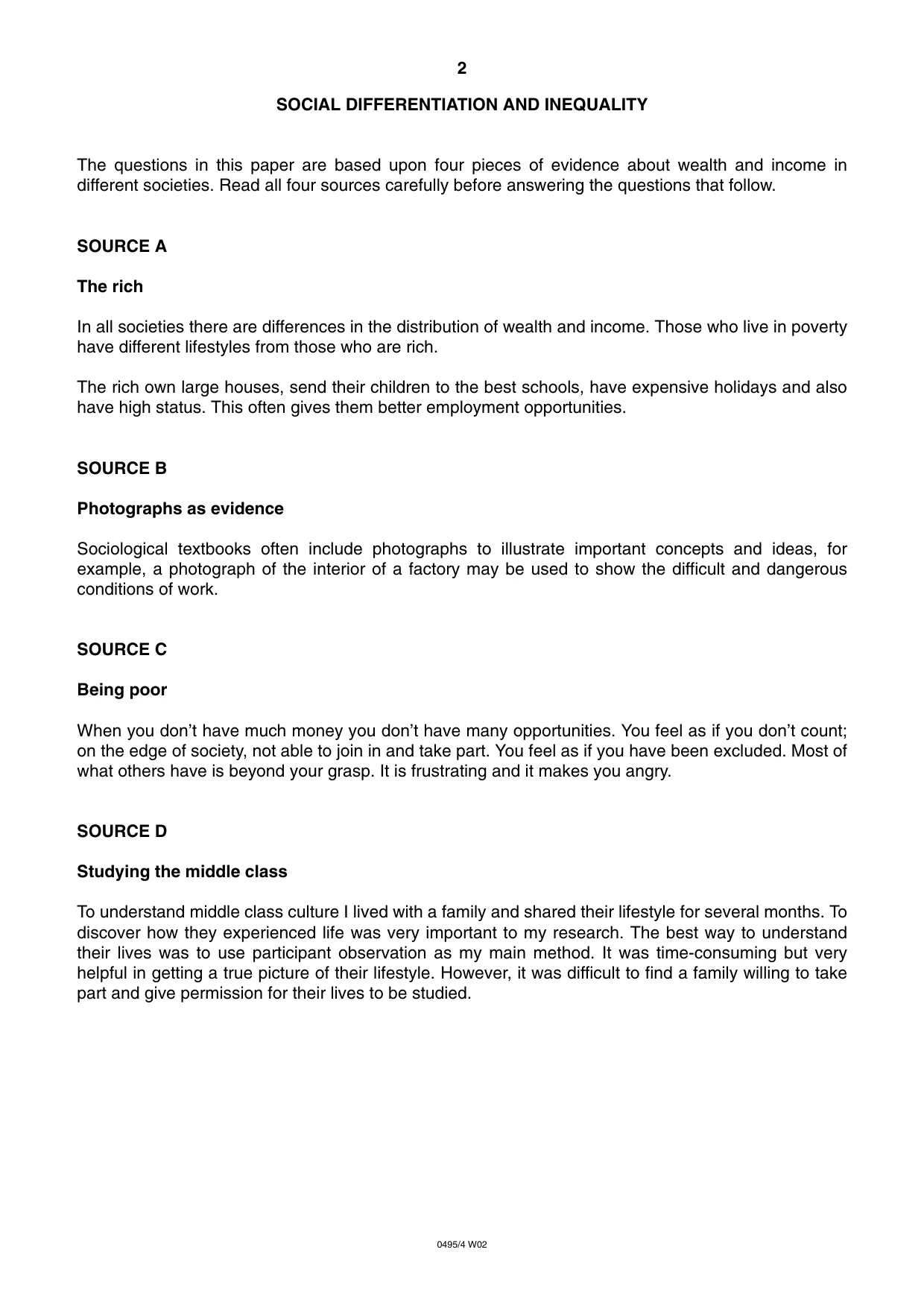
2 0495/4 W02 SOCIAL DIFFERENTIATION AND INEQUALITY The questions in this paper are based upon four pieces of evidence about wealth and income in different societies. Read all four sources carefully before answering the questions that follow. SOURCE A The rich In all societies there are differences in the distribution of wealth and income. Those who live in poverty have different lifestyles from those who are rich. The rich own large houses, send their children to the best schools, have expensive holidays and also have high status. This often gives them better employment opportunities. SOURCE B Photographs as evidence Sociological textbooks often include photographs to illustrate important concepts and ideas, for example, a photograph of the interior of a factory may be used to show the difficult and dangerous conditions of work. SOURCE C Being poor When you don’t have much money you don’t have many opportunities. You feel as if you don’t count; on the edge of society, not able to join in and take part. You feel as if you have been excluded. Most of what others have is beyond your grasp. It is frustrating and it makes you angry. SOURCE D Studying the middle class To understand middle class culture I lived with a family and shared their lifestyle for several months. To discover how they experienced life was very important to my research. The best way to understand their lives was to use participant observation as my main method. It was time-consuming but very helpful in getting a true picture of their lifestyle. However, it was difficult to find a family willing to take part and give permission for their lives to be studied.
Question paper, page 3
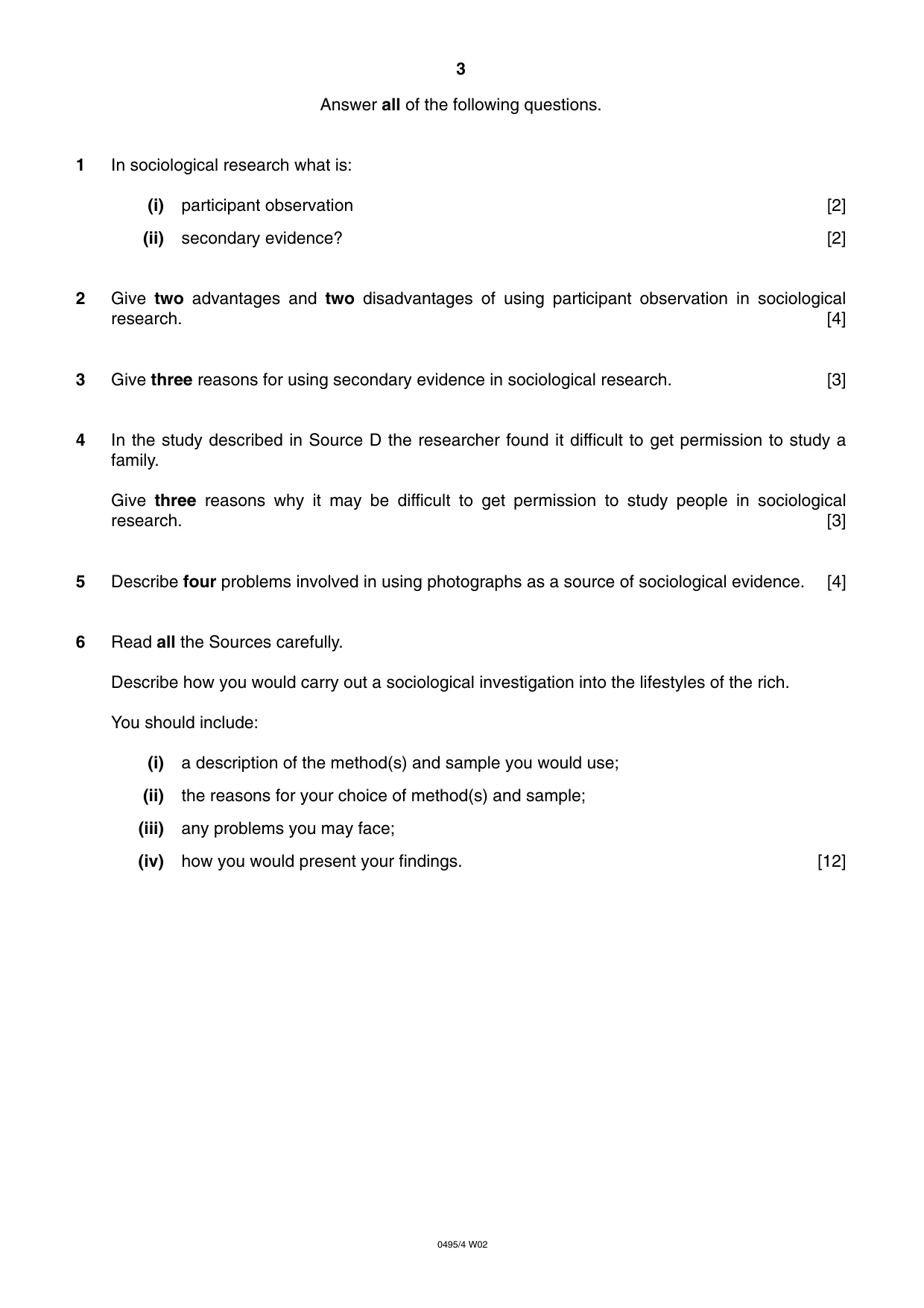
3 0495/4 W02 Answer all of the following questions. 1 In sociological research what is: (i) participant observation [2] (ii) secondary evidence? [2] 2 Give two advantages and two disadvantages of using participant observation in sociological research. [4] 3 Give three reasons for using secondary evidence in sociological research. [3] 4 In the study described in Source D the researcher found it difficult to get permission to study a family. Give three reasons why it may be difficult to get permission to study people in sociological research. [3] 5 Describe four problems involved in using photographs as a source of sociological evidence. [4] 6 Read all the Sources carefully. Describe how you would carry out a sociological investigation into the lifestyles of the rich. You should include: (i) a description of the method(s) and sample you would use; (ii) the reasons for your choice of method(s) and sample; (iii) any problems you may face; (iv) how you would present your findings. [12]
Mark scheme, page 1
CAMBRIDGE INTERNATIONAL EXAMINATIONS NOVEMBER 2002 INTERNATIONAL GCSE UNIVERSITY of CAMBRIDGE Local Examinations Syndicate
Mark scheme, page 2
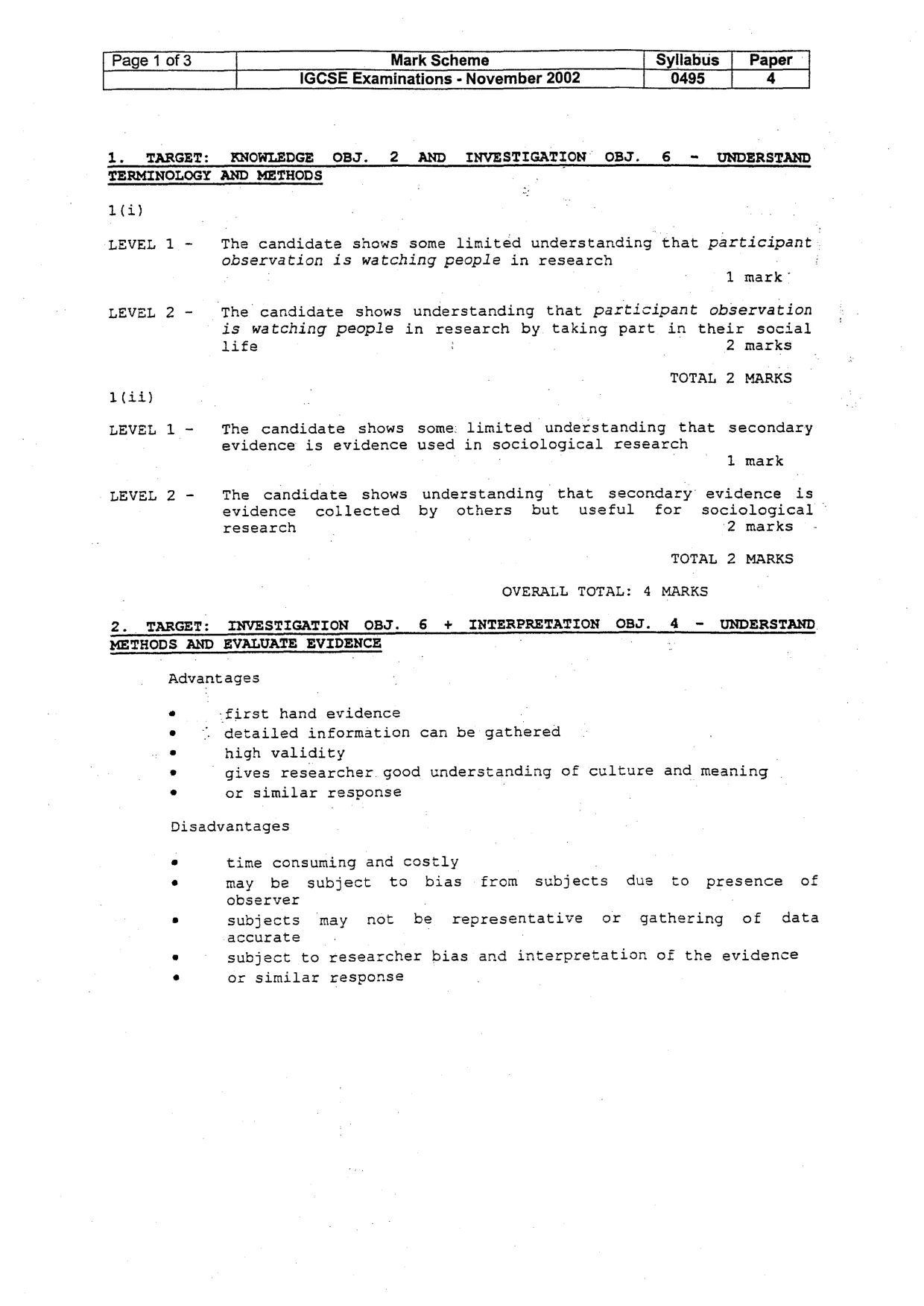
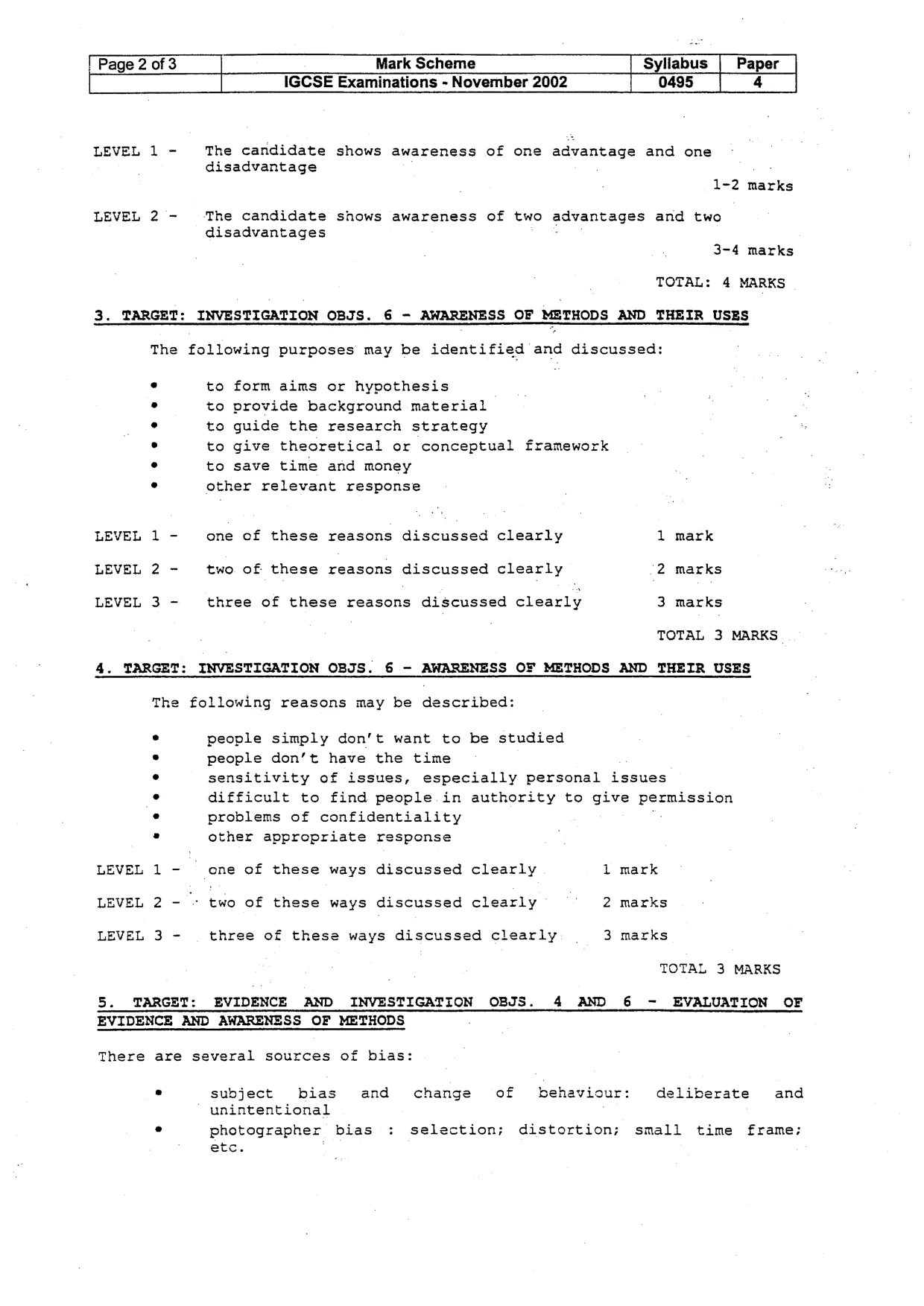
Page 1 of 3 Mark Scheme Syllabus | Paper IGCSE Examinations - November 2002 0495 1. TARGET: KNOWLEDGE OBJ. 2 AND INVESTIGATION OBJ. 6 - UNDERSTAND TERMINOLOGY AND METHODS . 1(i) LEVEL 1 - The candidate shows some limited understanding that participant observation is watching people in research 1 mark” LEVEL 2 - The candidate shows understanding that participant observation is watching people in research by taking part in their social life : 2 marks TOTAL 2 MARKS 1(ii) LEVEL 1 - The candidate shows some: limited understanding that secondary evidence is evidence used in sociological research 1 mark LEVEL 2 - The candidate shows understanding that secondary evidence is evidence collected by others but useful for sociological research 2 marks TOTAL 2 MARKS OVERALL TOTAL: 4 MARKS 2. TARGET: INVESTIGATION OBJ. 6 + INTERPRETATION OBJ. 4 - UNDERSTAND METHODS AND EVALUATE EVIDENCE Advantages e first hand evidence e “detailed information can be gathered ° high validity . gives researcher. good understanding of culture and meaning . or similar response Disadvantages . time consuming and costly . may be subject to bias from subjects due to presence of observer . subjects may not be representative or gathering of data accurate . subject to researcher bias and interpretation of the evidence . or similar response
Mark scheme, page 3
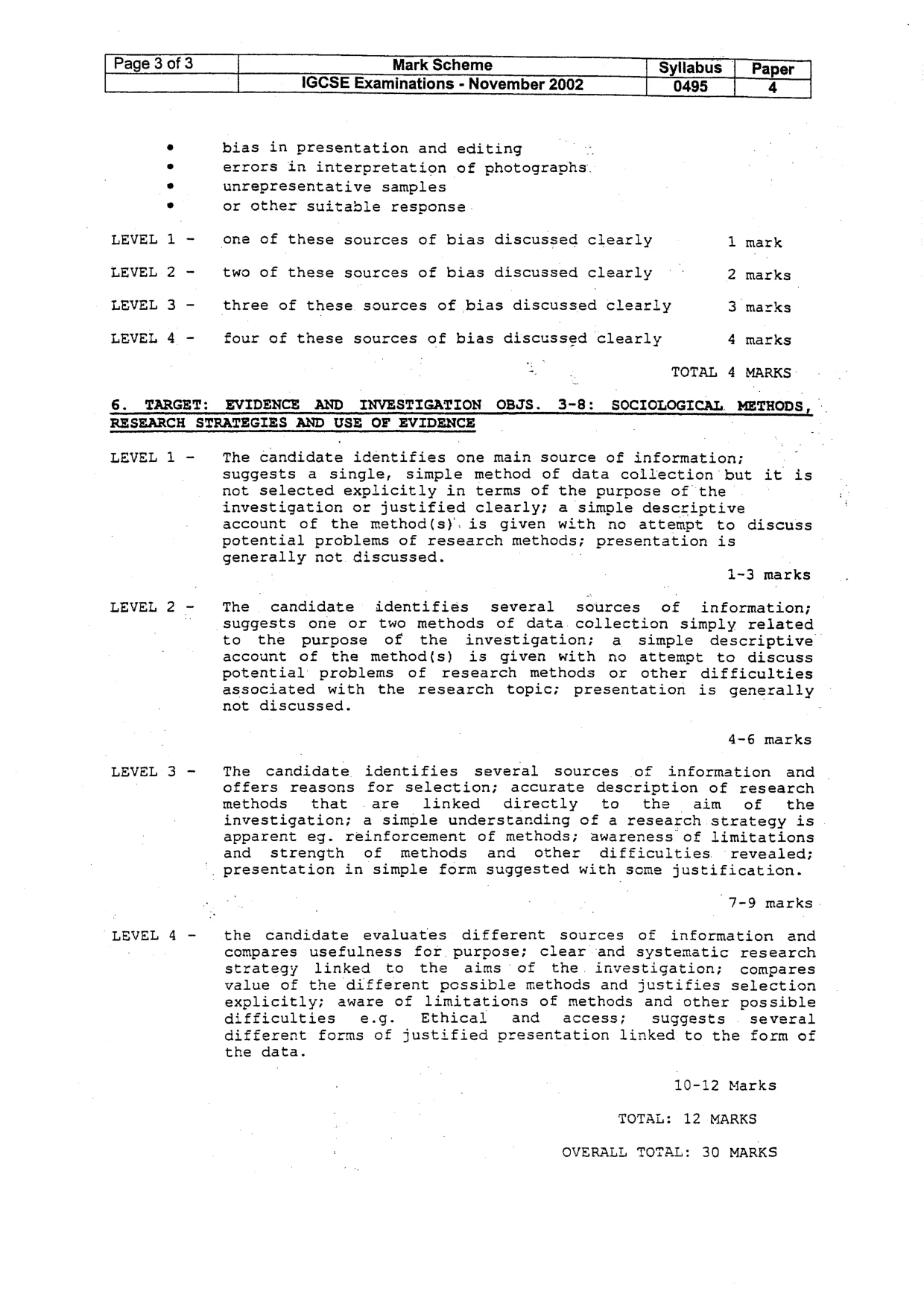
Page 2 of 3 Mark Scheme Syliabus | Paper IGCSE Examinations - November 2002 0495 4 LEVEL 1 - The candidate shows awareness of one advantage and one disadvantage 1-2 marks LEVEL 2 - The candidate shows awareness of two advantages and two disadvantages 3-4 marks TOTAL: 4 MARKS 3. TARGET: INVESTIGATION OBJS. 6 - AWARENESS OF METHODS AND THEIR USES The following purposes may be identified and discussed: to form aims or hypothesis to provide background material to guide the research strategy to give theoretical or conceptual framework to save time and money other relevant response eececeee LEVEL 1 - one of these reasons discussed clearly 1 mark LEVEL 2 - two of these reasons discussed clearly 2 marks LEVEL 3 - three of these reasons discussed clearly 3 marks TOTAL 3 MARKS 4. TARGET: INVESTIGATION OBJS. 6 - AWARENESS OF METHODS AND THEIR USES The following reasons may be described: e people simply don’t want to be studied people don’t have the time ° sensitivity of issues, especially personal issues ° difficult to find people in authority to give permission . problems of confidentiality ° . other appropriate response LEVEL 1 - one of these ways discussed clearly 1 mark LEVEL 2 - - two of these ways discussed clearly 2 marks LEVEL 3 - three of these ways discussed clearly 3 marks TOTAL 3 MARKS 5. TARGET: EVIDENCE AND INVESTIGATION OBJS. 4 AND 6 - EVALUATION OF EVIDENCE AND AWARENESS OF METHODS There are several sources of bias: . subject bias and change of behaviour: deliberate and unintentional e photographer bias : selection; distortion; small time frame; etc.
Mark scheme, page 4
Page 3 of 3 Mark Scheme [Syllabus | Paper | IGCSE Examinations - November 2002 [ o495 [4 | LEVEL a t LEVEL 2 - LEVEL 3 - LEVEL 4 - 6. TARGET: bias in presentation and editing errors in interpretation of photographs unrepresentative samples or other suitable response one of these sources of bias discussed clearly 1 mark two of these sources of bias discussed clearly 2 marks three of these sources of bias discussed clearly 3 marks four of these sources of bias discussed clearly 4 marks Lo TOTAL 4 MARKS EVIDENCE AND INVESTIGATION OBJS. 3-8: SOCIOLOGICAL METHODS a EN ER RESEARCH STRATEGIES AND USE OF EVIDENCE LEVEL 1 - LEVEL 2 ~- LEVEL 3 - LEVEL 4 - The candidate identifies one main source of information; suggests a single, simple method of data collection but it is not selected explicitly in terms of the purpose of the investigation or justified clearly; a simple descriptive account of the method(s)'. is given with no attempt to discuss potential problems of research methods; presentation is generally not discussed. 1-3 marks The candidate identifies several sources of information; suggests one or two methods of data collection simply related to the purpose of the investigation; a simple descriptive account of the method(s) is given with no attempt to discuss potential problems of research methods or other difficulties associated with the research topic; presentation is generally not discussed. 4-6 marks The candidate identifies several sources of information and offers reasons for selection; accurate description of research methods that are linked directly to the aim of the investigation; a simple understanding of a research strategy is apparent eg. reinforcement of methods; awareness of limitations and strength of methods and other difficulties. revealed; presentation in simple form suggested with some justification. 7-9 marks the candidate evaluates different sources of information and compares usefulness for. purpose; clear and systematic research strategy linked to the aims of the. investigation; compares value of the different possible methods and justifies selection explicitly; aware of limitations of methods and other possible difficulties e.g. Ethical and access; suggests several different forms of justified presentation linked to the form of the data. 10-12 Marks TOTAL: 12 MARKS OVERALL TOTAL: 30 MARKS