Cambridge IGCSE Sanskrit 0499 — 2020 May/June Paper 1 · Variant 0
0499/10/M/J/20
The question paper and its mark scheme, free to read here and free to download. This is Cambridge’s own paper, exactly as it was sat.
Question paper8 pages
Mark scheme
No mark scheme is in the library for this paper.
Paper as text
Question paper, page 1
DC (NF/CB) 183252/3 © UCLES 2020 [Turn over This document has 8 pages. Blank pages are indicated. SANSKRIT 0499/01 Paper 1 Language May/June 2020 1 hour 30 minutes You must answer on the answer booklet/paper. You will need: Answer booklet/paper INSTRUCTIONS ● Answer all questions. ● If you have been given an answer booklet, follow the instructions on the front cover of the answer booklet. ● Use a black or dark blue pen. ● Write your name, centre number and candidate number on all the work you hand in. ● Do not use an erasable pen or correction fluid. ● In Sanskrit passages, underlined words are glossed. ● At the end of the examination, fasten all your work together. Do not use staples, paper clips or glue. INFORMATION ● The total mark for this paper is 90. ● The number of marks for each question or part question is shown in brackets [ ]. Cambridge IGCSE™ * 4 7 6 7 8 1 6 8 5 0 *
Question paper, page 2
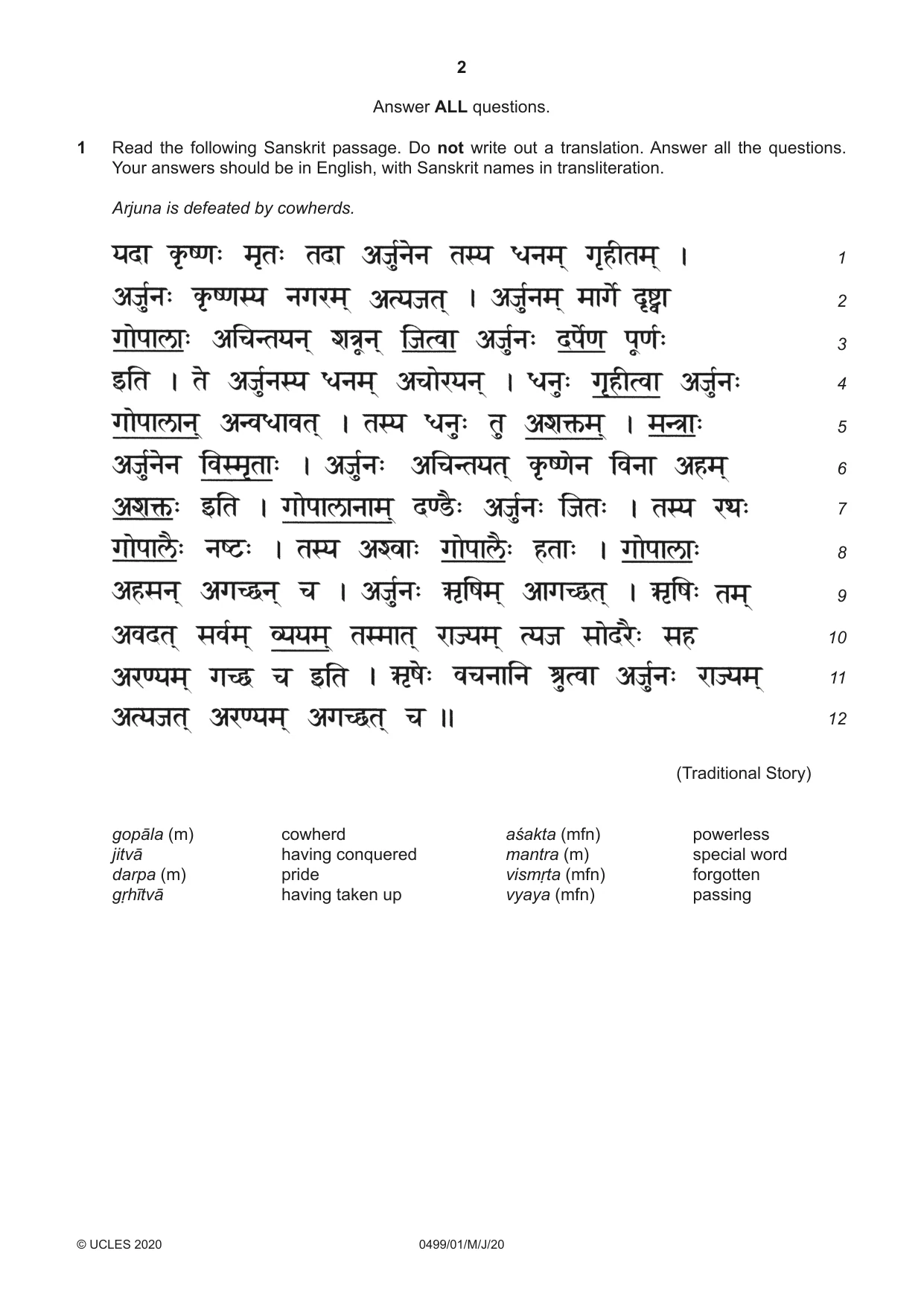
2 0499/01/M/J/20 © UCLES 2020 Answer ALL questions. 1 Read the following Sanskrit passage. Do not write out a translation. Answer all the questions. Your answers should be in English, with Sanskrit names in transliteration. Arjuna is defeated by cowherds. 1 2 3 4 5 6 7 8 9 10 11 12 (Traditional Story) gopāla (m) cowherd aśakta (mfn) powerless jitvā having conquered mantra (m) special word darpa (m) pride vismṛta (mfn) forgotten gṛhītvā having taken up vyaya (mfn) passing
Question paper, page 3
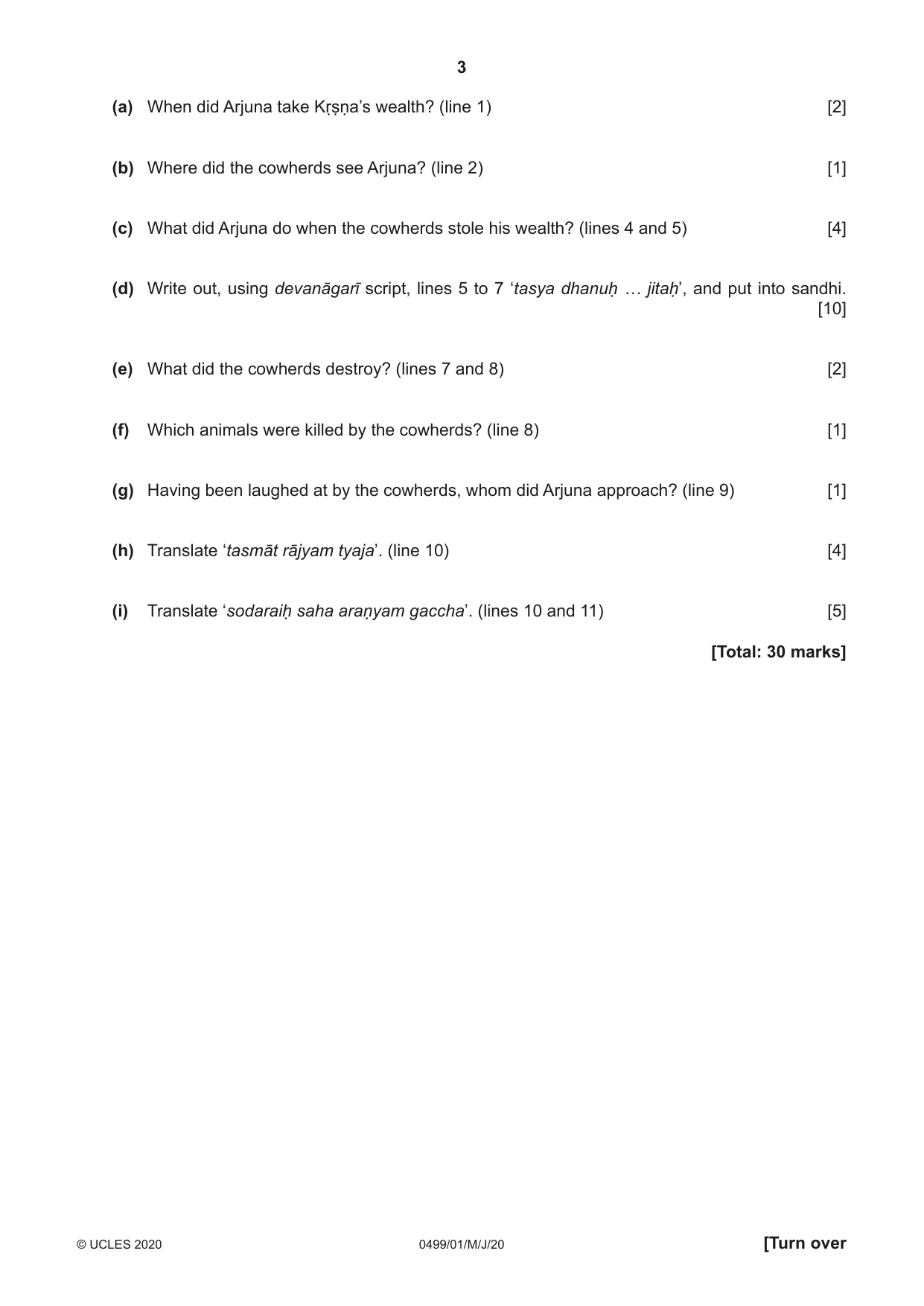
3 0499/01/M/J/20 © UCLES 2020 [Turn over (a) When did Arjuna take Kṛṣṇa’s wealth? (line 1) [2] (b) Where did the cowherds see Arjuna? (line 2) [1] (c) What did Arjuna do when the cowherds stole his wealth? (lines 4 and 5) [4] (d) Write out, using devanāgarī script, lines 5 to 7 ‘tasya dhanuḥ … jitaḥ’, and put into sandhi. [10] (e) What did the cowherds destroy? (lines 7 and 8) [2] (f) Which animals were killed by the cowherds? (line 8) [1] (g) Having been laughed at by the cowherds, whom did Arjuna approach? (line 9) [1] (h) Translate ‘tasmāt rājyam tyaja’. (line 10) [4] (i) Translate ‘sodaraiḥ saha araṇyam gaccha’. (lines 10 and 11) [5] [Total: 30 marks]
Question paper, page 4
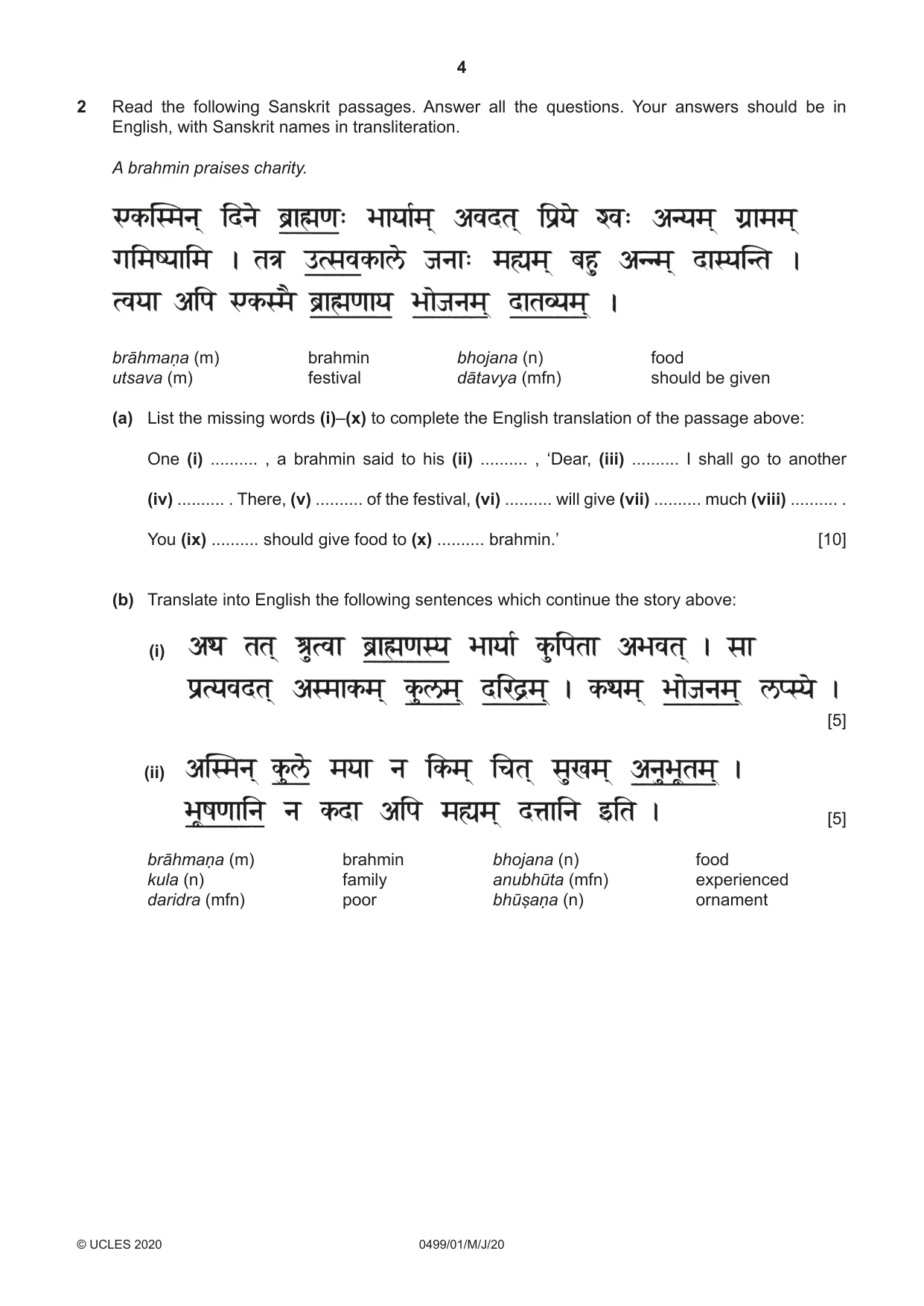
4 0499/01/M/J/20 © UCLES 2020 2 Read the following Sanskrit passages. Answer all the questions. Your answers should be in English, with Sanskrit names in transliteration. A brahmin praises charity. brāhmaṇa (m) brahmin bhojana (n) food utsava (m) festival dātavya (mfn) should be given (a) List the missing words (i)–(x) to complete the English translation of the passage above: One (i) … , a brahmin said to his (ii) … , ‘Dear, (iii) … I shall go to another (iv) … . There, (v) … of the festival, (vi) … will give (vii) … much (viii) … . You (ix) … should give food to (x) … brahmin.’ [10] (b) Translate into English the following sentences which continue the story above: (i) [5] (ii) [5] brāhmaṇa (m) brahmin bhojana (n) food kula (n) family anubhūta (mfn) experienced daridra (mfn) poor bhūṣaṇa (n) ornament
Question paper, page 5
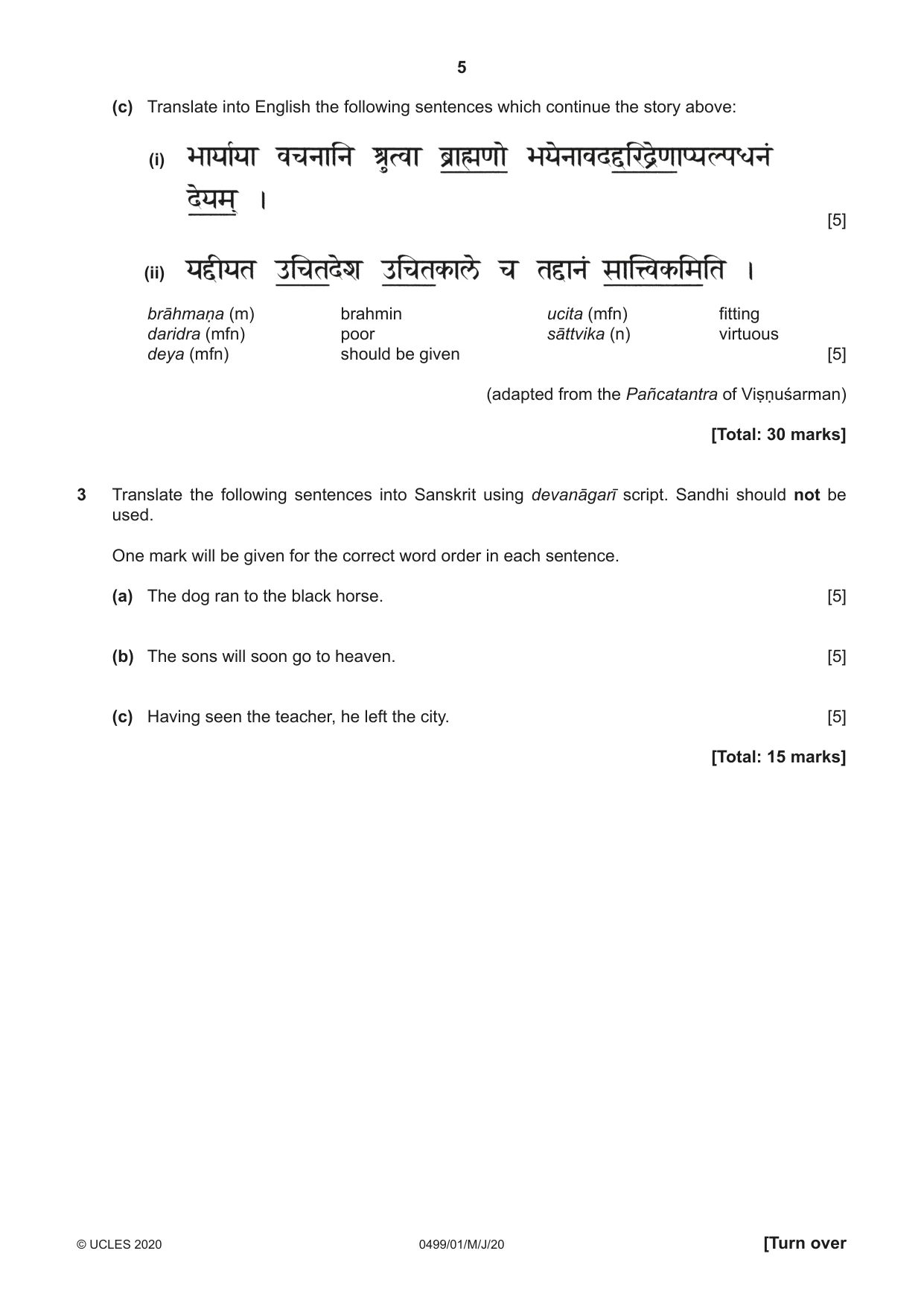
5 0499/01/M/J/20 © UCLES 2020 [Turn over (c) Translate into English the following sentences which continue the story above: (i) [5] (ii) brāhmaṇa (m) brahmin ucita (mfn) fitting daridra (mfn) poor sāttvika (n) virtuous deya (mfn) should be given [5] (adapted from the Pañcatantra of Viṣṇuśarman) [Total: 30 marks] 3 Translate the following sentences into Sanskrit using devanāgarī script. Sandhi should not be used. One mark will be given for the correct word order in each sentence. (a) The dog ran to the black horse. [5] (b) The sons will soon go to heaven. [5] (c) Having seen the teacher, he left the city. [5] [Total: 15 marks]
Question paper, page 6
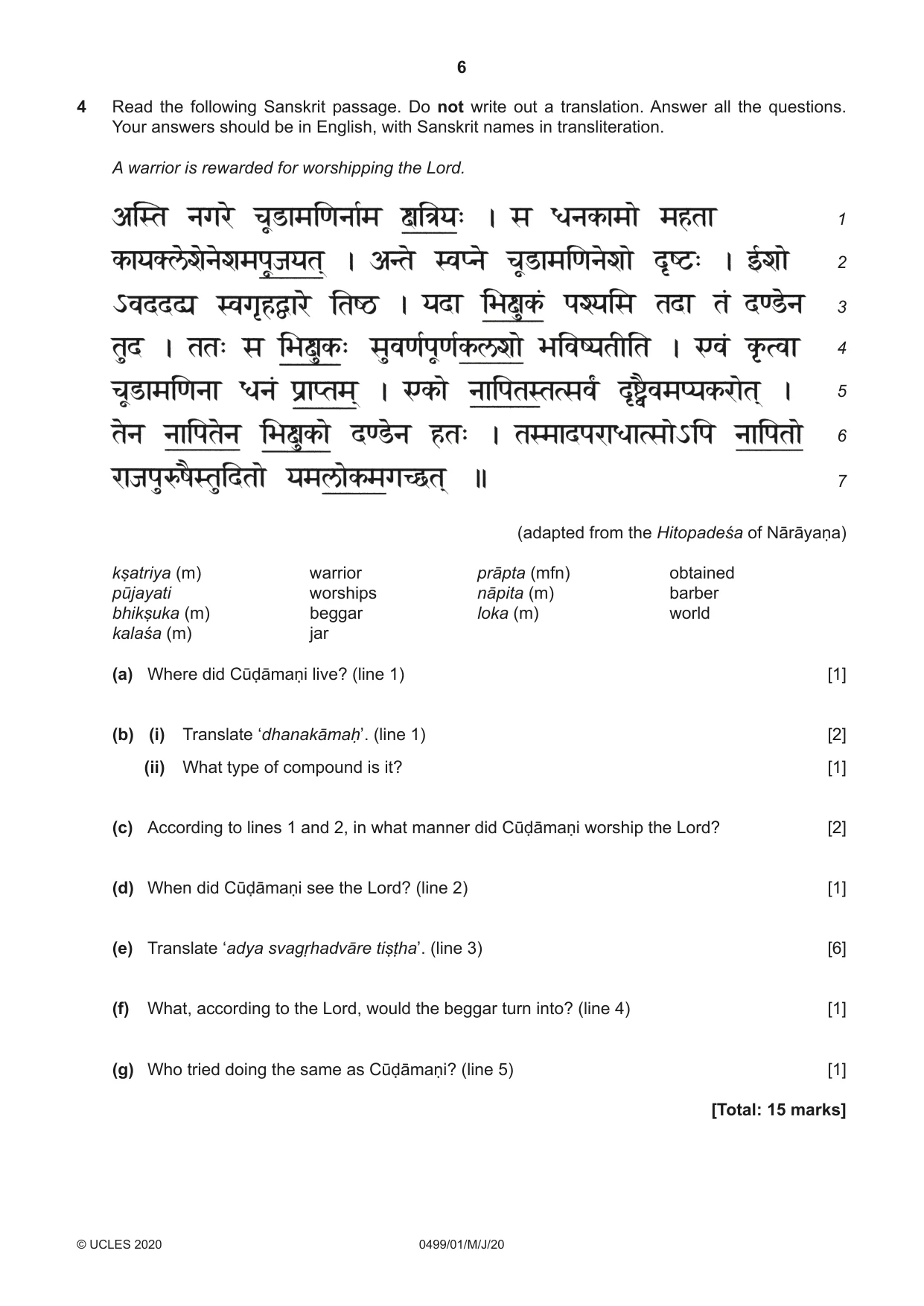
6 0499/01/M/J/20 © UCLES 2020 4 Read the following Sanskrit passage. Do not write out a translation. Answer all the questions. Your answers should be in English, with Sanskrit names in transliteration. A warrior is rewarded for worshipping the Lord. 1 2 3 4 5 6 7 (adapted from the Hitopadeśa of Nārāyaṇa) kṣatriya (m) warrior prāpta (mfn) obtained pūjayati worships nāpita (m) barber bhikṣuka (m) beggar loka (m) world kalaśa (m) jar (a) Where did Cūḍāmaṇi live? (line 1) [1] (b) (i) Translate ‘dhanakāmaḥ’. (line 1) [2] (ii) What type of compound is it? [1] (c) According to lines 1 and 2, in what manner did Cūḍāmaṇi worship the Lord? [2] (d) When did Cūḍāmaṇi see the Lord? (line 2) [1] (e) Translate ‘adya svagṛhadvāre tiṣṭha’. (line 3) [6] (f) What, according to the Lord, would the beggar turn into? (line 4) [1] (g) Who tried doing the same as Cūḍāmaṇi? (line 5) [1] [Total: 15 marks]
Question paper, page 7
7 0499/01/M/J/20 © UCLES 2020 BLANK PAGE
Question paper, page 8
8 0499/01/M/J/20 © UCLES 2020 Permission to reproduce items where third-party owned material protected by copyright is included has been sought and cleared where possible. Every reasonable effort has been made by the publisher (UCLES) to trace copyright holders, but if any items requiring clearance have unwittingly been included, the publisher will be pleased to make amends at the earliest possible opportunity. To avoid the issue of disclosure of answer-related information to candidates, all copyright acknowledgements are reproduced online in the Cambridge Assessment International Education Copyright Acknowledgements Booklet. This is produced for each series of examinations and is freely available to download at www.cambridgeinternational.org after the live examination series. Cambridge Assessment International Education is part of the Cambridge Assessment Group. Cambridge Assessment is the brand name of the University of Cambridge Local Examinations Syndicate (UCLES), which itself is a department of the University of Cambridge. BLANK PAGE