Cambridge IGCSE Sanskrit 0499 — 2019 May/June Paper 1 · Variant 1
0499/11/M/J/19 · 90 marks · ≈101 min
The question paper and its mark scheme, free to read here and free to download. This is Cambridge’s own paper, exactly as it was sat.
Question paper8 pages
Mark scheme5 pages
Answers below. Sit the paper first if you are practising.
Paper as text
Question paper, page 1
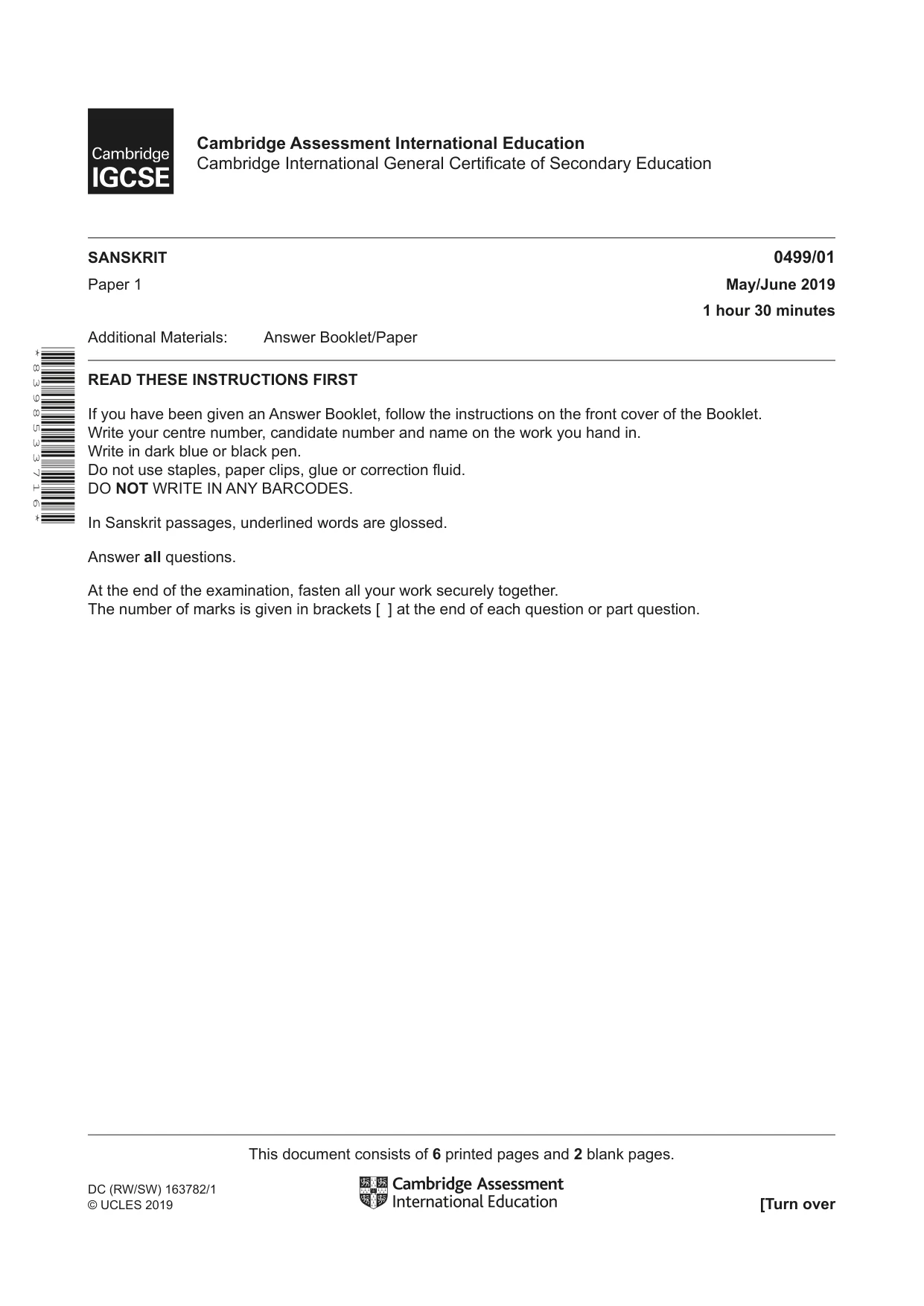
This document consists of 6 printed pages and 2 blank pages. DC (RW/SW) 163782/1 © UCLES 2019 [Turn over * 8 3 9 8 5 3 3 7 1 6 * SANSKRIT 0499/01 Paper 1 May/June 2019 1 hour 30 minutes Additional Materials: Answer Booklet/Paper READ THESE INSTRUCTIONS FIRST If you have been given an Answer Booklet, follow the instructions on the front cover of the Booklet. Write your centre number, candidate number and name on the work you hand in. Write in dark blue or black pen. Do not use staples, paper clips, glue or correction fluid. DO NOT WRITE IN ANY BARCODES. In Sanskrit passages, underlined words are glossed. Answer all questions. At the end of the examination, fasten all your work securely together. The number of marks is given in brackets [ ] at the end of each question or part question. Cambridge Assessment International Education Cambridge International General Certificate of Secondary Education
Question paper, page 2
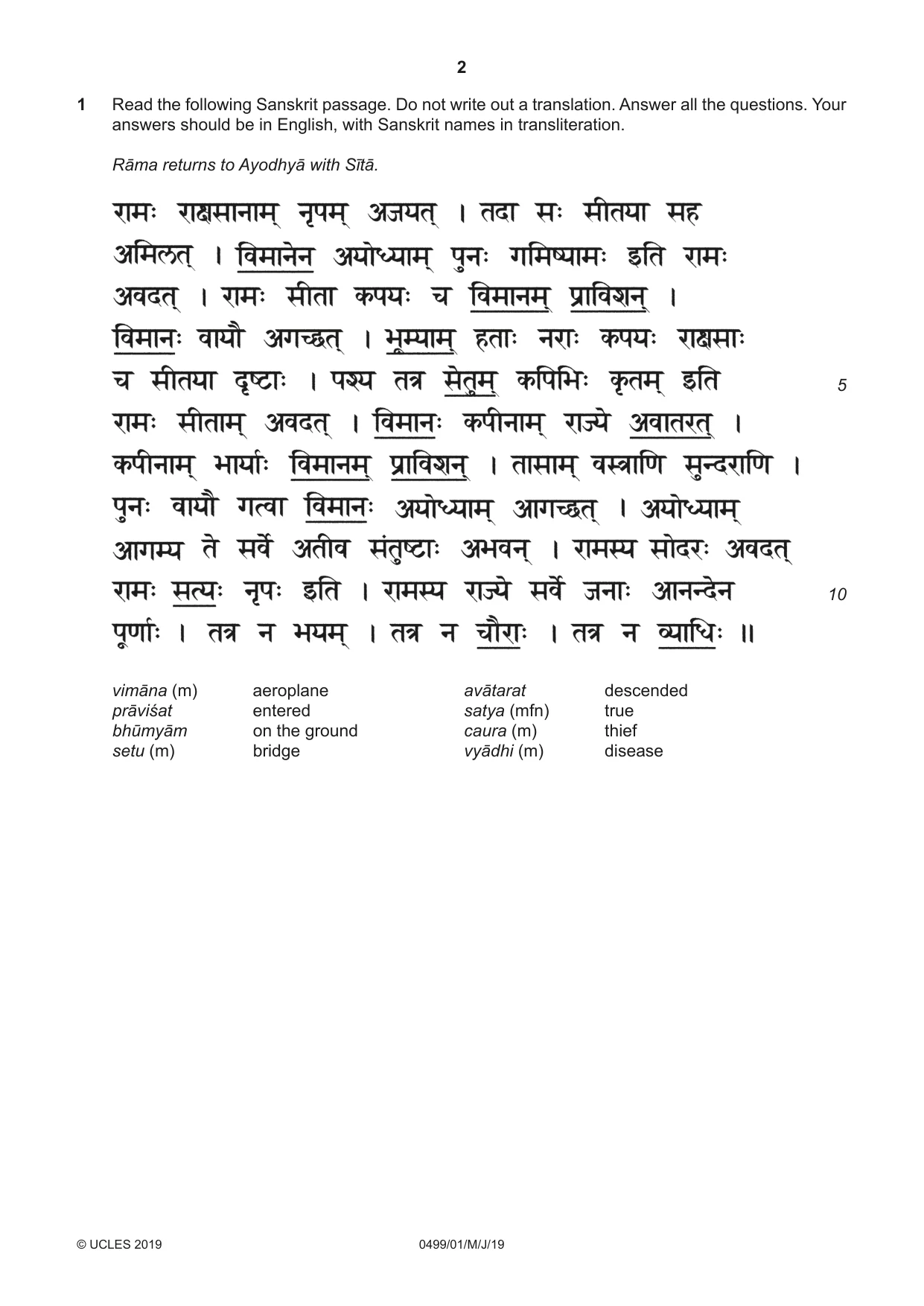
2 0499/01/M/J/19 © UCLES 2019 1 Read the following Sanskrit passage. Do not write out a translation. Answer all the questions. Your answers should be in English, with Sanskrit names in transliteration. Rāma returns to Ayodhyā with Sītā. 5 10 vimāna (m) aeroplane avātarat descended prāviśat entered satya (mfn) true bhūmyām on the ground caura (m) thief setu (m) bridge vyādhi (m) disease
Question paper, page 3
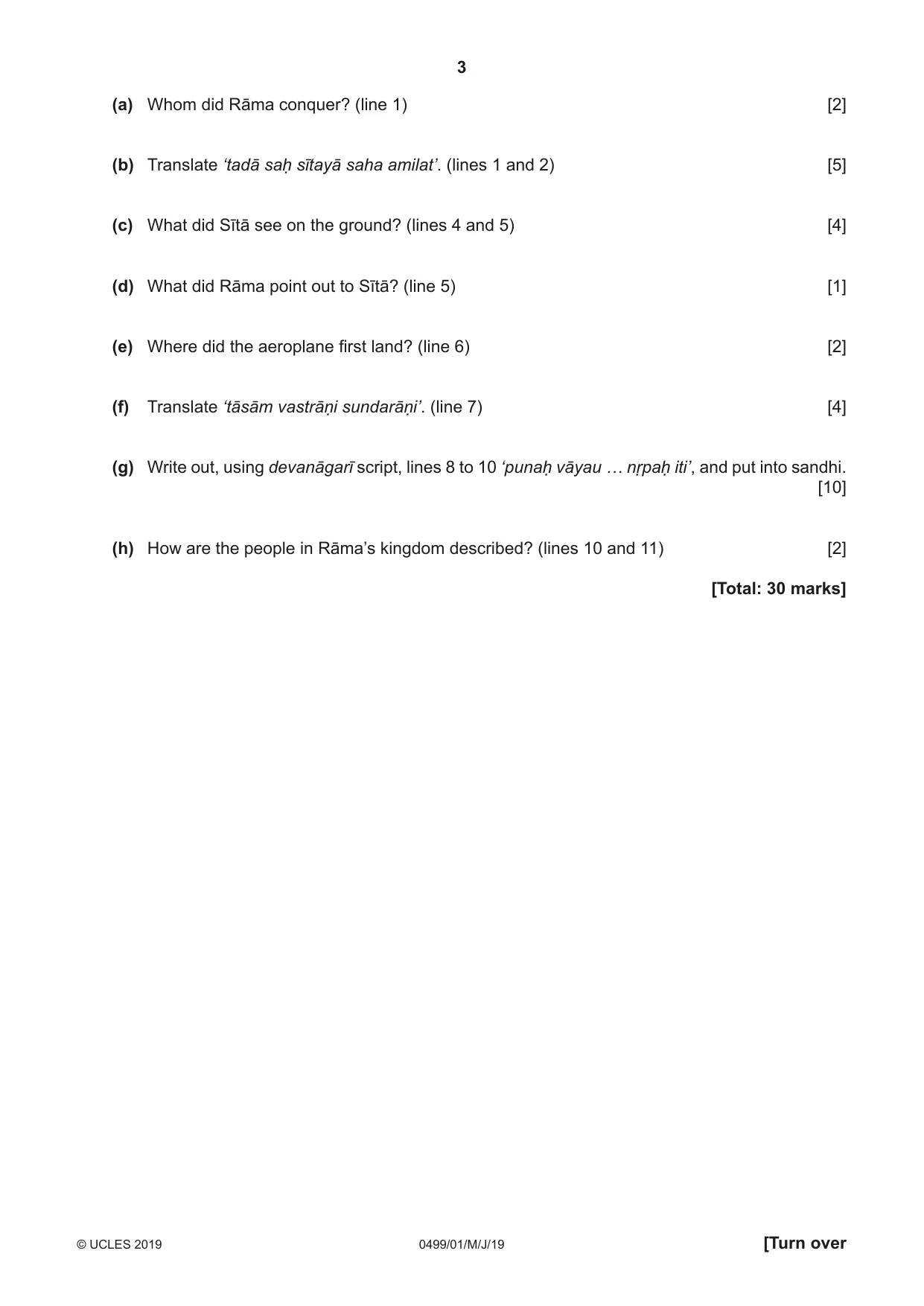
3 0499/01/M/J/19 © UCLES 2019 [Turn over (a) Whom did Rāma conquer? (line 1) [2] (b) Translate ‘tadā saḥ sītayā saha amilat’. (lines 1 and 2) [5] (c) What did Sītā see on the ground? (lines 4 and 5) [4] (d) What did Rāma point out to Sītā? (line 5) [1] (e) Where did the aeroplane first land? (line 6) [2] (f) Translate ‘tāsām vastrāṇi sundarāṇi’. (line 7) [4] (g) Write out, using devanāgarī script, lines 8 to 10 ‘punaḥ vāyau … nṛpaḥ iti’, and put into sandhi. [10] (h) How are the people in Rāma’s kingdom described? (lines 10 and 11) [2] [Total: 30 marks]
Question paper, page 4
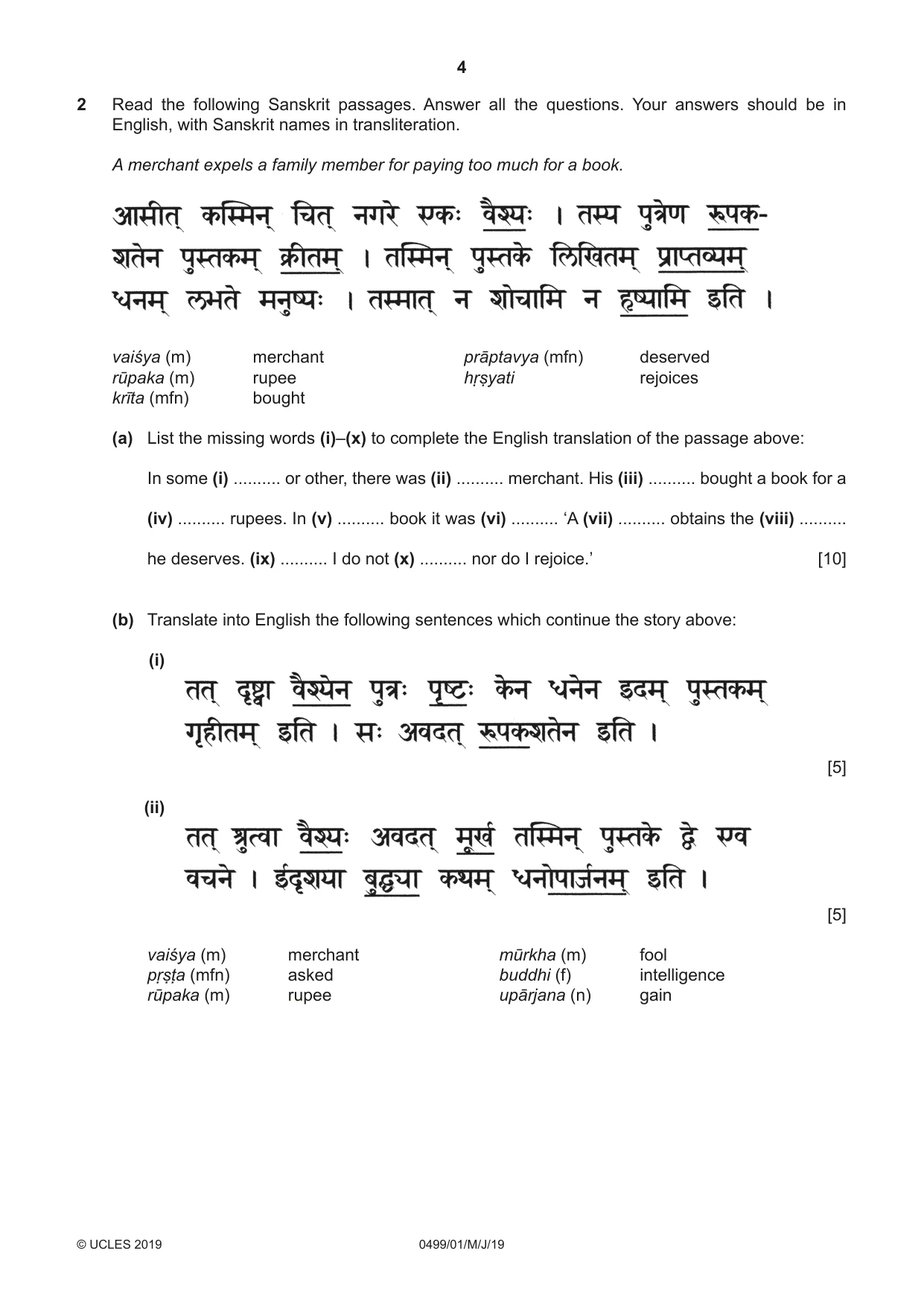
4 0499/01/M/J/19 © UCLES 2019 2 Read the following Sanskrit passages. Answer all the questions. Your answers should be in English, with Sanskrit names in transliteration. A merchant expels a family member for paying too much for a book. vaiśya (m) merchant prāptavya (mfn) deserved rūpaka (m) rupee hṛṣyati rejoices krīta (mfn) bought (a) List the missing words (i)–(x) to complete the English translation of the passage above: In some (i) … or other, there was (ii) … merchant. His (iii) … bought a book for a (iv) … rupees. In (v) … book it was (vi) … ‘A (vii) … obtains the (viii) … he deserves. (ix) … I do not (x) … nor do I rejoice.’ [10] (b) Translate into English the following sentences which continue the story above: (i) [5] (ii) [5] vaiśya (m) merchant mūrkha (m) fool pṛṣṭa (mfn) asked buddhi (f) intelligence rūpaka (m) rupee upārjana (n) gain
Question paper, page 5
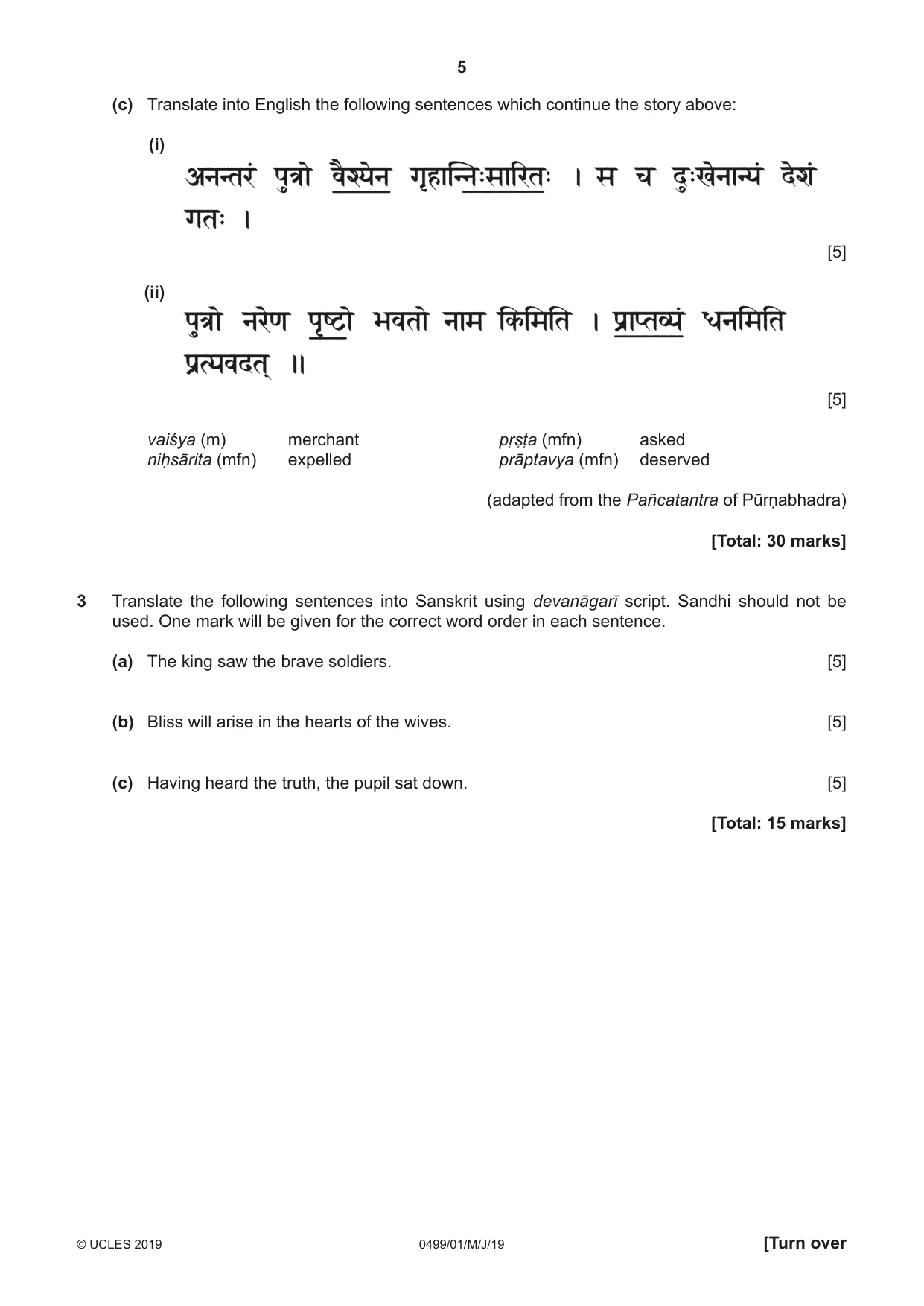
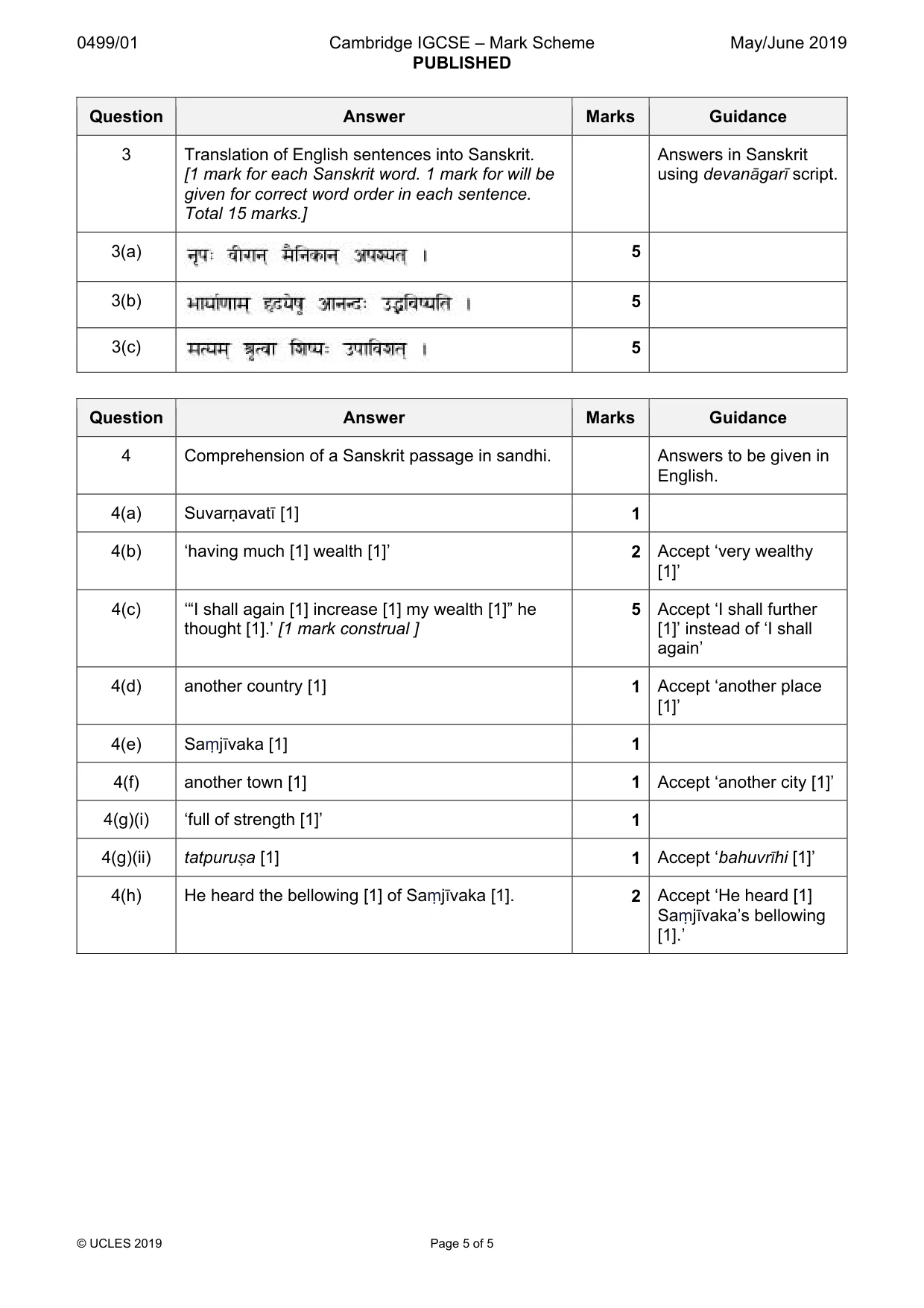
5 0499/01/M/J/19 © UCLES 2019 [Turn over (c) Translate into English the following sentences which continue the story above: (i) [5] (ii) [5] vaiśya (m) merchant pṛṣṭa (mfn) asked niḥsārita (mfn) expelled prāptavya (mfn) deserved (adapted from the Pañcatantra of Pūrṇabhadra) [Total: 30 marks] 3 Translate the following sentences into Sanskrit using devanāgarī script. Sandhi should not be used. One mark will be given for the correct word order in each sentence. (a) The king saw the brave soldiers. [5] (b) Bliss will arise in the hearts of the wives. [5] (c) Having heard the truth, the pupil sat down. [5] [Total: 15 marks]
Question paper, page 6
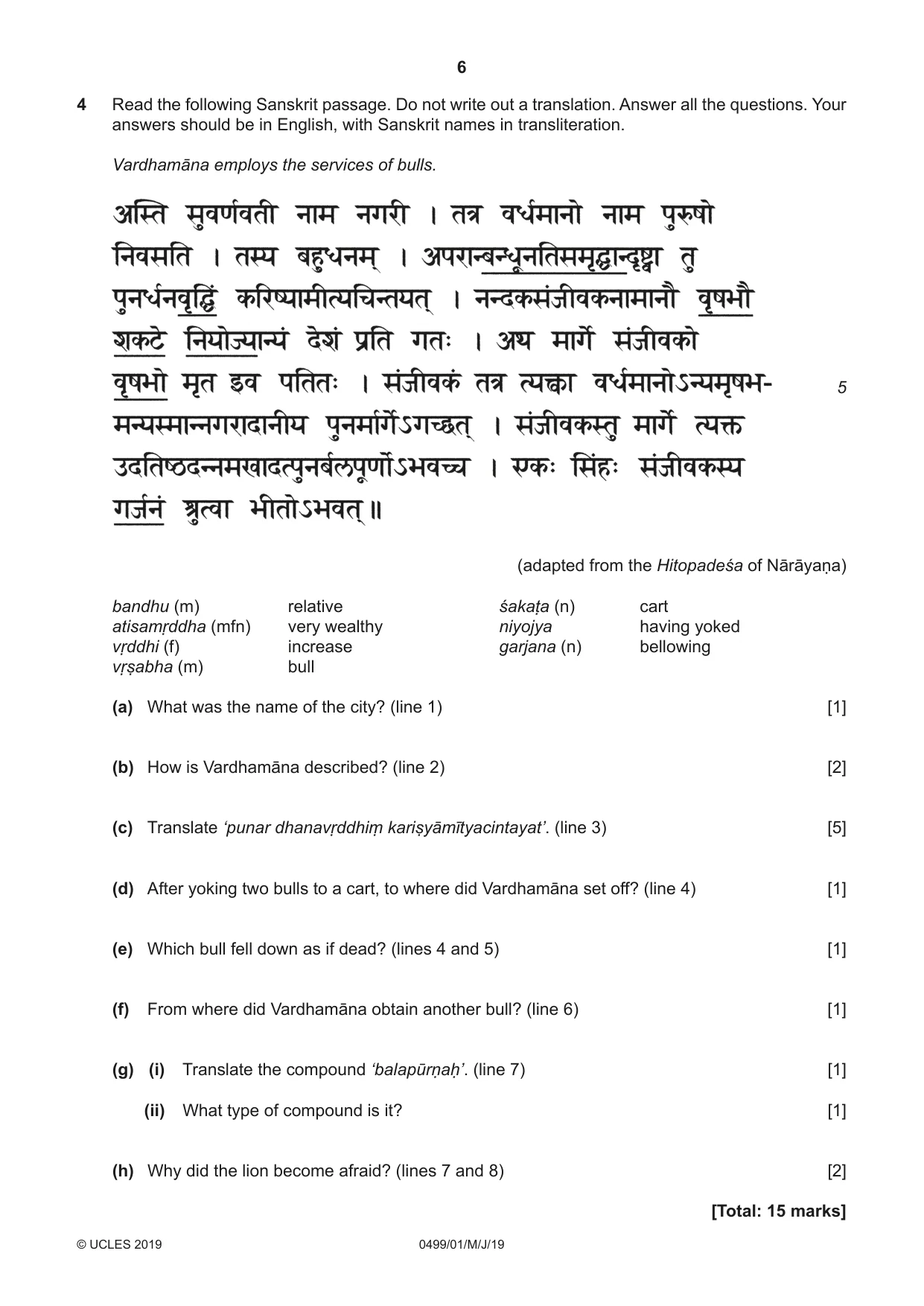
6 0499/01/M/J/19 © UCLES 2019 4 Read the following Sanskrit passage. Do not write out a translation. Answer all the questions. Your answers should be in English, with Sanskrit names in transliteration. Vardhamāna employs the services of bulls. 5 (adapted from the Hitopadeśa of Nārāyaṇa) bandhu (m) relative śakaṭa (n) cart atisamṛddha (mfn) very wealthy niyojya having yoked vṛddhi (f) increase garjana (n) bellowing vṛṣabha (m) bull (a) What was the name of the city? (line 1) [1] (b) How is Vardhamāna described? (line 2) [2] (c) Translate ‘punar dhanavṛddhiṃ kariṣyāmītyacintayat’. (line 3) [5] (d) After yoking two bulls to a cart, to where did Vardhamāna set off? (line 4) [1] (e) Which bull fell down as if dead? (lines 4 and 5) [1] (f) From where did Vardhamāna obtain another bull? (line 6) [1] (g) (i) Translate the compound ‘balapūrṇaḥ’. (line 7) [1] (ii) What type of compound is it? [1] (h) Why did the lion become afraid? (lines 7 and 8) [2] [Total: 15 marks]
Question paper, page 7
7 0499/01/M/J/19 © UCLES 2019 BLANK PAGE
Question paper, page 8
8 0499/01/M/J/19 © UCLES 2019 BLANK PAGE Permission to reproduce items where third-party owned material protected by copyright is included has been sought and cleared where possible. Every reasonable effort has been made by the publisher (UCLES) to trace copyright holders, but if any items requiring clearance have unwittingly been included, the publisher will be pleased to make amends at the earliest possible opportunity. To avoid the issue of disclosure of answer-related information to candidates, all copyright acknowledgements are reproduced online in the Cambridge Assessment International Education Copyright Acknowledgements Booklet. This is produced for each series of examinations and is freely available to download at www.cambridgeinternational.org after the live examination series. Cambridge Assessment International Education is part of the Cambridge Assessment Group. Cambridge Assessment is the brand name of the University of Cambridge Local Examinations Syndicate (UCLES), which itself is a department of the University of Cambridge.
Mark scheme, page 1
This document consists of 5 printed pages. © UCLES 2019 [Turn over Cambridge Assessment International Education Cambridge International General Certificate of Secondary Education SANSKRIT 0499/01 Paper 1 May/June 2019 MARK SCHEME Maximum Mark: 90 Published This mark scheme is published as an aid to teachers and candidates, to indicate the requirements of the examination. It shows the basis on which Examiners were instructed to award marks. It does not indicate the details of the discussions that took place at an Examiners’ meeting before marking began, which would have considered the acceptability of alternative answers. Mark schemes should be read in conjunction with the question paper and the Principal Examiner Report for Teachers. Cambridge International will not enter into discussions about these mark schemes. Cambridge International is publishing the mark schemes for the May/June 2019 series for most Cambridge IGCSE™, Cambridge International A and AS Level and Cambridge Pre-U components, and some Cambridge O Level components.
Mark scheme, page 2
0499/01 Cambridge IGCSE – Mark Scheme PUBLISHED May/June 2019 © UCLES 2019 Page 2 of 5 Generic Marking Principles These general marking principles must be applied by all examiners when marking candidate answers. They should be applied alongside the specific content of the mark scheme or generic level descriptors for a question. Each question paper and mark scheme will also comply with these marking principles. GENERIC MARKING PRINCIPLE 1: Marks must be awarded in line with: • the specific content of the mark scheme or the generic level descriptors for the question • the specific skills defined in the mark scheme or in the generic level descriptors for the question • the standard of response required by a candidate as exemplified by the standardisation scripts. GENERIC MARKING PRINCIPLE 2: Marks awarded are always whole marks (not half marks, or other fractions). GENERIC MARKING PRINCIPLE 3: Marks must be awarded positively: • marks are awarded for correct/valid answers, as defined in the mark scheme. However, credit is given for valid answers which go beyond the scope of the syllabus and mark scheme, referring to your Team Leader as appropriate • marks are awarded when candidates clearly demonstrate what they know and can do • marks are not deducted for errors • marks are not deducted for omissions • answers should only be judged on the quality of spelling, punctuation and grammar when these features are specifically assessed by the question as indicated by the mark scheme. The meaning, however, should be unambiguous. GENERIC MARKING PRINCIPLE 4: Rules must be applied consistently e.g. in situations where candidates have not followed instructions or in the application of generic level descriptors. GENERIC MARKING PRINCIPLE 5: Marks should be awarded using the full range of marks defined in the mark scheme for the question (however; the use of the full mark range may be limited according to the quality of the candidate responses seen). GENERIC MARKING PRINCIPLE 6: Marks awarded are based solely on the requirements as defined in the mark scheme. Marks should not be awarded with grade thresholds or grade descriptors in mind.
Mark scheme, page 3
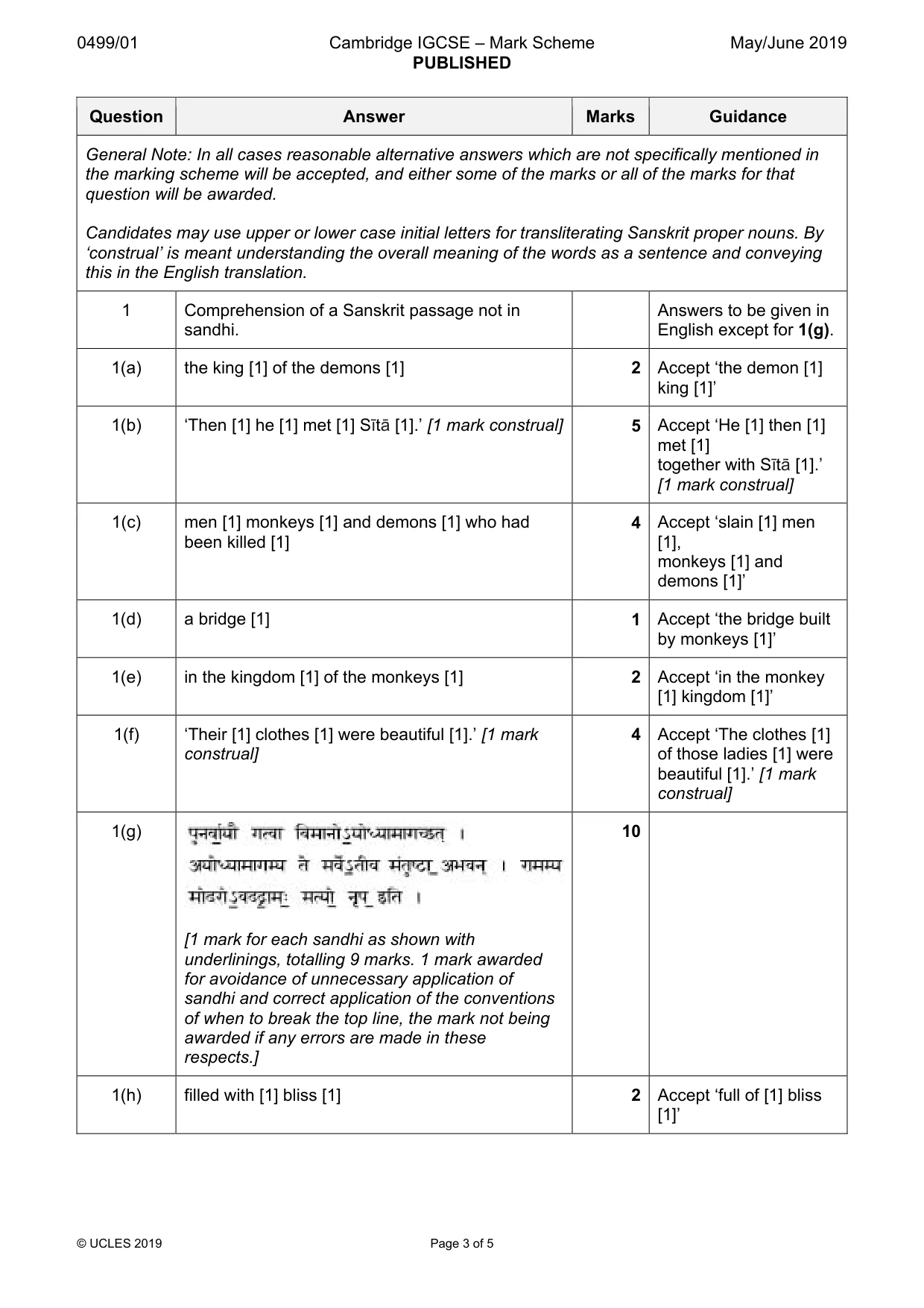
0499/01 Cambridge IGCSE – Mark Scheme PUBLISHED May/June 2019 © UCLES 2019 Page 3 of 5 Question Answer Marks Guidance General Note: In all cases reasonable alternative answers which are not specifically mentioned in the marking scheme will be accepted, and either some of the marks or all of the marks for that question will be awarded. Candidates may use upper or lower case initial letters for transliterating Sanskrit proper nouns. By ‘construal’ is meant understanding the overall meaning of the words as a sentence and conveying this in the English translation. 1 Comprehension of a Sanskrit passage not in sandhi. Answers to be given in English except for 1(g). 1(a) the king [1] of the demons [1] 2 Accept ‘the demon [1] king [1]’ 1(b) ‘Then [1] he [1] met [1] Sītā [1].’ [1 mark construal] 5 Accept ‘He [1] then [1] met [1] together with Sītā [1].’ [1 mark construal] 1(c) men [1] monkeys [1] and demons [1] who had been killed [1] 4 Accept ‘slain [1] men [1], monkeys [1] and demons [1]’ 1(d) a bridge [1] 1 Accept ‘the bridge built by monkeys [1]’ 1(e) in the kingdom [1] of the monkeys [1] 2 Accept ‘in the monkey [1] kingdom [1]’ 1(f) ‘Their [1] clothes [1] were beautiful [1].’ [1 mark construal] 4 Accept ‘The clothes [1] of those ladies [1] were beautiful [1].’ [1 mark construal] 1(g) [1 mark for each sandhi as shown with underlinings, totalling 9 marks. 1 mark awarded for avoidance of unnecessary application of sandhi and correct application of the conventions of when to break the top line, the mark not being awarded if any errors are made in these respects.] 10 1(h) filled with [1] bliss [1] 2 Accept ‘full of [1] bliss [1]’
Mark scheme, page 4
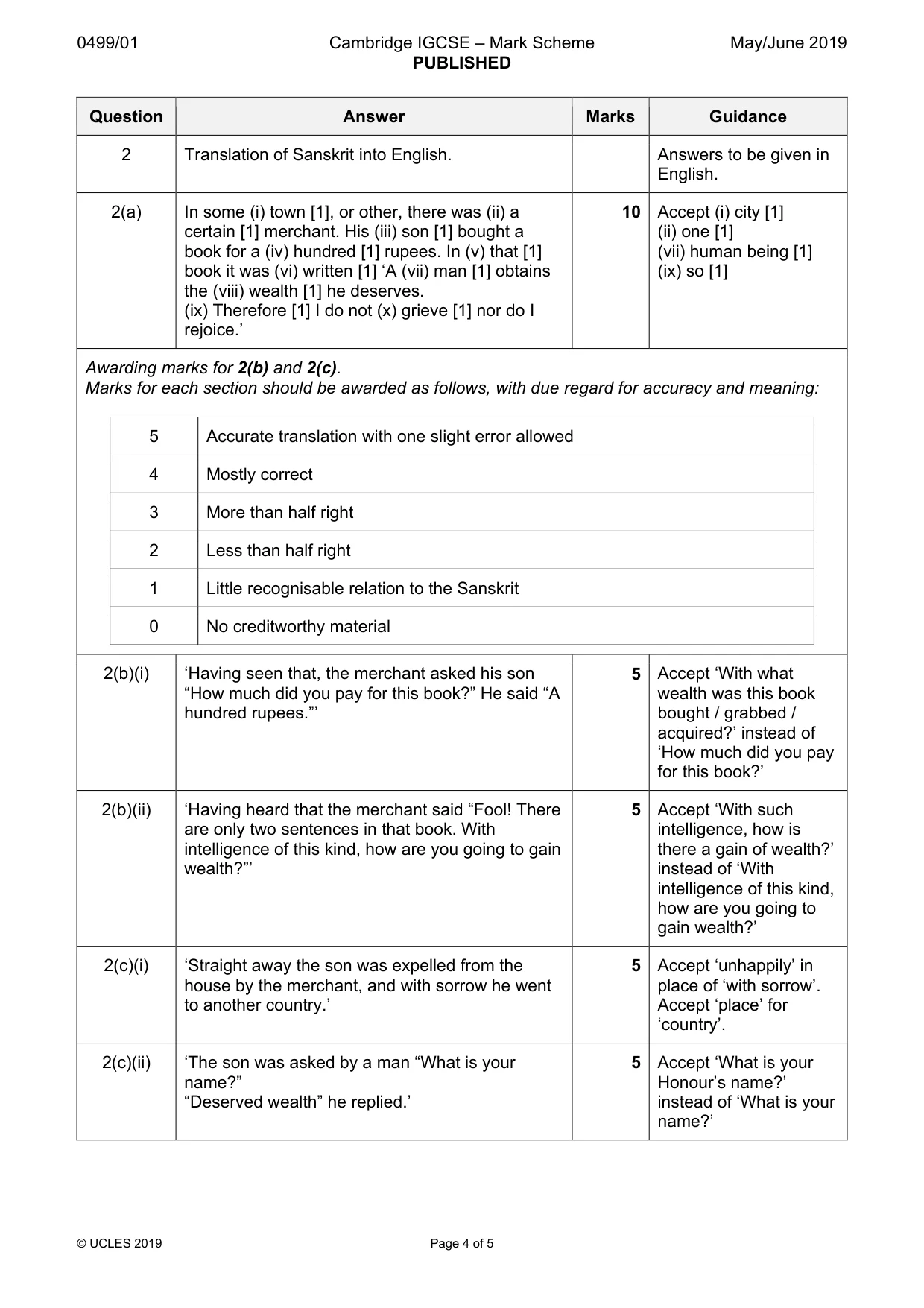
0499/01 Cambridge IGCSE – Mark Scheme PUBLISHED May/June 2019 © UCLES 2019 Page 4 of 5 Question Answer Marks Guidance 2 Translation of Sanskrit into English. Answers to be given in English. 2(a) In some (i) town [1], or other, there was (ii) a certain [1] merchant. His (iii) son [1] bought a book for a (iv) hundred [1] rupees. In (v) that [1] book it was (vi) written [1] ‘A (vii) man [1] obtains the (viii) wealth [1] he deserves. (ix) Therefore [1] I do not (x) grieve [1] nor do I rejoice.’ 10 Accept (i) city [1] (ii) one [1] (vii) human being [1] (ix) so [1] Awarding marks for 2(b) and 2(c). Marks for each section should be awarded as follows, with due regard for accuracy and meaning: 5 Accurate translation with one slight error allowed 4 Mostly correct 3 More than half right 2 Less than half right 1 Little recognisable relation to the Sanskrit 0 No creditworthy material 2(b)(i) ‘Having seen that, the merchant asked his son “How much did you pay for this book?” He said “A hundred rupees.”’ 5 Accept ‘With what wealth was this book bought / grabbed / acquired?’ instead of ‘How much did you pay for this book?’ 2(b)(ii) ‘Having heard that the merchant said “Fool! There are only two sentences in that book. With intelligence of this kind, how are you going to gain wealth?”’ 5 Accept ‘With such intelligence, how is there a gain of wealth?’ instead of ‘With intelligence of this kind, how are you going to gain wealth?’ 2(c)(i) ‘Straight away the son was expelled from the house by the merchant, and with sorrow he went to another country.’ 5 Accept ‘unhappily’ in place of ‘with sorrow’. Accept ‘place’ for ‘country’. 2(c)(ii) ‘The son was asked by a man “What is your name?” “Deserved wealth” he replied.’ 5 Accept ‘What is your Honour’s name?’ instead of ‘What is your name?’
Mark scheme, page 5
0499/01 Cambridge IGCSE – Mark Scheme PUBLISHED May/June 2019 © UCLES 2019 Page 5 of 5 Question Answer Marks Guidance 3 Translation of English sentences into Sanskrit. [1 mark for each Sanskrit word. 1 mark for will be given for correct word order in each sentence. Total 15 marks.] Answers in Sanskrit using devanāgarī script. 3(a) 5 3(b) 5 3(c) 5 Question Answer Marks Guidance 4 Comprehension of a Sanskrit passage in sandhi. Answers to be given in English. 4(a) Suvarṇavatī [1] 1 4(b) ‘having much [1] wealth [1]’ 2 Accept ‘very wealthy [1]’ 4(c) ‘“I shall again [1] increase [1] my wealth [1]” he thought [1].’ [1 mark construal ] 5 Accept ‘I shall further [1]’ instead of ‘I shall again’ 4(d) another country [1] 1 Accept ‘another place [1]’ 4(e) Saṃjīvaka [1] 1 4(f) another town [1] 1 Accept ‘another city [1]’ 4(g)(i) ‘full of strength [1]’ 1 4(g)(ii) tatpuruṣa [1] 1 Accept ‘bahuvrīhi [1]’ 4(h) He heard the bellowing [1] of Saṃjīvaka [1]. 2 Accept ‘He heard [1] Saṃjīvaka’s bellowing [1].’
What you needed in this session
Cambridge’s own grade thresholds for 2019 May/June, Paper 1 · Variant 1. A higher threshold means an easier paper — the bar moves with how the cohort did.