Cambridge IGCSE Russian - First Language 0516 — 2017 May/June Paper 1 · Variant 1
0516/11/M/J/17 · 50 marks · ≈56 min
The question paper and its mark scheme, free to read here and free to download. This is Cambridge’s own paper, exactly as it was sat.
Question paper8 pages




Mark scheme8 pages
Answers below. Sit the paper first if you are practising.
Paper as text
Question paper, page 1
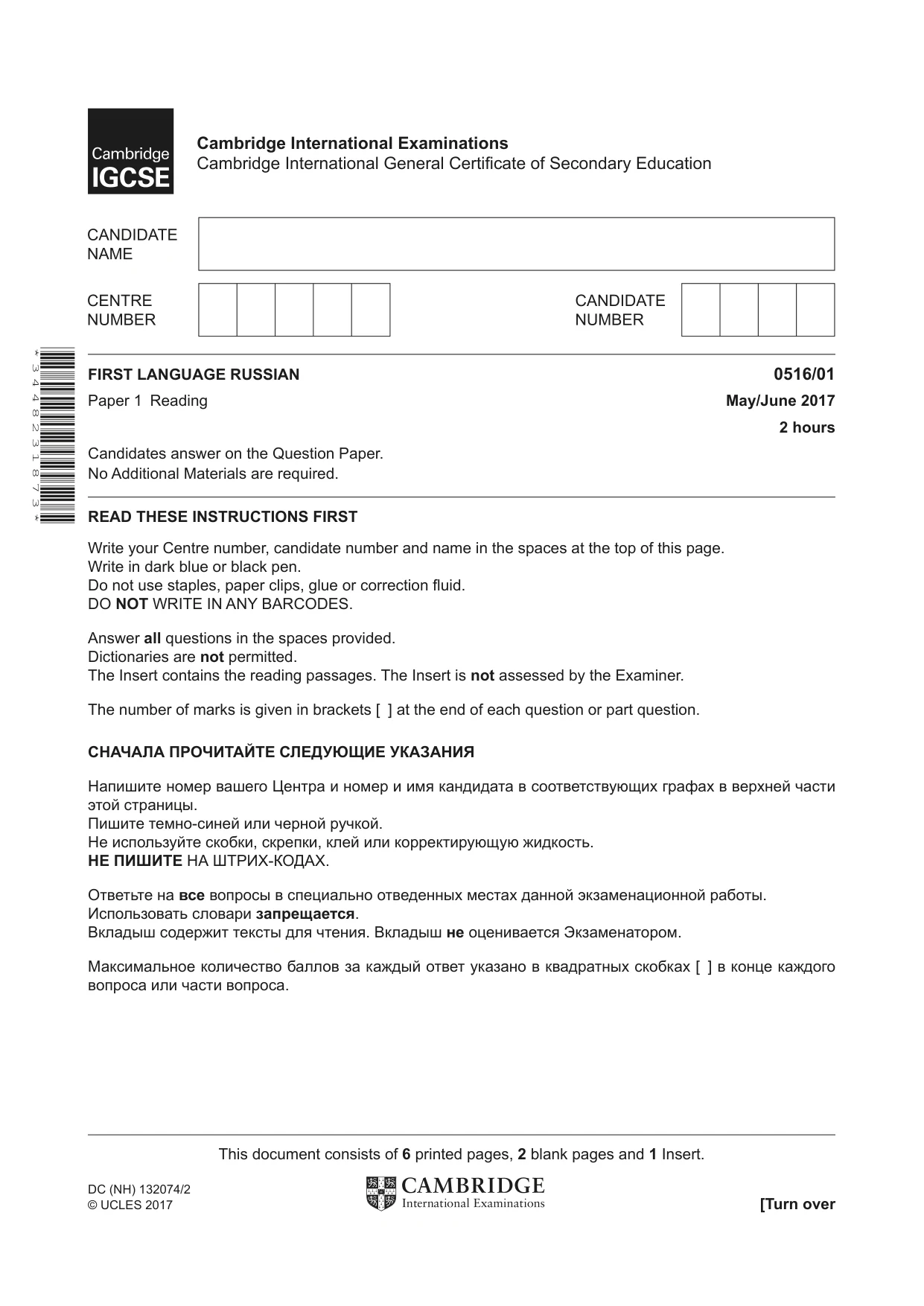
This document consists of 6 printed pages, 2 blank pages and 1 Insert. DC (NH) 132074/2 © UCLES 2017 [Turn over * 3 4 4 8 2 3 1 8 7 3 * FIRST LANGUAGE RUSSIAN 0516/01 Paper 1 Reading May/June 2017 2 hours Candidates answer on the Question Paper. No Additional Materials are required. READ THESE INSTRUCTIONS FIRST Write your Centre number, candidate number and name in the spaces at the top of this page. Write in dark blue or black pen. Do not use staples, paper clips, glue or correction fluid. DO NOT WRITE IN ANY BARCODES. Answer all questions in the spaces provided. Dictionaries are not permitted. The Insert contains the reading passages. The Insert is not assessed by the Examiner. The number of marks is given in brackets [ ] at the end of each question or part question. СНАЧАЛА ПРОЧИТАЙТЕ СЛЕДУЮЩИЕ УКАЗАНИЯ Напишите номер вашего Центра и номер и имя кандидата в соответствующих графах в верхней части этой страницы. Пишите темно-синей или черной ручкой. Не используйте скобки, скрепки, клей или корректирующую жидкость. НE ПИШИТE НА ШТРИХ-КОДАХ. Ответьте на все вопросы в специально отведенных местах данной экзаменационной работы. Использовать словари запрещается. Вкладыш содержит тексты для чтения. Вкладыш не оценивается Экзаменатором. Максимальное количество баллов за каждый ответ указано в квадратных скобках [ ] в конце каждого вопроса или части вопроса. Cambridge International Examinations Cambridge International General Certificate of Secondary Education
Question paper, page 2
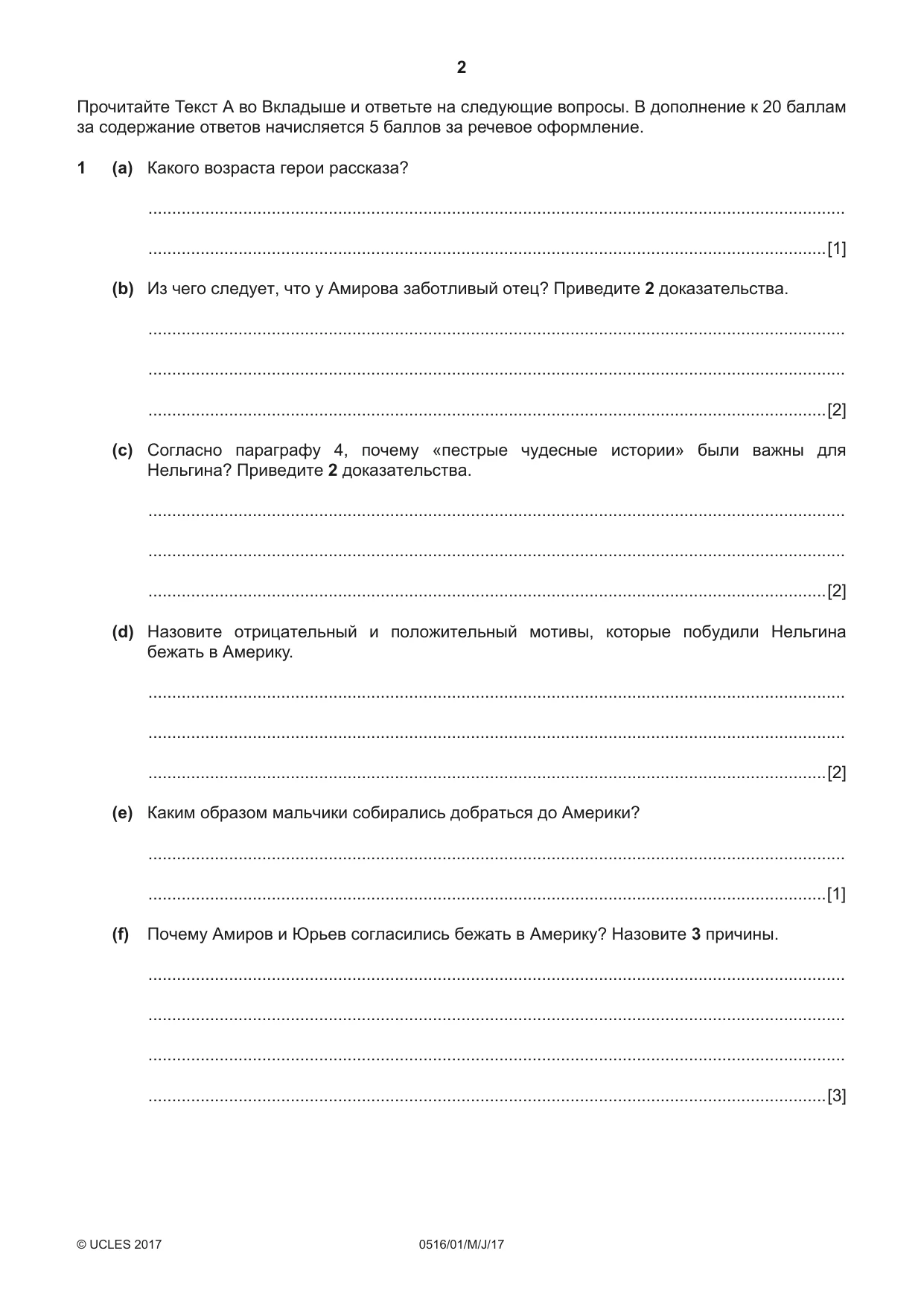
2 0516/01/M/J/17 © UCLES 2017 Прочитайте Текст А во Вкладыше и ответьте на следующие вопросы. В дополнение к 20 баллам за содержание ответов начисляется 5 баллов за речевое оформление. 1 (a) Какого возраста герои рассказа? … …[1] (b) Из чего следует, что у Амирова заботливый отец? Приведите 2 доказательства. … … …[2] (c) Согласно параграфу 4, почему «пестрые чудесные истории» были важны для Нельгина? Приведите 2 доказательства. … … …[2] (d) Назовите отрицательный и положительный мотивы, которые побудили Нельгина бежать в Америку. … … …[2] (e) Каким образом мальчики собирались добраться до Америки? … …[1] (f) Почему Амиров и Юрьев согласились бежать в Америку? Назовите 3 причины. … … … …[3]
Question paper, page 3
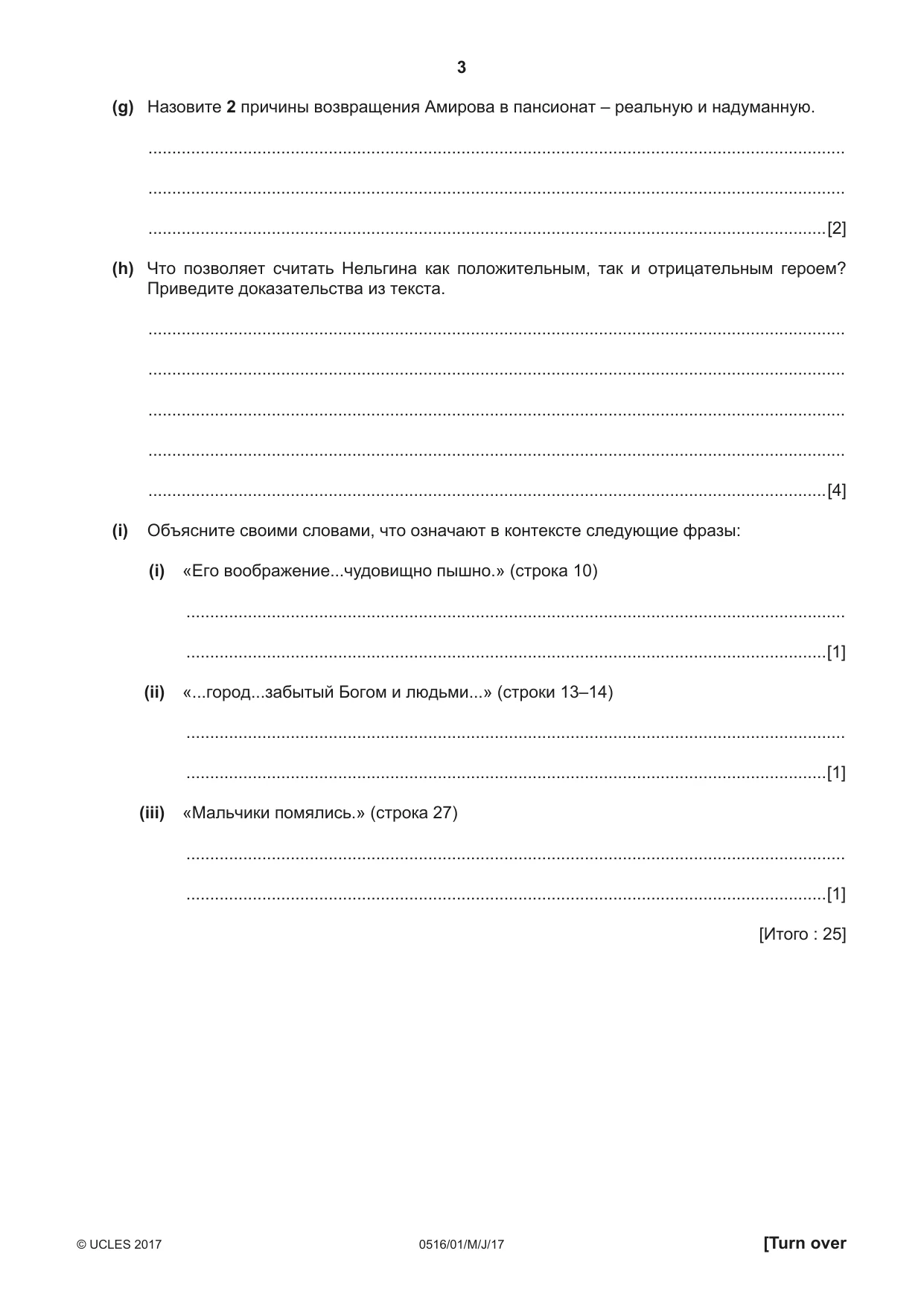
3 0516/01/M/J/17 © UCLES 2017 [Turn over (g) Назовите 2 причины возвращения Амирова в пансионат – реальную и надуманную. … … …[2] (h) Что позволяет считать Нельгина как положительным, так и отрицательным героем? Приведите доказательства из текста. … … … … …[4] (i) Объясните своими словами, что означают в контексте следующие фразы: (i) «Его воображение...чудовищно пышно.» (строка 10) … …[1] (ii) «...город...забытый Богом и людьми...» (строки 13–14) … …[1] (iii) «Мальчики помялись.» (строка 27) … …[1] [Итого : 25]
Question paper, page 4
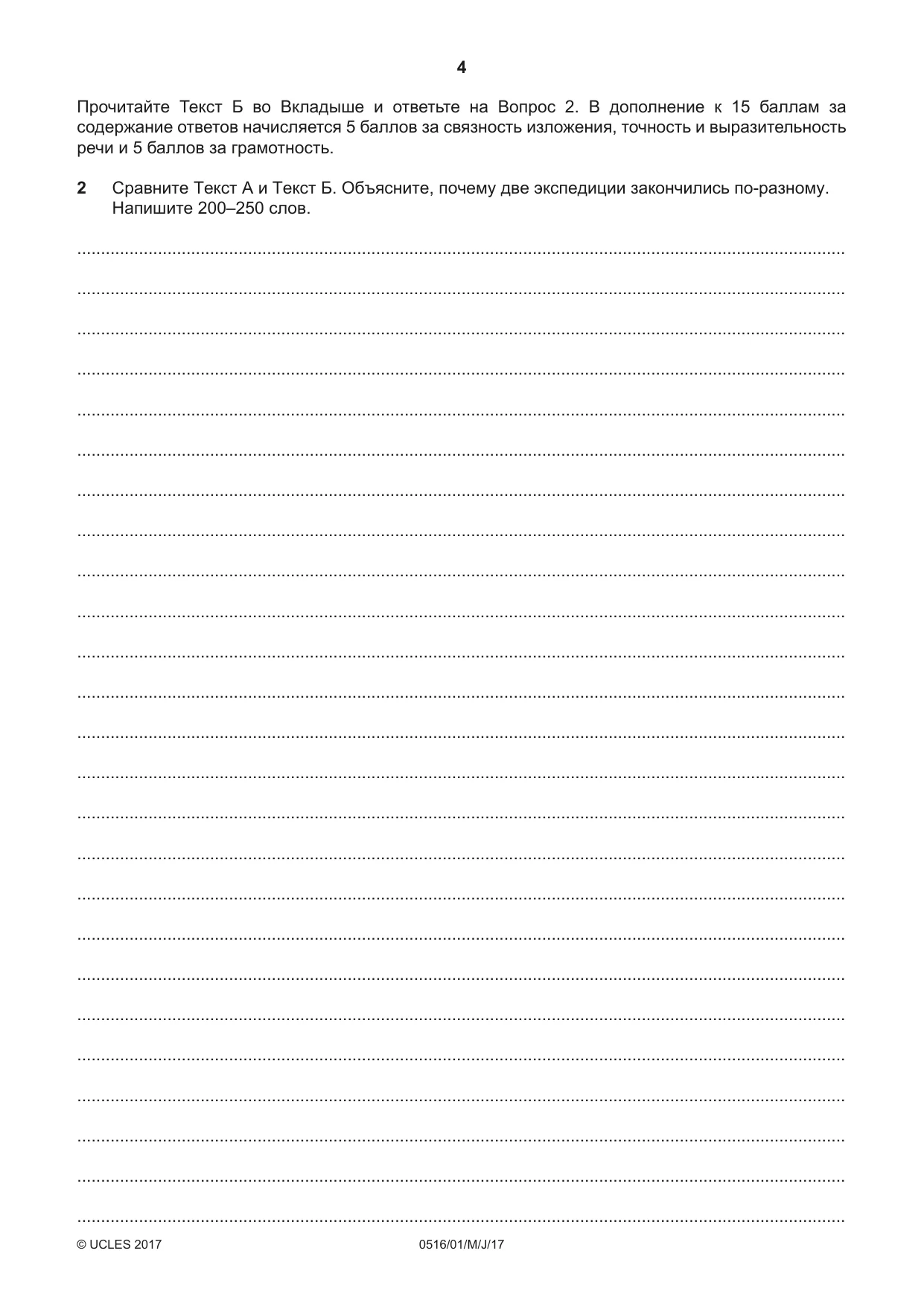
4 0516/01/M/J/17 © UCLES 2017 Прочитайте Текст Б во Вкладыше и ответьте на Вопрос 2. В дополнение к 15 баллам за содержание ответов начисляется 5 баллов за связность изложения, точность и выразительность речи и 5 баллов за грамотность. 2 Сравните Текст А и Текст Б. Объясните, почему две экспедиции закончились по-разному. Напишите 200‒250 слов. … … … … … … … … … … … … … … … … … … … … … … … … …
Question paper, page 5
5 0516/01/M/J/17 © UCLES 2017 [Turn over … … … … … … … … … … … … … … … … … … … … … … … … … … … …
Question paper, page 6
6 0516/01/M/J/17 © UCLES 2017 … … … … … … … … … … … … … … … … … … … … … … … … … … … [Итого : 25]
Question paper, page 7
7 0516/01/M/J/17 © UCLES 2017 BLANK PAGE
Question paper, page 8
8 0516/01/M/J/17 © UCLES 2017 BLANK PAGE Permission to reproduce items where third-party owned material protected by copyright is included has been sought and cleared where possible. Every reasonable effort has been made by the publisher (UCLES) to trace copyright holders, but if any items requiring clearance have unwittingly been included, the publisher will be pleased to make amends at the earliest possible opportunity. To avoid the issue of disclosure of answer-related information to candidates, all copyright acknowledgements are reproduced online in the Cambridge International Examinations Copyright Acknowledgements Booklet. This is produced for each series of examinations and is freely available to download at www.cie.org.uk after the live examination series. Cambridge International Examinations is part of the Cambridge Assessment Group. Cambridge Assessment is the brand name of University of Cambridge Local Examinations Syndicate (UCLES), which is itself a department of the University of Cambridge.
Mark scheme, page 1
® IGCSE is a registered trademark. This document consists of 8 printed pages. © UCLES 2017 [Turn over Cambridge International Examinations Cambridge International General Certificate of Secondary Education FIRST LANGUAGE RUSSIAN 0516/01 Paper 1 Reading May/June 2017 MARK SCHEME Maximum Mark: 50 Published This mark scheme is published as an aid to teachers and candidates, to indicate the requirements of the examination. It shows the basis on which Examiners were instructed to award marks. It does not indicate the details of the discussions that took place at an Examiners’ meeting before marking began, which would have considered the acceptability of alternative answers. Mark schemes should be read in conjunction with the question paper and the Principal Examiner Report for Teachers. Cambridge will not enter into discussions about these mark schemes. Cambridge is publishing the mark schemes for the May/June 2017 series for most Cambridge IGCSE®, Cambridge International A and AS Level and Cambridge Pre-U components, and some Cambridge O Level components.
Mark scheme, page 2
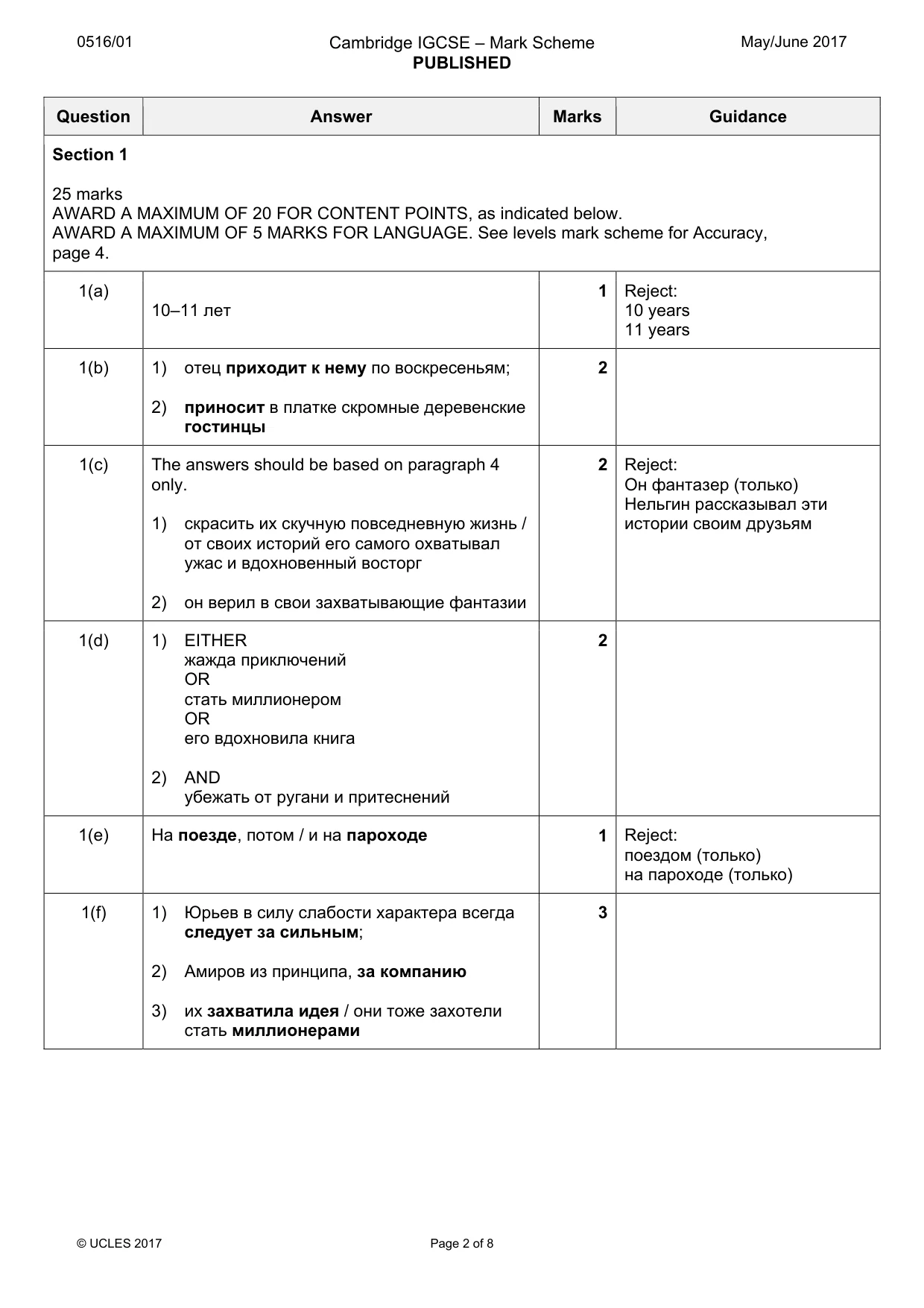
0516/01 Cambridge IGCSE – Mark Scheme PUBLISHED May/June 2017 © UCLES 2017 Page 2 of 8 Question Answer Marks Guidance Section 1 25 marks AWARD A MAXIMUM OF 20 FOR CONTENT POINTS, as indicated below. AWARD A MAXIMUM OF 5 MARKS FOR LANGUAGE. See levels mark scheme for Accuracy, page 4. 1(a) 10–11 лет 1 Reject: 10 years 11 years 1(b) 1) отец приходит к нему по воскресеньям; 2) приносит в платке скромные деревенские гостинцы 2 1(c) The answers should be based on paragraph 4 only. 1) скрасить их скучную повседневную жизнь / от своих историй его самого охватывал ужас и вдохновенный восторг 2) он верил в свои захватывающие фантазии 2 Reject: Он фантазер (только) Нельгин рассказывал эти истории своим друзьям 1(d) 1) EITHER жажда приключений OR стать миллионером OR его вдохновила книга 2) AND убежать от ругани и притеснений 2 1(e) На поезде, потом / и на пароходе 1 Reject: поездом (только) на пароходе (только) 1(f) 1) Юрьев в силу слабости характера всегда следует за сильным; 2) Амиров из принципа, за компанию 3) их захватила идея / они тоже захотели стать миллионерами 3
Mark scheme, page 3
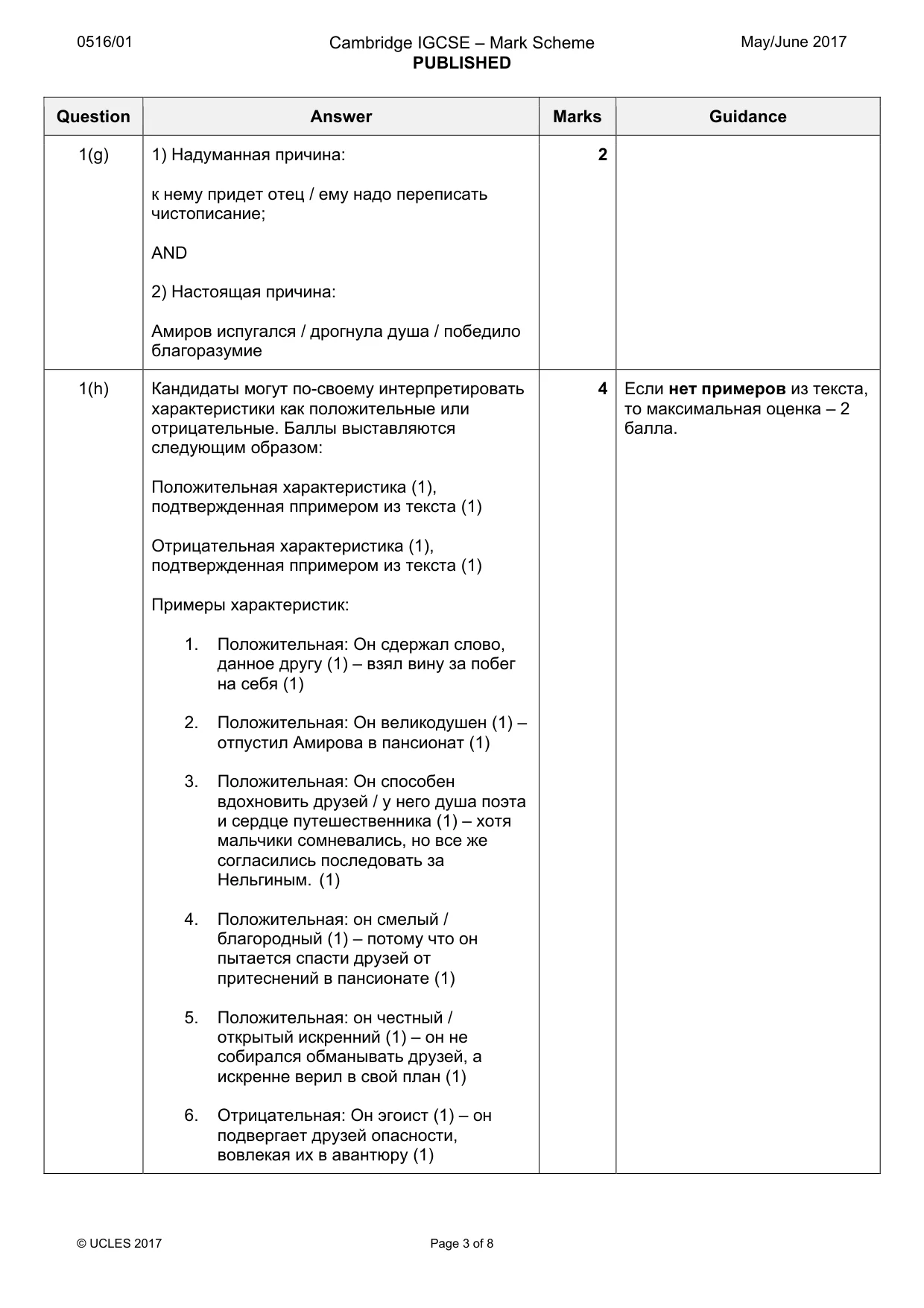
0516/01 Cambridge IGCSE – Mark Scheme PUBLISHED May/June 2017 © UCLES 2017 Page 3 of 8 Question Answer Marks Guidance 1(g) 1) Надуманная причина: к нему придет отец / ему надо переписать чистописание; AND 2) Настоящая причина: Амиров испугался / дрогнула душа / победило благоразумие 2 1(h) Кандидаты могут по-своему интерпретировать характеристики как положительные или отрицательные. Баллы выставляются следующим образом: Положительная характеристика (1), подтвержденная ппримером из текста (1) Отрицательная характеристика (1), подтвержденная ппримером из текста (1) Примеры характеристик: 1. Положительная: Он сдержал слово, данное другу (1) – взял вину за побег на себя (1) 2. Положительная: Он великодушен (1) – отпустил Амирова в пансионат (1) 3. Положительная: Он способен вдохновить друзей / у него душа поэта и сердце путешественника (1) – хотя мальчики сомневались, но все же согласились последовать за Нельгиным. (1) 4. Положительная: он смелый / благородный (1) – потому что он пытается спасти друзей от притеснений в пансионате (1) 5. Положительная: он честный / открытый искренний (1) – он не собирался обманывать друзей, а искренне верил в свой план (1) 6. Отрицательная: Он эгоист (1) – oн подвергает друзей опасности, вовлекая их в авантюру (1) 4 Если нет примеров из текста, то максимальная оценка – 2 балла.
Mark scheme, page 4
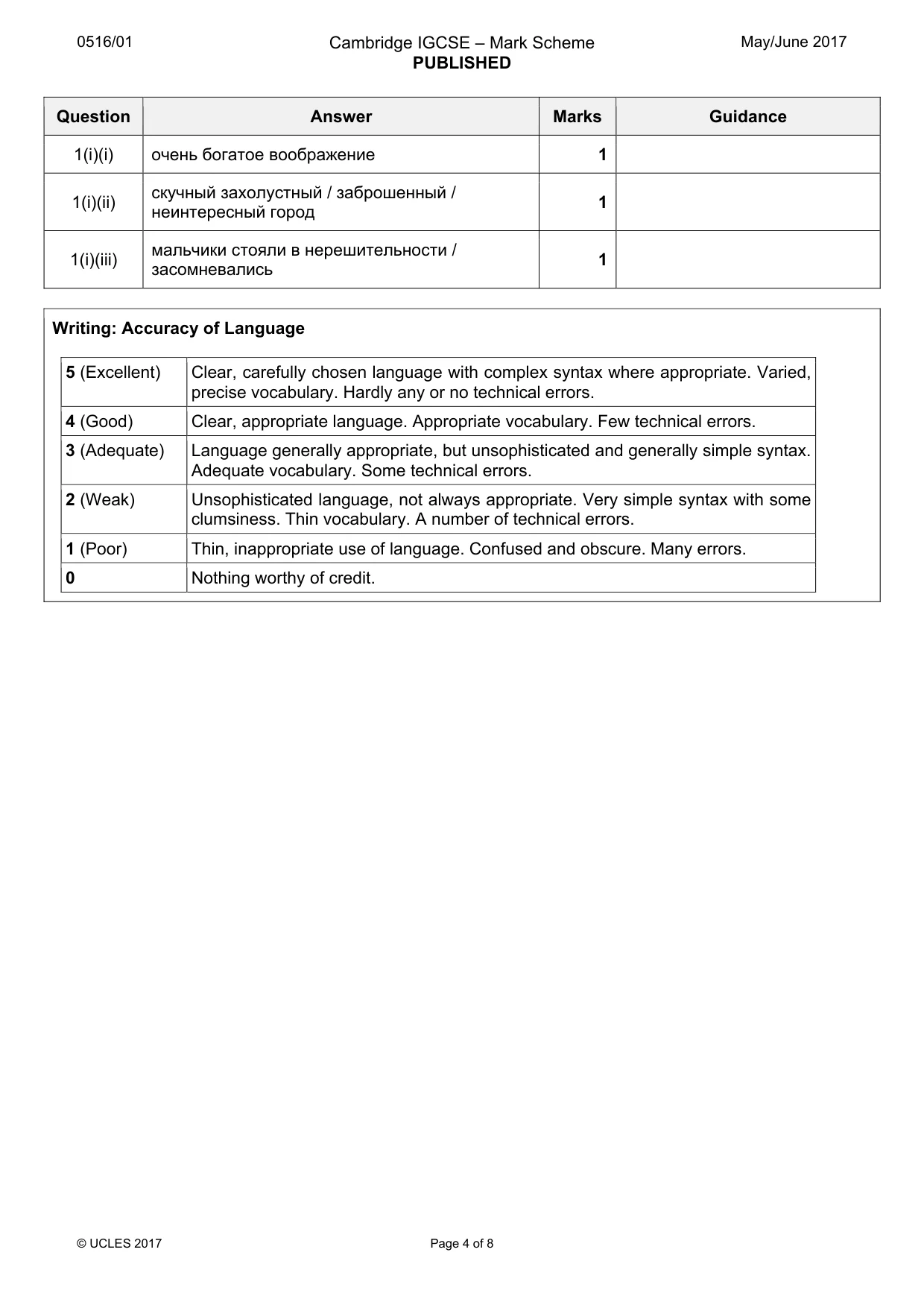
0516/01 Cambridge IGCSE – Mark Scheme PUBLISHED May/June 2017 © UCLES 2017 Page 4 of 8 Question Answer Marks Guidance 1(i)(i) очень богатое воображение 1 1(i)(ii) скучный захолустный / заброшенный / неинтересный город 1 1(i)(iii) мальчики стояли в нерешительности / засомневались 1 Writing: Accuracy of Language 5 (Excellent) Clear, carefully chosen language with complex syntax where appropriate. Varied, precise vocabulary. Hardly any or no technical errors. 4 (Good) Clear, appropriate language. Appropriate vocabulary. Few technical errors. 3 (Adequate) Language generally appropriate, but unsophisticated and generally simple syntax. Adequate vocabulary. Some technical errors. 2 (Weak) Unsophisticated language, not always appropriate. Very simple syntax with some clumsiness. Thin vocabulary. A number of technical errors. 1 (Poor) Thin, inappropriate use of language. Confused and obscure. Many errors. 0 Nothing worthy of credit.
Mark scheme, page 5
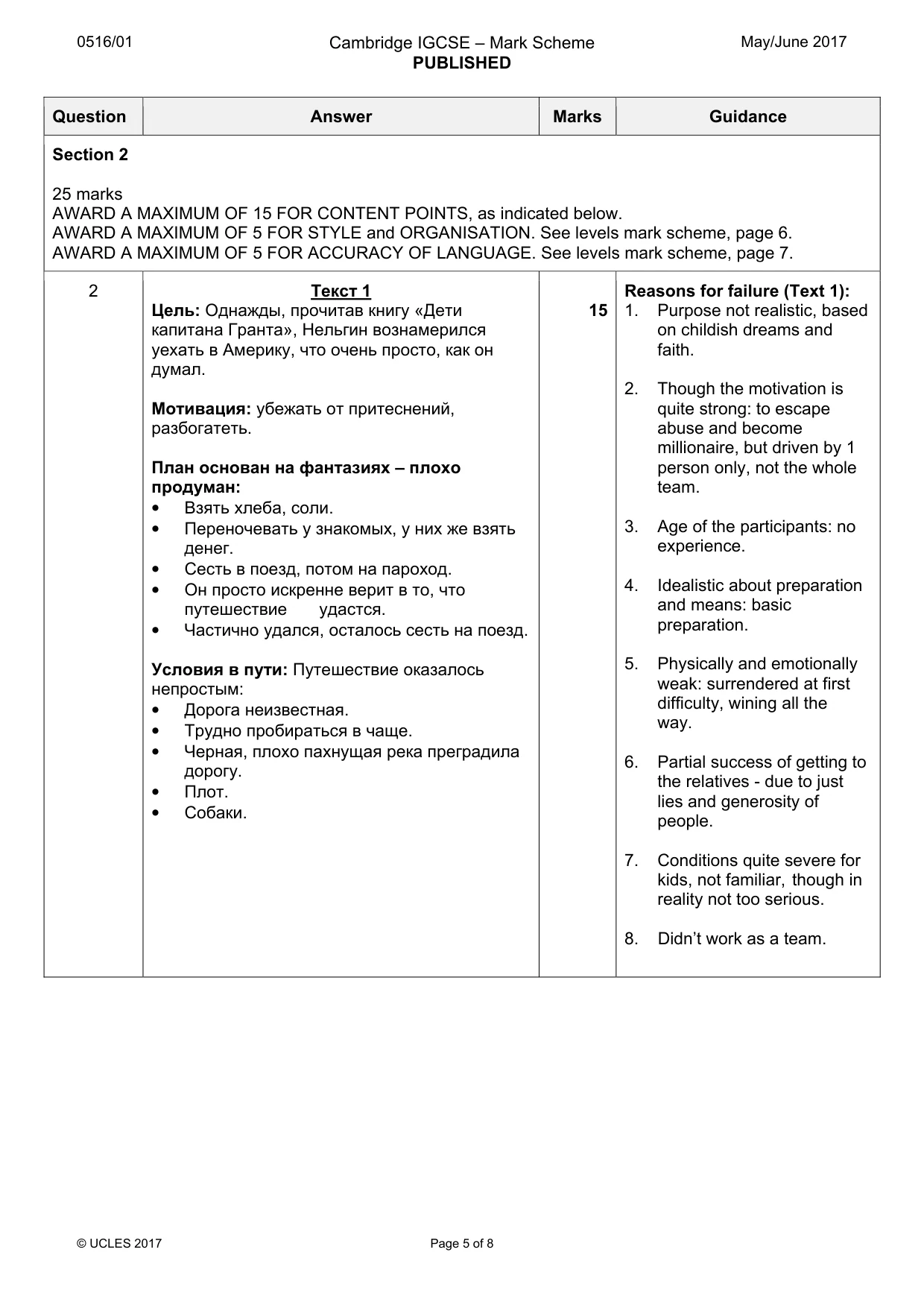
0516/01 Cambridge IGCSE – Mark Scheme PUBLISHED May/June 2017 © UCLES 2017 Page 5 of 8 Question Answer Marks Guidance Section 2 25 marks AWARD A MAXIMUM OF 15 FOR CONTENT POINTS, as indicated below. AWARD A MAXIMUM OF 5 FOR STYLE and ORGANISATION. See levels mark scheme, page 6. AWARD A MAXIMUM OF 5 FOR ACCURACY OF LANGUAGE. See levels mark scheme, page 7. 2 Текст 1 Цель: Однажды, прочитав книгу «Дети капитана Гранта», Нельгин вознамерился уехать в Америку, что очень просто, как он думал. Мотивация: убежать от притеснений, разбогатеть. План основан на фантазиях – плохо продуман: • Взять хлеба, соли. • Переночевать у знакомых, у них же взять денег. • Сесть в поезд, потом на пароход. • Он просто искренне верит в то, что путешествие удастся. • Частично удался, осталось сесть на поезд. Условия в пути: Путешествие оказалось непростым: • Дорога неизвестная. • Трудно пробираться в чаще. • Черная, плохо пахнущая река преградила дорогу. • Плот. • Собаки. 15 Reasons for failure (Text 1): 1. Purpose not realistic, based on childish dreams and faith. 2. Though the motivation is quite strong: to escape abuse and become millionaire, but driven by 1 person only, not the whole team. 3. Age of the participants: no experience. 4. Idealistic about preparation and means: basic preparation. 5. Physically and emotionally weak: surrendered at first difficulty, wining all the way. 6. Partial success of getting to the relatives - due to just lies and generosity of people. 7. Conditions quite severe for kids, not familiar, though in reality not too serious. 8. Didn’t work as a team.
Mark scheme, page 6
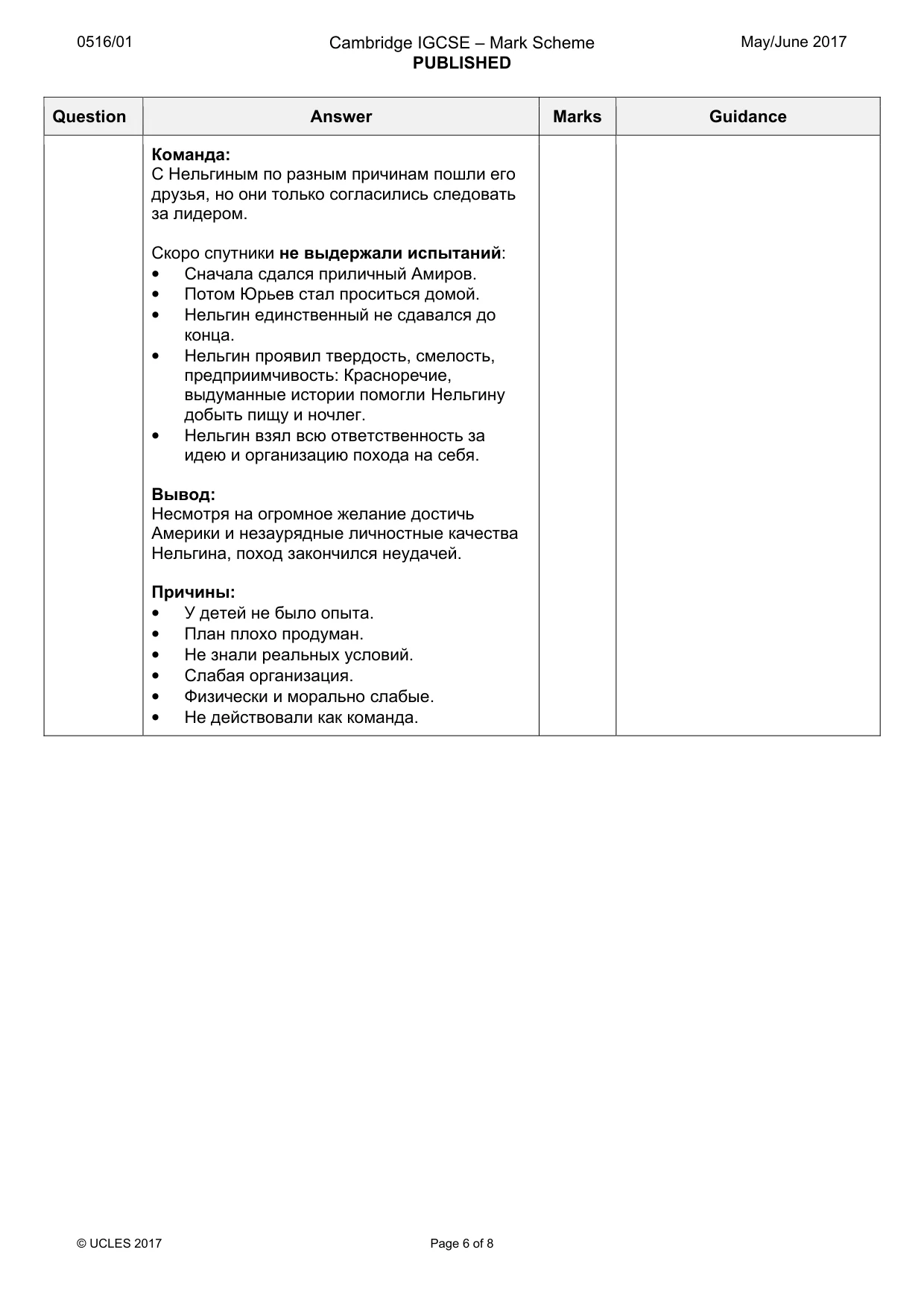
0516/01 Cambridge IGCSE – Mark Scheme PUBLISHED May/June 2017 © UCLES 2017 Page 6 of 8 Question Answer Marks Guidance Команда: С Нельгиным по разным причинам пошли его друзья, но они только согласились следовать за лидером. Скоро спутники не выдержали испытаний: • Сначала сдался приличный Амиров. • Потом Юрьев стал проситься домой. • Нельгин единственный не сдавался до конца. • Нельгин проявил твердость, смелость, предприимчивость: Красноречие, выдуманные истории помогли Нельгину добыть пищу и ночлег. • Нельгин взял всю ответственность за идею и организацию похода на себя. Вывод: Несмотря на огромное желание достичь Америки и незаурядные личностные качества Нельгина, поход закончился неудачей. Причины: • У детей не было опыта. • План плохо продуман. • Не знали реальных условий. • Слабая организация. • Физически и морально слабые. • Не действовали как команда.
Mark scheme, page 7
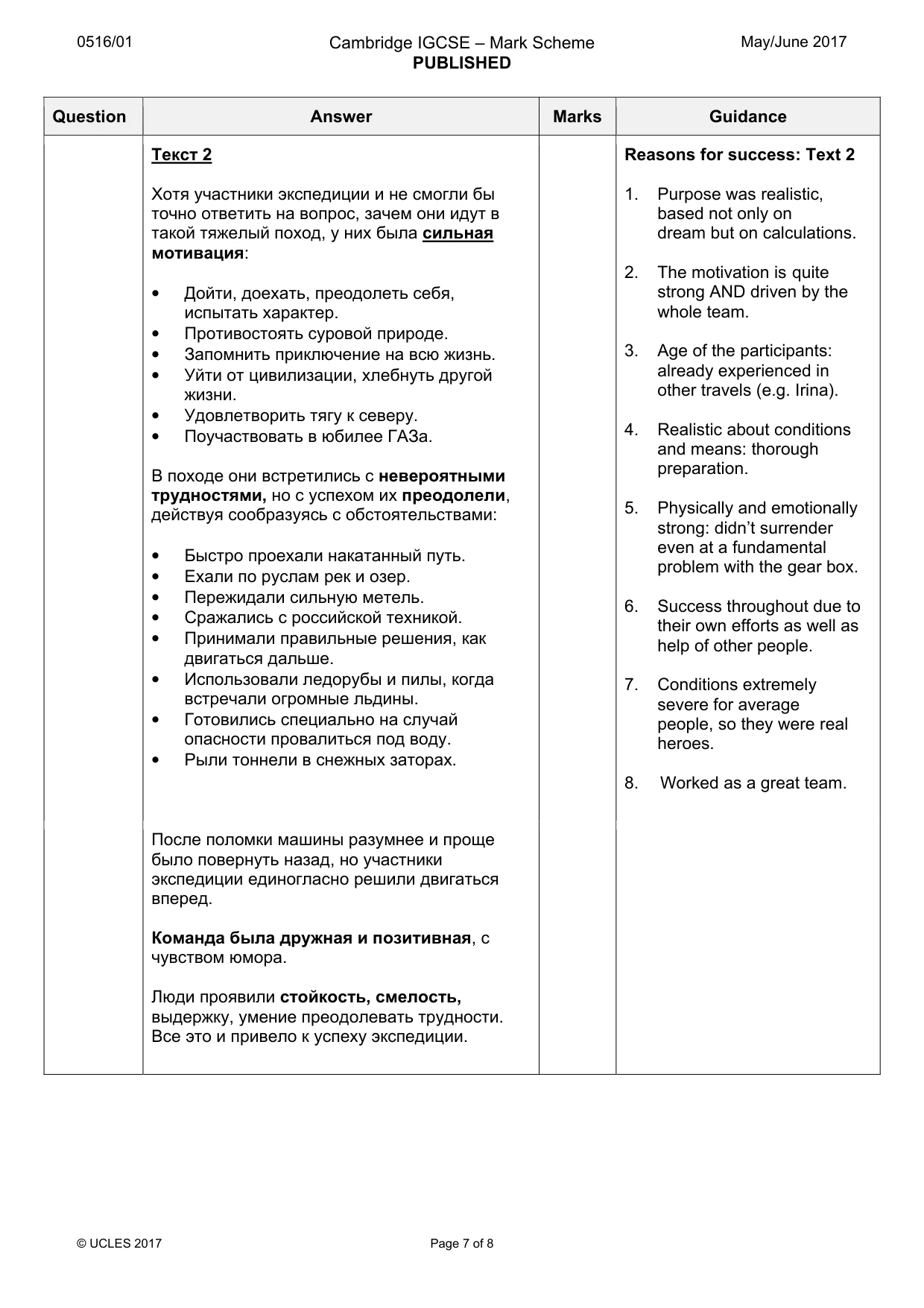
0516/01 Cambridge IGCSE – Mark Scheme PUBLISHED May/June 2017 © UCLES 2017 Page 7 of 8 Question Answer Marks Guidance Текст 2 Хотя участники экспедиции и не смогли бы точно ответить на вопрос, зачем они идут в такой тяжелый поход, у них была сильная мотивация: • Дойти, доехать, преодолеть себя, испытать характер. • Противостоять суровой природе. • Запомнить приключение на всю жизнь. • Уйти от цивилизации, хлебнуть другой жизни. • Удовлетворить тягу к северу. • Поучаствовать в юбилее ГАЗа. В походе они встретились с невероятными трудностями, но с успехом их преодолели, действуя сообразуясь с обстоятельствами: • Быстро проехали накатанный путь. • Ехали по руслам рек и озер. • Пережидали сильную метель. • Сражались с российской техникой. • Принимали правильные решения, как двигаться дальше. • Использовали ледорубы и пилы, когда встречали огромные льдины. • Готовились специально на случай опасности провалиться под воду. • Рыли тоннели в снежных заторах. Reasons for success: Text 2 1. Purpose was realistic, based not only on dream but on calculations. 2. The motivation is quite strong AND driven by the whole team. 3. Age of the participants: already experienced in other travels (e.g. Irina). 4. Realistic about conditions and means: thorough preparation. 5. Physically and emotionally strong: didn’t surrender even at a fundamental problem with the gear box. 6. Success throughout due to their own efforts as well as help of other people. 7. Conditions extremely severe for average people, so they were real heroes. 8. Worked as a great team. После поломки машины разумнее и проще было повернуть назад, но участники экспедиции единогласно решили двигаться вперед. Команда была дружная и позитивная, с чувством юмора. Люди проявили стойкость, смелость, выдержку, умение преодолевать трудности. Все это и привело к успеху экспедиции.
Mark scheme, page 8
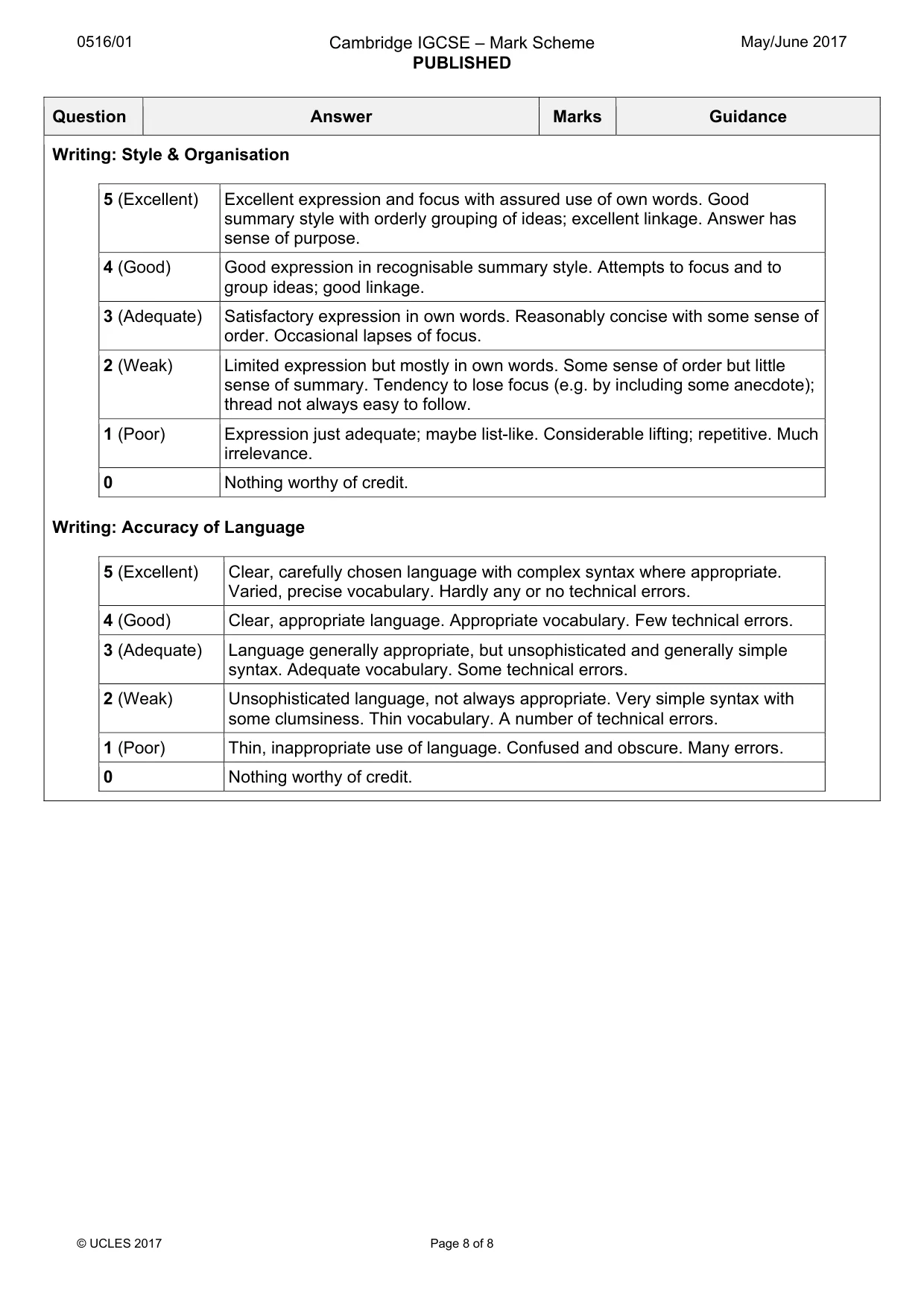
0516/01 Cambridge IGCSE – Mark Scheme PUBLISHED May/June 2017 © UCLES 2017 Page 8 of 8 Question Answer Marks Guidance Writing: Style & Organisation 5 (Excellent) Excellent expression and focus with assured use of own words. Good summary style with orderly grouping of ideas; excellent linkage. Answer has sense of purpose. 4 (Good) Good expression in recognisable summary style. Attempts to focus and to group ideas; good linkage. 3 (Adequate) Satisfactory expression in own words. Reasonably concise with some sense of order. Occasional lapses of focus. 2 (Weak) Limited expression but mostly in own words. Some sense of order but little sense of summary. Tendency to lose focus (e.g. by including some anecdote); thread not always easy to follow. 1 (Poor) Expression just adequate; maybe list-like. Considerable lifting; repetitive. Much irrelevance. 0 Nothing worthy of credit. Writing: Accuracy of Language 5 (Excellent) Clear, carefully chosen language with complex syntax where appropriate. Varied, precise vocabulary. Hardly any or no technical errors. 4 (Good) Clear, appropriate language. Appropriate vocabulary. Few technical errors. 3 (Adequate) Language generally appropriate, but unsophisticated and generally simple syntax. Adequate vocabulary. Some technical errors. 2 (Weak) Unsophisticated language, not always appropriate. Very simple syntax with some clumsiness. Thin vocabulary. A number of technical errors. 1 (Poor) Thin, inappropriate use of language. Confused and obscure. Many errors. 0 Nothing worthy of credit.
What you needed in this session
Cambridge’s own grade thresholds for 2017 May/June, Paper 1 · Variant 1. A higher threshold means an easier paper — the bar moves with how the cohort did.