Cambridge IGCSE Physics 0625 — 2008 Oct/Nov Paper 3 · Variant 0
0625/30/O/N/08
The question paper and its mark scheme, free to read here and free to download. This is Cambridge’s own paper, exactly as it was sat.
Question paper33 pages
Mark scheme
No mark scheme is in the library for this paper.
Paper as text
Question paper, page 1
Location Entry Codes As part of CIE’s continual commitment to maintaining best practice in assessment, CIE uses different variants of some question papers for our most popular assessments with large and widespread candidature. The question papers are closely related and the relationships between them have been thoroughly established using our assessment expertise. All versions of the paper give assessment of equal standard. The content assessed by the examination papers and the type of questions is unchanged. This change means that for this component there are now two variant Question Papers, Mark Schemes and Principal Examiner’s Reports where previously there was only one. For any individual country, it is intended that only one variant is used. This document contains both variants which will give all Centres access to even more past examination material than is usually the case. The diagram shows the relationship between the Question Papers, Mark Schemes and Principal Examiners’ Reports that are available. Question Paper Mark Scheme Principal Examiner’s Report Introduction Introduction Introduction First variant Question Paper First variant Mark Scheme First variant Principal Examiner’s Report Second variant Question Paper Second variant Mark Scheme Second variant Principal Examiner’s Report Who can I contact for further information on these changes? Please direct any questions about this to CIE’s Customer Services team at: international@cie.org.uk The titles for the variant items should correspond with the table above, so that at the top of the first page of the relevant part of the document and on the header, it has the words: • First variant Question Paper / Mark Scheme / Principal Examiner’s Report or • Second variant Question Paper / Mark Scheme / Principal Examiner’s Report as appropriate. www.XtremePapers.com
Question paper, page 2
This document consists of 16 printed pages. SPA (SHW 00014 3/07) T50468/5 © UCLES 2008 [Turn over UNIVERSITY OF CAMBRIDGE INTERNATIONAL EXAMINATIONS International General Certificate of Secondary Education READ THESE INSTRUCTIONS FIRST Write your Centre number, candidate number and name on all the work you hand in. Write in dark blue or black pen. You may use a soft pencil for any diagrams, graphs or rough working. Do not use staples, paper clips, highlighters, glue or correction fluid. DO NOT WRITE IN ANY BARCODES. Answer all questions. You may lose marks if you do not show your working or if you do not use appropriate units. Take the weight of 1 kg to be 10 N (i.e. acceleration of free fall = 10 m/s2). At the end of the examination, fasten all your work securely together. The number of marks is given in brackets [ ] at the end of each question or part question. * 0 6 3 1 4 6 3 0 8 2 * PHYSICS 0625/31 Paper 3 Extended October/November 2008 1 hour 15 minutes Candidates answer on the Question Paper. No Additional Materials are required. First Variant Question Paper
Question paper, page 3
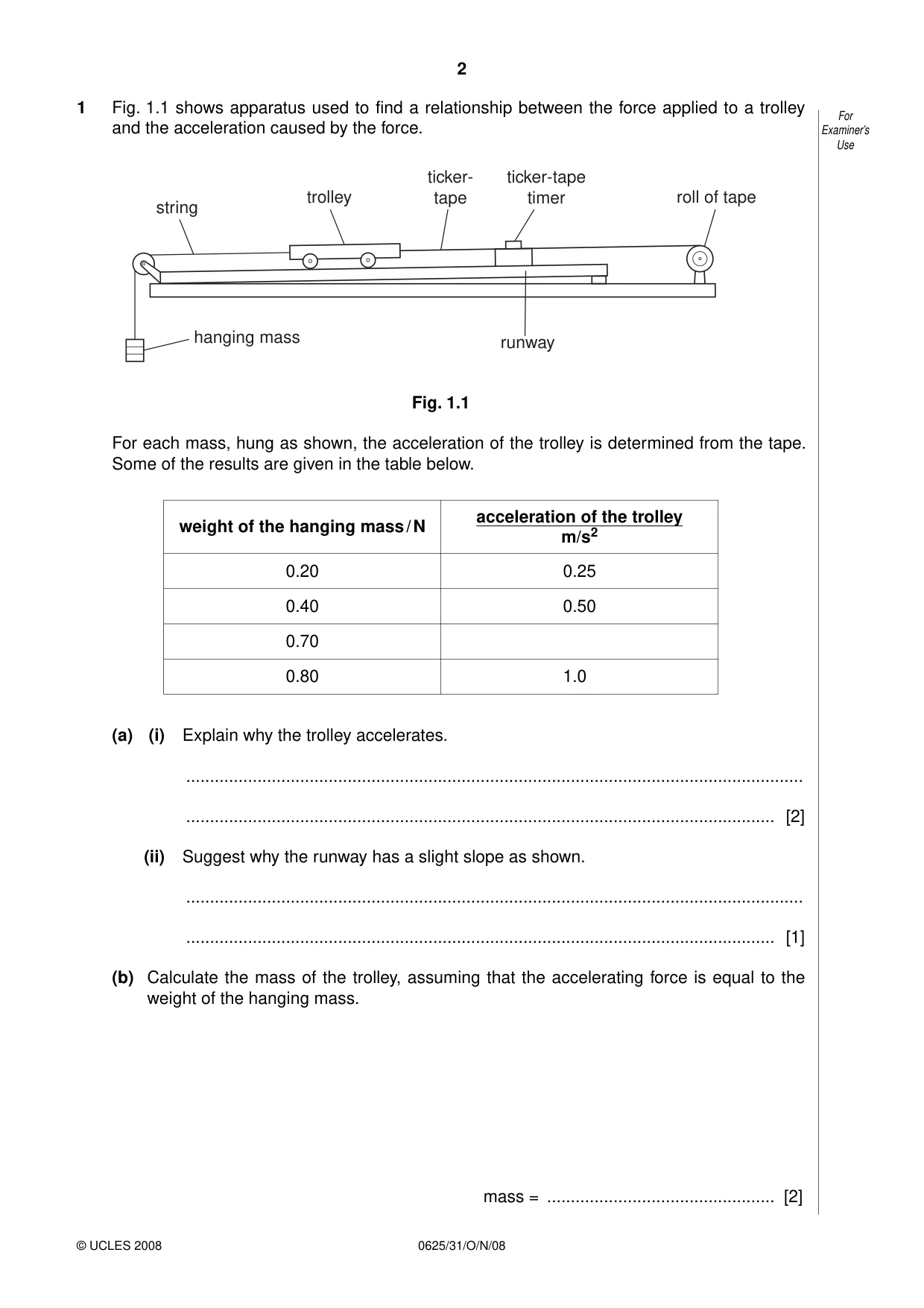
2 0625/31/O/N/08 © UCLES 2008 For Examiner’s Use 1 Fig. 1.1 shows apparatus used to find a relationship between the force applied to a trolley and the acceleration caused by the force. trolley runway string roll of tape ticker- tape ticker-tape timer hanging mass Fig. 1.1 For each mass, hung as shown, the acceleration of the trolley is determined from the tape. Some of the results are given in the table below. weight of the hanging mass / N acceleration of the trolley m/s2 0.20 0.25 0.40 0.50 0.70 0.80 1.0 (a) (i) Explain why the trolley accelerates. … … [2] (ii) Suggest why the runway has a slight slope as shown. … … [1] (b) Calculate the mass of the trolley, assuming that the accelerating force is equal to the weight of the hanging mass. mass = … [2]
Question paper, page 4
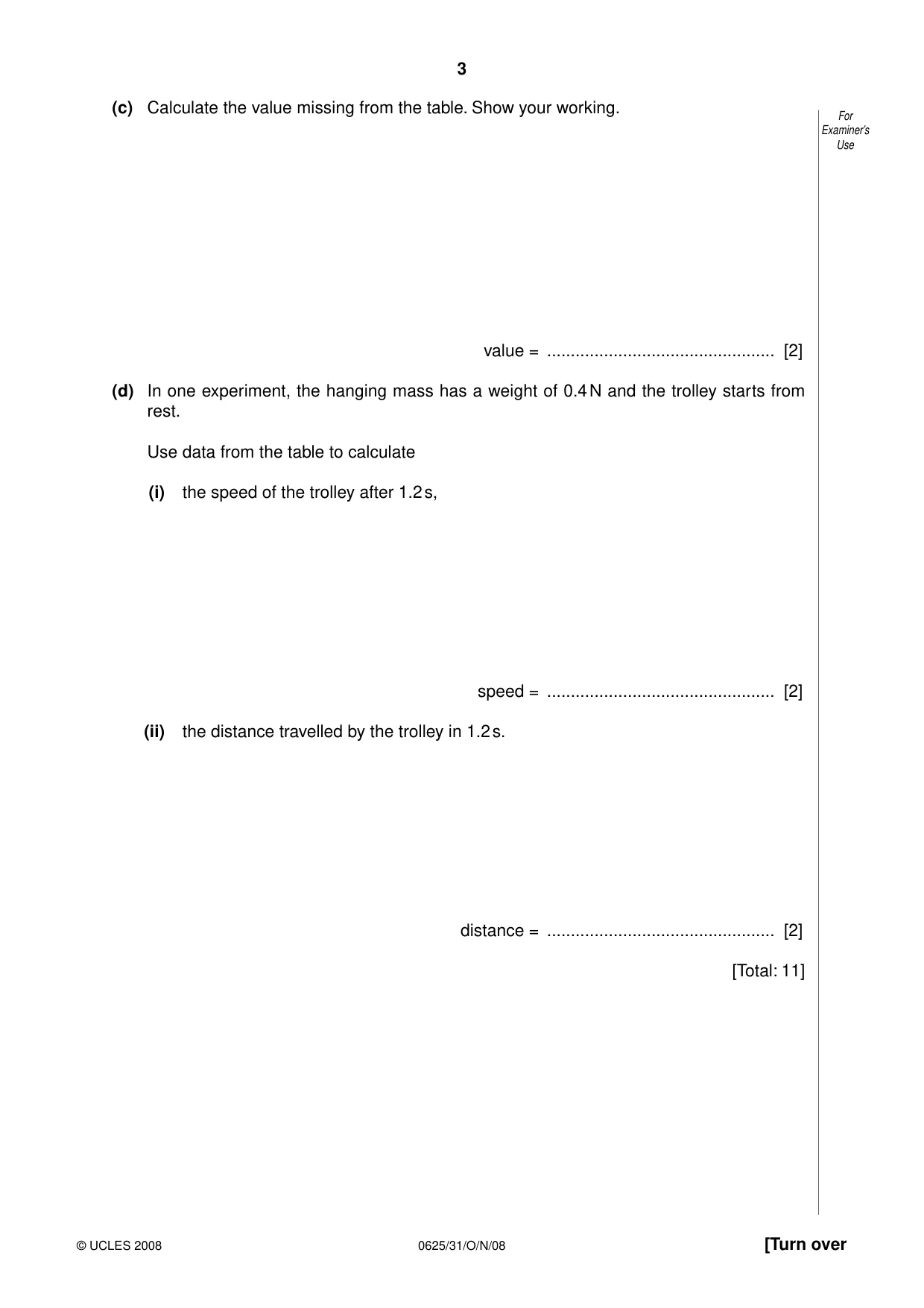
3 0625/31/O/N/08 © UCLES 2008 [Turn over For Examiner’s Use (c) Calculate the value missing from the table. Show your working. value = … [2] (d) In one experiment, the hanging mass has a weight of 0.4 N and the trolley starts from rest. Use data from the table to calculate (i) the speed of the trolley after 1.2 s, speed = … [2] (ii) the distance travelled by the trolley in 1.2 s. distance = … [2] [Total: 11]
Question paper, page 5
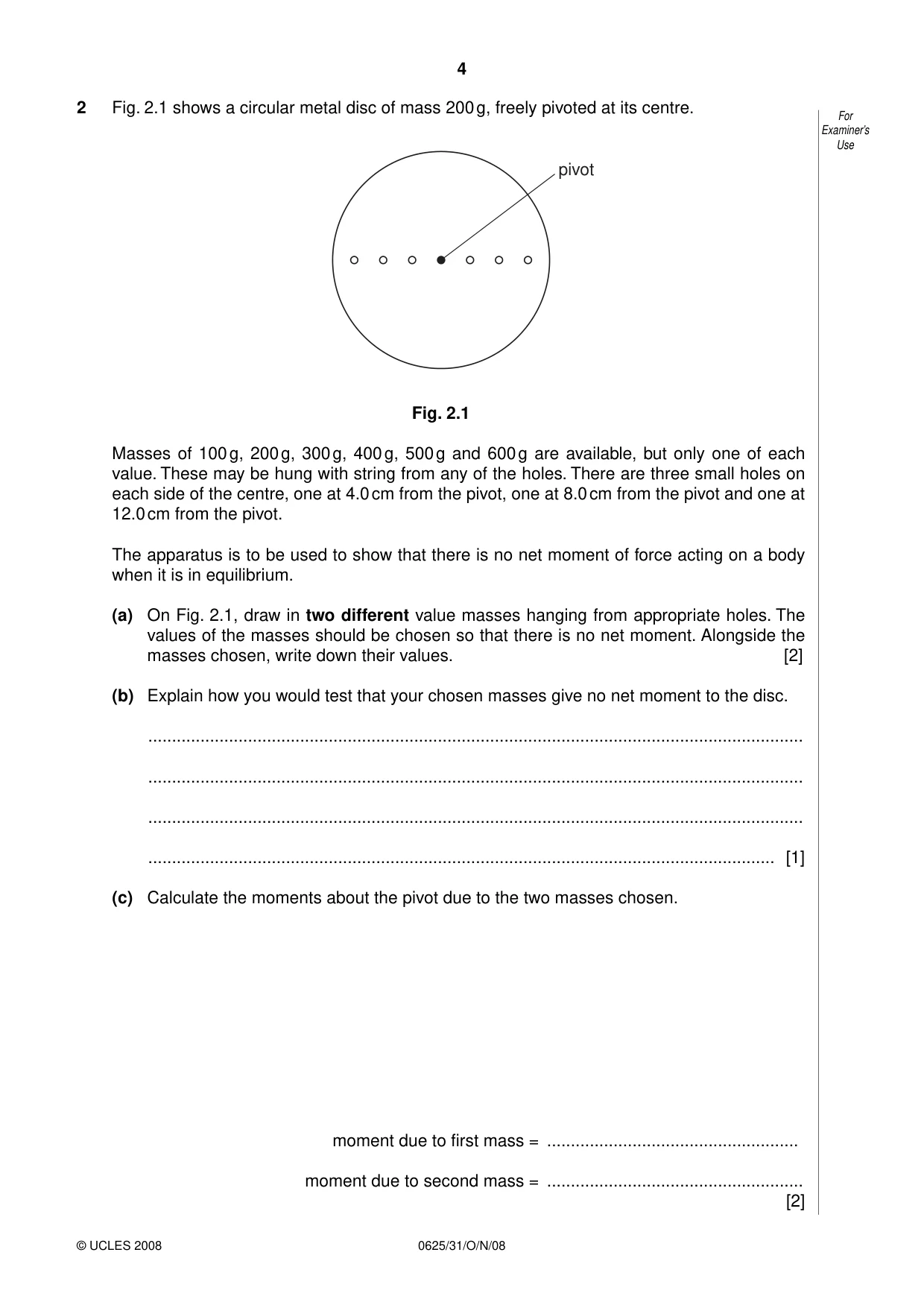
4 0625/31/O/N/08 © UCLES 2008 For Examiner’s Use 2 Fig. 2.1 shows a circular metal disc of mass 200 g, freely pivoted at its centre. pivot Fig. 2.1 Masses of 100 g, 200 g, 300 g, 400 g, 500 g and 600 g are available, but only one of each value. These may be hung with string from any of the holes. There are three small holes on each side of the centre, one at 4.0 cm from the pivot, one at 8.0 cm from the pivot and one at 12.0 cm from the pivot. The apparatus is to be used to show that there is no net moment of force acting on a body when it is in equilibrium. (a) On Fig. 2.1, draw in two different value masses hanging from appropriate holes. The values of the masses should be chosen so that there is no net moment. Alongside the masses chosen, write down their values. [2] (b) Explain how you would test that your chosen masses give no net moment to the disc. … … … … [1] (c) Calculate the moments about the pivot due to the two masses chosen. moment due to first mass = … moment due to second mass = … [2]
Question paper, page 6
5 0625/31/O/N/08 © UCLES 2008 [Turn over For Examiner’s Use (d) Calculate the force on the pivot when the two masses chosen are hanging from the disc. force = … [2] [Total: 7]
Question paper, page 7
6 0625/31/O/N/08 © UCLES 2008 For Examiner’s Use 3 (a) A submarine descends to a depth of 70 m below the surface of water. The density of the water is 1050 kg/m3. Atmospheric pressure is 1.0 × 10⁵ Pa. Calculate (i) the increase in pressure as it descends from the surface to a depth of 70 m, increase in pressure = … [2] (ii) the total pressure on the submarine at a depth of 70 m. total pressure = … [1] (b) On another dive, the submarine experiences a total pressure of 6.5 × 10⁵ Pa. A hatch cover on the submarine has an area of 2.5 m2. Calculate the force on the outside of the cover. force = … [2] (c) The submarine undergoes tests in fresh water of density 1000 kg/m3. Explain why the pressure on the submarine is less at the same depth. … … [1] [Total: 6]
Question paper, page 8
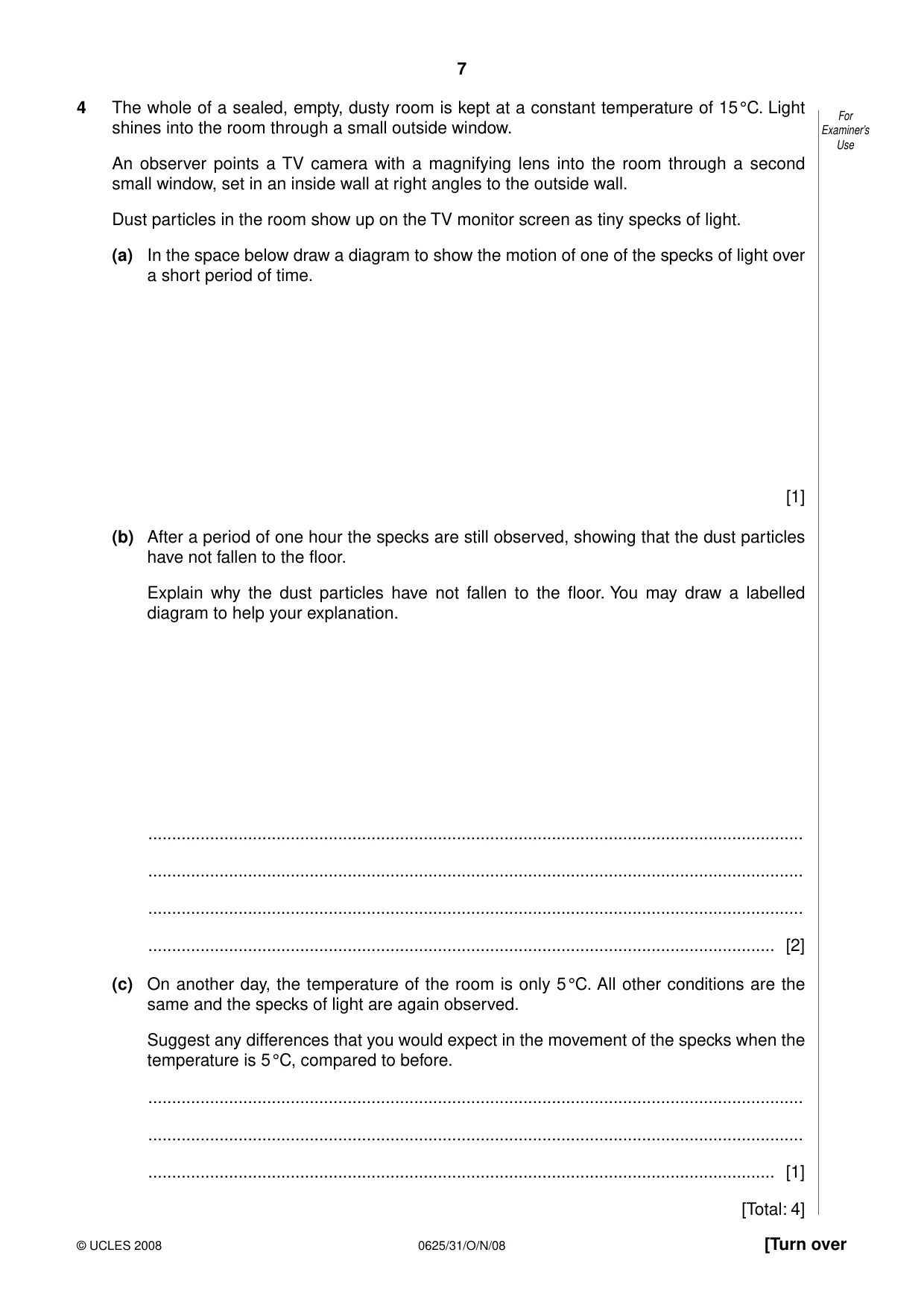
7 0625/31/O/N/08 © UCLES 2008 [Turn over For Examiner’s Use 4 The whole of a sealed, empty, dusty room is kept at a constant temperature of 15 °C. Light shines into the room through a small outside window. An observer points a TV camera with a magnifying lens into the room through a second small window, set in an inside wall at right angles to the outside wall. Dust particles in the room show up on the TV monitor screen as tiny specks of light. (a) In the space below draw a diagram to show the motion of one of the specks of light over a short period of time. [1] (b) After a period of one hour the specks are still observed, showing that the dust particles have not fallen to the floor. Explain why the dust particles have not fallen to the floor. You may draw a labelled diagram to help your explanation. … … … … [2] (c) On another day, the temperature of the room is only 5 °C. All other conditions are the same and the specks of light are again observed. Suggest any differences that you would expect in the movement of the specks when the temperature is 5 °C, compared to before. … … … [1] [Total: 4]
Question paper, page 9
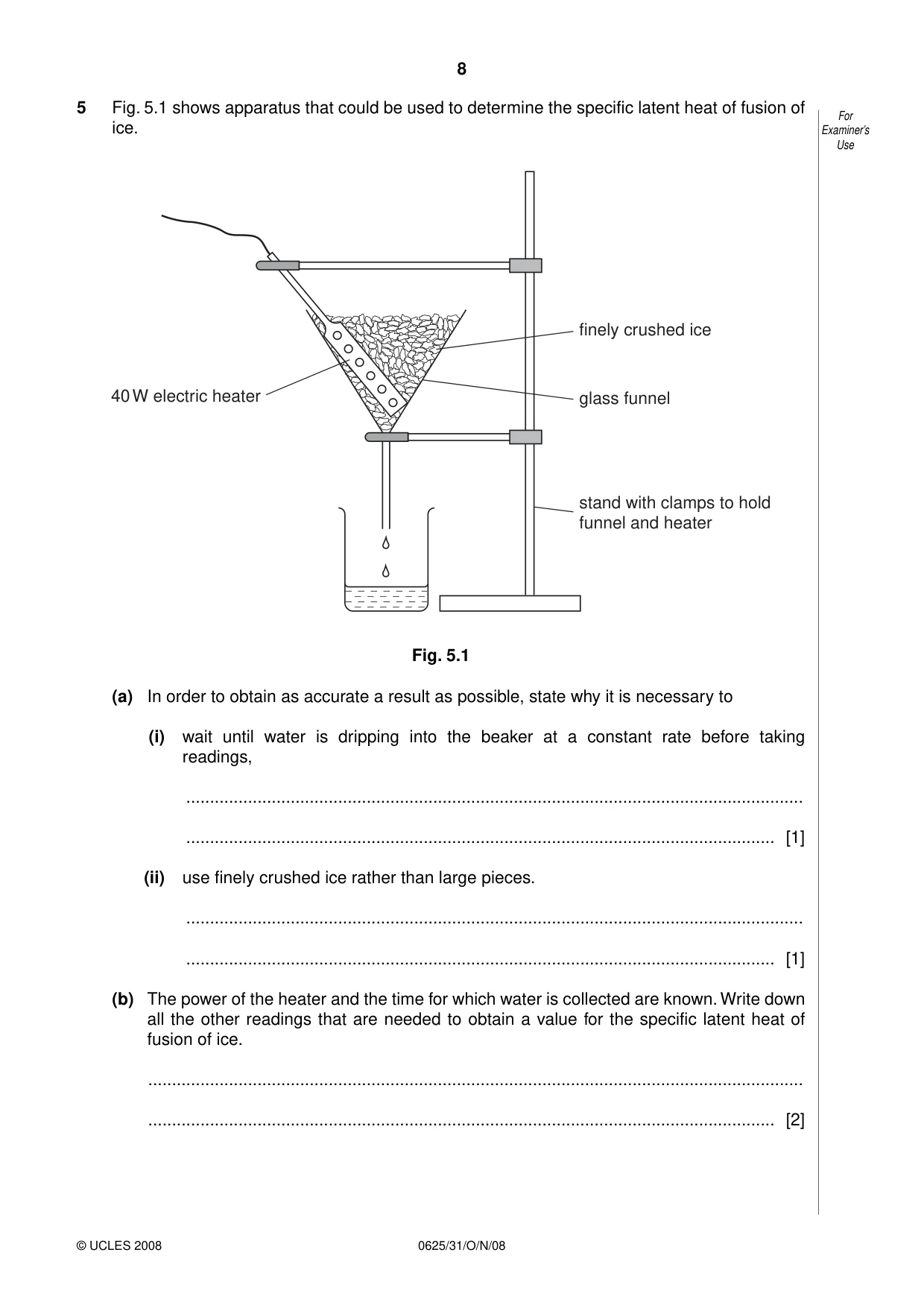
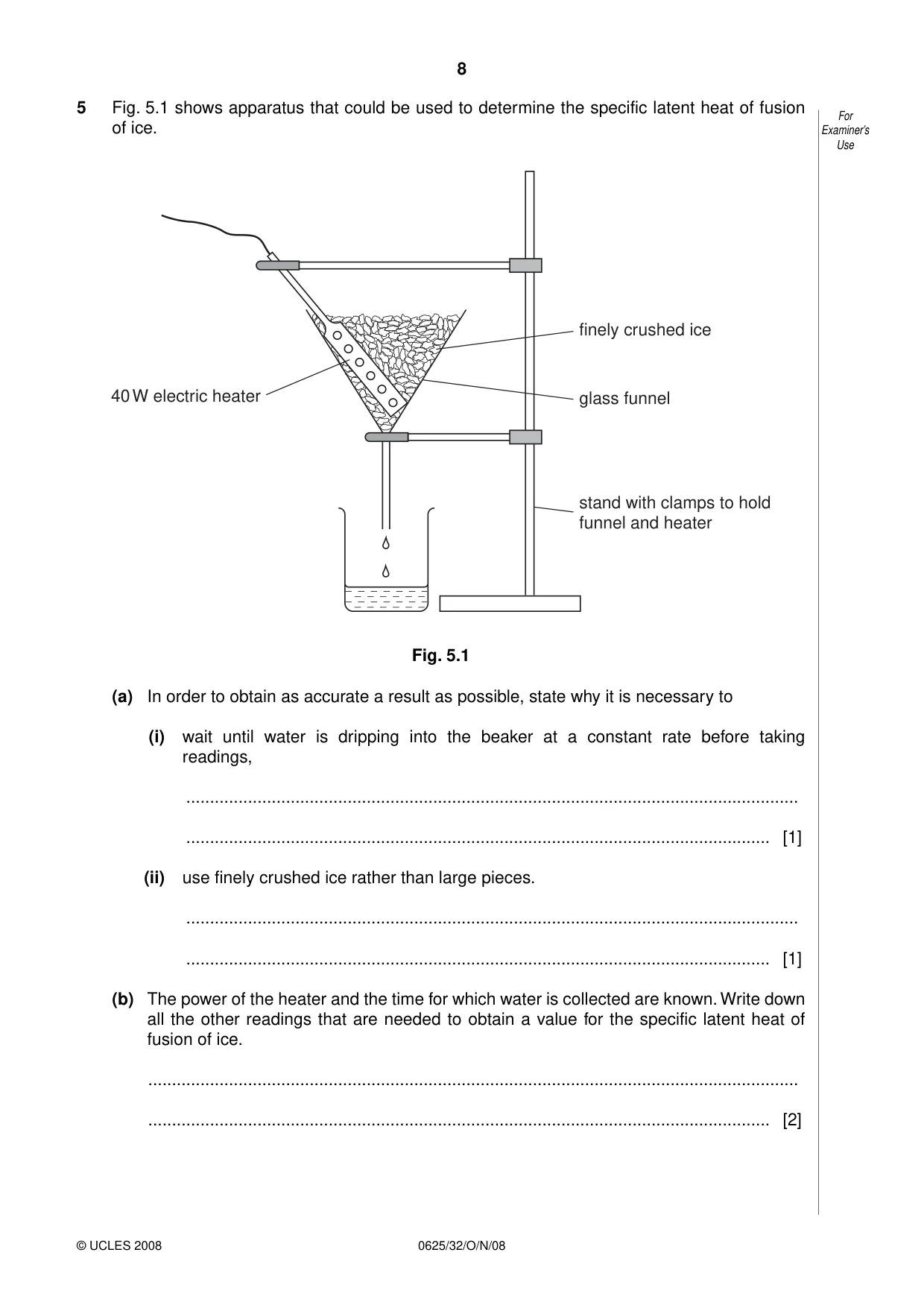
8 0625/31/O/N/08 © UCLES 2008 For Examiner’s Use 5 Fig. 5.1 shows apparatus that could be used to determine the specific latent heat of fusion of ice. 40 W electric heater finely crushed ice glass funnel stand with clamps to hold funnel and heater Fig. 5.1 (a) In order to obtain as accurate a result as possible, state why it is necessary to (i) wait until water is dripping into the beaker at a constant rate before taking readings, … … [1] (ii) use finely crushed ice rather than large pieces. … … [1] (b) The power of the heater and the time for which water is collected are known. Write down all the other readings that are needed to obtain a value for the specific latent heat of fusion of ice. … … [2]
Question paper, page 10
9 0625/31/O/N/08 © UCLES 2008 [Turn over For Examiner’s Use (c) Using a 40 W heater, 16.3 g of ice is melted in 2.0 minutes. The heater is then switched off. In a further 2.0 minutes, 2.1 g of ice is melted. Calculate the value of the specific latent heat of fusion of ice from these results. specific latent heat of fusion of ice = … [4] [Total: 8]
Question paper, page 11
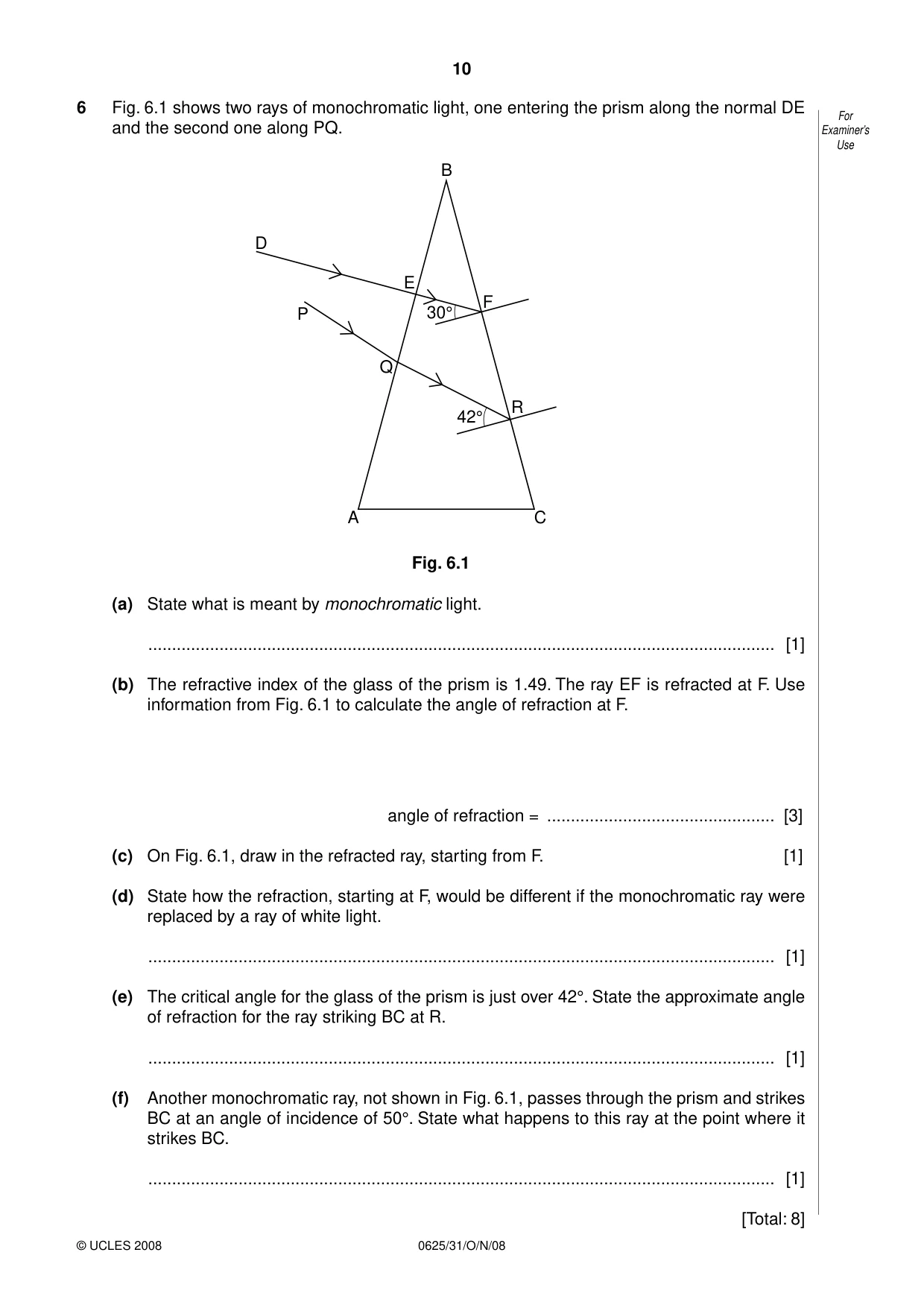
10 0625/31/O/N/08 © UCLES 2008 For Examiner’s Use 6 Fig. 6.1 shows two rays of monochromatic light, one entering the prism along the normal DE and the second one along PQ. D A C P E Q F R 42° 30° B Fig. 6.1 (a) State what is meant by monochromatic light. … [1] (b) The refractive index of the glass of the prism is 1.49. The ray EF is refracted at F. Use information from Fig. 6.1 to calculate the angle of refraction at F. angle of refraction = … [3] (c) On Fig. 6.1, draw in the refracted ray, starting from F. [1] (d) State how the refraction, starting at F, would be different if the monochromatic ray were replaced by a ray of white light. … [1] (e) The critical angle for the glass of the prism is just over 42°. State the approximate angle of refraction for the ray striking BC at R. … [1] (f) Another monochromatic ray, not shown in Fig. 6.1, passes through the prism and strikes BC at an angle of incidence of 50°. State what happens to this ray at the point where it strikes BC. … [1] [Total: 8]
Question paper, page 12
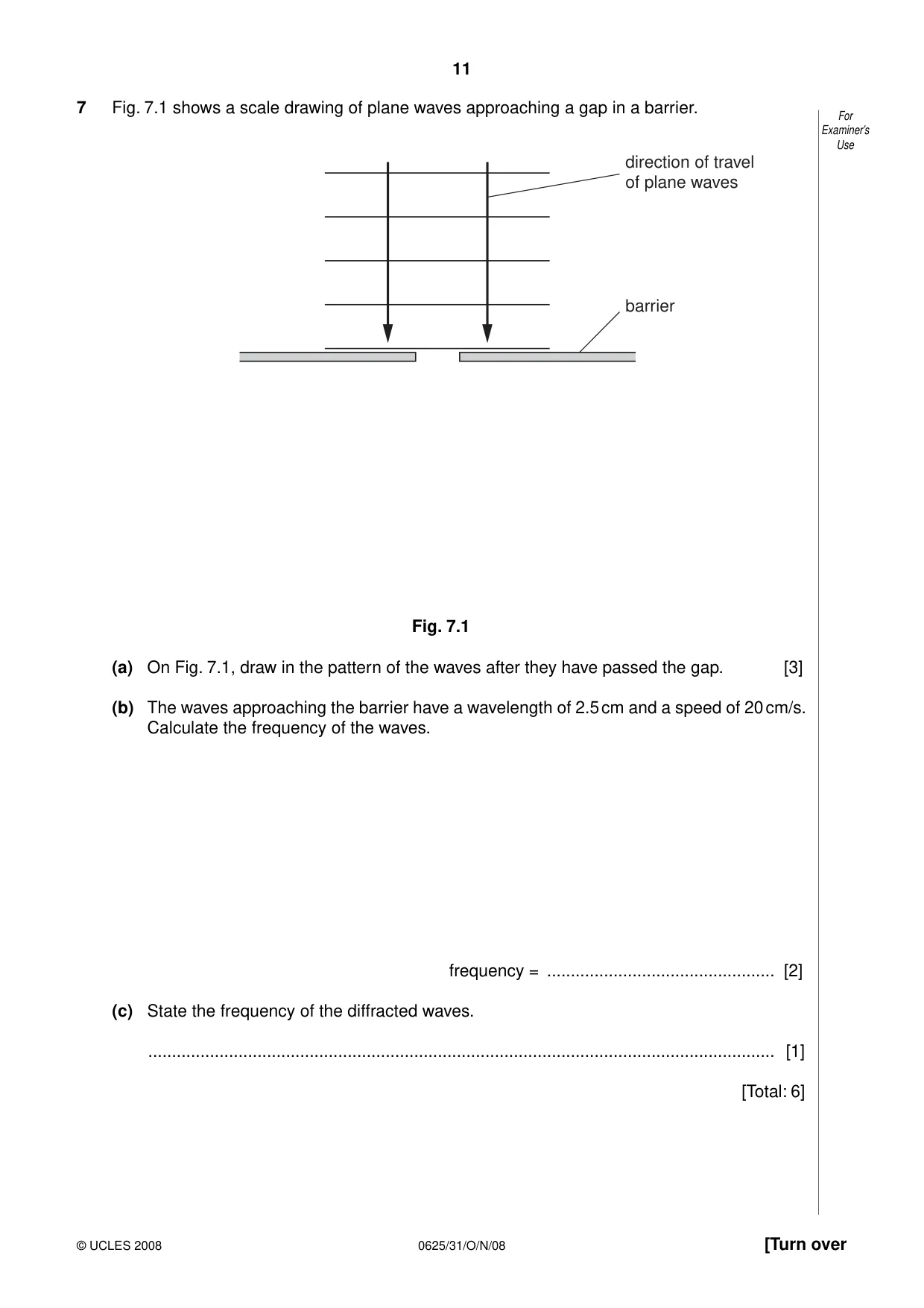
11 0625/31/O/N/08 © UCLES 2008 [Turn over For Examiner’s Use 7 Fig. 7.1 shows a scale drawing of plane waves approaching a gap in a barrier. direction of travel of plane waves barrier Fig. 7.1 (a) On Fig. 7.1, draw in the pattern of the waves after they have passed the gap. [3] (b) The waves approaching the barrier have a wavelength of 2.5 cm and a speed of 20 cm/s. Calculate the frequency of the waves. frequency = … [2] (c) State the frequency of the diffracted waves. … [1] [Total: 6]
Question paper, page 13
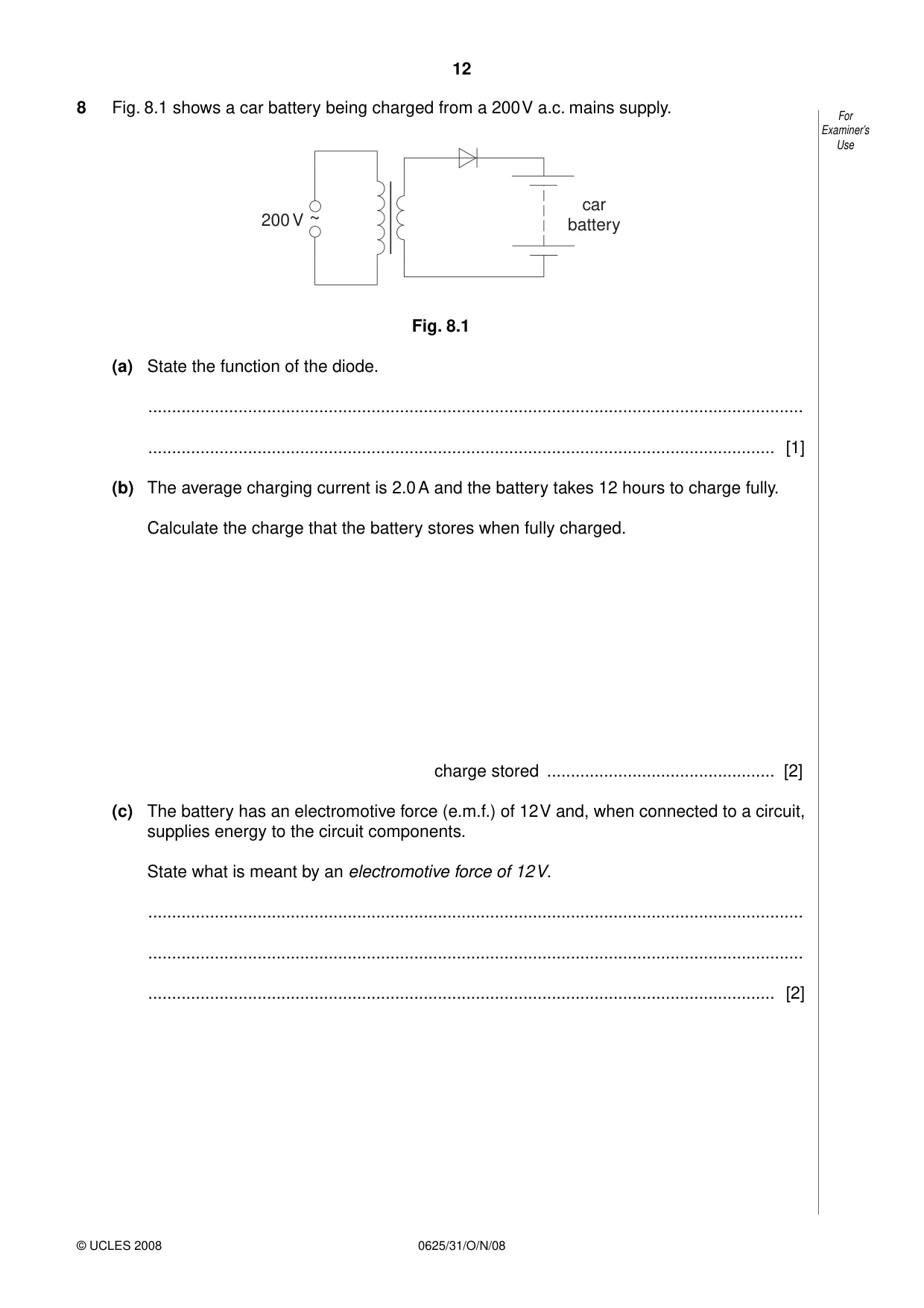
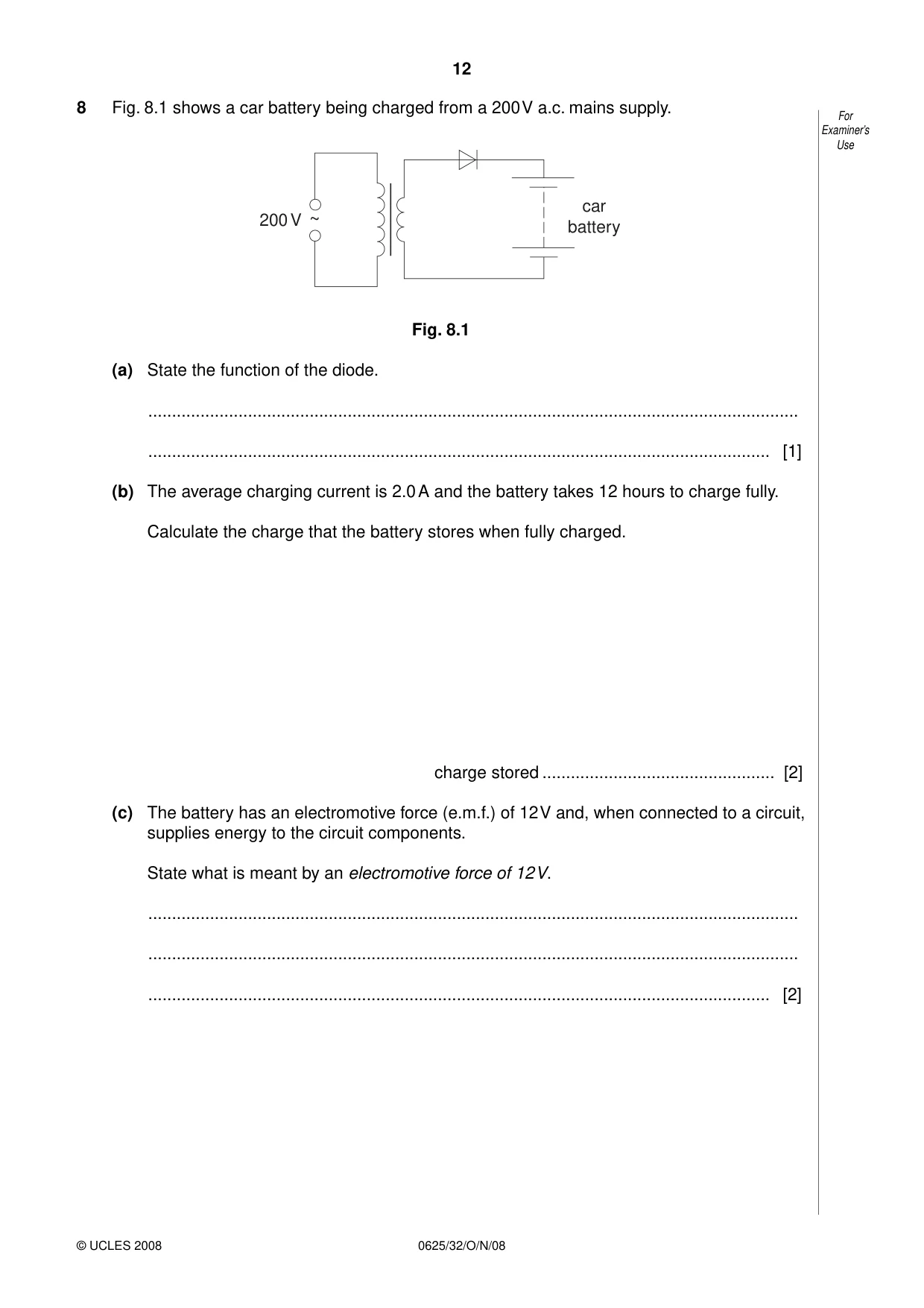
12 0625/31/O/N/08 © UCLES 2008 For Examiner’s Use 8 Fig. 8.1 shows a car battery being charged from a 200 V a.c. mains supply. 200 V ~ car battery Fig. 8.1 (a) State the function of the diode. … … [1] (b) The average charging current is 2.0 A and the battery takes 12 hours to charge fully. Calculate the charge that the battery stores when fully charged. charge stored … [2] (c) The battery has an electromotive force (e.m.f.) of 12 V and, when connected to a circuit, supplies energy to the circuit components. State what is meant by an electromotive force of 12 V. … … … [2]
Question paper, page 14
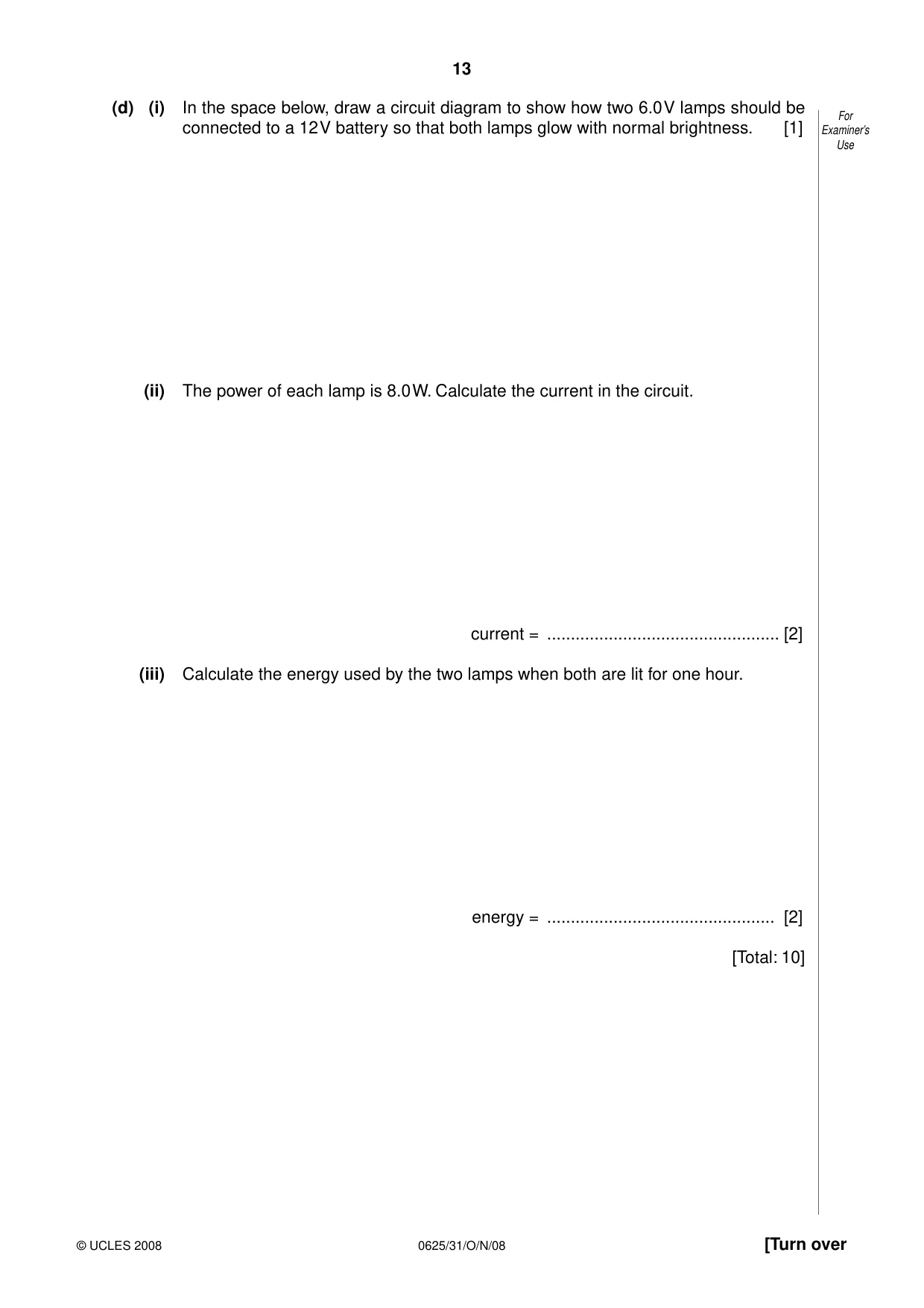
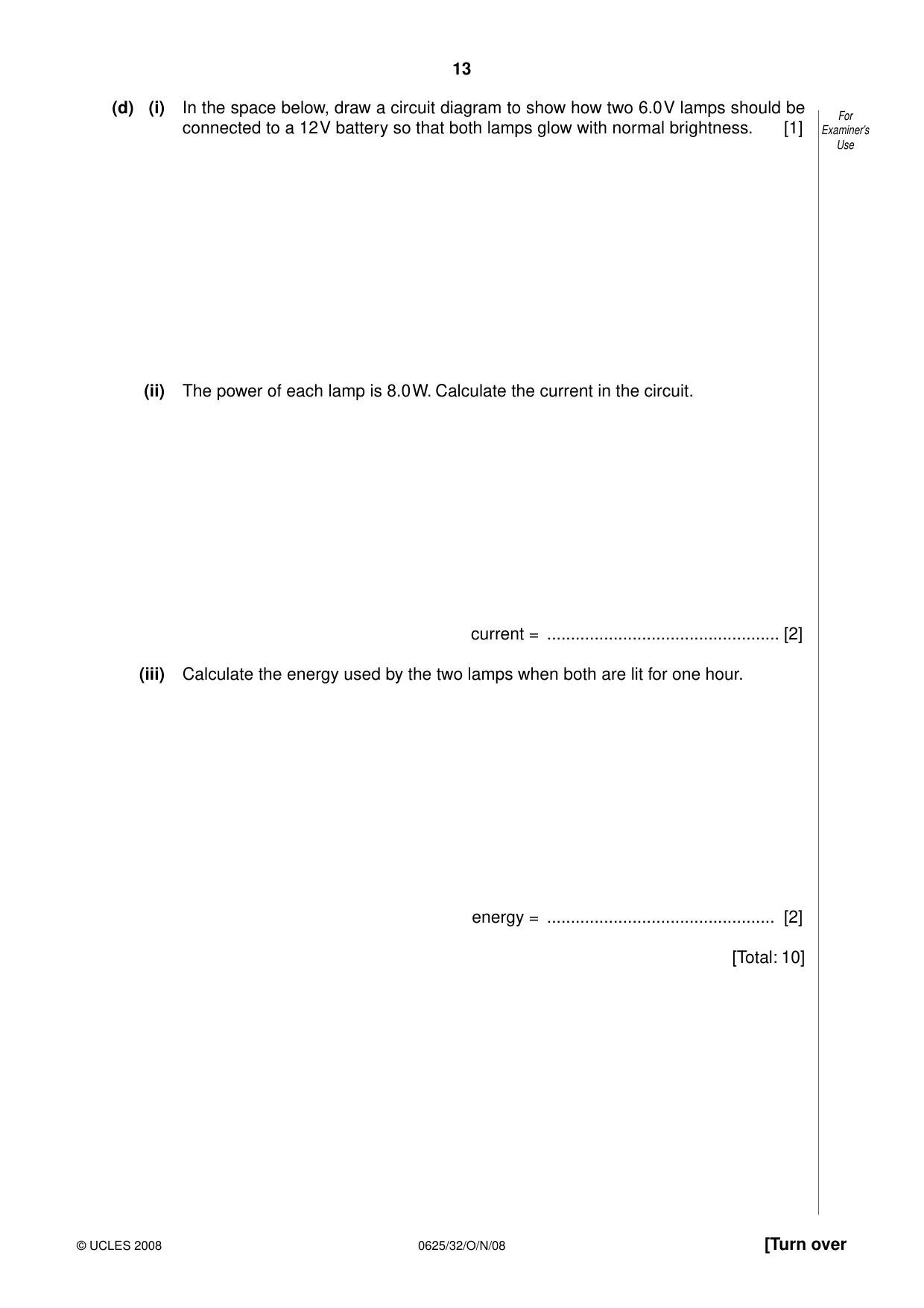
13 0625/31/O/N/08 © UCLES 2008 [Turn over For Examiner’s Use (d) (i) In the space below, draw a circuit diagram to show how two 6.0 V lamps should be connected to a 12 V battery so that both lamps glow with normal brightness. [1] (ii) The power of each lamp is 8.0 W. Calculate the current in the circuit. current = … [2] (iii) Calculate the energy used by the two lamps when both are lit for one hour. energy = … [2] [Total: 10]
Question paper, page 15
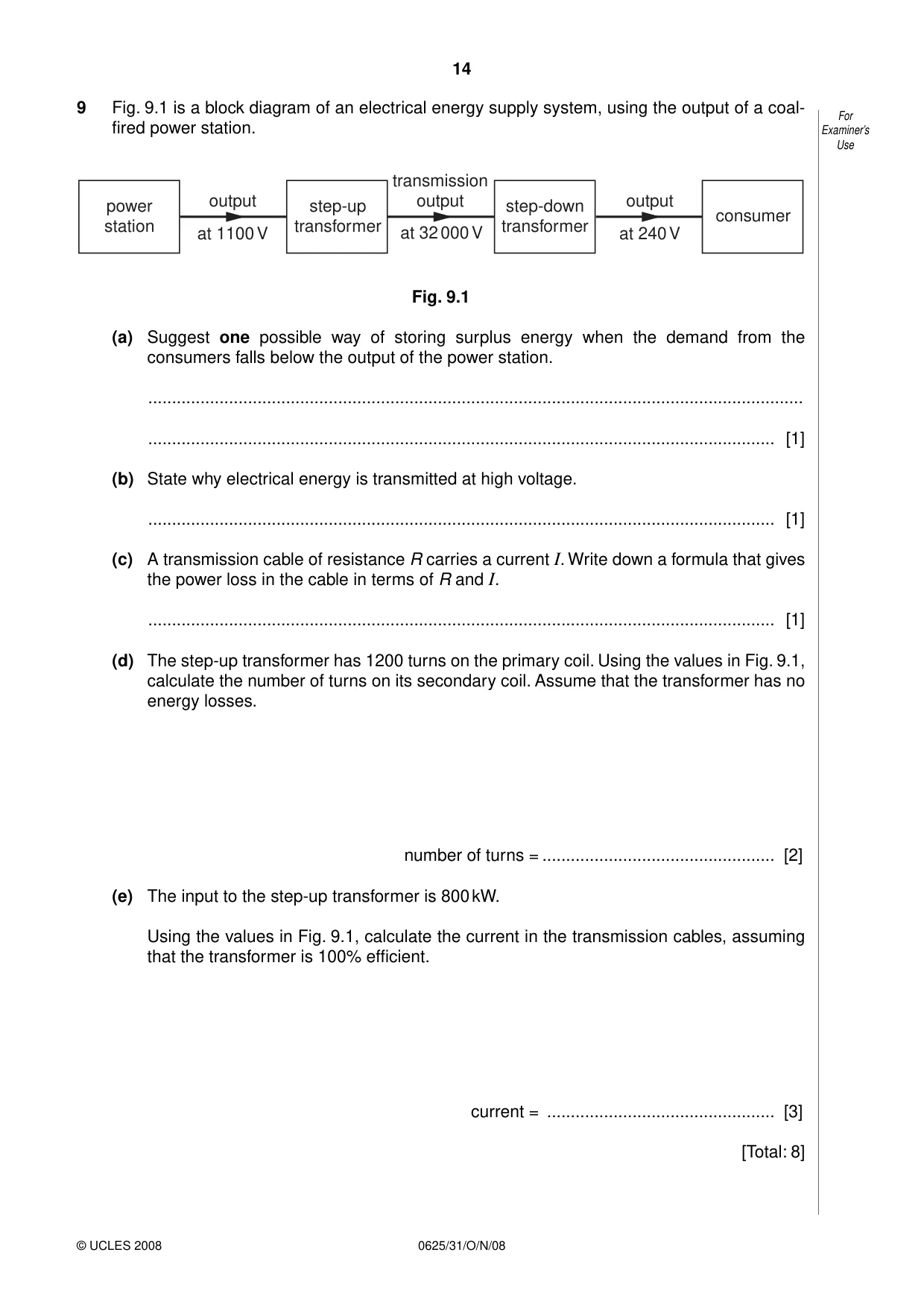
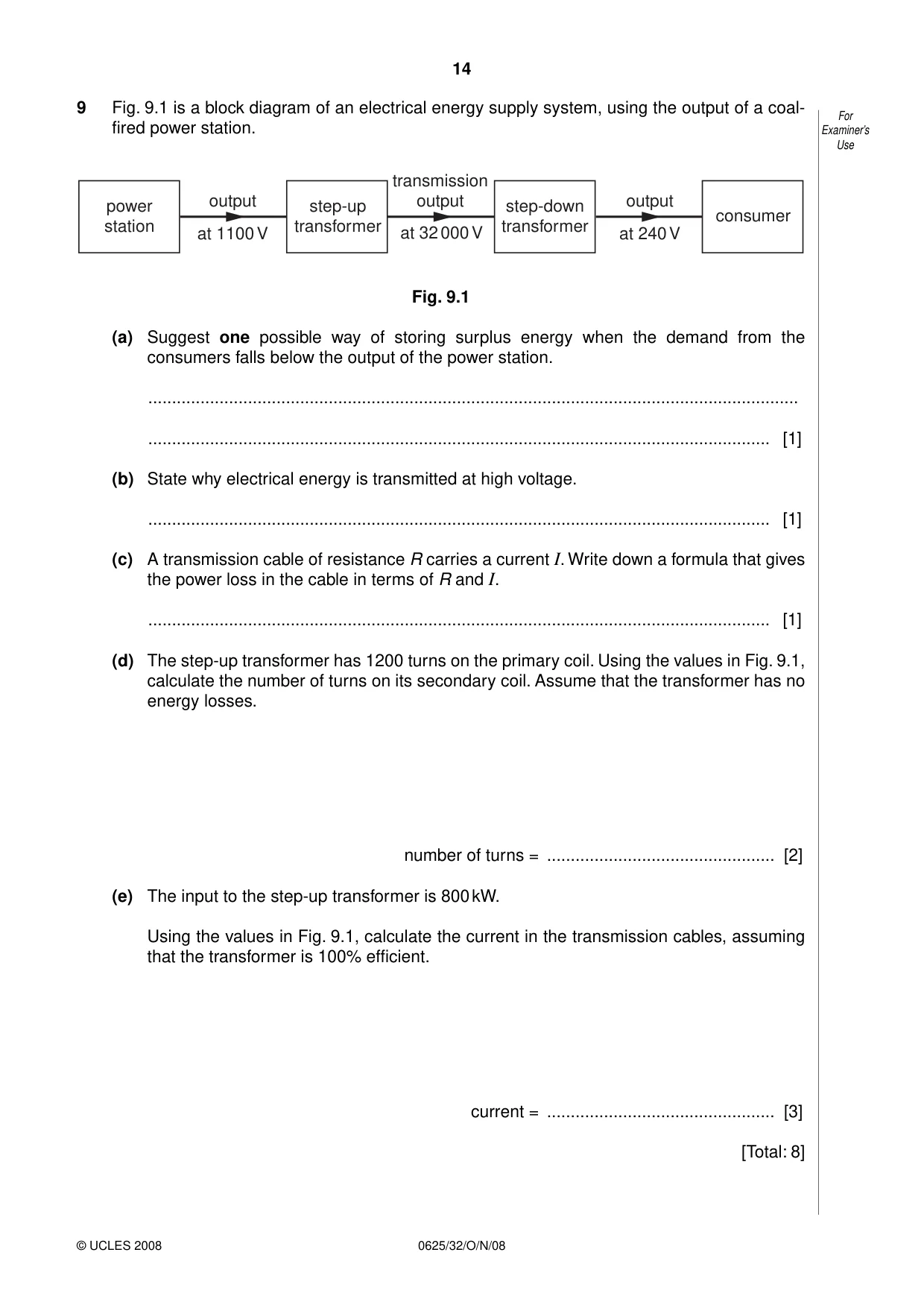
14 0625/31/O/N/08 © UCLES 2008 For Examiner’s Use 9 Fig. 9.1 is a block diagram of an electrical energy supply system, using the output of a coal- fired power station. step-up transformer power station consumer step-down transformer output at 1100 V output at 240 V at 32 000 V transmission output Fig. 9.1 (a) Suggest one possible way of storing surplus energy when the demand from the consumers falls below the output of the power station. … … [1] (b) State why electrical energy is transmitted at high voltage. … [1] (c) A transmission cable of resistance R carries a current I. Write down a formula that gives the power loss in the cable in terms of R and I. … [1] (d) The step-up transformer has 1200 turns on the primary coil. Using the values in Fig. 9.1, calculate the number of turns on its secondary coil. Assume that the transformer has no energy losses. number of turns = … [2] (e) The input to the step-up transformer is 800 kW. Using the values in Fig. 9.1, calculate the current in the transmission cables, assuming that the transformer is 100% efficient. current = … [3] [Total: 8]
Question paper, page 16
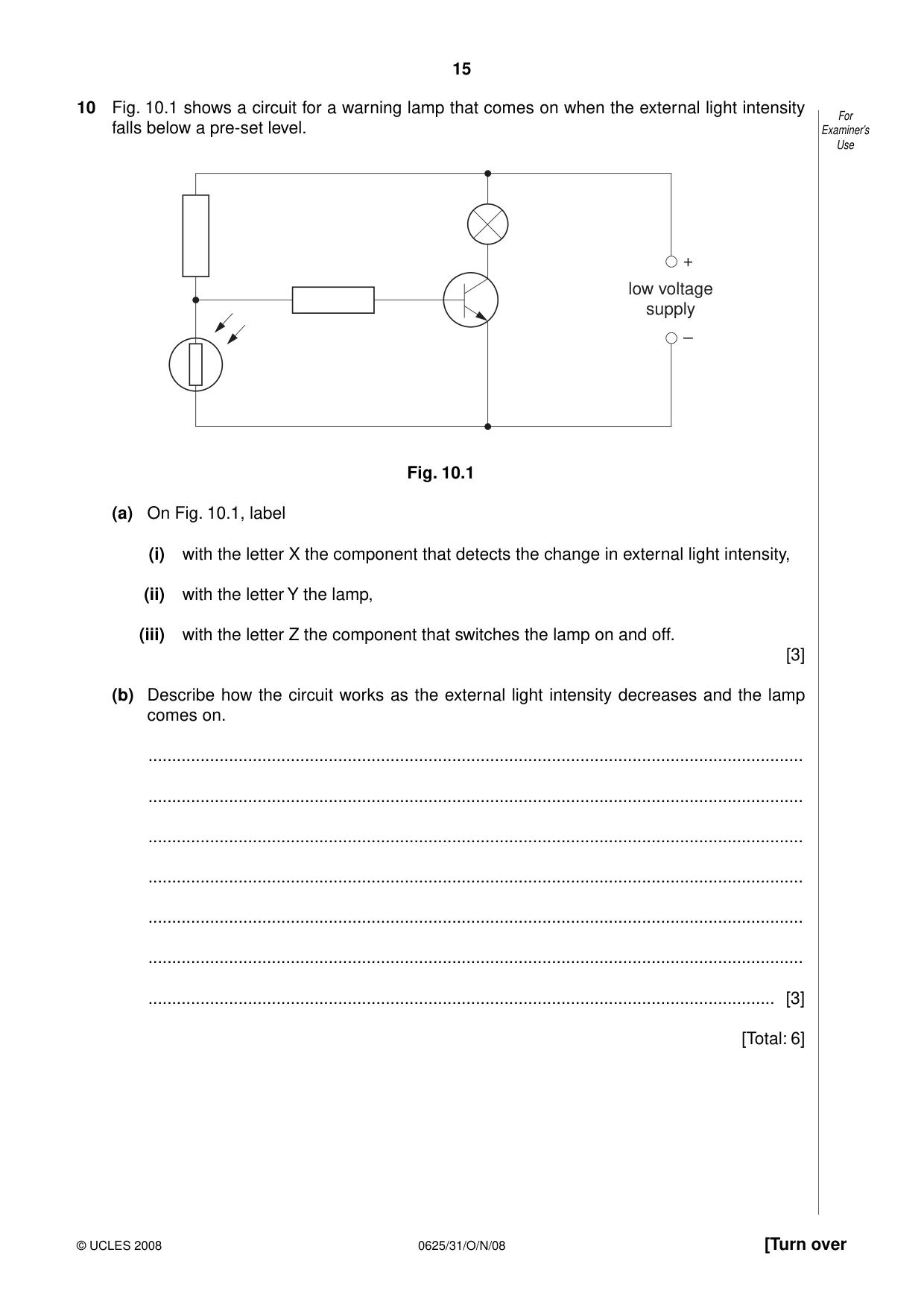
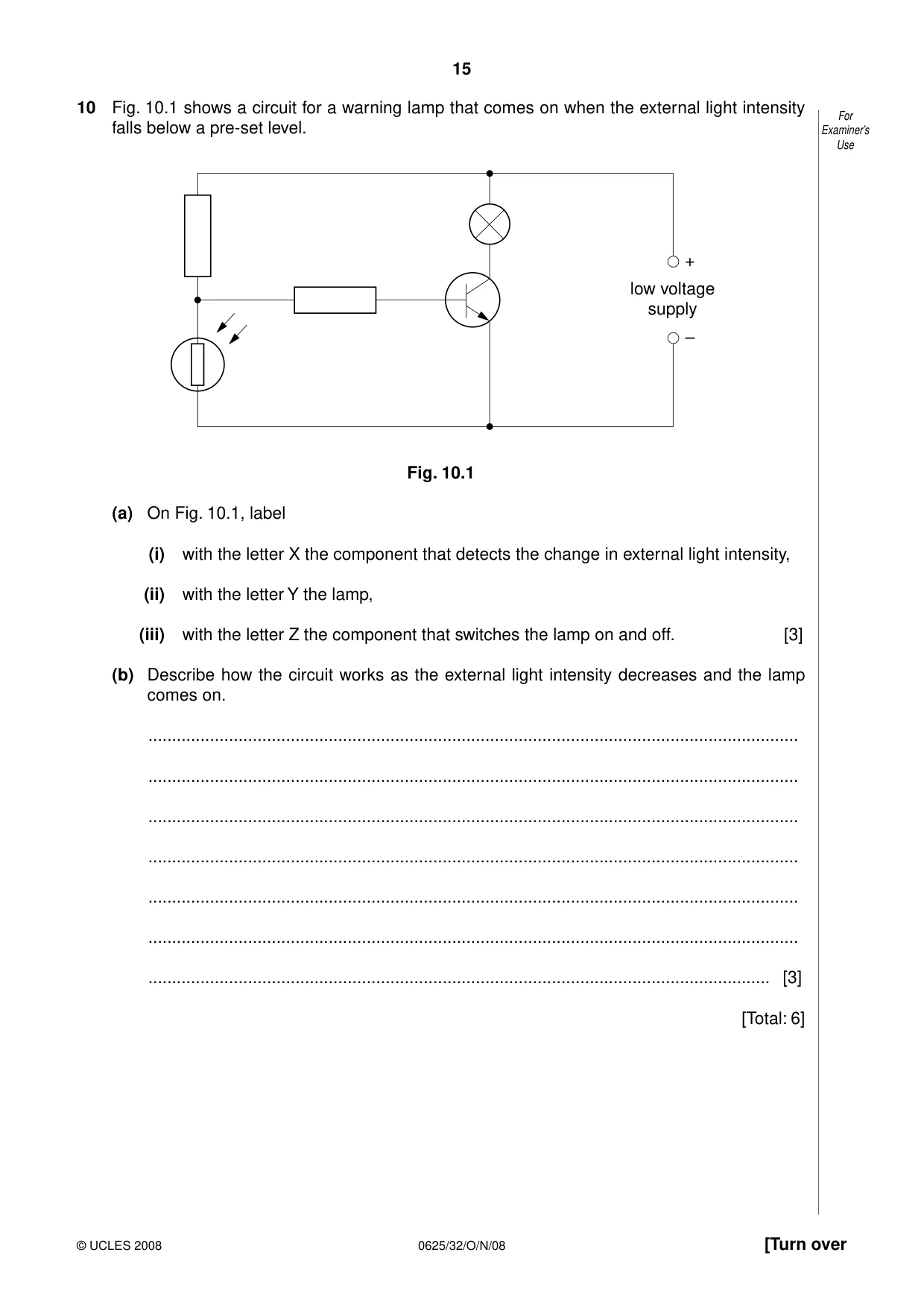
15 0625/31/O/N/08 © UCLES 2008 [Turn over For Examiner’s Use 10 Fig. 10.1 shows a circuit for a warning lamp that comes on when the external light intensity falls below a pre-set level. + – low voltage supply Fig. 10.1 (a) On Fig. 10.1, label (i) with the letter X the component that detects the change in external light intensity, (ii) with the letter Y the lamp, (iii) with the letter Z the component that switches the lamp on and off. [3] (b) Describe how the circuit works as the external light intensity decreases and the lamp comes on. … … … … … … … [3] [Total: 6]
Question paper, page 17
16 0625/31/O/N/08 © UCLES 2008 For Examiner’s Use 11 Fig. 11.1 shows the basic design of the tube of a cathode ray oscilloscope (CRO). A heater filament B C D anode cathode rays Fig. 11.1 (a) On Fig. 11.1, write the names of parts A, B, C and D in the boxes provided. [2] (b) State the function of: part A, … … part B. … … [2] (c) A varying p.d. from a 12 V supply is connected to a CRO, so that the waveform of the supply is shown on the screen. To which of the components in Fig. 11.1 (i) is the 12 V supply connected, … [1] (ii) is the time-base connected? … [1] [Total: 6] Permission to reproduce items where third-party owned material protected by copyright is included has been sought and cleared where possible. Every reasonable effort has been made by the publisher (UCLES) to trace copyright holders, but if any items requiring clearance have unwittingly been included, the publisher will be pleased to make amends at the earliest possible opportunity. University of Cambridge International Examinations is part of the Cambridge Assessment Group. Cambridge Assessment is the brand name of University of Cambridge Local Examinations Syndicate (UCLES), which is itself a department of the University of Cambridge.
Question paper, page 18
This document consists of 16 printed pages. SPA (SHW 00014 3/07) T50467/4 © UCLES 2008 [Turn over UNIVERSITY OF CAMBRIDGE INTERNATIONAL EXAMINATIONS International General Certificate of Secondary Education READ THESE INSTRUCTIONS FIRST Write your Centre number, candidate number and name on all the work you hand in. Write in dark blue or black pen. You may use a soft pencil for any diagrams, graphs or rough working. Do not use staples, paper clips, highlighters, glue or correction fluid. DO NOT WRITE IN ANY BARCODES. Answer all questions. You may lose marks if you do not show your working or if you do not use appropriate units. Take the weight of 1 kg to be 10 N (i.e. acceleration of free fall = 10 m/s2). At the end of the examination, fasten all your work securely together. The number of marks is given in brackets [ ] at the end of each question or part question. * 6 6 2 5 0 4 2 9 8 1 * PHYSICS 0625/32 Paper 3 Extended October/November 2008 1 hour 15 minutes Candidates answer on the Question Paper. No Additional Materials are required. Second Variant Question Paper
Question paper, page 19
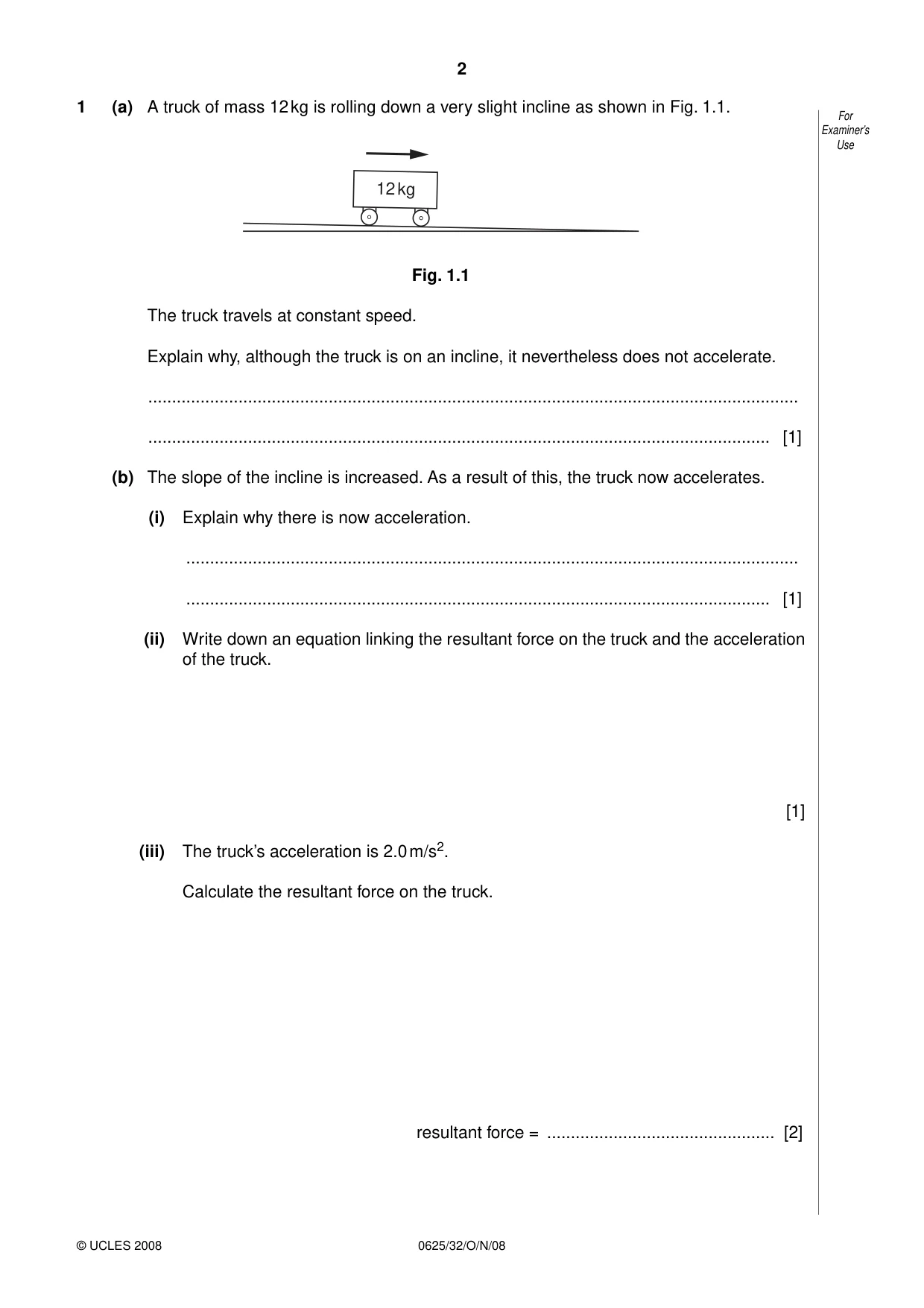
2 © UCLES 2008 For Examiner’s Use 0625/32/O/N/08 1 (a) A truck of mass 12 kg is rolling down a very slight incline as shown in Fig. 1.1. 12 kg Fig. 1.1 The truck travels at constant speed. Explain why, although the truck is on an incline, it nevertheless does not accelerate. … … [1] (b) The slope of the incline is increased. As a result of this, the truck now accelerates. (i) Explain why there is now acceleration. … … [1] (ii) Write down an equation linking the resultant force on the truck and the acceleration of the truck. [1] (iii) The truck’s acceleration is 2.0 m/s2. Calculate the resultant force on the truck. resultant force = … [2]
Question paper, page 20
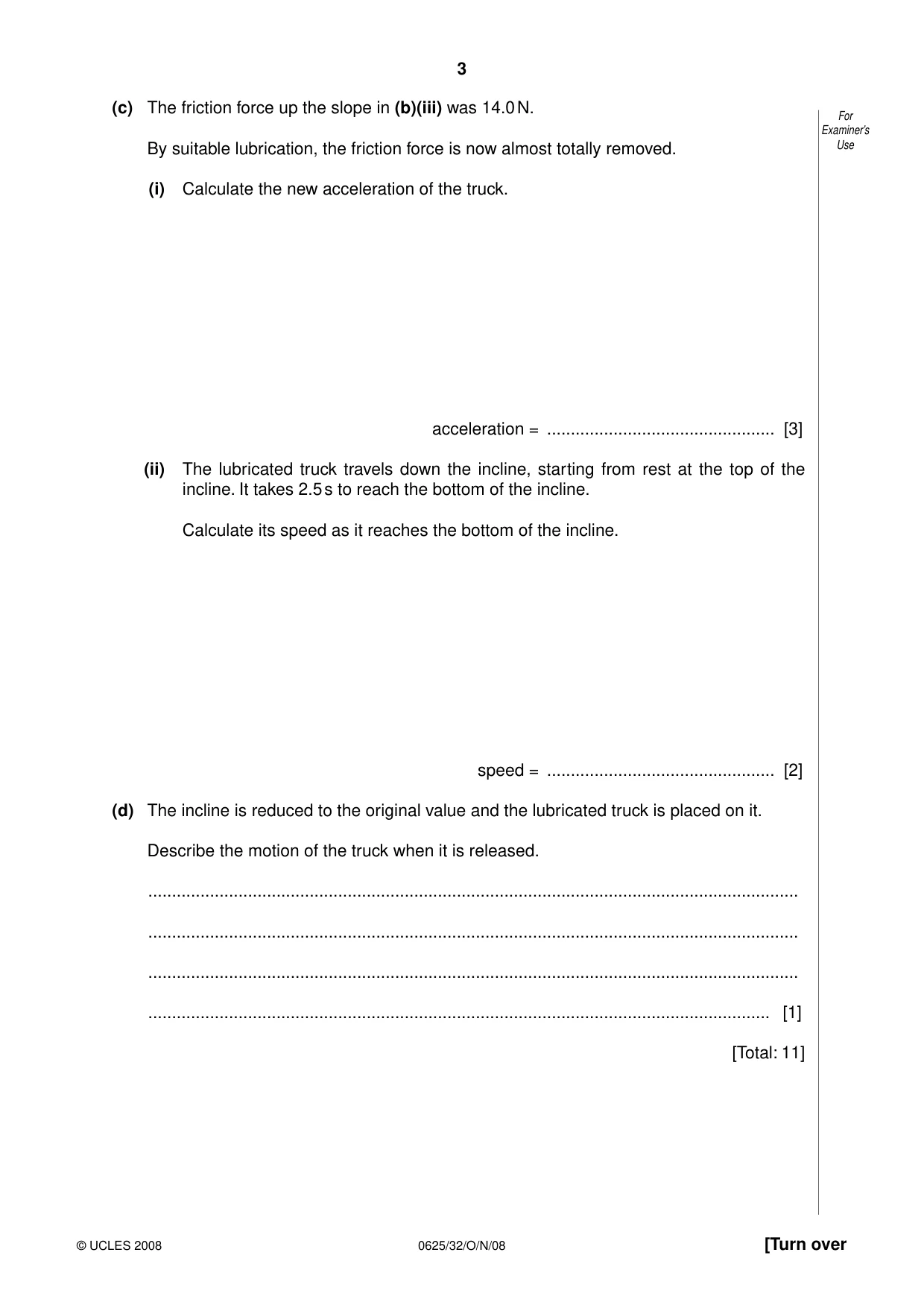
3 © UCLES 2008 [Turn over For Examiner’s Use 0625/32/O/N/08 (c) The friction force up the slope in (b)(iii) was 14.0 N. By suitable lubrication, the friction force is now almost totally removed. (i) Calculate the new acceleration of the truck. acceleration = … [3] (ii) The lubricated truck travels down the incline, starting from rest at the top of the incline. It takes 2.5 s to reach the bottom of the incline. Calculate its speed as it reaches the bottom of the incline. speed = … [2] (d) The incline is reduced to the original value and the lubricated truck is placed on it. Describe the motion of the truck when it is released. … … … … [1] [Total: 11]
Question paper, page 21
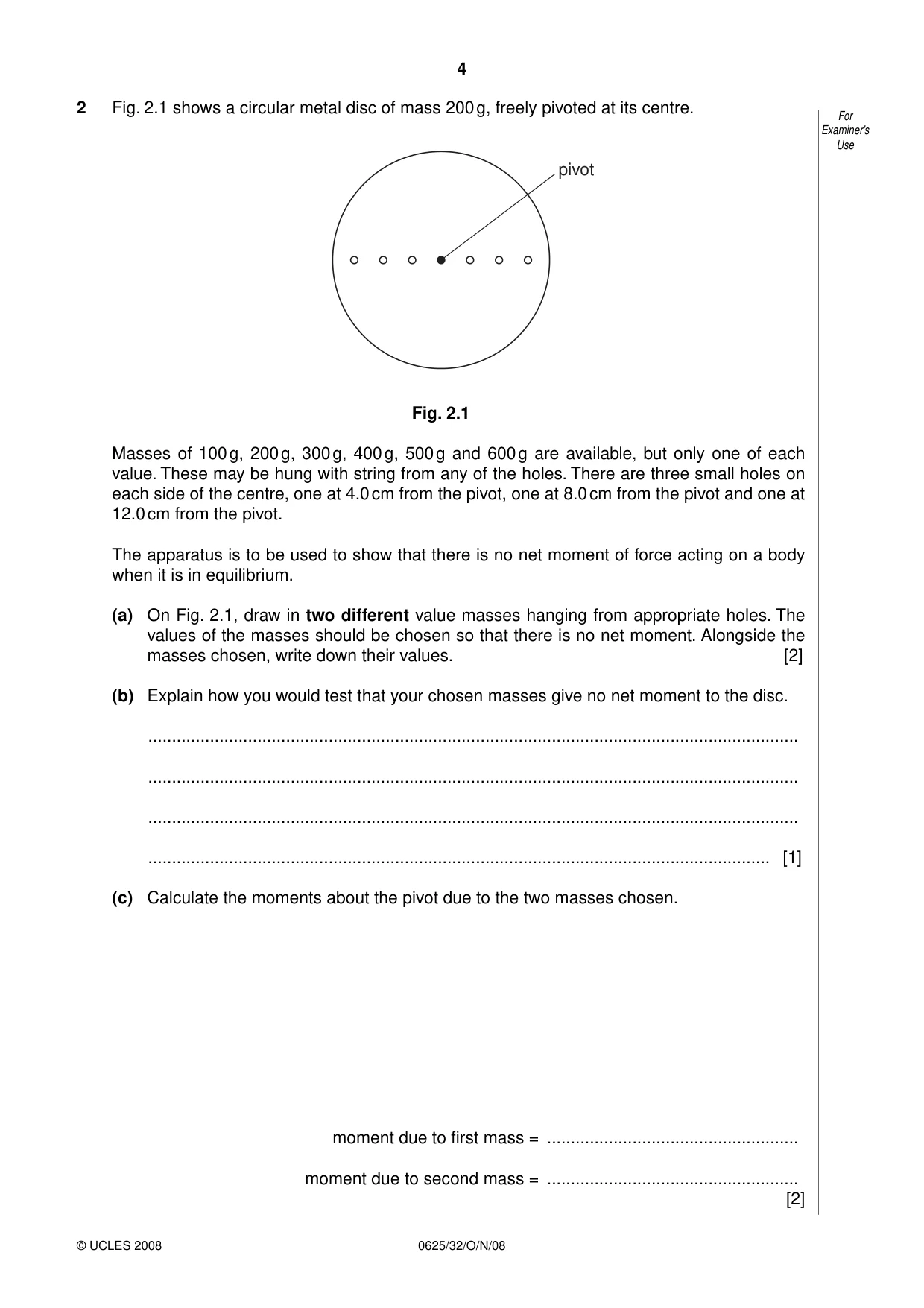
4 © UCLES 2008 For Examiner’s Use 0625/32/O/N/08 2 Fig. 2.1 shows a circular metal disc of mass 200 g, freely pivoted at its centre. pivot Fig. 2.1 Masses of 100 g, 200 g, 300 g, 400 g, 500 g and 600 g are available, but only one of each value. These may be hung with string from any of the holes. There are three small holes on each side of the centre, one at 4.0 cm from the pivot, one at 8.0 cm from the pivot and one at 12.0 cm from the pivot. The apparatus is to be used to show that there is no net moment of force acting on a body when it is in equilibrium. (a) On Fig. 2.1, draw in two different value masses hanging from appropriate holes. The values of the masses should be chosen so that there is no net moment. Alongside the masses chosen, write down their values. [2] (b) Explain how you would test that your chosen masses give no net moment to the disc. … … … … [1] (c) Calculate the moments about the pivot due to the two masses chosen. moment due to first mass = … moment due to second mass = … [2]
Question paper, page 22
5 © UCLES 2008 [Turn over For Examiner’s Use 0625/32/O/N/08 (d) Calculate the force on the pivot when the two masses chosen are hanging from the disc. force = … [2] [Total: 7]
Question paper, page 23
6 © UCLES 2008 For Examiner’s Use 0625/32/O/N/08 3 (a) A submarine descends to a depth of 70 m below the surface of water. The density of the water is 1050 kg/m3. Atmospheric pressure is 1.0 × 10⁵ Pa. Calculate (i) the increase in pressure as it descends from the surface to a depth of 70 m, increase in pressure = … [2] (ii) the total pressure on the submarine at a depth of 70 m. total pressure = … [1] (b) On another dive, the submarine experiences a total pressure of 6.5 × 10⁵ Pa. A hatch cover on the submarine has an area of 2.5 m2. Calculate the force on the outside of the cover. force = … [2] (c) The submarine undergoes tests in fresh water of density 1000 kg/m3. Explain why the pressure on the submarine is less at the same depth. … … [1] [Total: 6]
Question paper, page 24
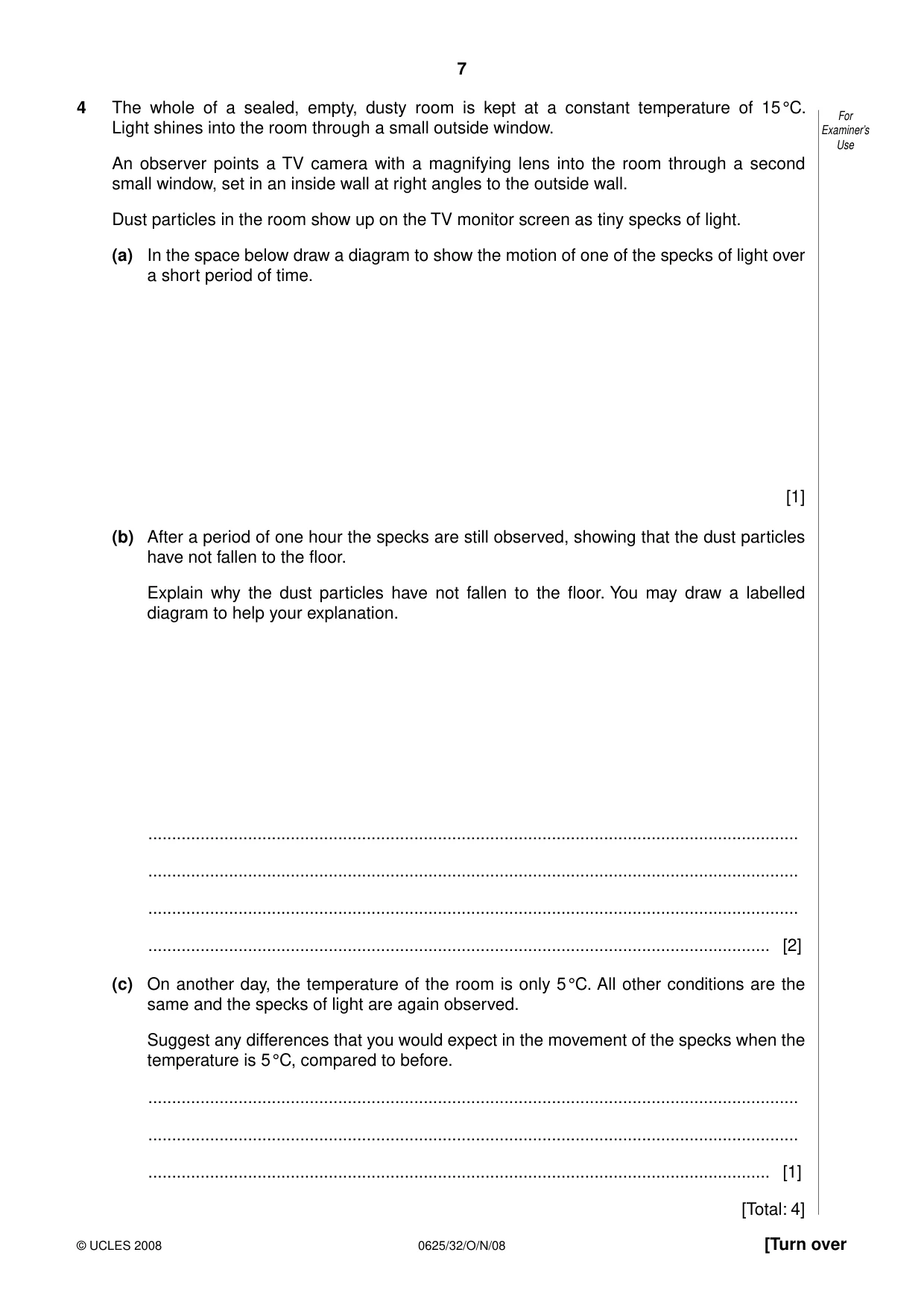
7 © UCLES 2008 [Turn over For Examiner’s Use 0625/32/O/N/08 4 The whole of a sealed, empty, dusty room is kept at a constant temperature of 15 °C. Light shines into the room through a small outside window. An observer points a TV camera with a magnifying lens into the room through a second small window, set in an inside wall at right angles to the outside wall. Dust particles in the room show up on the TV monitor screen as tiny specks of light. (a) In the space below draw a diagram to show the motion of one of the specks of light over a short period of time. [1] (b) After a period of one hour the specks are still observed, showing that the dust particles have not fallen to the floor. Explain why the dust particles have not fallen to the floor. You may draw a labelled diagram to help your explanation. … … … … [2] (c) On another day, the temperature of the room is only 5 °C. All other conditions are the same and the specks of light are again observed. Suggest any differences that you would expect in the movement of the specks when the temperature is 5 °C, compared to before. … … … [1] [Total: 4]
Question paper, page 25
8 © UCLES 2008 For Examiner’s Use 0625/32/O/N/08 5 Fig. 5.1 shows apparatus that could be used to determine the specific latent heat of fusion of ice. 40 W electric heater finely crushed ice glass funnel stand with clamps to hold funnel and heater Fig. 5.1 (a) In order to obtain as accurate a result as possible, state why it is necessary to (i) wait until water is dripping into the beaker at a constant rate before taking readings, … … [1] (ii) use finely crushed ice rather than large pieces. … … [1] (b) The power of the heater and the time for which water is collected are known. Write down all the other readings that are needed to obtain a value for the specific latent heat of fusion of ice. … … [2]
Question paper, page 26
9 © UCLES 2008 [Turn over For Examiner’s Use 0625/32/O/N/08 (c) (i) Using a 40 W heater, 250 g of water is heated for 3.0 minutes. The temperature rise of the water is 5.9 °C. Use these values to calculate a value for the specific heat capacity of water. specific heat capacity = … [3] (ii) The accepted value for the specific heat capacity of water is 4.2 J/(g °C). State one possible reason why the value you obtained in (c)(i) is different from this. … [1] [Total: 8]
Question paper, page 27
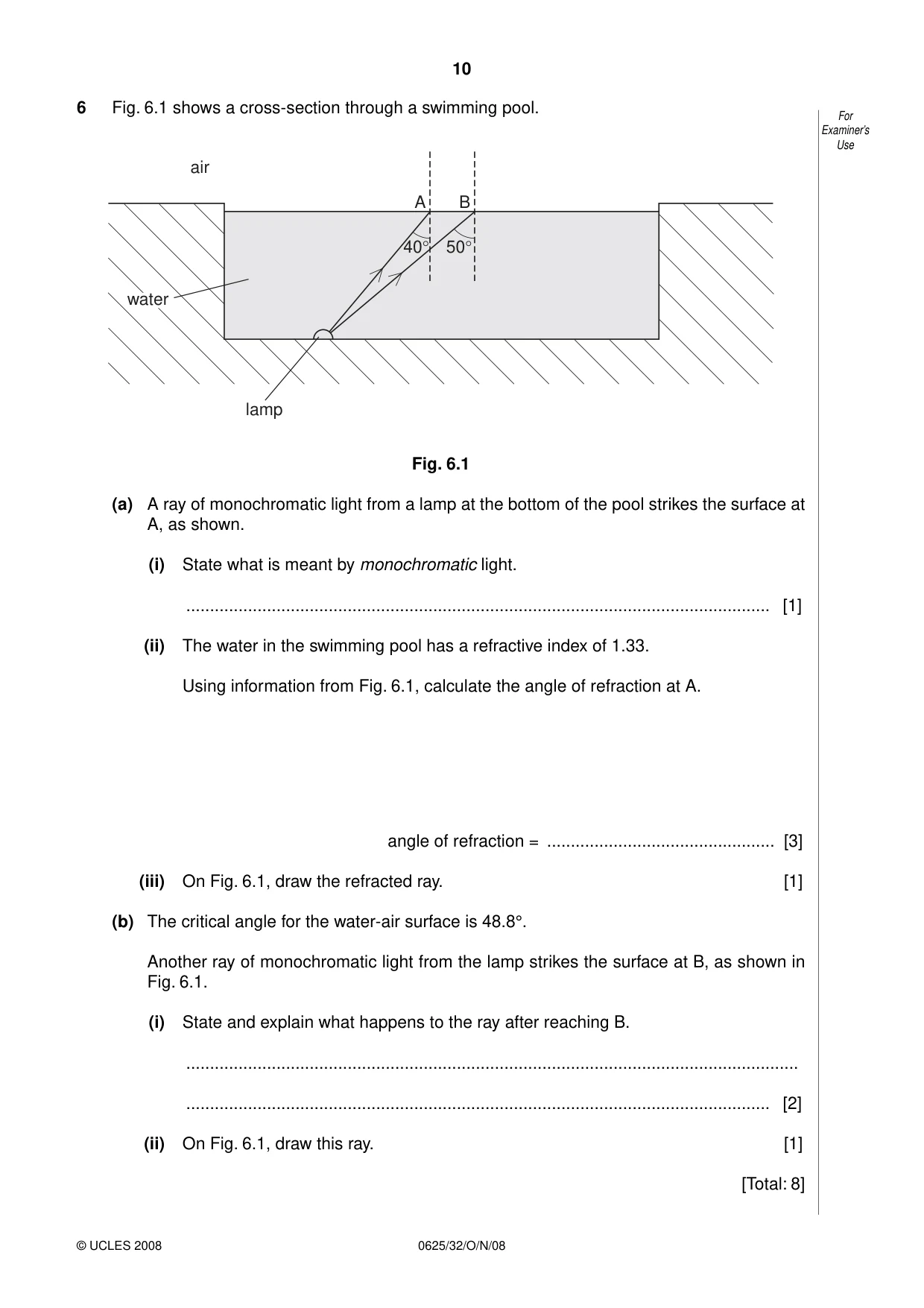
10 © UCLES 2008 For Examiner’s Use 0625/32/O/N/08 6 Fig. 6.1 shows a cross-section through a swimming pool. 40° 50° water air A B lamp Fig. 6.1 (a) A ray of monochromatic light from a lamp at the bottom of the pool strikes the surface at A, as shown. (i) State what is meant by monochromatic light. … [1] (ii) The water in the swimming pool has a refractive index of 1.33. Using information from Fig. 6.1, calculate the angle of refraction at A. angle of refraction = … [3] (iii) On Fig. 6.1, draw the refracted ray. [1] (b) The critical angle for the water-air surface is 48.8°. Another ray of monochromatic light from the lamp strikes the surface at B, as shown in Fig. 6.1. (i) State and explain what happens to the ray after reaching B. … … [2] (ii) On Fig. 6.1, draw this ray. [1] [Total: 8]
Question paper, page 28
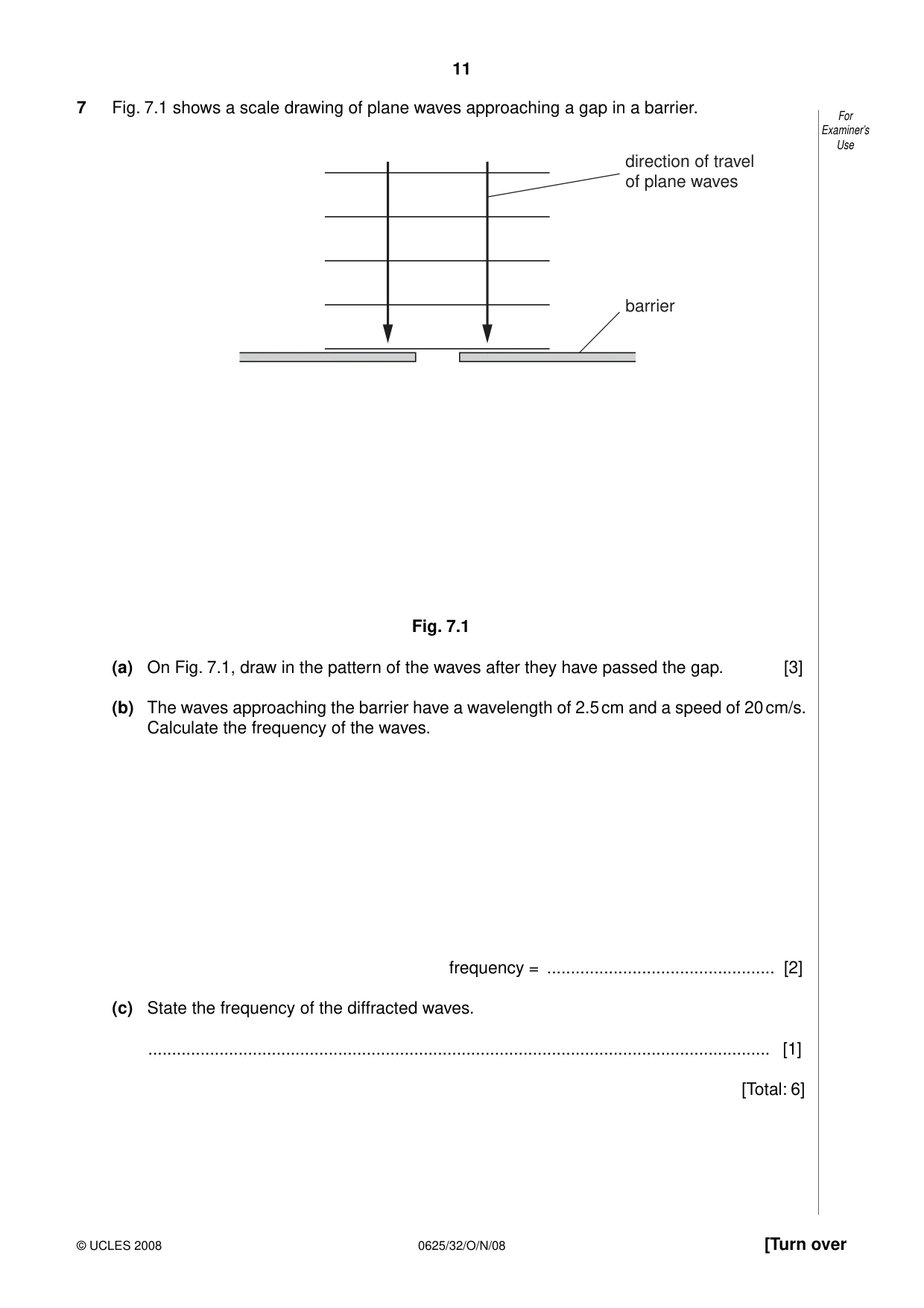
11 © UCLES 2008 [Turn over For Examiner’s Use 0625/32/O/N/08 7 Fig. 7.1 shows a scale drawing of plane waves approaching a gap in a barrier. direction of travel of plane waves barrier Fig. 7.1 (a) On Fig. 7.1, draw in the pattern of the waves after they have passed the gap. [3] (b) The waves approaching the barrier have a wavelength of 2.5 cm and a speed of 20 cm/s. Calculate the frequency of the waves. frequency = … [2] (c) State the frequency of the diffracted waves. … [1] [Total: 6]
Question paper, page 29
12 © UCLES 2008 For Examiner’s Use 0625/32/O/N/08 8 Fig. 8.1 shows a car battery being charged from a 200 V a.c. mains supply. 200 V ~ car battery Fig. 8.1 (a) State the function of the diode. … … [1] (b) The average charging current is 2.0 A and the battery takes 12 hours to charge fully. Calculate the charge that the battery stores when fully charged. charge stored … [2] (c) The battery has an electromotive force (e.m.f.) of 12 V and, when connected to a circuit, supplies energy to the circuit components. State what is meant by an electromotive force of 12 V. … … … [2]
Question paper, page 30
13 © UCLES 2008 [Turn over For Examiner’s Use 0625/32/O/N/08 (d) (i) In the space below, draw a circuit diagram to show how two 6.0 V lamps should be connected to a 12 V battery so that both lamps glow with normal brightness. [1] (ii) The power of each lamp is 8.0 W. Calculate the current in the circuit. current = … [2] (iii) Calculate the energy used by the two lamps when both are lit for one hour. energy = … [2] [Total: 10]
Question paper, page 31
14 © UCLES 2008 For Examiner’s Use 0625/32/O/N/08 9 Fig. 9.1 is a block diagram of an electrical energy supply system, using the output of a coal- fired power station. step-up transformer power station consumer step-down transformer output at 1100 V output at 240 V at 32 000 V transmission output Fig. 9.1 (a) Suggest one possible way of storing surplus energy when the demand from the consumers falls below the output of the power station. … … [1] (b) State why electrical energy is transmitted at high voltage. … [1] (c) A transmission cable of resistance R carries a current I. Write down a formula that gives the power loss in the cable in terms of R and I. … [1] (d) The step-up transformer has 1200 turns on the primary coil. Using the values in Fig. 9.1, calculate the number of turns on its secondary coil. Assume that the transformer has no energy losses. number of turns = … [2] (e) The input to the step-up transformer is 800 kW. Using the values in Fig. 9.1, calculate the current in the transmission cables, assuming that the transformer is 100% efficient. current = … [3] [Total: 8]
Question paper, page 32
15 © UCLES 2008 [Turn over For Examiner’s Use 0625/32/O/N/08 10 Fig. 10.1 shows a circuit for a warning lamp that comes on when the external light intensity falls below a pre-set level. + – low voltage supply Fig. 10.1 (a) On Fig. 10.1, label (i) with the letter X the component that detects the change in external light intensity, (ii) with the letter Y the lamp, (iii) with the letter Z the component that switches the lamp on and off. [3] (b) Describe how the circuit works as the external light intensity decreases and the lamp comes on. … … … … … … … [3] [Total: 6]
Question paper, page 33
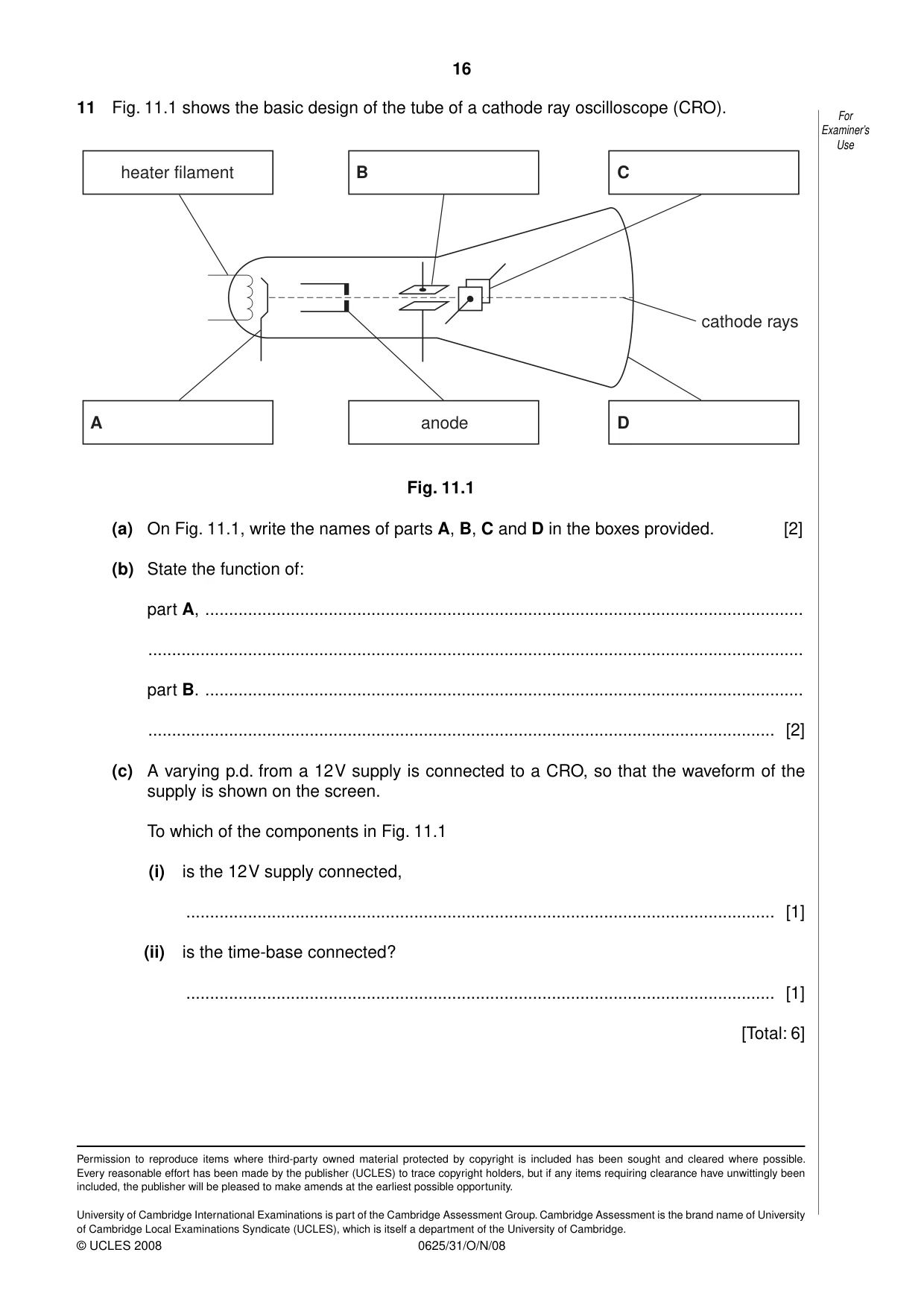
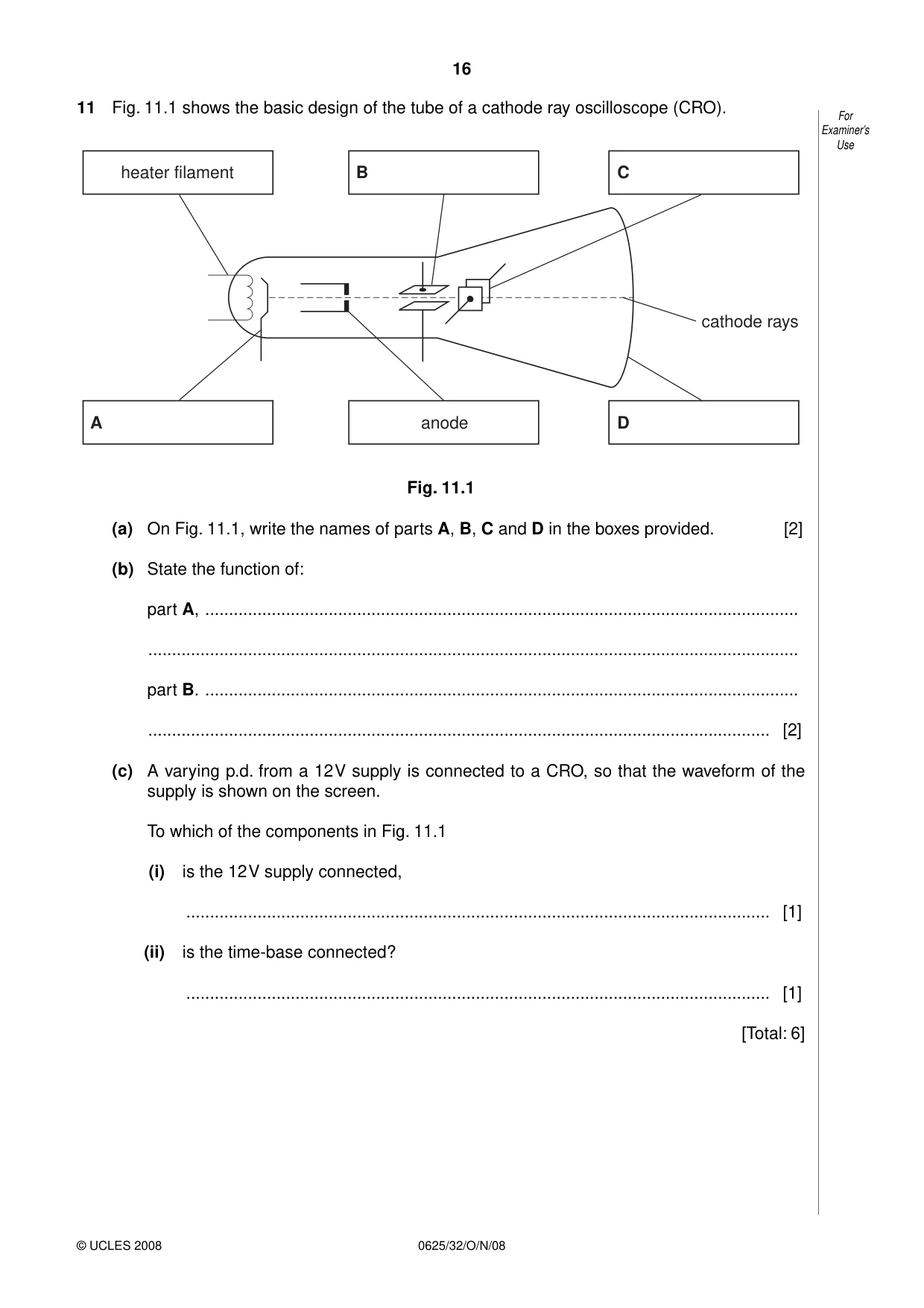
16 © UCLES 2008 For Examiner’s Use 0625/32/O/N/08 11 Fig. 11.1 shows the basic design of the tube of a cathode ray oscilloscope (CRO). A heater filament B C D anode cathode rays Fig. 11.1 (a) On Fig. 11.1, write the names of parts A, B, C and D in the boxes provided. [2] (b) State the function of: part A, … … part B. … … [2] (c) A varying p.d. from a 12 V supply is connected to a CRO, so that the waveform of the supply is shown on the screen. To which of the components in Fig. 11.1 (i) is the 12 V supply connected, … [1] (ii) is the time-base connected? … [1] [Total: 6]