Cambridge IGCSE Physical Science 0652 — 2008 Oct/Nov Paper 3 · Variant 0
0652/30/O/N/08
The question paper and its mark scheme, free to read here and free to download. This is Cambridge’s own paper, exactly as it was sat.
Question paper16 pages
Mark scheme
No mark scheme is in the library for this paper.
Paper as text
Question paper, page 1
This document consists of 16 printed pages. IB08 11_0652_03/4RP © UCLES 2008 [Turn over *6563002991* For Examiner's Use 1 2 3 4 5 6 7 8 9 Total UNIVERSITY OF CAMBRIDGE INTERNATIONAL EXAMINATIONS International General Certificate of Secondary Education PHYSICAL SCIENCE 0652/03 Paper 3 (Extended) October/November 2008 1 hour 15 minutes Candidates answer on the Question Paper. No Additional Materials are required. READ THESE INSTRUCTIONS FIRST Write your Centre number, candidate number and name on all the work you hand in. Write in dark blue or black pen. You may use a soft pencil for any diagrams, graphs, tables or rough working. Do not use staples, paper clips, highlighters, glue or correction fluid. DO NOT WRITE IN ANY BARCODES Answer all questions. A copy of the Periodic Table is printed on page 16. At the end of the examination, fasten all your work securely together. The number of marks is given in brackets [ ] at the end of each question or part question. www.XtremePapers.com
Question paper, page 2
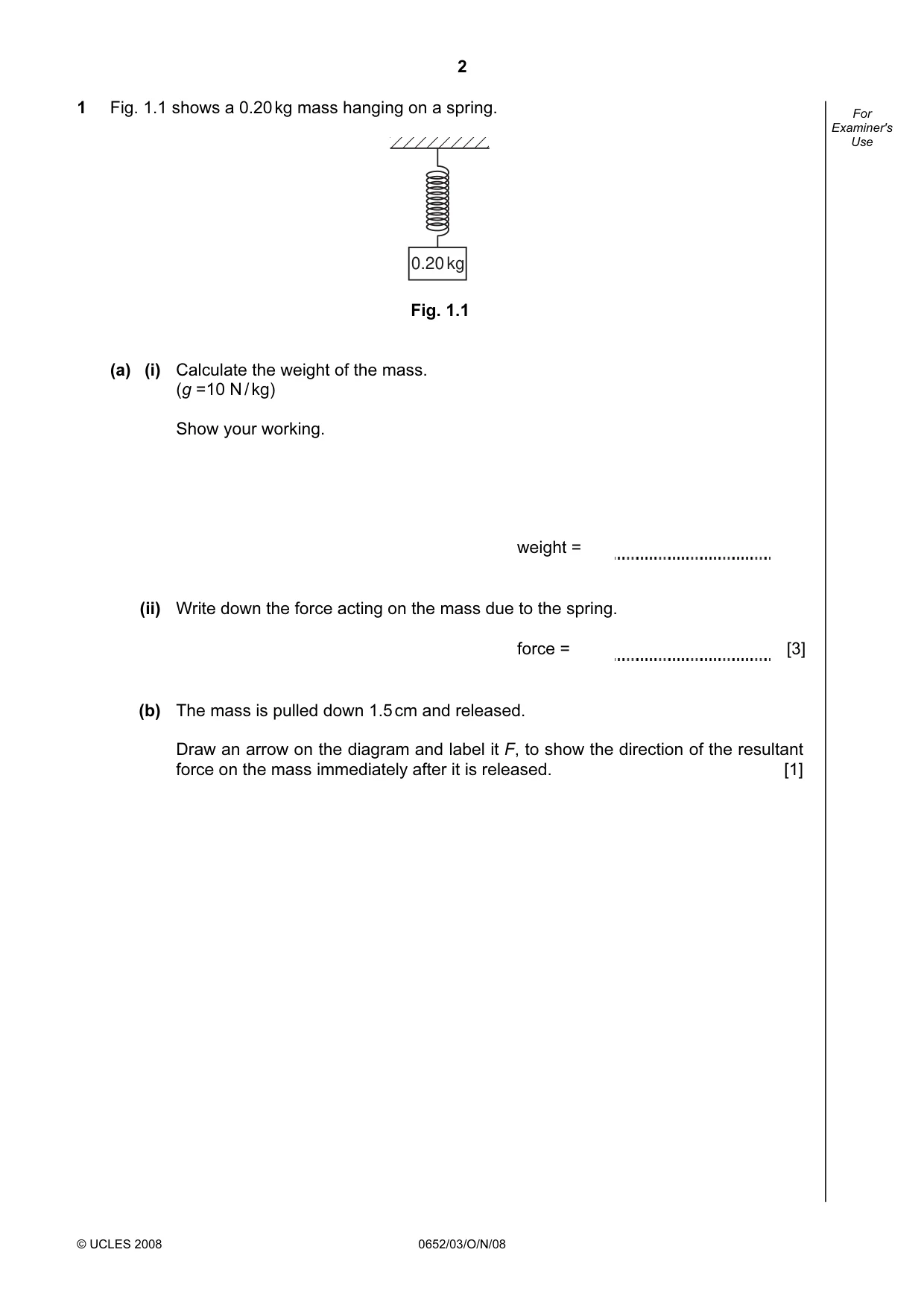
2 © UCLES 2008 0652/03/O/N/08 For Examiner's Use 1 Fig. 1.1 shows a 0.20 kg mass hanging on a spring. 0.20 kg Fig. 1.1 (a) (i) Calculate the weight of the mass. (g =10 N / kg) Show your working. weight = (ii) Write down the force acting on the mass due to the spring. force = [3] (b) The mass is pulled down 1.5 cm and released. Draw an arrow on the diagram and label it F, to show the direction of the resultant force on the mass immediately after it is released. [1]
Question paper, page 3
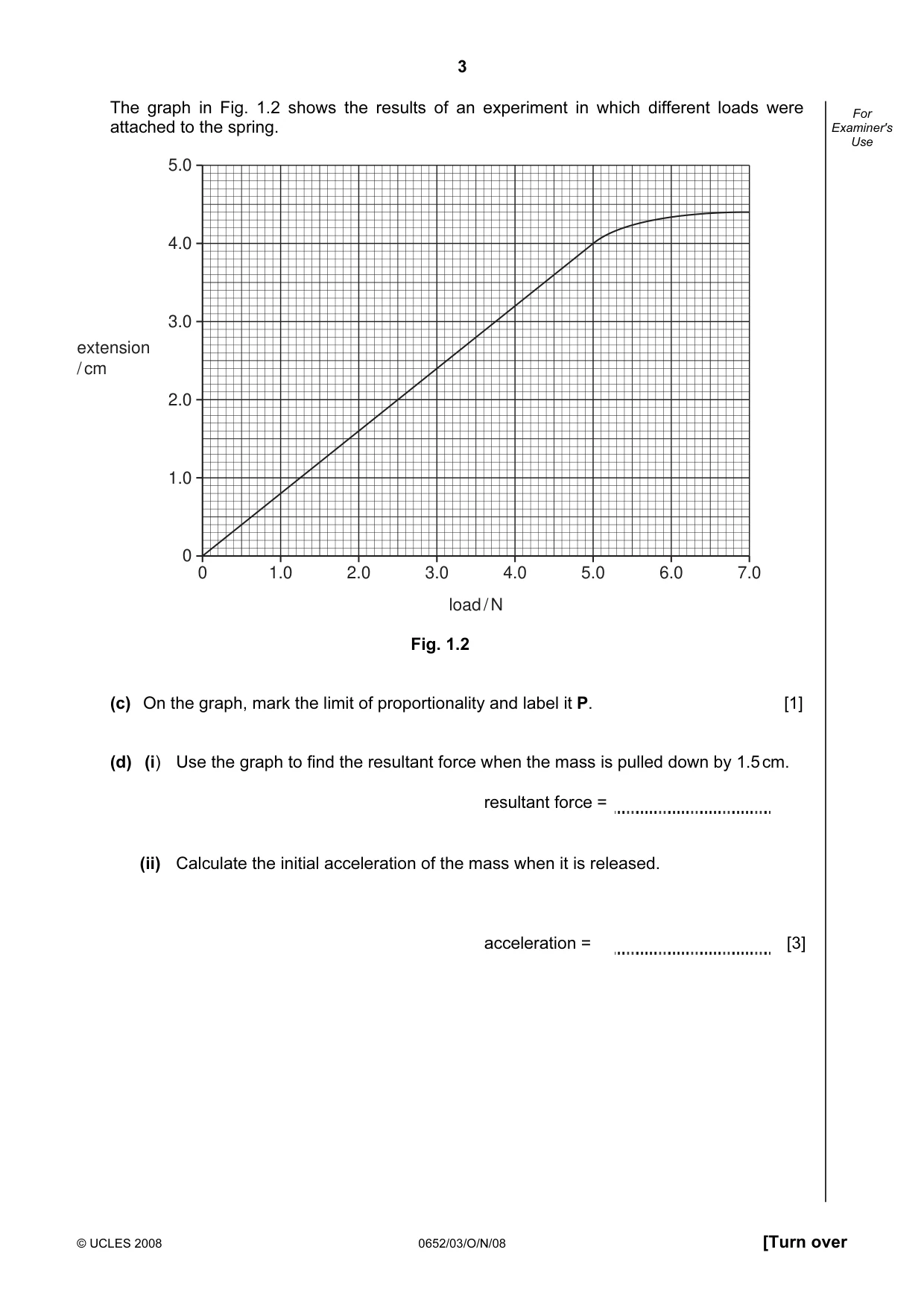
3 © UCLES 2008 0652/03/O/N/08 [Turn over For Examiner's Use The graph in Fig. 1.2 shows the results of an experiment in which different loads were attached to the spring. 0 1.0 2.0 3.0 4.0 5.0 6.0 7.0 load / N extension / cm 5.0 4.0 3.0 2.0 1.0 0 Fig. 1.2 (c) On the graph, mark the limit of proportionality and label it P. [1] (d) (i) Use the graph to find the resultant force when the mass is pulled down by 1.5 cm. resultant force = (ii) Calculate the initial acceleration of the mass when it is released. acceleration = [3]
Question paper, page 4
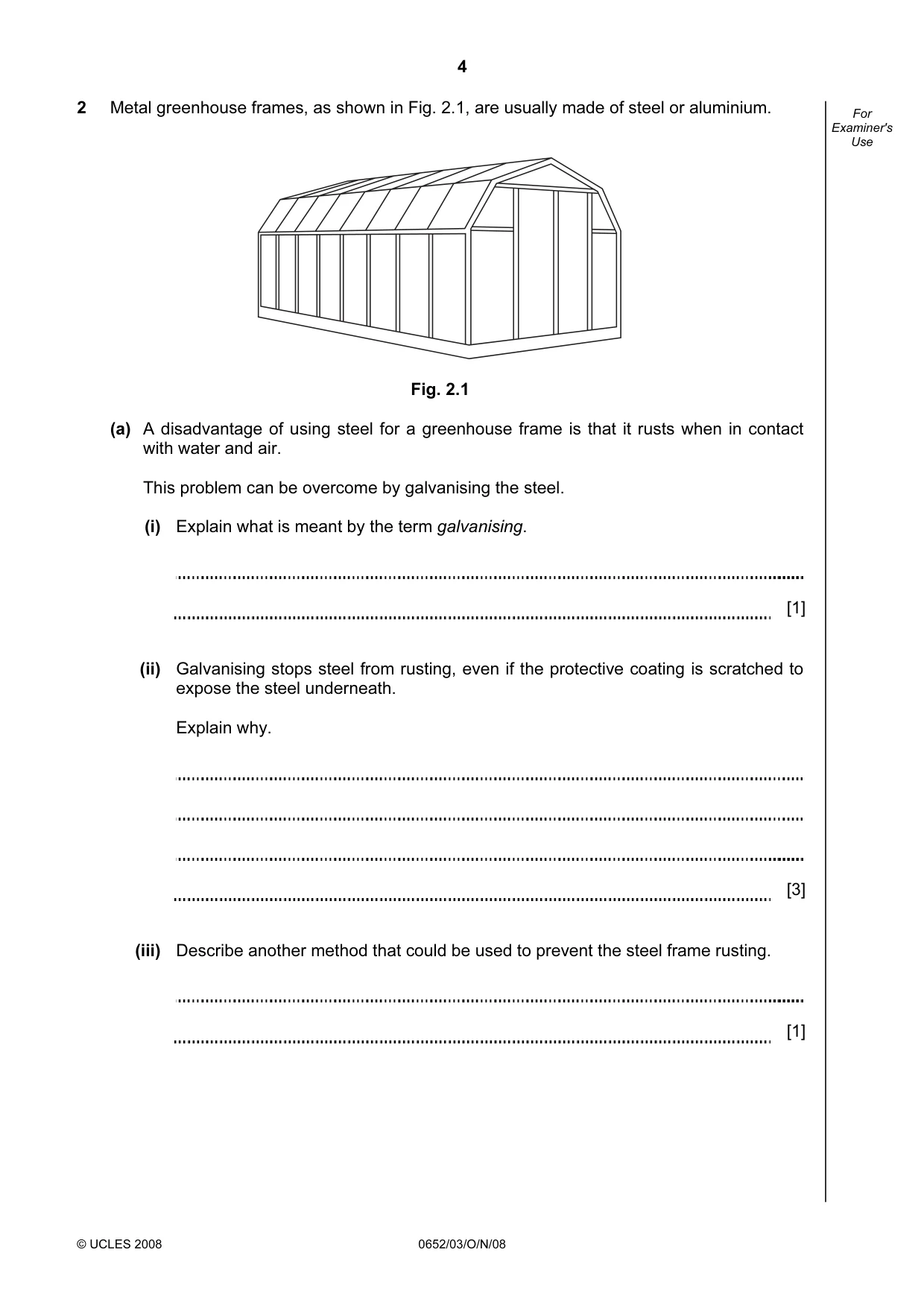
4 © UCLES 2008 0652/03/O/N/08 For Examiner's Use 2 Metal greenhouse frames, as shown in Fig. 2.1, are usually made of steel or aluminium. Fig. 2.1 (a) A disadvantage of using steel for a greenhouse frame is that it rusts when in contact with water and air. This problem can be overcome by galvanising the steel. (i) Explain what is meant by the term galvanising. [1] (ii) Galvanising stops steel from rusting, even if the protective coating is scratched to expose the steel underneath. Explain why. [3] (iii) Describe another method that could be used to prevent the steel frame rusting. [1]
Question paper, page 5
5 © UCLES 2008 0652/03/O/N/08 [Turn over For Examiner's Use (iv) Does this method protect the steel frame as well as galvanising? Explain your answer. [1] (b) An aluminium greenhouse frame does not corrode as quickly as steel. Explain why. [2] (c) Aluminium is also used to make aircraft bodies. For this use aluminium is alloyed with other metals. (i) What effect does alloying have on the properties of aluminium that make it more useful for aircraft construction? [1] (ii) Explain why alloying has this effect. [2]
Question paper, page 6
6 © UCLES 2008 0652/03/O/N/08 For Examiner's Use 3 Fig. 3.1 shows a liquid-in-glass thermometer. 0 10 20 30 40 50 60 70 80 90 100 110 °C Fig. 3.1 (a) Explain what happens to the liquid when the thermometer is placed in a beaker of hot water. [2] (b) Fig. 3.2 shows another type of thermometer, known as a thermocouple. V wire B wire A junction 1 junction 2 wire C Fig. 3.2 (i) Name suitable materials for wire A wires B and C [2] (ii) Junction 1 is placed in melting ice. Junction 2 is placed in boiling water. The voltmeter reads 7.2 mV. Junction 2 is then placed in a beaker of water. The voltmeter reading falls to 4.8 mV. Calculate the temperature of the beaker of water. Show your working. temperature [2]
Question paper, page 7
7 © UCLES 2008 0652/03/O/N/08 [Turn over For Examiner's Use (iii) State and explain one advantage that the thermocouple has over the liquid-in- glass thermometer. [2]
Question paper, page 8
8 © UCLES 2008 0652/03/O/N/08 For Examiner's Use 4 (a) Complete Table 4.1 to show the arrangement of electrons in atoms of these elements. The first one has been done for you. Table 4.1 element electron arrangement Mg 2 8 2 K Ar N [3] (b) Describe the relationship between the electron arrangement of the atoms of an element and the position of that element in the Periodic Table. [2] (c) Elements in Group 7 are called halogens. Table 4.2 gives some information about the physical properties of three halogens. Table 4.2 halogen proton number melting point / °C boiling point / °C colour chlorine 17 −101 −35 pale green bromine 35 −7 59 deep red iodine 53 114 184 dark grey (i) Calcium forms ions with the formula Ca2+. Iodine forms ions with the formula I¯. What is the formula of calcium iodide? [1]
Question paper, page 9
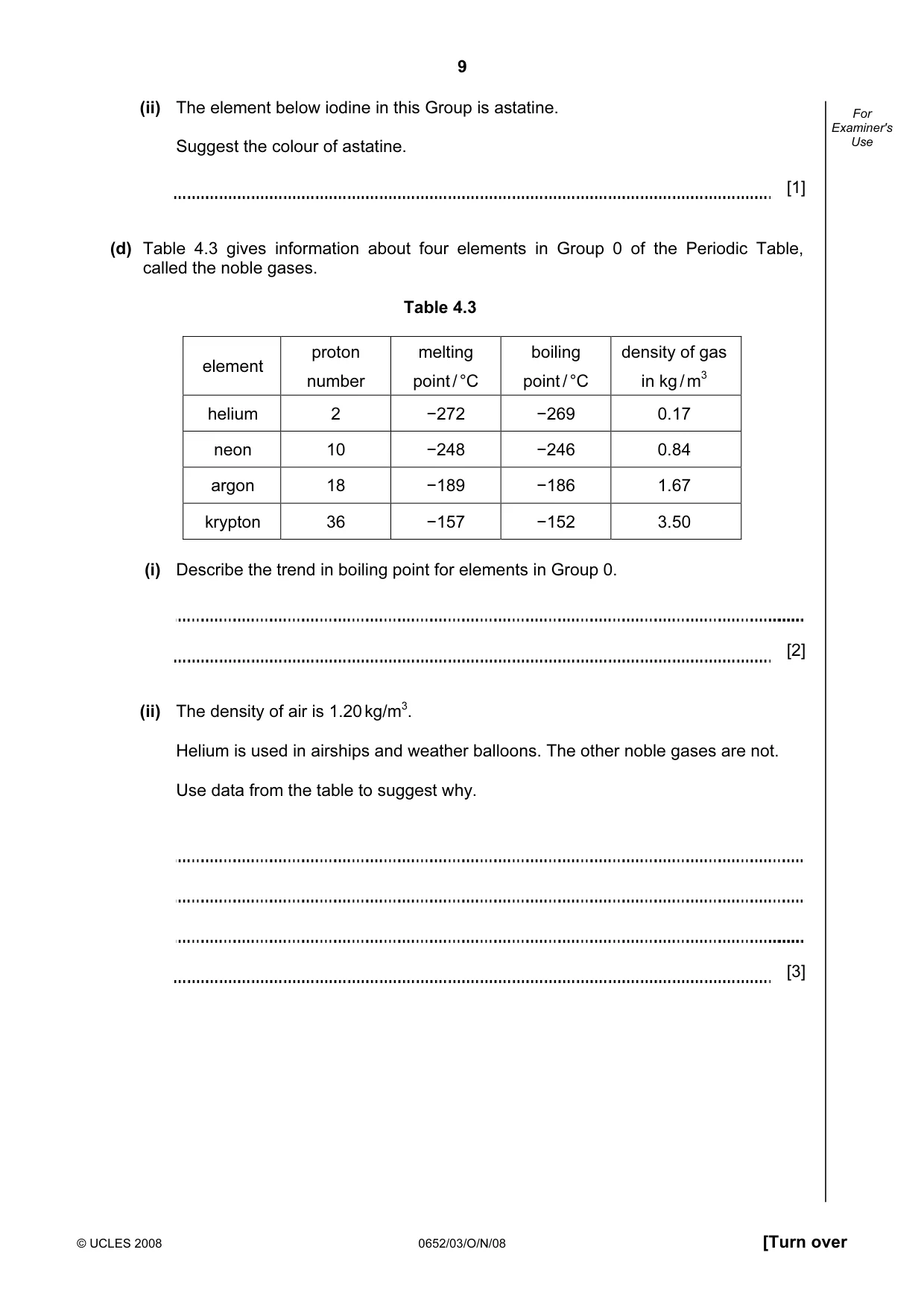
9 © UCLES 2008 0652/03/O/N/08 [Turn over For Examiner's Use (ii) The element below iodine in this Group is astatine. Suggest the colour of astatine. [1] (d) Table 4.3 gives information about four elements in Group 0 of the Periodic Table, called the noble gases. Table 4.3 element proton number melting point / °C boiling point / °C density of gas in kg / m3 helium 2 −272 −269 0.17 neon 10 −248 −246 0.84 argon 18 −189 −186 1.67 krypton 36 −157 −152 3.50 (i) Describe the trend in boiling point for elements in Group 0. [2] (ii) The density of air is 1.20 kg/m3. Helium is used in airships and weather balloons. The other noble gases are not. Use data from the table to suggest why. [3]
Question paper, page 10
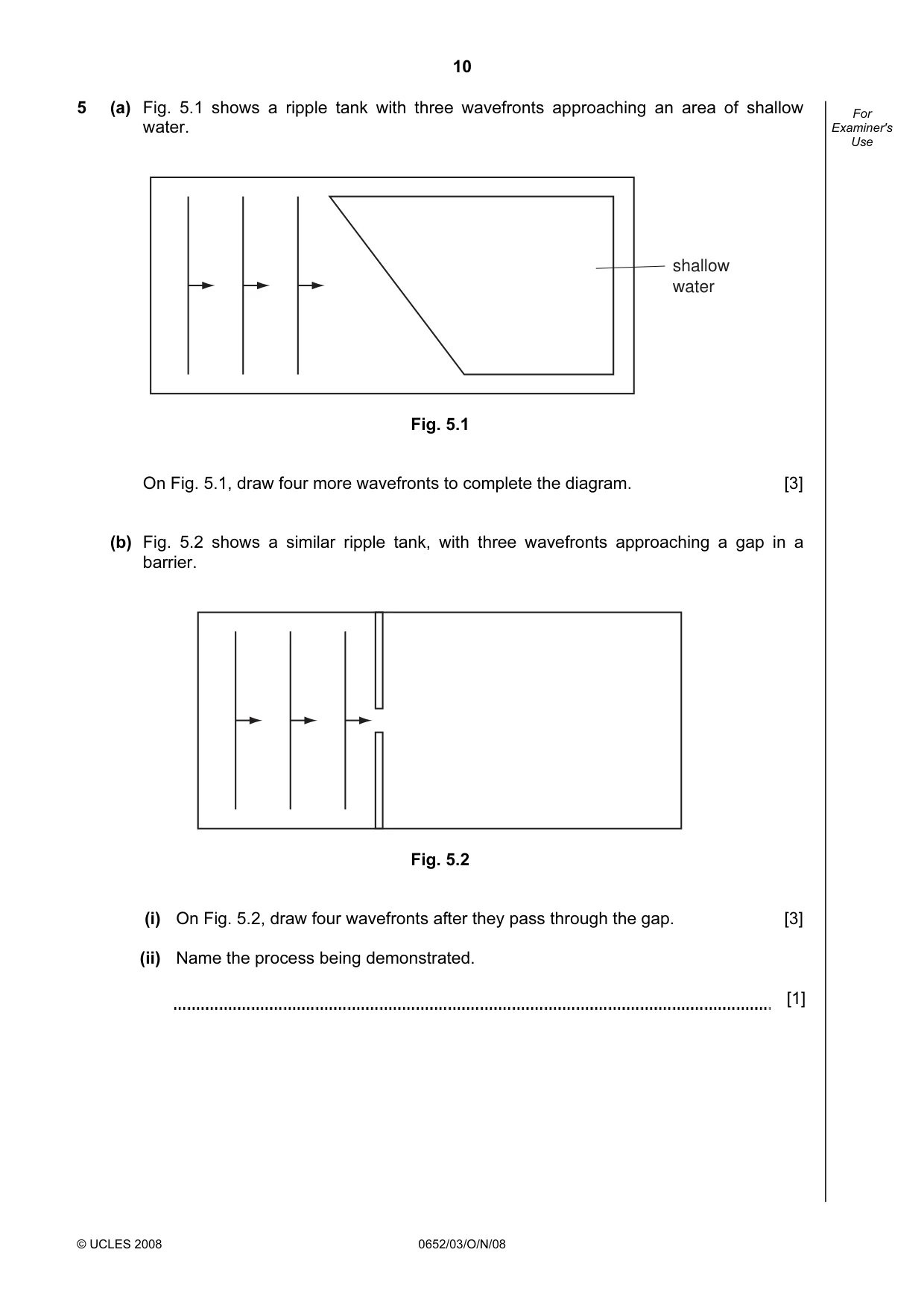
10 © UCLES 2008 0652/03/O/N/08 For Examiner's Use 5 (a) Fig. 5.1 shows a ripple tank with three wavefronts approaching an area of shallow water. shallow water Fig. 5.1 On Fig. 5.1, draw four more wavefronts to complete the diagram. [3] (b) Fig. 5.2 shows a similar ripple tank, with three wavefronts approaching a gap in a barrier. Fig. 5.2 (i) On Fig. 5.2, draw four wavefronts after they pass through the gap. [3] (ii) Name the process being demonstrated. [1]
Question paper, page 11
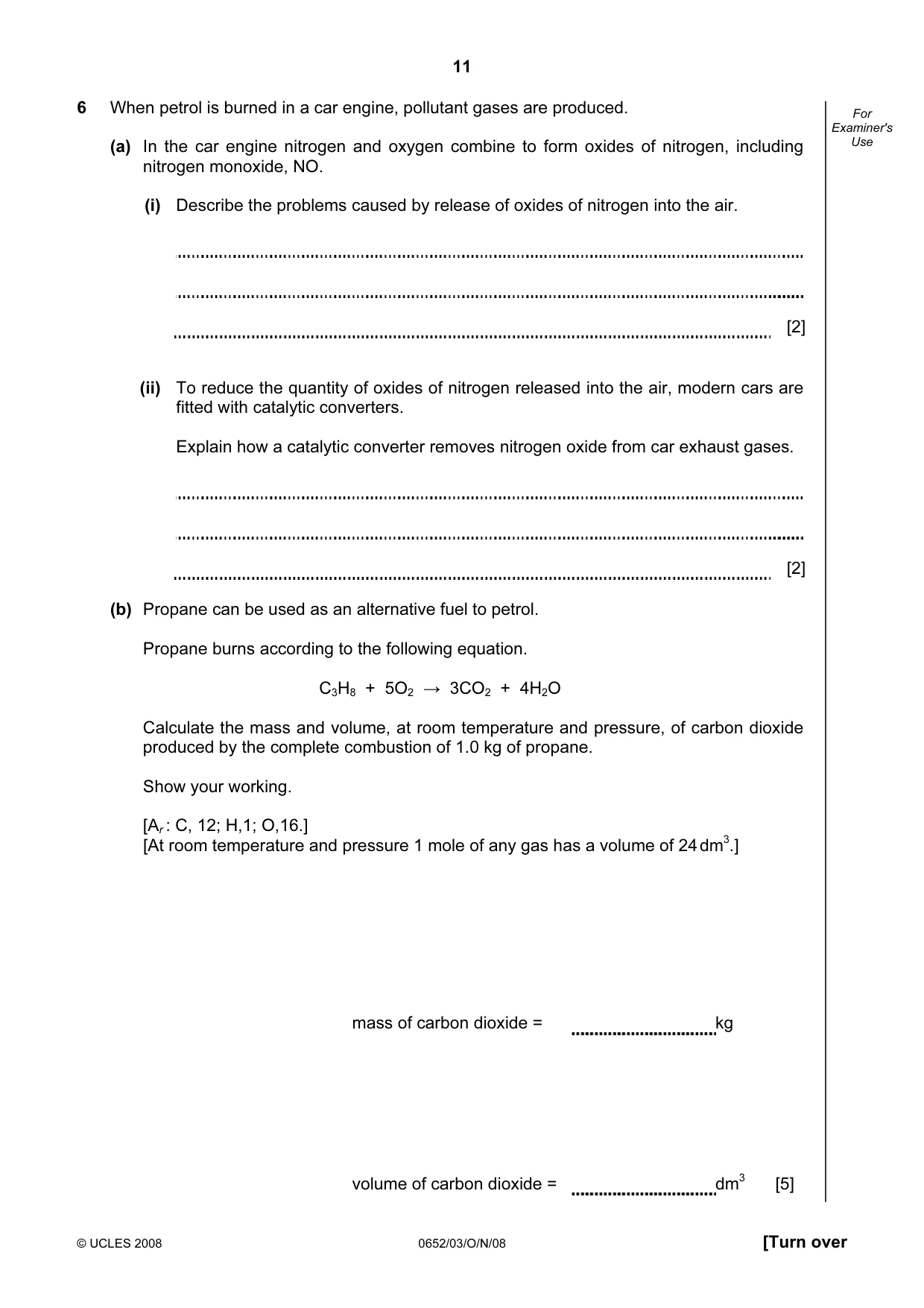
11 © UCLES 2008 0652/03/O/N/08 [Turn over For Examiner's Use 6 When petrol is burned in a car engine, pollutant gases are produced. (a) In the car engine nitrogen and oxygen combine to form oxides of nitrogen, including nitrogen monoxide, NO. (i) Describe the problems caused by release of oxides of nitrogen into the air. [2] (ii) To reduce the quantity of oxides of nitrogen released into the air, modern cars are fitted with catalytic converters. Explain how a catalytic converter removes nitrogen oxide from car exhaust gases. [2] (b) Propane can be used as an alternative fuel to petrol. Propane burns according to the following equation. C3H8 + 5O2 → 3CO2 + 4H2O Calculate the mass and volume, at room temperature and pressure, of carbon dioxide produced by the complete combustion of 1.0 kg of propane. Show your working. [Ar : C, 12; H,1; O,16.] [At room temperature and pressure 1 mole of any gas has a volume of 24 dm3.] mass of carbon dioxide = kg volume of carbon dioxide = dm3 [5]
Question paper, page 12
12 © UCLES 2008 0652/03/O/N/08 For Examiner's Use (c) Carbon dioxide is a covalent compound. Draw a diagram to show the arrangement of outer electrons in a molecule of carbon dioxide. [3]
Question paper, page 13
13 © UCLES 2008 0652/03/O/N/08 [Turn over For Examiner's Use 7 Ethene is reacted with steam to make ethanol. (a) Describe how ethene is obtained. [2] (b) Write a balanced equation for the reaction between ethene and steam. [2] (c) Complete this sentence to describe the conditions used for this reaction. Ethene and steam are mixed at high pressure in the presence of [1]
Question paper, page 14
14 © UCLES 2008 0652/03/O/N/08 For Examiner's Use 8 A nuclear power station supplies 200 000 kW to the National Grid at 55 000 V. (a) Calculate the current from the power station. Show your working. current = [3] (b) The energy is transmitted across the country at this voltage. It is stepped down to 250 V for domestic use. (i) Explain why the energy is transmitted at a very high voltage. (ii) Name the device used to step down the voltage. (iii) Calculate the turns ratio required to step the voltage down from 55 000 V to 250 V. Show your working. primary turns : secondary turns : [5] (c) A transformer is described as 100% efficient. Explain what is meant by this statement. [1]
Question paper, page 15
15 © UCLES 2008 0652/03/O/N/08 [Turn over For Examiner's Use 9 The iodine isotope, 131 53 I, decays by emitting a β–particle. (a) Explain what is meant by a β–particle. [2] (b) (i) Complete the equation which describes the decay. I = 131 53 … … … … X + β (ii) Use the Periodic Table, on page 16, to identify the element X and comment on its reactivity. [4] (c) This isotope has a half-life of 8.1 days and is used in medical diagnosis and treatment. Suggest why the isotope is suited for this purpose. [2]
Question paper, page 16
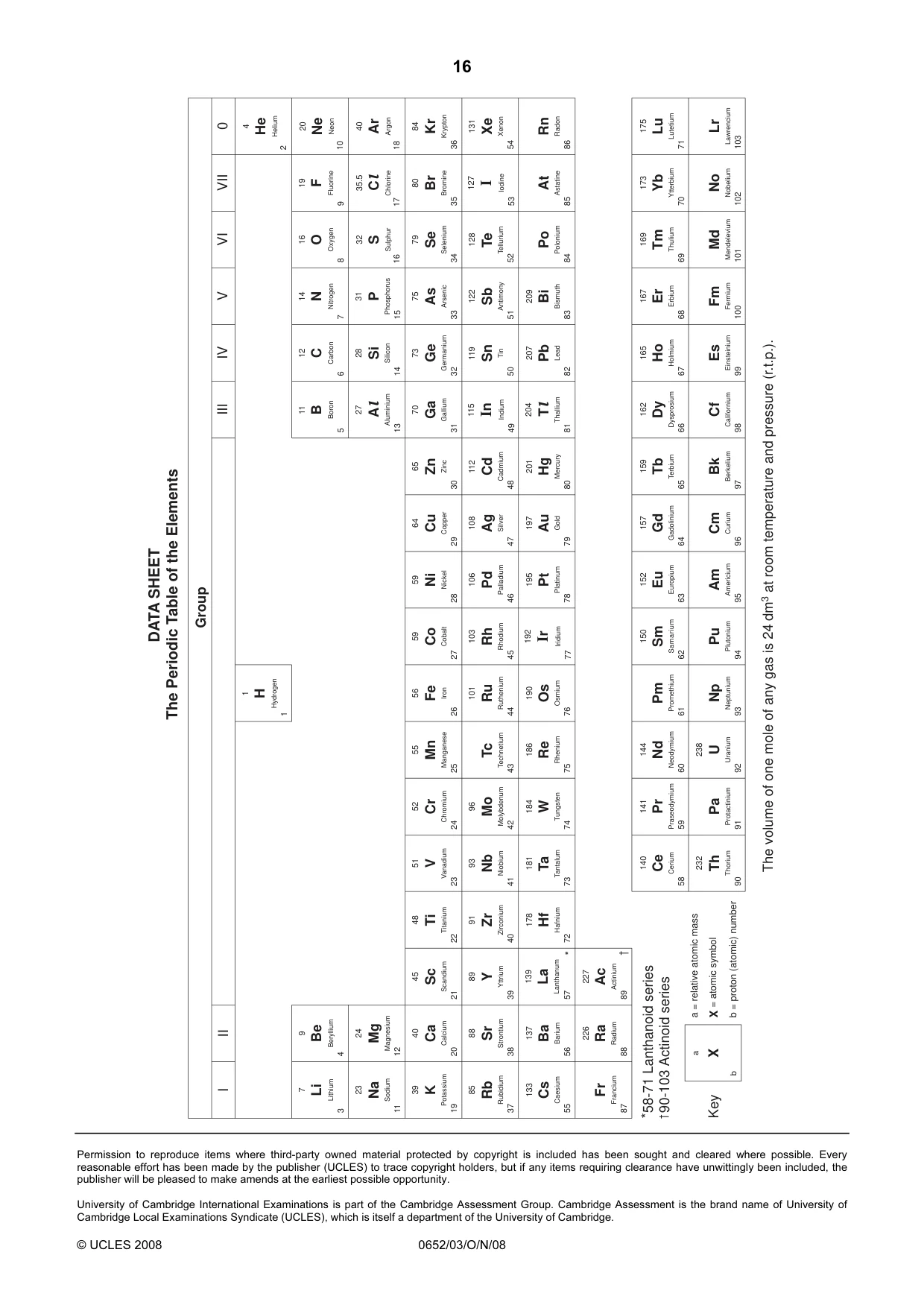
16 Permission to reproduce items where third-party owned material protected by copyright is included has been sought and cleared where possible. Every reasonable effort has been made by the publisher (UCLES) to trace copyright holders, but if any items requiring clearance have unwittingly been included, the publisher will be pleased to make amends at the earliest possible opportunity. University of Cambridge International Examinations is part of the Cambridge Assessment Group. Cambridge Assessment is the brand name of University of Cambridge Local Examinations Syndicate (UCLES), which is itself a department of the University of Cambridge. © UCLES 2008 0652/03/O/N/08 Group 140 Ce Cerium 58 141 Pr Praseodymium 59 144 Nd Neodymium 60 Pm Promethium 61 150 Sm Samarium 62 152 Eu Europium 63 157 Gd Gadolinium 64 159 Tb Terbium 65 162 Dy Dysprosium 66 165 Ho Holmium 67 167 Er Erbium 68 169 Tm Thulium 69 173 Yb Ytterbium 70 175 Lu Lutetium 71 232 Th Thorium 90 Pa Protactinium 91 238 U Uranium 92 Np Neptunium 93 Pu Plutonium 94 Am Americium 95 Cm Curium 96 Bk Berkelium 97 Cf Californium 98 Es Einsteinium 99 Fm Fermium 100 Md Mendelevium 101 No Nobelium 102 Lr Lawrencium 103 1 H Hydrogen 1 7 Li Lithium 3 23 Na Sodium 11 24 Mg Magnesium 12 40 Ca Calcium 20 45 Sc Scandium 21 48 Ti Titanium 22 51 V Vanadium 23 52 Cr Chromium 24 55 Mn Manganese 25 56 Fe Iron 26 59 Co Cobalt 27 59 Ni Nickel 28 64 Cu Copper 29 65 Zn Zinc 30 70 Ga Gallium 31 27 Al Aluminium 13 11 B Boron 5 12 C Carbon 6 14 N Nitrogen 7 16 O Oxygen 8 19 F Fluorine 9 28 Si Silicon 14 31 P Phosphorus 15 32 S Sulphur 16 35.5 Cl Chlorine 17 40 Ar Argon 18 20 Ne Neon 10 4 He Helium 2 73 Ge Germanium 32 75 As Arsenic 33 79 Se Selenium 34 80 Br Bromine 35 84 Kr Krypton 36 39 K Potassium 19 88 Sr Strontium 38 89 Y Yttrium 39 91 Zr Zirconium 40 93 Nb Niobium 41 96 Mo Molybdenum 42 Tc Technetium 43 101 Ru Ruthenium 44 103 Rh Rhodium 45 106 Pd Palladium 46 108 Ag Silver 47 112 Cd Cadmium 48 115 In Indium 49 119 Sn Tin 50 122 Sb Antimony 51 128 Te Tellurium 52 127 I Iodine 53 131 Xe Xenon 54 137 Ba Barium 56 139 La Lanthanum 57 * 178 Hf Hafnium 72 181 Ta Tantalum 73 184 W Tungsten 74 186 Re Rhenium 75 190 Os Osmium 76 192 Ir Iridium 77 195 Pt Platinum 78 197 Au Gold 79 201 Hg Mercury 80 204 Tl Thallium 81 207 Pb Lead 82 209 Bi Bismuth 83 Po Polonium 84 At Astatine 85 Rn Radon 86 Fr Francium 87 227 Ac Actinium 89 9 Be Beryllium 4 I II III IV V VI VII 0 85 Rb Rubidium 37 133 Cs Caesium 55 226 Ra Radium 88 The volume of one mole of any gas is 24 dm3 at room temperature and pressure (r.t.p.). a X b a = relative atomic mass X = atomic symbol b = proton (atomic) number Key *58-71 Lanthanoid series 90-103 Actinoid series DATA SHEET The Periodic Table of the Elements