Cambridge IGCSE Physical Education (9-1) 0995 — 2021 May/June Paper 1 · Variant 2
0995/12/M/J/21 · 100 marks · ≈113 min
The question paper and its mark scheme, free to read here and free to download. This is Cambridge’s own paper, exactly as it was sat.
Question paper16 pages

Mark scheme18 pages
Answers below. Sit the paper first if you are practising.
Paper as text
Question paper, page 1
This document has 16 pages. Any blank pages are indicated. Cambridge IGCSE™(9–1) DC (JP) 213262 © UCLES 2021 [Turn over PHYSICAL EDUCATION 0995/12 Paper 1 Theory May/June 2021 1 hour 45 minutes You must answer on the question paper. No additional materials are needed. INSTRUCTIONS ● Answer all questions. ● Use a black or dark blue pen. You may use an HB pencil for any diagrams or graphs. ● Write your name, centre number and candidate number in the boxes at the top of the page. ● Write your answer to each question in the space provided. ● Do not use an erasable pen or correction fluid. ● Do not write on any bar codes. ● You may use a calculator. ● You should show all your working and use appropriate units. INFORMATION ● The total mark for this paper is 100. ● The number of marks for each question or part question is shown in brackets [ ]. * 8 9 1 2 8 0 3 3 8 0 *
Question paper, page 2
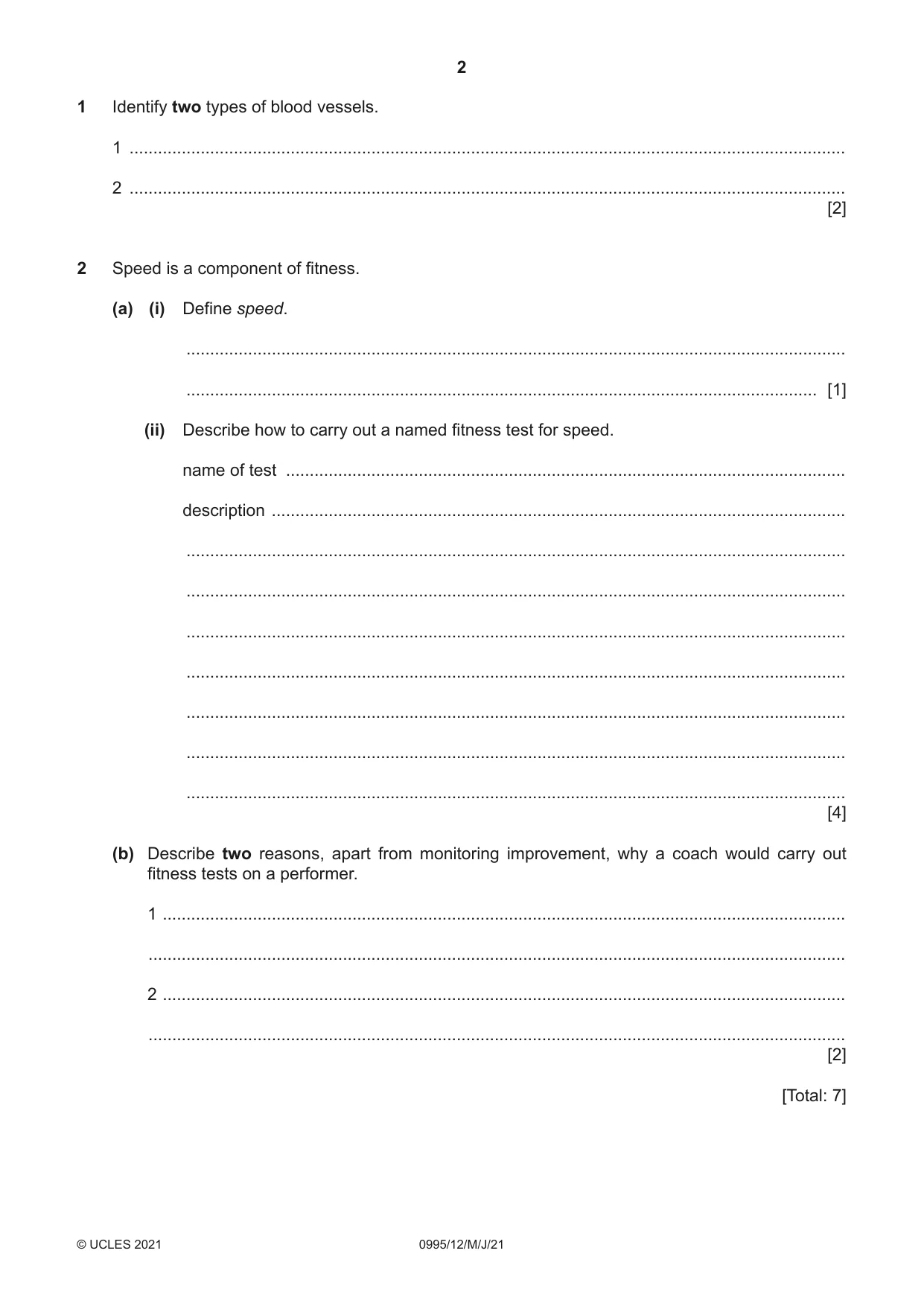
2 0995/12/M/J/21 © UCLES 2021 1 Identify two types of blood vessels. 1 … 2 … [2] 2 Speed is a component of fitness. (a) (i) Define speed. … … [1] (ii) Describe how to carry out a named fitness test for speed. name of test … description … … … … … … … … [4] (b) Describe two reasons, apart from monitoring improvement, why a coach would carry out fitness tests on a performer. 1 … … 2 … … [2] [Total: 7]
Question paper, page 3
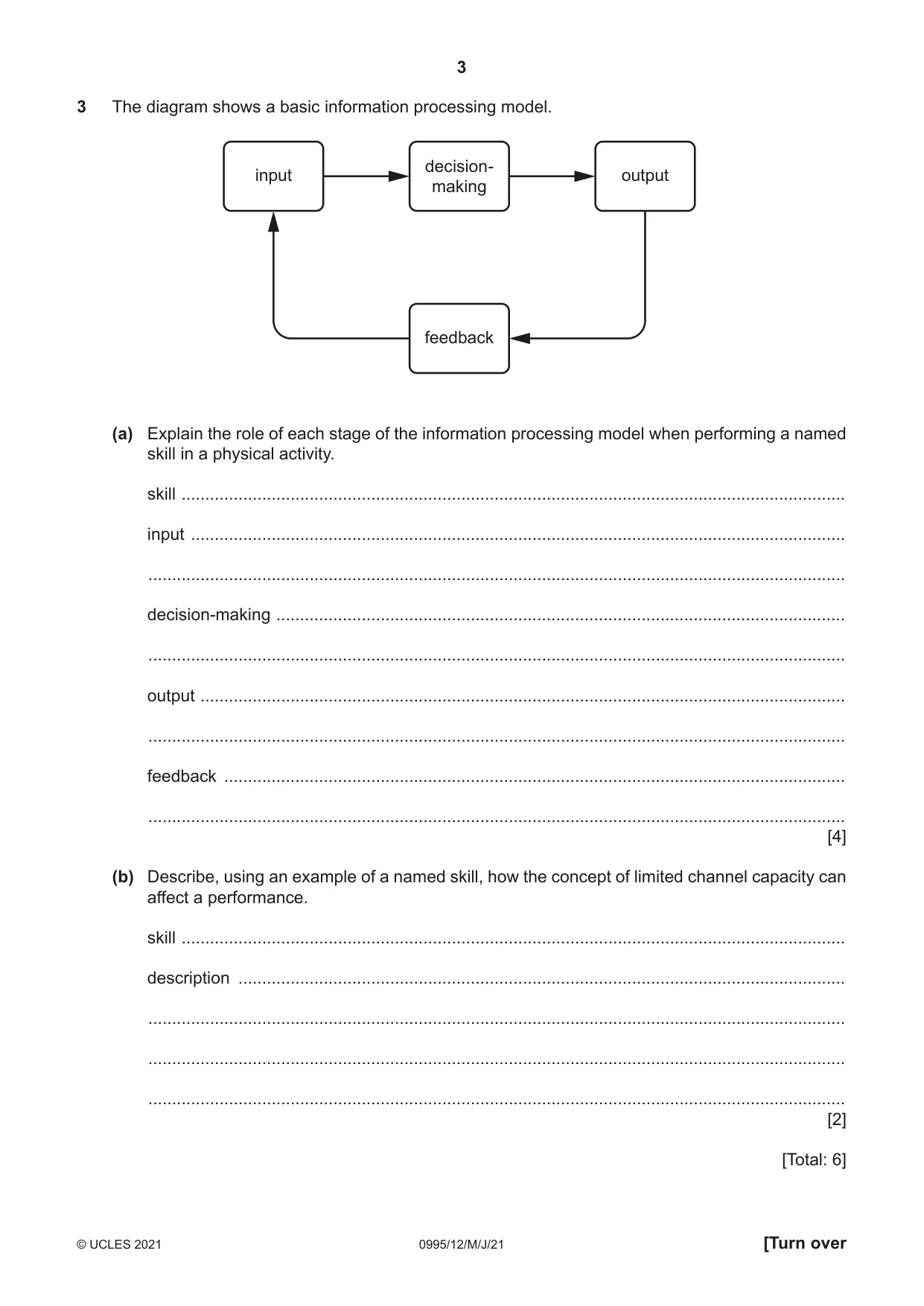
3 0995/12/M/J/21 © UCLES 2021 [Turn over 3 The diagram shows a basic information processing model. input output decision- making feedback (a) Explain the role of each stage of the information processing model when performing a named skill in a physical activity. skill … input … … decision-making … … output … … feedback … … [4] (b) Describe, using an example of a named skill, how the concept of limited channel capacity can affect a performance. skill … description … … … … [2] [Total: 6]
Question paper, page 4
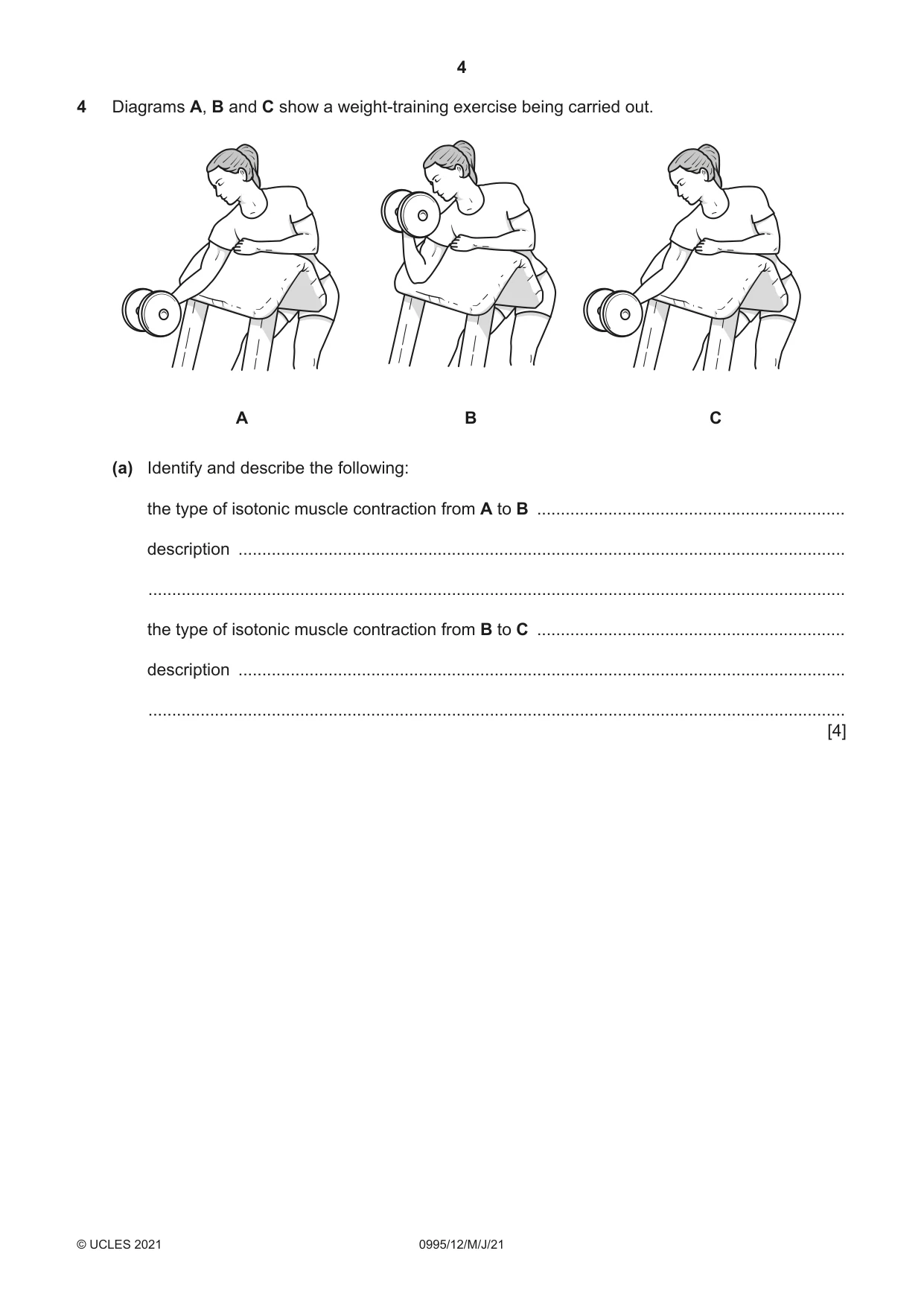
4 0995/12/M/J/21 © UCLES 2021 4 Diagrams A, B and C show a weight-training exercise being carried out. A B C (a) Identify and describe the following: the type of isotonic muscle contraction from A to B … description … … the type of isotonic muscle contraction from B to C … description … … [4]
Question paper, page 5
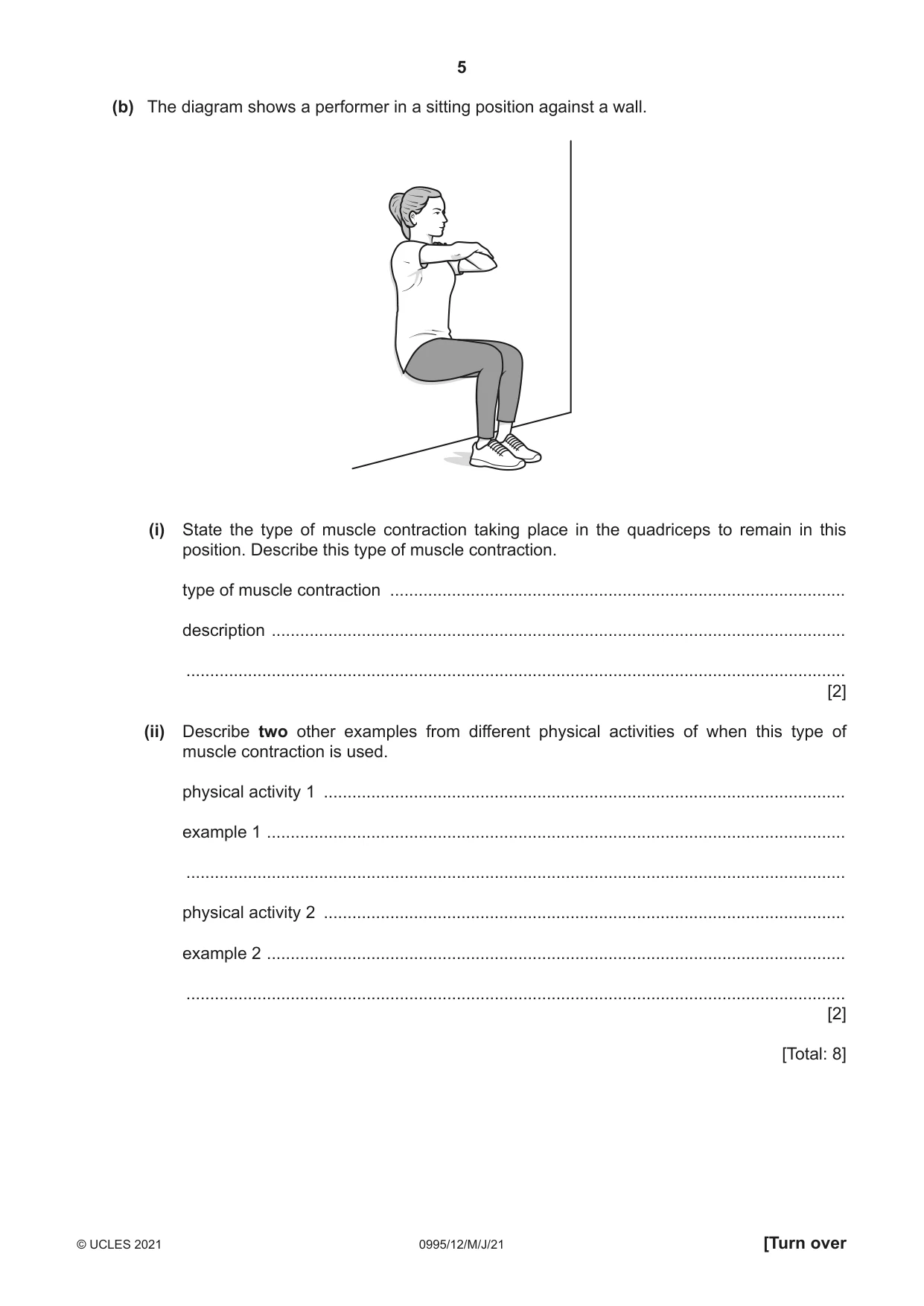
5 0995/12/M/J/21 © UCLES 2021 [Turn over (b) The diagram shows a performer in a sitting position against a wall. (i) State the type of muscle contraction taking place in the quadriceps to remain in this position. Describe this type of muscle contraction. type of muscle contraction … description … … [2] (ii) Describe two other examples from different physical activities of when this type of muscle contraction is used. physical activity 1 … example 1 … … physical activity 2 … example 2 … … [2] [Total: 8]
Question paper, page 6
6 0995/12/M/J/21 © UCLES 2021 5 Describe advantages that media coverage provides for audiences / spectators. … … … … … … [3] 6 (a) Define VO2 max. … … [1] (b) Explain how three named factors can affect a performer’s VO2 max. factor 1 … explanation … … factor 2 … explanation … … factor 3 … explanation … … [6] [Total: 7]
Question paper, page 7
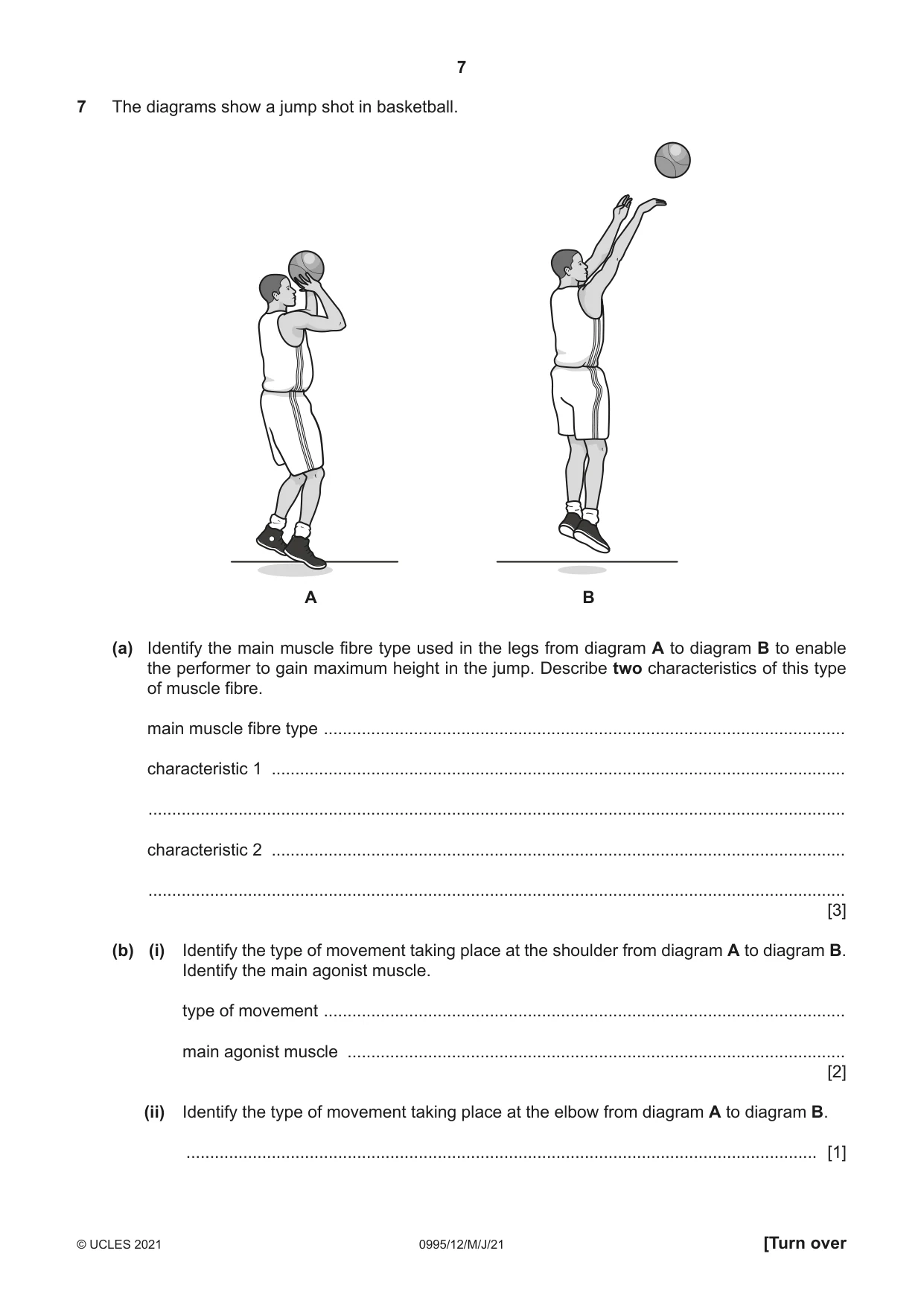
7 0995/12/M/J/21 © UCLES 2021 [Turn over 7 The diagrams show a jump shot in basketball. A B (a) Identify the main muscle fibre type used in the legs from diagram A to diagram B to enable the performer to gain maximum height in the jump. Describe two characteristics of this type of muscle fibre. main muscle fibre type … characteristic 1 … … characteristic 2 … … [3] (b) (i) Identify the type of movement taking place at the shoulder from diagram A to diagram B. Identify the main agonist muscle. type of movement … main agonist muscle … [2] (ii) Identify the type of movement taking place at the elbow from diagram A to diagram B. … [1]
Question paper, page 8
8 0995/12/M/J/21 © UCLES 2021 (iii) Describe the action of a named agonist and a named antagonist in the movement taking place at the elbow from diagram A to diagram B. agonist … action … antagonist … action … [4] [Total: 10] 8 (a) Explain, using practical examples from a named physical activity, how a named theory links the level of arousal with the quality of performance. physical activity … name of theory … explanation … … … … … … [4] (b) Suggest two different causes of anxiety for a sprinter waiting to start an Olympic final. 1 … … 2 … … [2] [Total: 6]
Question paper, page 9
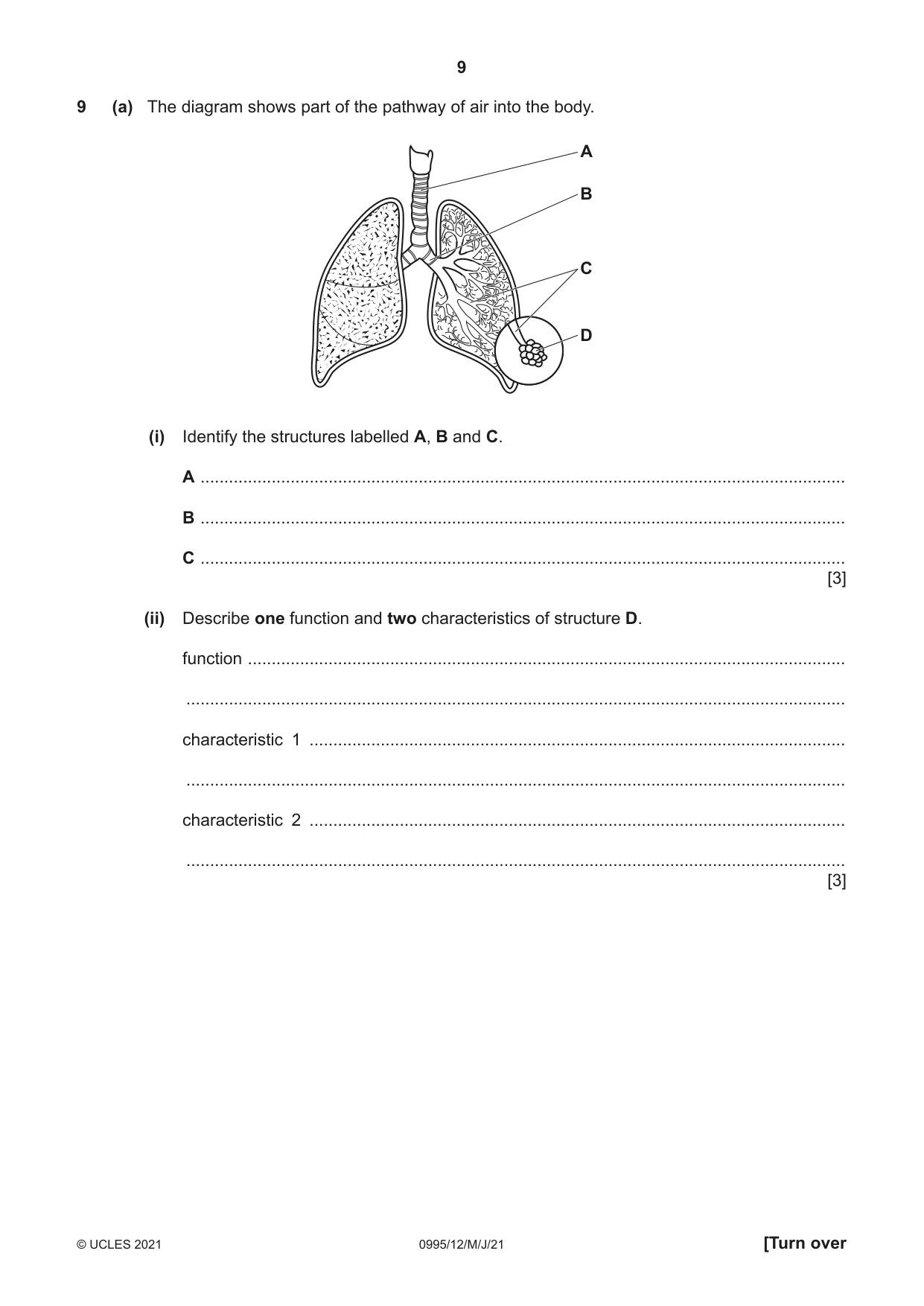
9 0995/12/M/J/21 © UCLES 2021 [Turn over 9 (a) The diagram shows part of the pathway of air into the body. A B C D (i) Identify the structures labelled A, B and C. A … B … C … [3] (ii) Describe one function and two characteristics of structure D. function … … characteristic 1 … … characteristic 2 … … [3]
Question paper, page 10
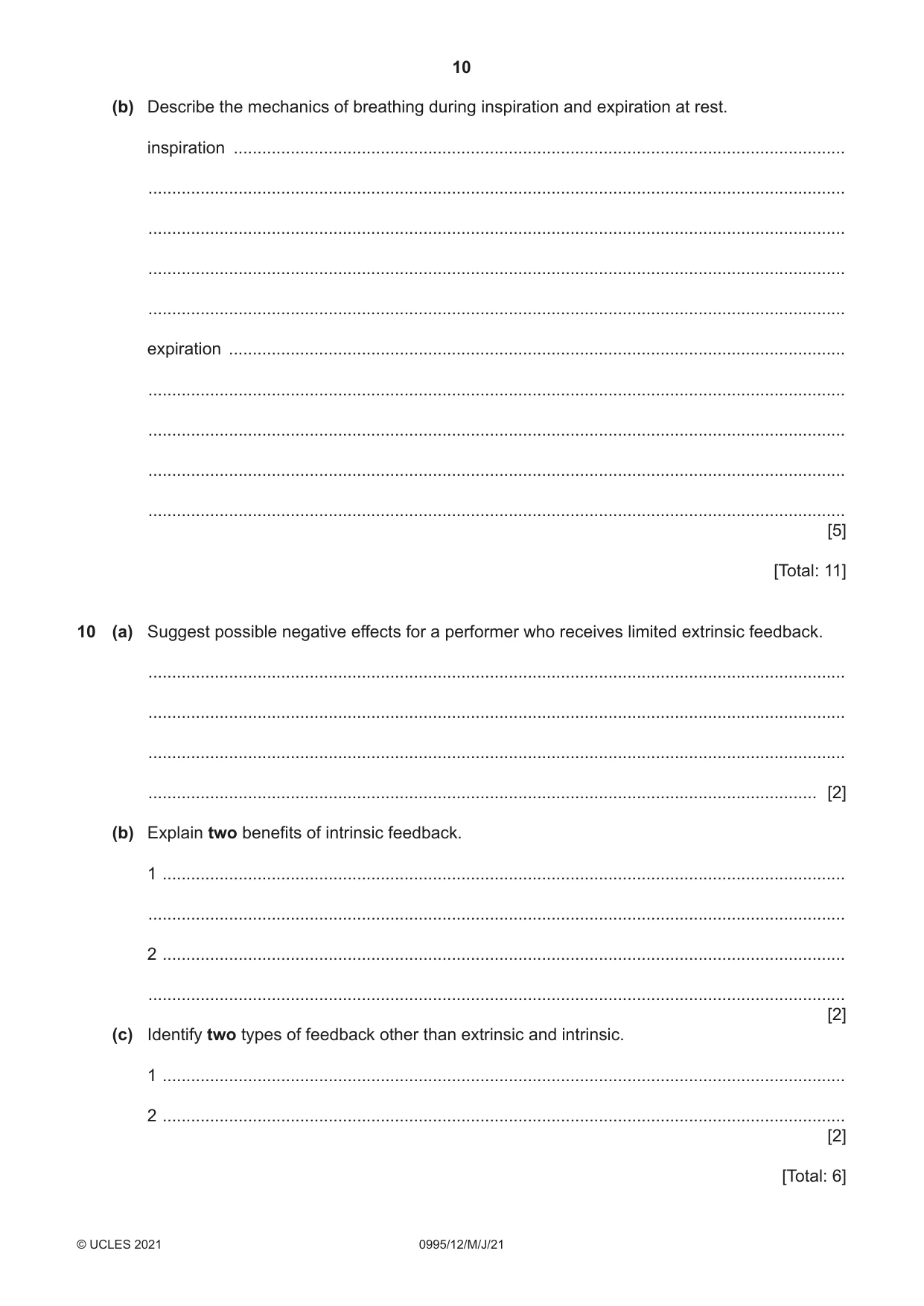
10 0995/12/M/J/21 © UCLES 2021 (b) Describe the mechanics of breathing during inspiration and expiration at rest. inspiration … … … … … expiration … … … … … [5] [Total: 11] 10 (a) Suggest possible negative effects for a performer who receives limited extrinsic feedback. … … … … [2] (b) Explain two benefits of intrinsic feedback. 1 … … 2 … … [2] (c) Identify two types of feedback other than extrinsic and intrinsic. 1 … 2 … [2] [Total: 6]
Question paper, page 11
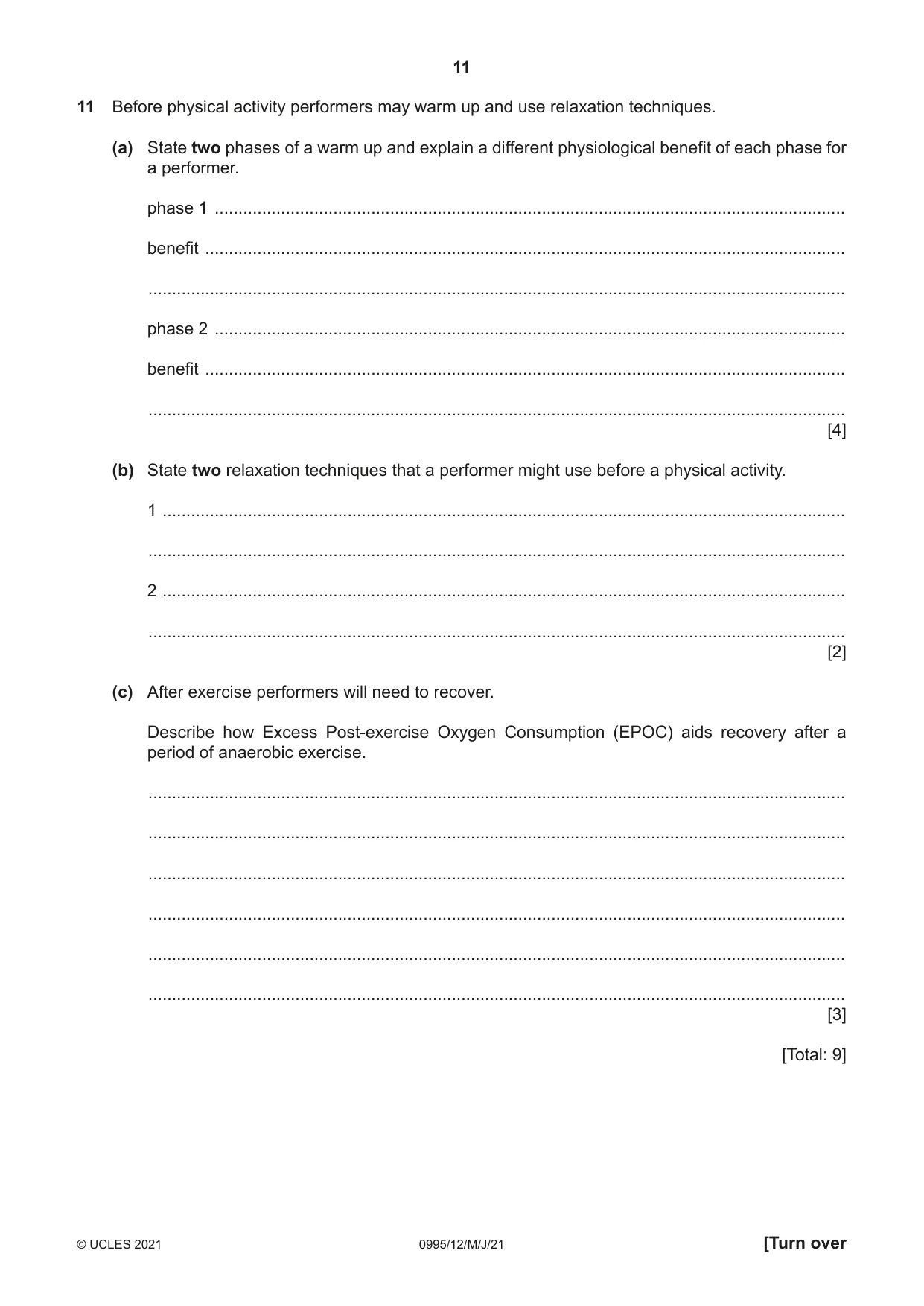
11 0995/12/M/J/21 © UCLES 2021 [Turn over 11 Before physical activity performers may warm up and use relaxation techniques. (a) State two phases of a warm up and explain a different physiological benefit of each phase for a performer. phase 1 … benefit … … phase 2 … benefit … … [4] (b) State two relaxation techniques that a performer might use before a physical activity. 1 … … 2 … … [2] (c) After exercise performers will need to recover. Describe how Excess Post-exercise Oxygen Consumption (EPOC) aids recovery after a period of anaerobic exercise. … … … … … … [3] [Total: 9]
Question paper, page 12
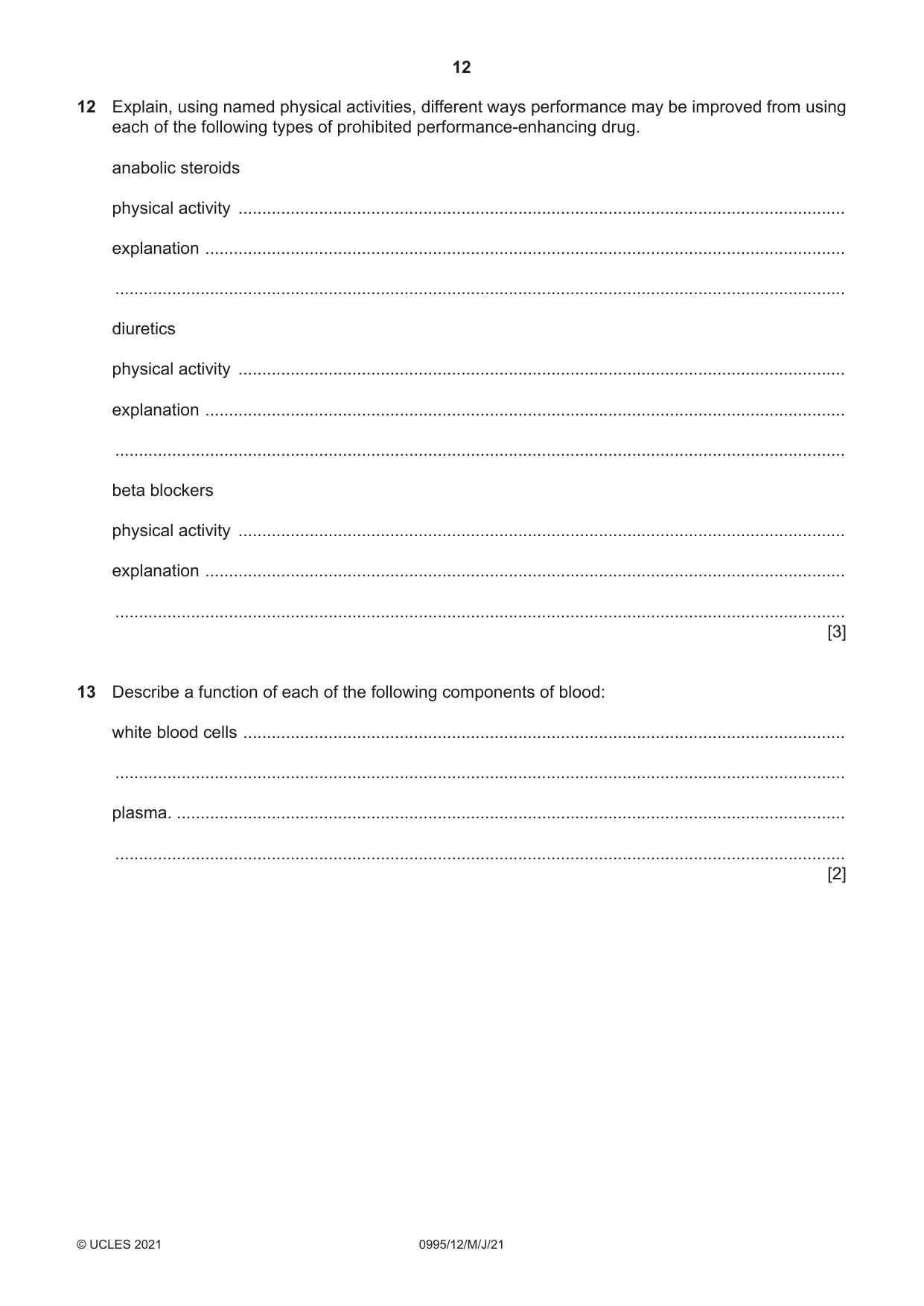
12 0995/12/M/J/21 © UCLES 2021 12 Explain, using named physical activities, different ways performance may be improved from using each of the following types of prohibited performance-enhancing drug. anabolic steroids physical activity … explanation … … diuretics physical activity … explanation … … beta blockers physical activity … explanation … … [3] 13 Describe a function of each of the following components of blood: white blood cells … … plasma. … … [2]
Question paper, page 13
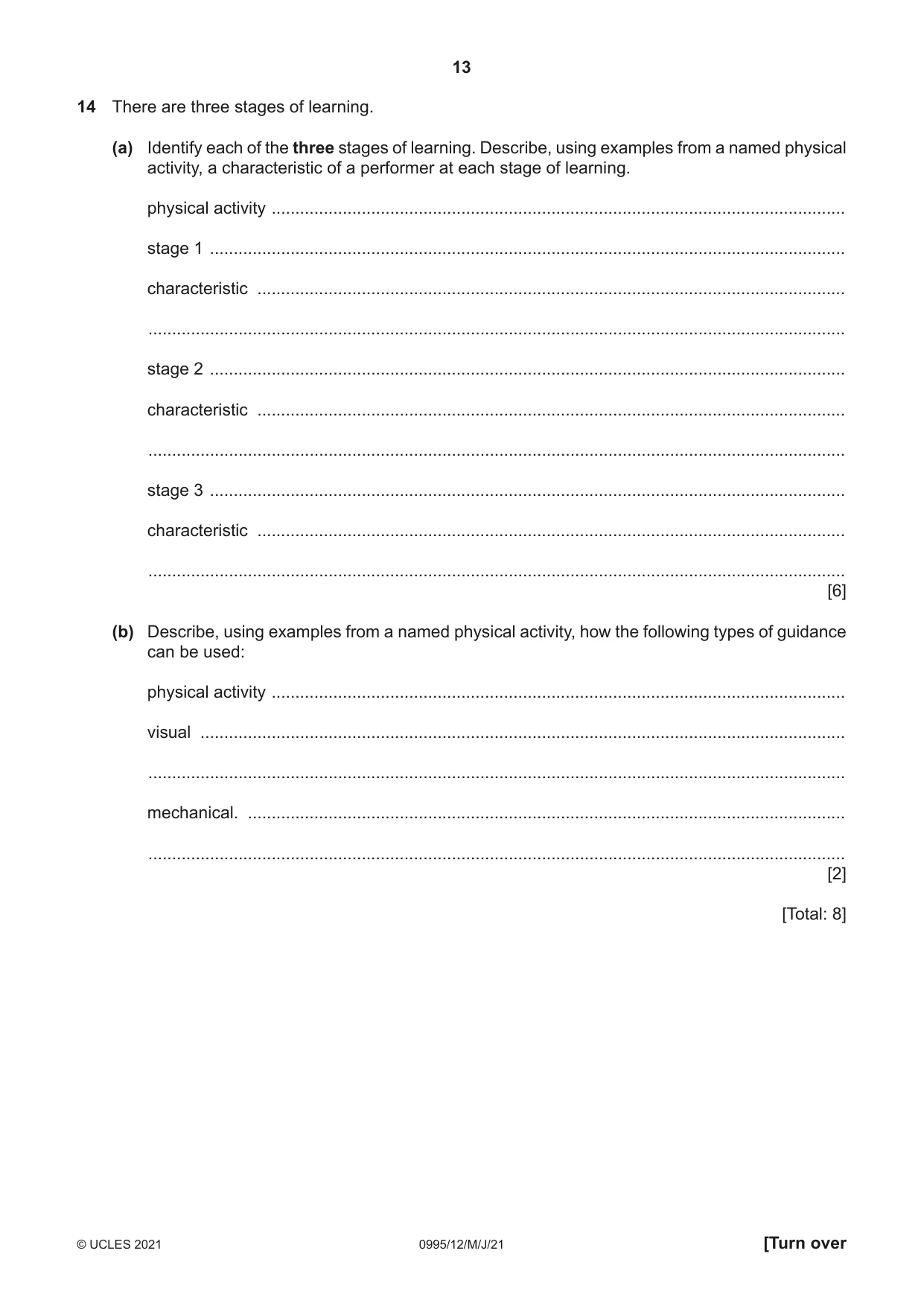
13 0995/12/M/J/21 © UCLES 2021 [Turn over 14 There are three stages of learning. (a) Identify each of the three stages of learning. Describe, using examples from a named physical activity, a characteristic of a performer at each stage of learning. physical activity … stage 1 … characteristic … … stage 2 … characteristic … … stage 3 … characteristic … … [6] (b) Describe, using examples from a named physical activity, how the following types of guidance can be used: physical activity … visual … … mechanical. … … [2] [Total: 8]
Question paper, page 14
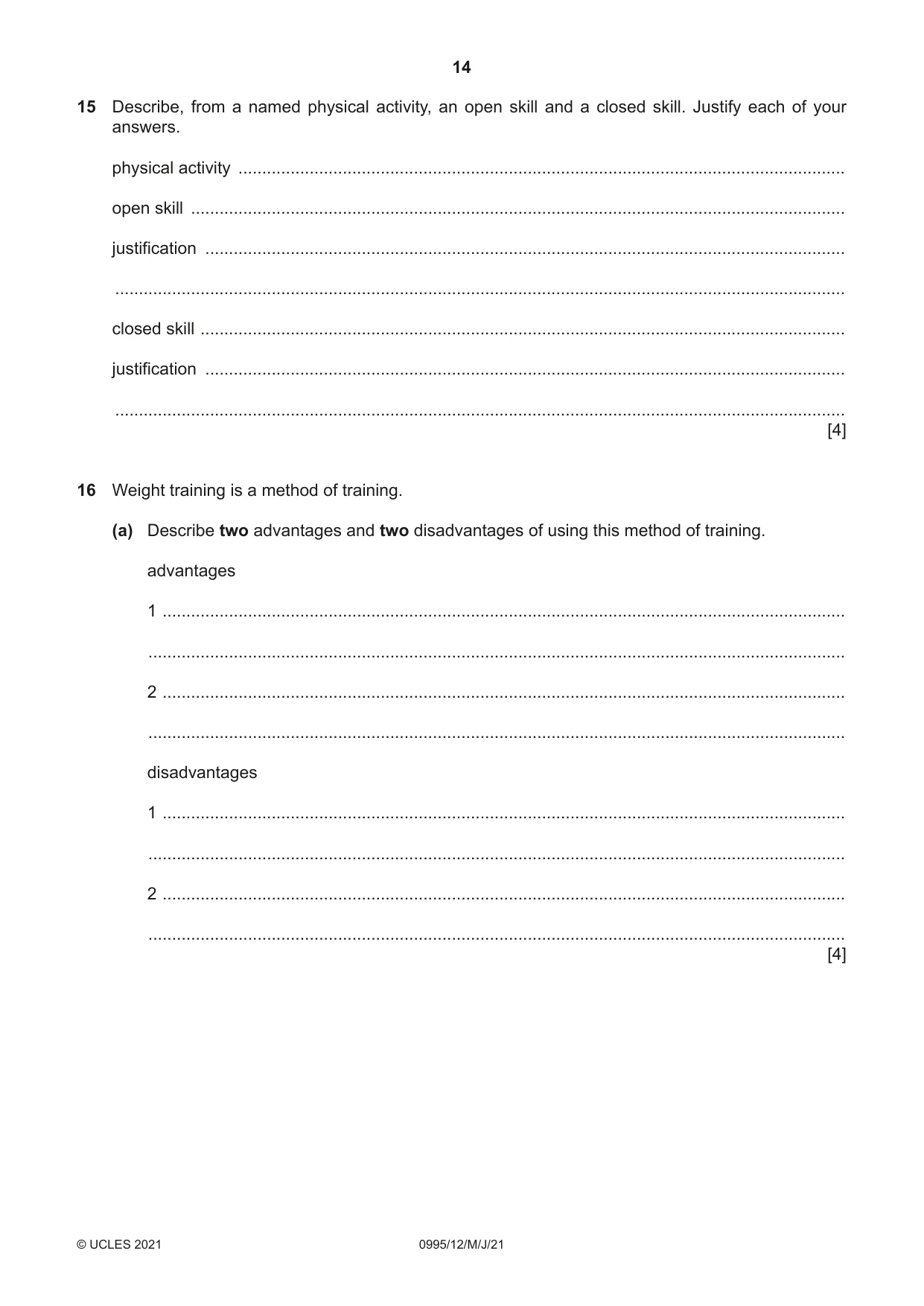
14 0995/12/M/J/21 © UCLES 2021 15 Describe, from a named physical activity, an open skill and a closed skill. Justify each of your answers. physical activity … open skill … justification … … closed skill … justification … … [4] 16 Weight training is a method of training. (a) Describe two advantages and two disadvantages of using this method of training. advantages 1 … … 2 … … disadvantages 1 … … 2 … … [4]
Question paper, page 15
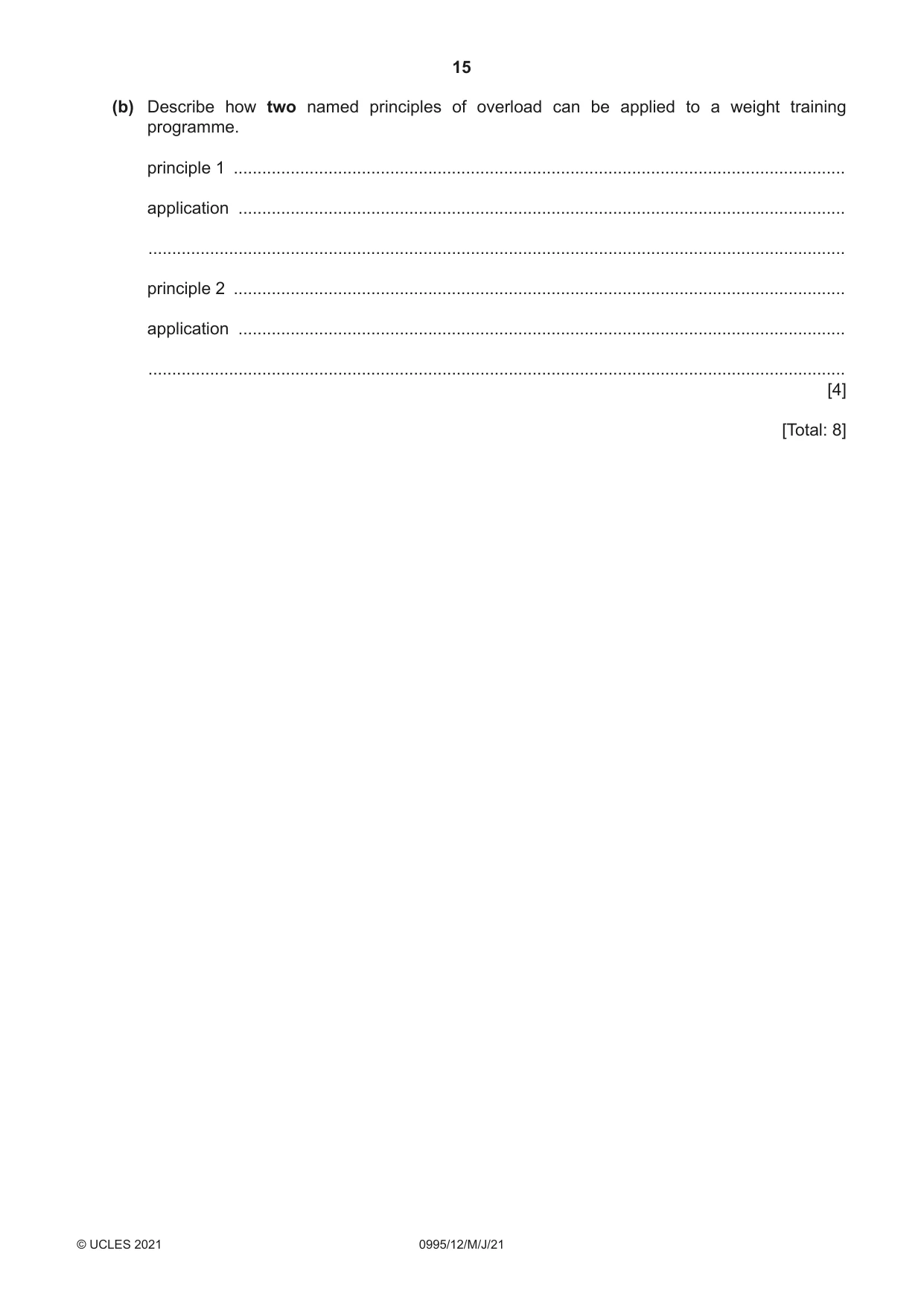
15 0995/12/M/J/21 © UCLES 2021 (b) Describe how two named principles of overload can be applied to a weight training programme. principle 1 … application … … principle 2 … application … … [4] [Total: 8]
Question paper, page 16
16 0995/12/M/J/21 © UCLES 2021 Permission to reproduce items where third-party owned material protected by copyright is included has been sought and cleared where possible. Every reasonable effort has been made by the publisher (UCLES) to trace copyright holders, but if any items requiring clearance have unwittingly been included, the publisher will be pleased to make amends at the earliest possible opportunity. To avoid the issue of disclosure of answer-related information to candidates, all copyright acknowledgements are reproduced online in the Cambridge Assessment International Education Copyright Acknowledgements Booklet. This is produced for each series of examinations and is freely available to download at www.cambridgeinternational.org after the live examination series. Cambridge Assessment International Education is part of the Cambridge Assessment Group. Cambridge Assessment is the brand name of the University of Cambridge Local Examinations Syndicate (UCLES), which itself is a department of the University of Cambridge. BLANK PAGE
Mark scheme, page 1
This document consists of 18 printed pages. © UCLES 2021 [Turn over Cambridge IGCSE™ (9–1) PHYSICAL EDUCATION 0995/12 Paper 1 Theory May/June 2021 MARK SCHEME Maximum Mark: 100 Published This mark scheme is published as an aid to teachers and candidates, to indicate the requirements of the examination. It shows the basis on which Examiners were instructed to award marks. It does not indicate the details of the discussions that took place at an Examiners’ meeting before marking began, which would have considered the acceptability of alternative answers. Mark schemes should be read in conjunction with the question paper and the Principal Examiner Report for Teachers. Cambridge International will not enter into discussions about these mark schemes. Cambridge International is publishing the mark schemes for the May/June 2021 series for most Cambridge IGCSE™, Cambridge International A and AS Level components and some Cambridge O Level components.
Mark scheme, page 2
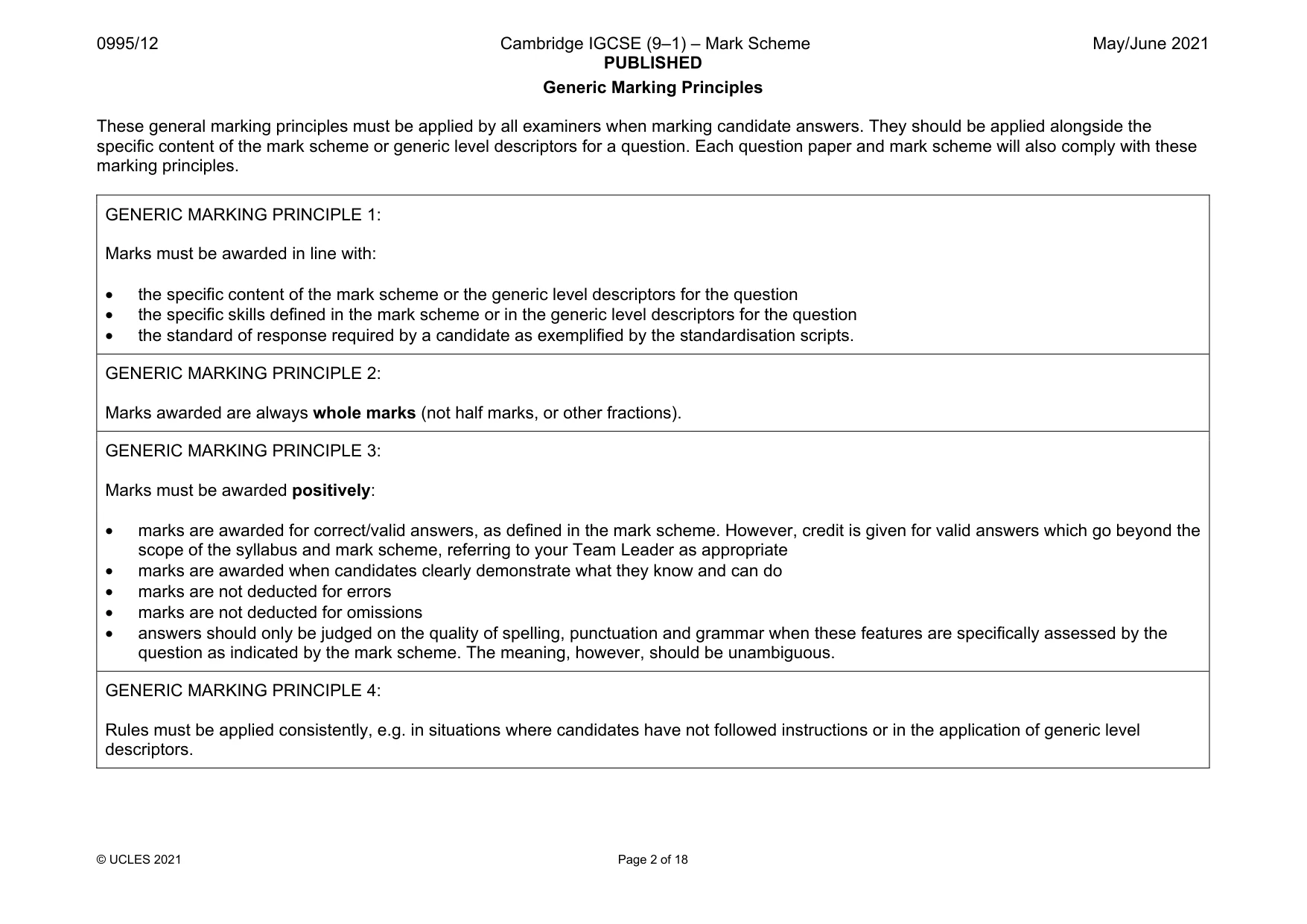
0995/12 Cambridge IGCSE (9–1) – Mark Scheme PUBLISHED May/June 2021 © UCLES 2021 Page 2 of 18 Generic Marking Principles These general marking principles must be applied by all examiners when marking candidate answers. They should be applied alongside the specific content of the mark scheme or generic level descriptors for a question. Each question paper and mark scheme will also comply with these marking principles. GENERIC MARKING PRINCIPLE 1: Marks must be awarded in line with: • the specific content of the mark scheme or the generic level descriptors for the question • the specific skills defined in the mark scheme or in the generic level descriptors for the question • the standard of response required by a candidate as exemplified by the standardisation scripts. GENERIC MARKING PRINCIPLE 2: Marks awarded are always whole marks (not half marks, or other fractions). GENERIC MARKING PRINCIPLE 3: Marks must be awarded positively: • marks are awarded for correct/valid answers, as defined in the mark scheme. However, credit is given for valid answers which go beyond the scope of the syllabus and mark scheme, referring to your Team Leader as appropriate • marks are awarded when candidates clearly demonstrate what they know and can do • marks are not deducted for errors • marks are not deducted for omissions • answers should only be judged on the quality of spelling, punctuation and grammar when these features are specifically assessed by the question as indicated by the mark scheme. The meaning, however, should be unambiguous. GENERIC MARKING PRINCIPLE 4: Rules must be applied consistently, e.g. in situations where candidates have not followed instructions or in the application of generic level descriptors.
Mark scheme, page 3
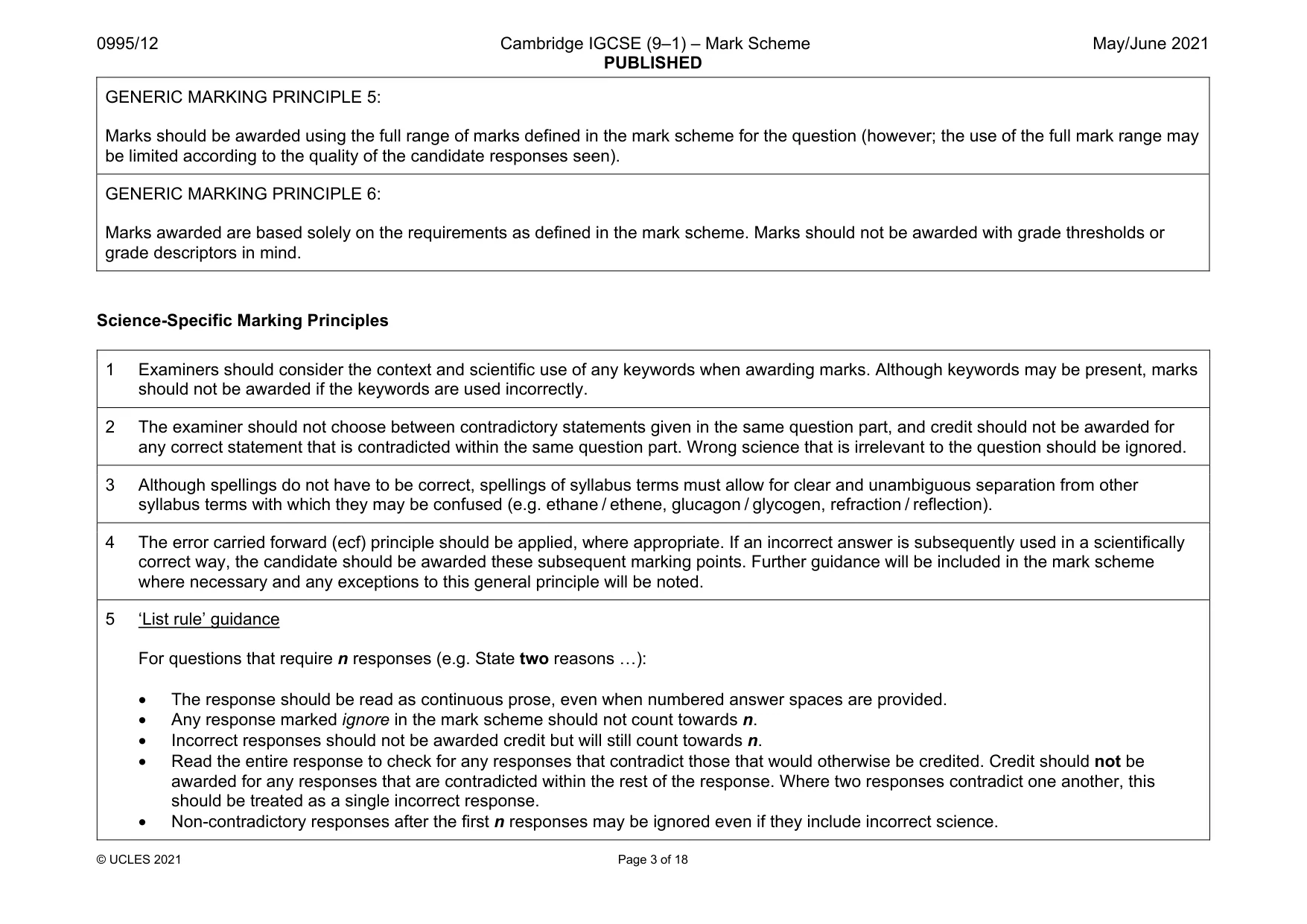
0995/12 Cambridge IGCSE (9–1) – Mark Scheme PUBLISHED May/June 2021 © UCLES 2021 Page 3 of 18 GENERIC MARKING PRINCIPLE 5: Marks should be awarded using the full range of marks defined in the mark scheme for the question (however; the use of the full mark range may be limited according to the quality of the candidate responses seen). GENERIC MARKING PRINCIPLE 6: Marks awarded are based solely on the requirements as defined in the mark scheme. Marks should not be awarded with grade thresholds or grade descriptors in mind. Science-Specific Marking Principles 1 Examiners should consider the context and scientific use of any keywords when awarding marks. Although keywords may be present, marks should not be awarded if the keywords are used incorrectly. 2 The examiner should not choose between contradictory statements given in the same question part, and credit should not be awarded for any correct statement that is contradicted within the same question part. Wrong science that is irrelevant to the question should be ignored. 3 Although spellings do not have to be correct, spellings of syllabus terms must allow for clear and unambiguous separation from other syllabus terms with which they may be confused (e.g. ethane / ethene, glucagon / glycogen, refraction / reflection). 4 The error carried forward (ecf) principle should be applied, where appropriate. If an incorrect answer is subsequently used in a scientifically correct way, the candidate should be awarded these subsequent marking points. Further guidance will be included in the mark scheme where necessary and any exceptions to this general principle will be noted. 5 ‘List rule’ guidance For questions that require n responses (e.g. State two reasons …): • The response should be read as continuous prose, even when numbered answer spaces are provided. • Any response marked ignore in the mark scheme should not count towards n. • Incorrect responses should not be awarded credit but will still count towards n. • Read the entire response to check for any responses that contradict those that would otherwise be credited. Credit should not be awarded for any responses that are contradicted within the rest of the response. Where two responses contradict one another, this should be treated as a single incorrect response. • Non-contradictory responses after the first n responses may be ignored even if they include incorrect science.
Mark scheme, page 4
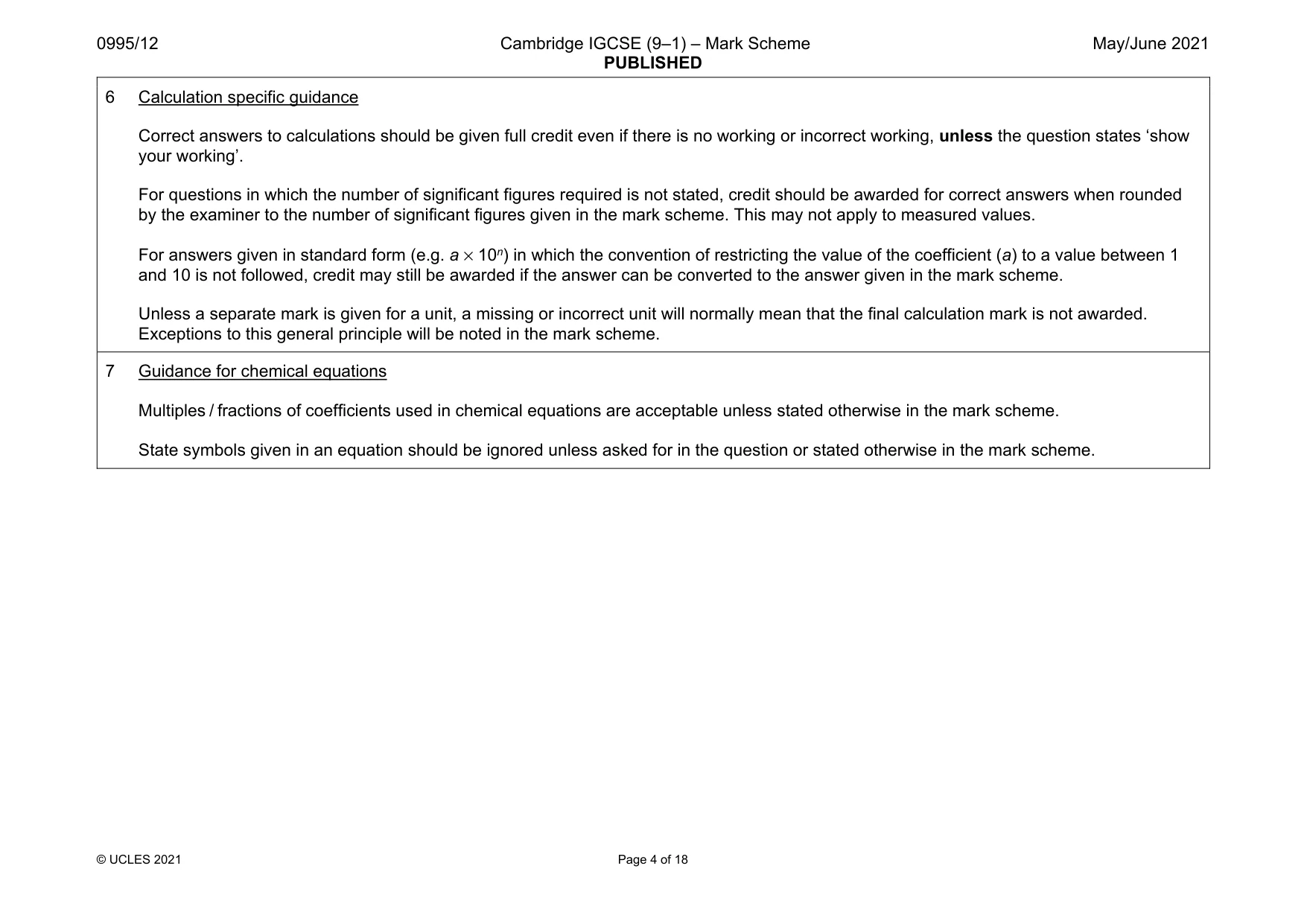
0995/12 Cambridge IGCSE (9–1) – Mark Scheme PUBLISHED May/June 2021 © UCLES 2021 Page 4 of 18 6 Calculation specific guidance Correct answers to calculations should be given full credit even if there is no working or incorrect working, unless the question states ‘show your working’. For questions in which the number of significant figures required is not stated, credit should be awarded for correct answers when rounded by the examiner to the number of significant figures given in the mark scheme. This may not apply to measured values. For answers given in standard form (e.g. a × 10n) in which the convention of restricting the value of the coefficient (a) to a value between 1 and 10 is not followed, credit may still be awarded if the answer can be converted to the answer given in the mark scheme. Unless a separate mark is given for a unit, a missing or incorrect unit will normally mean that the final calculation mark is not awarded. Exceptions to this general principle will be noted in the mark scheme. 7 Guidance for chemical equations Multiples / fractions of coefficients used in chemical equations are acceptable unless stated otherwise in the mark scheme. State symbols given in an equation should be ignored unless asked for in the question or stated otherwise in the mark scheme.
Mark scheme, page 5
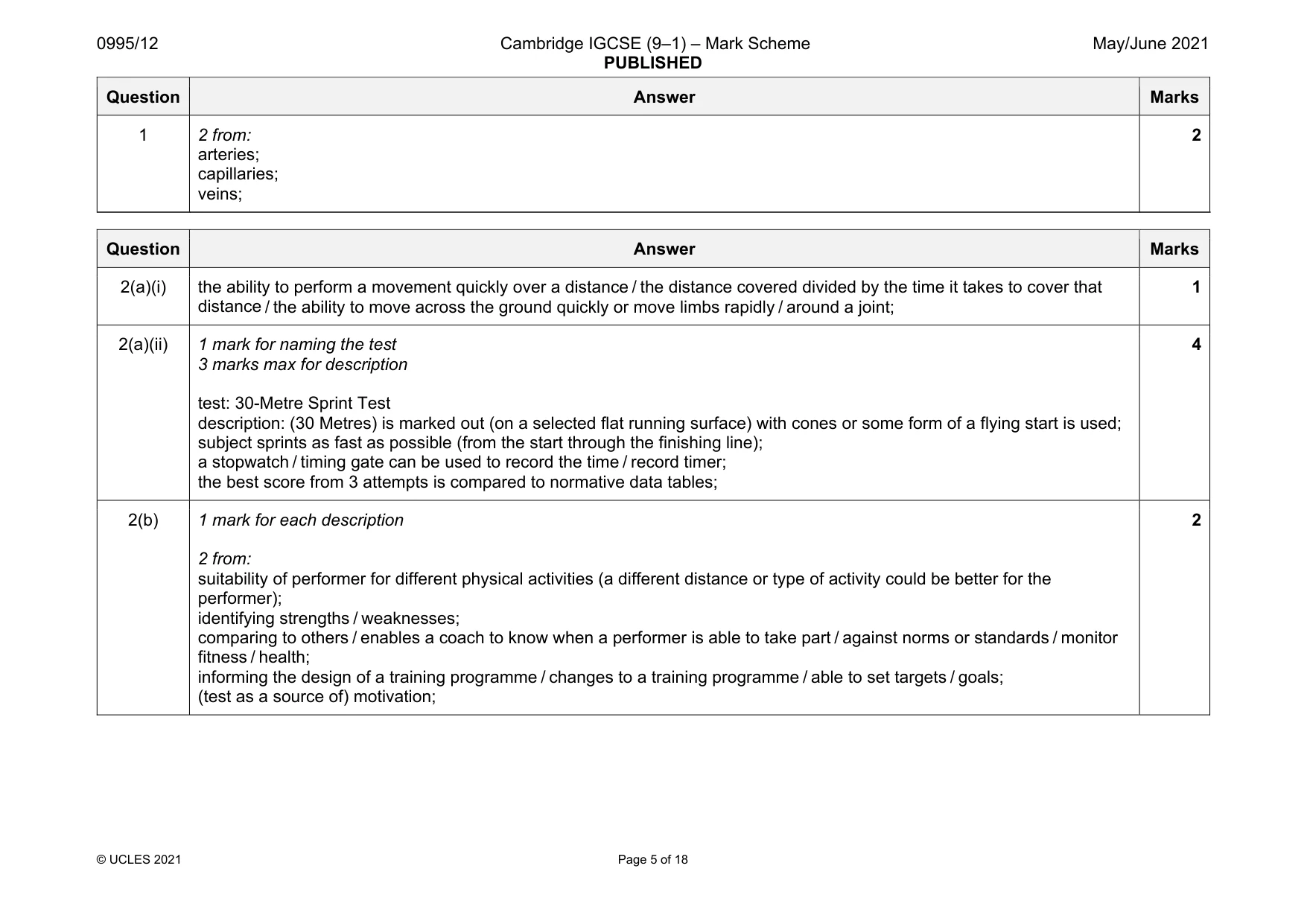
0995/12 Cambridge IGCSE (9–1) – Mark Scheme PUBLISHED May/June 2021 © UCLES 2021 Page 5 of 18 Question Answer Marks 1 2 from: arteries; capillaries; veins; 2 Question Answer Marks 2(a)(i) the ability to perform a movement quickly over a distance / the distance covered divided by the time it takes to cover that distance / the ability to move across the ground quickly or move limbs rapidly / around a joint; 1 2(a)(ii) 1 mark for naming the test 3 marks max for description test: 30-Metre Sprint Test description: (30 Metres) is marked out (on a selected flat running surface) with cones or some form of a flying start is used; subject sprints as fast as possible (from the start through the finishing line); a stopwatch / timing gate can be used to record the time / record timer; the best score from 3 attempts is compared to normative data tables; 4 2(b) 1 mark for each description 2 from: suitability of performer for different physical activities (a different distance or type of activity could be better for the performer); identifying strengths / weaknesses; comparing to others / enables a coach to know when a performer is able to take part / against norms or standards / monitor fitness / health; informing the design of a training programme / changes to a training programme / able to set targets / goals; (test as a source of) motivation; 2
Mark scheme, page 6
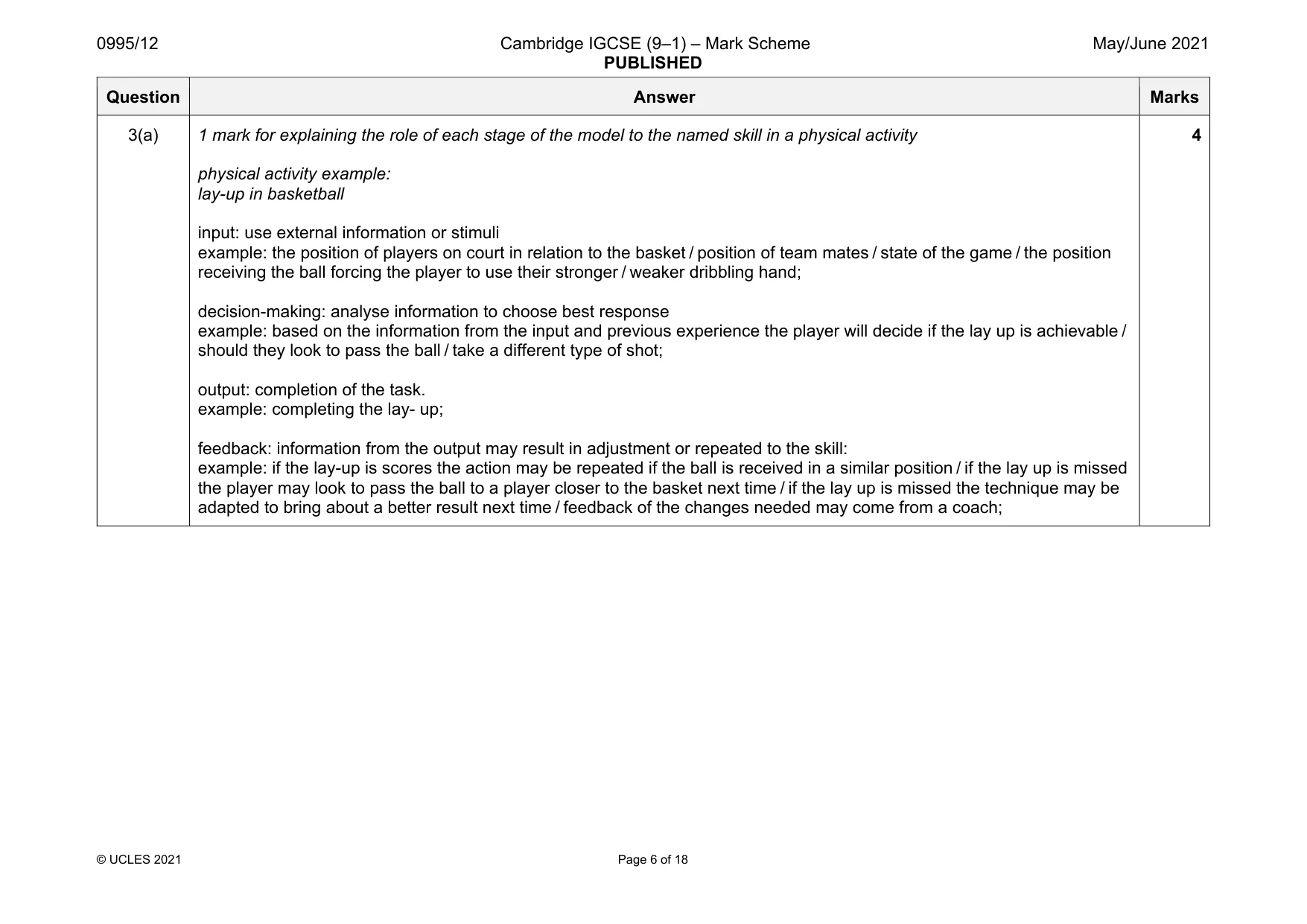
0995/12 Cambridge IGCSE (9–1) – Mark Scheme PUBLISHED May/June 2021 © UCLES 2021 Page 6 of 18 Question Answer Marks 3(a) 1 mark for explaining the role of each stage of the model to the named skill in a physical activity physical activity example: lay-up in basketball input: use external information or stimuli example: the position of players on court in relation to the basket / position of team mates / state of the game / the position receiving the ball forcing the player to use their stronger / weaker dribbling hand; decision-making: analyse information to choose best response example: based on the information from the input and previous experience the player will decide if the lay up is achievable / should they look to pass the ball / take a different type of shot; output: completion of the task. example: completing the lay- up; feedback: information from the output may result in adjustment or repeated to the skill: example: if the lay-up is scores the action may be repeated if the ball is received in a similar position / if the lay up is missed the player may look to pass the ball to a player closer to the basket next time / if the lay up is missed the technique may be adapted to bring about a better result next time / feedback of the changes needed may come from a coach; 4
Mark scheme, page 7
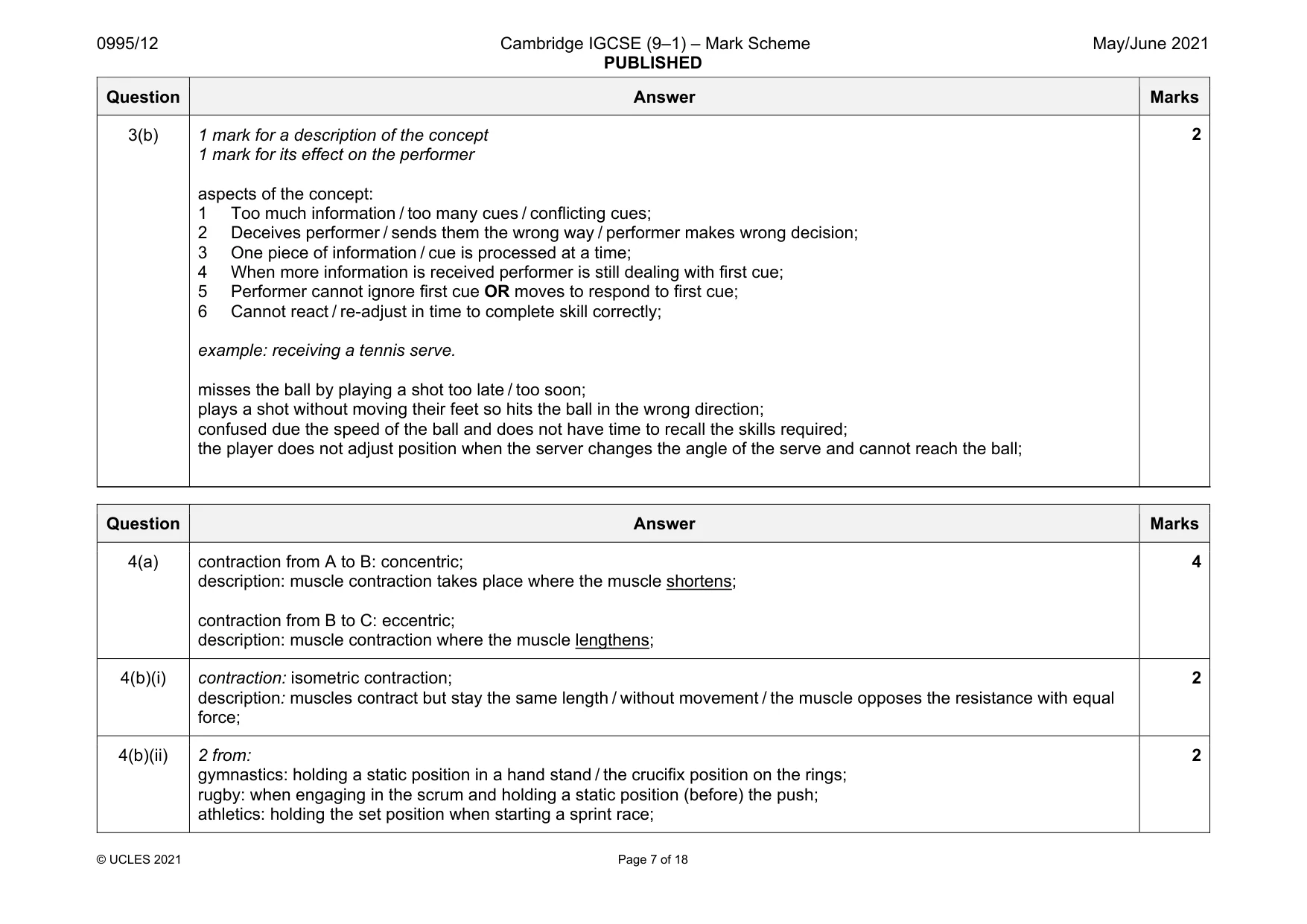
0995/12 Cambridge IGCSE (9–1) – Mark Scheme PUBLISHED May/June 2021 © UCLES 2021 Page 7 of 18 Question Answer Marks 3(b) 1 mark for a description of the concept 1 mark for its effect on the performer aspects of the concept: 1 Too much information / too many cues / conflicting cues; 2 Deceives performer / sends them the wrong way / performer makes wrong decision; 3 One piece of information / cue is processed at a time; 4 When more information is received performer is still dealing with first cue; 5 Performer cannot ignore first cue OR moves to respond to first cue; 6 Cannot react / re-adjust in time to complete skill correctly; example: receiving a tennis serve. misses the ball by playing a shot too late / too soon; plays a shot without moving their feet so hits the ball in the wrong direction; confused due the speed of the ball and does not have time to recall the skills required; the player does not adjust position when the server changes the angle of the serve and cannot reach the ball; 2 Question Answer Marks 4(a) contraction from A to B: concentric; description: muscle contraction takes place where the muscle shortens; contraction from B to C: eccentric; description: muscle contraction where the muscle lengthens; 4 4(b)(i) contraction: isometric contraction; description: muscles contract but stay the same length / without movement / the muscle opposes the resistance with equal force; 2 4(b)(ii) 2 from: gymnastics: holding a static position in a hand stand / the crucifix position on the rings; rugby: when engaging in the scrum and holding a static position (before) the push; athletics: holding the set position when starting a sprint race; 2
Mark scheme, page 8
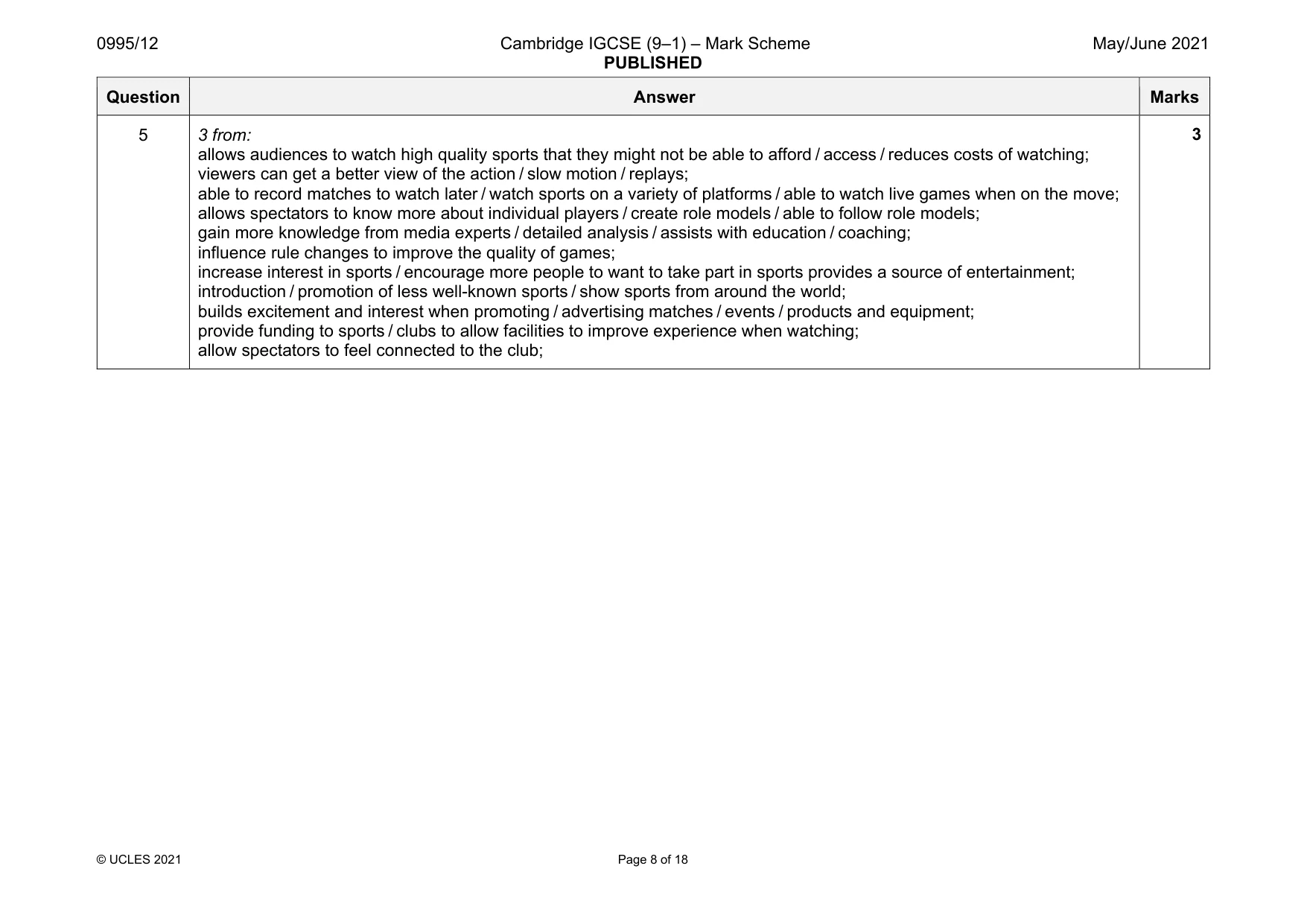
0995/12 Cambridge IGCSE (9–1) – Mark Scheme PUBLISHED May/June 2021 © UCLES 2021 Page 8 of 18 Question Answer Marks 5 3 from: allows audiences to watch high quality sports that they might not be able to afford / access / reduces costs of watching; viewers can get a better view of the action / slow motion / replays; able to record matches to watch later / watch sports on a variety of platforms / able to watch live games when on the move; allows spectators to know more about individual players / create role models / able to follow role models; gain more knowledge from media experts / detailed analysis / assists with education / coaching; influence rule changes to improve the quality of games; increase interest in sports / encourage more people to want to take part in sports provides a source of entertainment; introduction / promotion of less well-known sports / show sports from around the world; builds excitement and interest when promoting / advertising matches / events / products and equipment; provide funding to sports / clubs to allow facilities to improve experience when watching; allow spectators to feel connected to the club; 3
Mark scheme, page 9
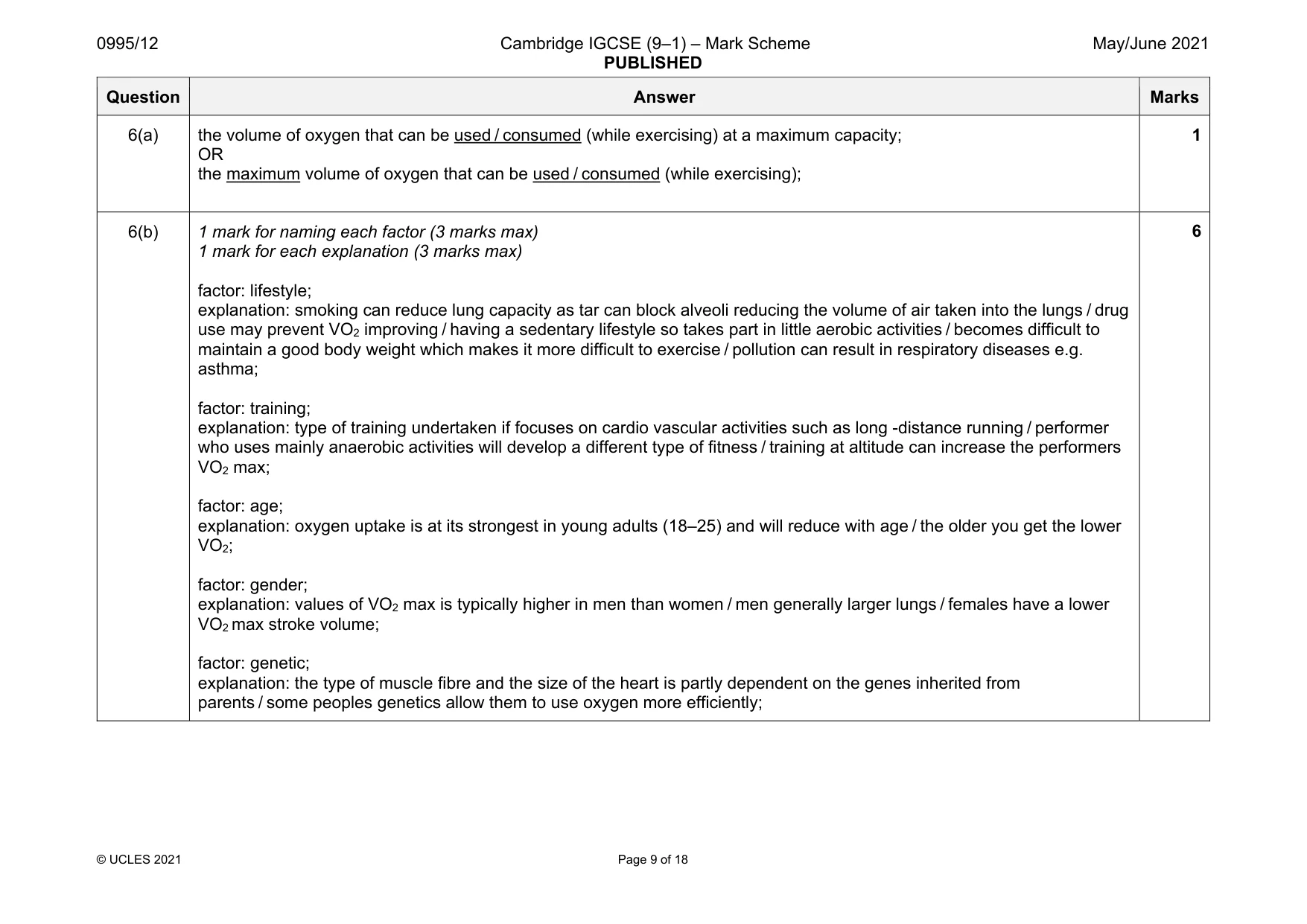
0995/12 Cambridge IGCSE (9–1) – Mark Scheme PUBLISHED May/June 2021 © UCLES 2021 Page 9 of 18 Question Answer Marks 6(a) the volume of oxygen that can be used / consumed (while exercising) at a maximum capacity; OR the maximum volume of oxygen that can be used / consumed (while exercising); 1 6(b) 1 mark for naming each factor (3 marks max) 1 mark for each explanation (3 marks max) factor: lifestyle; explanation: smoking can reduce lung capacity as tar can block alveoli reducing the volume of air taken into the lungs / drug use may prevent VO2 improving / having a sedentary lifestyle so takes part in little aerobic activities / becomes difficult to maintain a good body weight which makes it more difficult to exercise / pollution can result in respiratory diseases e.g. asthma; factor: training; explanation: type of training undertaken if focuses on cardio vascular activities such as long -distance running / performer who uses mainly anaerobic activities will develop a different type of fitness / training at altitude can increase the performers VO2 max; factor: age; explanation: oxygen uptake is at its strongest in young adults (18–25) and will reduce with age / the older you get the lower VO2; factor: gender; explanation: values of VO2 max is typically higher in men than women / men generally larger lungs / females have a lower VO2 max stroke volume; factor: genetic; explanation: the type of muscle fibre and the size of the heart is partly dependent on the genes inherited from parents / some peoples genetics allow them to use oxygen more efficiently; 6
Mark scheme, page 10
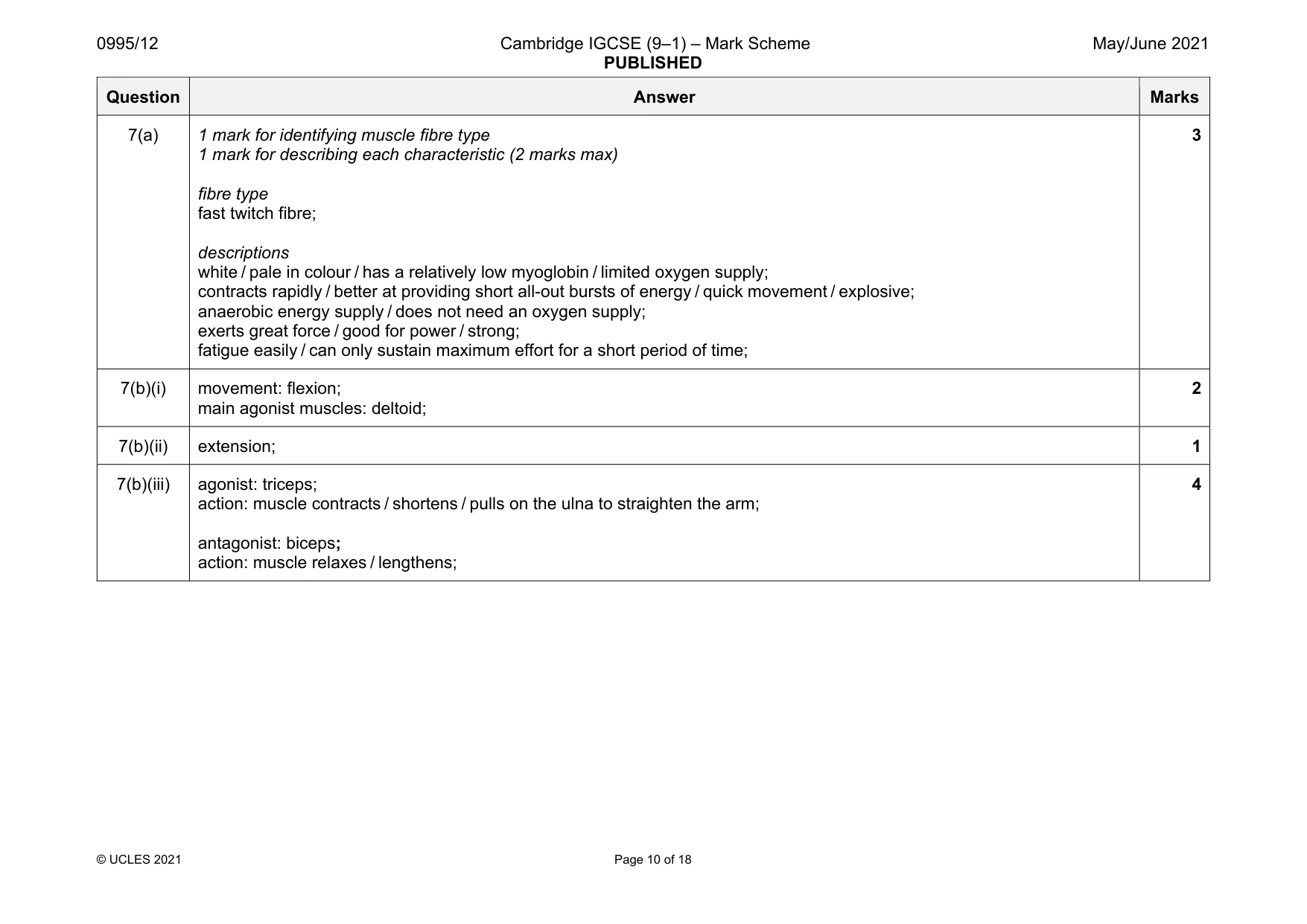
0995/12 Cambridge IGCSE (9–1) – Mark Scheme PUBLISHED May/June 2021 © UCLES 2021 Page 10 of 18 Question Answer Marks 7(a) 1 mark for identifying muscle fibre type 1 mark for describing each characteristic (2 marks max) fibre type fast twitch fibre; descriptions white / pale in colour / has a relatively low myoglobin / limited oxygen supply; contracts rapidly / better at providing short all-out bursts of energy / quick movement / explosive; anaerobic energy supply / does not need an oxygen supply; exerts great force / good for power / strong; fatigue easily / can only sustain maximum effort for a short period of time; 3 7(b)(i) movement: flexion; main agonist muscles: deltoid; 2 7(b)(ii) extension; 1 7(b)(iii) agonist: triceps; action: muscle contracts / shortens / pulls on the ulna to straighten the arm; antagonist: biceps; action: muscle relaxes / lengthens; 4
Mark scheme, page 11
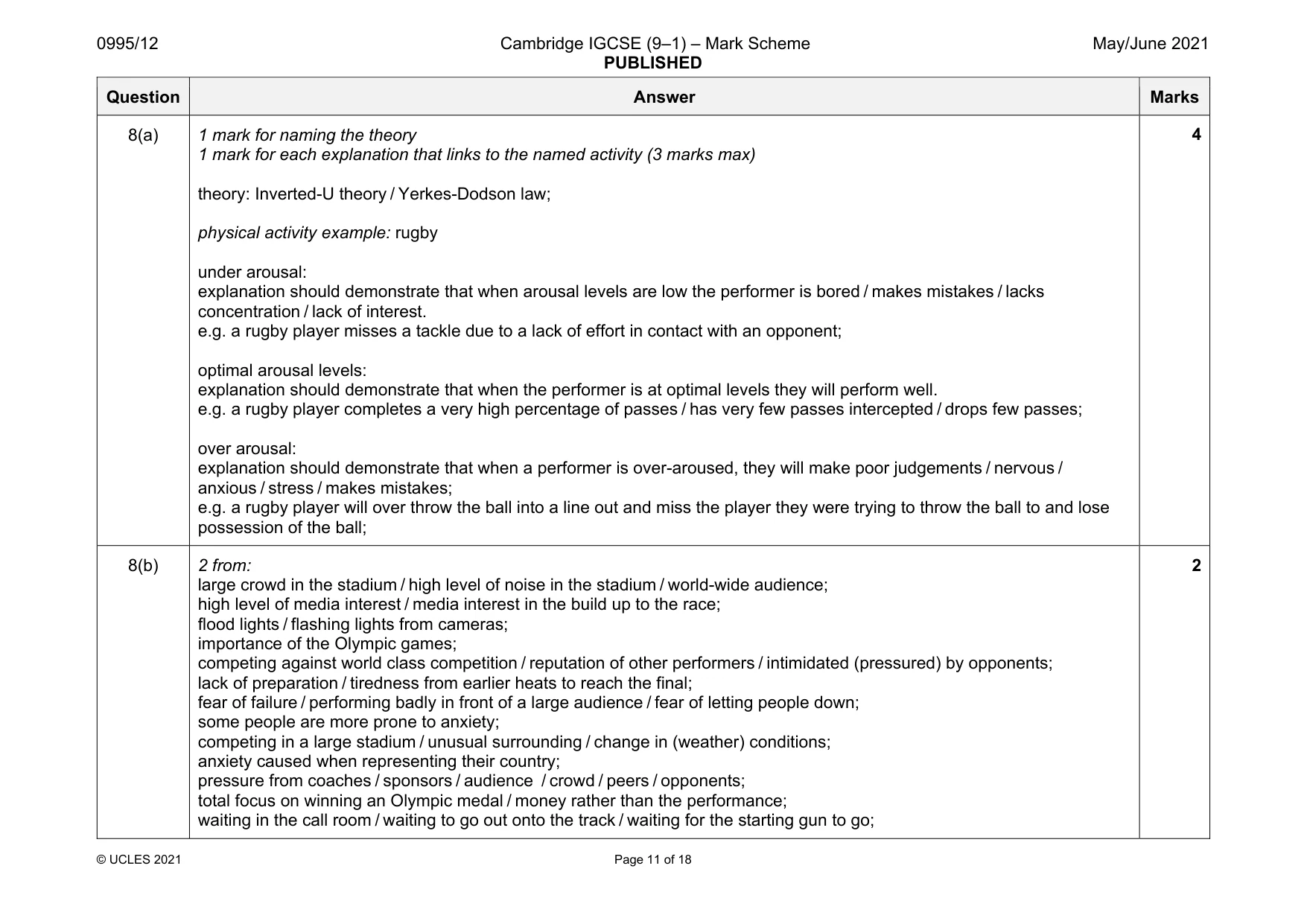
0995/12 Cambridge IGCSE (9–1) – Mark Scheme PUBLISHED May/June 2021 © UCLES 2021 Page 11 of 18 Question Answer Marks 8(a) 1 mark for naming the theory 1 mark for each explanation that links to the named activity (3 marks max) theory: Inverted-U theory / Yerkes-Dodson law; physical activity example: rugby under arousal: explanation should demonstrate that when arousal levels are low the performer is bored / makes mistakes / lacks concentration / lack of interest. e.g. a rugby player misses a tackle due to a lack of effort in contact with an opponent; optimal arousal levels: explanation should demonstrate that when the performer is at optimal levels they will perform well. e.g. a rugby player completes a very high percentage of passes / has very few passes intercepted / drops few passes; over arousal: explanation should demonstrate that when a performer is over-aroused, they will make poor judgements / nervous / anxious / stress / makes mistakes; e.g. a rugby player will over throw the ball into a line out and miss the player they were trying to throw the ball to and lose possession of the ball; 4 8(b) 2 from: large crowd in the stadium / high level of noise in the stadium / world-wide audience; high level of media interest / media interest in the build up to the race; flood lights / flashing lights from cameras; importance of the Olympic games; competing against world class competition / reputation of other performers / intimidated (pressured) by opponents; lack of preparation / tiredness from earlier heats to reach the final; fear of failure / performing badly in front of a large audience / fear of letting people down; some people are more prone to anxiety; competing in a large stadium / unusual surrounding / change in (weather) conditions; anxiety caused when representing their country; pressure from coaches / sponsors / audience / crowd / peers / opponents; total focus on winning an Olympic medal / money rather than the performance; waiting in the call room / waiting to go out onto the track / waiting for the starting gun to go; 2
Mark scheme, page 12
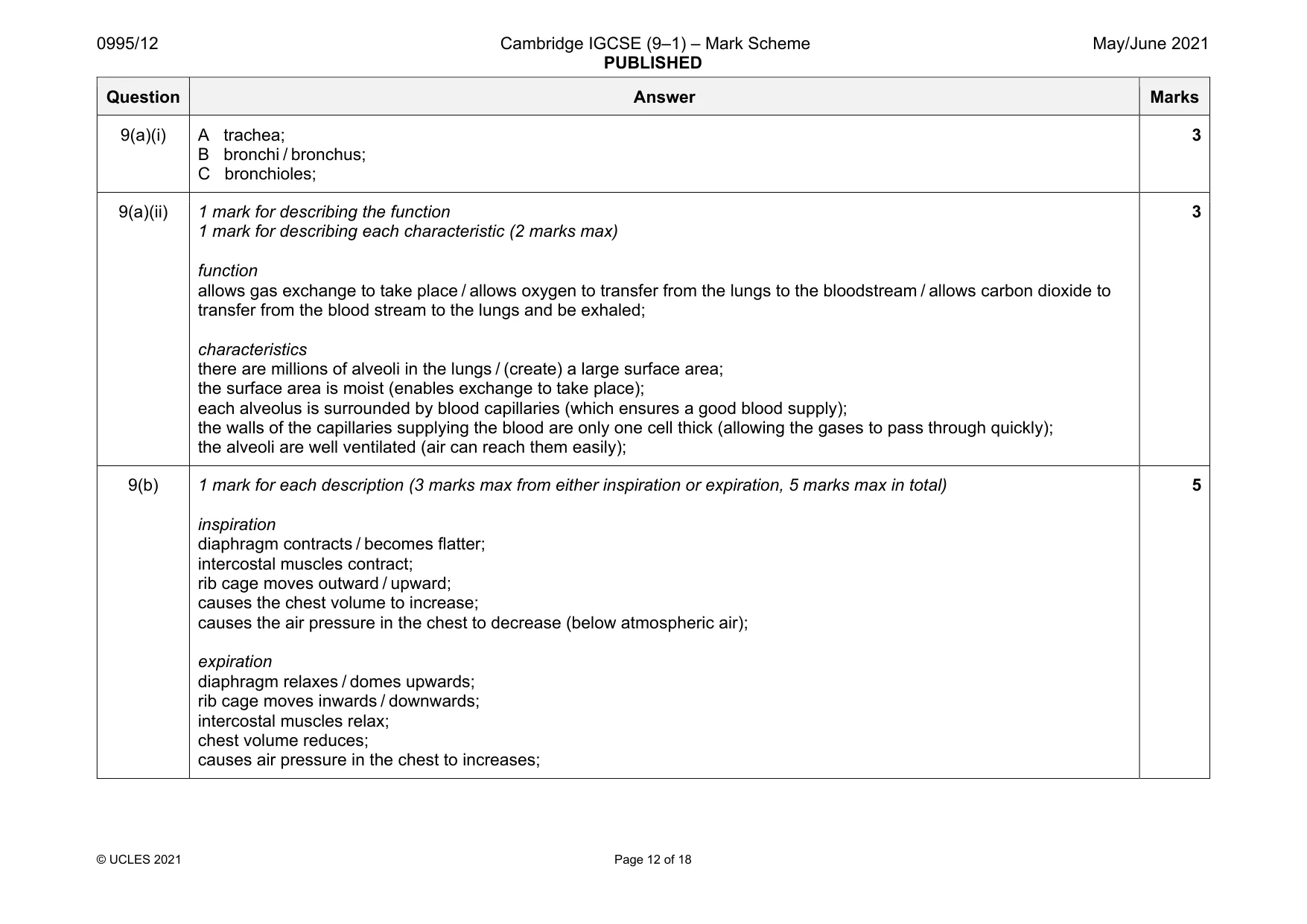
0995/12 Cambridge IGCSE (9–1) – Mark Scheme PUBLISHED May/June 2021 © UCLES 2021 Page 12 of 18 Question Answer Marks 9(a)(i) A trachea; B bronchi / bronchus; C bronchioles; 3 9(a)(ii) 1 mark for describing the function 1 mark for describing each characteristic (2 marks max) function allows gas exchange to take place / allows oxygen to transfer from the lungs to the bloodstream / allows carbon dioxide to transfer from the blood stream to the lungs and be exhaled; characteristics there are millions of alveoli in the lungs / (create) a large surface area; the surface area is moist (enables exchange to take place); each alveolus is surrounded by blood capillaries (which ensures a good blood supply); the walls of the capillaries supplying the blood are only one cell thick (allowing the gases to pass through quickly); the alveoli are well ventilated (air can reach them easily); 3 9(b) 1 mark for each description (3 marks max from either inspiration or expiration, 5 marks max in total) inspiration diaphragm contracts / becomes flatter; intercostal muscles contract; rib cage moves outward / upward; causes the chest volume to increase; causes the air pressure in the chest to decrease (below atmospheric air); expiration diaphragm relaxes / domes upwards; rib cage moves inwards / downwards; intercostal muscles relax; chest volume reduces; causes air pressure in the chest to increases; 5
Mark scheme, page 13
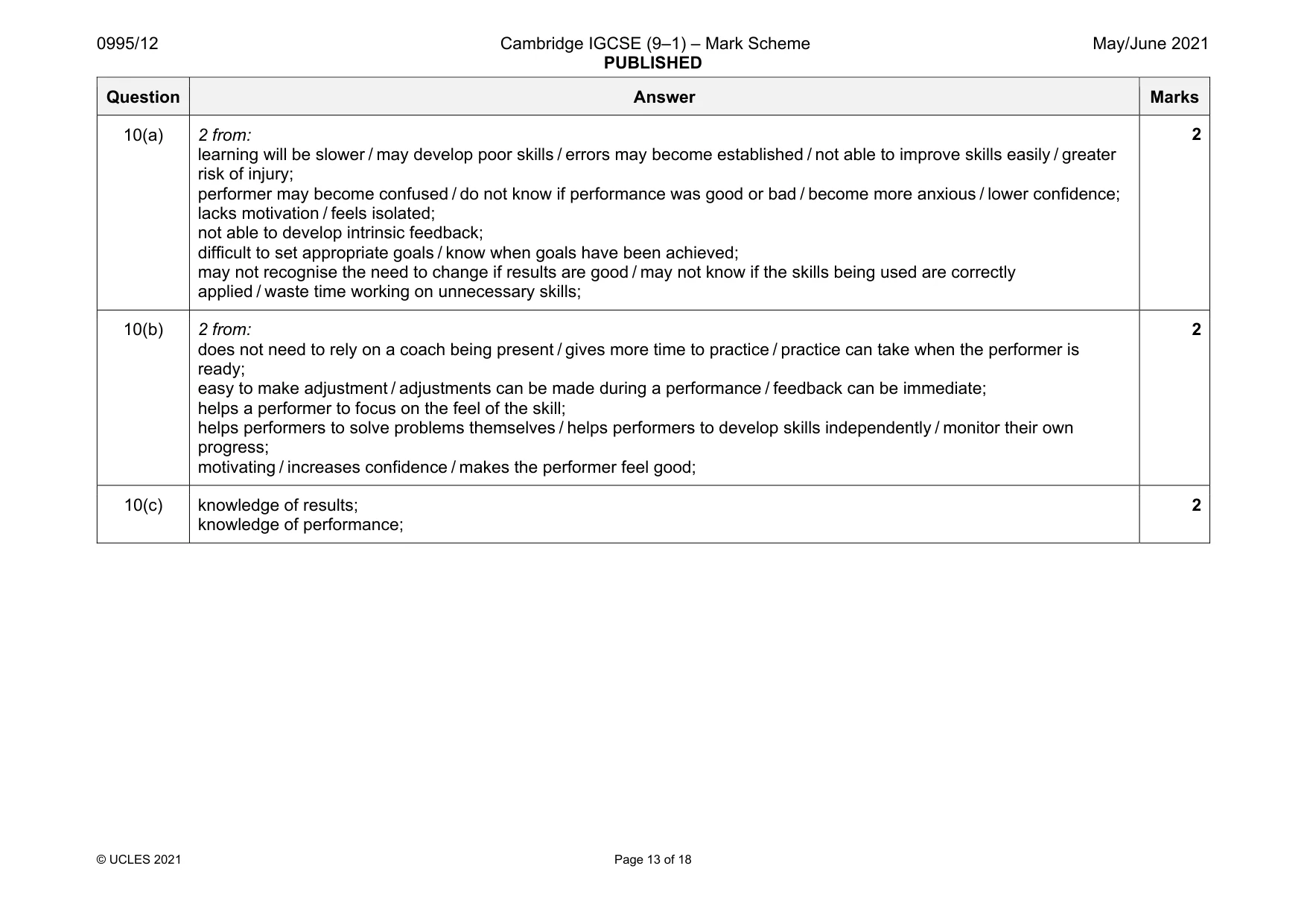
0995/12 Cambridge IGCSE (9–1) – Mark Scheme PUBLISHED May/June 2021 © UCLES 2021 Page 13 of 18 Question Answer Marks 10(a) 2 from: learning will be slower / may develop poor skills / errors may become established / not able to improve skills easily / greater risk of injury; performer may become confused / do not know if performance was good or bad / become more anxious / lower confidence; lacks motivation / feels isolated; not able to develop intrinsic feedback; difficult to set appropriate goals / know when goals have been achieved; may not recognise the need to change if results are good / may not know if the skills being used are correctly applied / waste time working on unnecessary skills; 2 10(b) 2 from: does not need to rely on a coach being present / gives more time to practice / practice can take when the performer is ready; easy to make adjustment / adjustments can be made during a performance / feedback can be immediate; helps a performer to focus on the feel of the skill; helps performers to solve problems themselves / helps performers to develop skills independently / monitor their own progress; motivating / increases confidence / makes the performer feel good; 2 10(c) knowledge of results; knowledge of performance; 2
Mark scheme, page 14
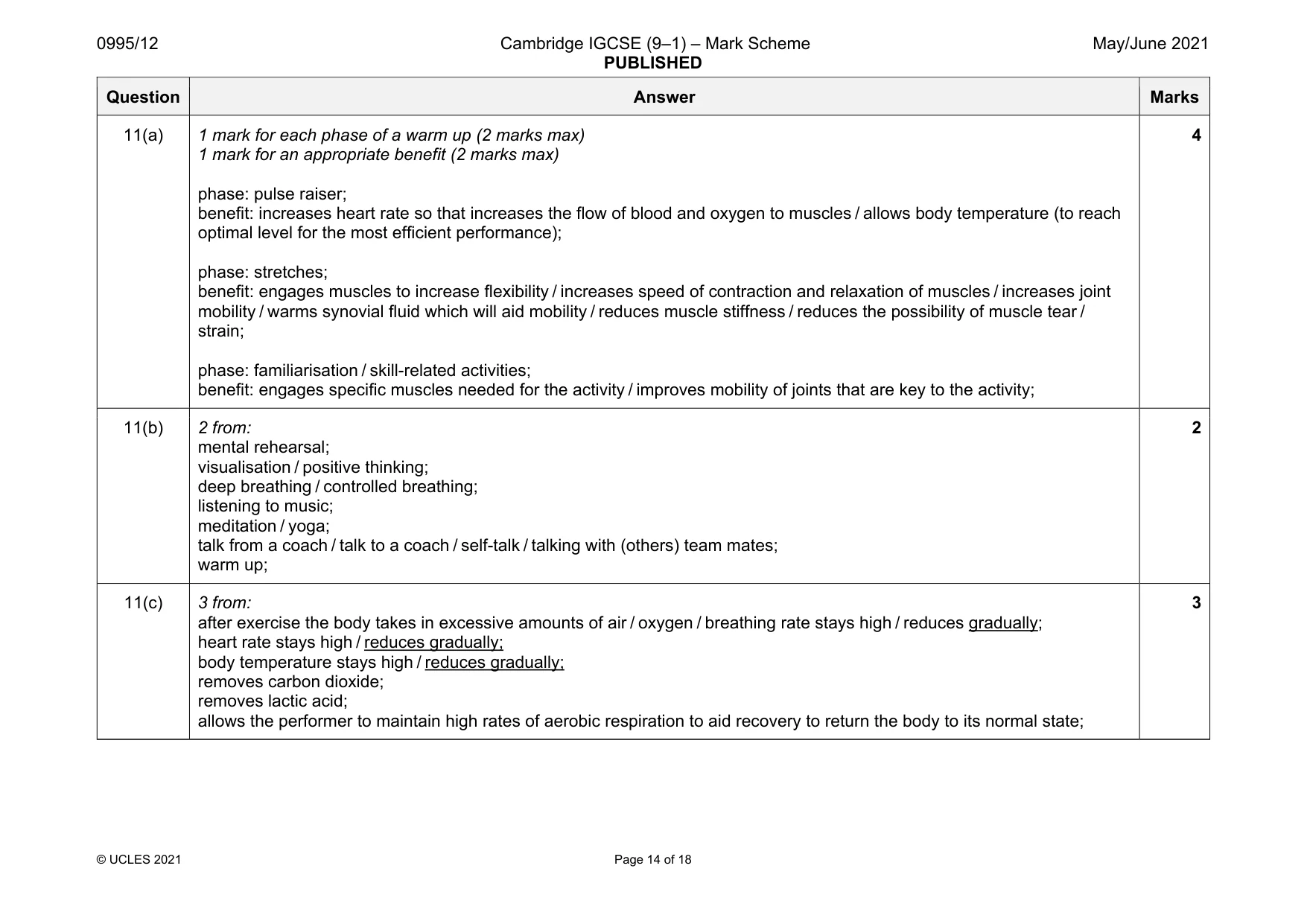
0995/12 Cambridge IGCSE (9–1) – Mark Scheme PUBLISHED May/June 2021 © UCLES 2021 Page 14 of 18 Question Answer Marks 11(a) 1 mark for each phase of a warm up (2 marks max) 1 mark for an appropriate benefit (2 marks max) phase: pulse raiser; benefit: increases heart rate so that increases the flow of blood and oxygen to muscles / allows body temperature (to reach optimal level for the most efficient performance); phase: stretches; benefit: engages muscles to increase flexibility / increases speed of contraction and relaxation of muscles / increases joint mobility / warms synovial fluid which will aid mobility / reduces muscle stiffness / reduces the possibility of muscle tear / strain; phase: familiarisation / skill-related activities; benefit: engages specific muscles needed for the activity / improves mobility of joints that are key to the activity; 4 11(b) 2 from: mental rehearsal; visualisation / positive thinking; deep breathing / controlled breathing; listening to music; meditation / yoga; talk from a coach / talk to a coach / self-talk / talking with (others) team mates; warm up; 2 11(c) 3 from: after exercise the body takes in excessive amounts of air / oxygen / breathing rate stays high / reduces gradually; heart rate stays high / reduces gradually; body temperature stays high / reduces gradually; removes carbon dioxide; removes lactic acid; allows the performer to maintain high rates of aerobic respiration to aid recovery to return the body to its normal state; 3
Mark scheme, page 15
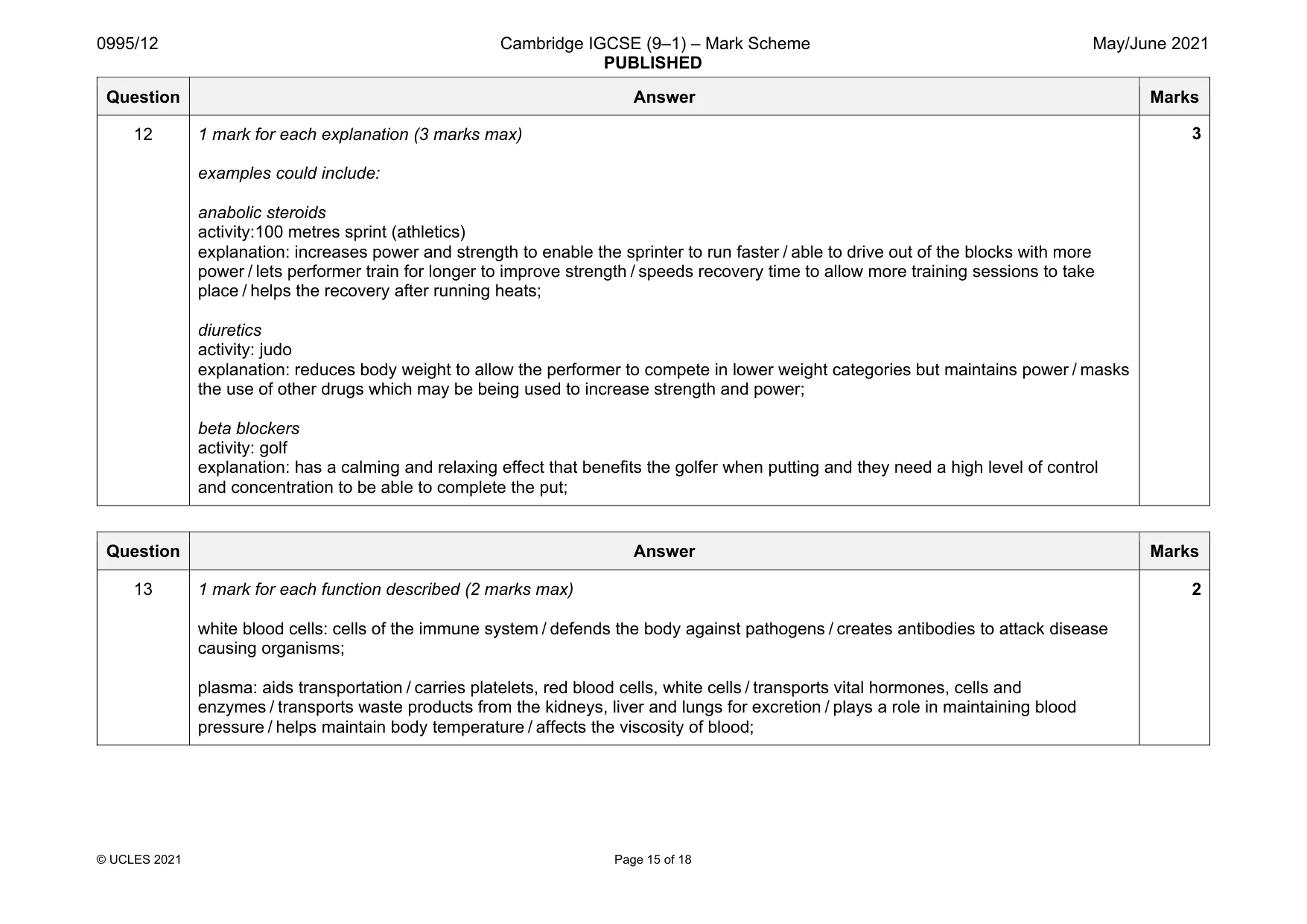
0995/12 Cambridge IGCSE (9–1) – Mark Scheme PUBLISHED May/June 2021 © UCLES 2021 Page 15 of 18 Question Answer Marks 12 1 mark for each explanation (3 marks max) examples could include: anabolic steroids activity:100 metres sprint (athletics) explanation: increases power and strength to enable the sprinter to run faster / able to drive out of the blocks with more power / lets performer train for longer to improve strength / speeds recovery time to allow more training sessions to take place / helps the recovery after running heats; diuretics activity: judo explanation: reduces body weight to allow the performer to compete in lower weight categories but maintains power / masks the use of other drugs which may be being used to increase strength and power; beta blockers activity: golf explanation: has a calming and relaxing effect that benefits the golfer when putting and they need a high level of control and concentration to be able to complete the put; 3 Question Answer Marks 13 1 mark for each function described (2 marks max) white blood cells: cells of the immune system / defends the body against pathogens / creates antibodies to attack disease causing organisms; plasma: aids transportation / carries platelets, red blood cells, white cells / transports vital hormones, cells and enzymes / transports waste products from the kidneys, liver and lungs for excretion / plays a role in maintaining blood pressure / helps maintain body temperature / affects the viscosity of blood; 2
Mark scheme, page 16
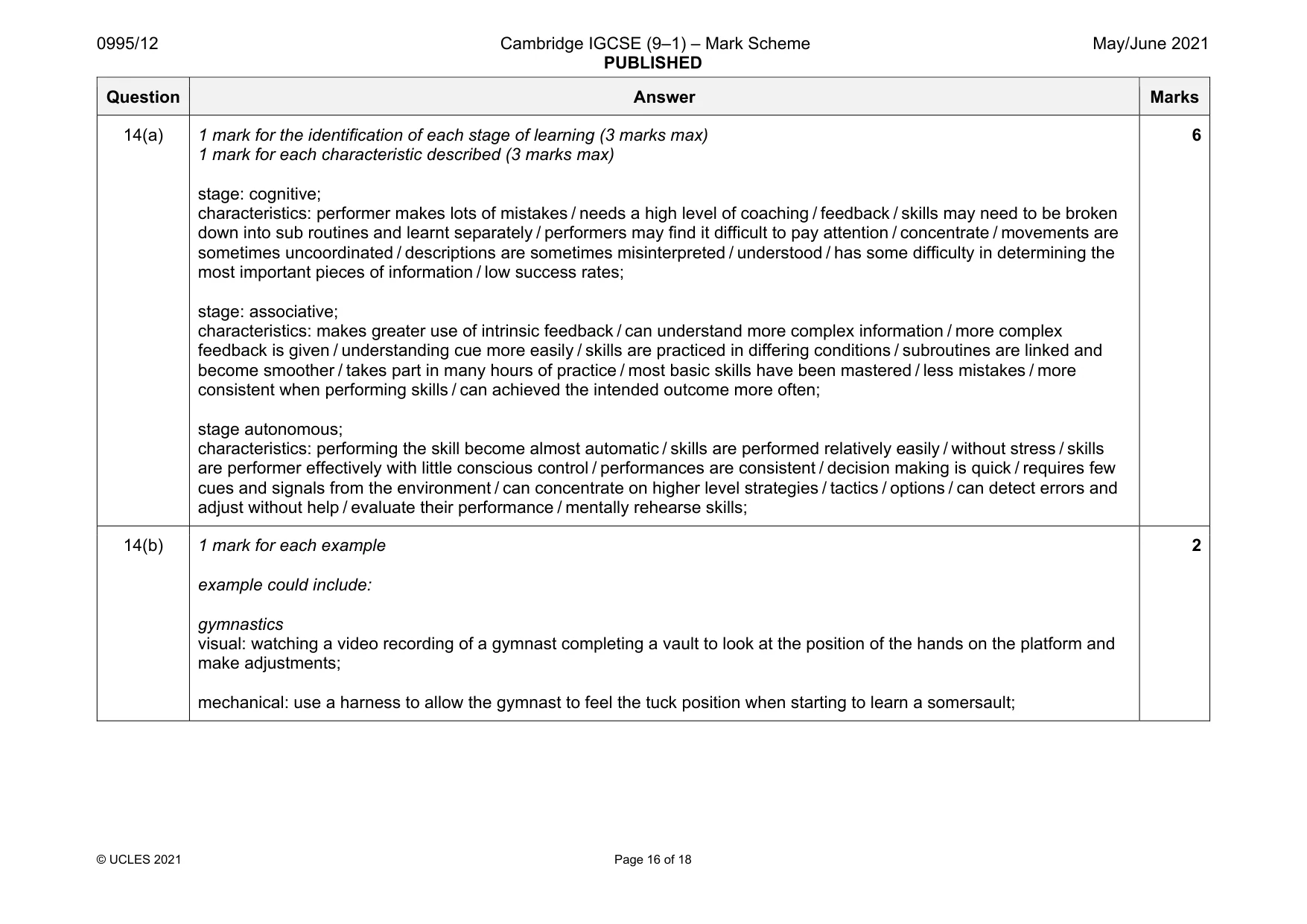
0995/12 Cambridge IGCSE (9–1) – Mark Scheme PUBLISHED May/June 2021 © UCLES 2021 Page 16 of 18 Question Answer Marks 14(a) 1 mark for the identification of each stage of learning (3 marks max) 1 mark for each characteristic described (3 marks max) stage: cognitive; characteristics: performer makes lots of mistakes / needs a high level of coaching / feedback / skills may need to be broken down into sub routines and learnt separately / performers may find it difficult to pay attention / concentrate / movements are sometimes uncoordinated / descriptions are sometimes misinterpreted / understood / has some difficulty in determining the most important pieces of information / low success rates; stage: associative; characteristics: makes greater use of intrinsic feedback / can understand more complex information / more complex feedback is given / understanding cue more easily / skills are practiced in differing conditions / subroutines are linked and become smoother / takes part in many hours of practice / most basic skills have been mastered / less mistakes / more consistent when performing skills / can achieved the intended outcome more often; stage autonomous; characteristics: performing the skill become almost automatic / skills are performed relatively easily / without stress / skills are performer effectively with little conscious control / performances are consistent / decision making is quick / requires few cues and signals from the environment / can concentrate on higher level strategies / tactics / options / can detect errors and adjust without help / evaluate their performance / mentally rehearse skills; 6 14(b) 1 mark for each example example could include: gymnastics visual: watching a video recording of a gymnast completing a vault to look at the position of the hands on the platform and make adjustments; mechanical: use a harness to allow the gymnast to feel the tuck position when starting to learn a somersault; 2
Mark scheme, page 17
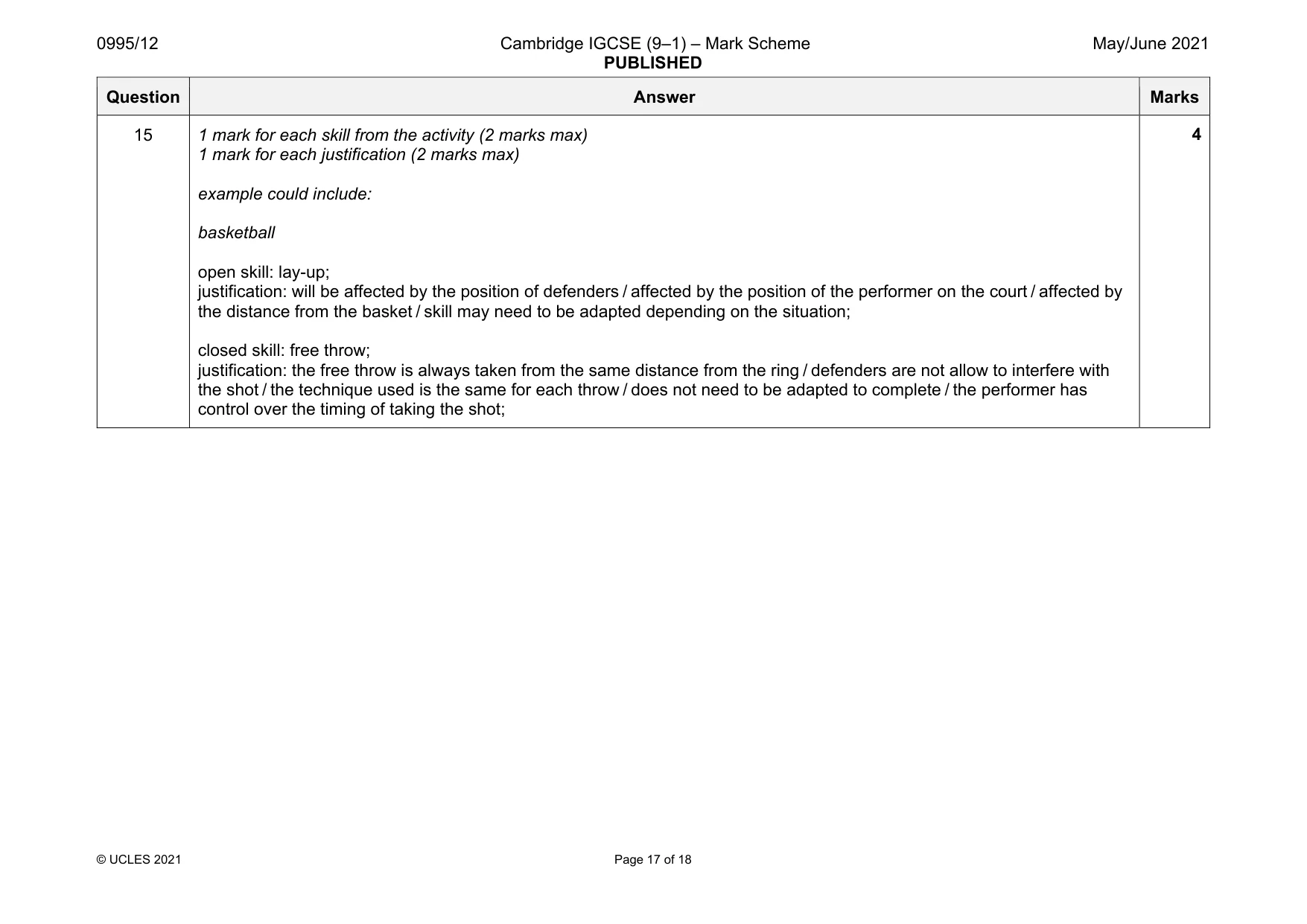
0995/12 Cambridge IGCSE (9–1) – Mark Scheme PUBLISHED May/June 2021 © UCLES 2021 Page 17 of 18 Question Answer Marks 15 1 mark for each skill from the activity (2 marks max) 1 mark for each justification (2 marks max) example could include: basketball open skill: lay-up; justification: will be affected by the position of defenders / affected by the position of the performer on the court / affected by the distance from the basket / skill may need to be adapted depending on the situation; closed skill: free throw; justification: the free throw is always taken from the same distance from the ring / defenders are not allow to interfere with the shot / the technique used is the same for each throw / does not need to be adapted to complete / the performer has control over the timing of taking the shot; 4
Mark scheme, page 18
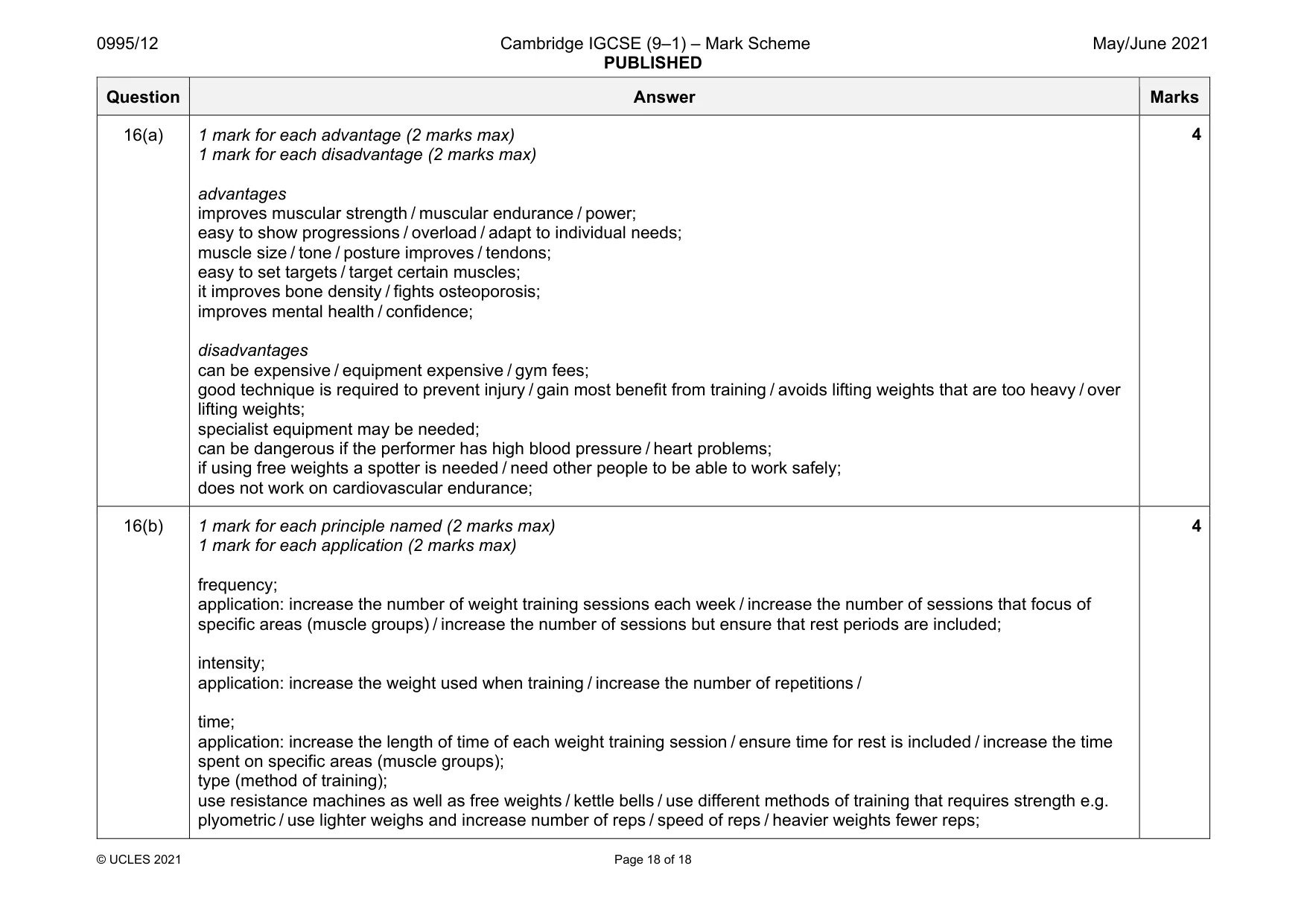
0995/12 Cambridge IGCSE (9–1) – Mark Scheme PUBLISHED May/June 2021 © UCLES 2021 Page 18 of 18 Question Answer Marks 16(a) 1 mark for each advantage (2 marks max) 1 mark for each disadvantage (2 marks max) advantages improves muscular strength / muscular endurance / power; easy to show progressions / overload / adapt to individual needs; muscle size / tone / posture improves / tendons; easy to set targets / target certain muscles; it improves bone density / fights osteoporosis; improves mental health / confidence; disadvantages can be expensive / equipment expensive / gym fees; good technique is required to prevent injury / gain most benefit from training / avoids lifting weights that are too heavy / over lifting weights; specialist equipment may be needed; can be dangerous if the performer has high blood pressure / heart problems; if using free weights a spotter is needed / need other people to be able to work safely; does not work on cardiovascular endurance; 4 16(b) 1 mark for each principle named (2 marks max) 1 mark for each application (2 marks max) frequency; application: increase the number of weight training sessions each week / increase the number of sessions that focus of specific areas (muscle groups) / increase the number of sessions but ensure that rest periods are included; intensity; application: increase the weight used when training / increase the number of repetitions / time; application: increase the length of time of each weight training session / ensure time for rest is included / increase the time spent on specific areas (muscle groups); type (method of training); use resistance machines as well as free weights / kettle bells / use different methods of training that requires strength e.g. plyometric / use lighter weighs and increase number of reps / speed of reps / heavier weights fewer reps; 4
What you needed in this session
Cambridge’s own grade thresholds for 2021 May/June, Paper 1 · Variant 2. A higher threshold means an easier paper — the bar moves with how the cohort did.