Cambridge IGCSE Pakistan Studies 0448 — 2013 May/June Paper 4 · Variant 2
0448/42/M/J/13 · 75 marks · ≈84 min
The question paper and its mark scheme, free to read here and free to download. This is Cambridge’s own paper, exactly as it was sat.
Question paper21 pages

Mark scheme10 pages
Answers below. Sit the paper first if you are practising.
Paper as text
Question paper, page 1
UNIVERISTY OF CAMBRIDGE INTERNATIONAL EXAMINATIONS International General Certificate of Secondary Education 0448 PAKISTAN STUDIES 0448/42 Paper 42 Due to a security breach we required all candidates in Pakistan who sat the paper for 0448/42 to attend a re-sit examination in June 2013. Candidates outside of Pakistan sat only the original paper and were not involved in a re-sit. www.XtremePapers.com
Question paper, page 2
This document consists of 18 printed pages, 2 blank pages and 1 insert. DC (CW/JG) 64438/6 © UCLES 2013 [Turn over UNIVERSITY OF CAMBRIDGE INTERNATIONAL EXAMINATIONS General Certificate of Education Ordinary Level * 1 6 6 9 0 0 7 8 9 9 * PAKISTAN STUDIES 2059/02 Paper 2 The Environment of Pakistan October/November 2013 1 hour 30 minutes Candidates answer on the Question Paper. READ THESE INSTRUCTIONS FIRST Write your name, Centre number and candidate number in the spaces provided. Write in dark blue or black pen. Do not use staples, paper clips, highlighters, glue or correction fluid. DO NOT WRITE IN ANY BARCODES. Answer any three questions. The Insert contains Fig. 9 for Question 5. The Insert is not required by the Examiner. The number of marks is given in brackets [ ] at the end of each question or part question.
Question paper, page 3
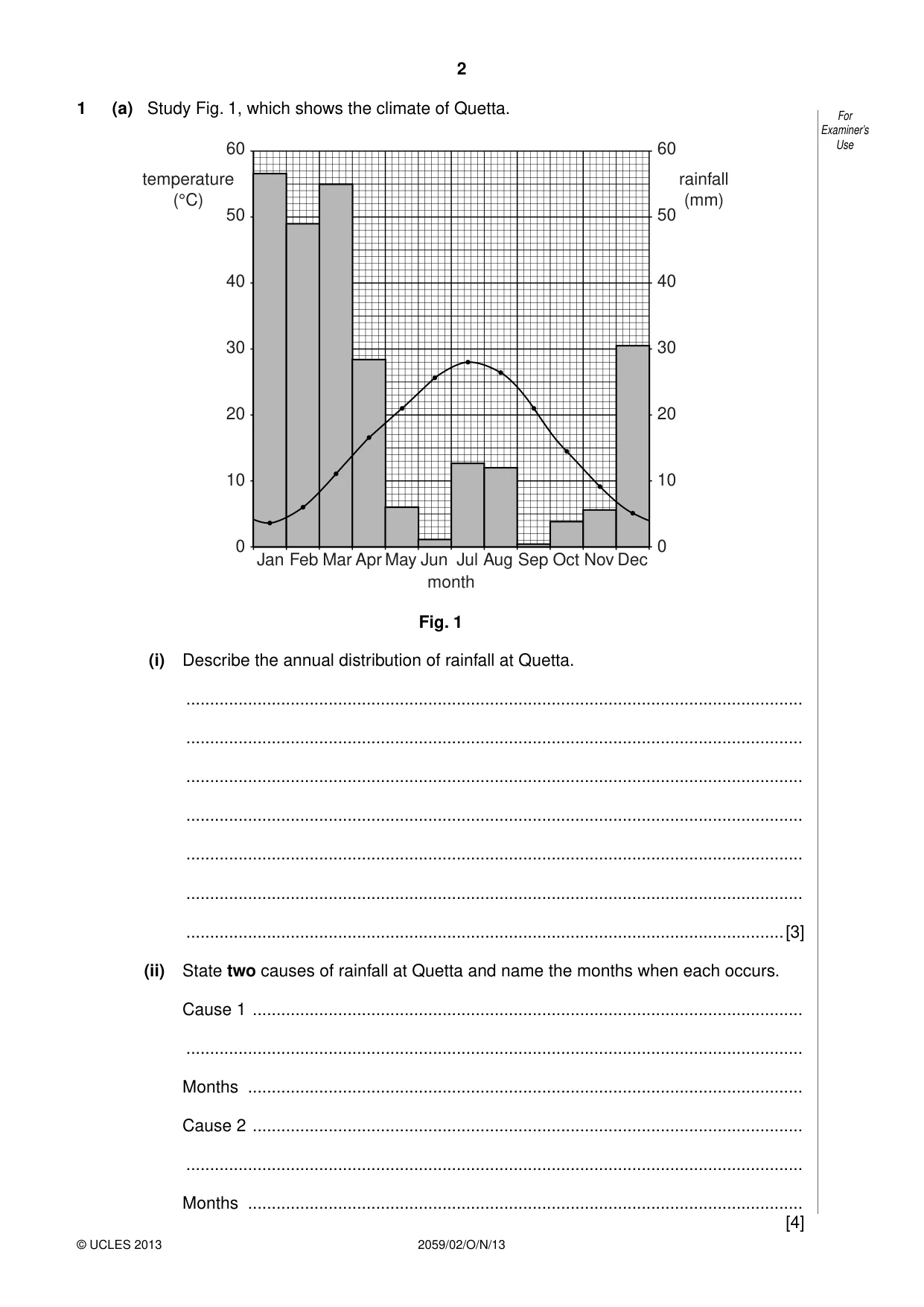
2 2059/02/O/N/13 © UCLES 2013 For Examiner’s Use 1 (a) Study Fig. 1, which shows the climate of Quetta. 50 40 30 20 10 0 60 50 40 30 20 10 0 60 Jan Feb Mar Apr May Jun Jul Aug Sep Oct Nov Dec temperature (°C) month rainfall (mm) Fig. 1 (i) Describe the annual distribution of rainfall at Quetta. … … … … … … …[3] (ii) State two causes of rainfall at Quetta and name the months when each occurs. Cause 1 … … Months … Cause 2 … … Months … [4]
Question paper, page 4
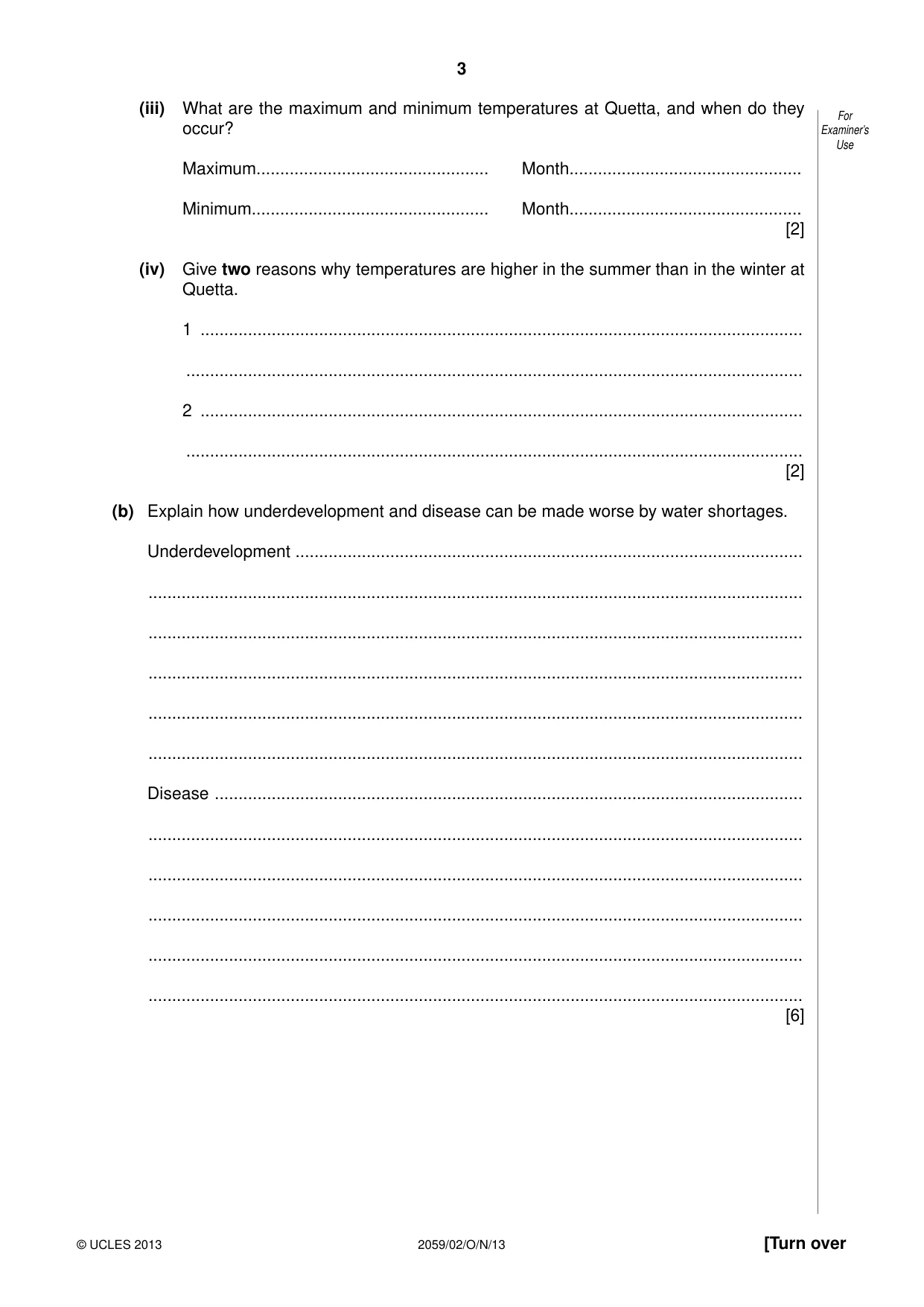
3 2059/02/O/N/13 © UCLES 2013 [Turn over For Examiner’s Use (iii) What are the maximum and minimum temperatures at Quetta, and when do they occur? Maximum… Month… Minimum… Month… [2] (iv) Give two reasons why temperatures are higher in the summer than in the winter at Quetta. 1 … … 2 … … [2] (b) Explain how underdevelopment and disease can be made worse by water shortages. Underdevelopment … … … … … … Disease … … … … … … [6]
Question paper, page 5
4 2059/02/O/N/13 © UCLES 2013 For Examiner’s Use (c) (i) Name two types of infrastructure other than water supply. 1 … 2 …[2] (ii) For each of the types of infrastructure named in (c)(i), consider the advantages and problems of improving it in Balochistan. 1 … … … … … … … … 2 … … … … … … … … [6] [Total: 25]
Question paper, page 6
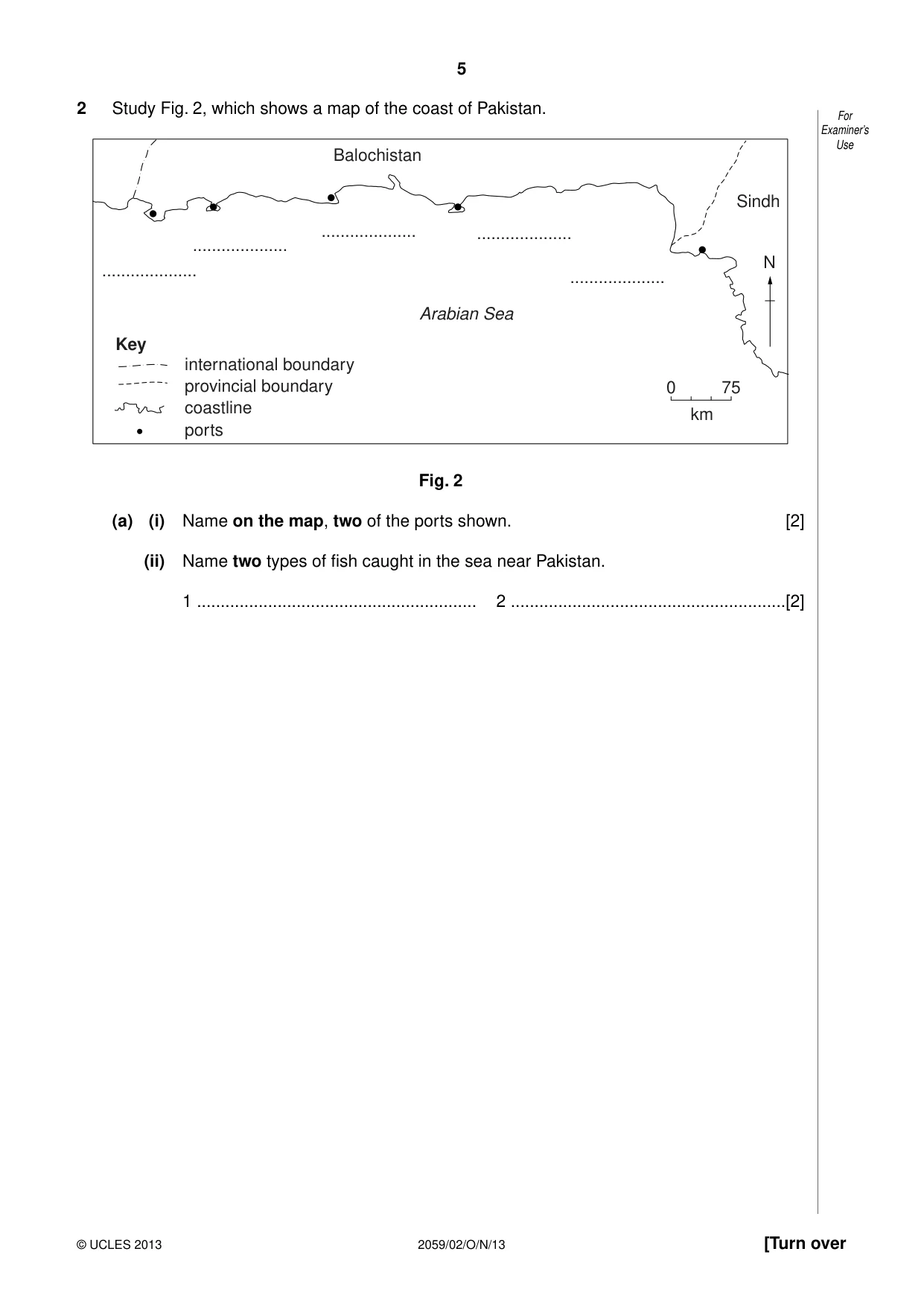
5 2059/02/O/N/13 © UCLES 2013 [Turn over For Examiner’s Use 2 Study Fig. 2, which shows a map of the coast of Pakistan. … … … … … Balochistan Sindh Arabian Sea 0 75 km Key international boundary provincial boundary coastline ports N Fig. 2 (a) (i) Name on the map, two of the ports shown. [2] (ii) Name two types of fish caught in the sea near Pakistan. 1 … 2 …[2]
Question paper, page 7
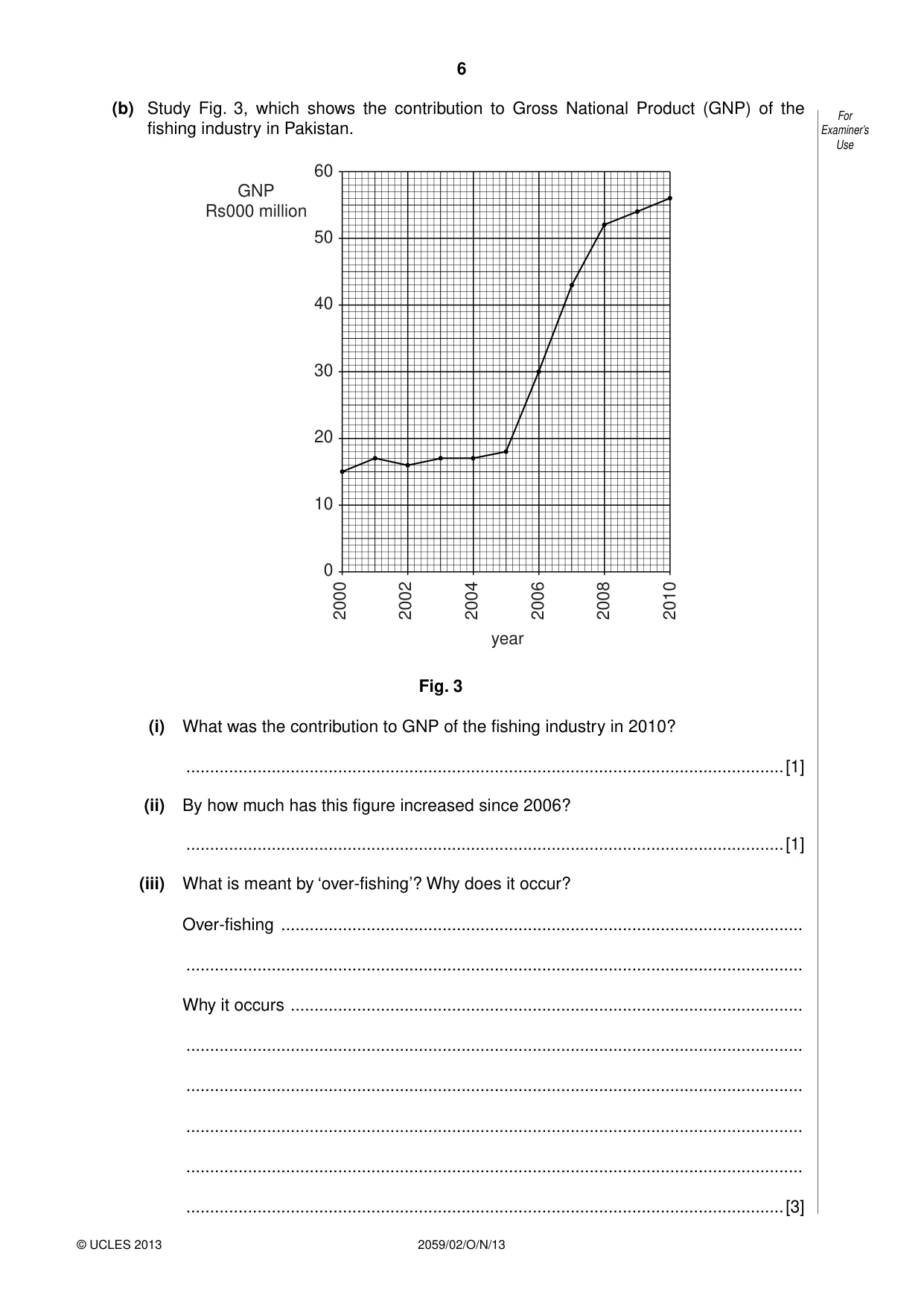
6 2059/02/O/N/13 © UCLES 2013 For Examiner’s Use (b) Study Fig. 3, which shows the contribution to Gross National Product (GNP) of the fishing industry in Pakistan. 2000 2002 2004 year 2006 2008 2010 0 10 20 30 40 50 60 GNP Rs000 million Fig. 3 (i) What was the contribution to GNP of the fishing industry in 2010? …[1] (ii) By how much has this figure increased since 2006? …[1] (iii) What is meant by ‘over-fishing’? Why does it occur? Over-fishing … … Why it occurs … … … … … …[3]
Question paper, page 8
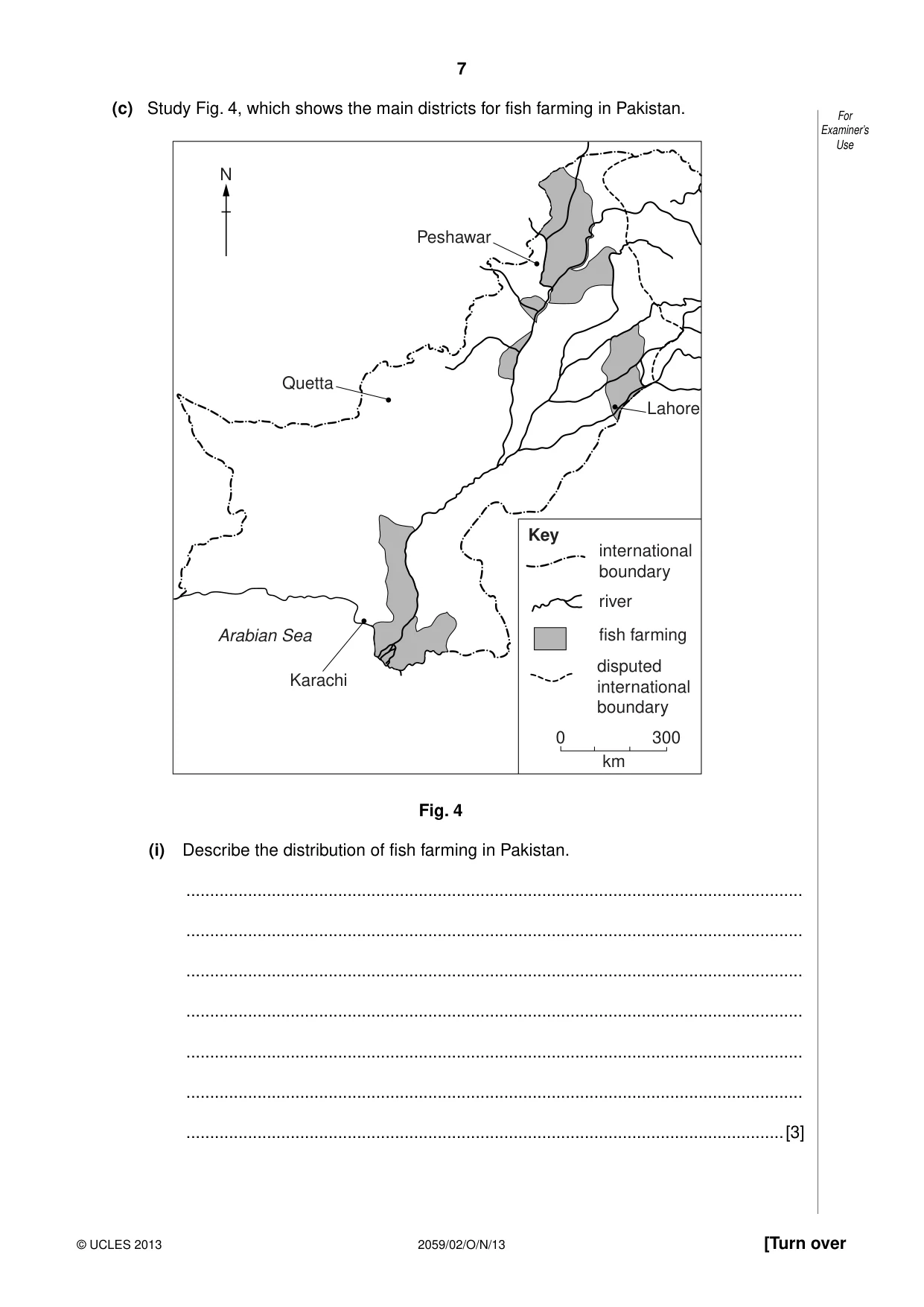
7 2059/02/O/N/13 © UCLES 2013 [Turn over For Examiner’s Use (c) Study Fig. 4, which shows the main districts for fish farming in Pakistan. Key international boundary disputed international boundary river Peshawar Quetta fish farming km 0 300 N Karachi Lahore Arabian Sea Fig. 4 (i) Describe the distribution of fish farming in Pakistan. … … … … … … …[3]
Question paper, page 9
8 2059/02/O/N/13 © UCLES 2013 For Examiner’s Use (ii) Describe how fish are reared on a fish farm. … … … … … … … … …[4] (d) Give an example of primary, secondary and tertiary employment in the fishing industry. Primary … Secondary … Tertiary … [3] (e) What are the benefits and problems of developing either marine fishing or inland fish farming in Pakistan? Choice … Benefits … … … … … … Problems … … … … … … [6] [Total: 25]
Question paper, page 10
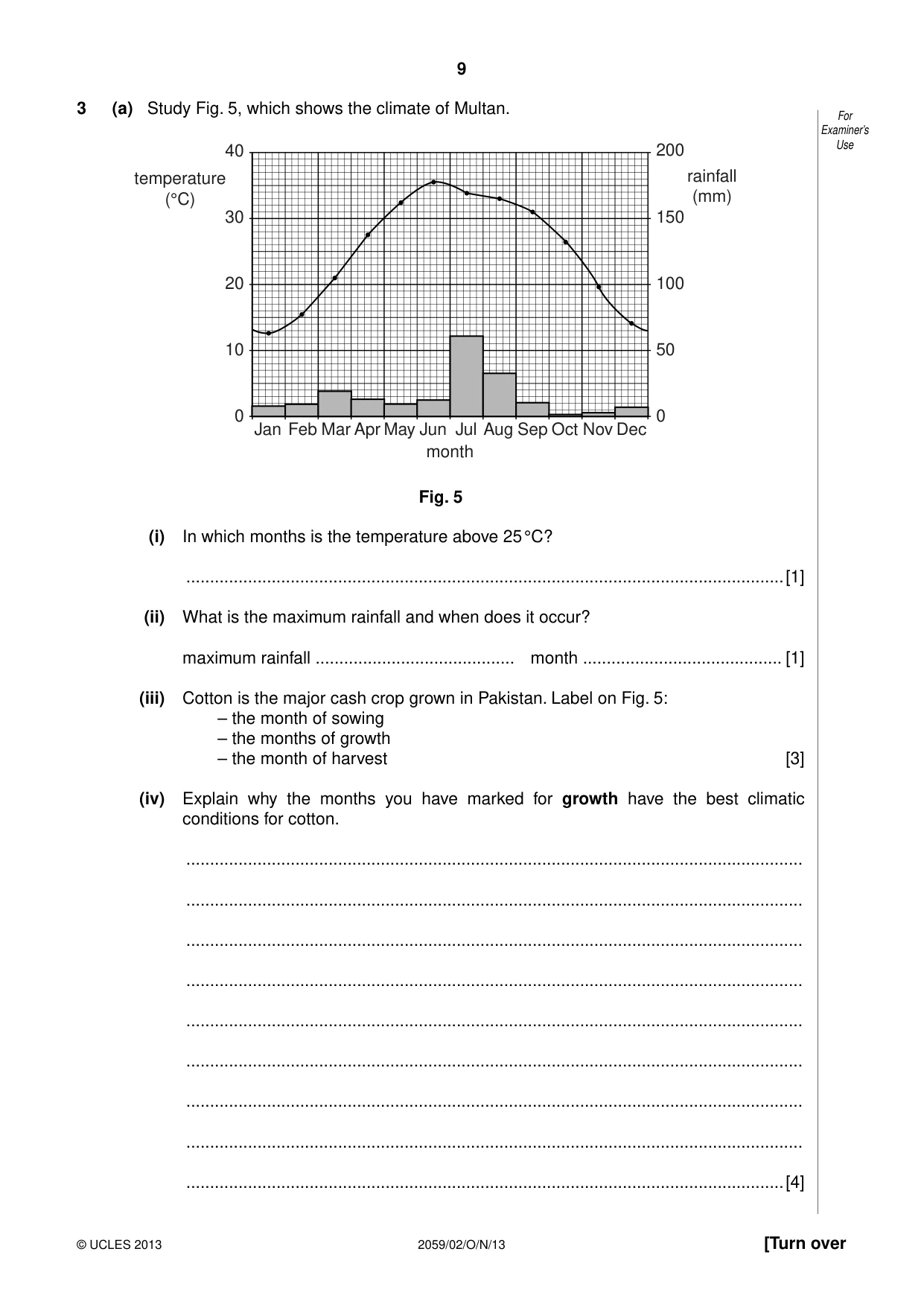
9 2059/02/O/N/13 © UCLES 2013 [Turn over For Examiner’s Use 3 (a) Study Fig. 5, which shows the climate of Multan. 40 30 20 10 0 200 150 100 50 0 Jan Feb Mar Apr May Jun Jul Aug Sep Oct Nov Dec temperature (°C) month rainfall (mm) Fig. 5 (i) In which months is the temperature above 25 °C? …[1] (ii) What is the maximum rainfall and when does it occur? maximum rainfall … month … [1] (iii) Cotton is the major cash crop grown in Pakistan. Label on Fig. 5: – the month of sowing – the months of growth – the month of harvest [3] (iv) Explain why the months you have marked for growth have the best climatic conditions for cotton. … … … … … … … … …[4]
Question paper, page 11
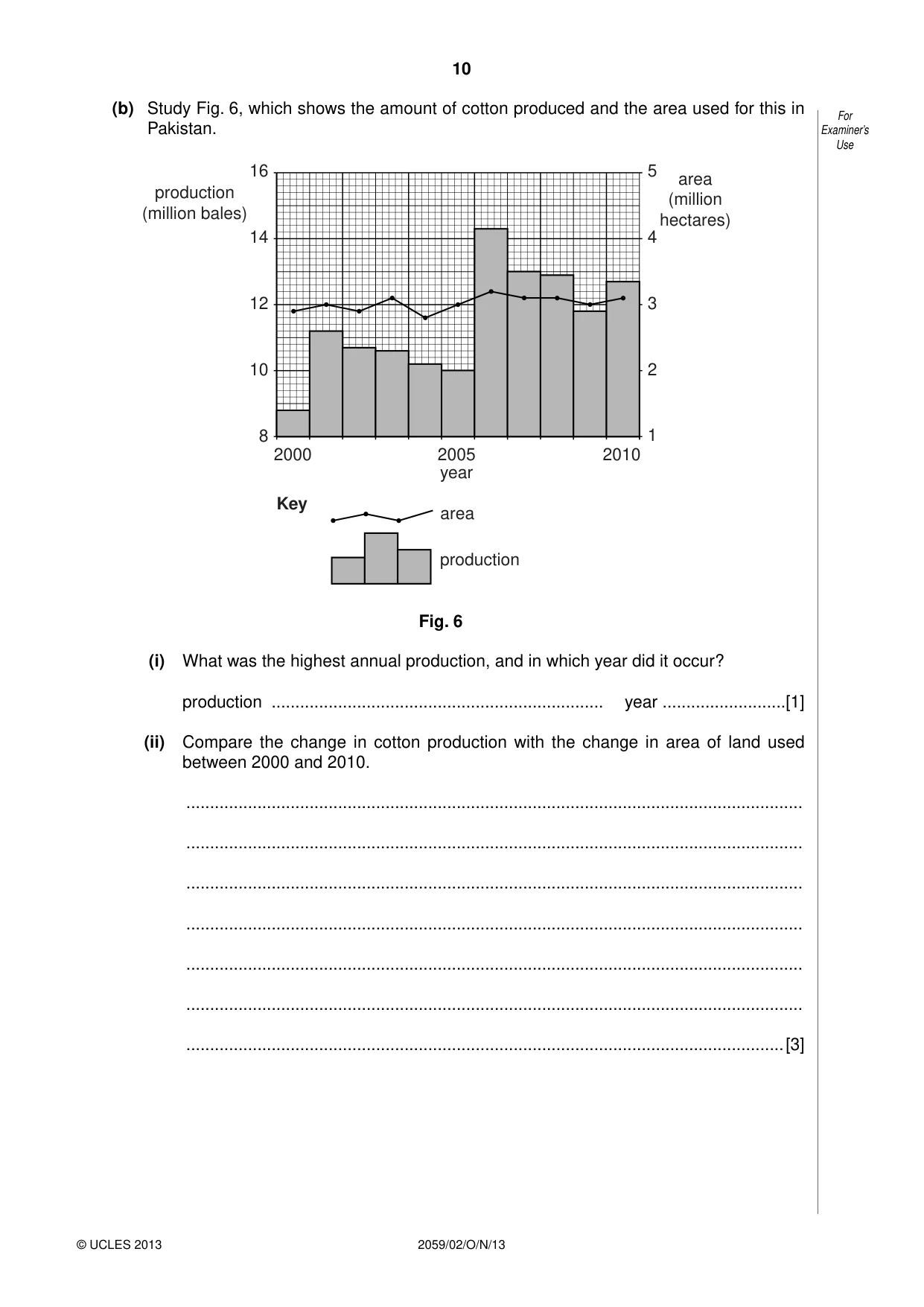
10 2059/02/O/N/13 © UCLES 2013 For Examiner’s Use (b) Study Fig. 6, which shows the amount of cotton produced and the area used for this in Pakistan. Key 16 14 12 10 8 5 4 3 2 1 production (million bales) area (million hectares) year 2000 2005 2010 production area Fig. 6 (i) What was the highest annual production, and in which year did it occur? production … year …[1] (ii) Compare the change in cotton production with the change in area of land used between 2000 and 2010. … … … … … … …[3]
Question paper, page 12
11 2059/02/O/N/13 © UCLES 2013 [Turn over For Examiner’s Use (c) How can the government help farmers to grow more cotton? … … … … … … … … … … … … … …[6]
Question paper, page 13
12 2059/02/O/N/13 © UCLES 2013 For Examiner’s Use (d) To what extent can the development of cottage and small-scale industries improve family incomes in Pakistan? … … … … … … … … … … … … … …[6] [Total: 25]
Question paper, page 14
13 2059/02/O/N/13 © UCLES 2013 [Turn over For Examiner’s Use 4 (a) (i) State what is meant by ‘renewable energy’ and give an example. meaning … … example …[2] (ii) Name a fossil fuel, and explain why it is non-renewable. name … why it is non-renewable … … … … …[2] (iii) Explain how fossil fuels cause: air pollution … … … land pollution … … …[2]
Question paper, page 15
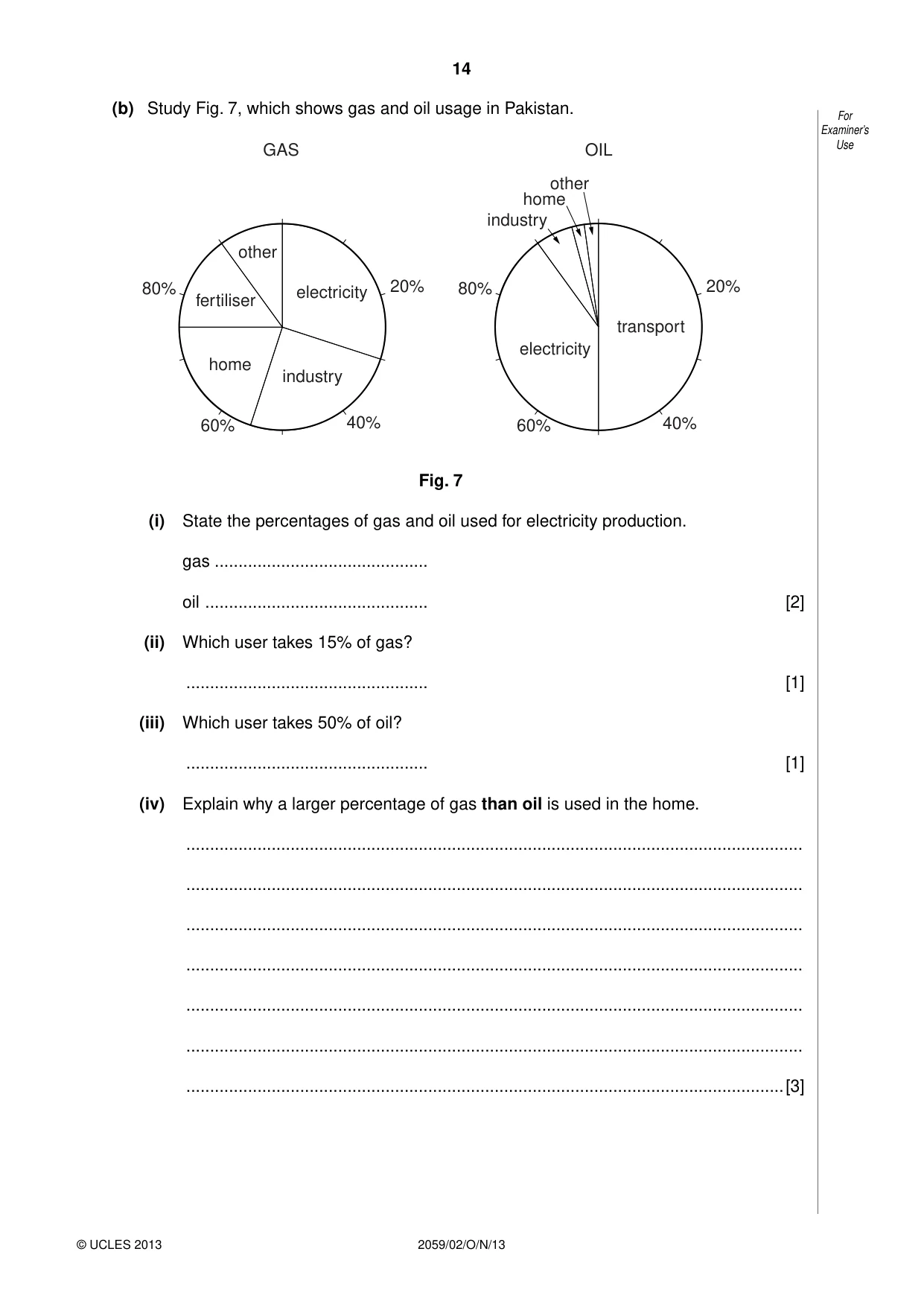
14 2059/02/O/N/13 © UCLES 2013 For Examiner’s Use (b) Study Fig. 7, which shows gas and oil usage in Pakistan. transport electricity electricity industry home fertiliser home industry other other OIL GAS 20% 40% 60% 80% 20% 40% 60% 80% Fig. 7 (i) State the percentages of gas and oil used for electricity production. gas … oil … [2] (ii) Which user takes 15% of gas? … [1] (iii) Which user takes 50% of oil? … [1] (iv) Explain why a larger percentage of gas than oil is used in the home. … … … … … … …[3]
Question paper, page 16
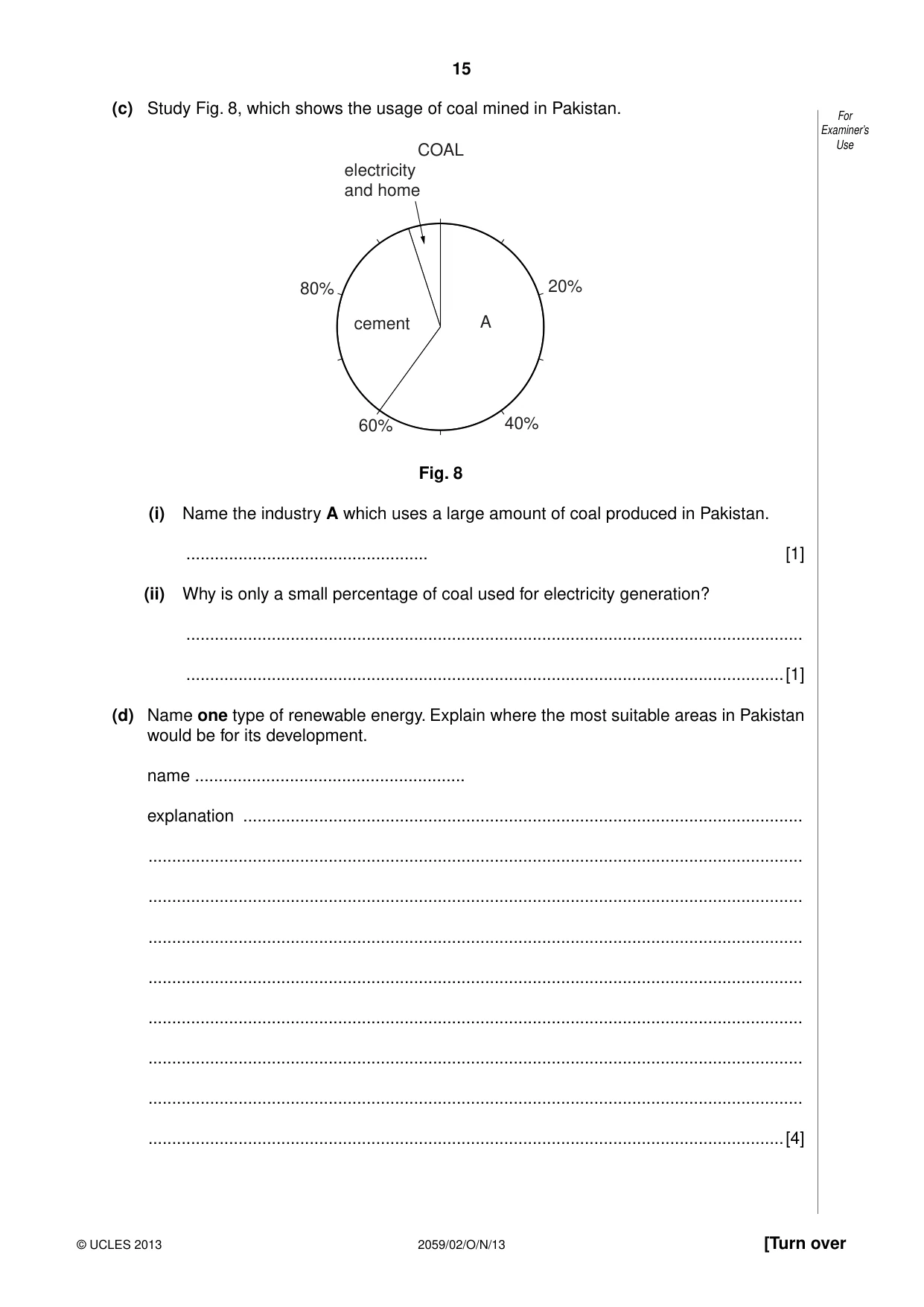
15 2059/02/O/N/13 © UCLES 2013 [Turn over For Examiner’s Use (c) Study Fig. 8, which shows the usage of coal mined in Pakistan. electricity and home COAL cement A 20% 40% 60% 80% Fig. 8 (i) Name the industry A which uses a large amount of coal produced in Pakistan. … [1] (ii) Why is only a small percentage of coal used for electricity generation? … …[1] (d) Name one type of renewable energy. Explain where the most suitable areas in Pakistan would be for its development. name … explanation … … … … … … … … …[4]
Question paper, page 17
16 2059/02/O/N/13 © UCLES 2013 For Examiner’s Use (e) Explain why it is important to supply electricity to rural areas. Consider to what extent it is possible. … … … … … … … … … … … … … …[6] [Total: 25]
Question paper, page 18
17 2059/02/O/N/13 © UCLES 2013 [Turn over For Examiner’s Use 5 (a) Study Fig. 9 (insert), which shows the main towns and cities in the Punjab province. (i) Name the cities A, B, C, and state the size of their population. A name … population … B name … population … C name … population … [6] (ii) Describe the distribution of towns and cities with a population of over 50 000. … … … … … … …[3] (b) Study Fig. 9 again. (i) Name an area with a population density below 50 persons per square kilometre. … [1] (ii) With reference to physical factors only, explain why the area that you have named in (b)(i) has a low population density. … … … … … … … … …[4]
Question paper, page 19
18 2059/02/O/N/13 © UCLES 2013 For Examiner’s Use (c) In the last 50 years there has been a big increase in the proportion of people living in urban areas. (i) Name two push factors that cause people to migrate from rural to urban areas. 1 … 2 …[1] (ii) Explain each of the factors you have named in (c)(i). 1 … … … … 2 … … … …[4] (iii) Explain two problems experienced by migrants from rural areas when they reach urban areas. problem 1 … … … … … … problem 2 … … … … … …[6] [Total: 25]
Question paper, page 20
19 2059/02/O/N/13 © UCLES 2013 BLANK PAGE
Question paper, page 21
20 2059/02/O/N/13 © UCLES 2013 BLANK PAGE Permission to reproduce items where third-party owned material protected by copyright is included has been sought and cleared where possible. Every reasonable effort has been made by the publisher (UCLES) to trace copyright holders, but if any items requiring clearance have unwittingly been included, the publisher will be pleased to make amends at the earliest possible opportunity. Cambridge International Examinations is part of the Cambridge Assessment Group. Cambridge Assessment is the brand name of University of Cambridge Local Examinations Syndicate (UCLES), which is itself a department of the University of Cambridge.
Mark scheme, page 1
UNIVERISTY OF CAMBRIDGE INTERNATIONAL EXAMINATIONS International General Certificate of Secondary Education 0448 PAKISTAN STUDIES 0448/42 Paper 42 Due to a security breach we required all candidates in Pakistan who sat the paper for 0448/02 to attend a re-sit examination in June 2013. Candidates outside of Pakistan sat only the original paper and were not involved in a re-sit. www.XtremePapers.com
Mark scheme, page 2
CAMBRIDGE INTERNATIONAL EXAMINATIONS International General Certificate of Secondary Education MARK SCHEME for the May/June 2013 series 0448 PAKISTAN STUDIES 0448/42 Paper 4 (Environment of Pakistan), maximum raw mark 75 This mark scheme is published as an aid to teachers and candidates, to indicate the requirements of the examination. It shows the basis on which Examiners were instructed to award marks. It does not indicate the details of the discussions that took place at an Examiners’ meeting before marking began, which would have considered the acceptability of alternative answers. Mark schemes should be read in conjunction with the question paper and the Principal Examiner Report for Teachers. Cambridge will not enter into discussions about these mark schemes. Cambridge is publishing the mark schemes for the May/June 2013 series for most IGCSE, GCE Advanced Level and Advanced Subsidiary Level components and some Ordinary Level components.
Mark scheme, page 3
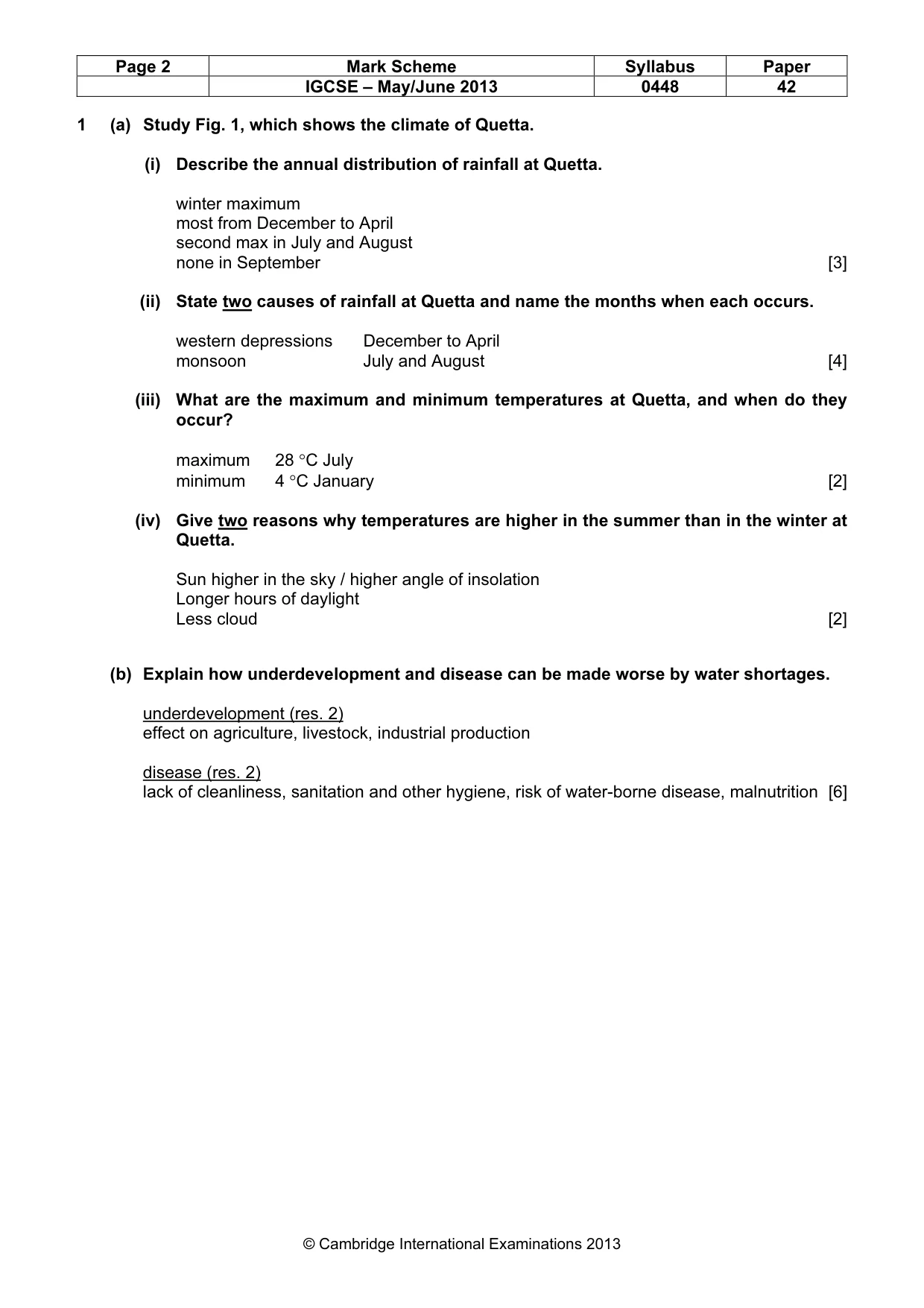
Page 2 Mark Scheme Syllabus Paper IGCSE – May/June 2013 0448 42 © Cambridge International Examinations 2013 1 (a) Study Fig. 1, which shows the climate of Quetta. (i) Describe the annual distribution of rainfall at Quetta. winter maximum most from December to April second max in July and August none in September [3] (ii) State two causes of rainfall at Quetta and name the months when each occurs. western depressions December to April monsoon July and August [4] (iii) What are the maximum and minimum temperatures at Quetta, and when do they occur? maximum 28 °C July minimum 4 °C January [2] (iv) Give two reasons why temperatures are higher in the summer than in the winter at Quetta. Sun higher in the sky / higher angle of insolation Longer hours of daylight Less cloud [2] (b) Explain how underdevelopment and disease can be made worse by water shortages. underdevelopment (res. 2) effect on agriculture, livestock, industrial production disease (res. 2) lack of cleanliness, sanitation and other hygiene, risk of water-borne disease, malnutrition [6]
Mark scheme, page 4
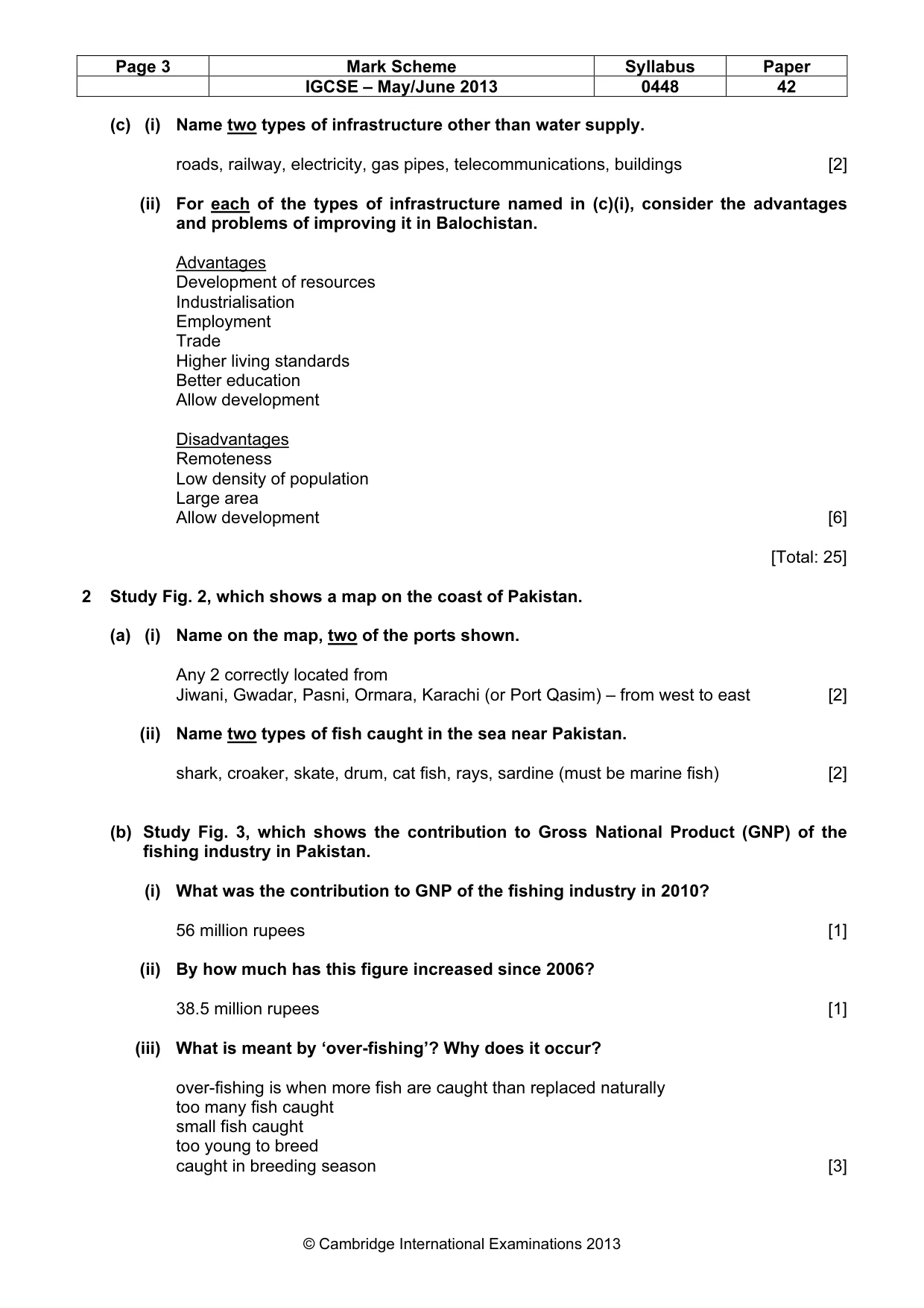
Page 3 Mark Scheme Syllabus Paper IGCSE – May/June 2013 0448 42 © Cambridge International Examinations 2013 (c) (i) Name two types of infrastructure other than water supply. roads, railway, electricity, gas pipes, telecommunications, buildings [2] (ii) For each of the types of infrastructure named in (c)(i), consider the advantages and problems of improving it in Balochistan. Advantages Development of resources Industrialisation Employment Trade Higher living standards Better education Allow development Disadvantages Remoteness Low density of population Large area Allow development [6] [Total: 25] 2 Study Fig. 2, which shows a map on the coast of Pakistan. (a) (i) Name on the map, two of the ports shown. Any 2 correctly located from Jiwani, Gwadar, Pasni, Ormara, Karachi (or Port Qasim) – from west to east [2] (ii) Name two types of fish caught in the sea near Pakistan. shark, croaker, skate, drum, cat fish, rays, sardine (must be marine fish) [2] (b) Study Fig. 3, which shows the contribution to Gross National Product (GNP) of the fishing industry in Pakistan. (i) What was the contribution to GNP of the fishing industry in 2010? 56 million rupees [1] (ii) By how much has this figure increased since 2006? 38.5 million rupees [1] (iii) What is meant by ‘over-fishing’? Why does it occur? over-fishing is when more fish are caught than replaced naturally too many fish caught small fish caught too young to breed caught in breeding season [3]
Mark scheme, page 5
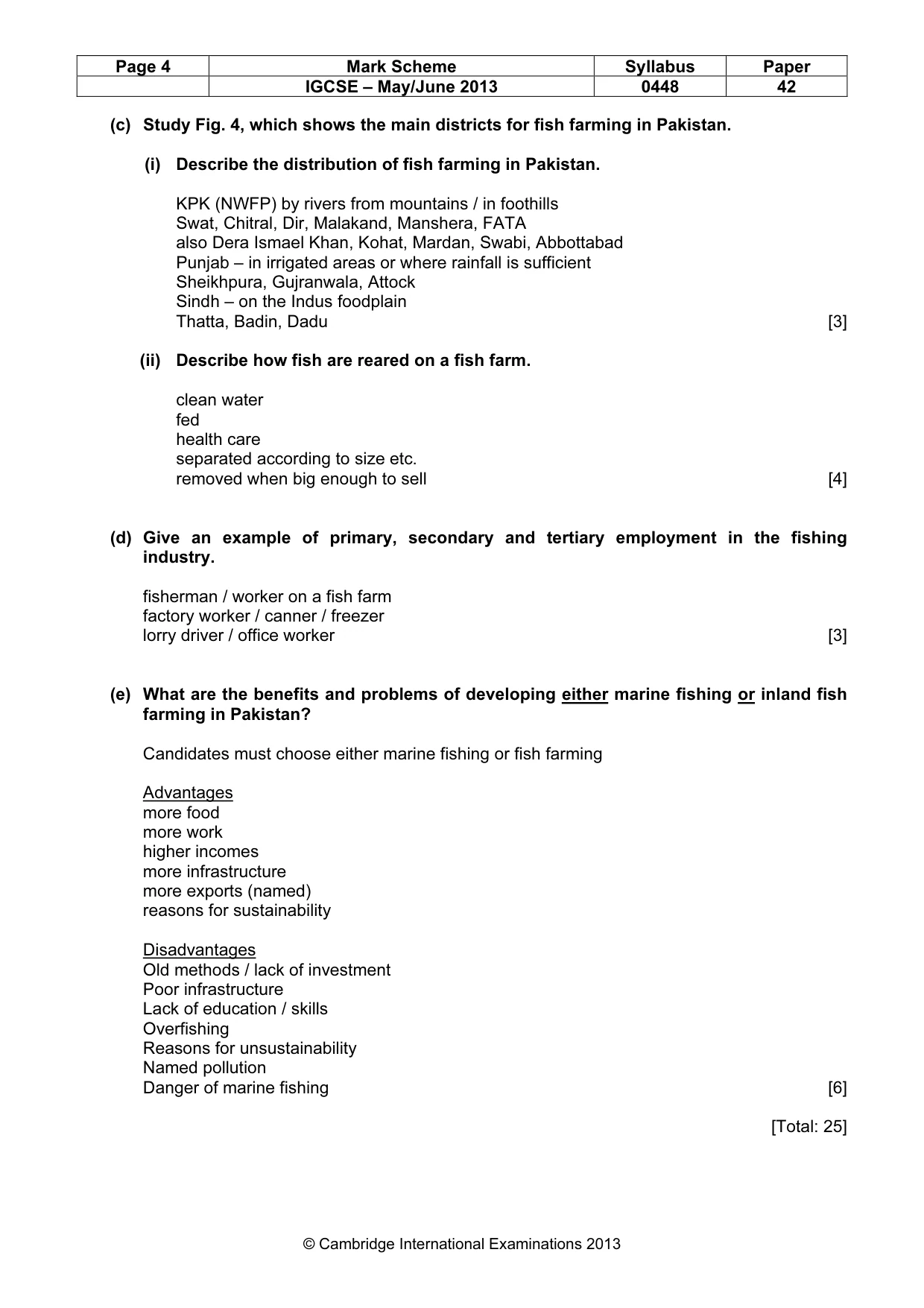
Page 4 Mark Scheme Syllabus Paper IGCSE – May/June 2013 0448 42 © Cambridge International Examinations 2013 (c) Study Fig. 4, which shows the main districts for fish farming in Pakistan. (i) Describe the distribution of fish farming in Pakistan. KPK (NWFP) by rivers from mountains / in foothills Swat, Chitral, Dir, Malakand, Manshera, FATA also Dera Ismael Khan, Kohat, Mardan, Swabi, Abbottabad Punjab – in irrigated areas or where rainfall is sufficient Sheikhpura, Gujranwala, Attock Sindh – on the Indus foodplain Thatta, Badin, Dadu [3] (ii) Describe how fish are reared on a fish farm. clean water fed health care separated according to size etc. removed when big enough to sell [4] (d) Give an example of primary, secondary and tertiary employment in the fishing industry. fisherman / worker on a fish farm factory worker / canner / freezer lorry driver / office worker [3] (e) What are the benefits and problems of developing either marine fishing or inland fish farming in Pakistan? Candidates must choose either marine fishing or fish farming Advantages more food more work higher incomes more infrastructure more exports (named) reasons for sustainability Disadvantages Old methods / lack of investment Poor infrastructure Lack of education / skills Overfishing Reasons for unsustainability Named pollution Danger of marine fishing [6] [Total: 25]
Mark scheme, page 6
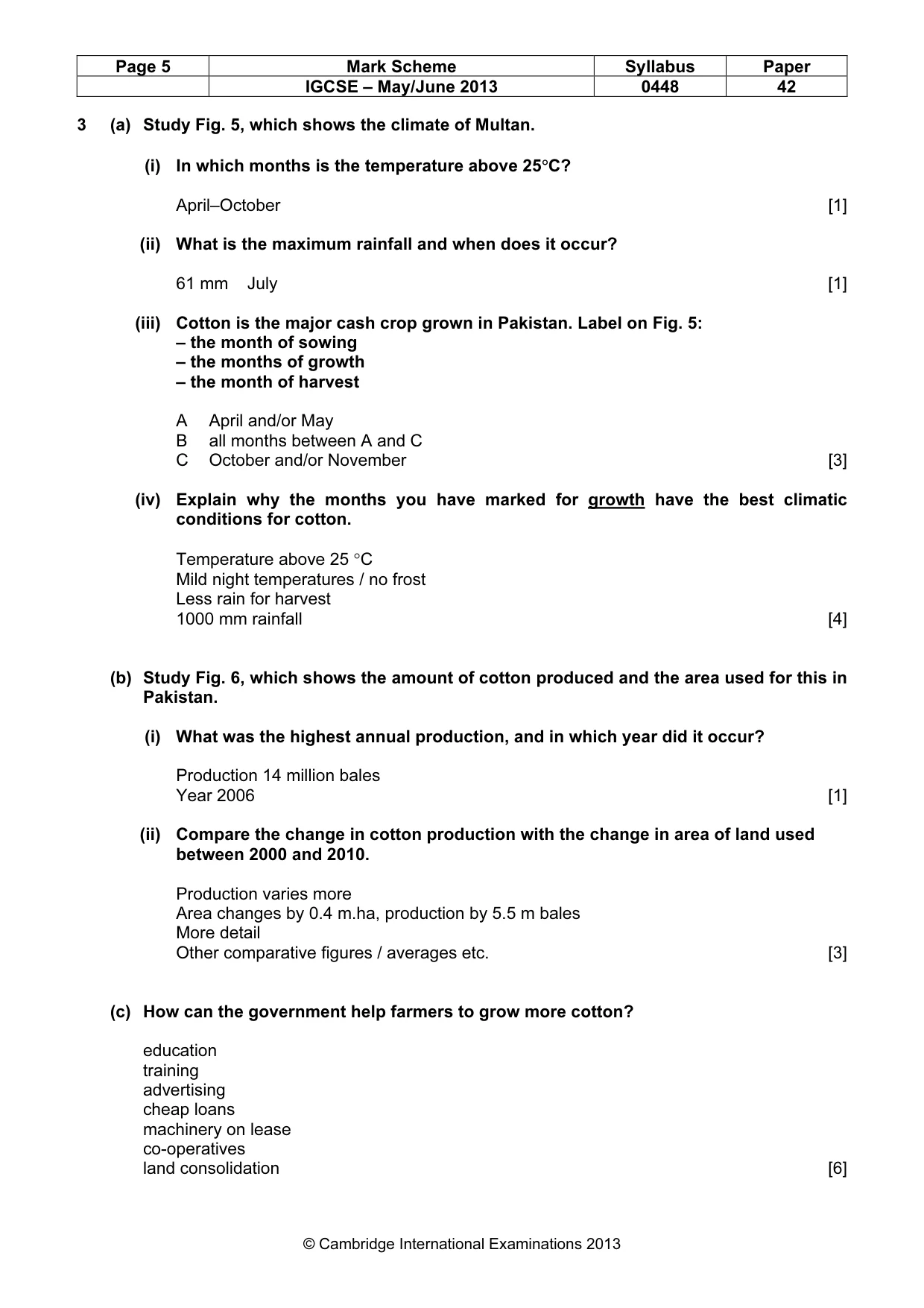
Page 5 Mark Scheme Syllabus Paper IGCSE – May/June 2013 0448 42 © Cambridge International Examinations 2013 3 (a) Study Fig. 5, which shows the climate of Multan. (i) In which months is the temperature above 25°C? April–October [1] (ii) What is the maximum rainfall and when does it occur? 61 mm July [1] (iii) Cotton is the major cash crop grown in Pakistan. Label on Fig. 5: – the month of sowing – the months of growth – the month of harvest A April and/or May B all months between A and C C October and/or November [3] (iv) Explain why the months you have marked for growth have the best climatic conditions for cotton. Temperature above 25 °C Mild night temperatures / no frost Less rain for harvest 1000 mm rainfall [4] (b) Study Fig. 6, which shows the amount of cotton produced and the area used for this in Pakistan. (i) What was the highest annual production, and in which year did it occur? Production 14 million bales Year 2006 [1] (ii) Compare the change in cotton production with the change in area of land used between 2000 and 2010. Production varies more Area changes by 0.4 m.ha, production by 5.5 m bales More detail Other comparative figures / averages etc. [3] (c) How can the government help farmers to grow more cotton? education training advertising cheap loans machinery on lease co-operatives land consolidation [6]
Mark scheme, page 7
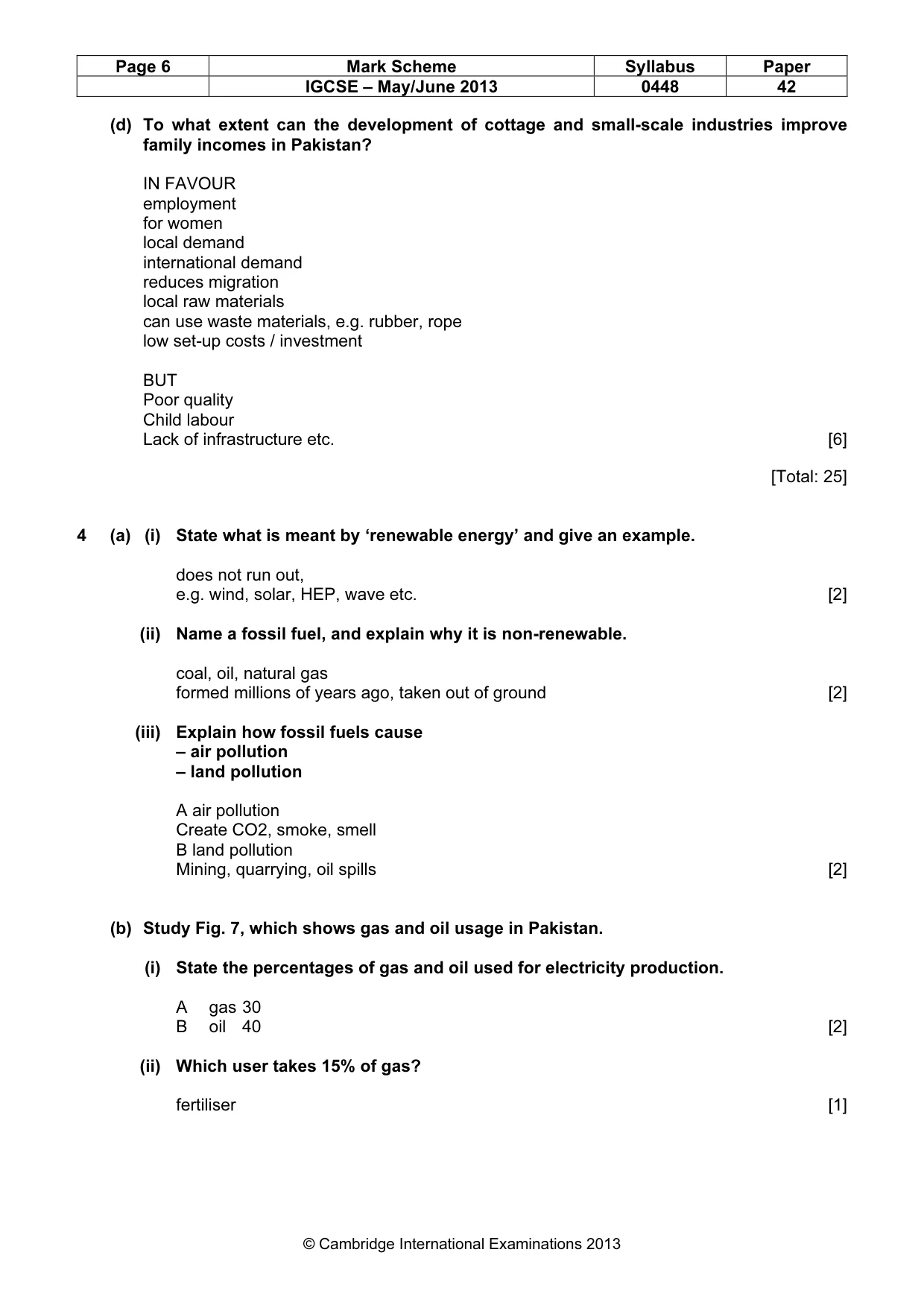
Page 6 Mark Scheme Syllabus Paper IGCSE – May/June 2013 0448 42 © Cambridge International Examinations 2013 (d) To what extent can the development of cottage and small-scale industries improve family incomes in Pakistan? IN FAVOUR employment for women local demand international demand reduces migration local raw materials can use waste materials, e.g. rubber, rope low set-up costs / investment BUT Poor quality Child labour Lack of infrastructure etc. [6] [Total: 25] 4 (a) (i) State what is meant by ‘renewable energy’ and give an example. does not run out, e.g. wind, solar, HEP, wave etc. [2] (ii) Name a fossil fuel, and explain why it is non-renewable. coal, oil, natural gas formed millions of years ago, taken out of ground [2] (iii) Explain how fossil fuels cause – air pollution – land pollution A air pollution Create CO2, smoke, smell B land pollution Mining, quarrying, oil spills [2] (b) Study Fig. 7, which shows gas and oil usage in Pakistan. (i) State the percentages of gas and oil used for electricity production. A gas 30 B oil 40 [2] (ii) Which user takes 15% of gas? fertiliser [1]
Mark scheme, page 8
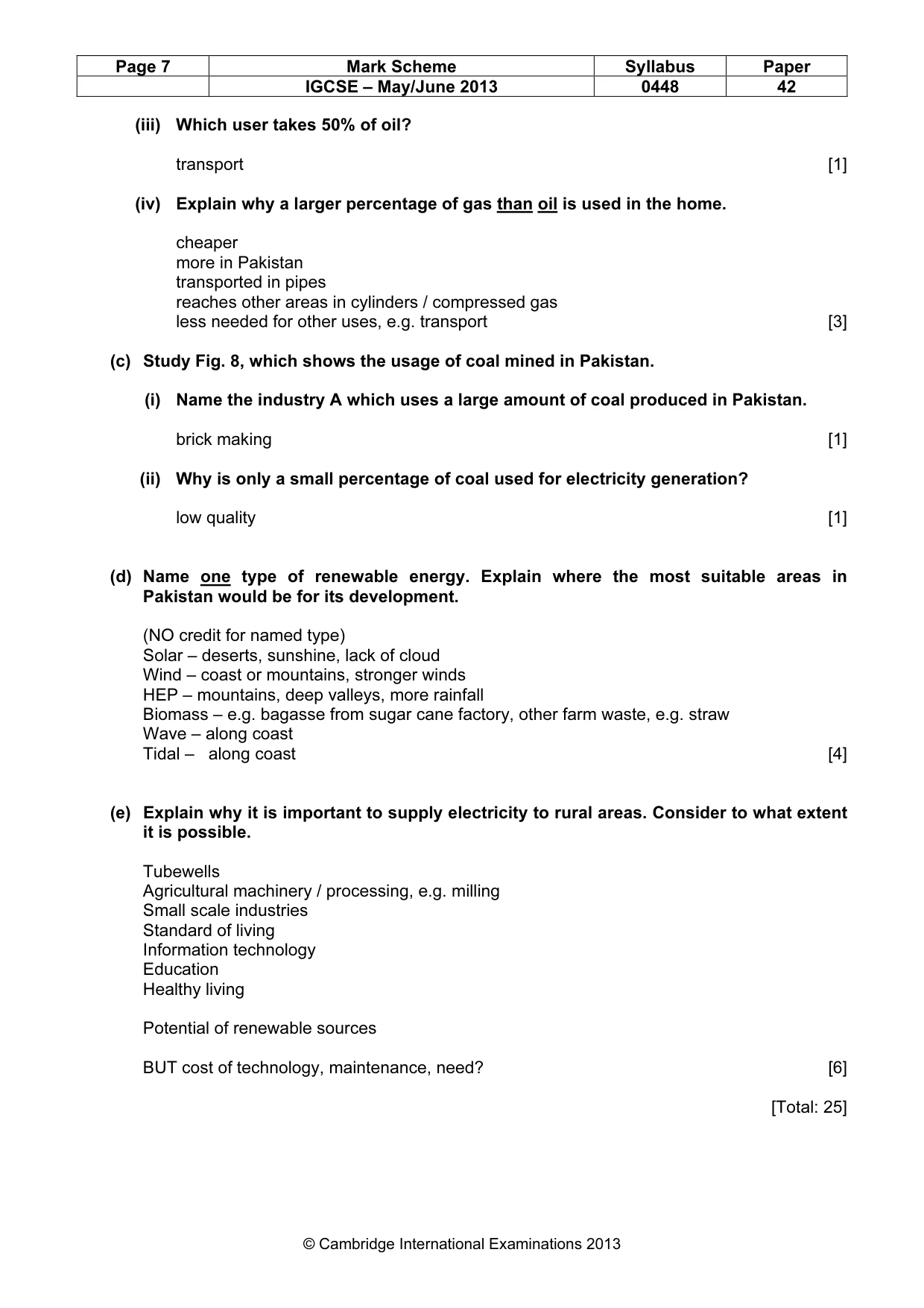
Page 7 Mark Scheme Syllabus Paper IGCSE – May/June 2013 0448 42 © Cambridge International Examinations 2013 (iii) Which user takes 50% of oil? transport [1] (iv) Explain why a larger percentage of gas than oil is used in the home. cheaper more in Pakistan transported in pipes reaches other areas in cylinders / compressed gas less needed for other uses, e.g. transport [3] (c) Study Fig. 8, which shows the usage of coal mined in Pakistan. (i) Name the industry A which uses a large amount of coal produced in Pakistan. brick making [1] (ii) Why is only a small percentage of coal used for electricity generation? low quality [1] (d) Name one type of renewable energy. Explain where the most suitable areas in Pakistan would be for its development. (NO credit for named type) Solar – deserts, sunshine, lack of cloud Wind – coast or mountains, stronger winds HEP – mountains, deep valleys, more rainfall Biomass – e.g. bagasse from sugar cane factory, other farm waste, e.g. straw Wave – along coast Tidal – along coast [4] (e) Explain why it is important to supply electricity to rural areas. Consider to what extent it is possible. Tubewells Agricultural machinery / processing, e.g. milling Small scale industries Standard of living Information technology Education Healthy living Potential of renewable sources BUT cost of technology, maintenance, need? [6] [Total: 25]
Mark scheme, page 9
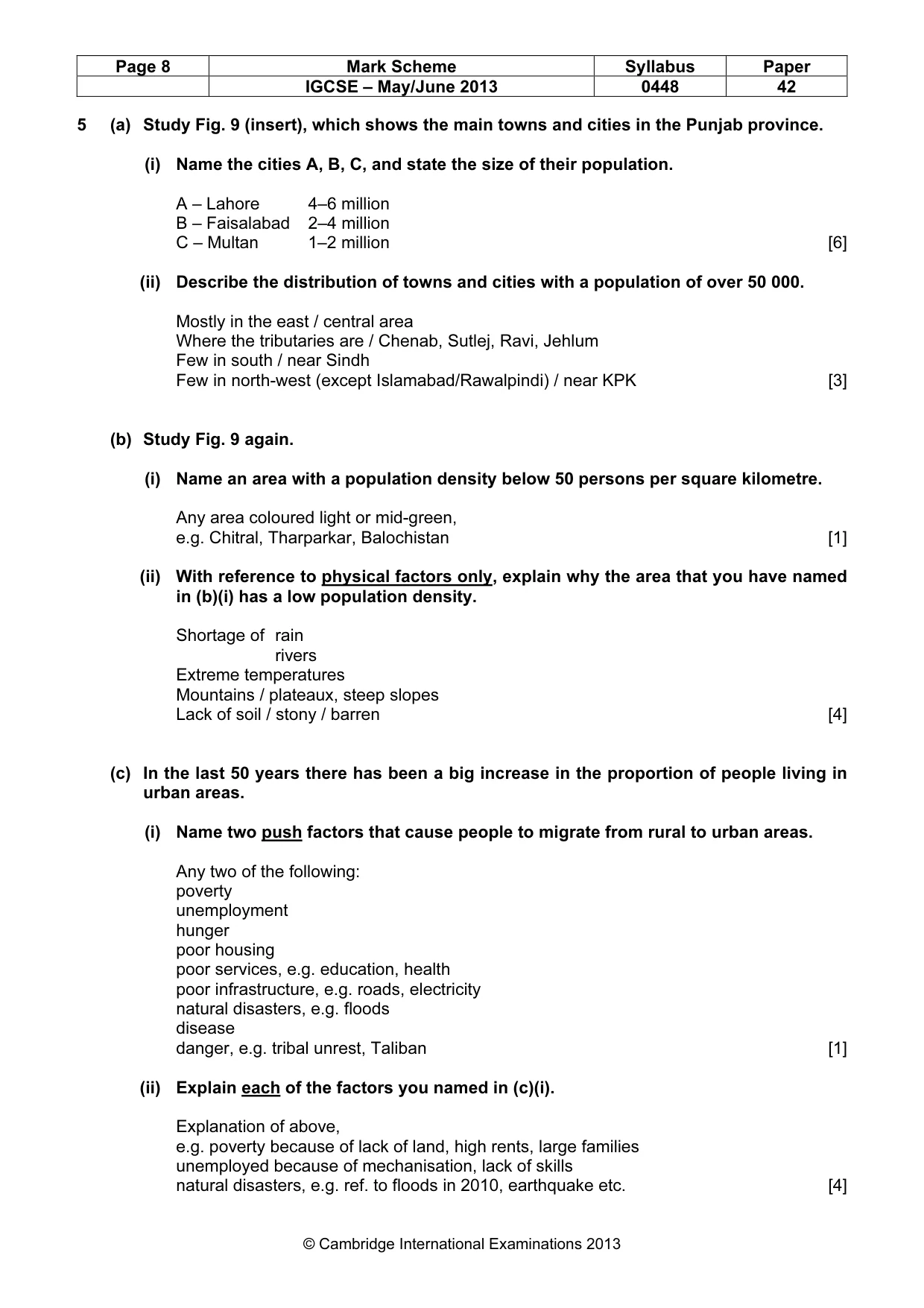
Page 8 Mark Scheme Syllabus Paper IGCSE – May/June 2013 0448 42 © Cambridge International Examinations 2013 5 (a) Study Fig. 9 (insert), which shows the main towns and cities in the Punjab province. (i) Name the cities A, B, C, and state the size of their population. A – Lahore 4–6 million B – Faisalabad 2–4 million C – Multan 1–2 million [6] (ii) Describe the distribution of towns and cities with a population of over 50 000. Mostly in the east / central area Where the tributaries are / Chenab, Sutlej, Ravi, Jehlum Few in south / near Sindh Few in north-west (except Islamabad/Rawalpindi) / near KPK [3] (b) Study Fig. 9 again. (i) Name an area with a population density below 50 persons per square kilometre. Any area coloured light or mid-green, e.g. Chitral, Tharparkar, Balochistan [1] (ii) With reference to physical factors only, explain why the area that you have named in (b)(i) has a low population density. Shortage of rain rivers Extreme temperatures Mountains / plateaux, steep slopes Lack of soil / stony / barren [4] (c) In the last 50 years there has been a big increase in the proportion of people living in urban areas. (i) Name two push factors that cause people to migrate from rural to urban areas. Any two of the following: poverty unemployment hunger poor housing poor services, e.g. education, health poor infrastructure, e.g. roads, electricity natural disasters, e.g. floods disease danger, e.g. tribal unrest, Taliban [1] (ii) Explain each of the factors you named in (c)(i). Explanation of above, e.g. poverty because of lack of land, high rents, large families unemployed because of mechanisation, lack of skills natural disasters, e.g. ref. to floods in 2010, earthquake etc. [4]
Mark scheme, page 10
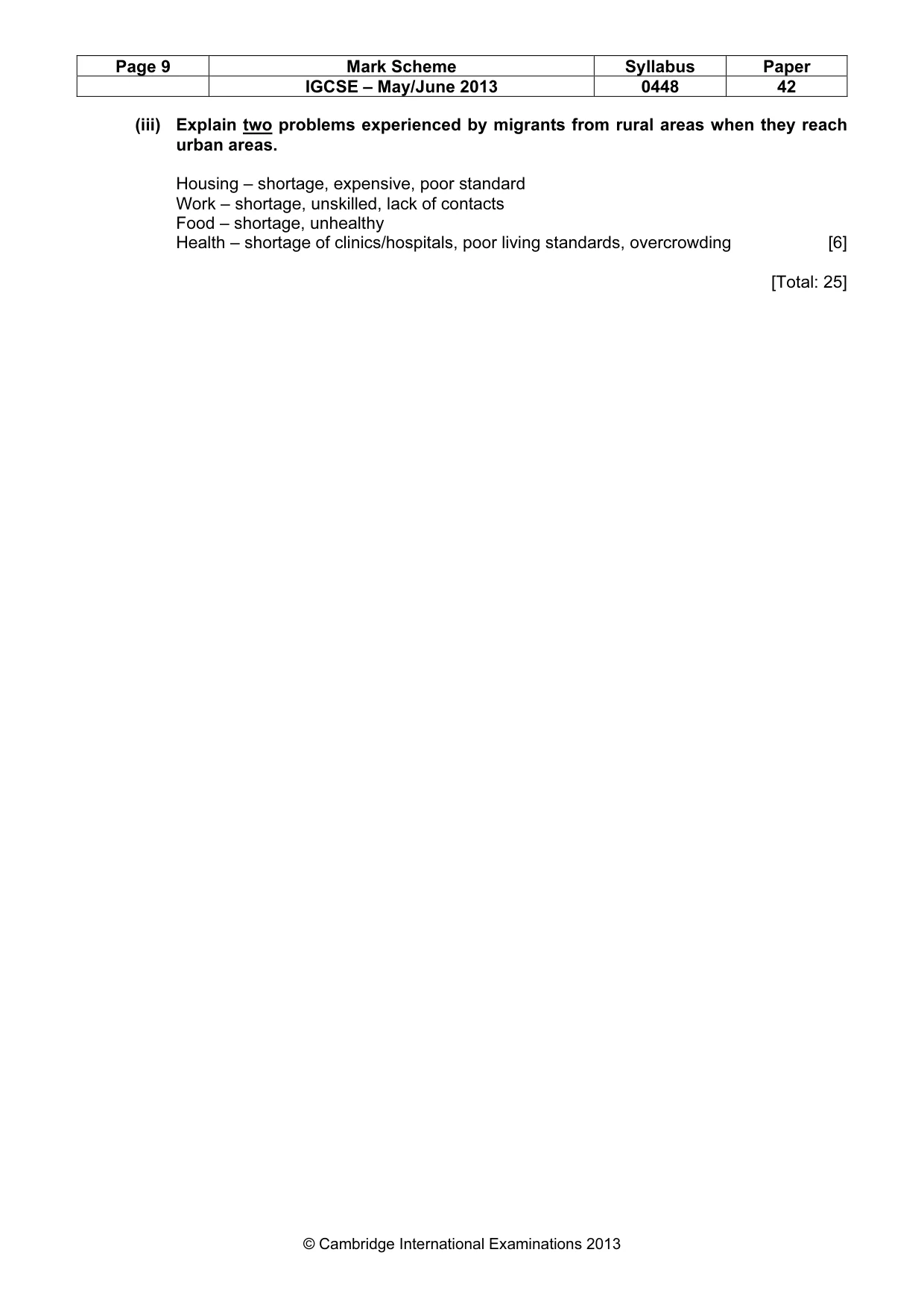
Page 9 Mark Scheme Syllabus Paper IGCSE – May/June 2013 0448 42 © Cambridge International Examinations 2013 (iii) Explain two problems experienced by migrants from rural areas when they reach urban areas. Housing – shortage, expensive, poor standard Work – shortage, unskilled, lack of contacts Food – shortage, unhealthy Health – shortage of clinics/hospitals, poor living standards, overcrowding [6] [Total: 25]
What you needed in this session
Cambridge’s own grade thresholds for 2013 May/June, Paper 4 · Variant 2. A higher threshold means an easier paper — the bar moves with how the cohort did.