Cambridge IGCSE Music (9-1) 0978 — 2023 Oct/Nov Paper 1 · Variant 2
0978/12/O/N/23 · 70 marks · ≈79 min
The question paper and its mark scheme, free to read here and free to download. This is Cambridge’s own paper, exactly as it was sat.
Question paper16 pages
Mark scheme
No mark scheme is in the library for this paper.
Paper as text
Question paper, page 1
This document has 16 pages. Any blank pages are indicated. [Turn over Cambridge IGCSE™(9–1) MUSIC 0978/12 Paper 1 Listening October/November 2023 Approximately 1 hour 15 minutes You must answer on the question paper. You will need: Insert (enclosed) INSTRUCTIONS ● Answer all questions in Sections A, B and C. ● Section D: answer all questions on the one Set Work you have studied, in the space provided. ● There will be time for you to look at the questions before you hear each extract of music. You may find it helpful to make notes on the music as you listen. ● Use a black or dark blue pen. ● Write your name, centre number and candidate number in the boxes at the top of the page. ● Write your answer to each question in the space provided. ● Do not use an erasable pen or correction fluid. ● Do not write on any bar codes. ● You may use an HB pencil for any music. ● The insert contains the scores for Music C1 and your chosen Set Work in Section D. INFORMATION ● The total mark for this paper is 70. ● The number of marks for each question or part question is shown in brackets [ ]. * 2 9 5 9 2 4 2 1 5 2 * DC (AP) 332809 © UCLES 2023
Question paper, page 2
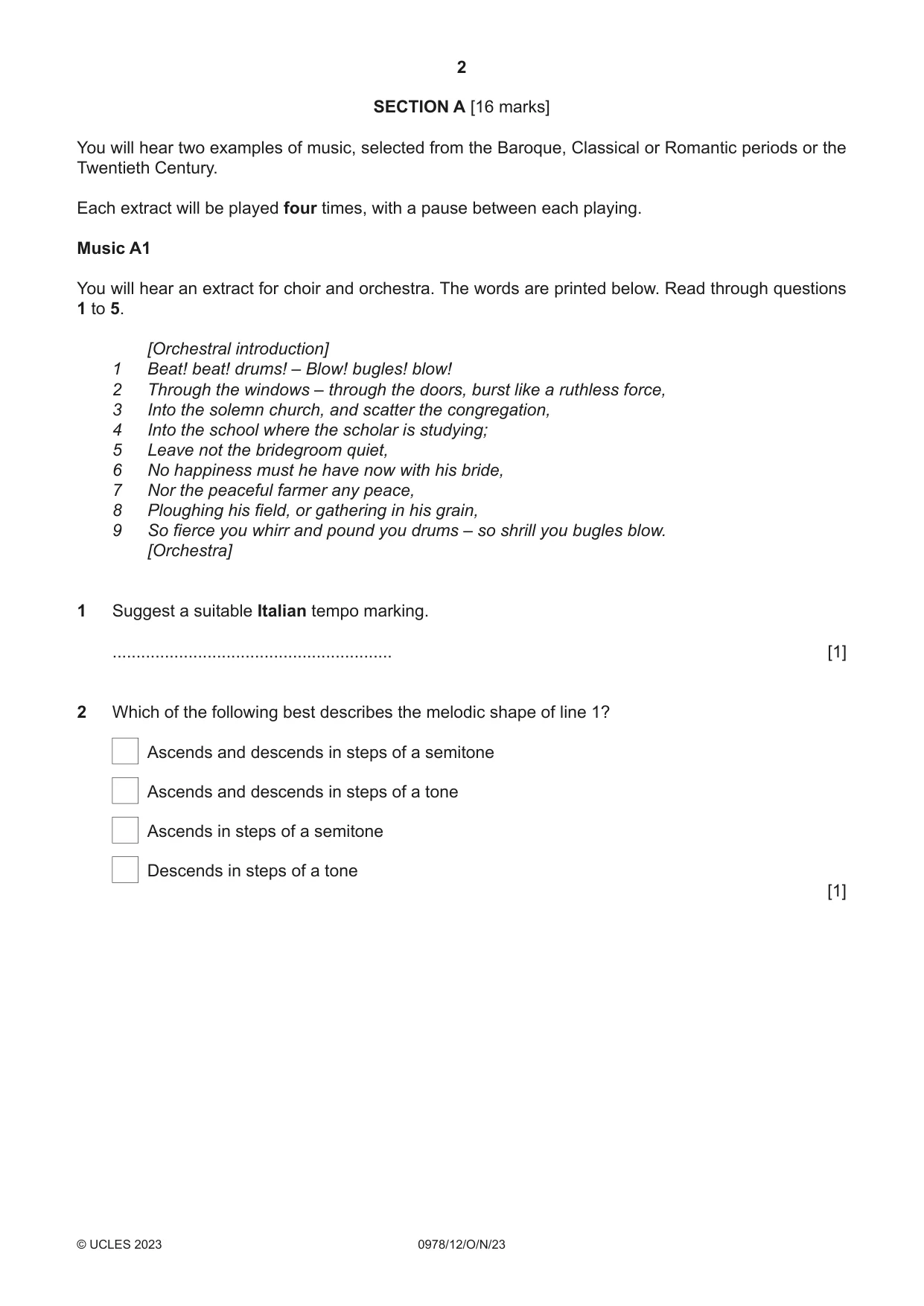
2 0978/12/O/N/23 © UCLES 2023 SECTION A [16 marks] You will hear two examples of music, selected from the Baroque, Classical or Romantic periods or the Twentieth Century. Each extract will be played four times, with a pause between each playing. Music A1 You will hear an extract for choir and orchestra. The words are printed below. Read through questions 1 to 5. [Orchestral introduction] 1 Beat! beat! drums! – Blow! bugles! blow! 2 Through the windows – through the doors, burst like a ruthless force, 3 Into the solemn church, and scatter the congregation, 4 Into the school where the scholar is studying; 5 Leave not the bridegroom quiet, 6 No happiness must he have now with his bride, 7 Nor the peaceful farmer any peace, 8 Ploughing his field, or gathering in his grain, 9 So fierce you whirr and pound you drums – so shrill you bugles blow. [Orchestra] 1 Suggest a suitable Italian tempo marking. … [1] 2 Which of the following best describes the melodic shape of line 1? Ascends and descends in steps of a semitone Ascends and descends in steps of a tone Ascends in steps of a semitone Descends in steps of a tone [1]
Question paper, page 3
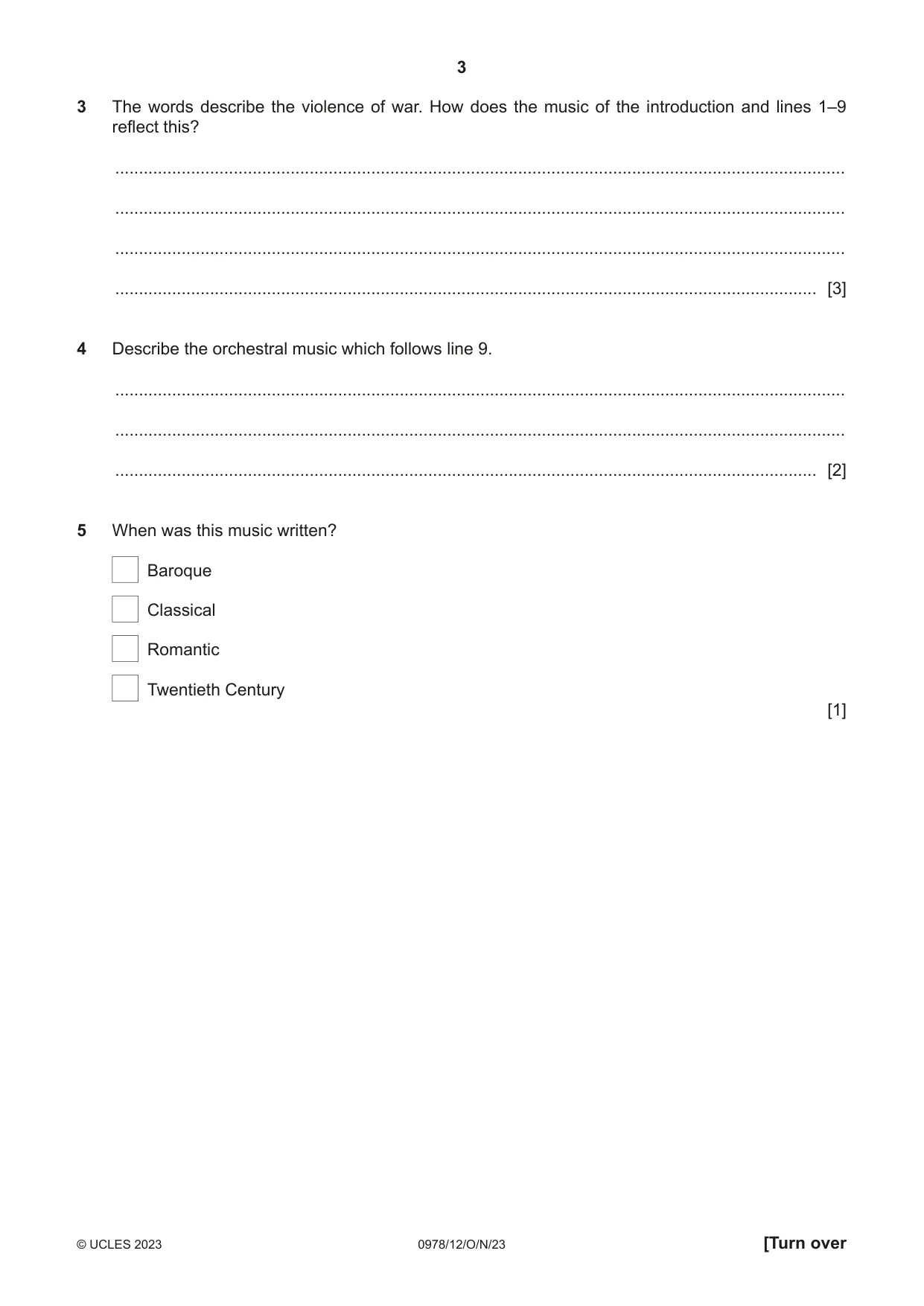
3 0978/12/O/N/23 © UCLES 2023 [Turn over 3 The words describe the violence of war. How does the music of the introduction and lines 1–9 reflect this? … … … … [3] 4 Describe the orchestral music which follows line 9. … … … [2] 5 When was this music written? Baroque Classical Romantic Twentieth Century [1]
Question paper, page 4
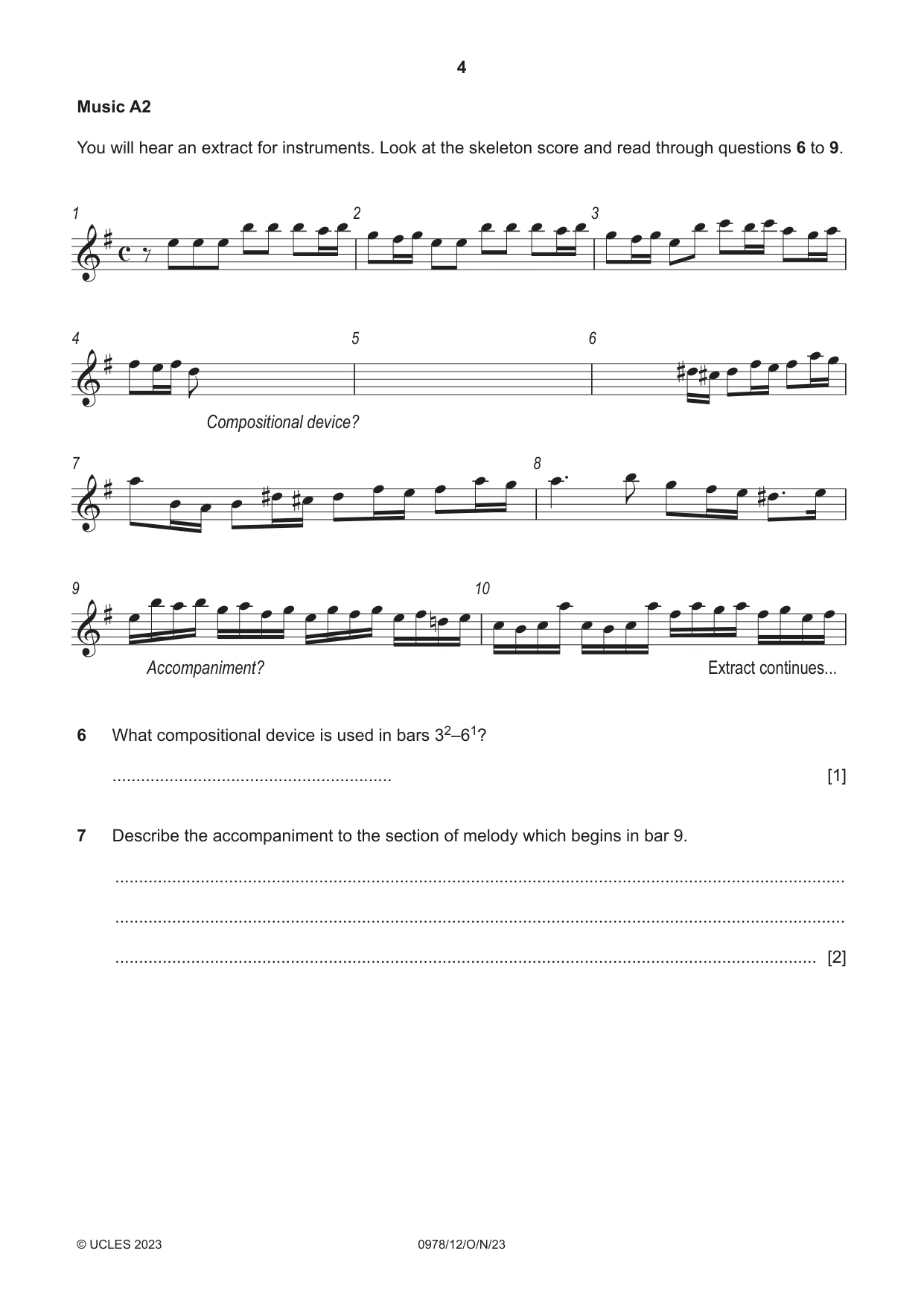
4 0978/12/O/N/23 © UCLES 2023 Music A2 You will hear an extract for instruments. Look at the skeleton score and read through questions 6 to 9. 1 2 3 4 5 6 7 8 9 10 c &# &# Compositional device? &# &# Accompaniment? Extract continues... ‰ œ œ œ œ œ œ œ œ œ œ œ œ œ œ œ œ œ œ œ œ œ œ œ œ œ œ œ œ œ œ œ œ œJ œ# œ# œ œ œ œ œ œ œ œ œ œ œ# œ# œ œ œ œ œ œ œ™ œJ œ œ œ œ# ™ œ œ œ œ œ œ œ œ œ œ œ œ œ œ œ œn œ œ œ œ œ œ œ œ œ œ œ œ œ œ œ œ œ 6 What compositional device is used in bars 32–61? … [1] 7 Describe the accompaniment to the section of melody which begins in bar 9. … … … [2]
Question paper, page 5
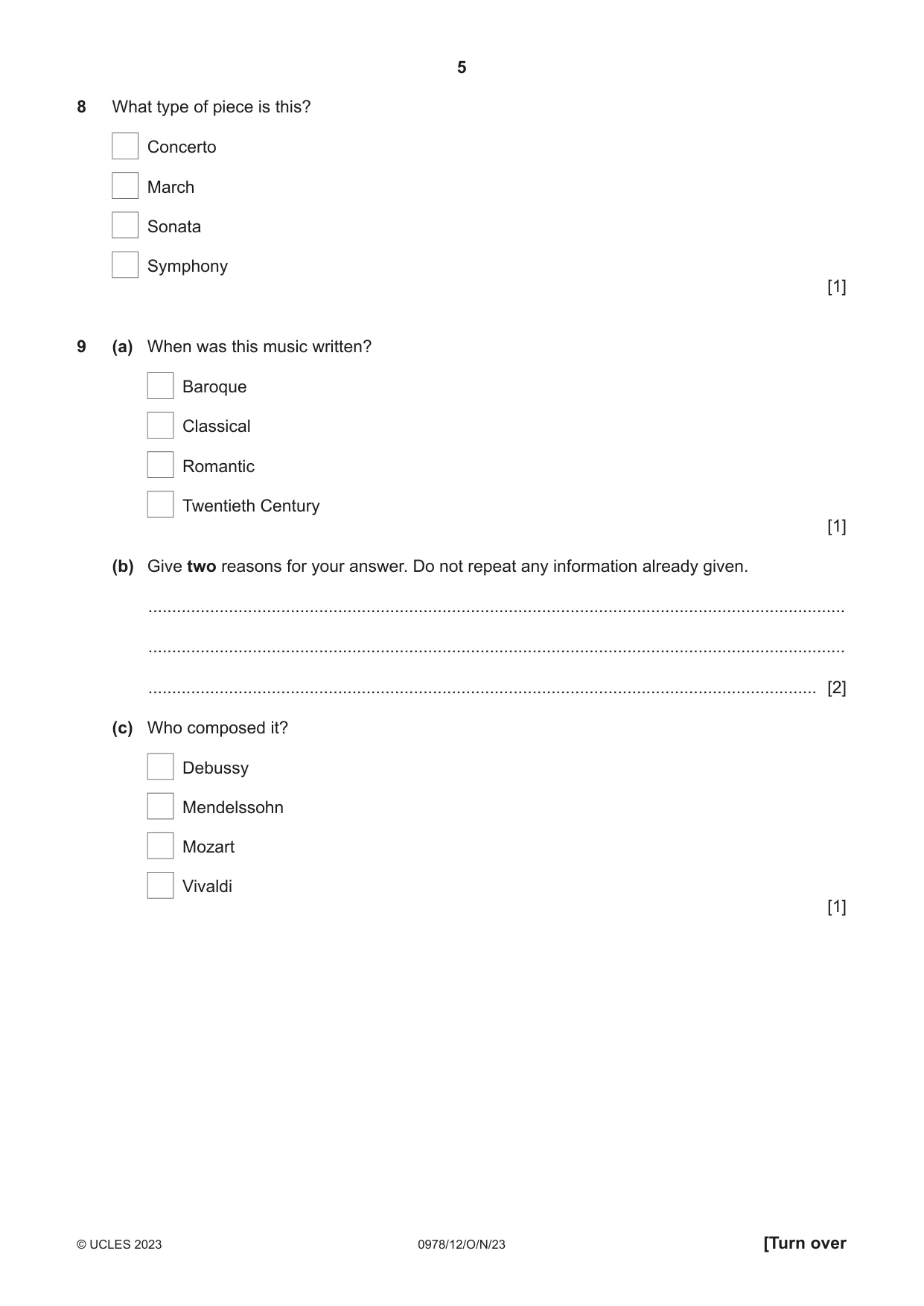
5 0978/12/O/N/23 © UCLES 2023 [Turn over 8 What type of piece is this? Concerto March Sonata Symphony [1] 9 (a) When was this music written? Baroque Classical Romantic Twentieth Century [1] (b) Give two reasons for your answer. Do not repeat any information already given. … … … [2] (c) Who composed it? Debussy Mendelssohn Mozart Vivaldi [1]
Question paper, page 6
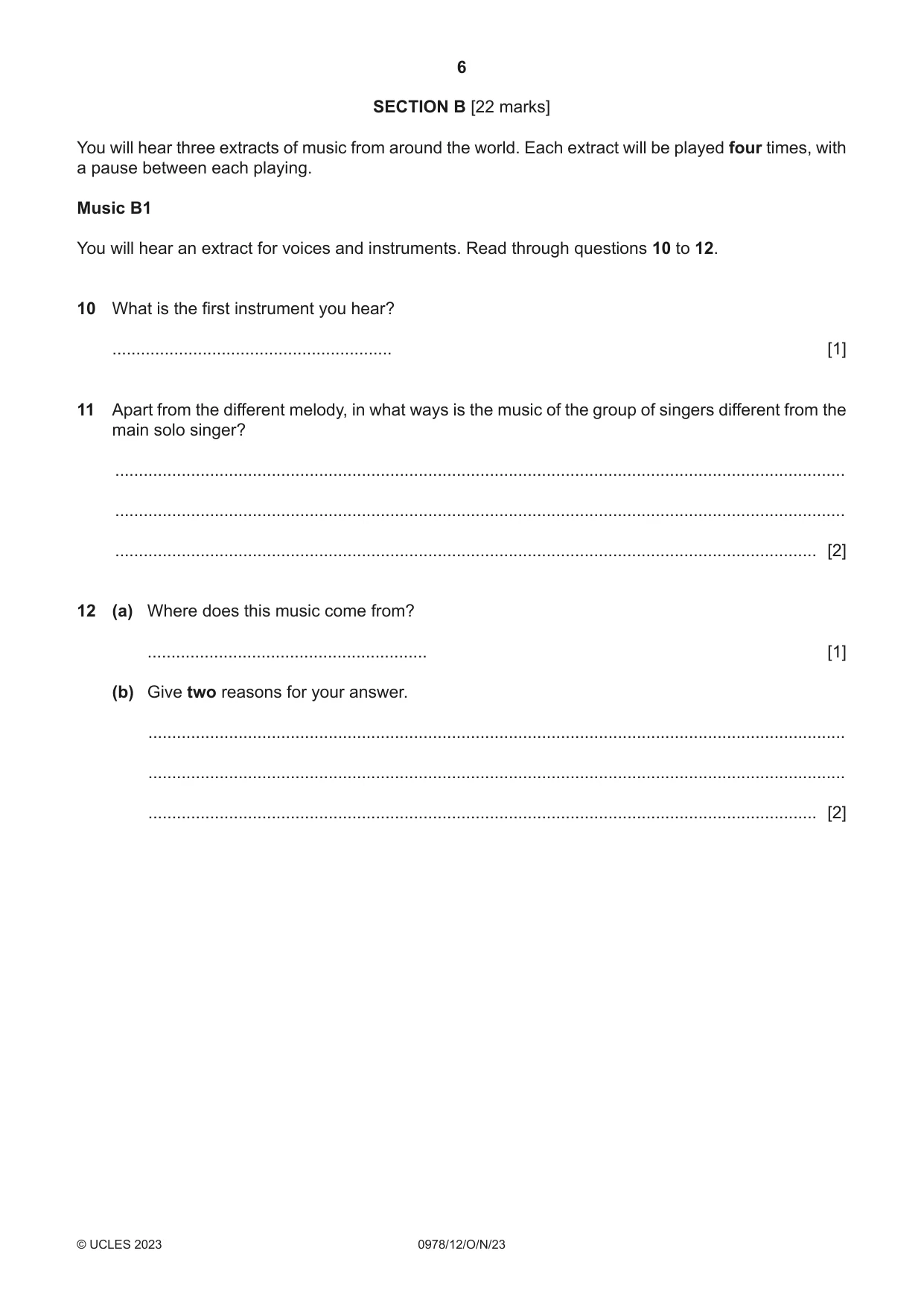
6 0978/12/O/N/23 © UCLES 2023 SECTION B [22 marks] You will hear three extracts of music from around the world. Each extract will be played four times, with a pause between each playing. Music B1 You will hear an extract for voices and instruments. Read through questions 10 to 12. 10 What is the first instrument you hear? … [1] 11 Apart from the different melody, in what ways is the music of the group of singers different from the main solo singer? … … … [2] 12 (a) Where does this music come from? … [1] (b) Give two reasons for your answer. … … … [2]
Question paper, page 7
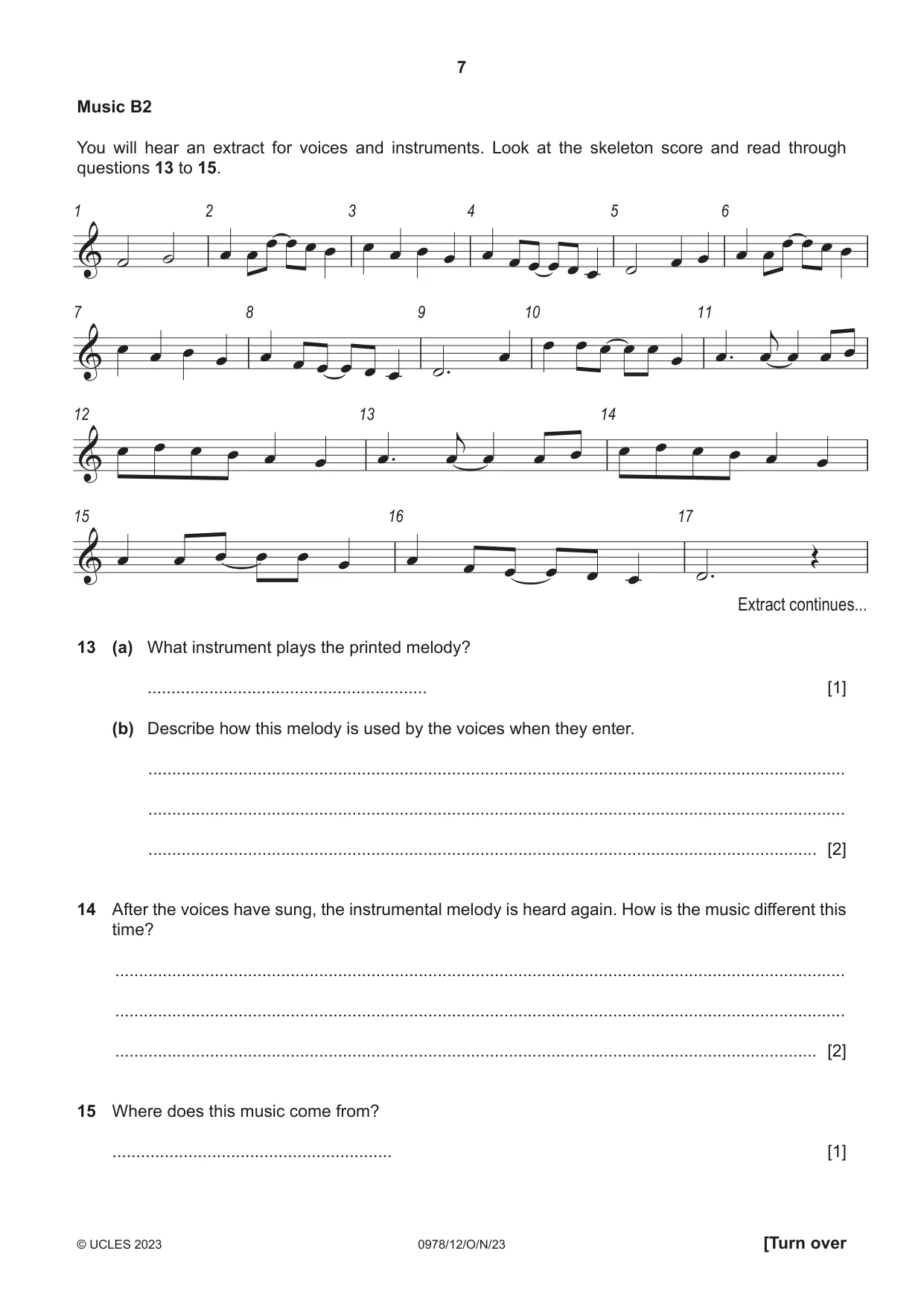
7 0978/12/O/N/23 © UCLES 2023 [Turn over Music B2 You will hear an extract for voices and instruments. Look at the skeleton score and read through questions 13 to 15. 1 2 3 4 5 6 7 8 9 10 11 12 13 14 15 16 17 & & & & Extract continues... ˙ ˙ œ œ œ œ œ œ œ œ œ œ œ œ œ œ œ œ ˙ œ œ œ œ œ œ œ œ œ œ œ œ œ œ œ œ œ œ ˙™ œ œ œ œ œ œ œ œ™ œj œ œ œ œ œ œ œ œ œ œ™ œj œ œ œ œ œ œ œ œ œ œ œ œ œ œ œ œ œ œ œ œ œ ˙™ Œ 13 (a) What instrument plays the printed melody? … [1] (b) Describe how this melody is used by the voices when they enter. … … … [2] 14 After the voices have sung, the instrumental melody is heard again. How is the music different this time? … … … [2] 15 Where does this music come from? … [1]
Question paper, page 8
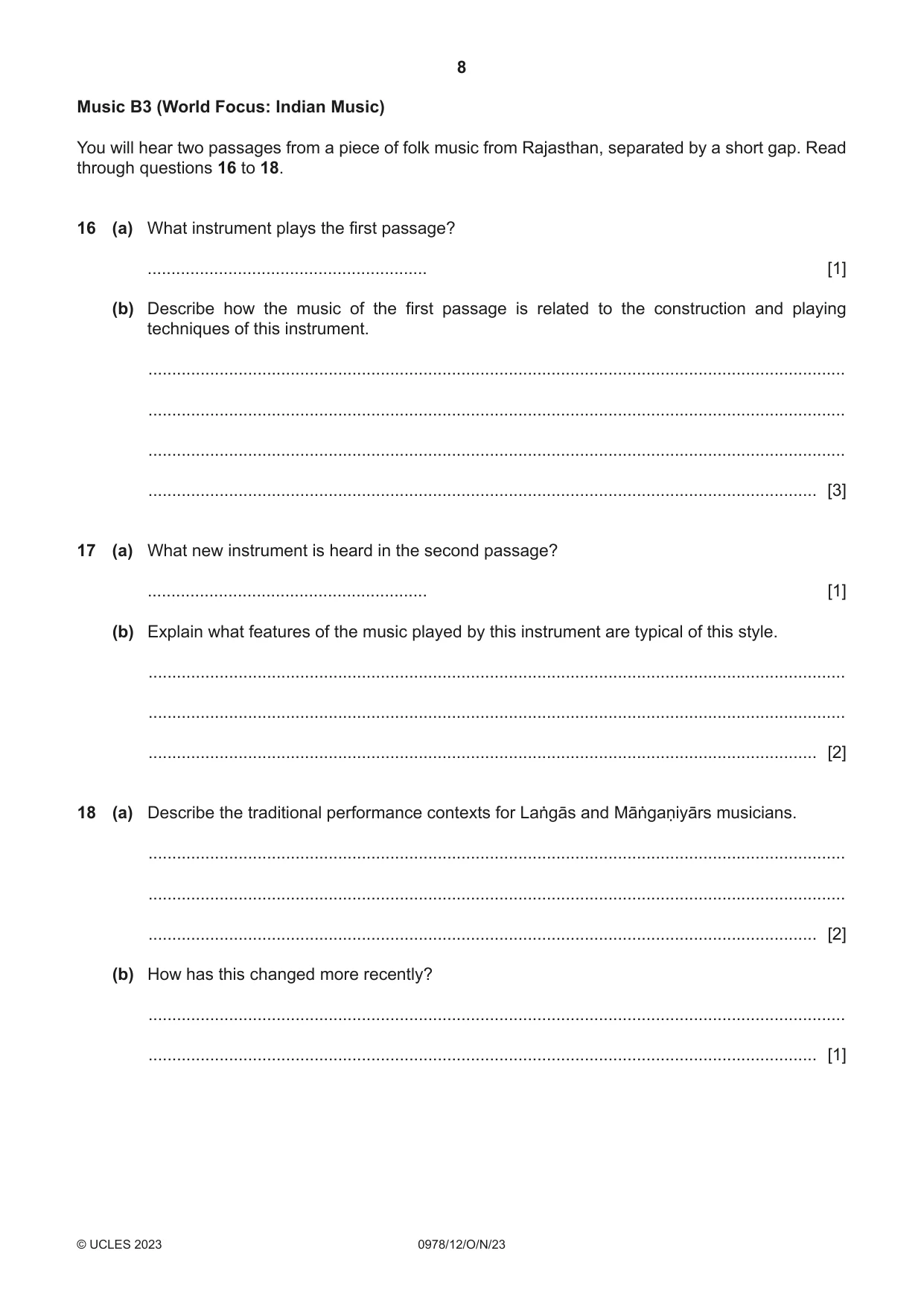
8 0978/12/O/N/23 © UCLES 2023 Music B3 (World Focus: Indian Music) You will hear two passages from a piece of folk music from Rajasthan, separated by a short gap. Read through questions 16 to 18. 16 (a) What instrument plays the first passage? … [1] (b) Describe how the music of the first passage is related to the construction and playing techniques of this instrument. … … … … [3] 17 (a) What new instrument is heard in the second passage? … [1] (b) Explain what features of the music played by this instrument are typical of this style. … … … [2] 18 (a) Describe the traditional performance contexts for Laṅgās and Māṅgaṇiyārs musicians. … … … [2] (b) How has this changed more recently? … … [1]
Question paper, page 9
9 0978/12/O/N/23 © UCLES 2023 [Turn over BLANK PAGE
Question paper, page 10
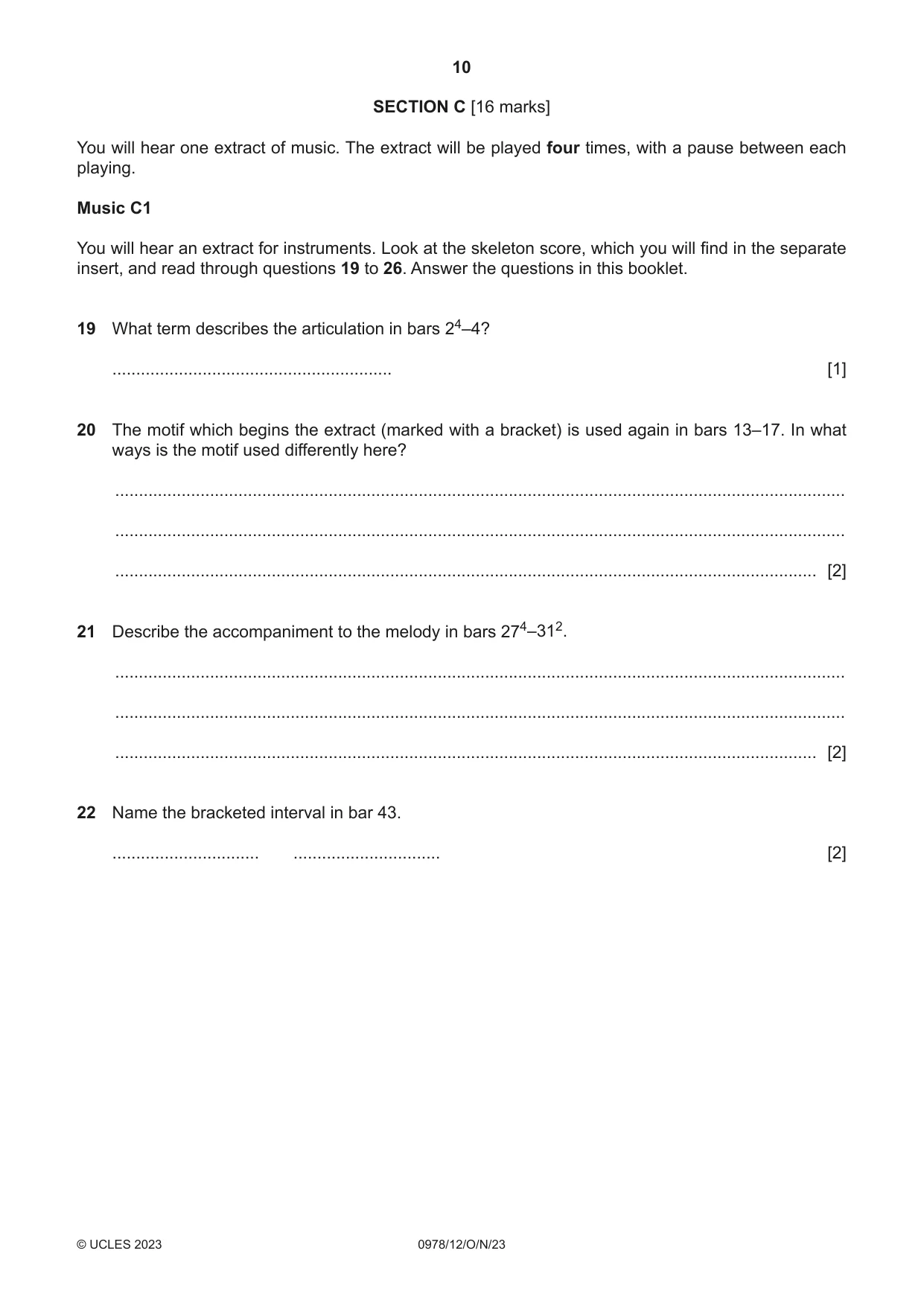
10 0978/12/O/N/23 © UCLES 2023 SECTION C [16 marks] You will hear one extract of music. The extract will be played four times, with a pause between each playing. Music C1 You will hear an extract for instruments. Look at the skeleton score, which you will find in the separate insert, and read through questions 19 to 26. Answer the questions in this booklet. 19 What term describes the articulation in bars 24–4? … [1] 20 The motif which begins the extract (marked with a bracket) is used again in bars 13–17. In what ways is the motif used differently here? … … … [2] 21 Describe the accompaniment to the melody in bars 274–312. … … … [2] 22 Name the bracketed interval in bar 43. … … [2]
Question paper, page 11
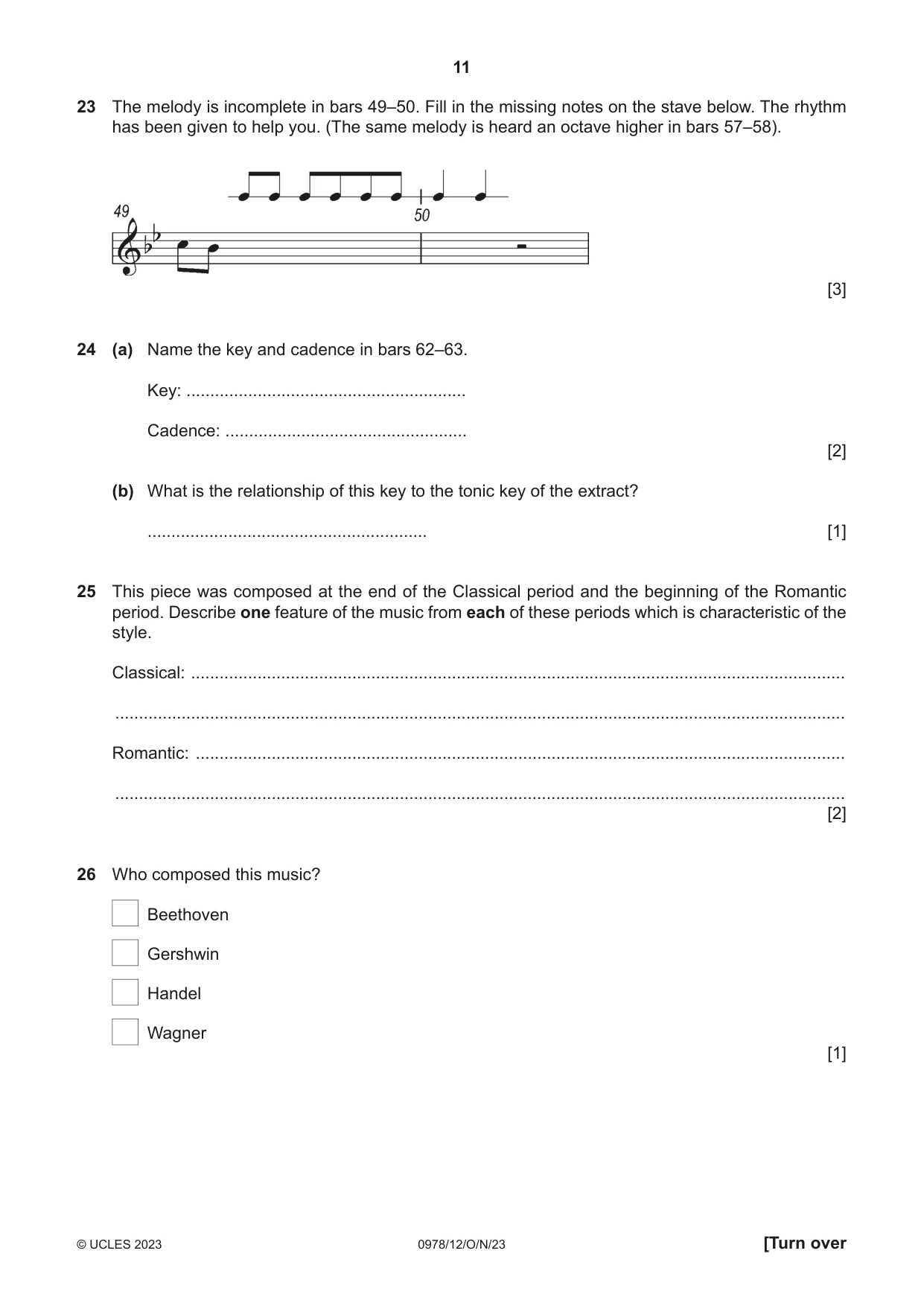
11 0978/12/O/N/23 © UCLES 2023 [Turn over 23 The melody is incomplete in bars 49–50. Fill in the missing notes on the stave below. The rhythm has been given to help you. (The same melody is heard an octave higher in bars 57–58). [3] 24 (a) Name the key and cadence in bars 62–63. Key: … Cadence: … [2] (b) What is the relationship of this key to the tonic key of the extract? … [1] 25 This piece was composed at the end of the Classical period and the beginning of the Romantic period. Describe one feature of the music from each of these periods which is characteristic of the style. Classical: … … Romantic: … … [2] 26 Who composed this music? Beethoven Gershwin Handel Wagner [1]
Question paper, page 12
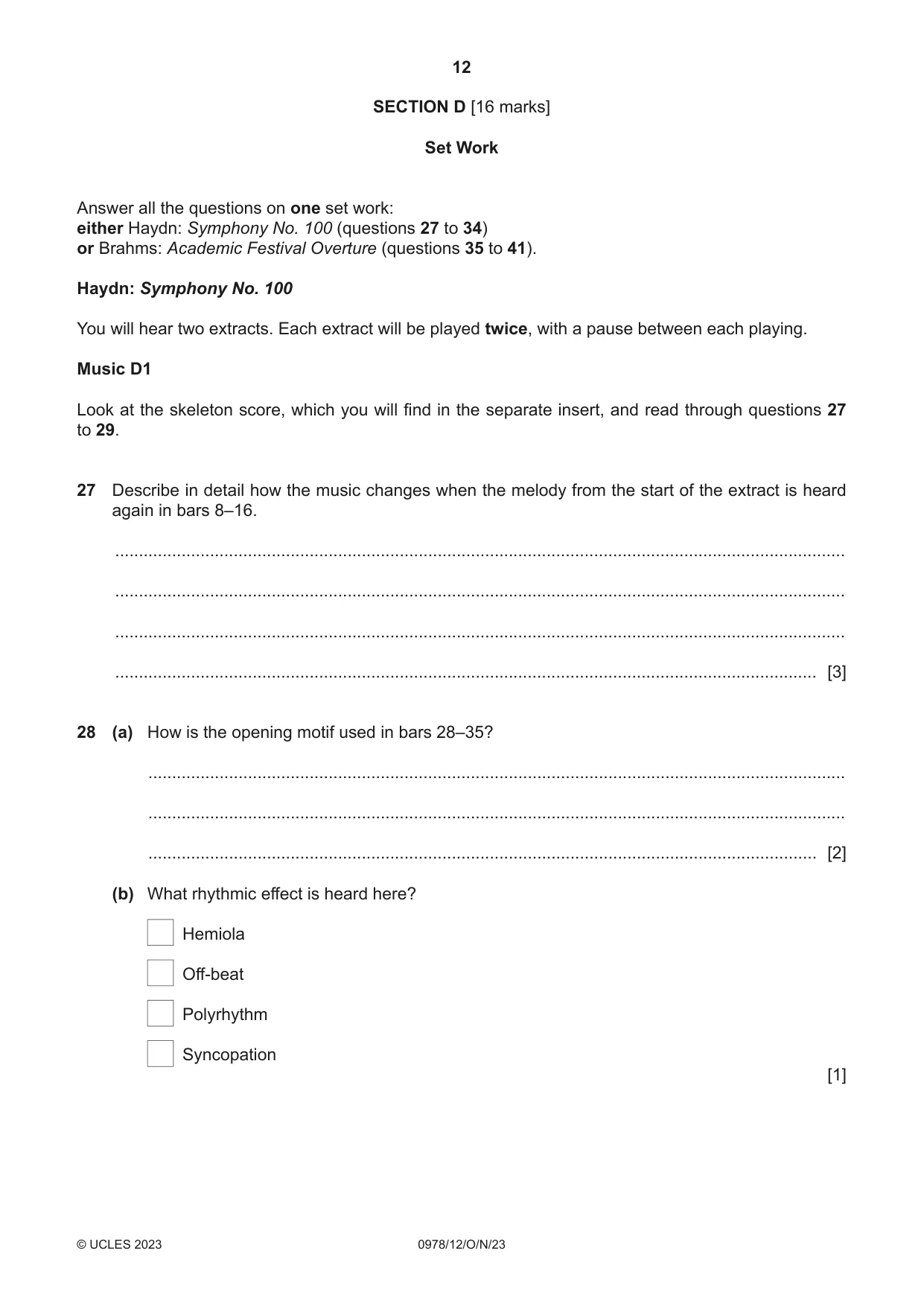
12 0978/12/O/N/23 © UCLES 2023 SECTION D [16 marks] Set Work Answer all the questions on one set work: either Haydn: Symphony No. 100 (questions 27 to 34) or Brahms: Academic Festival Overture (questions 35 to 41). Haydn: Symphony No. 100 You will hear two extracts. Each extract will be played twice, with a pause between each playing. Music D1 Look at the skeleton score, which you will find in the separate insert, and read through questions 27 to 29. 27 Describe in detail how the music changes when the melody from the start of the extract is heard again in bars 8–16. … … … … [3] 28 (a) How is the opening motif used in bars 28–35? … … … [2] (b) What rhythmic effect is heard here? Hemiola Off-beat Polyrhythm Syncopation [1]
Question paper, page 13
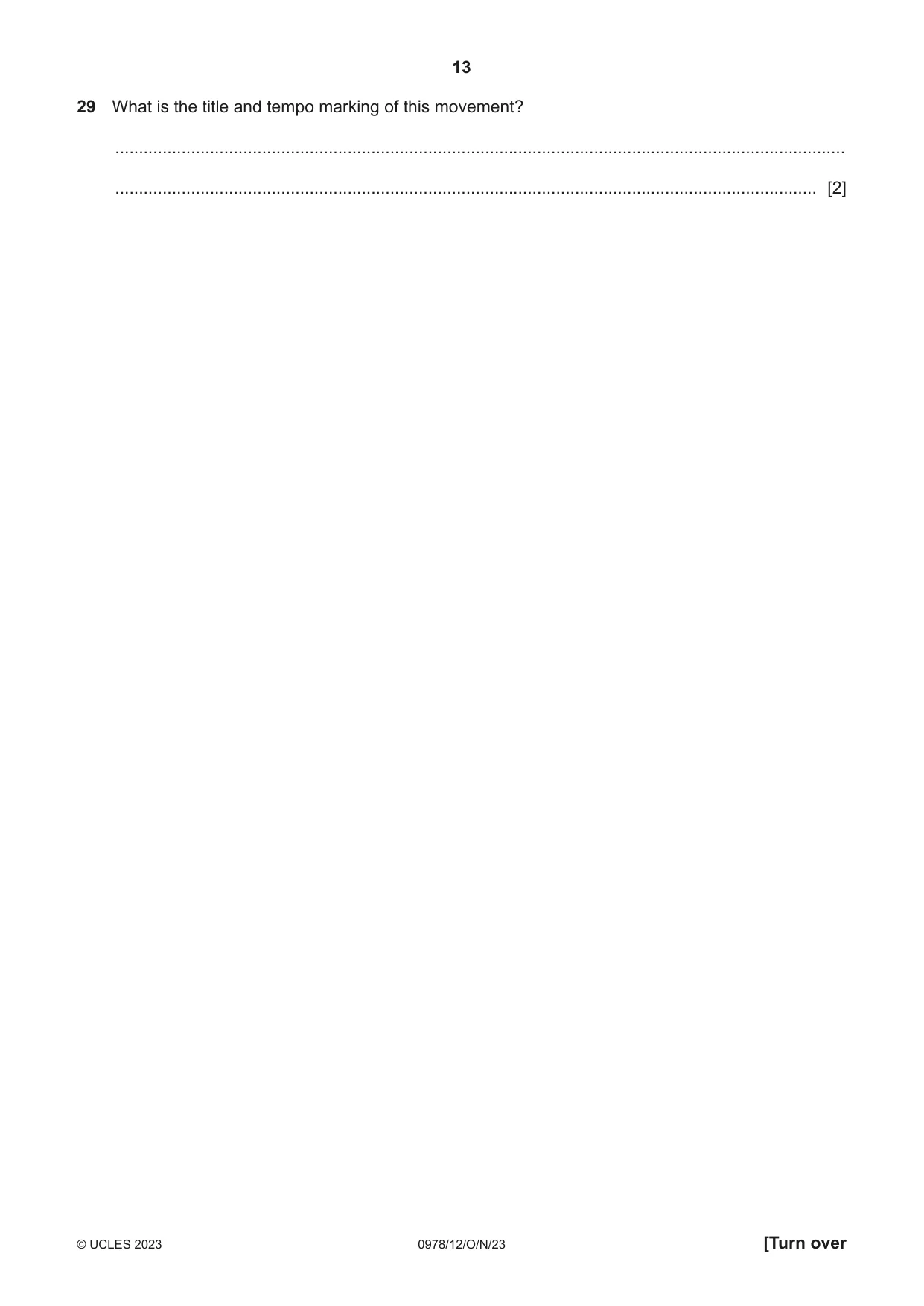
13 0978/12/O/N/23 © UCLES 2023 [Turn over 29 What is the title and tempo marking of this movement? … … [2]
Question paper, page 14
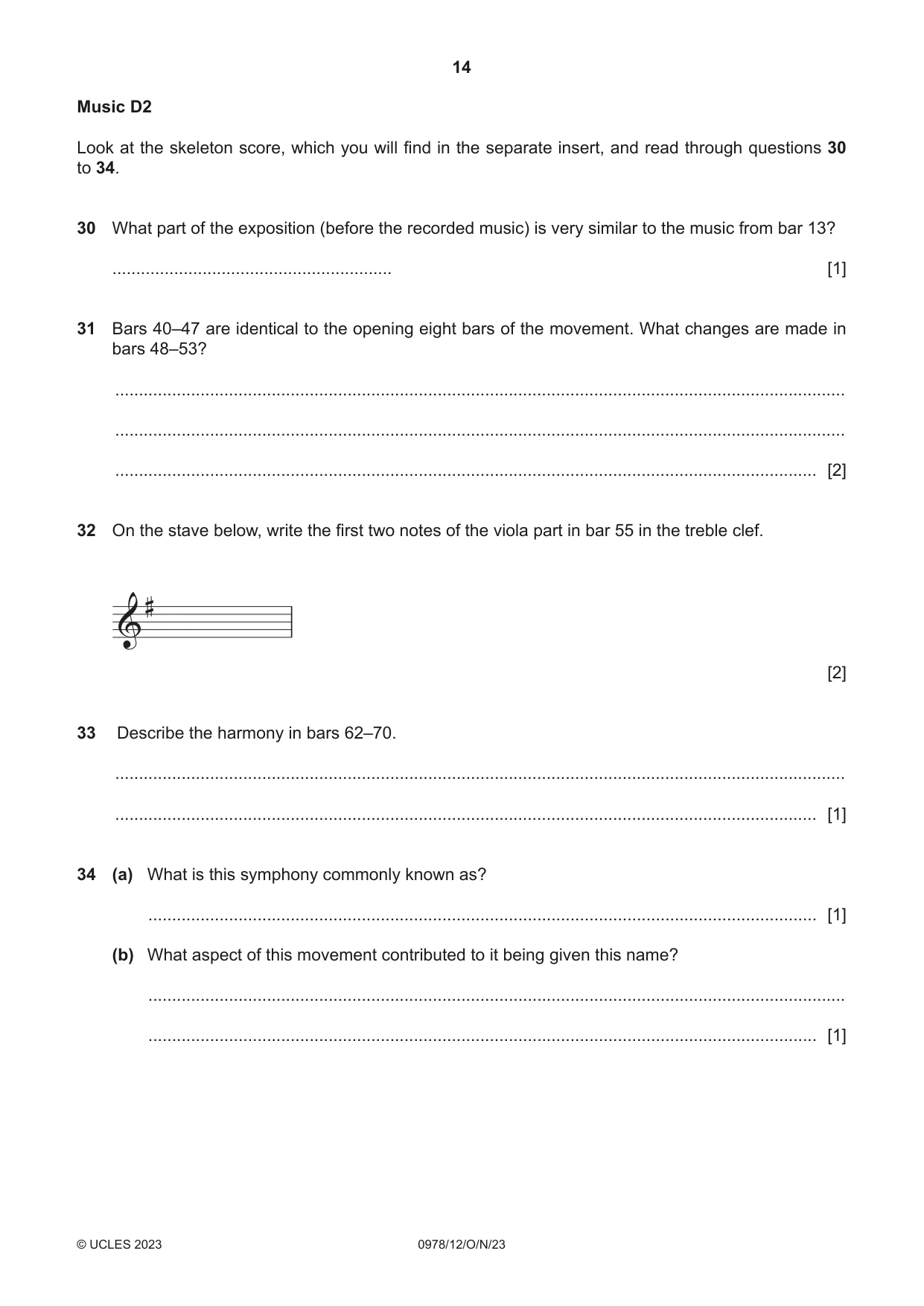
14 0978/12/O/N/23 © UCLES 2023 Music D2 Look at the skeleton score, which you will find in the separate insert, and read through questions 30 to 34. 30 What part of the exposition (before the recorded music) is very similar to the music from bar 13? … [1] 31 Bars 40–47 are identical to the opening eight bars of the movement. What changes are made in bars 48–53? … … … [2] 32 On the stave below, write the first two notes of the viola part in bar 55 in the treble clef. &# [2] 33 Describe the harmony in bars 62–70. … … [1] 34 (a) What is this symphony commonly known as? … [1] (b) What aspect of this movement contributed to it being given this name? … … [1]
Question paper, page 15
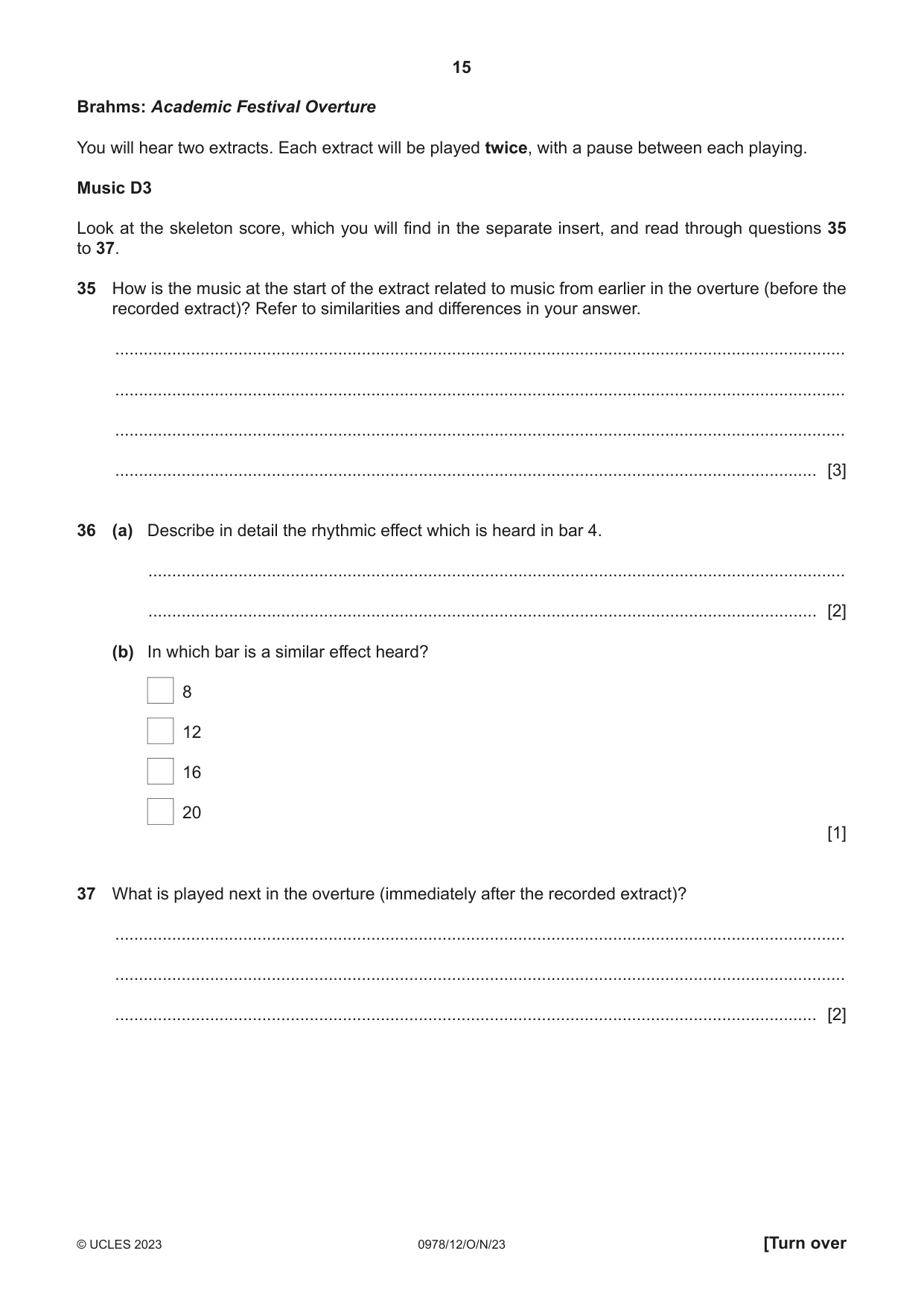
15 0978/12/O/N/23 © UCLES 2023 [Turn over Brahms: Academic Festival Overture You will hear two extracts. Each extract will be played twice, with a pause between each playing. Music D3 Look at the skeleton score, which you will find in the separate insert, and read through questions 35 to 37. 35 How is the music at the start of the extract related to music from earlier in the overture (before the recorded extract)? Refer to similarities and differences in your answer. … … … … [3] 36 (a) Describe in detail the rhythmic effect which is heard in bar 4. … … [2] (b) In which bar is a similar effect heard? 8 12 16 20 [1] 37 What is played next in the overture (immediately after the recorded extract)? … … … [2]
Question paper, page 16
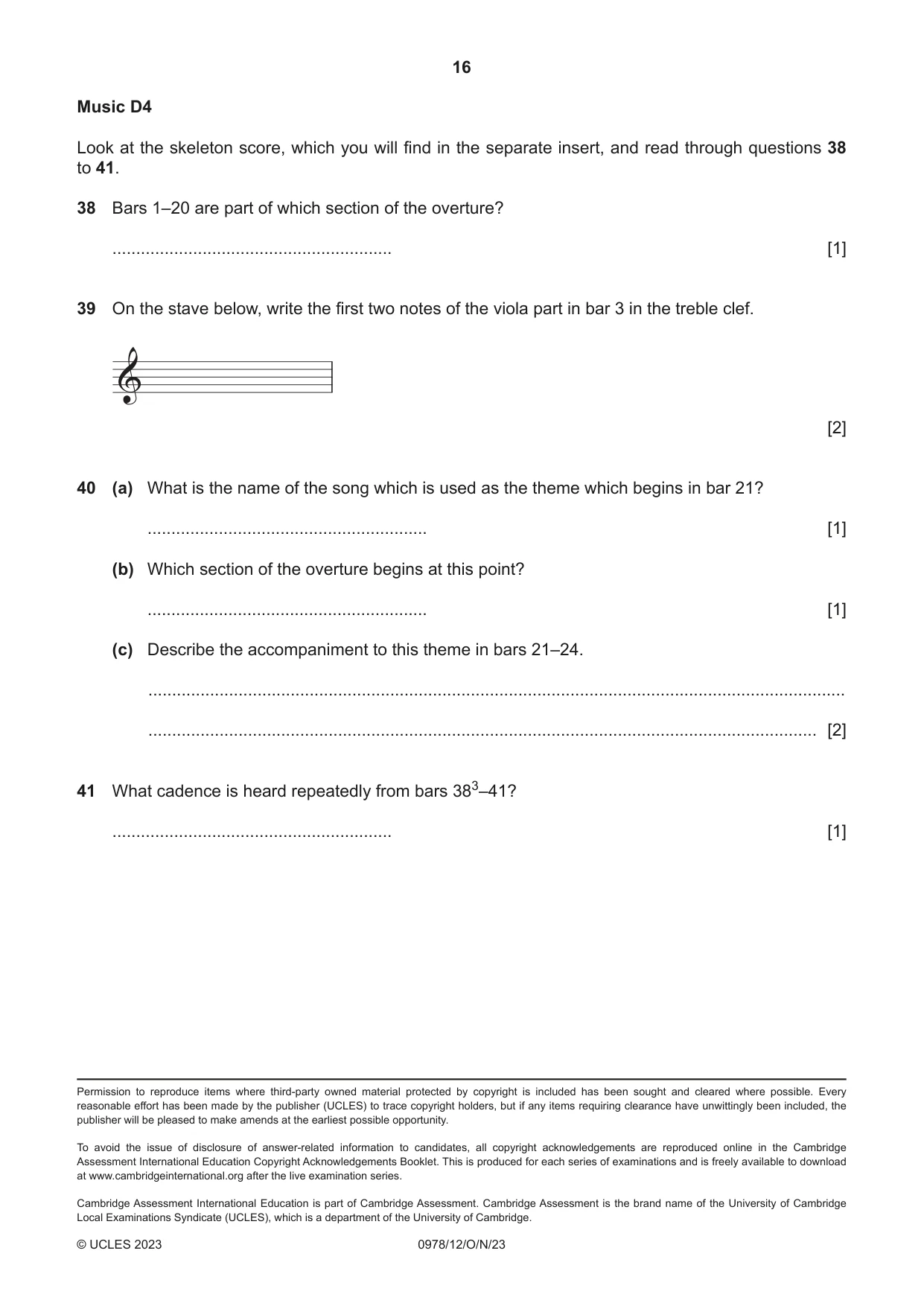
16 0978/12/O/N/23 © UCLES 2023 Permission to reproduce items where third-party owned material protected by copyright is included has been sought and cleared where possible. Every reasonable effort has been made by the publisher (UCLES) to trace copyright holders, but if any items requiring clearance have unwittingly been included, the publisher will be pleased to make amends at the earliest possible opportunity. To avoid the issue of disclosure of answer-related information to candidates, all copyright acknowledgements are reproduced online in the Cambridge Assessment International Education Copyright Acknowledgements Booklet. This is produced for each series of examinations and is freely available to download at www.cambridgeinternational.org after the live examination series. Cambridge Assessment International Education is part of Cambridge Assessment. Cambridge Assessment is the brand name of the University of Cambridge Local Examinations Syndicate (UCLES), which is a department of the University of Cambridge. Music D4 Look at the skeleton score, which you will find in the separate insert, and read through questions 38 to 41. 38 Bars 1–20 are part of which section of the overture? … [1] 39 On the stave below, write the first two notes of the viola part in bar 3 in the treble clef. & [2] 40 (a) What is the name of the song which is used as the theme which begins in bar 21? … [1] (b) Which section of the overture begins at this point? … [1] (c) Describe the accompaniment to this theme in bars 21–24. … … [2] 41 What cadence is heard repeatedly from bars 383–41? … [1]
What you needed in this session
Cambridge’s own grade thresholds for 2023 Oct/Nov, Paper 1 · Variant 2. A higher threshold means an easier paper — the bar moves with how the cohort did.