Cambridge IGCSE Music 0410 — 2019 May/June Paper 1 · Variant 1
0410/11/M/J/19 · 70 marks · ≈79 min
The question paper and its mark scheme, free to read here and free to download. This is Cambridge’s own paper, exactly as it was sat.
Question paper16 pages

Mark scheme6 pages
Answers below. Sit the paper first if you are practising.
Paper as text
Question paper, page 1
This document consists of 14 printed pages, 2 blank pages and 1 Insert. DC (ST) 168039/3 © UCLES 2019 [Turn over * 1 3 6 2 1 4 6 5 8 1 * MUSIC 0410/11 Paper 1 Listening May/June 2019 Approx. 1 hour 15 minutes Candidates answer on the Question Paper. No Additional Materials are required. READ THESE INSTRUCTIONS FIRST Write your centre number, candidate number and name on all the work you hand in. Write in dark blue or black pen. You may use an HB pencil for any diagrams, graphs, music or rough working. Do not use staples, paper clips, glue or correction fluid. DO NOT WRITE IN ANY BARCODES. Answer all questions in Sections A, B and C. In Section D answer all the questions on the one Set Work you have studied. In the Insert, you will find the skeleton scores for Music C1 and your chosen Set Work in Section D. For each question, tick (3) one of the boxes to show the most appropriate answer, or write your answer in the space provided. There will be time for you to look at the questions before you hear each extract of music. You may find it helpful to make notes on the music as you listen. Write your answers in this Question Paper booklet. At the end of the examination, fasten all your work securely together. The number of marks is given in brackets [ ] at the end of each question or part question. Cambridge Assessment International Education Cambridge International General Certificate of Secondary Education This syllabus is regulated for use in England, Wales and Northern Ireland as a Cambridge International Level 1/Level 2 Certificate.
Question paper, page 2
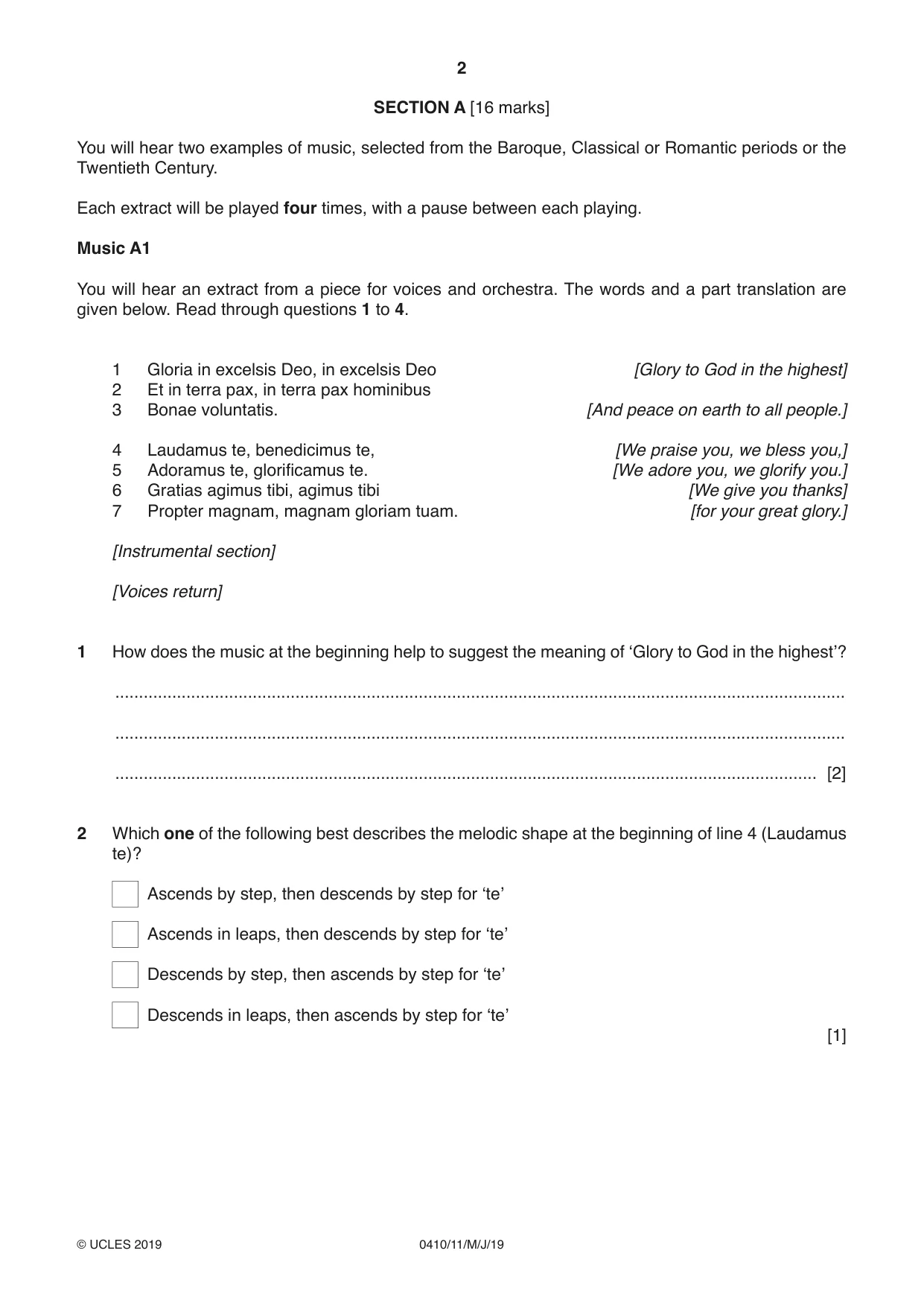
2 0410/11/M/J/19 © UCLES 2019 SECTION A [16 marks] You will hear two examples of music, selected from the Baroque, Classical or Romantic periods or the Twentieth Century. Each extract will be played four times, with a pause between each playing. Music A1 You will hear an extract from a piece for voices and orchestra. The words and a part translation are given below. Read through questions 1 to 4. 1 Gloria in excelsis Deo, in excelsis Deo [Glory to God in the highest] 2 Et in terra pax, in terra pax hominibus 3 Bonae voluntatis. [And peace on earth to all people.] 4 Laudamus te, benedicimus te, [We praise you, we bless you,] 5 Adoramus te, glorificamus te. [We adore you, we glorify you.] 6 Gratias agimus tibi, agimus tibi [We give you thanks] 7 Propter magnam, magnam gloriam tuam. [for your great glory.] [Instrumental section] [Voices return] 1 How does the music at the beginning help to suggest the meaning of ‘Glory to God in the highest’? … … … [2] 2 Which one of the following best describes the melodic shape at the beginning of line 4 (Laudamus te)? Ascends by step, then descends by step for ‘te’ Ascends in leaps, then descends by step for ‘te’ Descends by step, then ascends by step for ‘te’ Descends in leaps, then ascends by step for ‘te’ [1]
Question paper, page 3
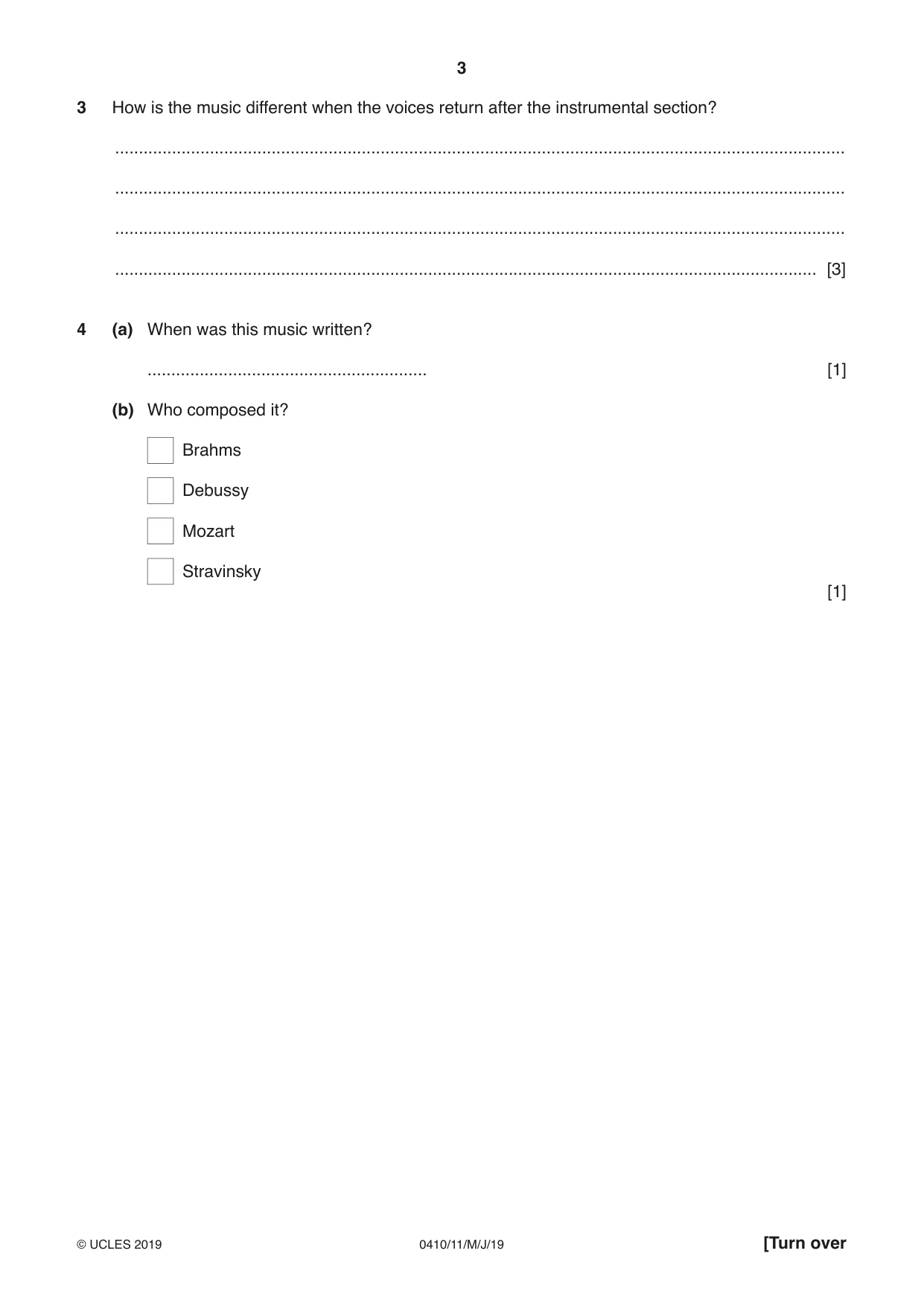
3 0410/11/M/J/19 © UCLES 2019 [Turn over 3 How is the music different when the voices return after the instrumental section? … … … … [3] 4 (a) When was this music written? … [1] (b) Who composed it? Brahms Debussy Mozart Stravinsky [1]
Question paper, page 4
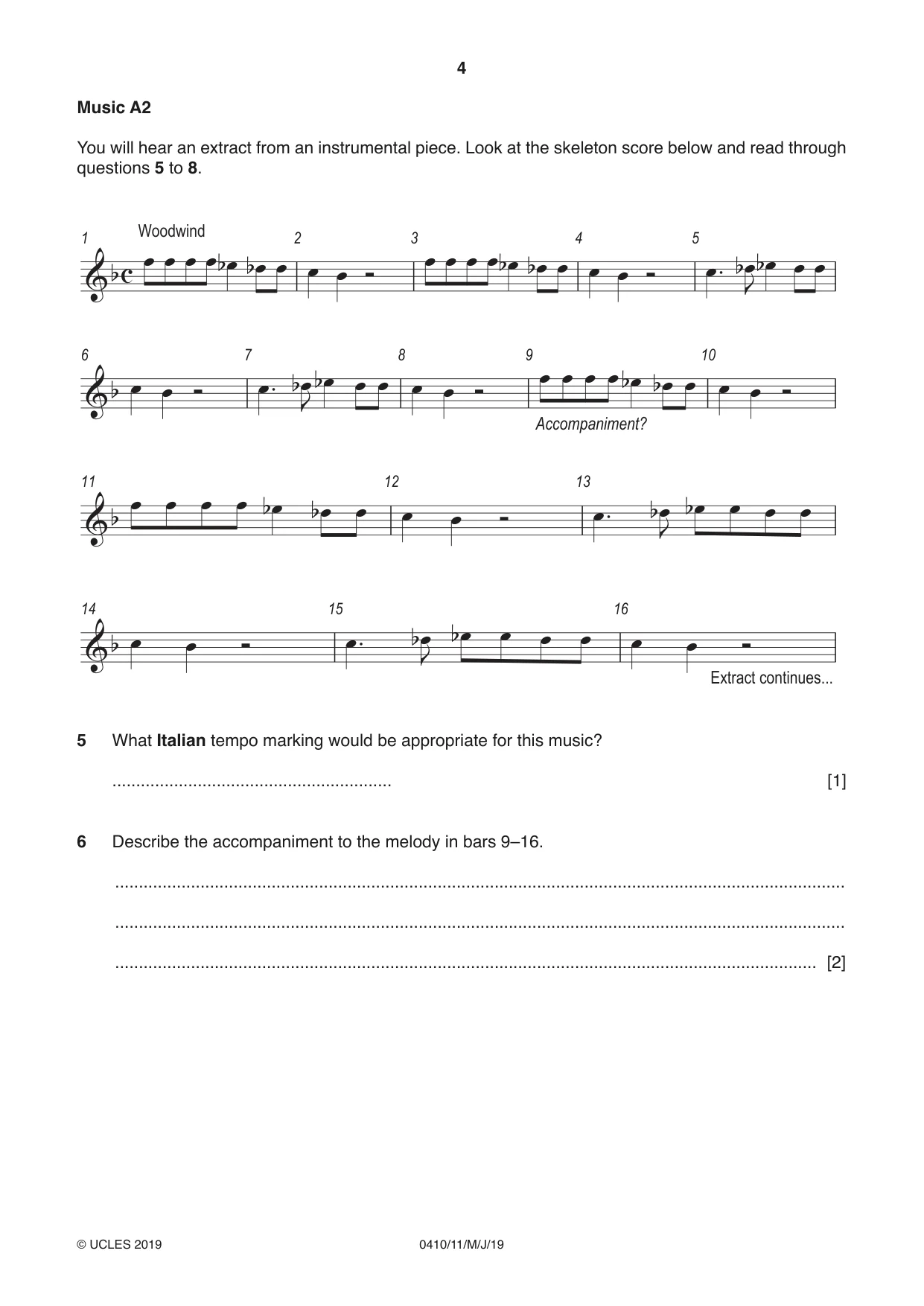
4 0410/11/M/J/19 © UCLES 2019 Music A2 You will hear an extract from an instrumental piece. Look at the skeleton score below and read through questions 5 to 8. Woodwind 1 2 3 4 5 Accompaniment? 6 7 8 9 10 11 12 13 Extract continues... 14 15 16 c &b &b &b &b œ œ œ œ œb œb œ œ œ Ó œ œ œ œ œb œb œ œ œ Ó œ™œbJ œb œ œ œ Ó œ™ œbJ œb œ œ œ Ó œ œ œ œ œb œb œ œ œ Ó œ œ œ œ œb œb œ œ œ Ó œ™ œbJ œb œ œ œ œ Ó œ™ œbJ œb œ œ œ œ Ó œ œ œ œ 5 What Italian tempo marking would be appropriate for this music? … [1] 6 Describe the accompaniment to the melody in bars 9–16. … … … [2]
Question paper, page 5
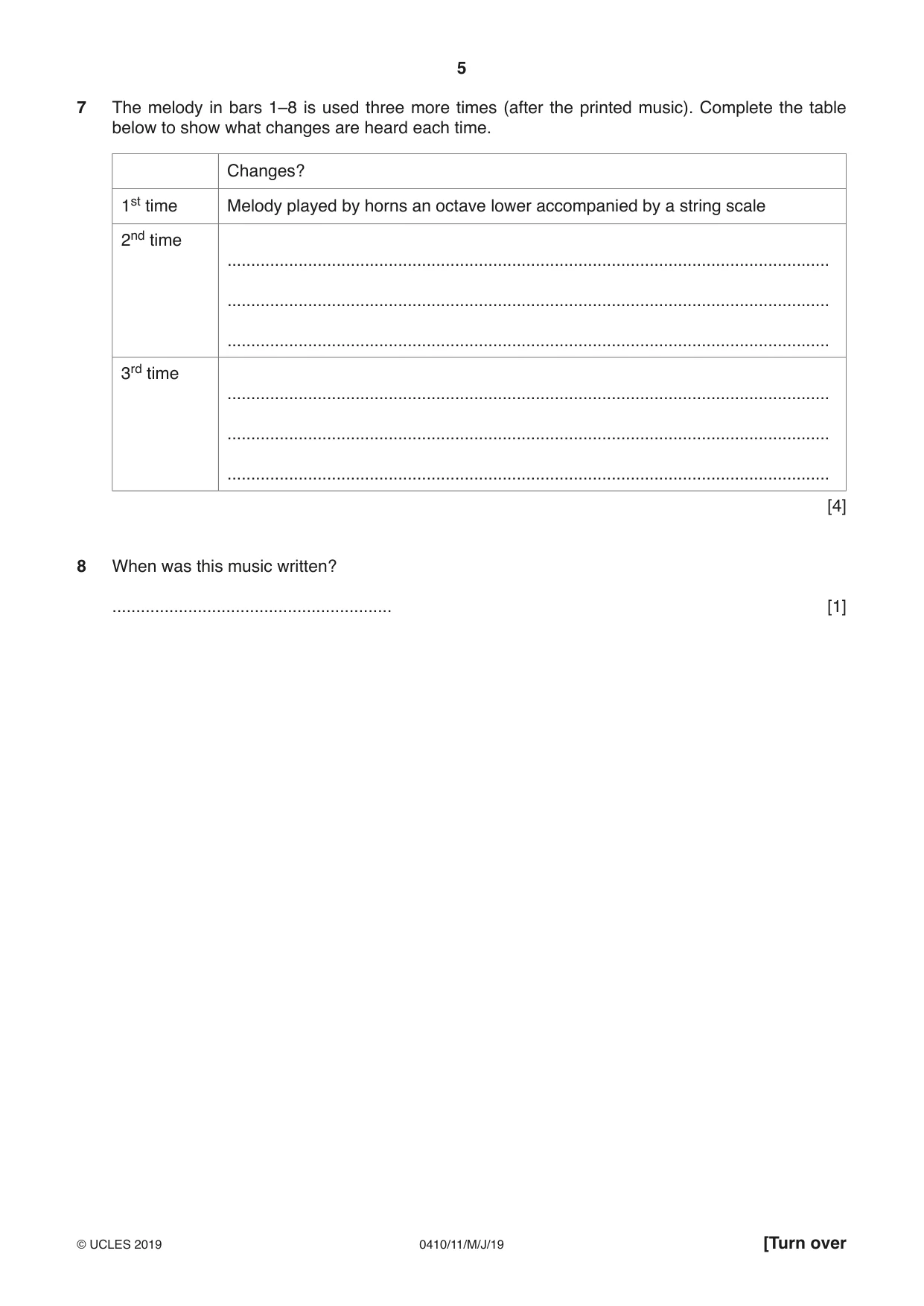
5 0410/11/M/J/19 © UCLES 2019 [Turn over 7 The melody in bars 1–8 is used three more times (after the printed music). Complete the table below to show what changes are heard each time. Changes? 1st time Melody played by horns an octave lower accompanied by a string scale 2nd time … … … 3rd time … … … [4] 8 When was this music written? … [1]
Question paper, page 6
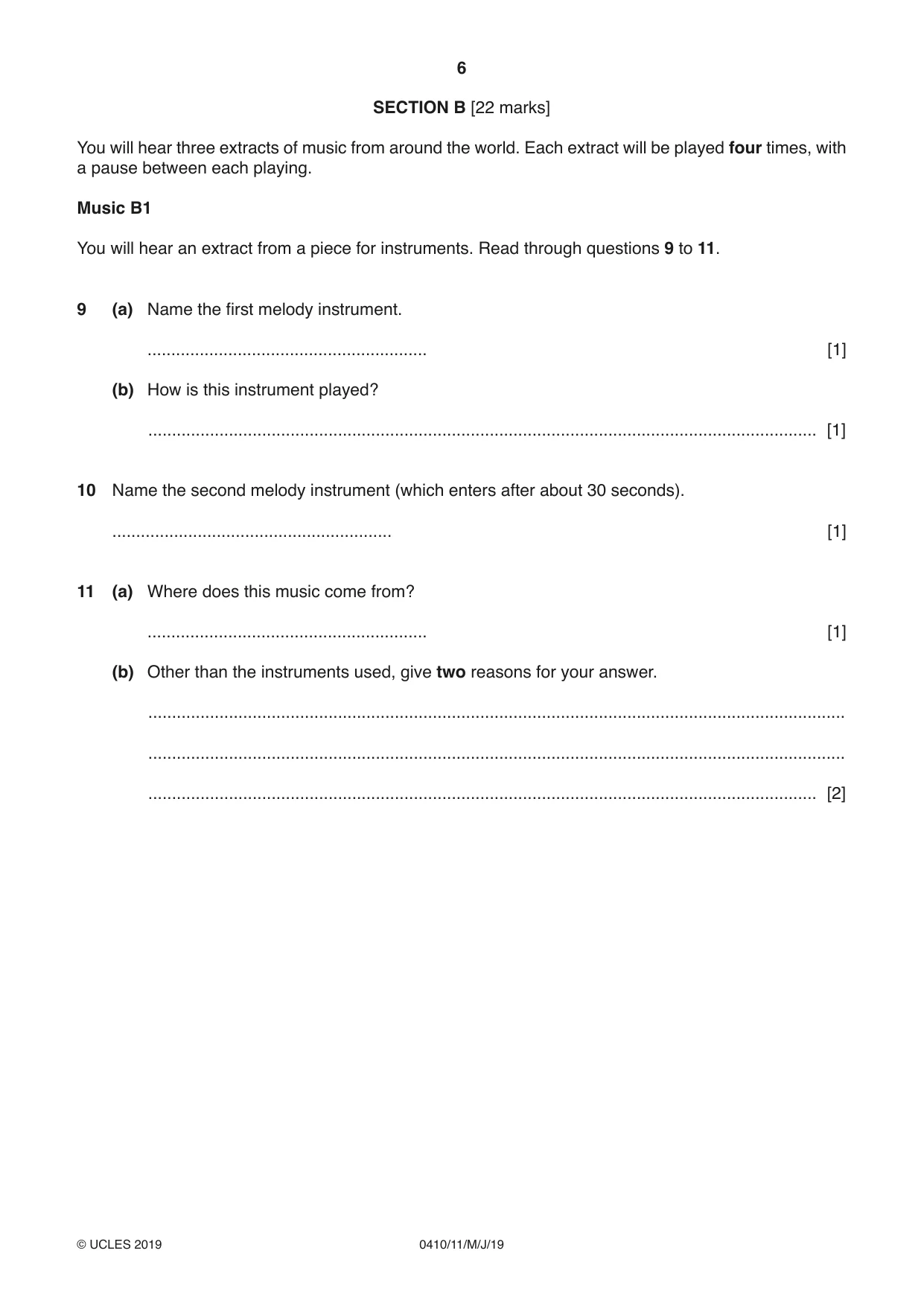
6 0410/11/M/J/19 © UCLES 2019 SECTION B [22 marks] You will hear three extracts of music from around the world. Each extract will be played four times, with a pause between each playing. Music B1 You will hear an extract from a piece for instruments. Read through questions 9 to 11. 9 (a) Name the first melody instrument. … [1] (b) How is this instrument played? … [1] 10 Name the second melody instrument (which enters after about 30 seconds). … [1] 11 (a) Where does this music come from? … [1] (b) Other than the instruments used, give two reasons for your answer. … … … [2]
Question paper, page 7
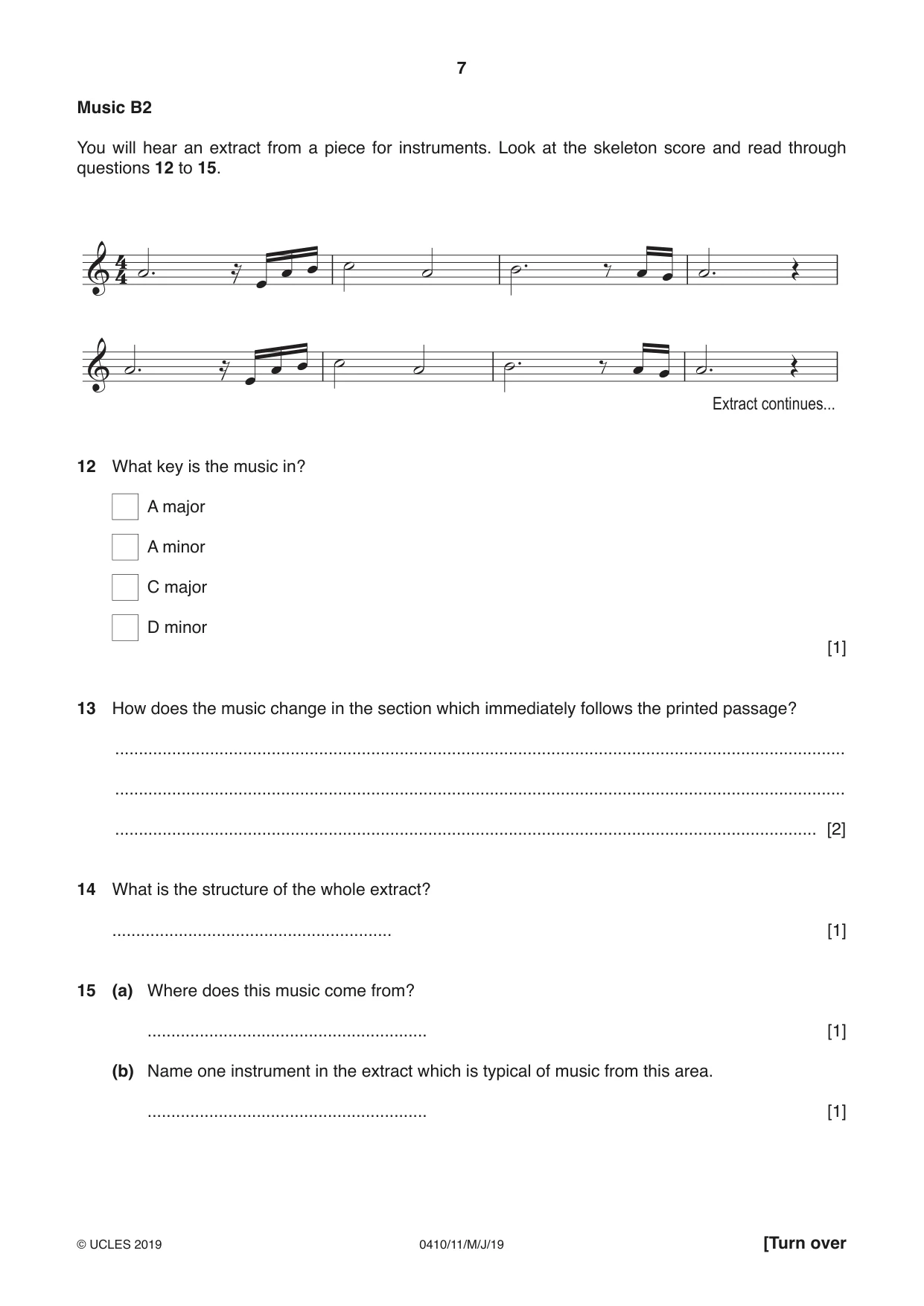
7 0410/11/M/J/19 © UCLES 2019 [Turn over Music B2 You will hear an extract from a piece for instruments. Look at the skeleton score and read through questions 12 to 15. 44 & & Extract continues... ˙™ ≈œ œ œ ˙ ˙ ˙™ ‰ œ œ ˙™ Œ ˙™ ≈œ œ œ ˙ ˙ ˙™ ‰ œ œ ˙™ Œ 12 What key is the music in? A major A minor C major D minor [1] 13 How does the music change in the section which immediately follows the printed passage? … … … [2] 14 What is the structure of the whole extract? … [1] 15 (a) Where does this music come from? … [1] (b) Name one instrument in the extract which is typical of music from this area. … [1]
Question paper, page 8
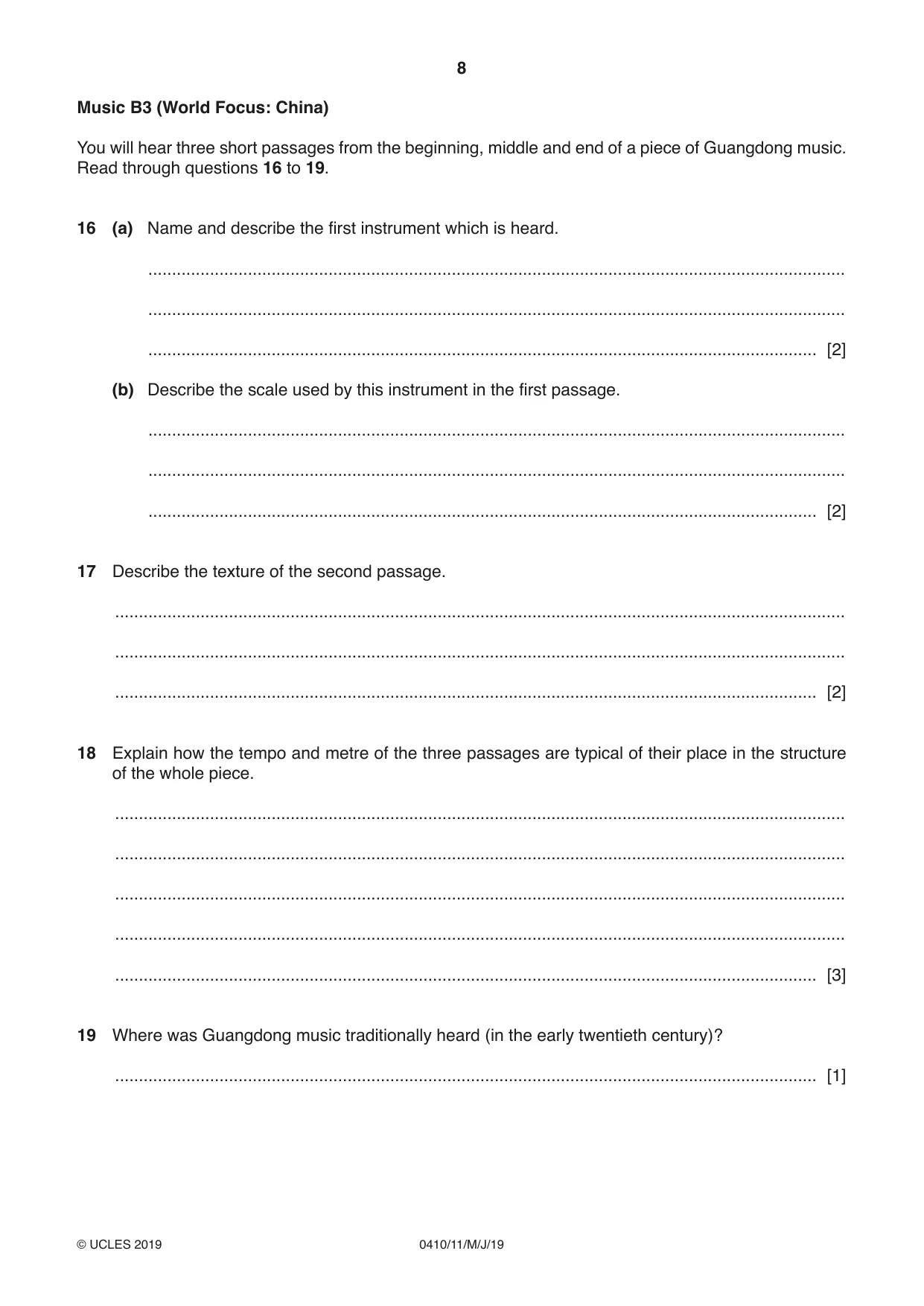
8 0410/11/M/J/19 © UCLES 2019 Music B3 (World Focus: China) You will hear three short passages from the beginning, middle and end of a piece of Guangdong music. Read through questions 16 to 19. 16 (a) Name and describe the first instrument which is heard. … … … [2] (b) Describe the scale used by this instrument in the first passage. … … … [2] 17 Describe the texture of the second passage. … … … [2] 18 Explain how the tempo and metre of the three passages are typical of their place in the structure of the whole piece. … … … … … [3] 19 Where was Guangdong music traditionally heard (in the early twentieth century)? … [1]
Question paper, page 9
9 0410/11/M/J/19 © UCLES 2019 [Turn over BLANK PAGE
Question paper, page 10
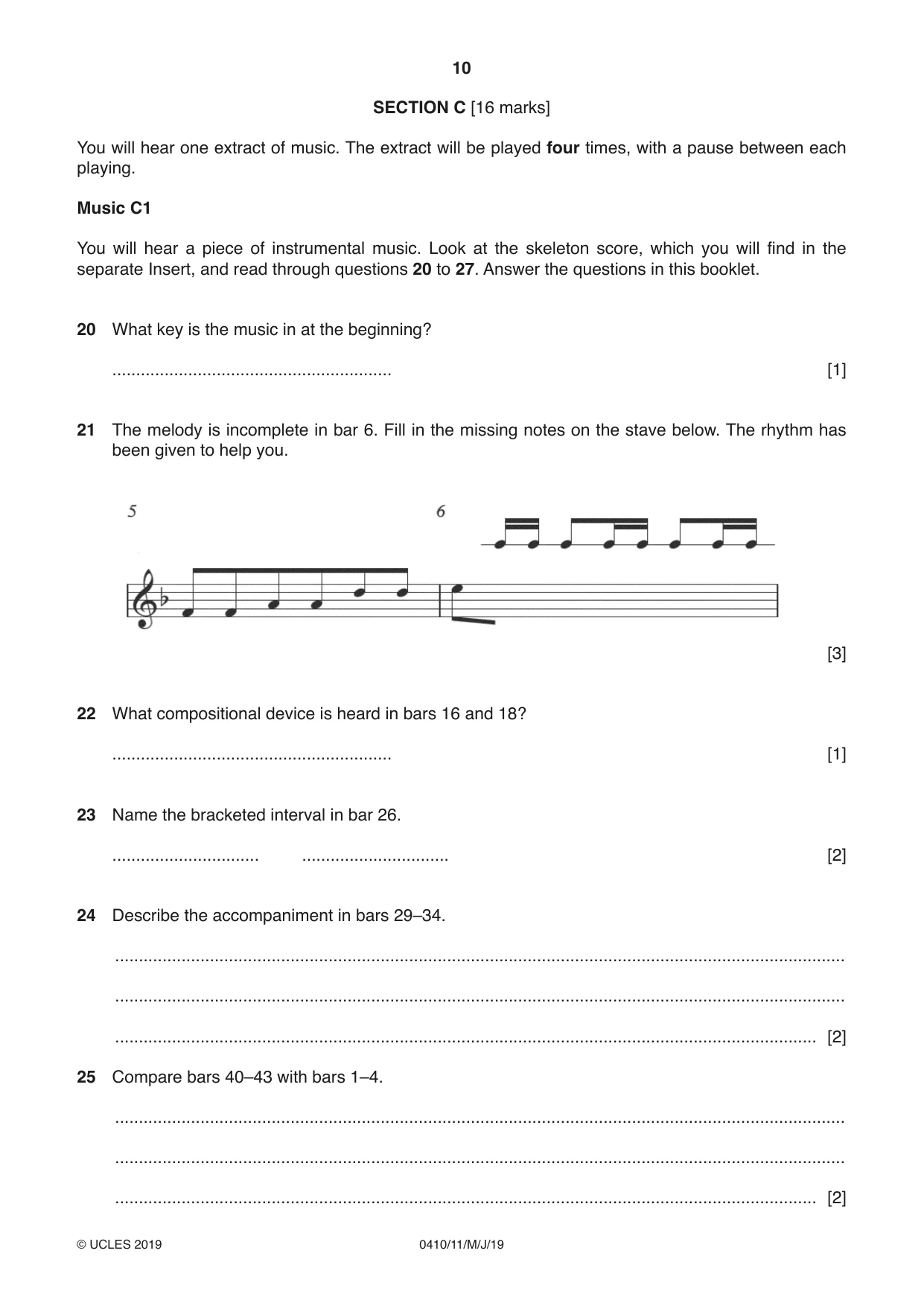
10 0410/11/M/J/19 © UCLES 2019 SECTION C [16 marks] You will hear one extract of music. The extract will be played four times, with a pause between each playing. Music C1 You will hear a piece of instrumental music. Look at the skeleton score, which you will find in the separate Insert, and read through questions 20 to 27. Answer the questions in this booklet. 20 What key is the music in at the beginning? … [1] 21 The melody is incomplete in bar 6. Fill in the missing notes on the stave below. The rhythm has been given to help you. [3] 22 What compositional device is heard in bars 16 and 18? … [1] 23 Name the bracketed interval in bar 26. … … [2] 24 Describe the accompaniment in bars 29–34. … … … [2] 25 Compare bars 40–43 with bars 1–4. … … … [2]
Question paper, page 11
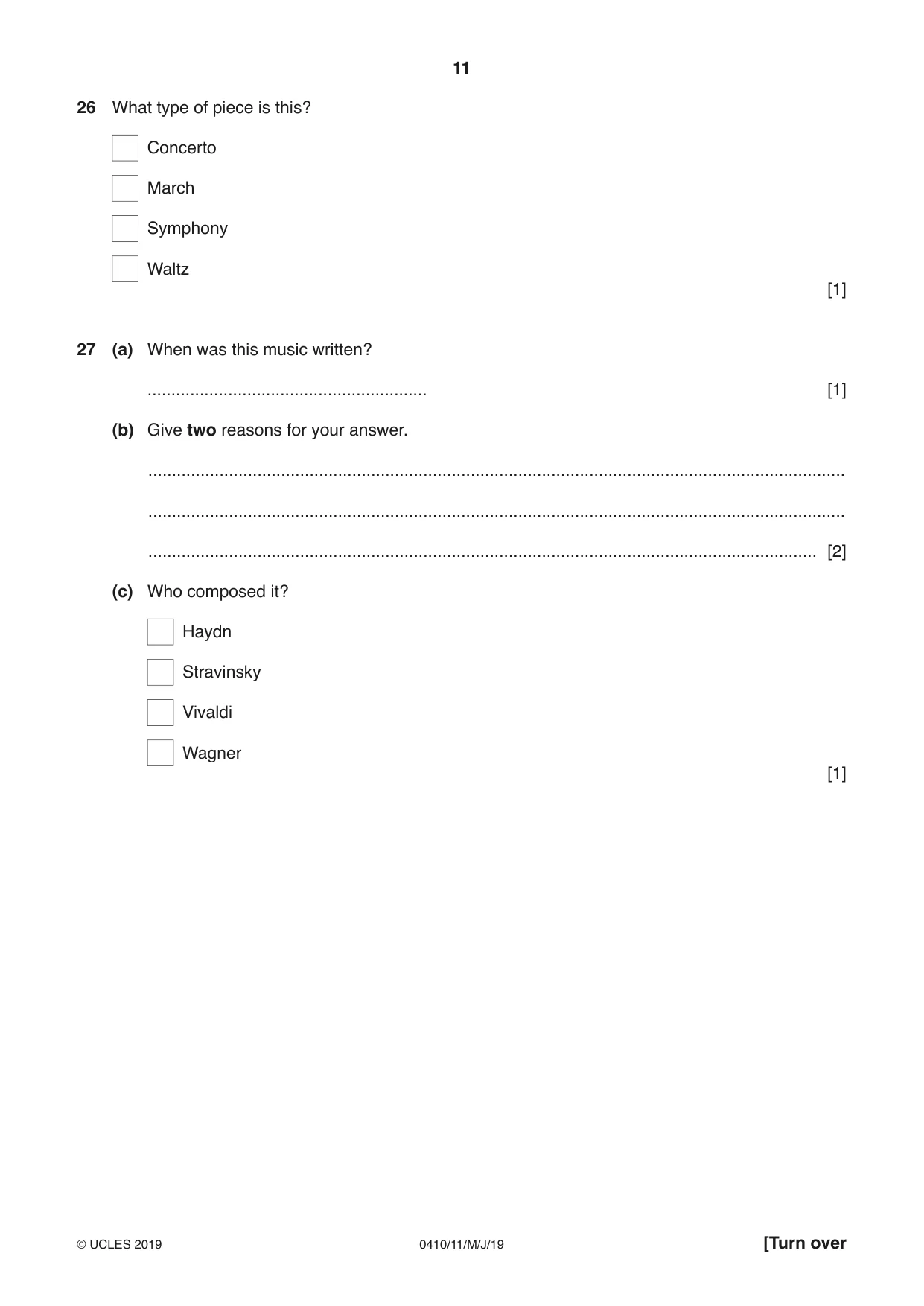
11 0410/11/M/J/19 © UCLES 2019 [Turn over 26 What type of piece is this? Concerto March Symphony Waltz [1] 27 (a) When was this music written? … [1] (b) Give two reasons for your answer. … … … [2] (c) Who composed it? Haydn Stravinsky Vivaldi Wagner [1]
Question paper, page 12
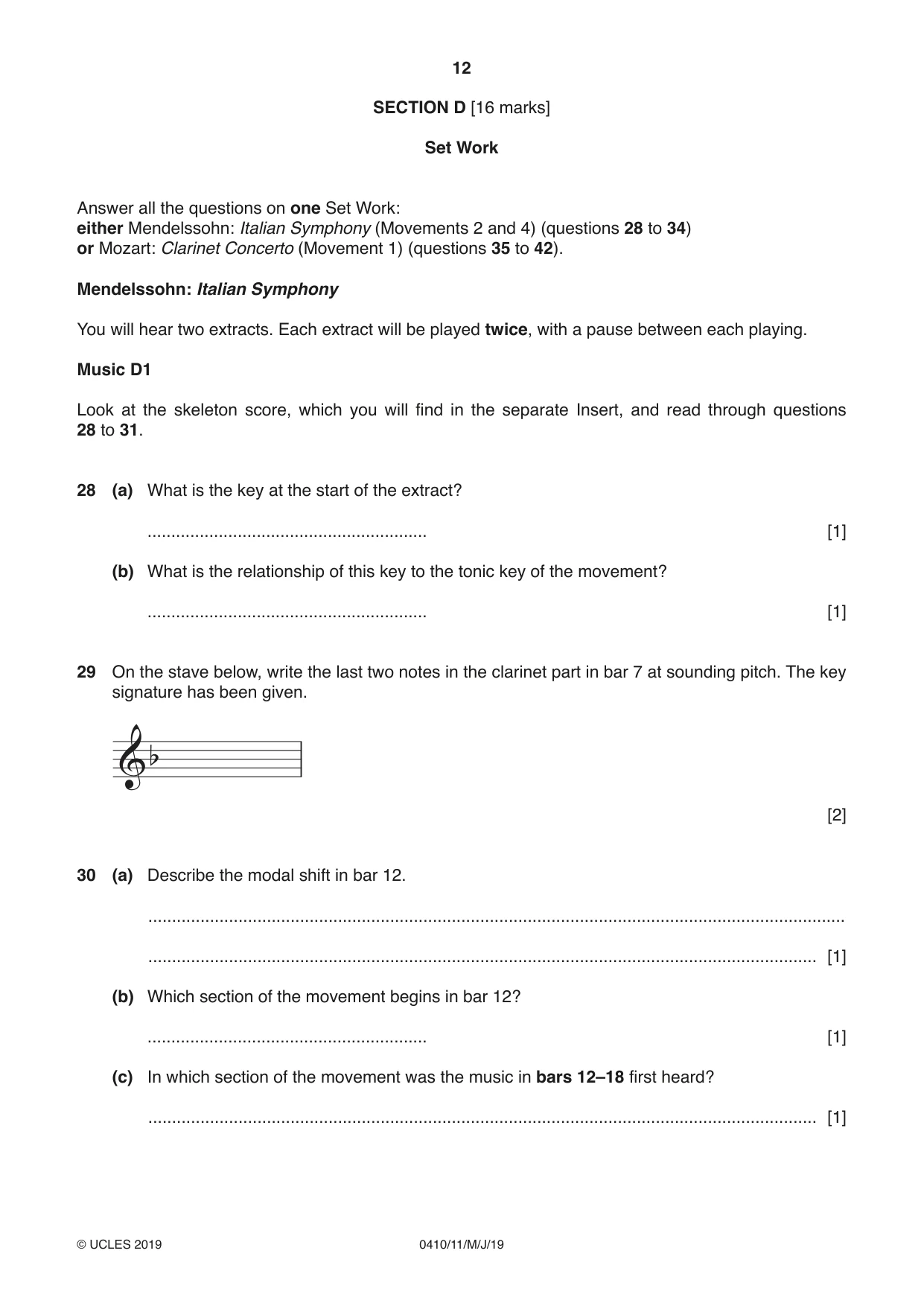
12 0410/11/M/J/19 © UCLES 2019 SECTION D [16 marks] Set Work Answer all the questions on one Set Work: either Mendelssohn: Italian Symphony (Movements 2 and 4) (questions 28 to 34) or Mozart: Clarinet Concerto (Movement 1) (questions 35 to 42). Mendelssohn: Italian Symphony You will hear two extracts. Each extract will be played twice, with a pause between each playing. Music D1 Look at the skeleton score, which you will find in the separate Insert, and read through questions 28 to 31. 28 (a) What is the key at the start of the extract? … [1] (b) What is the relationship of this key to the tonic key of the movement? … [1] 29 On the stave below, write the last two notes in the clarinet part in bar 7 at sounding pitch. The key signature has been given. &b [2] 30 (a) Describe the modal shift in bar 12. … … [1] (b) Which section of the movement begins in bar 12? … [1] (c) In which section of the movement was the music in bars 12–18 first heard? … [1]
Question paper, page 13
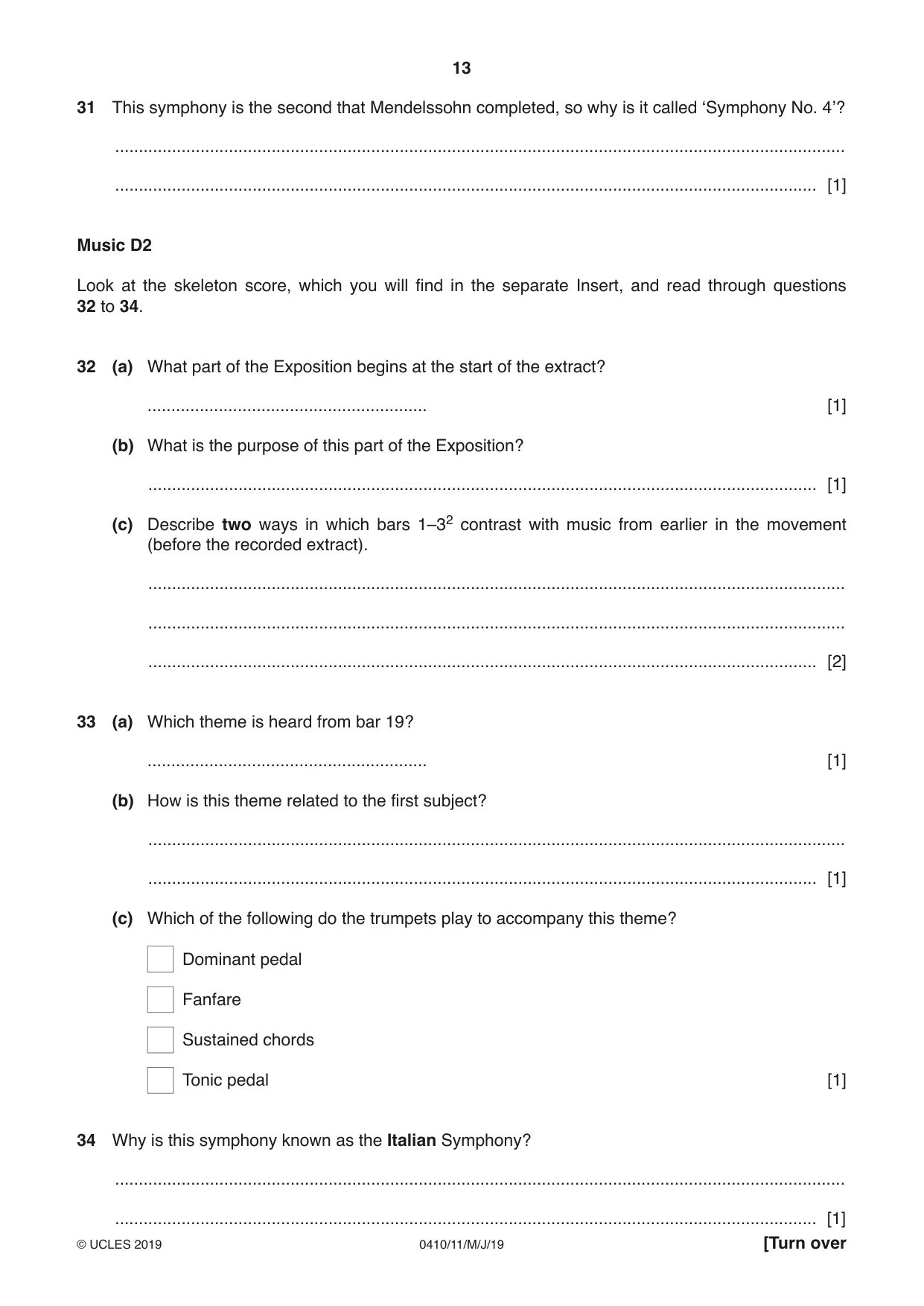
13 0410/11/M/J/19 © UCLES 2019 [Turn over 31 This symphony is the second that Mendelssohn completed, so why is it called ‘Symphony No. 4’? … … [1] Music D2 Look at the skeleton score, which you will find in the separate Insert, and read through questions 32 to 34. 32 (a) What part of the Exposition begins at the start of the extract? … [1] (b) What is the purpose of this part of the Exposition? … [1] (c) Describe two ways in which bars 1–32 contrast with music from earlier in the movement (before the recorded extract). … … … [2] 33 (a) Which theme is heard from bar 19? … [1] (b) How is this theme related to the first subject? … … [1] (c) Which of the following do the trumpets play to accompany this theme? Dominant pedal Fanfare Sustained chords Tonic pedal [1] 34 Why is this symphony known as the Italian Symphony? … … [1]
Question paper, page 14
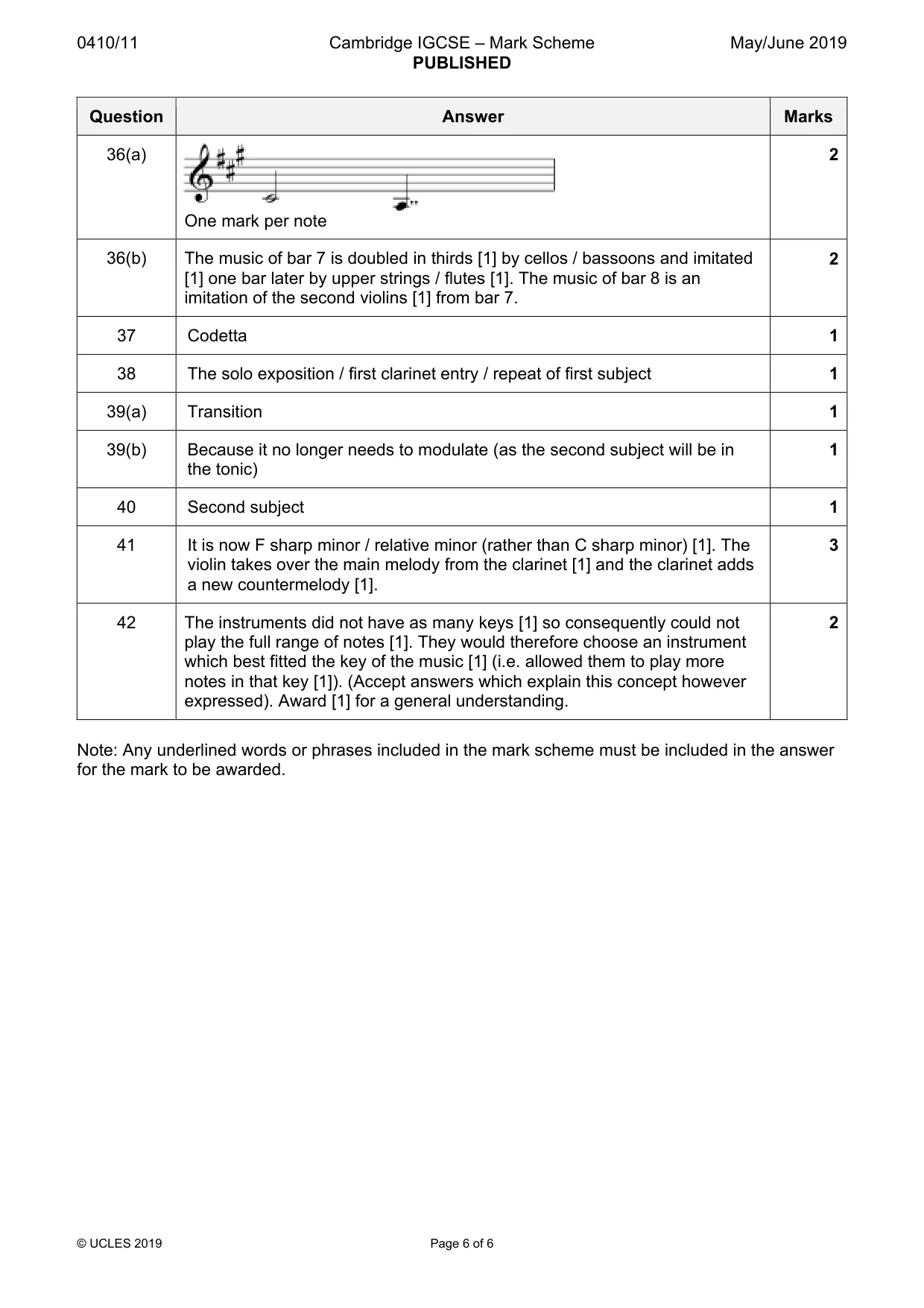
14 0410/11/M/J/19 © UCLES 2019 Mozart: Clarinet Concerto You will hear two extracts. Each extract will be played twice, with a pause between each playing. Music D3 Look at the skeleton score, which you will find in the separate Insert, and read through questions 35 to 38. 35 How is the theme which is played at the beginning of the extract different from when it was first heard in the movement (before the recorded extract)? … … … [2] 36 (a) On the stave below, write the first two notes of the viola part in bar 7 in the treble clef. The key signature has been given. [2] (b) Explain how the music played by the violas in bars 7–8 is related to the music of the other instruments. … … … [2] 37 What section of the movement starts in bar 253? … [1] 38 What is heard next in the movement (immediately after the recorded extract)? … … [1]
Question paper, page 15
15 0410/11/M/J/19 © UCLES 2019 Music D4 Look at the skeleton score, which you will find in the separate Insert, and read through questions 39 to 42. 39 (a) What section of the movement begins in bar 1? … [1] (b) Why does Mozart change the music from bar 4 compared with the equivalent section earlier in the movement (before the recorded extract)? … … [1] 40 What section of the movement begins in bar 17? … [1] 41 How is the music from bars 323–40 different from the equivalent passage earlier in the movement (before the recorded extract)? … … … … [3] 42 Clarinets in Mozart’s time were made in three keys: C, B flat and A. Why was this? … … … [2]
Question paper, page 16
16 0410/11/M/J/19 © UCLES 2019 Permission to reproduce items where third-party owned material protected by copyright is included has been sought and cleared where possible. Every reasonable effort has been made by the publisher (UCLES) to trace copyright holders, but if any items requiring clearance have unwittingly been included, the publisher will be pleased to make amends at the earliest possible opportunity. To avoid the issue of disclosure of answer-related information to candidates, all copyright acknowledgements are reproduced online in the Cambridge Assessment International Education Copyright Acknowledgements Booklet. This is produced for each series of examinations and is freely available to download at www.cambridgeinternational.org after the live examination series. Cambridge Assessment International Education is part of the Cambridge Assessment Group. Cambridge Assessment is the brand name of the University of Cambridge Local Examinations Syndicate (UCLES), which itself is a department of the University of Cambridge. BLANK PAGE
Mark scheme, page 1
This syllabus is regulated for use in England, Wales and Northern Ireland as a Cambridge International Level 1/Level 2 Certificate. This document consists of 6 printed pages. © UCLES 2019 [Turn over Cambridge Assessment International Education Cambridge International General Certificate of Secondary Education MUSIC 0410/11 Paper 1 Listening May/June 2019 MARK SCHEME Maximum Mark: 70 Published This mark scheme is published as an aid to teachers and candidates, to indicate the requirements of the examination. It shows the basis on which Examiners were instructed to award marks. It does not indicate the details of the discussions that took place at an Examiners’ meeting before marking began, which would have considered the acceptability of alternative answers. Mark schemes should be read in conjunction with the question paper and the Principal Examiner Report for Teachers. Cambridge International will not enter into discussions about these mark schemes. Cambridge International is publishing the mark schemes for the May/June 2019 series for most Cambridge IGCSE™, Cambridge International A and AS Level and Cambridge Pre-U components, and some Cambridge O Level components.
Mark scheme, page 2
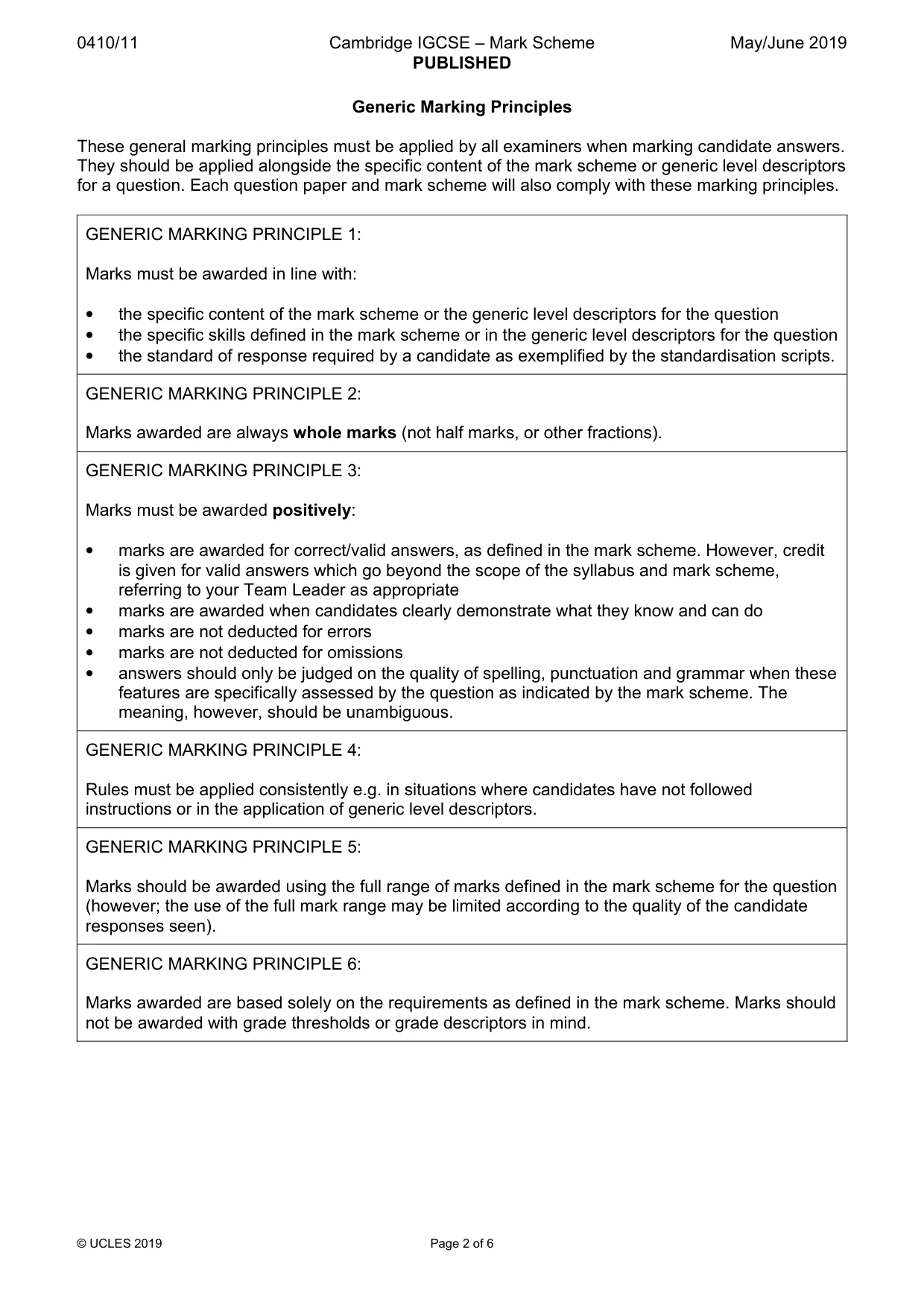
0410/11 Cambridge IGCSE – Mark Scheme PUBLISHED May/June 2019 © UCLES 2019 Page 2 of 6 Generic Marking Principles These general marking principles must be applied by all examiners when marking candidate answers. They should be applied alongside the specific content of the mark scheme or generic level descriptors for a question. Each question paper and mark scheme will also comply with these marking principles. GENERIC MARKING PRINCIPLE 1: Marks must be awarded in line with: • the specific content of the mark scheme or the generic level descriptors for the question • the specific skills defined in the mark scheme or in the generic level descriptors for the question • the standard of response required by a candidate as exemplified by the standardisation scripts. GENERIC MARKING PRINCIPLE 2: Marks awarded are always whole marks (not half marks, or other fractions). GENERIC MARKING PRINCIPLE 3: Marks must be awarded positively: • marks are awarded for correct/valid answers, as defined in the mark scheme. However, credit is given for valid answers which go beyond the scope of the syllabus and mark scheme, referring to your Team Leader as appropriate • marks are awarded when candidates clearly demonstrate what they know and can do • marks are not deducted for errors • marks are not deducted for omissions • answers should only be judged on the quality of spelling, punctuation and grammar when these features are specifically assessed by the question as indicated by the mark scheme. The meaning, however, should be unambiguous. GENERIC MARKING PRINCIPLE 4: Rules must be applied consistently e.g. in situations where candidates have not followed instructions or in the application of generic level descriptors. GENERIC MARKING PRINCIPLE 5: Marks should be awarded using the full range of marks defined in the mark scheme for the question (however; the use of the full mark range may be limited according to the quality of the candidate responses seen). GENERIC MARKING PRINCIPLE 6: Marks awarded are based solely on the requirements as defined in the mark scheme. Marks should not be awarded with grade thresholds or grade descriptors in mind.
Mark scheme, page 3
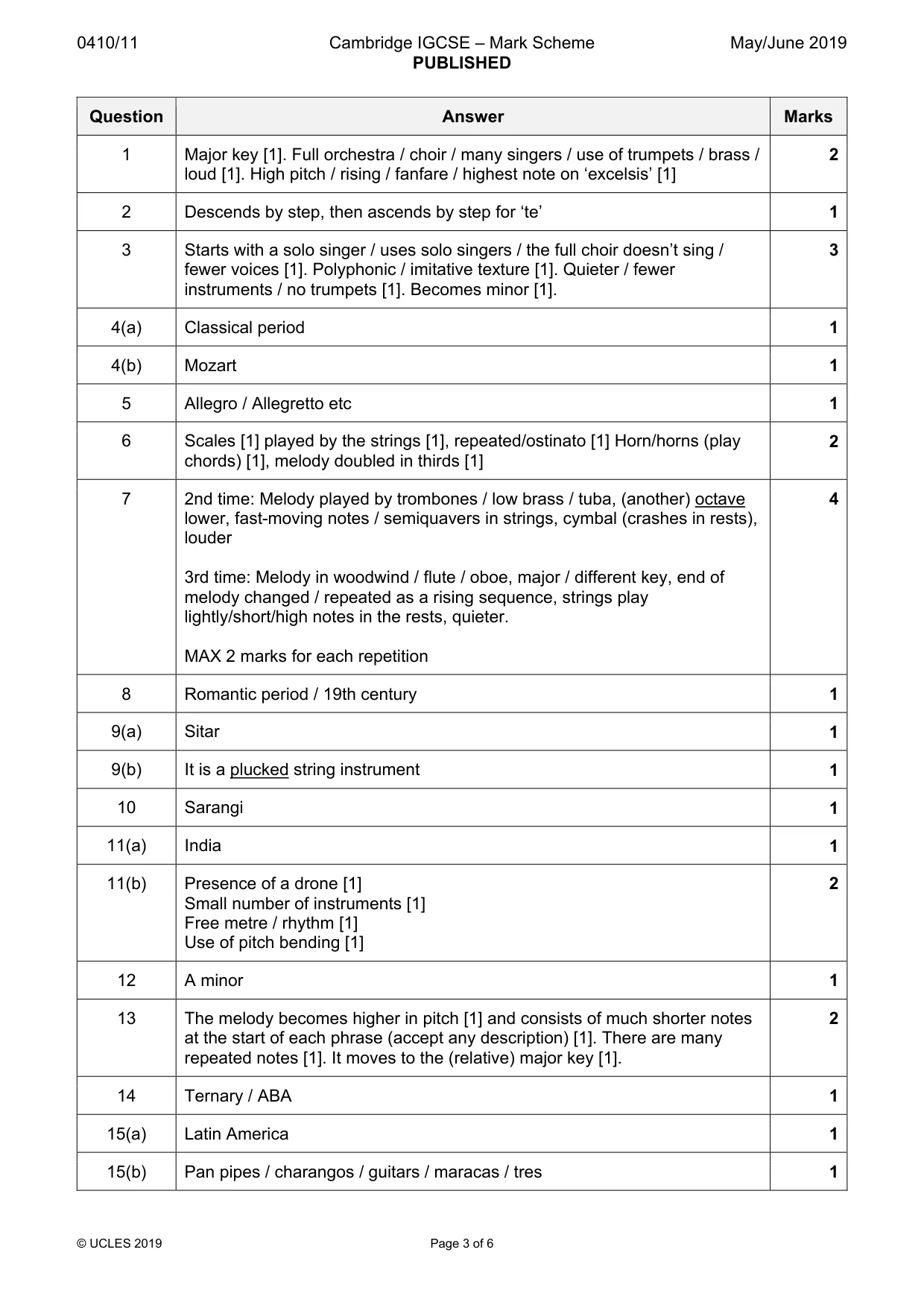
0410/11 Cambridge IGCSE – Mark Scheme PUBLISHED May/June 2019 © UCLES 2019 Page 3 of 6 Question Answer Marks 1 Major key [1]. Full orchestra / choir / many singers / use of trumpets / brass / loud [1]. High pitch / rising / fanfare / highest note on ‘excelsis’ [1] 2 2 Descends by step, then ascends by step for ‘te’ 1 3 Starts with a solo singer / uses solo singers / the full choir doesn’t sing / fewer voices [1]. Polyphonic / imitative texture [1]. Quieter / fewer instruments / no trumpets [1]. Becomes minor [1]. 3 4(a) Classical period 1 4(b) Mozart 1 5 Allegro / Allegretto etc 1 6 Scales [1] played by the strings [1], repeated/ostinato [1] Horn/horns (play chords) [1], melody doubled in thirds [1] 2 7 2nd time: Melody played by trombones / low brass / tuba, (another) octave lower, fast-moving notes / semiquavers in strings, cymbal (crashes in rests), louder 3rd time: Melody in woodwind / flute / oboe, major / different key, end of melody changed / repeated as a rising sequence, strings play lightly/short/high notes in the rests, quieter. MAX 2 marks for each repetition 4 8 Romantic period / 19th century 1 9(a) Sitar 1 9(b) It is a plucked string instrument 1 10 Sarangi 1 11(a) India 1 11(b) Presence of a drone [1] Small number of instruments [1] Free metre / rhythm [1] Use of pitch bending [1] 2 12 A minor 1 13 The melody becomes higher in pitch [1] and consists of much shorter notes at the start of each phrase (accept any description) [1]. There are many repeated notes [1]. It moves to the (relative) major key [1]. 2 14 Ternary / ABA 1 15(a) Latin America 1 15(b) Pan pipes / charangos / guitars / maracas / tres 1
Mark scheme, page 4
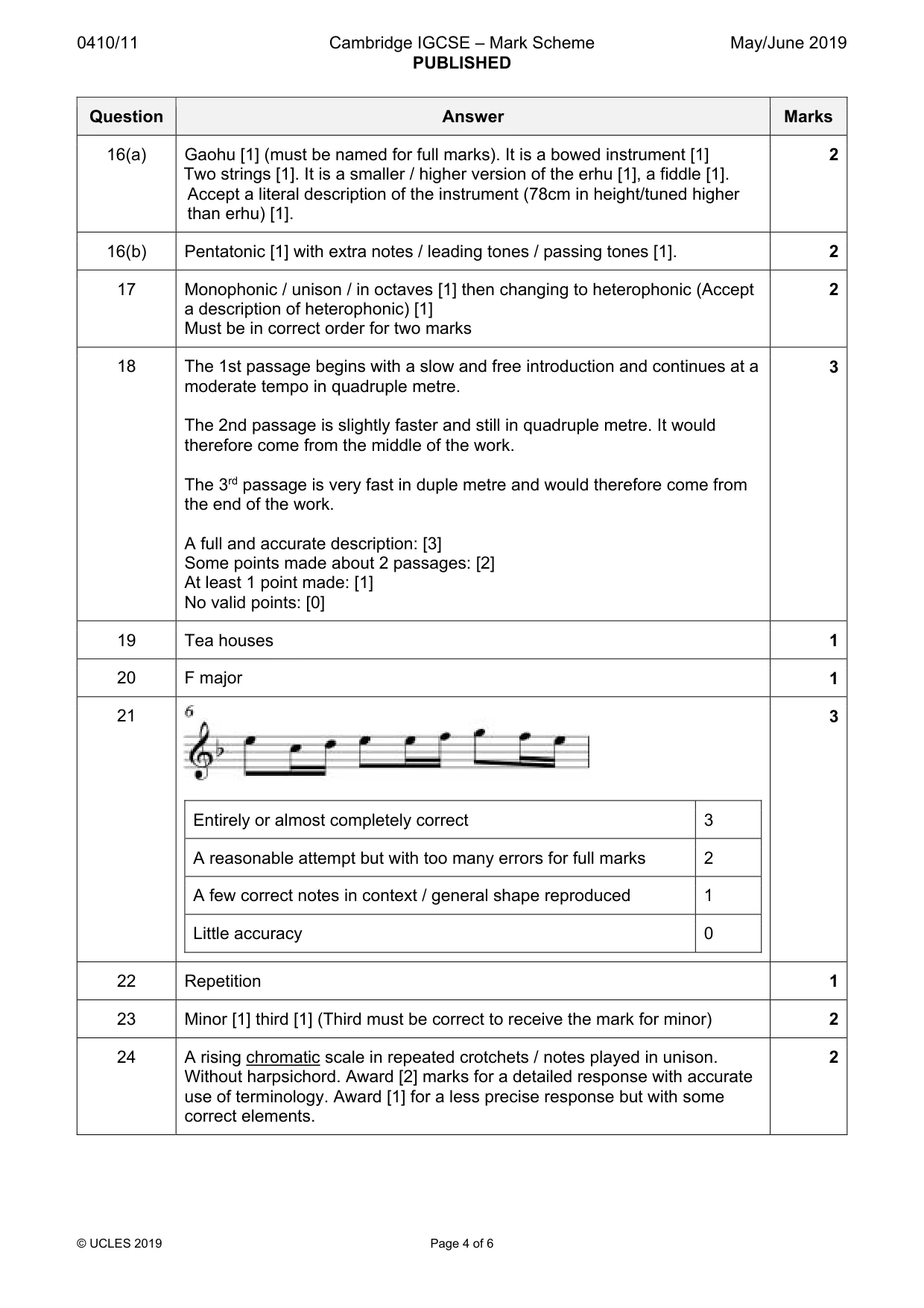
0410/11 Cambridge IGCSE – Mark Scheme PUBLISHED May/June 2019 © UCLES 2019 Page 4 of 6 Question Answer Marks 16(a) Gaohu [1] (must be named for full marks). It is a bowed instrument [1] Two strings [1]. It is a smaller / higher version of the erhu [1], a fiddle [1]. Accept a literal description of the instrument (78cm in height/tuned higher than erhu) [1]. 2 16(b) Pentatonic [1] with extra notes / leading tones / passing tones [1]. 2 17 Monophonic / unison / in octaves [1] then changing to heterophonic (Accept a description of heterophonic) [1] Must be in correct order for two marks 2 18 The 1st passage begins with a slow and free introduction and continues at a moderate tempo in quadruple metre. The 2nd passage is slightly faster and still in quadruple metre. It would therefore come from the middle of the work. The 3rd passage is very fast in duple metre and would therefore come from the end of the work. A full and accurate description: [3] Some points made about 2 passages: [2] At least 1 point made: [1] No valid points: [0] 3 19 Tea houses 1 20 F major 1 21 Entirely or almost completely correct 3 A reasonable attempt but with too many errors for full marks 2 A few correct notes in context / general shape reproduced 1 Little accuracy 0 3 22 Repetition 1 23 Minor [1] third [1] (Third must be correct to receive the mark for minor) 2 24 A rising chromatic scale in repeated crotchets / notes played in unison. Without harpsichord. Award [2] marks for a detailed response with accurate use of terminology. Award [1] for a less precise response but with some correct elements. 2
Mark scheme, page 5
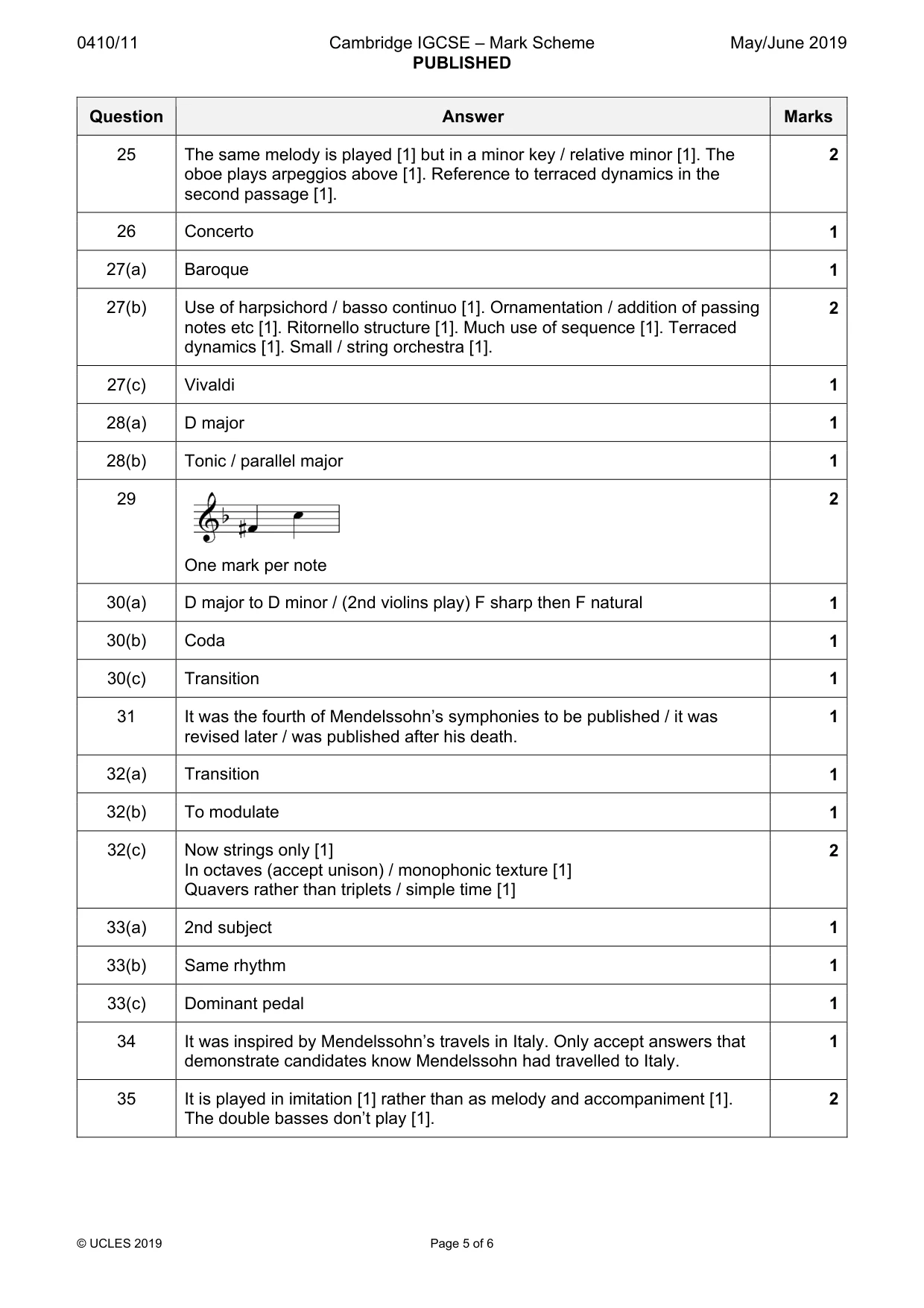
0410/11 Cambridge IGCSE – Mark Scheme PUBLISHED May/June 2019 © UCLES 2019 Page 5 of 6 Question Answer Marks 25 The same melody is played [1] but in a minor key / relative minor [1]. The oboe plays arpeggios above [1]. Reference to terraced dynamics in the second passage [1]. 2 26 Concerto 1 27(a) Baroque 1 27(b) Use of harpsichord / basso continuo [1]. Ornamentation / addition of passing notes etc [1]. Ritornello structure [1]. Much use of sequence [1]. Terraced dynamics [1]. Small / string orchestra [1]. 2 27(c) Vivaldi 1 28(a) D major 1 28(b) Tonic / parallel major 1 29 One mark per note 2 30(a) D major to D minor / (2nd violins play) F sharp then F natural 1 30(b) Coda 1 30(c) Transition 1 31 It was the fourth of Mendelssohn’s symphonies to be published / it was revised later / was published after his death. 1 32(a) Transition 1 32(b) To modulate 1 32(c) Now strings only [1] In octaves (accept unison) / monophonic texture [1] Quavers rather than triplets / simple time [1] 2 33(a) 2nd subject 1 33(b) Same rhythm 1 33(c) Dominant pedal 1 34 It was inspired by Mendelssohn’s travels in Italy. Only accept answers that demonstrate candidates know Mendelssohn had travelled to Italy. 1 35 It is played in imitation [1] rather than as melody and accompaniment [1]. The double basses don’t play [1]. 2
Mark scheme, page 6
0410/11 Cambridge IGCSE – Mark Scheme PUBLISHED May/June 2019 © UCLES 2019 Page 6 of 6 Question Answer Marks 36(a) One mark per note 2 36(b) The music of bar 7 is doubled in thirds [1] by cellos / bassoons and imitated [1] one bar later by upper strings / flutes [1]. The music of bar 8 is an imitation of the second violins [1] from bar 7. 2 37 Codetta 1 38 The solo exposition / first clarinet entry / repeat of first subject 1 39(a) Transition 1 39(b) Because it no longer needs to modulate (as the second subject will be in the tonic) 1 40 Second subject 1 41 It is now F sharp minor / relative minor (rather than C sharp minor) [1]. The violin takes over the main melody from the clarinet [1] and the clarinet adds a new countermelody [1]. 3 42 The instruments did not have as many keys [1] so consequently could not play the full range of notes [1]. They would therefore choose an instrument which best fitted the key of the music [1] (i.e. allowed them to play more notes in that key [1]). (Accept answers which explain this concept however expressed). Award [1] for a general understanding. 2 Note: Any underlined words or phrases included in the mark scheme must be included in the answer for the mark to be awarded.
What you needed in this session
Cambridge’s own grade thresholds for 2019 May/June, Paper 1 · Variant 1. A higher threshold means an easier paper — the bar moves with how the cohort did.