Cambridge IGCSE Music 0410 — 2008 May/June Paper 2 · Variant 1
0410/21/M/J/08 · 40 marks · ≈45 min
The question paper and its mark scheme, free to read here and free to download. This is Cambridge’s own paper, exactly as it was sat.
Question paper16 pages

Mark scheme8 pages
Answers below. Sit the paper first if you are practising.
Paper as text
Question paper, page 1
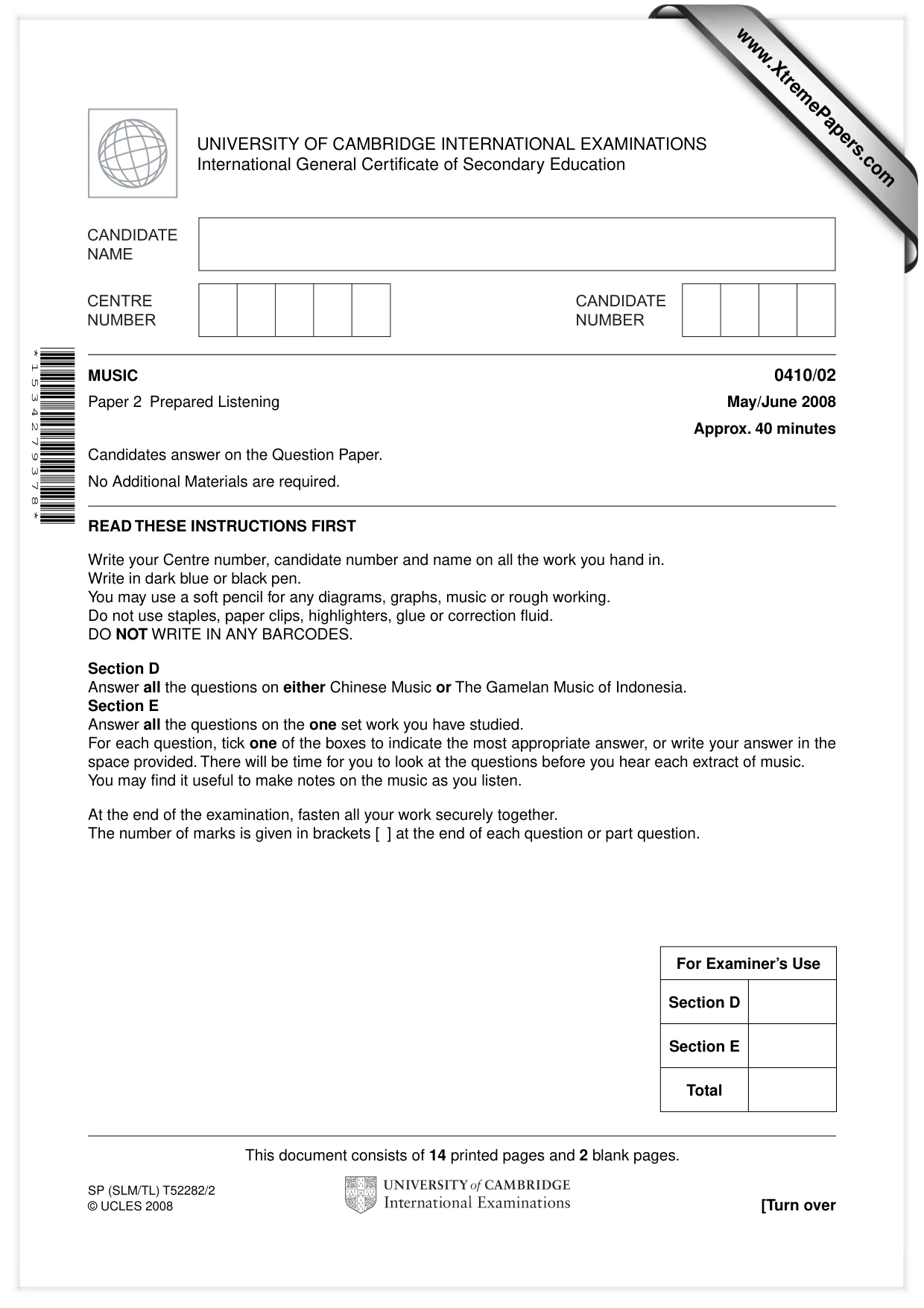
This document consists of 14 printed pages and 2 blank pages. SP (SLM/TL) T52282/2 © UCLES 2008 [Turn over UNIVERSITY OF CAMBRIDGE INTERNATIONAL EXAMINATIONS International General Certificate of Secondary Education READ THESE INSTRUCTIONS FIRST Write your Centre number, candidate number and name on all the work you hand in. Write in dark blue or black pen. You may use a soft pencil for any diagrams, graphs, music or rough working. Do not use staples, paper clips, highlighters, glue or correction fluid. DO NOT WRITE IN ANY BARCODES. Section D Answer all the questions on either Chinese Music or The Gamelan Music of Indonesia. Section E Answer all the questions on the one set work you have studied. For each question, tick one of the boxes to indicate the most appropriate answer, or write your answer in the space provided. There will be time for you to look at the questions before you hear each extract of music. You may find it useful to make notes on the music as you listen. At the end of the examination, fasten all your work securely together. The number of marks is given in brackets [ ] at the end of each question or part question. * 1 5 3 4 2 7 9 3 7 8 * MUSIC 0410/02 Paper 2 Prepared Listening May/June 2008 Approx. 40 minutes Candidates answer on the Question Paper. No Additional Materials are required. For Examiner’s Use Section D Section E Total www.XtremePapers.com
Question paper, page 2
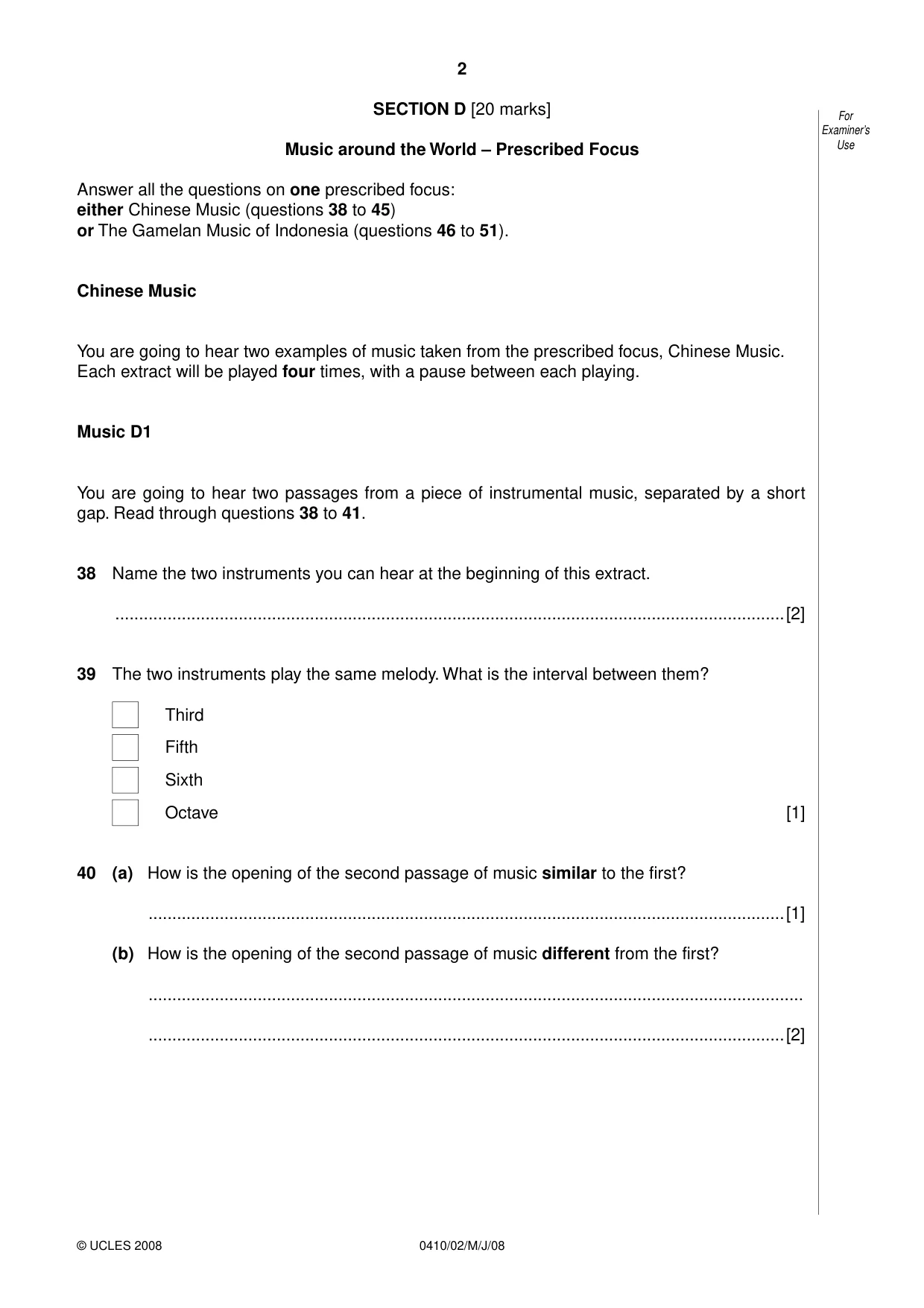
2 0410/02/M/J/08 © UCLES 2008 For Examiner’s Use SECTION D [20 marks] Music around the World – Prescribed Focus Answer all the questions on one prescribed focus: either Chinese Music (questions 38 to 45) or The Gamelan Music of Indonesia (questions 46 to 51). Chinese Music You are going to hear two examples of music taken from the prescribed focus, Chinese Music. Each extract will be played four times, with a pause between each playing. Music D1 You are going to hear two passages from a piece of instrumental music, separated by a short gap. Read through questions 38 to 41. 38 Name the two instruments you can hear at the beginning of this extract. …[2] 39 The two instruments play the same melody. What is the interval between them? Third Fifth Sixth Octave [1] 40 (a) How is the opening of the second passage of music similar to the first? …[1] (b) How is the opening of the second passage of music different from the first? … …[2]
Question paper, page 3
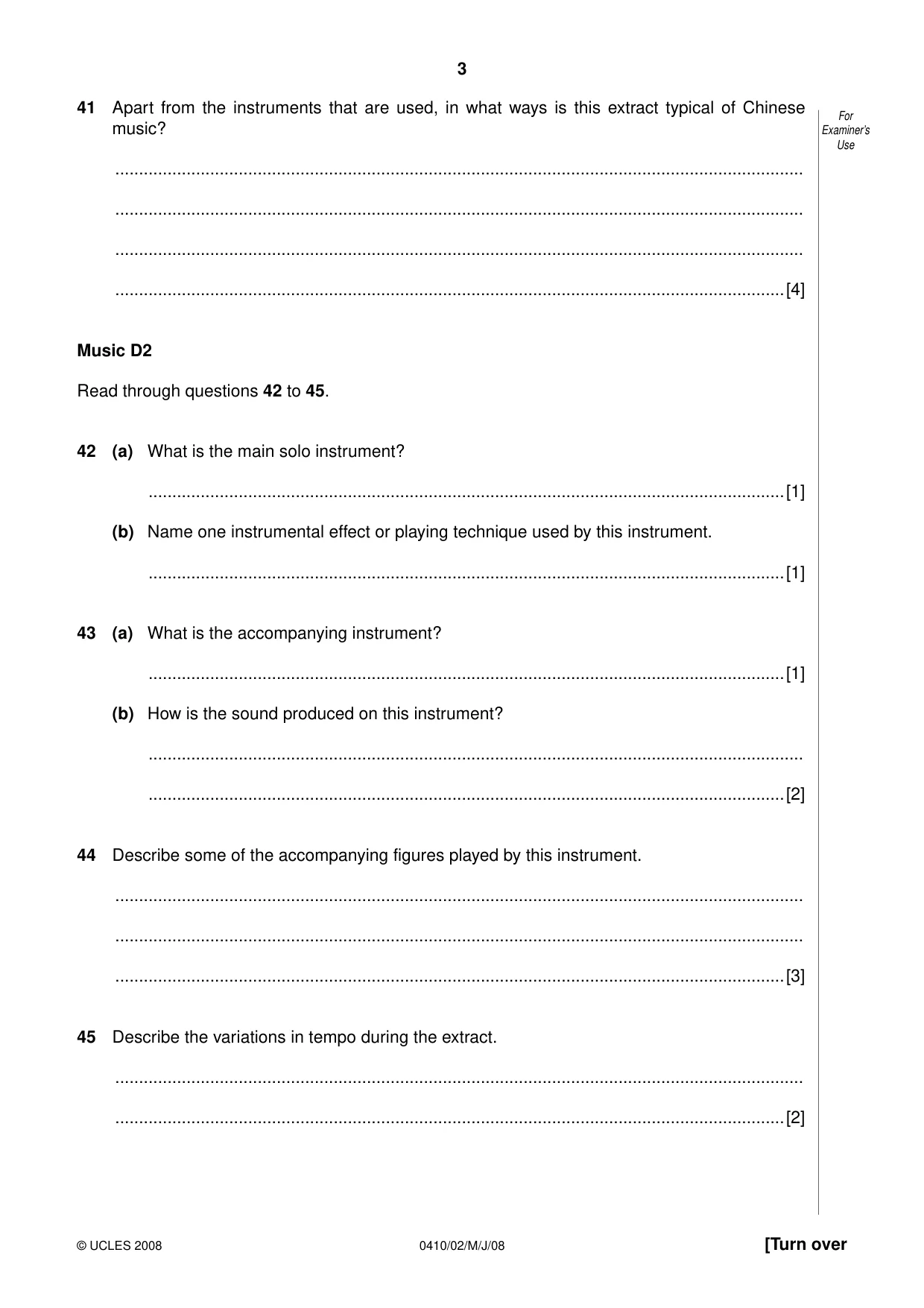
3 0410/02/M/J/08 © UCLES 2008 [Turn over For Examiner’s Use 41 Apart from the instruments that are used, in what ways is this extract typical of Chinese music? … … … …[4] Music D2 Read through questions 42 to 45. 42 (a) What is the main solo instrument? …[1] (b) Name one instrumental effect or playing technique used by this instrument. …[1] 43 (a) What is the accompanying instrument? …[1] (b) How is the sound produced on this instrument? … …[2] 44 Describe some of the accompanying figures played by this instrument. … … …[3] 45 Describe the variations in tempo during the extract. … …[2]
Question paper, page 4
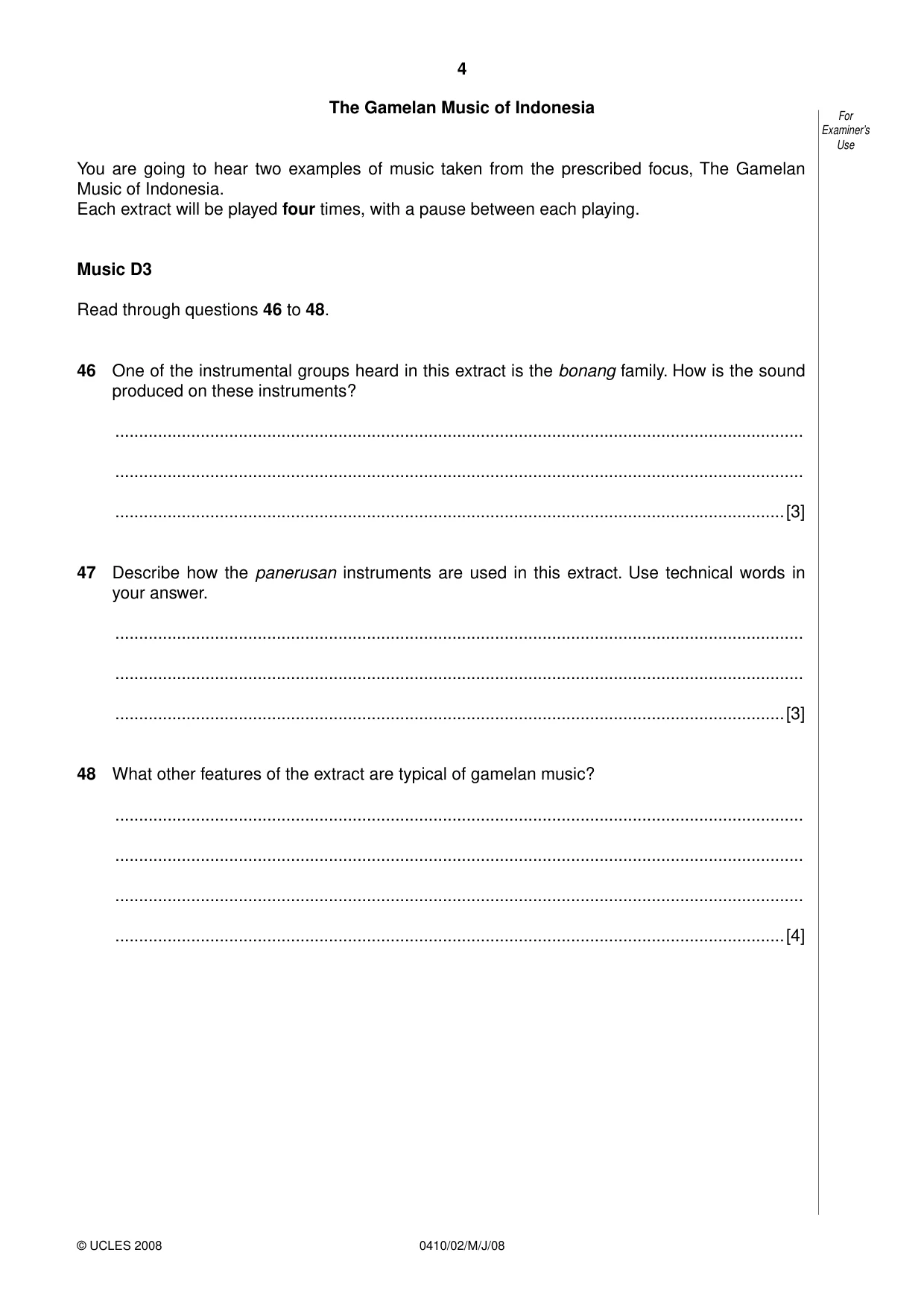
4 0410/02/M/J/08 © UCLES 2008 For Examiner’s Use The Gamelan Music of Indonesia You are going to hear two examples of music taken from the prescribed focus, The Gamelan Music of Indonesia. Each extract will be played four times, with a pause between each playing. Music D3 Read through questions 46 to 48. 46 One of the instrumental groups heard in this extract is the bonang family. How is the sound produced on these instruments? … … …[3] 47 Describe how the panerusan instruments are used in this extract. Use technical words in your answer. … … …[3] 48 What other features of the extract are typical of gamelan music? … … … …[4]
Question paper, page 5
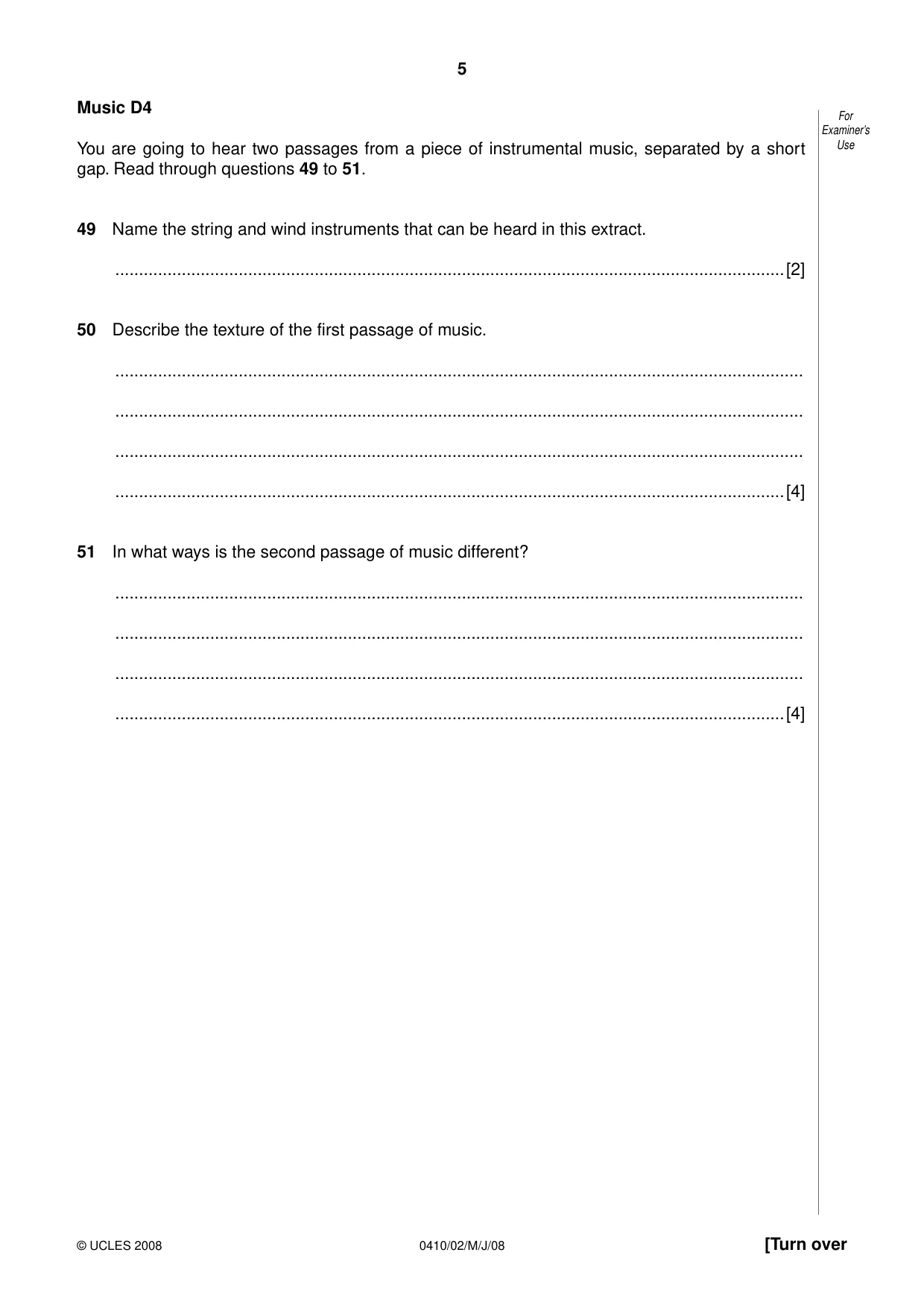
5 0410/02/M/J/08 © UCLES 2008 [Turn over For Examiner’s Use Music D4 You are going to hear two passages from a piece of instrumental music, separated by a short gap. Read through questions 49 to 51. 49 Name the string and wind instruments that can be heard in this extract. …[2] 50 Describe the texture of the first passage of music. … … … …[4] 51 In what ways is the second passage of music different? … … … …[4]
Question paper, page 6
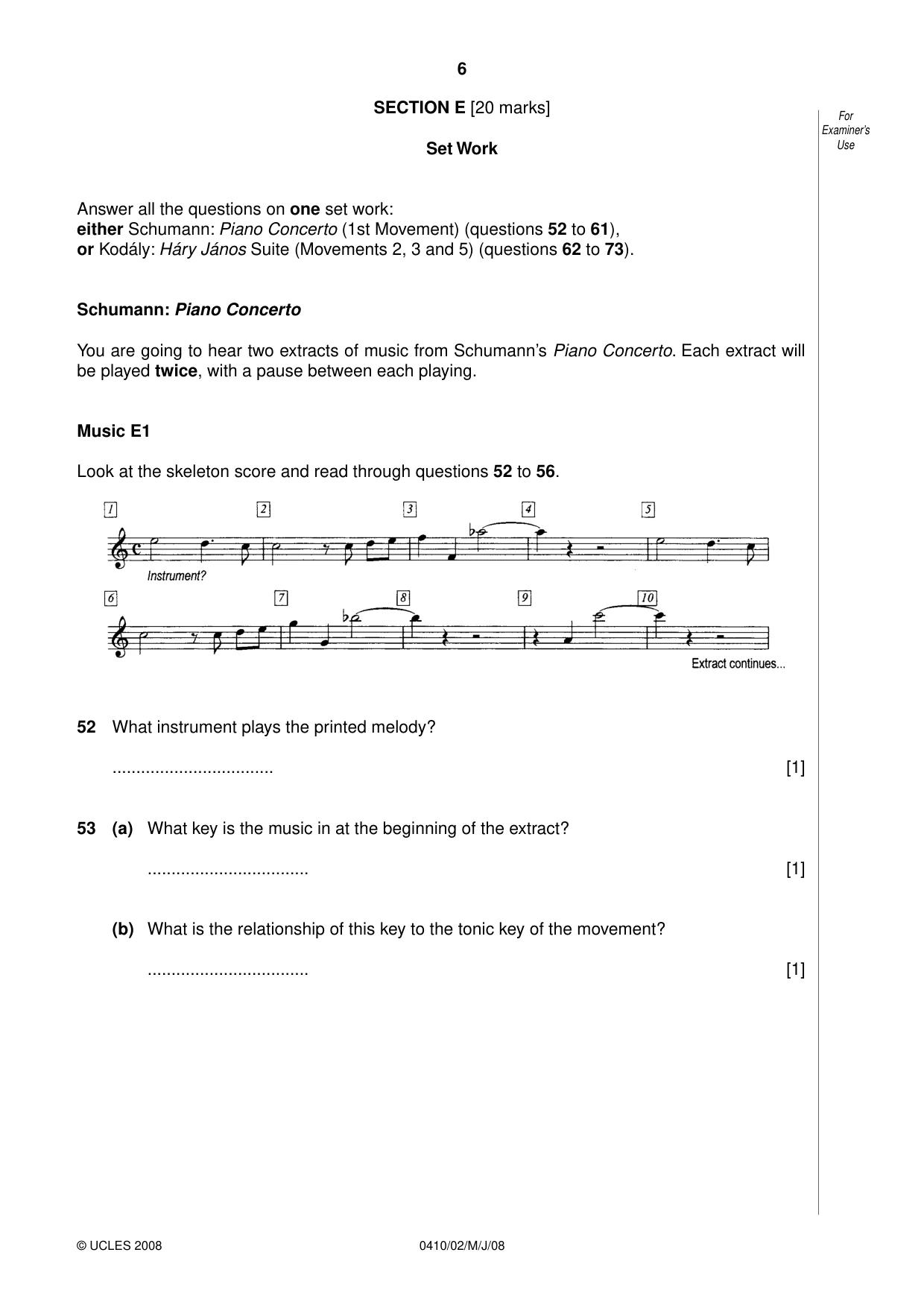
6 0410/02/M/J/08 © UCLES 2008 For Examiner’s Use SECTION E [20 marks] Set Work Answer all the questions on one set work: either Schumann: Piano Concerto (1st Movement) (questions 52 to 61), or Kodály: Háry János Suite (Movements 2, 3 and 5) (questions 62 to 73). Schumann: Piano Concerto You are going to hear two extracts of music from Schumann’s Piano Concerto. Each extract will be played twice, with a pause between each playing. Music E1 Look at the skeleton score and read through questions 52 to 56. 52 What instrument plays the printed melody? … [1] 53 (a) What key is the music in at the beginning of the extract? … [1] (b) What is the relationship of this key to the tonic key of the movement? … [1]
Question paper, page 7
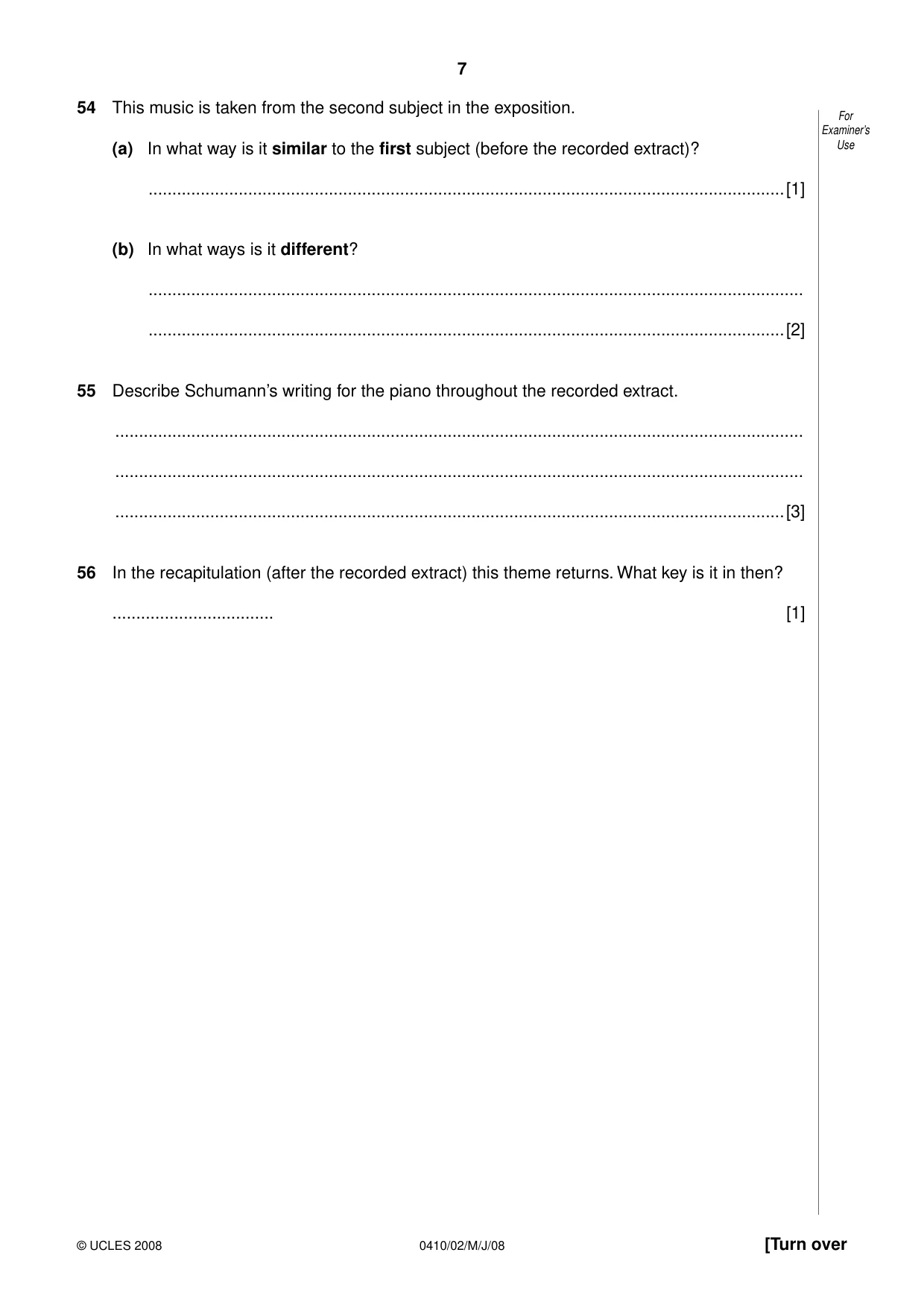
7 0410/02/M/J/08 © UCLES 2008 [Turn over For Examiner’s Use 54 This music is taken from the second subject in the exposition. (a) In what way is it similar to the first subject (before the recorded extract)? …[1] (b) In what ways is it different? … …[2] 55 Describe Schumann’s writing for the piano throughout the recorded extract. … … …[3] 56 In the recapitulation (after the recorded extract) this theme returns. What key is it in then? … [1]
Question paper, page 8
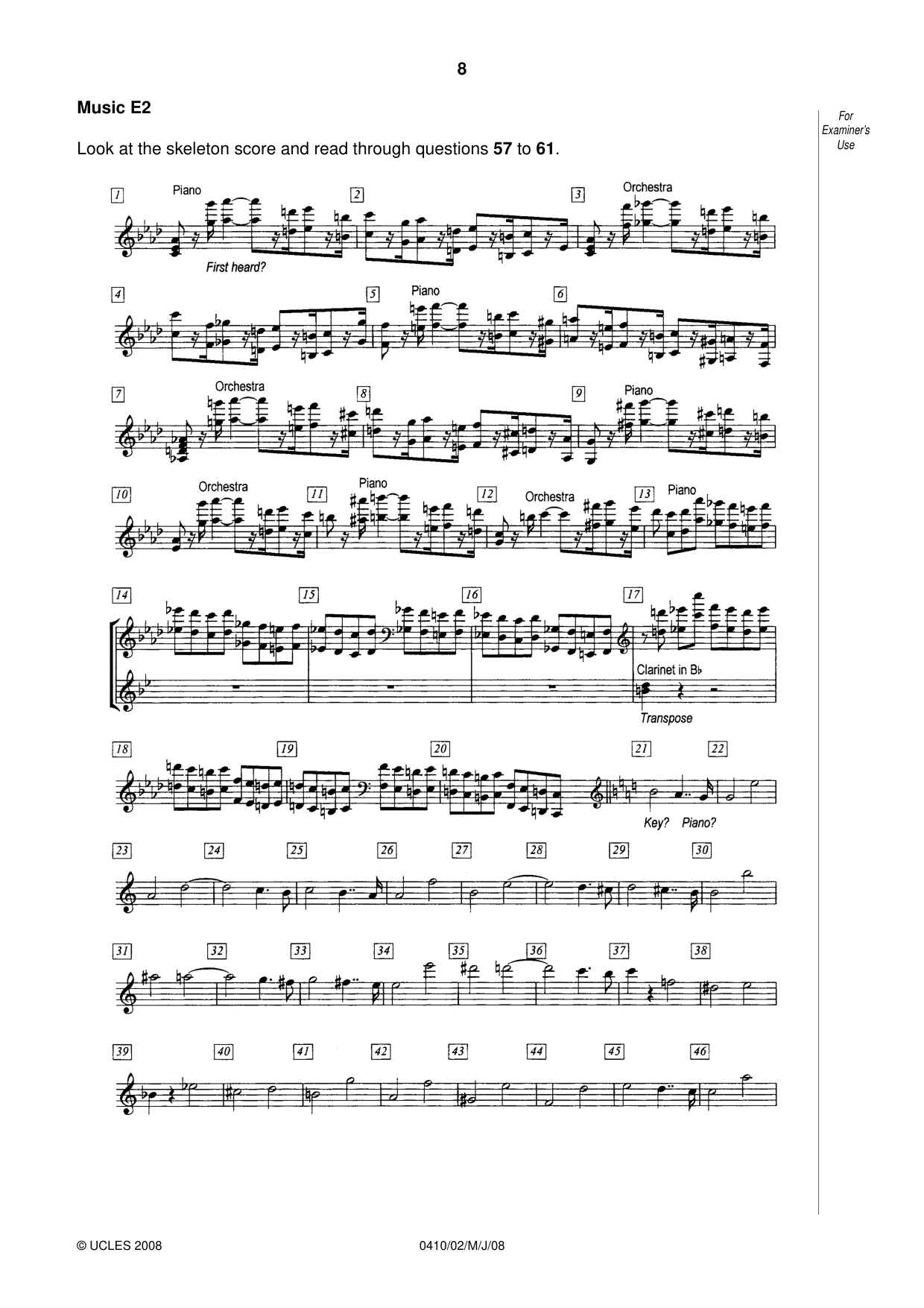
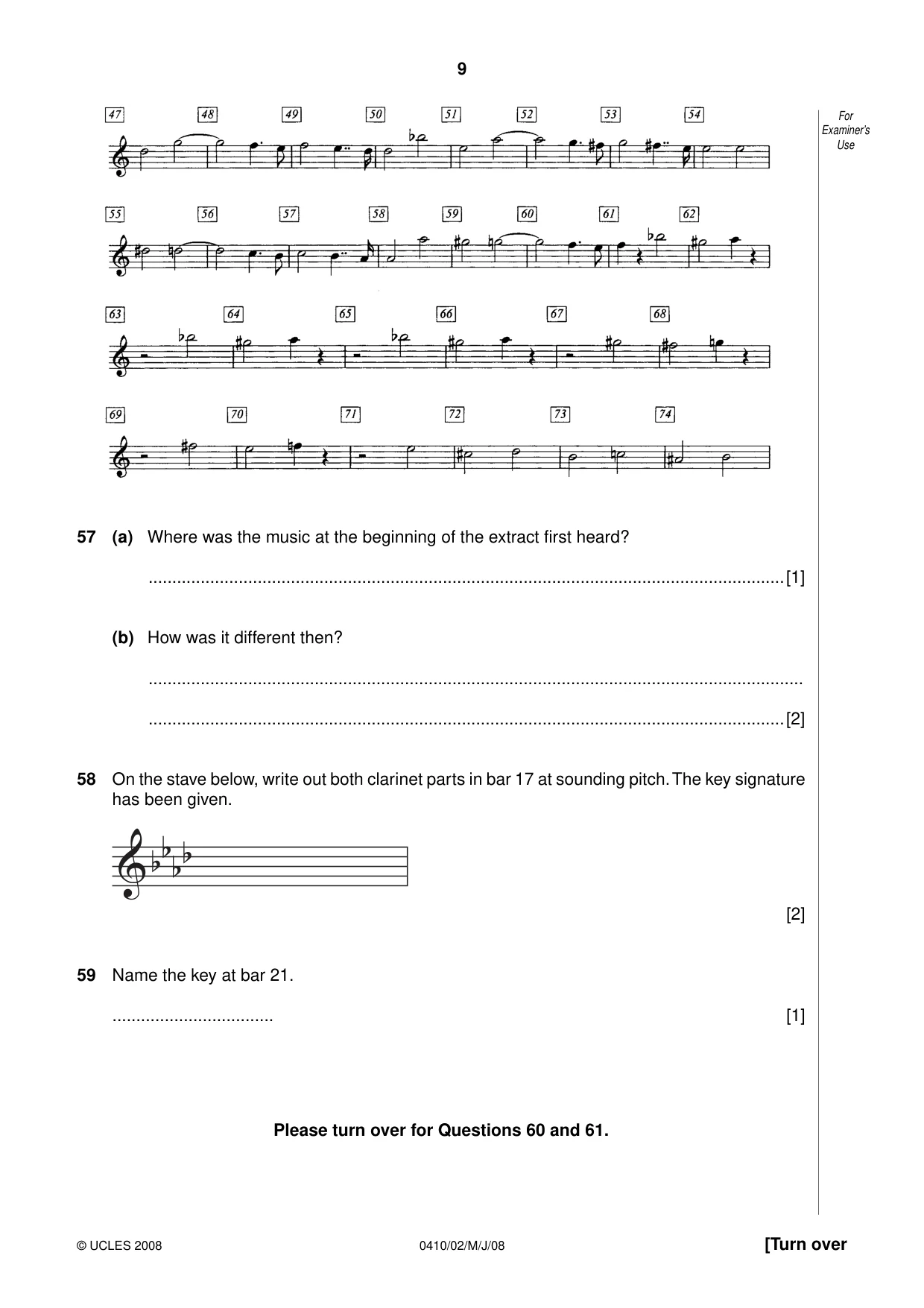
8 0410/02/M/J/08 © UCLES 2008 For Examiner’s Use Music E2 Look at the skeleton score and read through questions 57 to 61.
Question paper, page 9
9 0410/02/M/J/08 © UCLES 2008 [Turn over For Examiner’s Use 57 (a) Where was the music at the beginning of the extract first heard? …[1] (b) How was it different then? … …[2] 58 On the stave below, write out both clarinet parts in bar 17 at sounding pitch. The key signature has been given. [2] 59 Name the key at bar 21. … [1] Please turn over for Questions 60 and 61.
Question paper, page 10
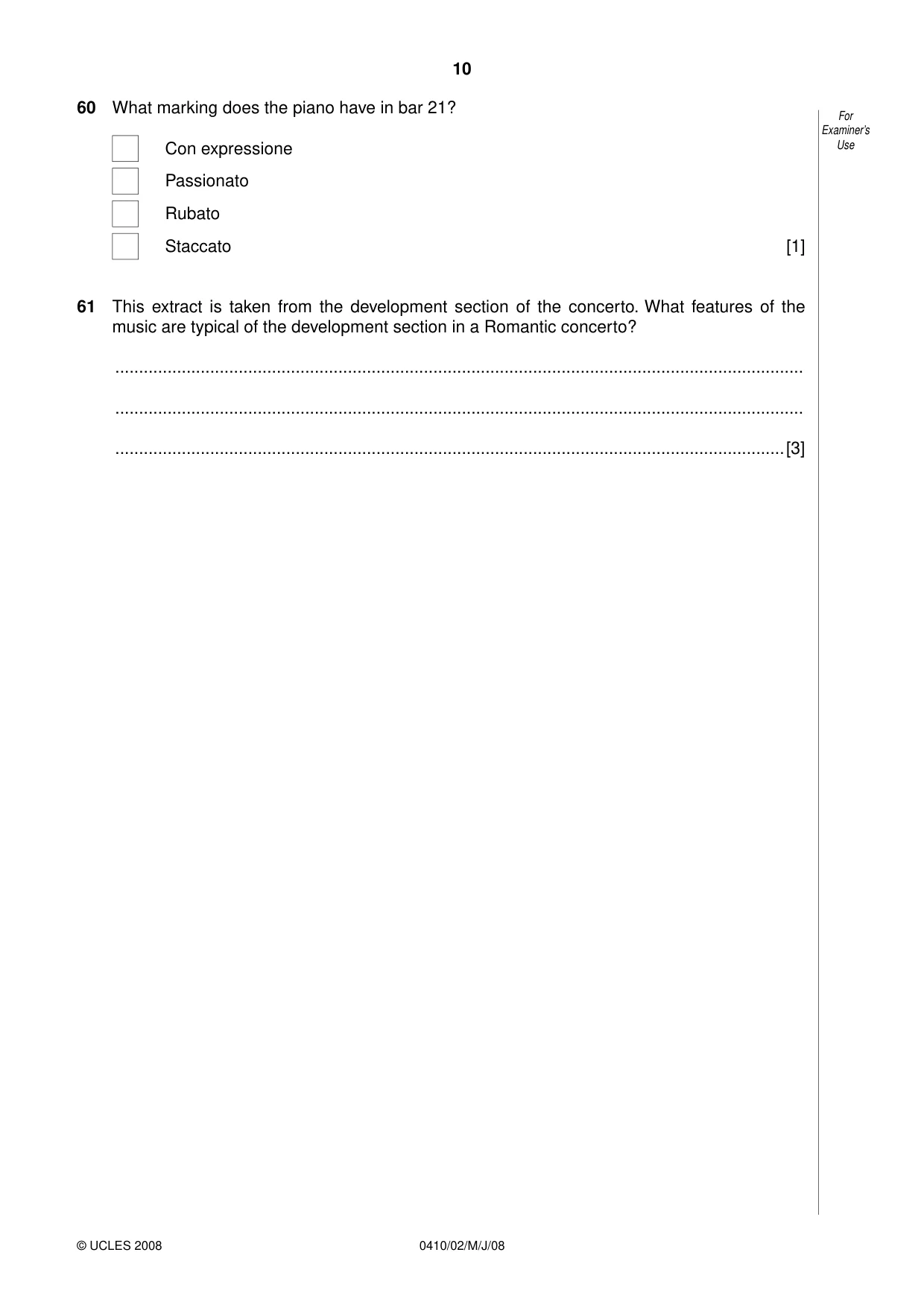
10 0410/02/M/J/08 © UCLES 2008 For Examiner’s Use 60 What marking does the piano have in bar 21? Con expressione Passionato Rubato Staccato [1] 61 This extract is taken from the development section of the concerto. What features of the music are typical of the development section in a Romantic concerto? … … …[3]
Question paper, page 12
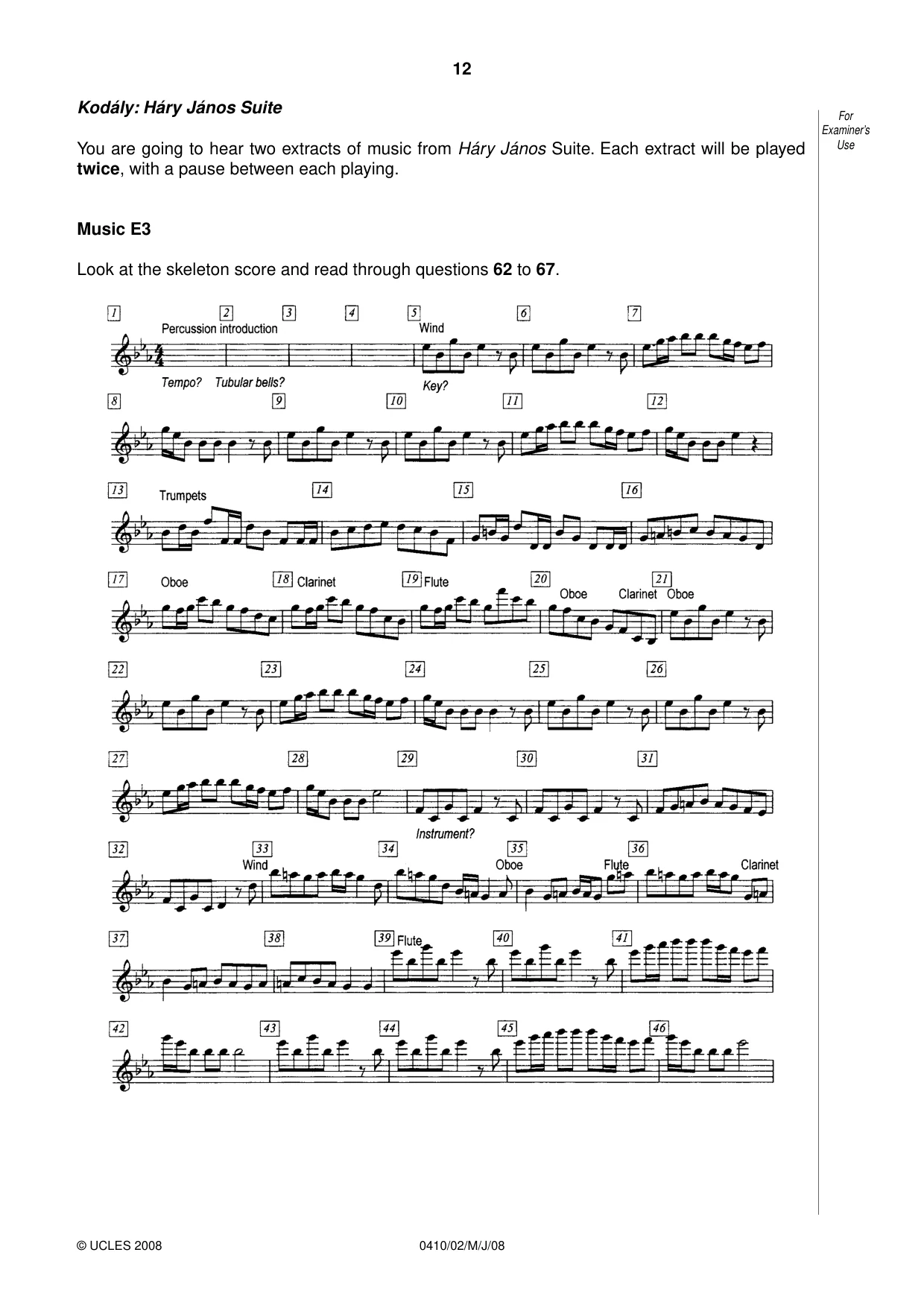
12 0410/02/M/J/08 © UCLES 2008 For Examiner’s Use Kodály: Háry János Suite You are going to hear two extracts of music from Háry János Suite. Each extract will be played twice, with a pause between each playing. Music E3 Look at the skeleton score and read through questions 62 to 67.
Question paper, page 13
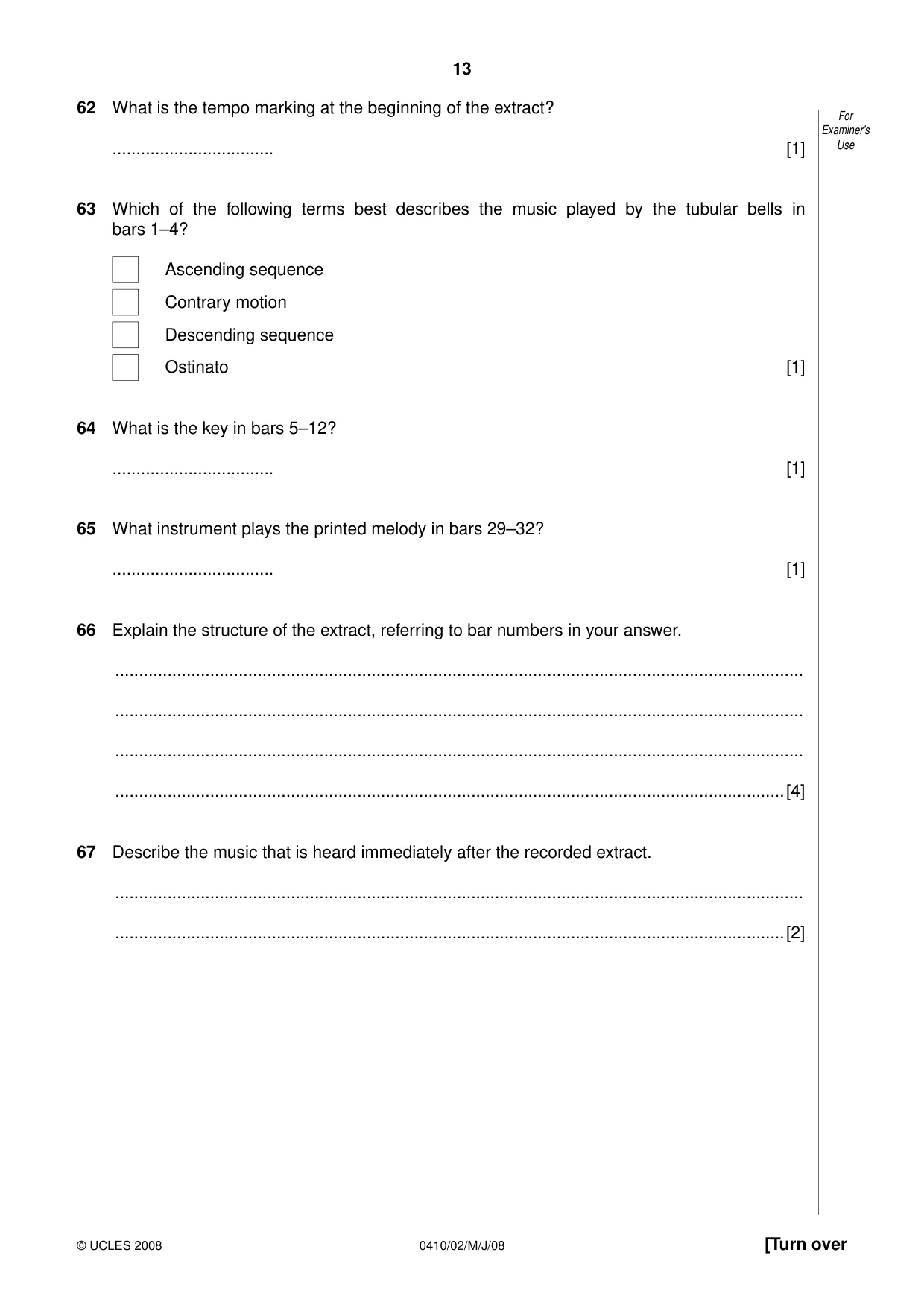
13 0410/02/M/J/08 © UCLES 2008 [Turn over For Examiner’s Use 62 What is the tempo marking at the beginning of the extract? … [1] 63 Which of the following terms best describes the music played by the tubular bells in bars 1–4? Ascending sequence Contrary motion Descending sequence Ostinato [1] 64 What is the key in bars 5–12? … [1] 65 What instrument plays the printed melody in bars 29–32? … [1] 66 Explain the structure of the extract, referring to bar numbers in your answer. … … … …[4] 67 Describe the music that is heard immediately after the recorded extract. … …[2]
Question paper, page 14
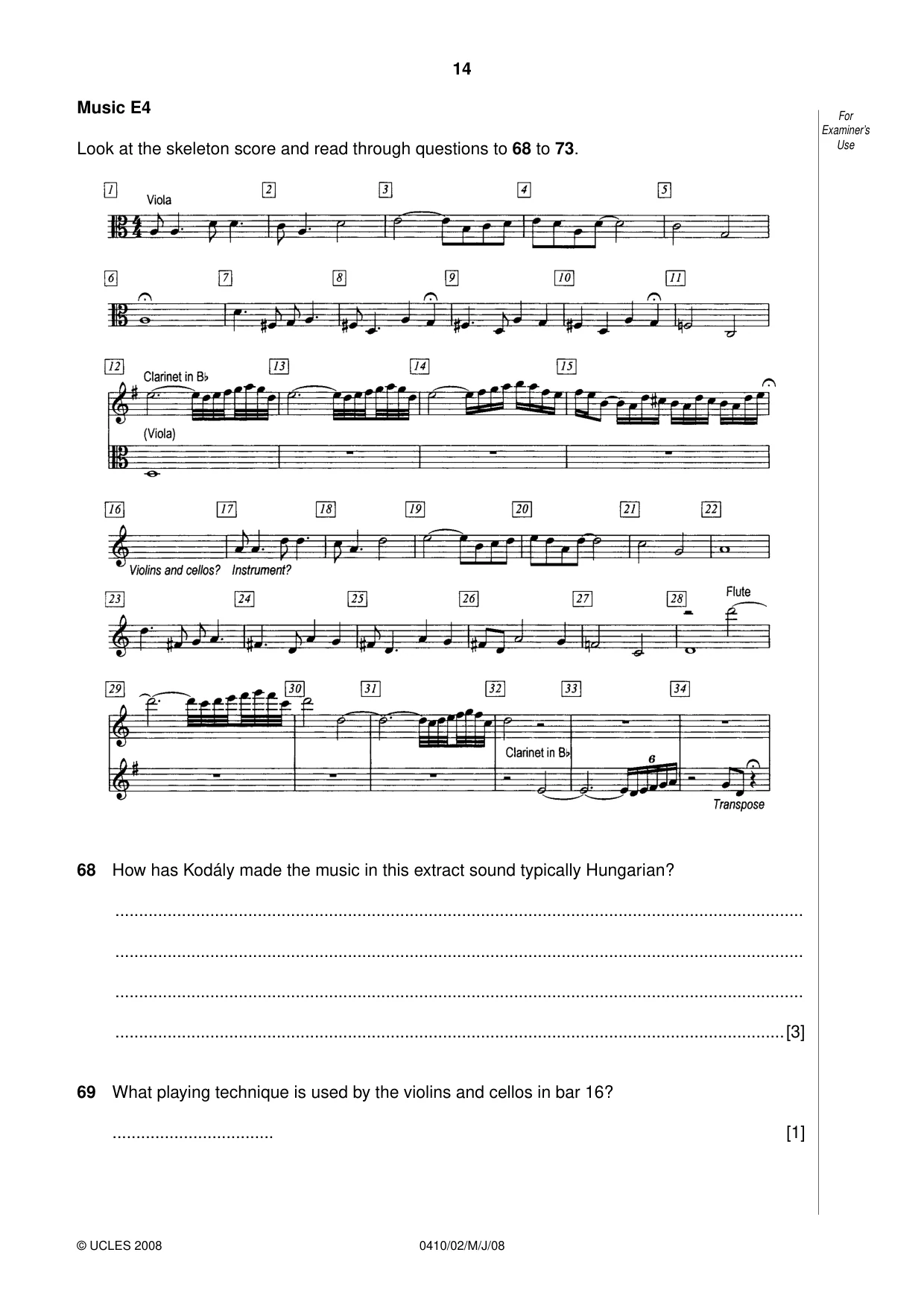
14 0410/02/M/J/08 © UCLES 2008 For Examiner’s Use Music E4 Look at the skeleton score and read through questions to 68 to 73. 68 How has Kodály made the music in this extract sound typically Hungarian? … … … …[3] 69 What playing technique is used by the violins and cellos in bar 16? … [1]
Question paper, page 15
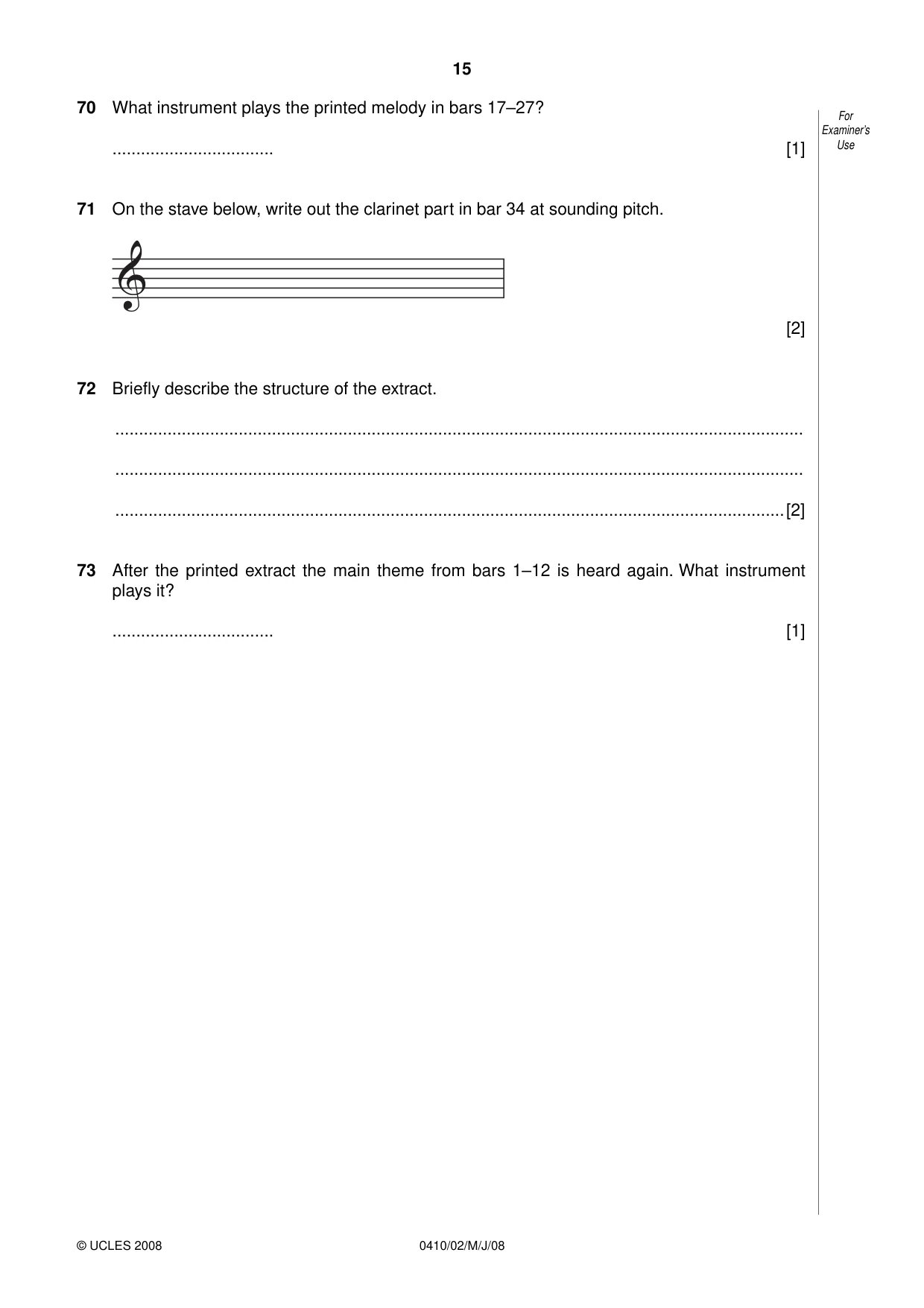
15 0410/02/M/J/08 © UCLES 2008 For Examiner’s Use 70 What instrument plays the printed melody in bars 17–27? … [1] 71 On the stave below, write out the clarinet part in bar 34 at sounding pitch. [2] 72 Briefly describe the structure of the extract. … … …[2] 73 After the printed extract the main theme from bars 1–12 is heard again. What instrument plays it? … [1]
Question paper, page 16
16 0410/02/M/J/08 BLANK PAGE Copyright Acknowledgements: E2 © MPA. E3 Copyright 1927 by Universal Edition. Copyright assigned 1952 to Universal Edition (London) Ltd, London. Copyright renewed 1955. Reproduced by permission. All rights reserved. E4 Copyright 1927 by Universal Edition. Copyright assigned 1952 to Universal Edition (London) Ltd, London. Copyright renewed 1955. Reproduced by permission. All rights reserved. Permission to reproduce items where third-party owned material protected by copyright is included has been sought and cleared where possible. Every reasonable effort has been made by the publisher (UCLES) to trace copyright holders, but if any items requiring clearance have unwittingly been included, the publisher will be pleased to make amends at the earliest possible opportunity. University of Cambridge International Examinations is part of the Cambridge Assessment Group. Cambridge Assessment is the brand name of University of Cambridge Local Examinations Syndicate (UCLES), which is itself a department of the University of Cambridge.
Mark scheme, page 1
UNIVERSITY OF CAMBRIDGE INTERNATIONAL EXAMINATIONS International General Certificate of Secondary Education MARK SCHEME for the May/June 2008 question paper 0410 MUSIC 0410/02 Paper 2 (Prepared Listening), maximum raw mark 40 This mark scheme is published as an aid to teachers and candidates, to indicate the requirements of the examination. It shows the basis on which Examiners were instructed to award marks. It does not indicate the details of the discussions that took place at an Examiners’ meeting before marking began. All Examiners are instructed that alternative correct answers and unexpected approaches in candidates’ scripts must be given marks that fairly reflect the relevant knowledge and skills demonstrated. Mark schemes must be read in conjunction with the question papers and the report on the examination. • CIE will not enter into discussions or correspondence in connection with these mark schemes. CIE is publishing the mark schemes for the May/June 2008 question papers for most IGCSE, GCE Advanced Level and Advanced Subsidiary Level syllabuses and some Ordinary Level syllabuses. www.XtremePapers.com
Mark scheme, page 2
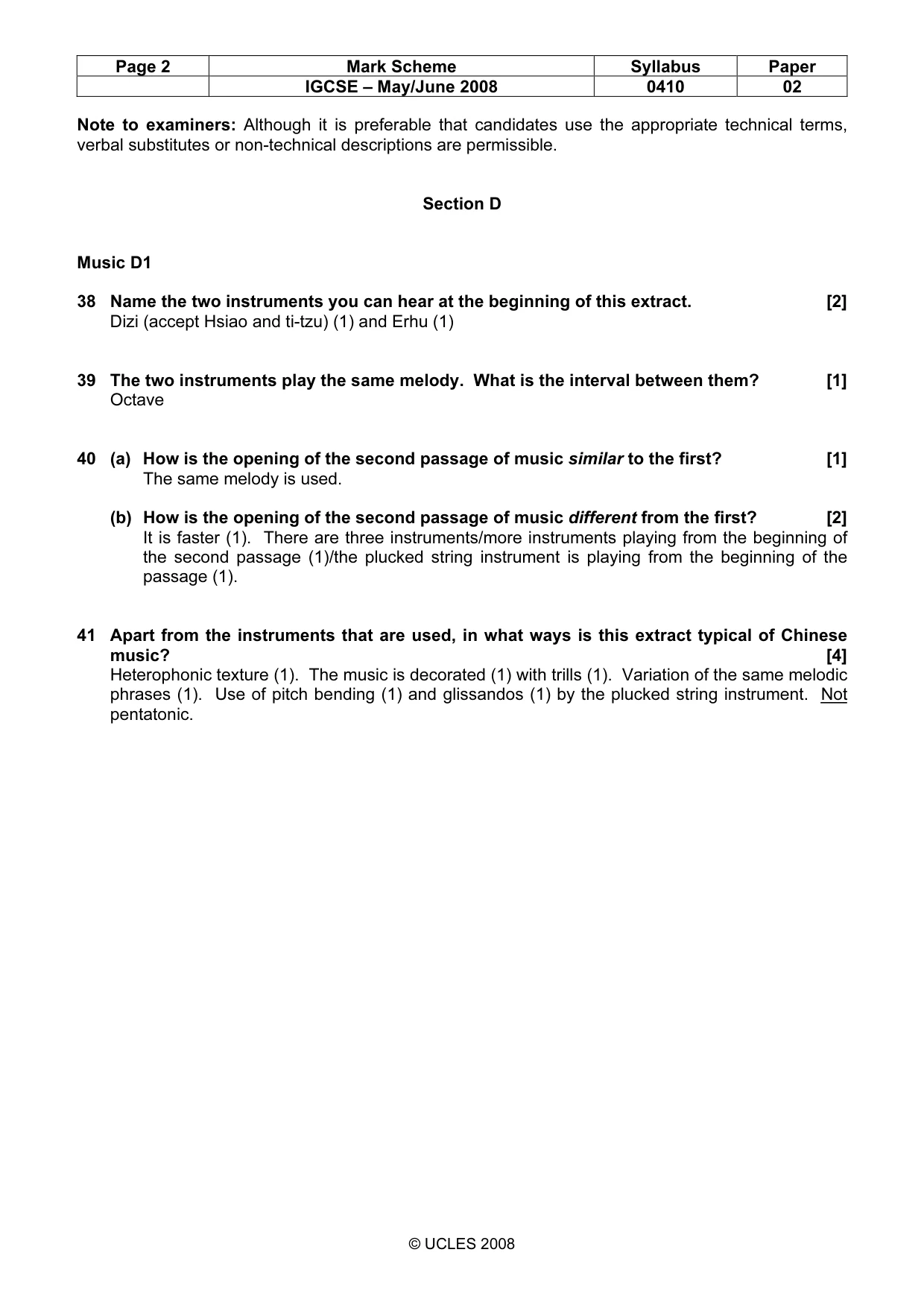
Page 2 Mark Scheme Syllabus Paper IGCSE – May/June 2008 0410 02 © UCLES 2008 Note to examiners: Although it is preferable that candidates use the appropriate technical terms, verbal substitutes or non-technical descriptions are permissible. Section D Music D1 38 Name the two instruments you can hear at the beginning of this extract. [2] Dizi (accept Hsiao and ti-tzu) (1) and Erhu (1) 39 The two instruments play the same melody. What is the interval between them? [1] Octave 40 (a) How is the opening of the second passage of music similar to the first? [1] The same melody is used. (b) How is the opening of the second passage of music different from the first? [2] It is faster (1). There are three instruments/more instruments playing from the beginning of the second passage (1)/the plucked string instrument is playing from the beginning of the passage (1). 41 Apart from the instruments that are used, in what ways is this extract typical of Chinese music? [4] Heterophonic texture (1). The music is decorated (1) with trills (1). Variation of the same melodic phrases (1). Use of pitch bending (1) and glissandos (1) by the plucked string instrument. Not pentatonic.
Mark scheme, page 3
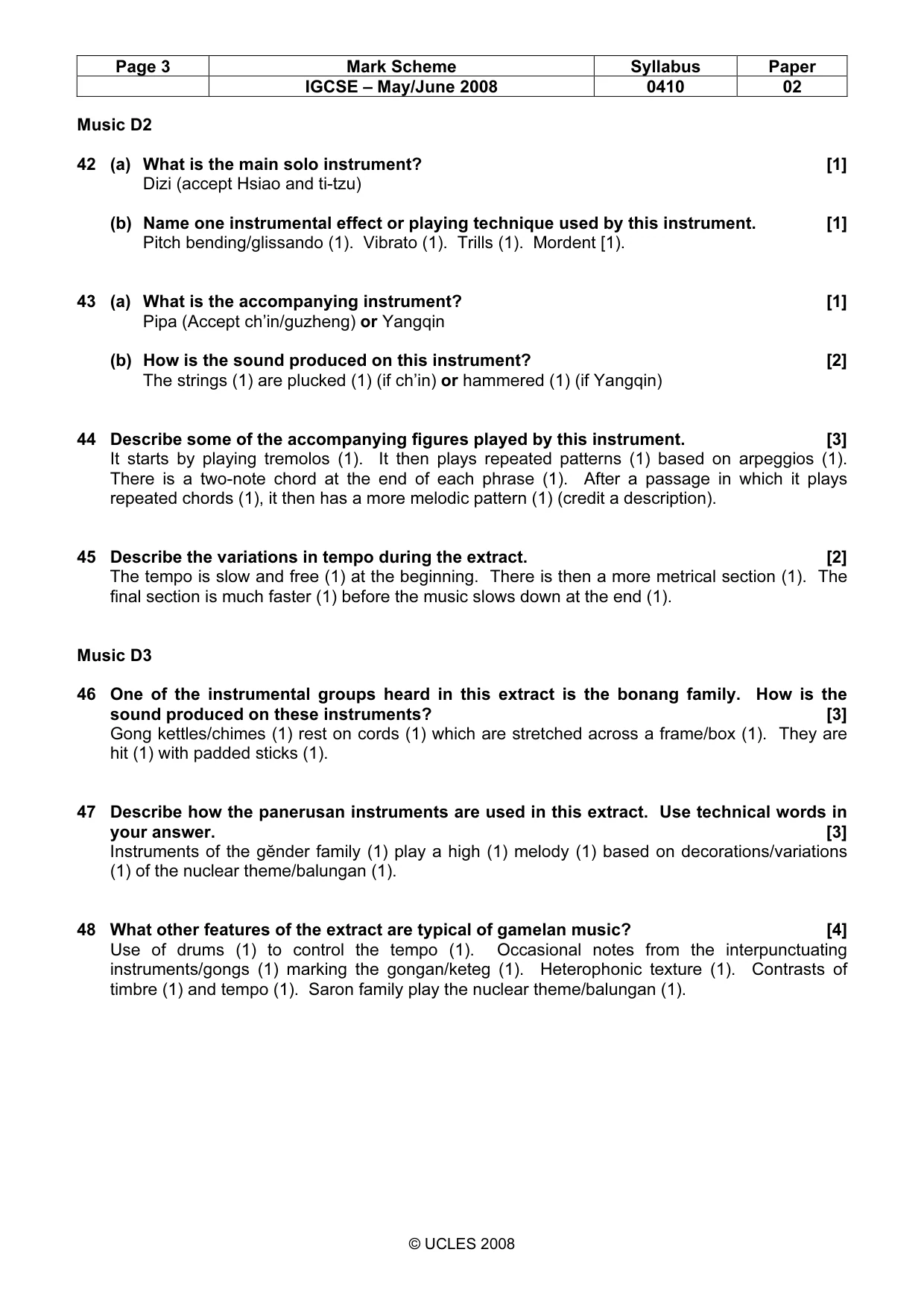
Page 3 Mark Scheme Syllabus Paper IGCSE – May/June 2008 0410 02 © UCLES 2008 Music D2 42 (a) What is the main solo instrument? [1] Dizi (accept Hsiao and ti-tzu) (b) Name one instrumental effect or playing technique used by this instrument. [1] Pitch bending/glissando (1). Vibrato (1). Trills (1). Mordent [1). 43 (a) What is the accompanying instrument? [1] Pipa (Accept ch’in/guzheng) or Yangqin (b) How is the sound produced on this instrument? [2] The strings (1) are plucked (1) (if ch’in) or hammered (1) (if Yangqin) 44 Describe some of the accompanying figures played by this instrument. [3] It starts by playing tremolos (1). It then plays repeated patterns (1) based on arpeggios (1). There is a two-note chord at the end of each phrase (1). After a passage in which it plays repeated chords (1), it then has a more melodic pattern (1) (credit a description). 45 Describe the variations in tempo during the extract. [2] The tempo is slow and free (1) at the beginning. There is then a more metrical section (1). The final section is much faster (1) before the music slows down at the end (1). Music D3 46 One of the instrumental groups heard in this extract is the bonang family. How is the sound produced on these instruments? [3] Gong kettles/chimes (1) rest on cords (1) which are stretched across a frame/box (1). They are hit (1) with padded sticks (1). 47 Describe how the panerusan instruments are used in this extract. Use technical words in your answer. [3] Instruments of the gĕnder family (1) play a high (1) melody (1) based on decorations/variations (1) of the nuclear theme/balungan (1). 48 What other features of the extract are typical of gamelan music? [4] Use of drums (1) to control the tempo (1). Occasional notes from the interpunctuating instruments/gongs (1) marking the gongan/keteg (1). Heterophonic texture (1). Contrasts of timbre (1) and tempo (1). Saron family play the nuclear theme/balungan (1).
Mark scheme, page 4
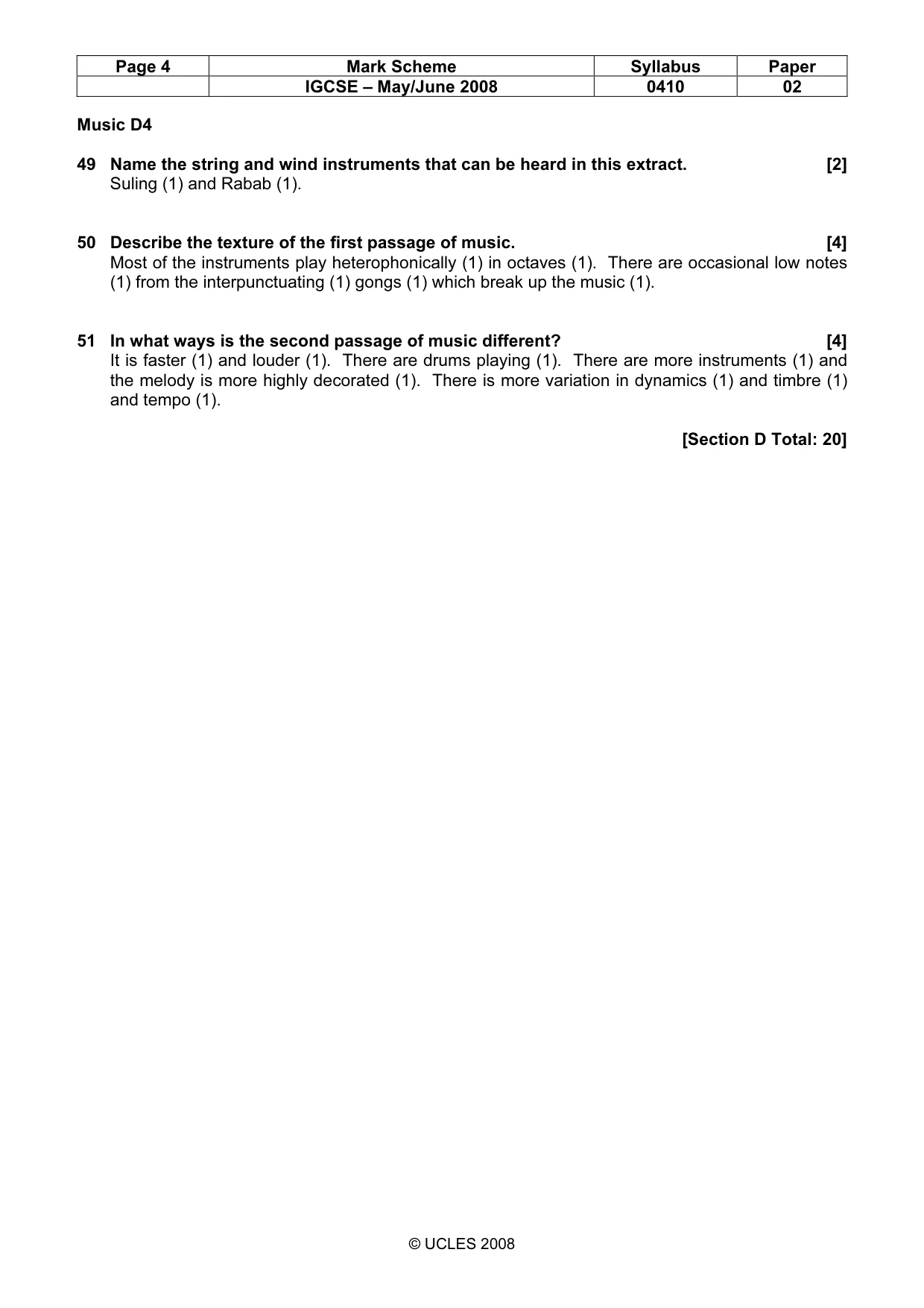
Page 4 Mark Scheme Syllabus Paper IGCSE – May/June 2008 0410 02 © UCLES 2008 Music D4 49 Name the string and wind instruments that can be heard in this extract. [2] Suling (1) and Rabab (1). 50 Describe the texture of the first passage of music. [4] Most of the instruments play heterophonically (1) in octaves (1). There are occasional low notes (1) from the interpunctuating (1) gongs (1) which break up the music (1). 51 In what ways is the second passage of music different? [4] It is faster (1) and louder (1). There are drums playing (1). There are more instruments (1) and the melody is more highly decorated (1). There is more variation in dynamics (1) and timbre (1) and tempo (1). [Section D Total: 20]
Mark scheme, page 5
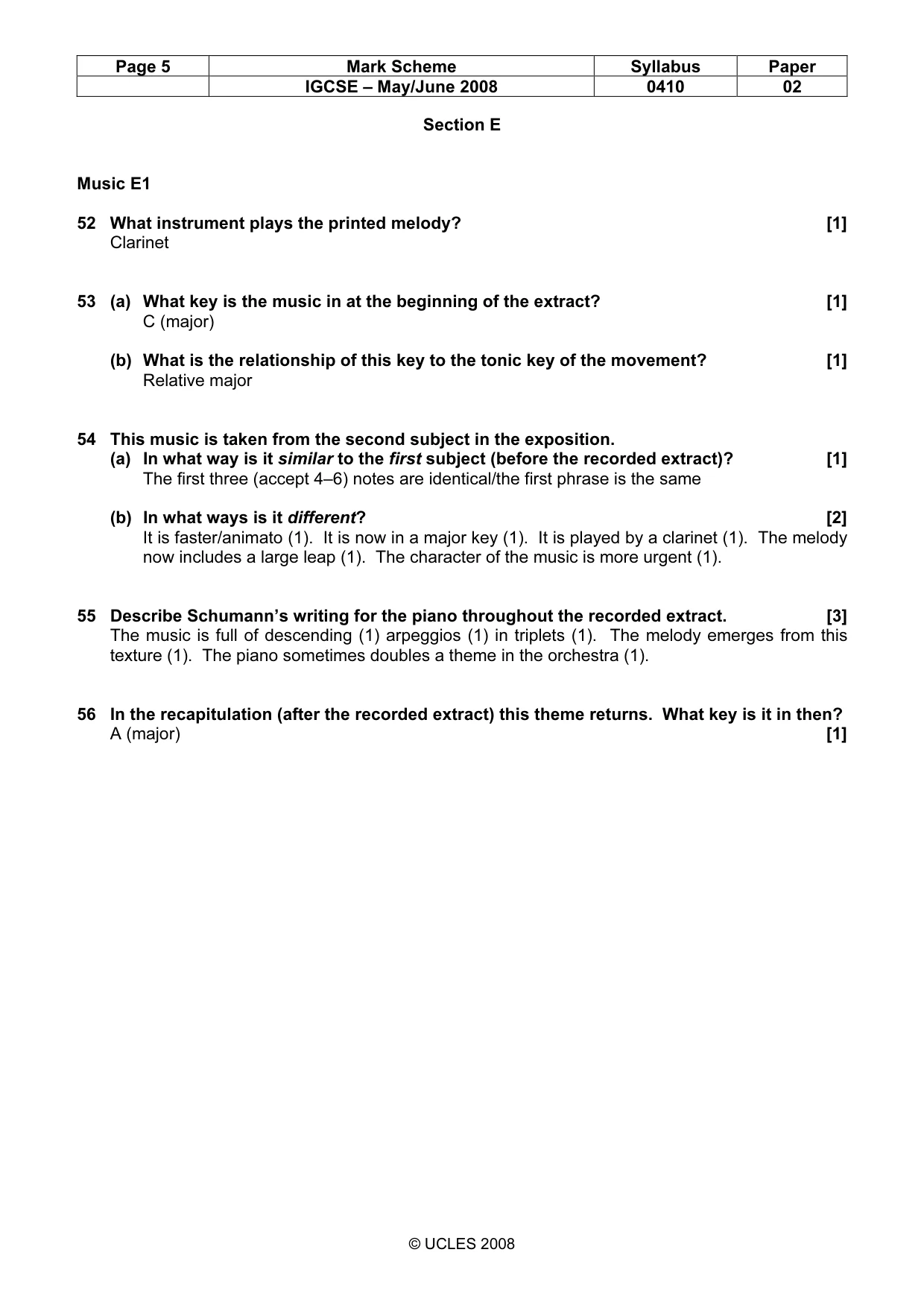
Page 5 Mark Scheme Syllabus Paper IGCSE – May/June 2008 0410 02 © UCLES 2008 Section E Music E1 52 What instrument plays the printed melody? [1] Clarinet 53 (a) What key is the music in at the beginning of the extract? [1] C (major) (b) What is the relationship of this key to the tonic key of the movement? [1] Relative major 54 This music is taken from the second subject in the exposition. (a) In what way is it similar to the first subject (before the recorded extract)? [1] The first three (accept 4–6) notes are identical/the first phrase is the same (b) In what ways is it different? [2] It is faster/animato (1). It is now in a major key (1). It is played by a clarinet (1). The melody now includes a large leap (1). The character of the music is more urgent (1). 55 Describe Schumann’s writing for the piano throughout the recorded extract. [3] The music is full of descending (1) arpeggios (1) in triplets (1). The melody emerges from this texture (1). The piano sometimes doubles a theme in the orchestra (1). 56 In the recapitulation (after the recorded extract) this theme returns. What key is it in then? A (major) [1]
Mark scheme, page 6
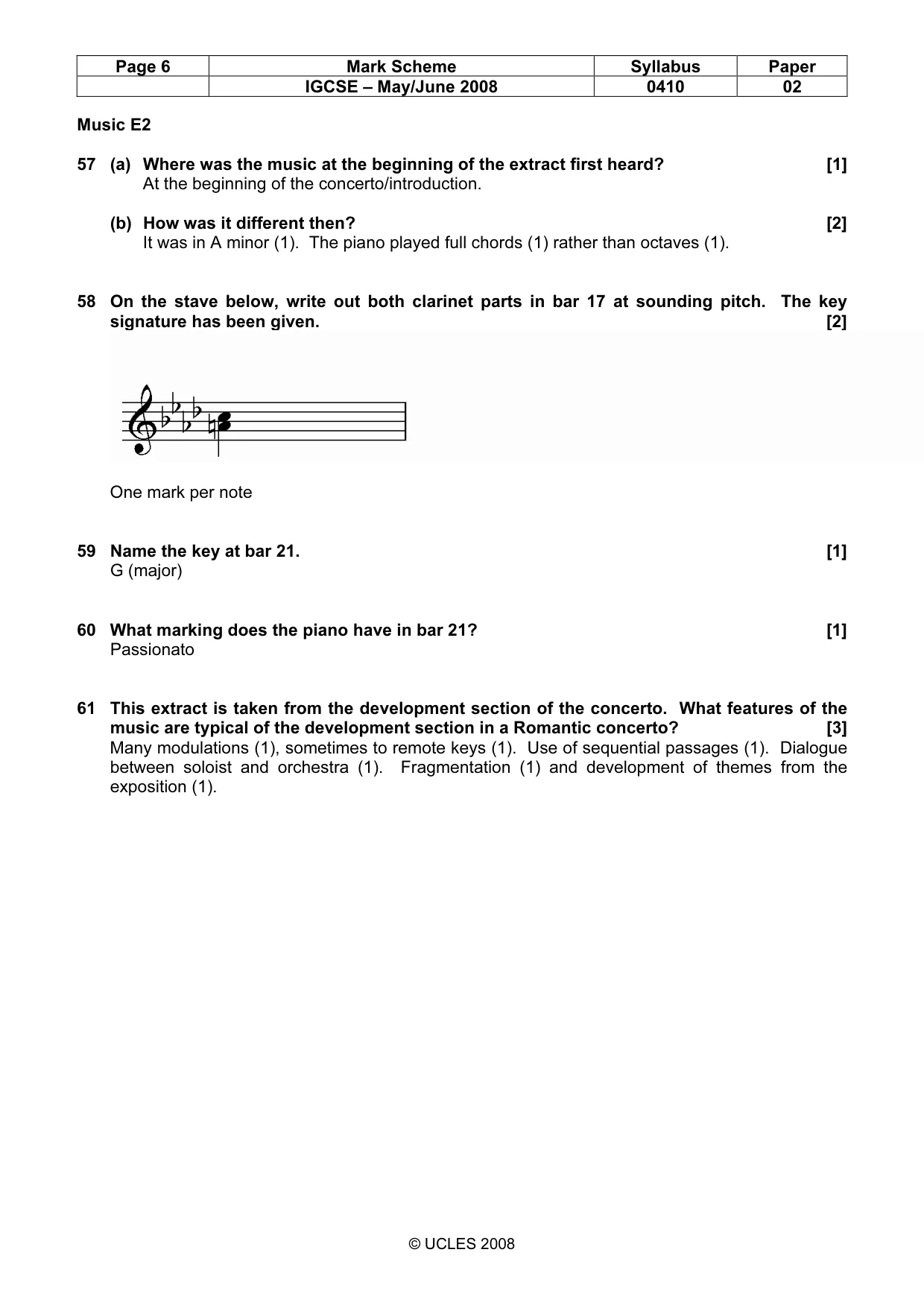
Page 6 Mark Scheme Syllabus Paper IGCSE – May/June 2008 0410 02 © UCLES 2008 Music E2 57 (a) Where was the music at the beginning of the extract first heard? [1] At the beginning of the concerto/introduction. (b) How was it different then? [2] It was in A minor (1). The piano played full chords (1) rather than octaves (1). 58 On the stave below, write out both clarinet parts in bar 17 at sounding pitch. The key signature has been given. [2] One mark per note 59 Name the key at bar 21. [1] G (major) 60 What marking does the piano have in bar 21? [1] Passionato 61 This extract is taken from the development section of the concerto. What features of the music are typical of the development section in a Romantic concerto? [3] Many modulations (1), sometimes to remote keys (1). Use of sequential passages (1). Dialogue between soloist and orchestra (1). Fragmentation (1) and development of themes from the exposition (1).
Mark scheme, page 7
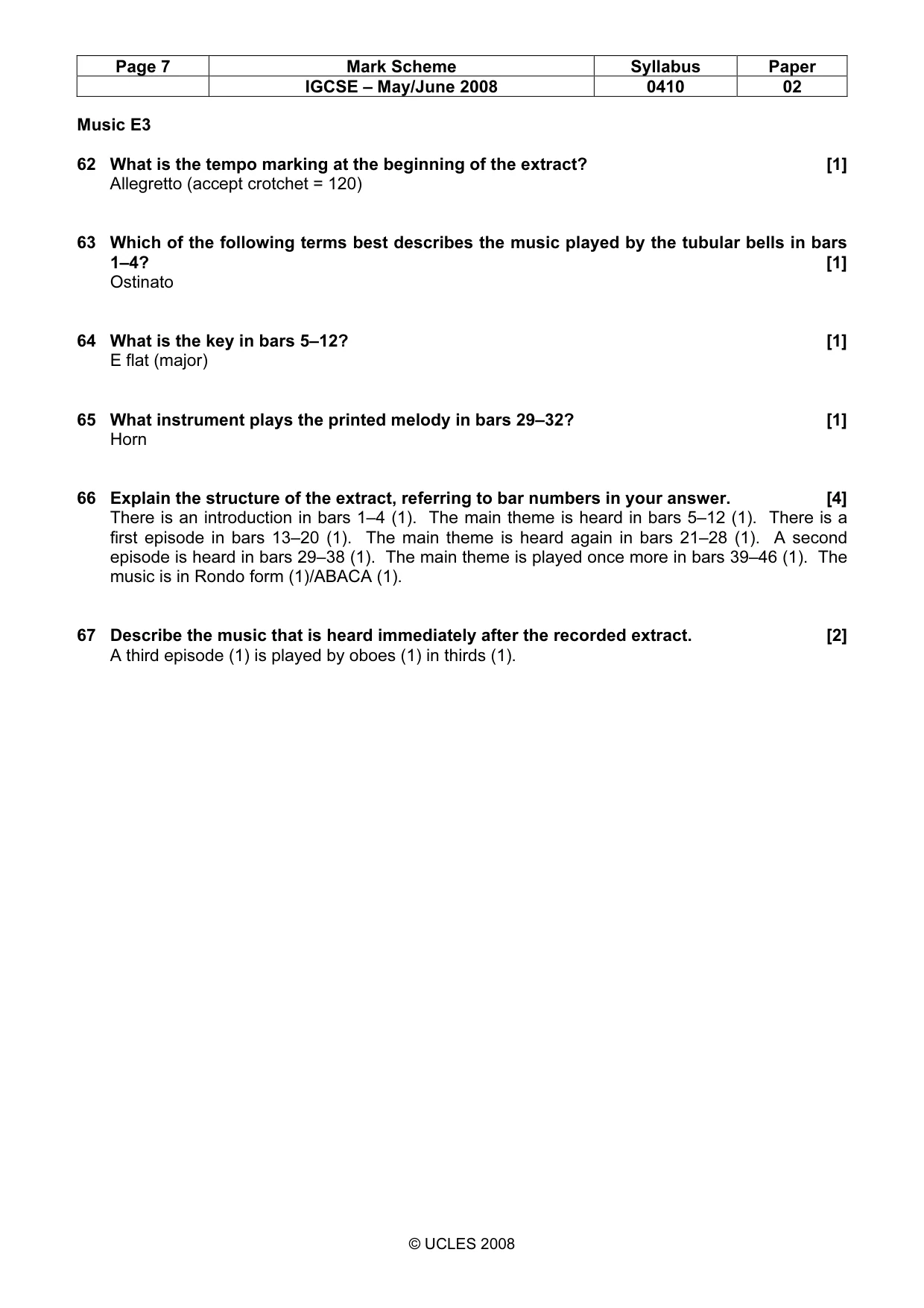
Page 7 Mark Scheme Syllabus Paper IGCSE – May/June 2008 0410 02 © UCLES 2008 Music E3 62 What is the tempo marking at the beginning of the extract? [1] Allegretto (accept crotchet = 120) 63 Which of the following terms best describes the music played by the tubular bells in bars 1–4? [1] Ostinato 64 What is the key in bars 5–12? [1] E flat (major) 65 What instrument plays the printed melody in bars 29–32? [1] Horn 66 Explain the structure of the extract, referring to bar numbers in your answer. [4] There is an introduction in bars 1–4 (1). The main theme is heard in bars 5–12 (1). There is a first episode in bars 13–20 (1). The main theme is heard again in bars 21–28 (1). A second episode is heard in bars 29–38 (1). The main theme is played once more in bars 39–46 (1). The music is in Rondo form (1)/ABACA (1). 67 Describe the music that is heard immediately after the recorded extract. [2] A third episode (1) is played by oboes (1) in thirds (1).
Mark scheme, page 8
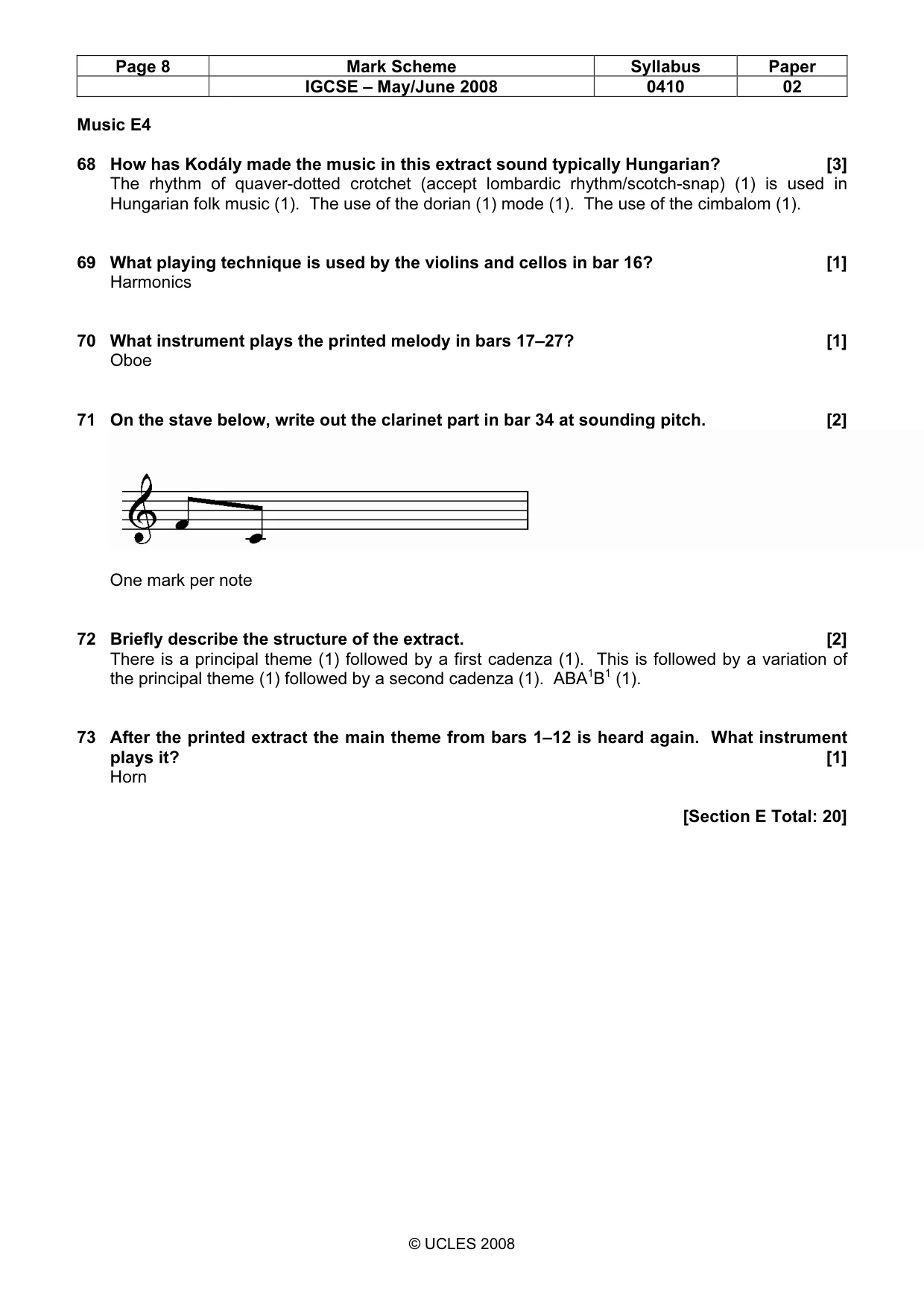
Page 8 Mark Scheme Syllabus Paper IGCSE – May/June 2008 0410 02 © UCLES 2008 Music E4 68 How has Kodály made the music in this extract sound typically Hungarian? [3] The rhythm of quaver-dotted crotchet (accept lombardic rhythm/scotch-snap) (1) is used in Hungarian folk music (1). The use of the dorian (1) mode (1). The use of the cimbalom (1). 69 What playing technique is used by the violins and cellos in bar 16? [1] Harmonics 70 What instrument plays the printed melody in bars 17–27? [1] Oboe 71 On the stave below, write out the clarinet part in bar 34 at sounding pitch. [2] One mark per note 72 Briefly describe the structure of the extract. [2] There is a principal theme (1) followed by a first cadenza (1). This is followed by a variation of the principal theme (1) followed by a second cadenza (1). ABA1B1 (1). 73 After the printed extract the main theme from bars 1–12 is heard again. What instrument plays it? [1] Horn [Section E Total: 20]
What you needed in this session
Cambridge’s own grade thresholds for 2008 May/June, Paper 2 · Variant 1. A higher threshold means an easier paper — the bar moves with how the cohort did.