Cambridge IGCSE Music 0410 — 2008 May/June Paper 1 · Variant 1
0410/11/M/J/08 · 60 marks · ≈68 min
The question paper and its mark scheme, free to read here and free to download. This is Cambridge’s own paper, exactly as it was sat.
Question paper14 pages
Mark scheme7 pages
Answers below. Sit the paper first if you are practising.
Paper as text
Question paper, page 1
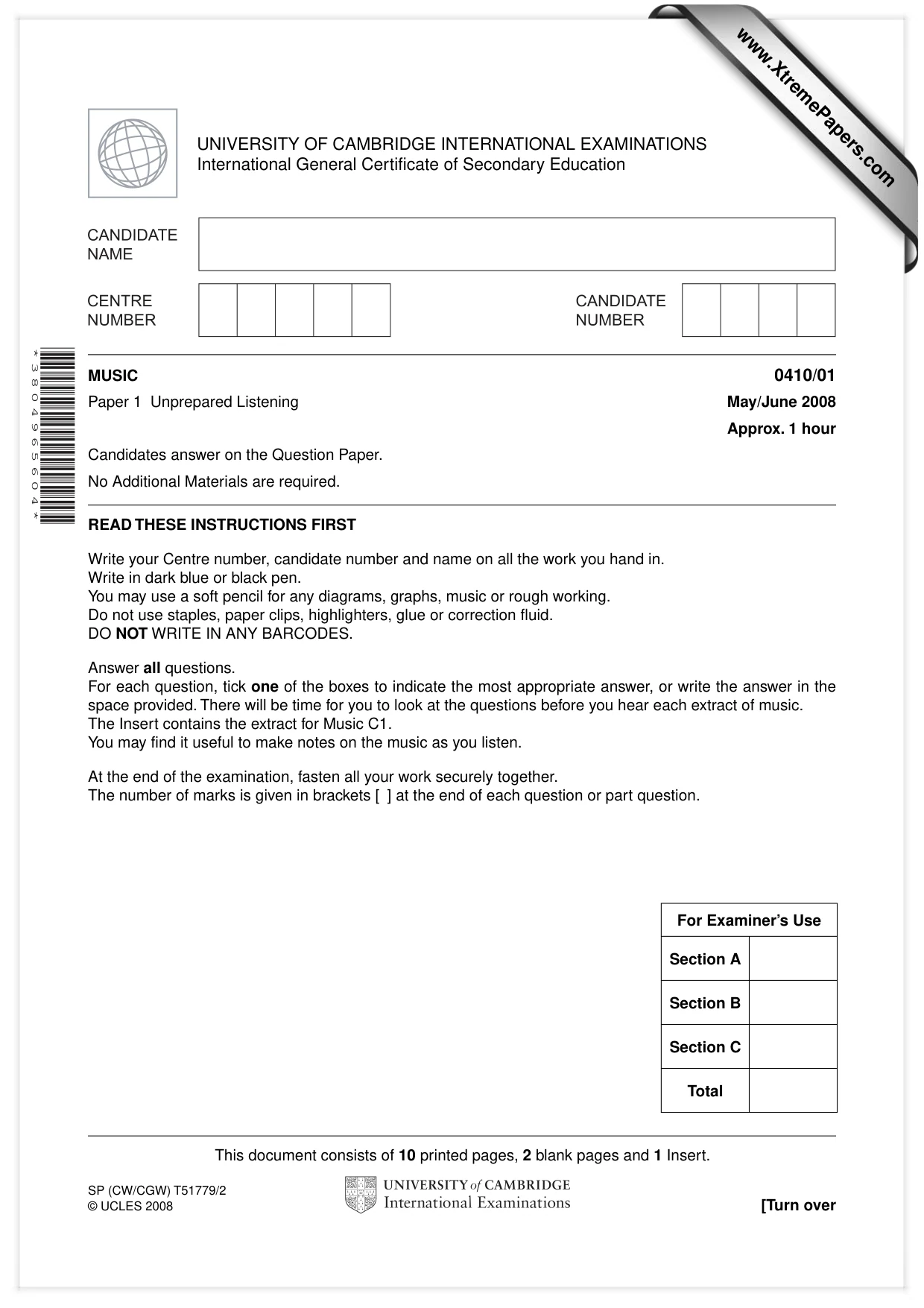
This document consists of 10 printed pages, 2 blank pages and 1 Insert. SP (CW/CGW) T51779/2 © UCLES 2008 [Turn over UNIVERSITY OF CAMBRIDGE INTERNATIONAL EXAMINATIONS International General Certificate of Secondary Education READ THESE INSTRUCTIONS FIRST Write your Centre number, candidate number and name on all the work you hand in. Write in dark blue or black pen. You may use a soft pencil for any diagrams, graphs, music or rough working. Do not use staples, paper clips, highlighters, glue or correction fluid. DO NOT WRITE IN ANY BARCODES. Answer all questions. For each question, tick one of the boxes to indicate the most appropriate answer, or write the answer in the space provided. There will be time for you to look at the questions before you hear each extract of music. The Insert contains the extract for Music C1. You may find it useful to make notes on the music as you listen. At the end of the examination, fasten all your work securely together. The number of marks is given in brackets [ ] at the end of each question or part question. * 3 8 0 4 9 6 5 6 0 4 * MUSIC 0410/01 Paper 1 Unprepared Listening May/June 2008 Approx. 1 hour Candidates answer on the Question Paper. No Additional Materials are required. For Examiner’s Use Section A Section B Section C Total www.XtremePapers.com
Question paper, page 2
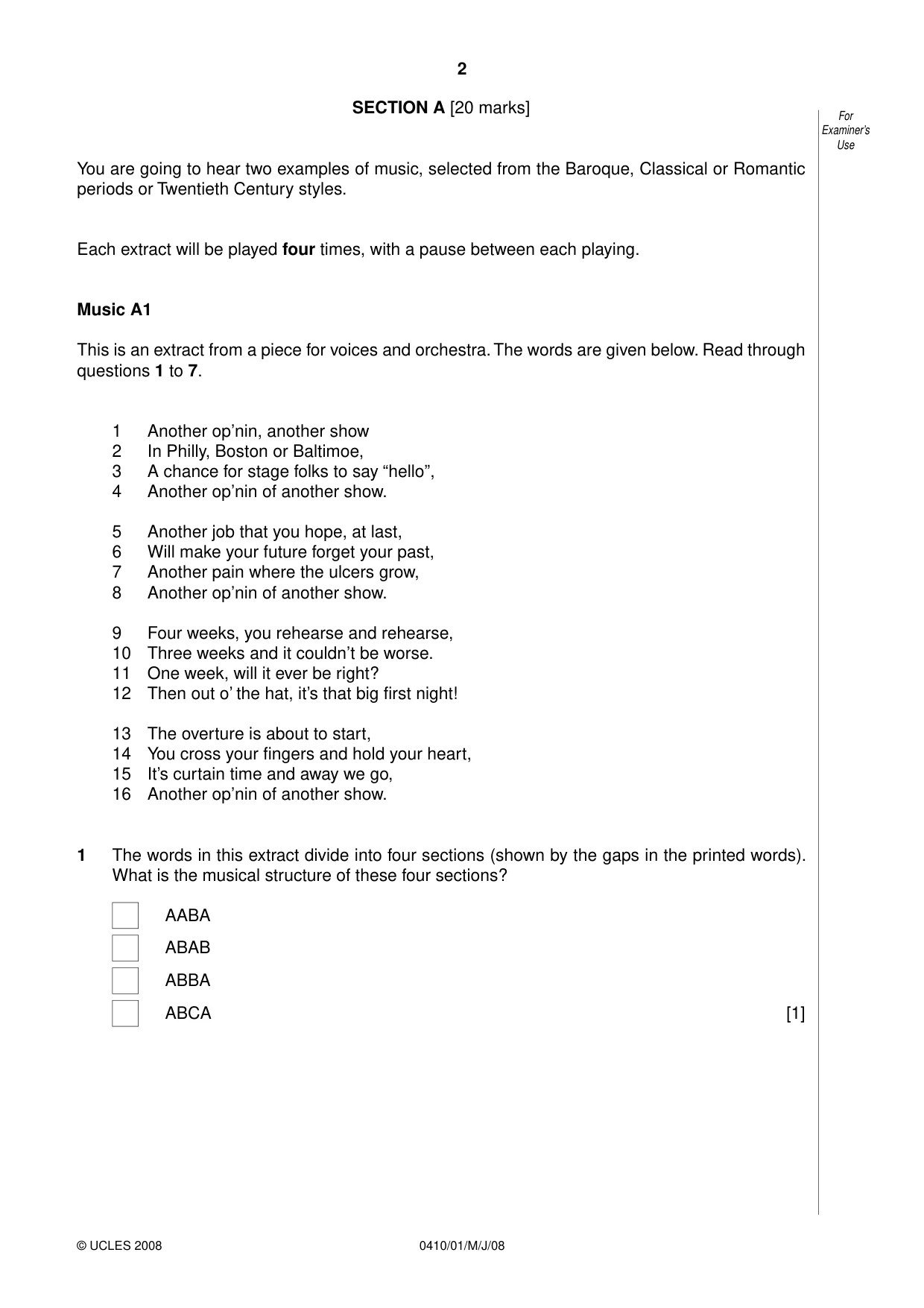
2 0410/01/M/J/08 © UCLES 2008 For Examiner’s Use SECTION A [20 marks] You are going to hear two examples of music, selected from the Baroque, Classical or Romantic periods or Twentieth Century styles. Each extract will be played four times, with a pause between each playing. Music A1 This is an extract from a piece for voices and orchestra. The words are given below. Read through questions 1 to 7. 1 Another op’nin, another show 2 In Philly, Boston or Baltimoe, 3 A chance for stage folks to say “hello”, 4 Another op’nin of another show. 5 Another job that you hope, at last, 6 Will make your future forget your past, 7 Another pain where the ulcers grow, 8 Another op’nin of another show. 9 Four weeks, you rehearse and rehearse, 10 Three weeks and it couldn’t be worse. 11 One week, will it ever be right? 12 Then out o’ the hat, it’s that big first night! 13 The overture is about to start, 14 You cross your fingers and hold your heart, 15 It’s curtain time and away we go, 16 Another op’nin of another show. 1 The words in this extract divide into four sections (shown by the gaps in the printed words). What is the musical structure of these four sections? AABA ABAB ABBA ABCA [1]
Question paper, page 3
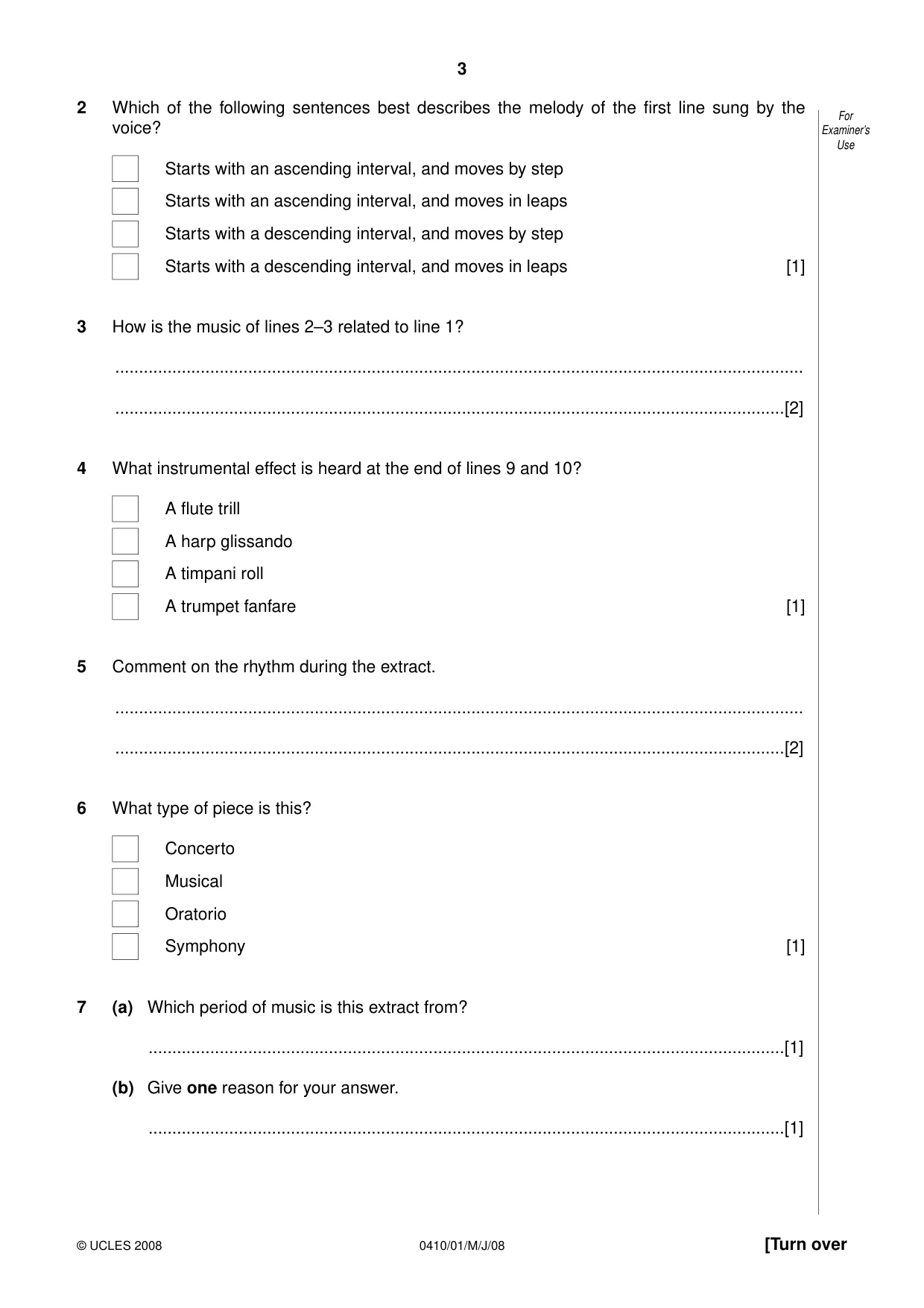
3 0410/01/M/J/08 © UCLES 2008 [Turn over For Examiner’s Use 2 Which of the following sentences best describes the melody of the first line sung by the voice? Starts with an ascending interval, and moves by step Starts with an ascending interval, and moves in leaps Starts with a descending interval, and moves by step Starts with a descending interval, and moves in leaps [1] 3 How is the music of lines 2–3 related to line 1? … …[2] 4 What instrumental effect is heard at the end of lines 9 and 10? A flute trill A harp glissando A timpani roll A trumpet fanfare [1] 5 Comment on the rhythm during the extract. … …[2] 6 What type of piece is this? Concerto Musical Oratorio Symphony [1] 7 (a) Which period of music is this extract from? …[1] (b) Give one reason for your answer. …[1]
Question paper, page 4
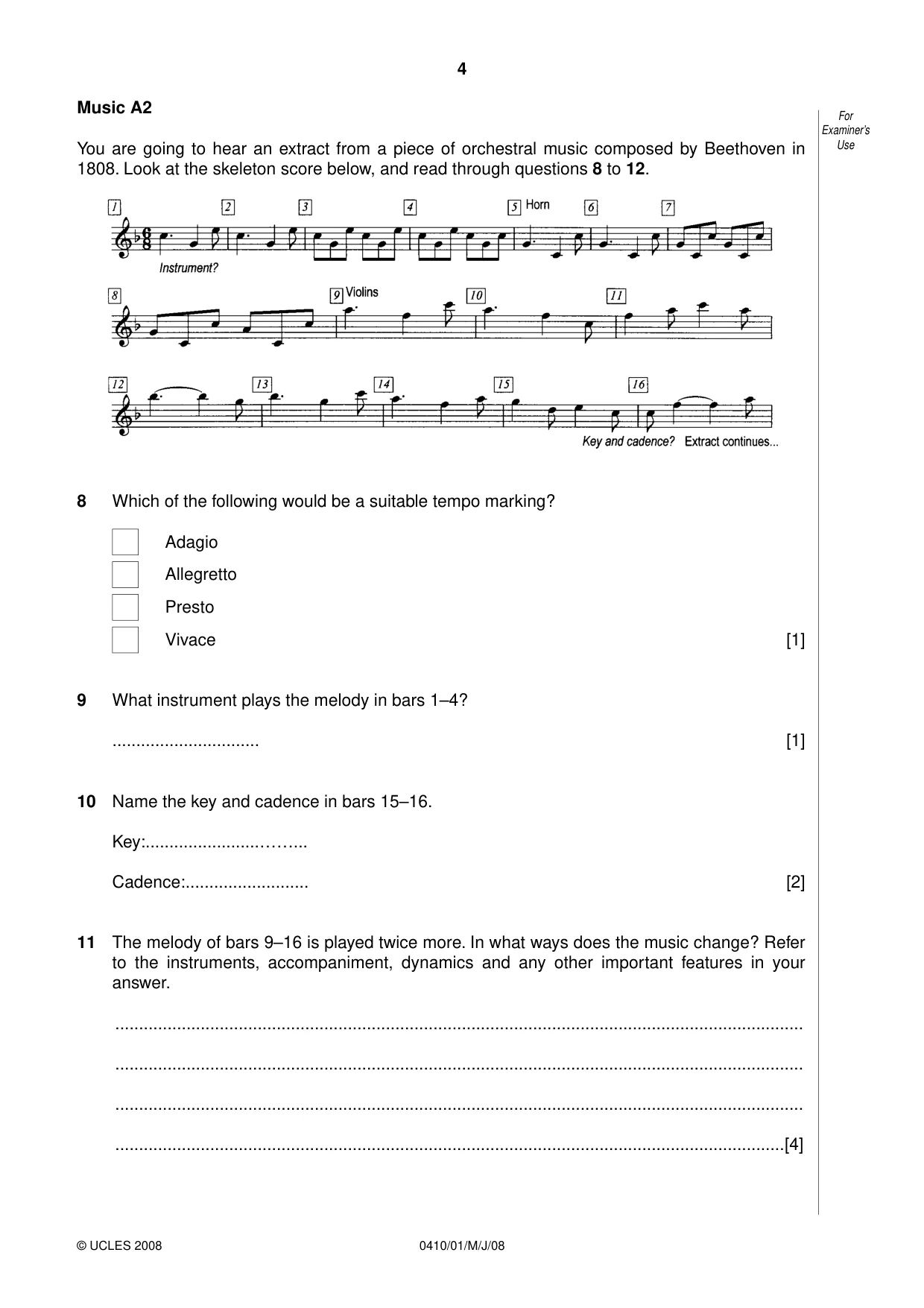
4 0410/01/M/J/08 © UCLES 2008 For Examiner’s Use Music A2 You are going to hear an extract from a piece of orchestral music composed by Beethoven in 1808. Look at the skeleton score below, and read through questions 8 to 12. 8 Which of the following would be a suitable tempo marking? Adagio Allegretto Presto Vivace [1] 9 What instrument plays the melody in bars 1–4? … [1] 10 Name the key and cadence in bars 15–16. Key:………... Cadence:… [2] 11 The melody of bars 9–16 is played twice more. In what ways does the music change? Refer to the instruments, accompaniment, dynamics and any other important features in your answer. … … … …[4]
Question paper, page 5
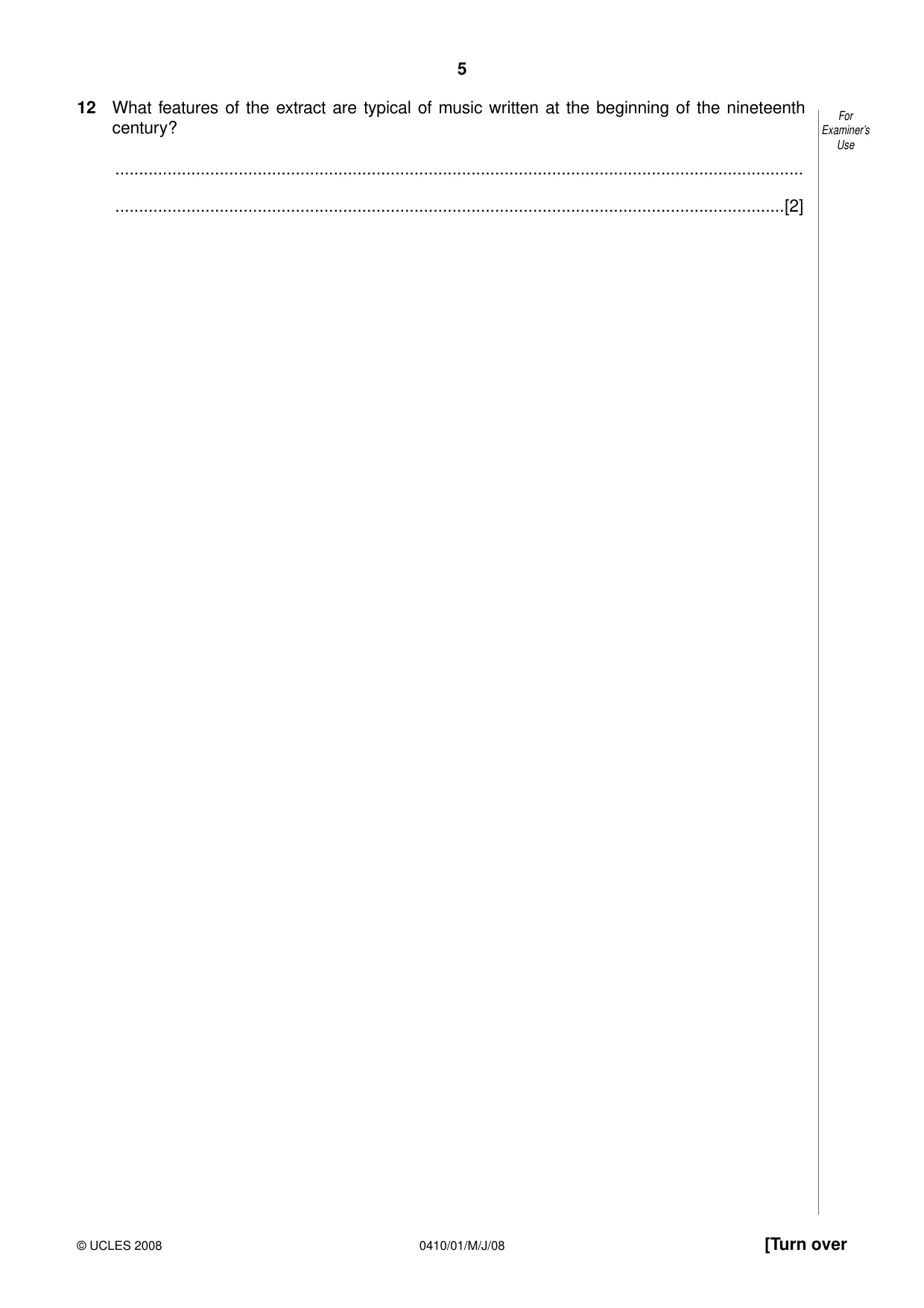
5 0410/01/M/J/08 © UCLES 2008 [Turn over For Examiner’s Use 12 What features of the extract are typical of music written at the beginning of the nineteenth century? … …[2]
Question paper, page 6
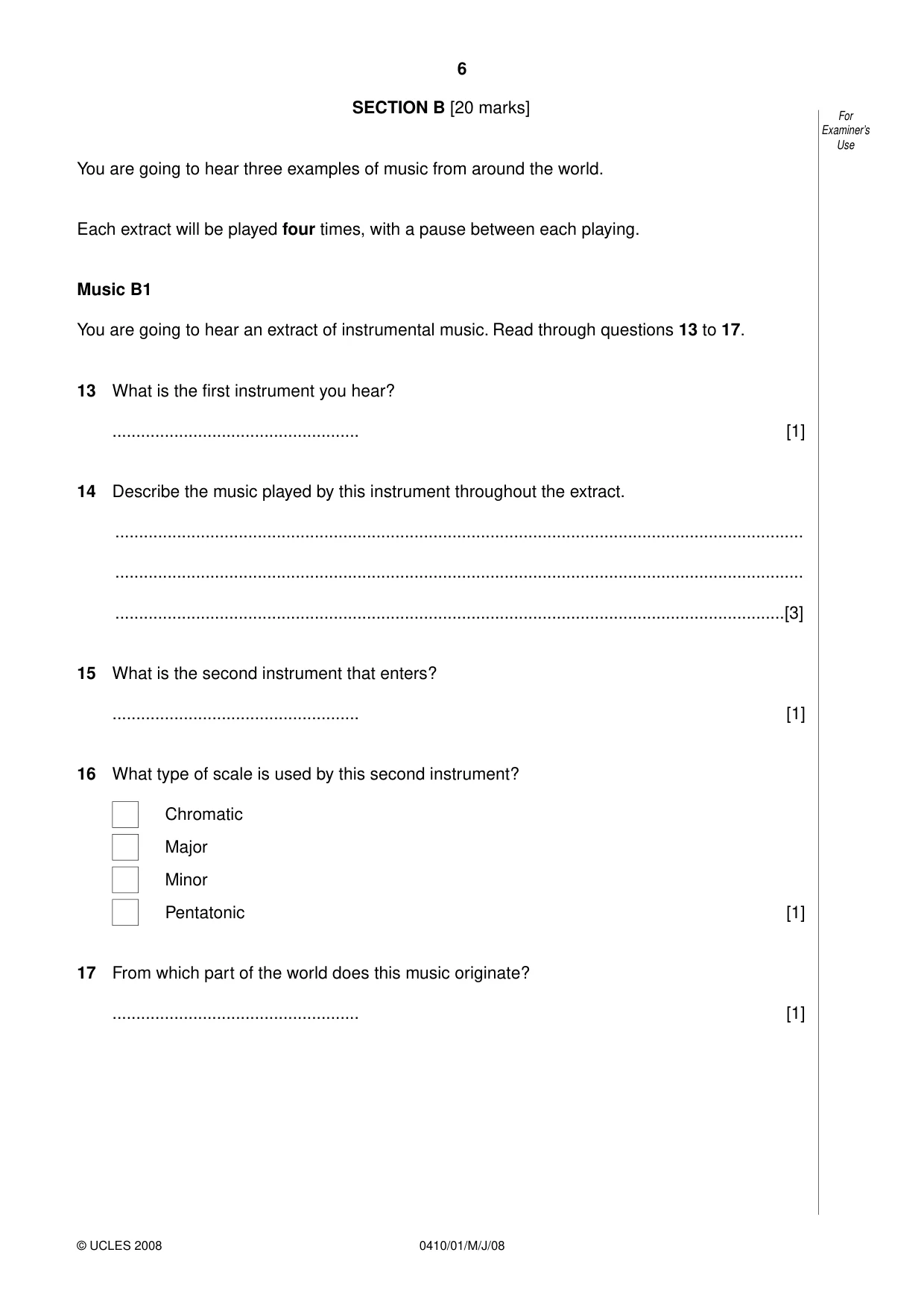
6 0410/01/M/J/08 © UCLES 2008 For Examiner’s Use SECTION B [20 marks] You are going to hear three examples of music from around the world. Each extract will be played four times, with a pause between each playing. Music B1 You are going to hear an extract of instrumental music. Read through questions 13 to 17. 13 What is the first instrument you hear? … [1] 14 Describe the music played by this instrument throughout the extract. … … …[3] 15 What is the second instrument that enters? … [1] 16 What type of scale is used by this second instrument? Chromatic Major Minor Pentatonic [1] 17 From which part of the world does this music originate? … [1]
Question paper, page 7
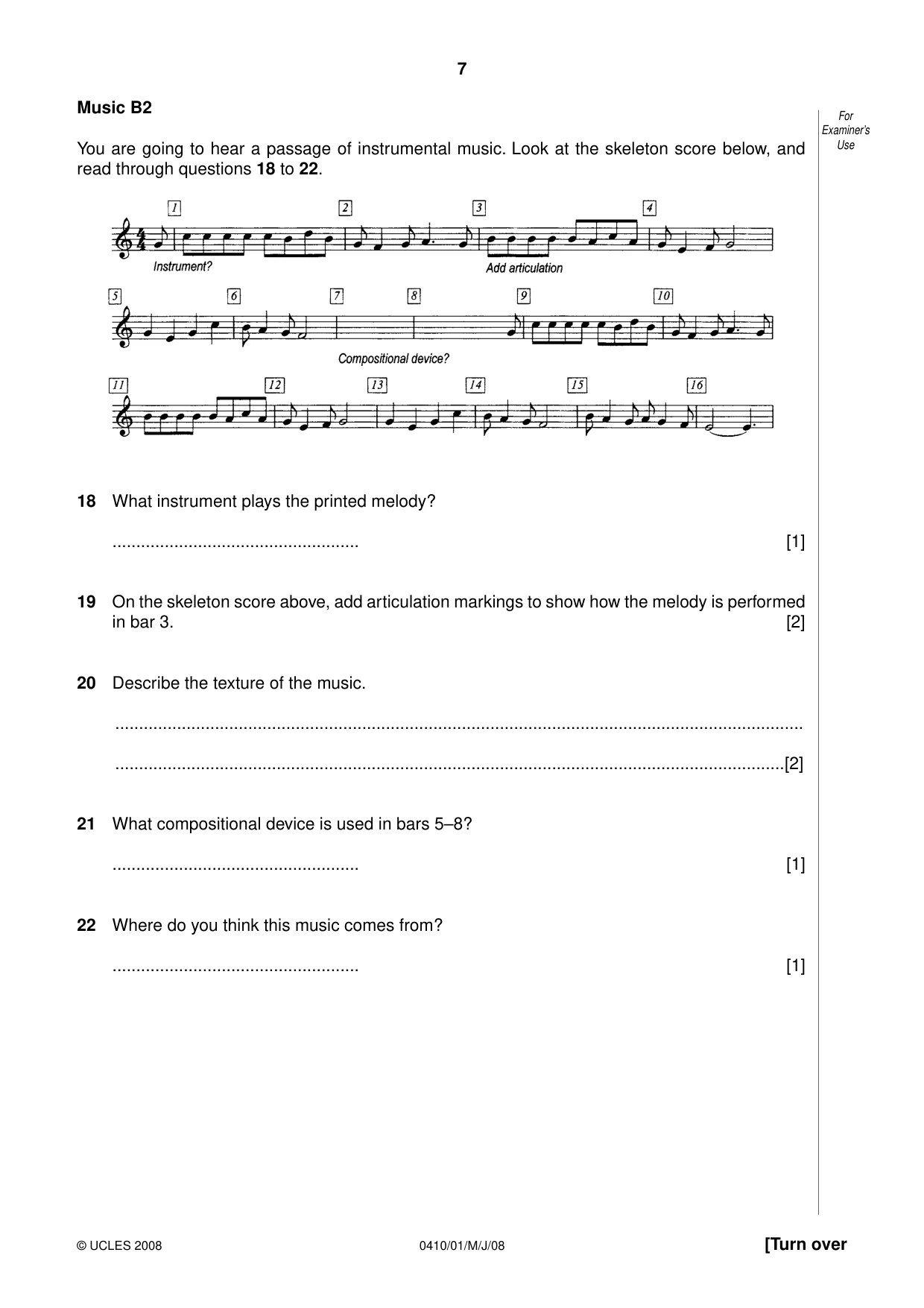
7 0410/01/M/J/08 © UCLES 2008 [Turn over For Examiner’s Use Music B2 You are going to hear a passage of instrumental music. Look at the skeleton score below, and read through questions 18 to 22. 18 What instrument plays the printed melody? … [1] 19 On the skeleton score above, add articulation markings to show how the melody is performed in bar 3. [2] 20 Describe the texture of the music. … …[2] 21 What compositional device is used in bars 5–8? … [1] 22 Where do you think this music comes from? … [1]
Question paper, page 8
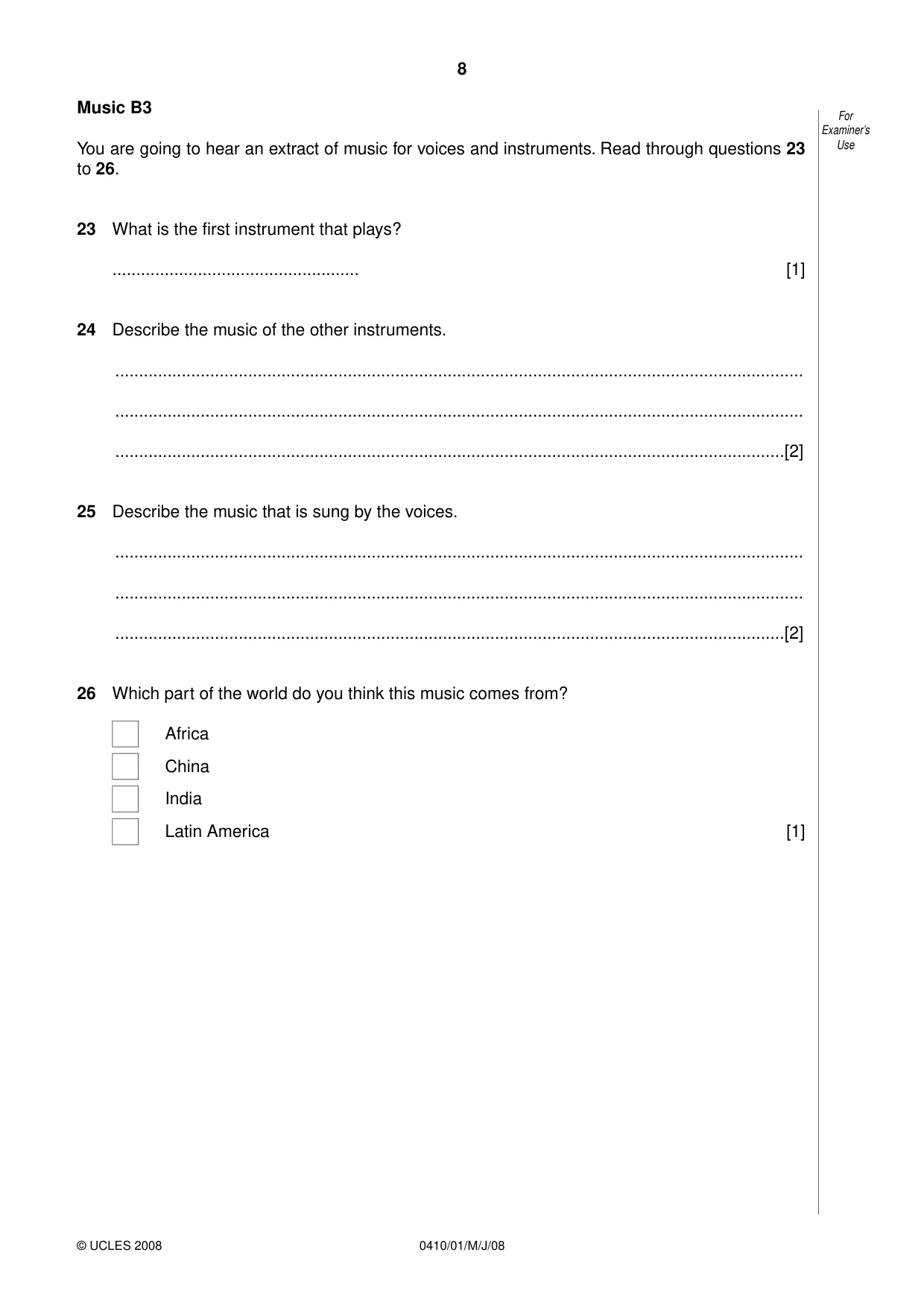
8 0410/01/M/J/08 © UCLES 2008 For Examiner’s Use Music B3 You are going to hear an extract of music for voices and instruments. Read through questions 23 to 26. 23 What is the first instrument that plays? … [1] 24 Describe the music of the other instruments. … … …[2] 25 Describe the music that is sung by the voices. … … …[2] 26 Which part of the world do you think this music comes from? Africa China India Latin America [1]
Question paper, page 9
9 0410/01/M/J/08 [Turn over BLANK PAGE PLEASE TURN OVER FOR SECTION C
Question paper, page 10
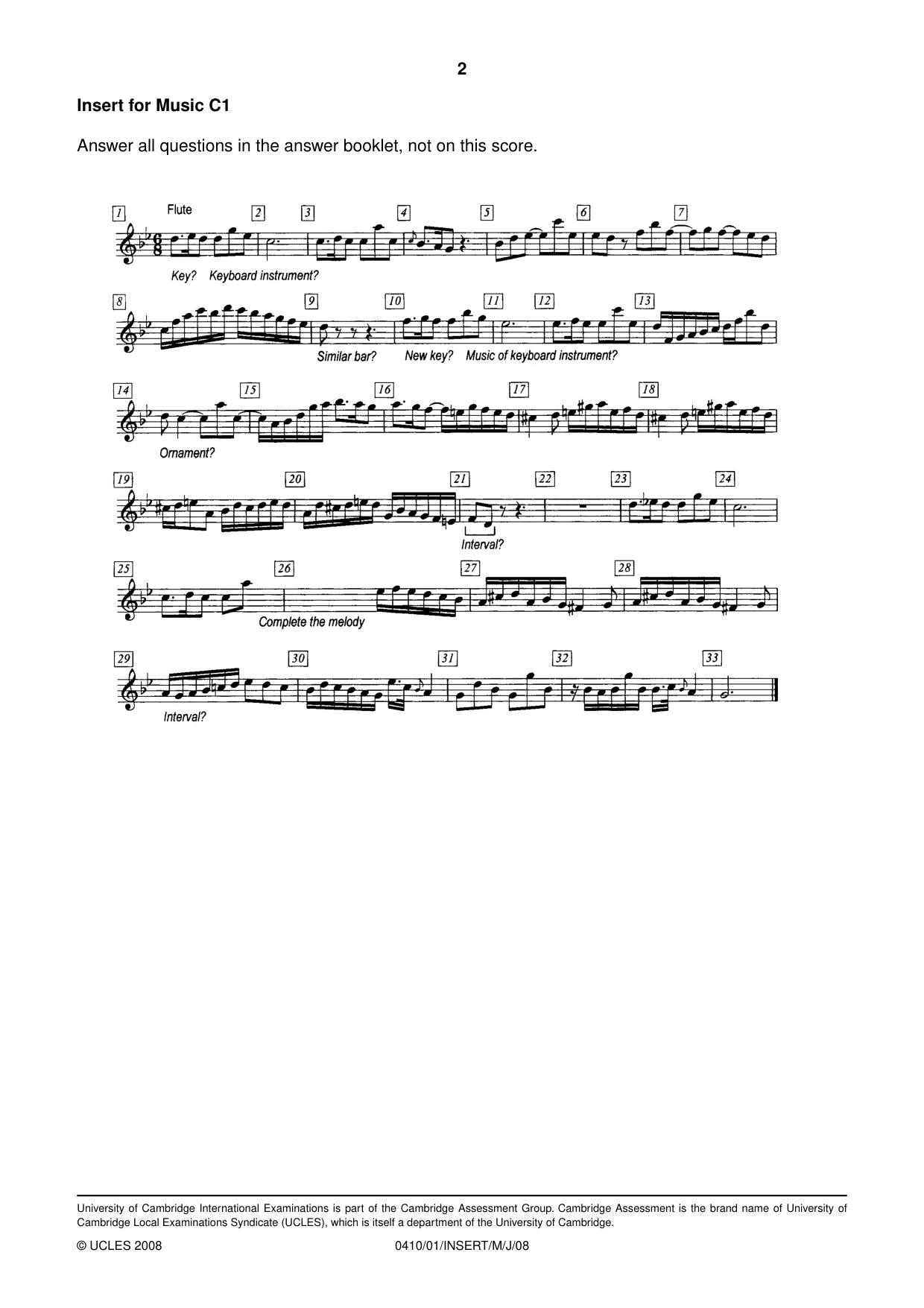
10 0410/01/M/J/08 © UCLES 2008 For Examiner’s Use SECTION C [20 marks] You are going to hear one extract of music. The extract will be played four times with a pause between each playing. Music C1 This is an extract from a sonata for flute and keyboard instrument. Look at the skeleton score, which you will find in the separate insert, and read through questions 27 to 37. Answer the questions in this booklet. 27 What is the key at the beginning of this extract? … [1] 28 Name the keyboard instrument. … [1] 29 The music played by the keyboard instrument in bar 9 is similar to one of the bars that the flute has already played. (a) Which bar is it similar to? … [1] (b) In what way is it different? …[1] 30 The flute melody in bar 10 is similar to the melody in bar 1, but it is in a new key. (a) What key is it in now? … [1] (b) What is the relationship of this key to the tonic key of the movement? …[1] 31 Describe the music played by the keyboard instrument in bars 10 – 16. … …[2]
Question paper, page 11
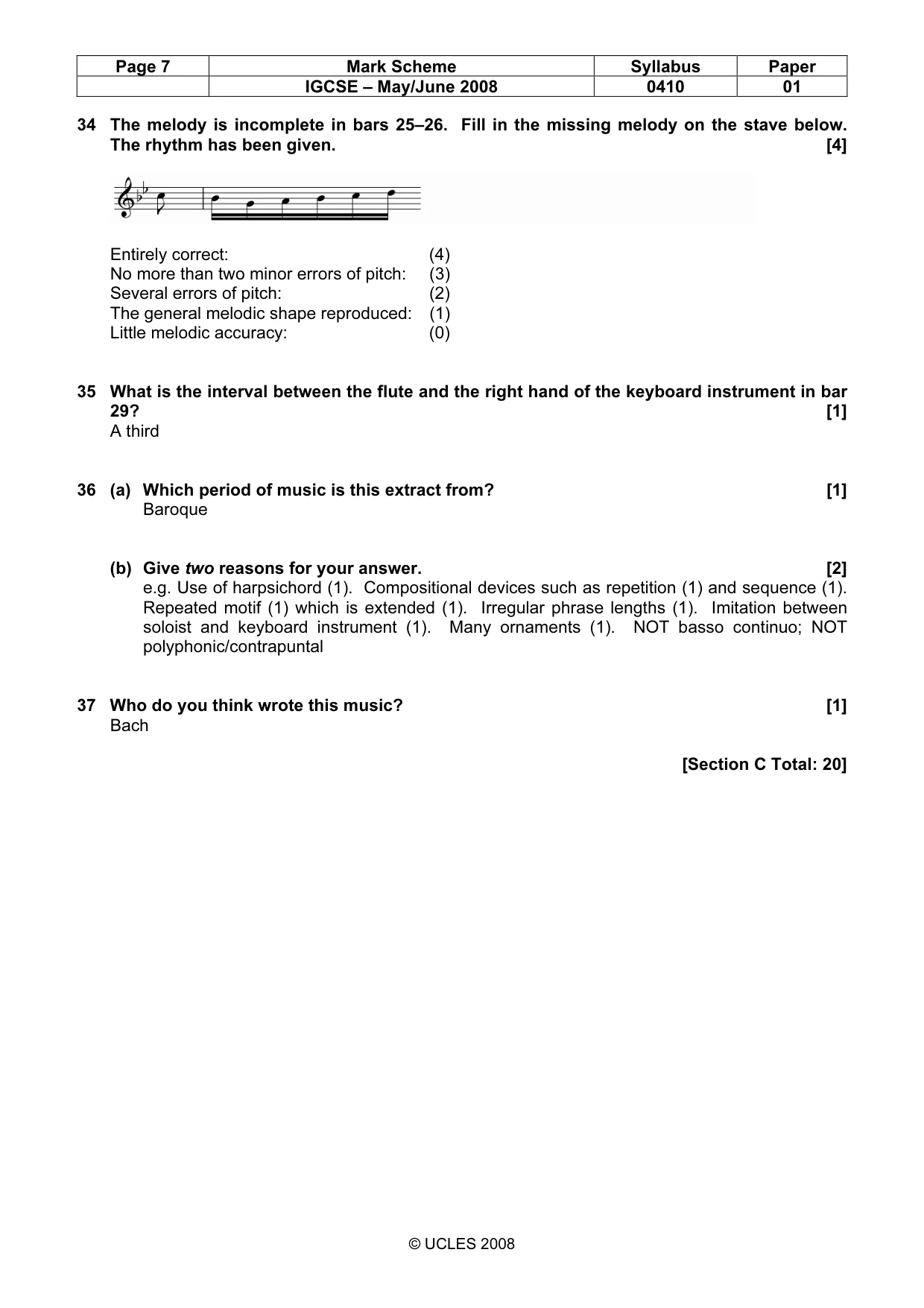
11 0410/01/M/J/08 © UCLES 2008 For Examiner’s Use 32 Which of the following ornaments is heard on the first note in bar 14? Acciaccatura Mordent Slide Trill [1] 33 Give the exact name of the bracketed interval in bar 21. … … [2] 34 The melody is incomplete in bars 25–26. Fill in the missing melody on the stave below. The rhythm has been given. [4] 35 What is the interval between the flute and the right hand of the keyboard instrument in bar 29? A third A fourth A fifth An octave [1] 36 (a) Which period of music is this extract from? … [1] (b) Give two reasons for your answer. … …[2] 37 Who do you think wrote this music? Bach Bartók Haydn Tchaikovsky [1]
Question paper, page 12
12 0410/01/M/J/08 BLANK PAGE Copyright Acknowledgements: Music A1 Copyright © 1949 by Cole Porter, copyright renewed. International copyright secured. All rights reserved. Music C1 © MPA. Permission to reproduce items where third-party owned material protected by copyright is included has been sought and cleared where possible. Every reasonable effort has been made by the publisher (UCLES) to trace copyright holders, but if any items requiring clearance have unwittingly been included, the publisher will be pleased to make amends at the earliest possible opportunity. University of Cambridge International Examinations is part of the Cambridge Assessment Group. Cambridge Assessment is the brand name of University of Cambridge Local Examinations Syndicate (UCLES), which is itself a department of the University of Cambridge.
Question paper, page 13
This document consists of 2 printed pages. SP (CW/TL) T51779/2 © UCLES 2008 [Turn over UNIVERSITY OF CAMBRIDGE INTERNATIONAL EXAMINATIONS International General Certificate of Secondary Education READ THESE INSTRUCTIONS FIRST This Insert contains the extract for Music C1. MUSIC 0410/01 Paper 1 Unprepared Listening May/June 2008 INSERT Approx. 1 hour
Question paper, page 14
2 0410/01/INSERT/M/J/08 © UCLES 2008 Insert for Music C1 Answer all questions in the answer booklet, not on this score. University of Cambridge International Examinations is part of the Cambridge Assessment Group. Cambridge Assessment is the brand name of University of Cambridge Local Examinations Syndicate (UCLES), which is itself a department of the University of Cambridge.
Mark scheme, page 1
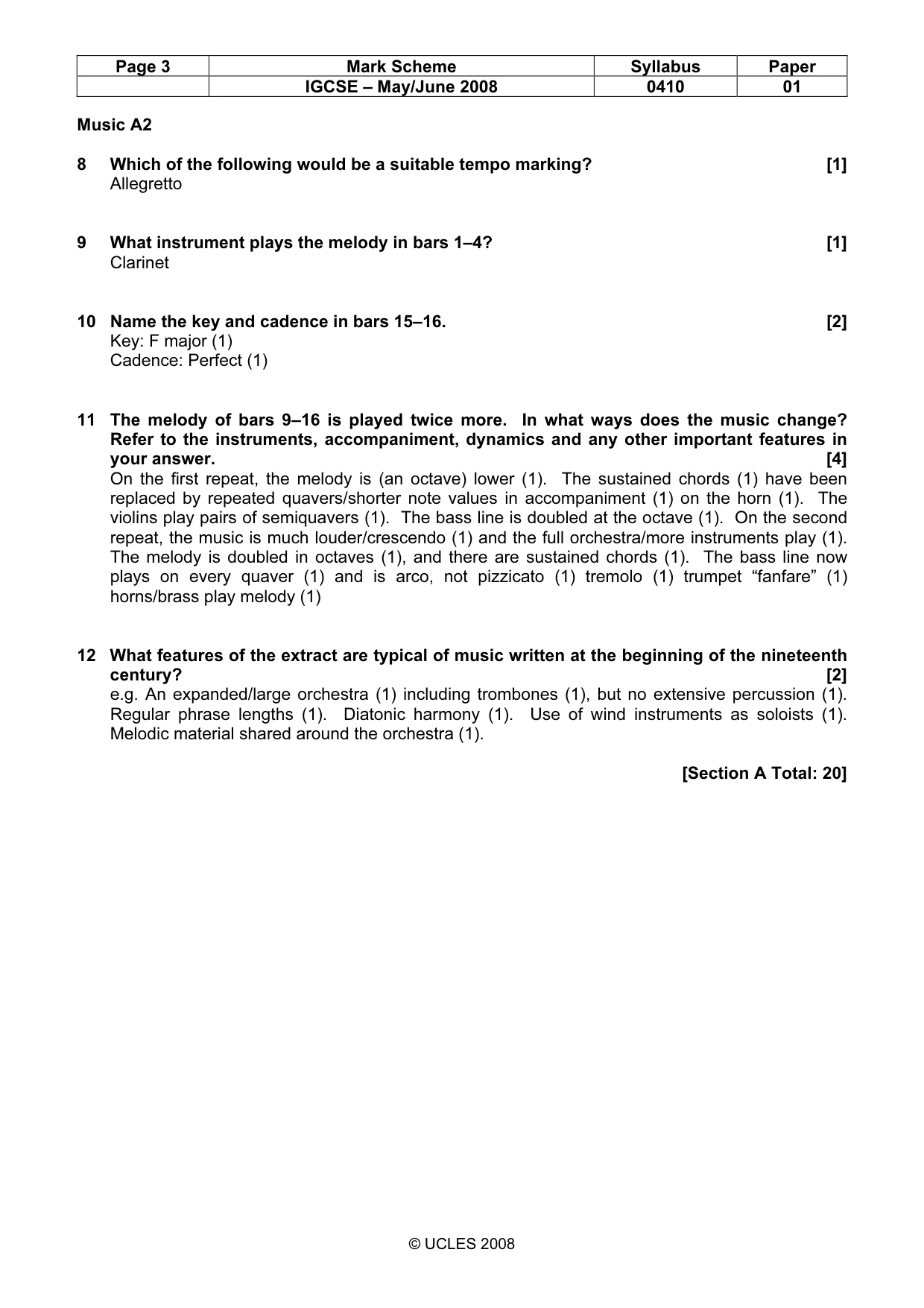
UNIVERSITY OF CAMBRIDGE INTERNATIONAL EXAMINATIONS International General Certificate of Secondary Education MARK SCHEME for the May/June 2008 question paper 0410 MUSIC 0410/01 Paper 1 (Unprepared Listening), maximum raw mark 60 This mark scheme is published as an aid to teachers and candidates, to indicate the requirements of the examination. It shows the basis on which Examiners were instructed to award marks. It does not indicate the details of the discussions that took place at an Examiners’ meeting before marking began. All Examiners are instructed that alternative correct answers and unexpected approaches in candidates’ scripts must be given marks that fairly reflect the relevant knowledge and skills demonstrated. Mark schemes must be read in conjunction with the question papers and the report on the examination. • CIE will not enter into discussions or correspondence in connection with these mark schemes. CIE is publishing the mark schemes for the May/June 2008 question papers for most IGCSE, GCE Advanced Level and Advanced Subsidiary Level syllabuses and some Ordinary Level syllabuses. www.XtremePapers.com
Mark scheme, page 2
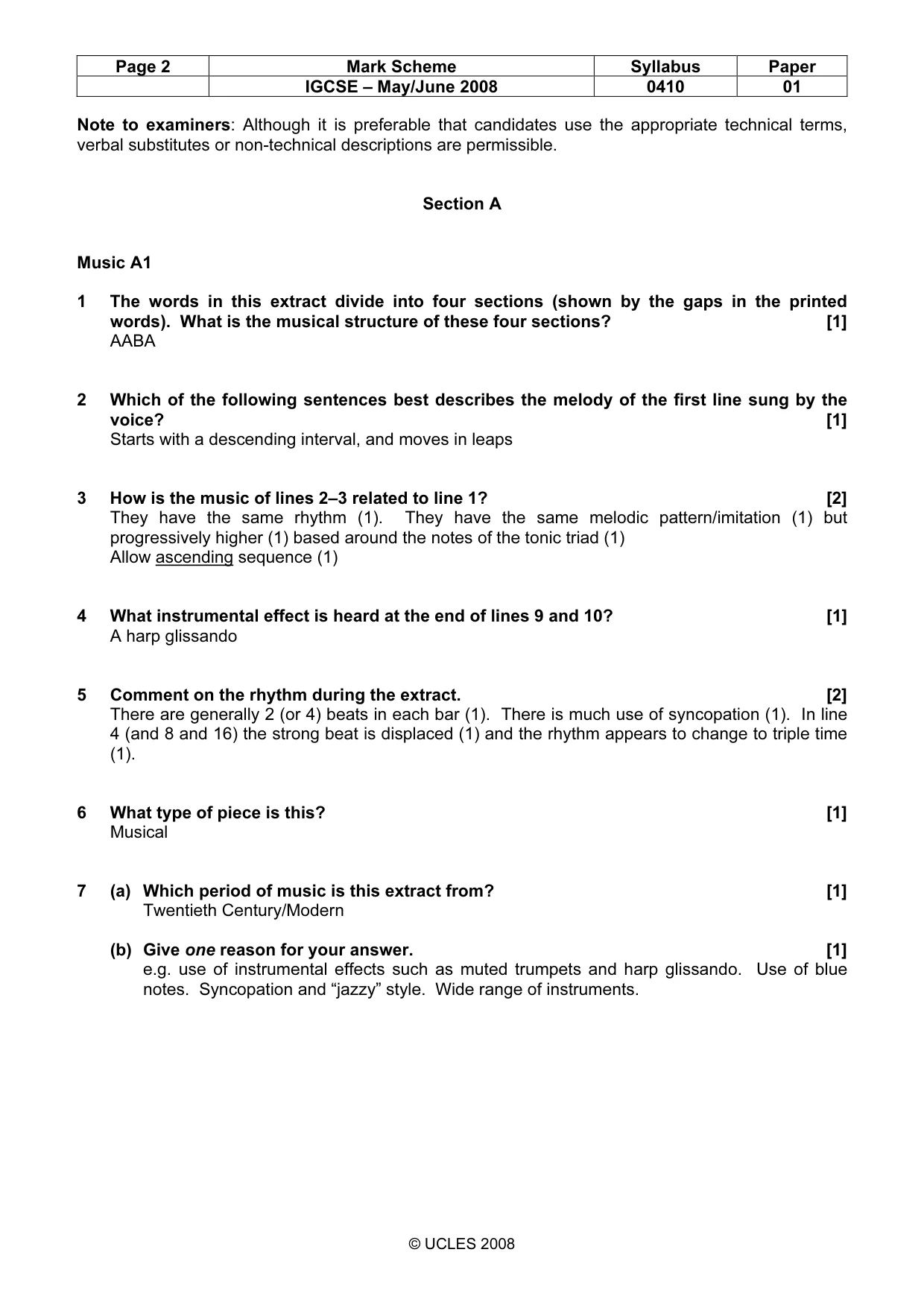
Page 2 Mark Scheme Syllabus Paper IGCSE – May/June 2008 0410 01 © UCLES 2008 Note to examiners: Although it is preferable that candidates use the appropriate technical terms, verbal substitutes or non-technical descriptions are permissible. Section A Music A1 1 The words in this extract divide into four sections (shown by the gaps in the printed words). What is the musical structure of these four sections? [1] AABA 2 Which of the following sentences best describes the melody of the first line sung by the voice? [1] Starts with a descending interval, and moves in leaps 3 How is the music of lines 2–3 related to line 1? [2] They have the same rhythm (1). They have the same melodic pattern/imitation (1) but progressively higher (1) based around the notes of the tonic triad (1) Allow ascending sequence (1) 4 What instrumental effect is heard at the end of lines 9 and 10? [1] A harp glissando 5 Comment on the rhythm during the extract. [2] There are generally 2 (or 4) beats in each bar (1). There is much use of syncopation (1). In line 4 (and 8 and 16) the strong beat is displaced (1) and the rhythm appears to change to triple time (1). 6 What type of piece is this? [1] Musical 7 (a) Which period of music is this extract from? [1] Twentieth Century/Modern (b) Give one reason for your answer. [1] e.g. use of instrumental effects such as muted trumpets and harp glissando. Use of blue notes. Syncopation and “jazzy” style. Wide range of instruments.
Mark scheme, page 3
Page 3 Mark Scheme Syllabus Paper IGCSE – May/June 2008 0410 01 © UCLES 2008 Music A2 8 Which of the following would be a suitable tempo marking? [1] Allegretto 9 What instrument plays the melody in bars 1–4? [1] Clarinet 10 Name the key and cadence in bars 15–16. [2] Key: F major (1) Cadence: Perfect (1) 11 The melody of bars 9–16 is played twice more. In what ways does the music change? Refer to the instruments, accompaniment, dynamics and any other important features in your answer. [4] On the first repeat, the melody is (an octave) lower (1). The sustained chords (1) have been replaced by repeated quavers/shorter note values in accompaniment (1) on the horn (1). The violins play pairs of semiquavers (1). The bass line is doubled at the octave (1). On the second repeat, the music is much louder/crescendo (1) and the full orchestra/more instruments play (1). The melody is doubled in octaves (1), and there are sustained chords (1). The bass line now plays on every quaver (1) and is arco, not pizzicato (1) tremolo (1) trumpet “fanfare” (1) horns/brass play melody (1) 12 What features of the extract are typical of music written at the beginning of the nineteenth century? [2] e.g. An expanded/large orchestra (1) including trombones (1), but no extensive percussion (1). Regular phrase lengths (1). Diatonic harmony (1). Use of wind instruments as soloists (1). Melodic material shared around the orchestra (1). [Section A Total: 20]
Mark scheme, page 4
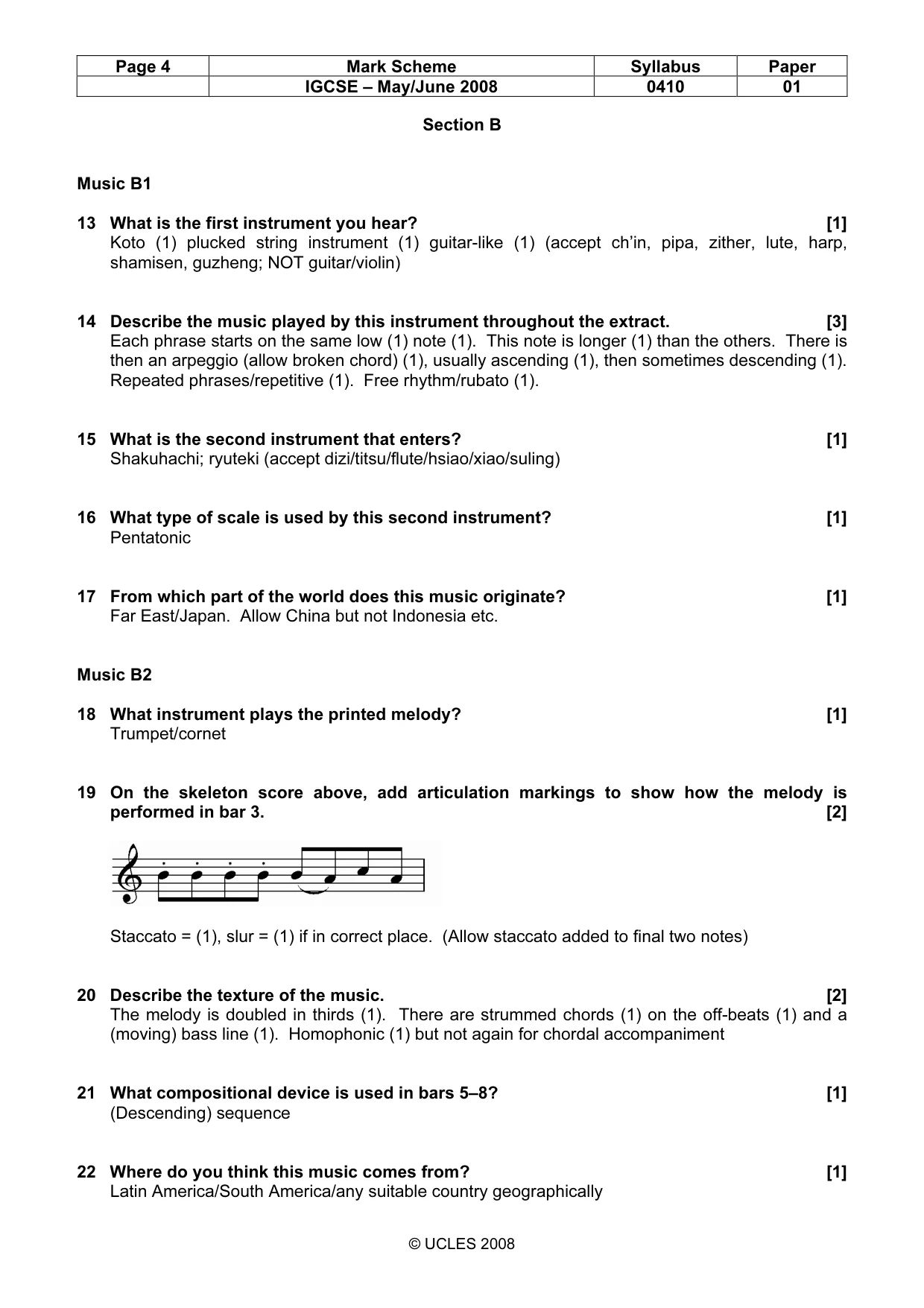
Page 4 Mark Scheme Syllabus Paper IGCSE – May/June 2008 0410 01 © UCLES 2008 Section B Music B1 13 What is the first instrument you hear? [1] Koto (1) plucked string instrument (1) guitar-like (1) (accept ch’in, pipa, zither, lute, harp, shamisen, guzheng; NOT guitar/violin) 14 Describe the music played by this instrument throughout the extract. [3] Each phrase starts on the same low (1) note (1). This note is longer (1) than the others. There is then an arpeggio (allow broken chord) (1), usually ascending (1), then sometimes descending (1). Repeated phrases/repetitive (1). Free rhythm/rubato (1). 15 What is the second instrument that enters? [1] Shakuhachi; ryuteki (accept dizi/titsu/flute/hsiao/xiao/suling) 16 What type of scale is used by this second instrument? [1] Pentatonic 17 From which part of the world does this music originate? [1] Far East/Japan. Allow China but not Indonesia etc. Music B2 18 What instrument plays the printed melody? [1] Trumpet/cornet 19 On the skeleton score above, add articulation markings to show how the melody is performed in bar 3. [2] Staccato = (1), slur = (1) if in correct place. (Allow staccato added to final two notes) 20 Describe the texture of the music. [2] The melody is doubled in thirds (1). There are strummed chords (1) on the off-beats (1) and a (moving) bass line (1). Homophonic (1) but not again for chordal accompaniment 21 What compositional device is used in bars 5–8? [1] (Descending) sequence 22 Where do you think this music comes from? [1] Latin America/South America/any suitable country geographically
Mark scheme, page 5
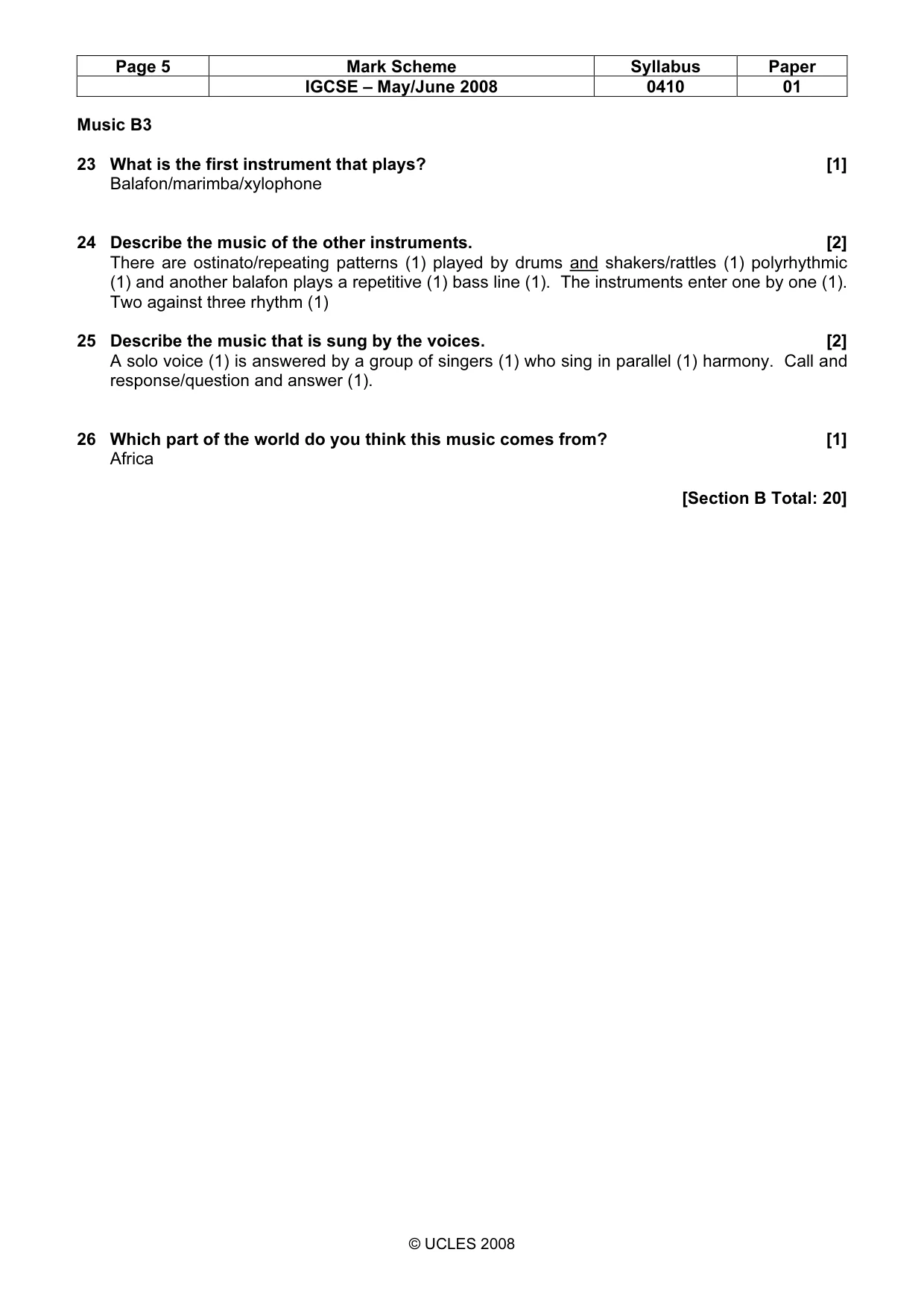
Page 5 Mark Scheme Syllabus Paper IGCSE – May/June 2008 0410 01 © UCLES 2008 Music B3 23 What is the first instrument that plays? [1] Balafon/marimba/xylophone 24 Describe the music of the other instruments. [2] There are ostinato/repeating patterns (1) played by drums and shakers/rattles (1) polyrhythmic (1) and another balafon plays a repetitive (1) bass line (1). The instruments enter one by one (1). Two against three rhythm (1) 25 Describe the music that is sung by the voices. [2] A solo voice (1) is answered by a group of singers (1) who sing in parallel (1) harmony. Call and response/question and answer (1). 26 Which part of the world do you think this music comes from? [1] Africa [Section B Total: 20]
Mark scheme, page 6
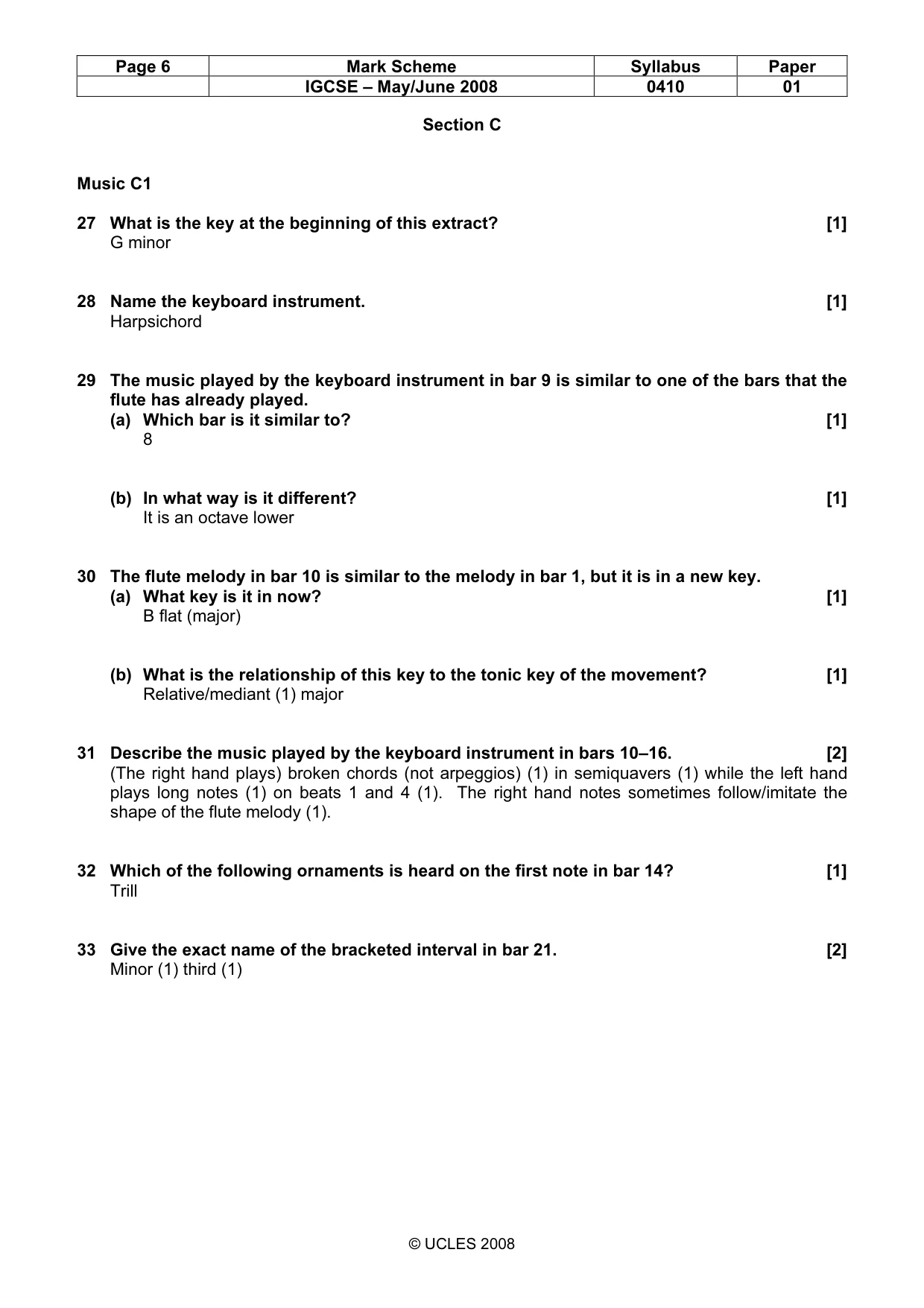
Page 6 Mark Scheme Syllabus Paper IGCSE – May/June 2008 0410 01 © UCLES 2008 Section C Music C1 27 What is the key at the beginning of this extract? [1] G minor 28 Name the keyboard instrument. [1] Harpsichord 29 The music played by the keyboard instrument in bar 9 is similar to one of the bars that the flute has already played. (a) Which bar is it similar to? [1] 8 (b) In what way is it different? [1] It is an octave lower 30 The flute melody in bar 10 is similar to the melody in bar 1, but it is in a new key. (a) What key is it in now? [1] B flat (major) (b) What is the relationship of this key to the tonic key of the movement? [1] Relative/mediant (1) major 31 Describe the music played by the keyboard instrument in bars 10–16. [2] (The right hand plays) broken chords (not arpeggios) (1) in semiquavers (1) while the left hand plays long notes (1) on beats 1 and 4 (1). The right hand notes sometimes follow/imitate the shape of the flute melody (1). 32 Which of the following ornaments is heard on the first note in bar 14? [1] Trill 33 Give the exact name of the bracketed interval in bar 21. [2] Minor (1) third (1)
Mark scheme, page 7
Page 7 Mark Scheme Syllabus Paper IGCSE – May/June 2008 0410 01 © UCLES 2008 34 The melody is incomplete in bars 25–26. Fill in the missing melody on the stave below. The rhythm has been given. [4] Entirely correct: (4) No more than two minor errors of pitch: (3) Several errors of pitch: (2) The general melodic shape reproduced: (1) Little melodic accuracy: (0) 35 What is the interval between the flute and the right hand of the keyboard instrument in bar 29? [1] A third 36 (a) Which period of music is this extract from? [1] Baroque (b) Give two reasons for your answer. [2] e.g. Use of harpsichord (1). Compositional devices such as repetition (1) and sequence (1). Repeated motif (1) which is extended (1). Irregular phrase lengths (1). Imitation between soloist and keyboard instrument (1). Many ornaments (1). NOT basso continuo; NOT polyphonic/contrapuntal 37 Who do you think wrote this music? [1] Bach [Section C Total: 20]
What you needed in this session
Cambridge’s own grade thresholds for 2008 May/June, Paper 1 · Variant 1. A higher threshold means an easier paper — the bar moves with how the cohort did.