Cambridge IGCSE Mathematics (with coursework) 0581 — 2014 Oct/Nov Paper 2 · Variant 2
0581/22/O/N/14
The question paper and its mark scheme, free to read here and free to download. This is Cambridge’s own paper, exactly as it was sat.
Question paper12 pages
Mark scheme5 pages
Answers below. Sit the paper first if you are practising.
Paper as text
Question paper, page 1
READ THESE INSTRUCTIONS FIRST Write your Centre number, candidate number and name on all the work you hand in. Write in dark blue or black pen. You may use an HB pencil for any diagrams or graphs. Do not use staples, paper clips, glue or correction fl uid. DO NOT WRITE IN ANY BARCODES. Answer all questions. If working is needed for any question it must be shown below that question. Electronic calculators should be used. If the degree of accuracy is not specifi ed in the question, and if the answer is not exact, give the answer to three signifi cant fi gures. Give answers in degrees to one decimal place. For π, use either your calculator value or 3.142. At the end of the examination, fasten all your work securely together. The number of marks is given in brackets [ ] at the end of each question or part question. The total of the marks for this paper is 70. MATHEMATICS 0581/22 Paper 2 (Extended) October/November 2014 1 hour 30 minutes Candidates answer on the Question Paper. Additional Materials: Electronic calculator Geometrical instruments Tracing paper (optional) Cambridge International Examinations Cambridge International General Certifi cate of Secondary Education This document consists of 12 printed pages. [Turn over IB14 11_0581_22/FP © UCLES 2014 *2463478208* PAPA CAMBRIDGE
Question paper, page 2
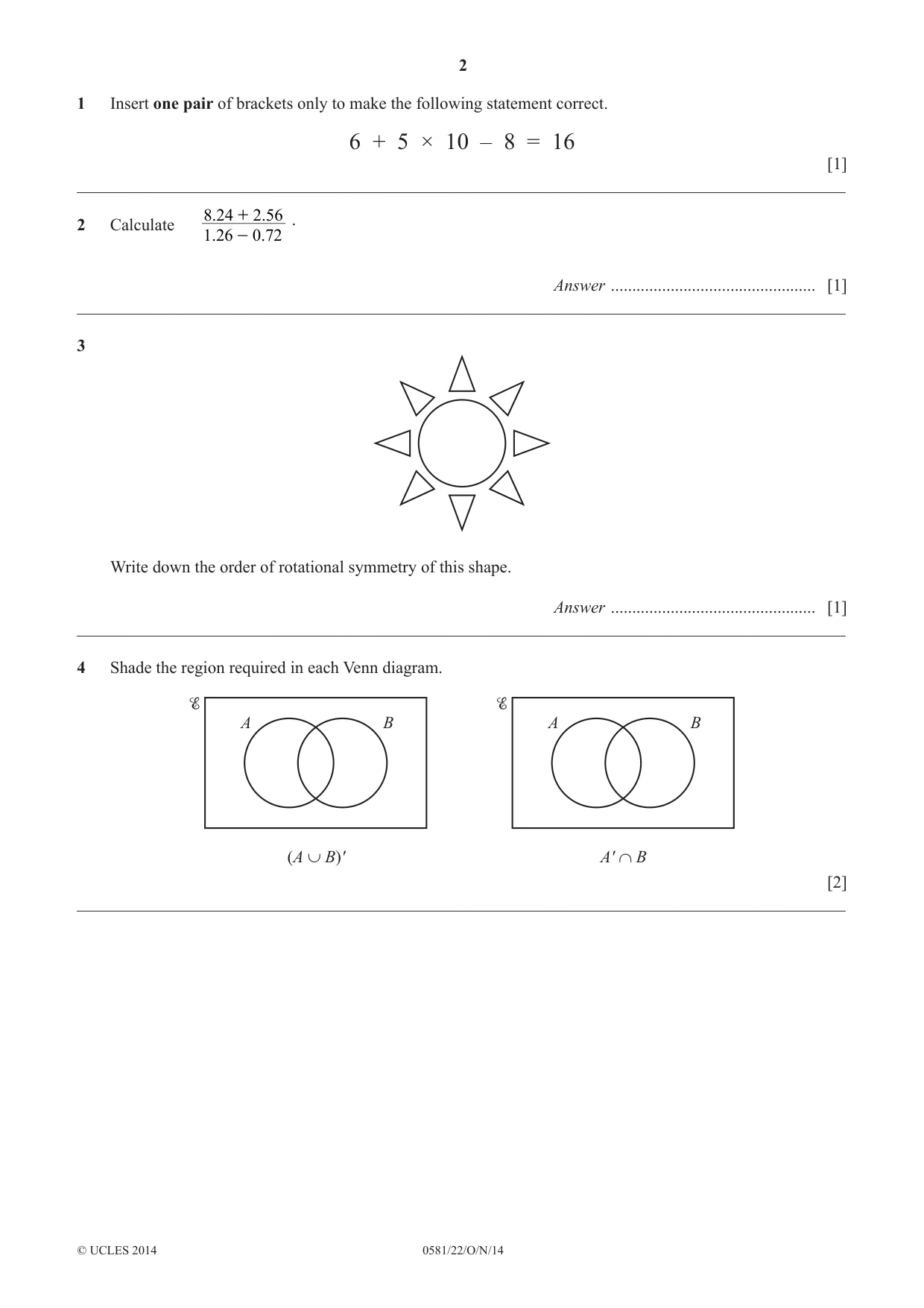
2 0581/22/O/N/14 © UCLES 2014 1 Insert one pair of brackets only to make the following statement correct. 6 + 5 × 10 – 8 = 16 [1] __________________________________________________________________________________________ 2 Calculate 1.26 0.72 8.24 2.56 - + . Answer … [1] __________________________________________________________________________________________ 3 Write down the order of rotational symmetry of this shape. Answer … [1] __________________________________________________________________________________________ 4 Shade the region required in each Venn diagram. A B (A ∪ B)' A B A' ∩ B [2] __________________________________________________________________________________________
Question paper, page 3
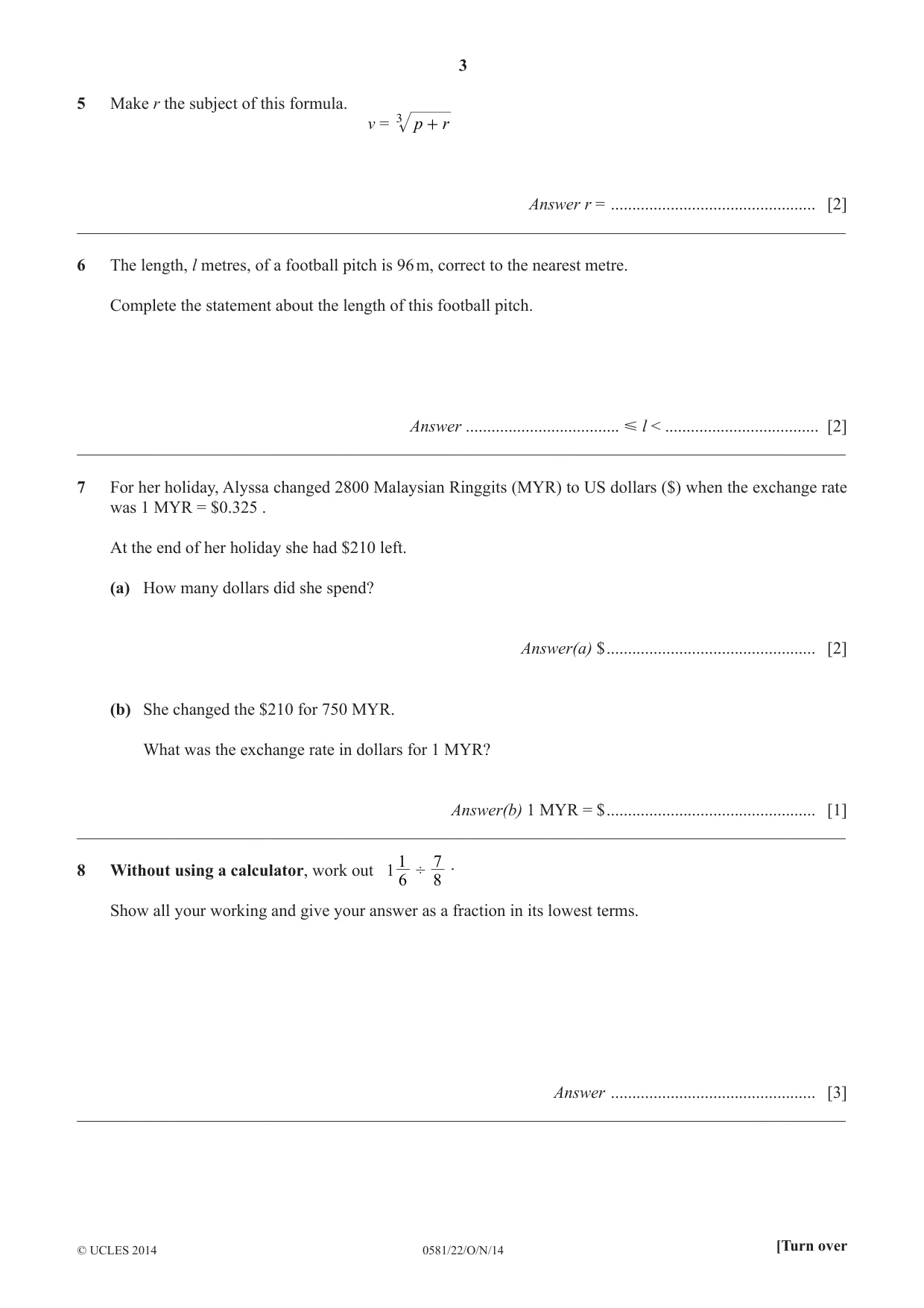
3 0581/22/O/N/14 © UCLES 2014 [Turn over 5 Make r the subject of this formula. v = p r + 3 Answer r = … [2] __________________________________________________________________________________________ 6 The length, l metres, of a football pitch is 96 m, correct to the nearest metre. Complete the statement about the length of this football pitch. Answer … Y l < … [2] __________________________________________________________________________________________ 7 For her holiday, Alyssa changed 2800 Malaysian Ringgits (MYR) to US dollars ($) when the exchange rate was 1 MYR = $0.325 . At the end of her holiday she had $210 left. (a) How many dollars did she spend? Answer(a) $ … [2] (b) She changed the $210 for 750 MYR. What was the exchange rate in dollars for 1 MYR? Answer(b) 1 MYR = $ … [1] __________________________________________________________________________________________ 8 Without using a calculator, work out 1 6 1 ÷ 8 7 . Show all your working and give your answer as a fraction in its lowest terms. Answer … [3] __________________________________________________________________________________________
Question paper, page 4
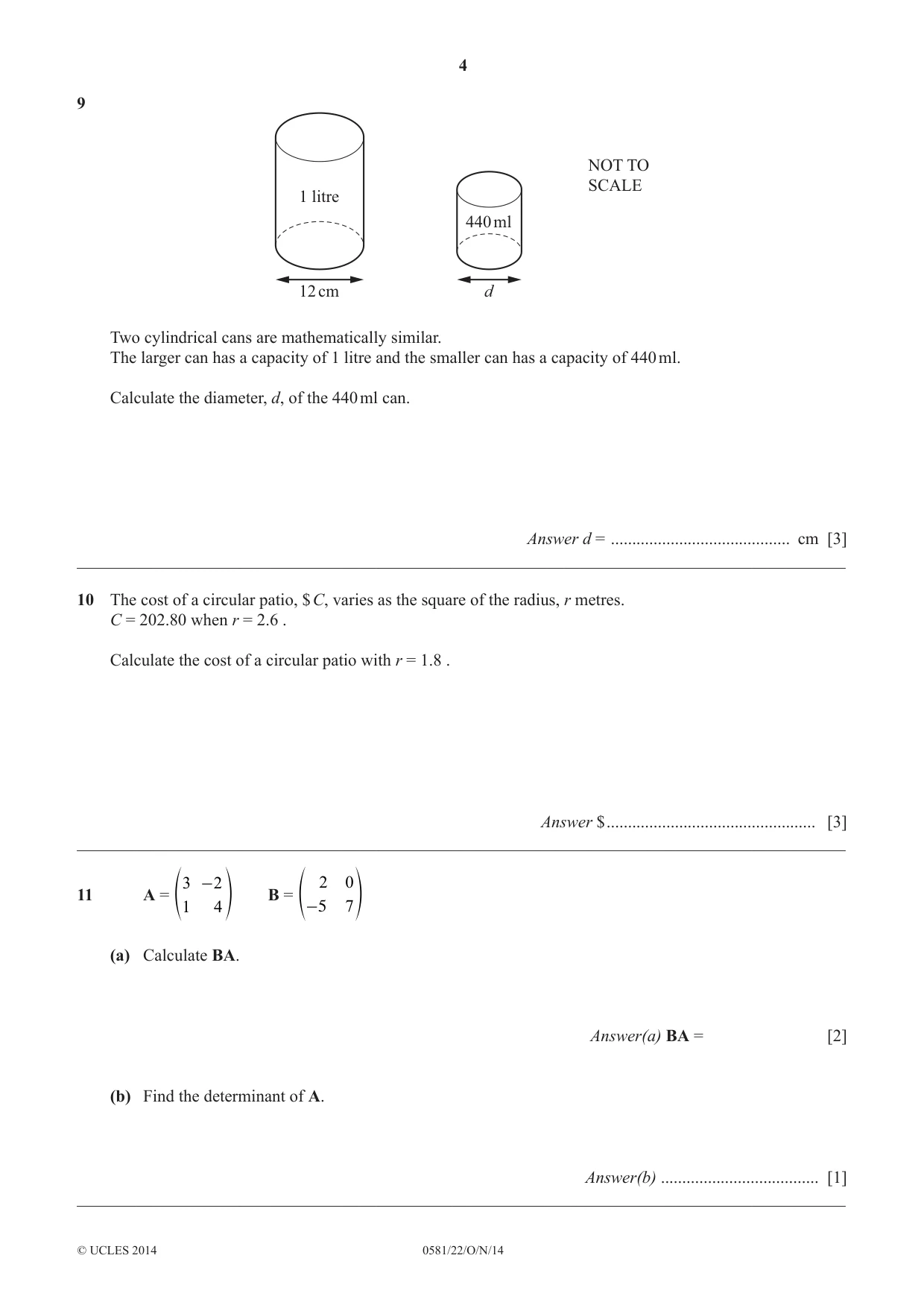
4 0581/22/O/N/14 © UCLES 2014 9 1 litre 12 cm 440 ml d NOT TO SCALE Two cylindrical cans are mathematically similar. The larger can has a capacity of 1 litre and the smaller can has a capacity of 440 ml. Calculate the diameter, d, of the 440 ml can. Answer d = … cm [3] __________________________________________________________________________________________ 10 The cost of a circular patio, $ C, varies as the square of the radius, r metres. C = 202.80 when r = 2.6 . Calculate the cost of a circular patio with r = 1.8 . Answer $ … [3] __________________________________________________________________________________________ 11 A = 2 1 3 4 - f p B = 5 2 0 7 - f p (a) Calculate BA. Answer(a) BA = [2] (b) Find the determinant of A. Answer(b) … [1] __________________________________________________________________________________________
Question paper, page 5
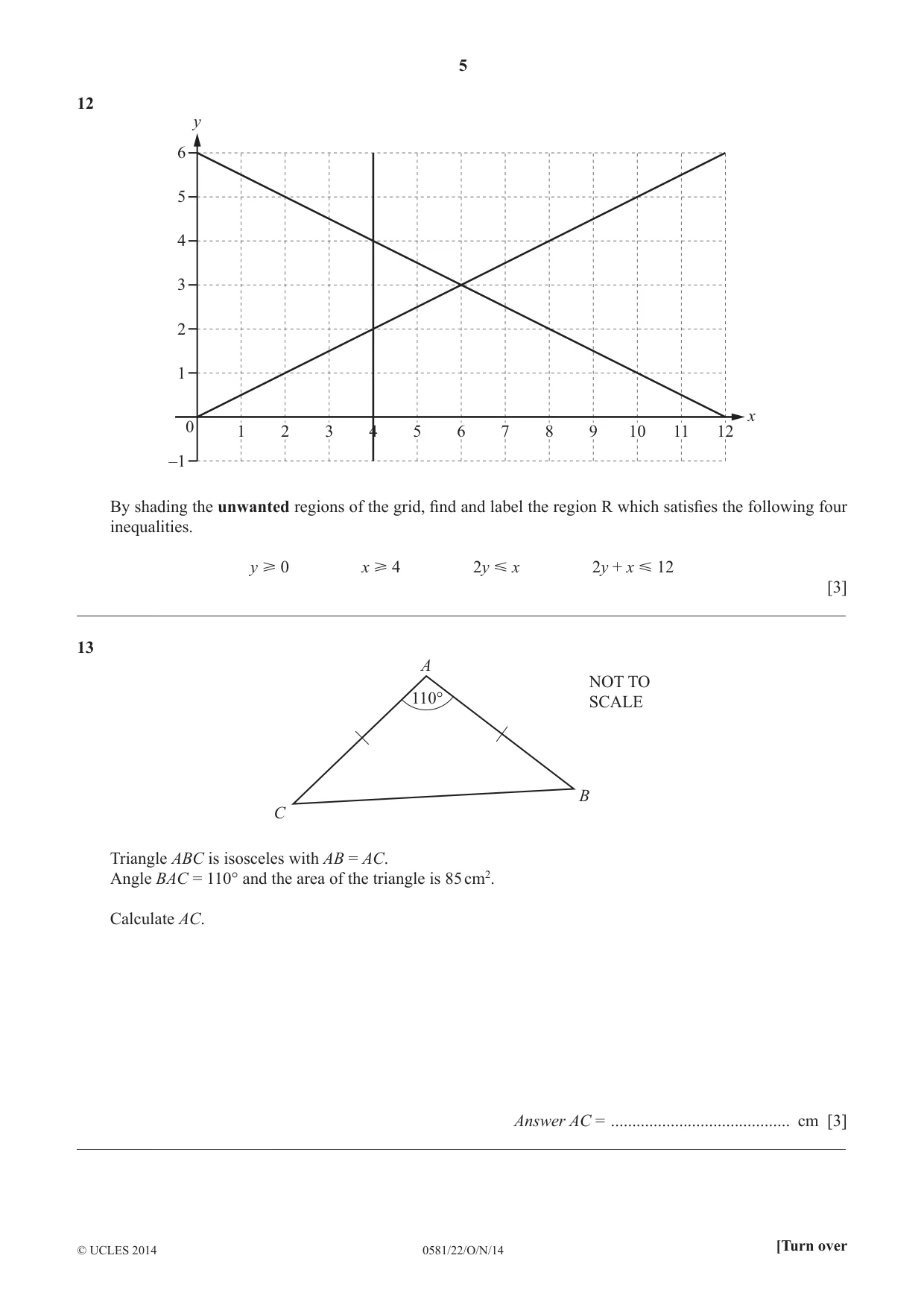
5 0581/22/O/N/14 © UCLES 2014 [Turn over 12 2 4 6 8 10 12 1 3 5 7 9 11 6 5 4 3 2 1 –1 0 y x By shading the unwanted regions of the grid, fi nd and label the region R which satisfi es the following four inequalities. y [ 0 x [ 4 2y Y x 2y + x Y 12 [3] __________________________________________________________________________________________ 13 110° NOT TO SCALE A C B Triangle ABC is isosceles with AB = AC. Angle BAC = 110° and the area of the triangle is 85 cm2. Calculate AC. Answer AC = … cm [3] __________________________________________________________________________________________
Question paper, page 6
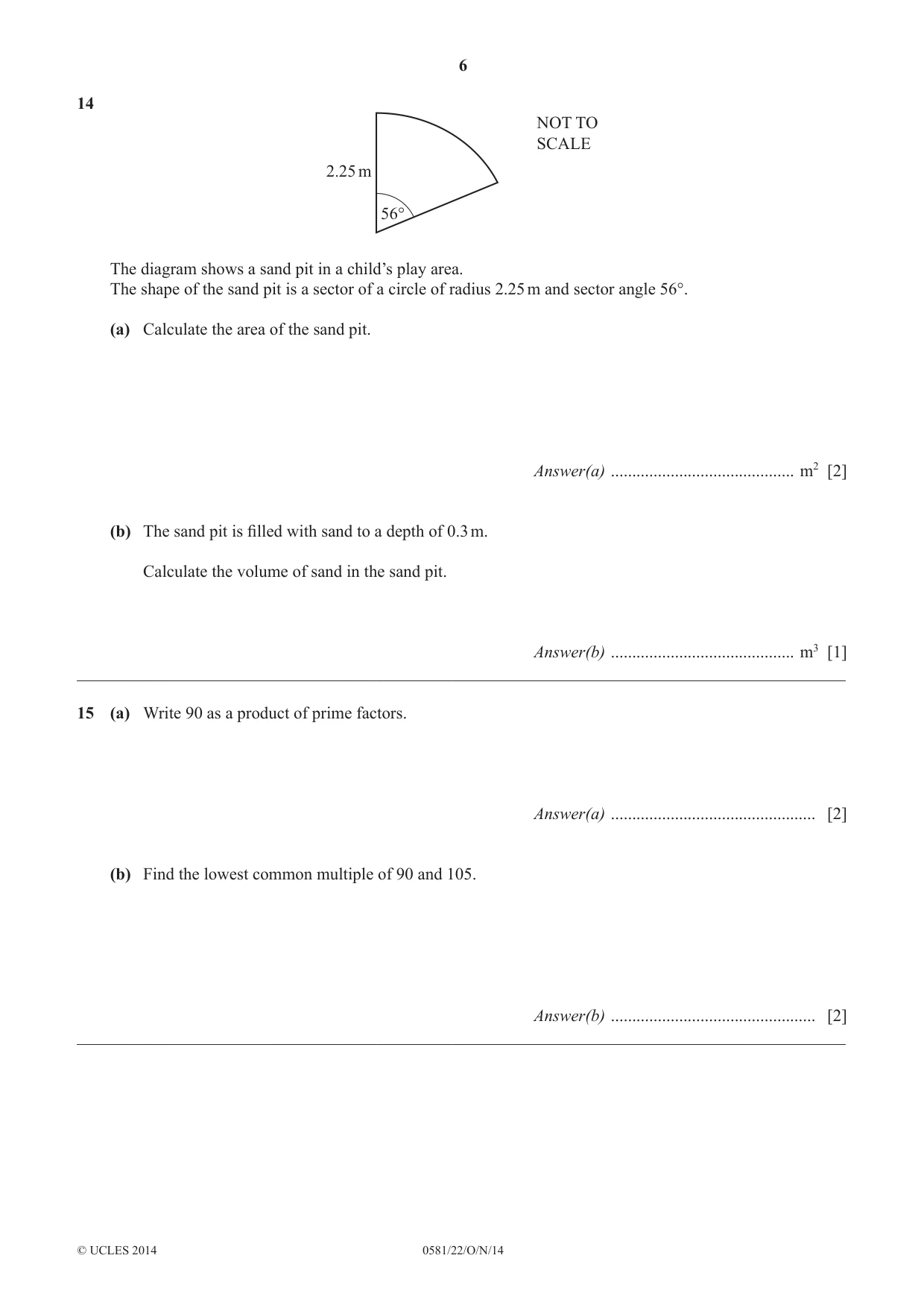
6 0581/22/O/N/14 © UCLES 2014 14 56° 2.25 m NOT TO SCALE The diagram shows a sand pit in a child’s play area. The shape of the sand pit is a sector of a circle of radius 2.25 m and sector angle 56°. (a) Calculate the area of the sand pit. Answer(a) … m2 [2] (b) The sand pit is fi lled with sand to a depth of 0.3 m. Calculate the volume of sand in the sand pit. Answer(b) … m3 [1] __________________________________________________________________________________________ 15 (a) Write 90 as a product of prime factors. Answer(a) … [2] (b) Find the lowest common multiple of 90 and 105. Answer(b) … [2] __________________________________________________________________________________________
Question paper, page 7
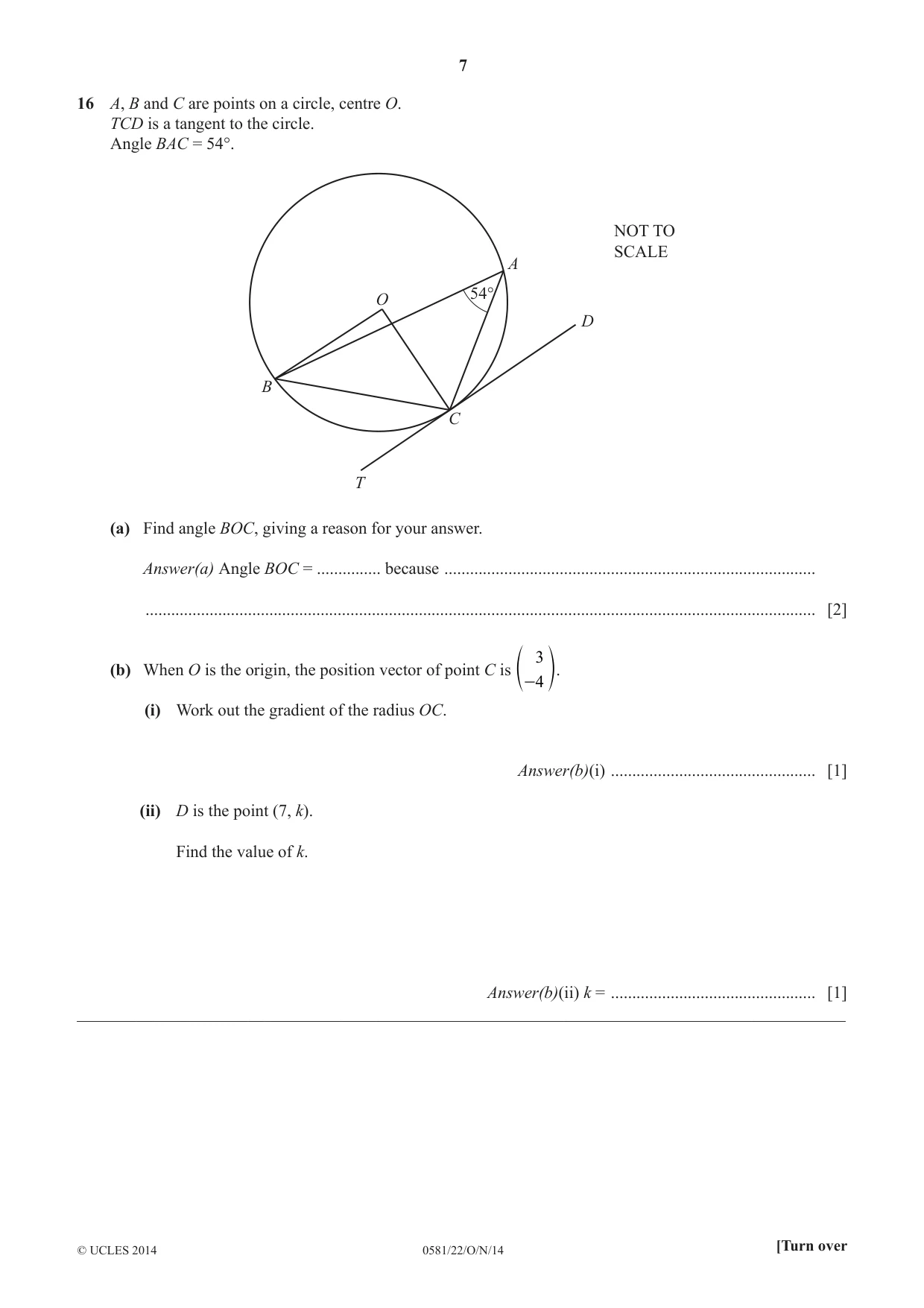
7 0581/22/O/N/14 © UCLES 2014 [Turn over 16 A, B and C are points on a circle, centre O. TCD is a tangent to the circle. Angle BAC = 54°. A D T B C O 54° NOT TO SCALE (a) Find angle BOC, giving a reason for your answer. Answer(a) Angle BOC = … because … … [2] (b) When O is the origin, the position vector of point C is 4 3 - e o. (i) Work out the gradient of the radius OC. Answer(b)(i) … [1] (ii) D is the point (7, k). Find the value of k. Answer(b)(ii) k = … [1] __________________________________________________________________________________________
Question paper, page 8
8 0581/22/O/N/14 © UCLES 2014 17 Alex invests $200 for 2 years at a rate of 2% per year simple interest. Chris invests $200 for 2 years at a rate of 2% per year compound interest. Calculate how much more interest Chris has than Alex. Answer $ … [4] __________________________________________________________________________________________
Question paper, page 9
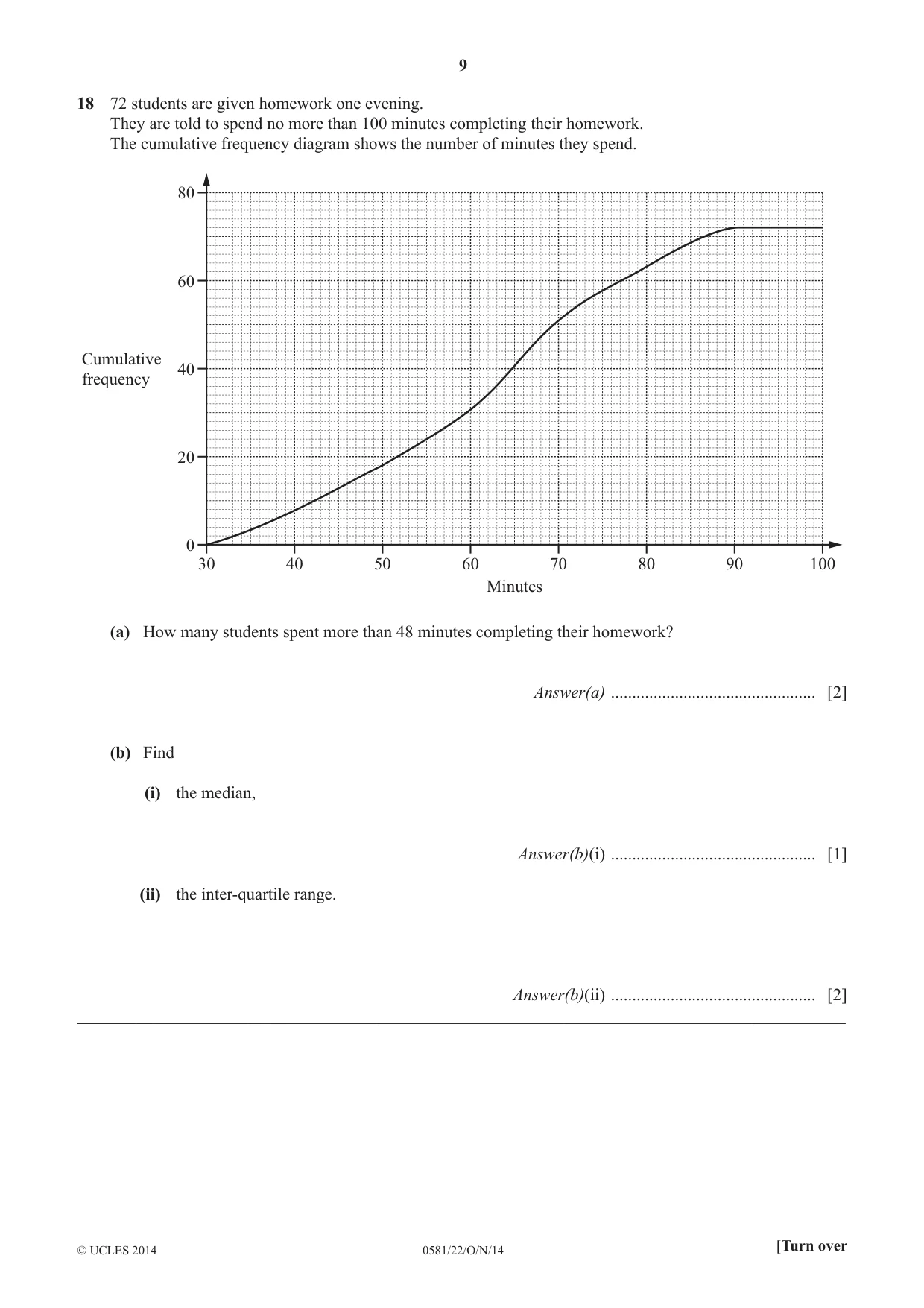
9 0581/22/O/N/14 © UCLES 2014 [Turn over 18 72 students are given homework one evening. They are told to spend no more than 100 minutes completing their homework. The cumulative frequency diagram shows the number of minutes they spend. 80 60 40 20 0 30 40 50 60 70 Minutes 80 90 100 Cumulative frequency (a) How many students spent more than 48 minutes completing their homework? Answer(a) … [2] (b) Find (i) the median, Answer(b)(i) … [1] (ii) the inter-quartile range. Answer(b)(ii) … [2] __________________________________________________________________________________________
Question paper, page 10
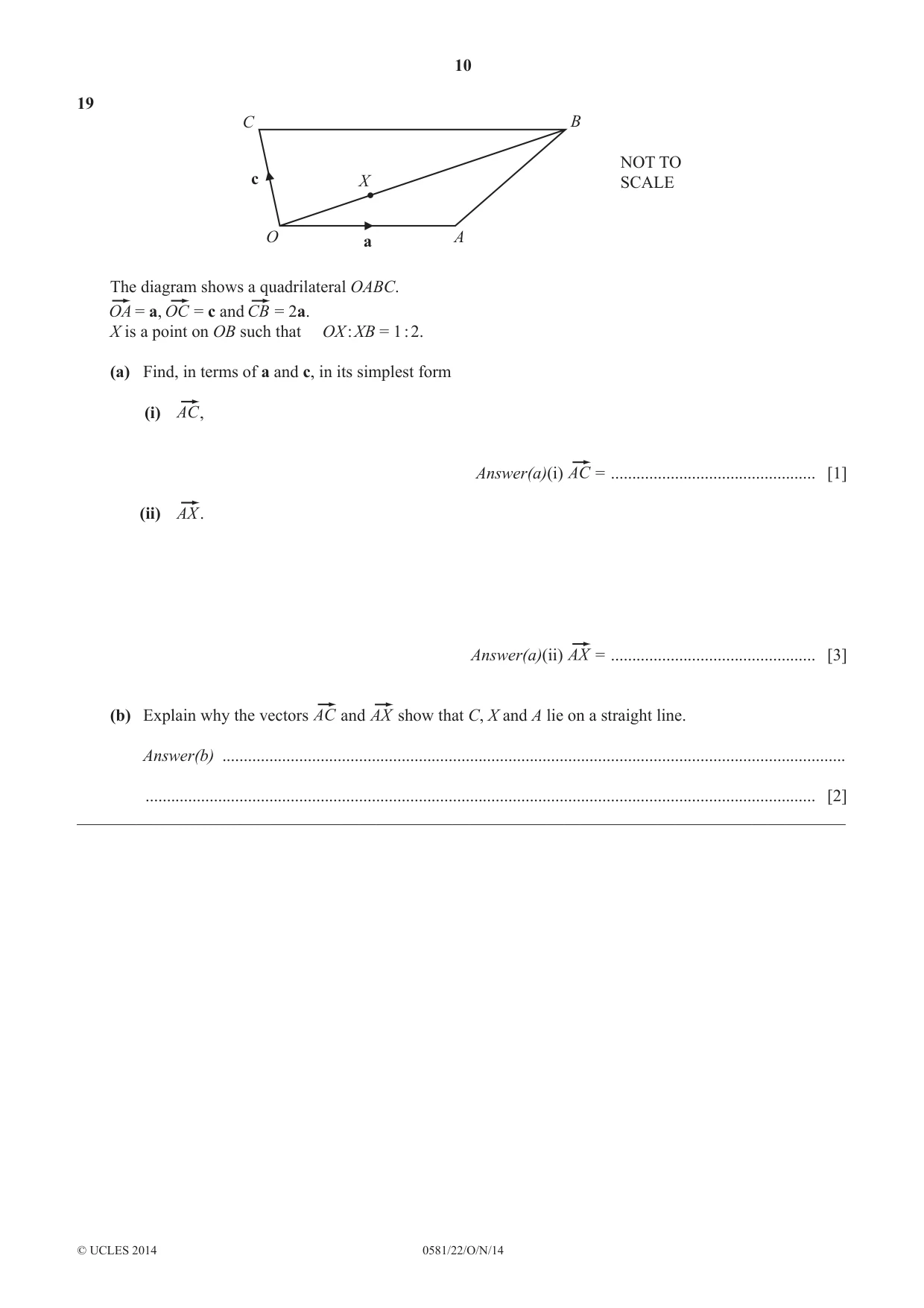
10 0581/22/O/N/14 © UCLES 2014 19 C O A B X c a NOT TO SCALE The diagram shows a quadrilateral OABC. = a, = c and = 2a. X is a point on OB such that OX : XB = 1 : 2. (a) Find, in terms of a and c, in its simplest form (i) , Answer(a)(i) = … [1] (ii) . Answer(a)(ii) = … [3] (b) Explain why the vectors and show that C, X and A lie on a straight line. Answer(b) … … [2] __________________________________________________________________________________________
Question paper, page 11
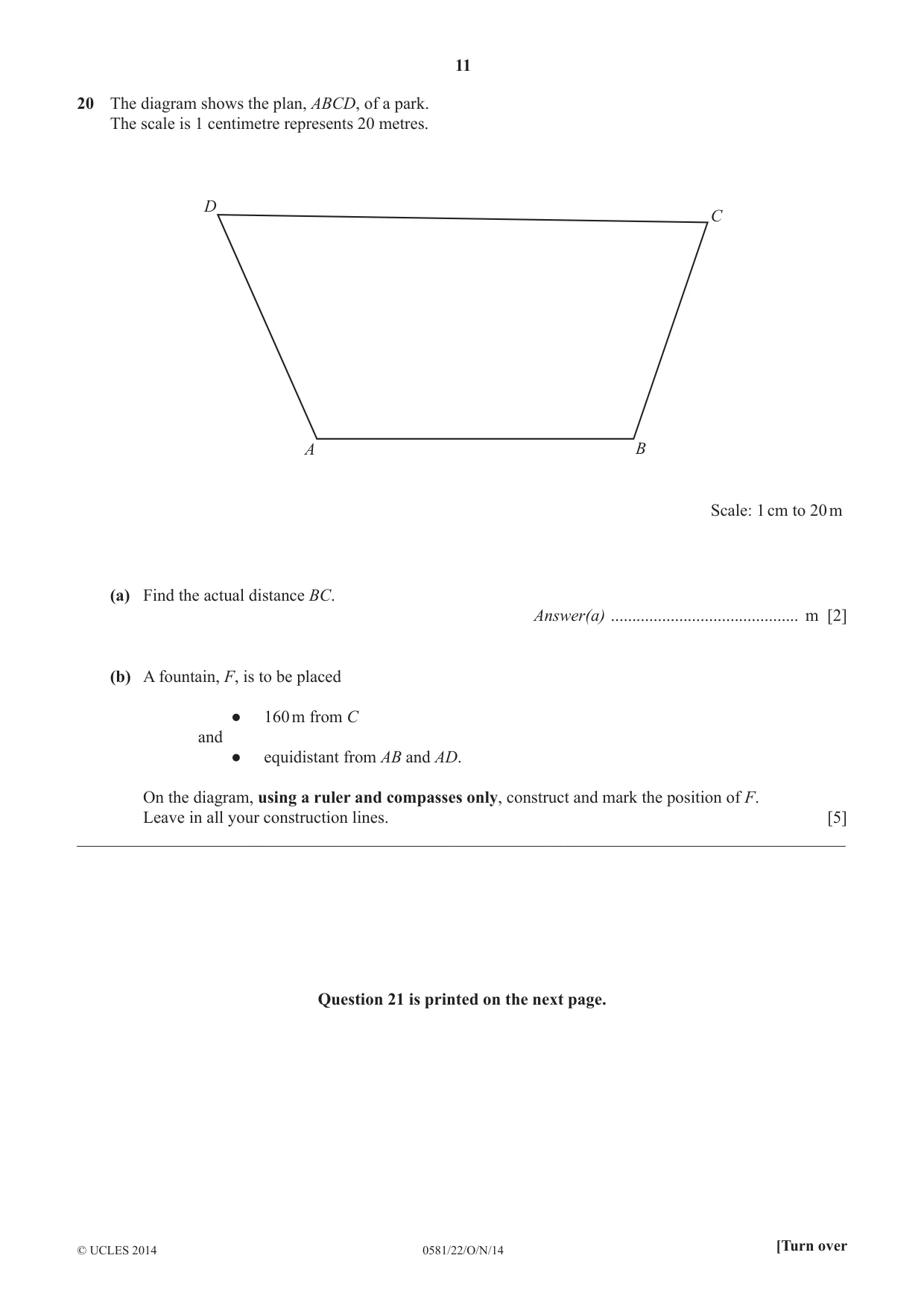
11 0581/22/O/N/14 © UCLES 2014 [Turn over 20 The diagram shows the plan, ABCD, of a park. The scale is 1 centimetre represents 20 metres. D A C B Scale: 1 cm to 20 m (a) Find the actual distance BC. Answer(a) … m [2] (b) A fountain, F, is to be placed ● 160 m from C and ● equidistant from AB and AD. On the diagram, using a ruler and compasses only, construct and mark the position of F. Leave in all your construction lines. [5] __________________________________________________________________________________________ Question 21 is printed on the next page.
Question paper, page 12
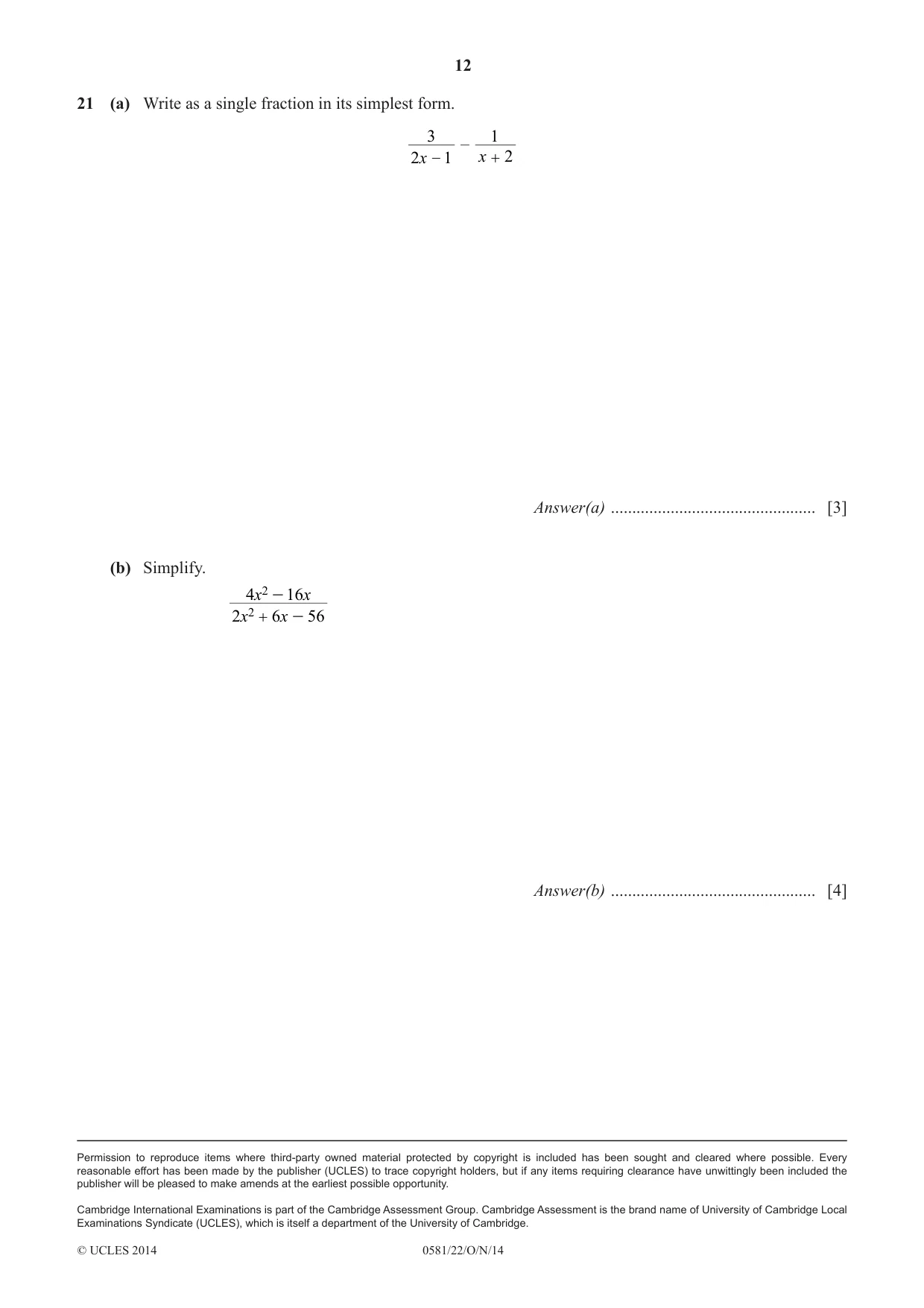
12 0581/22/O/N/14 © UCLES 2014 Permission to reproduce items where third-party owned material protected by copyright is included has been sought and cleared where possible. Every reasonable effort has been made by the publisher (UCLES) to trace copyright holders, but if any items requiring clearance have unwittingly been included the publisher will be pleased to make amends at the earliest possible opportunity. Cambridge International Examinations is part of the Cambridge Assessment Group. Cambridge Assessment is the brand name of University of Cambridge Local Examinations Syndicate (UCLES), which is itself a department of the University of Cambridge. 21 (a) Write as a single fraction in its simplest form. 2 1 3 x - – 2 x 1 + Answer(a) … [3] (b) Simplify. 2 2 2 6 56 4 16 x x x x - - + Answer(b) … [4]
Mark scheme, page 1
® IGCSE is the registered trademark of Cambridge International Examinations. CAMBRIDGE INTERNATIONAL EXAMINATIONS Cambridge International General Certificate of Secondary Education MARK SCHEME for the October/November 2014 series 0581 MATHEMATICS 0581/22 Paper 2 (Extended), maximum raw mark 70 This mark scheme is published as an aid to teachers and candidates, to indicate the requirements of the examination. It shows the basis on which Examiners were instructed to award marks. It does not indicate the details of the discussions that took place at an Examiners’ meeting before marking began, which would have considered the acceptability of alternative answers. Mark schemes should be read in conjunction with the question paper and the Principal Examiner Report for Teachers. Cambridge will not enter into discussions about these mark schemes. Cambridge is publishing the mark schemes for the October/November 2014 series for most Cambridge IGCSE®, Cambridge International A and AS Level components and some Cambridge O Level components. PAPA CAMBRIDGE
Mark scheme, page 2
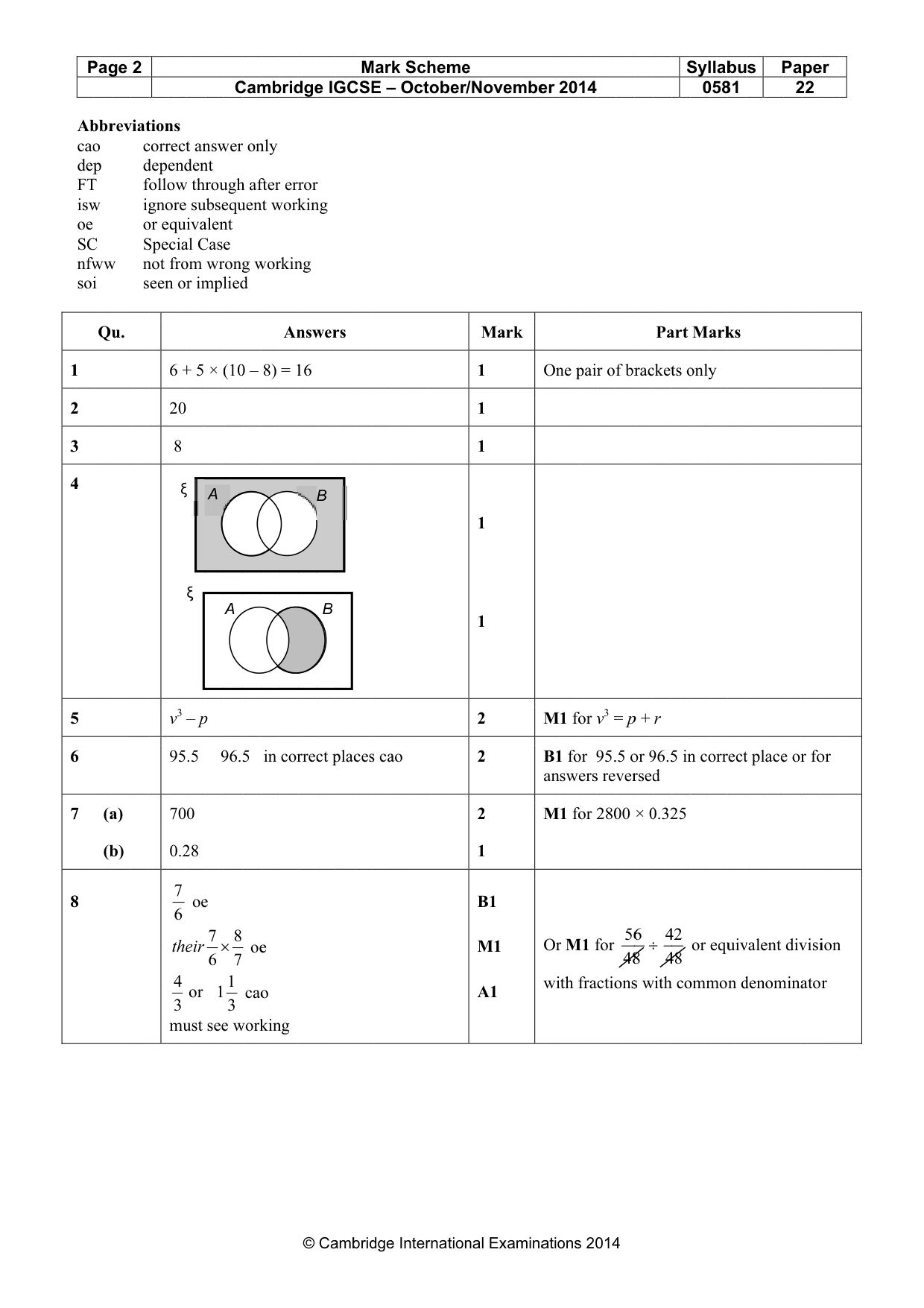
1 2 3 4 5 6 7 8 P Ab cao dep FT isw oe SC nfw soi 1 2 3 4 5 6 7 8 Pag bbr o p T w C ww i Qu (a (b ge rev w u. a) b) 2 viat c d fo ig o S n s tion corr dep follo gno or e Spe not een ns rect end ow ore equ ecia fro n or 6 + 20 8 v3 – 95 70 0.2 6 7 the 3 4 mu ξ t an den w thr su iva al C om r im + 5 – p .5 0 28 oe eir or ust ξ ξ nsw nt rou ubse alen Case wr mpl × ( p 9 e 6 7 × 1 see A C wer ugh equ nt e rong lied (10 96. 7 8 × 3 1 e w A Cam r on h af uen g w d 0 – 5 oe cao work mb nly fter nt w wor 8) in e o kin brid r err work rkin An = 1 cor ng dge © ror kin ng nsw 16 rrec B e IG Ca r ng wer ct p B B GC amb rs plac M CSE brid ces Mar E – dge s ca k S – O e In ao Sch Oct nter hem ob rnat me ber/ tion e /No nal M 1 1 1 1 1 2 2 2 1 B M A ove Ex Ma B1 M1 A1 em xam ark mbe mina k er 2 atio On M B1 an M Or wi 20 ons ne p 1 fo 1 fo sw 1 fo r M ith 14 s 20 pair for v or 9 ers for 2 M1 f fra 014 r o v3 = 95. s re 280 for ctio 4 f br = p .5 o ver 00 48 56 ons rac p + or 9 rsed × 0 8 6 ÷ s w Pa cket r 96.5 d 0.32 4 4 ÷ with S art ts o 5 in 25 48 42 h co Syl 0 M only n co or omm llab 058 ark y orr equ mo bu 81 ks rect uiv n d s t pl vale den P ace ent om Pa 2 e or div mina pe 22 r fo visi ato er or ion r n
Mark scheme, page 3
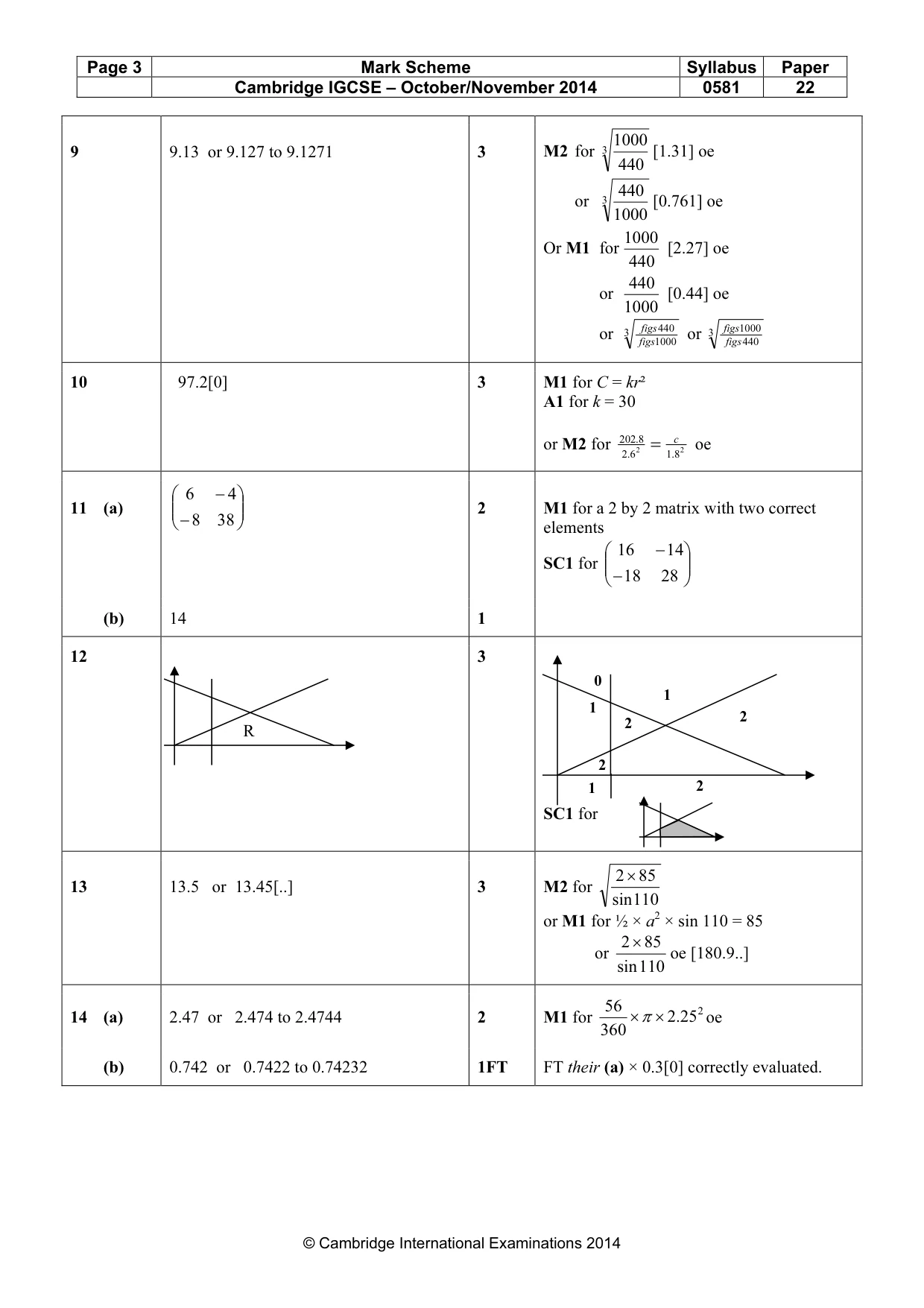
Page 3 Mark Scheme Syllabus Paper Cambridge IGCSE – October/November 2014 0581 22 © Cambridge International Examinations 2014 9 9.13 or 9.127 to 9.1271 3 M2 for 3 440 1000 [1.31] oe or 3 1000 440 [0.761] oe Or M1 for 440 1000 [2.27] oe or 1000 440 [0.44] oe or 3 1000 440 figs figs or 3 440 1000 figs figs 10 97.2[0] 3 M1 for C = kr² A1 for k = 30 or M2 for 2 2 8.1 6.2 8. 202 c = oe 11 (a) − − 38 8 4 6 2 M1 for a 2 by 2 matrix with two correct elements SC1 for − − 28 18 14 16 (b) 14 1 12 3 SC1 for 13 13.5 or 13.45[..] 3 M2 for 110 sin 85 2× or M1 for ½ × a2 × sin 110 = 85 or 110 sin 85 2× oe [180.9..] 14 (a) 2.47 or 2.474 to 2.4744 2 M1 for 2 25 .2 360 56 × ×π oe (b) 0.742 or 0.7422 to 0.74232 1FT FT their (a) × 0.3[0] correctly evaluated. R 2 2 1 1 2 0 1 2
Mark scheme, page 4
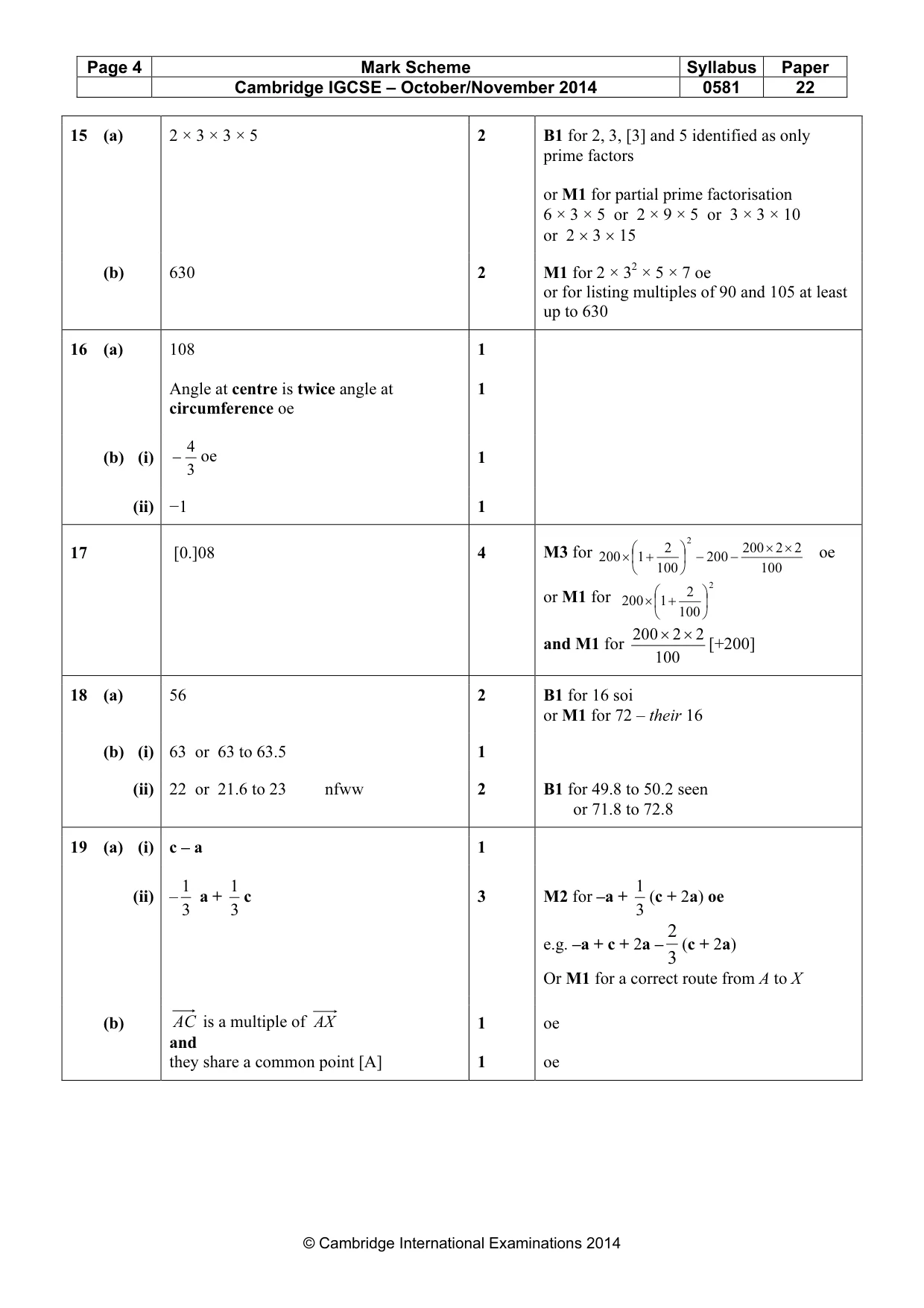
Page 4 Mark Scheme Syllabus Paper Cambridge IGCSE – October/November 2014 0581 22 © Cambridge International Examinations 2014 15 (a) 2 × 3 × 3 × 5 2 B1 for 2, 3, [3] and 5 identified as only prime factors or M1 for partial prime factorisation 6 × 3 × 5 or 2 × 9 × 5 or 3 × 3 × 10 or 2 × 3 × 15 (b) 630 2 M1 for 2 × 32 × 5 × 7 oe or for listing multiples of 90 and 105 at least up to 630 16 (a) 108 Angle at centre is twice angle at circumference oe 1 1 (b) (i) 3 4 − oe 1 (ii) −1 1 17 [0.]08 4 M3 for 100 2 2 200 200 100 2 1 200 2 × × − − + × oe or M1 for 2 100 2 1 200 + × and M1 for 100 2 2 200 × × [+200] 18 (a) 56 2 B1 for 16 soi or M1 for 72 – their 16 (b) (i) 63 or 63 to 63.5 1 (ii) 22 or 21.6 to 23 nfww 2 B1 for 49.8 to 50.2 seen or 71.8 to 72.8 19 (a) (i) c – a 1 (ii) – 3 1 a + 3 1 c 3 M2 for –a + 3 1 (c + 2a) oe e.g. –a + c + 2a – 3 2 (c + 2a) Or M1 for a correct route from A to X (b) AC is a multiple of AX and they share a common point [A] 1 1 oe oe
Mark scheme, page 5
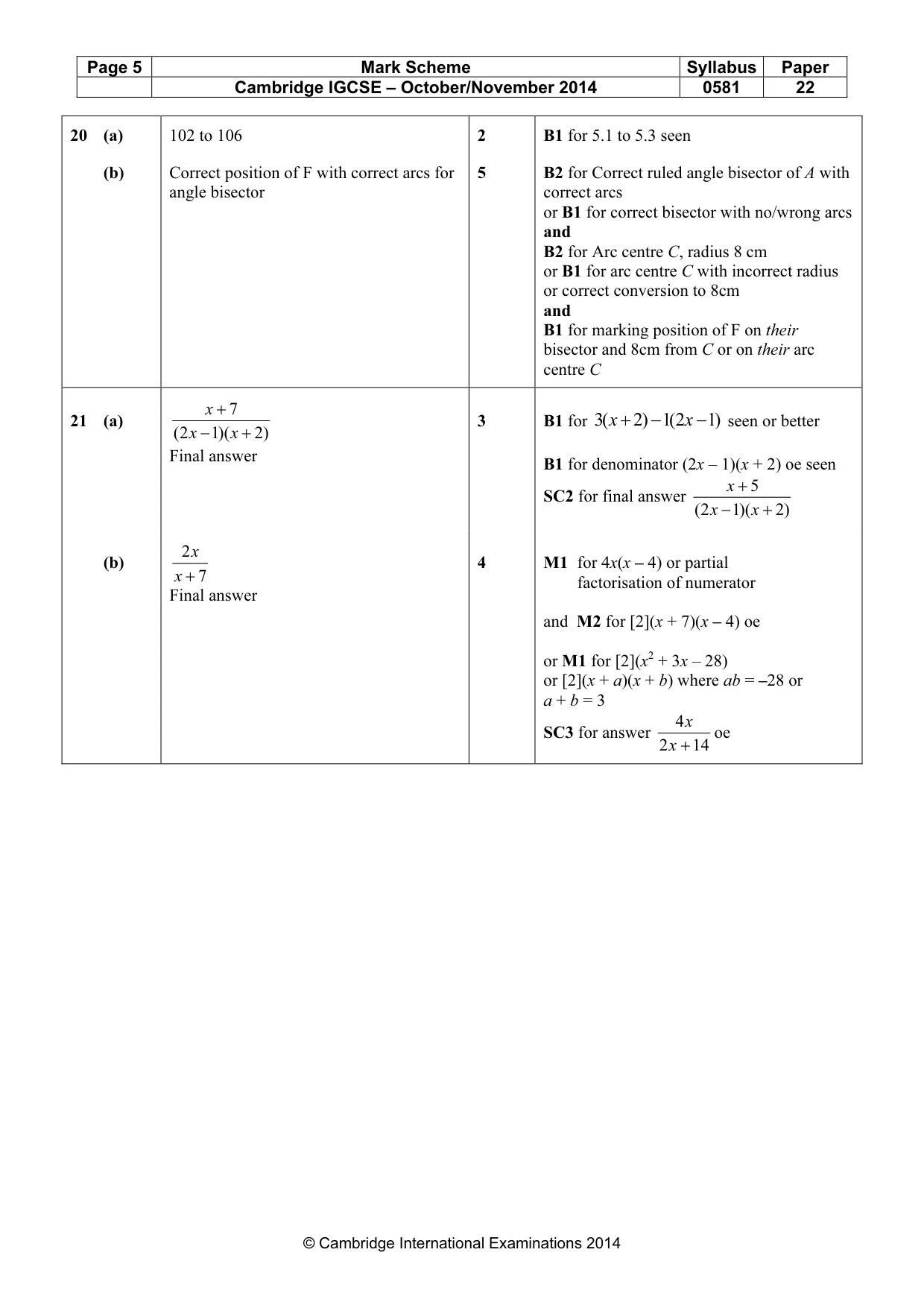
Page 5 Mark Scheme Syllabus Paper Cambridge IGCSE – October/November 2014 0581 22 © Cambridge International Examinations 2014 20 (a) 102 to 106 2 B1 for 5.1 to 5.3 seen (b) Correct position of F with correct arcs for angle bisector 5 B2 for Correct ruled angle bisector of A with correct arcs or B1 for correct bisector with no/wrong arcs and B2 for Arc centre C, radius 8 cm or B1 for arc centre C with incorrect radius or correct conversion to 8cm and B1 for marking position of F on their bisector and 8cm from C or on their arc centre C 21 (a) ) 2 )( 1 2 ( 7 + − + x x x Final answer 3 B1 for )1 2 (1 )2 (3 − − + x x seen or better B1 for denominator (2x – 1)(x + 2) oe seen SC2 for final answer ) 2 )( 1 2 ( 5 + − + x x x (b) 7 2 + x x Final answer 4 M1 for 4x(x – 4) or partial factorisation of numerator and M2 for [2](x + 7)(x – 4) oe or M1 for [2](x2 + 3x – 28) or [2](x + a)(x + b) where ab = –28 or a + b = 3 SC3 for answer 14 2 4 + x x oe