Cambridge IGCSE Mathematics (with coursework) 0581 — 2008 Oct/Nov Paper 1 · Variant 1
0581/11/O/N/08
The question paper and its mark scheme, free to read here and free to download. This is Cambridge’s own paper, exactly as it was sat.
Question paper25 pages
Mark scheme8 pages
Answers below. Sit the paper first if you are practising.
Paper as text
Question paper, page 1
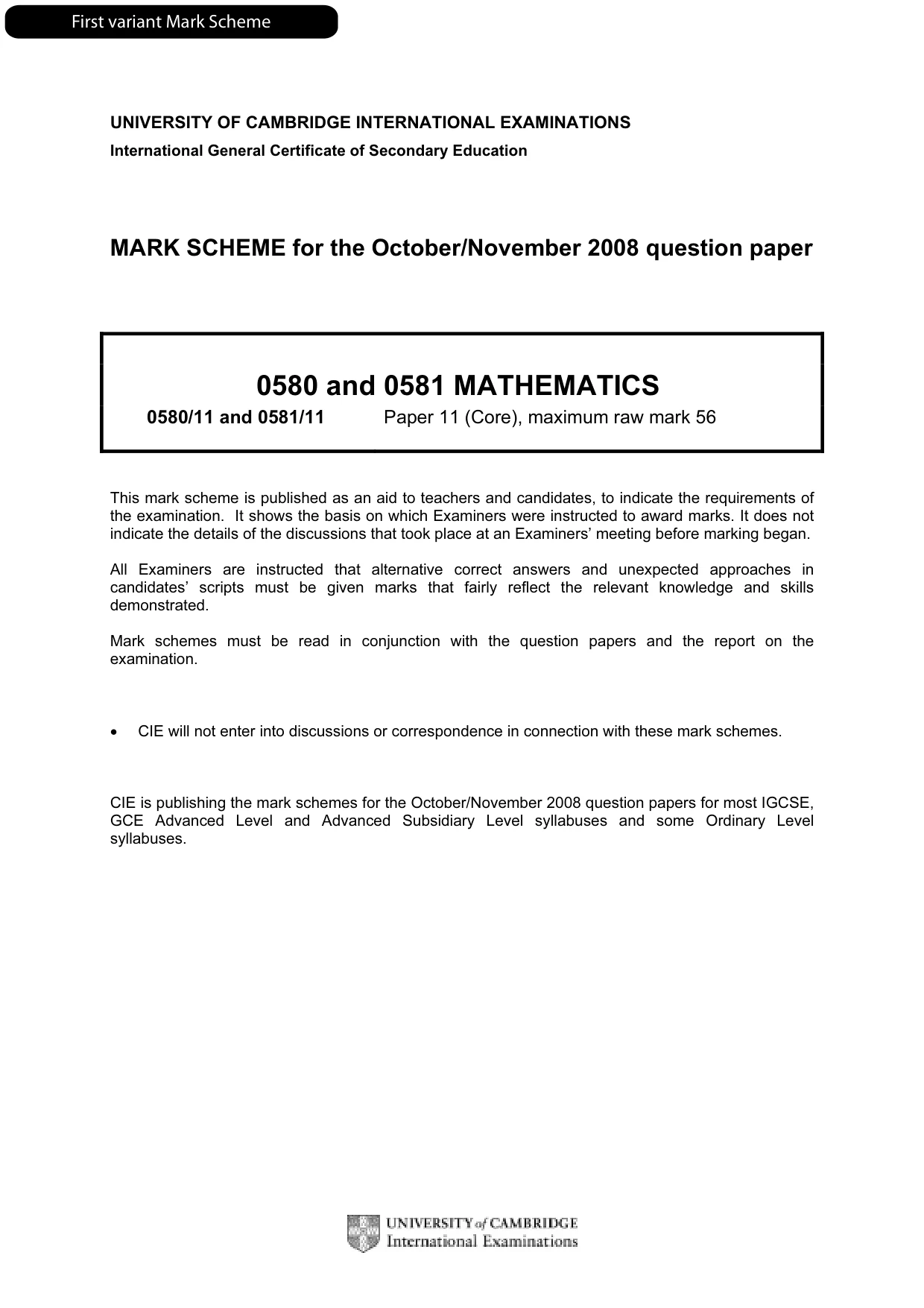
Location Entry Codes As part of CIE’s continual commitment to maintaining best practice in assessment, CIE uses different variants of some question papers for our most popular assessments with large and widespread candidature. The question papers are closely related and the relationships between them have been thoroughly established using our assessment expertise. All versions of the paper give assessment of equal standard. The content assessed by the examination papers and the type of questions is unchanged. This change means that for this component there are now two variant Question Papers, Mark Schemes and Principal Examiner’s Reports where previously there was only one. For any individual country, it is intended that only one variant is used. This document contains both variants which will give all Centres access to even more past examination material than is usually the case. The diagram shows the relationship between the Question Papers, Mark Schemes and Principal Examiners’ Reports that are available. Question Paper Mark Scheme Principal Examiner’s Report Introduction Introduction Introduction First variant Question Paper First variant Mark Scheme First variant Principal Examiner’s Report Second variant Question Paper Second variant Mark Scheme Second variant Principal Examiner’s Report Who can I contact for further information on these changes? Please direct any questions about this to CIE’s Customer Services team at: international@cie.org.uk The titles for the variant items should correspond with the table above, so that at the top of the first page of the relevant part of the document and on the header, it has the words: • First variant Question Paper / Mark Scheme / Principal Examiner’s Report or • Second variant Question Paper / Mark Scheme / Principal Examiner’s Report as appropriate. www.XtremePapers.com
Question paper, page 2
This document consists of 9 printed pages and 3 blank pages. IB08 11_0580_01/4RP © UCLES 2008 [Turn over *7272401607* For Examiner's Use UNIVERSITY OF CAMBRIDGE INTERNATIONAL EXAMINATIONS International General Certificate of Secondary Education MATHEMATICS 0580/11, 0581/11 Paper 1 (Core) October/November 2008 1 hour Candidates answer on the Question Paper. Additional Materials: Electronic Calculator Mathematical tables (optional) Geometrical Instruments Tracing paper (optional) READ THESE INSTRUCTIONS FIRST Write your Centre number, candidate number and name on all the work you hand in. Write in dark blue or black pen. You may use a soft pencil for any diagrams or graphs. Do not use staples, paper clips, highlighters, glue or correction fluid. DO NOT WRITE IN ANY BARCODES. Answer all questions. If working is needed for any question it must be shown below that question. Electronic calculators should be used. If the degree of accuracy is not specified in the question, and if the answer is not exact, give the answer to three significant figures. Give answers in degrees to one decimal place. For π, use either your calculator value or 3.142. At the end of the examination, fasten all your work securely together. The number of marks is given in brackets [ ] at the end of each question or part question. The total of the marks for this paper is 56. First Variant Question Paper
Question paper, page 3
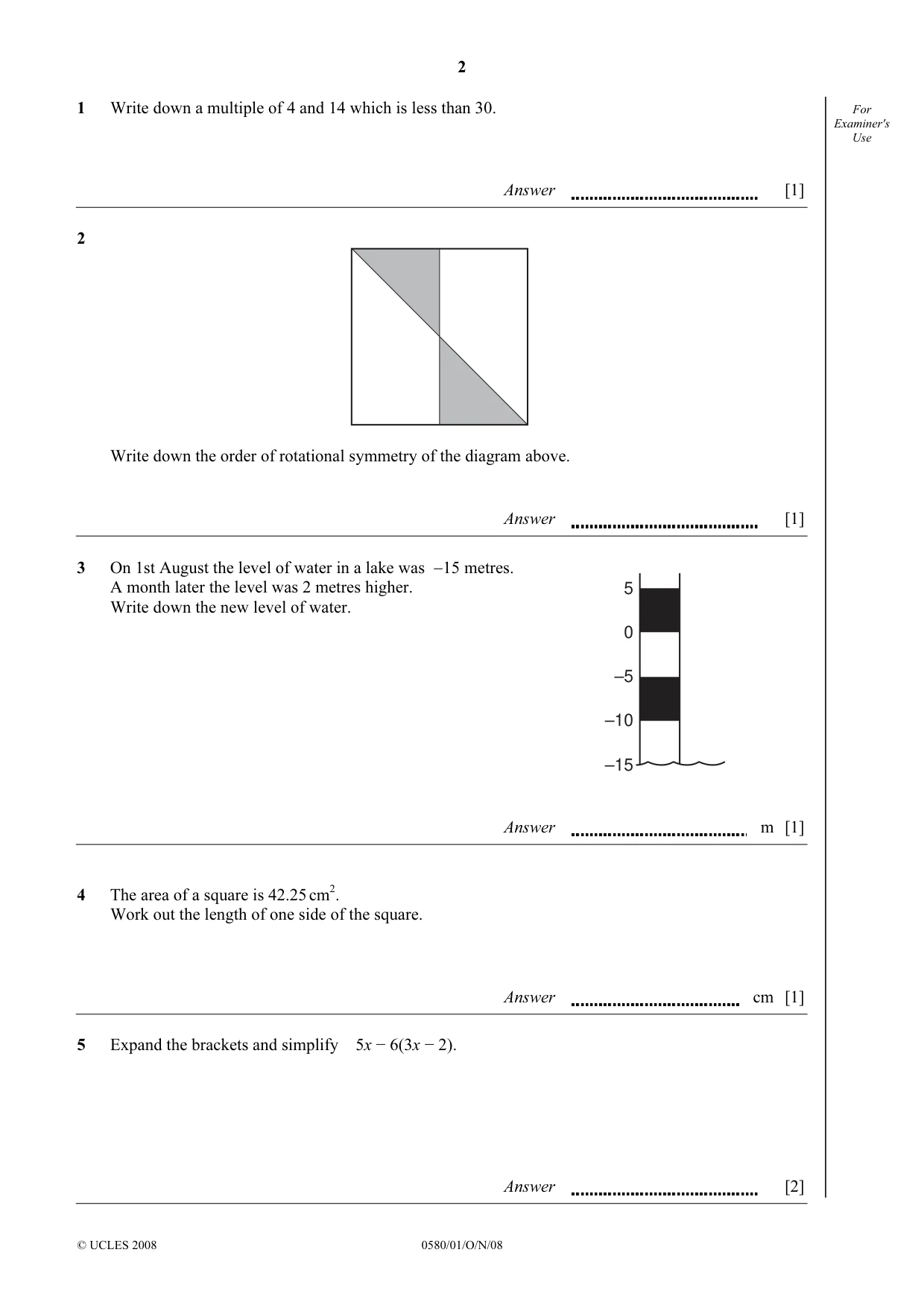
2 © UCLES 2008 0580/01/O/N/08 For Examiner's Use 1 Write down a multiple of 4 and 14 which is less than 30. Answer [1] 2 Write down the order of rotational symmetry of the diagram above. Answer [1] 3 On 1st August the level of water in a lake was −15 metres. A month later the level was 2 metres higher. Write down the new level of water. Answer m [1] 4 The area of a square is 42.25 cm2. Work out the length of one side of the square. Answer cm [1] 5 Expand the brackets and simplify 5x − 6(3x − 2). Answer [2] 5 0 –5 –10 –15
Question paper, page 4
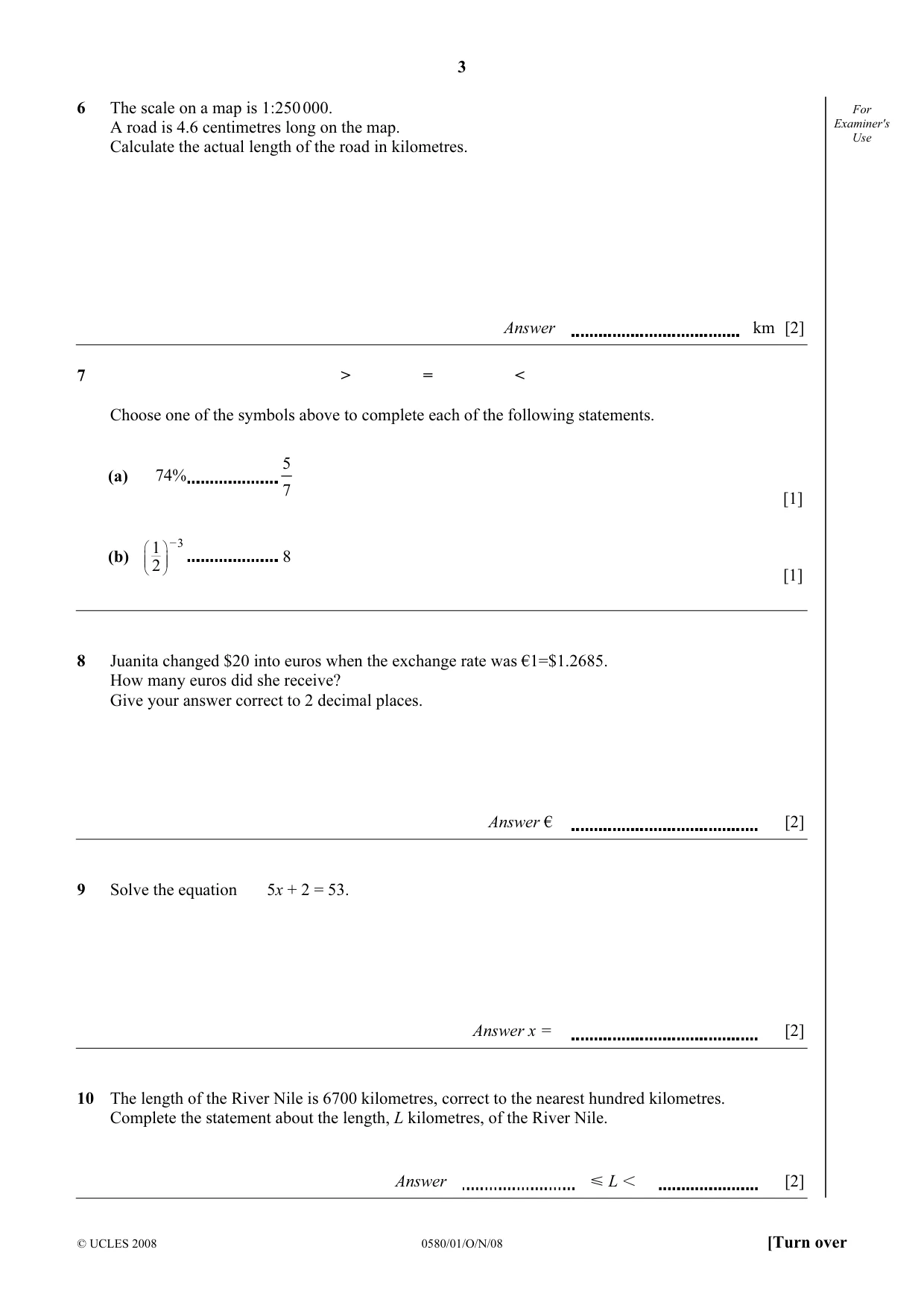
3 © UCLES 2008 0580/01/O/N/08 [Turn over For Examiner's Use 6 The scale on a map is 1:250 000. A road is 4.6 centimetres long on the map. Calculate the actual length of the road in kilometres. Answer km [2] 7 > = < Choose one of the symbols above to complete each of the following statements. (a) 74% 5 7 [1] (b) _3 1 2 8 [1] 8 Juanita changed $20 into euros when the exchange rate was €1=$1.2685. How many euros did she receive? Give your answer correct to 2 decimal places. Answer € [2] 9 Solve the equation 5x + 2 = 53. Answer x = [2] 10 The length of the River Nile is 6700 kilometres, correct to the nearest hundred kilometres. Complete the statement about the length, L kilometres, of the River Nile. Answer Y L I [2]
Question paper, page 5
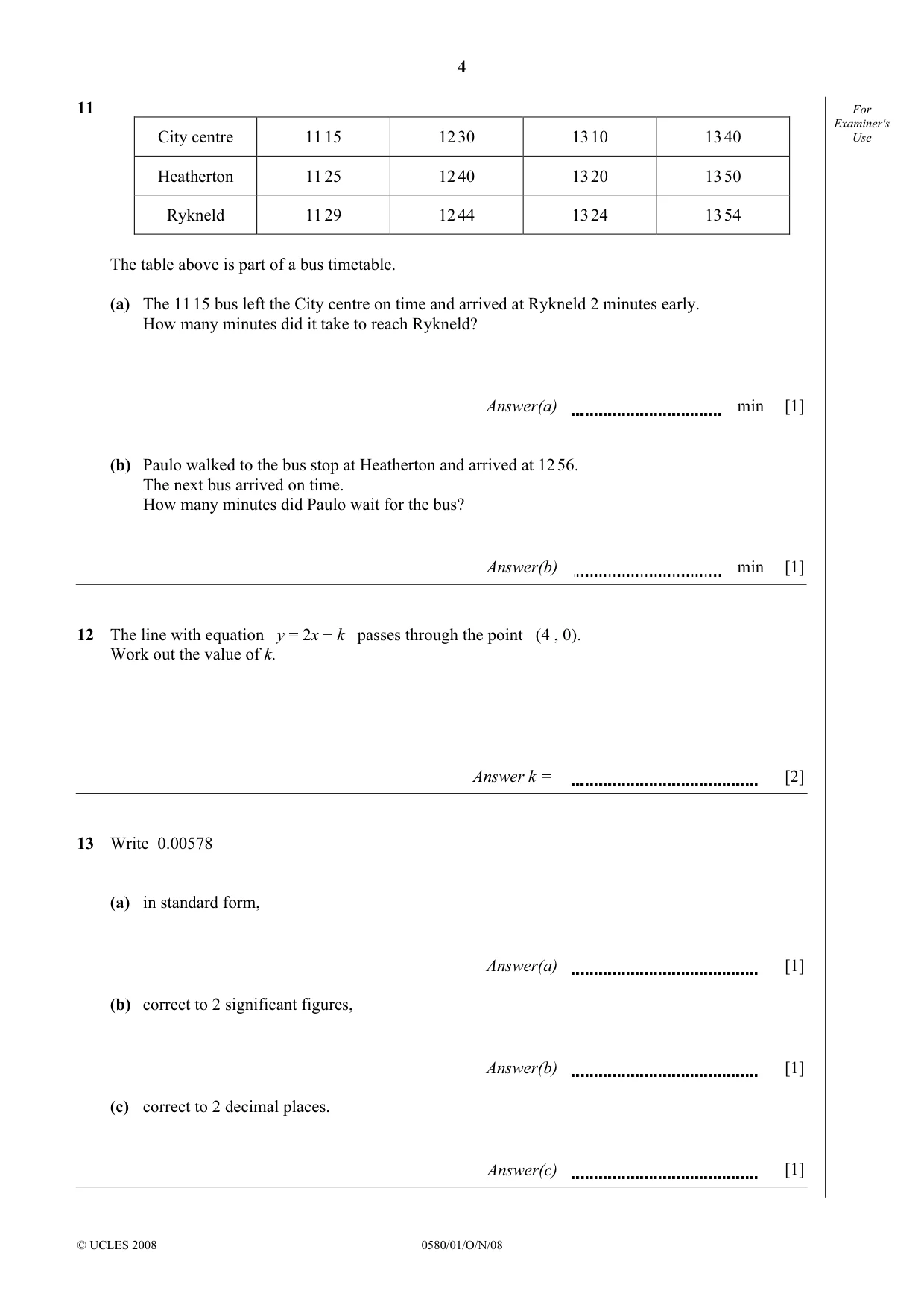
4 © UCLES 2008 0580/01/O/N/08 For Examiner's Use 11 City centre 11 15 12 30 13 10 13 40 Heatherton 11 25 12 40 13 20 13 50 Rykneld 11 29 12 44 13 24 13 54 The table above is part of a bus timetable. (a) The 11 15 bus left the City centre on time and arrived at Rykneld 2 minutes early. How many minutes did it take to reach Rykneld? Answer(a) min [1] (b) Paulo walked to the bus stop at Heatherton and arrived at 12 56. The next bus arrived on time. How many minutes did Paulo wait for the bus? Answer(b) min [1] 12 The line with equation y = 2x − k passes through the point (4 , 0). Work out the value of k. Answer k = [2] 13 Write 0.00578 (a) in standard form, Answer(a) [1] (b) correct to 2 significant figures, Answer(b) [1] (c) correct to 2 decimal places. Answer(c) [1]
Question paper, page 6
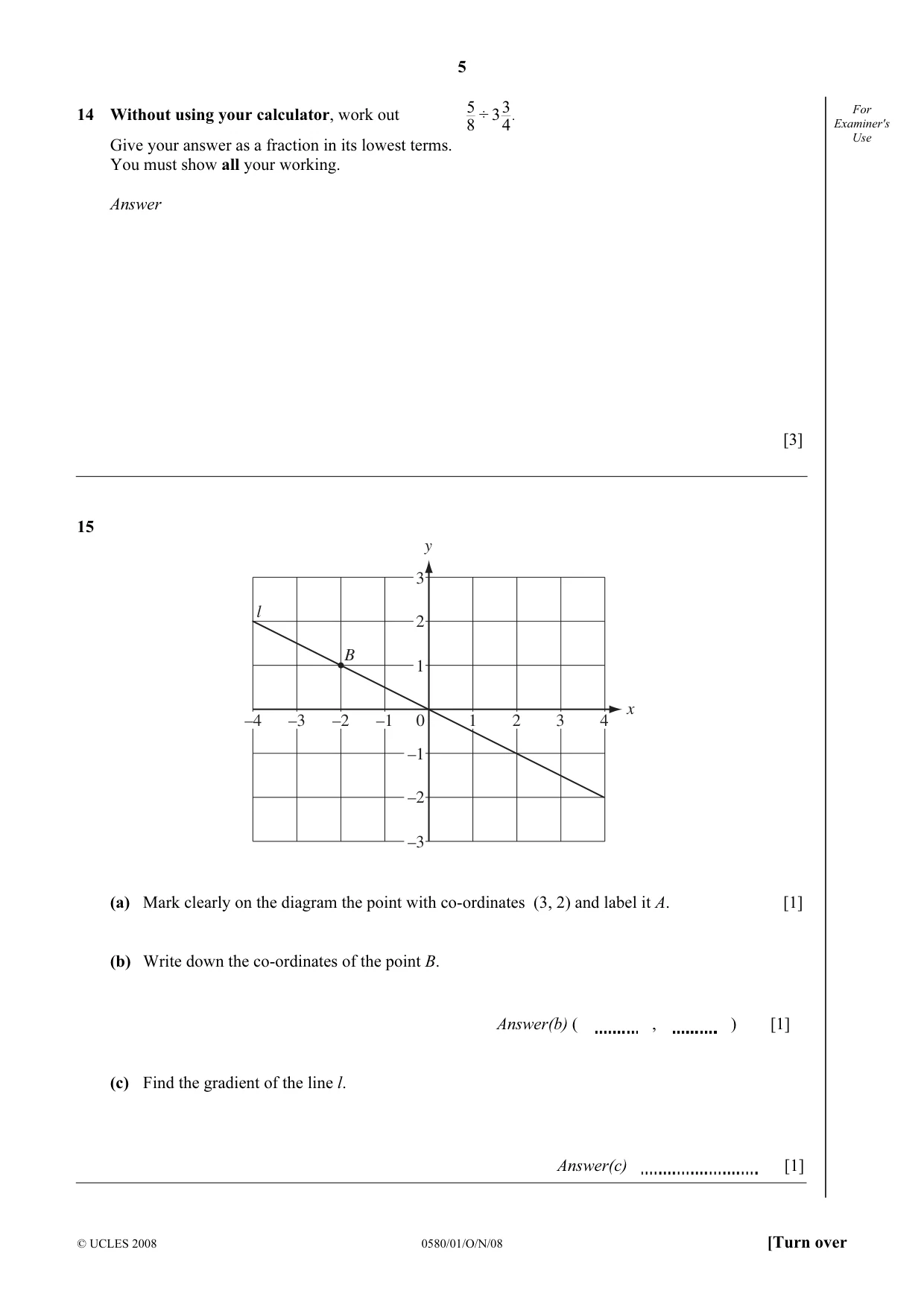
5 © UCLES 2008 0580/01/O/N/08 [Turn over For Examiner's Use 14 Without using your calculator, work out 5 3 ÷ 3 8 4 . Give your answer as a fraction in its lowest terms. You must show all your working. Answer [3] 15 y x B –4 –3 –2 –1 0 –1 –2 –3 3 2 1 1 2 3 4 l (a) Mark clearly on the diagram the point with co-ordinates (3, 2) and label it A. [1] (b) Write down the co-ordinates of the point B. Answer(b) ( , ) [1] (c) Find the gradient of the line l. Answer(c) [1]
Question paper, page 7
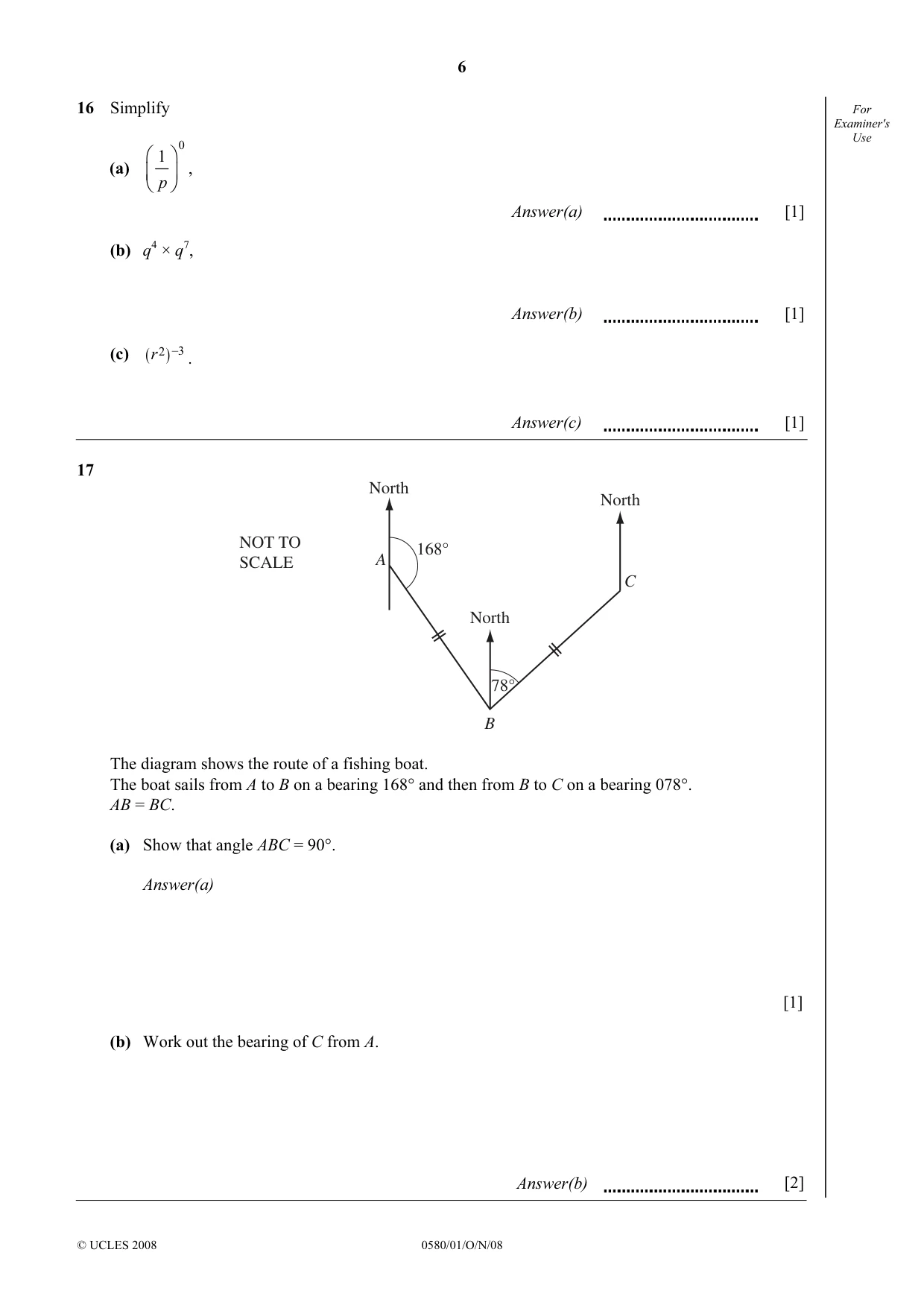
6 © UCLES 2008 0580/01/O/N/08 For Examiner's Use 16 Simplify (a) 0 1 p , Answer(a) [1] (b) q4 × q7, Answer(b) [1] (c) ( ) _3 2 r . Answer(c) [1] 17 A B C 168° 78° North North North NOT TO SCALE The diagram shows the route of a fishing boat. The boat sails from A to B on a bearing 168° and then from B to C on a bearing 078°. AB = BC. (a) Show that angle ABC = 90°. Answer(a) [1] (b) Work out the bearing of C from A. Answer(b) [2]
Question paper, page 8
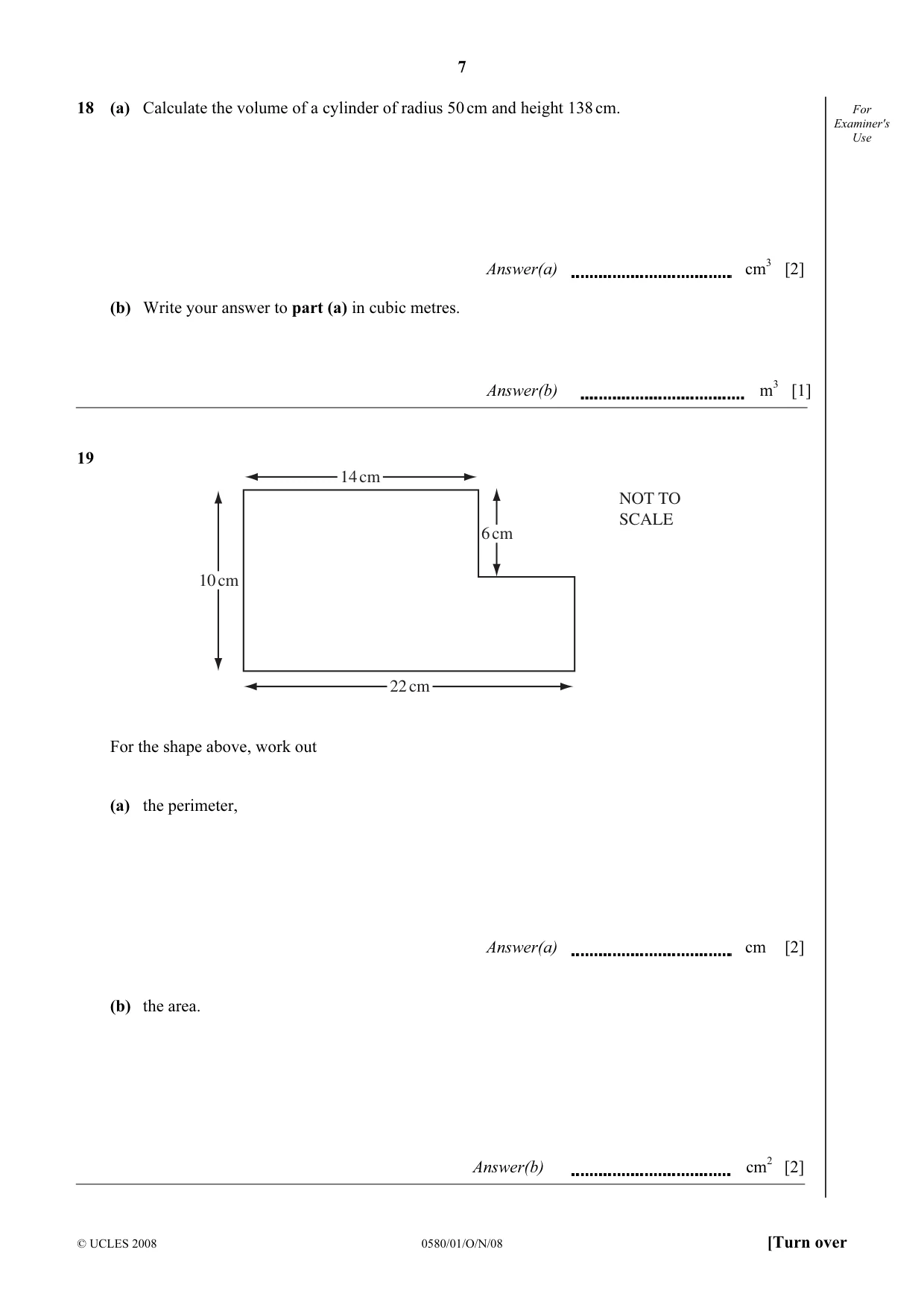
7 © UCLES 2008 0580/01/O/N/08 [Turn over For Examiner's Use 18 (a) Calculate the volume of a cylinder of radius 50 cm and height 138 cm. Answer(a) cm3 [2] (b) Write your answer to part (a) in cubic metres. Answer(b) m3 [1] 19 10 cm 14 cm 22 cm 6 cm NOT TO SCALE For the shape above, work out (a) the perimeter, Answer(a) cm [2] (b) the area. Answer(b) cm2 [2]
Question paper, page 9
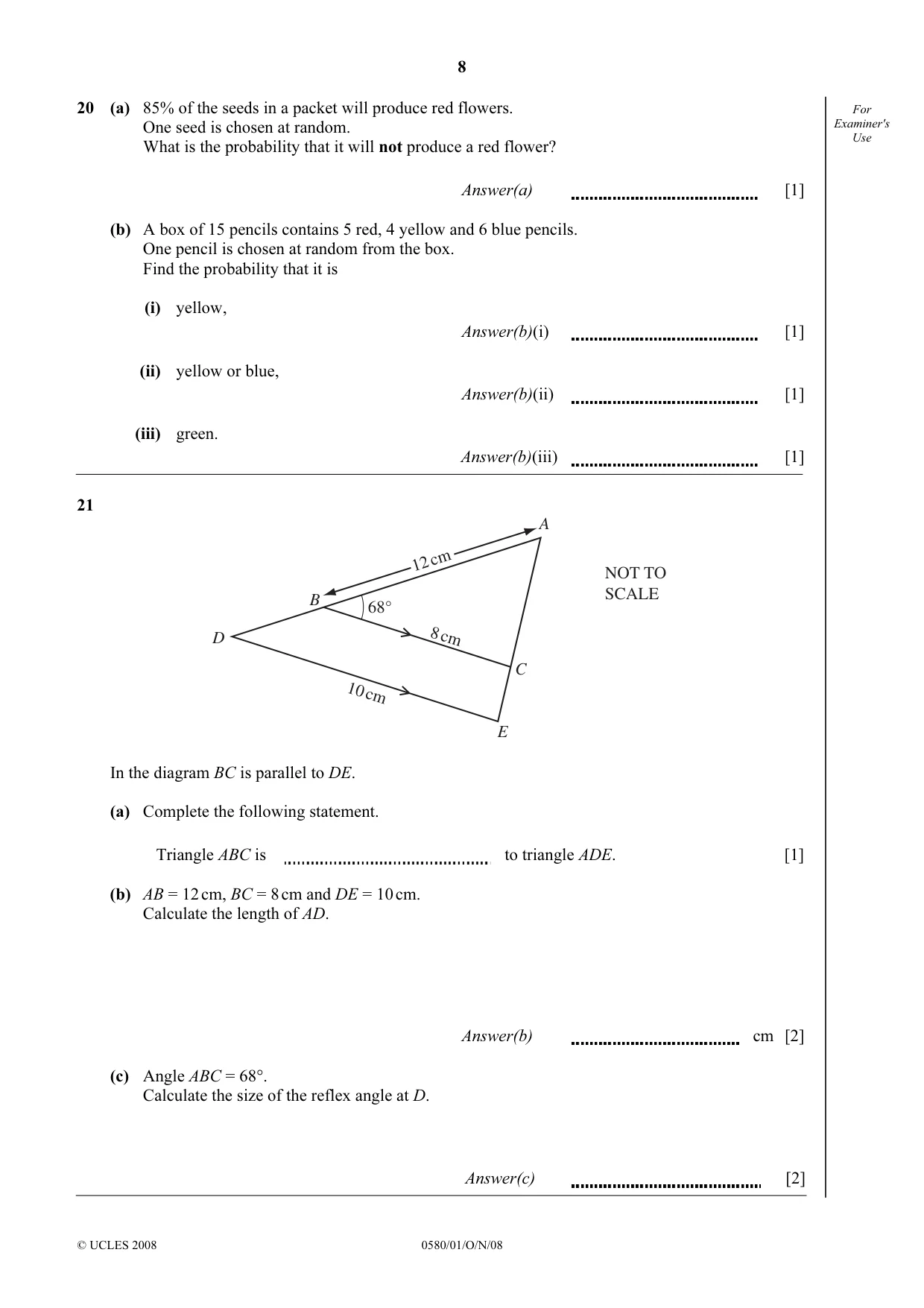
8 © UCLES 2008 0580/01/O/N/08 For Examiner's Use 20 (a) 85% of the seeds in a packet will produce red flowers. One seed is chosen at random. What is the probability that it will not produce a red flower? Answer(a) [1] (b) A box of 15 pencils contains 5 red, 4 yellow and 6 blue pencils. One pencil is chosen at random from the box. Find the probability that it is (i) yellow, Answer(b)(i) [1] (ii) yellow or blue, Answer(b)(ii) [1] (iii) green. Answer(b)(iii) [1] 21 D B A C E 68° NOT TO SCALE 12 cm 8 cm 10 cm In the diagram BC is parallel to DE. (a) Complete the following statement. Triangle ABC is to triangle ADE. [1] (b) AB = 12 cm, BC = 8 cm and DE = 10 cm. Calculate the length of AD. Answer(b) cm [2] (c) Angle ABC = 68°. Calculate the size of the reflex angle at D. Answer(c) [2]
Question paper, page 10
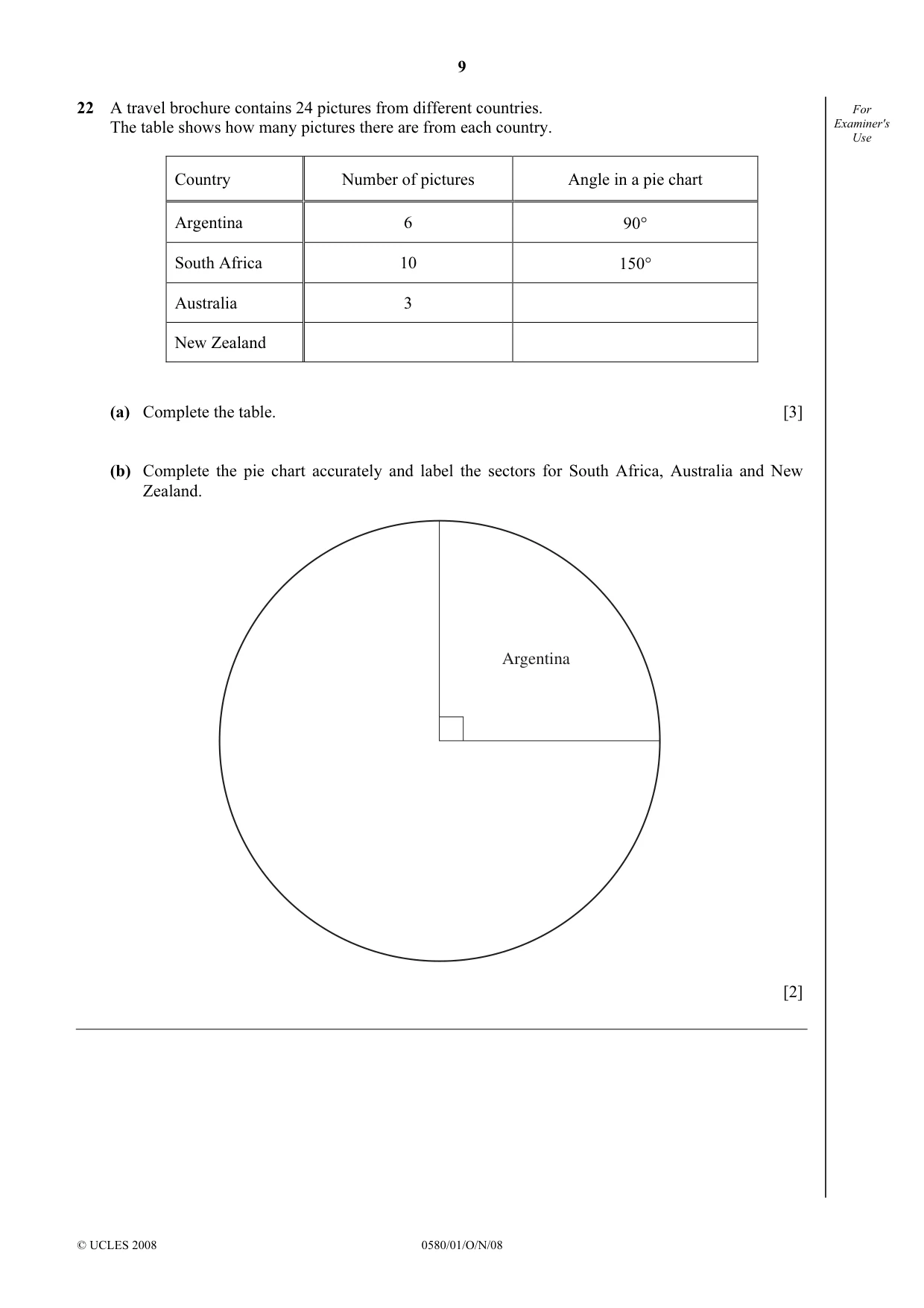
9 © UCLES 2008 0580/01/O/N/08 For Examiner's Use 22 A travel brochure contains 24 pictures from different countries. The table shows how many pictures there are from each country. Country Number of pictures Angle in a pie chart Argentina 6 90° South Africa 10 150° Australia 3 New Zealand (a) Complete the table. [3] (b) Complete the pie chart accurately and label the sectors for South Africa, Australia and New Zealand. Argentina [2]
Question paper, page 13
12 Permission to reproduce items where third-party owned material protected by copyright is included has been sought and cleared where possible. Every reasonable effort has been made by the publisher (UCLES) to trace copyright holders, but if any items requiring clearance have unwittingly been included, the publisher will be pleased to make amends at the earliest possible opportunity. University of Cambridge International Examinations is part of the Cambridge Assessment Group. Cambridge Assessment is the brand name of University of Cambridge Local Examinations Syndicate (UCLES), which is itself a department of the University of Cambridge. 0580/01/O/N/08 BLANK PAGE
Question paper, page 14
This document consists of 9 printed pages and 3 blank pages. IB08 11_0580_12/2RP © UCLES 2008 [Turn over *9940372872* For Examiner's Use UNIVERSITY OF CAMBRIDGE INTERNATIONAL EXAMINATIONS International General Certificate of Secondary Education MATHEMATICS 0580/12, 0581/12 Paper 1 (Core) October/November 2008 1 hour Candidates answer on the Question Paper. Additional Materials: Electronic Calculator Mathematical tables (optional) Geometrical Instruments Tracing paper (optional) READ THESE INSTRUCTIONS FIRST Write your Centre number, candidate number and name on all the work you hand in. Write in dark blue or black pen. You may use a pencil for any diagrams or graphs. Do not use staples, paper clips, highlighters, glue or correction fluid. DO NOT WRITE IN ANY BARCODES. Answer all questions. If working is needed for any question it must be shown below that question. Electronic calculators should be used. If the degree of accuracy is not specified in the question, and if the answer is not exact, give the answer to three significant figures. Give answers in degrees to one decimal place For π, use either your calculator value or 3.142. At the end of the examination, fasten all your work securely together. The number of marks is given in brackets [ ] at the end of each question or part question. The total of the marks for this paper is 56. Second Variant Question Paper
Question paper, page 15
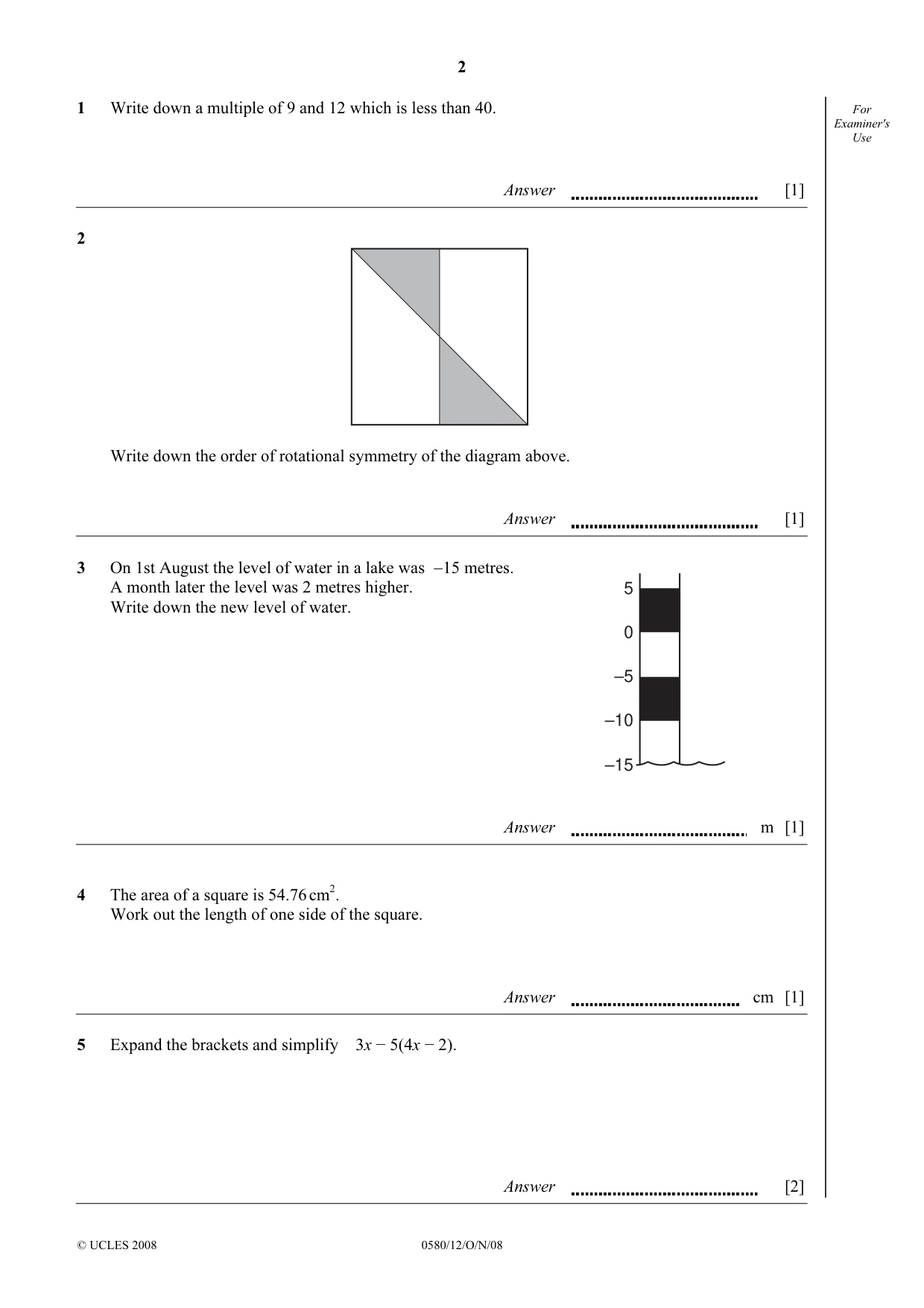
2 © UCLES 2008 0580/12/O/N/08 For Examiner's Use 1 Write down a multiple of 9 and 12 which is less than 40. Answer [1] 2 Write down the order of rotational symmetry of the diagram above. Answer [1] 3 On 1st August the level of water in a lake was −15 metres. A month later the level was 2 metres higher. Write down the new level of water. Answer m [1] 4 The area of a square is 54.76 cm2. Work out the length of one side of the square. Answer cm [1] 5 Expand the brackets and simplify 3x − 5(4x − 2). Answer [2] 5 0 –5 –10 –15
Question paper, page 16
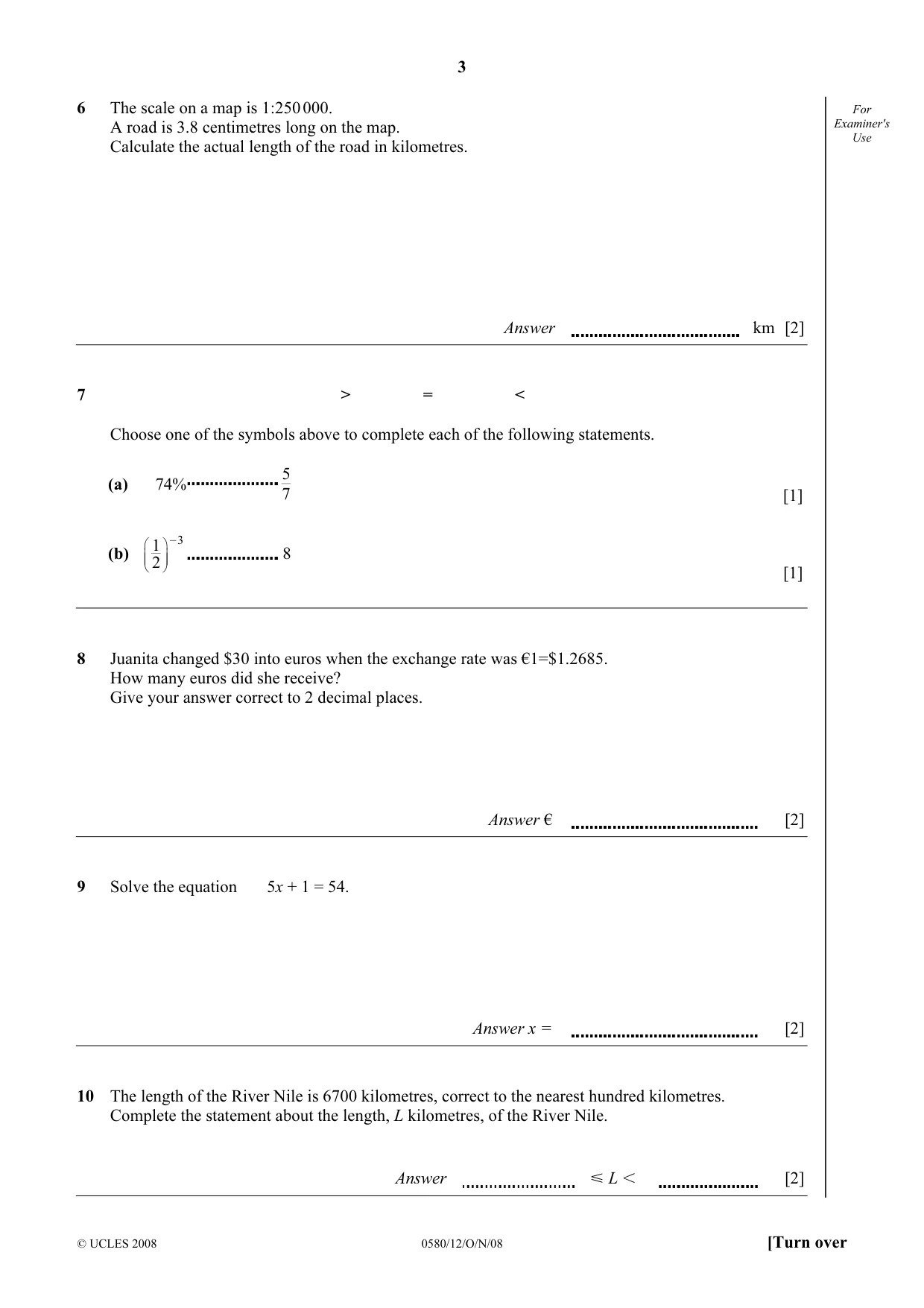
3 © UCLES 2008 0580/12/O/N/08 [Turn over For Examiner's Use 6 The scale on a map is 1:250 000. A road is 3.8 centimetres long on the map. Calculate the actual length of the road in kilometres. Answer km [2] 7 > = < Choose one of the symbols above to complete each of the following statements. (a) 74% 5 7 [1] (b) _3 1 2 8 [1] 8 Juanita changed $30 into euros when the exchange rate was €1=$1.2685. How many euros did she receive? Give your answer correct to 2 decimal places. Answer € [2] 9 Solve the equation 5x + 1 = 54. Answer x = [2] 10 The length of the River Nile is 6700 kilometres, correct to the nearest hundred kilometres. Complete the statement about the length, L kilometres, of the River Nile. Answer Y L I [2]
Question paper, page 17
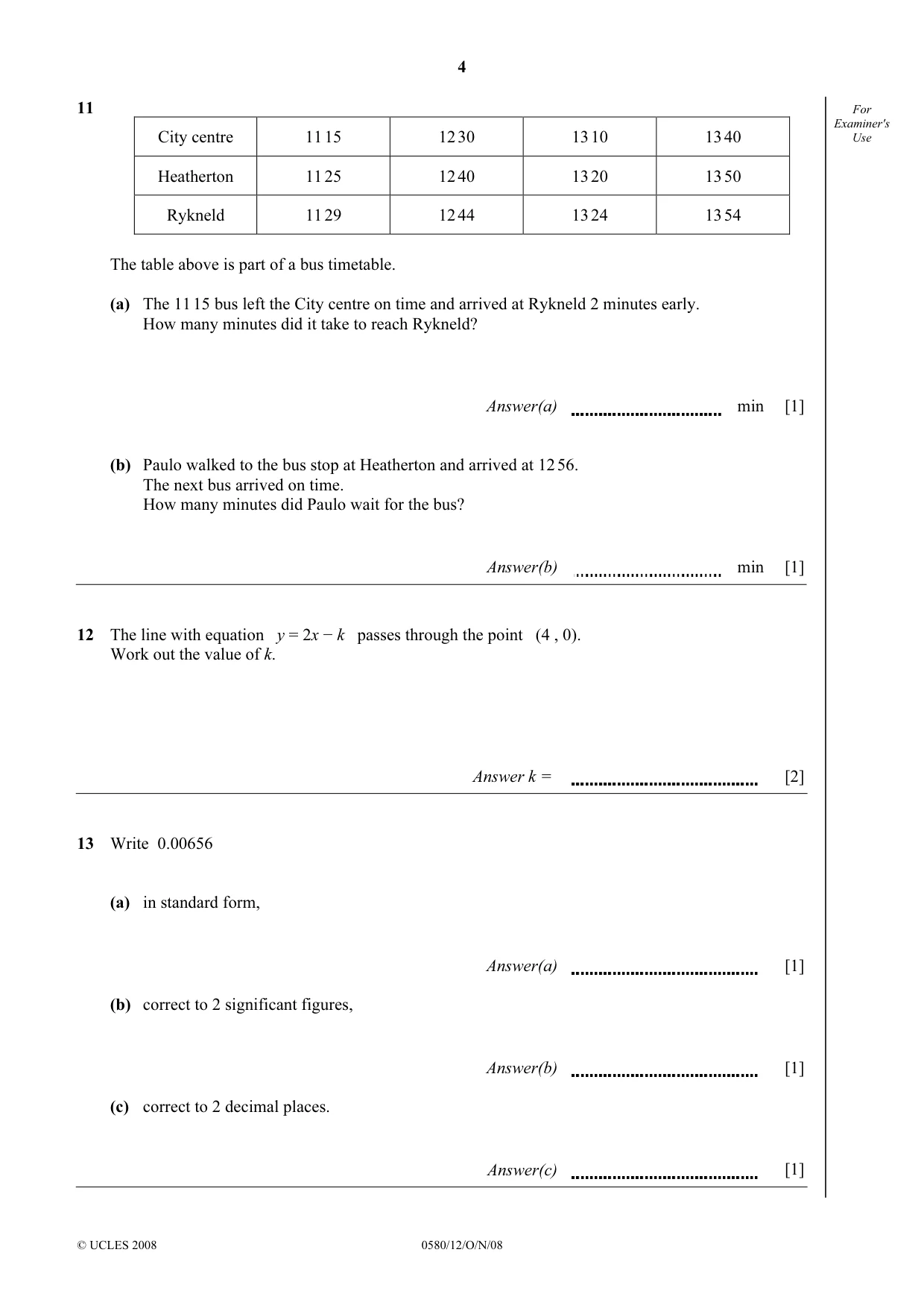
4 © UCLES 2008 0580/12/O/N/08 For Examiner's Use 11 City centre 11 15 12 30 13 10 13 40 Heatherton 11 25 12 40 13 20 13 50 Rykneld 11 29 12 44 13 24 13 54 The table above is part of a bus timetable. (a) The 11 15 bus left the City centre on time and arrived at Rykneld 2 minutes early. How many minutes did it take to reach Rykneld? Answer(a) min [1] (b) Paulo walked to the bus stop at Heatherton and arrived at 12 56. The next bus arrived on time. How many minutes did Paulo wait for the bus? Answer(b) min [1] 12 The line with equation y = 2x − k passes through the point (4 , 0). Work out the value of k. Answer k = [2] 13 Write 0.00656 (a) in standard form, Answer(a) [1] (b) correct to 2 significant figures, Answer(b) [1] (c) correct to 2 decimal places. Answer(c) [1]
Question paper, page 18
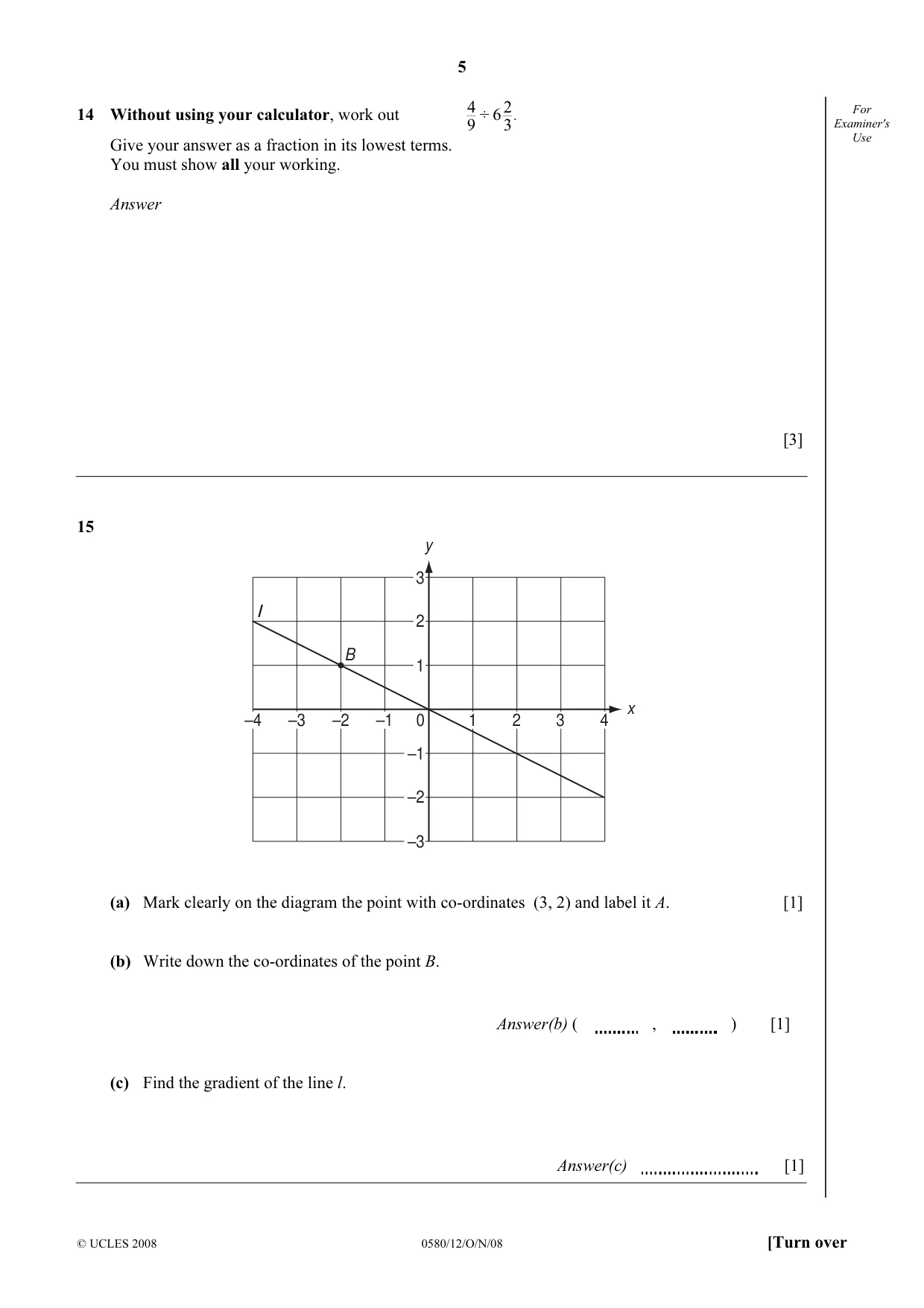
5 © UCLES 2008 0580/12/O/N/08 [Turn over For Examiner's Use 14 Without using your calculator, work out 4 2 ÷ 6 9 3 . Give your answer as a fraction in its lowest terms. You must show all your working. Answer [3] 15 y x B –4 –3 –2 –1 0 –1 –2 –3 3 2 1 1 2 3 4 l (a) Mark clearly on the diagram the point with co-ordinates (3, 2) and label it A. [1] (b) Write down the co-ordinates of the point B. Answer(b) ( , ) [1] (c) Find the gradient of the line l. Answer(c) [1]
Question paper, page 19
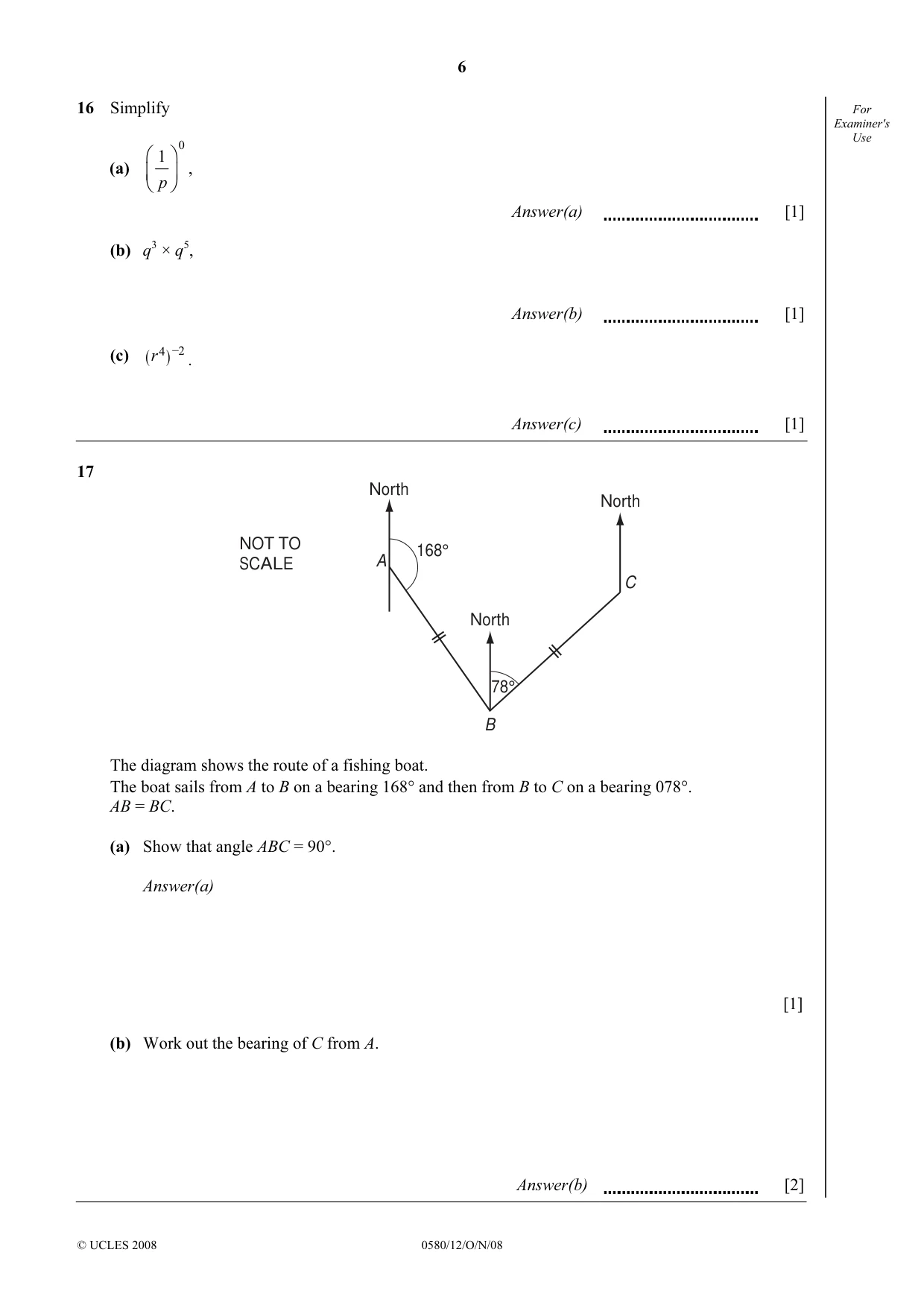
6 © UCLES 2008 0580/12/O/N/08 For Examiner's Use 16 Simplify (a) 0 1 p , Answer(a) [1] (b) q3 × q5, Answer(b) [1] (c) ( ) _2 4 r . Answer(c) [1] 17 A B C 168° 78° North North North NOT TO SCALE The diagram shows the route of a fishing boat. The boat sails from A to B on a bearing 168° and then from B to C on a bearing 078°. AB = BC. (a) Show that angle ABC = 90°. Answer(a) [1] (b) Work out the bearing of C from A. Answer(b) [2]
Question paper, page 20
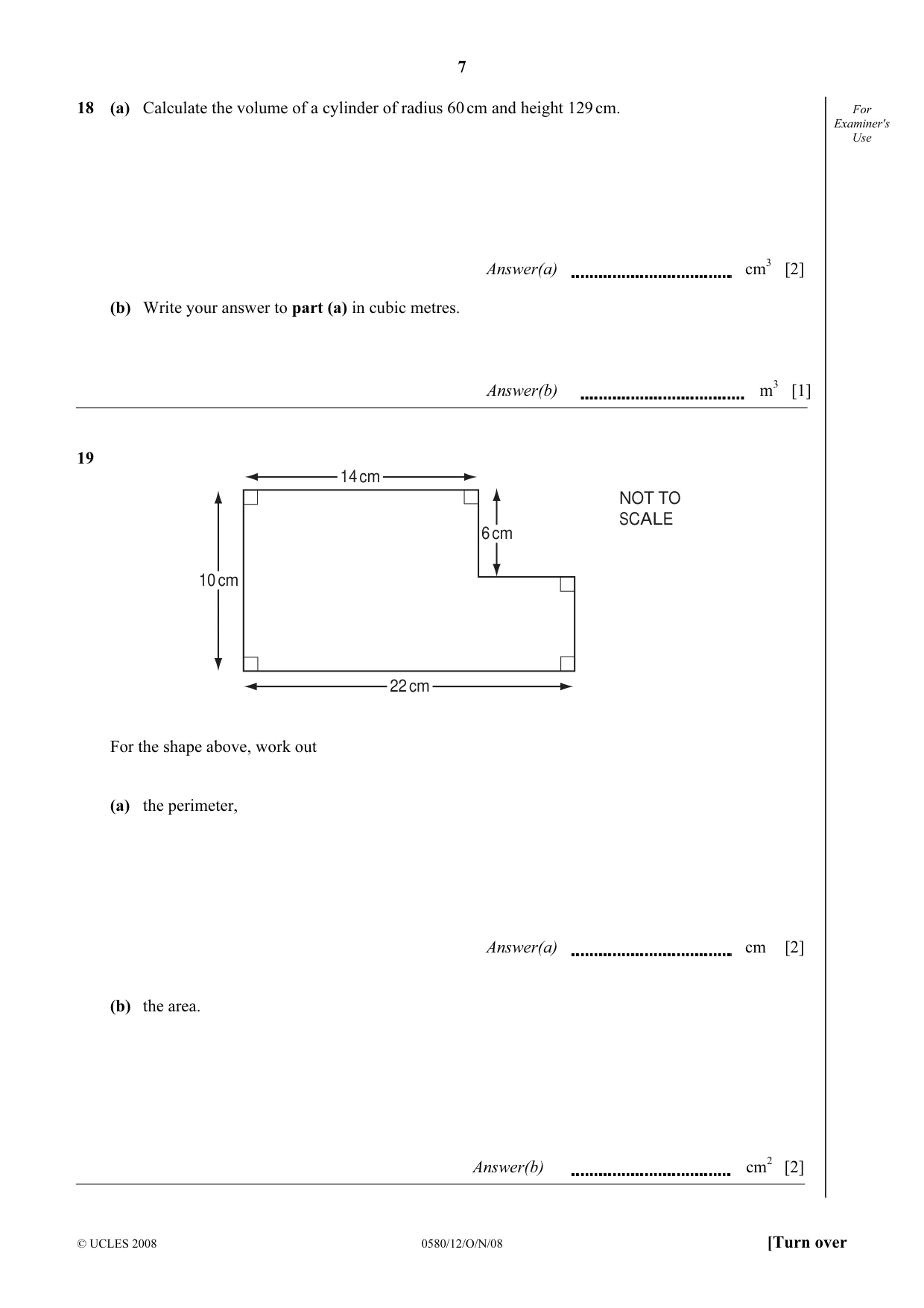
7 © UCLES 2008 0580/12/O/N/08 [Turn over For Examiner's Use 18 (a) Calculate the volume of a cylinder of radius 60 cm and height 129 cm. Answer(a) cm3 [2] (b) Write your answer to part (a) in cubic metres. Answer(b) m3 [1] 19 10 cm 14 cm 22 cm 6 cm NOT TO SCALE For the shape above, work out (a) the perimeter, Answer(a) cm [2] (b) the area. Answer(b) cm2 [2]
Question paper, page 21
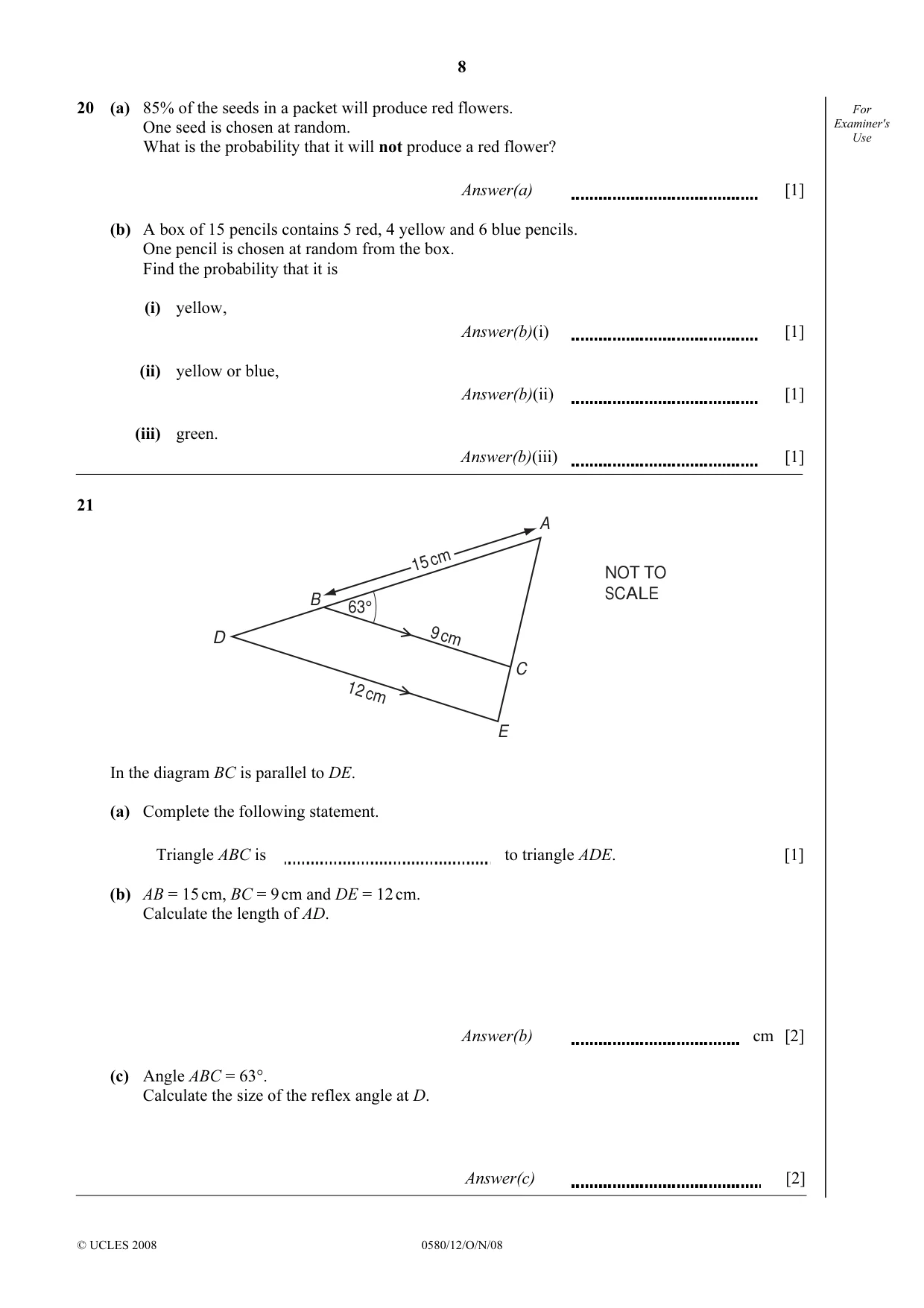
8 © UCLES 2008 0580/12/O/N/08 For Examiner's Use 20 (a) 85% of the seeds in a packet will produce red flowers. One seed is chosen at random. What is the probability that it will not produce a red flower? Answer(a) [1] (b) A box of 15 pencils contains 5 red, 4 yellow and 6 blue pencils. One pencil is chosen at random from the box. Find the probability that it is (i) yellow, Answer(b)(i) [1] (ii) yellow or blue, Answer(b)(ii) [1] (iii) green. Answer(b)(iii) [1] 21 D B A C E 63° NOT TO SCALE 15 cm 9 cm 12 cm In the diagram BC is parallel to DE. (a) Complete the following statement. Triangle ABC is to triangle ADE. [1] (b) AB = 15 cm, BC = 9 cm and DE = 12 cm. Calculate the length of AD. Answer(b) cm [2] (c) Angle ABC = 63°. Calculate the size of the reflex angle at D. Answer(c) [2]
Question paper, page 22
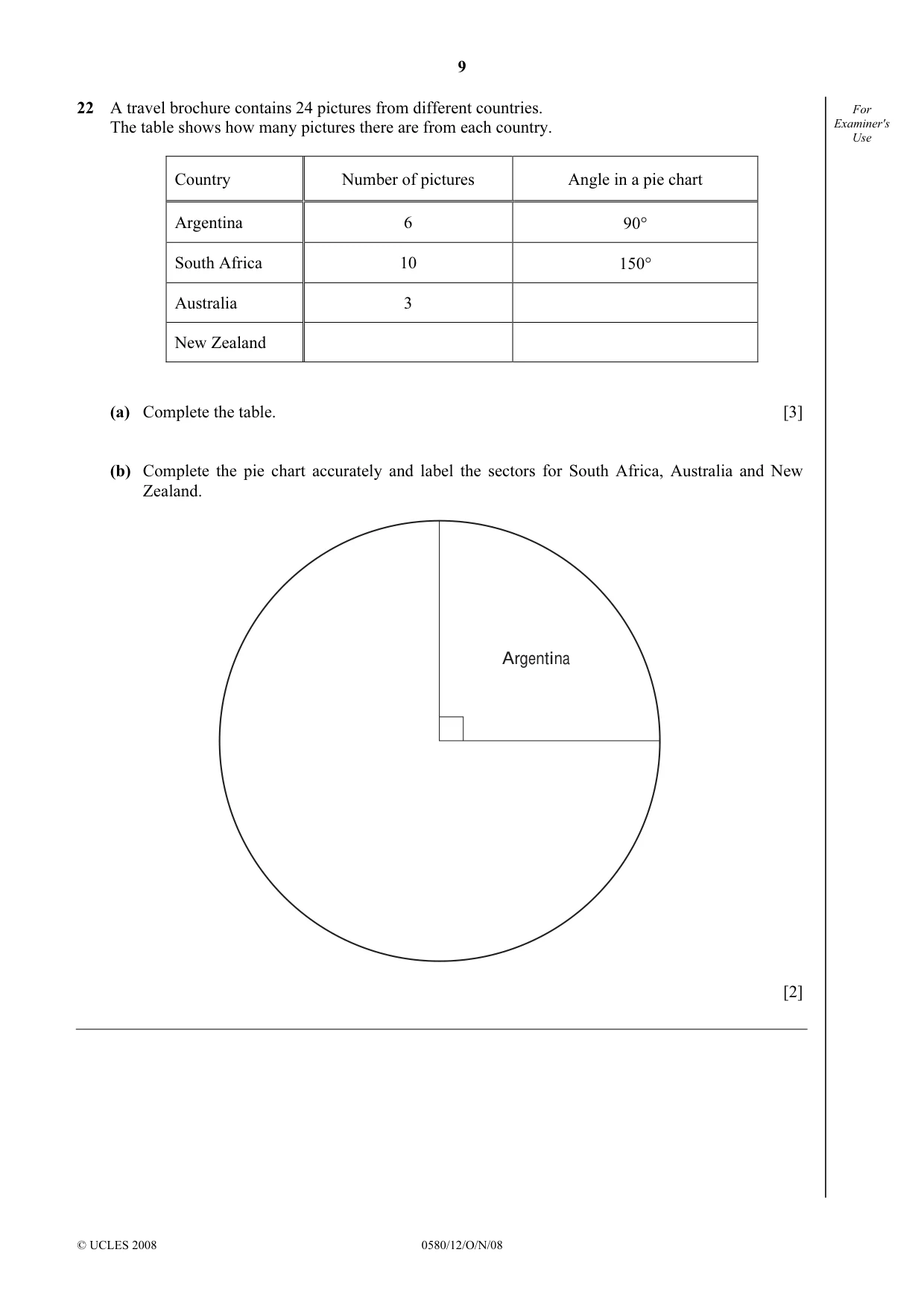
9 © UCLES 2008 0580/12/O/N/08 For Examiner's Use 22 A travel brochure contains 24 pictures from different countries. The table shows how many pictures there are from each country. Country Number of pictures Angle in a pie chart Argentina 6 90° South Africa 10 150° Australia 3 New Zealand (a) Complete the table. [3] (b) Complete the pie chart accurately and label the sectors for South Africa, Australia and New Zealand. Argentina [2]
Question paper, page 25
12 Permission to reproduce items where third-party owned material protected by copyright is included has been sought and cleared where possible. Every reasonable effort has been made by the publisher (UCLES) to trace copyright holders, but if any items requiring clearance have unwittingly been included, the publisher will be pleased to make amends at the earliest possible opportunity. University of Cambridge International Examinations is part of the Cambridge Assessment Group. Cambridge Assessment is the brand name of University of Cambridge Local Examinations Syndicate (UCLES), which is itself a department of the University of Cambridge. 0580/12/O/N/08 BLANK PAGE
Mark scheme, page 1
Location Entry Codes As part of CIE’s continual commitment to maintaining best practice in assessment, CIE has begun to use different variants of some question papers for our most popular assessments with extremely large and widespread candidature, The question papers are closely related and the relationships between them have been thoroughly established using our assessment expertise. All versions of the paper give assessment of equal standard. The content assessed by the examination papers and the type of questions are unchanged. This change means that for this component there are now two variant Question Papers, Mark Schemes and Principal Examiner’s Reports where previously there was only one. For any individual country, it is intended that only one variant is used. This document contains both variants which will give all Centres access to even more past examination material than is usually the case. The diagram shows the relationship between the Question Papers, Mark Schemes and Principal Examiner’s Reports. Question Paper Mark Scheme Principal Examiner’s Report Introduction Introduction Introduction First variant Question Paper First variant Mark Scheme First variant Principal Examiner’s Report Second variant Question Paper Second variant Mark Scheme Second variant Principal Examiner’s Report Who can I contact for further information on these changes? Please direct any questions about this to CIE’s Customer Services team at: international@cie.org.uk www.XtremePapers.com
Mark scheme, page 2
UNIVERSITY OF CAMBRIDGE INTERNATIONAL EXAMINATIONS International General Certificate of Secondary Education MARK SCHEME for the October/November 2008 question paper 0580 and 0581 MATHEMATICS 0580/11 and 0581/11 Paper 11 (Core), maximum raw mark 56 This mark scheme is published as an aid to teachers and candidates, to indicate the requirements of the examination. It shows the basis on which Examiners were instructed to award marks. It does not indicate the details of the discussions that took place at an Examiners’ meeting before marking began. All Examiners are instructed that alternative correct answers and unexpected approaches in candidates’ scripts must be given marks that fairly reflect the relevant knowledge and skills demonstrated. Mark schemes must be read in conjunction with the question papers and the report on the examination. • CIE will not enter into discussions or correspondence in connection with these mark schemes. CIE is publishing the mark schemes for the October/November 2008 question papers for most IGCSE, GCE Advanced Level and Advanced Subsidiary Level syllabuses and some Ordinary Level syllabuses. First variant Mark Scheme
Mark scheme, page 3
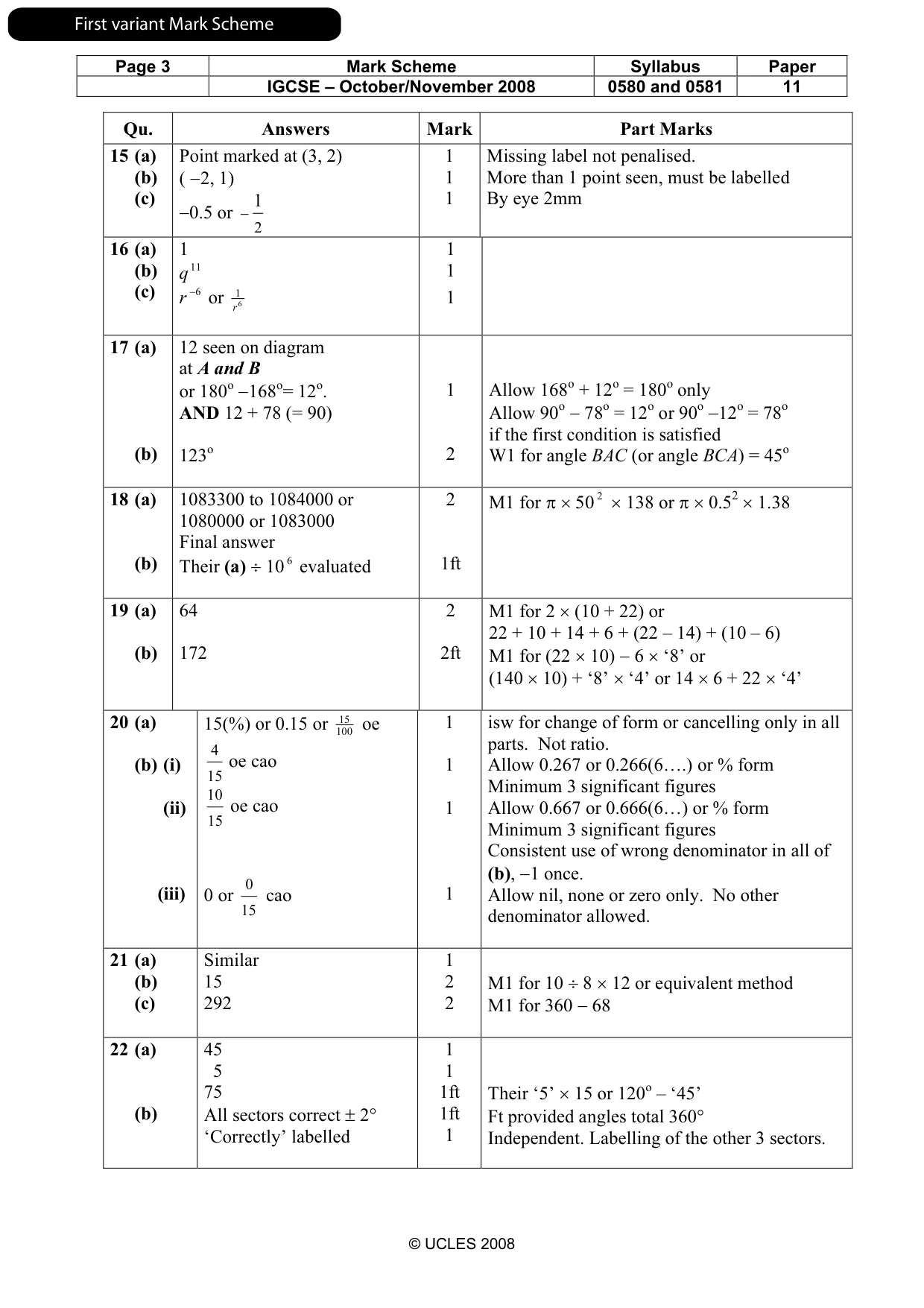
Page 2 Mark Scheme Syllabus Paper IGCSE – October/November 2008 0580 and 0581 11 © UCLES 2008 Abbreviations cao correct answer only ft work has been followed through after an error isw ignore subsequent working oe or equivalent SC Special Case soi seen or implied ww without working Qu. Answers Mark Part Marks 1 28 1 2 2 1 3 −13 1 4 6.5 1 5 12 − 13x cao final answer 2 W1 for (+)12 or −13x seen anywhere 6 11.5 2 M1 for 4.6 × figs 25 or W1 for figs 115 7 (a) (b) > = 1 1 8 15.77 cao 2 M1 for 20 ÷ 1.2685 or W1 for answers from 15 to 17 9 (x=) 10.2 or 10 5 1 isw 2 M1 for (53 − 2) ÷ 5 soi 10 6650 ≤ L < 6750 1, 1 1 mark for each value correctly placed. SC1 both correct but reversed 11 (a) (b) 12 24 1 1 12 (k=) 8 2 M1 for 0 = 2 × 4 − k or better 13 (a) (b) (c) 5.78 × 10 3 − 0.0058 0.01 1 1 1 Accept 5.8 × 10⁻³ Accept 1 × 10⁻² 14 4 15 seen 8 5 × their 15 4 6 1 W1 M1 A1 Must be inversion of an improper fraction Can be implied by ÷ 8 5 ' 120 20 ' ' 4 ' 15 = . ww no marks First variant Mark Scheme
Mark scheme, page 4
Page 3 Mark Scheme Syllabus Paper IGCSE – October/November 2008 0580 and 0581 11 © UCLES 2008 Qu. Answers Mark Part Marks 15 (a) (b) (c) Point marked at (3, 2) ( −2, 1) −0.5 or 2 1 − 1 1 1 Missing label not penalised. More than 1 point seen, must be labelled By eye 2mm 16 (a) (b) (c) 1 q 11 r 6 − or 6 1 r 1 1 1 17 (a) (b) 12 seen on diagram at A and B or 180o −168o= 12o. AND 12 + 78 (= 90) 123o 1 2 Allow 168o + 12o = 180o only Allow 90o − 78o = 12o or 90o −12o = 78o if the first condition is satisfied W1 for angle BAC (or angle BCA) = 45o 18 (a) (b) 1083300 to 1084000 or 1080000 or 1083000 Final answer Their (a) ÷ 10 6 evaluated 2 1ft M1 for π × 50 2 × 138 or π × 0.52 × 1.38 19 (a) (b) 64 172 2 2ft M1 for 2 × (10 + 22) or 22 + 10 + 14 + 6 + (22 – 14) + (10 – 6) M1 for (22 × 10) − 6 × ‘8’ or (140 × 10) + ‘8’ × ‘4’ or 14 × 6 + 22 × ‘4’ 20 (a) (b) (i) (ii) (iii) 15(%) or 0.15 or 100 15 oe 4 15 oe cao 10 15 oe cao 0 or 15 0 cao 1 1 1 1 isw for change of form or cancelling only in all parts. Not ratio. Allow 0.267 or 0.266(6….) or % form Minimum 3 significant figures Allow 0.667 or 0.666(6…) or % form Minimum 3 significant figures Consistent use of wrong denominator in all of (b), −1 once. Allow nil, none or zero only. No other denominator allowed. 21 (a) (b) (c) Similar 15 292 1 2 2 M1 for 10 ÷ 8 × 12 or equivalent method M1 for 360 − 68 22 (a) (b) 45 5 75 All sectors correct ± 2° ‘Correctly’ labelled 1 1 1ft 1ft 1 Their ‘5’ × 15 or 120o – ‘45’ Ft provided angles total 360° Independent. Labelling of the other 3 sectors. First variant Mark Scheme
Mark scheme, page 5
UNIVERSITY OF CAMBRIDGE INTERNATIONAL EXAMINATIONS International General Certificate of Secondary Education MARK SCHEME for the October/November 2008 question paper 0580 and 0581 MATHEMATICS 0580/12 and 0581/12 Paper 12 (Core), maximum raw mark 56 This mark scheme is published as an aid to teachers and candidates, to indicate the requirements of the examination. It shows the basis on which Examiners were instructed to award marks. It does not indicate the details of the discussions that took place at an Examiners’ meeting before marking began. All Examiners are instructed that alternative correct answers and unexpected approaches in candidates’ scripts must be given marks that fairly reflect the relevant knowledge and skills demonstrated. Mark schemes must be read in conjunction with the question papers and the report on the examination. • CIE will not enter into discussions or correspondence in connection with these mark schemes. CIE is publishing the mark schemes for the October/November 2008 question papers for most IGCSE, GCE Advanced Level and Advanced Subsidiary Level syllabuses and some Ordinary Level syllabuses. Second variant Mark Scheme
Mark scheme, page 6
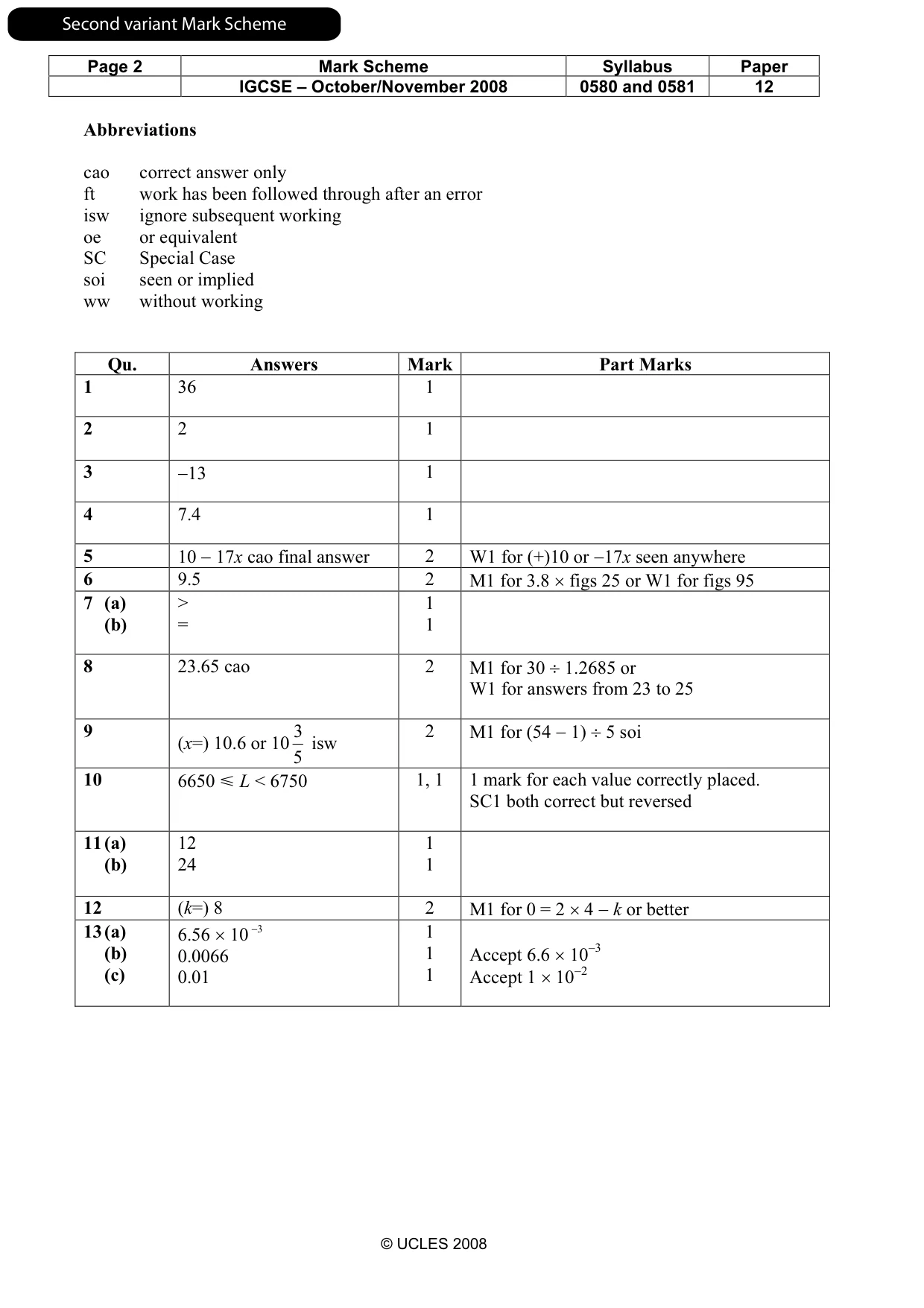
Page 2 Mark Scheme Syllabus Paper IGCSE – October/November 2008 0580 and 0581 12 © UCLES 2008 Abbreviations cao correct answer only ft work has been followed through after an error isw ignore subsequent working oe or equivalent SC Special Case soi seen or implied ww without working Qu. Answers Mark Part Marks 1 36 1 2 2 1 3 −13 1 4 7.4 1 5 10 − 17x cao final answer 2 W1 for (+)10 or −17x seen anywhere 6 9.5 2 M1 for 3.8 × figs 25 or W1 for figs 95 7 (a) (b) > = 1 1 8 23.65 cao 2 M1 for 30 ÷ 1.2685 or W1 for answers from 23 to 25 9 (x=) 10.6 or 10 5 3 isw 2 M1 for (54 − 1) ÷ 5 soi 10 6650 Y L < 6750 1, 1 1 mark for each value correctly placed. SC1 both correct but reversed 11 (a) (b) 12 24 1 1 12 (k=) 8 2 M1 for 0 = 2 × 4 − k or better 13 (a) (b) (c) 6.56 × 10 3 − 0.0066 0.01 1 1 1 Accept 6.6 × 10⁻³ Accept 1 × 10⁻² Second variant Mark Scheme
Mark scheme, page 7
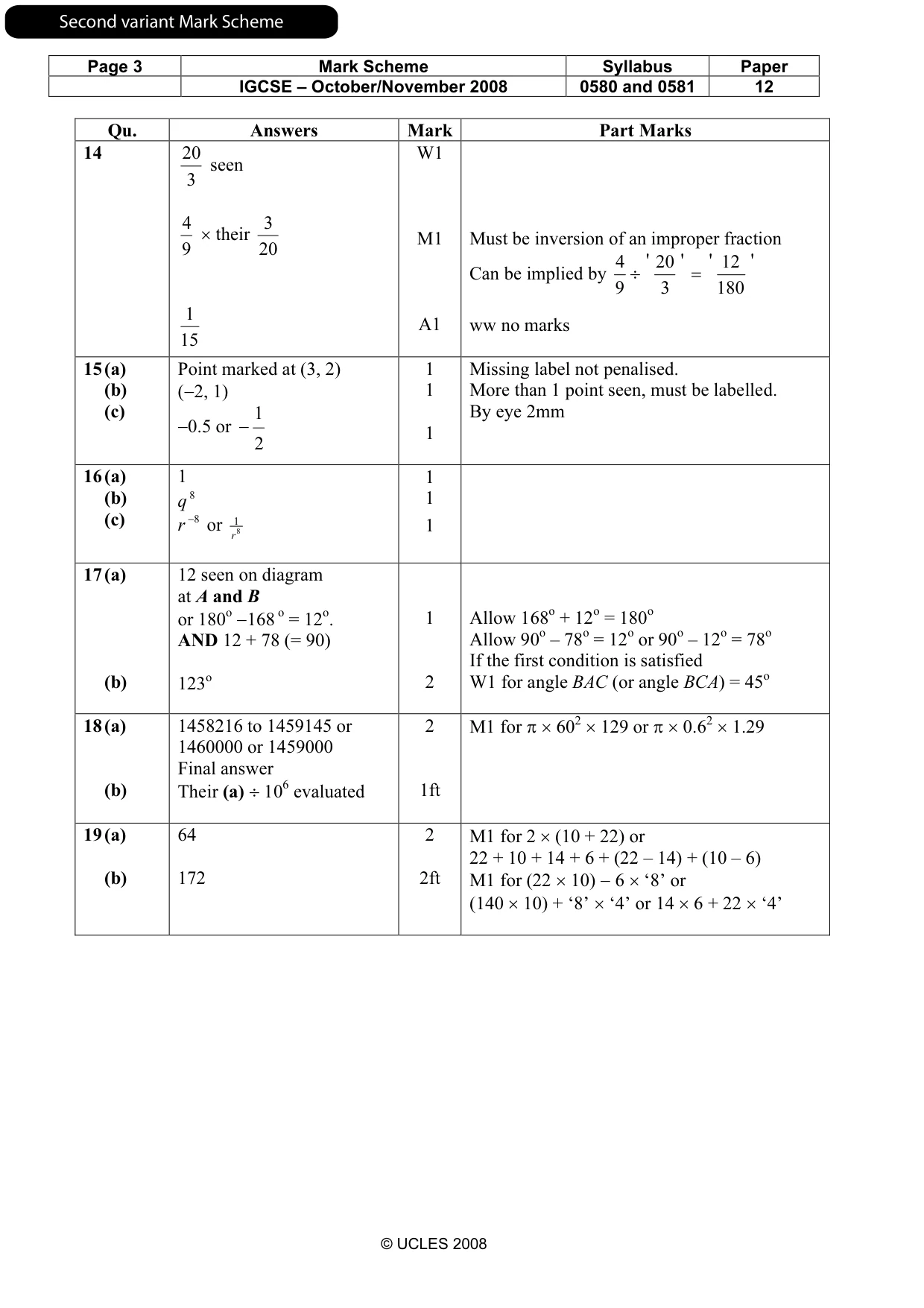
Page 3 Mark Scheme Syllabus Paper IGCSE – October/November 2008 0580 and 0581 12 © UCLES 2008 Qu. Answers Mark Part Marks 14 3 20 seen 9 4 × their 20 3 15 1 W1 M1 A1 Must be inversion of an improper fraction Can be implied by ' 180 12 ' ' 3 20 ' 9 4 = ÷ ww no marks 15 (a) (b) (c) Point marked at (3, 2) (−2, 1) −0.5 or 2 1 − 1 1 1 Missing label not penalised. More than 1 point seen, must be labelled. By eye 2mm 16 (a) (b) (c) 1 q 8 r 8 − or 8 1 r 1 1 1 17 (a) (b) 12 seen on diagram at A and B or 180o −168 o = 12o. AND 12 + 78 (= 90) 123o 1 2 Allow 168o + 12o = 180o Allow 90o – 78o = 12o or 90o – 12o = 78o If the first condition is satisfied W1 for angle BAC (or angle BCA) = 45o 18 (a) (b) 1458216 to 1459145 or 1460000 or 1459000 Final answer Their (a) ÷ 106 evaluated 2 1ft M1 for π × 602 × 129 or π × 0.62 × 1.29 19 (a) (b) 64 172 2 2ft M1 for 2 × (10 + 22) or 22 + 10 + 14 + 6 + (22 – 14) + (10 – 6) M1 for (22 × 10) − 6 × ‘8’ or (140 × 10) + ‘8’ × ‘4’ or 14 × 6 + 22 × ‘4’ Second variant Mark Scheme
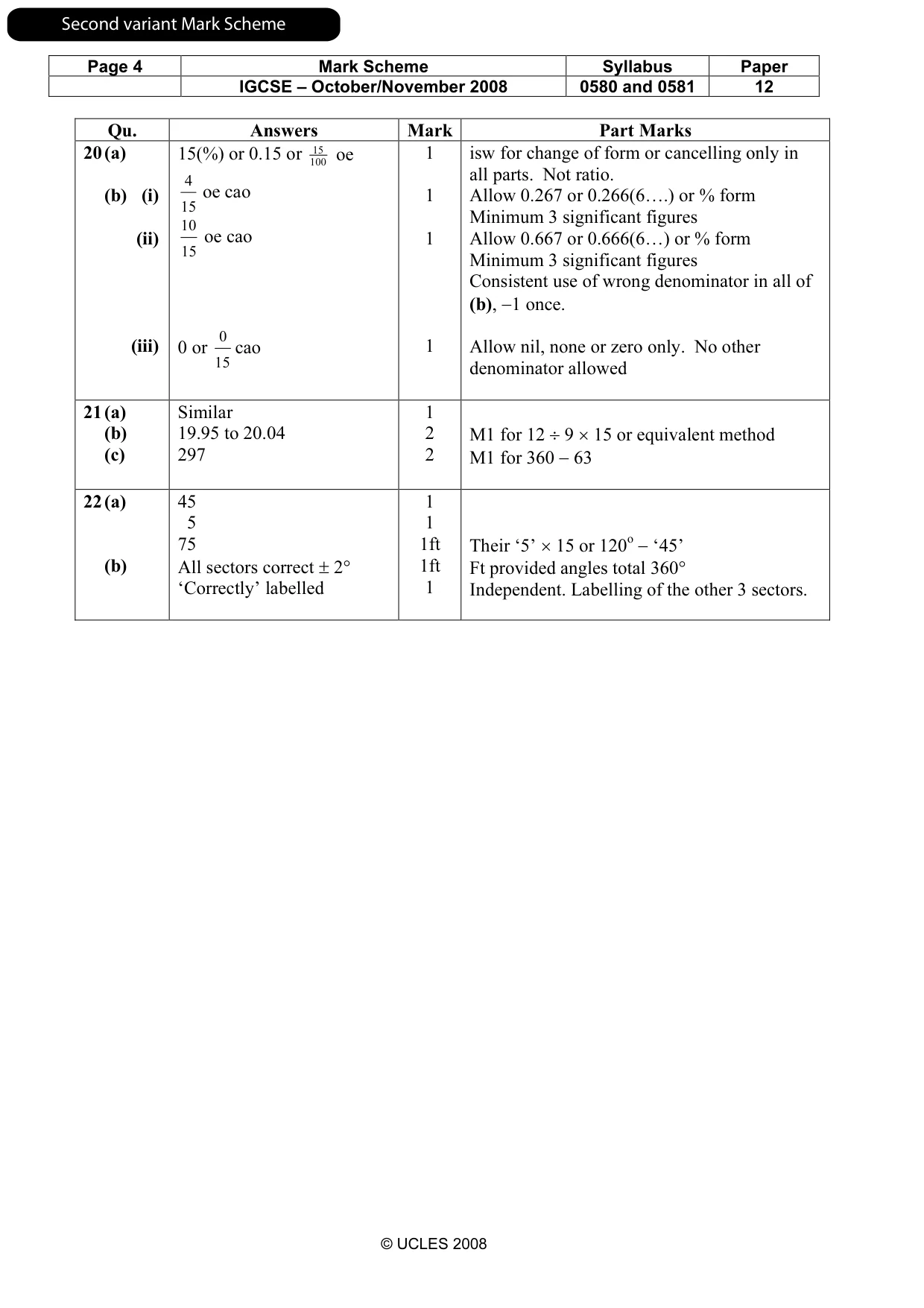
Mark scheme, page 8
Page 4 Mark Scheme Syllabus Paper IGCSE – October/November 2008 0580 and 0581 12 © UCLES 2008 Qu. Answers Mark Part Marks 20 (a) (b) (i) (ii) (iii) 15(%) or 0.15 or 100 15 oe 4 15 oe cao 10 15 oe cao 0 or 15 0 cao 1 1 1 1 isw for change of form or cancelling only in all parts. Not ratio. Allow 0.267 or 0.266(6….) or % form Minimum 3 significant figures Allow 0.667 or 0.666(6…) or % form Minimum 3 significant figures Consistent use of wrong denominator in all of (b), −1 once. Allow nil, none or zero only. No other denominator allowed 21 (a) (b) (c) Similar 19.95 to 20.04 297 1 2 2 M1 for 12 ÷ 9 × 15 or equivalent method M1 for 360 − 63 22 (a) (b) 45 5 75 All sectors correct ± 2° ‘Correctly’ labelled 1 1 1ft 1ft 1 Their ‘5’ × 15 or 120o − ‘45’ Ft provided angles total 360° Independent. Labelling of the other 3 sectors. Second variant Mark Scheme