Cambridge IGCSE Mathematics (with coursework) 0581 — 2007 Oct/Nov Paper 1 · Variant 1
0581/11/O/N/07 · 56 marks · ≈63 min
The question paper and its mark scheme, free to read here and free to download. This is Cambridge’s own paper, exactly as it was sat.
Question paper25 pages
Mark scheme7 pages
Answers below. Sit the paper first if you are practising.
Paper as text
Question paper, page 1
Location Entry Codes As part of CIE’s continual commitment to maintaining best practice in assessment, CIE has begun to use different variants of some question papers for our most popular assessments with extremely large and widespread candidature, The question papers are closely related and the relationships between them have been thoroughly established using our assessment expertise. All versions of the paper give assessment of equal standard. The content assessed by the examination papers and the type of questions are unchanged. This change means that for this component there are now two variant Question Papers, Mark Schemes and Principal Examiner’s Reports where previously there was only one. For any individual country, it is intended that only one variant is used. This document contains both variants which will give all Centres access to even more past examination material than is usually the case. The diagram shows the relationship between the Question Papers, Mark Schemes and Principal Examiner’s Reports. Question Paper Mark Scheme Principal Examiner’s Report Introduction Introduction Introduction First variant Question Paper First variant Mark Scheme First variant Principal Examiner’s Report Second variant Question Paper Second variant Mark Scheme Second variant Principal Examiner’s Report Who can I contact for further information on these changes? Please direct any questions about this to CIE’s Customer Services team at: international@cie.org.uk www.XtremePapers.com
Question paper, page 2
This document consists of 10 printed pages and 2 blank pages. IB07 11_0580_01/5RP © UCLES 2007 [Turn over *7675095749* For Examiner's Use P UNIVERSITY OF CAMBRIDGE INTERNATIONAL EXAMINATIONS International General Certificate of Secondary Education MATHEMATICS 0580/01, 0581/01 Paper 1 (Core) October/November 2007 1 hour Candidates answer on the Question Paper. Additional Materials: Electronic Calculator Mathematical tables (optional) Geometrical Instruments Tracing paper (optional) READ THESE INSTRUCTIONS FIRST Write your Centre number, candidate number and name on all the work you hand in. Write in dark blue or black pen. You may use a pencil for any diagrams or graphs. Do not use staples, paper clips, highlighters, glue or correction fluid. DO NOT WRITE IN ANY BARCODES. Answer all questions. If working is needed for any question it must be shown below that question. Electronic calculators should be used. If the degree of accuracy is not specified in the question, and if the answer is not exact, give the answer to three significant figures. Give answers in degrees to one decimal place. For π , use either your calculator value or 3.142. At the end of the examination, fasten all your work securely together. The number of marks is given in brackets [ ] at the end of each question or part question. The total of the marks for this paper is 56. First variant Question Paper
Question paper, page 3
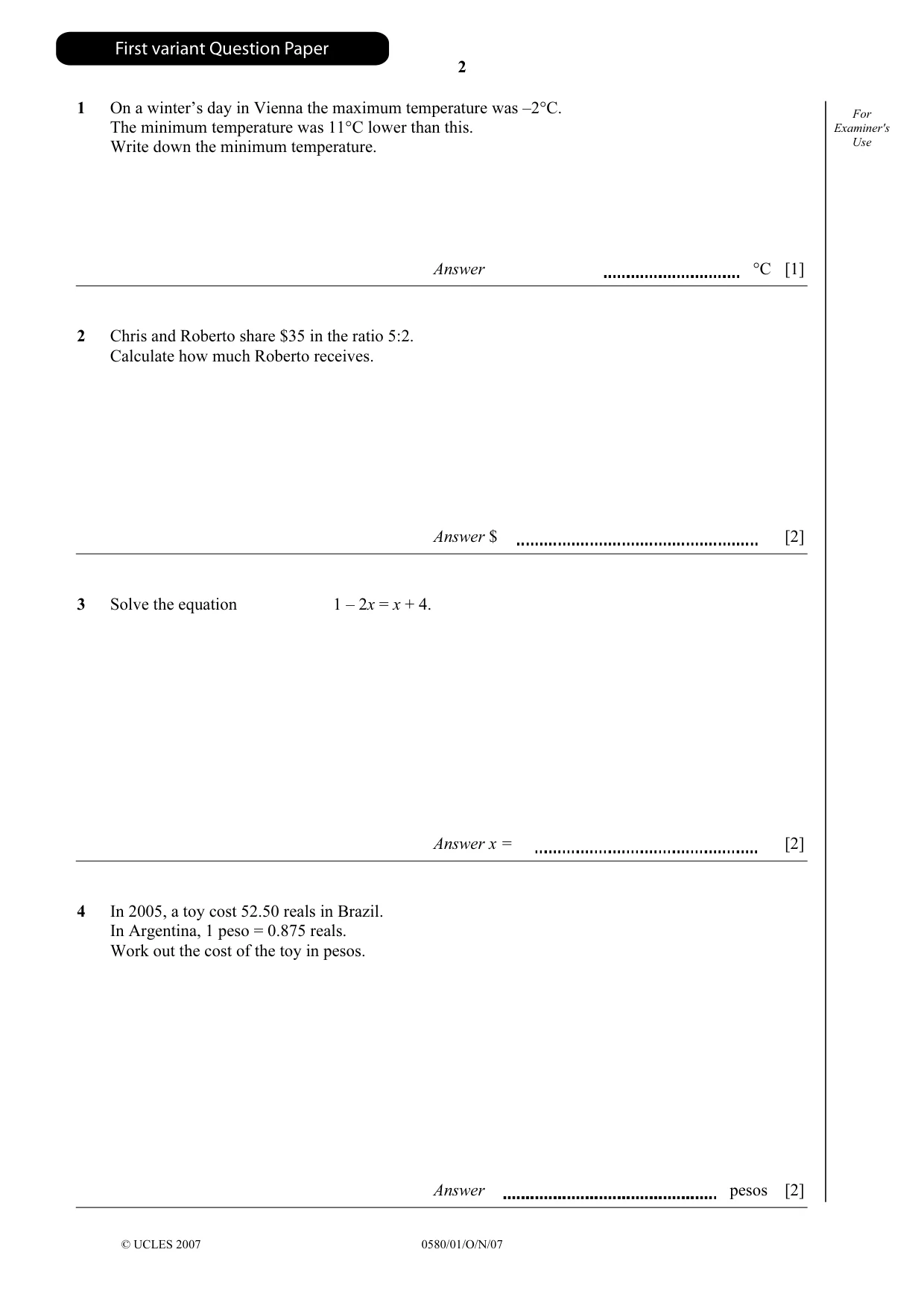
2 © UCLES 2007 0580/01/O/N/07 For Examiner's Use 1 On a winter’s day in Vienna the maximum temperature was –2°C. The minimum temperature was 11°C lower than this. Write down the minimum temperature. Answer °C [1] 2 Chris and Roberto share $35 in the ratio 5:2. Calculate how much Roberto receives. Answer $ [2] 3 Solve the equation 1 – 2x = x + 4. Answer x = [2] 4 In 2005, a toy cost 52.50 reals in Brazil. In Argentina, 1 peso = 0.875 reals. Work out the cost of the toy in pesos. Answer pesos [2] First variant Question Paper
Question paper, page 4
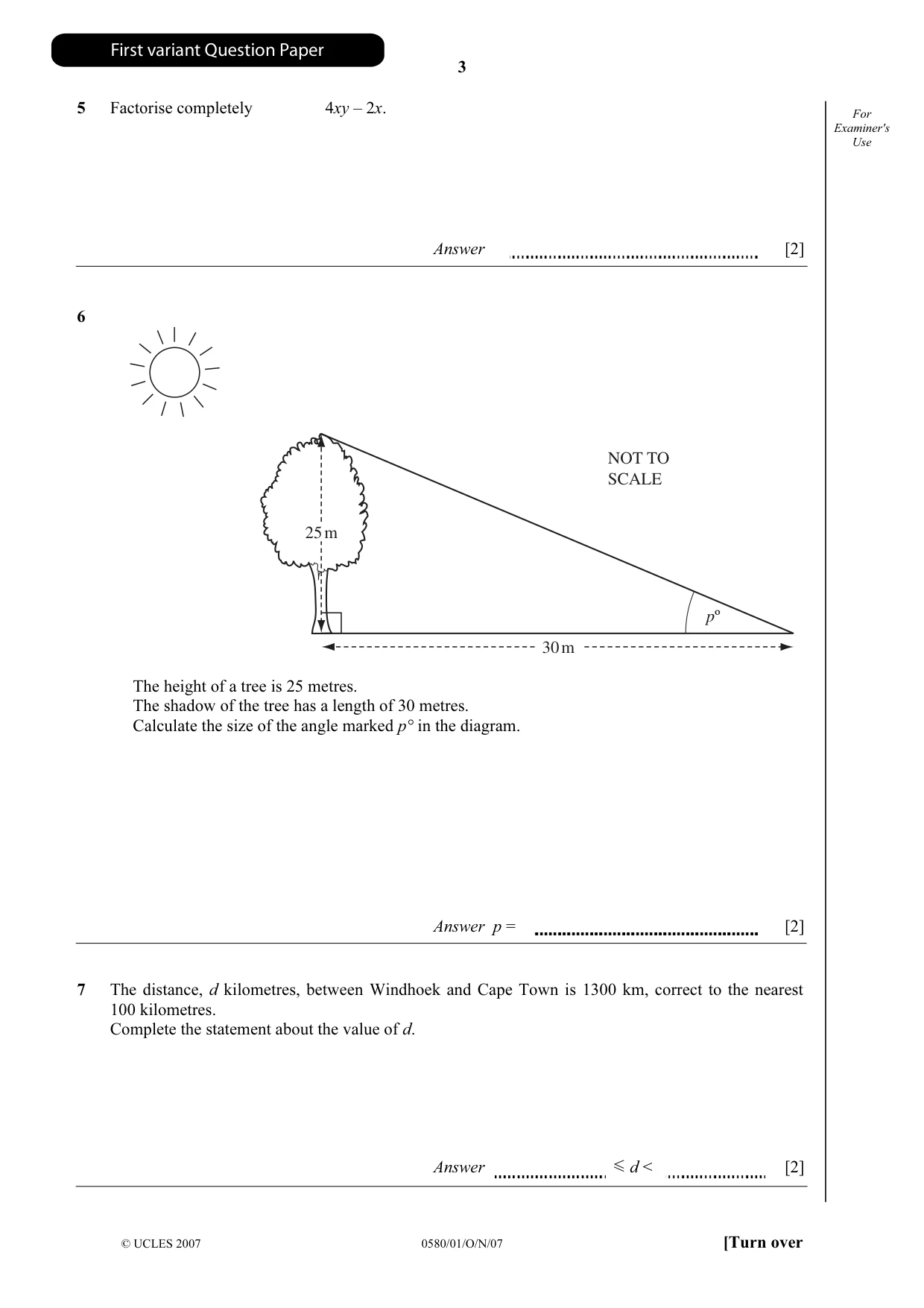
3 © UCLES 2007 0580/01/O/N/07 [Turn over For Examiner's Use 5 Factorise completely 4xy – 2x. Answer [2] 6 NOT TO SCALE pº 30 m 25 m The height of a tree is 25 metres. The shadow of the tree has a length of 30 metres. Calculate the size of the angle marked p° in the diagram. Answer p = [2] 7 The distance, d kilometres, between Windhoek and Cape Town is 1300 km, correct to the nearest 100 kilometres. Complete the statement about the value of d. Answer d < [2] First variant Question Paper
Question paper, page 5
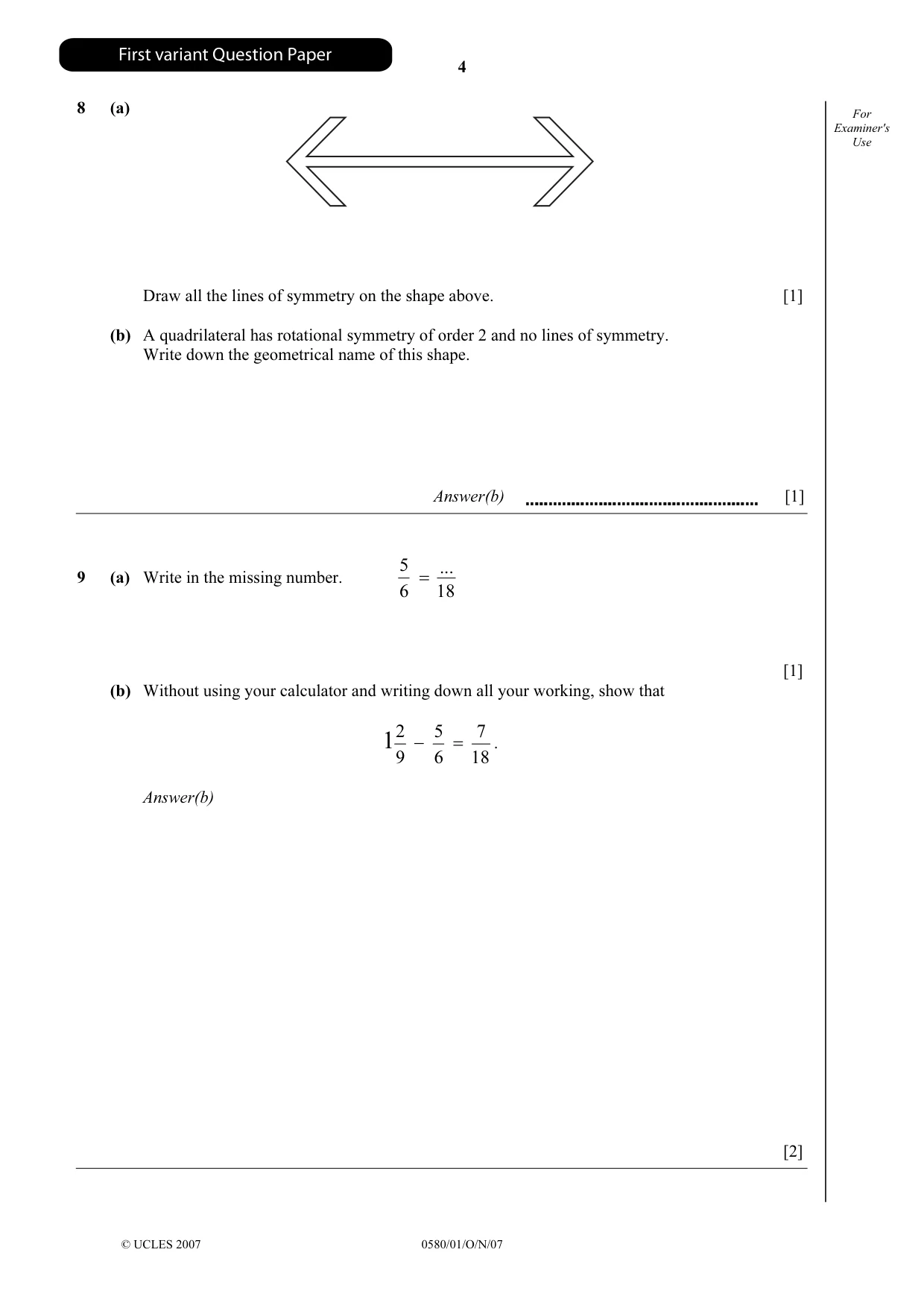
4 © UCLES 2007 0580/01/O/N/07 For Examiner's Use 8 (a) Draw all the lines of symmetry on the shape above. [1] (b) A quadrilateral has rotational symmetry of order 2 and no lines of symmetry. Write down the geometrical name of this shape. Answer(b) [1] 9 (a) Write in the missing number. 18 ... 6 5 = [1] (b) Without using your calculator and writing down all your working, show that 18 7 6 5 9 2 1 = − . Answer(b) [2] First variant Question Paper
Question paper, page 6
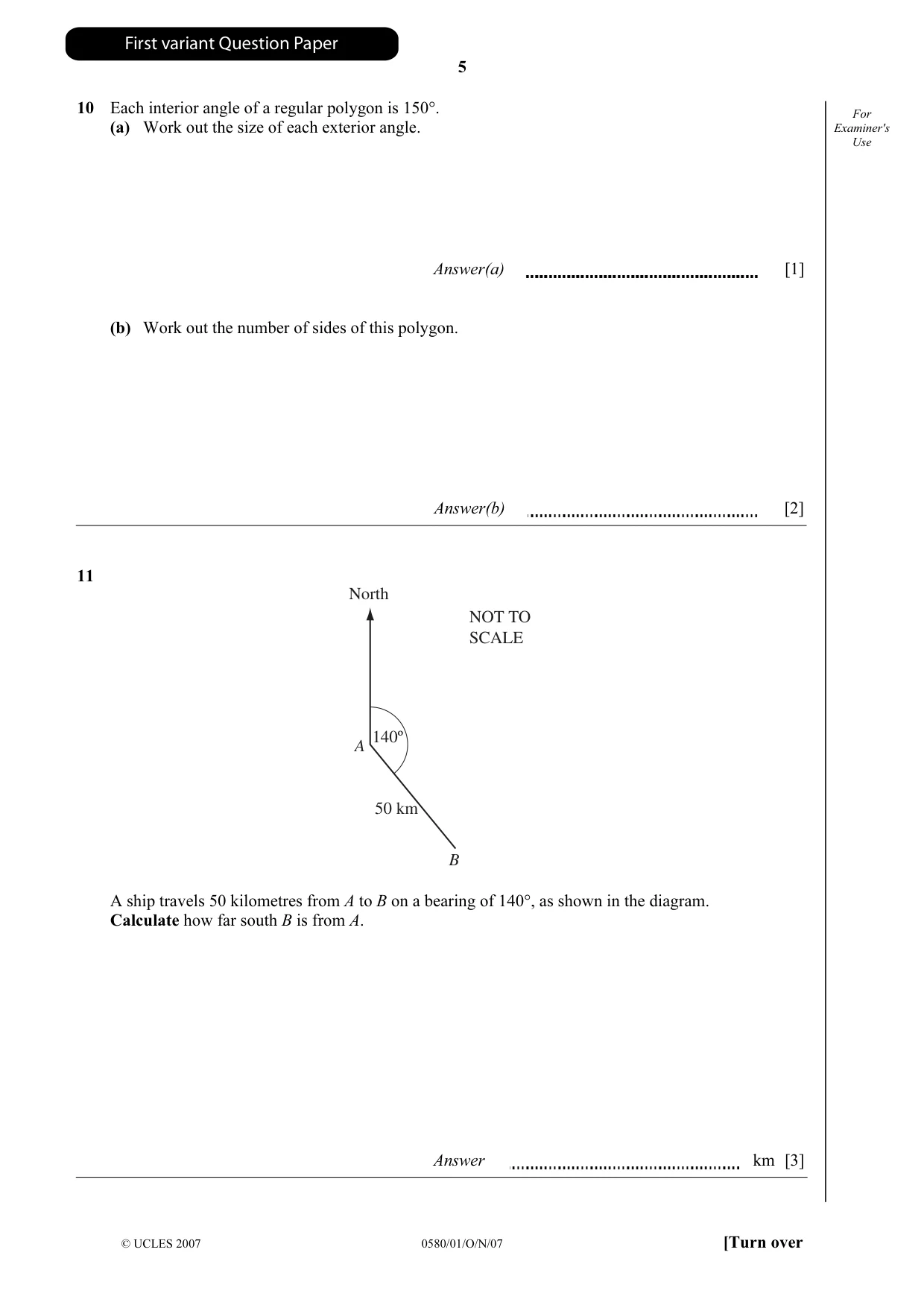
5 © UCLES 2007 0580/01/O/N/07 [Turn over For Examiner's Use 10 Each interior angle of a regular polygon is 150°. (a) Work out the size of each exterior angle. Answer(a) [1] (b) Work out the number of sides of this polygon. Answer(b) [2] 11 A B North NOT TO SCALE 140º 50 km A ship travels 50 kilometres from A to B on a bearing of 140°, as shown in the diagram. Calculate how far south B is from A. Answer km [3] First variant Question Paper
Question paper, page 7
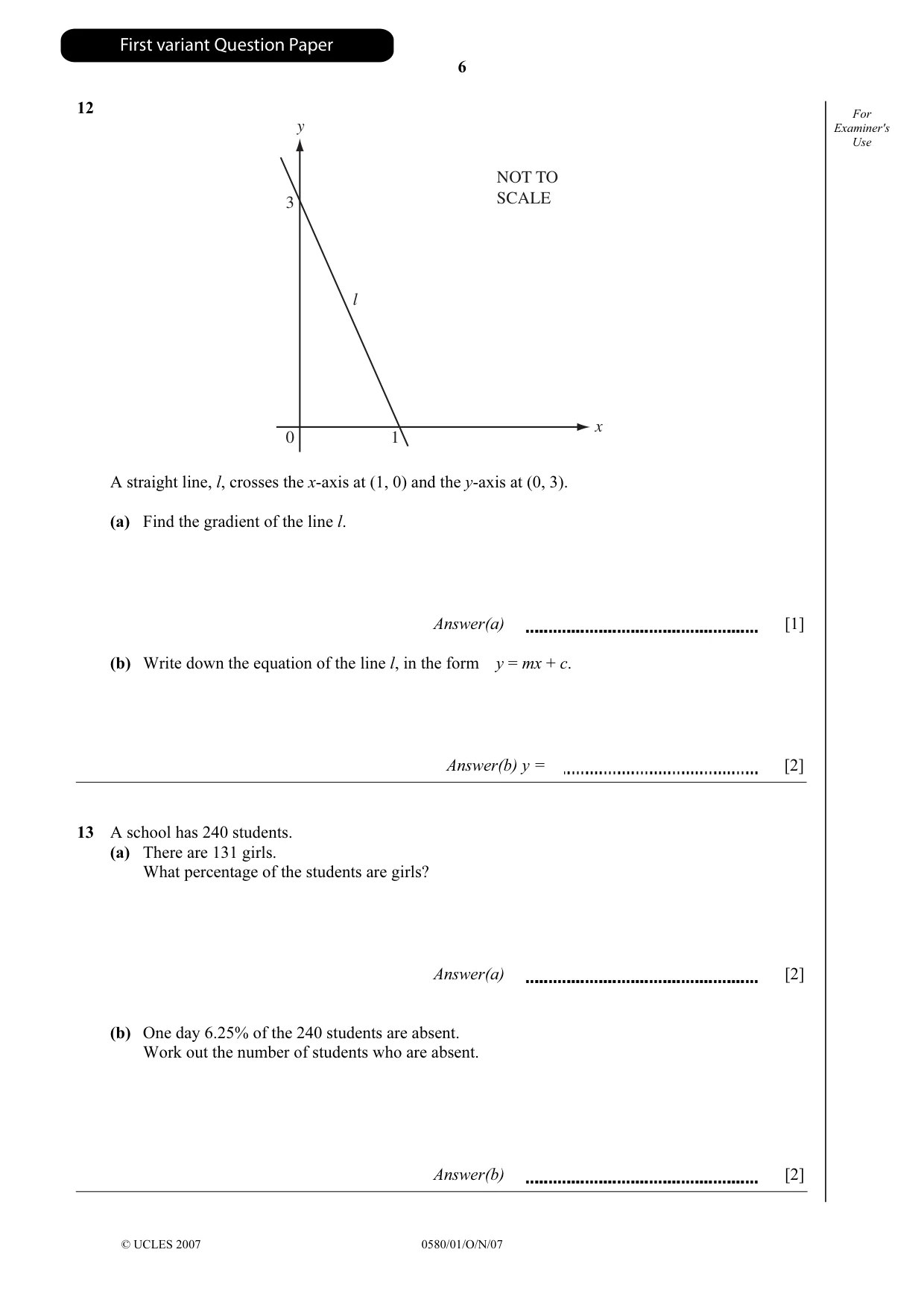
6 © UCLES 2007 0580/01/O/N/07 For Examiner's Use 12 y x l 0 3 1 NOT TO SCALE A straight line, l, crosses the x-axis at (1, 0) and the y-axis at (0, 3). (a) Find the gradient of the line l. Answer(a) [1] (b) Write down the equation of the line l, in the form y = mx + c. Answer(b) y = [2] 13 A school has 240 students. (a) There are 131 girls. What percentage of the students are girls? Answer(a) [2] (b) One day 6.25% of the 240 students are absent. Work out the number of students who are absent. Answer(b) [2] First variant Question Paper
Question paper, page 8
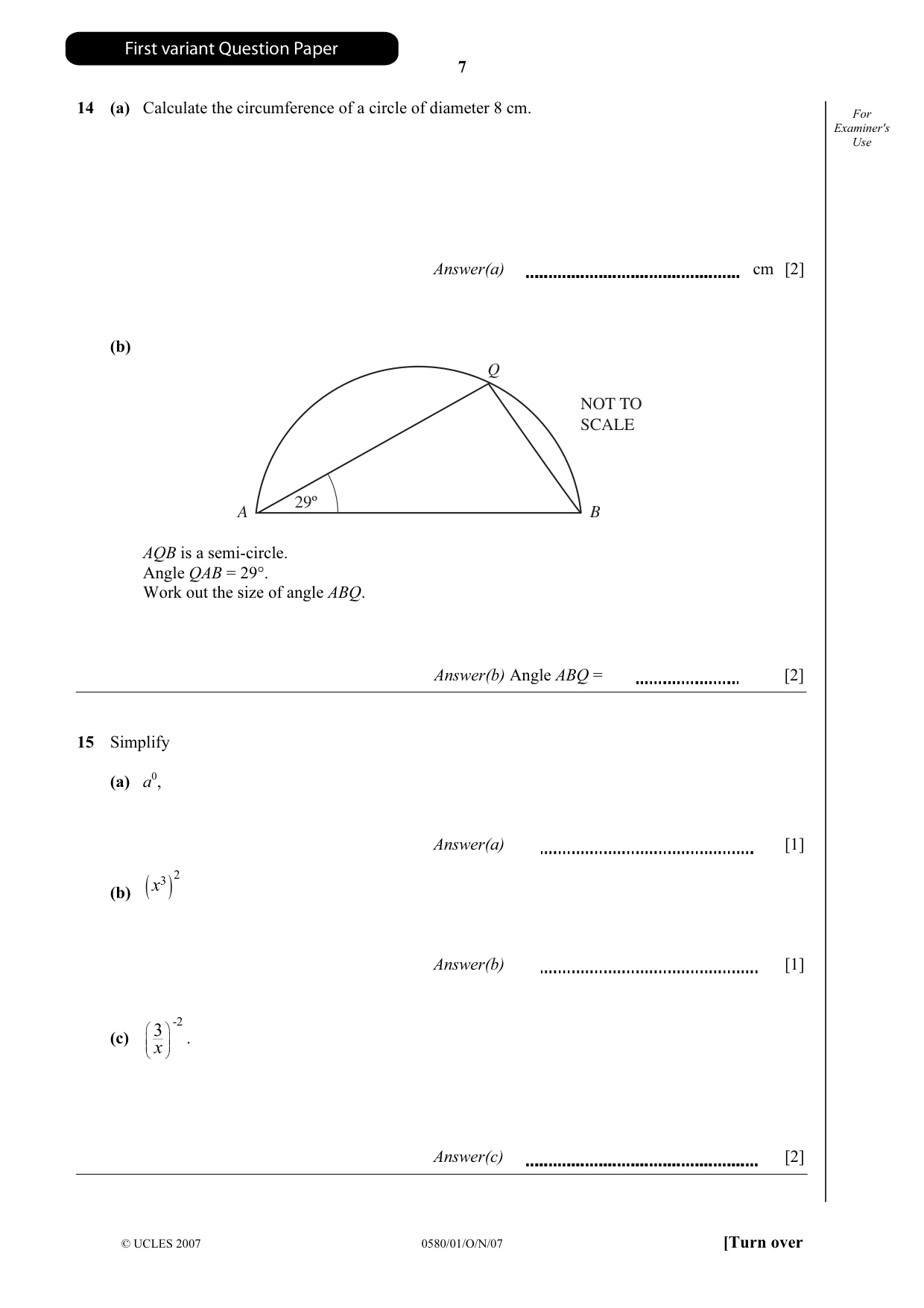
7 © UCLES 2007 0580/01/O/N/07 [Turn over For Examiner's Use 14 (a) Calculate the circumference of a circle of diameter 8 cm. Answer(a) cm [2] (b) Q B A NOT TO SCALE 29º AQB is a semi-circle. Angle QAB = 29°. Work out the size of angle ABQ. Answer(b) Angle ABQ = [2] 15 Simplify (a) a0, Answer(a) [1] (b) ( ) 2 3x Answer(b) [1] (c) -2 3 x . Answer(c) [2] First variant Question Paper
Question paper, page 9
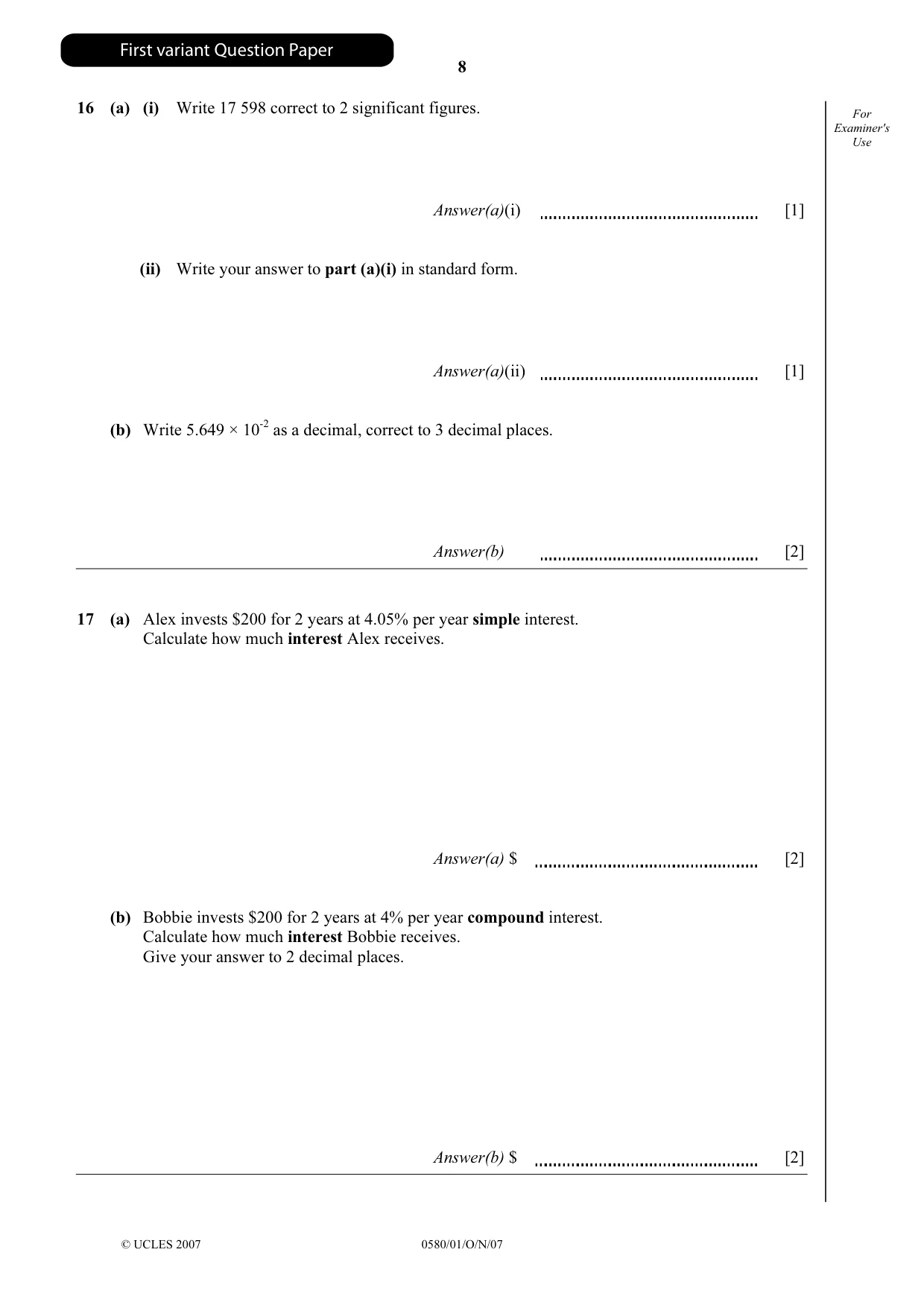
8 © UCLES 2007 0580/01/O/N/07 For Examiner's Use 16 (a) (i) Write 17 598 correct to 2 significant figures. Answer(a)(i) [1] (ii) Write your answer to part (a)(i) in standard form. Answer(a)(ii) [1] (b) Write 5.649 × 10⁻² as a decimal, correct to 3 decimal places. Answer(b) [2] 17 (a) Alex invests $200 for 2 years at 4.05% per year simple interest. Calculate how much interest Alex receives. Answer(a) $ [2] (b) Bobbie invests $200 for 2 years at 4% per year compound interest. Calculate how much interest Bobbie receives. Give your answer to 2 decimal places. Answer(b) $ [2] First variant Question Paper
Question paper, page 10
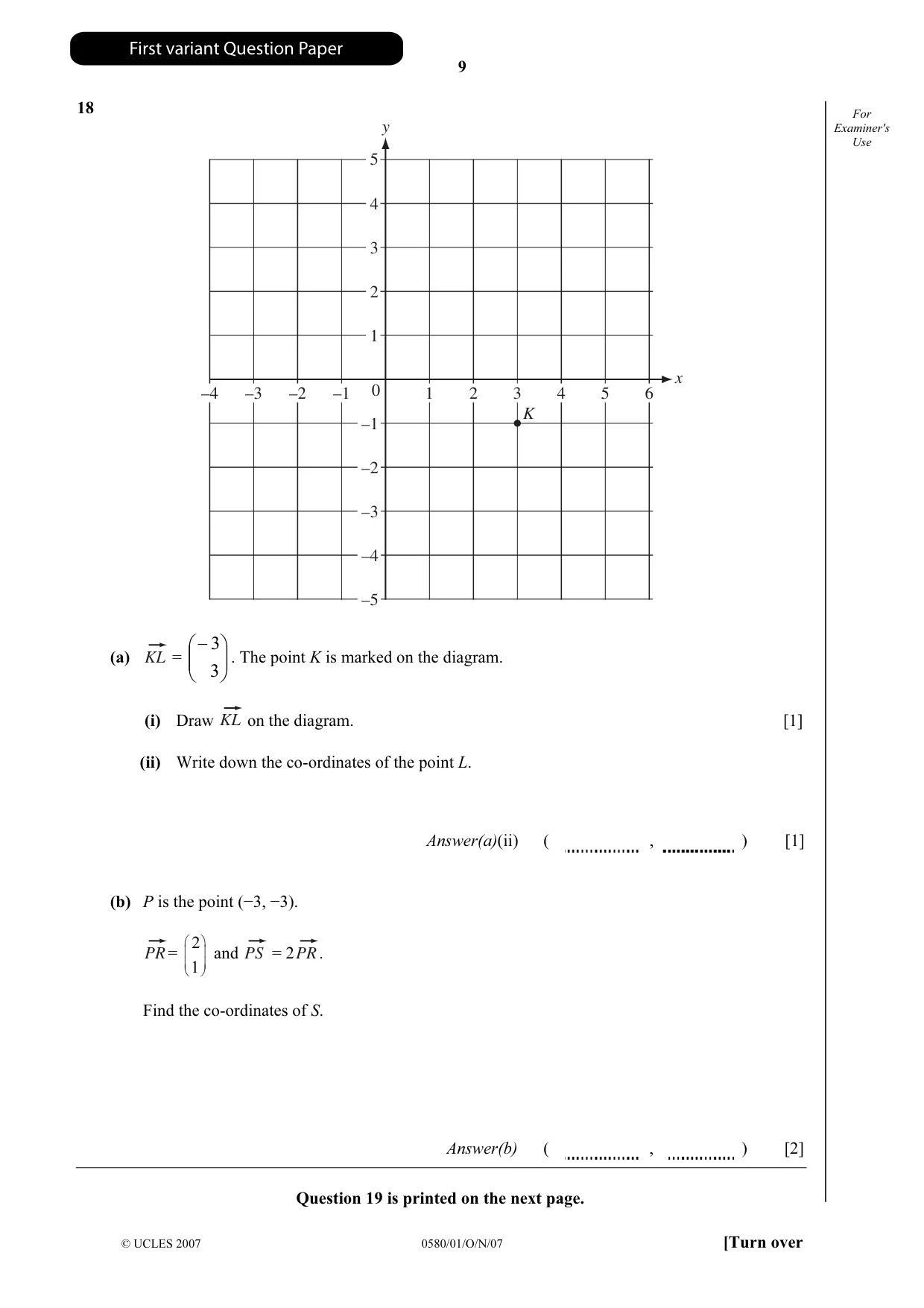
9 © UCLES 2007 0580/01/O/N/07 [Turn over For Examiner's Use 18 y x 5 4 3 2 1 –1 –2 –3 –4 –5 –4 –3 –2 –1 1 0 2 3 4 5 6 K (a) KL = − 3 3 . The point K is marked on the diagram. (i) Draw KL on the diagram. [1] (ii) Write down the co-ordinates of the point L. Answer(a)(ii) ( , ) [1] (b) P is the point (−3, −3). PR= 2 1 and PS = 2PR. Find the co-ordinates of S. Answer(b) ( , ) [2] Question 19 is printed on the next page. First variant Question Paper
Question paper, page 11
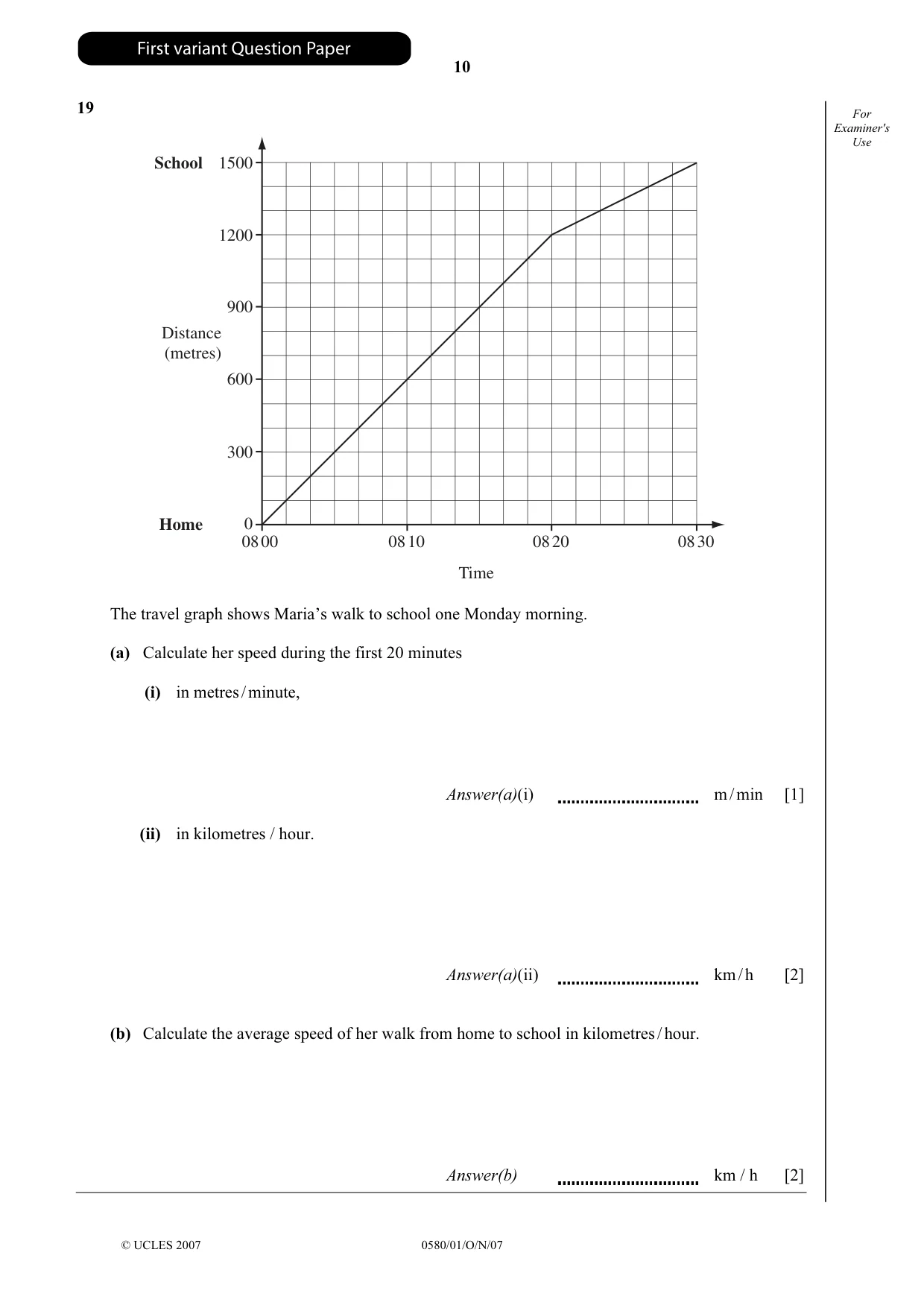
10 © UCLES 2007 0580/01/O/N/07 For Examiner's Use 19 1200 900 600 300 0 1500 08 00 08 20 08 10 08 30 Time Distance (metres) School Home The travel graph shows Maria’s walk to school one Monday morning. (a) Calculate her speed during the first 20 minutes (i) in metres / minute, Answer(a)(i) m / min [1] (ii) in kilometres / hour. Answer(a)(ii) km / h [2] (b) Calculate the average speed of her walk from home to school in kilometres / hour. Answer(b) km / h [2] First variant Question Paper
Question paper, page 12
11 © UCLES 2007 0580/01/O/N/07 BLANK PAGE First variant Question Paper
Question paper, page 13
12 Permission to reproduce items where third-party owned material protected by copyright is included has been sought and cleared where possible. Every reasonable effort has been made by the publisher (UCLES) to trace copyright holders, but if any items requiring clearance have unwittingly been included, the publisher will be pleased to make amends at the earliest possible opportunity. University of Cambridge International Examinations is part of the Cambridge Assessment Group. Cambridge Assessment is the brand name of University of Cambridge Local Examinations Syndicate (UCLES), which is itself a department of the University of Cambridge. © UCLES 2007 0580/01/O/N/07 BLANK PAGE First variant Question Paper
Question paper, page 14
This document consists of 10 printed pages and 2 blank pages. IB07 11_0580_01_TZ/2RP © UCLES 2007 [Turn over *5528231567* For Examiner's Use UNIVERSITY OF CAMBRIDGE INTERNATIONAL EXAMINATIONS International General Certificate of Secondary Education MATHEMATICS 0580/01, 0581/01 Paper 1 (Core) October/November 2007 1 hour Candidates answer on the Question Paper. Additional Materials: Electronic Calculator Mathematical tables (optional) Geometrical Instruments Tracing paper (optional) READ THESE INSTRUCTIONS FIRST Write your Centre number, candidate number and name on all the work you hand in. Write in dark blue or black pen. You may use a pencil for any diagrams or graphs. Do not use staples, paper clips, highlighters, glue or correction fluid. DO NOT WRITE IN ANY BARCODES Answer all questions. If working is needed for any question it must be shown below that question. Electronic calculators should be used. If the degree of accuracy is not specified in the question, and if the answer is not exact, give the answer to three significant figures. Give answers in degrees to one decimal place. For π, use either your calculator value or 3.142. At the end of the examination, fasten all your work securely together. The number of marks is given in brackets [ ] at the end of each question or part question. The total of the marks for this paper is 56. Q Second variant Question Paper
Question paper, page 15
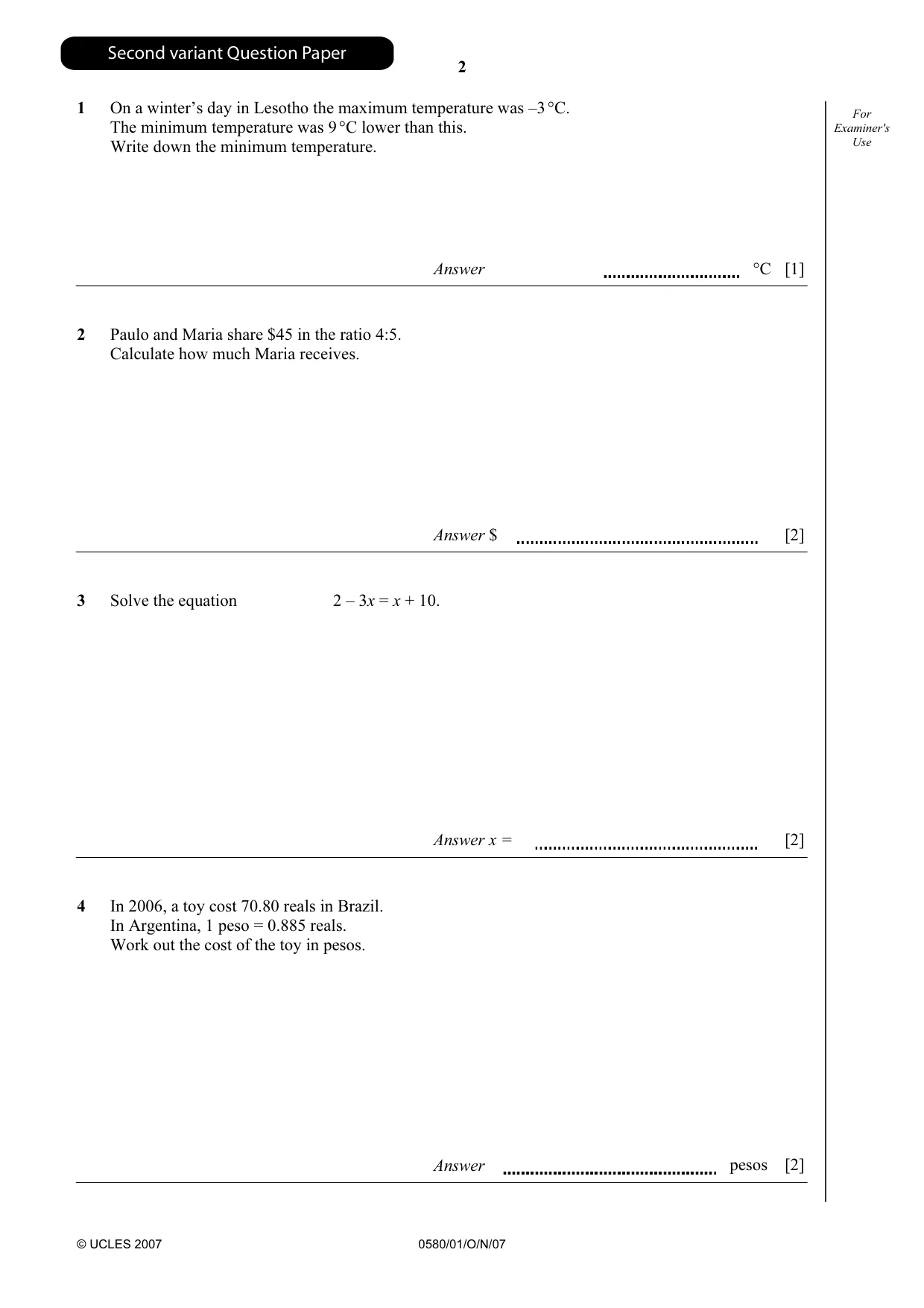
2 © UCLES 2007 0580/01/O/N/07 For Examiner's Use 1 On a winter’s day in Lesotho the maximum temperature was –3 °C. The minimum temperature was 9 °C lower than this. Write down the minimum temperature. Answer °C [1] 2 Paulo and Maria share $45 in the ratio 4:5. Calculate how much Maria receives. Answer $ [2] 3 Solve the equation 2 – 3x = x + 10. Answer x = [2] 4 In 2006, a toy cost 70.80 reals in Brazil. In Argentina, 1 peso = 0.885 reals. Work out the cost of the toy in pesos. Answer pesos [2] Second variant Question Paper
Question paper, page 16
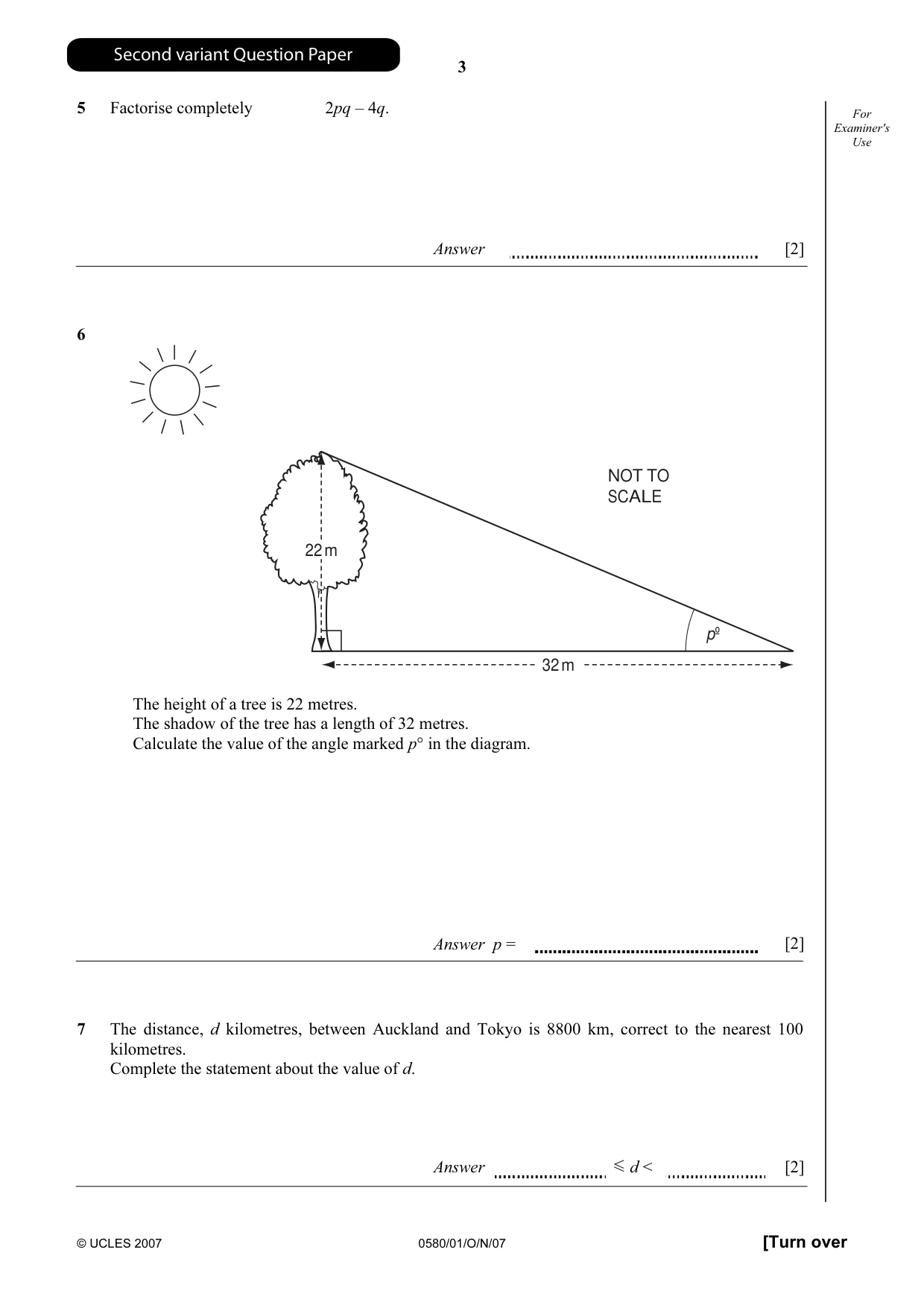
3 © UCLES 2007 0580/01/O/N/07 [Turn over For Examiner's Use 5 Factorise completely 2pq – 4q. Answer [2] 6 NOT TO SCALE pº 32 m 22 m The height of a tree is 22 metres. The shadow of the tree has a length of 32 metres. Calculate the value of the angle marked p° in the diagram. Answer p = [2] 7 The distance, d kilometres, between Auckland and Tokyo is 8800 km, correct to the nearest 100 kilometres. Complete the statement about the value of d. Answer d < [2] Second variant Question Paper
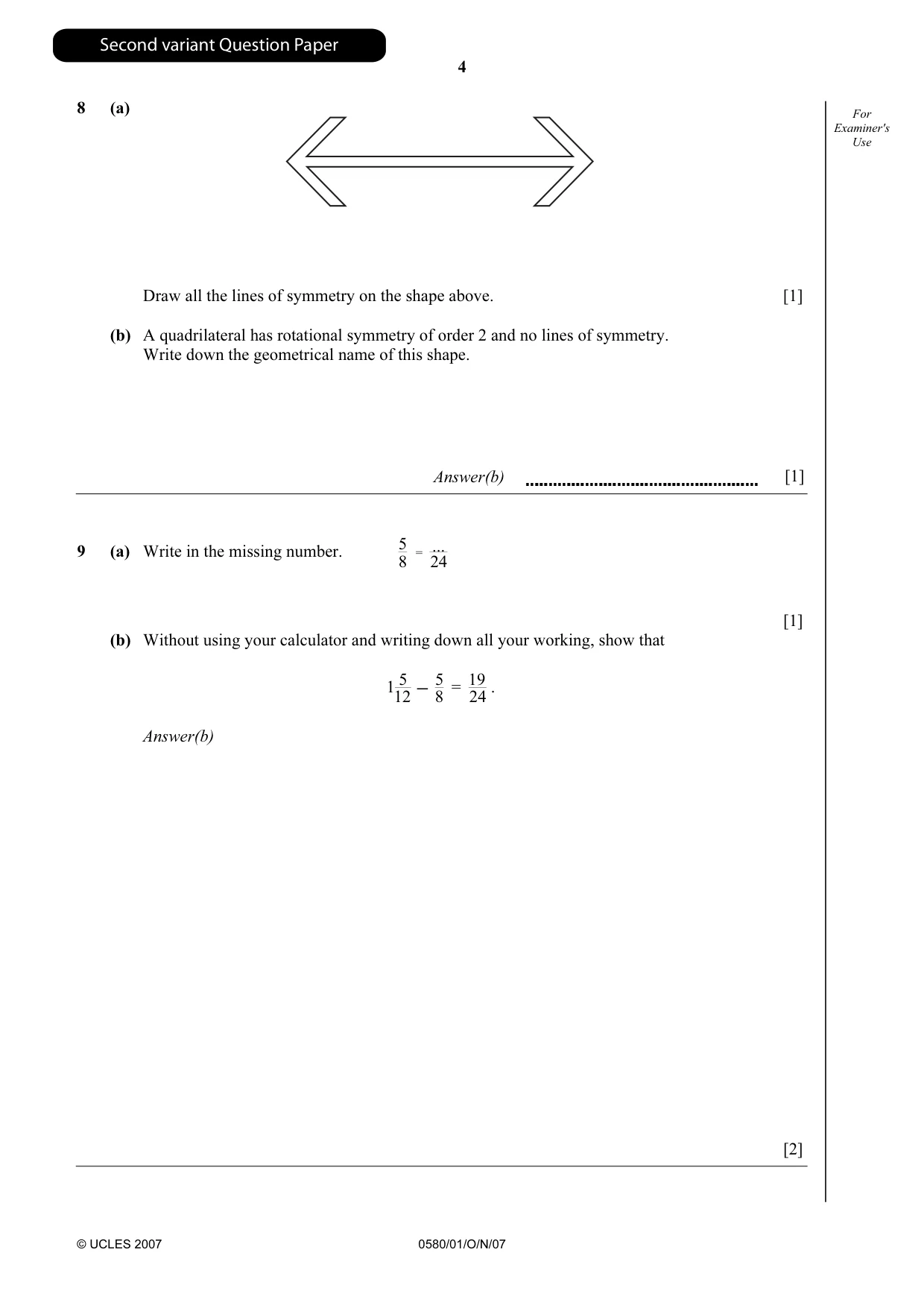
Question paper, page 17
4 © UCLES 2007 0580/01/O/N/07 For Examiner's Use 8 (a) Draw all the lines of symmetry on the shape above. [1] (b) A quadrilateral has rotational symmetry of order 2 and no lines of symmetry. Write down the geometrical name of this shape. Answer(b) [1] 9 (a) Write in the missing number. = 5 ... 8 24 [1] (b) Without using your calculator and writing down all your working, show that 5 5 19 1 = 12 8 24 _ . Answer(b) [2] Second variant Question Paper
Question paper, page 18
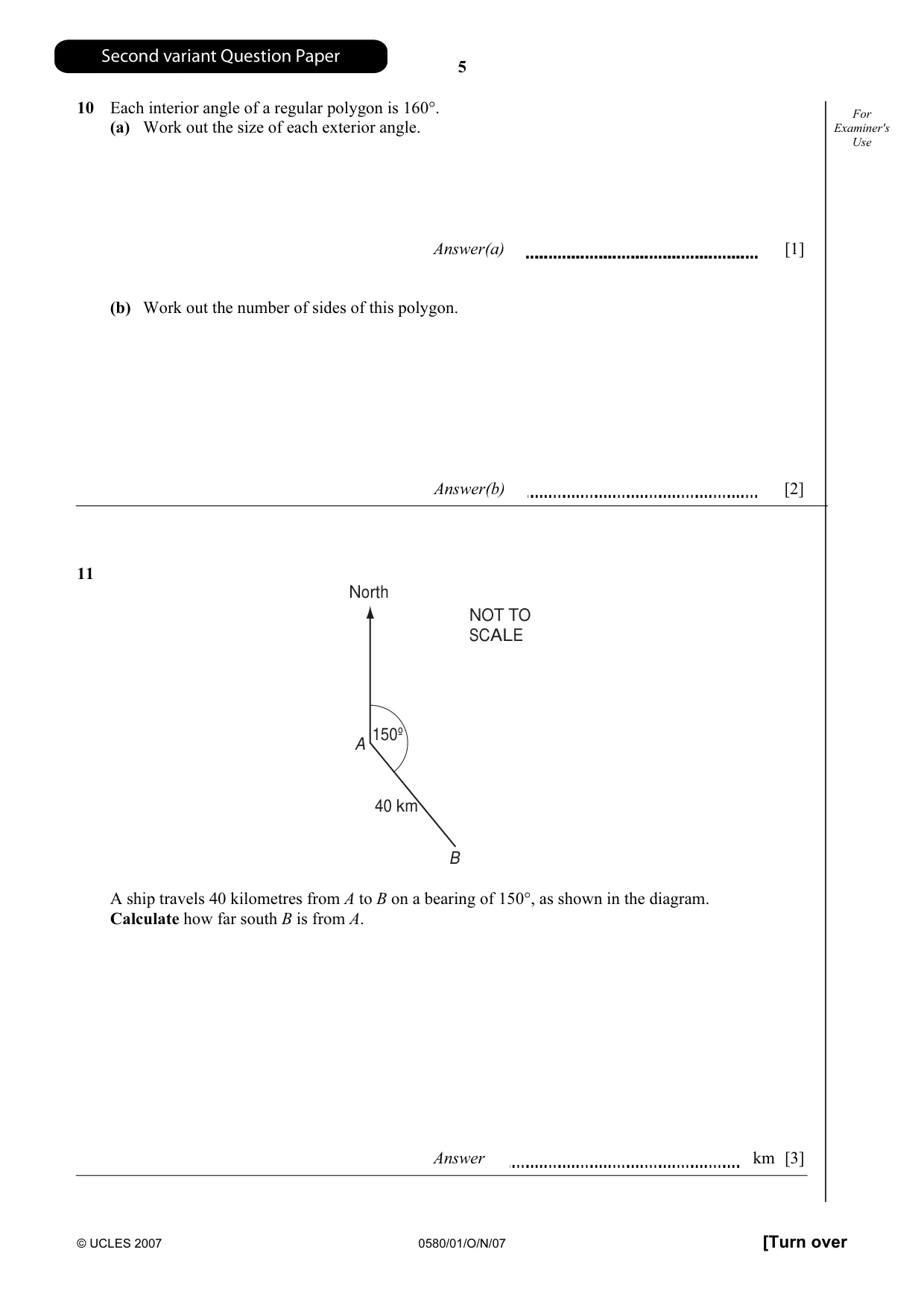
5 © UCLES 2007 0580/01/O/N/07 [Turn over For Examiner's Use 10 Each interior angle of a regular polygon is 160°. (a) Work out the size of each exterior angle. Answer(a) [1] (b) Work out the number of sides of this polygon. Answer(b) [2] 11 A B North NOT TO SCALE 150º 40 km A ship travels 40 kilometres from A to B on a bearing of 150°, as shown in the diagram. Calculate how far south B is from A. Answer km [3] Second variant Question Paper
Question paper, page 19
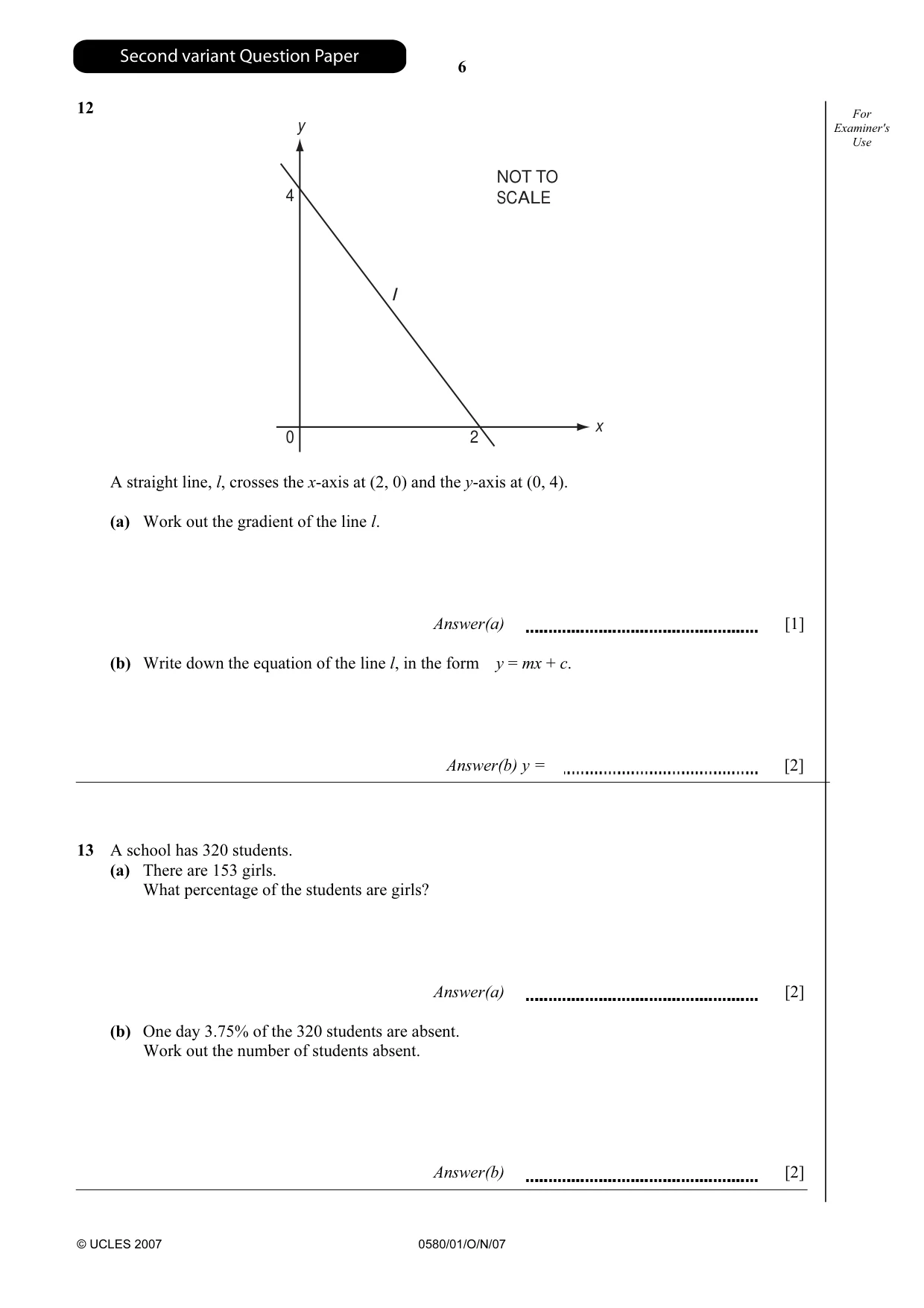
6 © UCLES 2007 0580/01/O/N/07 For Examiner's Use 12 y x l 0 4 2 NOT TO SCALE A straight line, l, crosses the x-axis at (2, 0) and the y-axis at (0, 4). (a) Work out the gradient of the line l. Answer(a) [1] (b) Write down the equation of the line l, in the form y = mx + c. Answer(b) y = [2] 13 A school has 320 students. (a) There are 153 girls. What percentage of the students are girls? Answer(a) [2] (b) One day 3.75% of the 320 students are absent. Work out the number of students absent. Answer(b) [2] Second variant Question Paper
Question paper, page 20
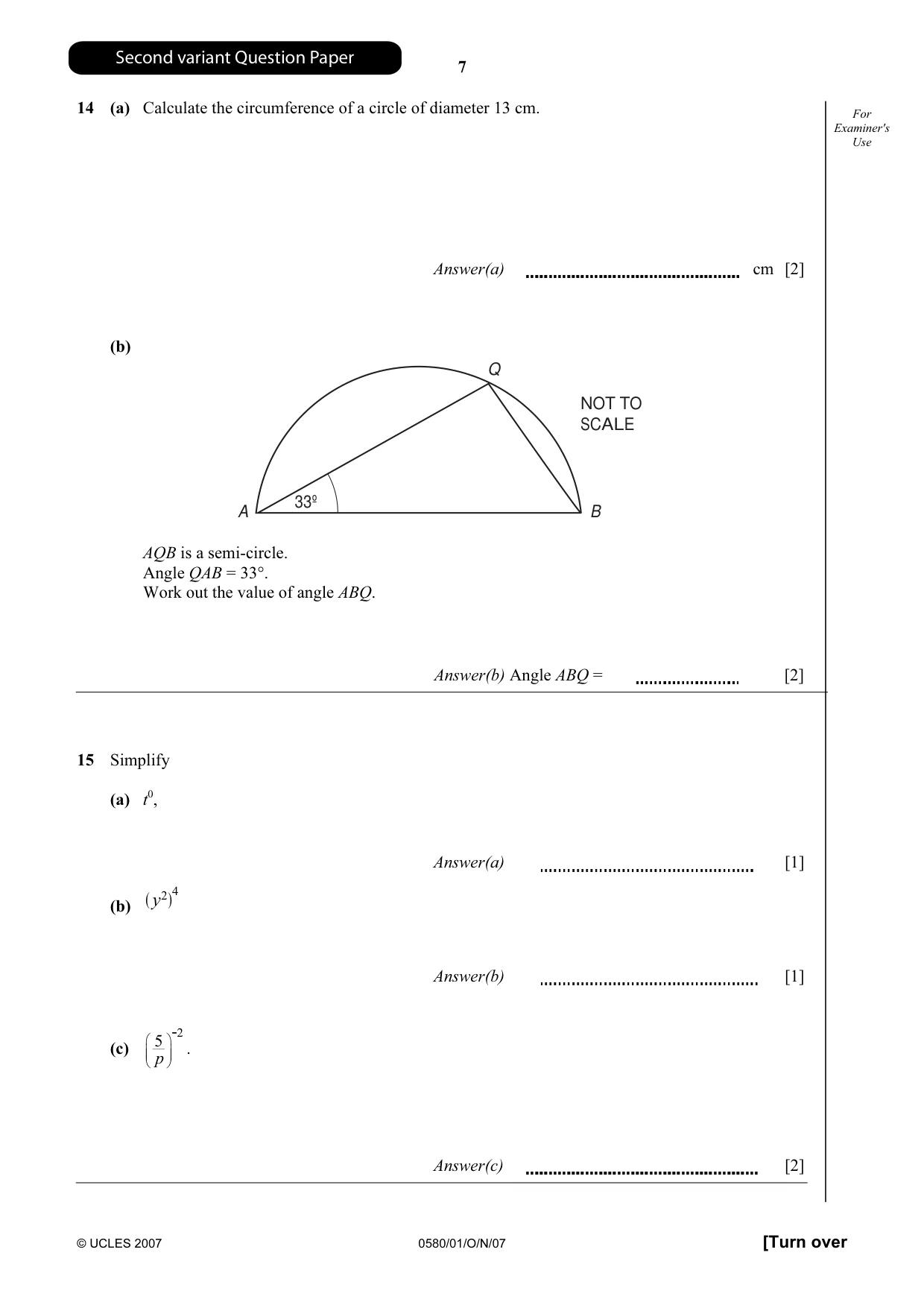
7 © UCLES 2007 0580/01/O/N/07 [Turn over For Examiner's Use 14 (a) Calculate the circumference of a circle of diameter 13 cm. Answer(a) cm [2] (b) Q B A NOT TO SCALE 33º AQB is a semi-circle. Angle QAB = 33°. Work out the value of angle ABQ. Answer(b) Angle ABQ = [2] 15 Simplify (a) t0, Answer(a) [1] (b) ( )4 2 y Answer(b) [1] (c) 2- 5 p . Answer(c) [2] Second variant Question Paper
Question paper, page 21
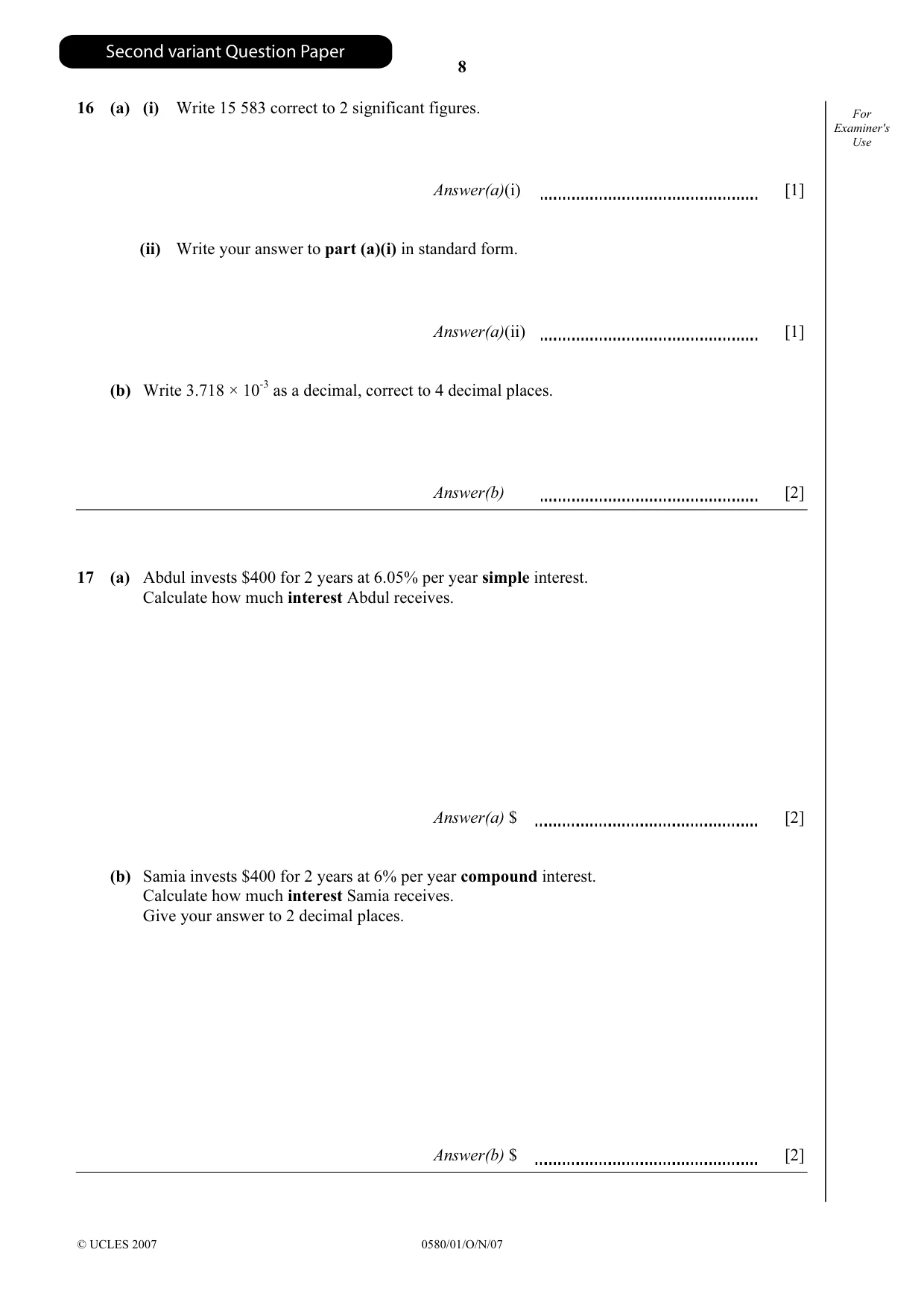
8 © UCLES 2007 0580/01/O/N/07 For Examiner's Use 16 (a) (i) Write 15 583 correct to 2 significant figures. Answer(a)(i) [1] (ii) Write your answer to part (a)(i) in standard form. Answer(a)(ii) [1] (b) Write 3.718 × 10⁻³ as a decimal, correct to 4 decimal places. Answer(b) [2] 17 (a) Abdul invests $400 for 2 years at 6.05% per year simple interest. Calculate how much interest Abdul receives. Answer(a) $ [2] (b) Samia invests $400 for 2 years at 6% per year compound interest. Calculate how much interest Samia receives. Give your answer to 2 decimal places. Answer(b) $ [2] Second variant Question Paper
Question paper, page 22
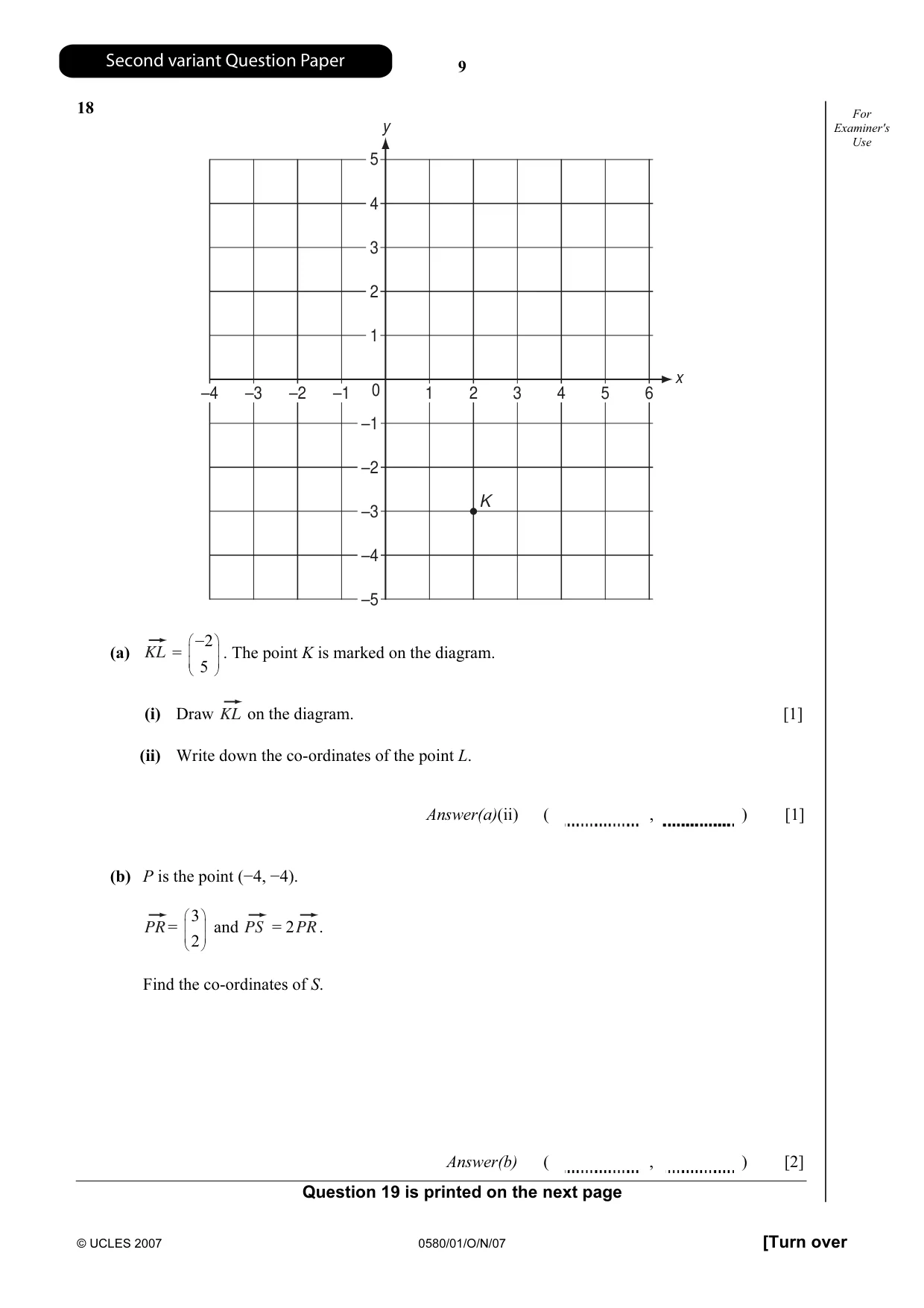
9 © UCLES 2007 0580/01/O/N/07 [Turn over For Examiner's Use 18 y x 5 4 3 2 1 –1 –2 –3 –4 –5 –4 –3 –2 –1 1 0 2 3 4 5 6 K (a) KL = _2 5 . The point K is marked on the diagram. (i) Draw KL on the diagram. [1] (ii) Write down the co-ordinates of the point L. Answer(a)(ii) ( , ) [1] (b) P is the point (−4, −4). PR= 3 2 and PS = 2PR. Find the co-ordinates of S. Answer(b) ( , ) [2] Question 19 is printed on the next page Second variant Question Paper
Question paper, page 23
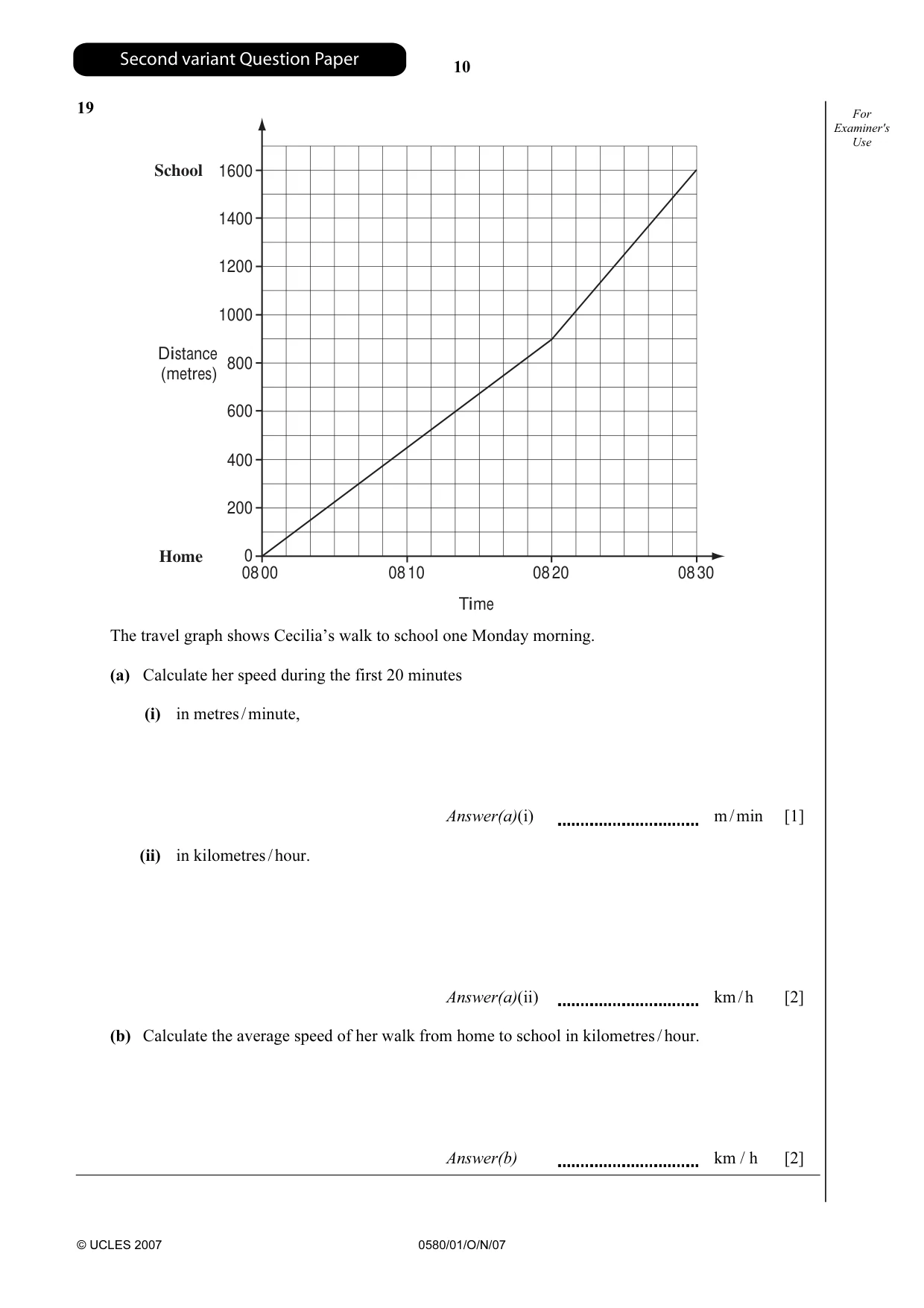
10 © UCLES 2007 0580/01/O/N/07 For Examiner's Use 19 1200 1400 600 800 1000 200 400 0 1600 08 00 08 20 08 10 08 30 Time Distance (metres) School Home The travel graph shows Cecilia’s walk to school one Monday morning. (a) Calculate her speed during the first 20 minutes (i) in metres / minute, Answer(a)(i) m / min [1] (ii) in kilometres / hour. Answer(a)(ii) km / h [2] (b) Calculate the average speed of her walk from home to school in kilometres / hour. Answer(b) km / h [2] Second variant Question Paper
Question paper, page 24
11 0580/01/O/N/07 BLANK PAGE Second variant Question Paper
Question paper, page 25
12 Permission to reproduce items where third-party owned material protected by copyright is included has been sought and cleared where possible. Every reasonable effort has been made by the publisher (UCLES) to trace copyright holders, but if any items requiring clearance have unwittingly been included, the publisher will be pleased to make amends at the earliest possible opportunity. University of Cambridge International Examinations is part of the Cambridge Assessment Group. Cambridge Assessment is the brand name of University of Cambridge Local Examinations Syndicate (UCLES), which is itself a department of the University of Cambridge. 0580/01/O/N/07 BLANK PAGE Second variant Question Paper
Mark scheme, page 1
Location Entry Codes As part of CIE’s continual commitment to maintaining best practice in assessment, CIE has begun to use different variants of some question papers for our most popular assessments with extremely large and widespread candidature, The question papers are closely related and the relationships between them have been thoroughly established using our assessment expertise. All versions of the paper give assessment of equal standard. The content assessed by the examination papers and the type of questions are unchanged. This change means that for this component there are now two variant Question Papers, Mark Schemes and Principal Examiner’s Reports where previously there was only one. For any individual country, it is intended that only one variant is used. This document contains both variants which will give all Centres access to even more past examination material than is usually the case. The diagram shows the relationship between the Question Papers, Mark Schemes and Principal Examiner’s Reports. Question Paper Mark Scheme Principal Examiner’s Report Introduction Introduction Introduction First variant Question Paper First variant Mark Scheme First variant Principal Examiner’s Report Second variant Question Paper Second variant Mark Scheme Second variant Principal Examiner’s Report Who can I contact for further information on these changes? Please direct any questions about this to CIE’s Customer Services team at: international@cie.org.uk www.XtremePapers.com
Mark scheme, page 2
UNIVERSITY OF CAMBRIDGE INTERNATIONAL EXAMINATIONS International General Certificate of Secondary Education MARK SCHEME for the October/November 2007 question paper 0580 and 0581 MATHEMATICS 0580/01 and 0581/01 Paper 1 (Core), maximum raw mark 56 This mark scheme is published as an aid to teachers and candidates, to indicate the requirements of the examination. It shows the basis on which Examiners were instructed to award marks. It does not indicate the details of the discussions that took place at an Examiners’ meeting before marking began. All Examiners are instructed that alternative correct answers and unexpected approaches in candidates’ scripts must be given marks that fairly reflect the relevant knowledge and skills demonstrated. Mark schemes must be read in conjunction with the question papers and the report on the examination. • CIE will not enter into discussions or correspondence in connection with these mark schemes. CIE is publishing the mark schemes for the October/November 2007 question papers for most IGCSE, GCE Advanced Level and Advanced Subsidiary Level syllabuses and some Ordinary Level syllabuses.
Mark scheme, page 3
Page 2 Mark Scheme Syllabus Paper IGCSE – October/November 2007 0580/0581 01 © UCLES 2007 Abbreviations In addition to those already seen the following may crop up. cao – correct answer only ww – without working www – without wrong working oe – or equivalent soi – seen or implied bod – benefit of doubt art – anything rounding to isw – ignore subsequent working ft – follow through oor – out of range isr – ignore subsequent rounding rot – rounded or truncated mog – marks on graph
Mark scheme, page 4
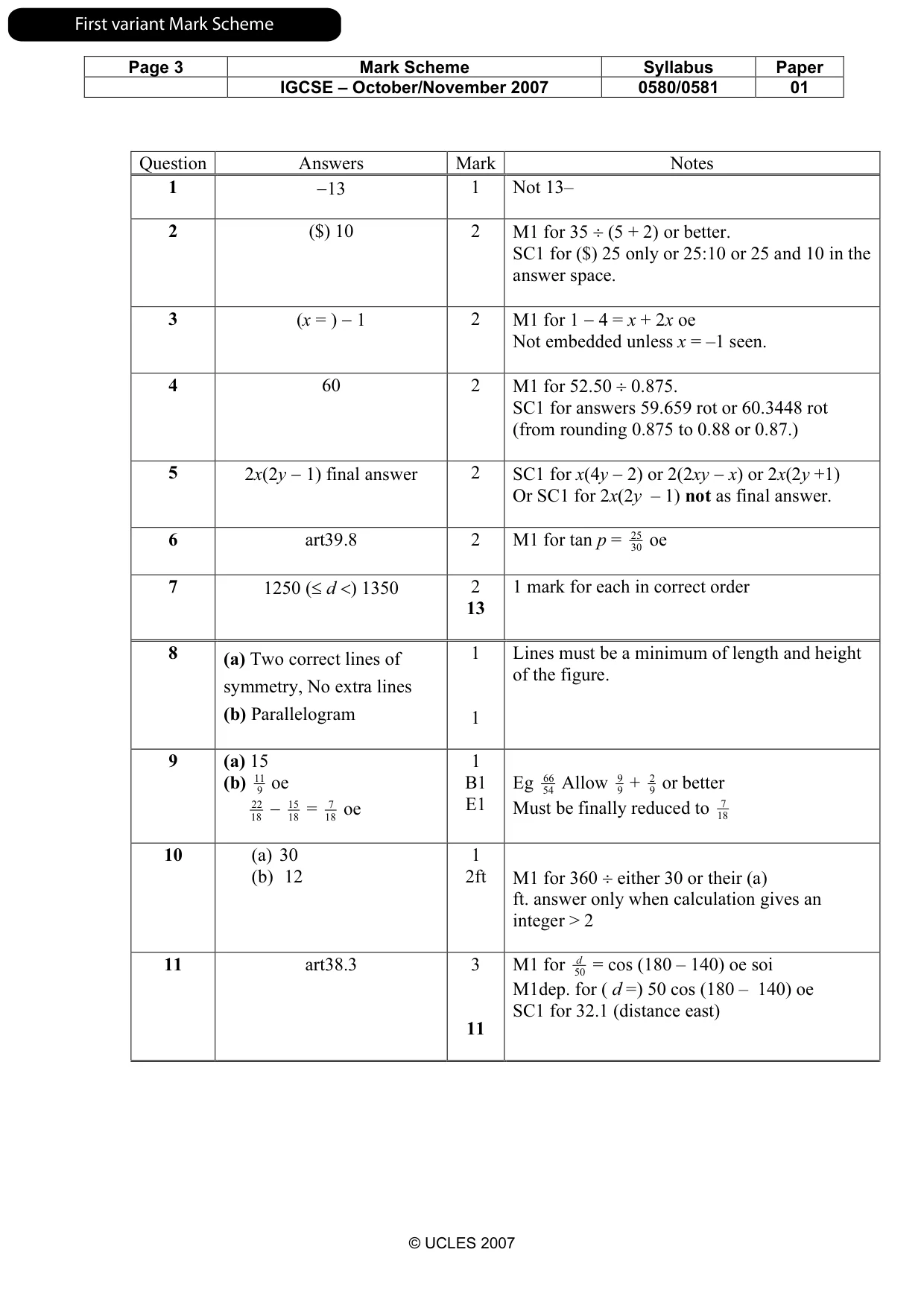
Page 3 Mark Scheme Syllabus Paper IGCSE – October/November 2007 0580/0581 01 © UCLES 2007 Question Answers Mark Notes 1 −13 1 Not 13– 2 ($) 10 2 M1 for 35 ÷ (5 + 2) or better. SC1 for ($) 25 only or 25:10 or 25 and 10 in the answer space. 3 (x = ) − 1 2 M1 for 1 − 4 = x + 2x oe Not embedded unless x = –1 seen. 4 60 2 M1 for 52.50 ÷ 0.875. SC1 for answers 59.659 rot or 60.3448 rot (from rounding 0.875 to 0.88 or 0.87.) 5 2x(2y − 1) final answer 2 SC1 for x(4y − 2) or 2(2xy − x) or 2x(2y +1) Or SC1 for 2x(2y – 1) not as final answer. 6 art39.8 2 M1 for tan p = 25 30 oe 7 1250 (≤ d <) 1350 2 13 1 mark for each in correct order 8 (a) Two correct lines of symmetry, No extra lines (b) Parallelogram 1 1 Lines must be a minimum of length and height of the figure. 9 (a) 15 (b) 11 9 oe 22 18 − 15 18 = 7 18 oe 1 B1 E1 Eg 66 54 Allow 9 9 + 2 9 or better Must be finally reduced to 7 18 10 (a) 30 (b) 12 1 2ft M1 for 360 ÷ either 30 or their (a) ft. answer only when calculation gives an integer > 2 11 art38.3 3 11 M1 for d 50 = cos (180 – 140) oe soi M1dep. for ( d =) 50 cos (180 – 140) oe SC1 for 32.1 (distance east) First variant Mark Scheme
Mark scheme, page 5
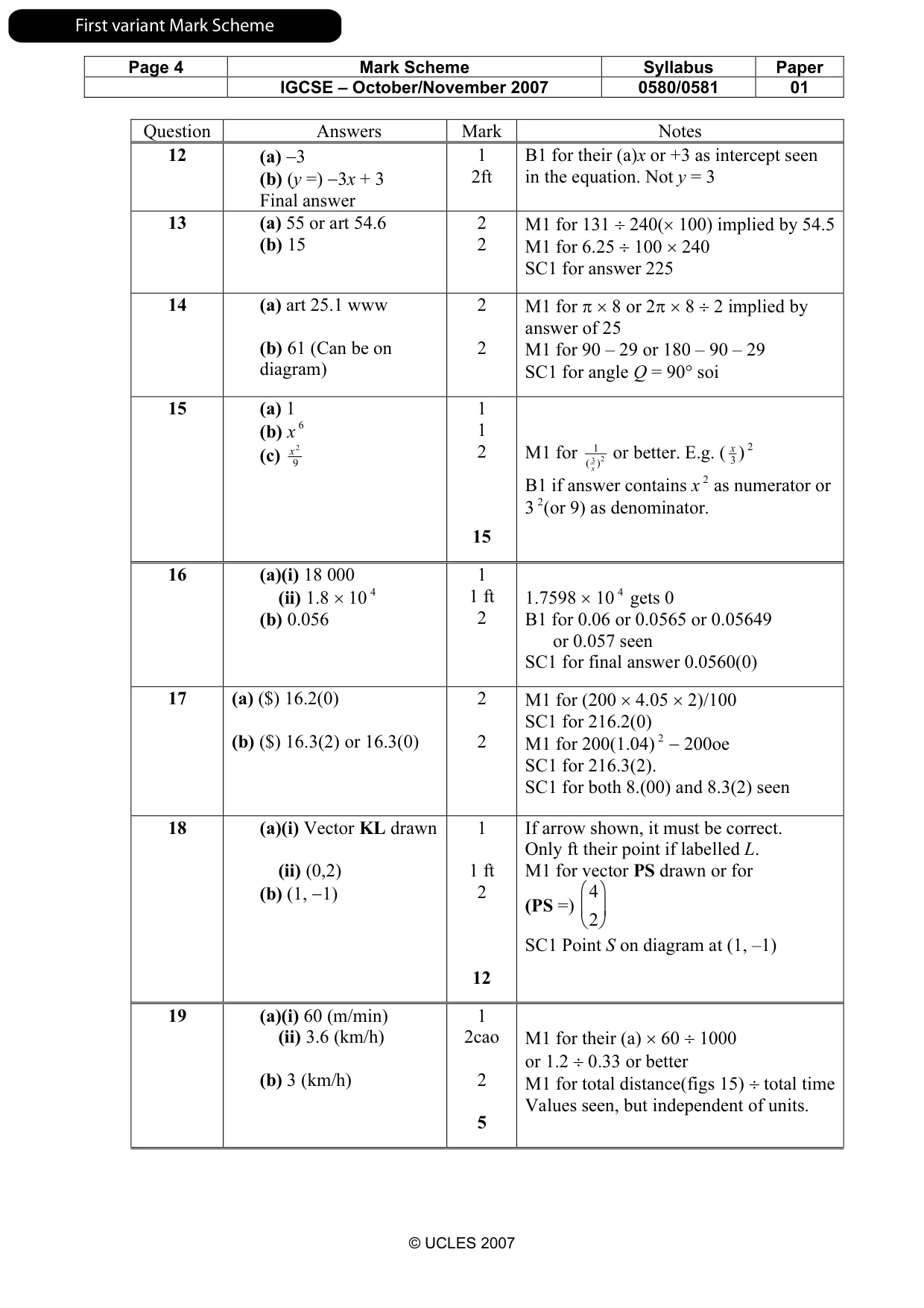
Page 4 Mark Scheme Syllabus Paper IGCSE – October/November 2007 0580/0581 01 © UCLES 2007 Question Answers Mark Notes 12 (a) −3 (b) (y =) −3x + 3 Final answer 1 2ft B1 for their (a)x or +3 as intercept seen in the equation. Not y = 3 13 (a) 55 or art 54.6 (b) 15 2 2 M1 for 131 ÷ 240(× 100) implied by 54.5 M1 for 6.25 ÷ 100 × 240 SC1 for answer 225 14 (a) art 25.1 www (b) 61 (Can be on diagram) 2 2 M1 for π × 8 or 2π × 8 ÷ 2 implied by answer of 25 M1 for 90 – 29 or 180 – 90 – 29 SC1 for angle Q = 90° soi 15 (a) 1 (b) x 6 (c) x 2 9 1 1 2 15 M1 for 1 ( 3 x )2 or better. E.g. ( x 3) 2 B1 if answer contains x 2 as numerator or 3 2(or 9) as denominator. 16 (a)(i) 18 000 (ii) 1.8 × 10 4 (b) 0.056 1 1 ft 2 1.7598 × 10 4 gets 0 B1 for 0.06 or 0.0565 or 0.05649 or 0.057 seen SC1 for final answer 0.0560(0) 17 (a) ($) 16.2(0) (b) ($) 16.3(2) or 16.3(0) 2 2 M1 for (200 × 4.05 × 2)/100 SC1 for 216.2(0) M1 for 200(1.04) 2 − 200oe SC1 for 216.3(2). SC1 for both 8.(00) and 8.3(2) seen 18 (a)(i) Vector KL drawn (ii) (0,2) (b) (1, −1) 1 1 ft 2 12 If arrow shown, it must be correct. Only ft their point if labelled L. M1 for vector PS drawn or for (PS =) 4 2 SC1 Point S on diagram at (1, –1) 19 (a)(i) 60 (m/min) (ii) 3.6 (km/h) (b) 3 (km/h) 1 2cao 2 5 M1 for their (a) × 60 ÷ 1000 or 1.2 ÷ 0.33 or better M1 for total distance(figs 15) ÷ total time Values seen, but independent of units. First variant Mark Scheme
Mark scheme, page 6
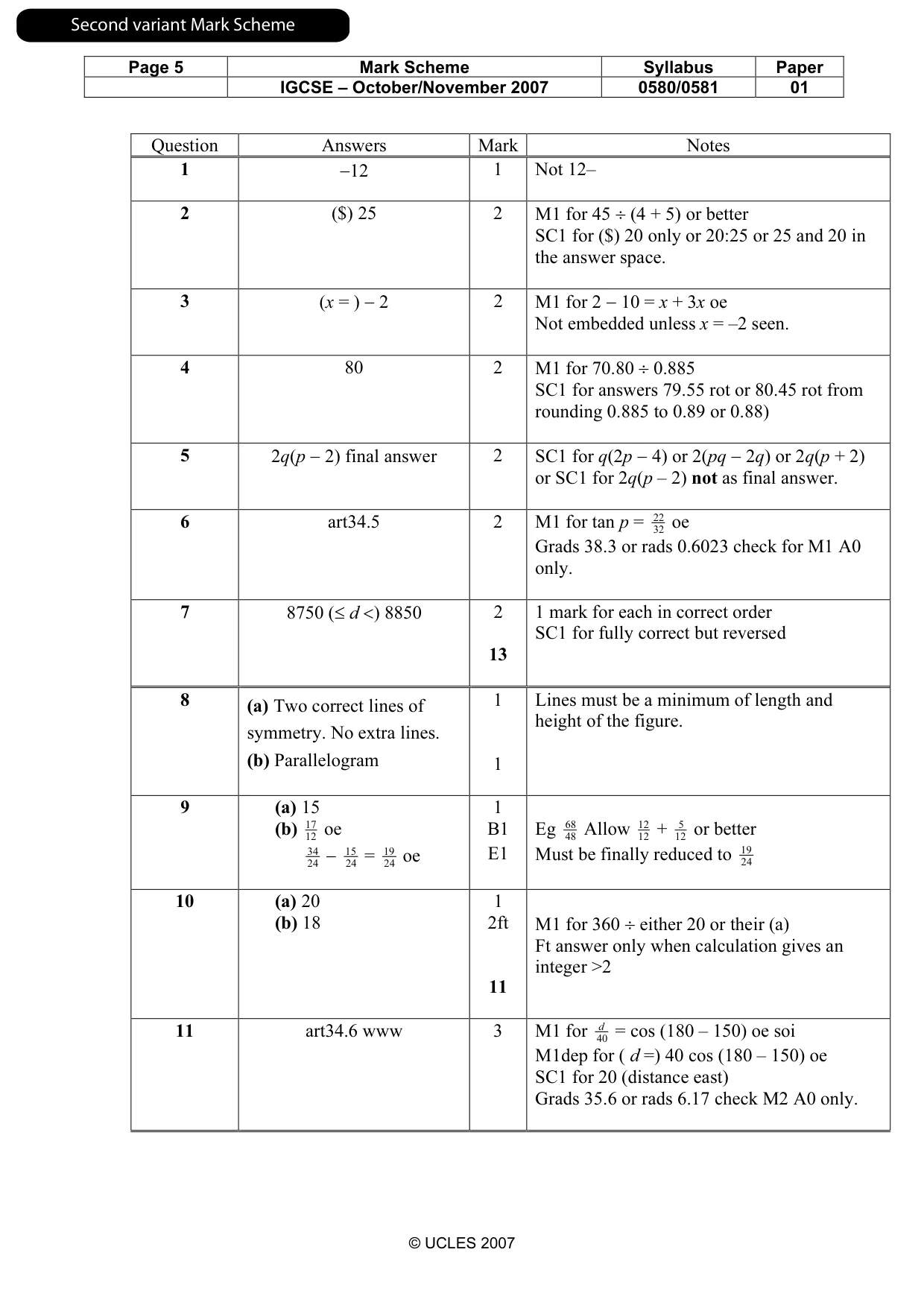
Page 5 Mark Scheme Syllabus Paper IGCSE – October/November 2007 0580/0581 01 © UCLES 2007 Question Answers Mark Notes 1 −12 1 Not 12– 2 ($) 25 2 M1 for 45 ÷ (4 + 5) or better SC1 for ($) 20 only or 20:25 or 25 and 20 in the answer space. 3 (x = ) − 2 2 M1 for 2 − 10 = x + 3x oe Not embedded unless x = –2 seen. 4 80 2 M1 for 70.80 ÷ 0.885 SC1 for answers 79.55 rot or 80.45 rot from rounding 0.885 to 0.89 or 0.88) 5 2q(p − 2) final answer 2 SC1 for q(2p − 4) or 2(pq − 2q) or 2q(p + 2) or SC1 for 2q(p – 2) not as final answer. 6 art34.5 2 M1 for tan p = 22 32 oe Grads 38.3 or rads 0.6023 check for M1 A0 only. 7 8750 (≤ d <) 8850 2 13 1 mark for each in correct order SC1 for fully correct but reversed 8 (a) Two correct lines of symmetry. No extra lines. (b) Parallelogram 1 1 Lines must be a minimum of length and height of the figure. 9 (a) 15 (b) 17 12 oe 34 24 − 15 24 = 19 24 oe 1 B1 E1 Eg 68 48 Allow 12 12 + 5 12 or better Must be finally reduced to 19 24 10 (a) 20 (b) 18 1 2ft 11 M1 for 360 ÷ either 20 or their (a) Ft answer only when calculation gives an integer >2 11 art34.6 www 3 M1 for d 40 = cos (180 – 150) oe soi M1dep for ( d =) 40 cos (180 – 150) oe SC1 for 20 (distance east) Grads 35.6 or rads 6.17 check M2 A0 only. Second variant Mark Scheme
Mark scheme, page 7
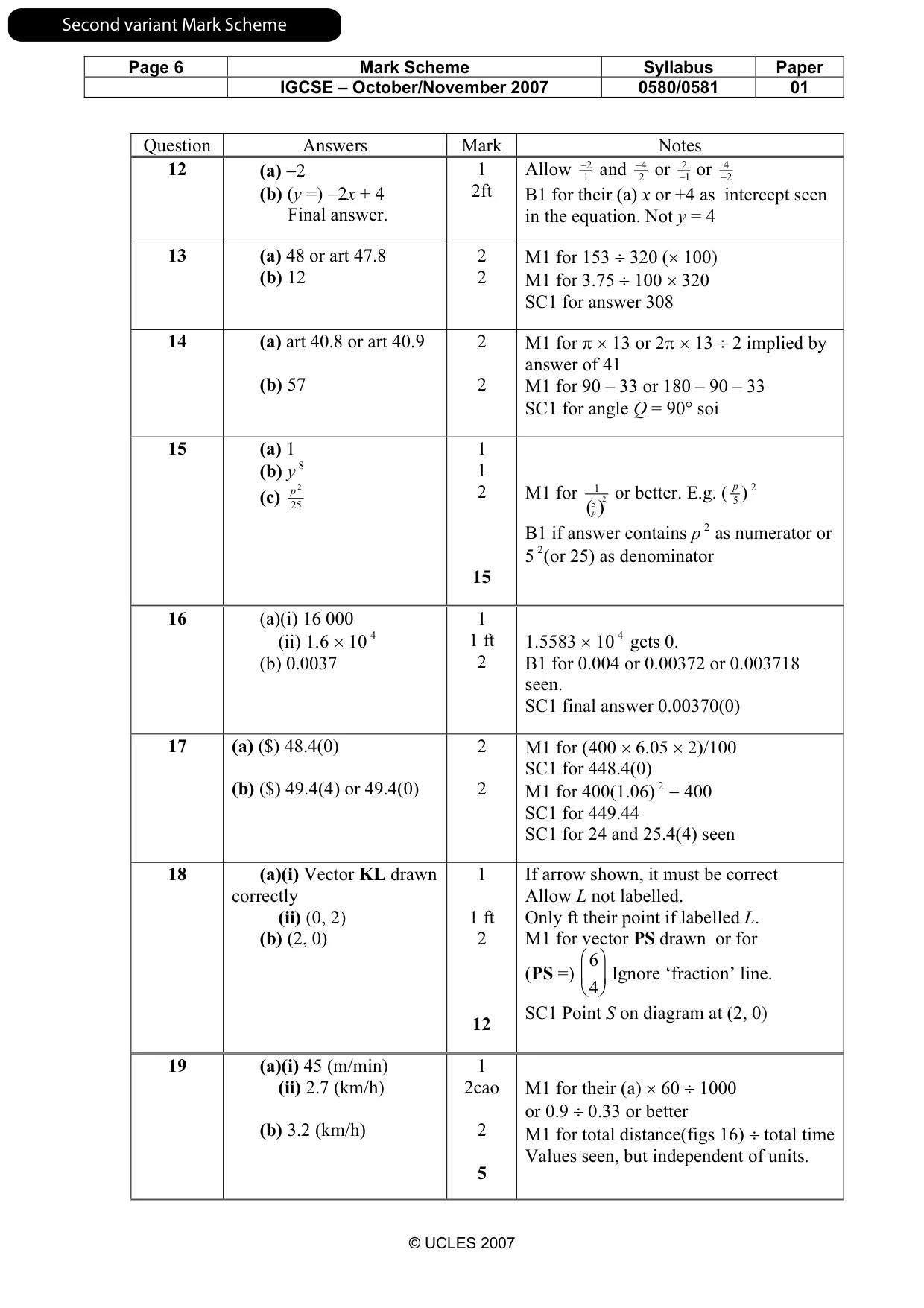
Page 6 Mark Scheme Syllabus Paper IGCSE – October/November 2007 0580/0581 01 © UCLES 2007 Question Answers Mark Notes 12 (a) −2 (b) (y =) −2x + 4 Final answer. 1 2ft Allow –2 1 and –4 2 or 2 –1 or 4 –2 B1 for their (a) x or +4 as intercept seen in the equation. Not y = 4 13 (a) 48 or art 47.8 (b) 12 2 2 M1 for 153 ÷ 320 (× 100) M1 for 3.75 ÷ 100 × 320 SC1 for answer 308 14 (a) art 40.8 or art 40.9 (b) 57 2 2 M1 for π × 13 or 2π × 13 ÷ 2 implied by answer of 41 M1 for 90 – 33 or 180 – 90 – 33 SC1 for angle Q = 90° soi 15 (a) 1 (b) y 8 (c) p 2 25 1 1 2 15 M1 for 1 5 p( ) 2 or better. E.g. ( p 5 ) 2 B1 if answer contains p 2 as numerator or 5 2(or 25) as denominator 16 (a)(i) 16 000 (ii) 1.6 × 10 4 (b) 0.0037 1 1 ft 2 1.5583 × 10 4 gets 0. B1 for 0.004 or 0.00372 or 0.003718 seen. SC1 final answer 0.00370(0) 17 (a) ($) 48.4(0) (b) ($) 49.4(4) or 49.4(0) 2 2 M1 for (400 × 6.05 × 2)/100 SC1 for 448.4(0) M1 for 400(1.06) 2 − 400 SC1 for 449.44 SC1 for 24 and 25.4(4) seen 18 (a)(i) Vector KL drawn correctly (ii) (0, 2) (b) (2, 0) 1 1 ft 2 12 If arrow shown, it must be correct Allow L not labelled. Only ft their point if labelled L. M1 for vector PS drawn or for (PS =) 6 4 Ignore ‘fraction’ line. SC1 Point S on diagram at (2, 0) 19 (a)(i) 45 (m/min) (ii) 2.7 (km/h) (b) 3.2 (km/h) 1 2cao 2 5 M1 for their (a) × 60 ÷ 1000 or 0.9 ÷ 0.33 or better M1 for total distance(figs 16) ÷ total time Values seen, but independent of units. Second variant Mark Scheme
What you needed in this session
Cambridge’s own grade thresholds for 2007 Oct/Nov, Paper 1 · Variant 1. A higher threshold means an easier paper — the bar moves with how the cohort did.