Cambridge IGCSE Mathematics (with coursework) 0581 — 2006 Oct/Nov Paper 1 · Variant 1
0581/11/O/N/06 · 56 marks · ≈63 min
The question paper and its mark scheme, free to read here and free to download. This is Cambridge’s own paper, exactly as it was sat.
Question paper8 pages
Mark scheme4 pages
Answers below. Sit the paper first if you are practising.
Paper as text
Question paper, page 1
This document consists of 8 printed pages. IB06 11_0580_01/3RP UCLES 2006 [Turn over UNIVERSITY OF CAMBRIDGE INTERNATIONAL EXAMINATIONS International General Certificate of Secondary Education MATHEMATICS Paper 1 (Core) 0580/01 0581/01 Candidates answer on the Question Paper. Additional Materials: Electronic calculator Geometrical instruments October/November 2006 Mathematical tables (optional) Tracing paper (optional) 1hour READ THESE INSTRUCTIONS FIRST Write your Centre number, candidate number and name on all the work you hand in. Write in dark blue or black pen in the spaces provided on the Question Paper. You may use a pencil for any diagrams or graphs. Do not use staples, paper clips, highlighters, glue or correction fluid. DO NOT WRITE IN THE BARCODE. DO NOT WRITE IN THE GREY AREAS BETWEEN THE PAGES. Answer all questions. If working is needed for any question it must be shown below that question. The number of marks is given in brackets [ ] at the end of each question or part question. The total of the marks for this paper is 56. Electronic calculators should be used. If the degree of accuracy is not specified in the question, and if the answer is not exact, give the answer to three significant figures. Give answers in degrees to one decimal place. For π , use either your calculator value or 3.142. Candidate Name Centre Number Candidate Number For Examiner's Use *058001* www.XtremePapers.com
Question paper, page 2
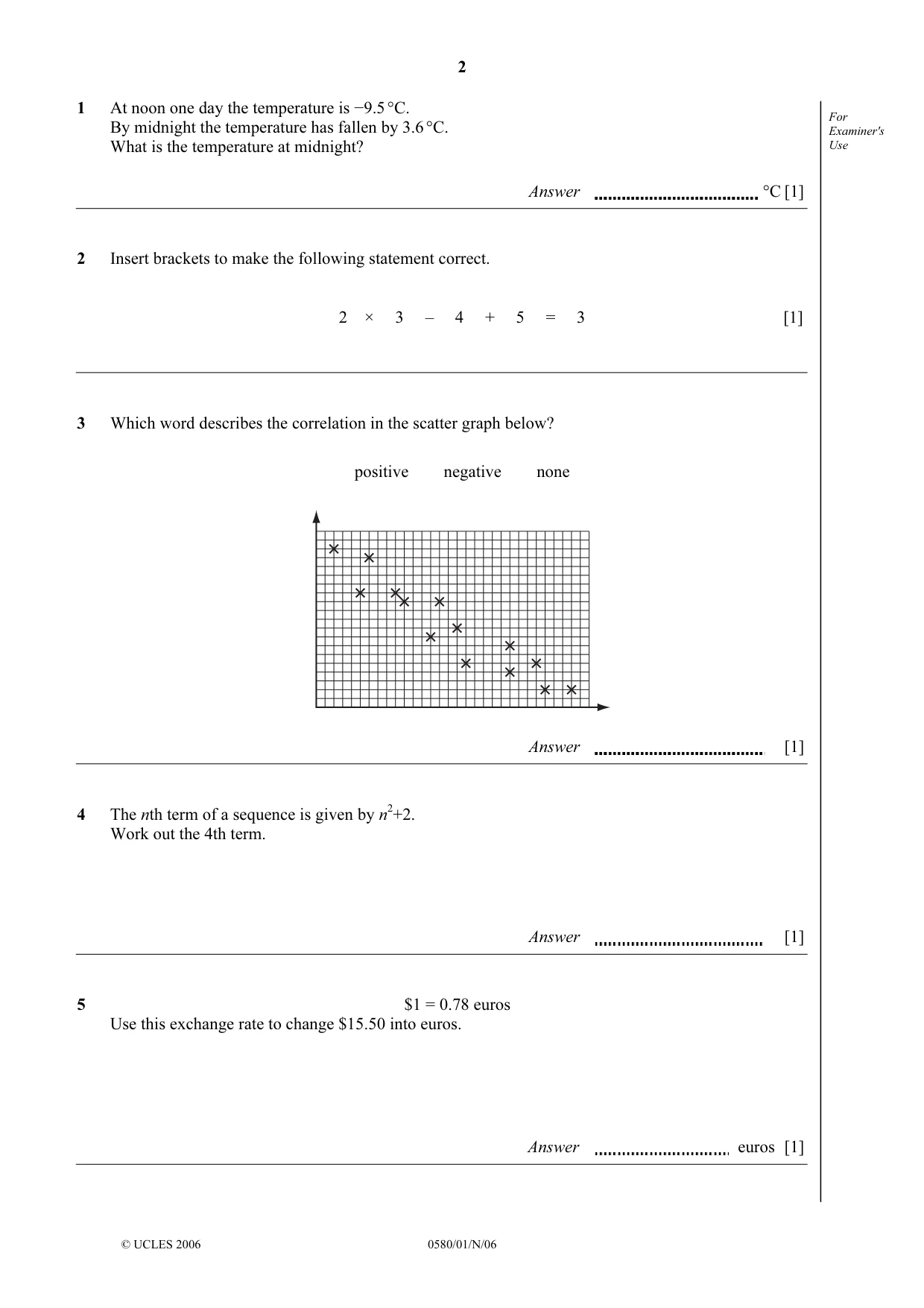
2 © UCLES 2006 0580/01/N/06 For Examiner's Use 1 At noon one day the temperature is −9.5 °C. By midnight the temperature has fallen by 3.6 °C. What is the temperature at midnight? Answer °C [1] 2 Insert brackets to make the following statement correct. 2 × 3 – 4 + 5 = 3 [1] 3 Which word describes the correlation in the scatter graph below? positive negative none Answer [1] 4 The nth term of a sequence is given by n2+2. Work out the 4th term. Answer [1] 5 $1 = 0.78 euros Use this exchange rate to change $15.50 into euros. Answer euros [1]
Question paper, page 3
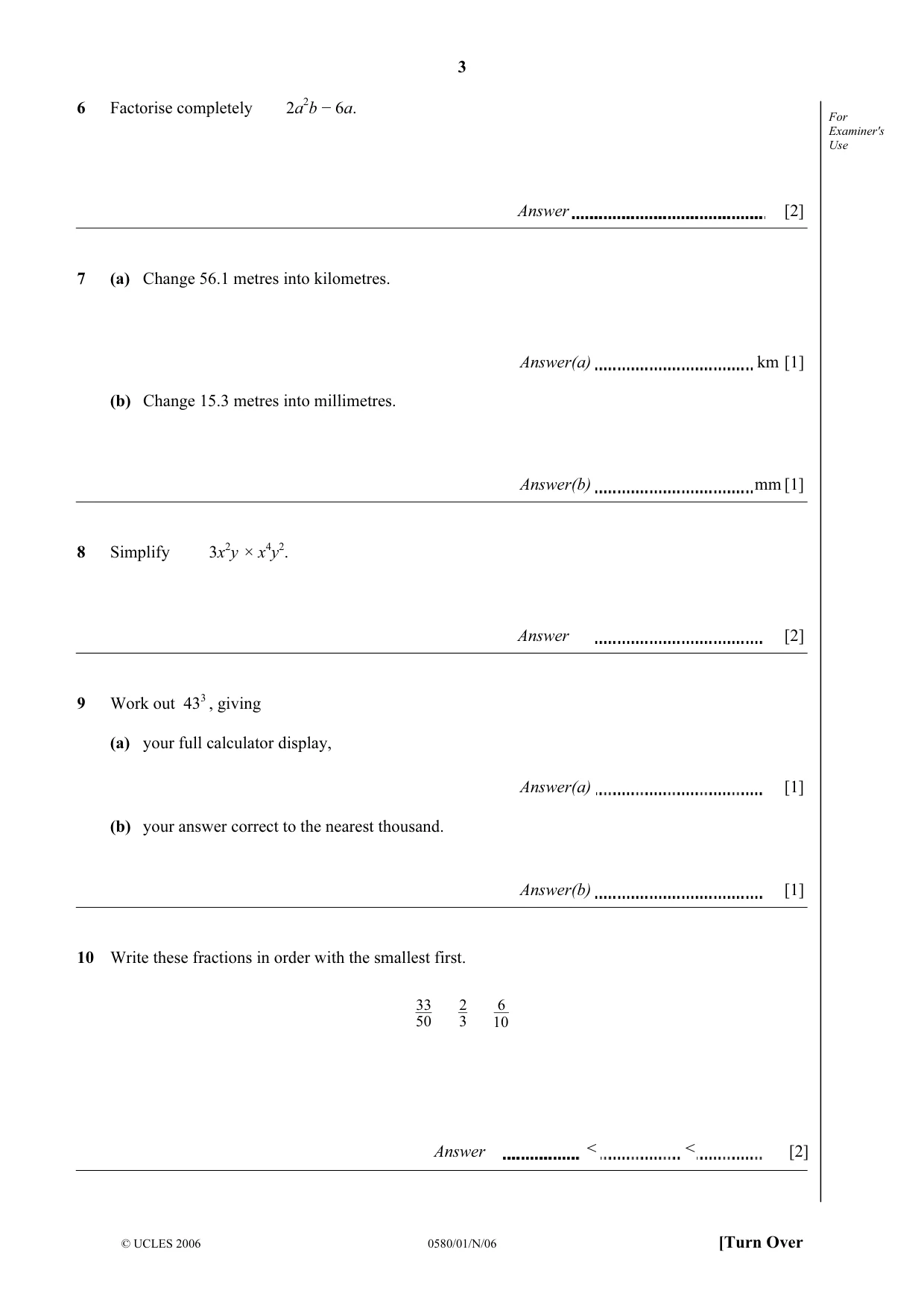
3 © UCLES 2006 0580/01/N/06 [Turn Over For Examiner's Use 6 Factorise completely 2a2b − 6a. Answer [2] 7 (a) Change 56.1 metres into kilometres. Answer(a) km [1] (b) Change 15.3 metres into millimetres. Answer(b) mm [1] 8 Simplify 3x2y × x4y2. Answer [2] 9 Work out 433 , giving (a) your full calculator display, Answer(a) [1] (b) your answer correct to the nearest thousand. Answer(b) [1] 10 Write these fractions in order with the smallest first. 33 2 6 50 3 10 < < Answer [2]
Question paper, page 4
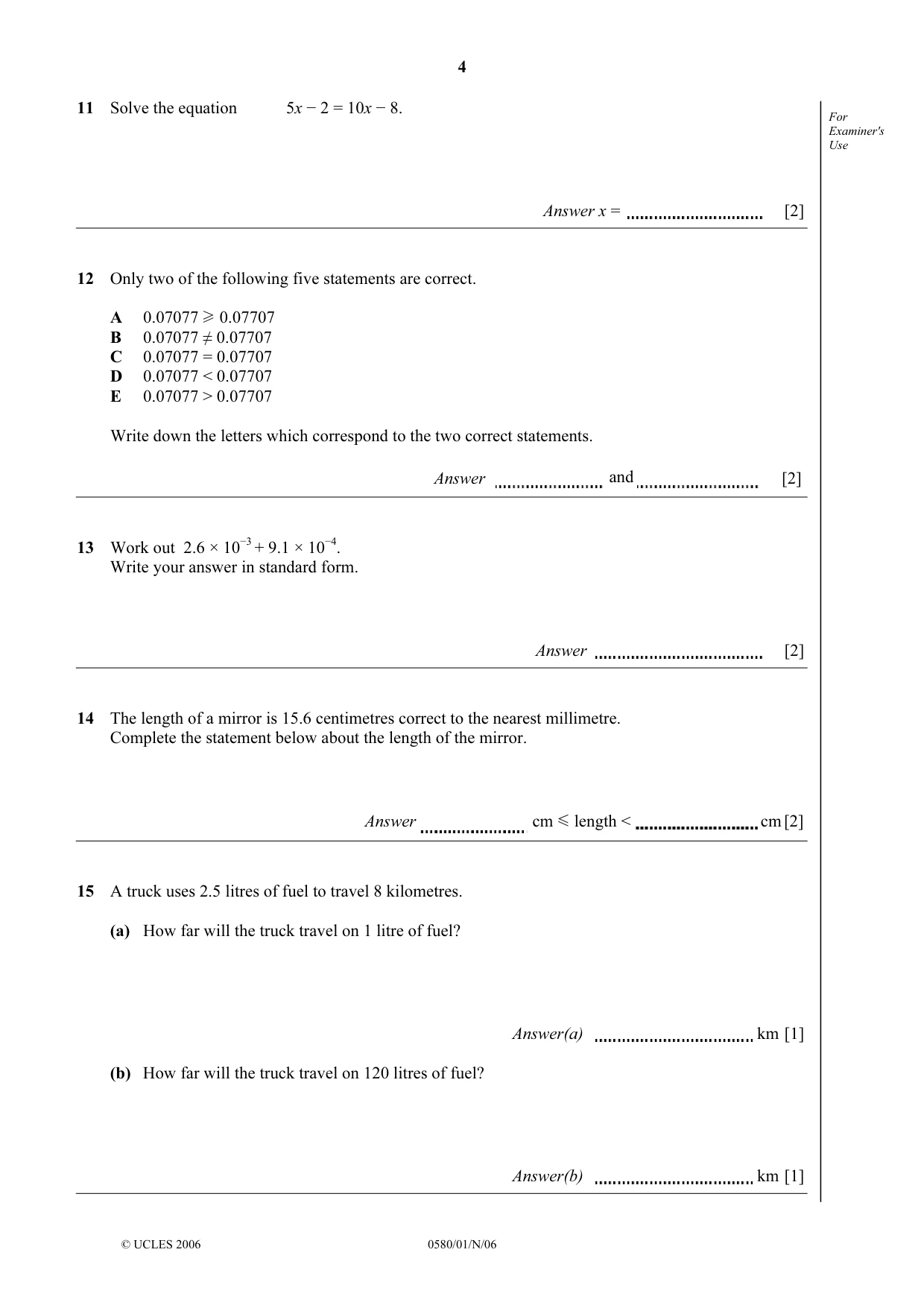
4 © UCLES 2006 0580/01/N/06 For Examiner's Use 11 Solve the equation 5x − 2 = 10x − 8. Answer x = [2] 12 Only two of the following five statements are correct. A 0.07077 0.07707 B 0.07077 ≠ 0.07707 C 0.07077 = 0.07707 D 0.07077 < 0.07707 E 0.07077 > 0.07707 Write down the letters which correspond to the two correct statements. and Answer [2] 13 Work out 2.6 × 10⁻³ + 9.1 × 10⁻⁴. Write your answer in standard form. Answer [2] 14 The length of a mirror is 15.6 centimetres correct to the nearest millimetre. Complete the statement below about the length of the mirror. Answer cm length < cm[2] 15 A truck uses 2.5 litres of fuel to travel 8 kilometres. (a) How far will the truck travel on 1 litre of fuel? Answer(a) km [1] (b) How far will the truck travel on 120 litres of fuel? Answer(b) km [1]
Question paper, page 5
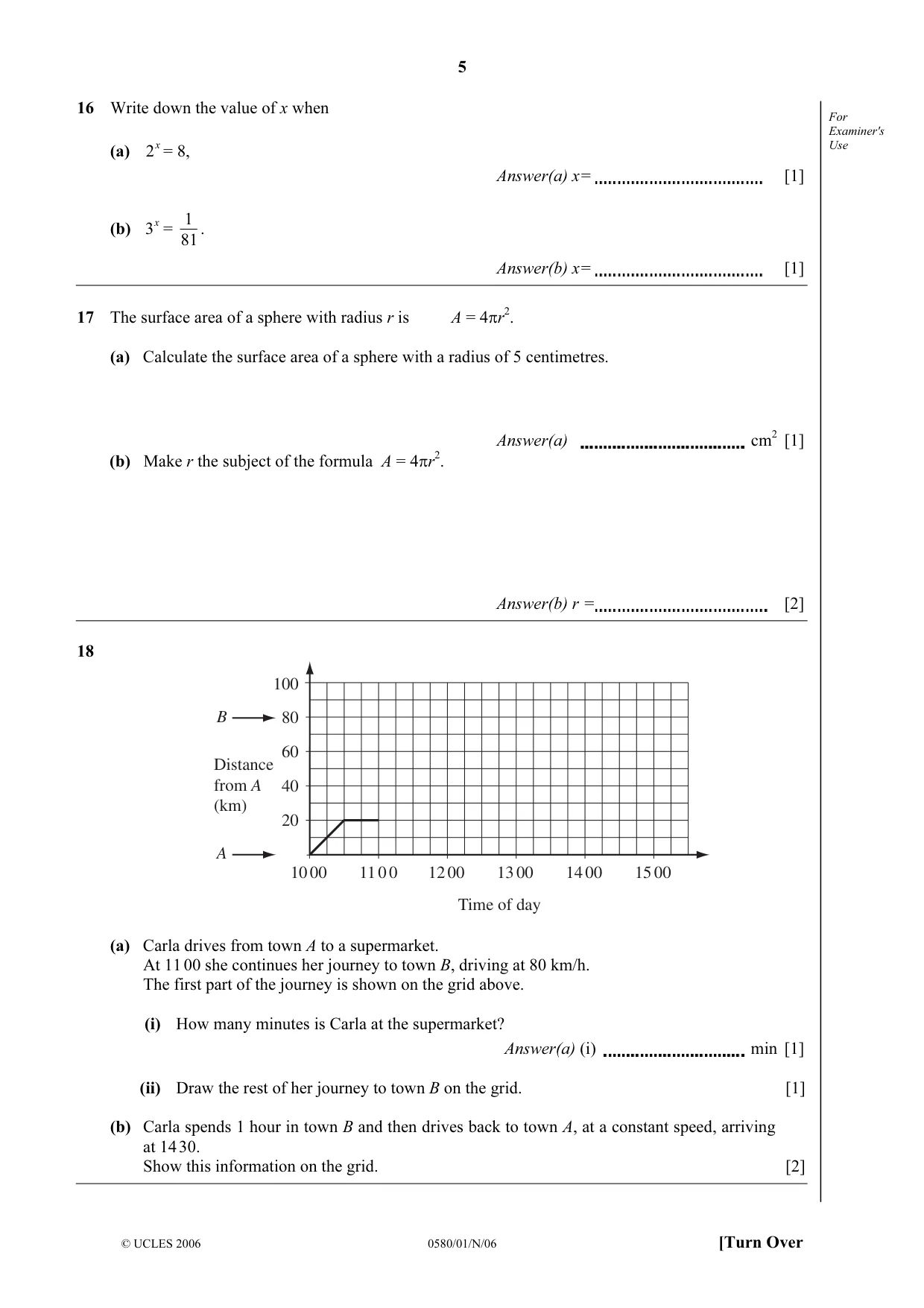
5 © UCLES 2006 0580/01/N/06 [Turn Over For Examiner's Use 16 Write down the value of x when (a) x 2 = 8, Answer(a) x= [1] (b) x 3 = 81 1 . Answer(b) x= [1] 17 The surface area of a sphere with radius r is A = 4πr2. (a) Calculate the surface area of a sphere with a radius of 5 centimetres. Answer(a) cm2 [1] (b) Make r the subject of the formula A = 4πr2. Answer(b) r = [2] 18 10 00 11 00 12 00 13 00 14 00 15 00 Time of day 100 80 60 40 20 Distance from A (km) A B (a) Carla drives from town A to a supermarket. At 11 00 she continues her journey to town B, driving at 80 km/h. The first part of the journey is shown on the grid above. (i) How many minutes is Carla at the supermarket? Answer(a) (i) min [1] (ii) Draw the rest of her journey to town B on the grid. [1] (b) Carla spends 1 hour in town B and then drives back to town A, at a constant speed, arriving at 14 30. Show this information on the grid. [2]
Question paper, page 6
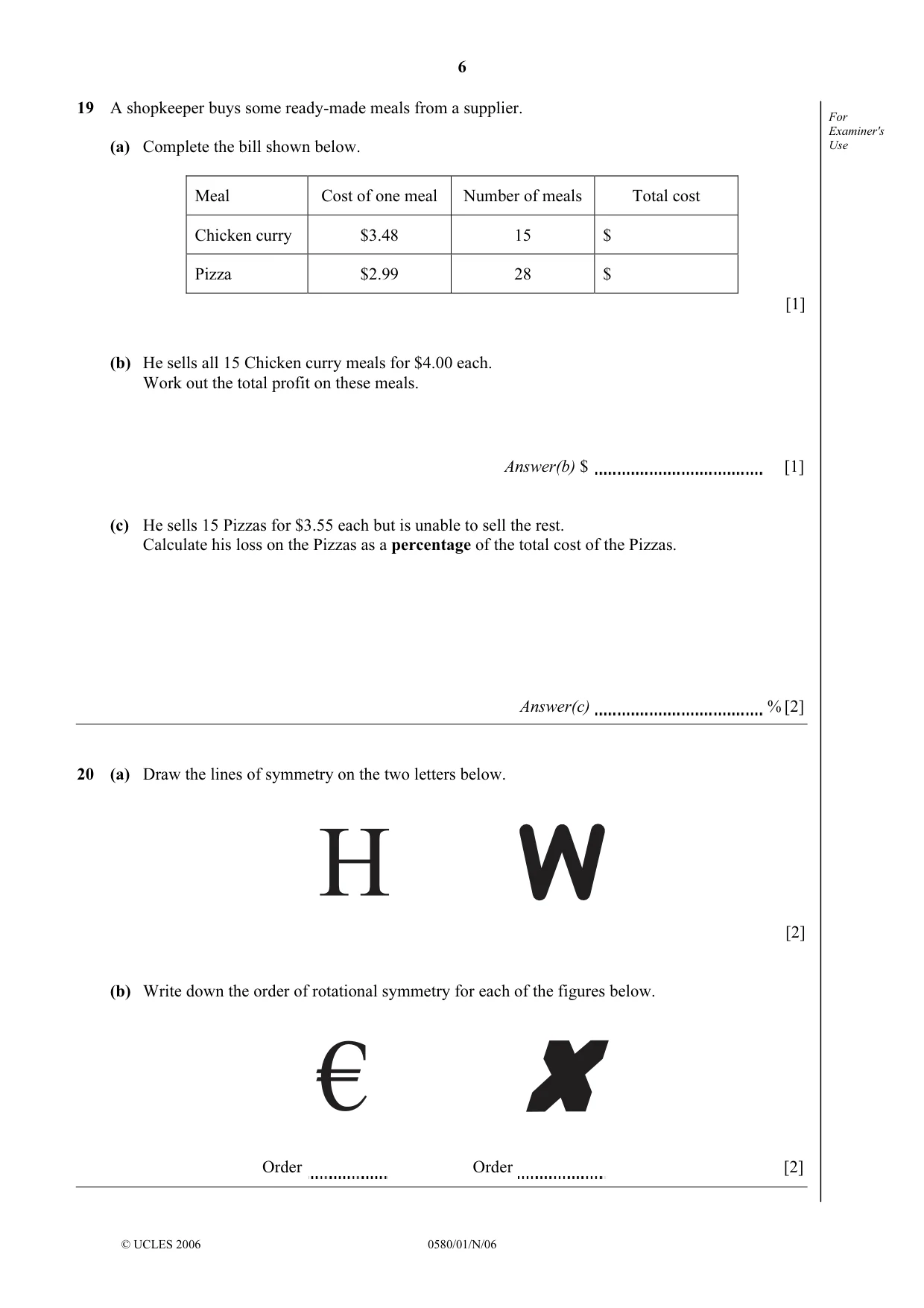
6 © UCLES 2006 0580/01/N/06 For Examiner's Use 19 A shopkeeper buys some ready-made meals from a supplier. (a) Complete the bill shown below. Meal Cost of one meal Number of meals Total cost Chicken curry $3.48 15 $ Pizza $2.99 28 $ [1] (b) He sells all 15 Chicken curry meals for $4.00 each. Work out the total profit on these meals. Answer(b) $ [1] (c) He sells 15 Pizzas for $3.55 each but is unable to sell the rest. Calculate his loss on the Pizzas as a percentage of the total cost of the Pizzas. Answer(c) % [2] 20 (a) Draw the lines of symmetry on the two letters below. [2] (b) Write down the order of rotational symmetry for each of the figures below. Order Order [2]
Question paper, page 7
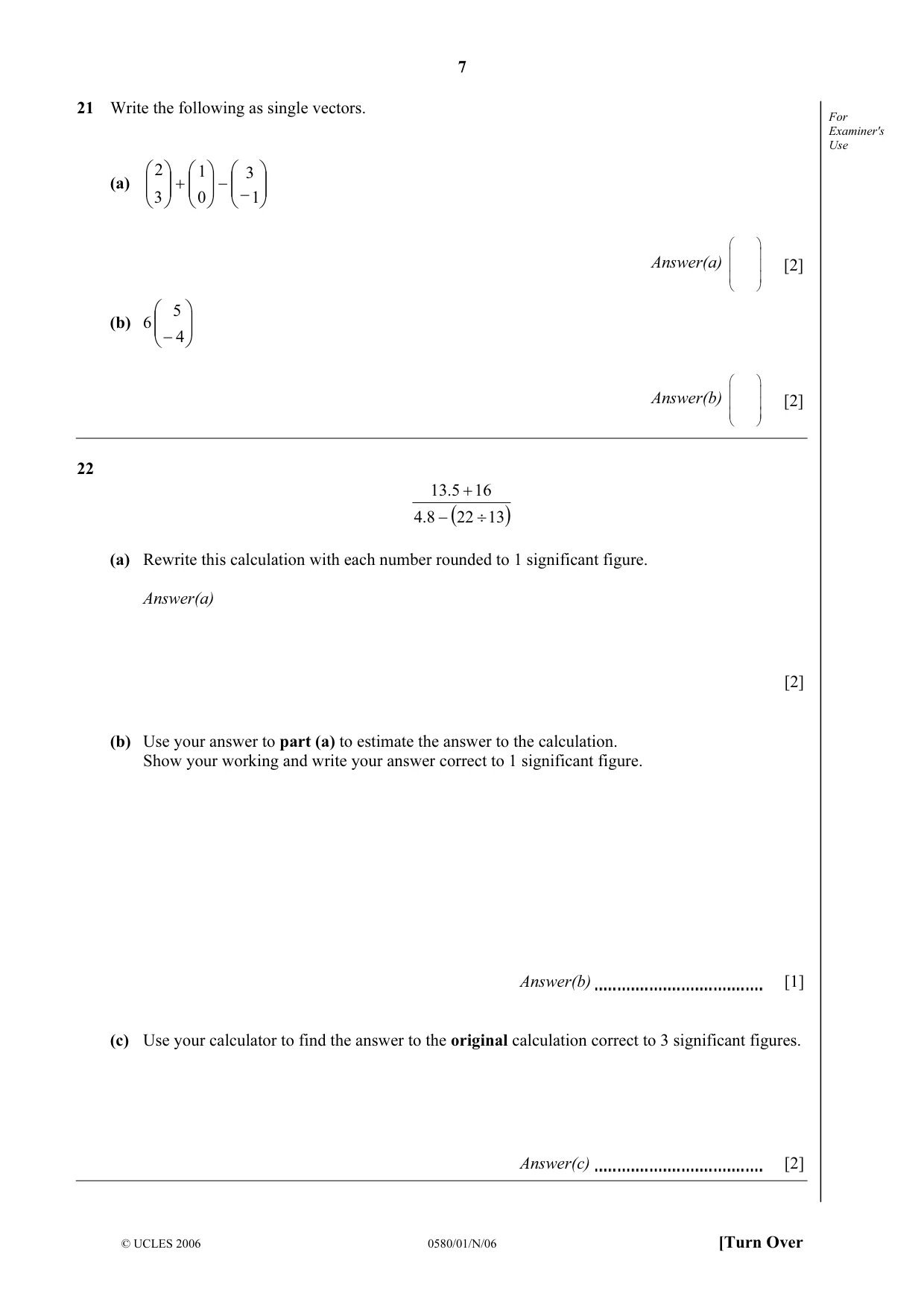
7 © UCLES 2006 0580/01/N/06 [Turn Over For Examiner's Use 21 Write the following as single vectors. (a) − − + 1 3 0 1 3 2 Answer(a) [2] (b) 6 −4 5 Answer(b) [2] 22 ( ) 13 22 4.8 16 13.5 ÷ − + (a) Rewrite this calculation with each number rounded to 1 significant figure. Answer(a) [2] (b) Use your answer to part (a) to estimate the answer to the calculation. Show your working and write your answer correct to 1 significant figure. Answer(b) [1] (c) Use your calculator to find the answer to the original calculation correct to 3 significant figures. Answer(c) [2]
Question paper, page 8
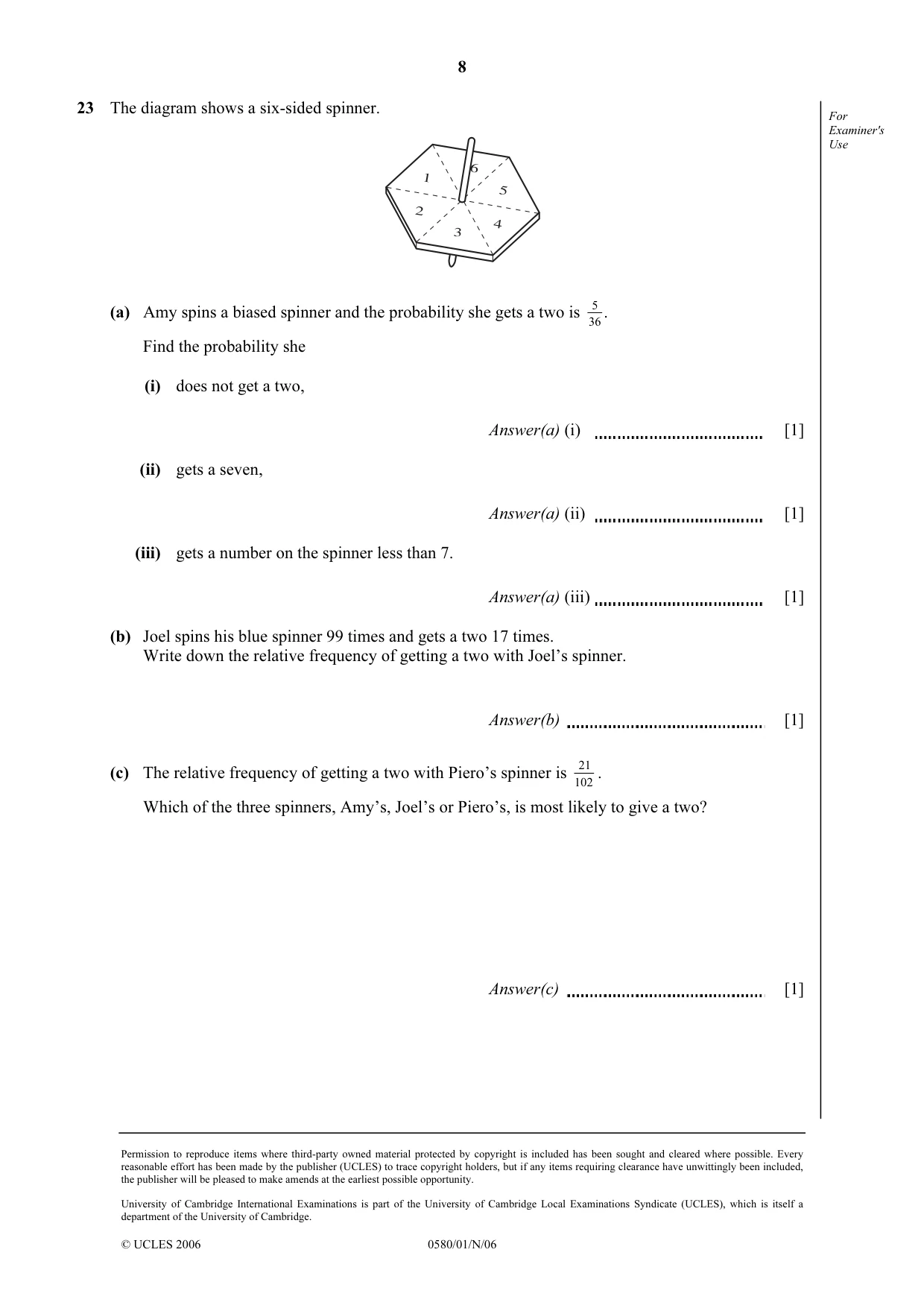
8 Permission to reproduce items where third-party owned material protected by copyright is included has been sought and cleared where possible. Every reasonable effort has been made by the publisher (UCLES) to trace copyright holders, but if any items requiring clearance have unwittingly been included, the publisher will be pleased to make amends at the earliest possible opportunity. University of Cambridge International Examinations is part of the University of Cambridge Local Examinations Syndicate (UCLES), which is itself a department of the University of Cambridge. © UCLES 2006 0580/01/N/06 For Examiner's Use 23 The diagram shows a six-sided spinner. 6 3 1 2 5 4 (a) Amy spins a biased spinner and the probability she gets a two is . 36 5 Find the probability she (i) does not get a two, Answer(a) (i) [1] (ii) gets a seven, Answer(a) (ii) [1] (iii) gets a number on the spinner less than 7. Answer(a) (iii) [1] (b) Joel spins his blue spinner 99 times and gets a two 17 times. Write down the relative frequency of getting a two with Joel’s spinner. Answer(b) [1] (c) The relative frequency of getting a two with Piero’s spinner is 102 21 . Which of the three spinners, Amy’s, Joel’s or Piero’s, is most likely to give a two? Answer(c) [1]
Mark scheme, page 1
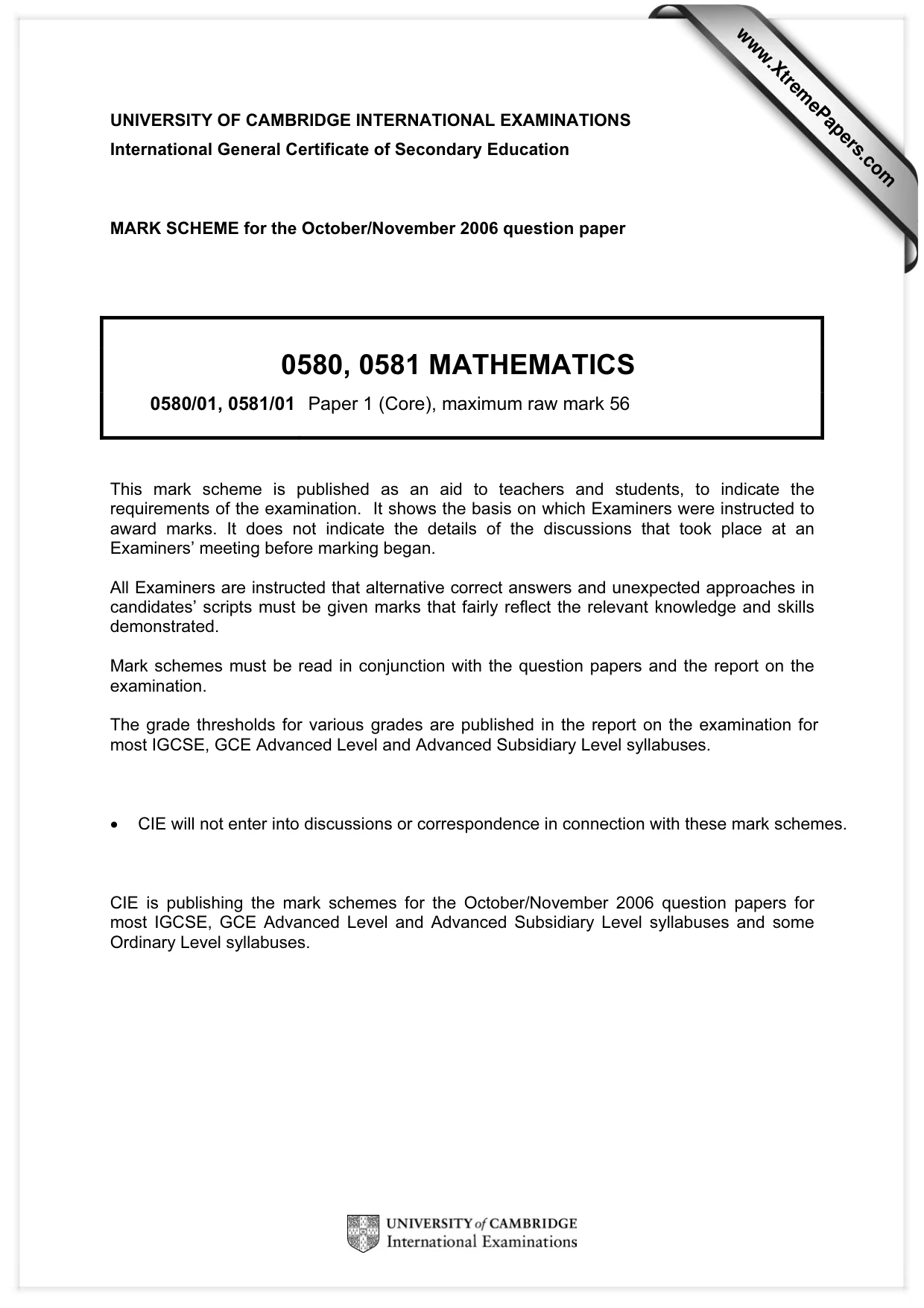
UNIVERSITY OF CAMBRIDGE INTERNATIONAL EXAMINATIONS International General Certificate of Secondary Education MARK SCHEME for the October/November 2006 question paper 0580, 0581 MATHEMATICS 0580/01, 0581/01 Paper 1 (Core), maximum raw mark 56 This mark scheme is published as an aid to teachers and students, to indicate the requirements of the examination. It shows the basis on which Examiners were instructed to award marks. It does not indicate the details of the discussions that took place at an Examiners’ meeting before marking began. All Examiners are instructed that alternative correct answers and unexpected approaches in candidates’ scripts must be given marks that fairly reflect the relevant knowledge and skills demonstrated. Mark schemes must be read in conjunction with the question papers and the report on the examination. The grade thresholds for various grades are published in the report on the examination for most IGCSE, GCE Advanced Level and Advanced Subsidiary Level syllabuses. • CIE will not enter into discussions or correspondence in connection with these mark schemes. CIE is publishing the mark schemes for the October/November 2006 question papers for most IGCSE, GCE Advanced Level and Advanced Subsidiary Level syllabuses and some Ordinary Level syllabuses. www.XtremePapers.com
Mark scheme, page 2
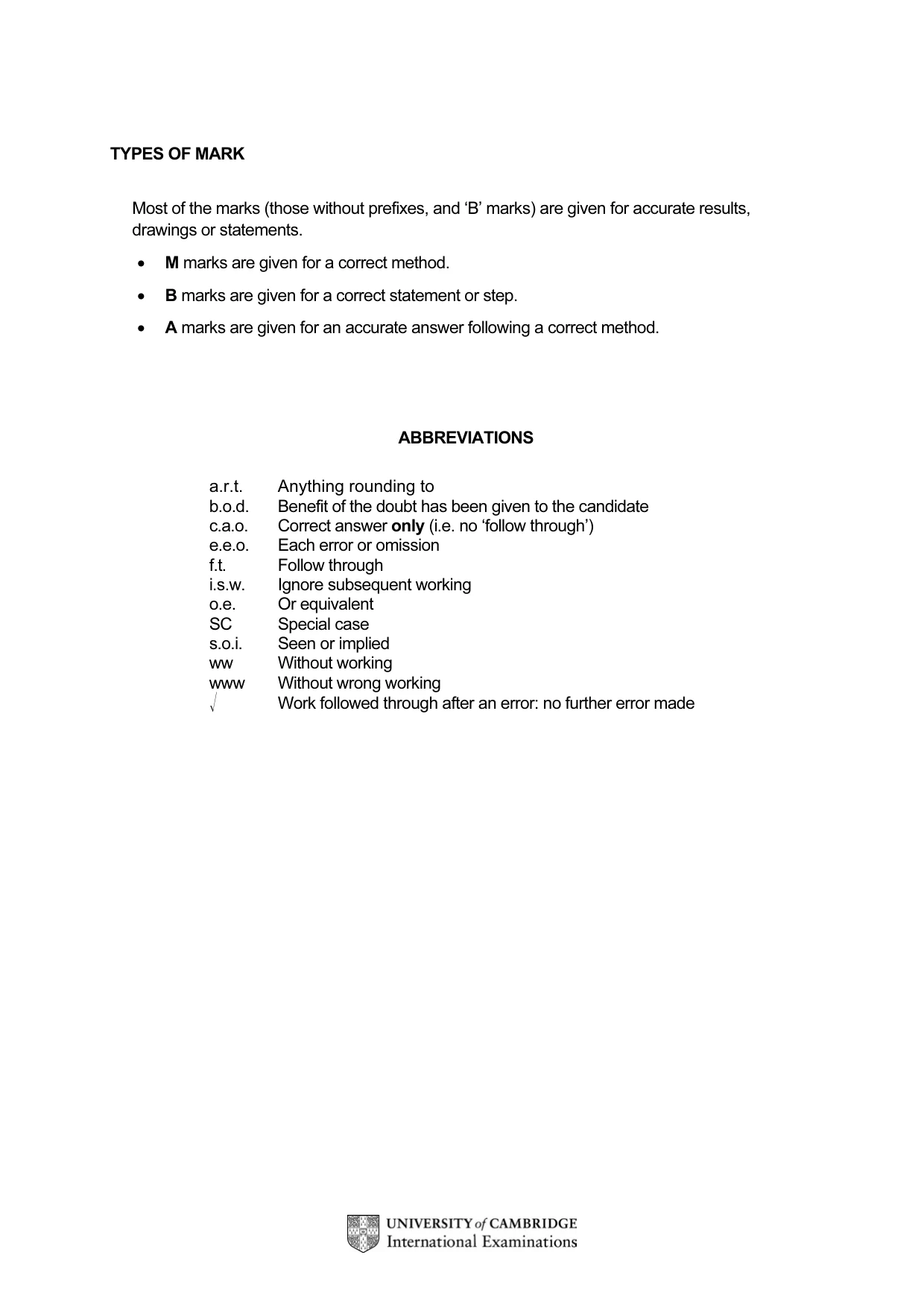
TYPES OF MARK Most of the marks (those without prefixes, and ‘B’ marks) are given for accurate results, drawings or statements. • M marks are given for a correct method. • B marks are given for a correct statement or step. • A marks are given for an accurate answer following a correct method. ABBREVIATIONS a.r.t. Anything rounding to b.o.d. Benefit of the doubt has been given to the candidate c.a.o. Correct answer only (i.e. no ‘follow through’) e.e.o. Each error or omission f.t. Follow through i.s.w. Ignore subsequent working o.e. Or equivalent SC Special case s.o.i. Seen or implied ww Without working www Without wrong working > Work followed through after an error: no further error made=
Mark scheme, page 3
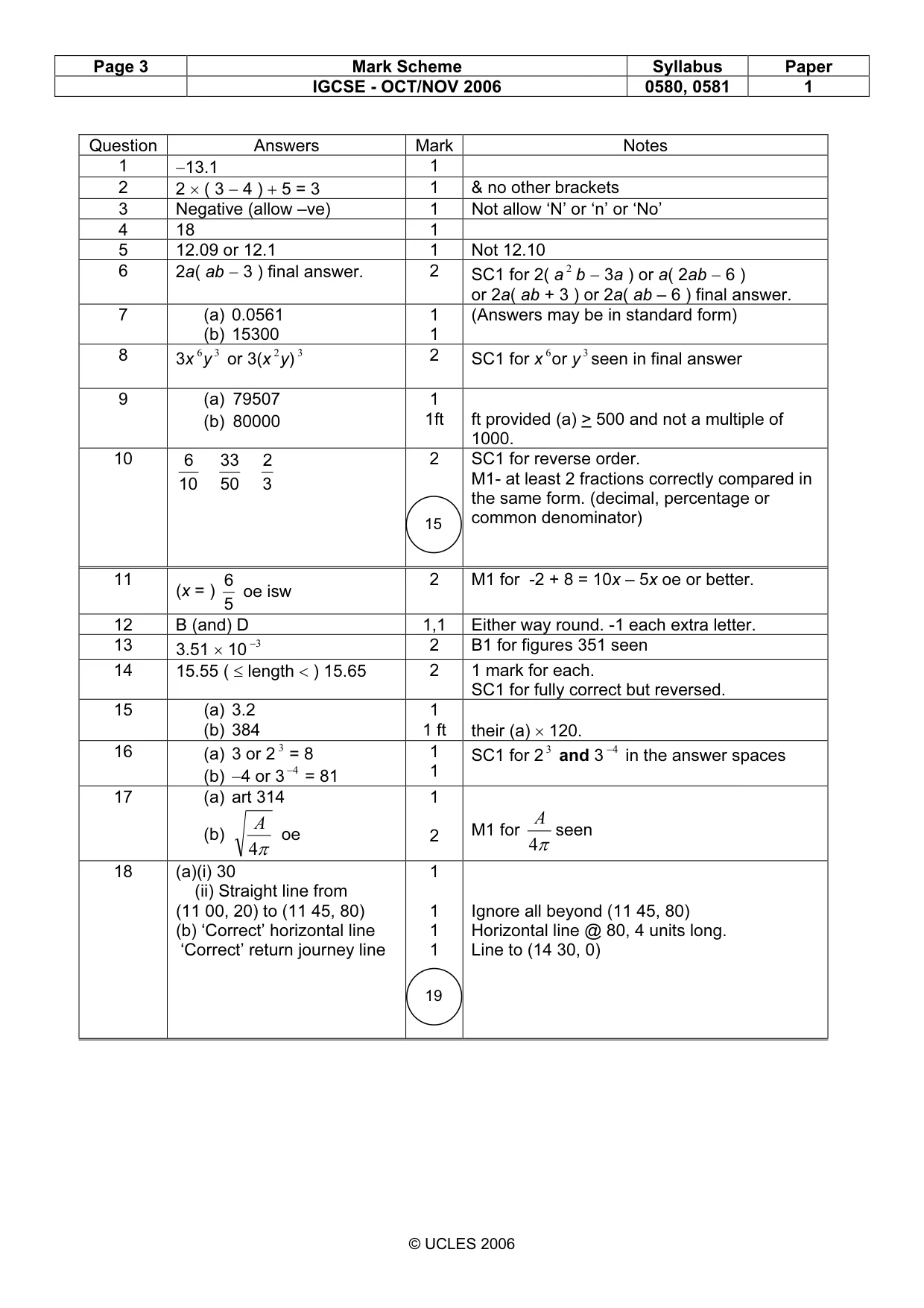
Page 3 Mark Scheme Syllabus Paper IGCSE - OCT/NOV 2006 0580, 0581 1 © UCLES 2006 Question Answers Mark Notes 1 −13.1 1 2 2 × ( 3 − 4 ) + 5 = 3 1 & no other brackets 3 Negative (allow –ve) 1 Not allow ‘N’ or ‘n’ or ‘No’ 4 18 1 5 12.09 or 12.1 1 Not 12.10 6 2a( ab − 3 ) final answer. 2 SC1 for 2( a 2 b − 3a ) or a( 2ab − 6 ) or 2a( ab + 3 ) or 2a( ab – 6 ) final answer. 7 (a) 0.0561 (b) 15300 1 1 (Answers may be in standard form) 8 3x 6y 3 or 3(x 2y) 3 2 SC1 for x 6or y 3 seen in final answer 9 (a) 79507 (b) 80000 1 1ft ft provided (a) > 500 and not a multiple of 1000. 10 10 6 50 33 3 2 2 SC1 for reverse order. M1- at least 2 fractions correctly compared in the same form. (decimal, percentage or common denominator) 11 (x = ) 5 6 oe isw 2 M1 for -2 + 8 = 10x – 5x oe or better. 12 B (and) D 1,1 Either way round. -1 each extra letter. 13 3.51 × 10 3 − 2 B1 for figures 351 seen 14 15.55 ( ≤ length < ) 15.65 2 1 mark for each. SC1 for fully correct but reversed. 15 (a) 3.2 (b) 384 1 1 ft their (a) × 120. 16 (a) 3 or 2 3 = 8 (b) −4 or 3 −4 = 81 1 1 SC1 for 2 3 and 3 4 − in the answer spaces 17 (a) art 314 (b) π 4 A oe 1 2 M1 for π 4 A seen 18 (a)(i) 30 (ii) Straight line from (11 00, 20) to (11 45, 80) (b) ‘Correct’ horizontal line ‘Correct’ return journey line 1 1 1 1 Ignore all beyond (11 45, 80) Horizontal line @ 80, 4 units long. Line to (14 30, 0) 15 19
Mark scheme, page 4
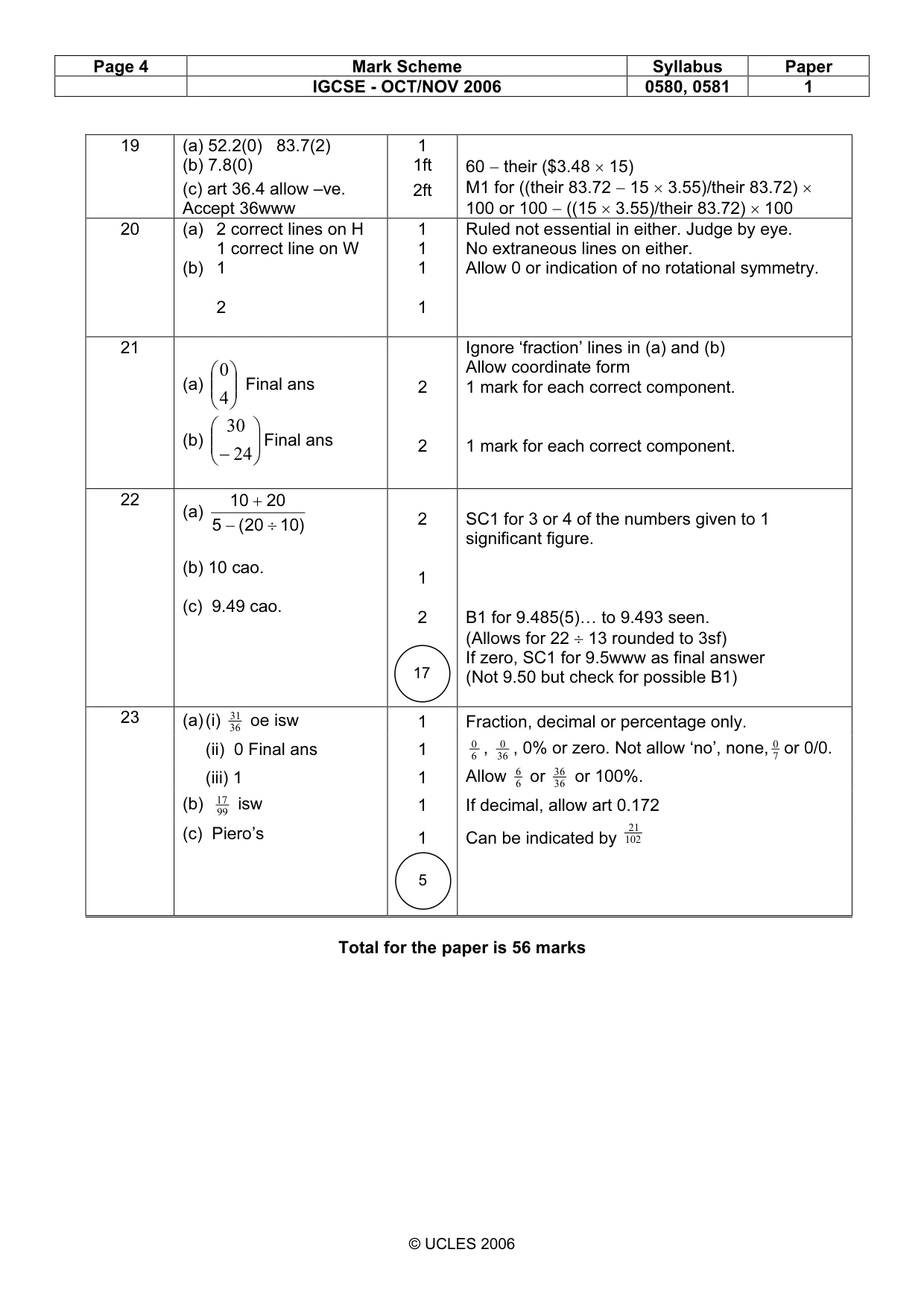
Page 4 Mark Scheme Syllabus Paper IGCSE - OCT/NOV 2006 0580, 0581 1 © UCLES 2006 19 (a) 52.2(0) 83.7(2) (b) 7.8(0) (c) art 36.4 allow –ve. Accept 36www 1 1ft 2ft 60 − their ($3.48 × 15) M1 for ((their 83.72 − 15 × 3.55)/their 83.72) × 100 or 100 − ((15 × 3.55)/their 83.72) × 100 20 (a) 2 correct lines on H 1 correct line on W (b) 1 2 1 1 1 1 Ruled not essential in either. Judge by eye. No extraneous lines on either. Allow 0 or indication of no rotational symmetry. 21 (a) 4 0 Final ans (b) −24 30 Final ans 2 2 Ignore ‘fraction’ lines in (a) and (b) Allow coordinate form 1 mark for each correct component. 1 mark for each correct component. 22 (a) ) 10 20 ( 5 20 10 ÷ − + (b) 10 cao. (c) 9.49 cao. 2 1 2 SC1 for 3 or 4 of the numbers given to 1 significant figure. B1 for 9.485(5)… to 9.493 seen. (Allows for 22 ÷ 13 rounded to 3sf) If zero, SC1 for 9.5www as final answer (Not 9.50 but check for possible B1) 23 (a) (i) 36 31 oe isw 1 Fraction, decimal or percentage only. (ii) 0 Final ans 1 6 0 , 36 0 , 0% or zero. Not allow ‘no’, none, 7 0 or 0/0. (iii) 1 1 Allow 6 6 or 36 36 or 100%. (b) 99 17 isw 1 If decimal, allow art 0.172 (c) Piero’s 1 Can be indicated by 102 21 Total for the paper is 56 marks 17 5
What you needed in this session
Cambridge’s own grade thresholds for 2006 Oct/Nov, Paper 1 · Variant 1. A higher threshold means an easier paper — the bar moves with how the cohort did.