Cambridge IGCSE Mathematics (with coursework) 0581 — 2005 Oct/Nov Paper 1 · Variant 1
0581/11/O/N/05
The question paper and its mark scheme, free to read here and free to download. This is Cambridge’s own paper, exactly as it was sat.
Question paper12 pages


Mark scheme4 pages
Answers below. Sit the paper first if you are practising.
Paper as text
Question paper, page 1
This document consists of 9 printed pages and 3 blank pages. IB05 11_0580_01/5RP UCLES 2005 [Turn over UNIVERSITY OF CAMBRIDGE INTERNATIONAL EXAMINATIONS International General Certificate of Secondary Education MATHEMATICS Paper 1 (Core) 0580/01 0581/01 Candidates answer on the Question Paper. Additional Materials: Electronic calculator Geometrical instruments October/November 2005 Mathematical tables (optional) Tracing paper (optional) 1hour READ THESE INSTRUCTIONS FIRST Write your Centre number, candidate number and name on all the work you hand in. Write in dark blue or black pen in the spaces provided on the Question Paper. You may use a pencil for any diagrams or graphs. Do not use staples, paper clips, highlighters, glue or correction fluid. DO NOT WRITE IN THE BARCODE. DO NOT WRITE IN THE GREY AREAS BETWEEN THE PAGES. Answer all questions. If working is needed for any question it must be shown below that question. The number of marks is given in brackets [ ] at the end of each question or part question. The total number of marks for this paper is 56. Electronic calculators should be used. If the degree of accuracy is not specified in the question, and if the answer is not exact, give the answer to three significant figures. Give answers in degrees to one decimal place. For π , use either your calculator value or 3.142. Candidate Name Centre Number Candidate Number *051001* For Examiner's Use www.XtremePapers.com
Question paper, page 2
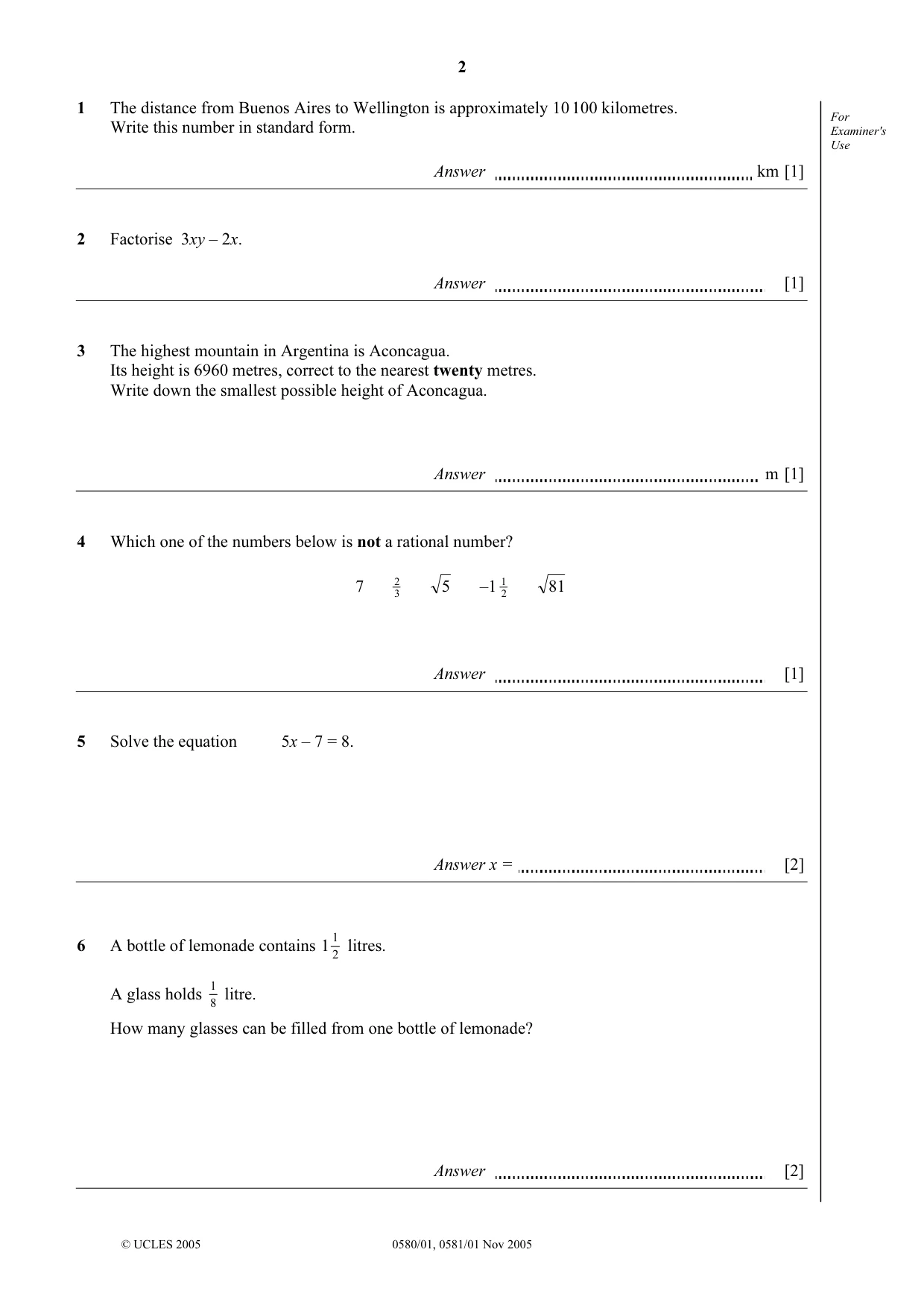
2 © UCLES 2005 0580/01, 0581/01 Nov 2005 For Examiner's Use 1 The distance from Buenos Aires to Wellington is approximately 10 100 kilometres. Write this number in standard form. Answer km [1] 2 Factorise 3xy – 2x. Answer [1] 3 The highest mountain in Argentina is Aconcagua. Its height is 6960 metres, correct to the nearest twenty metres. Write down the smallest possible height of Aconcagua. Answer m [1] 4 Which one of the numbers below is not a rational number? 7 2 3 5 –1 1 2 81 Answer [1] 5 Solve the equation 5x – 7 = 8. Answer x = [2] 6 A bottle of lemonade contains 2 1 1 litres. A glass holds 8 1 litre. How many glasses can be filled from one bottle of lemonade? Answer [2]
Question paper, page 3
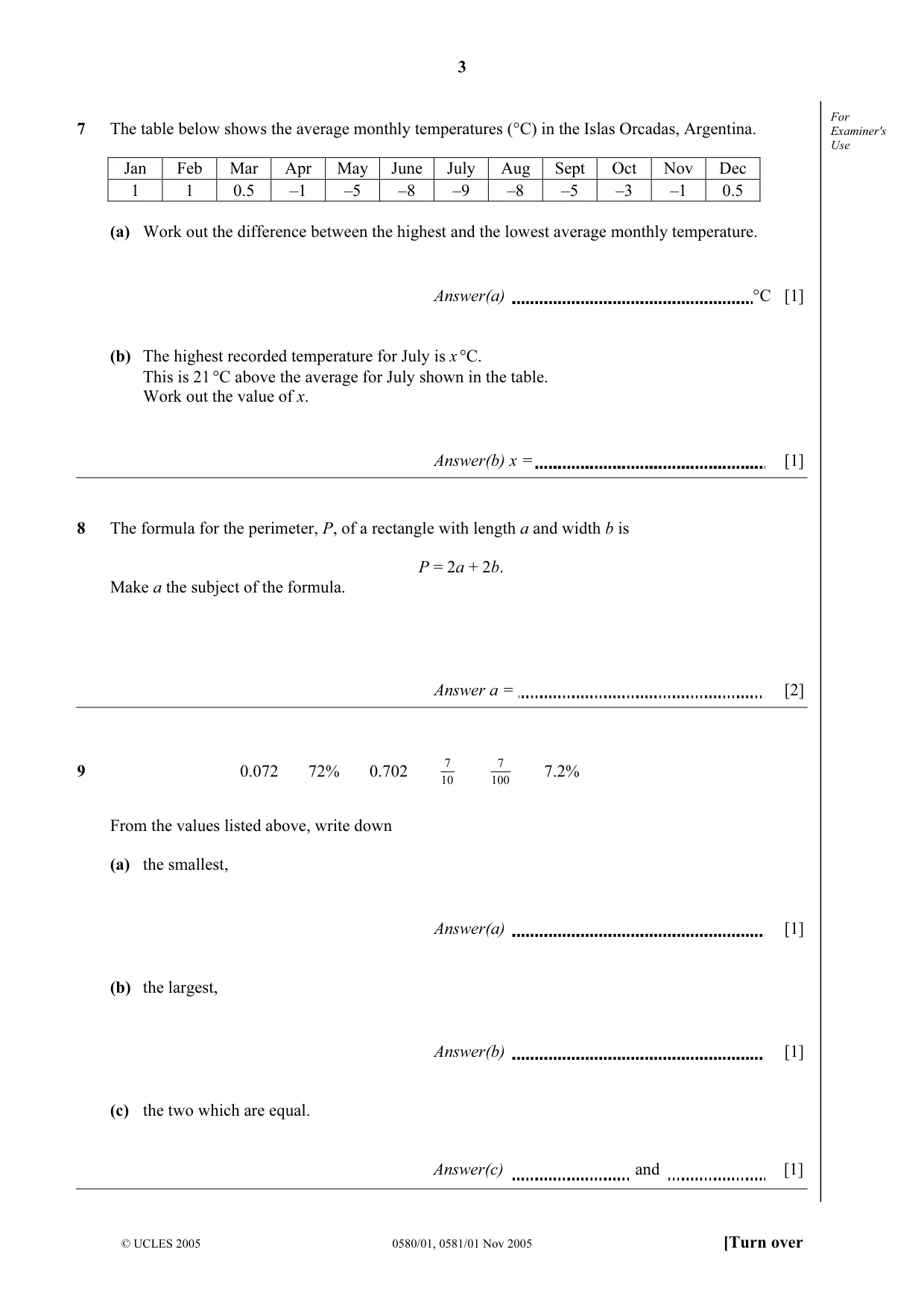
3 © UCLES 2005 0580/01, 0581/01 Nov 2005 [Turn over For Examiner's Use 7 The table below shows the average monthly temperatures (°C) in the Islas Orcadas, Argentina. Jan Feb Mar Apr May June July Aug Sept Oct Nov Dec 1 1 0.5 –1 –5 –8 –9 –8 –5 –3 –1 0.5 (a) Work out the difference between the highest and the lowest average monthly temperature. Answer(a) °C [1] (b) The highest recorded temperature for July is x °C. This is 21 °C above the average for July shown in the table. Work out the value of x. Answer(b) x = [1] 8 The formula for the perimeter, P, of a rectangle with length a and width b is P = 2a + 2b. Make a the subject of the formula. Answer a = [2] 9 0.072 72% 0.702 10 7 100 7 7.2% From the values listed above, write down (a) the smallest, Answer(a) [1] (b) the largest, Answer(b) [1] (c) the two which are equal. Answer(c) and [1]
Question paper, page 4
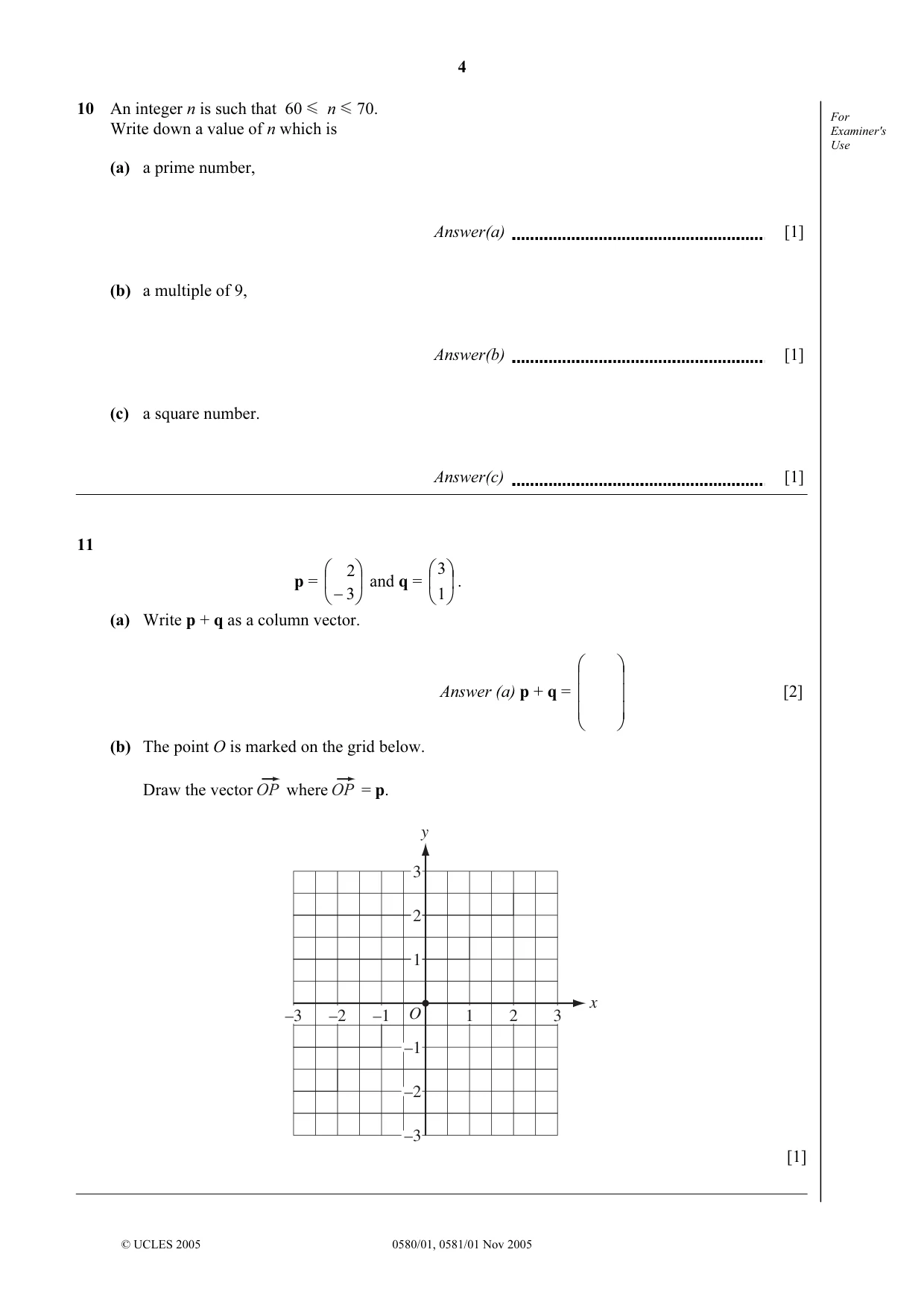
4 © UCLES 2005 0580/01, 0581/01 Nov 2005 For Examiner's Use 10 An integer n is such that 60 n 70. Write down a value of n which is (a) a prime number, Answer(a) [1] (b) a multiple of 9, Answer(b) [1] (c) a square number. Answer(c) [1] 11 p = −3 2 and q = 1 3 . (a) Write p + q as a column vector. Answer (a) p + q = [2] (b) The point O is marked on the grid below. Draw the vector where = p. 1 2 3 –3 –2 –1 3 2 1 –1 –2 –3 O y x [1]
Question paper, page 5
5 © UCLES 2005 0580/01, 0581/01 Nov 2005 [Turn over For Examiner's Use 12 S T 1.2 km 21o NOT TO SCALE The diagram shows a path, ST, up a hill. The path is 1.2 kilometres long and slopes at an angle of 21° to the horizontal. Calculate the height of the hill, showing all your working. Give your answer in metres. Answer m [3] 13 The population of Latvia in 1989 was 2 700 000. In 1994 it was 2 500 000. Calculate the percentage decrease in the population between 1989 and 1994. Answer % [3] 14 = < > Choose one of the symbols given above to complete each of the following statements. When x = 6 and y = –7, then (a) x y [1] (b) x² y² [1] (c) y - x x - y [1]
Question paper, page 6
6 © UCLES 2005 0580/01, 0581/01 Nov 2005 For Examiner's Use 15 (a) Write 0.48 correct to 1 significant figure. Answer(a) [1] (b) (i) Find an approximate answer for the sum 9.87 – 5.79 × 0.48 by rounding each number to 1 significant figure. Show your working. Answer(b)(i) [1] (ii) Use your calculator to find the exact answer for the sum in part (b) (i). Write down all the figures on your calculator. Answer(b)(ii) [1] 16 Simplify the following expressions. (a) 9r – 4s – 6r + s Answer(a) [1] (b) q4 ÷ q3 Answer(b) [1] (c) p6 × p−2 Answer(c) [1] 17 Three friends, Cleopatra, Dalila and Ebony go shopping. The money they each have is in the ratio Cleopatra : Dalila : Ebony = 5 : 7 : 8. Cleopatra has $15. (a) How many dollars do they have in total? Answer(a) [2] (b) Dalila spends $12 on a hat. How many dollars does she have left? Answer(b) [1]
Question paper, page 7
7 © UCLES 2005 0580/01, 0581/01 Nov 2005 [Turn over For Examiner's Use 18 A 400 metre running track has two straight sections, each of length 120 metres, and two semicircular ends. 120 m NOT TO SCALE d (a) Calculate the total length of the curved sections of the track. Answer(a) m [1] (b) Calculate d, the distance between the parallel straight sections of the track. Answer(b) d = m [2] 19 Joseph buys 45 kilograms of potatoes from a supplier for $0.65 per kilogram. (a) How much does he pay for the potatoes? Answer(a) $ [1] (b) He then puts the potatoes into bags which each hold 2.5 kilograms. How many bags can he fill with the potatoes? Answer(b) bags [1] (c) At the market he sells the bags of potatoes for $2.20 per bag. Calculate the smallest number of complete bags he needs to sell in order to make a profit. Answer(c) bags [2]
Question paper, page 8
8 © UCLES 2005 0580/01, 0581/01 Nov 2005 For Examiner's Use 20 $900 Lorenzo saves money for a motorbike. The marked price of the motorbike is $900. He pays a deposit of 35% of the marked price. (a) Calculate his deposit. Answer(a) $ [2] (b) He then makes 12 monthly payments of $60 each. How much more than the $900 marked price does he pay altogether? Answer(b) $ [3]
Question paper, page 9
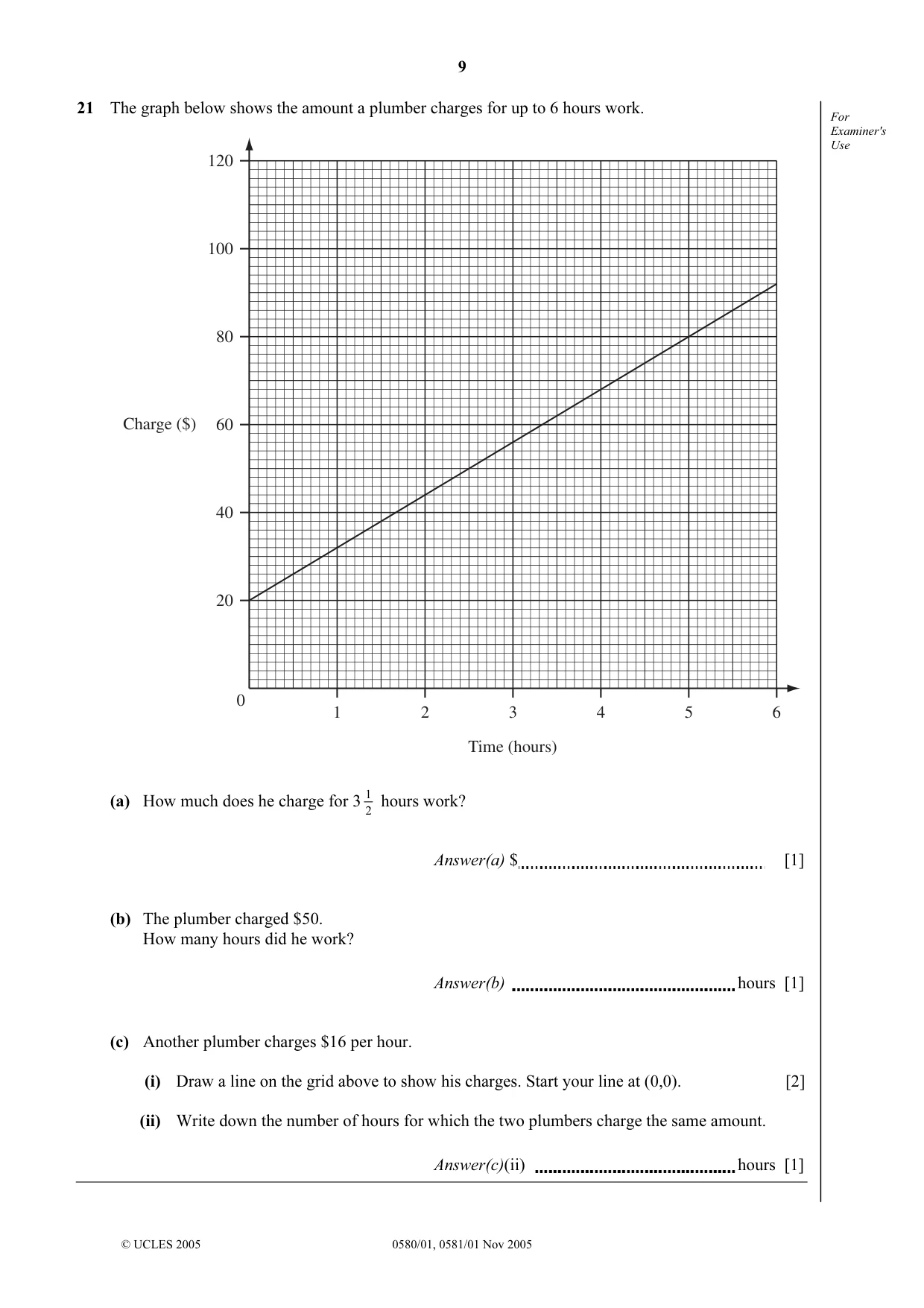
9 © UCLES 2005 0580/01, 0581/01 Nov 2005 For Examiner's Use 21 The graph below shows the amount a plumber charges for up to 6 hours work. 0 1 2 3 Time (hours) 4 5 6 120 100 80 60 40 20 Charge ($) (a) How much does he charge for 3 2 1 hours work? Answer(a) $ [1] (b) The plumber charged $50. How many hours did he work? Answer(b) hours [1] (c) Another plumber charges $16 per hour. (i) Draw a line on the grid above to show his charges. Start your line at (0,0). [2] (ii) Write down the number of hours for which the two plumbers charge the same amount. Answer(c)(ii) hours [1]
Question paper, page 12
12 Permission to reproduce items where third-party owned material protected by copyright is included has been sought and cleared where possible. Every reasonable effort has been made by the publisher (UCLES) to trace copyright holders, but if any items requiring clearance have unwittingly been included, the publisher will be pleased to make amends at the earliest possible opportunity. University of Cambridge International Examinations is part of the University of Cambridge Local Examinations Syndicate (UCLES), which is itself a department of the University of Cambridge. 0580/01, 0581/01 Nov 2005 BLANK PAGE
Mark scheme, page 1
UNIVERSITY OF CAMBRIDGE INTERNATIONAL EXAMINATIONS International General Certificate of Secondary Education MARK SCHEME for the November 2005 question papers 0580/0581 MATHEMATICS 0580/01, 0581/01 Paper 1 (Core), maximum raw mark 56 This mark scheme is published as an aid to teachers and students, to indicate the requirements of the examination. It shows the basis on which Examiners were initially instructed to award marks. It does not indicate the details of the discussions that took place at an Examiners’ meeting before marking began. Any substantial changes to the mark scheme that arose from these discussions will be recorded in the published Report on the Examination. All Examiners are instructed that alternative correct answers and unexpected approaches in candidates’ scripts must be given marks that fairly reflect the relevant knowledge and skills demonstrated. Mark schemes must be read in conjunction with the question papers and the Report on the Examination. • CIE will not enter into discussion or correspondence in connection with these mark schemes. The minimum marks in these components needed for various grades were previously published with these mark schemes, but are now instead included in the Report on the Examination for this session. CIE is publishing the mark schemes for the November 2005 question papers for most IGCSE and GCE Advanced Level and Advanced Subsidiary Level syllabuses and some Ordinary Level syllabuses. www.XtremePapers.com
Mark scheme, page 2
TYPES OF MARK Most of the marks (those without prefixes, and ‘B’ marks) are given for accurate results, drawings or statements. • M marks are given for a correct method. • B marks are given for a correct statement or step. • A marks are given for an accurate answer following a correct method. ABBREVIATIONS a.r.t. Anything rounding to b.o.d. Benefit of the doubt has been given to the candidate c.a.o. Correct answer only (i.e. no ‘follow through’) e.e.o. Each error or omission f.t. Follow through i.s.w. Ignore subsequent working o.e. Or equivalent SC Special case s.o.i. Seen or implied ww Without working www Without wrong working > Work followed through after an error: no further error made=
Mark scheme, page 3
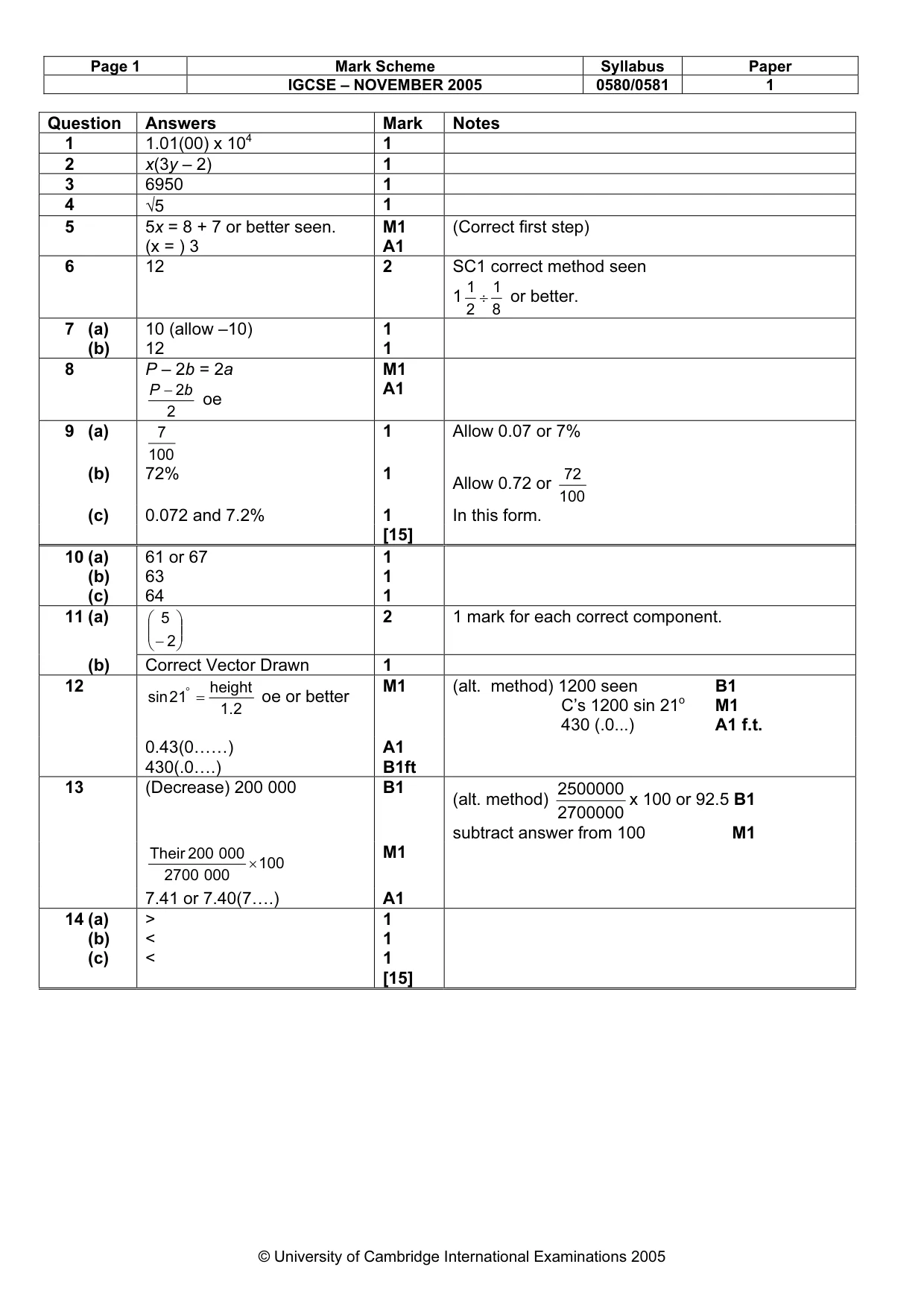
Page 1 Mark Scheme Syllabus Paper IGCSE – NOVEMBER 2005 0580/0581 1 © University of Cambridge International Examinations 2005 Question Answers Mark Notes 1 1.01(00) x 104 1 2 x(3y – 2) 1 3 6950 1 4 √5 1 5 5x = 8 + 7 or better seen. (x = ) 3 M1 A1 (Correct first step) 6 12 2 SC1 correct method seen 1 8 1 2 1 ÷ or better. 7 (a) (b) 10 (allow –10) 12 1 1 8 P – 2b = 2a 2 2b P − oe M1 A1 9 (a) 100 7 1 Allow 0.07 or 7% (b) 72% 1 Allow 0.72 or 100 72 (c) 0.072 and 7.2% 1 In this form. [15] 10 (a) (b) (c) 61 or 67 63 64 1 1 1 11 (a) −2 5 2 1 mark for each correct component. (b) Correct Vector Drawn 1 12 2 . 1 21 sin height = ° oe or better M1 (alt. method) 1200 seen B1 C’s 1200 sin 21o M1 430 (.0...) A1 f.t. 0.43(0……) 430(.0….) A1 B1ft 13 (Decrease) 200 000 B1 (alt. method) 2700000 2500000 x 100 or 92.5 B1 subtract answer from 100 M1 100 000 2700 000 200 × Their M1 7.41 or 7.40(7….) A1 14 (a) (b) (c) > < < 1 1 1 [15]
Mark scheme, page 4
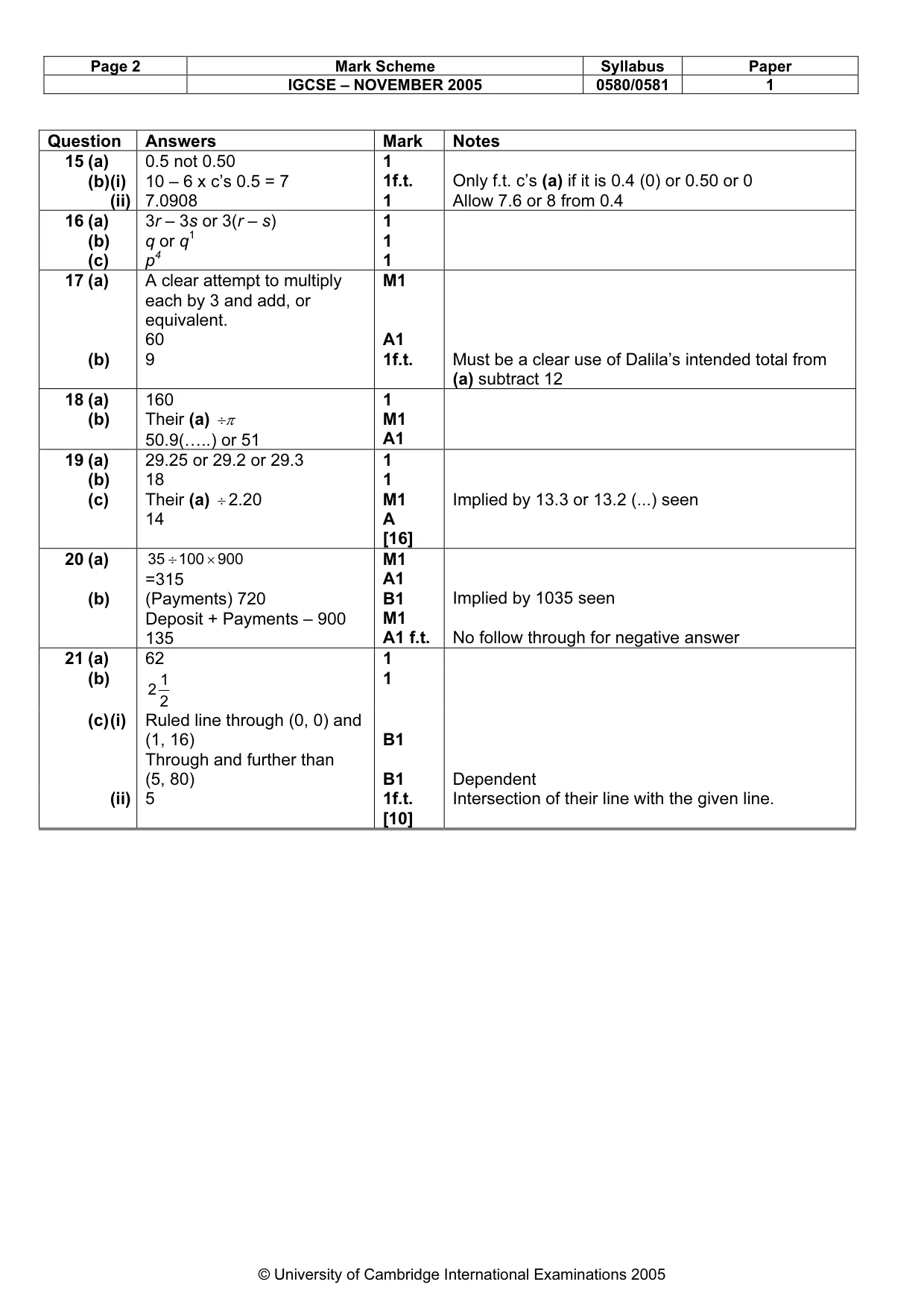
Page 2 Mark Scheme Syllabus Paper IGCSE – NOVEMBER 2005 0580/0581 1 © University of Cambridge International Examinations 2005 Question Answers Mark Notes 15 (a) (b) (i) (ii) 0.5 not 0.50 10 – 6 x c’s 0.5 = 7 7.0908 1 1f.t. 1 Only f.t. c’s (a) if it is 0.4 (0) or 0.50 or 0 Allow 7.6 or 8 from 0.4 16 (a) (b) (c) 3r – 3s or 3(r – s) q or q1 p4 1 1 1 17 (a) (b) A clear attempt to multiply each by 3 and add, or equivalent. 60 9 M1 A1 1f.t. Must be a clear use of Dalila’s intended total from (a) subtract 12 18 (a) (b) 160 Their (a) π ÷ 50.9(…..) or 51 1 M1 A1 19 (a) (b) (c) 29.25 or 29.2 or 29.3 18 Their (a) ÷ 2.20 14 1 1 M1 A [16] Implied by 13.3 or 13.2 (...) seen 20 (a) (b) 900 100 35 × ÷ =315 (Payments) 720 Deposit + Payments – 900 135 M1 A1 B1 M1 A1 f.t. Implied by 1035 seen No follow through for negative answer 21 (a) 62 1 (b) 2 1 2 1 (c) (i) Ruled line through (0, 0) and (1, 16) Through and further than (5, 80) B1 B1 Dependent (ii) 5 1f.t. [10] Intersection of their line with the given line.