Cambridge IGCSE Mathematics (with coursework) 0581 — 2005 May/June Paper 1 · Variant 1
0581/11/M/J/05
The question paper and its mark scheme, free to read here and free to download. This is Cambridge’s own paper, exactly as it was sat.
Question paper12 pages
Mark scheme6 pages
Answers below. Sit the paper first if you are practising.
Paper as text
Question paper, page 1
This document consists of 9 printed pages and 3 blank pages. IB05 06_0580_01/4RP UCLES 2005 [Turn over UNIVERSITY OF CAMBRIDGE INTERNATIONAL EXAMINATIONS International General Certificate of Secondary Education MATHEMATICS Paper 1 (Core) 0580/01 0581/01 Candidates answer on the Question Paper. Additional Materials: Electronic calculator Geometrical instruments May/June 2005 Mathematical tables (optional) Tracing paper (optional) 1hour READ THESE INSTRUCTIONS FIRST Write your Centre number, candidate number and name on all the work you hand in. Write in dark blue or black pen in the spaces provided on the Question Paper. You may use a pencil for any diagrams or graphs. Do not use staples, paper clips, highlighters, glue or correction fluid. DO NOT WRITE IN THE BARCODE. DO NOT WRITE IN THE GREY AREAS BETWEEN THE PAGES. Answer all questions. If working is needed for any question it must be shown below that question. The number of marks is given in brackets [ ] at the end of each question or part question. The total number of marks for this paper is 56. Electronic calculators should be used. If the degree of accuracy is not specified in the question, and if the answer is not exact, give the answer to three significant figures. Give answers in degrees to one decimal place. For π , use either your calculator value or 3.142. Candidate Name Centre Number Candidate Number For Examiner's Use *058001* www.XtremePapers.com
Question paper, page 2
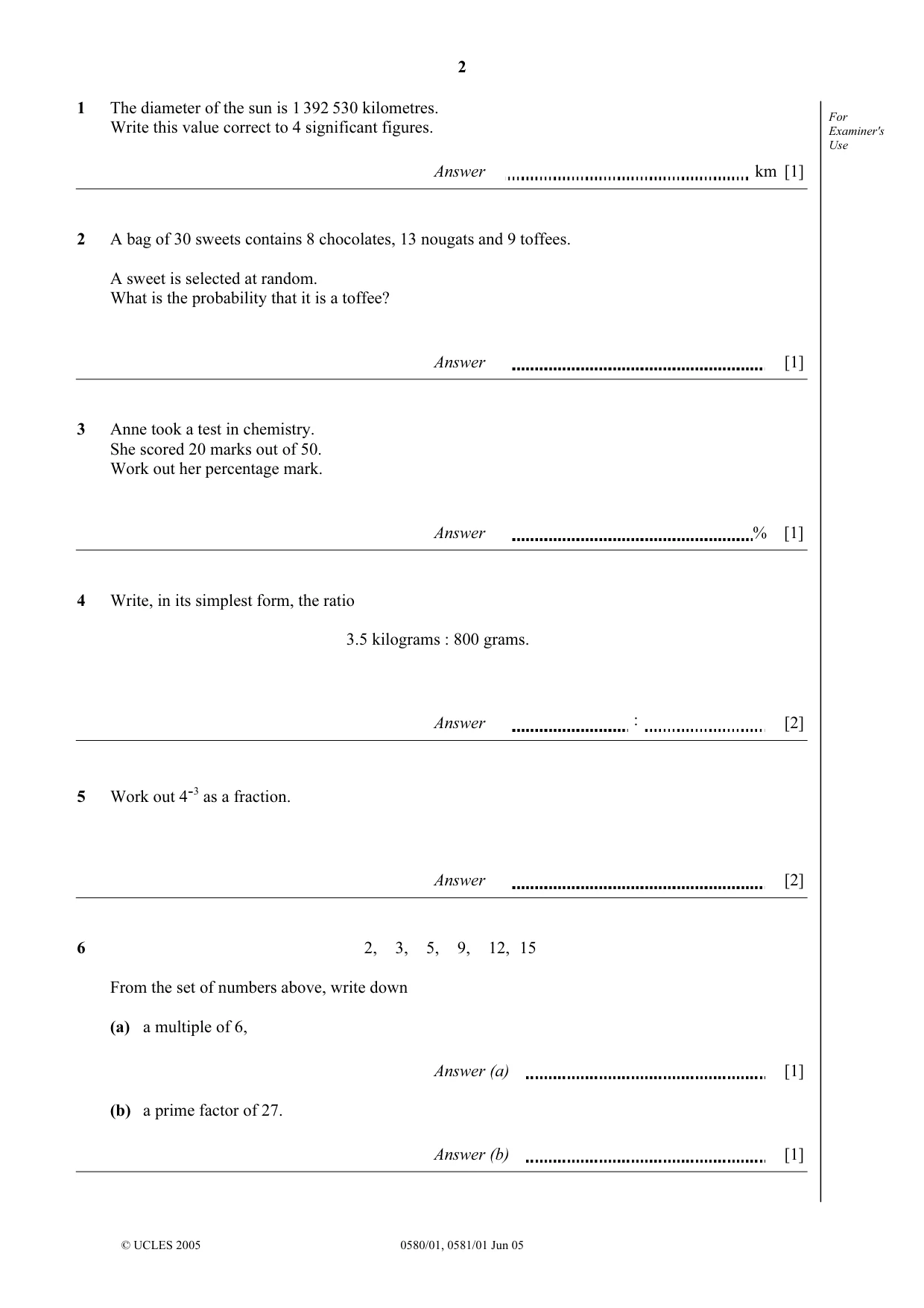
2 © UCLES 2005 0580/01, 0581/01 Jun 05 For Examiner's Use 1 The diameter of the sun is 1 392 530 kilometres. Write this value correct to 4 significant figures. Answer km [1] 2 A bag of 30 sweets contains 8 chocolates, 13 nougats and 9 toffees. A sweet is selected at random. What is the probability that it is a toffee? Answer [1] 3 Anne took a test in chemistry. She scored 20 marks out of 50. Work out her percentage mark. Answer % [1] 4 Write, in its simplest form, the ratio 3.5 kilograms : 800 grams. : Answer [2] 5 Work out 4-3 as a fraction. Answer [2] 6 2, 3, 5, 9, 12, 15 From the set of numbers above, write down (a) a multiple of 6, Answer (a) [1] (b) a prime factor of 27. Answer (b) [1]
Question paper, page 3
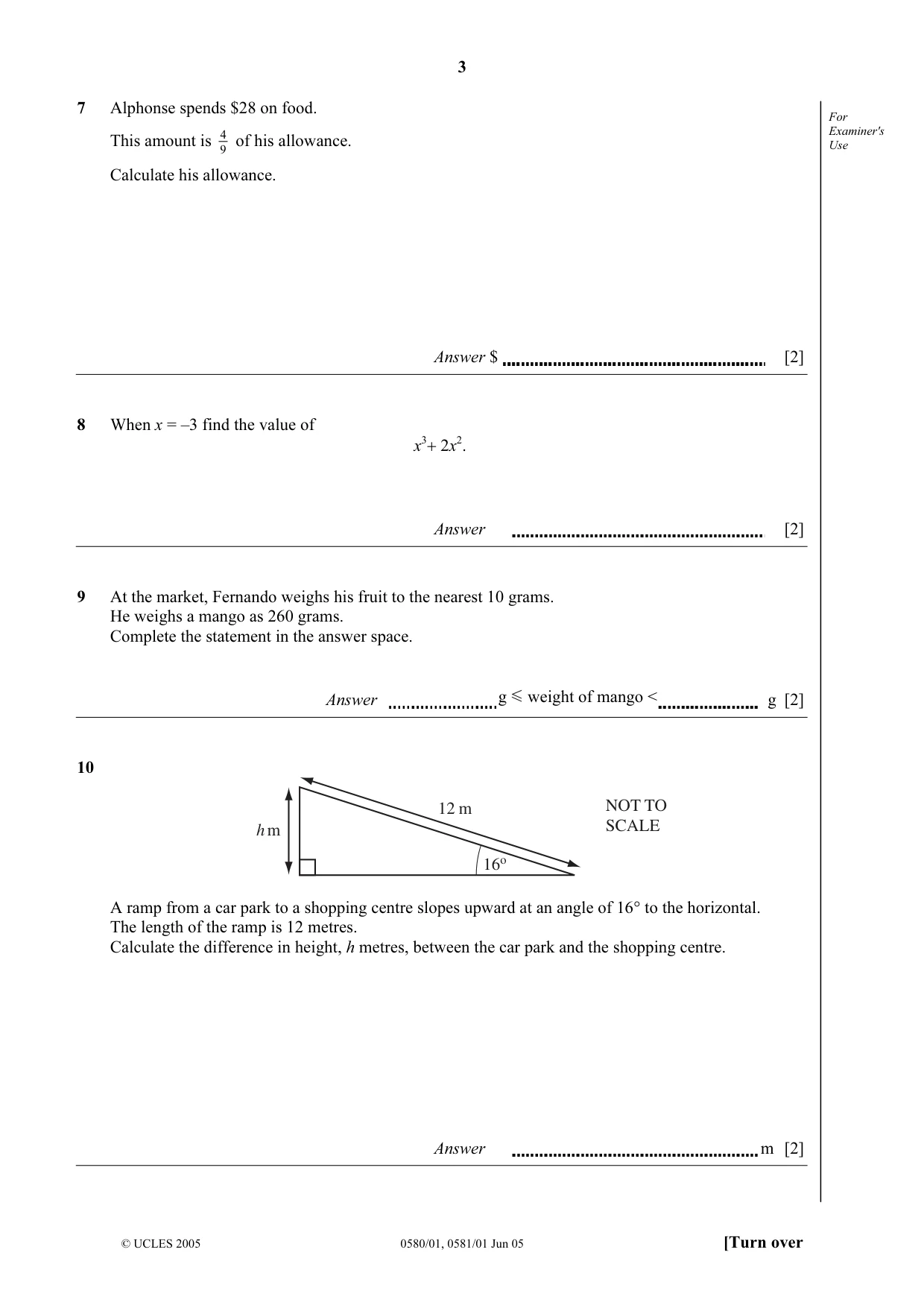
3 © UCLES 2005 0580/01, 0581/01 Jun 05 [Turn over For Examiner's Use 7 Alphonse spends $28 on food. This amount is 9 4 of his allowance. Calculate his allowance. Answer $ [2] 8 When x = –3 find the value of x3+ 2x2. Answer [2] 9 At the market, Fernando weighs his fruit to the nearest 10 grams. He weighs a mango as 260 grams. Complete the statement in the answer space. g weight of mango < Answer g [2] 10 16o 12 m h m NOT TO SCALE A ramp from a car park to a shopping centre slopes upward at an angle of 16° to the horizontal. The length of the ramp is 12 metres. Calculate the difference in height, h metres, between the car park and the shopping centre. Answer m [2]
Question paper, page 4
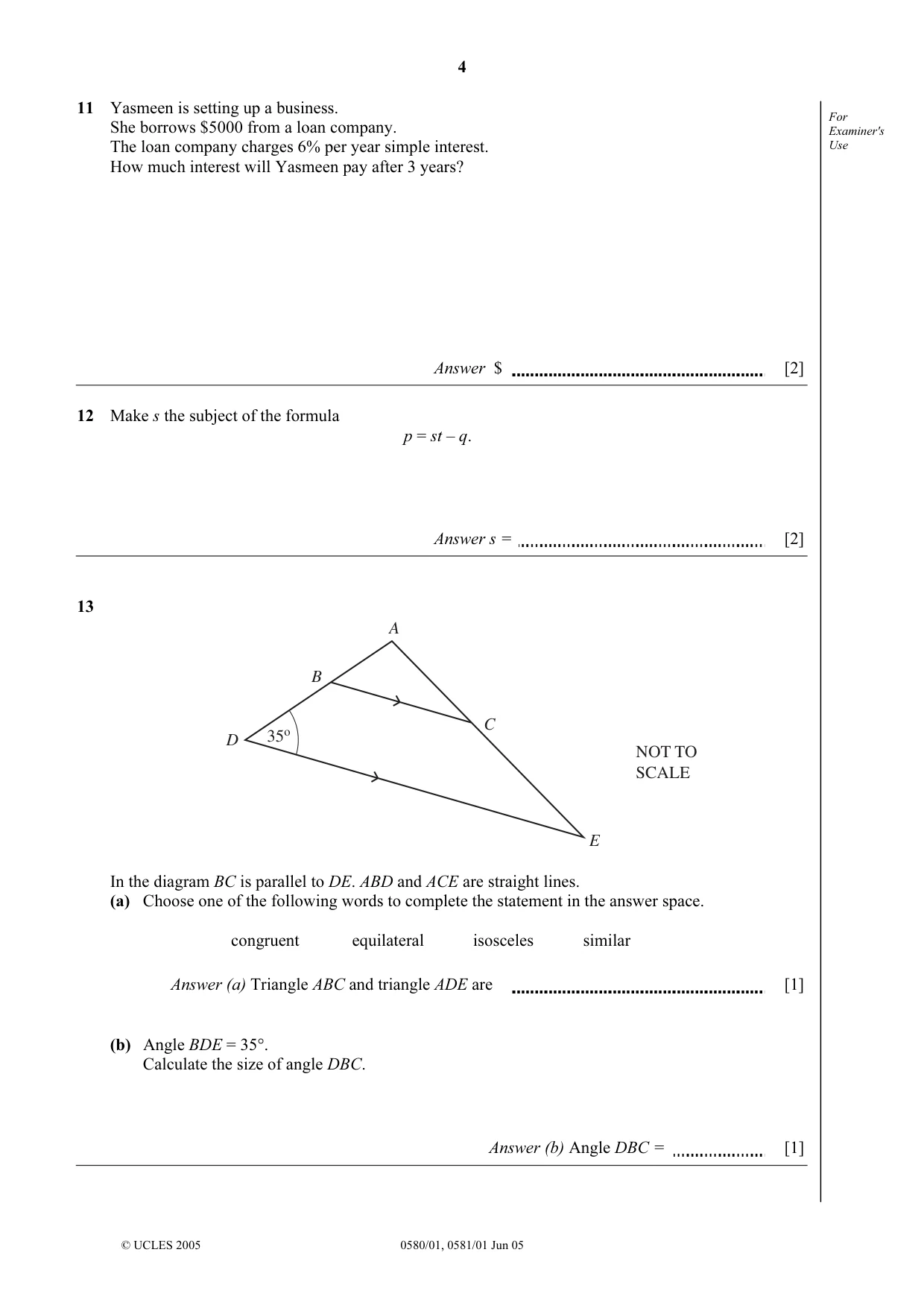
4 © UCLES 2005 0580/01, 0581/01 Jun 05 For Examiner's Use 11 Yasmeen is setting up a business. She borrows $5000 from a loan company. The loan company charges 6% per year simple interest. How much interest will Yasmeen pay after 3 years? Answer $ [2] 12 Make s the subject of the formula p = st – q. Answer s = [2] 13 A B C D E 35o NOT TO SCALE In the diagram BC is parallel to DE. ABD and ACE are straight lines. (a) Choose one of the following words to complete the statement in the answer space. congruent equilateral isosceles similar Answer (a) Triangle ABC and triangle ADE are [1] (b) Angle BDE = 35°. Calculate the size of angle DBC. Answer (b) Angle DBC = [1]
Question paper, page 5
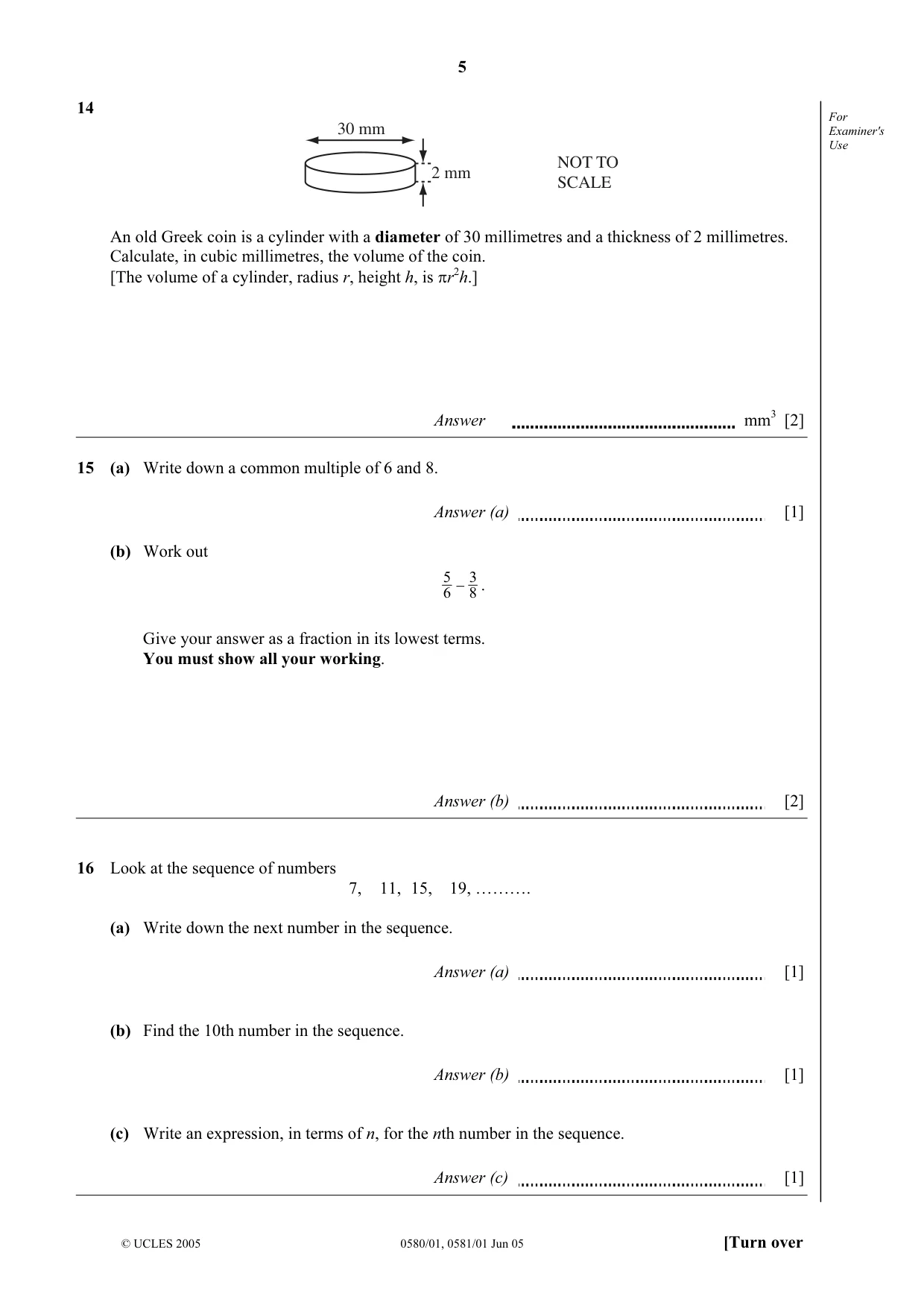
5 © UCLES 2005 0580/01, 0581/01 Jun 05 [Turn over For Examiner's Use 14 30 mm 2 mm NOT TO SCALE An old Greek coin is a cylinder with a diameter of 30 millimetres and a thickness of 2 millimetres. Calculate, in cubic millimetres, the volume of the coin. [The volume of a cylinder, radius r, height h, is πr2h.] Answer mm3 [2] 15 (a) Write down a common multiple of 6 and 8. Answer (a) [1] (b) Work out 8 3 6 5 − . Give your answer as a fraction in its lowest terms. You must show all your working. Answer (b) [2] 16 Look at the sequence of numbers 7, 11, 15, 19, ………. (a) Write down the next number in the sequence. Answer (a) [1] (b) Find the 10th number in the sequence. Answer (b) [1] (c) Write an expression, in terms of n, for the nth number in the sequence. Answer (c) [1]
Question paper, page 6
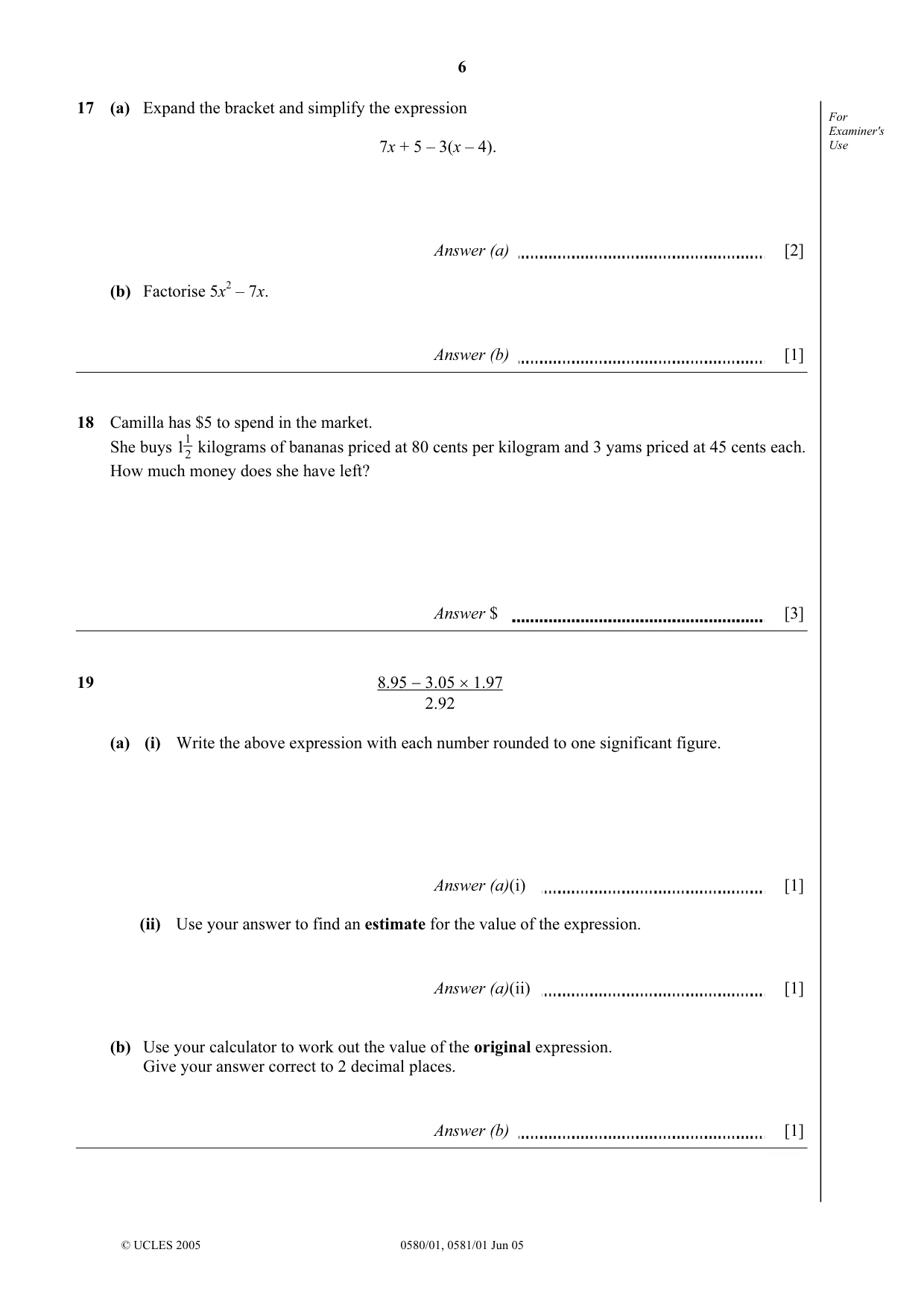
6 © UCLES 2005 0580/01, 0581/01 Jun 05 For Examiner's Use 17 (a) Expand the bracket and simplify the expression 7x + 5 – 3(x – 4). Answer (a) [2] (b) Factorise 5x2 – 7x. Answer (b) [1] 18 Camilla has $5 to spend in the market. She buys 1 kilograms of bananas priced at 80 cents per kilogram and 3 yams priced at 45 cents each. How much money does she have left? Answer $ [3] 19 8.95 − 3.05 × 1.97 2.92 (a) (i) Write the above expression with each number rounded to one significant figure. Answer (a)(i) [1] (ii) Use your answer to find an estimate for the value of the expression. Answer (a)(ii) [1] (b) Use your calculator to work out the value of the original expression. Give your answer correct to 2 decimal places. Answer (b) [1] 2 1
Question paper, page 7
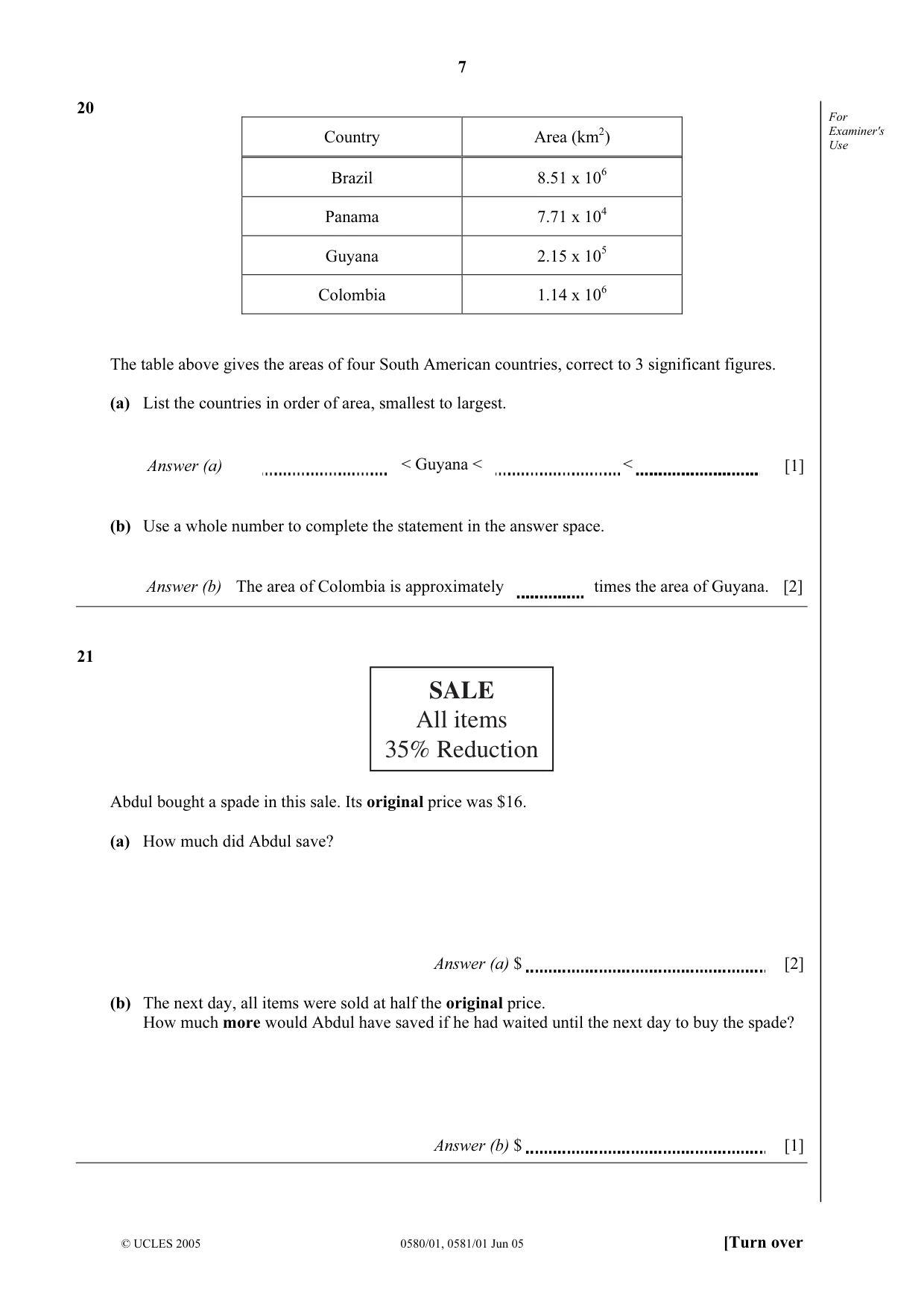
7 © UCLES 2005 0580/01, 0581/01 Jun 05 [Turn over For Examiner's Use 20 Country Area (km2) Brazil 8.51 x 10⁶ Panama 7.71 x 10⁴ Guyana 2.15 x 10⁵ Colombia 1.14 x 10⁶ The table above gives the areas of four South American countries, correct to 3 significant figures. (a) List the countries in order of area, smallest to largest. < Guyana < < Answer (a) [1] (b) Use a whole number to complete the statement in the answer space. Answer (b) The area of Colombia is approximately times the area of Guyana. [2] 21 SALE All items 35% Reduction Abdul bought a spade in this sale. Its original price was $16. (a) How much did Abdul save? Answer (a) $ [2] (b) The next day, all items were sold at half the original price. How much more would Abdul have saved if he had waited until the next day to buy the spade? Answer (b) $ [1]
Question paper, page 8
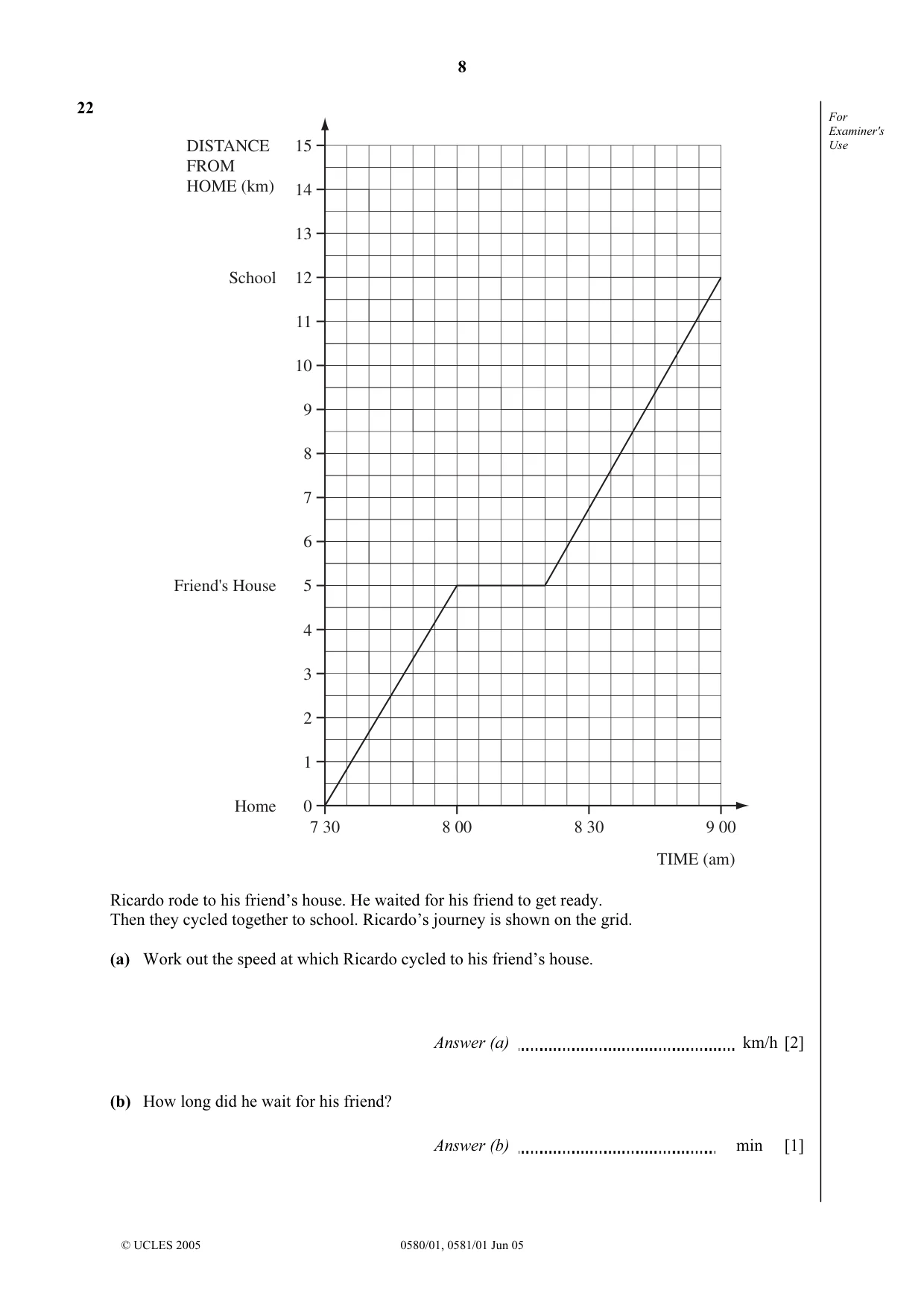
8 © UCLES 2005 0580/01, 0581/01 Jun 05 For Examiner's Use 22 15 14 13 12 11 10 9 8 7 6 5 4 3 2 1 0 7 30 8 00 8 30 9 00 School Friend's House Home DISTANCE FROM HOME (km) TIME (am) Ricardo rode to his friend’s house. He waited for his friend to get ready. Then they cycled together to school. Ricardo’s journey is shown on the grid. (a) Work out the speed at which Ricardo cycled to his friend’s house. Answer (a) km/h [2] (b) How long did he wait for his friend? Answer (b) min [1]
Question paper, page 9
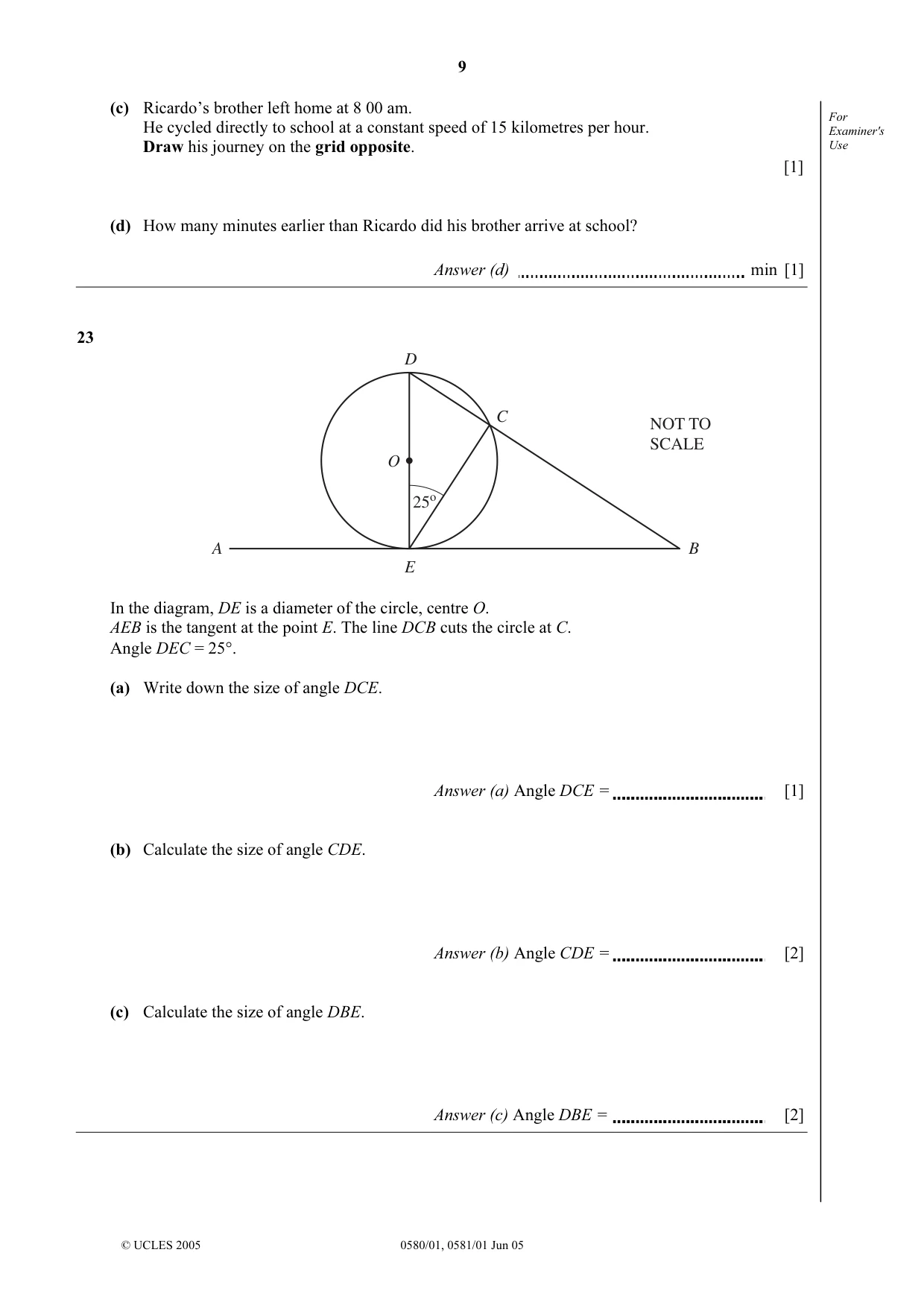
9 © UCLES 2005 0580/01, 0581/01 Jun 05 For Examiner's Use (c) Ricardo’s brother left home at 8 00 am. He cycled directly to school at a constant speed of 15 kilometres per hour. Draw his journey on the grid opposite. [1] (d) How many minutes earlier than Ricardo did his brother arrive at school? Answer (d) min [1] 23 A B E D C O 25o NOT TO SCALE In the diagram, DE is a diameter of the circle, centre O. AEB is the tangent at the point E. The line DCB cuts the circle at C. Angle DEC = 25°. (a) Write down the size of angle DCE. Answer (a) Angle DCE = [1] (b) Calculate the size of angle CDE. Answer (b) Angle CDE = [2] (c) Calculate the size of angle DBE. Answer (c) Angle DBE = [2]
Question paper, page 12
12 Permission to reproduce items where third-party owned material protected by copyright is included has been sought and cleared where possible. Every reasonable effort has been made by the publisher (UCLES) to trace copyright holders, but if any items requiring clearance have unwittingly been included, the publisher will be pleased to make amends at the earliest possible opportunity. University of Cambridge International Examinations is part of the University of Cambridge Local Examinations Syndicate (UCLES), which is itself a department of the University of Cambridge. 0580/01, 0581/01 Jun 05 BLANK PAGE
Mark scheme, page 1
UNIVERSITY OF CAMBRIDGE INTERNATIONAL EXAMINATIONS International General Certificate of Secondary Education MARK SCHEME for the June 2005 question papers 0580/0581 MATHEMATICS 0580/01, 0581/01 Paper 1 (Core), maximum raw mark 56 This mark scheme is published as an aid to teachers and students, to indicate the requirements of the examination. It shows the basis on which Examiners were initialy instructed to award marks. It does not indicate the details of the discussions that took place at an Examiners’ meeting before marking began. Any substantial changes to the mark scheme that arose from these discussions will be recorded in the published Report on the Examination. All Examiners are instructed that alternative correct answers and unexpected approaches in candidates’ scripts must be given marks that fairly reflect the relevant knowledge and skills demonstrated. Mark schemes must be read in conjunction with the question papers and the Report on the Examination. • CIE will not enter into discussion or correspondence in connection with these mark schemes. CIE is publishing the mark schemes for the June 2005 question papers for most IGCSE and GCE Advanced Level and Advanced Subsidiary Level syllabuses and some Ordinary Level syllabuses. www.XtremePapers.com
Mark scheme, page 2
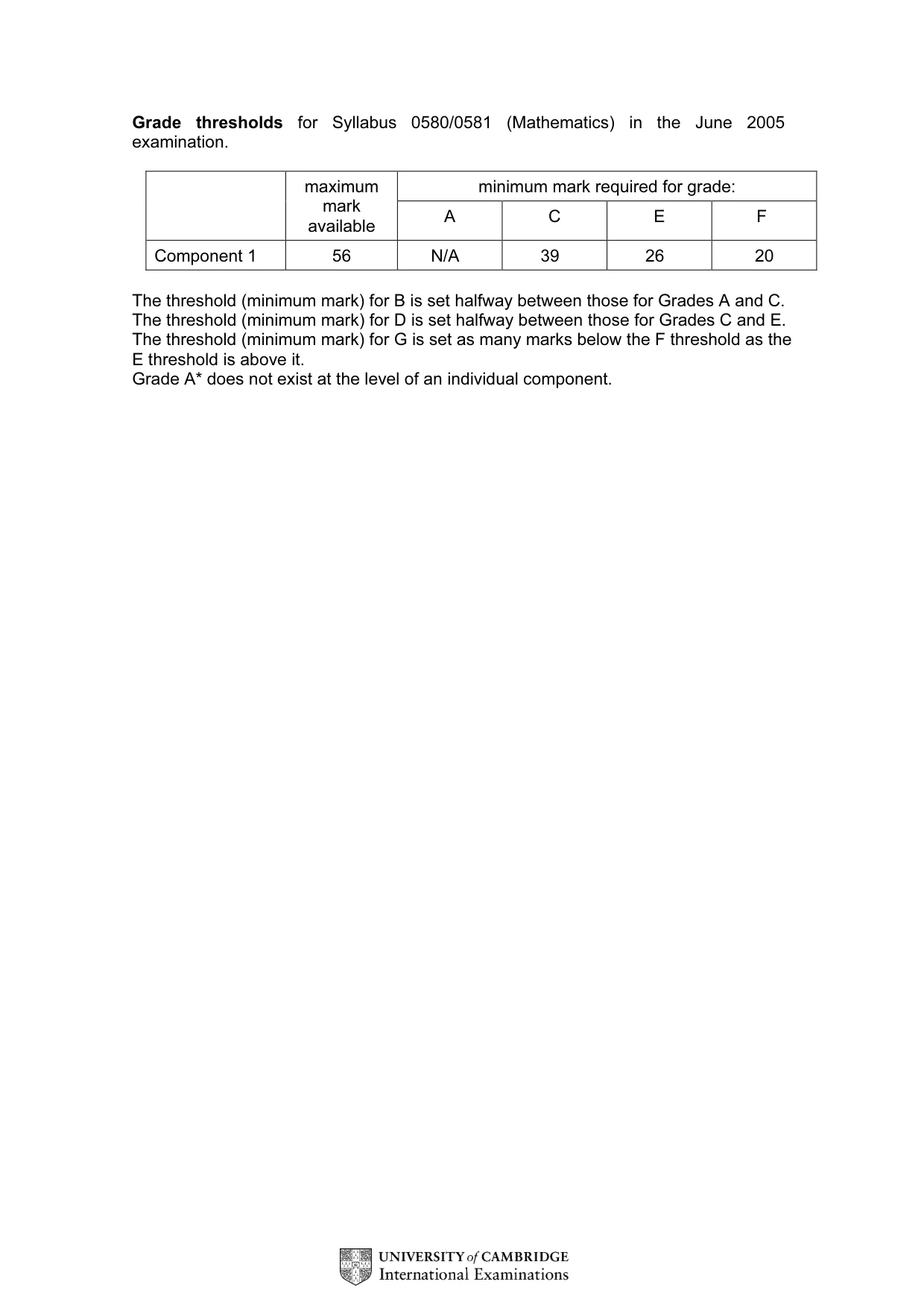
Grade thresholds for Syllabus 0580/0581 (Mathematics) in the June 2005 examination. minimum mark required for grade: maximum mark available A C E F Component 1 56 N/A 39 26 20 The threshold (minimum mark) for B is set halfway between those for Grades A and C. The threshold (minimum mark) for D is set halfway between those for Grades C and E. The threshold (minimum mark) for G is set as many marks below the F threshold as the E threshold is above it. Grade A* does not exist at the level of an individual component.
Mark scheme, page 3
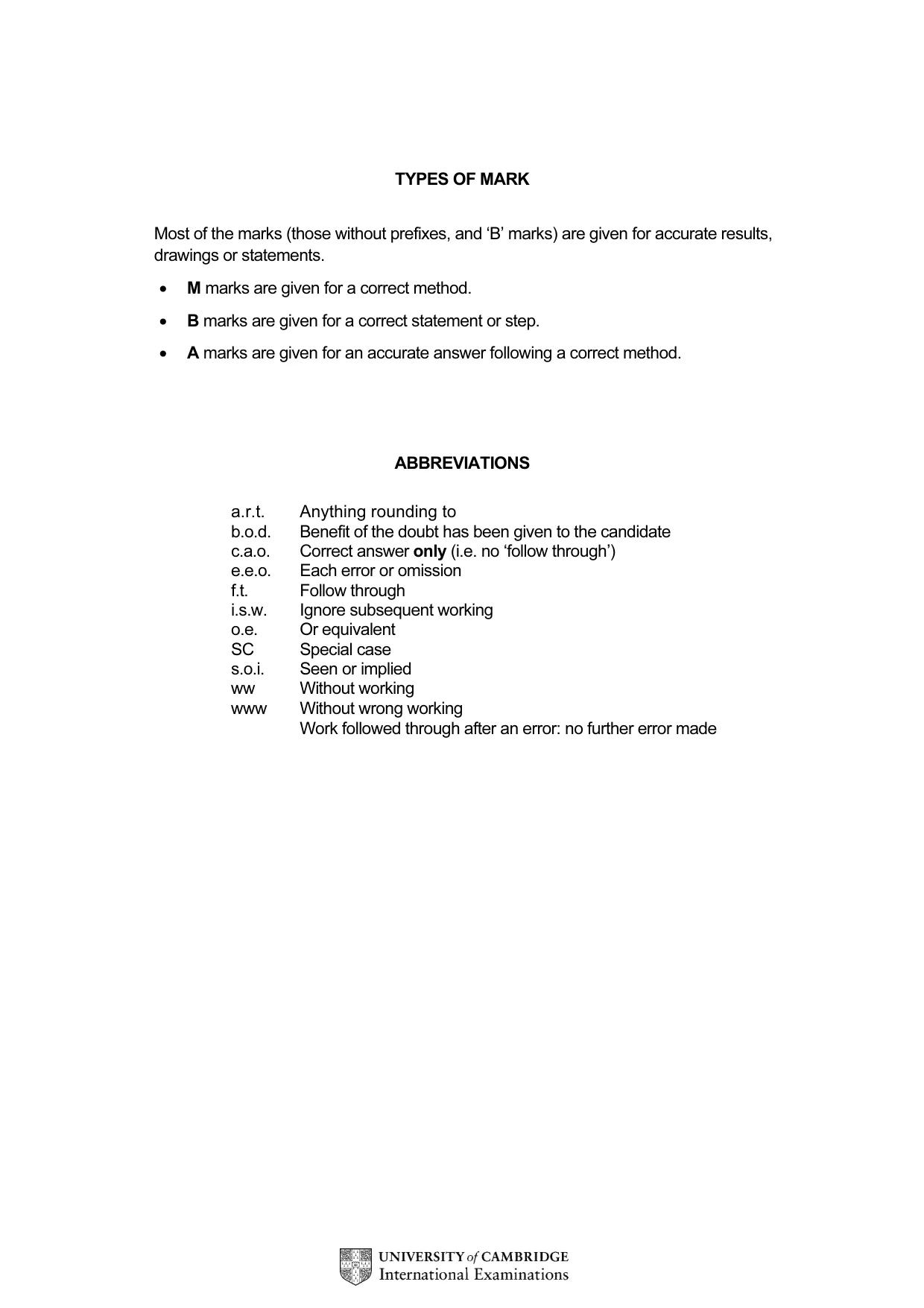
TYPES OF MARK Most of the marks (those without prefixes, and ‘B’ marks) are given for accurate results, drawings or statements. • M marks are given for a correct method. • B marks are given for a correct statement or step. • A marks are given for an accurate answer following a correct method. ABBREVIATIONS a.r.t. Anything rounding to b.o.d. Benefit of the doubt has been given to the candidate c.a.o. Correct answer only (i.e. no ‘follow through’) e.e.o. Each error or omission f.t. Follow through i.s.w. Ignore subsequent working o.e. Or equivalent SC Special case s.o.i. Seen or implied ww Without working www Without wrong working Work followed through after an error: no further error made
Mark scheme, page 4
June 2005 IGCSE MARK SCHEME MAXIMUM MARK: 56 SYLLABUS/COMPONENT: 0580/01, 0581/01 MATHEMATICS Paper 1 (Core)
Mark scheme, page 5
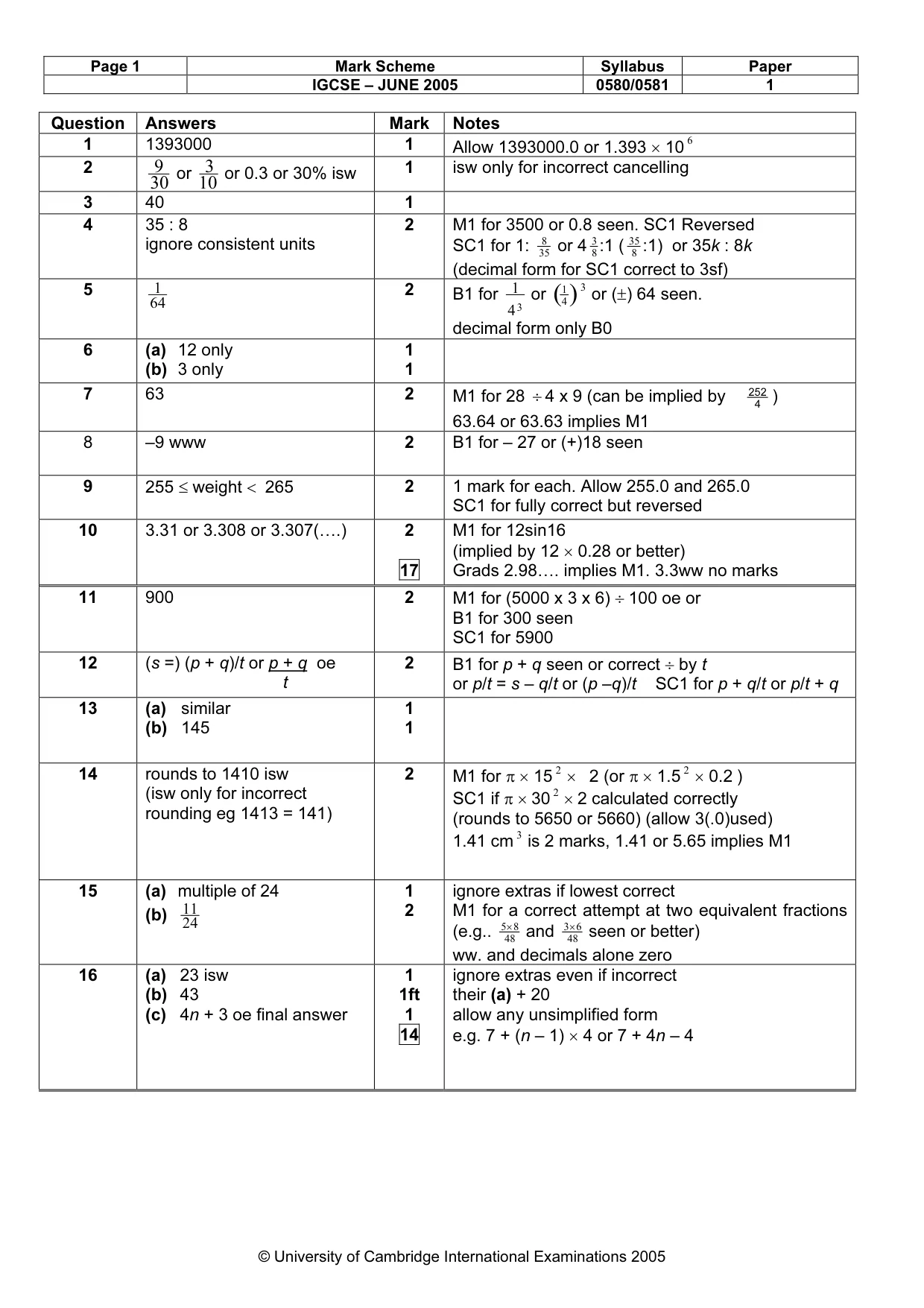
Page 1 Mark Scheme Syllabus Paper IGCSE – JUNE 2005 0580/0581 1 © University of Cambridge International Examinations 2005 Question Answers Mark Notes 1 1393000 1 Allow 1393000.0 or 1.393 × 10 6 2 9 30 or 3 10 or 0.3 or 30% isw 1 isw only for incorrect cancelling 3 40 1 4 35 : 8 ignore consistent units 2 M1 for 3500 or 0.8 seen. SC1 Reversed SC1 for 1: 8 35 or 4 3 8:1 ( 35 8 :1) or 35k : 8k (decimal form for SC1 correct to 3sf) 5 1 64 2 B1 for 1 43 or 1 4( ) 3 or (±) 64 seen. decimal form only B0 6 (a) 12 only (b) 3 only 1 1 7 63 2 M1 for 28 ÷ 4 x 9 (can be implied by 4 252 ) 63.64 or 63.63 implies M1 8 –9 www 2 B1 for – 27 or (+)18 seen 9 255 ≤ weight < 265 2 1 mark for each. Allow 255.0 and 265.0 SC1 for fully correct but reversed 10 3.31 or 3.308 or 3.307(….) 2 17 M1 for 12sin16 (implied by 12 × 0.28 or better) Grads 2.98…. implies M1. 3.3ww no marks 11 900 2 M1 for (5000 x 3 x 6) ÷ 100 oe or B1 for 300 seen SC1 for 5900 12 (s =) (p + q)/t or p + q oe t 2 B1 for p + q seen or correct ÷ by t or p/t = s – q/t or (p –q)/t SC1 for p + q/t or p/t + q 13 (a) similar (b) 145 1 1 14 rounds to 1410 isw (isw only for incorrect rounding eg 1413 = 141) 2 M1 for π × 15 2 × 2 (or π × 1.5 2 × 0.2 ) SC1 if π × 30 2 × 2 calculated correctly (rounds to 5650 or 5660) (allow 3(.0)used) 1.41 cm 3 is 2 marks, 1.41 or 5.65 implies M1 15 (a) multiple of 24 (b) 11 24 1 2 ignore extras if lowest correct M1 for a correct attempt at two equivalent fractions (e.g.. 5×8 48 and 3×6 48 seen or better) ww. and decimals alone zero 16 (a) 23 isw (b) 43 (c) 4n + 3 oe final answer 1 1ft 1 14 ignore extras even if incorrect their (a) + 20 allow any unsimplified form e.g. 7 + (n – 1) × 4 or 7 + 4n – 4
Mark scheme, page 6
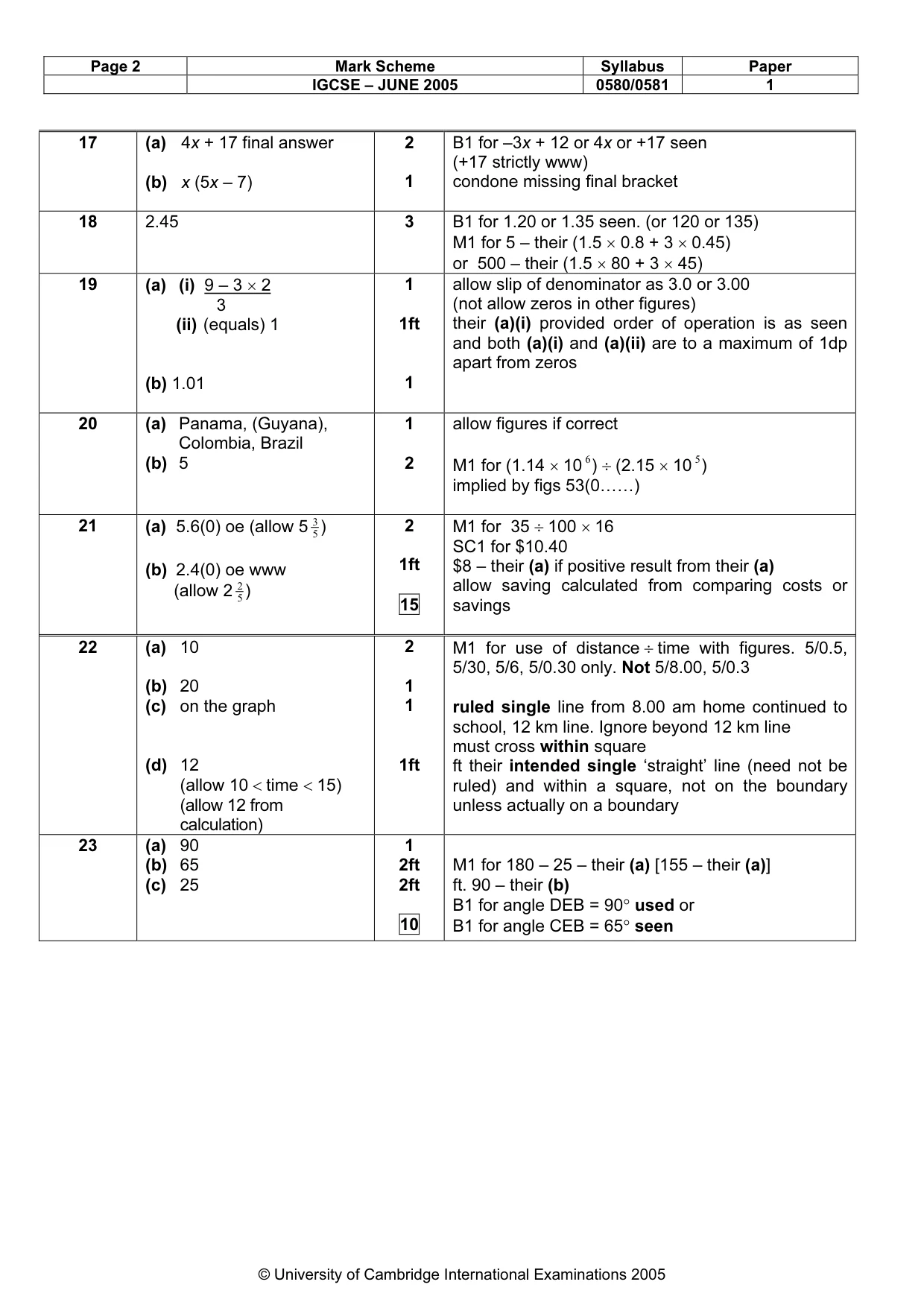
Page 2 Mark Scheme Syllabus Paper IGCSE – JUNE 2005 0580/0581 1 © University of Cambridge International Examinations 2005 17 (a) 4x + 17 final answer (b) x (5x – 7) 2 1 B1 for –3x + 12 or 4x or +17 seen (+17 strictly www) condone missing final bracket 18 2.45 3 B1 for 1.20 or 1.35 seen. (or 120 or 135) M1 for 5 – their (1.5 × 0.8 + 3 × 0.45) or 500 – their (1.5 × 80 + 3 × 45) 19 (a) (i) 9 – 3 × 2 3 (ii) (equals) 1 (b) 1.01 1 1ft 1 allow slip of denominator as 3.0 or 3.00 (not allow zeros in other figures) their (a)(i) provided order of operation is as seen and both (a)(i) and (a)(ii) are to a maximum of 1dp apart from zeros 20 (a) Panama, (Guyana), Colombia, Brazil (b) 5 1 2 allow figures if correct M1 for (1.14 × 10 6) ÷ (2.15 × 10 5) implied by figs 53(0……) 21 (a) 5.6(0) oe (allow 5 3 5) (b) 2.4(0) oe www (allow 2 2 5) 2 1ft 15 M1 for 35 ÷ 100 × 16 SC1 for $10.40 $8 – their (a) if positive result from their (a) allow saving calculated from comparing costs or savings 22 (a) 10 (b) 20 (c) on the graph (d) 12 (allow 10 < time < 15) (allow 12 from calculation) 2 1 1 1ft M1 for use of distance ÷ time with figures. 5/0.5, 5/30, 5/6, 5/0.30 only. Not 5/8.00, 5/0.3 ruled single line from 8.00 am home continued to school, 12 km line. Ignore beyond 12 km line must cross within square ft their intended single ‘straight’ line (need not be ruled) and within a square, not on the boundary unless actually on a boundary 23 (a) 90 (b) 65 (c) 25 1 2ft 2ft 10 M1 for 180 – 25 – their (a) [155 – their (a)] ft. 90 – their (b) B1 for angle DEB = 90° used or B1 for angle CEB = 65° seen