Cambridge IGCSE Mathematics (US) 0444 — 2020 May/June Paper 2 · Variant 1
0444/21/M/J/20 · 21 questions · 70 marks · ≈79 min
The question paper and its mark scheme, free to read here and free to download. This is Cambridge’s own paper, exactly as it was sat.
Question paper16 pages
Mark scheme6 pages
Answers below. Sit the paper first if you are practising.
Questions as text
Q1 · Rectangle A measures 3 cm by 8 cm
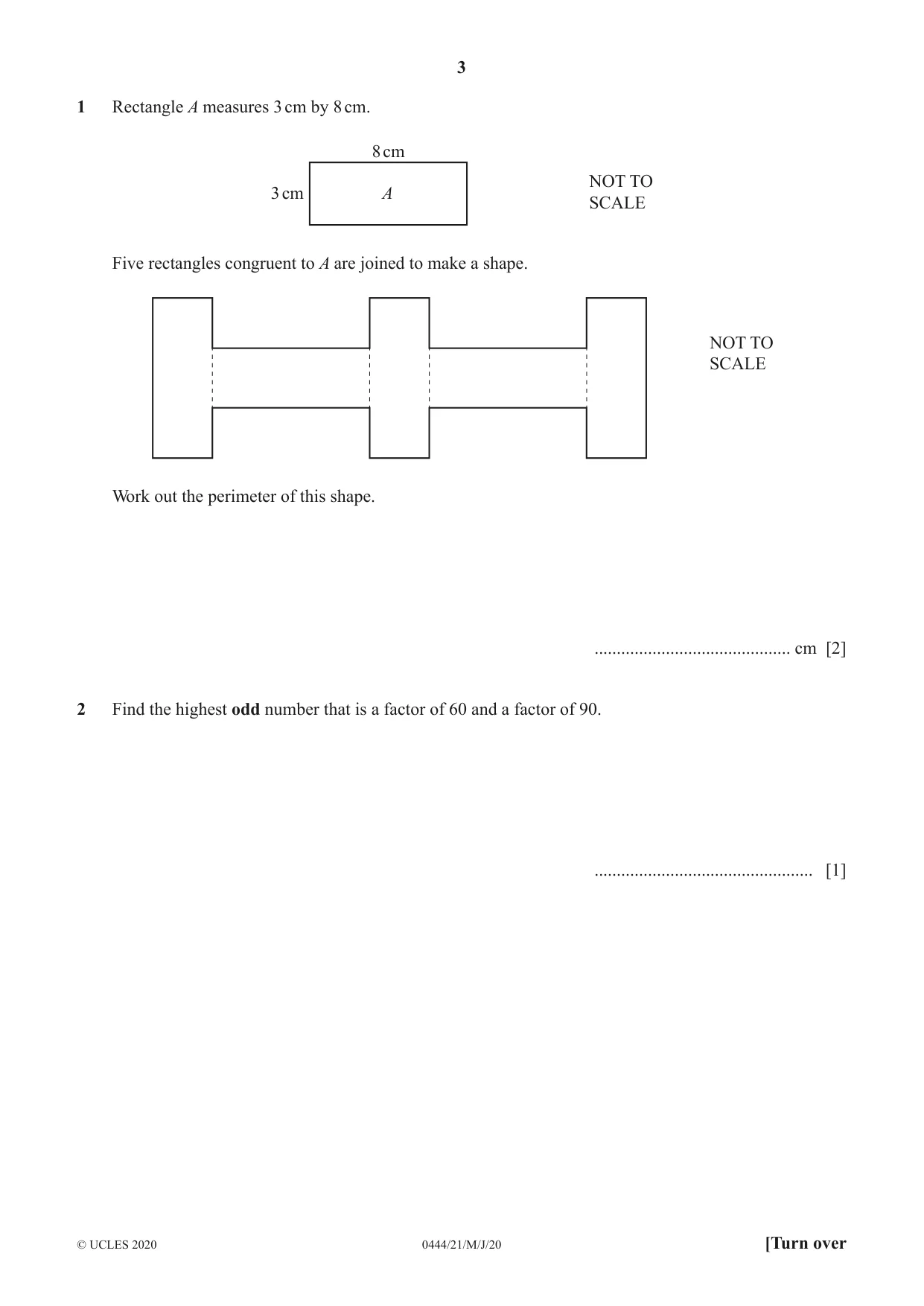
1 Rectangle A measures 3 cm by 8 cm. 8 cm NOT TO 3 cm A SCALE Five rectangles congruent to A are joined to make a shape. NOT TO SCALE Work out the perimeter of this shape. ............................................ cm [2]
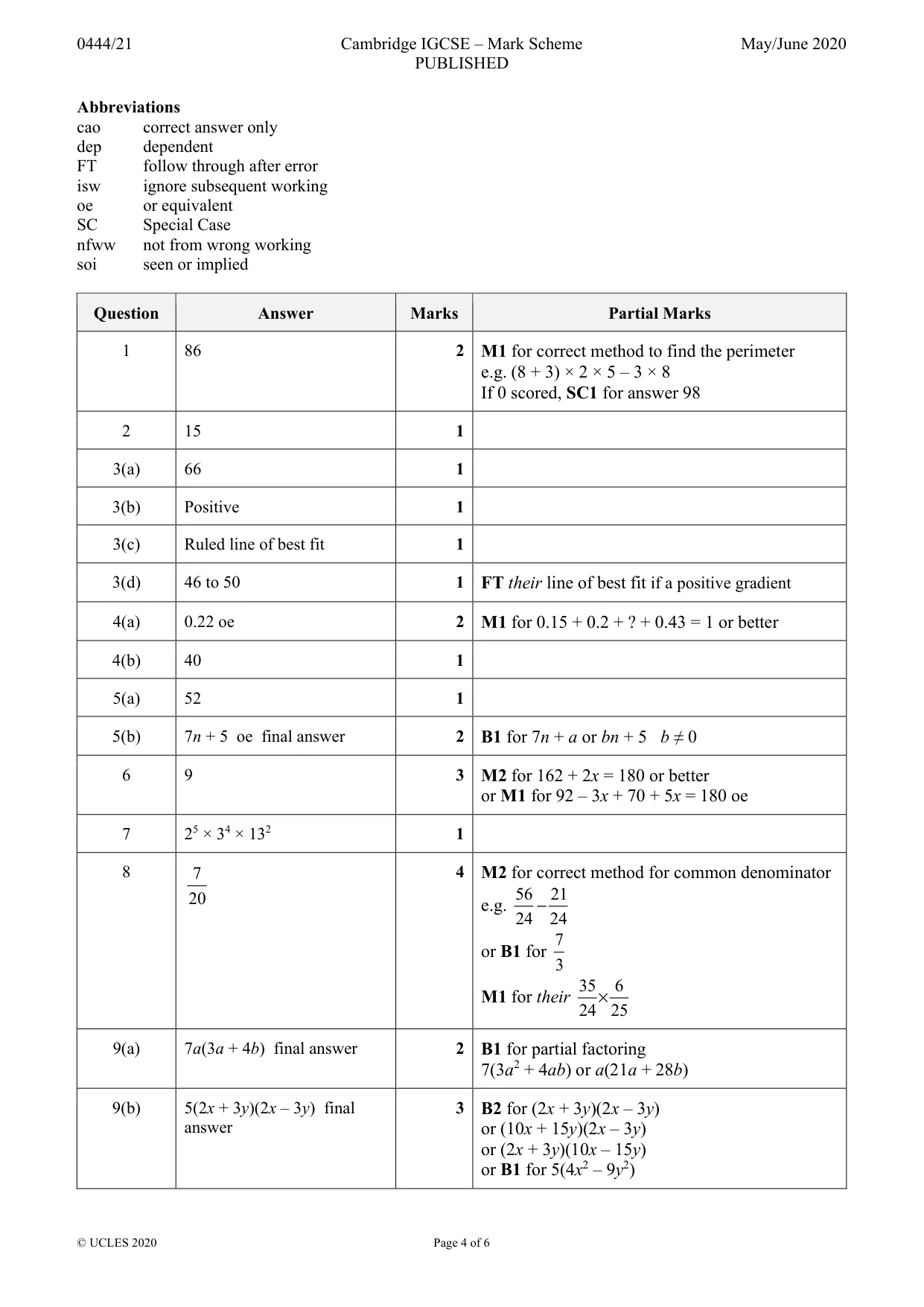
Mark scheme: Question Answer Marks Partial Marks 1 86 2 M1 for correct method to find the perimeter e.g. (8 + 3) × 2 × 5 – 3 × 8 If 0 scored, SC1 for answer 98
Q2 · Find the highest odd number that is a factor of 60 and a factor of 90
2 Find the highest odd number that is a factor of 60 and a factor of 90. ................................................. [1]
Mark scheme: 2 15 1
Q3 · Mrs Salaman gives her class two mathematics tests
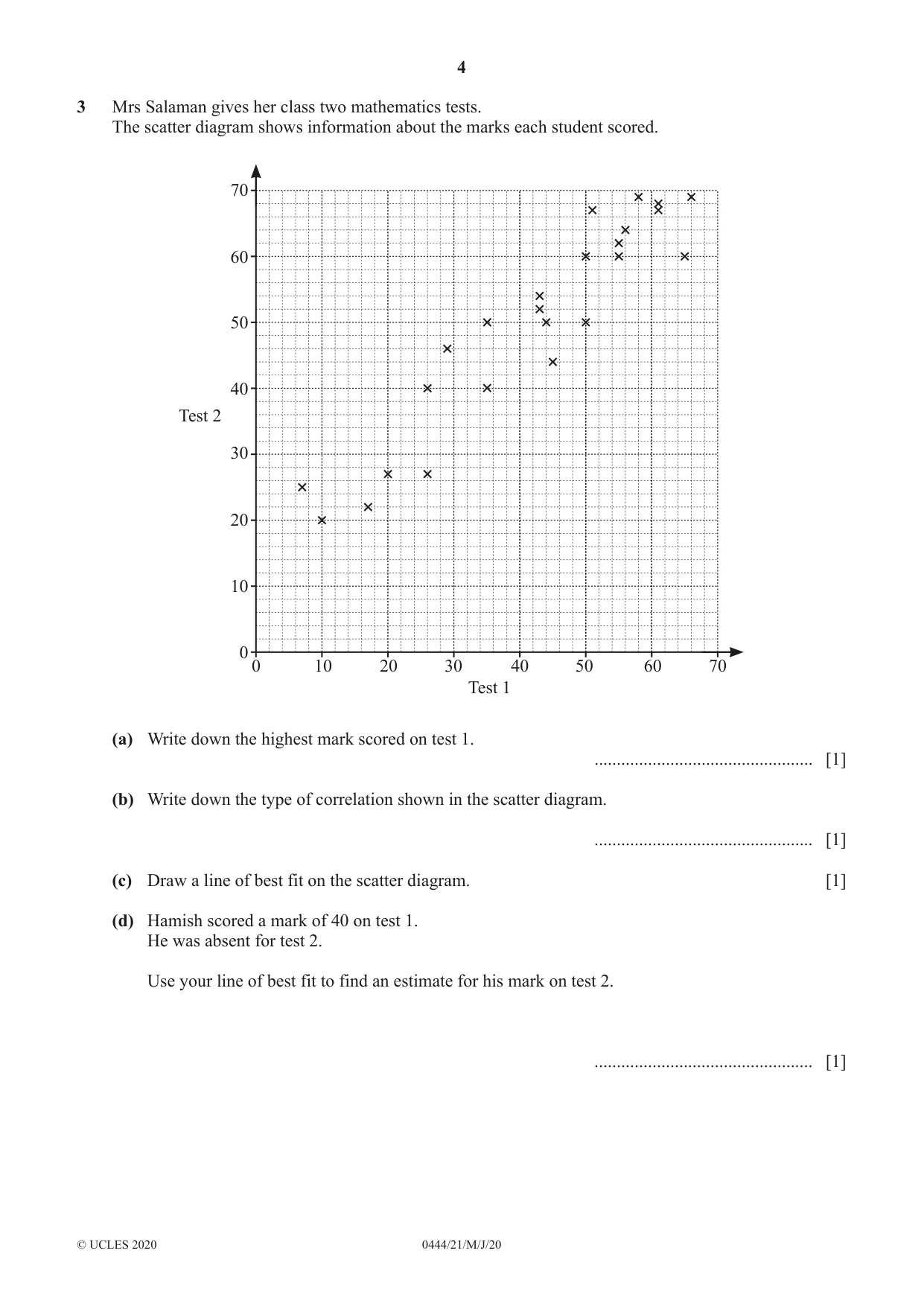
3 Mrs Salaman gives her class two mathematics tests. The scatter diagram shows information about the marks each student scored. 70 60 50 40 Test 2 30 20 10 0 0 10 20 30 40 50 60 70 Test 1 (a) Write down the highest mark scored on test 1. ................................................. [1] (b) Write down the type of correlation shown in the scatter diagram. ................................................. [1] (c) Draw a line of best fit on the scatter diagram. [1] (d) Hamish scored a mark of 40 on test 1. He was absent for test 2. Use your line of best fit to find an estimate for his mark on test 2. ................................................. [1]
Mark scheme: 3(a) 66 1 3(b) Positive 1 3(c) Ruled line of best fit 1 3(d) 46 to 50 1 FT their line of best fit if a positive gradient
Q4 · A bag contains blue, red, yellow, and green balls only
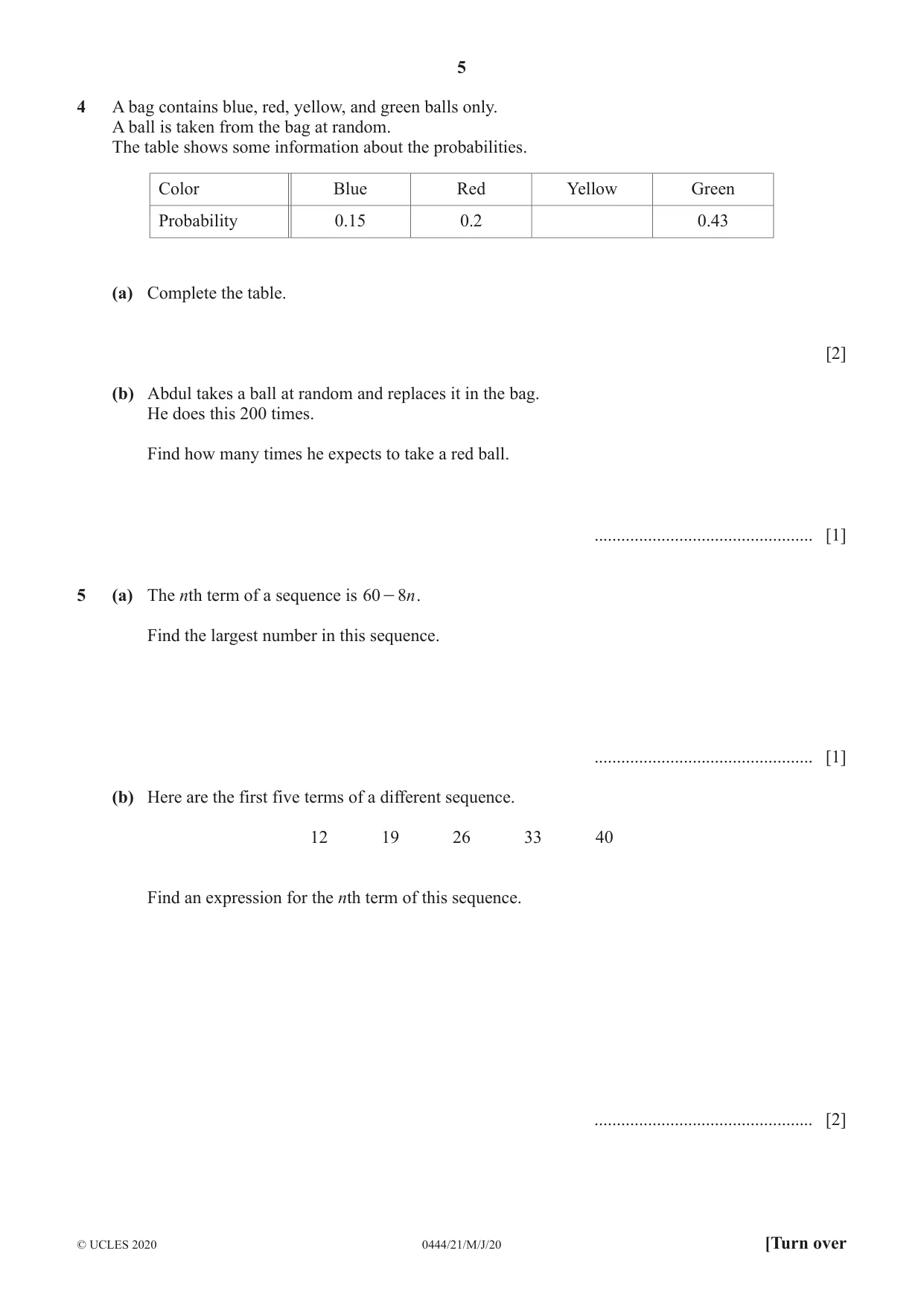
4 A bag contains blue, red, yellow, and green balls only. A ball is taken from the bag at random. The table shows some information about the probabilities. Color Blue Red Yellow Green Probability 0.15 0.2 0.43 (a) Complete the table. [2] (b) Abdul takes a ball at random and replaces it in the bag. He does this 200 times. Find how many times he expects to take a red ball. ................................................. [1]
Mark scheme: 4(a) 0.22 oe 2 M1 for 0.15 + 0.2 + ? + 0.43 = 1 or better 4(b) 40 1
Q5 · The nth term of a sequence is 60 - 8n
5 (a) The nth term of a sequence is 60 - 8n . Find the largest number in this sequence. ................................................. [1] (b) Here are the first five terms of a different sequence. 12 19 26 33 40 Find an expression for the nth term of this sequence. ................................................. [2]
Mark scheme: 5(a) 52 1 5(b) 7n + 5 oe final answer 2 B1 for 7n + a or bn + 5 b ≠ 0
Q6 · The diagram shows a trapezoid
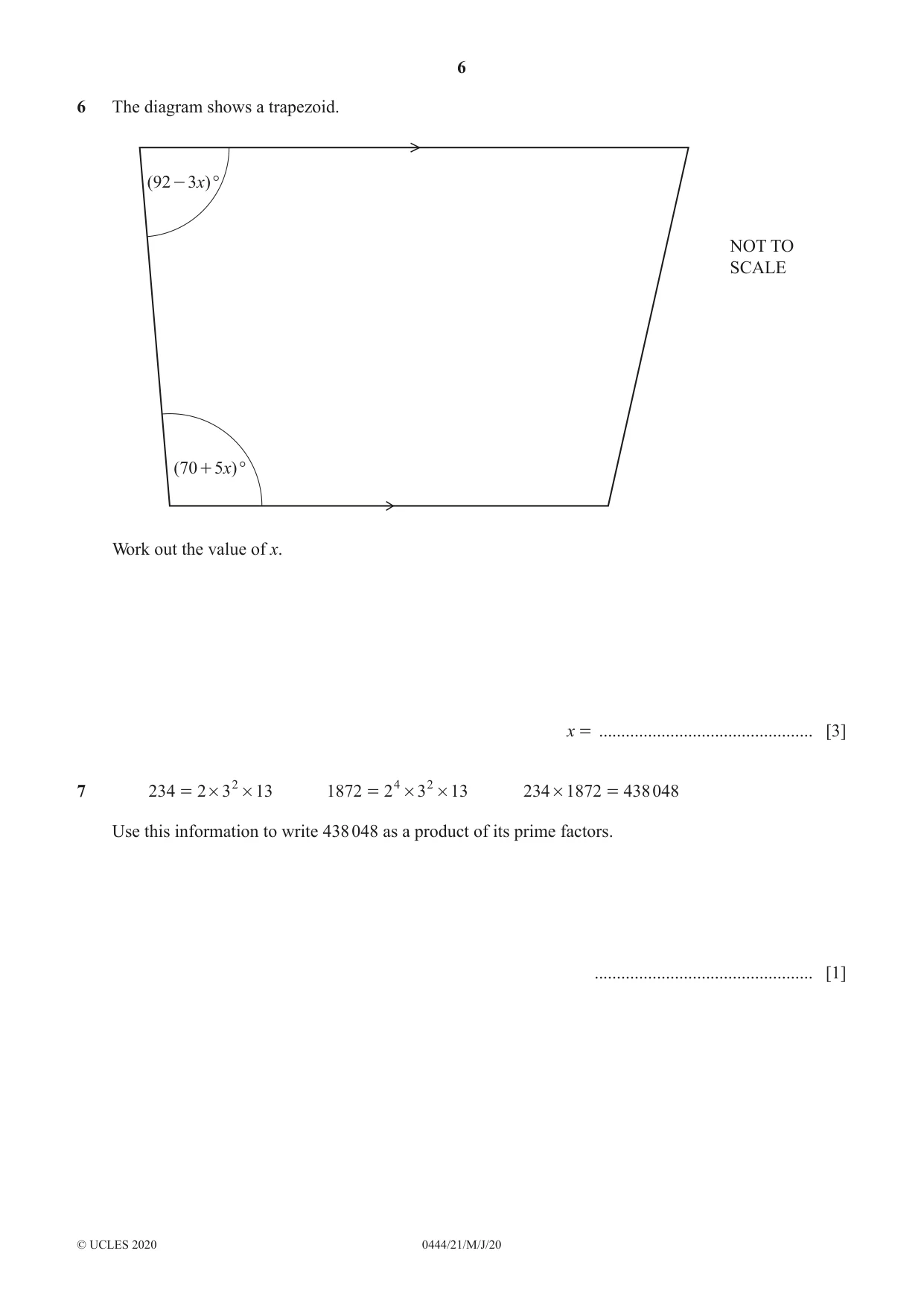
6 The diagram shows a trapezoid. ( 92- 3x)° NOT TO SCALE ( 70+ 5x)° Work out the value of x. x = ................................................ [3]
Mark scheme: 6 9 3 M2 for 162 + 2x = 180 or better or M1 for 92 – 3x + 70 + 5x = 180 oe
Q7 · 234 = 2 # 3 2 # 13 1872 = 2 4 # 3 2 # 13 234 # 1872 = 438048 Use this information to…
7 234 = 2 # 3 2 # 13 1872 = 2 4 # 3 2 # 13 234 # 1872 = 438048 Use this information to write 438 048 as a product of its prime factors. ................................................. [1]
Mark scheme: 7 25 × 34 × 132 1
Q8 · Work out 2 - #
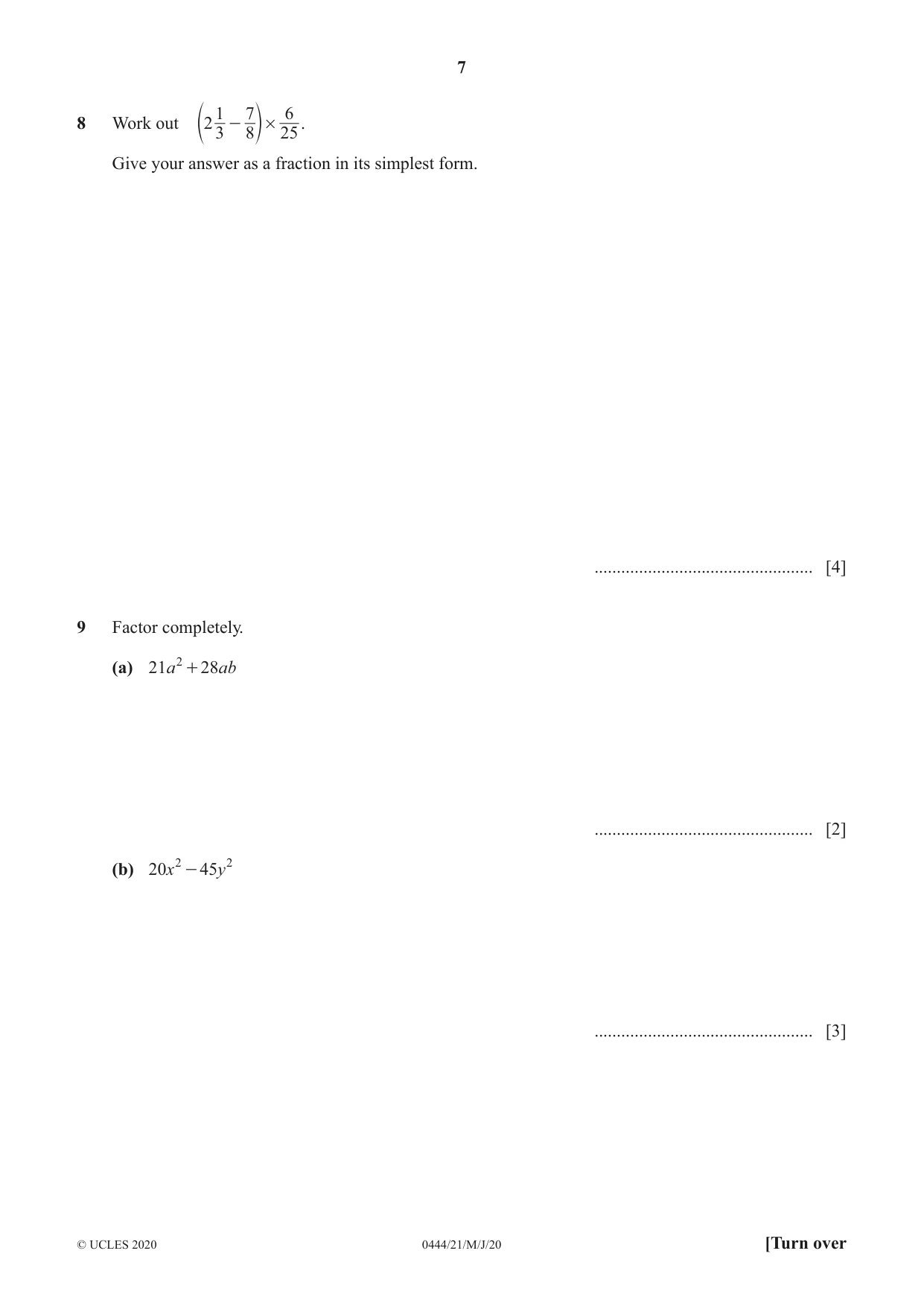
8 Work out 2 - # . 3 8 25 Give your answer as a fraction in its simplest form. ................................................. [4]
Mark scheme: 8 7 4 M2 for correct method for common denominator 20 56 21 e.g. − 24 24 7 or B1 for 3 35 6 M1 for their × 24 25
Question 9
9 Factor completely. (a) 21a 2 + 28ab ................................................. [2] (b) 20x 2 - 45y 2 ................................................. [3]
Mark scheme: 9(a) 7a(3a + 4b) final answer 2 B1 for partial factoring 7(3a2 + 4ab) or a(21a + 28b) 9(b) 5(2x + 3y)(2x – 3y) final 3 B2 for (2x + 3y)(2x – 3y) answer or (10x + 15y)(2x – 3y) or (2x + 3y)(10x – 15y) or B1 for 5(4x2 – 9y2)
Q10 · E NOT TO SCALE D 24° F y° O 110° C x° A B Points A, B, C, D, E and F lie on the circle…
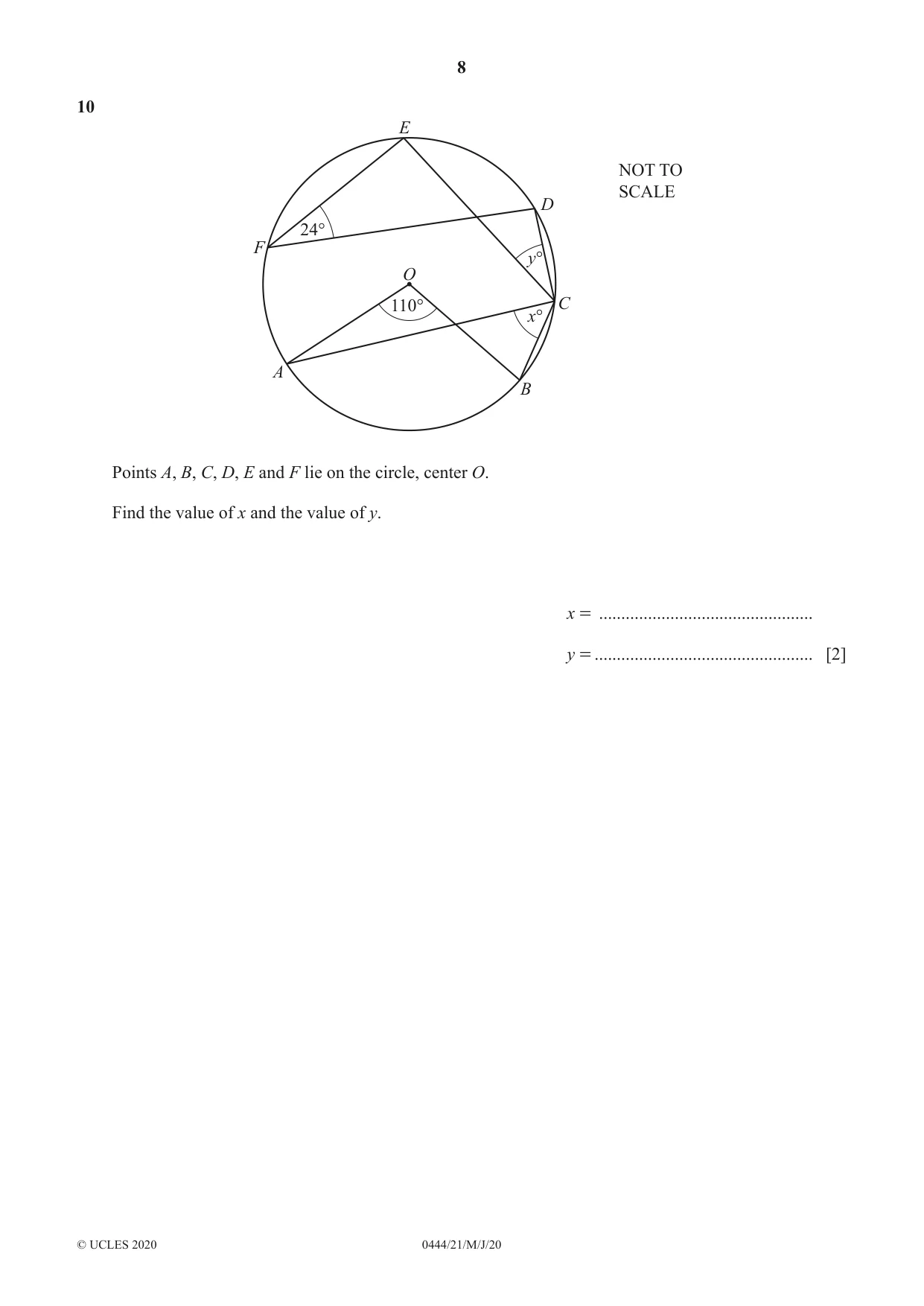
10 E NOT TO SCALE D 24° F y° O 110° C x° A B Points A, B, C, D, E and F lie on the circle, center O. Find the value of x and the value of y. x = ................................................ y = ................................................. [2]
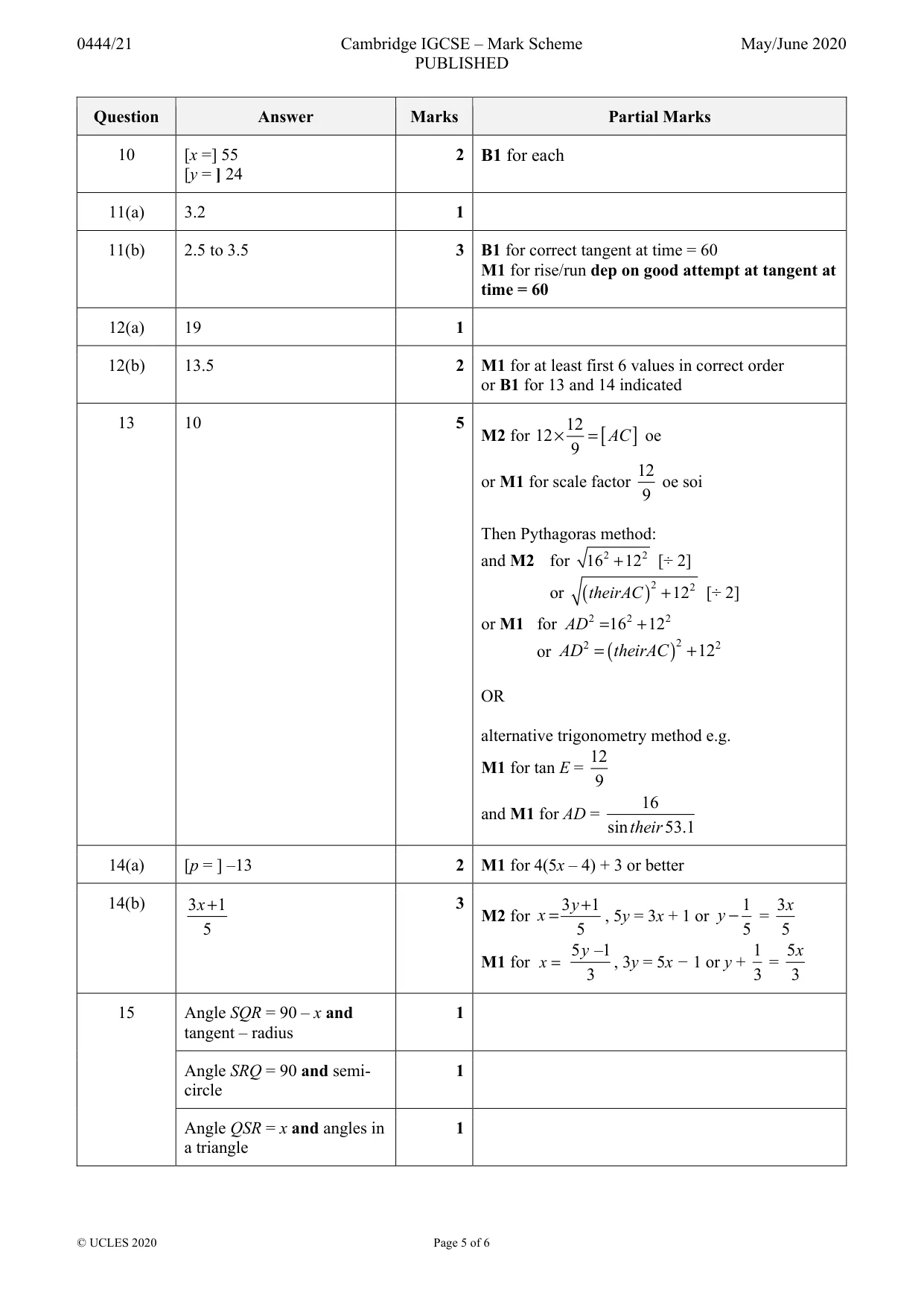
Mark scheme: 10 [x =] 55 2 B1 for each [y = ] 24
Q11 · 320 280 240 200 Distance (meters) 160 120 80 40 0 0 10 20 30 40 50 60 70 80 90 100 Time…
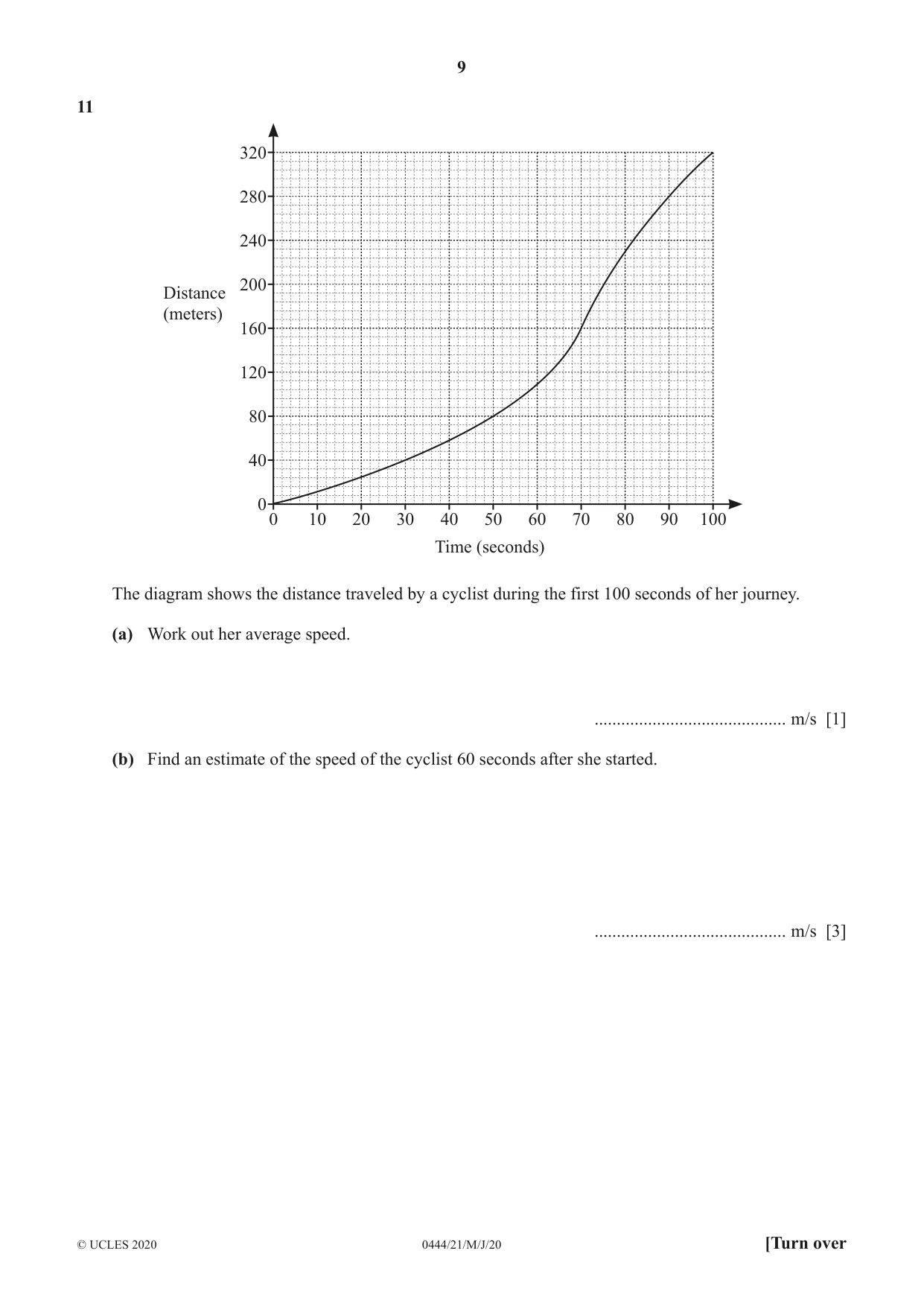
11 320 280 240 200 Distance (meters) 160 120 80 40 0 0 10 20 30 40 50 60 70 80 90 100 Time (seconds) The diagram shows the distance traveled by a cyclist during the first 100 seconds of her journey. (a) Work out her average speed. ........................................... m/s [1] (b) Find an estimate of the speed of the cyclist 60 seconds after she started. ........................................... m/s [3]
Mark scheme: 11(a) 3.2 1 11(b) 2.5 to 3.5 3 B1 for correct tangent at time = 60 M1 for rise/run dep on good attempt at tangent at time = 60
Q12 · 19 11 13 10 12 19 14 15 19 13 The list shows 10 test scores
12 19 11 13 10 12 19 14 15 19 13 The list shows 10 test scores. Find (a) the mode, ................................................. [1] (b) the median. ................................................. [2]
Mark scheme: 12(a) 19 1 12(b) 13.5 2 M1 for at least first 6 values in correct order or B1 for 13 and 14 indicated
Q13 · C B 12 cm NOT TO SCALE 9 cm 12 cm D E A C lies on a circle with diameter AD
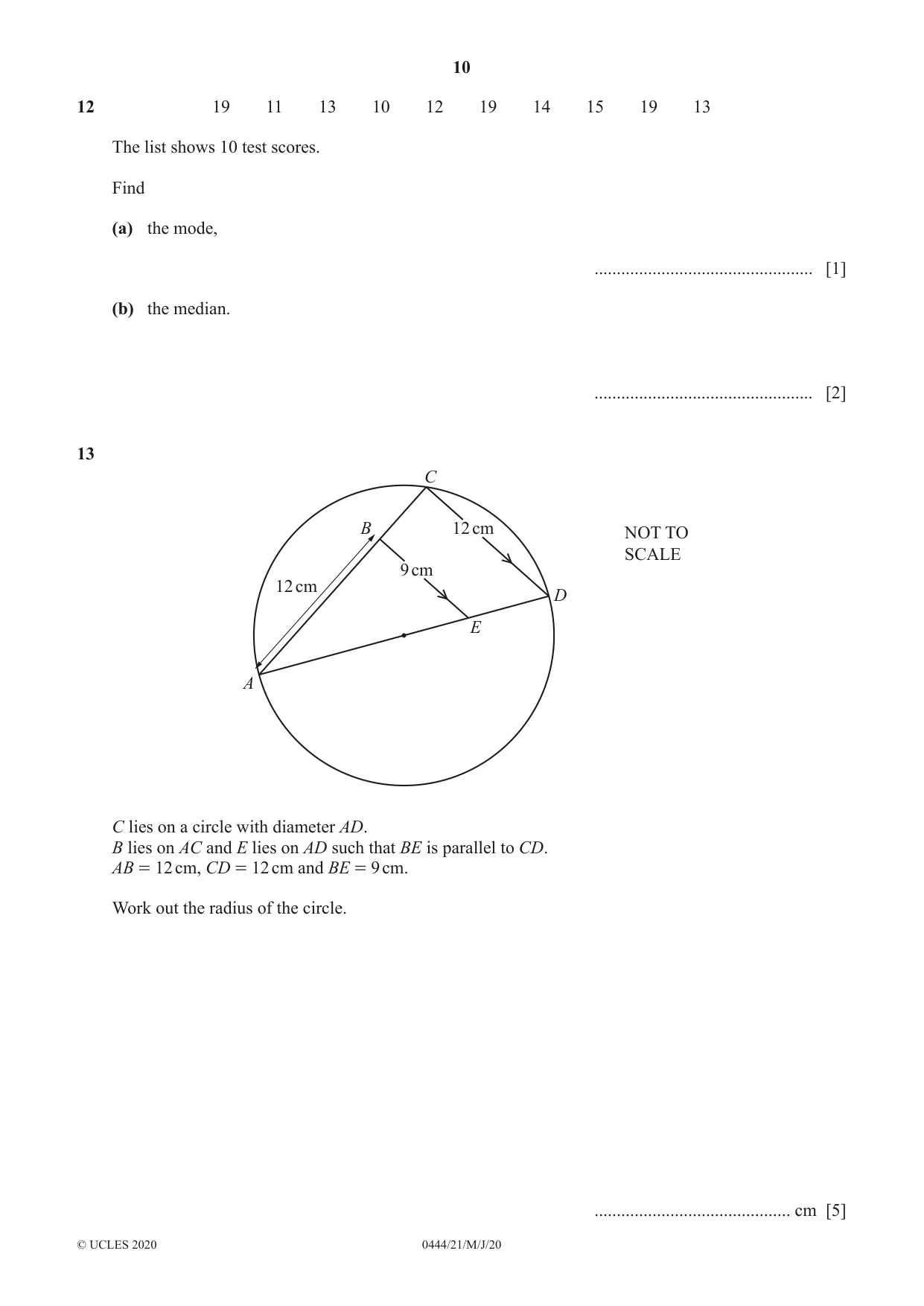
13 C B 12 cm NOT TO SCALE 9 cm 12 cm D E A C lies on a circle with diameter AD. B lies on AC and E lies on AD such that BE is parallel to CD. AB = 12 cm, CD = 12 cm and BE = 9 cm. Work out the radius of the circle. ............................................ cm [5]
Mark scheme: 13 10 5 12 M2 for 12 × = [ AC ] oe 9 12 or M1 for scale factor oe soi 9 Then Pythagoras method: and M2 for 16 2 + 12 2 [÷ 2] or ( theirAC ) 2 + 12 2 [÷ 2] or M1 for AD 2 = 1 6 2 + 12 2 2 2 2 or AD = ( theirAC ) + 12 OR alternative trigonometry method e.g. 12 M1 for tan E = 9 16 and M1 for AD = sin their 53.1
Q14 · F ( x) = 4 x + 3 g ( x) = 5 x - 4 f g ( x) = 20 x + p ` j Find the value of p
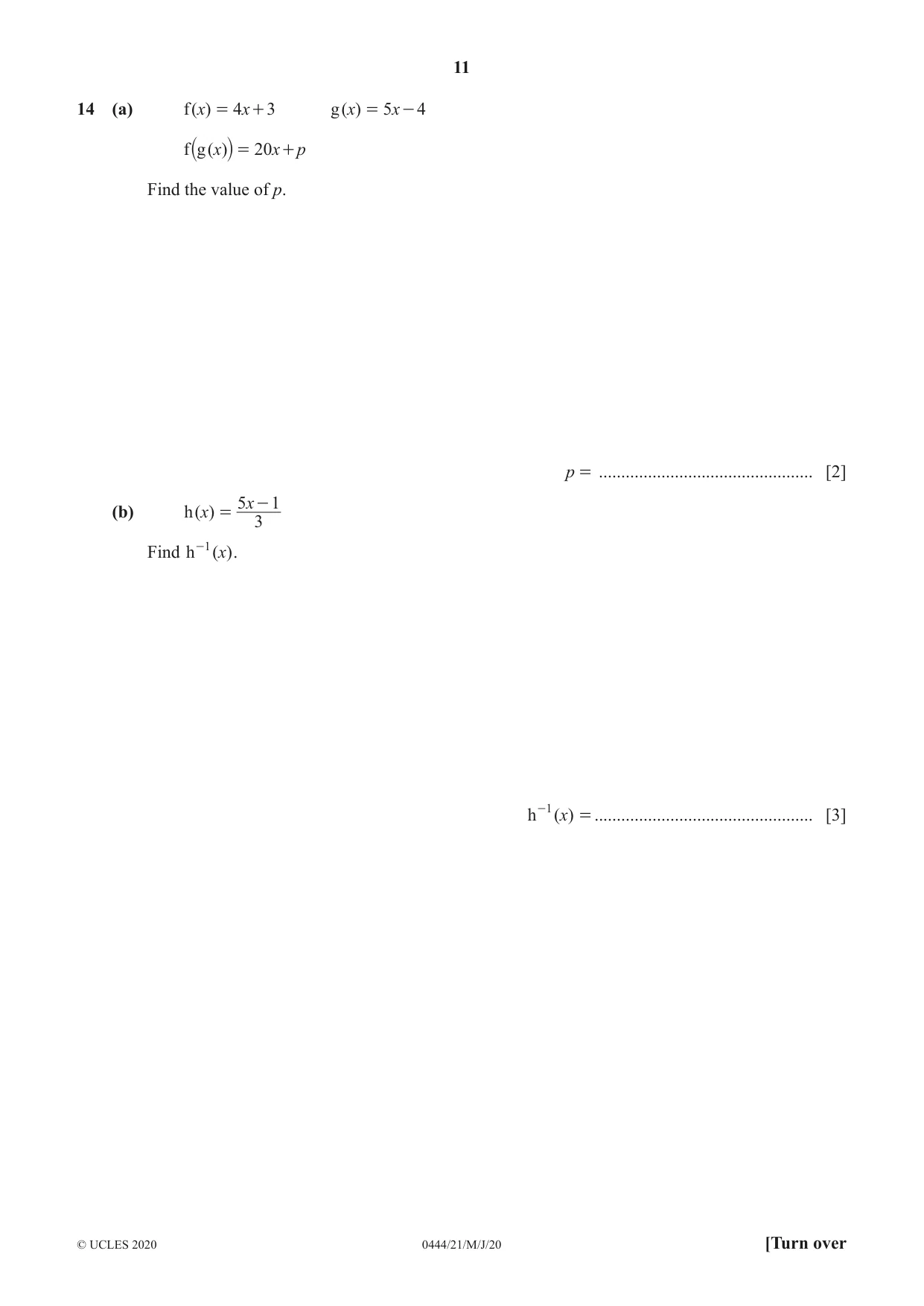
14 (a) f ( x) = 4 x + 3 g ( x) = 5 x - 4 f g ( x) = 20 x + p ` j Find the value of p. p = ................................................ [2] 5x - 1 (b) h ( x) = 3 Find h -1 ( x) . h -1 ( x) = ................................................. [3]
Mark scheme: 14(a) [p = ] –13 2 M1 for 4(5x – 4) + 3 or better 14(b) 3 x + 1 3 3 y + 1 1 3 x M2 for x = , 5y = 3x + 1 or y − = 5 5 5 5 5 y –1 1 5 x M1 for x = , 3y = 5x − 1 or y + = 3 3 3
Q15 · A NOT TO Q SCALE x° B R S Q, R and S are points on the circle
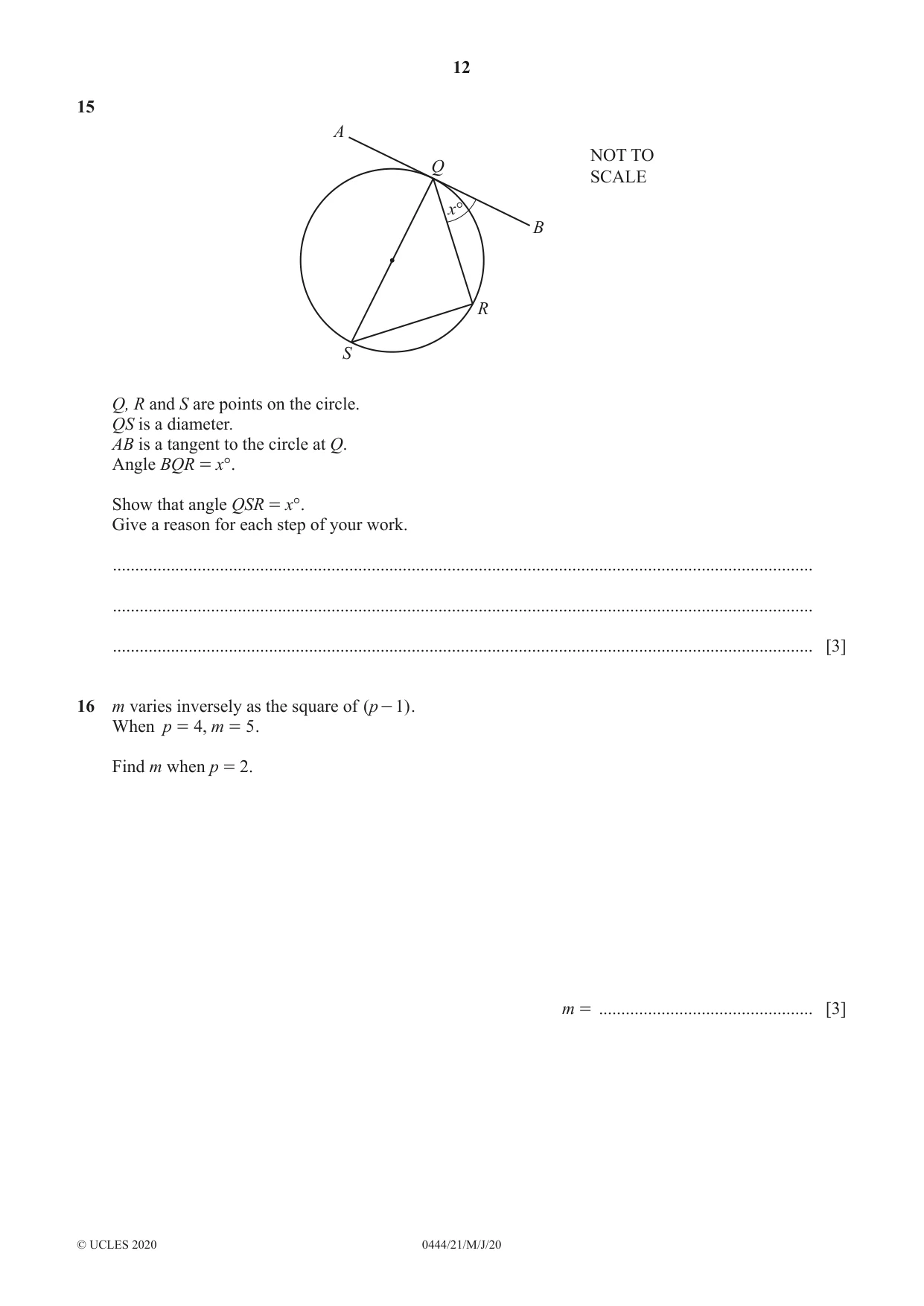
15 A NOT TO Q SCALE x° B R S Q, R and S are points on the circle. QS is a diameter. AB is a tangent to the circle at Q. Angle BQR = x°. Show that angle QSR = x°. Give a reason for each step of your work. ............................................................................................................................................................. ............................................................................................................................................................. ............................................................................................................................................................. [3]
Mark scheme: 15 Angle SQR = 90 – x and 1 tangent – radius Angle SRQ = 90 and semi- 1 circle Angle QSR = x and angles in 1 a triangle
Q16 · M varies inversely as the square of ( p - 1 )
16 m varies inversely as the square of ( p - 1 ) . When p = 4 , m = 5 . Find m when p = 2. m = ................................................ [3]
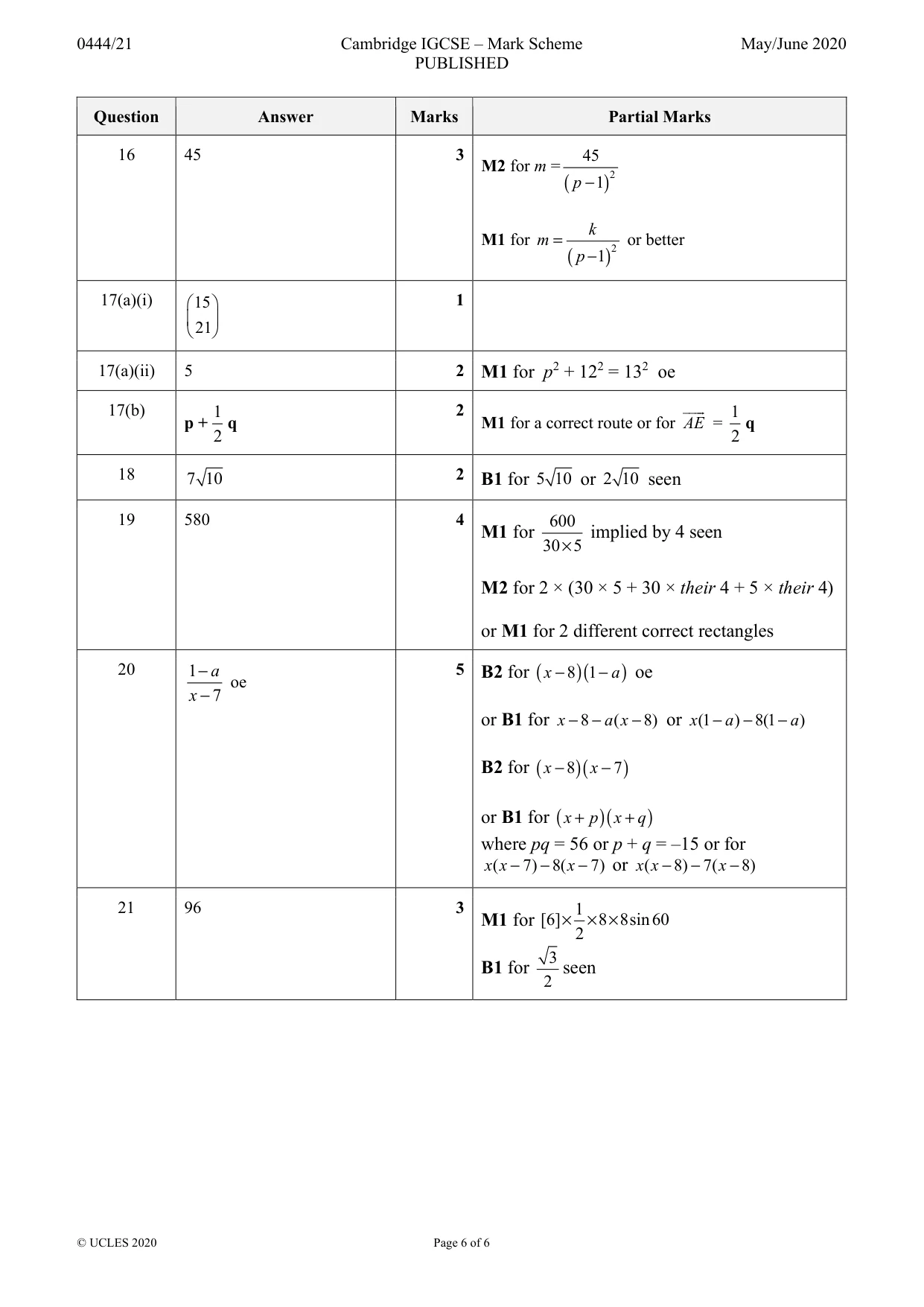
Mark scheme: 16 45 3 45 M2 for m = ( p − 1) 2 k M1 for m = or better ( p − 1) 2
Q17 · M = 7 Find 3m
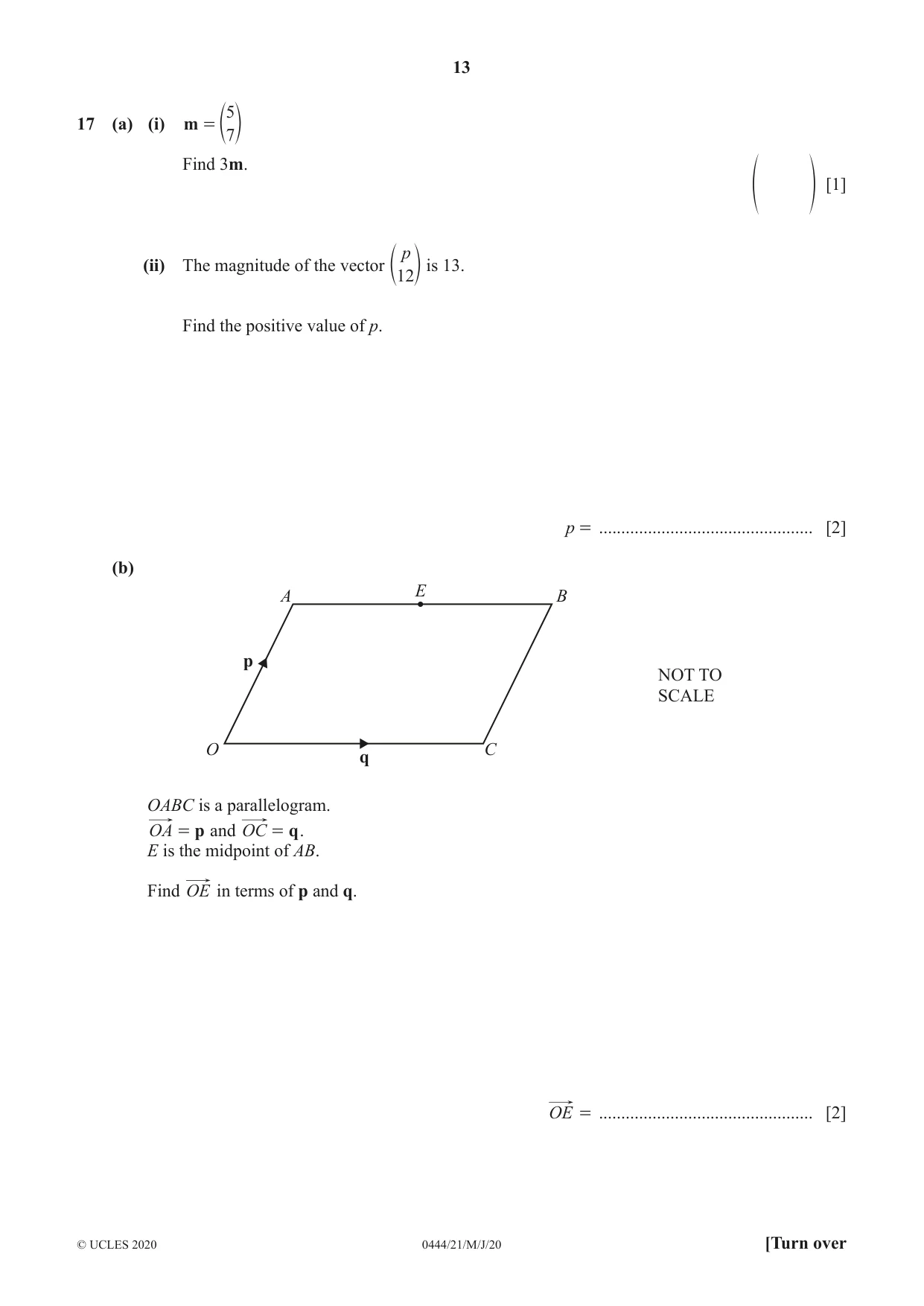
17 (a) (i) m = 7 Find 3m. [1] f p p (ii) The magnitude of the vector is 13. e12o Find the positive value of p. p = ................................................ [2] (b) E A B p NOT TO SCALE O C q OABC is a parallelogram. OA = p and OC = q . E is the midpoint of AB. Find OE in terms of p and q. OE = ................................................ [2]
Mark scheme: 17(a)(i) 15 1 21 17(a)(ii) 5 2 M1 for p2 + 122 = 132 oe 17(b) 1 2 1 p + q M1 for a correct route or for AE = q 2 2
Q18 · Simplify 250 + 40
18 Simplify 250 + 40 . ................................................. [2]
Mark scheme: 18 7 10 2 B1 for 5 10 or 2 10 seen
Q19 · F G NOT TO SCALE E H B C 5 cm A 30 cm D The diagram shows a solid cuboid ABCDEFGH of…
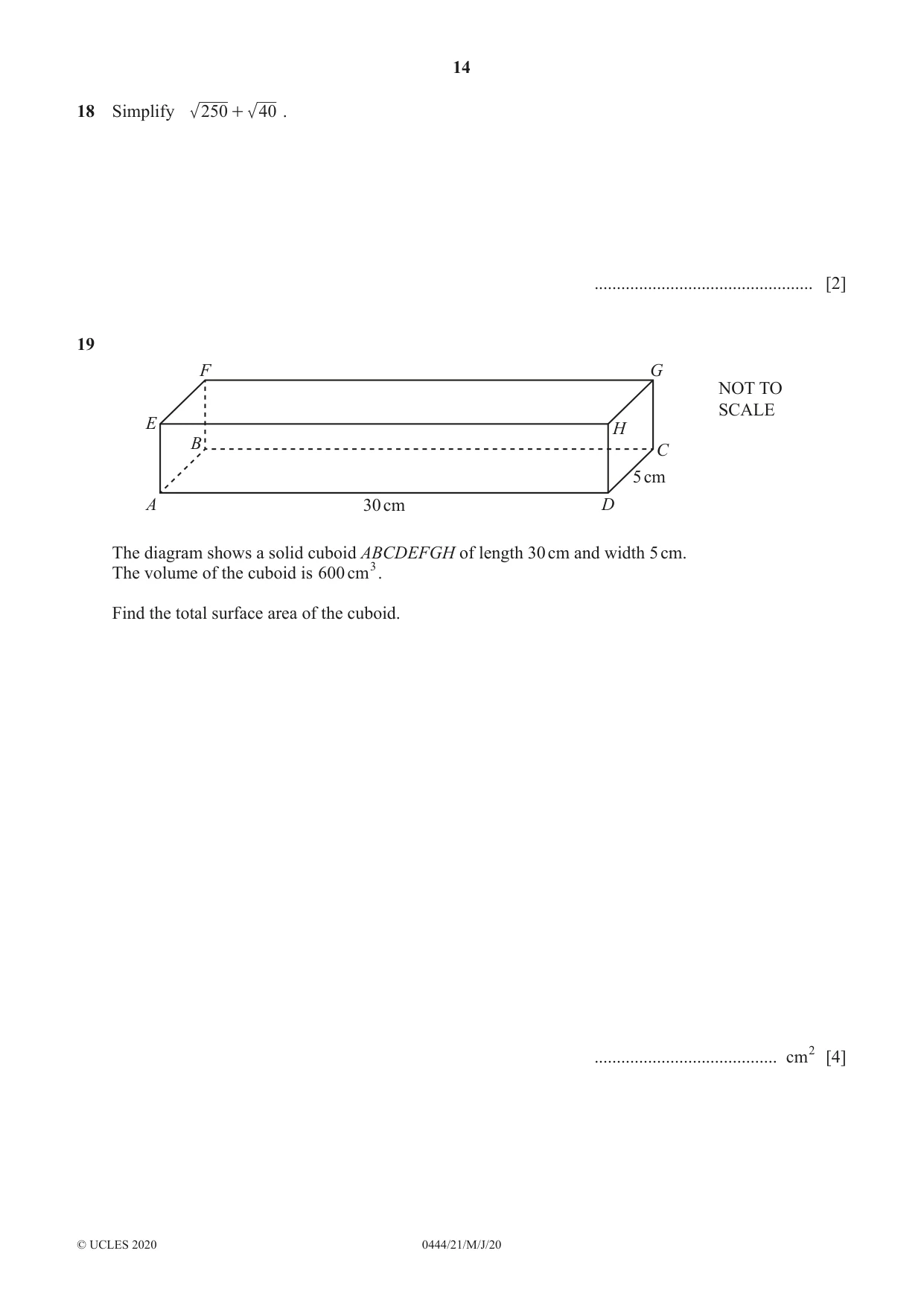
19 F G NOT TO SCALE E H B C 5 cm A 30 cm D The diagram shows a solid cuboid ABCDEFGH of length 30 cm and width 5 cm. The volume of the cuboid is 600 cm 3. Find the total surface area of the cuboid. ......................................... cm2 [4]
Mark scheme: 19 580 4 600 M1 for implied by 4 seen 30 × 5 M2 for 2 × (30 × 5 + 30 × their 4 + 5 × their 4) or M1 for 2 different correct rectangles
Question 20
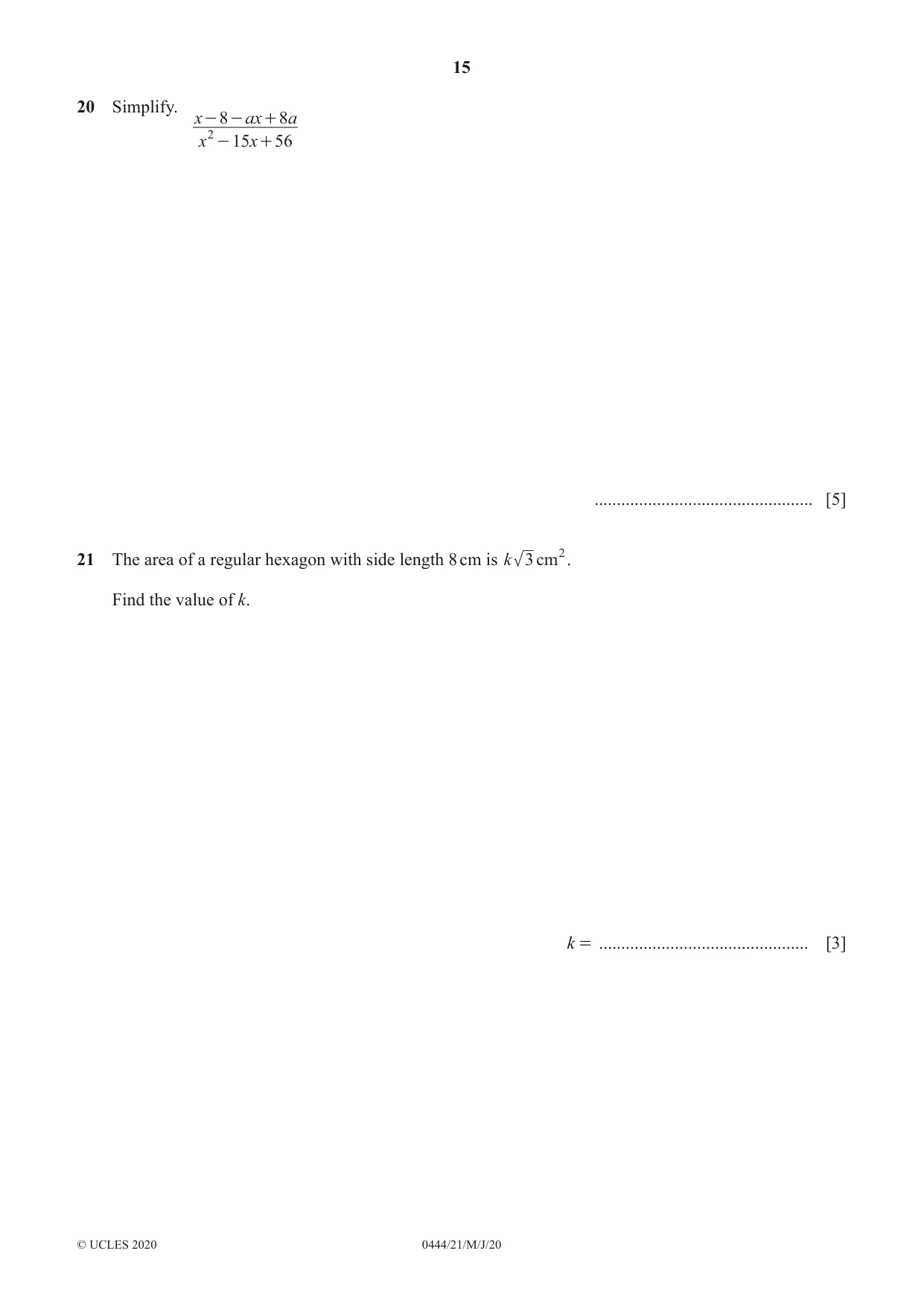
20 Simplify. x - 8 - ax + 8 a x 2 - 15x + 56 ................................................. [5]
Mark scheme: 20 1 − a 5 B2 for ( x − 8 )(1 − a ) oe oe x − 7 or B1 for x − 8 − a ( x − 8) or x (1 − a ) − 8(1 − a ) B2 for ( x − 8 )( x − 7 ) or B1 for ( x + p )( x + q ) where pq = 56 or p + q = –15 or for x ( x − 7) − 8( x − 7) or x ( x − 8) − 7( x − 8)
Q21 · The area of a regular hexagon with side length 8 cm is k 3 cm 2
21 The area of a regular hexagon with side length 8 cm is k 3 cm 2. Find the value of k. k = ............................................... [3]
Mark scheme: 21 96 3 1 M1 for [6] × × 8 × 8sin60 2 3 B1 for seen 2