Cambridge IGCSE Mathematics (US) 0444 — 2019 May/June Paper 3 · Variant 1
0444/31/M/J/19 · 10 questions · 104 marks · ≈117 min
The question paper and its mark scheme, free to read here and free to download. This is Cambridge’s own paper, exactly as it was sat.
Question paper16 pages
Mark scheme6 pages
Answers below. Sit the paper first if you are practising.
Questions as text
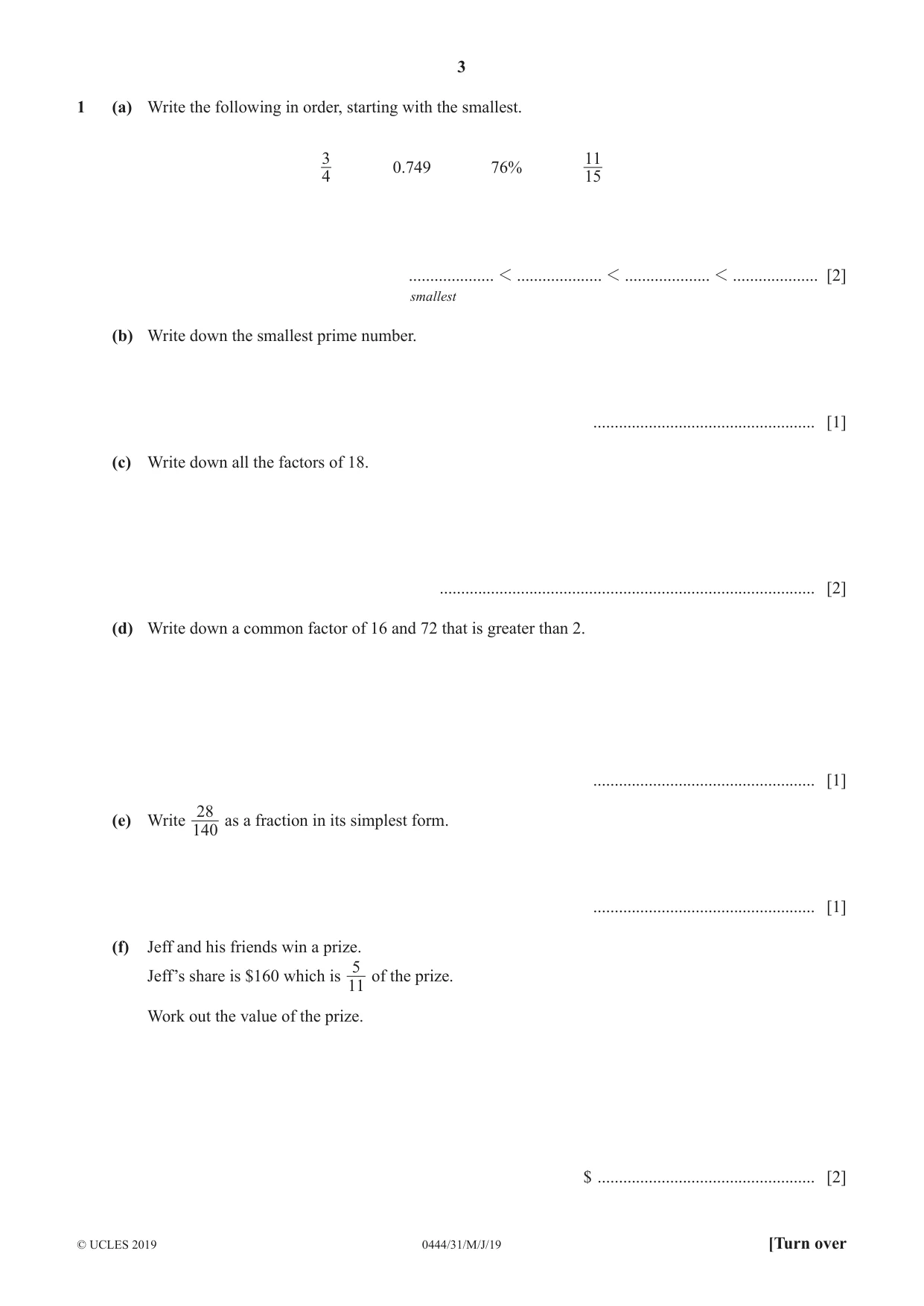
Q1 · Write the following in order, starting with the smallest
1 (a) Write the following in order, starting with the smallest. 3 11 0.749 76% 4 15 .................... 1 .................... 1 .................... 1 .................... [2] smallest (b) Write down the smallest prime number. .................................................... [1] (c) Write down all the factors of 18. ........................................................................................ [2] (d) Write down a common factor of 16 and 72 that is greater than 2. .................................................... [1] 28 (e) Write as a fraction in its simplest form. 140 .................................................... [1] (f) Jeff and his friends win a prize. 5 Jeff’s share is $160 which is of the prize. 11 Work out the value of the prize. $ ................................................... [2]
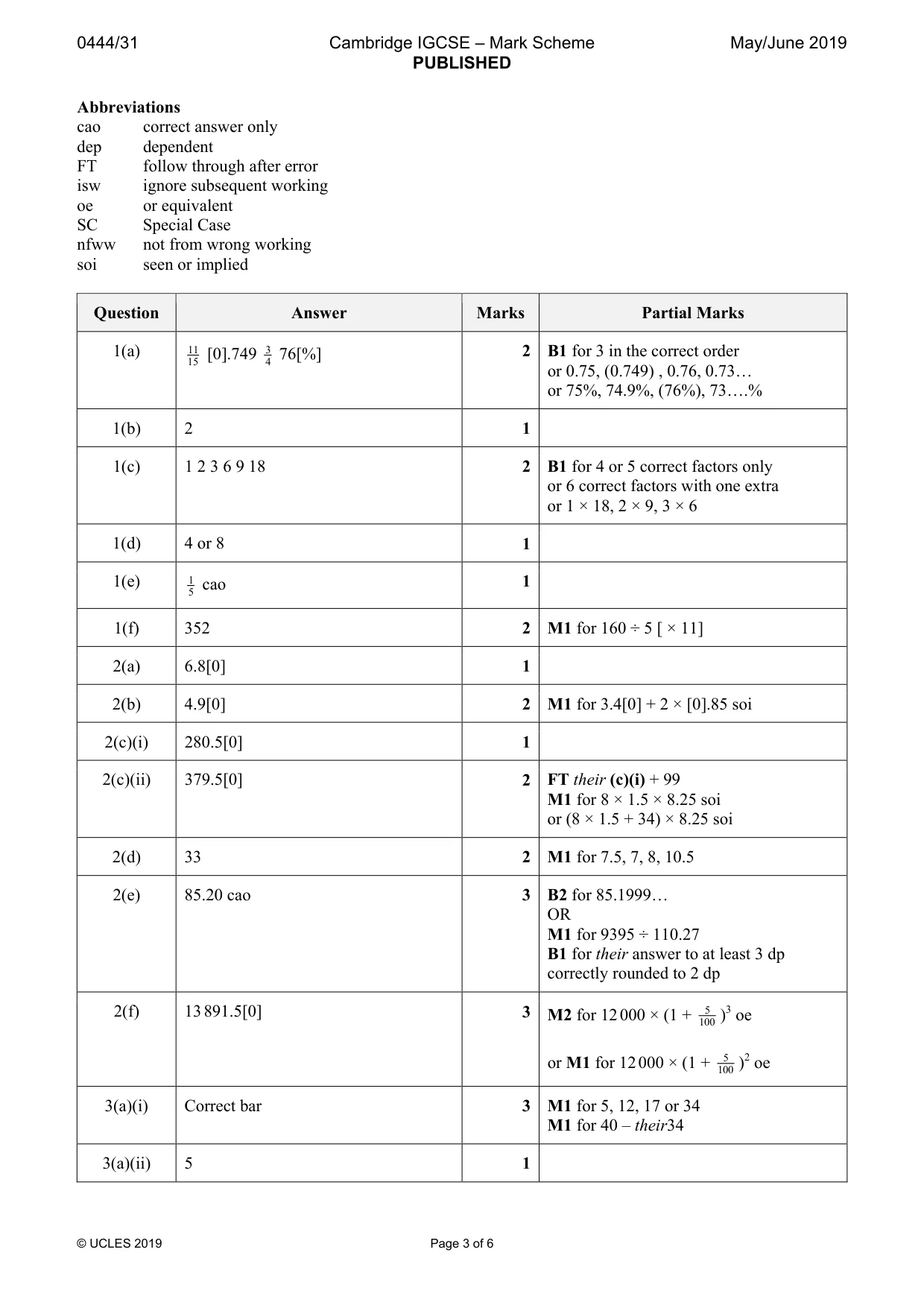
Mark scheme: Question Answer Marks Partial Marks 1(a) 11 [0].749 34 76[%] 2 B1 for 3 in the correct order 15 or 0.75, (0.749) , 0.76, 0.73… or 75%, 74.9%, (76%), 73….% 1(b) 2 1 1(c) 1 2 3 6 9 18 2 B1 for 4 or 5 correct factors only or 6 correct factors with one extra or 1 × 18, 2 × 9, 3 × 6 1(d) 4 or 8 1 1(e) 1 5 cao 1 1(f) 352 2 M1 for 160 ÷ 5 [ × 11]
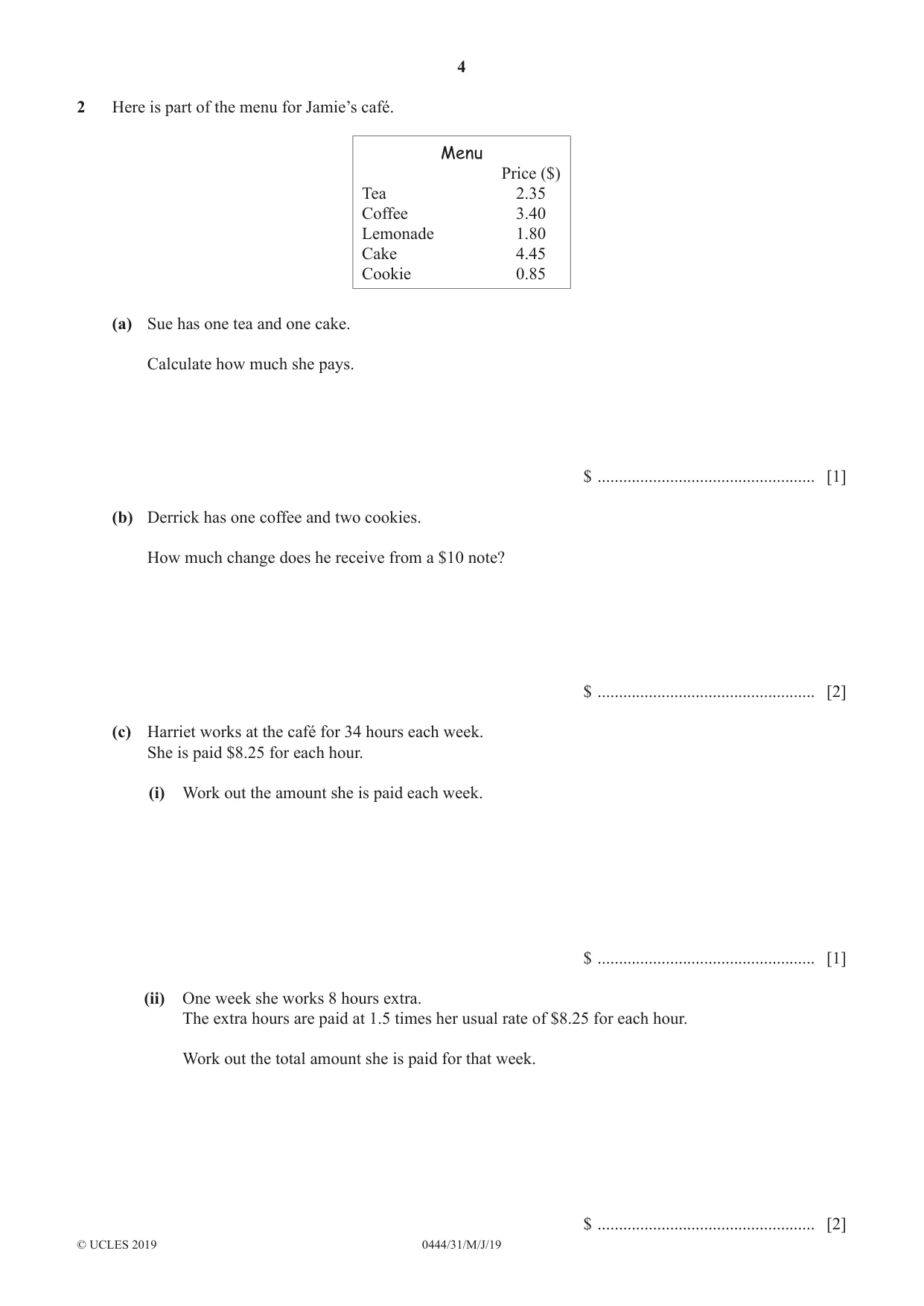
Q2 · Here is part of the menu for Jamie’s café
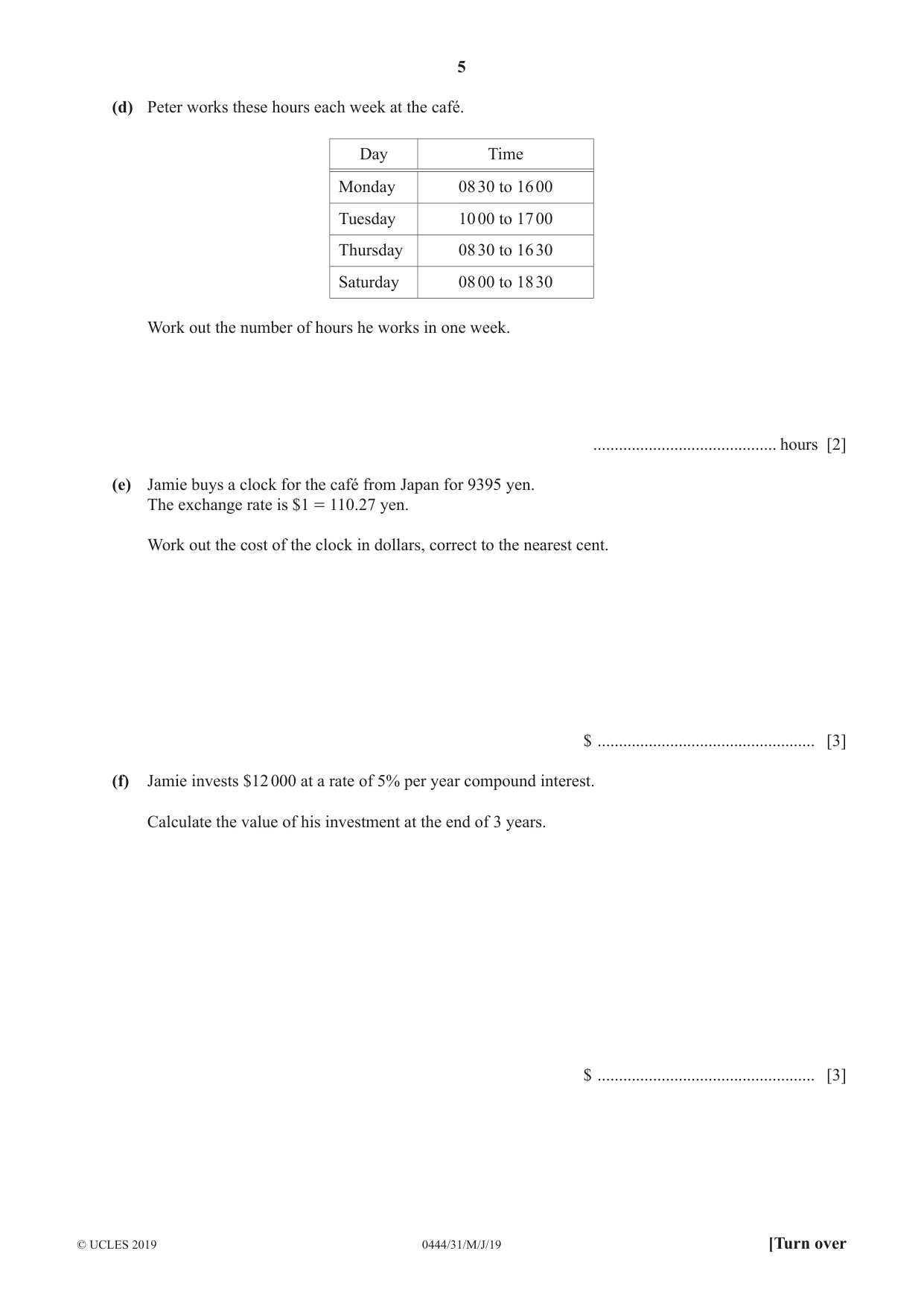
2 Here is part of the menu for Jamie’s café. Menu Price ($) Tea 2.35 Coffee 3.40 Lemonade 1.80 Cake 4.45 Cookie 0.85 (a) Sue has one tea and one cake. Calculate how much she pays. $ ................................................... [1] (b) Derrick has one coffee and two cookies. How much change does he receive from a $10 note? $ ................................................... [2] (c) Harriet works at the café for 34 hours each week. She is paid $8.25 for each hour. (i) Work out the amount she is paid each week. $ ................................................... [1] (ii) One week she works 8 hours extra. The extra hours are paid at 1.5 times her usual rate of $8.25 for each hour. Work out the total amount she is paid for that week. $ ................................................... [2] (d) Peter works these hours each week at the café. Day Time Monday 08 30 to 16 00 Tuesday 10 00 to 17 00 Thursday 08 30 to 16 30 Saturday 08 00 to 18 30 Work out the number of hours he works in one week. ........................................... hours [2] (e) Jamie buys a clock for the café from Japan for 9395 yen. The exchange rate is $1 = 110.27 yen. Work out the cost of the clock in dollars, correct to the nearest cent. $ ................................................... [3] (f) Jamie invests $12 000 at a rate of 5% per year compound interest. Calculate the value of his investment at the end of 3 years. $ ................................................... [3]
Mark scheme: 2(a) 6.8[0] 1 2(b) 4.9[0] 2 M1 for 3.4[0] + 2 × [0].85 soi 2(c)(i) 280.5[0] 1 2(c)(ii) 379.5[0] 2 FT their (c)(i) + 99 M1 for 8 × 1.5 × 8.25 soi or (8 × 1.5 + 34) × 8.25 soi 2(d) 33 2 M1 for 7.5, 7, 8, 10.5 2(e) 85.20 cao 3 B2 for 85.1999… OR M1 for 9395 ÷ 110.27 B1 for their answer to at least 3 dp correctly rounded to 2 dp 2(f) 13 891.5[0] 3 M2 for 12 000 × (1 + 1005 )3 oe or M1 for 12 000 × (1 + 1005 )2 oe
Q3 · On Monday, Main Street station sells 40 tickets
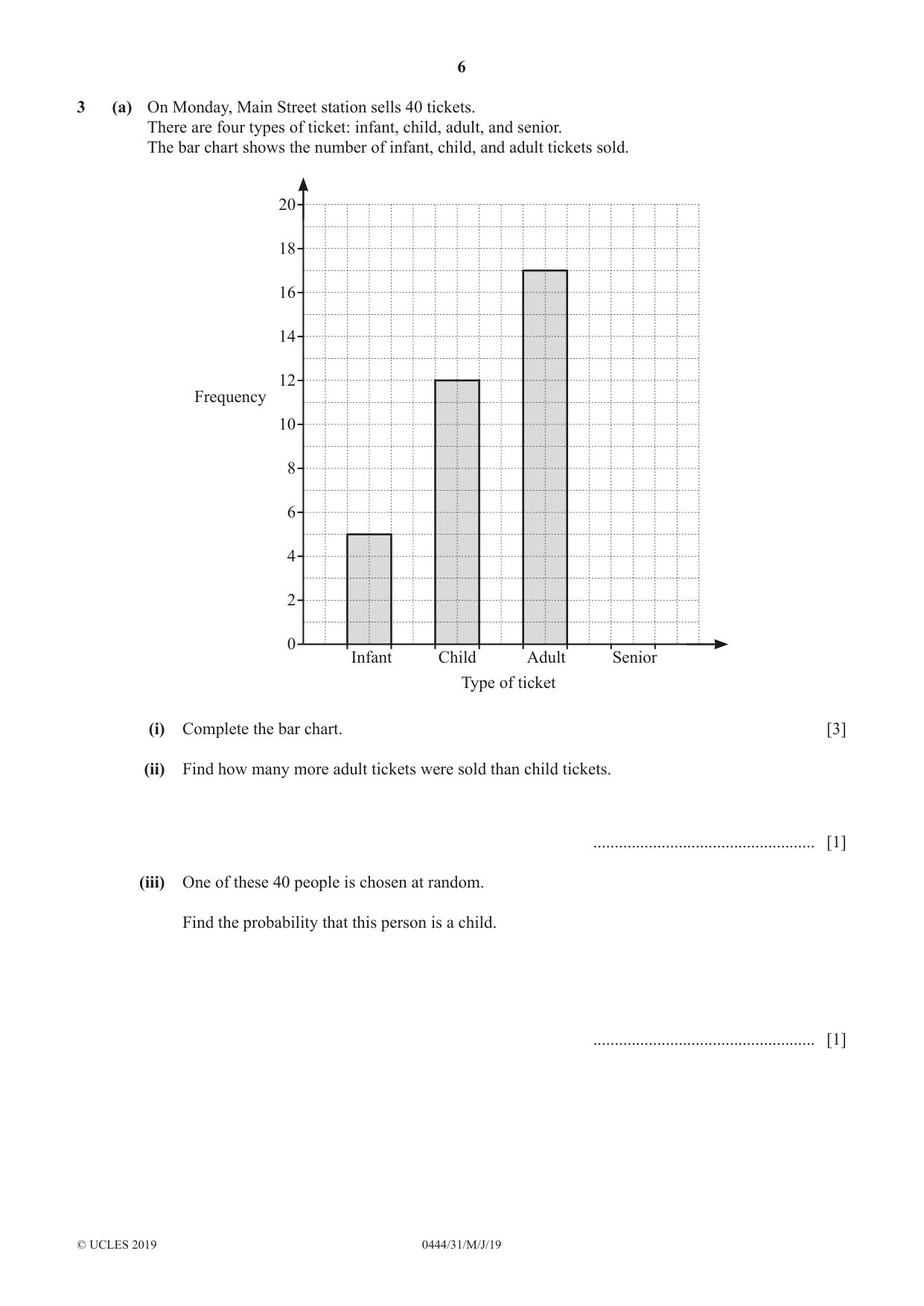
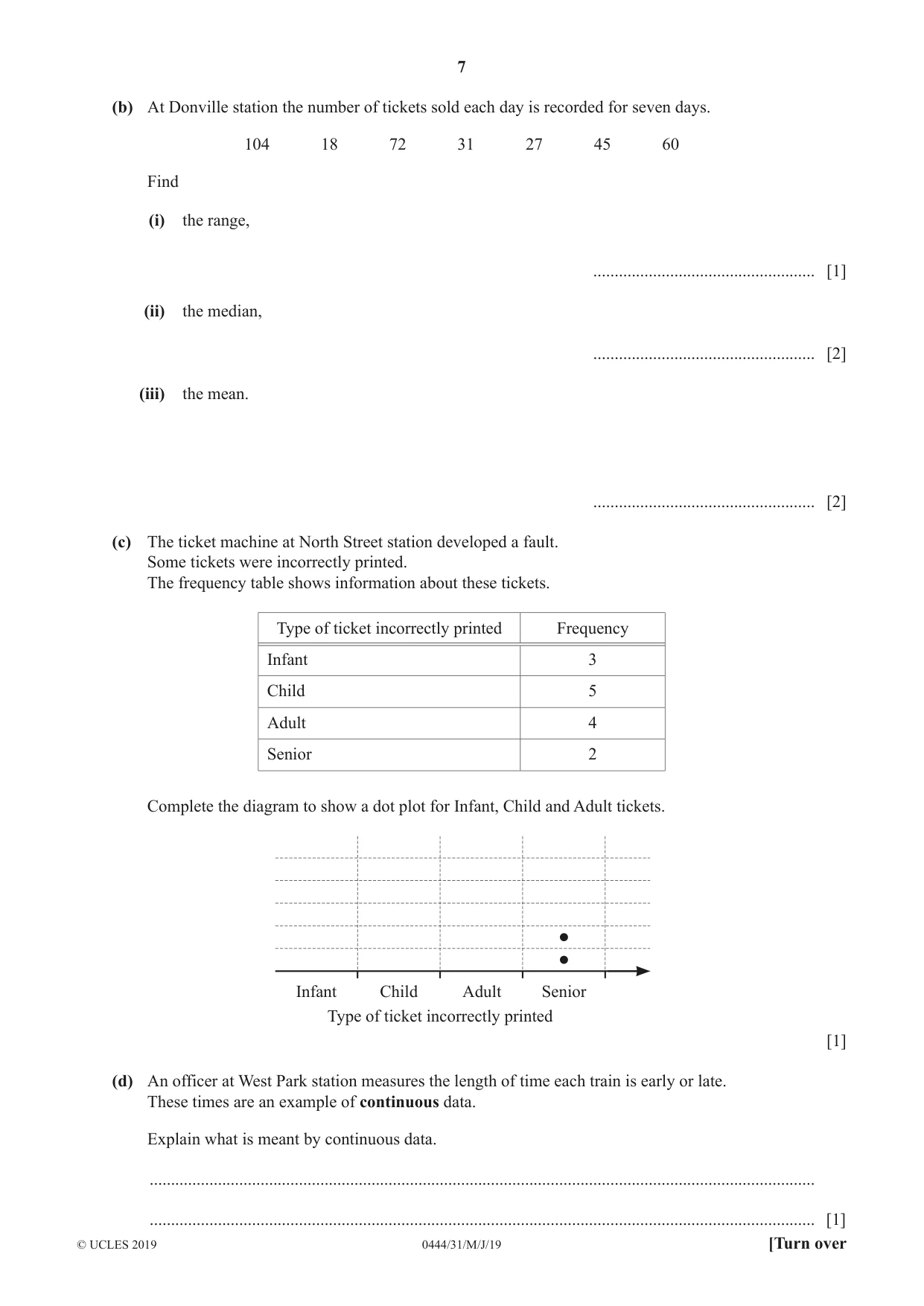
3 (a) On Monday, Main Street station sells 40 tickets. There are four types of ticket: infant, child, adult, and senior. The bar chart shows the number of infant, child, and adult tickets sold. 20 18 16 14 12 Frequency 10 8 6 4 2 0 Infant Child Adult Senior Type of ticket (i) Complete the bar chart. [3] (ii) Find how many more adult tickets were sold than child tickets. .................................................... [1] (iii) One of these 40 people is chosen at random. Find the probability that this person is a child. .................................................... [1] (b) At Donville station the number of tickets sold each day is recorded for seven days. 104 18 72 31 27 45 60 Find (i) the range, .................................................... [1] (ii) the median, .................................................... [2] (iii) the mean. .................................................... [2] (c) The ticket machine at North Street station developed a fault. Some tickets were incorrectly printed. The frequency table shows information about these tickets. Type of ticket incorrectly printed Frequency Infant 3 Child 5 Adult 4 Senior 2 Complete the diagram to show a dot plot for Infant, Child and Adult tickets. Infant Child Adult Senior Type of ticket incorrectly printed [1] (d) An officer at West Park station measures the length of time each train is early or late. These times are an example of continuous data. Explain what is meant by continuous data. ............................................................................................................................................................ ............................................................................................................................................................ [1]
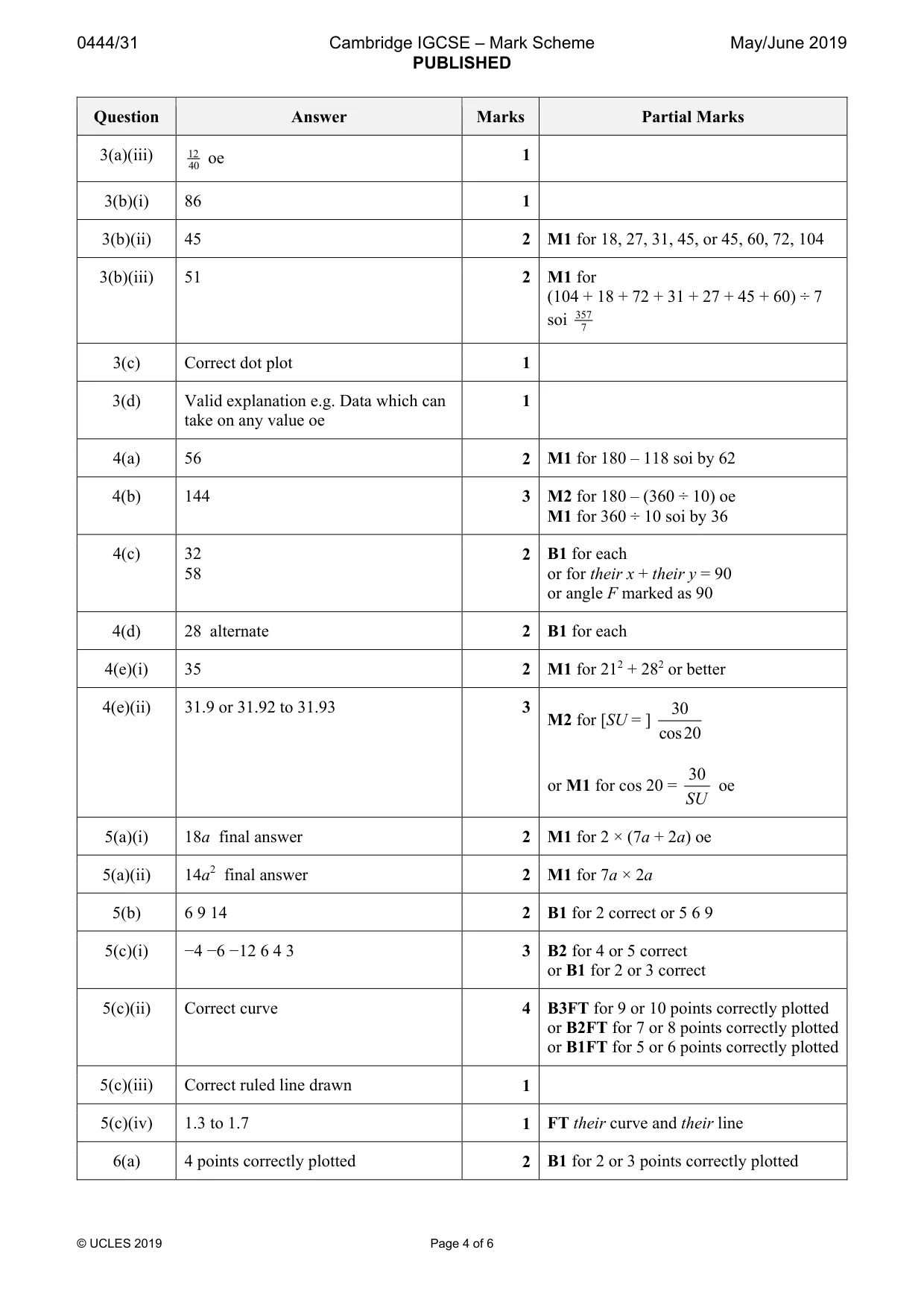
Mark scheme: 3(a)(i) Correct bar 3 M1 for 5, 12, 17 or 34 M1 for 40 – their34 3(a)(ii) 5 1 3(a)(iii) 12 40 oe 1 3(b)(i) 86 1 3(b)(ii) 45 2 M1 for 18, 27, 31, 45, or 45, 60, 72, 104 3(b)(iii) 51 2 M1 for (104 + 18 + 72 + 31 + 27 + 45 + 60) ÷ 7 soi 3577 3(c) Correct dot plot 1 3(d) Valid explanation e.g. Data which can 1 take on any value oe
Q4 · A NOT TO a° SCALE 118° B C D ABC is an isosceles triangle
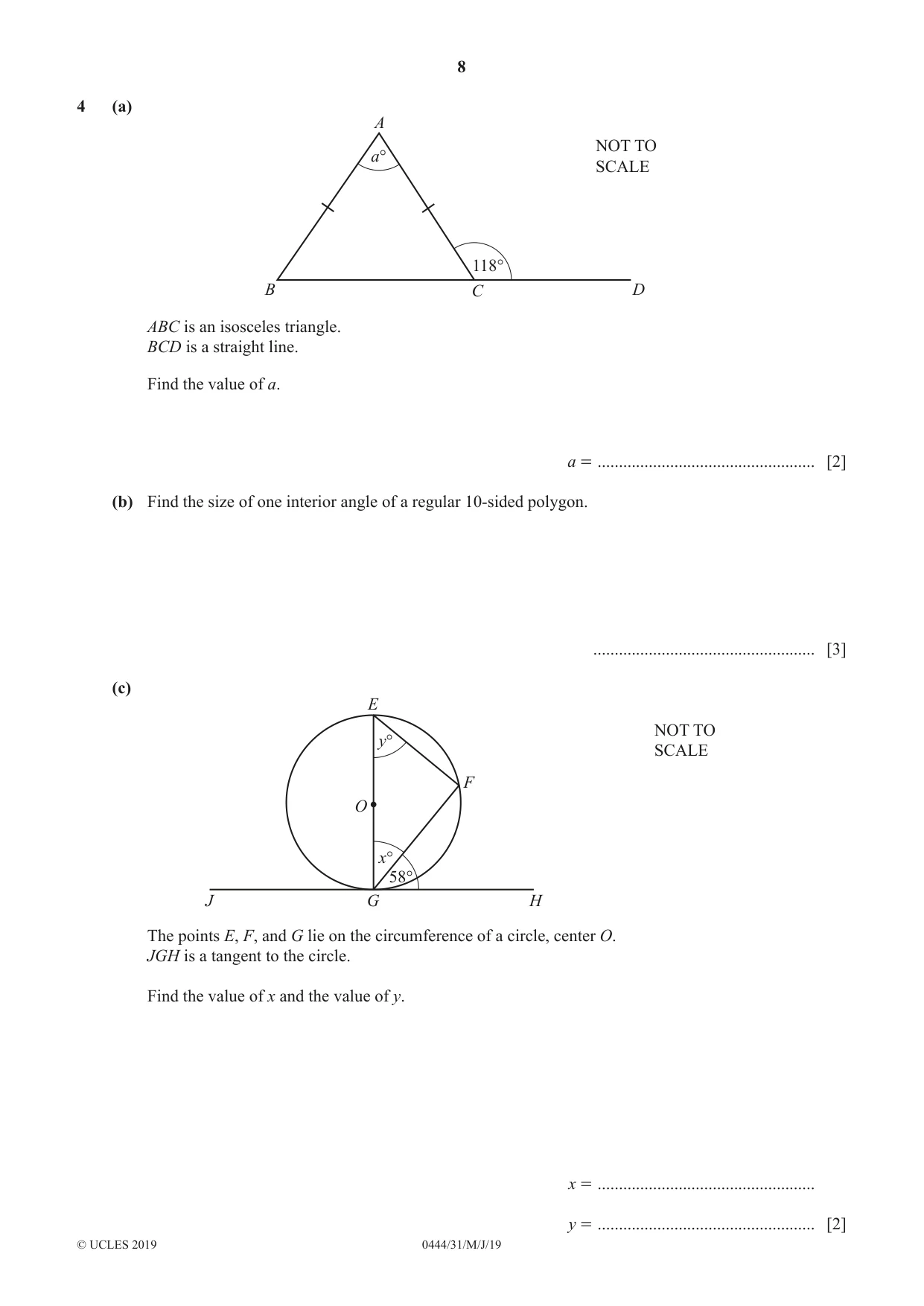
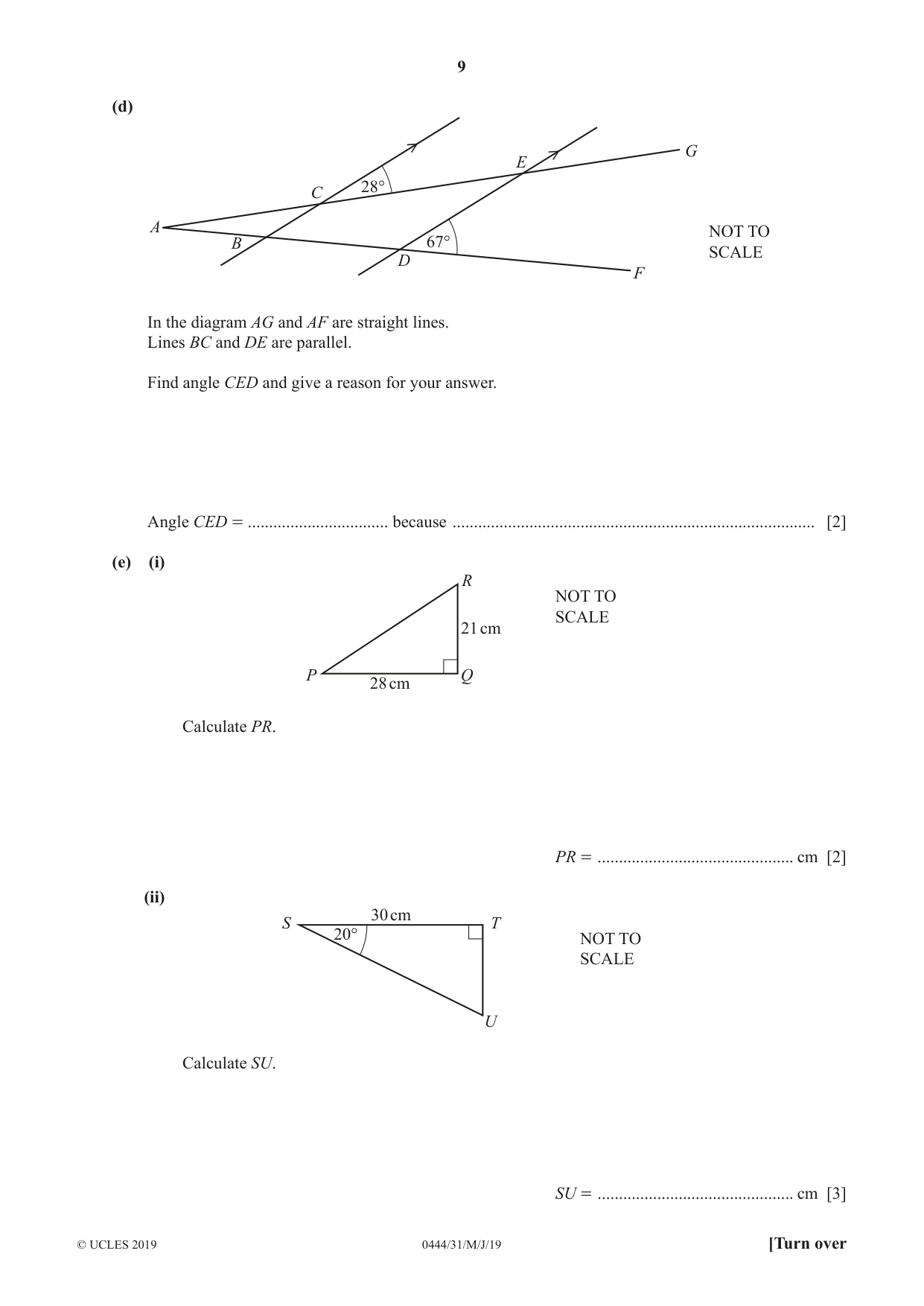
4 (a) A NOT TO a° SCALE 118° B C D ABC is an isosceles triangle. BCD is a straight line. Find the value of a. a = ................................................... [2] (b) Find the size of one interior angle of a regular 10-sided polygon. .................................................... [3] (c) E NOT TO y° SCALE F O x° 58° J G H The points E, F, and G lie on the circumference of a circle, center O. JGH is a tangent to the circle. Find the value of x and the value of y. x = ................................................... y = ................................................... [2] (d) G E 28° C A NOT TO B 67° SCALE D F In the diagram AG and AF are straight lines. Lines BC and DE are parallel. Find angle CED and give a reason for your answer. Angle CED = ................................. because ..................................................................................... [2] (e) (i) R NOT TO SCALE 21 cm P Q 28 cm Calculate PR. PR = .............................................. cm [2] (ii) 30 cm S T 20° NOT TO SCALE U Calculate SU. SU = .............................................. cm [3]
Mark scheme: 4(a) 56 2 M1 for 180 – 118 soi by 62 4(b) 144 3 M2 for 180 – (360 ÷ 10) oe M1 for 360 ÷ 10 soi by 36 4(c) 32 2 B1 for each 58 or for their x + their y = 90 or angle F marked as 90 4(d) 28 alternate 2 B1 for each 4(e)(i) 35 2 M1 for 212 + 282 or better 4(e)(ii) 31.9 or 31.92 to 31.93 3 30 M2 for [SU = ] cos20 30 or M1 for cos 20 = oe SU
Q5 · The diagram shows a rectangle with length 7a and width 2a
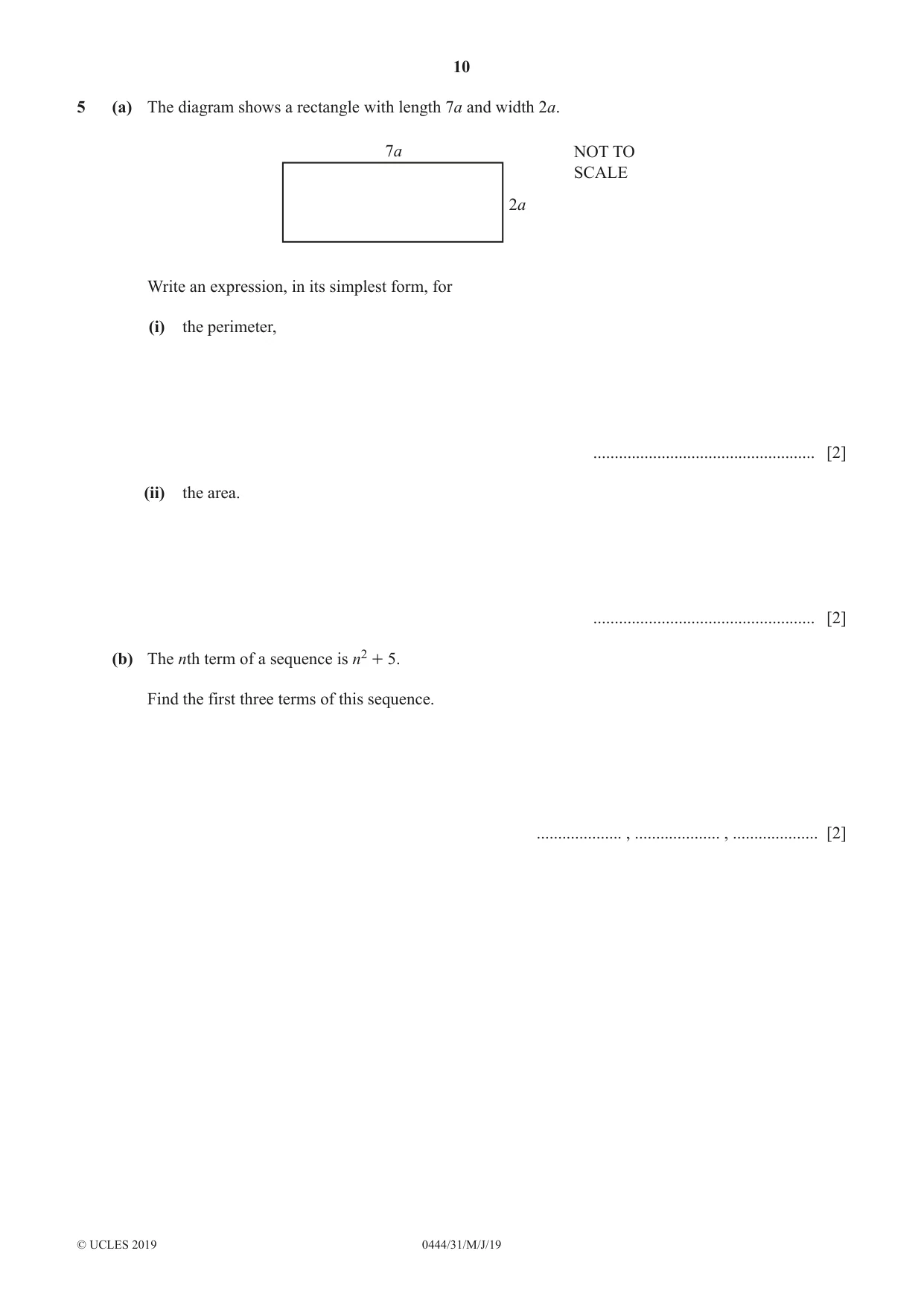
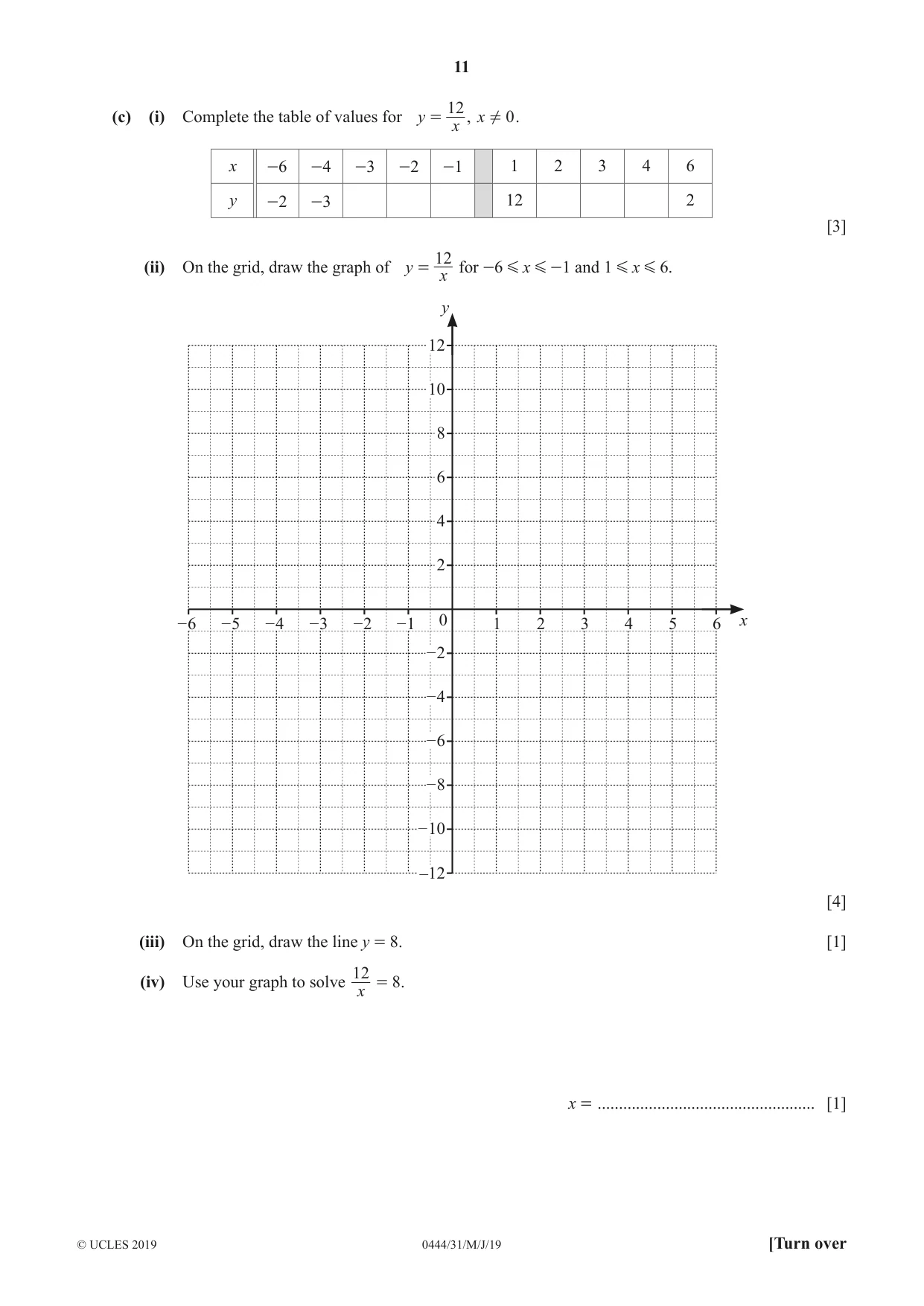
5 (a) The diagram shows a rectangle with length 7a and width 2a. 7a NOT TO SCALE 2a Write an expression, in its simplest form, for (i) the perimeter, .................................................... [2] (ii) the area. .................................................... [2] (b) The nth term of a sequence is n2 + 5. Find the first three terms of this sequence. .................... , .................... , .................... [2] 12(c) (i) Complete the table of values for y = , x ! 0 . x x -6 -4 -3 -2 -1 1 2 3 4 6 y -2 -3 12 2 [3] 12 (ii) On the grid, draw the graph of y = for -6 G x G -1 and 1 G x G 6. x y 12 10 8 6 4 2 – 6 – 5 – 4 – 3 – 2 – 1 0 1 2 3 4 5 6 x – 2 – 4 – 6 – 8 – 10 –12 [4] (iii) On the grid, draw the line y = 8. [1] 12 (iv) Use your graph to solve = 8. x x = ................................................... [1]
Mark scheme: 5(a)(i) 18a final answer 2 M1 for 2 × (7a + 2a) oe 5(a)(ii) 14a2 final answer 2 M1 for 7a × 2a 5(b) 6 9 14 2 B1 for 2 correct or 5 6 9 5(c)(i) −4 −6 −12 6 4 3 3 B2 for 4 or 5 correct or B1 for 2 or 3 correct 5(c)(ii) Correct curve 4 B3FT for 9 or 10 points correctly plotted or B2FT for 7 or 8 points correctly plotted or B1FT for 5 or 6 points correctly plotted 5(c)(iii) Correct ruled line drawn 1 5(c)(iv) 1.3 to 1.7 1 FT their curve and their line
Q6 · Fourteen students each take two tests in French, a speaking test and a written test
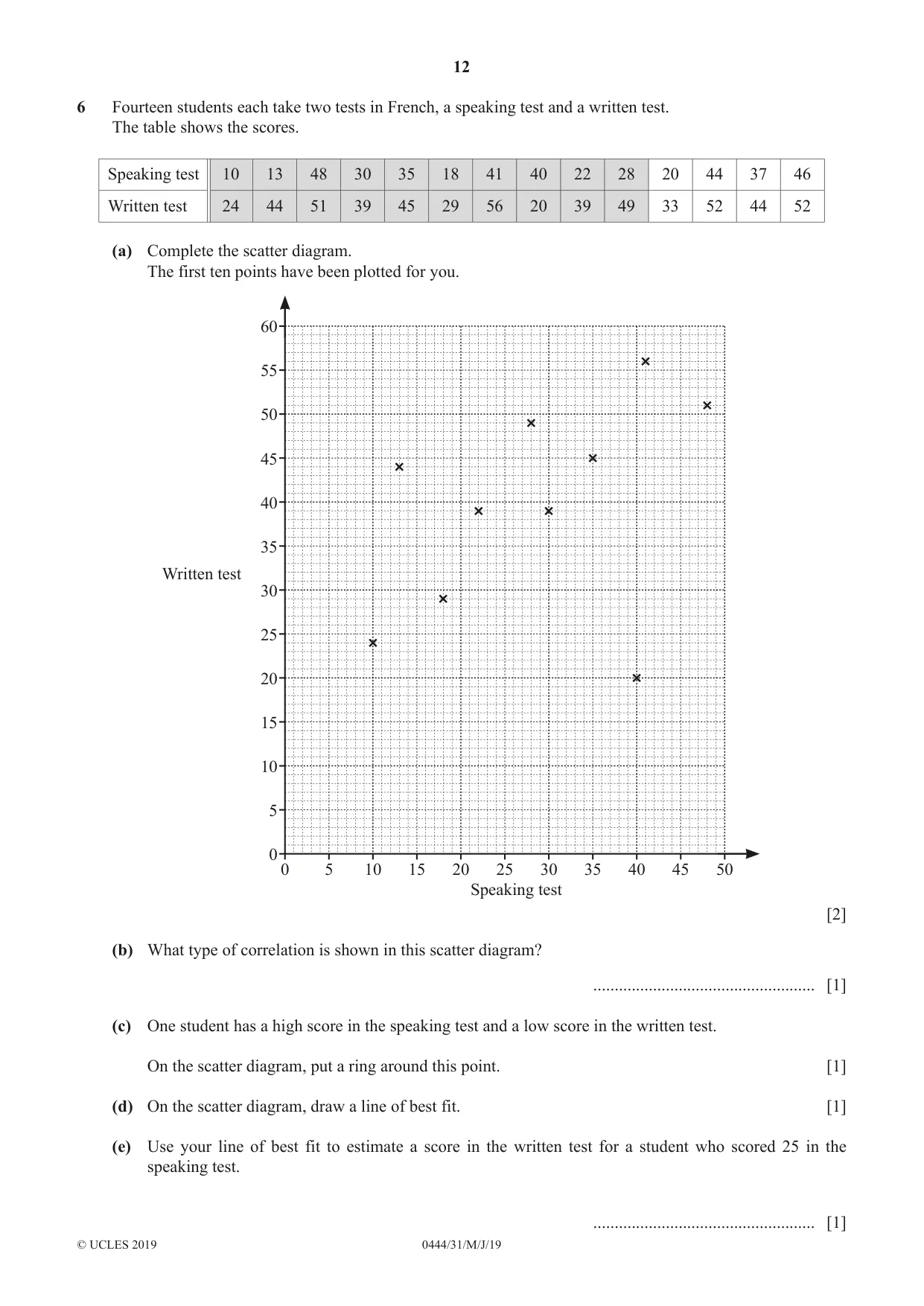
6 Fourteen students each take two tests in French, a speaking test and a written test. The table shows the scores. Speaking test 10 13 48 30 35 18 41 40 22 28 20 44 37 46 Written test 24 44 51 39 45 29 56 20 39 49 33 52 44 52 (a) Complete the scatter diagram. The first ten points have been plotted for you. 60 55 50 45 40 35 Written test 30 25 20 15 10 5 0 0 5 10 15 20 25 30 35 40 45 50 Speaking test [2] (b) What type of correlation is shown in this scatter diagram? .................................................... [1] (c) One student has a high score in the speaking test and a low score in the written test. On the scatter diagram, put a ring around this point. [1] (d) On the scatter diagram, draw a line of best fit. [1] (e) Use your line of best fit to estimate a score in the written test for a student who scored 25 in the speaking test. .................................................... [1]
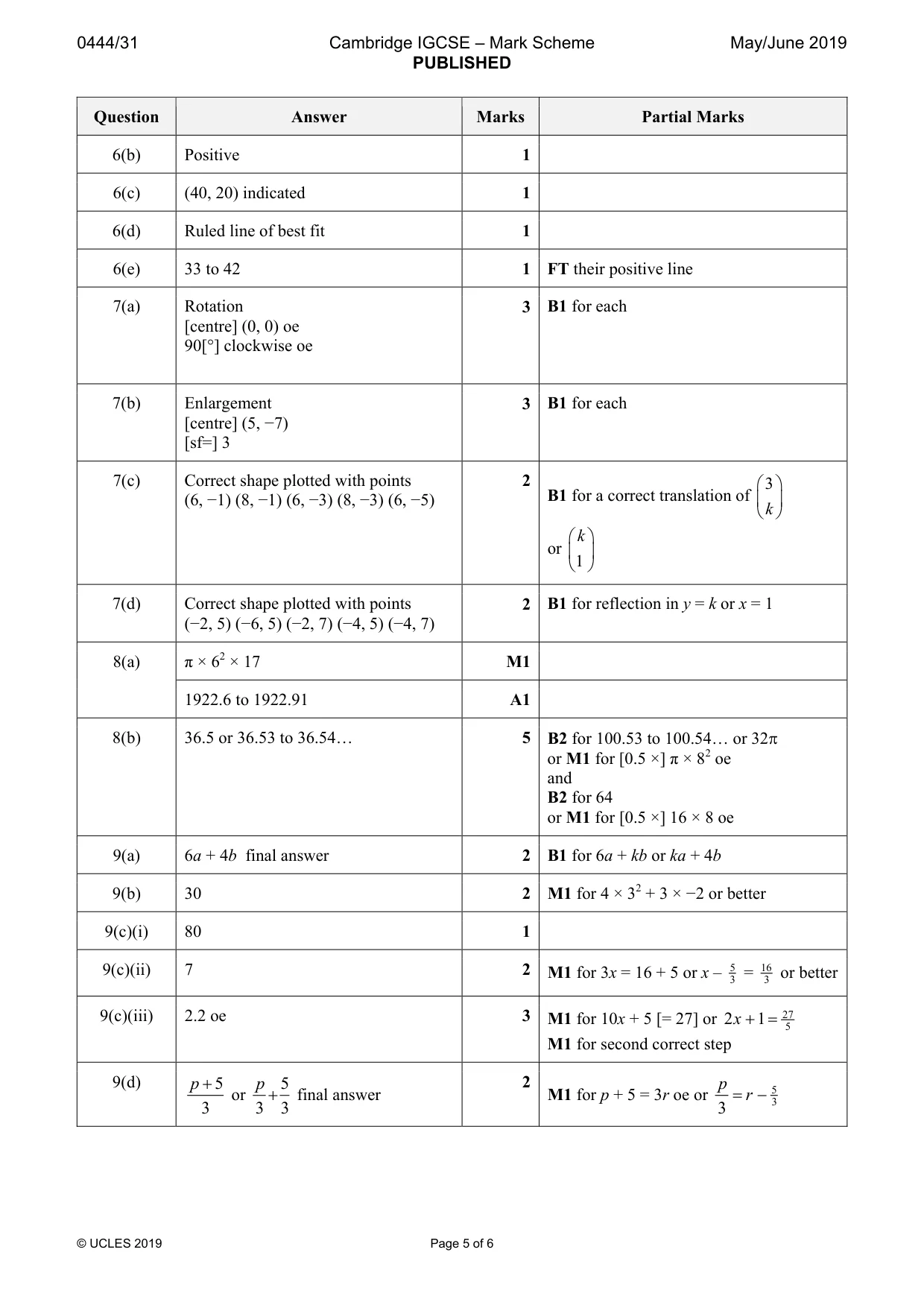
Mark scheme: 6(a) 4 points correctly plotted 2 B1 for 2 or 3 points correctly plotted 6(b) Positive 1 6(c) (40, 20) indicated 1 6(d) Ruled line of best fit 1 6(e) 33 to 42 1 FT their positive line
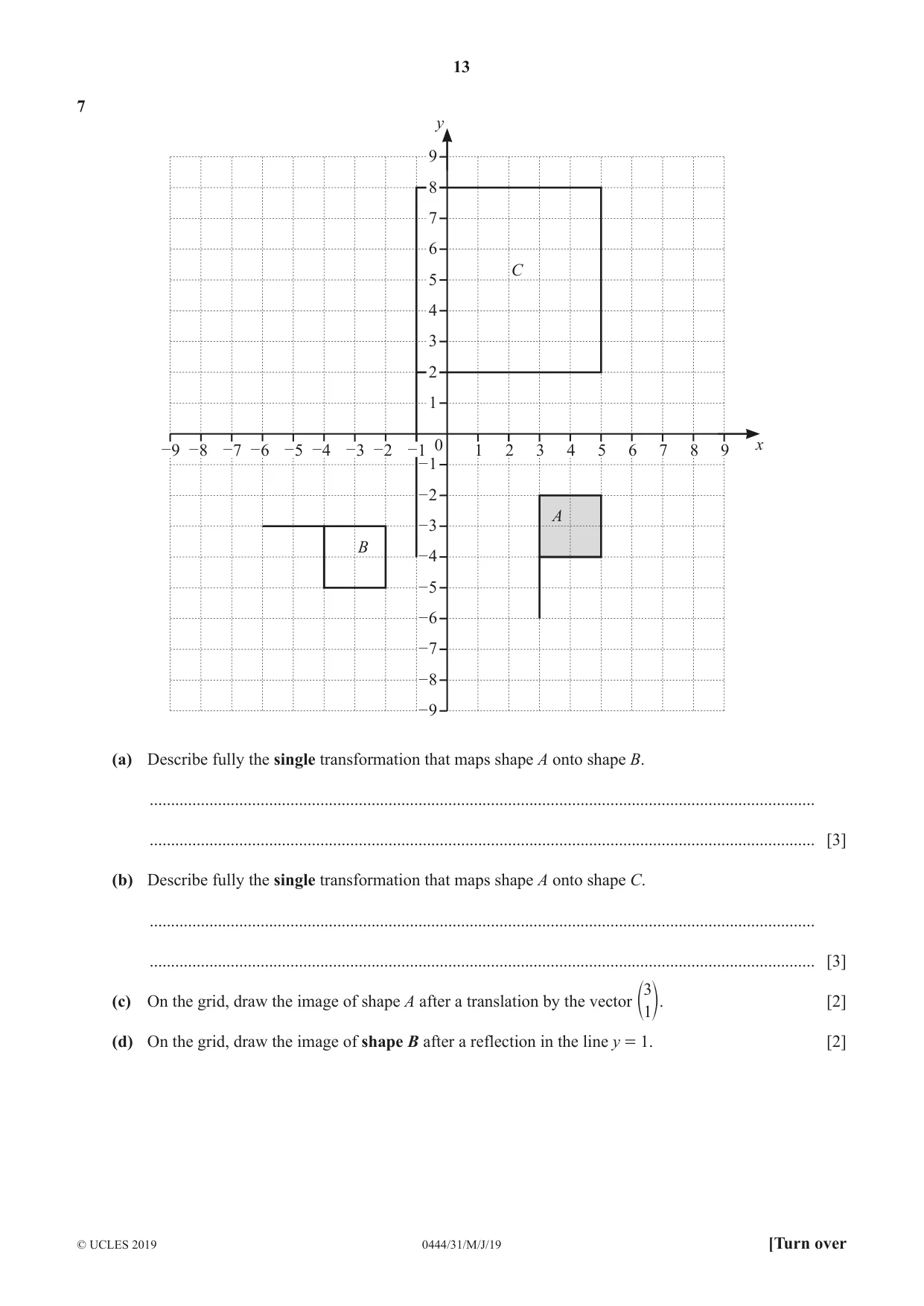
Q7 · Y 9 8 7 6 C 5 4 3 2 1 – 9 – 8 – 7 – 6 – 5 – 4 – 3 – 2 – 1 0 1 2 3 4 5 6 7 8 9 x – 1 – 2 A…
7 y 9 8 7 6 C 5 4 3 2 1 – 9 – 8 – 7 – 6 – 5 – 4 – 3 – 2 – 1 0 1 2 3 4 5 6 7 8 9 x – 1 – 2 A – 3 B – 4 – 5 – 6 – 7 – 8 – 9 (a) Describe fully the single transformation that maps shape A onto shape B. ............................................................................................................................................................ ............................................................................................................................................................ [3] (b) Describe fully the single transformation that maps shape A onto shape C. ............................................................................................................................................................ ............................................................................................................................................................ [3] 3 (c) On the grid, draw the image of shape A after a translation by the vector [2] e1o. (d) On the grid, draw the image of shape B after a reflection in the line y = 1. [2]
Mark scheme: 7(a) Rotation 3 B1 for each [centre] (0, 0) oe 90[°] clockwise oe 7(b) Enlargement 3 B1 for each [centre] (5, −7) [sf=] 3 7(c) Correct shape plotted with points 2 3 (6, −1) (8, −1) (6, −3) (8, −3) (6, −5) B1 for a correct translation of k k or 1 7(d) Correct shape plotted with points 2 B1 for reflection in y = k or x = 1 (−2, 5) (−6, 5) (−2, 7) (−4, 5) (−4, 7)
Q8 · A cylinder has a radius of 6 cm and a height of 17 cm
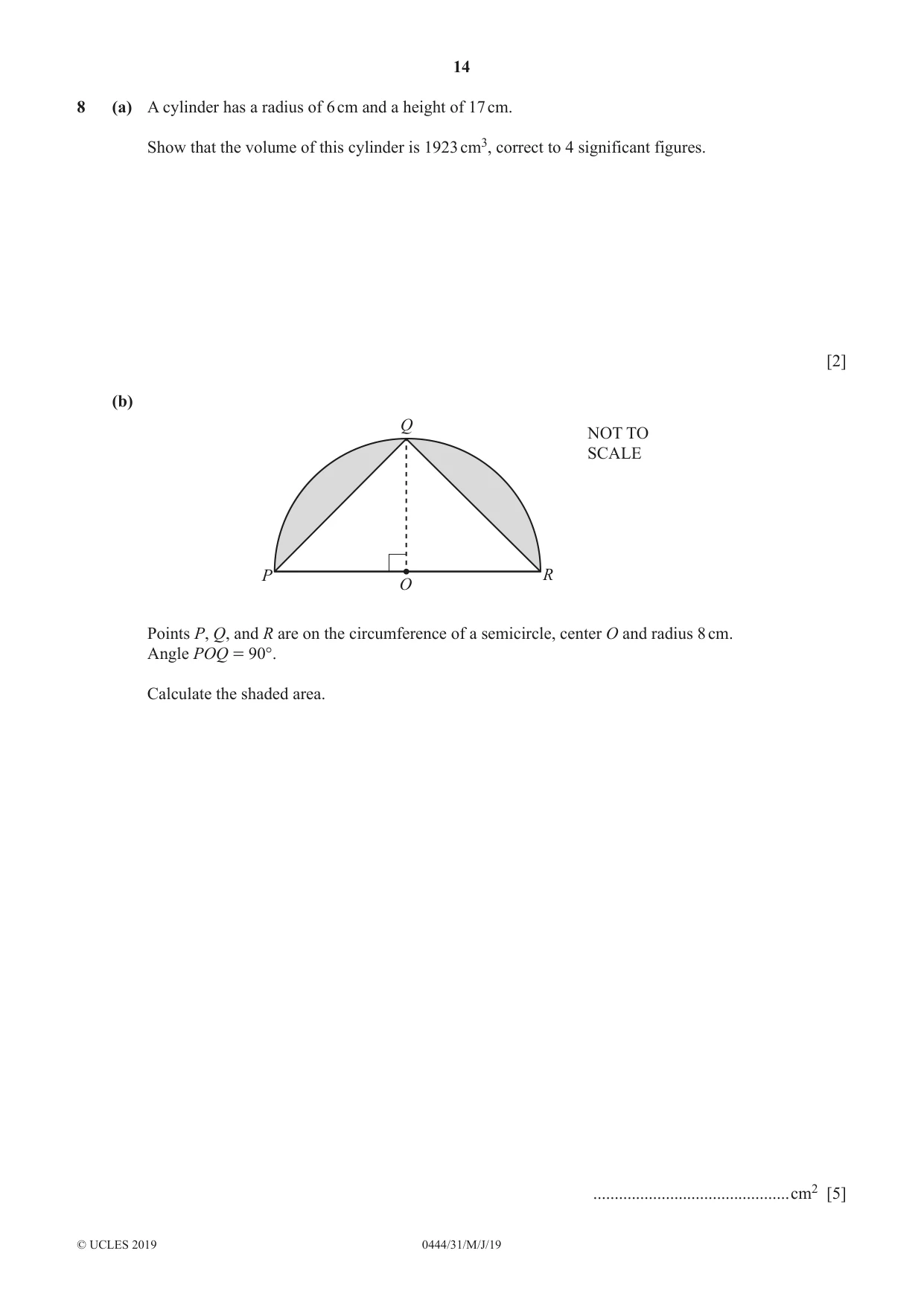
8 (a) A cylinder has a radius of 6 cm and a height of 17 cm. Show that the volume of this cylinder is 1923 cm3, correct to 4 significant figures. [2] (b) Q NOT TO SCALE P R O Points P, Q, and R are on the circumference of a semicircle, center O and radius 8 cm. Angle POQ = 90°. Calculate the shaded area. ..............................................cm2 [5]
Mark scheme: 8(a) π × 62 × 17 M1 1922.6 to 1922.91 A1 8(b) 36.5 or 36.53 to 36.54… 5 B2 for 100.53 to 100.54… or 32π or M1 for [0.5 ×] π × 82 oe and B2 for 64 or M1 for [0.5 ×] 16 × 8 oe
Q9 · Simplify 8a + 3b - 2a + b
9 (a) Simplify 8a + 3b - 2a + b. .................................................... [2] (b) Calculate the value of 4x2 + xy when x = 3 and y = -2. .................................................... [2] (c) Solve these equations. x (i) = 20 4 x = ................................................... [1] (ii) 3x - 5 = 16 x = ................................................... [2] (iii) 5(2x + 1) = 27 x = ................................................... [3] (d) Solve for r. p = 3r - 5 r = ................................................... [2] Question 10 is printed on the next page.
Mark scheme: 9(a) 6a + 4b final answer 2 B1 for 6a + kb or ka + 4b 9(b) 30 2 M1 for 4 × 32 + 3 × −2 or better 9(c)(i) 80 1 9(c)(ii) 7 2 M1 for 3x = 16 + 5 or x – 53 = 163 or better 9(c)(iii) 2.2 oe 3 M1 for 10x + 5 [= 27] or 2 x + 1 = 275 M1 for second correct step 9(d) p + 5 p 5 2 p 5 or + final answer M1 for p + 5 = 3r oe or = r − 3 3 3 3 3
Q10 · The scale drawing shows a field, ABCD
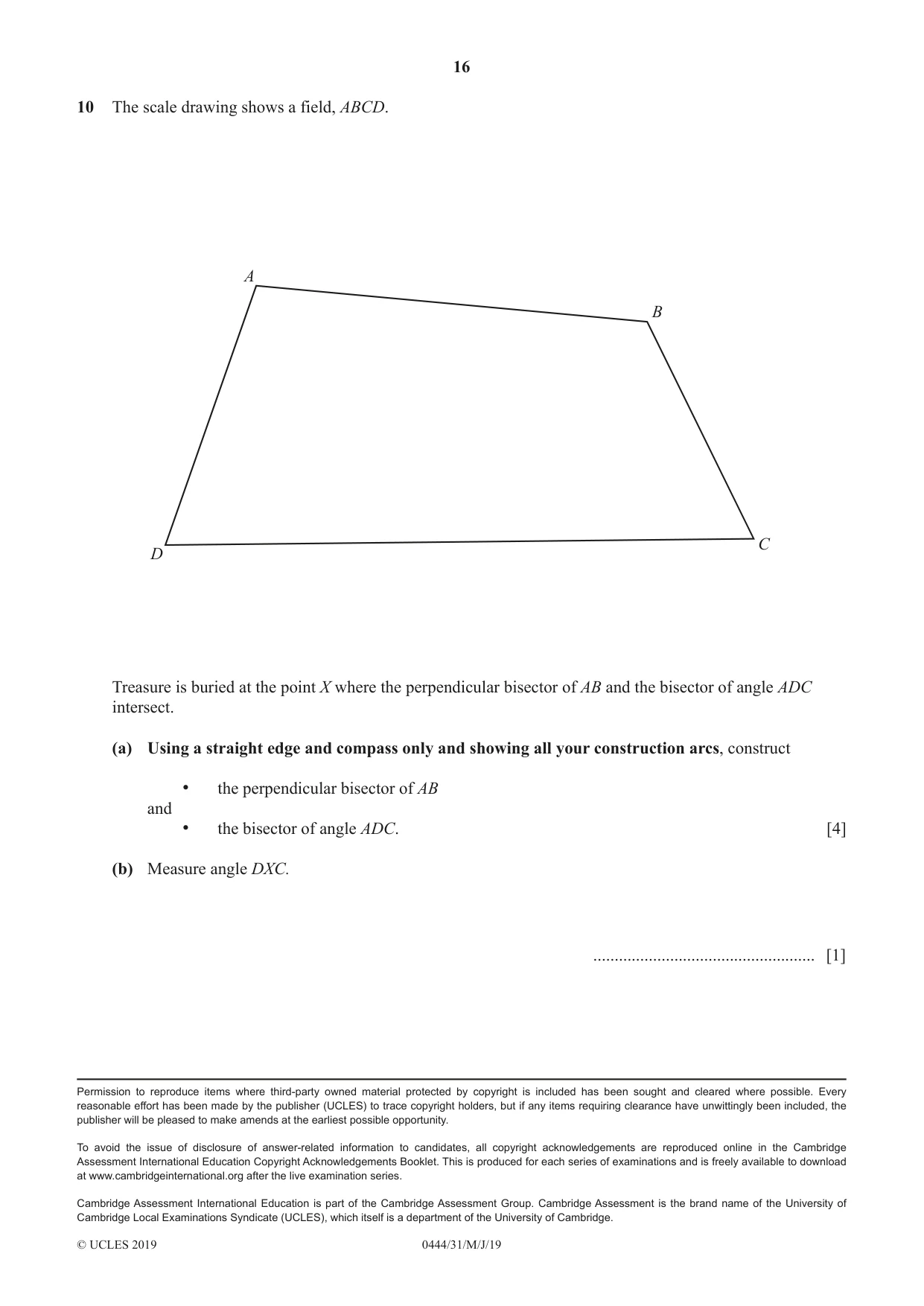
10 The scale drawing shows a field, ABCD. A B C D Treasure is buried at the point X where the perpendicular bisector of AB and the bisector of angle ADC intersect. (a) Using a straight edge and compass only and showing all your construction arcs, construct • the perpendicular bisector of AB and • the bisector of angle ADC. [4] (b) Measure angle DXC. .................................................... [1]
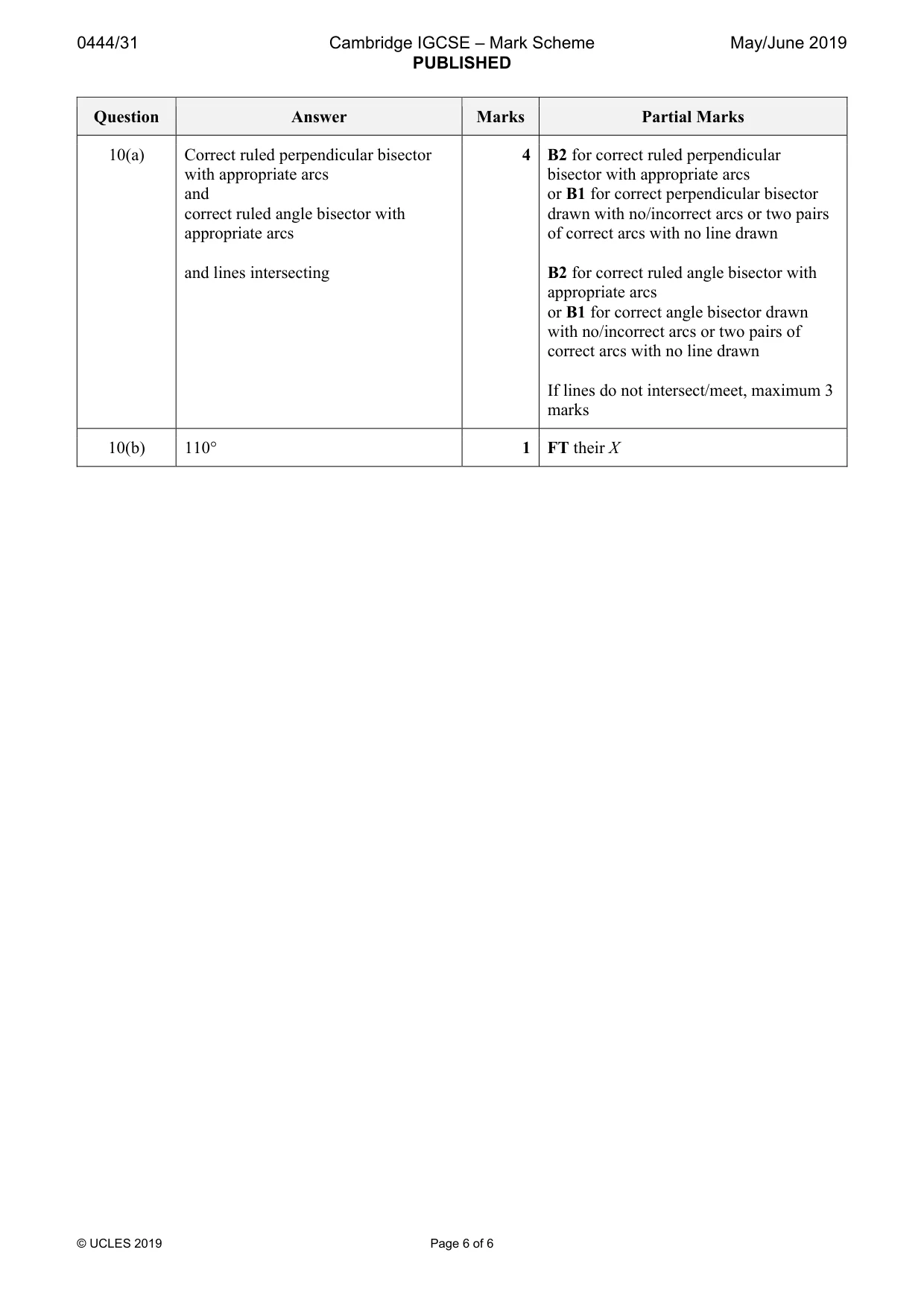
Mark scheme: 10(a) Correct ruled perpendicular bisector 4 B2 for correct ruled perpendicular with appropriate arcs bisector with appropriate arcs and or B1 for correct perpendicular bisector correct ruled angle bisector with drawn with no/incorrect arcs or two pairs appropriate arcs of correct arcs with no line drawn and lines intersecting B2 for correct ruled angle bisector with appropriate arcs or B1 for correct angle bisector drawn with no/incorrect arcs or two pairs of correct arcs with no line drawn If lines do not intersect/meet, maximum 3 marks 10(b) 110° 1 FT their X
What you needed in this session
Cambridge’s own grade thresholds for 2019 May/June, Paper 3 · Variant 1. A higher threshold means an easier paper — the bar moves with how the cohort did.