Cambridge IGCSE Mathematics - International 0607 — 2017 Oct/Nov Paper 5 · Variant 1
0607/51/O/N/17 · 24 marks · ≈27 min
The question paper and its mark scheme, free to read here and free to download. This is Cambridge’s own paper, exactly as it was sat.
Question paper8 pages
Mark scheme4 pages
Answers below. Sit the paper first if you are practising.
Paper as text
Question paper, page 1
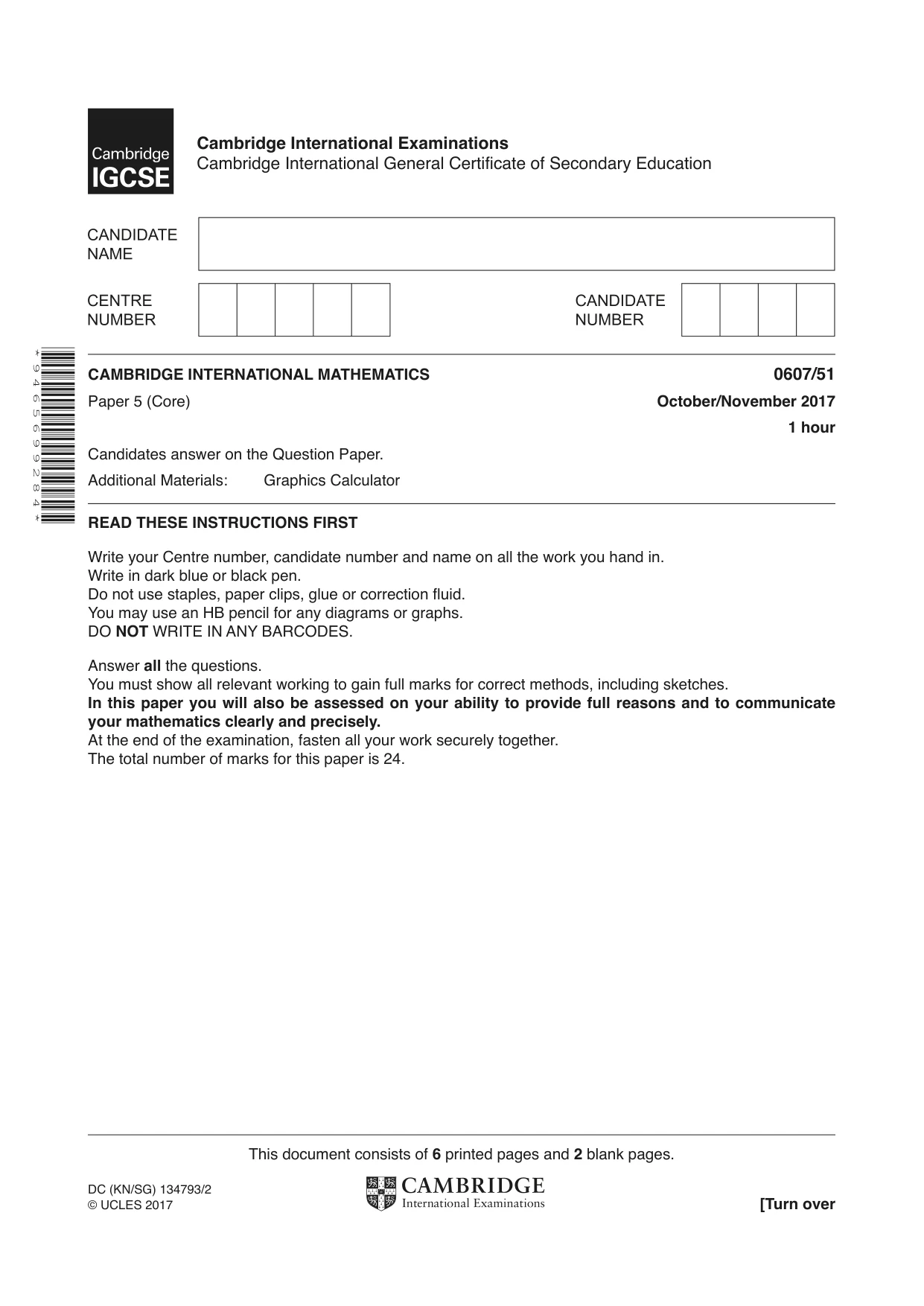
This document consists of 6 printed pages and 2 blank pages. DC (KN/SG) 134793/2 © UCLES 2017 [Turn over * 9 4 6 5 6 9 9 2 8 4 * CAMBRIDGE INTERNATIONAL MATHEMATICS 0607/51 Paper 5 (Core) October/November 2017 1 hour Candidates answer on the Question Paper. Additional Materials: Graphics Calculator READ THESE INSTRUCTIONS FIRST Write your Centre number, candidate number and name on all the work you hand in. Write in dark blue or black pen. Do not use staples, paper clips, glue or correction fluid. You may use an HB pencil for any diagrams or graphs. DO NOT WRITE IN ANY BARCODES. Answer all the questions. You must show all relevant working to gain full marks for correct methods, including sketches. In this paper you will also be assessed on your ability to provide full reasons and to communicate your mathematics clearly and precisely. At the end of the examination, fasten all your work securely together. The total number of marks for this paper is 24. Cambridge International Examinations Cambridge International General Certificate of Secondary Education
Question paper, page 2
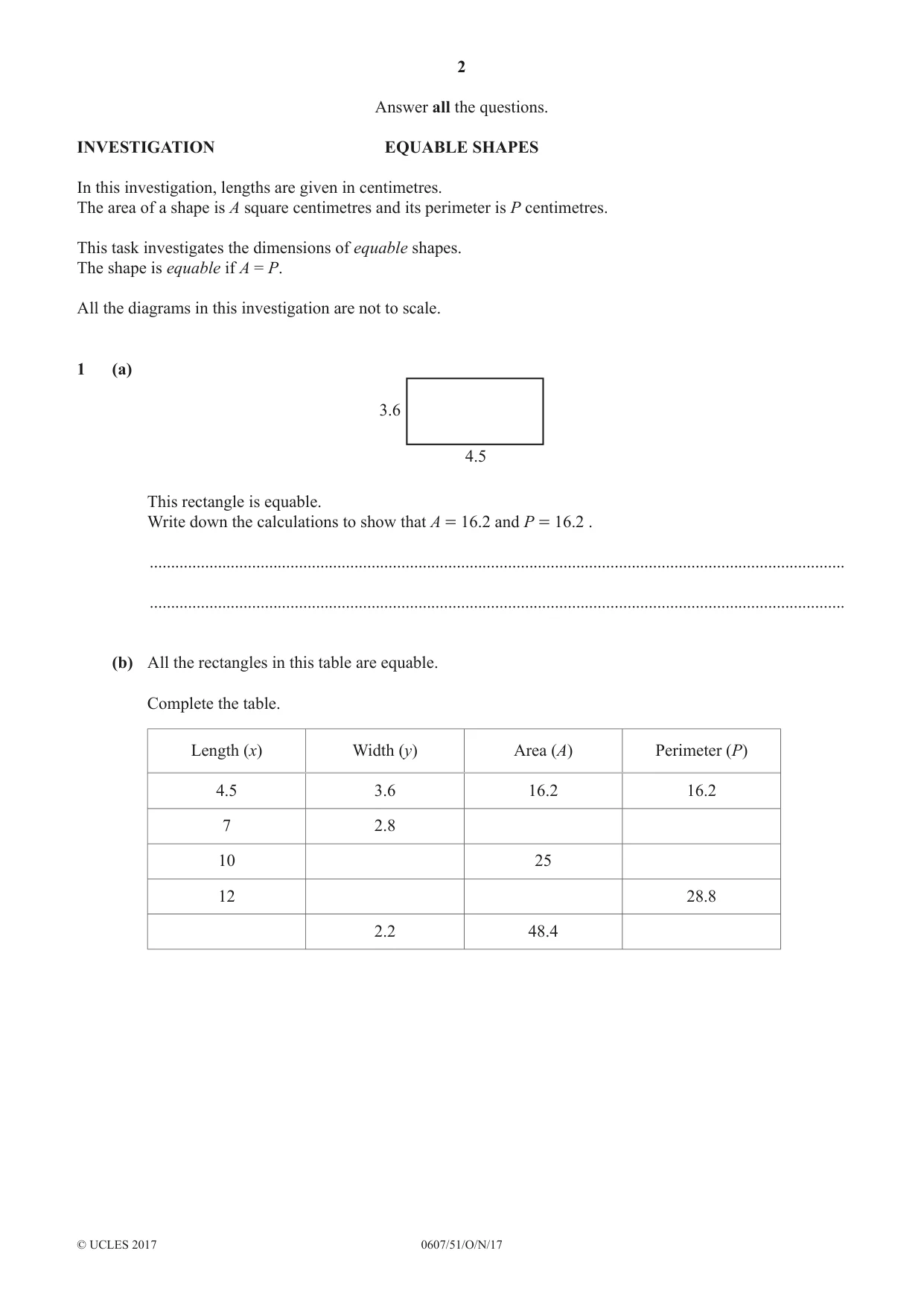
2 0607/51/O/N/17 © UCLES 2017 Answer all the questions. INVESTIGATION EQUABLE SHAPES In this investigation, lengths are given in centimetres. The area of a shape is A square centimetres and its perimeter is P centimetres. This task investigates the dimensions of equable shapes. The shape is equable if A = P. All the diagrams in this investigation are not to scale. 1 (a) 3.6 4.5 This rectangle is equable. Write down the calculations to show that A = 16.2 and P = 16.2 . … … (b) All the rectangles in this table are equable. Complete the table. Length (x) Width (y) Area (A) Perimeter (P) 4.5 3.6 16.2 16.2 7 2.8 10 25 12 28.8 2.2 48.4
Question paper, page 3
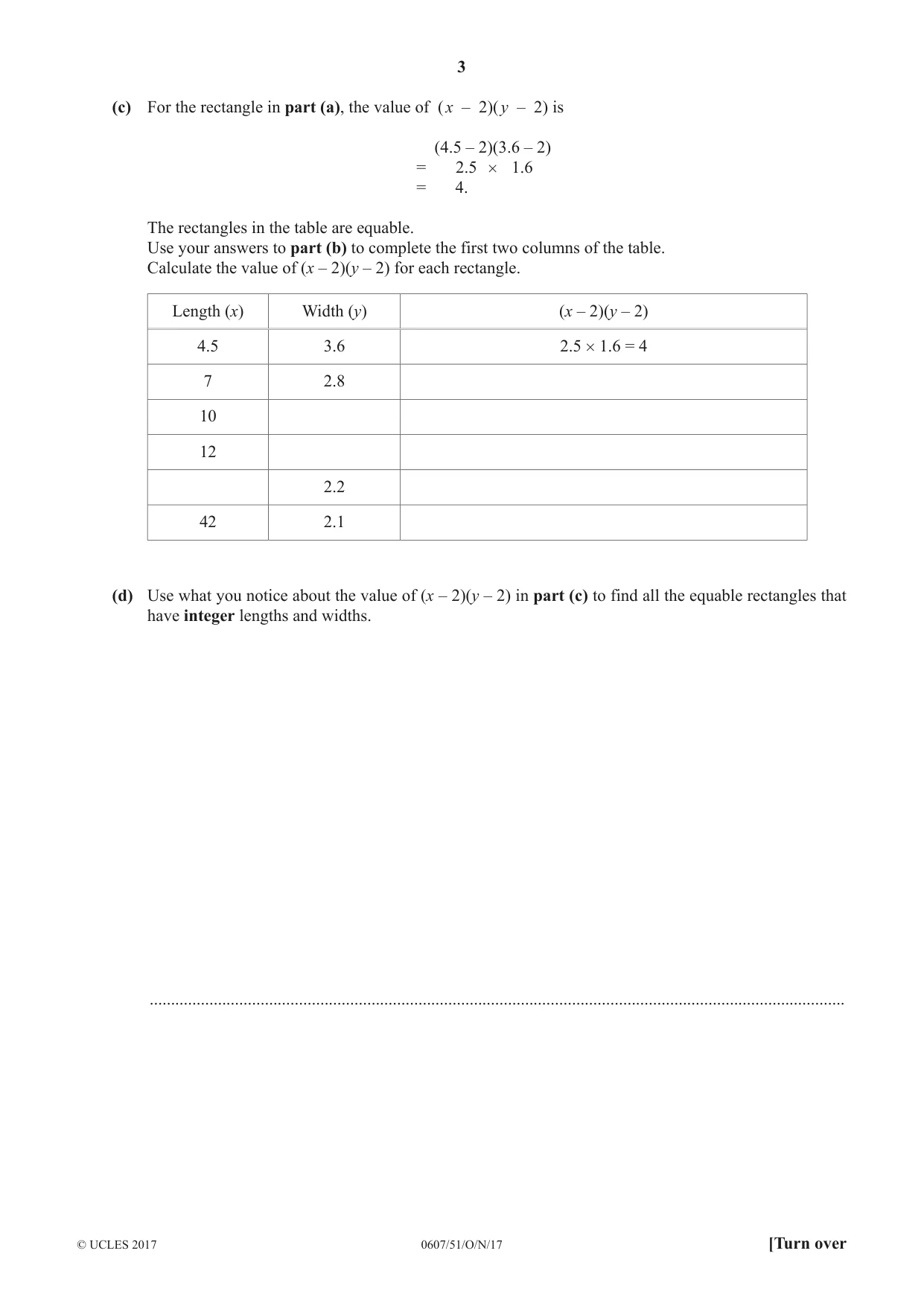
3 0607/51/O/N/17 © UCLES 2017 [Turn over (c) For the rectangle in part (a), the value of ( x – 2)( y – 2) is (4.5 – 2)(3.6 – 2) = 2.5 # 1.6 = 4. The rectangles in the table are equable. Use your answers to part (b) to complete the first two columns of the table. Calculate the value of (x – 2)(y – 2) for each rectangle. Length (x) Width (y) (x – 2)(y – 2) 4.5 3.6 2.5 # 1.6 = 4 7 2.8 10 12 2.2 42 2.1 (d) Use what you notice about the value of (x – 2)(y – 2) in part (c) to find all the equable rectangles that have integer lengths and widths. …
Question paper, page 4
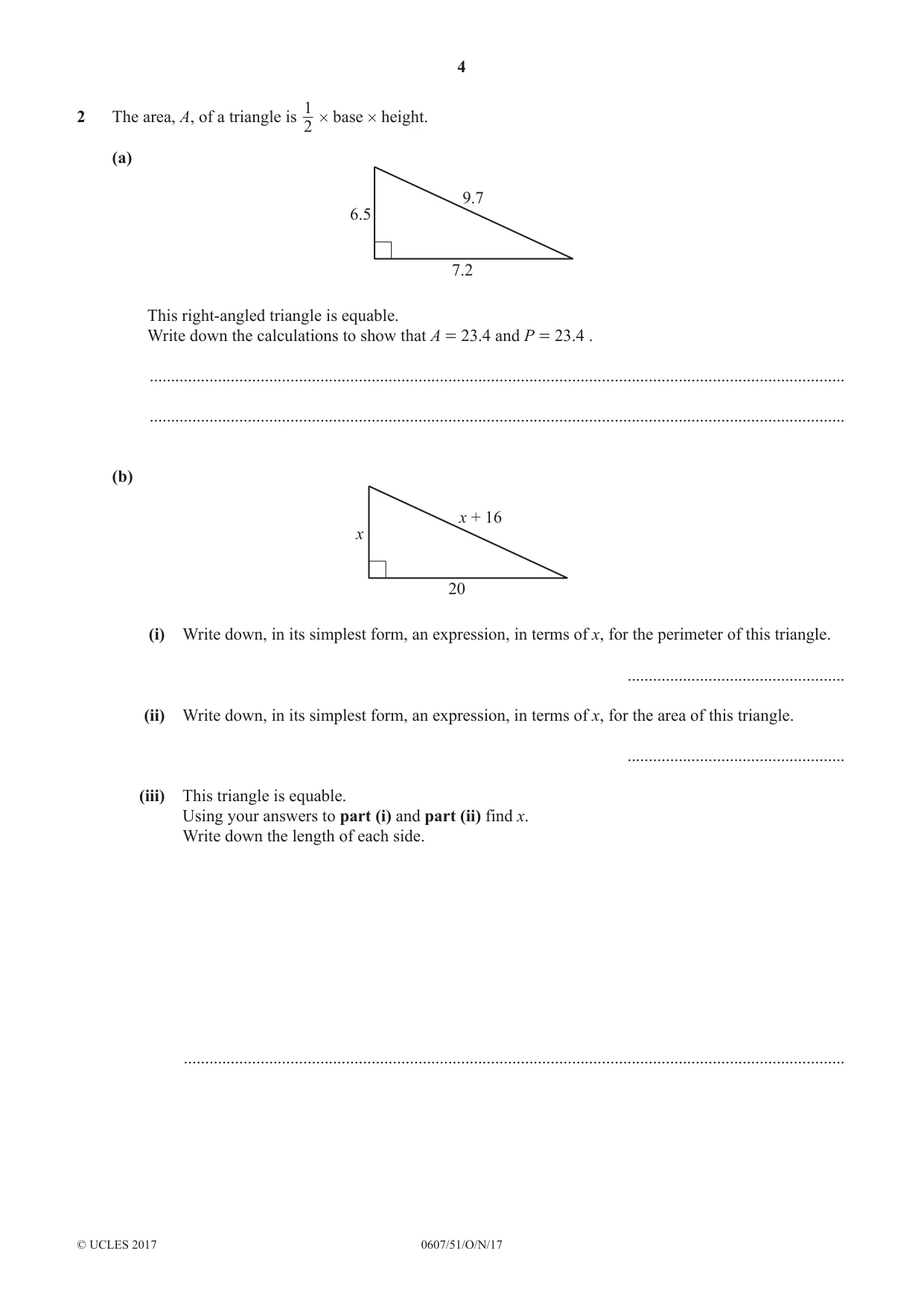
4 0607/51/O/N/17 © UCLES 2017 2 The area, A, of a triangle is 2 1 # base # height. (a) 6.5 7.2 9.7 This right-angled triangle is equable. Write down the calculations to show that A = 23.4 and P = 23.4 . … … (b) x 20 x + 16 (i) Write down, in its simplest form, an expression, in terms of x, for the perimeter of this triangle. … (ii) Write down, in its simplest form, an expression, in terms of x, for the area of this triangle. … (iii) This triangle is equable. Using your answers to part (i) and part (ii) find x. Write down the length of each side. …
Question paper, page 5
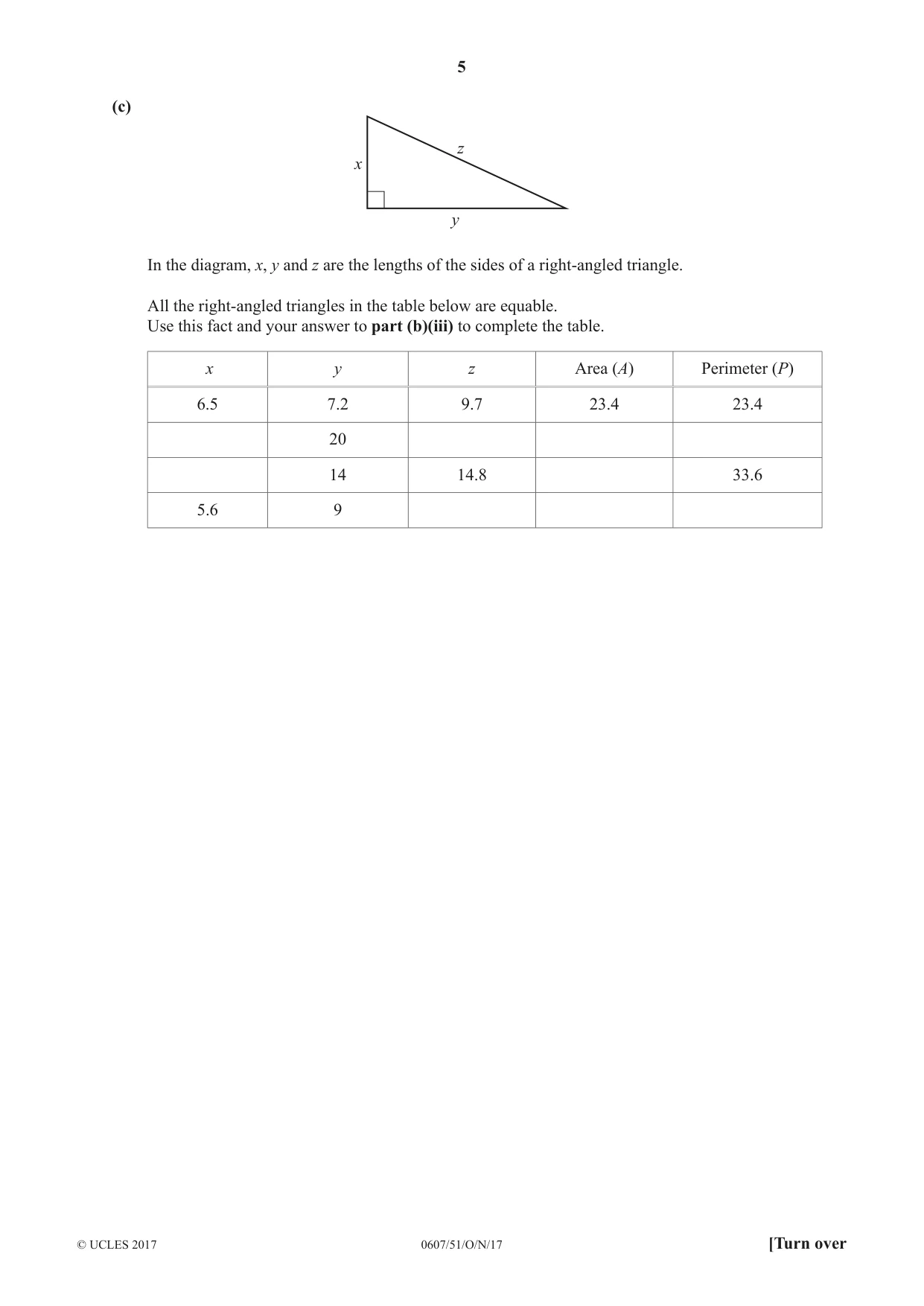
5 0607/51/O/N/17 © UCLES 2017 [Turn over (c) x y z In the diagram, x, y and z are the lengths of the sides of a right-angled triangle. All the right-angled triangles in the table below are equable. Use this fact and your answer to part (b)(iii) to complete the table. x y z Area (A) Perimeter (P) 6.5 7.2 9.7 23.4 23.4 20 14 14.8 33.6 5.6 9
Question paper, page 6
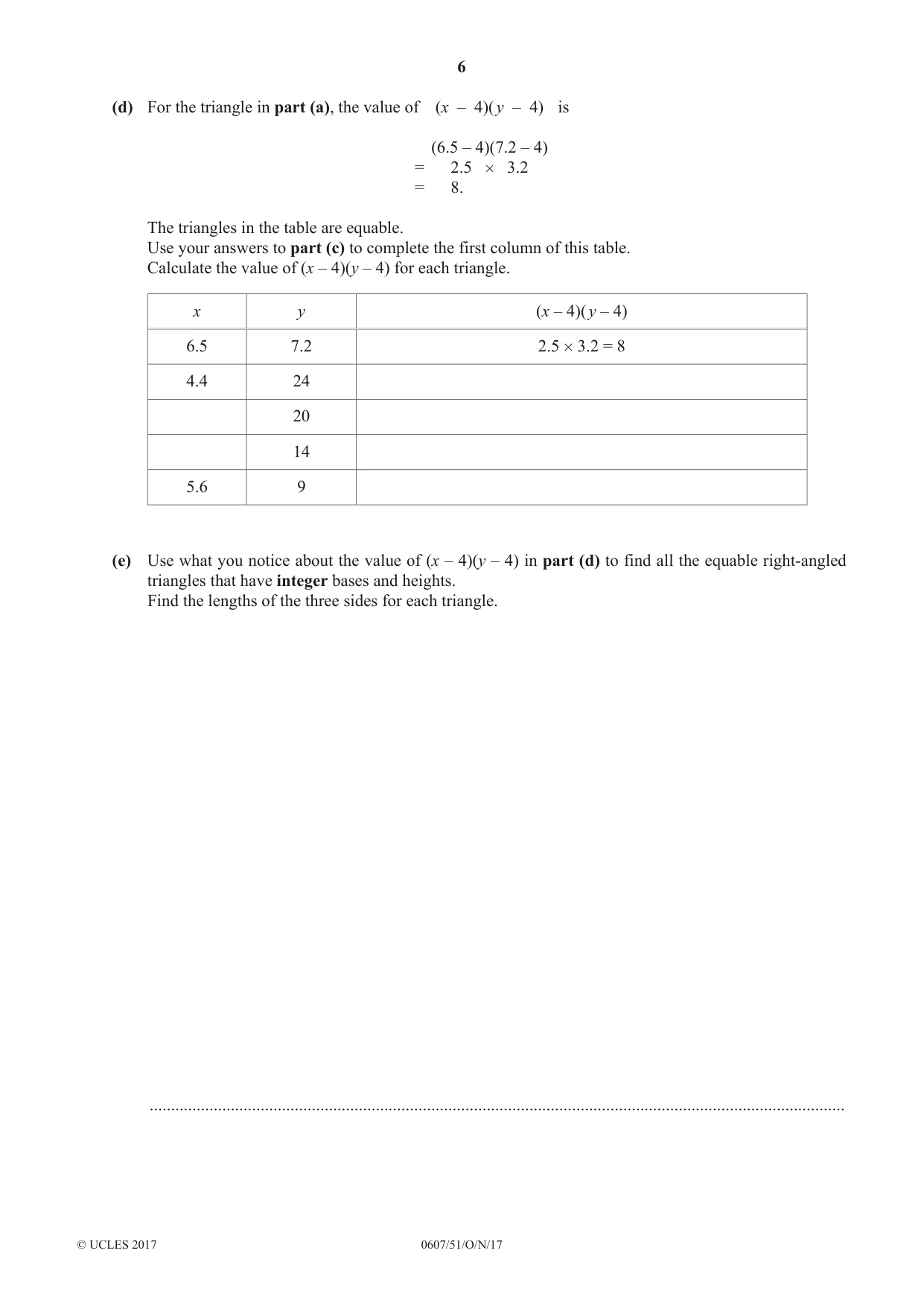
6 0607/51/O/N/17 © UCLES 2017 (d) For the triangle in part (a), the value of (x – 4)( y – 4) is (6.5 – 4)(7.2 – 4) = 2.5 # 3.2 = 8. The triangles in the table are equable. Use your answers to part (c) to complete the first column of this table. Calculate the value of (x – 4)(y – 4) for each triangle. x y (x – 4)( y – 4) 6.5 7.2 2.5 # 3.2 = 8 4.4 24 20 14 5.6 9 (e) Use what you notice about the value of (x – 4)(y – 4) in part (d) to find all the equable right-angled triangles that have integer bases and heights. Find the lengths of the three sides for each triangle. …
Question paper, page 7
7 0607/51/O/N/17 © UCLES 2017 BLANK PAGE
Question paper, page 8
8 0607/51/O/N/17 © UCLES 2017 Permission to reproduce items where third-party owned material protected by copyright is included has been sought and cleared where possible. Every reasonable effort has been made by the publisher (UCLES) to trace copyright holders, but if any items requiring clearance have unwittingly been included, the publisher will be pleased to make amends at the earliest possible opportunity. To avoid the issue of disclosure of answer-related information to candidates, all copyright acknowledgements are reproduced online in the Cambridge International Examinations Copyright Acknowledgements Booklet. This is produced for each series of examinations and is freely available to download at www.cie.org.uk after the live examination series. Cambridge International Examinations is part of the Cambridge Assessment Group. Cambridge Assessment is the brand name of University of Cambridge Local Examinations Syndicate (UCLES), which is itself a department of the University of Cambridge. BLANK PAGE
Mark scheme, page 1
® IGCSE is a registered trademark. This document consists of 4 printed pages. © UCLES 2017 [Turn over Cambridge Assessment International Education Cambridge International General Certificate of Secondary Education CAMBRIDGE INTERNATIONAL MATHEMATICS 0607/51 Paper 5 (Core) October/November 2017 MARK SCHEME Maximum Mark: 24 Published This mark scheme is published as an aid to teachers and candidates, to indicate the requirements of the examination. It shows the basis on which Examiners were instructed to award marks. It does not indicate the details of the discussions that took place at an Examiners’ meeting before marking began, which would have considered the acceptability of alternative answers. Mark schemes should be read in conjunction with the question paper and the Principal Examiner Report for Teachers. Cambridge International will not enter into discussions about these mark schemes. Cambridge International is publishing the mark schemes for the October/November 2017 series for most Cambridge IGCSE®, Cambridge International A and AS Level components and some Cambridge O Level components.
Mark scheme, page 2
0607/51 Cambridge IGCSE – Mark Scheme PUBLISHED October/November 2017 © UCLES 2017 Page 2 of 4 MARK SCHEME NOTES The following notes are intended to aid interpretation of mark schemes in general, but individual mark schemes may include marks awarded for specific reasons outside the scope of these notes. Types of mark M Method marks, awarded for a valid method applied to the problem. A Accuracy mark, awarded for a correct answer or intermediate step correctly obtained. For accuracy marks to be given, the associated Method mark must be earned or implied. B Mark for a correct result or statement independent of Method marks. When a part of a question has two or more ‘method’ steps, the M marks are in principle independent unless the scheme specifically says otherwise; and similarly where there are several B marks allocated. The notation ‘dep’ is used to indicate that a particular M or B mark is dependent on an earlier mark in the scheme. Abbreviations awrt answers which round to cao correct answer only dep dependent FT follow through after error isw ignore subsequent working nfww not from wrong working oe or equivalent rot rounded or truncated SC Special Case soi seen or implied
Mark scheme, page 3
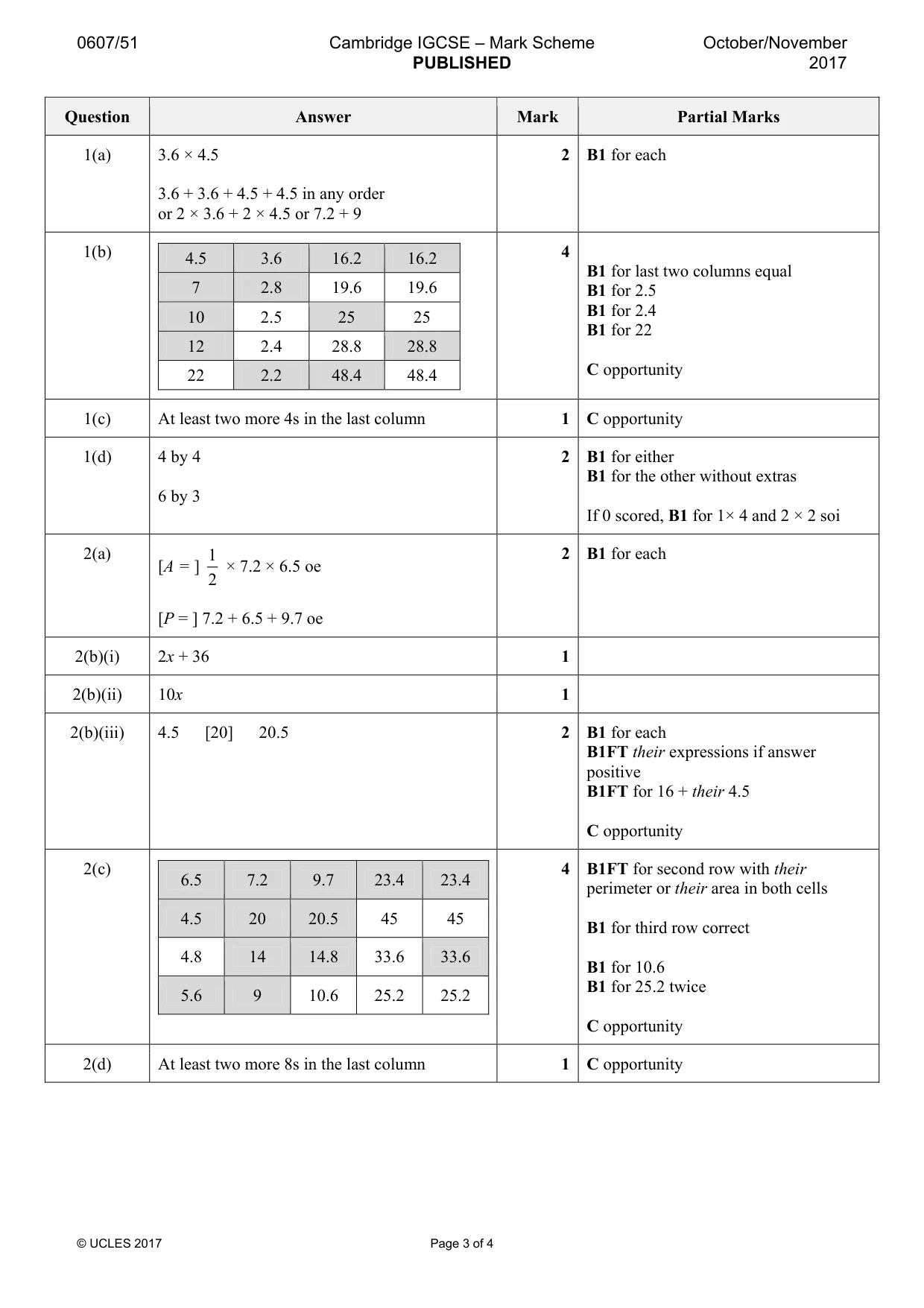
0607/51 Cambridge IGCSE – Mark Scheme PUBLISHED October/November 2017 © UCLES 2017 Page 3 of 4 Question Answer Mark Partial Marks 1(a) 3.6 × 4.5 3.6 + 3.6 + 4.5 + 4.5 in any order or 2 × 3.6 + 2 × 4.5 or 7.2 + 9 2 B1 for each 1(b) 4.5 3.6 16.2 16.2 7 2.8 19.6 19.6 10 2.5 25 25 12 2.4 28.8 28.8 22 2.2 48.4 48.4 4 B1 for last two columns equal B1 for 2.5 B1 for 2.4 B1 for 22 C opportunity 1(c) At least two more 4s in the last column 1 C opportunity 1(d) 4 by 4 6 by 3 2 B1 for either B1 for the other without extras If 0 scored, B1 for 1× 4 and 2 × 2 soi 2(a) [A = ] 1 2 × 7.2 × 6.5 oe [P = ] 7.2 + 6.5 + 9.7 oe 2 B1 for each 2(b)(i) 2x + 36 1 2(b)(ii) 10x 1 2(b)(iii) 4.5 [20] 20.5 2 B1 for each B1FT their expressions if answer positive B1FT for 16 + their 4.5 C opportunity 2(c) 6.5 7.2 9.7 23.4 23.4 4.5 20 20.5 45 45 4.8 14 14.8 33.6 33.6 5.6 9 10.6 25.2 25.2 4 B1FT for second row with their perimeter or their area in both cells B1 for third row correct B1 for 10.6 B1 for 25.2 twice C opportunity 2(d) At least two more 8s in the last column 1 C opportunity
Mark scheme, page 4
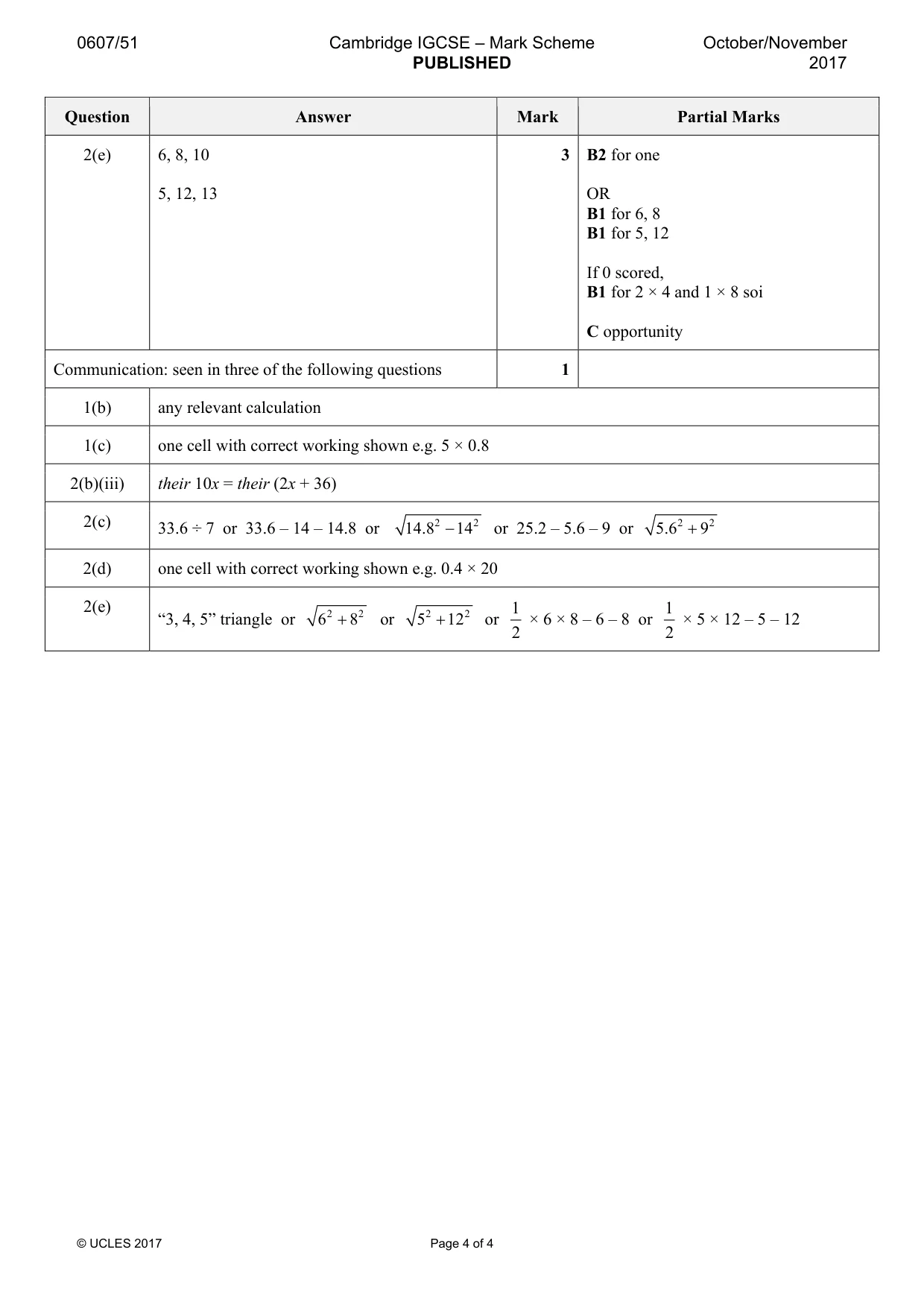
0607/51 Cambridge IGCSE – Mark Scheme PUBLISHED October/November 2017 © UCLES 2017 Page 4 of 4 Question Answer Mark Partial Marks 2(e) 6, 8, 10 5, 12, 13 3 B2 for one OR B1 for 6, 8 B1 for 5, 12 If 0 scored, B1 for 2 × 4 and 1 × 8 soi C opportunity Communication: seen in three of the following questions 1 1(b) any relevant calculation 1(c) one cell with correct working shown e.g. 5 × 0.8 2(b)(iii) their 10x = their (2x + 36) 2(c) 33.6 ÷ 7 or 33.6 – 14 – 14.8 or 2 2 14.8 14 − or 25.2 – 5.6 – 9 or 2 2 5.6 9 + 2(d) one cell with correct working shown e.g. 0.4 × 20 2(e) “3, 4, 5” triangle or 2 2 6 8 + or 2 2 5 12 + or 1 2 × 6 × 8 – 6 – 8 or 1 2 × 5 × 12 – 5 – 12
What you needed in this session
Cambridge’s own grade thresholds for 2017 Oct/Nov, Paper 5 · Variant 1. A higher threshold means an easier paper — the bar moves with how the cohort did.