Cambridge IGCSE Mathematics - International 0607 — 2017 May/June Paper 6 · Variant 3
0607/63/M/J/17 · 40 marks · ≈45 min
The question paper and its mark scheme, free to read here and free to download. This is Cambridge’s own paper, exactly as it was sat.
Question paper16 pages
Mark scheme6 pages
Answers below. Sit the paper first if you are practising.
Paper as text
Question paper, page 1
This document consists of 16 printed pages. DC (NH/AR) 134782/2 © UCLES 2017 [Turn over Cambridge International Examinations Cambridge International General Certificate of Secondary Education * 7 1 4 1 3 6 3 4 7 0 * CAMBRIDGE INTERNATIONAL MATHEMATICS 0607/63 Paper 6 (Extended) May/June 2017 1 hour 30 minutes Candidates answer on the Question Paper. Additional Materials: Graphics Calculator READ THESE INSTRUCTIONS FIRST Write your Centre number, candidate number and name on all the work you hand in. Write in dark blue or black pen. Do not use staples, paper clips, glue or correction fluid. You may use an HB pencil for any diagrams or graphs. DO NOT WRITE IN ANY BARCODES. Answer both parts A and B. You must show all the relevant working to gain full marks for correct methods, including sketches. In this paper you will also be assessed on your ability to provide full reasons and communicate your mathematics clearly and precisely. At the end of the examination, fasten all your work securely together. The total number of marks for this paper is 40.
Question paper, page 2
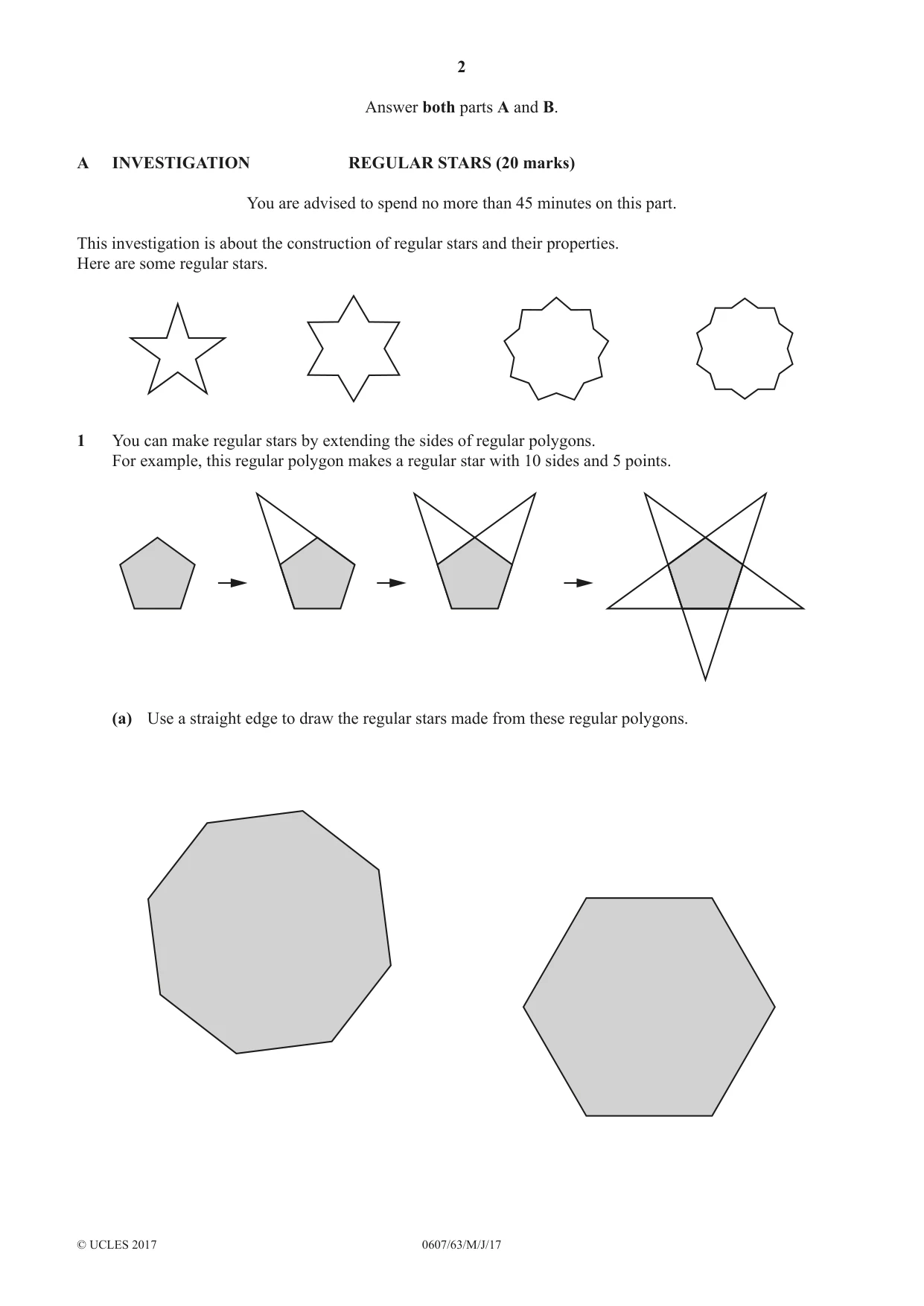
2 0607/63/M/J/17 © UCLES 2017 Answer both parts A and B. A INVESTIGATION REGULAR STARS (20 marks) You are advised to spend no more than 45 minutes on this part. This investigation is about the construction of regular stars and their properties. Here are some regular stars. 1 You can make regular stars by extending the sides of regular polygons. For example, this regular polygon makes a regular star with 10 sides and 5 points. (a) Use a straight edge to draw the regular stars made from these regular polygons.
Question paper, page 3
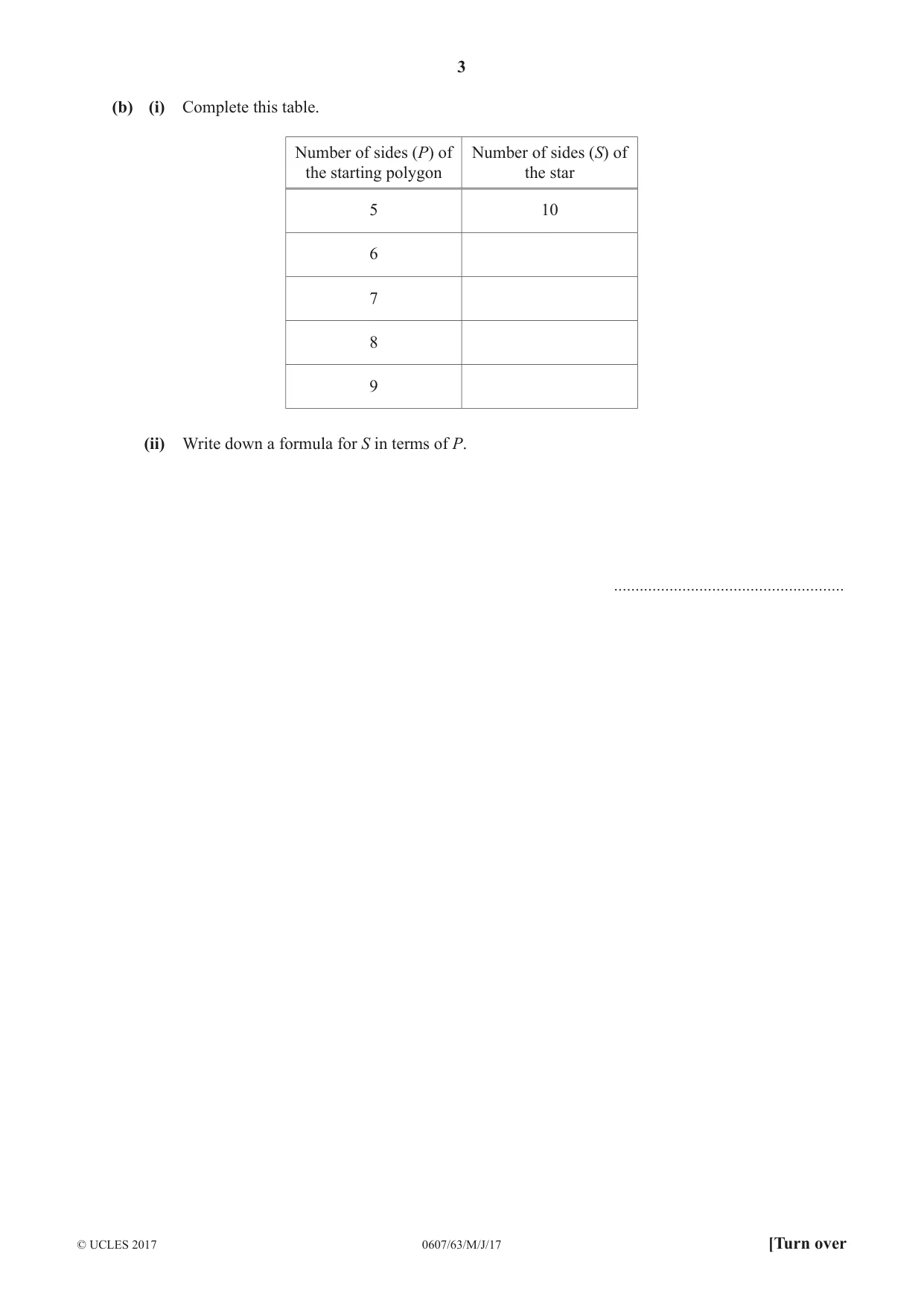
3 0607/63/M/J/17 © UCLES 2017 [Turn over (b) (i) Complete this table. Number of sides (P) of the starting polygon Number of sides (S) of the star 5 10 6 7 8 9 (ii) Write down a formula for S in terms of P. …
Question paper, page 4
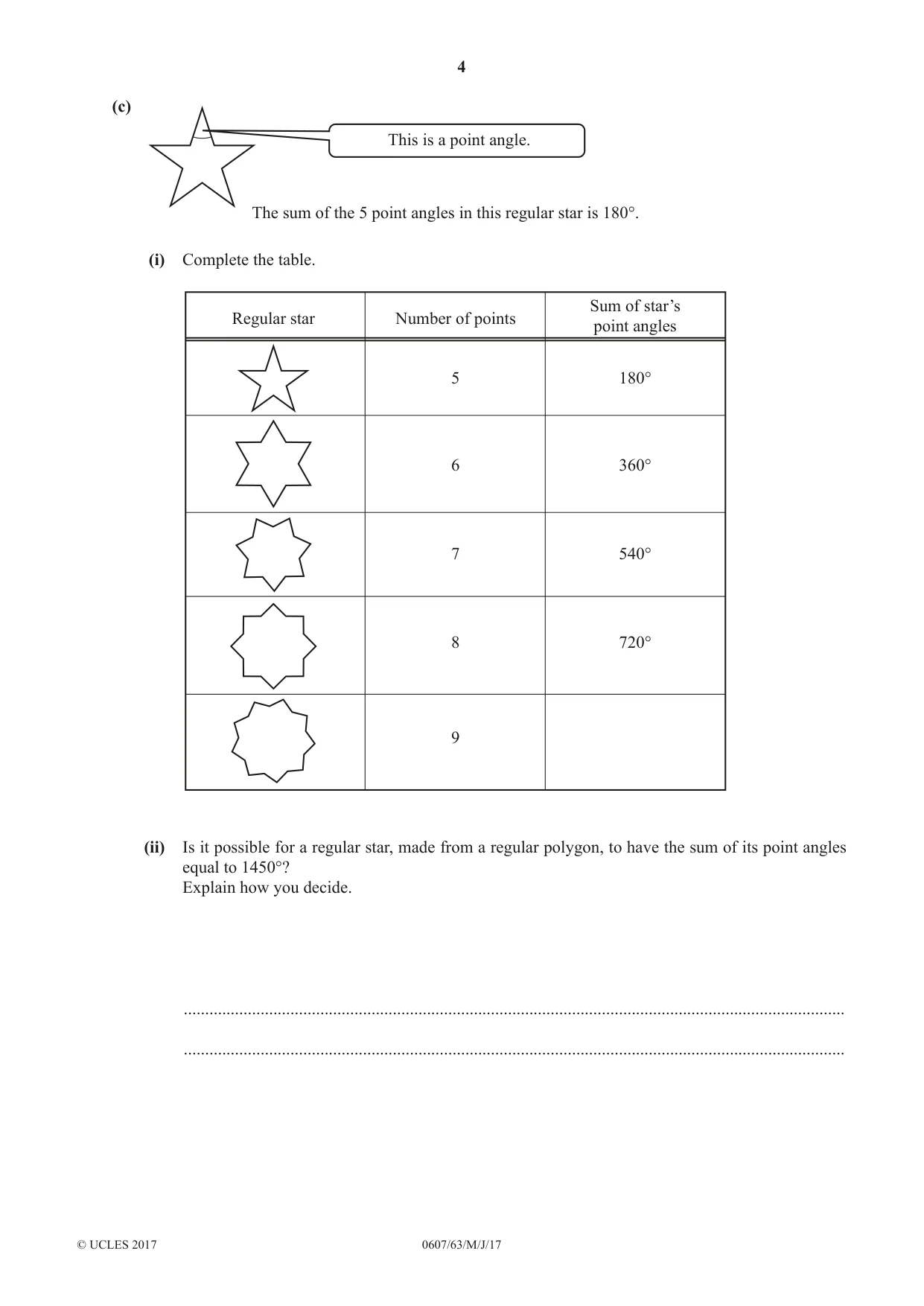
4 0607/63/M/J/17 © UCLES 2017 (c) This is a point angle. The sum of the 5 point angles in this regular star is 180°. (i) Complete the table. Regular star Number of points Sum of star’s point angles 5 6 7 8 9 180° 360° 540° 720° (ii) Is it possible for a regular star, made from a regular polygon, to have the sum of its point angles equal to 1450°? Explain how you decide. … …
Question paper, page 5
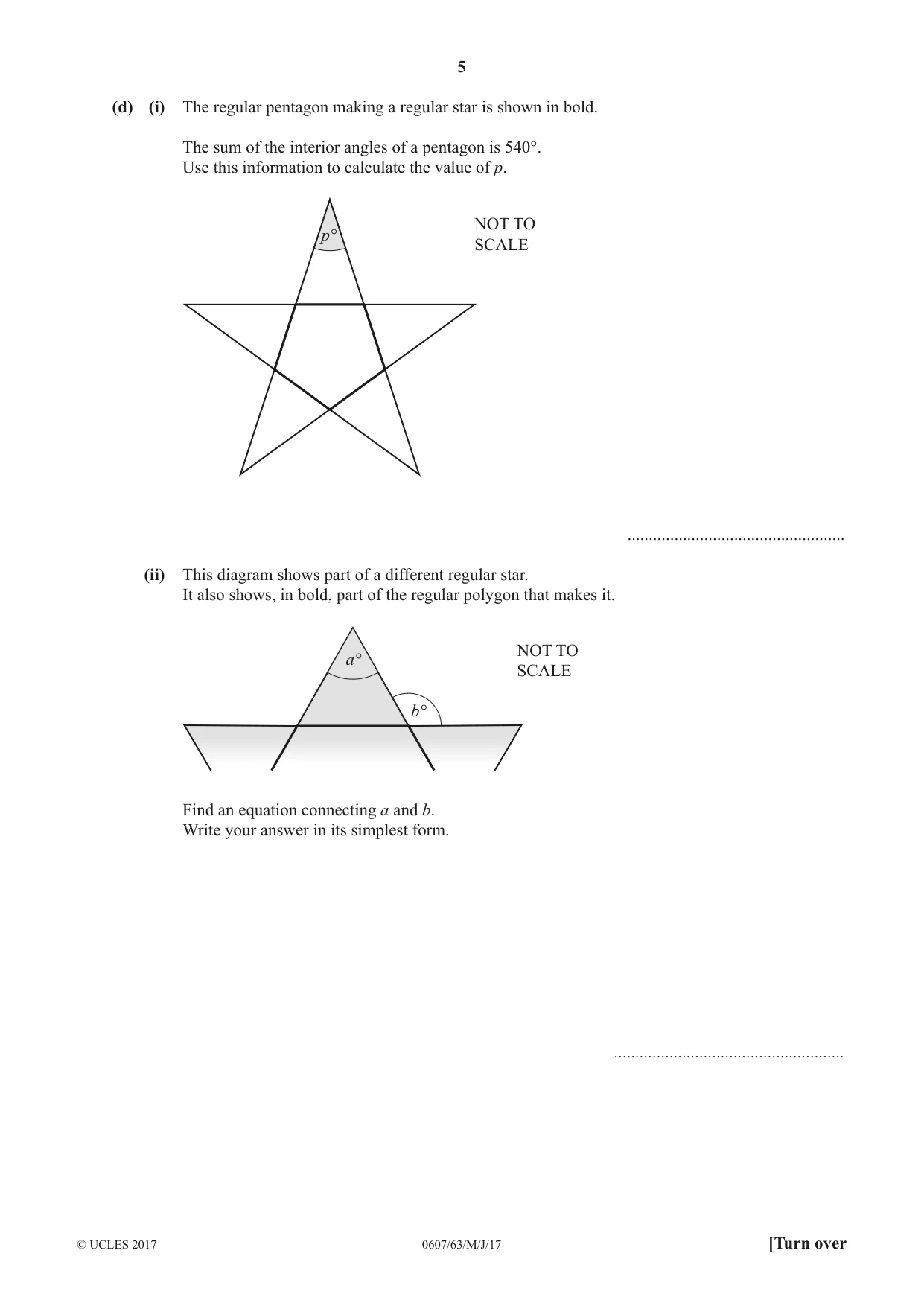
5 0607/63/M/J/17 © UCLES 2017 [Turn over (d) (i) The regular pentagon making a regular star is shown in bold. The sum of the interior angles of a pentagon is 540°. Use this information to calculate the value of p. p° NOT TO SCALE … (ii) This diagram shows part of a different regular star. It also shows, in bold, part of the regular polygon that makes it. NOT TO SCALE a° b° Find an equation connecting a and b. Write your answer in its simplest form. …
Question paper, page 6
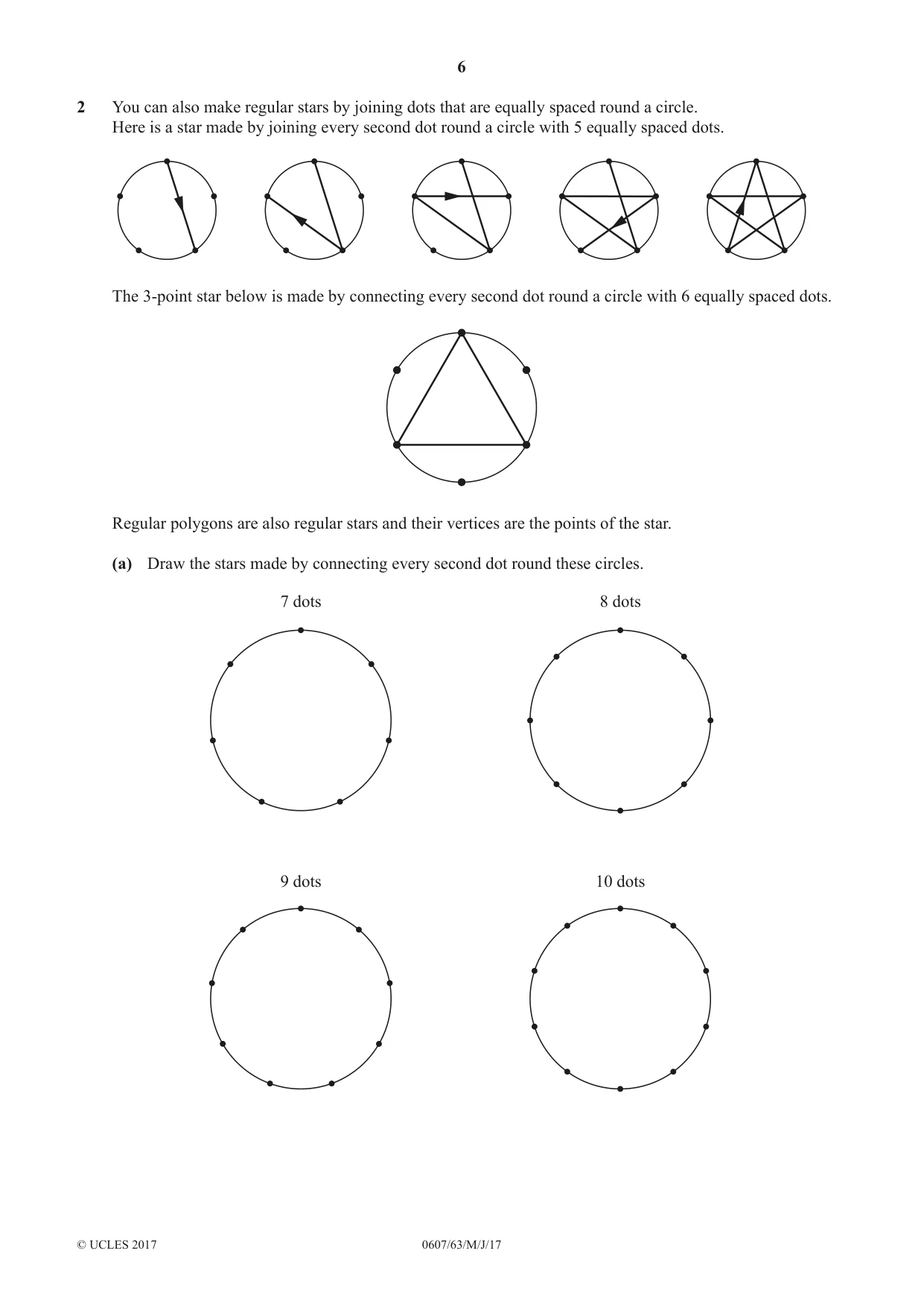
6 0607/63/M/J/17 © UCLES 2017 2 You can also make regular stars by joining dots that are equally spaced round a circle. Here is a star made by joining every second dot round a circle with 5 equally spaced dots. The 3-point star below is made by connecting every second dot round a circle with 6 equally spaced dots. Regular polygons are also regular stars and their vertices are the points of the star. (a) Draw the stars made by connecting every second dot round these circles. 7 dots 8 dots 9 dots 10 dots
Question paper, page 7
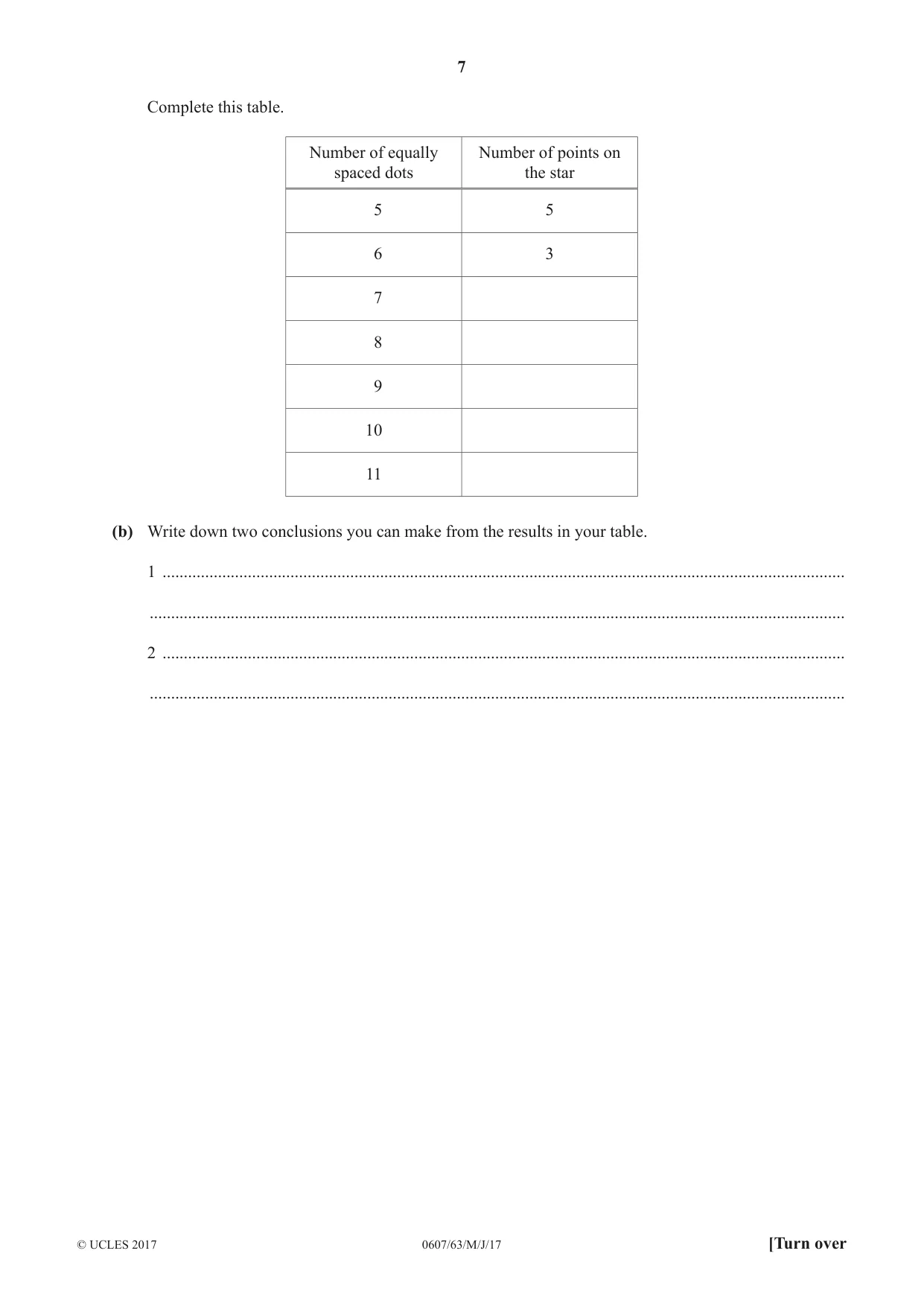
7 0607/63/M/J/17 © UCLES 2017 [Turn over Complete this table. Number of equally spaced dots Number of points on the star 5 5 6 3 7 8 9 10 11 (b) Write down two conclusions you can make from the results in your table. 1 … … 2 … …
Question paper, page 8
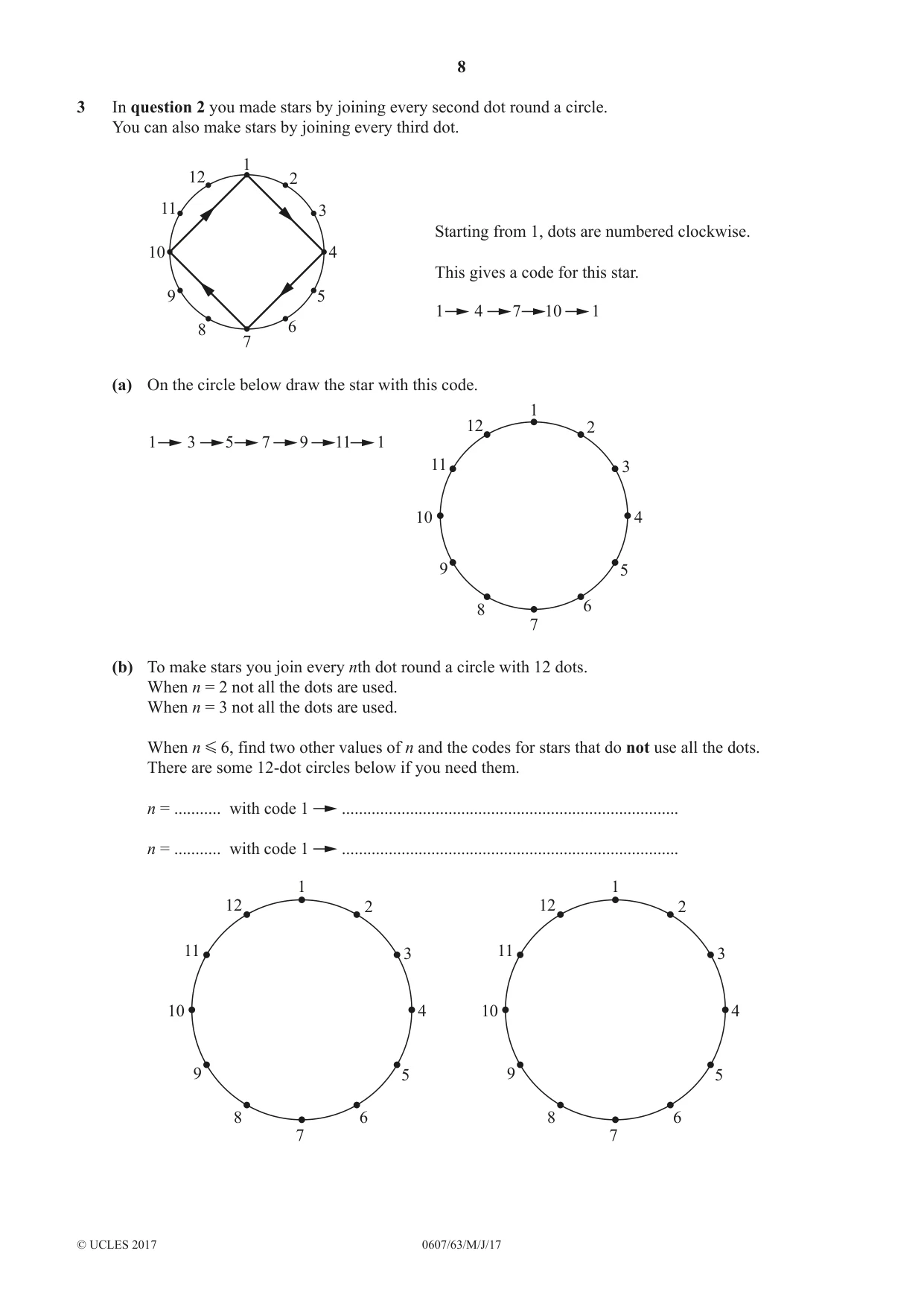
8 0607/63/M/J/17 © UCLES 2017 3 In question 2 you made stars by joining every second dot round a circle. You can also make stars by joining every third dot. 1 Starting from 1, dots are numbered clockwise. This gives a code for this star. 4 7 10 1 1 2 3 4 5 6 7 8 9 10 11 12 (a) On the circle below draw the star with this code. 1 3 5 7 9 11 1 1 2 3 4 5 6 7 8 9 10 11 12 (b) To make stars you join every nth dot round a circle with 12 dots. When n = 2 not all the dots are used. When n = 3 not all the dots are used. When n G 6, find two other values of n and the codes for stars that do not use all the dots. There are some 12-dot circles below if you need them. n = … with code 1 … n = … with code 1 … 1 2 3 4 5 6 7 8 9 10 11 12 1 2 3 4 5 6 7 8 9 10 11 12
Question paper, page 9
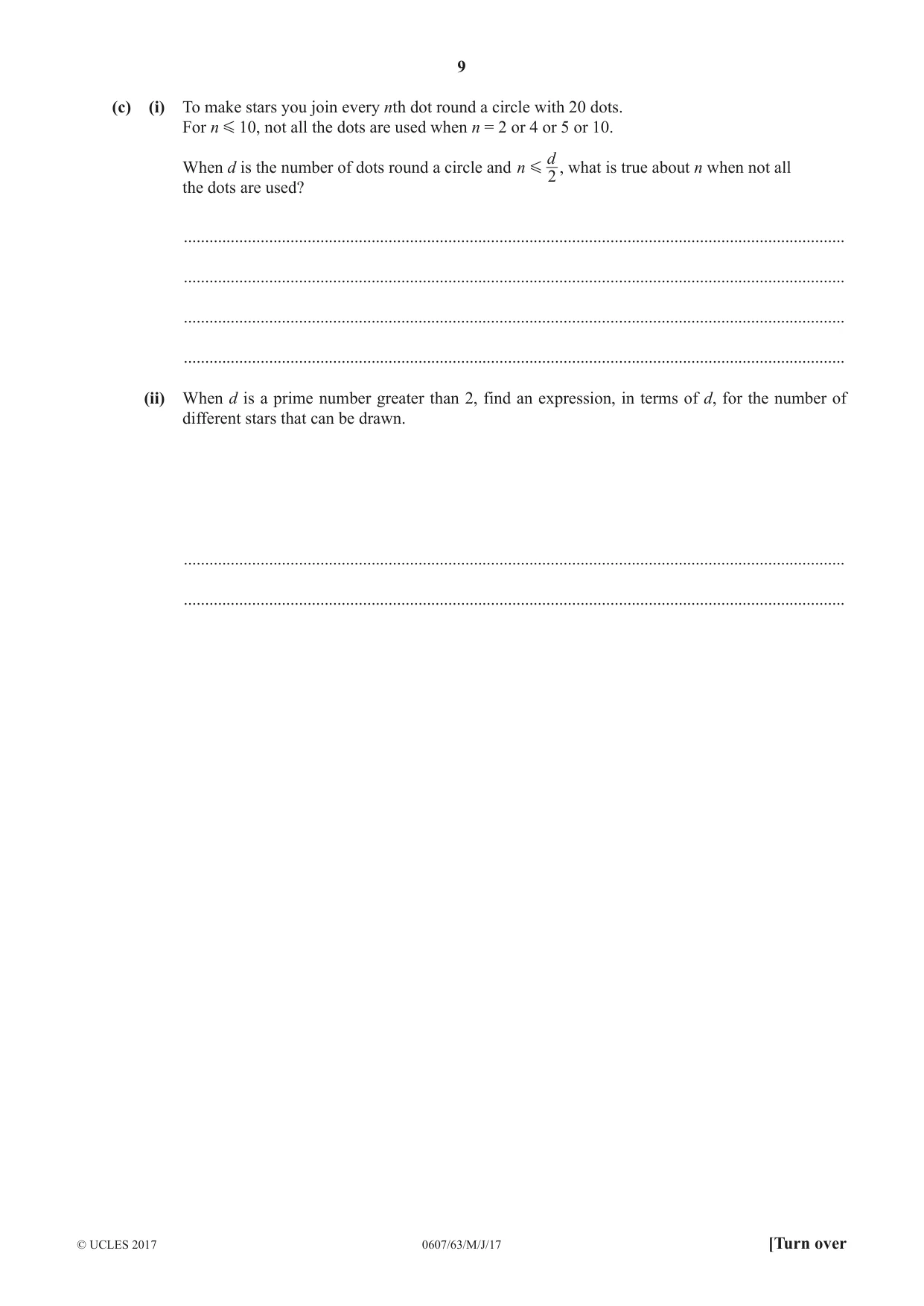
9 0607/63/M/J/17 © UCLES 2017 [Turn over (c) (i) To make stars you join every nth dot round a circle with 20 dots. For n G 10, not all the dots are used when n = 2 or 4 or 5 or 10. When d is the number of dots round a circle and n d 2 G , what is true about n when not all the dots are used? … … … … (ii) When d is a prime number greater than 2, find an expression, in terms of d, for the number of different stars that can be drawn. … …
Question paper, page 10
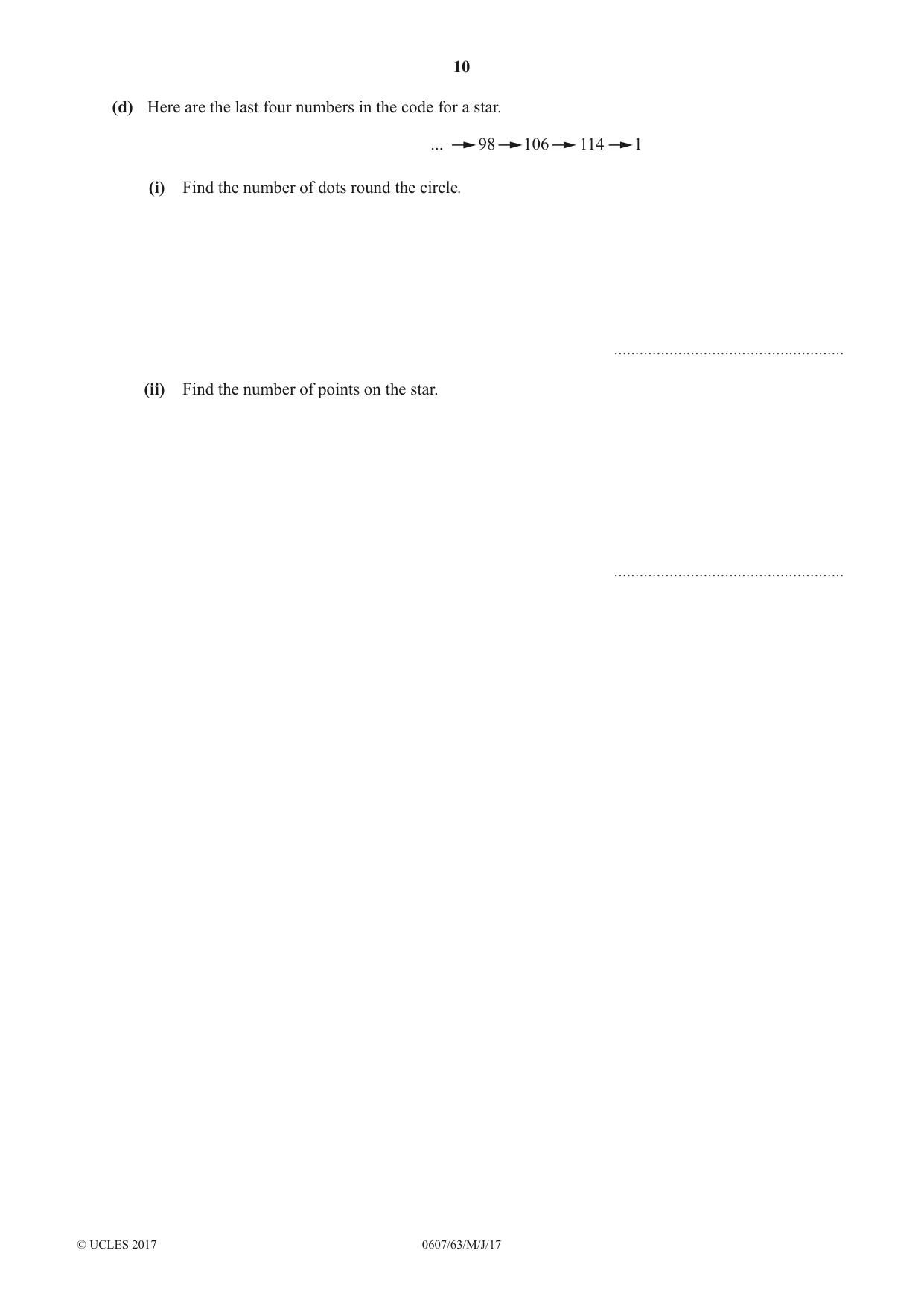
10 0607/63/M/J/17 © UCLES 2017 (d) Here are the last four numbers in the code for a star. ... 98 106 114 1 (i) Find the number of dots round the circle. … (ii) Find the number of points on the star. …
Question paper, page 11
11 0607/63/M/J/17 © UCLES 2017 [Turn over The modelling task starts on page 12.
Question paper, page 12
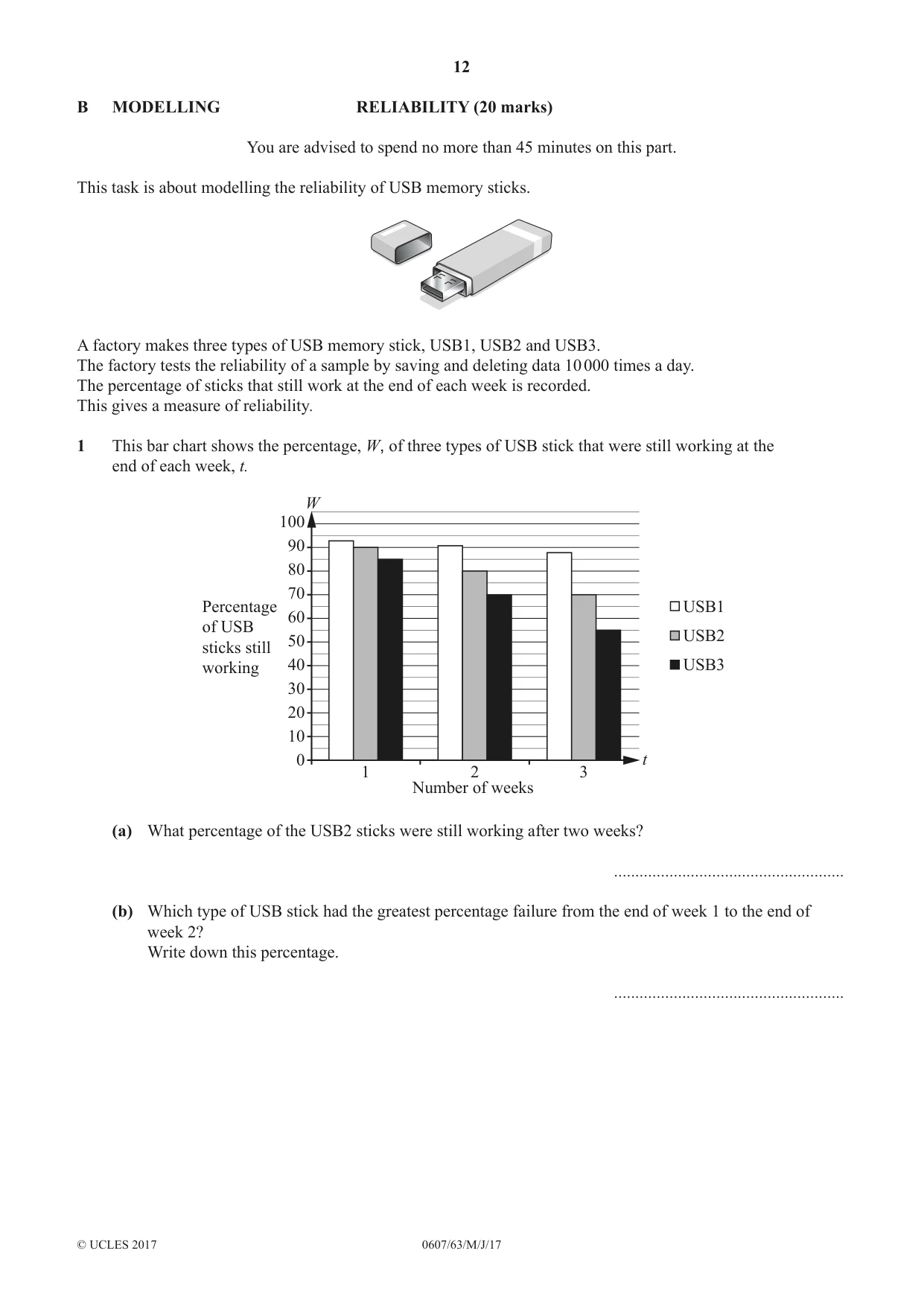
12 0607/63/M/J/17 © UCLES 2017 B MODELLING RELIABILITY (20 marks) You are advised to spend no more than 45 minutes on this part. This task is about modelling the reliability of USB memory sticks. A factory makes three types of USB memory stick, USB1, USB2 and USB3. The factory tests the reliability of a sample by saving and deleting data 10 000 times a day. The percentage of sticks that still work at the end of each week is recorded. This gives a measure of reliability. 1 This bar chart shows the percentage, W, of three types of USB stick that were still working at the end of each week, t. Percentage of USB sticks still working Number of weeks USB1 USB2 USB3 100 90 80 70 60 50 40 30 20 10 0 1 2 3 t W (a) What percentage of the USB2 sticks were still working after two weeks? … (b) Which type of USB stick had the greatest percentage failure from the end of week 1 to the end of week 2? Write down this percentage. …
Question paper, page 13
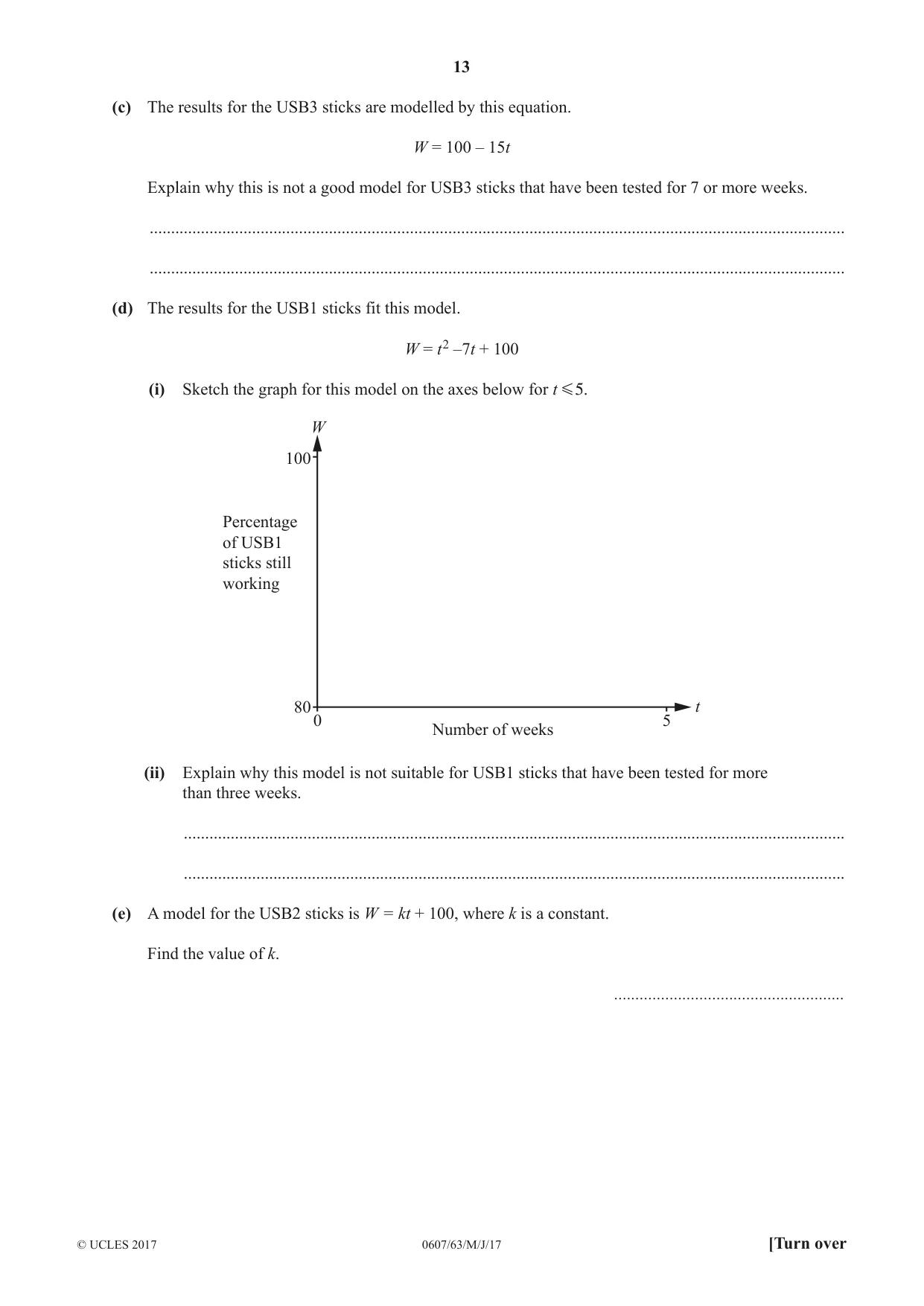
13 0607/63/M/J/17 © UCLES 2017 [Turn over (c) The results for the USB3 sticks are modelled by this equation. W = 100 – 15t Explain why this is not a good model for USB3 sticks that have been tested for 7 or more weeks. … … (d) The results for the USB1 sticks fit this model. W = t2 –7t + 100 (i) Sketch the graph for this model on the axes below for t G 5. Percentage of USB1 sticks still working Number of weeks 100 80 t W 0 5 (ii) Explain why this model is not suitable for USB1 sticks that have been tested for more than three weeks. … … (e) A model for the USB2 sticks is W = kt + 100, where k is a constant. Find the value of k. …
Question paper, page 14
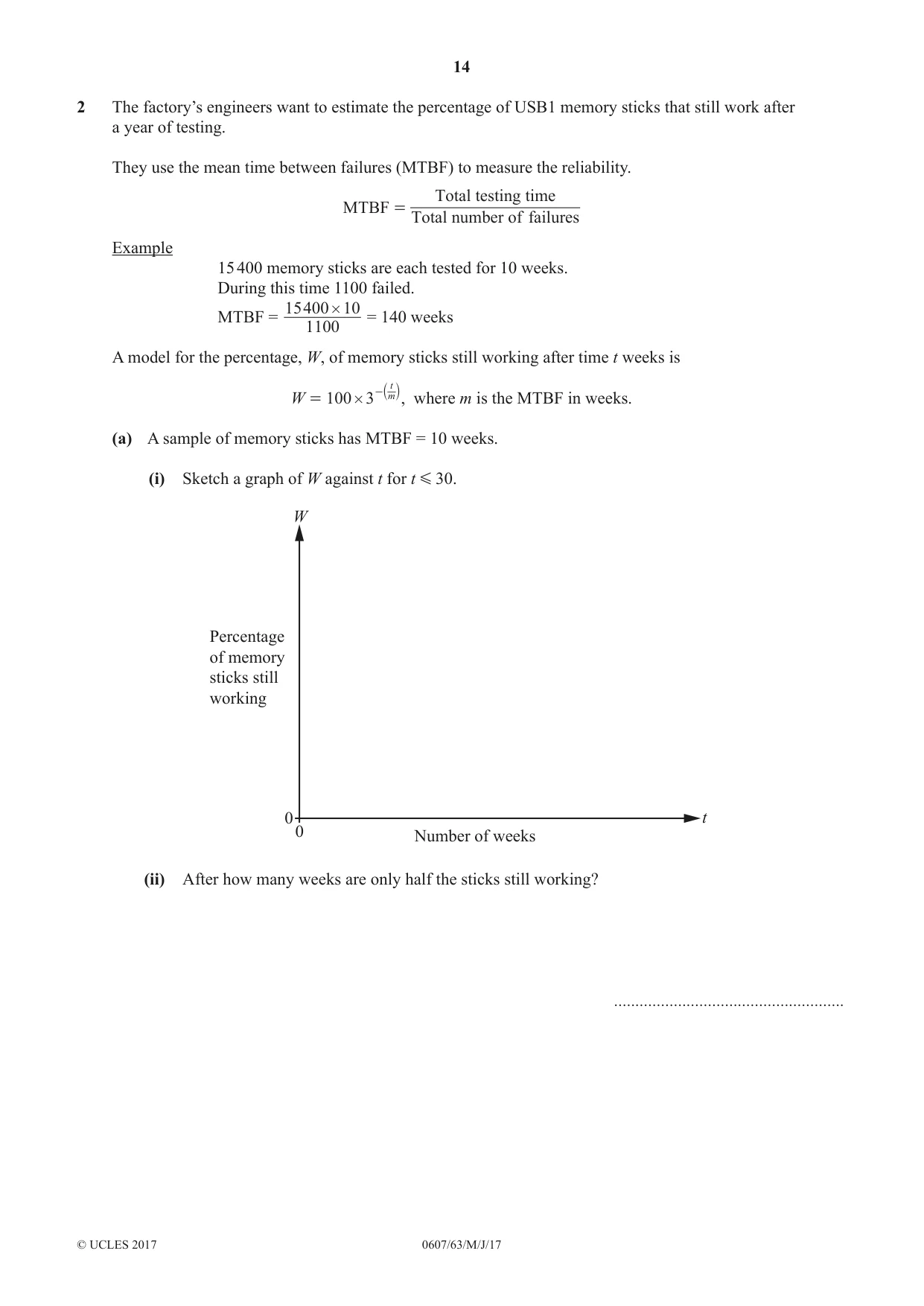
14 0607/63/M/J/17 © UCLES 2017 2 The factory’s engineers want to estimate the percentage of USB1 memory sticks that still work after a year of testing. They use the mean time between failures (MTBF) to measure the reliability. MTBF Total number of failures Total testing time = Example 15 400 memory sticks are each tested for 10 weeks. During this time 1100 failed. MTBF = 1100 15400 10 # = 140 weeks A model for the percentage, W, of memory sticks still working after time t weeks is W 100 3 m t # = -a k, where m is the MTBF in weeks. (a) A sample of memory sticks has MTBF = 10 weeks. (i) Sketch a graph of W against t for t G 30. Percentage of memory sticks still working Number of weeks t W 00 (ii) After how many weeks are only half the sticks still working? …
Question paper, page 15
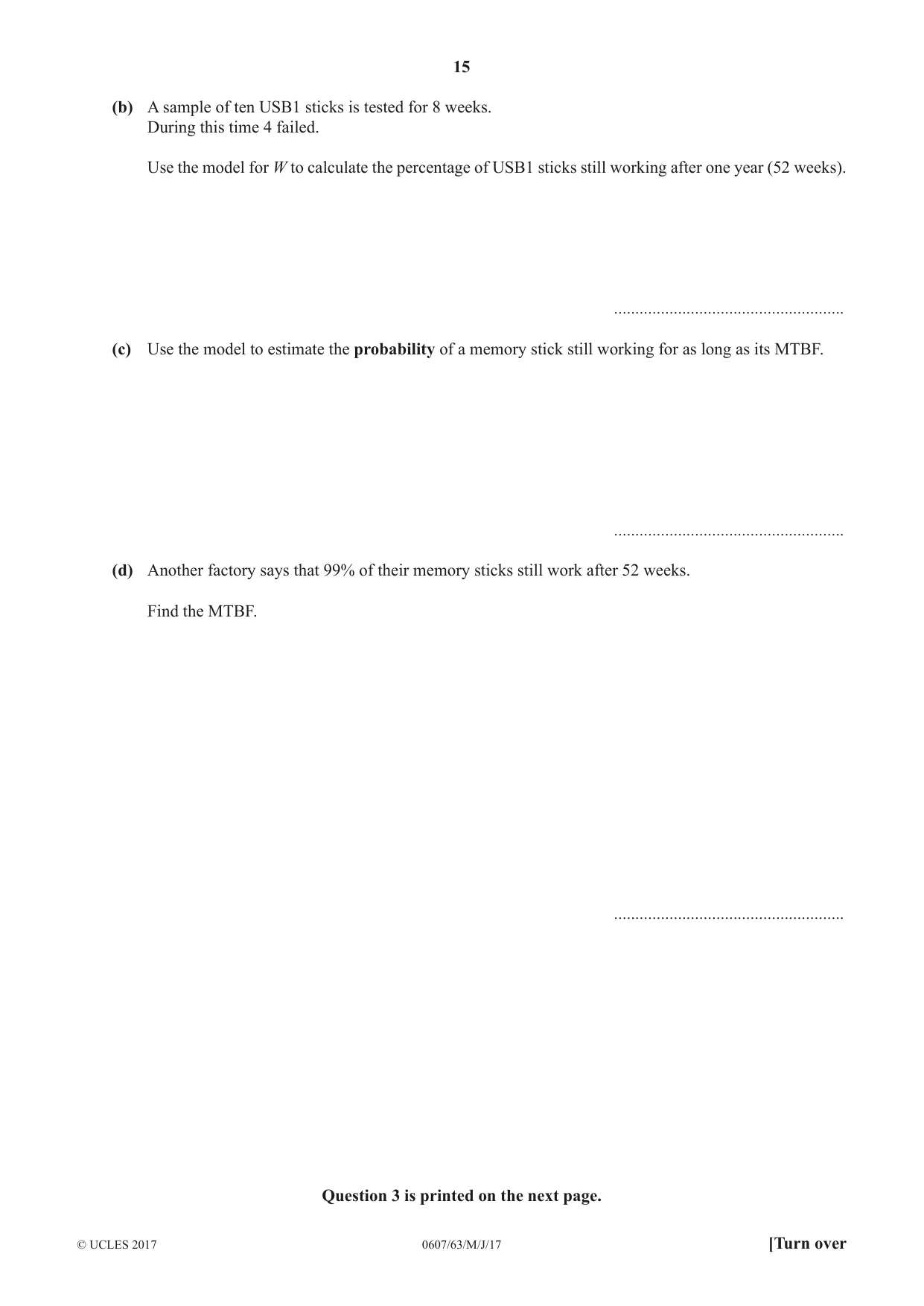
15 0607/63/M/J/17 © UCLES 2017 [Turn over (b) A sample of ten USB1 sticks is tested for 8 weeks. During this time 4 failed. Use the model for W to calculate the percentage of USB1 sticks still working after one year (52 weeks). … (c) Use the model to estimate the probability of a memory stick still working for as long as its MTBF. … (d) Another factory says that 99% of their memory sticks still work after 52 weeks. Find the MTBF. … Question 3 is printed on the next page.
Question paper, page 16
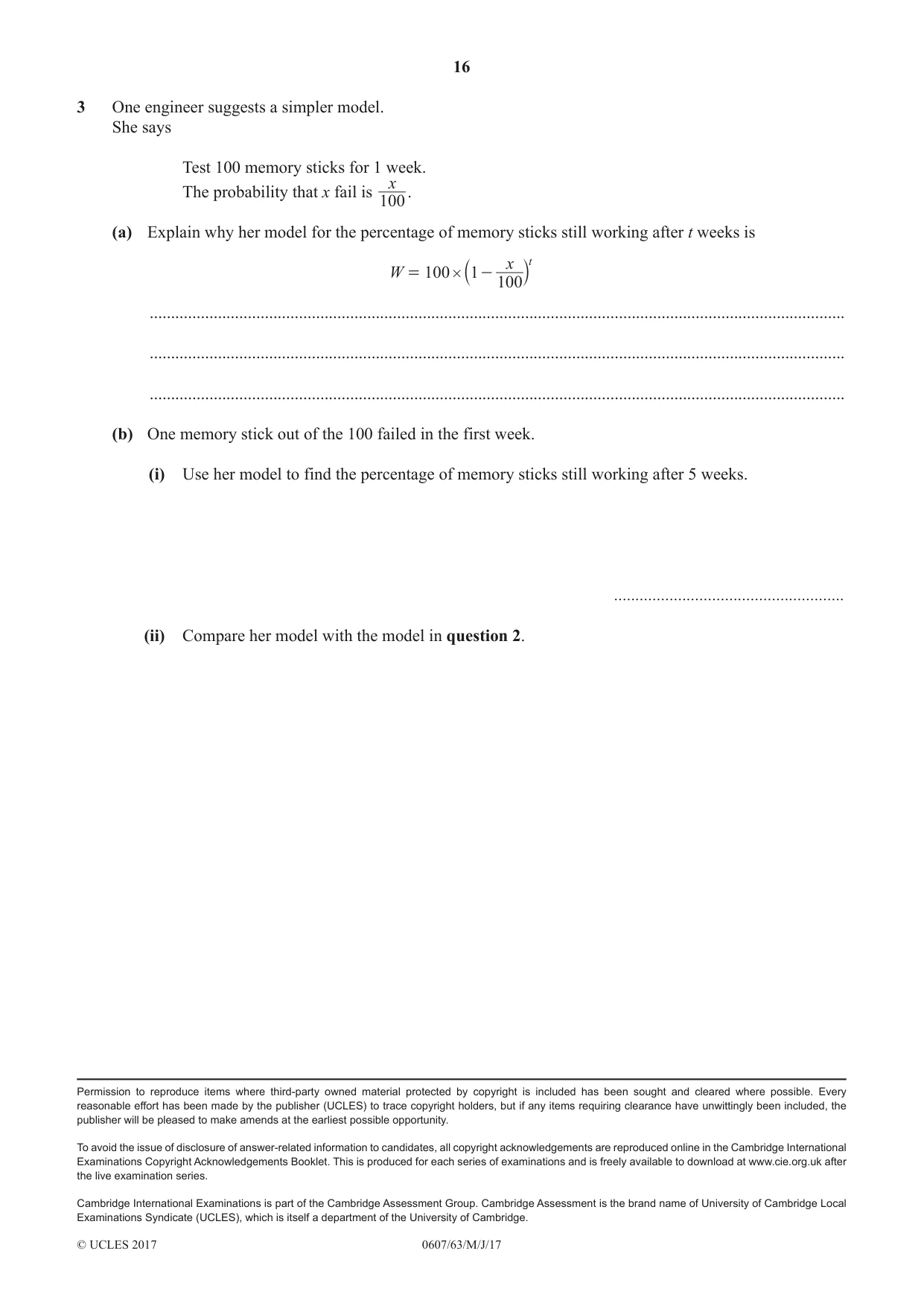
16 0607/63/M/J/17 © UCLES 2017 3 One engineer suggests a simpler model. She says Test 100 memory sticks for 1 week. The probability that x fail is x 100 . (a) Explain why her model for the percentage of memory sticks still working after t weeks is W x 100 1 100 t # = - a k … … … (b) One memory stick out of the 100 failed in the first week. (i) Use her model to find the percentage of memory sticks still working after 5 weeks. … (ii) Compare her model with the model in question 2. Permission to reproduce items where third-party owned material protected by copyright is included has been sought and cleared where possible. Every reasonable effort has been made by the publisher (UCLES) to trace copyright holders, but if any items requiring clearance have unwittingly been included, the publisher will be pleased to make amends at the earliest possible opportunity. To avoid the issue of disclosure of answer-related information to candidates, all copyright acknowledgements are reproduced online in the Cambridge International Examinations Copyright Acknowledgements Booklet. This is produced for each series of examinations and is freely available to download at www.cie.org.uk after the live examination series. Cambridge International Examinations is part of the Cambridge Assessment Group. Cambridge Assessment is the brand name of University of Cambridge Local Examinations Syndicate (UCLES), which is itself a department of the University of Cambridge.
Mark scheme, page 1
® IGCSE is a registered trademark. This document consists of 6 printed pages. © UCLES 2017 [Turn over Cambridge International Examinations Cambridge International General Certificate of Secondary Education CAMBRIDGE INTERNATIONAL MATHEMATICS 0607/63 Paper 6 (Extended) May/June 2017 MARK SCHEME Maximum Mark: 40 Published This mark scheme is published as an aid to teachers and candidates, to indicate the requirements of the examination. It shows the basis on which Examiners were instructed to award marks. It does not indicate the details of the discussions that took place at an Examiners’ meeting before marking began, which would have considered the acceptability of alternative answers. Mark schemes should be read in conjunction with the question paper and the Principal Examiner Report for Teachers. Cambridge will not enter into discussions about these mark schemes. Cambridge is publishing the mark schemes for the May/June 2017 series for most Cambridge IGCSE®, Cambridge International A and AS Level and Cambridge Pre-U components, and some Cambridge O Level components.
Mark scheme, page 2
0607/63 Cambridge IGCSE – Mark Scheme PUBLISHED May/June 2017 © UCLES 2017 Page 2 of 6 MARK SCHEME NOTES The following notes are intended to aid interpretation of mark schemes in general, but individual mark schemes may include marks awarded for specific reasons outside the scope of these notes. Types of mark M Method marks, awarded for a valid method applied to the problem. A Accuracy mark, awarded for a correct answer or intermediate step correctly obtained. For accuracy marks to be given, the associated Method mark must be earned or implied. B Mark for a correct result or statement independent of Method marks. When a part of a question has two or more ‘method’ steps, the M marks are in principle independent unless the scheme specifically says otherwise; and similarly where there are several B marks allocated. The notation ‘dep’ is used to indicate that a particular M or B mark is dependent on an earlier mark in the scheme. Abbreviations awrt answers which round to cao correct answer only dep dependent FT follow through after error isw ignore subsequent working nfww not from wrong working oe or equivalent rot rounded or truncated SC Special Case soi seen or implied
Mark scheme, page 3
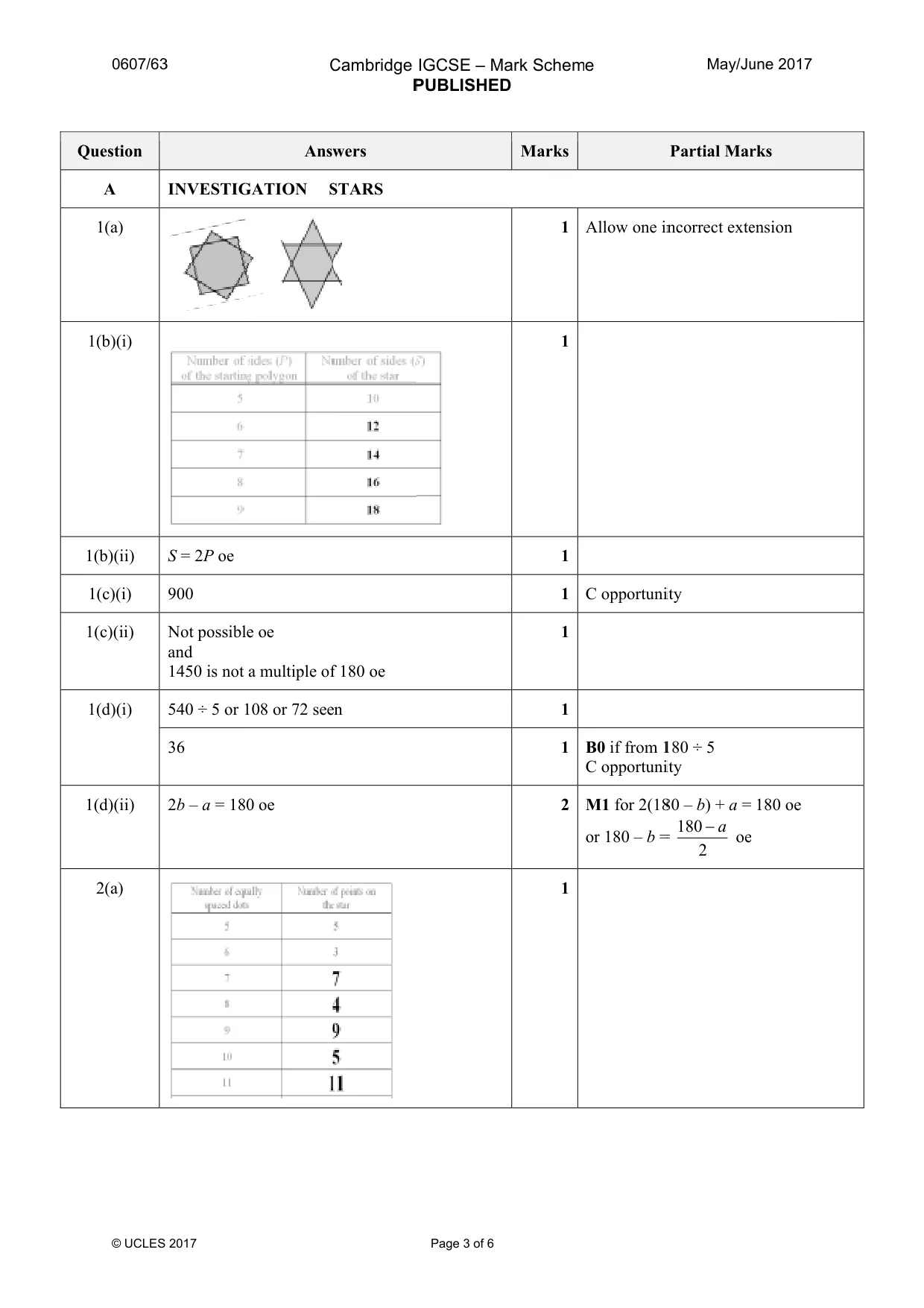
Q 0607/63 © UCLES Question A 1(a) 1(b)(i) 1(b)(ii) 1(c)(i) 1(c)(ii) 1(d)(i) 1(d)(ii) 2(a) 3 2017 INVESTIG S = 2P oe 900 Not possible and 1450 is not a 540 ÷ 5 or 1 36 2b – a = 180 C Answ GATION S e oe a multiple of 08 or 72 see 0 oe Cambridge P wers STARS f 180 oe n IGCSE – M PUBLISHED Page 3 of 6 Mark Schem D Marks 1 1 1 1 1 1 1 2 1 e Allow one in C opportuni B0 if from 1 C opportuni M1 for 2(18 or 180 – b = May/Ju Partial Mar ncorrect exte ity 180 ÷ 5 ity 80 – b) + a = = 180 2 a − oe une 2017 rks ension 180 oe e
Mark scheme, page 4
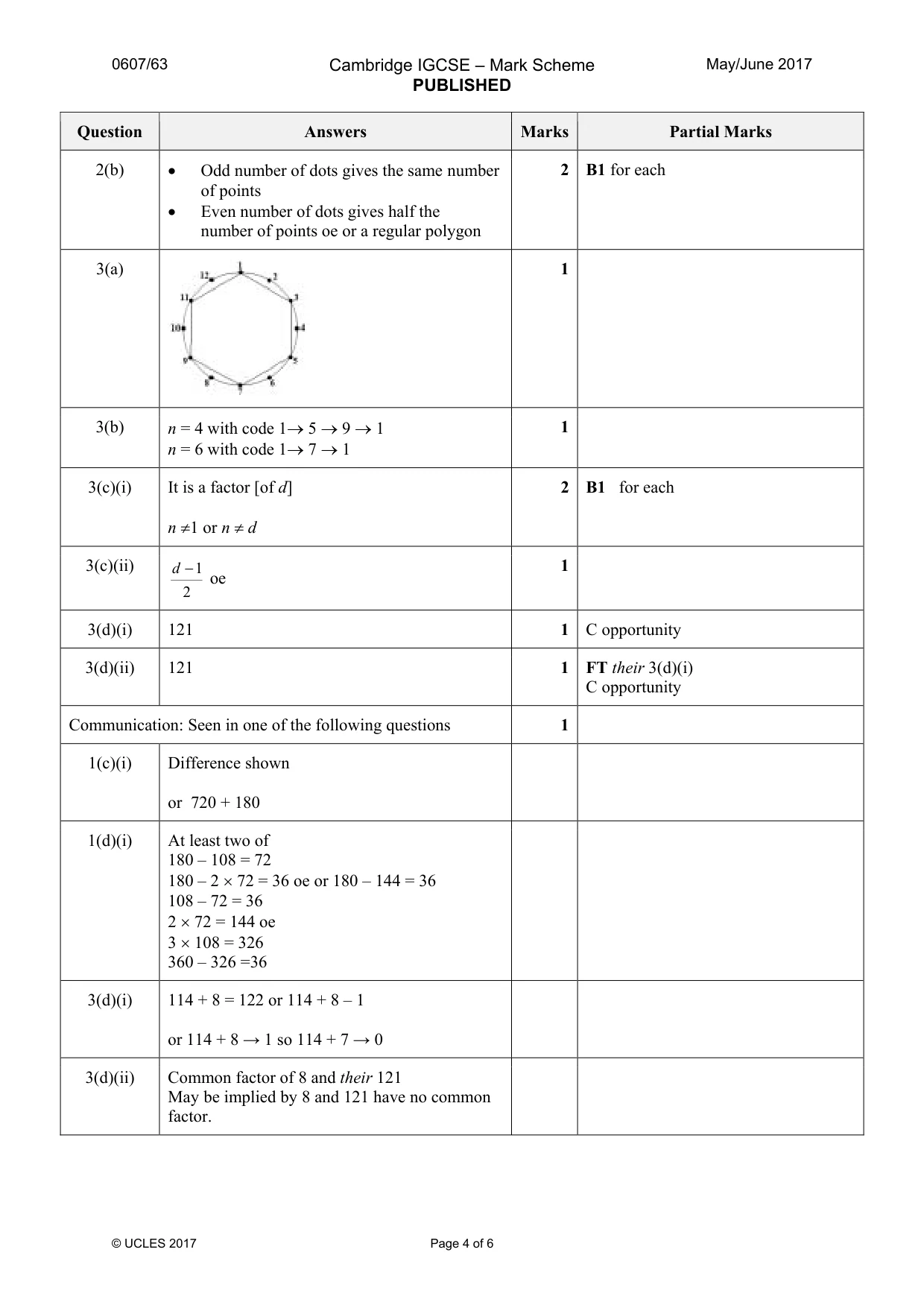
0607/63 Cambridge IGCSE – Mark Scheme PUBLISHED May/June 2017 © UCLES 2017 Page 4 of 6 Question Answers Marks Partial Marks 2(b) • Odd number of dots gives the same number of points • Even number of dots gives half the number of points oe or a regular polygon 2 B1 for each 3(a) 1 3(b) n = 4 with code 1→ 5 → 9 → 1 n = 6 with code 1→ 7 → 1 1 3(c)(i) It is a factor [of d] n ≠1 or n ≠ d 2 B1 for each 3(c)(ii) 1 2 d − oe 1 3(d)(i) 121 1 C opportunity 3(d)(ii) 121 1 FT their 3(d)(i) C opportunity Communication: Seen in one of the following questions 1 1(c)(i) Difference shown or 720 + 180 1(d)(i) At least two of 180 – 108 = 72 180 – 2 × 72 = 36 oe or 180 – 144 = 36 108 – 72 = 36 2 × 72 = 144 oe 3 × 108 = 326 360 – 326 =36 3(d)(i) 114 + 8 = 122 or 114 + 8 – 1 or 114 + 8 → 1 so 114 + 7 → 0 3(d)(ii) Common factor of 8 and their 121 May be implied by 8 and 121 have no common factor.
Mark scheme, page 5
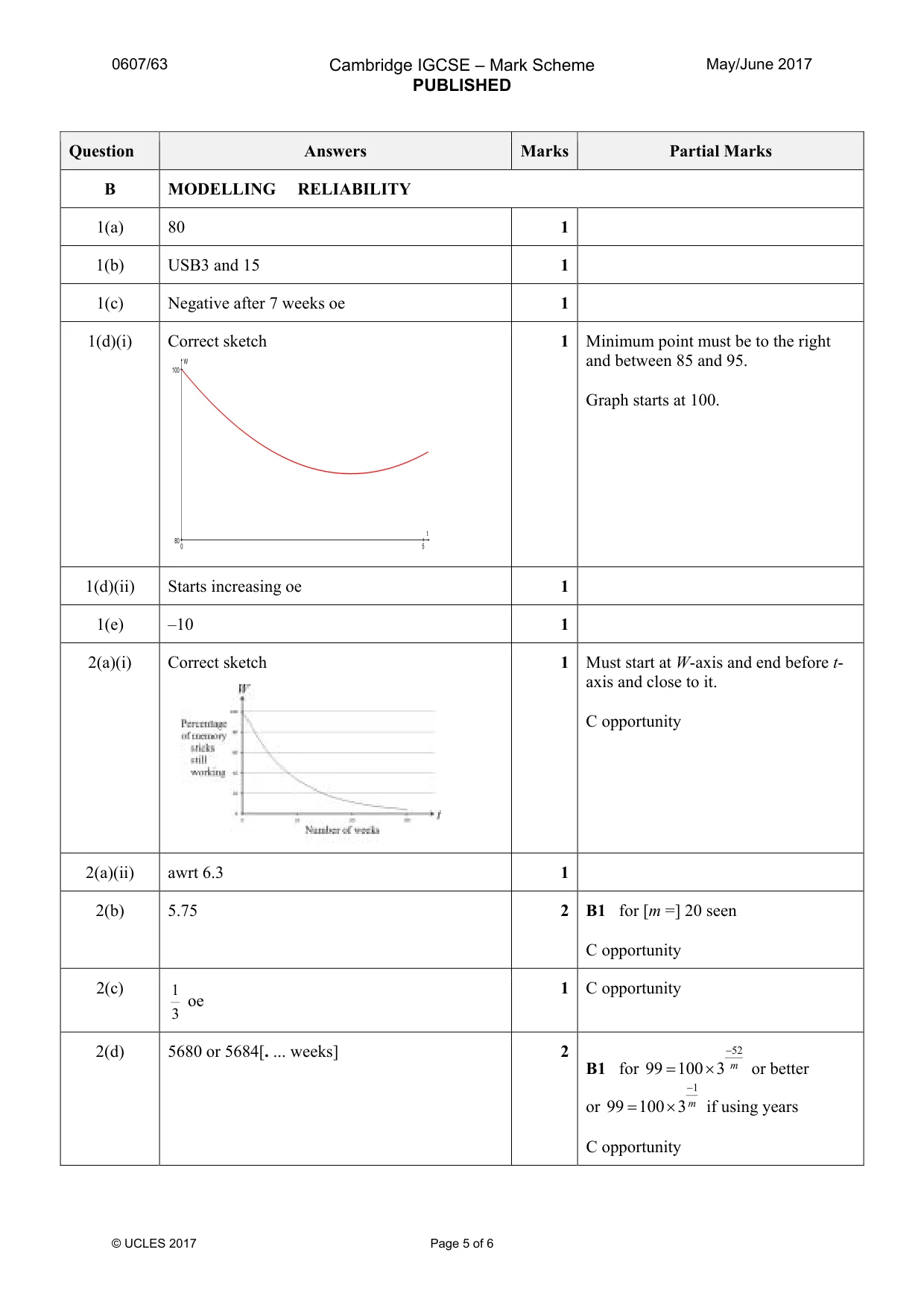
0607/63 Cambridge IGCSE – Mark Scheme PUBLISHED May/June 2017 © UCLES 2017 Page 5 of 6 Question Answers Marks Partial Marks B MODELLING RELIABILITY 1(a) 80 1 1(b) USB3 and 15 1 1(c) Negative after 7 weeks oe 1 1(d)(i) Correct sketch 1 Minimum point must be to the right and between 85 and 95. Graph starts at 100. 1(d)(ii) Starts increasing oe 1 1(e) –10 1 2(a)(i) Correct sketch 1 Must start at W-axis and end before t- axis and close to it. C opportunity 2(a)(ii) awrt 6.3 1 2(b) 5.75 2 B1 for [m =] 20 seen C opportunity 2(c) 1 3 oe 1 C opportunity 2(d) 5680 or 5684[. ... weeks] 2 B1 for 52 99 100 3 m − = × or better or 1 99 100 3 m − = × if using years C opportunity 0 5 80 100 t W
Mark scheme, page 6
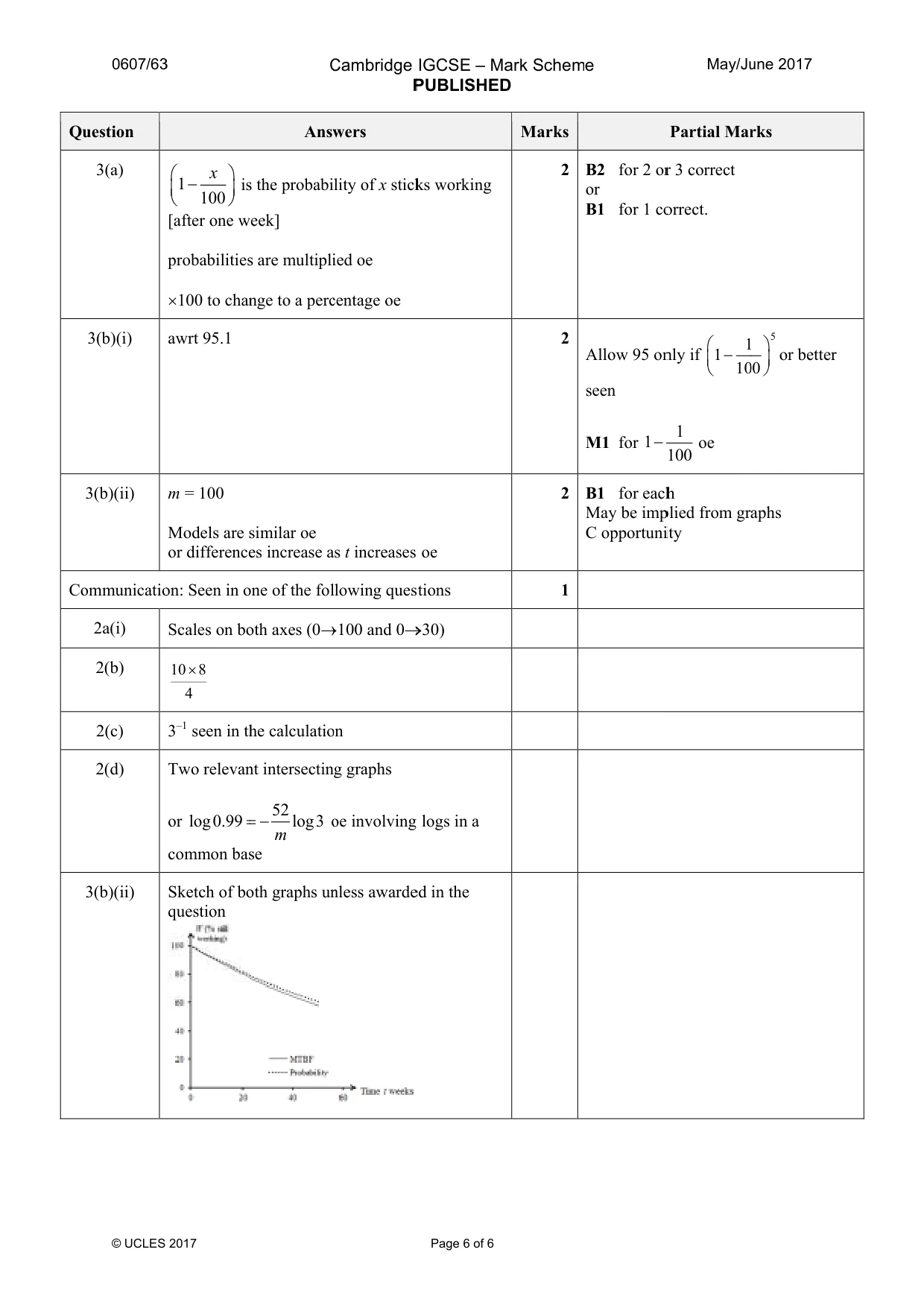
Qu Co 0607/63 © UCLES uestion 3(a) 3(b)(i) 3(b)(ii) ommunicatio 2a(i) 2(b) 2(c) 2(d) 3(b)(ii) 3 2017 1 100 x − is [after one w probabilities ×100 to chan awrt 95.1 m = 100 Models are s or difference on: Seen in o Scales on bo 10 8 4 × 3–1 seen in th Two relevan or log0.99 = common bas Sketch of bo question C Answ s the probabi eek] s are multipli nge to a perc similar oe es increase a one of the fol oth axes (0→ he calculatio nt intersectin 52 log3 m = − o se oth graphs un Cambridge P wers lity of x stick ied oe centage oe s t increases llowing quest →100 and 0→ on g graphs oe involving nless awarde IGCSE – M PUBLISHED Page 6 of 6 ks working oe tions →30) logs in a ed in the Mark Schem D Marks 2 2 2 1 e B2 for 2 or or B1 for 1 co Allow 95 on seen M1 for 1 1 − B1 for each May be imp C opportuni May/Ju Partial Mar r 3 correct orrect. nly if 1 1 10 − 1 100 oe h plied from gr ity une 2017 rks 5 00 or better aphs r
What you needed in this session
Cambridge’s own grade thresholds for 2017 May/June, Paper 6 · Variant 3. A higher threshold means an easier paper — the bar moves with how the cohort did.