Cambridge IGCSE Mathematics - International 0607 — 2016 Oct/Nov Paper 3 · Variant 3
0607/33/O/N/16 · 96 marks · ≈108 min
The question paper and its mark scheme, free to read here and free to download. This is Cambridge’s own paper, exactly as it was sat.
Question paper20 pages
Mark scheme4 pages
Answers below. Sit the paper first if you are practising.
Paper as text
Question paper, page 1
This document consists of 19 printed pages and 1 blank page. DC (RW) 126391 © UCLES 2016 [Turn over Cambridge International Examinations Cambridge International General Certificate of Secondary Education * 8 7 3 5 3 9 2 5 5 2 * CAMBRIDGE INTERNATIONAL MATHEMATICS 0607/33 Paper 3 (Core) October/November 2016 1 hour 45 minutes Candidates answer on the Question Paper. Additional Materials: Geometrical Instruments Graphics Calculator READ THESE INSTRUCTIONS FIRST Write your Centre number, candidate number and name on all the work you hand in. Write in dark blue or black pen. Do not use staples, paper clips, glue or correction fluid. You may use an HB pencil for any diagrams or graphs. DO NOT WRITE IN ANY BARCODES. Answer all the questions. Unless instructed otherwise, give your answers exactly or correct to three significant figures as appropriate. Answers in degrees should be given to one decimal place. For π, use your calculator value. You must show all the relevant working to gain full marks and you will be given marks for correct methods, including sketches, even if your answer is incorrect. The number of marks is given in brackets [ ] at the end of each question or part question. The total number of marks for this paper is 96.
Question paper, page 2
2 0607/33/O/N/16 © UCLES 2016 Formula List Area, A, of triangle, base b, height h. A = 2 1 bh Area, A, of circle, radius r. A = rr2 Circumference, C, of circle, radius r. C = 2rr Curved surface area, A, of cylinder of radius r, height h. A = 2rrh Curved surface area, A, of cone of radius r, sloping edge l. A = rrl Curved surface area, A, of sphere of radius r. A = 4rr2 Volume, V, of prism, cross-sectional area A, length l. V = Al Volume, V, of pyramid, base area A, height h. V = 3 1 Ah Volume, V, of cylinder of radius r, height h. V = rr2h Volume, V, of cone of radius r, height h. V = 3 1 rr2h Volume, V, of sphere of radius r. V = 3 4 rr3
Question paper, page 3
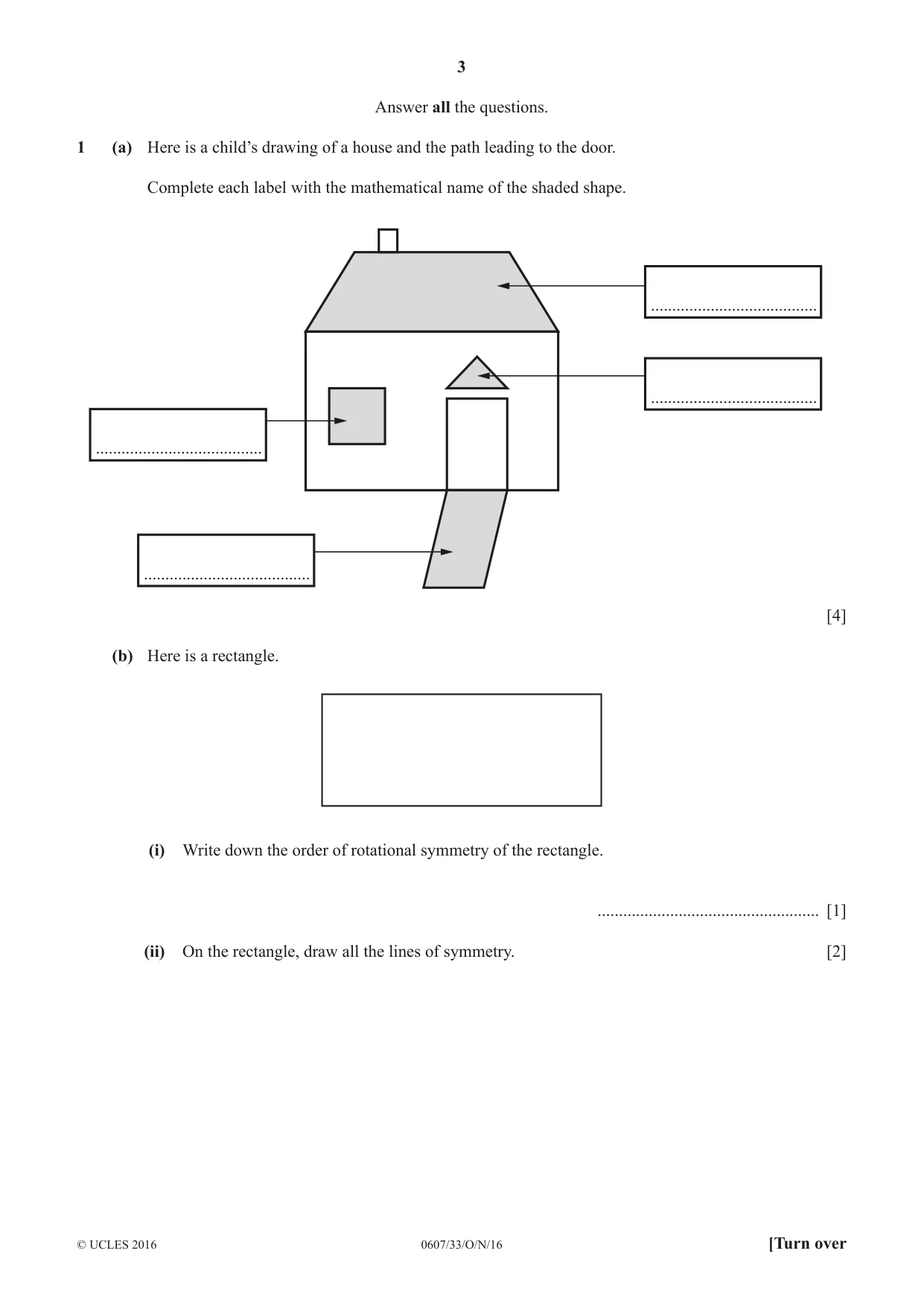
3 0607/33/O/N/16 © UCLES 2016 [Turn over Answer all the questions. 1 (a) Here is a child’s drawing of a house and the path leading to the door. Complete each label with the mathematical name of the shaded shape. … … … … [4] (b) Here is a rectangle. (i) Write down the order of rotational symmetry of the rectangle. … [1] (ii) On the rectangle, draw all the lines of symmetry. [2]
Question paper, page 4
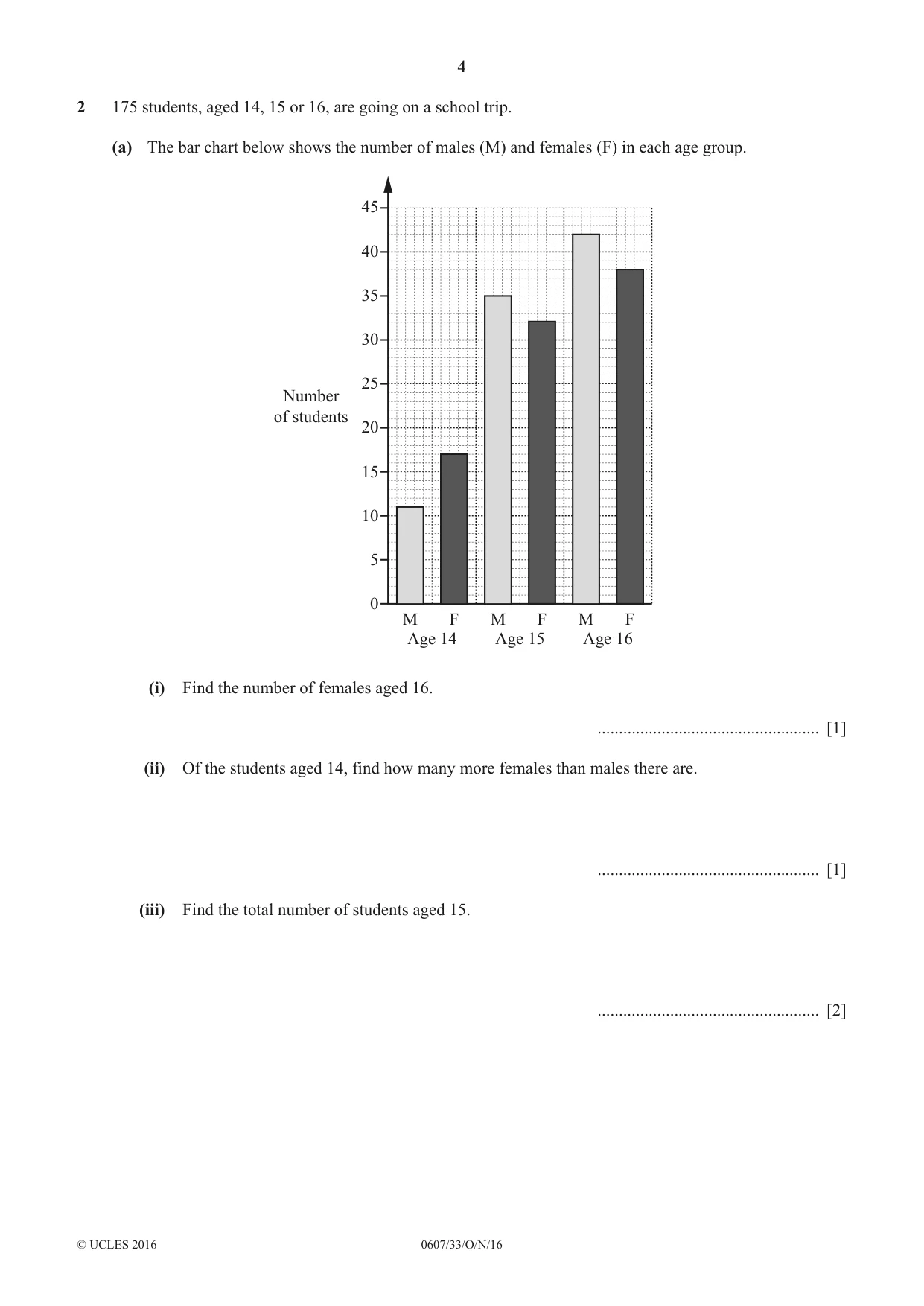
4 0607/33/O/N/16 © UCLES 2016 2 175 students, aged 14, 15 or 16, are going on a school trip. (a) The bar chart below shows the number of males (M) and females (F) in each age group. 45 40 35 30 25 20 15 10 5 0 M F M F M F Age 14 Age 15 Age 16 Number of students (i) Find the number of females aged 16. … [1] (ii) Of the students aged 14, find how many more females than males there are. … [1] (iii) Find the total number of students aged 15. … [2]
Question paper, page 5
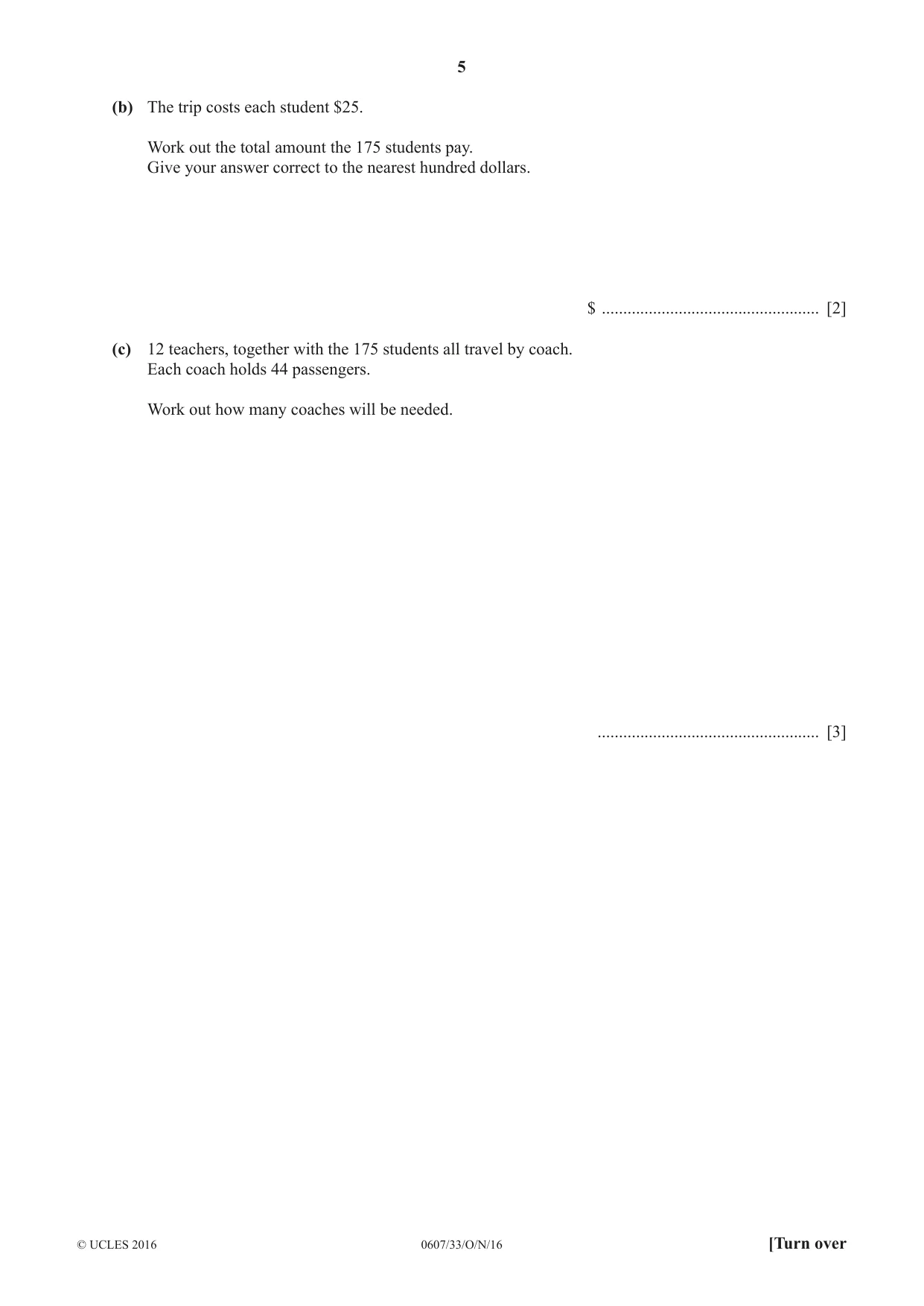
5 0607/33/O/N/16 © UCLES 2016 [Turn over (b) The trip costs each student $25. Work out the total amount the 175 students pay. Give your answer correct to the nearest hundred dollars. $ … [2] (c) 12 teachers, together with the 175 students all travel by coach. Each coach holds 44 passengers. Work out how many coaches will be needed. … [3]
Question paper, page 6
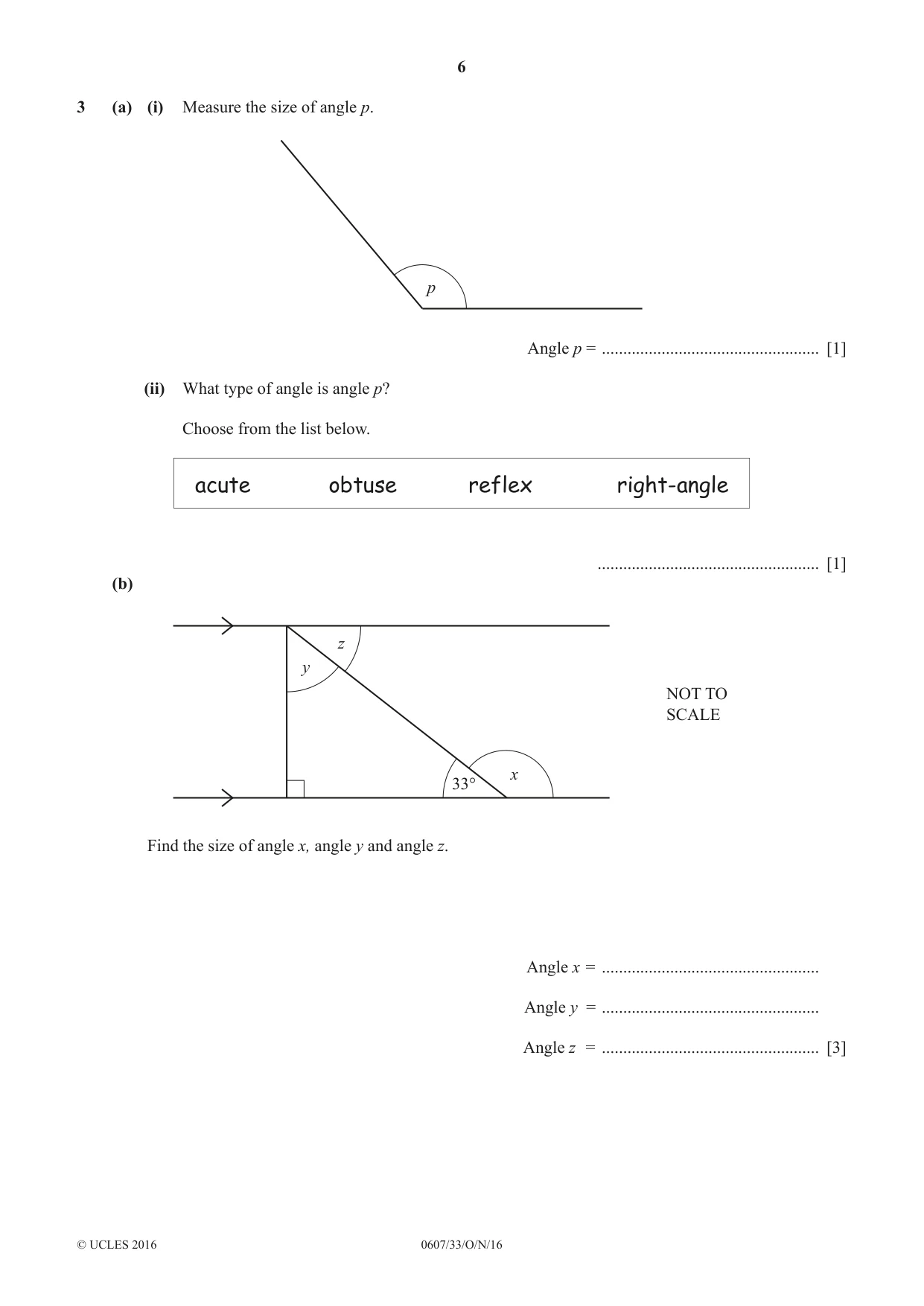
6 0607/33/O/N/16 © UCLES 2016 3 (a) (i) Measure the size of angle p. p Angle p = … [1] (ii) What type of angle is angle p? Choose from the list below. acute obtuse reflex right-angle … [1] (b) 33° y z x NOT TO SCALE Find the size of angle x, angle y and angle z. Angle x = … Angle y = … Angle z = … [3]
Question paper, page 7
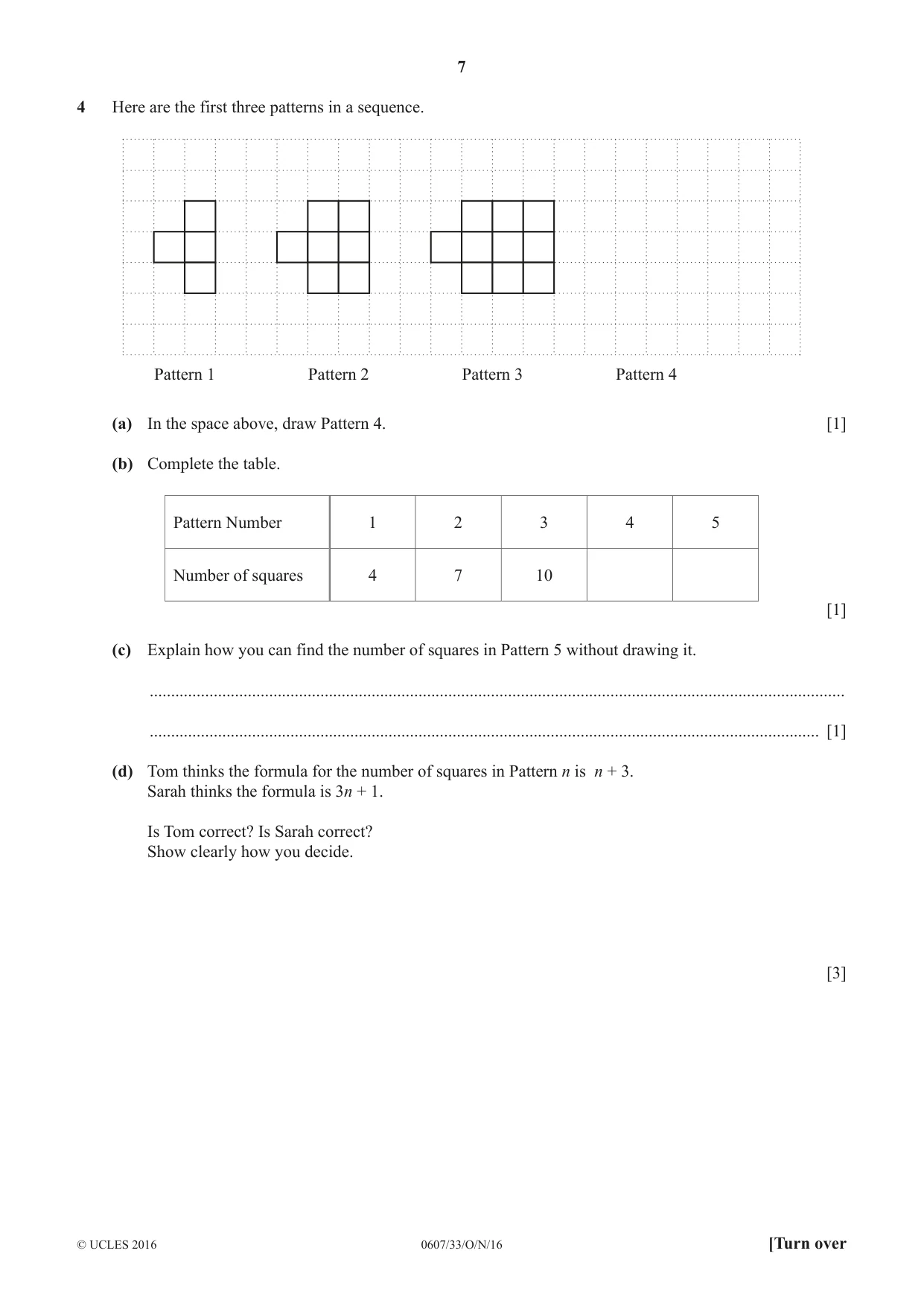
7 0607/33/O/N/16 © UCLES 2016 [Turn over 4 Here are the first three patterns in a sequence. Pattern 1 Pattern 2 Pattern 3 Pattern 4 (a) In the space above, draw Pattern 4. [1] (b) Complete the table. Pattern Number 1 2 3 4 5 Number of squares 4 7 10 [1] (c) Explain how you can find the number of squares in Pattern 5 without drawing it. … … [1] (d) Tom thinks the formula for the number of squares in Pattern n is n + 3. Sarah thinks the formula is 3n + 1. Is Tom correct? Is Sarah correct? Show clearly how you decide. [3]
Question paper, page 8
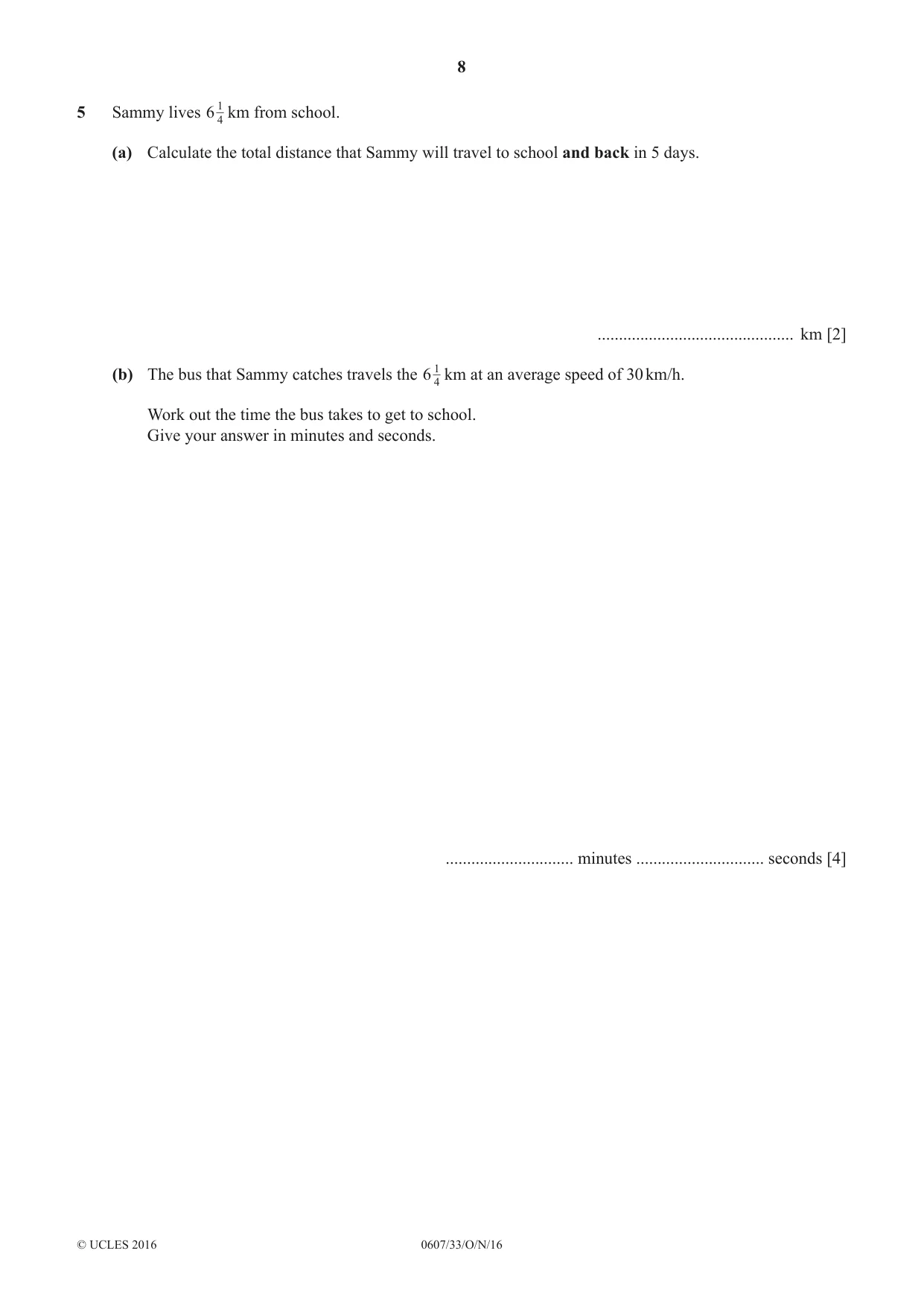
8 0607/33/O/N/16 © UCLES 2016 5 Sammy lives 6 4 1 km from school. (a) Calculate the total distance that Sammy will travel to school and back in 5 days. … km [2] (b) The bus that Sammy catches travels the 6 4 1 km at an average speed of 30 km/h. Work out the time the bus takes to get to school. Give your answer in minutes and seconds. … minutes … seconds [4]
Question paper, page 9
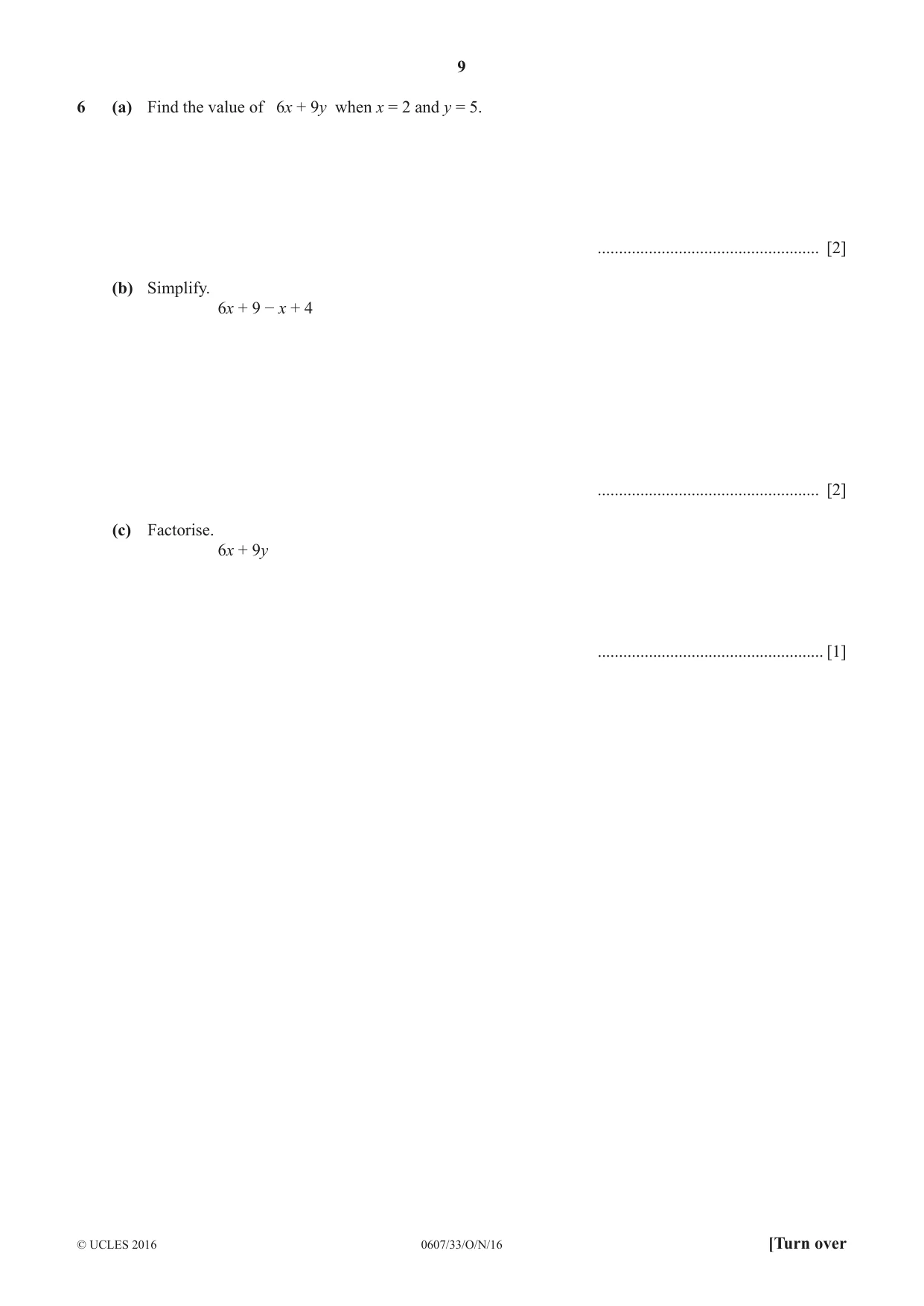
9 0607/33/O/N/16 © UCLES 2016 [Turn over 6 (a) Find the value of 6x + 9y when x = 2 and y = 5. … [2] (b) Simplify. 6x + 9 − x + 4 … [2] (c) Factorise. 6x + 9y … [1]
Question paper, page 10
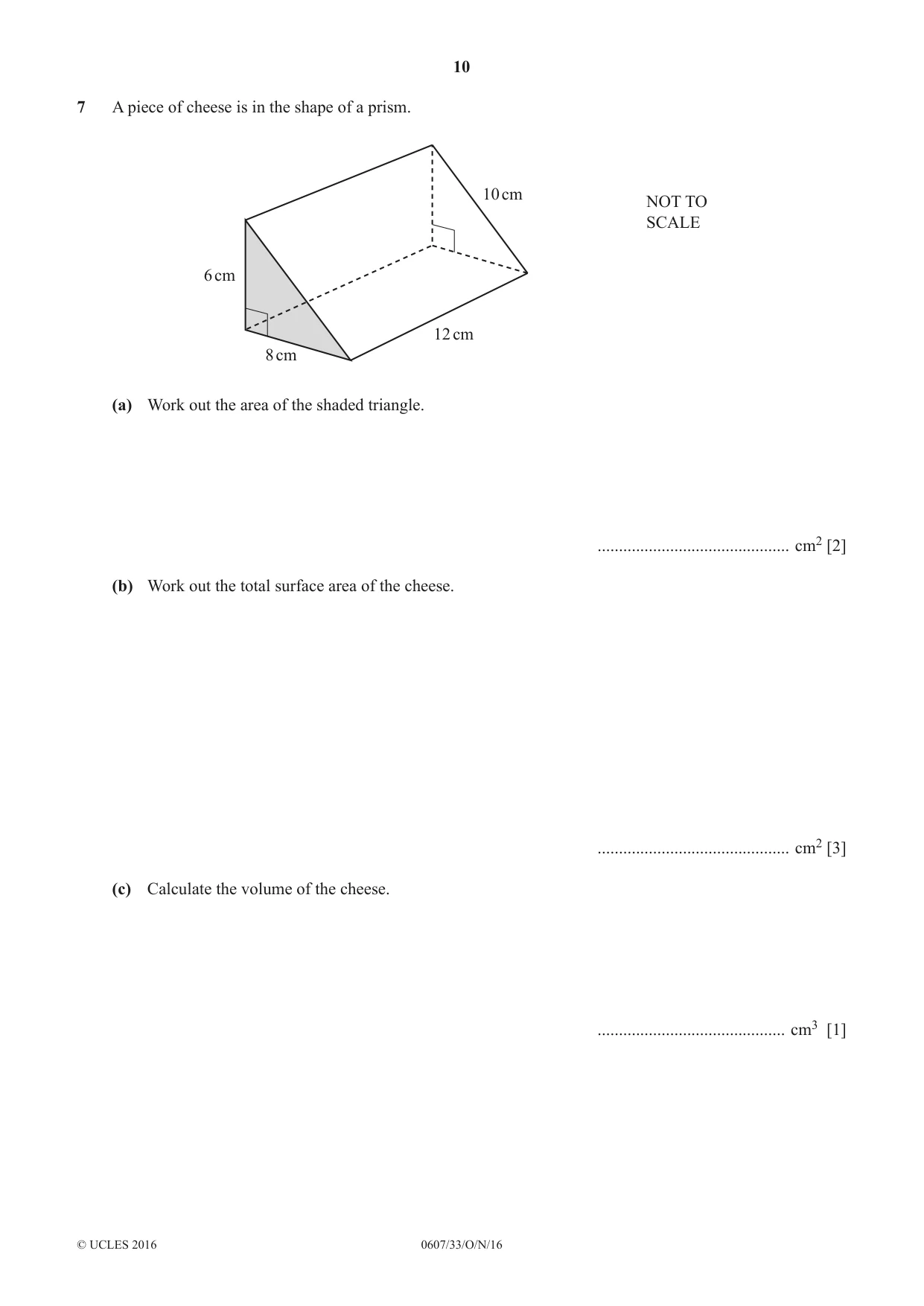
10 0607/33/O/N/16 © UCLES 2016 7 A piece of cheese is in the shape of a prism. 10 cm NOT TO SCALE 12 cm 8 cm 6 cm (a) Work out the area of the shaded triangle. … cm2 [2] (b) Work out the total surface area of the cheese. … cm2 [3] (c) Calculate the volume of the cheese. … cm3 [1]
Question paper, page 11
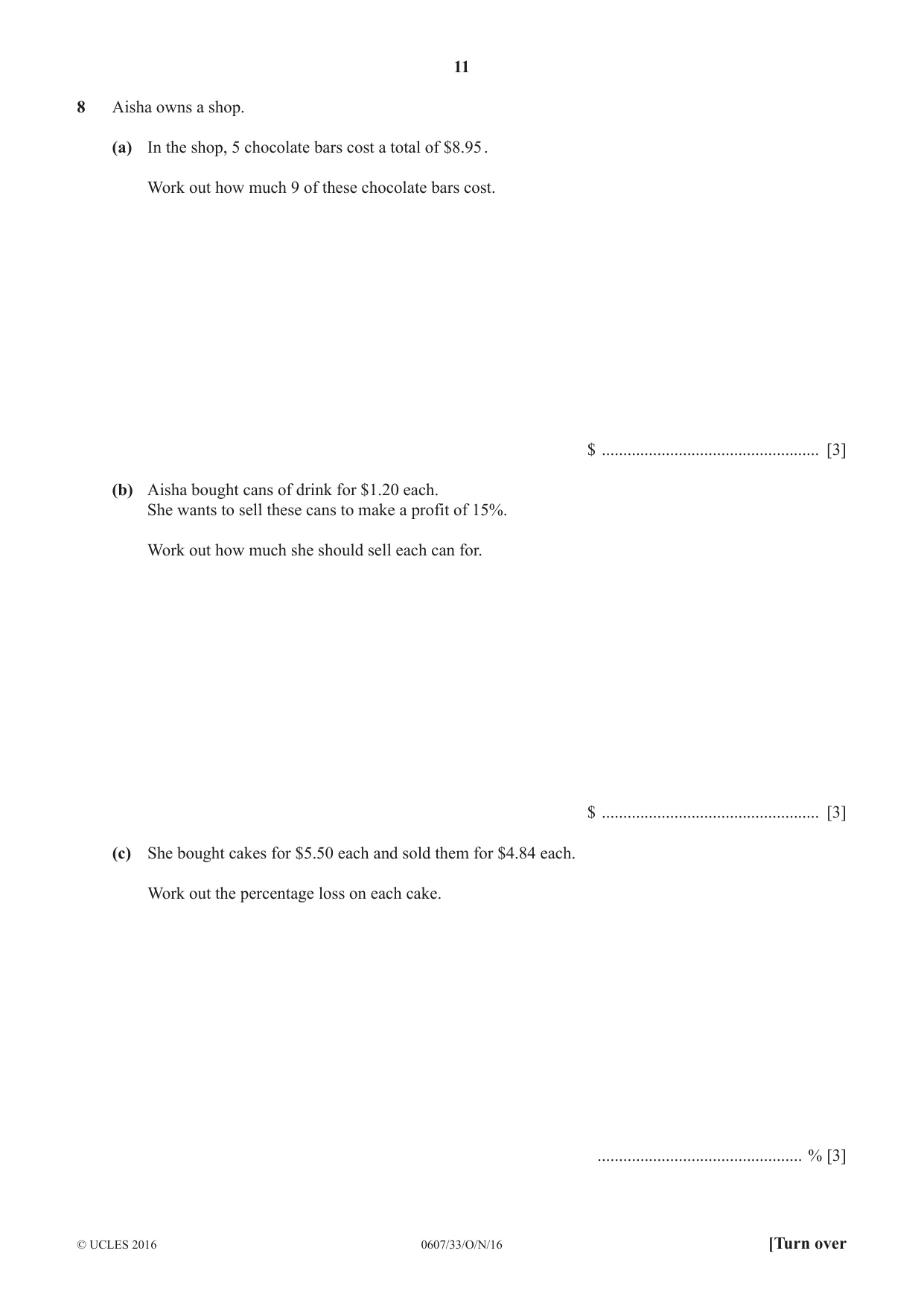
11 0607/33/O/N/16 © UCLES 2016 [Turn over 8 Aisha owns a shop. (a) In the shop, 5 chocolate bars cost a total of $8.95 . Work out how much 9 of these chocolate bars cost. $ … [3] (b) Aisha bought cans of drink for $1.20 each. She wants to sell these cans to make a profit of 15%. Work out how much she should sell each can for. $ … [3] (c) She bought cakes for $5.50 each and sold them for $4.84 each. Work out the percentage loss on each cake. … % [3]
Question paper, page 12
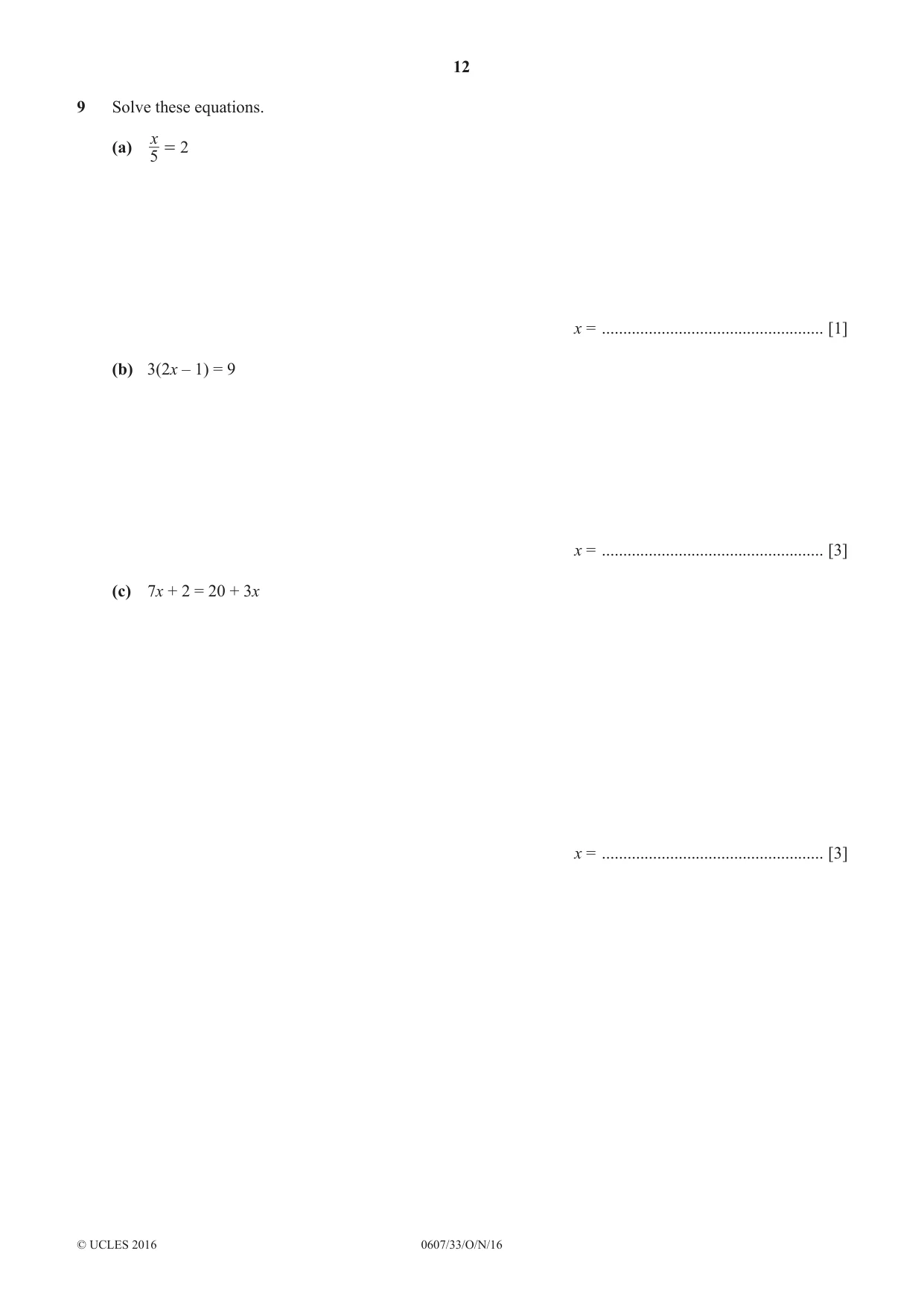
12 0607/33/O/N/16 © UCLES 2016 9 Solve these equations. (a) x 5 2 = x = … [1] (b) 3(2x – 1) = 9 x = … [3] (c) 7x + 2 = 20 + 3x x = … [3]
Question paper, page 13
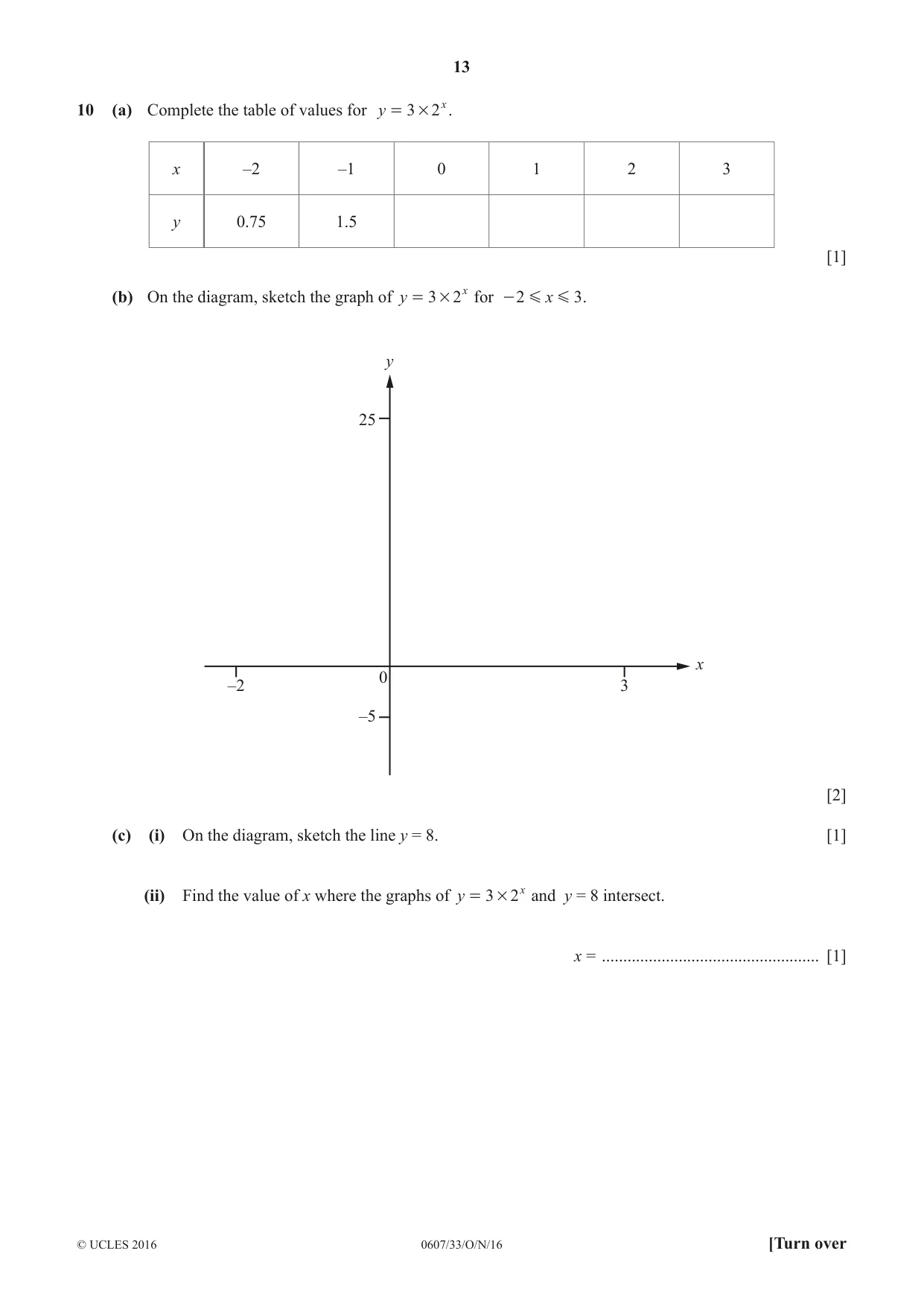
13 0607/33/O/N/16 © UCLES 2016 [Turn over 10 (a) Complete the table of values for y 3 2x # = . x –2 –1 0 1 2 3 y 0.75 1.5 [1] (b) On the diagram, sketch the graph of y 3 2x # = for x 2 3 G G - . 0 25 –5 –2 3 x y [2] (c) (i) On the diagram, sketch the line y = 8. [1] (ii) Find the value of x where the graphs of y 3 2x # = and y = 8 intersect. x = … [1]
Question paper, page 14
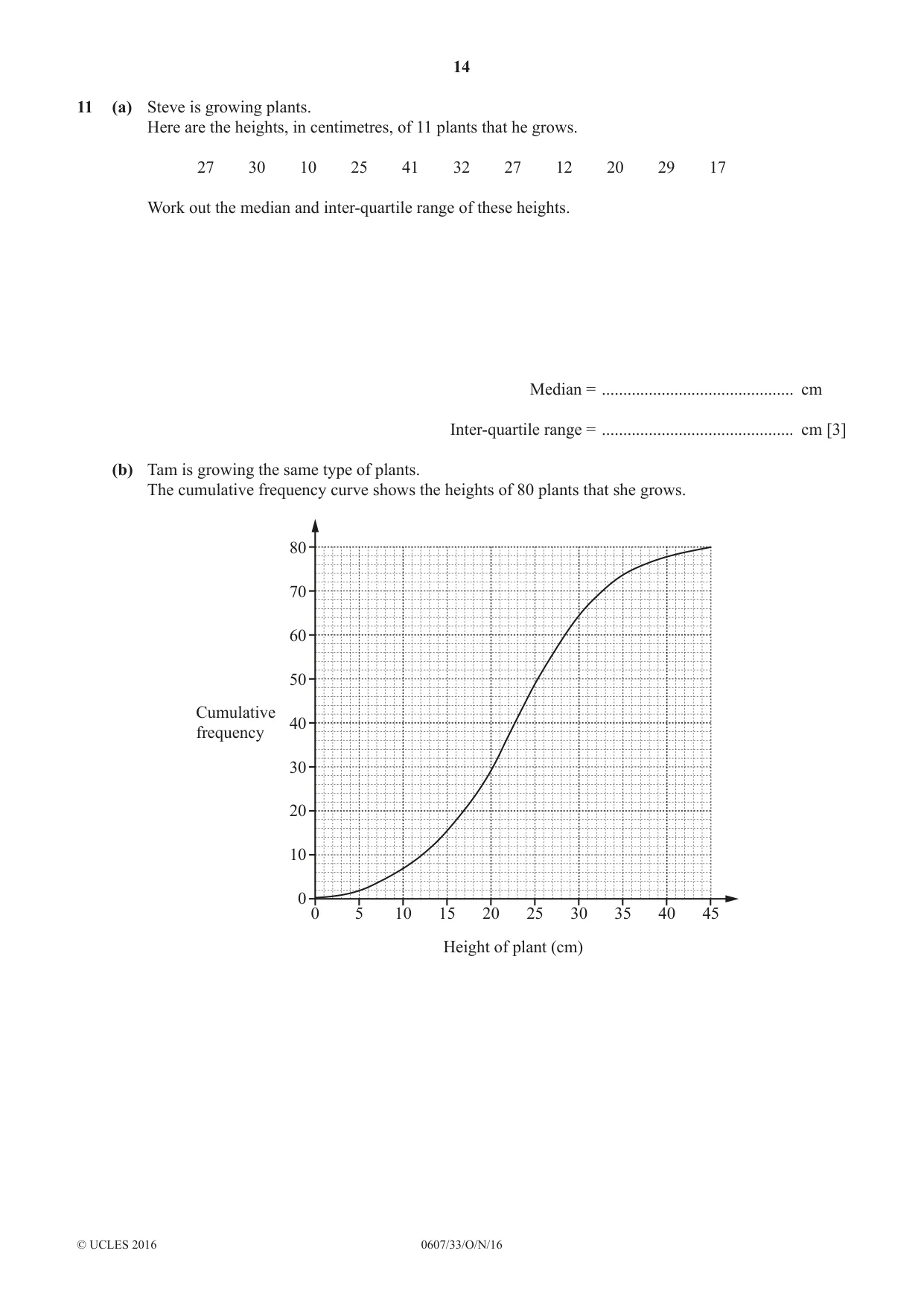
14 0607/33/O/N/16 © UCLES 2016 11 (a) Steve is growing plants. Here are the heights, in centimetres, of 11 plants that he grows. 27 30 10 25 41 32 27 12 20 29 17 Work out the median and inter-quartile range of these heights. Median = … cm Inter-quartile range = … cm [3] (b) Tam is growing the same type of plants. The cumulative frequency curve shows the heights of 80 plants that she grows. 80 70 60 50 40 30 20 10 0 0 5 10 15 20 25 30 35 40 45 Cumulative frequency Height of plant (cm)
Question paper, page 15
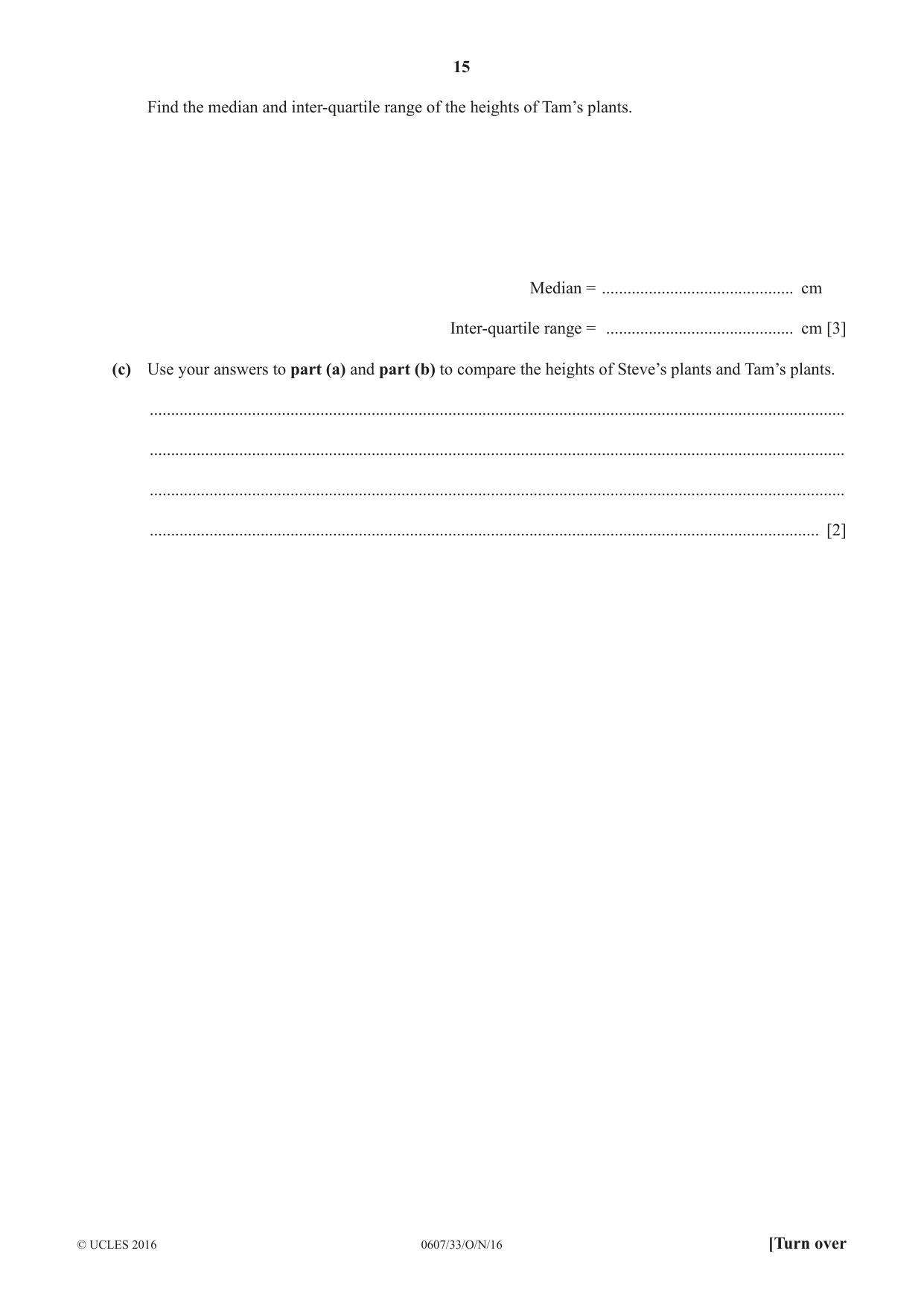
15 0607/33/O/N/16 © UCLES 2016 [Turn over Find the median and inter-quartile range of the heights of Tam’s plants. Median = … cm Inter-quartile range = … cm [3] (c) Use your answers to part (a) and part (b) to compare the heights of Steve’s plants and Tam’s plants. … … … … [2]
Question paper, page 16
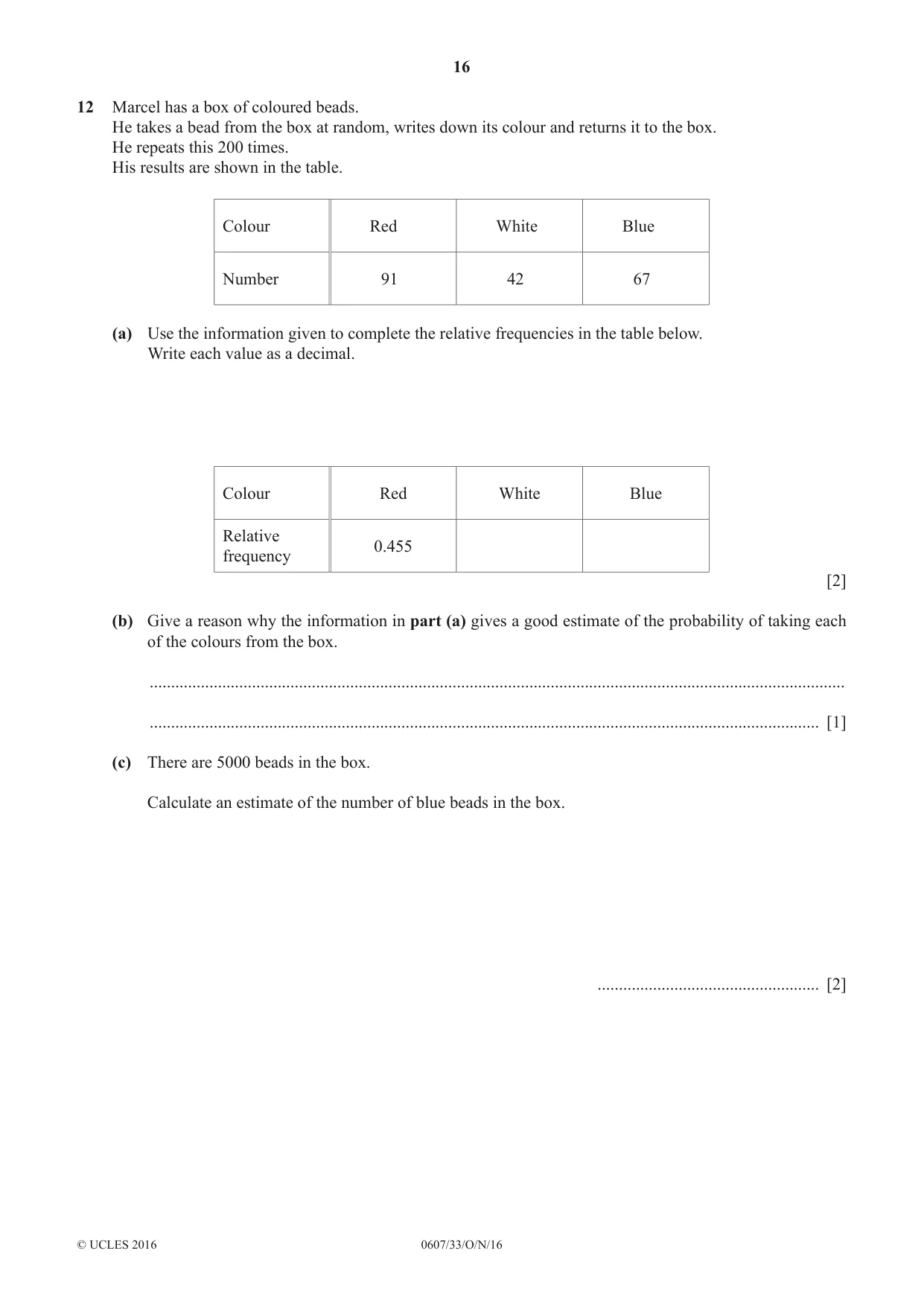
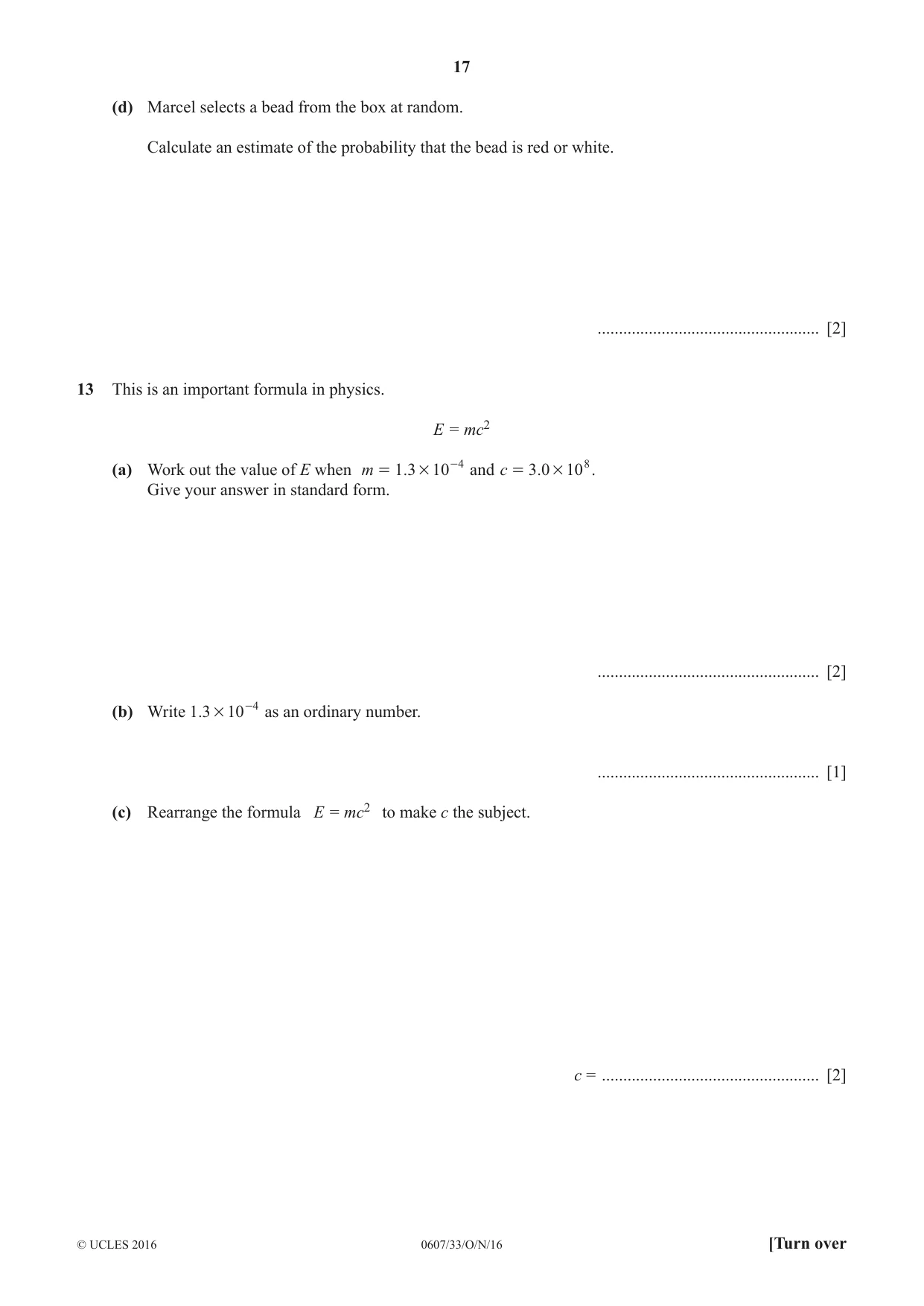
16 0607/33/O/N/16 © UCLES 2016 12 Marcel has a box of coloured beads. He takes a bead from the box at random, writes down its colour and returns it to the box. He repeats this 200 times. His results are shown in the table. Colour Red White Blue Number 91 42 67 (a) Use the information given to complete the relative frequencies in the table below. Write each value as a decimal. Colour Red White Blue Relative frequency 0.455 [2] (b) Give a reason why the information in part (a) gives a good estimate of the probability of taking each of the colours from the box. … … [1] (c) There are 5000 beads in the box. Calculate an estimate of the number of blue beads in the box. … [2]
Question paper, page 17
17 0607/33/O/N/16 © UCLES 2016 [Turn over (d) Marcel selects a bead from the box at random. Calculate an estimate of the probability that the bead is red or white. … [2] 13 This is an important formula in physics. E = mc2 (a) Work out the value of E when . m 1 3 10 4 # = - and . c 3 0 108 # = . Give your answer in standard form. … [2] (b) Write .1 3 10 4 # - as an ordinary number. … [1] (c) Rearrange the formula E = mc2 to make c the subject. c = … [2]
Question paper, page 18
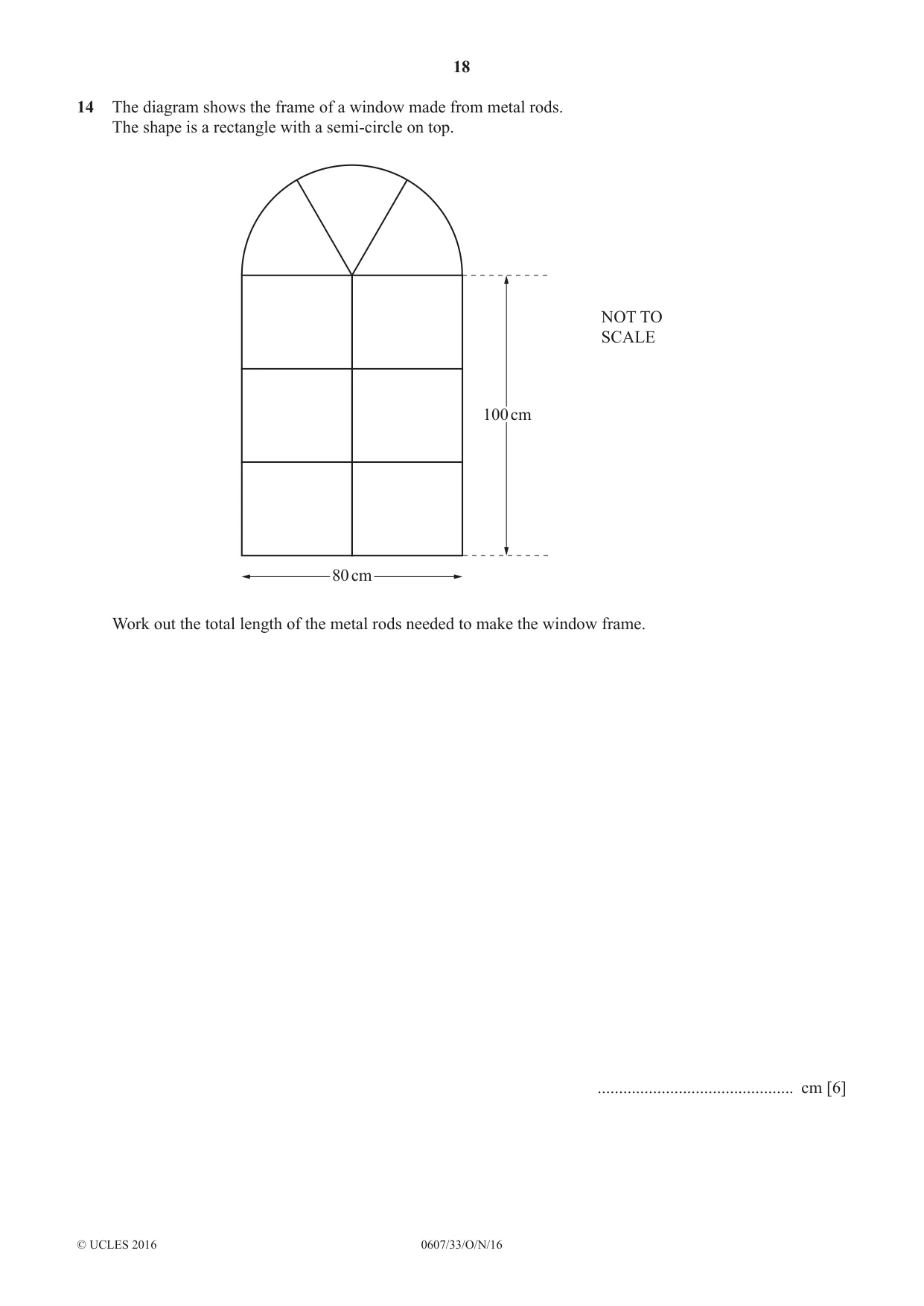
18 0607/33/O/N/16 © UCLES 2016 14 The diagram shows the frame of a window made from metal rods. The shape is a rectangle with a semi-circle on top. NOT TO SCALE 100 cm 80 cm Work out the total length of the metal rods needed to make the window frame. … cm [6]
Question paper, page 19
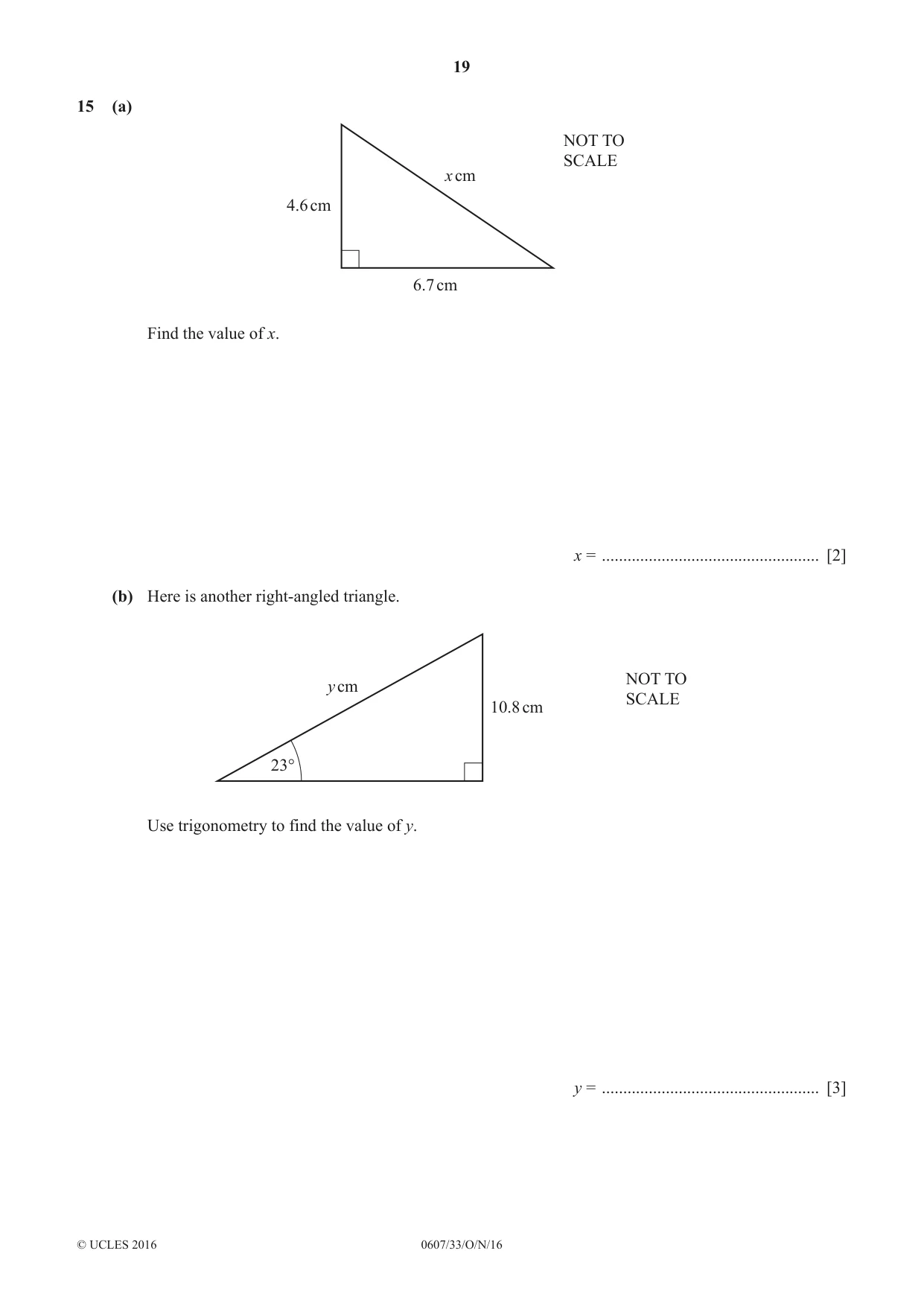
19 0607/33/O/N/16 © UCLES 2016 15 (a) x cm 6.7 cm 4.6 cm NOT TO SCALE Find the value of x. x = … [2] (b) Here is another right-angled triangle. 23° y cm 10.8 cm NOT TO SCALE Use trigonometry to find the value of y. y = … [3]
Question paper, page 20
20 0607/33/O/N/16 © UCLES 2016 Permission to reproduce items where third-party owned material protected by copyright is included has been sought and cleared where possible. Every reasonable effort has been made by the publisher (UCLES) to trace copyright holders, but if any items requiring clearance have unwittingly been included, the publisher will be pleased to make amends at the earliest possible opportunity. To avoid the issue of disclosure of answer-related information to candidates, all copyright acknowledgements are reproduced online in the Cambridge International Examinations Copyright Acknowledgements Booklet. This is produced for each series of examinations and is freely available to download at www.cie.org.uk after the live examination series. Cambridge International Examinations is part of the Cambridge Assessment Group. Cambridge Assessment is the brand name of University of Cambridge Local Examinations Syndicate (UCLES), which is itself a department of the University of Cambridge. bLank page
Mark scheme, page 1
® IGCSE is the registered trademark of Cambridge International Examinations. This document consists of 4 printed pages. © UCLES 2016 [Turn over Cambridge International Examinations Cambridge International General Certificate of Secondary Education CAMBRIDGE INTERNATIONAL MATHEMATICS 0607/33 Paper 3 (Core) October/November 2016 MARK SCHEME Maximum Mark: 96 Published This mark scheme is published as an aid to teachers and candidates, to indicate the requirements of the examination. It shows the basis on which Examiners were instructed to award marks. It does not indicate the details of the discussions that took place at an Examiners’ meeting before marking began, which would have considered the acceptability of alternative answers. Mark schemes should be read in conjunction with the question paper and the Principal Examiner Report for Teachers. Cambridge will not enter into discussions about these mark schemes. Cambridge is publishing the mark schemes for the October/November 2016 series for most Cambridge IGCSE®, Cambridge International A and AS Level components and some Cambridge O Level components.
Mark scheme, page 2
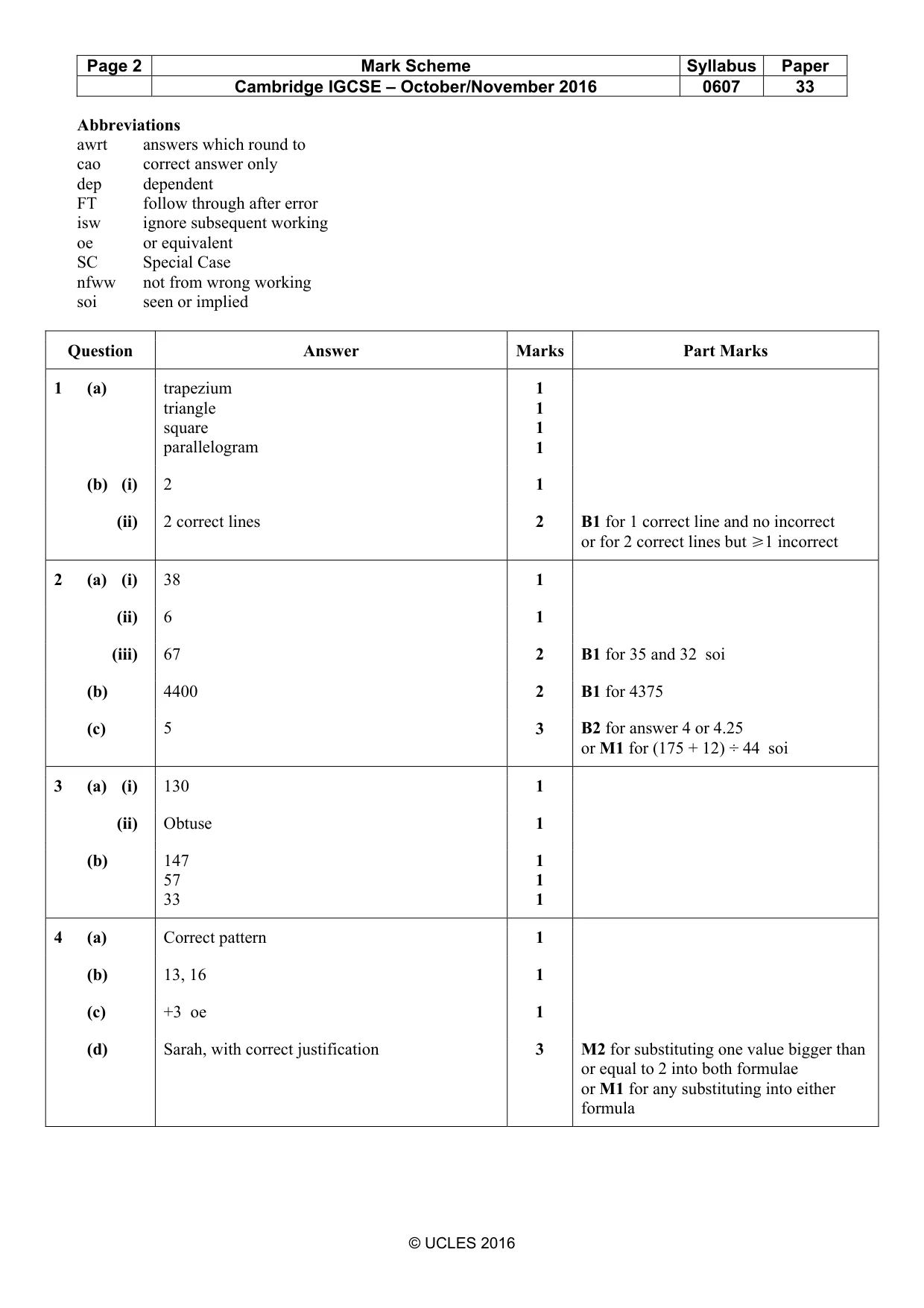
Page 2 Mark Scheme Syllabus Paper Cambridge IGCSE – October/November 2016 0607 33 © UCLES 2016 Abbreviations awrt answers which round to cao correct answer only dep dependent FT follow through after error isw ignore subsequent working oe or equivalent SC Special Case nfww not from wrong working soi seen or implied Question Answer Marks Part Marks 1 (a) trapezium triangle square parallelogram 1 1 1 1 (b) (i) 2 1 (ii) 2 correct lines 2 B1 for 1 correct line and no incorrect or for 2 correct lines but ≥1 incorrect 2 (a) (i) 38 1 (ii) 6 1 (iii) 67 2 B1 for 35 and 32 soi (b) 4400 2 B1 for 4375 (c) 5 3 B2 for answer 4 or 4.25 or M1 for (175 + 12) ÷ 44 soi 3 (a) (i) 130 1 (ii) Obtuse 1 (b) 147 57 33 1 1 1 4 (a) Correct pattern 1 (b) 13, 16 1 (c) +3 oe 1 (d) Sarah, with correct justification 3 M2 for substituting one value bigger than or equal to 2 into both formulae or M1 for any substituting into either formula
Mark scheme, page 3
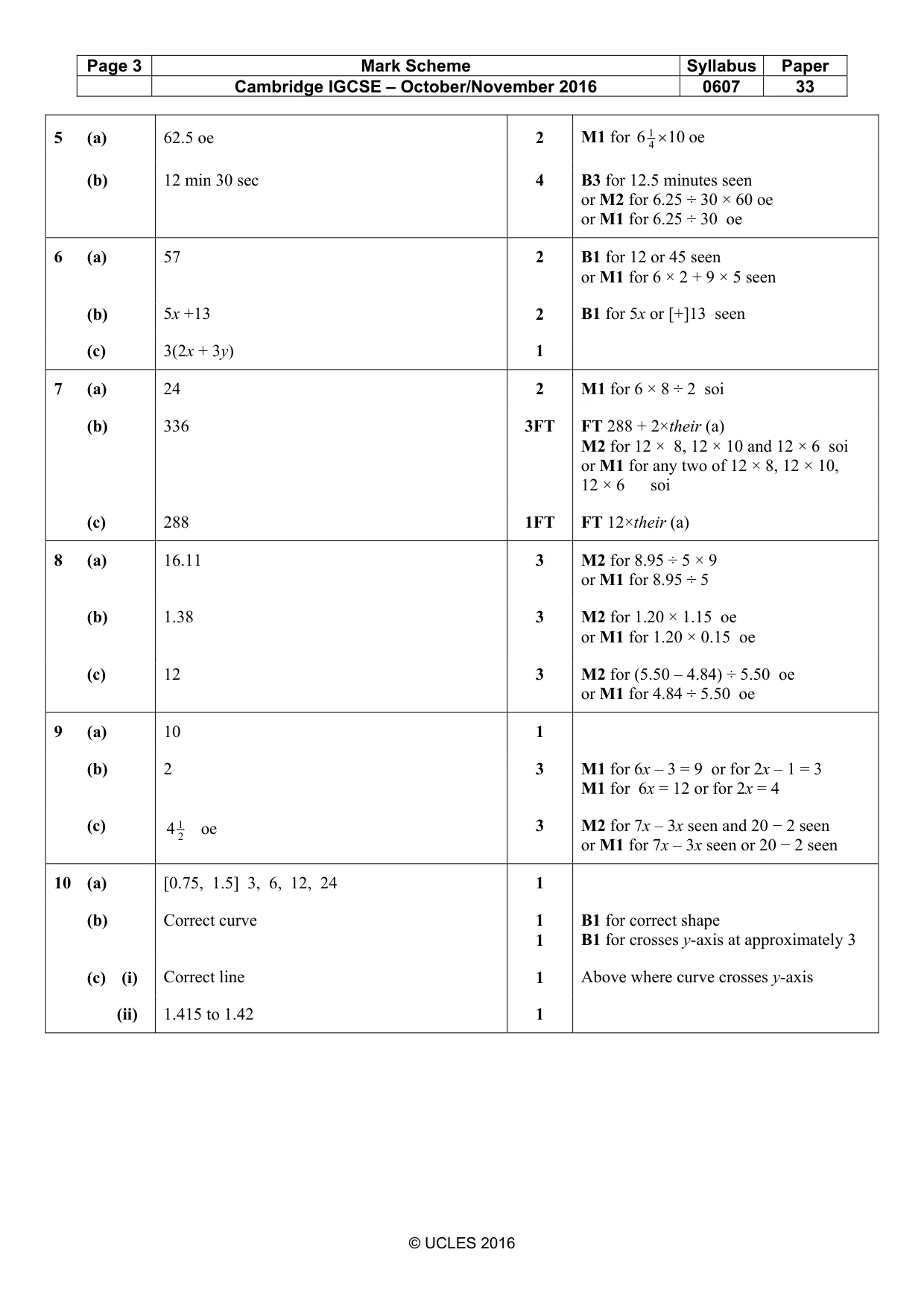
Page 3 Mark Scheme Syllabus Paper Cambridge IGCSE – October/November 2016 0607 33 © UCLES 2016 5 (a) 62.5 oe 2 M1 for 1 4 6 10 × oe (b) 12 min 30 sec 4 B3 for 12.5 minutes seen or M2 for 6.25 ÷ 30 × 60 oe or M1 for 6.25 ÷ 30 oe 6 (a) 57 2 B1 for 12 or 45 seen or M1 for 6 × 2 + 9 × 5 seen (b) 5x +13 2 B1 for 5x or [+]13 seen (c) 3(2x + 3y) 1 7 (a) 24 2 M1 for 6 × 8 ÷ 2 soi (b) 336 3FT FT 288 + 2×their (a) M2 for 12 × 8, 12 × 10 and 12 × 6 soi or M1 for any two of 12 × 8, 12 × 10, 12 × 6 soi (c) 288 1FT FT 12×their (a) 8 (a) 16.11 3 M2 for 8.95 ÷ 5 × 9 or M1 for 8.95 ÷ 5 (b) 1.38 3 M2 for 1.20 × 1.15 oe or M1 for 1.20 × 0.15 oe (c) 12 3 M2 for (5.50 – 4.84) ÷ 5.50 oe or M1 for 4.84 ÷ 5.50 oe 9 (a) 10 1 (b) 2 3 M1 for 6x – 3 = 9 or for 2x – 1 = 3 M1 for 6x = 12 or for 2x = 4 (c) 1 2 4 oe 3 M2 for 7x – 3x seen and 20 − 2 seen or M1 for 7x – 3x seen or 20 − 2 seen 10 (a) [0.75, 1.5] 3, 6, 12, 24 1 (b) Correct curve 1 1 B1 for correct shape B1 for crosses y-axis at approximately 3 (c) (i) Correct line 1 Above where curve crosses y-axis (ii) 1.415 to 1.42 1
Mark scheme, page 4
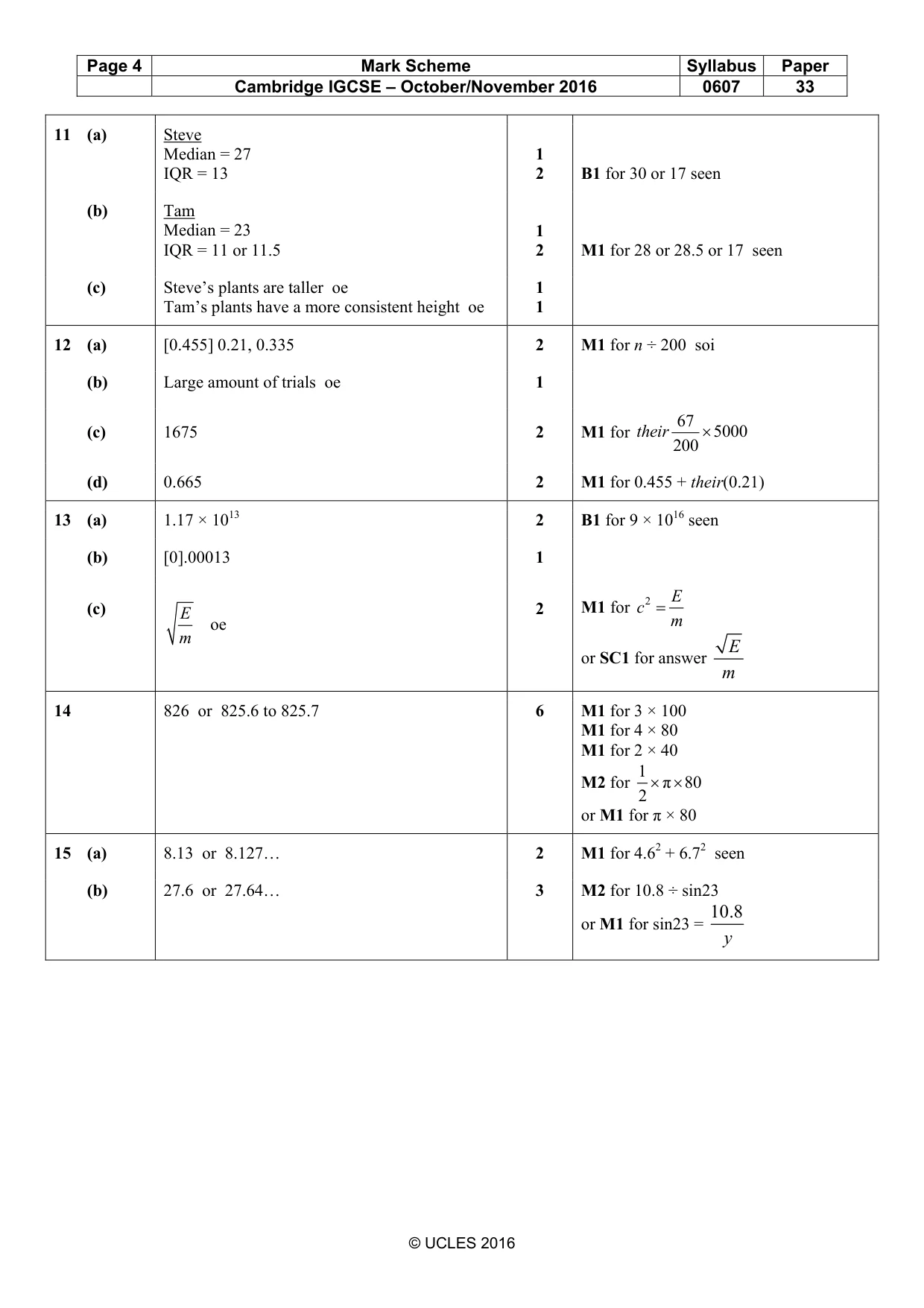
Page 4 Mark Scheme Syllabus Paper Cambridge IGCSE – October/November 2016 0607 33 © UCLES 2016 11 (a) Steve Median = 27 IQR = 13 1 2 B1 for 30 or 17 seen (b) Tam Median = 23 IQR = 11 or 11.5 1 2 M1 for 28 or 28.5 or 17 seen (c) Steve’s plants are taller oe Tam’s plants have a more consistent height oe 1 1 12 (a) [0.455] 0.21, 0.335 2 M1 for n ÷ 200 soi (b) Large amount of trials oe 1 (c) 1675 2 M1 for 67 5000 200 their × (d) 0.665 2 M1 for 0.455 + their(0.21) 13 (a) 1.17 × 10¹³ 2 B1 for 9 × 10¹⁶ seen (b) [0].00013 1 (c) E m oe 2 M1 for 2 E c m = or SC1 for answer E m 14 826 or 825.6 to 825.7 6 M1 for 3 × 100 M1 for 4 × 80 M1 for 2 × 40 M2 for 1 π 80 2 × × or M1 for π × 80 15 (a) 8.13 or 8.127… 2 M1 for 4.62 + 6.72 seen (b) 27.6 or 27.64… 3 M2 for 10.8 ÷ sin23 or M1 for sin23 = 10.8 y
What you needed in this session
Cambridge’s own grade thresholds for 2016 Oct/Nov, Paper 3 · Variant 3. A higher threshold means an easier paper — the bar moves with how the cohort did.