Cambridge IGCSE Mathematics - International 0607 — 2016 May/June Paper 3 · Variant 2
0607/32/M/J/16 · 96 marks · ≈108 min
The question paper and its mark scheme, free to read here and free to download. This is Cambridge’s own paper, exactly as it was sat.
Question paper20 pages
Mark scheme5 pages
Answers below. Sit the paper first if you are practising.
Paper as text
Question paper, page 1
This document consists of 18 printed pages and 2 blank pages. DC (LK/CGW) 115324/3 © UCLES 2016 [Turn over Cambridge International Examinations Cambridge International General Certificate of Secondary Education * 8 2 3 4 0 5 3 6 4 6 * CAMBRIDGE INTERNATIONAL MATHEMATICS 0607/32 Paper 3 (Core) May/June 2016 1 hour 45 minutes Candidates answer on the Question Paper. Additional Materials: Geometrical Instruments Graphics Calculator READ THESE INSTRUCTIONS FIRST Write your Centre number, candidate number and name on all the work you hand in. Write in dark blue or black pen. Do not use staples, paper clips, glue or correction fluid. You may use an HB pencil for any diagrams or graphs. DO NOT WRITE IN ANY BARCODES. Answer all the questions. Unless instructed otherwise, give your answers exactly or correct to three significant figures as appropriate. Answers in degrees should be given to one decimal place. For r, use your calculator value. You must show all the relevant working to gain full marks and you will be given marks for correct methods, including sketches, even if your answer is incorrect. The number of marks is given in brackets [ ] at the end of each question or part question. The total number of marks for this paper is 96.
Question paper, page 2
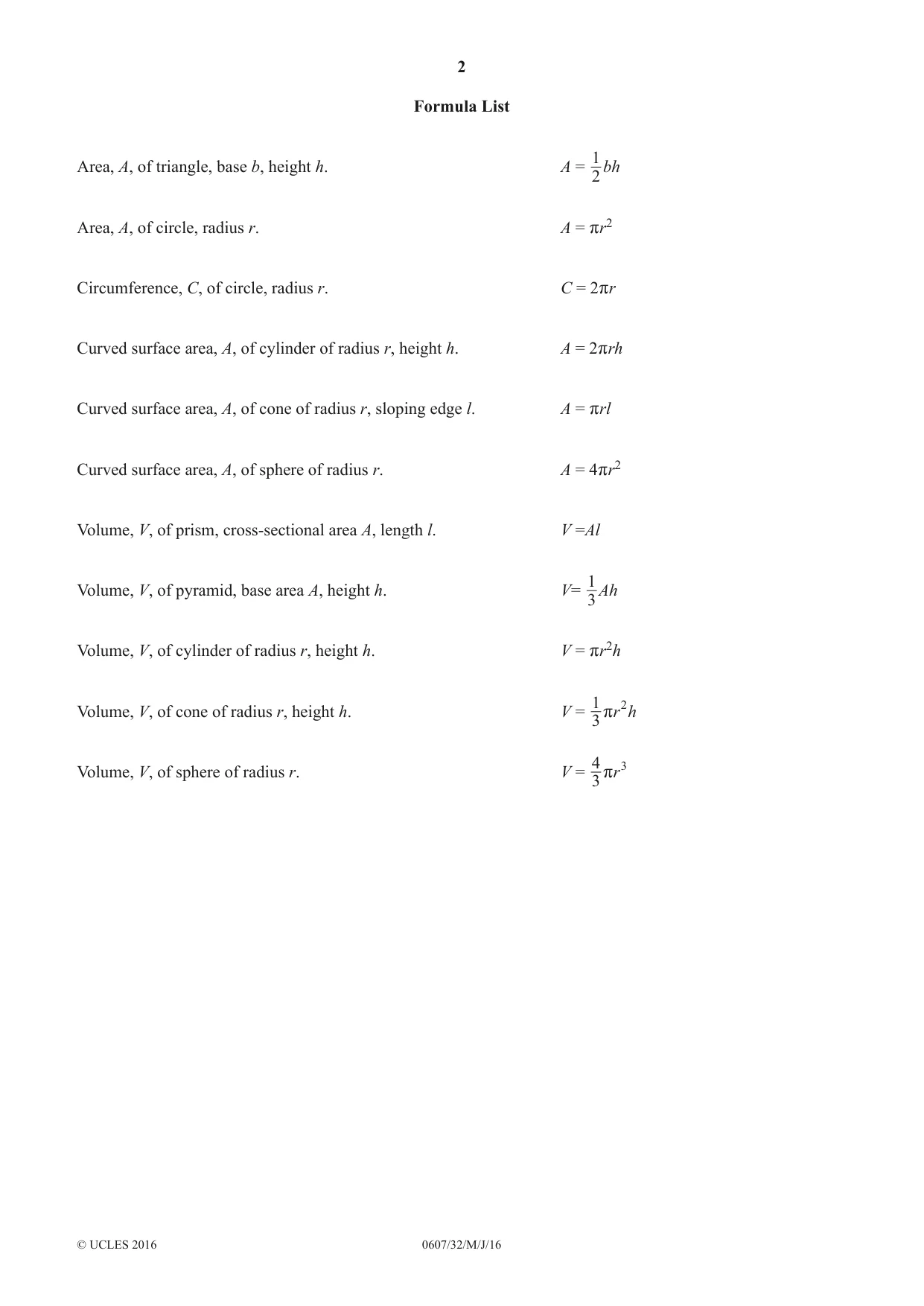
2 0607/32/M/J/16 © UCLES 2016 Formula List Area, A, of triangle, base b, height h. A = bh 2 1 Area, A, of circle, radius r. A = rr2 Circumference, C, of circle, radius r. C = 2rr Curved surface area, A, of cylinder of radius r, height h. A = 2rrh Curved surface area, A, of cone of radius r, sloping edge l. A = rrl Curved surface area, A, of sphere of radius r. A = 4rr2 Volume, V, of prism, cross-sectional area A, length l. V =Al Volume, V, of pyramid, base area A, height h. V= Ah 3 1 Volume, V, of cylinder of radius r, height h. V = rr2h Volume, V, of cone of radius r, height h. V = r h 3 1 2 r Volume, V, of sphere of radius r. V = r 3 4 3 r
Question paper, page 3
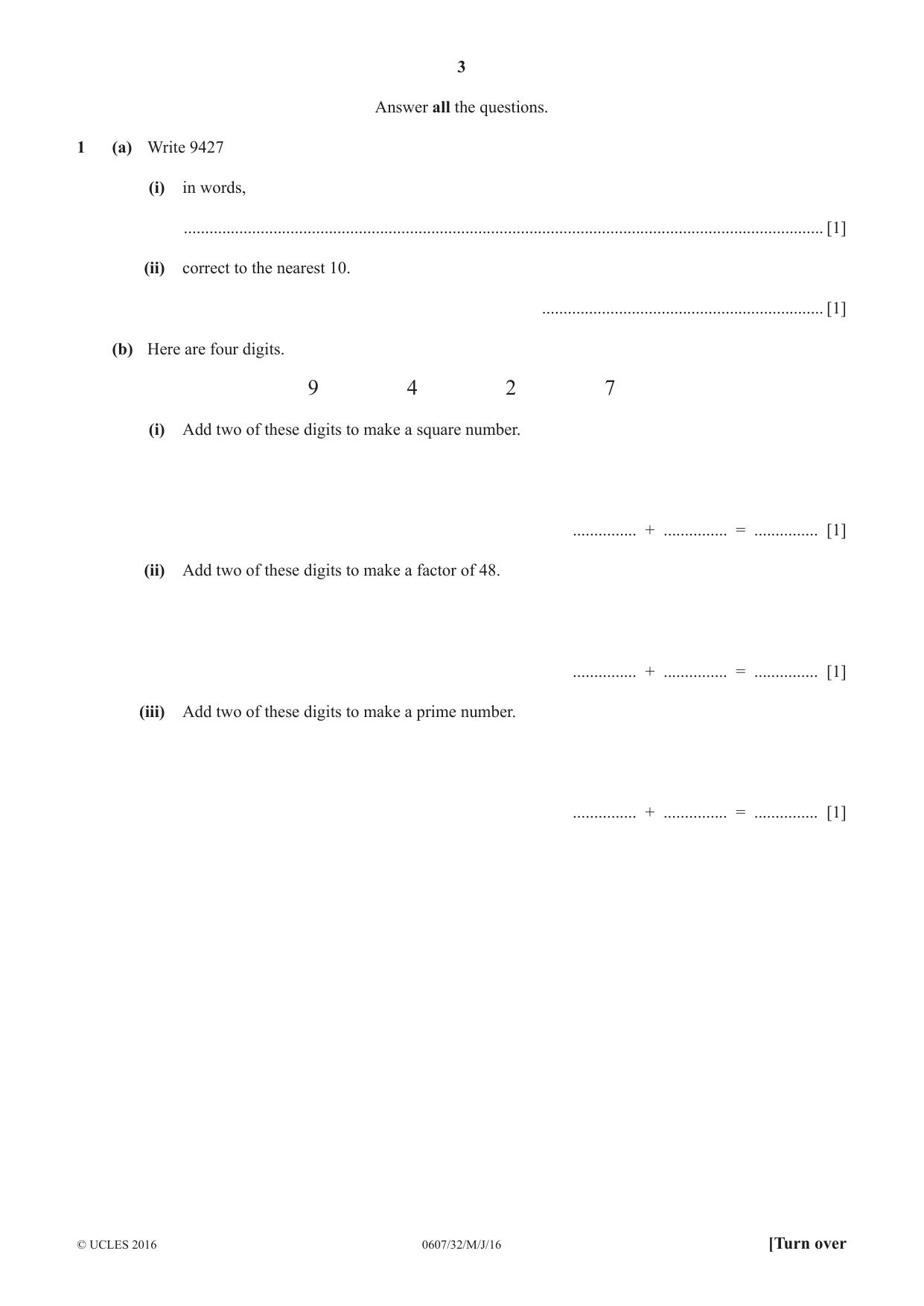
3 0607/32/M/J/16 © UCLES 2016 [Turn over Answer all the questions. 1 (a) Write 9427 (i) in words, … [1] (ii) correct to the nearest 10. … [1] (b) Here are four digits. 9 4 2 7 (i) Add two of these digits to make a square number. … + … = … [1] (ii) Add two of these digits to make a factor of 48. … + … = … [1] (iii) Add two of these digits to make a prime number. … + … = … [1]
Question paper, page 4
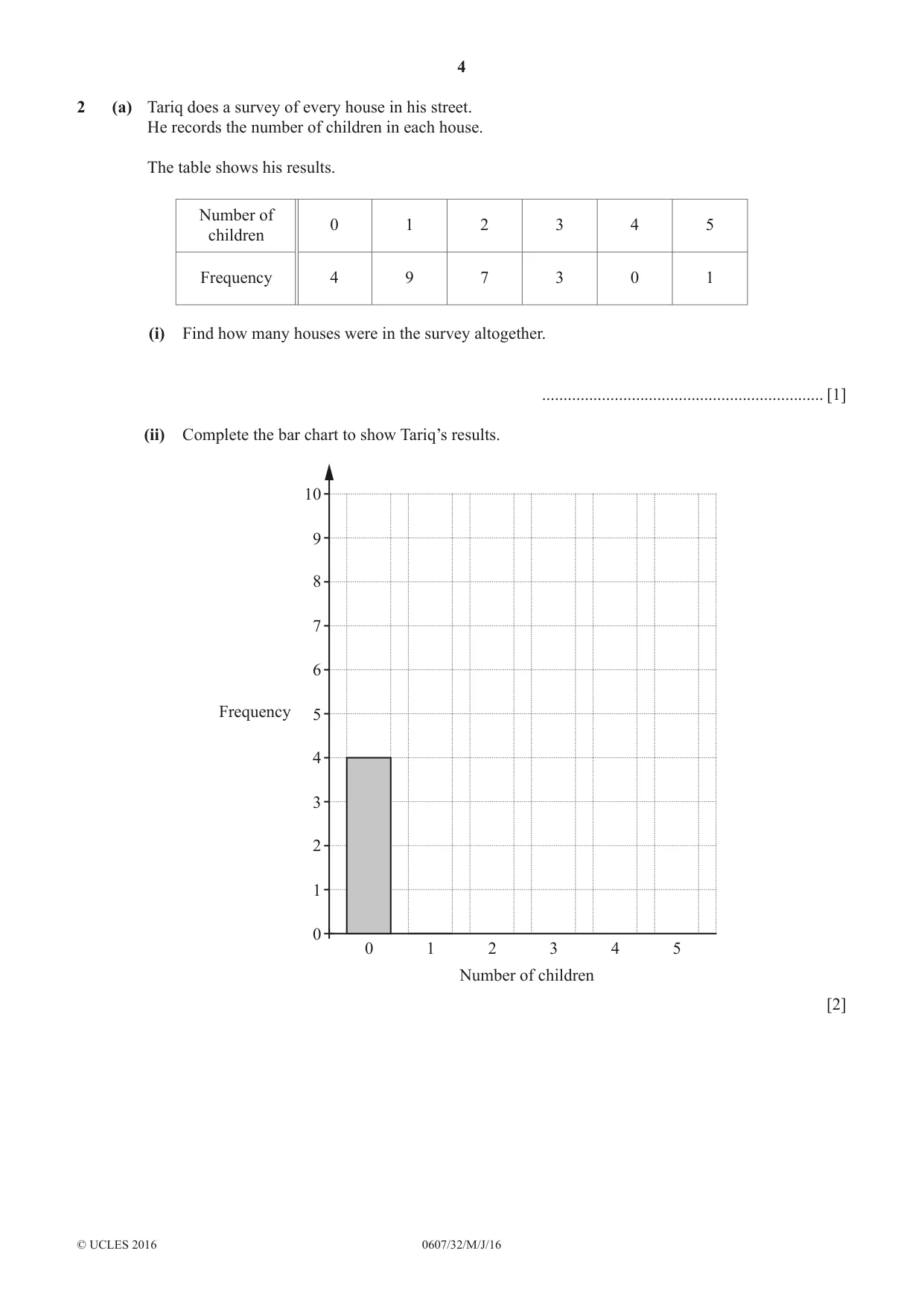
4 0607/32/M/J/16 © UCLES 2016 2 (a) Tariq does a survey of every house in his street. He records the number of children in each house. The table shows his results. Number of children 0 1 2 3 4 5 Frequency 4 9 7 3 0 1 (i) Find how many houses were in the survey altogether. … [1] (ii) Complete the bar chart to show Tariq’s results. 1 0 1 0 2 3 4 5 Number of children 2 3 4 5 6 Frequency 7 8 9 10 [2]
Question paper, page 5
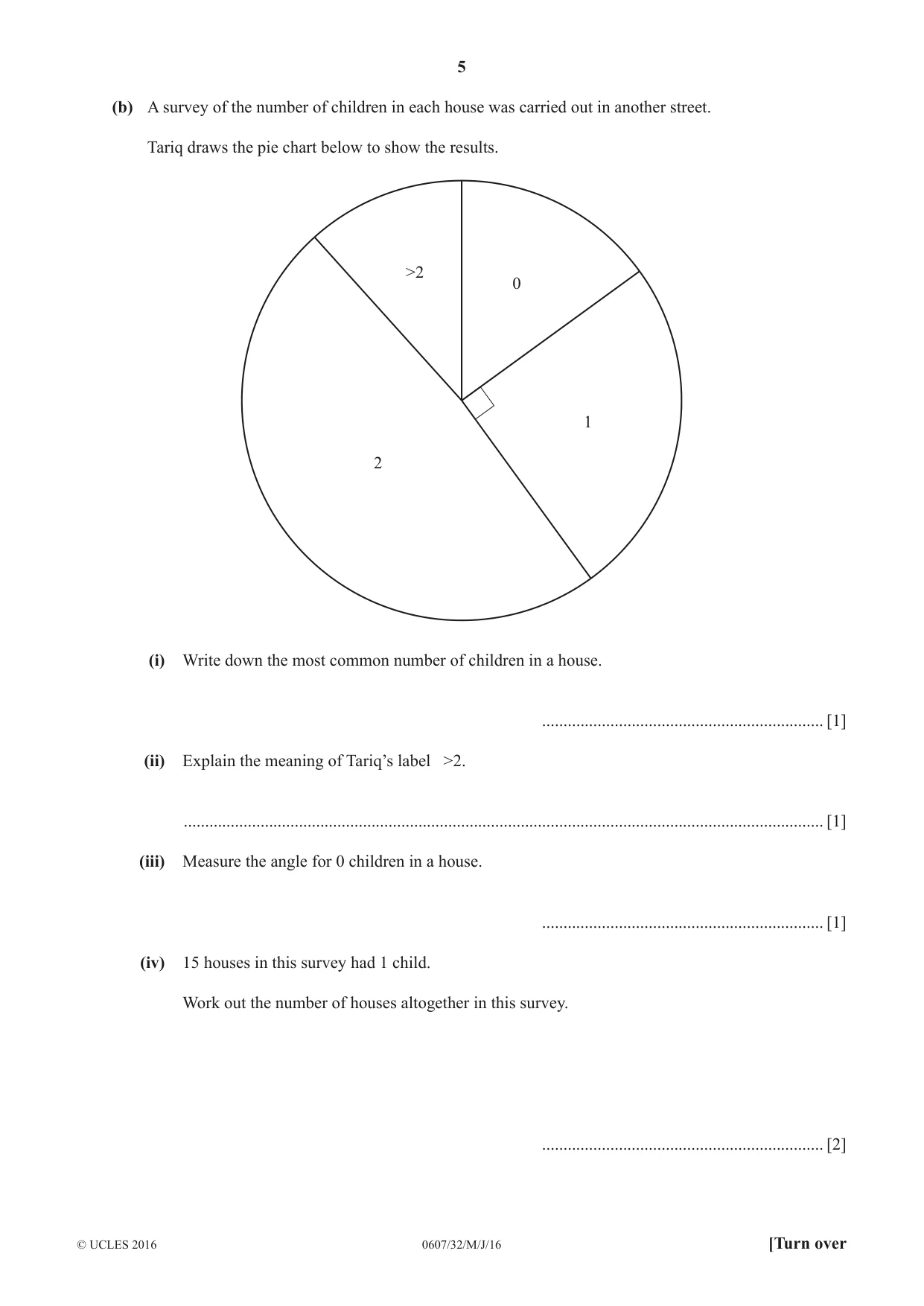
5 0607/32/M/J/16 © UCLES 2016 [Turn over (b) A survey of the number of children in each house was carried out in another street. Tariq draws the pie chart below to show the results. 2 >2 0 1 (i) Write down the most common number of children in a house. … [1] (ii) Explain the meaning of Tariq’s label >2. … [1] (iii) Measure the angle for 0 children in a house. … [1] (iv) 15 houses in this survey had 1 child. Work out the number of houses altogether in this survey. … [2]
Question paper, page 6
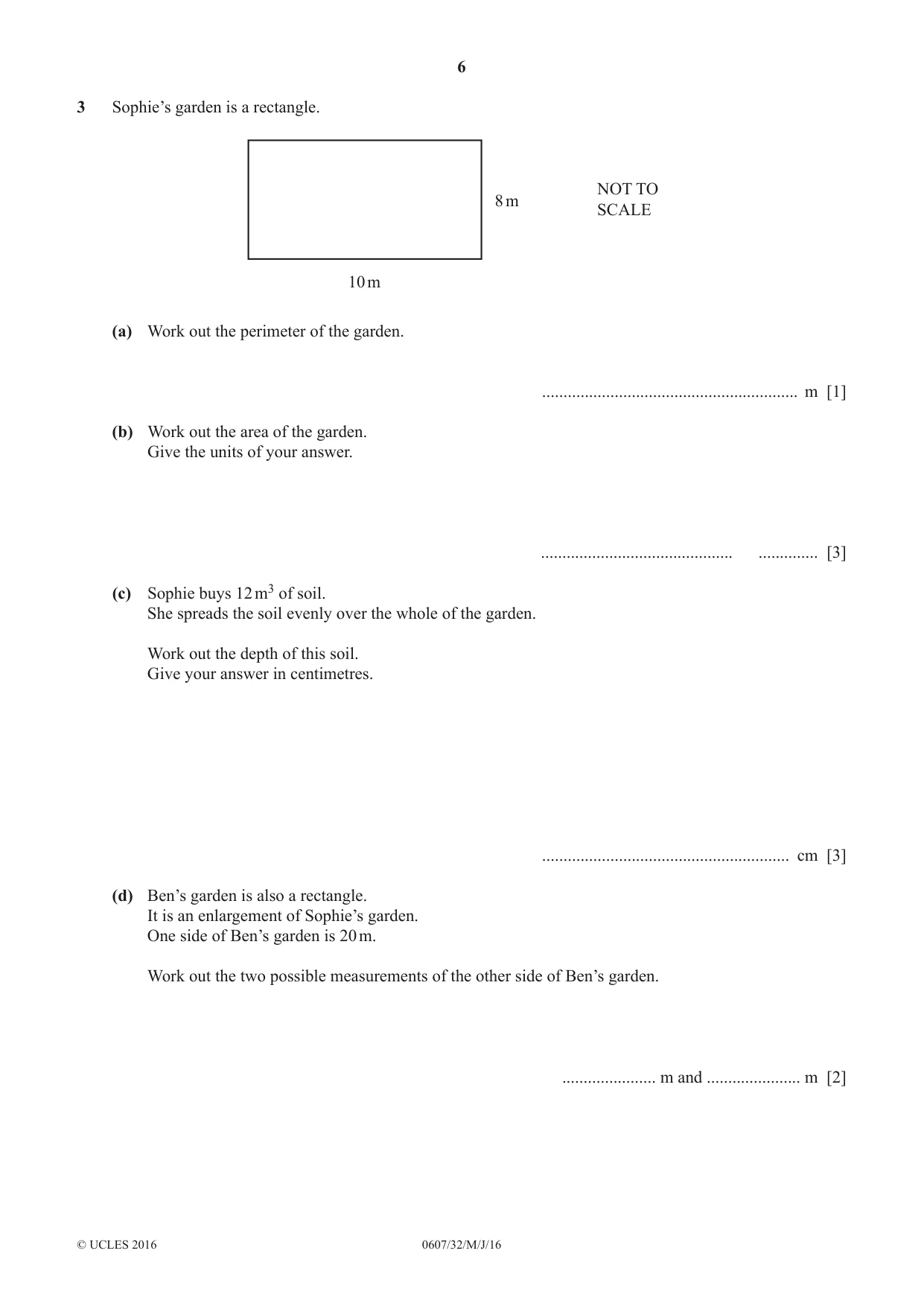
6 0607/32/M/J/16 © UCLES 2016 3 Sophie’s garden is a rectangle. 8 m NOT TO SCALE 10 m (a) Work out the perimeter of the garden. … m [1] (b) Work out the area of the garden. Give the units of your answer. … … [3] (c) Sophie buys 12 m3 of soil. She spreads the soil evenly over the whole of the garden. Work out the depth of this soil. Give your answer in centimetres. … cm [3] (d) Ben’s garden is also a rectangle. It is an enlargement of Sophie’s garden. One side of Ben’s garden is 20 m. Work out the two possible measurements of the other side of Ben’s garden. … m and … m [2]
Question paper, page 7
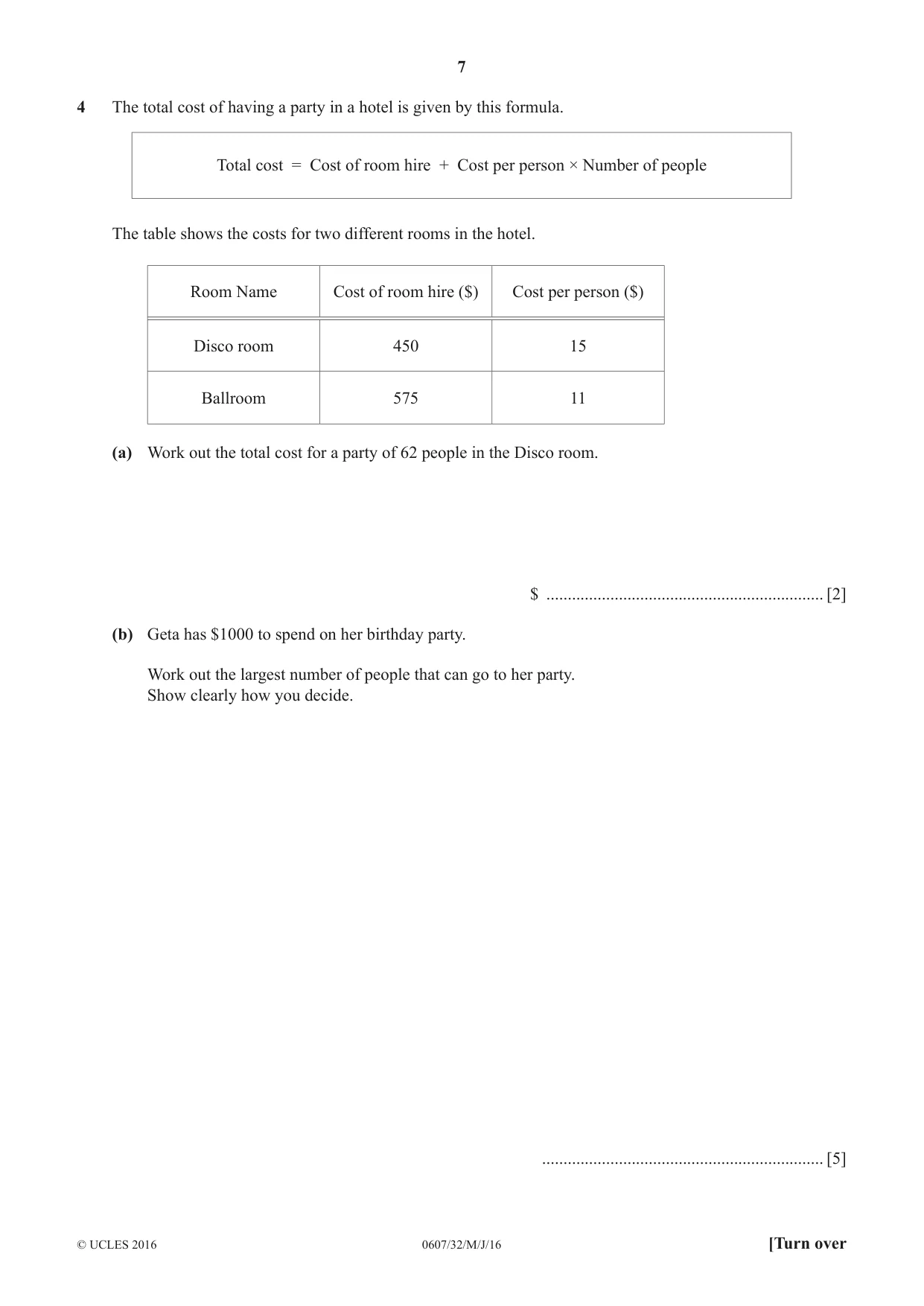
7 0607/32/M/J/16 © UCLES 2016 [Turn over 4 The total cost of having a party in a hotel is given by this formula. Total cost = Cost of room hire + Cost per person × Number of people The table shows the costs for two different rooms in the hotel. Room Name Cost of room hire ($) Cost per person ($) Disco room 450 15 Ballroom 575 11 (a) Work out the total cost for a party of 62 people in the Disco room. $ … [2] (b) Geta has $1000 to spend on her birthday party. Work out the largest number of people that can go to her party. Show clearly how you decide. … [5]
Question paper, page 8
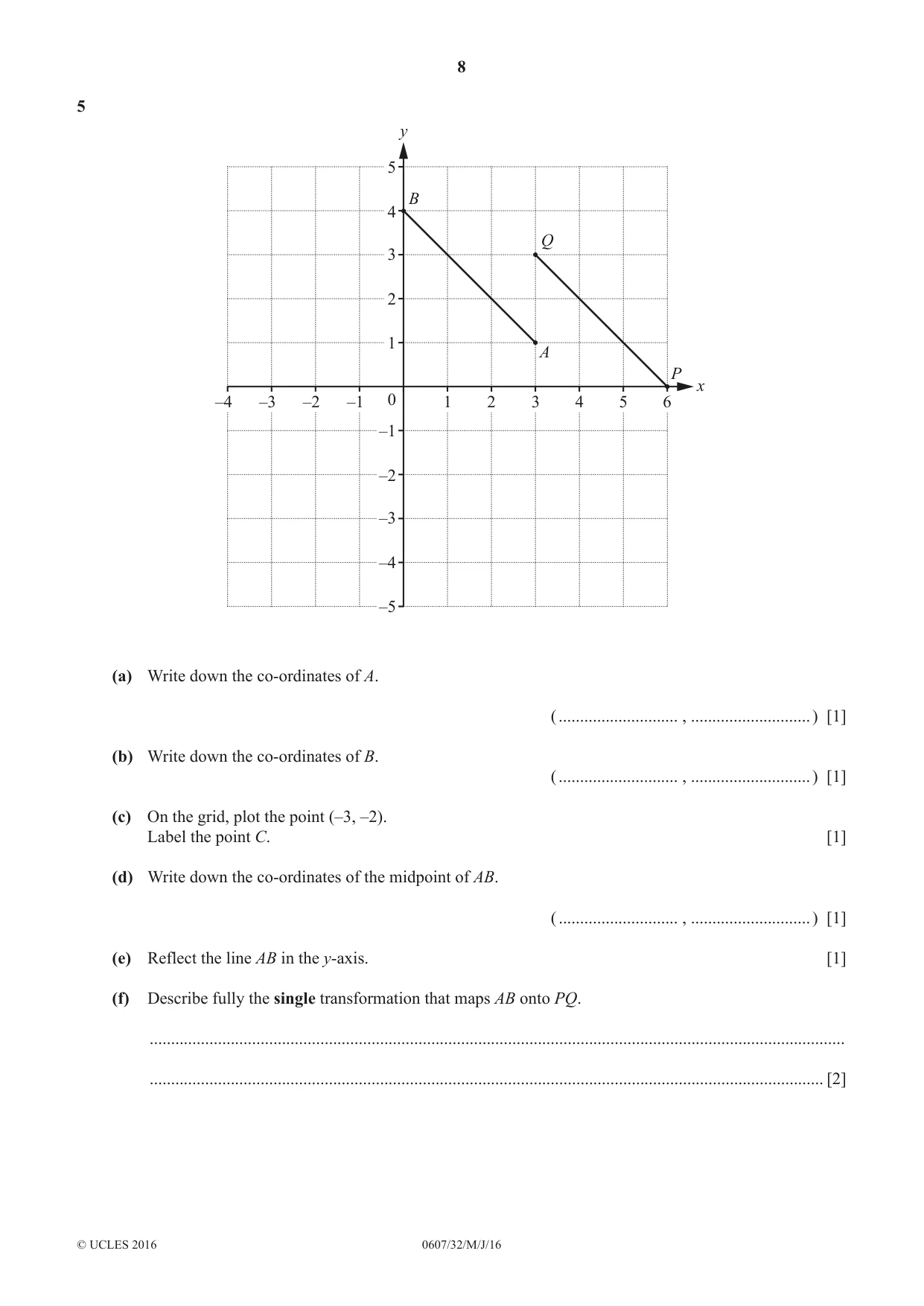
8 0607/32/M/J/16 © UCLES 2016 5 1 2 3 4 5 –5 –4 –3 –2 –1 0 –4 –3 –2 –1 1 2 3 4 5 6 x P Q B A y (a) Write down the co-ordinates of A. ( … , … ) [1] (b) Write down the co-ordinates of B. ( … , … ) [1] (c) On the grid, plot the point (–3, –2). Label the point C. [1] (d) Write down the co-ordinates of the midpoint of AB. ( … , … ) [1] (e) Reflect the line AB in the y-axis. [1] (f) Describe fully the single transformation that maps AB onto PQ. … … [2]
Question paper, page 9
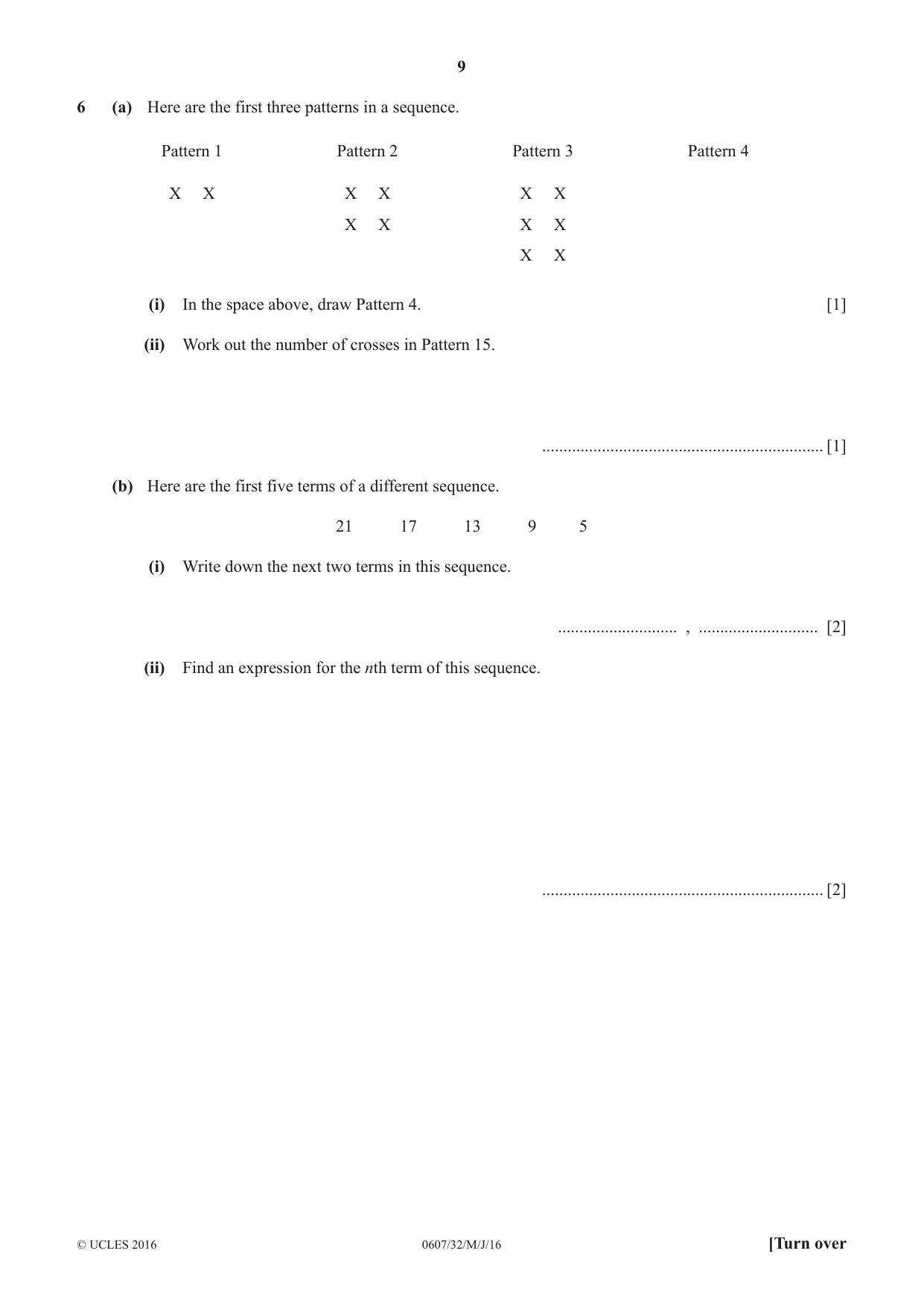
9 0607/32/M/J/16 © UCLES 2016 [Turn over 6 (a) Here are the first three patterns in a sequence. Pattern 1 X X Pattern 2 X X Pattern 3 X X X X X X X X Pattern 4 (i) In the space above, draw Pattern 4. [1] (ii) Work out the number of crosses in Pattern 15. … [1] (b) Here are the first five terms of a different sequence. 21 17 13 9 5 (i) Write down the next two terms in this sequence. … , … [2] (ii) Find an expression for the nth term of this sequence. … [2]
Question paper, page 10
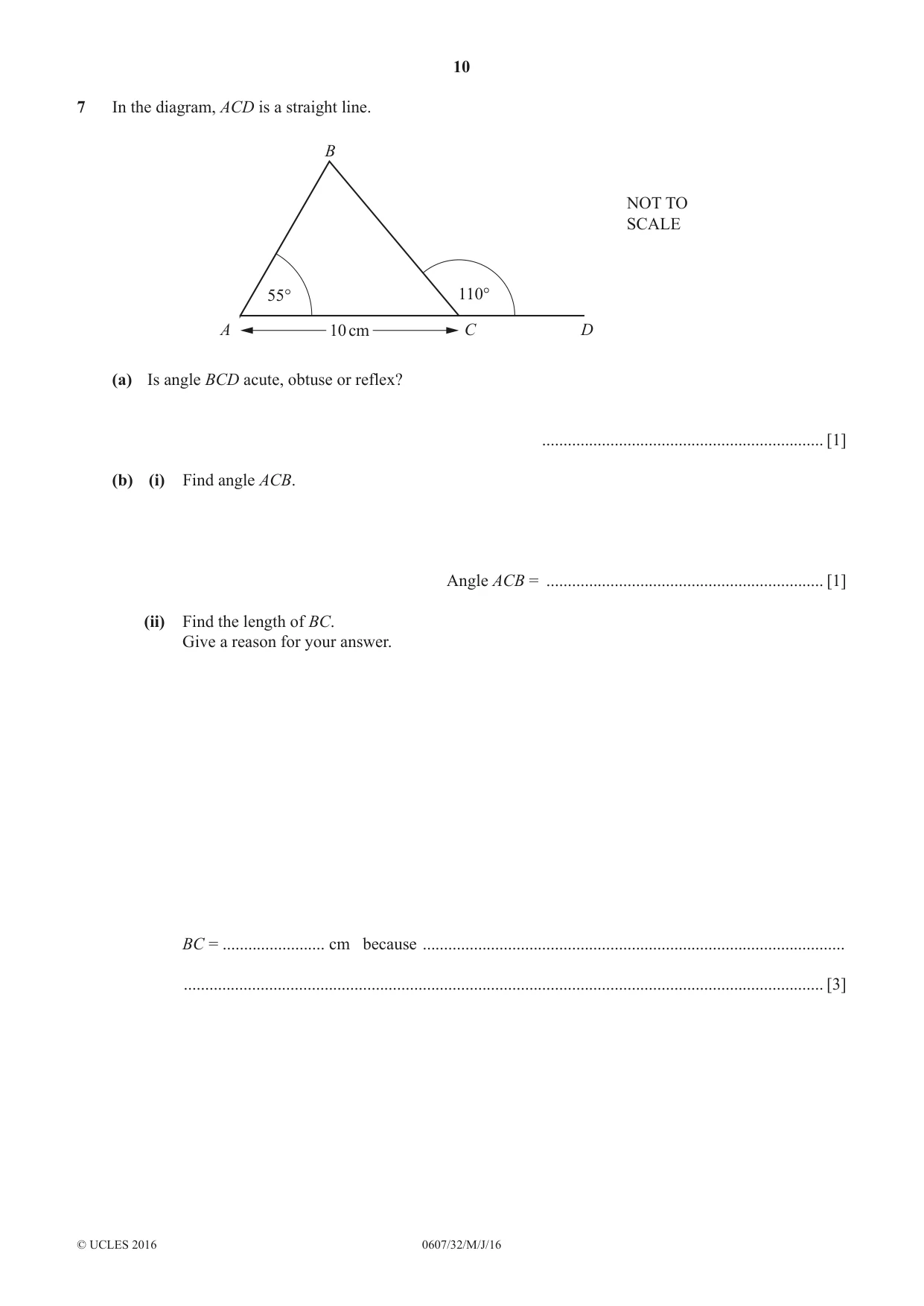
10 0607/32/M/J/16 © UCLES 2016 7 In the diagram, ACD is a straight line. 55° B D C A 110° NOT TO SCALE 10 cm (a) Is angle BCD acute, obtuse or reflex? … [1] (b) (i) Find angle ACB. Angle ACB = … [1] (ii) Find the length of BC. Give a reason for your answer. BC = … cm because … … [3]
Question paper, page 11
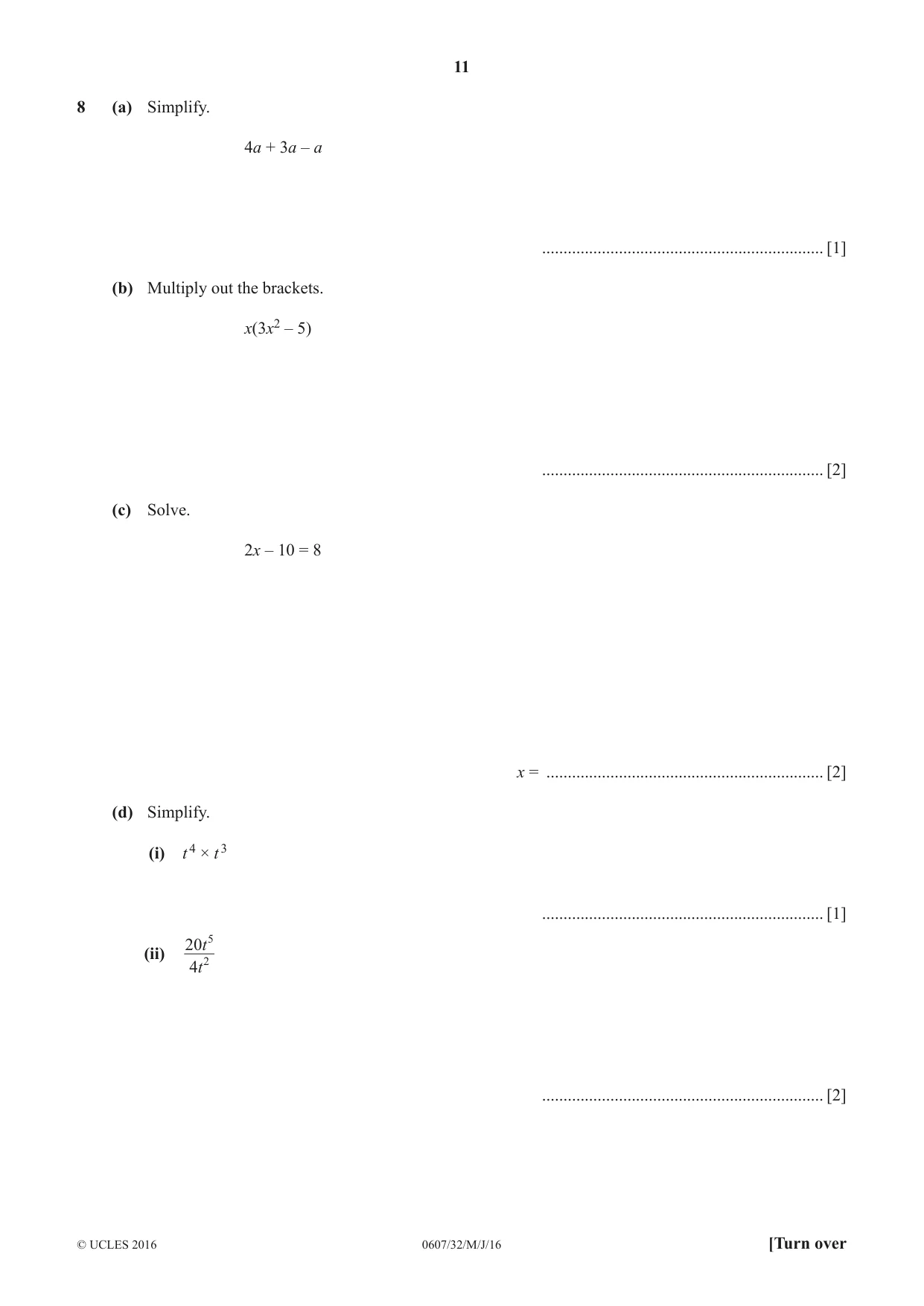
11 0607/32/M/J/16 © UCLES 2016 [Turn over 8 (a) Simplify. 4a + 3a – a … [1] (b) Multiply out the brackets. x(3x2 – 5) … [2] (c) Solve. 2x – 10 = 8 x = … [2] (d) Simplify. (i) t 4 × t 3 … [1] (ii) t t 4 20 2 5 … [2]
Question paper, page 12
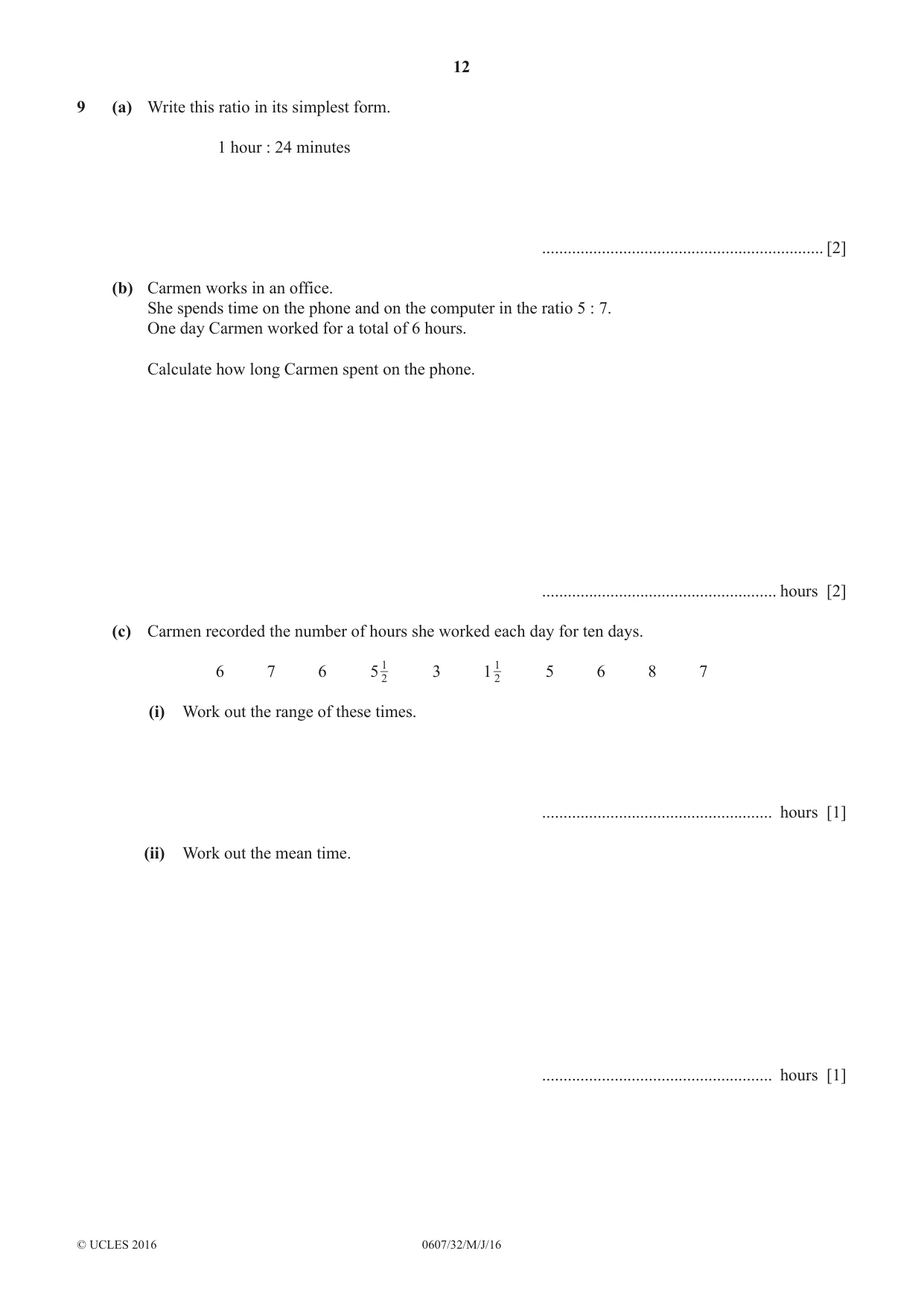
12 0607/32/M/J/16 © UCLES 2016 9 (a) Write this ratio in its simplest form. 1 hour : 24 minutes … [2] (b) Carmen works in an office. She spends time on the phone and on the computer in the ratio 5 : 7. One day Carmen worked for a total of 6 hours. Calculate how long Carmen spent on the phone. … hours [2] (c) Carmen recorded the number of hours she worked each day for ten days. 6 7 6 5 2 1 3 1 2 1 5 6 8 7 (i) Work out the range of these times. … hours [1] (ii) Work out the mean time. … hours [1]
Question paper, page 13
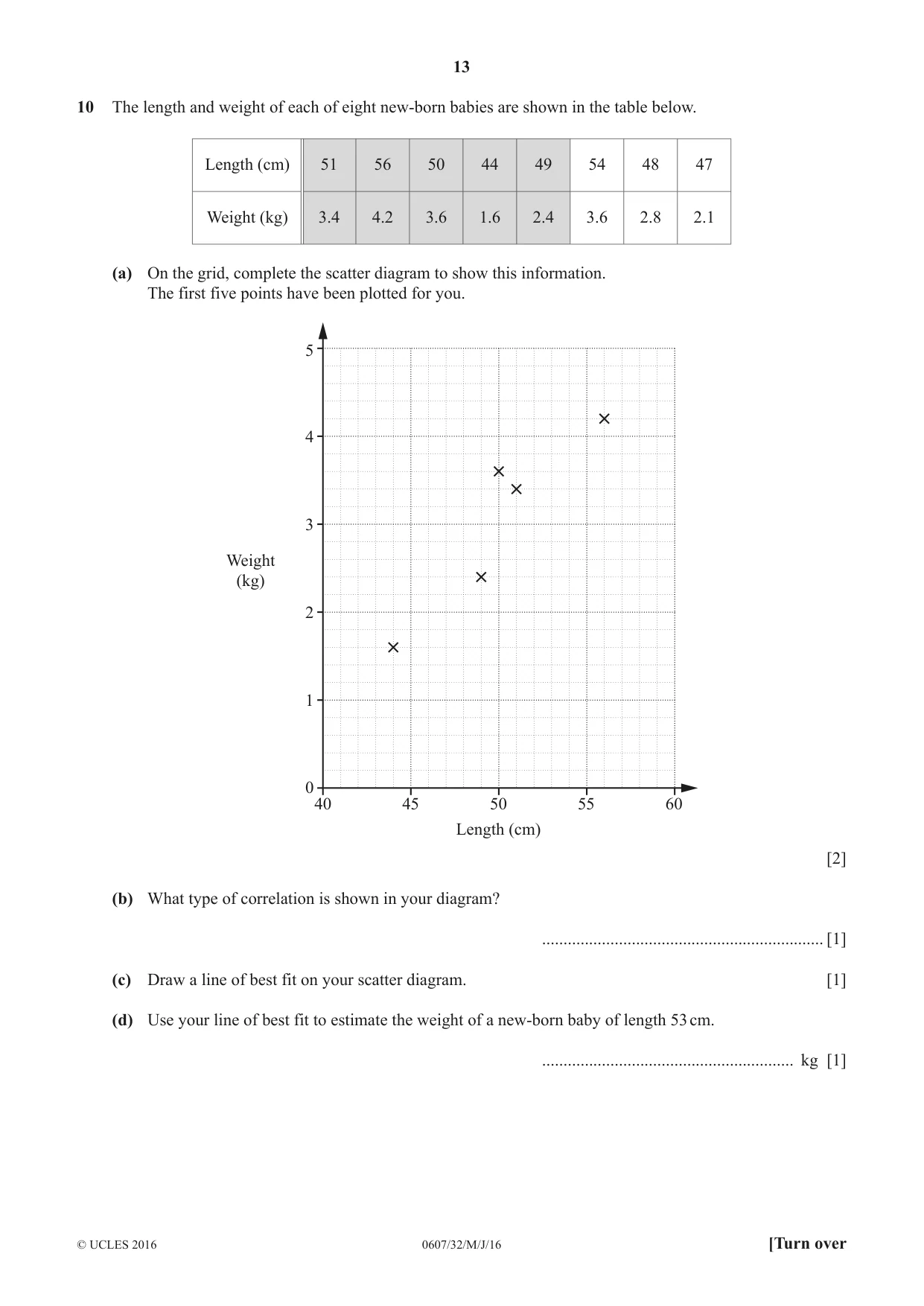
13 0607/32/M/J/16 © UCLES 2016 [Turn over 10 The length and weight of each of eight new-born babies are shown in the table below. Length (cm) 51 56 50 44 49 54 48 47 Weight (kg) 3.4 4.2 3.6 1.6 2.4 3.6 2.8 2.1 (a) On the grid, complete the scatter diagram to show this information. The first five points have been plotted for you. 4 5 3 2 40 45 50 Length (cm) 55 60 Weight (kg) 1 0 [2] (b) What type of correlation is shown in your diagram? … [1] (c) Draw a line of best fit on your scatter diagram. [1] (d) Use your line of best fit to estimate the weight of a new-born baby of length 53 cm. … kg [1]
Question paper, page 14
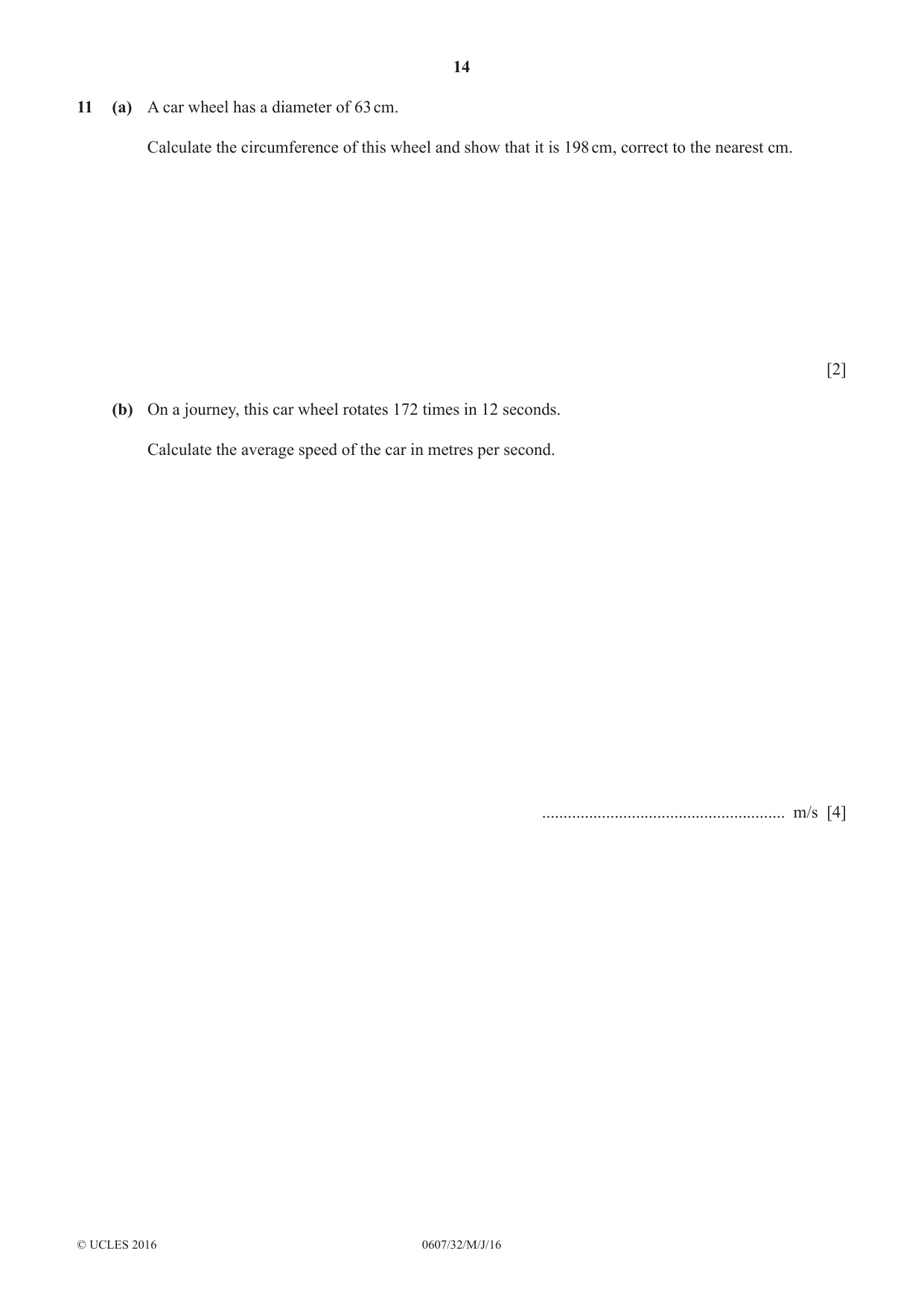
14 0607/32/M/J/16 © UCLES 2016 11 (a) A car wheel has a diameter of 63 cm. Calculate the circumference of this wheel and show that it is 198 cm, correct to the nearest cm. [2] (b) On a journey, this car wheel rotates 172 times in 12 seconds. Calculate the average speed of the car in metres per second. … m/s [4]
Question paper, page 15
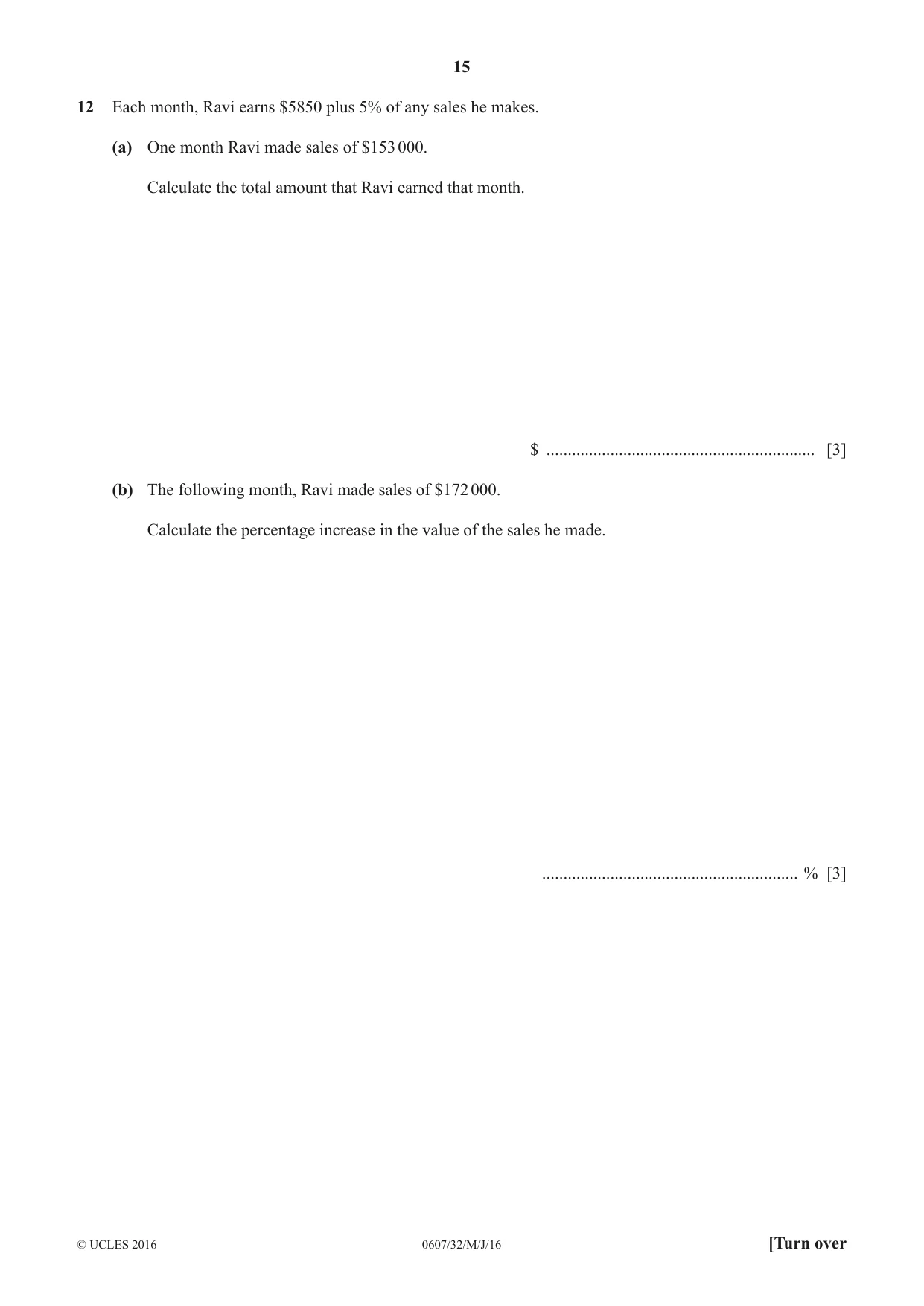
15 0607/32/M/J/16 © UCLES 2016 [Turn over 12 Each month, Ravi earns $5850 plus 5% of any sales he makes. (a) One month Ravi made sales of $153 000. Calculate the total amount that Ravi earned that month. $ … [3] (b) The following month, Ravi made sales of $172 000. Calculate the percentage increase in the value of the sales he made. … % [3]
Question paper, page 16
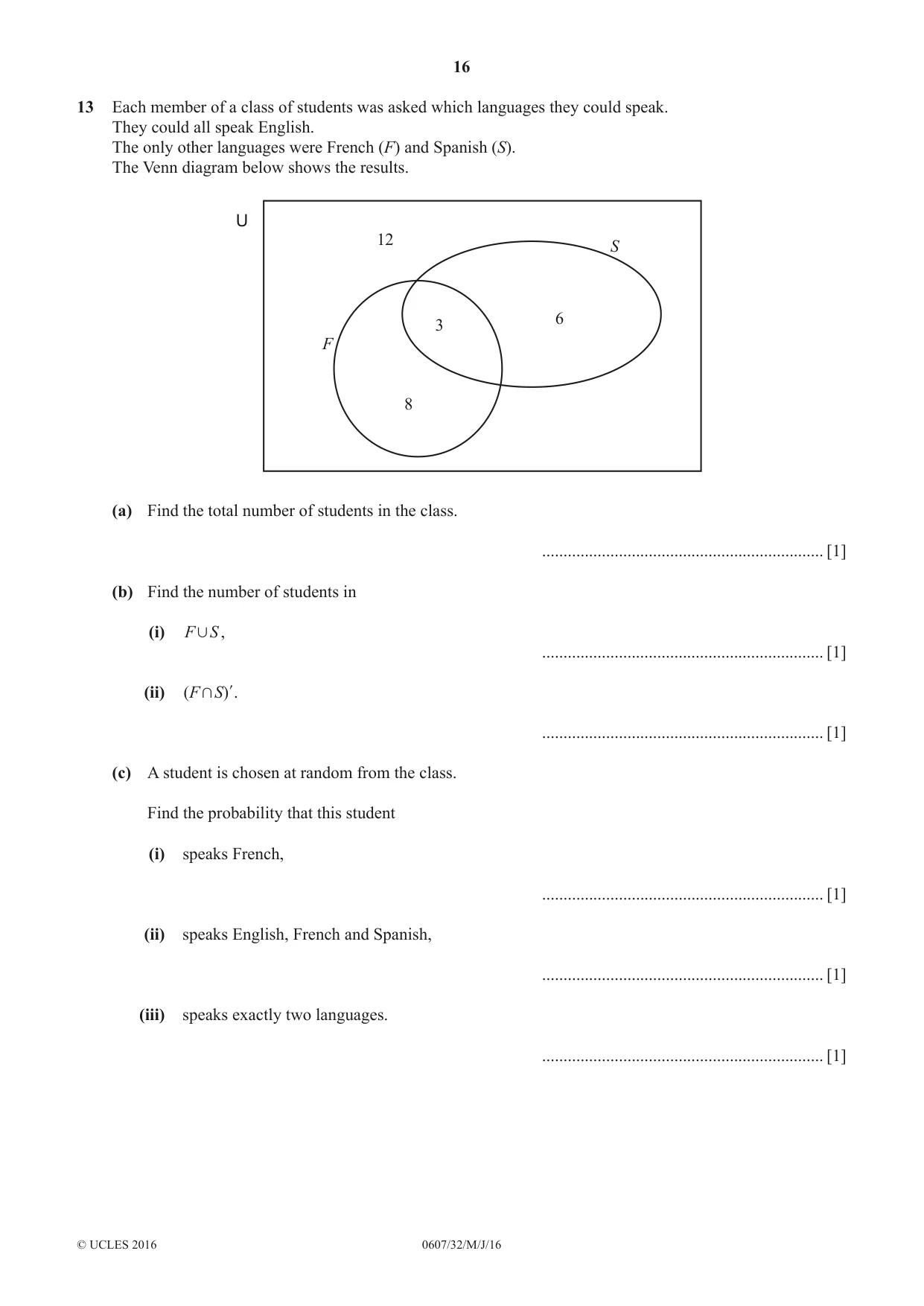
16 0607/32/M/J/16 © UCLES 2016 13 Each member of a class of students was asked which languages they could speak. They could all speak English. The only other languages were French (F) and Spanish (S). The Venn diagram below shows the results. F S 12 6 3 8 U (a) Find the total number of students in the class. … [1] (b) Find the number of students in (i) F S , , … [1] (ii) ( ) F S + l. … [1] (c) A student is chosen at random from the class. Find the probability that this student (i) speaks French, … [1] (ii) speaks English, French and Spanish, … [1] (iii) speaks exactly two languages. … [1]
Question paper, page 17
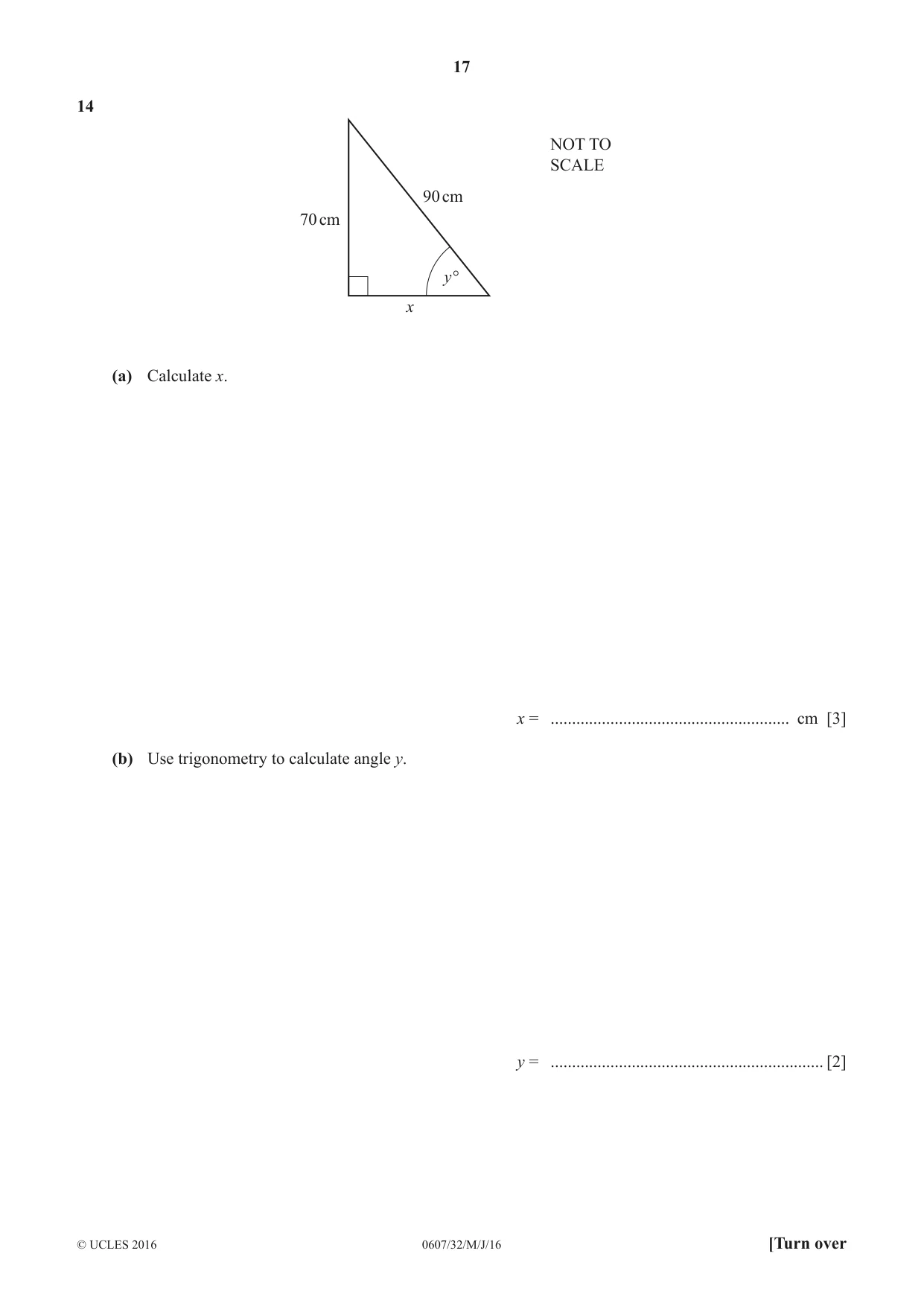
17 0607/32/M/J/16 © UCLES 2016 [Turn over 14 70 cm 90 cm NOT TO SCALE x y° (a) Calculate x. x = … cm [3] (b) Use trigonometry to calculate angle y. y = … [2]
Question paper, page 18
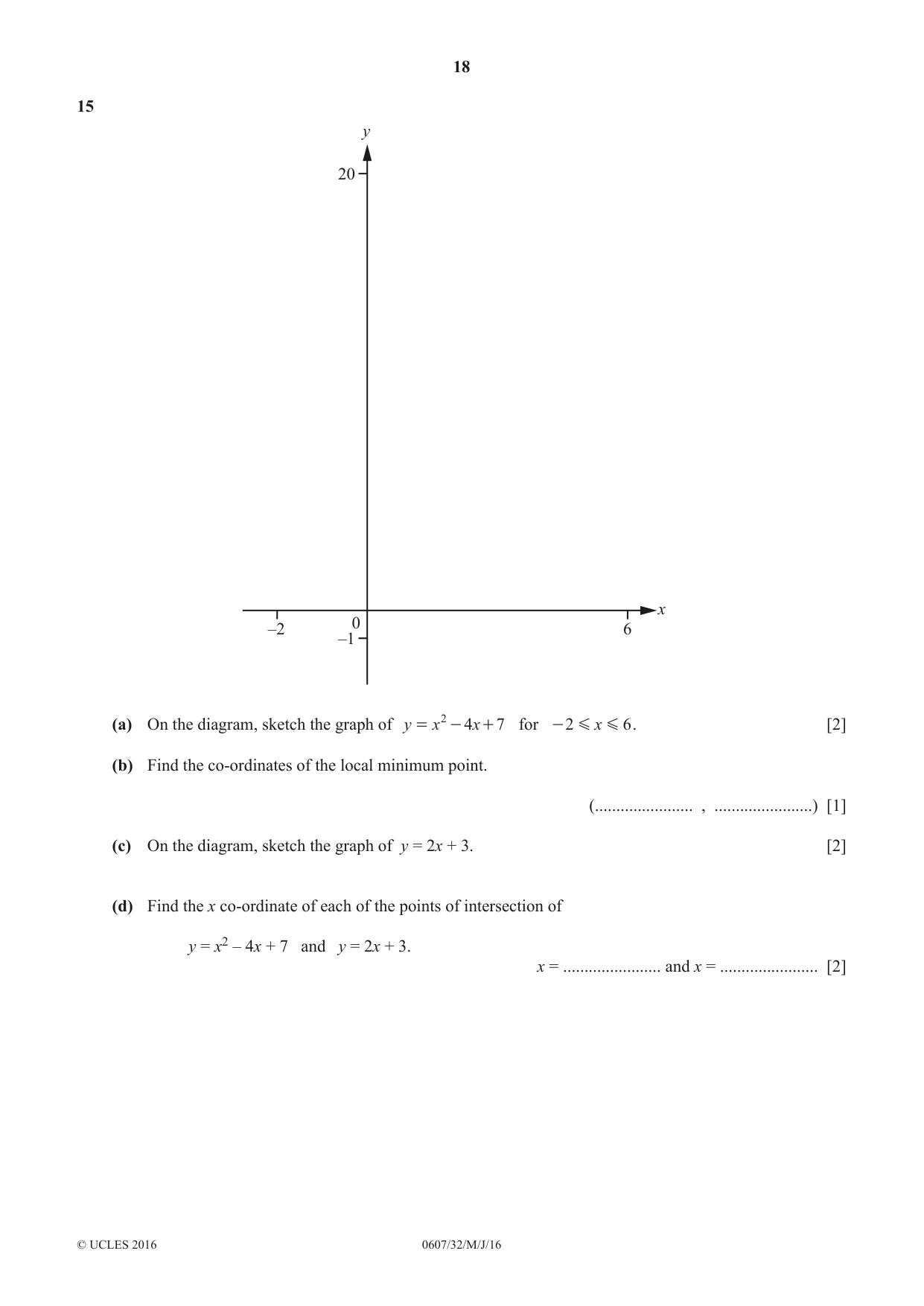
18 0607/32/M/J/16 © UCLES 2016 15 20 –1 0 –2 6 x y (a) On the diagram, sketch the graph of y x x 4 7 2 = - + for x 2 6 G G - . [2] (b) Find the co-ordinates of the local minimum point. (… , …) [1] (c) On the diagram, sketch the graph of y = 2x + 3. [2] (d) Find the x co-ordinate of each of the points of intersection of y = x2 – 4x + 7 and y = 2x + 3. x = … and x = … [2]
Question paper, page 19
19 0607/32/M/J/16 © UCLES 2016 bLank page
Question paper, page 20
20 0607/32/M/J/16 © UCLES 2016 Permission to reproduce items where third-party owned material protected by copyright is included has been sought and cleared where possible. Every reasonable effort has been made by the publisher (UCLES) to trace copyright holders, but if any items requiring clearance have unwittingly been included, the publisher will be pleased to make amends at the earliest possible opportunity. To avoid the issue of disclosure of answer-related information to candidates, all copyright acknowledgements are reproduced online in the Cambridge International Examinations Copyright Acknowledgements Booklet. This is produced for each series of examinations and is freely available to download at www.cie.org.uk after the live examination series. Cambridge International Examinations is part of the Cambridge Assessment Group. Cambridge Assessment is the brand name of University of Cambridge Local Examinations Syndicate (UCLES), which is itself a department of the University of Cambridge. bLank page
Mark scheme, page 1
® IGCSE is the registered trademark of Cambridge International Examinations. This document consists of 5 printed pages. © UCLES 2016 [Turn over Cambridge International Examinations Cambridge International General Certificate of Secondary Education CAMBRDGE INTERNATIONAL MATHEMATICS 0607/32 Paper 3 (Core) May/June 2016 MARK SCHEME Maximum Mark: 96 Published This mark scheme is published as an aid to teachers and candidates, to indicate the requirements of the examination. It shows the basis on which Examiners were instructed to award marks. It does not indicate the details of the discussions that took place at an Examiners’ meeting before marking began, which would have considered the acceptability of alternative answers. Mark schemes should be read in conjunction with the question paper and the Principal Examiner Report for Teachers. Cambridge will not enter into discussions about these mark schemes. Cambridge is publishing the mark schemes for the May/June 2016 series for most Cambridge IGCSE®, Cambridge International A and AS Level components and some Cambridge O Level components.
Mark scheme, page 2
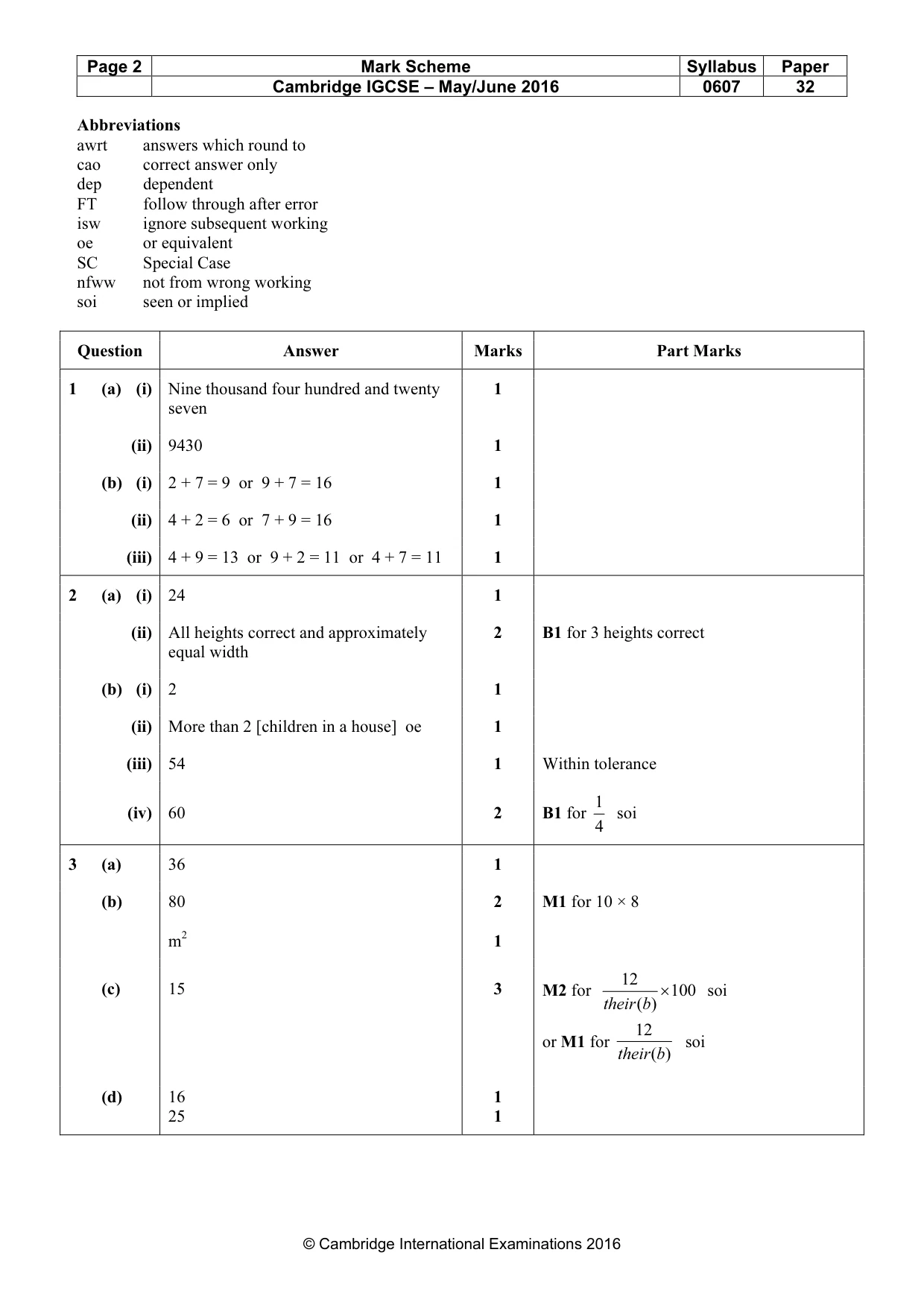
Page 2 Mark Scheme Syllabus Paper Cambridge IGCSE – May/June 2016 0607 32 © Cambridge International Examinations 2016 Abbreviations awrt answers which round to cao correct answer only dep dependent FT follow through after error isw ignore subsequent working oe or equivalent SC Special Case nfww not from wrong working soi seen or implied Question Answer Marks Part Marks 1 (a) (i) Nine thousand four hundred and twenty seven 1 (ii) 9430 1 (b) (i) 2 + 7 = 9 or 9 + 7 = 16 1 (ii) 4 + 2 = 6 or 7 + 9 = 16 1 (iii) 4 + 9 = 13 or 9 + 2 = 11 or 4 + 7 = 11 1 2 (a) (i) 24 1 (ii) All heights correct and approximately equal width 2 B1 for 3 heights correct (b) (i) 2 1 (ii) More than 2 [children in a house] oe 1 (iii) 54 1 Within tolerance (iv) 60 2 B1 for 1 4 soi 3 (a) 36 1 (b) 80 m2 2 1 M1 for 10 × 8 (c) 15 3 M2 for 12 100 ( ) their b × soi or M1 for soi (d) 16 25 1 1 ) ( 12 b their
Mark scheme, page 3
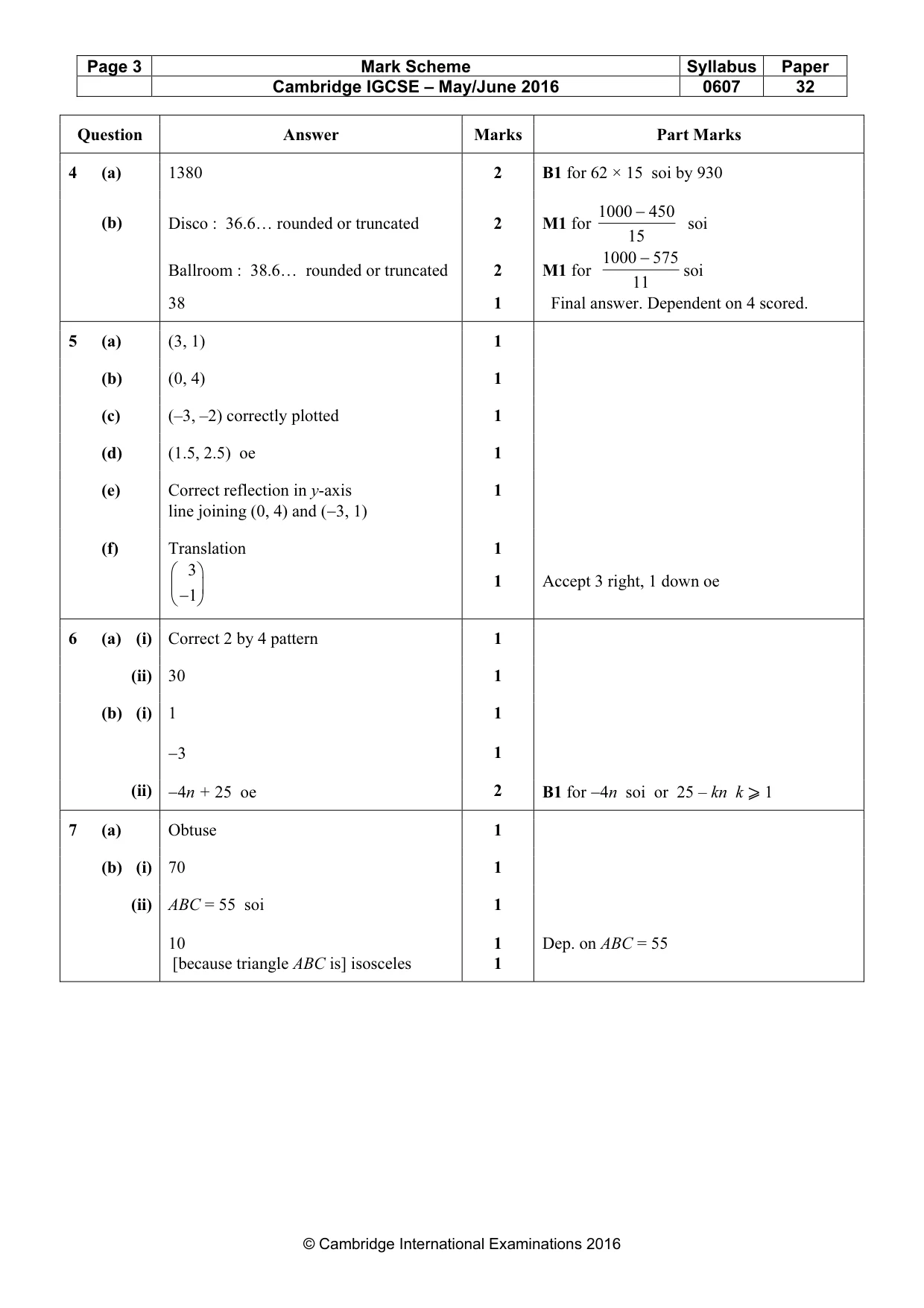
Page 3 Mark Scheme Syllabus Paper Cambridge IGCSE – May/June 2016 0607 32 © Cambridge International Examinations 2016 Question Answer Marks Part Marks 4 (a) 1380 2 B1 for 62 × 15 soi by 930 (b) Disco : 36.6… rounded or truncated Ballroom : 38.6… rounded or truncated 38 2 2 1 M1 for soi M1 for soi Final answer. Dependent on 4 scored. 5 (a) (3, 1) 1 (b) (0, 4) 1 (c) (–3, –2) correctly plotted 1 (d) (1.5, 2.5) oe 1 (e) Correct reflection in y-axis line joining (0, 4) and (−3, 1) 1 (f) Translation 3 1 − 1 1 Accept 3 right, 1 down oe 6 (a) (i) Correct 2 by 4 pattern 1 (ii) 30 1 (b) (i) 1 −3 1 1 (ii) −4n + 25 oe 2 B1 for −4n soi or 25 – kn k ⩾ 1 7 (a) Obtuse 1 (b) (i) 70 1 (ii) ABC = 55 soi 10 [because triangle ABC is] isosceles 1 1 1 Dep. on ABC = 55 15 450 1000 − 11 575 1000 −
Mark scheme, page 4
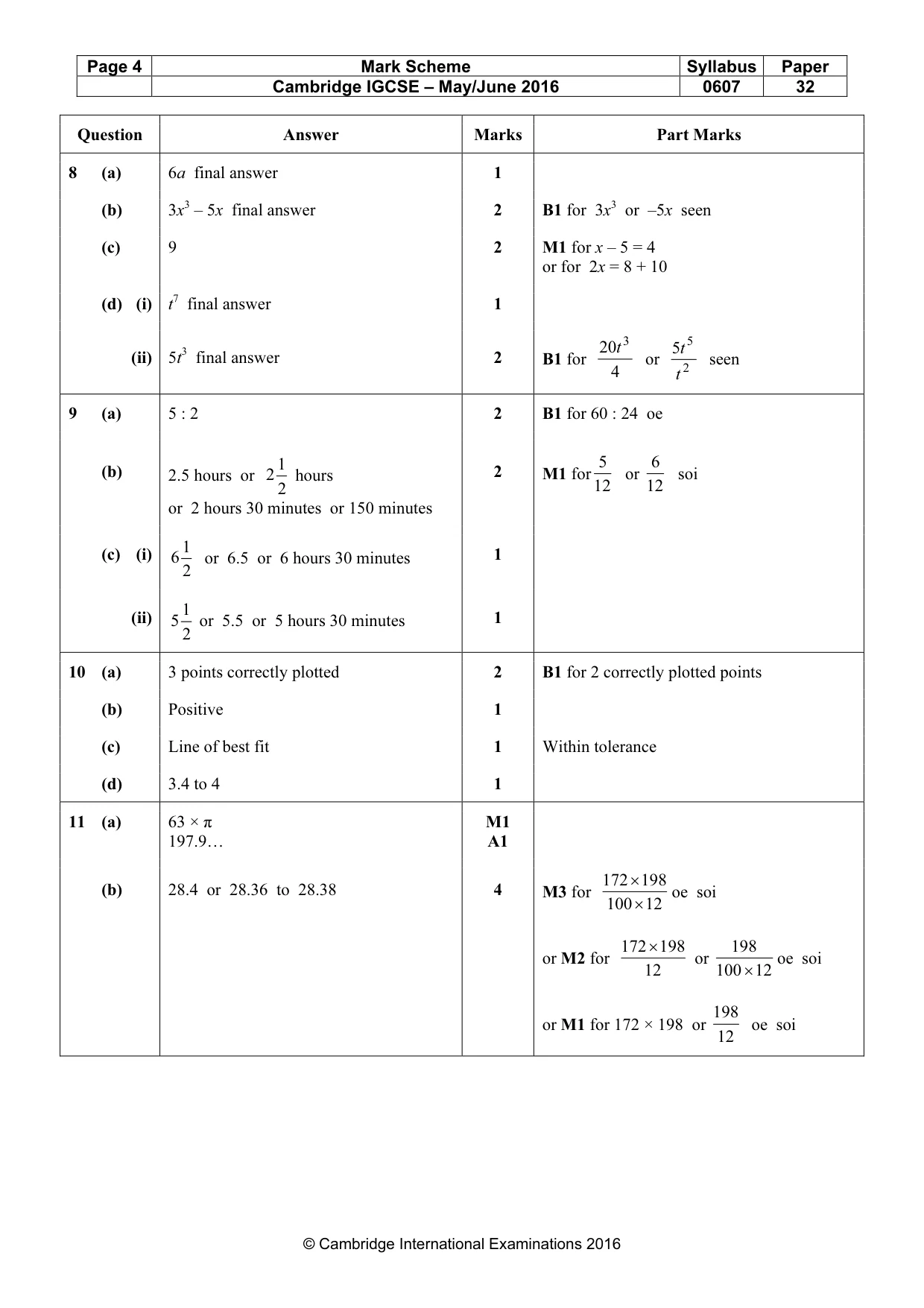
Page 4 Mark Scheme Syllabus Paper Cambridge IGCSE – May/June 2016 0607 32 © Cambridge International Examinations 2016 Question Answer Marks Part Marks 8 (a) 6a final answer 1 (b) 3x3 – 5x final answer 2 B1 for 3x3 or –5x seen (c) 9 2 M1 for x – 5 = 4 or for 2x = 8 + 10 (d) (i) t7 final answer 1 (ii) 5t3 final answer 2 B1 for or seen 9 (a) 5 : 2 2 B1 for 60 : 24 oe (b) 2.5 hours or 1 2 2 hours or 2 hours 30 minutes or 150 minutes 2 M1 for or soi (c) (i) 1 6 2 or 6.5 or 6 hours 30 minutes 1 (ii) 1 5 2 or 5.5 or 5 hours 30 minutes 1 10 (a) 3 points correctly plotted 2 B1 for 2 correctly plotted points (b) Positive 1 (c) Line of best fit 1 Within tolerance (d) 3.4 to 4 1 11 (a) 63 × π 197.9… M1 A1 (b) 28.4 or 28.36 to 28.38 4 M3 for oe soi or M2 for or oe soi or M1 for 172 × 198 or oe soi 4 20 3t 2 5 5 t t 12 5 12 6 12 100 198 172 × × 12 198 172× 12 100 198 × 12 198
Mark scheme, page 5
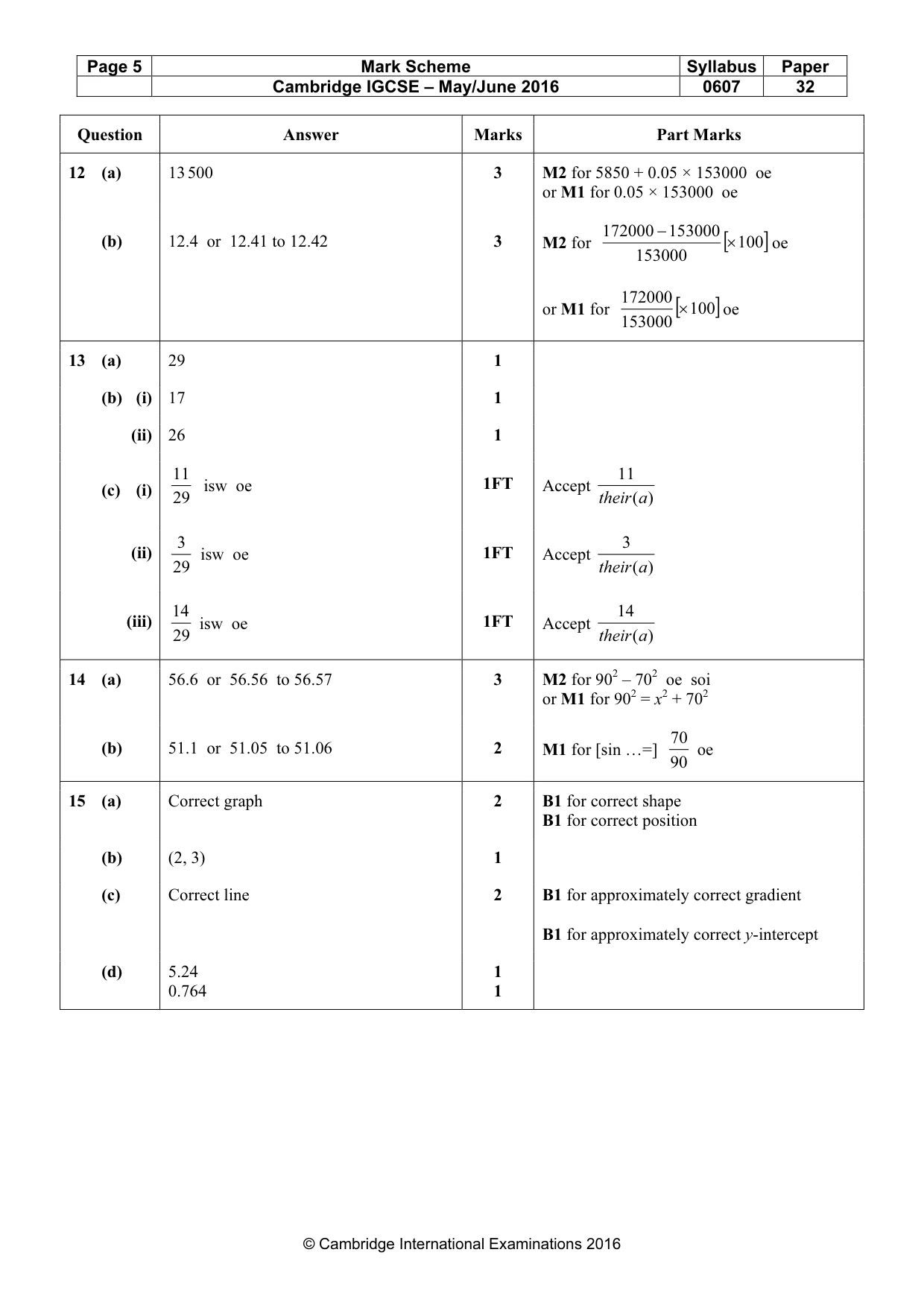
Page 5 Mark Scheme Syllabus Paper Cambridge IGCSE – May/June 2016 0607 32 © Cambridge International Examinations 2016 Question Answer Marks Part Marks 12 (a) 13 500 3 M2 for 5850 + 0.05 × 153000 oe or M1 for 0.05 × 153000 oe (b) 12.4 or 12.41 to 12.42 3 M2 for oe or M1 for oe 13 (a) 29 1 (b) (i) 17 1 (ii) 26 1 (c) (i) isw oe 1FT Accept (ii) isw oe 1FT Accept (iii) isw oe 1FT Accept 14 (a) 56.6 or 56.56 to 56.57 3 M2 for 902 – 702 oe soi or M1 for 902 = x2 + 702 (b) 51.1 or 51.05 to 51.06 2 M1 for [sin …=] oe 15 (a) Correct graph 2 B1 for correct shape B1 for correct position (b) (2, 3) 1 (c) Correct line 2 B1 for approximately correct gradient B1 for approximately correct y-intercept (d) 5.24 0.764 1 1 [ ] 100 153000 153000 172000 × − [ ] 100 153000 172000 × 29 11 ) ( 11 a their 29 3 ) ( 3 a their 29 14 ) ( 14 a their 90 70
What you needed in this session
Cambridge’s own grade thresholds for 2016 May/June, Paper 3 · Variant 2. A higher threshold means an easier paper — the bar moves with how the cohort did.