Cambridge IGCSE Mathematics - International 0607 — 2015 May/June Paper 3 · Variant 3
0607/33/M/J/15 · 96 marks · ≈108 min
The question paper and its mark scheme, free to read here and free to download. This is Cambridge’s own paper, exactly as it was sat.
Question paper16 pages
Mark scheme6 pages
Answers below. Sit the paper first if you are practising.
Paper as text
Question paper, page 1
This document consists of 16 printed pages. DC (KN/CGW) 100417/4 © UCLES 2015 [Turn over Cambridge International Examinations Cambridge International General Certificate of Secondary Education * 7 9 4 8 3 0 2 2 3 6 * CAMBRIDGE INTERNATIONAL MATHEMATICS 0607/33 Paper 3 (Core) May/June 2015 1 hour 45 minutes Candidates answer on the Question Paper. Additional Materials: Geometrical Instruments Graphics Calculator READ THESE INSTRUCTIONS FIRST Write your Centre number, candidate number and name on all the work you hand in. Write in dark blue or black pen. Do not use staples, paper clips, glue or correction fluid. You may use an HB pencil for any diagrams or graphs. DO NOT WRITE IN ANY BARCODES. Answer all the questions. Unless instructed otherwise, give your answers exactly or correct to three significant figures as appropriate. Answers in degrees should be given to one decimal place. For π, use your calculator value. You must show all the relevant working to gain full marks and you will be given marks for correct methods, including sketches, even if your answer is incorrect. The number of marks is given in brackets [ ] at the end of each question or part question. The total number of marks for this paper is 96.
Question paper, page 2
2 0607/33/M/J/15 © UCLES 2015 Formula List Area, A, of triangle, base b, height h. A = bh 2 1 Area, A, of circle, radius r. A = πr2 Circumference, C, of circle, radius r. C = 2πr Curved surface area, A, of cylinder of radius r, height h. A = 2πrh Curved surface area, A, of cone of radius r, sloping edge l. A = πrl Curved surface area, A, of sphere of radius r. A = 4πr2 Volume, V, of prism, cross-sectional area A, length l. V =Al Volume, V, of pyramid, base area A, height h. V= Ah 3 1 Volume, V, of cylinder of radius r, height h. V = πr2h Volume, V, of cone of radius r, height h. V = r h 3 1 2 r Volume, V, of sphere of radius r. V = r 3 4 3 r
Question paper, page 3
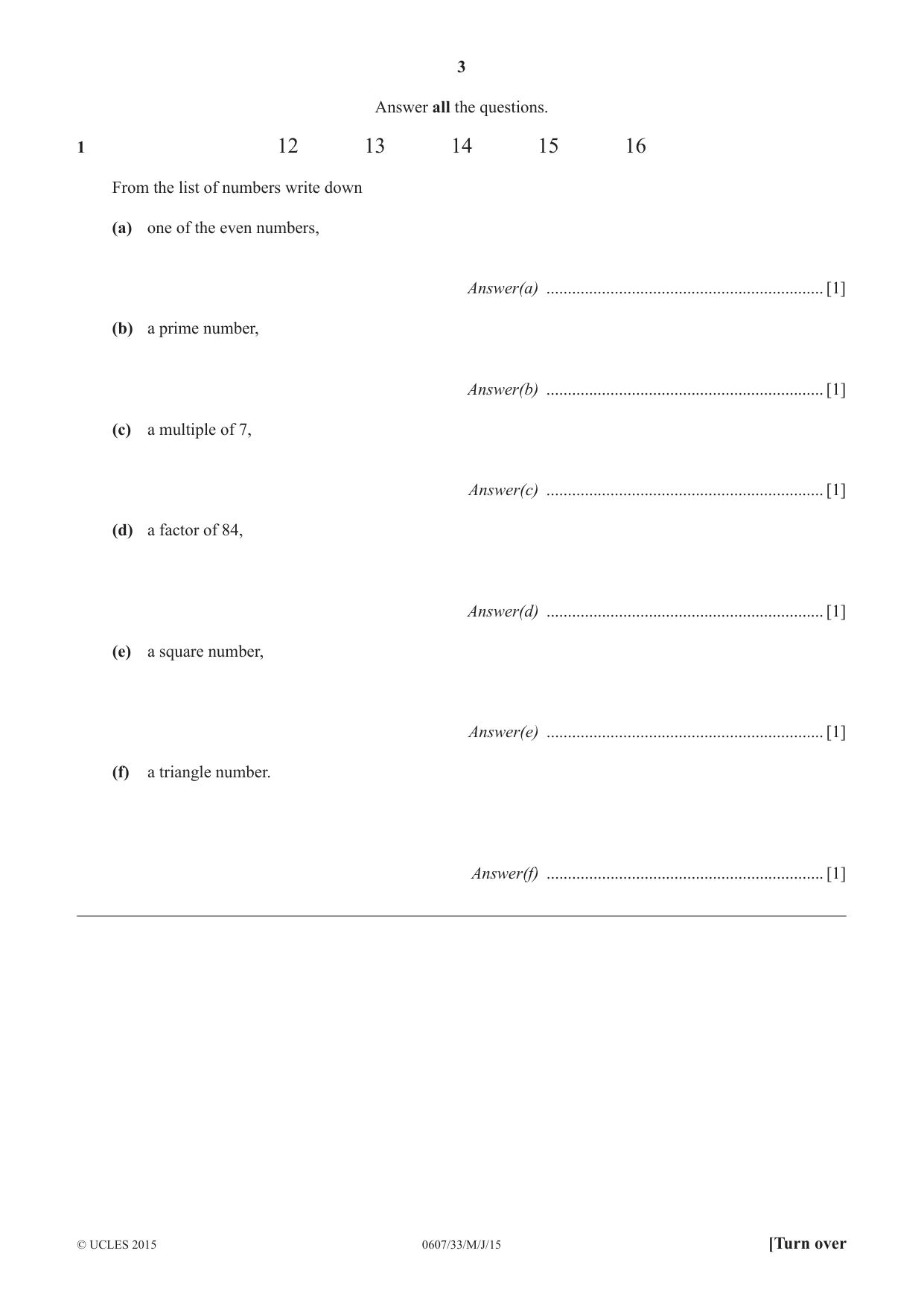
3 0607/33/M/J/15 © UCLES 2015 [Turn over Answer all the questions. 1 12 13 14 15 16 From the list of numbers write down (a) one of the even numbers, Answer(a) … [1] (b) a prime number, Answer(b) … [1] (c) a multiple of 7, Answer(c) … [1] (d) a factor of 84, Answer(d) … [1] (e) a square number, Answer(e) … [1] (f) a triangle number. Answer(f) … [1]
Question paper, page 4
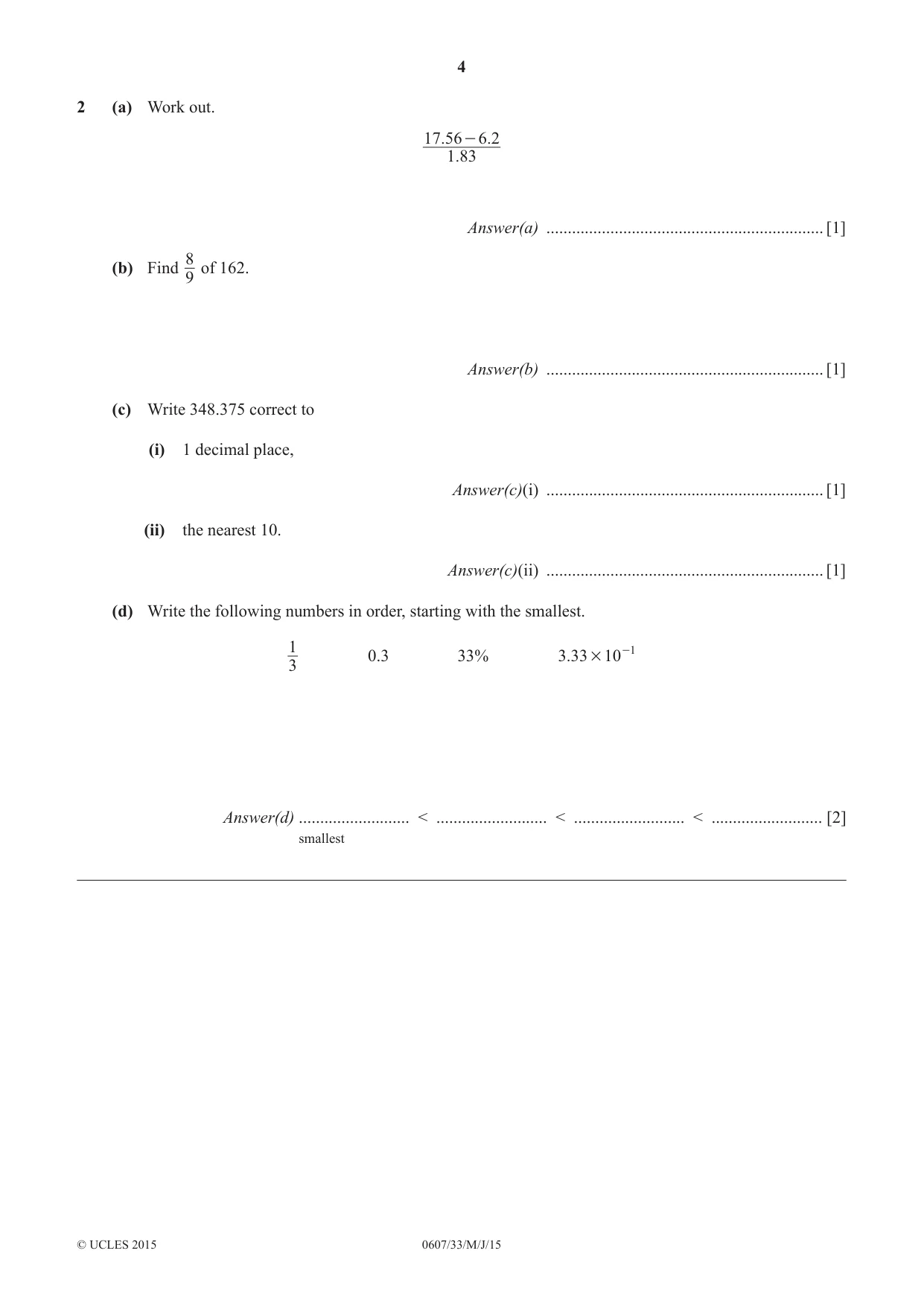
4 0607/33/M/J/15 © UCLES 2015 2 (a) Work out. . . . 1 83 17 56 6 2 - Answer(a) … [1] (b) Find 9 8 of 162. Answer(b) … [1] (c) Write 348.375 correct to (i) 1 decimal place, Answer(c)(i) … [1] (ii) the nearest 10. Answer(c)(ii) … [1] (d) Write the following numbers in order, starting with the smallest. 3 1 0.3 33% .3 33 10 1 # - Answer(d) … < … < … < … [2] smallest
Question paper, page 5
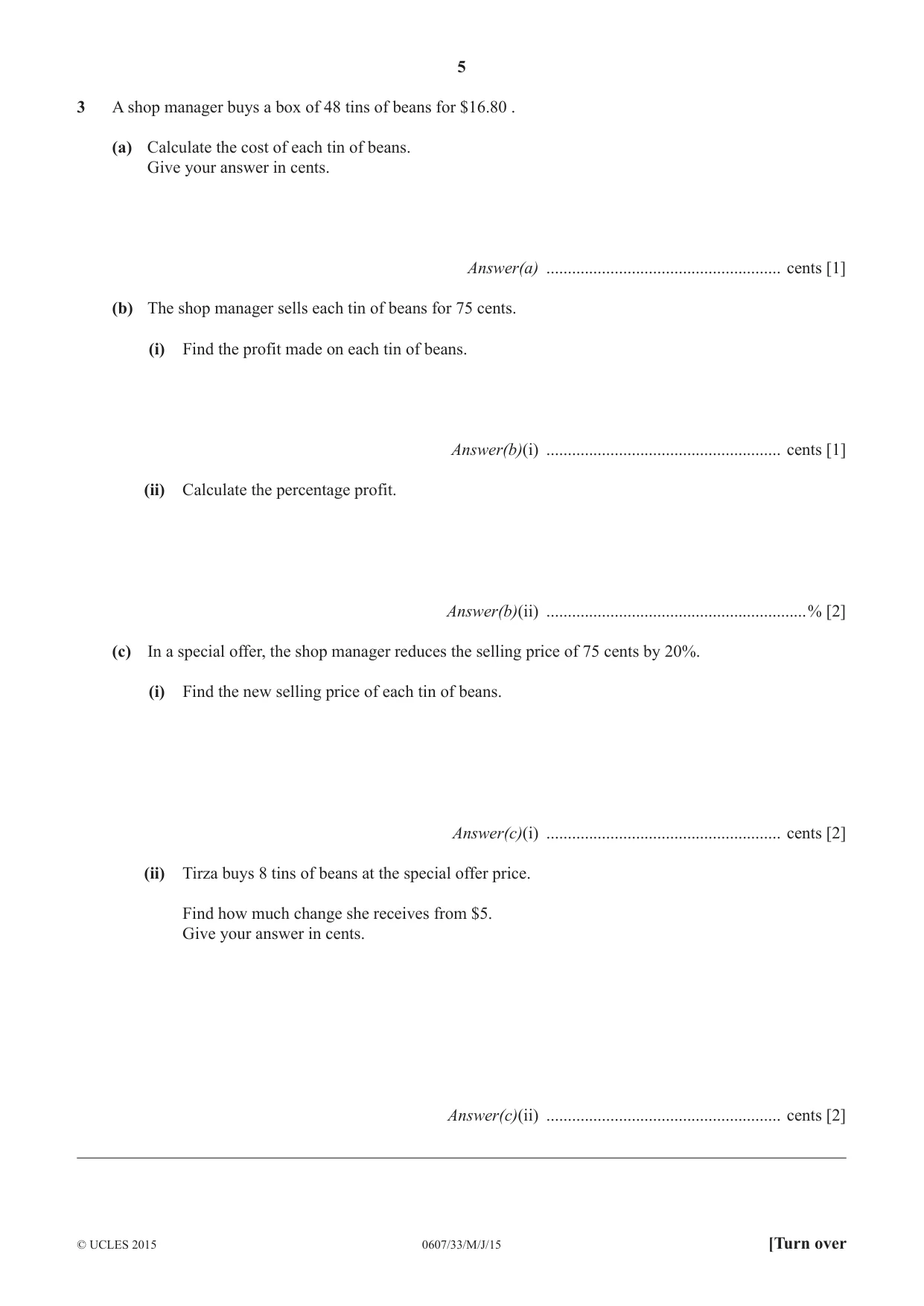
5 0607/33/M/J/15 © UCLES 2015 [Turn over 3 A shop manager buys a box of 48 tins of beans for $16.80 . (a) Calculate the cost of each tin of beans. Give your answer in cents. Answer(a) … cents [1] (b) The shop manager sells each tin of beans for 75 cents. (i) Find the profit made on each tin of beans. Answer(b)(i) … cents [1] (ii) Calculate the percentage profit. Answer(b)(ii) …% [2] (c) In a special offer, the shop manager reduces the selling price of 75 cents by 20%. (i) Find the new selling price of each tin of beans. Answer(c)(i) … cents [2] (ii) Tirza buys 8 tins of beans at the special offer price. Find how much change she receives from $5. Give your answer in cents. Answer(c)(ii) … cents [2]
Question paper, page 6
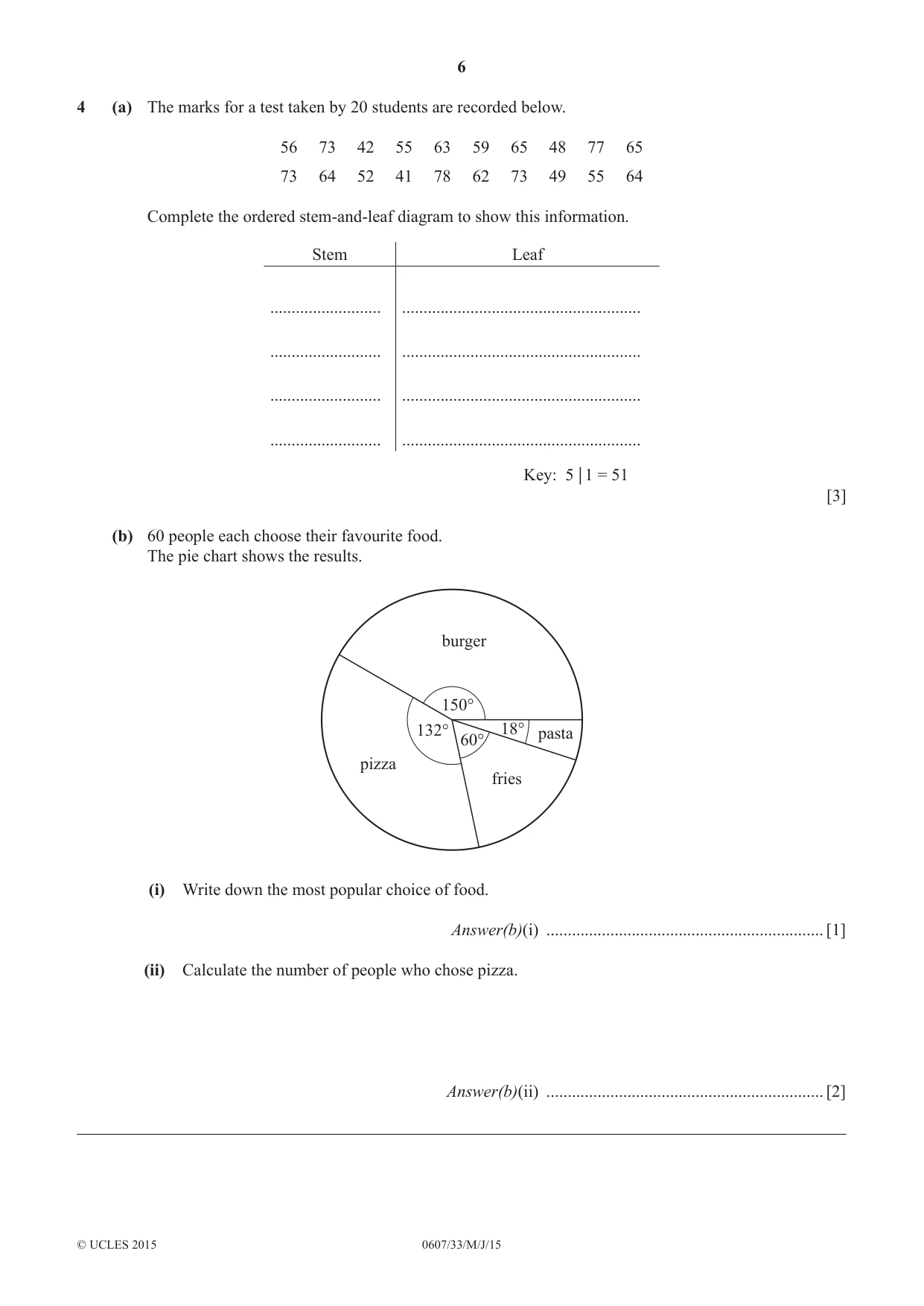
6 0607/33/M/J/15 © UCLES 2015 4 (a) The marks for a test taken by 20 students are recorded below. 56 73 42 55 63 59 65 48 77 65 73 64 52 41 78 62 73 49 55 64 Complete the ordered stem-and-leaf diagram to show this information. Stem Leaf … … … … … … … … Key: 5 1 = 51 [3] (b) 60 people each choose their favourite food. The pie chart shows the results. 132° 150° burger pizza fries pasta 18° 60° (i) Write down the most popular choice of food. Answer(b)(i) … [1] (ii) Calculate the number of people who chose pizza. Answer(b)(ii) … [2]
Question paper, page 7
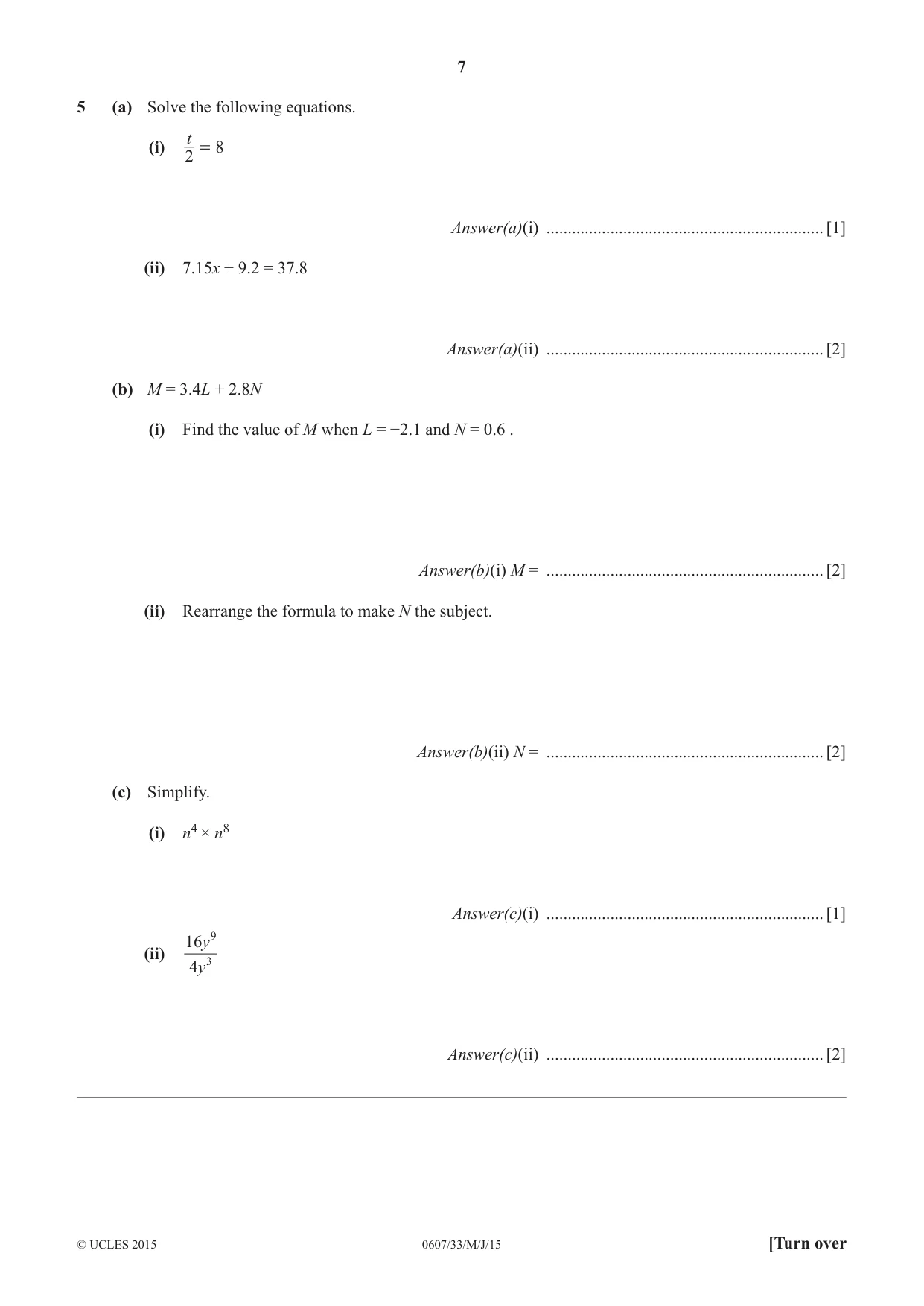
7 0607/33/M/J/15 © UCLES 2015 [Turn over 5 (a) Solve the following equations. (i) t 2 8 = Answer(a)(i) … [1] (ii) 7.15x + 9.2 = 37.8 Answer(a)(ii) … [2] (b) M = 3.4L + 2.8N (i) Find the value of M when L = −2.1 and N = 0.6 . Answer(b)(i) M = … [2] (ii) Rearrange the formula to make N the subject. Answer(b)(ii) N = … [2] (c) Simplify. (i) n4 × n8 Answer(c)(i) … [1] (ii) y y 4 16 3 9 Answer(c)(ii) … [2]
Question paper, page 8
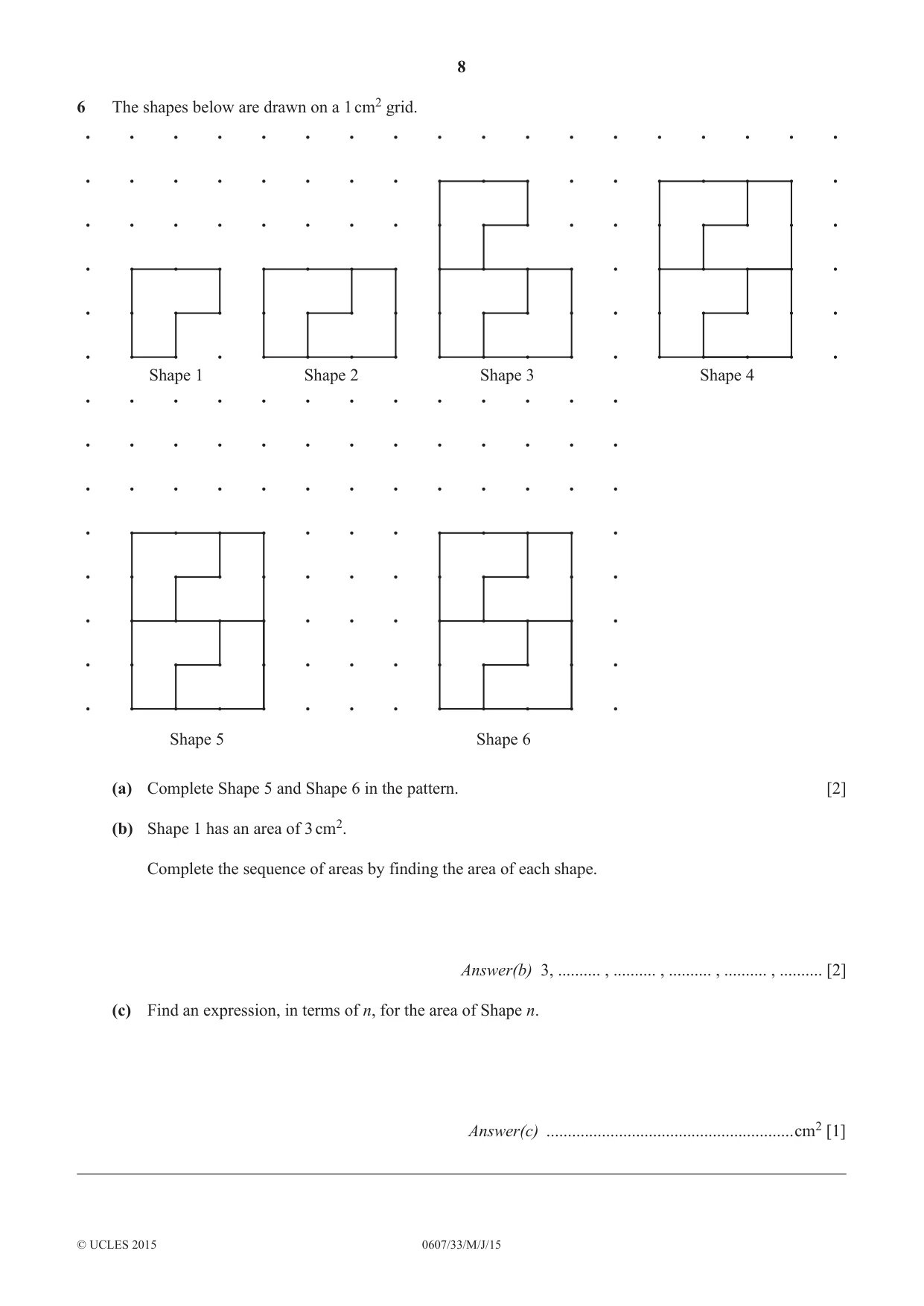
8 0607/33/M/J/15 © UCLES 2015 6 The shapes below are drawn on a 1 cm2 grid. Shape 1 Shape 5 Shape 6 Shape 2 Shape 3 Shape 4 (a) Complete Shape 5 and Shape 6 in the pattern. [2] (b) Shape 1 has an area of 3 cm2. Complete the sequence of areas by finding the area of each shape. Answer(b) 3, … , … , … , … , … [2] (c) Find an expression, in terms of n, for the area of Shape n. Answer(c) …cm2 [1]
Question paper, page 9
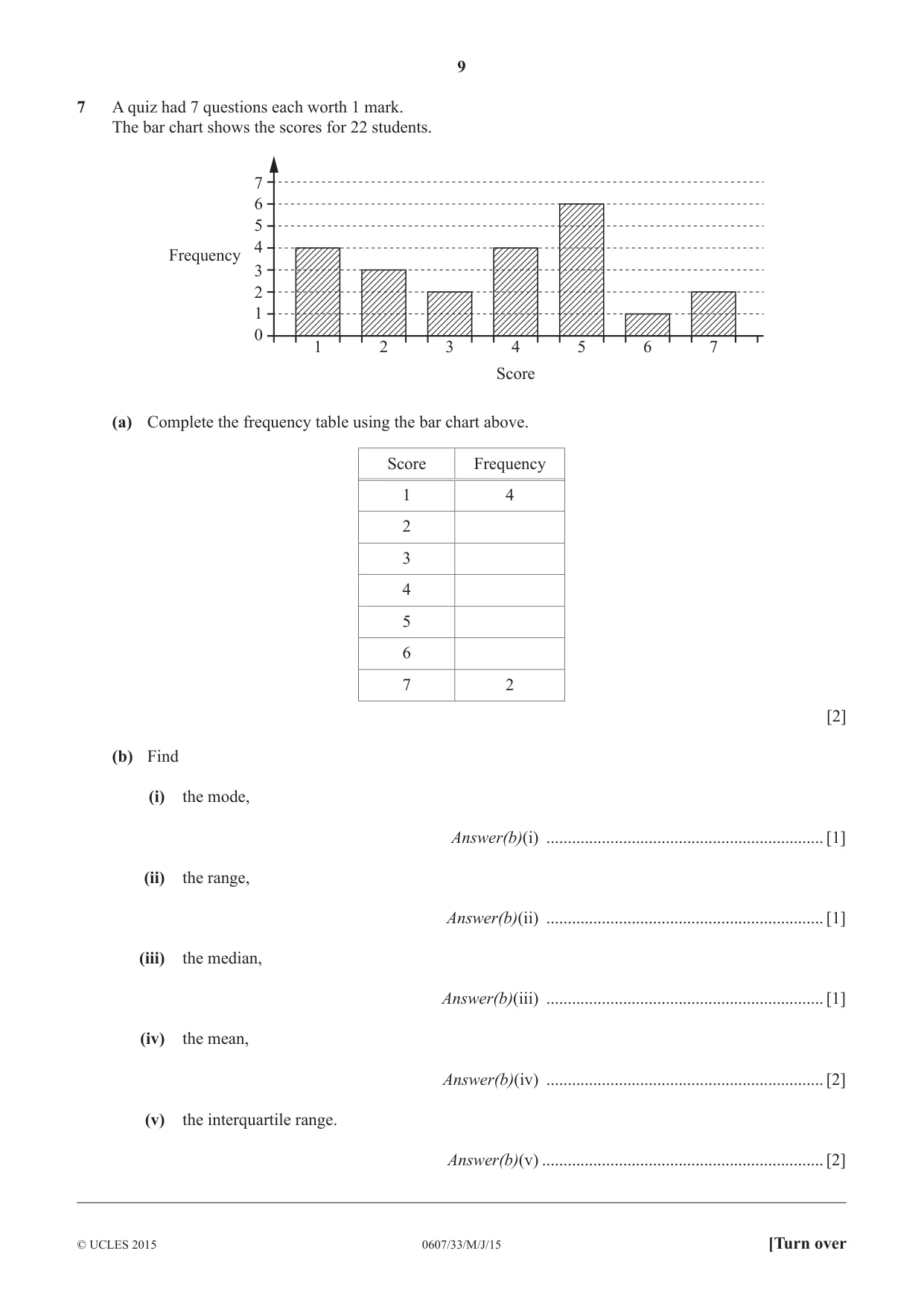
9 0607/33/M/J/15 © UCLES 2015 [Turn over 7 A quiz had 7 questions each worth 1 mark. The bar chart shows the scores for 22 students. 1 7 6 5 4 3 Frequency 2 1 0 2 3 4 Score 5 6 7 (a) Complete the frequency table using the bar chart above. Score Frequency 1 4 2 3 4 5 6 7 2 [2] (b) Find (i) the mode, Answer(b)(i) … [1] (ii) the range, Answer(b)(ii) … [1] (iii) the median, Answer(b)(iii) … [1] (iv) the mean, Answer(b)(iv) … [2] (v) the interquartile range. Answer(b)(v) … [2]
Question paper, page 10
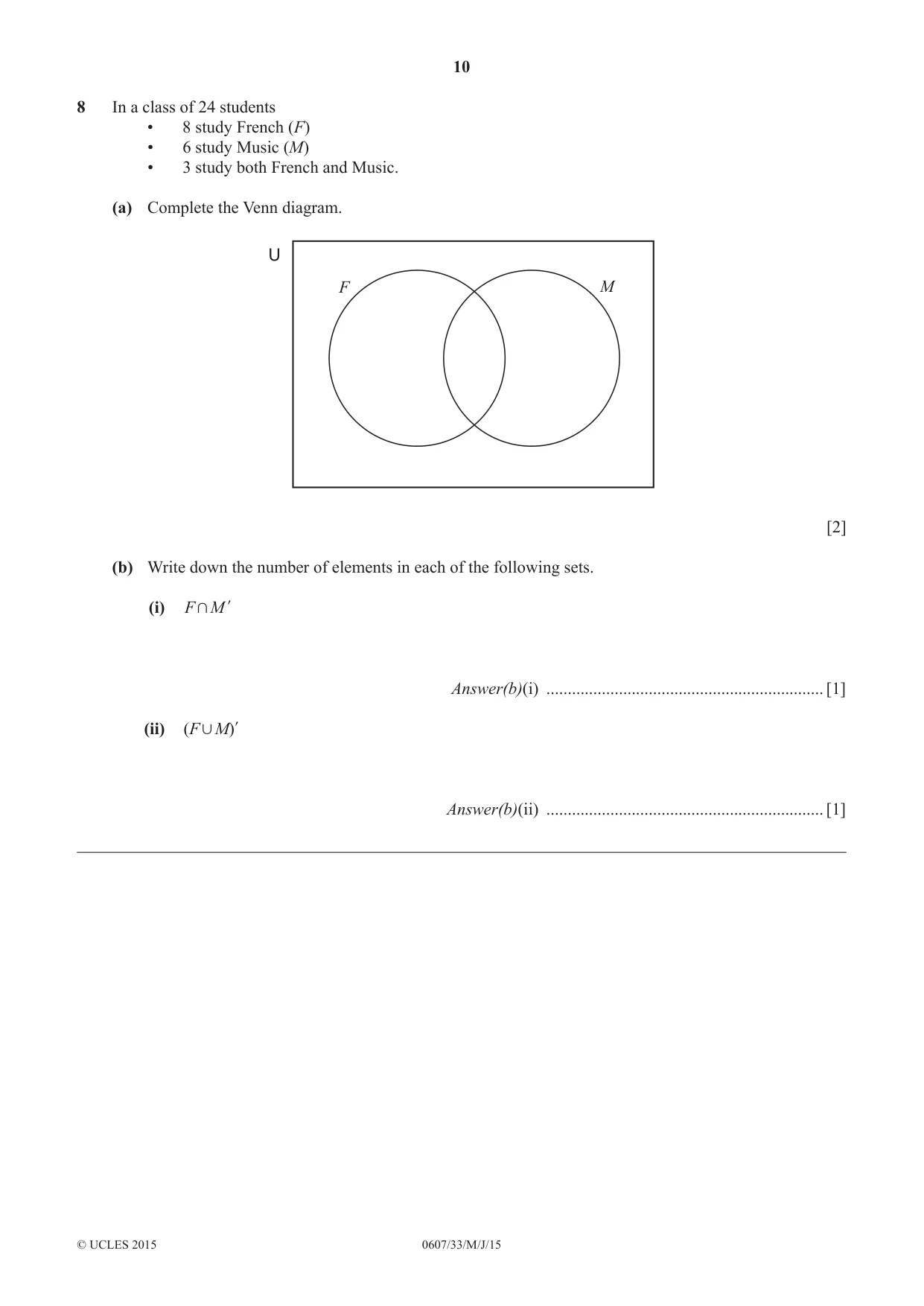
10 0607/33/M/J/15 © UCLES 2015 8 In a class of 24 students • 8 study French (F) • 6 study Music (M) • 3 study both French and Music. (a) Complete the Venn diagram. F M U [2] (b) Write down the number of elements in each of the following sets. (i) F M + l Answer(b)(i) … [1] (ii) ( ) F M , l Answer(b)(ii) … [1]
Question paper, page 11
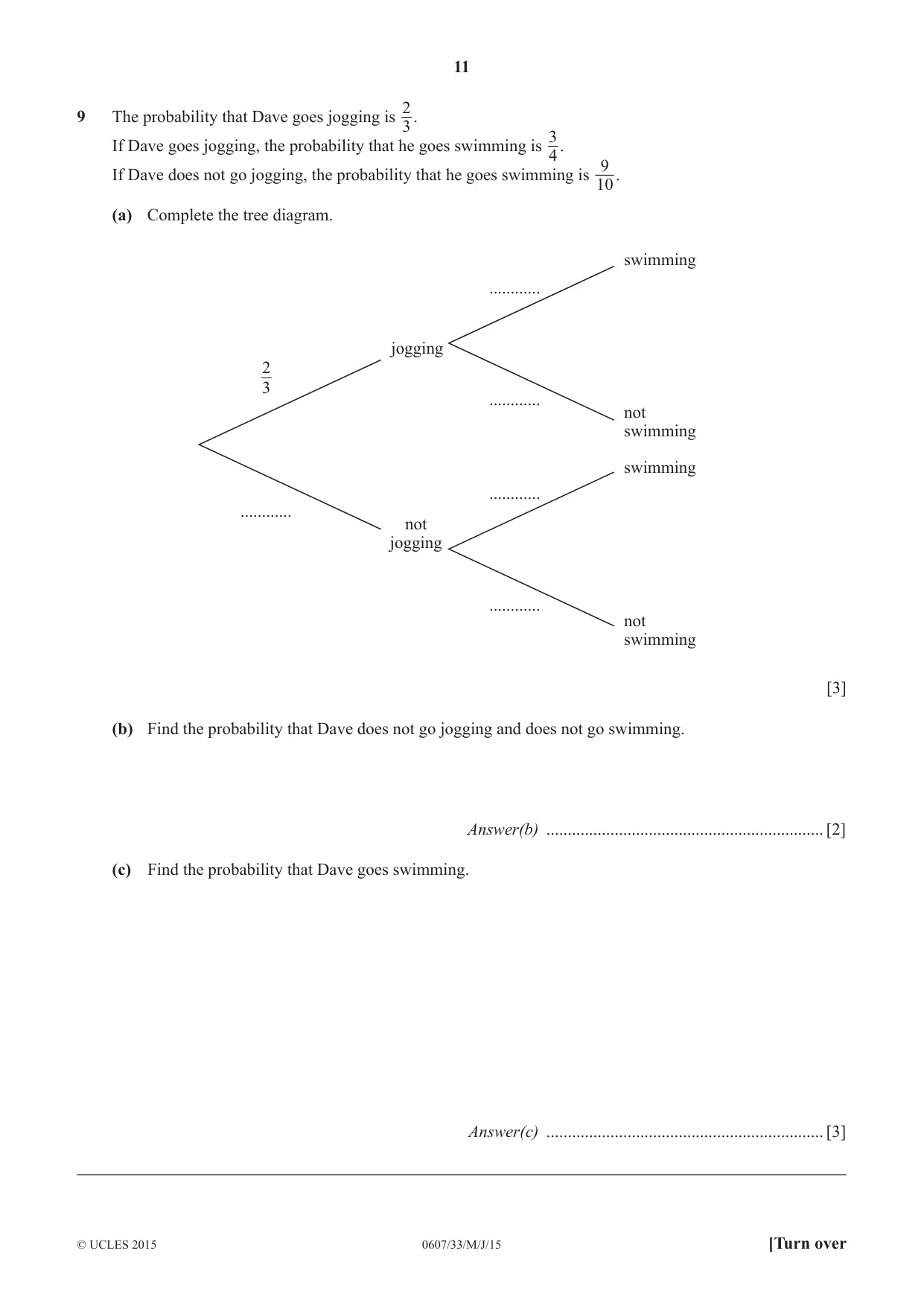
11 0607/33/M/J/15 © UCLES 2015 [Turn over 9 The probability that Dave goes jogging is 3 2 . If Dave goes jogging, the probability that he goes swimming is 4 3 . If Dave does not go jogging, the probability that he goes swimming is 10 9 . (a) Complete the tree diagram. jogging 2 3 swimming not swimming not swimming swimming … … … … … not jogging [3] (b) Find the probability that Dave does not go jogging and does not go swimming. Answer(b) … [2] (c) Find the probability that Dave goes swimming. Answer(c) … [3]
Question paper, page 12
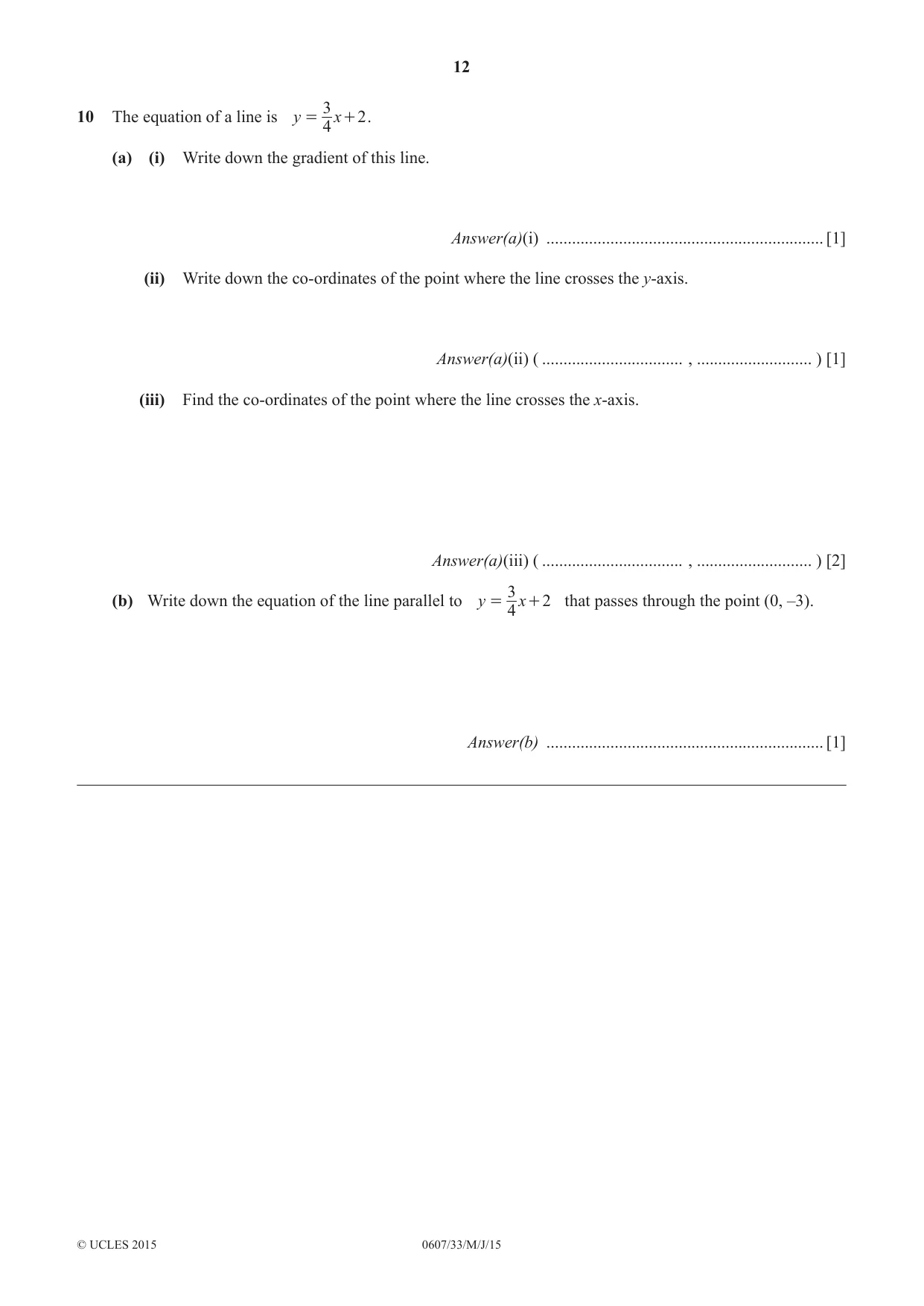
12 0607/33/M/J/15 © UCLES 2015 10 The equation of a line is y x 4 3 2 = + . (a) (i) Write down the gradient of this line. Answer(a)(i) … [1] (ii) Write down the co-ordinates of the point where the line crosses the y-axis. Answer(a)(ii) ( … , … ) [1] (iii) Find the co-ordinates of the point where the line crosses the x-axis. Answer(a)(iii) ( … , … ) [2] (b) Write down the equation of the line parallel to y x 4 3 2 = + that passes through the point (0, –3). Answer(b) … [1]
Question paper, page 13
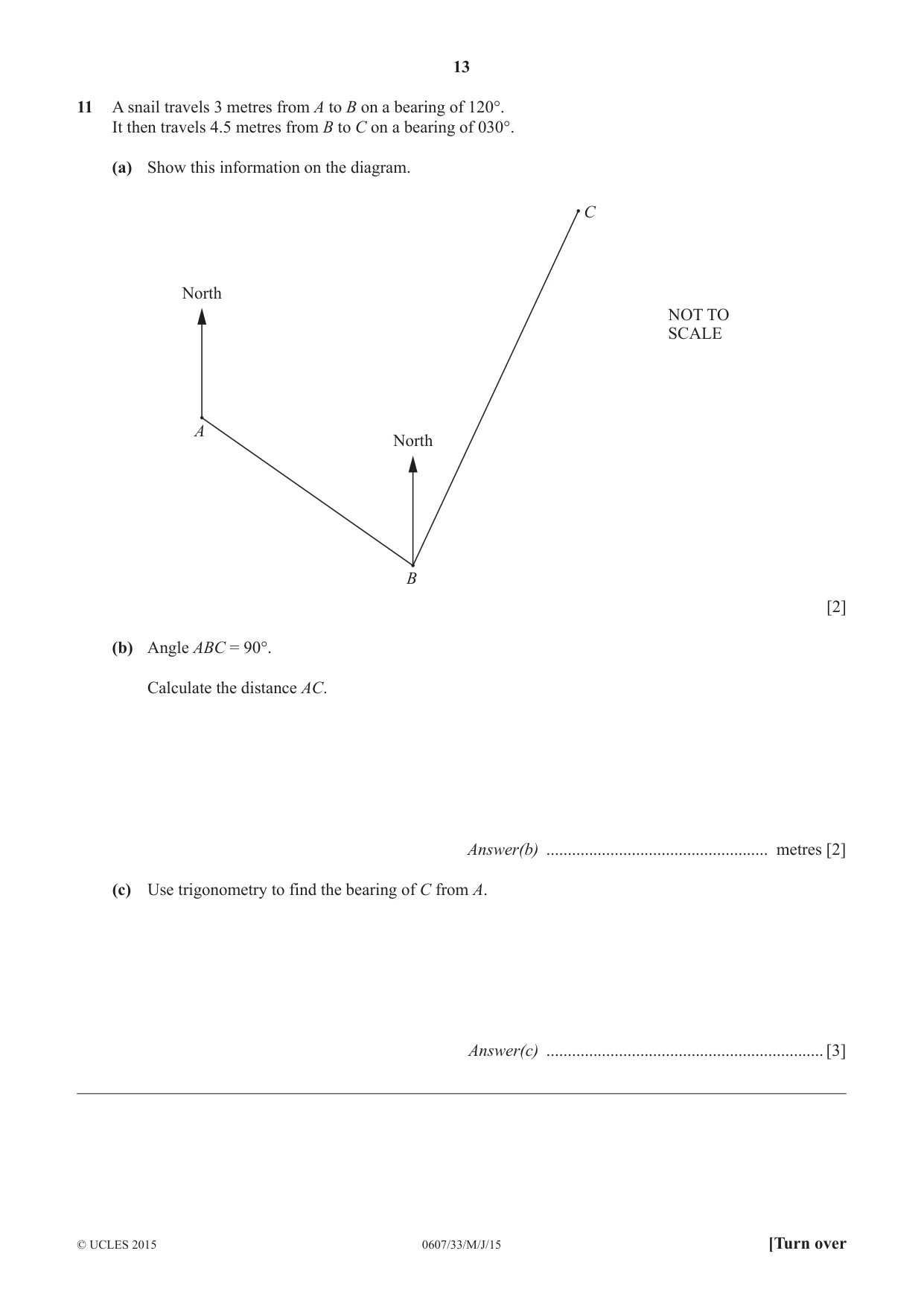
13 0607/33/M/J/15 © UCLES 2015 [Turn over 11 A snail travels 3 metres from A to B on a bearing of 120°. It then travels 4.5 metres from B to C on a bearing of 030°. (a) Show this information on the diagram. North North NOT TO SCALE A C B [2] (b) Angle ABC = 90°. Calculate the distance AC. Answer(b) … metres [2] (c) Use trigonometry to find the bearing of C from A. Answer(c) … [3]
Question paper, page 14
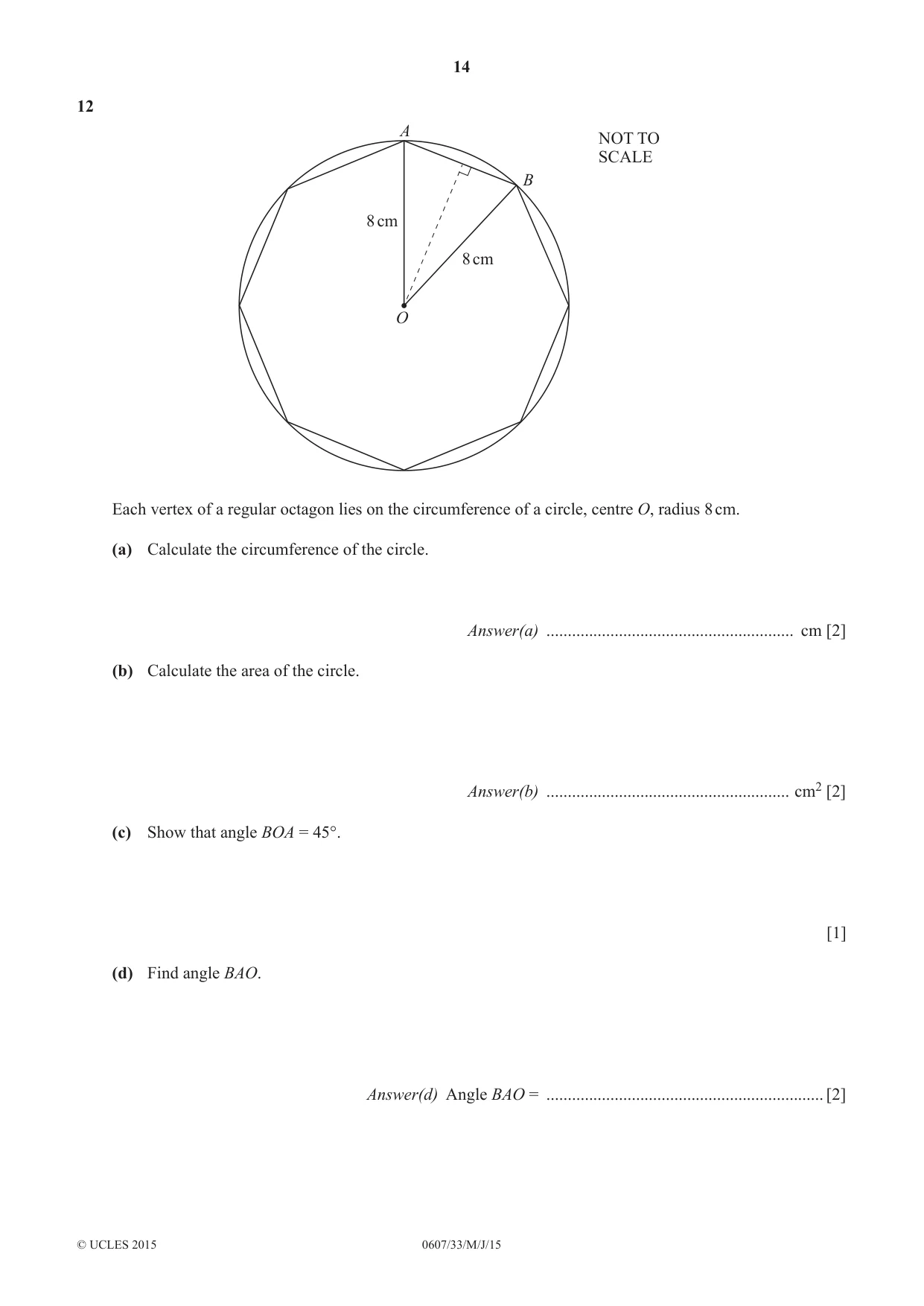
14 0607/33/M/J/15 © UCLES 2015 12 A B O 8 cm NOT TO SCALE 8 cm Each vertex of a regular octagon lies on the circumference of a circle, centre O, radius 8 cm. (a) Calculate the circumference of the circle. Answer(a) … cm [2] (b) Calculate the area of the circle. Answer(b) … cm2 [2] (c) Show that angle BOA = 45°. [1] (d) Find angle BAO. Answer(d) Angle BAO = … [2]
Question paper, page 15
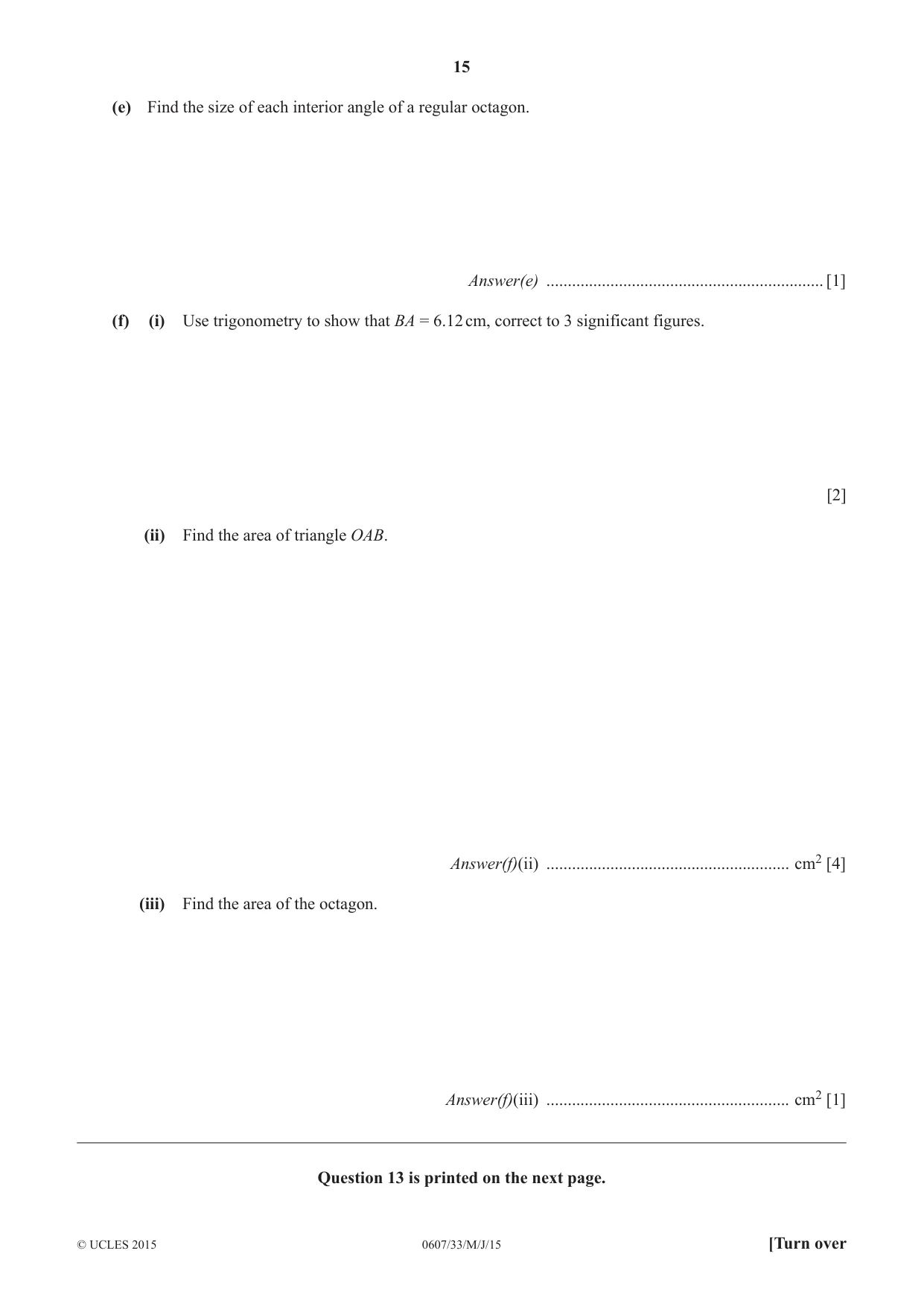
15 0607/33/M/J/15 © UCLES 2015 [Turn over (e) Find the size of each interior angle of a regular octagon. Answer(e) … [1] (f) (i) Use trigonometry to show that BA = 6.12 cm, correct to 3 significant figures. [2] (ii) Find the area of triangle OAB. Answer(f)(ii) … cm2 [4] (iii) Find the area of the octagon. Answer(f)(iii) … cm2 [1] Question 13 is printed on the next page.
Question paper, page 16
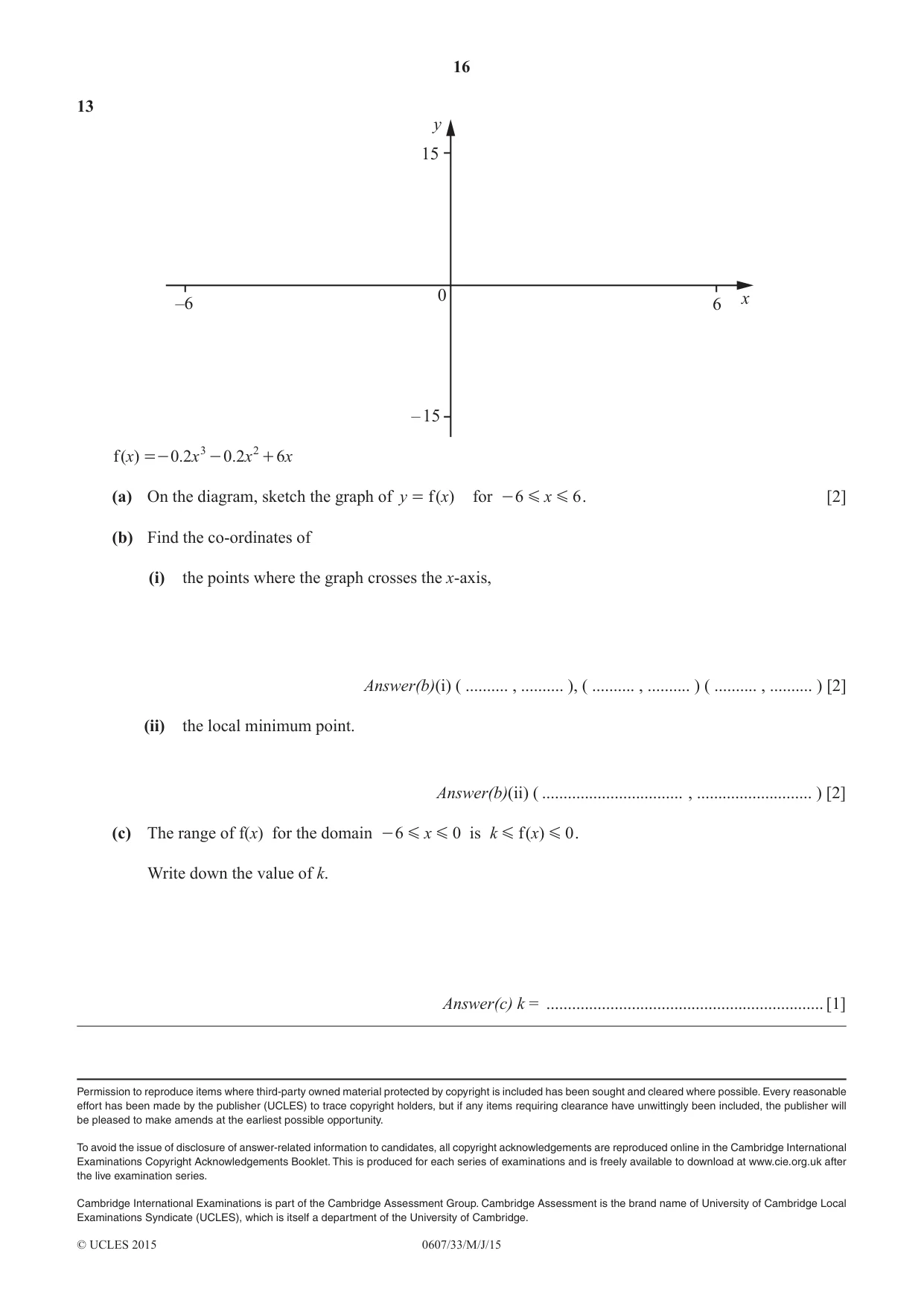
16 0607/33/M/J/15 © UCLES 2015 Permission to reproduce items where third-party owned material protected by copyright is included has been sought and cleared where possible. Every reasonable effort has been made by the publisher (UCLES) to trace copyright holders, but if any items requiring clearance have unwittingly been included, the publisher will be pleased to make amends at the earliest possible opportunity. To avoid the issue of disclosure of answer-related information to candidates, all copyright acknowledgements are reproduced online in the Cambridge International Examinations Copyright Acknowledgements Booklet. This is produced for each series of examinations and is freely available to download at www.cie.org.uk after the live examination series. Cambridge International Examinations is part of the Cambridge Assessment Group. Cambridge Assessment is the brand name of University of Cambridge Local Examinations Syndicate (UCLES), which is itself a department of the University of Cambridge. 13 –6 – 15 6 0 x 15 y ( ) . . x x x x 0 2 0 2 6 f 3 2 =- - + (a) On the diagram, sketch the graph of ( ) y x f = for x 6 6 G G - . [2] (b) Find the co-ordinates of (i) the points where the graph crosses the x-axis, Answer(b)(i) ( … , … ), ( … , … ) ( … , … ) [2] (ii) the local minimum point. Answer(b)(ii) ( … , … ) [2] (c) The range of f(x) for the domain ( ) x k x 6 0 0 is f G G G G - . Write down the value of k. Answer(c) k = … [1]
Mark scheme, page 1
® IGCSE is the registered trademark of Cambridge International Examinations. CAMBRIDGE INTERNATIONAL EXAMINATIONS Cambridge International General Certificate of Secondary Education MARK SCHEME for the May/June 2015 series 0607 CAMBRIDGE INTERNATIONAL MATHEMATICS 0607/33 Paper 3 (Core), maximum raw mark 96 This mark scheme is published as an aid to teachers and candidates, to indicate the requirements of the examination. It shows the basis on which Examiners were instructed to award marks. It does not indicate the details of the discussions that took place at an Examiners’ meeting before marking began, which would have considered the acceptability of alternative answers. Mark schemes should be read in conjunction with the question paper and the Principal Examiner Report for Teachers. Cambridge will not enter into discussions about these mark schemes. Cambridge is publishing the mark schemes for the May/June 2015 series for most Cambridge IGCSE®, Cambridge International A and AS Level components and some Cambridge O Level components.
Mark scheme, page 2
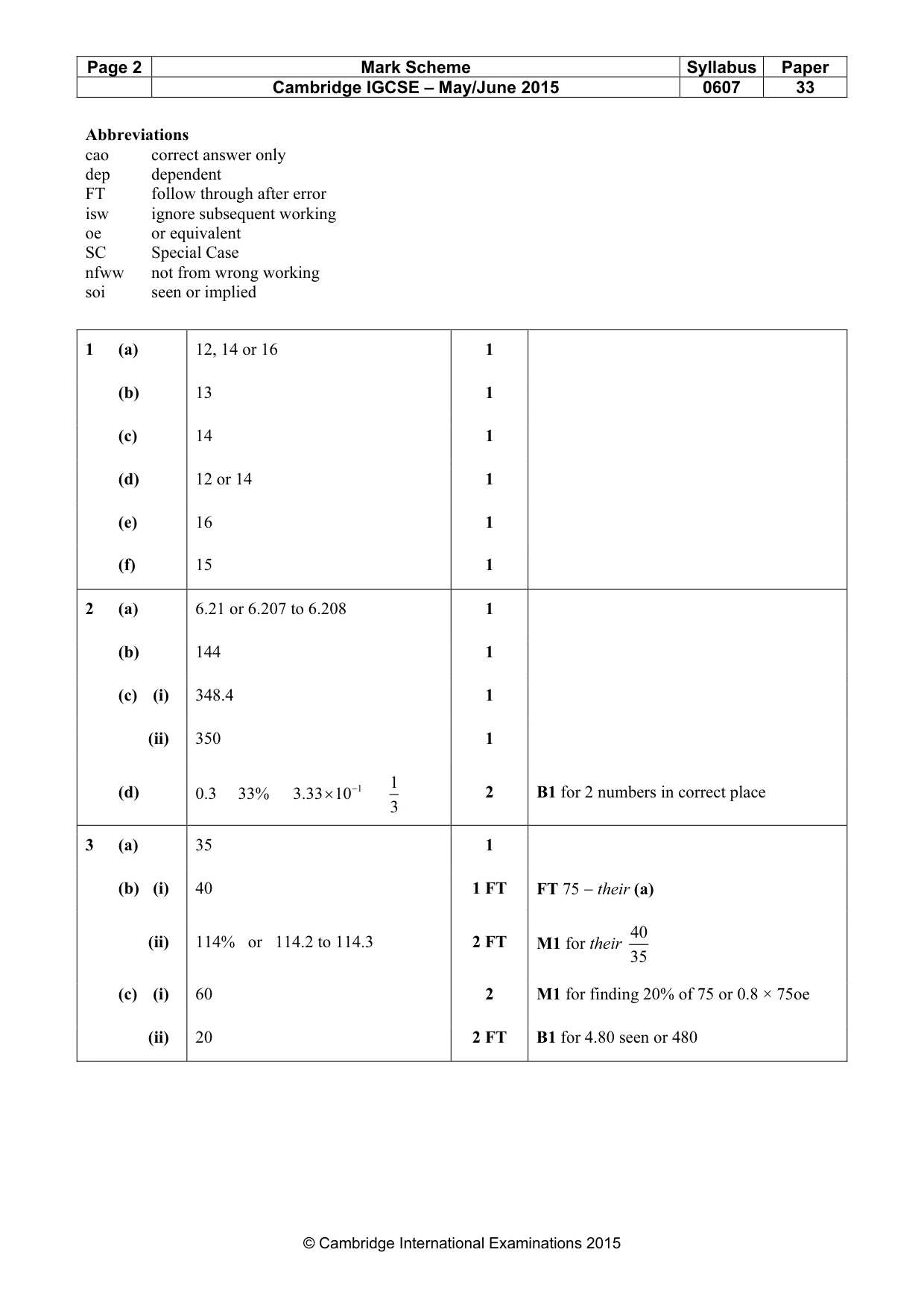
Page 2 Mark Scheme Syllabus Paper Cambridge IGCSE – May/June 2015 0607 33 © Cambridge International Examinations 2015 Abbreviations cao correct answer only dep dependent FT follow through after error isw ignore subsequent working oe or equivalent SC Special Case nfww not from wrong working soi seen or implied 1 (a) 12, 14 or 16 1 (b) 13 1 (c) 14 1 (d) 12 or 14 1 (e) 16 1 (f) 15 1 2 (a) 6.21 or 6.207 to 6.208 1 (b) 144 1 (c) (i) 348.4 1 (ii) 350 1 (d) 0.3 33% 1 3.33 10− × 1 3 2 B1 for 2 numbers in correct place 3 (a) 35 1 (b) (i) 40 1 FT FT 75 − their (a) (ii) 114% or 114.2 to 114.3 2 FT M1 for their 40 35 (c) (i) 60 2 M1 for finding 20% of 75 or 0.8 × 75oe (ii) 20 2 FT B1 for 4.80 seen or 480
Mark scheme, page 3
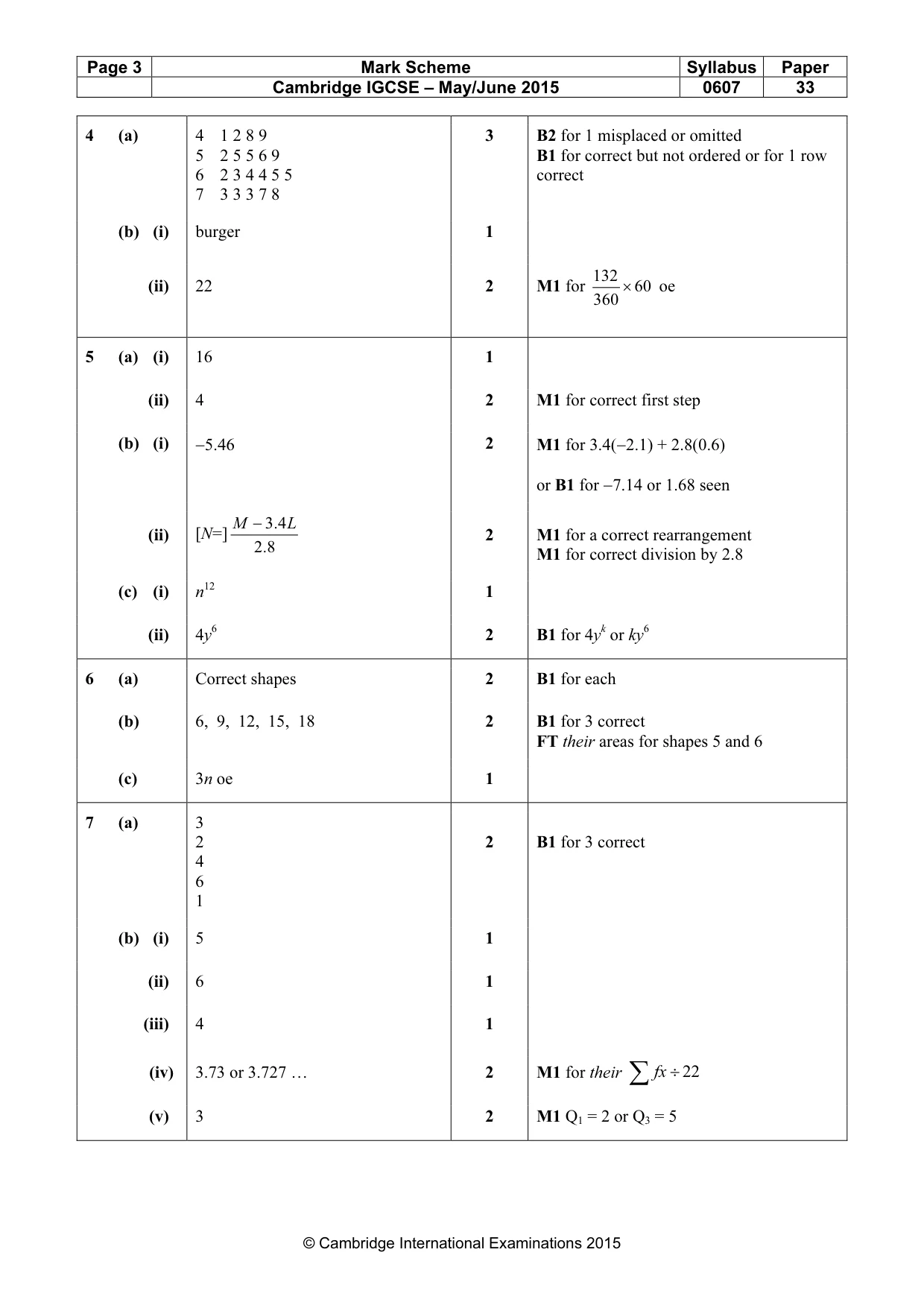
Page 3 Mark Scheme Syllabus Paper Cambridge IGCSE – May/June 2015 0607 33 © Cambridge International Examinations 2015 4 (a) 4 1 2 8 9 5 2 5 5 6 9 6 2 3 4 4 5 5 7 3 3 3 7 8 3 B2 for 1 misplaced or omitted B1 for correct but not ordered or for 1 row correct (b) (i) burger 1 (ii) 22 2 M1 for 60 360 132 × oe 5 (a) (i) 16 1 (ii) 4 2 M1 for correct first step (b) (i) −5.46 2 M1 for 3.4(−2.1) + 2.8(0.6) or B1 for −7.14 or 1.68 seen (ii) [N=] 8.2 4.3 L M − 2 M1 for a correct rearrangement M1 for correct division by 2.8 (c) (i) n12 1 (ii) 4y6 2 B1 for 4yk or ky6 6 (a) Correct shapes 2 B1 for each (b) 6, 9, 12, 15, 18 2 B1 for 3 correct FT their areas for shapes 5 and 6 (c) 3n oe 1 7 (a) 3 2 4 6 1 2 B1 for 3 correct (b) (i) 5 1 (ii) 6 1 (iii) 4 1 (iv) 3.73 or 3.727 … 2 M1 for their ∑ ÷ 22 fx (v) 3 2 M1 Q1 = 2 or Q3 = 5
Mark scheme, page 4
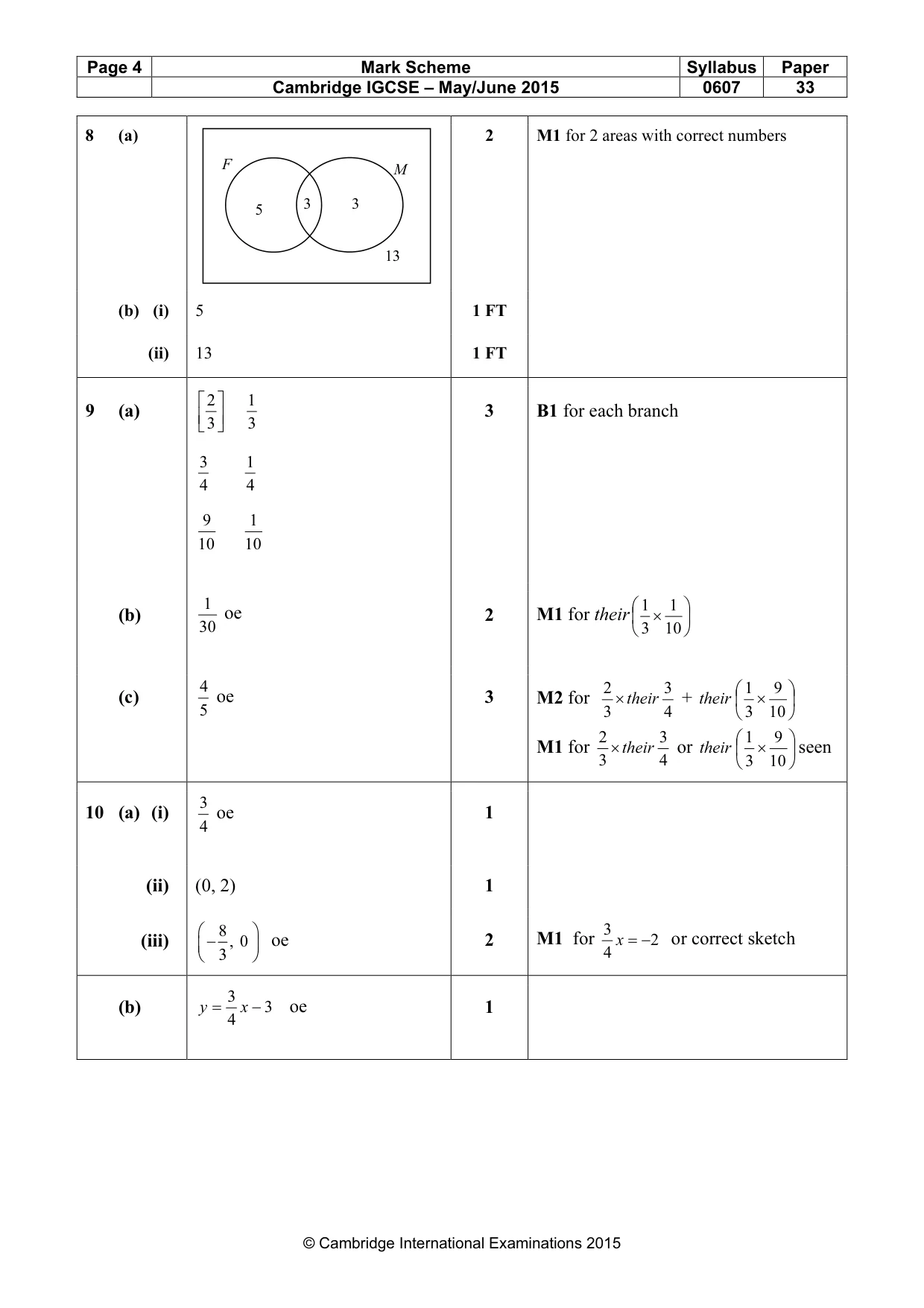
Page 4 Mark Scheme Syllabus Paper Cambridge IGCSE – May/June 2015 0607 33 © Cambridge International Examinations 2015 8 (a) 2 M1 for 2 areas with correct numbers (b) (i) 5 1 FT (ii) 13 1 FT 9 (a) 3 2 3 1 4 3 4 1 10 9 10 1 3 B1 for each branch (b) 30 1 oe 2 M1 for their × 10 1 3 1 (c) 5 4 oe 3 M2 for 4 3 3 2 their × + × 10 9 3 1 their M1 for 4 3 3 2 their × or × 10 9 3 1 their seen 10 (a) (i) 4 3 oe 1 (ii) (0, 2) 1 (iii) 8, 0 3 − oe 2 M1 for 2 4 3 − = x or correct sketch (b) 3 4 3 − = x y oe 1 5 3 3 13 F M
Mark scheme, page 5
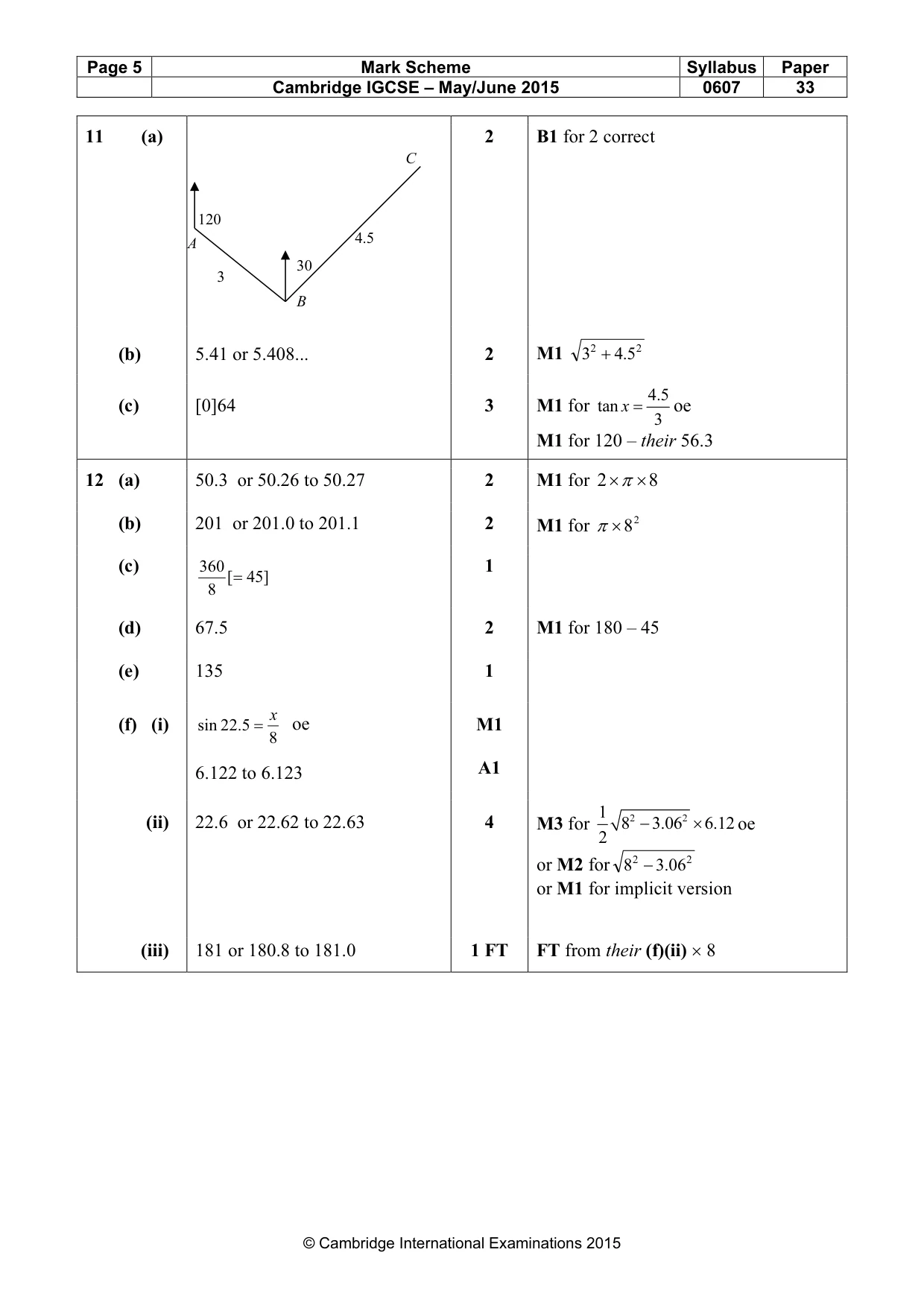
Page 5 Mark Scheme Syllabus Paper Cambridge IGCSE – May/June 2015 0607 33 © Cambridge International Examinations 2015 11 (a) 2 B1 for 2 correct (b) 5.41 or 5.408... 2 M1 2 2 5.4 3 + (c) [0]64 3 M1 for 4.5 tan 3 x = oe M1 for 120 – their 56.3 12 (a) 50.3 or 50.26 to 50.27 2 M1 for 8 2 × ×π (b) 201 or 201.0 to 201.1 2 M1 for 2 8 × π (c) ] 45 [ 8 360 = 1 (d) 67.5 2 M1 for 180 – 45 (e) 135 1 (f) (i) 8 5. 22 sin x = oe 6.122 to 6.123 M1 A1 (ii) 22.6 or 22.62 to 22.63 4 M3 for 2 2 1 8 3.06 6.12 2 − × oe or M2 for 2 2 06 .3 8 − or M1 for implicit version (iii) 181 or 180.8 to 181.0 1 FT FT from their (f)(ii) × 8 120 30 3 4.5 A B C
Mark scheme, page 6
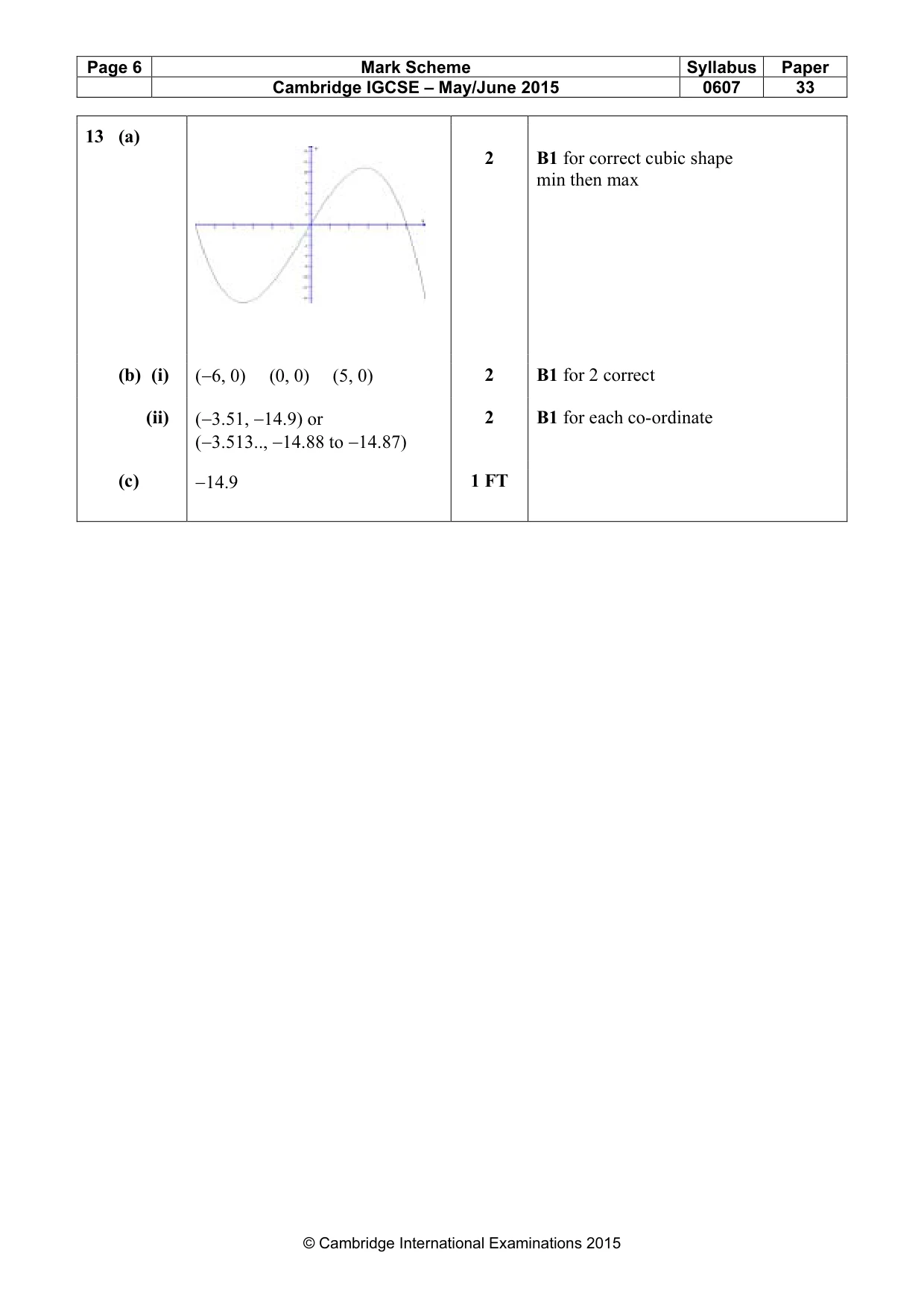
Page 6 Mark Scheme Syllabus Paper Cambridge IGCSE – May/June 2015 0607 33 © Cambridge International Examinations 2015 13 (a) 2 B1 for correct cubic shape min then max (b) (i) (−6, 0) (0, 0) (5, 0) 2 B1 for 2 correct (ii) (−3.51, −14.9) or (−3.513.., −14.88 to −14.87) 2 B1 for each co-ordinate (c) −14.9 1 FT
What you needed in this session
Cambridge’s own grade thresholds for 2015 May/June, Paper 3 · Variant 3. A higher threshold means an easier paper — the bar moves with how the cohort did.