Cambridge IGCSE Mathematics - International 0607 — 2014 Oct/Nov Paper 3 · Variant 2
0607/32/O/N/14 · 96 marks · ≈108 min
The question paper and its mark scheme, free to read here and free to download. This is Cambridge’s own paper, exactly as it was sat.
Question paper16 pages
Mark scheme5 pages
Answers below. Sit the paper first if you are practising.
Paper as text
Question paper, page 1
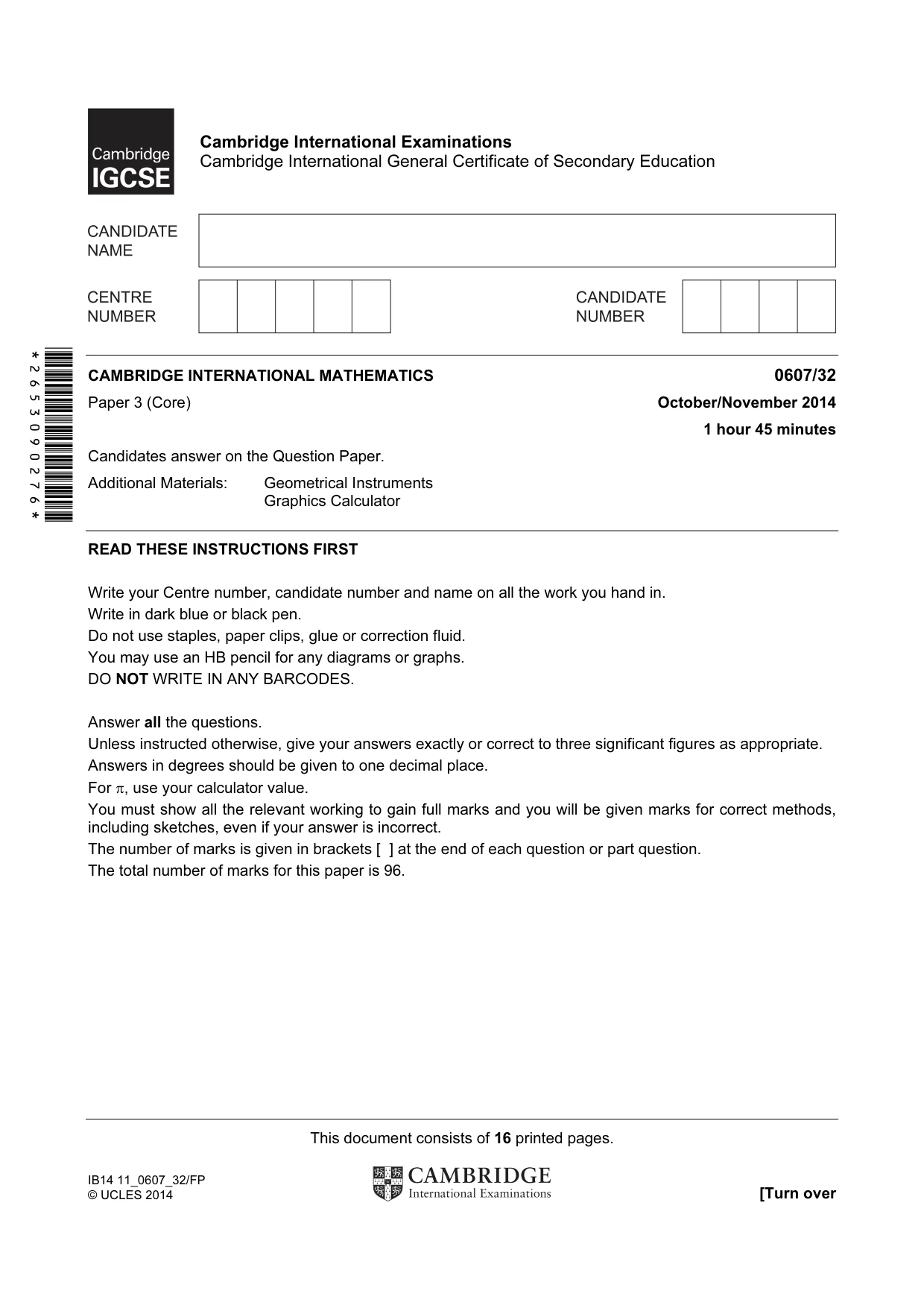
This document consists of 16 printed pages. IB14 11_0607_32/FP © UCLES 2014 [Turn over *2653090276* Cambridge International Examinations Cambridge International General Certificate of Secondary Education CAMBRIDGE INTERNATIONAL MATHEMATICS 0607/32 Paper 3 (Core) October/November 2014 1 hour 45 minutes Candidates answer on the Question Paper. Additional Materials: Geometrical Instruments Graphics Calculator READ THESE INSTRUCTIONS FIRST Write your Centre number, candidate number and name on all the work you hand in. Write in dark blue or black pen. Do not use staples, paper clips, glue or correction fluid. You may use an HB pencil for any diagrams or graphs. DO NOT WRITE IN ANY BARCODES. Answer all the questions. Unless instructed otherwise, give your answers exactly or correct to three significant figures as appropriate. Answers in degrees should be given to one decimal place. For π, use your calculator value. You must show all the relevant working to gain full marks and you will be given marks for correct methods, including sketches, even if your answer is incorrect. The number of marks is given in brackets [ ] at the end of each question or part question. The total number of marks for this paper is 96.
Question paper, page 2
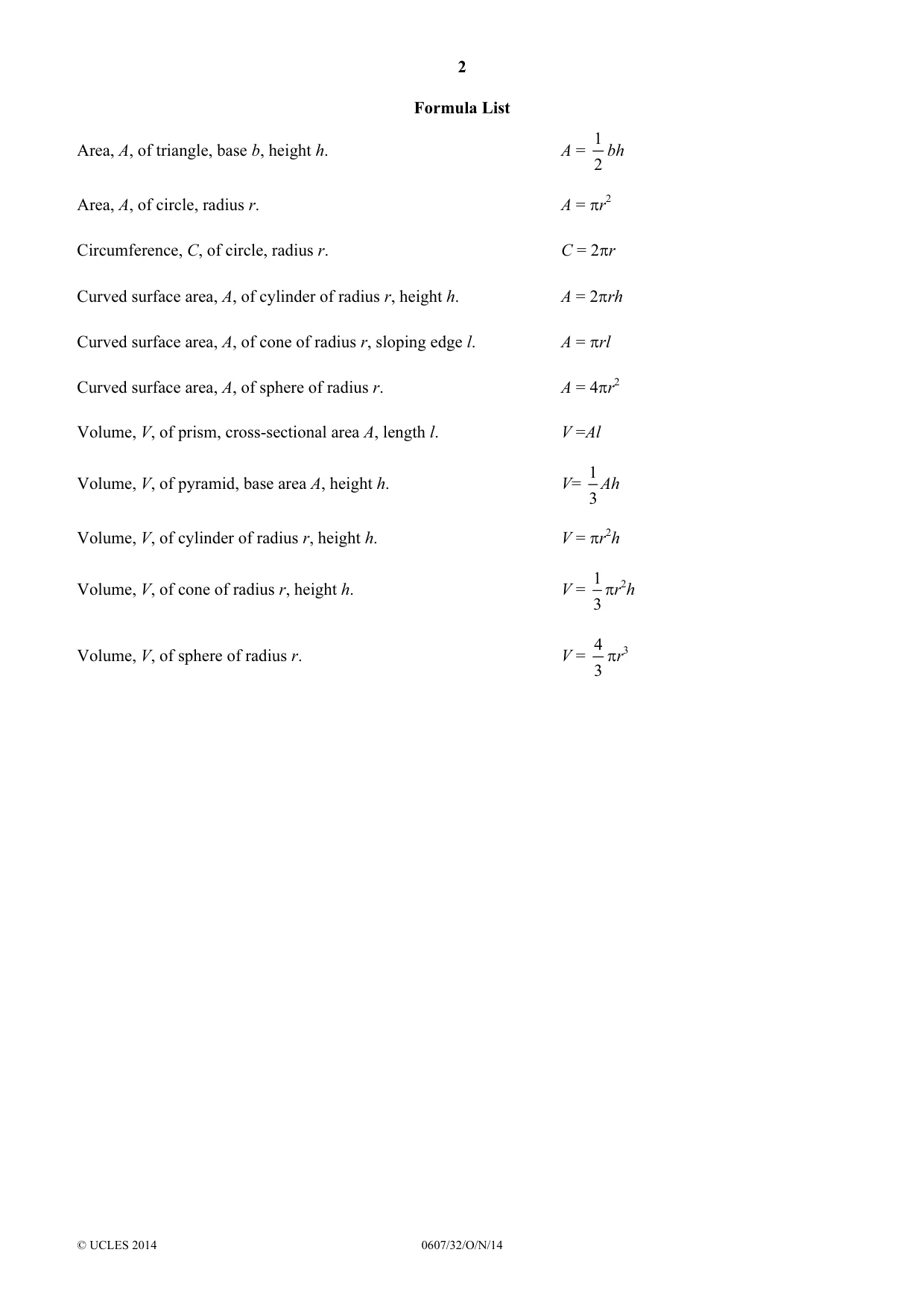
2 © UCLES 2014 0607/32/O/N/14 Formula List Area, A, of triangle, base b, height h. A = 1 2 bh Area, A, of circle, radius r. A = πr2 Circumference, C, of circle, radius r. C = 2πr Curved surface area, A, of cylinder of radius r, height h. A = 2πrh Curved surface area, A, of cone of radius r, sloping edge l. A = πrl Curved surface area, A, of sphere of radius r. A = 4πr2 Volume, V, of prism, cross-sectional area A, length l. V =Al Volume, V, of pyramid, base area A, height h. V= 1 3 Ah Volume, V, of cylinder of radius r, height h. V = πr2h Volume, V, of cone of radius r, height h. V = 1 3 πr2h Volume, V, of sphere of radius r. V = 4 3 πr3
Question paper, page 3
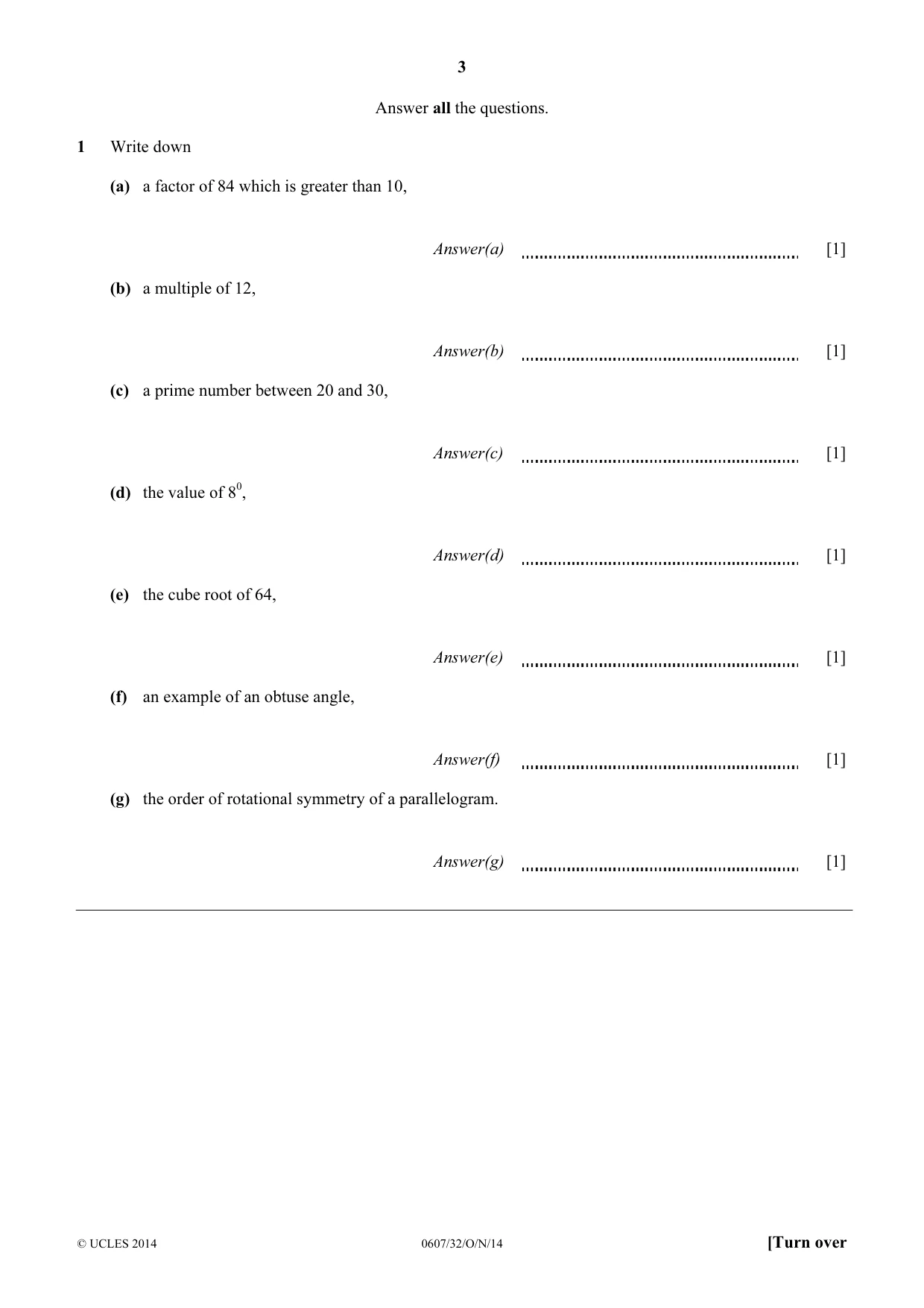
3 © UCLES 2014 0607/32/O/N/14 [Turn over Answer all the questions. 1 Write down (a) a factor of 84 which is greater than 10, Answer(a) [1] (b) a multiple of 12, Answer(b) [1] (c) a prime number between 20 and 30, Answer(c) [1] (d) the value of 80, Answer(d) [1] (e) the cube root of 64, Answer(e) [1] (f) an example of an obtuse angle, Answer(f) [1] (g) the order of rotational symmetry of a parallelogram. Answer(g) [1]
Question paper, page 4
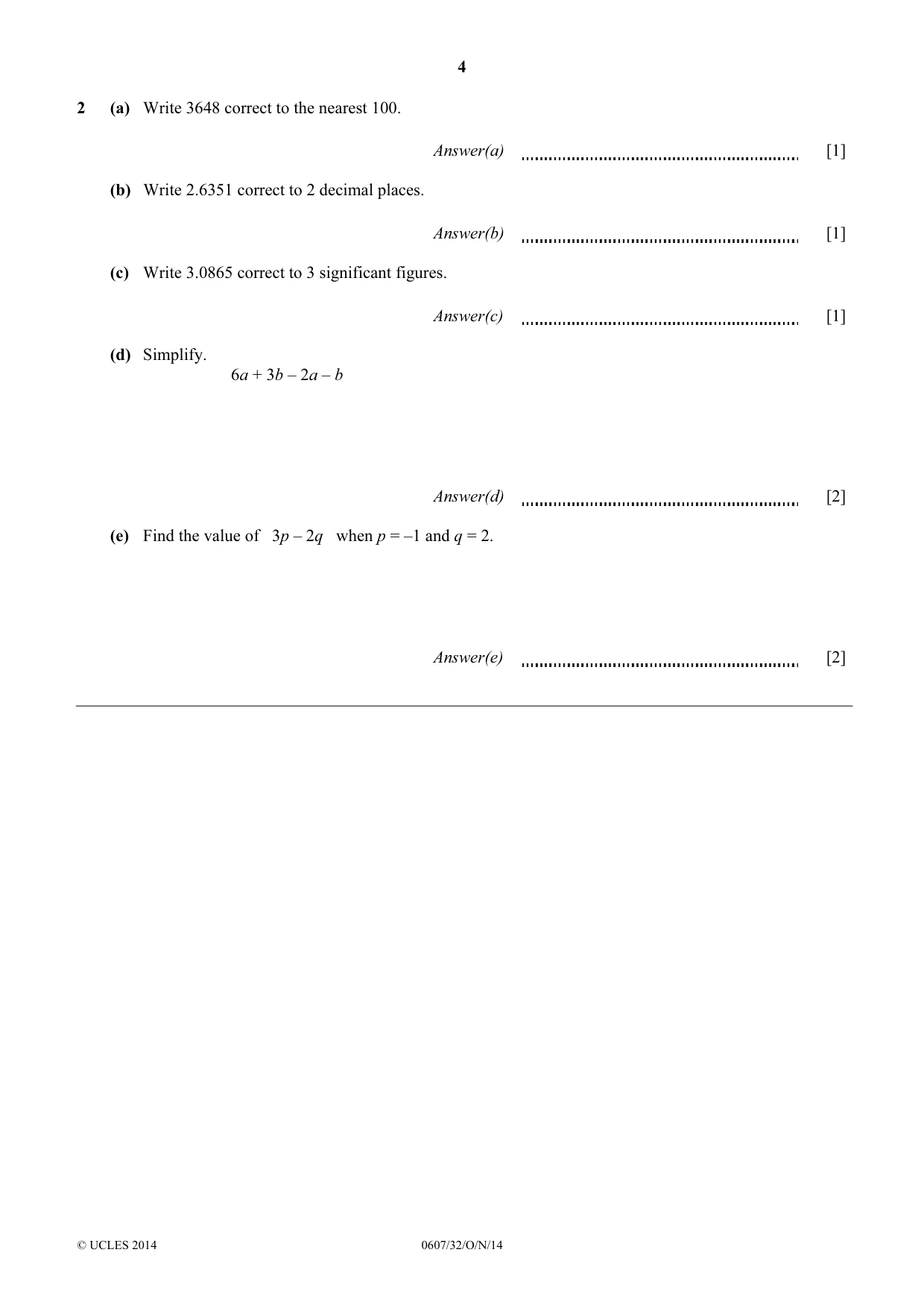
4 © UCLES 2014 0607/32/O/N/14 2 (a) Write 3648 correct to the nearest 100. Answer(a) [1] (b) Write 2.6351 correct to 2 decimal places. Answer(b) [1] (c) Write 3.0865 correct to 3 significant figures. Answer(c) [1] (d) Simplify. 6a + 3b – 2a – b Answer(d) [2] (e) Find the value of 3p – 2q when p = –1 and q = 2. Answer(e) [2]
Question paper, page 5
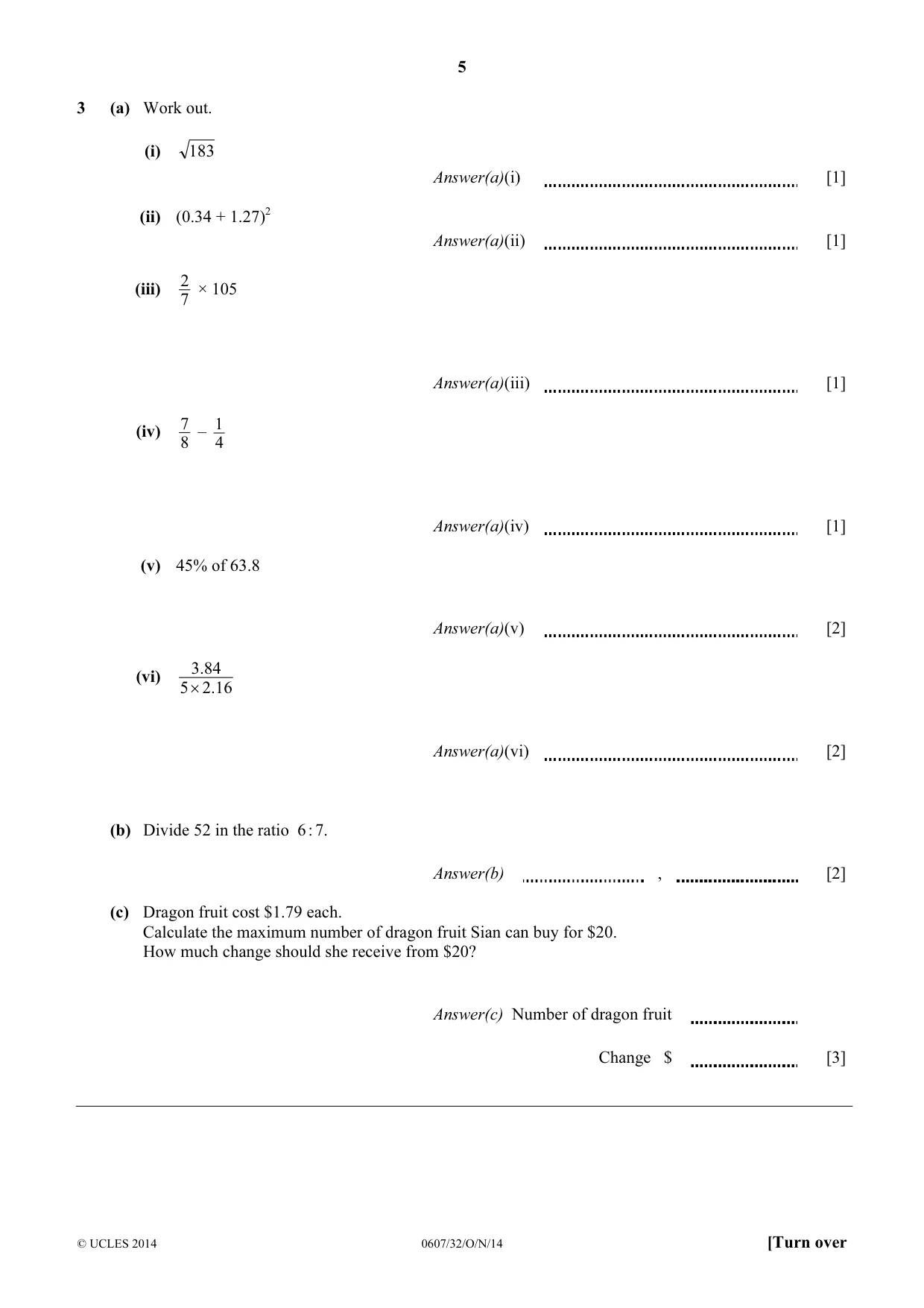
5 © UCLES 2014 0607/32/O/N/14 [Turn over 3 (a) Work out. (i) 183 Answer(a)(i) [1] (ii) (0.34 + 1.27)2 Answer(a)(ii) [1] (iii) 7 2 × 10⁵ Answer(a)(iii) [1] (iv) 8 7 – 4 1 Answer(a)(iv) [1] (v) 45% of 63.8 Answer(a)(v) [2] (vi) 16 .2 5 84 .3 × Answer(a)(vi) [2] (b) Divide 52 in the ratio 6 : 7. Answer(b) , [2] (c) Dragon fruit cost $1.79 each. Calculate the maximum number of dragon fruit Sian can buy for $20. How much change should she receive from $20? Answer(c) Number of dragon fruit Change $ [3]
Question paper, page 6
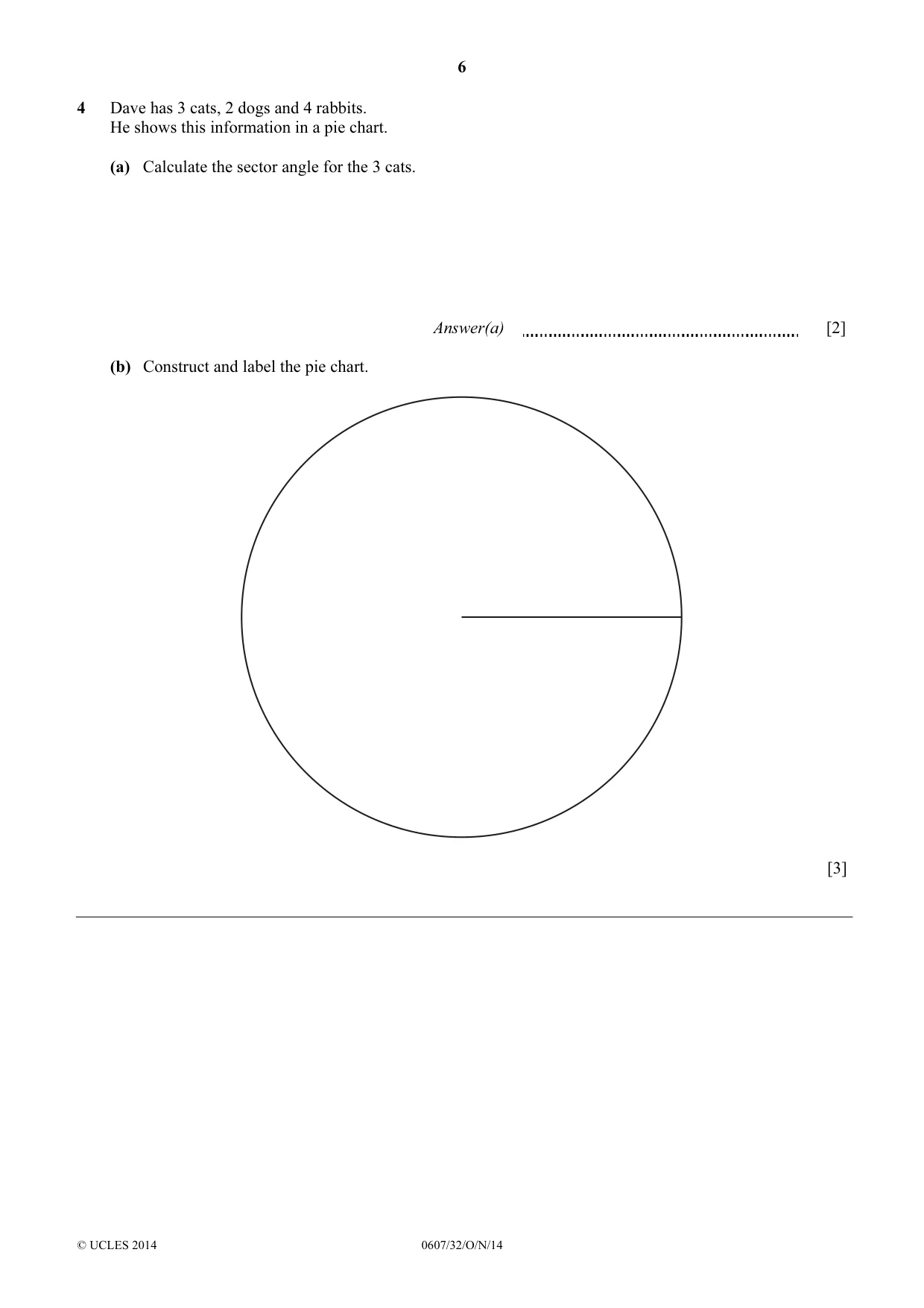
6 © UCLES 2014 0607/32/O/N/14 4 Dave has 3 cats, 2 dogs and 4 rabbits. He shows this information in a pie chart. (a) Calculate the sector angle for the 3 cats. Answer(a) [2] (b) Construct and label the pie chart. [3]
Question paper, page 7
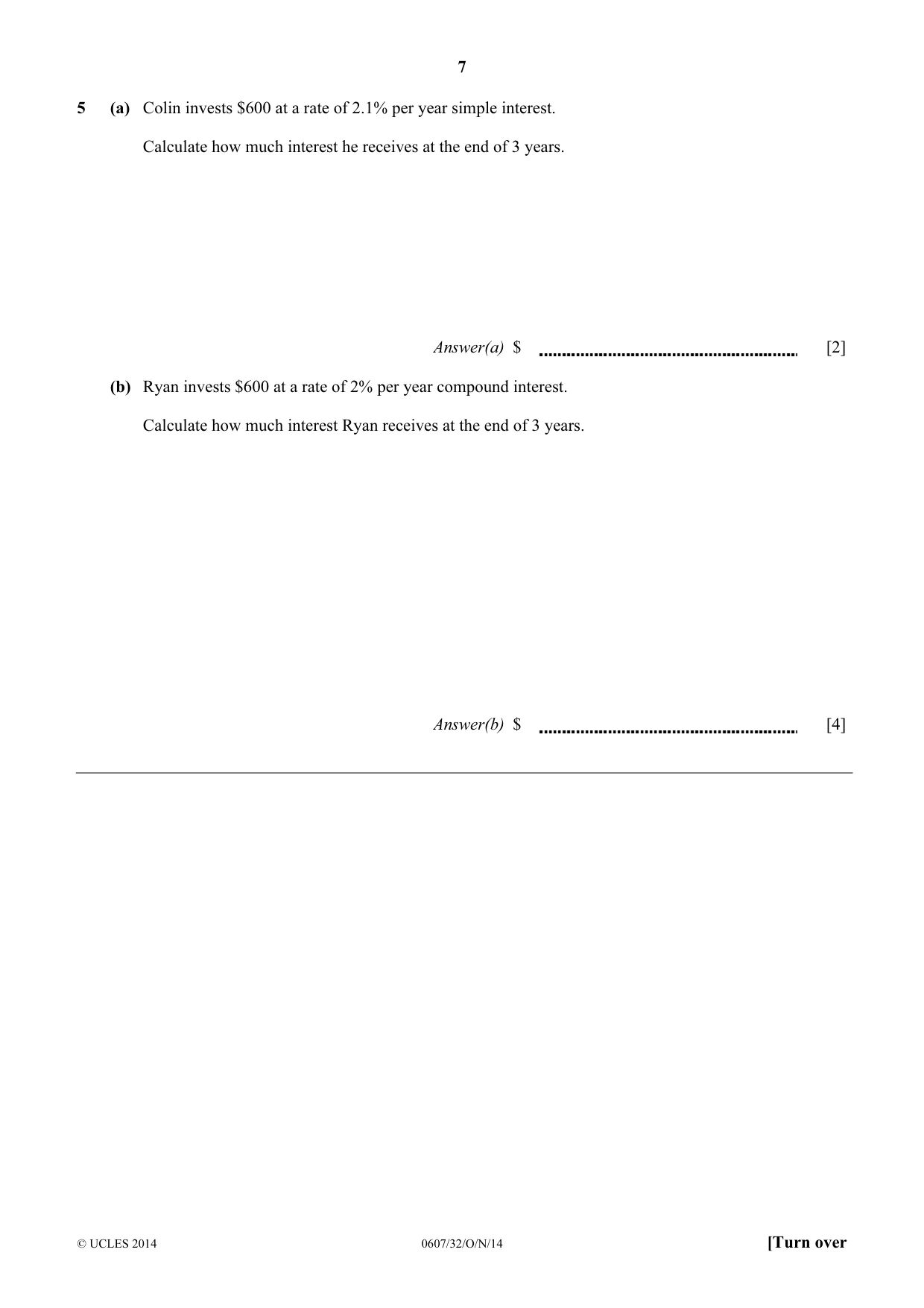
7 © UCLES 2014 0607/32/O/N/14 [Turn over 5 (a) Colin invests $600 at a rate of 2.1% per year simple interest. Calculate how much interest he receives at the end of 3 years. Answer(a) $ [2] (b) Ryan invests $600 at a rate of 2% per year compound interest. Calculate how much interest Ryan receives at the end of 3 years. Answer(b) $ [4]
Question paper, page 8
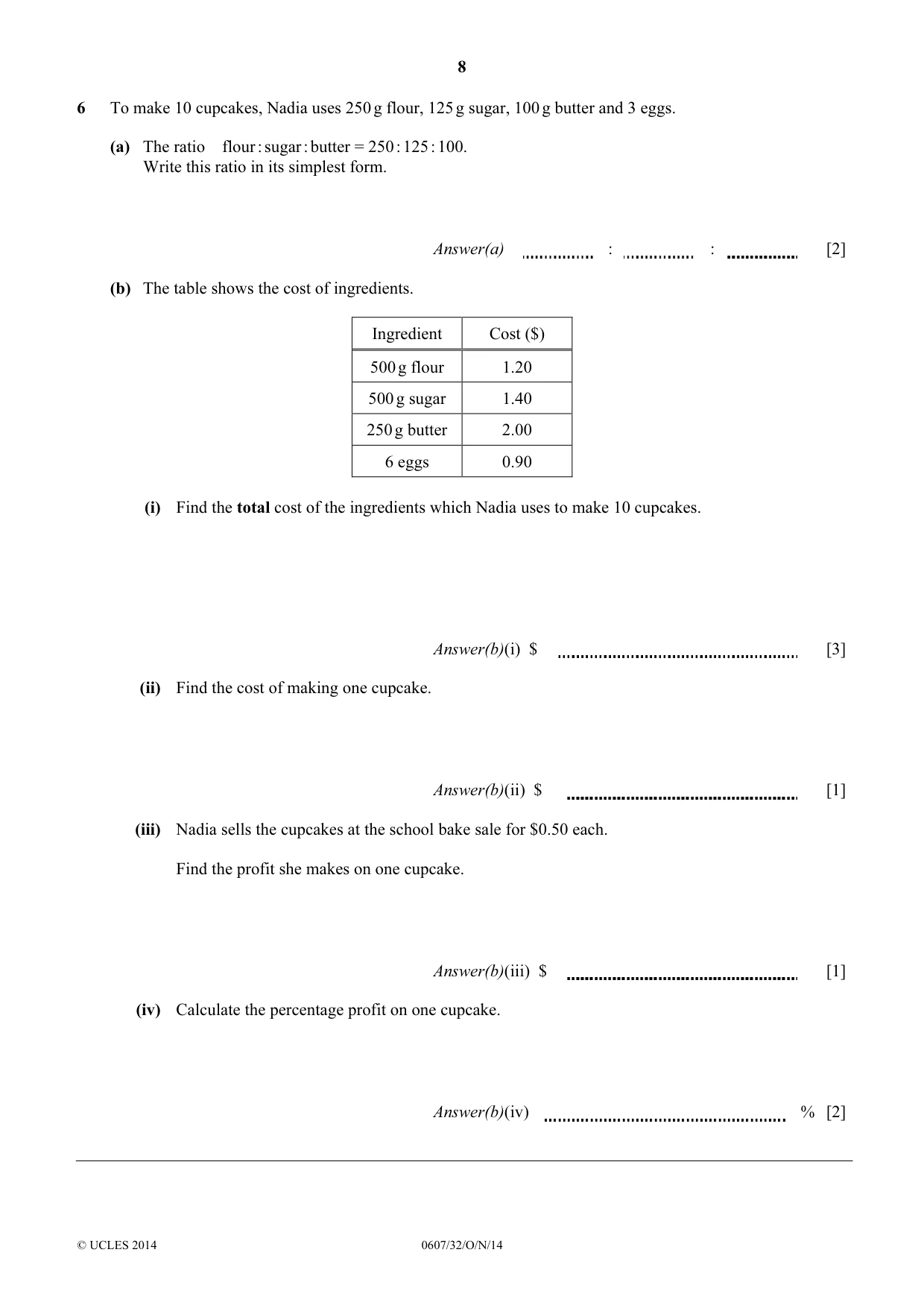
8 © UCLES 2014 0607/32/O/N/14 6 To make 10 cupcakes, Nadia uses 250 g flour, 125 g sugar, 100 g butter and 3 eggs. (a) The ratio flour : sugar : butter = 250 : 125 : 100. Write this ratio in its simplest form. Answer(a) : : [2] (b) The table shows the cost of ingredients. Ingredient Cost ($) 500 g flour 1.20 500 g sugar 1.40 250 g butter 2.00 6 eggs 0.90 (i) Find the total cost of the ingredients which Nadia uses to make 10 cupcakes. Answer(b)(i) $ [3] (ii) Find the cost of making one cupcake. Answer(b)(ii) $ [1] (iii) Nadia sells the cupcakes at the school bake sale for $0.50 each. Find the profit she makes on one cupcake. Answer(b)(iii) $ [1] (iv) Calculate the percentage profit on one cupcake. Answer(b)(iv) % [2]
Question paper, page 9
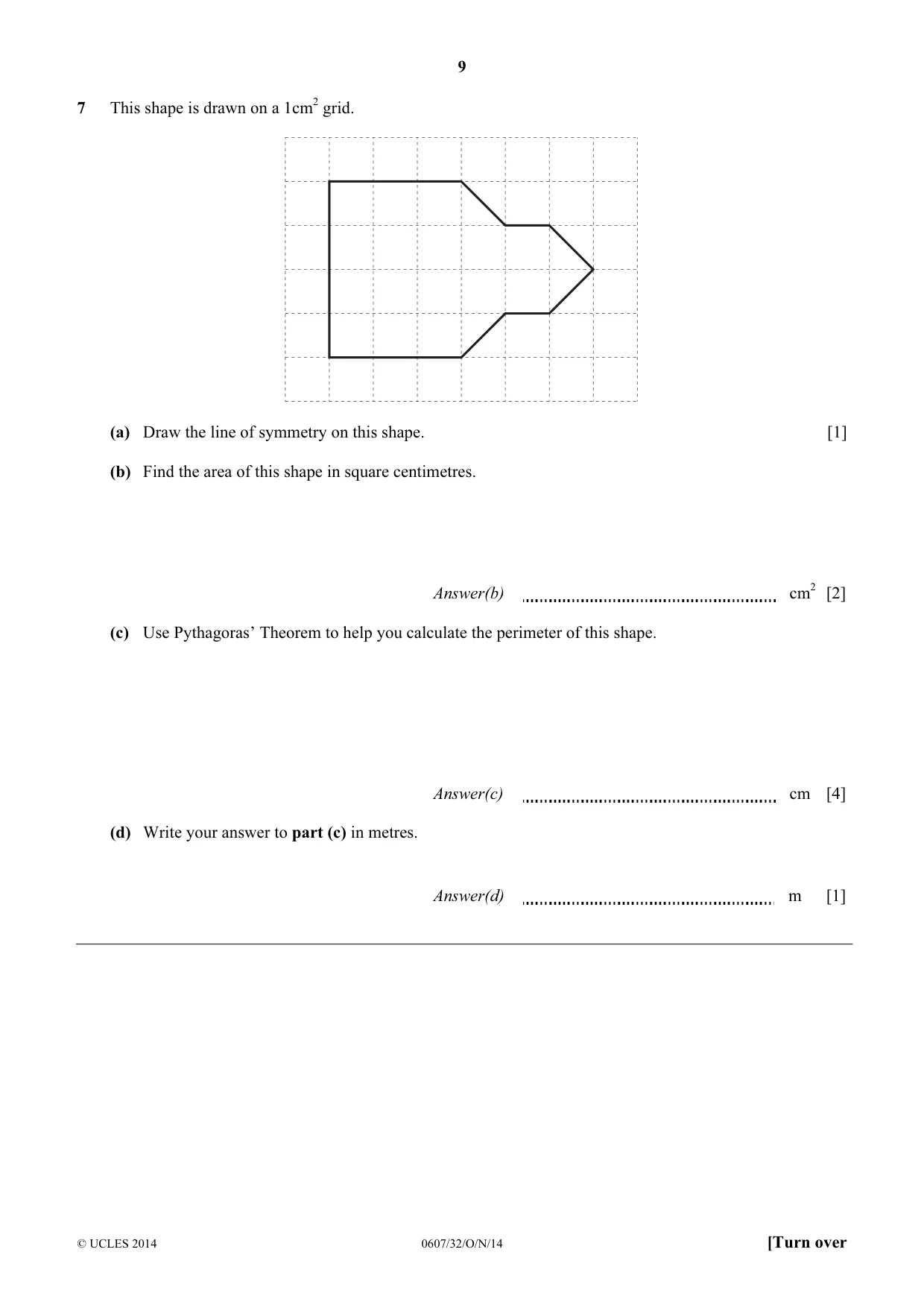
9 © UCLES 2014 0607/32/O/N/14 [Turn over 7 This shape is drawn on a 1cm2 grid. (a) Draw the line of symmetry on this shape. [1] (b) Find the area of this shape in square centimetres. Answer(b) cm2 [2] (c) Use Pythagoras’ Theorem to help you calculate the perimeter of this shape. Answer(c) cm [4] (d) Write your answer to part (c) in metres. Answer(d) m [1]
Question paper, page 10
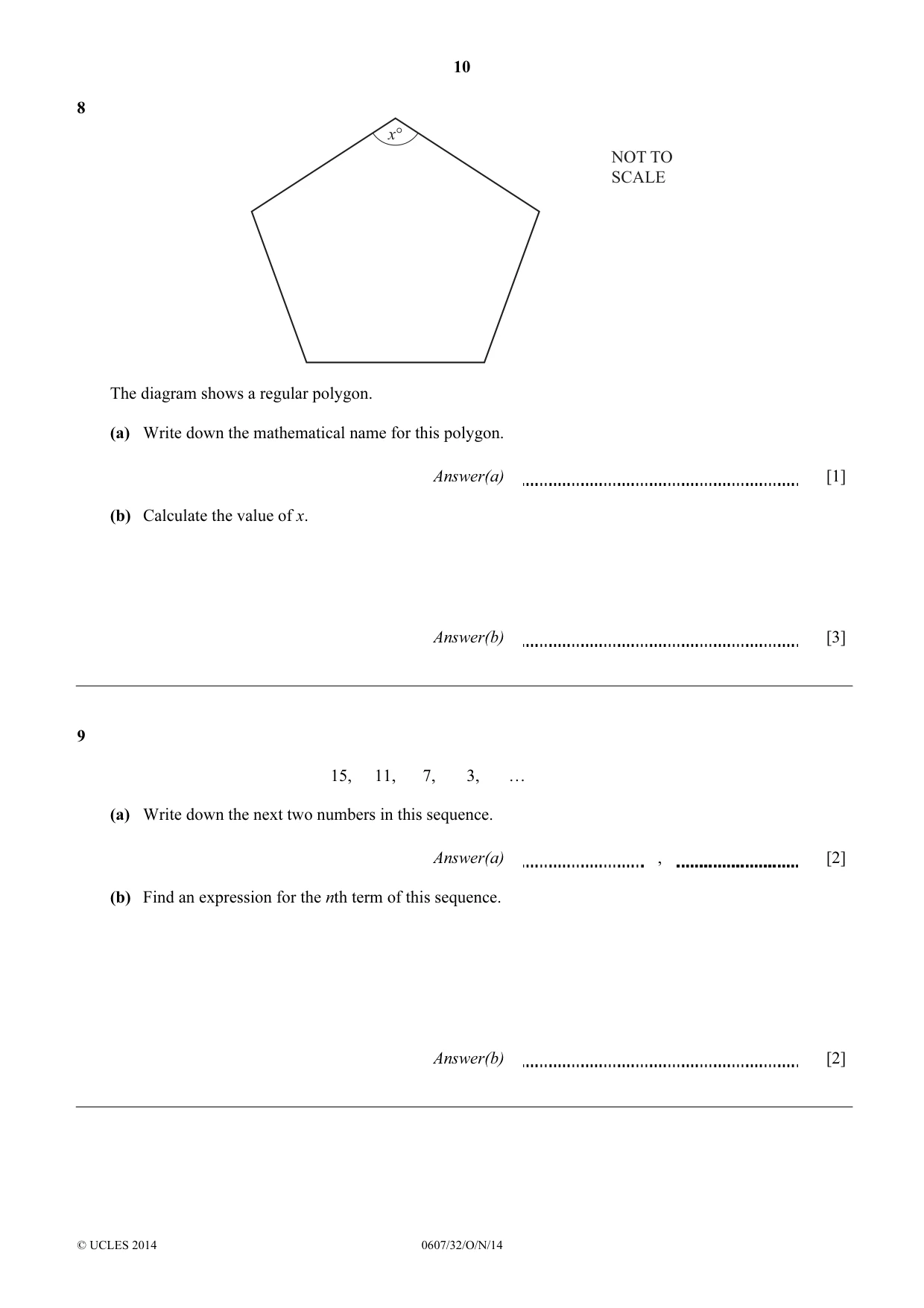
10 © UCLES 2014 0607/32/O/N/14 8 x° NOT TO SCALE The diagram shows a regular polygon. (a) Write down the mathematical name for this polygon. Answer(a) [1] (b) Calculate the value of x. Answer(b) [3] 9 15, 11, 7, 3, … (a) Write down the next two numbers in this sequence. Answer(a) , [2] (b) Find an expression for the nth term of this sequence. Answer(b) [2]
Question paper, page 11
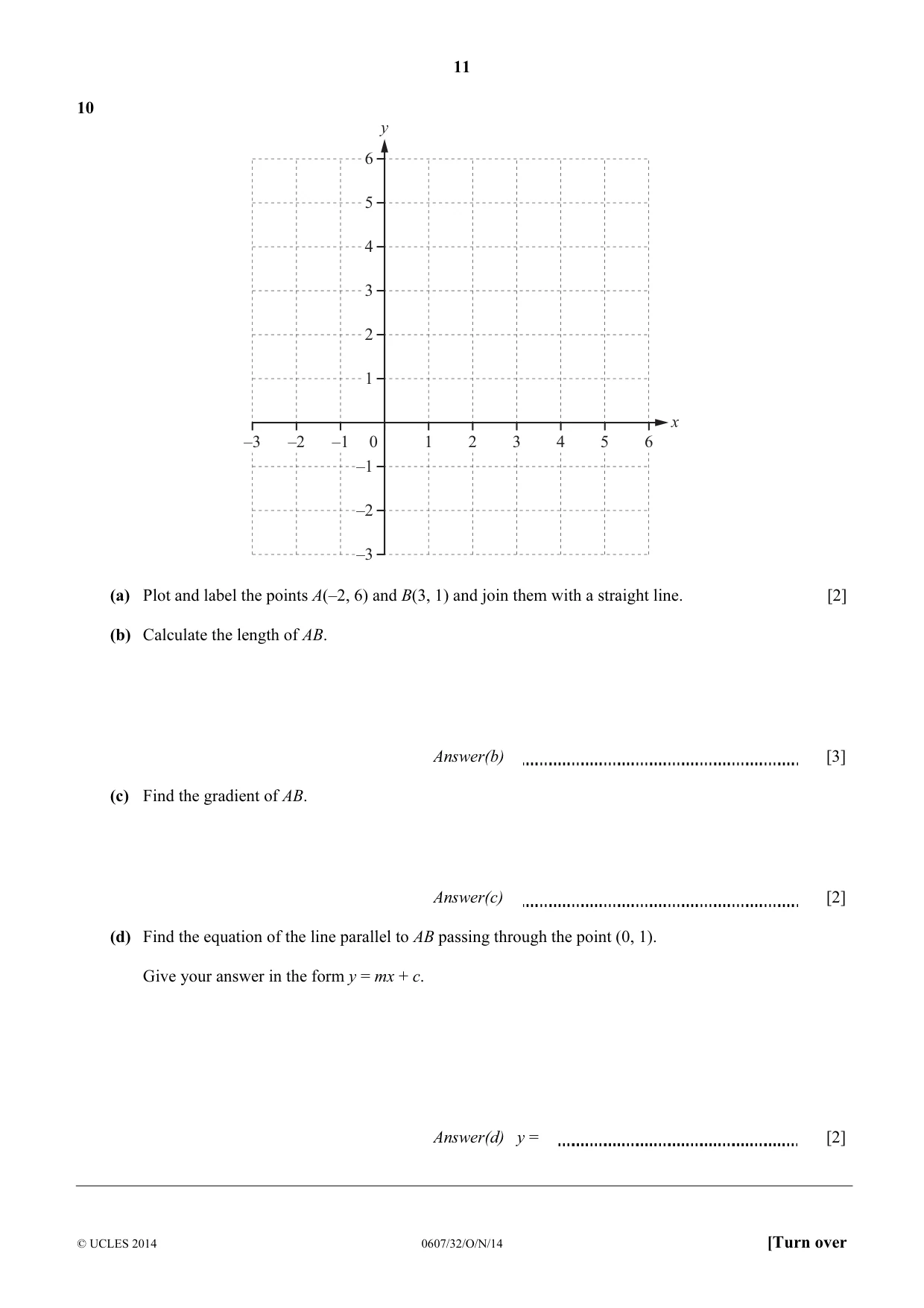
11 © UCLES 2014 0607/32/O/N/14 [Turn over 10 y x 6 5 4 3 2 1 –1 –2 –3 0 –1 1 2 3 4 5 6 –2 –3 (a) Plot and label the points A(–2, 6) and B(3, 1) and join them with a straight line. [2] (b) Calculate the length of AB. Answer(b) [3] (c) Find the gradient of AB. Answer(c) [2] (d) Find the equation of the line parallel to AB passing through the point (0, 1). Give your answer in the form y = mx + c. Answer(d) y = [2]
Question paper, page 12
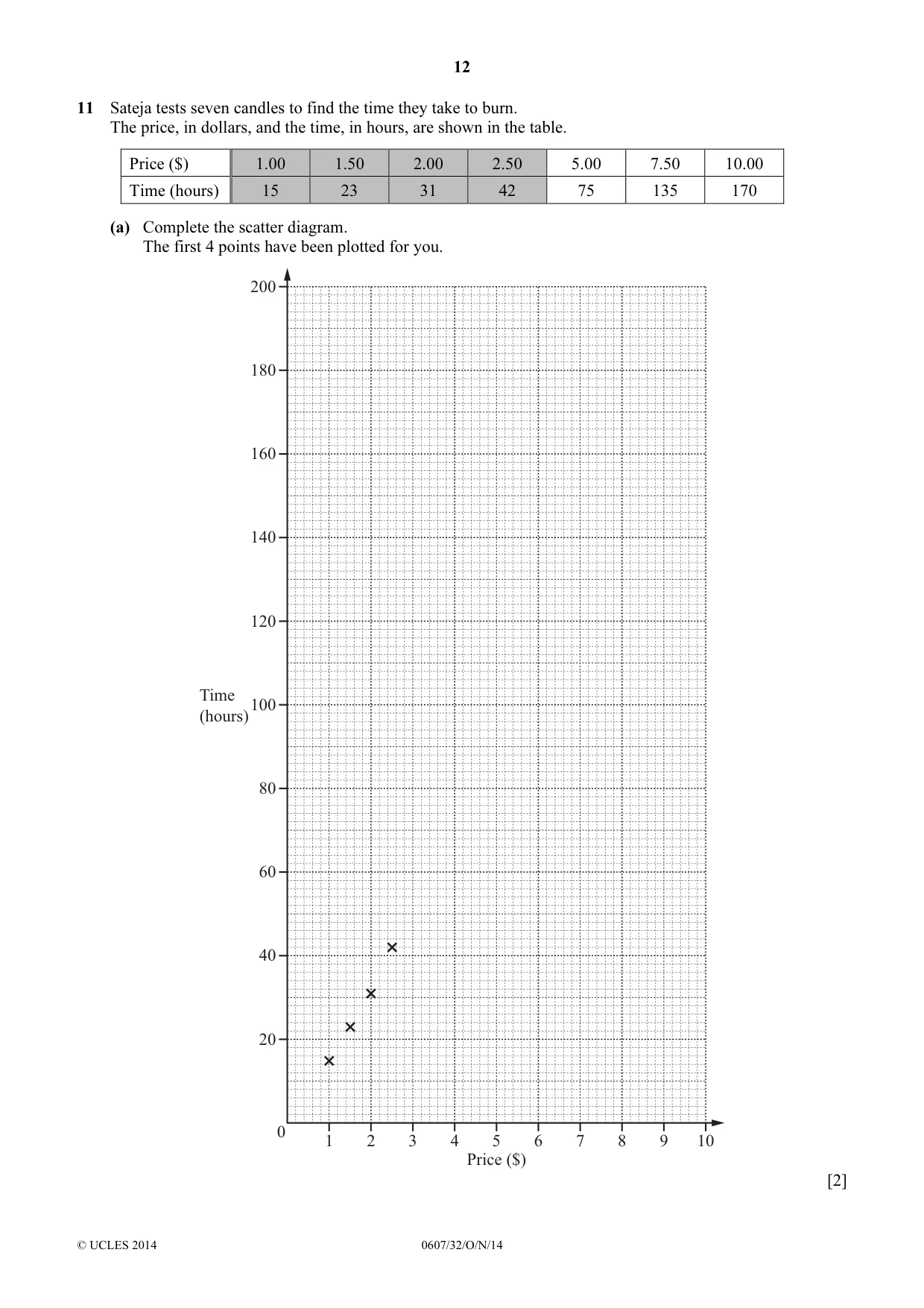
12 © UCLES 2014 0607/32/O/N/14 11 Sateja tests seven candles to find the time they take to burn. The price, in dollars, and the time, in hours, are shown in the table. Price ($) 1.00 1.50 2.00 2.50 5.00 7.50 10.00 Time (hours) 15 23 31 42 75 135 170 (a) Complete the scatter diagram. The first 4 points have been plotted for you. 200 180 160 140 120 100 80 60 40 20 1 2 3 4 5 6 7 8 9 10 0 Price ($) Time (hours) [2]
Question paper, page 13
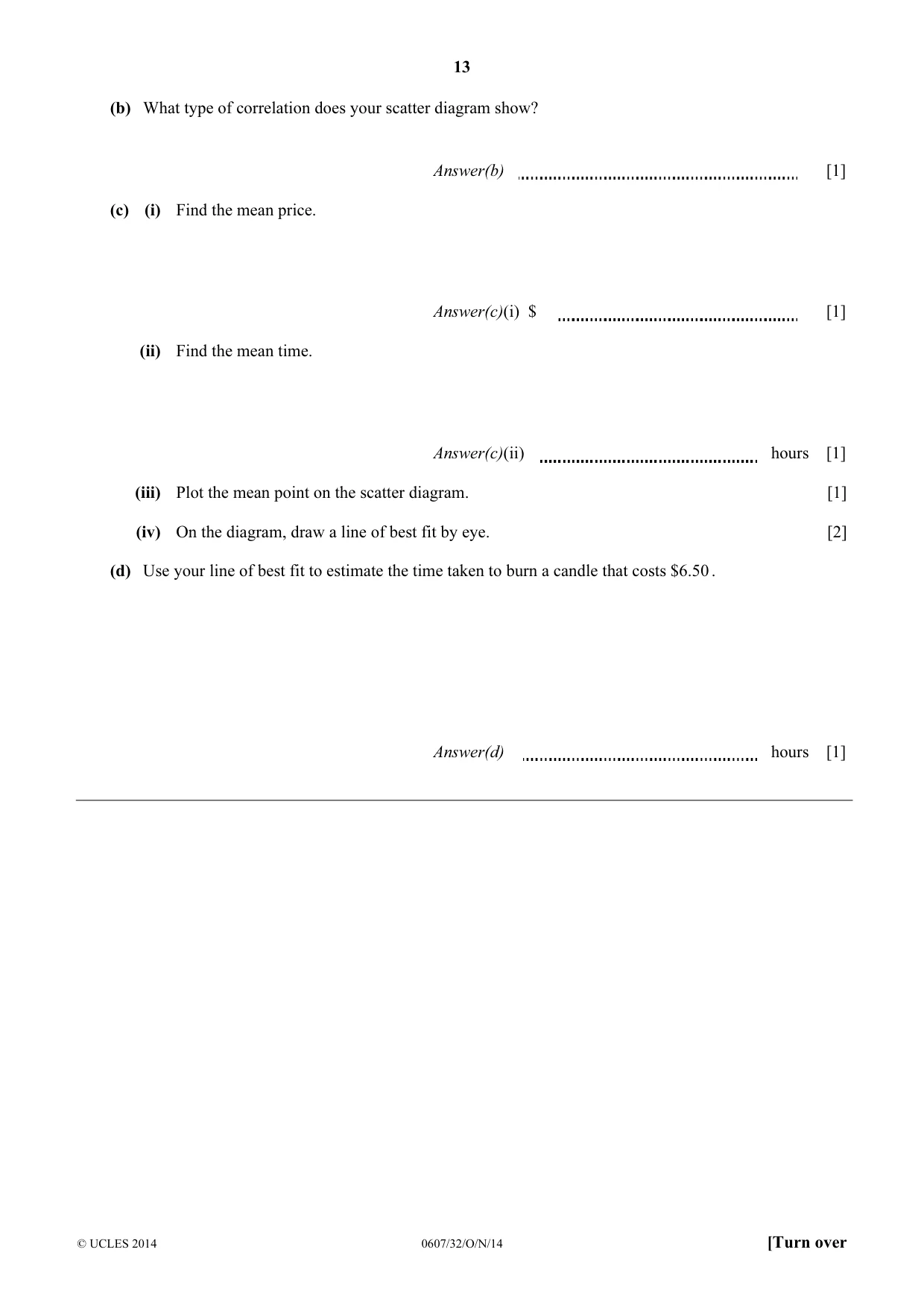
13 © UCLES 2014 0607/32/O/N/14 [Turn over (b) What type of correlation does your scatter diagram show? Answer(b) [1] (c) (i) Find the mean price. Answer(c)(i) $ [1] (ii) Find the mean time. Answer(c)(ii) hours [1] (iii) Plot the mean point on the scatter diagram. [1] (iv) On the diagram, draw a line of best fit by eye. [2] (d) Use your line of best fit to estimate the time taken to burn a candle that costs $6.50 . Answer(d) hours [1]
Question paper, page 14
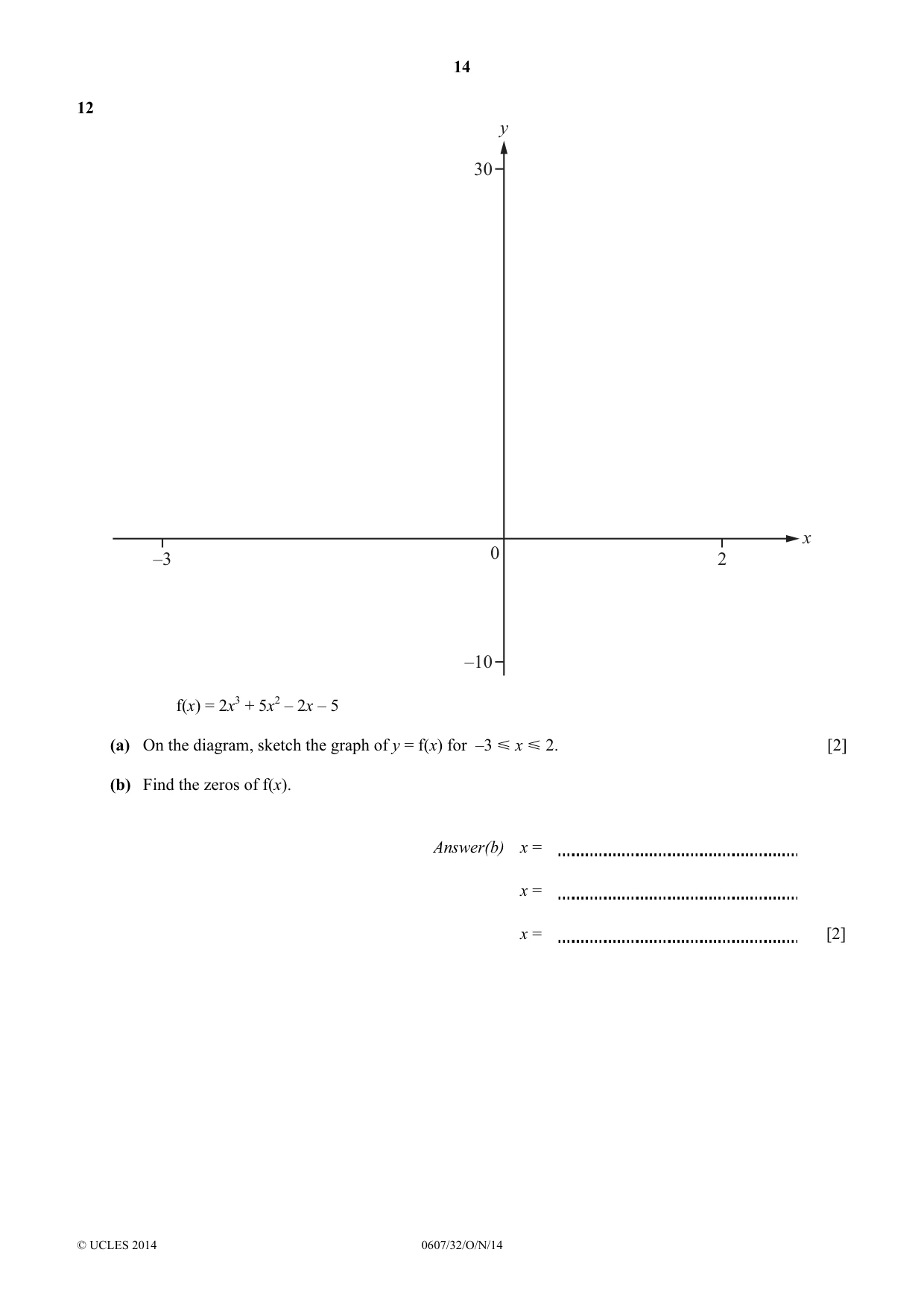
14 © UCLES 2014 0607/32/O/N/14 12 –3 –10 30 0 2 x y f(x) = 2x3 + 5x2 – 2x – 5 (a) On the diagram, sketch the graph of y = f(x) for –3 Y x Y 2. [2] (b) Find the zeros of f(x). Answer(b) x = x = x = [2]
Question paper, page 15
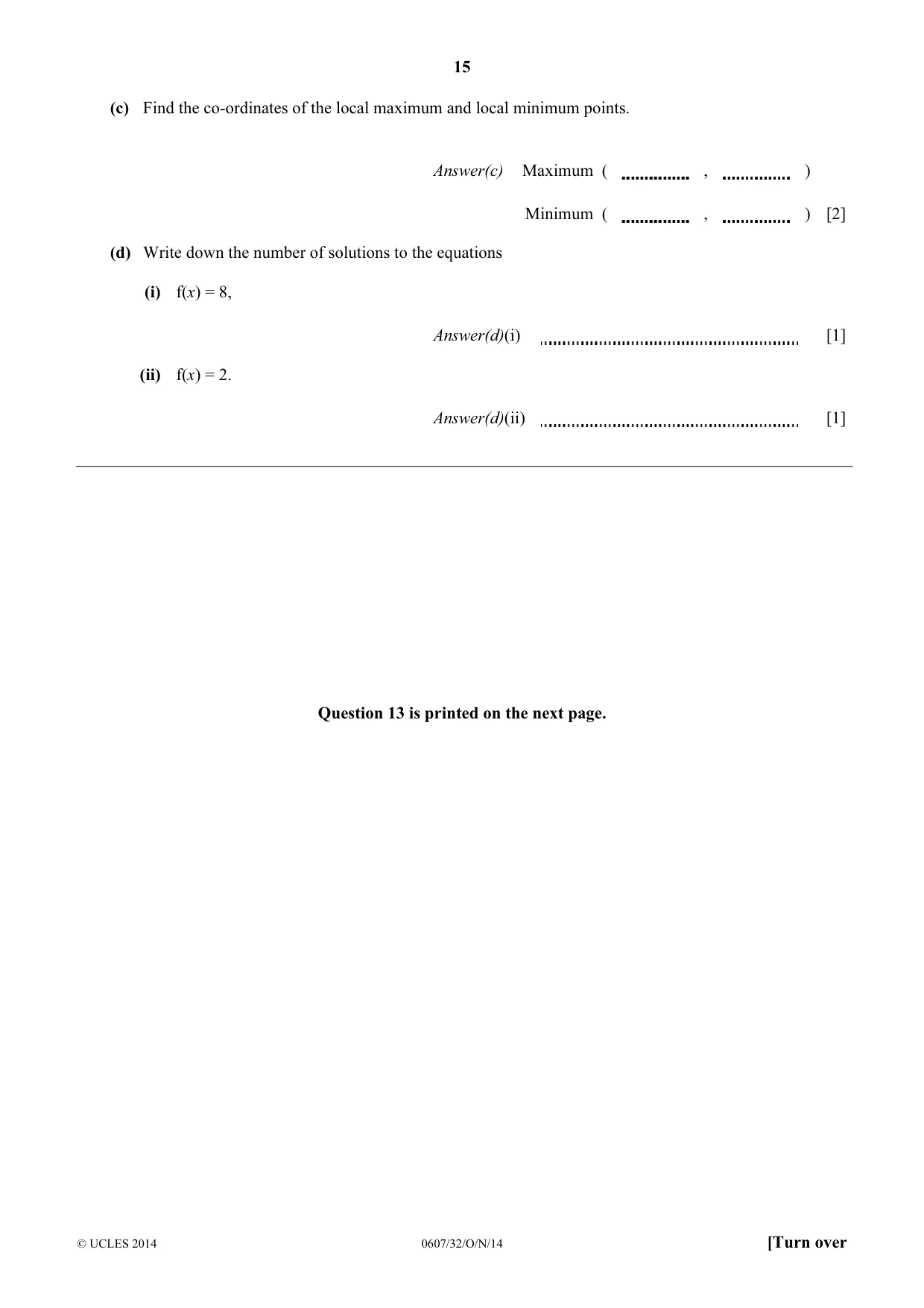
15 © UCLES 2014 0607/32/O/N/14 [Turn over (c) Find the co-ordinates of the local maximum and local minimum points. Answer(c) Maximum ( , ) Minimum ( , ) [2] (d) Write down the number of solutions to the equations (i) f(x) = 8, Answer(d)(i) [1] (ii) f(x) = 2. Answer(d)(ii) [1] Question 13 is printed on the next page.
Question paper, page 16
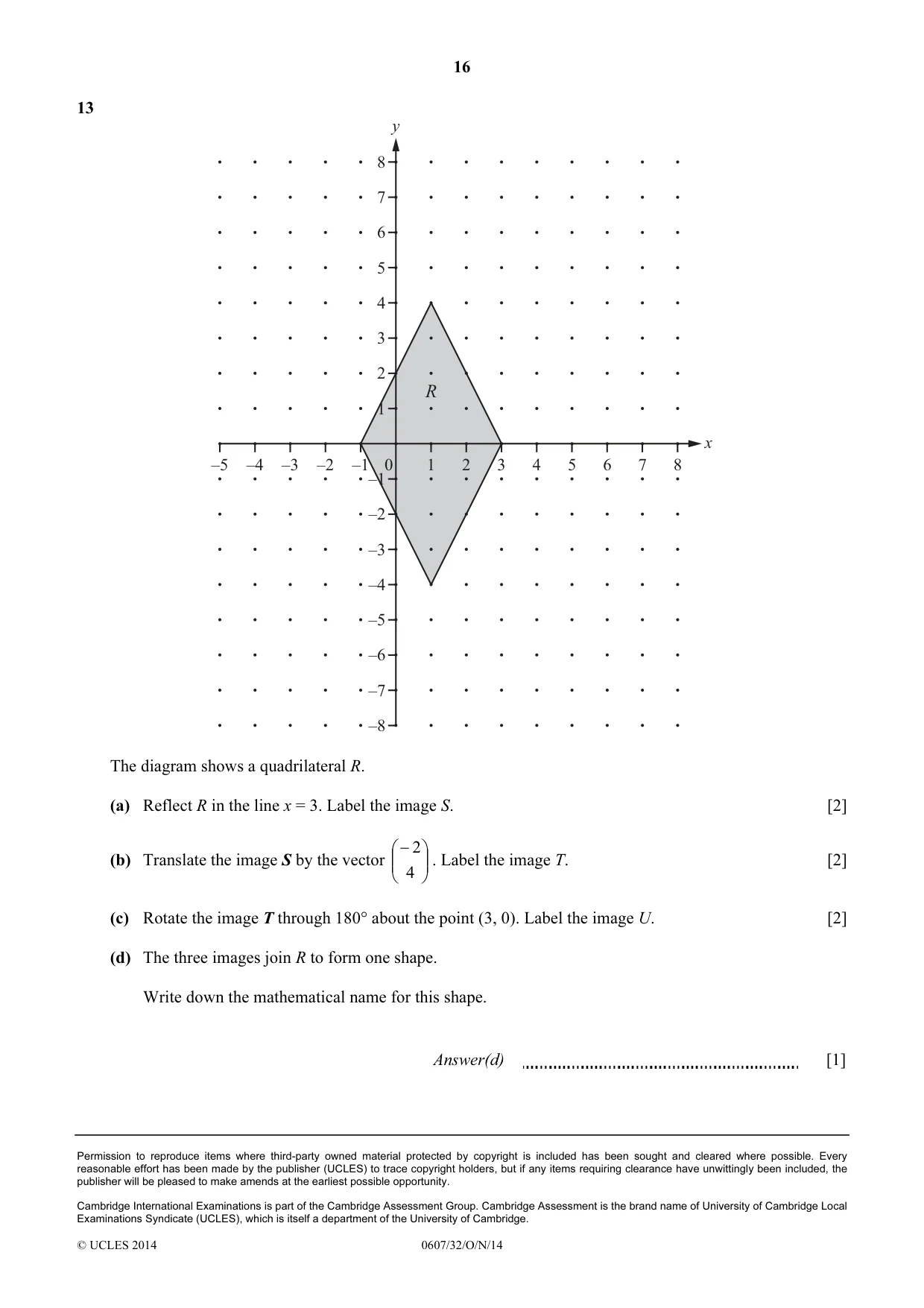
16 Permission to reproduce items where third-party owned material protected by copyright is included has been sought and cleared where possible. Every reasonable effort has been made by the publisher (UCLES) to trace copyright holders, but if any items requiring clearance have unwittingly been included, the publisher will be pleased to make amends at the earliest possible opportunity. Cambridge International Examinations is part of the Cambridge Assessment Group. Cambridge Assessment is the brand name of University of Cambridge Local Examinations Syndicate (UCLES), which is itself a department of the University of Cambridge. © UCLES 2014 0607/32/O/N/14 13 R y x 8 7 6 5 4 3 2 1 –1 –2 –3 –4 –5 –6 –7 –8 –4 –2 –3 –5 –1 2 3 1 0 4 5 7 6 8 The diagram shows a quadrilateral R. (a) Reflect R in the line x = 3. Label the image S. [2] (b) Translate the image S by the vector − 4 2 . Label the image T. [2] (c) Rotate the image T through 180° about the point (3, 0). Label the image U. [2] (d) The three images join R to form one shape. Write down the mathematical name for this shape. Answer(d) [1]
Mark scheme, page 1
® IGCSE is the registered trademark of Cambridge International Examinations. CAMBRIDGE INTERNATIONAL EXAMINATIONS Cambridge International General Certificate of Secondary Education MARK SCHEME for the October/November 2014 series 0607 CAMBRIDGE INTERNATIONAL MATHEMATICS 0607/32 Paper 3 (Core), maximum raw mark 96 This mark scheme is published as an aid to teachers and candidates, to indicate the requirements of the examination. It shows the basis on which Examiners were instructed to award marks. It does not indicate the details of the discussions that took place at an Examiners’ meeting before marking began, which would have considered the acceptability of alternative answers. Mark schemes should be read in conjunction with the question paper and the Principal Examiner Report for Teachers. Cambridge will not enter into discussions about these mark schemes. Cambridge is publishing the mark schemes for the October/November 2014 series for most Cambridge IGCSE®, Cambridge International A and AS Level components and some Cambridge O Level components.
Mark scheme, page 2
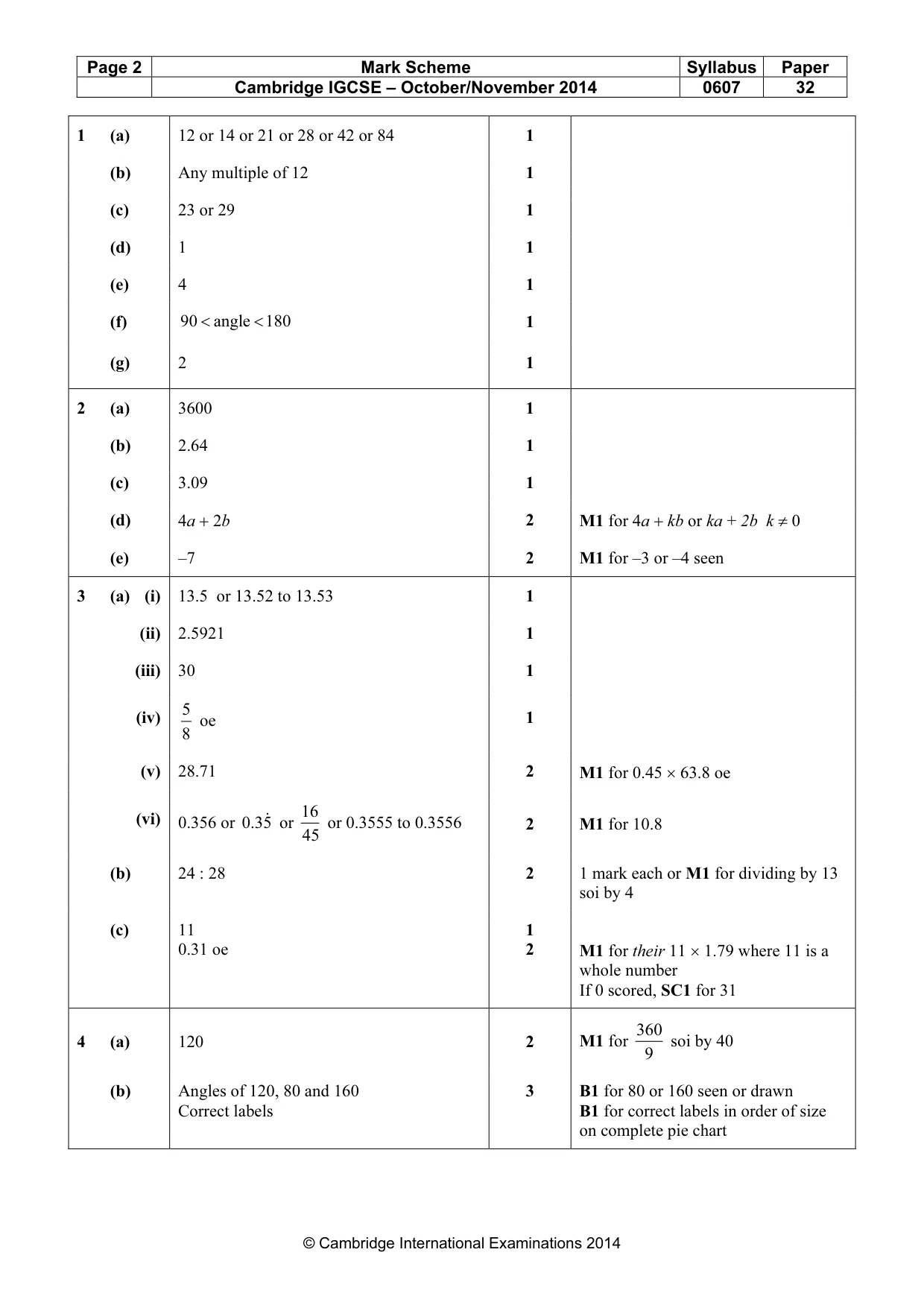
Page 2 Mark Scheme Syllabus Paper Cambridge IGCSE – October/November 2014 0607 32 © Cambridge International Examinations 2014 1 (a) 12 or 14 or 21 or 28 or 42 or 84 1 (b) Any multiple of 12 1 (c) 23 or 29 1 (d) 1 1 (e) 4 1 (f) 90 angle 180 < < 1 (g) 2 1 2 (a) 3600 1 (b) 2.64 1 (c) 3.09 1 (d) 4a + 2b 2 M1 for 4a + kb or ka + 2b k ≠ 0 (e) –7 2 M1 for –3 or –4 seen 3 (a) (i) 13.5 or 13.52 to 13.53 1 (ii) 2.5921 1 (iii) 30 1 (iv) 8 5 oe 1 (v) 28.71 2 M1 for 0.45 × 63.8 oe (vi) 0.356 or 0.35& or 45 16 or 0.3555 to 0.3556 2 M1 for 10.8 (b) 24 : 28 2 1 mark each or M1 for dividing by 13 soi by 4 (c) 11 0.31 oe 1 2 M1 for their 11 × 1.79 where 11 is a whole number If 0 scored, SC1 for 31 4 (a) 120 2 M1 for 9 360 soi by 40 (b) Angles of 120, 80 and 160 Correct labels 3 B1 for 80 or 160 seen or drawn B1 for correct labels in order of size on complete pie chart
Mark scheme, page 3
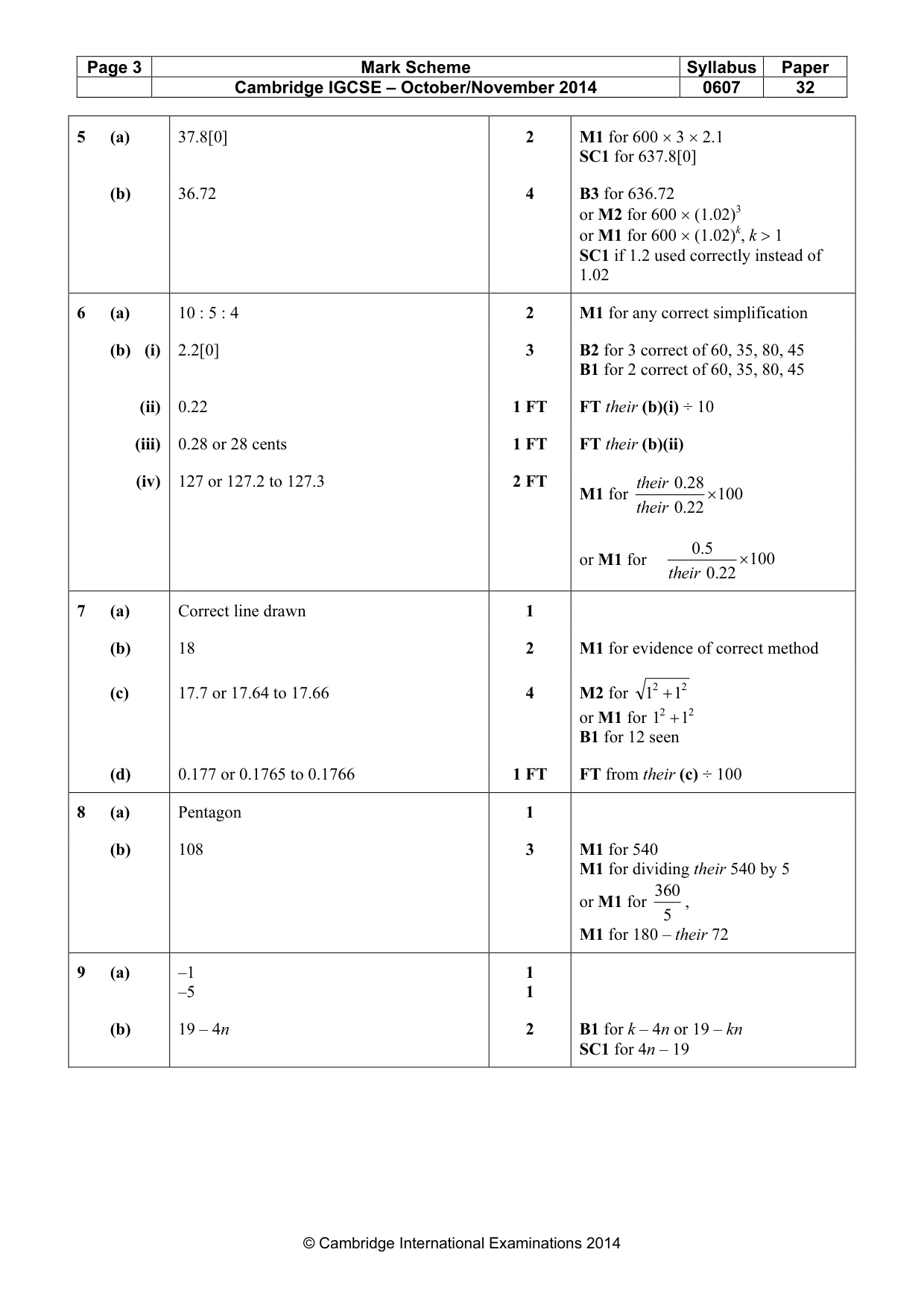
Page 3 Mark Scheme Syllabus Paper Cambridge IGCSE – October/November 2014 0607 32 © Cambridge International Examinations 2014 5 (a) 37.8[0] 2 M1 for 600 × 3 × 2.1 SC1 for 637.8[0] (b) 36.72 4 B3 for 636.72 or M2 for 600 × (1.02)3 or M1 for 600 × (1.02)k, k > 1 SC1 if 1.2 used correctly instead of 1.02 6 (a) 10 : 5 : 4 2 M1 for any correct simplification (b) (i) 2.2[0] 3 B2 for 3 correct of 60, 35, 80, 45 B1 for 2 correct of 60, 35, 80, 45 (ii) 0.22 1 FT FT their (b)(i) ÷ 10 (iii) 0.28 or 28 cents 1 FT FT their (b)(ii) (iv) 127 or 127.2 to 127.3 2 FT M1 for 0.28 100 0.22 their their × or M1 for 0.5 100 0.22 their × 7 (a) Correct line drawn 1 (b) 18 2 M1 for evidence of correct method (c) 17.7 or 17.64 to 17.66 4 M2 for 2 2 1 1 + or M1 for 2 2 1 1 + B1 for 12 seen (d) 0.177 or 0.1765 to 0.1766 1 FT FT from their (c) ÷ 100 8 (a) Pentagon 1 (b) 108 3 M1 for 540 M1 for dividing their 540 by 5 or M1 for 360 5 , M1 for 180 – their 72 9 (a) –1 –5 1 1 (b) 19 – 4n 2 B1 for k – 4n or 19 – kn SC1 for 4n – 19
Mark scheme, page 4
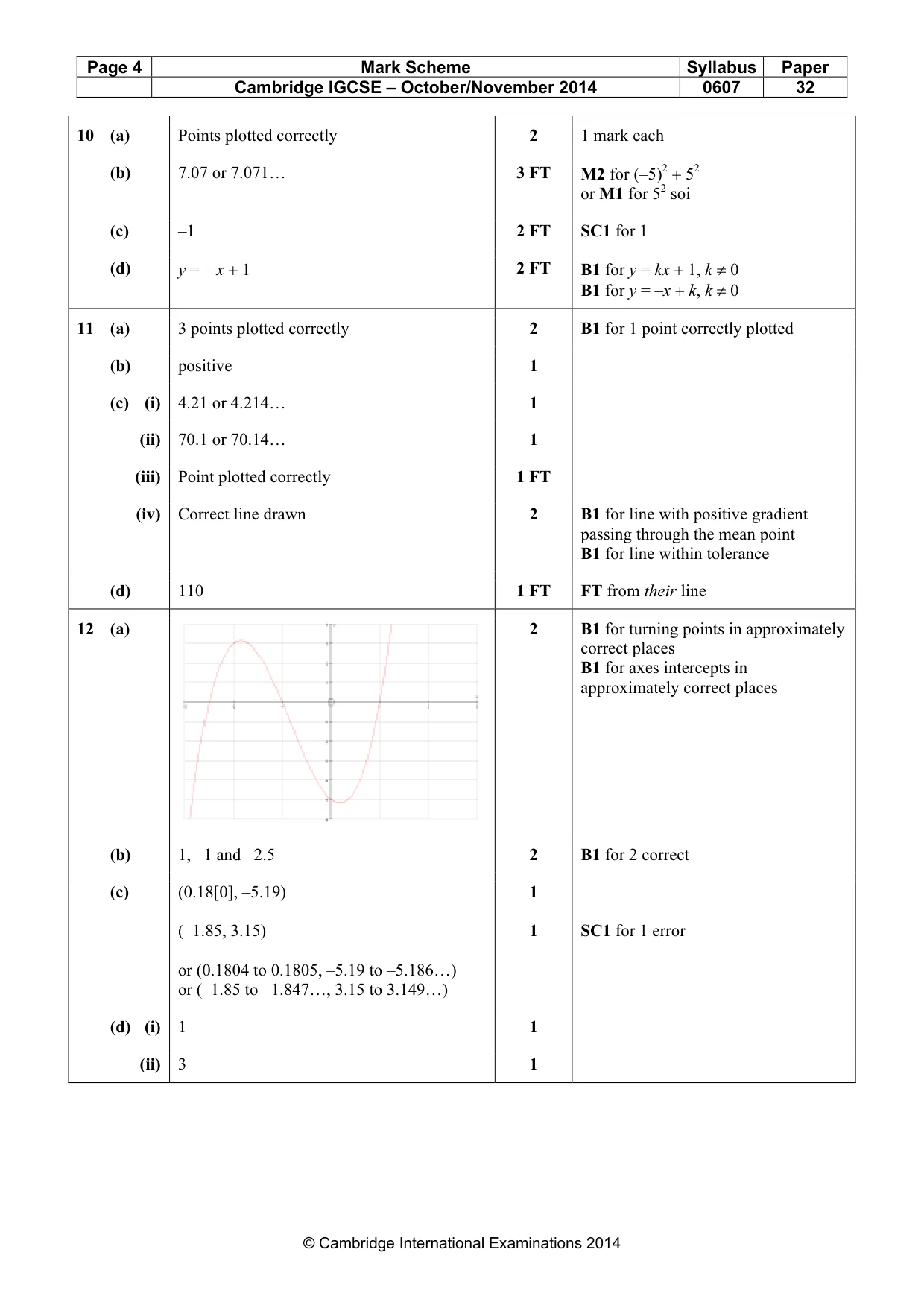
Page 4 Mark Scheme Syllabus Paper Cambridge IGCSE – October/November 2014 0607 32 © Cambridge International Examinations 2014 10 (a) Points plotted correctly 2 1 mark each (b) 7.07 or 7.071… 3 FT M2 for (–5)2 + 52 or M1 for 52 soi (c) –1 2 FT SC1 for 1 (d) y = – x + 1 2 FT B1 for y = kx + 1, k ≠ 0 B1 for y = –x + k, k ≠ 0 11 (a) 3 points plotted correctly 2 B1 for 1 point correctly plotted (b) positive 1 (c) (i) 4.21 or 4.214… 1 (ii) 70.1 or 70.14… 1 (iii) Point plotted correctly 1 FT (iv) Correct line drawn 2 B1 for line with positive gradient passing through the mean point B1 for line within tolerance (d) 110 1 FT FT from their line 12 (a) 2 B1 for turning points in approximately correct places B1 for axes intercepts in approximately correct places (b) 1, –1 and –2.5 2 B1 for 2 correct (c) (0.18[0], –5.19) (–1.85, 3.15) or (0.1804 to 0.1805, –5.19 to –5.186…) or (–1.85 to –1.847…, 3.15 to 3.149…) 1 1 SC1 for 1 error (d) (i) 1 1 (ii) 3 1
Mark scheme, page 5
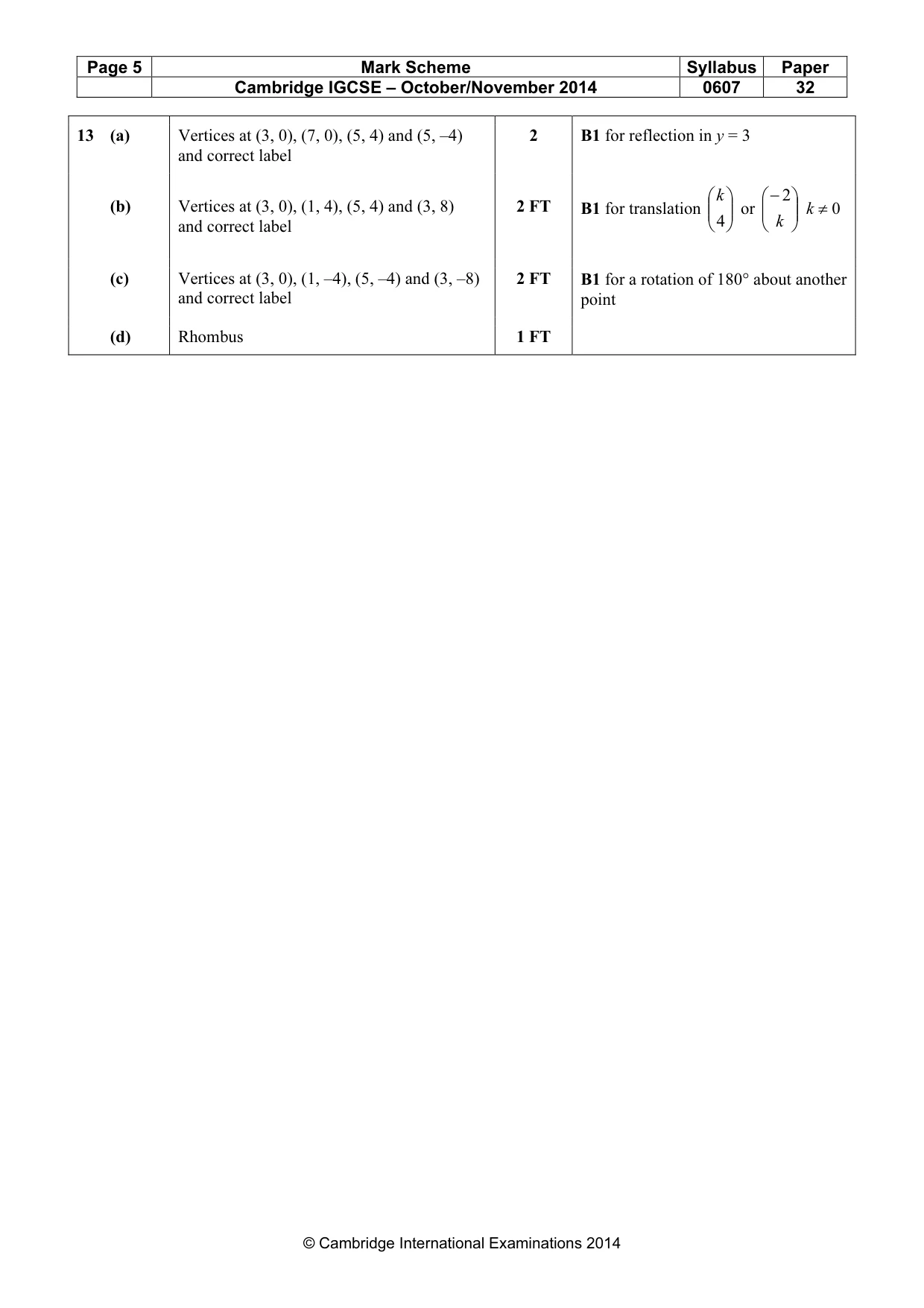
Page 5 Mark Scheme Syllabus Paper Cambridge IGCSE – October/November 2014 0607 32 © Cambridge International Examinations 2014 13 (a) Vertices at (3, 0), (7, 0), (5, 4) and (5, –4) and correct label 2 B1 for reflection in y = 3 (b) Vertices at (3, 0), (1, 4), (5, 4) and (3, 8) and correct label 2 FT B1 for translation 4 k or − k 2 k ≠ 0 (c) Vertices at (3, 0), (1, –4), (5, –4) and (3, –8) and correct label 2 FT B1 for a rotation of 180° about another point (d) Rhombus 1 FT
What you needed in this session
Cambridge’s own grade thresholds for 2014 Oct/Nov, Paper 3 · Variant 2. A higher threshold means an easier paper — the bar moves with how the cohort did.