Cambridge IGCSE Mathematics - International 0607 — 2014 May/June Paper 6 · Variant 2
0607/62/M/J/14 · 40 marks · ≈45 min
The question paper and its mark scheme, free to read here and free to download. This is Cambridge’s own paper, exactly as it was sat.
Question paper12 pages

Mark scheme5 pages
Answers below. Sit the paper first if you are practising.
Paper as text
Question paper, page 1
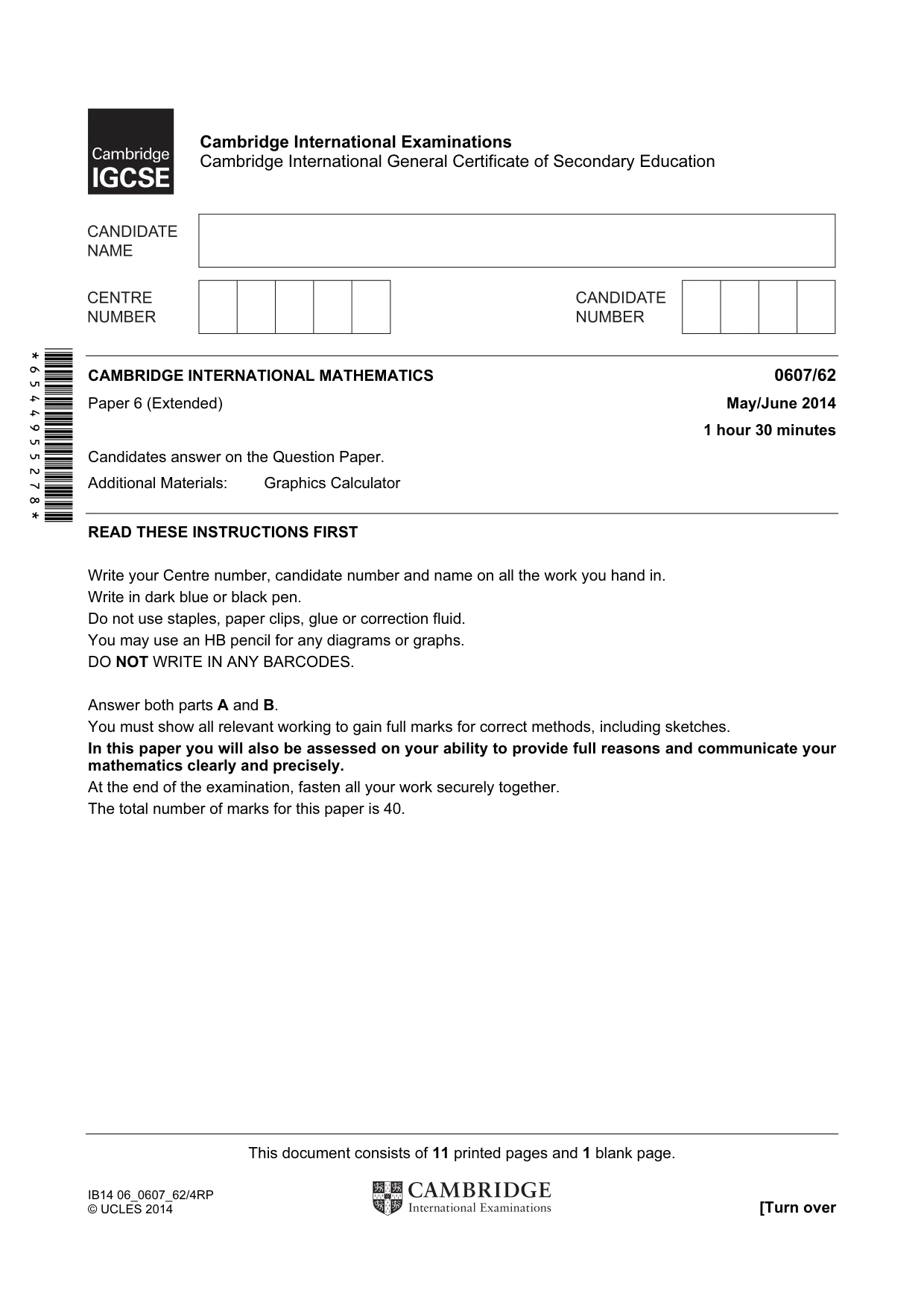
This document consists of 11 printed pages and 1 blank page. IB14 06_0607_62/4RP © UCLES 2014 [Turn over *6544955278* Cambridge International Examinations Cambridge International General Certificate of Secondary Education CAMBRIDGE INTERNATIONAL MATHEMATICS 0607/62 Paper 6 (Extended) May/June 2014 1 hour 30 minutes Candidates answer on the Question Paper. Additional Materials: Graphics Calculator READ THESE INSTRUCTIONS FIRST Write your Centre number, candidate number and name on all the work you hand in. Write in dark blue or black pen. Do not use staples, paper clips, glue or correction fluid. You may use an HB pencil for any diagrams or graphs. DO NOT WRITE IN ANY BARCODES. Answer both parts A and B. You must show all relevant working to gain full marks for correct methods, including sketches. In this paper you will also be assessed on your ability to provide full reasons and communicate your mathematics clearly and precisely. At the end of the examination, fasten all your work securely together. The total number of marks for this paper is 40.
Question paper, page 2
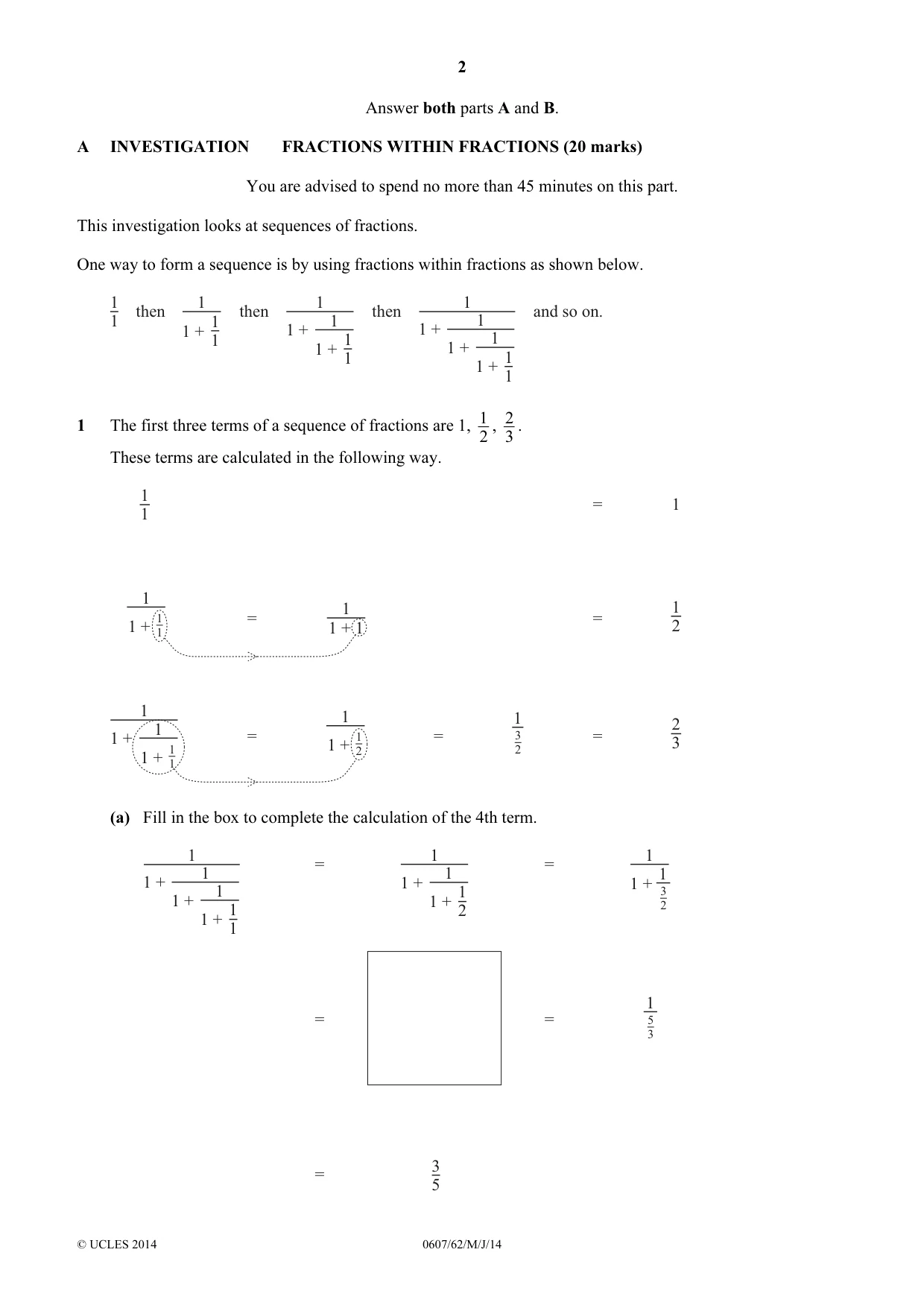
2 © UCLES 2014 0607/62/M/J/14 Answer both parts A and B. A INVESTIGATION FRACTIONS WITHIN FRACTIONS (20 marks) You are advised to spend no more than 45 minutes on this part. This investigation looks at sequences of fractions. One way to form a sequence is by using fractions within fractions as shown below. 1 1 then 1 1 1 + 1 then 1 1 1 + 1 + 1 1 then and so on. 1 1 1 1 + 1 + 1 + 1 1 1 The first three terms of a sequence of fractions are 1, 2 1 , 3 2 . These terms are calculated in the following way. 1 1 1 + 1 + 1 1 2 1 + 1 3 2 1 1 = = = 2 3 1 1 1 + 1 1 + 1 1 = = 1 2 1 1 = 1 (a) Fill in the box to complete the calculation of the 4th term. 3 2 1 5 3 1 1 1 1 1 + 1 + 1 + 1 1 1 2 3 5 1 + 1 + 1 1 + 1 1 = = = = =
Question paper, page 3
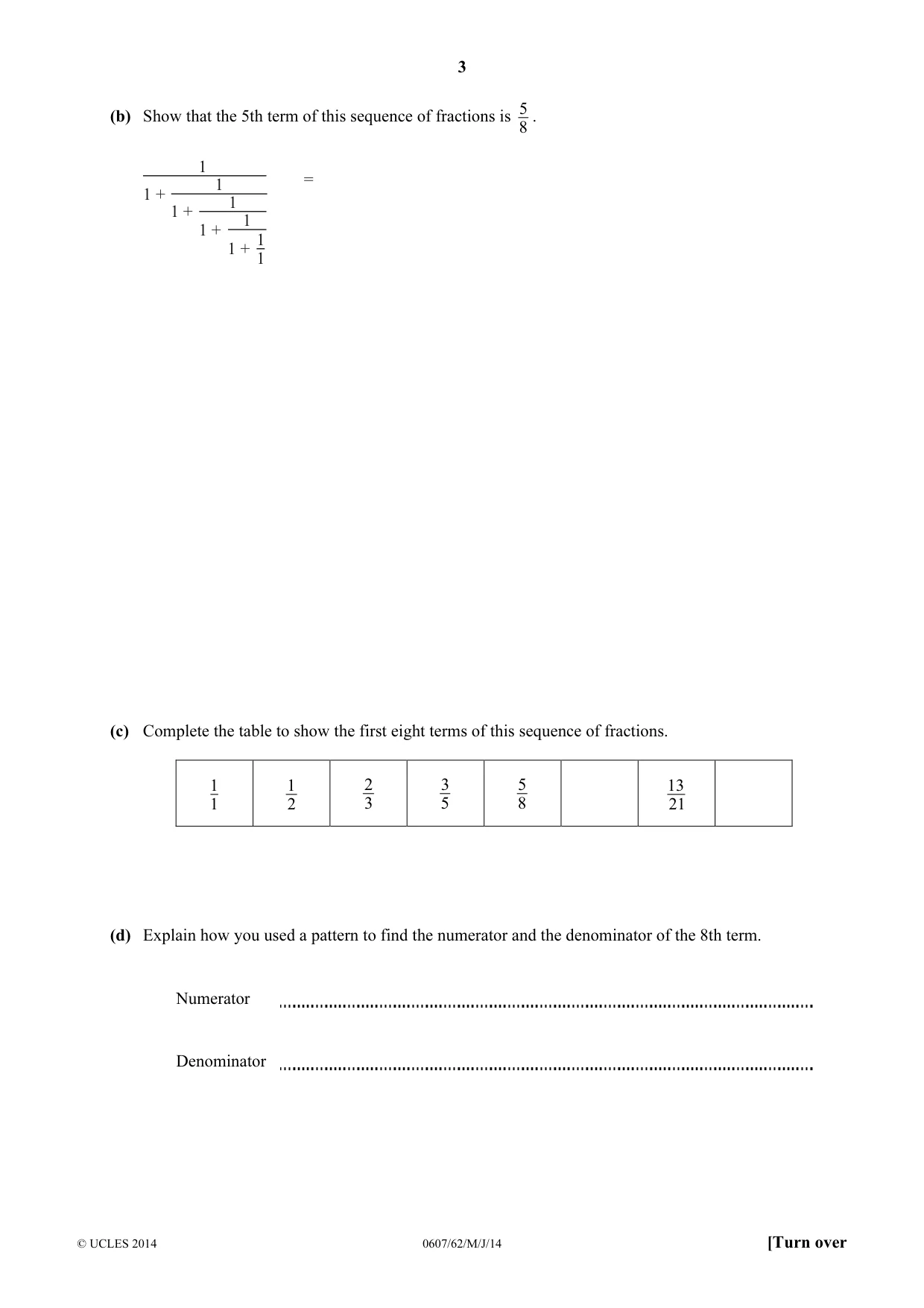
3 © UCLES 2014 0607/62/M/J/14 [Turn over (b) Show that the 5th term of this sequence of fractions is 8 5 . 1 1 = 1 1 1 + 1 + 1 + 1 + 1 1 (c) Complete the table to show the first eight terms of this sequence of fractions. 1 1 2 1 3 2 5 3 8 5 21 13 (d) Explain how you used a pattern to find the numerator and the denominator of the 8th term. Numerator Denominator
Question paper, page 4
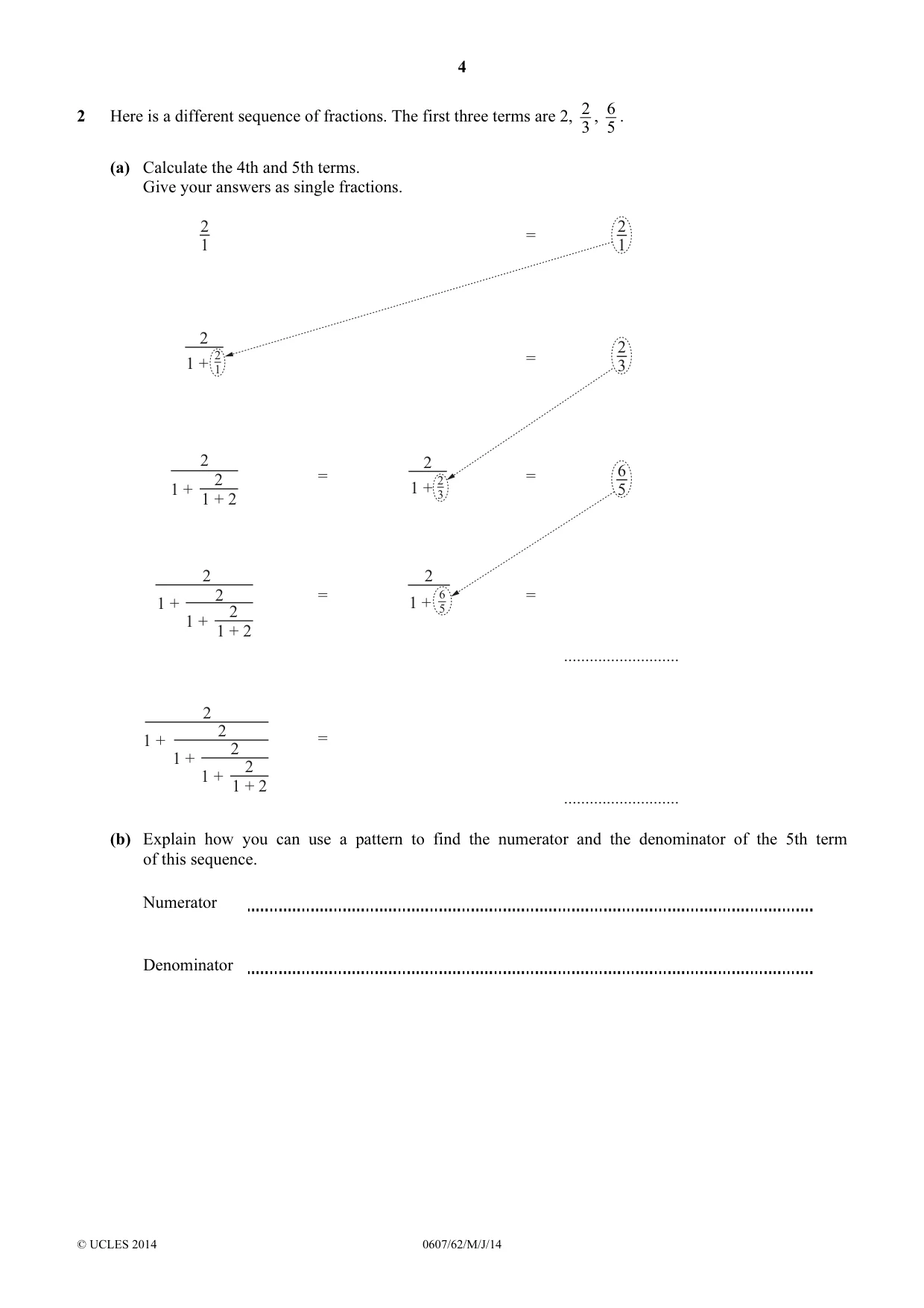
4 © UCLES 2014 0607/62/M/J/14 2 Here is a different sequence of fractions. The first three terms are 2, 3 2 , 5 6 . (a) Calculate the 4th and 5th terms. Give your answers as single fractions. 6 5 2 3 1 + 2 1 + 2 1 + 2 2 1 + 2 1 + 1 + 2 2 2 = = = = 6 5 2 1 1 + 2 1 + 2 = 2 3 2 1 2 1 = … 1 + 2 1 + 1 + 2 2 2 1 + 2 = … (b) Explain how you can use a pattern to find the numerator and the denominator of the 5th term of this sequence. Numerator Denominator
Question paper, page 5
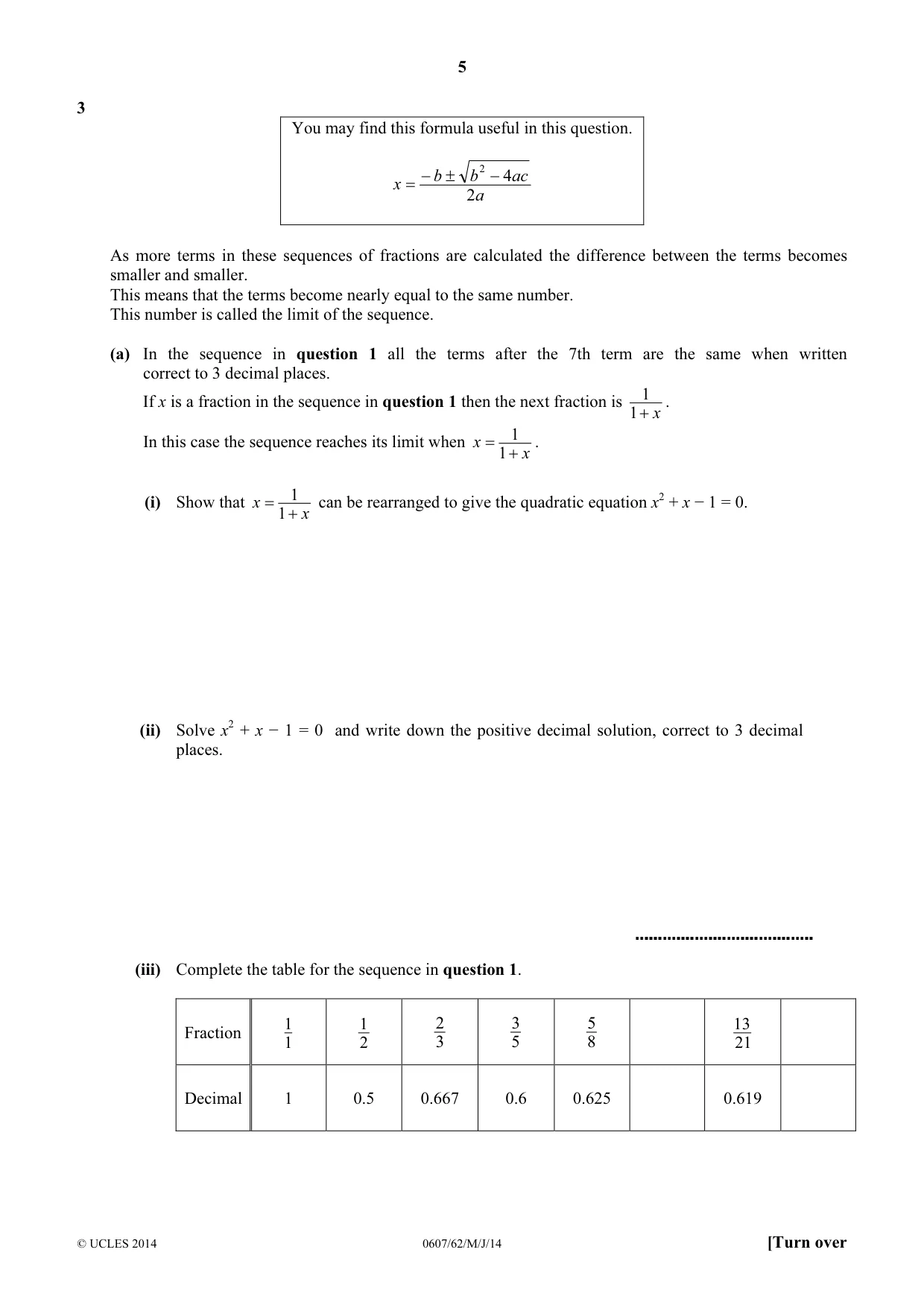
5 © UCLES 2014 0607/62/M/J/14 [Turn over 3 You may find this formula useful in this question. a ac b b x 2 4 2 − ± − = As more terms in these sequences of fractions are calculated the difference between the terms becomes smaller and smaller. This means that the terms become nearly equal to the same number. This number is called the limit of the sequence. (a) In the sequence in question 1 all the terms after the 7th term are the same when written correct to 3 decimal places. If x is a fraction in the sequence in question 1 then the next fraction is x + 1 1 . In this case the sequence reaches its limit when x x + = 1 1 . (i) Show that x x + = 1 1 can be rearranged to give the quadratic equation x2 + x − 1 = 0. (ii) Solve x2 + x − 1 = 0 and write down the positive decimal solution, correct to 3 decimal places. (iii) Complete the table for the sequence in question 1. Fraction 1 1 2 1 3 2 5 3 8 5 21 13 Decimal 1 0.5 0.667 0.6 0.625 0.619
Question paper, page 6
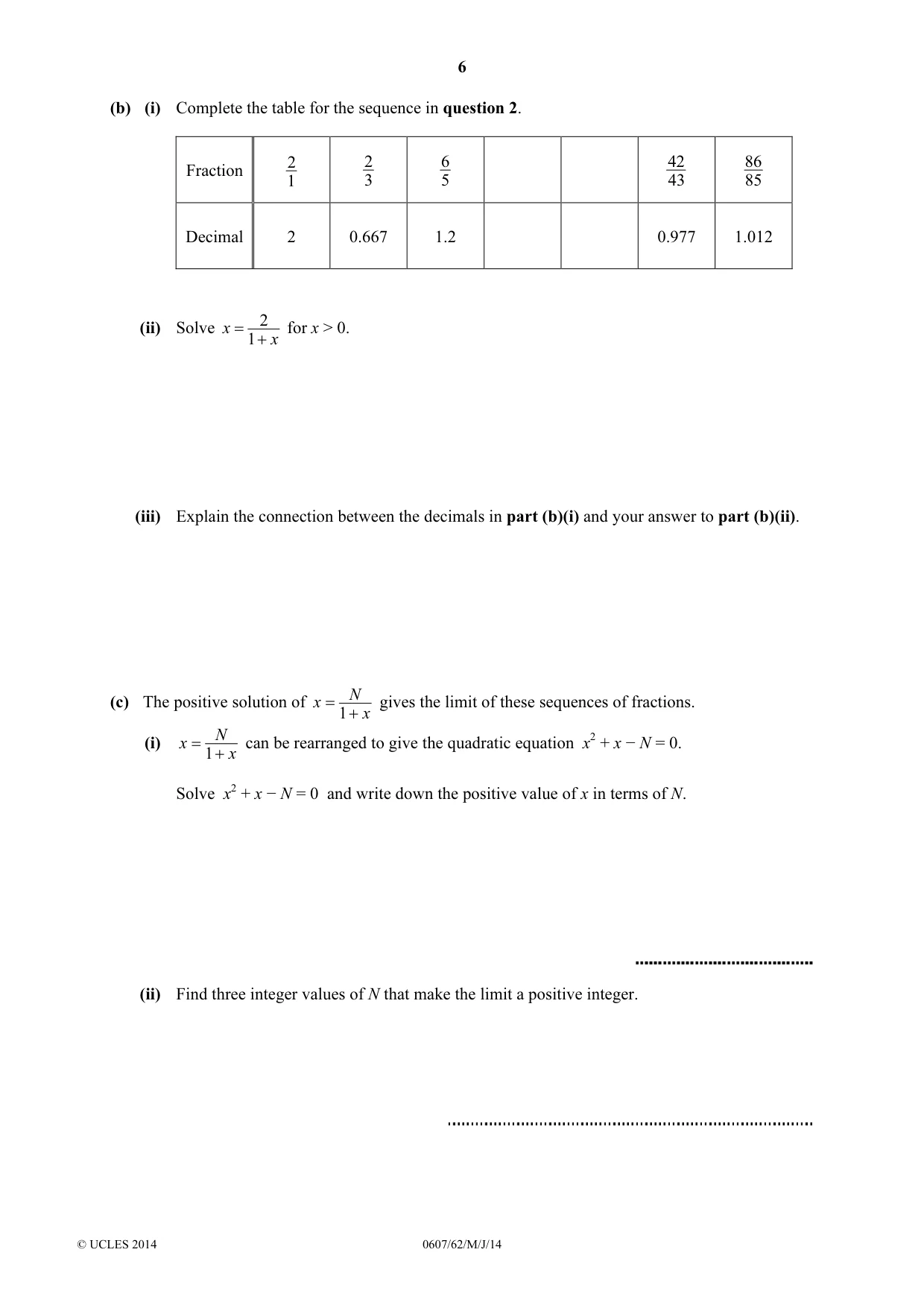
6 © UCLES 2014 0607/62/M/J/14 (b) (i) Complete the table for the sequence in question 2. Fraction 1 2 3 2 5 6 43 42 85 86 Decimal 2 0.667 1.2 0.977 1.012 (ii) Solve x x + = 1 2 for x > 0. (iii) Explain the connection between the decimals in part (b)(i) and your answer to part (b)(ii). (c) The positive solution of x N x + = 1 gives the limit of these sequences of fractions. (i) x N x + = 1 can be rearranged to give the quadratic equation x2 + x − N = 0. Solve x2 + x − N = 0 and write down the positive value of x in terms of N. (ii) Find three integer values of N that make the limit a positive integer.
Question paper, page 7
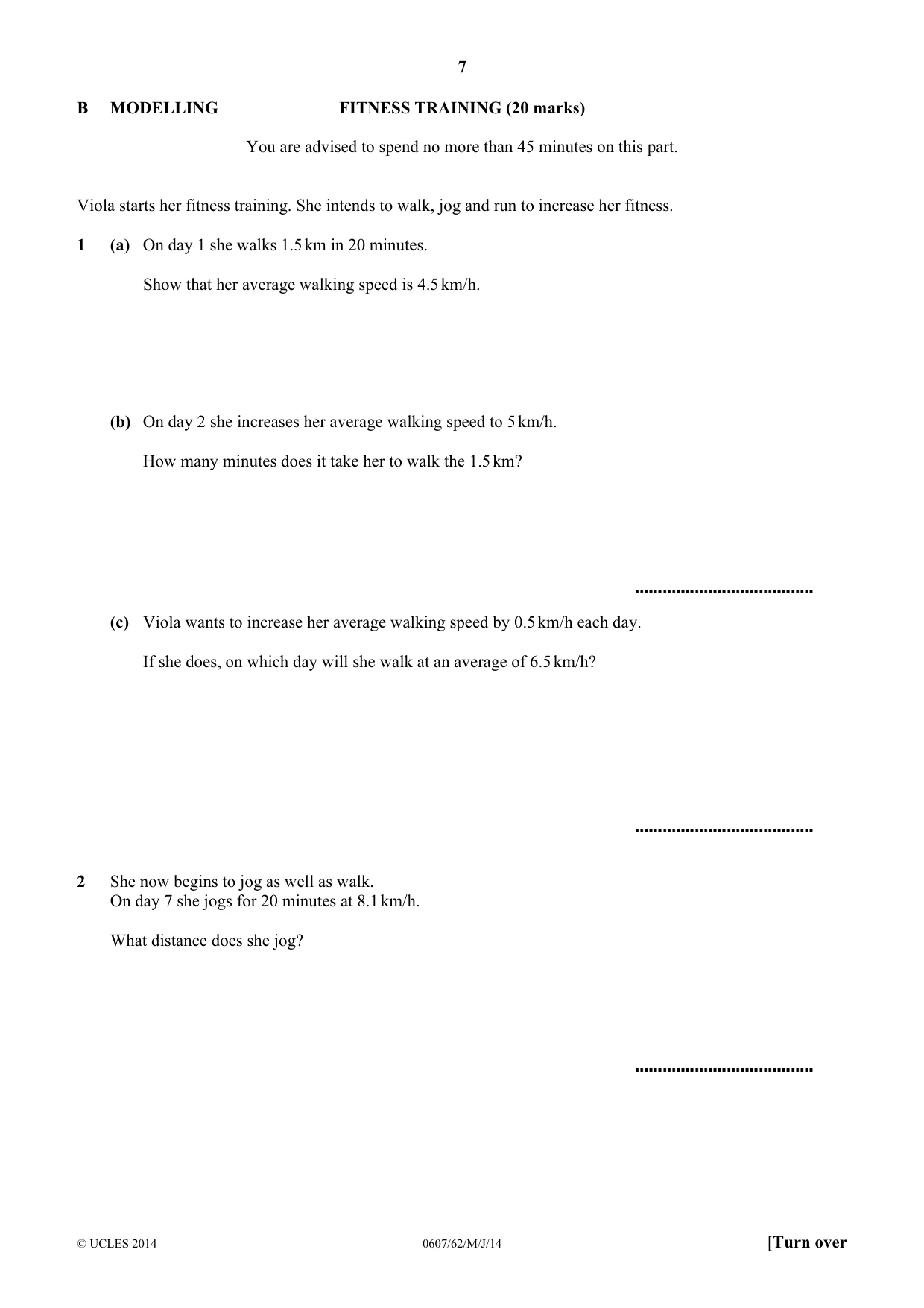
7 © UCLES 2014 0607/62/M/J/14 [Turn over B MODELLING FITNESS TRAINING (20 marks) You are advised to spend no more than 45 minutes on this part. Viola starts her fitness training. She intends to walk, jog and run to increase her fitness. 1 (a) On day 1 she walks 1.5 km in 20 minutes. Show that her average walking speed is 4.5 km/h. (b) On day 2 she increases her average walking speed to 5 km/h. How many minutes does it take her to walk the 1.5 km? (c) Viola wants to increase her average walking speed by 0.5 km/h each day. If she does, on which day will she walk at an average of 6.5 km/h? 2 She now begins to jog as well as walk. On day 7 she jogs for 20 minutes at 8.1 km/h. What distance does she jog?
Question paper, page 8
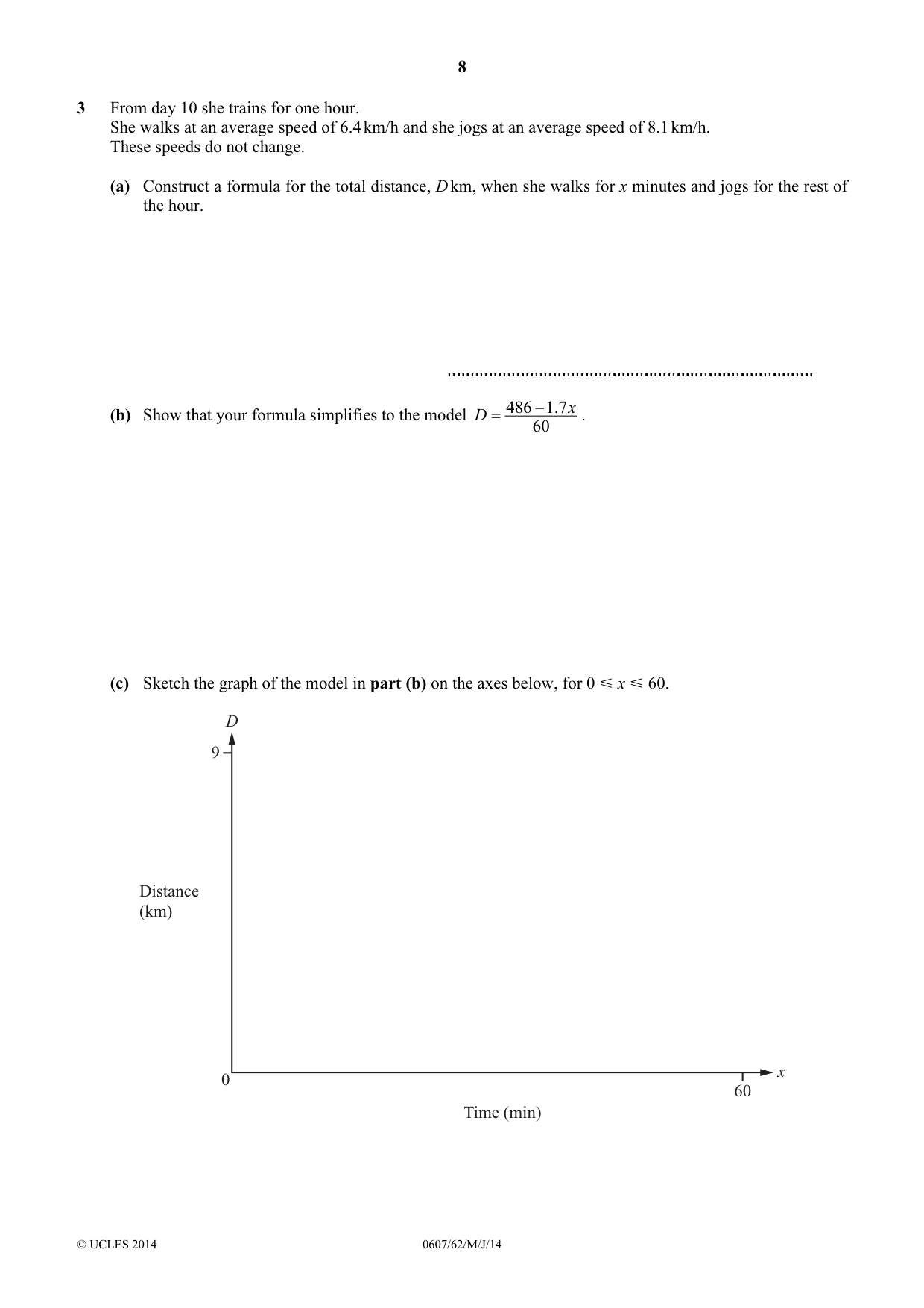
8 © UCLES 2014 0607/62/M/J/14 3 From day 10 she trains for one hour. She walks at an average speed of 6.4 km/h and she jogs at an average speed of 8.1 km/h. These speeds do not change. (a) Construct a formula for the total distance, D km, when she walks for x minutes and jogs for the rest of the hour. (b) Show that your formula simplifies to the model 60 7.1 486 x D − = . (c) Sketch the graph of the model in part (b) on the axes below, for 0 Y x Y 60. 9 0 Distance (km) Time (min) 60 x D
Question paper, page 9
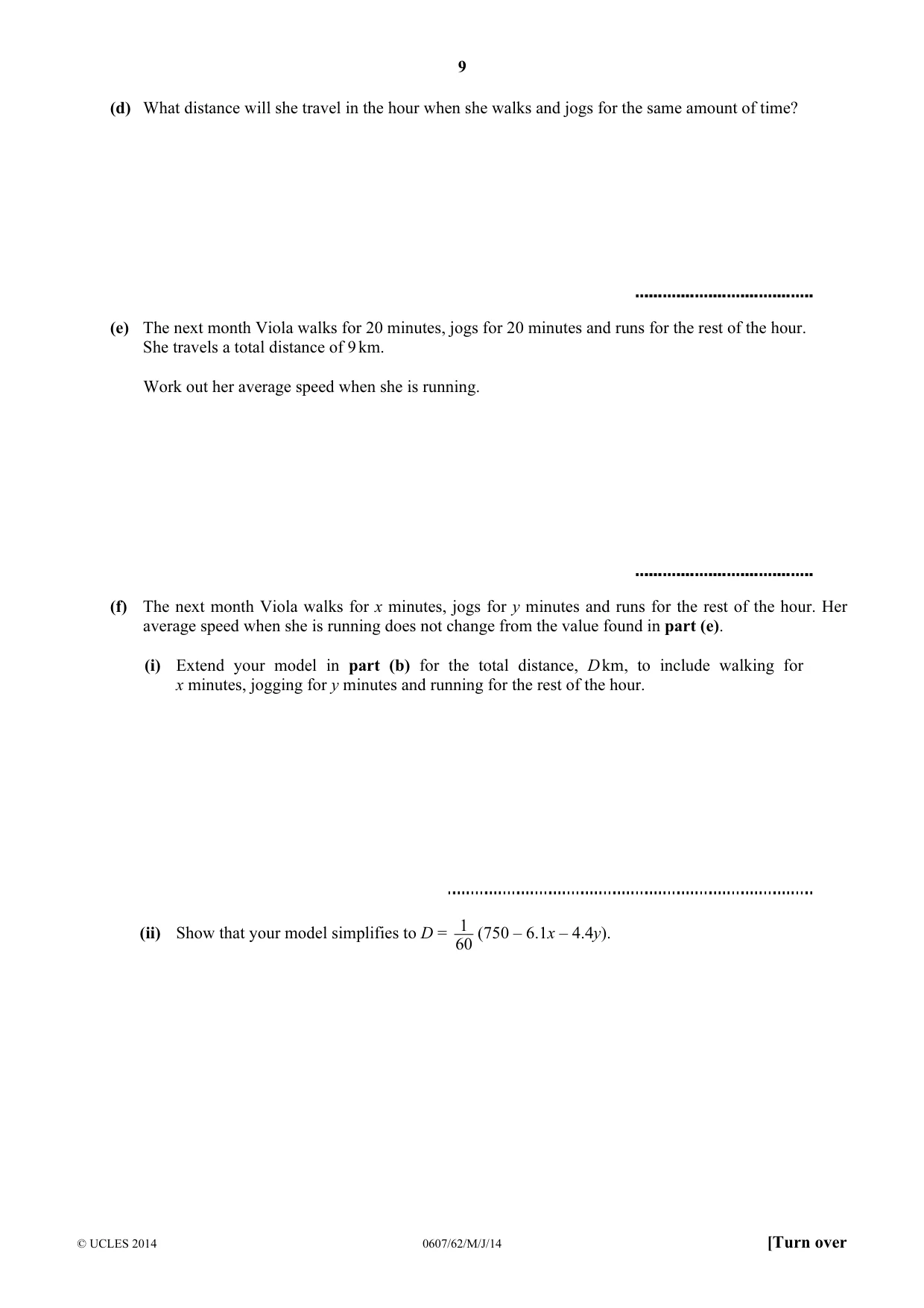
9 © UCLES 2014 0607/62/M/J/14 [Turn over (d) What distance will she travel in the hour when she walks and jogs for the same amount of time? (e) The next month Viola walks for 20 minutes, jogs for 20 minutes and runs for the rest of the hour. She travels a total distance of 9 km. Work out her average speed when she is running. (f) The next month Viola walks for x minutes, jogs for y minutes and runs for the rest of the hour. Her average speed when she is running does not change from the value found in part (e). (i) Extend your model in part (b) for the total distance, D km, to include walking for x minutes, jogging for y minutes and running for the rest of the hour. (ii) Show that your model simplifies to D = 60 1 (750 – 6.1x – 4.4y).
Question paper, page 10
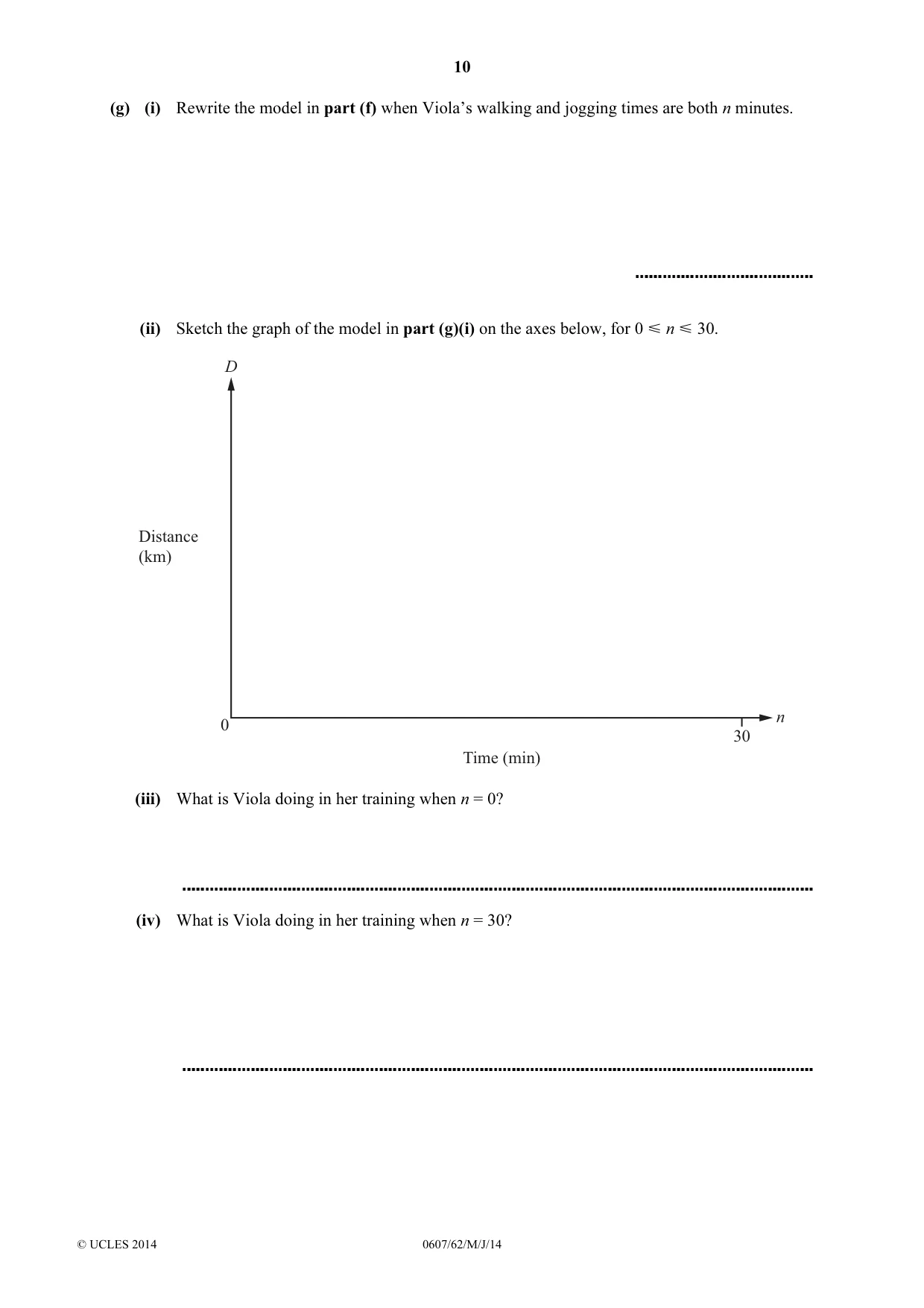
10 © UCLES 2014 0607/62/M/J/14 (g) (i) Rewrite the model in part (f) when Viola’s walking and jogging times are both n minutes. (ii) Sketch the graph of the model in part (g)(i) on the axes below, for 0 Y n Y 30. 0 Distance (km) Time (min) 30 n D (iii) What is Viola doing in her training when n = 0? (iv) What is Viola doing in her training when n = 30?
Question paper, page 11
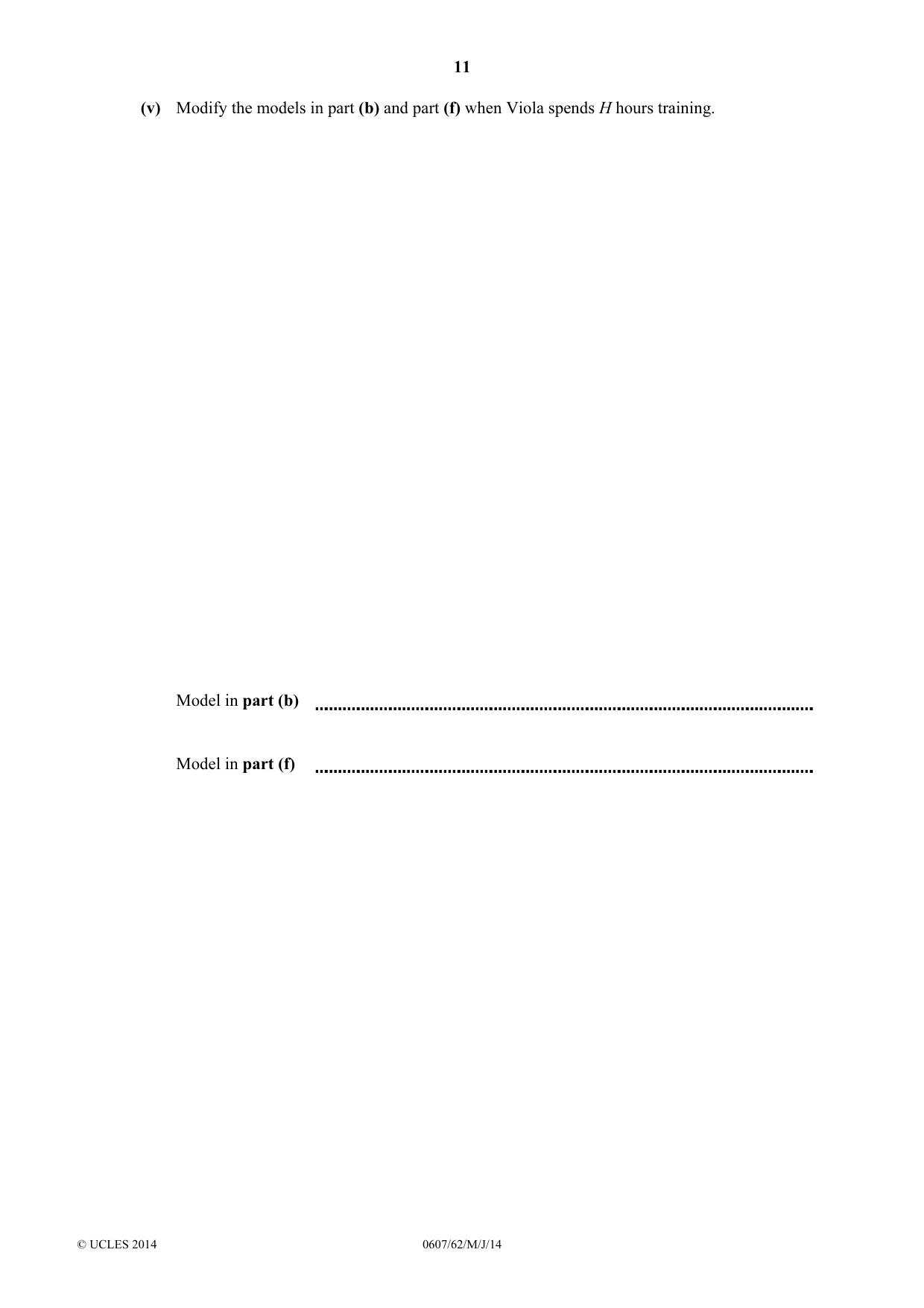
11 © UCLES 2014 0607/62/M/J/14 (v) Modify the models in part (b) and part (f) when Viola spends H hours training. Model in part (b) Model in part (f)
Question paper, page 12
12 Permission to reproduce items where third-party owned material protected by copyright is included has been sought and cleared where possible. Every reasonable effort has been made by the publisher (UCLES) to trace copyright holders, but if any items requiring clearance have unwittingly been included, the publisher will be pleased to make amends at the earliest possible opportunity. Cambridge International Examinations is part of the Cambridge Assessment Group. Cambridge Assessment is the brand name of University of Cambridge Local Examinations Syndicate (UCLES), which is itself a department of the University of Cambridge. © UCLES 2014 0607/62/M/J/14 BLANK PAGE
Mark scheme, page 1
CAMBRIDGE INTERNATIONAL EXAMINATIONS International General Certificate of Secondary Education MARK SCHEME for the May/June 2014 series 0607 CAMBRIDGE INTERNATIONAL MATHEMATICS 0607/62 Paper 6 (Extended), maximum raw mark 40 This mark scheme is published as an aid to teachers and candidates, to indicate the requirements of the examination. It shows the basis on which Examiners were instructed to award marks. It does not indicate the details of the discussions that took place at an Examiners’ meeting before marking began, which would have considered the acceptability of alternative answers. Mark schemes should be read in conjunction with the question paper and the Principal Examiner Report for Teachers. Cambridge will not enter into discussions about these mark schemes. Cambridge is publishing the mark schemes for the May/June 2014 series for most IGCSE, GCE Advanced Level and Advanced Subsidiary Level components and some Ordinary Level components.
Mark scheme, page 2
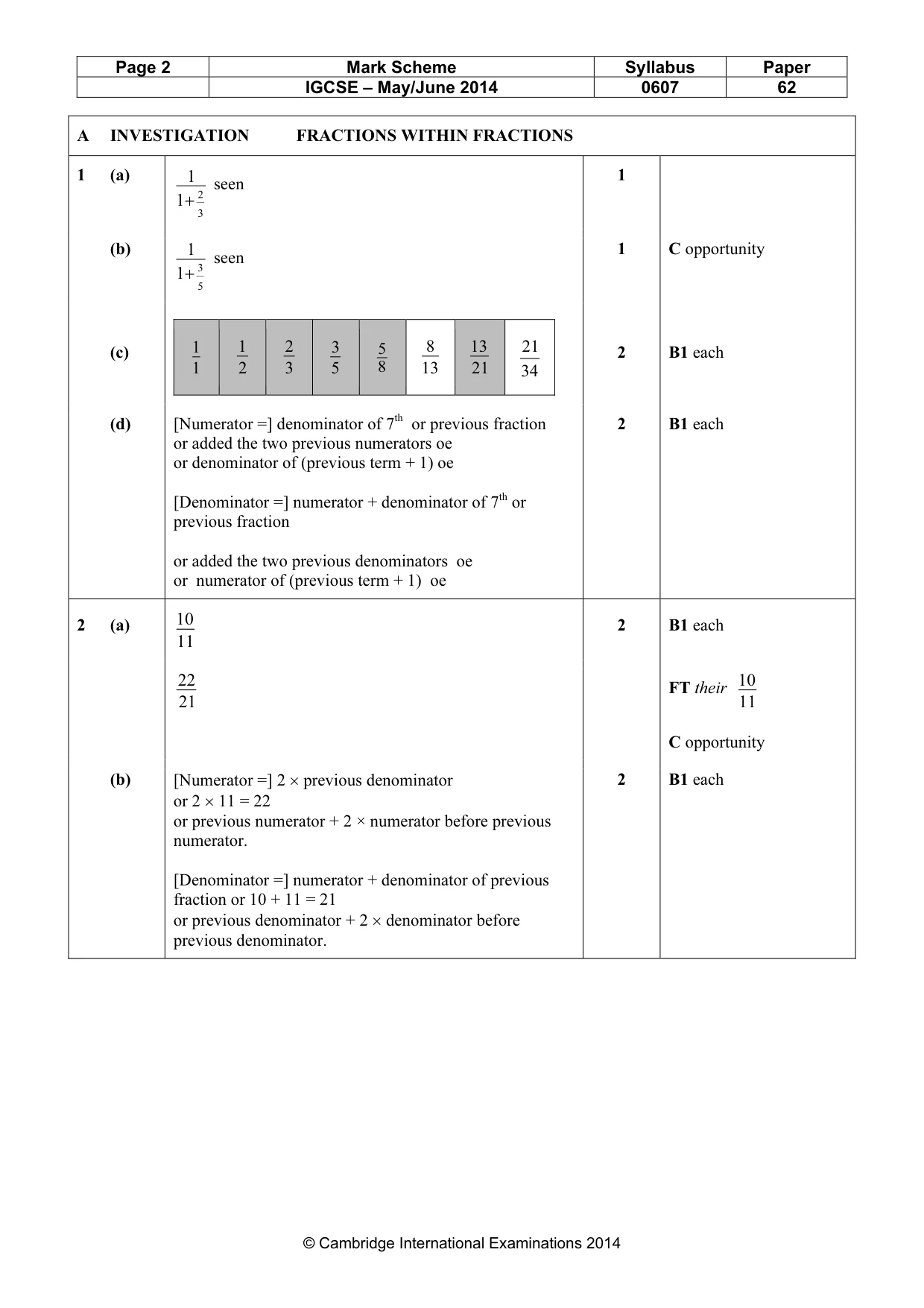
Page 2 Mark Scheme Syllabus Paper IGCSE – May/June 2014 0607 62 © Cambridge International Examinations 2014 A INVESTIGATION FRACTIONS WITHIN FRACTIONS 1 (a) 3 2 1 1 + seen 1 (b) 5 3 1 1 + seen 1 C opportunity (c) 1 1 2 1 3 2 5 3 8 5 13 8 21 13 34 21 2 B1 each (d) [Numerator =] denominator of 7th or previous fraction or added the two previous numerators oe or denominator of (previous term + 1) oe= [Denominator =] numerator + denominator of 7th or previous fraction or added the two previous denominators oe or numerator of (previous term + 1) oe 2 B1 each 2 (a) 11 10 2 B1 each 21 22 FT their 11 10 C opportunity (b) [Numerator =] 2 × previous denominator or 2 × 11 = 22 or previous numerator + 2 × numerator before previous numerator. [Denominator =] numerator + denominator of previous fraction or 10 + 11 = 21 or previous denominator + 2 × denominator before previous denominator. 2 B1 each
Mark scheme, page 3
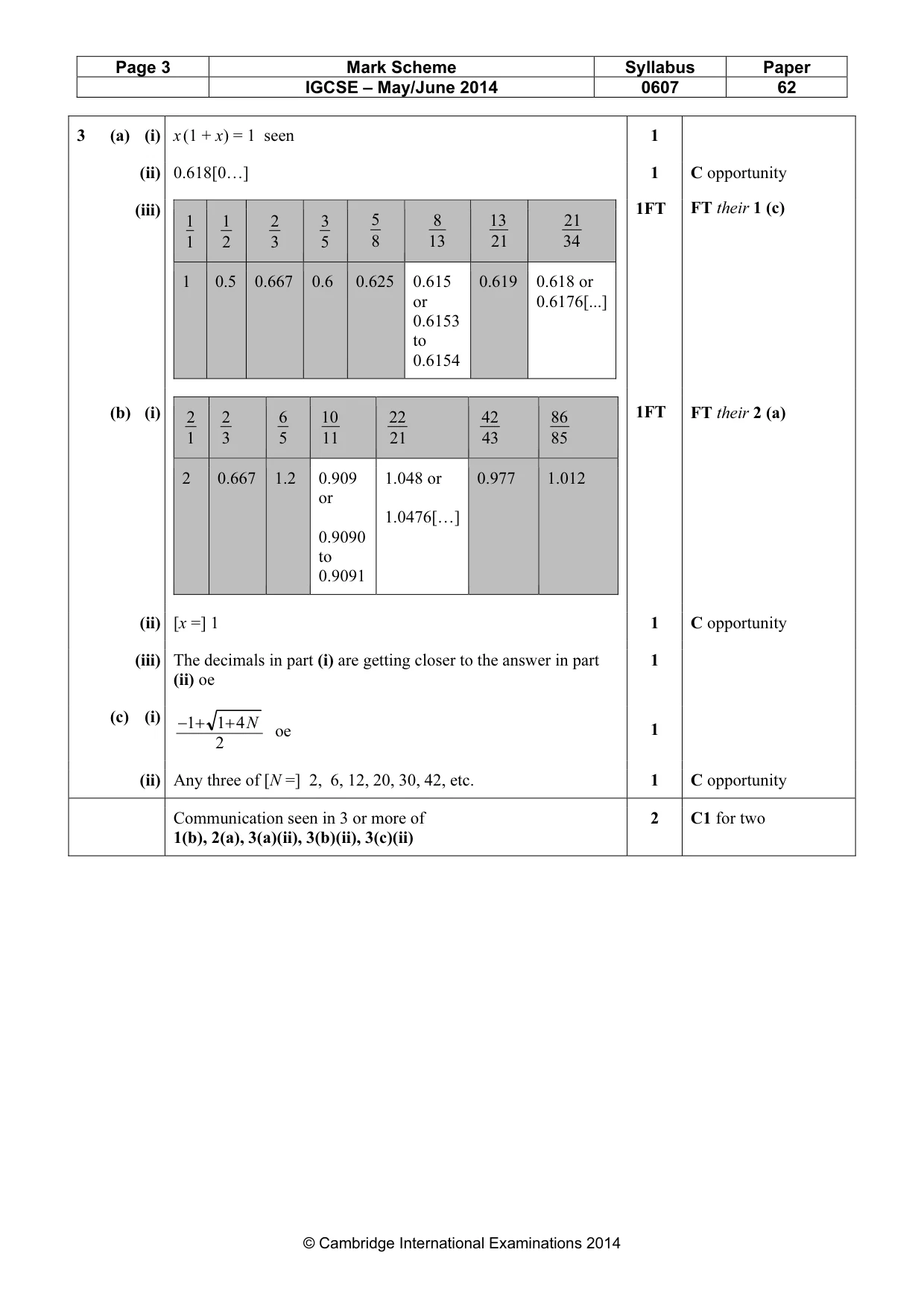
Page 3 Mark Scheme Syllabus Paper IGCSE – May/June 2014 0607 62 © Cambridge International Examinations 2014 3 (a) (i) x (1 + x) = 1 seen 1 (ii) 0.618[0…] 1 C opportunity (iii) 1 1 2 1 3 2 5 3 8 5 13 8 21 13 34 21 1 0.5 0.667 0.6 0.625 0.615 or 0.6153 to 0.6154 0.619 0.618 or 0.6176[...] 1FT FT their 1 (c) (b) (i) 1 2 3 2 5 6 11 10 21 22 43 42 85 86 2 0.667 1.2 0.909 or 0.9090 to 0.9091 1.048 or 1.0476[…] 0.977 1.012 1FT FT their 2 (a) (ii) [x =] 1 1 C opportunity (iii) The decimals in part (i) are getting closer to the answer in part (ii) oe 1 (c) (i) 2 4 1 1 N + + − oe 1 (ii) Any three of [N =] 2, 6, 12, 20, 30, 42, etc. 1 C opportunity Communication seen in 3 or more of 1(b), 2(a), 3(a)(ii), 3(b)(ii), 3(c)(ii) 2 C1 for two
Mark scheme, page 4
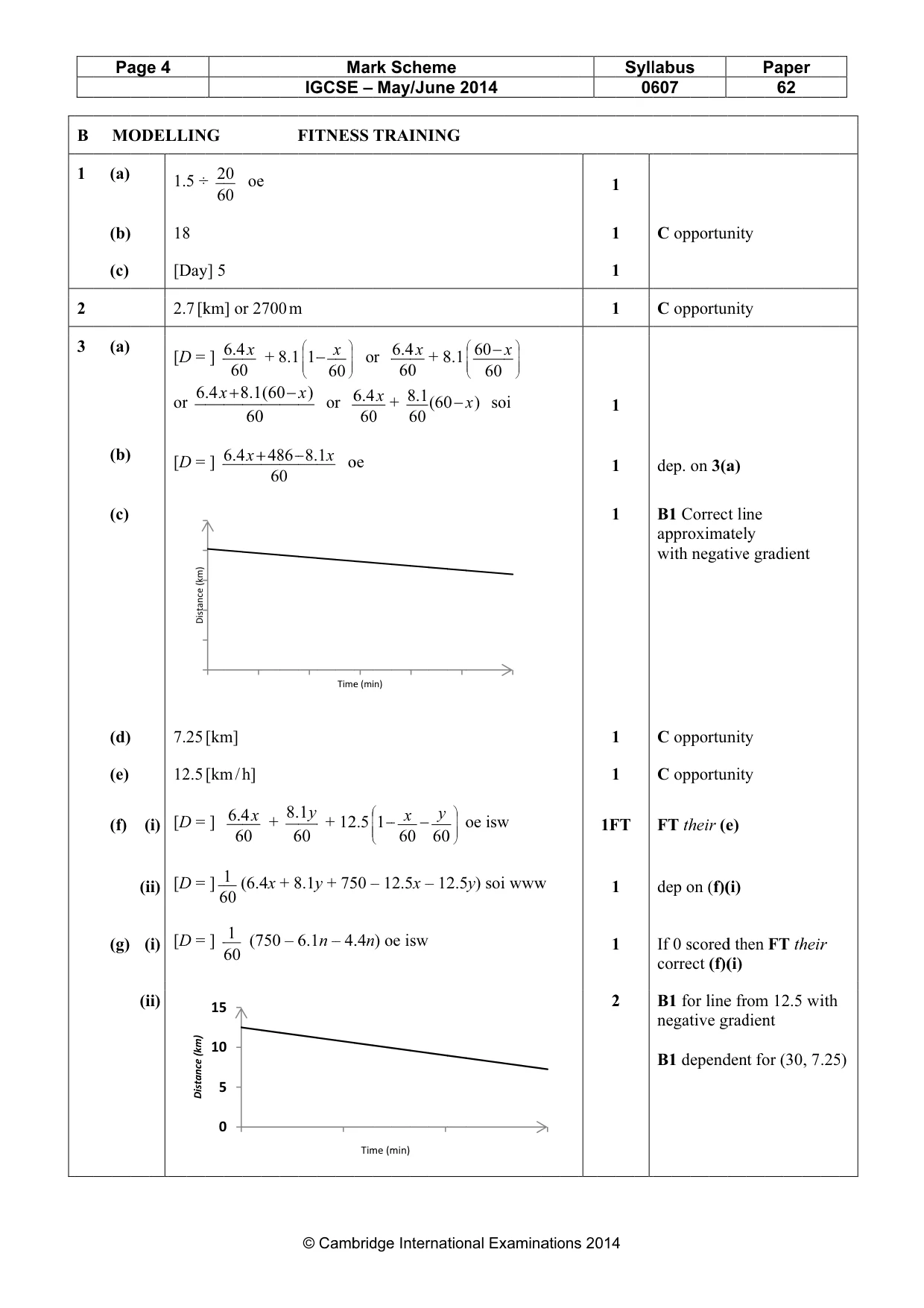
B 1 2 3 ( ( ( ( ( ( ( ( ( ( Pa MO (a) (b) (c) (a) (b) (c) (d) (e) (f) (g) age OD ( (i ( (i e 4 DEL (i) ii) (i) ii) 4 LL 1. 18 [D 2. [D or [D 7.2 12 [D [D [D LIN 5 ÷ 8 Day 7 [k D = r 6 D = 25 2.5 D = D = D = Distance (km) Distance (km) NG ÷ 6 2 y] 5 km ] .4x ] [km [km ] ] 6 ] 0 5 10 15 60 20 5 m] o 60 6.4 8 x+ 6.4 m] m / h 6 6.4 60 1 ( 60 1 0 5 0 5 oe r 2 0 4x 60 8.1 4x+ h] 60 4x (6.4 (7 e 700 + 8 0 (60 6 48 + + 4x 750 F 0 m 8.1 0 x − 0 86− 6 8. + 8 0 – 6 IG © FIT m − 1 ) x 8. − 60 1y 8.1y 6.1 GC Ca TN − 6 x or 1x + y + n – M SE amb NES 60 x r 6 o 12 + 75 – 4. Time Mar E – brid SS o 60 6.4 oe 2.5 50 – .4n e (mi Tim rk S M dge TR or 0 4x + − 1 – 1 n) o in) me (m Sc ay/ e In RAI 60 6.4 + 6 8 − 60 x 2.5 oe is min) che /Ju nter INI 0 4x + 60 8.1 − 0 x 5x – sw eme une rnat ING + 8 (60 60 y – 12 e e 2 tion G 8.1 0 x − 0 o 2.5 201 nal 60 ) x oe 5y) 14 Ex − 60 0 so isw soi xam x oi w i ww mina ww atio w ons 20 014 1 1 1 1 1 1 1 1 1 1F 1 1 2 S 4 1 1 1 1 1 1 1 1 1 FT 1 1 2 Syll 06 lab 607 C C de B1 ap wi C C FT de If co B1 ne B1 bus 7 op op ep. 1 C ppro ith op op T th ep o 0 s orre 1 fo egat 1 d s por por on Corr oxi neg por por hei on ( scor ect or l tive epe rtun rtun 3(a rec ma gat rtun rtun r (e (f)( red (f)( line e g end nity nity a) ct li atel tive nity nity e) (i) d th (i) e fr grad den P y y ne ly e gr y y hen rom dien nt fo Pa 6 rad FT m 12 nt or ( pe 62 dien T th 2.5 (30 er nt heir wi , 7 r ith .25)
Mark scheme, page 5
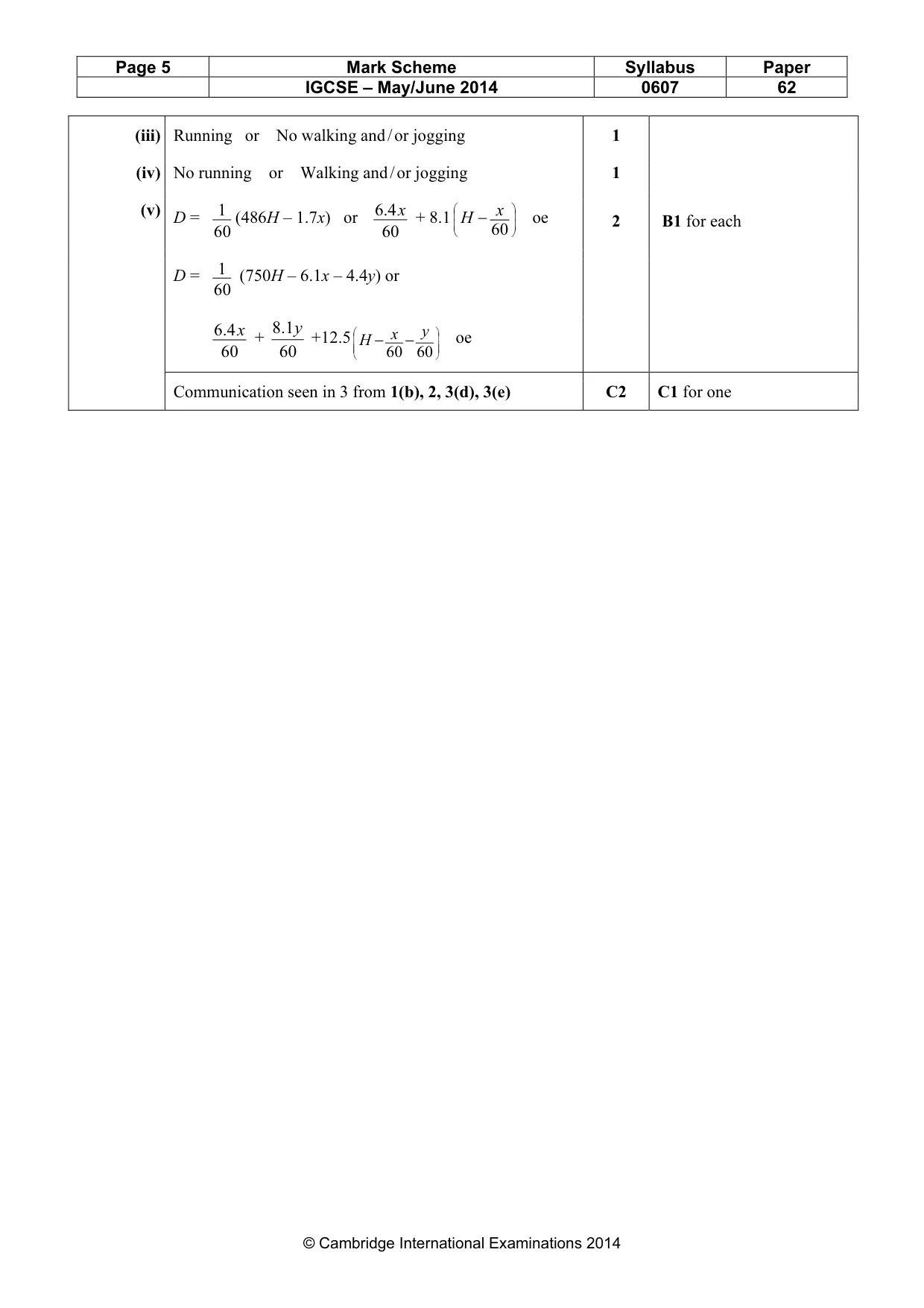
Page 5 Mark Scheme Syllabus Paper IGCSE – May/June 2014 0607 62 © Cambridge International Examinations 2014 (iii) Running or No walking and / or jogging 1 (iv) No running or Walking and / or jogging 1 (v) D = 60 1 (486H – 1.7x) or 60 6.4x + 8.1 −60 x H oe 2 B1 for each D = 60 1 (750H – 6.1x – 4.4y) or 60 6.4x + 60 8.1y +12.5 − − 60 60 y x H oe Communication seen in 3 from 1(b), 2, 3(d), 3(e) C2 C1 for one
What you needed in this session
Cambridge’s own grade thresholds for 2014 May/June, Paper 6 · Variant 2. A higher threshold means an easier paper — the bar moves with how the cohort did.