Cambridge IGCSE Mathematics - International 0607 — 2014 May/June Paper 3 · Variant 3
0607/33/M/J/14 · 96 marks · ≈108 min
The question paper and its mark scheme, free to read here and free to download. This is Cambridge’s own paper, exactly as it was sat.
Question paper16 pages
Mark scheme6 pages
Answers below. Sit the paper first if you are practising.
Paper as text
Question paper, page 1
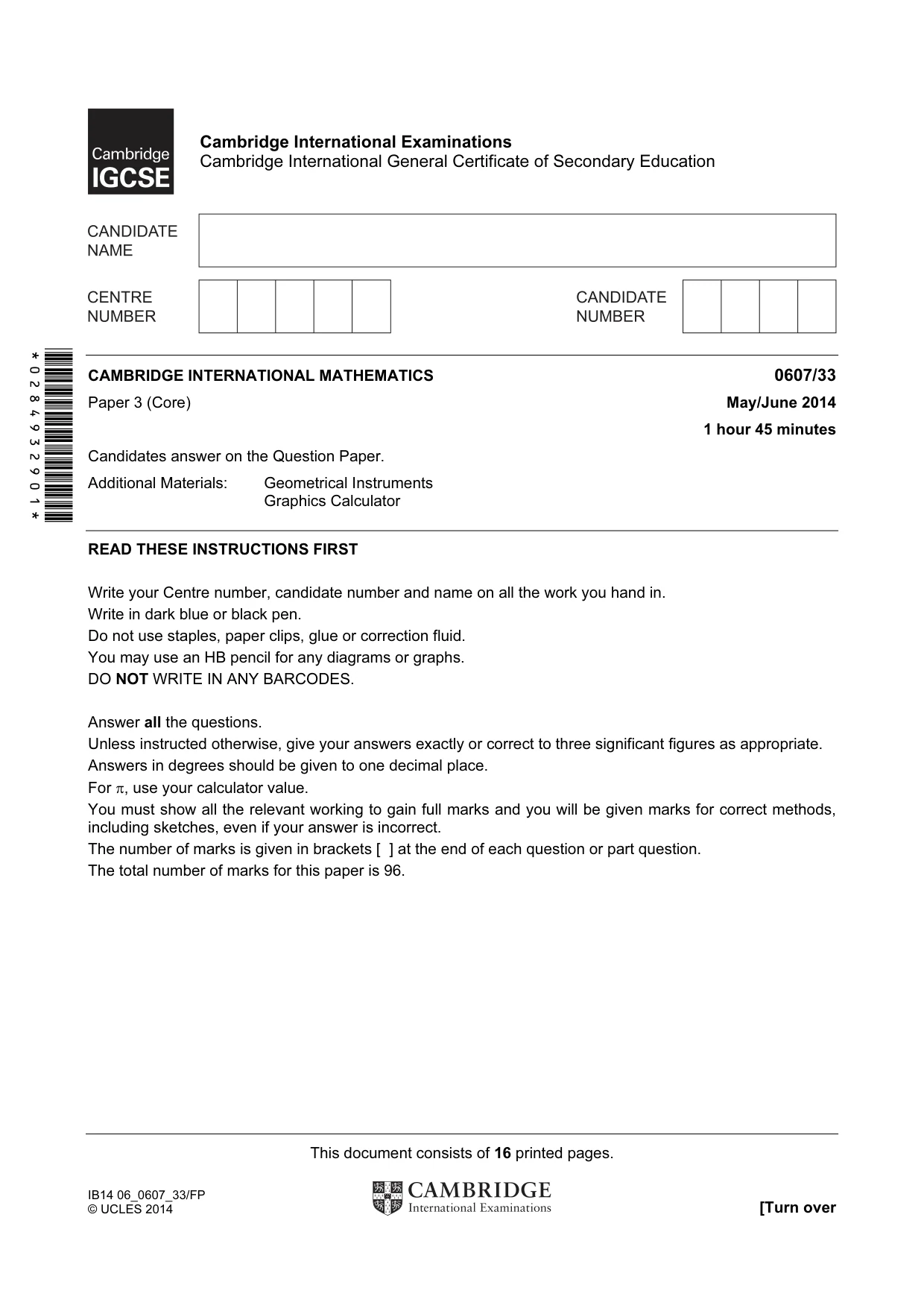
This document consists of 16 printed pages. IB14 06_0607_33/FP © UCLES 2014 [Turn over *0284932901* Cambridge International Examinations Cambridge International General Certificate of Secondary Education CAMBRIDGE INTERNATIONAL MATHEMATICS 0607/33 Paper 3 (Core) May/June 2014 1 hour 45 minutes Candidates answer on the Question Paper. Additional Materials: Geometrical Instruments Graphics Calculator READ THESE INSTRUCTIONS FIRST Write your Centre number, candidate number and name on all the work you hand in. Write in dark blue or black pen. Do not use staples, paper clips, glue or correction fluid. You may use an HB pencil for any diagrams or graphs. DO NOT WRITE IN ANY BARCODES. Answer all the questions. Unless instructed otherwise, give your answers exactly or correct to three significant figures as appropriate. Answers in degrees should be given to one decimal place. For π, use your calculator value. You must show all the relevant working to gain full marks and you will be given marks for correct methods, including sketches, even if your answer is incorrect. The number of marks is given in brackets [ ] at the end of each question or part question. The total number of marks for this paper is 96.
Question paper, page 2
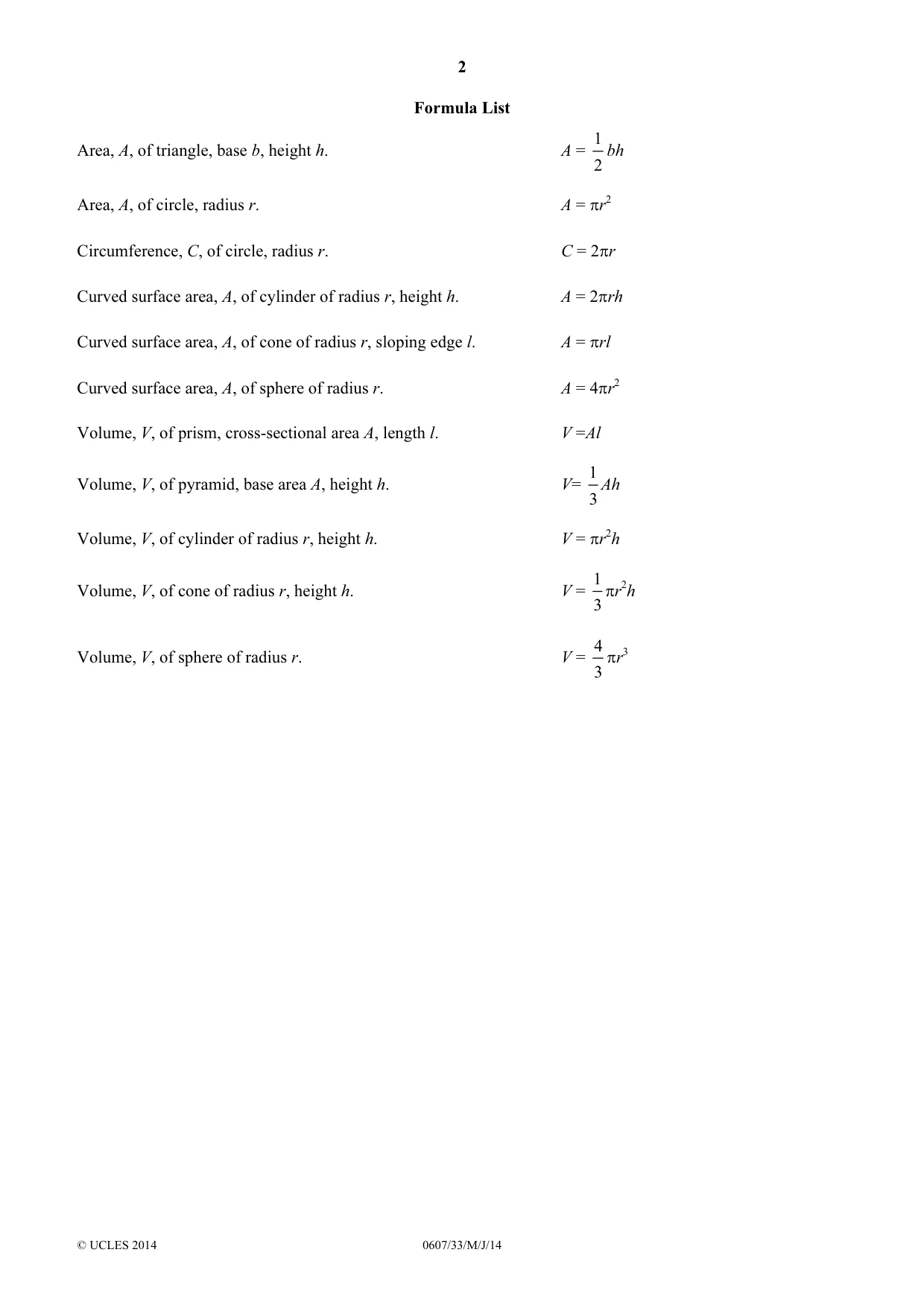
2 © UCLES 2014 0607/33/M/J/14 Formula List Area, A, of triangle, base b, height h. A = 1 2 bh Area, A, of circle, radius r. A = πr2 Circumference, C, of circle, radius r. C = 2πr Curved surface area, A, of cylinder of radius r, height h. A = 2πrh Curved surface area, A, of cone of radius r, sloping edge l. A = πrl Curved surface area, A, of sphere of radius r. A = 4πr2 Volume, V, of prism, cross-sectional area A, length l. V =Al Volume, V, of pyramid, base area A, height h. V= 1 3 Ah Volume, V, of cylinder of radius r, height h. V = πr2h Volume, V, of cone of radius r, height h. V = 1 3 πr2h Volume, V, of sphere of radius r. V = 4 3 πr3
Question paper, page 3
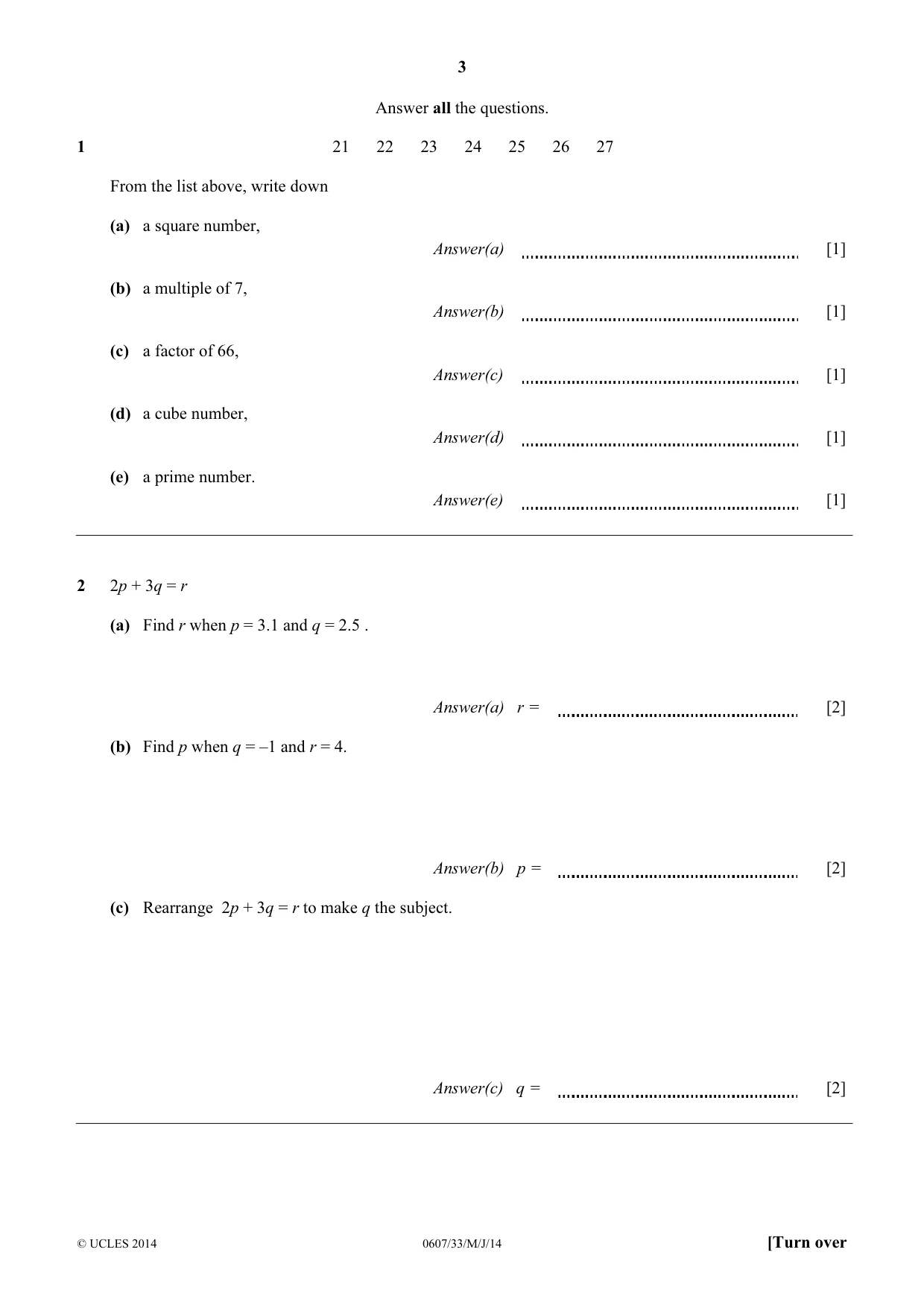
3 © UCLES 2014 0607/33/M/J/14 [Turn over Answer all the questions. 1 21 22 23 24 25 26 27 From the list above, write down (a) a square number, Answer(a) [1] (b) a multiple of 7, Answer(b) [1] (c) a factor of 66, Answer(c) [1] (d) a cube number, Answer(d) [1] (e) a prime number. Answer(e) [1] 2 2p + 3q = r (a) Find r when p = 3.1 and q = 2.5 . Answer(a) r = [2] (b) Find p when q = –1 and r = 4. Answer(b) p = [2] (c) Rearrange 2p + 3q = r to make q the subject. Answer(c) q = [2]
Question paper, page 4
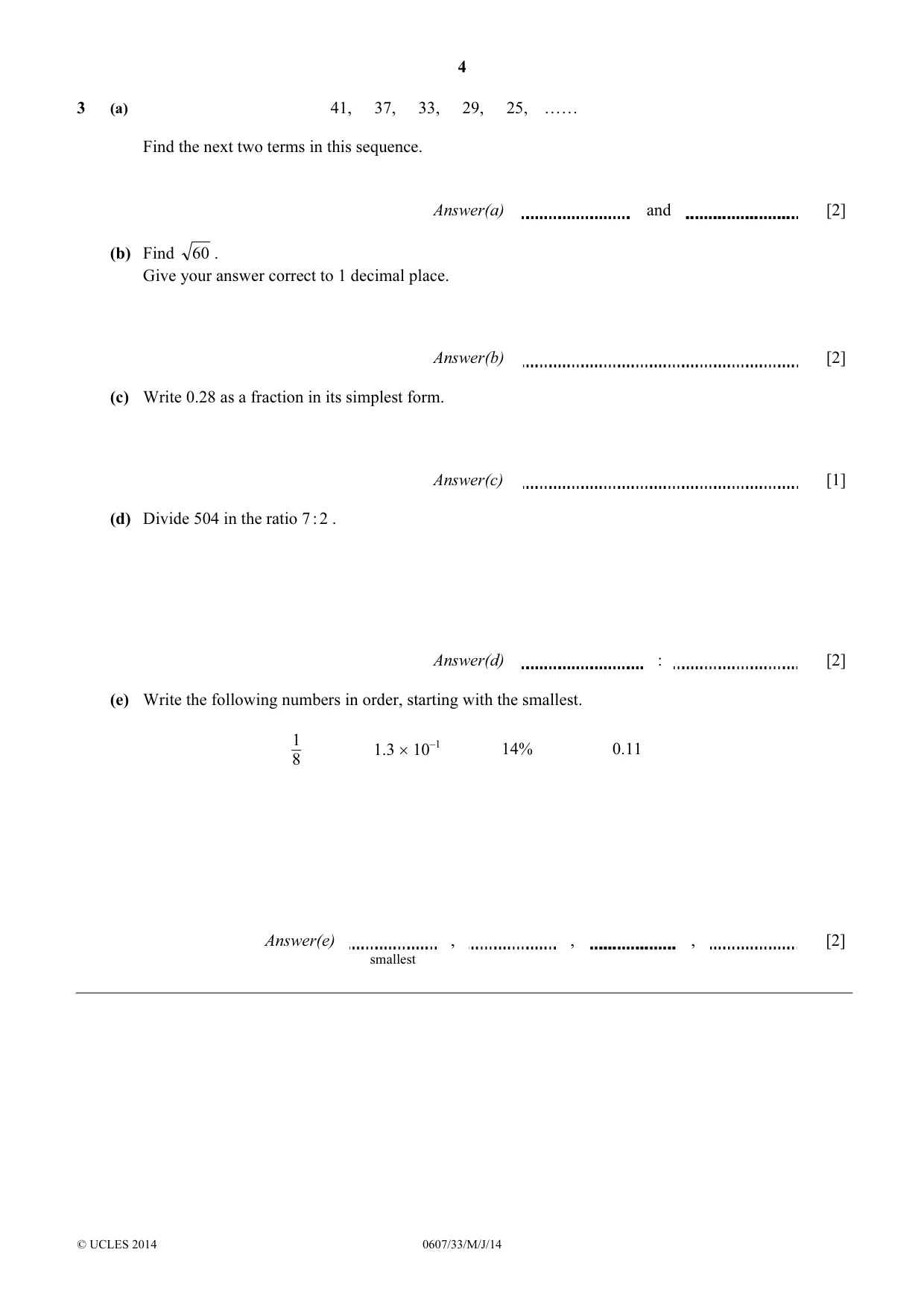
4 © UCLES 2014 0607/33/M/J/14 3 (a) 41, 37, 33, 29, 25, …… Find the next two terms in this sequence. Answer(a) and [2] (b) Find 60 . Give your answer correct to 1 decimal place. Answer(b) [2] (c) Write 0.28 as a fraction in its simplest form. Answer(c) [1] (d) Divide 504 in the ratio 7 : 2 . Answer(d) : [2] (e) Write the following numbers in order, starting with the smallest. 8 1 1.3 × 10⁻¹ 14% 0.11 Answer(e) , , , [2] smallest
Question paper, page 5
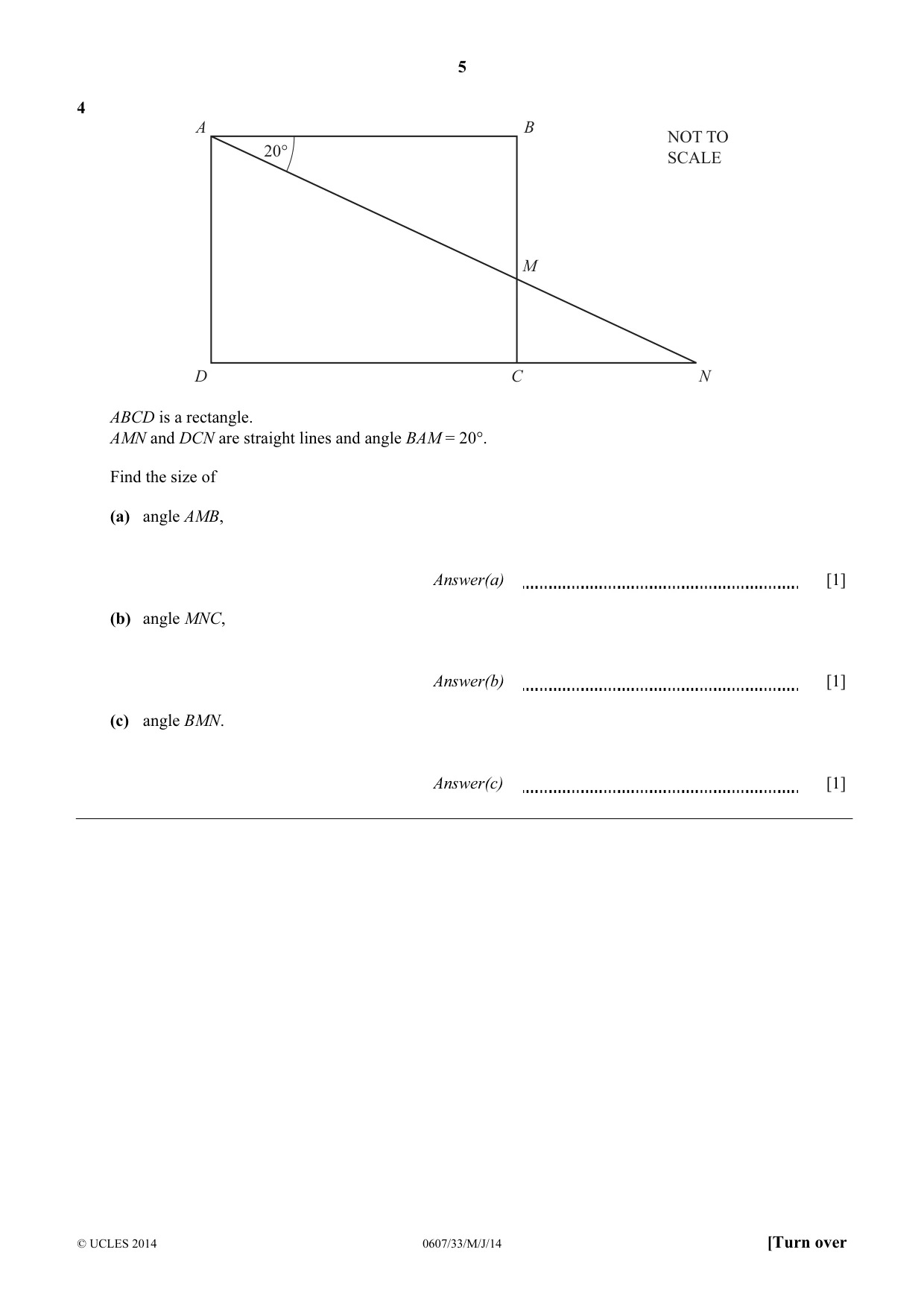
5 © UCLES 2014 0607/33/M/J/14 [Turn over 4 A D C N B M 20° NOT TO SCALE ABCD is a rectangle. AMN and DCN are straight lines and angle BAM = 20°. Find the size of (a) angle AMB, Answer(a) [1] (b) angle MNC, Answer(b) [1] (c) angle BMN. Answer(c) [1]
Question paper, page 6
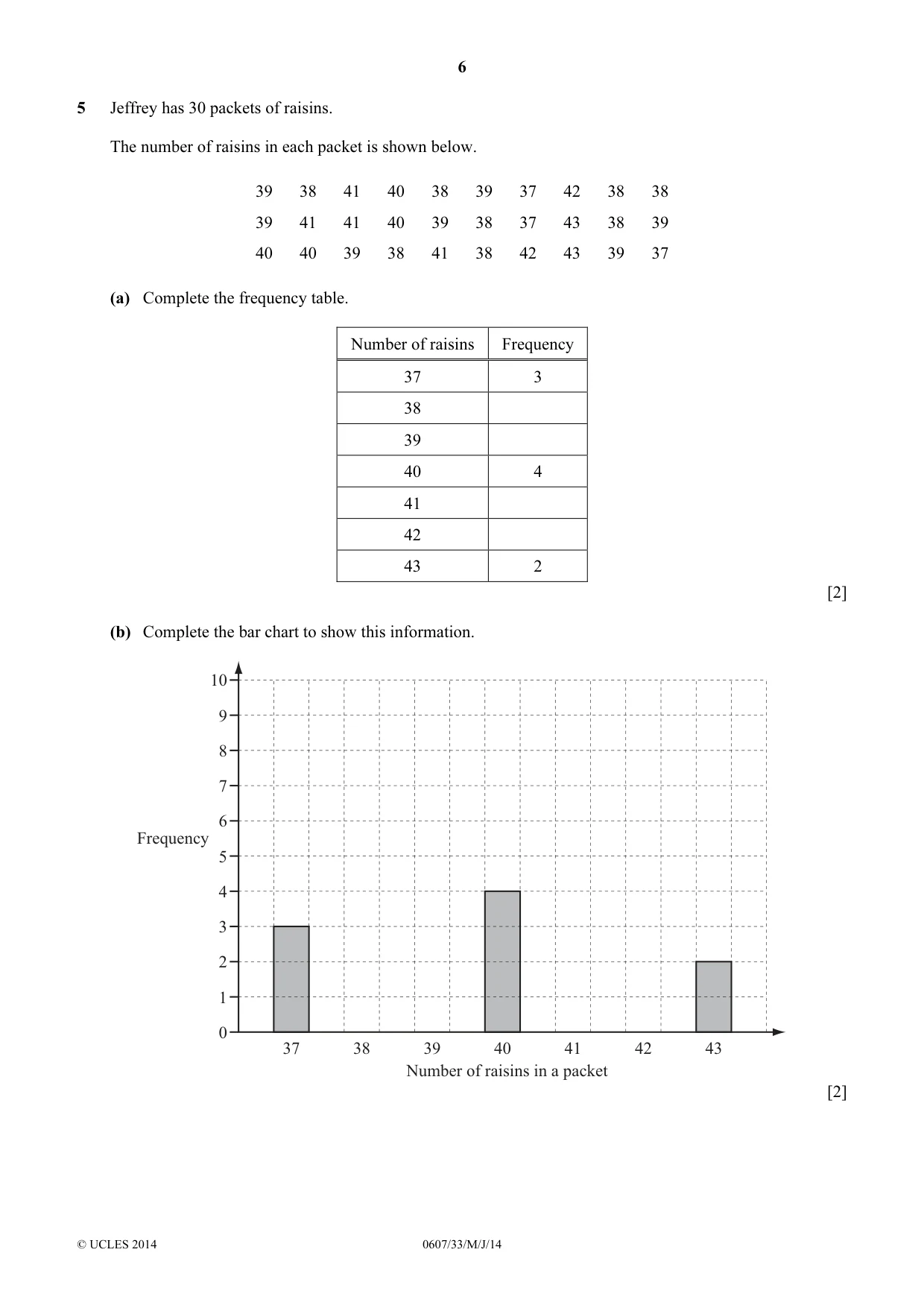
6 © UCLES 2014 0607/33/M/J/14 5 Jeffrey has 30 packets of raisins. The number of raisins in each packet is shown below. 39 38 41 40 38 39 37 42 38 38 39 41 41 40 39 38 37 43 38 39 40 40 39 38 41 38 42 43 39 37 (a) Complete the frequency table. Number of raisins Frequency 37 3 38 39 40 4 41 42 43 2 [2] (b) Complete the bar chart to show this information. 10 9 8 7 6 5 4 3 2 1 0 Frequency Number of raisins in a packet 37 38 39 40 41 42 43 [2]
Question paper, page 7
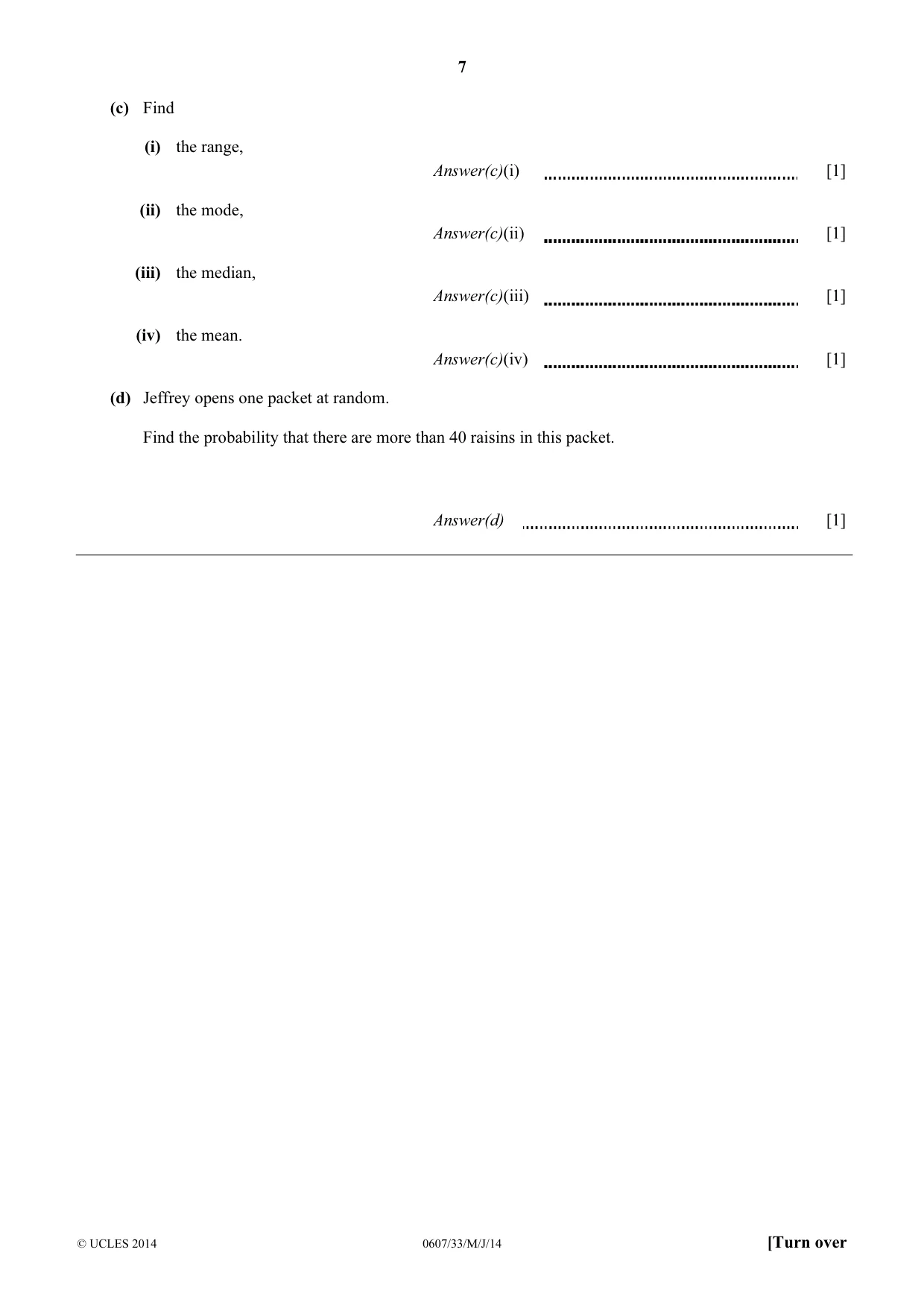
7 © UCLES 2014 0607/33/M/J/14 [Turn over (c) Find (i) the range, Answer(c)(i) [1] (ii) the mode, Answer(c)(ii) [1] (iii) the median, Answer(c)(iii) [1] (iv) the mean. Answer(c)(iv) [1] (d) Jeffrey opens one packet at random. Find the probability that there are more than 40 raisins in this packet. Answer(d) [1]
Question paper, page 8
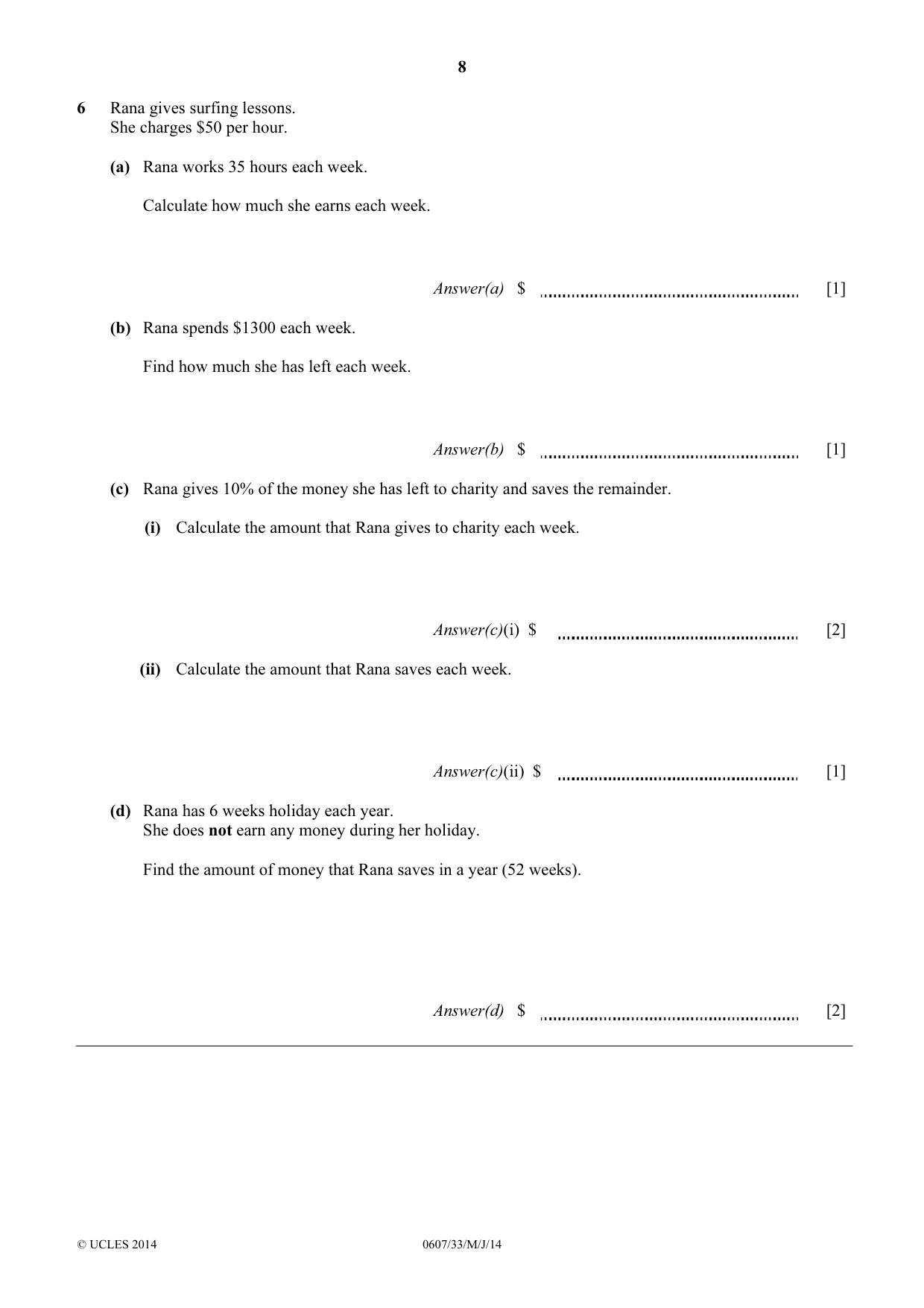
8 © UCLES 2014 0607/33/M/J/14 6 Rana gives surfing lessons. She charges $50 per hour. (a) Rana works 35 hours each week. Calculate how much she earns each week. Answer(a) $ [1] (b) Rana spends $1300 each week. Find how much she has left each week. Answer(b) $ [1] (c) Rana gives 10% of the money she has left to charity and saves the remainder. (i) Calculate the amount that Rana gives to charity each week. Answer(c)(i) $ [2] (ii) Calculate the amount that Rana saves each week. Answer(c)(ii) $ [1] (d) Rana has 6 weeks holiday each year. She does not earn any money during her holiday. Find the amount of money that Rana saves in a year (52 weeks). Answer(d) $ [2]
Question paper, page 9
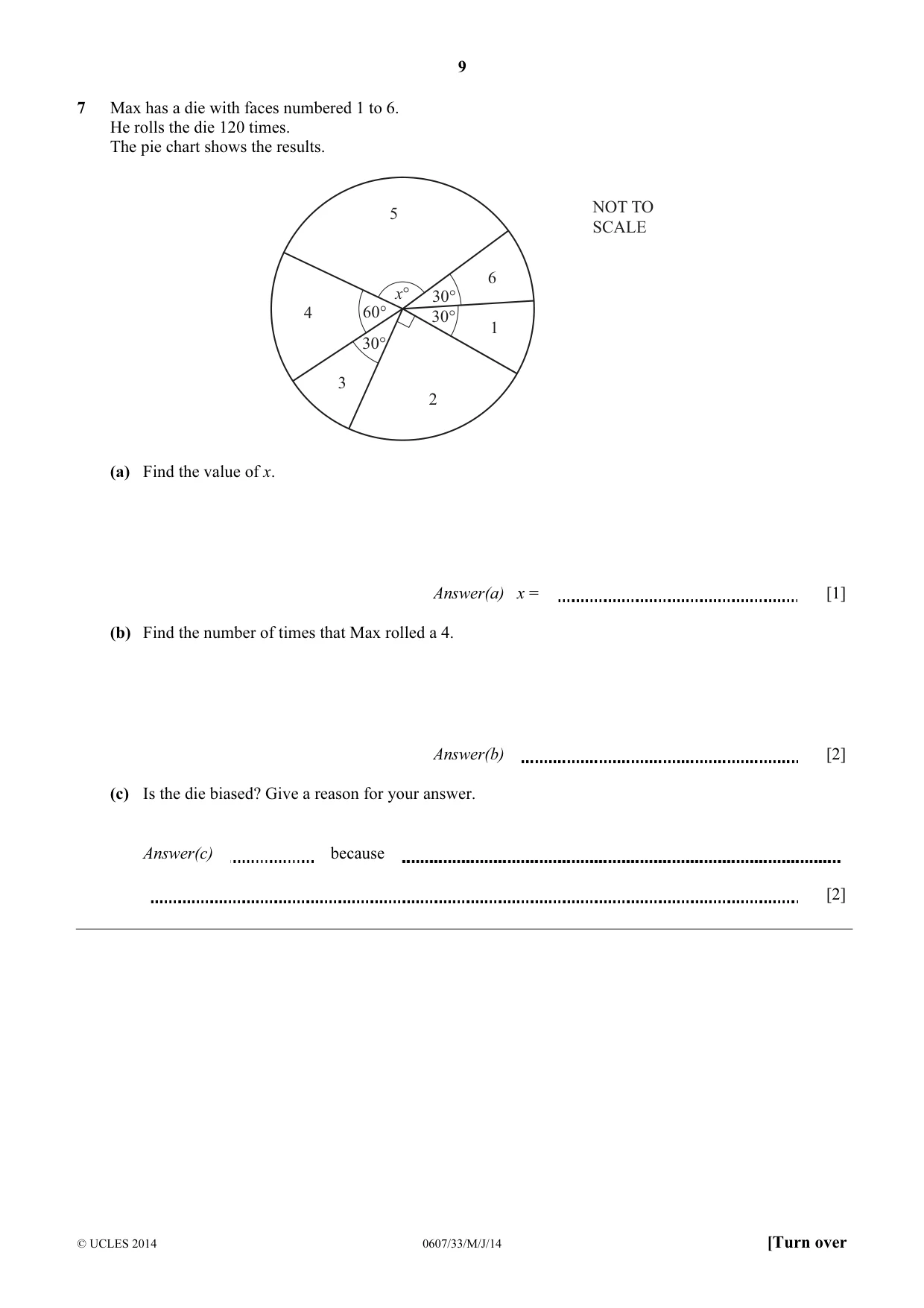
9 © UCLES 2014 0607/33/M/J/14 [Turn over 7 Max has a die with faces numbered 1 to 6. He rolls the die 120 times. The pie chart shows the results. 5 6 1 2 3 4 x° 30° 30° 30° 60° NOT TO SCALE (a) Find the value of x. Answer(a) x = [1] (b) Find the number of times that Max rolled a 4. Answer(b) [2] (c) Is the die biased? Give a reason for your answer. Answer(c) because [2]
Question paper, page 10
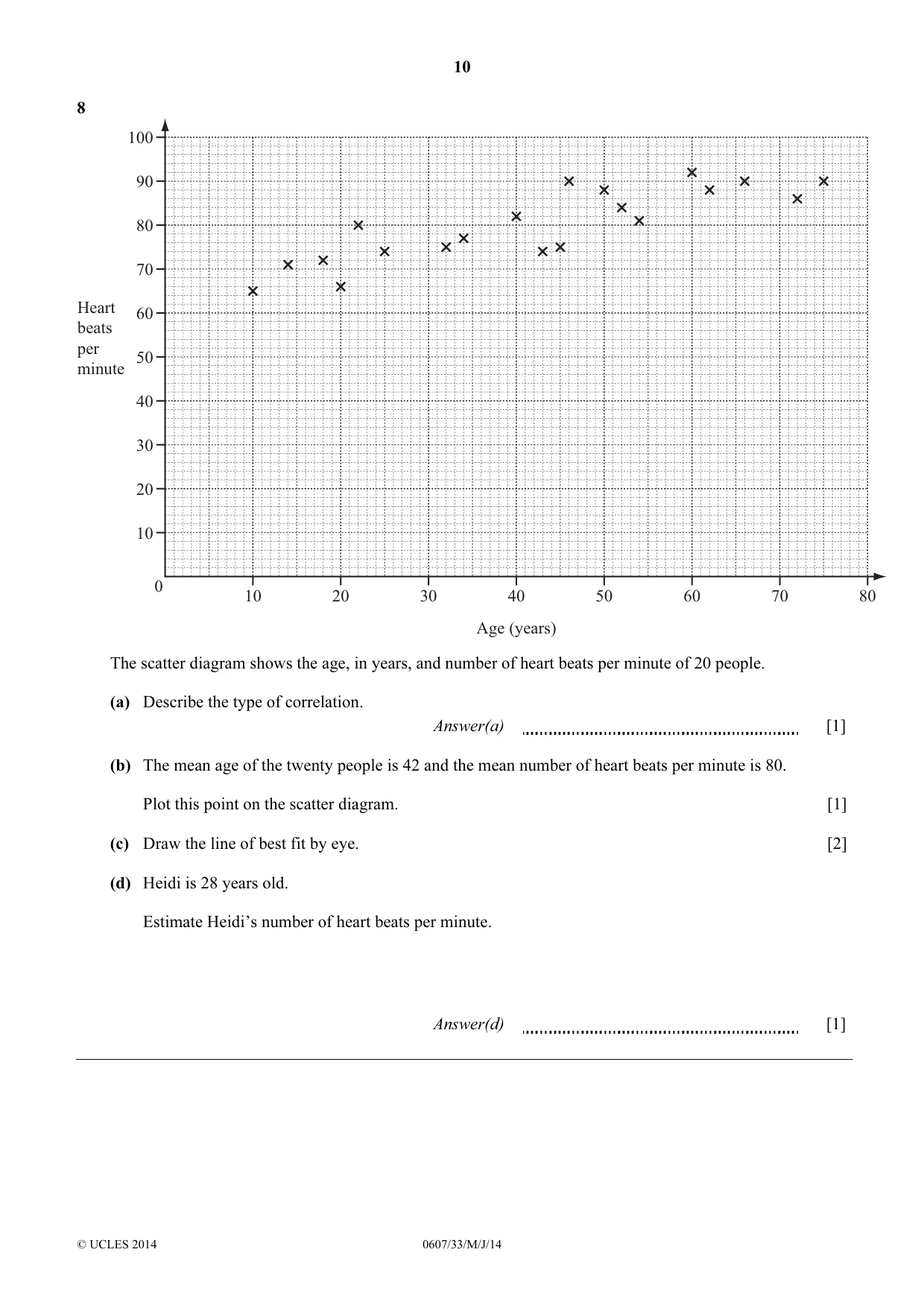
10 © UCLES 2014 0607/33/M/J/14 8 The scatter diagram shows the age, in years, and number of heart beats per minute of 20 people. (a) Describe the type of correlation. Answer(a) [1] (b) The mean age of the twenty people is 42 and the mean number of heart beats per minute is 80. Plot this point on the scatter diagram. [1] (c) Draw the line of best fit by eye. [2] (d) Heidi is 28 years old. Estimate Heidi’s number of heart beats per minute. Answer(d) [1] 100 90 80 70 60 50 40 30 20 10 10 20 30 40 Age (years) 50 60 70 80 0 Heart beats per minute
Question paper, page 11
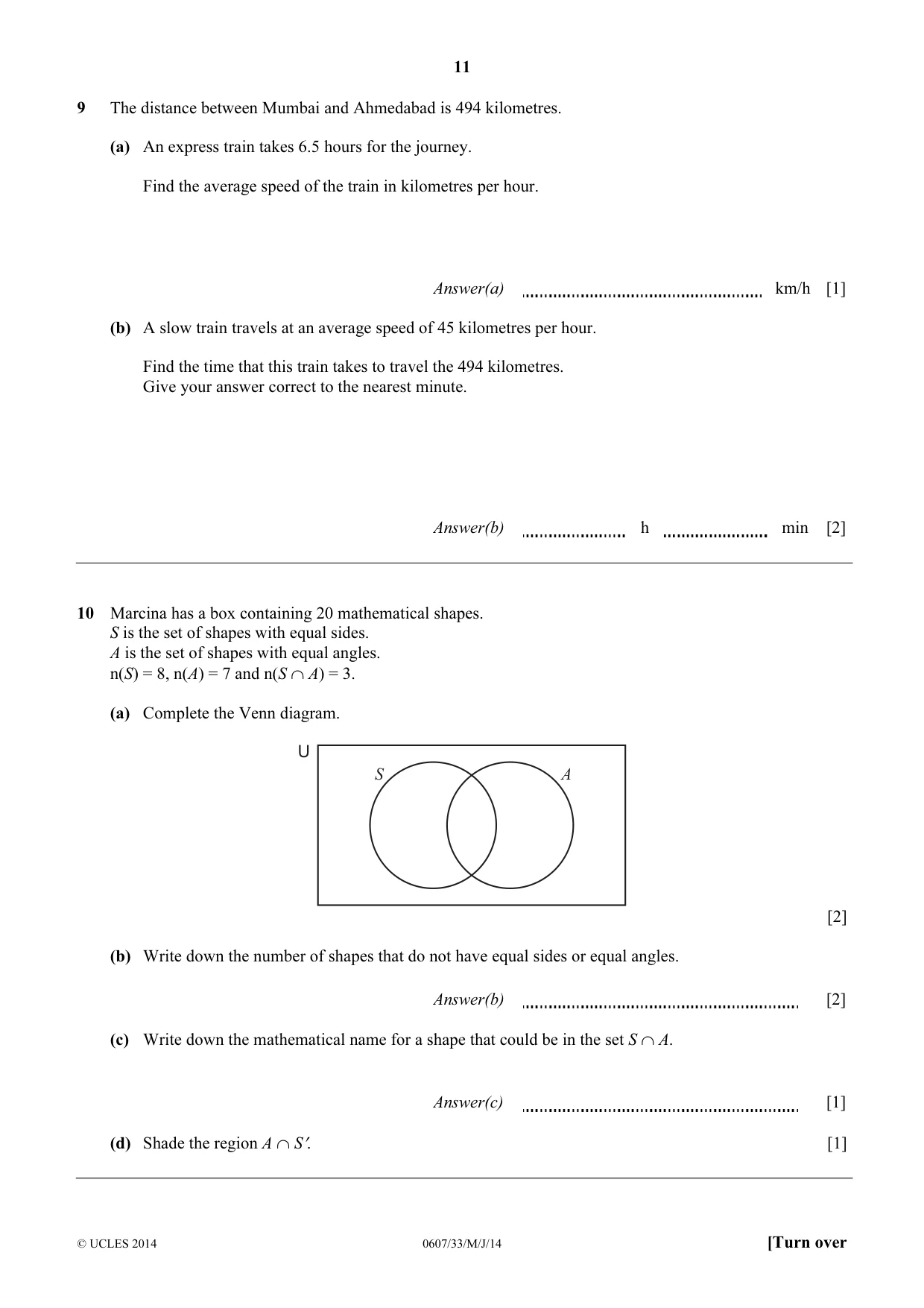
11 © UCLES 2014 0607/33/M/J/14 [Turn over 9 The distance between Mumbai and Ahmedabad is 494 kilometres. (a) An express train takes 6.5 hours for the journey. Find the average speed of the train in kilometres per hour. Answer(a) km/h [1] (b) A slow train travels at an average speed of 45 kilometres per hour. Find the time that this train takes to travel the 494 kilometres. Give your answer correct to the nearest minute. Answer(b) h min [2] 10 Marcina has a box containing 20 mathematical shapes. S is the set of shapes with equal sides. A is the set of shapes with equal angles. n(S) = 8, n(A) = 7 and n(S ∩ A) = 3. (a) Complete the Venn diagram. U S A [2] (b) Write down the number of shapes that do not have equal sides or equal angles. Answer(b) [2] (c) Write down the mathematical name for a shape that could be in the set S ∩ A. Answer(c) [1] (d) Shade the region A ∩ S′. [1]
Question paper, page 12
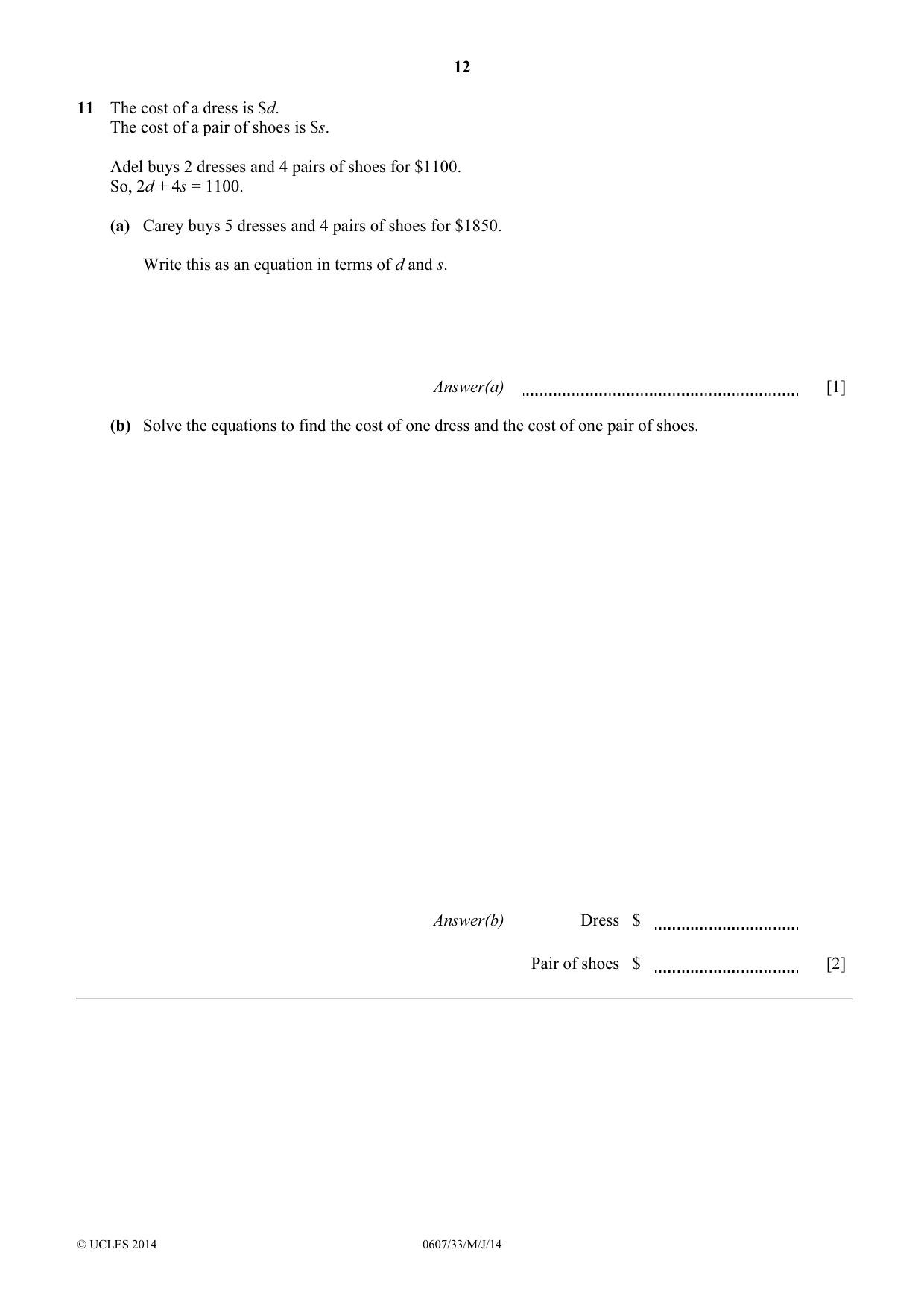
12 © UCLES 2014 0607/33/M/J/14 11 The cost of a dress is $d. The cost of a pair of shoes is $s. Adel buys 2 dresses and 4 pairs of shoes for $1100. So, 2d + 4s = 1100. (a) Carey buys 5 dresses and 4 pairs of shoes for $1850. Write this as an equation in terms of d and s. Answer(a) [1] (b) Solve the equations to find the cost of one dress and the cost of one pair of shoes. Answer(b) Dress $ Pair of shoes $ [2]
Question paper, page 13
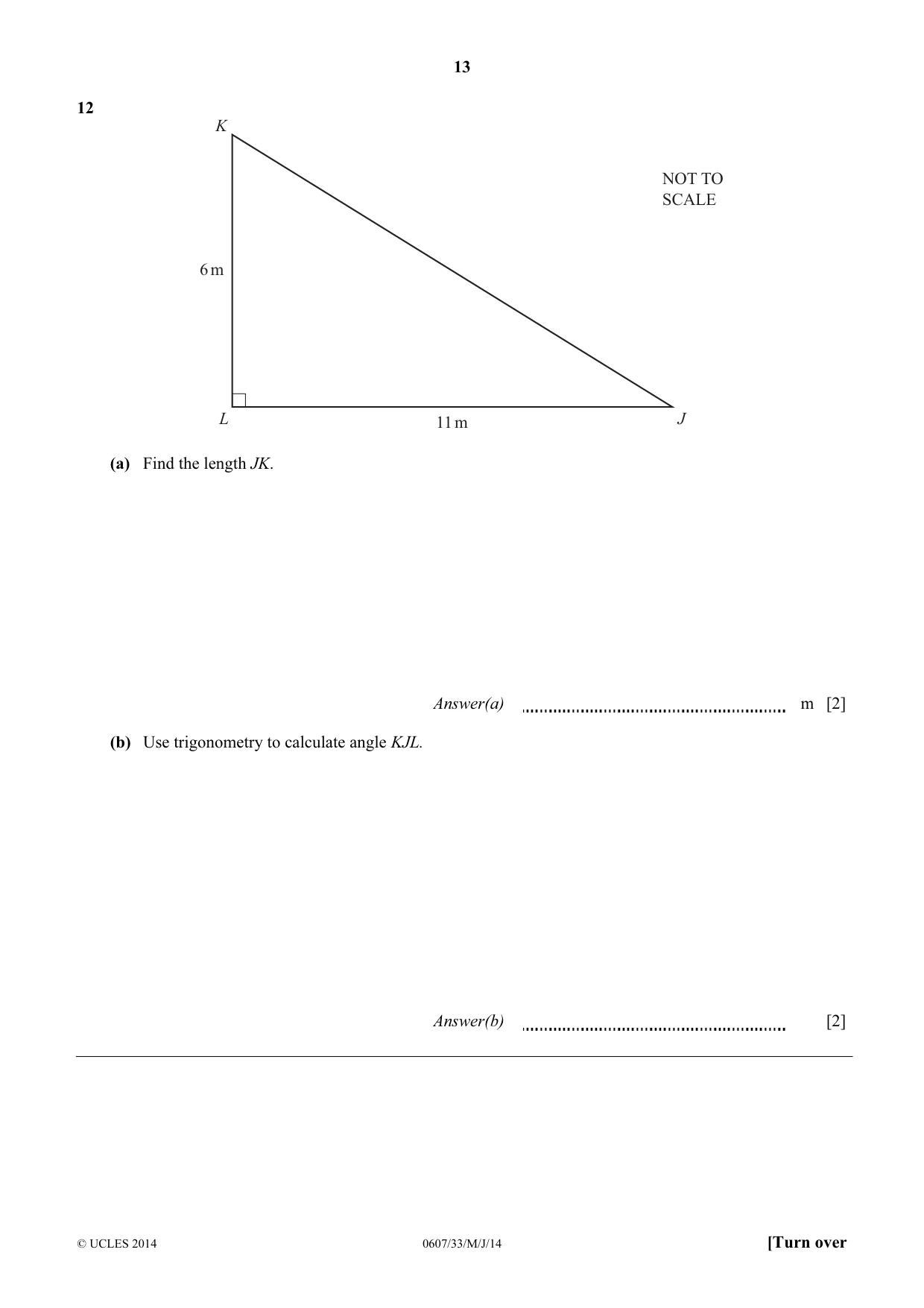
13 © UCLES 2014 0607/33/M/J/14 [Turn over 12 K L J NOT TO SCALE 11 m 6 m (a) Find the length JK. Answer(a) m [2] (b) Use trigonometry to calculate angle KJL. Answer(b) [2]
Question paper, page 14
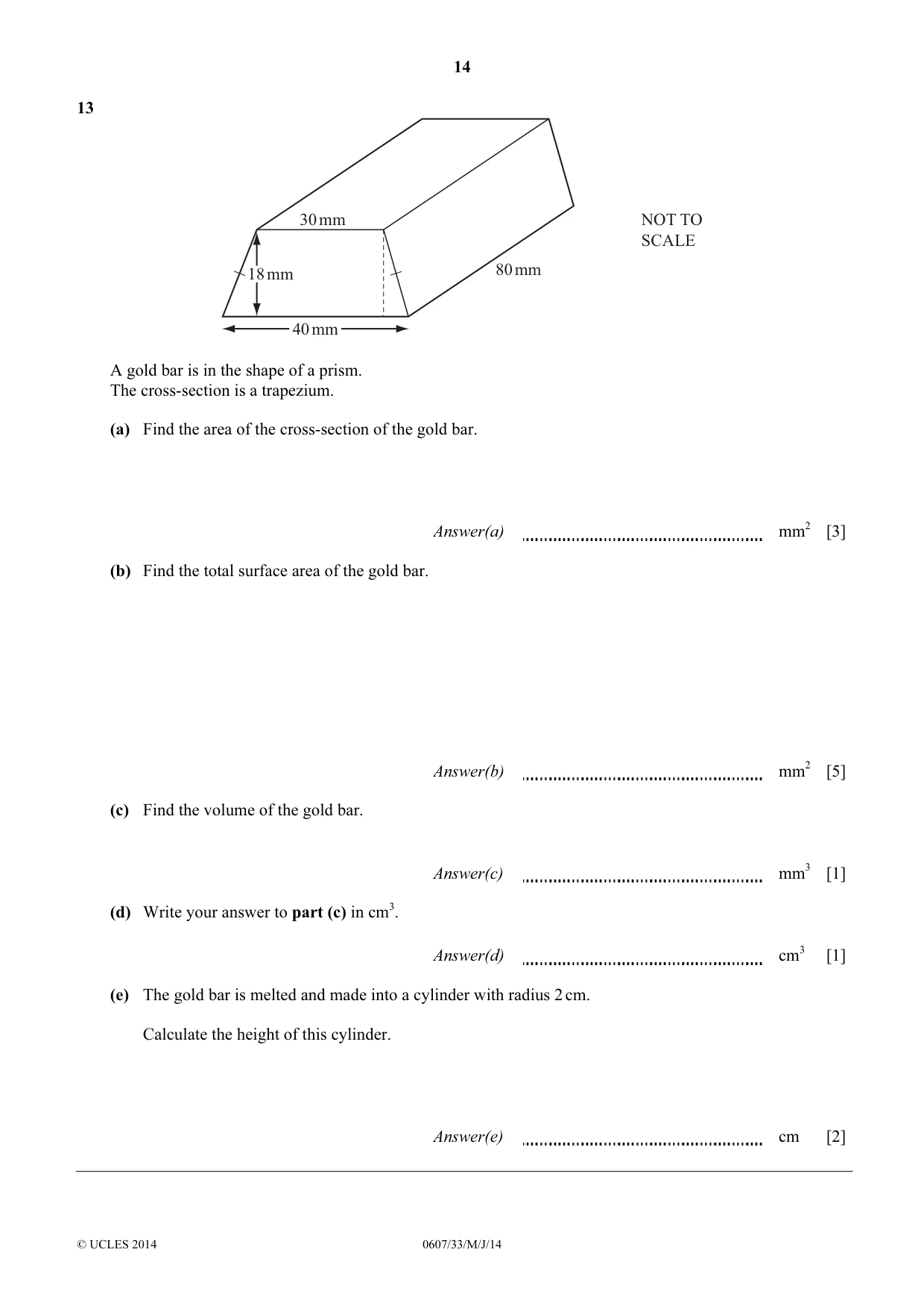
14 © UCLES 2014 0607/33/M/J/14 13 18 mm 40 mm 30 mm 80 mm NOT TO SCALE A gold bar is in the shape of a prism. The cross-section is a trapezium. (a) Find the area of the cross-section of the gold bar. Answer(a) mm2 [3] (b) Find the total surface area of the gold bar. Answer(b) mm2 [5] (c) Find the volume of the gold bar. Answer(c) mm3 [1] (d) Write your answer to part (c) in cm3. Answer(d) cm3 [1] (e) The gold bar is melted and made into a cylinder with radius 2 cm. Calculate the height of this cylinder. Answer(e) cm [2]
Question paper, page 15
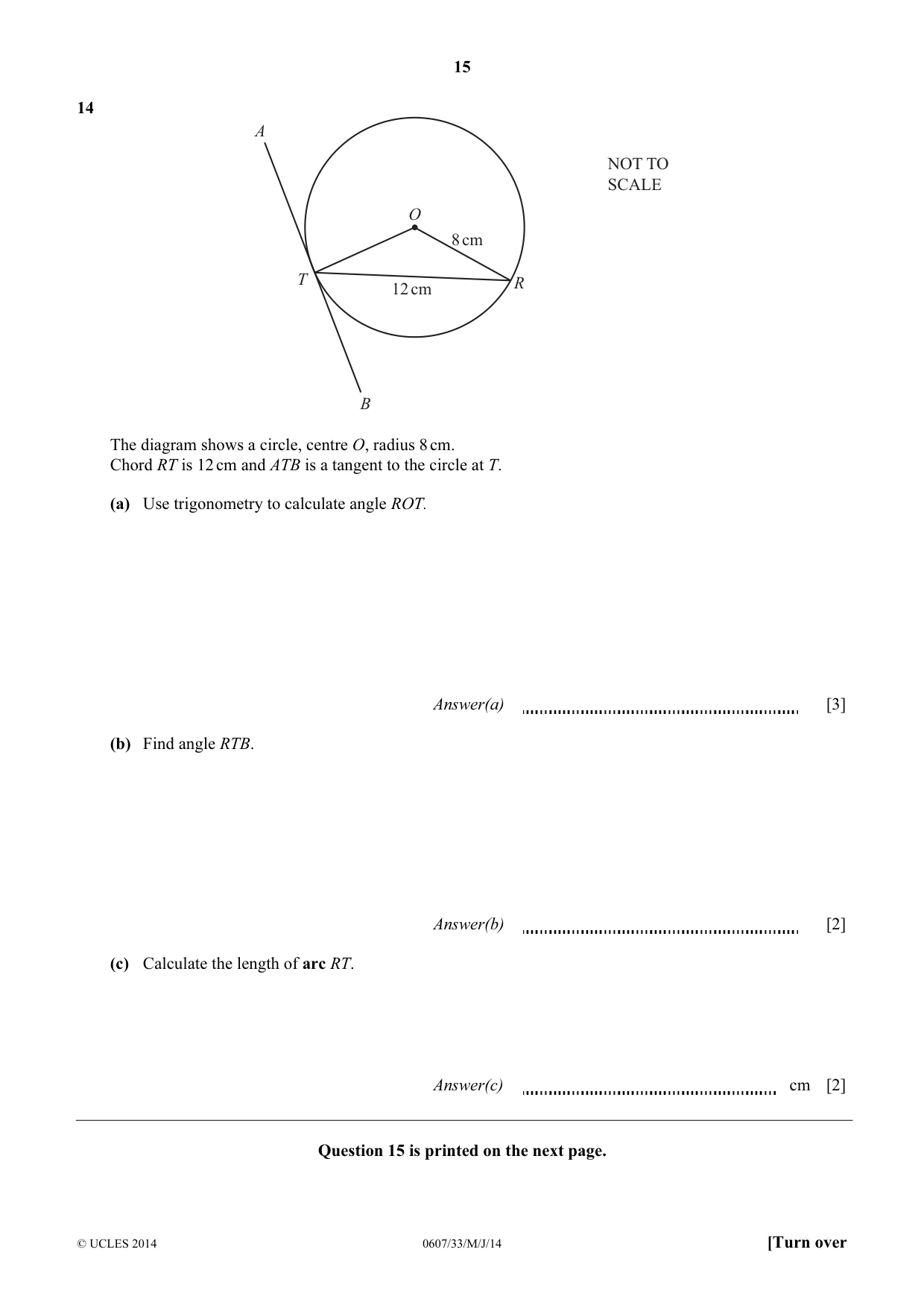
15 © UCLES 2014 0607/33/M/J/14 [Turn over 14 A B T O R 12 cm 8 cm NOT TO SCALE The diagram shows a circle, centre O, radius 8 cm. Chord RT is 12 cm and ATB is a tangent to the circle at T. (a) Use trigonometry to calculate angle ROT. Answer(a) [3] (b) Find angle RTB. Answer(b) [2] (c) Calculate the length of arc RT. Answer(c) cm [2] Question 15 is printed on the next page.
Question paper, page 16
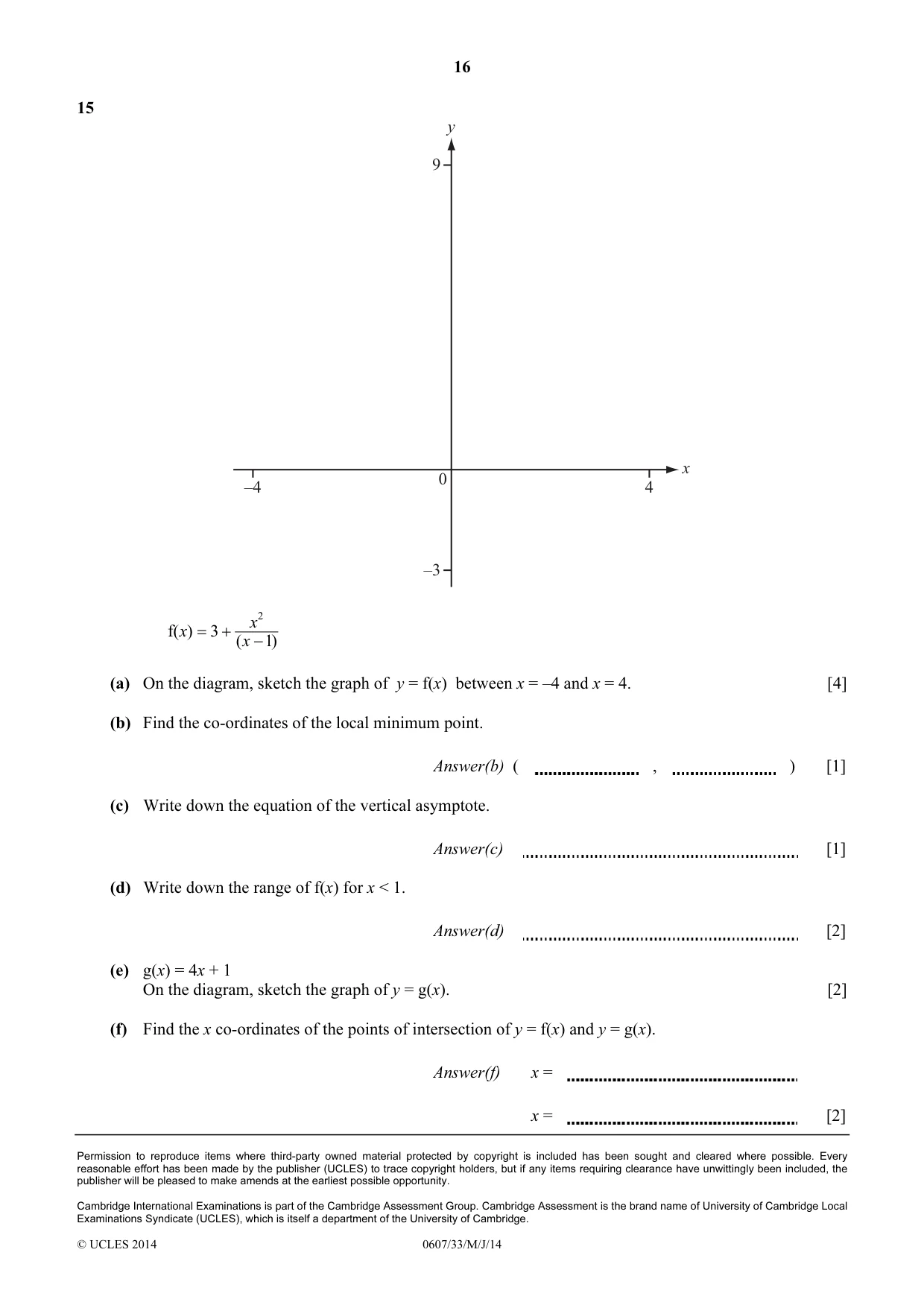
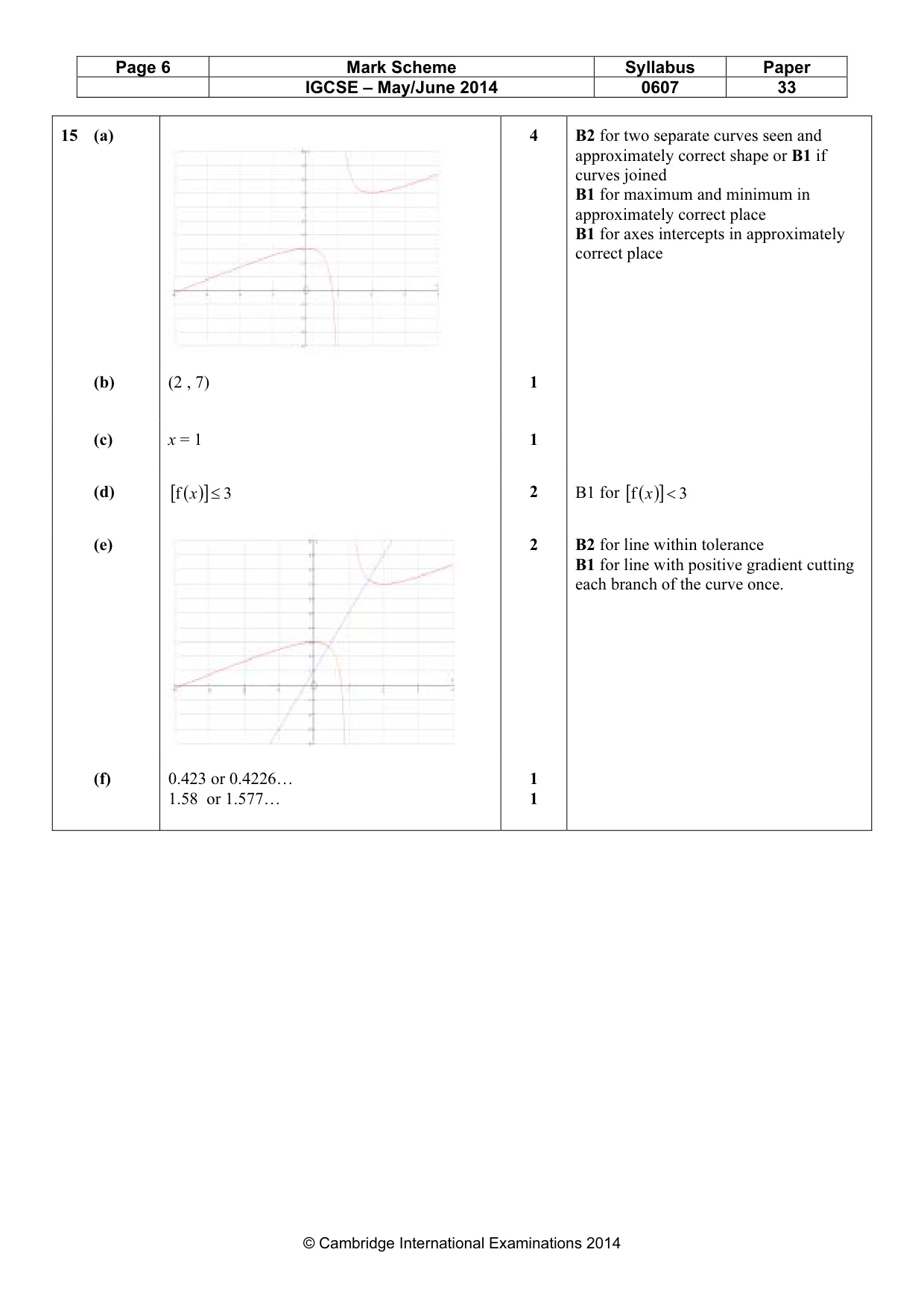
16 Permission to reproduce items where third-party owned material protected by copyright is included has been sought and cleared where possible. Every reasonable effort has been made by the publisher (UCLES) to trace copyright holders, but if any items requiring clearance have unwittingly been included, the publisher will be pleased to make amends at the earliest possible opportunity. Cambridge International Examinations is part of the Cambridge Assessment Group. Cambridge Assessment is the brand name of University of Cambridge Local Examinations Syndicate (UCLES), which is itself a department of the University of Cambridge. © UCLES 2014 0607/33/M/J/14 15 y x 4 –4 –3 9 0 )1 ( 3 ) f( 2 − + = x x x (a) On the diagram, sketch the graph of y = f(x) between x = –4 and x = 4. [4] (b) Find the co-ordinates of the local minimum point. Answer(b) ( , ) [1] (c) Write down the equation of the vertical asymptote. Answer(c) [1] (d) Write down the range of f(x) for x < 1. Answer(d) [2] (e) g(x) = 4x + 1 On the diagram, sketch the graph of y = g(x). [2] (f) Find the x co-ordinates of the points of intersection of y = f(x) and y = g(x). Answer(f) x = x = [2]
Mark scheme, page 1
CAMBRIDGE INTERNATIONAL EXAMINATIONS International General Certificate of Secondary Education MARK SCHEME for the May/June 2014 series 0607 CAMBRIDGE INTERNATIONAL MATHEMATICS 0607/33 Paper 3 (Core), maximum raw mark 96 This mark scheme is published as an aid to teachers and candidates, to indicate the requirements of the examination. It shows the basis on which Examiners were instructed to award marks. It does not indicate the details of the discussions that took place at an Examiners’ meeting before marking began, which would have considered the acceptability of alternative answers. Mark schemes should be read in conjunction with the question paper and the Principal Examiner Report for Teachers. Cambridge will not enter into discussions about these mark schemes. Cambridge is publishing the mark schemes for the May/June 2014 series for most IGCSE, GCE Advanced Level and Advanced Subsidiary Level components and some Ordinary Level components.
Mark scheme, page 2
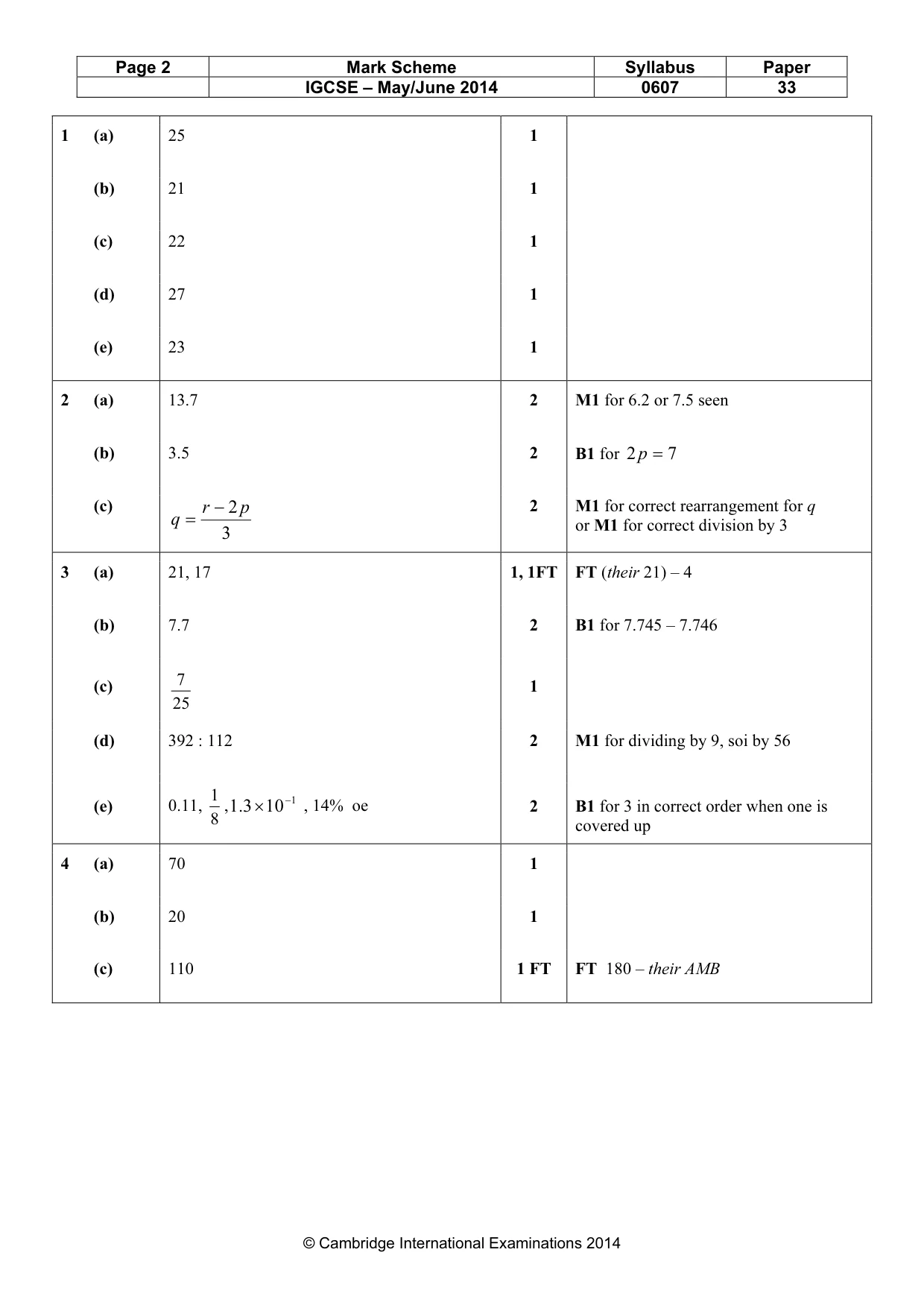
Page 2 Mark Scheme Syllabus Paper IGCSE – May/June 2014 0607 33 © Cambridge International Examinations 2014 1 (a) 25 1 (b) 21 1 (c) 22 1 (d) 27 1 (e) 23 1 2 (a) 13.7 2 M1 for 6.2 or 7.5 seen (b) 3.5 2 B1 for 7 2 = p (c) 3 2p r q − = 2 M1 for correct rearrangement for q or M1 for correct division by 3 3 (a) 21, 17 1, 1FT FT (their 21) – 4 (b) 7.7 2 B1 for 7.745 – 7.746 (c) 25 7 1 (d) 392 : 112 2 M1 for dividing by 9, soi by 56 (e) 0.11, 8 1 , 1 10 3.1 − × , 14% oe 2 B1 for 3 in correct order when one is covered up 4 (a) 70 1 (b) 20 1 (c) 110 1 FT FT 180 – their AMB
Mark scheme, page 3
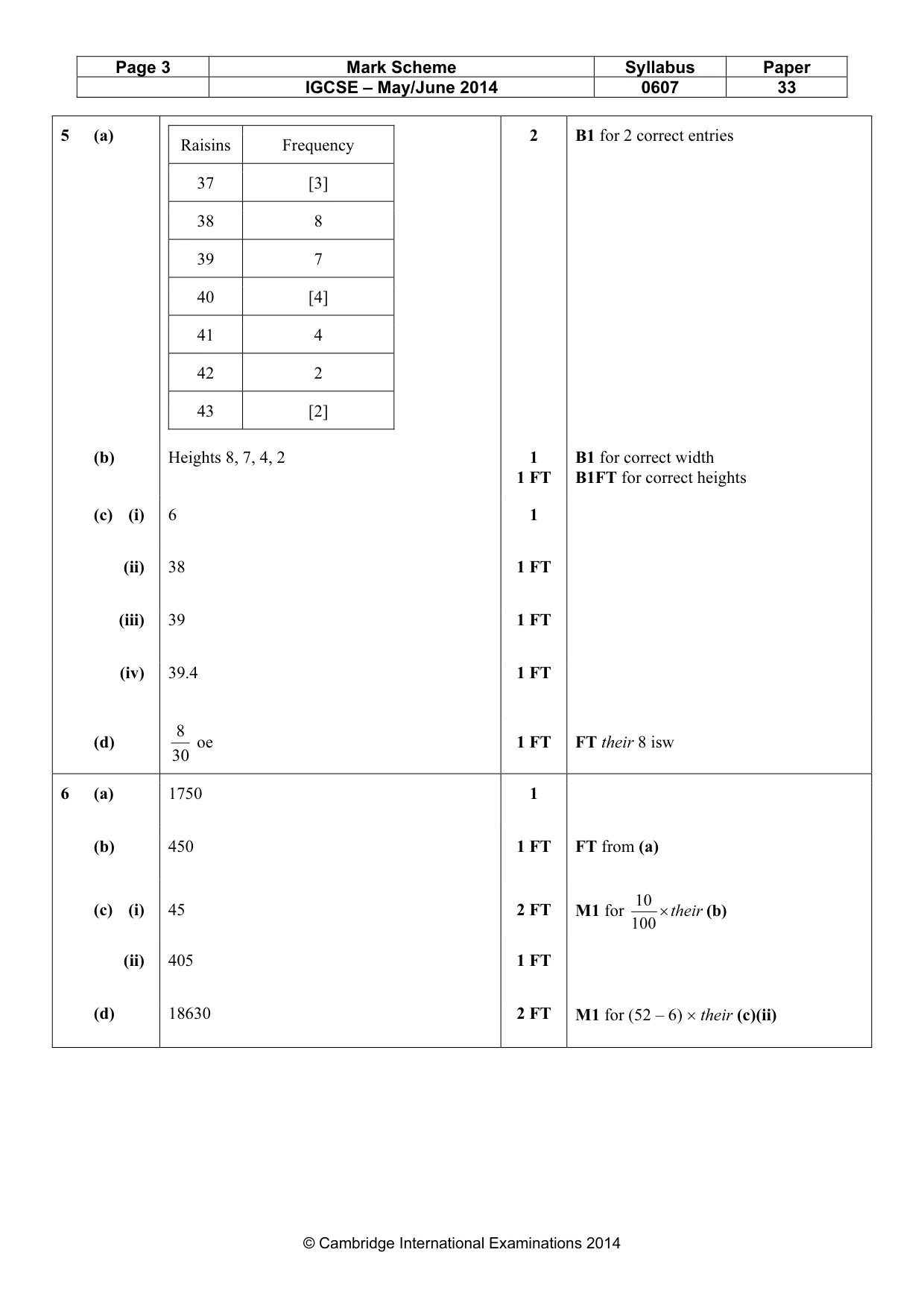
Page 3 Mark Scheme Syllabus Paper IGCSE – May/June 2014 0607 33 © Cambridge International Examinations 2014 5 (a) Raisins Frequency 37 [3] 38 8 39 7 40 [4] 41 4 42 2 43 [2] 2 B1 for 2 correct entries (b) Heights 8, 7, 4, 2 1 1 FT B1 for correct width B1FT for correct heights (c) (i) 6 1 (ii) 38 1 FT (iii) 39 1 FT (iv) 39.4 1 FT (d) 30 8 oe 1 FT FT their 8 isw 6 (a) 1750 1 (b) 450 1 FT FT from (a) (c) (i) 45 2 FT M1 for (b) 100 10 their × (ii) 405 1 FT (d) 18630 2 FT M1 for (52 – 6) × their (c)(ii)
Mark scheme, page 4
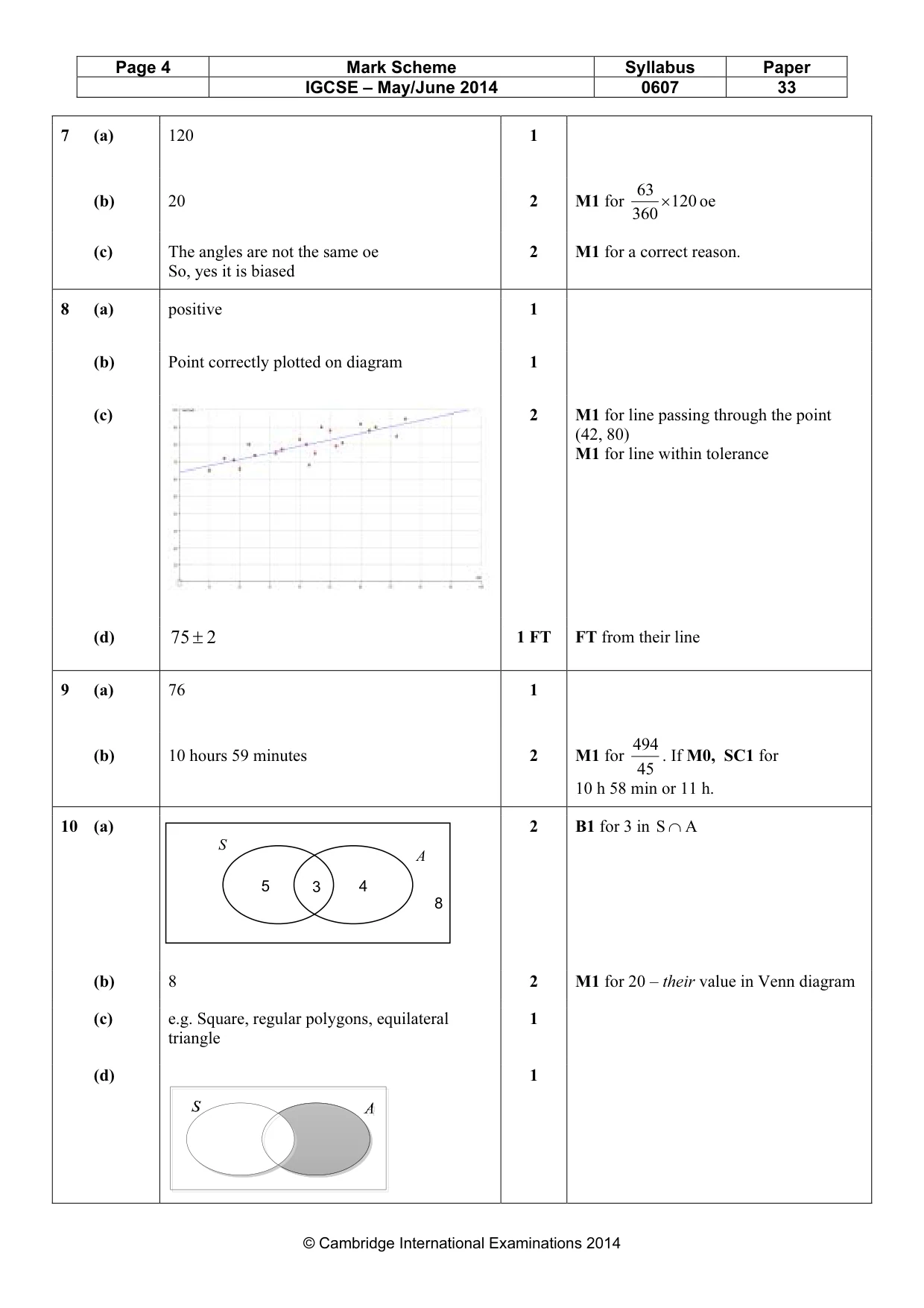
Page 4 Mark Scheme Syllabus Paper IGCSE – May/June 2014 0607 33 © Cambridge International Examinations 2014 7 (a) 120 1 (b) 20 2 M1 for 120 360 63 × oe (c) The angles are not the same oe So, yes it is biased 2 M1 for a correct reason. 8 (a) positive 1 (b) Point correctly plotted on diagram 1 (c) 2 M1 for line passing through the point (42, 80) M1 for line within tolerance (d) 2 75± 1 FT FT from their line 9 (a) 76 1 (b) 10 hours 59 minutes 2 M1 for 45 494 . If M0, SC1 for 10 h 58 min or 11 h. 10 (a) 2 B1 for 3 in A S ∩ (b) 8 2 M1 for 20 – their value in Venn diagram (c) e.g. Square, regular polygons, equilateral triangle 1 (d) 1 3 S A 5 4 8
Mark scheme, page 5
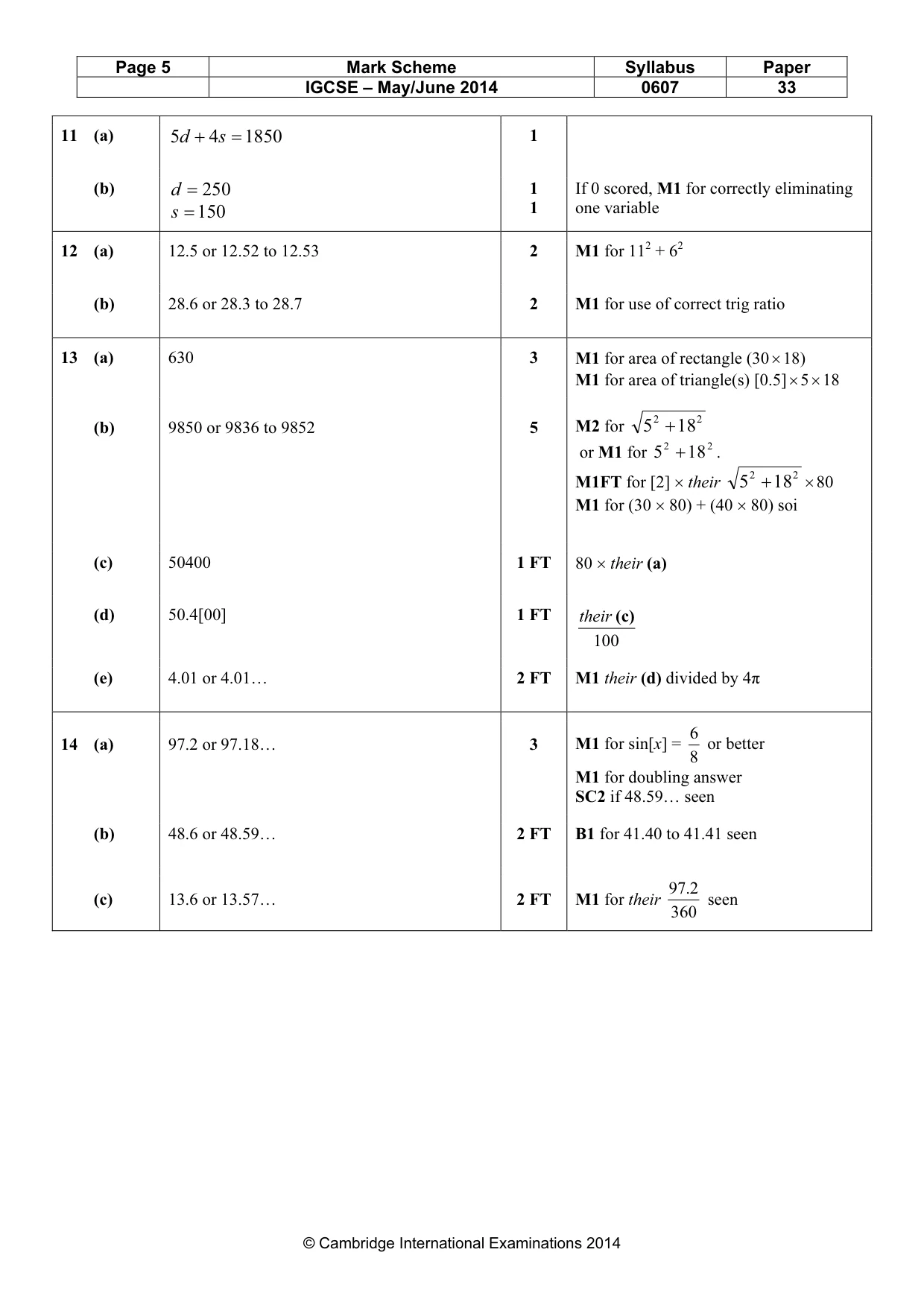
Page 5 Mark Scheme Syllabus Paper IGCSE – May/June 2014 0607 33 © Cambridge International Examinations 2014 11 (a) 1850 4 5 = + s d 1 (b) 250 = d 150 = s 1 1 If 0 scored, M1 for correctly eliminating one variable 12 (a) 12.5 or 12.52 to 12.53 2 M1 for 112 + 62 (b) 28.6 or 28.3 to 28.7 2 M1 for use of correct trig ratio 13 (a) 630 3 M1 for area of rectangle (30 × 18) M1 for area of triangle(s) [0.5] × 5 × 18 (b) 9850 or 9836 to 9852 5 M2 for 2 2 18 5 + or M1 for 2 2 18 5 + . M1FT for [2] × their 2 2 18 5 + × 80 M1 for (30 × 80) + (40 × 80) soi (c) 50400 1 FT 80 × their (a) (d) 50.4[00] 1 FT 100 (c) their (e) 4.01 or 4.01… 2 FT M1 their (d) divided by 4π 14 (a) 97.2 or 97.18… 3 M1 for sin[x] = 8 6 or better M1 for doubling answer SC2 if 48.59… seen (b) 48.6 or 48.59… 2 FT B1 for 41.40 to 41.41 seen (c) 13.6 or 13.57… 2 FT M1 for their 360 2. 97 seen
Mark scheme, page 6
Page 6 Mark Scheme Syllabus Paper IGCSE – May/June 2014 0607 33 © Cambridge International Examinations 2014 15 (a) 4 B2 for two separate curves seen and approximately correct shape or B1 if curves joined B1 for maximum and minimum in approximately correct place B1 for axes intercepts in approximately correct place (b) (2 , 7) 1 (c) x = 1 1 (d) ( ) [ ] 3 f ≤ x 2 B1 for ( ) [ ] 3 f < x (e) 2 B2 for line within tolerance B1 for line with positive gradient cutting each branch of the curve once. (f) 0.423 or 0.4226… 1.58 or 1.577… 1 1
What you needed in this session
Cambridge’s own grade thresholds for 2014 May/June, Paper 3 · Variant 3. A higher threshold means an easier paper — the bar moves with how the cohort did.