Cambridge IGCSE Mathematics - International 0607 — 2013 May/June Paper 3 · Variant 3
0607/33/M/J/13 · 96 marks · ≈108 min
The question paper and its mark scheme, free to read here and free to download. This is Cambridge’s own paper, exactly as it was sat.
Question paper16 pages
Mark scheme6 pages
Answers below. Sit the paper first if you are practising.
Paper as text
Question paper, page 1
This document consists of 16 printed pages. IB13 06_0607_33/FP © UCLES 2013 [Turn over *5902643799* UNIVERSITY OF CAMBRIDGE INTERNATIONAL EXAMINATIONS International General Certificate of Secondary Education CAMBRIDGE INTERNATIONAL MATHEMATICS 0607/33 Paper 3 (Core) May/June 2013 1 hour 45 minutes Candidates answer on the Question Paper. Additional Materials: Geometrical Instruments Graphics Calculator READ THESE INSTRUCTIONS FIRST Write your Centre number, candidate number and name on all the work you hand in. Write in dark blue or black pen. Do not use staples, paper clips, highlighters, glue or correction fluid. You may use a pencil for any diagrams or graphs. DO NOT WRITE IN ANY BARCODES. Answer all the questions. Unless instructed otherwise, give your answers exactly or correct to three significant figures as appropriate. Answers in degrees should be given to one decimal place. For π, use your calculator value. You must show all the relevant working to gain full marks and you will be given marks for correct methods, including sketches, even if your answer is incorrect. The number of marks is given in brackets [ ] at the end of each question or part question. The total number of marks for this paper is 96. www.XtremePapers.com
Question paper, page 2
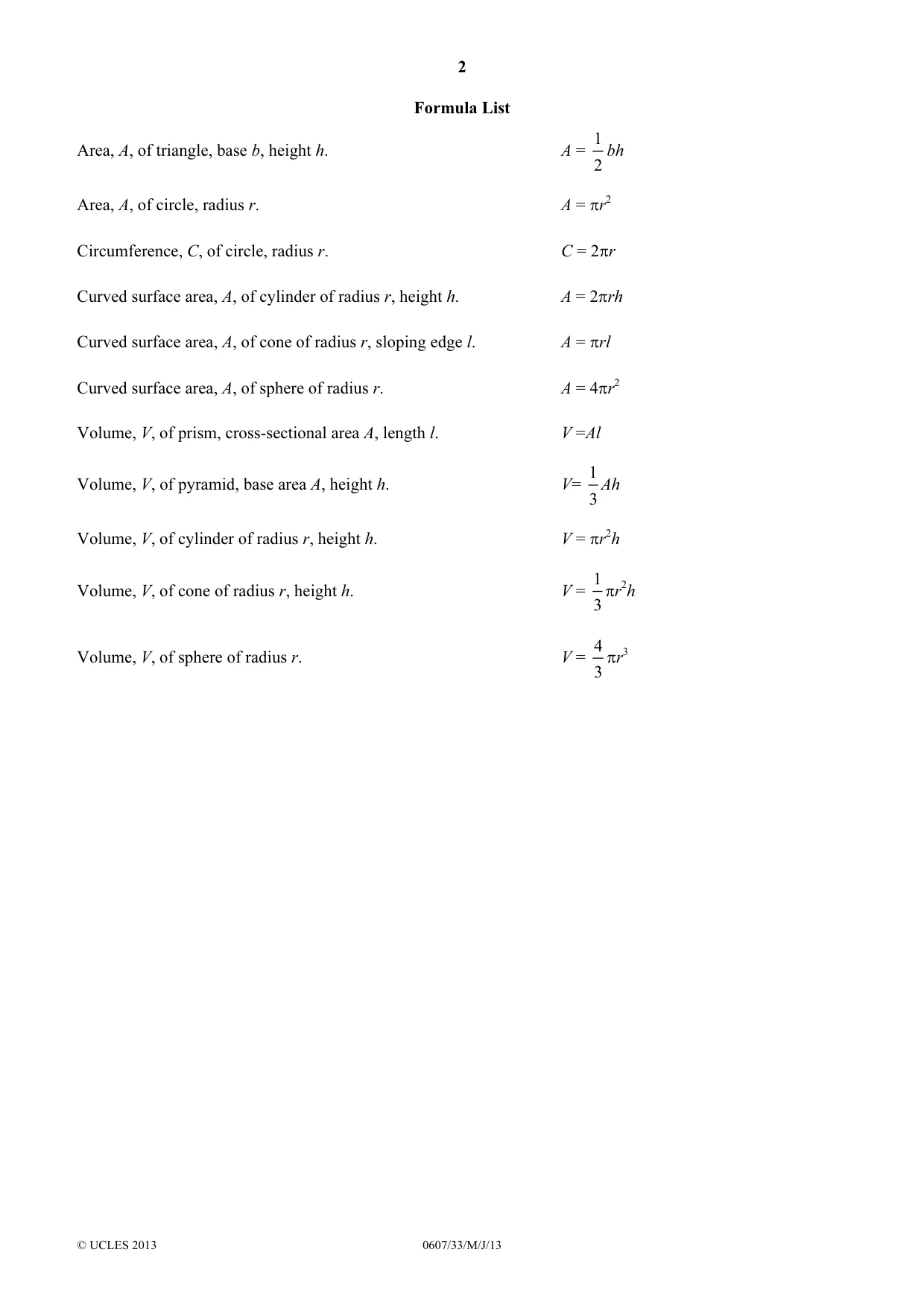
2 © UCLES 2013 0607/33/M/J/13 Formula List Area, A, of triangle, base b, height h. A = 1 2 bh Area, A, of circle, radius r. A = πr2 Circumference, C, of circle, radius r. C = 2πr Curved surface area, A, of cylinder of radius r, height h. A = 2πrh Curved surface area, A, of cone of radius r, sloping edge l. A = πrl Curved surface area, A, of sphere of radius r. A = 4πr2 Volume, V, of prism, cross-sectional area A, length l. V =Al Volume, V, of pyramid, base area A, height h. V= 1 3 Ah Volume, V, of cylinder of radius r, height h. V = πr2h Volume, V, of cone of radius r, height h. V = 1 3 πr2h Volume, V, of sphere of radius r. V = 4 3 πr3
Question paper, page 3
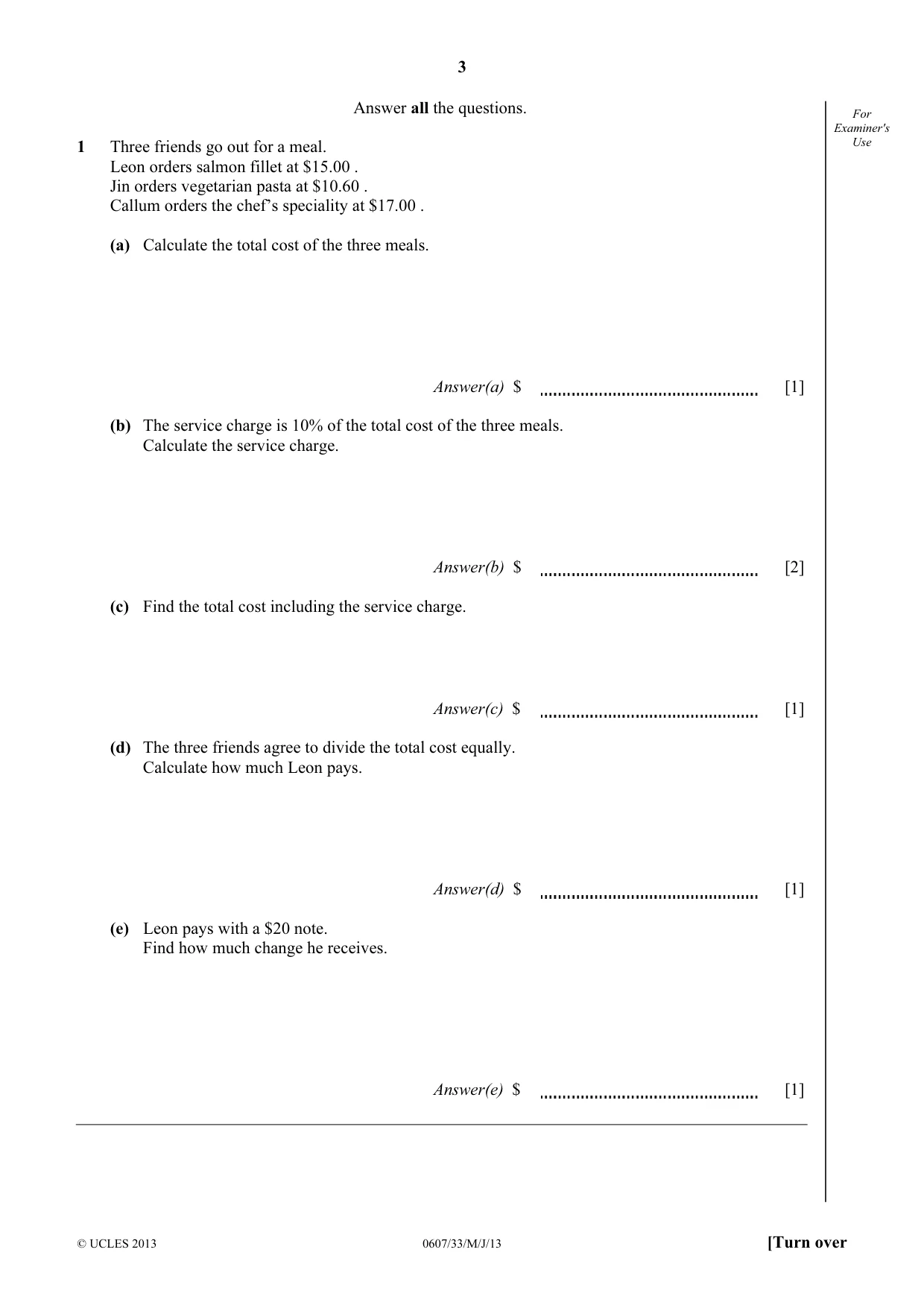
3 © UCLES 2013 0607/33/M/J/13 [Turn over For Examiner's Use Answer all the questions. 1 Three friends go out for a meal. Leon orders salmon fillet at $15.00 . Jin orders vegetarian pasta at $10.60 . Callum orders the chef’s speciality at $17.00 . (a) Calculate the total cost of the three meals. Answer(a) $ [1] (b) The service charge is 10% of the total cost of the three meals. Calculate the service charge. Answer(b) $ [2] (c) Find the total cost including the service charge. Answer(c) $ [1] (d) The three friends agree to divide the total cost equally. Calculate how much Leon pays. Answer(d) $ [1] (e) Leon pays with a $20 note. Find how much change he receives. Answer(e) $ [1]
Question paper, page 4
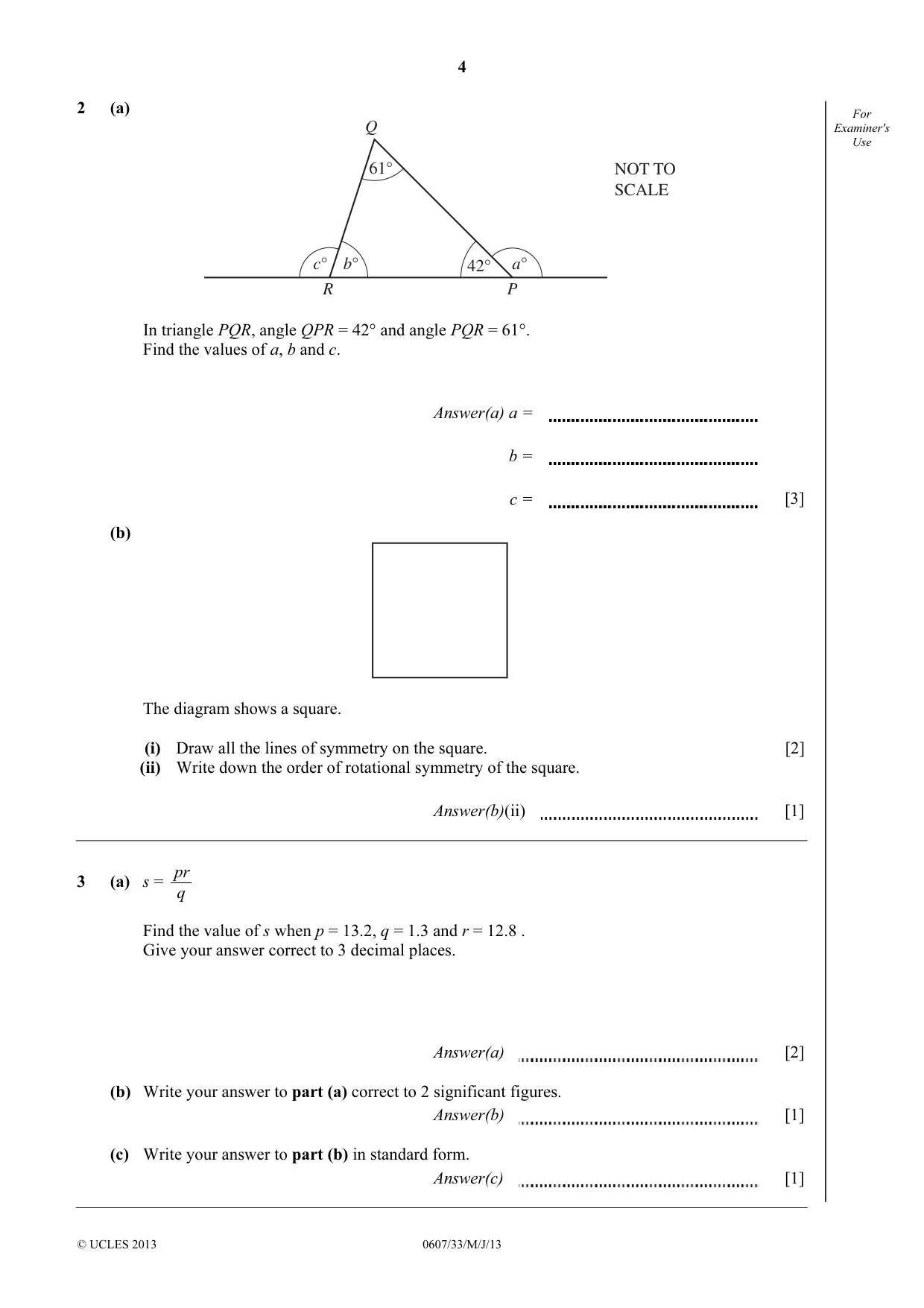
4 © UCLES 2013 0607/33/M/J/13 For Examiner's Use 2 (a) Q R P a° 42° 61° b° c° NOT TO SCALE In triangle PQR, angle QPR = 42° and angle PQR = 61°. Find the values of a, b and c. Answer(a) a = b = c = [3] (b) The diagram shows a square. (i) Draw all the lines of symmetry on the square. [2] (ii) Write down the order of rotational symmetry of the square. Answer(b)(ii) [1] 3 (a) s = q pr Find the value of s when p = 13.2, q = 1.3 and r = 12.8 . Give your answer correct to 3 decimal places. Answer(a) [2] (b) Write your answer to part (a) correct to 2 significant figures. Answer(b) [1] (c) Write your answer to part (b) in standard form. Answer(c) [1]
Question paper, page 5
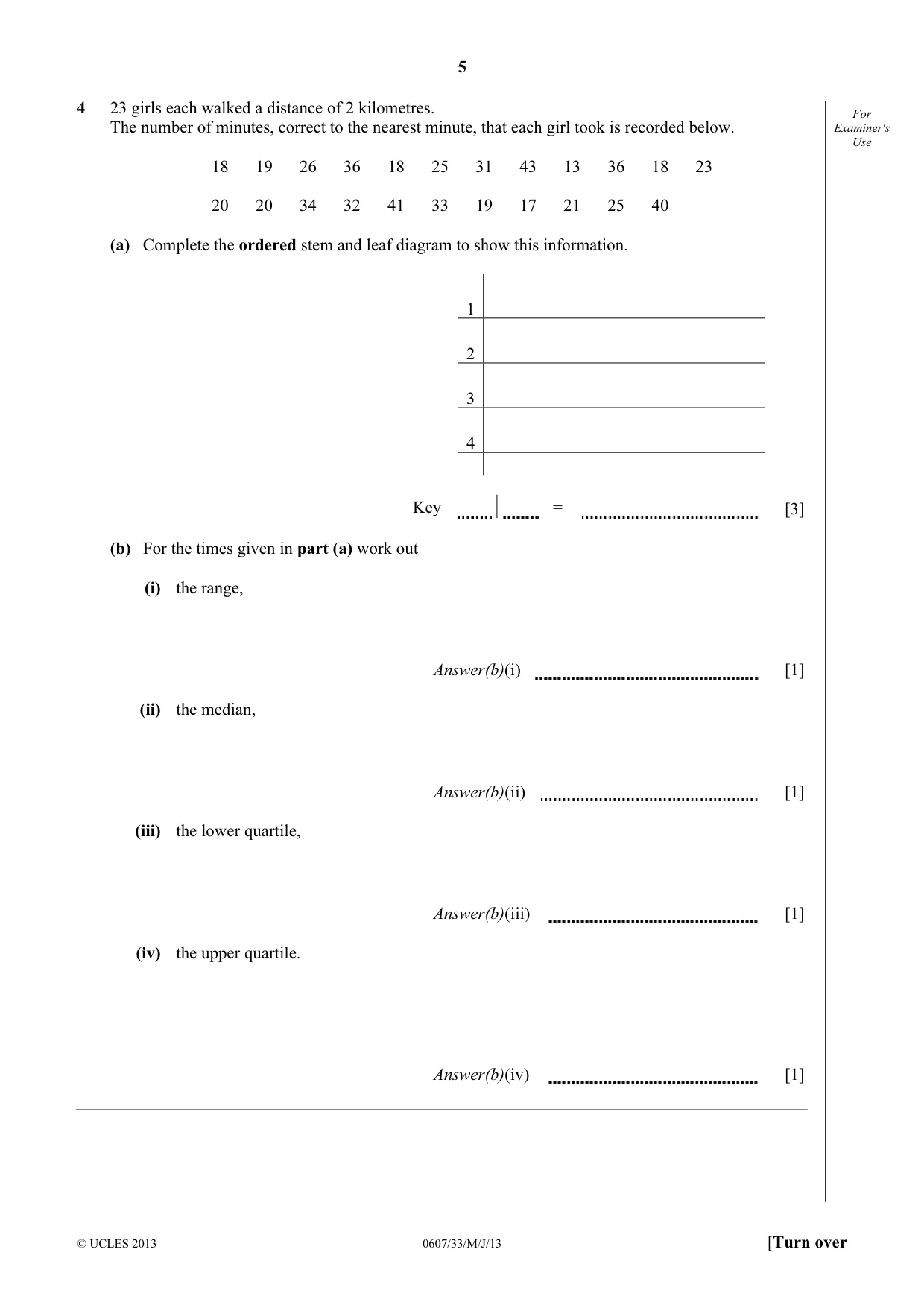
5 © UCLES 2013 0607/33/M/J/13 [Turn over For Examiner's Use 4 23 girls each walked a distance of 2 kilometres. The number of minutes, correct to the nearest minute, that each girl took is recorded below. 18 19 26 36 18 25 31 43 13 36 18 23 20 20 34 32 41 33 19 17 21 25 40 (a) Complete the ordered stem and leaf diagram to show this information. 1 2 3 4 Key = [3] (b) For the times given in part (a) work out (i) the range, Answer(b)(i) [1] (ii) the median, Answer(b)(ii) [1] (iii) the lower quartile, Answer(b)(iii) [1] (iv) the upper quartile. Answer(b)(iv) [1]
Question paper, page 6
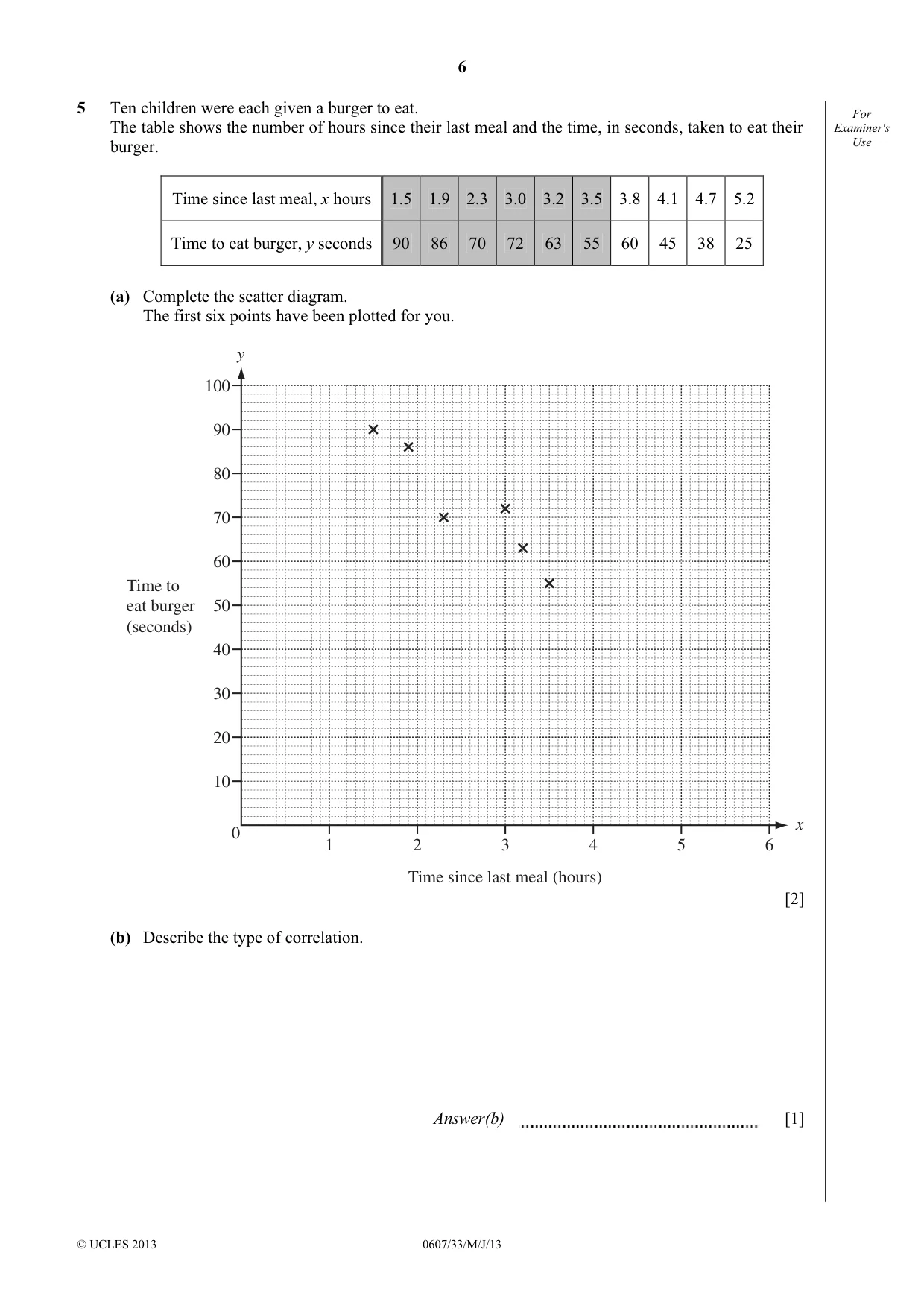
6 © UCLES 2013 0607/33/M/J/13 For Examiner's Use 5 Ten children were each given a burger to eat. The table shows the number of hours since their last meal and the time, in seconds, taken to eat their burger. Time since last meal, x hours 1.5 1.9 2.3 3.0 3.2 3.5 3.8 4.1 4.7 5.2 Time to eat burger, y seconds 90 86 70 72 63 55 60 45 38 25 (a) Complete the scatter diagram. The first six points have been plotted for you. 100 90 80 70 60 50 40 30 20 10 0 1 2 3 Time since last meal (hours) 4 5 6 Time to eat burger (seconds) y x [2] (b) Describe the type of correlation. Answer(b) [1]
Question paper, page 7
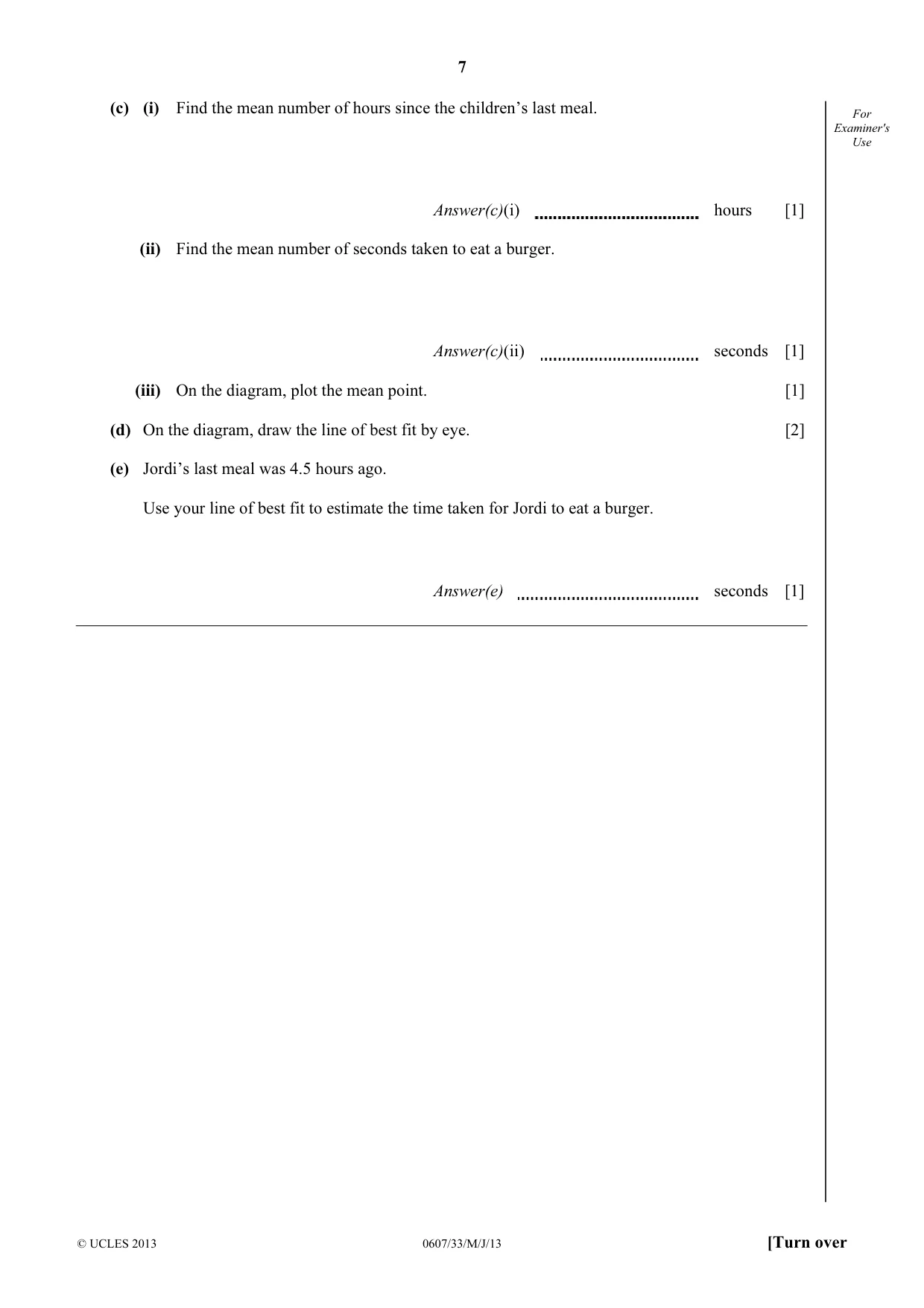
7 © UCLES 2013 0607/33/M/J/13 [Turn over For Examiner's Use (c) (i) Find the mean number of hours since the children’s last meal. Answer(c)(i) hours [1] (ii) Find the mean number of seconds taken to eat a burger. Answer(c)(ii) seconds [1] (iii) On the diagram, plot the mean point. [1] (d) On the diagram, draw the line of best fit by eye. [2] (e) Jordi’s last meal was 4.5 hours ago. Use your line of best fit to estimate the time taken for Jordi to eat a burger. Answer(e) seconds [1]
Question paper, page 8
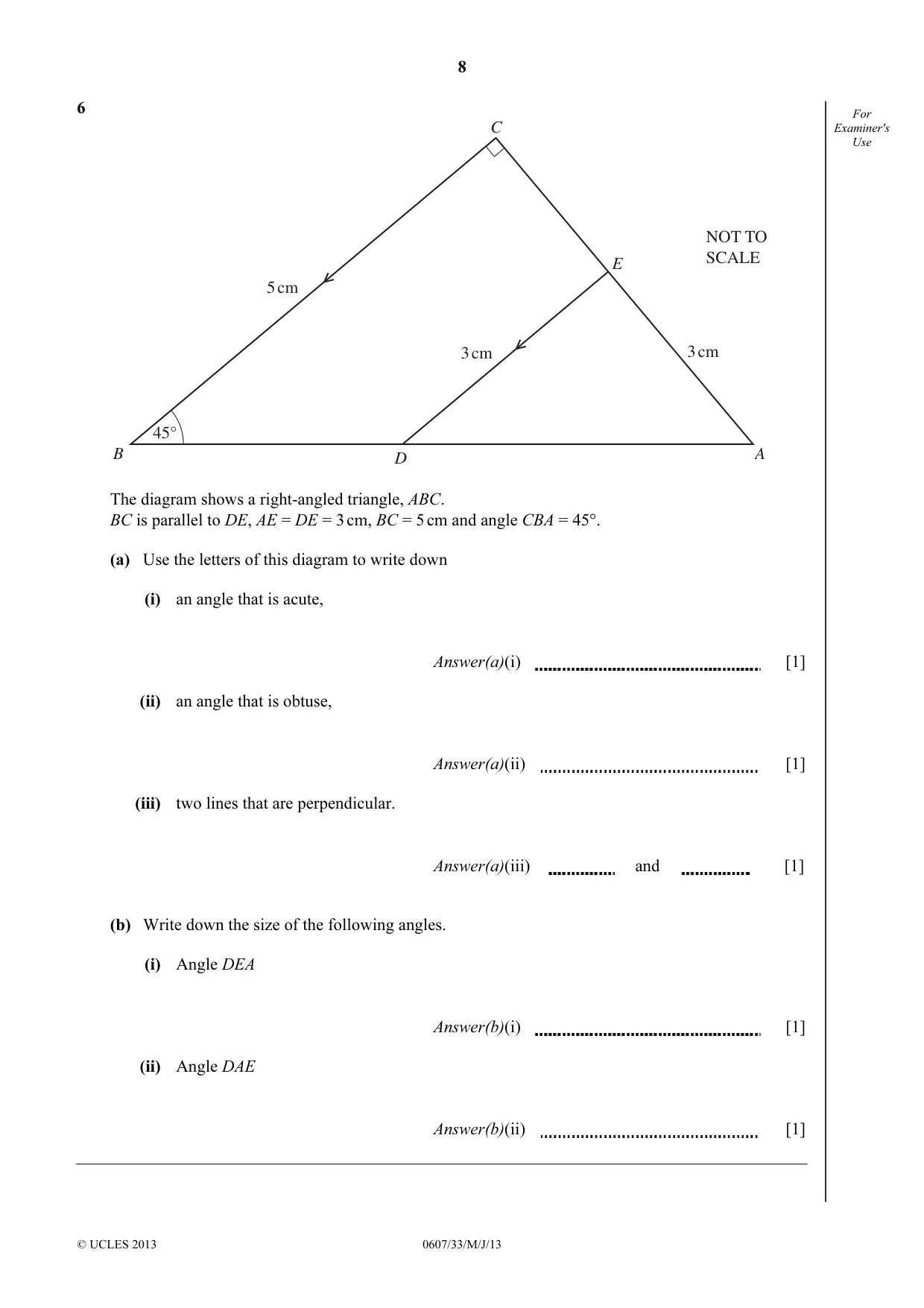
8 © UCLES 2013 0607/33/M/J/13 For Examiner's Use 6 C E A B D 5 cm 3 cm 3 cm NOT TO SCALE 45° The diagram shows a right-angled triangle, ABC. BC is parallel to DE, AE = DE = 3 cm, BC = 5 cm and angle CBA = 45°. (a) Use the letters of this diagram to write down (i) an angle that is acute, Answer(a)(i) [1] (ii) an angle that is obtuse, Answer(a)(ii) [1] (iii) two lines that are perpendicular. Answer(a)(iii) and [1] (b) Write down the size of the following angles. (i) Angle DEA Answer(b)(i) [1] (ii) Angle DAE Answer(b)(ii) [1]
Question paper, page 9
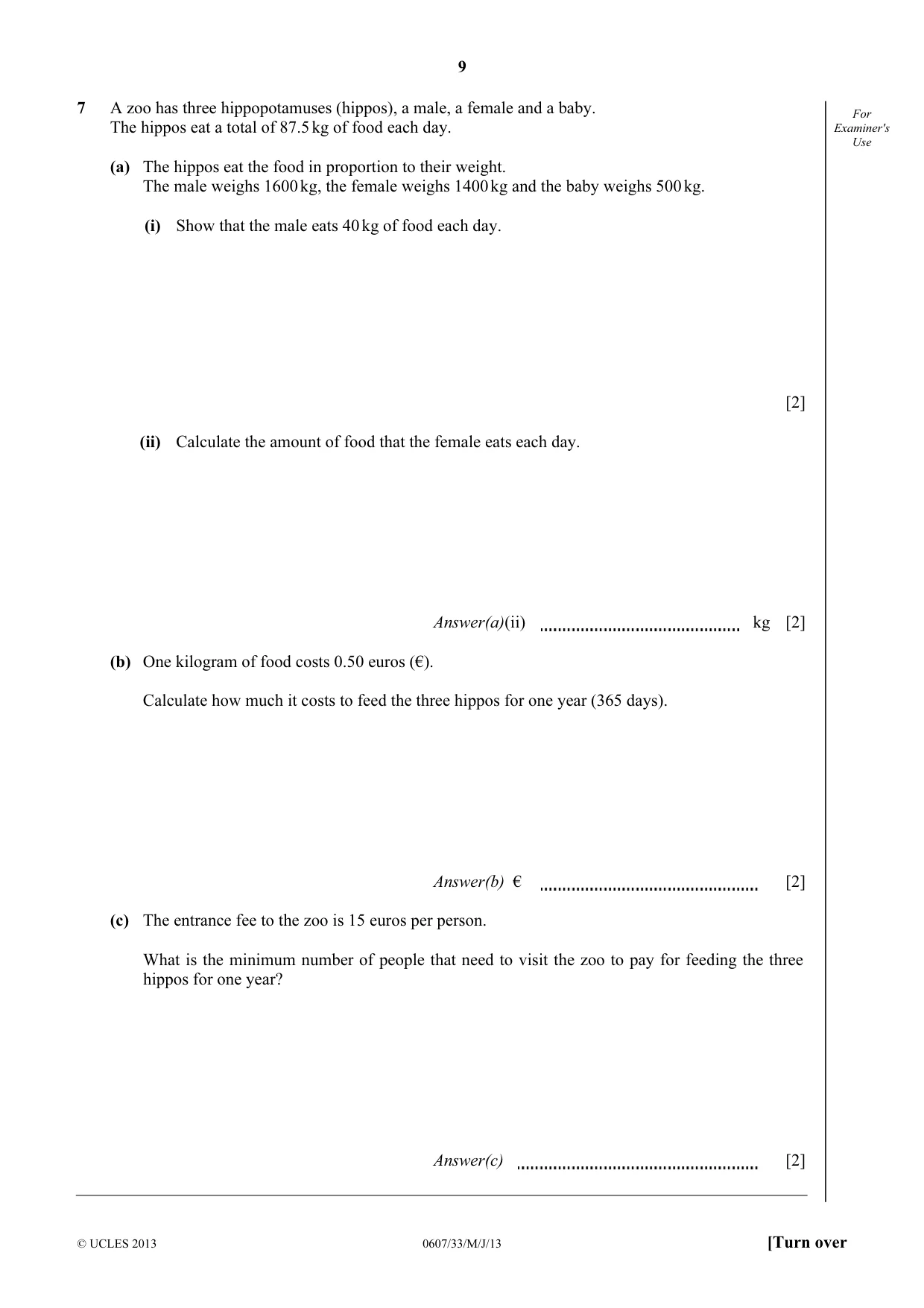
9 © UCLES 2013 0607/33/M/J/13 [Turn over For Examiner's Use 7 A zoo has three hippopotamuses (hippos), a male, a female and a baby. The hippos eat a total of 87.5 kg of food each day. (a) The hippos eat the food in proportion to their weight. The male weighs 1600 kg, the female weighs 1400 kg and the baby weighs 500 kg. (i) Show that the male eats 40 kg of food each day. [2] (ii) Calculate the amount of food that the female eats each day. Answer(a)(ii) kg [2] (b) One kilogram of food costs 0.50 euros (€). Calculate how much it costs to feed the three hippos for one year (365 days). Answer(b) € [2] (c) The entrance fee to the zoo is 15 euros per person. What is the minimum number of people that need to visit the zoo to pay for feeding the three hippos for one year? Answer(c) [2]
Question paper, page 10
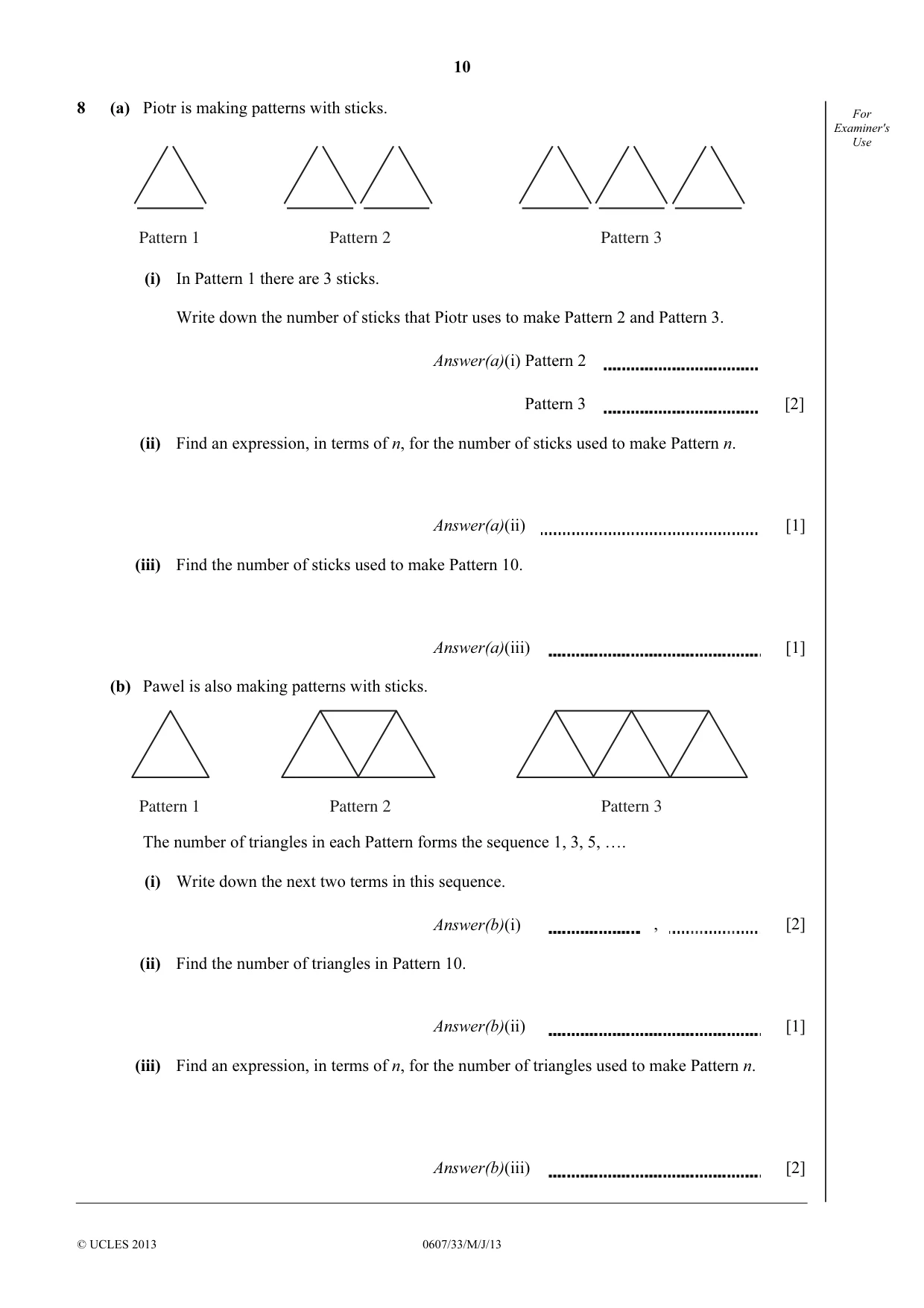
10 © UCLES 2013 0607/33/M/J/13 For Examiner's Use 8 (a) Piotr is making patterns with sticks. Pattern 1 Pattern 2 Pattern 3 (i) In Pattern 1 there are 3 sticks. Write down the number of sticks that Piotr uses to make Pattern 2 and Pattern 3. Answer(a)(i) Pattern 2 Pattern 3 [2] (ii) Find an expression, in terms of n, for the number of sticks used to make Pattern n. Answer(a)(ii) [1] (iii) Find the number of sticks used to make Pattern 10. Answer(a)(iii) [1] (b) Pawel is also making patterns with sticks. Pattern 1 Pattern 2 Pattern 3 The number of triangles in each Pattern forms the sequence 1, 3, 5, …. (i) Write down the next two terms in this sequence. Answer(b)(i) , [2] (ii) Find the number of triangles in Pattern 10. Answer(b)(ii) [1] (iii) Find an expression, in terms of n, for the number of triangles used to make Pattern n. Answer(b)(iii) [2]
Question paper, page 11
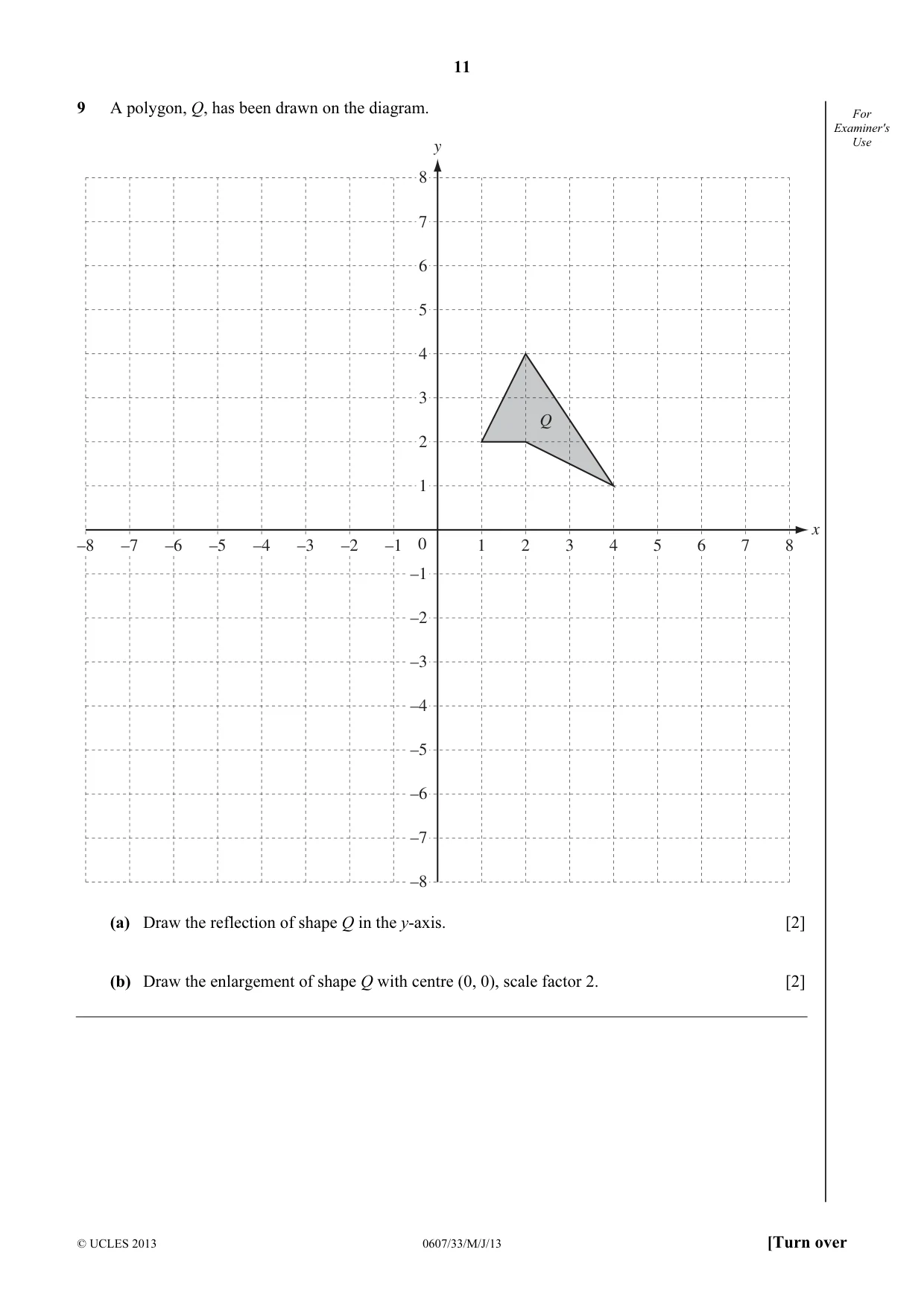
11 © UCLES 2013 0607/33/M/J/13 [Turn over For Examiner's Use 9 A polygon, Q, has been drawn on the diagram. Q y x 8 7 6 5 4 3 2 1 –1 –2 –3 –4 –5 –6 –7 –8 0 –1 1 2 3 4 5 6 7 8 –2 –3 –4 –5 –6 –7 –8 (a) Draw the reflection of shape Q in the y-axis. [2] (b) Draw the enlargement of shape Q with centre (0, 0), scale factor 2. [2]
Question paper, page 12
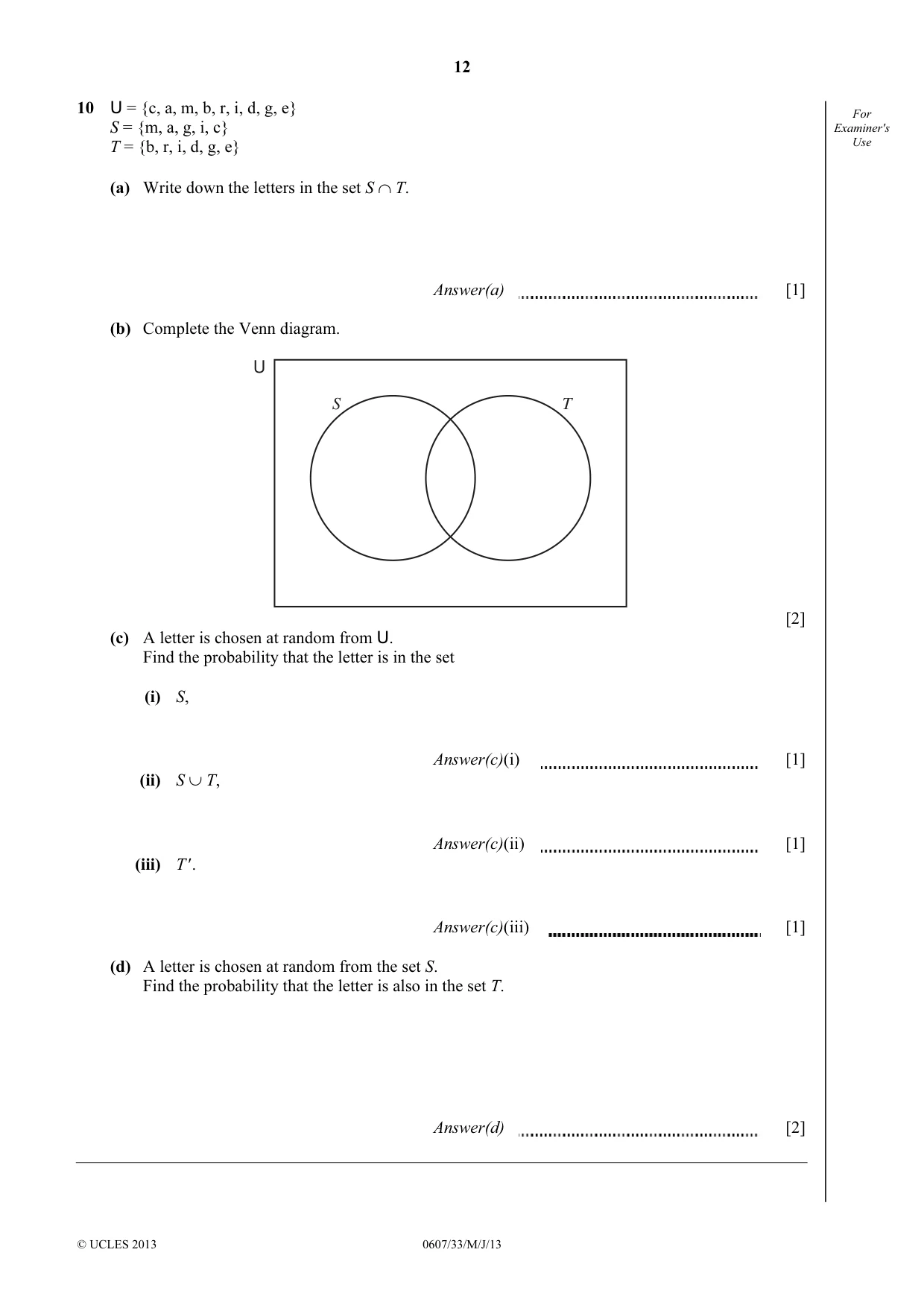
12 © UCLES 2013 0607/33/M/J/13 For Examiner's Use 10 U = {c, a, m, b, r, i, d, g, e} S = {m, a, g, i, c} T = {b, r, i, d, g, e} (a) Write down the letters in the set S ∩ T. Answer(a) [1] (b) Complete the Venn diagram. U S T [2] (c) A letter is chosen at random from U. Find the probability that the letter is in the set (i) S, Answer(c)(i) [1] (ii) S ∪ T, Answer(c)(ii) [1] (iii) T ′. Answer(c)(iii) [1] (d) A letter is chosen at random from the set S. Find the probability that the letter is also in the set T. Answer(d) [2]
Question paper, page 13
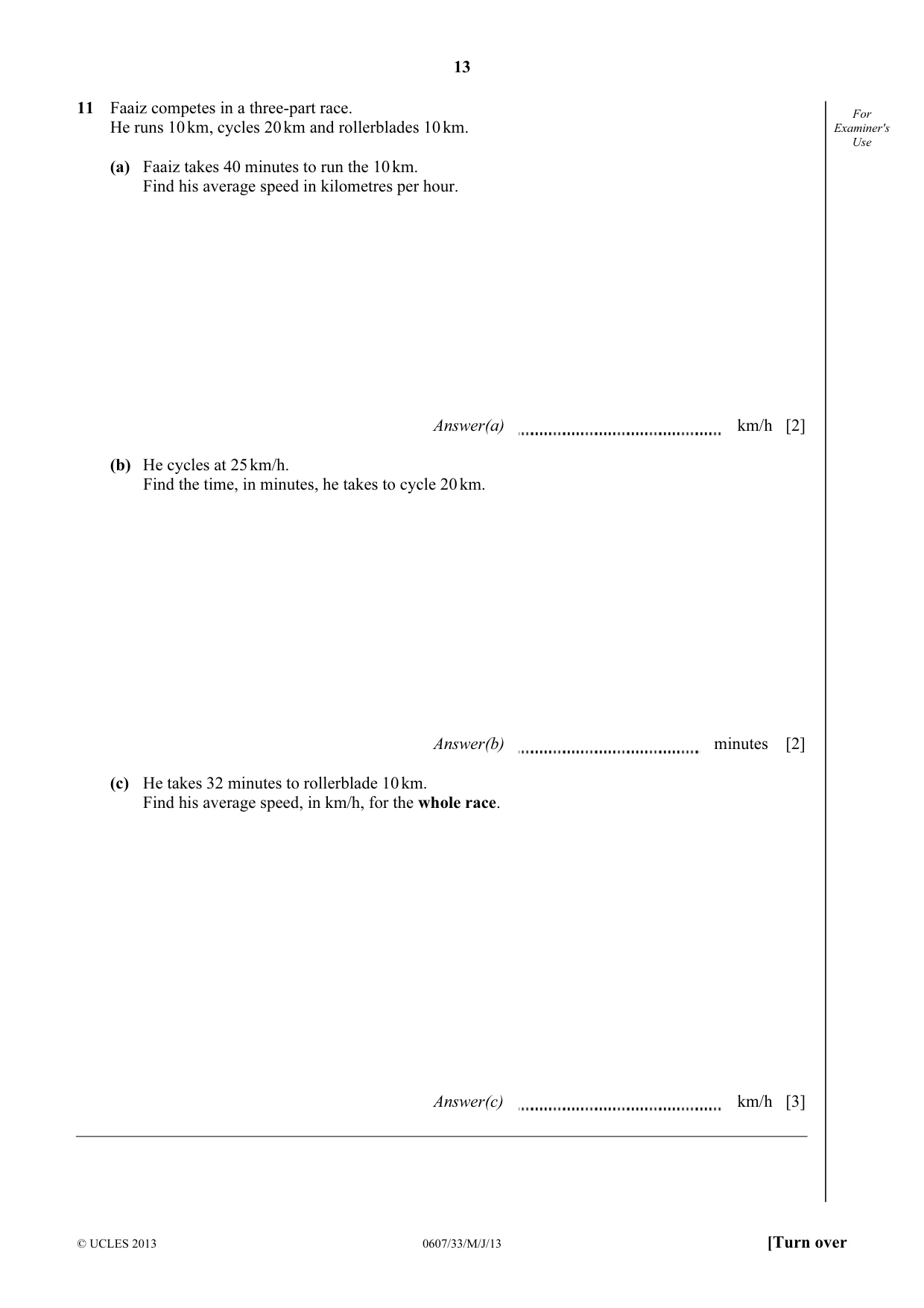
13 © UCLES 2013 0607/33/M/J/13 [Turn over For Examiner's Use 11 Faaiz competes in a three-part race. He runs 10 km, cycles 20 km and rollerblades 10 km. (a) Faaiz takes 40 minutes to run the 10 km. Find his average speed in kilometres per hour. Answer(a) km/h [2] (b) He cycles at 25 km/h. Find the time, in minutes, he takes to cycle 20 km. Answer(b) minutes [2] (c) He takes 32 minutes to rollerblade 10 km. Find his average speed, in km/h, for the whole race. Answer(c) km/h [3]
Question paper, page 14
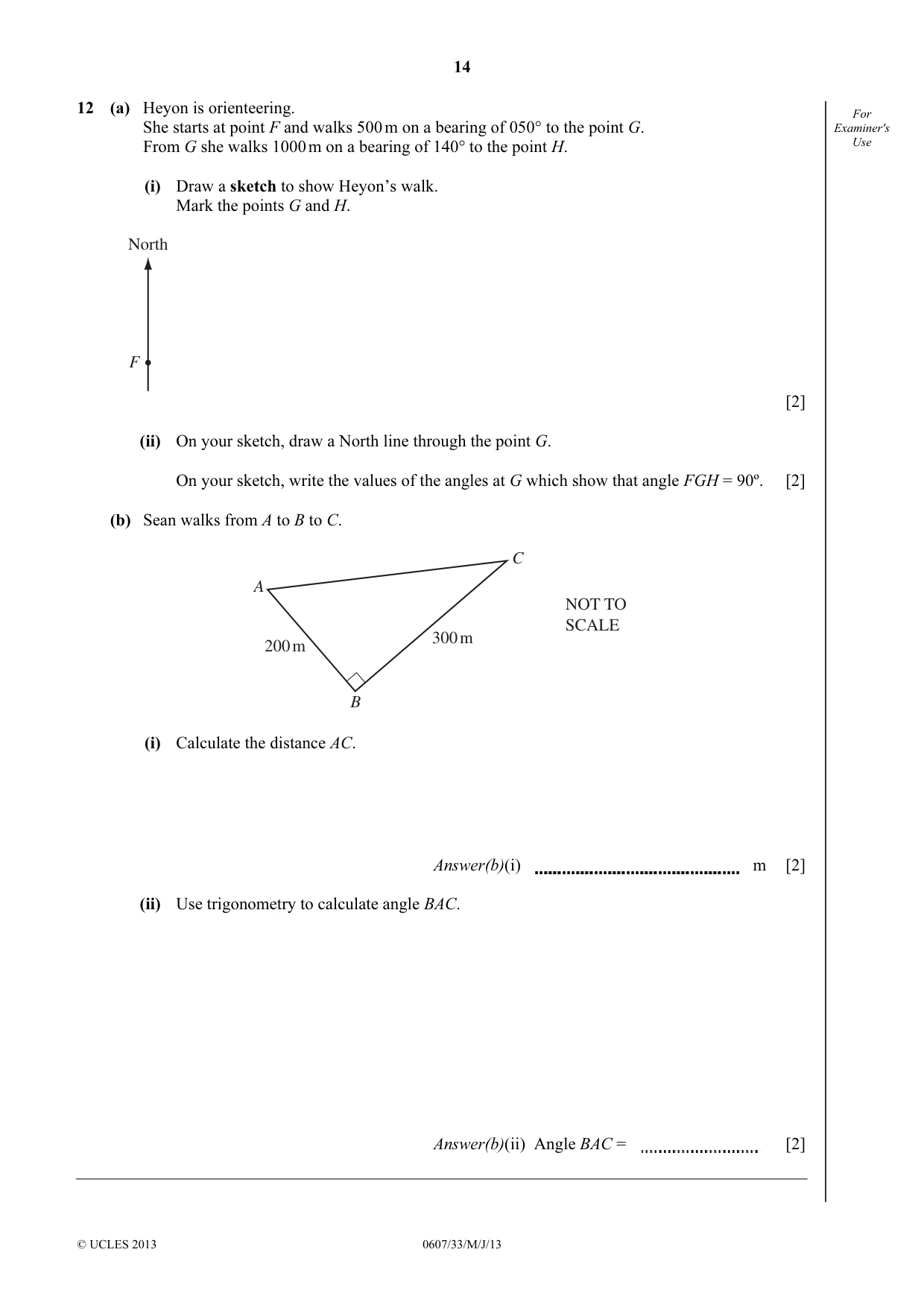
14 © UCLES 2013 0607/33/M/J/13 For Examiner's Use 12 (a) Heyon is orienteering. She starts at point F and walks 500 m on a bearing of 050° to the point G. From G she walks 1000 m on a bearing of 140° to the point H. (i) Draw a sketch to show Heyon’s walk. Mark the points G and H. F North [2] (ii) On your sketch, draw a North line through the point G. On your sketch, write the values of the angles at G which show that angle FGH = 90º. [2] (b) Sean walks from A to B to C. A C B 200 m 300 m NOT TO SCALE (i) Calculate the distance AC. Answer(b)(i) m [2] (ii) Use trigonometry to calculate angle BAC. Answer(b)(ii) Angle BAC = [2]
Question paper, page 15
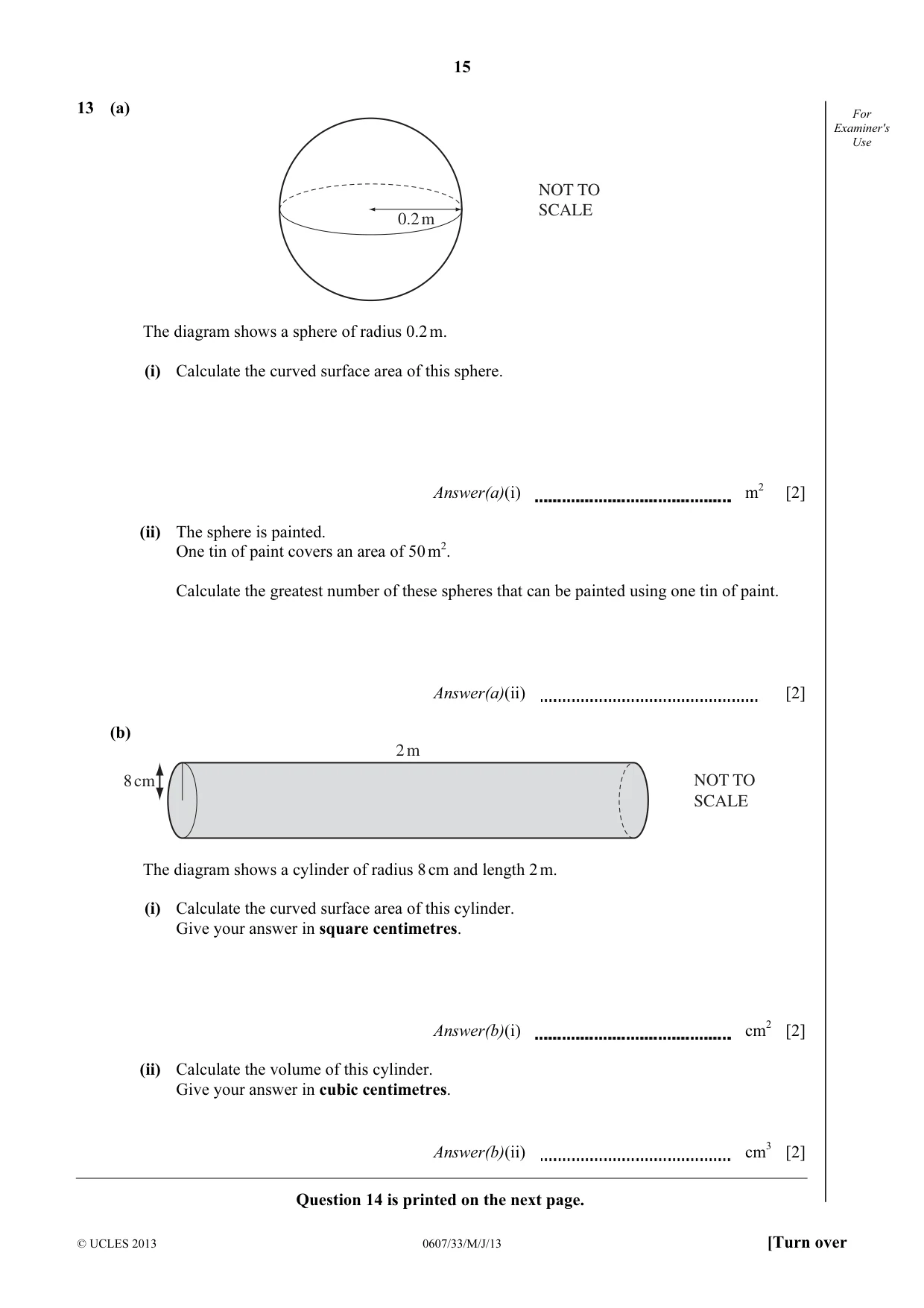
15 © UCLES 2013 0607/33/M/J/13 [Turn over For Examiner's Use 13 (a) 0.2 m NOT TO SCALE The diagram shows a sphere of radius 0.2 m. (i) Calculate the curved surface area of this sphere. Answer(a)(i) m2 [2] (ii) The sphere is painted. One tin of paint covers an area of 50 m2. Calculate the greatest number of these spheres that can be painted using one tin of paint. Answer(a)(ii) [2] (b) 8 cm 2 m NOT TO SCALE The diagram shows a cylinder of radius 8 cm and length 2 m. (i) Calculate the curved surface area of this cylinder. Give your answer in square centimetres. Answer(b)(i) cm2 [2] (ii) Calculate the volume of this cylinder. Give your answer in cubic centimetres. Answer(b)(ii) cm3 [2] Question 14 is printed on the next page.
Question paper, page 16
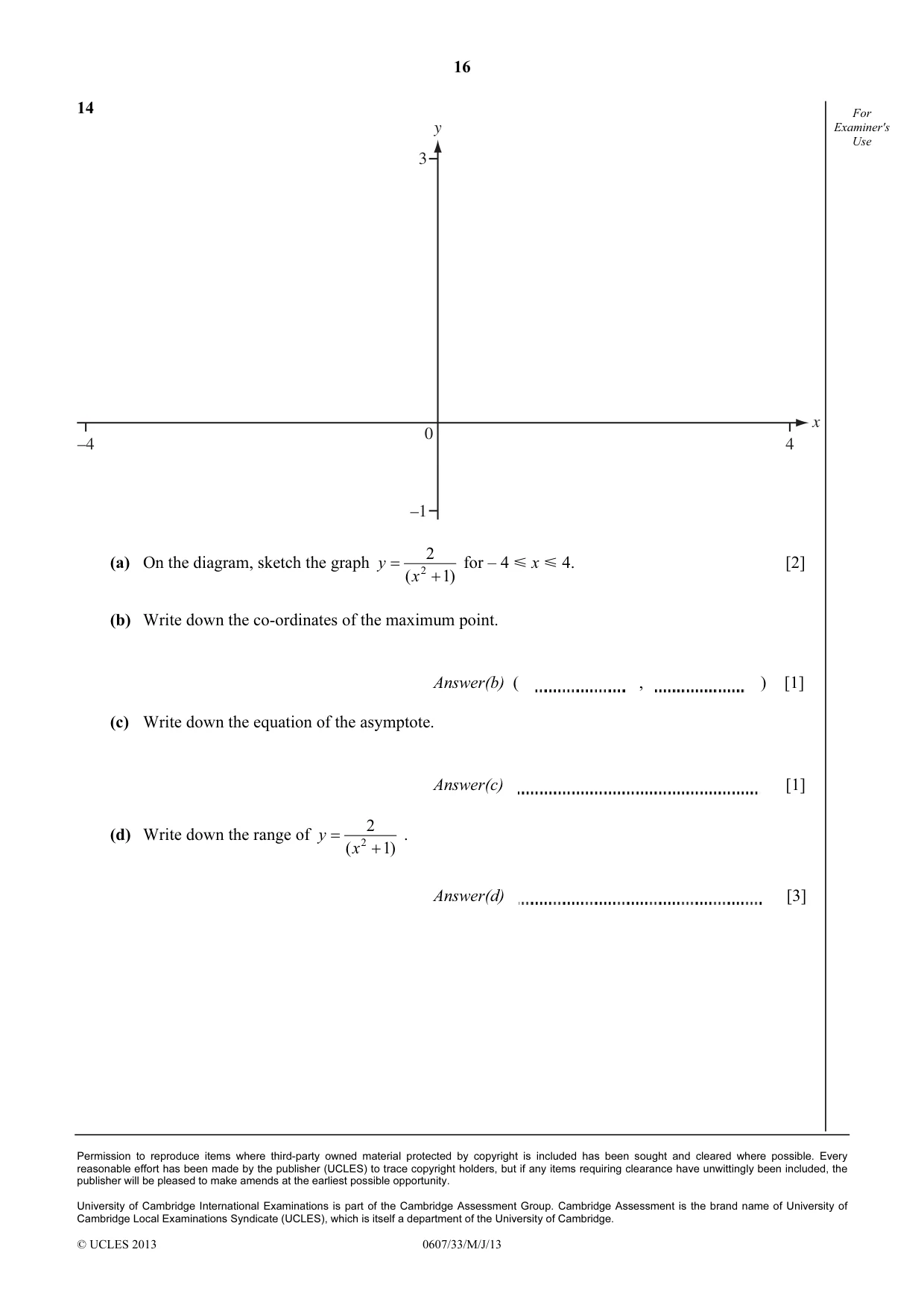
16 Permission to reproduce items where third-party owned material protected by copyright is included has been sought and cleared where possible. Every reasonable effort has been made by the publisher (UCLES) to trace copyright holders, but if any items requiring clearance have unwittingly been included, the publisher will be pleased to make amends at the earliest possible opportunity. University of Cambridge International Examinations is part of the Cambridge Assessment Group. Cambridge Assessment is the brand name of University of Cambridge Local Examinations Syndicate (UCLES), which is itself a department of the University of Cambridge. © UCLES 2013 0607/33/M/J/13 For Examiner's Use 14 –4 4 3 –1 y x 0 (a) On the diagram, sketch the graph )1 ( 2 2 + = x y for – 4 Y x Y 4. [2] (b) Write down the co-ordinates of the maximum point. Answer(b) ( , ) [1] (c) Write down the equation of the asymptote. Answer(c) [1] (d) Write down the range of )1 ( 2 2 + = x y . Answer(d) [3]
Mark scheme, page 1
CAMBRIDGE INTERNATIONAL EXAMINATIONS International General Certificate of Secondary Education MARK SCHEME for the May/June 2013 series 0607 CAMBRIDGE INTERNATIONAL MATHEMATICS 0607/33 Paper 3 (Core), maximum raw mark 96 This mark scheme is published as an aid to teachers and candidates, to indicate the requirements of the examination. It shows the basis on which Examiners were instructed to award marks. It does not indicate the details of the discussions that took place at an Examiners’ meeting before marking began, which would have considered the acceptability of alternative answers. Mark schemes should be read in conjunction with the question paper and the Principal Examiner Report for Teachers. Cambridge will not enter into discussions about these mark schemes. Cambridge is publishing the mark schemes for the May/June 2013 series for most IGCSE, GCE Advanced Level and Advanced Subsidiary Level components and some Ordinary Level components. www.XtremePapers.com
Mark scheme, page 2
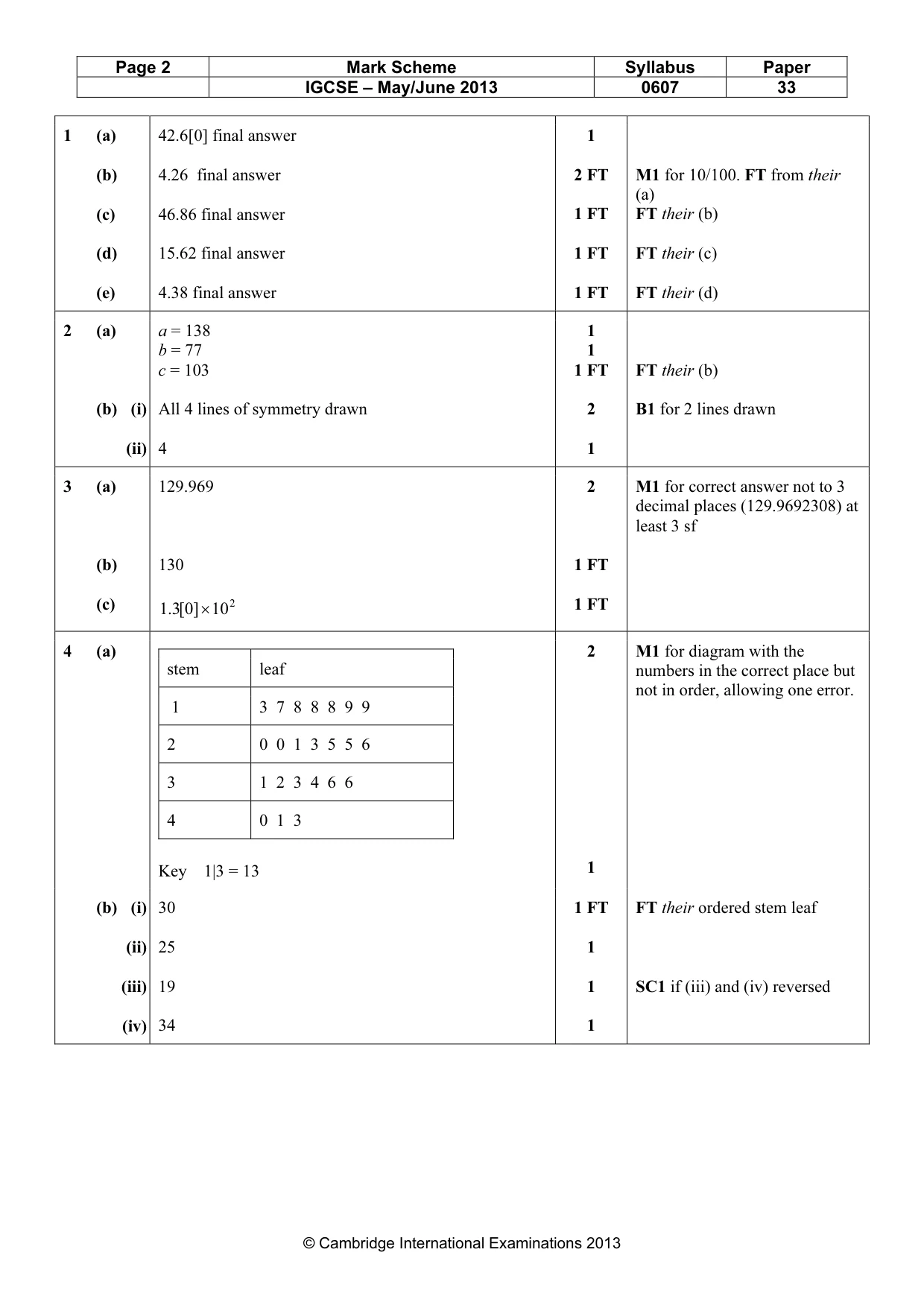
Page 2 Mark Scheme Syllabus Paper IGCSE – May/June 2013 0607 33 © Cambridge International Examinations 2013 1 (a) (b) (c) (d) (e) 42.6[0] final answer 4.26 final answer 46.86 final answer 15.62 final answer 4.38 final answer 1 2 FT 1 FT 1 FT 1 FT M1 for 10/100. FT from their (a) FT their (b) FT their (c) FT their (d) 2 (a) (b) (i) (ii) a = 138 b = 77 c = 103 All 4 lines of symmetry drawn 4 1 1 1 FT 2 1 FT their (b) B1 for 2 lines drawn 3 (a) (b) (c) 129.969 130 2 10 ] 0 [3.1 × 2 1 FT 1 FT M1 for correct answer not to 3 decimal places (129.9692308) at least 3 sf 4 (a) Key 1|3 = 13 stem leaf 1 3 7 8 8 8 9 9 2 0 0 1 3 5 5 6 3 1 2 3 4 6 6 4 0 1 3 2 1 M1 for diagram with the numbers in the correct place but not in order, allowing one error. (b) (i) (ii) (iii) (iv) 30 25 19 34 1 FT 1 1 1 FT their ordered stem leaf SC1 if (iii) and (iv) reversed
Mark scheme, page 3
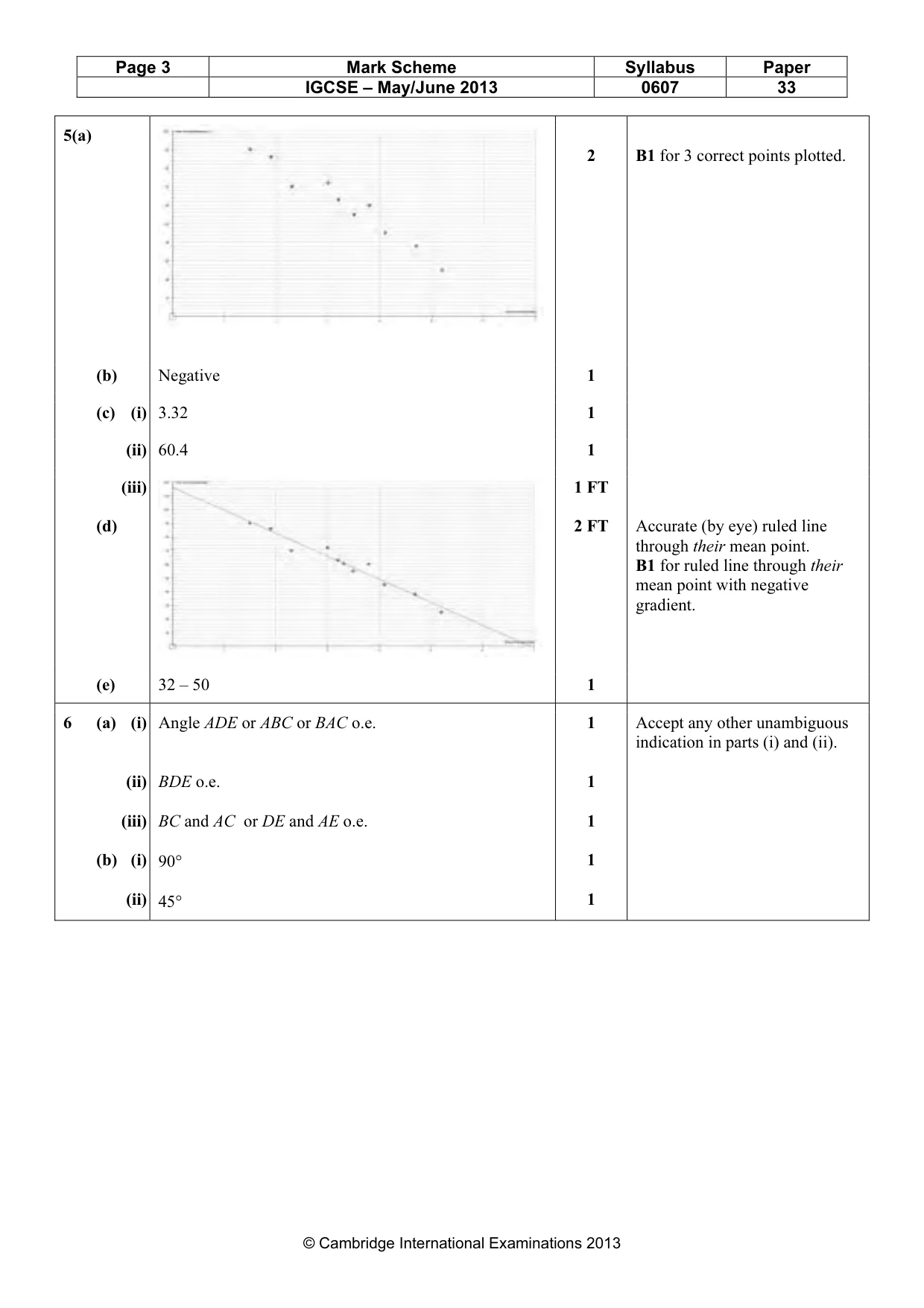
Page 3 Mark Scheme Syllabus Paper IGCSE – May/June 2013 0607 33 © Cambridge International Examinations 2013 5(a) 2 B1 for 3 correct points plotted. (b) Negative 1 (c) (i) 3.32 1 (ii) 60.4 1 (iii) (d) 1 FT 2 FT Accurate (by eye) ruled line through their mean point. B1 for ruled line through their mean point with negative gradient. (e) 32 – 50 1 6 (a) (i) (ii) (iii) (b) (i) (ii) Angle ADE or ABC or BAC o.e. BDE o.e. BC and AC or DE and AE o.e. 90° 45° 1 1 1 1 1 Accept any other unambiguous indication in parts (i) and (ii).
Mark scheme, page 4
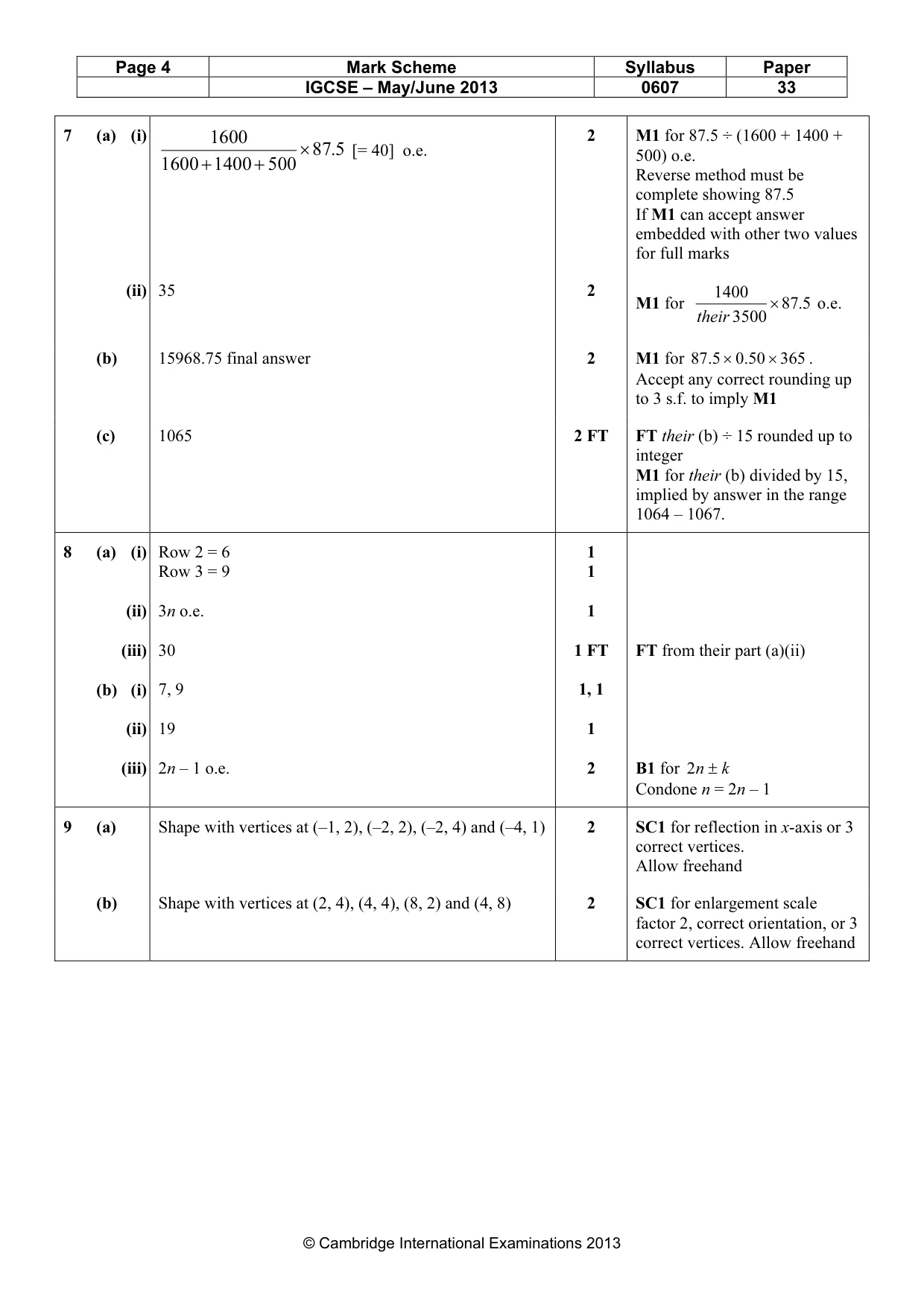
Page 4 Mark Scheme Syllabus Paper IGCSE – May/June 2013 0607 33 © Cambridge International Examinations 2013 7 (a) (i) 5. 87 500 1400 1600 1600 × + + [= 40] o.e. 2 M1 for 87.5 ÷ (1600 + 1400 + 500) o.e. Reverse method must be complete showing 87.5 If M1 can accept answer embedded with other two values for full marks (ii) 35 2 M1 for 5. 87 3500 1400 × their o.e. (b) 15968.75 final answer 2 M1 for 365 50 .0 5. 87 × × . Accept any correct rounding up to 3 s.f. to imply M1 (c) 1065 2 FT FT their (b) ÷ 15 rounded up to integer M1 for their (b) divided by 15, implied by answer in the range 1064 – 1067. 8 (a) (i) (ii) (iii) (b) (i) (ii) (iii) Row 2 = 6 Row 3 = 9 3n o.e. 30 7, 9 19 2n – 1 o.e. 1 1 1 1 FT 1, 1 1 2 FT from their part (a)(ii) B1 for k n ± 2 Condone n = 2n – 1 9 (a) Shape with vertices at (–1, 2), (–2, 2), (–2, 4) and (–4, 1) 2 SC1 for reflection in x-axis or 3 correct vertices. Allow freehand (b) Shape with vertices at (2, 4), (4, 4), (8, 2) and (4, 8) 2 SC1 for enlargement scale factor 2, correct orientation, or 3 correct vertices. Allow freehand
Mark scheme, page 5
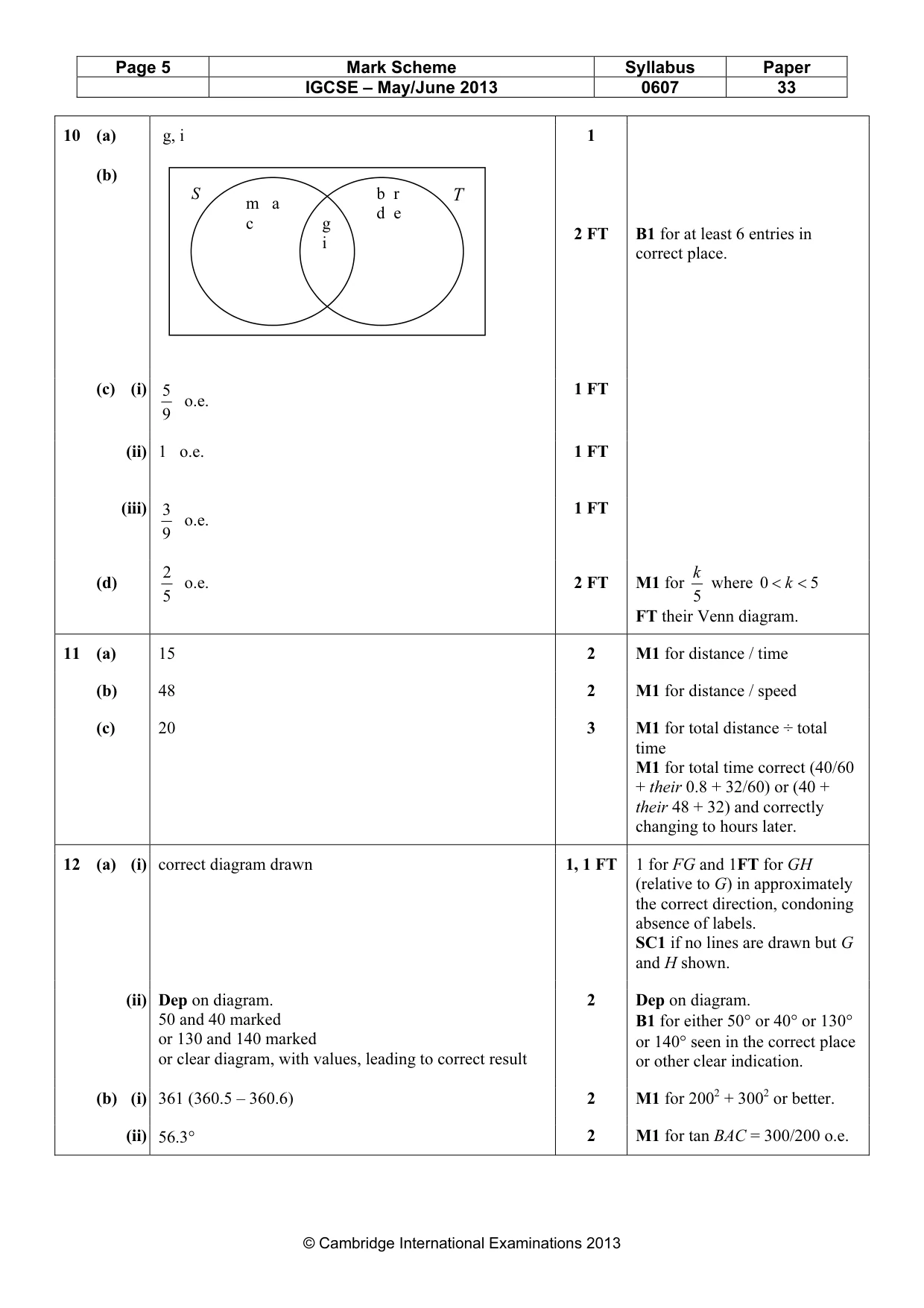
Page 5 Mark Scheme Syllabus Paper IGCSE – May/June 2013 0607 33 © Cambridge International Examinations 2013 10 (a) (b) g, i 1 2 FT B1 for at least 6 entries in correct place. (c) (i) 9 5 o.e. 1 FT (ii) 1 o.e. 1 FT (iii) 9 3 o.e. 1 FT (d) 5 2 o.e. 2 FT M1 for 5 k where 5 0 < < k FT their Venn diagram. 11 (a) 15 2 M1 for distance / time (b) 48 2 M1 for distance / speed (c) 20 3 M1 for total distance ÷ total time M1 for total time correct (40/60 + their 0.8 + 32/60) or (40 + their 48 + 32) and correctly changing to hours later. 12 (a) (i) correct diagram drawn 1, 1 FT 1 for FG and 1FT for GH (relative to G) in approximately the correct direction, condoning absence of labels. SC1 if no lines are drawn but G and H shown. (ii) Dep on diagram. 50 and 40 marked or 130 and 140 marked or clear diagram, with values, leading to correct result 2 Dep on diagram. B1 for either 50° or 40° or 130° or 140° seen in the correct place or other clear indication. (b) (i) 361 (360.5 – 360.6) 2 M1 for 2002 + 3002 or better. (ii) 56.3° 2 M1 for tan BAC = 300/200 o.e. T g i m a c b r d e S
Mark scheme, page 6
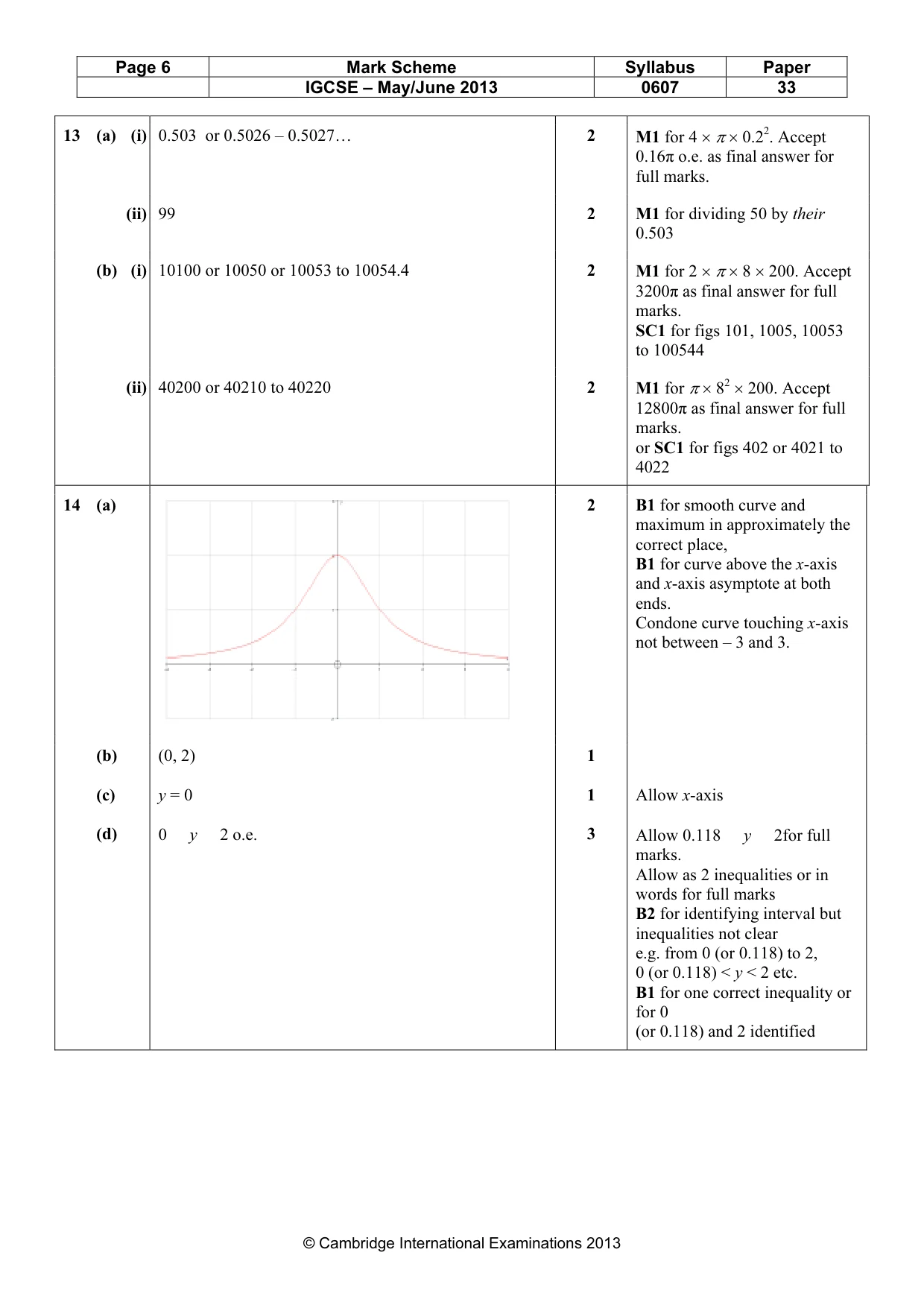
Page 6 Mark Scheme Syllabus Paper IGCSE – May/June 2013 0607 33 © Cambridge International Examinations 2013 13 (a) (i) 0.503 or 0.5026 – 0.5027… 2 M1 for 4 × π × 0.22. Accept 0.16π o.e. as final answer for full marks. (ii) 99 2 M1 for dividing 50 by their 0.503 (b) (i) 10100 or 10050 or 10053 to 10054.4 2 M1 for 2 × π × 8 × 200. Accept 3200π as final answer for full marks. SC1 for figs 101, 1005, 10053 to 100544 (ii) 40200 or 40210 to 40220 2 M1 for π × 82 × 200. Accept 12800π as final answer for full marks. or SC1 for figs 402 or 4021 to 4022 14 (a) 2 B1 for smooth curve and maximum in approximately the correct place, B1 for curve above the x-axis and x-axis asymptote at both ends. Condone curve touching x-axis not between – 3 and 3. (b) (c) (d) (0, 2) y = 0 0 y 2 o.e. 1 1 3 Allow x-axis Allow 0.118 y 2for full marks. Allow as 2 inequalities or in words for full marks B2 for identifying interval but inequalities not clear e.g. from 0 (or 0.118) to 2, 0 (or 0.118) < y < 2 etc. B1 for one correct inequality or for 0 (or 0.118) and 2 identified
What you needed in this session
Cambridge’s own grade thresholds for 2013 May/June, Paper 3 · Variant 3. A higher threshold means an easier paper — the bar moves with how the cohort did.