Cambridge IGCSE Mathematics - International 0607 — 2012 May/June Paper 6 · Variant 1
0607/61/M/J/12 · 40 marks · ≈45 min
The question paper and its mark scheme, free to read here and free to download. This is Cambridge’s own paper, exactly as it was sat.
Question paper12 pages
Mark scheme6 pages
Answers below. Sit the paper first if you are practising.
Paper as text
Question paper, page 1
This document consists of 11 printed pages and 1 blank page. IB12 06_0607_06/5RP © UCLES 2012 [Turn over *4119238411* UNIVERSITY OF CAMBRIDGE INTERNATIONAL EXAMINATIONS International General Certificate of Secondary Education CAMBRIDGE INTERNATIONAL MATHEMATICS 0607/06 Paper 6 (Extended) May/June 2012 1 hour 30 minutes Candidates answer on the Question Paper Additional Materials: Graphics Calculator READ THESE INSTRUCTIONS FIRST Write your Centre number, candidate number and name on all the work you hand in. Write in dark blue or black pen. Do not use staples, paper clips, highlighters, glue or correction fluid. You may use a pencil for any diagrams or graphs. DO NOT WRITE IN ANY BARCODES. Answer both parts A and B. You must show all relevant working to gain full marks for correct methods, including sketches. In this paper you will also be assessed on your ability to provide full reasons and communicate your mathematics clearly and precisely. At the end of the examination, fasten all your work securely together. The total number of marks for this paper is 40. www.XtremePapers.com
Question paper, page 2
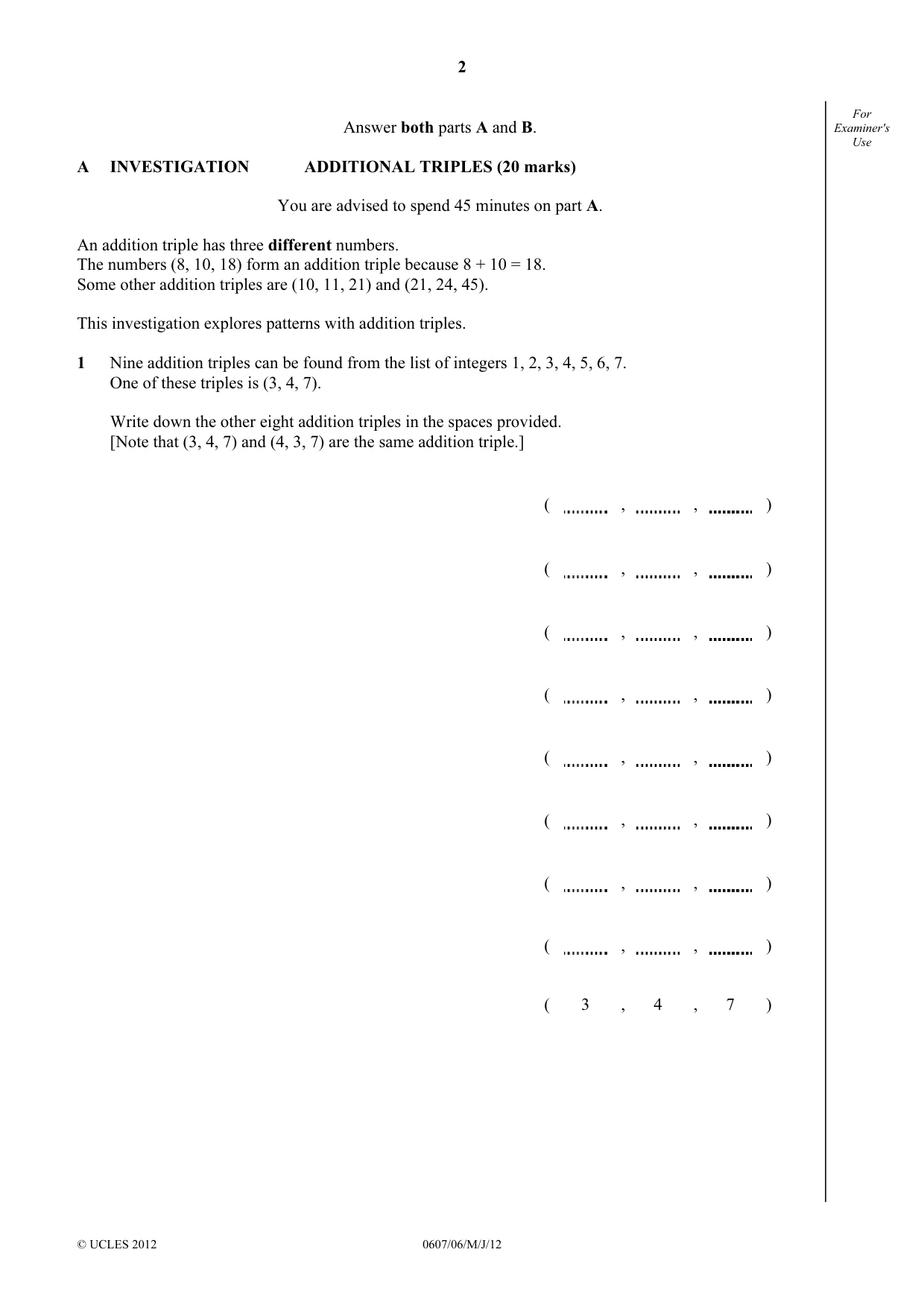
2 © UCLES 2012 0607/06/M/J/12 For Examiner's Use Answer both parts A and B. A INVESTIGATION ADDITIONAL TRIPLES (20 marks) You are advised to spend 45 minutes on part A. An addition triple has three different numbers. The numbers (8, 10, 18) form an addition triple because 8 + 10 = 18. Some other addition triples are (10, 11, 21) and (21, 24, 45). This investigation explores patterns with addition triples. 1 Nine addition triples can be found from the list of integers 1, 2, 3, 4, 5, 6, 7. One of these triples is (3, 4, 7). Write down the other eight addition triples in the spaces provided. [Note that (3, 4, 7) and (4, 3, 7) are the same addition triple.] ( , , ) ( , , ) ( , , ) ( , , ) ( , , ) ( , , ) ( , , ) ( , , ) ( 3 , 4 , 7 )
Question paper, page 3
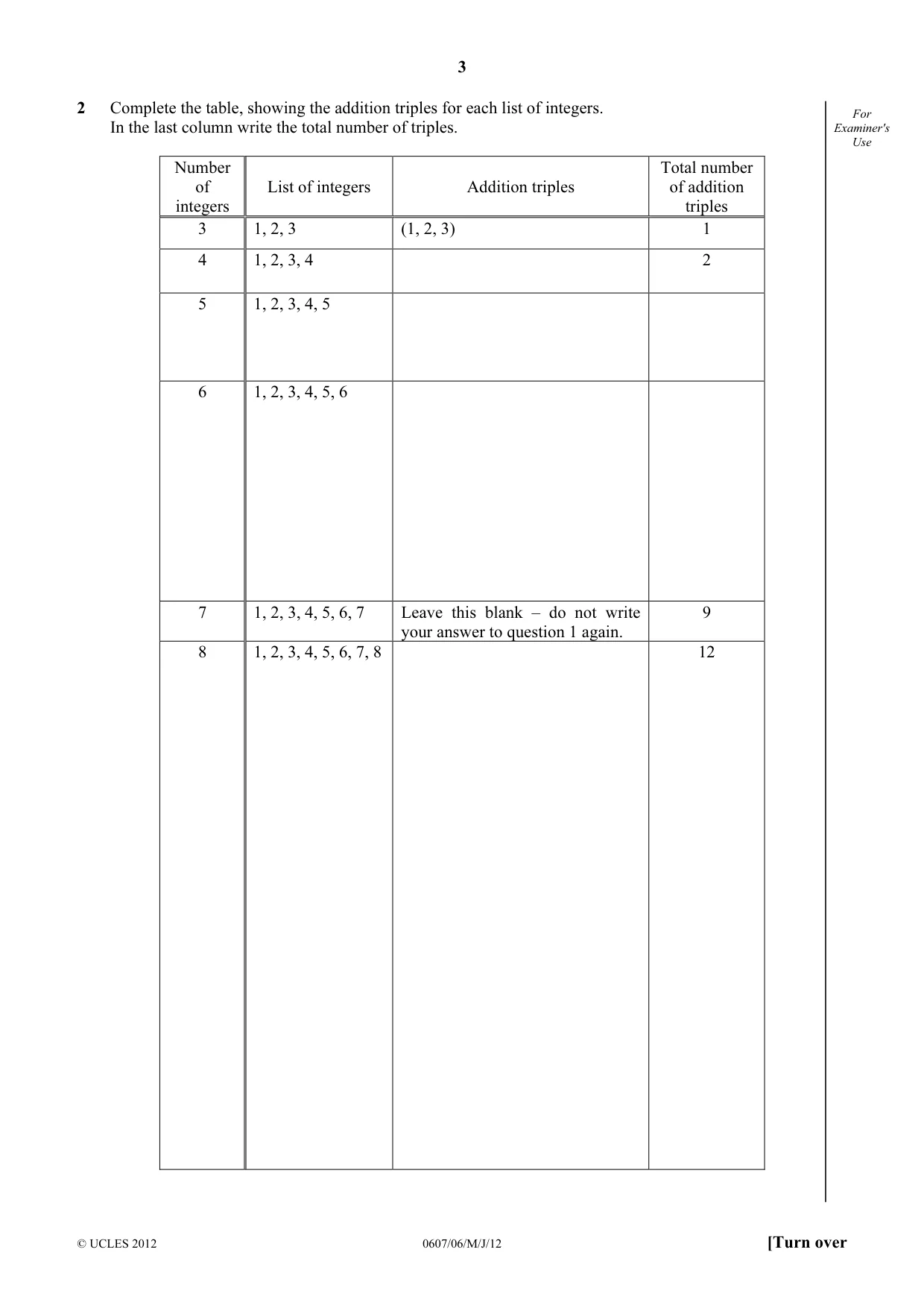
3 © UCLES 2012 0607/06/M/J/12 [Turn over For Examiner's Use 2 Complete the table, showing the addition triples for each list of integers. In the last column write the total number of triples. Number of integers List of integers Addition triples Total number of addition triples 3 1, 2, 3 (1, 2, 3) 1 4 1, 2, 3, 4 2 5 1, 2, 3, 4, 5 6 1, 2, 3, 4, 5, 6 7 1, 2, 3, 4, 5, 6, 7 Leave this blank – do not write your answer to question 1 again. 9 8 1, 2, 3, 4, 5, 6, 7, 8 12
Question paper, page 4
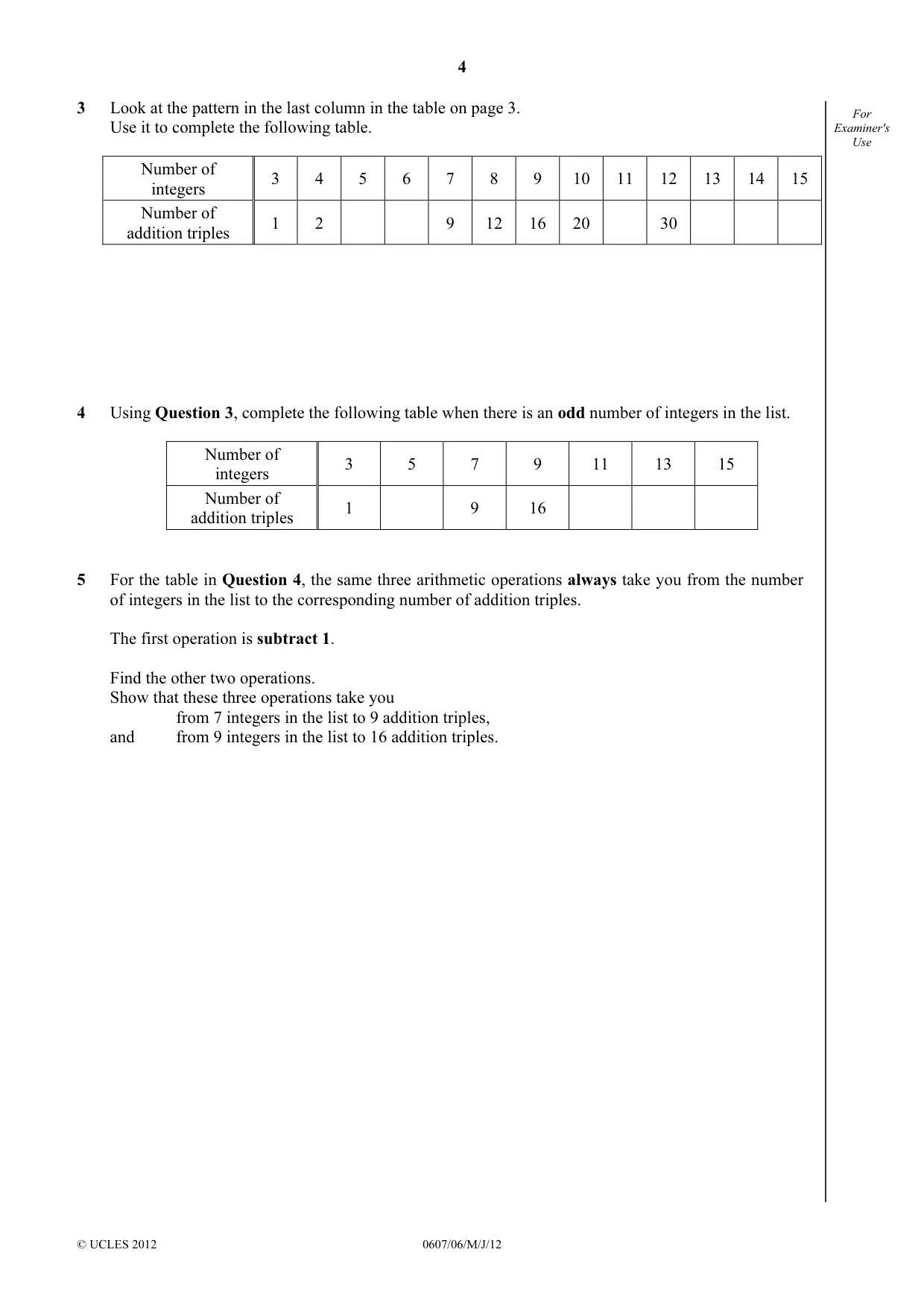
4 © UCLES 2012 0607/06/M/J/12 For Examiner's Use 3 Look at the pattern in the last column in the table on page 3. Use it to complete the following table. Number of integers 3 4 5 6 7 8 9 10 11 12 13 14 15 Number of addition triples 1 2 9 12 16 20 30 4 Using Question 3, complete the following table when there is an odd number of integers in the list. Number of integers 3 5 7 9 11 13 15 Number of addition triples 1 9 16 5 For the table in Question 4, the same three arithmetic operations always take you from the number of integers in the list to the corresponding number of addition triples. The first operation is subtract 1. Find the other two operations. Show that these three operations take you from 7 integers in the list to 9 addition triples, and from 9 integers in the list to 16 addition triples.
Question paper, page 5
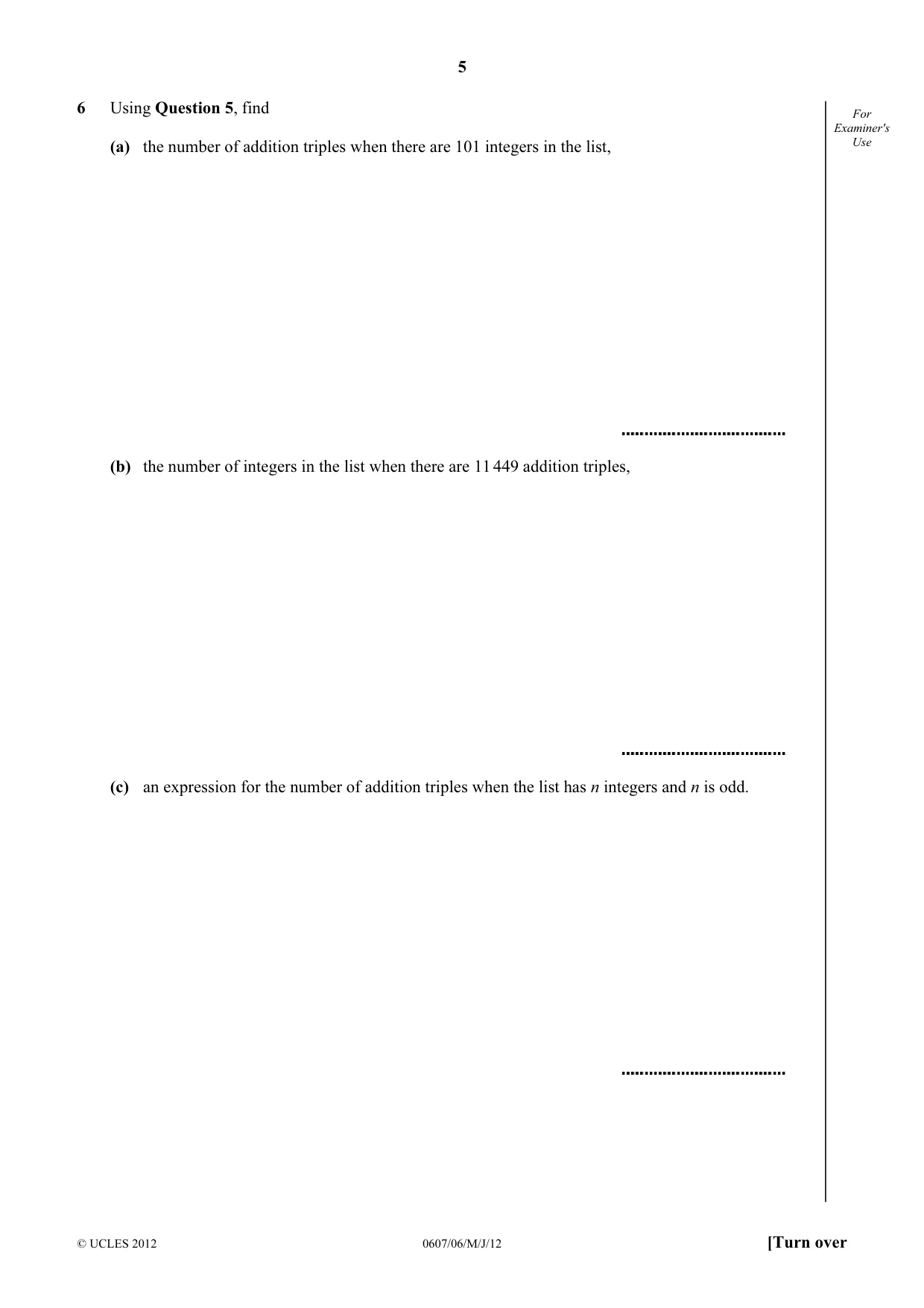
5 © UCLES 2012 0607/06/M/J/12 [Turn over For Examiner's Use 6 Using Question 5, find (a) the number of addition triples when there are 101 integers in the list, (b) the number of integers in the list when there are 11 449 addition triples, (c) an expression for the number of addition triples when the list has n integers and n is odd.
Question paper, page 6
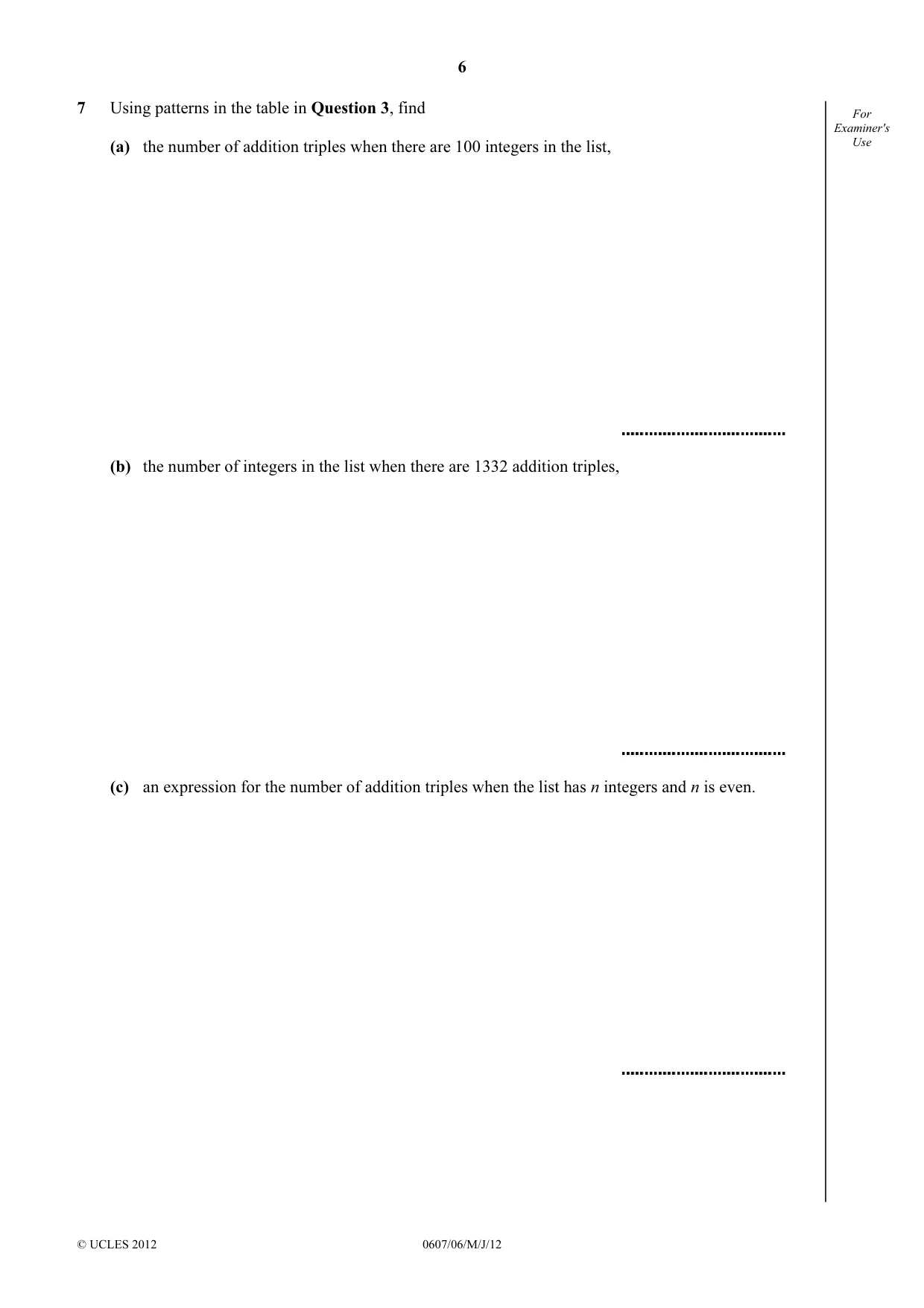
6 © UCLES 2012 0607/06/M/J/12 For Examiner's Use 7 Using patterns in the table in Question 3, find (a) the number of addition triples when there are 100 integers in the list, (b) the number of integers in the list when there are 1332 addition triples, (c) an expression for the number of addition triples when the list has n integers and n is even.
Question paper, page 7
7 © UCLES 2012 0607/06/M/J/12 [Turn over BLANK PAGE
Question paper, page 8
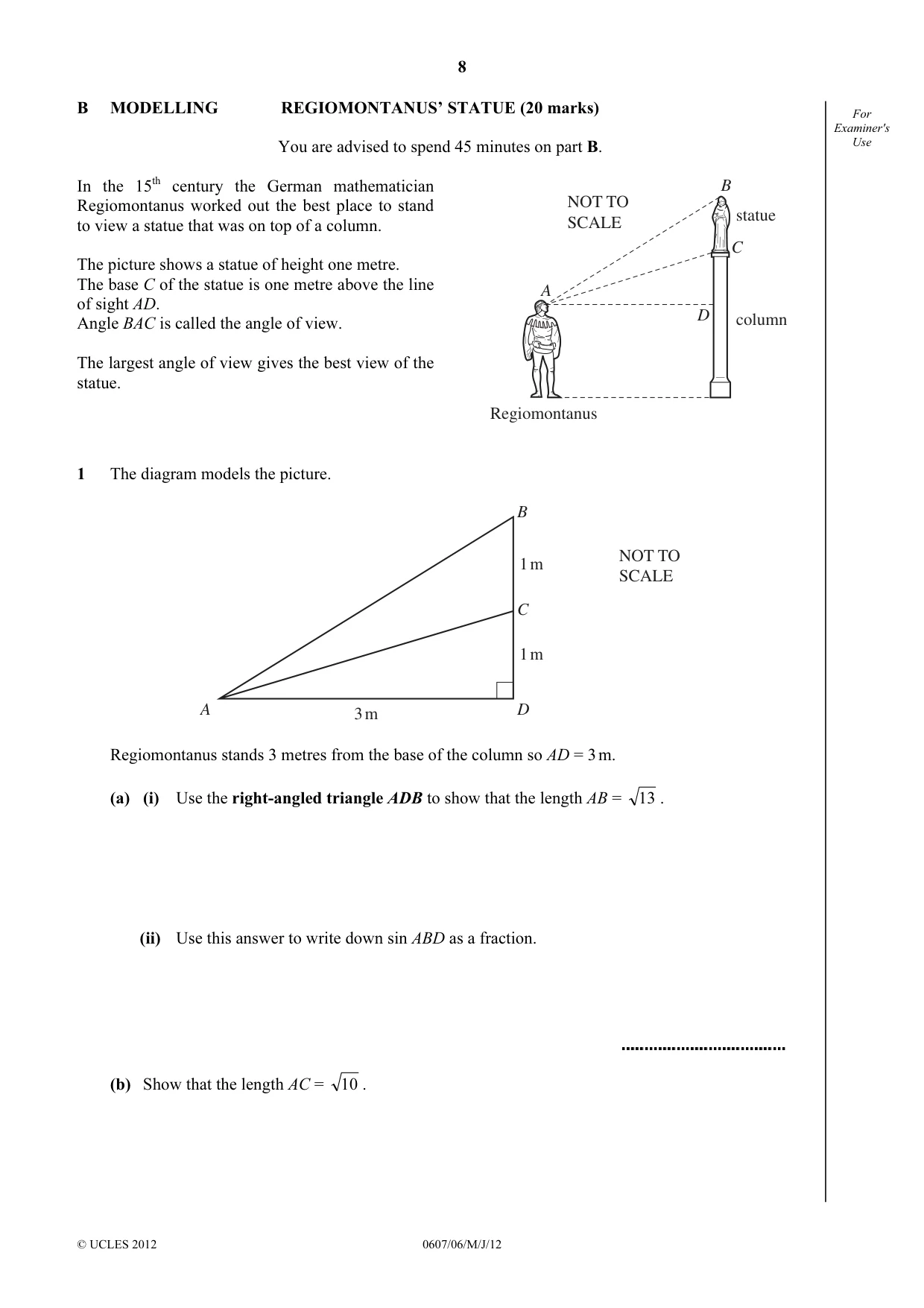
8 © UCLES 2012 0607/06/M/J/12 For Examiner's Use B MODELLING REGIOMONTANUS’ STATUE (20 marks) You are advised to spend 45 minutes on part B. In the 15th century the German mathematician Regiomontanus worked out the best place to stand to view a statue that was on top of a column. The picture shows a statue of height one metre. The base C of the statue is one metre above the line of sight AD. Angle BAC is called the angle of view. The largest angle of view gives the best view of the statue. NOT TO SCALE B C D A statue column Regiomontanus 1 The diagram models the picture. NOT TO SCALE B C D A 1 m 1 m 3 m Regiomontanus stands 3 metres from the base of the column so AD = 3 m. (a) (i) Use the right-angled triangle ADB to show that the length AB = 13 . (ii) Use this answer to write down sin ABD as a fraction. (b) Show that the length AC = 10 .
Question paper, page 9
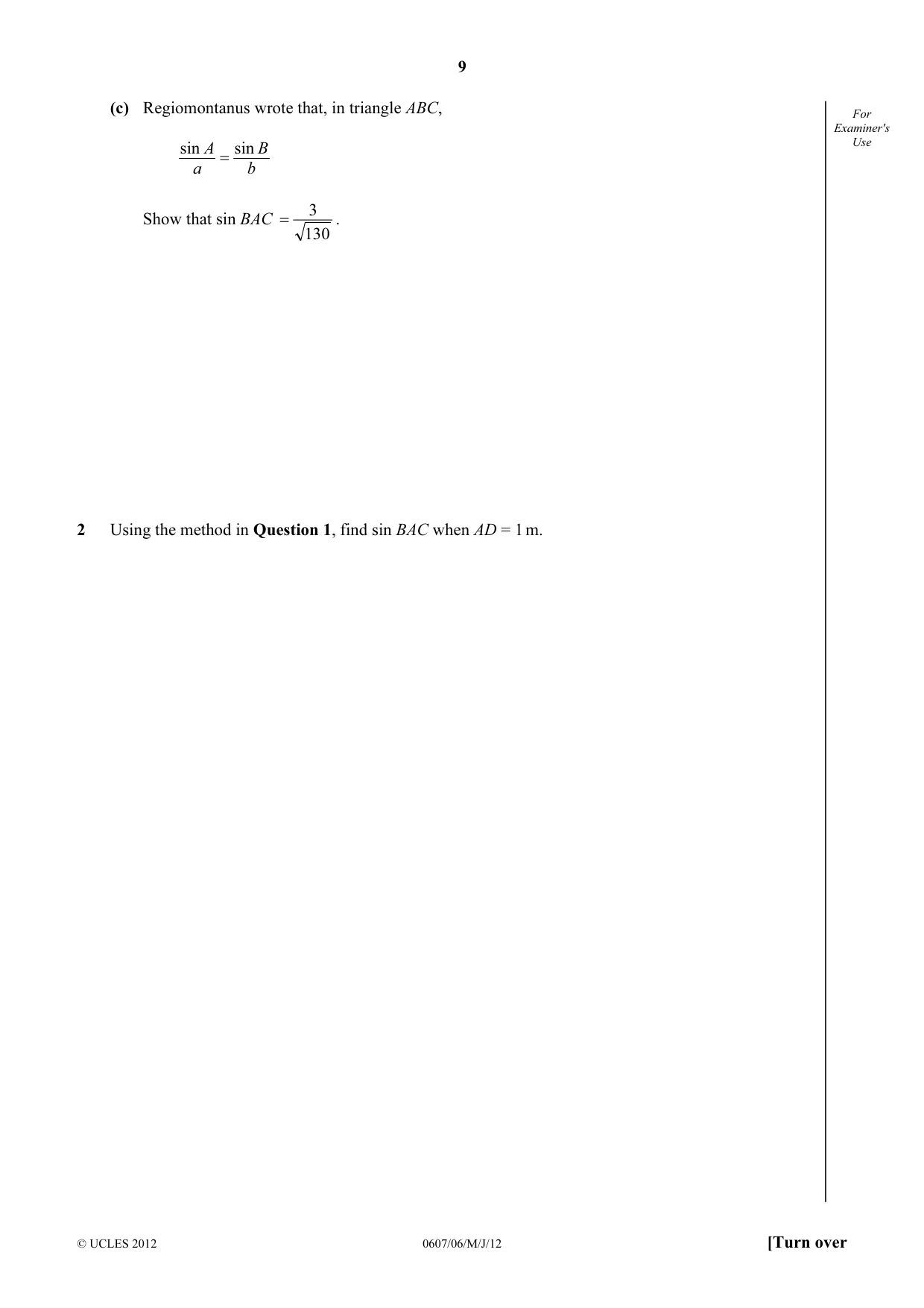
9 © UCLES 2012 0607/06/M/J/12 [Turn over For Examiner's Use (c) Regiomontanus wrote that, in triangle ABC, b B a A sin sin = Show that sin BAC 130 3 = . 2 Using the method in Question 1, find sin BAC when AD = 1 m.
Question paper, page 10
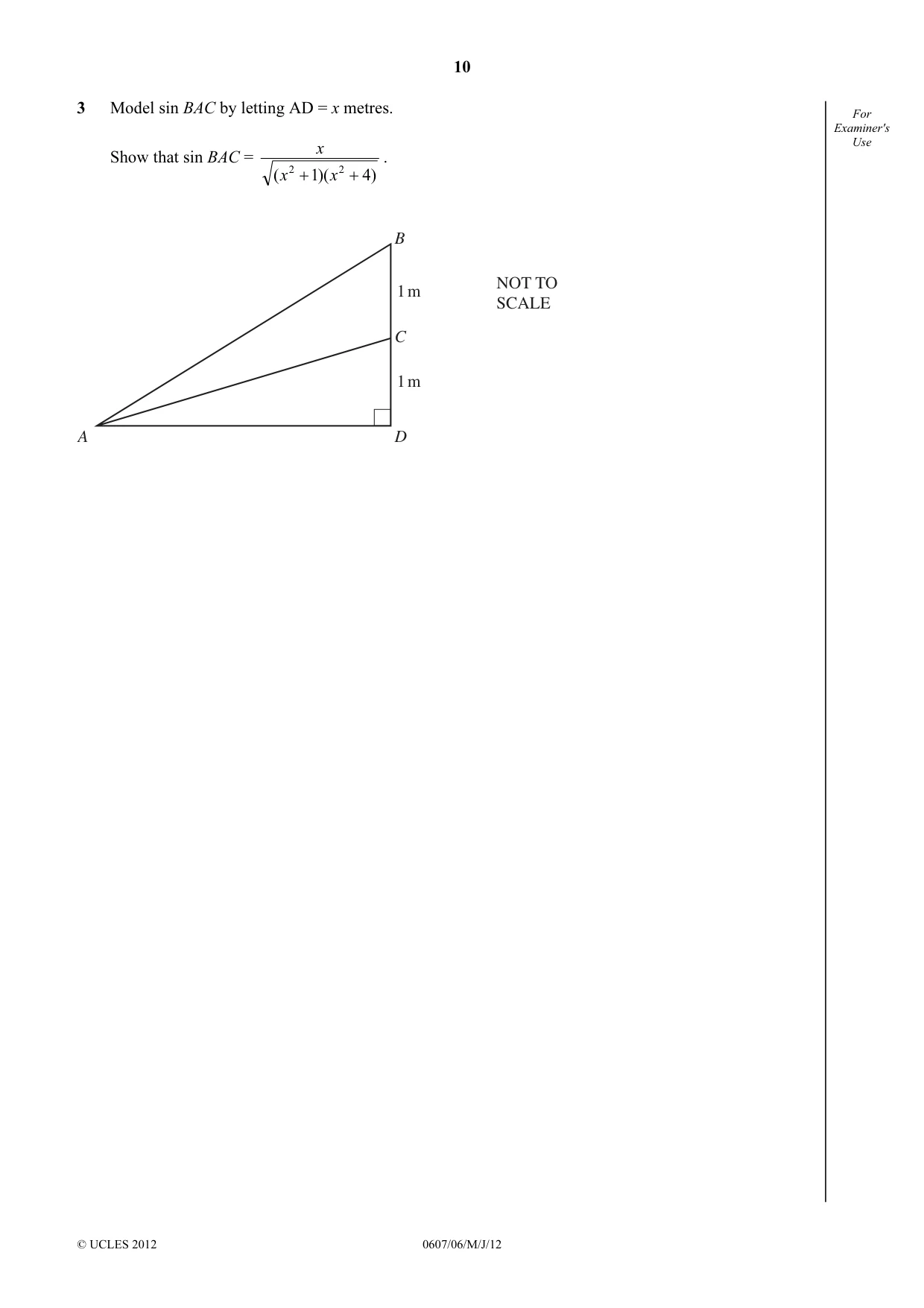
10 © UCLES 2012 0607/06/M/J/12 For Examiner's Use 3 Model sin BAC by letting AD = x metres. Show that sin BAC = ) 4 )( 1 ( 2 2 + + x x x . NOT TO SCALE B C D A 1 m 1 m
Question paper, page 11
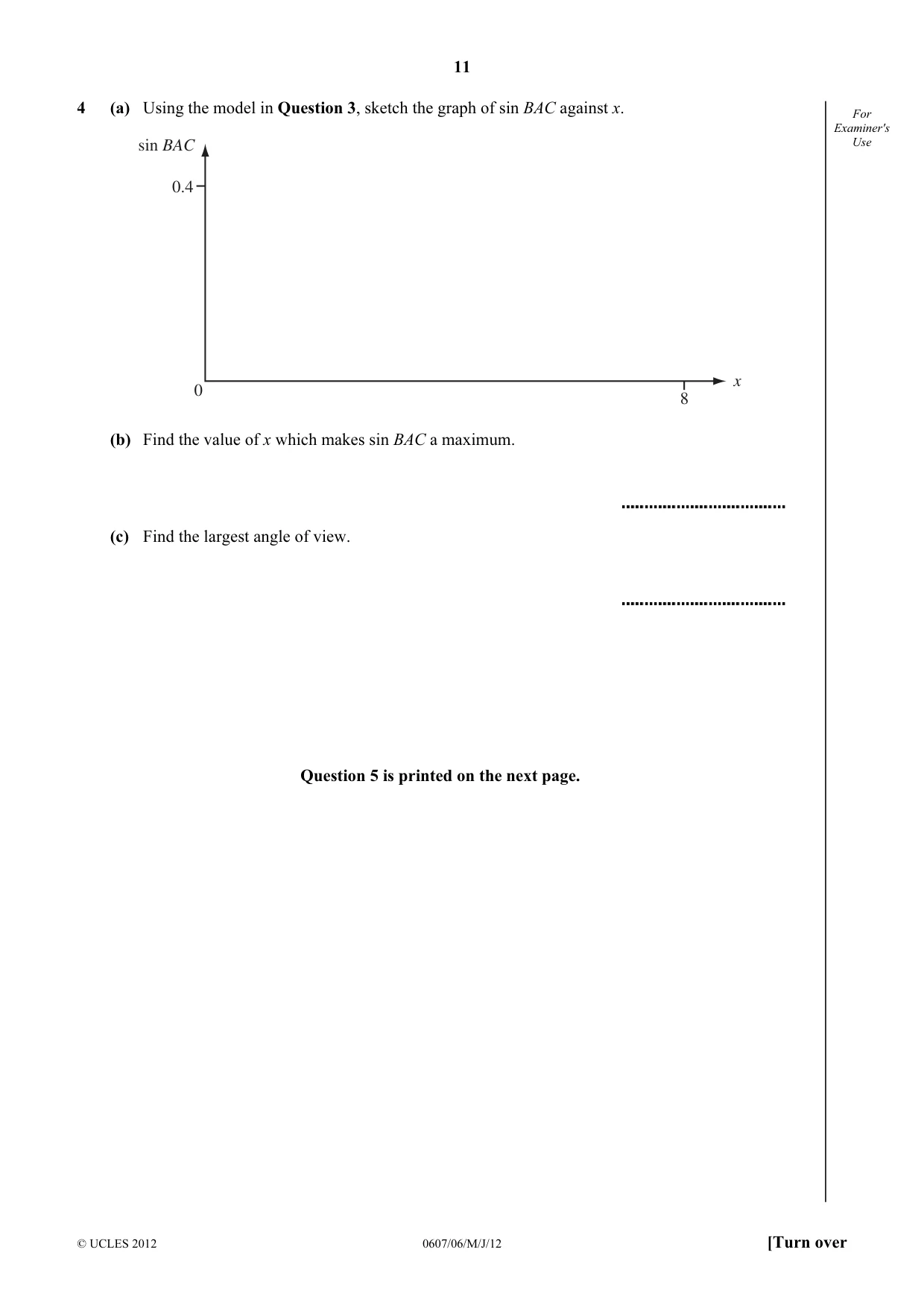
11 © UCLES 2012 0607/06/M/J/12 [Turn over For Examiner's Use 4 (a) Using the model in Question 3, sketch the graph of sin BAC against x. 0 0.4 8 sin BAC x (b) Find the value of x which makes sin BAC a maximum. (c) Find the largest angle of view. Question 5 is printed on the next page.
Question paper, page 12
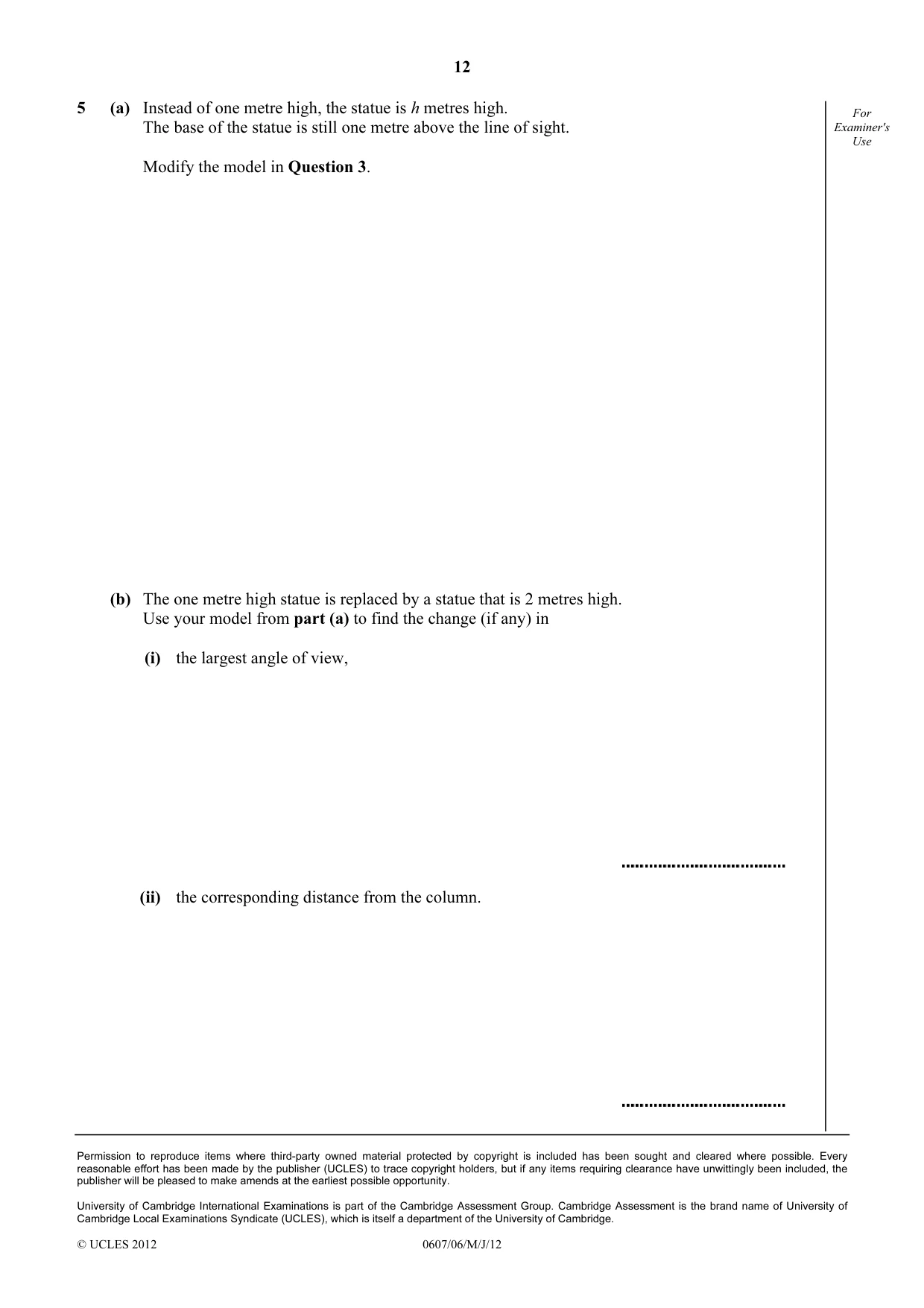
12 Permission to reproduce items where third-party owned material protected by copyright is included has been sought and cleared where possible. Every reasonable effort has been made by the publisher (UCLES) to trace copyright holders, but if any items requiring clearance have unwittingly been included, the publisher will be pleased to make amends at the earliest possible opportunity. University of Cambridge International Examinations is part of the Cambridge Assessment Group. Cambridge Assessment is the brand name of University of Cambridge Local Examinations Syndicate (UCLES), which is itself a department of the University of Cambridge. © UCLES 2012 0607/06/M/J/12 For Examiner's Use 5 (a) Instead of one metre high, the statue is h metres high. The base of the statue is still one metre above the line of sight. Modify the model in Question 3. (b) The one metre high statue is replaced by a statue that is 2 metres high. Use your model from part (a) to find the change (if any) in (i) the largest angle of view, (ii) the corresponding distance from the column.
Mark scheme, page 1
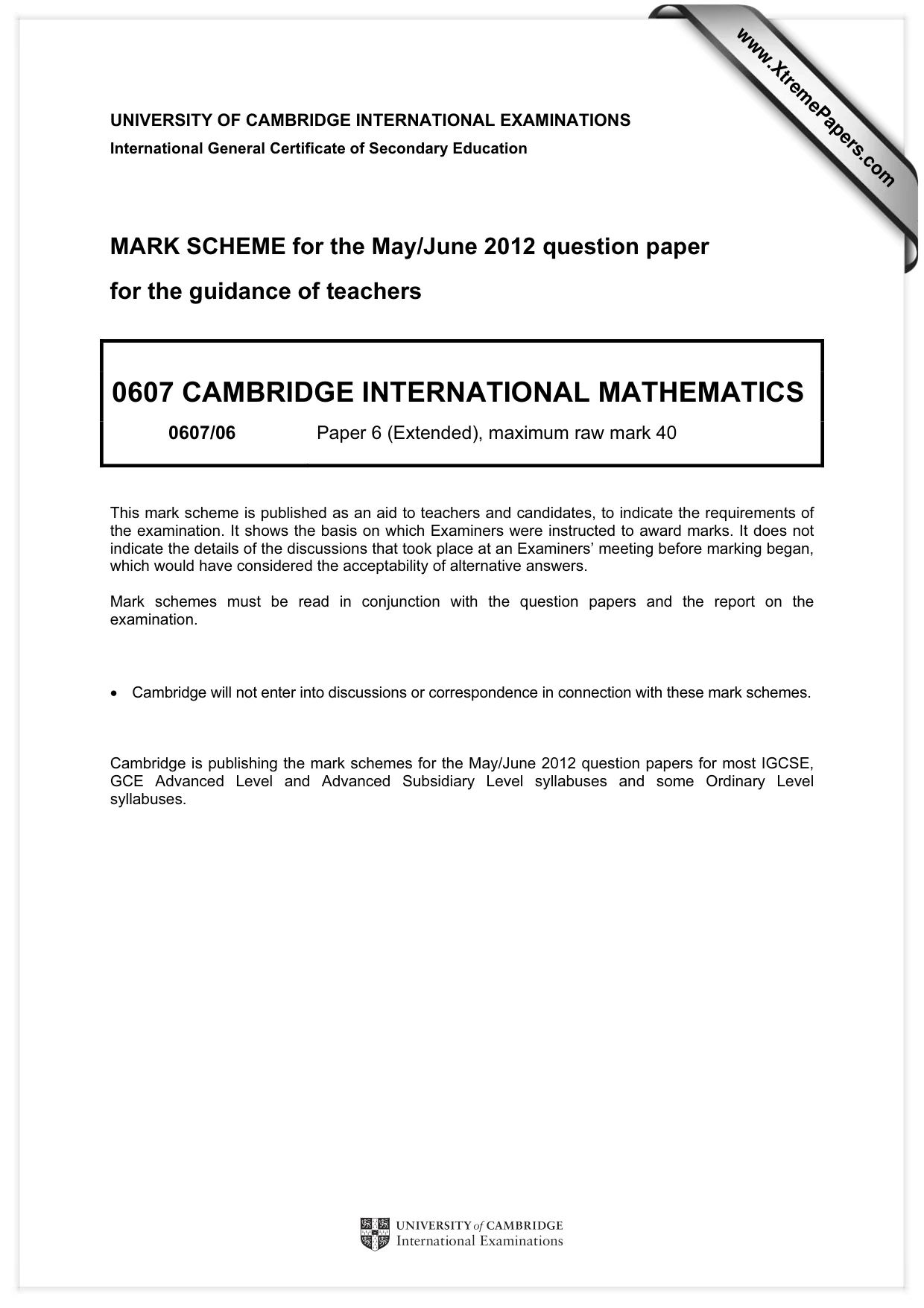
UNIVERSITY OF CAMBRIDGE INTERNATIONAL EXAMINATIONS International General Certificate of Secondary Education MARK SCHEME for the May/June 2012 question paper for the guidance of teachers 0607 CAMBRIDGE INTERNATIONAL MATHEMATICS 0607/06 Paper 6 (Extended), maximum raw mark 40 This mark scheme is published as an aid to teachers and candidates, to indicate the requirements of the examination. It shows the basis on which Examiners were instructed to award marks. It does not indicate the details of the discussions that took place at an Examiners’ meeting before marking began, which would have considered the acceptability of alternative answers. Mark schemes must be read in conjunction with the question papers and the report on the examination. • Cambridge will not enter into discussions or correspondence in connection with these mark schemes. Cambridge is publishing the mark schemes for the May/June 2012 question papers for most IGCSE, GCE Advanced Level and Advanced Subsidiary Level syllabuses and some Ordinary Level syllabuses. www.XtremePapers.com
Mark scheme, page 2
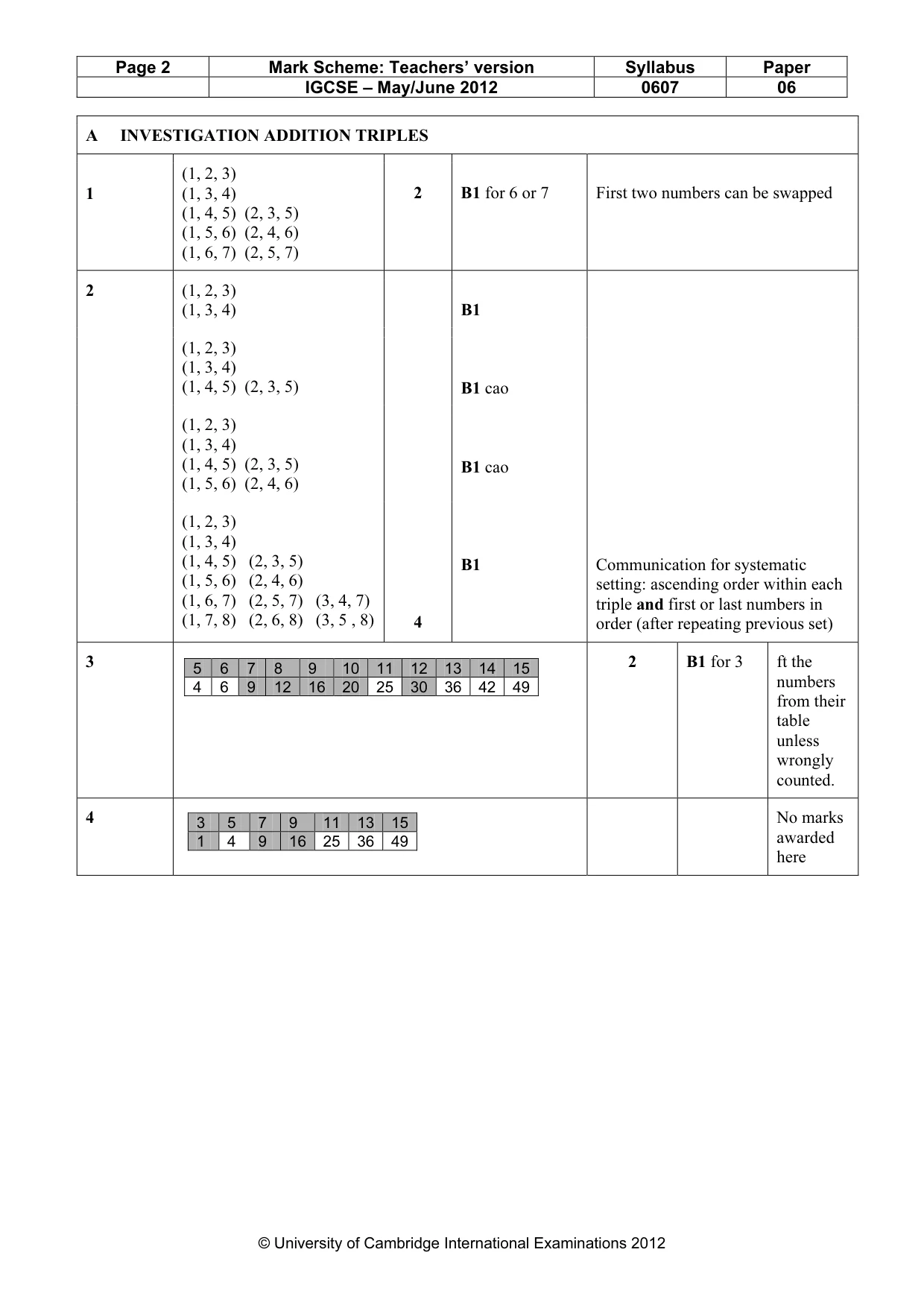
Page 2 Mark Scheme: Teachers’ version Syllabus Paper IGCSE – May/June 2012 0607 06 © University of Cambridge International Examinations 2012 A INVESTIGATION ADDITION TRIPLES 1 (1, 2, 3) (1, 3, 4) (1, 4, 5) (2, 3, 5) (1, 5, 6) (2, 4, 6) (1, 6, 7) (2, 5, 7) 2 B1 for 6 or 7 First two numbers can be swapped (1, 2, 3) (1, 3, 4) (1, 2, 3) (1, 3, 4) (1, 4, 5) (2, 3, 5) (1, 2, 3) (1, 3, 4) (1, 4, 5) (2, 3, 5) (1, 5, 6) (2, 4, 6) 2 (1, 2, 3) (1, 3, 4) (1, 4, 5) (2, 3, 5) (1, 5, 6) (2, 4, 6) (1, 6, 7) (2, 5, 7) (3, 4, 7) (1, 7, 8) (2, 6, 8) (3, 5 , 8) 4 B1 B1 cao B1 cao B1 Communication for systematic setting: ascending order within each triple and first or last numbers in order (after repeating previous set) 3 2 B1 for 3 ft the numbers from their table unless wrongly counted. 4 No marks awarded here 5 6 7 8 9 10 11 12 13 14 15 4 6 9 12 16 20 25 30 36 42 49 3 5 7 9 11 13 15 1 4 9 16 25 36 49
Mark scheme, page 3
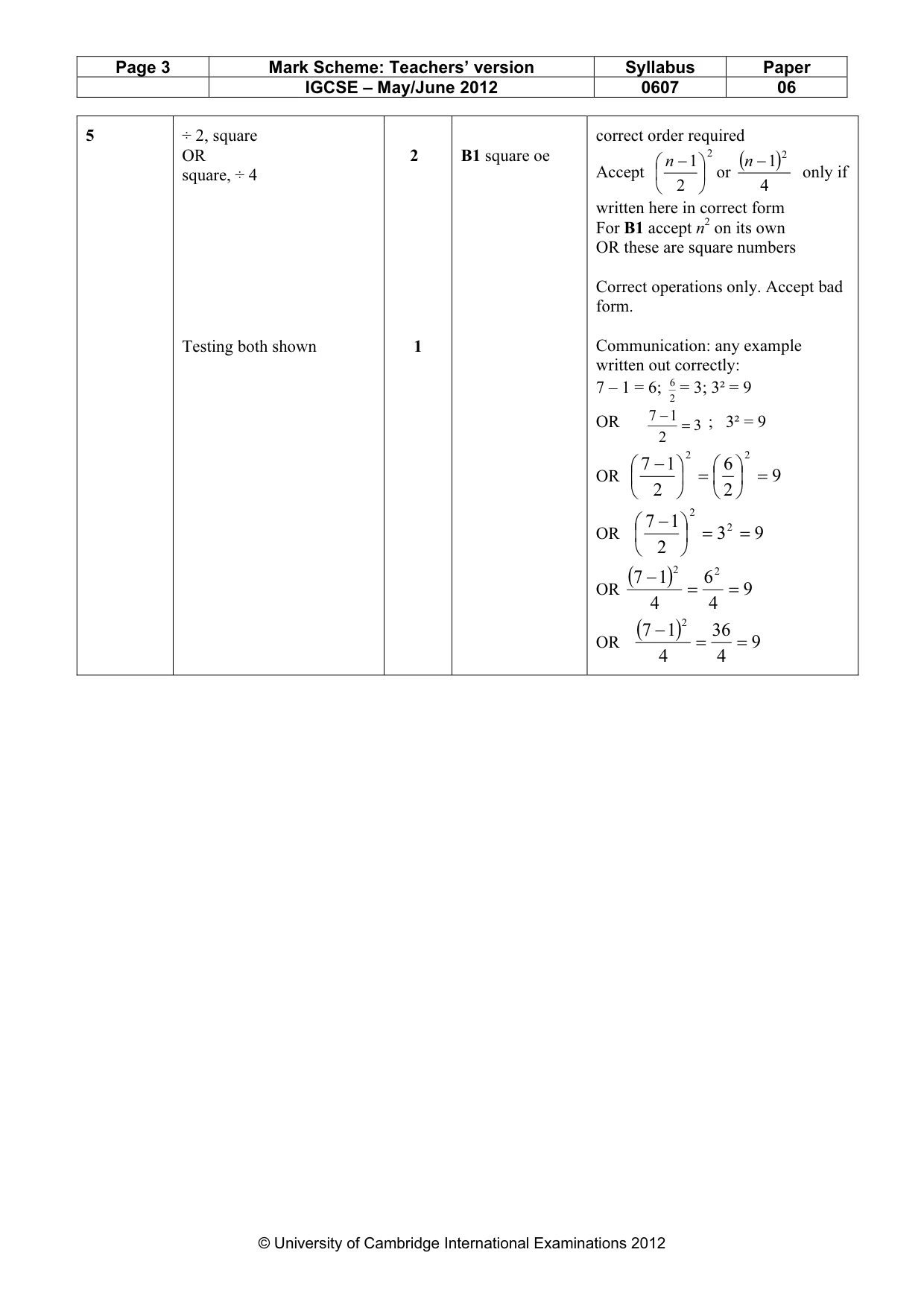
Page 3 Mark Scheme: Teachers’ version Syllabus Paper IGCSE – May/June 2012 0607 06 © University of Cambridge International Examinations 2012 5 ÷ 2, square OR square, ÷ 4 Testing both shown 2 1 B1 square oe correct order required Accept 2 2 1 − n or ( ) 4 1 2 − n only if written here in correct form For B1 accept n2 on its own OR these are square numbers Correct operations only. Accept bad form. Communication: any example written out correctly: 7 – 1 = 6; 2 6 = 3; 3² = 9 OR 3 2 1 7 = − ; 3² = 9 OR 9 2 6 2 1 7 2 2 = = − OR 9 3 2 1 7 2 2 = = − OR ( ) 9 4 6 4 1 7 2 2 = = − OR ( ) 9 4 36 4 1 7 2 = = −
Mark scheme, page 4
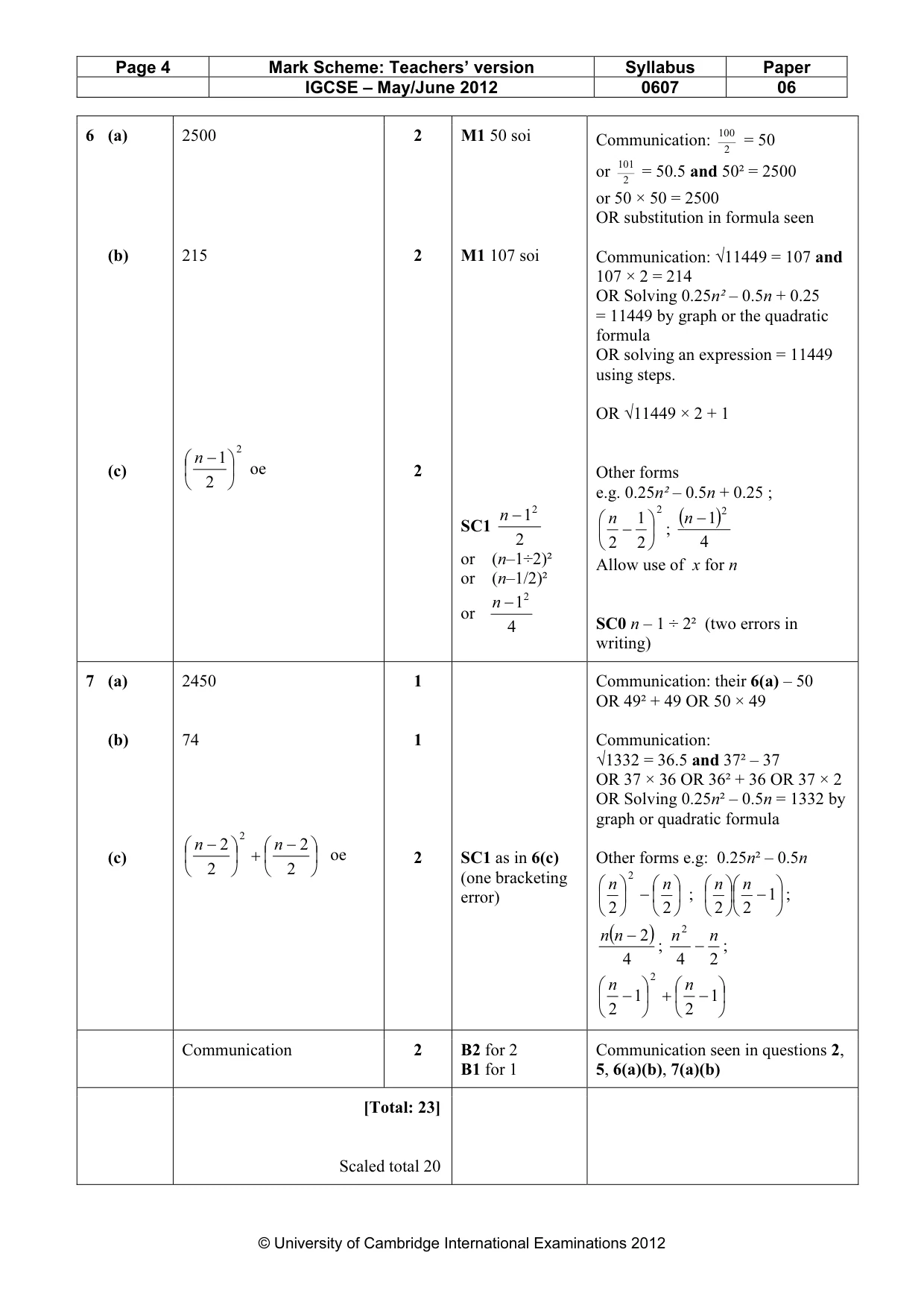
Page 4 Mark Scheme: Teachers’ version Syllabus Paper IGCSE – May/June 2012 0607 06 © University of Cambridge International Examinations 2012 6 (a) (b) (c) 2500 215 2 2 1 − n oe 2 2 2 M1 50 soi M1 107 soi SC1 2 12 − n or (n–1÷2)² or (n–1/2)² or 4 12 − n Communication: 2 100 = 50 or 2 101 = 50.5 and 50² = 2500 or 50 × 50 = 2500 OR substitution in formula seen Communication: √11449 = 107 and 107 × 2 = 214 OR Solving 0.25n² – 0.5n + 0.25 = 11449 by graph or the quadratic formula OR solving an expression = 11449 using steps. OR √11449 × 2 + 1 Other forms e.g. 0.25n² – 0.5n + 0.25 ; 2 2 1 2 − n ; ( ) 4 1 2 − n Allow use of x for n SC0 n – 1 ÷ 2² (two errors in writing) 7 (a) (b) (c) 2450 74 − + − 2 2 2 2 2 n n oe 1 1 2 SC1 as in 6(c) (one bracketing error) Communication: their 6(a) – 50 OR 49² + 49 OR 50 × 49 Communication: √1332 = 36.5 and 37² – 37 OR 37 × 36 OR 36² + 36 OR 37 × 2 OR Solving 0.25n² – 0.5n = 1332 by graph or quadratic formula Other forms e.g: 0.25n² – 0.5n − 2 2 2 n n ; − 1 2 2 n n ; ( ) 4 2 − n n ; 2 4 2 n n − ; − + − 1 2 1 2 2 n n Communication 2 B2 for 2 B1 for 1 Communication seen in questions 2, 5, 6(a)(b), 7(a)(b) [Total: 23] Scaled total 20
Mark scheme, page 5
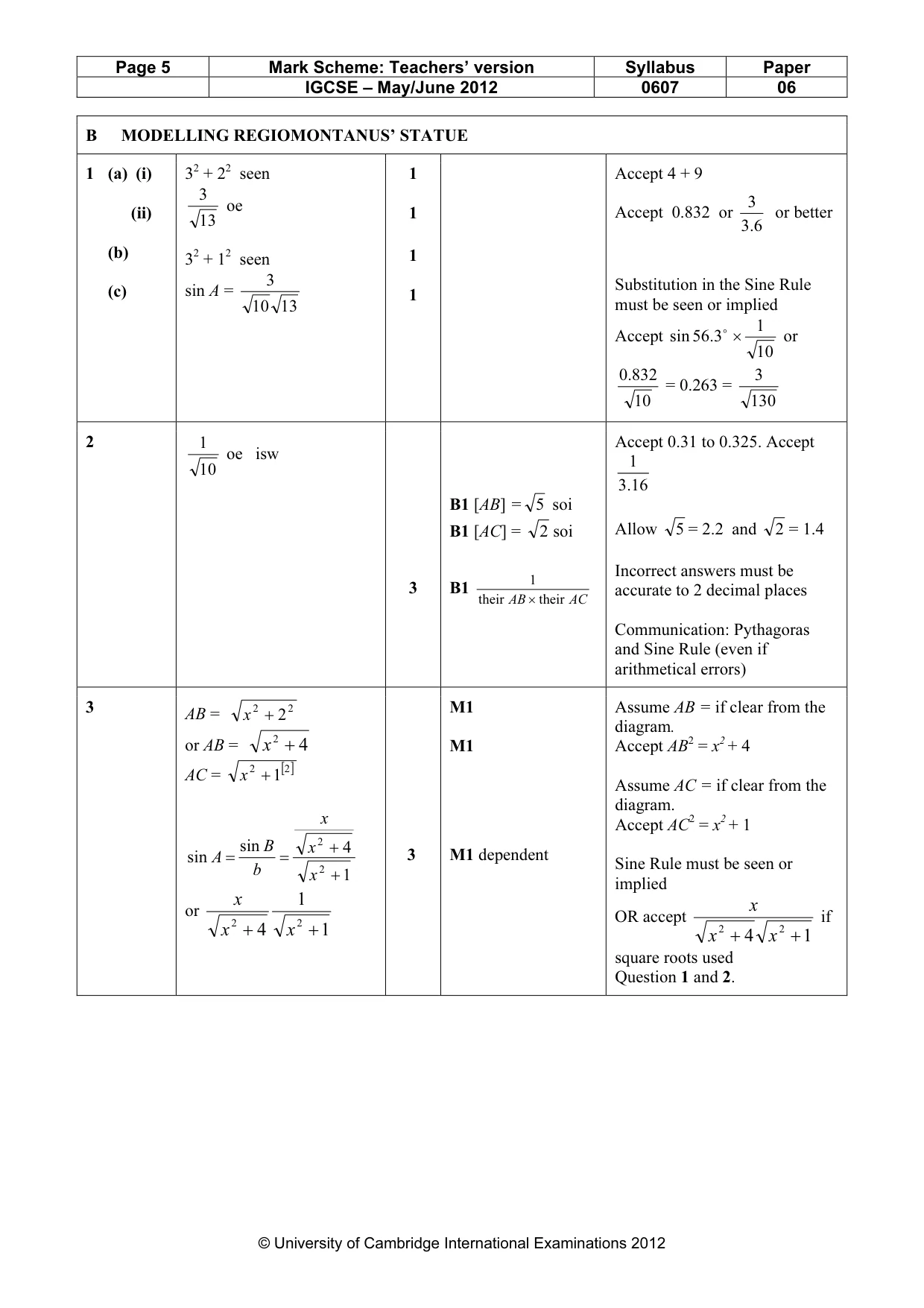
Page 5 Mark Scheme: Teachers’ version Syllabus Paper IGCSE – May/June 2012 0607 06 © University of Cambridge International Examinations 2012 B MODELLING REGIOMONTANUS’ STATUE 1 (a) (i) (ii) (b) (c) 32 + 22 seen 13 3 oe 32 + 12 seen sin A = 13 10 3 1 1 1 1 Accept 4 + 9 Accept 0.832 or 6.3 3 or better Substitution in the Sine Rule must be seen or implied Accept 10 1 3. 56 sin × o or 10 832 .0 = 0.263 = 130 3 2 10 1 oe isw 3 B1 [AB] = 5 soi B1 [AC] = 2 soi B1 1 their their AB AC × Accept 0.31 to 0.325. Accept 1 3.16 Allow 5 = 2.2 and 2 = 1.4 Incorrect answers must be accurate to 2 decimal places Communication: Pythagoras and Sine Rule (even if arithmetical errors) 3 AB = 2 2 2 + x or AB = 4 2 + x AC = [ ] 2 2 1 + x 1 4 sin sin 2 2 + + = = x x x b B A or 1 1 4 2 2 + + x x x 3 M1 M1 M1 dependent Assume AB = if clear from the diagram. Accept AB2 = x2 + 4 Assume AC = if clear from the diagram. Accept AC2 = x2 + 1 Sine Rule must be seen or implied OR accept 1 4 2 2 + + x x x if square roots used Question 1 and 2.
Mark scheme, page 6
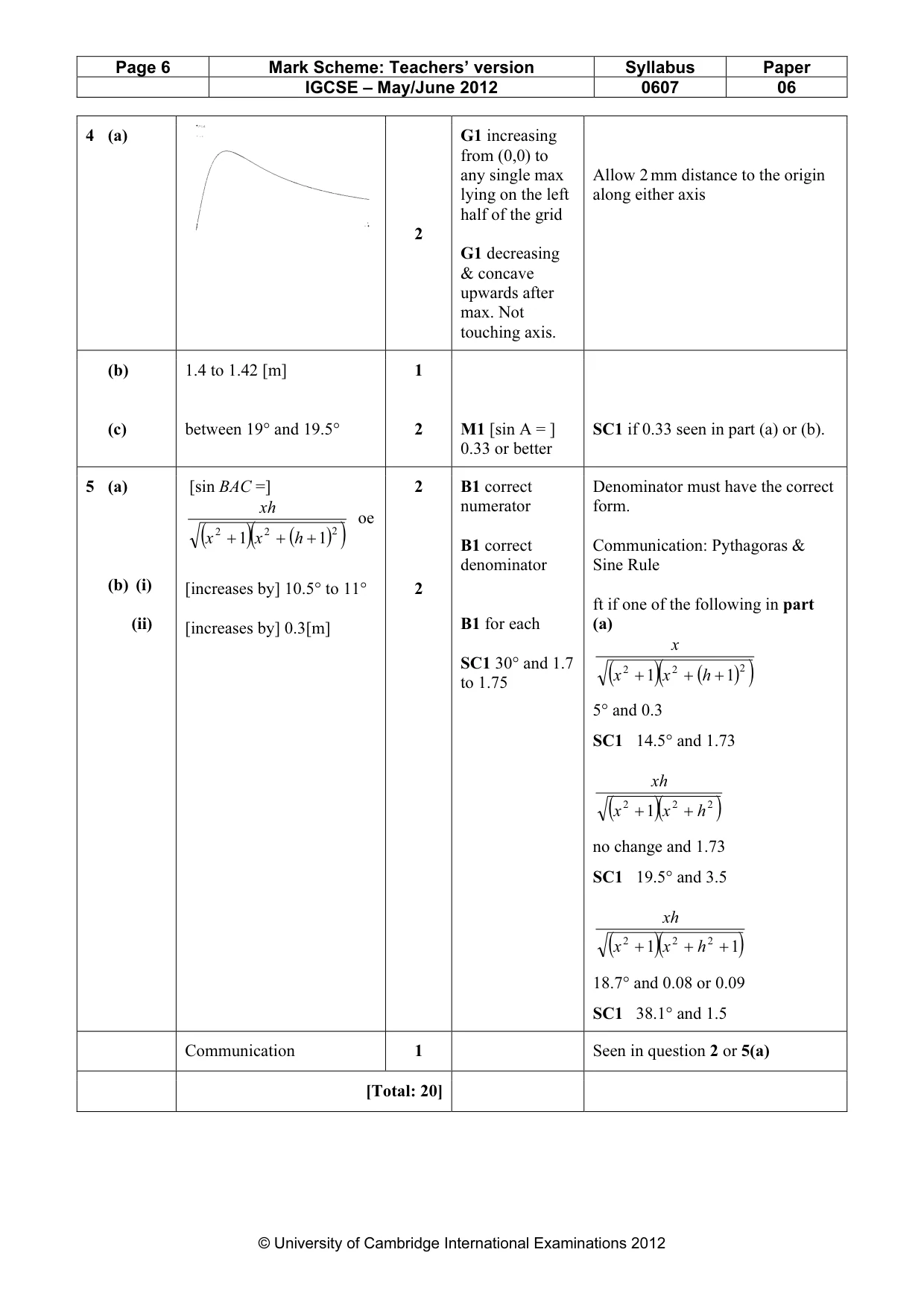
Page 6 Mark Scheme: Teachers’ version Syllabus Paper IGCSE – May/June 2012 0607 06 © University of Cambridge International Examinations 2012 4 (a) 2 G1 increasing from (0,0) to any single max lying on the left half of the grid G1 decreasing & concave upwards after max. Not touching axis. Allow 2 mm distance to the origin along either axis (b) (c) 1.4 to 1.42 [m] between 19° and 19.5° 1 2 M1 [sin A = ] 0.33 or better SC1 if 0.33 seen in part (a) or (b). 5 (a) (b) (i) (ii) [sin BAC =] ( ) ( ) ( ) 2 2 2 1 1 + + + h x x xh oe [increases by] 10.5° to 11° [increases by] 0.3[m] 2 2 B1 correct numerator B1 correct denominator B1 for each SC1 30° and 1.7 to 1.75 Denominator must have the correct form. Communication: Pythagoras & Sine Rule ft if one of the following in part (a) ( ) ( ) ( ) 2 2 2 1 1 + + + h x x x 5° and 0.3 SC1 14.5° and 1.73 ( )( ) 2 2 2 1 h x x xh + + no change and 1.73 SC1 19.5° and 3.5 ( )( )1 1 2 2 2 + + + h x x xh 18.7° and 0.08 or 0.09 SC1 38.1° and 1.5 Communication 1 Seen in question 2 or 5(a) [Total: 20]
What you needed in this session
Cambridge’s own grade thresholds for 2012 May/June, Paper 6 · Variant 1. A higher threshold means an easier paper — the bar moves with how the cohort did.