Cambridge IGCSE Mathematics - International 0607 — 2011 May/June Paper 1 · Variant 2
0607/12/M/J/11 · 40 marks · ≈45 min
The question paper and its mark scheme, free to read here and free to download. This is Cambridge’s own paper, exactly as it was sat.
Question paper12 pages

Mark scheme3 pages
Answers below. Sit the paper first if you are practising.
Paper as text
Question paper, page 1
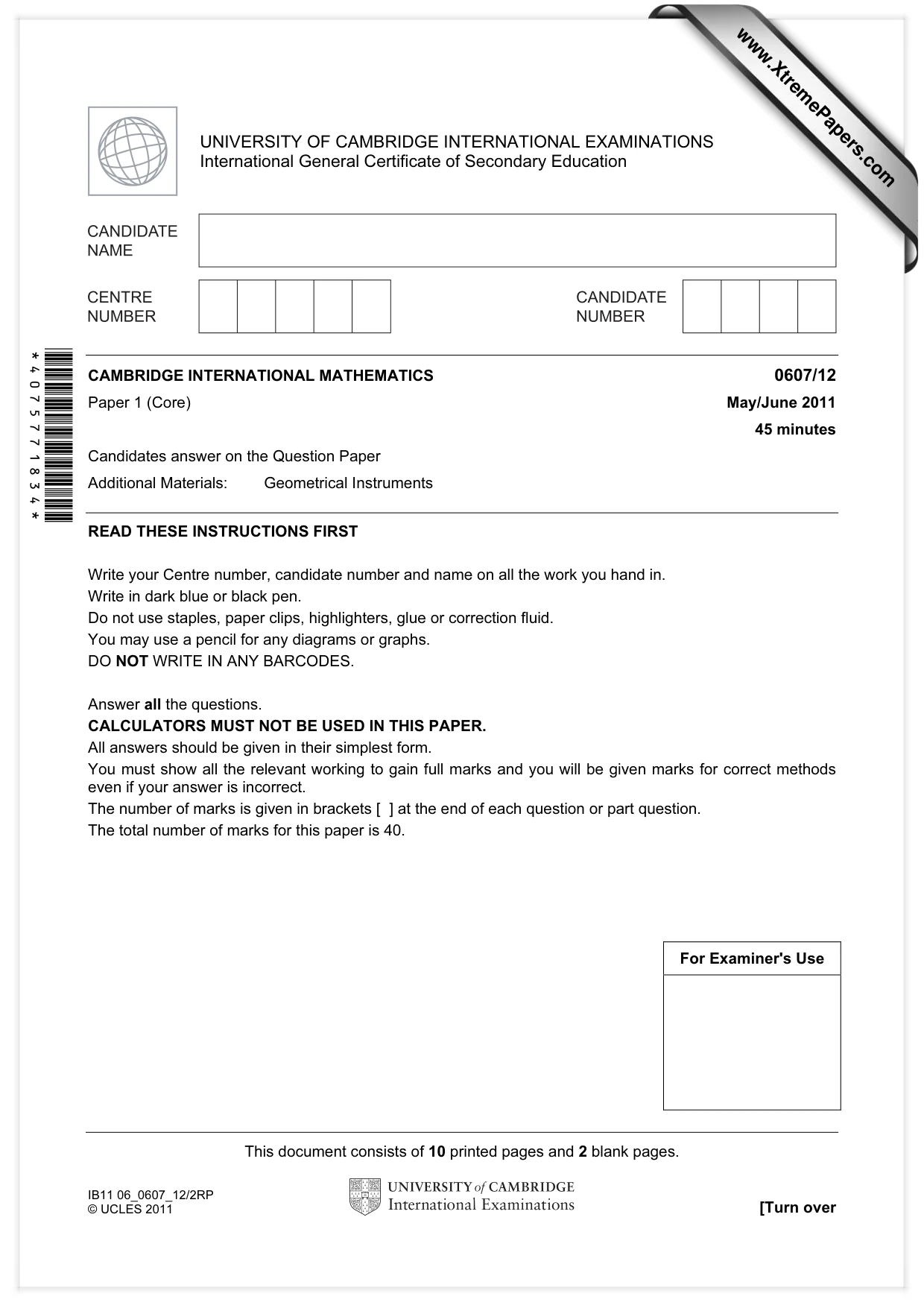
This document consists of 10 printed pages and 2 blank pages. IB11 06_0607_12/2RP © UCLES 2011 [Turn over *4075771834* For Examiner's Use UNIVERSITY OF CAMBRIDGE INTERNATIONAL EXAMINATIONS International General Certificate of Secondary Education CAMBRIDGE INTERNATIONAL MATHEMATICS 0607/12 Paper 1 (Core) May/June 2011 45 minutes Candidates answer on the Question Paper Additional Materials: Geometrical Instruments READ THESE INSTRUCTIONS FIRST Write your Centre number, candidate number and name on all the work you hand in. Write in dark blue or black pen. Do not use staples, paper clips, highlighters, glue or correction fluid. You may use a pencil for any diagrams or graphs. DO NOT WRITE IN ANY BARCODES. Answer all the questions. CALCULATORS MUST NOT BE USED IN THIS PAPER. All answers should be given in their simplest form. You must show all the relevant working to gain full marks and you will be given marks for correct methods even if your answer is incorrect. The number of marks is given in brackets [ ] at the end of each question or part question. The total number of marks for this paper is 40. www.XtremePapers.com
Question paper, page 2
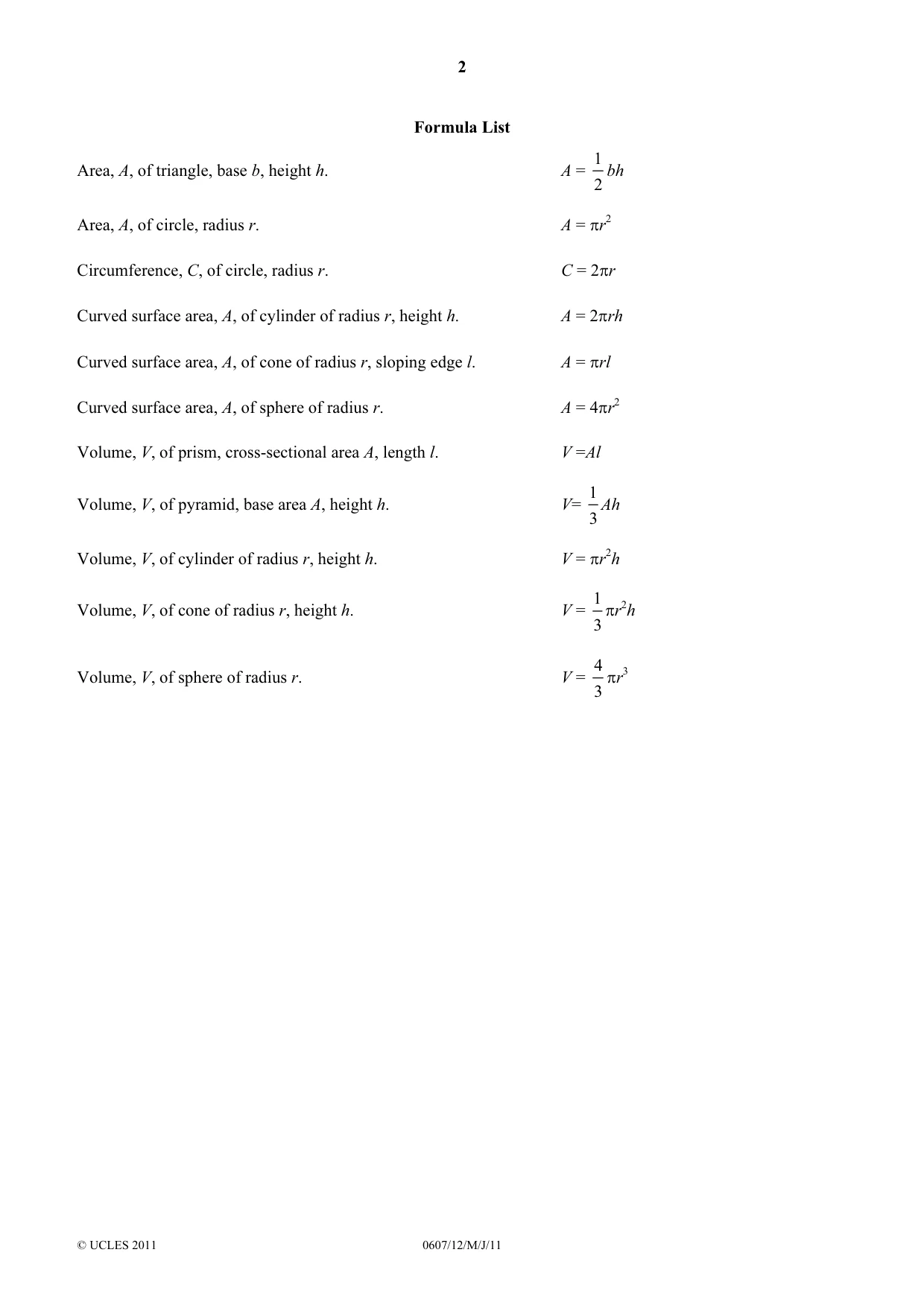
2 © UCLES 2011 0607/12/M/J/11 Formula List Area, A, of triangle, base b, height h. A = 1 2 bh Area, A, of circle, radius r. A = πr2 Circumference, C, of circle, radius r. C = 2πr Curved surface area, A, of cylinder of radius r, height h. A = 2πrh Curved surface area, A, of cone of radius r, sloping edge l. A = πrl Curved surface area, A, of sphere of radius r. A = 4πr2 Volume, V, of prism, cross-sectional area A, length l. V =Al Volume, V, of pyramid, base area A, height h. V= 1 3 Ah Volume, V, of cylinder of radius r, height h. V = πr2h Volume, V, of cone of radius r, height h. V = 1 3 πr2h Volume, V, of sphere of radius r. V = 4 3 πr3
Question paper, page 3
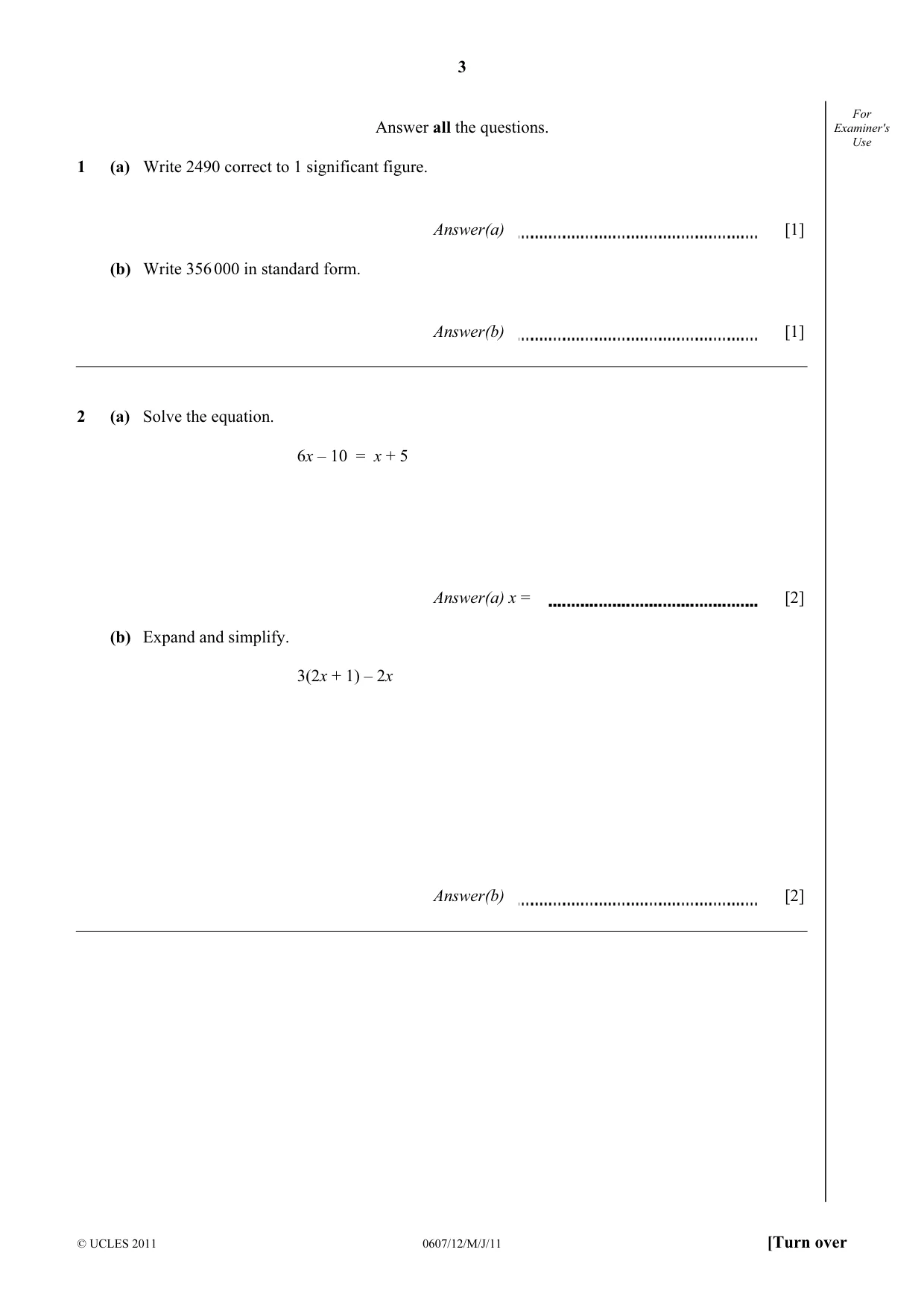
3 © UCLES 2011 0607/12/M/J/11 [Turn over For Examiner's Use Answer all the questions. 1 (a) Write 2490 correct to 1 significant figure. Answer(a) [1] (b) Write 356 000 in standard form. Answer(b) [1] 2 (a) Solve the equation. 6x – 10 = x + 5 Answer(a) x = [2] (b) Expand and simplify. 3(2x + 1) – 2x Answer(b) [2]
Question paper, page 4
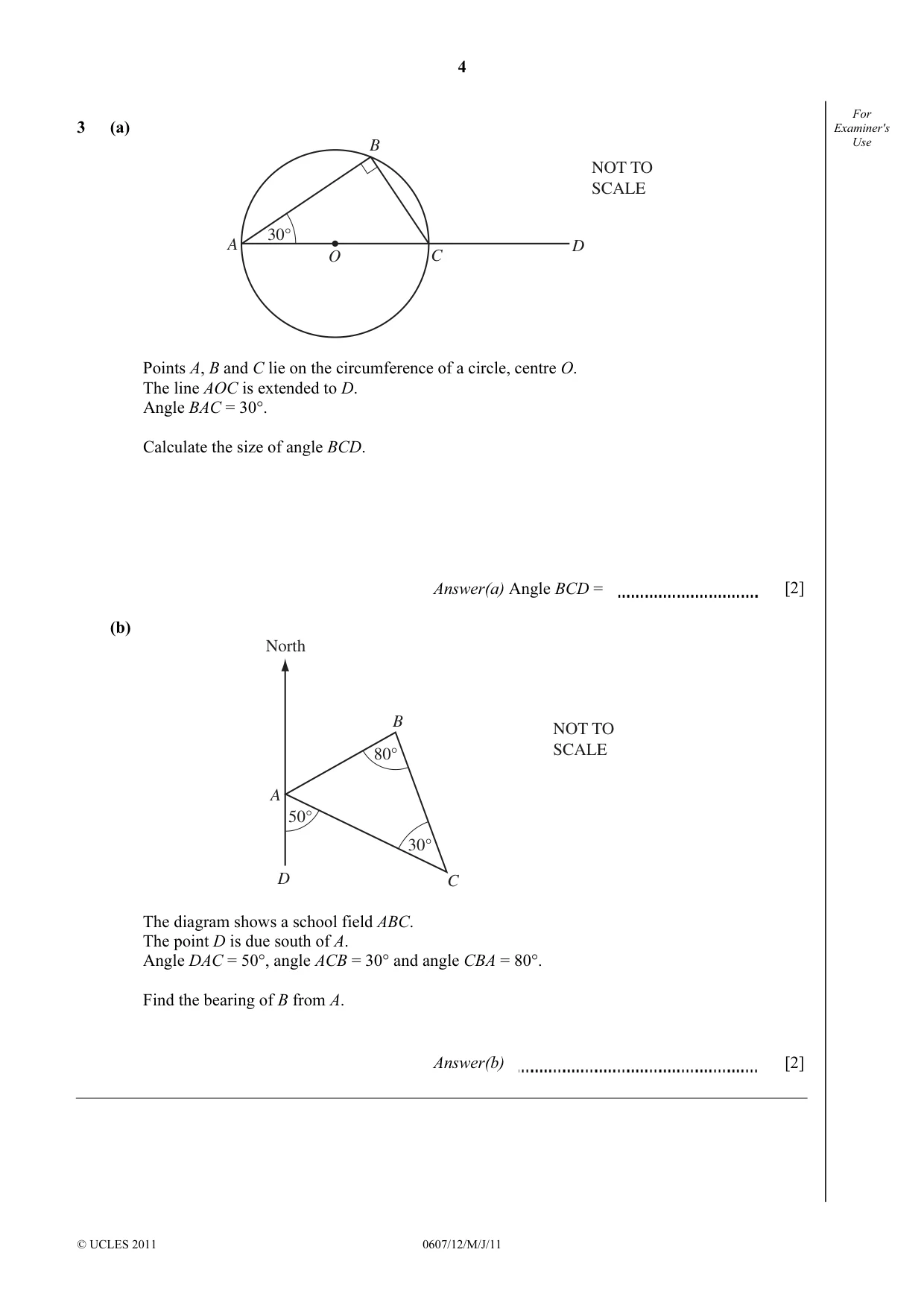
4 © UCLES 2011 0607/12/M/J/11 For Examiner's Use 3 (a) A O B C D 30° NOT TO SCALE Points A, B and C lie on the circumference of a circle, centre O. The line AOC is extended to D. Angle BAC = 30°. Calculate the size of angle BCD. Answer(a) Angle BCD = [2] (b) North 50° 80° 30° A B C D NOT TO SCALE The diagram shows a school field ABC. The point D is due south of A. Angle DAC = 50°, angle ACB = 30° and angle CBA = 80°. Find the bearing of B from A. Answer(b) [2]
Question paper, page 5
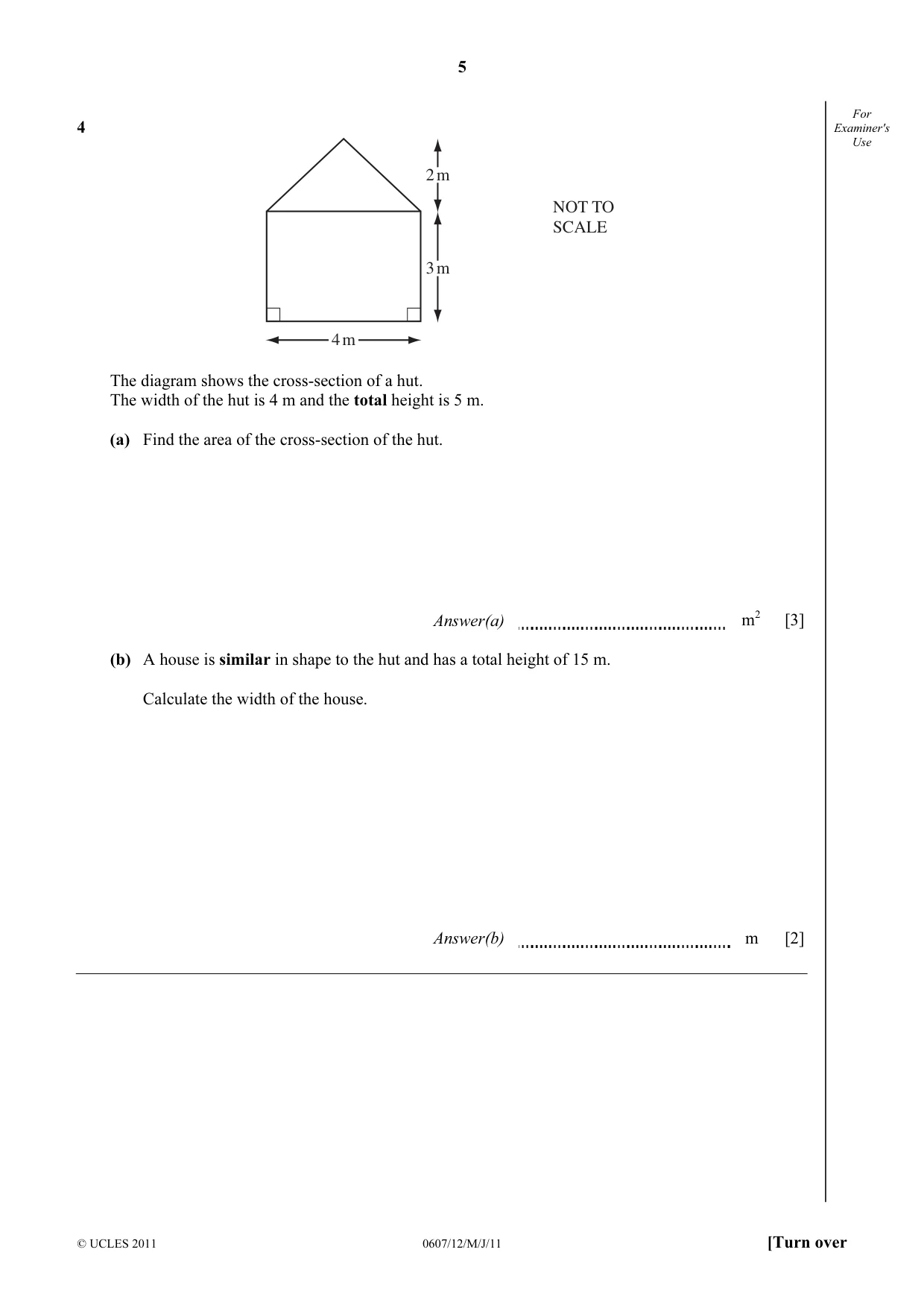
5 © UCLES 2011 0607/12/M/J/11 [Turn over For Examiner's Use 4 4 m 3 m 2 m NOT TO SCALE The diagram shows the cross-section of a hut. The width of the hut is 4 m and the total height is 5 m. (a) Find the area of the cross-section of the hut. Answer(a) m2 [3] (b) A house is similar in shape to the hut and has a total height of 15 m. Calculate the width of the house. Answer(b) m [2]
Question paper, page 6
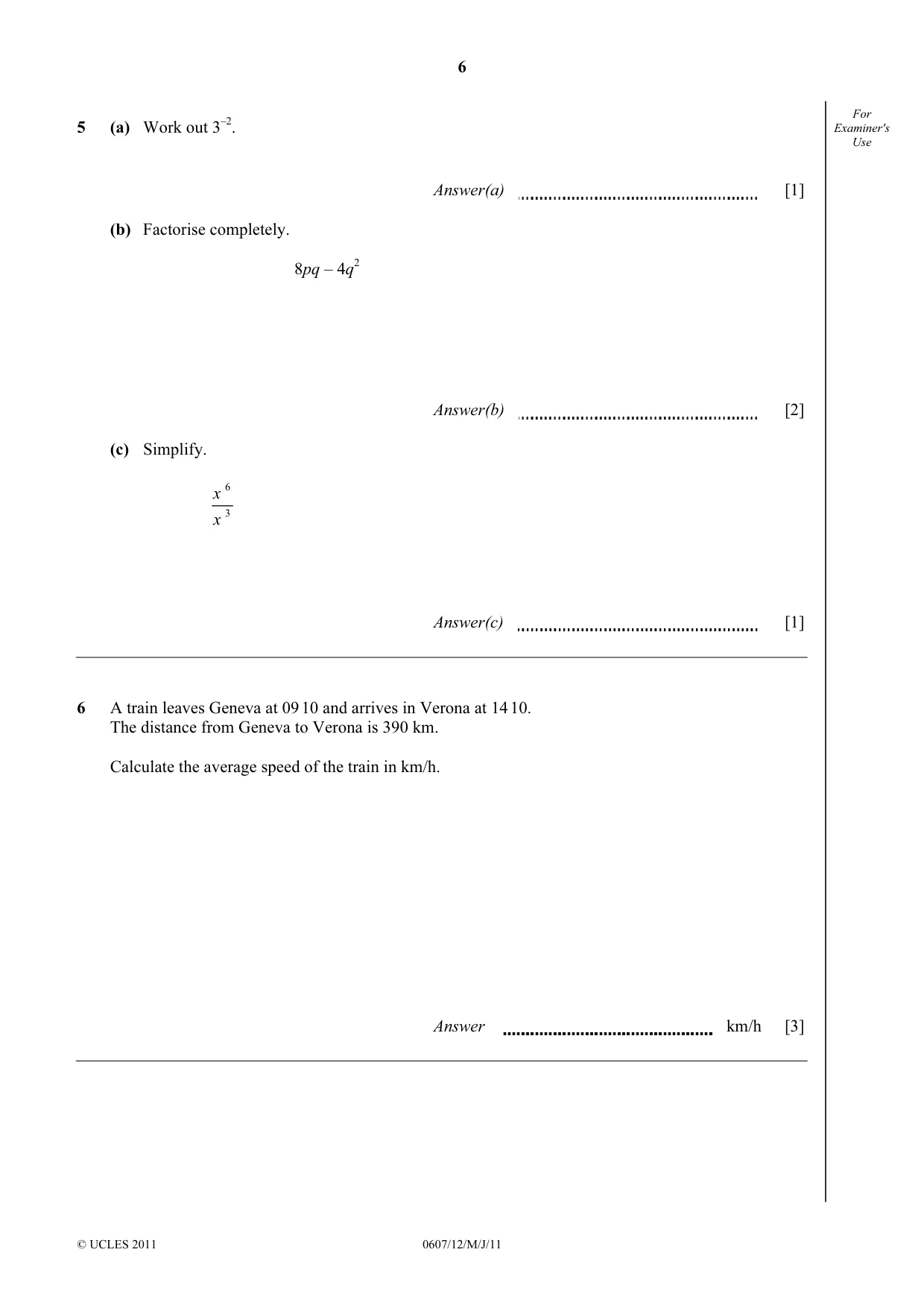
6 © UCLES 2011 0607/12/M/J/11 For Examiner's Use 5 (a) Work out 3–2. Answer(a) [1] (b) Factorise completely. 8pq – 4q2 Answer(b) [2] (c) Simplify. 6 3 x x Answer(c) [1] 6 A train leaves Geneva at 09 10 and arrives in Verona at 14 10. The distance from Geneva to Verona is 390 km. Calculate the average speed of the train in km/h. Answer km/h [3]
Question paper, page 7
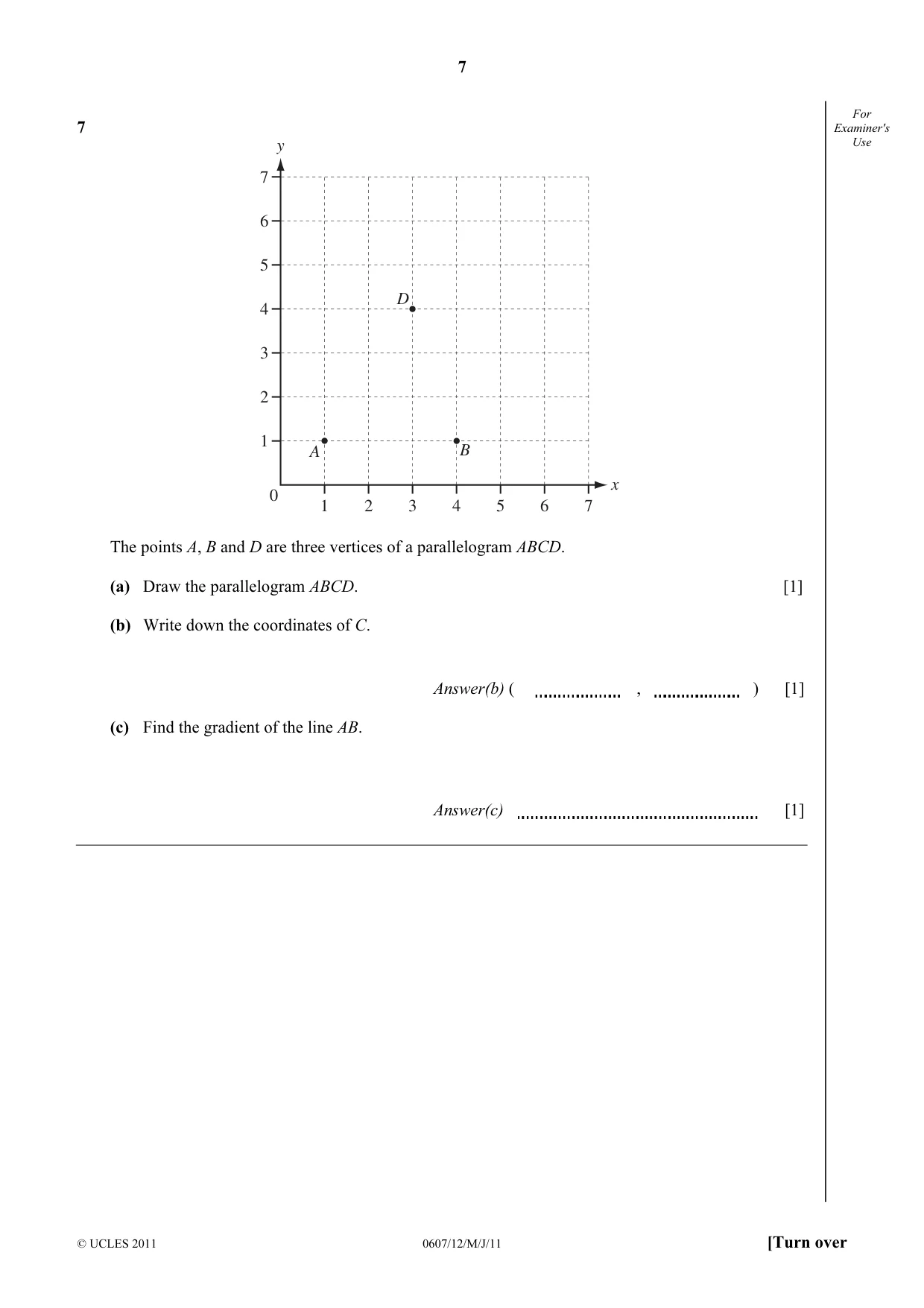
7 © UCLES 2011 0607/12/M/J/11 [Turn over For Examiner's Use 7 7 6 5 4 3 2 1 1 2 3 4 5 6 7 0 y x A D B The points A, B and D are three vertices of a parallelogram ABCD. (a) Draw the parallelogram ABCD. [1] (b) Write down the coordinates of C. Answer(b) ( , ) [1] (c) Find the gradient of the line AB. Answer(c) [1]
Question paper, page 8
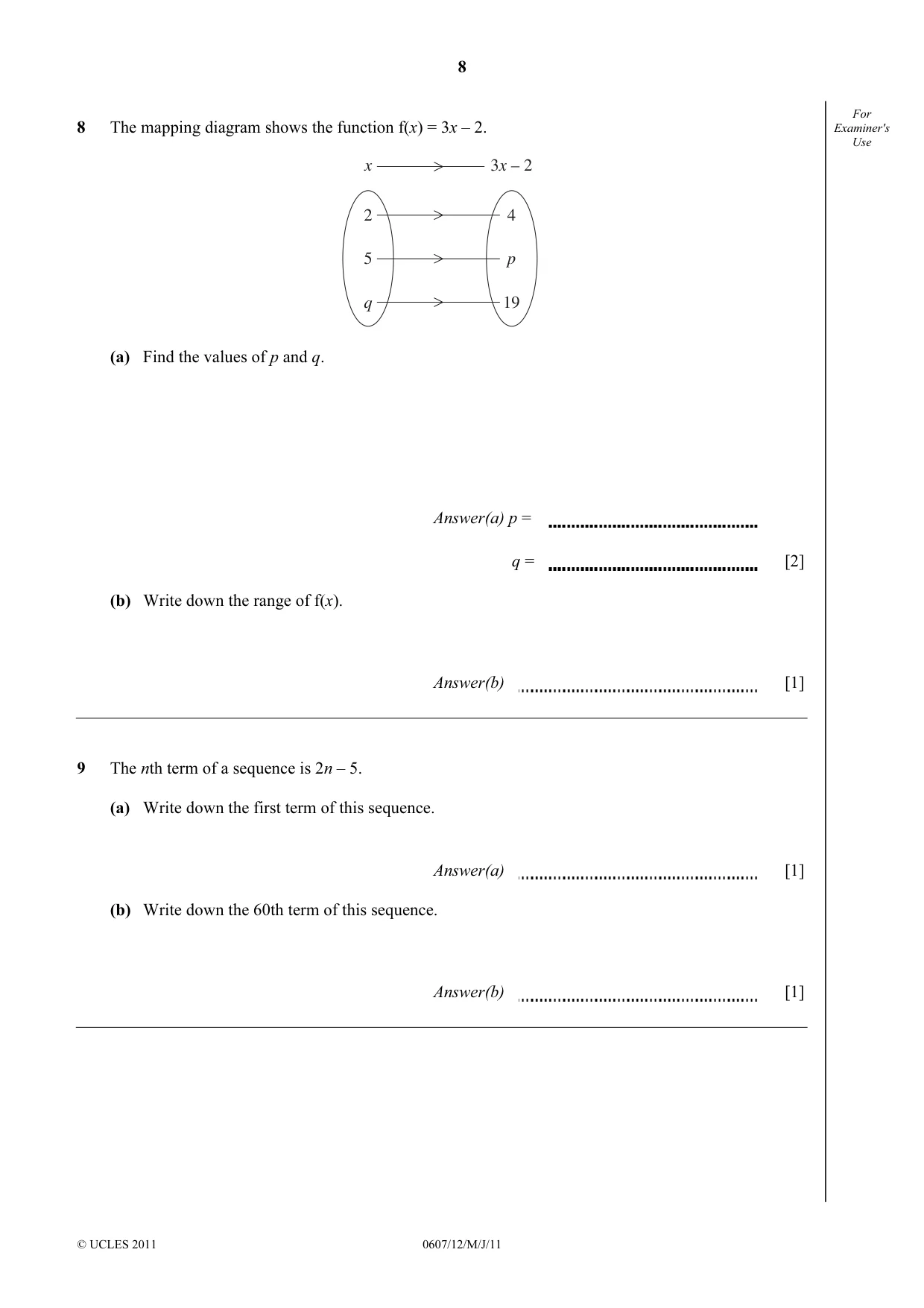
8 © UCLES 2011 0607/12/M/J/11 For Examiner's Use 8 The mapping diagram shows the function f(x) = 3x – 2. x 2 5 q 3x – 2 4 p 19 (a) Find the values of p and q. Answer(a) p = q = [2] (b) Write down the range of f(x). Answer(b) [1] 9 The nth term of a sequence is 2n – 5. (a) Write down the first term of this sequence. Answer(a) [1] (b) Write down the 60th term of this sequence. Answer(b) [1]
Question paper, page 9
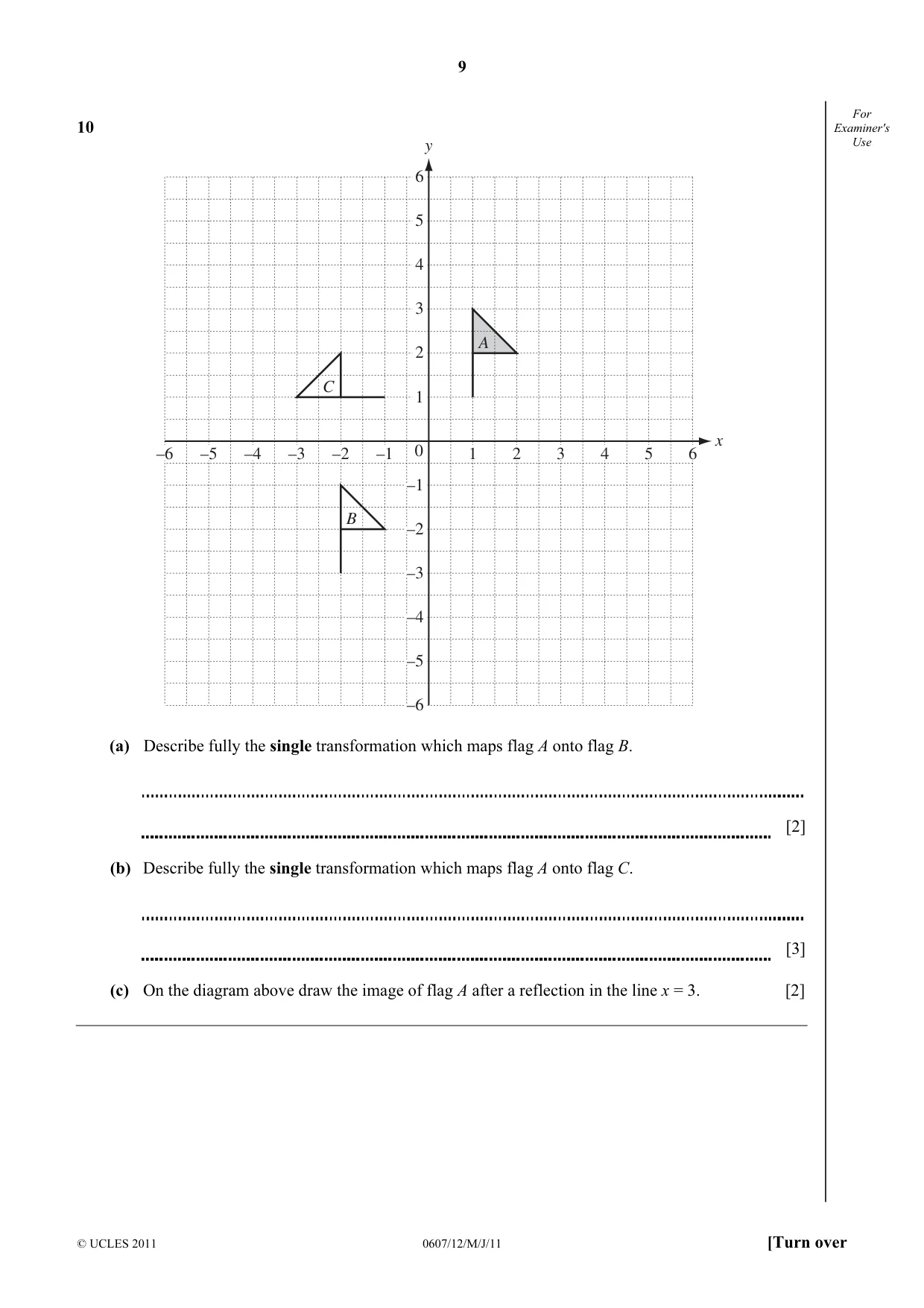
9 © UCLES 2011 0607/12/M/J/11 [Turn over For Examiner's Use 10 y x 6 5 4 3 2 1 –1 –2 –3 –4 –5 –6 0 –6 –5 –4 –3 –2 –1 1 2 3 4 5 6 A C B (a) Describe fully the single transformation which maps flag A onto flag B. [2] (b) Describe fully the single transformation which maps flag A onto flag C. [3] (c) On the diagram above draw the image of flag A after a reflection in the line x = 3. [2]
Question paper, page 10
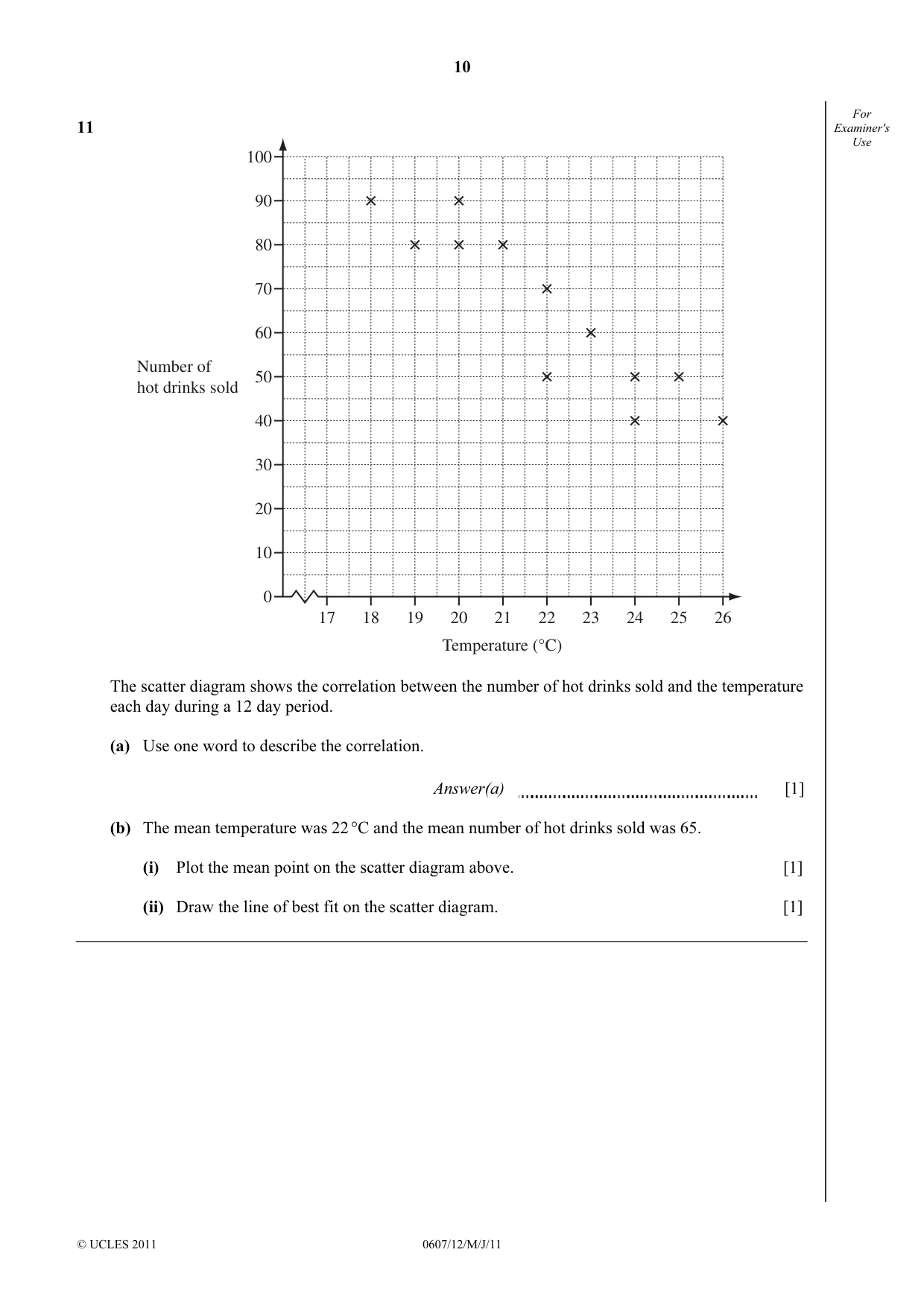
10 © UCLES 2011 0607/12/M/J/11 For Examiner's Use 11 100 90 80 70 60 50 40 30 20 10 0 17 18 19 20 21 22 23 24 25 26 Number of hot drinks sold Temperature (°C) The scatter diagram shows the correlation between the number of hot drinks sold and the temperature each day during a 12 day period. (a) Use one word to describe the correlation. Answer(a) [1] (b) The mean temperature was 22 °C and the mean number of hot drinks sold was 65. (i) Plot the mean point on the scatter diagram above. [1] (ii) Draw the line of best fit on the scatter diagram. [1]
Question paper, page 11
11 © UCLES 2011 0607/12/M/J/11 BLANK PAGE
Question paper, page 12
12 Permission to reproduce items where third-party owned material protected by copyright is included has been sought and cleared where possible. Every reasonable effort has been made by the publisher (UCLES) to trace copyright holders, but if any items requiring clearance have unwittingly been included, the publisher will be pleased to make amends at the earliest possible opportunity. University of Cambridge International Examinations is part of the Cambridge Assessment Group. Cambridge Assessment is the brand name of University of Cambridge Local Examinations Syndicate (UCLES), which is itself a department of the University of Cambridge. © UCLES 2011 0607/12/M/J/11 BLANK PAGE
Mark scheme, page 1
UNIVERSITY OF CAMBRIDGE INTERNATIONAL EXAMINATIONS International General Certificate of Secondary Education MARK SCHEME for the May/June 2011 question paper for the guidance of teachers 0607 CAMBRIDGE INTERNATIONAL MATHEMATICS 0607/12 Paper 1 (Core), maximum raw mark 40 This mark scheme is published as an aid to teachers and candidates, to indicate the requirements of the examination. It shows the basis on which Examiners were instructed to award marks. It does not indicate the details of the discussions that took place at an Examiners’ meeting before marking began, which would have considered the acceptability of alternative answers. Mark schemes must be read in conjunction with the question papers and the report on the examination. • Cambridge will not enter into discussions or correspondence in connection with these mark schemes. Cambridge is publishing the mark schemes for the May/June 2011 question papers for most IGCSE, GCE Advanced Level and Advanced Subsidiary Level syllabuses and some Ordinary Level syllabuses. www.XtremePapers.com
Mark scheme, page 2
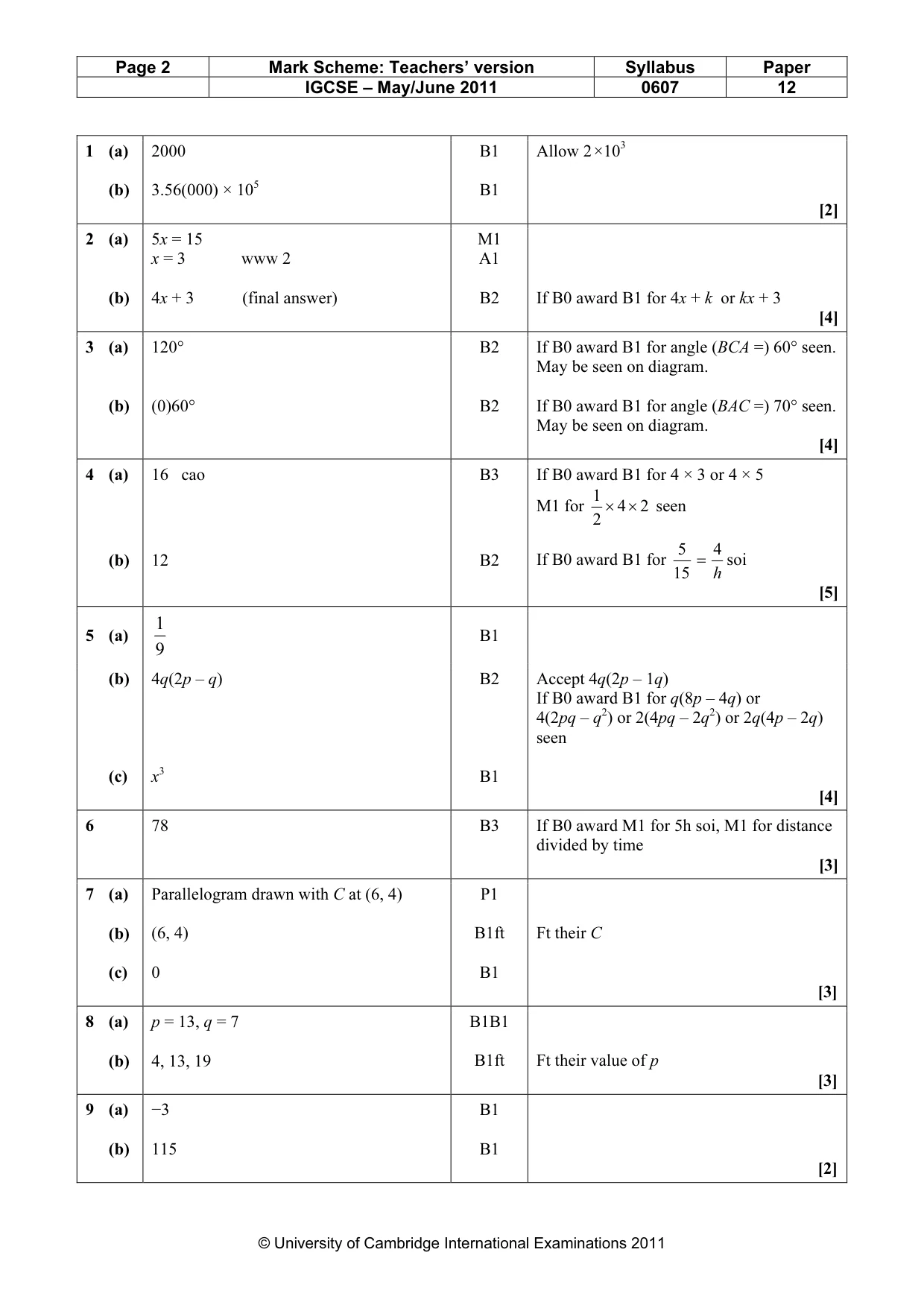
Page 2 Mark Scheme: Teachers’ version Syllabus Paper IGCSE – May/June 2011 0607 12 © University of Cambridge International Examinations 2011 1 (a) (b) 2000 3.56(000) × 105 B1 B1 Allow 2×10³ [2] 2 (a) (b) 5x = 15 x = 3 www 2 4x + 3 (final answer) M1 A1 B2 If B0 award B1 for 4x + k or kx + 3 [4] 3 (a) (b) 120° (0)60° B2 B2 If B0 award B1 for angle (BCA =) 60° seen. May be seen on diagram. If B0 award B1 for angle (BAC =) 70° seen. May be seen on diagram. [4] 4 (a) 16 cao B3 If B0 award B1 for 4 × 3 or 4 × 5 M1 for 2 4 2 1 × × seen (b) 12 B2 If B0 award B1 for h 4 15 5 = soi [5] 5 (a) 9 1 B1 (b) (c) 4q(2p – q) x3 B2 B1 Accept 4q(2p – 1q) If B0 award B1 for q(8p – 4q) or 4(2pq – q2) or 2(4pq – 2q2) or 2q(4p – 2q) seen [4] 6 78 B3 If B0 award M1 for 5h soi, M1 for distance divided by time [3] 7 (a) (b) (c) Parallelogram drawn with C at (6, 4) (6, 4) 0 P1 B1ft B1 Ft their C [3] 8 (a) (b) p = 13, q = 7 4, 13, 19 B1B1 B1ft Ft their value of p [3] 9 (a) (b) −3 115 B1 B1 [2]
Mark scheme, page 3
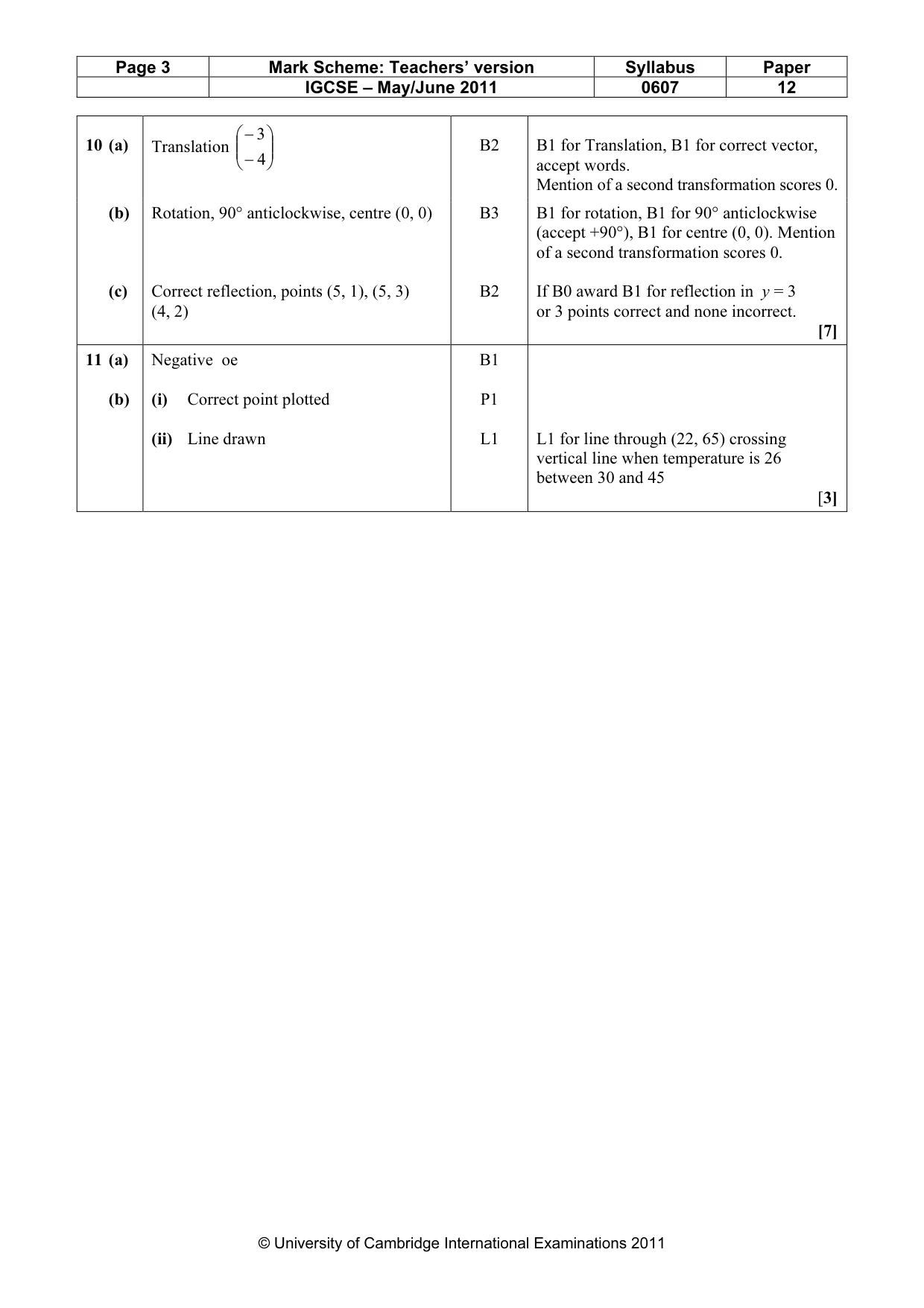
Page 3 Mark Scheme: Teachers’ version Syllabus Paper IGCSE – May/June 2011 0607 12 © University of Cambridge International Examinations 2011 10 (a) Translation − − 4 3 B2 B1 for Translation, B1 for correct vector, accept words. Mention of a second transformation scores 0. (b) (c) Rotation, 90° anticlockwise, centre (0, 0) Correct reflection, points (5, 1), (5, 3) (4, 2) B3 B2 B1 for rotation, B1 for 90° anticlockwise (accept +90°), B1 for centre (0, 0). Mention of a second transformation scores 0. If B0 award B1 for reflection in y = 3 or 3 points correct and none incorrect. [7] 11 (a) (b) Negative oe (i) Correct point plotted (ii) Line drawn B1 P1 L1 L1 for line through (22, 65) crossing vertical line when temperature is 26 between 30 and 45 [3]
What you needed in this session
Cambridge’s own grade thresholds for 2011 May/June, Paper 1 · Variant 2. A higher threshold means an easier paper — the bar moves with how the cohort did.