Cambridge IGCSE Mathematics - International 0607 — 2010 May/June Paper 5 · Variant 1
0607/51/M/J/10
The question paper and its mark scheme, free to read here and free to download. This is Cambridge’s own paper, exactly as it was sat.
Question paper4 pages
Mark scheme3 pages
Answers below. Sit the paper first if you are practising.
Paper as text
Question paper, page 1
This document consists of 4 printed pages. IB10 06_0607_05/5RP © UCLES 2010 [Turn over *8483854260* *8483854260* UNIVERSITY OF CAMBRIDGE INTERNATIONAL EXAMINATIONS International General Certificate of Secondary Education CAMBRIDGE INTERNATIONAL MATHEMATICS 0607/05 Paper 5 (Core) May/June 2010 1 hour Candidates answer on the Question Paper. Additional Materials: Graphics Calculator READ THESE INSTRUCTIONS FIRST Write your Centre number, candidate number and name on all the work you hand in. Write in dark blue or black pen. Do not use staples, paper clips, highlighters, glue or correction fluid. You may use a pencil for any diagrams or graphs. Answer all the questions. You must show all relevant working to gain full marks for correct methods, including sketches. In this paper you will also be assessed on your ability to provide full reasons and communicate your mathematics clearly and precisely. At the end of the examination, fasten all your work securely together. The total number of the marks for this paper is 24. www.XtremePapers.com
Question paper, page 2
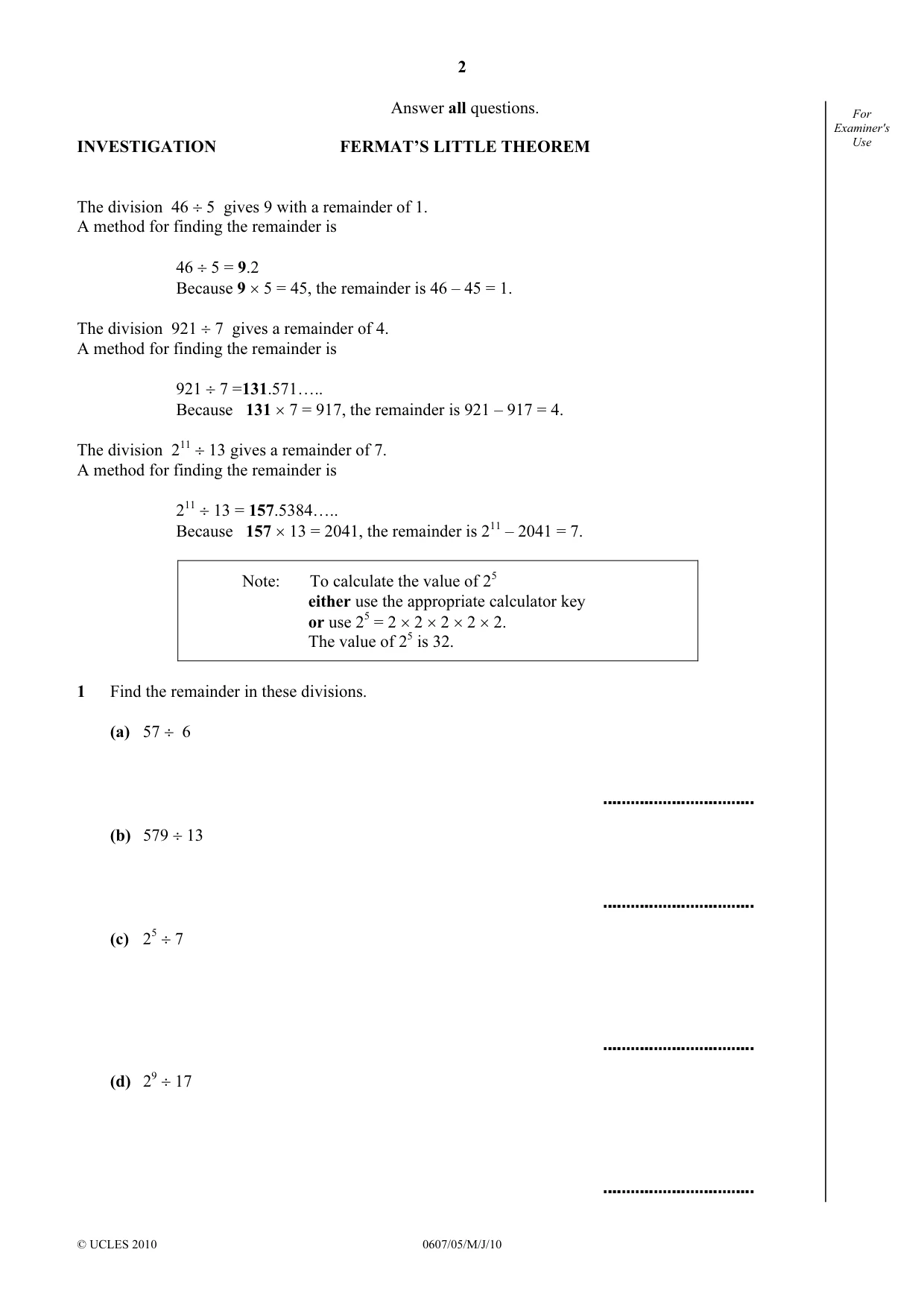
2 © UCLES 2010 0607/05/M/J/10 For Examiner's Use Answer all questions. INVESTIGATION FERMAT’S LITTLE THEOREM The division 46 ÷ 5 gives 9 with a remainder of 1. A method for finding the remainder is 46 ÷ 5 = 9.2 Because 9 × 5 = 45, the remainder is 46 – 45 = 1. The division 921 ÷ 7 gives a remainder of 4. A method for finding the remainder is 921 ÷ 7 =131.571….. Because 131 × 7 = 917, the remainder is 921 – 917 = 4. The division 211 ÷ 13 gives a remainder of 7. A method for finding the remainder is 211 ÷ 13 = 157.5384….. Because 157 × 13 = 2041, the remainder is 211 – 2041 = 7. Note: To calculate the value of 25 either use the appropriate calculator key or use 25 = 2 × 2 × 2 × 2 × 2. The value of 25 is 32. 1 Find the remainder in these divisions. (a) 57 ÷ 6 (b) 579 ÷ 13 (c) 25 ÷ 7 (d) 29 ÷ 17
Question paper, page 3
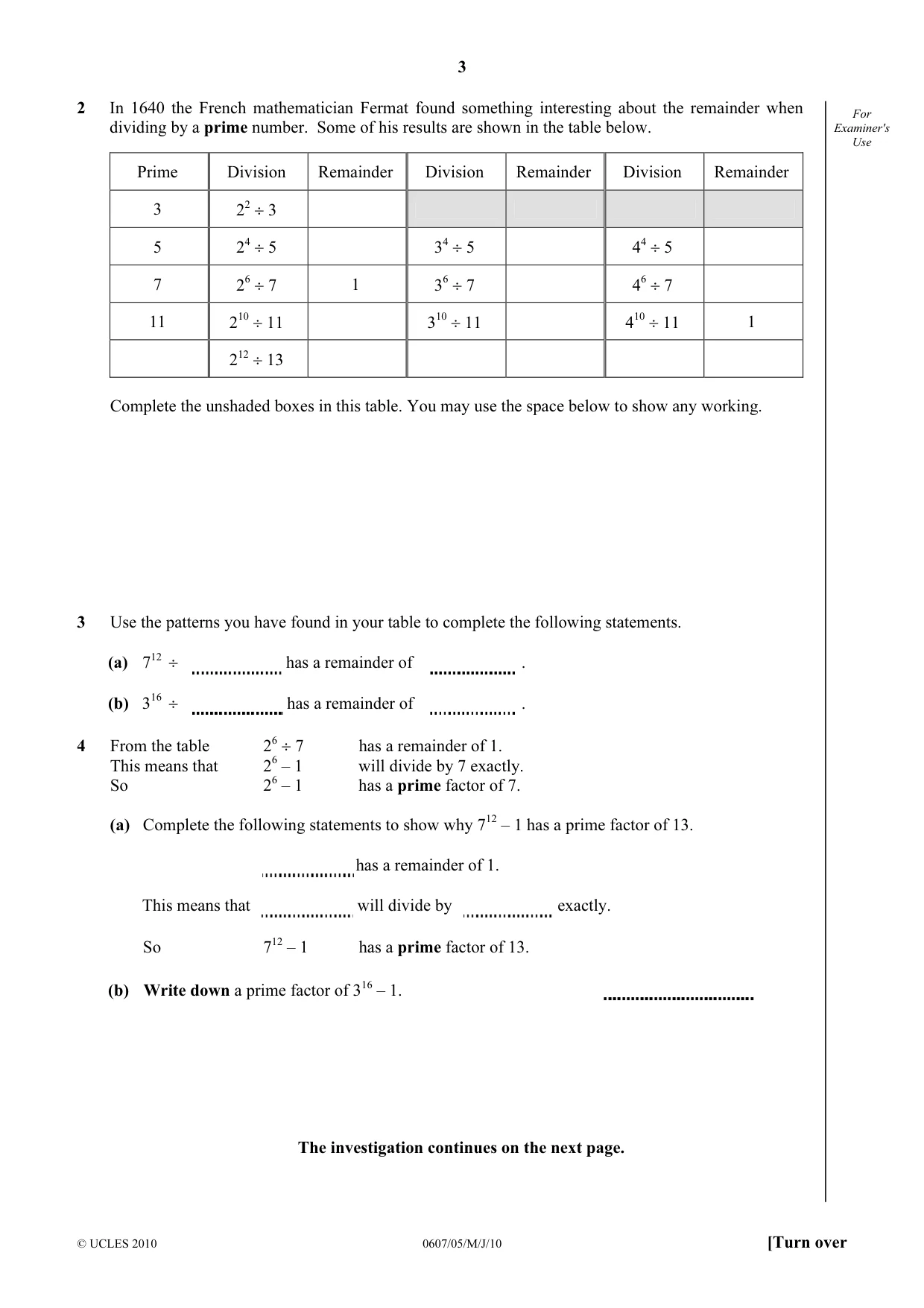
3 © UCLES 2010 0607/05/M/J/10 [Turn over For Examiner's Use 2 In 1640 the French mathematician Fermat found something interesting about the remainder when dividing by a prime number. Some of his results are shown in the table below. Prime Division Remainder Division Remainder Division Remainder 3 22 ÷ 3 5 24 ÷ 5 34 ÷ 5 44 ÷ 5 7 26 ÷ 7 1 36 ÷ 7 46 ÷ 7 11 210 ÷ 11 310 ÷ 11 410 ÷ 11 1 212 ÷ 13 Complete the unshaded boxes in this table. You may use the space below to show any working. 3 Use the patterns you have found in your table to complete the following statements. (a) 712 ÷ has a remainder of . (b) 316 ÷ has a remainder of . 4 From the table 26 ÷ 7 has a remainder of 1. This means that 26 – 1 will divide by 7 exactly. So 26 – 1 has a prime factor of 7. (a) Complete the following statements to show why 712 – 1 has a prime factor of 13. has a remainder of 1. This means that will divide by exactly. So 712 – 1 has a prime factor of 13. (b) Write down a prime factor of 316 – 1. The investigation continues on the next page.
Question paper, page 4
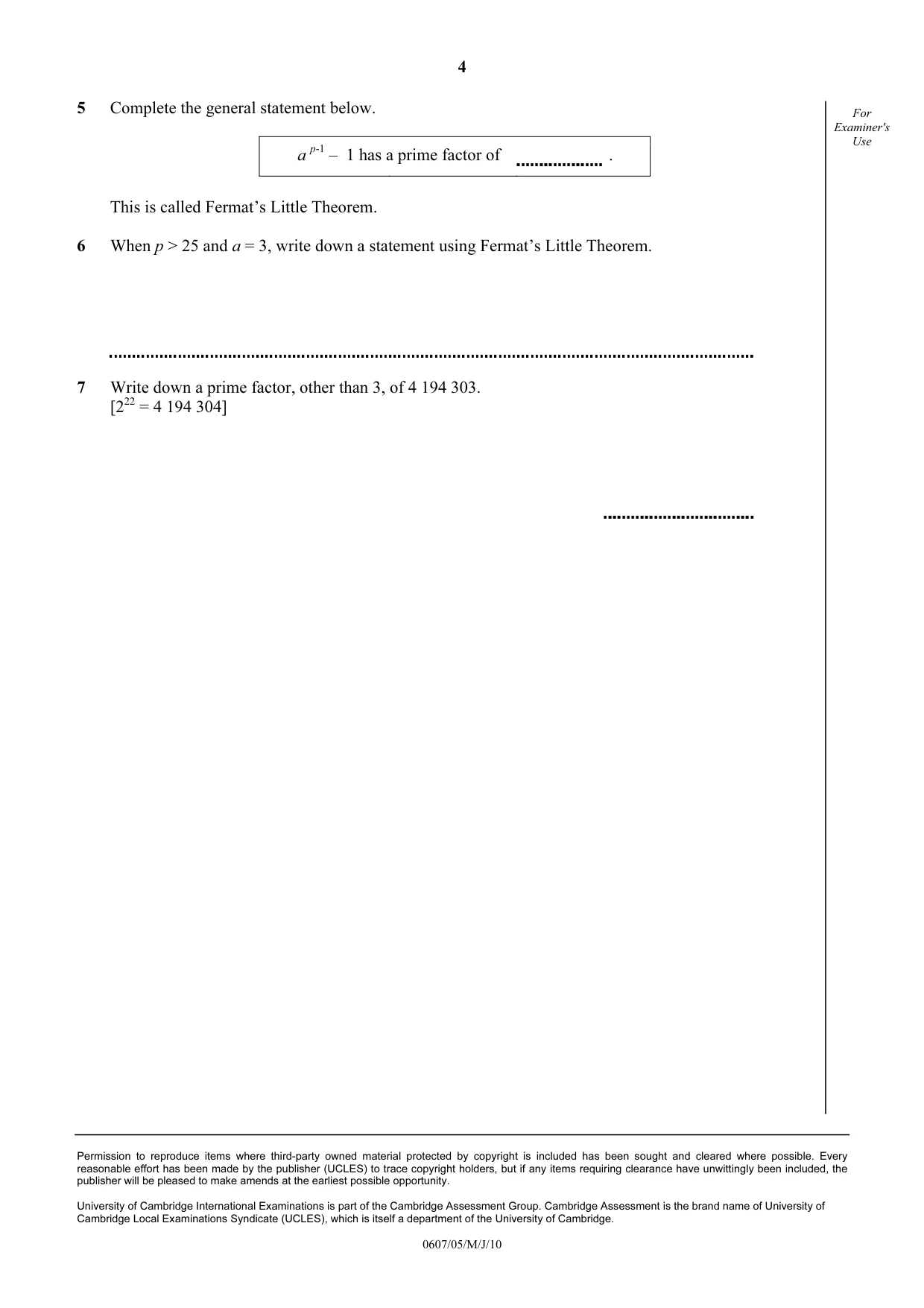
4 Permission to reproduce items where third-party owned material protected by copyright is included has been sought and cleared where possible. Every reasonable effort has been made by the publisher (UCLES) to trace copyright holders, but if any items requiring clearance have unwittingly been included, the publisher will be pleased to make amends at the earliest possible opportunity. University of Cambridge International Examinations is part of the Cambridge Assessment Group. Cambridge Assessment is the brand name of University of Cambridge Local Examinations Syndicate (UCLES), which is itself a department of the University of Cambridge. 0607/05/M/J/10 For Examiner's Use 5 Complete the general statement below. a p-1 – 1 has a prime factor of . This is called Fermat’s Little Theorem. 6 When p > 25 and a = 3, write down a statement using Fermat’s Little Theorem. 7 Write down a prime factor, other than 3, of 4 194 303. [222 = 4 194 304]
Mark scheme, page 1
UNIVERSITY OF CAMBRIDGE INTERNATIONAL EXAMINATIONS International General Certificate of Secondary Education MARK SCHEME for the May/June 2010 question paper for the guidance of teachers 0607 CAMBRIDGE INTERNATIONAL MATHEMATICS 0607/05 Paper 5 (Core), maximum raw mark 24 This mark scheme is published as an aid to teachers and candidates, to indicate the requirements of the examination. It shows the basis on which Examiners were instructed to award marks. It does not indicate the details of the discussions that took place at an Examiners’ meeting before marking began, which would have considered the acceptability of alternative answers. Mark schemes must be read in conjunction with the question papers and the report on the examination. • CIE will not enter into discussions or correspondence in connection with these mark schemes. CIE is publishing the mark schemes for the May/June 2010 question papers for most IGCSE, GCE Advanced Level and Advanced Subsidiary Level syllabuses and some Ordinary Level syllabuses. www.XtremePapers.com
Mark scheme, page 2
Page 2 Mark Scheme: Teachers’ version Syllabus Paper IGCSE – May/June 2010 0607 05 © UCLES 2010 M marks are given for a correct method. A marks are given for an accurate answer following a correct method. B marks are given for a correct statement or step. D marks are given for a clear and appropriately accurate drawing. P marks are given for accurate plotting of points. E marks are given for correctly explaining or establishing a given result. C marks are given for clear communication. Abbreviations cao correct answer only cso correct solution only ft follow through oe or equivalent soi seen or implied ww without working www without wrong working
Mark scheme, page 3
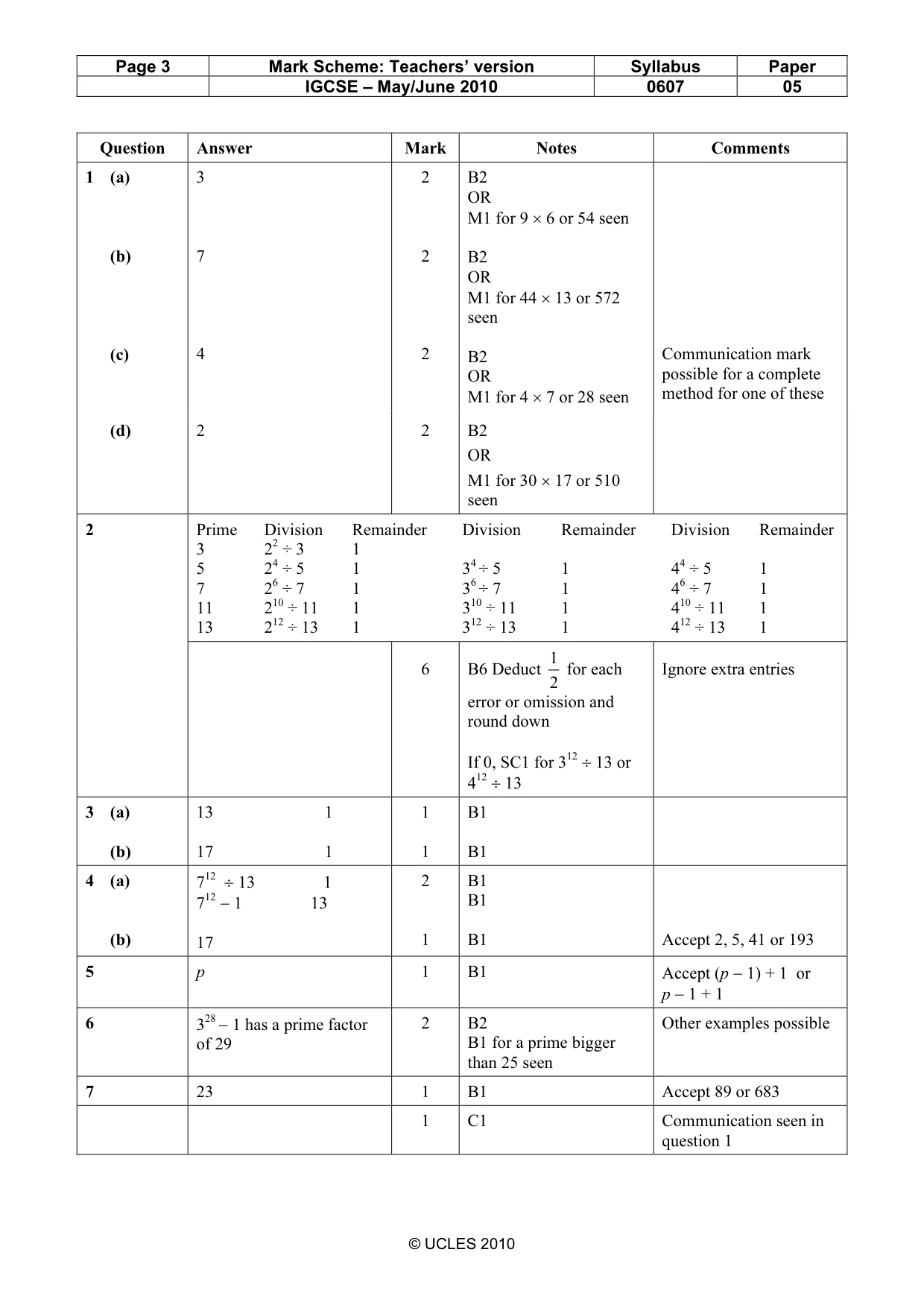
Page 3 Mark Scheme: Teachers’ version Syllabus Paper IGCSE – May/June 2010 0607 05 © UCLES 2010 Question Answer Mark Notes Comments 1 (a) (b) (c) 3 7 4 2 2 2 B2 OR M1 for 9 × 6 or 54 seen B2 OR M1 for 44 × 13 or 572 seen B2 OR M1 for 4 × 7 or 28 seen Communication mark possible for a complete method for one of these (d) 2 2 B2 OR M1 for 30 × 17 or 510 seen 2 Prime Division Remainder Division Remainder Division Remainder 3 22 ÷ 3 1 5 24 ÷ 5 1 34 ÷ 5 1 44 ÷ 5 1 7 26 ÷ 7 1 36 ÷ 7 1 46 ÷ 7 1 11 210 ÷ 11 1 310 ÷ 11 1 410 ÷ 11 1 13 212 ÷ 13 1 312 ÷ 13 1 412 ÷ 13 1 6 B6 Deduct 2 1 for each error or omission and round down If 0, SC1 for 312 ÷ 13 or 412 ÷ 13 Ignore extra entries 3 (a) (b) 13 1 17 1 1 1 B1 B1 4 (a) (b) 712 ÷ 13 1 712 − 1 13 17 2 1 B1 B1 B1 Accept 2, 5, 41 or 193 5 p 1 B1 Accept (p − 1) + 1 or p − 1 + 1 6 328 − 1 has a prime factor of 29 2 B2 B1 for a prime bigger than 25 seen Other examples possible 7 23 1 B1 Accept 89 or 683 1 C1 Communication seen in question 1