Cambridge IGCSE Mathematics - Additional 0606 — 2021 Feb/March Paper 2 · Variant 2
0606/22/F/M/21 · 12 questions · 80 marks · ≈90 min
The question paper and its mark scheme, free to read here and free to download. This is Cambridge’s own paper, exactly as it was sat.
Question paper16 pages
Mark scheme10 pages
Answers below. Sit the paper first if you are practising.
Questions as text
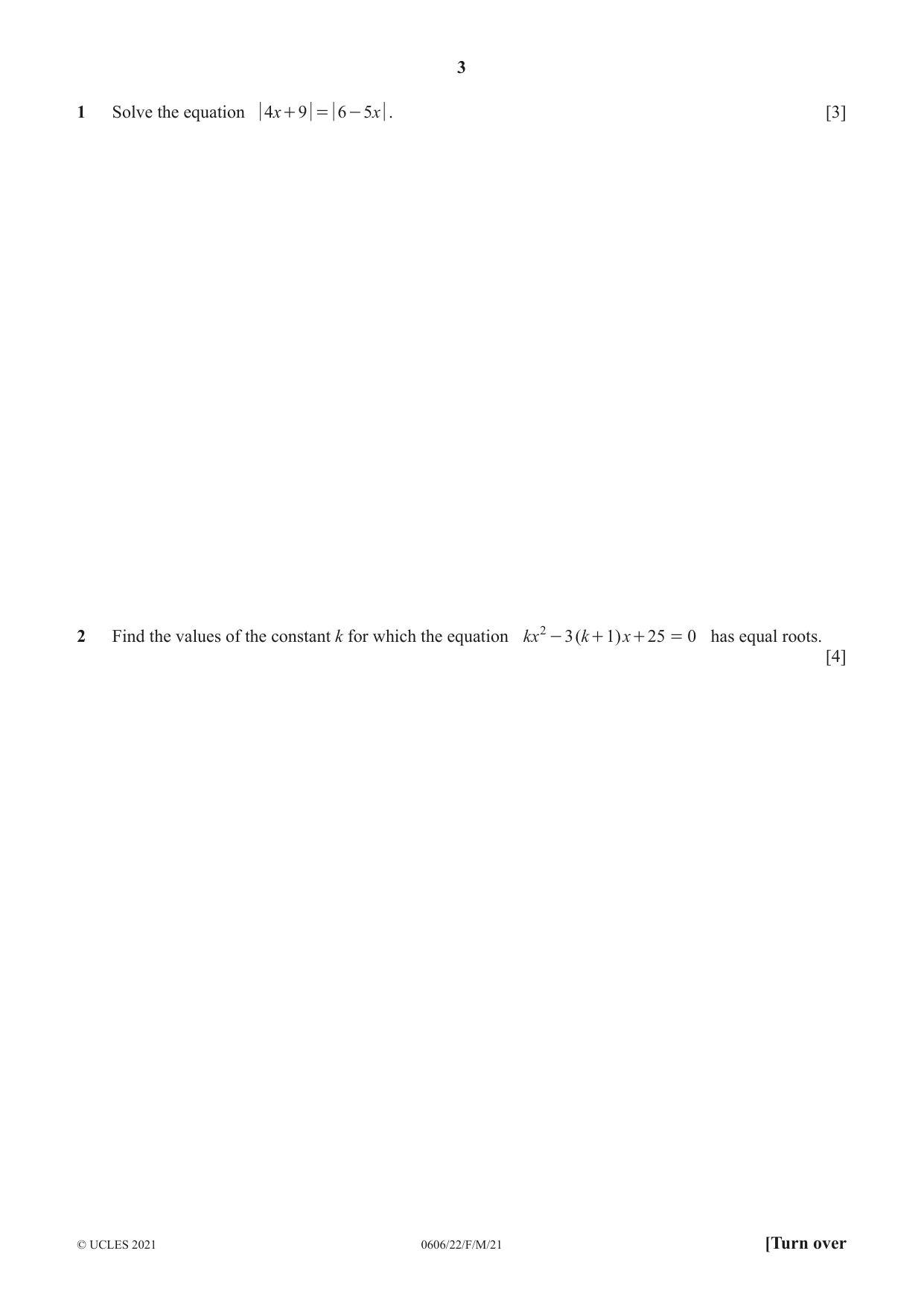
Q1 · Solve the equation 4x + 9 = 6 - 5 x
1 Solve the equation 4x + 9 = 6 - 5 x . [3]
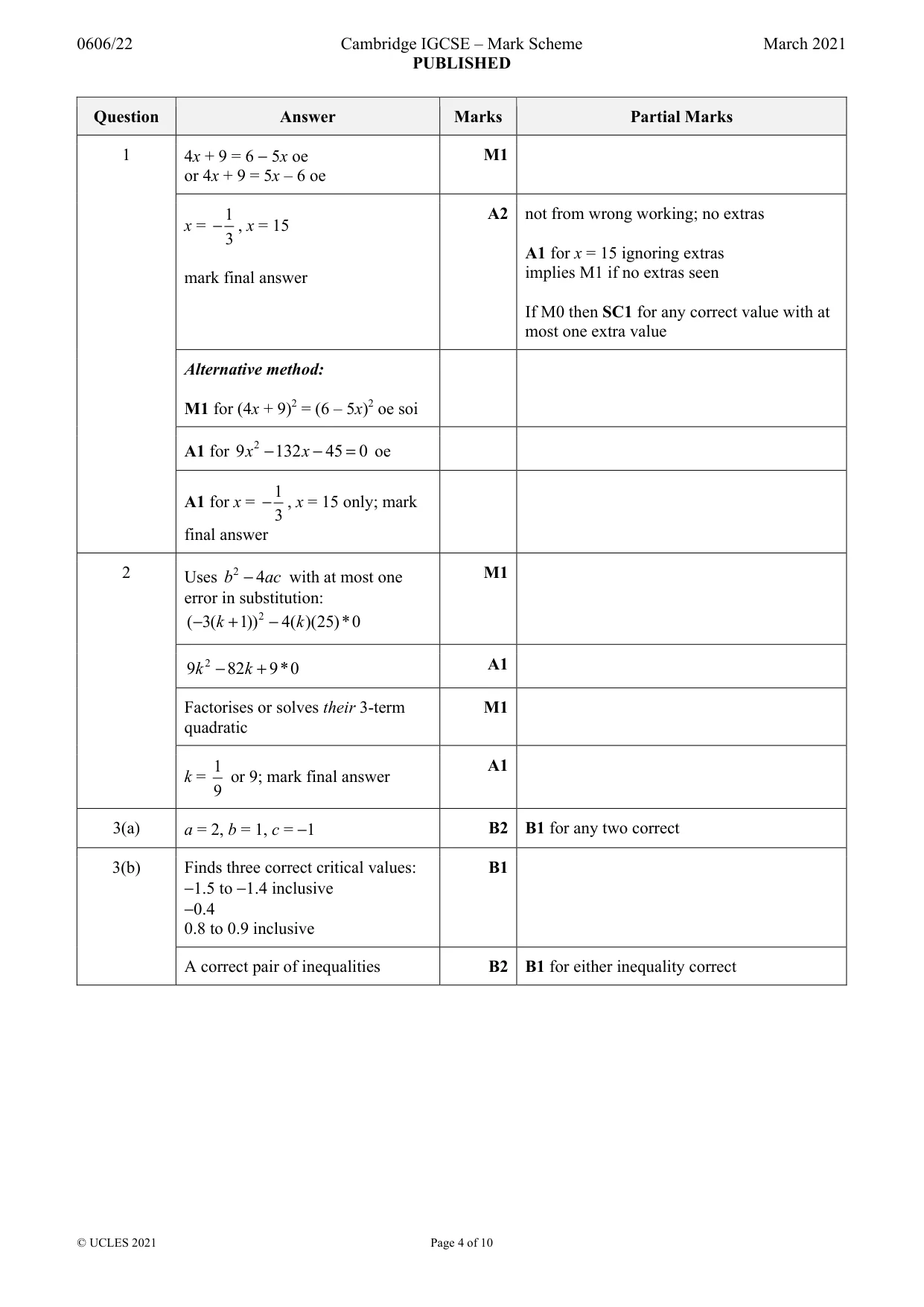
Mark scheme: Question Answer Marks Partial Marks 1 4x + 9 = 6 − 5x oe M1 or 4x + 9 = 5x – 6 oe 1 A2 not from wrong working; no extras x = − , x = 15 3 A1 for x = 15 ignoring extras implies M1 if no extras seen mark final answer If M0 then SC1 for any correct value with at most one extra value Alternative method: M1 for (4x + 9)2 = (6 – 5x)2 oe soi A1 for 9 x 2 − 132 x − 45 = 0 oe 1 A1 for x = − , x = 15 only; mark 3 final answer
Q2 · Find the values of the constant k for which the equation kx 2 - 3 ( k + 1) x + 25 = 0 has…
2 Find the values of the constant k for which the equation kx 2 - 3 ( k + 1) x + 25 = 0 has equal roots. [4]
Mark scheme: 2 Uses b 2 − 4 ac with at most one M1 error in substitution: ( −3( k + 1)) 2 − 4( k )(25)*0 9 k 2 − 82 k + 9*0 A1 Factorises or solves their 3-term M1 quadratic 1 A1 k = or 9; mark final answer 9
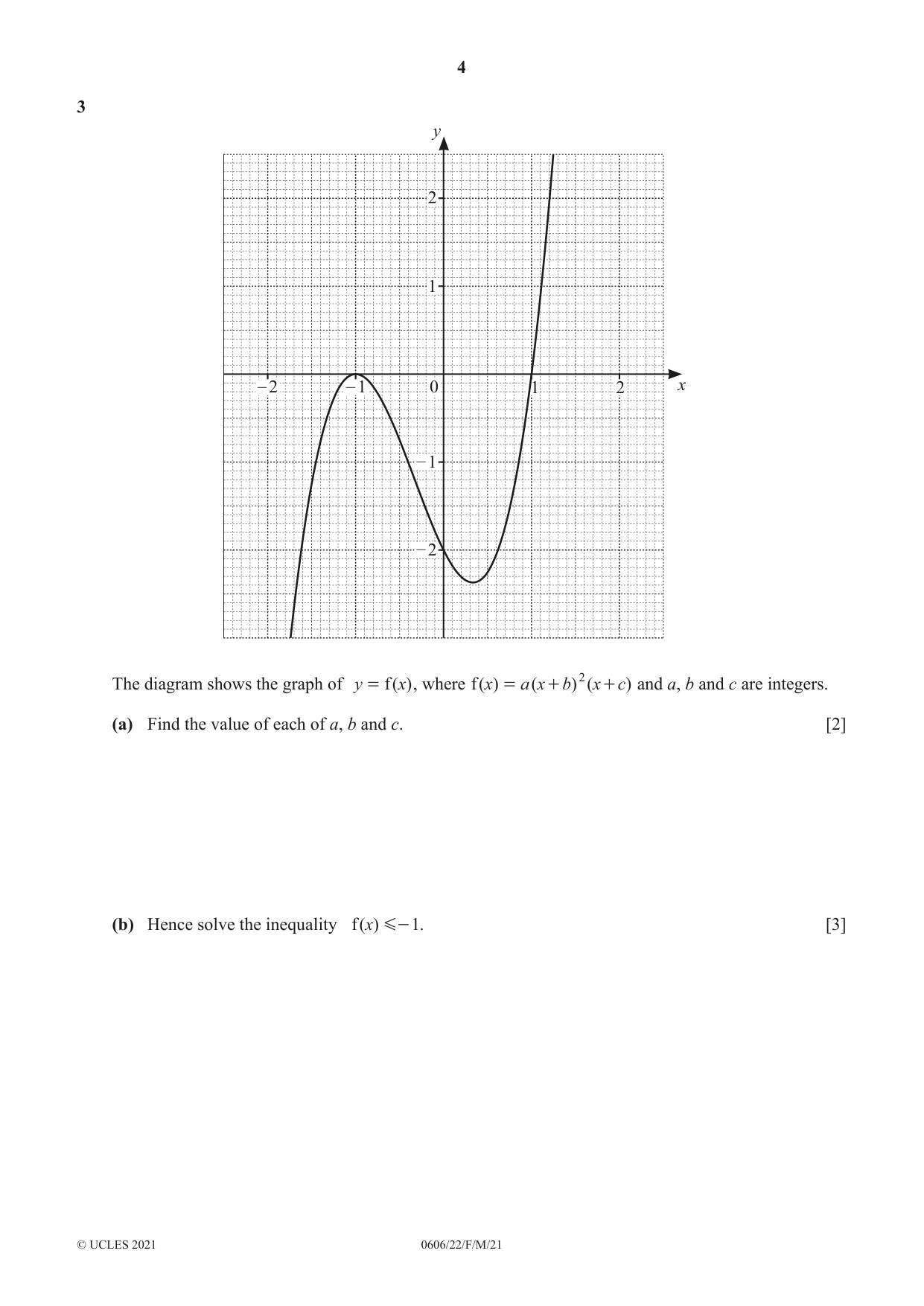
Q3 · Y 2 1 – 2 – 1 0 1 2 x – 1 – 2 The diagram shows the graph of y = f ( x) , where f ( x) =…
3 y 2 1 – 2 – 1 0 1 2 x – 1 – 2 The diagram shows the graph of y = f ( x) , where f ( x) = a ( x + b) 2 ( x + c) and a, b and c are integers. (a) Find the value of each of a, b and c. [2] (b) Hence solve the inequality f ( )x G- 1. [3]
Mark scheme: 3(a) a = 2, b = 1, c = −1 B2 B1 for any two correct 3(b) Finds three correct critical values: B1 −1.5 to −1.4 inclusive −0.4 0.8 to 0.9 inclusive A correct pair of inequalities B2 B1 for either inequality correct
More questions on Solve graphically cubic inequalities of the form
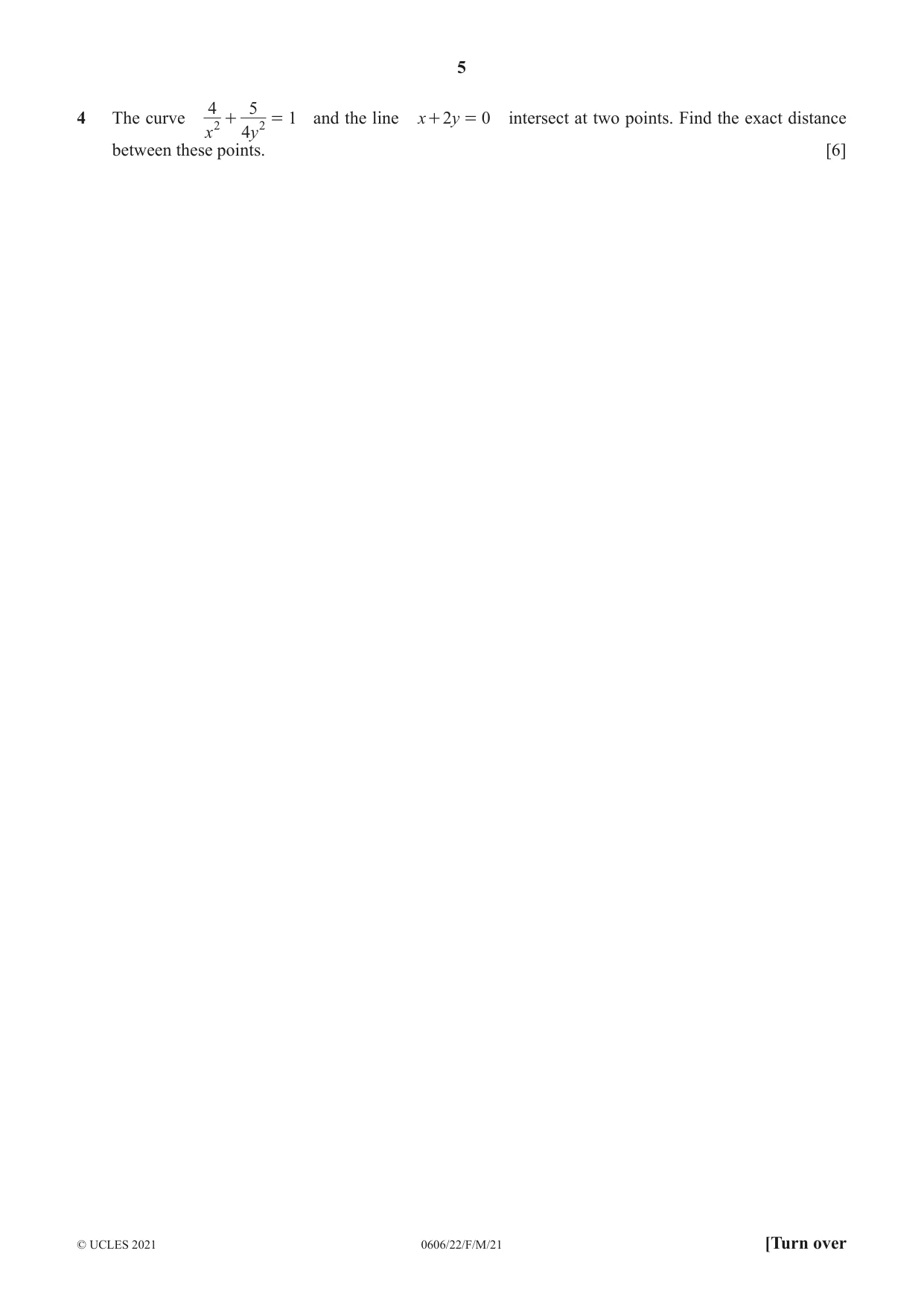
Q4 · The curve 2 + 2 = 1 and the line x + 2y = 0 intersect at two points
4 The curve 2 + 2 = 1 and the line x + 2y = 0 intersect at two points. Find the exact distance x 4 y between these points. [6]
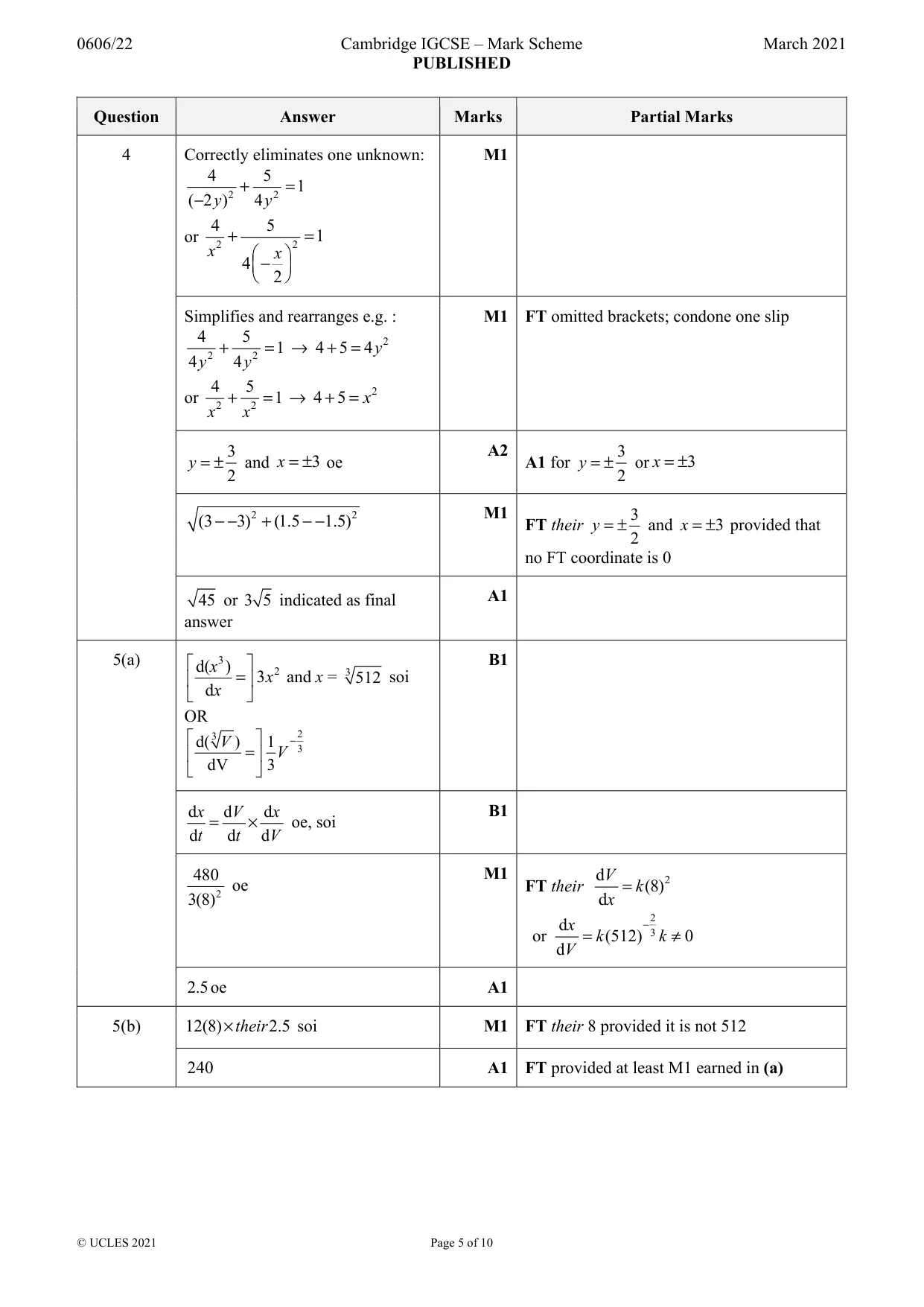
Mark scheme: 4 Correctly eliminates one unknown: M1 4 5 + = 1 ( −y2 ) 2 4 y 2 4 5 or 2 + 2 = 1 x x 4 − 2 Simplifies and rearranges e.g. : M1 FT omitted brackets; condone one slip 4 5 2 + = 1 → 4 + 5 = 4 y 4 y 2 4 y 2 4 5 2 or + = 1 → 4 + 5 = x x 2 x 2 3 A2 3 y = ± and x = ±3 oe A1 for y = ± or x = ±3 2 2 2 2 M1 3 (3 −−3) + (1.5 −−1.5) FT their y = ± and x = ±3 provided that 2 no FT coordinate is 0 45 or 3 5 indicated as final A1 answer
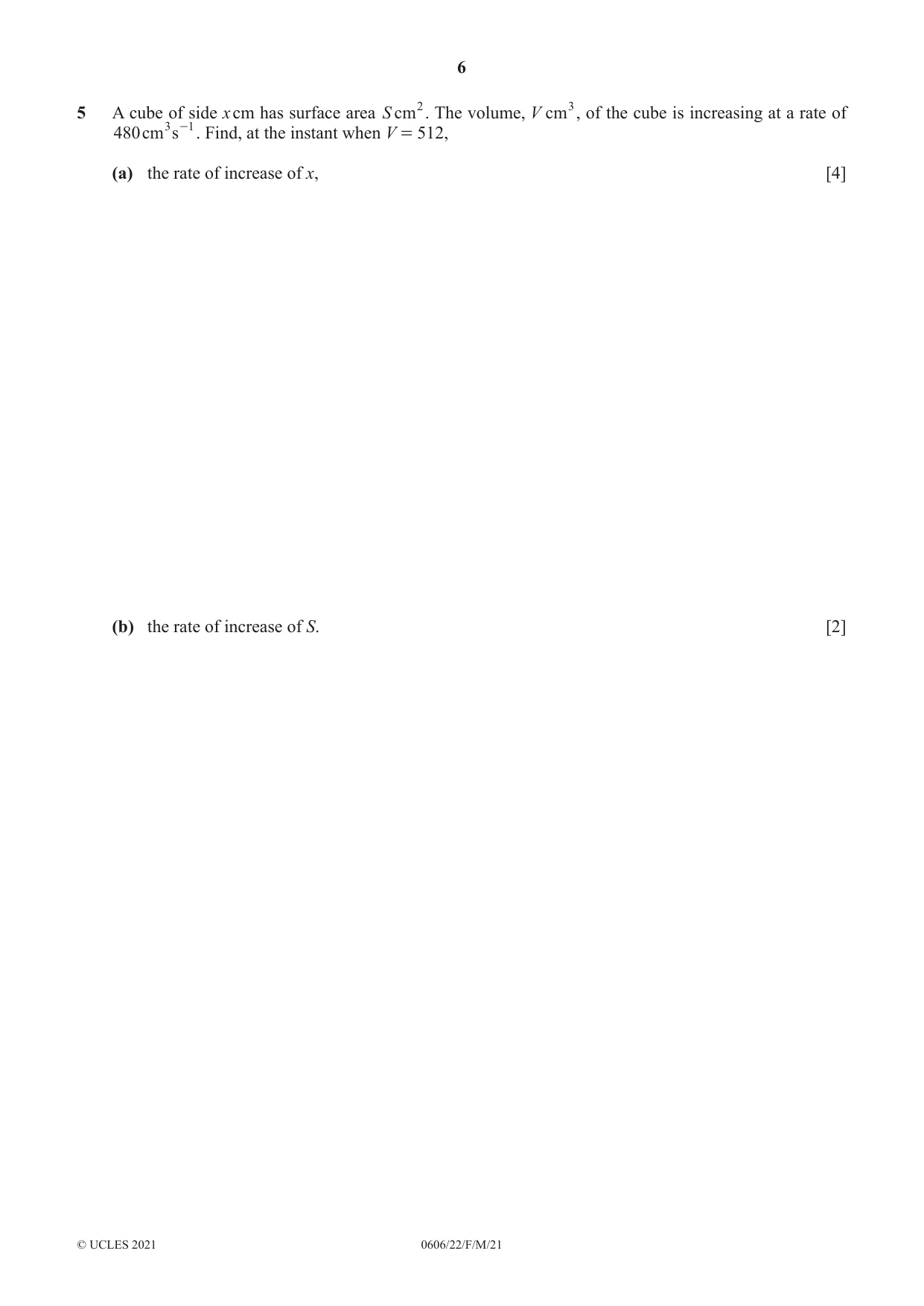
Q5 · A cube of side x cm has surface area S cm2
5 A cube of side x cm has surface area S cm2. The volume, V cm3, of the cube is increasing at a rate of 480cm 3 s -1 . Find, at the instant when V = 512, (a) the rate of increase of x, [4] (b) the rate of increase of S. [2]
Mark scheme: 5(a) d(x 3 ) 2 3 B1 = 3 x and x = 512 soi dx OR d( 3 V ) 1 − 23 = V dV 3 dx dV dx B1 = × oe, soi dt dt dV 480 M1 dV 2 oe FT their = k (8) 2 3(8) dx d x − 23 or = k (512) k ≠ 0 d V 2.5oe A1 5(b) 12(8) ×their 2.5 soi M1 FT their 8 provided it is not 512 240 A1 FT provided at least M1 earned in (a)
More questions on Apply differentiation to connected rates of
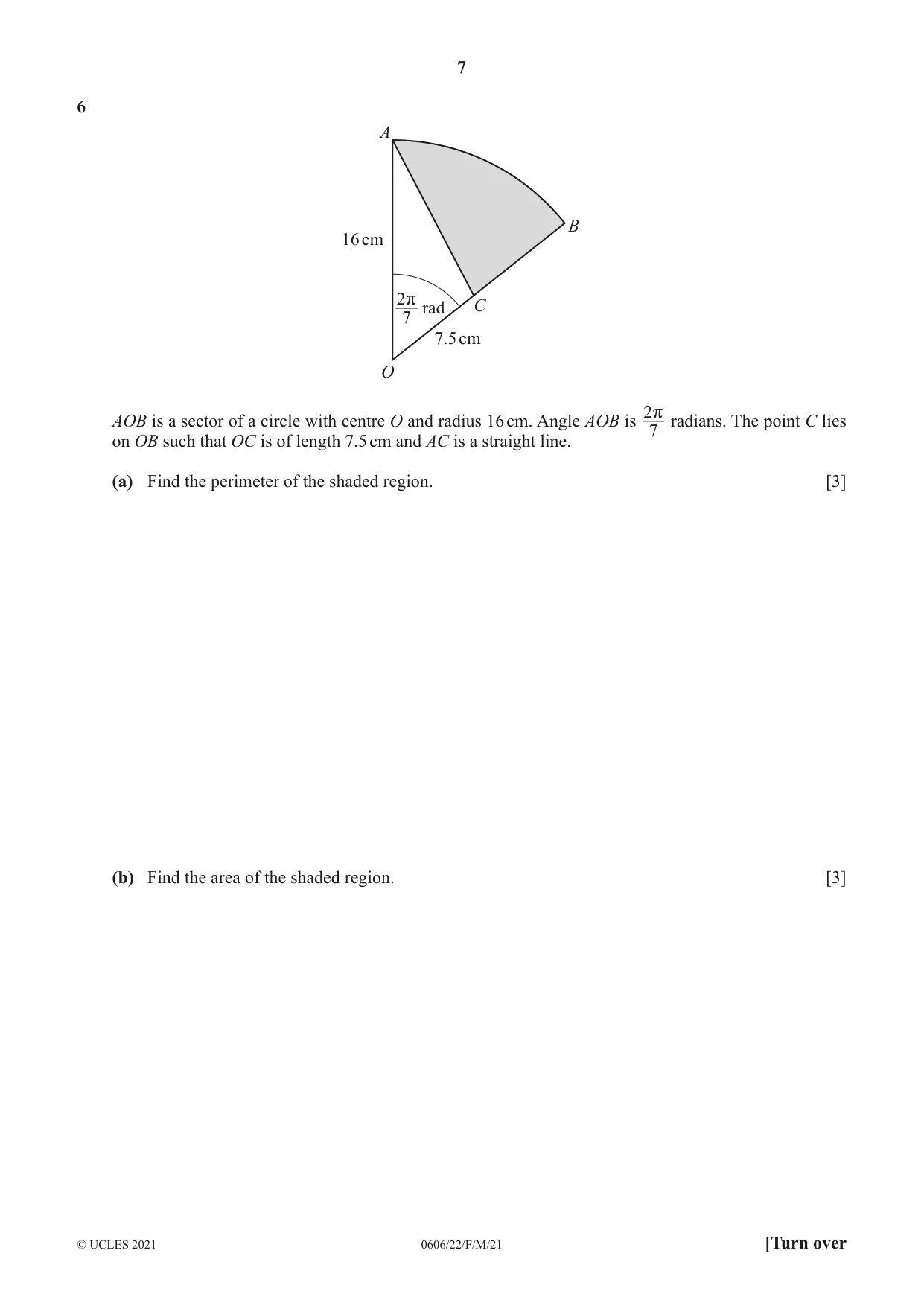
Q6 · A B 16 cm 2 r rad C 7 7.5 cm O 2r AOB is a sector of a circle with centre O and radius 16…
6 A B 16 cm 2 r rad C 7 7.5 cm O 2r AOB is a sector of a circle with centre O and radius 16 cm. Angle AOB is radians. The point C lies 7 on OB such that OC is of length 7.5 cm and AC is a straight line. (a) Find the perimeter of the shaded region. [3] (b) Find the area of the shaded region. [3]
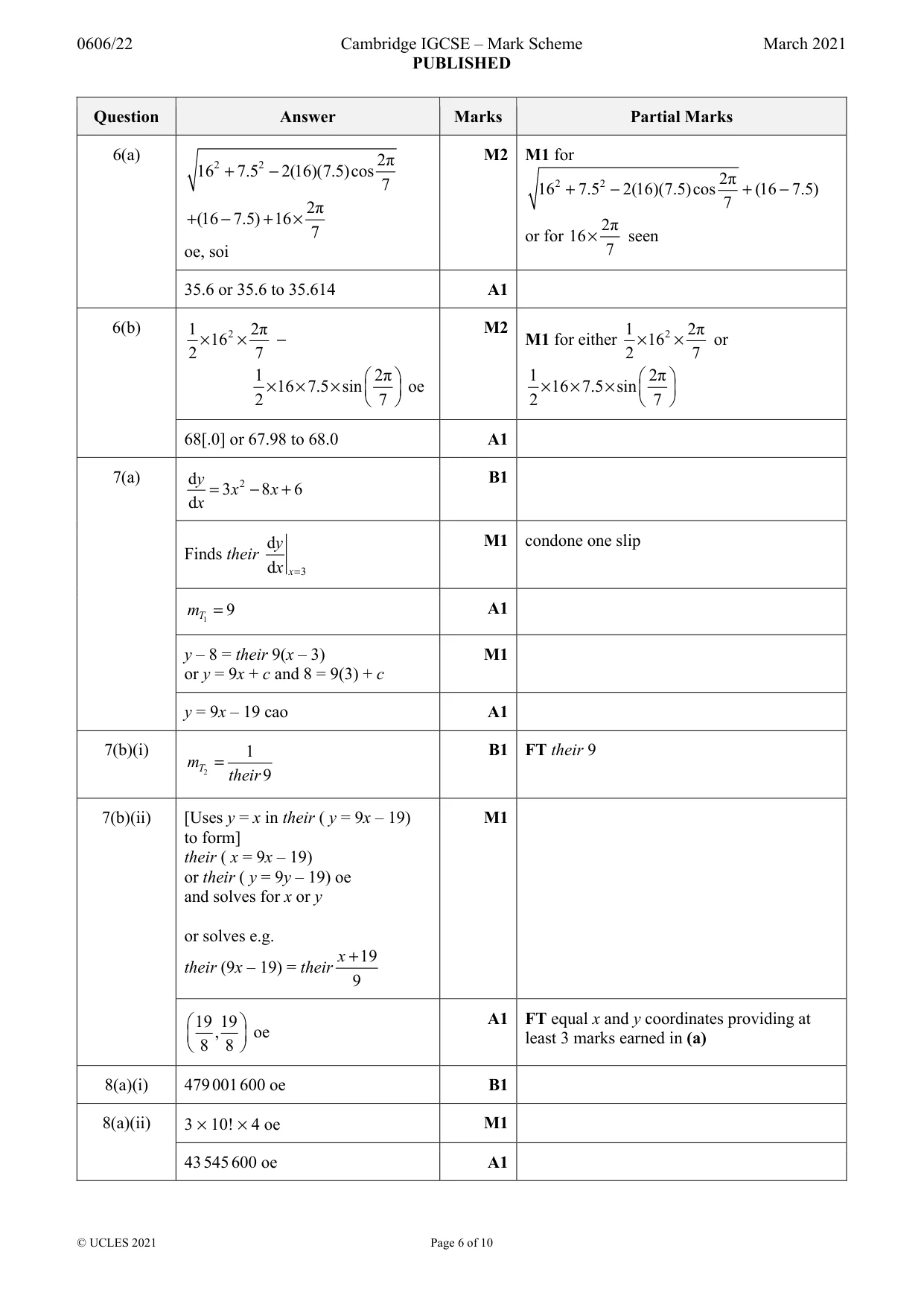
Mark scheme: 6(a) M2 M1 for 2 2 2π 16 + 7.5 − 2(16)(7.5)cos 2π 7 16 2 + 7.5 2 − 2(16)(7.5)cos + (16 − 7.5) 7 2π + (16 − 7.5) + 16 × 2π 7 or for 16 × seen oe, soi 7 35.6 or 35.6 to 35.614 A1 6(b) 1 2 2π M2 1 2 2π × 16 × − M1 for either × 16 × or 2 7 2 7 1 2π 1 2π × 16 × 7.5 × sin oe × 16 × 7.5 × sin 2 7 2 7 68[.0] or 67.98 to 68.0 A1
More questions on Solve problems involving the arc length and
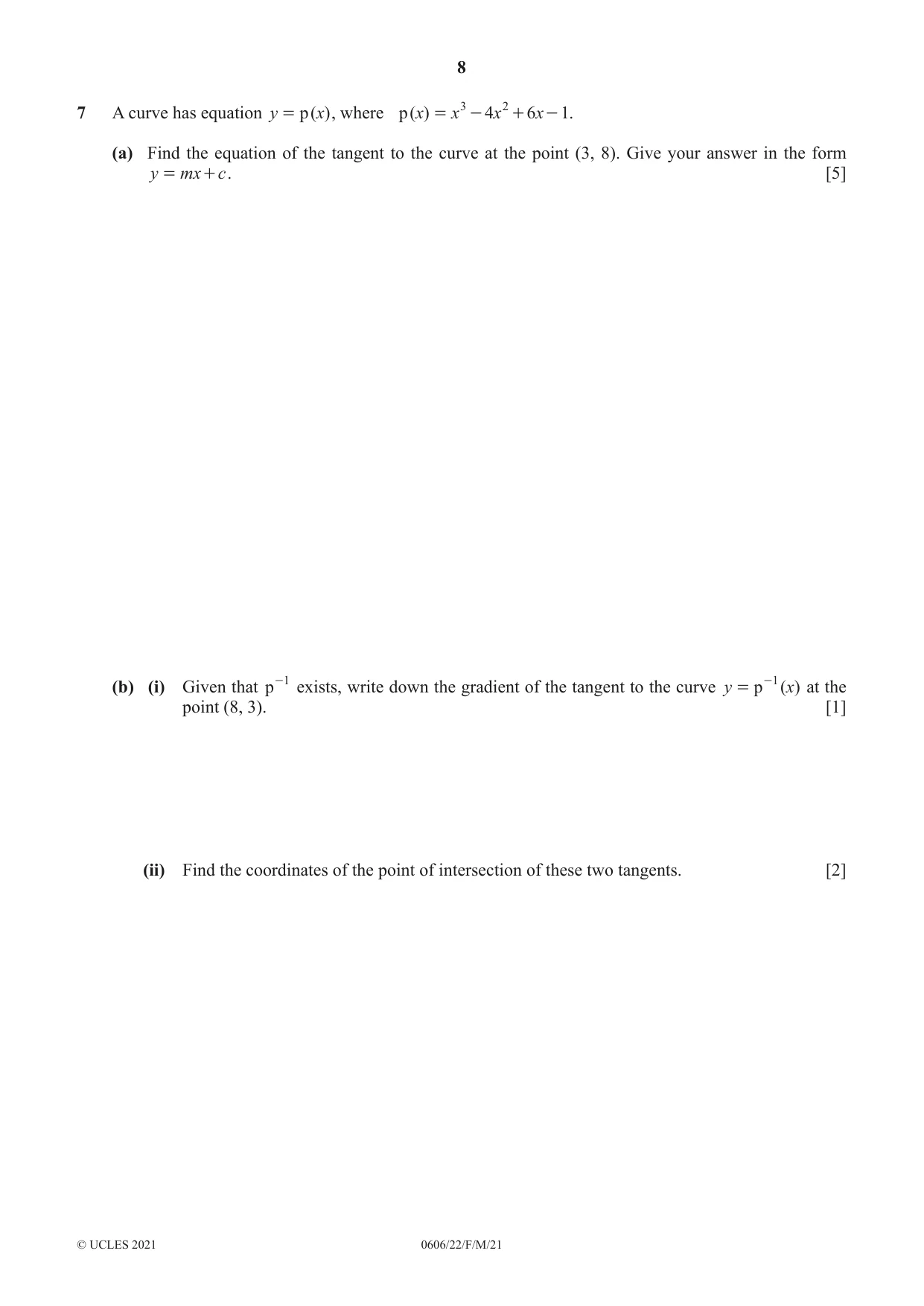
Q7 · A curve has equation y = p ( x) , where p ( )x = x 3 - 4x 2 + 6x - 1
7 A curve has equation y = p ( x) , where p ( )x = x 3 - 4x 2 + 6x - 1. (a) Find the equation of the tangent to the curve at the point (3, 8). Give your answer in the form y = mx + c . [5] (b) (i) Given that p -1 exists, write down the gradient of the tangent to the curve y = p -1 ( x) at the point (8, 3). [1] (ii) Find the coordinates of the point of intersection of these two tangents. [2]
Mark scheme: 7(a) dy 2 B1 = 3 x − 8 x + 6 dx d y M1 condone one slip Finds their d x x = 3 mT1 = 9 A1 y – 8 = their 9(x – 3) M1 or y = 9x + c and 8 = 9(3) + c y = 9x – 19 cao A1 7(b)(i) 1 B1 FT their 9 mT2 = their 9 7(b)(ii) [Uses y = x in their ( y = 9x – 19) M1 to form] their ( x = 9x – 19) or their ( y = 9y – 19) oe and solves for x or y or solves e.g. x + 19 their (9x – 19) = their 9 19 19 A1 FT equal x and y coordinates providing at , oe least 3 marks earned in (a) 8 8
More questions on Use differentiation to find gradients, tangents
Q8 · A photographer takes 12 different photographs
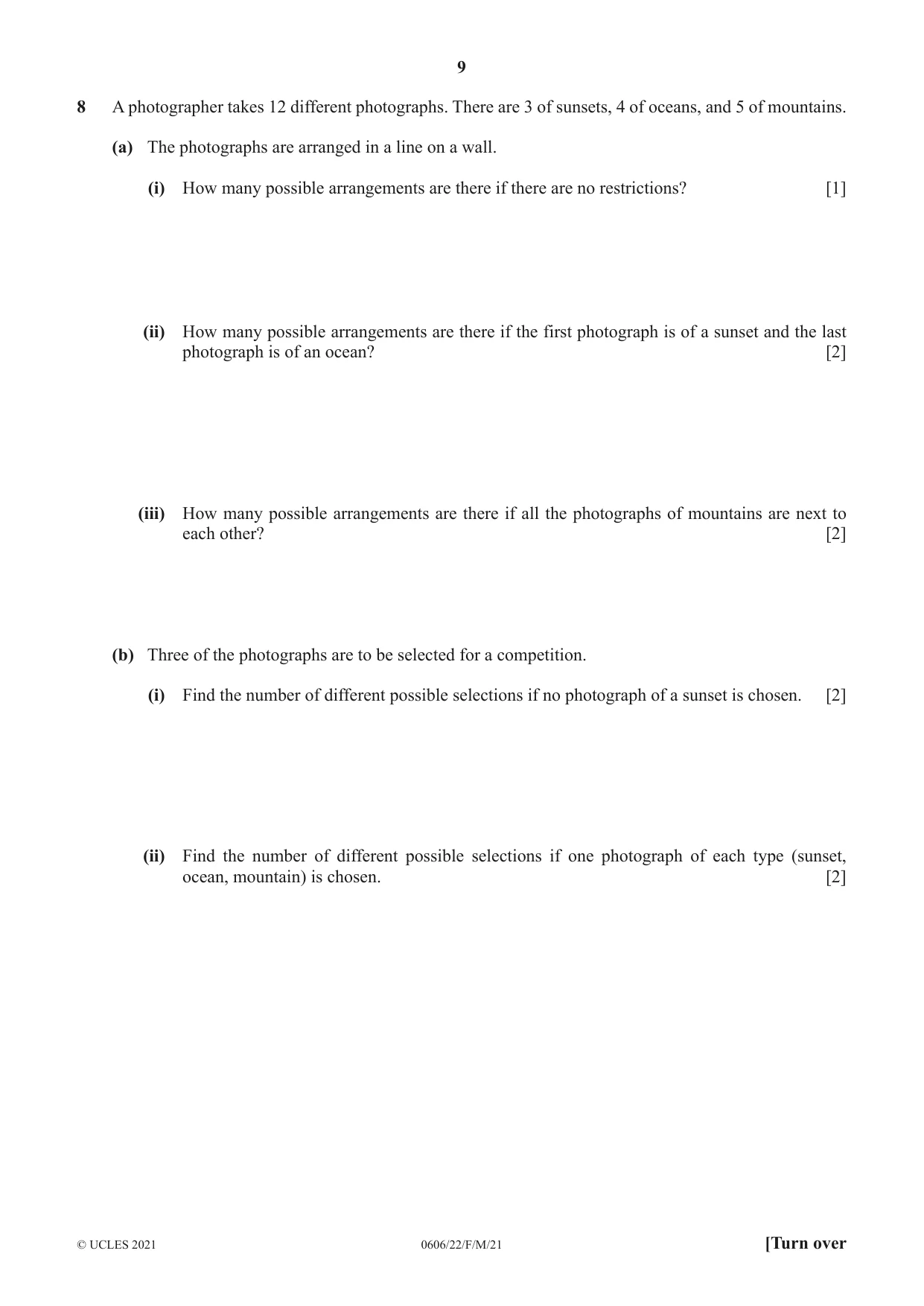
8 A photographer takes 12 different photographs. There are 3 of sunsets, 4 of oceans, and 5 of mountains. (a) The photographs are arranged in a line on a wall. (i) How many possible arrangements are there if there are no restrictions? [1] (ii) How many possible arrangements are there if the first photograph is of a sunset and the last photograph is of an ocean? [2] (iii) How many possible arrangements are there if all the photographs of mountains are next to each other? [2] (b) Three of the photographs are to be selected for a competition. (i) Find the number of different possible selections if no photograph of a sunset is chosen. [2] (ii) Find the number of different possible selections if one photograph of each type (sunset, ocean, mountain) is chosen. [2]
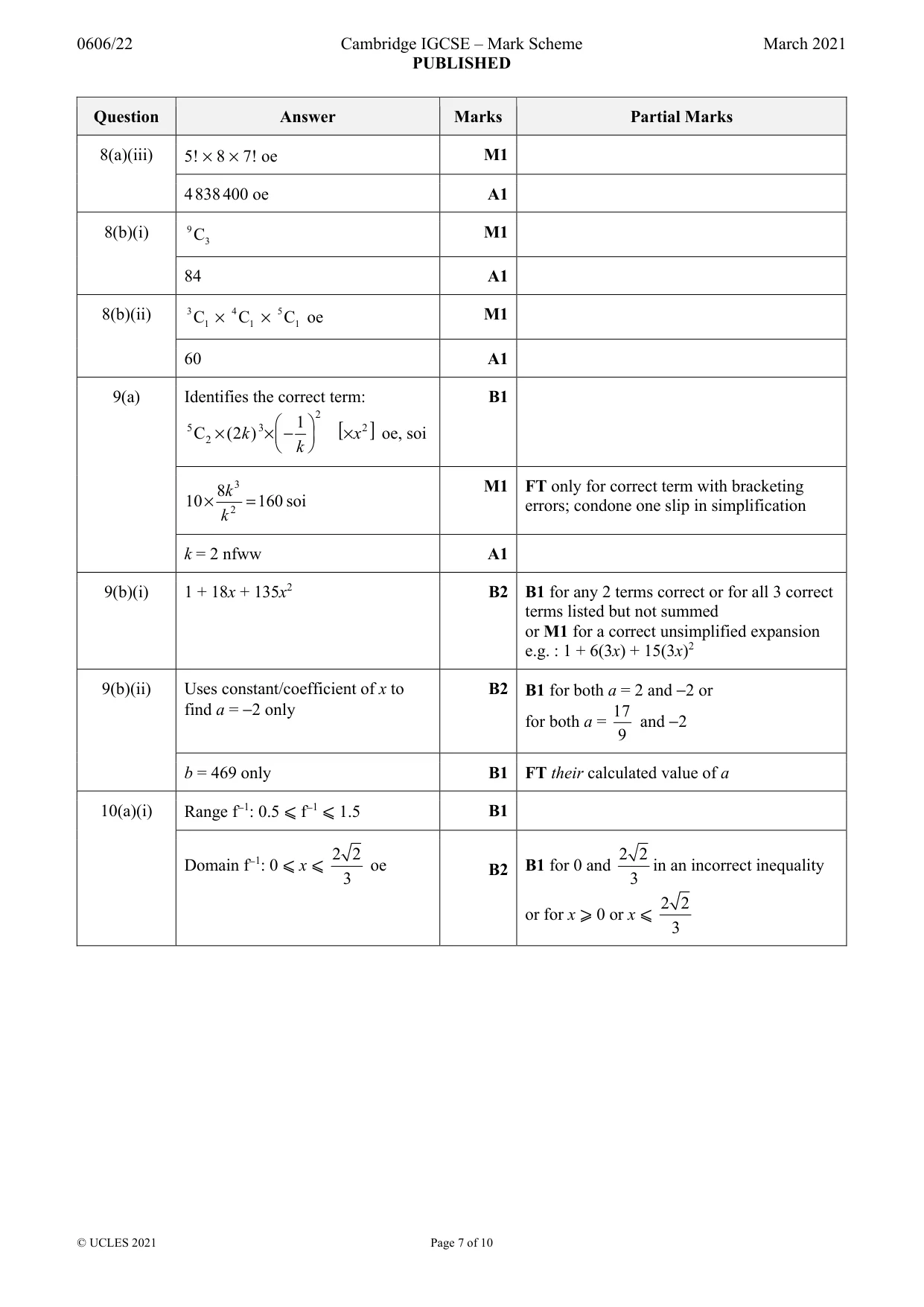
Mark scheme: 8(a)(i) 479 001 600 oe B1 8(a)(ii) 3 × 10! × 4 oe M1 43 545 600 oe A1 8(a)(iii) 5! × 8 × 7! oe M1 4 838 400 oe A1 8(b)(i) 9 C 3 M1 84 A1 8(b)(ii) 3 C1 × 4 C1 × 5 C1 oe M1 60 A1
More questions on Solve problems on arrangement and selection
Q9 · In the expansion of 2 k - , where k is a constant, the coefficient of x2 is 160
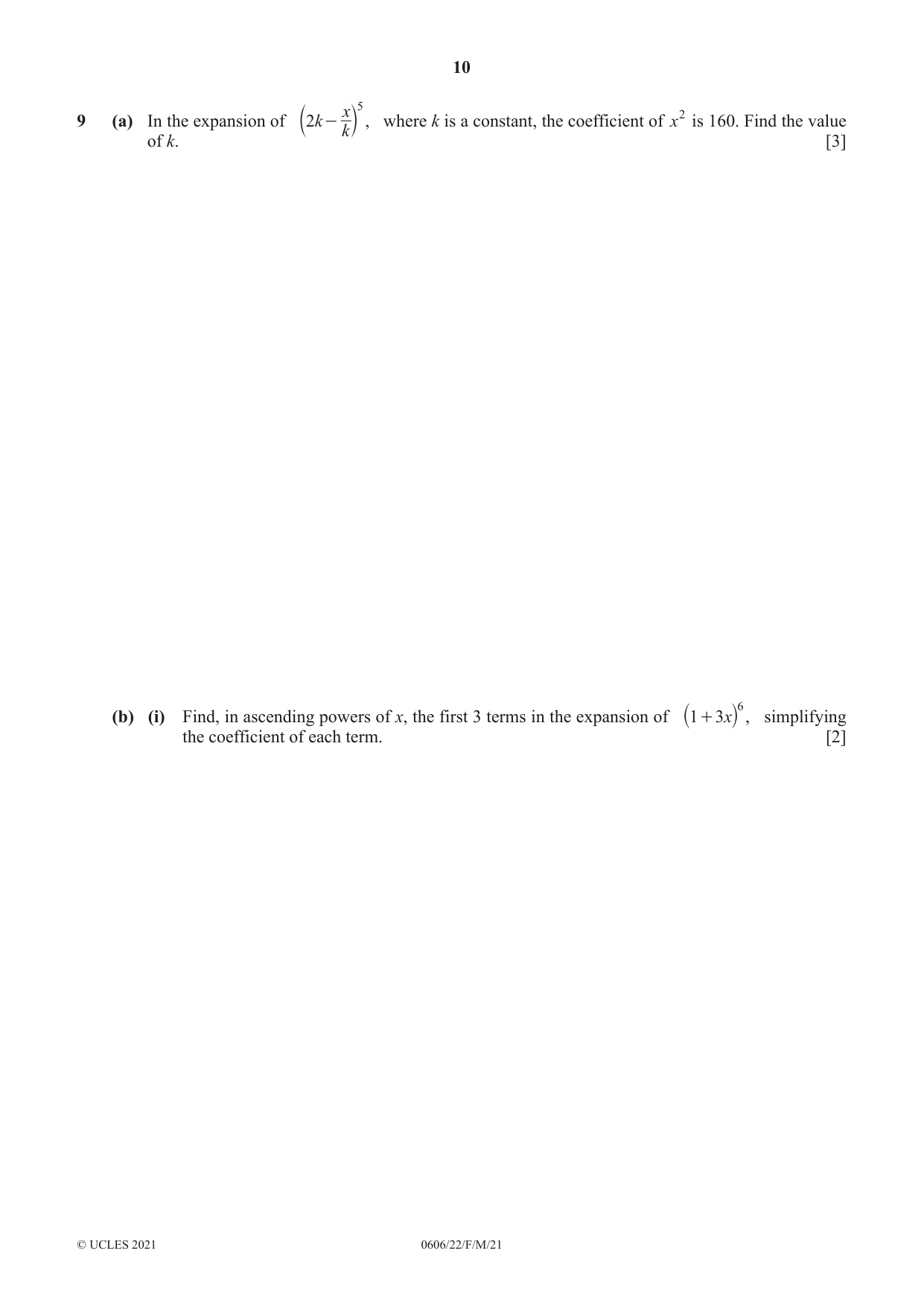
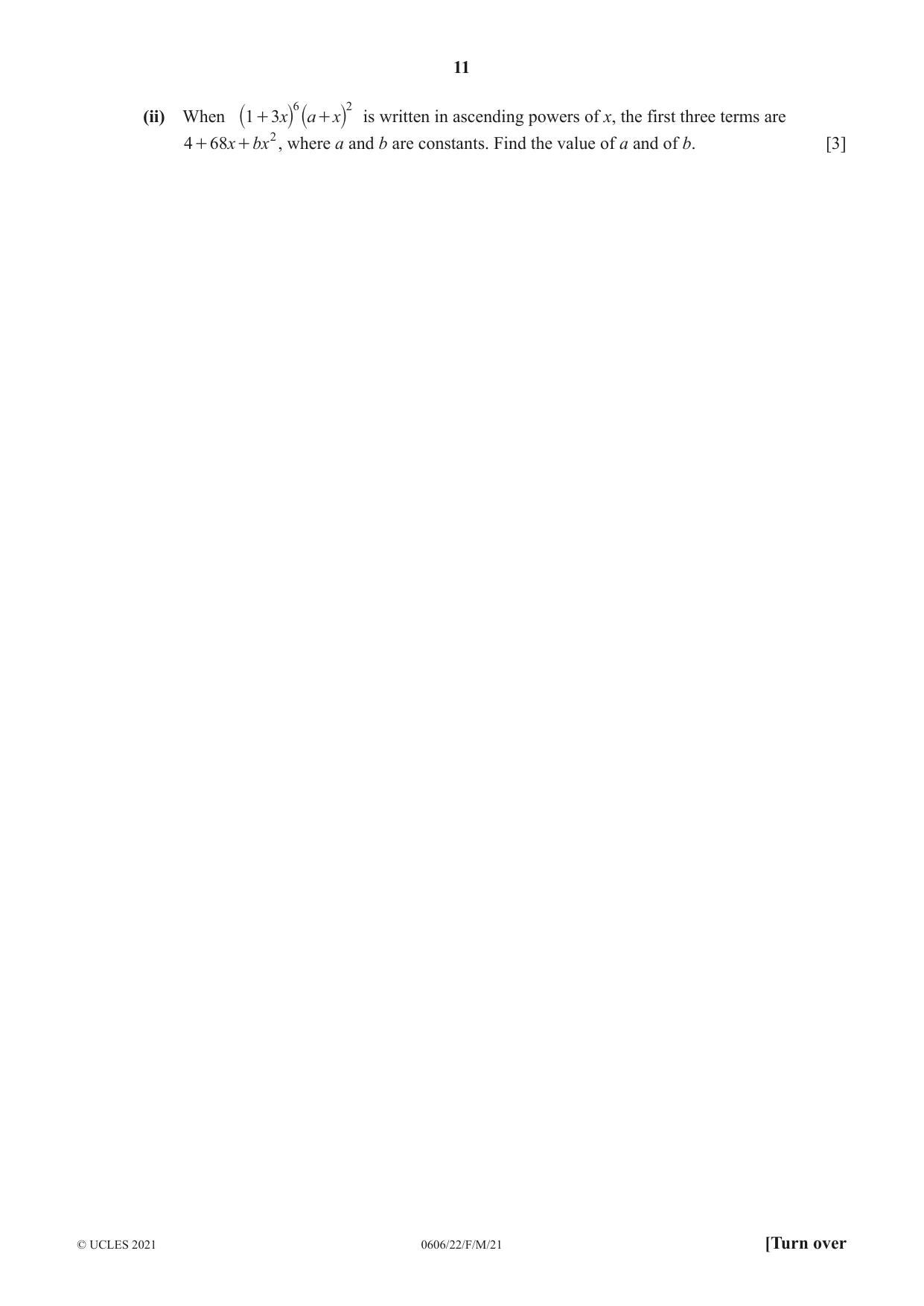
9 (a) In the expansion of 2 k - , where k is a constant, the coefficient of x2 is 160. Find the value k of k. [3] 6 (b) (i) Find, in ascending powers of x, the first 3 terms in the expansion of 1 + 3x , simplifying ` j the coefficient of each term. [2] 6 2 (ii) When 1 + 3x a + x is written in ascending powers of x, the first three terms are ` j ` j 4 + 68x + bx 2 , where a and b are constants. Find the value of a and of b. [3]
Mark scheme: 9(a) Identifies the correct term: B1 5 3 1 2 2 [× x ] oe, soi C 2 × (2 k ) × − k 8 k 3 M1 FT only for correct term with bracketing 10 × = 160 soi errors; condone one slip in simplification 2 k k = 2 nfww A1 9(b)(i) 1 + 18x + 135x2 B2 B1 for any 2 terms correct or for all 3 correct terms listed but not summed or M1 for a correct unsimplified expansion e.g. : 1 + 6(3x) + 15(3x)2 9(b)(ii) Uses constant/coefficient of x to B2 B1 for both a = 2 and −2 or find a = −2 only 17 for both a = and −2 9 b = 469 only B1 FT their calculated value of a
Q10 · The function f is defined by f ( )x = for 0.5 G x G 1 .5
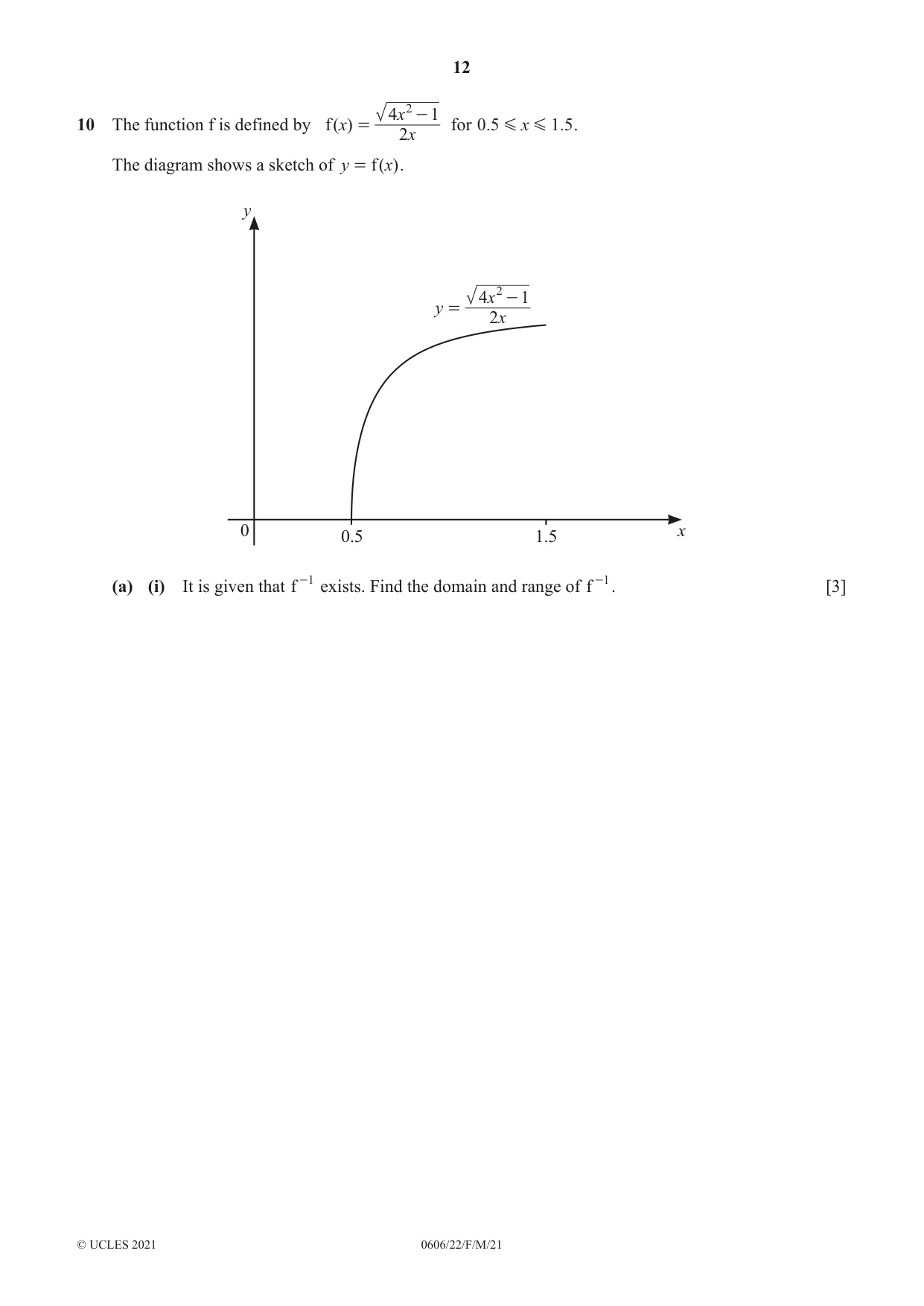
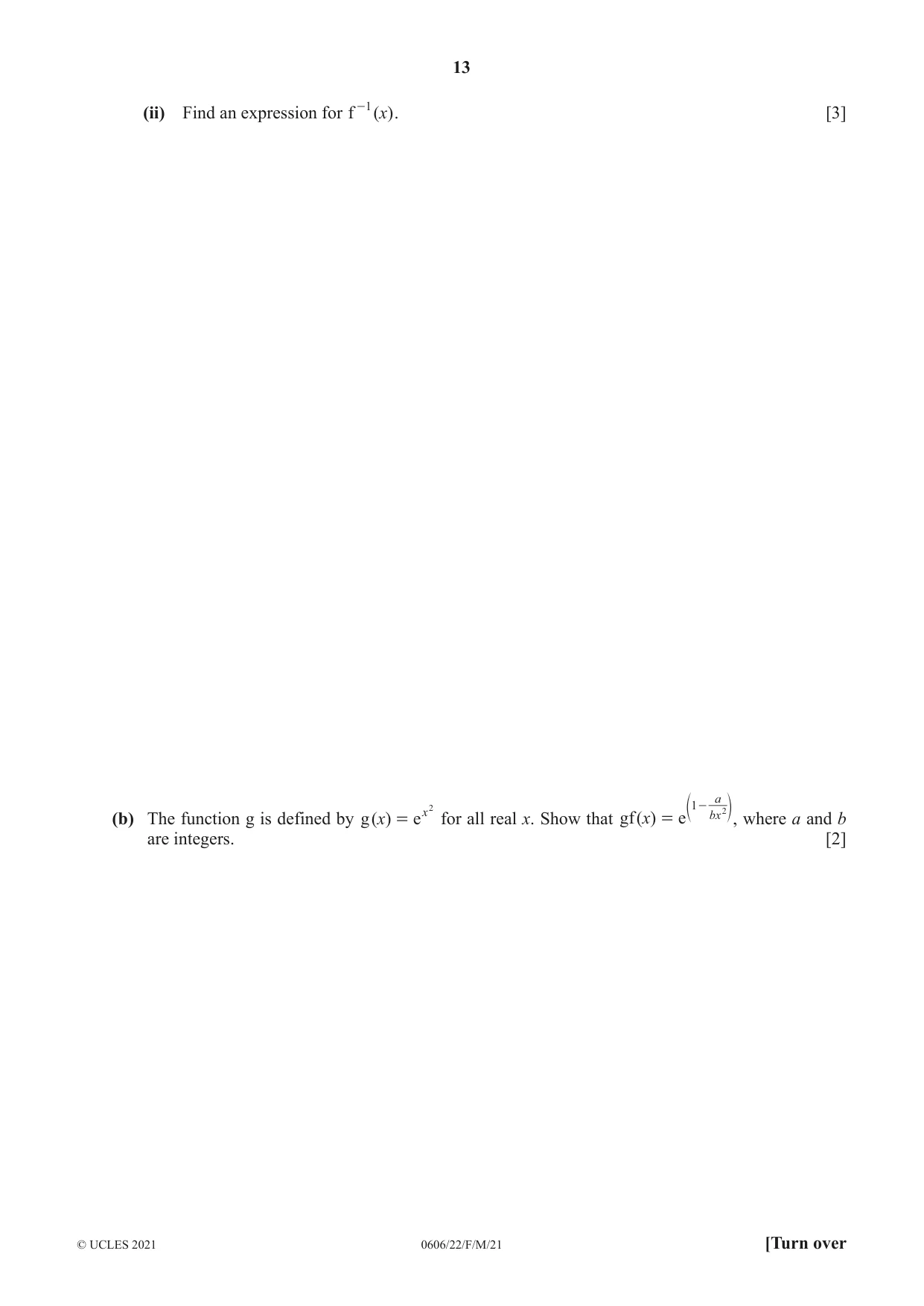
10 The function f is defined by f ( )x = for 0.5 G x G 1 .5 . 2x The diagram shows a sketch of y = f ( x) . y 4x 2 - 1 y = 2x 0 x 0.5 1.5 (a) (i) It is given that f -1 exists. Find the domain and range of f -1 . [3] (ii) Find an expression for f -1 ( )x . [3] a 1 - 2 (b) The function g is defined by g ( )x = ex2 for all real x. Show that gf ( )x = e e bx o, where a and b are integers. [2]
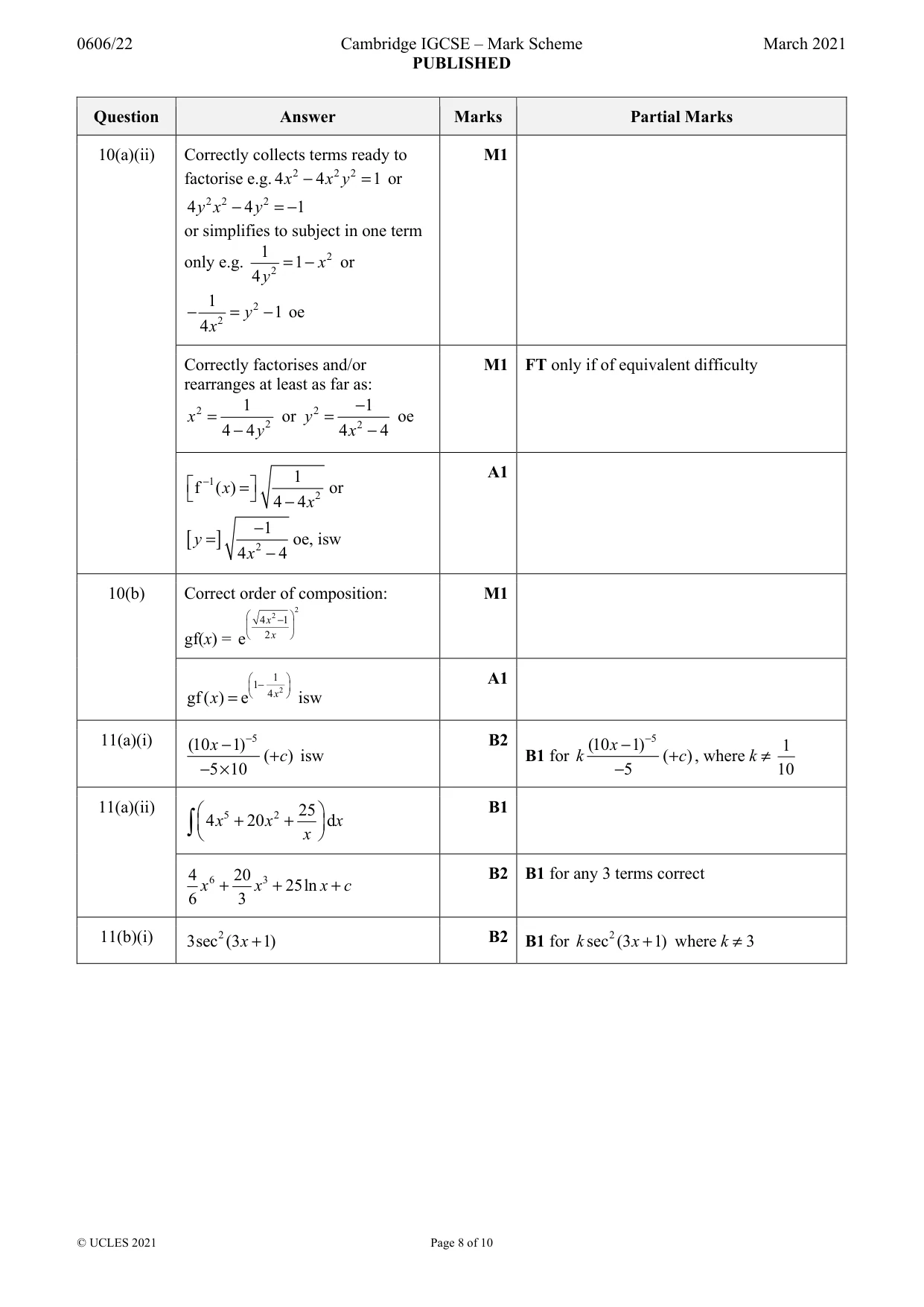
Mark scheme: 10(a)(i) Range f−1: 0.5 ⩽ f−1 ⩽ 1.5 B1 2 2 2 2 Domain f−1: 0 ⩽ x ⩽ oe B2 B1 for 0 and in an incorrect inequality 3 3 2 2 or for x ⩾ 0 or x ⩽ 3 10(a)(ii) Correctly collects terms ready to M1 factorise e.g. 4 x 2 − 4 x 2 y 2 = 1 or 4 y 2 x 2 − 4 y 2 = −1 or simplifies to subject in one term 1 2 only e.g. = 1 −x or 4 y 2 1 2 − = y − 1 oe 4 x 2 Correctly factorises and/or M1 FT only if of equivalent difficulty rearranges at least as far as: 2 1 2 −1 x = or y = oe 4 − 4 y 2 4 x 2 − 4 −1 1 A1 f ( x ) = or 2 4 − 4 x −1 [ y = ] 2 oe, isw 4 x − 4 10(b) Correct order of composition: M1 2 −1 4 x 2 gf(x) = e 2 x 1 A1 1− 2 gf ( x ) = e 4 x isw
Question 11
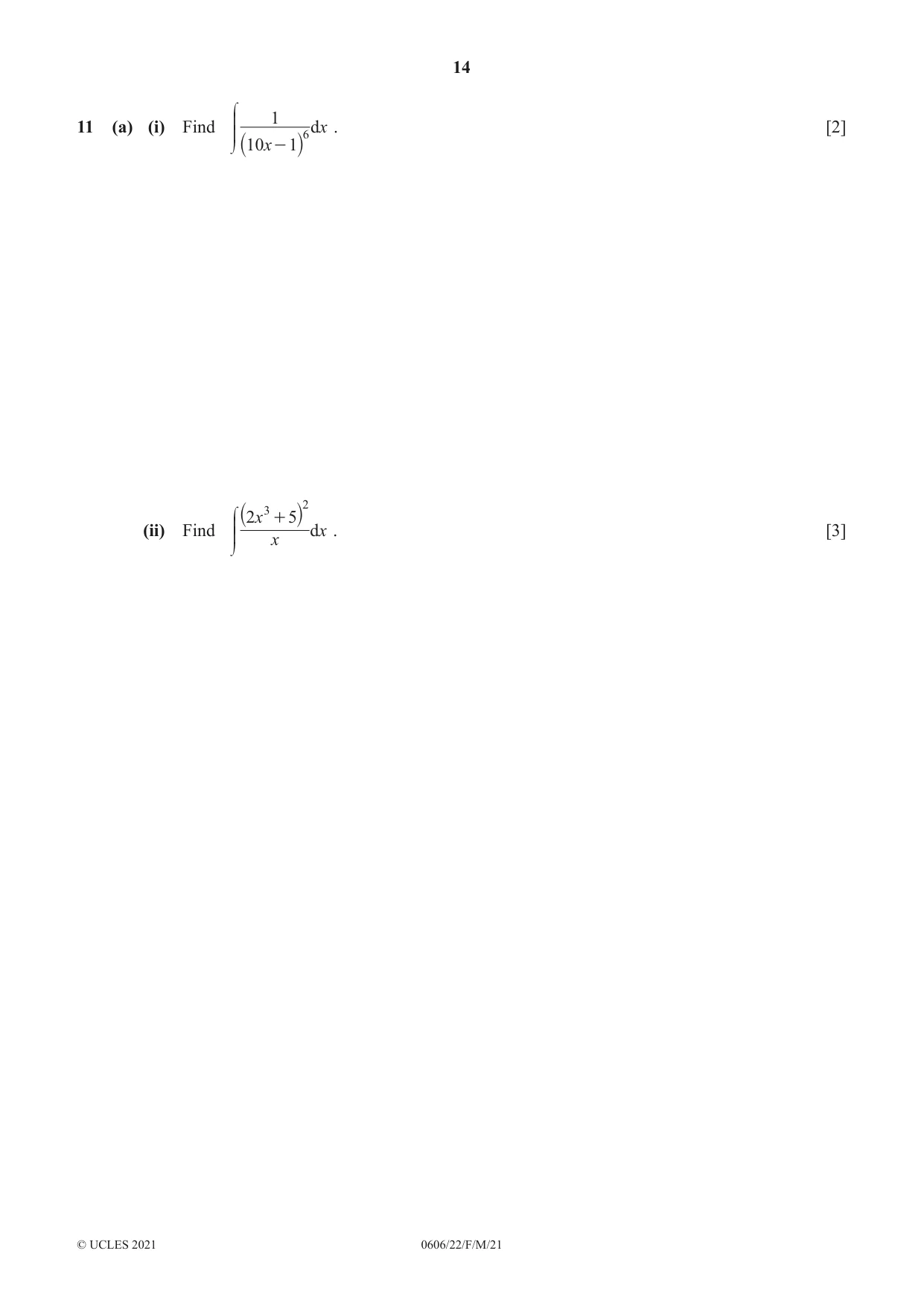
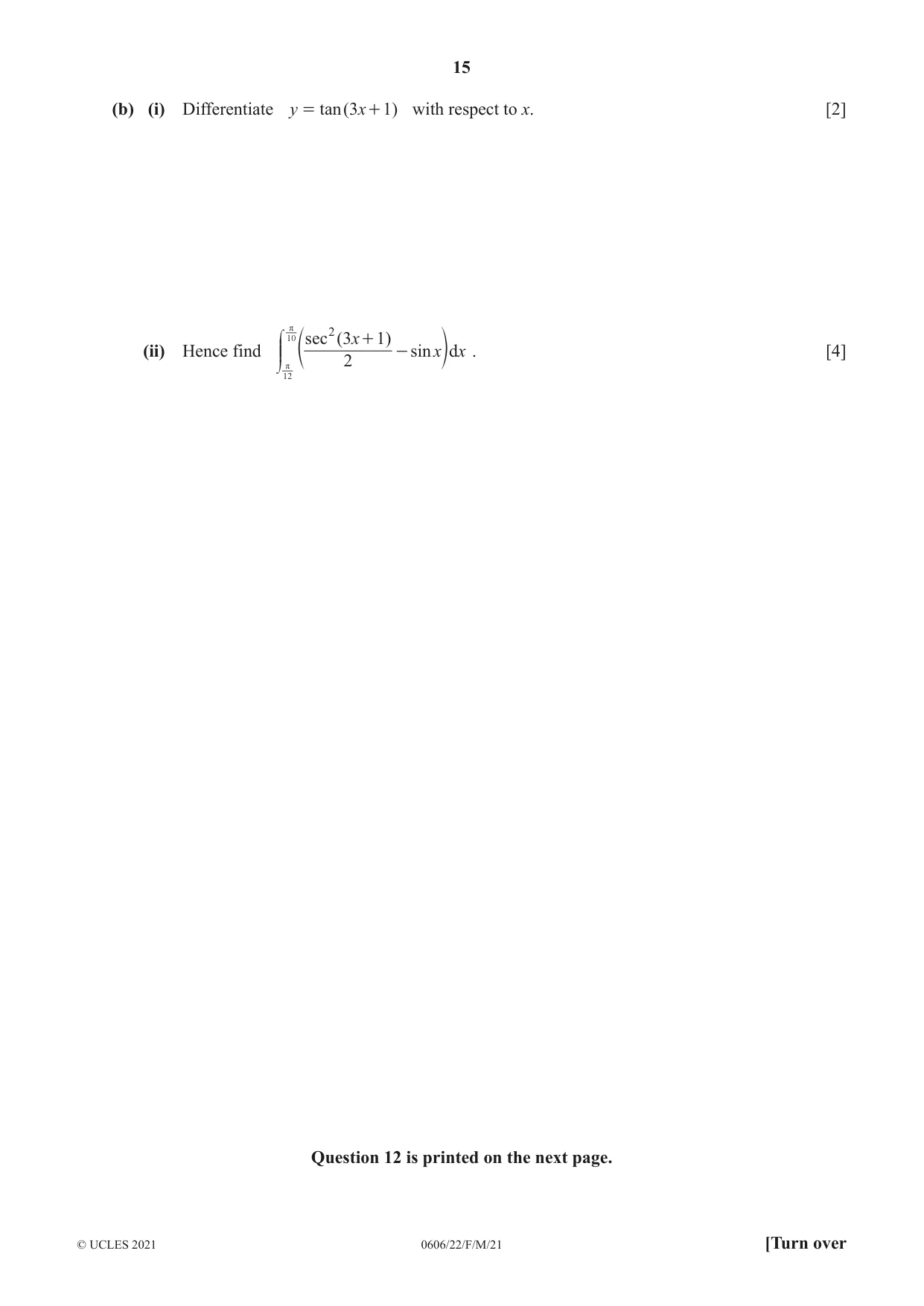
11 (a) (i) Find 6 dx . [2] 10x - 1 e dd` j 2 c 2 x 3 + 5 (ii) Find ` j d x . [3] dd x e (b) (i) Differentiate y = tan ( 3 x + 1) with respect to x. [2] c 10r sec 2 ( 3x + 1) (ii) Hence find dd - sin x d x . [4] r e 2 o e12 Question 12 is printed on the next page.
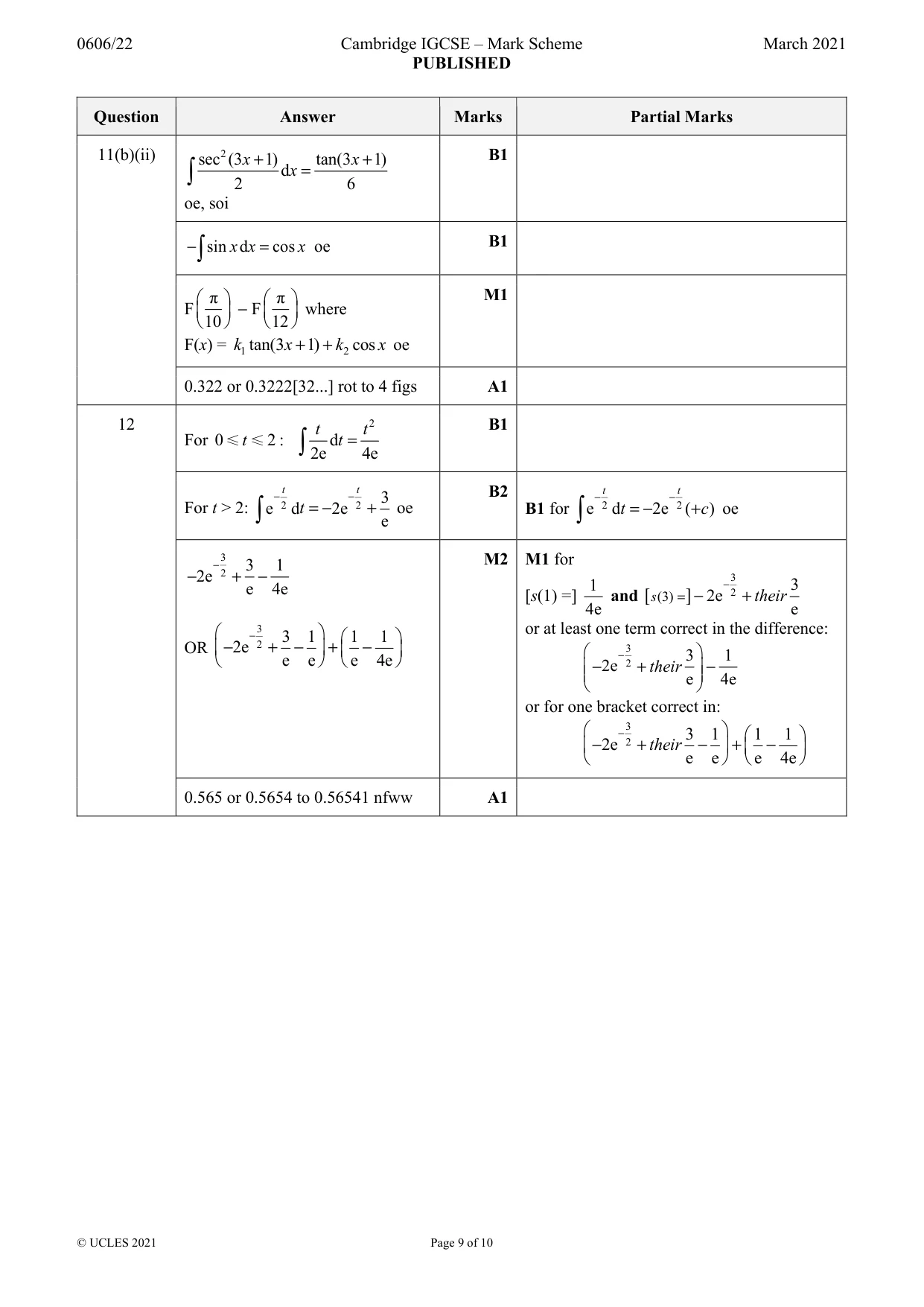
Mark scheme: 11(a)(i) (10 x − 1) −5 B2 (10 x − 1) −5 1 ( + c ) isw B1 for k ( + c ) , where k ≠ −×5 10 −5 10 11(a)(ii) 5 2 25 B1 4 x + 20 x + d x x 4 6 20 3 B2 B1 for any 3 terms correct x + x + 25ln x + c 6 3 11(b)(i) 3sec 2 (3 x + 1) B2 B1 for k sec 2 (3 x + 1) where k ≠ 3 11(b)(ii) sec 2 (3 x + 1) tan(3 x + 1) B1 dx = 2 6 oe, soi B1 − sin x d x = cos x oe π π M1 F − F where 10 12 F(x) = k1 tan(3 x + 1) + k 2 cos x oe 0.322 or 0.3222[32...] rot to 4 figs A1
Q12 · A particle P travels in a straight line so that, t seconds after passing through a fixed…
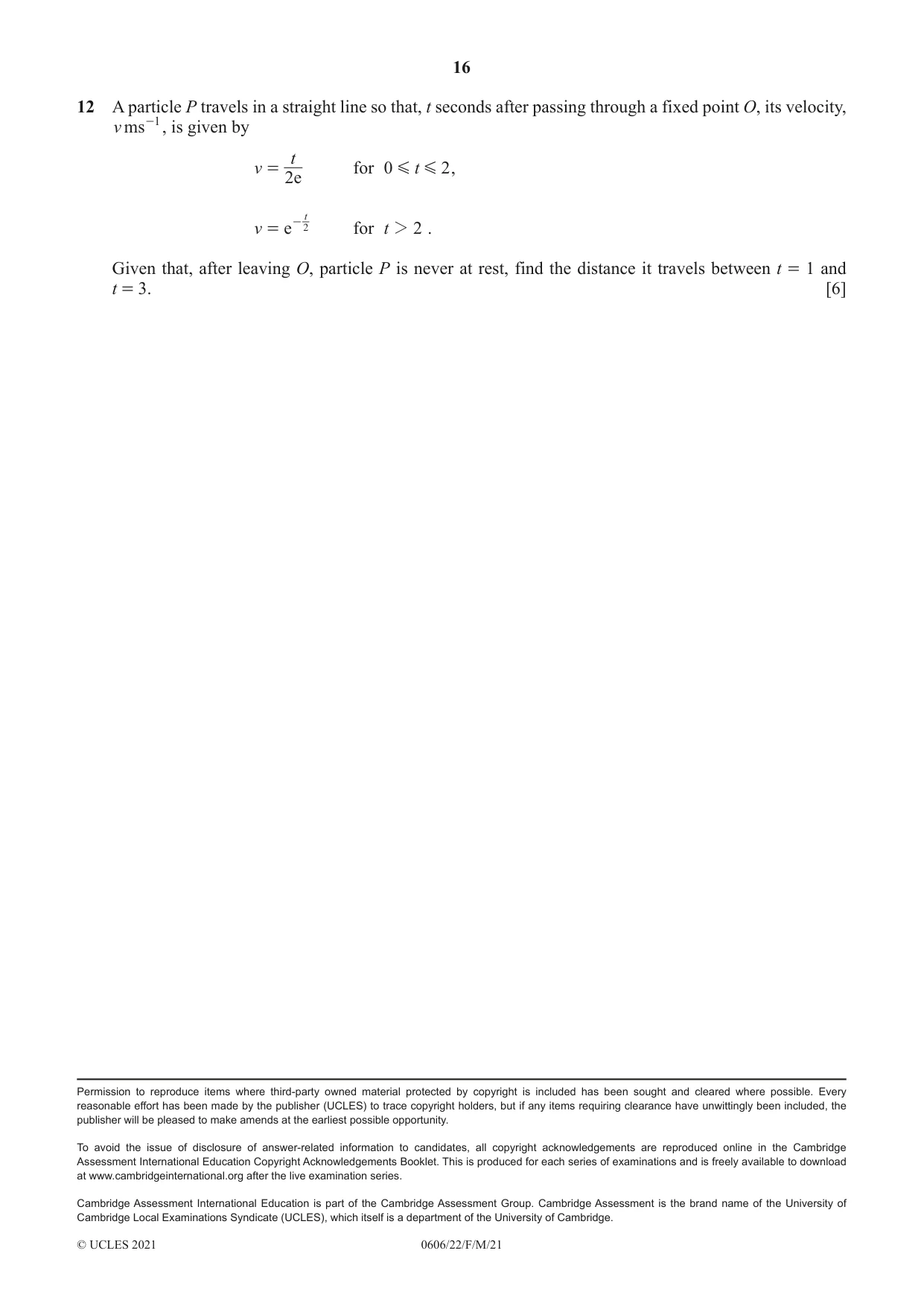
12 A particle P travels in a straight line so that, t seconds after passing through a fixed point O, its velocity, v ms -1 , is given by t v = for 0 G t G 2 , 2e t 2 v = e - for t 2 2 . Given that, after leaving O, particle P is never at rest, find the distance it travels between t = 1 and t = 3. [6]
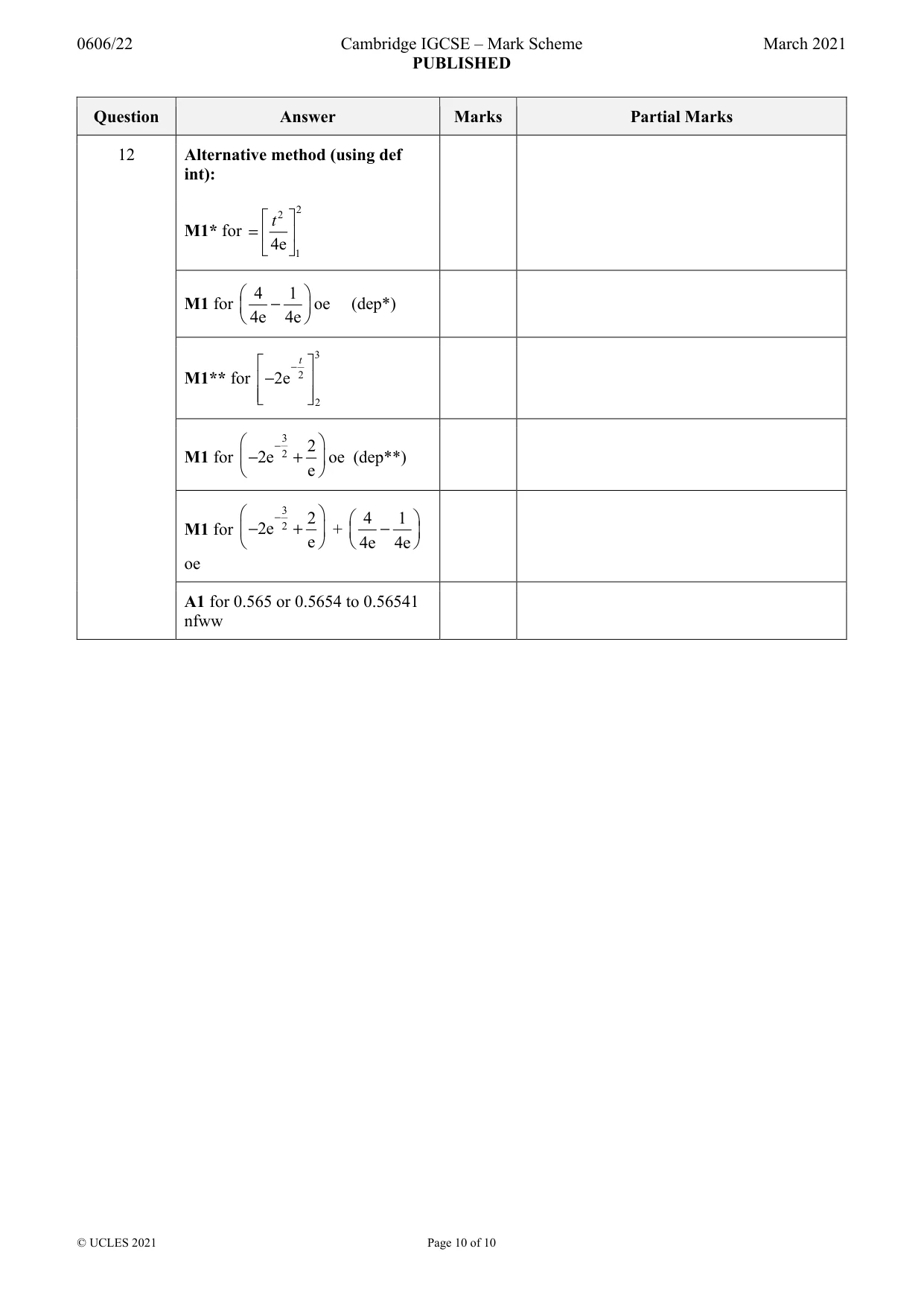
Mark scheme: 12 t t 2 B1 For 0 ≤≤t 2 : dt = 2e 4e t t t − − − t 3 B2 − 2 2 2 2 For t > 2: e d t = −2e + oe B1 for e dt = −2e ( + c ) oe e 3 M2 M1 for − 3 1 3 2 + − −2e e 4e 1 − 2 3 [s(1) =] and [ s (3) = ] − 2e + their 4e e 3 or at least one term correct in the difference: − 3 1 1 1 3 2 + − − −2e OR + − 3 1 e e e 4e 2e 2 + their − − e 4e or for one bracket correct in: − 3 1 1 2 3 1 −2e + their − + − e e e 4e 0.565 or 0.5654 to 0.56541 nfww A1 12 Alternative method (using def int): 2 t 2 M1* for = 4e 1 4 1 M1 for − (dep*) 4e 4e oe 3 − t M1** for − 2e 2 2 − 3 2 2 M1 for −2e + (dep**) e oe − 3 4 1 2 2 M1 for −2e + + − e 4e 4e oe A1 for 0.565 or 0.5654 to 0.56541 nfww
What was in this paper
The subtopics covered by these 12 questions, and how many questions each got. Open one in a new tab to see every Cambridge question on it.
2Apply differentiation to connected rates of1Find the domain and range of functions1Know the conditions for f(x) = 0 to have1Solve graphically cubic inequalities of the form1Solve problems involving the arc length and1Solve problems involving the intersection of a1Solve problems on arrangement and selection1Use differentiation to find gradients, tangents1Use the binomial theorem for expansion of1Use the equation of a straight line1What you needed in this session
Cambridge’s own grade thresholds for 2021 Feb/March, Paper 2 · Variant 2. A higher threshold means an easier paper — the bar moves with how the cohort did.