Cambridge IGCSE Mathematics - Additional 0606 — 2019 Feb/March Paper 2 · Variant 2
0606/22/F/M/19 · 11 questions · 80 marks · ≈90 min
The question paper and its mark scheme, free to read here and free to download. This is Cambridge’s own paper, exactly as it was sat.
Question paper16 pages

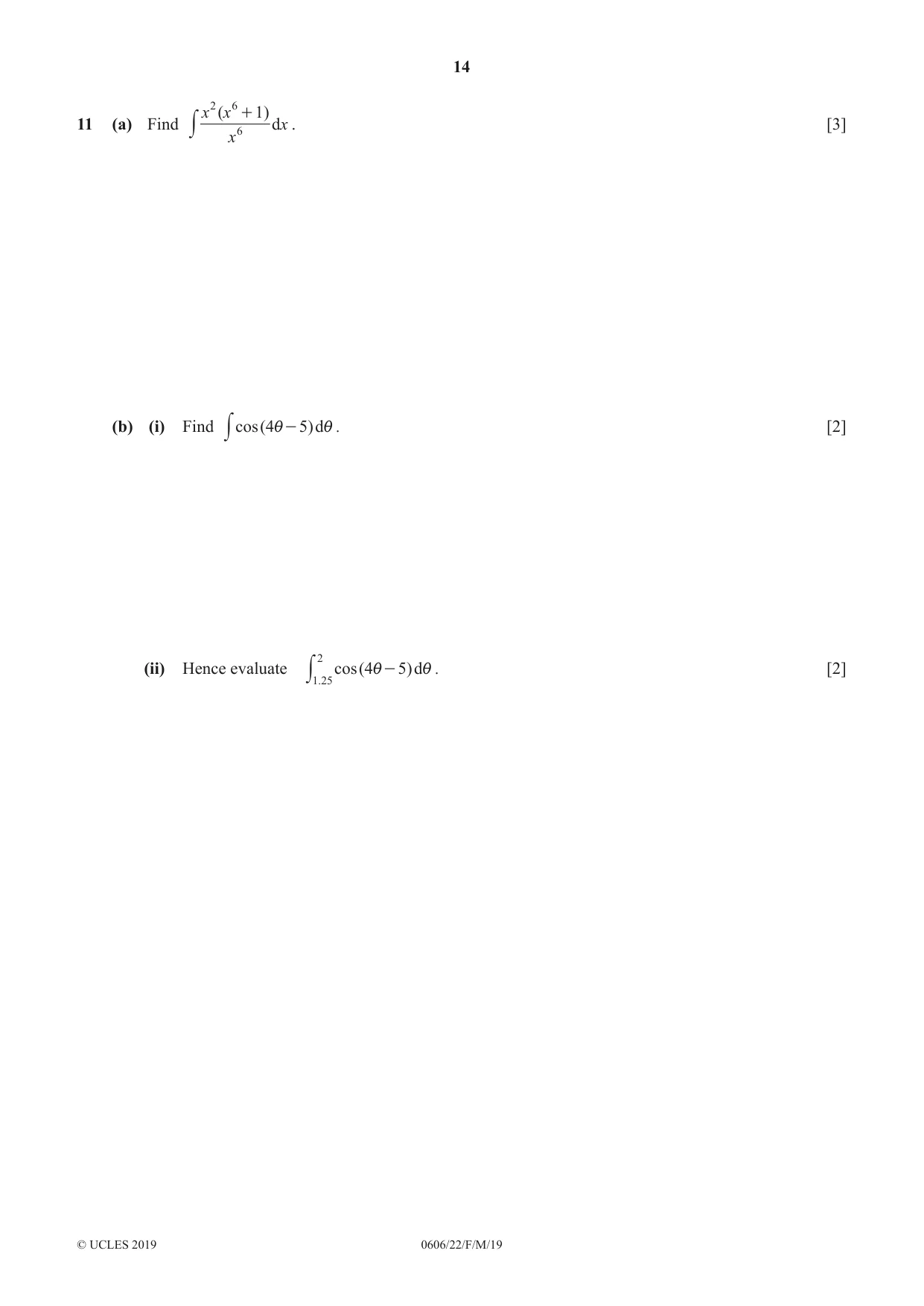

Mark scheme10 pages
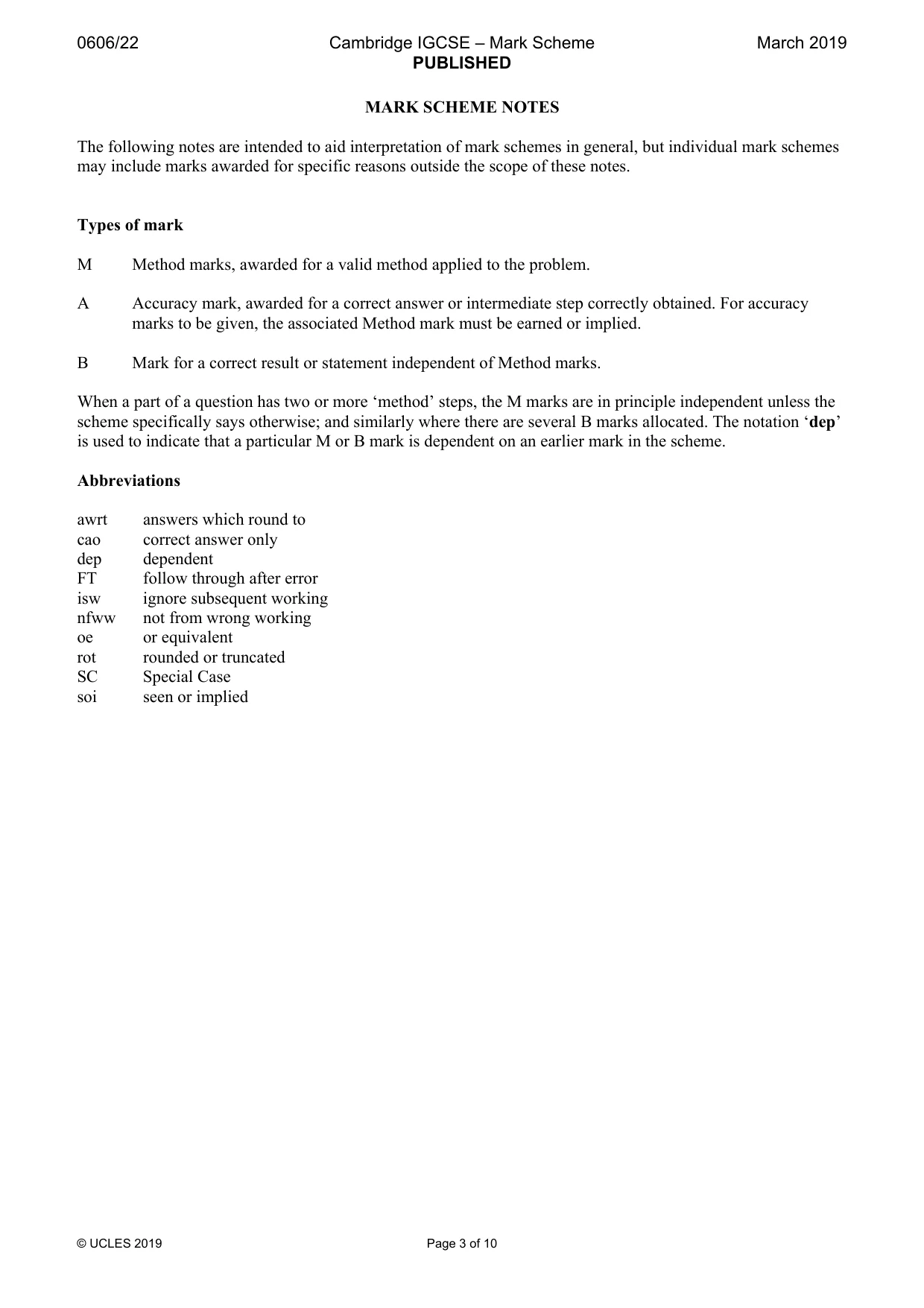
Answers below. Sit the paper first if you are practising.
Questions as text
Q1 · A band can play 25 different pieces of music
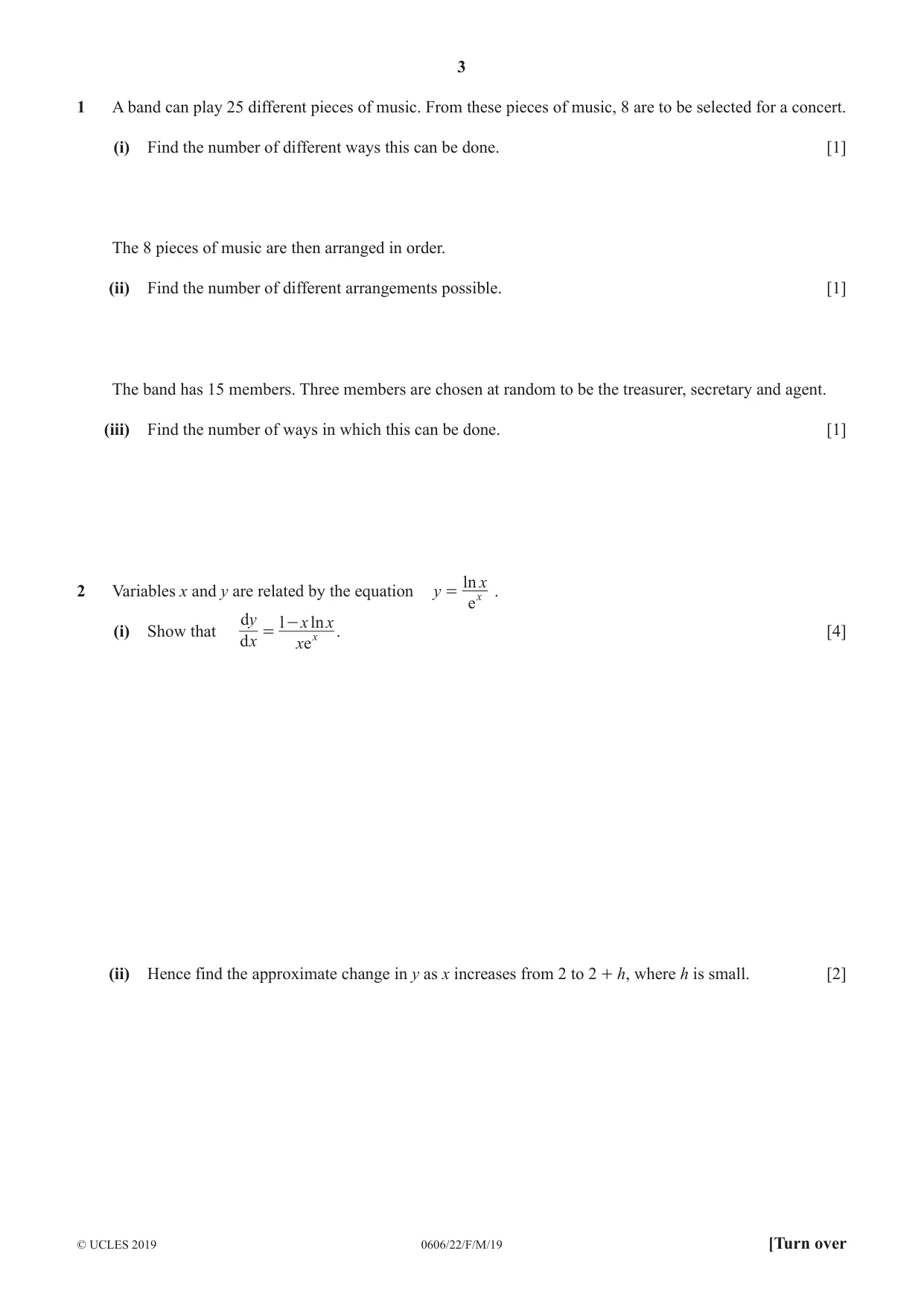
1 A band can play 25 different pieces of music. From these pieces of music, 8 are to be selected for a concert. (i) Find the number of different ways this can be done. [1] The 8 pieces of music are then arranged in order. (ii) Find the number of different arrangements possible. [1] The band has 15 members. Three members are chosen at random to be the treasurer, secretary and agent. (iii) Find the number of ways in which this can be done. [1]
Mark scheme: Question Answer Marks Partial Marks 1(i) 1 081 575 B1 1(ii) 40 320 B1 1(iii) 2730 B1
More questions on Solve problems on arrangement and selection
Q2 · Variables x and y are related by the equation y =
2 Variables x and y are related by the equation y = . ex d y l - x ln x (i) Show that = x . [4] d x xe (ii) Hence find the approximate change in y as x increases from 2 to 2 + h, where h is small. [2]
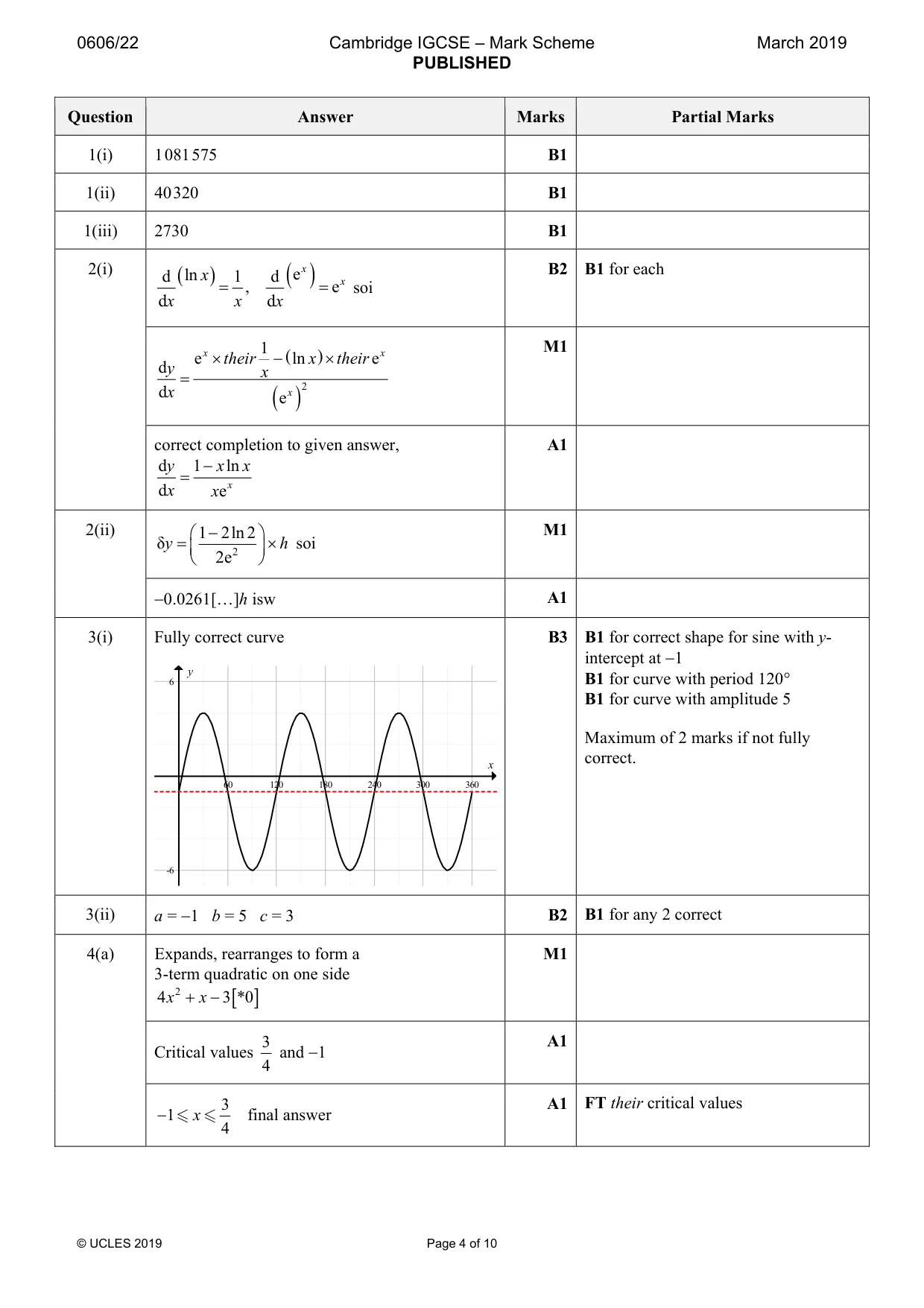
Mark scheme: 2(i) x B2 B1 for each e d ( ln x ) 1 d ( ) x = , = e soi dx x dx x 1 x M1 e × their − ( ln x ) × their e d y x = dx x 2 e ( ) correct completion to given answer, A1 d y 1 − x ln x = d x xe x 2(ii) 1 − 2ln 2 M1 δy = × h soi 2 2e −0.0261[…]h isw A1
Q3 · The function f is defined, for 0c G x G 360c, by f (x) = a + b sin cx , where a, b and c…
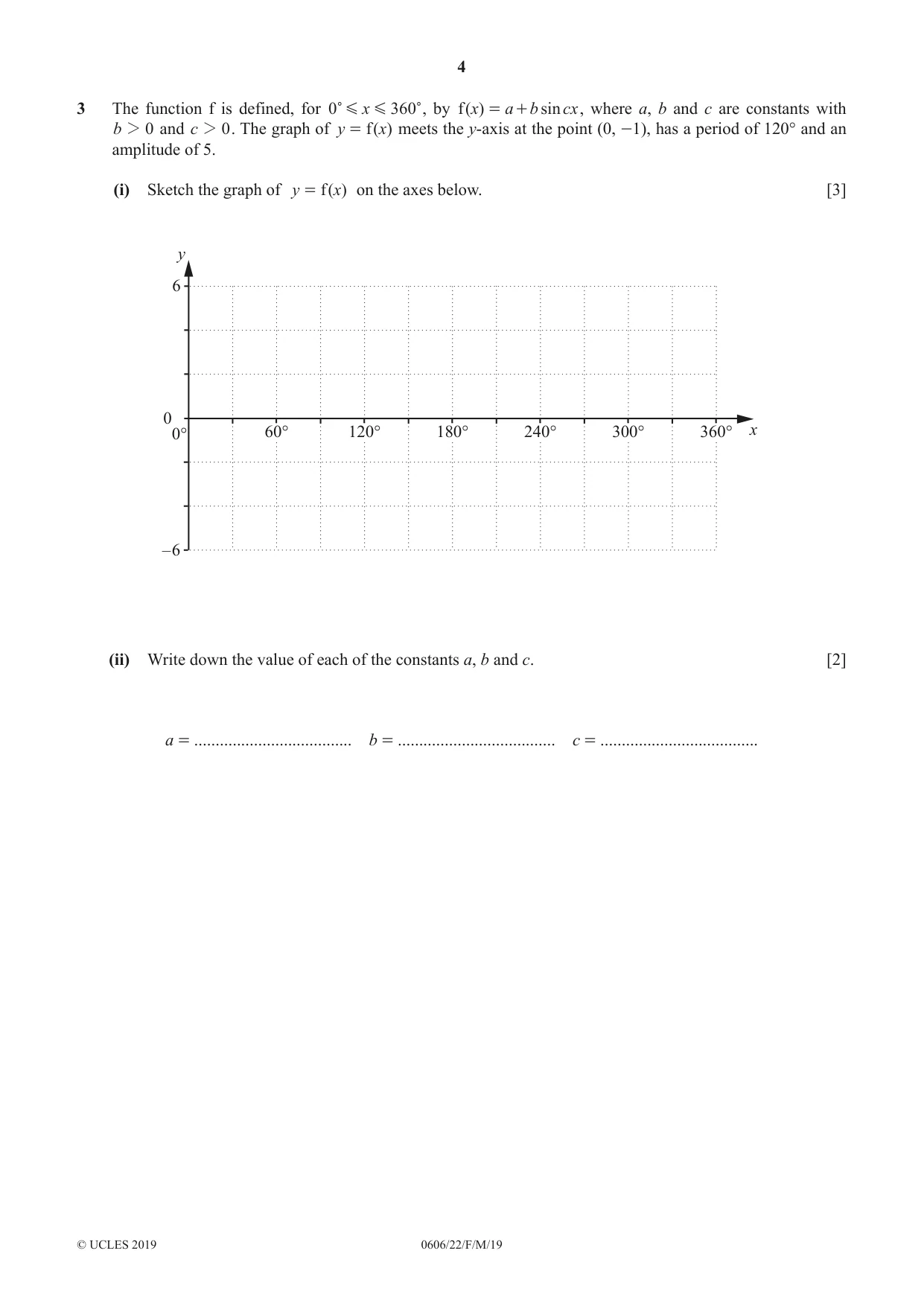
3 The function f is defined, for 0c G x G 360c, by f (x) = a + b sin cx , where a, b and c are constants with b 2 0 and c 2 0 . The graph of y = f ( x) meets the y-axis at the point (0, -1), has a period of 120° and an amplitude of 5. (i) Sketch the graph of y = f ( x) on the axes below. [3] y 6 0 0° 60° 120° 180° 240° 300° 360° x – 6 (ii) Write down the value of each of the constants a, b and c. [2] a = ..................................... b = ..................................... c = .....................................
Mark scheme: 3(i) Fully correct curve B3 B1 for correct shape for sine with y- intercept at −1 y 6 B1 for curve with period 120° B1 for curve with amplitude 5 Maximum of 2 marks if not fully x correct. 60 120 180 240 300 360 -6 3(ii) a = −1 b = 5 c = 3 B2 B1 for any 2 correct
Q4 · Find the values of x for which 2x + 1 G 3x + 4
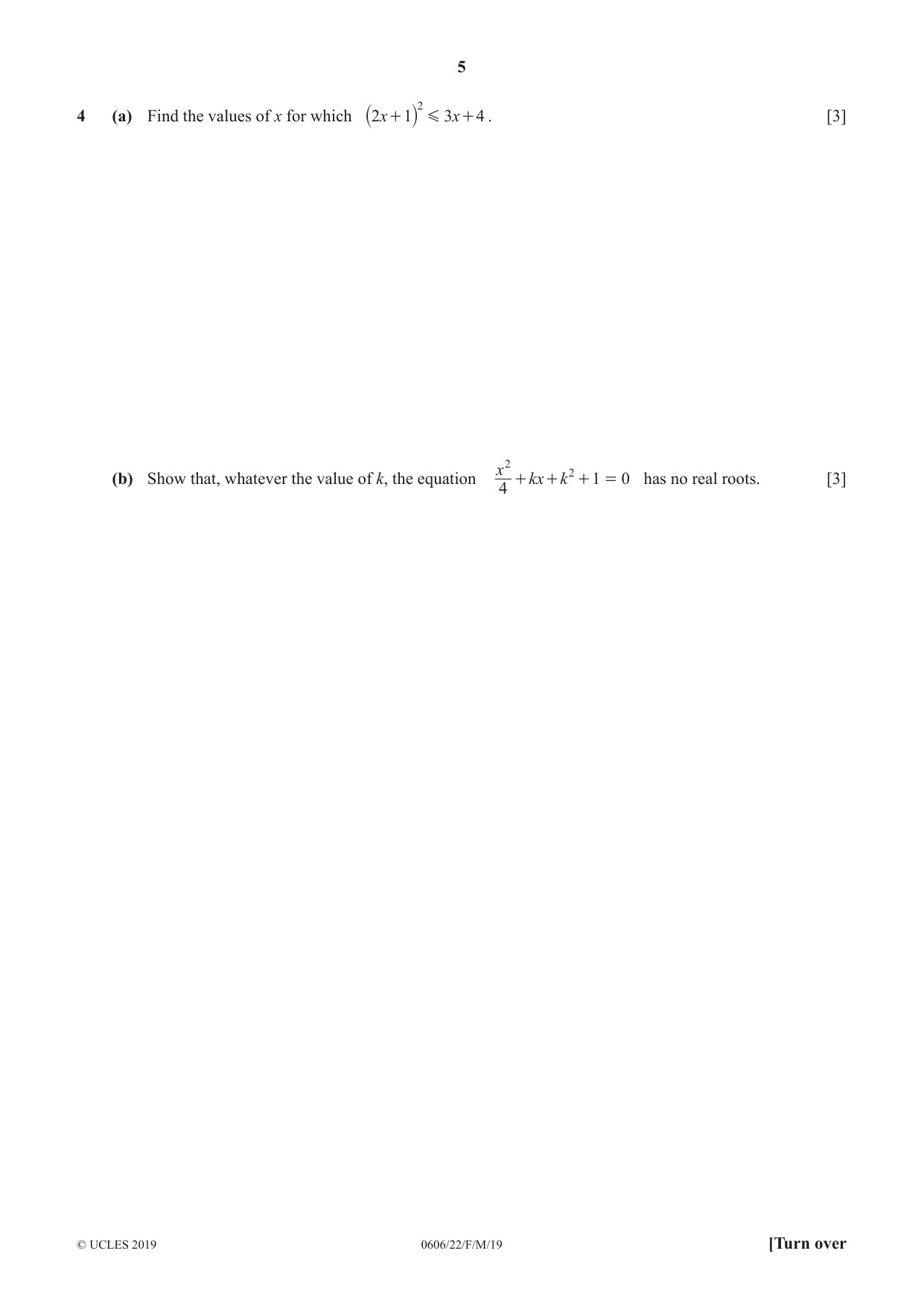
4 (a) Find the values of x for which 2x + 1 G 3x + 4 . [3] x 2 2 (b) Show that, whatever the value of k, the equation + kx + k + 1 = 0 has no real roots. [3] 4
Mark scheme: 4(a) Expands, rearranges to form a M1 3-term quadratic on one side 4 x 2 + x − 3 [*0 ] 3 A1 Critical values and −1 4 3 A1 FT their critical values − 1 - x - final answer 4 4(b) 2 1 2 M1 k − 4 k + 1 ( ) 4 −1 A1 discriminant independent of k and negative oe A1 FT their −1
More questions on Solve graphically or algebraically inequalities
Q5 · Solutions to this question by accurate drawing will not be accepted
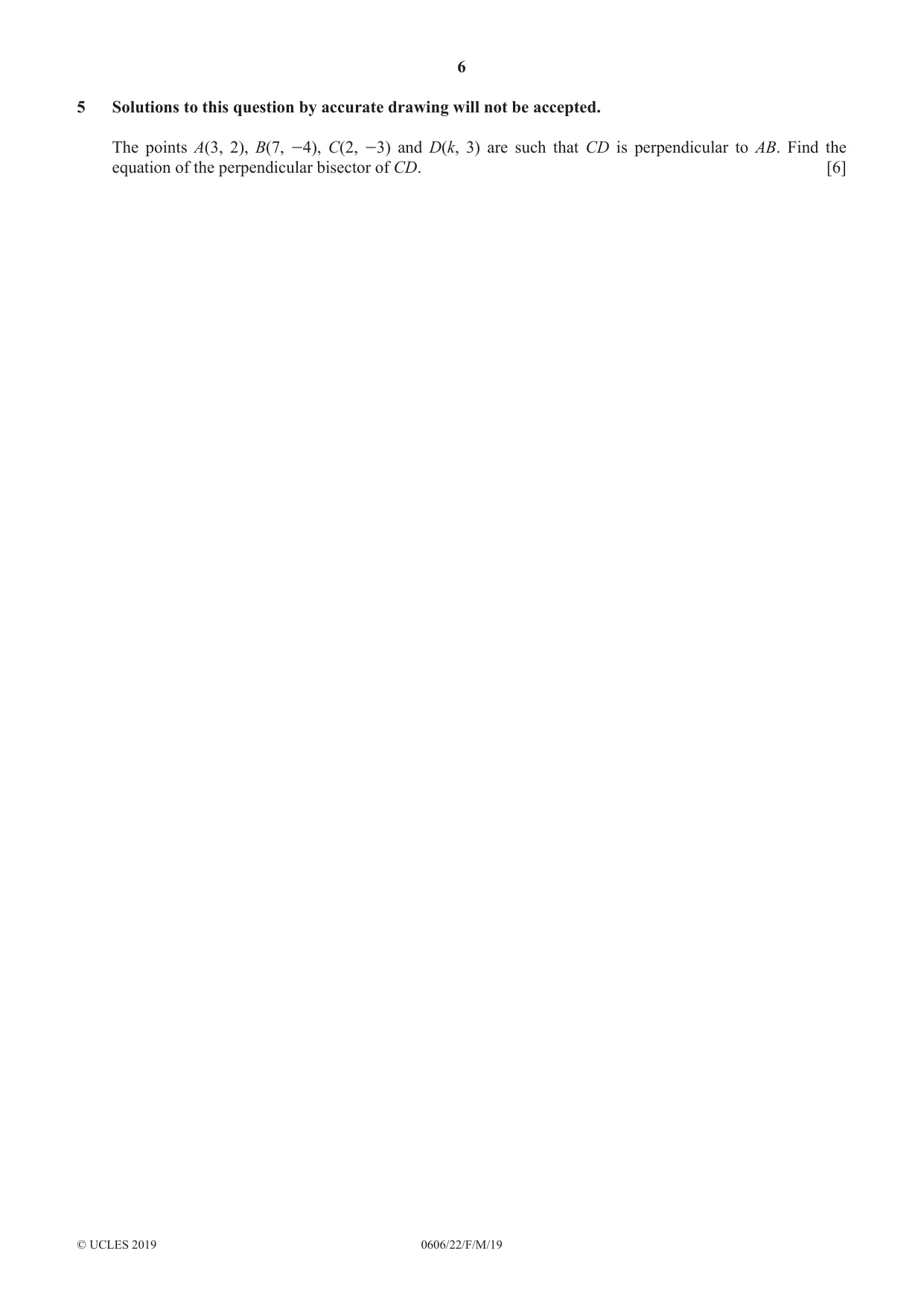
5 Solutions to this question by accurate drawing will not be accepted. The points A(3, 2), B(7, -4), C(2, -3) and D(k, 3) are such that CD is perpendicular to AB. Find the equation of the perpendicular bisector of CD. [6]
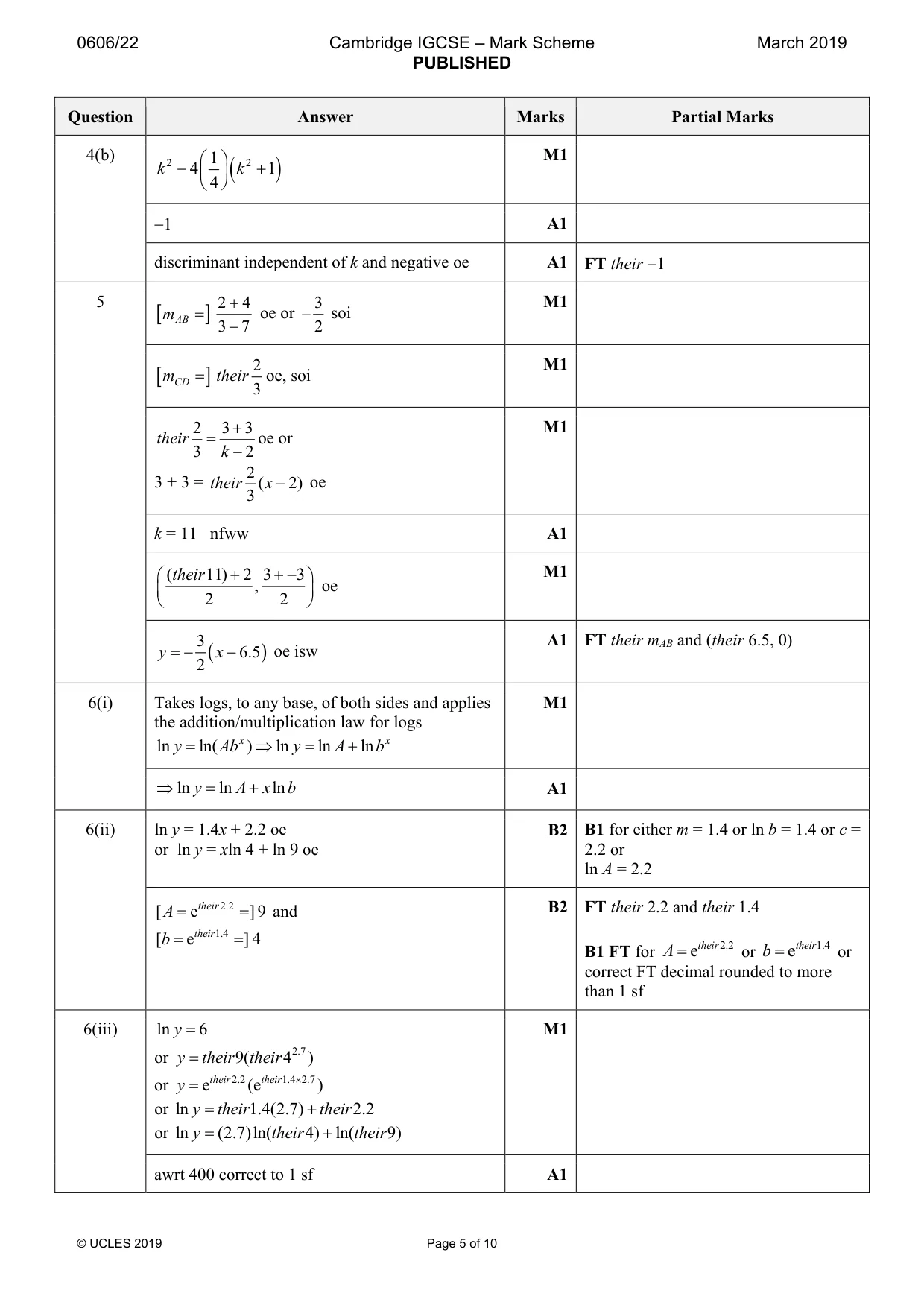
Mark scheme: 5 2 + 4 3 M1 [ m AB = ] oe or − soi 3 − 7 2 2 M1 [ mCD = ] their oe, soi 3 2 3 + 3 M1 their = oe or 3 k − 2 2 3 + 3 = their ( x − 2) oe 3 k = 11 nfww A1 (their 11) + 2 3 + −3 M1 , oe 2 2 3 A1 FT their mAB and (their 6.5, 0) y = − ( x − 6.5 ) oe isw 2
More questions on Know and use the condition for two lines to
Q6 · The relationship between experimental values of two variables, x and y, is given by y =…
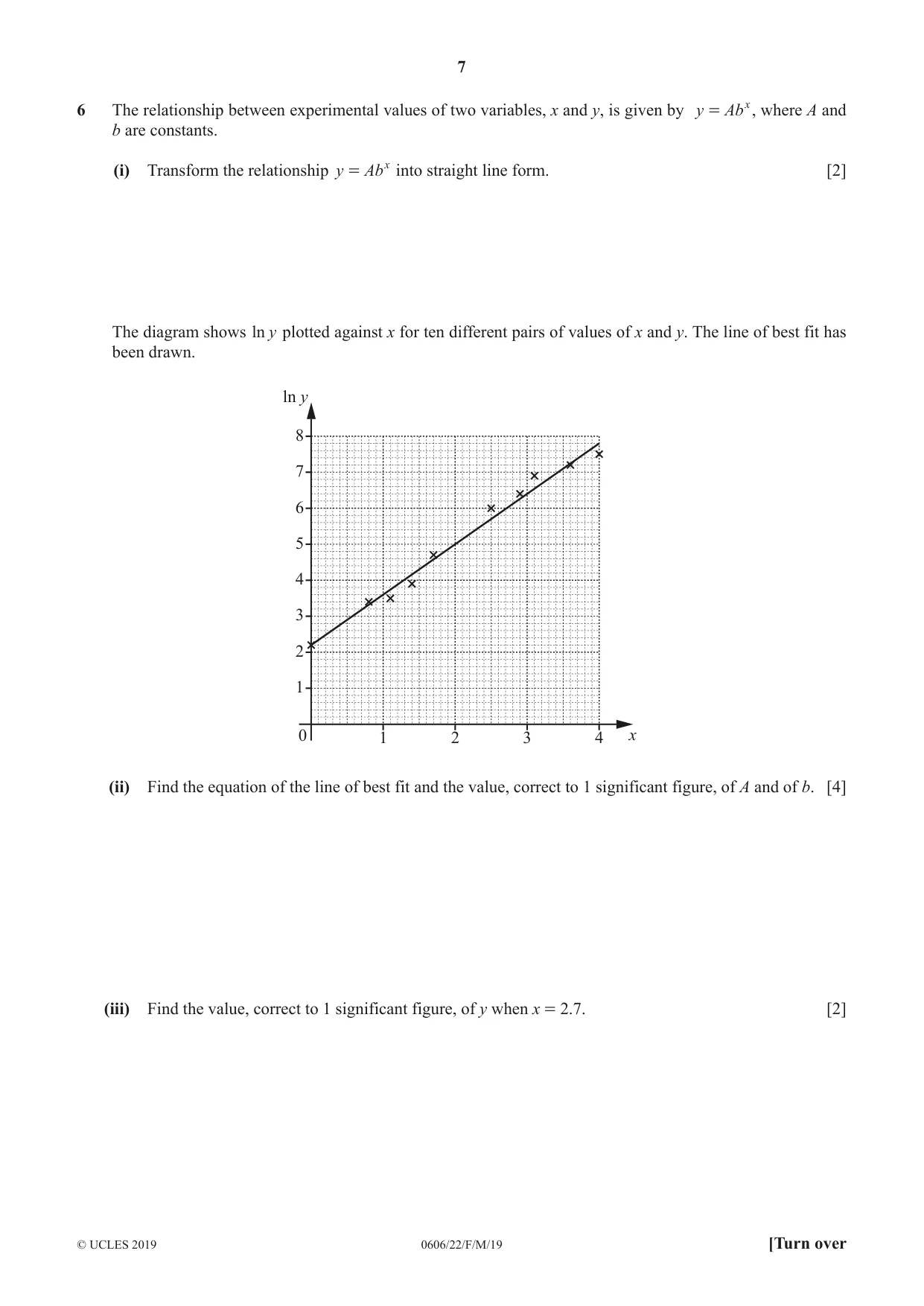
6 The relationship between experimental values of two variables, x and y, is given by y = Abx , where A and b are constants. (i) Transform the relationship y = Abx into straight line form. [2] The diagram shows ln y plotted against x for ten different pairs of values of x and y. The line of best fit has been drawn. ln y 8 7 6 5 4 3 2 1 0 1 2 3 4 x (ii) Find the equation of the line of best fit and the value, correct to 1 significant figure, of A and of b. [4] (iii) Find the value, correct to 1 significant figure, of y when x = 2.7. [2]
Mark scheme: 6(i) Takes logs, to any base, of both sides and applies M1 the addition/multiplication law for logs ln y = ln( Ab x ) ⇒ ln y = ln A + ln b x ⇒ ln y = ln A + x ln b A1 6(ii) ln y = 1.4x + 2.2 oe B2 B1 for either m = 1.4 or ln b = 1.4 or c = or ln y = xln 4 + ln 9 oe 2.2 or ln A = 2.2 [ A = e their 2.2 = ]9 and B2 FT their 2.2 and their 1.4 [b = e their 1.4 = ] 4 their 2.2 their 1.4 B1 FT for A = e or b = e or correct FT decimal rounded to more than 1 sf 6(iii) ln y = 6 M1 or y = their 9(their 4 2.7 ) or y = e their 2.2 (e their 1.4 × 2.7 ) or ln y = their1.4(2.7) + their 2.2 or ln y = (2.7)ln(their 4) + ln( their 9) awrt 400 correct to 1 sf A1
Q7 · Given that y = x x 2 + 1 , show that = p , where a, b and p are positive constants
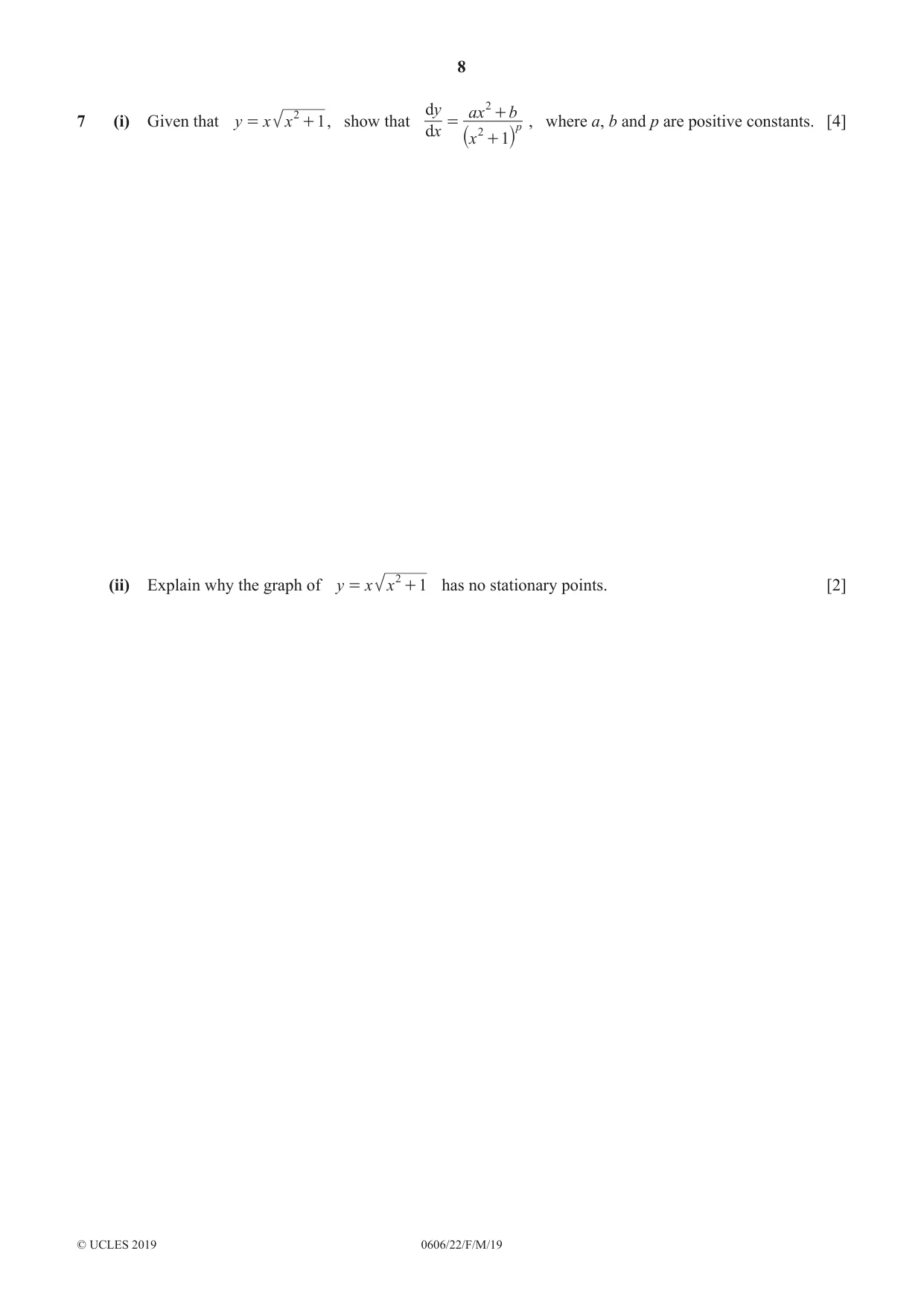
7 (i) Given that y = x x 2 + 1 , show that = p , where a, b and p are positive constants. [4] dx 2 x + 1 ` j (ii) Explain why the graph of y = x x 2 + 1 has no stationary points. [2]
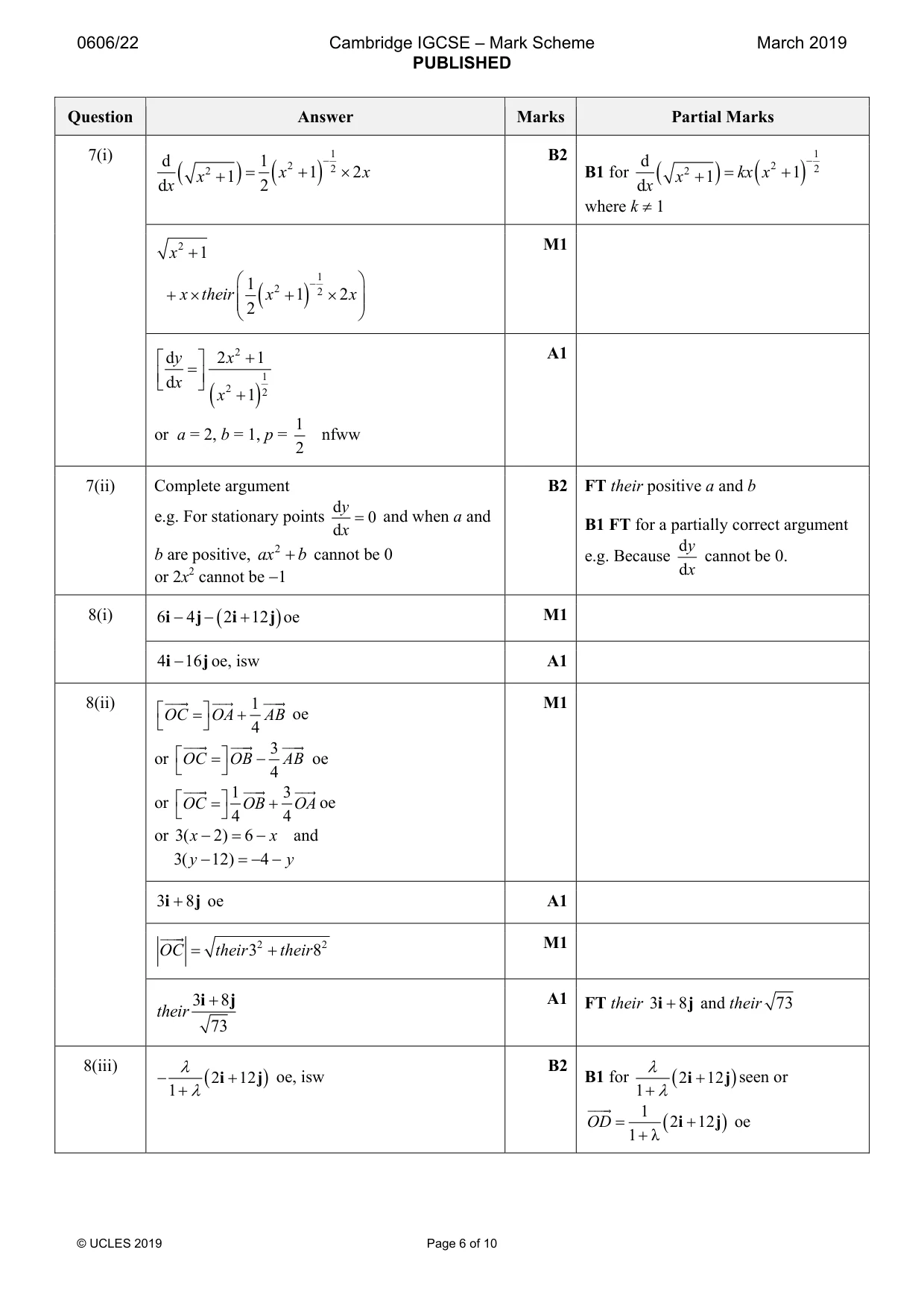
Mark scheme: 7(i) B2 2 = x 2 + 1 2 × 2 x = kx x 2 + 1 B1 for d ( x d ( x 2 + 1 ) 2 + 1 ) 1 ( ) − 1 ( ) − 1 dx 2 dx where k ≠ 1 2 M1 x + 1 − 1 2 1 2 x + 1 + x × their × 2 x ( ) 2 d y 2 x 2 + 1 A1 = 1 d x 2 2 x + 1 ( ) 1 or a = 2, b = 1, p = nfww 2 7(ii) Complete argument B2 FT their positive a and b d y e.g. For stationary points = 0 and when a and B1 FT for a partially correct argument d x 2 d y b are positive, ax + b cannot be 0 e.g. Because cannot be 0. d x or 2x2 cannot be −1
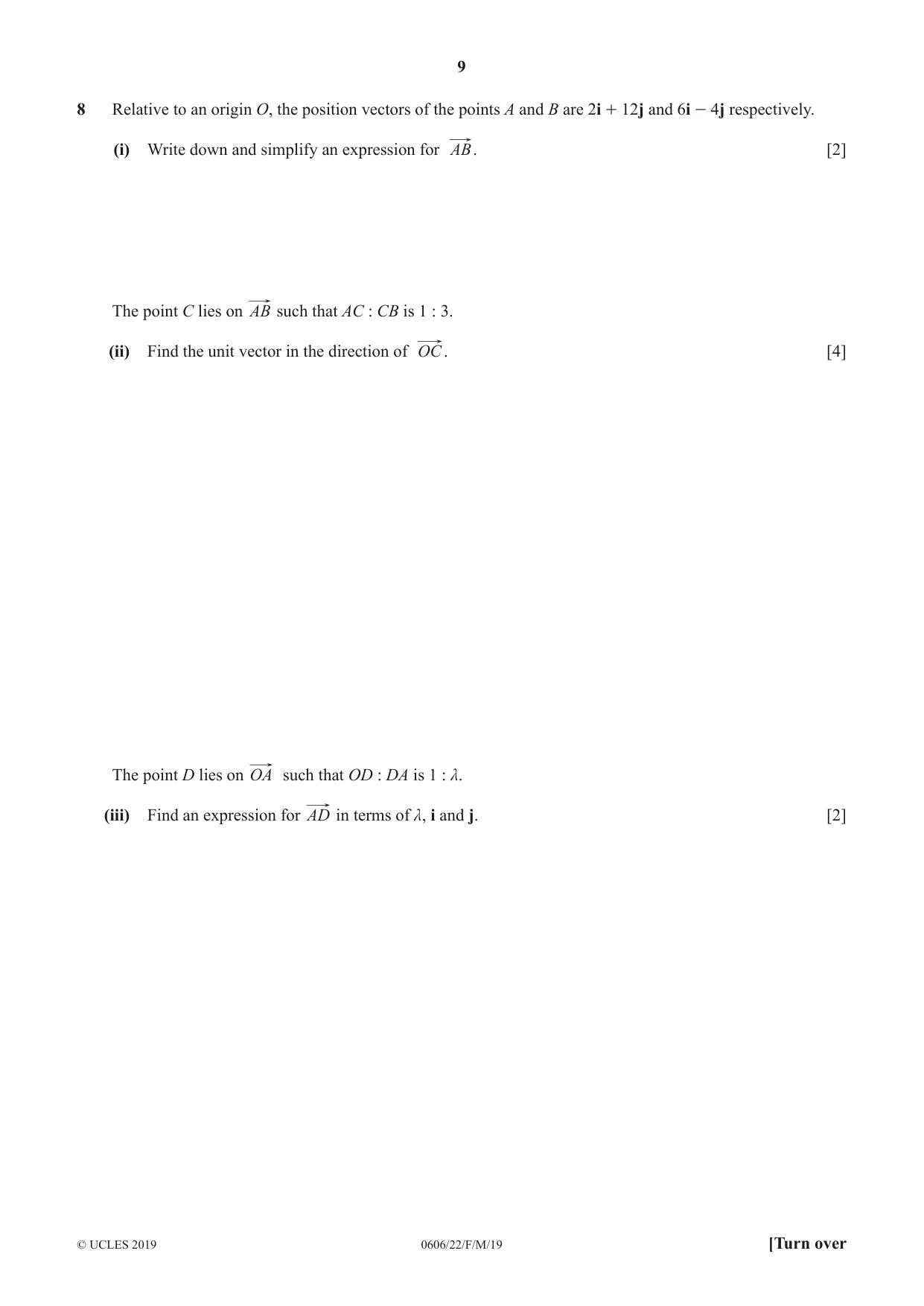
Q8 · Relative to an origin O, the position vectors of the points A and B are 2i + 12j and 6i…
8 Relative to an origin O, the position vectors of the points A and B are 2i + 12j and 6i - 4j respectively. (i) Write down and simplify an expression for AB. [2] The point C lies on AB such that AC : CB is 1 : 3. (ii) Find the unit vector in the direction of OC. [4] The point D lies on OA such that OD : DA is 1 : m. (iii) Find an expression for AD in terms of m, i and j. [2]
Mark scheme: 8(i) 6 i − 4 j − ( 2 i + 12 j ) oe M1 4i − 16 j oe, isw A1 8(ii) JJJG JJG 1 JJJG M1 OC = OA + AB oe 4 JJJG JJJG JJJG 3 or OC = OB − AB oe 4 JJJG JJJG JJG 1 3 or OC = OB + OA oe 4 4 or 3( x − 2) = 6 − x and 3( y − 12) = −−4 y 3i + 8 j oe A1 JJJG 2 2 M1 OC = their 3 + their 8 3i + 8 j A1 FT their 3i + 8 j and their 73 their 73 8(iii) λ B2 λ − ( 2 i + 12 j ) oe, isw B1 for ( 2 i + 12 j ) seen or 1 + λ 1 + λ JJJG 1 OD = ( 2 i + 12 j ) oe 1 + λ
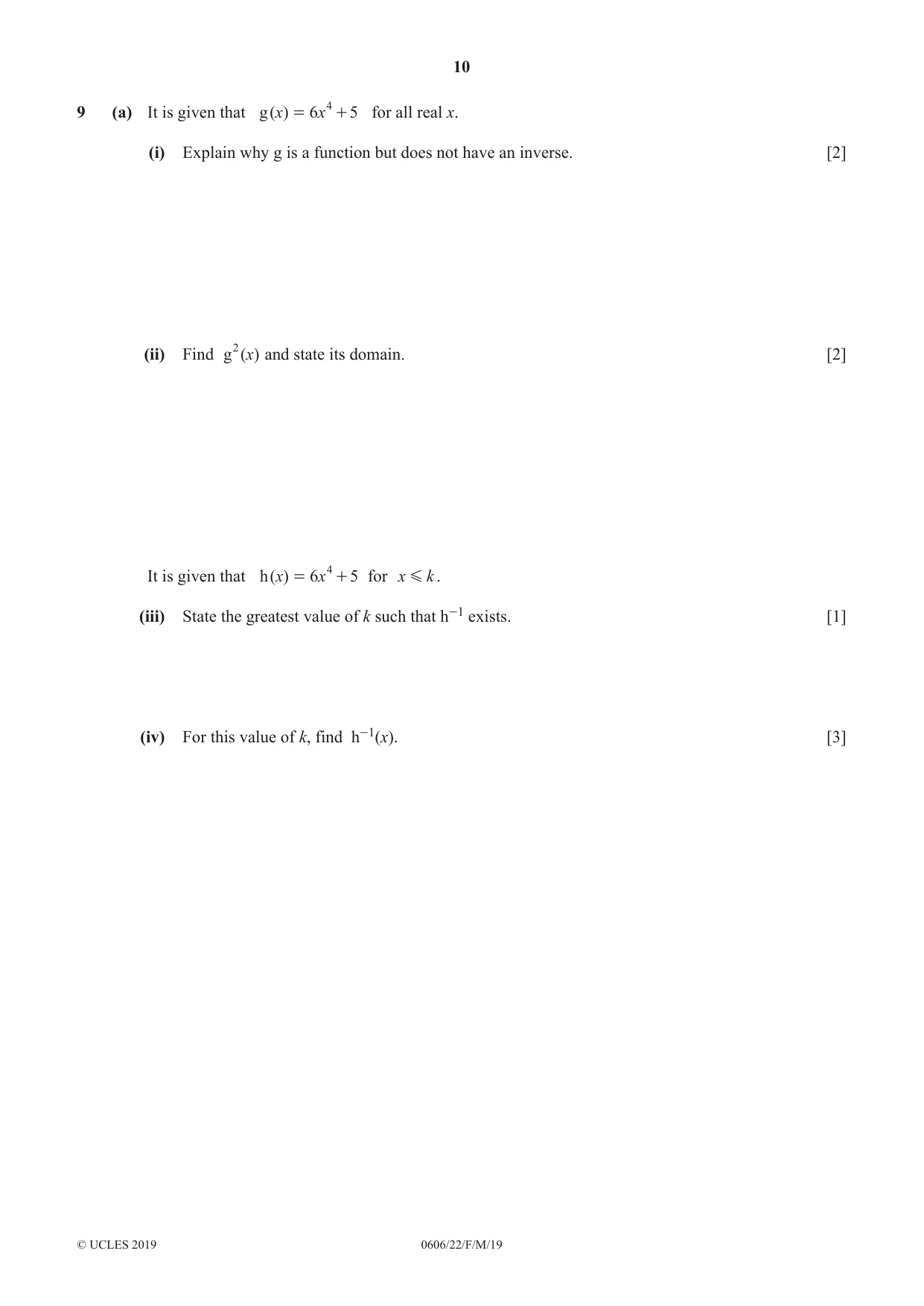
Q9 · It is given that g ()x = 6x 4 + 5 for all real x
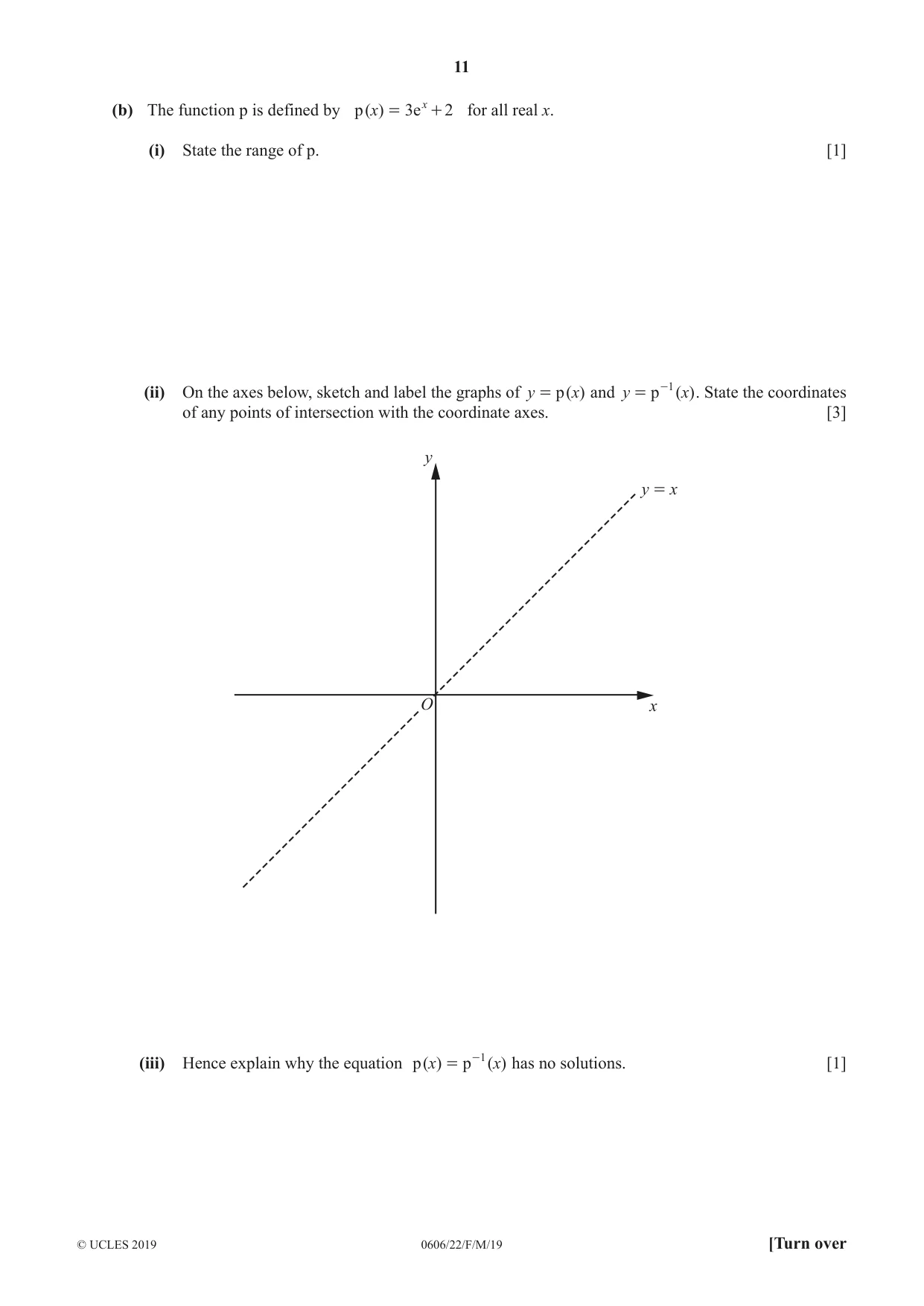
9 (a) It is given that g ()x = 6x 4 + 5 for all real x. (i) Explain why g is a function but does not have an inverse. [2] (ii) Find g2 ()x and state its domain. [2] It is given that h ()x = 6x 4 + 5 for x G k . (iii) State the greatest value of k such that h-1 exists. [1] (iv) For this value of k, find h-1(x). [3] (b) The function p is defined by p ()x = 3ex + 2 for all real x. (i) State the range of p. [1] (ii) On the axes below, sketch and label the graphs of y = p (x) and y = p -1 (x) . State the coordinates of any points of intersection with the coordinate axes. [3] y y = x O x (iii) Hence explain why the equation p (x) = p -1 (x) has no solutions. [1]
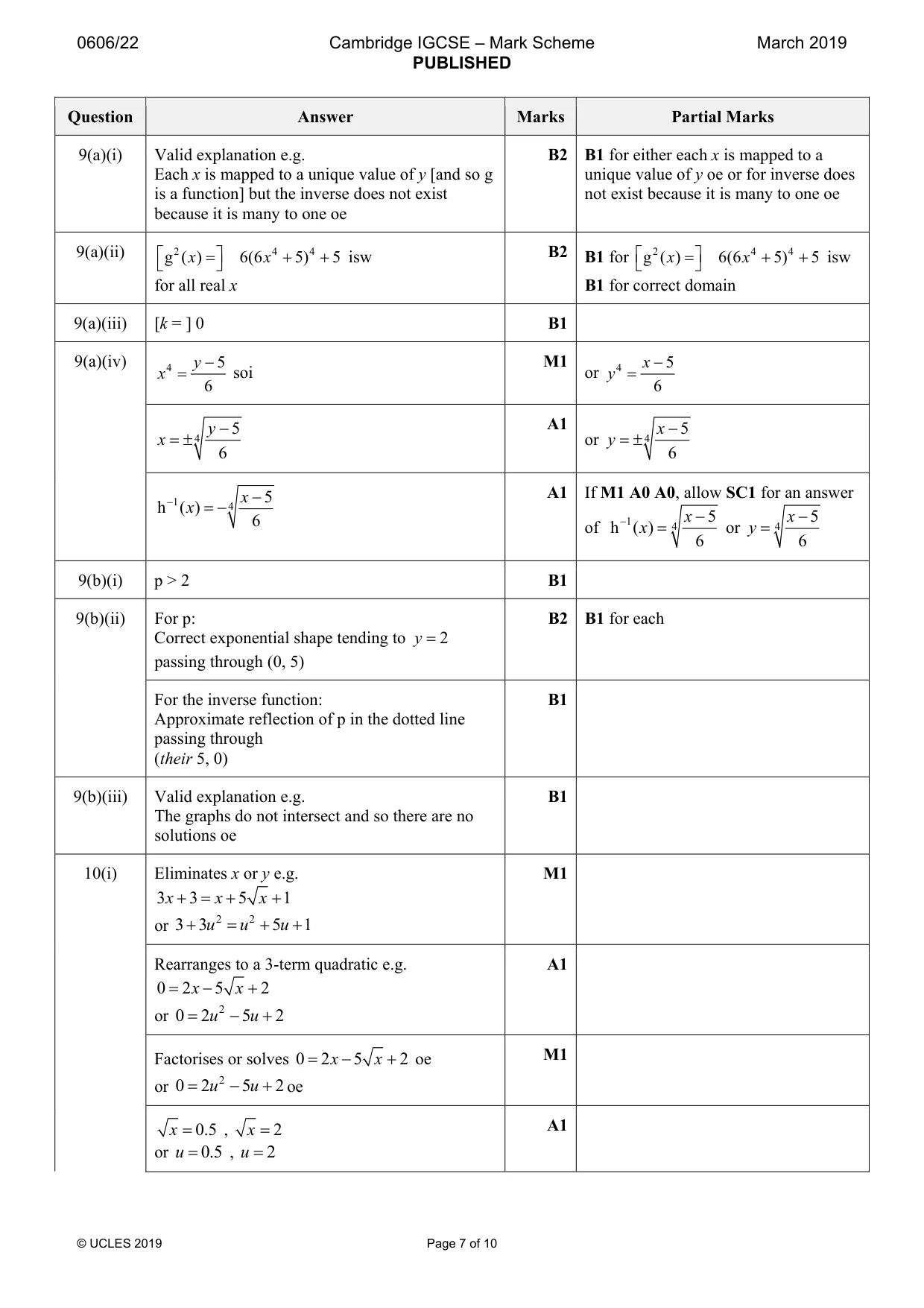
Mark scheme: 9(a)(i) Valid explanation e.g. B2 B1 for either each x is mapped to a Each x is mapped to a unique value of y [and so g unique value of y oe or for inverse does is a function] but the inverse does not exist not exist because it is many to one oe because it is many to one oe 9(a)(ii) g 2 ( x ) = 6(6 x 4 + 5) 4 + 5 isw B2 B1 for g 2 ( x ) = 6(6 x 4 + 5) 4 + 5 isw for all real x B1 for correct domain 9(a)(iii) [k = ] 0 B1 9(a)(iv) 4 y − 5 M1 4 x − 5 x = soi or y = 6 6 y − 5 A1 x − 5 x = ± 4 or y = ± 4 6 6 −1 x − 5 A1 If M1 A0 A0, allow SC1 for an answer h ( x ) = − 4 x − 5 x − 5 6 of h −1 ( x ) = 4 or y = 4 6 6 9(b)(i) p > 2 B1 9(b)(ii) For p: B2 B1 for each Correct exponential shape tending to y = 2 passing through (0, 5) For the inverse function: B1 Approximate reflection of p in the dotted line passing through (their 5, 0) 9(b)(iii) Valid explanation e.g. B1 The graphs do not intersect and so there are no solutions oe
Q10 · Y B y = 1 + x + 5 x y - 3x = 3 A O D C x The diagram shows the curve y = 1 + x + 5 x and…
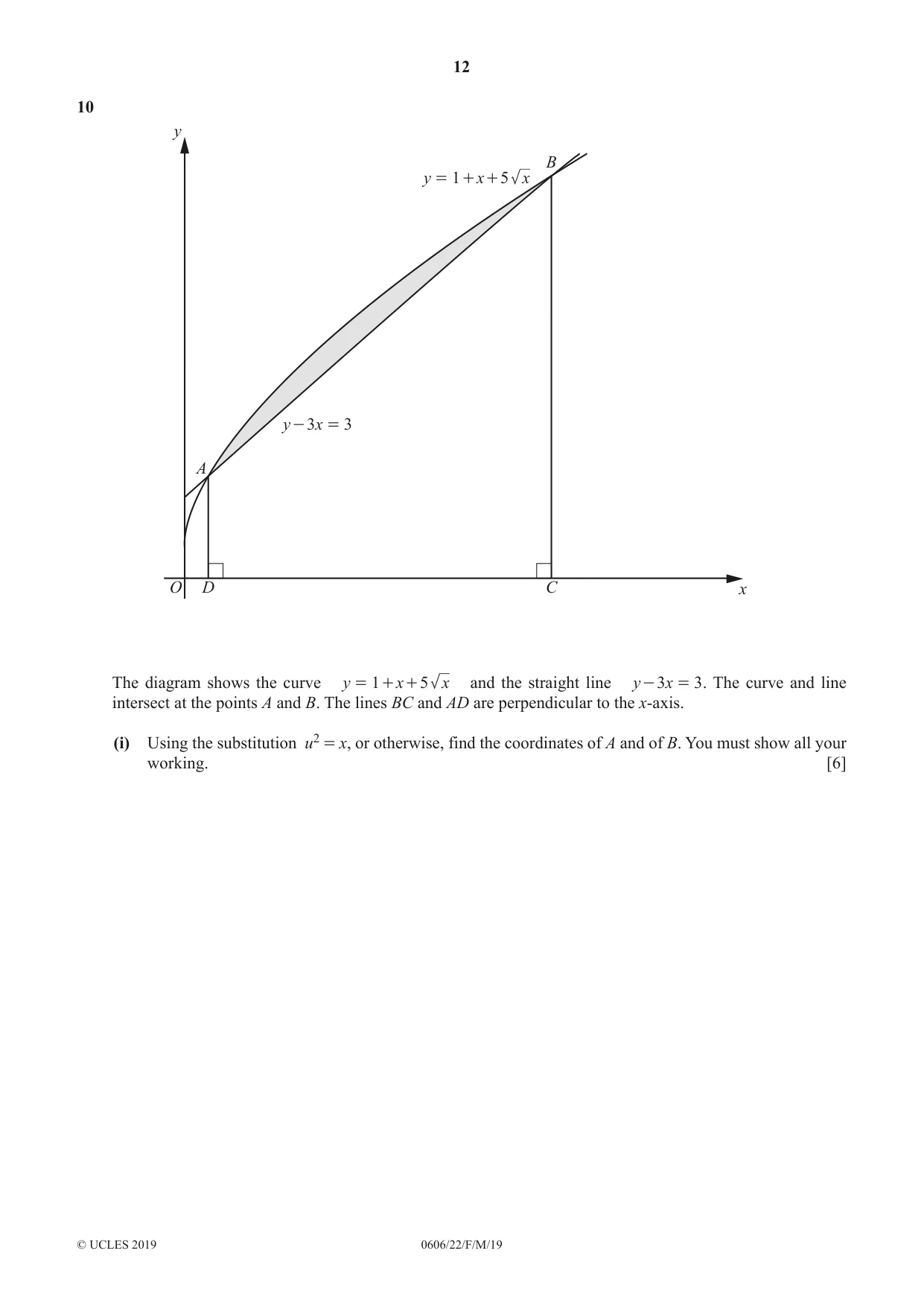
10 y B y = 1 + x + 5 x y - 3x = 3 A O D C x The diagram shows the curve y = 1 + x + 5 x and the straight line y - 3x = 3 . The curve and line intersect at the points A and B. The lines BC and AD are perpendicular to the x-axis. (i) Using the substitution u2 = x, or otherwise, find the coordinates of A and of B. You must show all your working. [6]
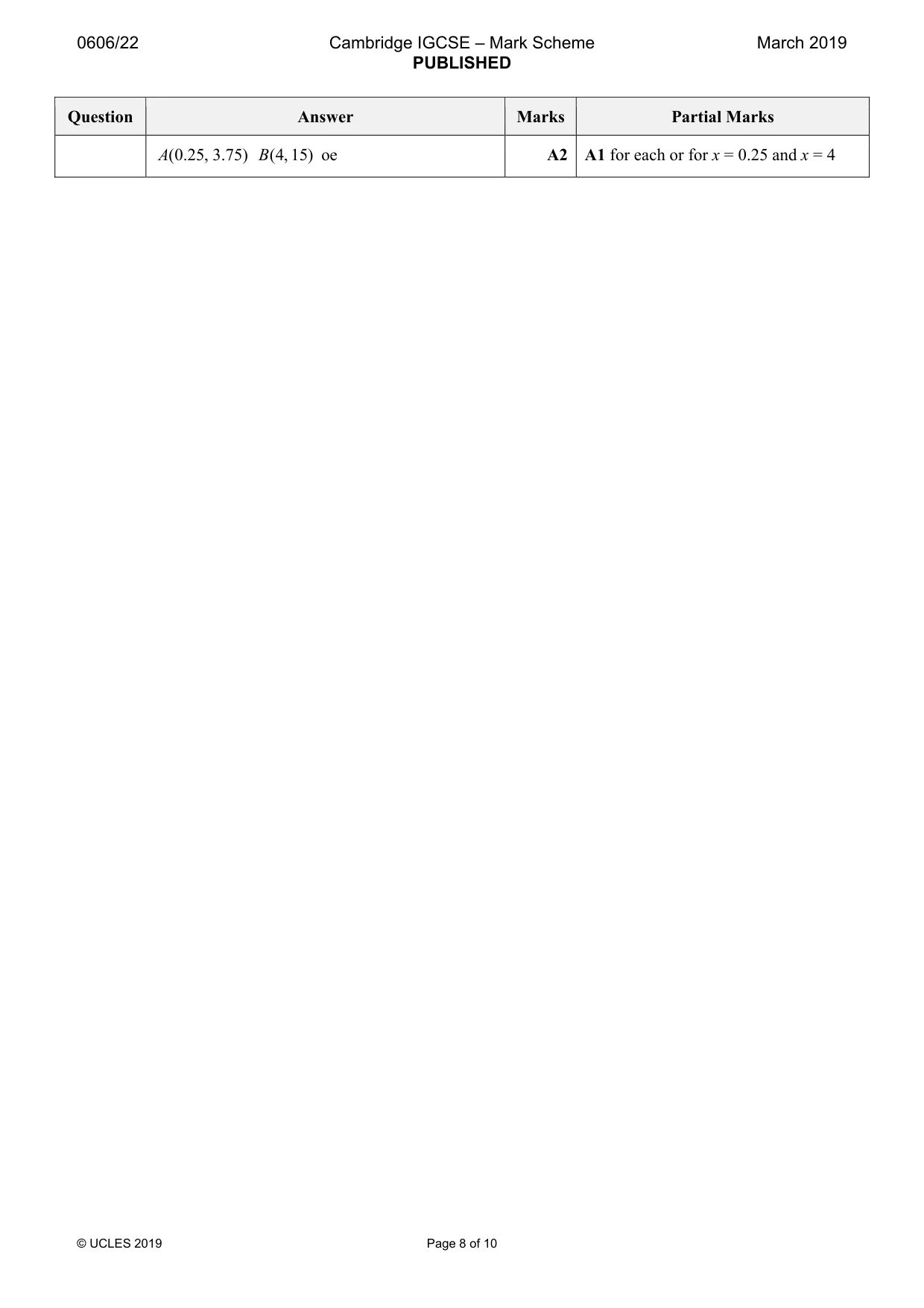
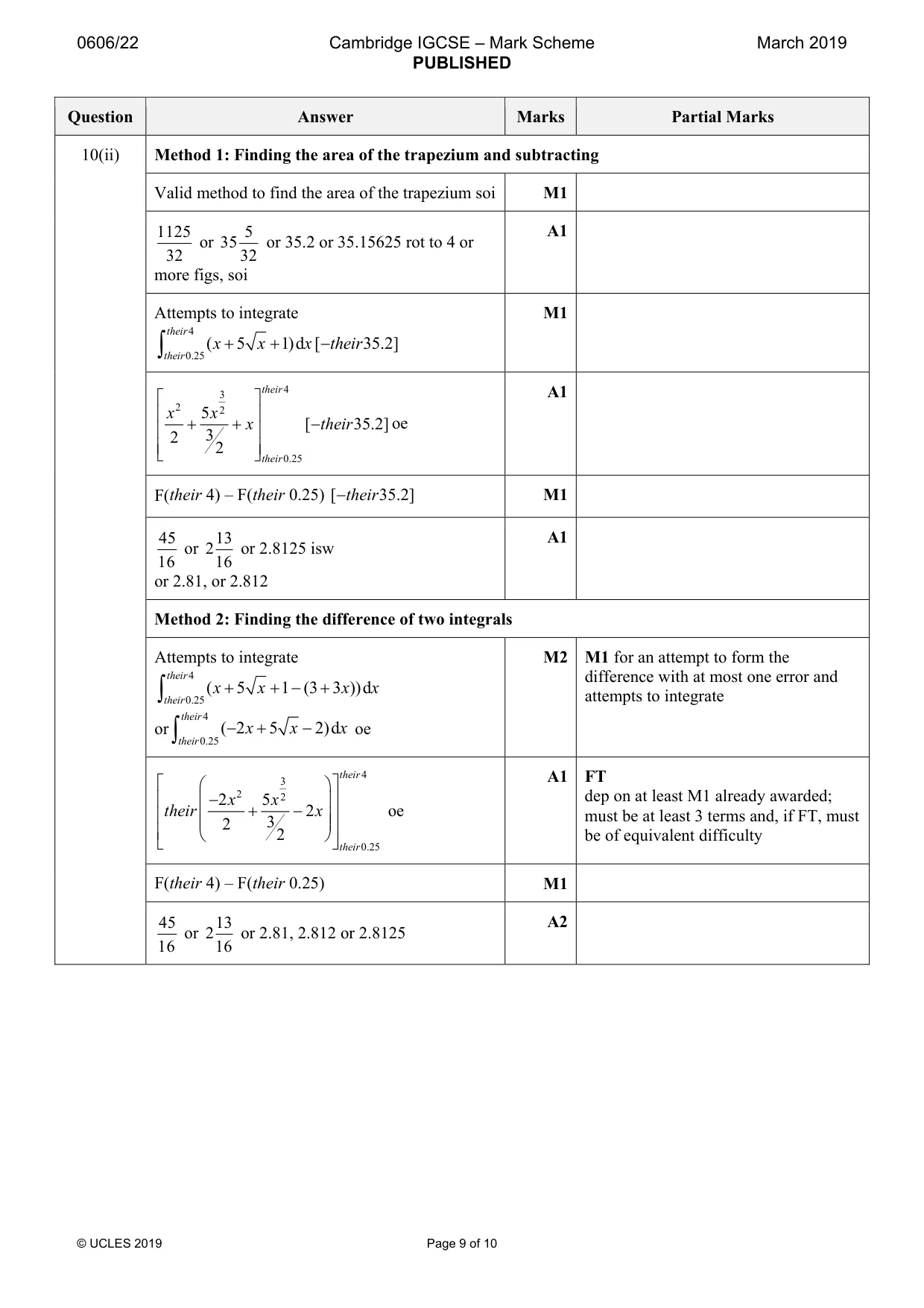
Mark scheme: 10(i) Eliminates x or y e.g. M1 3 x + 3 = x + 5 x + 1 or 3 + 3u 2 = u 2 + 5u + 1 Rearranges to a 3-term quadratic e.g. A1 0 = 2 x − 5 x + 2 or 0 = 2u 2 − 5u + 2 Factorises or solves 0 = 2 x − 5 x + 2 oe M1 or 0 = 2u 2 − 5u + 2 oe x = 0.5 , x = 2 A1 or u = 0.5 , u = 2 A(0.25, 3.75) B (4, 15) oe A2 A1 for each or for x = 0.25 and x = 4 10(ii) Method 1: Finding the area of the trapezium and subtracting Valid method to find the area of the trapezium soi M1 1125 5 A1 or 35 or 35.2 or 35.15625 rot to 4 or 32 32 more figs, soi Attempts to integrate M1 their 4 ∫their 0.25( x + 5 x + 1)dx [ −their 35.2] their 4 3 A1 x 2 5 x 2 + + x [ − their 35.2] oe 2 3 2 their 0.25 F(their 4) – F(their 0.25) [ −their 35.2] M1 45 13 A1 or or 2.8125 isw 16 216 or 2.81, or 2.812 Method 2: Finding the difference of two integrals Attempts to integrate M2 M1 for an attempt to form the their 4 difference with at most one error and ∫their 0.25( x + 5 x + 1 − (3 + 3 x ))dx attempts to integrate their 4 or ∫their 0.25( −2 x + 5 x − 2)dx oe their 4 A1 FT 3 −2 x 2 5 x 2 dep on at least M1 already awarded; their + − 2 x oe must be at least 3 terms and, if FT, must 2 3 2 be of equivalent difficulty their 0.25 F(their 4) – F(their 0.25) M1 45 13 A2 or or 2.81, 2.812 or 2.8125 16 216
More questions on Use substitution to form and solve a quadratic
Q11 · Find y 6 dx
11 (a) Find y 6 dx . [3] x i - 5 ) d i . [2] (b) (i) Find y cos (4 2 i - 5 ) d i . [2] (ii) Hence evaluate y cos (4 .125
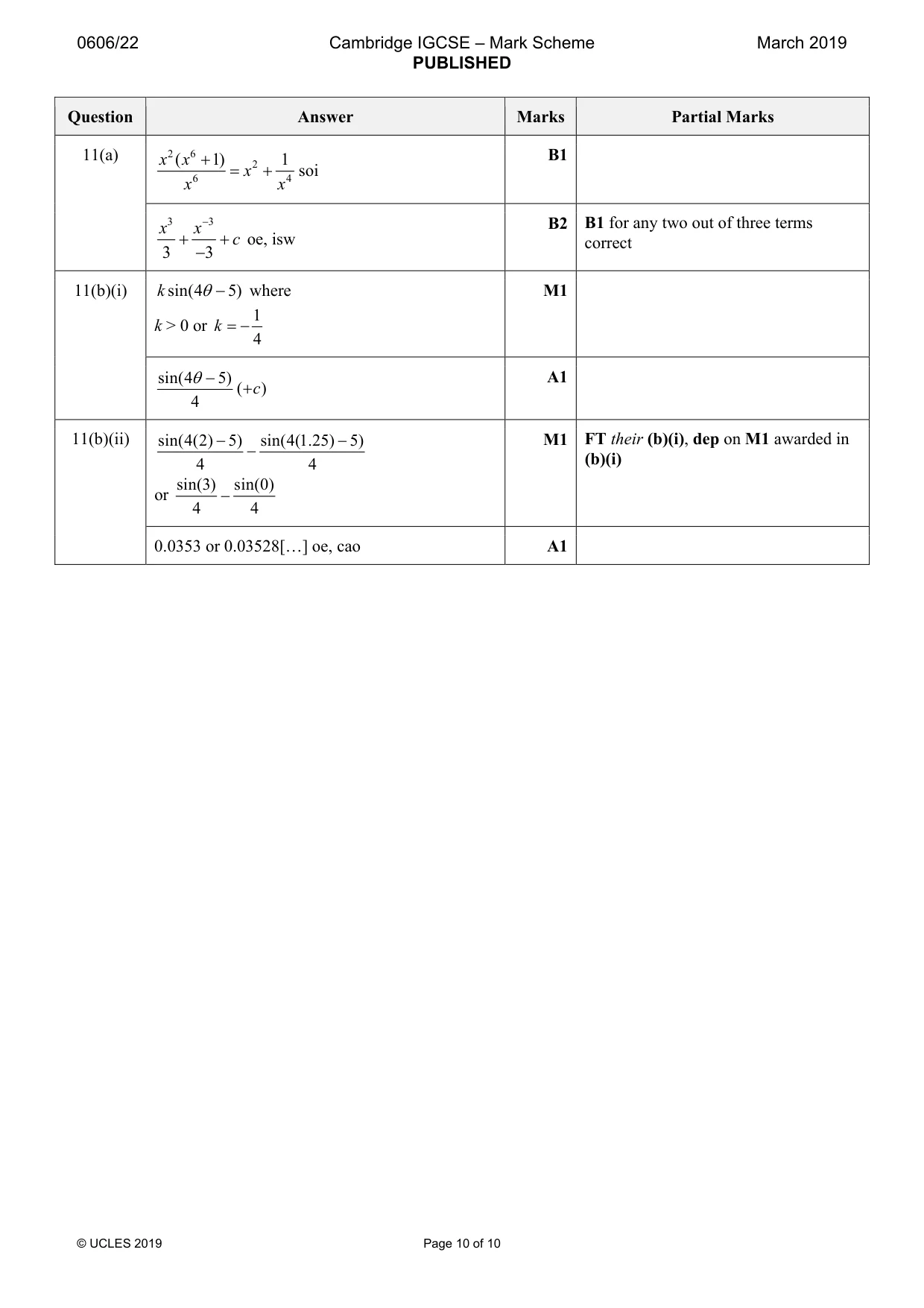
Mark scheme: 11(a) x 2 ( x 6 + 1) 2 1 B1 = x + soi x 6 x 4 x 3 x −3 B2 B1 for any two out of three terms + + c oe, isw correct 3 −3 11(b)(i) k sin(4θ− 5) where M1 1 k > 0 or k = − 4 sin(4θ− 5) A1 ( +c ) 4 11(b)(ii) sin(4(2) − 5) sin(4(1.25) − 5) M1 FT their (b)(i), dep on M1 awarded in − (b)(i) 4 4 sin(3) sin(0) or − 4 4 0.0353 or 0.03528[…] oe, cao A1
What was in this paper
The subtopics covered by these 11 questions, and how many questions each got. Open one in a new tab to see every Cambridge question on it.
2Draw and use the graphs of1Find the inverse of a one–one function1Find the magnitude of a vector; add and1Integrate functions of the form1Know and use the condition for two lines to1Solve graphically or algebraically inequalities1Solve problems on arrangement and selection1Use substitution to form and solve a quadratic1Use the equation of a straight line1What you needed in this session
Cambridge’s own grade thresholds for 2019 Feb/March, Paper 2 · Variant 2. A higher threshold means an easier paper — the bar moves with how the cohort did.