Cambridge IGCSE Mathematics - Additional 0606 — 2014 May/June Paper 2 · Variant 2
0606/22/M/J/14 · 80 marks · ≈90 min
The question paper and its mark scheme, free to read here and free to download. This is Cambridge’s own paper, exactly as it was sat.
Question paper16 pages

Mark scheme9 pages
Answers below. Sit the paper first if you are practising.
Paper as text
Question paper, page 1
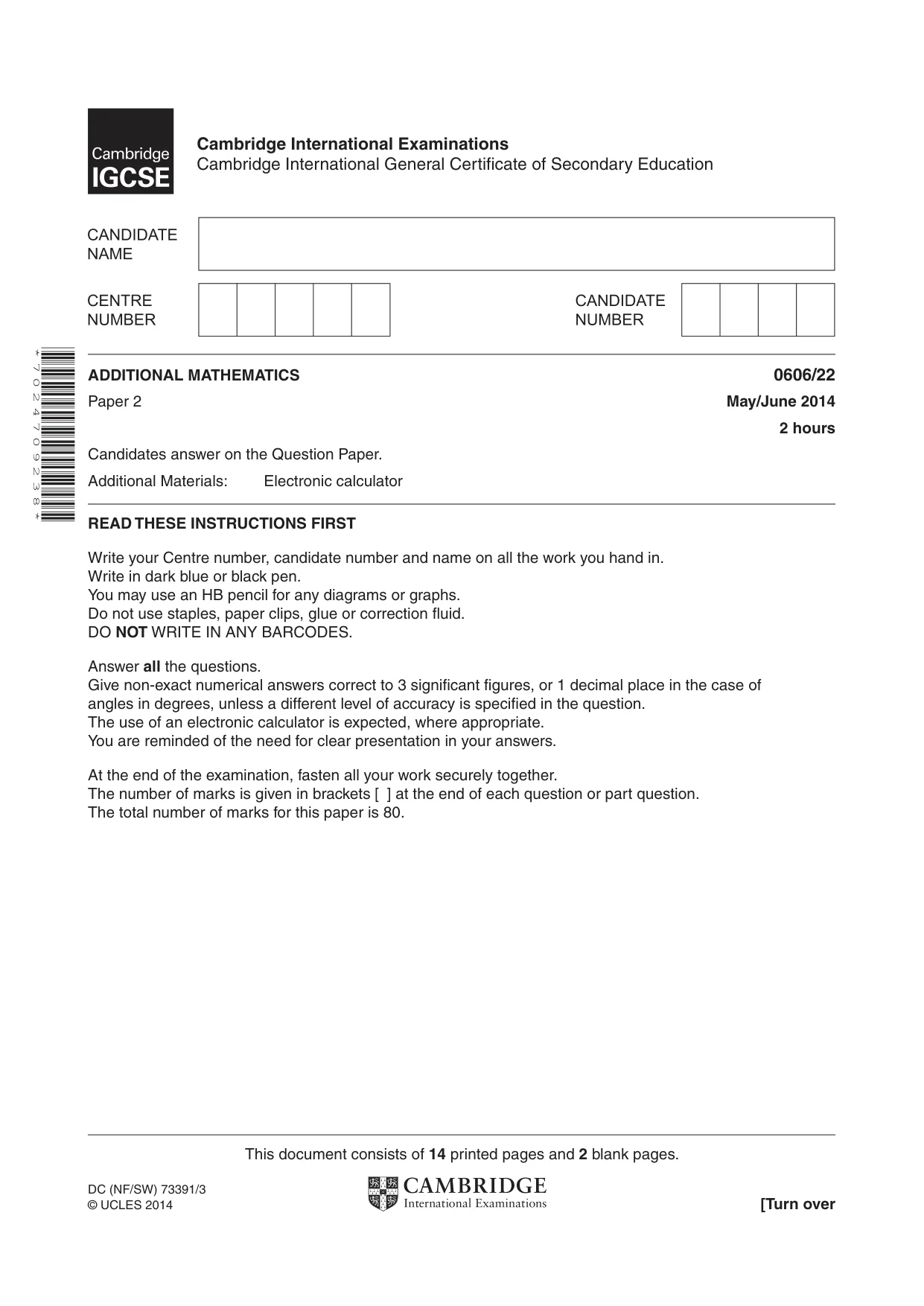
ADDITIONAL MATHEMATICS 0606/22 Paper 2 May/June 2014 2 hours Candidates answer on the Question Paper. Additional Materials: Electronic calculator READ THESE INSTRUCTIONS FIRST Write your Centre number, candidate number and name on all the work you hand in. Write in dark blue or black pen. You may use an HB pencil for any diagrams or graphs. Do not use staples, paper clips, glue or correction fluid. DO NOT WRITE IN ANY BARCODES. Answer all the questions. Give non-exact numerical answers correct to 3 significant figures, or 1 decimal place in the case of angles in degrees, unless a different level of accuracy is specified in the question. The use of an electronic calculator is expected, where appropriate. You are reminded of the need for clear presentation in your answers. At the end of the examination, fasten all your work securely together. The number of marks is given in brackets [ ] at the end of each question or part question. The total number of marks for this paper is 80. This document consists of 14 printed pages and 2 blank pages. DC (NF/SW) 73391/3 © UCLES 2014 [Turn over Cambridge International Examinations Cambridge International General Certificate of Secondary Education * 7 0 2 4 7 0 9 2 3 8 *
Question paper, page 2
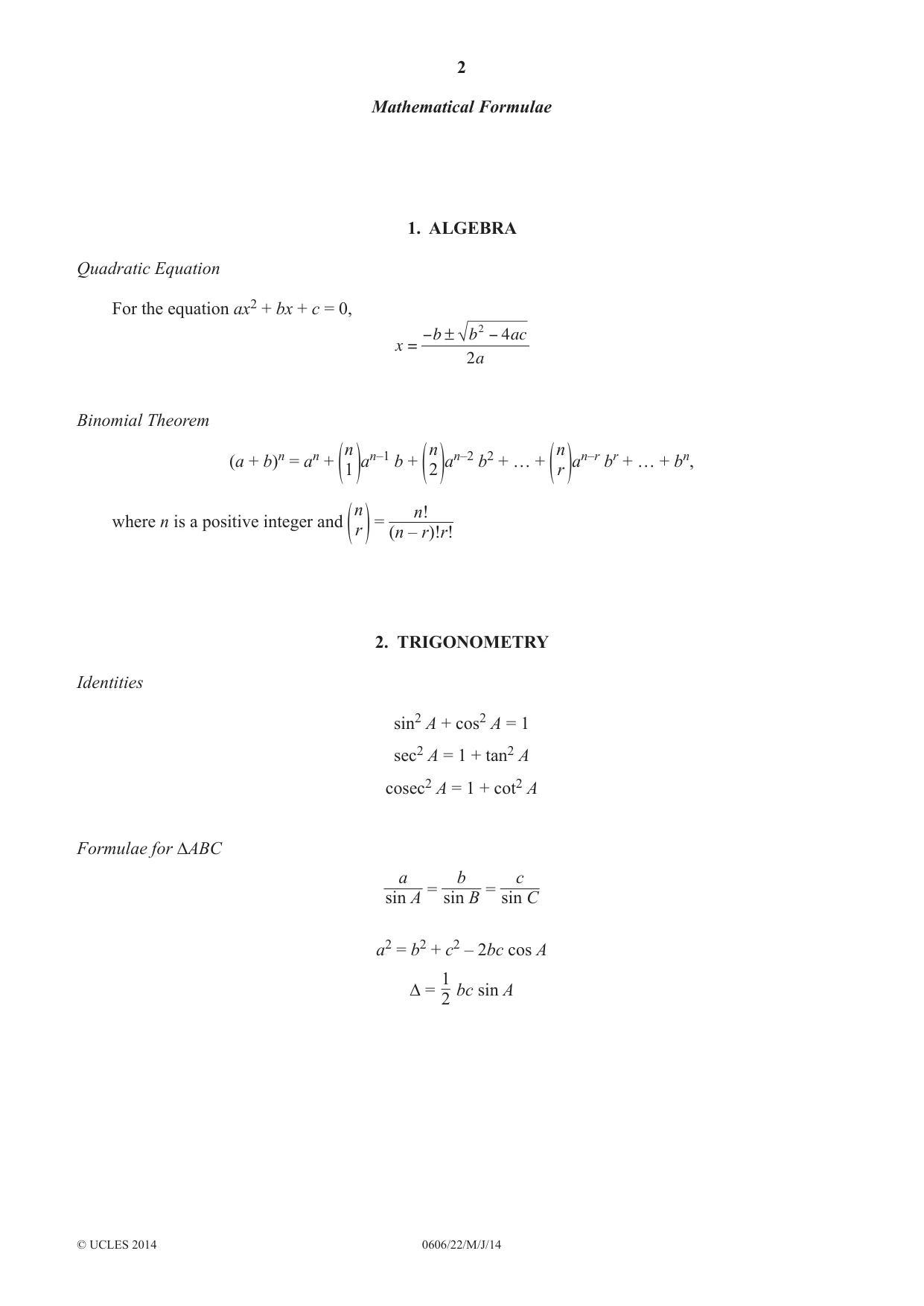
2 0606/22/M/J/14 © UCLES 2014 Mathematical Formulae 1. ALGEBRA Quadratic Equation For the equation ax2 + bx + c = 0, x b b ac a = − − 2 4 2 Binomial Theorem (a + b)n = an + ( n 1)an–1 b + ( n 2)an–2 b2 + … + ( n r)an–r br + … + bn, where n is a positive integer and ( n r) = n! (n – r)!r! 2. TRIGONOMETRY Identities sin2 A + cos2 A = 1 sec2 A = 1 + tan2 A cosec2 A = 1 + cot2 A Formulae for ∆ABC a sin A = b sin B = c sin C a2 = b2 + c2 – 2bc cos A ∆ = 1 2 bc sin A
Question paper, page 3
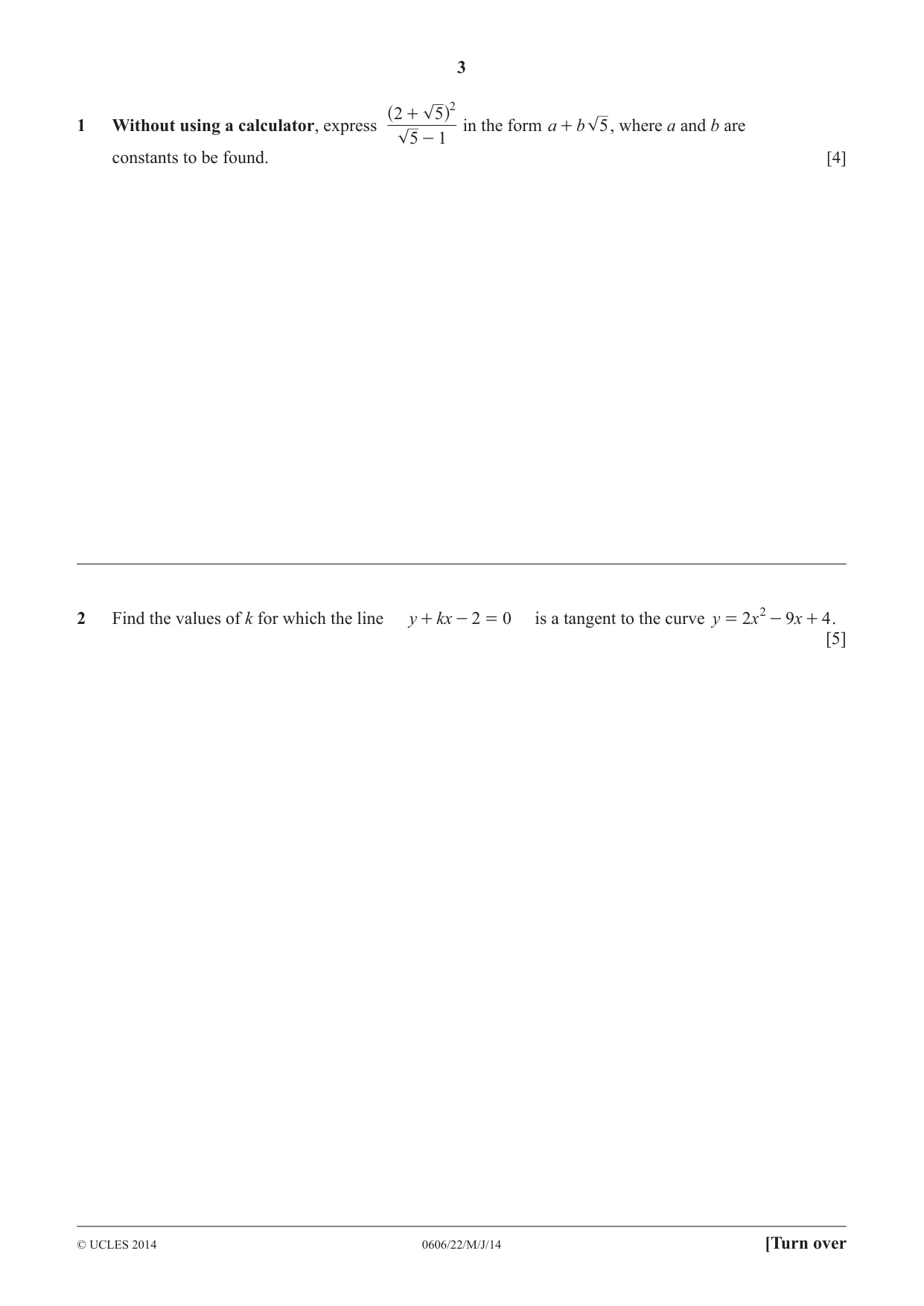
3 0606/22/M/J/14 © UCLES 2014 [Turn over 1 Without using a calculator, express 5 2 5 1 2 + - ^ h in the form a b 5 + , where a and b are constants to be found. [4] 2 Find the values of k for which the line y kx 2 0 + - = is a tangent to the curve y x x 2 9 4 2 = - + . [5]
Question paper, page 4
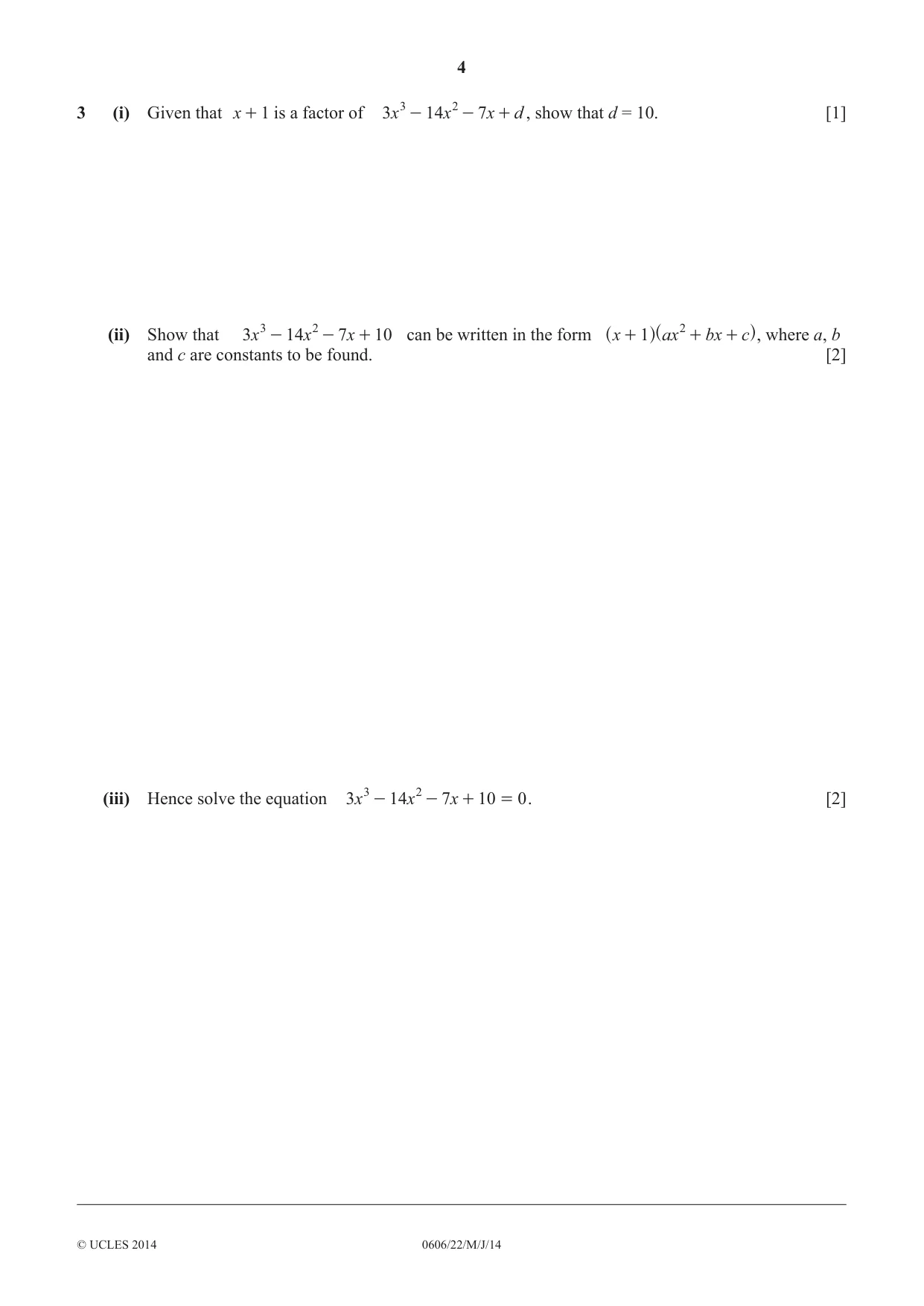
4 0606/22/M/J/14 © UCLES 2014 3 (i) Given that x 1 + is a factor of x x x d 3 14 7 3 2 - - + , show that d = 10. [1] (ii) Show that x x x 3 14 7 10 3 2 - - + can be written in the form x ax bx c 1 2 + + + ^ ^h h, where a, b and c are constants to be found. [2] (iii) Hence solve the equation x x x 3 14 7 10 0 3 2 - - + = . [2]
Question paper, page 5
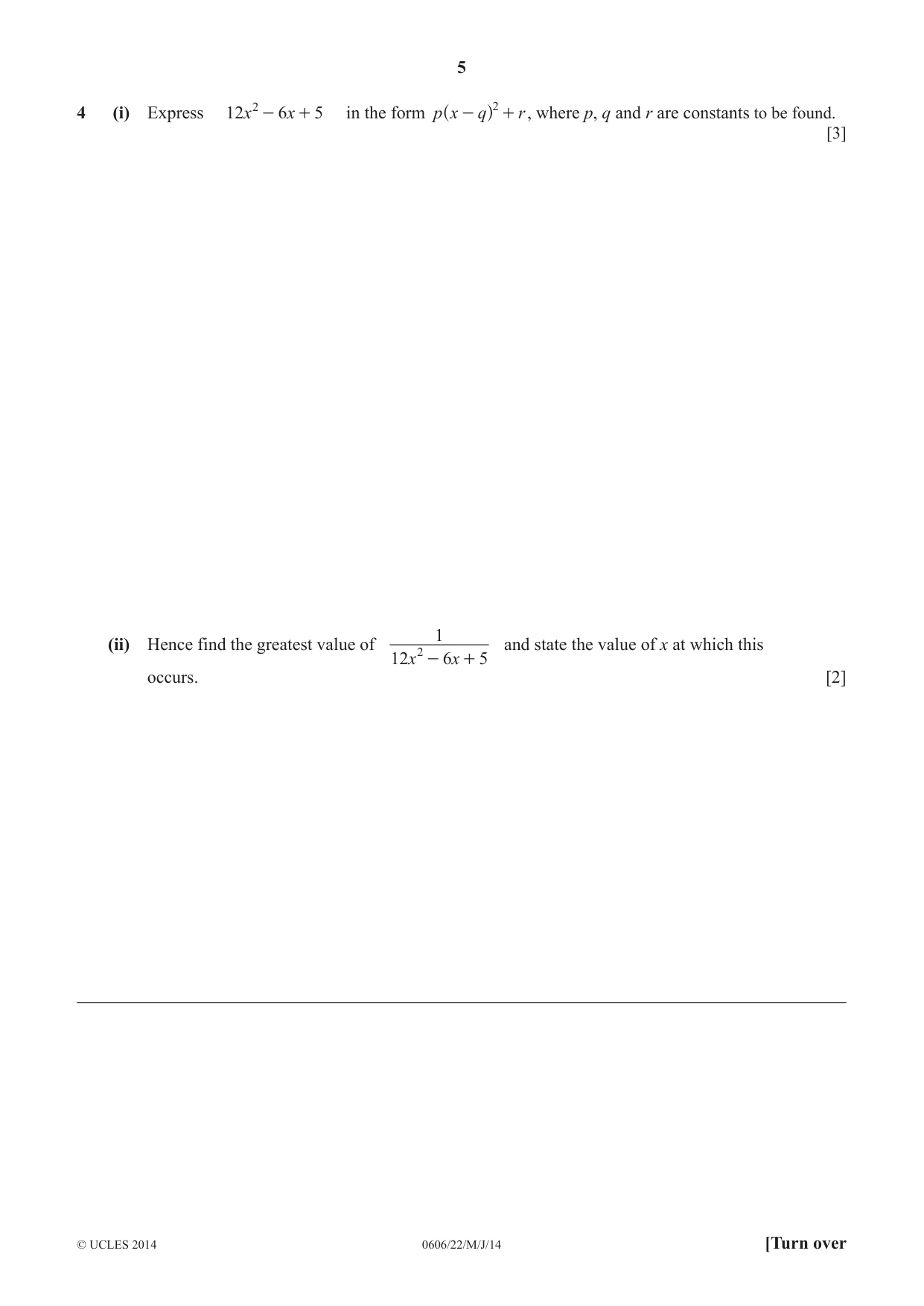
5 0606/22/M/J/14 © UCLES 2014 [Turn over 4 (i) Express x x 12 6 5 2 - + in the form p x q r 2 - + ^ h , where p, q and r are constants to be found. [3] (ii) Hence find the greatest value of x x 12 6 5 1 2 - + and state the value of x at which this occurs. [2]
Question paper, page 6
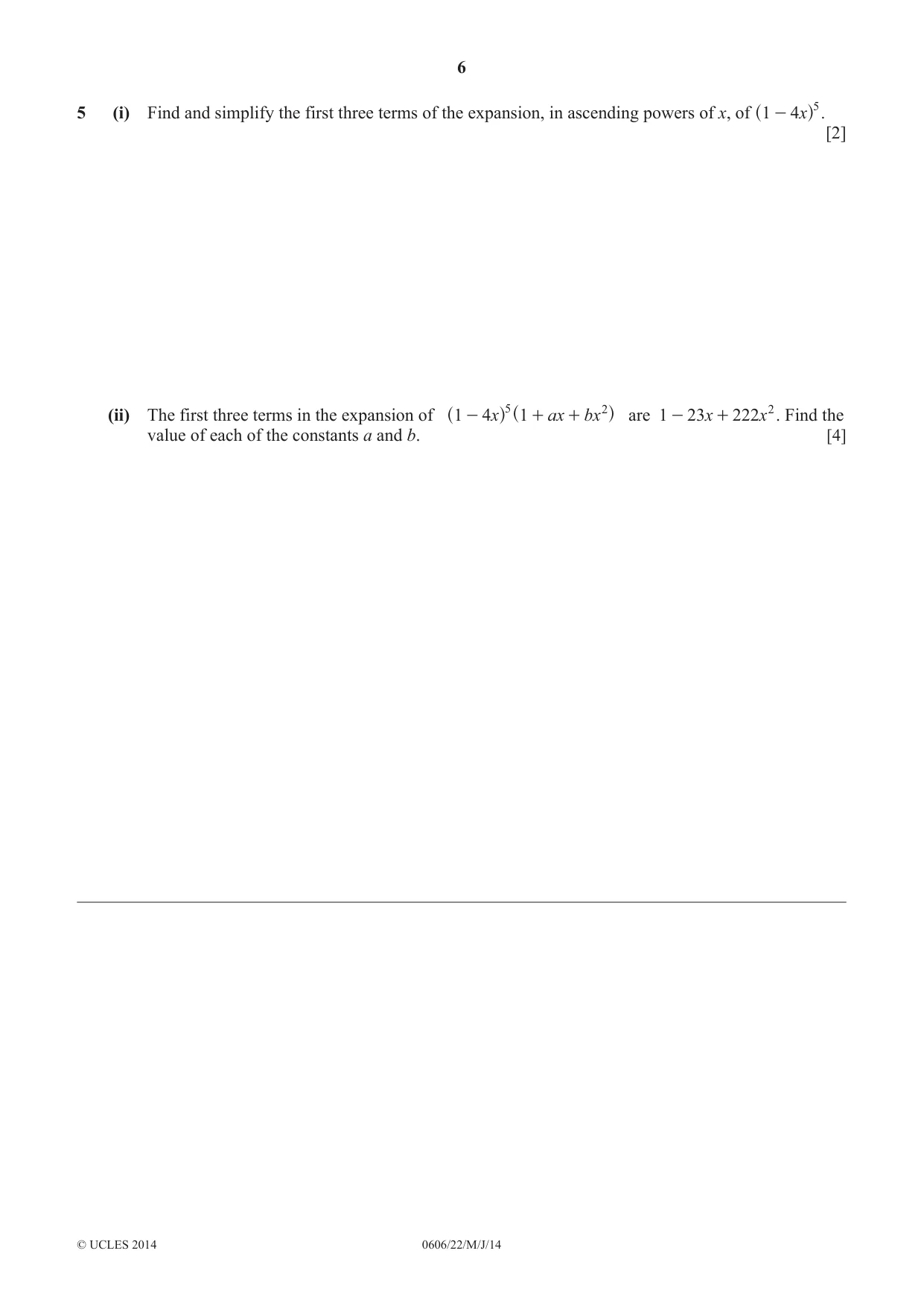
6 0606/22/M/J/14 © UCLES 2014 5 (i) Find and simplify the first three terms of the expansion, in ascending powers of x, of x 1 4 5 - ^ h . [2] (ii) The first three terms in the expansion of x ax bx 1 4 1 5 2 - + + ^ ^ h h are x x 1 23 222 2 - + . Find the value of each of the constants a and b. [4]
Question paper, page 7
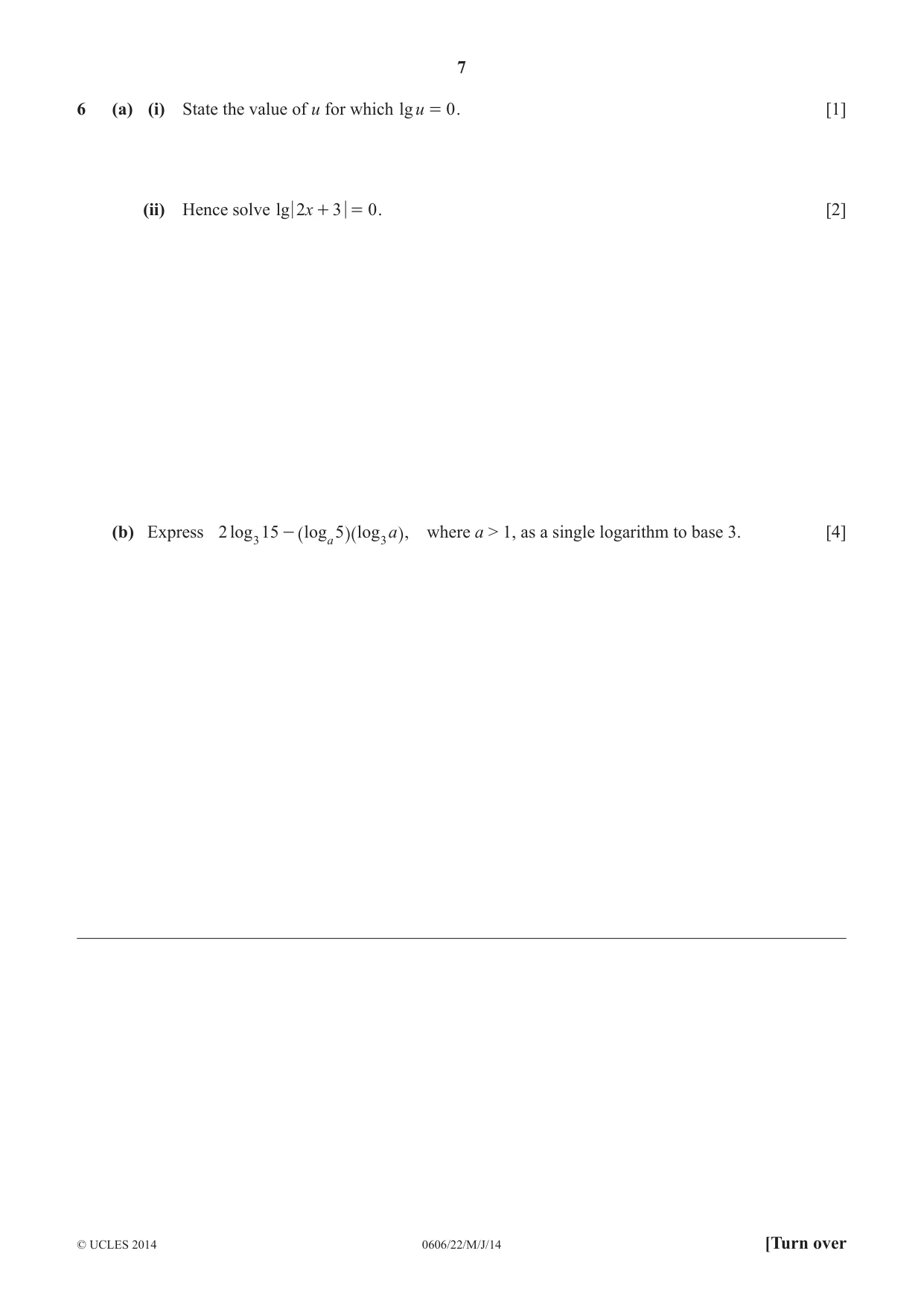
7 0606/22/M/J/14 © UCLES 2014 [Turn over 6 (a) (i) State the value of u for which lgu 0 = . [1] (ii) Hence solve lg x 2 3 0 + = . [2] (b) Express log log log a 2 15 5 a 3 3 -^ ^h h, where a > 1, as a single logarithm to base 3. [4]
Question paper, page 8
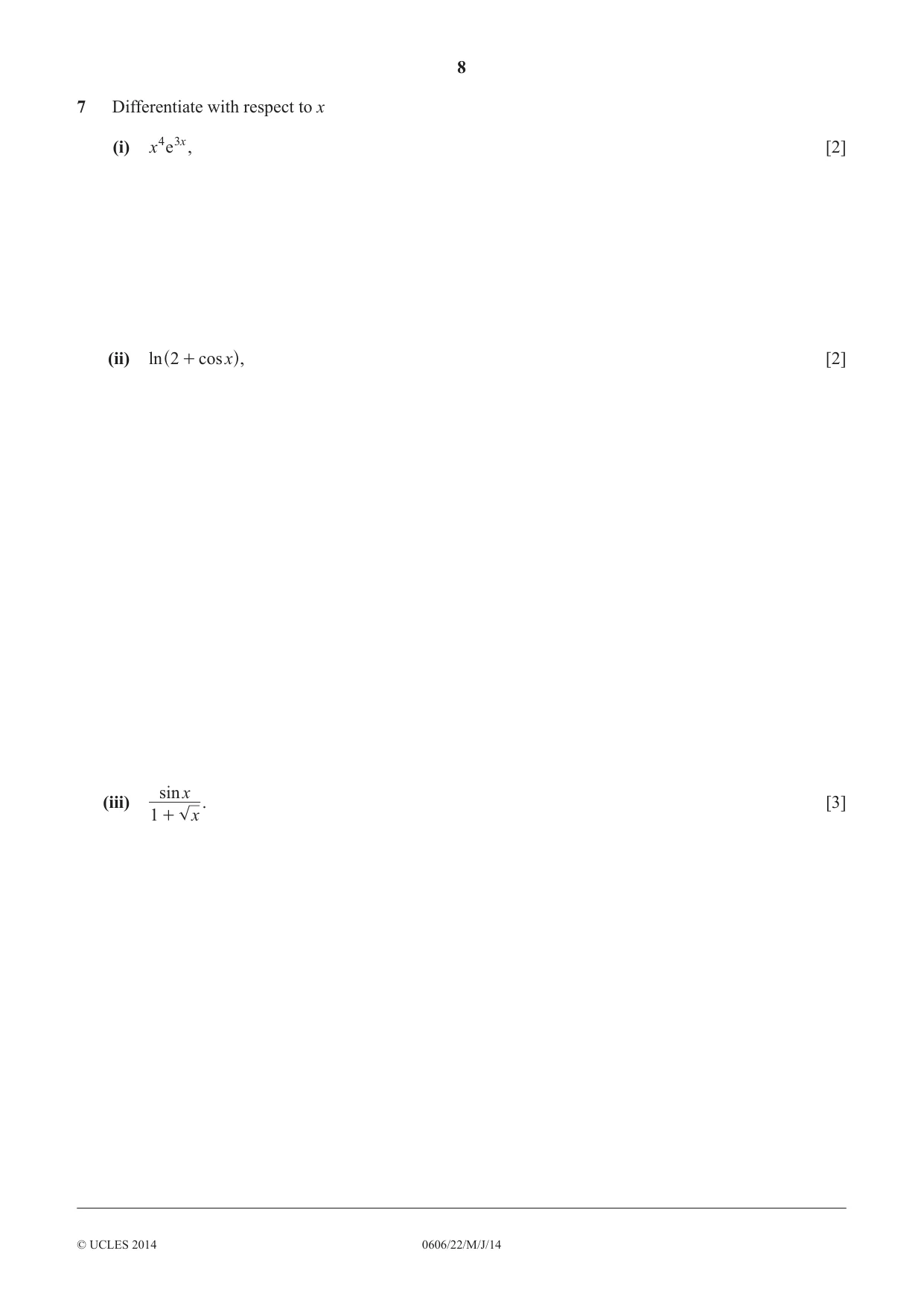
8 0606/22/M/J/14 © UCLES 2014 7 Differentiate with respect to x (i) x e x 4 3 , [2] (ii) ln cosx 2 + ^ h, [2] (iii) sin x x 1 + . [3]
Question paper, page 9
9 0606/22/M/J/14 © UCLES 2014 [Turn over 8 The line y x 5 = - meets the curve x y x 2 35 0 2 2 + + - = at the points A and B. Find the exact length of AB. [6]
Question paper, page 10
10 0606/22/M/J/14 © UCLES 2014 9 A curve is such that x y x 2 1 d d 2 1 = + ^ h . The curve passes through the point (4, 10). (i) Find the equation of the curve. [4] (ii) Find y x d y and hence evaluate y x d . 0 1 5 y . [5]
Question paper, page 11
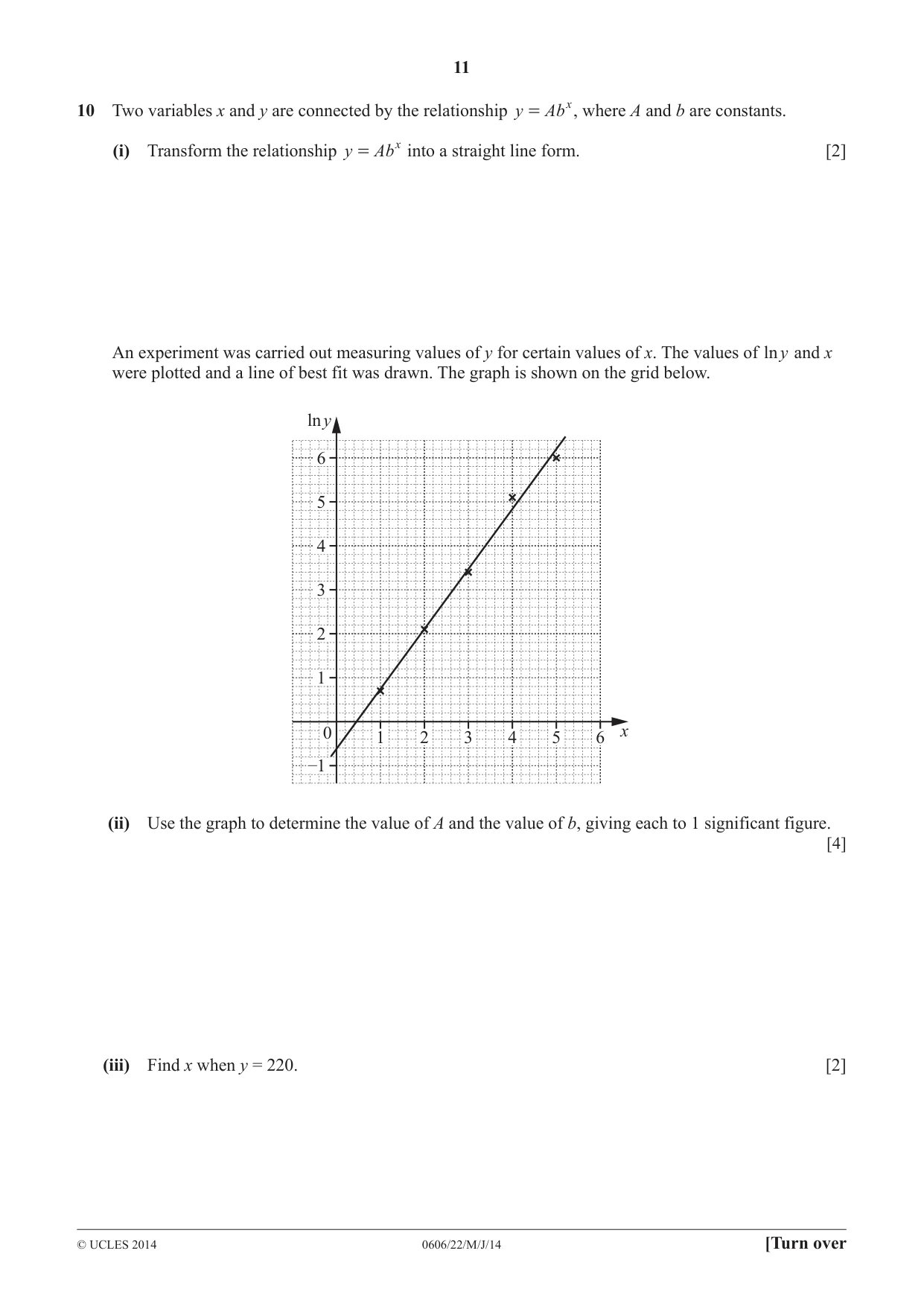
11 0606/22/M/J/14 © UCLES 2014 [Turn over 10 Two variables x and y are connected by the relationship y Abx = , where A and b are constants. (i) Transform the relationship y Abx = into a straight line form. [2] An experiment was carried out measuring values of y for certain values of x. The values of lny and x were plotted and a line of best fit was drawn. The graph is shown on the grid below. ln y x 1 0 1 –1 2 3 4 5 6 2 3 4 5 6 (ii) Use the graph to determine the value of A and the value of b, giving each to 1 significant figure. [4] (iii) Find x when y = 220. [2]
Question paper, page 12
12 0606/22/M/J/14 © UCLES 2014 11 The functions f and g are defined, for real values of x greater than 2, by ( )x 2 1 f x = - , ( )x x x 1 g = + ^ h. (i) State the range of f. [1] (ii) Find an expression for ( )x f 1 - , stating its domain and range. [4]
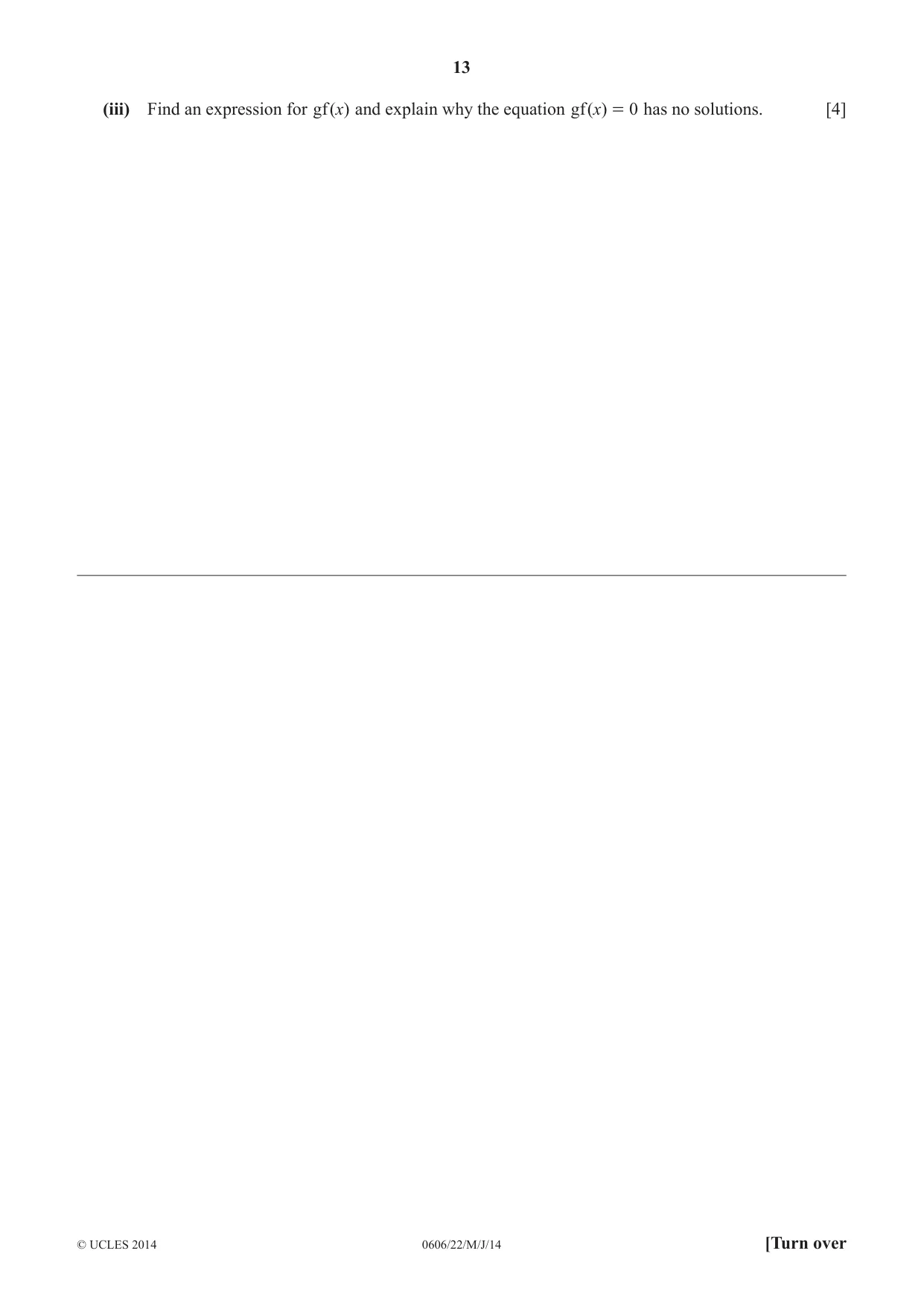
Question paper, page 13
13 0606/22/M/J/14 © UCLES 2014 [Turn over (iii) Find an expression for ( )x gf and explain why the equation ( )x 0 gf = has no solutions. [4]
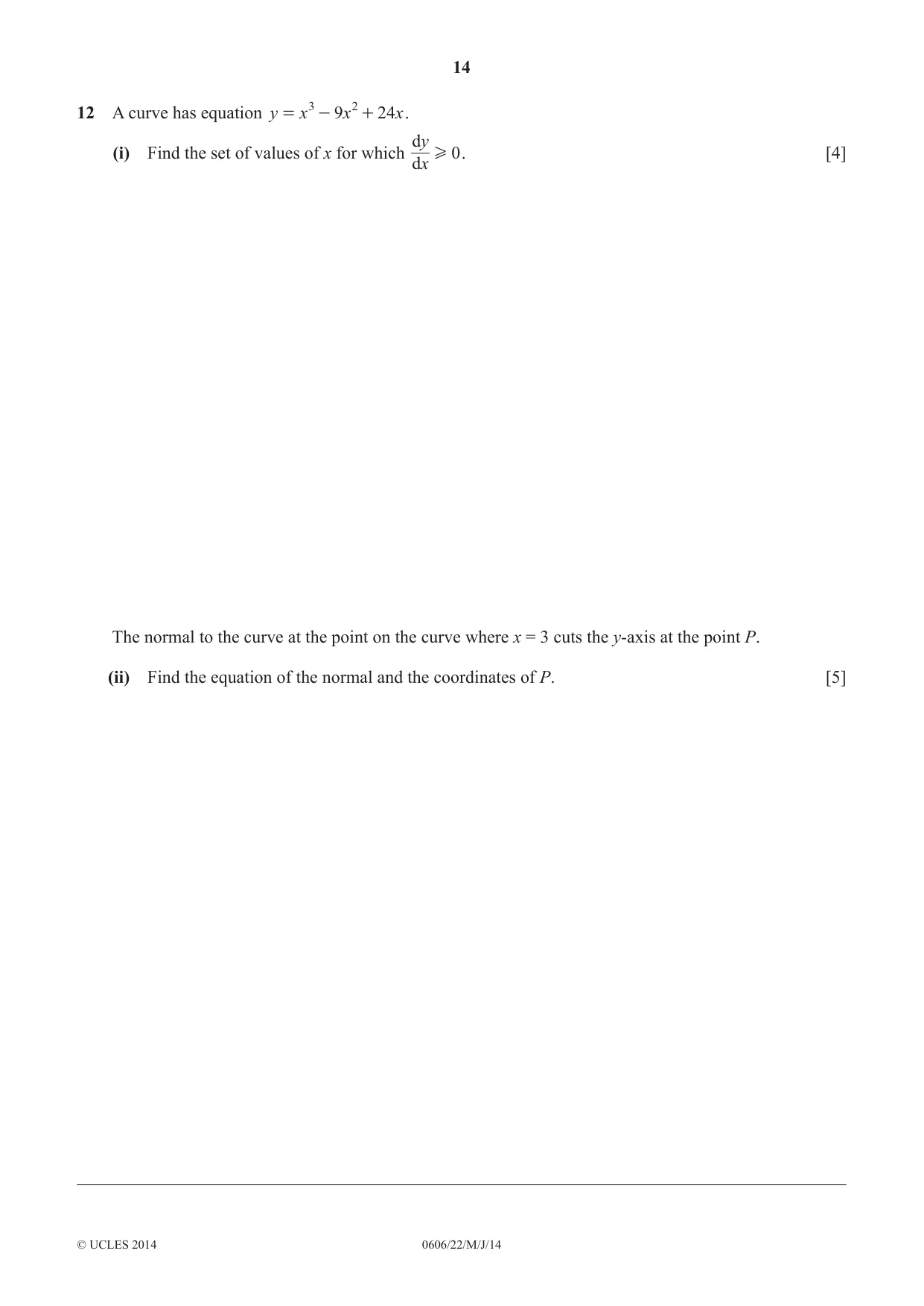
Question paper, page 14
14 0606/22/M/J/14 © UCLES 2014 12 A curve has equation y x x x 9 24 3 2 = - + . (i) Find the set of values of x for which x y 0 d d H . [4] The normal to the curve at the point on the curve where x = 3 cuts the y-axis at the point P. (ii) Find the equation of the normal and the coordinates of P. [5]
Question paper, page 15
15 0606/22/M/J/14 © UCLES 2014 BLANK PAGE
Question paper, page 16
16 0606/22/M/J/14 © UCLES 2014 BLANK PAGE Permission to reproduce items where third-party owned material protected by copyright is included has been sought and cleared where possible. Every reasonable effort has been made by the publisher (UCLES) to trace copyright holders, but if any items requiring clearance have unwittingly been included, the publisher will be pleased to make amends at the earliest possible opportunity. Cambridge International Examinations is part of the Cambridge Assessment Group. Cambridge Assessment is the brand name of University of Cambridge Local Examinations Syndicate (UCLES), which is itself a department of the University of Cambridge.
Mark scheme, page 1
CAMBRIDGE INTERNATIONAL EXAMINATIONS International General Certificate of Secondary Education MARK SCHEME for the May/June 2014 series 0606 ADDITIONAL MATHEMATICS 0606/22 Paper 2, maximum raw mark 80 This mark scheme is published as an aid to teachers and candidates, to indicate the requirements of the examination. It shows the basis on which Examiners were instructed to award marks. It does not indicate the details of the discussions that took place at an Examiners’ meeting before marking began, which would have considered the acceptability of alternative answers. Mark schemes should be read in conjunction with the question paper and the Principal Examiner Report for Teachers. Cambridge will not enter into discussions about these mark schemes. Cambridge is publishing the mark schemes for the May/June 2014 series for most IGCSE, GCE Advanced Level and Advanced Subsidiary Level components and some Ordinary Level components.
Mark scheme, page 2
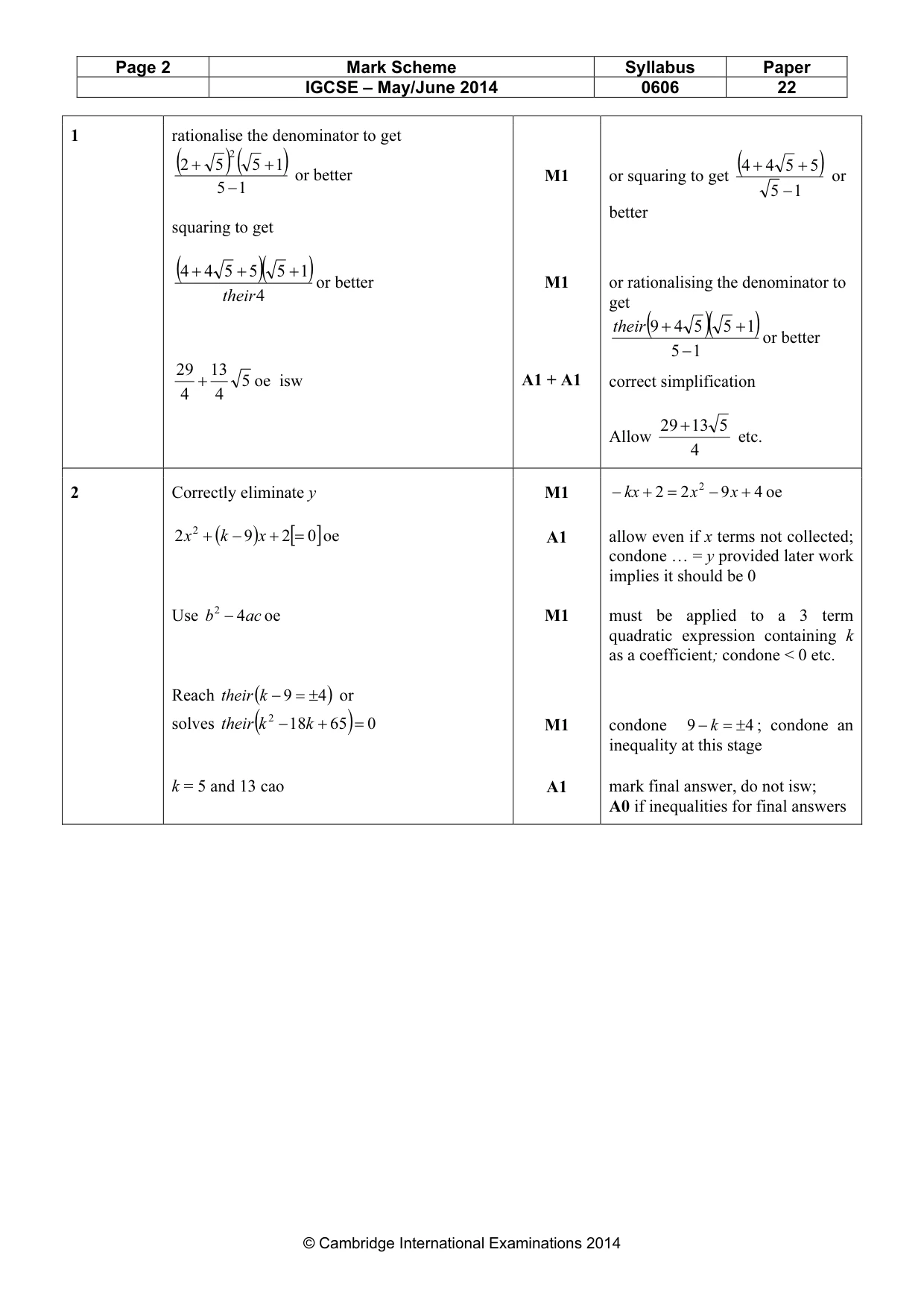
Page 2 Mark Scheme Syllabus Paper IGCSE – May/June 2014 0606 22 © Cambridge International Examinations 2014 1 rationalise the denominator to get ( ) ( ) 1 5 1 5 5 2 2 − + + or better squaring to get ( )( ) 4 1 5 5 5 4 4 their + + + or better 5 4 13 4 29 + oe isw M1 M1 A1 + A1 or squaring to get ( ) 1 5 5 5 4 4 − + + or better or rationalising the denominator to get ( )( ) 1 5 1 5 5 4 9 − + + their or better correct simplification Allow 4 5 13 29 + etc. 2 Correctly eliminate y ( ) [ ] 0 2 9 2 2 = + − + x k x oe Use ac b 4 2 − oe Reach ( ) 4 9 ± = − k their or solves ( ) 0 65 18 2 = + − k k their k = 5 and 13 cao M1 A1 M1 M1 A1 4 9 2 2 2 + − = + − x x kx oe allow even if x terms not collected; condone … = y provided later work implies it should be 0 must be applied to a 3 term quadratic expression containing k as a coefficient; condone < 0 etc. condone 4 9 ± = −k ; condone an inequality at this stage mark final answer, do not isw; A0 if inequalities for final answers
Mark scheme, page 3
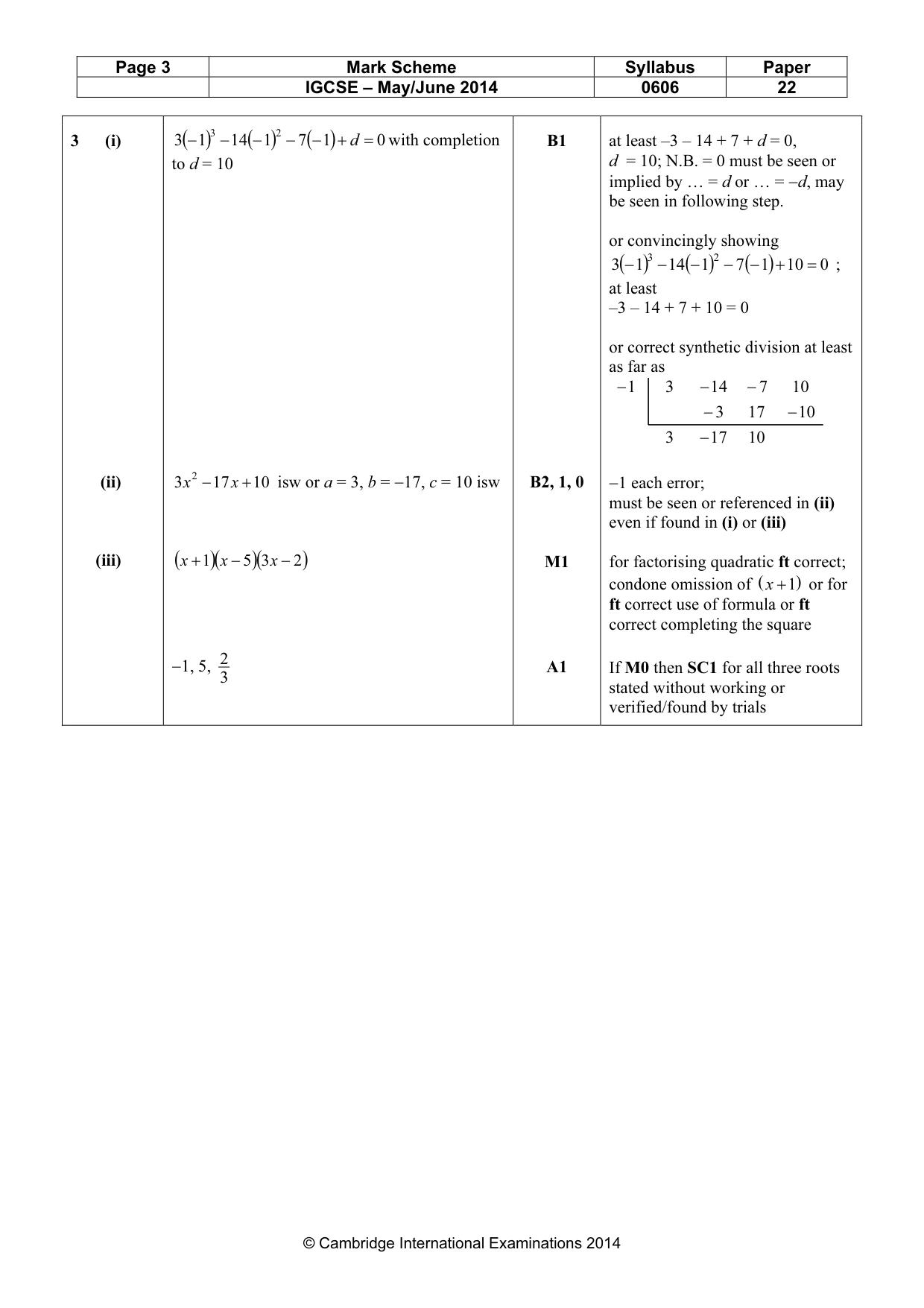
Page 3 Mark Scheme Syllabus Paper IGCSE – May/June 2014 0606 22 © Cambridge International Examinations 2014 3 (i) (ii) (iii) ( ) ( ) ( ) 0 1 7 1 14 1 3 2 3 = + − − − − − d with completion to d = 10 10 17 3 2 + − x x isw or a = 3, b = −17, c = 10 isw ( )( )( ) 2 3 5 1 − − + x x x −1, 5, 3 2 B1 B2, 1, 0 M1 A1 at least –3 – 14 + 7 + d = 0, d = 10; N.B. = 0 must be seen or implied by … = d or … = −d, may be seen in following step. or convincingly showing ( ) ( ) ( ) 0 10 1 7 1 14 1 3 2 3 = + − − − − − ; at least –3 – 14 + 7 + 10 = 0 or correct synthetic division at least as far as 10 17 3 10 17 3 10 7 14 3 1 − − − − − − −1 each error; must be seen or referenced in (ii) even if found in (i) or (iii) for factorising quadratic ft correct; condone omission of or for ft correct use of formula or ft correct completing the square If M0 then SC1 for all three roots stated without working or verified/found by trials ( )1 x +
Mark scheme, page 4
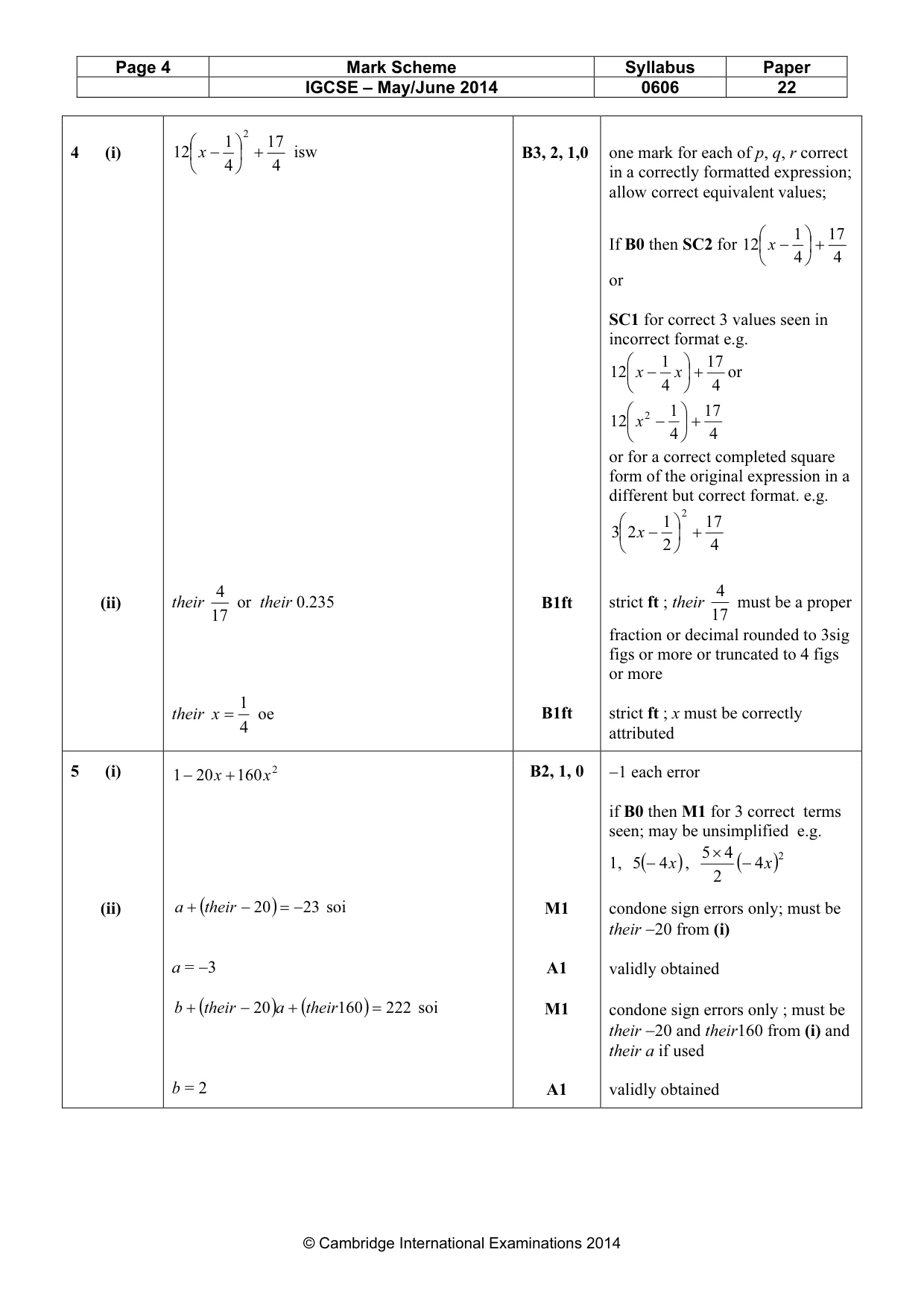
Page 4 Mark Scheme Syllabus Paper IGCSE – May/June 2014 0606 22 © Cambridge International Examinations 2014 4 (i) (ii) 4 17 4 1 12 2 + − x isw their 17 4 or their 0.235 their 4 1 = x oe B3, 2, 1,0 B1ft B1ft one mark for each of p, q, r correct in a correctly formatted expression; allow correct equivalent values; If B0 then SC2 for 4 17 4 1 12 + − x or SC1 for correct 3 values seen in incorrect format e.g. 4 17 4 1 12 + − x x or 4 17 4 1 12 2 + − x or for a correct completed square form of the original expression in a different but correct format. e.g. 4 17 2 1 2 3 2 + − x strict ft ; their 17 4 must be a proper fraction or decimal rounded to 3sig figs or more or truncated to 4 figs or more strict ft ; x must be correctly attributed 5 (i) (ii) 2 160 20 1 x x + − ( ) 23 20 − = − + their a soi a = −3 ( ) ( ) 222 160 20 = + − + their a their b soi b = 2 B2, 1, 0 M1 A1 M1 A1 −1 each error if B0 then M1 for 3 correct terms seen; may be unsimplified e.g. 1, ( ) x 4 5 − , ( )2 4 2 4 5 x − × condone sign errors only; must be their −20 from (i) validly obtained condone sign errors only ; must be their −20 and their160 from (i) and their a if used validly obtained
Mark scheme, page 5
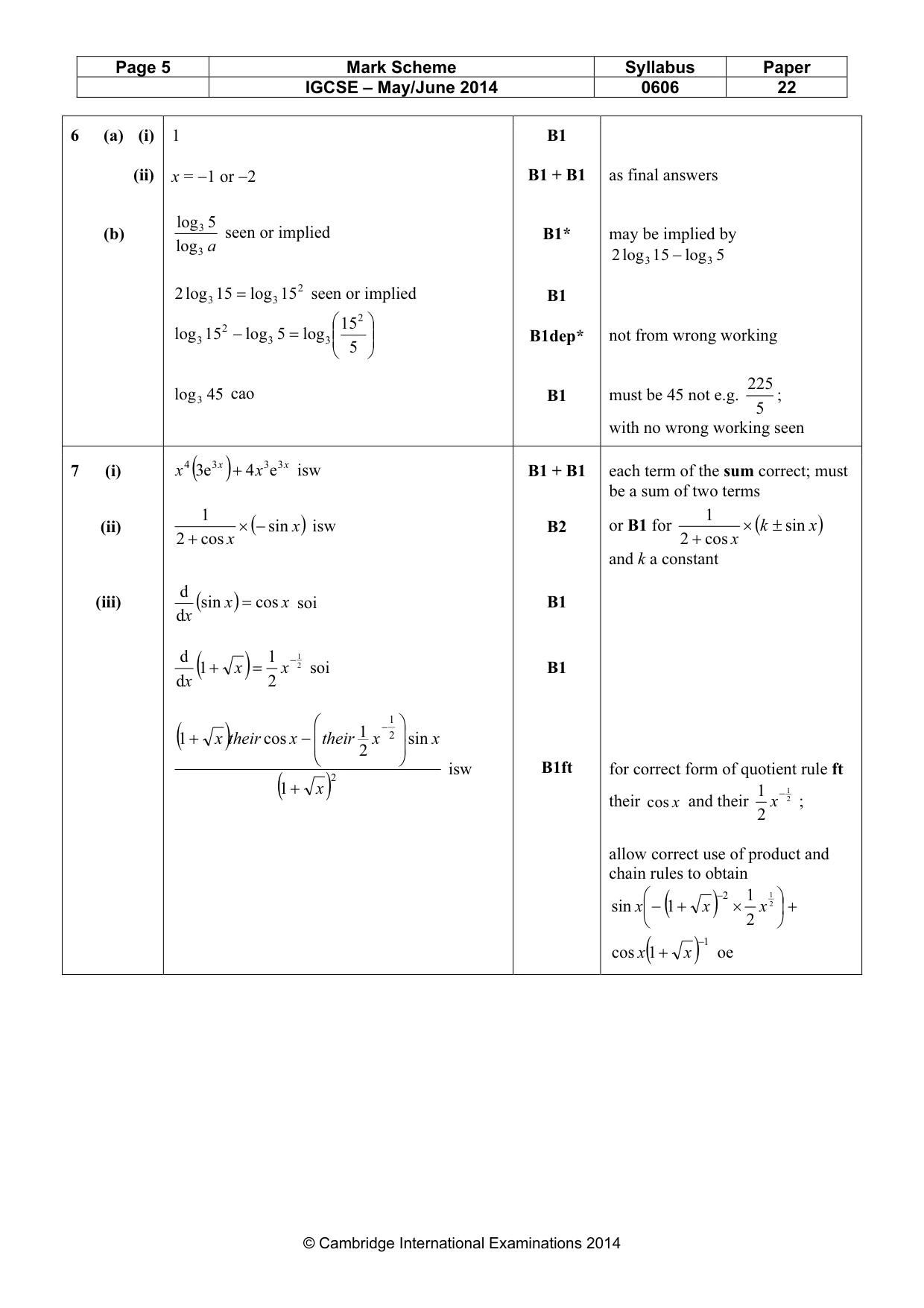
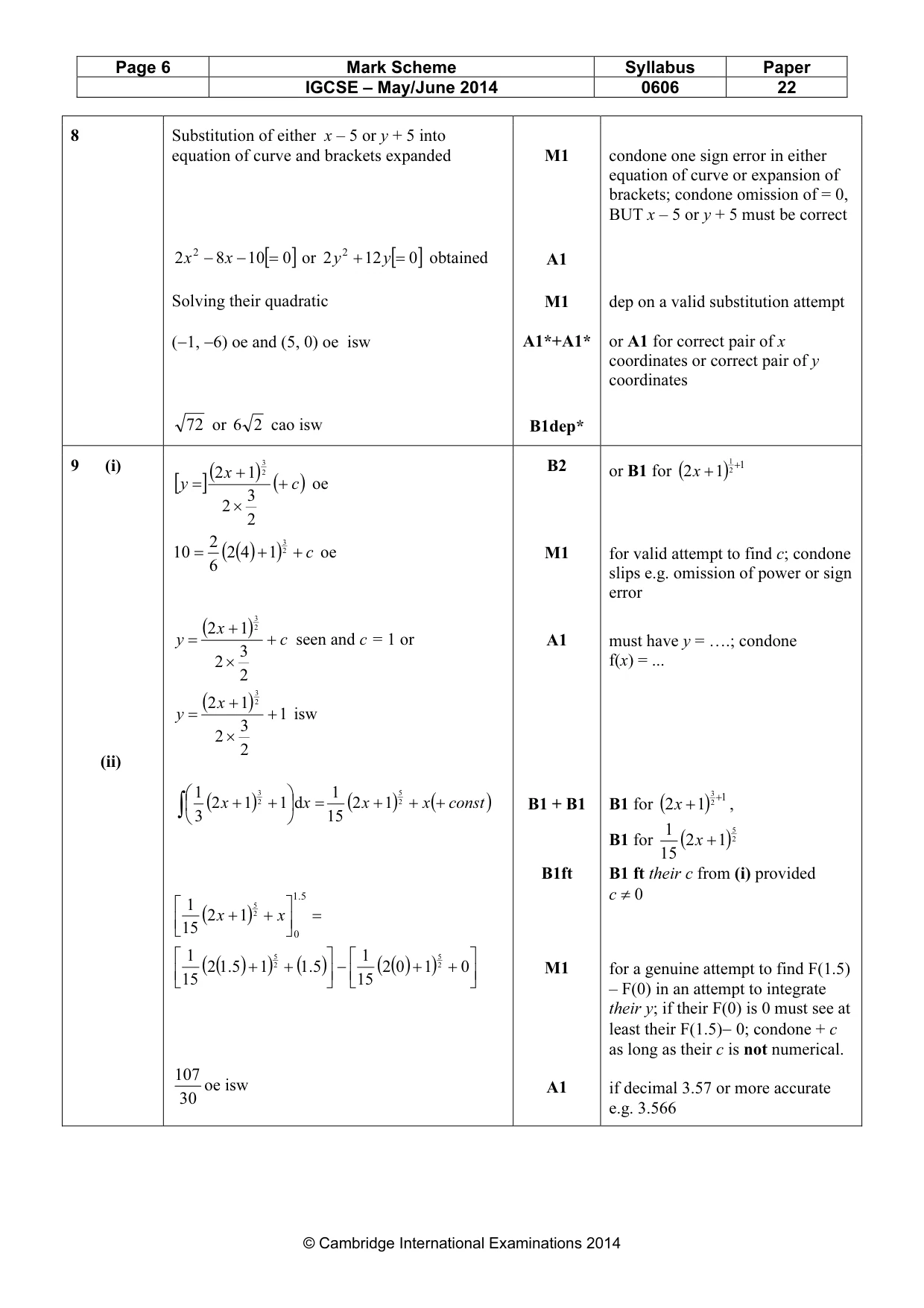
Page 5 Mark Scheme Syllabus Paper IGCSE – May/June 2014 0606 22 © Cambridge International Examinations 2014 6 (a) (i) (ii) (b) 1 x = −1 or −2 a 3 3 log 5 log seen or implied 2 3 3 15 log 15 log 2 = seen or implied = − 5 15 log 5 log 15 log 2 3 3 2 3 45 log3 cao B1 B1 + B1 B1* B1 B1dep* B1 as final answers may be implied by 5 log 15 log 2 3 3 − not from wrong working must be 45 not e.g. 5 225 ; with no wrong working seen 7 (i) (ii) (iii) ( ) x x x x 3 3 3 4 e 4 e 3 + isw ( ) x x sin cos 2 1 − × + isw ( ) x x x cos sin d d = soi ( ) 2 1 2 1 1 d d − = + x x x soi ( ) ( ) 2 2 1 1 sin 2 1 cos 1 x x x their x their x + − + − isw B1 + B1 B2 B1 B1 B1ft each term of the sum correct; must be a sum of two terms or B1 for ( ) x k x sin cos 2 1 ± × + and k a constant for correct form of quotient rule ft their and their 2 1 2 1 − x ; allow correct use of product and chain rules to obtain ( ) ( ) oe 1 cos 2 1 1 sin 1 2 2 1 − − + + × + − x x x x x cos x
Mark scheme, page 6
Page 6 Mark Scheme Syllabus Paper IGCSE – May/June 2014 0606 22 © Cambridge International Examinations 2014 8 Substitution of either x – 5 or y + 5 into equation of curve and brackets expanded [ ] 0 10 8 2 2 = − −x x or [ ] 0 12 2 2 = + y y obtained Solving their quadratic (−1, −6) oe and (5, 0) oe isw 72 or 2 6 cao isw M1 A1 M1 A1*+A1* B1dep* condone one sign error in either equation of curve or expansion of brackets; condone omission of = 0, BUT x – 5 or y + 5 must be correct dep on a valid substitution attempt or A1 for correct pair of x coordinates or correct pair of y coordinates 9 (i) (ii) [ ]( ) ( ) c x y + × + = 2 3 2 1 2 2 3 oe ( ) ( ) c + + = 2 3 1 4 2 6 2 10 oe ( ) c x y + × + = 2 3 2 1 2 2 3 seen and c = 1 or ( ) 1 2 3 2 1 2 2 3 + × + = x y isw ( ) ( ) ( ) const x x x x + + + = + + ∫ 2 5 2 3 1 2 15 1 d 1 1 2 3 1 ( ) ( ) ( ) ( ) ( ) ( ) + + − + + = + + 0 1 0 2 15 1 5.1 1 5.1 2 15 1 1 2 15 1 2 5 2 5 2 5 5.1 0 x x 30 107 oe isw B2 M1 A1 B1 + B1 B1ft M1 A1 or B1 for ( ) 1 2 1 1 2 + + x for valid attempt to find c; condone slips e.g. omission of power or sign error must have y = ….; condone f(x) = ... B1 for ( ) 1 2 3 1 2 + + x , B1 for ( )2 5 1 2 15 1 + x B1 ft their c from (i) provided c ≠ 0 for a genuine attempt to find F(1.5) – F(0) in an attempt to integrate their y; if their F(0) is 0 must see at least their F(1.5)− 0; condone + c as long as their c is not numerical. if decimal 3.57 or more accurate e.g. 3.566
Mark scheme, page 7
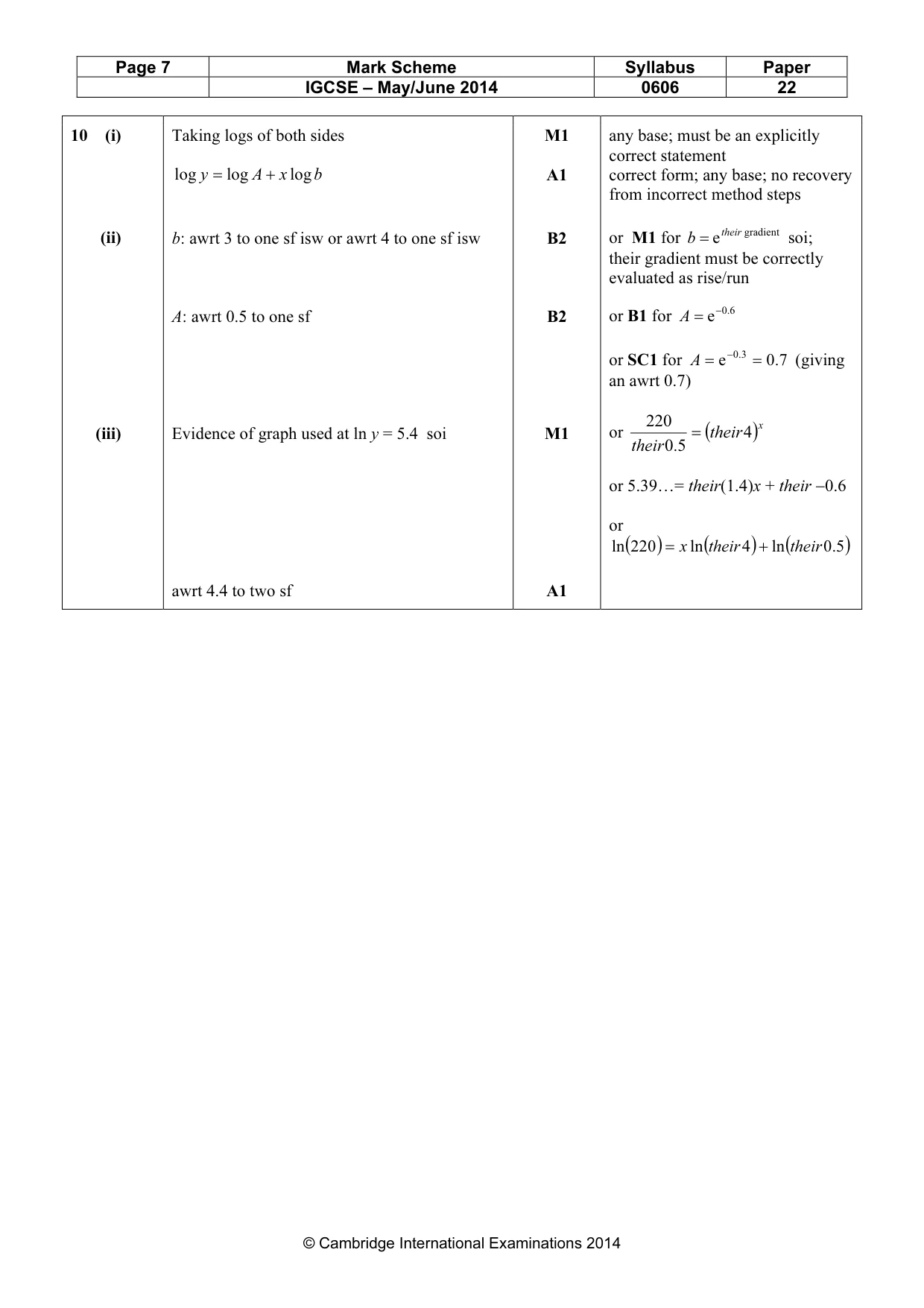
Page 7 Mark Scheme Syllabus Paper IGCSE – May/June 2014 0606 22 © Cambridge International Examinations 2014 10 (i) (ii) (iii) Taking logs of both sides b x A y log log log + = b: awrt 3 to one sf isw or awrt 4 to one sf isw A: awrt 0.5 to one sf Evidence of graph used at ln y = 5.4 soi awrt 4.4 to two sf M1 A1 B2 B2 M1 A1 any base; must be an explicitly correct statement correct form; any base; no recovery from incorrect method steps or M1 for gradient etheir b = soi; their gradient must be correctly evaluated as rise/run or B1 for 6.0 e− = A or SC1 for 7.0 e 3.0 = = − A (giving an awrt 0.7) or ( )x their their 4 5.0 220 = or 5.39…= their(1.4)x + their −0.6 or ( ) ( ) ( ) 5.0 ln 4 ln 220 ln their their x + =
Mark scheme, page 8
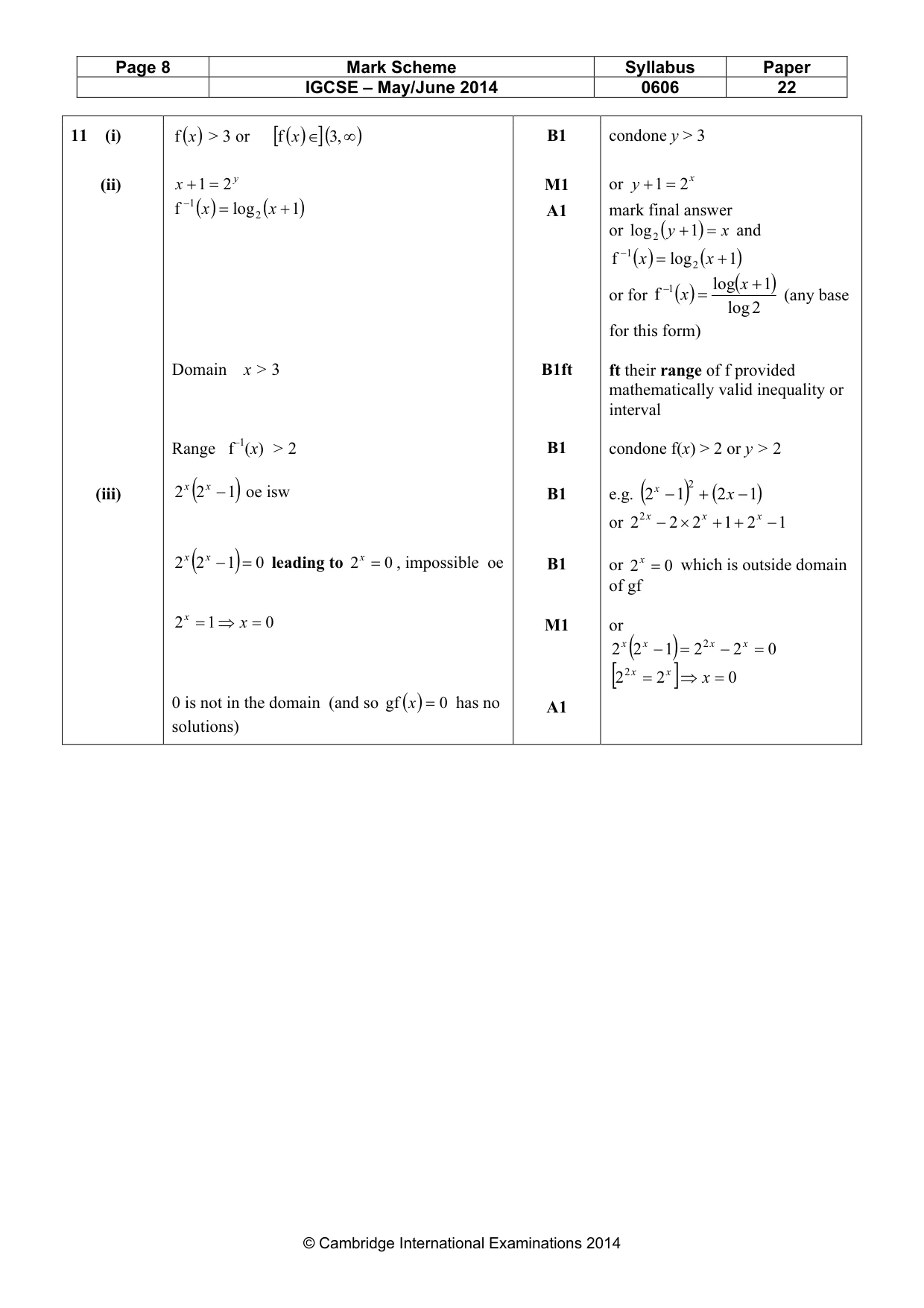
Page 8 Mark Scheme Syllabus Paper IGCSE – May/June 2014 0606 22 © Cambridge International Examinations 2014 11 (i) (ii) (iii) ( ) x f > 3 or ( ) [ ]( ) ∞ ∈ ,3 f x y x 2 1 = + ( ) ( )1 log f 2 1 + = − x x Domain x > 3 Range f–1(x) > 2 ( )1 2 2 − x x oe isw ( ) 0 1 2 2 = − x x leading to 0 2 = x , impossible oe 0 1 2 = ⇒ = x x 0 is not in the domain (and so ( ) 0 gf = x has no solutions) B1 M1 A1 B1ft B1 B1 B1 M1 A1 condone y > 3 or x y 2 1 = + mark final answer or ( ) x y = +1 log2 and ( ) ( )1 log f 2 1 + = − x x or for ( ) ( ) 2 log 1 log f 1 + = − x x (any base for this form) ft their range of f provided mathematically valid inequality or interval condone f(x) > 2 or y > 2 e.g. ( ) ( )1 2 1 2 2 − + − x x or 1 2 1 2 2 22 − + + × − x x x or 0 2 = x which is outside domain of gf or ( ) [ ] 0 2 2 0 2 2 1 2 2 2 2 = ⇒ = = − = − x x x x x x x
Mark scheme, page 9
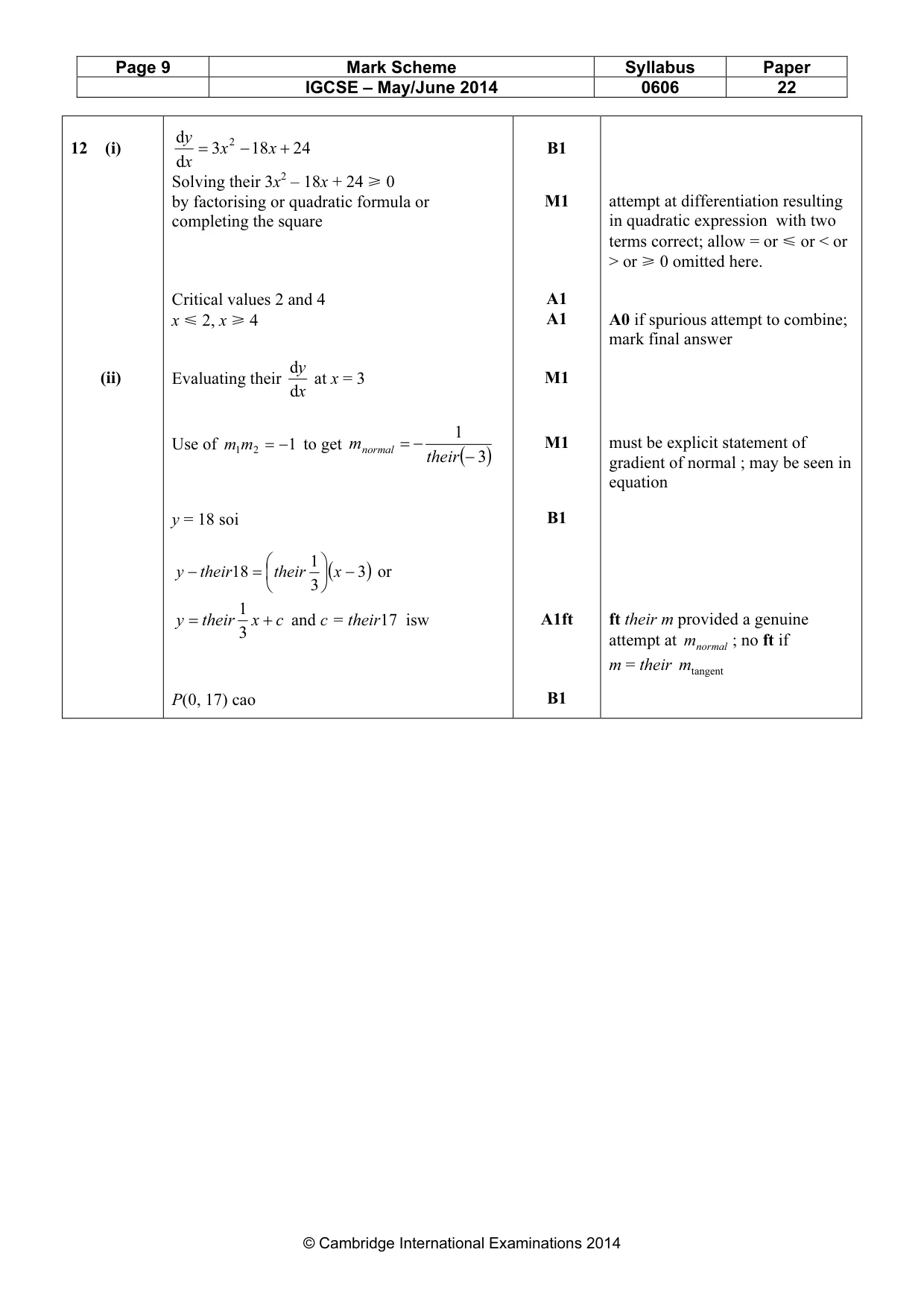
Page 9 Mark Scheme Syllabus Paper IGCSE – May/June 2014 0606 22 © Cambridge International Examinations 2014 12 (i) (ii) 24 18 3 d d 2 + − = x x x y Solving their 3x2 – 18x + 24 [ 0 by factorising or quadratic formula or completing the square Critical values 2 and 4 x Y 2, x [ 4 Evaluating their x y d d at x = 3 Use of 1 2 1 − = m m to get ( ) 3 1 − − = their mnormal y = 18 soi ( ) 3 3 1 18 − = − x their their y or c x their y + = 3 1 and c = their17 isw P(0, 17) cao B1 M1 A1 A1 M1 M1 B1 A1ft B1 attempt at differentiation resulting in quadratic expression with two terms correct; allow = or Y or < or > or [ 0 omitted here. A0 if spurious attempt to combine; mark final answer must be explicit statement of gradient of normal ; may be seen in equation ft their m provided a genuine attempt at normal m ; no ft if m = their tangent m
What you needed in this session
Cambridge’s own grade thresholds for 2014 May/June, Paper 2 · Variant 2. A higher threshold means an easier paper — the bar moves with how the cohort did.