Cambridge IGCSE Mathematics - Additional 0606 — 2014 May/June Paper 1 · Variant 1
0606/11/M/J/14 · 80 marks · ≈90 min
The question paper and its mark scheme, free to read here and free to download. This is Cambridge’s own paper, exactly as it was sat.
Question paper16 pages
Mark scheme7 pages
Answers below. Sit the paper first if you are practising.
Paper as text
Question paper, page 1
This document consists of 16 printed pages. DC (LK/CGW) 73326/4 © UCLES 2014 [Turn over Cambridge International Examinations Cambridge International General Certificate of Secondary Education * 9 7 8 0 7 1 0 6 7 7 * ADDITIONAL MATHEMATICS 0606/11 Paper 1 May/June 2014 2 hours Candidates answer on the Question Paper. Additional Materials: Electronic calculator READ THESE INSTRUCTIONS FIRST Write your Centre number, candidate number and name on all the work you hand in. Write in dark blue or black pen. You may use an HB pencil for any diagrams or graphs. Do not use staples, paper clips, glue or correction fluid. DO NOT WRITE IN ANY BARCODES. Answer all the questions. Give non-exact numerical answers correct to 3 significant figures, or 1 decimal place in the case of angles in degrees, unless a different level of accuracy is specified in the question. The use of an electronic calculator is expected, where appropriate. You are reminded of the need for clear presentation in your answers. At the end of the examination, fasten all your work securely together. The number of marks is given in brackets [ ] at the end of each question or part question. The total number of marks for this paper is 80.
Question paper, page 2
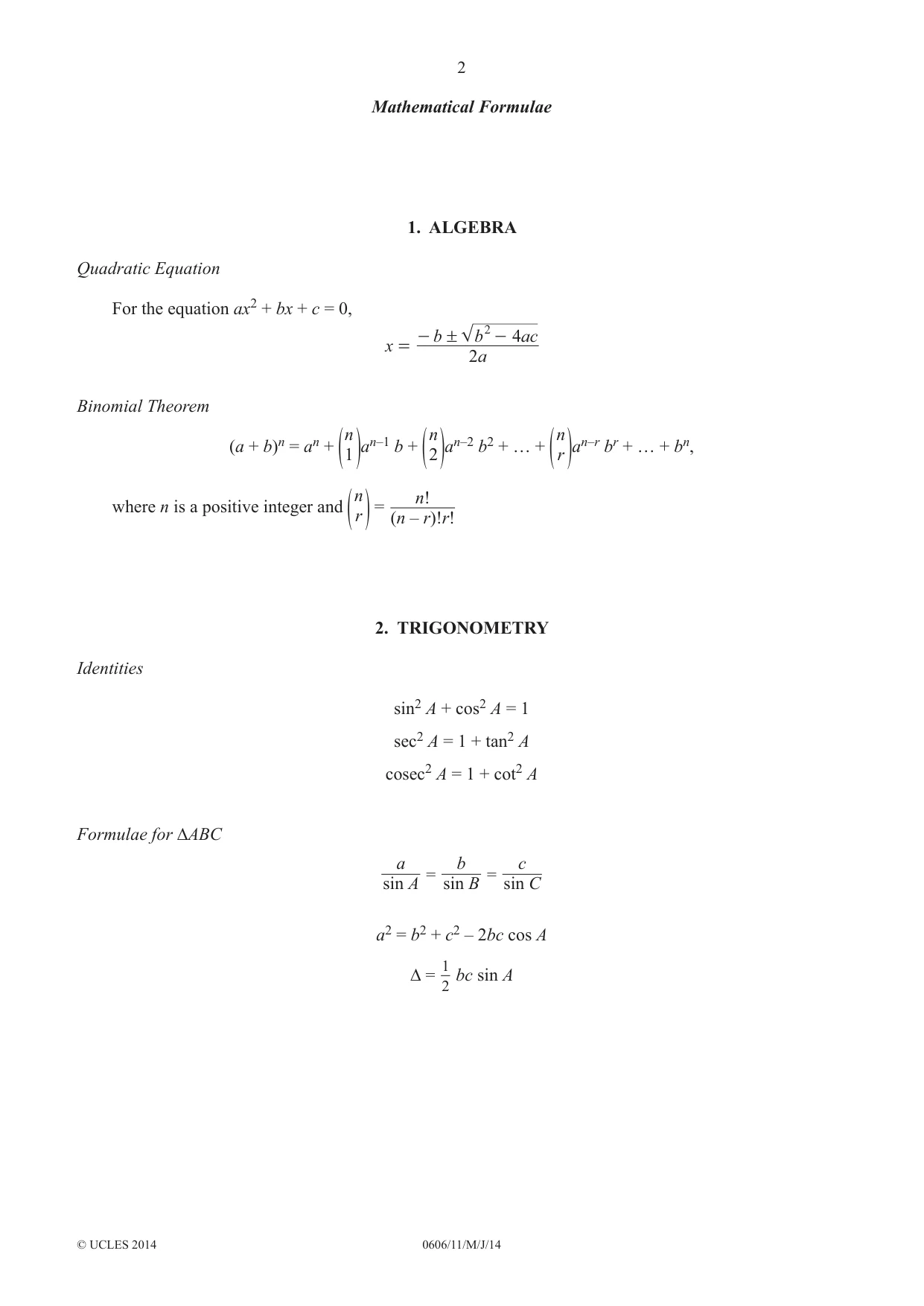
2 0606/11/M/J/14 © UCLES 2014 Mathematical Formulae 1. ALGEBRA Quadratic Equation For the equation ax2 + bx + c = 0, x a b b ac 2 4 2 ! = - - Binomial Theorem (a + b)n = an + ( n 1)an–1 b + ( n 2)an–2 b2 + … + ( n r)an–r br + … + bn, where n is a positive integer and ( n r) = n! (n – r)!r! 2. TRIGONOMETRY Identities sin2 A + cos2 A = 1 sec2 A = 1 + tan2 A cosec2 A = 1 + cot2 A Formulae for ∆ABC a sin A = b sin B = c sin C a2 = b2 + c2 – 2bc cos A ∆ = 1 2 bc sin A
Question paper, page 3
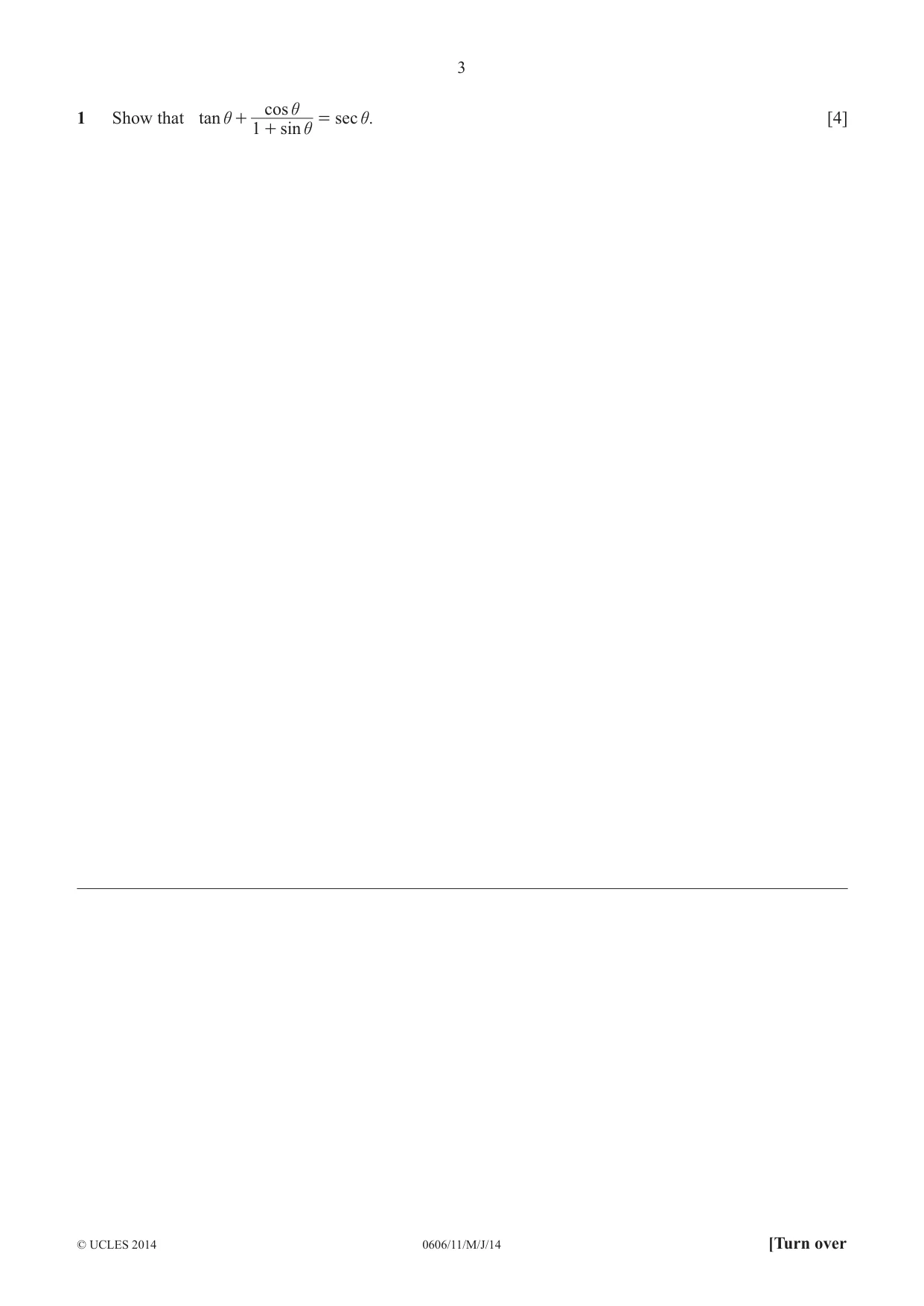
3 0606/11/M/J/14 © UCLES 2014 [Turn over 1 Show that . tan sin cos sec 1 i i i i + + = [4]
Question paper, page 4
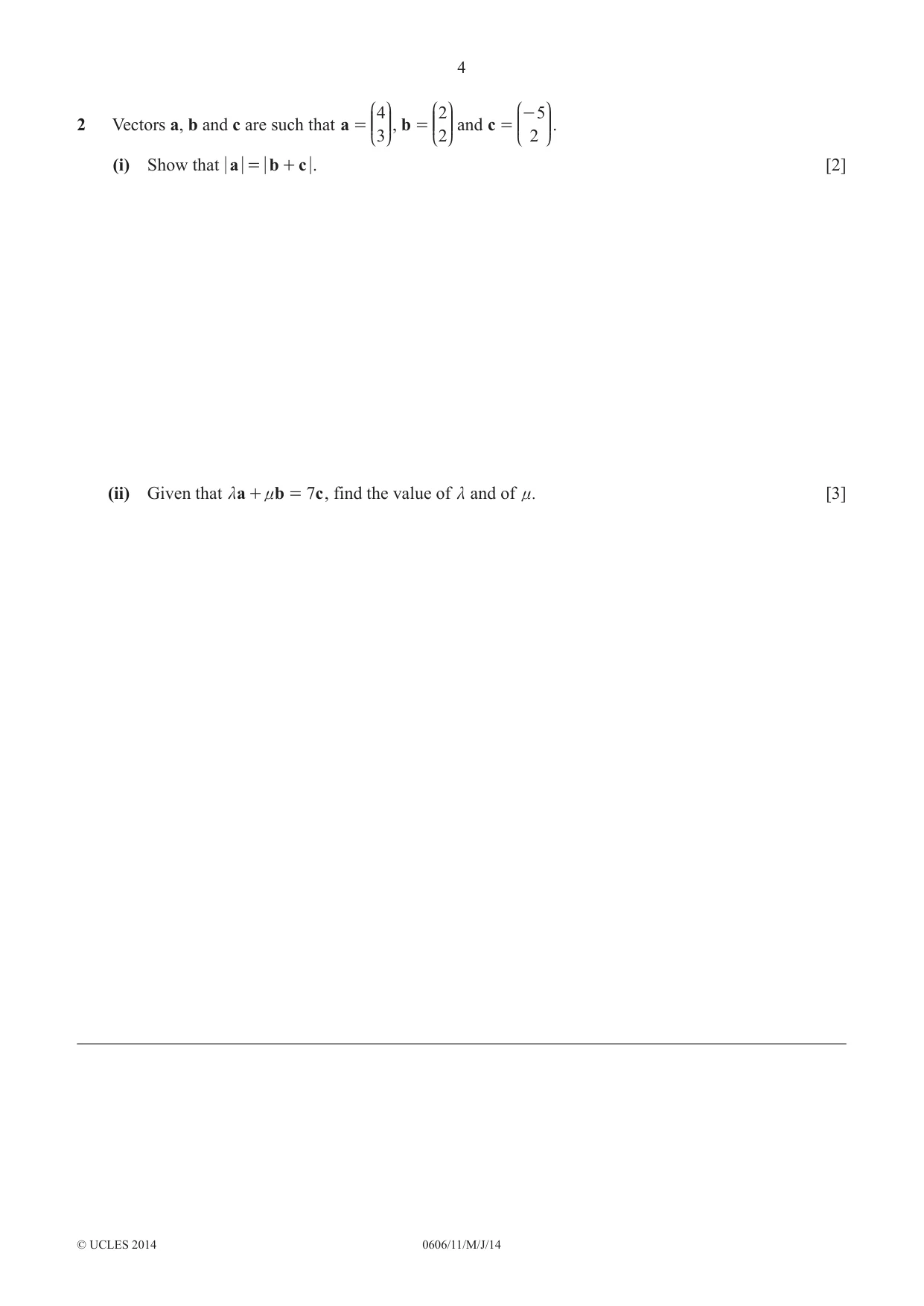
4 0606/11/M/J/14 © UCLES 2014 2 Vectors a, b and c are such that , and a b c 4 3 2 2 5 2 = = = - J L KK J L KK J L KK N P OO N P OO N P OO. (i) Show that . a b c = + [2] (ii) Given that a b c 7 m n + = , find the value of m and of . n [3]
Question paper, page 5
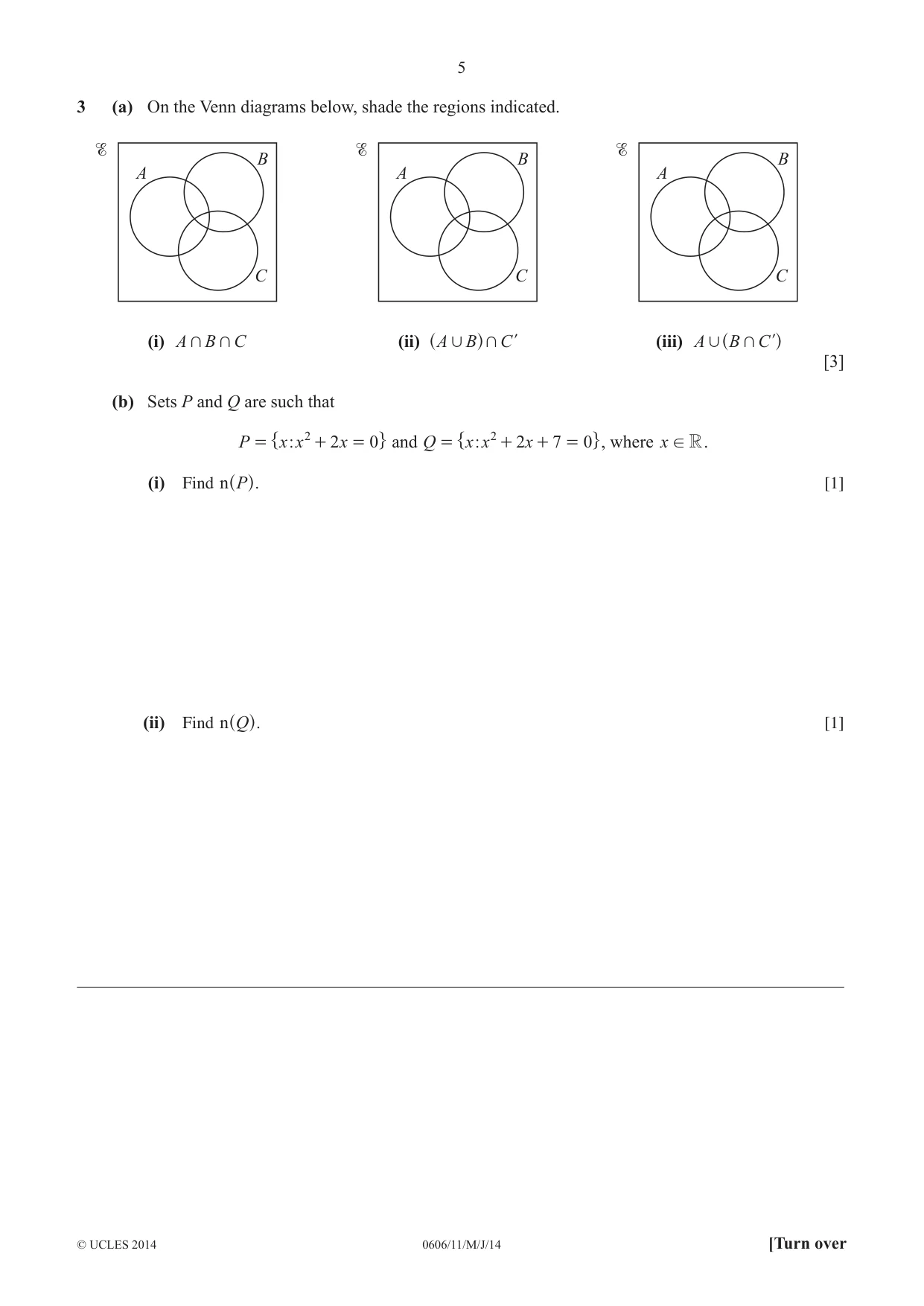
5 0606/11/M/J/14 © UCLES 2014 [Turn over 3 (a) On the Venn diagrams below, shade the regions indicated. A C B A C B A C B (i) C A B + + (ii) A B C , + l ^ h (iii) A B C , + l ^ h [3] (b) Sets P and Q are such that : P x x x 2 0 2 = + = " , and : Q x x x 2 7 0 2 = + + = " ,, where x R ! . (i) Find . P n^ h [1] (ii) Find . Q n^ h [1]
Question paper, page 6
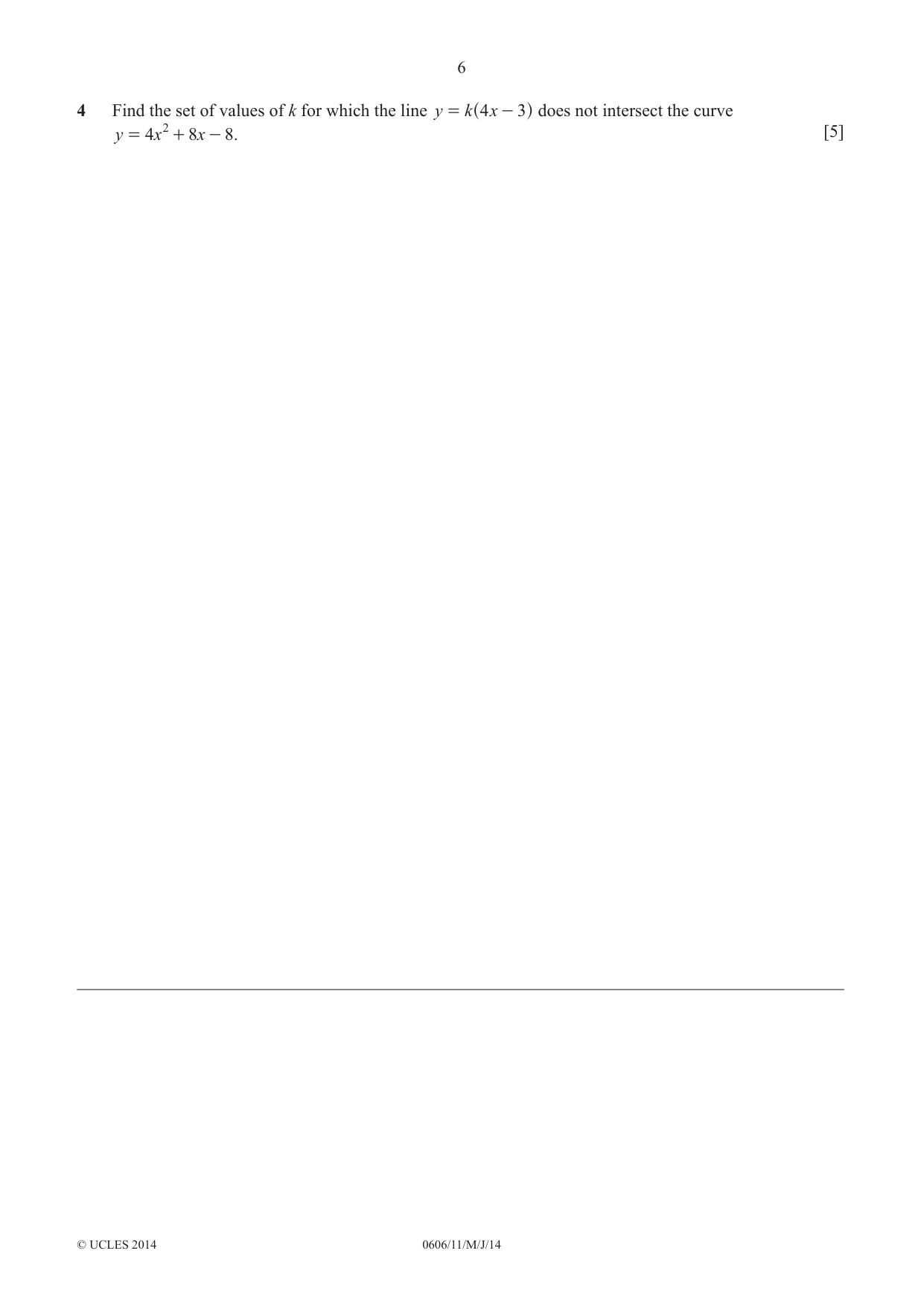
6 0606/11/M/J/14 © UCLES 2014 4 Find the set of values of k for which the line y k x 4 3 = - ^ h does not intersect the curve . y x x 4 8 8 2 = + - [5]
Question paper, page 7
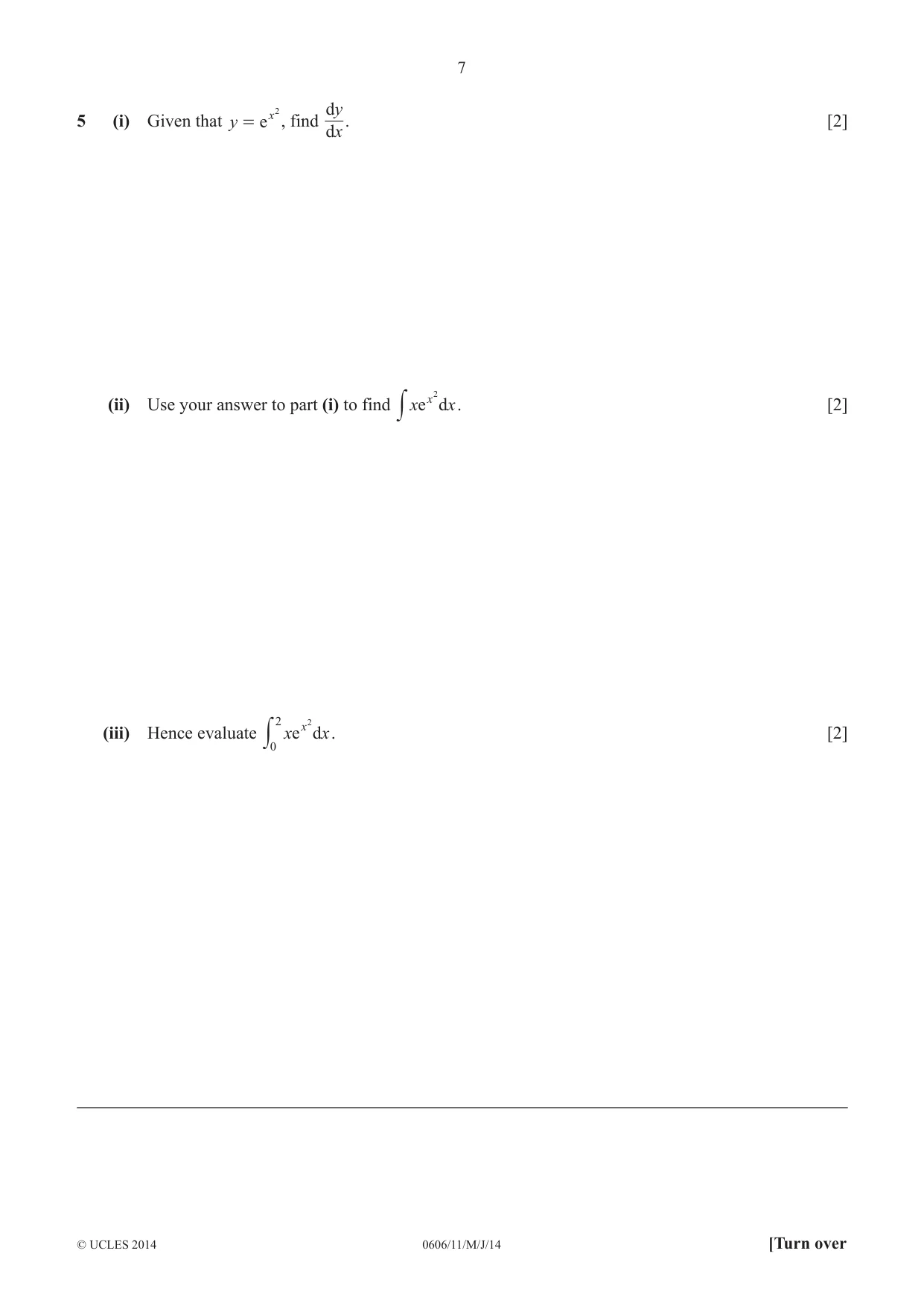
7 0606/11/M/J/14 © UCLES 2014 [Turn over 5 (i) Given that y ex2 = , find x y d d . [2] (ii) Use your answer to part (i) to find x x e d x2 y . [2] (iii) Hence evaluate x x e d x 0 2 2 y . [2]
Question paper, page 8
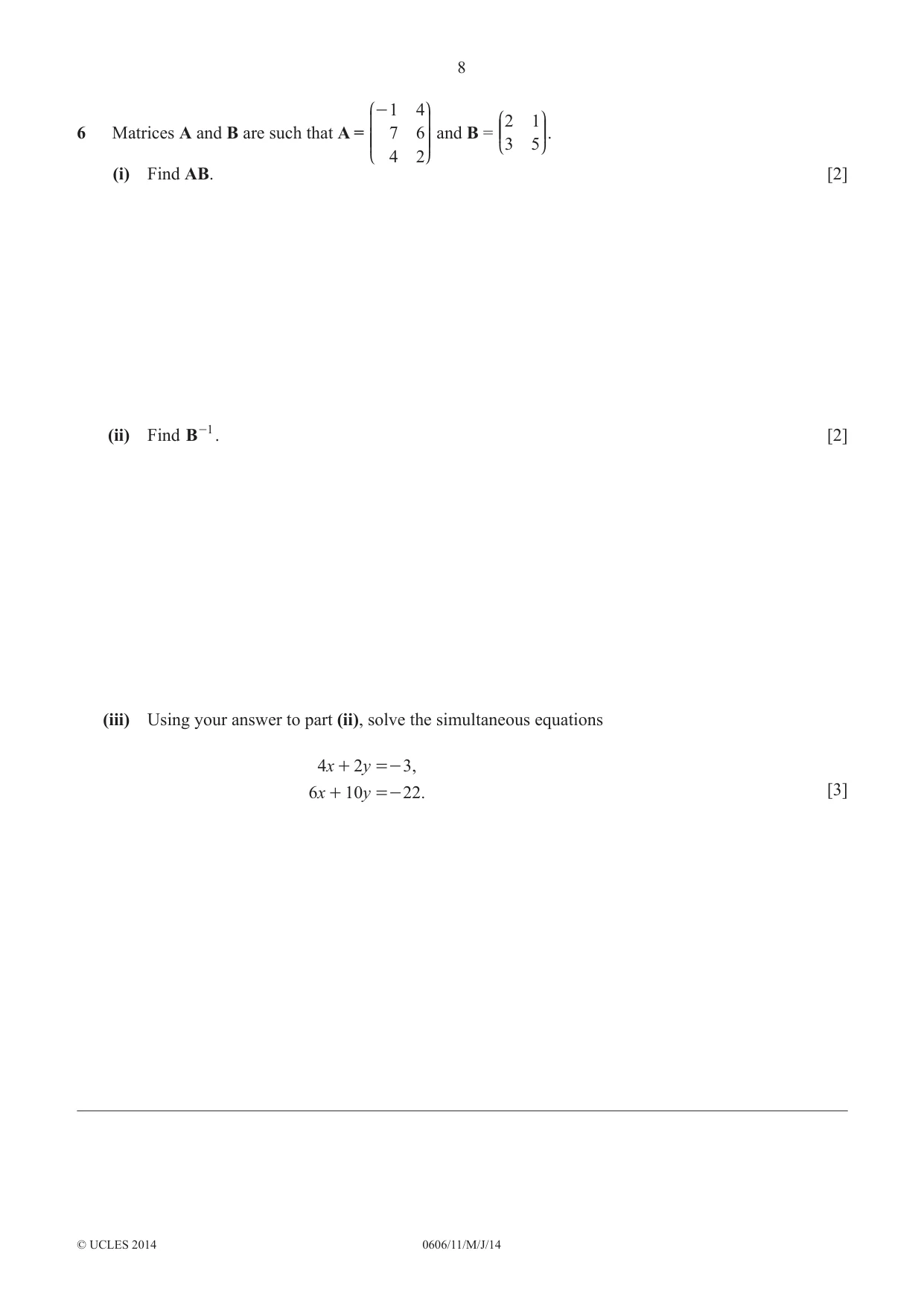
8 0606/11/M/J/14 © UCLES 2014 6 Matrices A and B are such that A = 1 7 4 4 6 2 - J L K KK N P O OO and B = 2 3 1 5 J L KK N P OO. (i) Find AB. [2] (ii) Find B 1 - . [2] (iii) Using your answer to part (ii), solve the simultaneous equations , . x y x y 4 2 3 6 10 22 + =- + =- [3]
Question paper, page 9
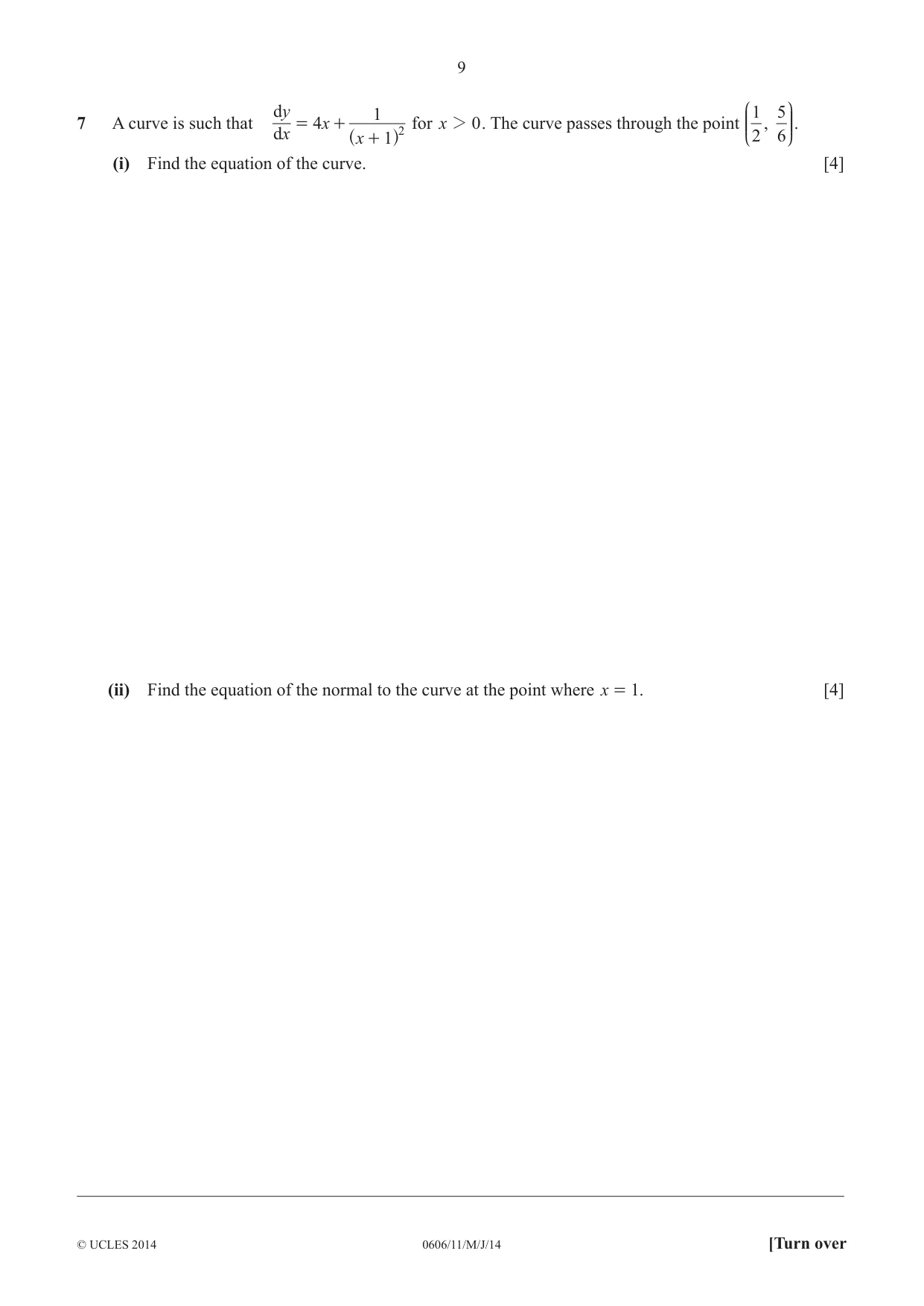
9 0606/11/M/J/14 © UCLES 2014 [Turn over 7 A curve is such that x y x x 4 1 1 d d 2 = + + ^ h for x 0 2 . The curve passes through the point , 2 1 6 5 J L KK N P OO. (i) Find the equation of the curve. [4] (ii) Find the equation of the normal to the curve at the point where x 1 = . [4]
Question paper, page 10
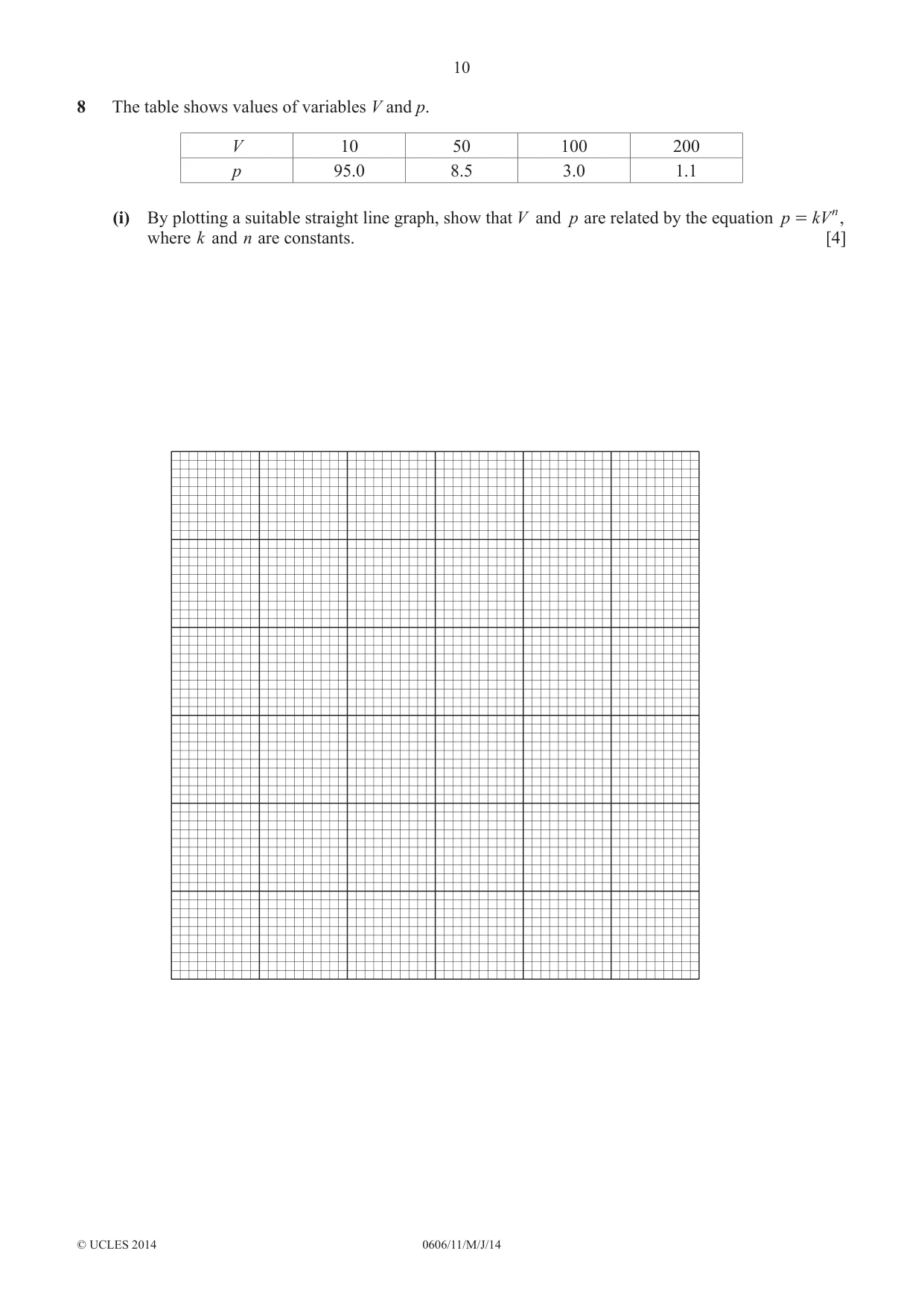
10 0606/11/M/J/14 © UCLES 2014 8 The table shows values of variables V and p. V 10 50 100 200 p 95.0 8.5 3.0 1.1 (i) By plotting a suitable straight line graph, show that V and p are related by the equation p kVn = , where k and n are constants. [4]
Question paper, page 11
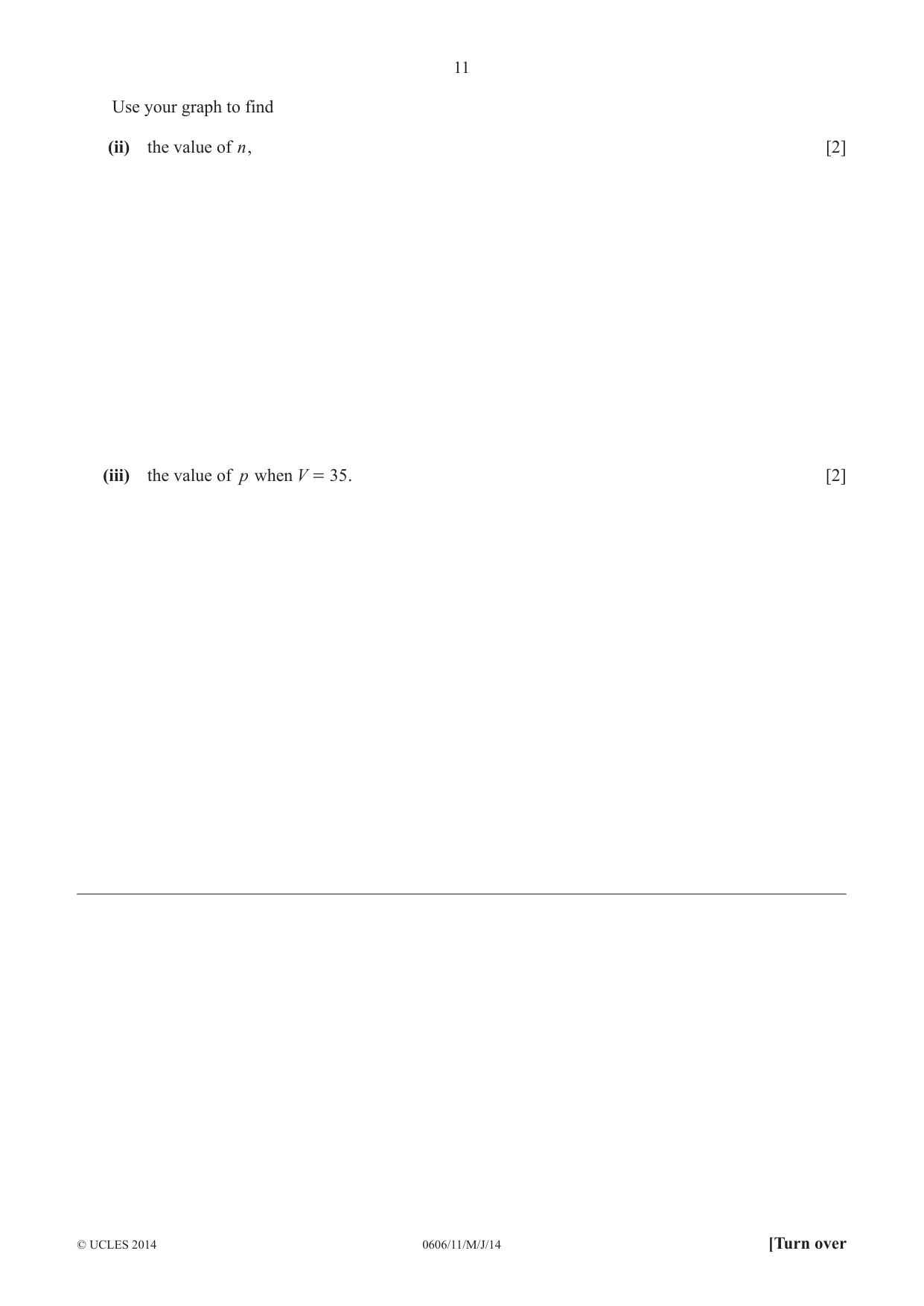
11 0606/11/M/J/14 © UCLES 2014 [Turn over Use your graph to find (ii) the value of n, [2] (iii) the value of p when V 35 = . [2]
Question paper, page 12
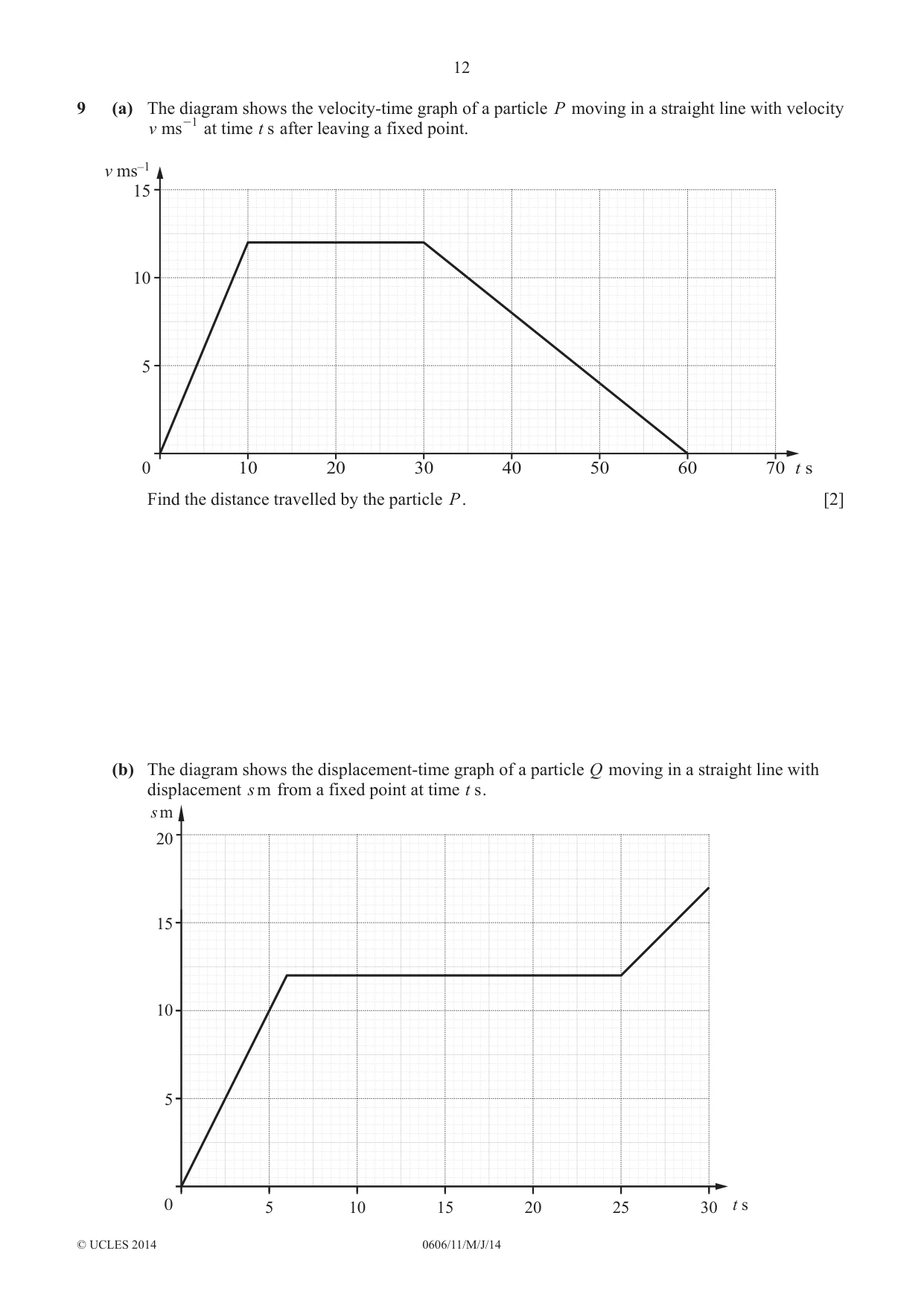
12 0606/11/M/J/14 © UCLES 2014 9 (a) The diagram shows the velocity-time graph of a particle P moving in a straight line with velocity v ms 1 - at time t s after leaving a fixed point. 5 0 10 20 30 40 50 60 70 t s 10 15 v ms–1 Find the distance travelled by the particle P. [2] (b) The diagram shows the displacement-time graph of a particle Q moving in a straight line with displacement sm from a fixed point at time t s. 5 0 5 10 15 20 25 30 t s 10 15 s m 20
Question paper, page 13
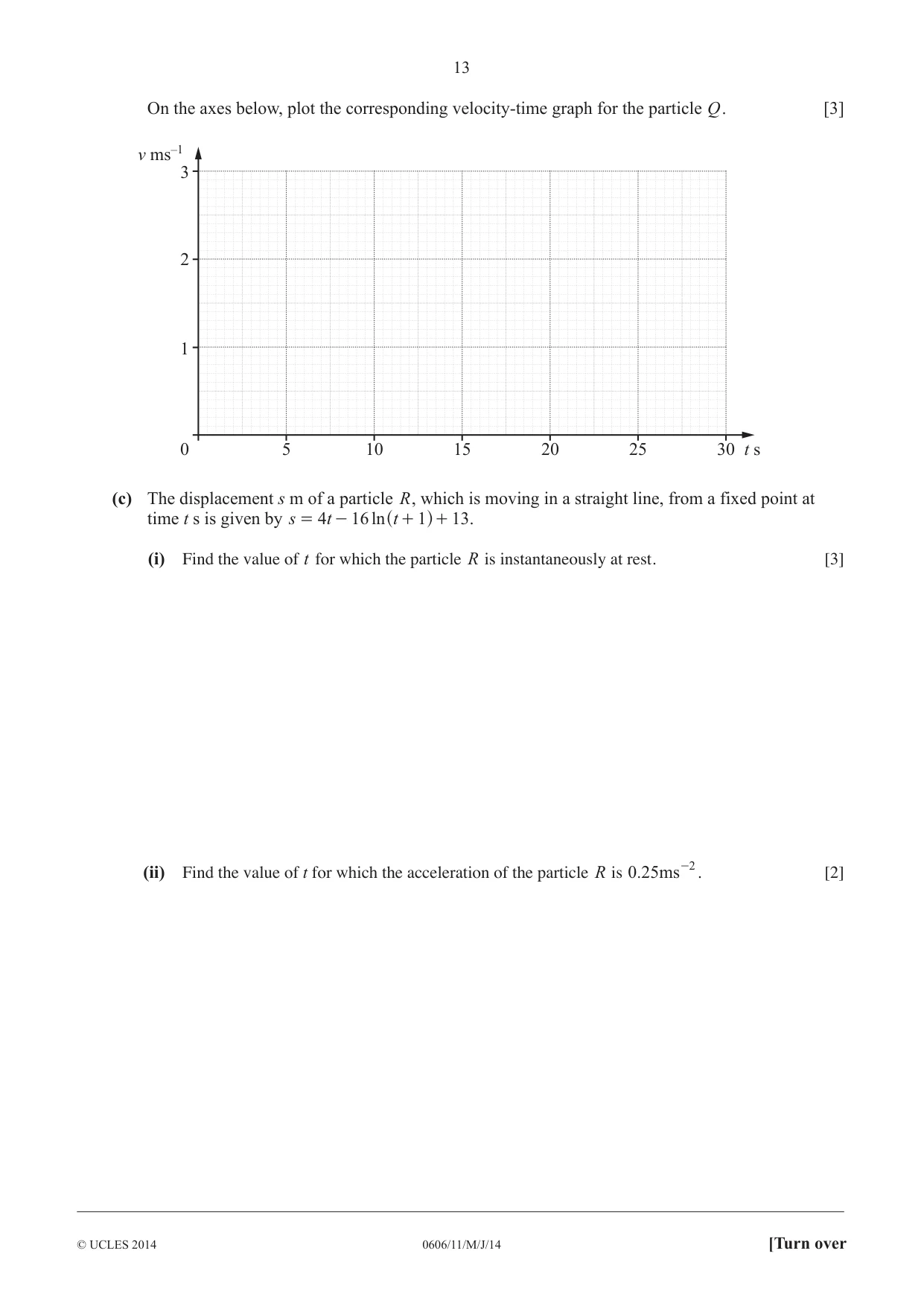
13 0606/11/M/J/14 © UCLES 2014 [Turn over On the axes below, plot the corresponding velocity-time graph for the particle Q. [3] 1 0 5 10 15 20 25 30 t s 2 3 v ms–1 (c) The displacement s m of a particle R, which is moving in a straight line, from a fixed point at time t s is given by ln s t t 4 16 1 13 = - + + ^ h . (i) Find the value of t for which the particle R is instantaneously at rest. [3] (ii) Find the value of t for which the acceleration of the particle R is .0 25ms 2 - . [2]
Question paper, page 14
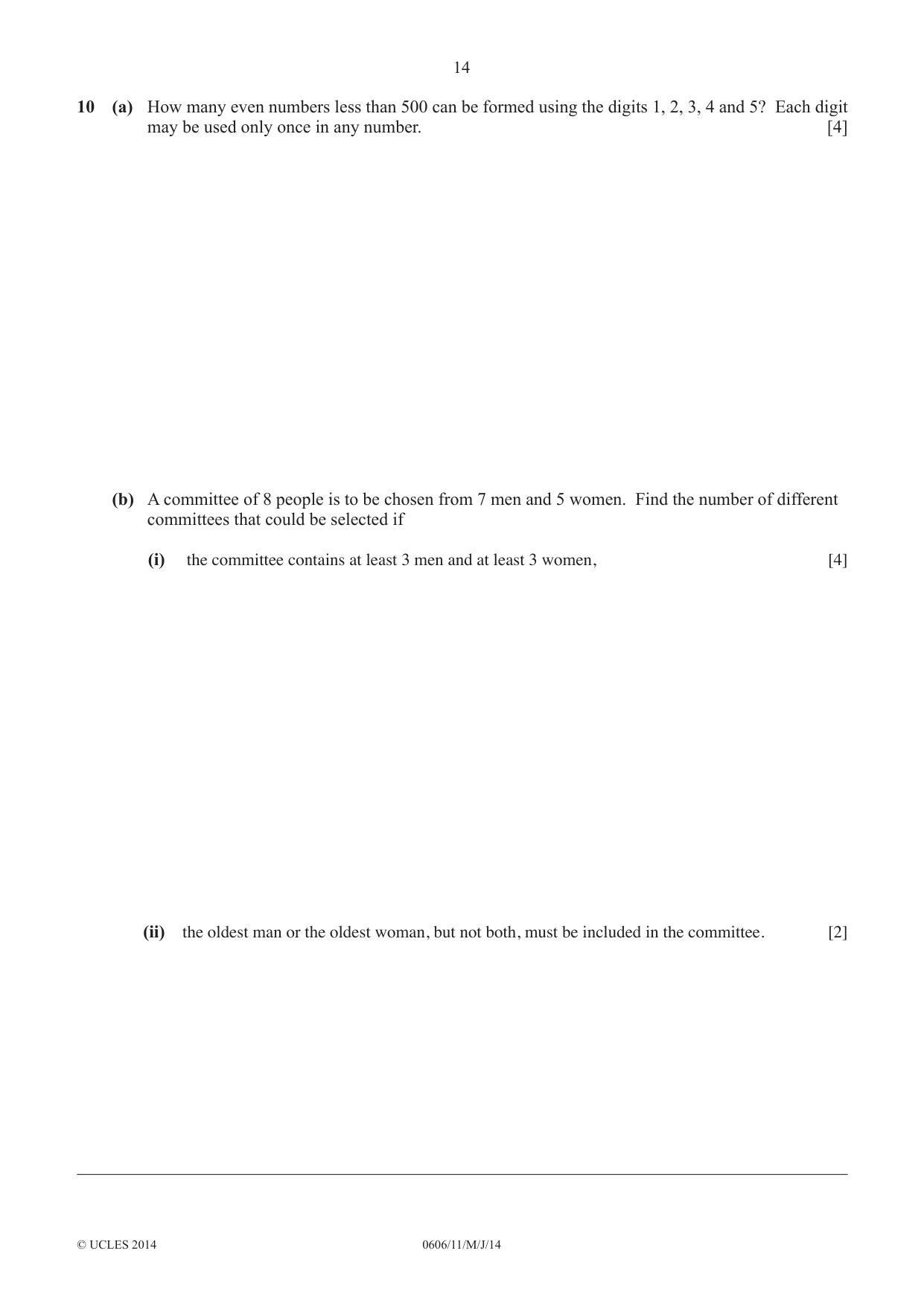
14 0606/11/M/J/14 © UCLES 2014 10 (a) How many even numbers less than 500 can be formed using the digits 1, 2, 3, 4 and 5? Each digit may be used only once in any number. [4] (b) A committee of 8 people is to be chosen from 7 men and 5 women. Find the number of different committees that could be selected if (i) the committee contains at least 3 men and at least 3 women, [4] (ii) the oldest man or the oldest woman, but not both, must be included in the committee. [2]
Question paper, page 15
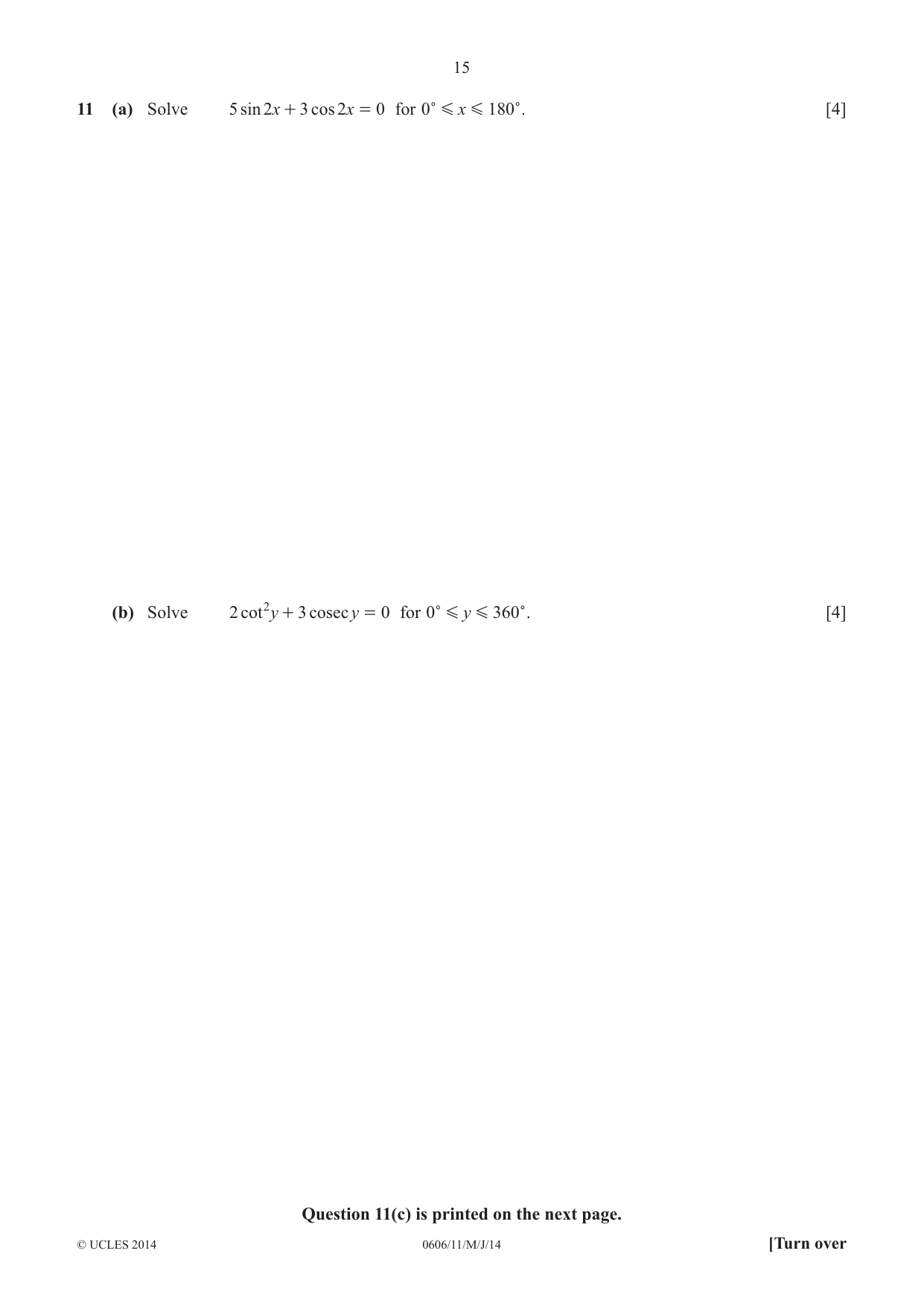
15 0606/11/M/J/14 © UCLES 2014 [Turn over 11 (a) Solve sin cos x x 5 2 3 2 0 + = for x 0 180 c c G G . [4] (b) Solve cot cosec y y 2 3 0 2 + = for y 0 360 c c G G . [4] Question 11(c) is printed on the next page.
Question paper, page 16
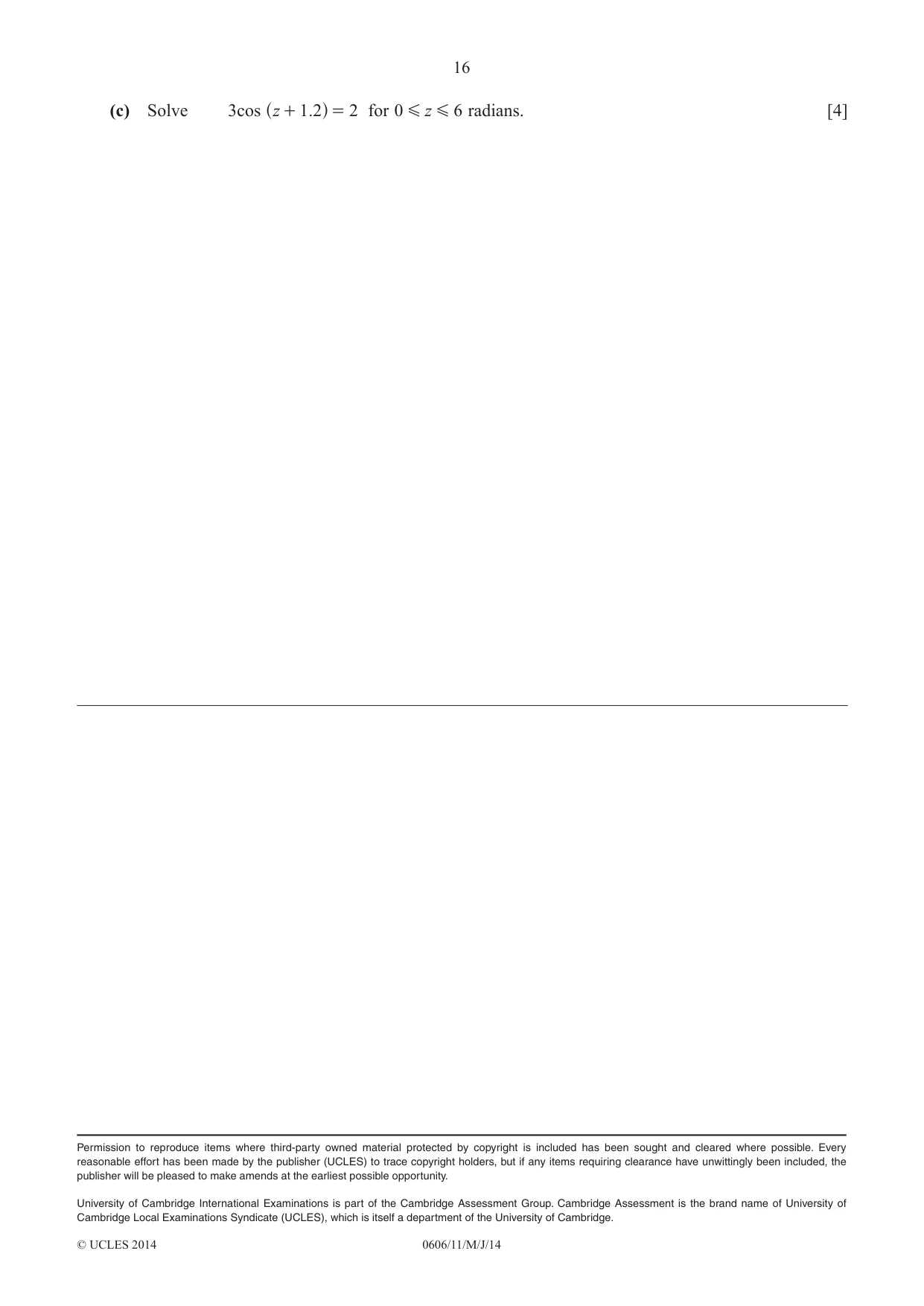
16 0606/11/M/J/14 © UCLES 2014 Permission to reproduce items where third-party owned material protected by copyright is included has been sought and cleared where possible. Every reasonable effort has been made by the publisher (UCLES) to trace copyright holders, but if any items requiring clearance have unwittingly been included, the publisher will be pleased to make amends at the earliest possible opportunity. University of Cambridge International Examinations is part of the Cambridge Assessment Group. Cambridge Assessment is the brand name of University of Cambridge Local Examinations Syndicate (UCLES), which is itself a department of the University of Cambridge. (c) Solve 3cos . z 1 2 2 + = ^ h for z 0 6 G G radians. [4]
Mark scheme, page 1
CAMBRIDGE INTERNATIONAL EXAMINATIONS International General Certificate of Secondary Education MARK SCHEME for the May/June 2014 series 0606 ADDITIONAL MATHEMATICS 0606/11 Paper 1, maximum raw mark 80 This mark scheme is published as an aid to teachers and candidates, to indicate the requirements of the examination. It shows the basis on which Examiners were instructed to award marks. It does not indicate the details of the discussions that took place at an Examiners’ meeting before marking began, which would have considered the acceptability of alternative answers. Mark schemes should be read in conjunction with the question paper and the Principal Examiner Report for Teachers. Cambridge will not enter into discussions about these mark schemes. Cambridge is publishing the mark schemes for the May/June 2014 series for most IGCSE, GCE Advanced Level and Advanced Subsidiary Level components and some Ordinary Level components.
Mark scheme, page 2
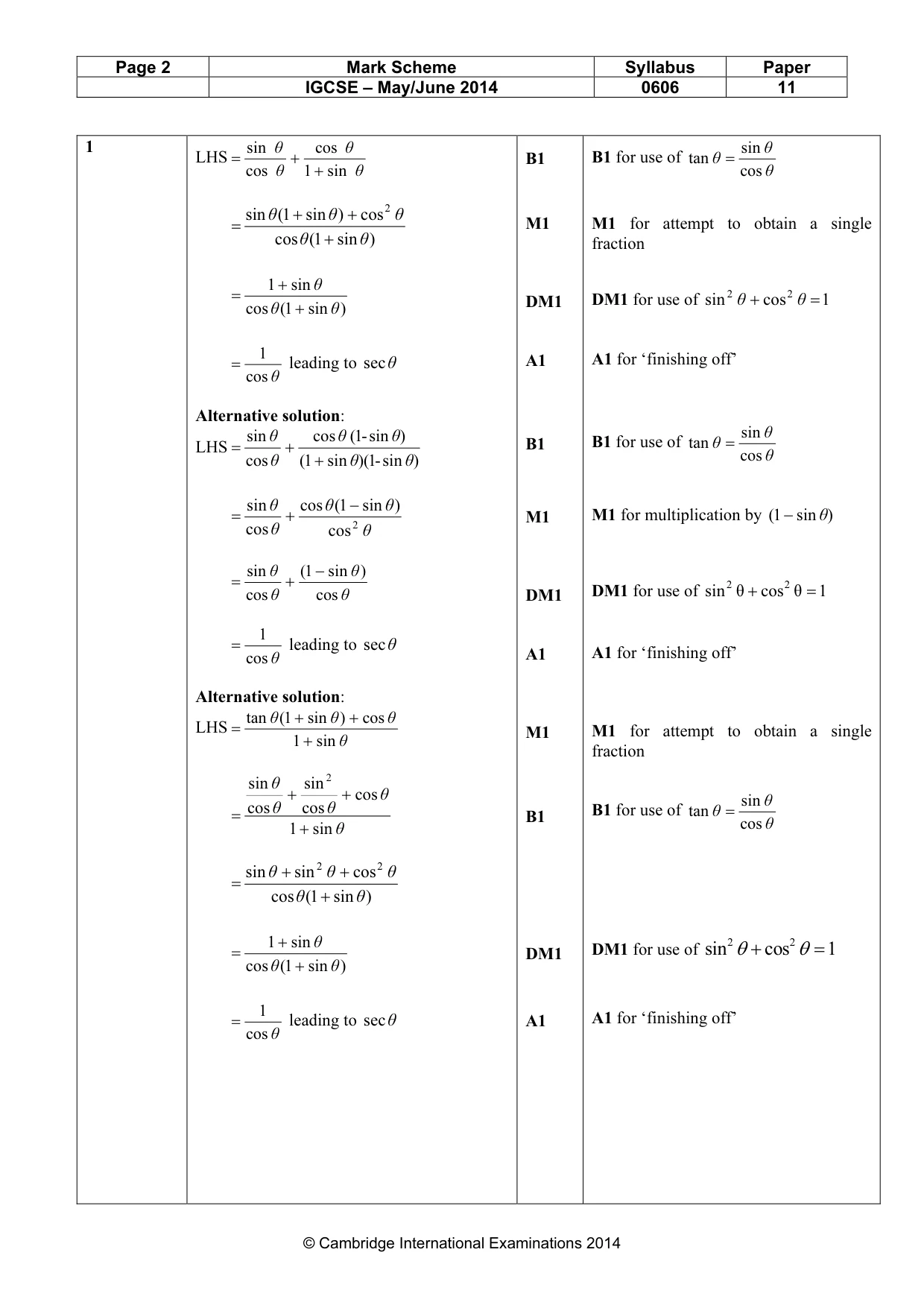
Page 2 Mark Scheme Syllabus Paper IGCSE – May/June 2014 0606 11 © Cambridge International Examinations 2014 1 LHS θ θ θ θ sin 1 cos cos sin + + = ) sin 1( cos cos ) sin 1( sin 2 θ θ θ θ θ + + + = ) sin 1( cos sin 1 θ θ θ + + = θ cos 1 = leading to θ sec Alternative solution: LHS ) sin -1 )( sin 1( ) sin -1( cos cos sin θ θ θ θ θ θ + + = θ θ θ θ θ 2 cos ) sin 1( cos cos sin − + = θ θ θ θ cos ) sin 1( cos sin − + = θ cos 1 = leading to θ sec Alternative solution: LHS θ θ θ θ sin 1 cos ) sin 1( tan + + + = θ θ θ θ θ sin 1 cos cos sin cos sin 2 + + + = ) sin 1( cos cos sin sin 2 2 θ θ θ θ θ + + + = ) sin 1( cos sin 1 θ θ θ + + = θ cos 1 = leading to θ sec B1 M1 DM1 A1 B1 M1 DM1 A1 M1 B1 DM1 A1 B1 for use of θ θ θ cos sin tan = M1 for attempt to obtain a single fraction DM1 for use of 1 cos sin 2 2 = + θ θ A1 for ‘finishing off’ B1 for use of θ θ θ cos sin tan = M1 for multiplication by ) sin 1( θ − DM1 for use of 1 θ cos θ sin 2 2 = + A1 for ‘finishing off’ M1 for attempt to obtain a single fraction B1 for use of θ θ θ cos sin tan = DM1 for use of 2 2 sin cos 1 θ θ + = A1 for ‘finishing off’
Mark scheme, page 3
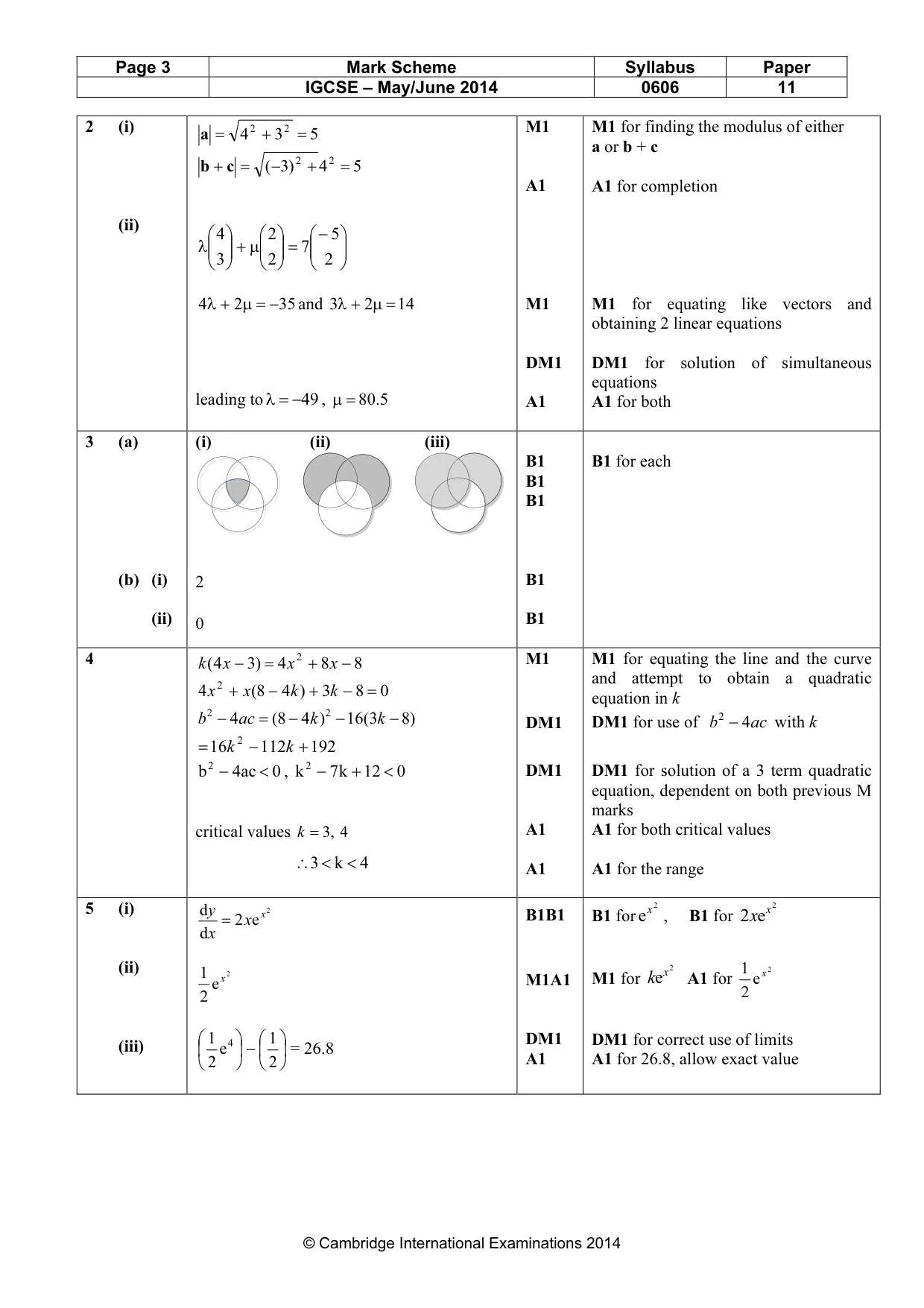
Page 3 Mark Scheme Syllabus Paper IGCSE – May/June 2014 0606 11 © Cambridge International Examinations 2014 2 (i) (ii) 5 3 4 2 2 = + = a 5 4 ) 3 ( 2 2 = + − = + c b − = µ + λ 2 5 7 2 2 3 4 35 2 4 − = µ + λ and 14 2 3 = µ + λ leading to 49 − = λ , 5. 80 = µ M1 A1 M1 DM1 A1 M1 for finding the modulus of either a or b + c A1 for completion M1 for equating like vectors and obtaining 2 linear equations DM1 for solution of simultaneous equations A1 for both 3 (a) (b) (i) (ii) (i) (ii) (iii) 2 0 B1 B1 B1 B1 B1 B1 for each 4 8 8 4 ) 3 4 ( 2 − + = − x x x k 0 8 3 ) 4 8 ( 4 2 = − + − + k k x x ) 8 3 ( 16 ) 4 8 ( 4 2 2 − − − = − k k ac b 192 112 16 2 + − = k k 0 ac 4 b2 < − , 0 12 k 7 k 2 < + − critical values 4 , 3 = k 4 k 3 < < ∴ M1 DM1 DM1 A1 A1 M1 for equating the line and the curve and attempt to obtain a quadratic equation in k DM1 for use of ac b 4 2 − with k DM1 for solution of a 3 term quadratic equation, dependent on both previous M marks A1 for both critical values A1 for the range 5 (i) (ii) (iii) 2 e 2 d d x x x y = 2 e 2 1 x − 2 1 e 2 1 4 = 26.8 B1B1 M1A1 DM1 A1 B1 for 2 ex , B1 for 2 e 2 x x M1 for 2 ex k A1 for 2 e 2 1 x DM1 for correct use of limits A1 for 26.8, allow exact value
Mark scheme, page 4
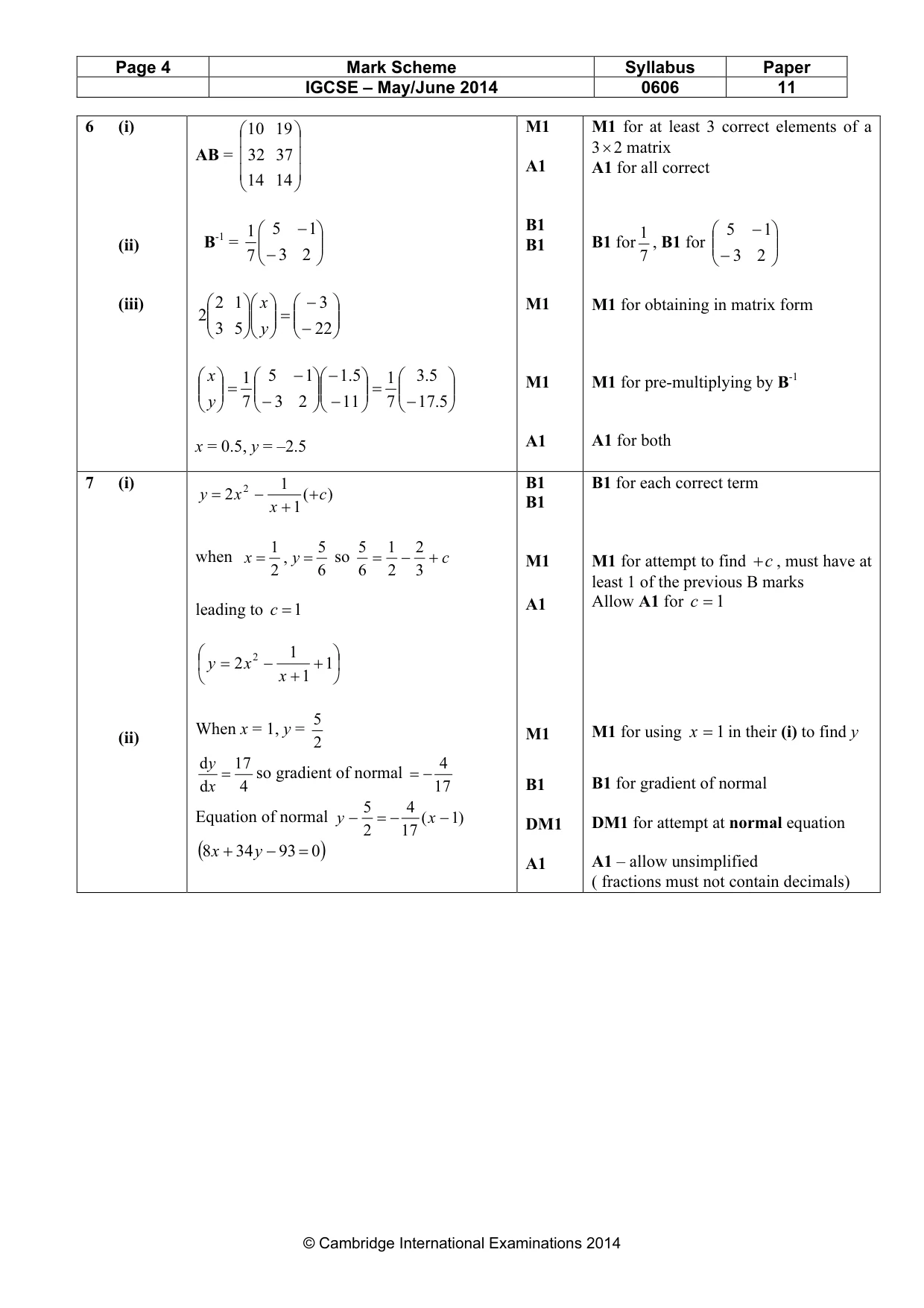
Page 4 Mark Scheme Syllabus Paper IGCSE – May/June 2014 0606 11 © Cambridge International Examinations 2014 6 (i) (ii) (iii) AB = 14 37 19 14 32 10 B-1 = − − 2 1 3 5 7 1 − − = 22 3 5 1 3 2 2 y x − = − − − − = 5. 17 5.3 7 1 11 5.1 2 1 3 5 7 1 y x x = 0.5, y = –2.5 M1 A1 B1 B1 M1 M1 A1 M1 for at least 3 correct elements of a 3 × 2 matrix A1 for all correct B1 for 7 1 , B1 for − − 2 1 3 5 M1 for obtaining in matrix form M1 for pre-multiplying by B-1 A1 for both 7 (i) (ii) ) ( 1 1 2 2 c x x y + + − = when 6 5 , 2 1 y x = = so c + − = 3 2 2 1 6 5 leading to 1 = c + + − = 1 1 1 2 2 x x y When x = 1, y = 2 5 4 17 d d = x y so gradient of normal 17 4 − = Equation of normal )1 ( 17 4 2 5 − − = − x y ( ) 0 93 34 8 = − + y x B1 B1 M1 A1 M1 B1 DM1 A1 B1 for each correct term M1 for attempt to find c + , must have at least 1 of the previous B marks Allow A1 for 1 c = M1 for using 1 x = in their (i) to find y B1 for gradient of normal DM1 for attempt at normal equation A1 – allow unsimplified ( fractions must not contain decimals)
Mark scheme, page 5
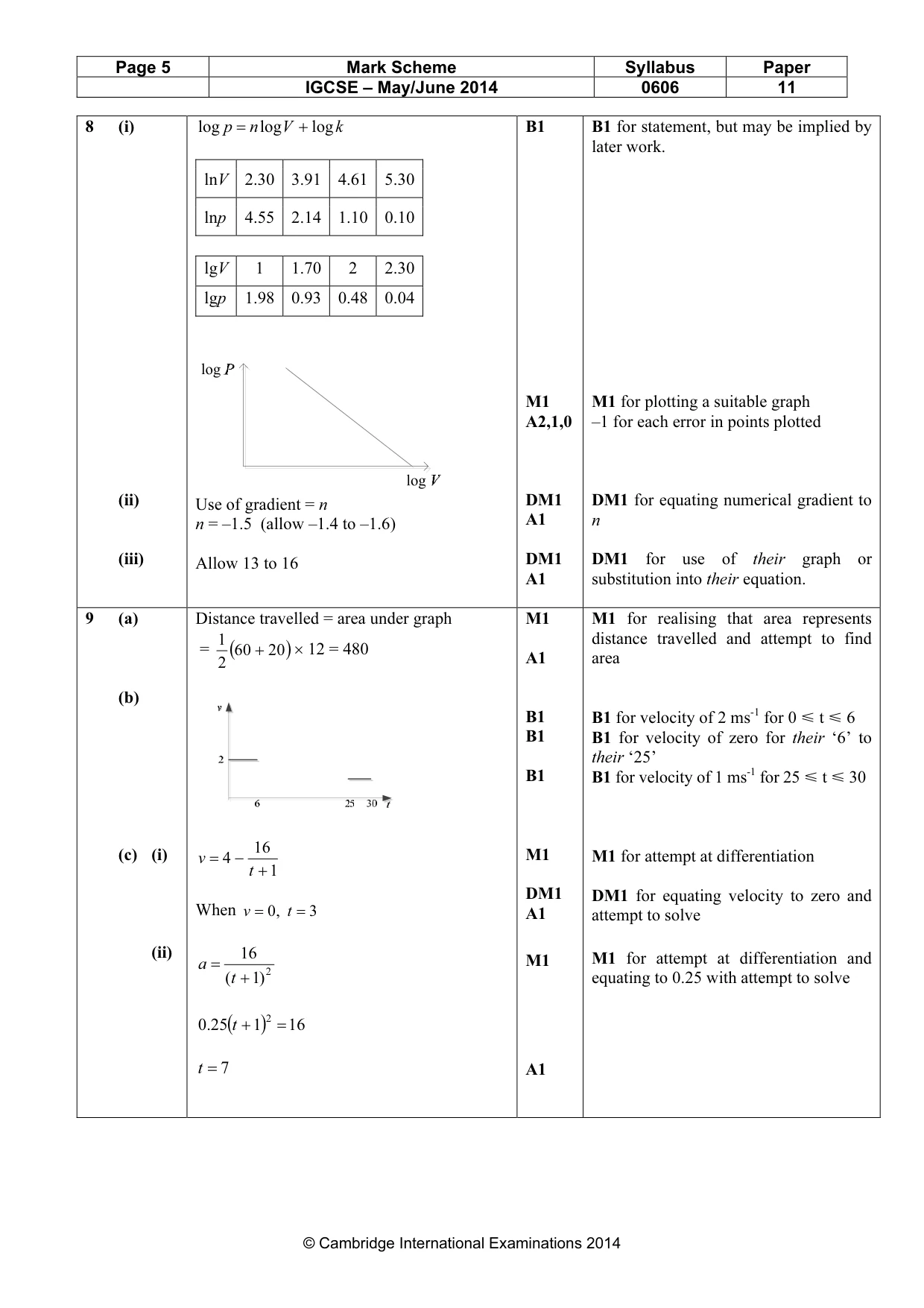
Page 5 Mark Scheme Syllabus Paper IGCSE – May/June 2014 0606 11 © Cambridge International Examinations 2014 8 (i) (ii) (iii) k V n p log log log + = lnV 2.30 3.91 4.61 5.30 lnp 4.55 2.14 1.10 0.10 lgV 1 1.70 2 2.30 lgp 1.98 0.93 0.48 0.04 Use of gradient = n n = –1.5 (allow –1.4 to –1.6) Allow 13 to 16 B1 M1 A2,1,0 DM1 A1 DM1 A1 B1 for statement, but may be implied by later work. M1 for plotting a suitable graph –1 for each error in points plotted DM1 for equating numerical gradient to n DM1 for use of their graph or substitution into their equation. 9 (a) (b) (c) (i) (ii) Distance travelled = area under graph = ( ) 20 60 2 1 + × 12 = 480 1 16 4 + − = t v When 3 ,0 = = t v 2)1 ( 16 + = t a ( ) 16 1 25 .0 2 = + t 7 = t M1 A1 B1 B1 B1 M1 DM1 A1 M1 A1 M1 for realising that area represents distance travelled and attempt to find area B1 for velocity of 2 ms-1 for 0 Y t Y 6 B1 for velocity of zero for their ‘6’ to their ‘25’ B1 for velocity of 1 ms-1 for 25 Y t Y 30 M1 for attempt at differentiation DM1 for equating velocity to zero and attempt to solve M1 for attempt at differentiation and equating to 0.25 with attempt to solve
Mark scheme, page 6
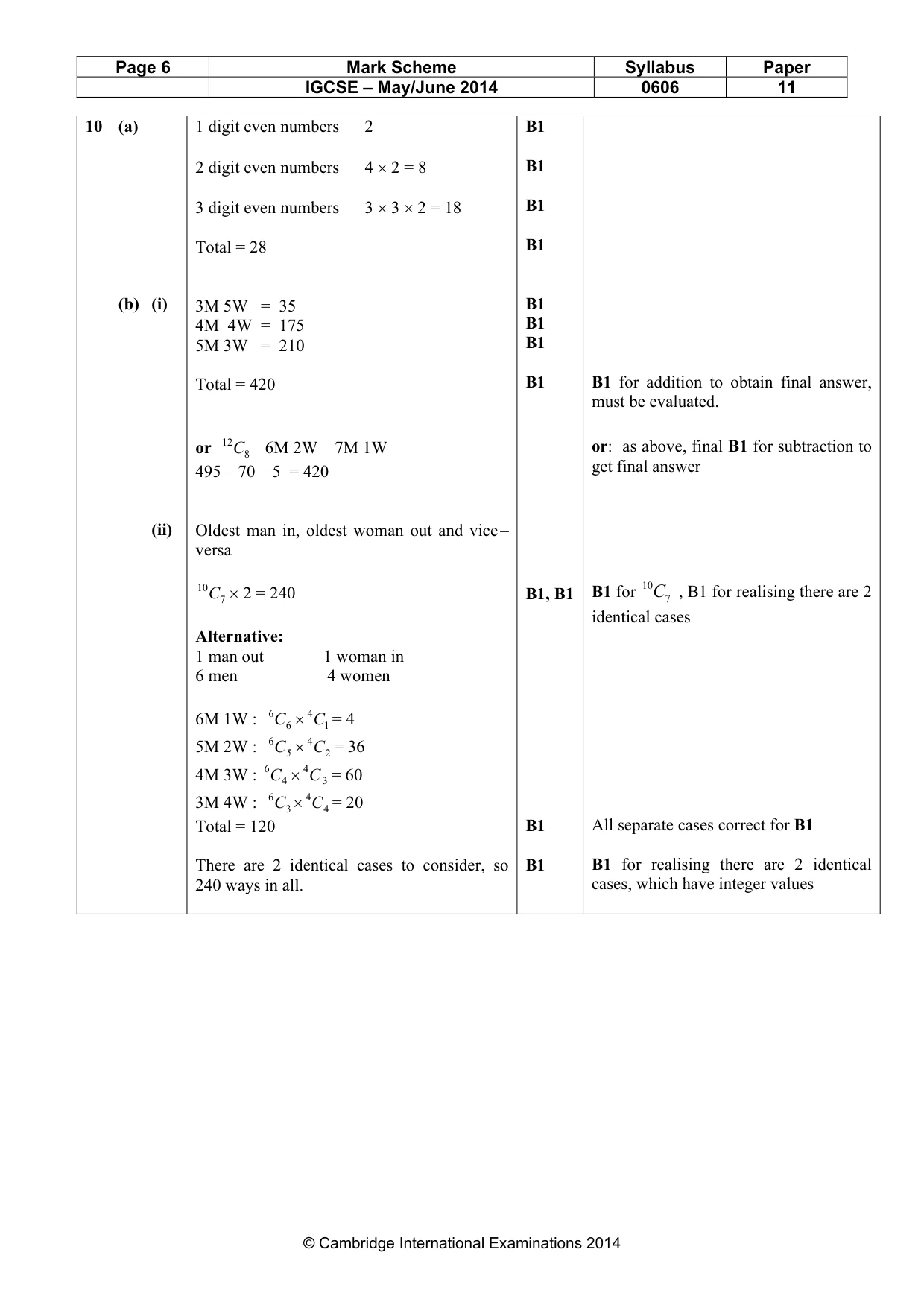
Page 6 Mark Scheme Syllabus Paper IGCSE – May/June 2014 0606 11 © Cambridge International Examinations 2014 10 (a) (b) (i) (ii) 1 digit even numbers 2 2 digit even numbers 4 × 2 = 8 3 digit even numbers 3 × 3 × 2 = 18 Total = 28 3M 5W = 35 4M 4W = 175 5M 3W = 210 Total = 420 or 8 12C – 6M 2W – 7M 1W 495 – 70 – 5 = 420 Oldest man in, oldest woman out and vice – versa 7 10C × 2 = 240 Alternative: 1 man out 1 woman in 6 men 4 women 6M 1W : 6 6C × 1 4C = 4 5M 2W : 5 C 6 × 2 4C = 36 4M 3W : 4 6C × 3 4C = 60 3M 4W : 3 6C × 4 4C = 20 Total = 120 There are 2 identical cases to consider, so 240 ways in all. B1 B1 B1 B1 B1 B1 B1 B1 B1, B1 B1 B1 B1 for addition to obtain final answer, must be evaluated. or: as above, final B1 for subtraction to get final answer B1 for 10 7 C , B1 for realising there are 2 identical cases All separate cases correct for B1 B1 for realising there are 2 identical cases, which have integer values
Mark scheme, page 7
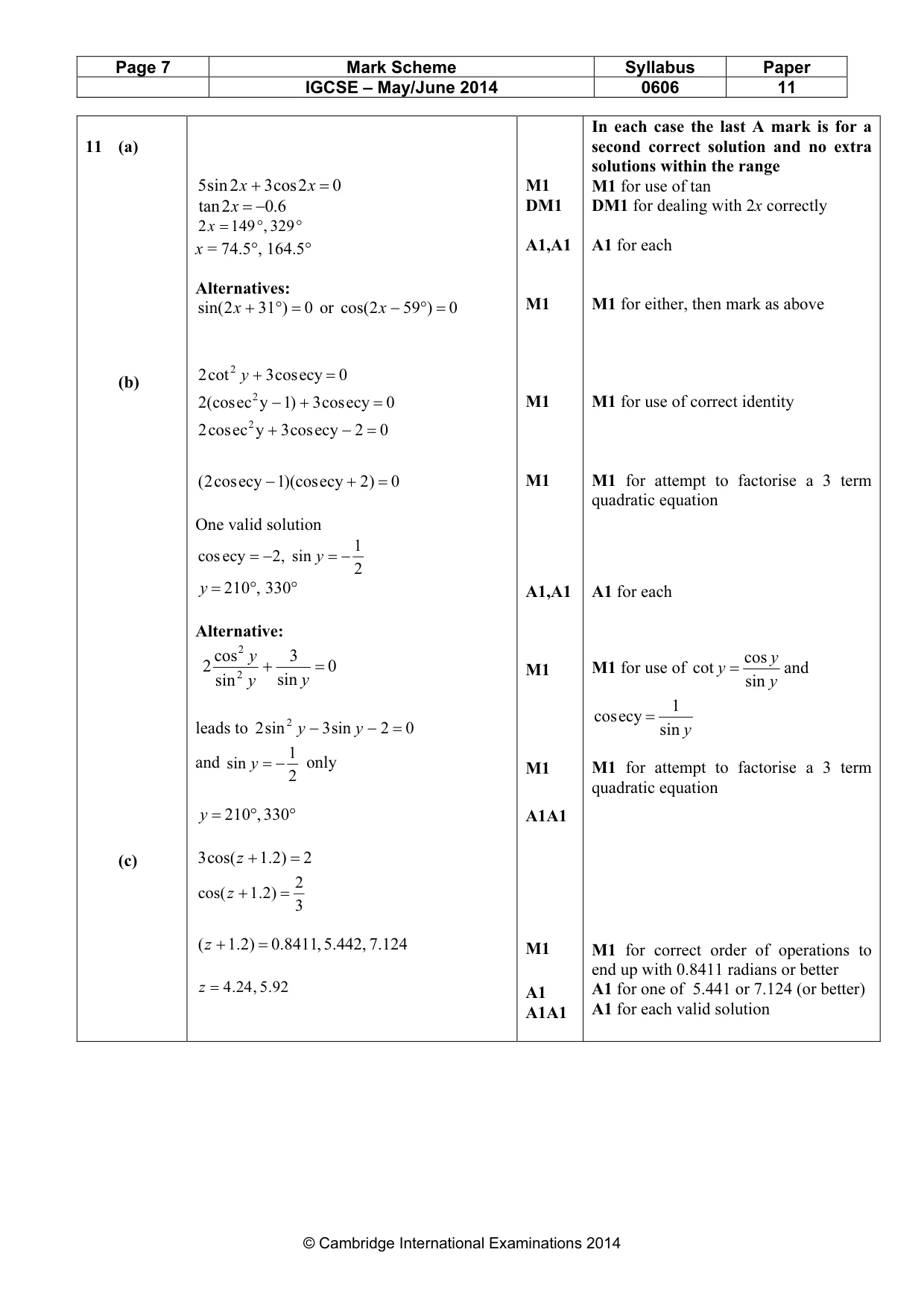
Page 7 Mark Scheme Syllabus Paper IGCSE – May/June 2014 0606 11 © Cambridge International Examinations 2014 11 (a) (b) (c) 0 2 cos 3 2 sin 5 = + x x 6.0 2 tan − = x ° ° = 329 , 149 2 x x = 74.5°, 164.5° Alternatives: 0 ) 31 2 sin( = ° + x or 0 ) 59 2 cos( = ° − x 0 ecy cos 3 cot 2 2 = + y 0 ecy cos 3 )1 y ec (cos 2 2 = + − 0 2 ecy cos 3 y ec cos 2 2 = − + 0 ) 2 ecy )(cos 1 ecy cos 2 ( = + − One valid solution 2 1 sin ,2 ecy cos − = − = y ° ° = 330 , 210 y Alternative: 0 sin 3 sin cos 2 2 2 = + y y y leads to 0 2 sin 3 sin 2 2 = − − y y and 2 1 sin − = y only ° ° = 330 , 210 y 2 ) 2.1 cos( 3 = + z 3 2 ) 2.1 cos( = + z 124 .7 , 442 .5 , 8411 .0 ) 2.1 ( z = + 92 .5 , 24 .4 z = M1 DM1 A1,A1 M1 M1 M1 A1,A1 M1 M1 A1A1 M1 A1 A1A1 In each case the last A mark is for a second correct solution and no extra solutions within the range M1 for use of tan DM1 for dealing with 2x correctly A1 for each M1 for either, then mark as above M1 for use of correct identity M1 for attempt to factorise a 3 term quadratic equation A1 for each M1 for use of y y y sin cos cot = and y sin 1 ecy cos = M1 for attempt to factorise a 3 term quadratic equation M1 for correct order of operations to end up with 0.8411 radians or better A1 for one of 5.441 or 7.124 (or better) A1 for each valid solution
What you needed in this session
Cambridge’s own grade thresholds for 2014 May/June, Paper 1 · Variant 1. A higher threshold means an easier paper — the bar moves with how the cohort did.