Cambridge IGCSE Mathematics - Additional 0606 — 2002 Oct/Nov Paper 1 · Variant 1
0606/11/O/N/02
The question paper and its mark scheme, free to read here and free to download. This is Cambridge’s own paper, exactly as it was sat.
Question paper8 pages

Mark scheme7 pages
Answers below. Sit the paper first if you are practising.
Paper as text
Question paper, page 1
International General Certificate of Secondary Education CAMBRIDGE INTERNATIONAL EXAMINATIONS ADDITIONAL MATHEMATICS 0606/1 PAPER 1 OCTOBER/NOVEMBER SESSION 2002 2 hours Additional materials: Answer paper Electronic calculator Graph paper Mathematical tables TIME 2hours INSTRUCTIONS TO CANDIDATES Write your name, Centre number and candidate number in the spaces provided on the answer paper/answer booklet. Answer all the questions. Write your answers on the separate answer paper provided. If you use more than one sheet of paper, fasten the sheets together. Give non-exact numerical answers correct to 3 significant figures, or 1 decimal place in the case of angles in degrees, unless a different level of accuracy is specified in the question. INFORMATION FOR CANDIDATES The number of marks is given in brackets [ ] at the end of each question or part question. The total number of marks for this paper is 80. The use of an electronic calculator is expected, where appropriate. You are reminded of the need for clear presentation in your answers. This question paper consists of 5 printed pages and 3 blank pages. (NH/TC) $22559 © CIE 2002 University of CAMBRIDGE [Turn over Local Examinations Syndicate
Question paper, page 2
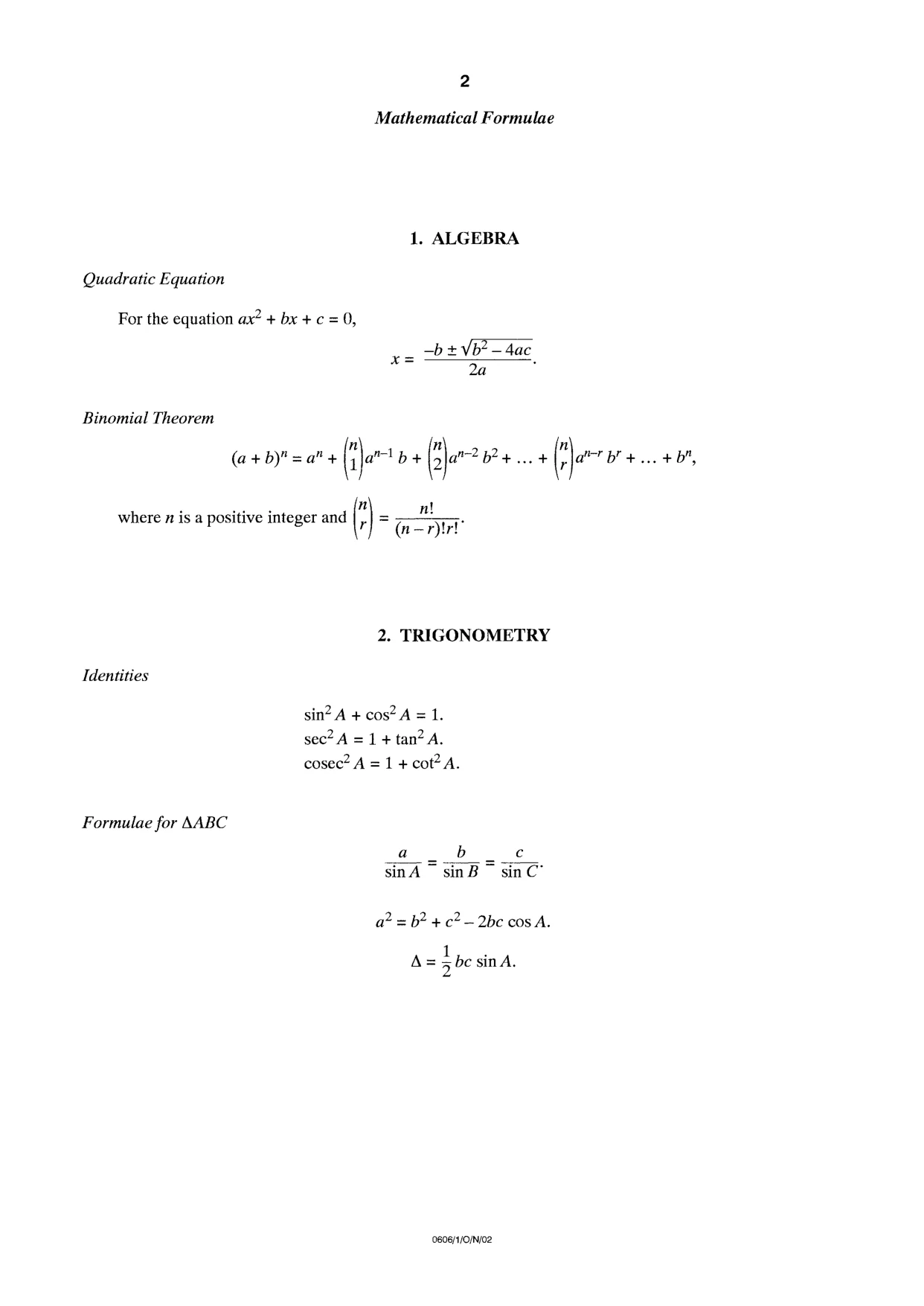
2 Mathematical Formulae 1. ALGEBRA Quadratic Equation For the equation ax? + bx +c = 0, _ -b+ Vb? —4ac a) Binomial Theorem (a+b)"=a"+ (ier b+ bers B+ it ( ab + +b", n! in Ty)” (a=nit where 77 is a positive integer and | 2. TRIGONOMETRY Identities sin? A + cos*A = 1. sec?A =1+tan? A. cosec? A = 1 + cot? A. Formulae for AABC a? = b* +c? — 2be cos A. 1 . A= 3 be sind. 0606/1/O/N/02
Question paper, page 3
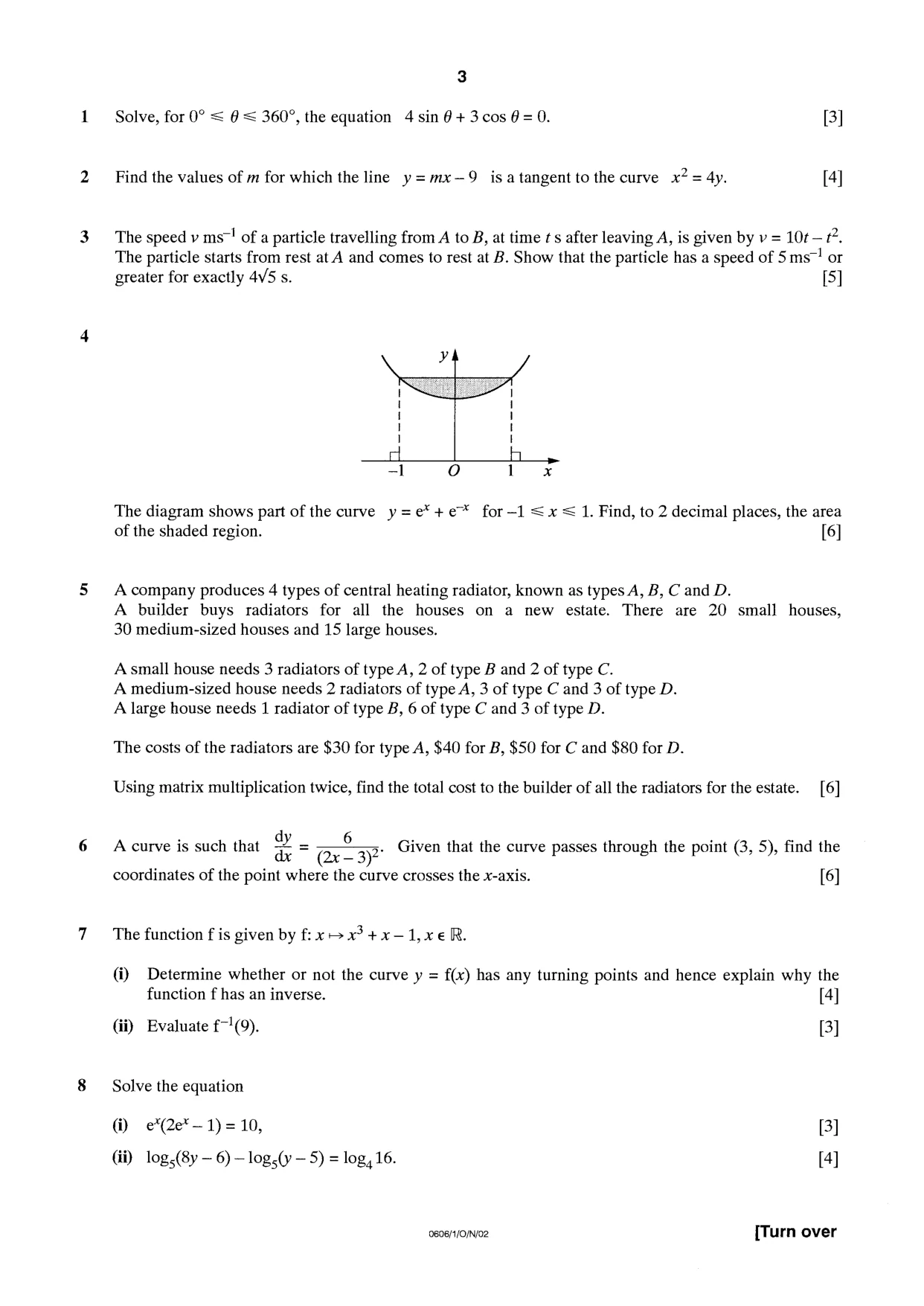
3 Solve, for 0° < 6 < 360°, the equation 4 sin 6+ 3cos @=0. [3] Find the values of m for which the line y=mx-—9 isa tangent to the curve x? = 4y. [4] The speed v ms“! of a particle travelling from A to B, at time fs after leaving A, is given by v = 10t—??. The particle starts from rest at A and comes to rest at B. Show that the particle has a speed of Sms“! or greater for exactly 4V5 s. [5] The diagram shows part of the curve y=e*+e™ for—1 <x < 1. Find, to 2 decimal places, the area of the shaded region. [6] A company produces 4 types of central heating radiator, known as types A, B, C and D, A builder buys radiators for all the houses on a new estate. There are 20 small houses, 30 medium-sized houses and 15 large houses. Asmall house needs 3 radiators of type A, 2 of type B and 2 of type C. A medium-sized house needs 2 radiators of type A, 3 of type C and 3 of type D. A large house needs 1 radiator of type B, 6 of type C and 3 of type D. The costs of the radiators are $30 for type A, $40 for B, $50 for C and $80 for D. Using matrix multiplication twice, find the total cost to the builder of all the radiators for the estate. [6] A curve is such that » = ey Given that the curve passes through the point (3, 5), find the coordinates of the point where the curve crosses the x-axis. [6] The function f is given by f: x oe xiex-LxeR. (i) Determine whether or not the curve y = f(x) has any turning points and hence explain why the function f has an inverse. [4] (ii) Evaluate f-!(9). [3] Solve the equation () e*(2e*—1) = 10, B] (ii) log.(8y — 6) — log.(y — 5) = log, 16. [4] 9606/1/0/N/02 {Turn over
Question paper, page 4
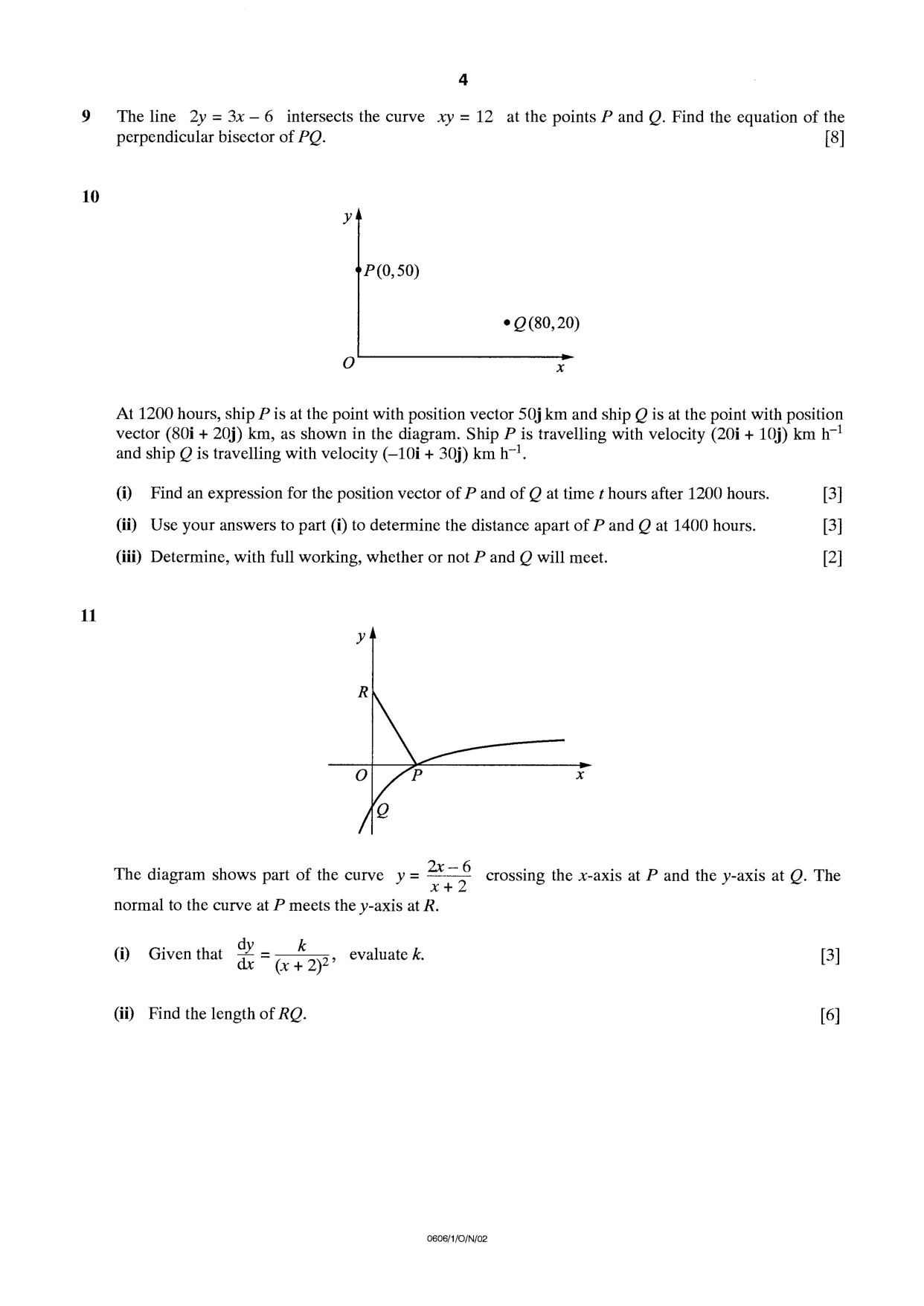
9 10 i 4 The line 2y = 3x—6 intersects the curve xy = 12 at the points P and Q. Find the equation of the perpendicular bisector of PQ. [8] P (0,50) * Q(80, 20) oO x At 1200 hours, ship P is at the point with position vector 50j km and ship Q is at the point with position vector (80i + 20j) km, as shown in the diagram. Ship P is travelling with velocity (20i + 10j) km hv! and ship Q is travelling with velocity (-10i + 30j) km h7. (i) Find an expression for the position vector of P and of Q at time ¢ hours after 1200 hours. [3] (ii) Use your answers to part (i) to determine the distance apart of P and Q at 1400 hours. [3] (iii) Determine, with full working, whether or not P and Q will meet. [2] The diagram shows part of the curve y= 28 crossing the x-axis at P and the y-axis at Q. The normal to the curve at P meets the y-axis at R. (i) Given that gy a a evaluate k. [3] (ii) Find the length of RQ. [6] 606 /1//N/02
Question paper, page 5
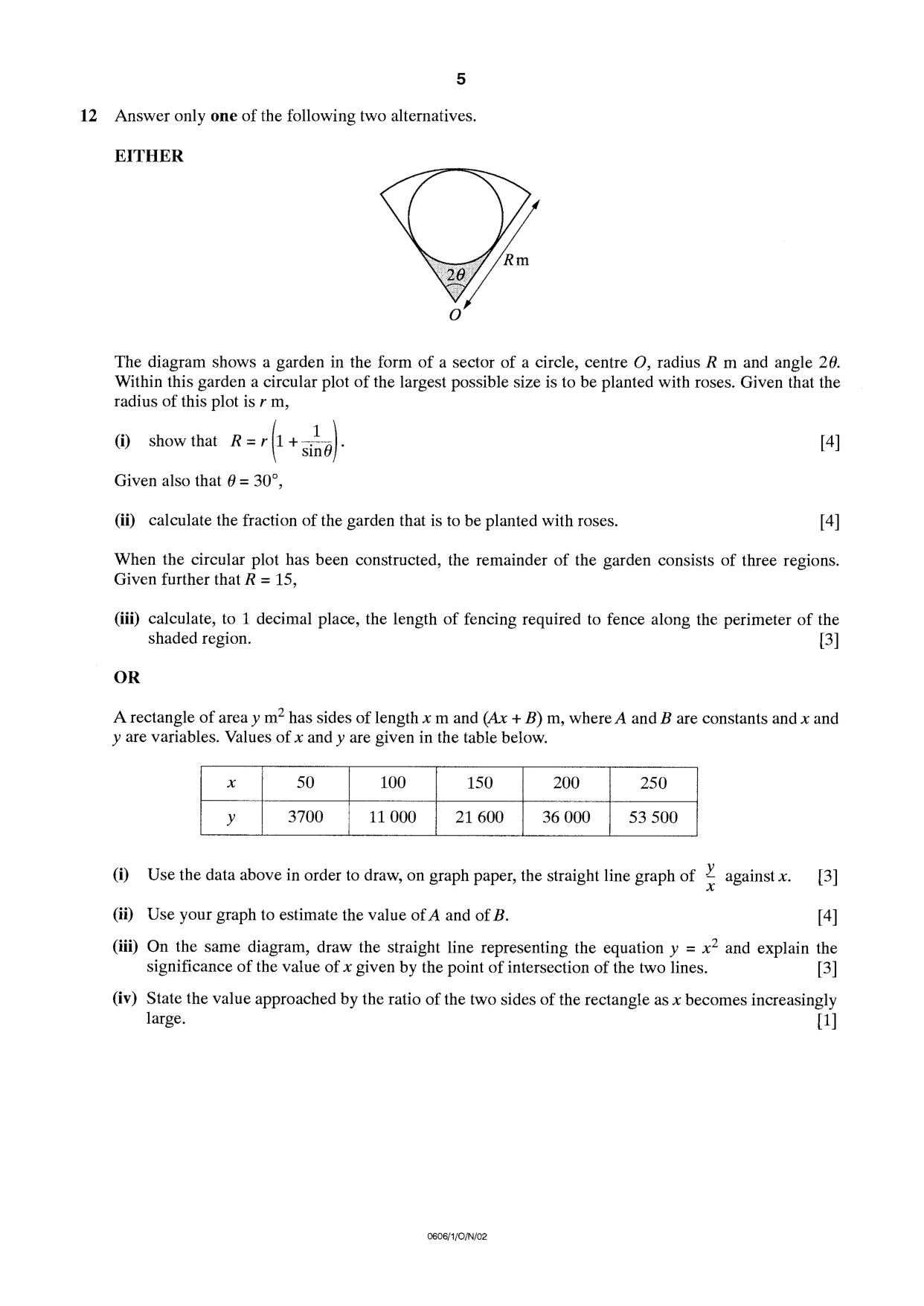
5 12 Answer only one of the following two alternatives. UY S oO EITHER The diagram shows a garden in the form of a sector of a circle, centre O, radius R m and angle 20. Within this garden a circular plot of the largest possible size is to be planted with roses. Given that the radius of this plot is r m, (@) showthat R=r{1 + ata) . [4] Given also that @ = 30°, (ii) calculate the fraction of the garden that is to be planted with roses. [4] When the circular plot has been constructed, the remainder of the garden consists of three regions. Given further that R = 15, (iii) calculate, to 1 decimal place, the length of fencing required to fence along the perimeter of the shaded region. [3] OR A rectangle of area y m? has sides of length x m and (Ax + B) m, where A and B are constants and x and y are variables. Values of x and y are given in the table below. x 50 100 150 200 250 y 3700 11 000 21 600 36 000 53 500 (i) Use the data above in order to draw, on graph paper, the straight line graph of 2 againstx. [3] (ii) Use your graph to estimate the value of A and of B. [4] (iii) On the same diagram, draw the straight line representing the equation y = x* and explain the significance of the value of x given by the point of intersection of the two lines. [3] (iv) State the value approached by the ratio of the two sides of the rectangle as x becomes increasingly large. 0] 0606/1/0/N/02
Mark scheme, page 1
CAMBRIDGE INTERNATIONAL EXAMINATIONS International General Certificate of Secondary Education MARK SCHEME FOR the November 2002 question papers 0606 Additional Mathematics 0606/1 Paper 1, maximum raw mark 80 0606/2 Paper 2, maximum raw mark 80 These mark schemes are published as an aid to teachers and students, to indicate the requirements of the examination. They show the basis on which Examiners were initially instructed to award marks. They do not indicate the details of the discussions that took place at an Examiners’ meeting before marking began. Any substantial changes to the mark scheme that arose from these discussions will be recorded in the published Report on the Examination. All Examiners are instructed that alternative correct answers and unexpected approaches in candidates’ scripts must be given marks that fairly reflect the relevant knowledge and skills demonstrated. Mark schemes must be read in conjunction with the question papers and the Report on the Examination. . CIE will not enter into discussions or correspondence in connection with these mark schemes. CIE is publishing the mark schemes for the November 2002 question papers for most IGCSE, Advanced Subsidiary (AS) Level and Advanced Level syllabuses. UNIVERSITY of CAMBRIDGE Local Examinations Syndicate
Mark scheme, page 2
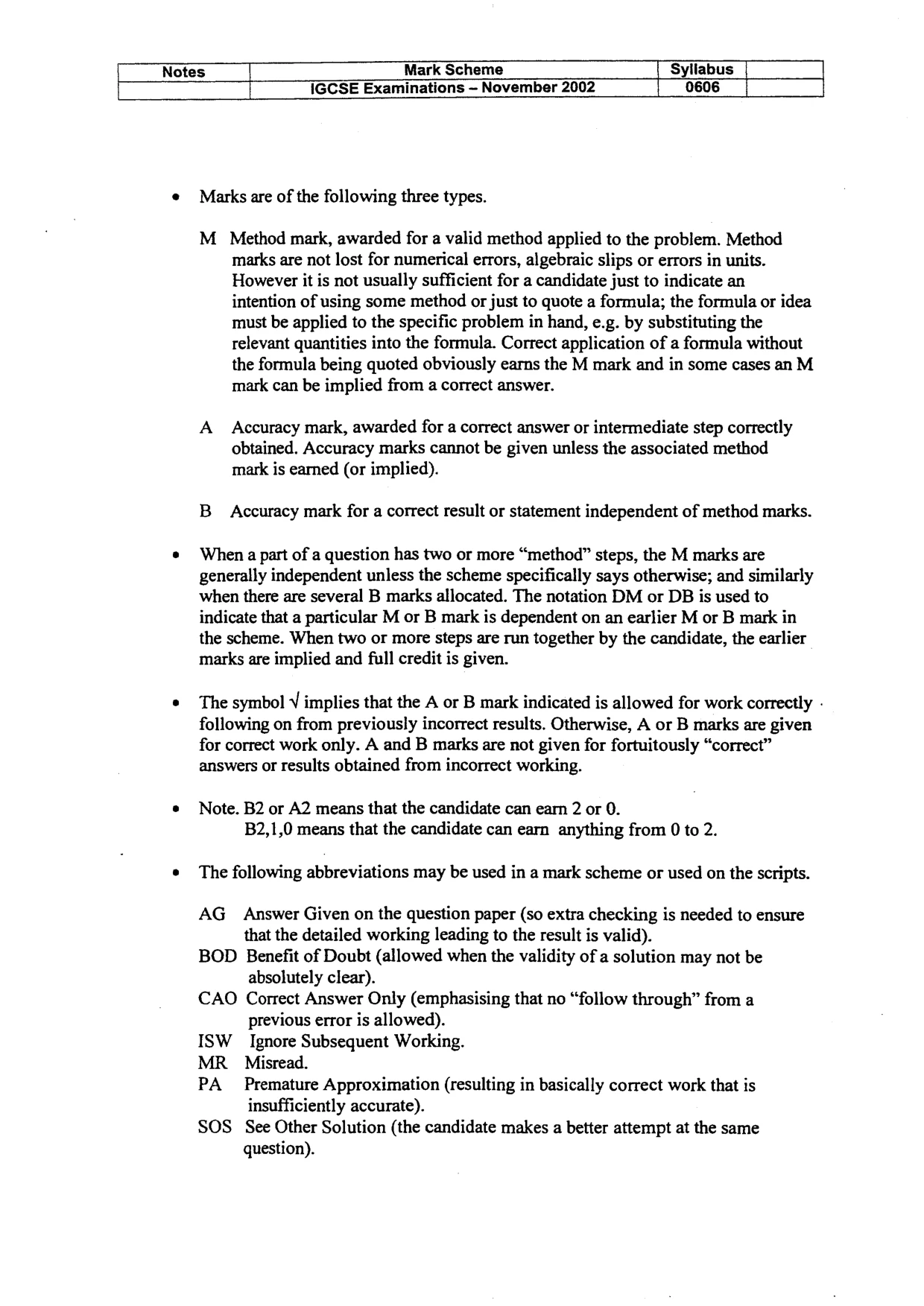
Notes Mark Scheme Syllabus IGCSE Examinations ~ November 2002 0606 © Marks are of the following three types. M Method mark, awarded for a valid method applied to the problem. Method marks are not lost for numerical errors, algebraic slips or errors in units. However it is not usually sufficient for a candidate just to indicate an intention of using some method or just to quote a formula; the formula or idea must be applied to the specific problem in hand, e.g. by substituting the relevant quantities into the formula. Correct application of a formula without the formula being quoted obviously earns the M mark and in some cases an M mark can be implied from a correct answer. A Accuracy mark, awarded for a correct answer or intermediate step correctly obtained. Accuracy marks cannot be given unless the associated method mark is earned (or implied). B_ Accuracy mark for a correct result or statement independent of method marks. * When a part of a question has two or more “method” steps, the M marks are generally independent unless the scheme specifically says otherwise; and similarly when there are several B marks allocated. The notation DM or DB is used to indicate that a particular M or B mark is dependent on an earlier M or B mark in the scheme. When two or more steps are run together by the candidate, the earlier marks are implied and full credit is given. * The symbol ¥ implies that the A or B mark indicated is allowed for work correctly - following on from previously incorrect results. Otherwise, A or B marks are given for correct work only. A and B marks are not given for fortuitously “correct” answers or results obtained from incorrect working. * Note. B2 or A2 means that the candidate can earn 2 or 0. B2,1,0 means that the candidate can earn anything from 0 to 2. * The following abbreviations may be used in a mark scheme or used on the scripts. AG_ Answer Given on the question paper (so extra checking is needed to ensure that the detailed working leading to the result is valid). BOD Benefit of Doubt (allowed when the validity of a solution may not be absolutely clear). CAO Correct Answer Only (emphasising that no “follow through” from a previous error is allowed). ISW Ignore Subsequent Working. MR Misread. PA Premature Approximation (resulting in basically correct work that is insufficiently accurate). SOS See Other Solution (the candidate makes a better attempt at the same question).
Mark scheme, page 3
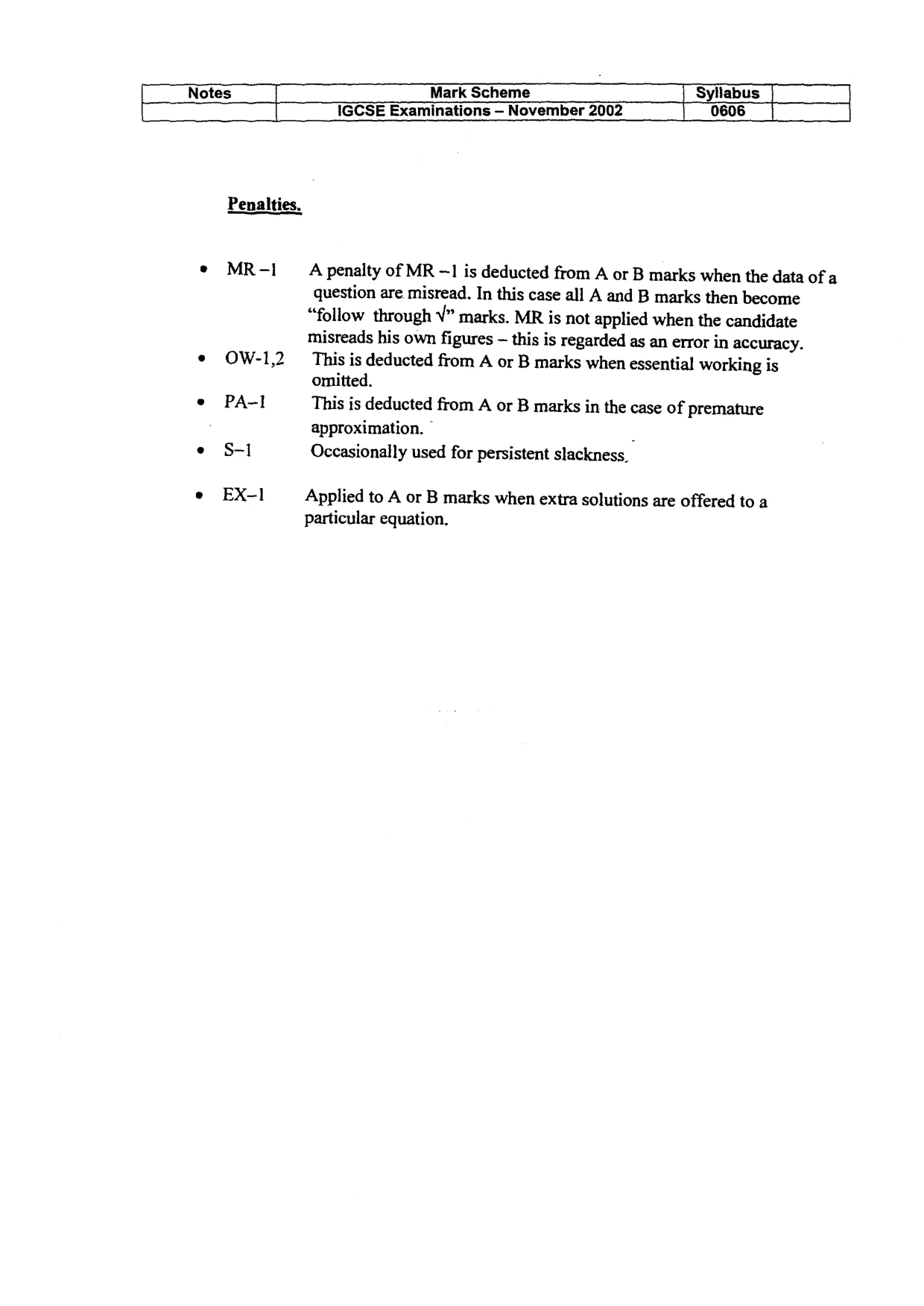
Mark Scheme Syllabus ti Notes IGCSE Examinations — November 2002 0606 Penalties. * MR-1 A penalty of MR -1 is deducted from A or B marks when the data of a question are misread. In this case all A and B marks then become “follow through V” marks. MR is not applied when the candidate misreads his own figures — this is regarded as an error in accuracy. ¢ OW-1,2 — This is deducted from A or B marks when essential working is omitted. e PA-1 This is deducted from A or B marks in the case of premature approximation. © . ° S-1 Occasionally used for persistent slackness, e EX-l Applied to A or B marks when extra solutions are offered to a particular equation.
Mark scheme, page 4
CAMBRIDGE INTERNATIONAL EXAMINATIONS November 2002 INTERNATIONAL GCSE UNIversiry of CAMBRIDGE Local Examinations Syndicate
Mark scheme, page 5
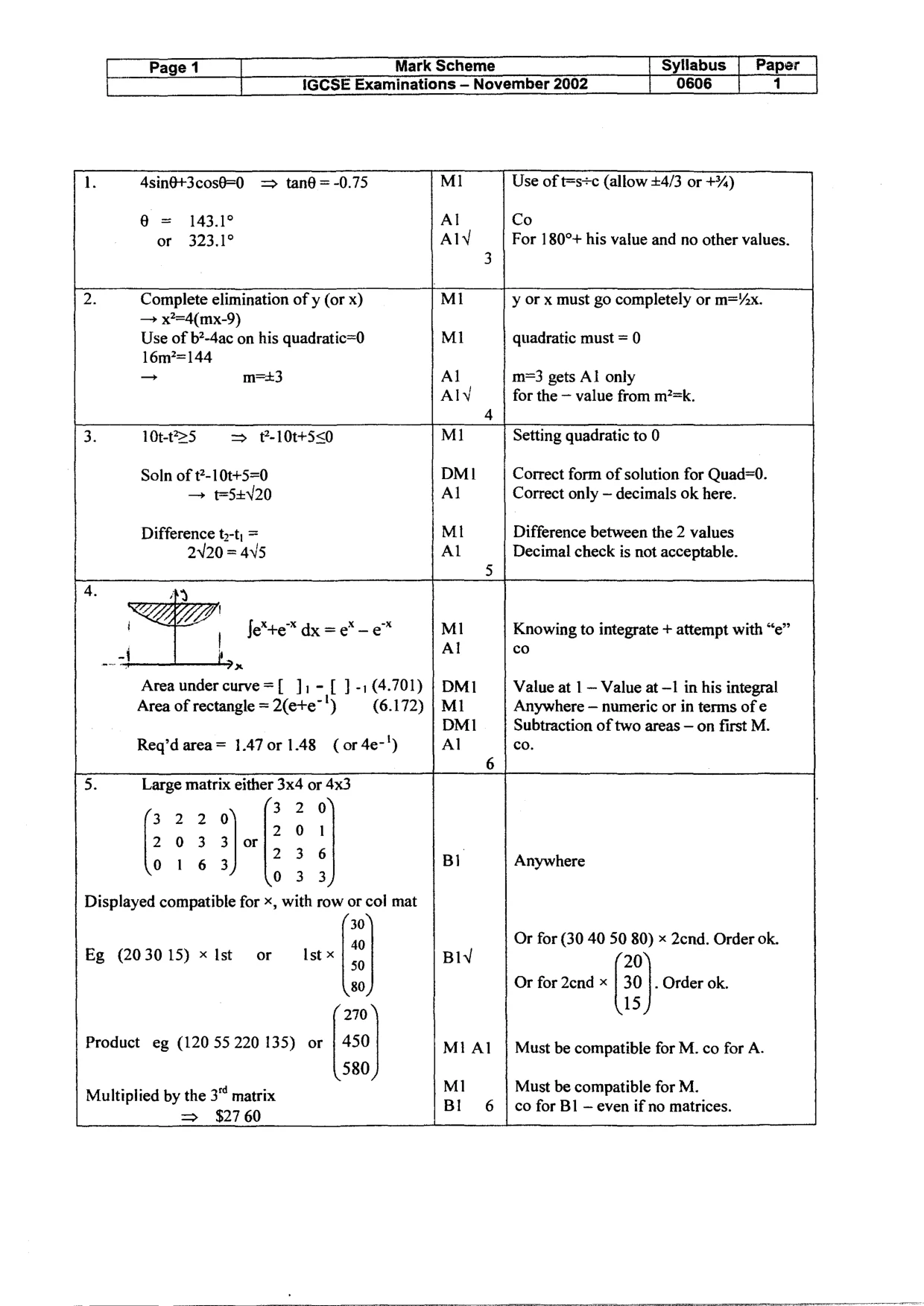
Page 1 Mark Scheme Syllabus | Paper IGCSE Examinations — November 2002 0606 1 1. 4sin@+3cos0=0 => tan@=-0.75 MI Use of t=s+c (allow +4/3 or +%) @ = 143.1° Al Co or 323.1° AV For 180°+ his value and no other values. 3 2. Complete elimination of y (or x) MI y Or x must go completely or m=/4x. — x=4(mx-9) Use of b?-4ac on his quadratic=0 MI quadratic must = 0 16m?=144 > m=43 Al m=3 gets Al only Aly for the — value from m?=k. 4 3. 10t-t?25 => t-10tt+5<0 MI Setting quadratic to 0 Soln of t?-10t+5=0 DMI Correct form of solution for Quad=0. — t=5+V20 Al Correct only — decimals ok here. Difference t,-t; = MI Difference between the 2 values 2N20 = 4V5 Al Decimal check is not acceptable. 5 4. JeX+e™ dx = e%—e™ MI Knowing to integrate + attempt with “e” Al co ~ % Area under curve=[ ]; - [ ] -1 (4.701) | DM1 Value at 1 — Value at —1 in his integral Area of rectangle = 2(ete™ 4 (6.172) | M1 Anywhere — numeric or in terms of e DMI Subtraction of two areas — on first M. Req’d area= 1.470r 1.48 (or 4e-') Al co. 6 5. Large matrix either 3x4 or 4x3 “| 2220) [22° 2 0 3 3/or 0163 236 Bl Anywhere 033 Displayed compatible for x, with row or col mat 30 40 Or for (30 40 50 80) x 2cnd. Order ok. Eg (203015) x Ist or Ist x 50 BIV 20 80 Or for 2cnd = | 30 |. Order ok. 270 15 Product eg (120 55220 135) or | 450 MI AI | Must be compatible for M. co for A. 580 soe cd ‘ MI Must be compatible for M. Multiplied by the 3°" matrix BI 6 | co for BI — even if no matrices. =>_ $2760
Mark scheme, page 6
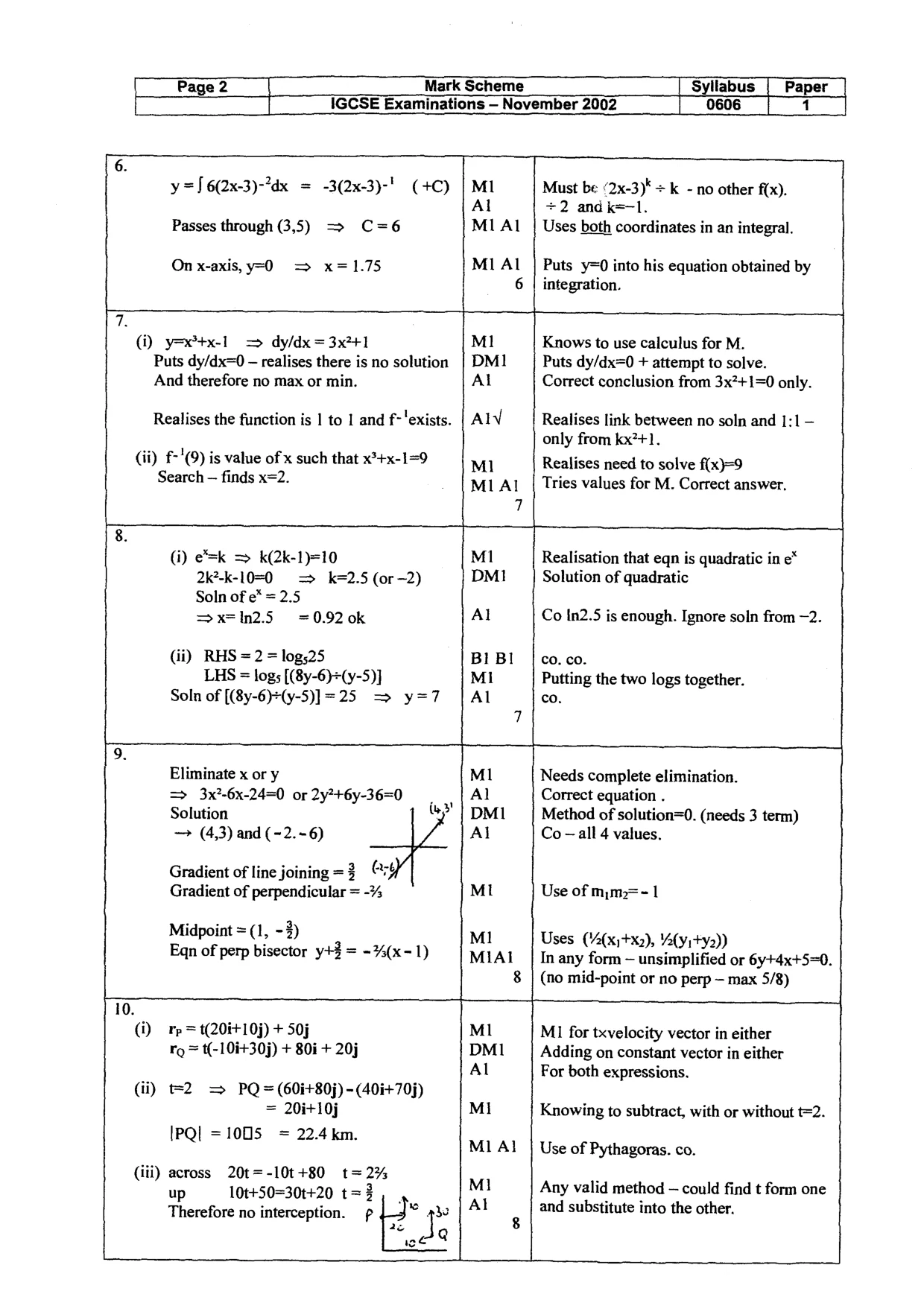
Page 2 Mark Scheme Syllabus IGCSE Examinations — November 2002 Paper 0606 1 _ 6. y =] 6(2x-3)-"dx = -3(2x-3)-' (+C) | MI Must be /2x-3)* +k - no other f(x). Al +2 and k=-l. Passes through (3,5) = C=6 MLAL | Uses both coordinates in an integral. On x-axis, y=0 => x=1.75 M1 AI | Puts y=0 into his equation obtained by 6 | integration. 7. (i) yeOtx-1 => dy/dx = 3x2+1 Mi Knows to use calculus for M. Puts dy/dx=0 — realises there is no solution | DMI Puts dy/dx=0 + attempt to solve. And therefore no max or min. Al Correct conclusion from 3x?+1=0 only. Realises the function is 1 to 1 and f-'exists. | AV Realises link between no soln and 1:1 — only from kx?+], (ii) -1(9) is value of x such that x?+x-1=9 MI Realises need to solve f{x)=9 Search — finds x=2. MIAI | Tries values for M. Correct answer. 7 8. (i) =k => k(2k-1)=10 MI Realisation that eqn is quadratic in e* 2k?-k-10=0 ==> k=2.5 (or —2) DMI Solution of quadratic Soln of e* = 2.5 =>x=n2.5 =0.92 0k Al Co {n2.5 is enough. Ignore soln from —2. (ii) RHS = 2 = logs25 BIBI | co. co. LHS = logs [(8y-6)+(y-5)] MI Putting the two logs together. Soln of [(8y-6}+(y-5)]}=25 => y=7 |AL co. 7 9. Eliminate x or y MI Needs complete elimination. => 3x?-6x-24=0 or 2y*+6y-36=0 | All Correct equation . Solution &>" | DMI | Method of solution=0. (needs 3 term) — (4,3) and (-2.-6) Al Co —all 4 values. Gradient of line joining =3 4 Gradient of perpendicular = -%5 MI Use of mym2=- 1 Midpoint =(1,~3) MI | Uses (Cx #2), Ytvi+y2)) Eqn of perp bisector y+3= -%(x-1) | MIAI_ | Inany form — unsimplified or 6y+4x+5=0. 8 | (no mid-point or no perp — max 5/8) | 10. al (i) rp = t(20i+10j) + 50j MI MI for txvelocity vector in either Tq = t(-10i+30j) + 80i + 20j DMI Adding on constant vector in either Al For both expressions. (ii) 2 => PQ=(60i+80j) -(40i+70j) = 20i+10j MI Knowing to subtract, with or without t=2. PQ| =1005 = 22.4km. [PQ MI1Al! | Use of Pythagoras. co. (iii) across 20t=-10t+80 t=2% M1 . up 10t+50=30t+20 t= “I Any valid method —could find t form one Therefore no interception. p 8 and substitute into the other. © phe Q
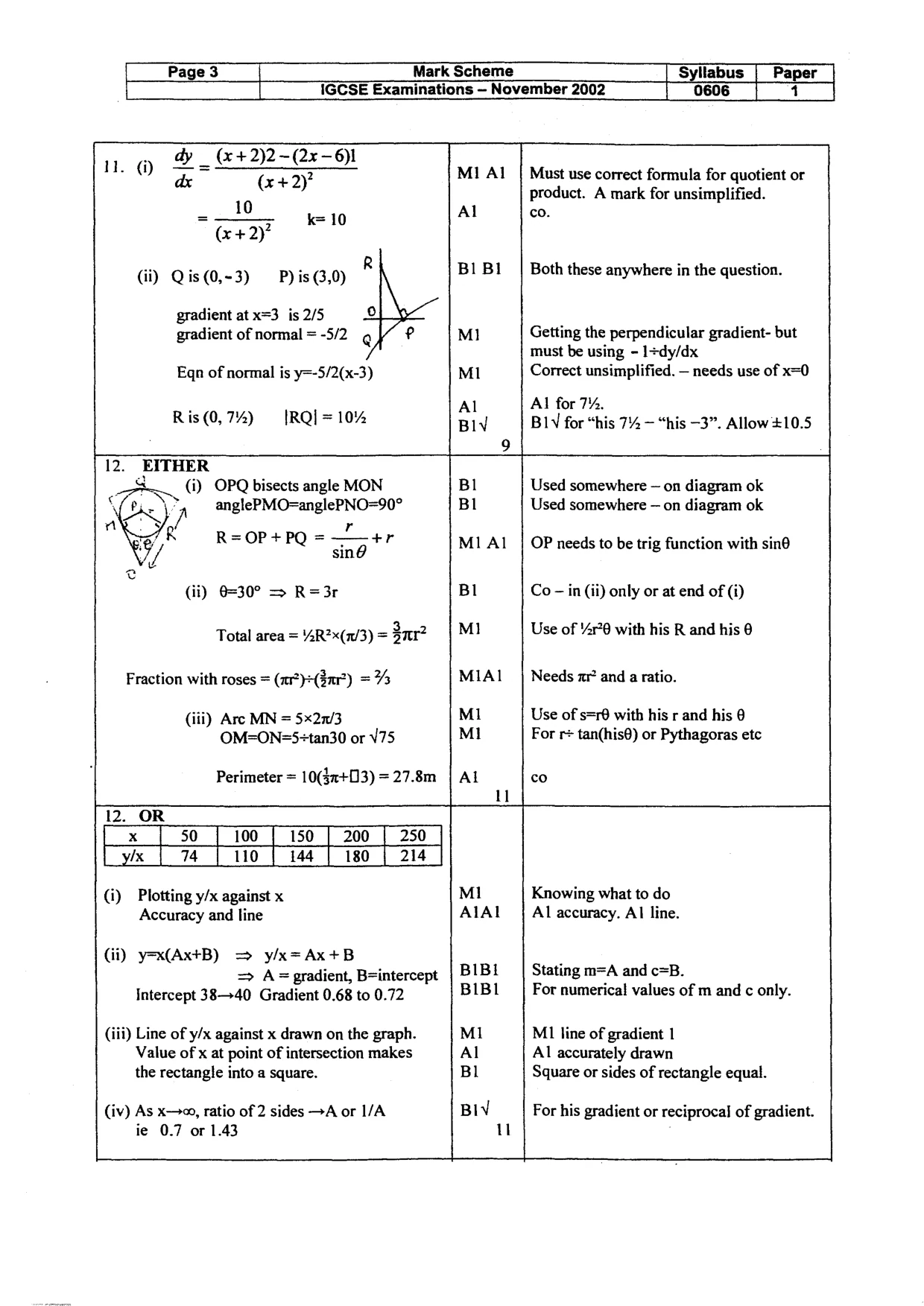
Mark scheme, page 7
Page 3. Mark Scheme Syllabus | Paper IGCSE Examinations — November 2002 o6oe | 41 MG dy _ (x+2)2~(2x-6)1 - i) x = Gaz M1 AI | Must use correct formula for quotient or product. A mark for unsimplified. = 10 k= 10 Al co. 2 (x + 2) (i) Qis(0,-3) P)is (3,0) B1B1_ | Both these anywhere in the question. gradient at x=3 is 2/5 © gradient of normal = -5/2 Q ? MI Getting the perpendicular gradient- but must be using - 1+dy/dx Eqn of normal is y=-5/2(x-3) MIL Correct unsimplified. — needs use of x=0 . , Al Al for 7%. Ris(0,7%) — [RQ = 10% Biv _| BIW for “his 7% ~ “his -3”. Allow +10.5 9 12. EITHER g (i) OPQ bisects angle MON Bl Used somewhere — on diagram ok 7 > anglePMO=anglePNO=90° Bl Used somewhere — on diagram ok a ¥ i R= OP + PQ = sind +r MI AI | OP needs to be trig function with sin@ if ct (ii) €=30° => R=3r Bl Co — in (ii) only or at end of (i) Total area = 4R2x(n/3) = 3x? MI Use of %4r°0 with his R and his @ Fraction with roses = (af)}+(3ar) =7/ MIAI | Needs xr and a ratio. (iii) Are MN = 5x2n/3 MI Use of s=r0 with his r and his @ OM=ON=5-tan30 or V75 MI For r= tan(his@) or Pythagoras etc Perimeter = 10(32+013) = 27.8m 12. OR 200 | 250 180 | 214 x 30 [100 | 150 | yx | 74 [110 [ 144 | (i) Plotting y/x against x Accuracy and line (ii) y=x(Axt+B) = y/x=Ax+B => A= gradient, B=intercept Intercept 38-+40 Gradient 0.68 to 0.72 (iii) Line of y/x against x drawn on the graph. Value of x at point of intersection makes the rectangle into a square. (iv) As x0, ratio of 2 sides +A or 1/A ie 0.7 or 1.43 Al co 5 M1 AIAIL BIBL BIBL Knowing what to do Al accuracy. A1 line. Stating m=A and c=B. For numerical values of m and c only. ML line of gradient 1 Al accurately drawn Square or sides of rectangle equal. For his gradient or reciprocal of gradient.