Cambridge IGCSE Mathematics (9-1) (UK only) 0626 — 2018 May/June Paper 6 · Variant 0
0626/60/M/J/18
The question paper and its mark scheme, free to read here and free to download. This is Cambridge’s own paper, exactly as it was sat.
Question paper20 pages
Mark scheme
No mark scheme is in the library for this paper.
Paper as text
Question paper, page 1
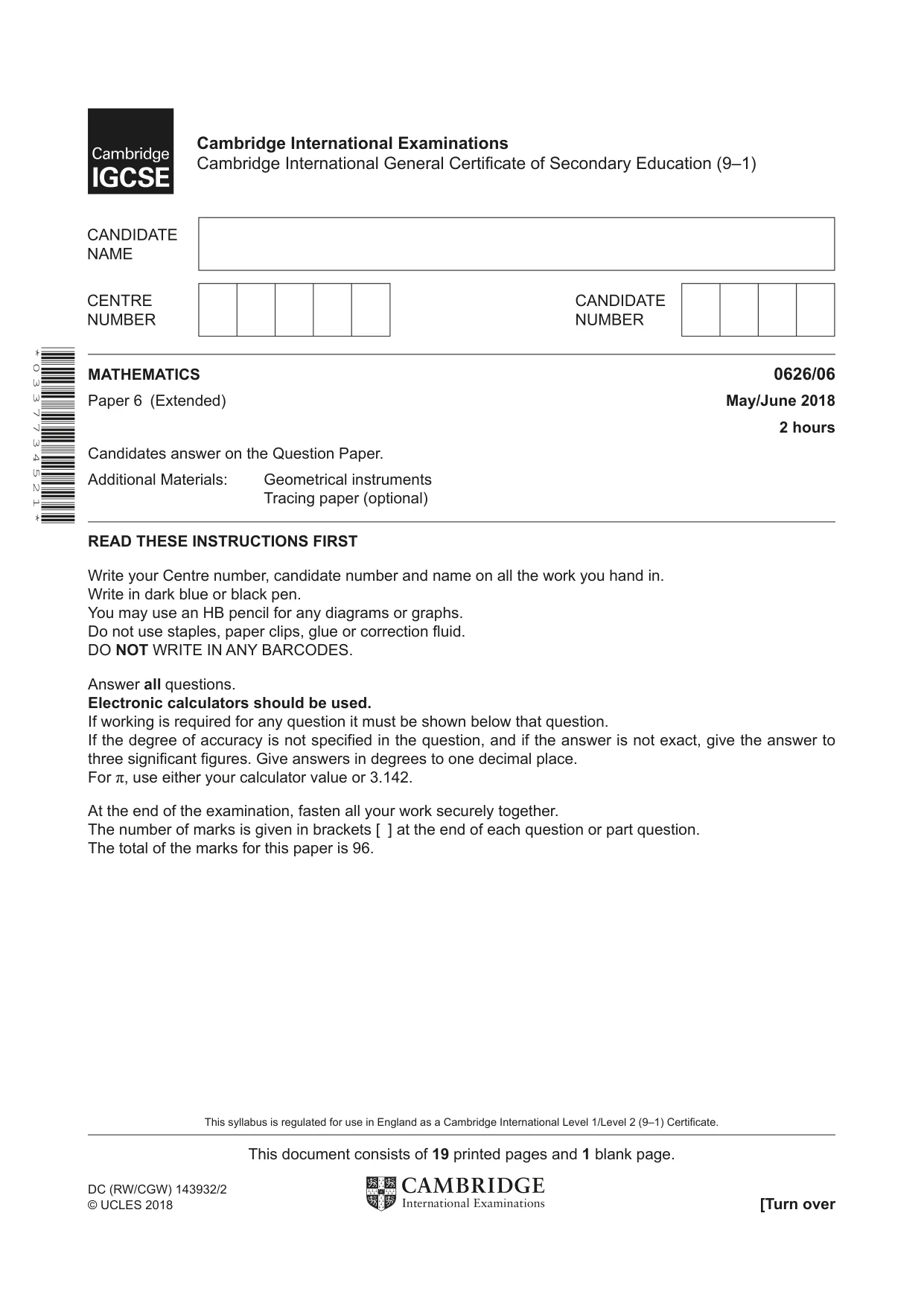
* 0 3 3 7 7 3 4 5 2 1 * This document consists of 19 printed pages and 1 blank page. DC (RW/CGW) 143932/2 © UCLES 2018 [Turn over MATHEMATICS 0626/06 Paper 6 (Extended) May/June 2018 2 hours Candidates answer on the Question Paper. Additional Materials: Geometrical instruments Tracing paper (optional) READ THESE INSTRUCTIONS FIRST Write your Centre number, candidate number and name on all the work you hand in. Write in dark blue or black pen. You may use an HB pencil for any diagrams or graphs. Do not use staples, paper clips, glue or correction fluid. DO NOT WRITE IN ANY BARCODES. Answer all questions. Electronic calculators should be used. If working is required for any question it must be shown below that question. If the degree of accuracy is not specified in the question, and if the answer is not exact, give the answer to three significant figures. Give answers in degrees to one decimal place. For π, use either your calculator value or 3.142. At the end of the examination, fasten all your work securely together. The number of marks is given in brackets [ ] at the end of each question or part question. The total of the marks for this paper is 96. This syllabus is regulated for use in England as a Cambridge International Level 1/Level 2 (9–1) Certificate. Cambridge International Examinations Cambridge International General Certificate of Secondary Education (9–1)
Question paper, page 2
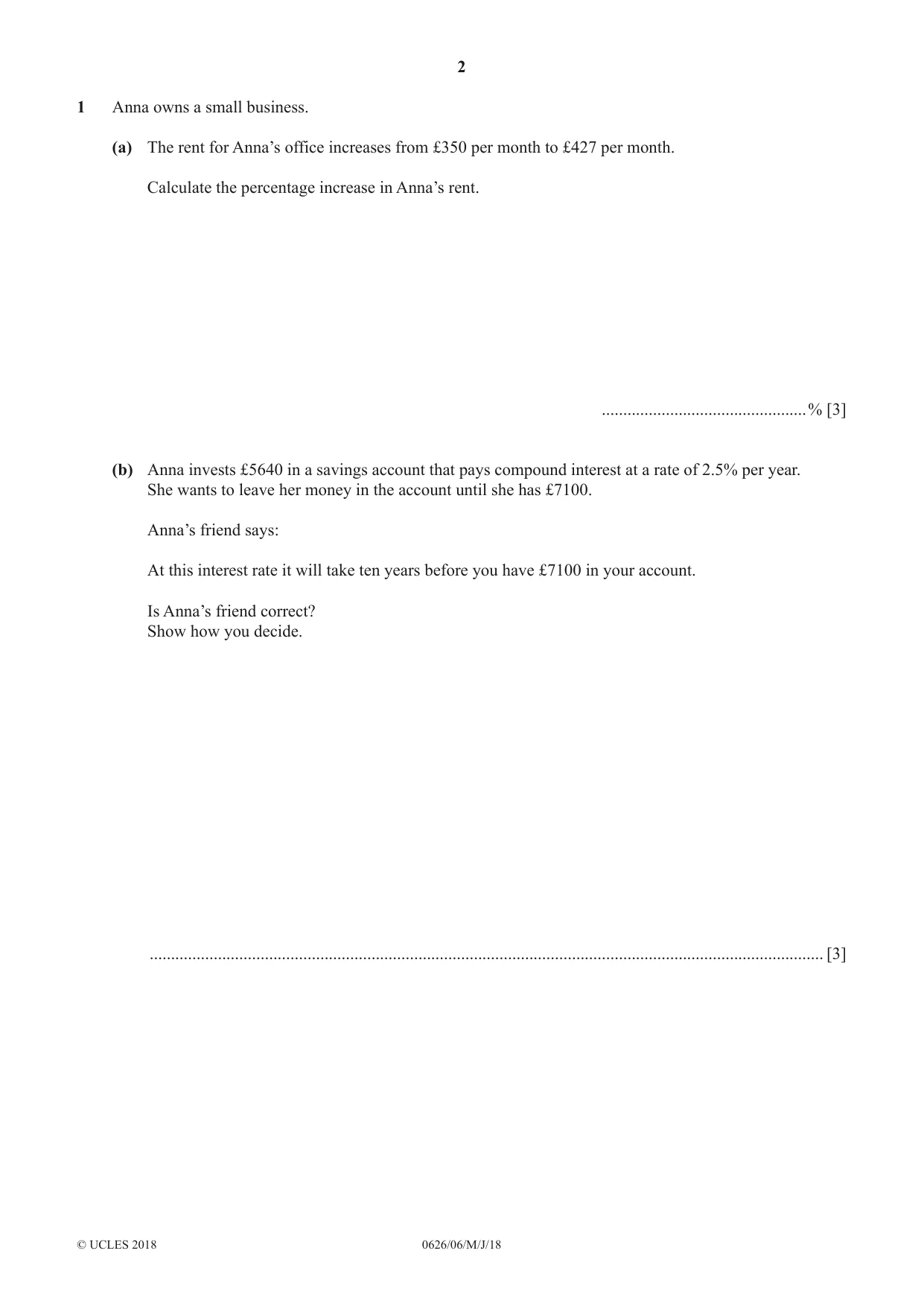
2 0626/06/M/J/18 © UCLES 2018 1 Anna owns a small business. (a) The rent for Anna’s office increases from £350 per month to £427 per month. Calculate the percentage increase in Anna’s rent. …% [3] (b) Anna invests £5640 in a savings account that pays compound interest at a rate of 2.5% per year. She wants to leave her money in the account until she has £7100. Anna’s friend says: At this interest rate it will take ten years before you have £7100 in your account. Is Anna’s friend correct? Show how you decide. … [3]
Question paper, page 3
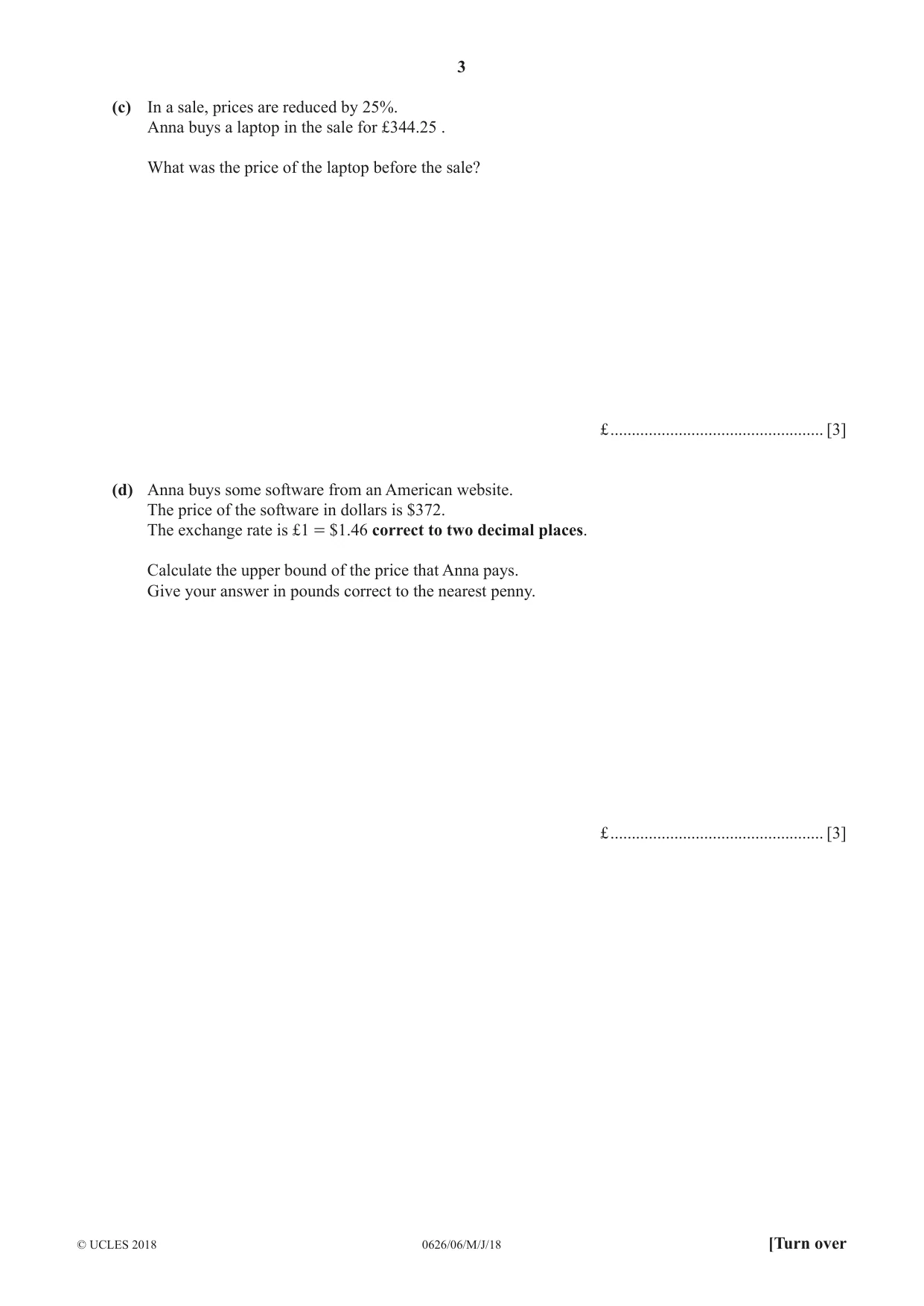
3 0626/06/M/J/18 © UCLES 2018 [Turn over (c) In a sale, prices are reduced by 25%. Anna buys a laptop in the sale for £344.25 . What was the price of the laptop before the sale? £ … [3] (d) Anna buys some software from an American website. The price of the software in dollars is $372. The exchange rate is £1 = $1.46 correct to two decimal places. Calculate the upper bound of the price that Anna pays. Give your answer in pounds correct to the nearest penny. £ … [3]
Question paper, page 4
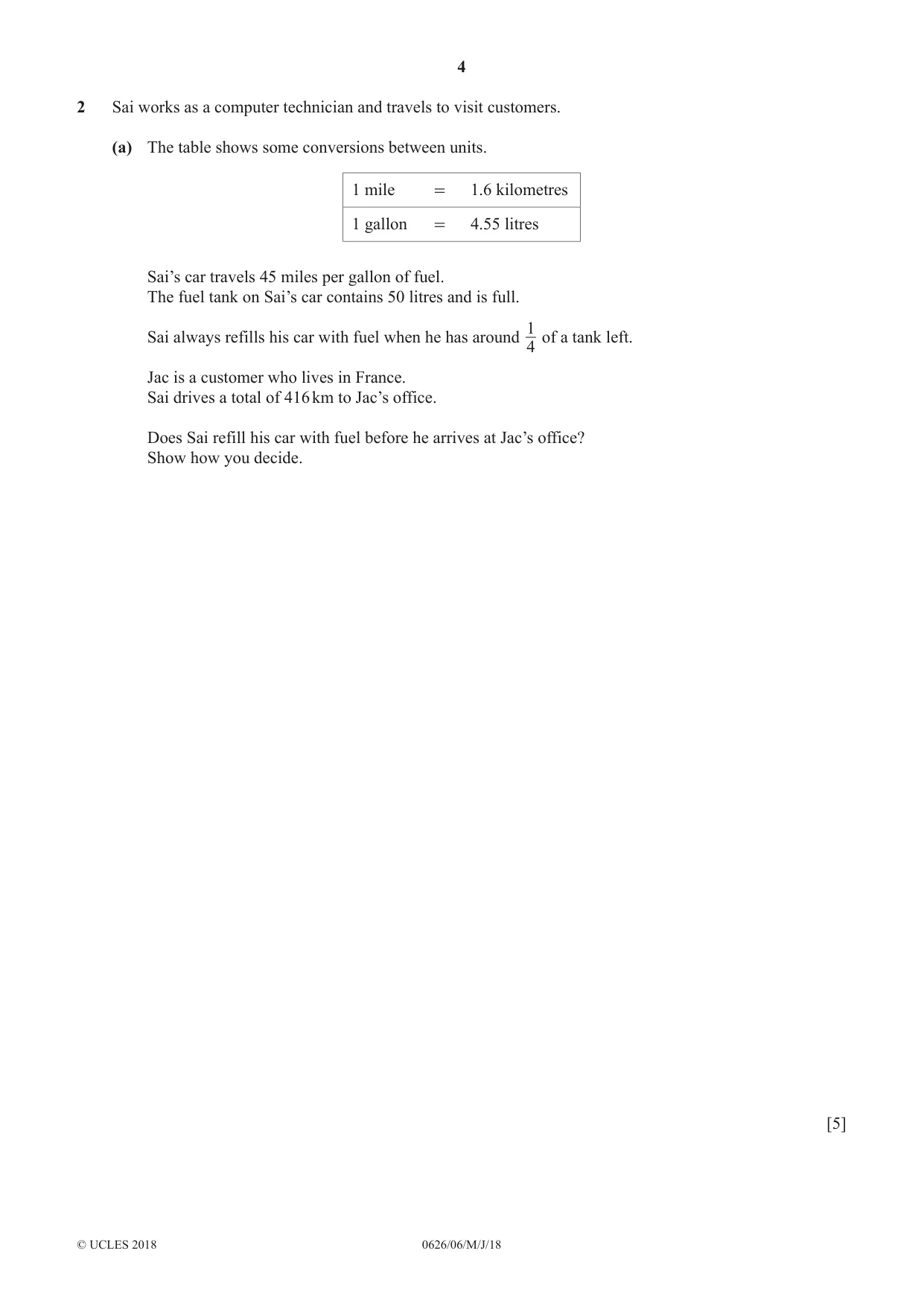
4 0626/06/M/J/18 © UCLES 2018 2 Sai works as a computer technician and travels to visit customers. (a) The table shows some conversions between units. 1 mile = 1.6 kilometres 1 gallon = 4.55 litres Sai’s car travels 45 miles per gallon of fuel. The fuel tank on Sai’s car contains 50 litres and is full. Sai always refills his car with fuel when he has around 4 1 of a tank left. Jac is a customer who lives in France. Sai drives a total of 416 km to Jac’s office. Does Sai refill his car with fuel before he arrives at Jac’s office? Show how you decide. [5]
Question paper, page 5
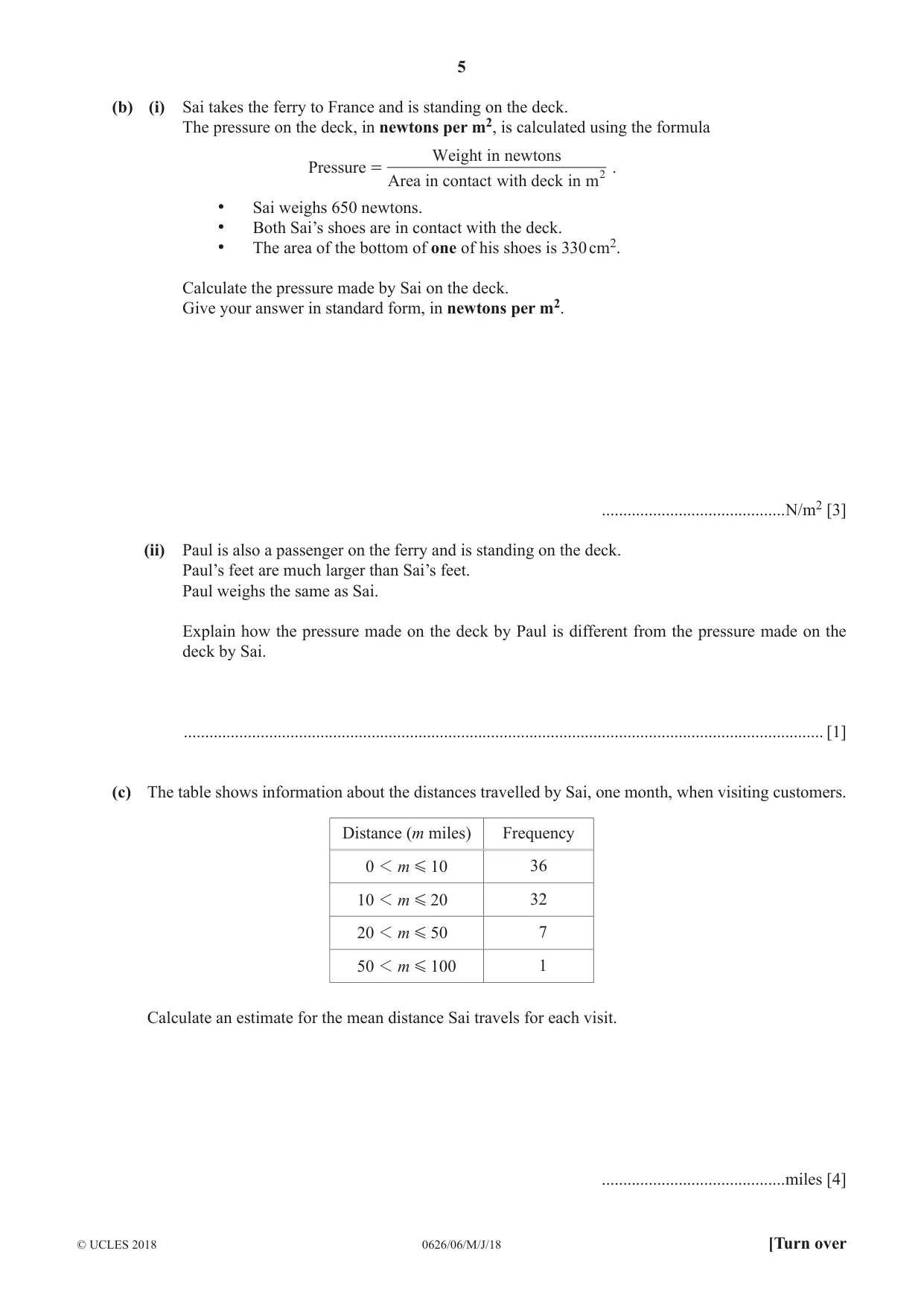
5 0626/06/M/J/18 © UCLES 2018 [Turn over (b) (i) Sai takes the ferry to France and is standing on the deck. The pressure on the deck, in newtons per m2, is calculated using the formula Pressure Area in contact with deck in m Weight in newtons 2 = . • Sai weighs 650 newtons. • Both Sai’s shoes are in contact with the deck. • The area of the bottom of one of his shoes is 330 cm2. Calculate the pressure made by Sai on the deck. Give your answer in standard form, in newtons per m2. …N/m2 [3] (ii) Paul is also a passenger on the ferry and is standing on the deck. Paul’s feet are much larger than Sai’s feet. Paul weighs the same as Sai. Explain how the pressure made on the deck by Paul is different from the pressure made on the deck by Sai. … [1] (c) The table shows information about the distances travelled by Sai, one month, when visiting customers. Distance (m miles) Frequency m 0 10 1 G 36 m 10 20 1 G 32 m 20 50 1 G 7 m 0 100 5 1 G 1 Calculate an estimate for the mean distance Sai travels for each visit. …miles [4]
Question paper, page 6
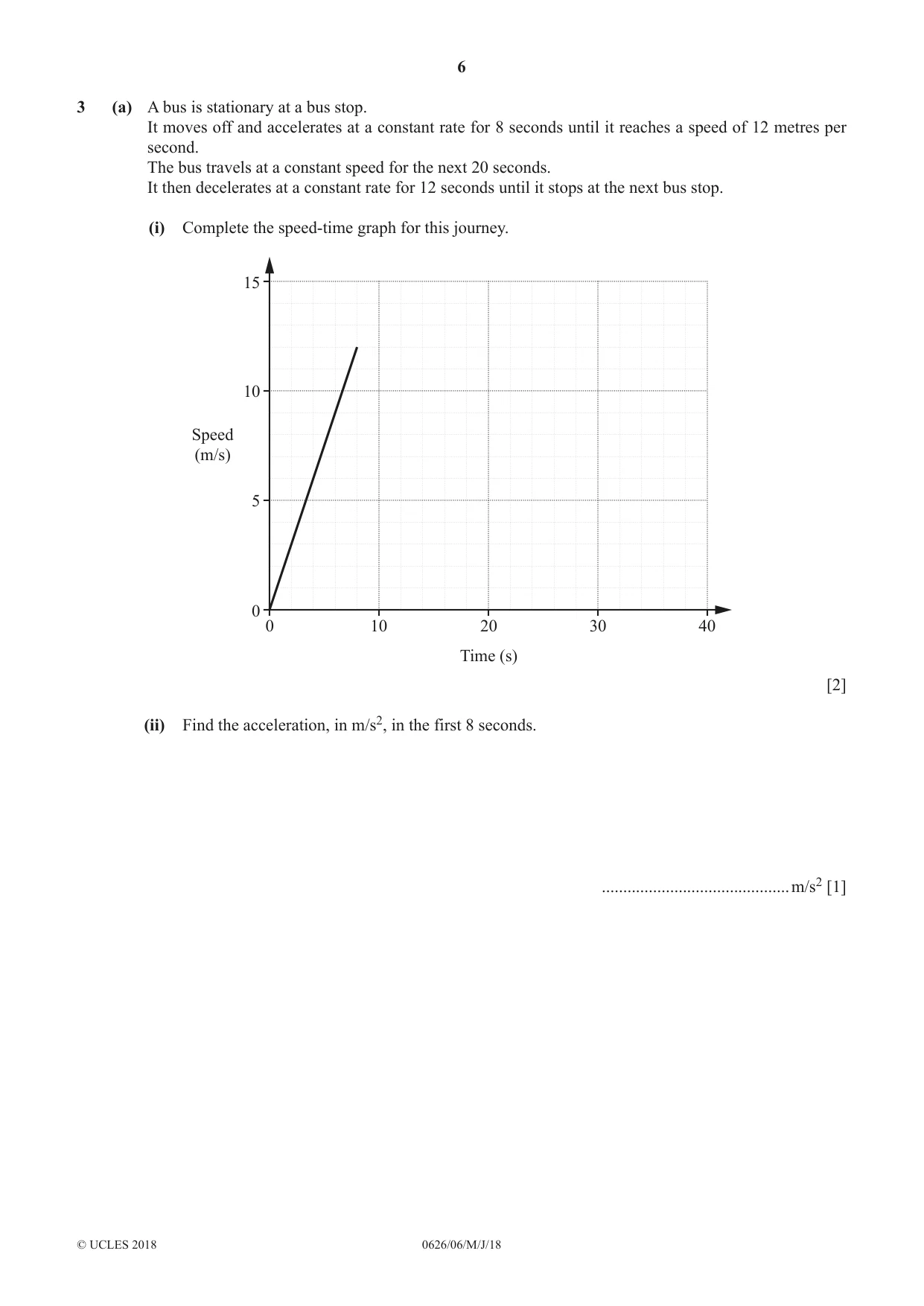
6 0626/06/M/J/18 © UCLES 2018 3 (a) A bus is stationary at a bus stop. It moves off and accelerates at a constant rate for 8 seconds until it reaches a speed of 12 metres per second. The bus travels at a constant speed for the next 20 seconds. It then decelerates at a constant rate for 12 seconds until it stops at the next bus stop. (i) Complete the speed-time graph for this journey. 0 10 20 Time (s) Speed (m/s) 30 40 0 5 10 15 [2] (ii) Find the acceleration, in m/s2, in the first 8 seconds. …m/s2 [1]
Question paper, page 7
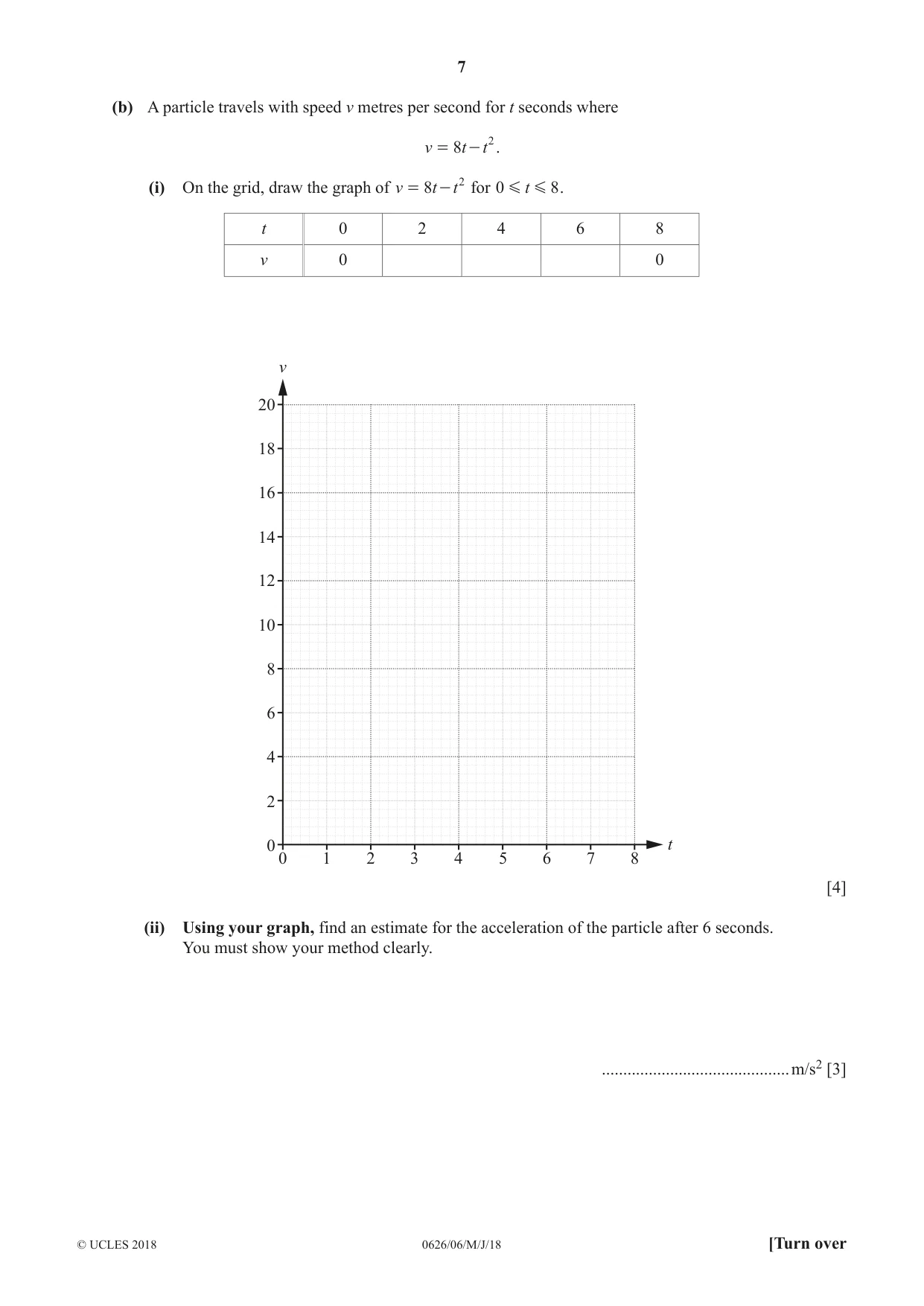
7 0626/06/M/J/18 © UCLES 2018 [Turn over (b) A particle travels with speed v metres per second for t seconds where v t t 8 2 = - . (i) On the grid, draw the graph of v t t 8 2 = - for t 0 8 G G . t 0 2 4 6 8 v 0 0 0 0 2 4 6 8 10 12 14 16 18 20 1 2 3 4 5 6 7 8 t v [4] (ii) Using your graph, find an estimate for the acceleration of the particle after 6 seconds. You must show your method clearly. …m/s2 [3]
Question paper, page 8
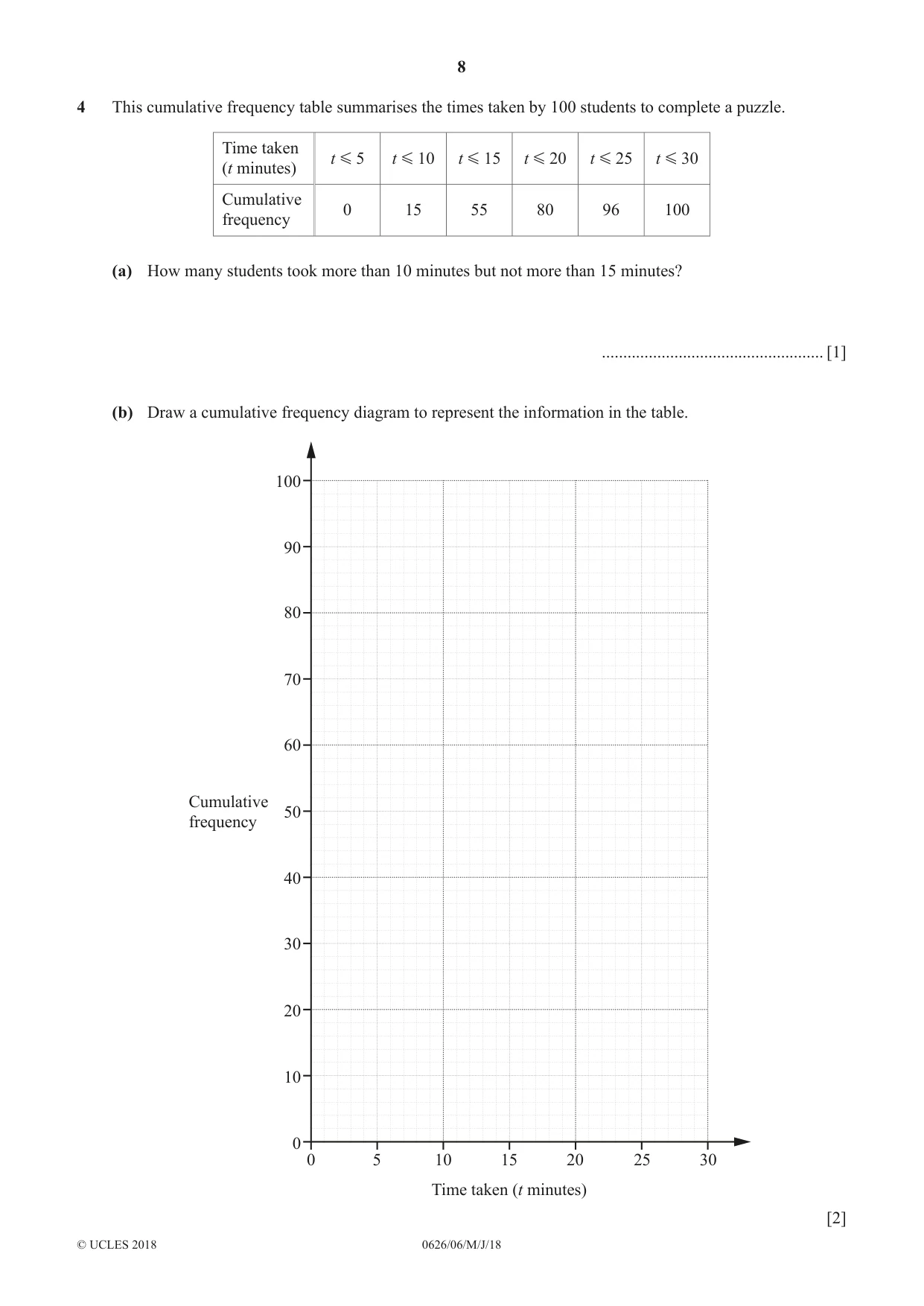
8 0626/06/M/J/18 © UCLES 2018 4 This cumulative frequency table summarises the times taken by 100 students to complete a puzzle. Time taken (t minutes) t 5 G t 10 G t 15 G t 20 G t 25 G t 30 G Cumulative frequency 0 15 55 80 96 100 (a) How many students took more than 10 minutes but not more than 15 minutes? … [1] (b) Draw a cumulative frequency diagram to represent the information in the table. 0 0 10 20 30 40 50 Cumulative frequency 60 70 80 90 100 5 10 15 Time taken (t minutes) 20 25 30 [2]
Question paper, page 9
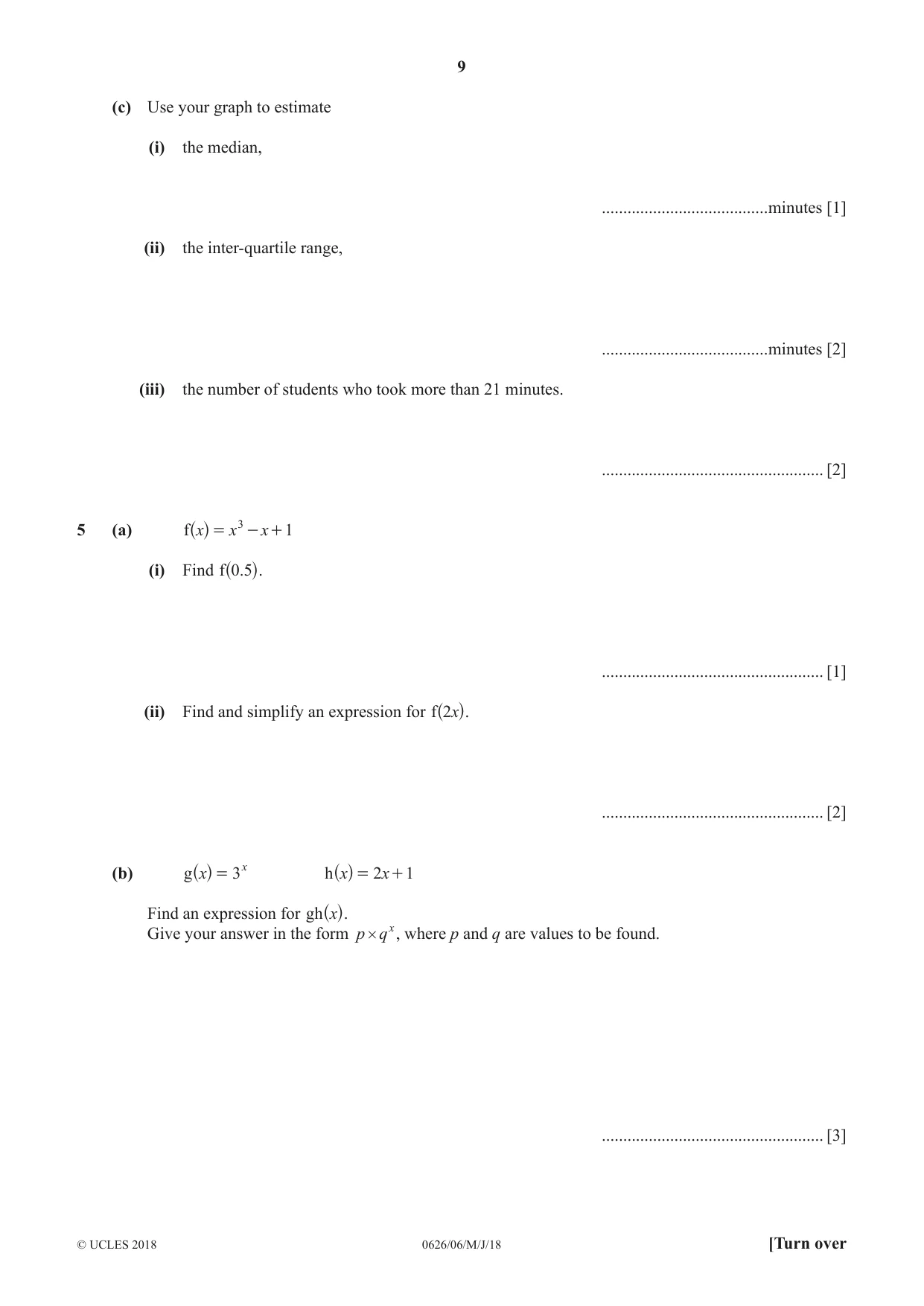
9 0626/06/M/J/18 © UCLES 2018 [Turn over (c) Use your graph to estimate (i) the median, …minutes [1] (ii) the inter-quartile range, …minutes [2] (iii) the number of students who took more than 21 minutes. … [2] 5 (a) x x x 1 f 3 = - + ^ h (i) Find .0 5 f^ h. … [1] (ii) Find and simplify an expression for x 2 f^ h. … [2] (b) x 3 g x = ^ h x x 2 1 h = + ^ h Find an expression for x gh^ h. Give your answer in the form p qx # , where p and q are values to be found. … [3]
Question paper, page 10
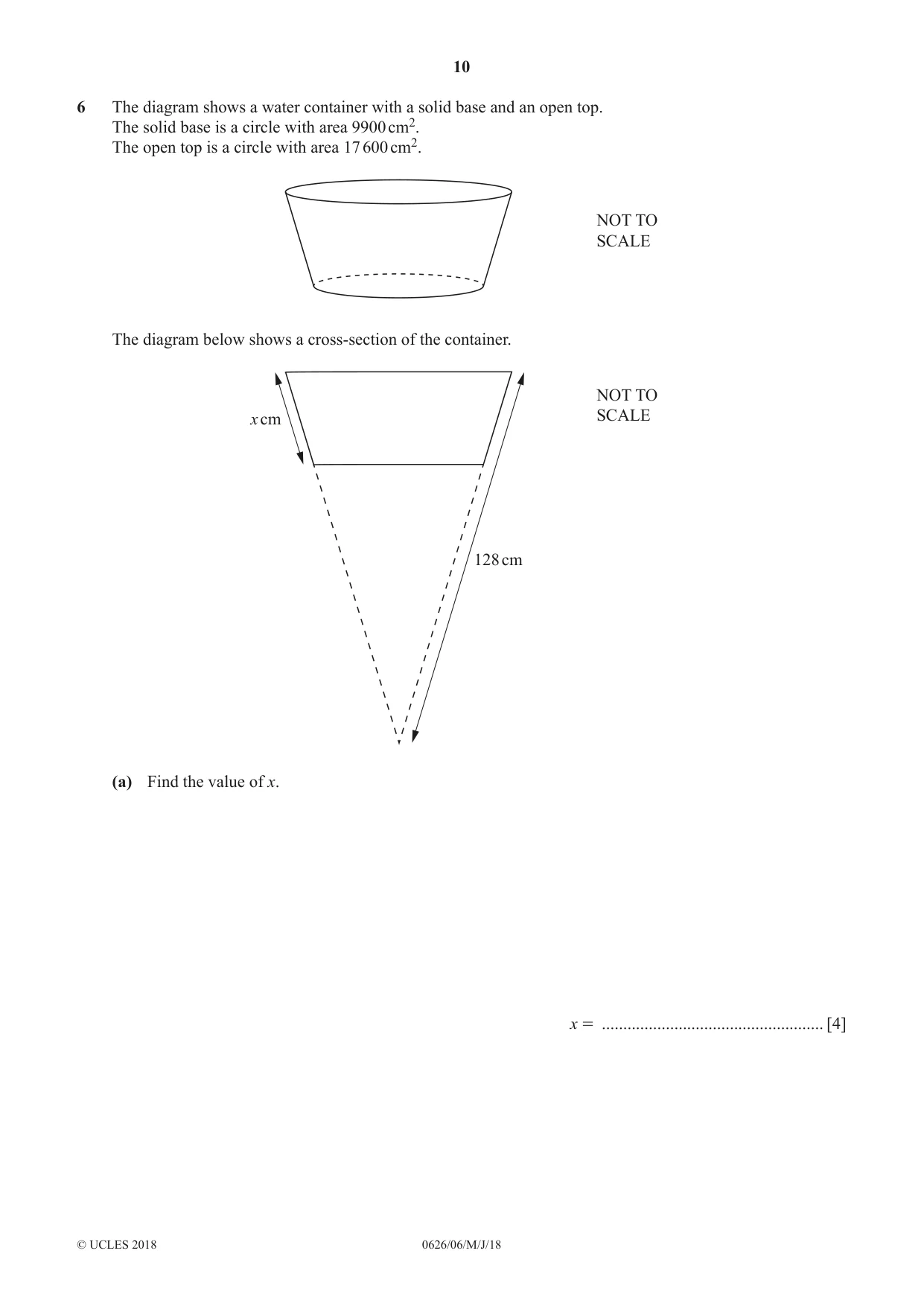
10 0626/06/M/J/18 © UCLES 2018 6 The diagram shows a water container with a solid base and an open top. The solid base is a circle with area 9900 cm2. The open top is a circle with area 17 600 cm2. NOT TO SCALE The diagram below shows a cross-section of the container. x cm 128 cm NOT TO SCALE (a) Find the value of x. x = … [4]
Question paper, page 11
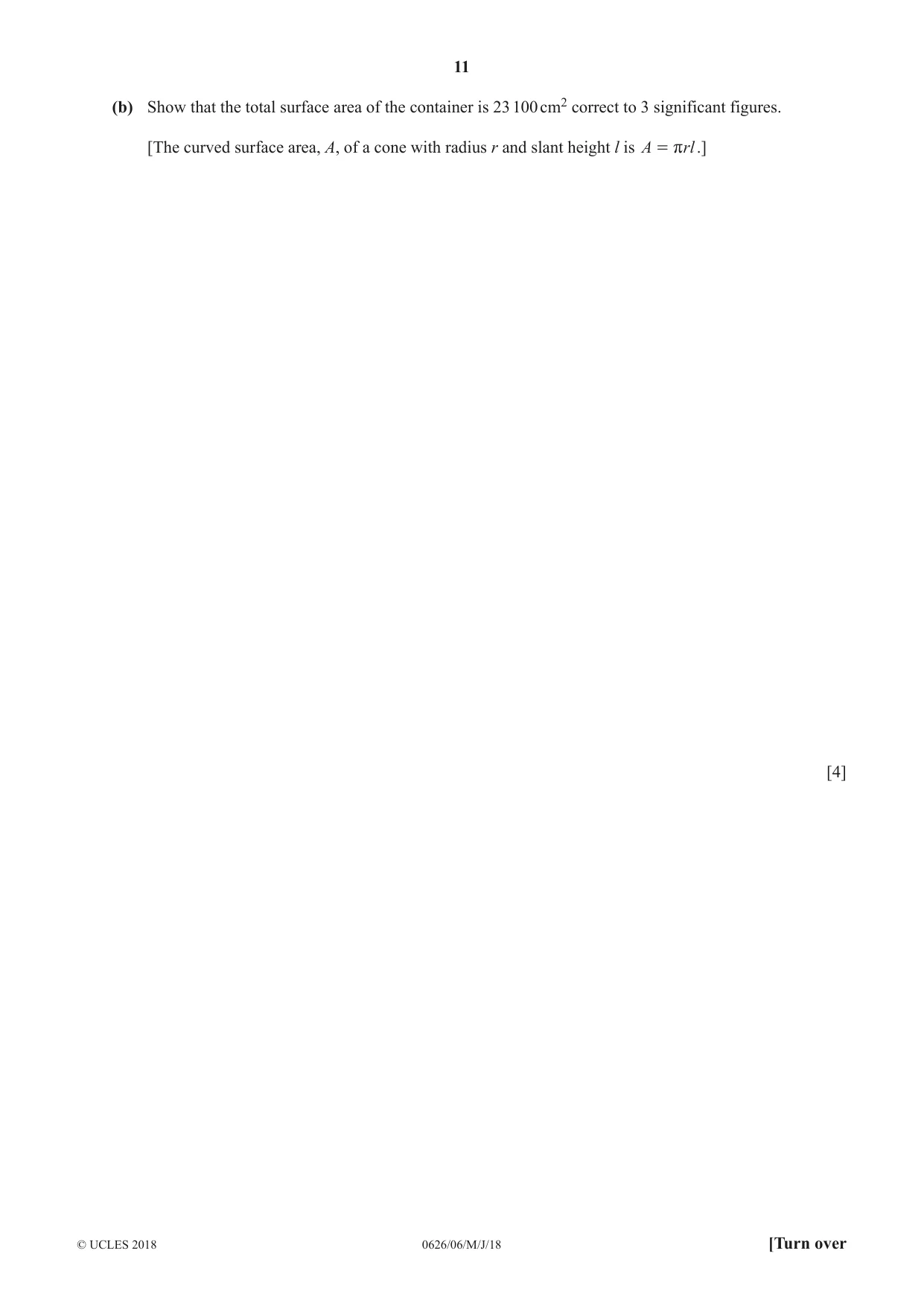
11 0626/06/M/J/18 © UCLES 2018 [Turn over (b) Show that the total surface area of the container is 23 100 cm2 correct to 3 significant figures. [The curved surface area, A, of a cone with radius r and slant height l is r A rl = .] [4]
Question paper, page 12
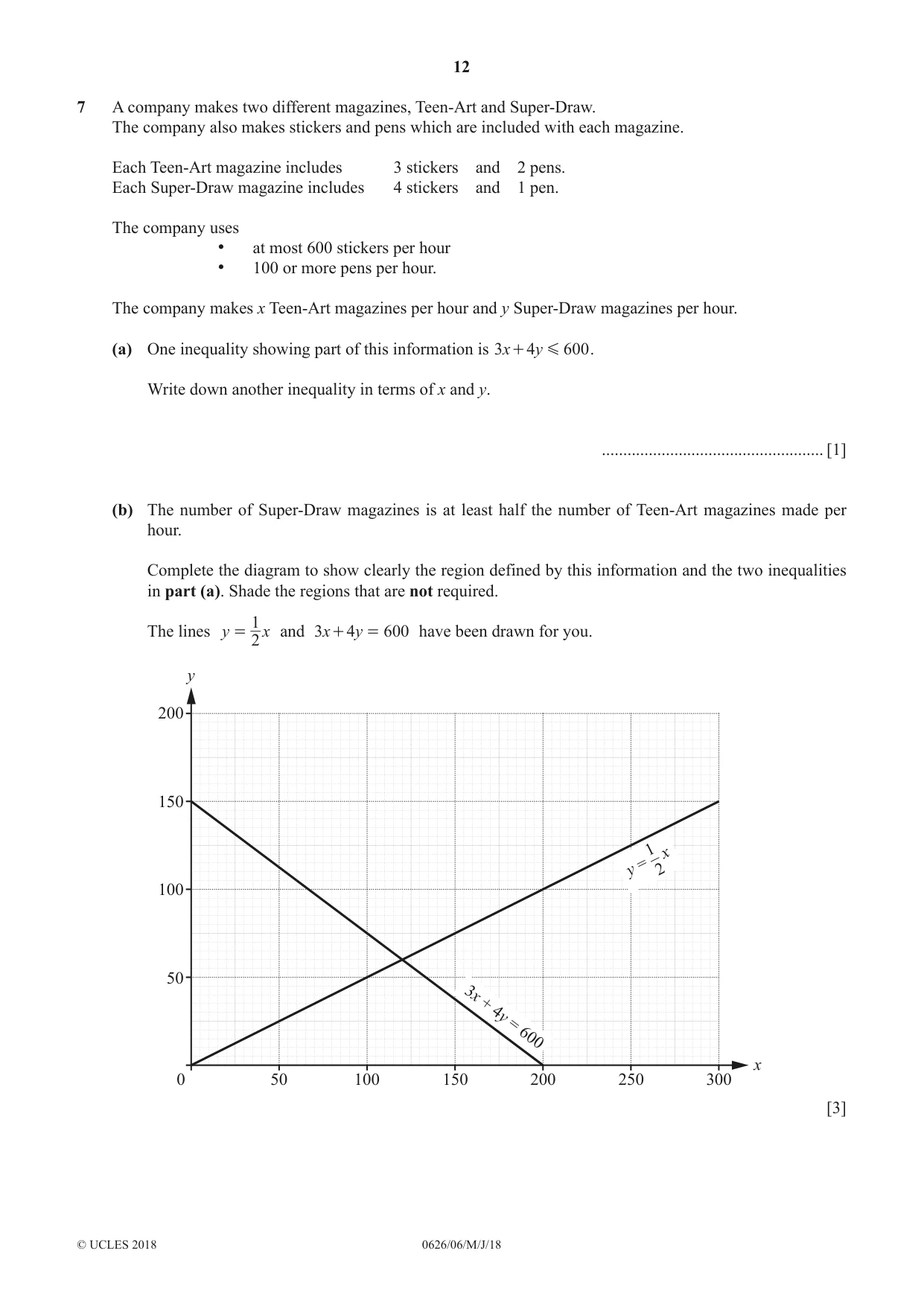
12 0626/06/M/J/18 © UCLES 2018 7 A company makes two different magazines, Teen-Art and Super-Draw. The company also makes stickers and pens which are included with each magazine. Each Teen-Art magazine includes 3 stickers and 2 pens. Each Super-Draw magazine includes 4 stickers and 1 pen. The company uses • at most 600 stickers per hour • 100 or more pens per hour. The company makes x Teen-Art magazines per hour and y Super-Draw magazines per hour. (a) One inequality showing part of this information is x y 3 4 600 G + . Write down another inequality in terms of x and y. … [1] (b) The number of Super-Draw magazines is at least half the number of Teen-Art magazines made per hour. Complete the diagram to show clearly the region defined by this information and the two inequalities in part (a). Shade the regions that are not required. The lines y x 2 1 = and x y 3 4 600 + = have been drawn for you. 0 50 100 150 200 50 100 150 200 250 300 x y 3x + 4y = 600 y = 1 x 2 [3]
Question paper, page 13
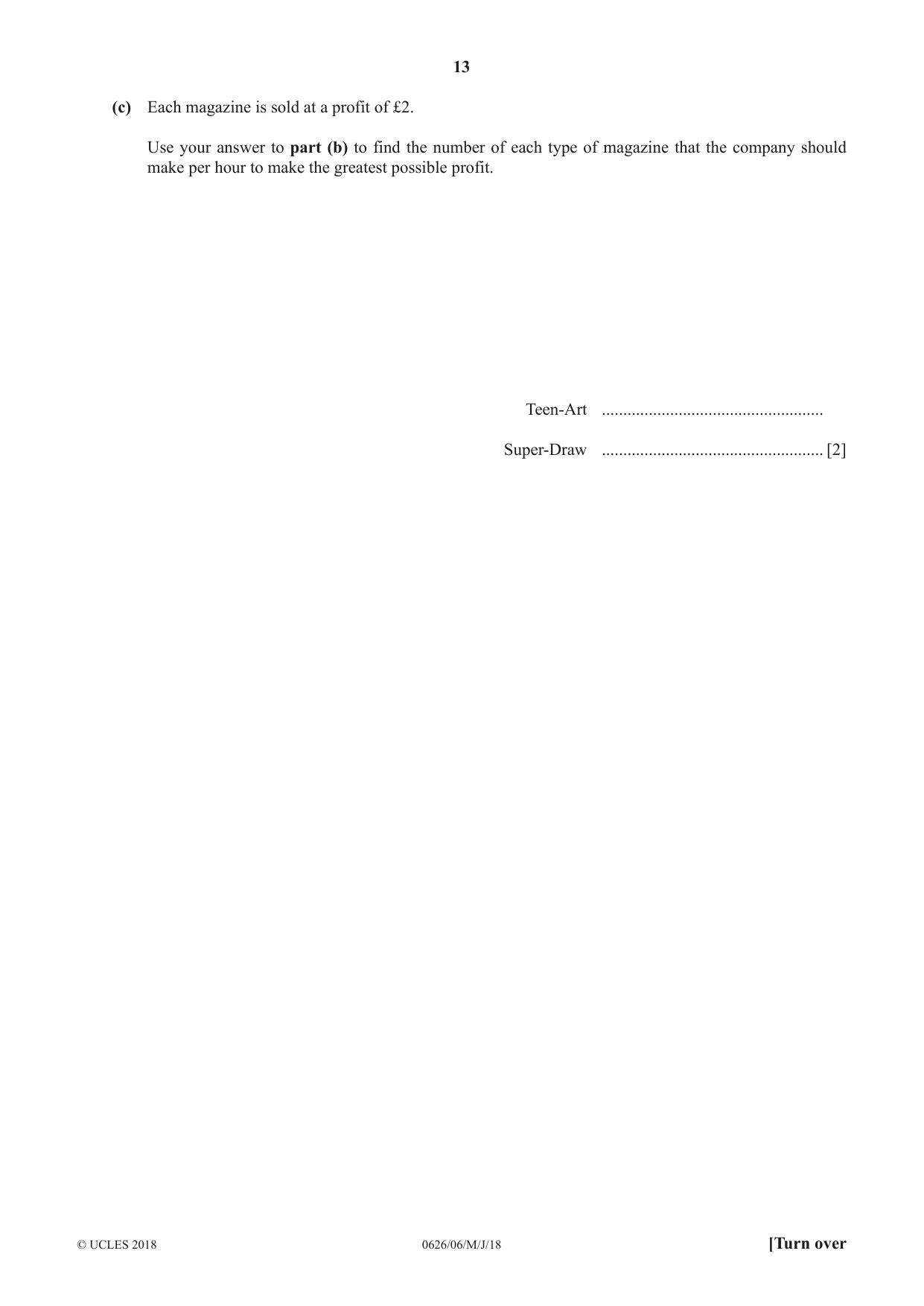
13 0626/06/M/J/18 © UCLES 2018 [Turn over (c) Each magazine is sold at a profit of £2. Use your answer to part (b) to find the number of each type of magazine that the company should make per hour to make the greatest possible profit. Teen-Art … Super-Draw … [2]
Question paper, page 14
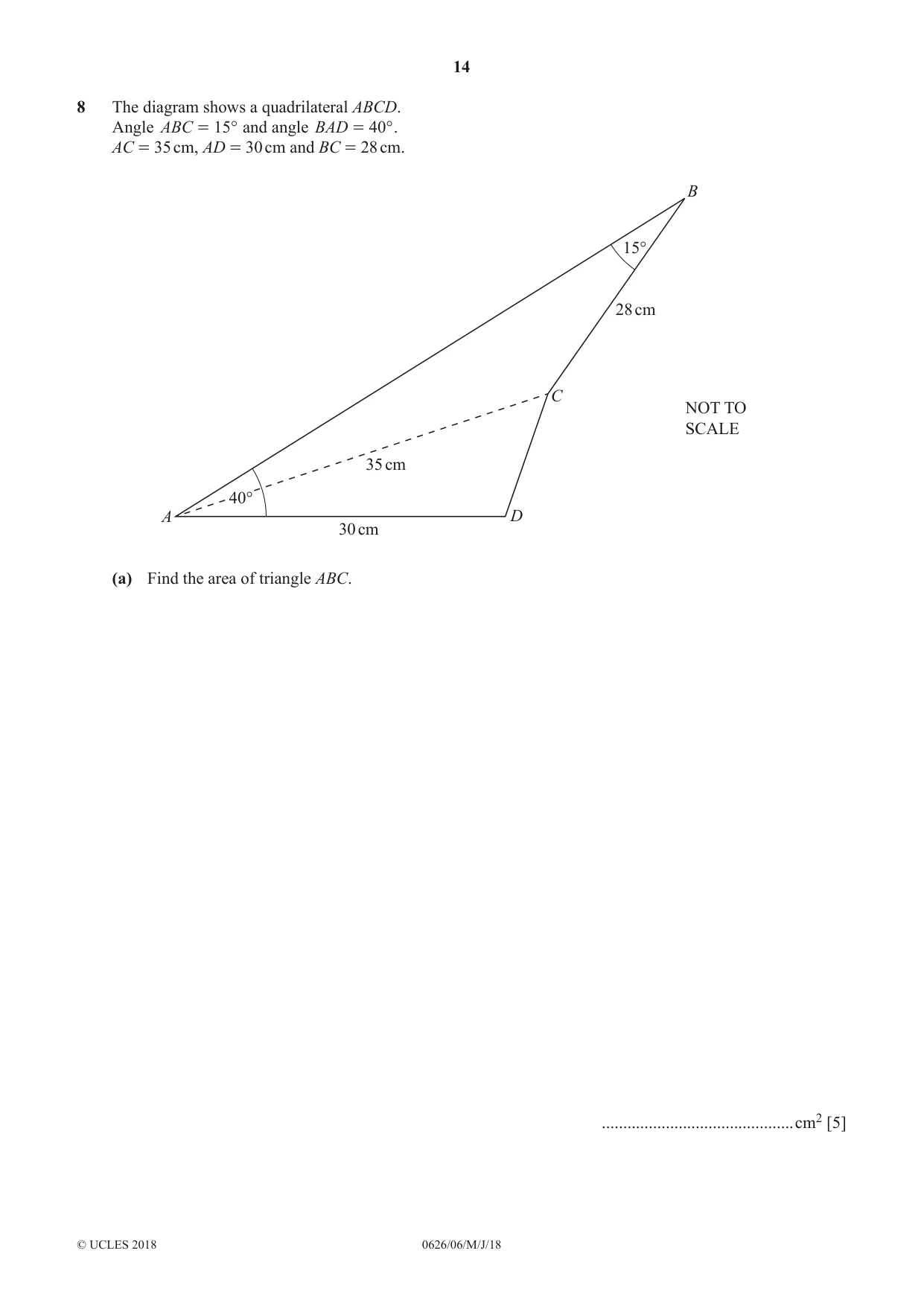
14 0626/06/M/J/18 © UCLES 2018 8 The diagram shows a quadrilateral ABCD. Angle ° ABC 15 = and angle ° BAD 40 = . AC = 35 cm, AD = 30 cm and BC = 28 cm. 15° 28 cm NOT TO SCALE 35 cm 30 cm B C D A 40° (a) Find the area of triangle ABC. …cm2 [5]
Question paper, page 15
15 0626/06/M/J/18 © UCLES 2018 [Turn over (b) Find the length of CD. CD = … cm [4]
Question paper, page 16
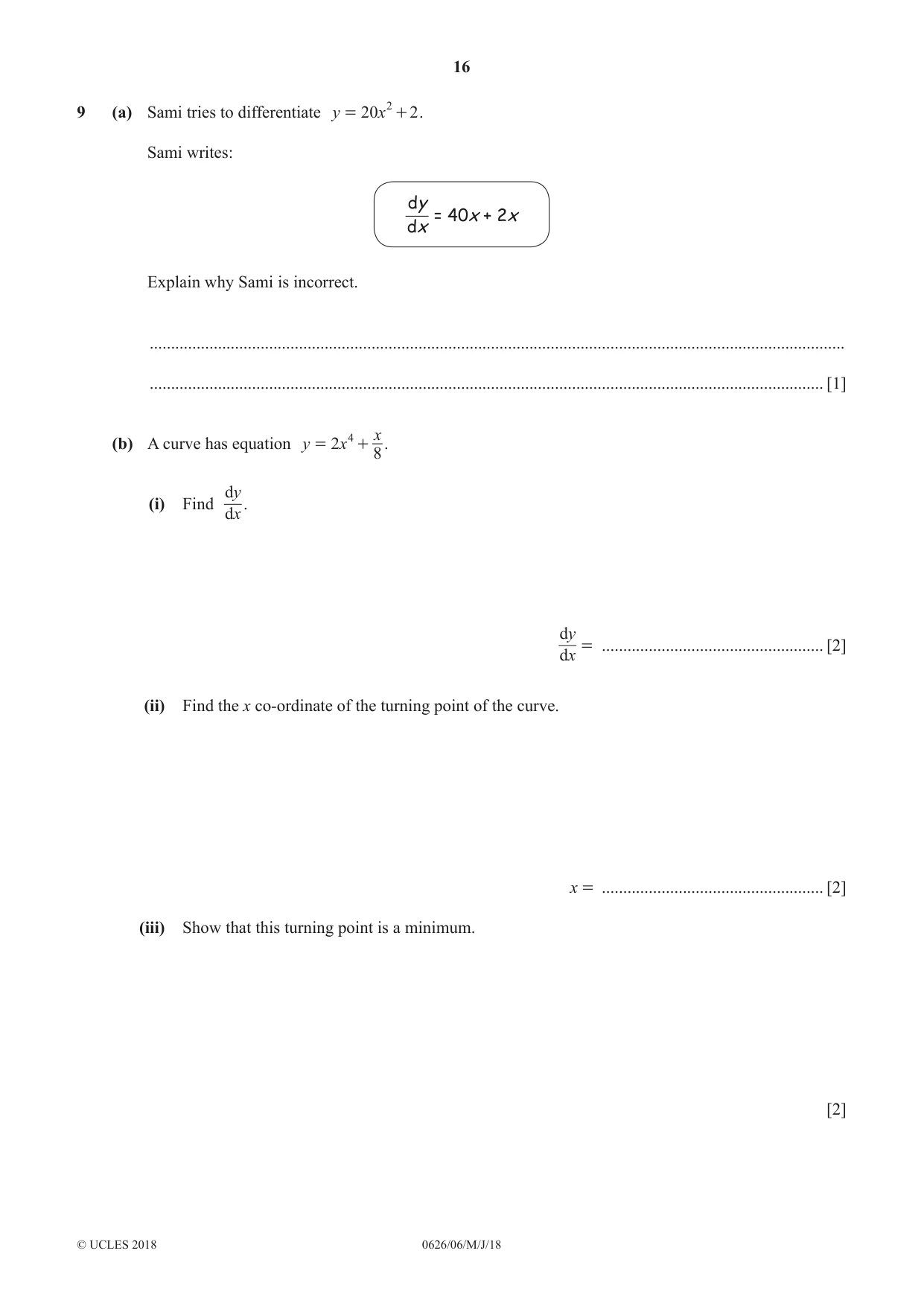
16 0626/06/M/J/18 © UCLES 2018 9 (a) Sami tries to differentiate y x 20 2 2 = + . Sami writes: dy dx = 40x + 2x Explain why Sami is incorrect. … … [1] (b) A curve has equation y x x 2 8 4 = + . (i) Find x y d d . x y d d = … [2] (ii) Find the x co-ordinate of the turning point of the curve. x = … [2] (iii) Show that this turning point is a minimum. [2]
Question paper, page 17
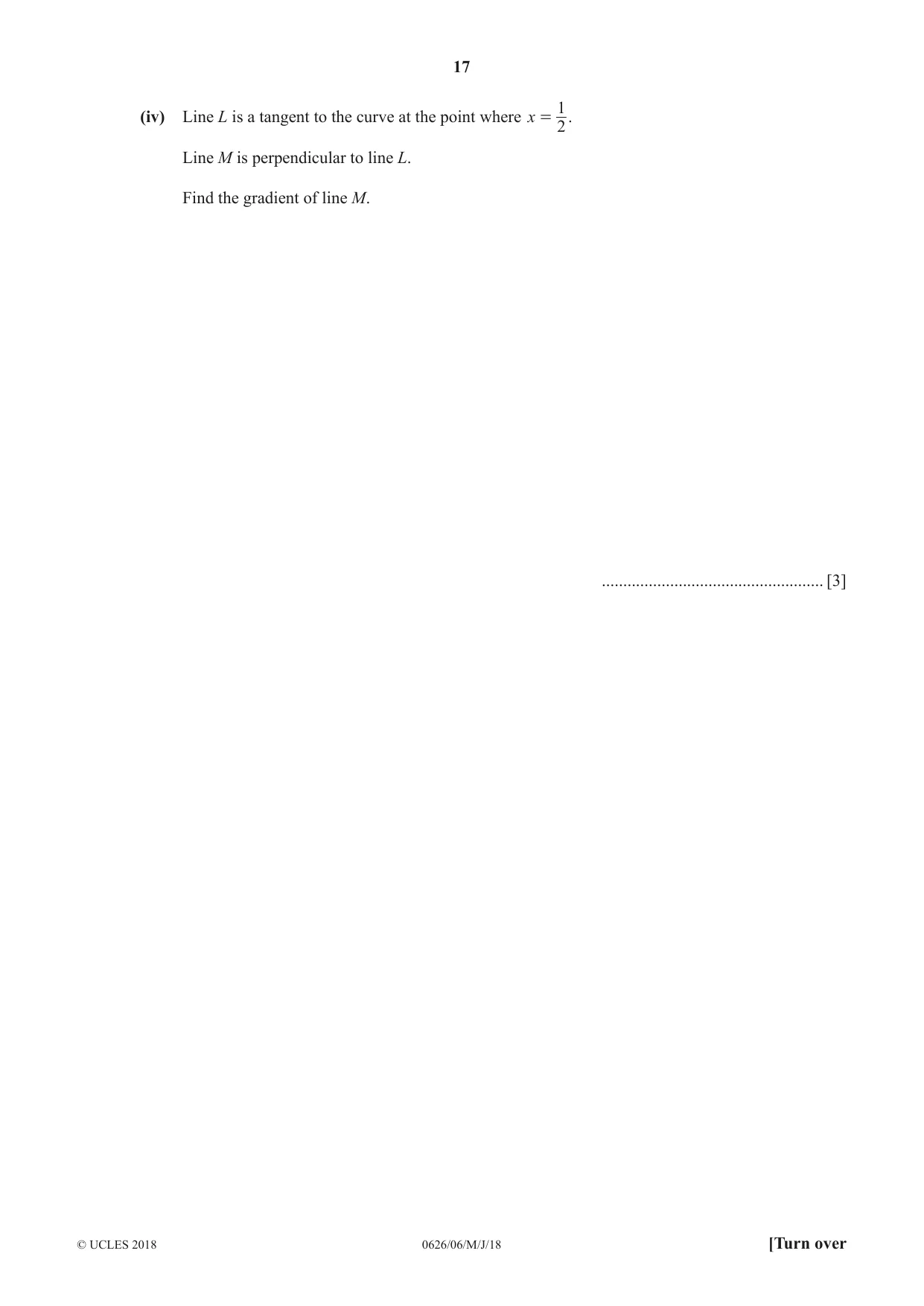
17 0626/06/M/J/18 © UCLES 2018 [Turn over (iv) Line L is a tangent to the curve at the point where x 2 1 = . Line M is perpendicular to line L. Find the gradient of line M. … [3]
Question paper, page 18
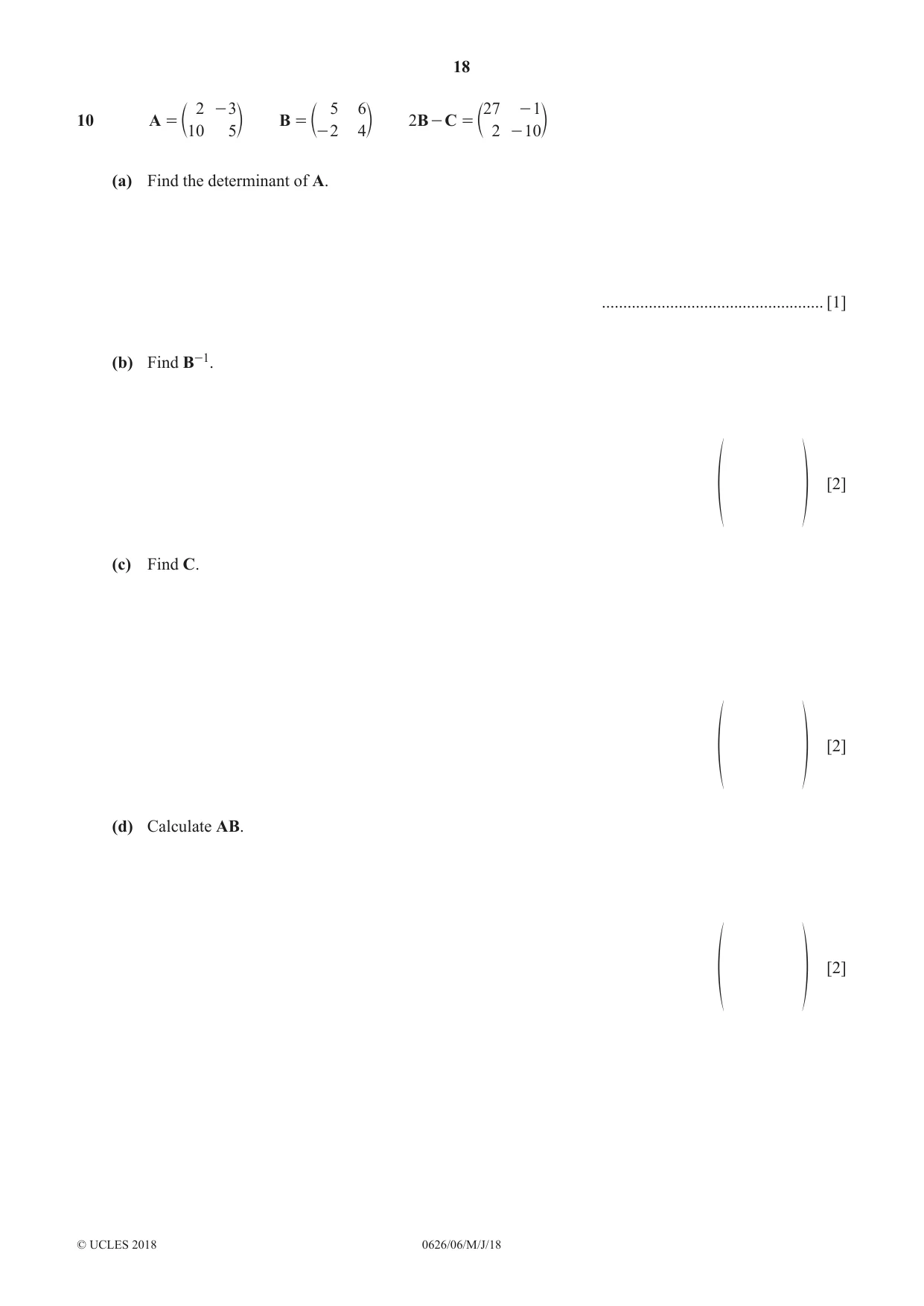
18 0626/06/M/J/18 © UCLES 2018 10 A 2 10 3 5 = - c m B 5 2 6 4 = - c m B C 2 27 2 1 10 - = - - c m (a) Find the determinant of A. … [1] (b) Find B-1. f p [2] (c) Find C. f p [2] (d) Calculate AB. f p [2]
Question paper, page 19
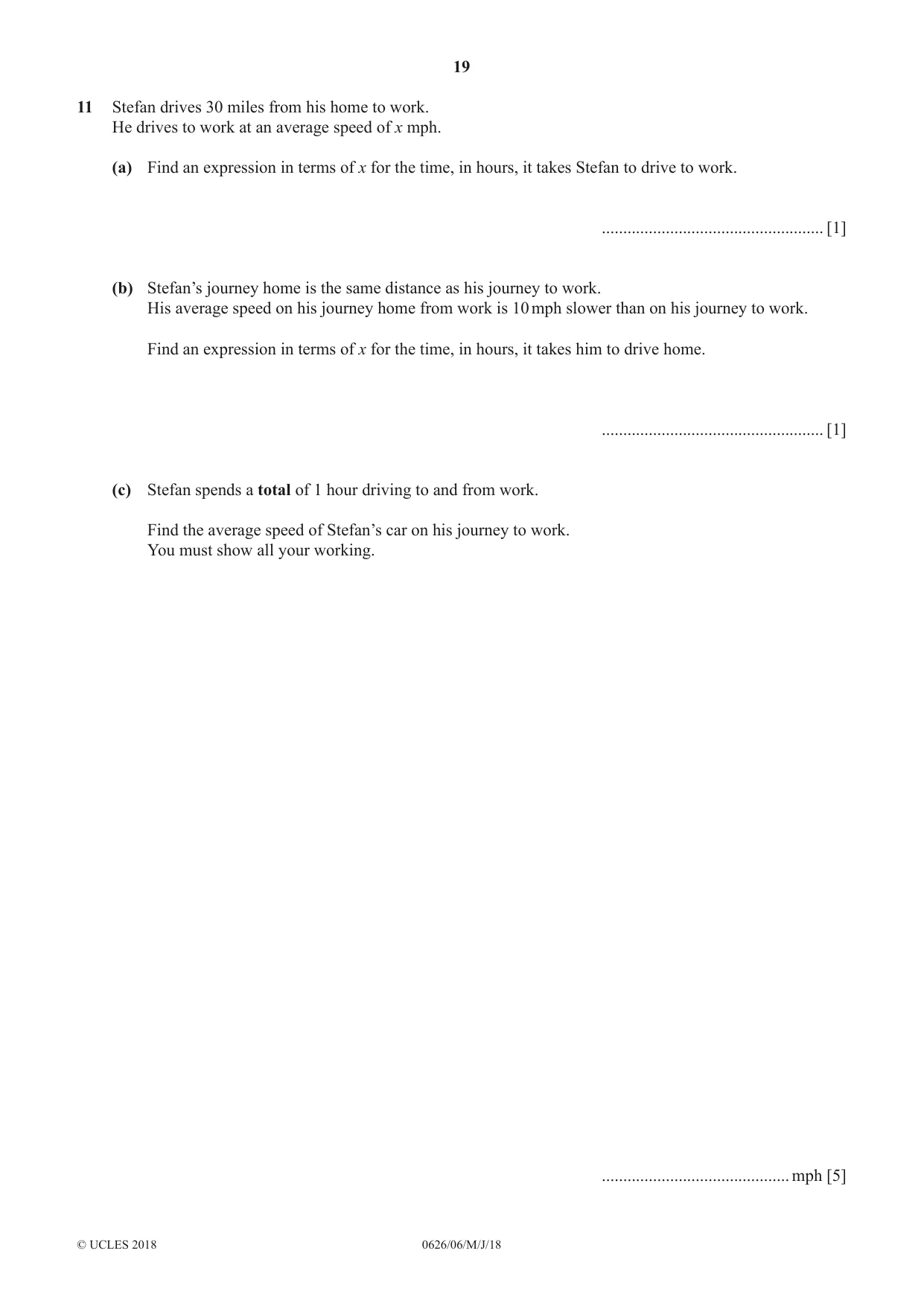
19 0626/06/M/J/18 © UCLES 2018 11 Stefan drives 30 miles from his home to work. He drives to work at an average speed of x mph. (a) Find an expression in terms of x for the time, in hours, it takes Stefan to drive to work. … [1] (b) Stefan’s journey home is the same distance as his journey to work. His average speed on his journey home from work is 10 mph slower than on his journey to work. Find an expression in terms of x for the time, in hours, it takes him to drive home. … [1] (c) Stefan spends a total of 1 hour driving to and from work. Find the average speed of Stefan’s car on his journey to work. You must show all your working. … mph [5]
Question paper, page 20
20 0626/06/M/J/18 © UCLES 2018 Permission to reproduce items where third-party owned material protected by copyright is included has been sought and cleared where possible. Every reasonable effort has been made by the publisher (UCLES) to trace copyright holders, but if any items requiring clearance have unwittingly been included, the publisher will be pleased to make amends at the earliest possible opportunity. To avoid the issue of disclosure of answer-related information to candidates, all copyright acknowledgements are reproduced online in the Cambridge International Examinations Copyright Acknowledgements Booklet. This is produced for each series of examinations and is freely available to download at www.cie.org.uk after the live examination series. Cambridge International Examinations is part of the Cambridge Assessment Group. Cambridge Assessment is the brand name of University of Cambridge Local Examinations Syndicate (UCLES), which is itself a department of the University of Cambridge. BLANK PAGE