Cambridge IGCSE Mathematics (9-1) (UK only) 0626 — 2018 May/June Paper 5 · Variant 0
0626/50/M/J/18
The question paper and its mark scheme, free to read here and free to download. This is Cambridge’s own paper, exactly as it was sat.
Question paper16 pages
Mark scheme
No mark scheme is in the library for this paper.
Paper as text
Question paper, page 1
This document consists of 16 printed pages. DC (LEG/FC) 143933/2 © UCLES 2018 [Turn over Cambridge International Examinations Cambridge International General Certificate of Secondary Education (9–1) * 1 6 5 3 1 6 0 3 1 8 * MATHEMATICS 0626/05 Paper 5 (Core) May/June 2018 2 hours Candidates answer on the Question Paper. Additional Materials: Geometrical instruments Tracing paper (optional) READ THESE INSTRUCTIONS FIRST Write your Centre number, candidate number and name on all the work you hand in. Write in dark blue or black pen. You may use an HB pencil for any diagrams or graphs. Do not use staples, paper clips, glue or correction fluid. DO NOT WRITE IN ANY BARCODES. Answer all questions. Electronic calculators should be used. If working is needed for any question it must be shown below that question. If the degree of accuracy is not specified in the question, and if the answer is not exact, give the answer to three significant figures. Give answers in degrees to one decimal place. For r, use either your calculator value or 3.142. At the end of the examination, fasten all your work securely together. The number of marks is given in brackets [ ] at the end of each question or part question. The total of the marks for this paper is 96. This syllabus is regulated for use in England as a Cambridge International Level 1/Level 2 (9–1) Certificate.
Question paper, page 2
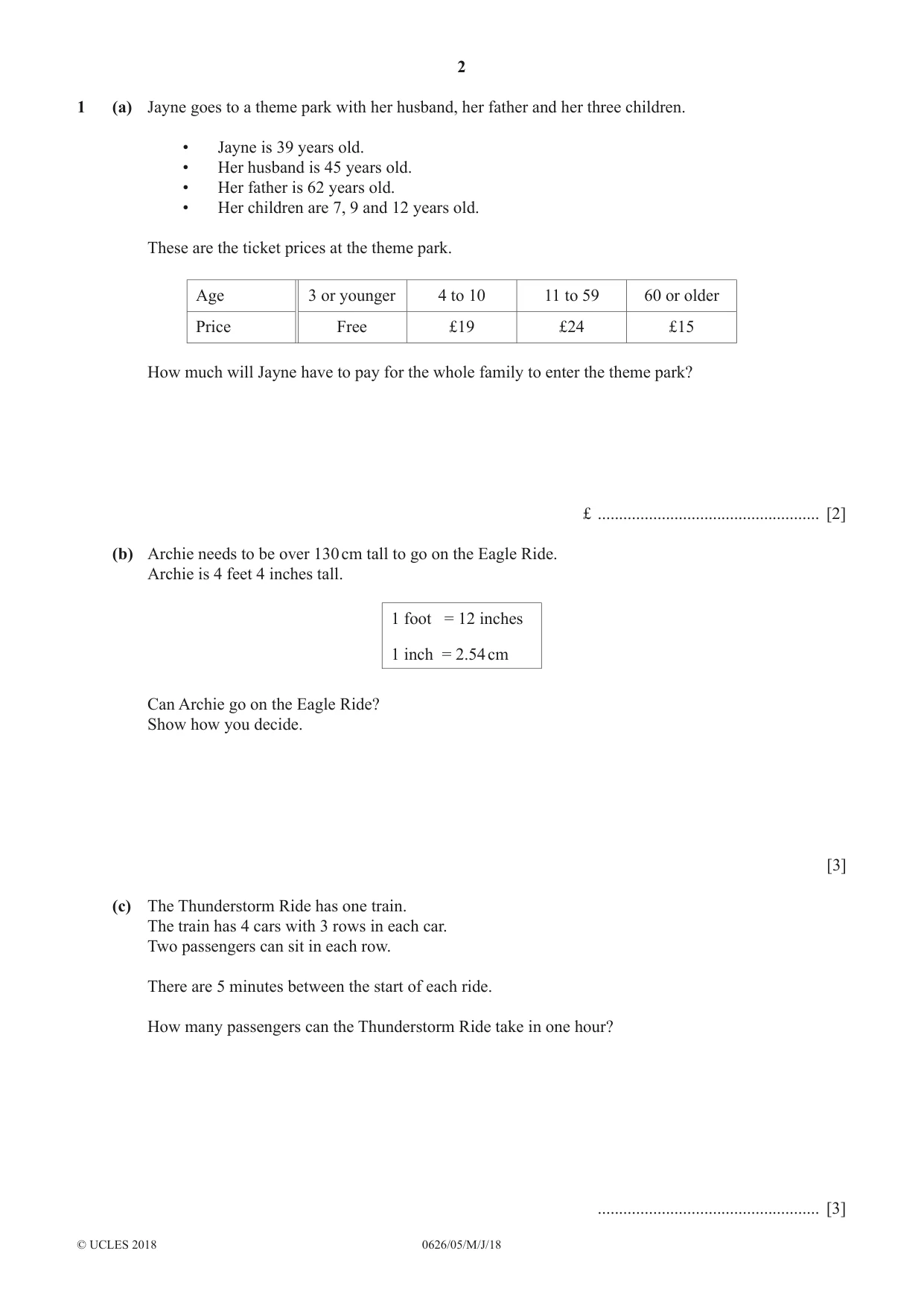
2 0626/05/M/J/18 © UCLES 2018 1 (a) Jayne goes to a theme park with her husband, her father and her three children. • Jayne is 39 years old. • Her husband is 45 years old. • Her father is 62 years old. • Her children are 7, 9 and 12 years old. These are the ticket prices at the theme park. Age 3 or younger 4 to 10 11 to 59 60 or older Price Free £19 £24 £15 How much will Jayne have to pay for the whole family to enter the theme park? £ … [2] (b) Archie needs to be over 130 cm tall to go on the Eagle Ride. Archie is 4 feet 4 inches tall. 1 foot = 12 inches 1 inch = 2.54 cm Can Archie go on the Eagle Ride? Show how you decide. [3] (c) The Thunderstorm Ride has one train. The train has 4 cars with 3 rows in each car. Two passengers can sit in each row. There are 5 minutes between the start of each ride. How many passengers can the Thunderstorm Ride take in one hour? … [3]
Question paper, page 3
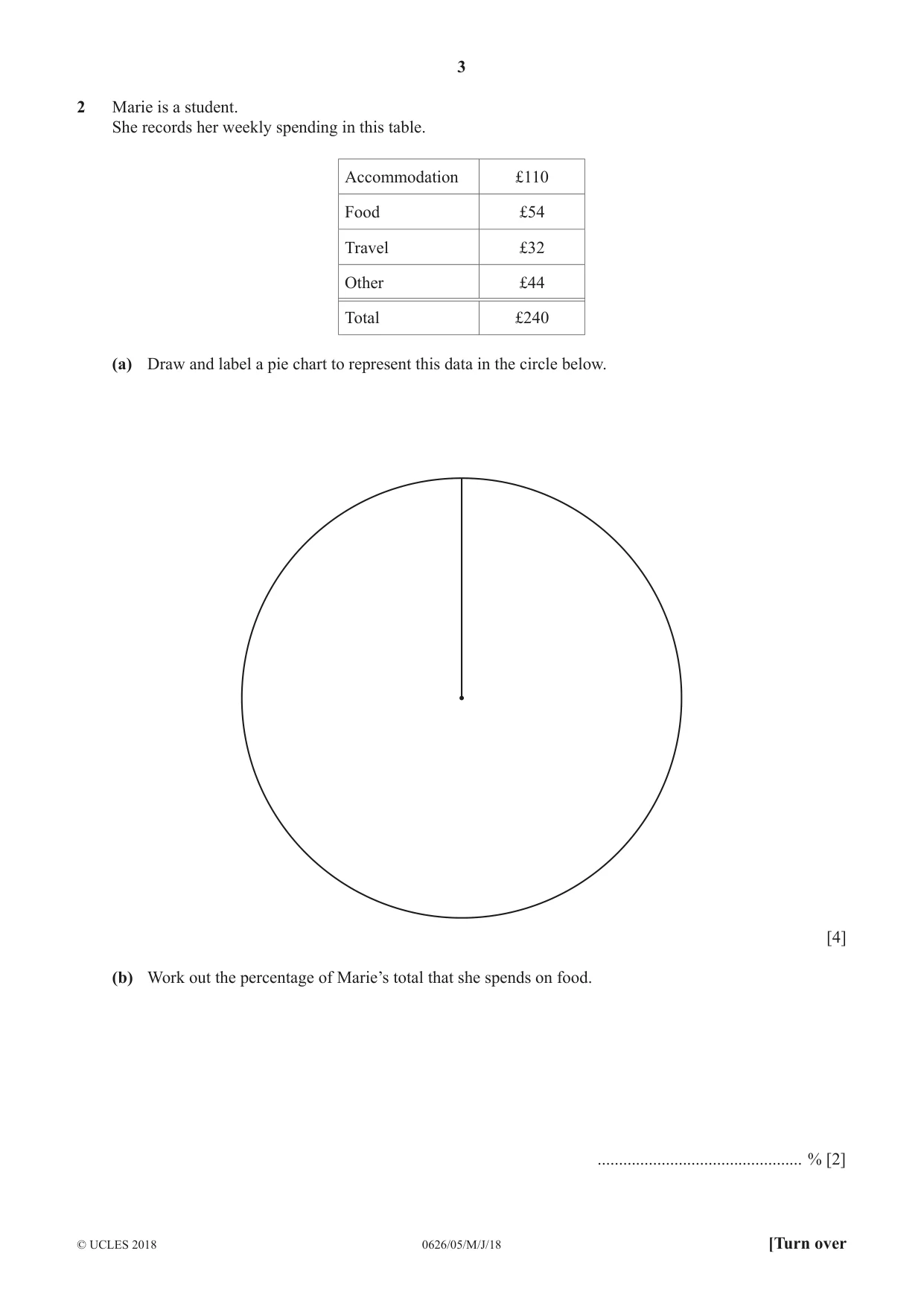
3 0626/05/M/J/18 © UCLES 2018 [Turn over 2 Marie is a student. She records her weekly spending in this table. Accommodation £110 Food £54 Travel £32 Other £44 Total £240 (a) Draw and label a pie chart to represent this data in the circle below. [4] (b) Work out the percentage of Marie’s total that she spends on food. … % [2]
Question paper, page 4
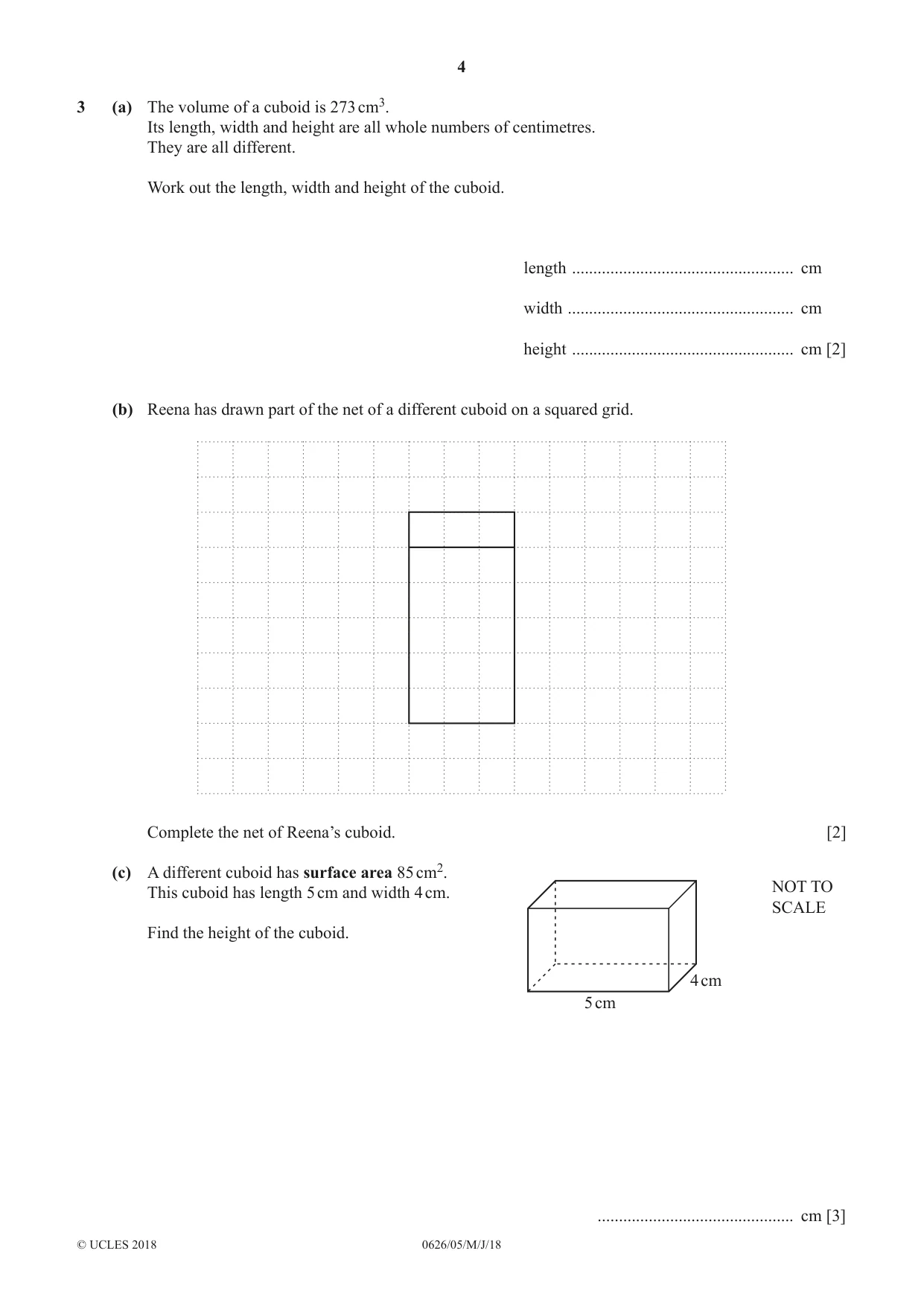
4 0626/05/M/J/18 © UCLES 2018 3 (a) The volume of a cuboid is 273 cm3. Its length, width and height are all whole numbers of centimetres. They are all different. Work out the length, width and height of the cuboid. length … cm [2] width … cm [2] height … cm [2] (b) Reena has drawn part of the net of a different cuboid on a squared grid. Complete the net of Reena’s cuboid. [2] (c) A different cuboid has surface area 85 cm2. This cuboid has length 5 cm and width 4 cm. Find the height of the cuboid. 5 cm 4 cm NOT TO SCALE … cm [3]
Question paper, page 5
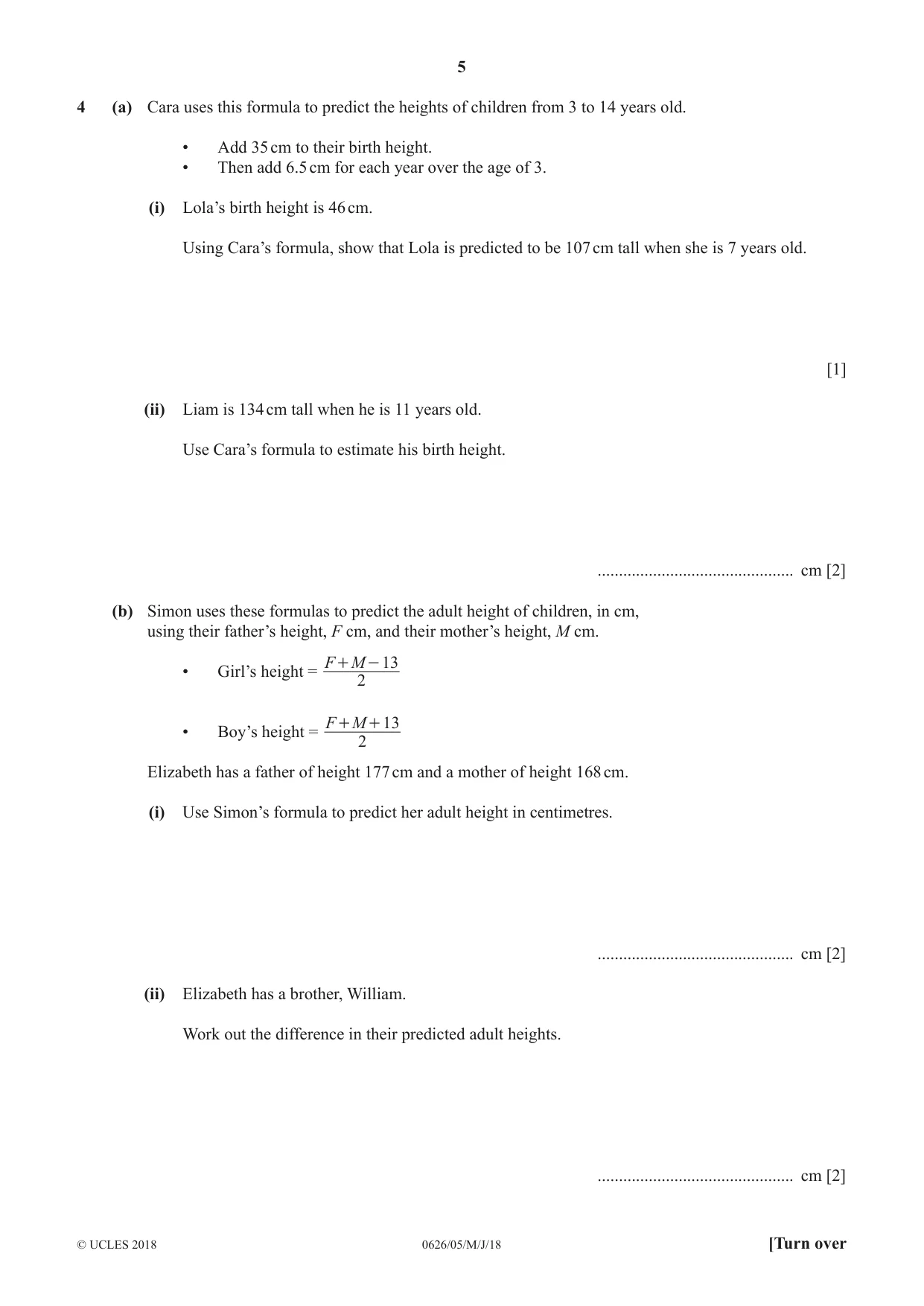
5 0626/05/M/J/18 © UCLES 2018 [Turn over 4 (a) Cara uses this formula to predict the heights of children from 3 to 14 years old. • Add 35 cm to their birth height. • Then add 6.5 cm for each year over the age of 3. (i) Lola’s birth height is 46 cm. Using Cara’s formula, show that Lola is predicted to be 107 cm tall when she is 7 years old. [1] (ii) Liam is 134 cm tall when he is 11 years old. Use Cara’s formula to estimate his birth height. … cm [2] (b) Simon uses these formulas to predict the adult height of children, in cm, using their father’s height, F cm, and their mother’s height, M cm. • Girl’s height = F M 2 13 + - • Boy’s height = F M 2 13 + + Elizabeth has a father of height 177 cm and a mother of height 168 cm. (i) Use Simon’s formula to predict her adult height in centimetres. … cm [2] (ii) Elizabeth has a brother, William. Work out the difference in their predicted adult heights. … cm [2]
Question paper, page 6
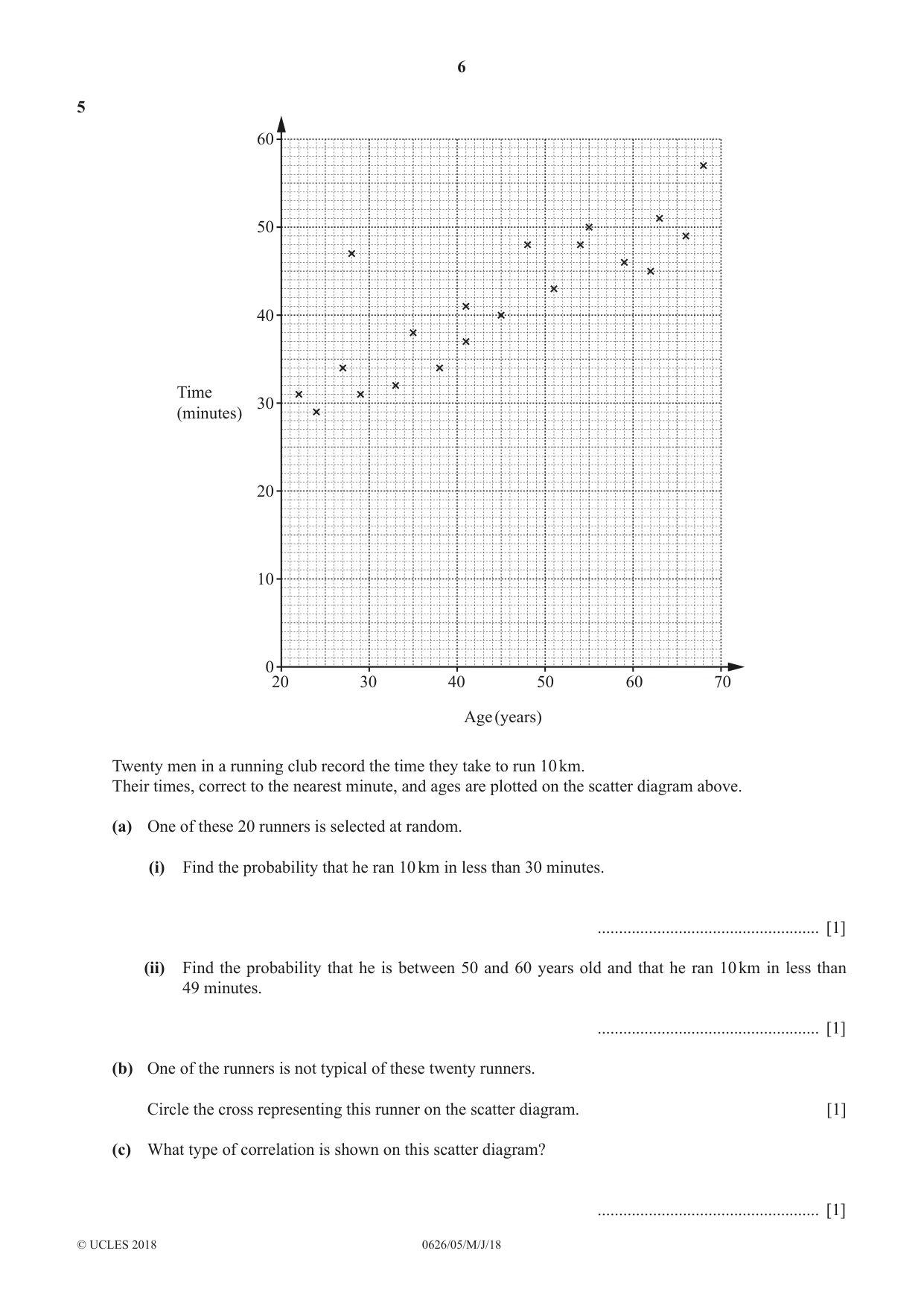
6 0626/05/M/J/18 © UCLES 2018 5 20 30 40 50 60 70 Age (years) 0 10 20 30 Time (minutes) 40 50 60 Twenty men in a running club record the time they take to run 10 km. Their times, correct to the nearest minute, and ages are plotted on the scatter diagram above. (a) One of these 20 runners is selected at random. (i) Find the probability that he ran 10 km in less than 30 minutes. … [1] (ii) Find the probability that he is between 50 and 60 years old and that he ran 10 km in less than 49 minutes. … [1] (b) One of the runners is not typical of these twenty runners. Circle the cross representing this runner on the scatter diagram. [1] (c) What type of correlation is shown on this scatter diagram? … [1]
Question paper, page 7
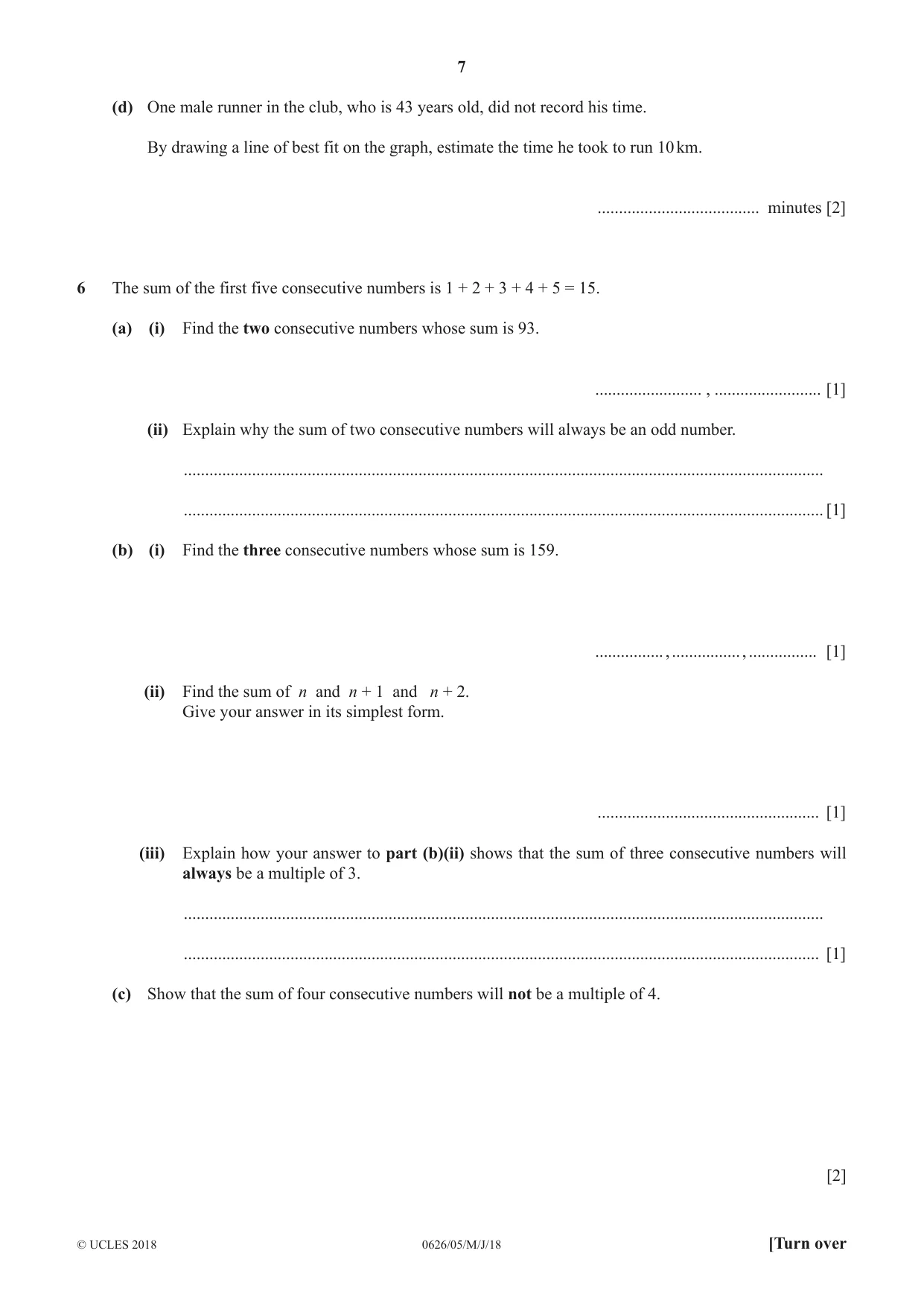
7 0626/05/M/J/18 © UCLES 2018 [Turn over (d) One male runner in the club, who is 43 years old, did not record his time. By drawing a line of best fit on the graph, estimate the time he took to run 10 km. … minutes [2] 6 The sum of the first five consecutive numbers is 1 + 2 + 3 + 4 + 5 = 15. (a) (i) Find the two consecutive numbers whose sum is 93. … , … [1] (ii) Explain why the sum of two consecutive numbers will always be an odd number. … … [1] (b) (i) Find the three consecutive numbers whose sum is 159. … , … , … [1] (ii) Find the sum of n and n + 1 and n + 2. Give your answer in its simplest form. … [1] (iii) Explain how your answer to part (b)(ii) shows that the sum of three consecutive numbers will always be a multiple of 3. … … [1] (c) Show that the sum of four consecutive numbers will not be a multiple of 4. [2]
Question paper, page 8
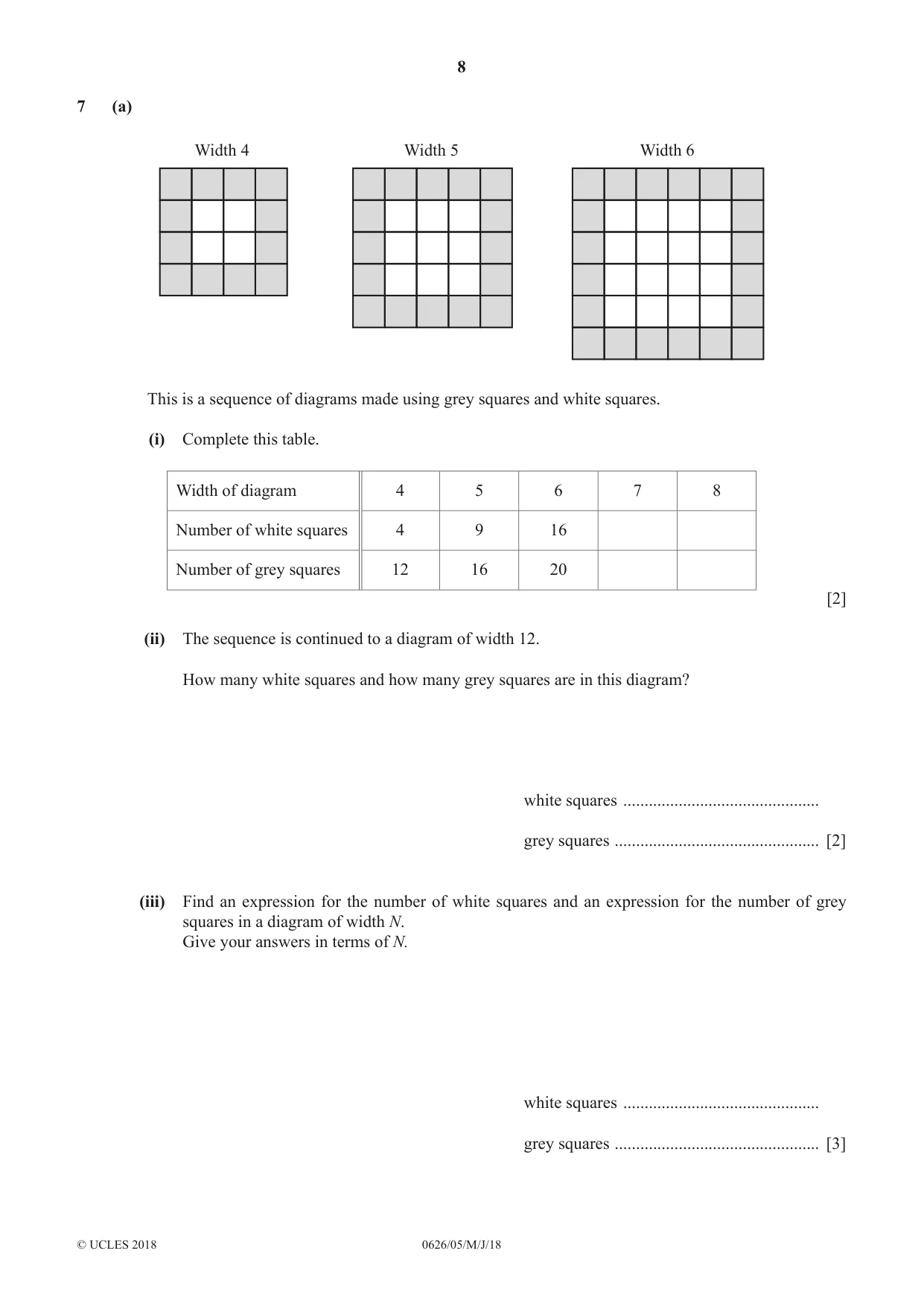
8 0626/05/M/J/18 © UCLES 2018 7 (a) Width 4 Width 5 Width 6 This is a sequence of diagrams made using grey squares and white squares. (i) Complete this table. Width of diagram 4 5 6 7 8 Number of white squares 4 9 16 Number of grey squares 12 16 20 [2] (ii) The sequence is continued to a diagram of width 12. How many white squares and how many grey squares are in this diagram? white squares … grey squares … [2] (iii) Find an expression for the number of white squares and an expression for the number of grey squares in a diagram of width N. Give your answers in terms of N. white squares … grey squares … [3]
Question paper, page 9
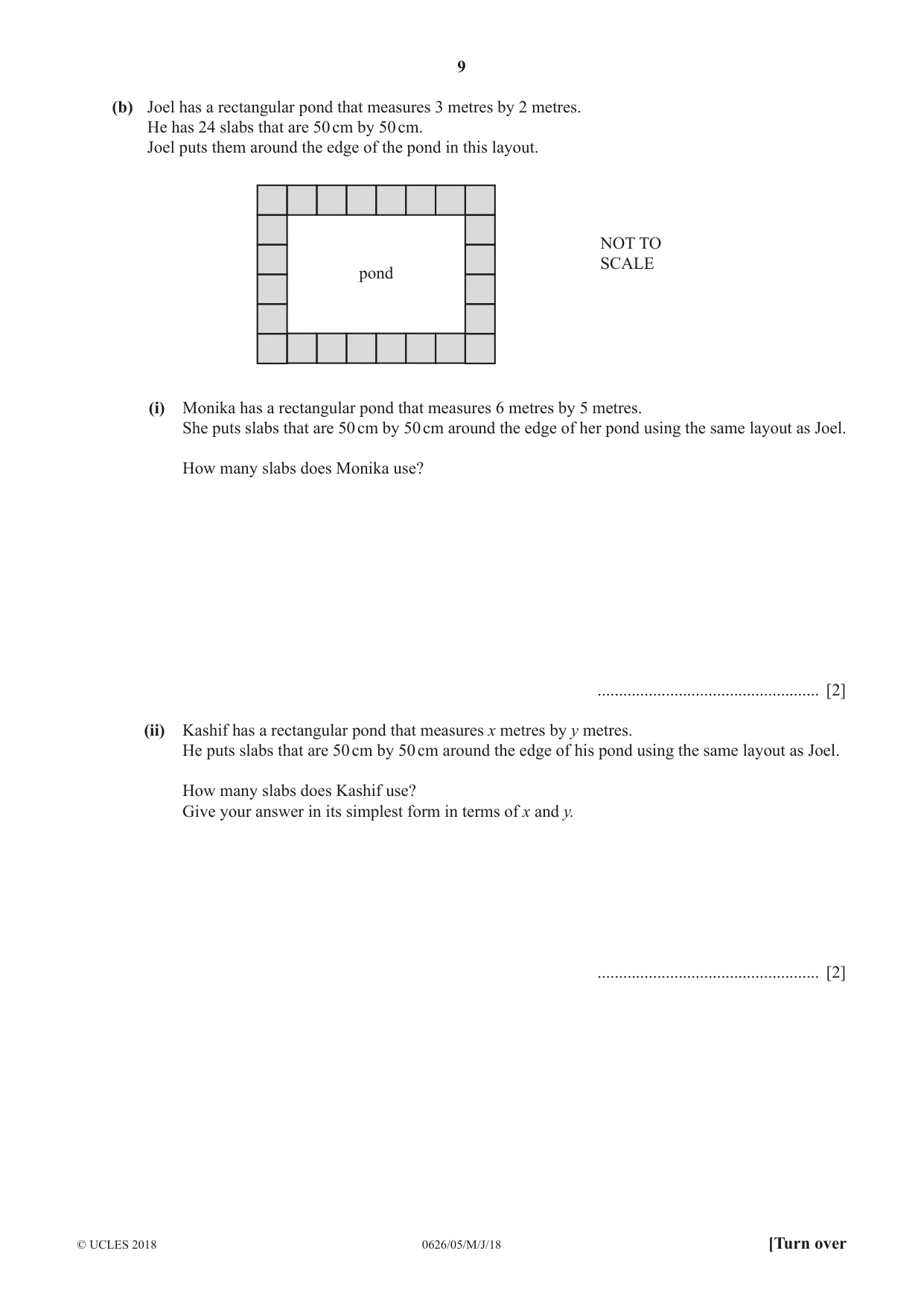
9 0626/05/M/J/18 © UCLES 2018 [Turn over (b) Joel has a rectangular pond that measures 3 metres by 2 metres. He has 24 slabs that are 50 cm by 50 cm. Joel puts them around the edge of the pond in this layout. NOT TO SCALE pond (i) Monika has a rectangular pond that measures 6 metres by 5 metres. She puts slabs that are 50 cm by 50 cm around the edge of her pond using the same layout as Joel. How many slabs does Monika use? … [2] (ii) Kashif has a rectangular pond that measures x metres by y metres. He puts slabs that are 50 cm by 50 cm around the edge of his pond using the same layout as Joel. How many slabs does Kashif use? Give your answer in its simplest form in terms of x and y. … [2]
Question paper, page 10
10 0626/05/M/J/18 © UCLES 2018 8 Jenny travels to France. (a) (i) She leaves home at 13 15 and drives to the ferry port. Her journey takes 2 hours 50 minutes. At what time does she arrive at the ferry port? … [1] (ii) Jenny leaves the ferry port in France at 19 25 and drives to her final destination. She arrives at her final destination at 20 15. How many minutes does her journey in France take? … minutes [1] (b) Jenny changes £440 into euros (€). The exchange rate is £1 = €1.25. (i) How many euros does Jenny receive? € … [1] (ii) In France Jenny buys an antique for €350. She brings the antique back to England. Jenny sells the antique for £365.40. Calculate her percentage profit. … % [4]
Question paper, page 11
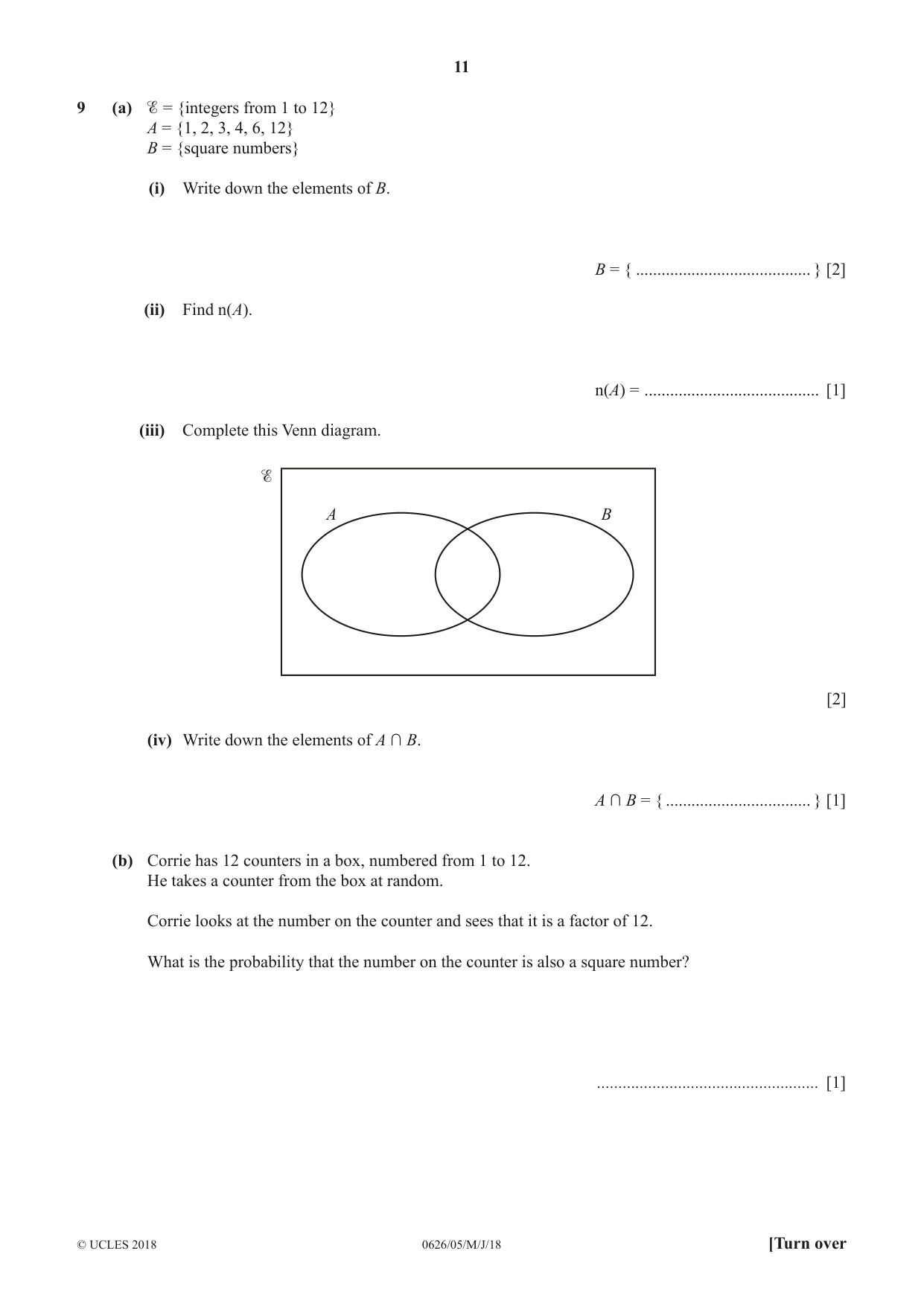
11 0626/05/M/J/18 © UCLES 2018 [Turn over 9 (a) = {integers from 1 to 12} A = {1, 2, 3, 4, 6, 12} B = {square numbers} (i) Write down the elements of B. B = { … } [2] (ii) Find n(A). n(A) = … [1] (iii) Complete this Venn diagram. A B [2] (iv) Write down the elements of A ∩ B. A ∩ B = { … } [1] (b) Corrie has 12 counters in a box, numbered from 1 to 12. He takes a counter from the box at random. Corrie looks at the number on the counter and sees that it is a factor of 12. What is the probability that the number on the counter is also a square number? … [1]
Question paper, page 12
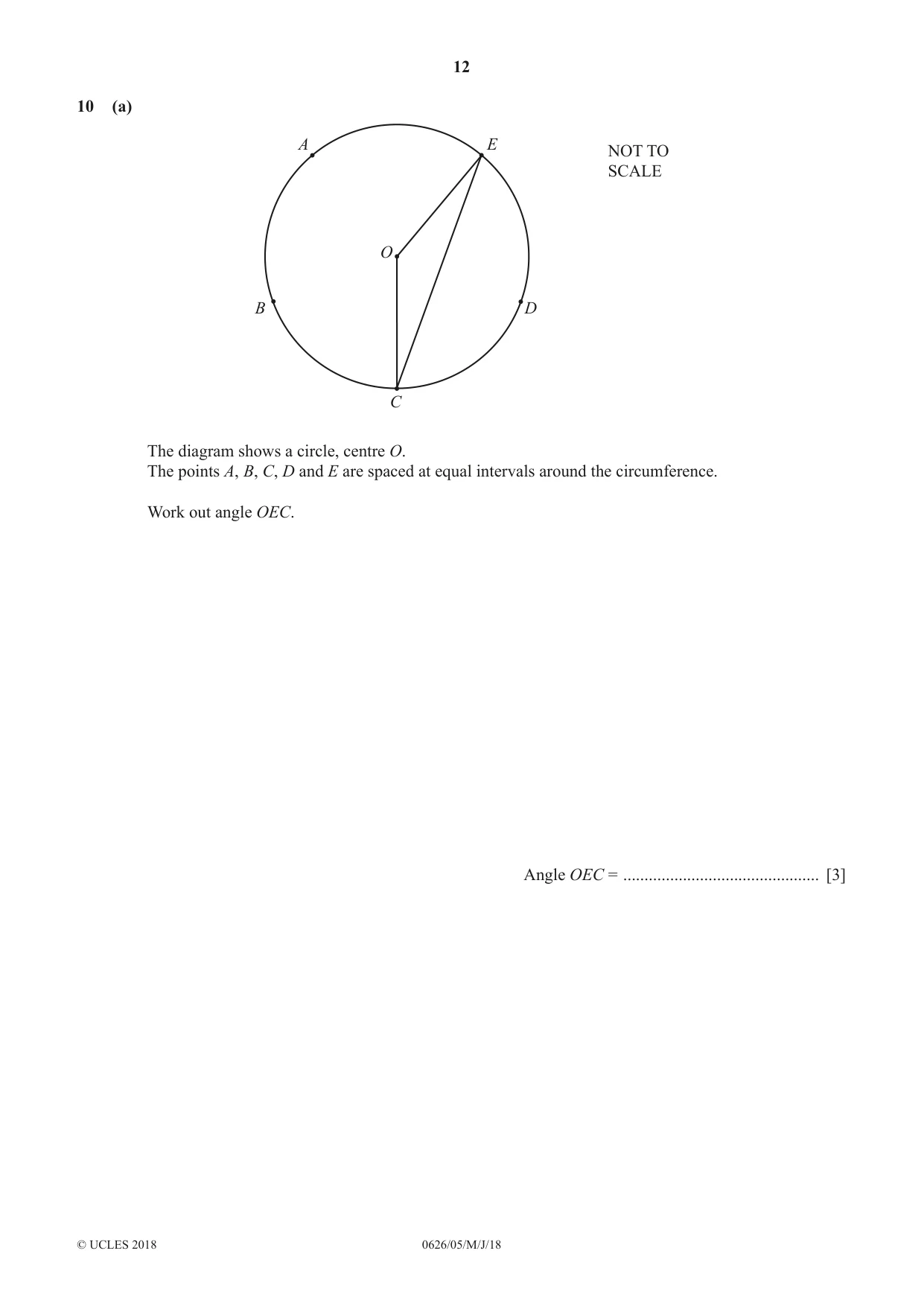
12 0626/05/M/J/18 © UCLES 2018 10 (a) A B E NOT TO SCALE D C O The diagram shows a circle, centre O. The points A, B, C, D and E are spaced at equal intervals around the circumference. Work out angle OEC. Angle OEC = … [3]
Question paper, page 13
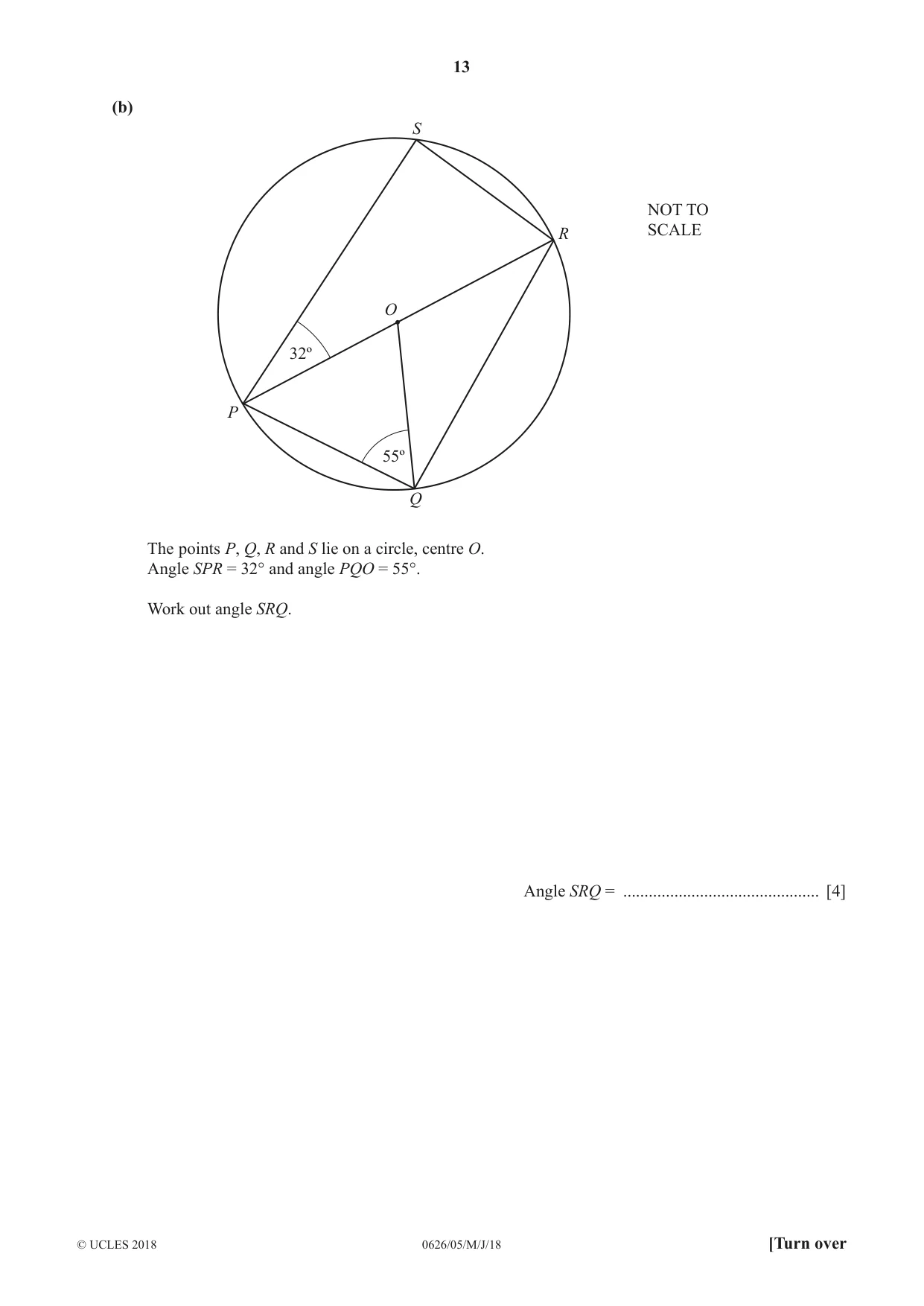
13 0626/05/M/J/18 © UCLES 2018 [Turn over (b) S P R NOT TO SCALE 55º 32º Q O The points P, Q, R and S lie on a circle, centre O. Angle SPR = 32° and angle PQO = 55°. Work out angle SRQ. Angle SRQ = … [4]
Question paper, page 14
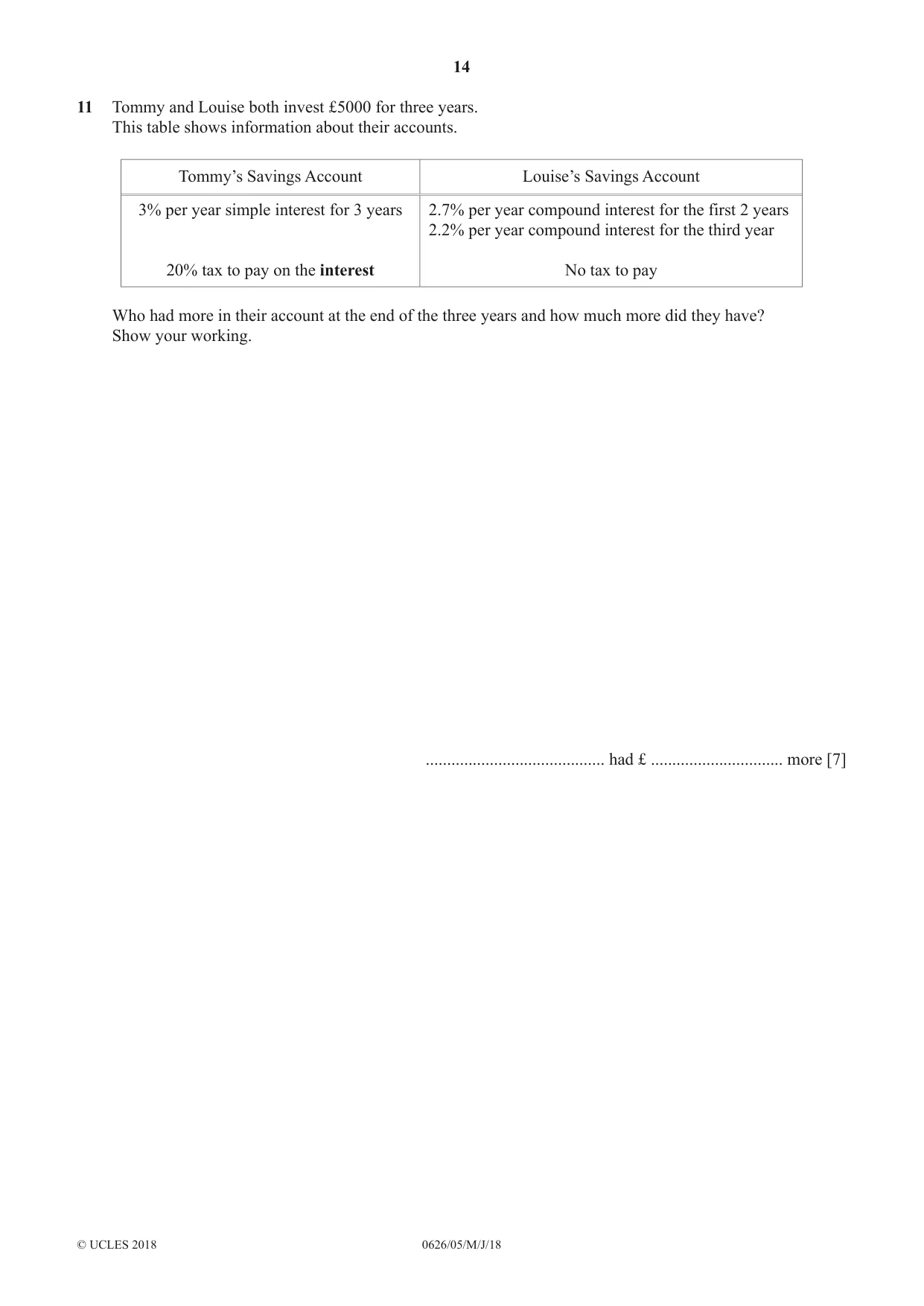
14 0626/05/M/J/18 © UCLES 2018 11 Tommy and Louise both invest £5000 for three years. This table shows information about their accounts. Tommy’s Savings Account Louise’s Savings Account 3% per year simple interest for 3 years 20% tax to pay on the interest 2.7% per year compound interest for the first 2 years 2.2% per year compound interest for the third year No tax to pay Who had more in their account at the end of the three years and how much more did they have? Show your working. … had £ … more [7]
Question paper, page 15
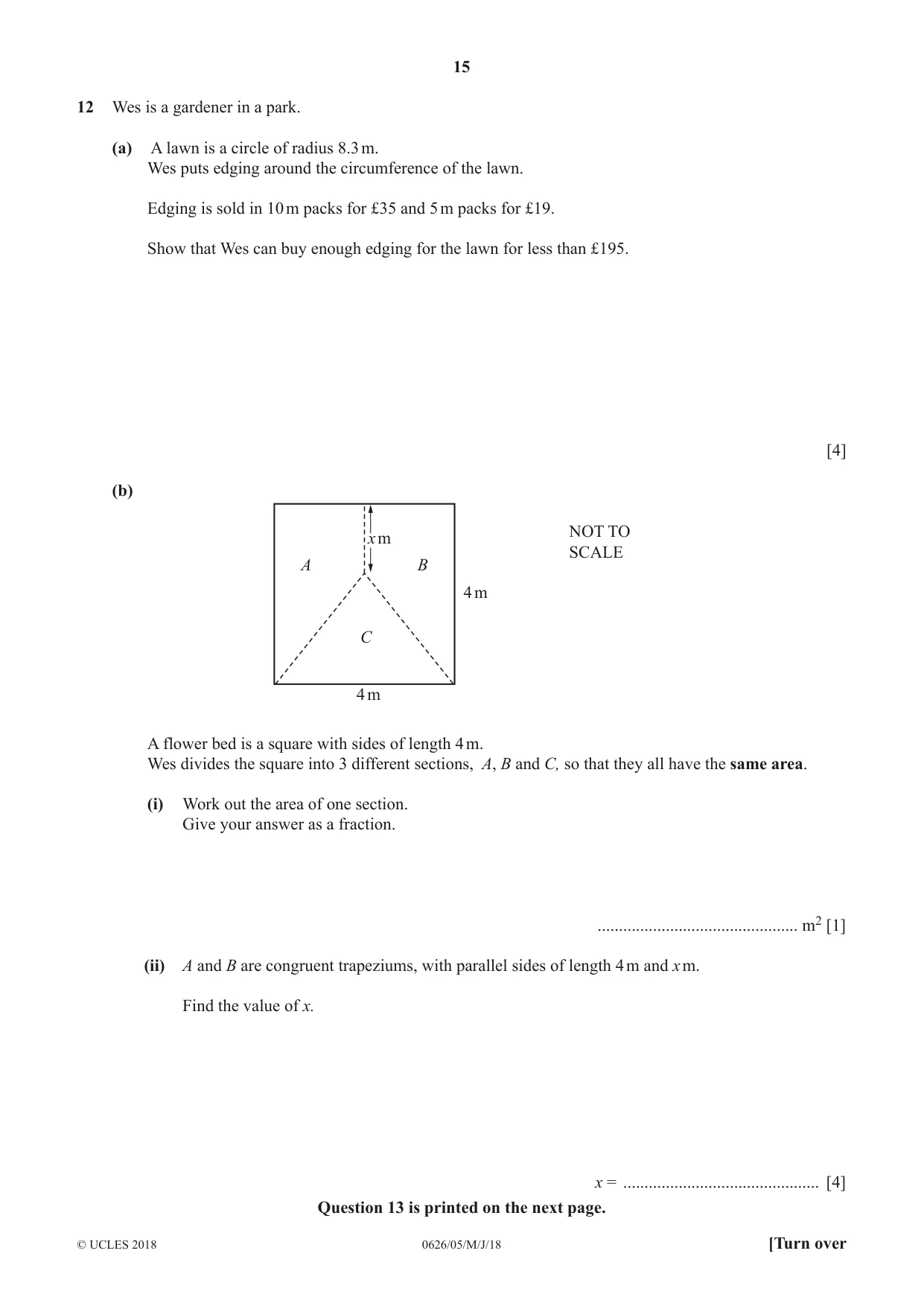
15 0626/05/M/J/18 © UCLES 2018 [Turn over 12 Wes is a gardener in a park. (a) A lawn is a circle of radius 8.3 m. Wes puts edging around the circumference of the lawn. Edging is sold in 10 m packs for £35 and 5 m packs for £19. Show that Wes can buy enough edging for the lawn for less than £195. [4] (b) A B C x m 4 m 4 m NOT TO SCALE A flower bed is a square with sides of length 4 m. Wes divides the square into 3 different sections, A, B and C, so that they all have the same area. (i) Work out the area of one section. Give your answer as a fraction. … m2 [1] (ii) A and B are congruent trapeziums, with parallel sides of length 4 m and x m. Find the value of x. x = … [4] Question 13 is printed on the next page.
Question paper, page 16
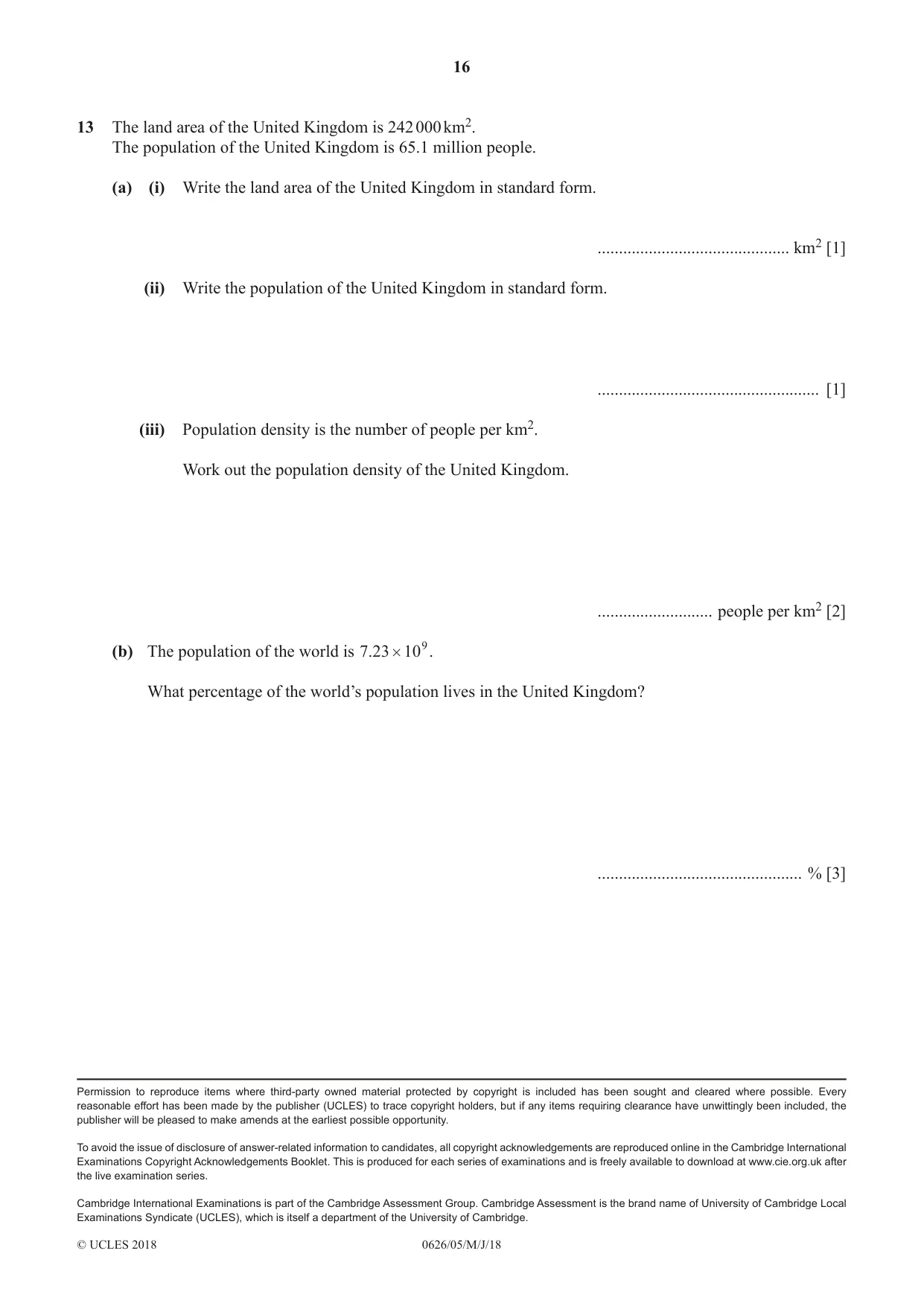
16 0626/05/M/J/18 © UCLES 2018 Permission to reproduce items where third-party owned material protected by copyright is included has been sought and cleared where possible. Every reasonable effort has been made by the publisher (UCLES) to trace copyright holders, but if any items requiring clearance have unwittingly been included, the publisher will be pleased to make amends at the earliest possible opportunity. To avoid the issue of disclosure of answer-related information to candidates, all copyright acknowledgements are reproduced online in the Cambridge International Examinations Copyright Acknowledgements Booklet. This is produced for each series of examinations and is freely available to download at www.cie.org.uk after the live examination series. Cambridge International Examinations is part of the Cambridge Assessment Group. Cambridge Assessment is the brand name of University of Cambridge Local Examinations Syndicate (UCLES), which is itself a department of the University of Cambridge. 13 The land area of the United Kingdom is 242 000 km2. The population of the United Kingdom is 65.1 million people. (a) (i) Write the land area of the United Kingdom in standard form. … km2 [1] (ii) Write the population of the United Kingdom in standard form. … [1] (iii) Population density is the number of people per km2. Work out the population density of the United Kingdom. … people per km2 [2] (b) The population of the world is .7 23 109 # . What percentage of the world’s population lives in the United Kingdom? … % [3]