Cambridge IGCSE Mathematics (9-1) (UK only) 0626 — 2017 Oct/Nov Paper 5 · Variant 1
0626/51/O/N/17 · 96 marks · ≈108 min
The question paper and its mark scheme, free to read here and free to download. This is Cambridge’s own paper, exactly as it was sat.
Question paper20 pages
Mark scheme6 pages
Answers below. Sit the paper first if you are practising.
Paper as text
Question paper, page 1
* 1 3 7 2 3 6 0 7 8 1 * This document consists of 19 printed pages and 1 blank page. DC (RW/SG) 133757/3 © UCLES 2017 [Turn over Cambridge International Examinations Cambridge International General Certificate of Secondary Education (9–1) MATHEMATICS 0626/05 Paper 5 (Core) October/November 2017 2 hours Candidates answer on the Question Paper. Additional Materials: Geometrical instruments Tracing paper (optional) READ THESE INSTRUCTIONS FIRST Write your Centre number, candidate number and name on all the work you hand in. Write in dark blue or black pen. You may use an HB pencil for any diagrams and graphs. Do not use staples, paper clips, glue or correction fluid. DO NOT WRITE IN ANY BARCODES. Answer all questions. Electronic calculators should be used. If working is required for any question it must be shown below that question. If the degree of accuracy is not specified in the question, and if the answer is not exact, give the answer to three significant figures. Give answers in degrees to one decimal place. For r, use either your calculator value or 3.142. At the end of the examination, fasten all your work securely together. The number of marks is given in brackets [ ] at the end of each question or part question. The total of the marks for this paper is 96. This syllabus is regulated for use in England as a Cambridge International Level 1/Level 2 (9–1) Certificate.
Question paper, page 2
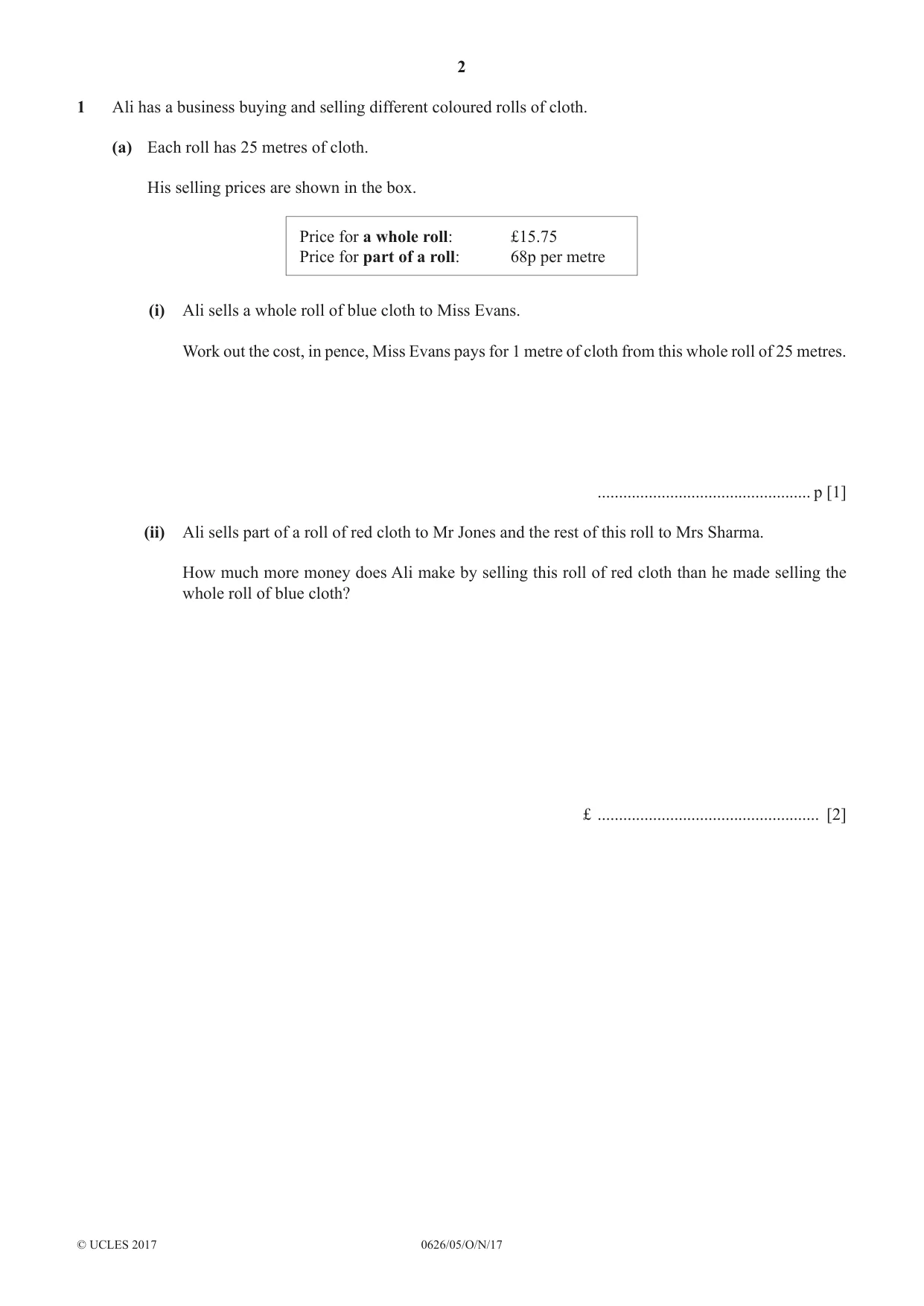
2 0626/05/O/N/17 © UCLES 2017 1 Ali has a business buying and selling different coloured rolls of cloth. (a) Each roll has 25 metres of cloth. His selling prices are shown in the box. Price for a whole roll: £15.75 Price for part of a roll: 68p per metre (i) Ali sells a whole roll of blue cloth to Miss Evans. Work out the cost, in pence, Miss Evans pays for 1 metre of cloth from this whole roll of 25 metres. … p [1] (ii) Ali sells part of a roll of red cloth to Mr Jones and the rest of this roll to Mrs Sharma. How much more money does Ali make by selling this roll of red cloth than he made selling the whole roll of blue cloth? £ … [2]
Question paper, page 3
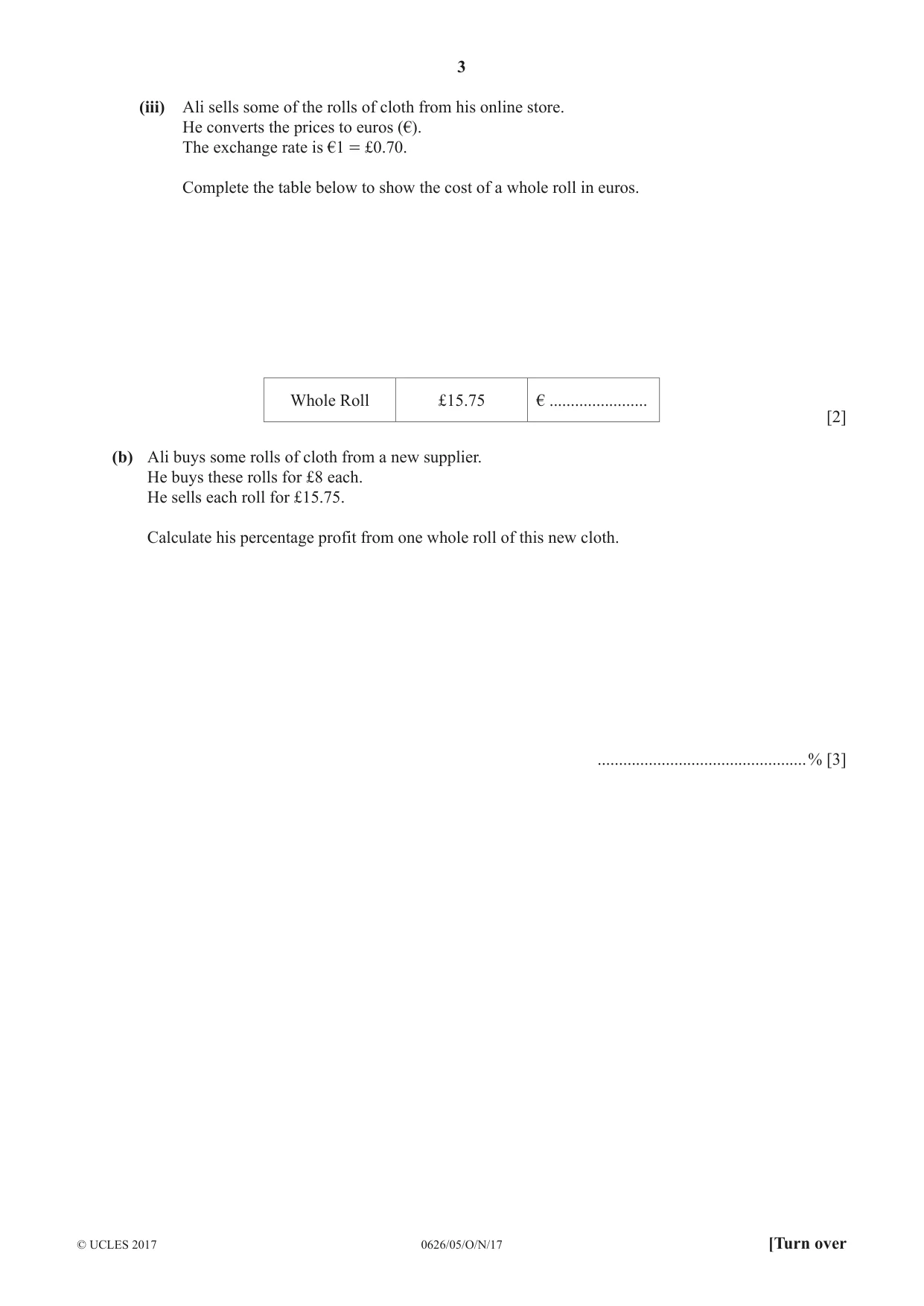
3 0626/05/O/N/17 © UCLES 2017 [Turn over (iii) Ali sells some of the rolls of cloth from his online store. He converts the prices to euros (€). The exchange rate is €1 = £0.70. Complete the table below to show the cost of a whole roll in euros. Whole Roll £15.75 € … [2] (b) Ali buys some rolls of cloth from a new supplier. He buys these rolls for £8 each. He sells each roll for £15.75. Calculate his percentage profit from one whole roll of this new cloth. …% [3]
Question paper, page 4
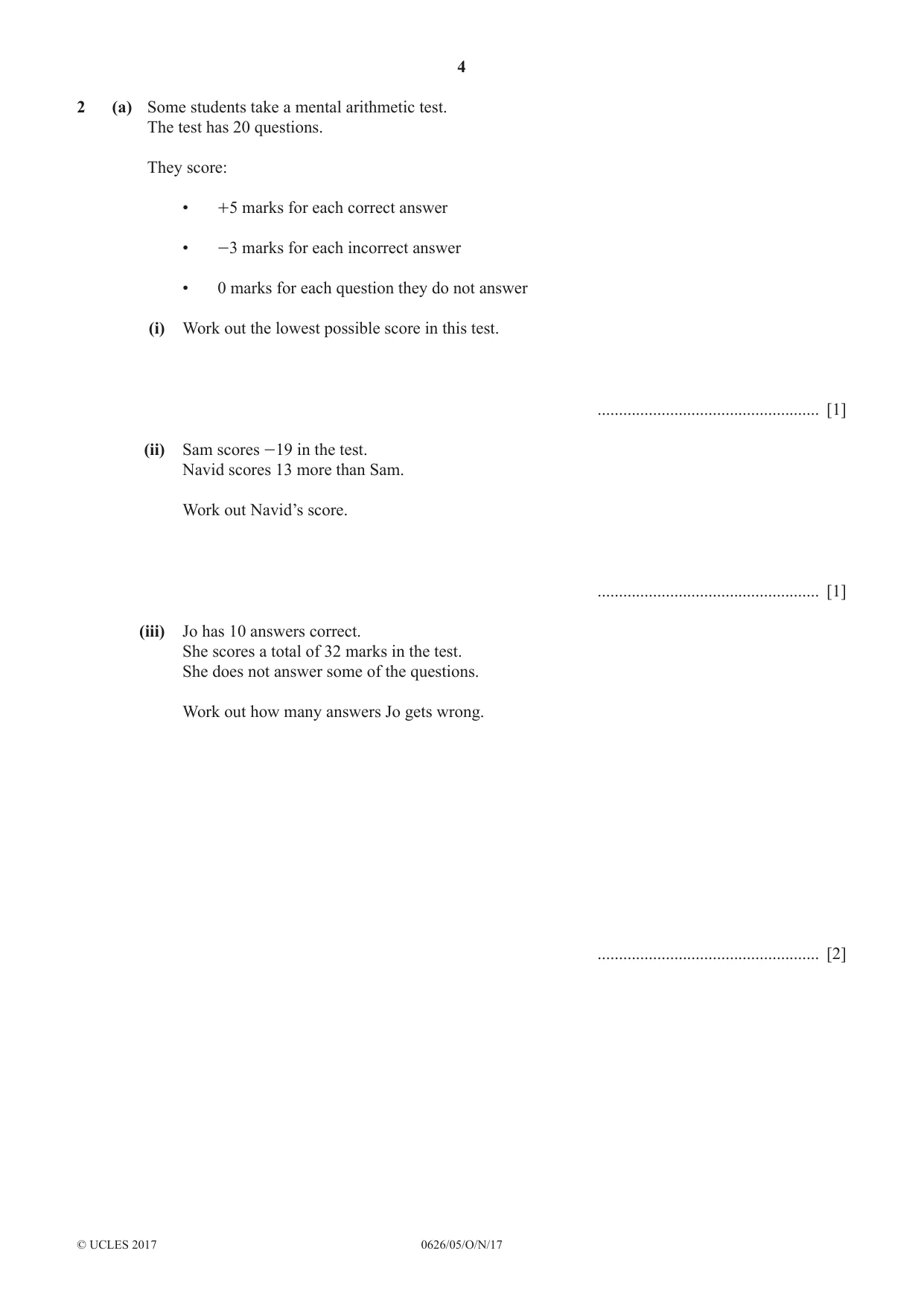
4 0626/05/O/N/17 © UCLES 2017 2 (a) Some students take a mental arithmetic test. The test has 20 questions. They score: • +5 marks for each correct answer • -3 marks for each incorrect answer • 0 marks for each question they do not answer (i) Work out the lowest possible score in this test. … [1] (ii) Sam scores -19 in the test. Navid scores 13 more than Sam. Work out Navid’s score. … [1] (iii) Jo has 10 answers correct. She scores a total of 32 marks in the test. She does not answer some of the questions. Work out how many answers Jo gets wrong. … [2]
Question paper, page 5
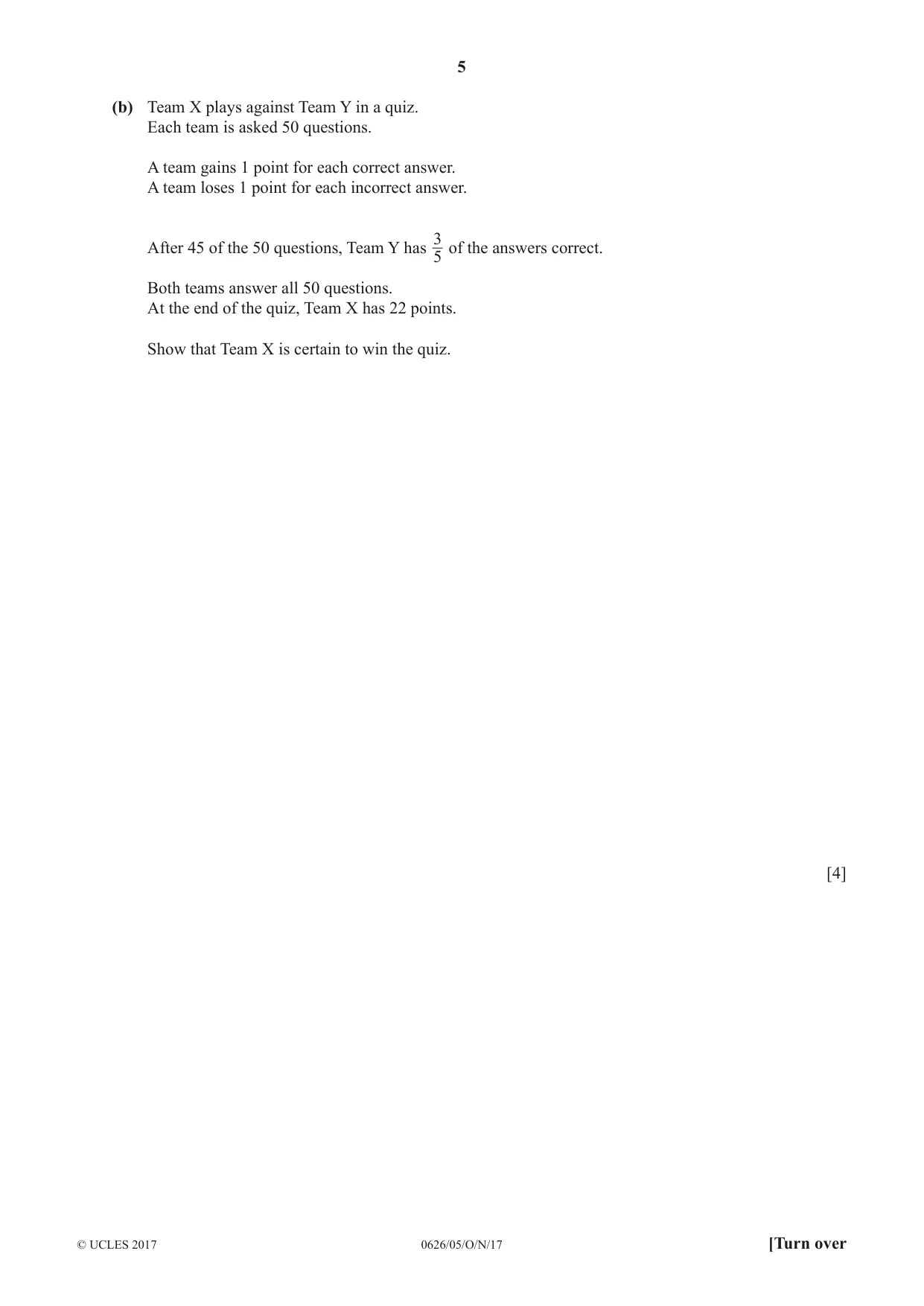
5 0626/05/O/N/17 © UCLES 2017 [Turn over (b) Team X plays against Team Y in a quiz. Each team is asked 50 questions. A team gains 1 point for each correct answer. A team loses 1 point for each incorrect answer. After 45 of the 50 questions, Team Y has 5 3 of the answers correct. Both teams answer all 50 questions. At the end of the quiz, Team X has 22 points. Show that Team X is certain to win the quiz. [4]
Question paper, page 6
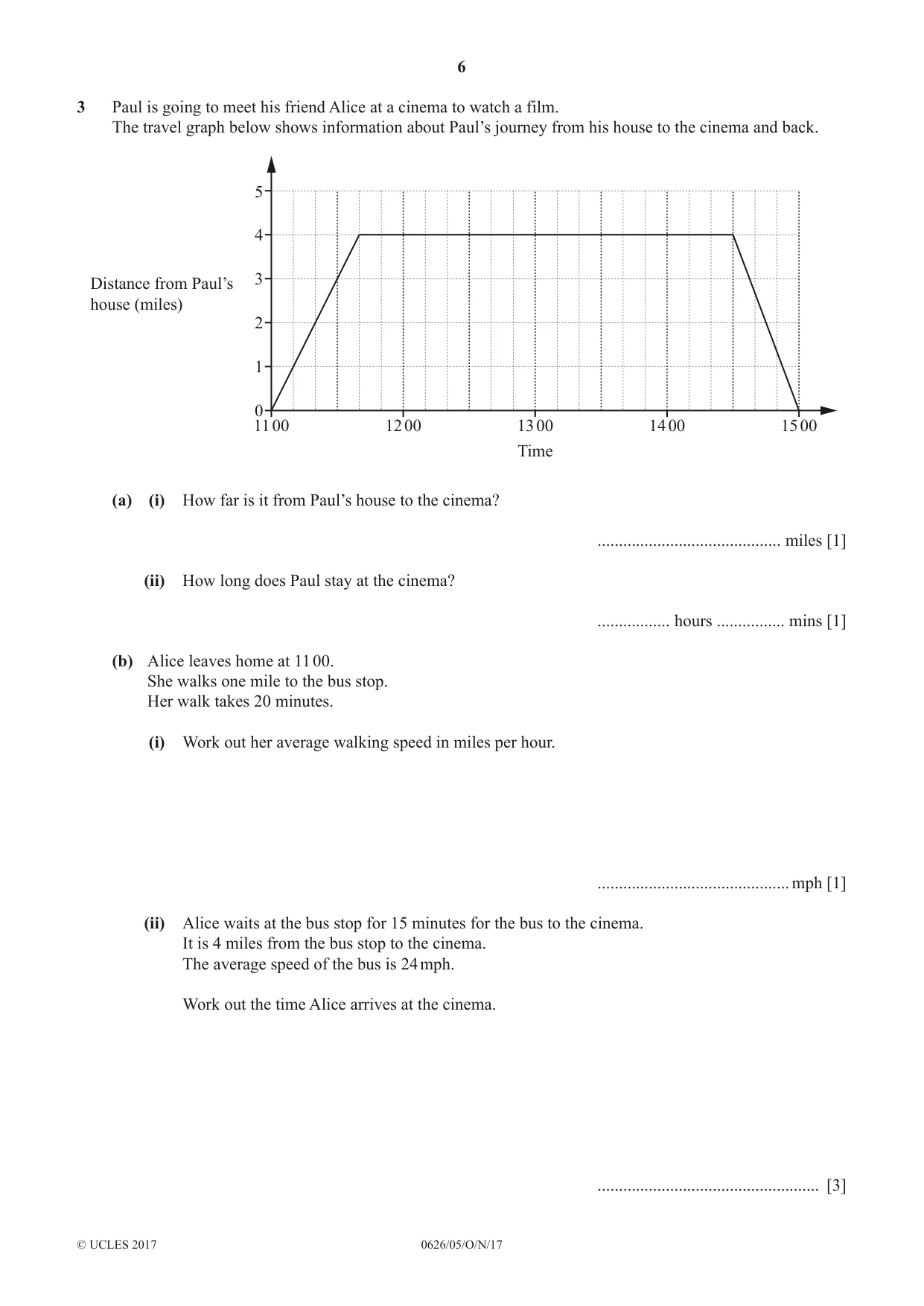
6 0626/05/O/N/17 © UCLES 2017 3 Paul is going to meet his friend Alice at a cinema to watch a film. The travel graph below shows information about Paul’s journey from his house to the cinema and back. Distance from Paul’s house (miles) 5 4 3 2 1 0 11 00 12 00 13 00 14 00 15 00 Time (a) (i) How far is it from Paul’s house to the cinema? … miles [1] (ii) How long does Paul stay at the cinema? … hours … mins [1] (b) Alice leaves home at 11 00. She walks one mile to the bus stop. Her walk takes 20 minutes. (i) Work out her average walking speed in miles per hour. … mph [1] (ii) Alice waits at the bus stop for 15 minutes for the bus to the cinema. It is 4 miles from the bus stop to the cinema. The average speed of the bus is 24 mph. Work out the time Alice arrives at the cinema. … [3]
Question paper, page 7
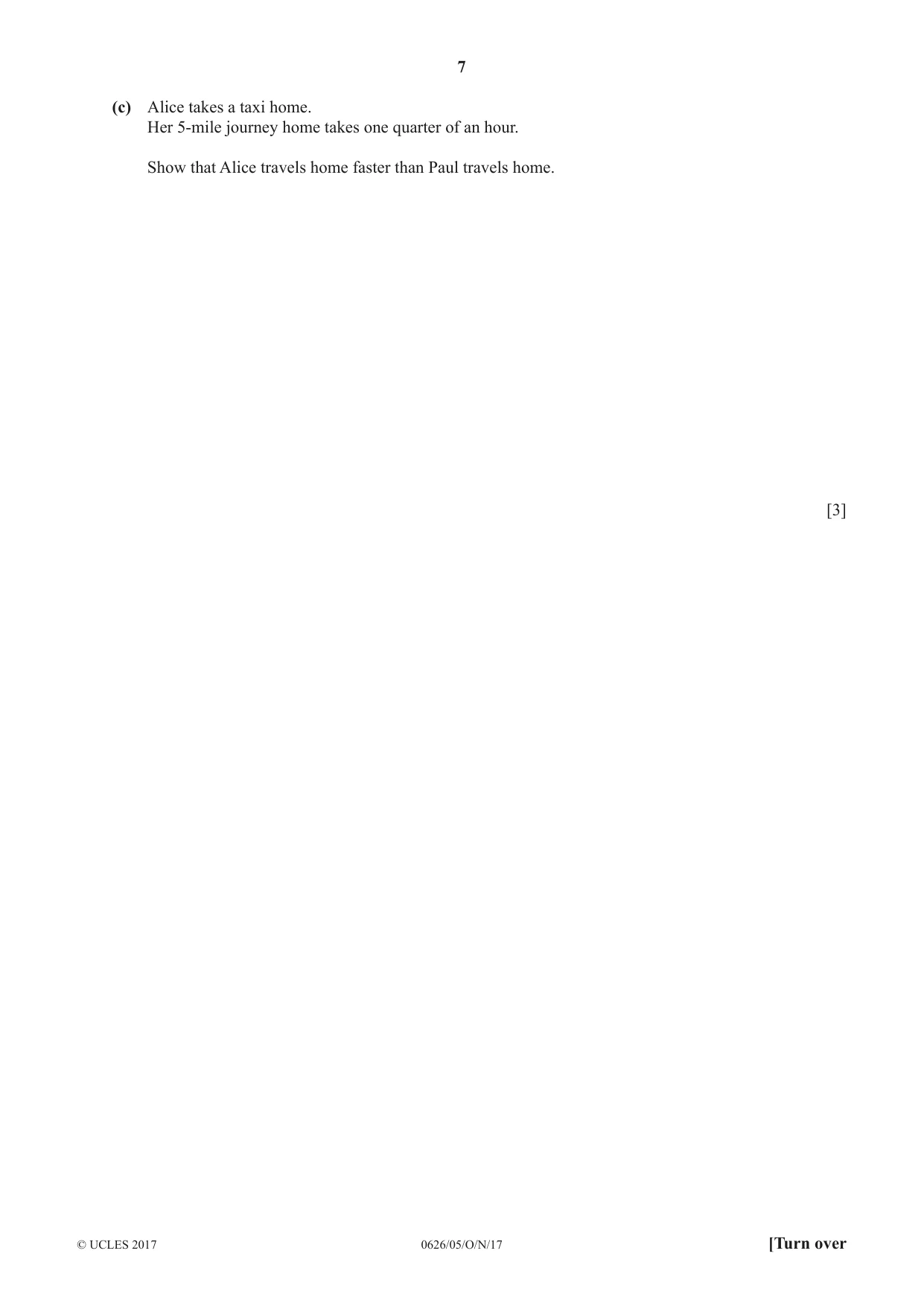
7 0626/05/O/N/17 © UCLES 2017 [Turn over (c) Alice takes a taxi home. Her 5-mile journey home takes one quarter of an hour. Show that Alice travels home faster than Paul travels home. [3]
Question paper, page 8
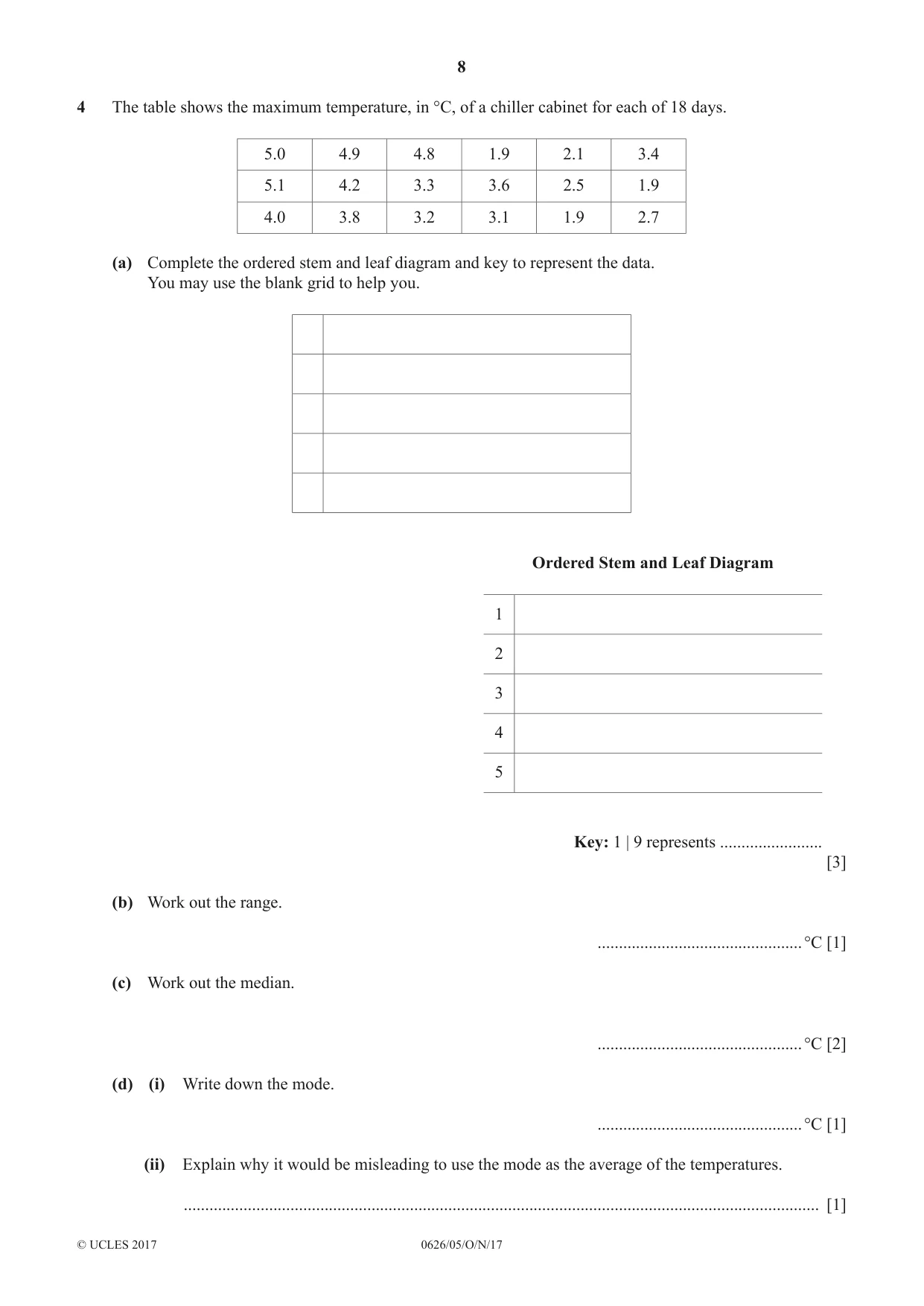
8 0626/05/O/N/17 © UCLES 2017 4 The table shows the maximum temperature, in °C, of a chiller cabinet for each of 18 days. 5.0 4.9 4.8 1.9 2.1 3.4 5.1 4.2 3.3 3.6 2.5 1.9 4.0 3.8 3.2 3.1 1.9 2.7 (a) Complete the ordered stem and leaf diagram and key to represent the data. You may use the blank grid to help you. Ordered Stem and Leaf Diagram 1 2 3 4 5 Key: 1 | 9 represents … [3] (b) Work out the range. …°C [1] (c) Work out the median. …°C [2] (d) (i) Write down the mode. …°C [1] (ii) Explain why it would be misleading to use the mode as the average of the temperatures. … [1]
Question paper, page 9
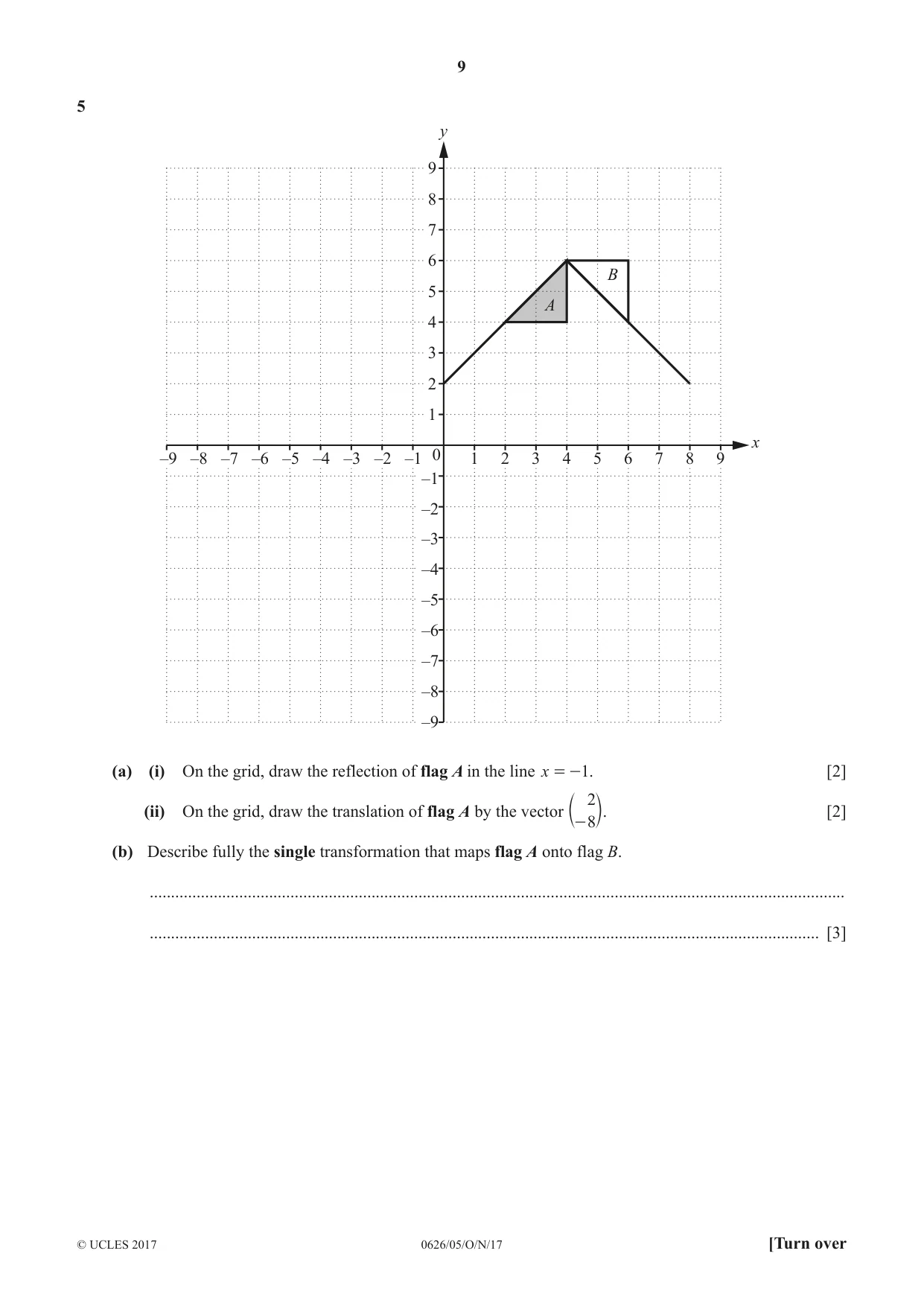
9 0626/05/O/N/17 © UCLES 2017 [Turn over 5 1 0 2 3 4 5 6 7 8 9 –9 –8 –7 –6 –5 –4 –3 –2 –1 –1 –2 –3 –4 –5 –6 –7 –8 –9 1 2 3 4 5 6 7 8 9 y x A B (a) (i) On the grid, draw the reflection of flag A in the line x 1 = - . [2] (ii) On the grid, draw the translation of flag A by the vector 2 8 - c m. [2] (b) Describe fully the single transformation that maps flag A onto flag B. … … [3]
Question paper, page 10
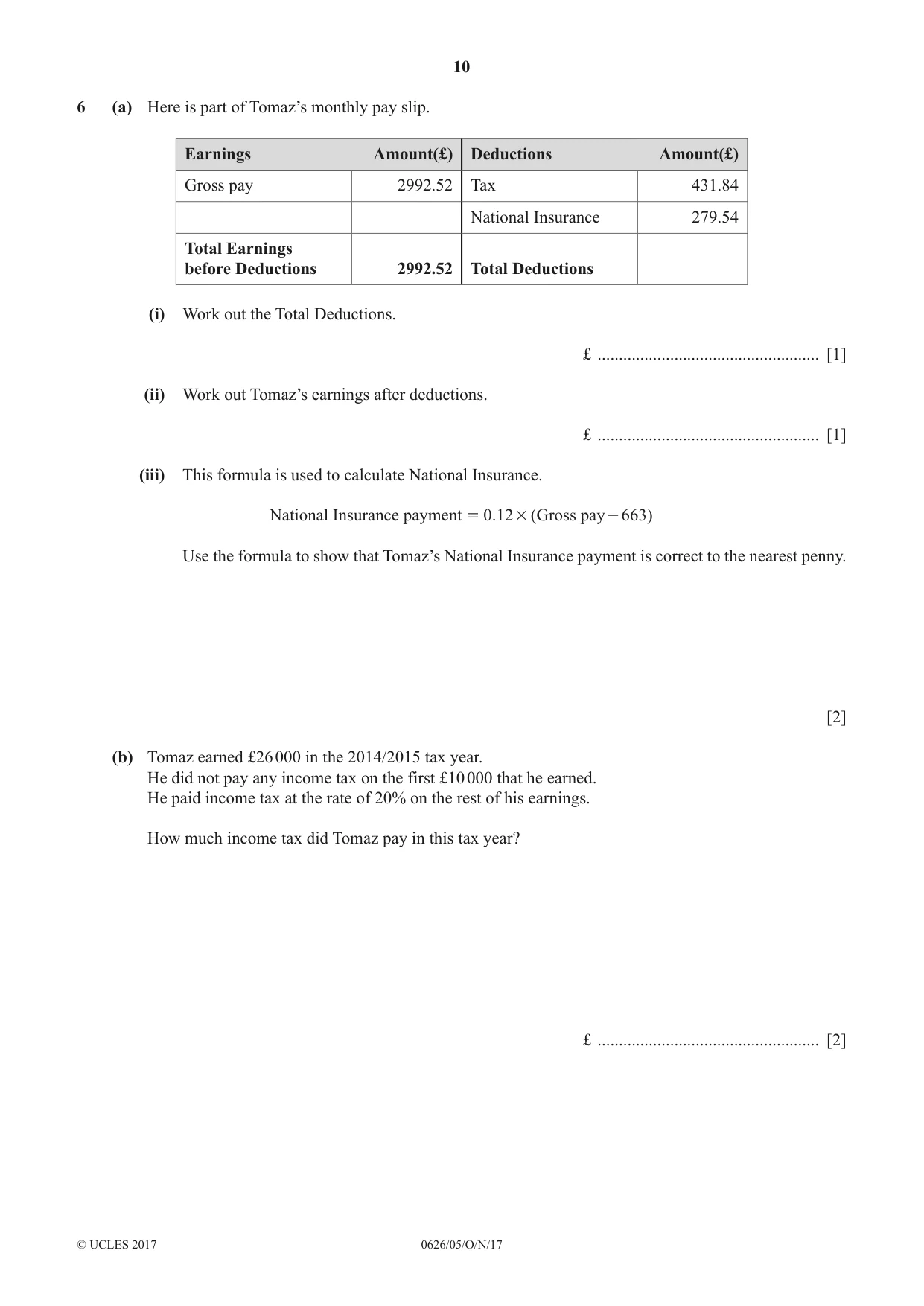
10 0626/05/O/N/17 © UCLES 2017 6 (a) Here is part of Tomaz’s monthly pay slip. Earnings Amount(£) Deductions Amount(£) Gross pay 2992.52 Tax 431.84 National Insurance 279.54 Total Earnings before Deductions 2992.52 Total Deductions (i) Work out the Total Deductions. £ … [1] (ii) Work out Tomaz’s earnings after deductions. £ … [1] (iii) This formula is used to calculate National Insurance. National Insurance payment . ( ) 0 12 663 Gross pay # = - Use the formula to show that Tomaz’s National Insurance payment is correct to the nearest penny. [2] (b) Tomaz earned £26 000 in the 2014/2015 tax year. He did not pay any income tax on the first £10 000 that he earned. He paid income tax at the rate of 20% on the rest of his earnings. How much income tax did Tomaz pay in this tax year? £ … [2]
Question paper, page 11
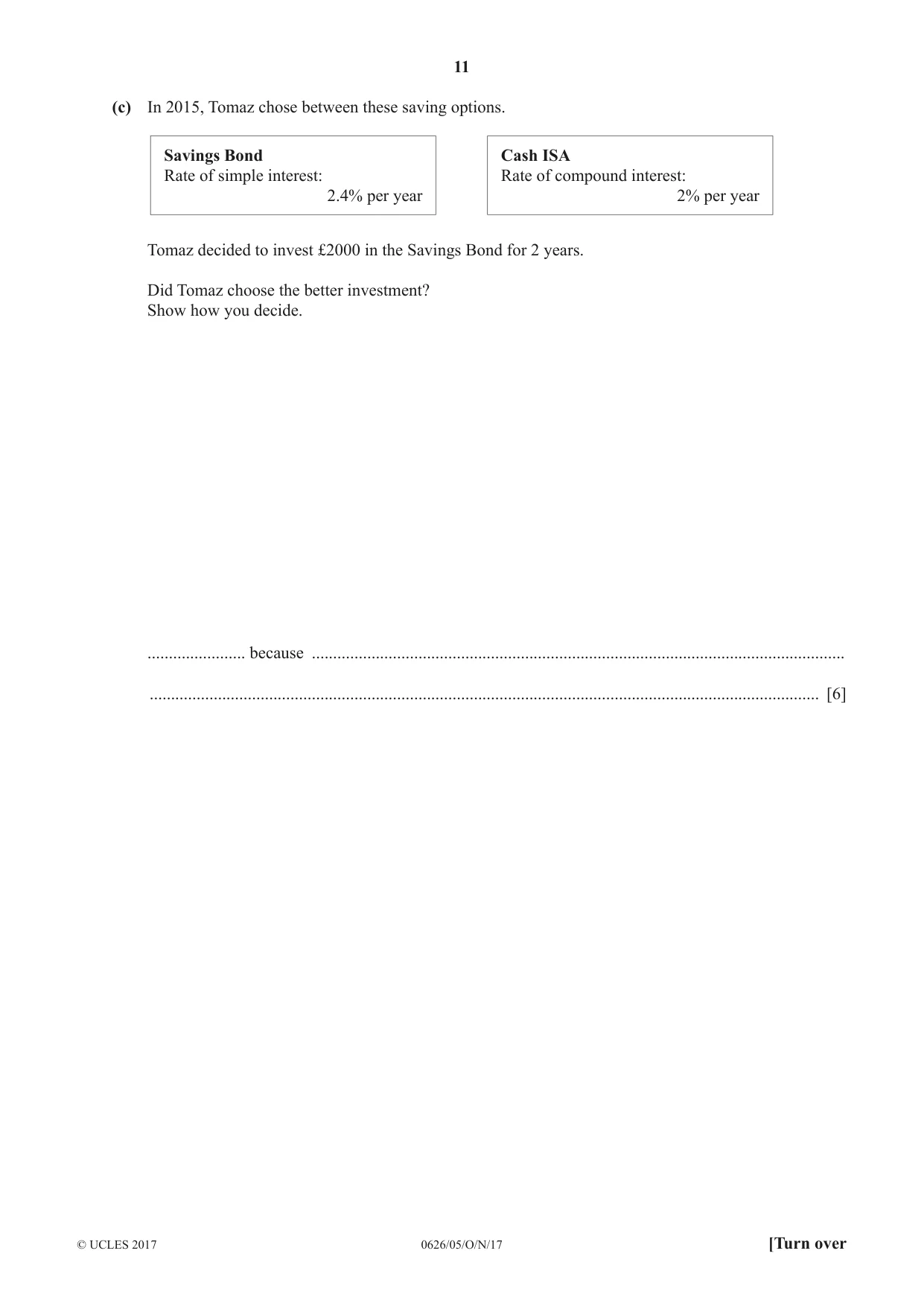
11 0626/05/O/N/17 © UCLES 2017 [Turn over (c) In 2015, Tomaz chose between these saving options. Savings Bond Rate of simple interest: 2.4% per year Cash ISA Rate of compound interest: 2% per year Tomaz decided to invest £2000 in the Savings Bond for 2 years. Did Tomaz choose the better investment? Show how you decide. … because … … [6]
Question paper, page 12
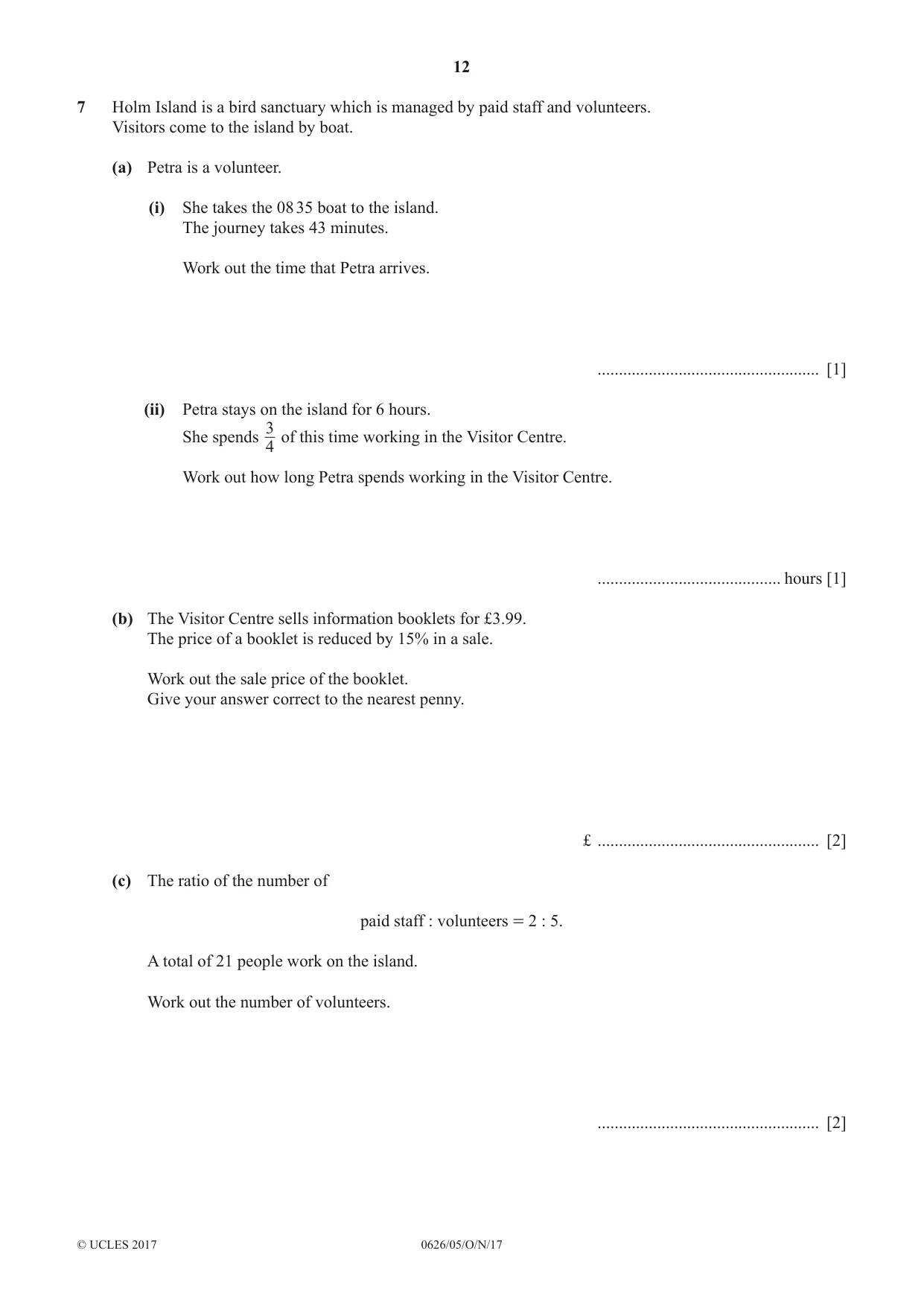
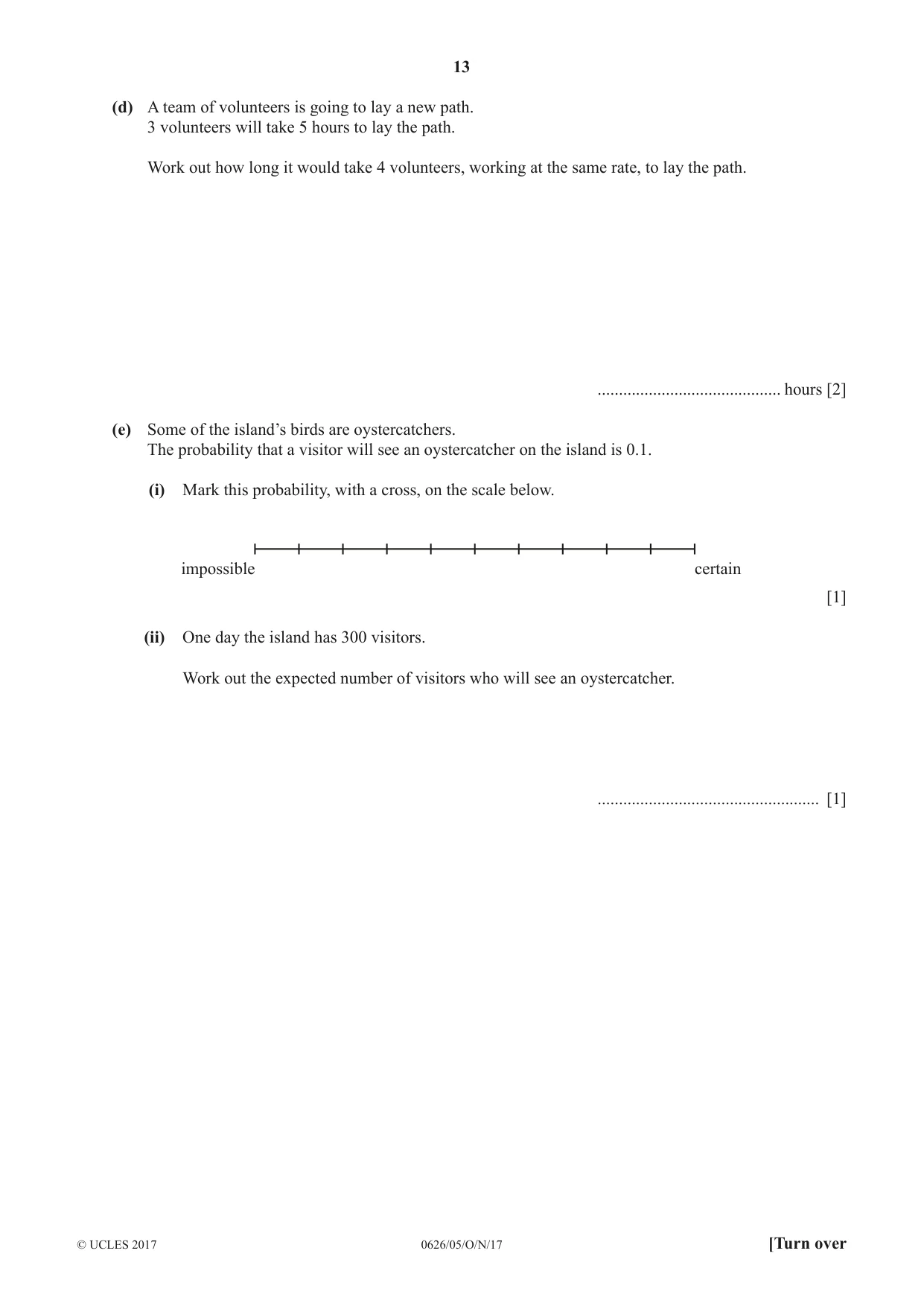
12 0626/05/O/N/17 © UCLES 2017 7 Holm Island is a bird sanctuary which is managed by paid staff and volunteers. Visitors come to the island by boat. (a) Petra is a volunteer. (i) She takes the 08 35 boat to the island. The journey takes 43 minutes. Work out the time that Petra arrives. … [1] (ii) Petra stays on the island for 6 hours. She spends 4 3 of this time working in the Visitor Centre. Work out how long Petra spends working in the Visitor Centre. … hours [1] (b) The Visitor Centre sells information booklets for £3.99. The price of a booklet is reduced by 15% in a sale. Work out the sale price of the booklet. Give your answer correct to the nearest penny. £ … [2] (c) The ratio of the number of paid staff : volunteers = 2 : 5. A total of 21 people work on the island. Work out the number of volunteers. … [2]
Question paper, page 13
13 0626/05/O/N/17 © UCLES 2017 [Turn over (d) A team of volunteers is going to lay a new path. 3 volunteers will take 5 hours to lay the path. Work out how long it would take 4 volunteers, working at the same rate, to lay the path. … hours [2] (e) Some of the island’s birds are oystercatchers. The probability that a visitor will see an oystercatcher on the island is 0.1. (i) Mark this probability, with a cross, on the scale below. impossible certain [1] (ii) One day the island has 300 visitors. Work out the expected number of visitors who will see an oystercatcher. … [1]
Question paper, page 14
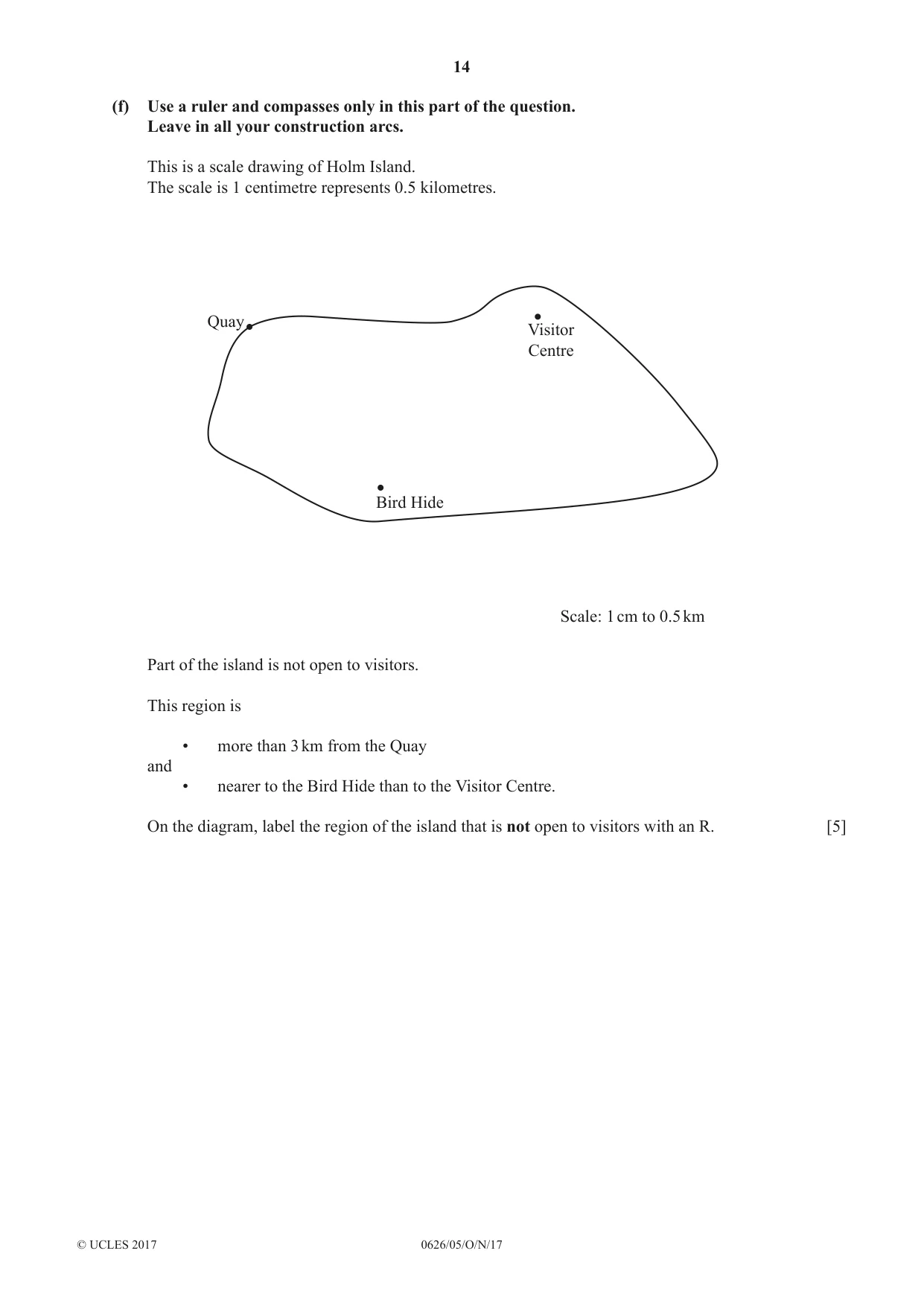
14 0626/05/O/N/17 © UCLES 2017 (f) Use a ruler and compasses only in this part of the question. Leave in all your construction arcs. This is a scale drawing of Holm Island. The scale is 1 centimetre represents 0.5 kilometres. Quay Bird Hide Visitor Centre Scale: 1 cm to 0.5 km Part of the island is not open to visitors. This region is • more than 3 km from the Quay and • nearer to the Bird Hide than to the Visitor Centre. On the diagram, label the region of the island that is not open to visitors with an R. [5]
Question paper, page 15
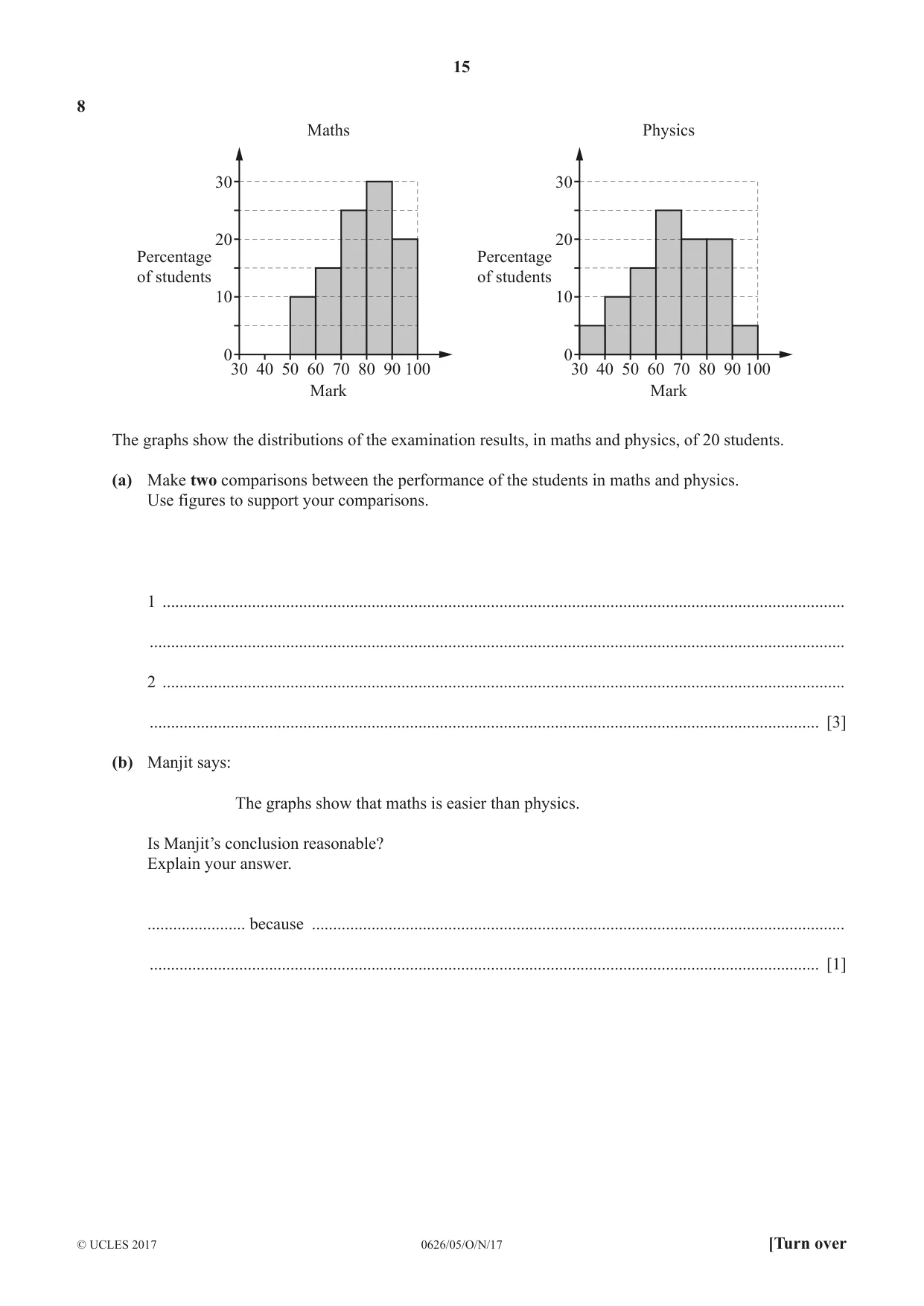
15 0626/05/O/N/17 © UCLES 2017 [Turn over 8 30 20 10 0 30 40 50 60 70 80 90 100 Mark Maths Percentage of students 30 20 10 0 30 40 50 60 70 80 90 100 Mark Physics Percentage of students The graphs show the distributions of the examination results, in maths and physics, of 20 students. (a) Make two comparisons between the performance of the students in maths and physics. Use figures to support your comparisons. 1 … … 2 … … [3] (b) Manjit says: The graphs show that maths is easier than physics. Is Manjit’s conclusion reasonable? Explain your answer. … because … … [1]
Question paper, page 16
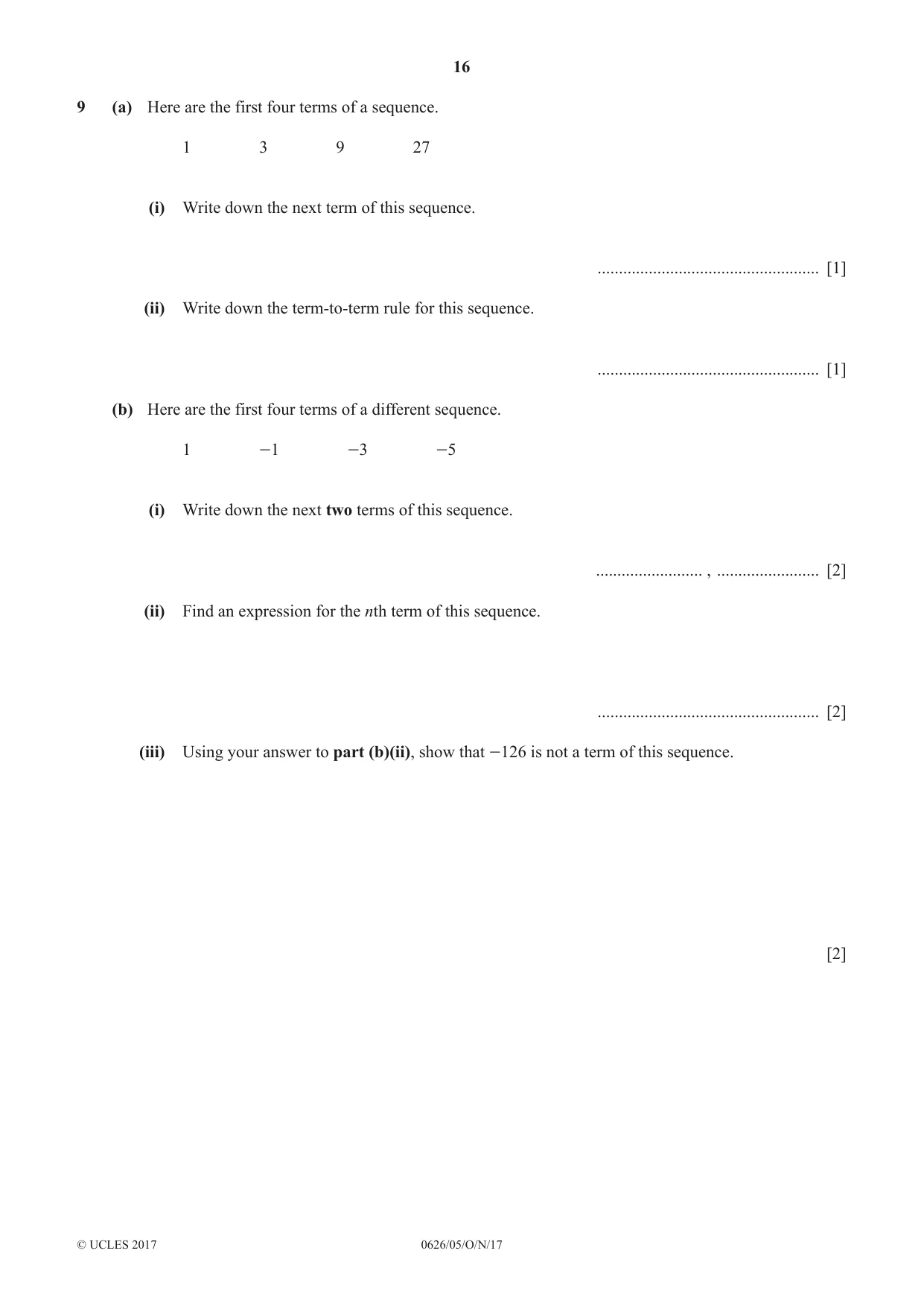
16 0626/05/O/N/17 © UCLES 2017 9 (a) Here are the first four terms of a sequence. 1 3 9 27 (i) Write down the next term of this sequence. … [1] (ii) Write down the term-to-term rule for this sequence. … [1] (b) Here are the first four terms of a different sequence. 1 -1 -3 -5 (i) Write down the next two terms of this sequence. … , … [2] (ii) Find an expression for the nth term of this sequence. … [2] (iii) Using your answer to part (b)(ii), show that -126 is not a term of this sequence. [2]
Question paper, page 17
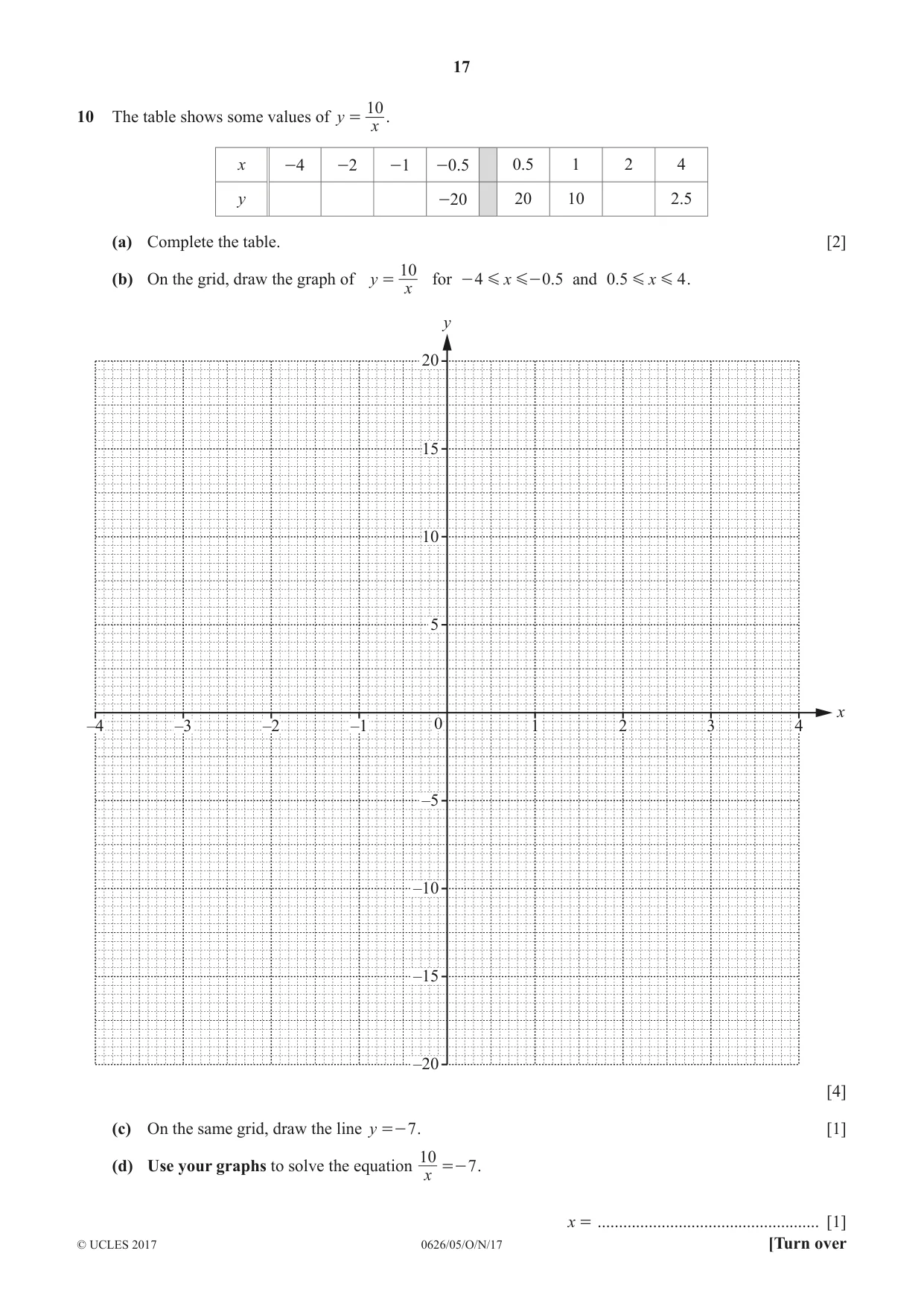
17 0626/05/O/N/17 © UCLES 2017 [Turn over 10 The table shows some values of y x 10 = . x -4 -2 -1 -0.5 0.5 1 2 4 y -20 20 10 2.5 (a) Complete the table. [2] (b) On the grid, draw the graph of y x 10 = for . x 0 5 4 G G - - and . x 0 5 4 G G . 5 1 –1 –2 –3 –4 2 3 4 10 15 20 0 –5 –10 –15 –20 y x [4] (c) On the same grid, draw the line y 7 =- . [1] (d) Use your graphs to solve the equation x 10 7 =- . x = … [1]
Question paper, page 18
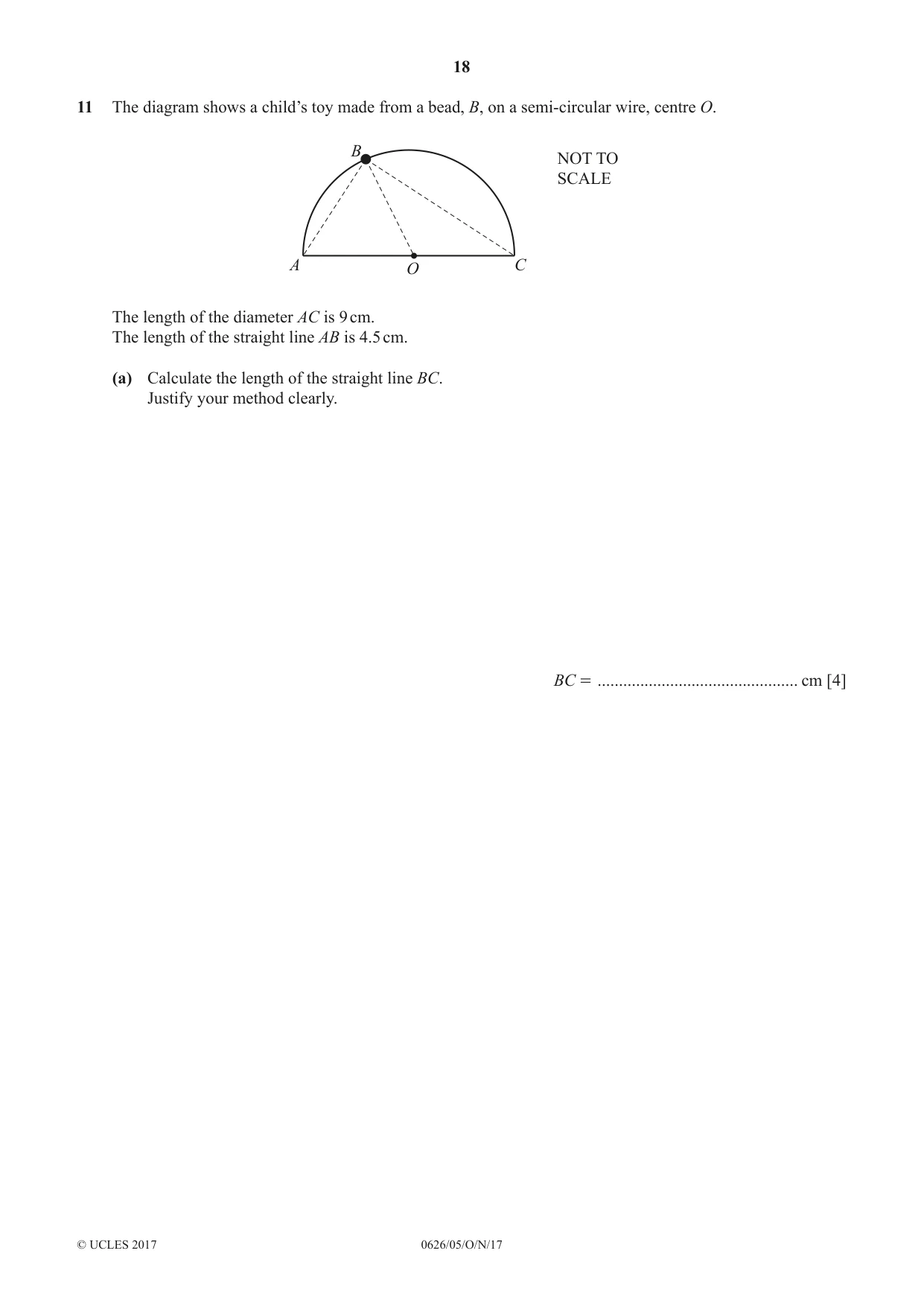
18 0626/05/O/N/17 © UCLES 2017 11 The diagram shows a child’s toy made from a bead, B, on a semi-circular wire, centre O. B A C O NOT TO SCALE The length of the diameter AC is 9 cm. The length of the straight line AB is 4.5 cm. (a) Calculate the length of the straight line BC. Justify your method clearly. BC = … cm [4]
Question paper, page 19
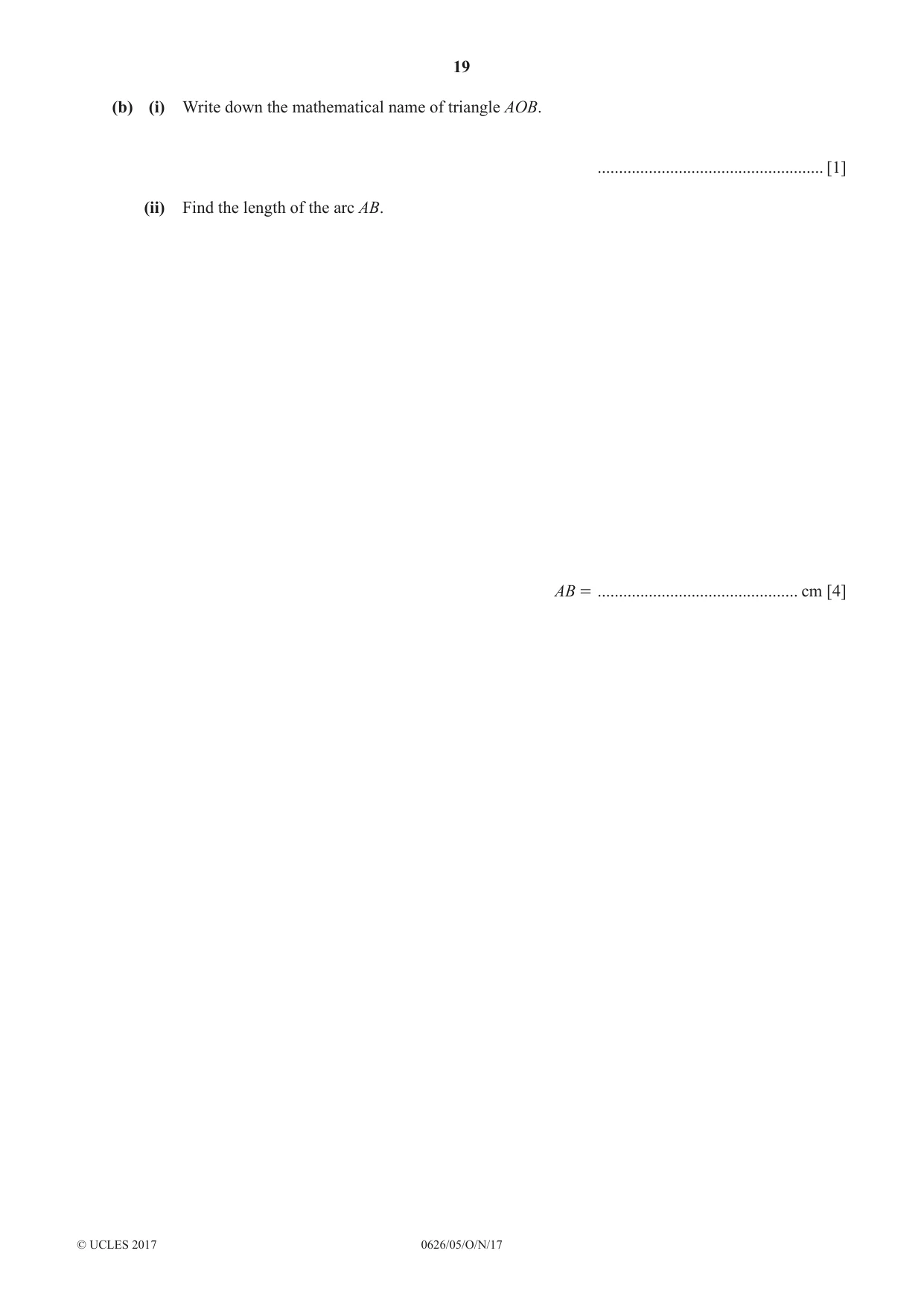
19 0626/05/O/N/17 © UCLES 2017 (b) (i) Write down the mathematical name of triangle AOB. … [1] (ii) Find the length of the arc AB. AB = … cm [4]
Question paper, page 20
20 0626/05/O/N/17 © UCLES 2017 Permission to reproduce items where third-party owned material protected by copyright is included has been sought and cleared where possible. Every reasonable effort has been made by the publisher (UCLES) to trace copyright holders, but if any items requiring clearance have unwittingly been included, the publisher will be pleased to make amends at the earliest possible opportunity. To avoid the issue of disclosure of answer-related information to candidates, all copyright acknowledgements are reproduced online in the Cambridge International Examinations Copyright Acknowledgements Booklet. This is produced for each series of examinations and is freely available to download at www.cie.org.uk after the live examination series. Cambridge International Examinations is part of the Cambridge Assessment Group. Cambridge Assessment is the brand name of University of Cambridge Local Examinations Syndicate (UCLES), which is itself a department of the University of Cambridge. BLANK PAGE
Mark scheme, page 1
® IGCSE is a registered trademark. This syllabus is regulated for use in England as a Cambridge International Level 1/Level 2 (9–1) Certificate. This document consists of 6 printed pages. © UCLES 2017 [Turn over Cambridge Assessment International Education Cambridge International General Certificate of Secondary Education (9–1) MATHEMATICS 0626/05 Paper 5 October/November 2017 MARK SCHEME Maximum Mark: 96 Published This mark scheme is published as an aid to teachers and candidates, to indicate the requirements of the examination. It shows the basis on which Examiners were instructed to award marks. It does not indicate the details of the discussions that took place at an Examiners’ meeting before marking began, which would have considered the acceptability of alternative answers. Mark schemes should be read in conjunction with the question paper and the Principal Examiner Report for Teachers. Cambridge International will not enter into discussions about these mark schemes. Cambridge International is publishing the mark schemes for the October/November 2017 series for most Cambridge IGCSE®, Cambridge International A and AS Level components and some Cambridge O Level components.
Mark scheme, page 2
0626/05 Cambridge IGCSE (9–1) – Mark Scheme PUBLISHED October/November 2017 © UCLES 2017 Page 2 of 6 MARK SCHEME NOTES The following notes are intended to aid interpretation of mark schemes in general, but individual mark schemes may include marks awarded for specific reasons outside the scope of these notes. Types of mark M Method marks, awarded for a valid method applied to the problem. A Accuracy mark, awarded for a correct answer or intermediate step correctly obtained. For accuracy marks to be given, the associated Method mark must be earned or implied. B Mark for a correct result or statement independent of Method marks. When a part of a question has two or more ‘method’ steps, the M marks are in principle independent unless the scheme specifically says otherwise; and similarly where there are several B marks allocated. The notation ‘dep’ is used to indicate that a particular M or B mark is dependent on an earlier mark in the scheme. Abbreviations awrt answers which round to cao correct answer only dep dependent FT follow through after error isw ignore subsequent working nfww not from wrong working oe or equivalent rot rounded or truncated SC Special Case soi seen or implied
Mark scheme, page 3
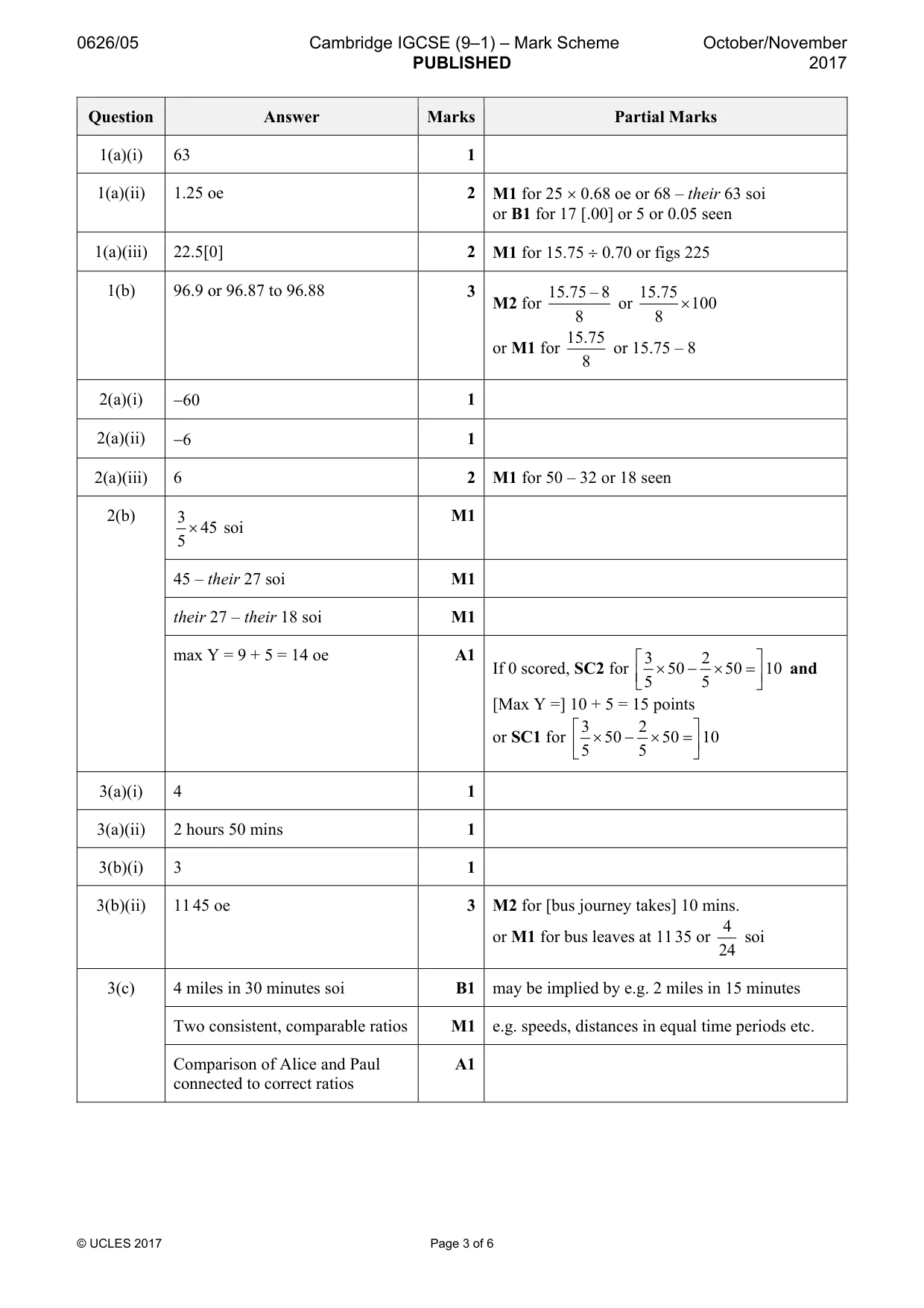
0626/05 Cambridge IGCSE (9–1) – Mark Scheme PUBLISHED October/November 2017 © UCLES 2017 Page 3 of 6 Question Answer Marks Partial Marks 1(a)(i) 63 1 1(a)(ii) 1.25 oe 2 M1 for 25 × 0.68 oe or 68 – their 63 soi or B1 for 17 [.00] or 5 or 0.05 seen 1(a)(iii) 22.5[0] 2 M1 for 15.75 ÷ 0.70 or figs 225 1(b) 96.9 or 96.87 to 96.88 3 M2 for 15.75 – 8 8 or 15.75 100 8 × or M1 for 15.75 8 or 15.75 – 8 2(a)(i) −60 1 2(a)(ii) −6 1 2(a)(iii) 6 2 M1 for 50 – 32 or 18 seen 2(b) 3 45 5 × soi M1 45 – their 27 soi M1 their 27 – their 18 soi M1 max Y = 9 + 5 = 14 oe A1 If 0 scored, SC2 for 3 2 50 50 10 5 5 × − × = and [Max Y =] 10 + 5 = 15 points or SC1 for 3 2 50 50 10 5 5 × − × = 3(a)(i) 4 1 3(a)(ii) 2 hours 50 mins 1 3(b)(i) 3 1 3(b)(ii) 11 45 oe 3 M2 for [bus journey takes] 10 mins. or M1 for bus leaves at 11 35 or 4 24 soi 3(c) 4 miles in 30 minutes soi B1 may be implied by e.g. 2 miles in 15 minutes Two consistent, comparable ratios M1 e.g. speeds, distances in equal time periods etc. Comparison of Alice and Paul connected to correct ratios A1
Mark scheme, page 4
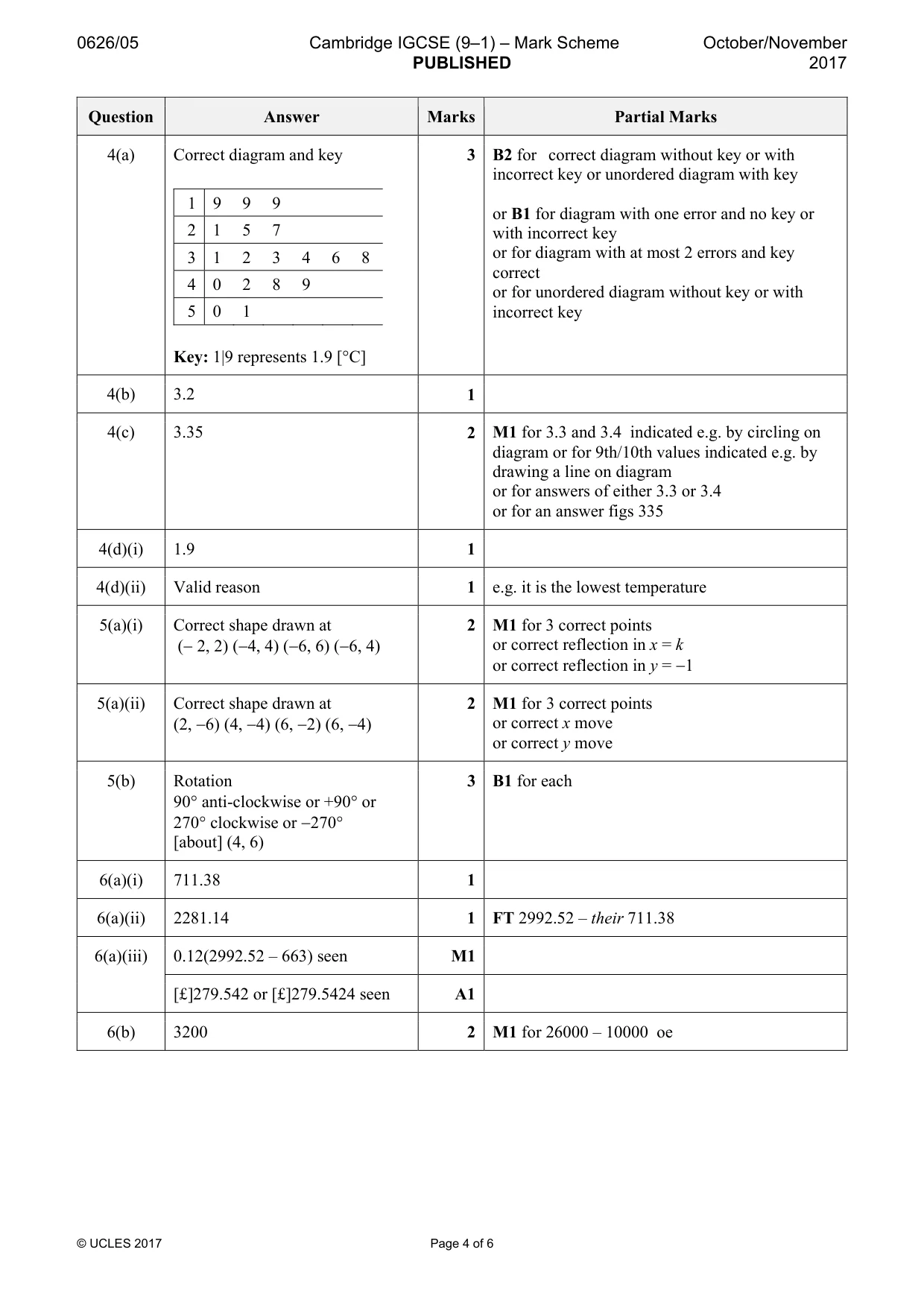
0626/05 Cambridge IGCSE (9–1) – Mark Scheme PUBLISHED October/November 2017 © UCLES 2017 Page 4 of 6 Question Answer Marks Partial Marks 4(a) Correct diagram and key Key: 1|9 represents 1.9 [°C] 1 9 9 9 2 1 5 7 3 1 2 3 4 6 8 4 0 2 8 9 5 0 1 3 B2 for correct diagram without key or with incorrect key or unordered diagram with key or B1 for diagram with one error and no key or with incorrect key or for diagram with at most 2 errors and key correct or for unordered diagram without key or with incorrect key 4(b) 3.2 1 4(c) 3.35 2 M1 for 3.3 and 3.4 indicated e.g. by circling on diagram or for 9th/10th values indicated e.g. by drawing a line on diagram or for answers of either 3.3 or 3.4 or for an answer figs 335 4(d)(i) 1.9 1 4(d)(ii) Valid reason 1 e.g. it is the lowest temperature 5(a)(i) Correct shape drawn at (− 2, 2) (−4, 4) (−6, 6) (−6, 4) 2 M1 for 3 correct points or correct reflection in x = k or correct reflection in y = −1 5(a)(ii) Correct shape drawn at (2, −6) (4, −4) (6, −2) (6, −4) 2 M1 for 3 correct points or correct x move or correct y move 5(b) Rotation 90° anti-clockwise or +90° or 270° clockwise or −270° [about] (4, 6) 3 B1 for each 6(a)(i) 711.38 1 6(a)(ii) 2281.14 1 FT 2992.52 – their 711.38 6(a)(iii) 0.12(2992.52 – 663) seen M1 [£]279.542 or [£]279.5424 seen A1 6(b) 3200 2 M1 for 26000 – 10000 oe
Mark scheme, page 5
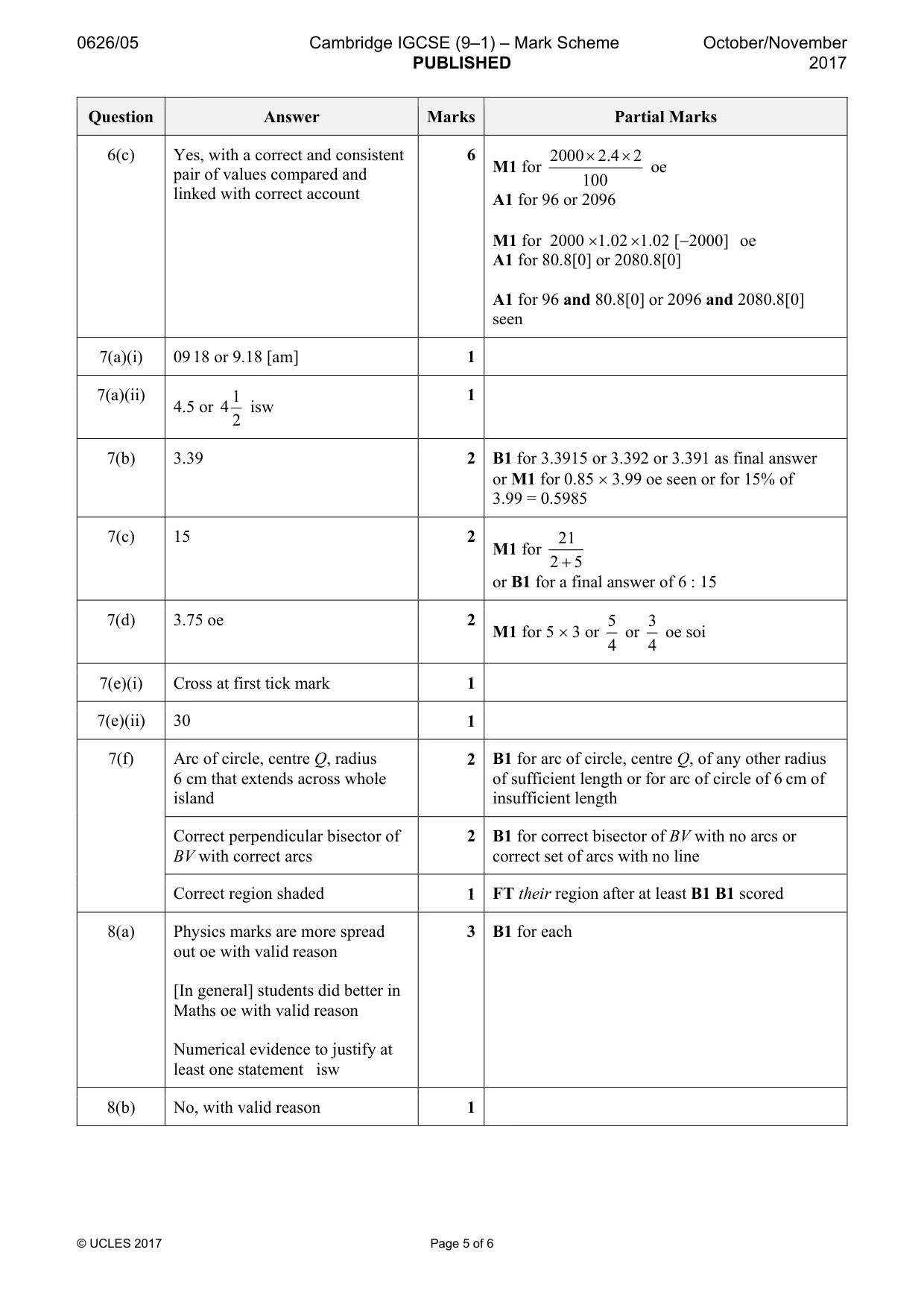
0626/05 Cambridge IGCSE (9–1) – Mark Scheme PUBLISHED October/November 2017 © UCLES 2017 Page 5 of 6 Question Answer Marks Partial Marks 6(c) Yes, with a correct and consistent pair of values compared and linked with correct account 6 M1 for 2000 2.4 2 100 × × oe A1 for 96 or 2096 M1 for 2000 ×1.02 ×1.02 [−2000] oe A1 for 80.8[0] or 2080.8[0] A1 for 96 and 80.8[0] or 2096 and 2080.8[0] seen 7(a)(i) 09 18 or 9.18 [am] 1 7(a)(ii) 4.5 or 1 4 2 isw 1 7(b) 3.39 2 B1 for 3.3915 or 3.392 or 3.391 as final answer or M1 for 0.85 × 3.99 oe seen or for 15% of 3.99 = 0.5985 7(c) 15 2 M1 for 21 2 5 + or B1 for a final answer of 6 : 15 7(d) 3.75 oe 2 M1 for 5 × 3 or 5 4 or 3 4 oe soi 7(e)(i) Cross at first tick mark 1 7(e)(ii) 30 1 7(f) Arc of circle, centre Q, radius 6 cm that extends across whole island 2 B1 for arc of circle, centre Q, of any other radius of sufficient length or for arc of circle of 6 cm of insufficient length Correct perpendicular bisector of BV with correct arcs 2 B1 for correct bisector of BV with no arcs or correct set of arcs with no line Correct region shaded 1 FT their region after at least B1 B1 scored 8(a) Physics marks are more spread out oe with valid reason [In general] students did better in Maths oe with valid reason Numerical evidence to justify at least one statement isw 3 B1 for each 8(b) No, with valid reason 1
Mark scheme, page 6
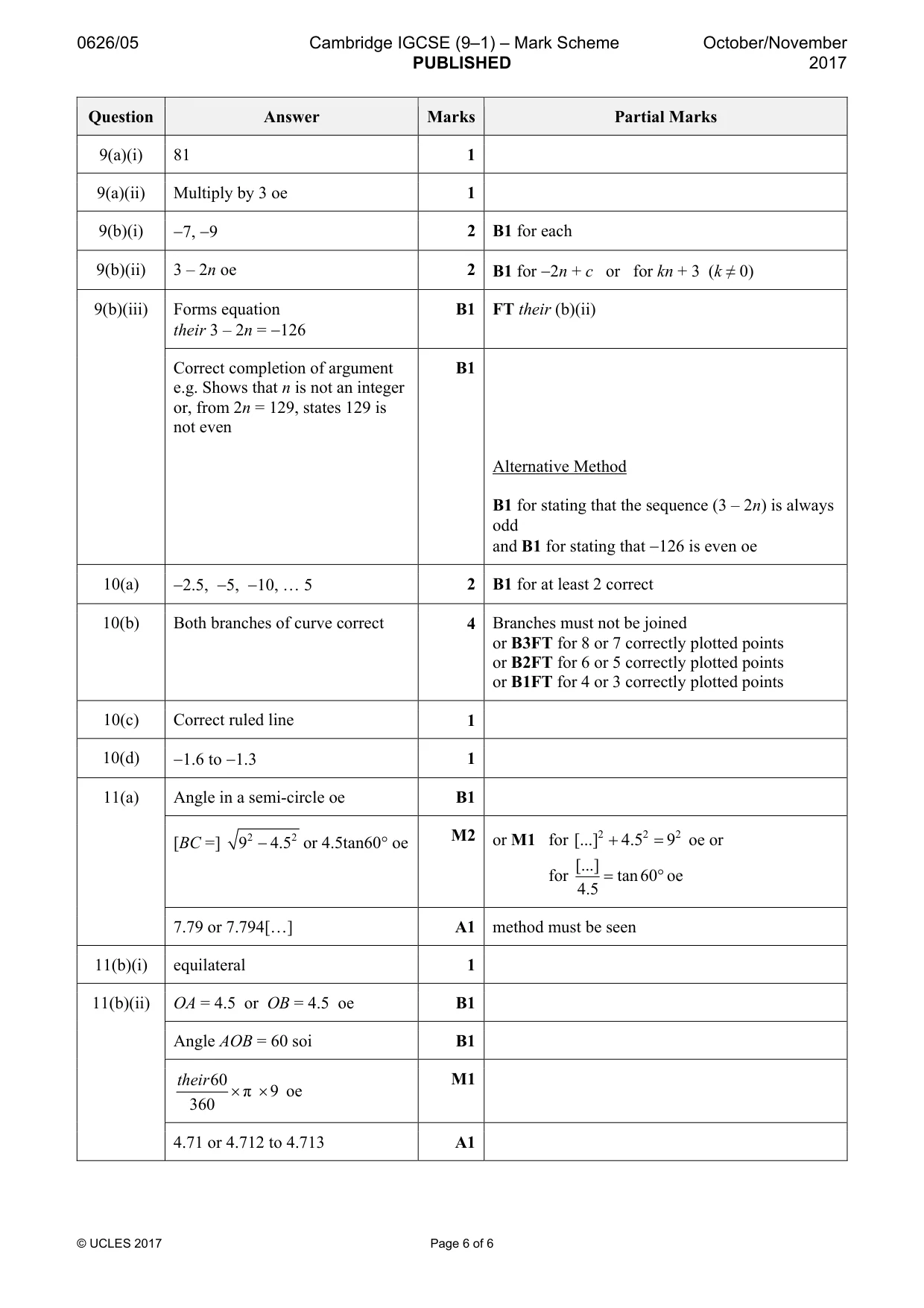
0626/05 Cambridge IGCSE (9–1) – Mark Scheme PUBLISHED October/November 2017 © UCLES 2017 Page 6 of 6 Question Answer Marks Partial Marks 9(a)(i) 81 1 9(a)(ii) Multiply by 3 oe 1 9(b)(i) −7, −9 2 B1 for each 9(b)(ii) 3 – 2n oe 2 B1 for −2n + c or for kn + 3 (k ≠ 0) 9(b)(iii) Forms equation their 3 – 2n = −126 B1 FT their (b)(ii) Correct completion of argument e.g. Shows that n is not an integer or, from 2n = 129, states 129 is not even B1 Alternative Method B1 for stating that the sequence (3 – 2n) is always odd and B1 for stating that −126 is even oe 10(a) −2.5, −5, −10, … 5 2 B1 for at least 2 correct 10(b) Both branches of curve correct 4 Branches must not be joined or B3FT for 8 or 7 correctly plotted points or B2FT for 6 or 5 correctly plotted points or B1FT for 4 or 3 correctly plotted points 10(c) Correct ruled line 1 10(d) −1.6 to −1.3 1 11(a) Angle in a semi-circle oe B1 [BC =] 2 2 9 4.5 − or 4.5tan60° oe M2 or M1 for 2 2 2 [...] 4.5 9 + = oe or for [...] tan60 4.5 = ° oe 7.79 or 7.794[…] A1 method must be seen 11(b)(i) equilateral 1 11(b)(ii) OA = 4.5 or OB = 4.5 oe B1 Angle AOB = 60 soi B1 60 π 9 360 × × their oe M1 4.71 or 4.712 to 4.713 A1
What you needed in this session
Cambridge’s own grade thresholds for 2017 Oct/Nov, Paper 5 · Variant 1. A higher threshold means an easier paper — the bar moves with how the cohort did.