Cambridge IGCSE Mathematics (9-1) (UK only) 0626 — 2017 Oct/Nov Paper 3 · Variant 1
0626/31/O/N/17 · 84 marks · ≈95 min
The question paper and its mark scheme, free to read here and free to download. This is Cambridge’s own paper, exactly as it was sat.
Question paper16 pages
Mark scheme6 pages
Answers below. Sit the paper first if you are practising.
Paper as text
Question paper, page 1
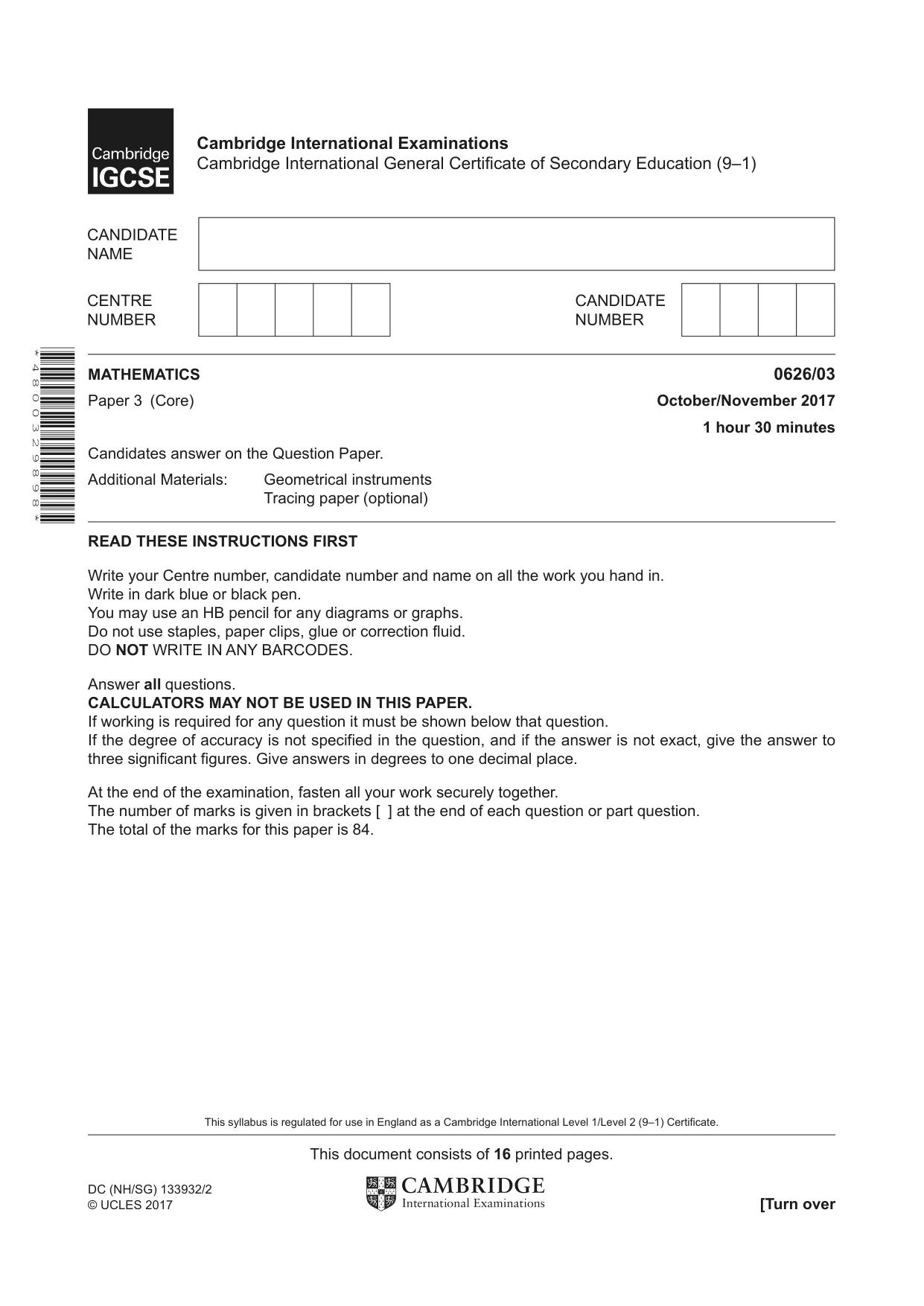
This document consists of 16 printed pages. DC (NH/SG) 133932/2 © UCLES 2017 [Turn over * 4 8 0 0 3 2 9 8 9 8 * MATHEMATICS 0626/03 Paper 3 (Core) October/November 2017 1 hour 30 minutes Candidates answer on the Question Paper. Additional Materials: Geometrical instruments Tracing paper (optional) READ THESE INSTRUCTIONS FIRST Write your Centre number, candidate number and name on all the work you hand in. Write in dark blue or black pen. You may use an HB pencil for any diagrams or graphs. Do not use staples, paper clips, glue or correction fluid. DO NOT WRITE IN ANY BARCODES. Answer all questions. CALCULATORS MAY NOT BE USED IN THIS PAPER. If working is required for any question it must be shown below that question. If the degree of accuracy is not specified in the question, and if the answer is not exact, give the answer to three significant figures. Give answers in degrees to one decimal place. At the end of the examination, fasten all your work securely together. The number of marks is given in brackets [ ] at the end of each question or part question. The total of the marks for this paper is 84. This syllabus is regulated for use in England as a Cambridge International Level 1/Level 2 (9–1) Certificate. Cambridge International Examinations Cambridge International General Certificate of Secondary Education (9–1)
Question paper, page 2
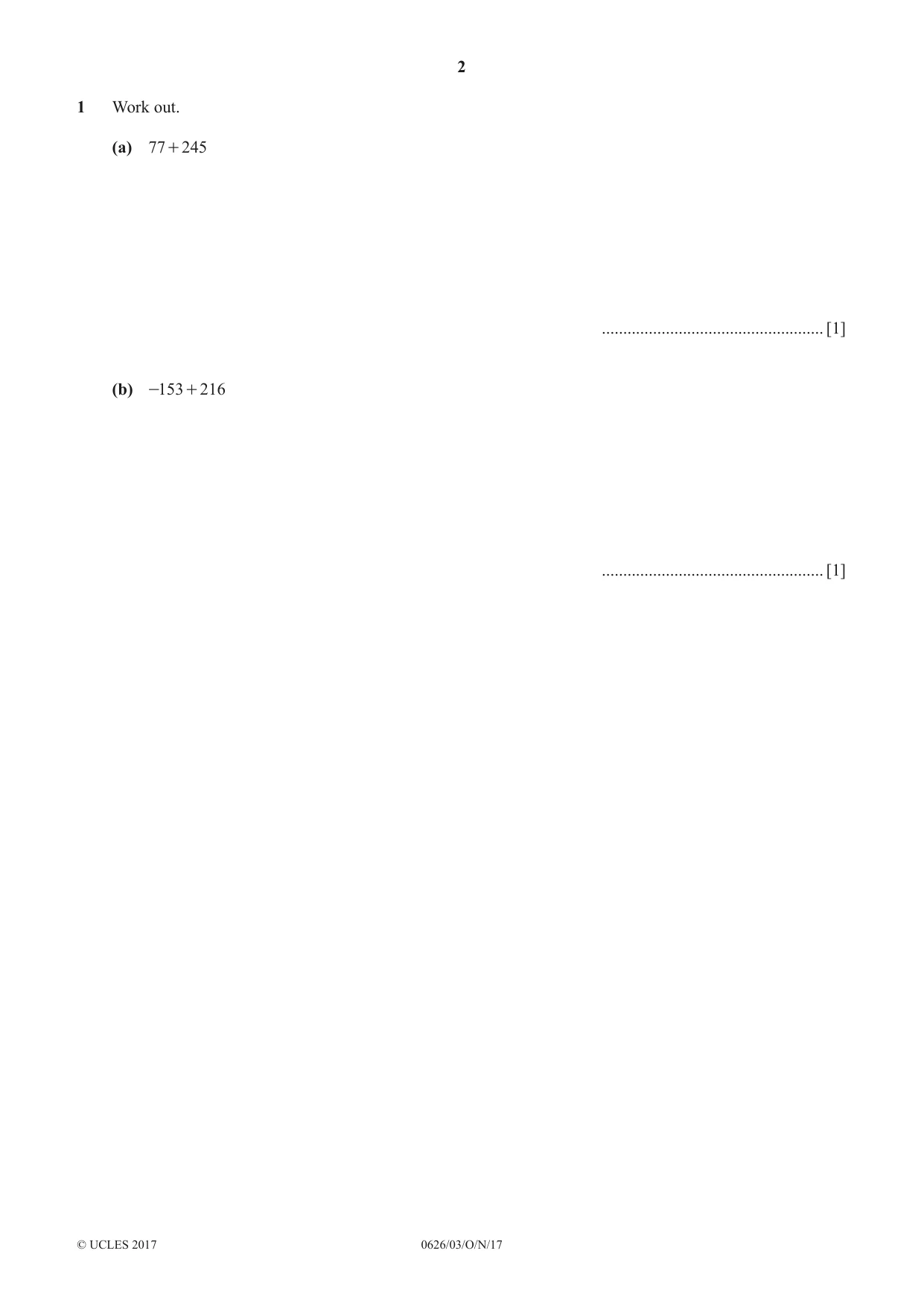
2 0626/03/O/N/17 © UCLES 2017 1 Work out. (a) 77 245 + … [1] (b) 153 216 - + … [1]
Question paper, page 3
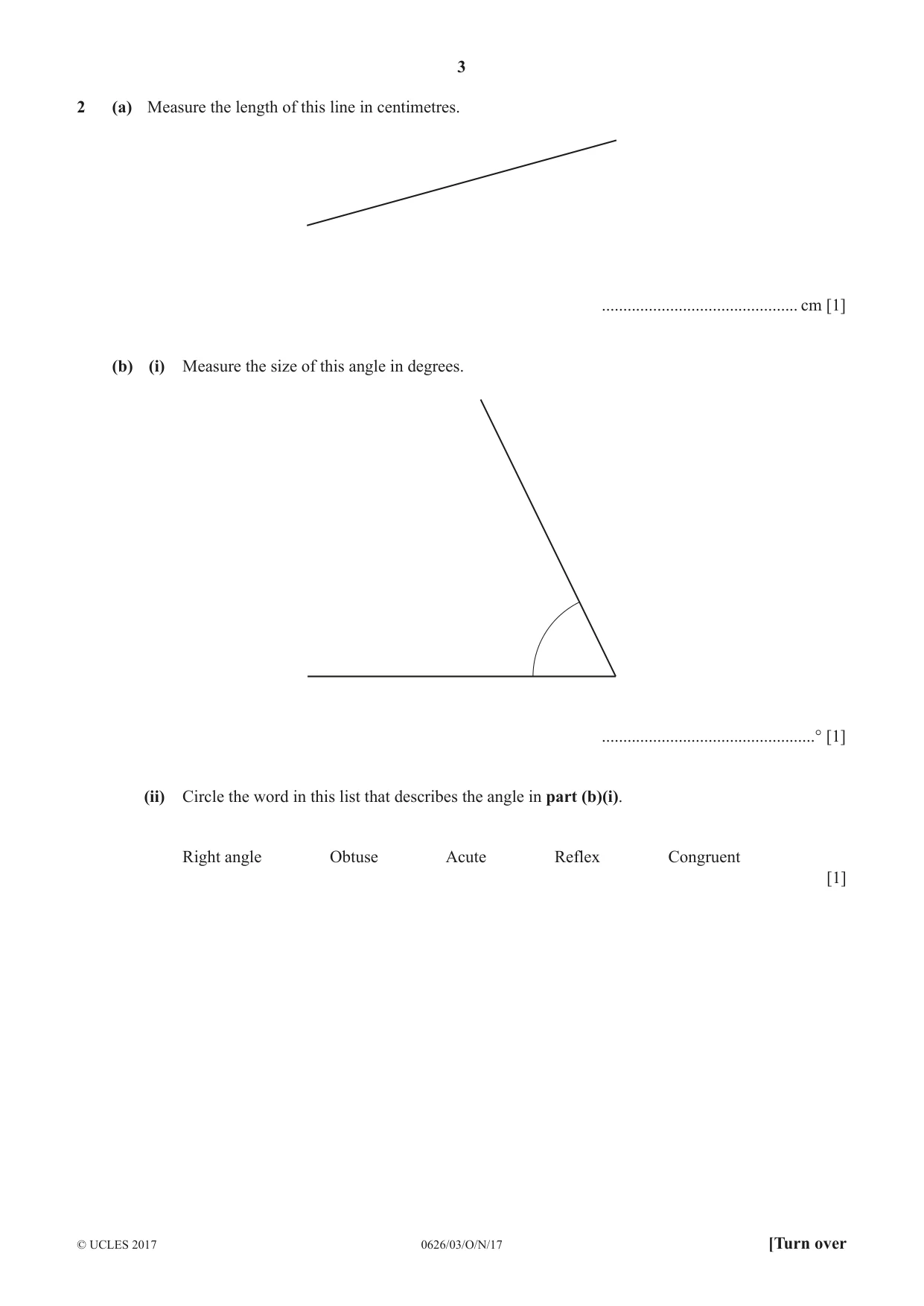
3 0626/03/O/N/17 © UCLES 2017 [Turn over 2 (a) Measure the length of this line in centimetres. … cm [1] (b) (i) Measure the size of this angle in degrees. …° [1] (ii) Circle the word in this list that describes the angle in part (b)(i). Right angle Obtuse Acute Reflex Congruent [1]
Question paper, page 4
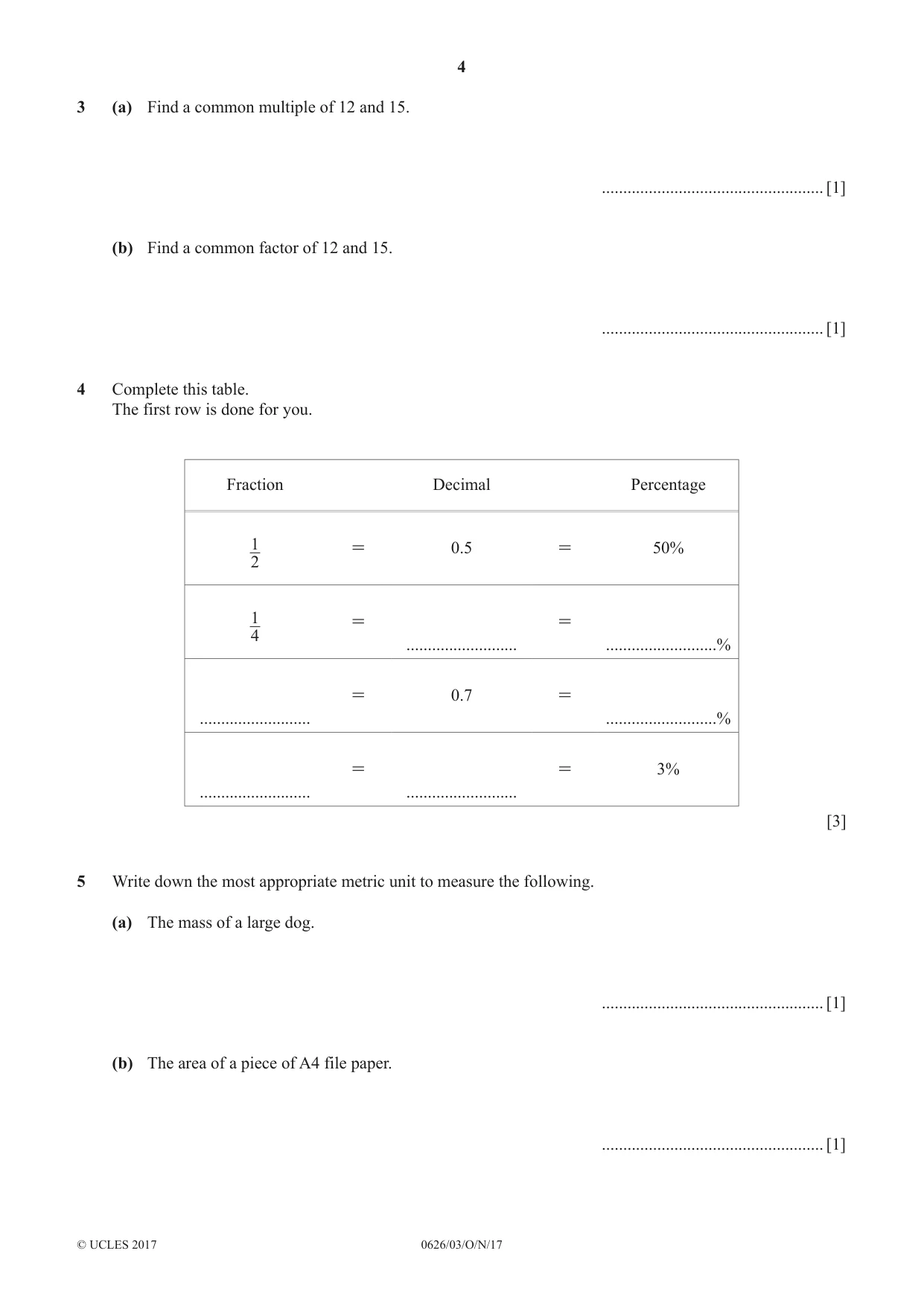
4 0626/03/O/N/17 © UCLES 2017 3 (a) Find a common multiple of 12 and 15. … [1] (b) Find a common factor of 12 and 15. … [1] 4 Complete this table. The first row is done for you. Fraction Decimal Percentage 2 1 = 0.5 = 50% 1 4 = … = …% … = 0.7 = …% … = … = 3% [3] 5 Write down the most appropriate metric unit to measure the following. (a) The mass of a large dog. … [1] (b) The area of a piece of A4 file paper. … [1]
Question paper, page 5
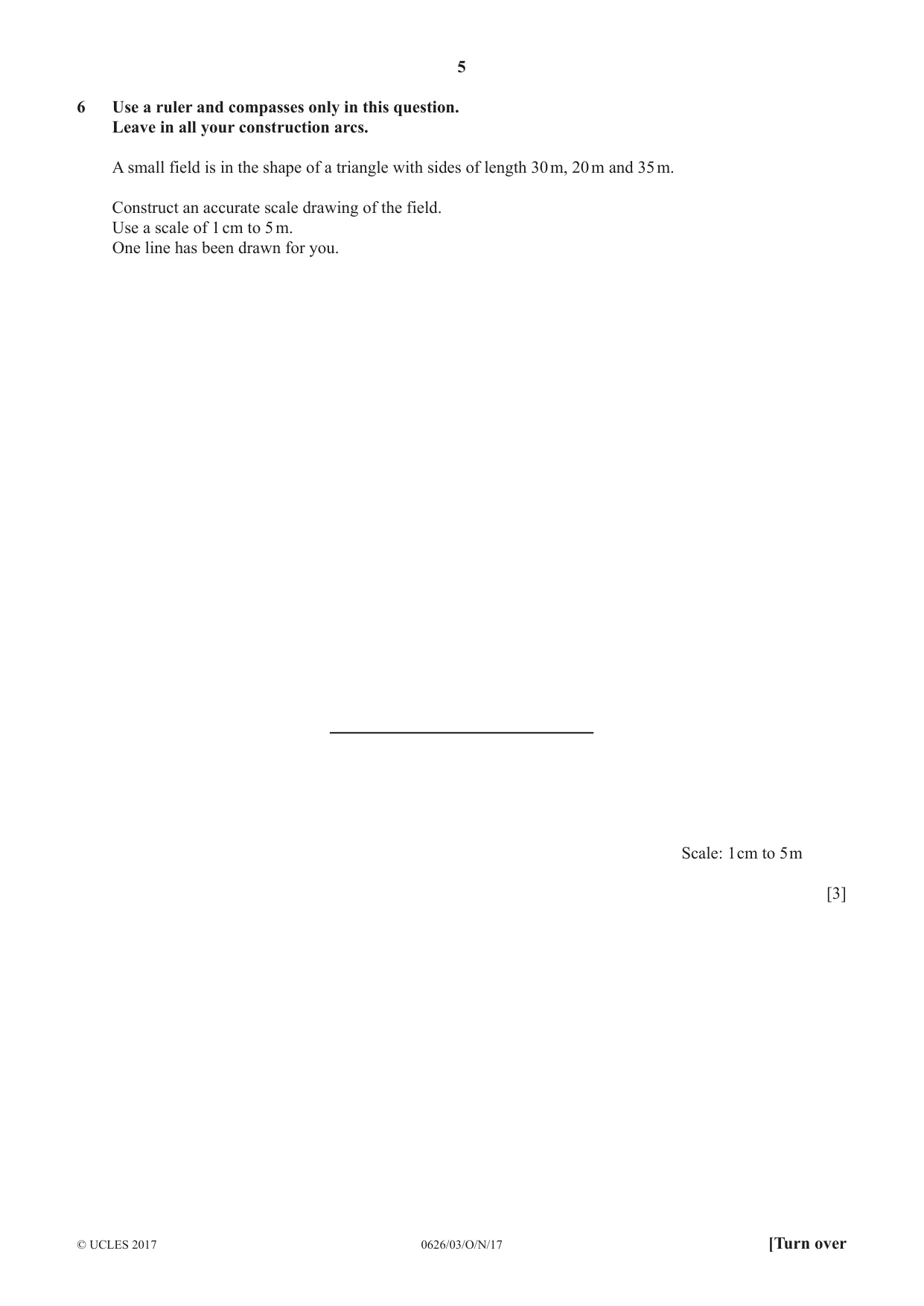
5 0626/03/O/N/17 © UCLES 2017 [Turn over 6 Use a ruler and compasses only in this question. Leave in all your construction arcs. A small field is in the shape of a triangle with sides of length 30 m, 20 m and 35 m. Construct an accurate scale drawing of the field. Use a scale of 1 cm to 5 m. One line has been drawn for you. Scale: 1 cm to 5 m [3]
Question paper, page 6
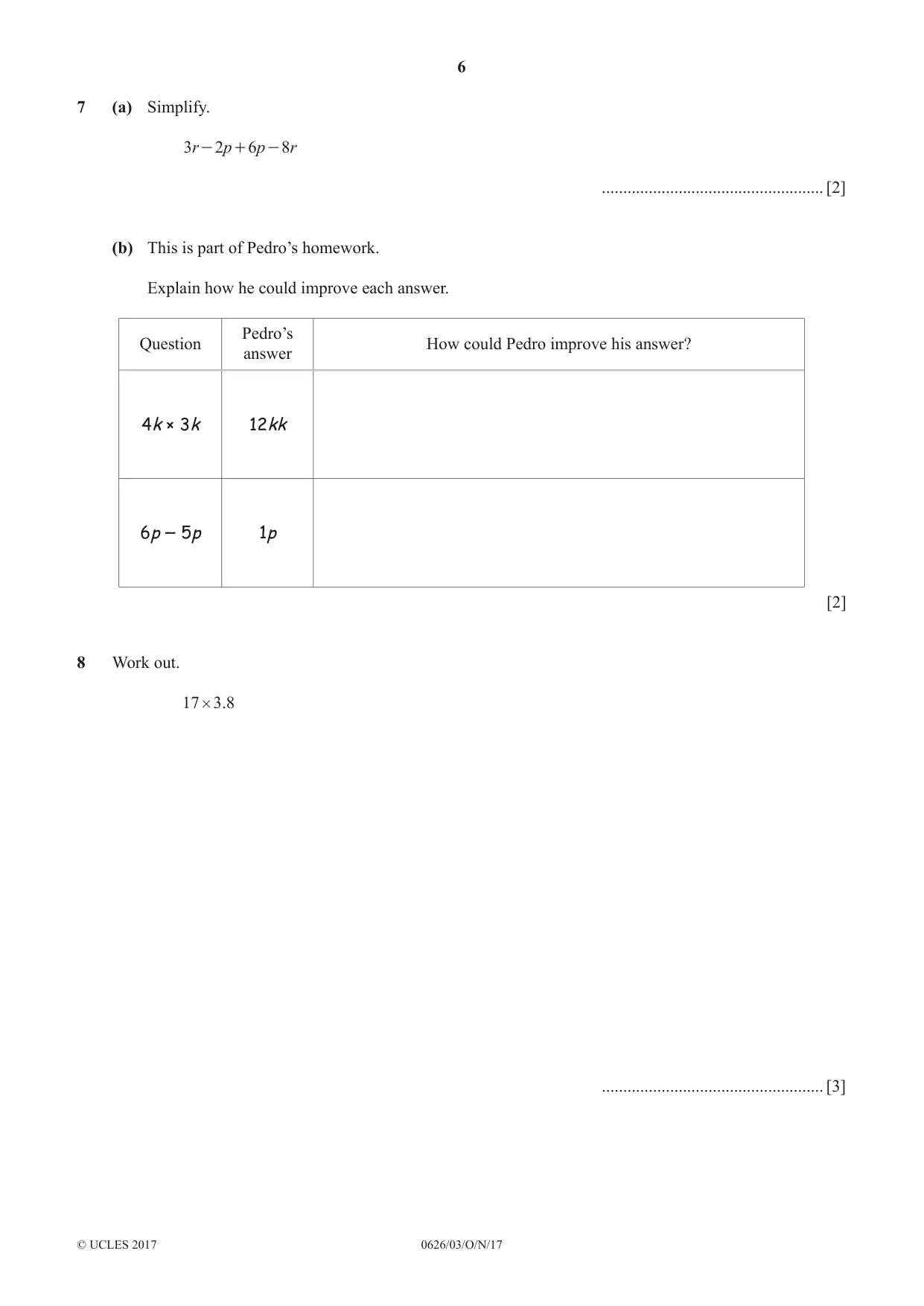
6 0626/03/O/N/17 © UCLES 2017 7 (a) Simplify. r p p r 3 2 6 8 - + - … [2] (b) This is part of Pedro’s homework. Explain how he could improve each answer. Question Pedro’s answer How could Pedro improve his answer? 4k × 3k 12kk 6p — 5p 1p [2] 8 Work out. . 17 3 8 # … [3]
Question paper, page 7
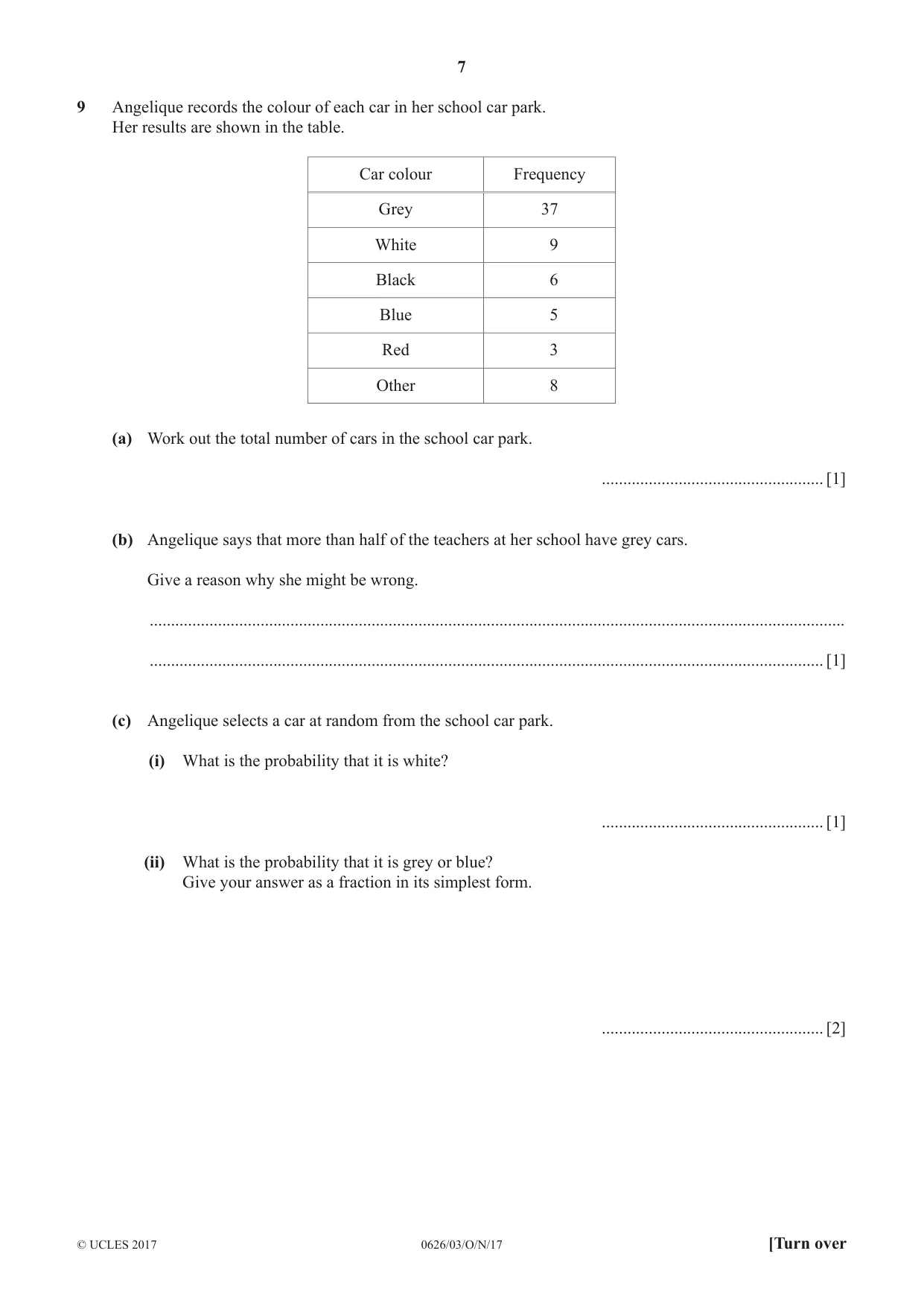
7 0626/03/O/N/17 © UCLES 2017 [Turn over 9 Angelique records the colour of each car in her school car park. Her results are shown in the table. Car colour Frequency Grey 37 White 9 Black 6 Blue 5 Red 3 Other 8 (a) Work out the total number of cars in the school car park. … [1] (b) Angelique says that more than half of the teachers at her school have grey cars. Give a reason why she might be wrong. … … [1] (c) Angelique selects a car at random from the school car park. (i) What is the probability that it is white? … [1] (ii) What is the probability that it is grey or blue? Give your answer as a fraction in its simplest form. … [2]
Question paper, page 8
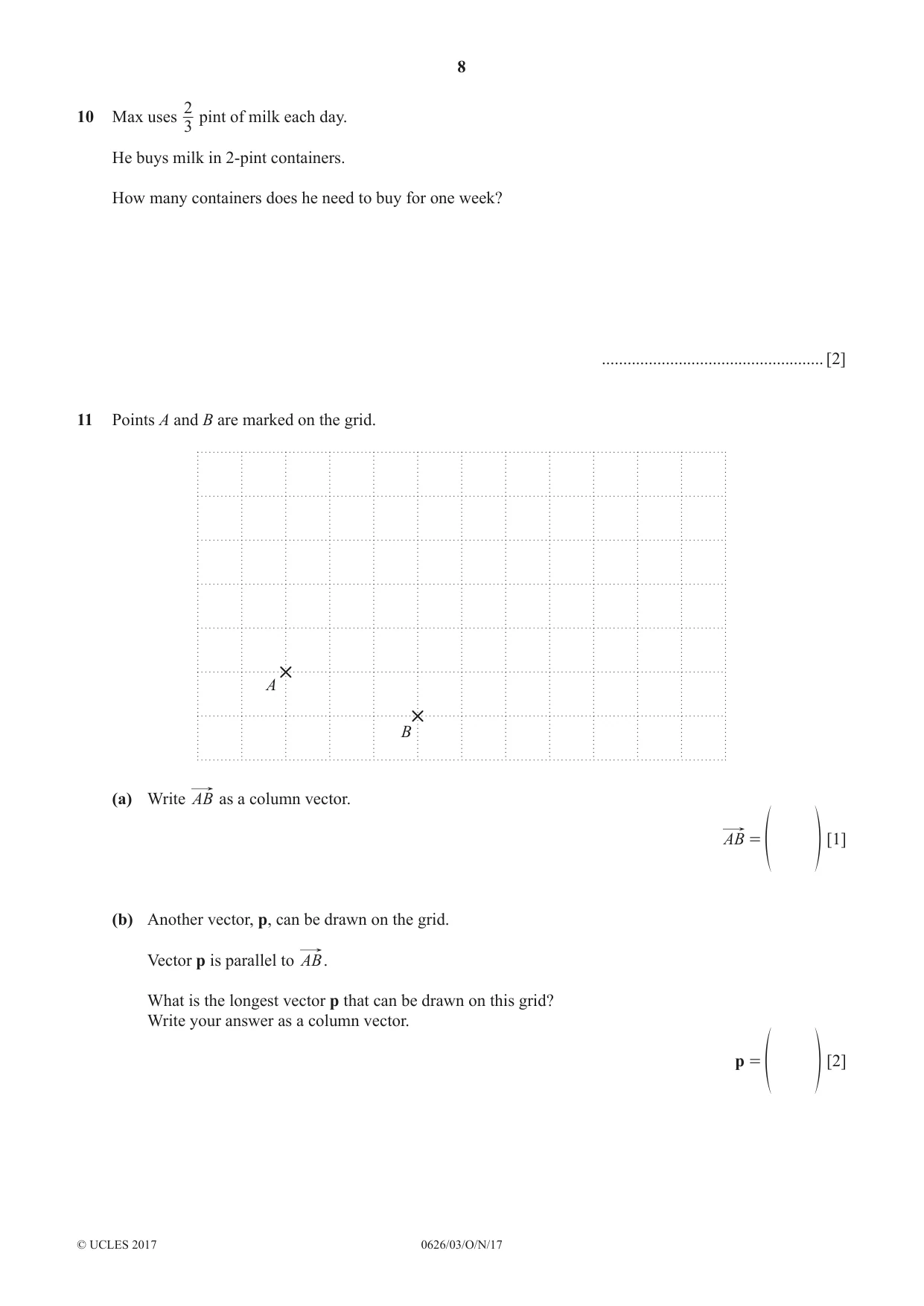
8 0626/03/O/N/17 © UCLES 2017 10 Max uses 3 2 pint of milk each day. He buys milk in 2-pint containers. How many containers does he need to buy for one week? … [2] 11 Points A and B are marked on the grid. A B (a) Write AB as a column vector. AB = f p [1] (b) Another vector, p, can be drawn on the grid. Vector p is parallel to AB. What is the longest vector p that can be drawn on this grid? Write your answer as a column vector. p = f p [2]
Question paper, page 9
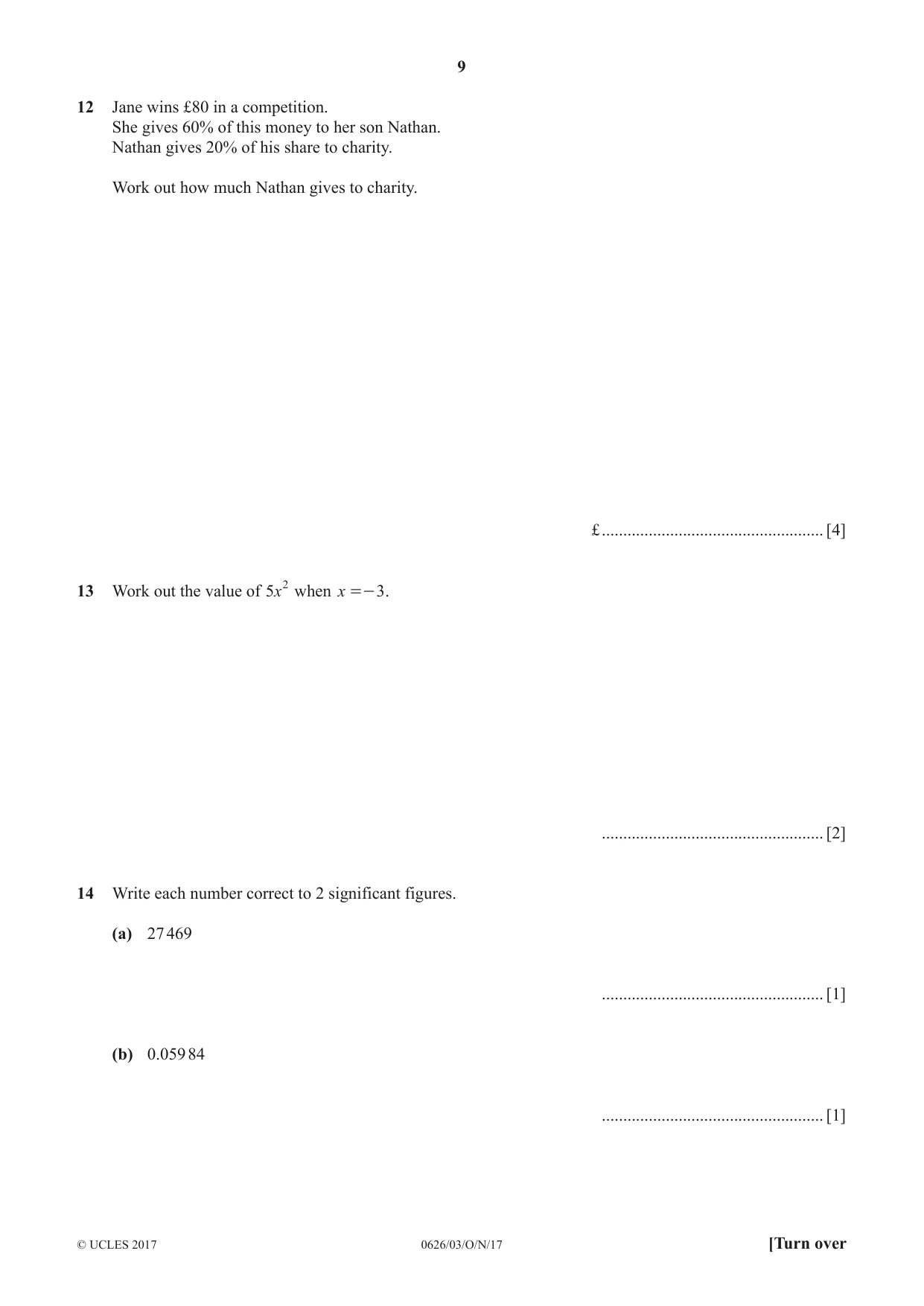
9 0626/03/O/N/17 © UCLES 2017 [Turn over 12 Jane wins £80 in a competition. She gives 60% of this money to her son Nathan. Nathan gives 20% of his share to charity. Work out how much Nathan gives to charity. £ … [4] 13 Work out the value of x 5 2 when x 3 =- . … [2] 14 Write each number correct to 2 significant figures. (a) 27 469 … [1] (b) 0.059 84 … [1]
Question paper, page 10
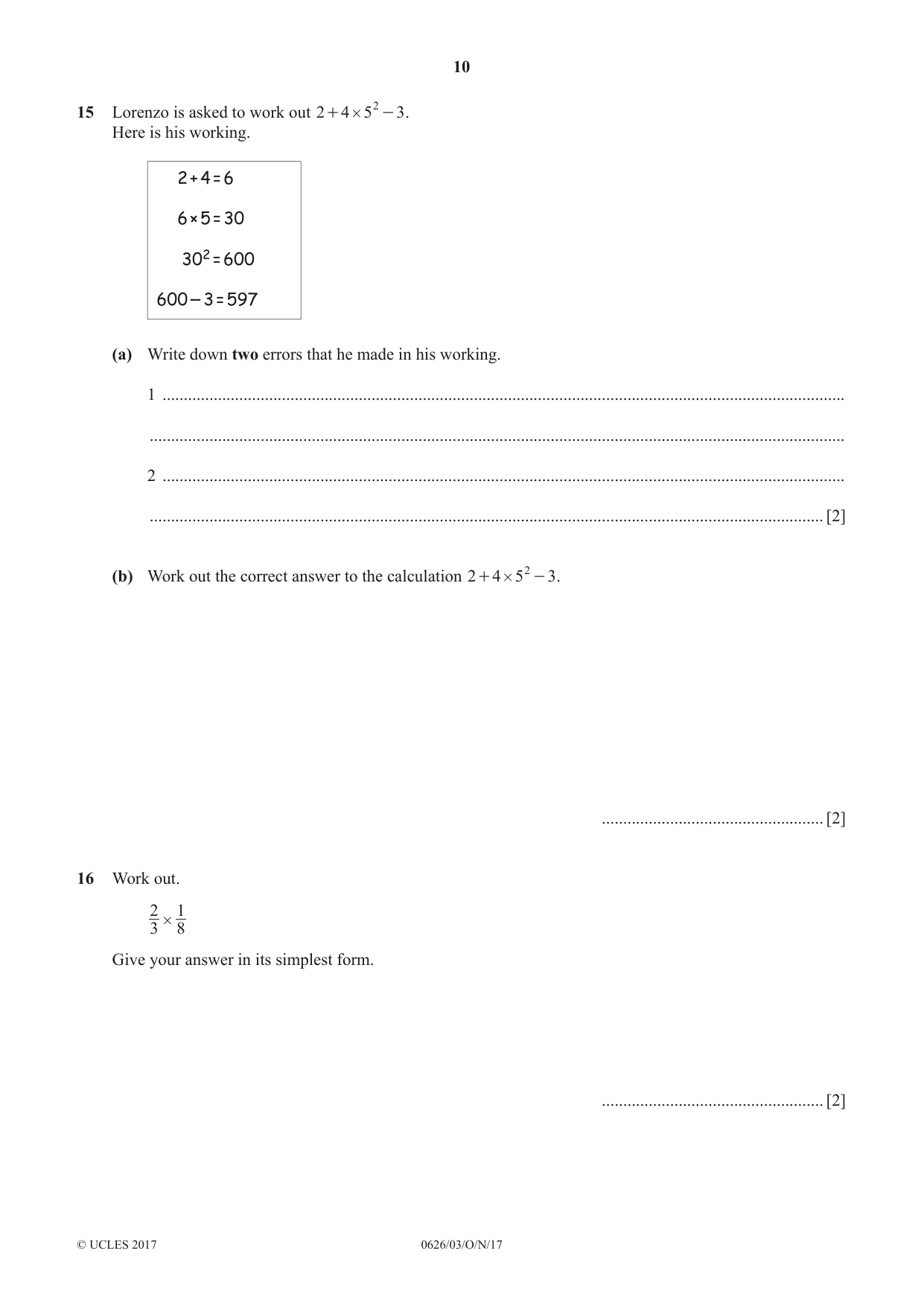
10 0626/03/O/N/17 © UCLES 2017 15 Lorenzo is asked to work out 2 4 5 3 2 # + - . Here is his working. 2 + 4 = 6 6 × 5 = 30 302 = 600 600 — 3 = 597 (a) Write down two errors that he made in his working. 1 … … 2 … … [2] (b) Work out the correct answer to the calculation 2 4 5 3 2 # + - . … [2] 16 Work out. 3 2 8 1 # Give your answer in its simplest form. … [2]
Question paper, page 11
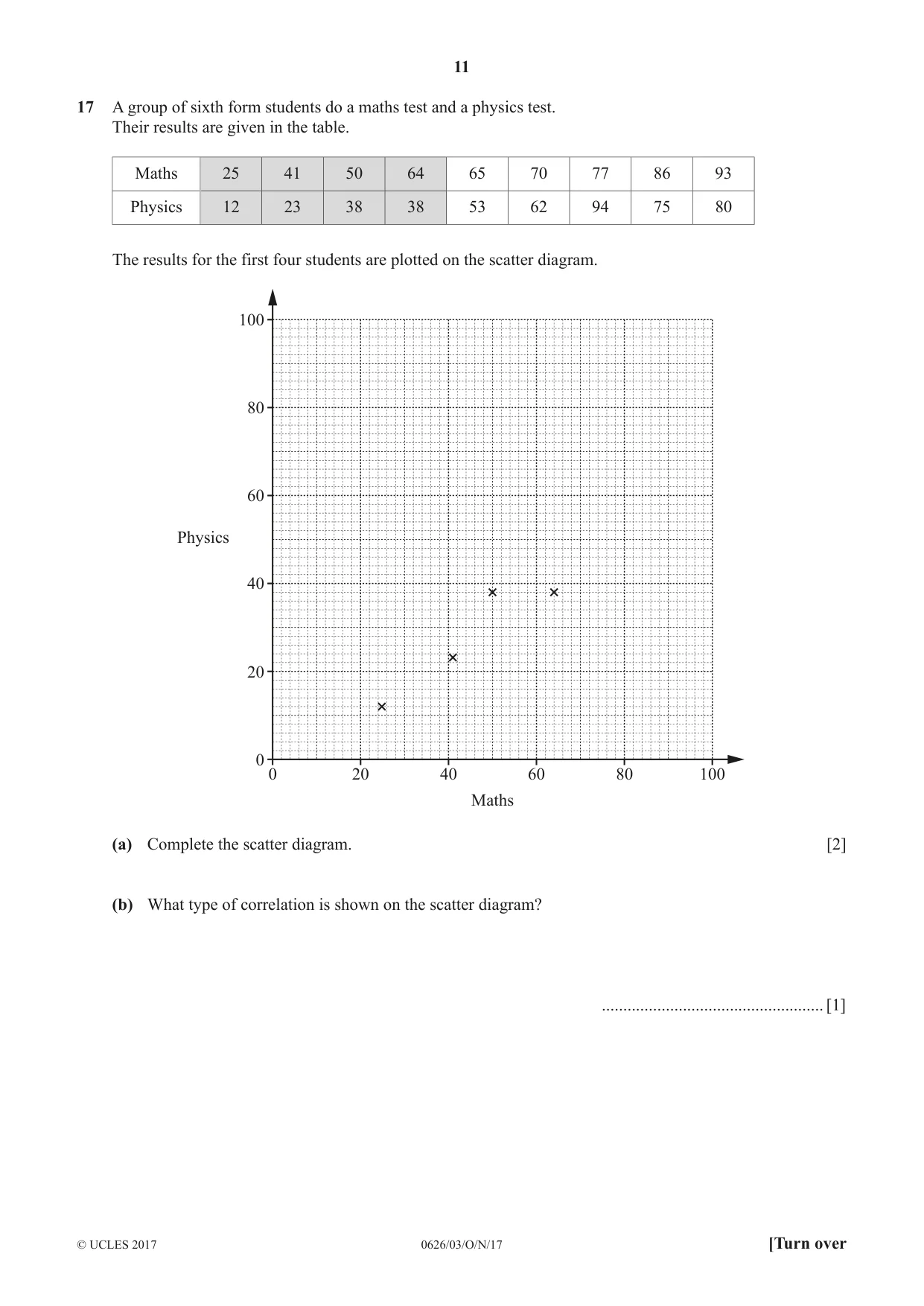
11 0626/03/O/N/17 © UCLES 2017 [Turn over 17 A group of sixth form students do a maths test and a physics test. Their results are given in the table. Maths 25 41 50 64 65 70 77 86 93 Physics 12 23 38 38 53 62 94 75 80 The results for the first four students are plotted on the scatter diagram. 100 80 60 Physics Maths 40 20 0 0 20 40 60 80 100 (a) Complete the scatter diagram. [2] (b) What type of correlation is shown on the scatter diagram? … [1]
Question paper, page 12
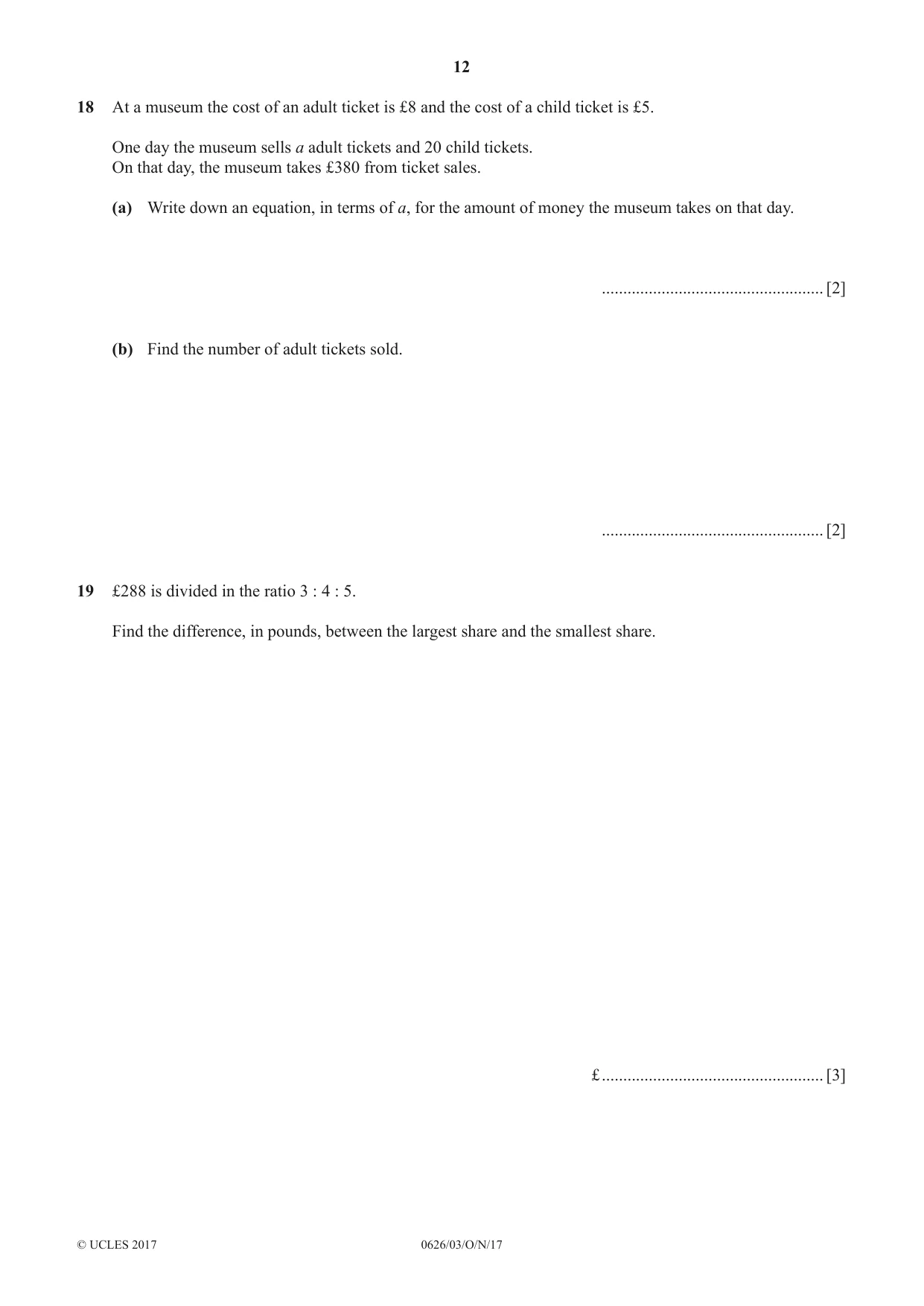
12 0626/03/O/N/17 © UCLES 2017 18 At a museum the cost of an adult ticket is £8 and the cost of a child ticket is £5. One day the museum sells a adult tickets and 20 child tickets. On that day, the museum takes £380 from ticket sales. (a) Write down an equation, in terms of a, for the amount of money the museum takes on that day. … [2] (b) Find the number of adult tickets sold. … [2] 19 £288 is divided in the ratio 3 : 4 : 5. Find the difference, in pounds, between the largest share and the smallest share. £ … [3]
Question paper, page 13
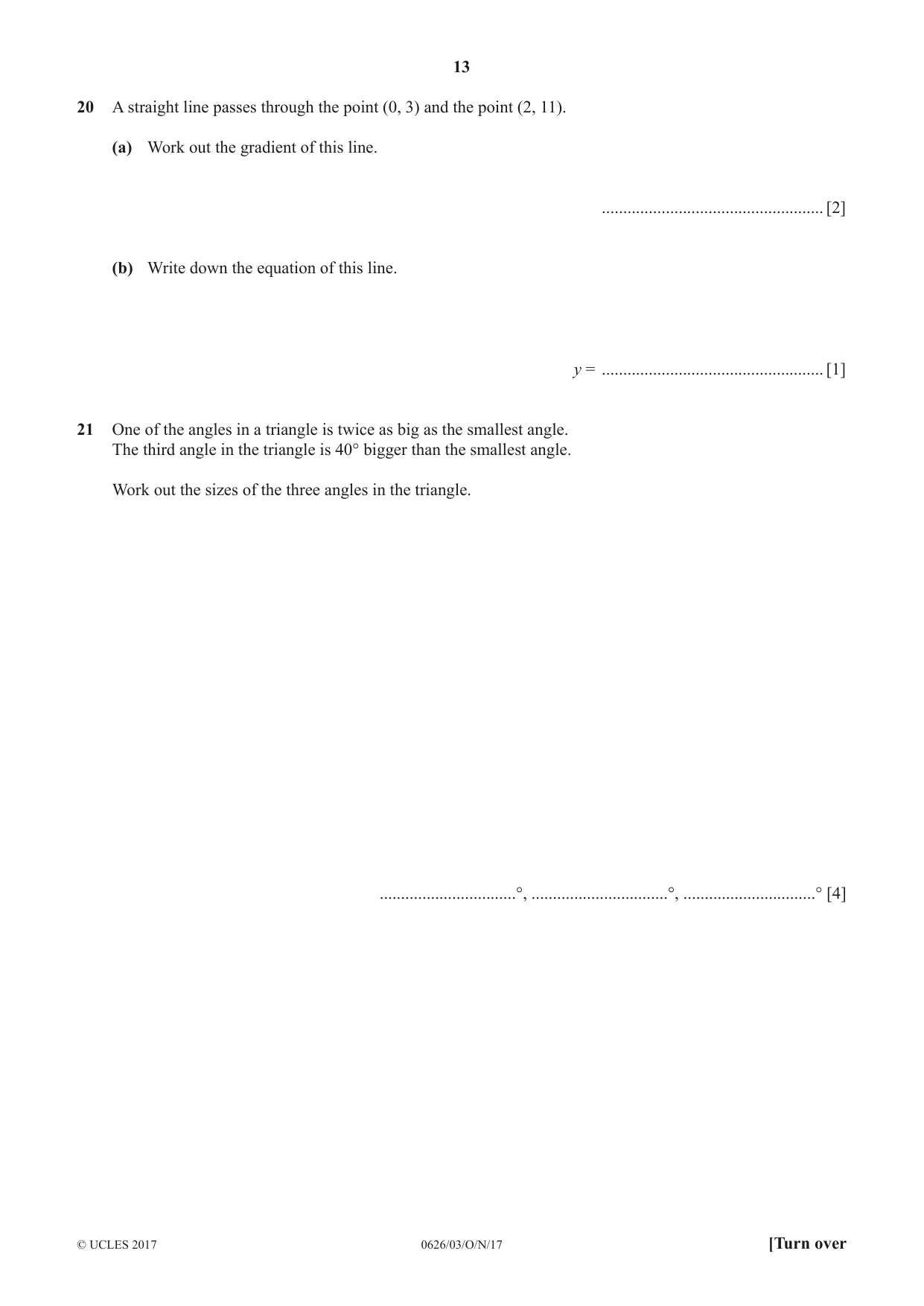
13 0626/03/O/N/17 © UCLES 2017 [Turn over 20 A straight line passes through the point (0, 3) and the point (2, 11). (a) Work out the gradient of this line. … [2] (b) Write down the equation of this line. y = … [1] 21 One of the angles in a triangle is twice as big as the smallest angle. The third angle in the triangle is 40° bigger than the smallest angle. Work out the sizes of the three angles in the triangle. …°, …°, …° [4]
Question paper, page 14
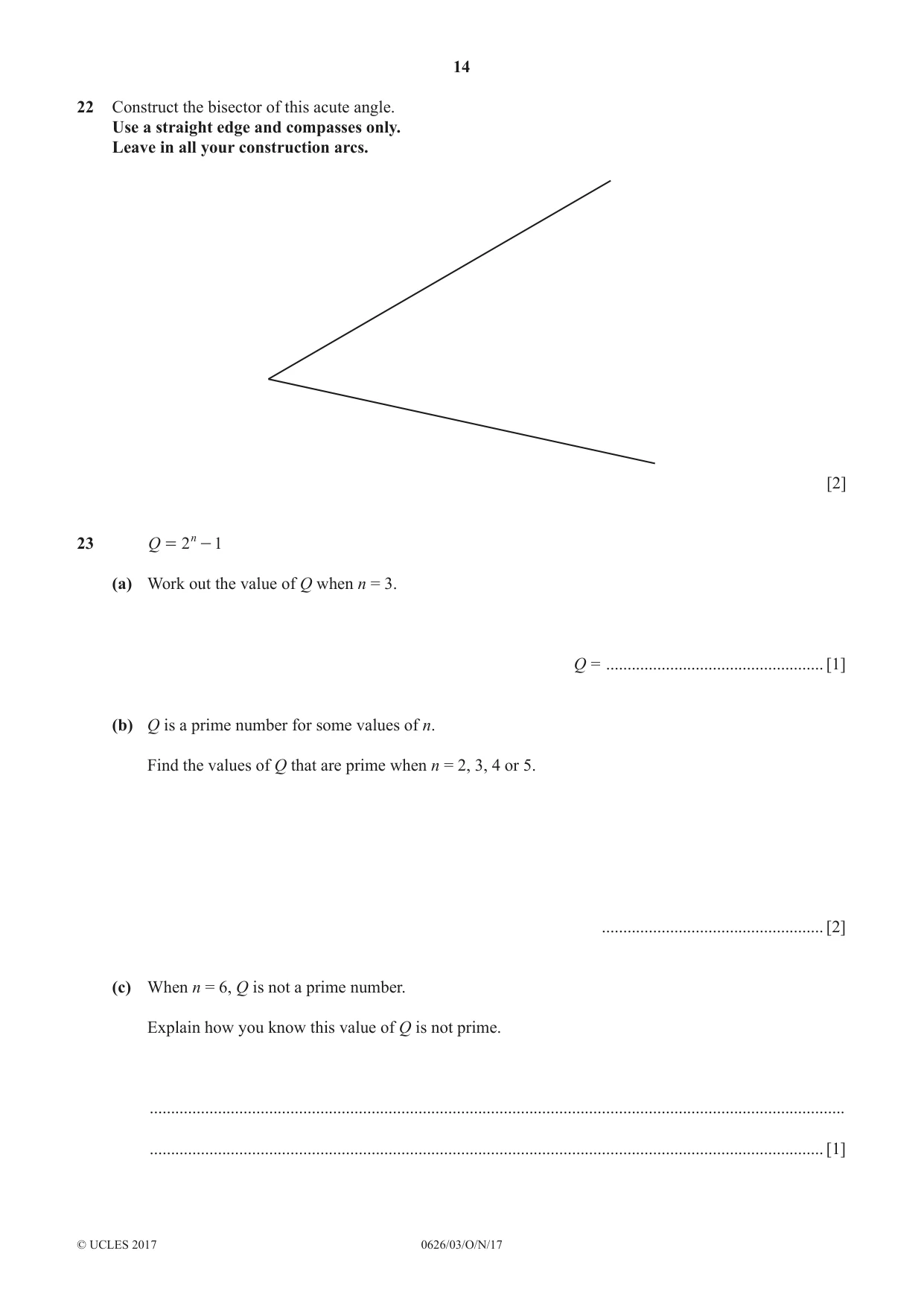
14 0626/03/O/N/17 © UCLES 2017 22 Construct the bisector of this acute angle. Use a straight edge and compasses only. Leave in all your construction arcs. [2] 23 Q 2 1 n = - (a) Work out the value of Q when n = 3. Q = … [1] (b) Q is a prime number for some values of n. Find the values of Q that are prime when n = 2, 3, 4 or 5. … [2] (c) When n = 6, Q is not a prime number. Explain how you know this value of Q is not prime. … … [1]
Question paper, page 15
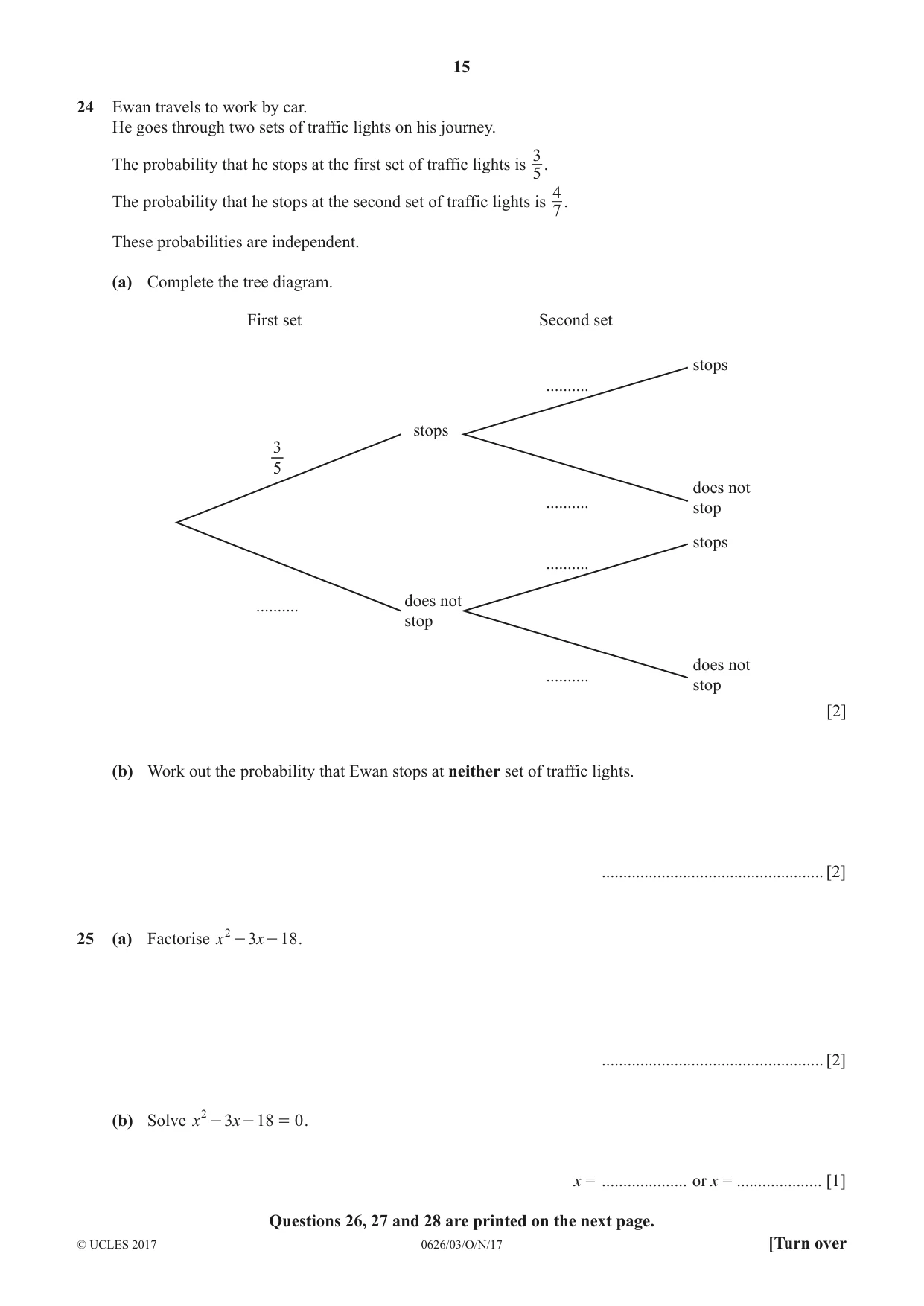
15 0626/03/O/N/17 © UCLES 2017 [Turn over 24 Ewan travels to work by car. He goes through two sets of traffic lights on his journey. The probability that he stops at the first set of traffic lights is 5 3 . The probability that he stops at the second set of traffic lights is 7 4 . These probabilities are independent. (a) Complete the tree diagram. 3 5 stops does not stop stops does not stop stops does not stop … … … … … First set Second set [2] (b) Work out the probability that Ewan stops at neither set of traffic lights. … [2] 25 (a) Factorise x x 3 18 2 - - . … [2] (b) Solve x x 3 18 0 2 - - = . x = … or x = … [1] Questions 26, 27 and 28 are printed on the next page.
Question paper, page 16
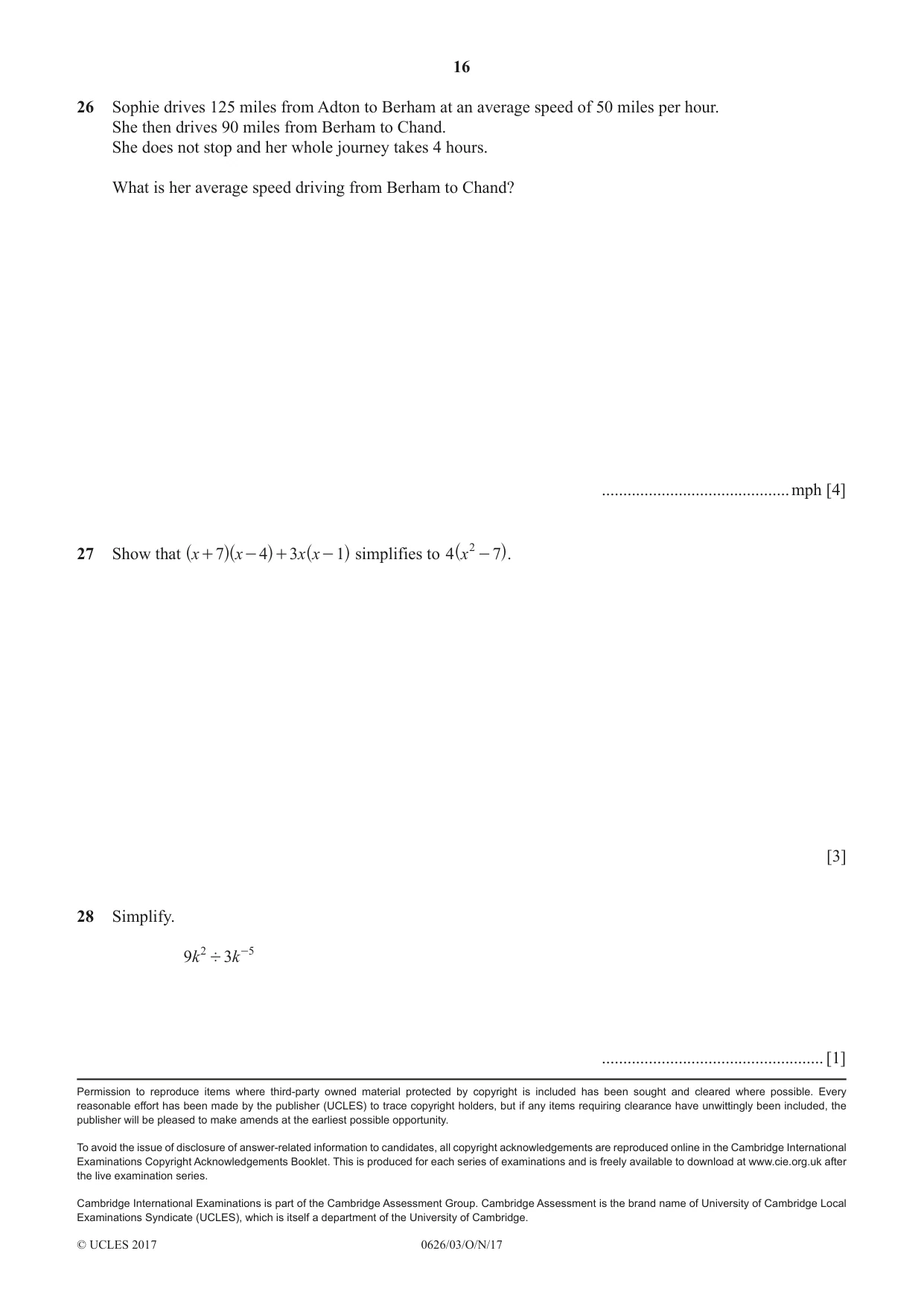
16 0626/03/O/N/17 © UCLES 2017 Permission to reproduce items where third-party owned material protected by copyright is included has been sought and cleared where possible. Every reasonable effort has been made by the publisher (UCLES) to trace copyright holders, but if any items requiring clearance have unwittingly been included, the publisher will be pleased to make amends at the earliest possible opportunity. To avoid the issue of disclosure of answer-related information to candidates, all copyright acknowledgements are reproduced online in the Cambridge International Examinations Copyright Acknowledgements Booklet. This is produced for each series of examinations and is freely available to download at www.cie.org.uk after the live examination series. Cambridge International Examinations is part of the Cambridge Assessment Group. Cambridge Assessment is the brand name of University of Cambridge Local Examinations Syndicate (UCLES), which is itself a department of the University of Cambridge. 26 Sophie drives 125 miles from Adton to Berham at an average speed of 50 miles per hour. She then drives 90 miles from Berham to Chand. She does not stop and her whole journey takes 4 hours. What is her average speed driving from Berham to Chand? …mph [4] 27 Show that x x x x 7 4 3 1 + - + - ^ ^ ^ h h h simplifies to x 4 7 2 - ^ h. [3] 28 Simplify. k k 9 3 2 5 ' - … [1]
Mark scheme, page 1
® IGCSE is a registered trademark. This syllabus is regulated for use in England as a Cambridge International Level 1/Level 2 (9–1) Certificate. This document consists of 6 printed pages. © UCLES 2017 [Turn over Cambridge Assessment International Education Cambridge International General Certificate of Secondary Education (9–1) MATHEMATICS 0626/03 Paper 3 October/November 2017 MARK SCHEME Maximum Mark: 84 Published This mark scheme is published as an aid to teachers and candidates, to indicate the requirements of the examination. It shows the basis on which Examiners were instructed to award marks. It does not indicate the details of the discussions that took place at an Examiners’ meeting before marking began, which would have considered the acceptability of alternative answers. Mark schemes should be read in conjunction with the question paper and the Principal Examiner Report for Teachers. Cambridge International will not enter into discussions about these mark schemes. Cambridge International is publishing the mark schemes for the October/November 2017 series for most Cambridge IGCSE®, Cambridge International A and AS Level components and some Cambridge O Level components.
Mark scheme, page 2
0626/03 Cambridge IGCSE (9–1) – Mark Scheme PUBLISHED October/November 2017 © UCLES 2017 Page 2 of 6 MARK SCHEME NOTES The following notes are intended to aid interpretation of mark schemes in general, but individual mark schemes may include marks awarded for specific reasons outside the scope of these notes. Types of mark M Method marks, awarded for a valid method applied to the problem. A Accuracy mark, awarded for a correct answer or intermediate step correctly obtained. For accuracy marks to be given, the associated Method mark must be earned or implied. B Mark for a correct result or statement independent of Method marks. When a part of a question has two or more ‘method’ steps, the M marks are in principle independent unless the scheme specifically says otherwise; and similarly where there are several B marks allocated. The notation ‘dep’ is used to indicate that a particular M or B mark is dependent on an earlier mark in the scheme. Abbreviations awrt answers which round to cao correct answer only dep dependent FT follow through after error isw ignore subsequent working nfww not from wrong working oe or equivalent rot rounded or truncated SC Special Case soi seen or implied
Mark scheme, page 3
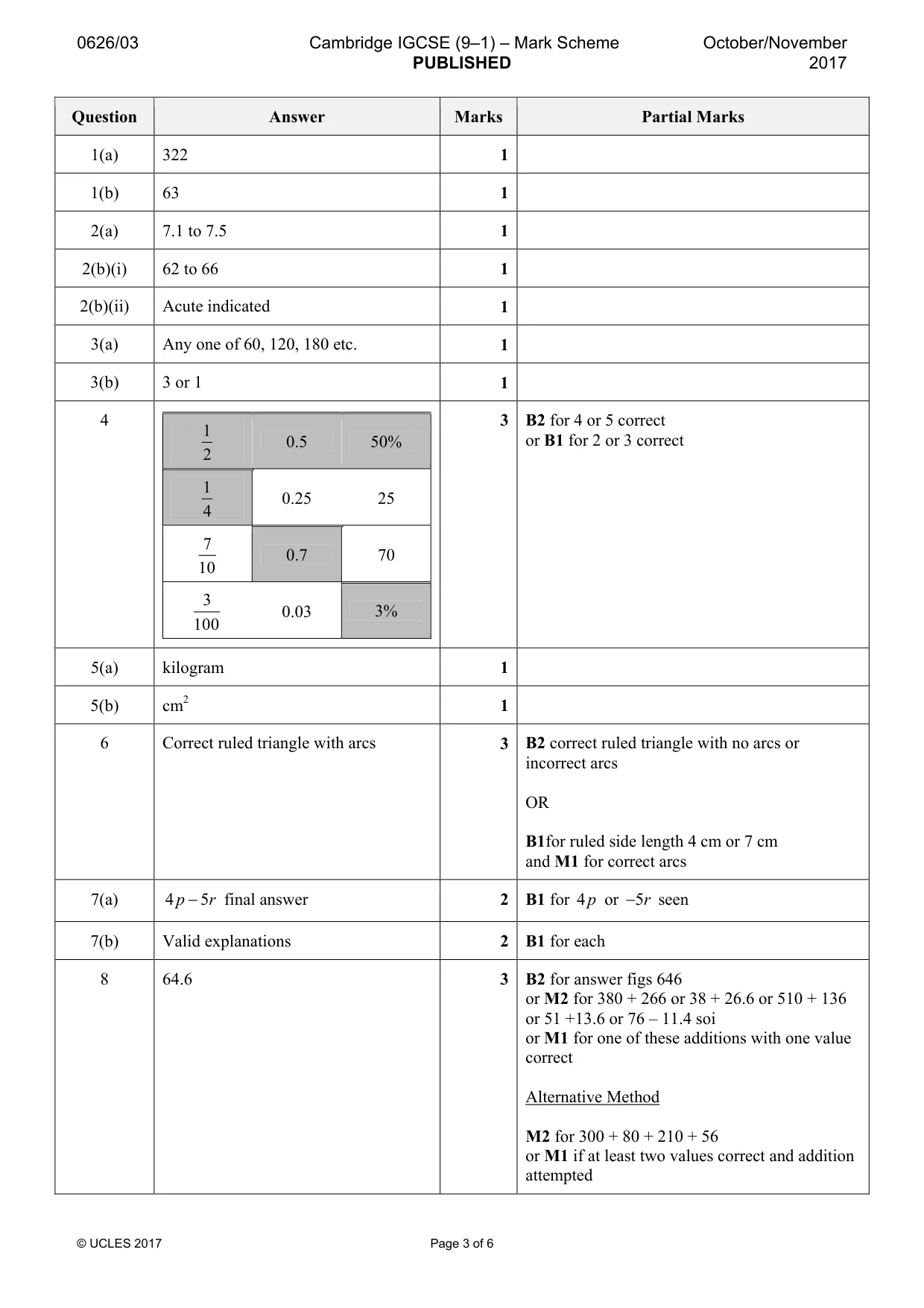
0626/03 Cambridge IGCSE (9–1) – Mark Scheme PUBLISHED October/November 2017 © UCLES 2017 Page 3 of 6 Question Answer Marks Partial Marks 1(a) 322 1 1(b) 63 1 2(a) 7.1 to 7.5 1 2(b)(i) 62 to 66 1 2(b)(ii) Acute indicated 1 3(a) Any one of 60, 120, 180 etc. 1 3(b) 3 or 1 1 4 1 2 0.5 50% 1 4 0.25 25 7 10 0.7 70 3 100 0.03 3% 3 B2 for 4 or 5 correct or B1 for 2 or 3 correct 5(a) kilogram 1 5(b) cm2 1 6 Correct ruled triangle with arcs 3 B2 correct ruled triangle with no arcs or incorrect arcs OR B1for ruled side length 4 cm or 7 cm and M1 for correct arcs 7(a) 4 5 − p r final answer 2 B1 for 4p or 5 −r seen 7(b) Valid explanations 2 B1 for each 8 64.6 3 B2 for answer figs 646 or M2 for 380 + 266 or 38 + 26.6 or 510 + 136 or 51 +13.6 or 76 – 11.4 soi or M1 for one of these additions with one value correct Alternative Method M2 for 300 + 80 + 210 + 56 or M1 if at least two values correct and addition attempted
Mark scheme, page 4
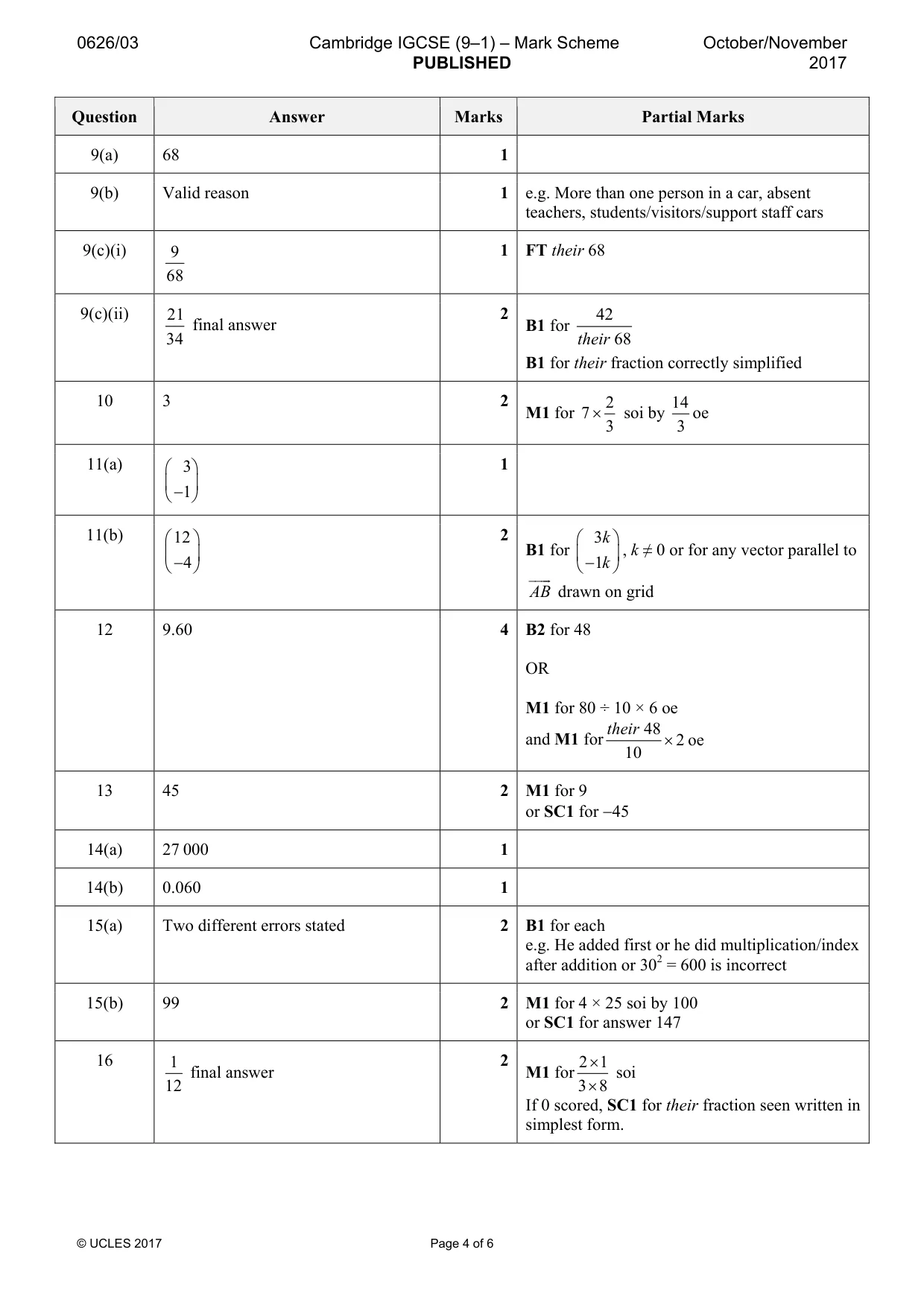
0626/03 Cambridge IGCSE (9–1) – Mark Scheme PUBLISHED October/November 2017 © UCLES 2017 Page 4 of 6 Question Answer Marks Partial Marks 9(a) 68 1 9(b) Valid reason 1 e.g. More than one person in a car, absent teachers, students/visitors/support staff cars 9(c)(i) 9 68 1 FT their 68 9(c)(ii) 21 34 final answer 2 B1 for 42 68 their B1 for their fraction correctly simplified 10 3 2 M1 for 2 7 3 × soi by 14 3 oe 11(a) 3 1 − 1 11(b) 12 4 − 2 B1 for 3 1 k k − , k ≠ 0 or for any vector parallel to JJJG AB drawn on grid 12 9.60 4 B2 for 48 OR M1 for 80 ÷ 10 × 6 oe and M1 for 48 2 oe 10 × their 13 45 2 M1 for 9 or SC1 for −45 14(a) 27 000 1 14(b) 0.060 1 15(a) Two different errors stated 2 B1 for each e.g. He added first or he did multiplication/index after addition or 302 = 600 is incorrect 15(b) 99 2 M1 for 4 × 25 soi by 100 or SC1 for answer 147 16 1 12 final answer 2 M1 for 2 1 3 8 × × soi If 0 scored, SC1 for their fraction seen written in simplest form.
Mark scheme, page 5
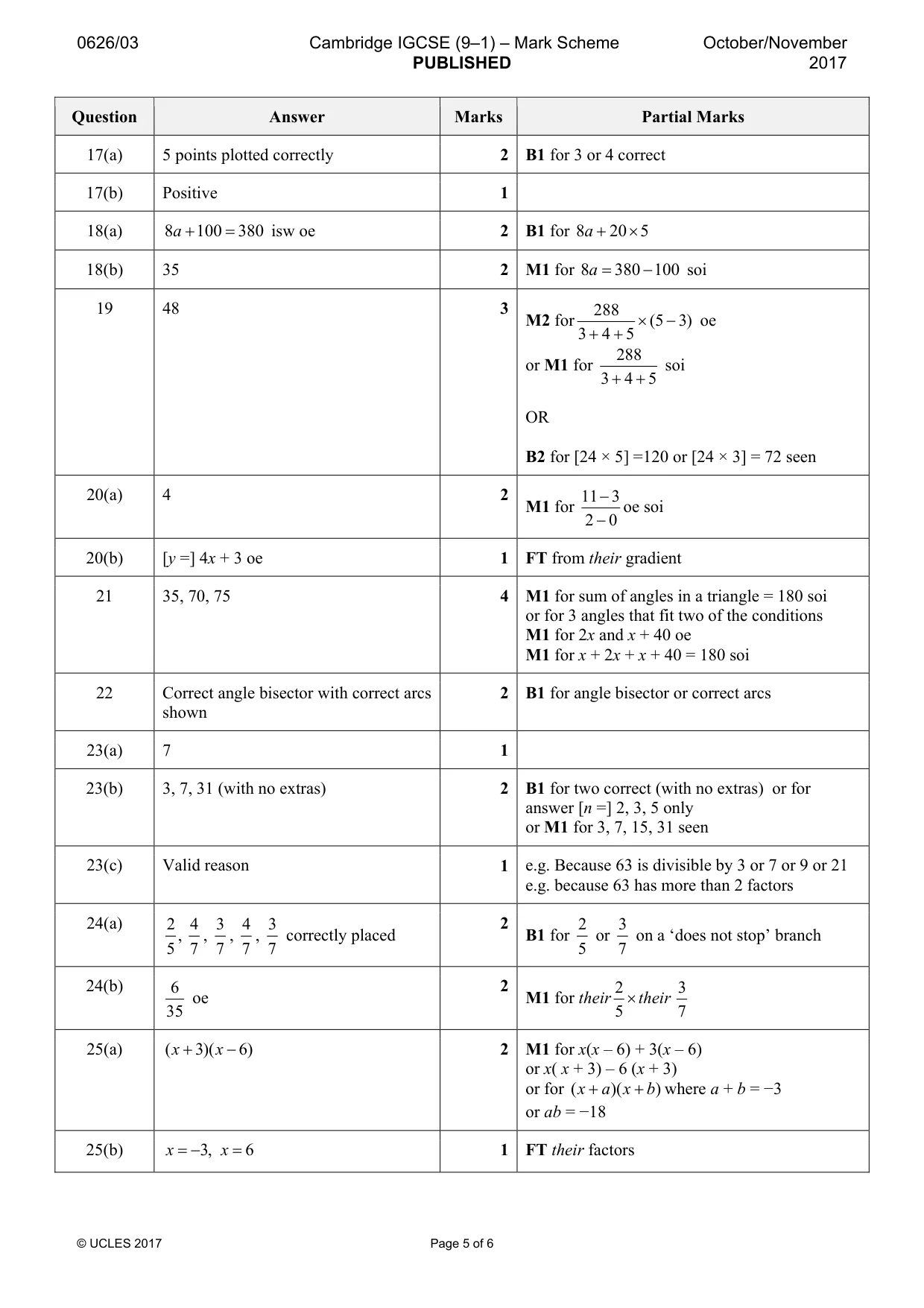
0626/03 Cambridge IGCSE (9–1) – Mark Scheme PUBLISHED October/November 2017 © UCLES 2017 Page 5 of 6 Question Answer Marks Partial Marks 17(a) 5 points plotted correctly 2 B1 for 3 or 4 correct 17(b) Positive 1 18(a) 8 100 380 + = a isw oe 2 B1 for 8 20 5 + × a 18(b) 35 2 M1 for 8 380 100 = − a soi 19 48 3 M2 for 288 (5 3) 3 4 5 × − + + oe or M1 for 288 3 4 5 + + soi OR B2 for [24 × 5] =120 or [24 × 3] = 72 seen 20(a) 4 2 M1 for 11 3 2 0 − − oe soi 20(b) [y =] 4x + 3 oe 1 FT from their gradient 21 35, 70, 75 4 M1 for sum of angles in a triangle = 180 soi or for 3 angles that fit two of the conditions M1 for 2x and x + 40 oe M1 for x + 2x + x + 40 = 180 soi 22 Correct angle bisector with correct arcs shown 2 B1 for angle bisector or correct arcs 23(a) 7 1 23(b) 3, 7, 31 (with no extras) 2 B1 for two correct (with no extras) or for answer [n =] 2, 3, 5 only or M1 for 3, 7, 15, 31 seen 23(c) Valid reason 1 e.g. Because 63 is divisible by 3 or 7 or 9 or 21 e.g. because 63 has more than 2 factors 24(a) 2 , 5 4 7 , 3 7 , 4 7 , 3 7 correctly placed 2 B1 for 2 5 or 3 7 on a ‘does not stop’ branch 24(b) 6 35 oe 2 M1 for their 2 3 5 7 ×their 25(a) ( 3)( 6) + − x x 2 M1 for x(x – 6) + 3(x – 6) or x( x + 3) – 6 (x + 3) or for ( )( ) + + x a x b where a + b = −3 or ab = −18 25(b) 3, 6 x x = − = 1 FT their factors
Mark scheme, page 6
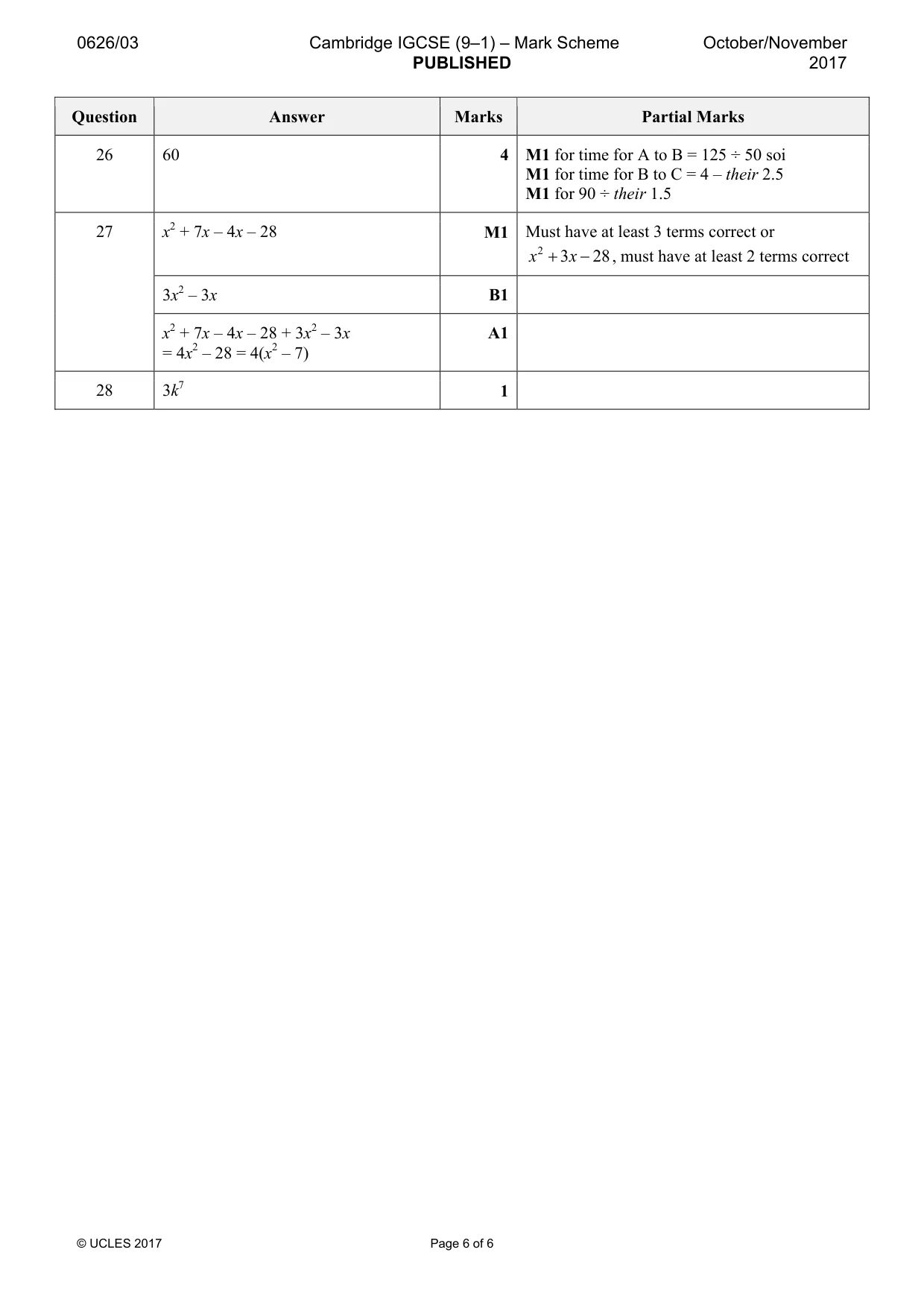
0626/03 Cambridge IGCSE (9–1) – Mark Scheme PUBLISHED October/November 2017 © UCLES 2017 Page 6 of 6 Question Answer Marks Partial Marks 26 60 4 M1 for time for A to B = 125 ÷ 50 soi M1 for time for B to C = 4 – their 2.5 M1 for 90 ÷ their 1.5 27 x2 + 7x – 4x – 28 M1 Must have at least 3 terms correct or 2 3 28 + − x x , must have at least 2 terms correct 3x2 – 3x B1 x2 + 7x – 4x – 28 + 3x2 – 3x = 4x2 – 28 = 4(x2 – 7) A1 28 3k7 1
What you needed in this session
Cambridge’s own grade thresholds for 2017 Oct/Nov, Paper 3 · Variant 1. A higher threshold means an easier paper — the bar moves with how the cohort did.