Cambridge IGCSE Mathematics (9-1) (UK only) 0626 — 2017 Oct/Nov Paper 1 · Variant 1
0626/11/O/N/17 · 60 marks · ≈68 min
The question paper and its mark scheme, free to read here and free to download. This is Cambridge’s own paper, exactly as it was sat.
Question paper12 pages
Mark scheme5 pages
Answers below. Sit the paper first if you are practising.
Paper as text
Question paper, page 1
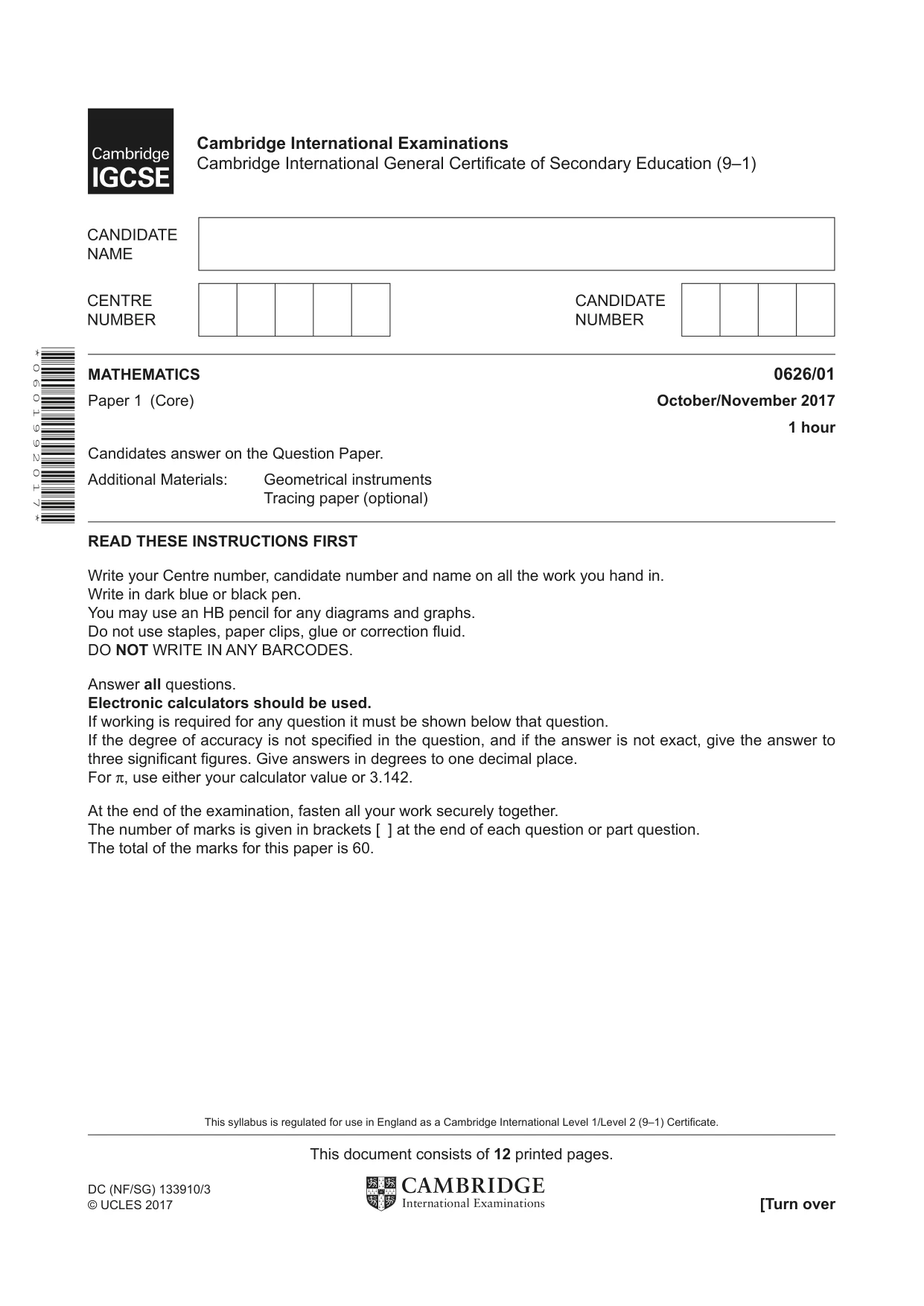
This document consists of 12 printed pages. DC (NF/SG) 133910/3 © UCLES 2017 [Turn over Cambridge International Examinations Cambridge International General Certificate of Secondary Education (9–1) * 0 6 0 1 9 9 2 0 1 7 * MATHEMATICS 0626/01 Paper 1 (Core) October/November 2017 1 hour Candidates answer on the Question Paper. Additional Materials: Geometrical instruments Tracing paper (optional) READ THESE INSTRUCTIONS FIRST Write your Centre number, candidate number and name on all the work you hand in. Write in dark blue or black pen. You may use an HB pencil for any diagrams and graphs. Do not use staples, paper clips, glue or correction fluid. DO NOT WRITE IN ANY BARCODES. Answer all questions. Electronic calculators should be used. If working is required for any question it must be shown below that question. If the degree of accuracy is not specified in the question, and if the answer is not exact, give the answer to three significant figures. Give answers in degrees to one decimal place. For π, use either your calculator value or 3.142. At the end of the examination, fasten all your work securely together. The number of marks is given in brackets [ ] at the end of each question or part question. The total of the marks for this paper is 60. This syllabus is regulated for use in England as a Cambridge International Level 1/Level 2 (9–1) Certificate.
Question paper, page 2
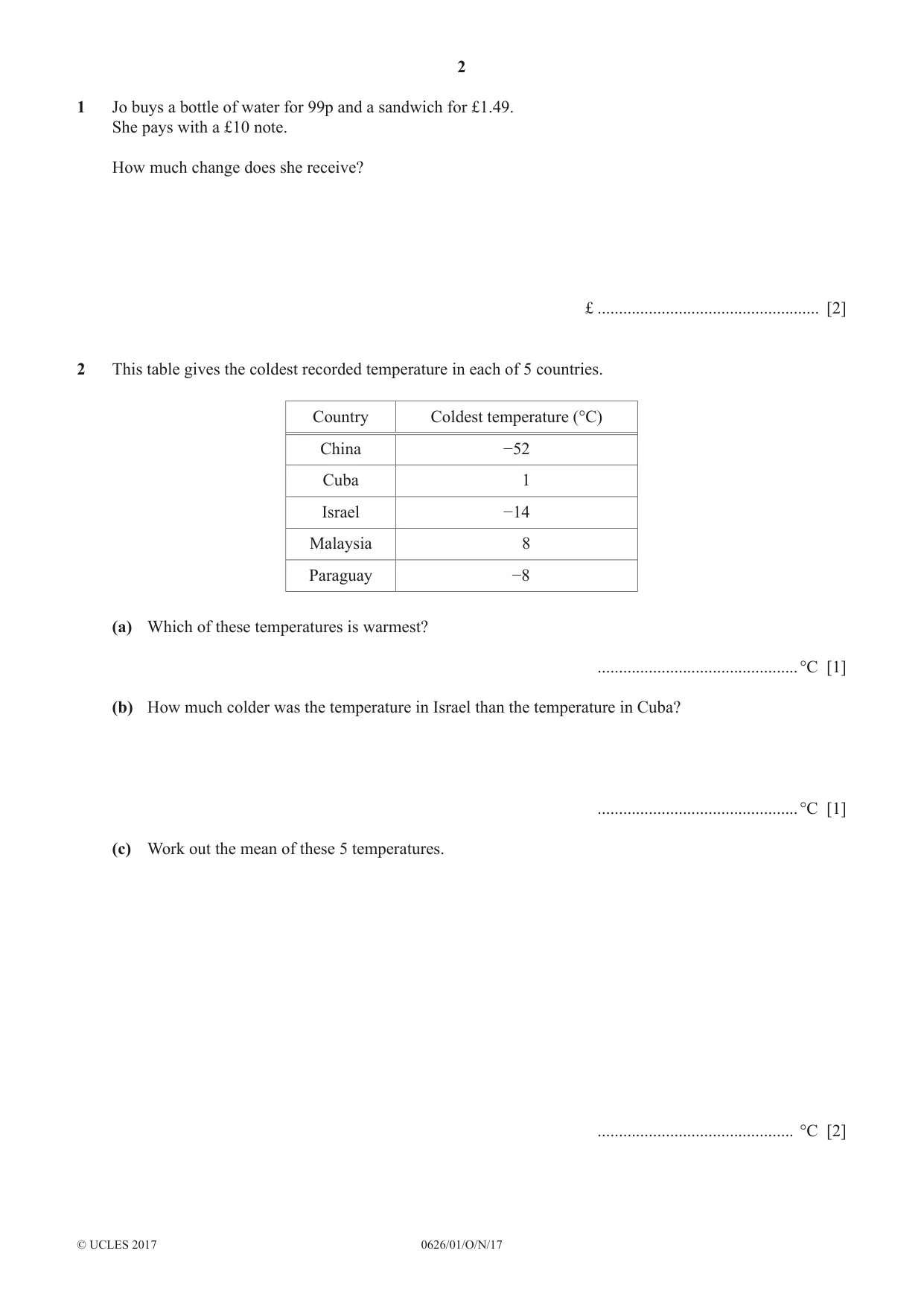
2 0626/01/O/N/17 © UCLES 2017 1 Jo buys a bottle of water for 99p and a sandwich for £1.49. She pays with a £10 note. How much change does she receive? £ … [2] 2 This table gives the coldest recorded temperature in each of 5 countries. Country Coldest temperature (°C) China −52 Cuba 1 Israel −14 Malaysia 8 Paraguay −8 (a) Which of these temperatures is warmest? …°C [1] (b) How much colder was the temperature in Israel than the temperature in Cuba? …°C [1] (c) Work out the mean of these 5 temperatures. … °C [2]
Question paper, page 3
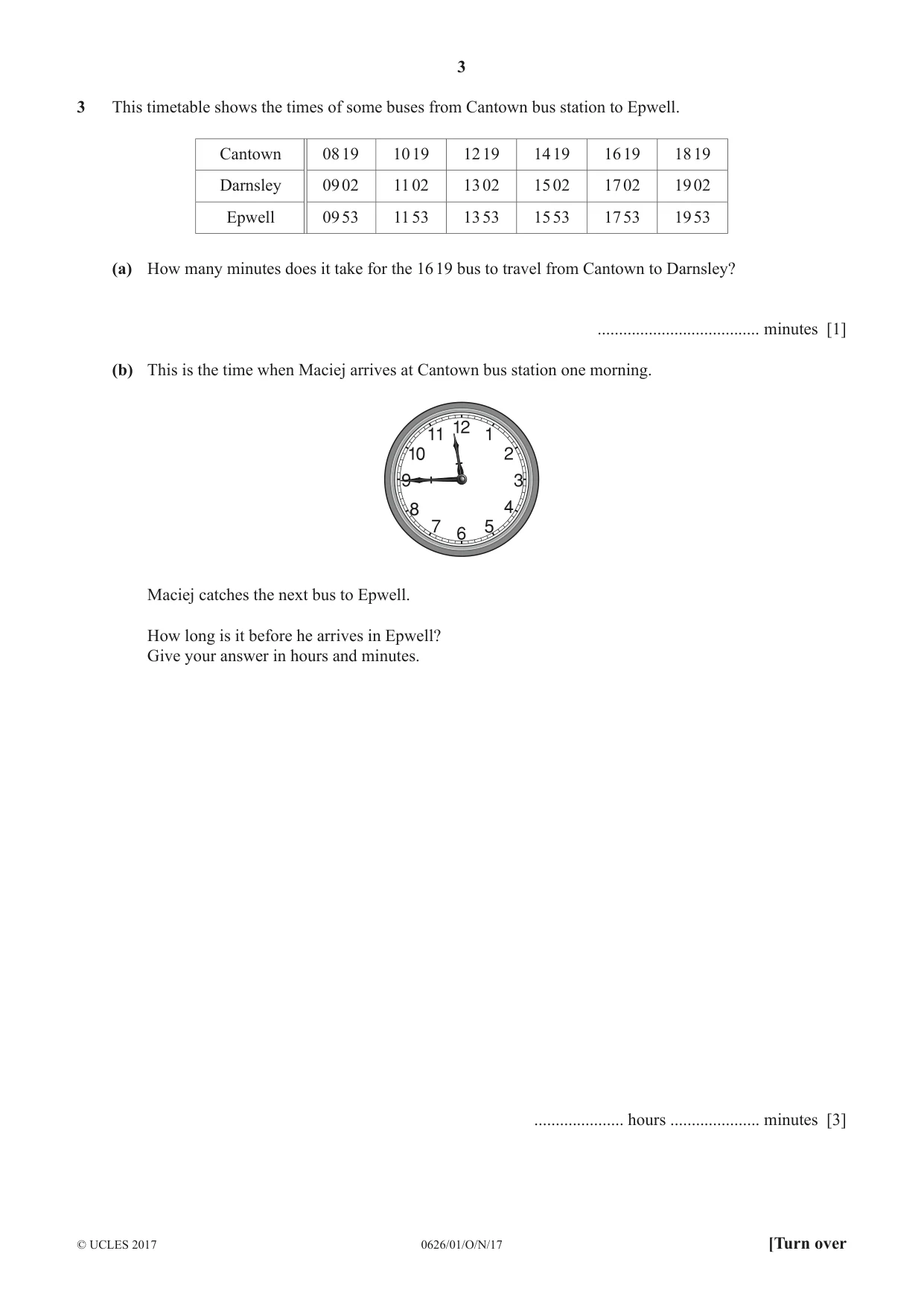
3 0626/01/O/N/17 © UCLES 2017 [Turn over 3 This timetable shows the times of some buses from Cantown bus station to Epwell. Cantown 08 19 10 19 12 19 14 19 16 19 18 19 Darnsley 09 02 11 02 13 02 15 02 17 02 19 02 Epwell 09 53 11 53 13 53 15 53 17 53 19 53 (a) How many minutes does it take for the 16 19 bus to travel from Cantown to Darnsley? … minutes [1] (b) This is the time when Maciej arrives at Cantown bus station one morning. Maciej catches the next bus to Epwell. How long is it before he arrives in Epwell? Give your answer in hours and minutes. … hours … minutes [3]
Question paper, page 4
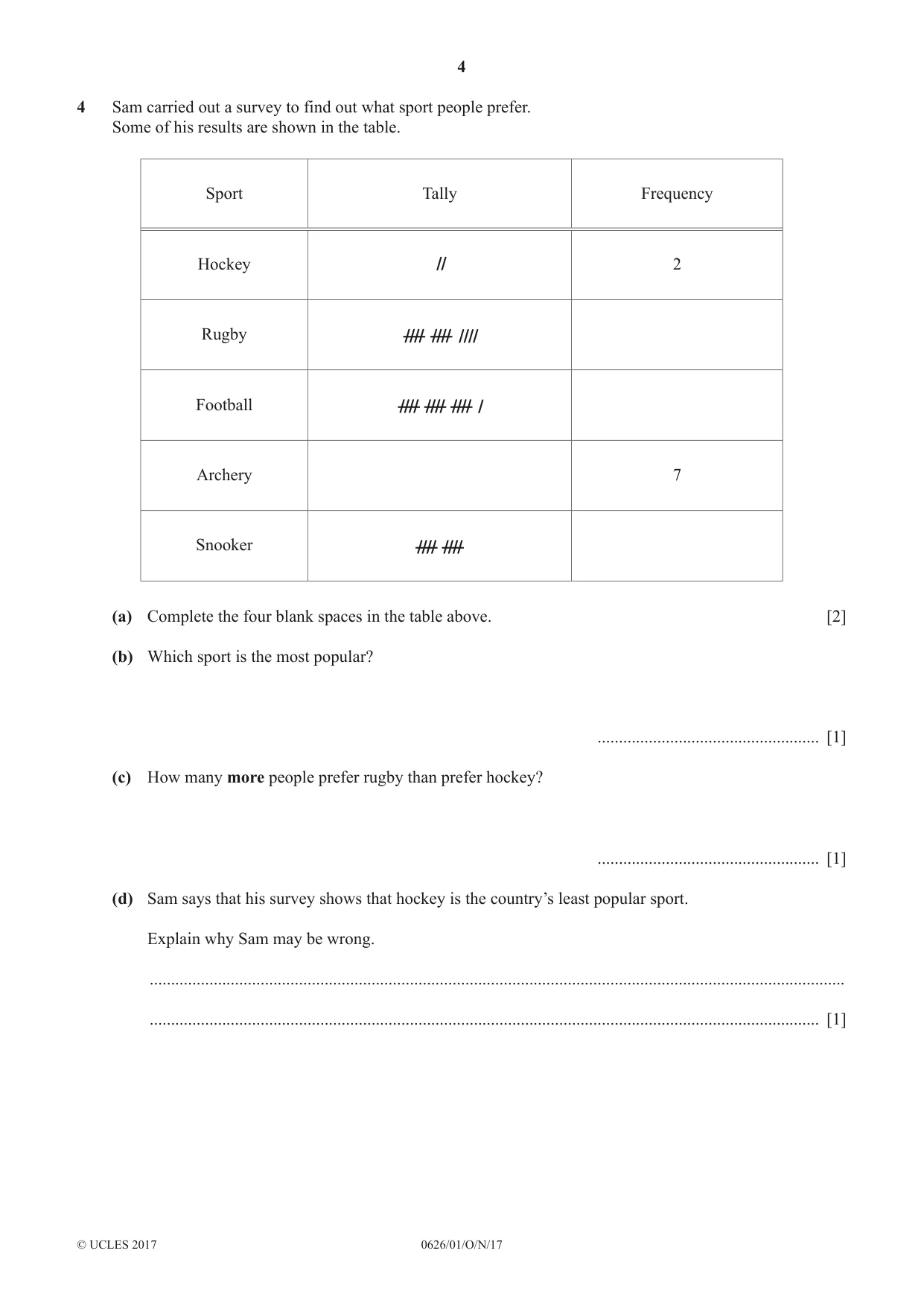
4 0626/01/O/N/17 © UCLES 2017 4 Sam carried out a survey to find out what sport people prefer. Some of his results are shown in the table. Sport Tally Frequency Hockey ll 2 Rugby llll llll llll Football llll llll llll l Archery 7 Snooker llll llll (a) Complete the four blank spaces in the table above. [2] (b) Which sport is the most popular? … [1] (c) How many more people prefer rugby than prefer hockey? … [1] (d) Sam says that his survey shows that hockey is the country’s least popular sport. Explain why Sam may be wrong. … … [1]
Question paper, page 5
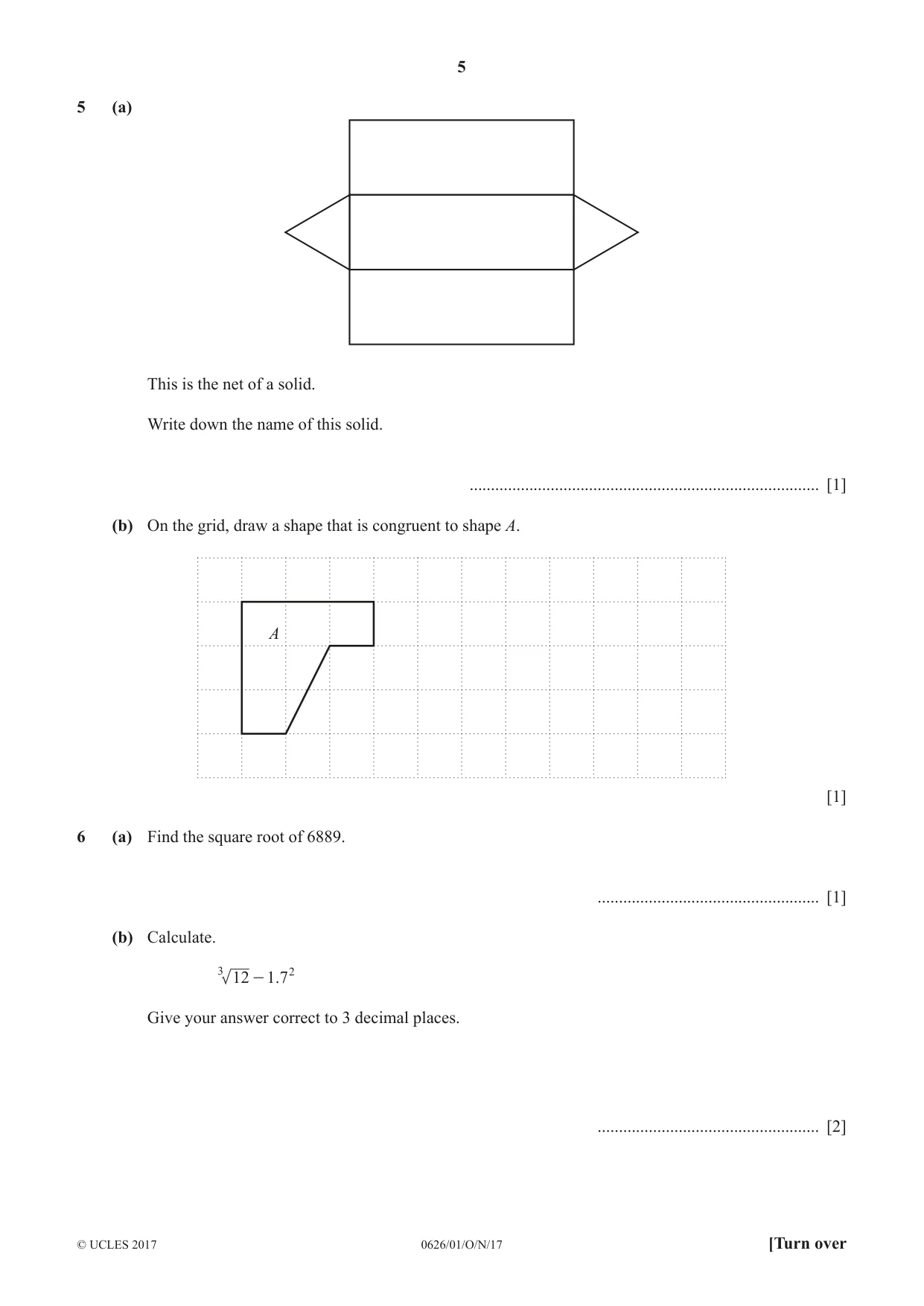
5 0626/01/O/N/17 © UCLES 2017 [Turn over 5 (a) This is the net of a solid. Write down the name of this solid. … [1] (b) On the grid, draw a shape that is congruent to shape A. A [1] 6 (a) Find the square root of 6889. … [1] (b) Calculate. . 12 1 7 3 2 - Give your answer correct to 3 decimal places. … [2]
Question paper, page 6
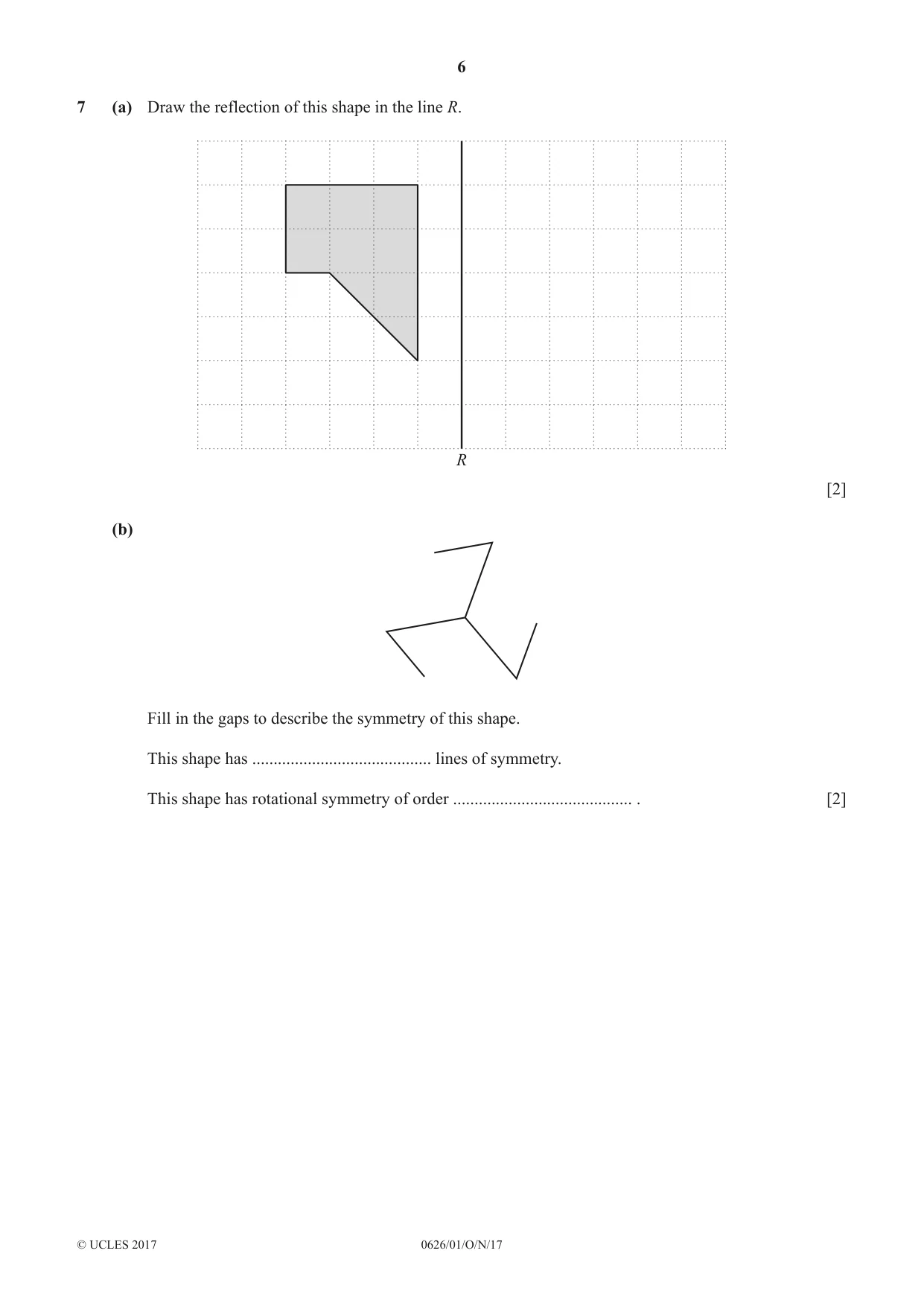
6 0626/01/O/N/17 © UCLES 2017 7 (a) Draw the reflection of this shape in the line R. R [2] (b) Fill in the gaps to describe the symmetry of this shape. This shape has … lines of symmetry. This shape has rotational symmetry of order … . [2]
Question paper, page 7
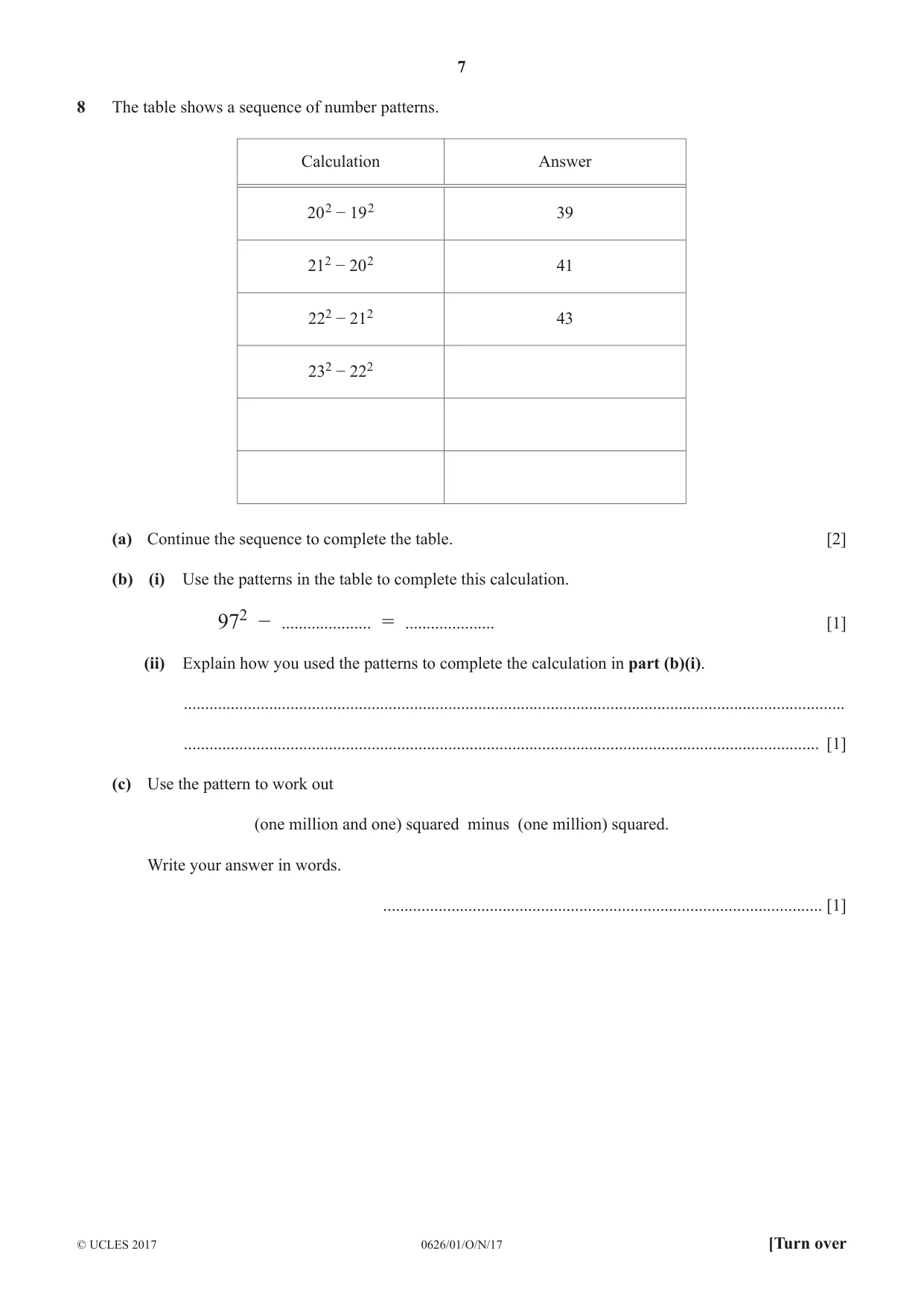
7 0626/01/O/N/17 © UCLES 2017 [Turn over 8 The table shows a sequence of number patterns. Calculation Answer 202 − 192 39 212 − 202 41 222 − 212 43 232 − 222 (a) Continue the sequence to complete the table. [2] (b) (i) Use the patterns in the table to complete this calculation. 972 − … = … [1] (ii) Explain how you used the patterns to complete the calculation in part (b)(i). … … [1] (c) Use the pattern to work out (one million and one) squared minus (one million) squared. Write your answer in words. … [1]
Question paper, page 8
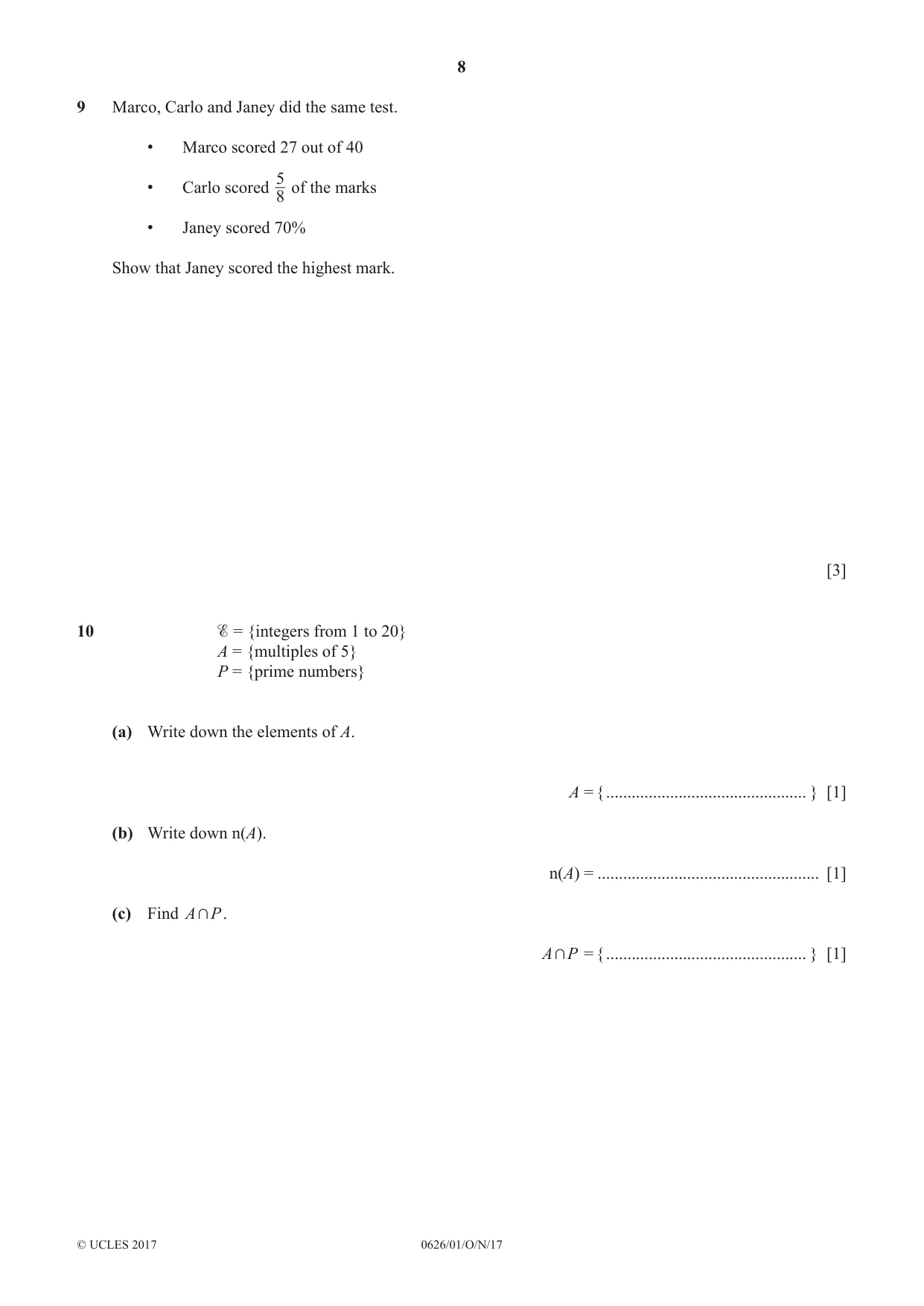
8 0626/01/O/N/17 © UCLES 2017 9 Marco, Carlo and Janey did the same test. • Marco scored 27 out of 40 • Carlo scored 8 5 of the marks • Janey scored 70% Show that Janey scored the highest mark. [3] 10 = {integers from 1 to 20} A = {multiples of 5} P = {prime numbers} (a) Write down the elements of A. A = { … } [1] (b) Write down n(A). n(A) = … [1] (c) Find A P + . A P + = { … } [1]
Question paper, page 9
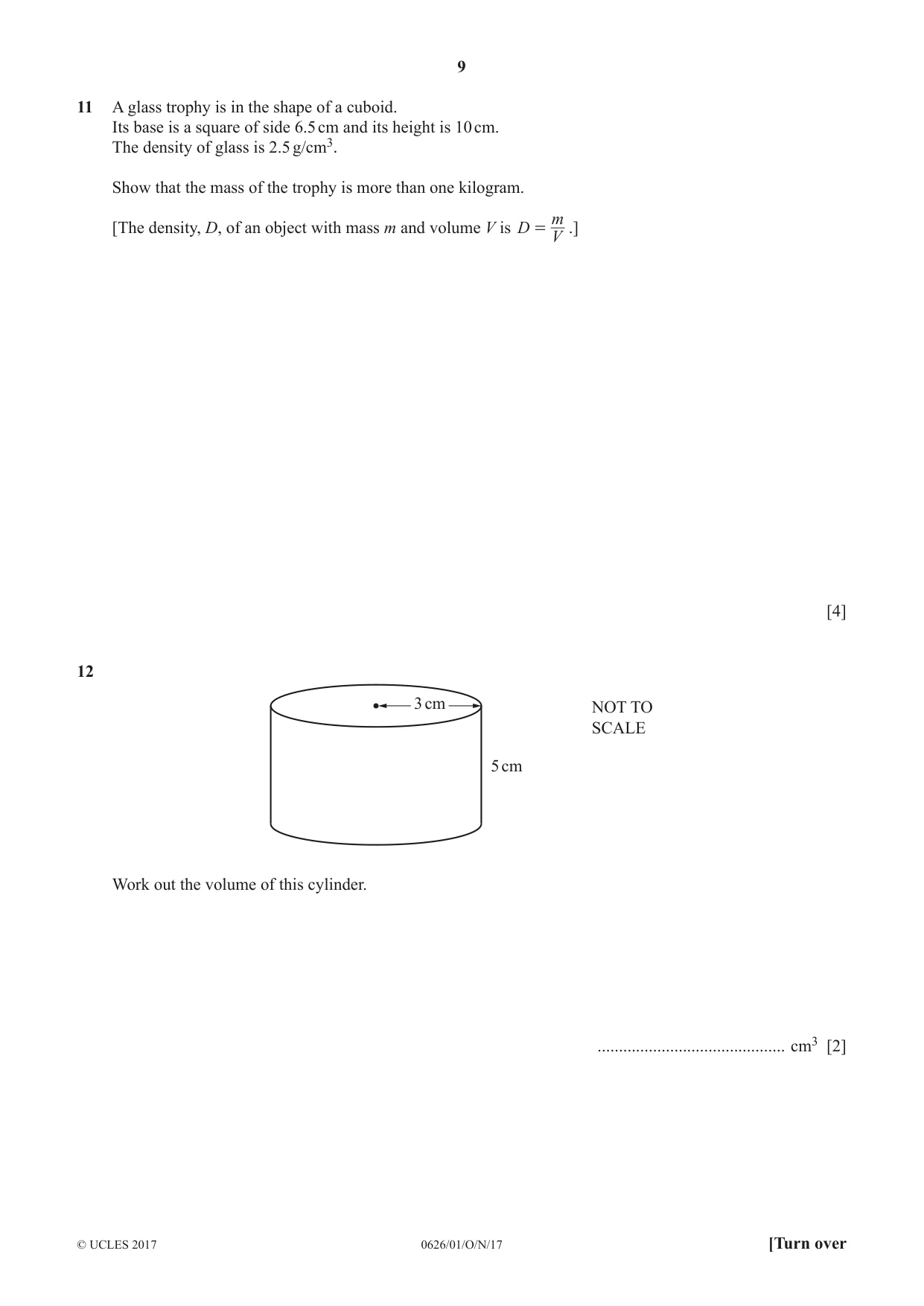
9 0626/01/O/N/17 © UCLES 2017 [Turn over 11 A glass trophy is in the shape of a cuboid. Its base is a square of side 6.5 cm and its height is 10 cm. The density of glass is 2.5 g/cm3. Show that the mass of the trophy is more than one kilogram. [The density, D, of an object with mass m and volume V is D V m = .] [4] 12 3 cm 5 cm NOT TO SCALE Work out the volume of this cylinder. … cm3 [2]
Question paper, page 10
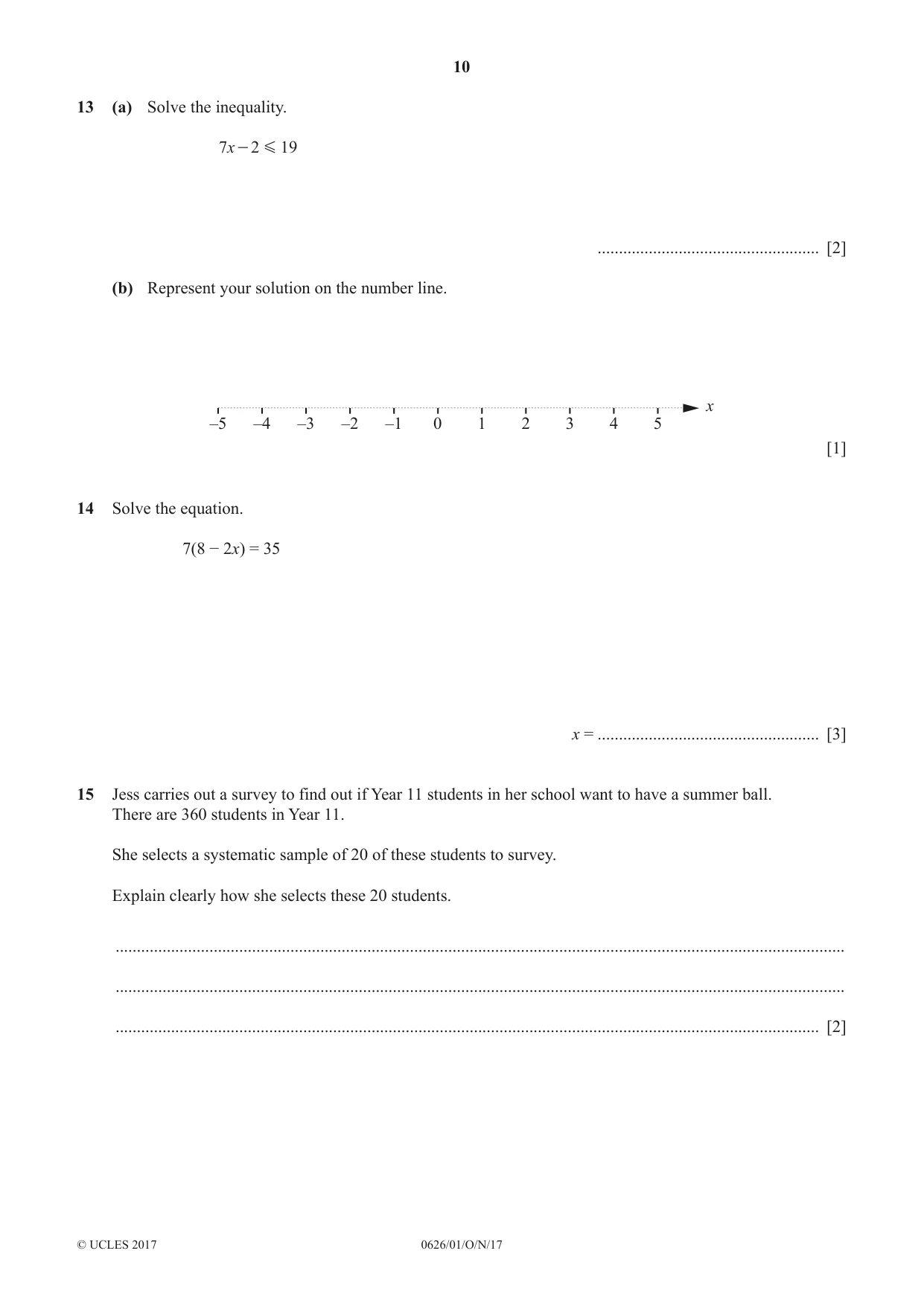
10 0626/01/O/N/17 © UCLES 2017 13 (a) Solve the inequality. x 7 2 19 G - … [2] (b) Represent your solution on the number line. –5 –4 –3 –2 –1 0 1 2 3 5 4 x [1] 14 Solve the equation. 7(8 − 2x) = 35 x = … [3] 15 Jess carries out a survey to find out if Year 11 students in her school want to have a summer ball. There are 360 students in Year 11. She selects a systematic sample of 20 of these students to survey. Explain clearly how she selects these 20 students. … … … [2]
Question paper, page 11
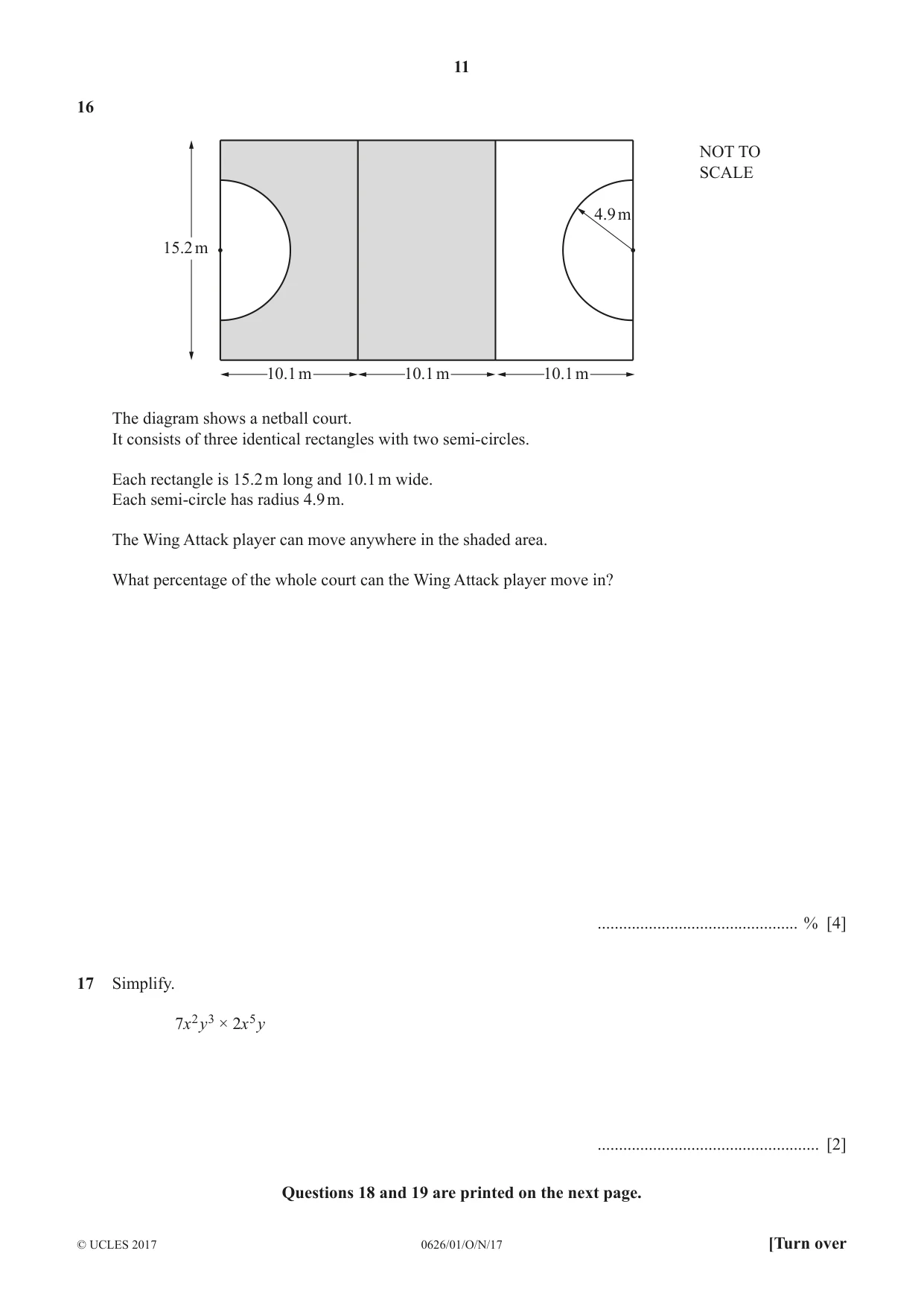
11 0626/01/O/N/17 © UCLES 2017 [Turn over 16 10.1 m 15.2 m 4.9 m 10.1 m 10.1 m NOT TO SCALE The diagram shows a netball court. It consists of three identical rectangles with two semi-circles. Each rectangle is 15.2 m long and 10.1 m wide. Each semi-circle has radius 4.9 m. The Wing Attack player can move anywhere in the shaded area. What percentage of the whole court can the Wing Attack player move in? … % [4] 17 Simplify. 7x2 y3 × 2x5 y … [2] Questions 18 and 19 are printed on the next page.
Question paper, page 12
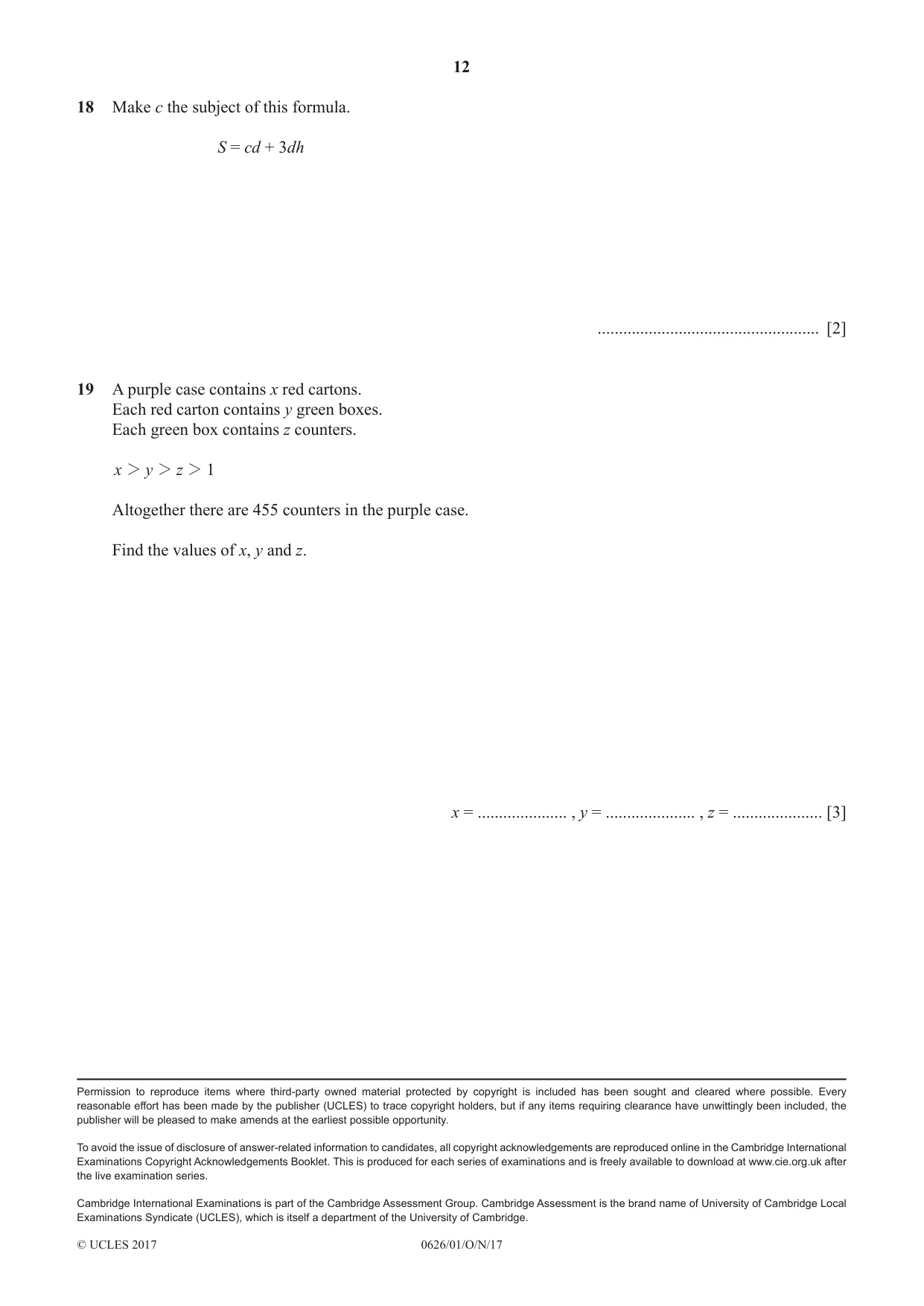
12 0626/01/O/N/17 © UCLES 2017 Permission to reproduce items where third-party owned material protected by copyright is included has been sought and cleared where possible. Every reasonable effort has been made by the publisher (UCLES) to trace copyright holders, but if any items requiring clearance have unwittingly been included, the publisher will be pleased to make amends at the earliest possible opportunity. To avoid the issue of disclosure of answer-related information to candidates, all copyright acknowledgements are reproduced online in the Cambridge International Examinations Copyright Acknowledgements Booklet. This is produced for each series of examinations and is freely available to download at www.cie.org.uk after the live examination series. Cambridge International Examinations is part of the Cambridge Assessment Group. Cambridge Assessment is the brand name of University of Cambridge Local Examinations Syndicate (UCLES), which is itself a department of the University of Cambridge. 18 Make c the subject of this formula. S = cd + 3dh … [2] 19 A purple case contains x red cartons. Each red carton contains y green boxes. Each green box contains z counters. x y z 1 2 2 2 Altogether there are 455 counters in the purple case. Find the values of x, y and z. x = … , y = … , z = … [3]
Mark scheme, page 1
® IGCSE is a registered trademark. This syllabus is regulated for use in England as a Cambridge International Level 1/Level 2 (9–1) Certificate. This document consists of 5 printed pages. © UCLES 2017 [Turn over Cambridge Assessment International Education Cambridge International General Certificate of Secondary Education (9–1) MATHEMATICS 0626/01 Paper 1 October/November 2017 MARK SCHEME Maximum Mark: 60 Published This mark scheme is published as an aid to teachers and candidates, to indicate the requirements of the examination. It shows the basis on which Examiners were instructed to award marks. It does not indicate the details of the discussions that took place at an Examiners’ meeting before marking began, which would have considered the acceptability of alternative answers. Mark schemes should be read in conjunction with the question paper and the Principal Examiner Report for Teachers. Cambridge International will not enter into discussions about these mark schemes. Cambridge International is publishing the mark schemes for the October/November 2017 series for most Cambridge IGCSE®, Cambridge International A and AS Level components and some Cambridge O Level components.
Mark scheme, page 2
0626/01 Cambridge IGCSE (9–1) – Mark Scheme PUBLISHED October/November 2017 © UCLES 2017 Page 2 of 5 MARK SCHEME NOTES The following notes are intended to aid interpretation of mark schemes in general, but individual mark schemes may include marks awarded for specific reasons outside the scope of these notes. Types of mark M Method marks, awarded for a valid method applied to the problem. A Accuracy mark, awarded for a correct answer or intermediate step correctly obtained. For accuracy marks to be given, the associated Method mark must be earned or implied. B Mark for a correct result or statement independent of Method marks. When a part of a question has two or more ‘method’ steps, the M marks are in principle independent unless the scheme specifically says otherwise; and similarly where there are several B marks allocated. The notation ‘dep’ is used to indicate that a particular M or B mark is dependent on an earlier mark in the scheme. Abbreviations awrt answers which round to cao correct answer only dep dependent FT follow through after error isw ignore subsequent working nfww not from wrong working oe or equivalent rot rounded or truncated SC Special Case soi seen or implied
Mark scheme, page 3
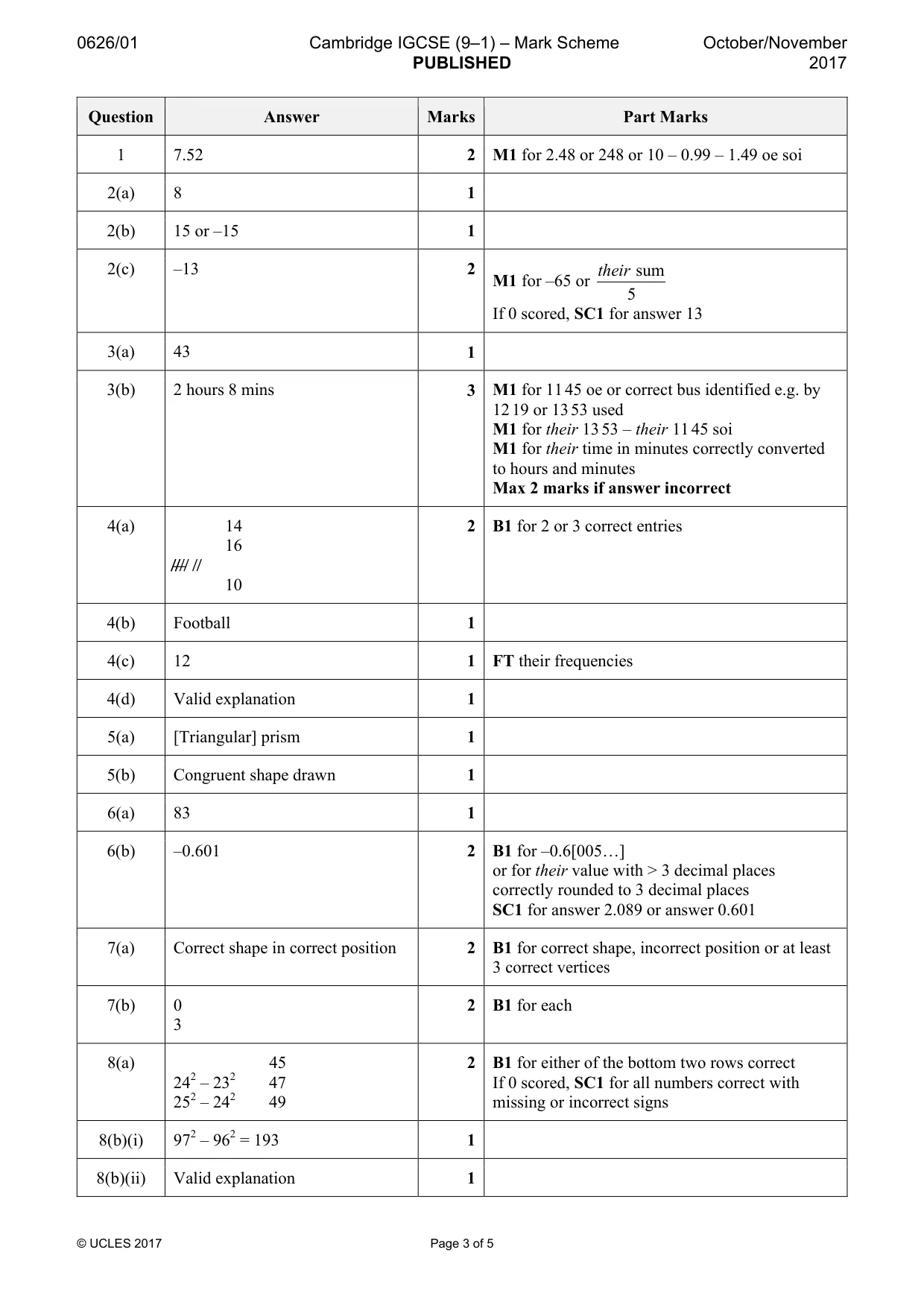
0626/01 Cambridge IGCSE (9–1) – Mark Scheme PUBLISHED October/November 2017 © UCLES 2017 Page 3 of 5 Question Answer Marks Part Marks 1 7.52 2 M1 for 2.48 or 248 or 10 – 0.99 – 1.49 oe soi 2(a) 8 1 2(b) 15 or –15 1 2(c) –13 2 M1 for –65 or sum 5 their If 0 scored, SC1 for answer 13 3(a) 43 1 3(b) 2 hours 8 mins 3 M1 for 11 45 oe or correct bus identified e.g. by 12 19 or 13 53 used M1 for their 13 53 – their 11 45 soi M1 for their time in minutes correctly converted to hours and minutes Max 2 marks if answer incorrect 4(a) 14 16 ̸ ̸ ̸ ̸ ̸ ̸ 10 2 B1 for 2 or 3 correct entries 4(b) Football 1 4(c) 12 1 FT their frequencies 4(d) Valid explanation 1 5(a) [Triangular] prism 1 5(b) Congruent shape drawn 1 6(a) 83 1 6(b) –0.601 2 B1 for –0.6[005…] or for their value with > 3 decimal places correctly rounded to 3 decimal places SC1 for answer 2.089 or answer 0.601 7(a) Correct shape in correct position 2 B1 for correct shape, incorrect position or at least 3 correct vertices 7(b) 0 3 2 B1 for each 8(a) 45 242 – 232 47 252 – 242 49 2 B1 for either of the bottom two rows correct If 0 scored, SC1 for all numbers correct with missing or incorrect signs 8(b)(i) 972 – 962 = 193 1 8(b)(ii) Valid explanation 1
Mark scheme, page 4
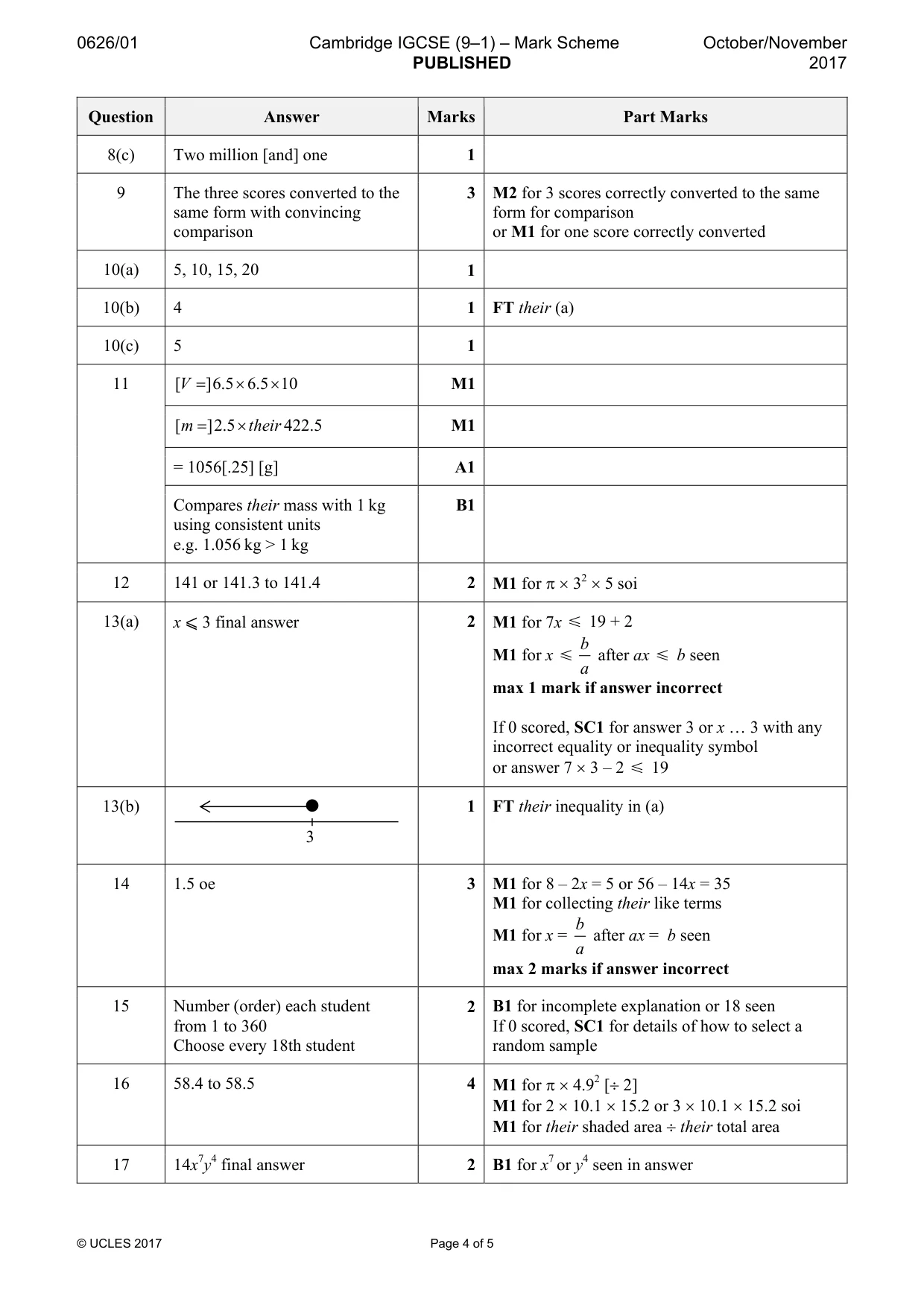
0626/01 Cambridge IGCSE (9–1) – Mark Scheme PUBLISHED October/November 2017 © UCLES 2017 Page 4 of 5 Question Answer Marks Part Marks 8(c) Two million [and] one 1 9 The three scores converted to the same form with convincing comparison 3 M2 for 3 scores correctly converted to the same form for comparison or M1 for one score correctly converted 10(a) 5, 10, 15, 20 1 10(b) 4 1 FT their (a) 10(c) 5 1 11 [ ]6.5 6.5 10 V = × × M1 [ ]2.5 422.5 m their = × M1 = 1056[.25] [g] A1 Compares their mass with 1 kg using consistent units e.g. 1.056 kg > 1 kg B1 12 141 or 141.3 to 141.4 2 M1 for π × 32 × 5 soi 13(a) x ⩽ 3 final answer 2 M1 for 7x ≤ 19 + 2 M1 for x ≤b a after ax ≤ b seen max 1 mark if answer incorrect If 0 scored, SC1 for answer 3 or x … 3 with any incorrect equality or inequality symbol or answer 7 × 3 – 2 ≤ 19 13(b) 1 FT their inequality in (a) 14 1.5 oe 3 M1 for 8 – 2x = 5 or 56 – 14x = 35 M1 for collecting their like terms M1 for x = b a after ax = b seen max 2 marks if answer incorrect 15 Number (order) each student from 1 to 360 Choose every 18th student 2 B1 for incomplete explanation or 18 seen If 0 scored, SC1 for details of how to select a random sample 16 58.4 to 58.5 4 M1 for π × 4.92 [÷ 2] M1 for 2 × 10.1 × 15.2 or 3 × 10.1 × 15.2 soi M1 for their shaded area ÷ their total area 17 14x7y4 final answer 2 B1 for x7 or y4 seen in answer 3
Mark scheme, page 5
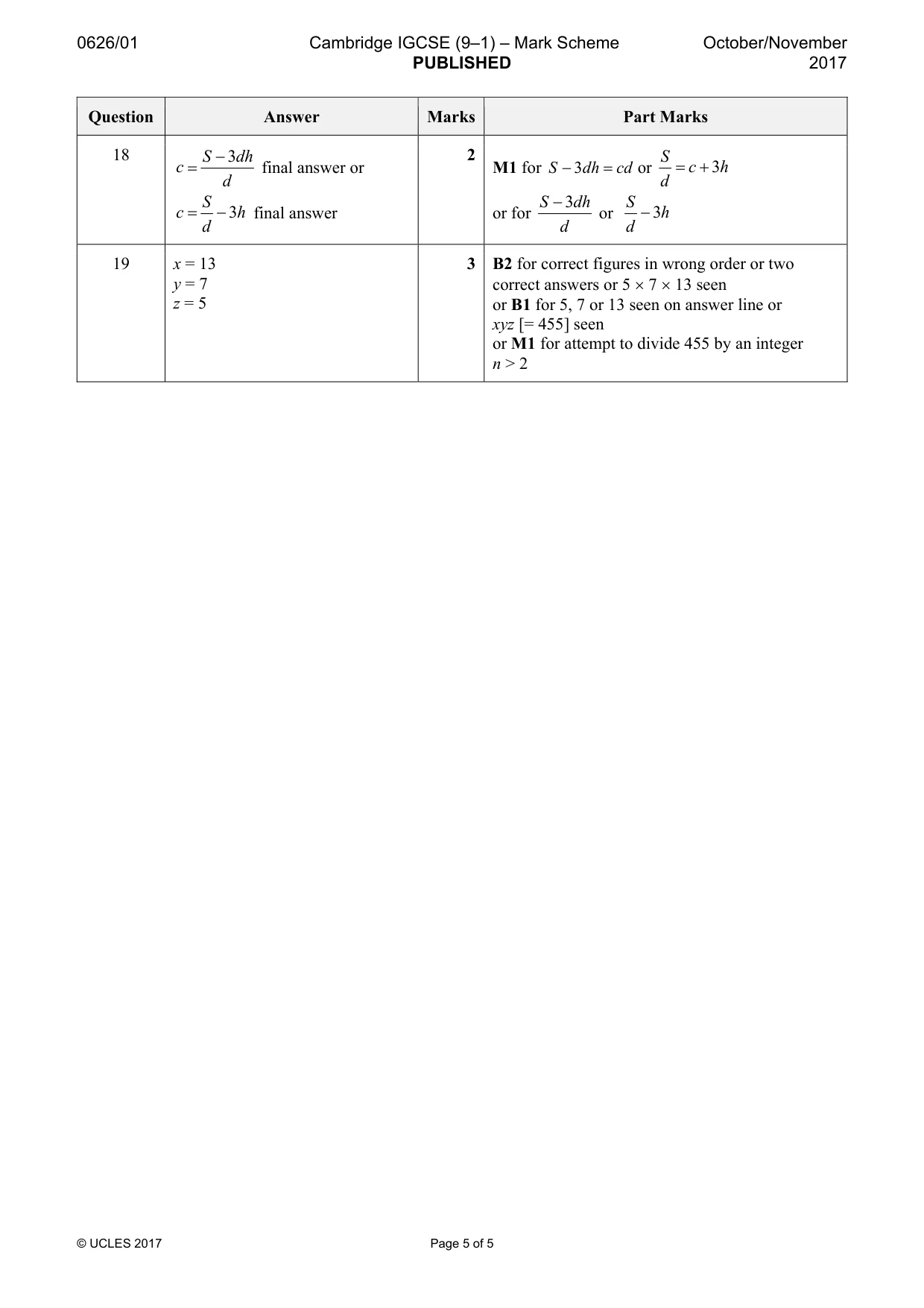
0626/01 Cambridge IGCSE (9–1) – Mark Scheme PUBLISHED October/November 2017 © UCLES 2017 Page 5 of 5 Question Answer Marks Part Marks 18 3 S dh c d − = final answer or 3 S c h d = − final answer 2 M1 for 3 S dh cd − = or 3 S c h d = + or for 3 S dh d − or 3 S h d − 19 x = 13 y = 7 z = 5 3 B2 for correct figures in wrong order or two correct answers or 5 × 7 × 13 seen or B1 for 5, 7 or 13 seen on answer line or xyz [= 455] seen or M1 for attempt to divide 455 by an integer n > 2
What you needed in this session
Cambridge’s own grade thresholds for 2017 Oct/Nov, Paper 1 · Variant 1. A higher threshold means an easier paper — the bar moves with how the cohort did.