Cambridge IGCSE Mathematics (9-1) 0980 — 2020 May/June Paper 2 · Variant 2
0980/22/M/J/20 · 27 questions · 70 marks · ≈79 min
The question paper and its mark scheme, free to read here and free to download. This is Cambridge’s own paper, exactly as it was sat.
Question paper12 pages
Mark scheme6 pages
Answers below. Sit the paper first if you are practising.
Questions as text
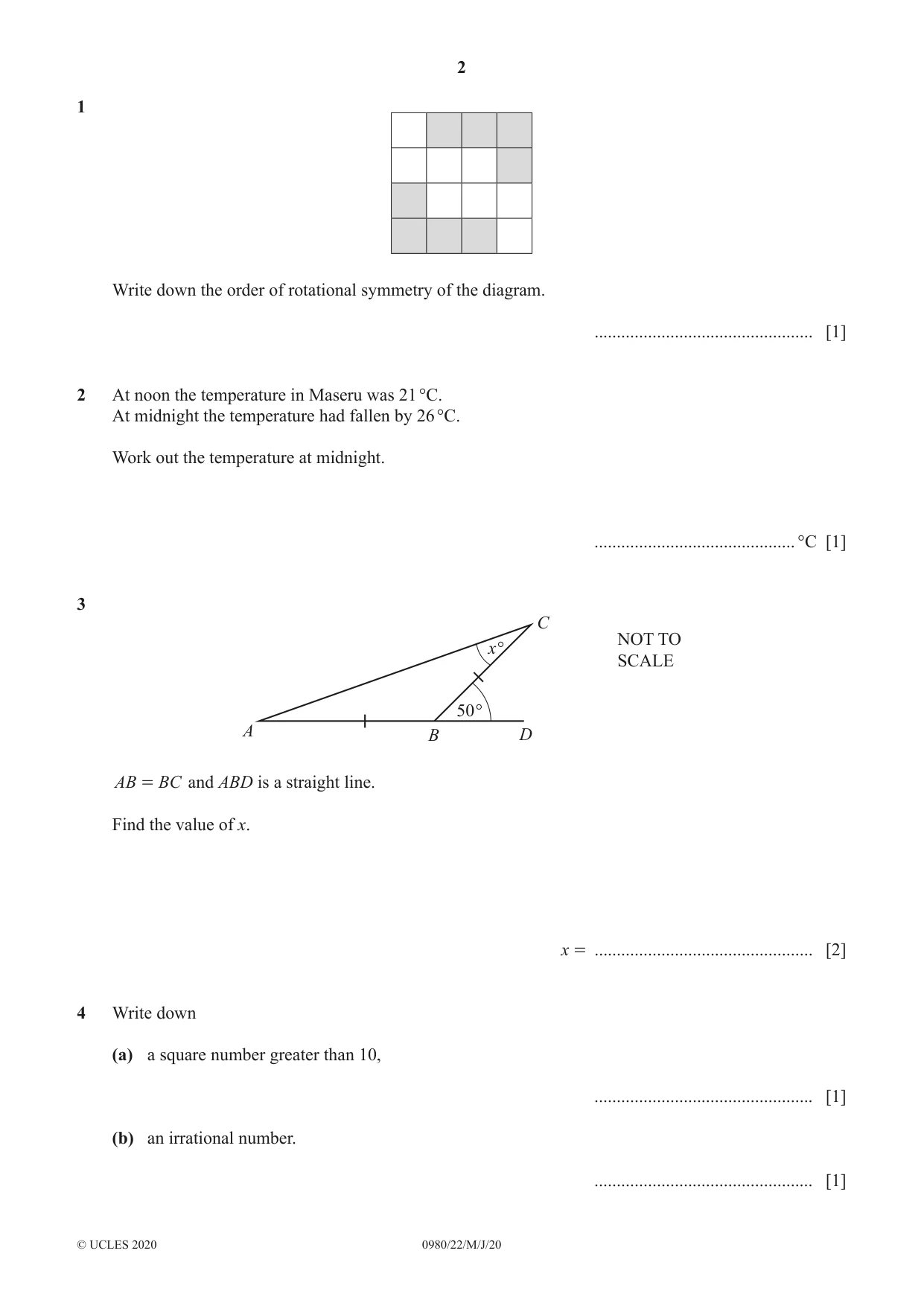
Q1 · Write down the order of rotational symmetry of the diagram
1 Write down the order of rotational symmetry of the diagram. ................................................. [1]
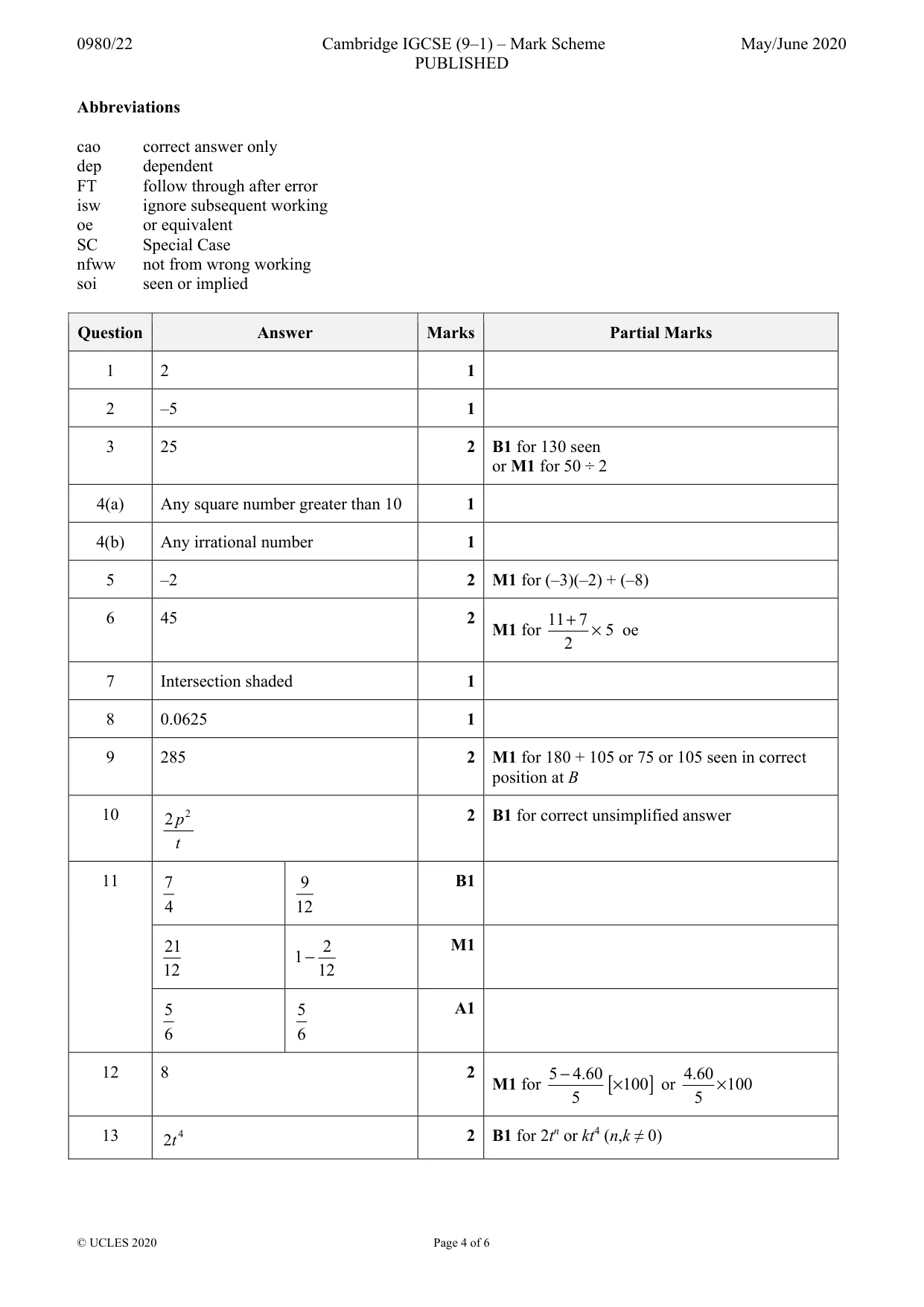
Mark scheme: Question Answer Marks Partial Marks 1 2 1
Q2 · At noon the temperature in Maseru was 21 °C
2 At noon the temperature in Maseru was 21 °C. At midnight the temperature had fallen by 26 °C. Work out the temperature at midnight. ............................................. °C [1]
Mark scheme: 2 –5 1
Q3 · C NOT TO x° SCALE 50° A B D AB = BC and ABD is a straight line
3 C NOT TO x° SCALE 50° A B D AB = BC and ABD is a straight line. Find the value of x. x = ................................................. [2]
Mark scheme: 3 25 2 B1 for 130 seen or M1 for 50 ÷ 2
Q4 · Write down (a) a square number greater than 10…
4 Write down (a) a square number greater than 10, ................................................. [1] (b) an irrational number. ................................................. [1]
Mark scheme: 4(a) Any square number greater than 10 1 4(b) Any irrational number 1
Q5 · Y = mx + c Find the value of y when m =- 3 , x =- 2 and c =- 8
5 y = mx + c Find the value of y when m =- 3 , x =- 2 and c =- 8 . y = ................................................. [2]
Mark scheme: 5 –2 2 M1 for (–3)(–2) + (–8)
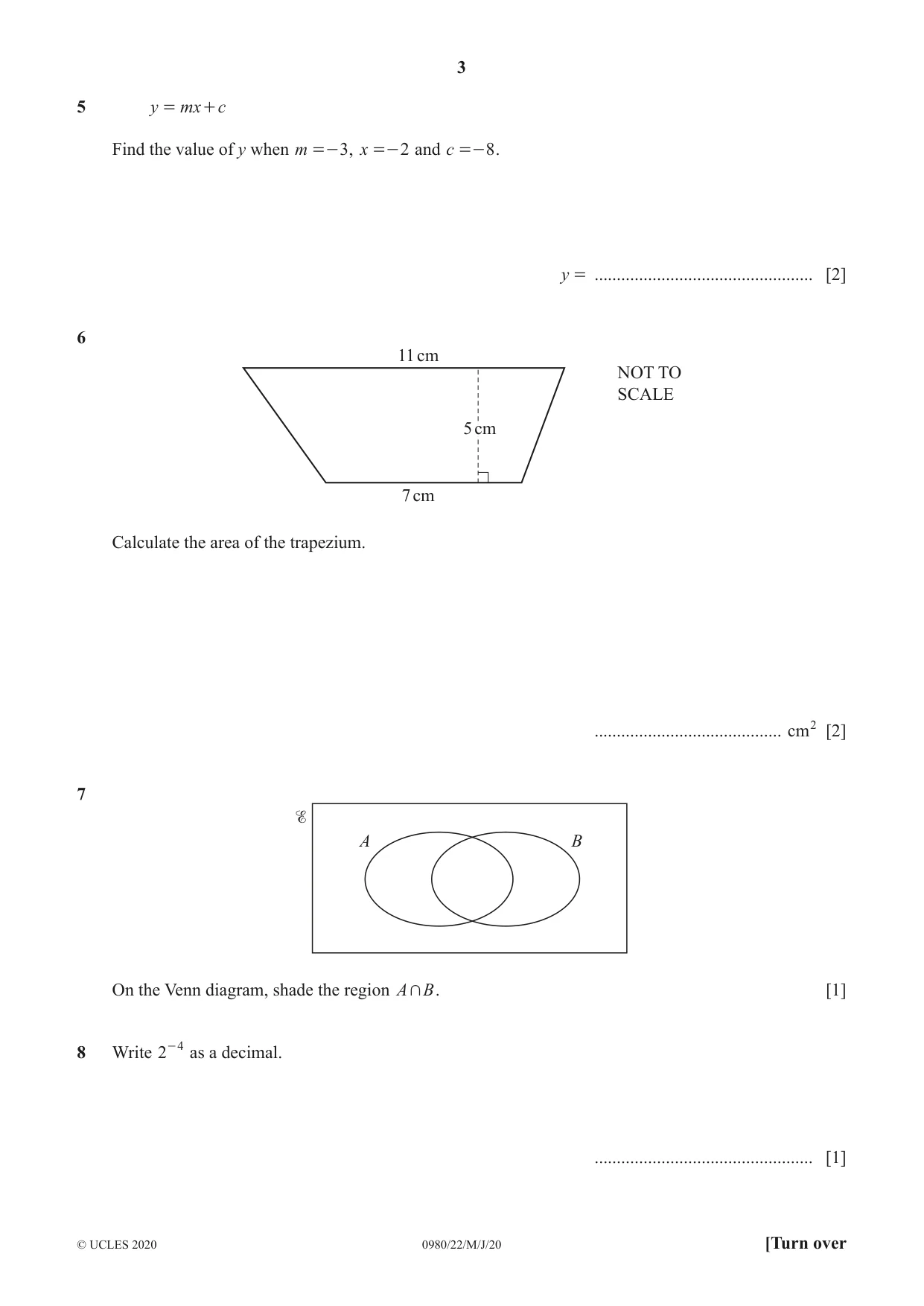
Q6 · 11 cm NOT TO SCALE 5 cm 7 cm Calculate the area of the trapezium
6 11 cm NOT TO SCALE 5 cm 7 cm Calculate the area of the trapezium. .......................................... cm2 [2]
Mark scheme: 6 45 2 11 + 7 M1 for × 5 oe 2
Q7 · A B On the Venn diagram, shade the region A + B
7 A B On the Venn diagram, shade the region A + B . [1]
Mark scheme: 7 Intersection shaded 1
Q8 · Write 2 - 4 as a decimal
8 Write 2 - 4 as a decimal. ................................................. [1]
Mark scheme: 8 0.0625 1
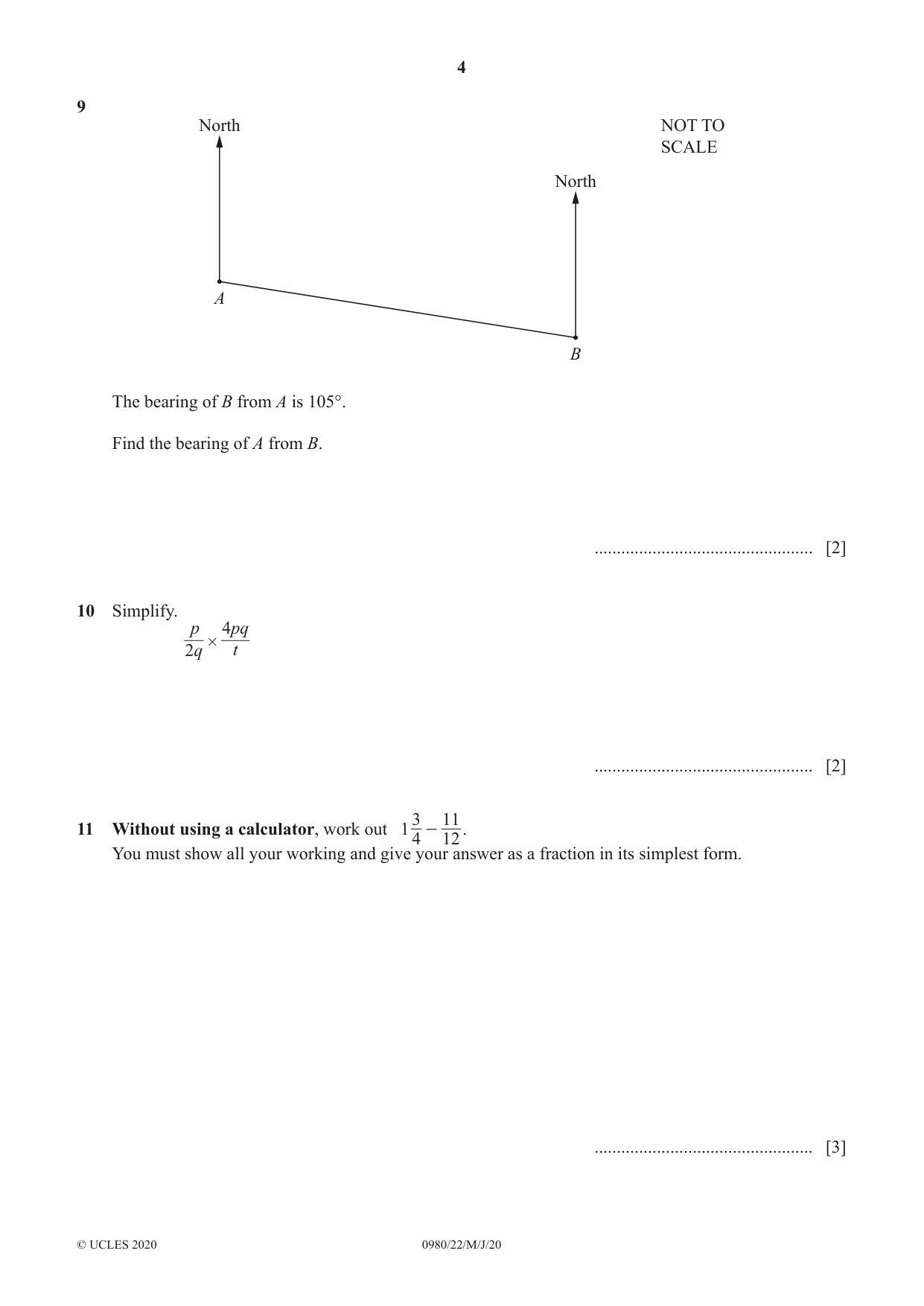
Q9 · North NOT TO SCALE North A B The bearing of B from A is 105°
9 North NOT TO SCALE North A B The bearing of B from A is 105°. Find the bearing of A from B. ................................................. [2]
Mark scheme: 9 285 2 M1 for 180 + 105 or 75 or 105 seen in correct position at B
Question 10
10 Simplify. p 4pq 2q # t ................................................. [2]
Mark scheme: 10 2 p 2 2 B1 for correct unsimplified answer t
Q11 · Without using a calculator, work out 1 -
11 Without using a calculator, work out 1 - . 4 12 You must show all your working and give your answer as a fraction in its simplest form. ................................................. [3]
Mark scheme: 11 7 9 B1 4 12 21 2 M1 1 − 12 12 5 5 A1 6 6
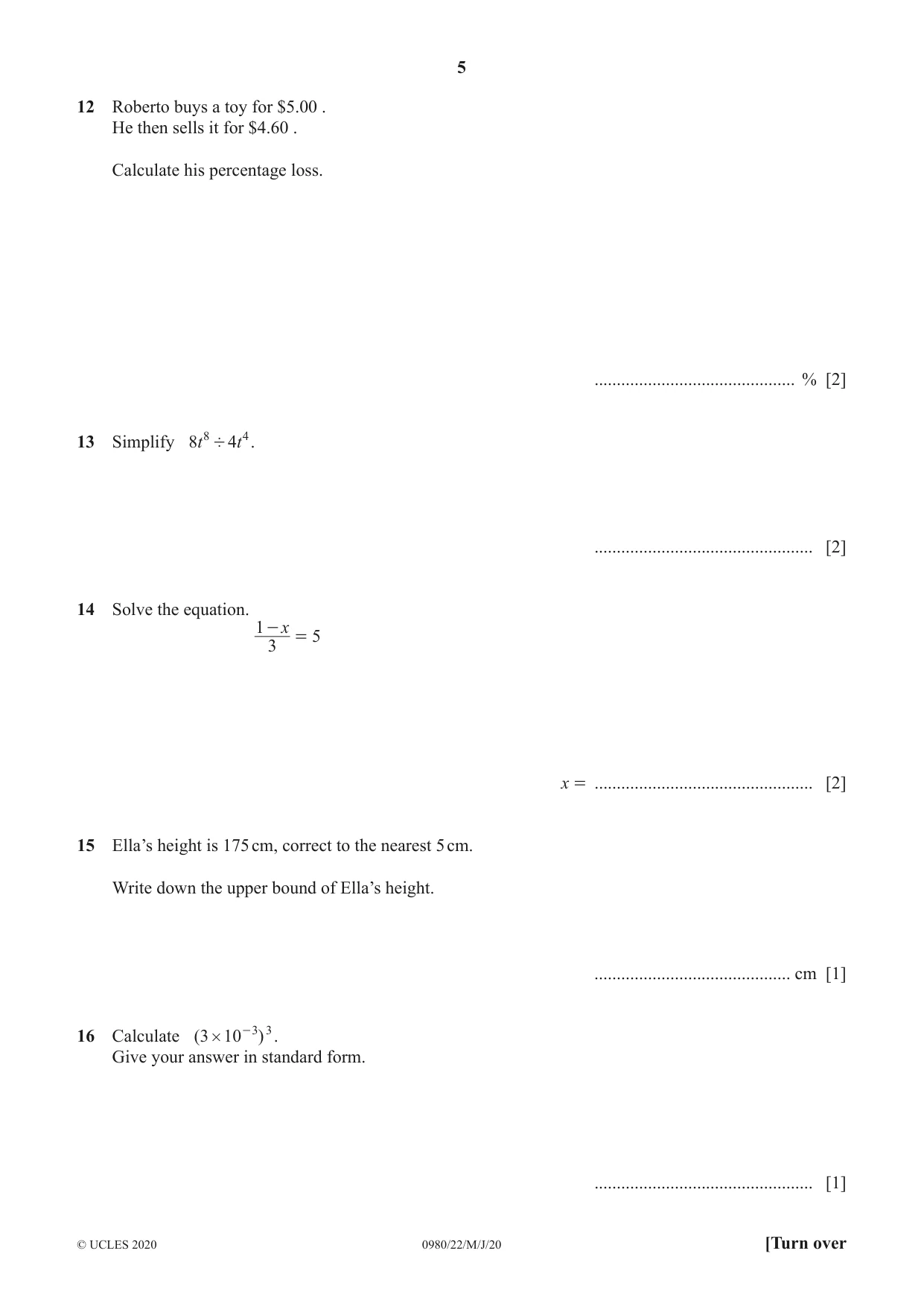
Q12 · Roberto buys a toy for $5.00
12 Roberto buys a toy for $5.00 . He then sells it for $4.60 . Calculate his percentage loss. ............................................. % [2]
Mark scheme: 12 8 2 5 − 4.60 4.60 M1 for [× 100 ] or × 100 5 5
Q13 · Simplify 8t 8 ' 4t 4
13 Simplify 8t 8 ' 4t 4 . ................................................. [2]
Mark scheme: 13 2t 4 2 B1 for 2tn or kt4 (n,k ≠ 0)
Question 14
14 Solve the equation. 1 - x = 5 3 x = ................................................. [2]
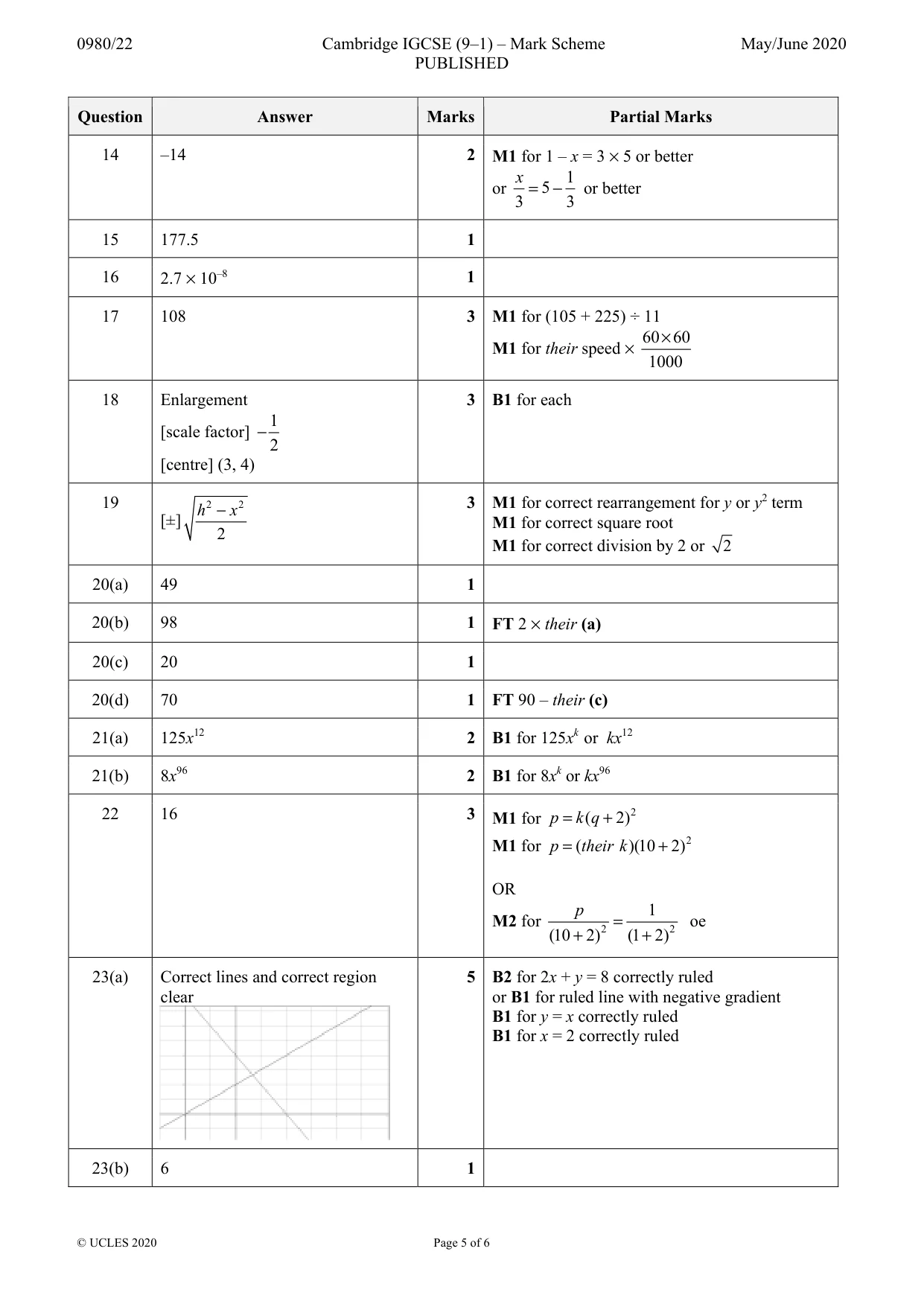
Mark scheme: 14 –14 2 M1 for 1 – x = 3 × 5 or better x 1 or = 5 − or better 3 3
Q15 · Ella’s height is 175 cm, correct to the nearest 5 cm
15 Ella’s height is 175 cm, correct to the nearest 5 cm. Write down the upper bound of Ella’s height. ............................................ cm [1]
Mark scheme: 15 177.5 1
Q16 · Calculate ( 3 # 10 - 3 ) 3
16 Calculate ( 3 # 10 - 3 ) 3 . Give your answer in standard form. ................................................. [1]
Mark scheme: 16 2.7 × 10⁻⁸ 1
Q17 · A train of length 105 m takes 11 seconds to pass completely through a station of length…
17 A train of length 105 m takes 11 seconds to pass completely through a station of length 225 m. Calculate the speed of the train in km/h. ........................................ km/h [3]
Mark scheme: 17 108 3 M1 for (105 + 225) ÷ 11 60 × 60 M1 for their speed × 1000
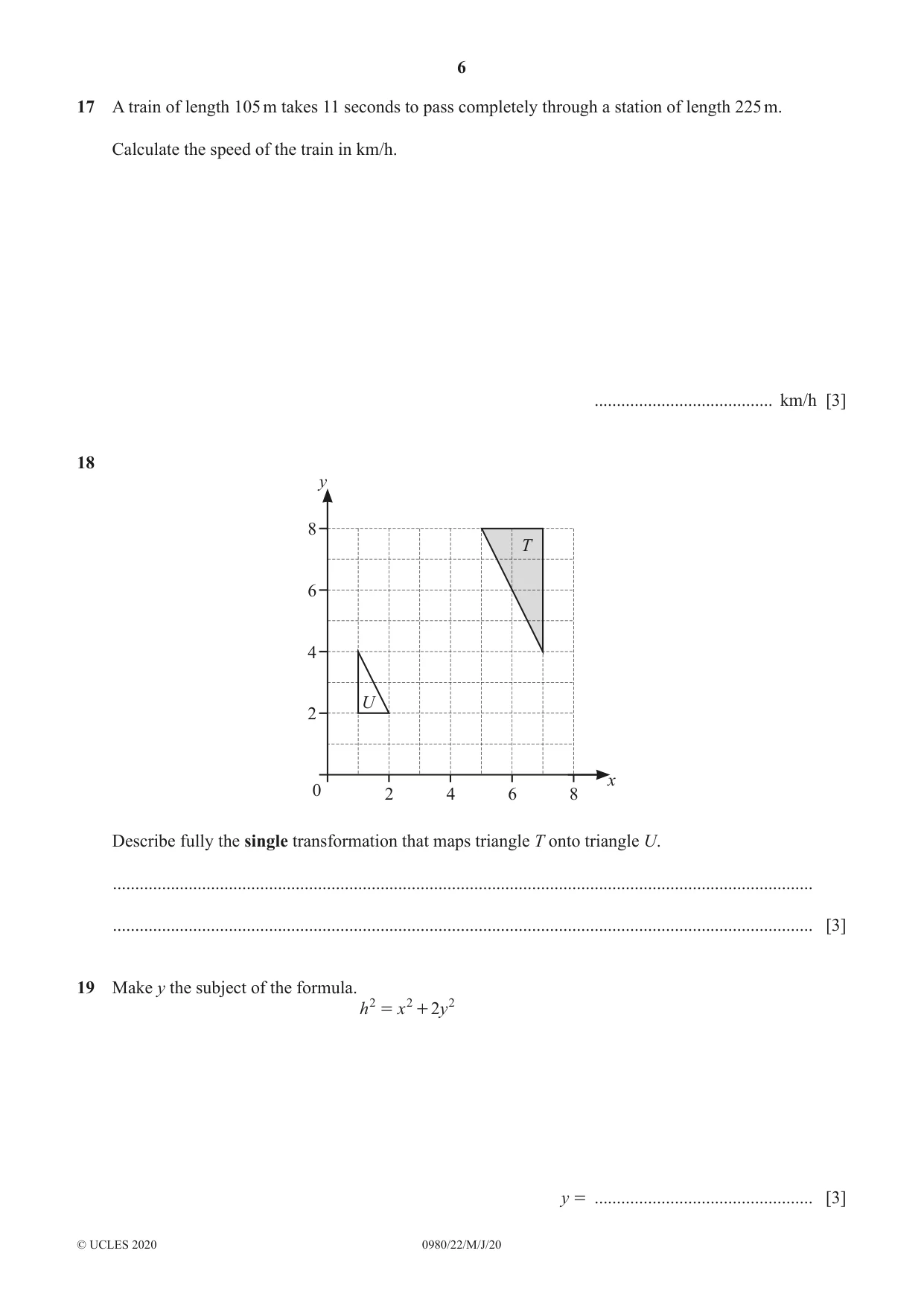
Q18 · Y 8 T 6 4 U 2 x 0 2 4 6 8 Describe fully the single transformation that maps triangle T…
18 y 8 T 6 4 U 2 x 0 2 4 6 8 Describe fully the single transformation that maps triangle T onto triangle U. ............................................................................................................................................................. ............................................................................................................................................................. [3]
Mark scheme: 18 Enlargement 3 B1 for each 1 [scale factor] − 2 [centre] (3, 4)
Q19 · Make y the subject of the formula
19 Make y the subject of the formula. h 2 = x 2 + 2y 2 y = ................................................. [3]
Mark scheme: 19 2 2 3 M1 for correct rearrangement for y or y2 term h − x [±] M1 for correct square root 2 M1 for correct division by 2 or 2
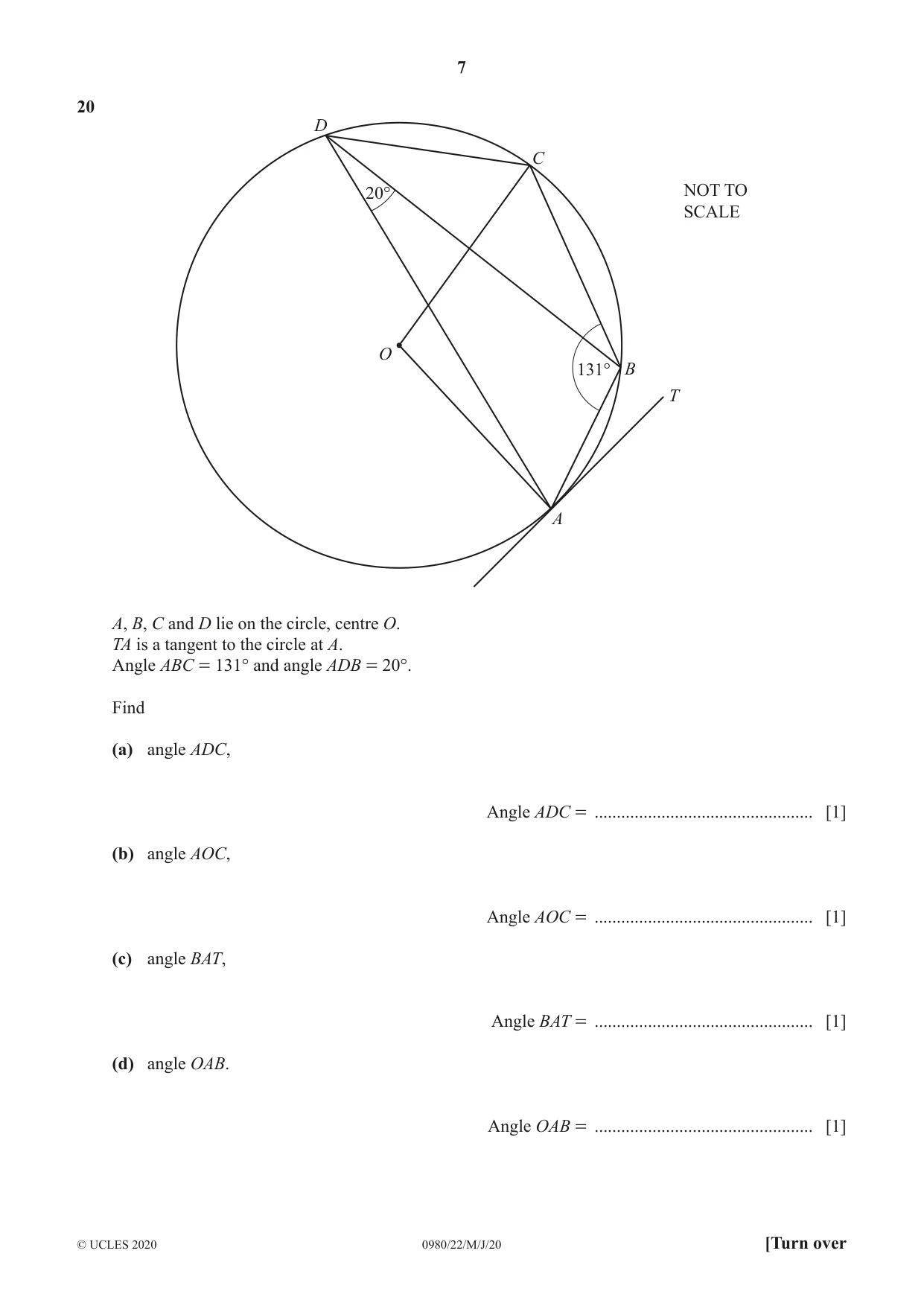
Q20 · D C 20° NOT TO SCALE O 131° B T A A, B, C and D lie on the circle, centre O
20 D C 20° NOT TO SCALE O 131° B T A A, B, C and D lie on the circle, centre O. TA is a tangent to the circle at A. Angle ABC = 131° and angle ADB = 20°. Find (a) angle ADC, Angle ADC = ................................................. [1] (b) angle AOC, Angle AOC = ................................................. [1] (c) angle BAT, Angle BAT = ................................................. [1] (d) angle OAB. Angle OAB = ................................................. [1]
Mark scheme: 20(a) 49 1 20(b) 98 1 FT 2 × their (a) 20(c) 20 1 20(d) 70 1 FT 90 – their (c)
Question 21
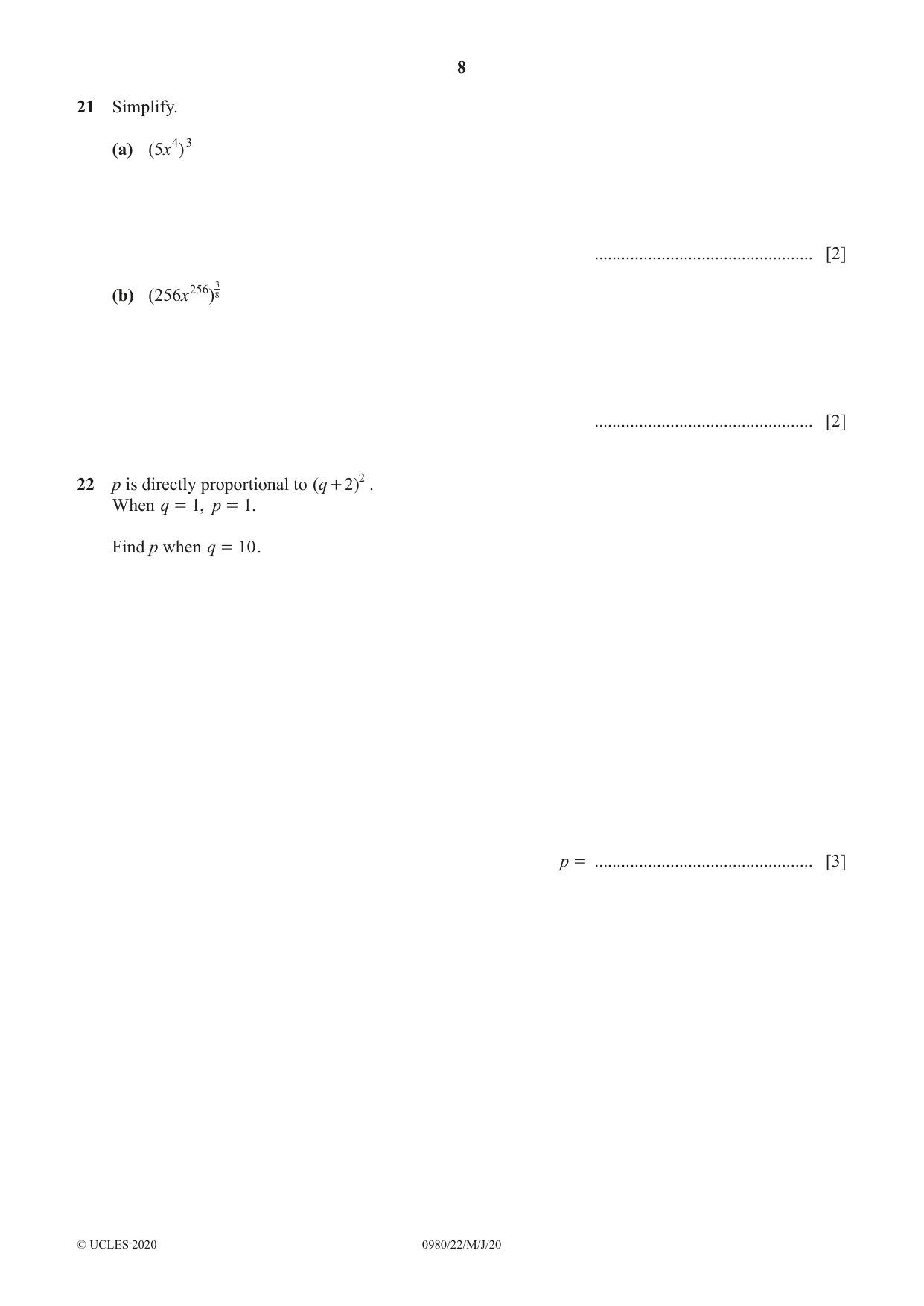
21 Simplify. (a) ( 5x 4 ) 3 ................................................. [2] 3 8 (b) ( 256x 256 ) ................................................. [2]
Mark scheme: 21(a) 125x12 2 B1 for 125xk or kx12 21(b) 8x96 2 B1 for 8xk or kx96
Q22 · P is directly proportional to ( q + 2)2
22 p is directly proportional to ( q + 2)2 . When q = 1, p = 1. Find p when q = 10 . p = ................................................. [3]
Mark scheme: 22 16 3 M1 for p = k ( q + 2) 2 M1 for p = (their k )(10 + 2) 2 OR p 1 M2 for = oe (10 + 2) 2 (1 + 2) 2
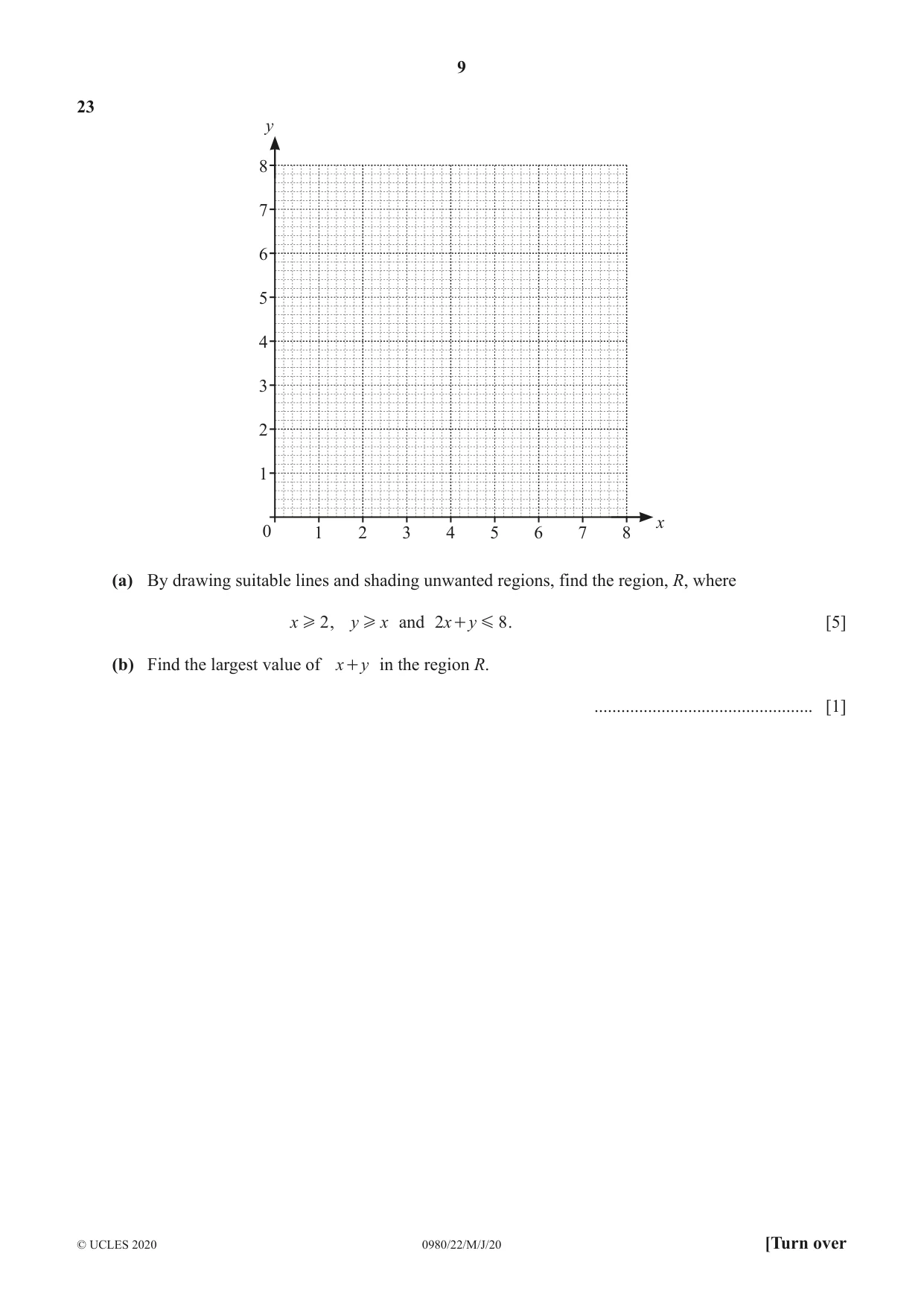
Q23 · Y 8 7 6 5 4 3 2 1 x 0 1 2 3 4 5 6 7 8 (a) By drawing suitable lines and shading unwanted…
23 y 8 7 6 5 4 3 2 1 x 0 1 2 3 4 5 6 7 8 (a) By drawing suitable lines and shading unwanted regions, find the region, R, where x H 2 , y H x and 2x + y G 8 . [5] (b) Find the largest value of x + y in the region R. ................................................. [1]
Mark scheme: 23(a) Correct lines and correct region 5 B2 for 2x + y = 8 correctly ruled clear or B1 for ruled line with negative gradient B1 for y = x correctly ruled B1 for x = 2 correctly ruled 23(b) 6 1
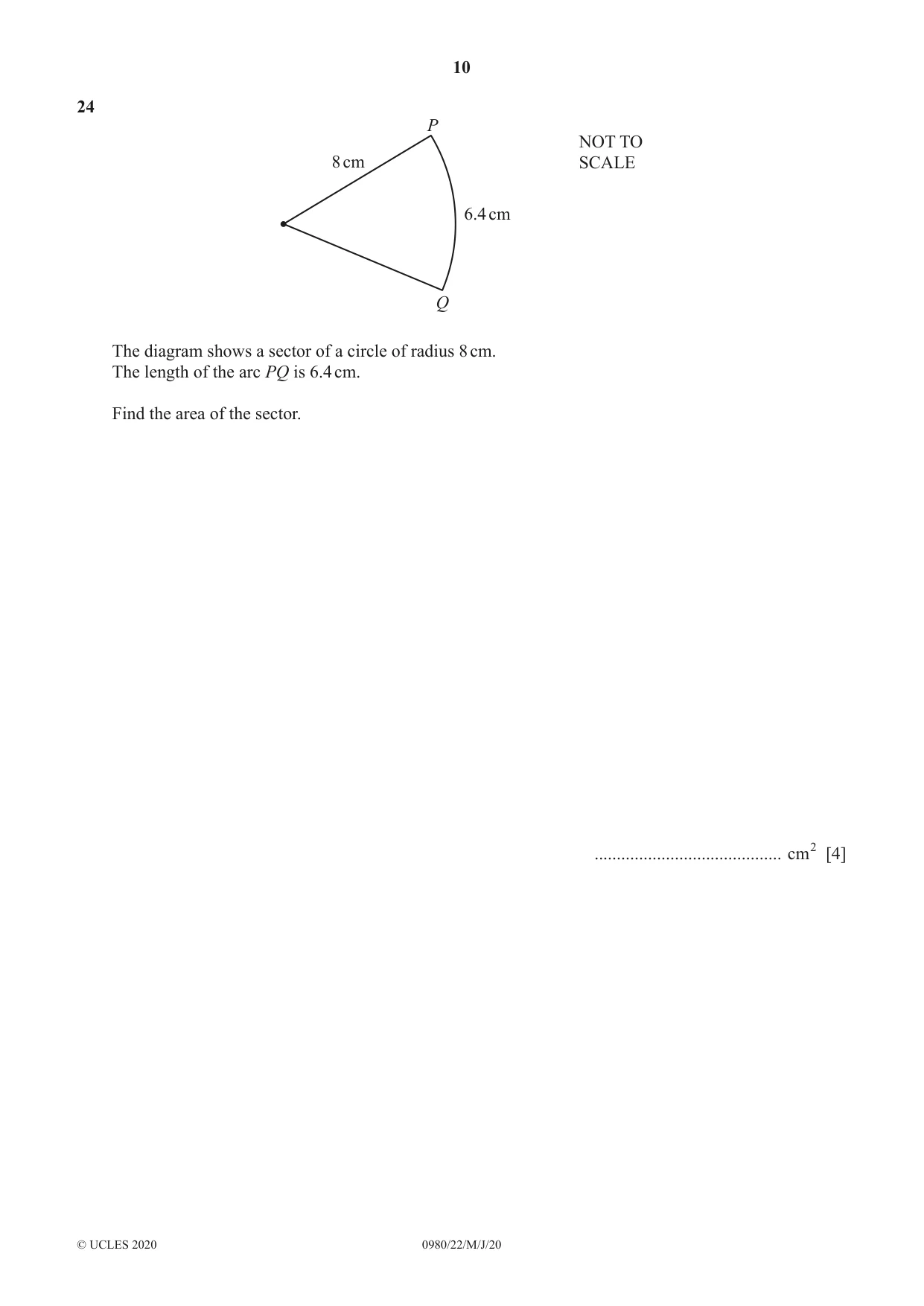
Q24 · P NOT TO 8 cm SCALE 6.4 cm Q The diagram shows a sector of a circle of radius 8 cm
24 P NOT TO 8 cm SCALE 6.4 cm Q The diagram shows a sector of a circle of radius 8 cm. The length of the arc PQ is 6.4 cm. Find the area of the sector. .......................................... cm2 [4]
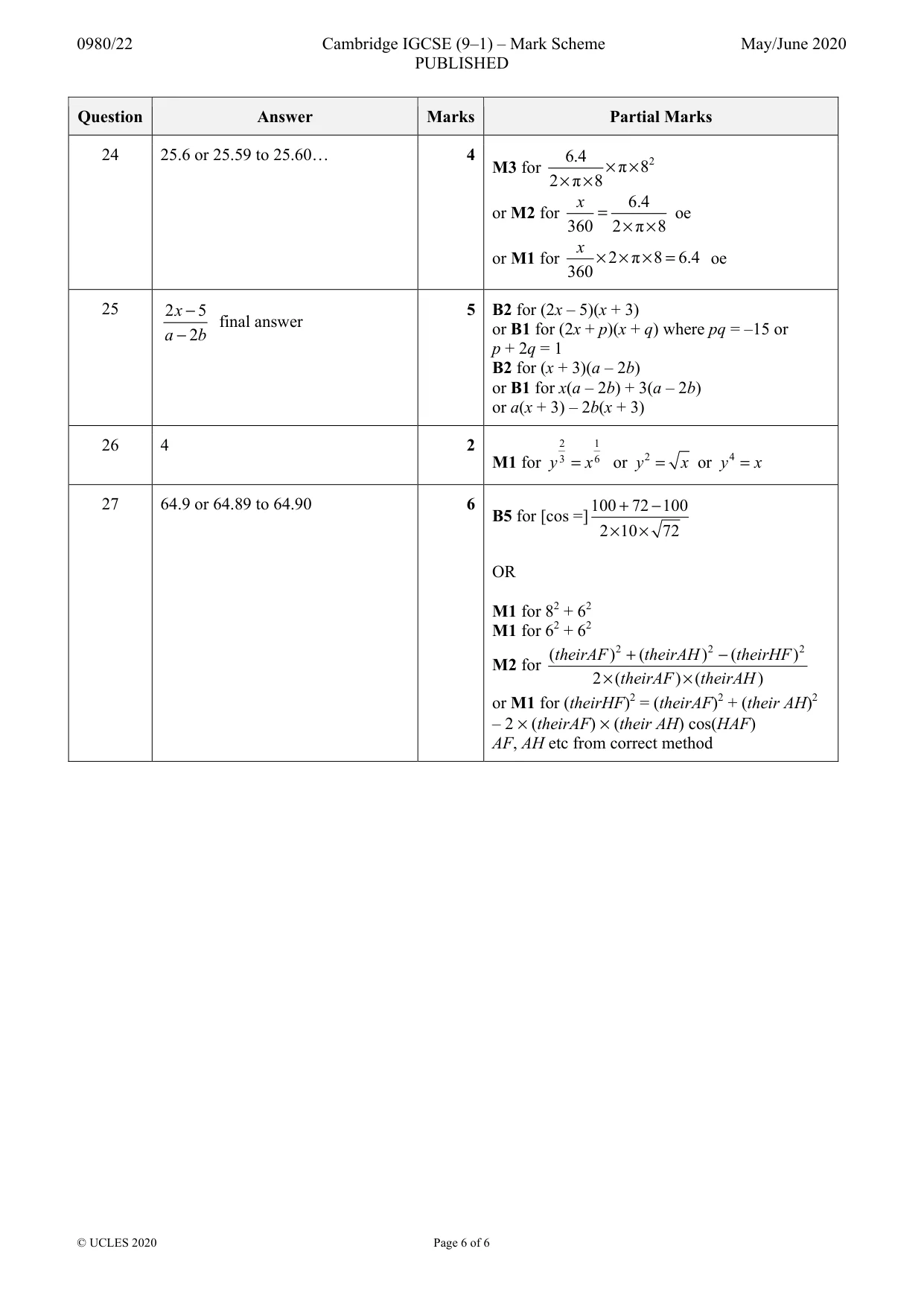
Mark scheme: 24 25.6 or 25.59 to 25.60… 4 6.4 2 M3 for × π × 8 2 × π × 8 x 6.4 or M2 for = oe 360 2 × π × 8 x or M1 for × 2 × π × 8 = 6.4 oe 360
Question 25
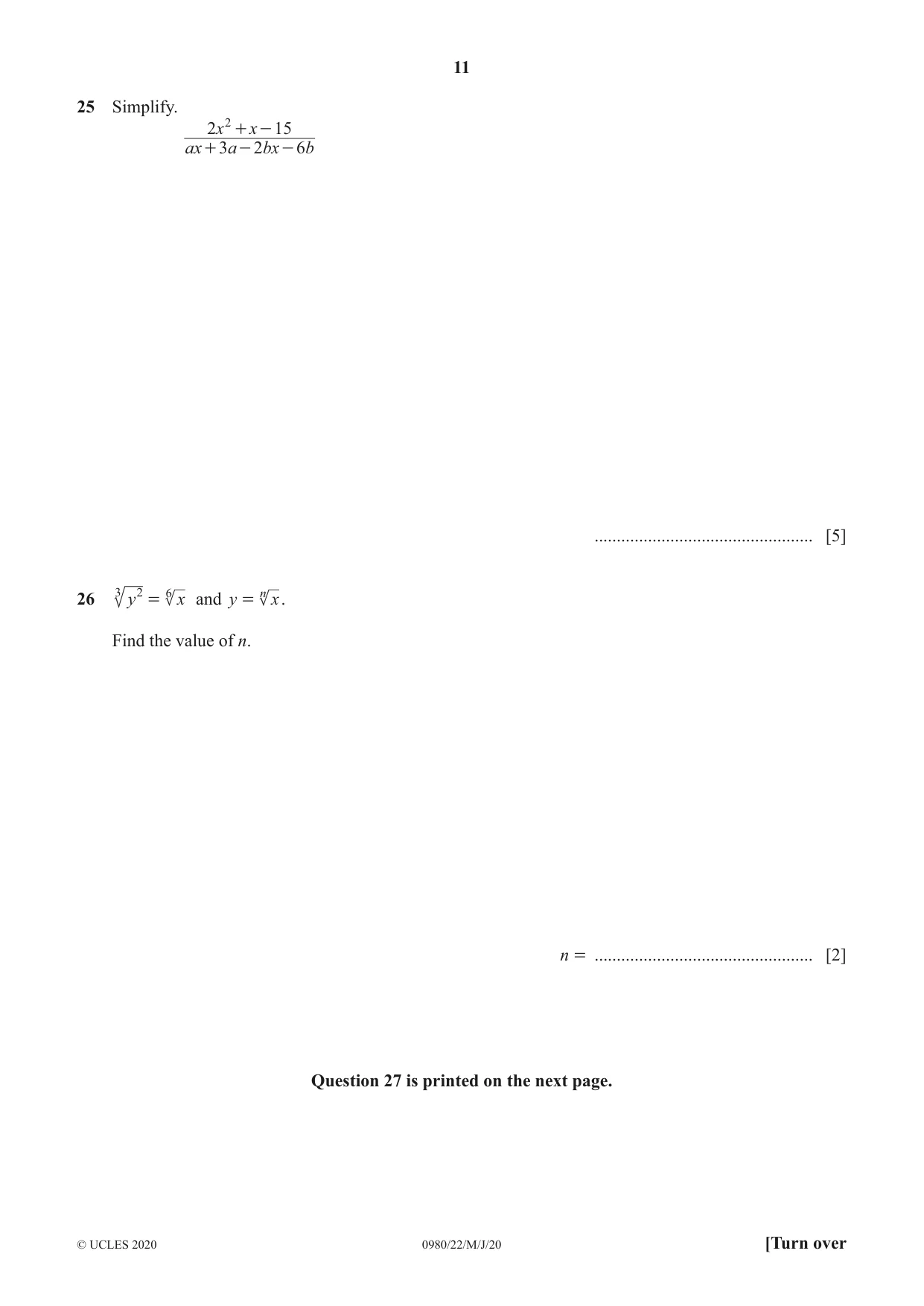
25 Simplify. 2x 2 + x - 15 ax + 3a - 2bx - 6b ................................................. [5]
Mark scheme: 25 2 x − 5 5 B2 for (2x – 5)(x + 3) final answer or B1 for (2x + p)(x + q) where pq = –15 or a − 2b p + 2q = 1 B2 for (x + 3)(a – 2b) or B1 for x(a – 2b) + 3(a – 2b) or a(x + 3) – 2b(x + 3)
Q26 · 3 y 2 = 6 x and y = n x
26 3 y 2 = 6 x and y = n x . Find the value of n. n = ................................................. [2] Question 27 is printed on the next page.
Mark scheme: 26 4 2 2 1 M1 for y 3 = x 6 or y 2 = x or y 4 = x
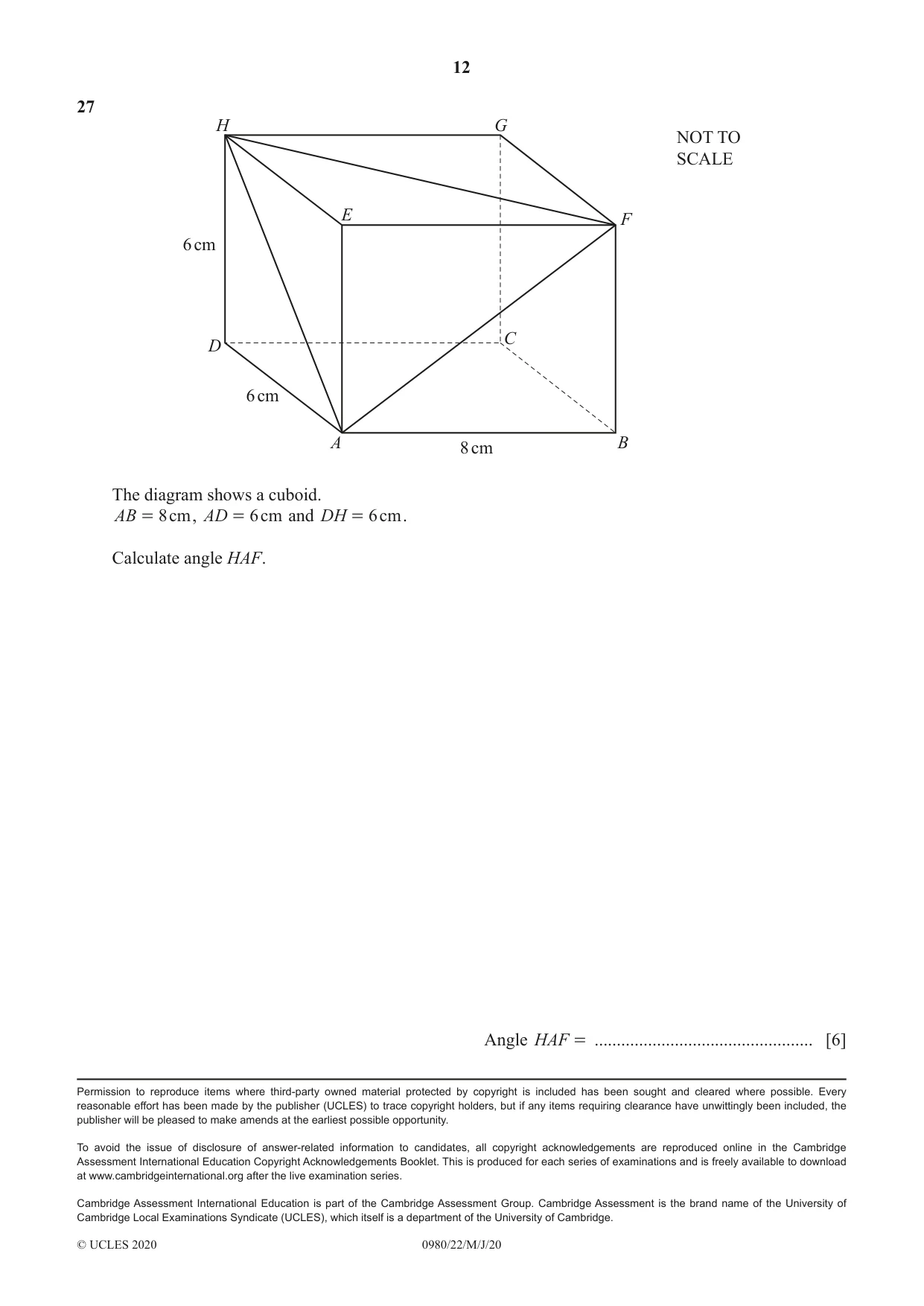
Q27 · H G NOT TO SCALE E F 6 cm C D 6 cm A B 8 cm The diagram shows a cuboid
27 H G NOT TO SCALE E F 6 cm C D 6 cm A B 8 cm The diagram shows a cuboid. AB = 8cm , AD = 6cm and DH = 6cm . Calculate angle HAF. Angle HAF = ................................................. [6]
Mark scheme: 27 64.9 or 64.89 to 64.90 6 + 72 − 100 B5 for [cos =]100 2 × 10 × 72 OR M1 for 82 + 62 M1 for 62 + 62 ( theirAF ) 2 + (theirAH ) 2 − (theirHF ) 2 M2 for 2 × (theirAF ) × ( theirAH ) or M1 for (theirHF)2 = (theirAF)2 + (their AH)2 – 2 × (theirAF) × (their AH) cos(HAF) AF, AH etc from correct method
What was in this paper
The subtopics covered by these 27 questions, and how many questions each got. Open one in a new tab to see every Cambridge question on it.
2Indices II2Algebraic manipulation1Angles1Area and perimeter1Circle theorems I1Circles, arcs and sectors1Equations1Equations of linear graphs1Geometrical terms1Indices I1Indices I1Inequalities1Limits of accuracy1Percentages1Proportion1Pythagoras’ theorem and trigonometry1Rates1Sets1Standard form1Symmetry1The four operations1The four operations1Transformations1Types of number1