Cambridge IGCSE Mathematics 0580 — 2010 May/June Paper 4 · Variant 1
0580/41/M/J/10 · 9 questions · 108 marks · ≈122 min
The question paper and its mark scheme, free to read here and free to download. This is Cambridge’s own paper, exactly as it was sat.
Question paper20 pages
Mark scheme5 pages
Answers below. Sit the paper first if you are practising.
Questions as text
Q1 · A school has 220 boys and 280 girls
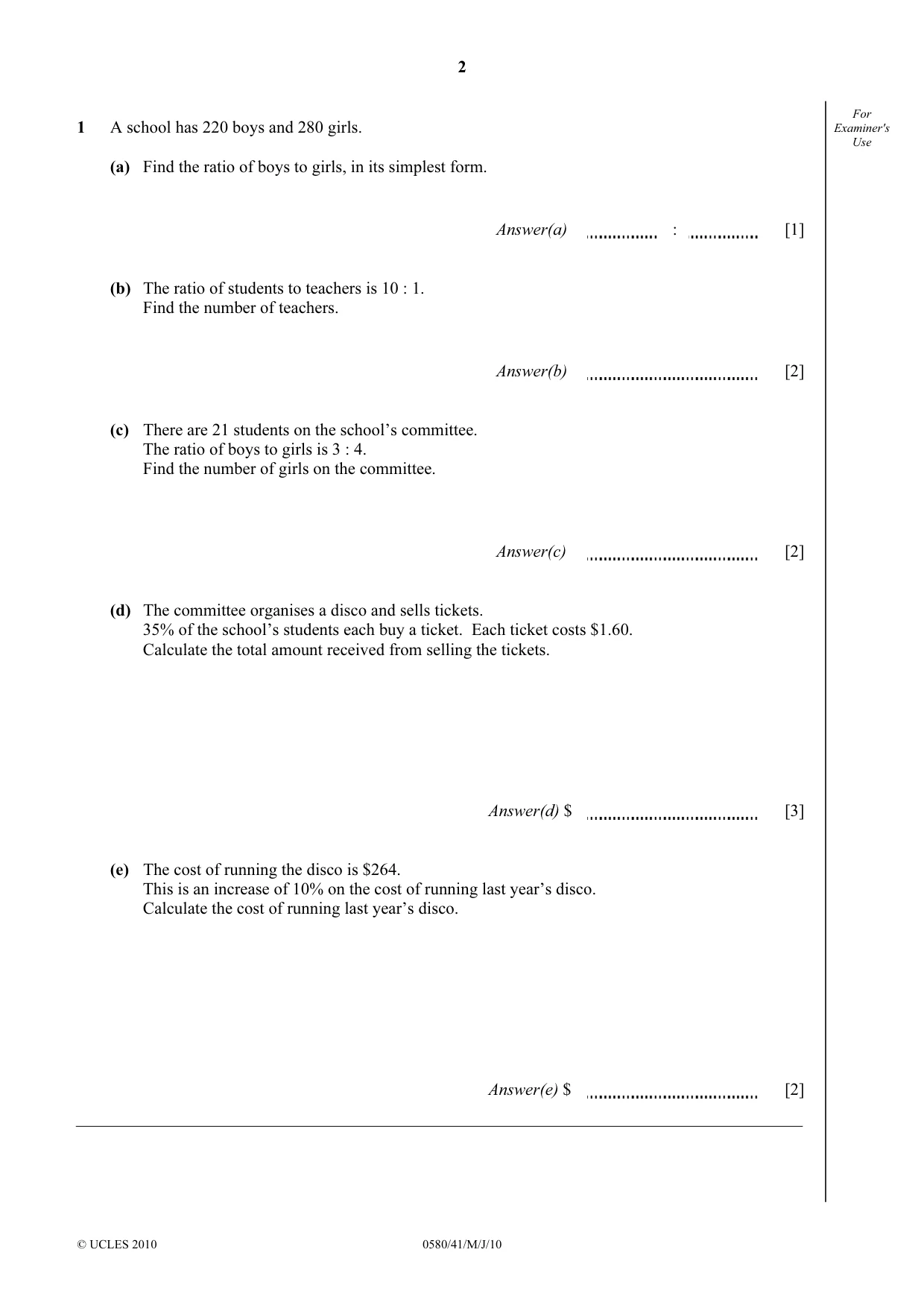
1 A school has 220 boys and 280 girls. Examiner's Use (a) Find the ratio of boys to girls, in its simplest form. Answer(a) : [1] (b) The ratio of students to teachers is 10 : 1. Find the number of teachers. Answer(b) [2] (c) There are 21 students on the school’s committee. The ratio of boys to girls is 3 : 4. Find the number of girls on the committee. Answer(c) [2] (d) The committee organises a disco and sells tickets. 35% of the school’s students each buy a ticket. Each ticket costs $1.60. Calculate the total amount received from selling the tickets. Answer(d) $ [3] (e) The cost of running the disco is $264. This is an increase of 10% on the cost of running last year’s disco. Calculate the cost of running last year’s disco. Answer(e) $ [2]
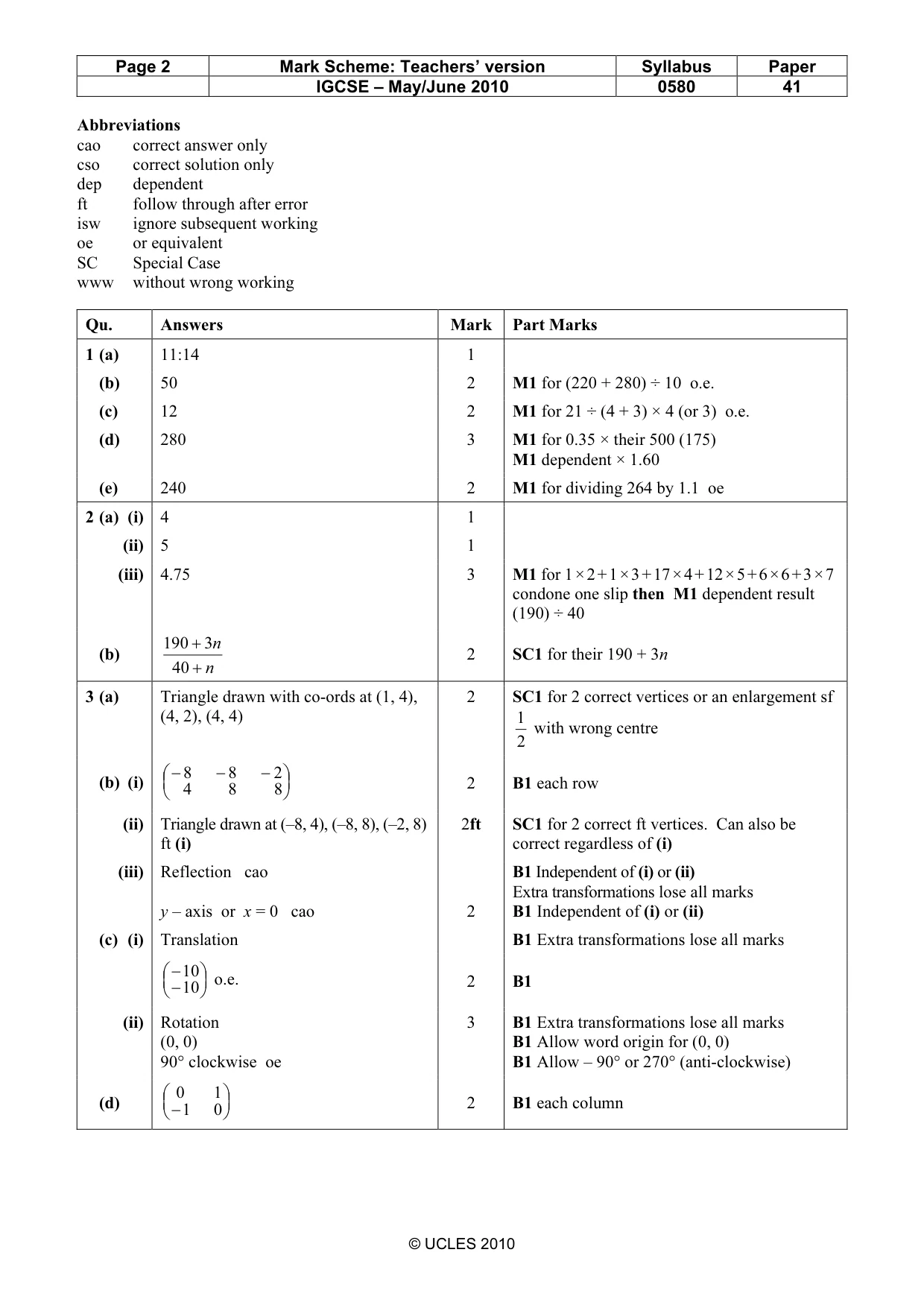
Mark scheme: Qu. Answers Mark Part Marks 1 (a) 11:14 1 (b) 50 2 M1 for (220 + 280) ÷ 10 o.e. (c) 12 2 M1 for 21 ÷ (4 + 3) × 4 (or 3) o.e. (d) 280 3 M1 for 0.35 × their 500 (175) M1 dependent × 1.60 (e) 240 2 M1 for dividing 264 by 1.1 oe
Q2 · 40 students are asked about the number of people in their families
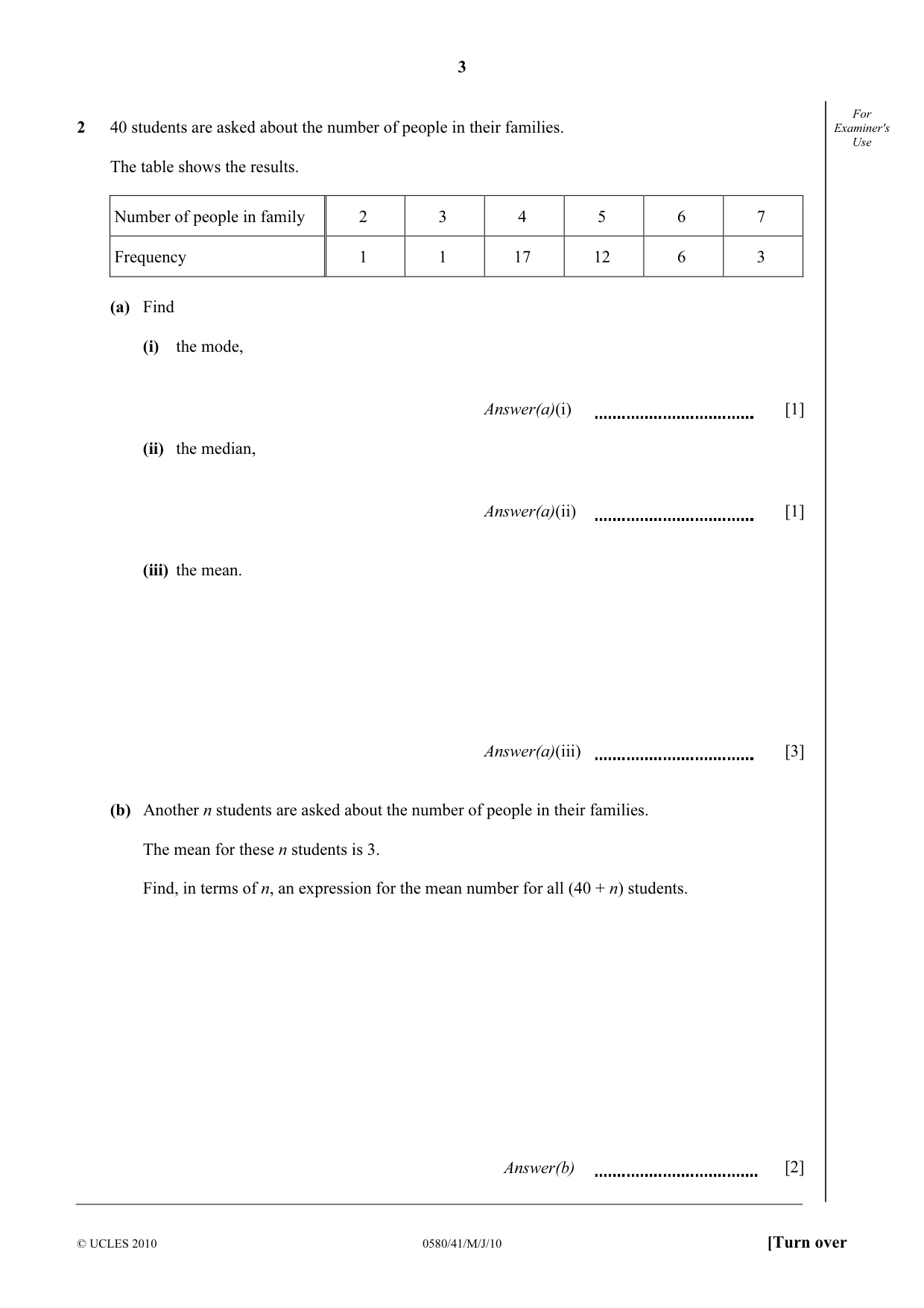
2 40 students are asked about the number of people in their families. Examiner's Use The table shows the results. Number of people in family 2 3 4 5 6 7 Frequency 1 1 17 12 6 3 (a) Find (i) the mode, Answer(a)(i) [1] (ii) the median, Answer(a)(ii) [1] (iii) the mean. Answer(a)(iii) [3] (b) Another n students are asked about the number of people in their families. The mean for these n students is 3. Find, in terms of n, an expression for the mean number for all (40 + n) students. Answer(b) [2]
Mark scheme: 2 (a) (i) 4 1 (ii) 5 1 (iii) 4.75 3 M1 for 1 × 2 + 1 × 3 + 17 × 4 + 12 × 5 + 6 × 6 + 3 × 7 condone one slip then M1 dependent result (190) ÷ 40 190 + 3n (b) 2 SC1 for their 190 + 3n 40 + n
Q3 · Examiner's y Use 8 7 T 6 5 4 3 2 1 x –8 –7 –6 –5 –4 –3 –2 –1 0 1 2 3 4 5 6 7 8 –1 –2 –3 P…
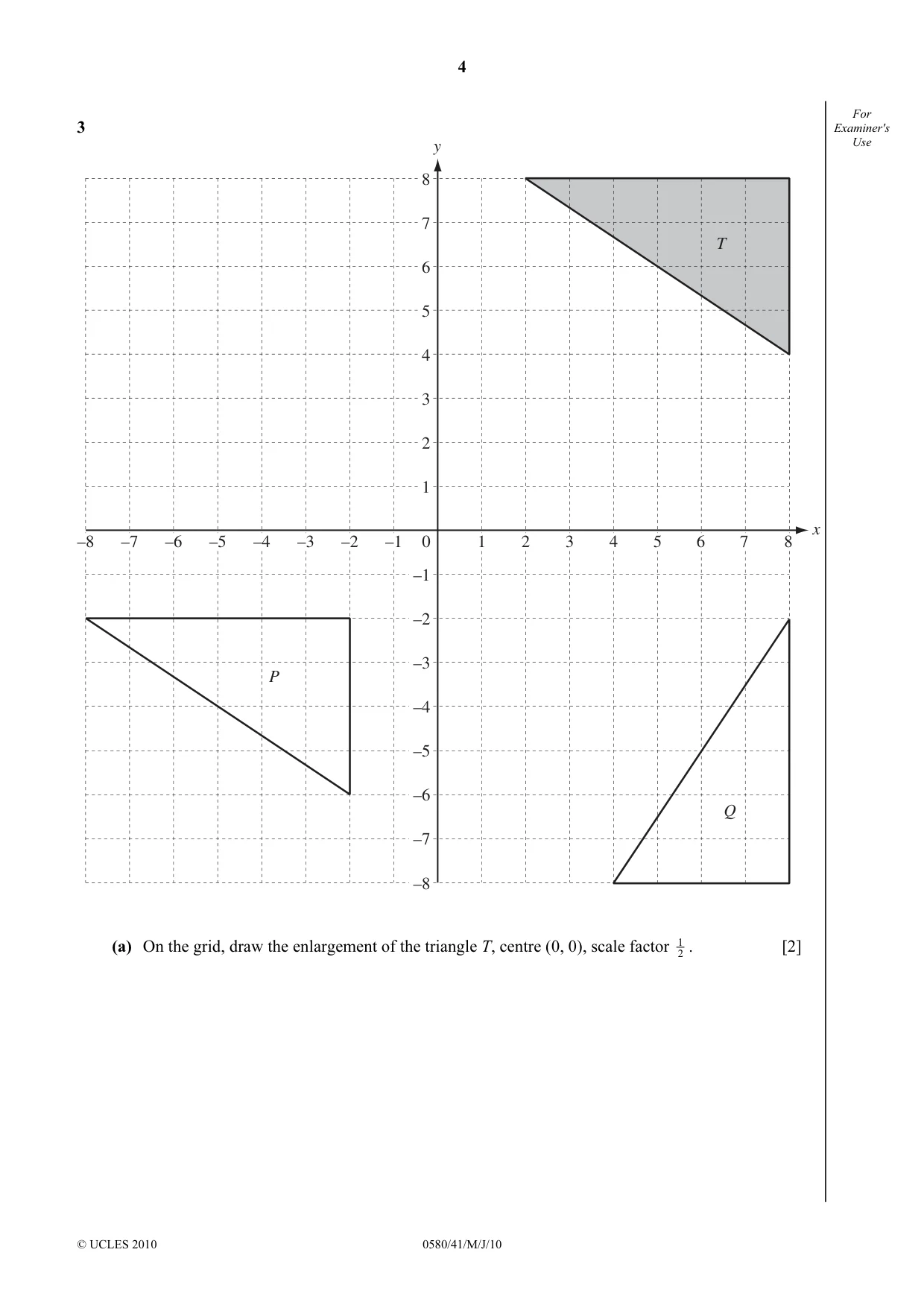
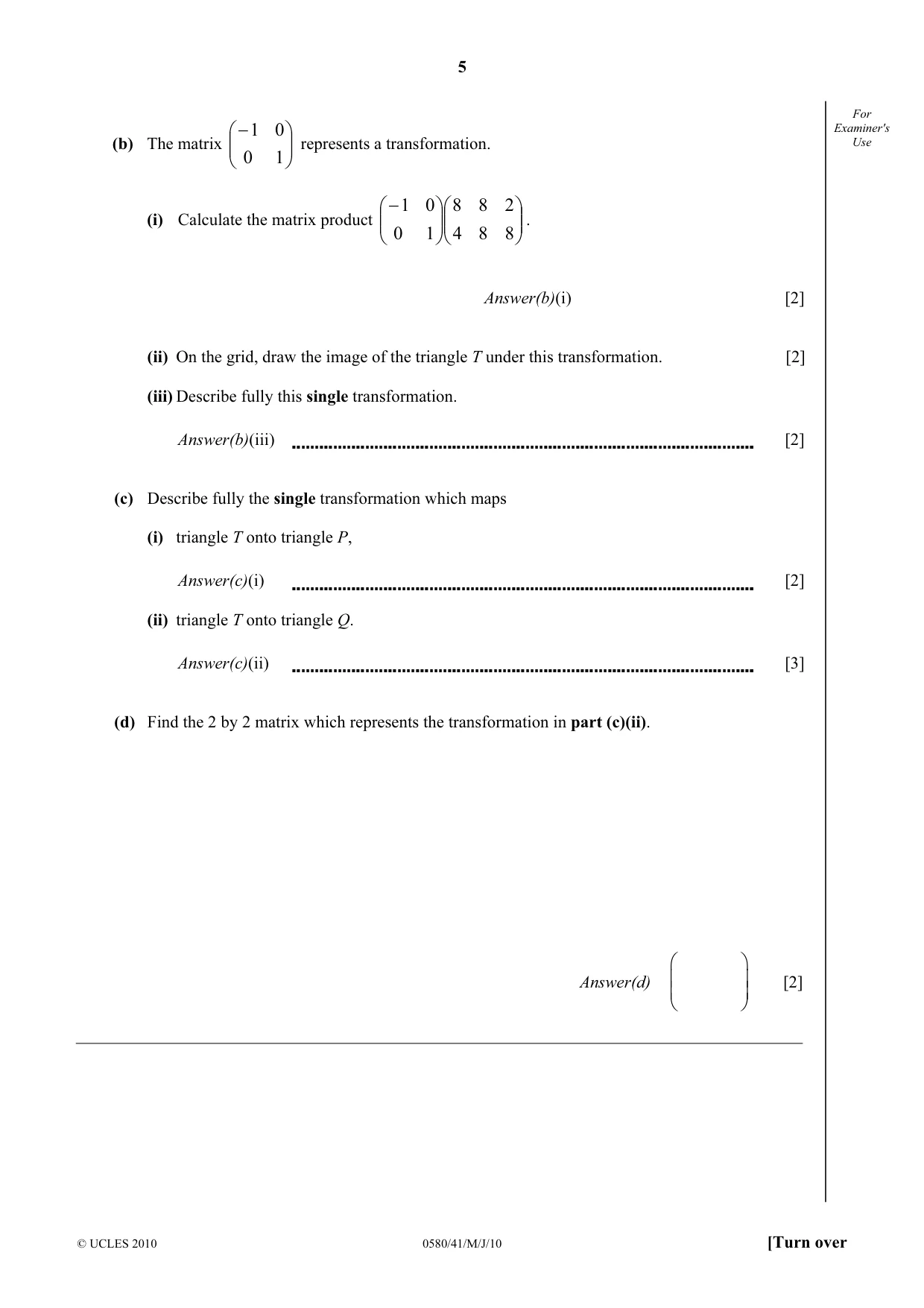
3 Examiner's y Use 8 7 T 6 5 4 3 2 1 x –8 –7 –6 –5 –4 –3 –2 –1 0 1 2 3 4 5 6 7 8 –1 –2 –3 P –4 –5 –6 Q –7 –8 (a) On the grid, draw the enlargement of the triangle T, centre (0, 0), scale factor 12 . [2] For − 1 0 Examiner's (b) The matrix represents a transformation. Use 0 1 − 1 0 8 8 2 (i) Calculate the matrix product . 0 1 4 8 8 Answer(b)(i) [2] (ii) On the grid, draw the image of the triangle T under this transformation. [2] (iii) Describe fully this single transformation. Answer(b)(iii) [2] (c) Describe fully the single transformation which maps (i) triangle T onto triangle P, Answer(c)(i) [2] (ii) triangle T onto triangle Q. Answer(c)(ii) [3] (d) Find the 2 by 2 matrix which represents the transformation in part (c)(ii). Answer(d) [2]
Mark scheme: 3 (a) Triangle drawn with co-ords at (1, 4), 2 SC1 for 2 correct vertices or an enlargement sf (4, 2), (4, 4) 1 with wrong centre 2 − 8 − 8 − 2 (b) (i) 4 8 8 2 B1 each row (ii) Triangle drawn at (–8, 4), (–8, 8), (–2, 8) 2ft SC1 for 2 correct ft vertices. Can also be ft (i) correct regardless of (i) (iii) Reflection cao B1 Independent of (i) or (ii) Extra transformations lose all marks y – axis or x = 0 cao 2 B1 Independent of (i) or (ii) (c) (i) Translation B1 Extra transformations lose all marks − 10 − 10 o.e. 2 B1 (ii) Rotation 3 B1 Extra transformations lose all marks (0, 0) B1 Allow word origin for (0, 0) 90° clockwise oe B1 Allow – 90° or 270° (anti-clockwise) 0 1 (d) − 1 0 2 B1 each column IGCSE – May/June 2010 0580 41
Q4 · Examiner's Use A B Box A contains 3 black balls and 1 white ball
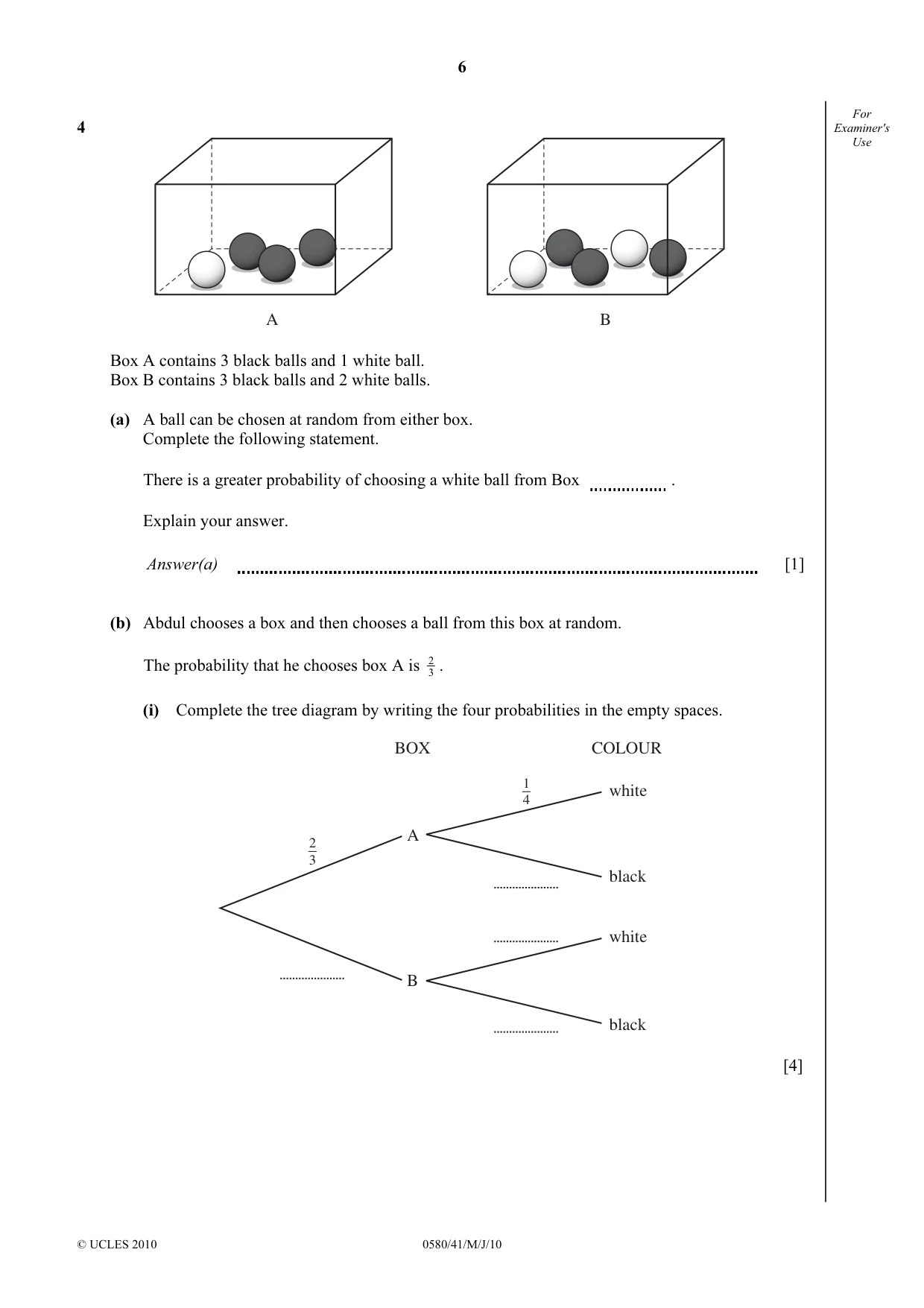
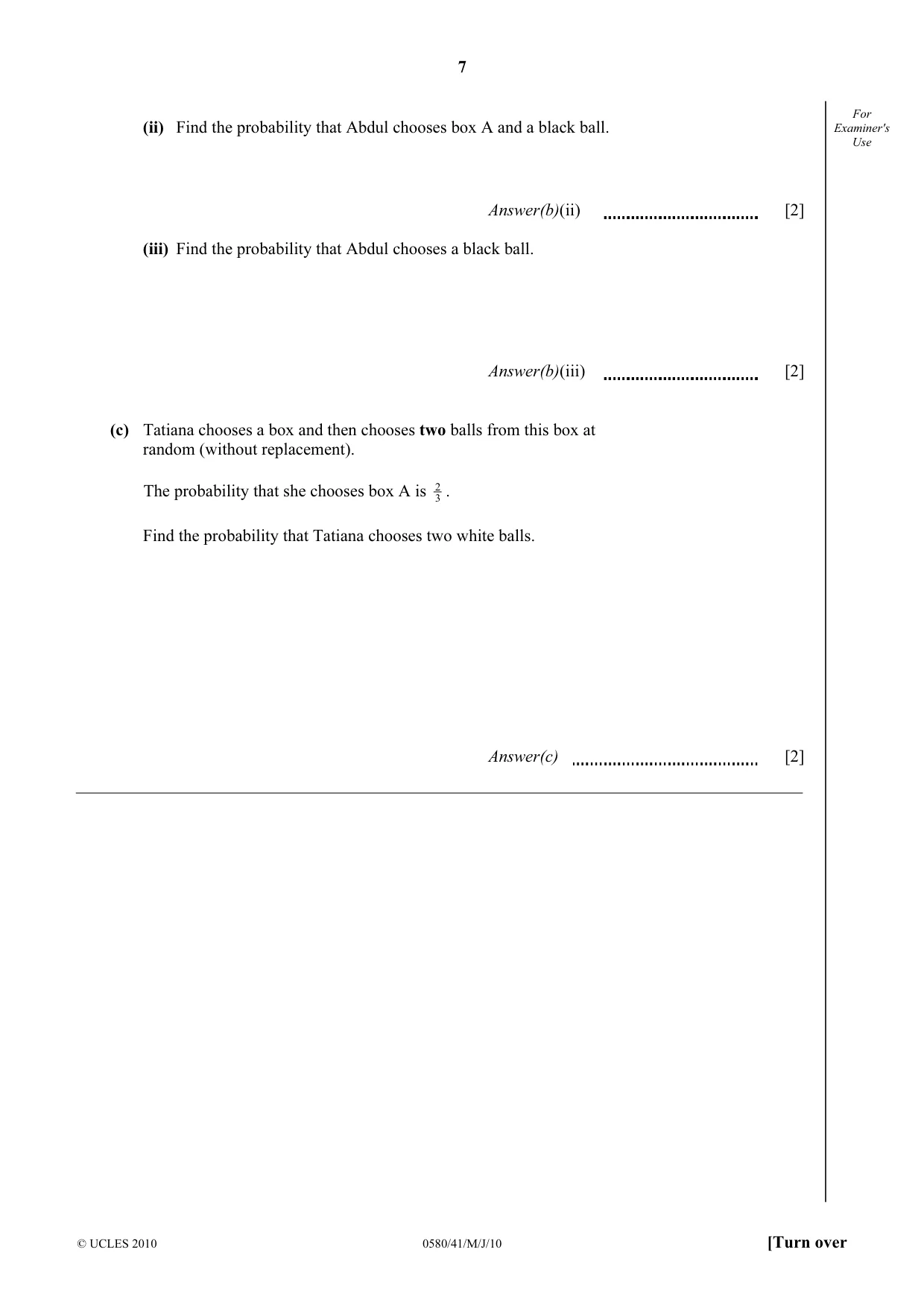
4 Examiner's Use A B Box A contains 3 black balls and 1 white ball. Box B contains 3 black balls and 2 white balls. (a) A ball can be chosen at random from either box. Complete the following statement. There is a greater probability of choosing a white ball from Box . Explain your answer. Answer(a) [1] (b) Abdul chooses a box and then chooses a ball from this box at random. The probability that he chooses box A is 23 . (i) Complete the tree diagram by writing the four probabilities in the empty spaces. BOX COLOUR 1 white 4 A 2 3 black white B black [4] For (ii) Find the probability that Abdul chooses box A and a black ball. Examiner's Use Answer(b)(ii) [2] (iii) Find the probability that Abdul chooses a black ball. Answer(b)(iii) [2] (c) Tatiana chooses a box and then chooses two balls from this box at random (without replacement). The probability that she chooses box A is 23 . Find the probability that Tatiana chooses two white balls. Answer(c) [2]
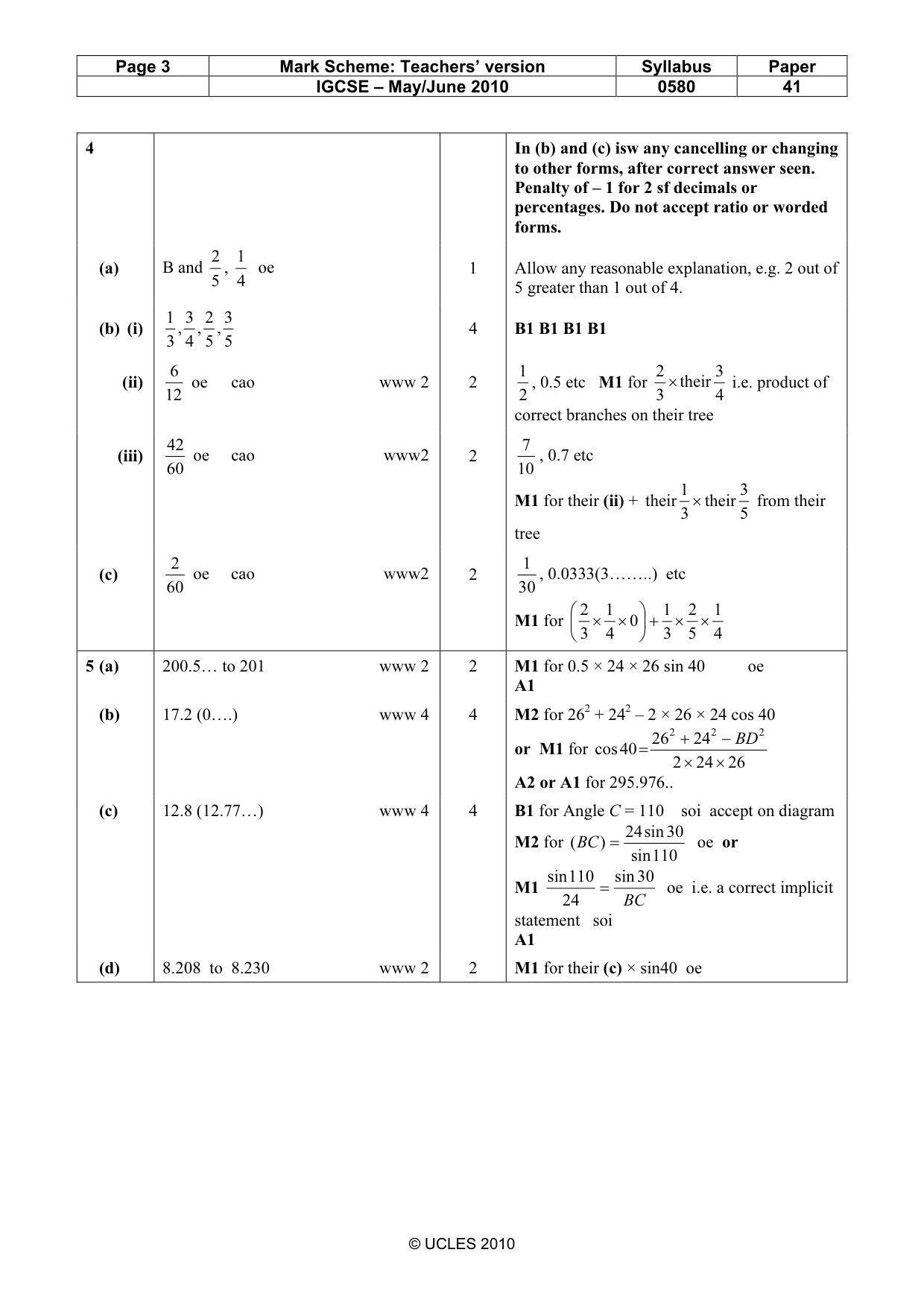
Mark scheme: 4 In (b) and (c) isw any cancelling or changing to other forms, after correct answer seen. Penalty of – 1 for 2 sf decimals or percentages. Do not accept ratio or worded forms. 2 1 (a) B and , oe 1 Allow any reasonable explanation, e.g. 2 out of 5 4 5 greater than 1 out of 4. 1 3 2 3 (b) (i) , , , 4 B1 B1 B1 B1 3 4 5 5 6 1 2 3 (ii) oe cao www 2 2 , 0.5 etc M1 for × their i.e. product of 12 2 3 4 correct branches on their tree 42 7 (iii) oe cao www2 2 , 0.7 etc 60 10 1 3 M1 for their (ii) + their × their from their 3 5 tree 2 1 (c) oe cao www2 2 , 0.0333(3……..) etc 60 30 2 1 1 2 1 M1 for × × 0 + × × 3 4 3 5 4
Q5 · Examiner's D Use 30° C NOT TO SCALE 24 cm 40° 40° A 26 cm B ABCD is a quadrilateral and…
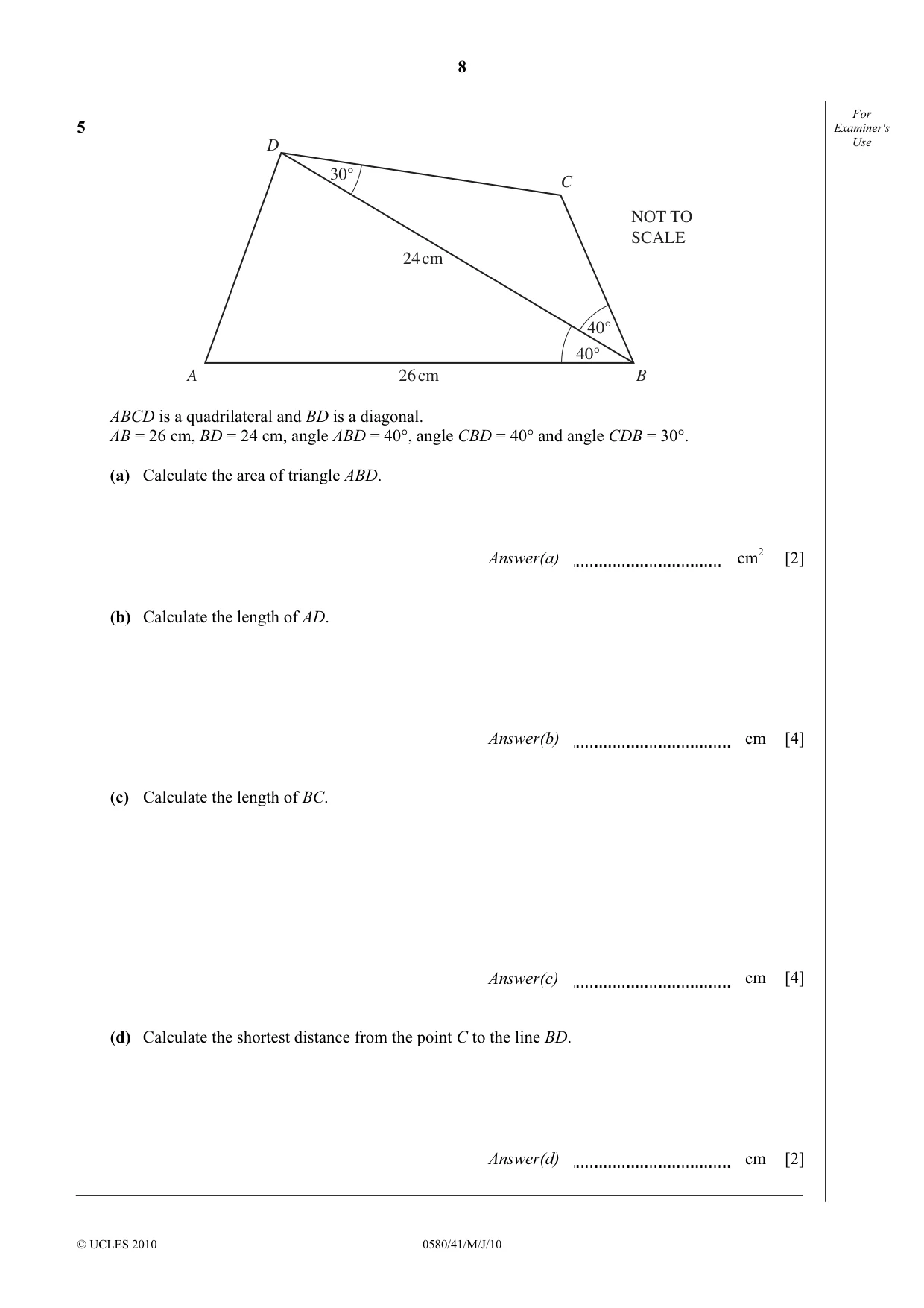
5 Examiner's D Use 30° C NOT TO SCALE 24 cm 40° 40° A 26 cm B ABCD is a quadrilateral and BD is a diagonal. AB = 26 cm, BD = 24 cm, angle ABD = 40°, angle CBD = 40° and angle CDB = 30°. (a) Calculate the area of triangle ABD. Answer(a) cm2 [2] (b) Calculate the length of AD. Answer(b) cm [4] (c) Calculate the length of BC. Answer(c) cm [4] (d) Calculate the shortest distance from the point C to the line BD. Answer(d) cm [2]
Mark scheme: 5 (a) 200.5… to 201 www 2 2 M1 for 0.5 × 24 × 26 sin 40 oe A1 (b) 17.2 (0….) www 4 4 M2 for 262 + 242 – 2 × 26 × 24 cos 40 26 2 + 24 2 − BD 2 or M1 for cos 40 = 2 × 24 × 26 A2 or A1 for 295.976.. (c) 12.8 (12.77…) www 4 4 B1 for Angle C = 110 soi accept on diagram 24 sin 30 M2 for ( BC ) = oe or sin 110 sin 110 sin 30 M1 = oe i.e. a correct implicit 24 BC statement soi A1 (d) 8.208 to 8.230 www 2 2 M1 for their (c) × sin40 oe IGCSE – May/June 2010 0580 41
Q6 · The masses of 60 potatoes are measured
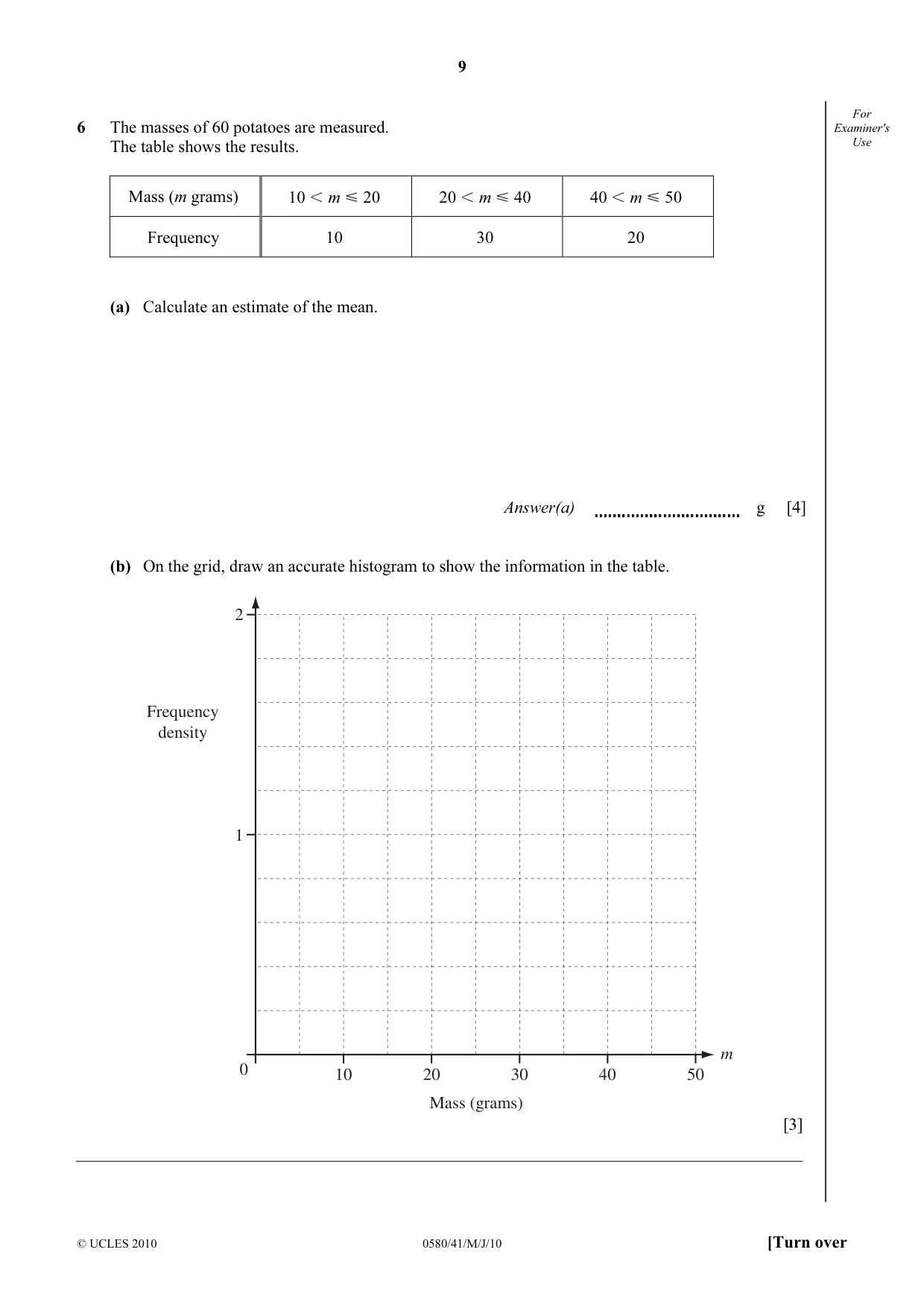
6 The masses of 60 potatoes are measured. Examiner's The table shows the results. Use Mass (m grams) 10 I m Y 20 20 I m Y 40 40 I m Y 50 Frequency 10 30 20 (a) Calculate an estimate of the mean. Answer(a) g [4] (b) On the grid, draw an accurate histogram to show the information in the table. 2 Frequency density 1 m 0 10 20 30 40 50 Mass (grams) [3]
Mark scheme: 6 (a) 32.5 cao www4 4 M1 for mid-values seen M1 for use of Σfx with x’s anywhere in each interval (10 × 15 + 30 × 30 + 20 × 45) M1 ÷ 60 dependent on second M1 (b) Histogram drawn 3 B1 Bars correct positions and widths – no gaps B2 Heights of bars 1, 1.5 and 2 (B1 for any two correct or for heights in the ratio 2:3:4)
Q7 · Calculate the volume of a cylinder of radius 31 centimetres and length 15 metres
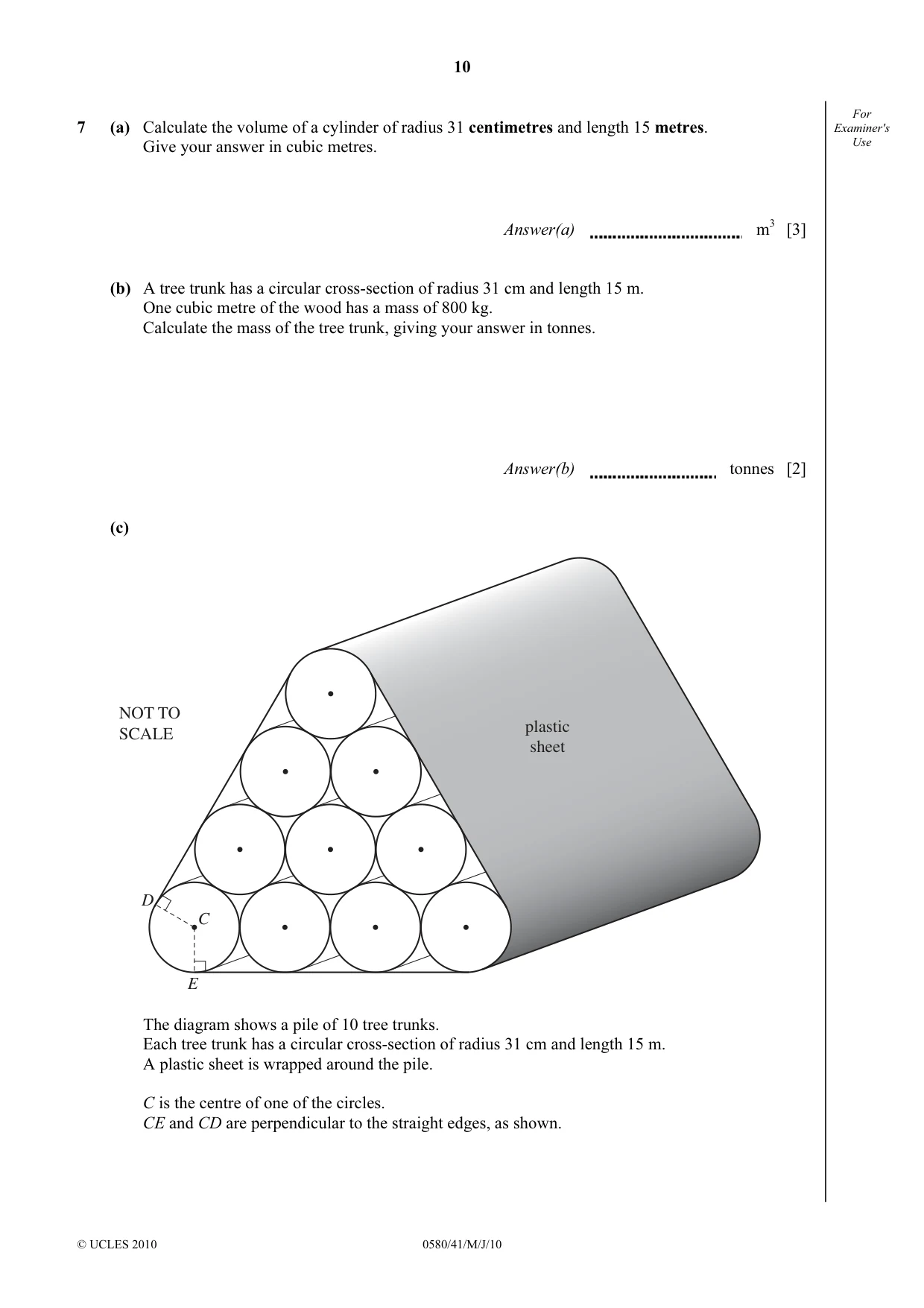
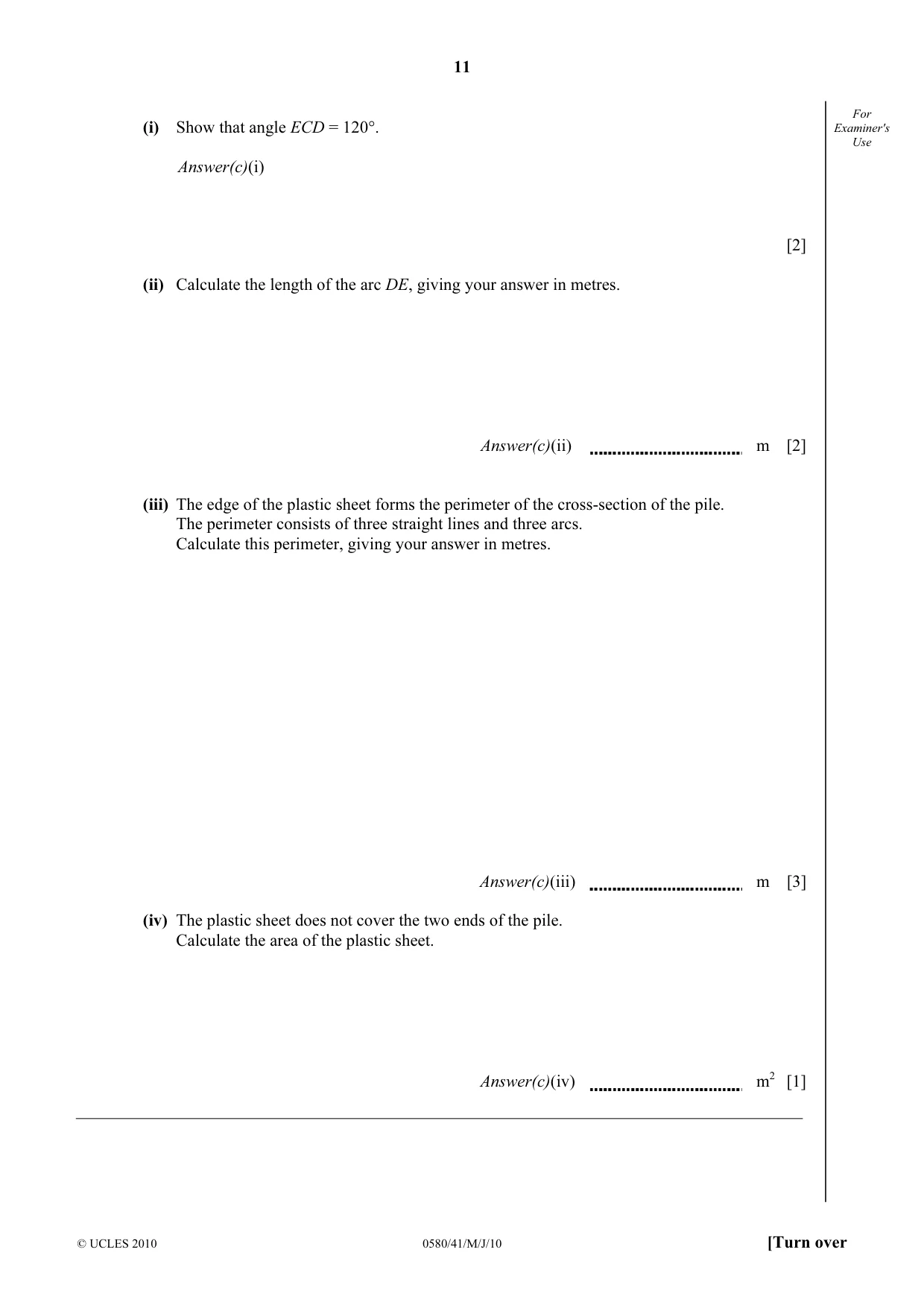
7 (a) Calculate the volume of a cylinder of radius 31 centimetres and length 15 metres. Examiner's Give your answer in cubic metres. Use Answer(a) m3 [3] (b) A tree trunk has a circular cross-section of radius 31 cm and length 15 m. One cubic metre of the wood has a mass of 800 kg. Calculate the mass of the tree trunk, giving your answer in tonnes. Answer(b) tonnes [2] (c) NOT TO plastic SCALE sheet D C E The diagram shows a pile of 10 tree trunks. Each tree trunk has a circular cross-section of radius 31 cm and length 15 m. A plastic sheet is wrapped around the pile. C is the centre of one of the circles. CE and CD are perpendicular to the straight edges, as shown. For (i) Show that angle ECD = 120°. Examiner's Use Answer(c)(i) [2] (ii) Calculate the length of the arc DE, giving your answer in metres. Answer(c)(ii) m [2] (iii) The edge of the plastic sheet forms the perimeter of the cross-section of the pile. The perimeter consists of three straight lines and three arcs. Calculate this perimeter, giving your answer in metres. Answer(c)(iii) m [3] (iv) The plastic sheet does not cover the two ends of the pile. Calculate the area of the plastic sheet. Answer(c)(iv) m2 [1]
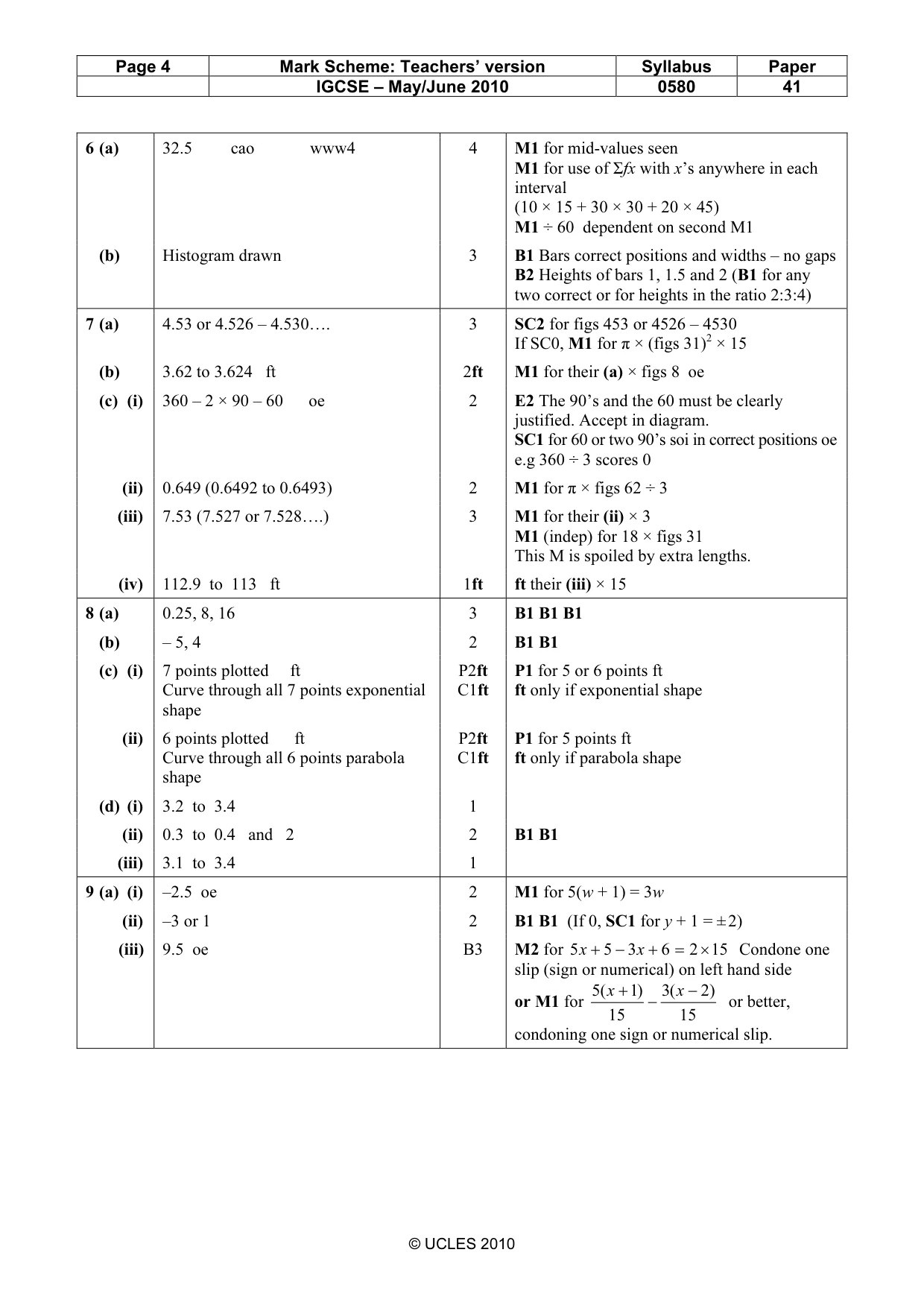
Mark scheme: 7 (a) 4.53 or 4.526 – 4.530…. 3 SC2 for figs 453 or 4526 – 4530 If SC0, M1 for π × (figs 31)2 × 15 (b) 3.62 to 3.624 ft 2ft M1 for their (a) × figs 8 oe (c) (i) 360 – 2 × 90 – 60 oe 2 E2 The 90’s and the 60 must be clearly justified. Accept in diagram. SC1 for 60 or two 90’s soi in correct positions oe e.g 360 ÷ 3 scores 0 (ii) 0.649 (0.6492 to 0.6493) 2 M1 for π × figs 62 ÷ 3 (iii) 7.53 (7.527 or 7.528….) 3 M1 for their (ii) × 3 M1 (indep) for 18 × figs 31 This M is spoiled by extra lengths. (iv) 112.9 to 113 ft 1ft ft their (iii) × 15
Q8 · F(x) = 2x Examiner's Use Complete the table
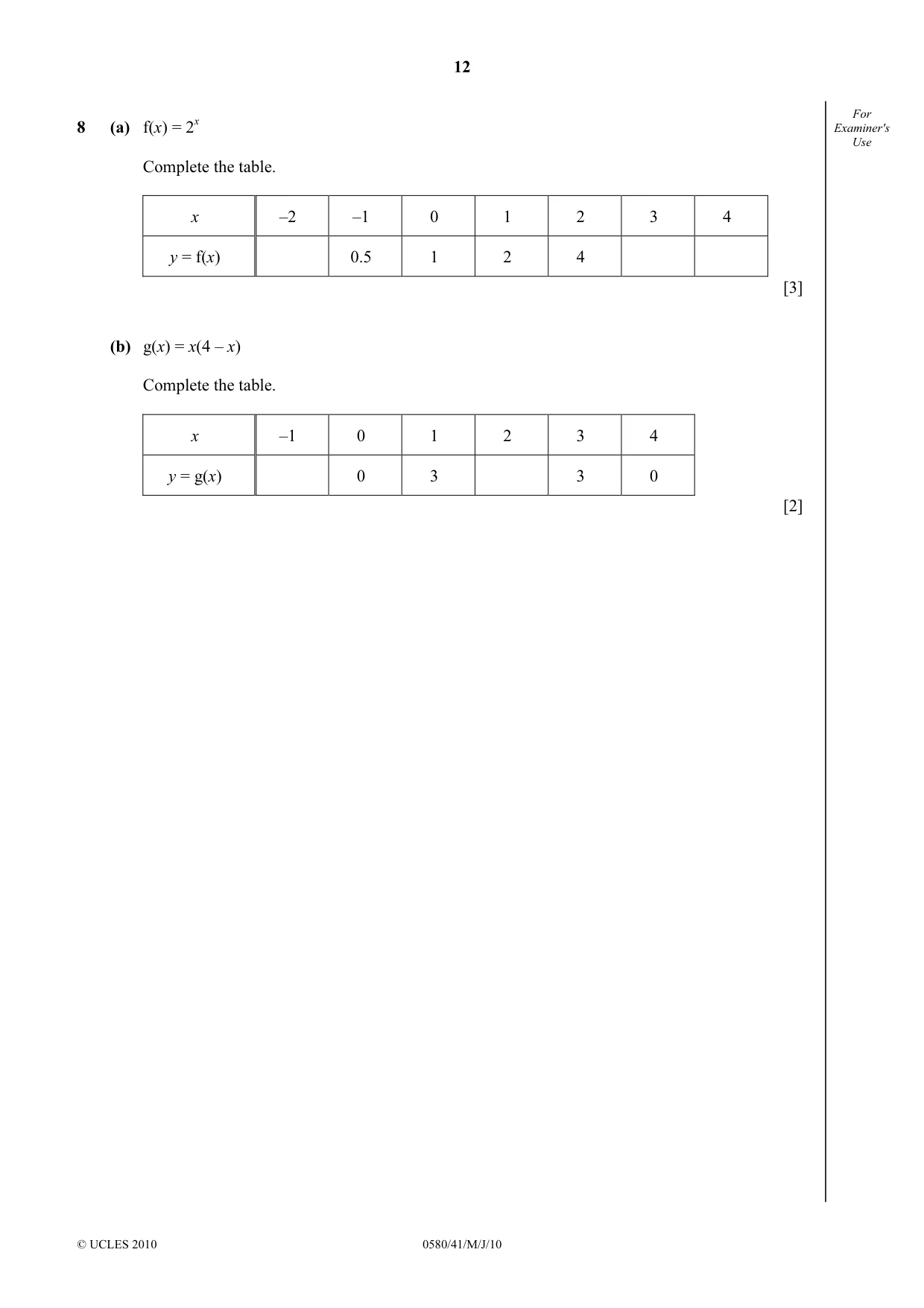
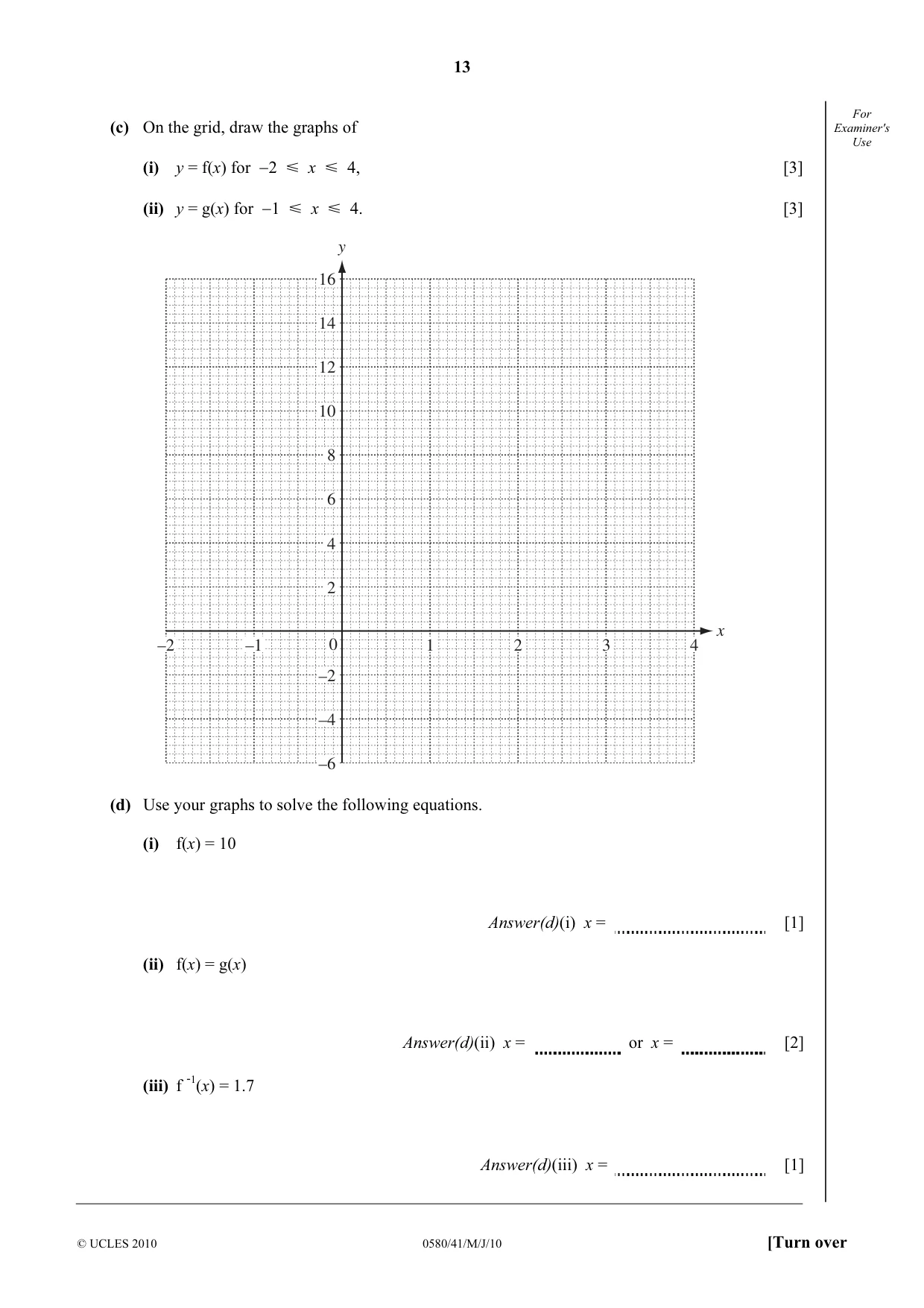
8 (a) f(x) = 2x Examiner's Use Complete the table. x –2 –1 0 1 2 3 4 y = f(x) 0.5 1 2 4 [3] (b) g(x) = x(4 – x) Complete the table. x –1 0 1 2 3 4 y = g(x) 0 3 3 0 [2] For (c) On the grid, draw the graphs of Examiner's Use (i) y = f(x) for −2 Y x Y 4, [3] (ii) y = g(x) for −1 Y x Y 4. [3] y 16 14 12 10 8 6 4 2 x –2 –1 0 1 2 3 4 –2 –4 –6 (d) Use your graphs to solve the following equations. (i) f(x) = 10 Answer(d)(i) x = [1] (ii) f(x) = g(x) Answer(d)(ii) x = or x = [2] (iii) f -1(x) = 1.7 Answer(d)(iii) x = [1]
Mark scheme: 8 (a) 0.25, 8, 16 3 B1 B1 B1 (b) – 5, 4 2 B1 B1 (c) (i) 7 points plotted ft P2ft P1 for 5 or 6 points ft Curve through all 7 points exponential C1ft ft only if exponential shape shape (ii) 6 points plotted ft P2ft P1 for 5 points ft Curve through all 6 points parabola C1ft ft only if parabola shape shape (d) (i) 3.2 to 3.4 1 (ii) 0.3 to 0.4 and 2 2 B1 B1 (iii) 3.1 to 3.4 1
Q9 · Solve the following equations
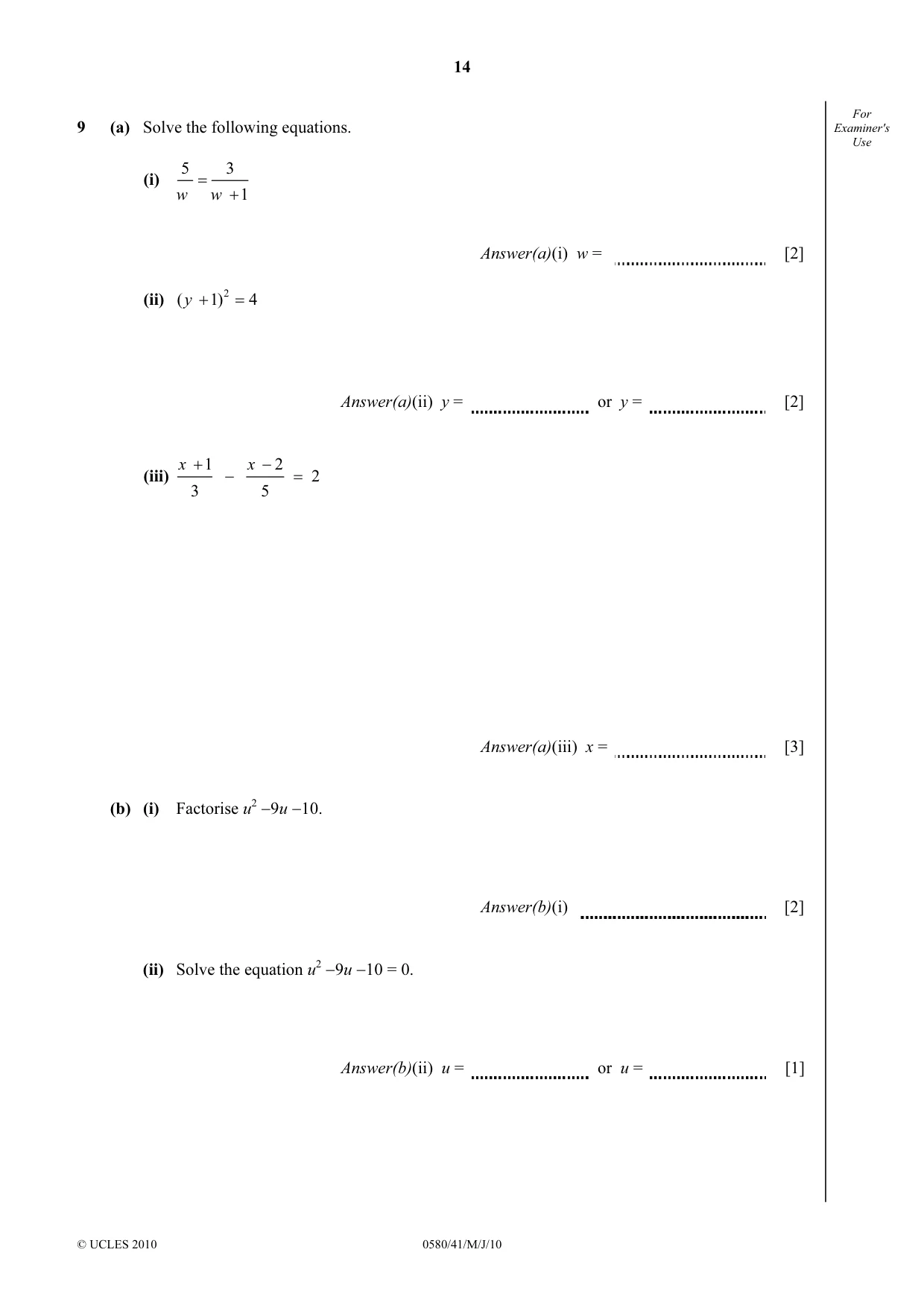
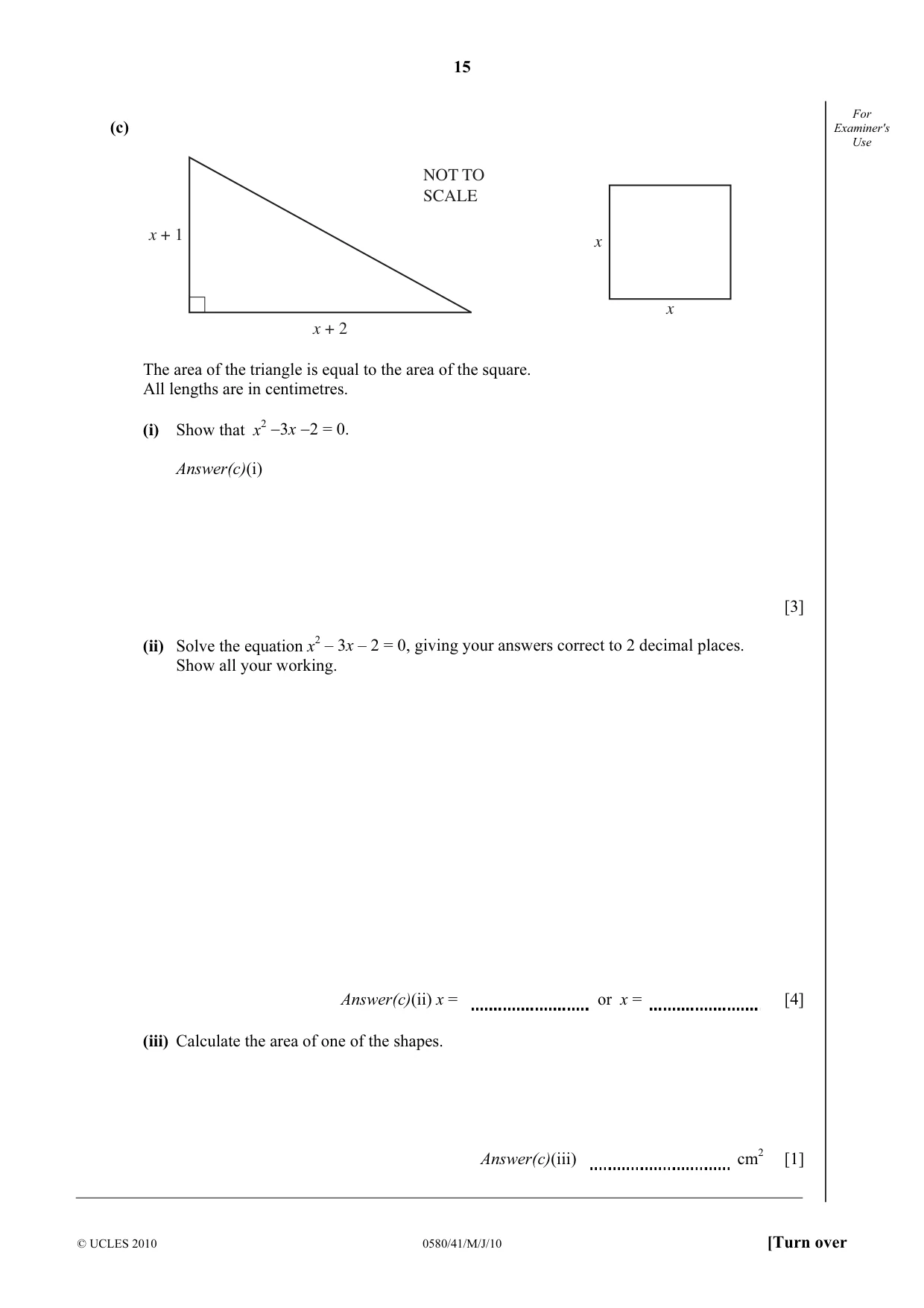
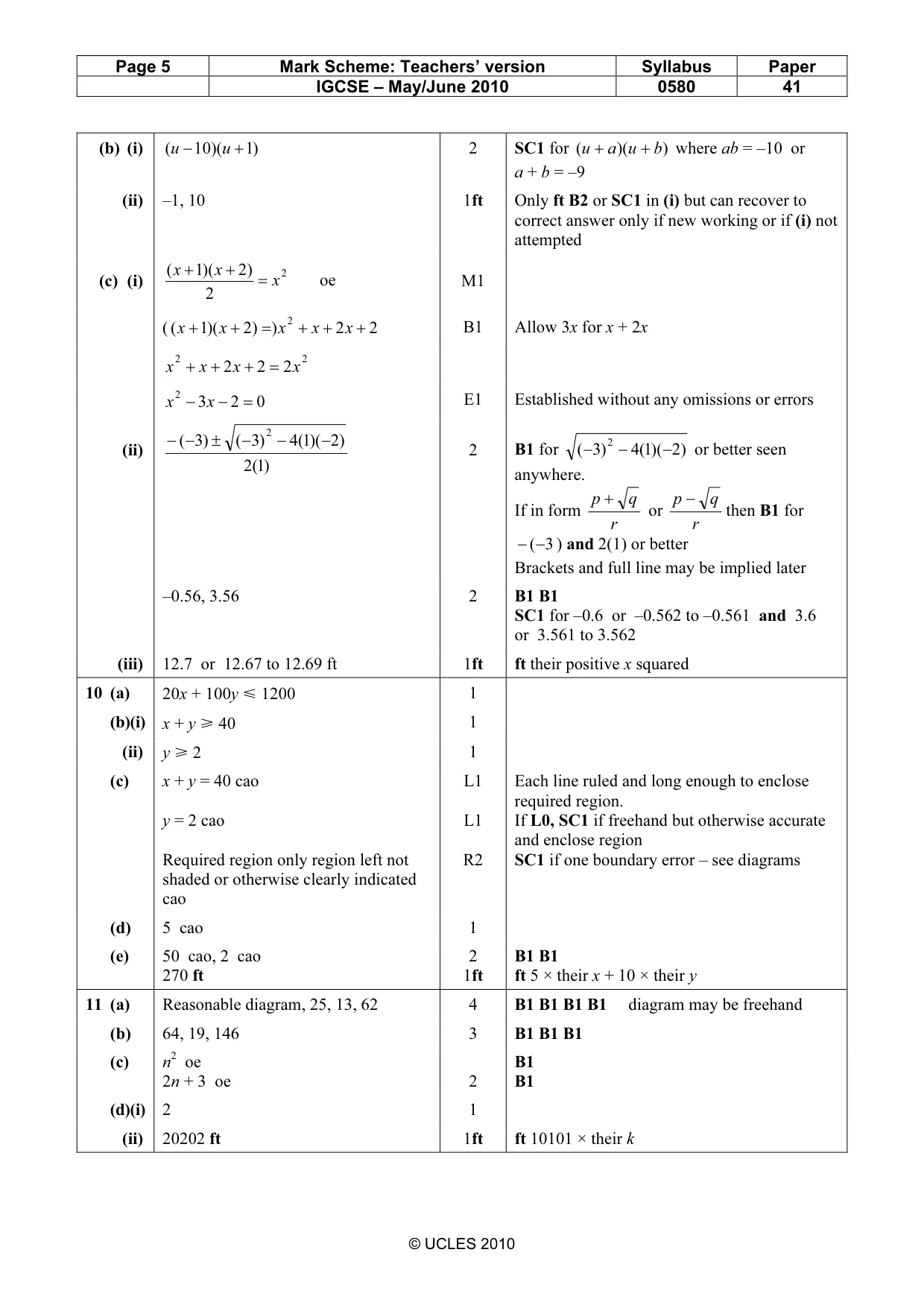
9 (a) Solve the following equations. Examiner's Use 5 3 (i) = w w + 1 Answer(a)(i) w = [2] (ii) ( y + 1) 2 = 4 Answer(a)(ii) y = or y = [2] x + 1 x − 2 (iii) − = 2 3 5 Answer(a)(iii) x = [3] (b) (i) Factorise u2 −9u −10. Answer(b)(i) [2] (ii) Solve the equation u2 −9u −10 = 0. Answer(b)(ii) u = or u = [1] For (c) Examiner's Use NOT TO SCALE x + 1 x x x + 2 The area of the triangle is equal to the area of the square. All lengths are in centimetres. (i) Show that x2 −3x −2 = 0. Answer(c)(i) [3] (ii) Solve the equation x2 – 3x – 2 = 0, giving your answers correct to 2 decimal places. Show all your working. Answer(c)(ii) x = or x = [4] (iii) Calculate the area of one of the shapes. Answer(c)(iii) cm2 [1]
Mark scheme: 9 (a) (i) –2.5 oe 2 M1 for 5(w + 1) = 3w (ii) –3 or 1 2 B1 B1 (If 0, SC1 for y + 1 = ± 2) (iii) 9.5 oe B3 M2 for 5 x + 5 − 3 x + 6 = 2 × 15 Condone one slip (sign or numerical) on left hand side 5( x + )1 3( x − 2) or M1 for − or better, 15 15 condoning one sign or numerical slip. IGCSE – May/June 2010 0580 41
What was in this paper
The subtopics covered by these 9 questions, and how many questions each got. Open one in a new tab to see every Cambridge question on it.