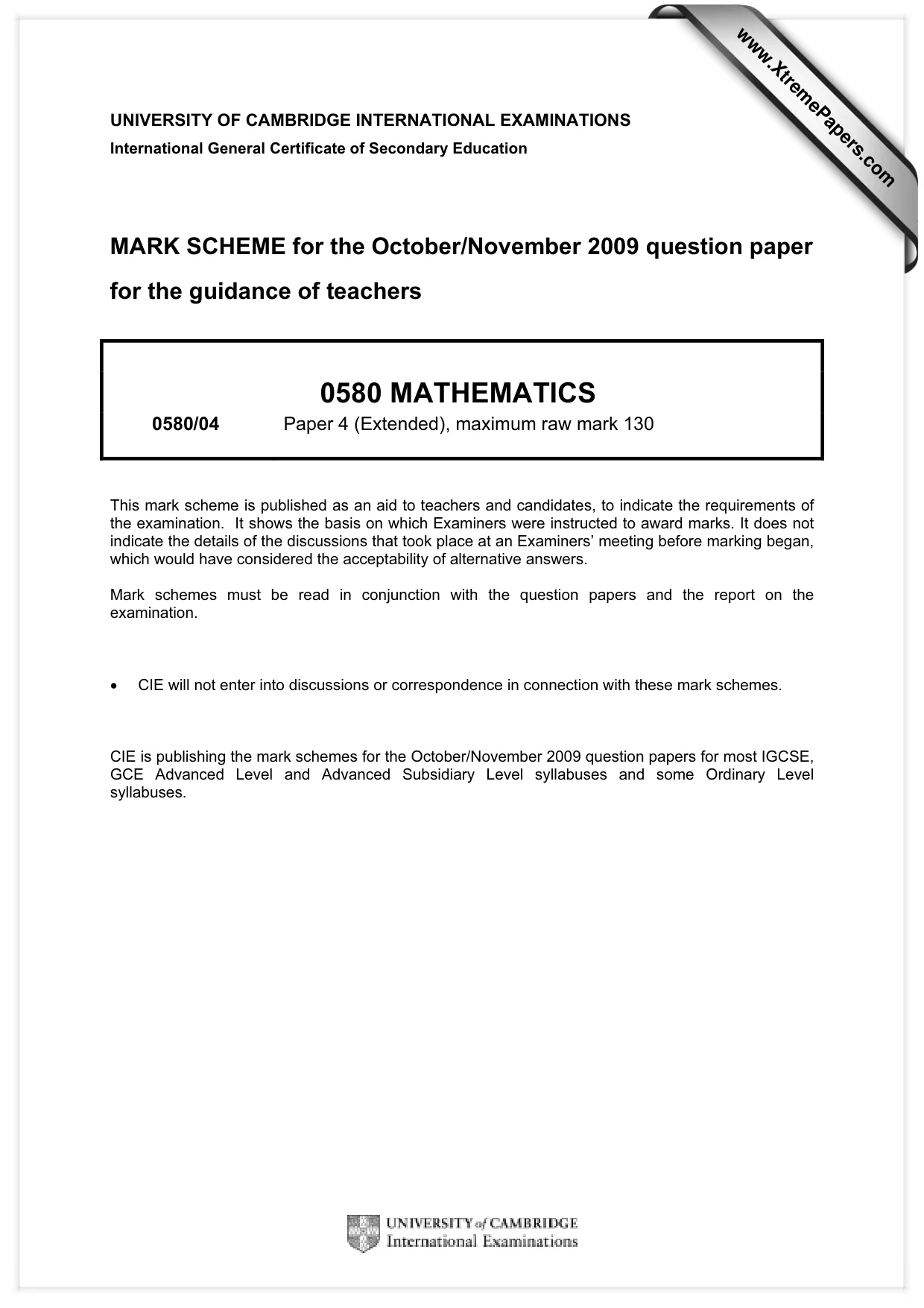
Cambridge IGCSE Mathematics 0580 — 2009 Oct/Nov Paper 4 · Variant 1
0580/41/O/N/09 · 8 questions · 130 marks · ≈146 min
The question paper and its mark scheme, free to read here and free to download. This is Cambridge’s own paper, exactly as it was sat.
Question paper24 pages
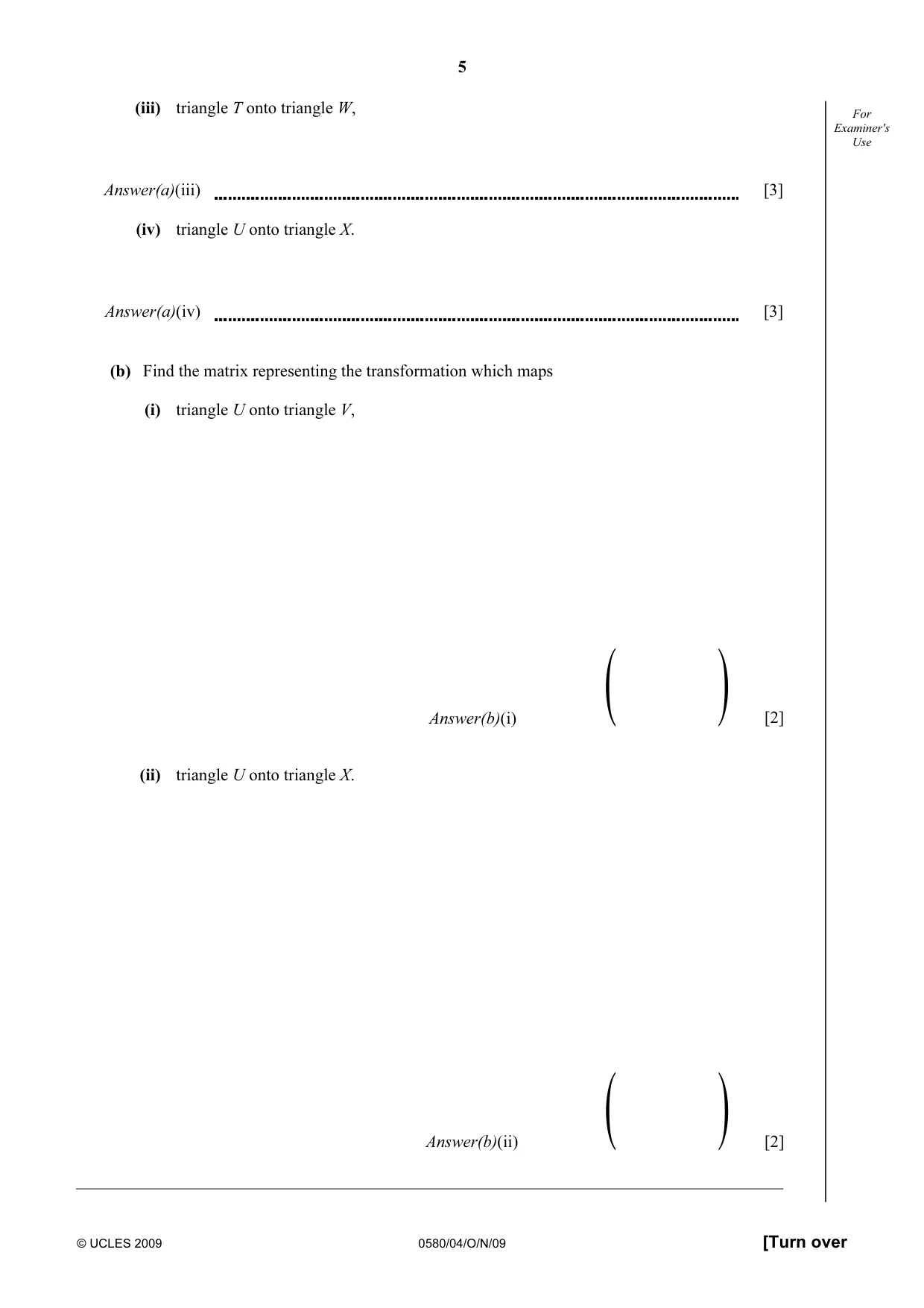
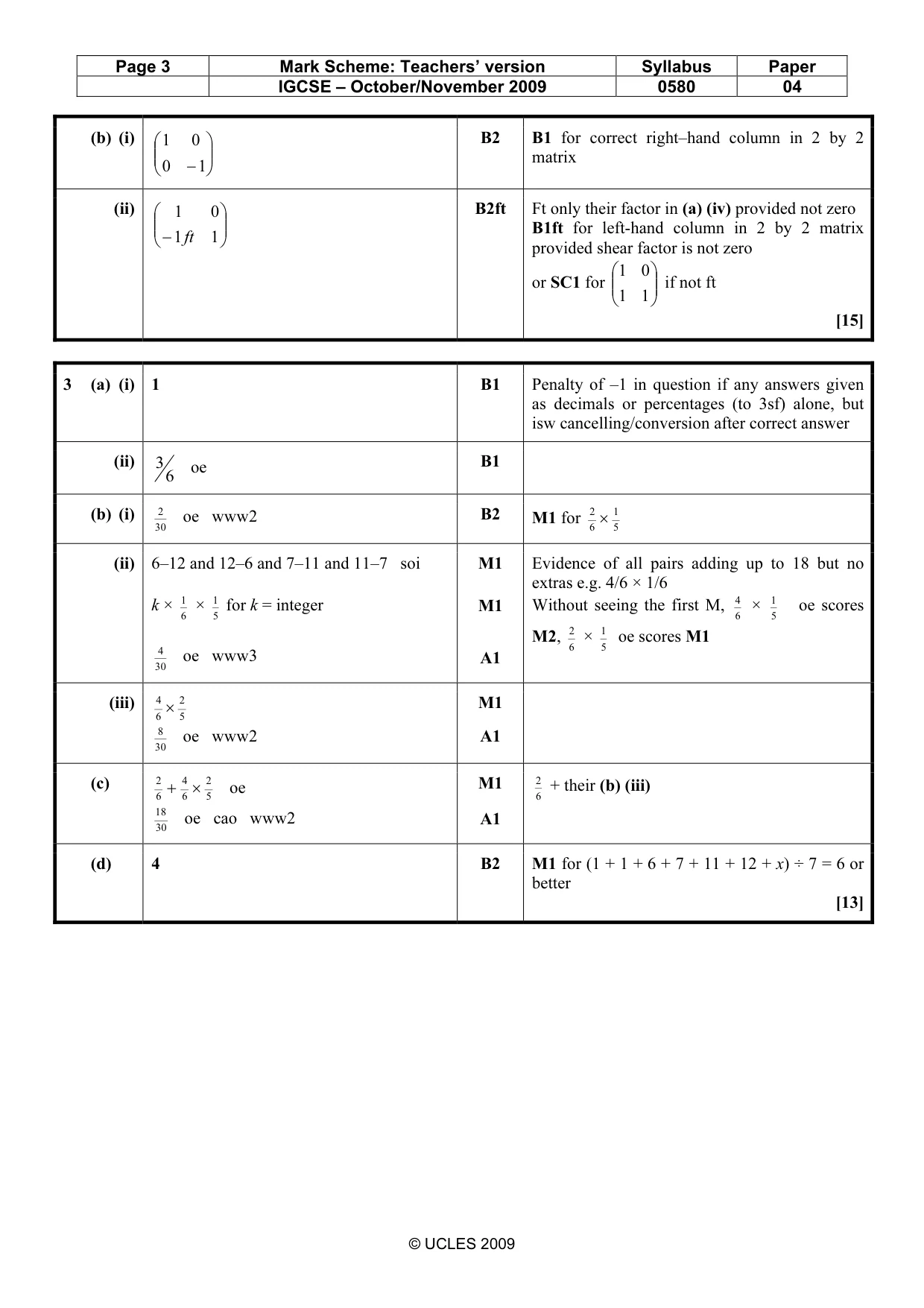
Mark scheme7 pages
Answers below. Sit the paper first if you are practising.
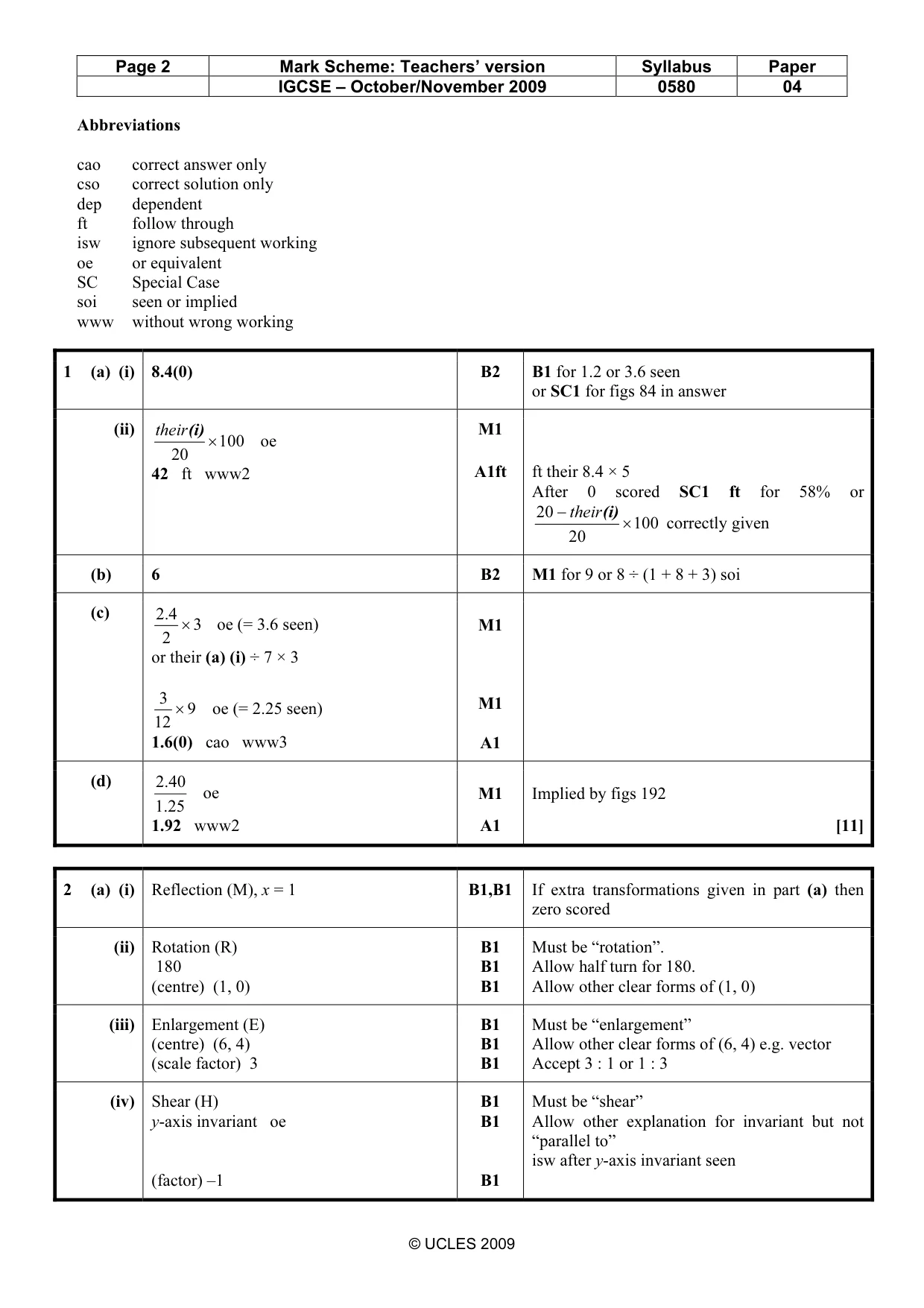
Questions as text
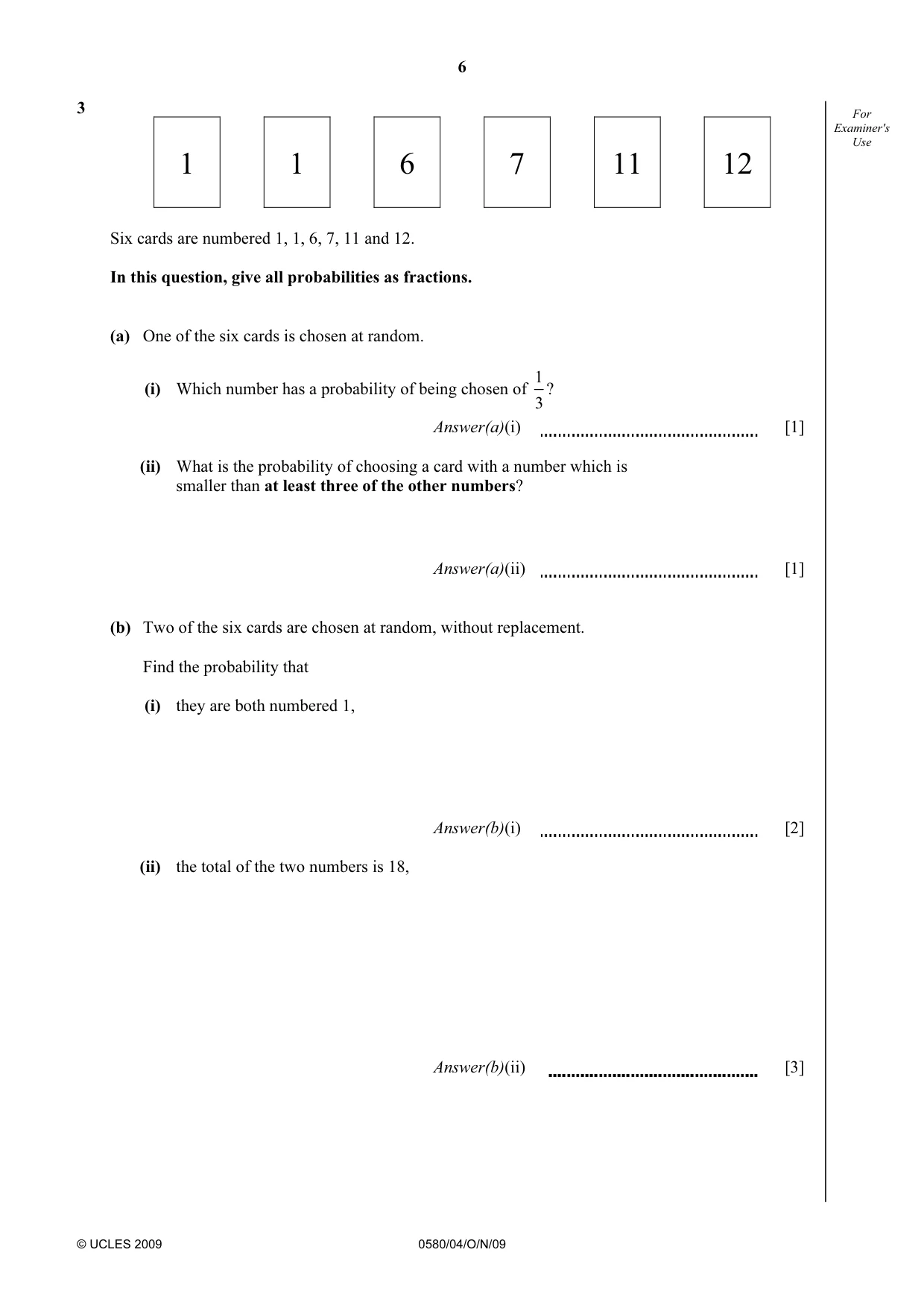
Q3 · For Examiner's Use 1 1 6 7 11 12 Six cards are numbered 1, 1, 6, 7, 11 and 12
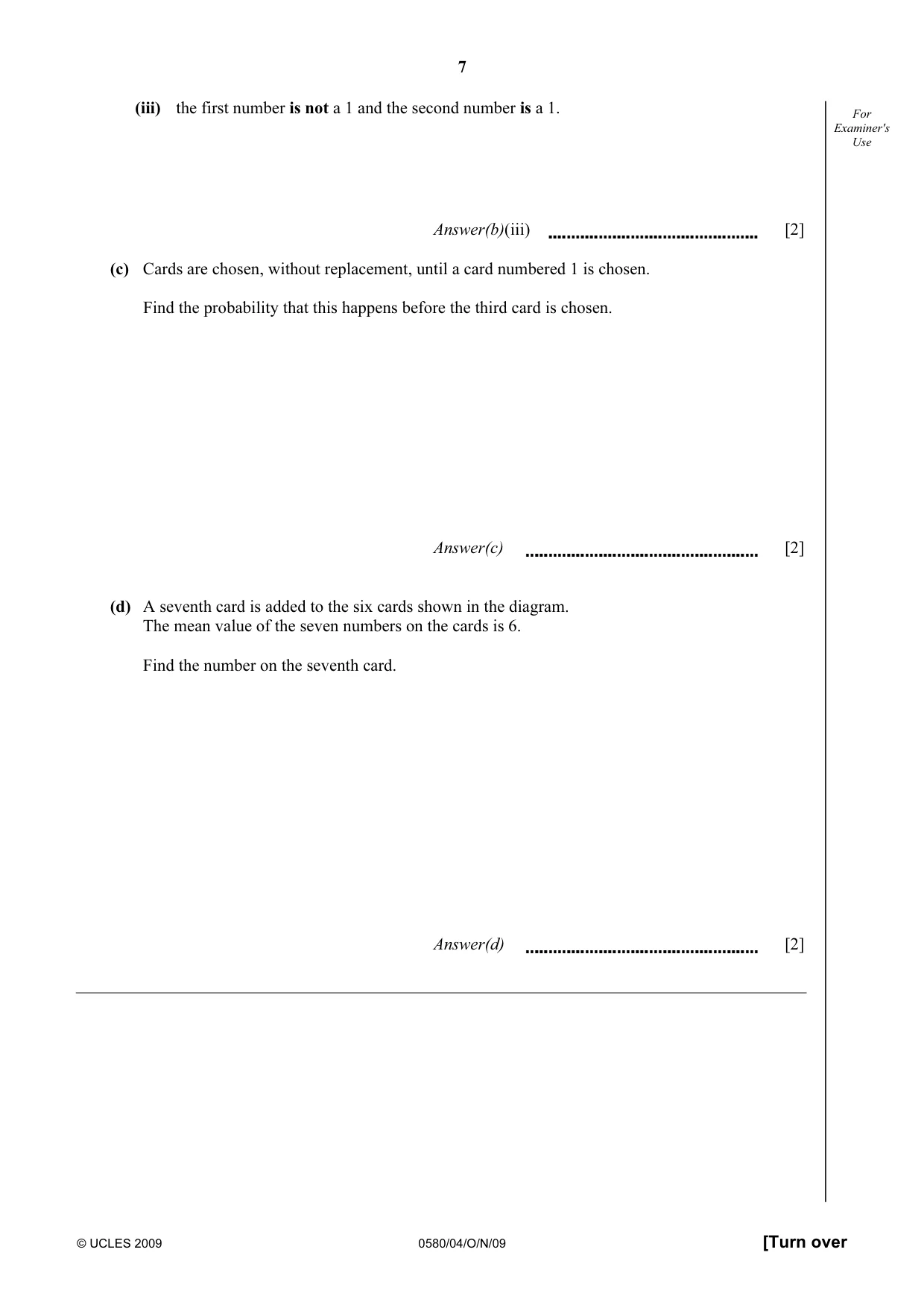
3 For Examiner's Use 1 1 6 7 11 12 Six cards are numbered 1, 1, 6, 7, 11 and 12. In this question, give all probabilities as fractions. (a) One of the six cards is chosen at random. 1 (i) Which number has a probability of being chosen of ? 3 Answer(a)(i) [1] (ii) What is the probability of choosing a card with a number which is smaller than at least three of the other numbers? Answer(a)(ii) [1] (b) Two of the six cards are chosen at random, without replacement. Find the probability that (i) they are both numbered 1, Answer(b)(i) [2] (ii) the total of the two numbers is 18, Answer(b)(ii) [3] (iii) the first number is not a 1 and the second number is a 1. For Examiner's Use Answer(b)(iii) [2] (c) Cards are chosen, without replacement, until a card numbered 1 is chosen. Find the probability that this happens before the third card is chosen. Answer(c) [2] (d) A seventh card is added to the six cards shown in the diagram. The mean value of the seven numbers on the cards is 6. Find the number on the seventh card. Answer(d) [2]
Mark scheme: 3 (a) (i) 1 B1 Penalty of –1 in question if any answers given as decimals or percentages (to 3sf) alone, but isw cancelling/conversion after correct answer (ii) 3 B1 oe 6 (b) (i) 2 oe www2 B2 M1 for 2 × 1 30 6 5 (ii) 6–12 and 12–6 and 7–11 and 11–7 soi M1 Evidence of all pairs adding up to 18 but no extras e.g. 4/6 × 1/6 k × 1 × 1 for k = integer M1 Without seeing the first M, 4 × 1 oe scores 6 5 6 5 M2, 2 × 1 oe scores M1 4 6 5 oe www3 A1 30 (iii) 4 × 2 M1 6 5 8 oe www2 A1 30 (c) 2 + 4 × 2 oe M1 2 + their (b) (iii) 6 6 5 6 18 oe cao www2 A1 30 (d) 4 B2 M1 for (1 + 1 + 6 + 7 + 11 + 12 + x) ÷ 7 = 6 or better [13] IGCSE – October/November 2009 0580 04
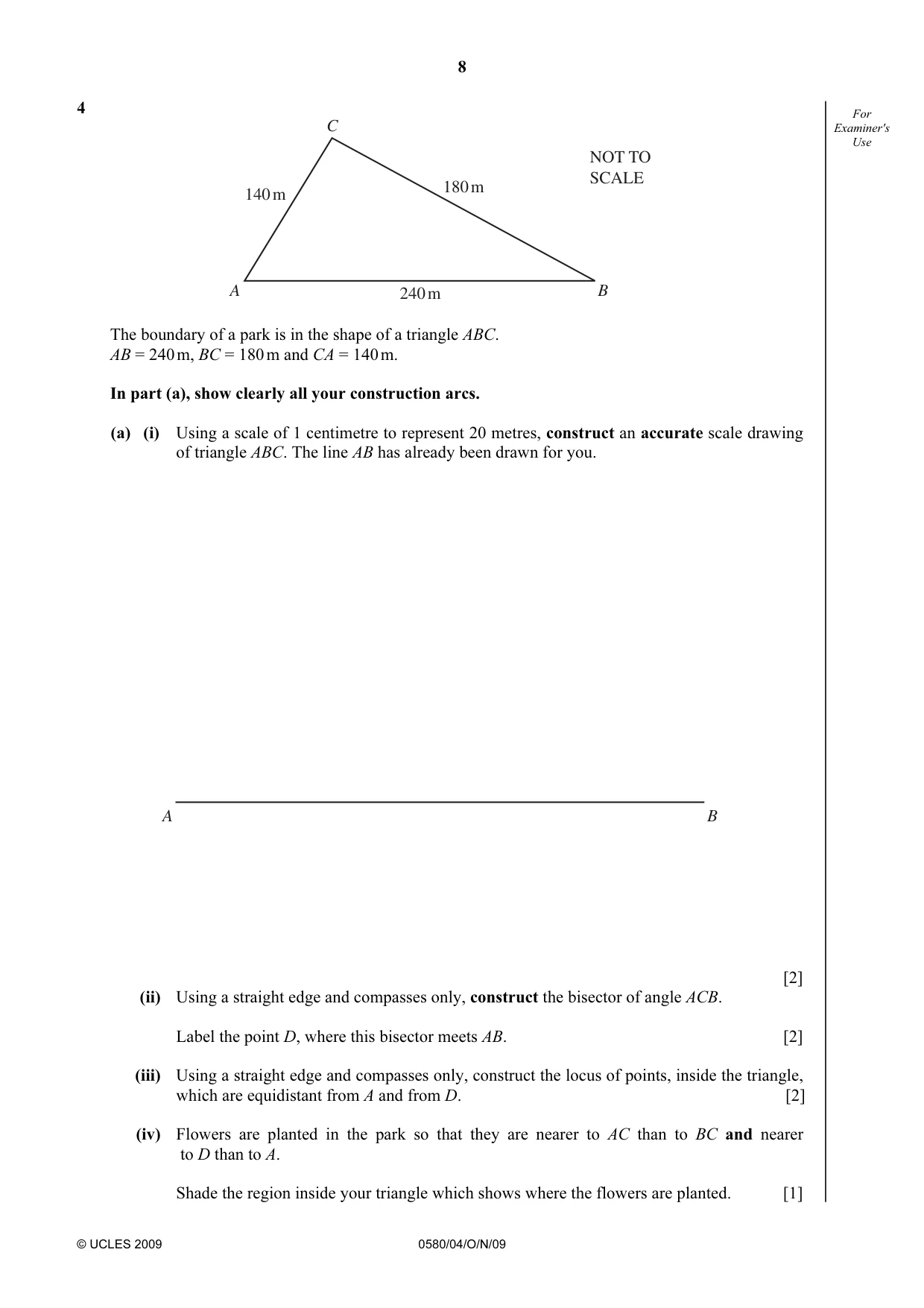
Q4 · For C Examiner's Use NOT TO SCALE 180 m 140 m A 240 m B The boundary of a park is in the…
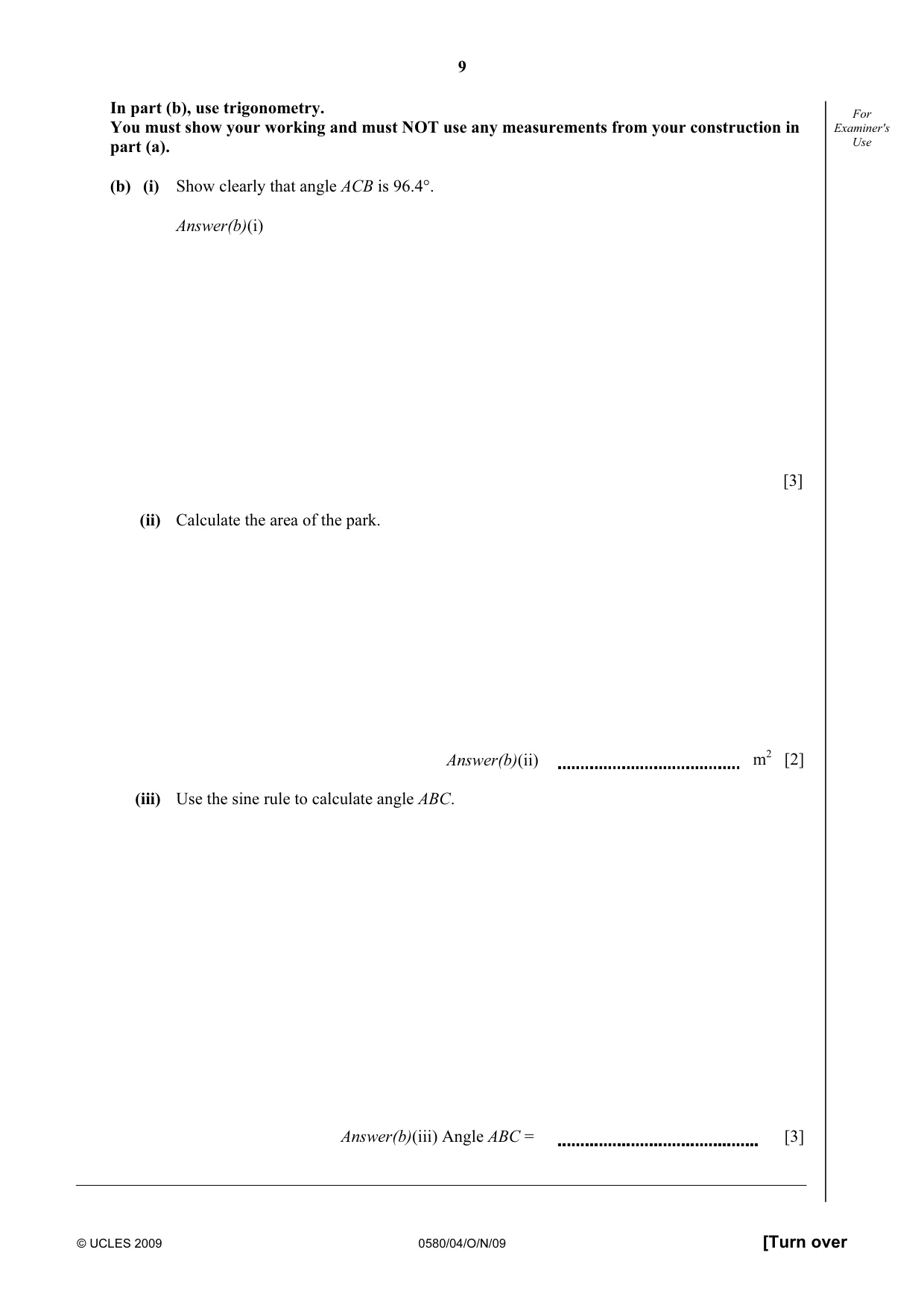
4 For C Examiner's Use NOT TO SCALE 180 m 140 m A 240 m B The boundary of a park is in the shape of a triangle ABC. AB = 240 m, BC = 180 m and CA = 140 m. In part (a), show clearly all your construction arcs. (a) (i) Using a scale of 1 centimetre to represent 20 metres, construct an accurate scale drawing of triangle ABC. The line AB has already been drawn for you. A B [2] (ii) Using a straight edge and compasses only, construct the bisector of angle ACB. Label the point D, where this bisector meets AB. [2] (iii) Using a straight edge and compasses only, construct the locus of points, inside the triangle, which are equidistant from A and from D. [2] (iv) Flowers are planted in the park so that they are nearer to AC than to BC and nearer to D than to A. Shade the region inside your triangle which shows where the flowers are planted. [1] In part (b), use trigonometry. For You must show your working and must NOT use any measurements from your construction in Examiner's part (a). Use (b) (i) Show clearly that angle ACB is 96.4°. Answer(b)(i) [3] (ii) Calculate the area of the park. Answer(b)(ii) m2 [2] (iii) Use the sine rule to calculate angle ABC. Answer(b)(iii) Angle ABC = [3]
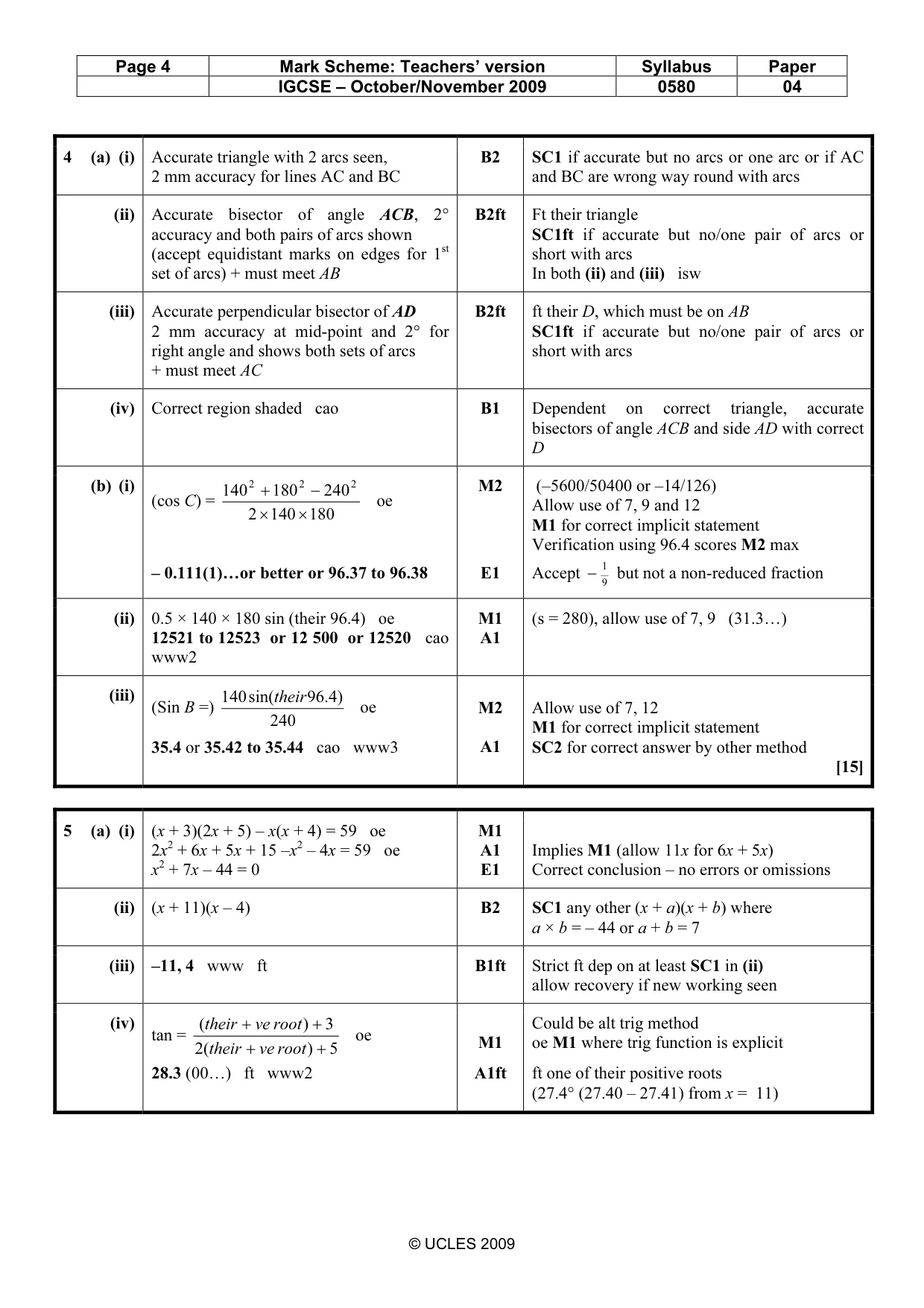
Mark scheme: 4 (a) (i) Accurate triangle with 2 arcs seen, B2 SC1 if accurate but no arcs or one arc or if AC 2 mm accuracy for lines AC and BC and BC are wrong way round with arcs (ii) Accurate bisector of angle ACB, 2° B2ft Ft their triangle accuracy and both pairs of arcs shown SC1ft if accurate but no/one pair of arcs or (accept equidistant marks on edges for 1st short with arcs set of arcs) + must meet AB In both (ii) and (iii) isw (iii) Accurate perpendicular bisector of AD B2ft ft their D, which must be on AB 2 mm accuracy at mid-point and 2° for SC1ft if accurate but no/one pair of arcs or right angle and shows both sets of arcs short with arcs + must meet AC (iv) Correct region shaded cao B1 Dependent on correct triangle, accurate bisectors of angle ACB and side AD with correct D (b) (i) 140 2 + 180 2 − 240 2 M2 (–5600/50400 or –14/126) (cos C) = oe Allow use of 7, 9 and 12 2 × 140 × 180 M1 for correct implicit statement Verification using 96.4 scores M2 max – 0.111(1)…or better or 96.37 to 96.38 E1 Accept − 1 but not a non-reduced fraction 9 (ii) 0.5 × 140 × 180 sin (their 96.4) oe M1 (s = 280), allow use of 7, 9 (31.3…) 12521 to 12523 or 12 500 or 12520 cao A1 www2 (iii) 140 sin(their 964.) (Sin B =) oe M2 Allow use of 7, 12 240 M1 for correct implicit statement 35.4 or 35.42 to 35.44 cao www3 A1 SC2 for correct answer by other method [15]
Q5 · For NOT TO Examiner's D C SCALE Use S R (x + 3) cm x cm A B P Q (2x + 5) cm (x + 4) cm…
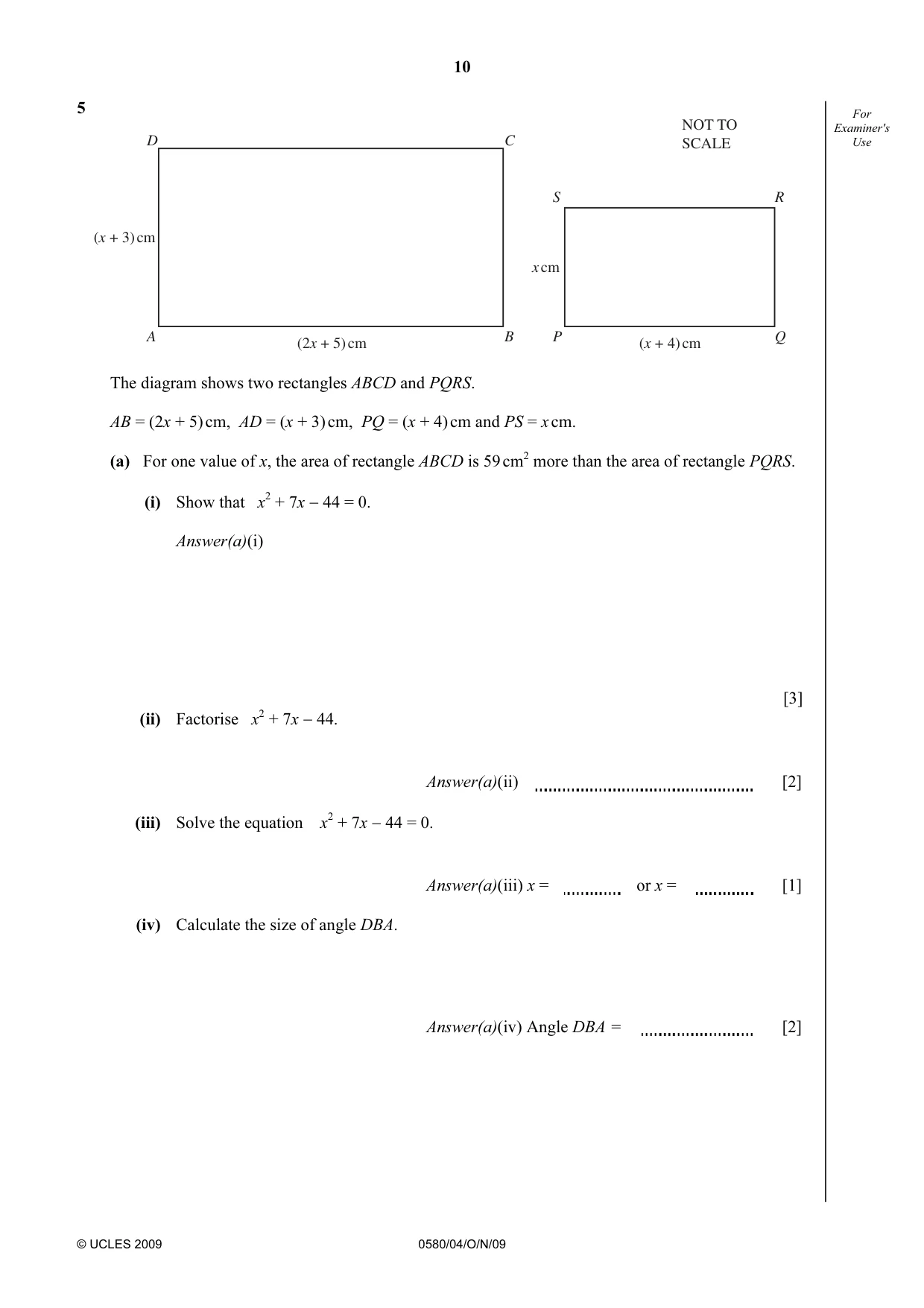
5 For NOT TO Examiner's D C SCALE Use S R (x + 3) cm x cm A B P Q (2x + 5) cm (x + 4) cm The diagram shows two rectangles ABCD and PQRS. AB = (2x + 5) cm, AD = (x + 3) cm, PQ = (x + 4) cm and PS = x cm. (a) For one value of x, the area of rectangle ABCD is 59 cm2 more than the area of rectangle PQRS. (i) Show that x2 + 7x − 44 = 0. Answer(a)(i) [3] (ii) Factorise x2 + 7x − 44. Answer(a)(ii) [2] (iii) Solve the equation x2 + 7x − 44 = 0. Answer(a)(iii) x = or x = [1] (iv) Calculate the size of angle DBA. Answer(a)(iv) Angle DBA = [2] (b) For a different value of x, the rectangles ABCD and PQRS are similar. For Examiner's (i) Show that this value of x satisfies the equation x2 − 2x − 12 = 0. Use Answer(b)(i) [3] (ii) Solve the equation x2 − 2x − 12 = 0, giving your answers correct to 2 decimal places. Answer(b)(ii) x = or x = [4] (iii) Calculate the perimeter of the rectangle PQRS. Answer(b)(iii) cm [1]
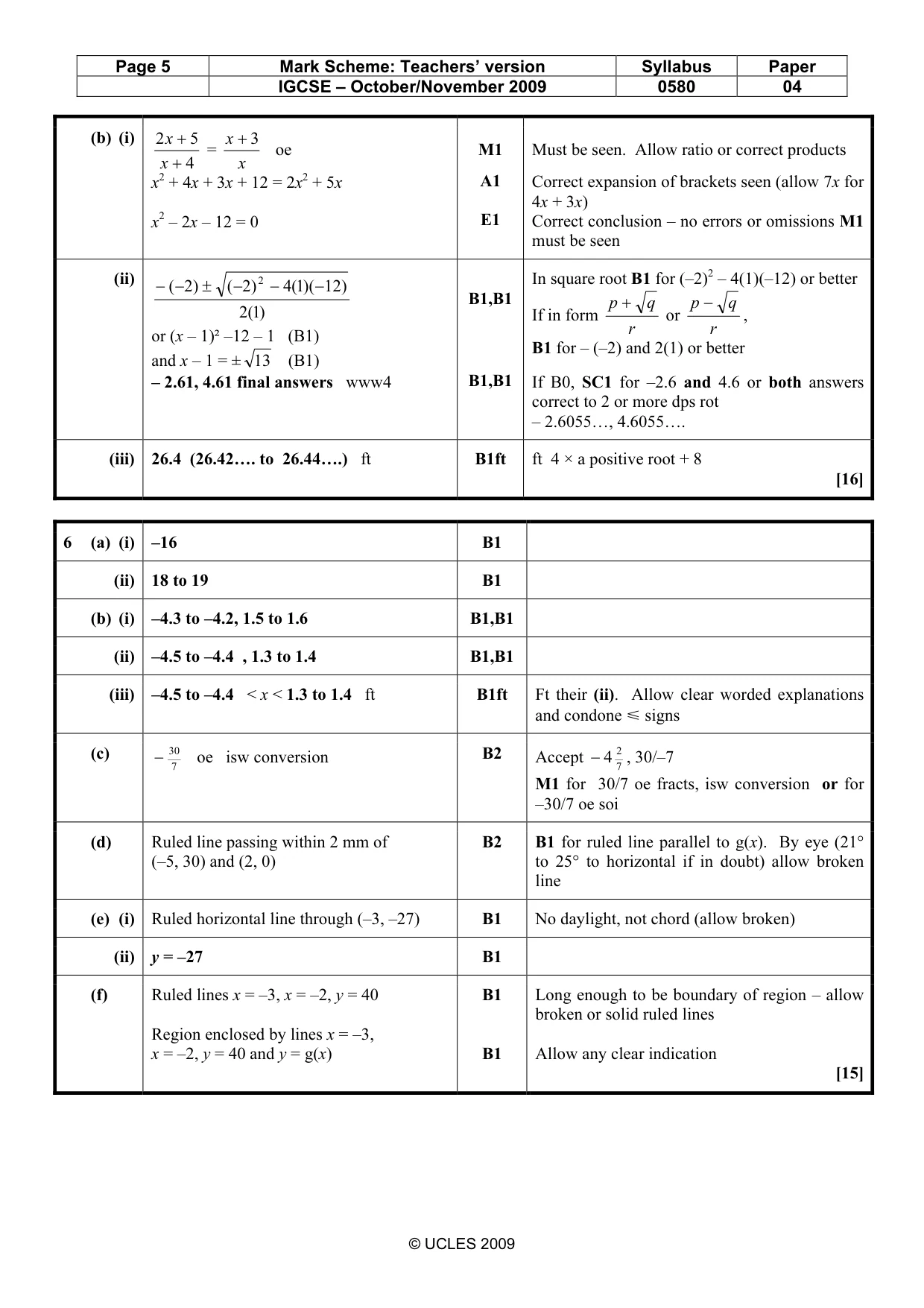
Mark scheme: 5 (a) (i) (x + 3)(2x + 5) – x(x + 4) = 59 oe M1 2x2 + 6x + 5x + 15 –x2 – 4x = 59 oe A1 Implies M1 (allow 11x for 6x + 5x) x2 + 7x – 44 = 0 E1 Correct conclusion – no errors or omissions (ii) (x + 11)(x – 4) B2 SC1 any other (x + a)(x + b) where a × b = – 44 or a + b = 7 (iii) –11, 4 www ft B1ft Strict ft dep on at least SC1 in (ii) allow recovery if new working seen (iv) (their + ve root ) + 3 Could be alt trig method tan = oe M1 oe M1 where trig function is explicit 2(their + ve root ) + 5 28.3 (00…) ft www2 A1ft ft one of their positive roots (27.4° (27.40 – 27.41) from x = 11) IGCSE – October/November 2009 0580 04 (b) (i) 2 x + 5 x + 3 = oe M1 Must be seen. Allow ratio or correct products x + 4 x x2 + 4x + 3x + 12 = 2x2 + 5x A1 Correct expansion of brackets seen (allow 7x for 4x + 3x) x2 – 2x – 12 = 0 E1 Correct conclusion – no errors or omissions M1 must be seen (ii) 2 In square root B1 for (–2)2 – 4(1)(–12) or better − ( −2 ) ± ( −2) − 41()( −12) B1,B1 p + q p − q 2 )1( If in form or , r r or (x – 1)² –12 – 1 (B1) B1 for – (–2) and 2(1) or better and x – 1 = ± 13 (B1) – 2.61, 4.61 final answers www4 B1,B1 If B0, SC1 for –2.6 and 4.6 or both answers correct to 2 or more dps rot – 2.6055…, 4.6055…. (iii) 26.4 (26.42…. to 26.44….) ft B1ft ft 4 × a positive root + 8 [16]
Q6 · For y Examiner's Use 50 A 40 y = f(x) 30 20 y = g(x) 10 B x –5 –4 –3 –2 –1 0 1 2 –10 –20…
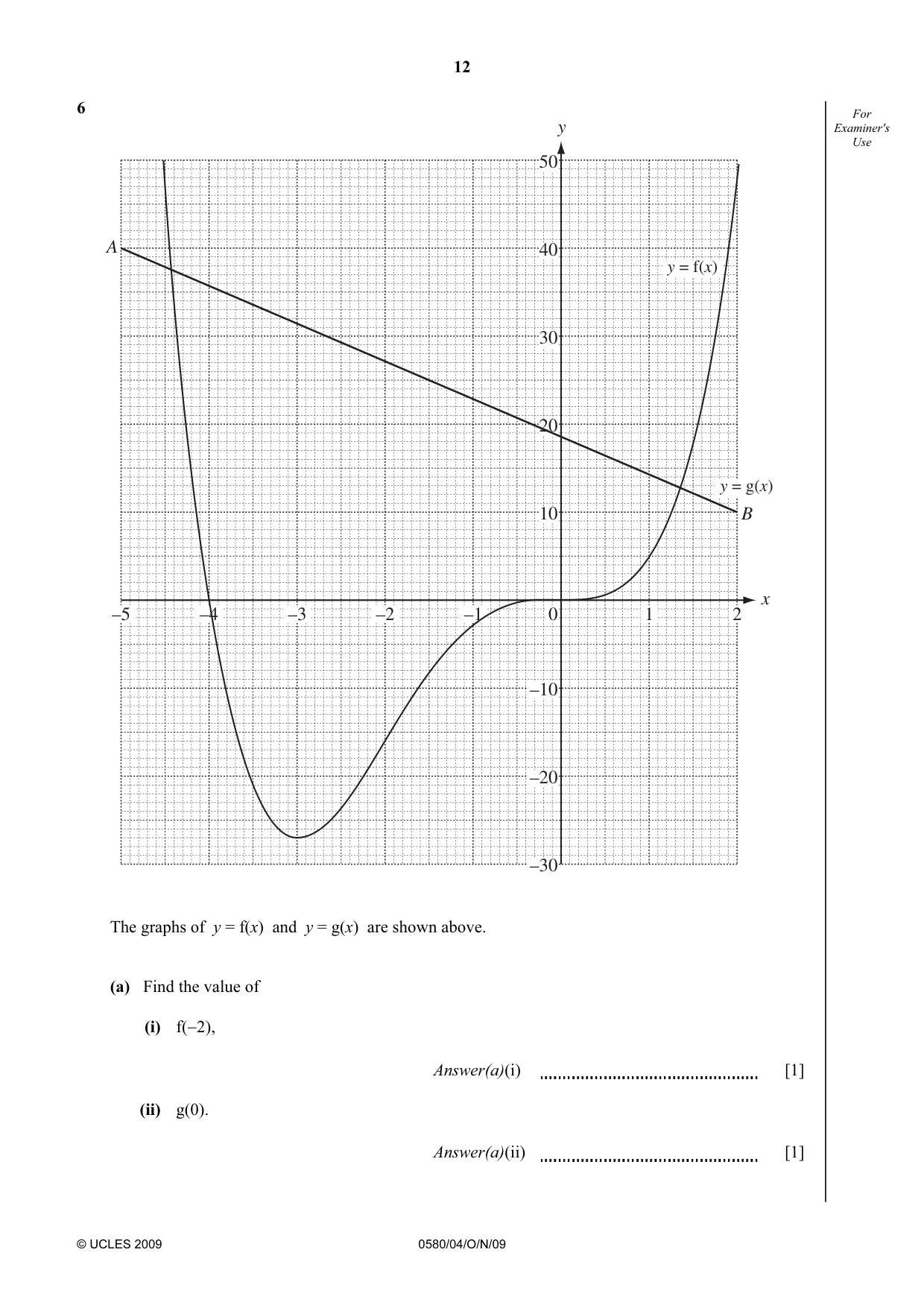
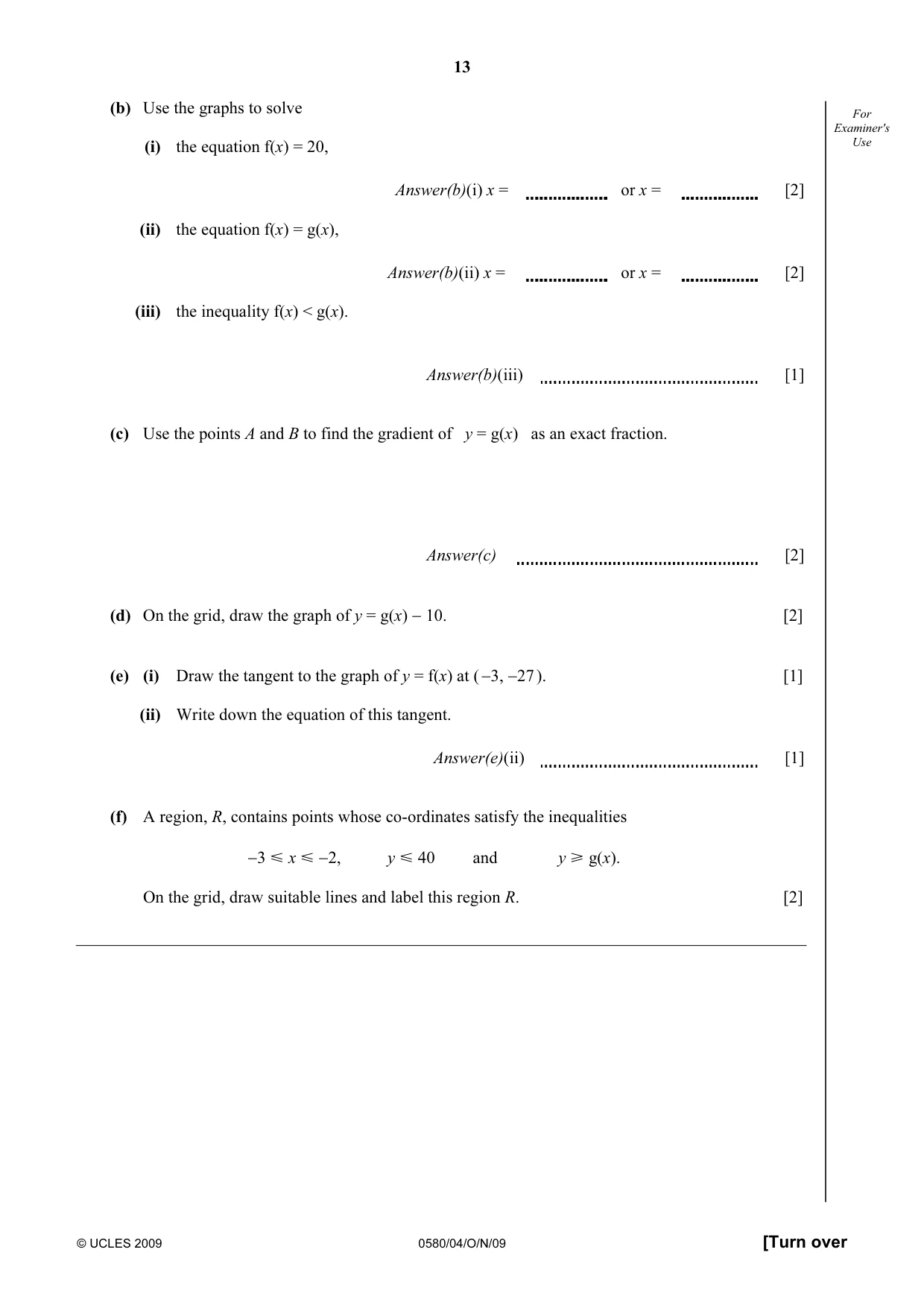
6 For y Examiner's Use 50 A 40 y = f(x) 30 20 y = g(x) 10 B x –5 –4 –3 –2 –1 0 1 2 –10 –20 –30 The graphs of y = f(x) and y = g(x) are shown above. (a) Find the value of (i) f(−2), Answer(a)(i) [1] (ii) g(0). Answer(a)(ii) [1] (b) Use the graphs to solve For Examiner's (i) the equation f(x) = 20, Use Answer(b)(i) x = or x = [2] (ii) the equation f(x) = g(x), Answer(b)(ii) x = or x = [2] (iii) the inequality f(x) < g(x). Answer(b)(iii) [1] (c) Use the points A and B to find the gradient of y = g(x) as an exact fraction. Answer(c) [2] (d) On the grid, draw the graph of y = g(x) − 10. [2] (e) (i) Draw the tangent to the graph of y = f(x) at ( −3, −27 ). [1] (ii) Write down the equation of this tangent. Answer(e)(ii) [1] (f) A region, R, contains points whose co-ordinates satisfy the inequalities −3 Y x Y −2, y Y 40 and y [ g(x). On the grid, draw suitable lines and label this region R. [2]
Mark scheme: 6 (a) (i) –16 B1 (ii) 18 to 19 B1 (b) (i) –4.3 to –4.2, 1.5 to 1.6 B1,B1 (ii) –4.5 to –4.4 , 1.3 to 1.4 B1,B1 (iii) –4.5 to –4.4 < x < 1.3 to 1.4 ft B1ft Ft their (ii). Allow clear worded explanations and condone Y signs (c) − 30 oe isw conversion B2 Accept − 4 2 , 30/–7 7 7 M1 for 30/7 oe fracts, isw conversion or for –30/7 oe soi (d) Ruled line passing within 2 mm of B2 B1 for ruled line parallel to g(x). By eye (21° (–5, 30) and (2, 0) to 25° to horizontal if in doubt) allow broken line (e) (i) Ruled horizontal line through (–3, –27) B1 No daylight, not chord (allow broken) (ii) y = –27 B1 (f) Ruled lines x = –3, x = –2, y = 40 B1 Long enough to be boundary of region – allow broken or solid ruled lines Region enclosed by lines x = –3, x = –2, y = 40 and y = g(x) B1 Allow any clear indication [15] IGCSE – October/November 2009 0580 04
Q7 · For A Examiner's NOT TO Use SCALE 60° O 24 cm B (a) The sector of a circle, centre O…
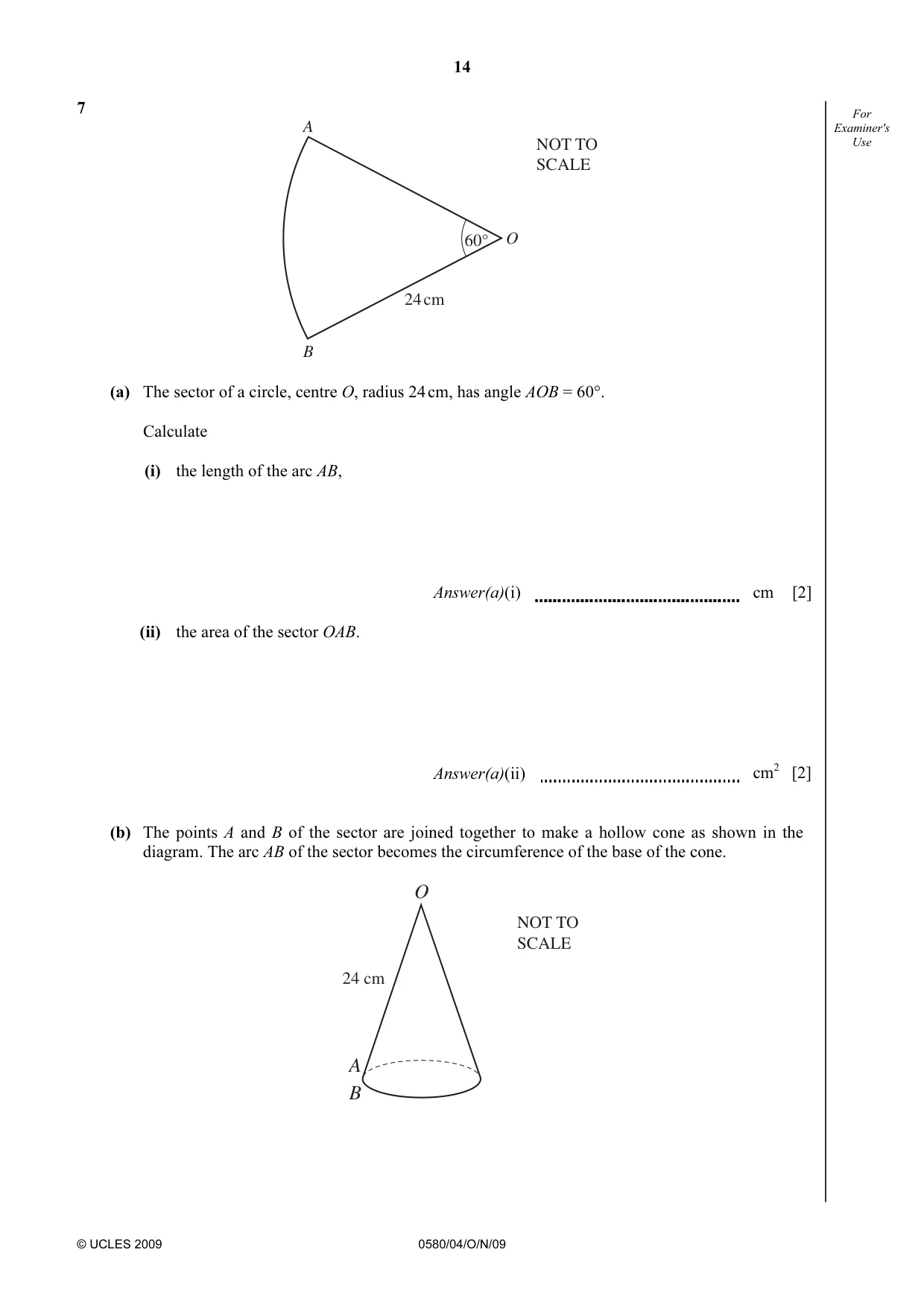
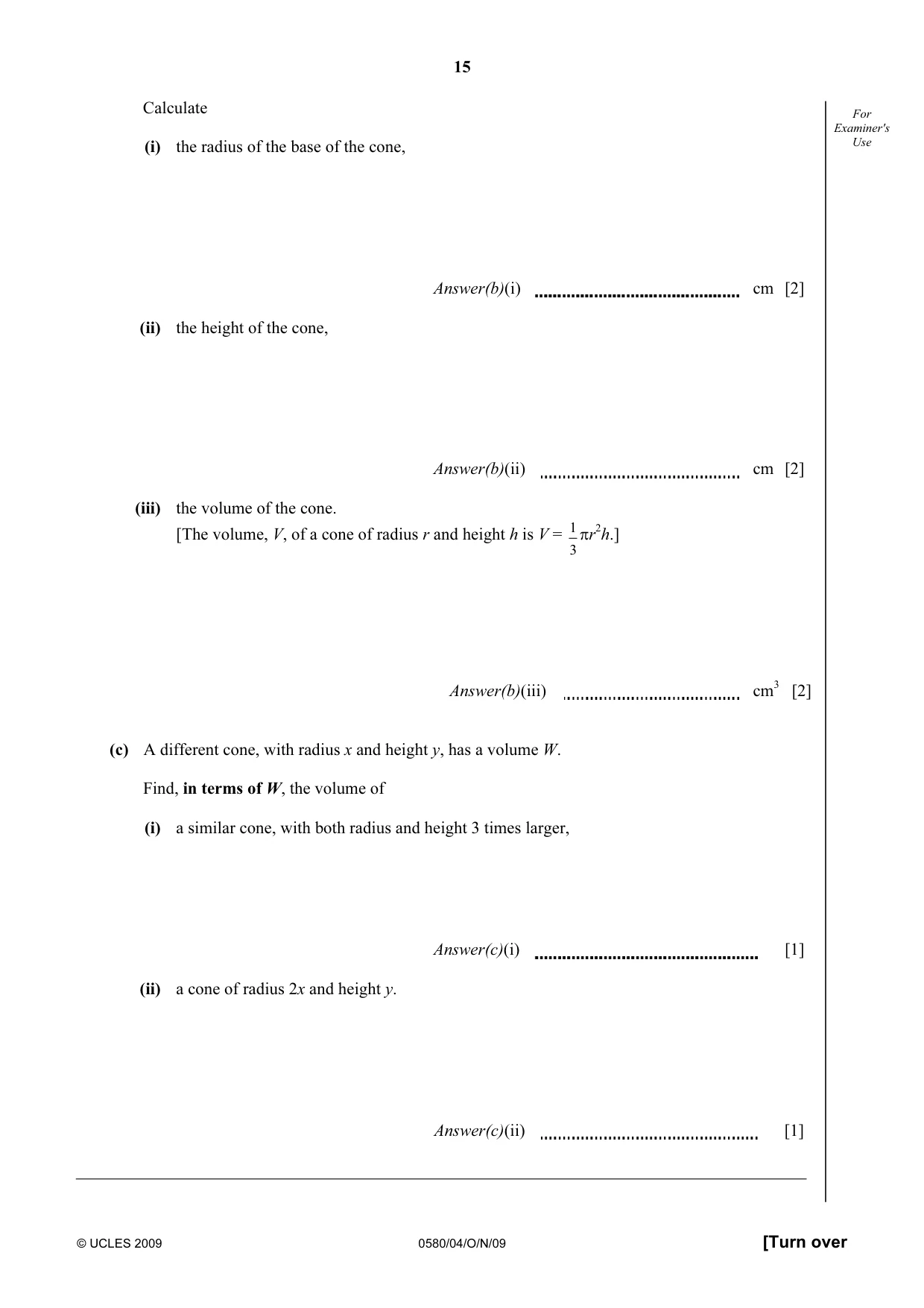
7 For A Examiner's NOT TO Use SCALE 60° O 24 cm B (a) The sector of a circle, centre O, radius 24 cm, has angle AOB = 60°. Calculate (i) the length of the arc AB, Answer(a)(i) cm [2] (ii) the area of the sector OAB. Answer(a)(ii) cm2 [2] (b) The points A and B of the sector are joined together to make a hollow cone as shown in the diagram. The arc AB of the sector becomes the circumference of the base of the cone. O NOT TO SCALE 24 cm A B Calculate For Examiner's (i) the radius of the base of the cone, Use Answer(b)(i) cm [2] (ii) the height of the cone, Answer(b)(ii) cm [2] (iii) the volume of the cone. 1 [The volume, V, of a cone of radius r and height h is V = πr2h.] 3 Answer(b)(iii) cm3 [2] (c) A different cone, with radius x and height y, has a volume W. Find, in terms of W, the volume of (i) a similar cone, with both radius and height 3 times larger, Answer(c)(i) [1] (ii) a cone of radius 2x and height y. Answer(c)(ii) [1]
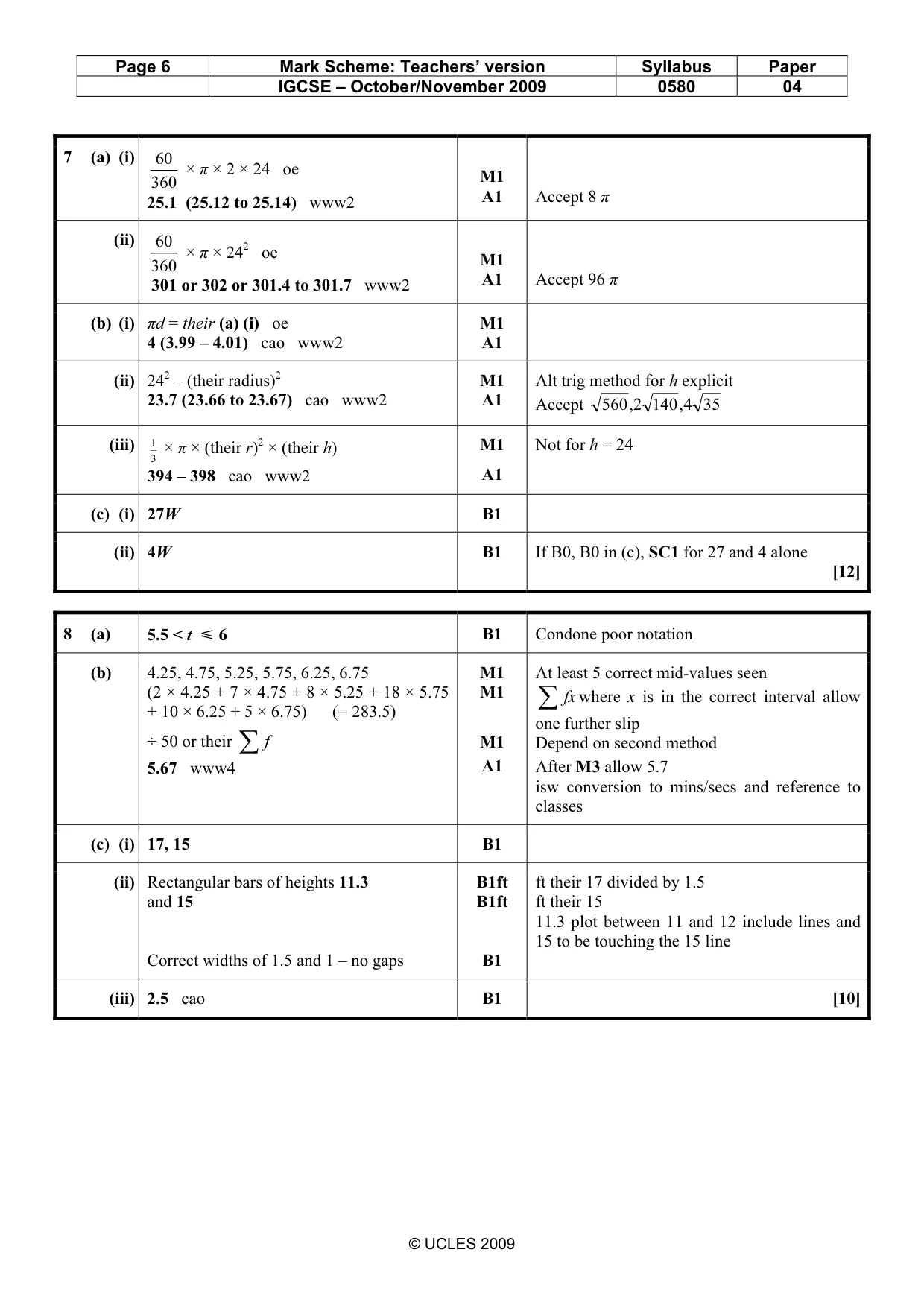
Mark scheme: 7 (a) (i) 60 × π × 2 × 24 oe M1 360 A1 Accept 8 π 25.1 (25.12 to 25.14) www2 (ii) 60 × π × 242 oe M1 360 A1 Accept 96 π 301 or 302 or 301.4 to 301.7 www2 (b) (i) πd = their (a) (i) oe M1 4 (3.99 – 4.01) cao www2 A1 (ii) 242 – (their radius)2 M1 Alt trig method for h explicit 23.7 (23.66 to 23.67) cao www2 A1 Accept 560 2, 140 4, 35 (iii) 1 × π × (their r)2 × (their h) M1 Not for h = 24 3 394 – 398 cao www2 A1 (c) (i) 27W B1 (ii) 4W B1 If B0, B0 in (c), SC1 for 27 and 4 alone [12]
Q8 · Fifty students are timed when running one kilometre
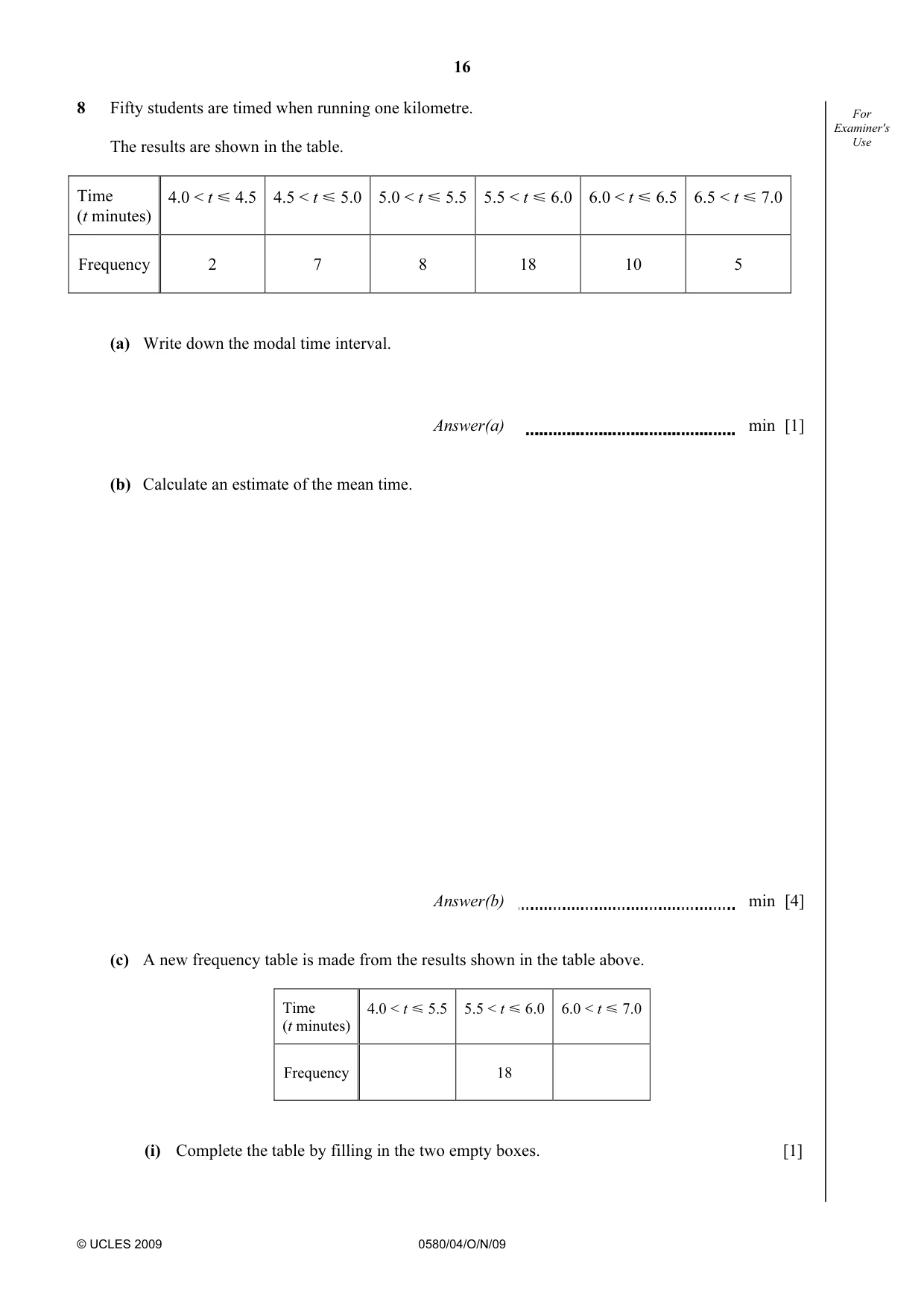
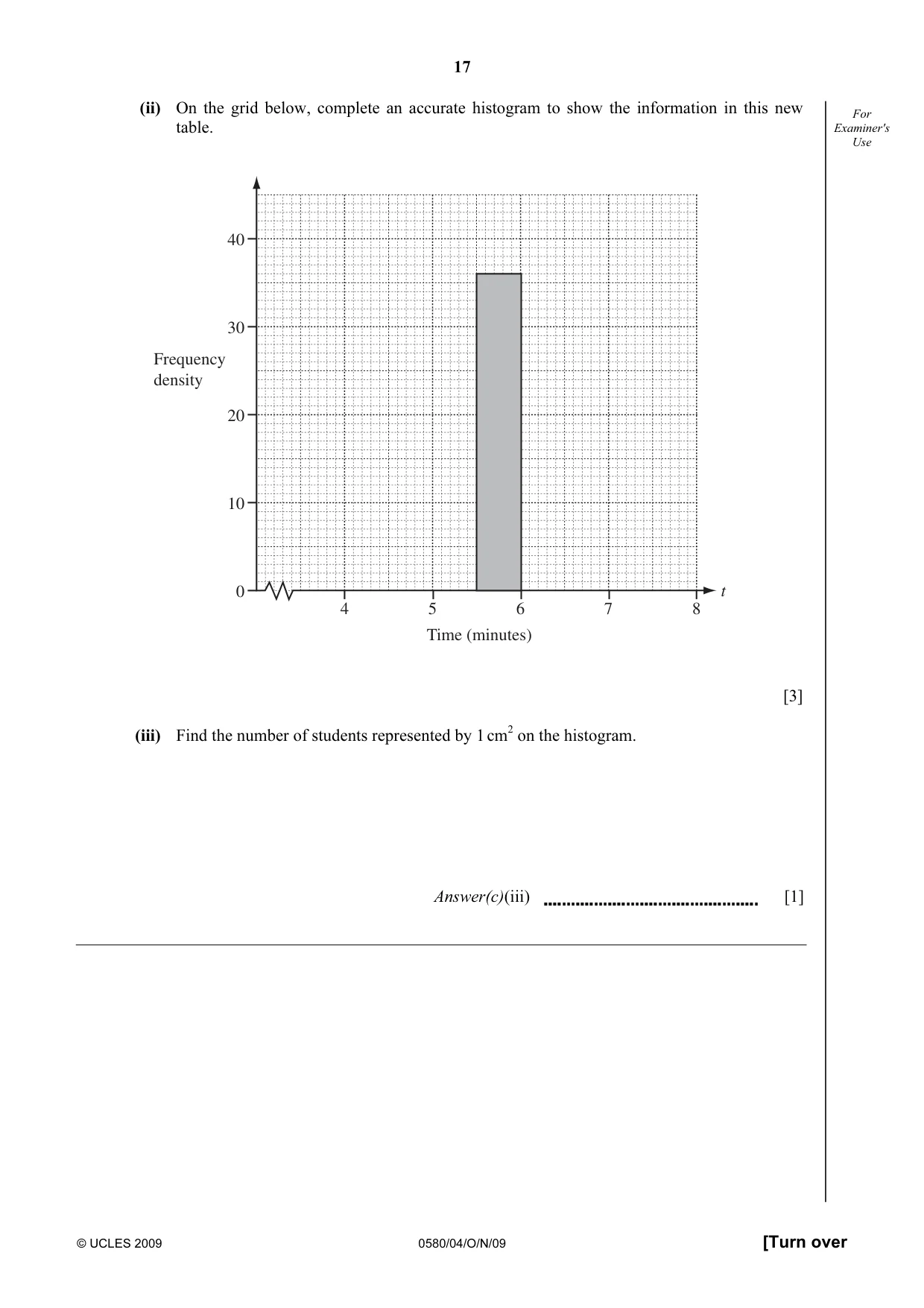
8 Fifty students are timed when running one kilometre. For Examiner's The results are shown in the table. Use Time 4.0 < t Y 4.5 4.5 < t Y 5.0 5.0 < t Y 5.5 5.5 < t Y 6.0 6.0 < t Y 6.5 6.5 < t Y 7.0 (t minutes) Frequency 2 7 8 18 10 5 (a) Write down the modal time interval. Answer(a) min [1] (b) Calculate an estimate of the mean time. Answer(b) min [4] (c) A new frequency table is made from the results shown in the table above. Time 4.0 < t Y 5.5 5.5 < t Y 6.0 6.0 < t Y 7.0 (t minutes) Frequency 18 (i) Complete the table by filling in the two empty boxes. [1] (ii) On the grid below, complete an accurate histogram to show the information in this new For table. Examiner's Use 40 30 Frequency density 20 10 0 t 4 5 6 7 8 Time (minutes) [3] (iii) Find the number of students represented by 1 cm2 on the histogram. Answer(c)(iii) [1]
Mark scheme: 8 (a) 5.5 < t Y 6 B1 Condone poor notation (b) 4.25, 4.75, 5.25, 5.75, 6.25, 6.75 M1 At least 5 correct mid-values seen where x is in the correct interval allow (2 × 4.25 + 7 × 4.75 + 8 × 5.25 + 18 × 5.75 M1 ∑fx + 10 × 6.25 + 5 × 6.75) (= 283.5) one further slip M1 Depend on second method ÷ 50 or their ∑f 5.67 www4 A1 After M3 allow 5.7 isw conversion to mins/secs and reference to classes (c) (i) 17, 15 B1 (ii) Rectangular bars of heights 11.3 B1ft ft their 17 divided by 1.5 and 15 B1ft ft their 15 11.3 plot between 11 and 12 include lines and 15 to be touching the 15 line Correct widths of 1.5 and 1 – no gaps B1 (iii) 2.5 cao B1 [10] IGCSE – October/November 2009 0580 04
Q9 · _ m 3 m + 4 _ For 9 (a) Solve the equation + = 7
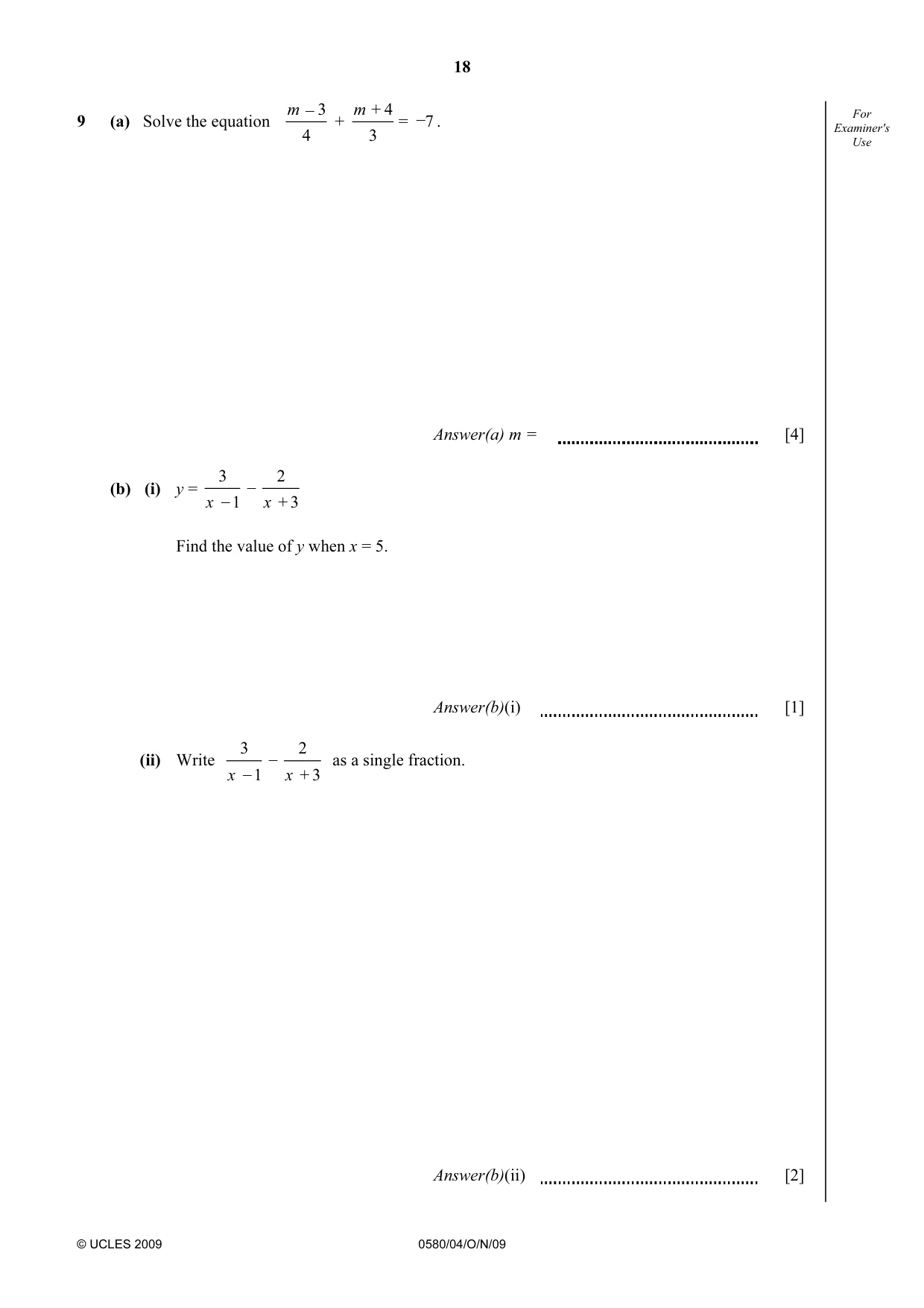
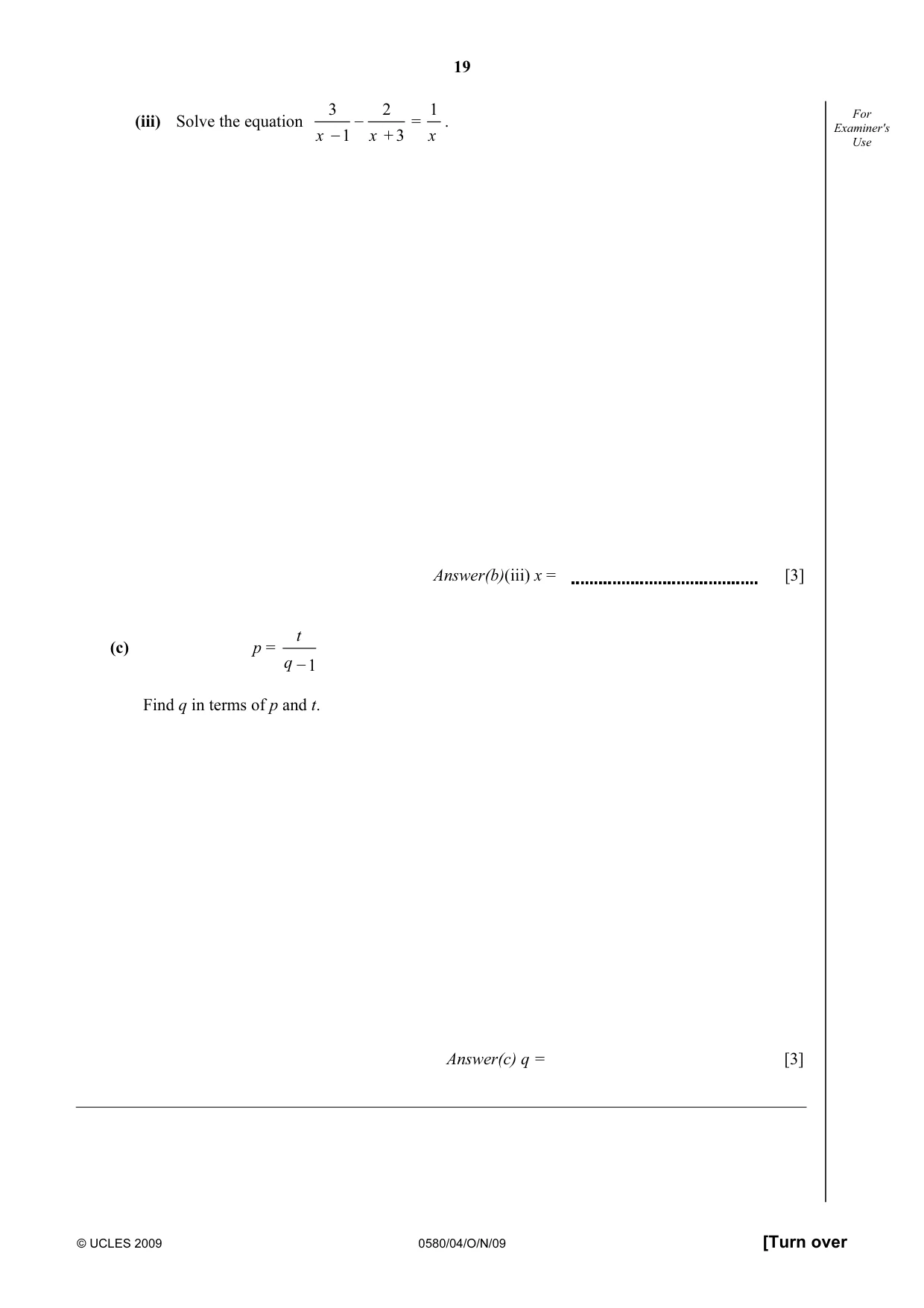
_ m 3 m + 4 _ For 9 (a) Solve the equation + = 7 . Examiner's 4 3 Use Answer(a) m = [4] 3 _ 2 (b) (i) y = _ x 1 x + 3 Find the value of y when x = 5. Answer(b)(i) [1] 3 _ 2 (ii) Write as a single fraction. _ x 1 x + 3 Answer(b)(ii) [2] 3 _ 2 1 For (iii) Solve the equation = . Examiner's _ x 1 x + 3 x Use Answer(b)(iii) x = [3] t (c) p = q _1 Find q in terms of p and t. Answer(c) q = [3]
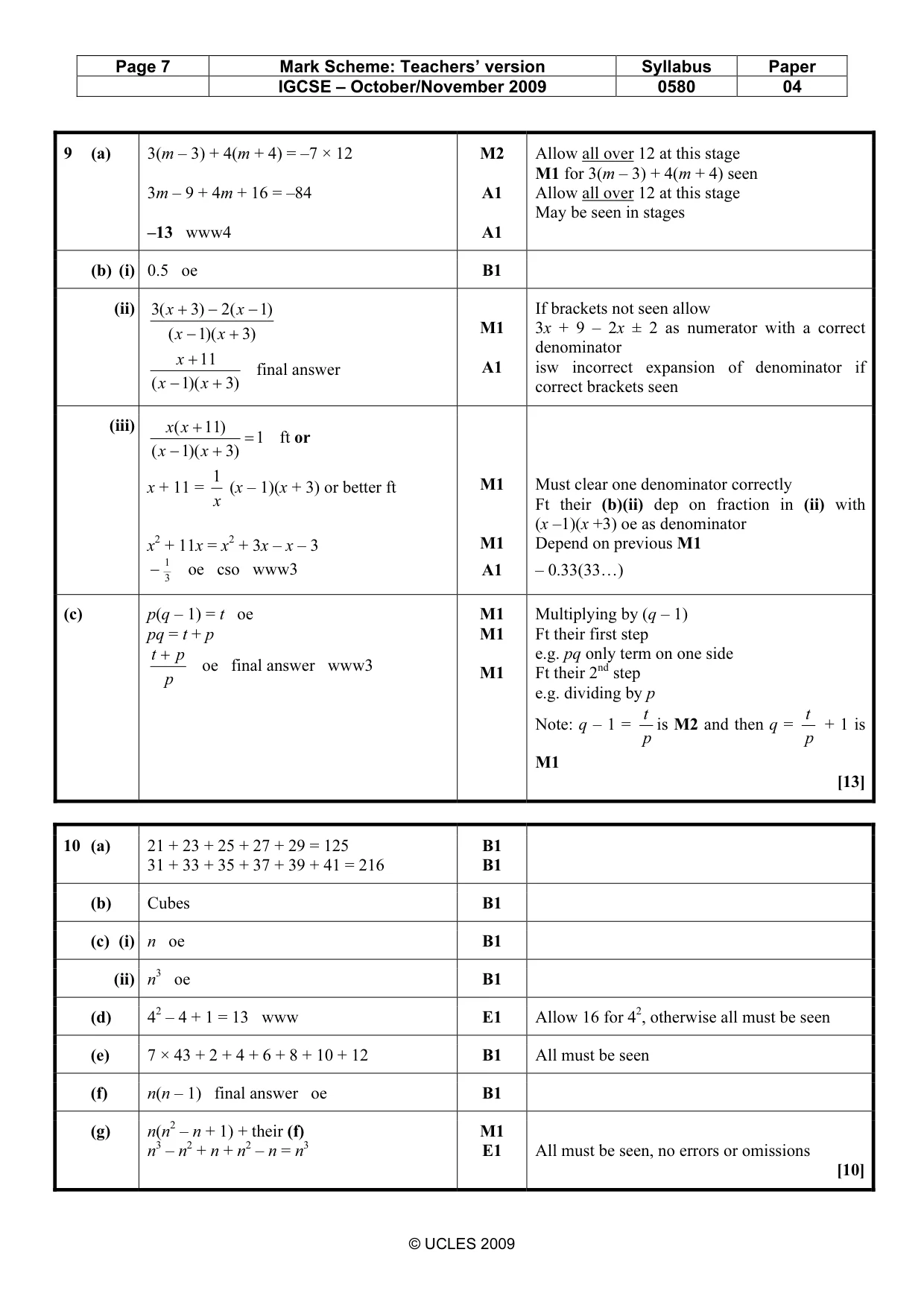
Mark scheme: 9 (a) 3(m – 3) + 4(m + 4) = –7 × 12 M2 Allow all over 12 at this stage M1 for 3(m – 3) + 4(m + 4) seen 3m – 9 + 4m + 16 = –84 A1 Allow all over 12 at this stage May be seen in stages –13 www4 A1 (b) (i) 0.5 oe B1 (ii) 3( x + 3) − 2( x − )1 If brackets not seen allow M1 3x + 9 – 2x ± 2 as numerator with a correct ( x − 1)( x + 3) denominator x + 11 final answer A1 isw incorrect expansion of denominator if ( x − 1)( x + 3) correct brackets seen (iii) x ( x + 11) = 1 ft or ( x − 1)( x + 3) 1 x + 11 = (x – 1)(x + 3) or better ft M1 Must clear one denominator correctly x Ft their (b)(ii) dep on fraction in (ii) with (x –1)(x +3) oe as denominator x2 + 11x = x2 + 3x – x – 3 M1 Depend on previous M1 − 1 oe cso www3 A1 – 0.33(33…) 3 (c) p(q – 1) = t oe M1 Multiplying by (q – 1) pq = t + p M1 Ft their first step t + p e.g. pq only term on one side oe final answer www3 M1 Ft their 2nd step p e.g. dividing by p t t Note: q – 1 = is M2 and then q = + 1 is p p M1 [13]
Q10 · For Examiner's Total Use Row 1 1 = 1 Row 2 3 + 5 = 8 Row 3 7 + 9 + 11 = 27 Row 4 13 + 15…
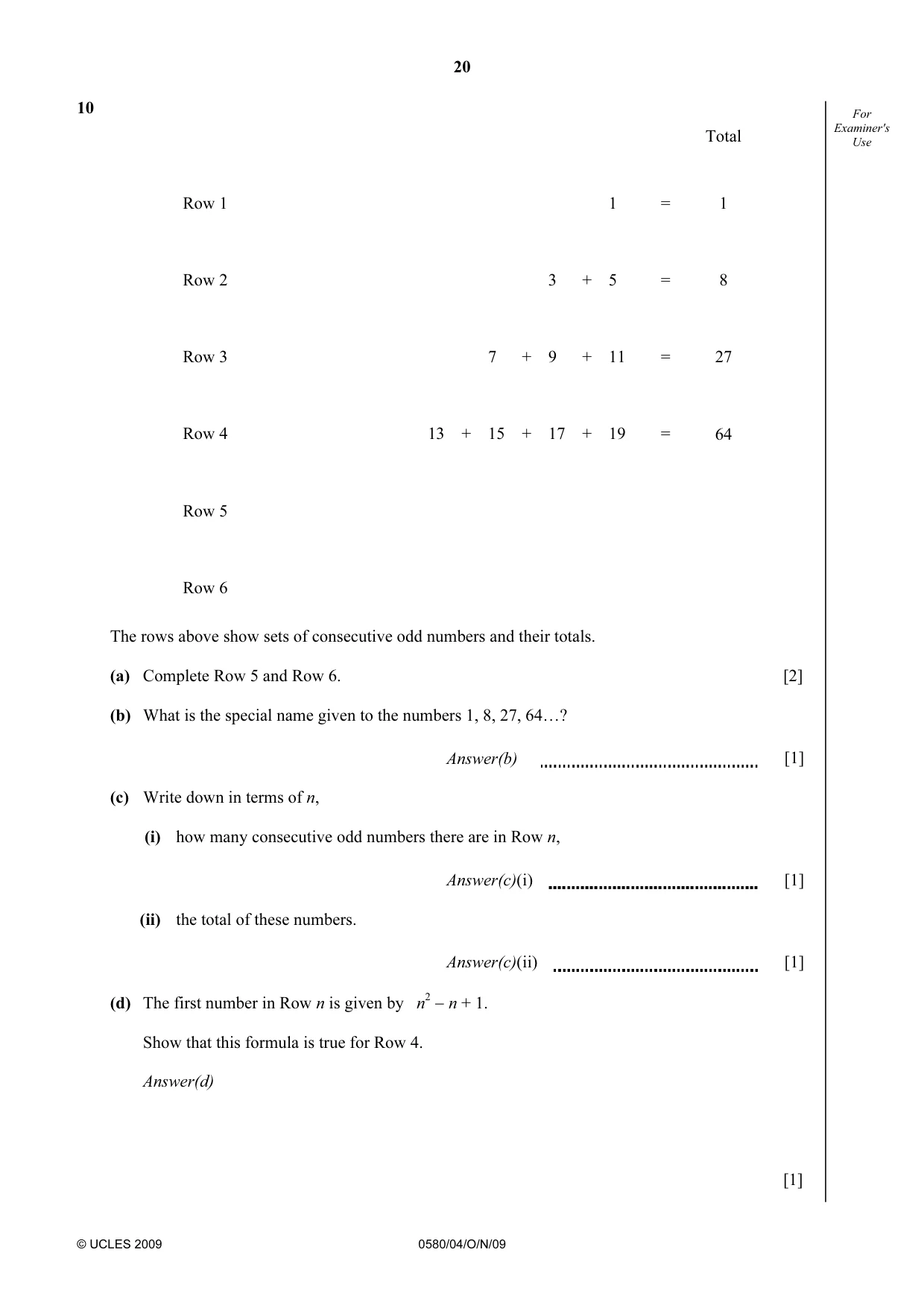
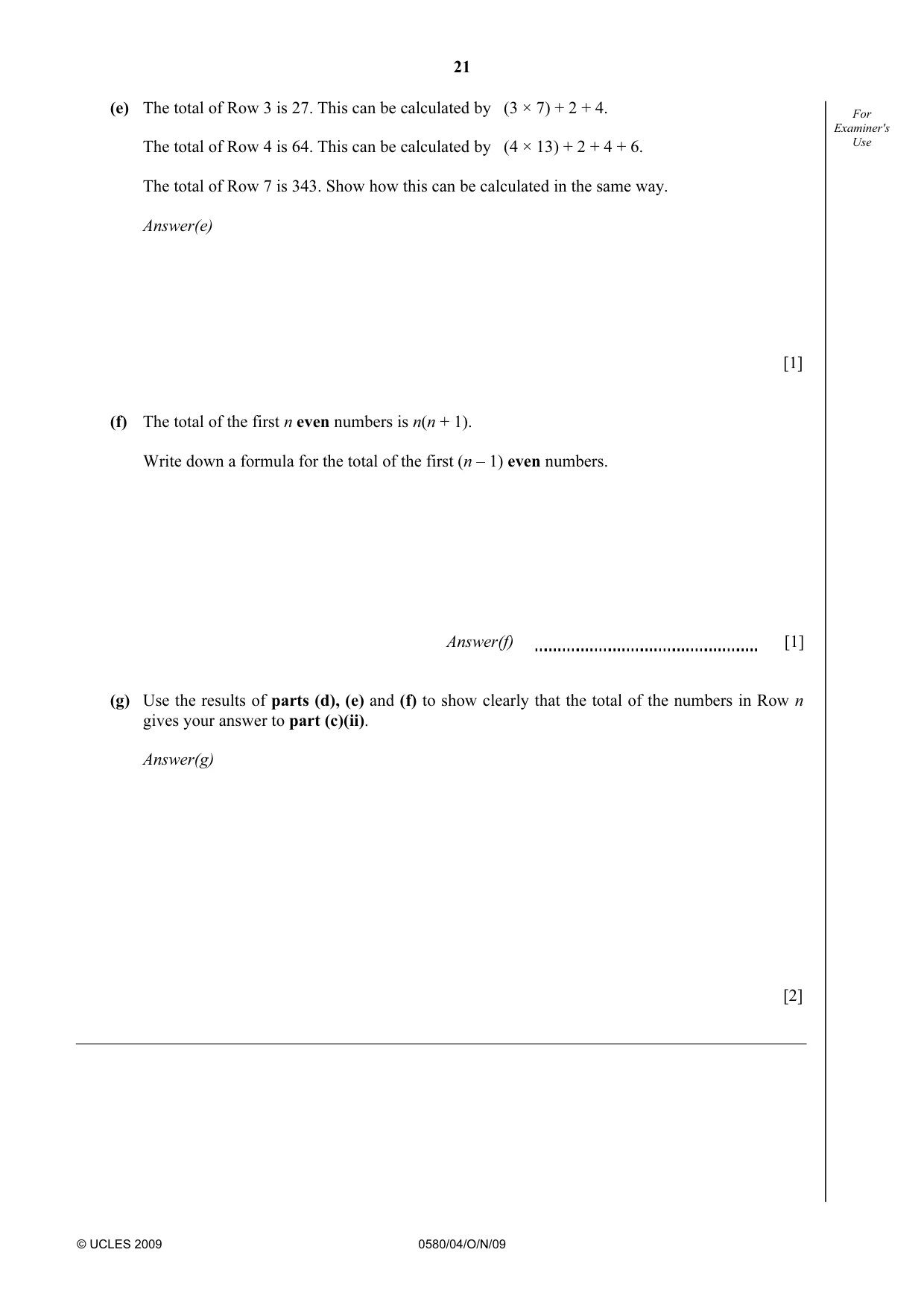
10 For Examiner's Total Use Row 1 1 = 1 Row 2 3 + 5 = 8 Row 3 7 + 9 + 11 = 27 Row 4 13 + 15 + 17 + 19 = 64 Row 5 Row 6 The rows above show sets of consecutive odd numbers and their totals. (a) Complete Row 5 and Row 6. [2] (b) What is the special name given to the numbers 1, 8, 27, 64…? Answer(b) [1] (c) Write down in terms of n, (i) how many consecutive odd numbers there are in Row n, Answer(c)(i) [1] (ii) the total of these numbers. Answer(c)(ii) [1] (d) The first number in Row n is given by n2 − n + 1. Show that this formula is true for Row 4. Answer(d) [1] (e) The total of Row 3 is 27. This can be calculated by (3 × 7) + 2 + 4. For Examiner's The total of Row 4 is 64. This can be calculated by (4 × 13) + 2 + 4 + 6. Use The total of Row 7 is 343. Show how this can be calculated in the same way. Answer(e) [1] (f) The total of the first n even numbers is n(n + 1). Write down a formula for the total of the first (n – 1) even numbers. Answer(f) [1] (g) Use the results of parts (d), (e) and (f) to show clearly that the total of the numbers in Row n gives your answer to part (c)(ii). Answer(g) [2]
Mark scheme: 10 (a) 21 + 23 + 25 + 27 + 29 = 125 B1 31 + 33 + 35 + 37 + 39 + 41 = 216 B1 (b) Cubes B1 (c) (i) n oe B1 (ii) n3 oe B1 (d) 42 – 4 + 1 = 13 www E1 Allow 16 for 42, otherwise all must be seen (e) 7 × 43 + 2 + 4 + 6 + 8 + 10 + 12 B1 All must be seen (f) n(n – 1) final answer oe B1 (g) n(n2 – n + 1) + their (f) M1 n3 – n2 + n + n2 – n = n3 E1 All must be seen, no errors or omissions [10]
What was in this paper
The subtopics covered by these 8 questions, and how many questions each got. Open one in a new tab to see every Cambridge question on it.
What you needed in this session
Cambridge’s own grade thresholds for 2009 Oct/Nov, Paper 4 · Variant 1. A higher threshold means an easier paper — the bar moves with how the cohort did.