Cambridge IGCSE Mathematics 0580 — 2004 Oct/Nov Paper 4 · Variant 1
0580/41/O/N/04
The question paper and its mark scheme, free to read here and free to download. This is Cambridge’s own paper, exactly as it was sat.
Question paper8 pages
Mark scheme9 pages
Answers below. Sit the paper first if you are practising.
Paper as text
Question paper, page 1
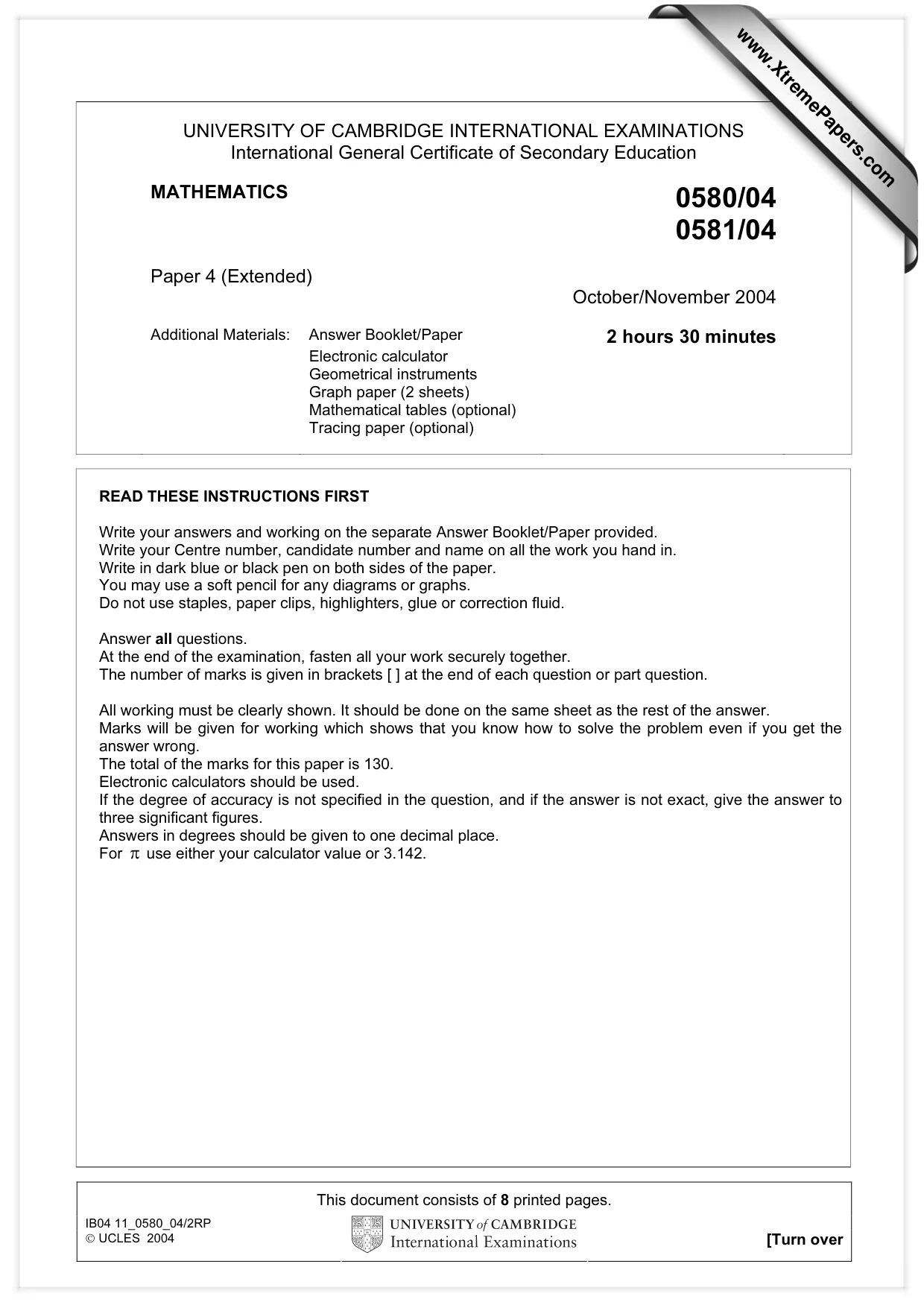
UNIVERSITY OF CAMBRIDGE INTERNATIONAL EXAMINATIONS International General Certificate of Secondary Education MATHEMATICS 0580/04 0581/04 Paper 4 (Extended) October/November 2004 Additional Materials: Answer Booklet/Paper 2 hours 30 minutes Electronic calculator Geometrical instruments Graph paper (2 sheets) Mathematical tables (optional) Tracing paper (optional) READ THESE INSTRUCTIONS FIRST Write your answers and working on the separate Answer Booklet/Paper provided. Write your Centre number, candidate number and name on all the work you hand in. Write in dark blue or black pen on both sides of the paper. You may use a soft pencil for any diagrams or graphs. Do not use staples, paper clips, highlighters, glue or correction fluid. Answer all questions. At the end of the examination, fasten all your work securely together. The number of marks is given in brackets [ ] at the end of each question or part question. All working must be clearly shown. It should be done on the same sheet as the rest of the answer. Marks will be given for working which shows that you know how to solve the problem even if you get the answer wrong. The total of the marks for this paper is 130. Electronic calculators should be used. If the degree of accuracy is not specified in the question, and if the answer is not exact, give the answer to three significant figures. Answers in degrees should be given to one decimal place. For π use either your calculator value or 3.142. This document consists of 8 printed pages. IB04 11_0580_04/2RP UCLES 2004 [Turn over www.XtremePapers.com
Question paper, page 2
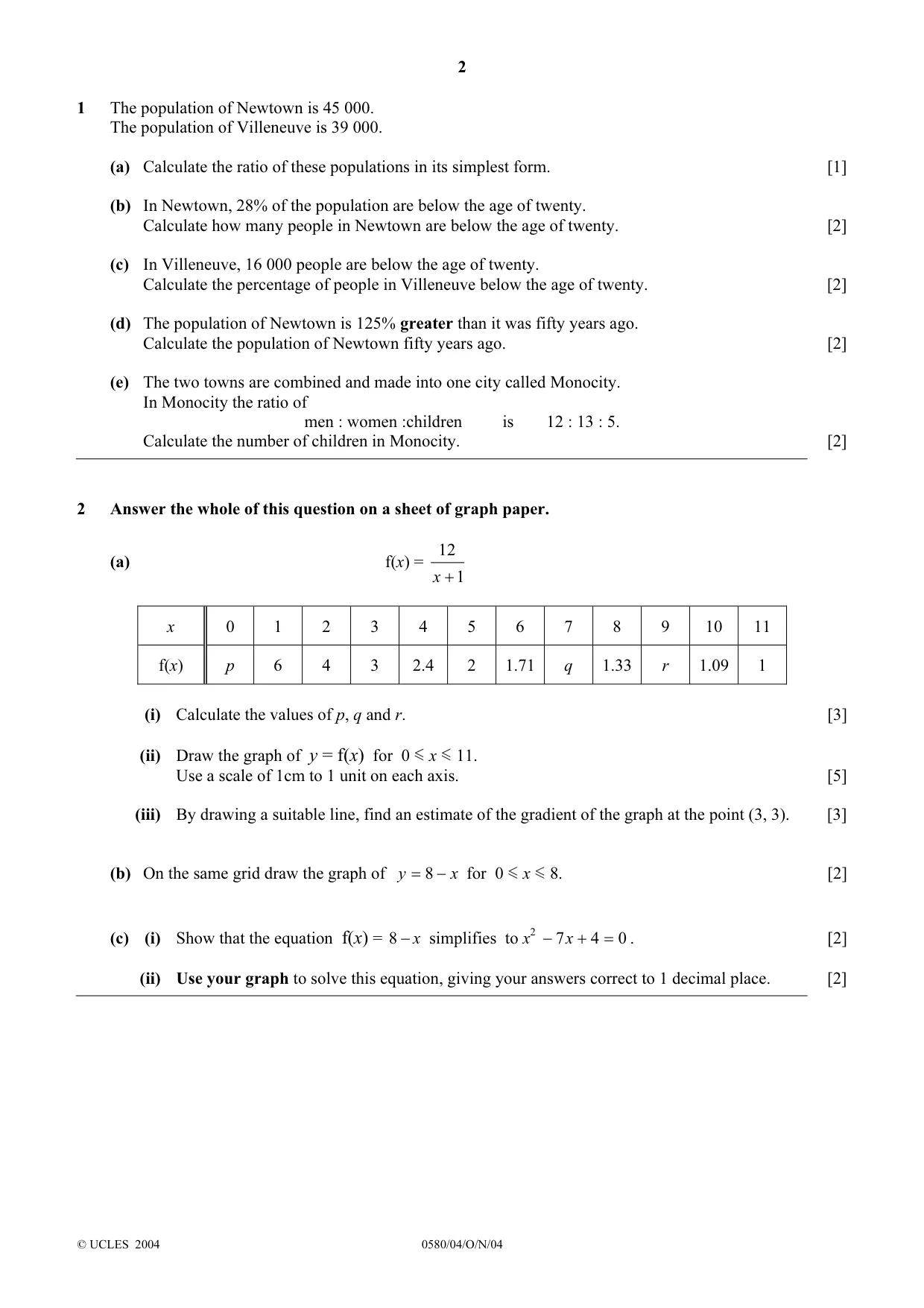
2 © UCLES 2004 0580/04/O/N/04 1 The population of Newtown is 45 000. The population of Villeneuve is 39 000. (a) Calculate the ratio of these populations in its simplest form. [1] (b) In Newtown, 28% of the population are below the age of twenty. Calculate how many people in Newtown are below the age of twenty. [2] (c) In Villeneuve, 16 000 people are below the age of twenty. Calculate the percentage of people in Villeneuve below the age of twenty. [2] (d) The population of Newtown is 125% greater than it was fifty years ago. Calculate the population of Newtown fifty years ago. [2] (e) The two towns are combined and made into one city called Monocity. In Monocity the ratio of men : women :children is 12 : 13 : 5. Calculate the number of children in Monocity. [2] 2 Answer the whole of this question on a sheet of graph paper. (a) f(x) = 1 12 + x x 0 1 2 3 4 5 6 7 8 9 10 11 f(x) p 6 4 3 2.4 2 1.71 q 1.33 r 1.09 1 (i) Calculate the values of p, q and r. [3] (ii) Draw the graph of y = f(x) for 0 x 11. Use a scale of 1cm to 1 unit on each axis. [5] (iii) By drawing a suitable line, find an estimate of the gradient of the graph at the point (3, 3). [3] (b) On the same grid draw the graph of x y − = 8 for 0 x 8. [2] (c) (i) Show that the equation f(x) = − 8 x simplifies to x2 0 4 7 = + −x . [2] (ii) Use your graph to solve this equation, giving your answers correct to 1 decimal place. [2]
Question paper, page 3
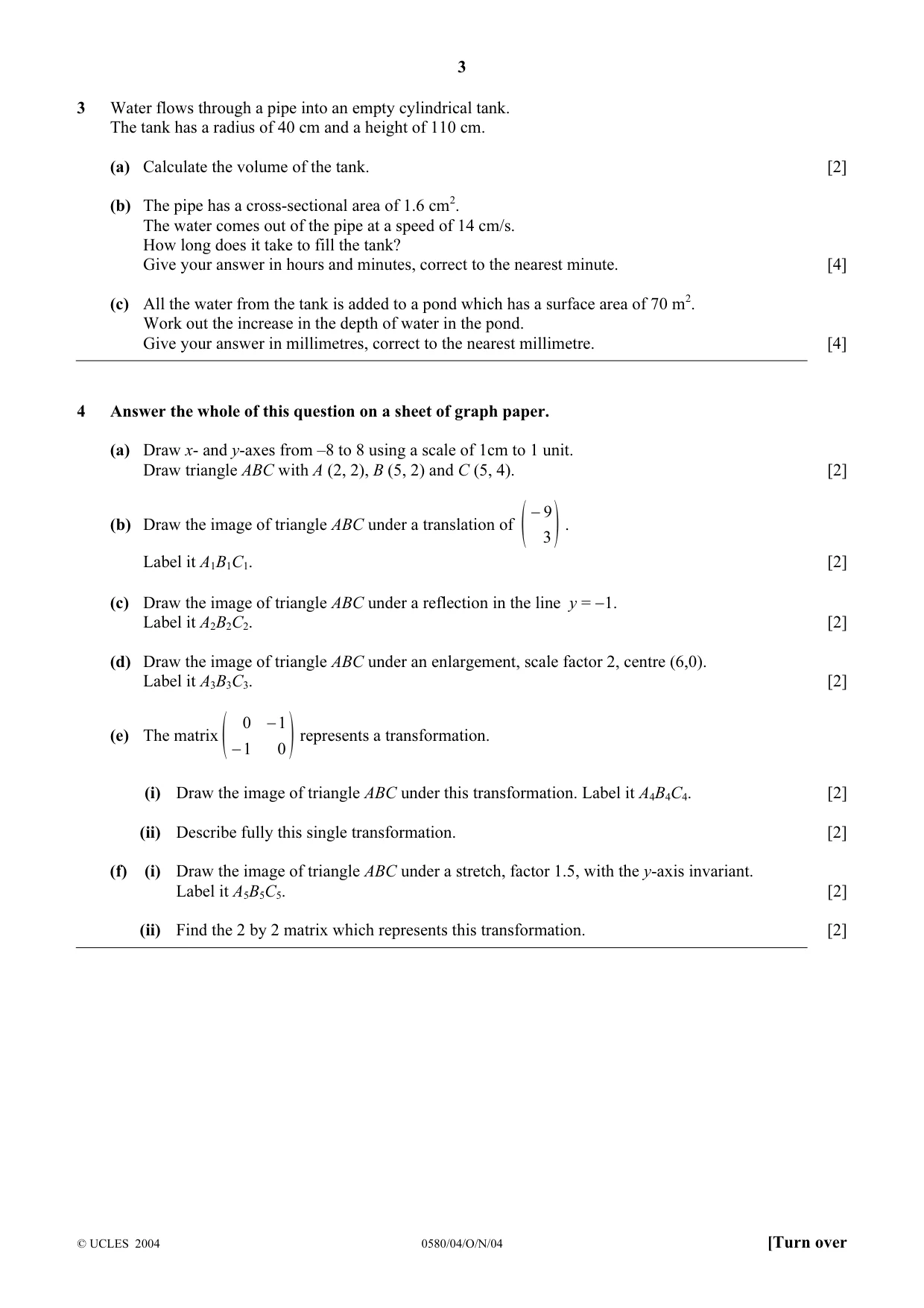
3 © UCLES 2004 0580/04/O/N/04 [Turn over 3 Water flows through a pipe into an empty cylindrical tank. The tank has a radius of 40 cm and a height of 110 cm. (a) Calculate the volume of the tank. [2] (b) The pipe has a cross-sectional area of 1.6 cm2. The water comes out of the pipe at a speed of 14 cm/s. How long does it take to fill the tank? Give your answer in hours and minutes, correct to the nearest minute. [4] (c) All the water from the tank is added to a pond which has a surface area of 70 m2. Work out the increase in the depth of water in the pond. Give your answer in millimetres, correct to the nearest millimetre. [4] 4 Answer the whole of this question on a sheet of graph paper. (a) Draw x- and y-axes from –8 to 8 using a scale of 1cm to 1 unit. Draw triangle ABC with A (2, 2), B (5, 2) and C (5, 4). [2] (b) Draw the image of triangle ABC under a translation of 3 9 − . Label it A1B1C1. [2] (c) Draw the image of triangle ABC under a reflection in the line y = −1. Label it A2B2C2. [2] (d) Draw the image of triangle ABC under an enlargement, scale factor 2, centre (6,0). Label it A3B3C3. [2] (e) The matrix 0 1 1 0 − − represents a transformation. (i) Draw the image of triangle ABC under this transformation. Label it A4B4C4. [2] (ii) Describe fully this single transformation. [2] (f) (i) Draw the image of triangle ABC under a stretch, factor 1.5, with the y-axis invariant. Label it A5B5C5. [2] (ii) Find the 2 by 2 matrix which represents this transformation. [2]
Question paper, page 4
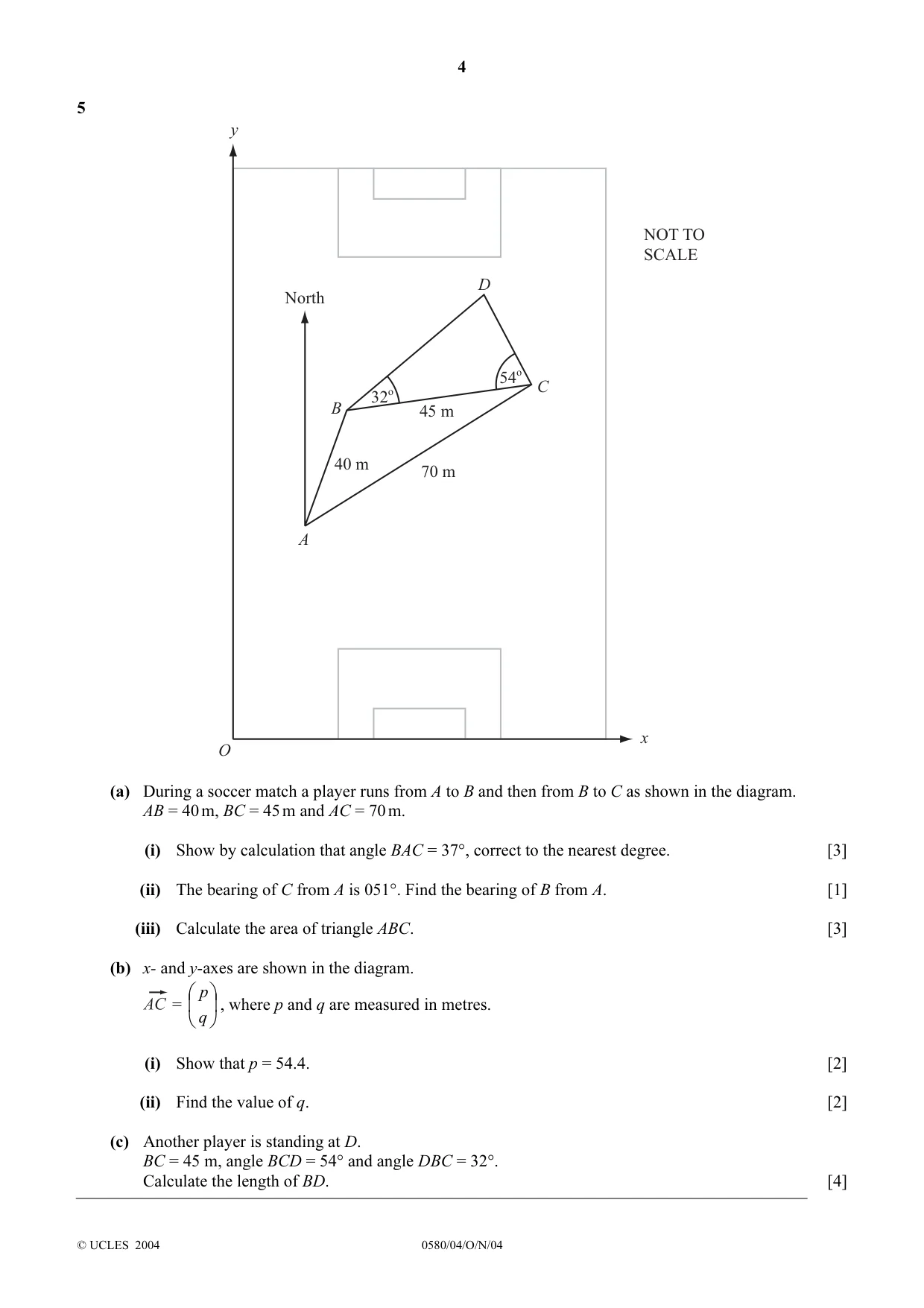
4 © UCLES 2004 0580/04/O/N/04 5 NOT TO SCALE 54o 32o 70 m A B C D 45 m 40 m North O y x (a) During a soccer match a player runs from A to B and then from B to C as shown in the diagram. AB = 40m, BC = 45m and AC = 70m. (i) Show by calculation that angle BAC = 37°, correct to the nearest degree. [3] (ii) The bearing of C from A is 051°. Find the bearing of B from A. [1] (iii) Calculate the area of triangle ABC. [3] (b) x- and y-axes are shown in the diagram. = q p , where p and q are measured in metres. (i) Show that p = 54.4. [2] (ii) Find the value of q. [2] (c) Another player is standing at D. BC = 45 m, angle BCD = 54° and angle DBC = 32°. Calculate the length of BD. [4]
Question paper, page 5
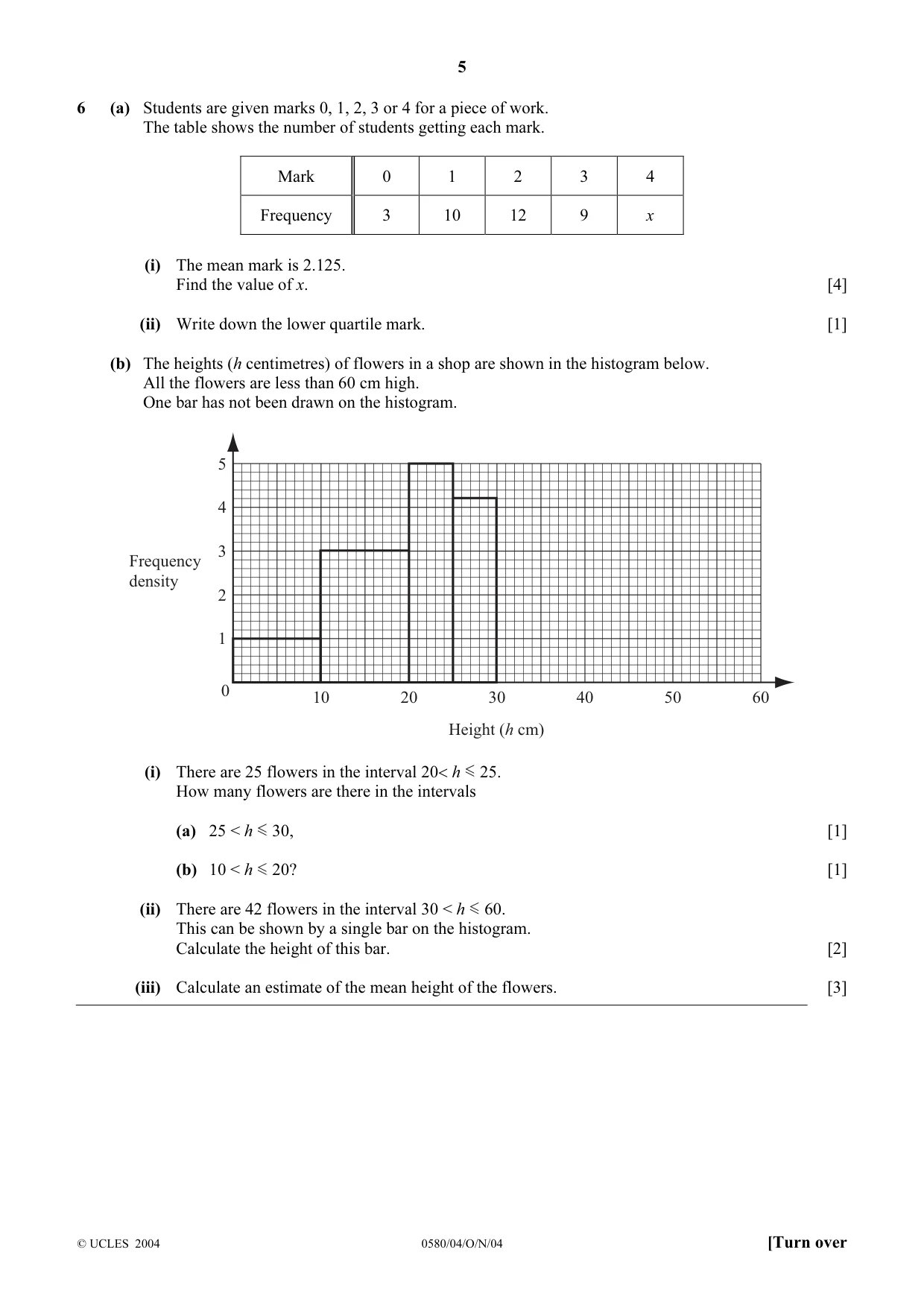
5 © UCLES 2004 0580/04/O/N/04 [Turn over 6 (a) Students are given marks 0, 1, 2, 3 or 4 for a piece of work. The table shows the number of students getting each mark. Mark 0 1 2 3 4 Frequency 3 10 12 9 x (i) The mean mark is 2.125. Find the value of x. [4] (ii) Write down the lower quartile mark. [1] (b) The heights (h centimetres) of flowers in a shop are shown in the histogram below. All the flowers are less than 60 cm high. One bar has not been drawn on the histogram. 60 50 40 30 20 10 0 5 4 3 2 1 Frequency density Height (h cm) (i) There are 25 flowers in the interval 20< h 25. How many flowers are there in the intervals (a) 25 < h 30, [1] (b) 10 < h 20? [1] (ii) There are 42 flowers in the interval 30 < h 60. This can be shown by a single bar on the histogram. Calculate the height of this bar. [2] (iii) Calculate an estimate of the mean height of the flowers. [3]
Question paper, page 6
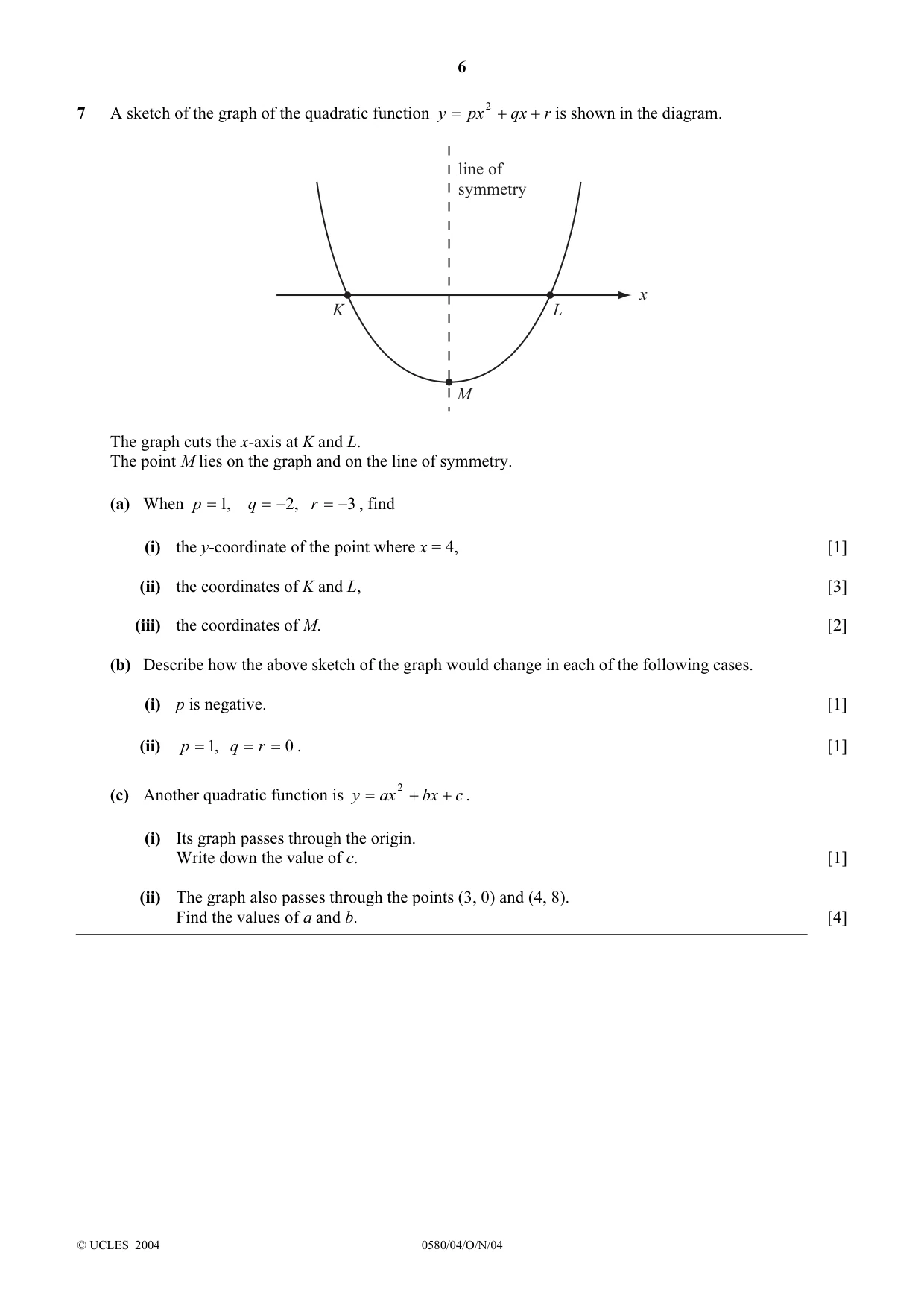
6 © UCLES 2004 0580/04/O/N/04 7 A sketch of the graph of the quadratic function r qx px y + + = 2 is shown in the diagram. line of symmetry x K L M The graph cuts the x-axis at K and L. The point M lies on the graph and on the line of symmetry. (a) When 3 ,2 ,1 − = − = = r q p , find (i) the y-coordinate of the point where x = 4, [1] (ii) the coordinates of K and L, [3] (iii) the coordinates of M. [2] (b) Describe how the above sketch of the graph would change in each of the following cases. (i) p is negative. [1] (ii) 0 ,1 = = = r q p . [1] (c) Another quadratic function is c bx ax y + + = 2 . (i) Its graph passes through the origin. Write down the value of c. [1] (ii) The graph also passes through the points (3, 0) and (4, 8). Find the values of a and b. [4]
Question paper, page 7
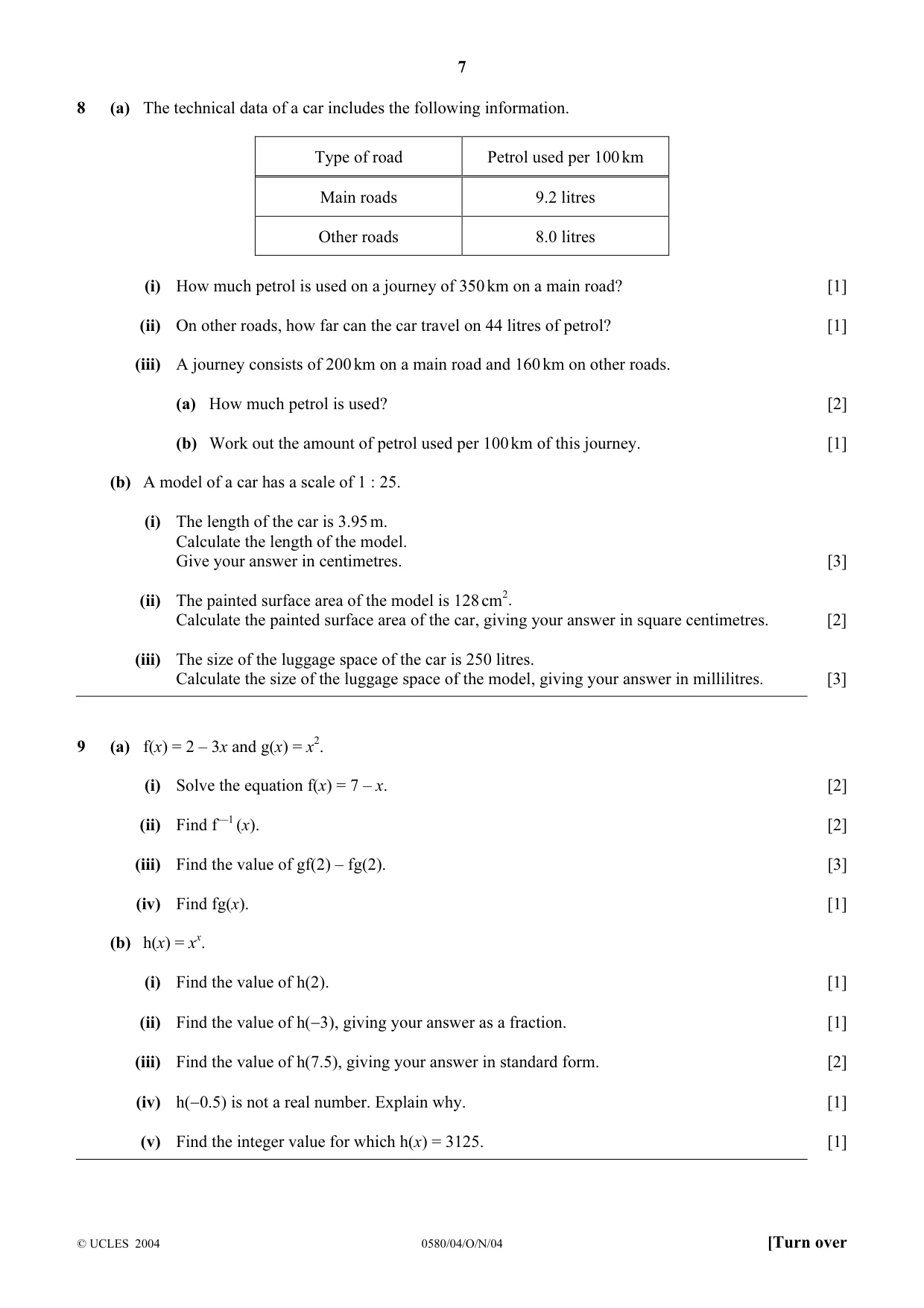
7 © UCLES 2004 0580/04/O/N/04 [Turn over 8 (a) The technical data of a car includes the following information. Type of road Petrol used per 100km Main roads 9.2 litres Other roads 8.0 litres (i) How much petrol is used on a journey of 350km on a main road? [1] (ii) On other roads, how far can the car travel on 44 litres of petrol? [1] (iii) A journey consists of 200km on a main road and 160km on other roads. (a) How much petrol is used? [2] (b) Work out the amount of petrol used per 100km of this journey. [1] (b) A model of a car has a scale of 1 : 25. (i) The length of the car is 3.95m. Calculate the length of the model. Give your answer in centimetres. [3] (ii) The painted surface area of the model is 128cm2. Calculate the painted surface area of the car, giving your answer in square centimetres. [2] (iii) The size of the luggage space of the car is 250 litres. Calculate the size of the luggage space of the model, giving your answer in millilitres. [3] 9 (a) f(x) = 2 – 3x and g(x) = x2. (i) Solve the equation f(x) = 7 – x. [2] (ii) Find f—1 (x). [2] (iii) Find the value of gf(2) – fg(2). [3] (iv) Find fg(x). [1] (b) h(x) = xx. (i) Find the value of h(2). [1] (ii) Find the value of h(−3), giving your answer as a fraction. [1] (iii) Find the value of h(7.5), giving your answer in standard form. [2] (iv) h(−0.5) is not a real number. Explain why. [1] (v) Find the integer value for which h(x) = 3125. [1]
Question paper, page 8
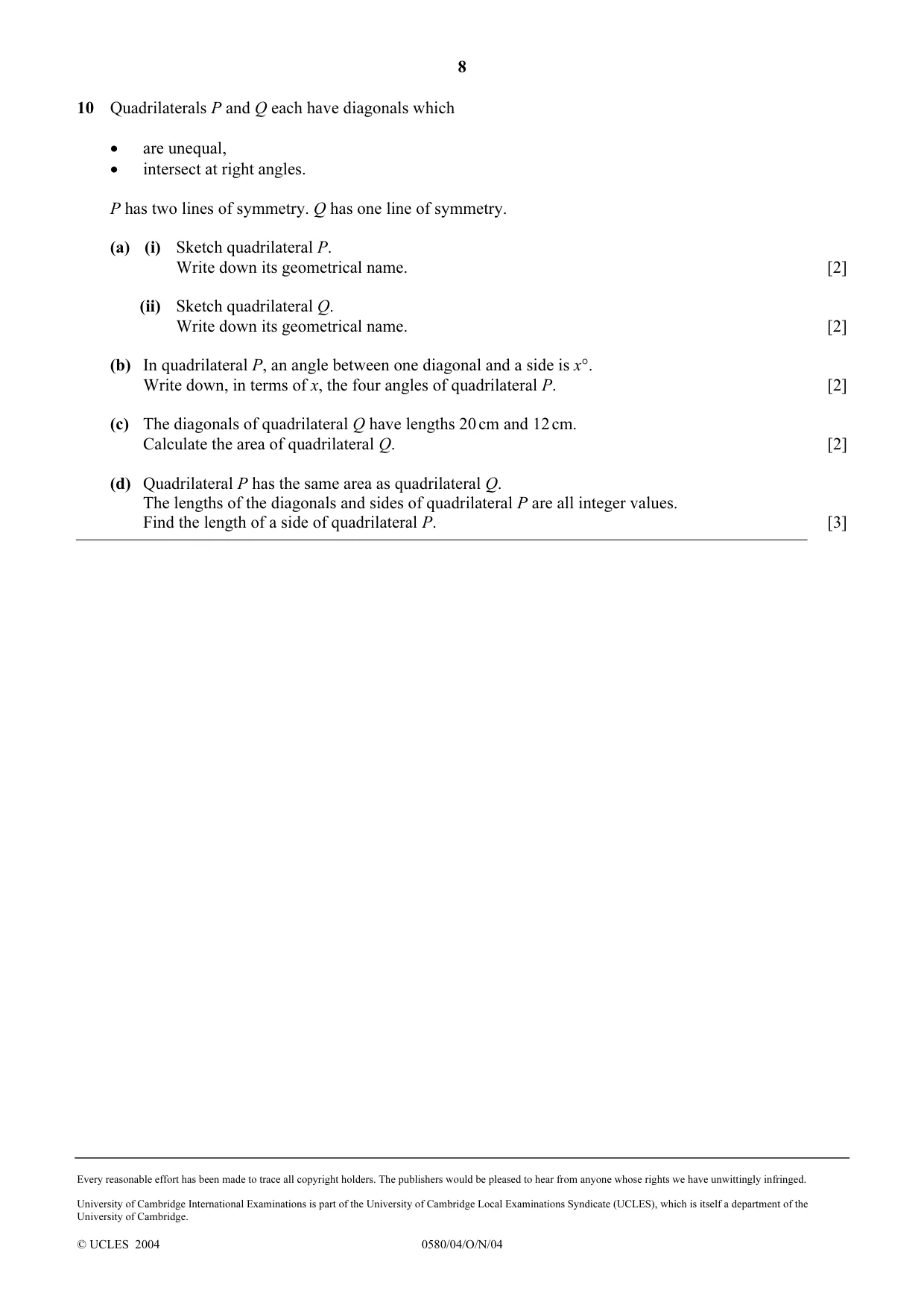
8 Every reasonable effort has been made to trace all copyright holders. The publishers would be pleased to hear from anyone whose rights we have unwittingly infringed. University of Cambridge International Examinations is part of the University of Cambridge Local Examinations Syndicate (UCLES), which is itself a department of the University of Cambridge. © UCLES 2004 0580/04/O/N/04 10 Quadrilaterals P and Q each have diagonals which • are unequal, • intersect at right angles. P has two lines of symmetry. Q has one line of symmetry. (a) (i) Sketch quadrilateral P. Write down its geometrical name. [2] (ii) Sketch quadrilateral Q. Write down its geometrical name. [2] (b) In quadrilateral P, an angle between one diagonal and a side is x°. Write down, in terms of x, the four angles of quadrilateral P. [2] (c) The diagonals of quadrilateral Q have lengths 20cm and 12cm. Calculate the area of quadrilateral Q. [2] (d) Quadrilateral P has the same area as quadrilateral Q. The lengths of the diagonals and sides of quadrilateral P are all integer values. Find the length of a side of quadrilateral P. [3]
Mark scheme, page 1
CAMBRIDGE INTERNATIONAL EXAMINATIONS International General Certificate of Secondary Education MARK SCHEME for the November 2004 question papers 0580/0581 MATHEMATICS 0580/04, 0581/04 Paper 4 (Extended), maximum raw mark 130 This mark scheme is published as an aid to teachers and students, to indicate the requirements of the examination. It shows the basis on which Examiners were initially instructed to award marks. It does not indicate the details of the discussions that took place at an Examiners’ meeting before marking began. Any substantial changes to the mark scheme that arose from these discussions will be recorded in the published Report on the Examination. All Examiners are instructed that alternative correct answers and unexpected approaches in candidates’ scripts must be given marks that fairly reflect the relevant knowledge and skills demonstrated. Mark schemes must be read in conjunction with the question papers and the Report on the Examination. • CIE will not enter into discussion or correspondence in connection with these mark schemes. CIE is publishing the mark schemes for the November 2004 question papers for most IGCSE and GCE Advanced Level syllabuses. www.XtremePapers.com
Mark scheme, page 2
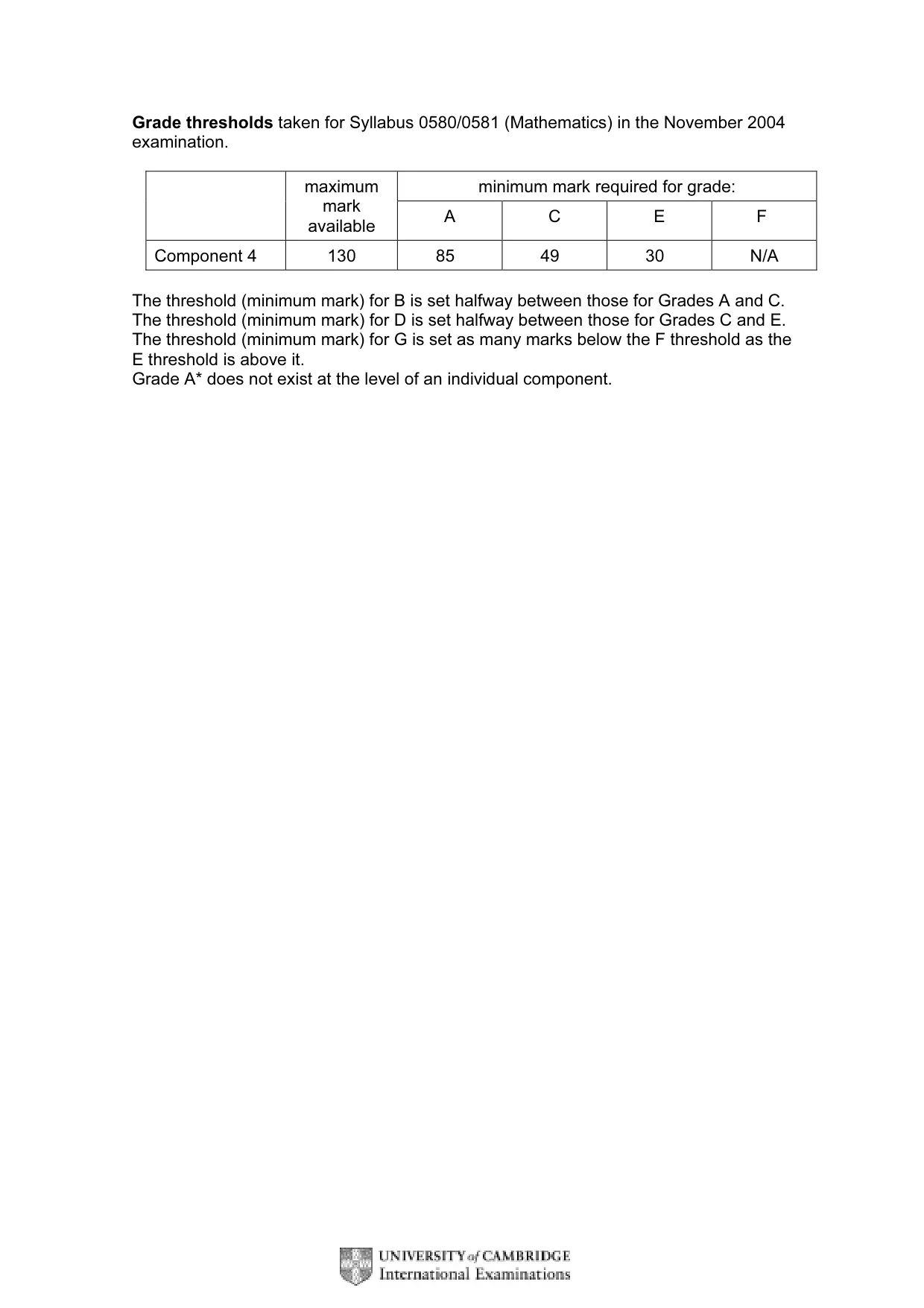
Grade thresholds taken for Syllabus 0580/0581 (Mathematics) in the November 2004 examination. minimum mark required for grade: maximum mark available A C E F Component 4 130 85 49 30 N/A The threshold (minimum mark) for B is set halfway between those for Grades A and C. The threshold (minimum mark) for D is set halfway between those for Grades C and E. The threshold (minimum mark) for G is set as many marks below the F threshold as the E threshold is above it. Grade A* does not exist at the level of an individual component.
Mark scheme, page 3
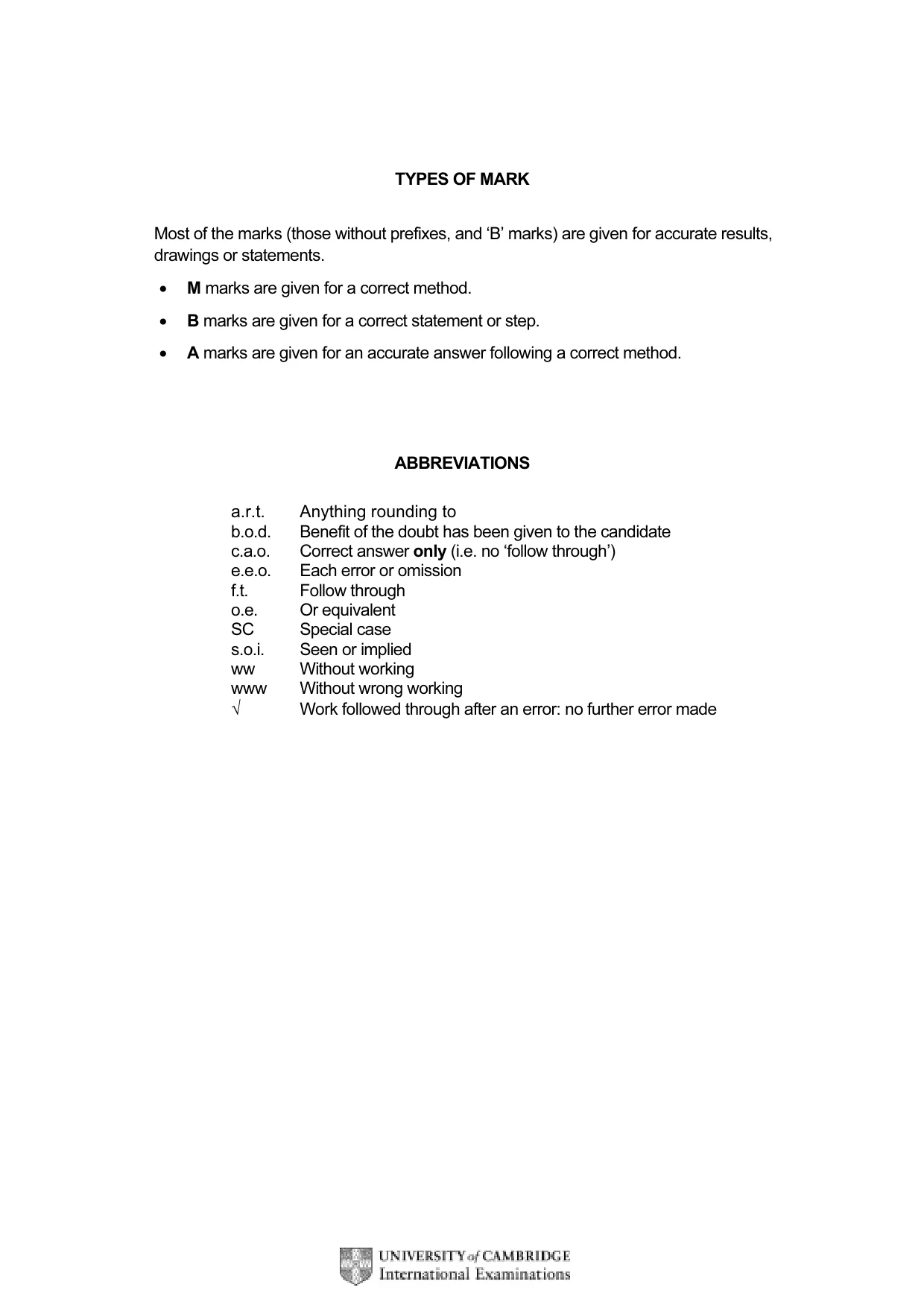
TYPES OF MARK Most of the marks (those without prefixes, and ‘B’ marks) are given for accurate results, drawings or statements. • M marks are given for a correct method. • B marks are given for a correct statement or step. • A marks are given for an accurate answer following a correct method. ABBREVIATIONS a.r.t. Anything rounding to b.o.d. Benefit of the doubt has been given to the candidate c.a.o. Correct answer only (i.e. no ‘follow through’) e.e.o. Each error or omission f.t. Follow through o.e. Or equivalent SC Special case s.o.i. Seen or implied ww Without working www Without wrong working √ Work followed through after an error: no further error made=
Mark scheme, page 4
November 2004 INTERNATIONAL GCSE MARK SCHEME MAXIMUM MARK: 130 SYLLABUS/COMPONENT: 0580/04, 0581/04 MATHEMATICS Paper 4 Extended
Mark scheme, page 5
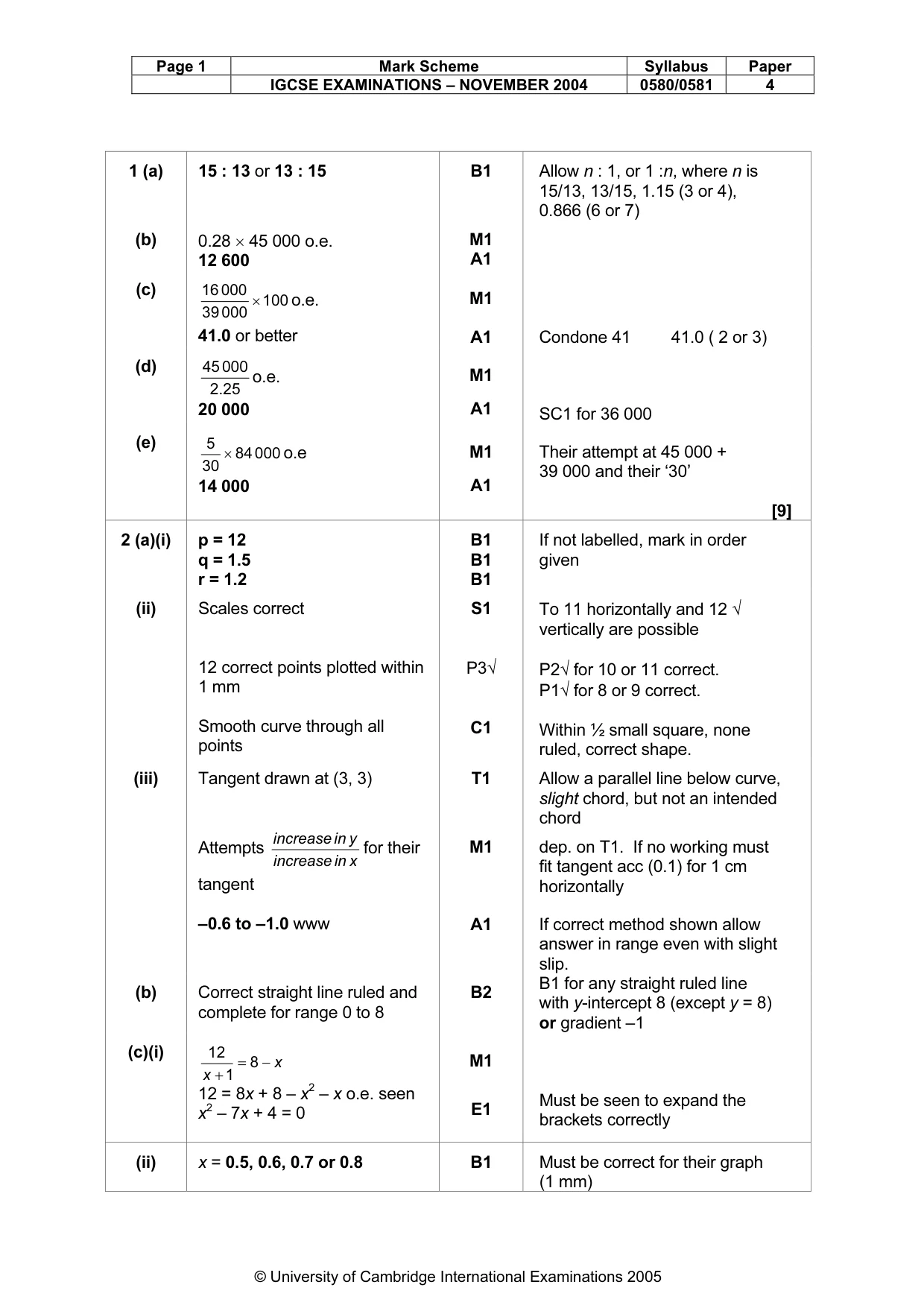
Page 1 Mark Scheme Syllabus Paper IGCSE EXAMINATIONS – NOVEMBER 2004 0580/0581 4 © University of Cambridge International Examinations 2005 1 (a) 15 : 13 or 13 : 15 B1 Allow n : 1, or 1 :n, where n is 15/13, 13/15, 1.15 (3 or 4), 0.866 (6 or 7) (b) 0.28 × 45 000 o.e. 12 600 M1 A1 (c) 100 000 39 000 16 × o.e. 41.0 or better M1 A1 Condone 41 41.0 ( 2 or 3) (d) 25 . 2 000 45 o.e. 20 000 M1 A1 SC1 for 36 000 (e) 000 84 30 5 × o.e 14 000 M1 A1 Their attempt at 45 000 + 39 000 and their ‘30’ [9] 2 (a)(i) p = 12 q = 1.5 r = 1.2 B1 B1 B1 If not labelled, mark in order given (ii) Scales correct 12 correct points plotted within 1 mm Smooth curve through all points S1 P3√ C1 To 11 horizontally and 12 √ vertically are possible P2√ for 10 or 11 correct. P1√ for 8 or 9 correct. Within ½ small square, none ruled, correct shape. (iii) Tangent drawn at (3, 3) Attempts x in increase y in increase for their tangent –0.6 to –1.0 www T1 M1 A1 Allow a parallel line below curve, slight chord, but not an intended chord dep. on T1. If no working must fit tangent acc (0.1) for 1 cm horizontally If correct method shown allow answer in range even with slight slip. (b) Correct straight line ruled and complete for range 0 to 8 B2 B1 for any straight ruled line with y-intercept 8 (except y = 8) or gradient –1 (c)(i) x x − = + 8 1 12 12 = 8x + 8 – x2 – x o.e. seen x2 – 7x + 4 = 0 M1 E1 Must be seen to expand the brackets correctly (ii) x = 0.5, 0.6, 0.7 or 0.8 B1 Must be correct for their graph (1 mm)
Mark scheme, page 6
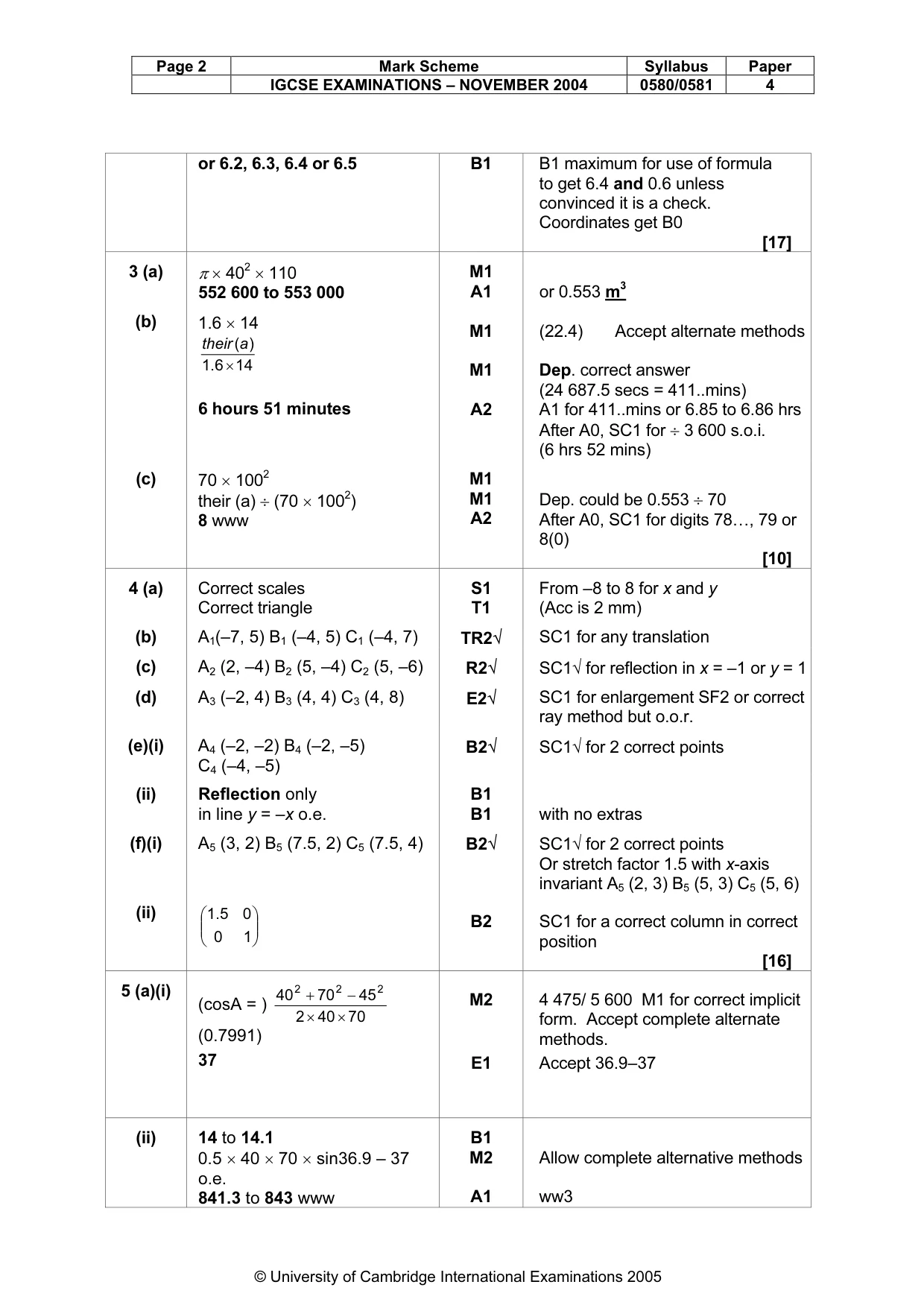
Page 2 Mark Scheme Syllabus Paper IGCSE EXAMINATIONS – NOVEMBER 2004 0580/0581 4 © University of Cambridge International Examinations 2005 or 6.2, 6.3, 6.4 or 6.5 B1 B1 maximum for use of formula to get 6.4 and 0.6 unless convinced it is a check. Coordinates get B0 [17] 3 (a) π × 402 × 110 552 600 to 553 000 M1 A1 or 0.553 m3 (b) 1.6 × 14 14 6 . 1 ) ( × a their 6 hours 51 minutes M1 M1 A2 (22.4) Accept alternate methods Dep. correct answer (24 687.5 secs = 411..mins) A1 for 411..mins or 6.85 to 6.86 hrs After A0, SC1 for ÷ 3 600 s.o.i. (6 hrs 52 mins) (c) 70 × 1002 their (a) ÷ (70 × 1002) 8 www M1 M1 A2 Dep. could be 0.553 ÷ 70 After A0, SC1 for digits 78…, 79 or 8(0) [10] 4 (a) Correct scales Correct triangle S1 T1 From –8 to 8 for x and y (Acc is 2 mm) (b) A1(–7, 5) B1 (–4, 5) C1 (–4, 7) TR2√ SC1 for any translation (c) A2 (2, –4) B2 (5, –4) C2 (5, –6) R2√ SC1√ for reflection in x = –1 or y = 1 (d) A3 (–2, 4) B3 (4, 4) C3 (4, 8) E2√ SC1 for enlargement SF2 or correct ray method but o.o.r. (e)(i) A4 (–2, –2) B4 (–2, –5) C4 (–4, –5) B2√ SC1√ for 2 correct points (ii) Reflection only in line y = –x o.e. B1 B1 with no extras (f)(i) A5 (3, 2) B5 (7.5, 2) C5 (7.5, 4) B2√ SC1√ for 2 correct points Or stretch factor 1.5 with x-axis invariant A5 (2, 3) B5 (5, 3) C5 (5, 6) (ii) 1 0 0 5 . 1 B2 SC1 for a correct column in correct position [16] 5 (a)(i) (cosA = ) 70 40 2 45 70 40 2 2 2 × × − + (0.7991) 37 M2 E1 4 475/ 5 600 M1 for correct implicit form. Accept complete alternate methods. Accept 36.9–37 (ii) 14 to 14.1 0.5 × 40 × 70 × sin36.9 – 37 o.e. 841.3 to 843 www B1 M2 A1 Allow complete alternative methods ww3
Mark scheme, page 7
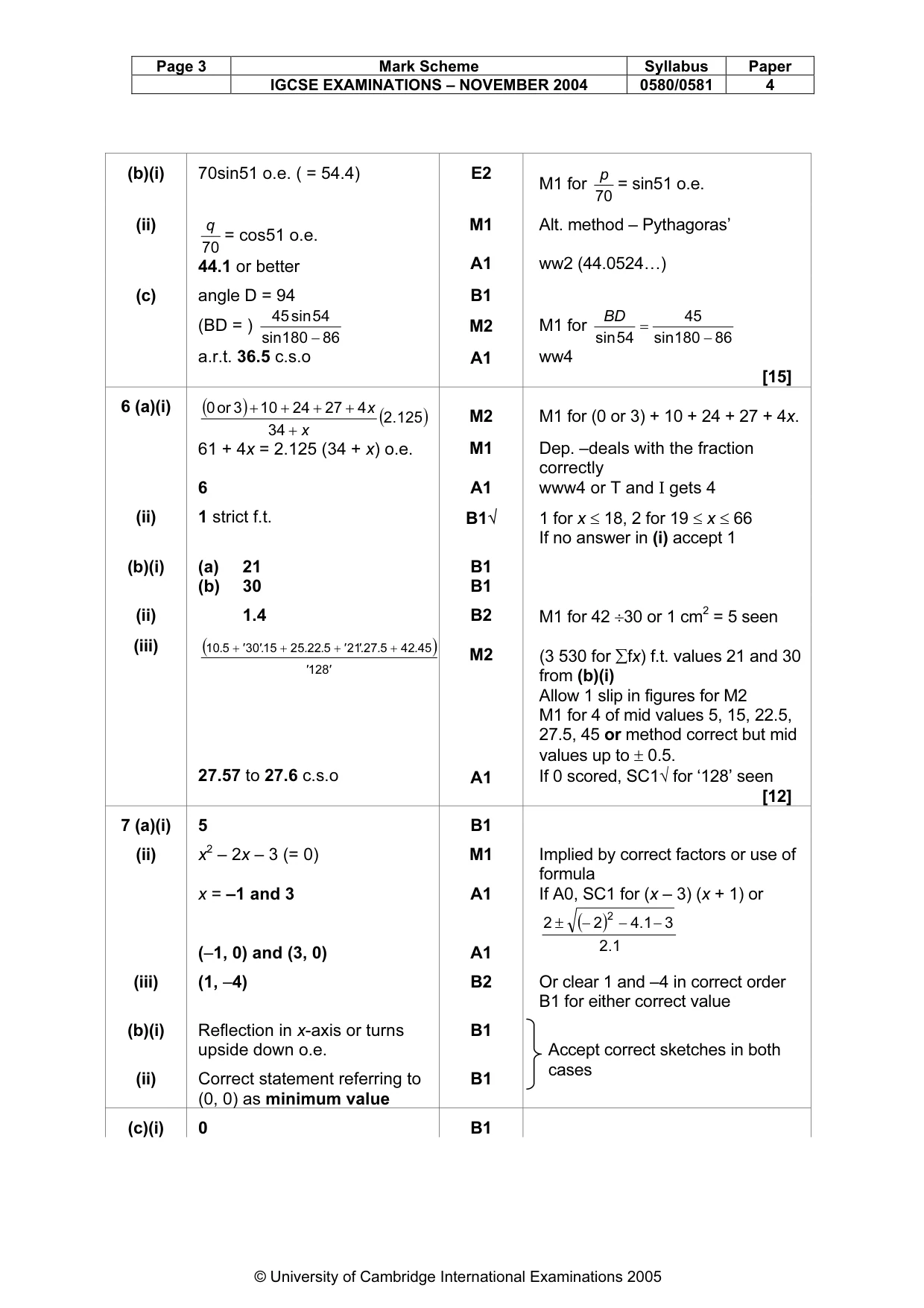
Page 3 Mark Scheme Syllabus Paper IGCSE EXAMINATIONS – NOVEMBER 2004 0580/0581 4 © University of Cambridge International Examinations 2005 (b)(i) 70sin51 o.e. ( = 54.4) E2 M1 for 70 p = sin51 o.e. (ii) 70 q = cos51 o.e. 44.1 or better M1 A1 Alt. method – Pythagoras’ ww2 (44.0524…) (c) angle D = 94 (BD = ) 86 180 sin 54 sin 45 − a.r.t. 36.5 c.s.o B1 M2 A1 M1 for 86 180 sin 45 54 sin − = BD ww4 [15] 6 (a)(i) ( ) ( ) 125 . 2 34 4 27 24 10 3 0 x x + + + + + or 61 + 4x = 2.125 (34 + x) o.e. 6 M2 M1 A1 M1 for (0 or 3) + 10 + 24 + 27 + 4x. Dep. –deals with the fraction correctly www4 or T and I gets 4 (ii) 1 strict f.t. B1√ 1 for x ≤ 18, 2 for 19 ≤ x ≤ 66 If no answer in (i) accept 1 (b)(i) (a) 21 (b) 30 B1 B1 (ii) 1.4 B2 M1 for 42 ÷30 or 1 cm2 = 5 seen (iii) ( ) ' ' . . '. ' . . '. ' . 128 45 42 5 27 21 5 22 25 15 30 5 10 + + + + 27.57 to 27.6 c.s.o M2 A1 (3 530 for ∑fx) f.t. values 21 and 30 from (b)(i) Allow 1 slip in figures for M2 M1 for 4 of mid values 5, 15, 22.5, 27.5, 45 or method correct but mid values up to ± 0.5. If 0 scored, SC1√ for ‘128’ seen [12] 7 (a)(i) 5 B1 (ii) x2 – 2x – 3 (= 0) x = –1 and 3 (–1, 0) and (3, 0) M1 A1 A1 Implied by correct factors or use of formula If A0, SC1 for (x – 3) (x + 1) or ( ) 1 . 2 3 1 . 4 2 2 2 − − − ± (iii) (1, –4) B2 Or clear 1 and –4 in correct order B1 for either correct value (b)(i) Reflection in x-axis or turns upside down o.e. B1 (ii) Correct statement referring to (0, 0) as minimum value B1 Accept correct sketches in both cases (c)(i) 0 B1
Mark scheme, page 8
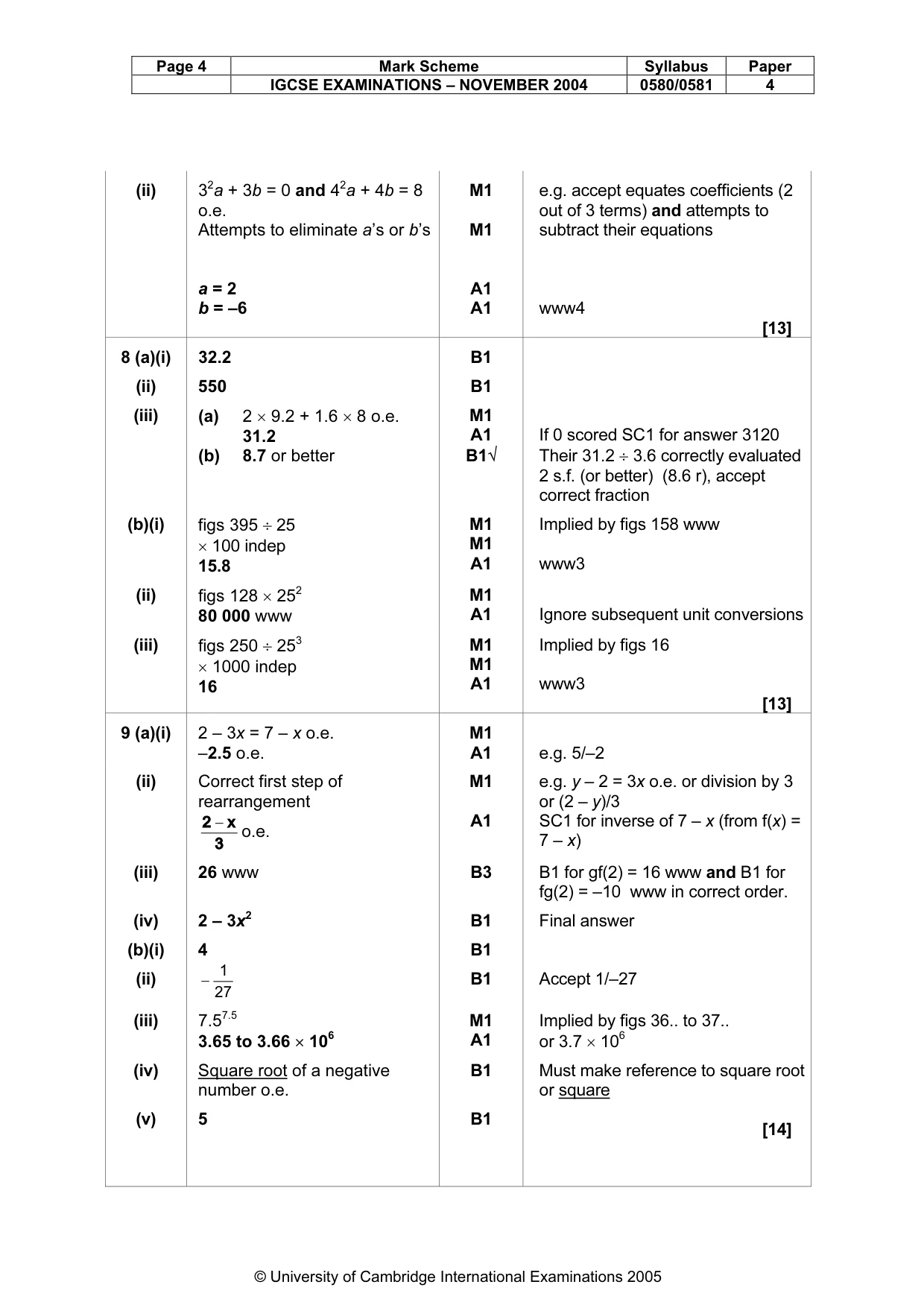
Page 4 Mark Scheme Syllabus Paper IGCSE EXAMINATIONS – NOVEMBER 2004 0580/0581 4 © University of Cambridge International Examinations 2005 (ii) 32a + 3b = 0 and 42a + 4b = 8 o.e. Attempts to eliminate a’s or b’s a = 2 b = –6 M1 M1 A1 A1 e.g. accept equates coefficients (2 out of 3 terms) and attempts to subtract their equations www4 [13] 8 (a)(i) 32.2 B1 (ii) 550 B1 (iii) (a) 2 × 9.2 + 1.6 × 8 o.e. 31.2 (b) 8.7 or better M1 A1 B1√ If 0 scored SC1 for answer 3120 Their 31.2 ÷ 3.6 correctly evaluated 2 s.f. (or better) (8.6 r), accept correct fraction (b)(i) figs 395 ÷ 25 × 100 indep 15.8 M1 M1 A1 Implied by figs 158 www www3 (ii) figs 128 × 252 80 000 www M1 A1 Ignore subsequent unit conversions (iii) figs 250 ÷ 253 × 1000 indep 16 M1 M1 A1 Implied by figs 16 www3 [13] 9 (a)(i) 2 – 3x = 7 – x o.e. –2.5 o.e. M1 A1 e.g. 5/–2 (ii) Correct first step of rearrangement 3 x 2 − o.e. M1 A1 e.g. y – 2 = 3x o.e. or division by 3 or (2 – y)/3 SC1 for inverse of 7 – x (from f(x) = 7 – x) (iii) 26 www B3 B1 for gf(2) = 16 www and B1 for fg(2) = –10 www in correct order. (iv) 2 – 3x2 B1 Final answer (b)(i) 4 B1 (ii) 27 1 − B1 Accept 1/–27 (iii) 7.57.5 3.65 to 3.66 × 10⁶ M1 A1 Implied by figs 36.. to 37.. or 3.7 × 10⁶ (iv) Square root of a negative number o.e. B1 Must make reference to square root or square (v) 5 B1 [14]
Mark scheme, page 9
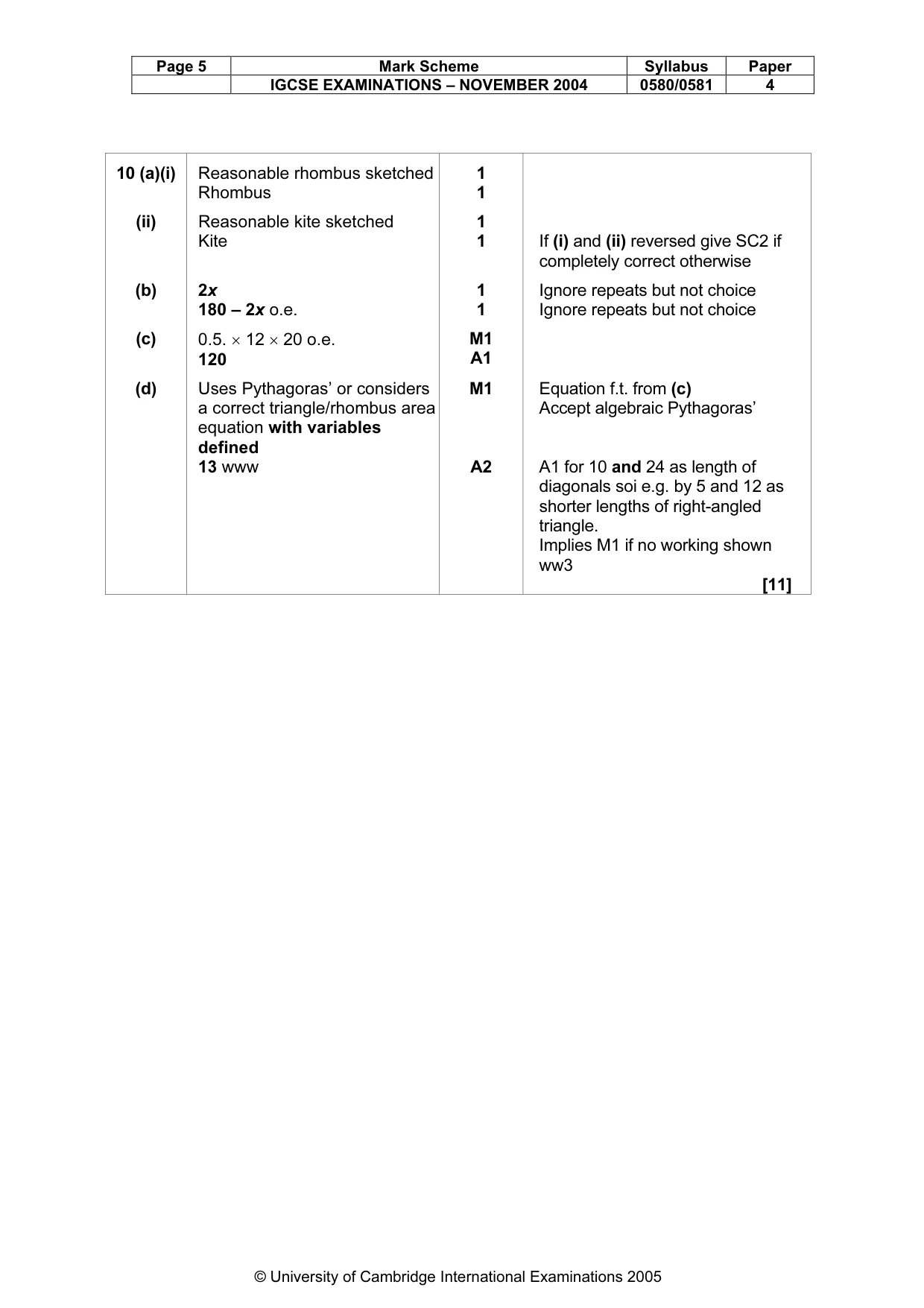
Page 5 Mark Scheme Syllabus Paper IGCSE EXAMINATIONS – NOVEMBER 2004 0580/0581 4 © University of Cambridge International Examinations 2005 10 (a)(i) Reasonable rhombus sketched Rhombus 1 1 (ii) Reasonable kite sketched Kite 1 1 If (i) and (ii) reversed give SC2 if completely correct otherwise (b) 2x 180 – 2x o.e. 1 1 Ignore repeats but not choice Ignore repeats but not choice (c) 0.5. × 12 × 20 o.e. 120 M1 A1 (d) Uses Pythagoras’ or considers a correct triangle/rhombus area equation with variables defined 13 www M1 A2 Equation f.t. from (c) Accept algebraic Pythagoras’ A1 for 10 and 24 as length of diagonals soi e.g. by 5 and 12 as shorter lengths of right-angled triangle. Implies M1 if no working shown ww3 [11]