Cambridge IGCSE Marine Science (Maldives only) 0697 — 2022 May/June Paper 3 · Variant 0
0697/30/M/J/22 · 60 marks · ≈68 min
The question paper and its mark scheme, free to read here and free to download. This is Cambridge’s own paper, exactly as it was sat.
Question paper12 pages
Mark scheme
No mark scheme is in the library for this paper.
Paper as text
Question paper, page 1
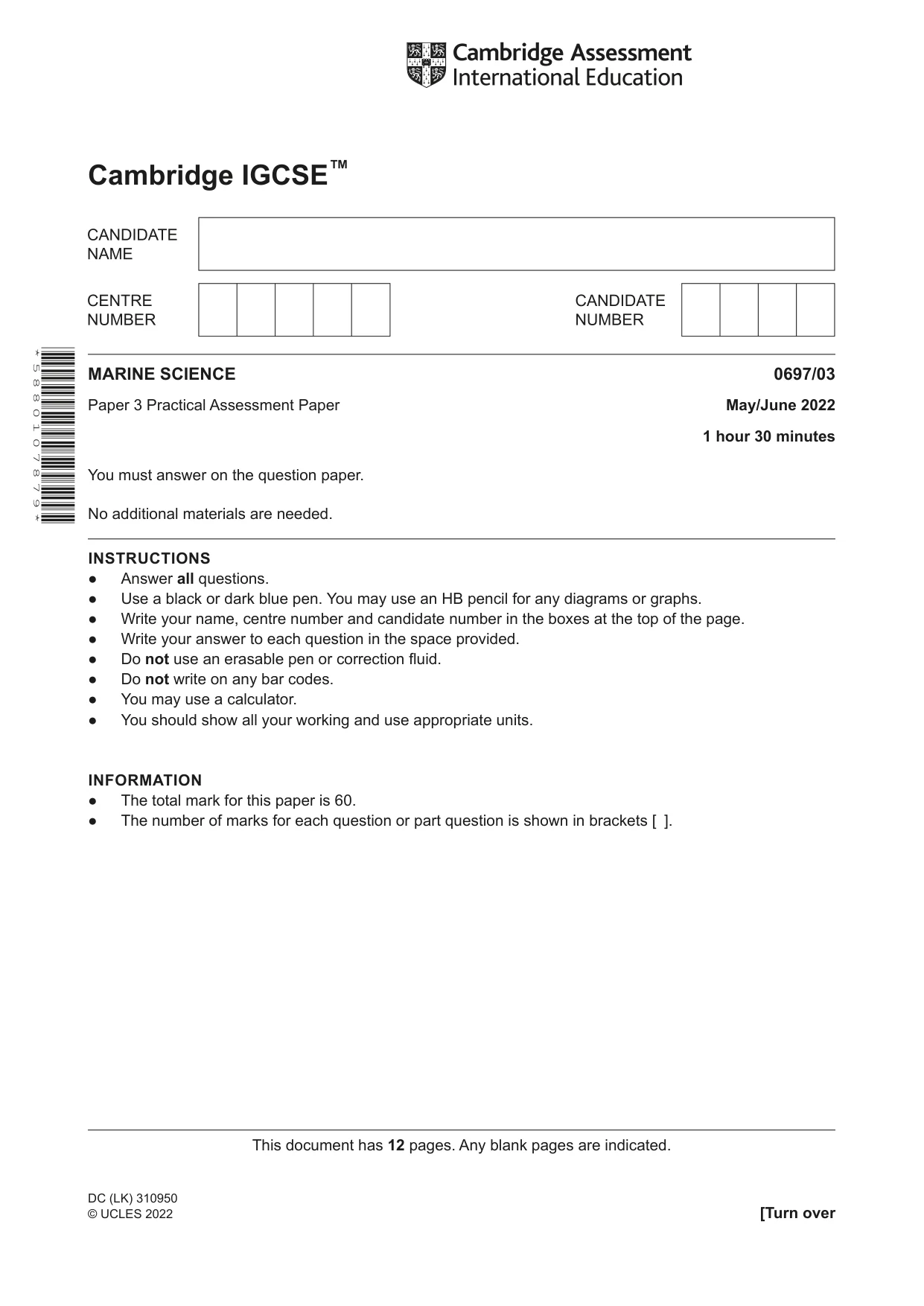
DC (LK) 310950 © UCLES 2022 [Turn over This document has 12 pages. Any blank pages are indicated. * 5 8 8 0 1 0 7 8 7 9 * MARINE SCIENCE 0697/03 Paper 3 Practical Assessment Paper May/June 2022 1 hour 30 minutes You must answer on the question paper. No additional materials are needed. INSTRUCTIONS ● Answer all questions. ● Use a black or dark blue pen. You may use an HB pencil for any diagrams or graphs. ● Write your name, centre number and candidate number in the boxes at the top of the page. ● Write your answer to each question in the space provided. ● Do not use an erasable pen or correction fluid. ● Do not write on any bar codes. ● You may use a calculator. ● You should show all your working and use appropriate units. INFORMATION ● The total mark for this paper is 60. ● The number of marks for each question or part question is shown in brackets [ ]. Cambridge IGCSE™
Question paper, page 2
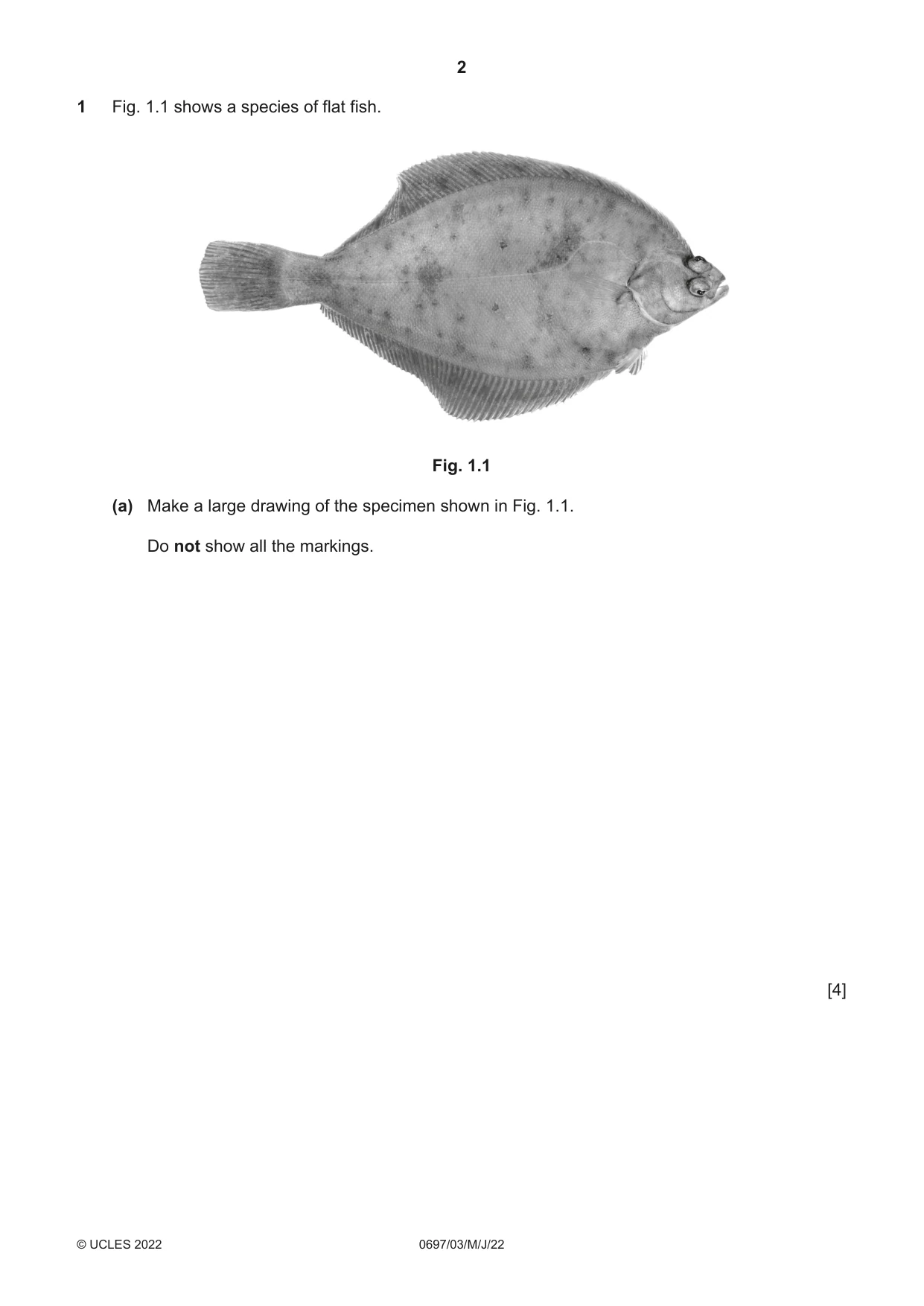
2 0697/03/M/J/22 © UCLES 2022 1 Fig. 1.1 shows a species of flat fish. Fig. 1.1 (a) Make a large drawing of the specimen shown in Fig. 1.1. Do not show all the markings. [4]
Question paper, page 3
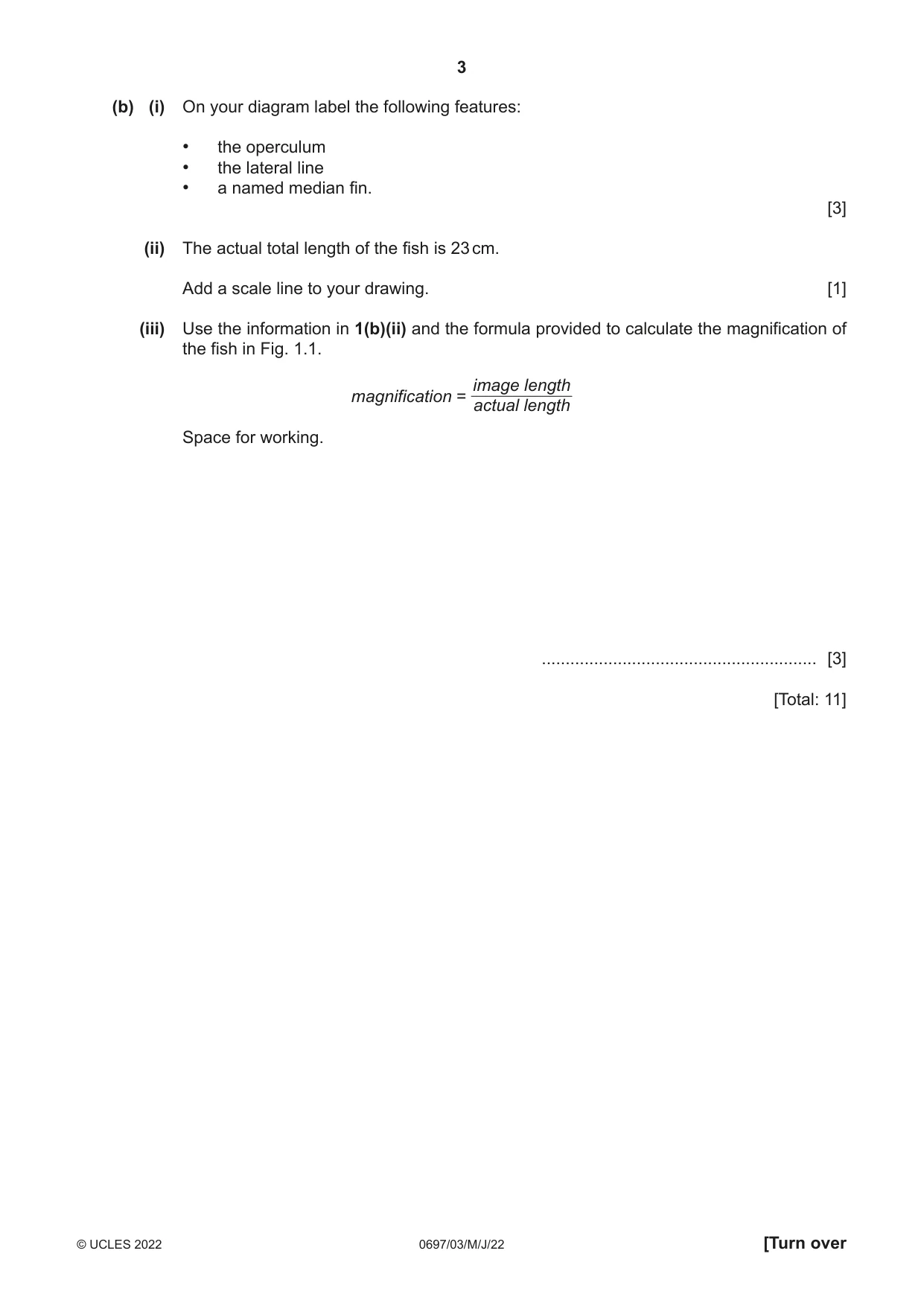
3 0697/03/M/J/22 © UCLES 2022 [Turn over (b) (i) On your diagram label the following features: • the operculum • the lateral line • a named median fin. [3] (ii) The actual total length of the fish is 23 cm. Add a scale line to your drawing. [1] (iii) Use the information in 1(b)(ii) and the formula provided to calculate the magnification of the fish in Fig. 1.1. magnification = image length actual length Space for working. … [3] [Total: 11]
Question paper, page 4
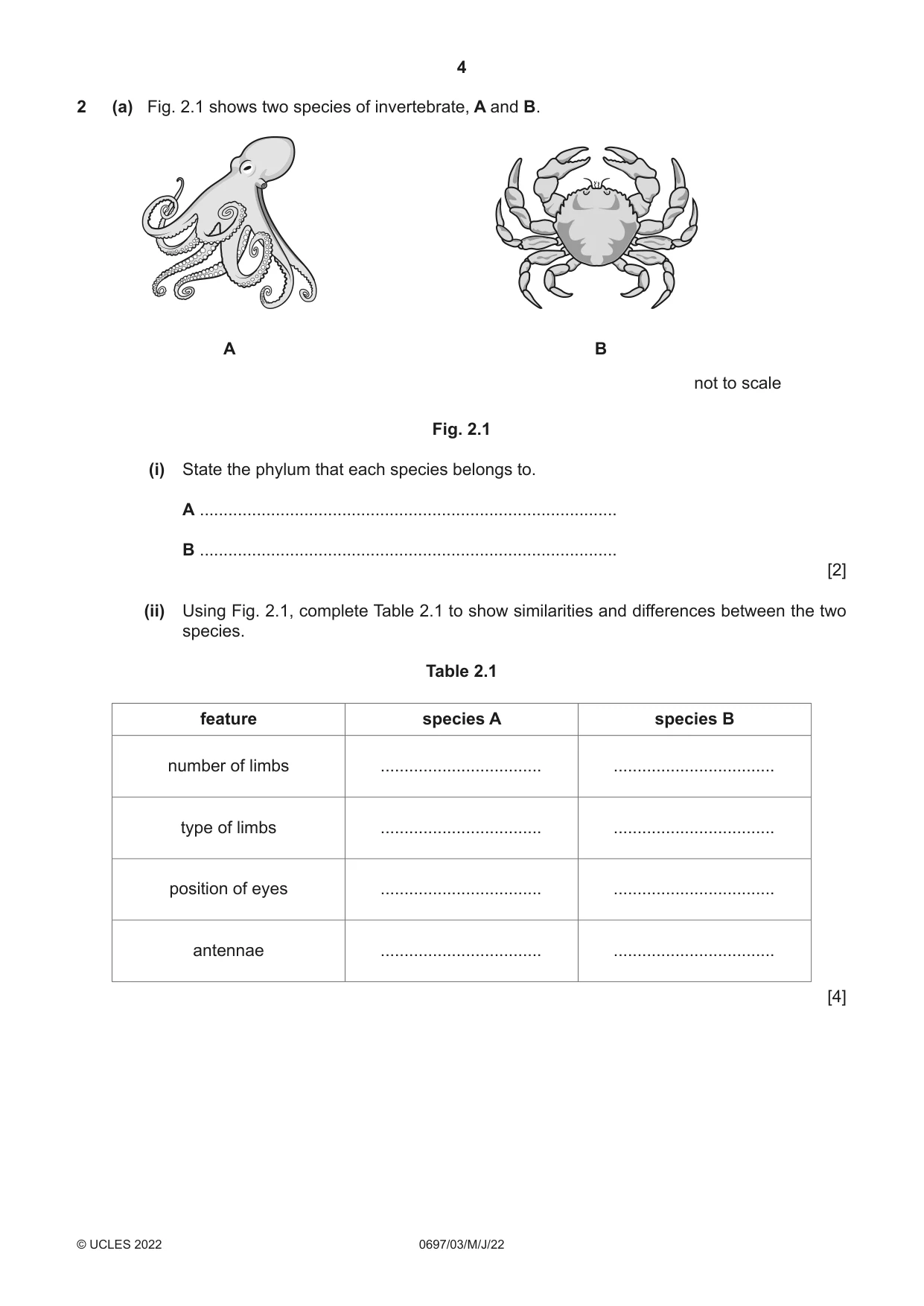
4 0697/03/M/J/22 © UCLES 2022 2 (a) Fig. 2.1 shows two species of invertebrate, A and B. not to scale A B Fig. 2.1 (i) State the phylum that each species belongs to. A … B … [2] (ii) Using Fig. 2.1, complete Table 2.1 to show similarities and differences between the two species. Table 2.1 feature species A species B number of limbs … … type of limbs … … position of eyes … … antennae … … [4]
Question paper, page 5
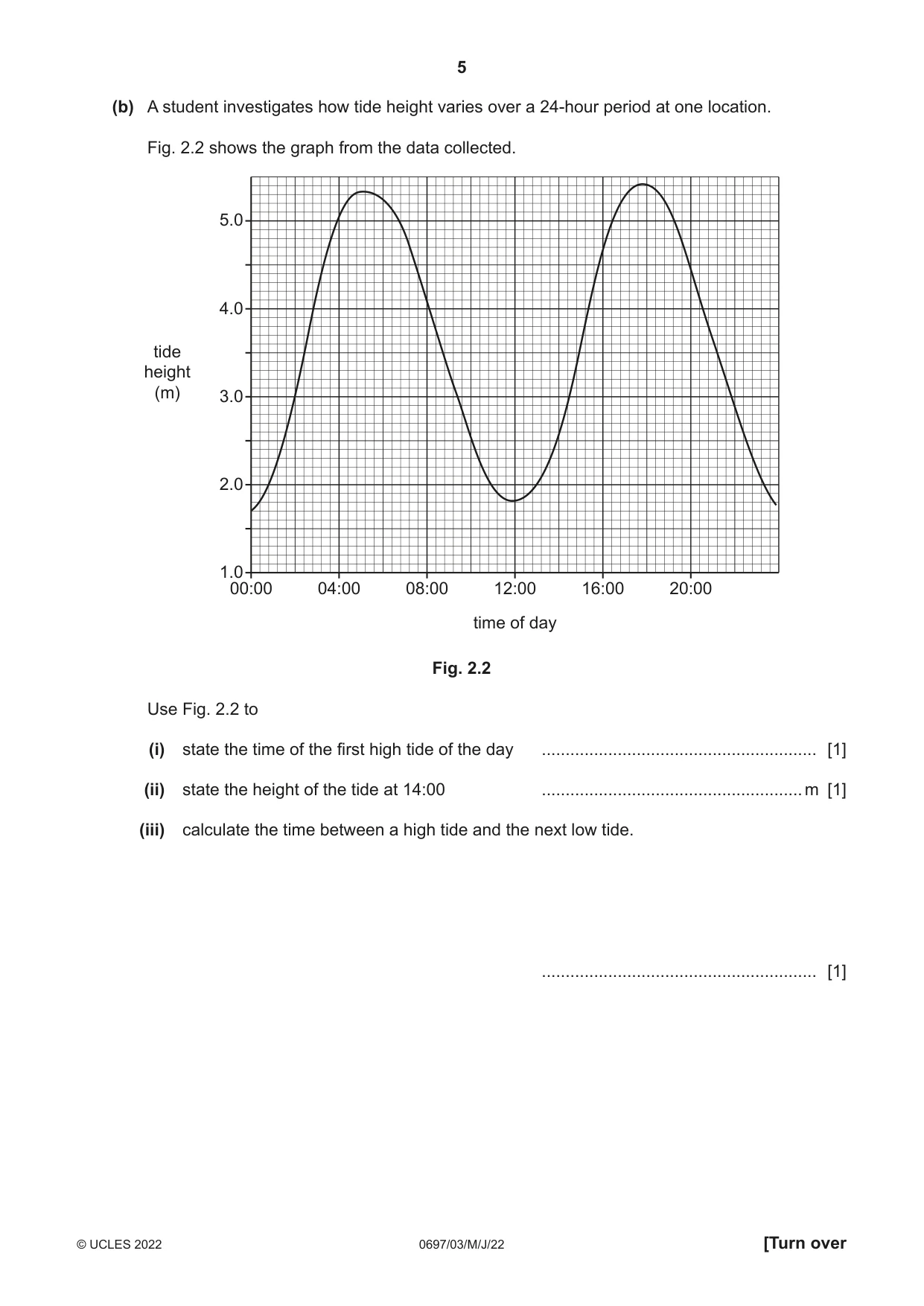
5 0697/03/M/J/22 © UCLES 2022 [Turn over (b) A student investigates how tide height varies over a 24-hour period at one location. Fig. 2.2 shows the graph from the data collected. 00:00 1.0 2.0 3.0 tide height (m) 4.0 5.0 04:00 08:00 12:00 time of day 16:00 20:00 Fig. 2.2 Use Fig. 2.2 to (i) state the time of the first high tide of the day … [1] (ii) state the height of the tide at 14:00 … m [1] (iii) calculate the time between a high tide and the next low tide. … [1]
Question paper, page 6
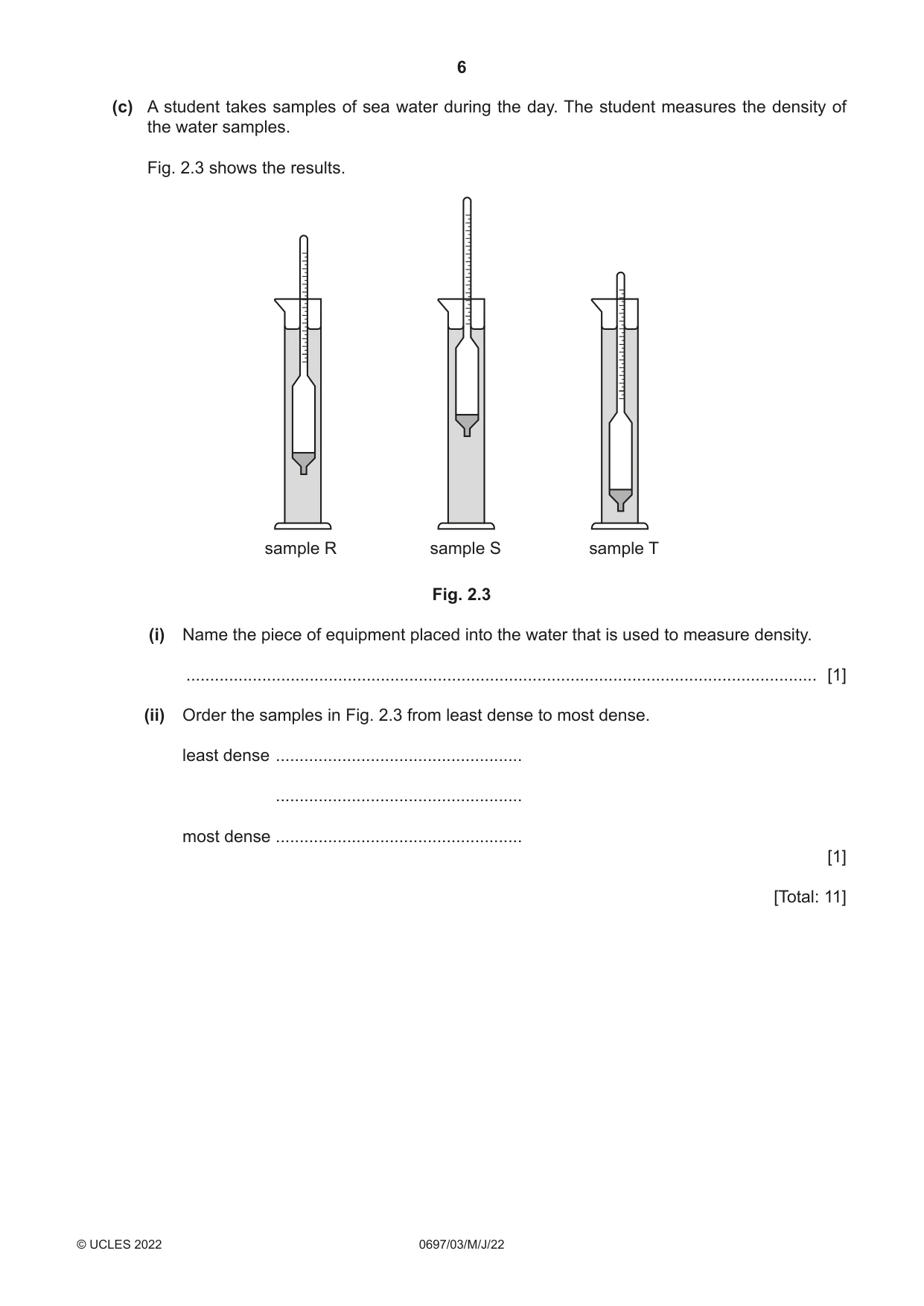
6 0697/03/M/J/22 © UCLES 2022 (c) A student takes samples of sea water during the day. The student measures the density of the water samples. Fig. 2.3 shows the results. sample R sample S sample T Fig. 2.3 (i) Name the piece of equipment placed into the water that is used to measure density. … [1] (ii) Order the samples in Fig. 2.3 from least dense to most dense. least dense … … most dense … [1] [Total: 11]
Question paper, page 7
7 0697/03/M/J/22 © UCLES 2022 [Turn over 3 A student compares the density of the shells of three different species of marine mollusc from a rocky shore. They collected ten shells for each species from the same beach area. (a) Describe a method to find the mean shell density for each species. … … … … … … … … … … [4] (b) The student notes that the shells of each species are a different shape. Describe a method they could use to investigate which shell shape is the most streamlined. … … … … … … … … … … [4] [Total: 8]
Question paper, page 8
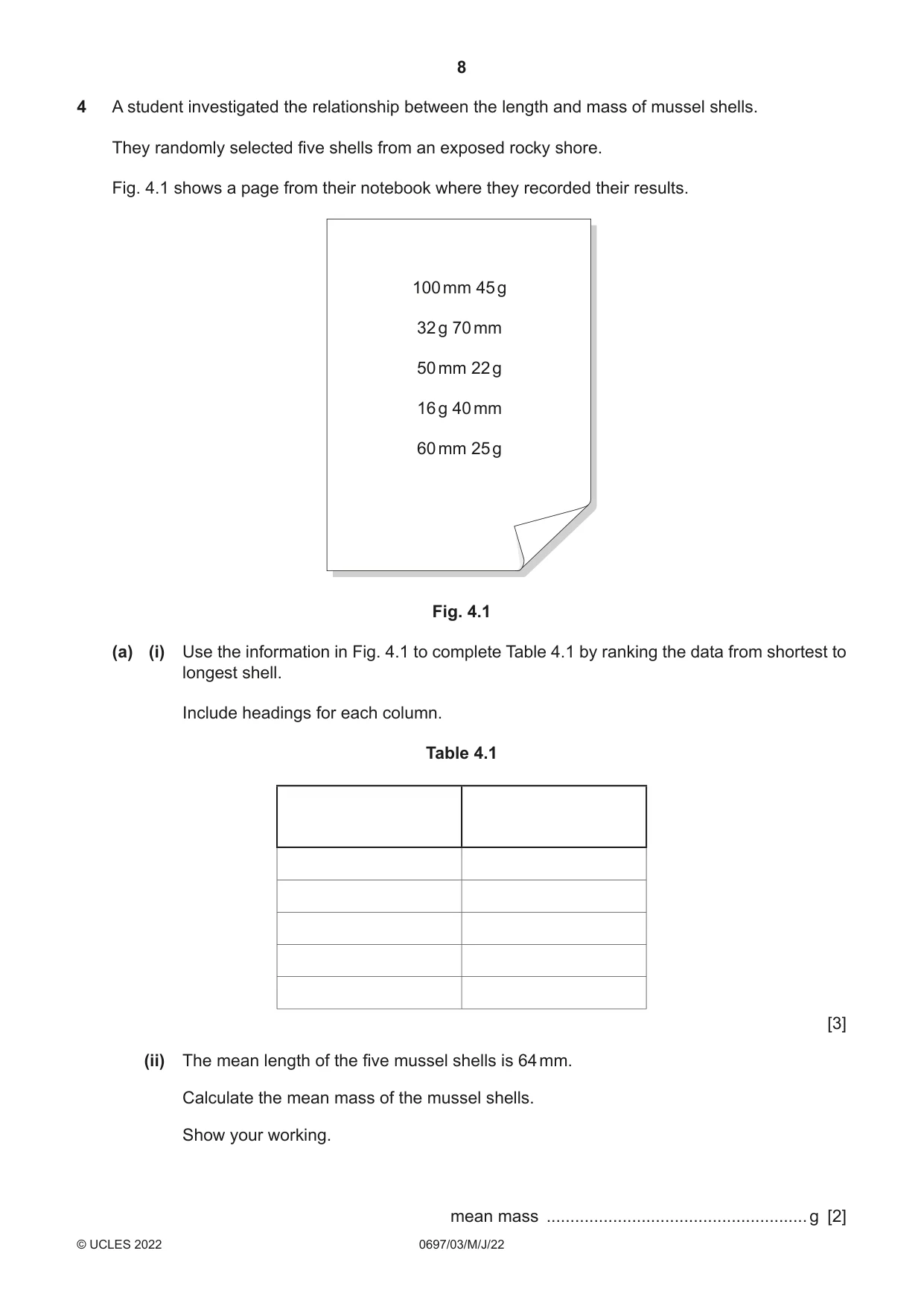
8 0697/03/M/J/22 © UCLES 2022 4 A student investigated the relationship between the length and mass of mussel shells. They randomly selected five shells from an exposed rocky shore. Fig. 4.1 shows a page from their notebook where they recorded their results. 100 mm 45 g 32 g 70 mm 50 mm 22 g 16 g 40 mm 60 mm 25 g Fig. 4.1 (a) (i) Use the information in Fig. 4.1 to complete Table 4.1 by ranking the data from shortest to longest shell. Include headings for each column. Table 4.1 [3] (ii) The mean length of the five mussel shells is 64 mm. Calculate the mean mass of the mussel shells. Show your working. mean mass … g [2]
Question paper, page 9
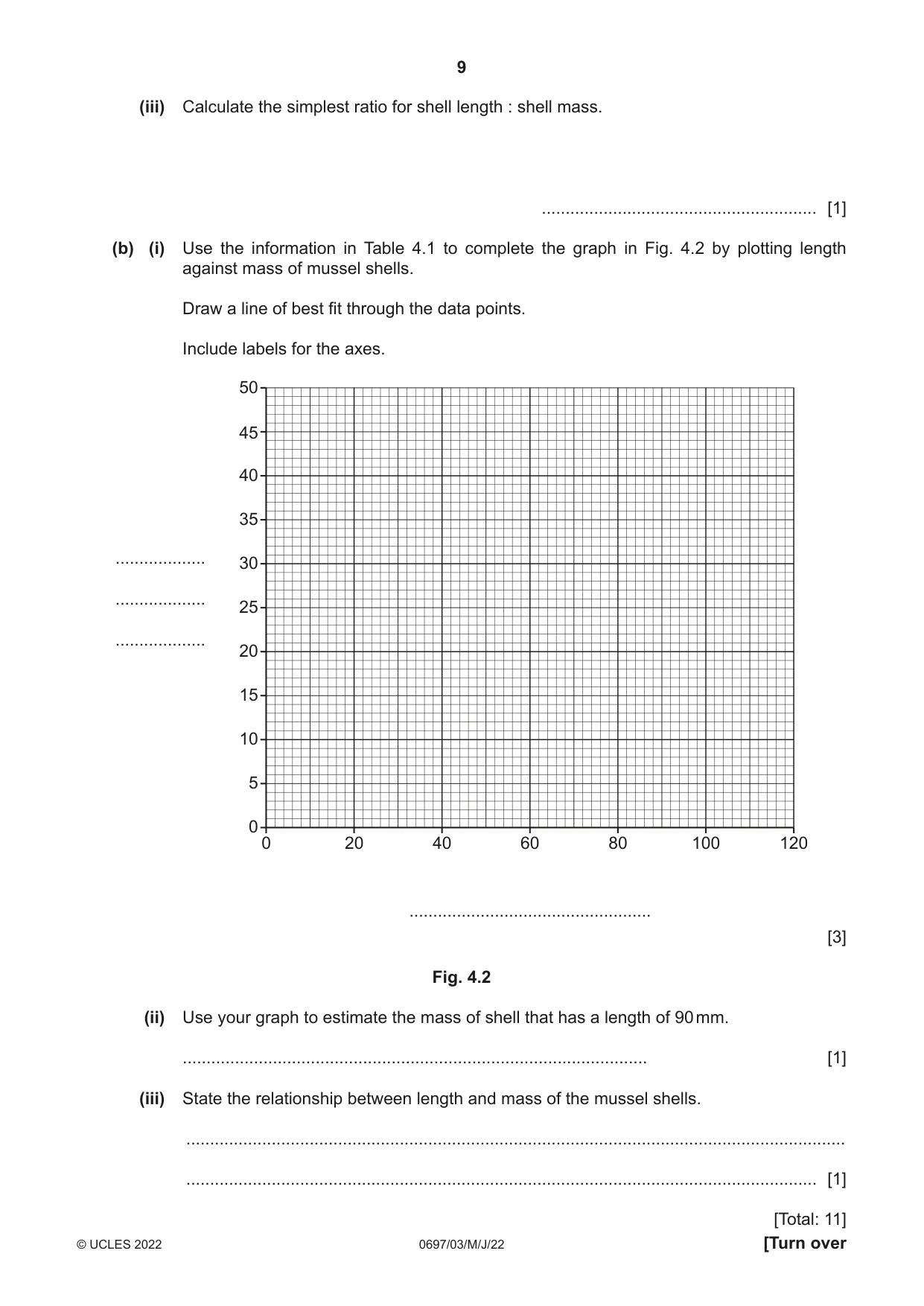
9 0697/03/M/J/22 © UCLES 2022 [Turn over (iii) Calculate the simplest ratio for shell length : shell mass. … [1] (b) (i) Use the information in Table 4.1 to complete the graph in Fig. 4.2 by plotting length against mass of mussel shells. Draw a line of best fit through the data points. Include labels for the axes. 20 0 0 10 20 … … … 30 40 50 45 5 15 25 35 40 60 80 … 100 120 [3] Fig. 4.2 (ii) Use your graph to estimate the mass of shell that has a length of 90 mm. … [1] (iii) State the relationship between length and mass of the mussel shells. … … [1] [Total: 11]
Question paper, page 10
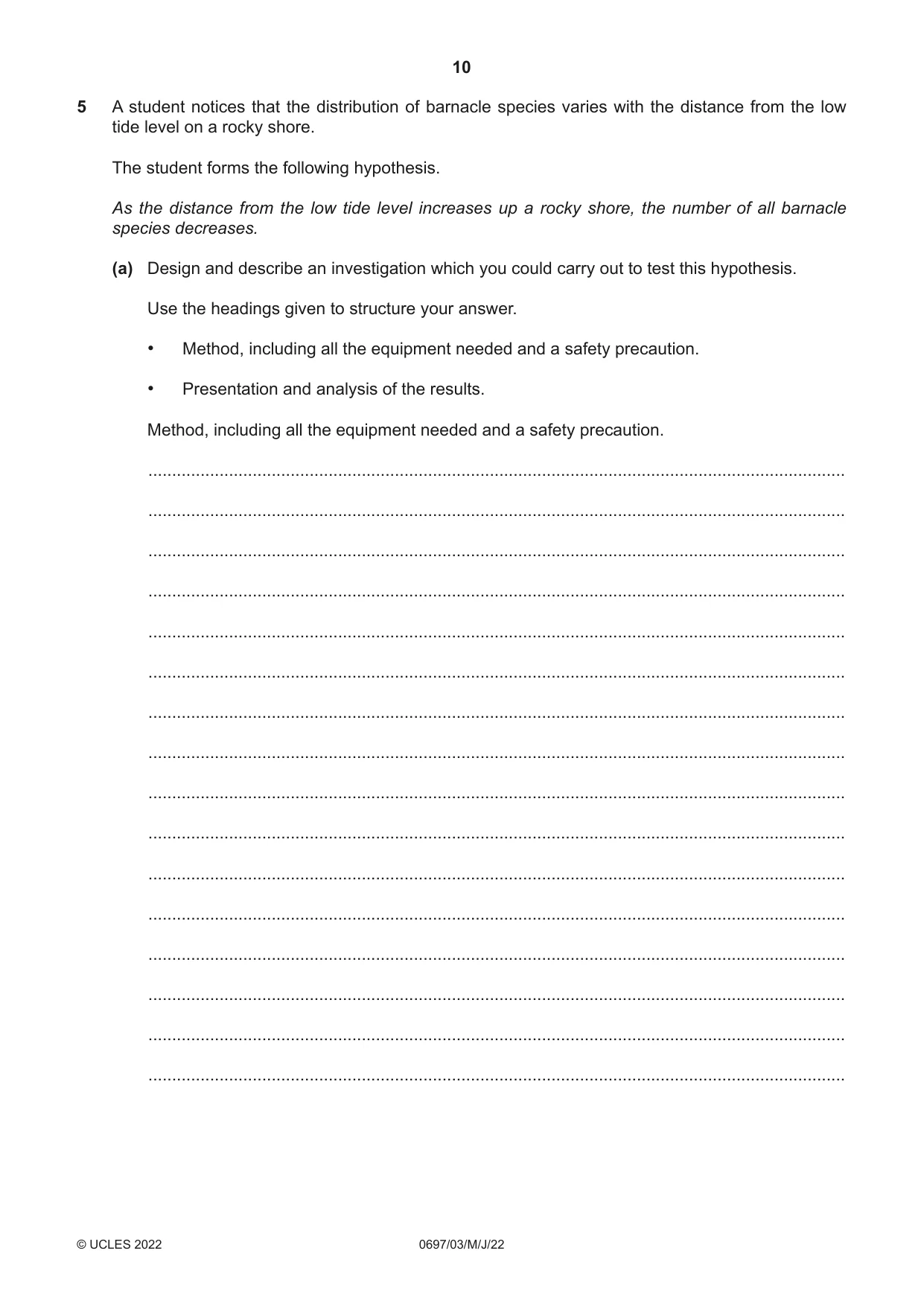
10 0697/03/M/J/22 © UCLES 2022 5 A student notices that the distribution of barnacle species varies with the distance from the low tide level on a rocky shore. The student forms the following hypothesis. As the distance from the low tide level increases up a rocky shore, the number of all barnacle species decreases. (a) Design and describe an investigation which you could carry out to test this hypothesis. Use the headings given to structure your answer. • Method, including all the equipment needed and a safety precaution. • Presentation and analysis of the results. Method, including all the equipment needed and a safety precaution. … … … … … … … … … … … … … … … …
Question paper, page 11
11 0697/03/M/J/22 © UCLES 2022 Presentation and analysis of the results. … … … … … … … … … … … … [14] (b) Describe the limitations of your method and suggest improvements. Suggest further work to extend the investigation. … … … … … … … … … … [5] [Total: 19]
Question paper, page 12
12 0697/03/M/J/22 © UCLES 2022 Permission to reproduce items where third-party owned material protected by copyright is included has been sought and cleared where possible. Every reasonable effort has been made by the publisher (UCLES) to trace copyright holders, but if any items requiring clearance have unwittingly been included, the publisher will be pleased to make amends at the earliest possible opportunity. To avoid the issue of disclosure of answer-related information to candidates, all copyright acknowledgements are reproduced online in the Cambridge Assessment International Education Copyright Acknowledgements Booklet. This is produced for each series of examinations and is freely available to download at www.cambridgeinternational.org after the live examination series. Cambridge Assessment International Education is part of Cambridge Assessment. Cambridge Assessment is the brand name of the University of Cambridge Local Examinations Syndicate (UCLES), which is a department of the University of Cambridge. BLANK PAGE
What you needed in this session
Cambridge’s own grade thresholds for 2022 May/June, Paper 3 · Variant 0. A higher threshold means an easier paper — the bar moves with how the cohort did.