Cambridge IGCSE Latin 0480 — 2016 May/June Paper 1 · Variant 0
0480/10/M/J/16
The question paper and its mark scheme, free to read here and free to download. This is Cambridge’s own paper, exactly as it was sat.
Question paper8 pages




Mark scheme
No mark scheme is in the library for this paper.
Paper as text
Question paper, page 1
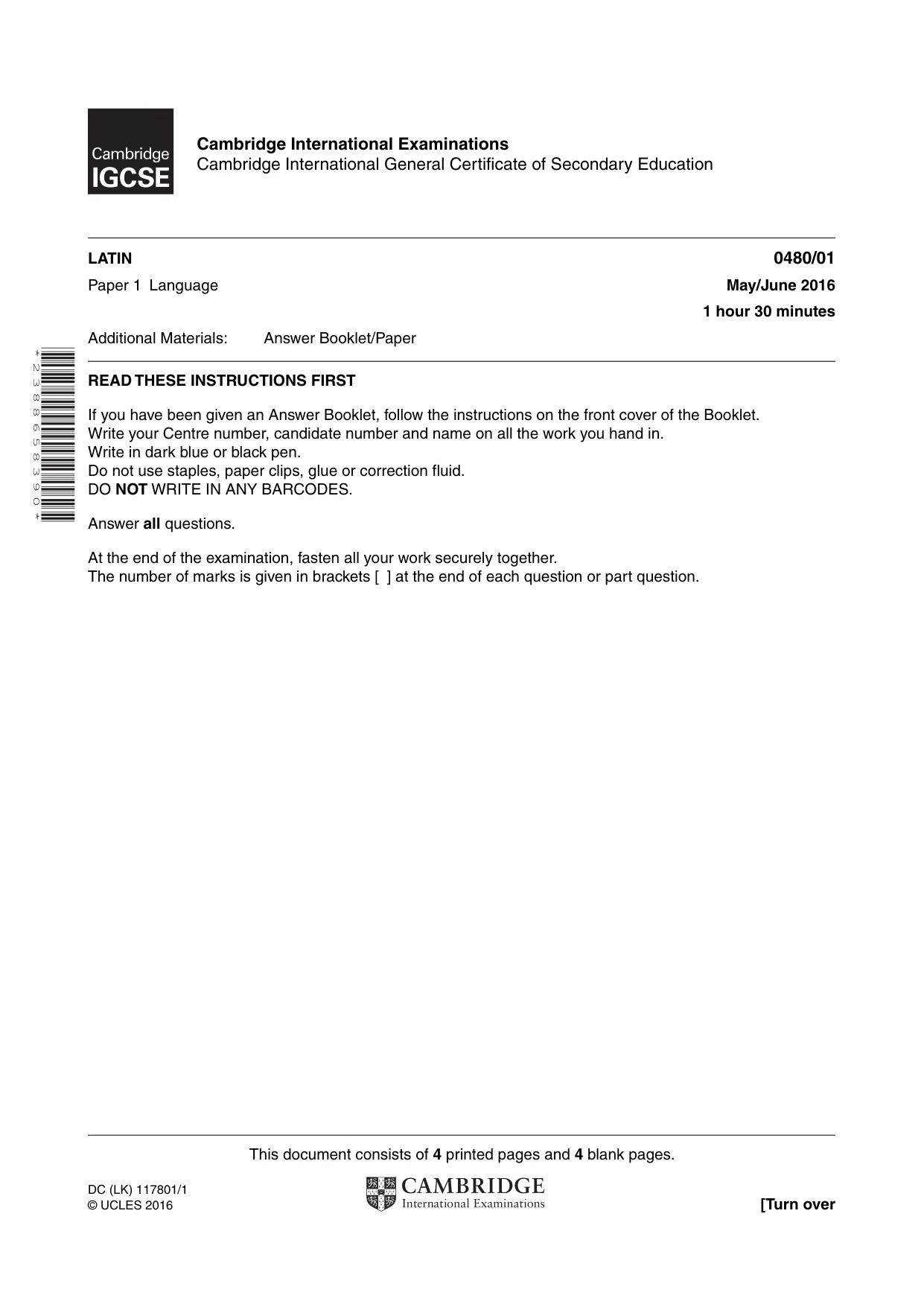
This document consists of 4 printed pages and 4 blank pages. DC (LK) 117801/1 © UCLES 2016 [Turn over Cambridge International Examinations Cambridge International General Certificate of Secondary Education * 2 3 8 8 6 5 8 3 9 0 * LATIN 0480/01 Paper 1 Language May/June 2016 1 hour 30 minutes Additional Materials: Answer Booklet/Paper READ THESE INSTRUCTIONS FIRST If you have been given an Answer Booklet, follow the instructions on the front cover of the Booklet. Write your Centre number, candidate number and name on all the work you hand in. Write in dark blue or black pen. Do not use staples, paper clips, glue or correction fluid. DO NOT WRITE IN ANY BARCODES. Answer all questions. At the end of the examination, fasten all your work securely together. The number of marks is given in brackets [ ] at the end of each question or part question.
Question paper, page 2
2 0480/01/M/J/16 © UCLES 2016 BLANK PAGE
Question paper, page 3
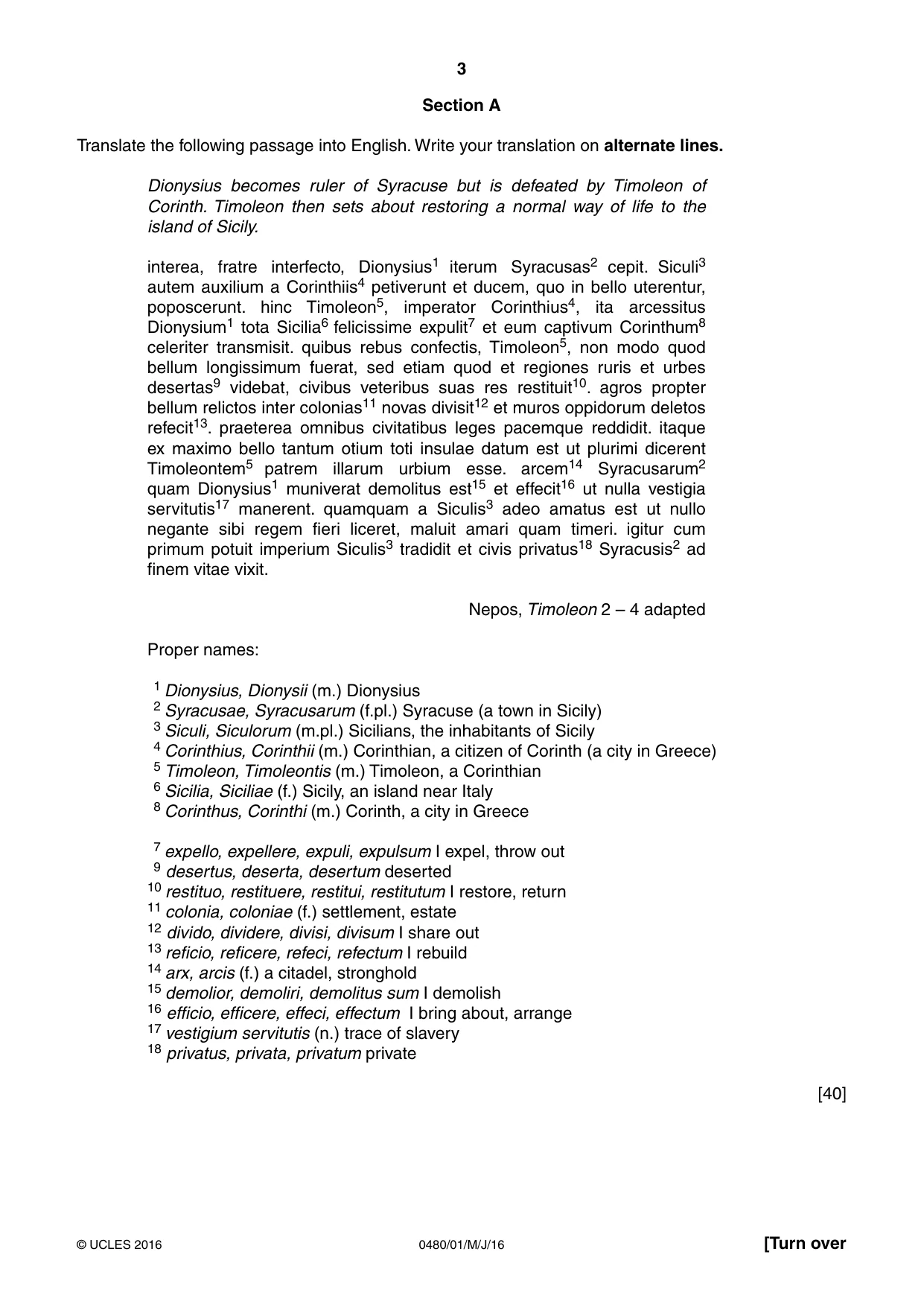
3 0480/01/M/J/16 © UCLES 2016 [Turn over Section A Translate the following passage into English. Write your translation on alternate lines. Dionysius becomes ruler of Syracuse but is defeated by Timoleon of Corinth. Timoleon then sets about restoring a normal way of life to the island of Sicily. interea, fratre interfecto, Dionysius1 iterum Syracusas2 cepit. Siculi3 autem auxilium a Corinthiis4 petiverunt et ducem, quo in bello uterentur, poposcerunt. hinc Timoleon5, imperator Corinthius4, ita arcessitus Dionysium1 tota Sicilia6 felicissime expulit7 et eum captivum Corinthum8 celeriter transmisit. quibus rebus confectis, Timoleon5, non modo quod bellum longissimum fuerat, sed etiam quod et regiones ruris et urbes desertas9 videbat, civibus veteribus suas res restituit10. agros propter bellum relictos inter colonias11 novas divisit12 et muros oppidorum deletos refecit13. praeterea omnibus civitatibus leges pacemque reddidit. itaque ex maximo bello tantum otium toti insulae datum est ut plurimi dicerent Timoleontem5 patrem illarum urbium esse. arcem14 Syracusarum2 quam Dionysius1 muniverat demolitus est15 et effecit16 ut nulla vestigia servitutis17 manerent. quamquam a Siculis3 adeo amatus est ut nullo negante sibi regem fieri liceret, maluit amari quam timeri. igitur cum primum potuit imperium Siculis3 tradidit et civis privatus18 Syracusis2 ad finem vitae vixit. Nepos, Timoleon 2 – 4 adapted Proper names: 1 Dionysius, Dionysii (m.) Dionysius 2 Syracusae, Syracusarum (f.pl.) Syracuse (a town in Sicily) 3 Siculi, Siculorum (m.pl.) Sicilians, the inhabitants of Sicily 4 Corinthius, Corinthii (m.) Corinthian, a citizen of Corinth (a city in Greece) 5 Timoleon, Timoleontis (m.) Timoleon, a Corinthian 6 Sicilia, Siciliae (f.) Sicily, an island near Italy 8 Corinthus, Corinthi (m.) Corinth, a city in Greece 7 expello, expellere, expuli, expulsum I expel, throw out 9 desertus, deserta, desertum deserted 10 restituo, restituere, restitui, restitutum I restore, return 11 colonia, coloniae (f.) settlement, estate 12 divido, dividere, divisi, divisum I share out 13 reficio, reficere, refeci, refectum I rebuild 14 arx, arcis (f.) a citadel, stronghold 15 demolior, demoliri, demolitus sum I demolish 16 efficio, efficere, effeci, effectum I bring about, arrange 17 vestigium servitutis (n.) trace of slavery 18 privatus, privata, privatum private [40]
Question paper, page 4
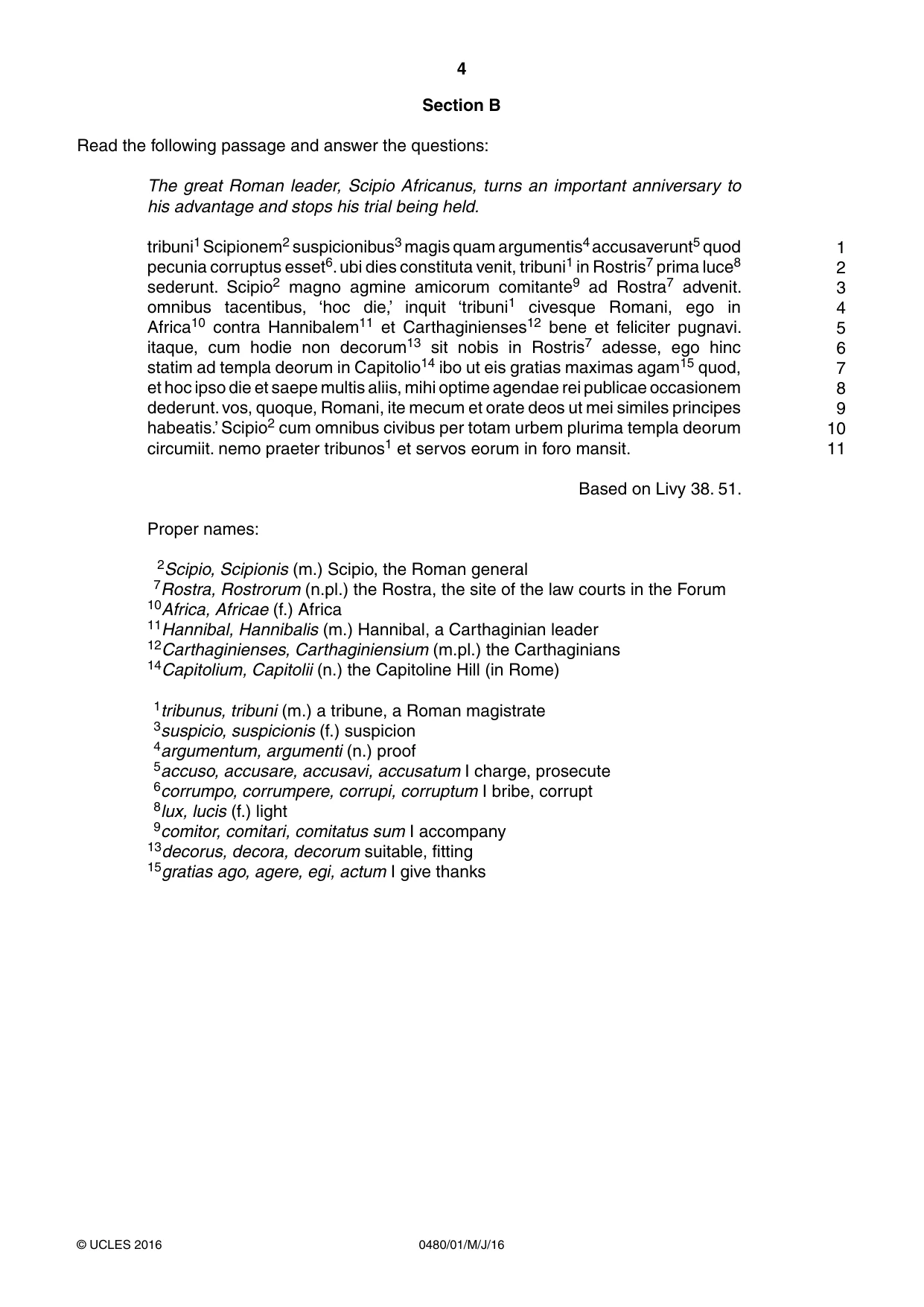
4 0480/01/M/J/16 © UCLES 2016 Section B Read the following passage and answer the questions: The great Roman leader, Scipio Africanus, turns an important anniversary to his advantage and stops his trial being held. tribuni1 Scipionem2 suspicionibus3 magis quam argumentis4 accusaverunt5 quod pecunia corruptus esset6. ubi dies constituta venit, tribuni1 in Rostris7 prima luce8 sederunt. Scipio2 magno agmine amicorum comitante9 ad Rostra7 advenit. omnibus tacentibus, ‘hoc die,’ inquit ‘tribuni1 civesque Romani, ego in Africa10 contra Hannibalem11 et Carthaginienses12 bene et feliciter pugnavi. itaque, cum hodie non decorum13 sit nobis in Rostris7 adesse, ego hinc statim ad templa deorum in Capitolio14 ibo ut eis gratias maximas agam15 quod, et hoc ipso die et saepe multis aliis, mihi optime agendae rei publicae occasionem dederunt. vos, quoque, Romani, ite mecum et orate deos ut mei similes principes habeatis.’ Scipio2 cum omnibus civibus per totam urbem plurima templa deorum circumiit. nemo praeter tribunos1 et servos eorum in foro mansit. Based on Livy 38. 51. Proper names: 2Scipio, Scipionis (m.) Scipio, the Roman general 7Rostra, Rostrorum (n.pl.) the Rostra, the site of the law courts in the Forum 10Africa, Africae (f.) Africa 11Hannibal, Hannibalis (m.) Hannibal, a Carthaginian leader 12Carthaginienses, Carthaginiensium (m.pl.) the Carthaginians 14Capitolium, Capitolii (n.) the Capitoline Hill (in Rome) 1tribunus, tribuni (m.) a tribune, a Roman magistrate 3suspicio, suspicionis (f.) suspicion 4argumentum, argumenti (n.) proof 5accuso, accusare, accusavi, accusatum I charge, prosecute 6corrumpo, corrumpere, corrupi, corruptum I bribe, corrupt 8lux, lucis (f.) light 9comitor, comitari, comitatus sum I accompany 13decorus, decora, decorum suitable, fitting 15gratias ago, agere, egi, actum I give thanks 1 2 3 4 5 6 7 8 9 10 11
Question paper, page 5
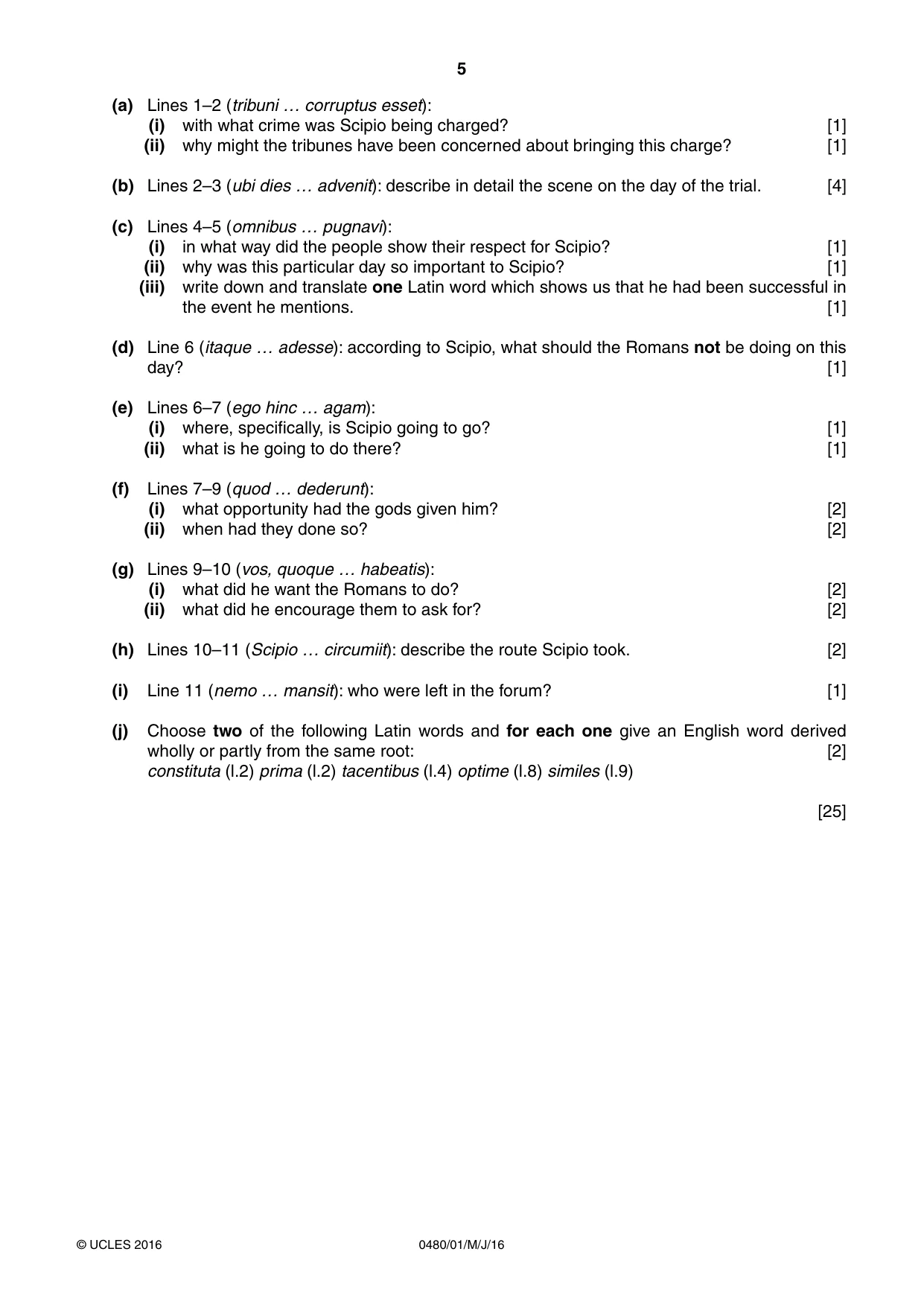
5 0480/01/M/J/16 © UCLES 2016 (a) Lines 1–2 (tribuni … corruptus esset): (i) with what crime was Scipio being charged? [1] (ii) why might the tribunes have been concerned about bringing this charge? [1] (b) Lines 2–3 (ubi dies … advenit): describe in detail the scene on the day of the trial. [4] (c) Lines 4–5 (omnibus … pugnavi): (i) in what way did the people show their respect for Scipio? [1] (ii) why was this particular day so important to Scipio? [1] (iii) write down and translate one Latin word which shows us that he had been successful in the event he mentions. [1] (d) Line 6 (itaque … adesse): according to Scipio, what should the Romans not be doing on this day? [1] (e) Lines 6–7 (ego hinc … agam): (i) where, specifically, is Scipio going to go? [1] (ii) what is he going to do there? [1] (f) Lines 7–9 (quod … dederunt): (i) what opportunity had the gods given him? [2] (ii) when had they done so? [2] (g) Lines 9–10 (vos, quoque … habeatis): (i) what did he want the Romans to do? [2] (ii) what did he encourage them to ask for? [2] (h) Lines 10–11 (Scipio … circumiit): describe the route Scipio took. [2] (i) Line 11 (nemo … mansit): who were left in the forum? [1] (j) Choose two of the following Latin words and for each one give an English word derived wholly or partly from the same root: [2] constituta (l.2) prima (l.2) tacentibus (l.4) optime (l.8) similes (l.9) [25]
Question paper, page 6
6 0480/01/M/J/16 © UCLES 2016 BLANK PAGE
Question paper, page 7
7 0480/01/M/J/16 © UCLES 2016 BLANK PAGE
Question paper, page 8
8 0480/01/M/J/16 © UCLES 2016 Permission to reproduce items where third-party owned material protected by copyright is included has been sought and cleared where possible. Every reasonable effort has been made by the publisher (UCLES) to trace copyright holders, but if any items requiring clearance have unwittingly been included, the publisher will be pleased to make amends at the earliest possible opportunity. To avoid the issue of disclosure of answer-related information to candidates, all copyright acknowledgements are reproduced online in the Cambridge International Examinations Copyright Acknowledgements Booklet. This is produced for each series of examinations and is freely available to download at www.cie.org.uk after the live examination series. Cambridge International Examinations is part of the Cambridge Assessment Group. Cambridge Assessment is the brand name of University of Cambridge Local Examinations Syndicate (UCLES), which is itself a department of the University of Cambridge. BLANK PAGE