Cambridge IGCSE Italian - Foreign Language (UK) 0679 — 2014 May/June Paper 4 · Variant 1
0679/41/M/J/14 · 50 marks · ≈56 min
The question paper and its mark scheme, free to read here and free to download. This is Cambridge’s own paper, exactly as it was sat.
Question paper4 pages
Mark scheme23 pages
Answers below. Sit the paper first if you are practising.
Paper as text
Question paper, page 1
PAPA CAMBRIDGE This document consists of 4 printed pages. DC (KN) 92462 © UCLES 2014 [Turn over * 9 2 4 0 4 1 1 3 7 8 * ITALIAN 0679/04 Paper 4 Continuous Writing May/June 2014 1 hour 15 minutes Candidates answer on the Question Paper. No Additional Materials are required. READ THESE INSTRUCTIONS FIRST Write your Centre number, candidate number and name on all the work you hand in. Write in dark blue or black pen. Do not use staples, paper clips, glue or correction fluid. DO NOT WRITE IN ANY BARCODES. Answer Question 1(a) or Question 1(b) and Question 2. At the end of the examination, fasten all your work securely together. All questions in this paper carry equal marks. Cambridge International Examinations Cambridge International General Certificate of Secondary Education For Examiner’s Use 1 2 Total The syllabus is approved for use in England, Wales and Northern Ireland as a Cambridge International Level 1/Level 2 Certificate.
Question paper, page 2
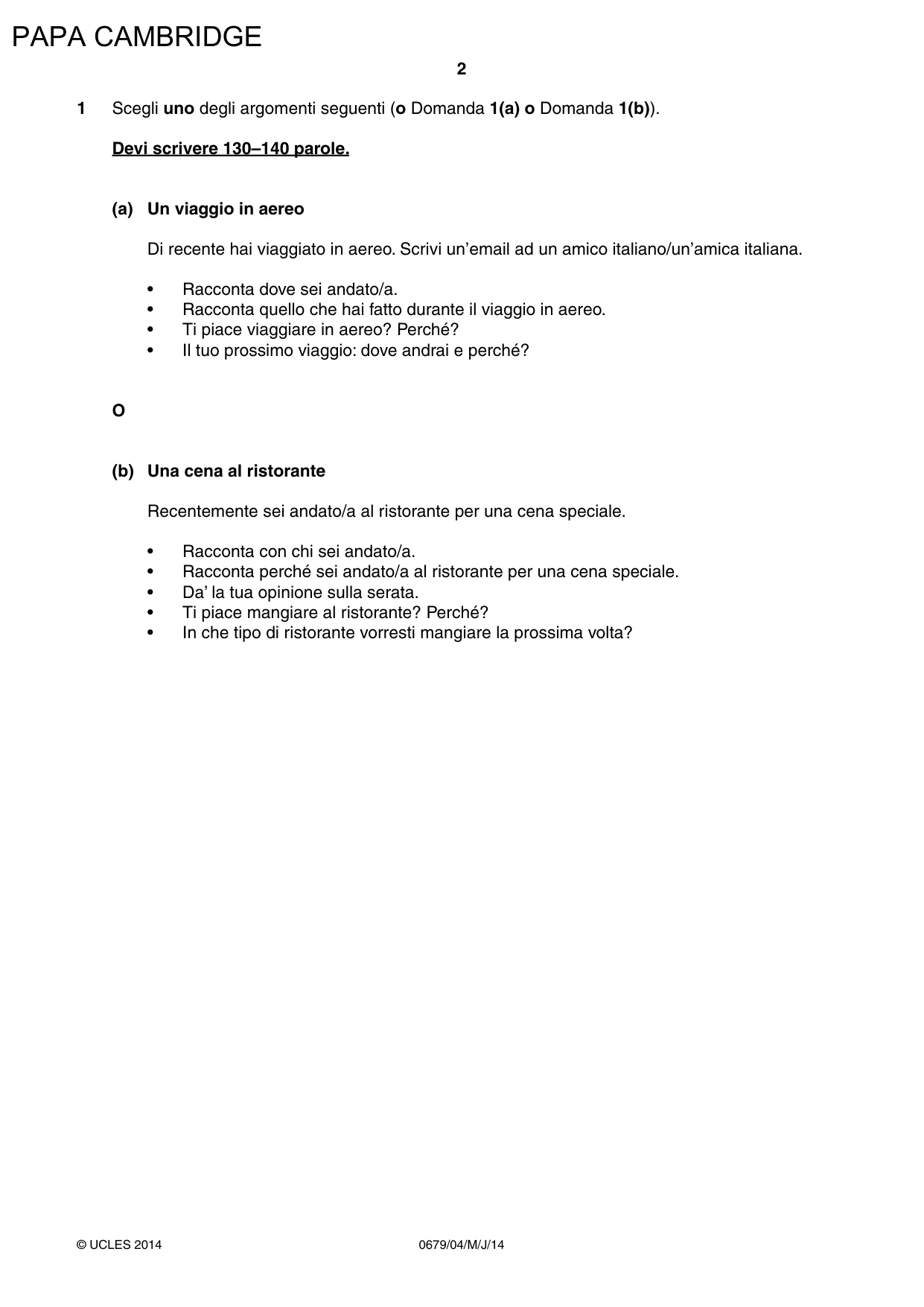
PAPA CAMBRIDGE 2 0679/04/M/J/14 © UCLES 2014 1 Scegli uno degli argomenti seguenti (o Domanda 1(a) o Domanda 1(b)). Devi scrivere 130–140 parole. (a) Un viaggio in aereo Di recente hai viaggiato in aereo. Scrivi un’email ad un amico italiano/un’amica italiana. • Racconta dove sei andato/a. • Racconta quello che hai fatto durante il viaggio in aereo. • Ti piace viaggiare in aereo? Perché? • Il tuo prossimo viaggio: dove andrai e perché? O (b) Una cena al ristorante Recentemente sei andato/a al ristorante per una cena speciale. • Racconta con chi sei andato/a. • Racconta perché sei andato/a al ristorante per una cena speciale. • Da’ la tua opinione sulla serata. • Ti piace mangiare al ristorante? Perché? • In che tipo di ristorante vorresti mangiare la prossima volta?
Question paper, page 3
PAPA CAMBRIDGE 3 0679/04/M/J/14 © UCLES 2014 [Turn over SCRIVI QUI LA TUA RISPOSTA ALLA DOMANDA 1 … … … … … … … … … … … … … … … … … … … … … … … … … …
Question paper, page 4
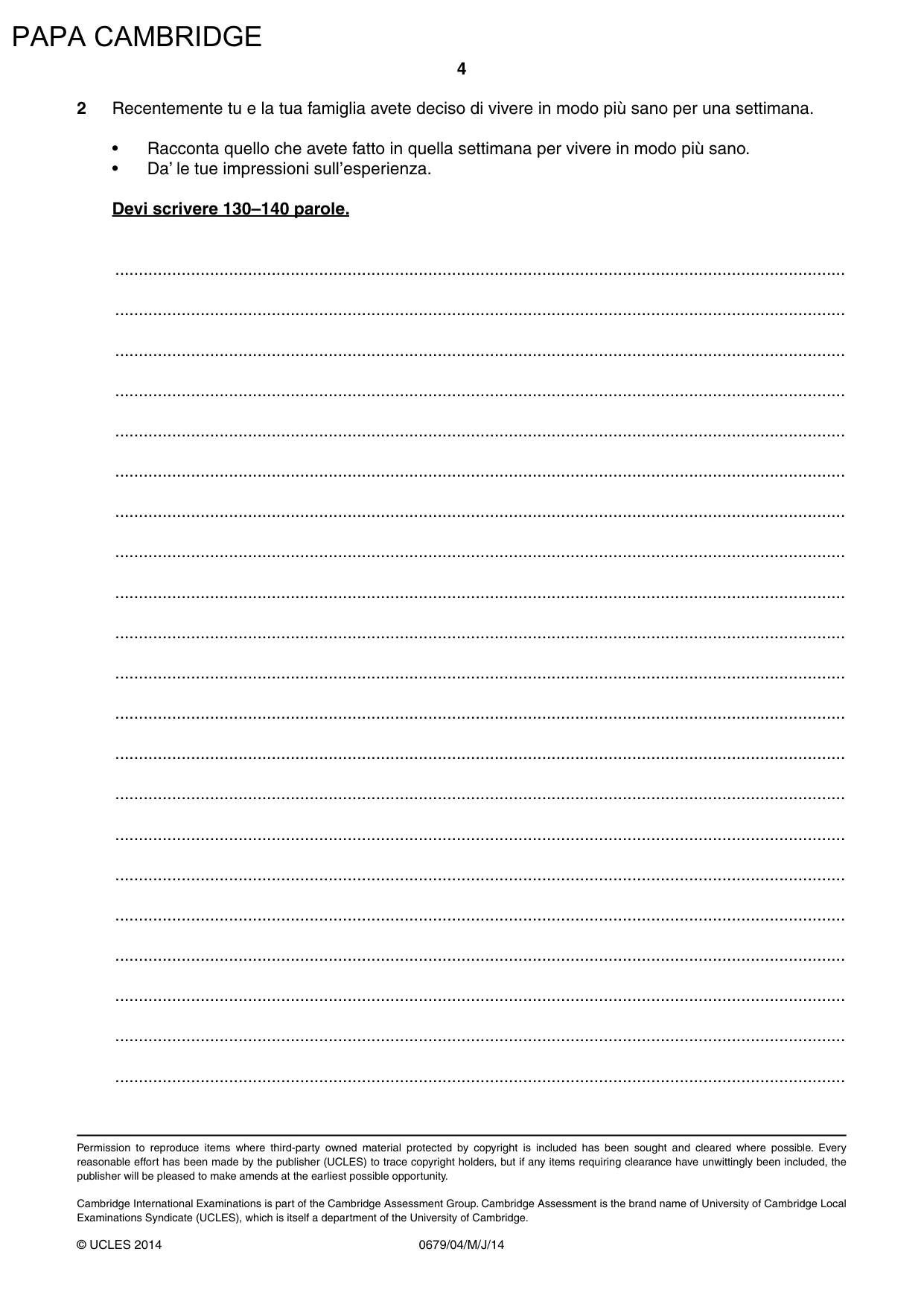
PAPA CAMBRIDGE 4 0679/04/M/J/14 © UCLES 2014 2 Recentemente tu e la tua famiglia avete deciso di vivere in modo più sano per una settimana. • Racconta quello che avete fatto in quella settimana per vivere in modo più sano. • Da’ le tue impressioni sull’esperienza. Devi scrivere 130–140 parole. … … … … … … … … … … … … … … … … … … … … … Permission to reproduce items where third-party owned material protected by copyright is included has been sought and cleared where possible. Every reasonable effort has been made by the publisher (UCLES) to trace copyright holders, but if any items requiring clearance have unwittingly been included, the publisher will be pleased to make amends at the earliest possible opportunity. Cambridge International Examinations is part of the Cambridge Assessment Group. Cambridge Assessment is the brand name of University of Cambridge Local Examinations Syndicate (UCLES), which is itself a department of the University of Cambridge.
Mark scheme, page 1
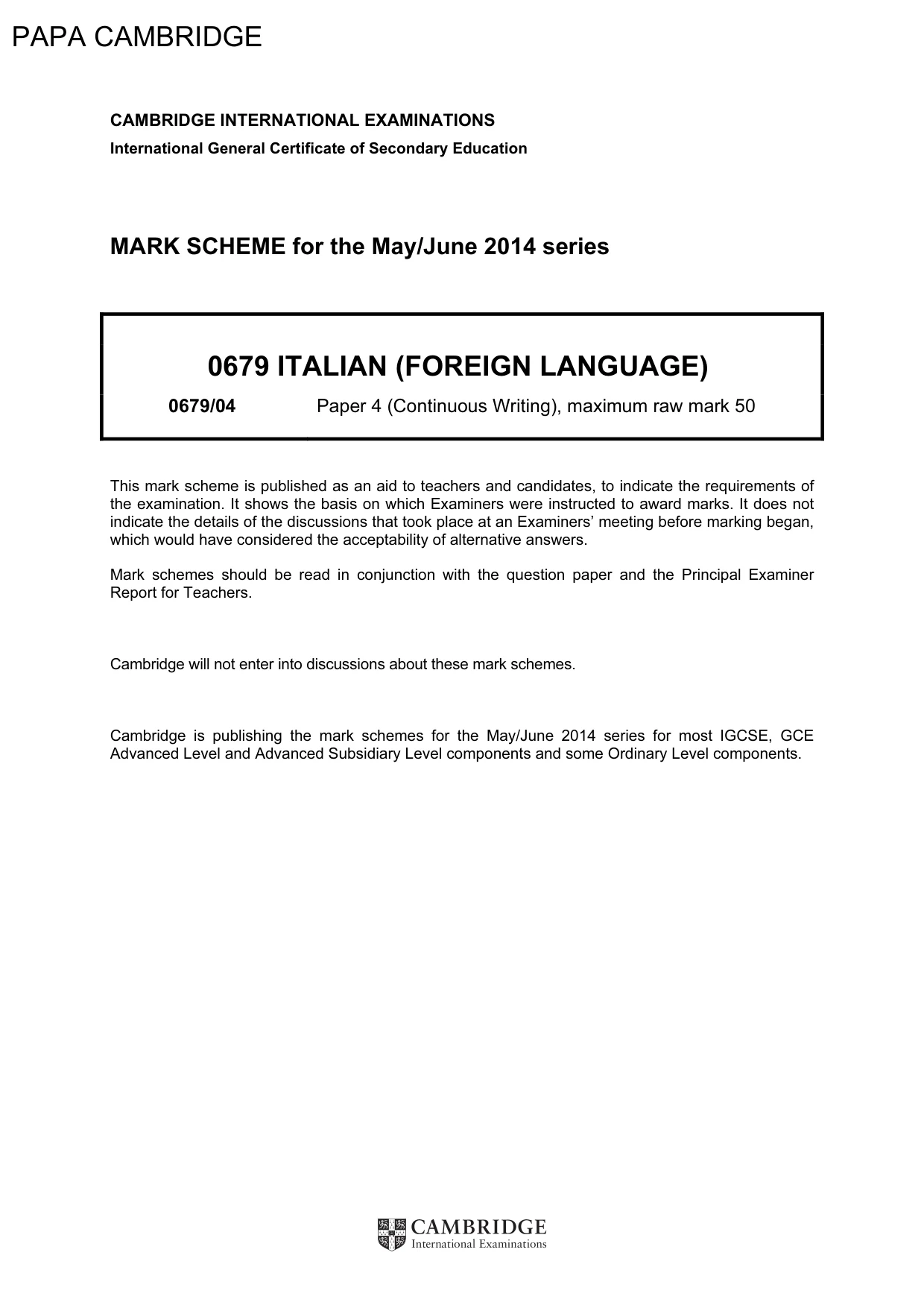
PAPA CAMBRIDGE CAMBRIDGE INTERNATIONAL EXAMINATIONS International General Certificate of Secondary Education MARK SCHEME for the May/June 2014 series 0679 ITALIAN (FOREIGN LANGUAGE) 0679/04 Paper 4 (Continuous Writing), maximum raw mark 50 This mark scheme is published as an aid to teachers and candidates, to indicate the requirements of the examination. It shows the basis on which Examiners were instructed to award marks. It does not indicate the details of the discussions that took place at an Examiners’ meeting before marking began, which would have considered the acceptability of alternative answers. Mark schemes should be read in conjunction with the question paper and the Principal Examiner Report for Teachers. Cambridge will not enter into discussions about these mark schemes. Cambridge is publishing the mark schemes for the May/June 2014 series for most IGCSE, GCE Advanced Level and Advanced Subsidiary Level components and some Ordinary Level components.
Mark scheme, page 2
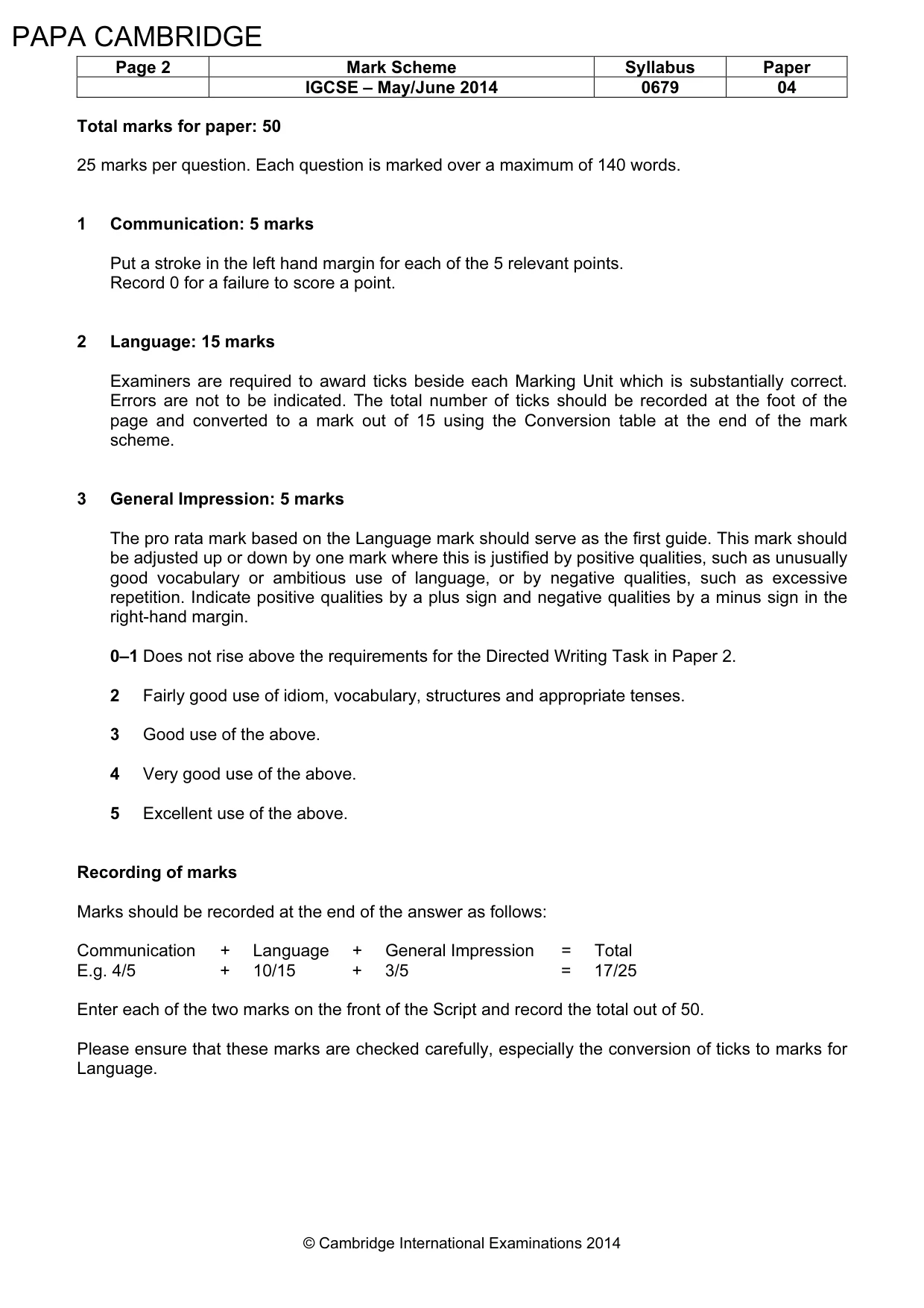
PAPA CAMBRIDGE Page 2 Mark Scheme Syllabus Paper IGCSE – May/June 2014 0679 04 © Cambridge International Examinations 2014 Total marks for paper: 50 25 marks per question. Each question is marked over a maximum of 140 words. 1 Communication: 5 marks Put a stroke in the left hand margin for each of the 5 relevant points. Record 0 for a failure to score a point. 2 Language: 15 marks Examiners are required to award ticks beside each Marking Unit which is substantially correct. Errors are not to be indicated. The total number of ticks should be recorded at the foot of the page and converted to a mark out of 15 using the Conversion table at the end of the mark scheme. 3 General Impression: 5 marks The pro rata mark based on the Language mark should serve as the first guide. This mark should be adjusted up or down by one mark where this is justified by positive qualities, such as unusually good vocabulary or ambitious use of language, or by negative qualities, such as excessive repetition. Indicate positive qualities by a plus sign and negative qualities by a minus sign in the right-hand margin. 0–1 Does not rise above the requirements for the Directed Writing Task in Paper 2. 2 Fairly good use of idiom, vocabulary, structures and appropriate tenses. 3 Good use of the above. 4 Very good use of the above. 5 Excellent use of the above. Recording of marks Marks should be recorded at the end of the answer as follows: Communication + Language + General Impression = Total E.g. 4/5 + 10/15 + 3/5 = 17/25 Enter each of the two marks on the front of the Script and record the total out of 50. Please ensure that these marks are checked carefully, especially the conversion of ticks to marks for Language.
Mark scheme, page 3
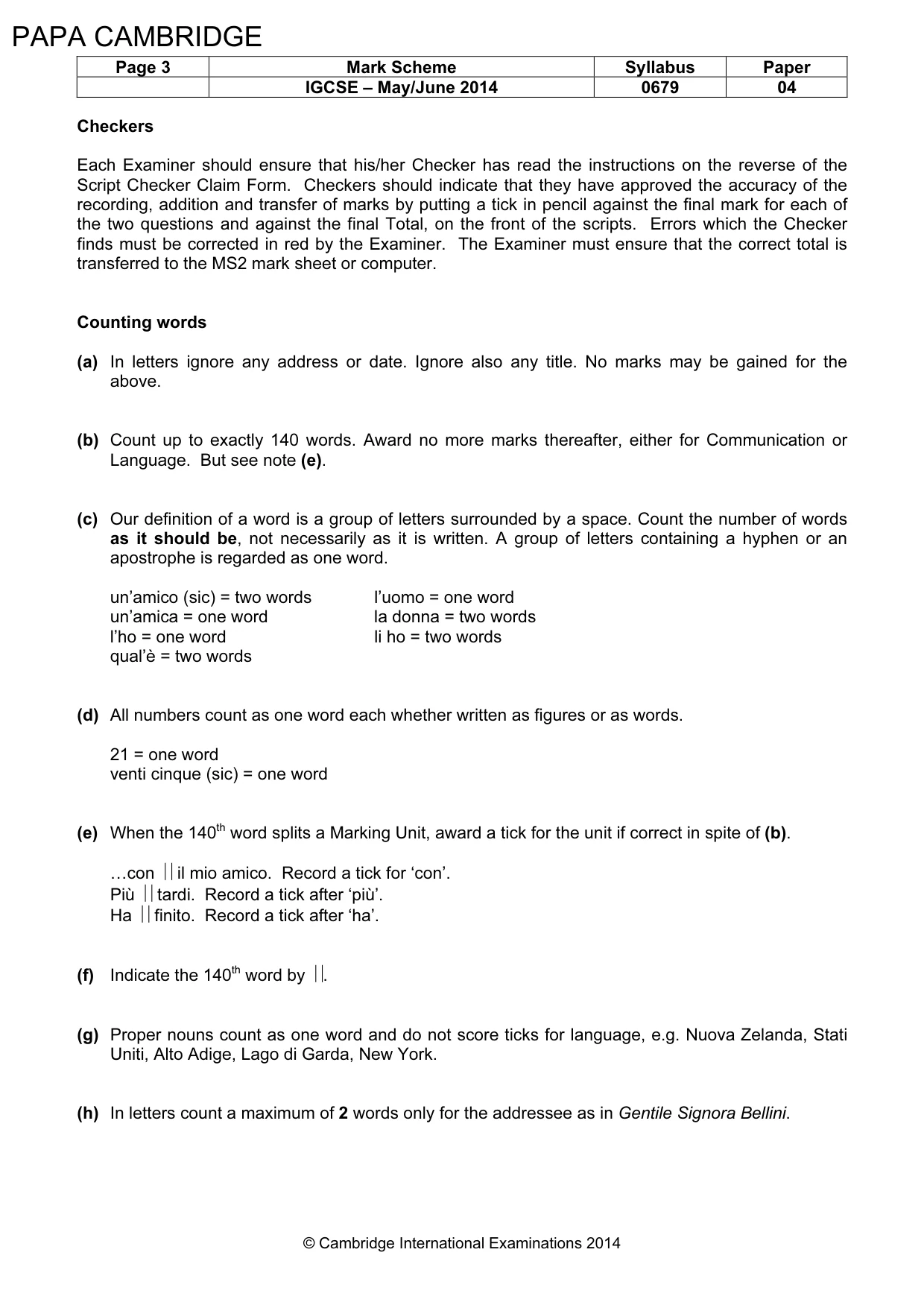
PAPA CAMBRIDGE Page 3 Mark Scheme Syllabus Paper IGCSE – May/June 2014 0679 04 © Cambridge International Examinations 2014 Checkers Each Examiner should ensure that his/her Checker has read the instructions on the reverse of the Script Checker Claim Form. Checkers should indicate that they have approved the accuracy of the recording, addition and transfer of marks by putting a tick in pencil against the final mark for each of the two questions and against the final Total, on the front of the scripts. Errors which the Checker finds must be corrected in red by the Examiner. The Examiner must ensure that the correct total is transferred to the MS2 mark sheet or computer. Counting words (a) In letters ignore any address or date. Ignore also any title. No marks may be gained for the above. (b) Count up to exactly 140 words. Award no more marks thereafter, either for Communication or Language. But see note (e). (c) Our definition of a word is a group of letters surrounded by a space. Count the number of words as it should be, not necessarily as it is written. A group of letters containing a hyphen or an apostrophe is regarded as one word. un’amico (sic) = two words l’uomo = one word un’amica = one word la donna = two words l’ho = one word li ho = two words qual’è = two words (d) All numbers count as one word each whether written as figures or as words. 21 = one word venti cinque (sic) = one word (e) When the 140th word splits a Marking Unit, award a tick for the unit if correct in spite of (b). …con il mio amico. Record a tick for ‘con’. Più tardi. Record a tick after ‘più’. Ha finito. Record a tick after ‘ha’. (f) Indicate the 140th word by . (g) Proper nouns count as one word and do not score ticks for language, e.g. Nuova Zelanda, Stati Uniti, Alto Adige, Lago di Garda, New York. (h) In letters count a maximum of 2 words only for the addressee as in Gentile Signora Bellini.
Mark scheme, page 4
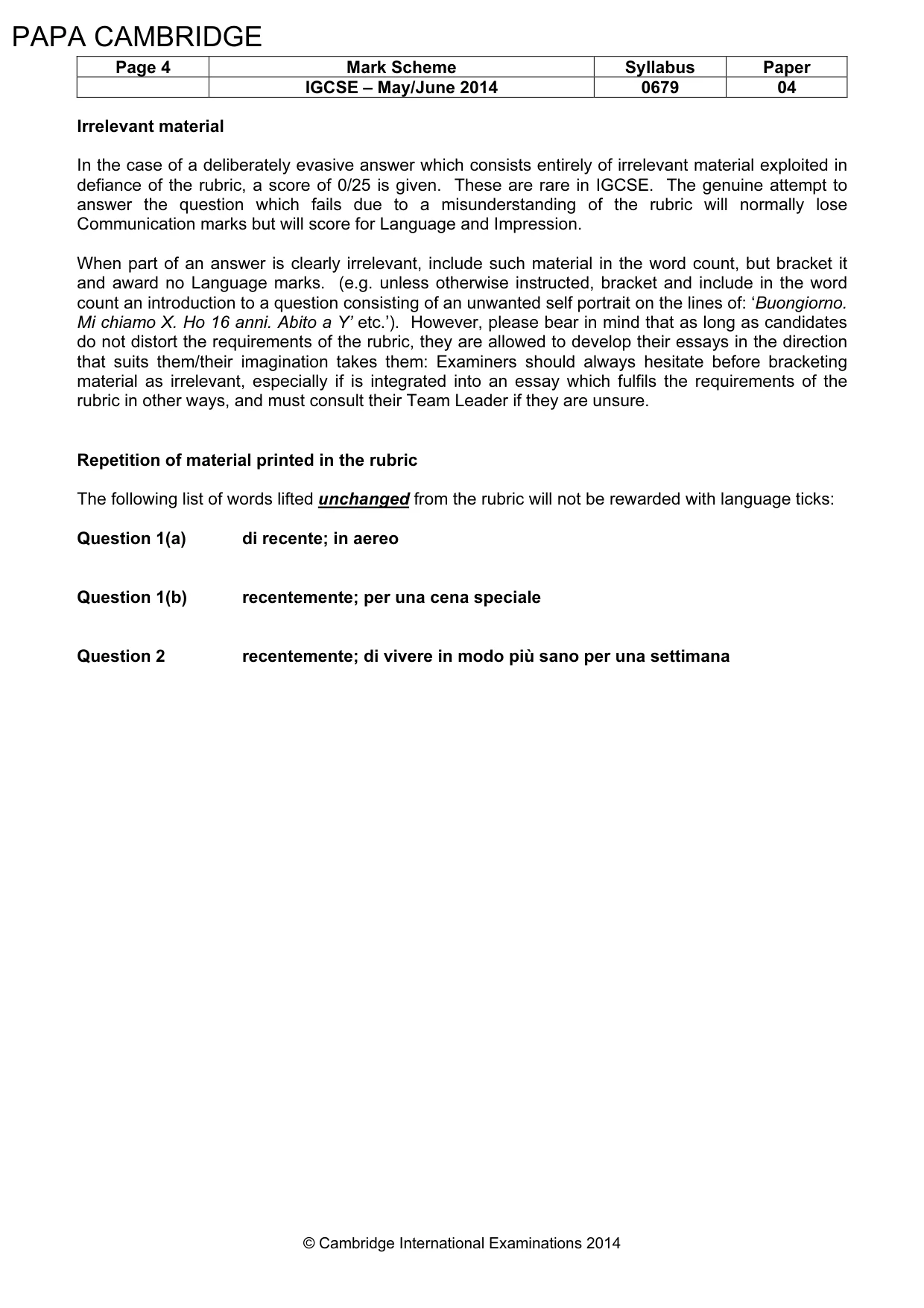
PAPA CAMBRIDGE Page 4 Mark Scheme Syllabus Paper IGCSE – May/June 2014 0679 04 © Cambridge International Examinations 2014 Irrelevant material In the case of a deliberately evasive answer which consists entirely of irrelevant material exploited in defiance of the rubric, a score of 0/25 is given. These are rare in IGCSE. The genuine attempt to answer the question which fails due to a misunderstanding of the rubric will normally lose Communication marks but will score for Language and Impression. When part of an answer is clearly irrelevant, include such material in the word count, but bracket it and award no Language marks. (e.g. unless otherwise instructed, bracket and include in the word count an introduction to a question consisting of an unwanted self portrait on the lines of: ‘Buongiorno. Mi chiamo X. Ho 16 anni. Abito a Y’ etc.’). However, please bear in mind that as long as candidates do not distort the requirements of the rubric, they are allowed to develop their essays in the direction that suits them/their imagination takes them: Examiners should always hesitate before bracketing material as irrelevant, especially if is integrated into an essay which fulfils the requirements of the rubric in other ways, and must consult their Team Leader if they are unsure. Repetition of material printed in the rubric The following list of words lifted unchanged from the rubric will not be rewarded with language ticks: Question 1(a) di recente; in aereo Question 1(b) recentemente; per una cena speciale Question 2 recentemente; di vivere in modo più sano per una settimana
Mark scheme, page 5
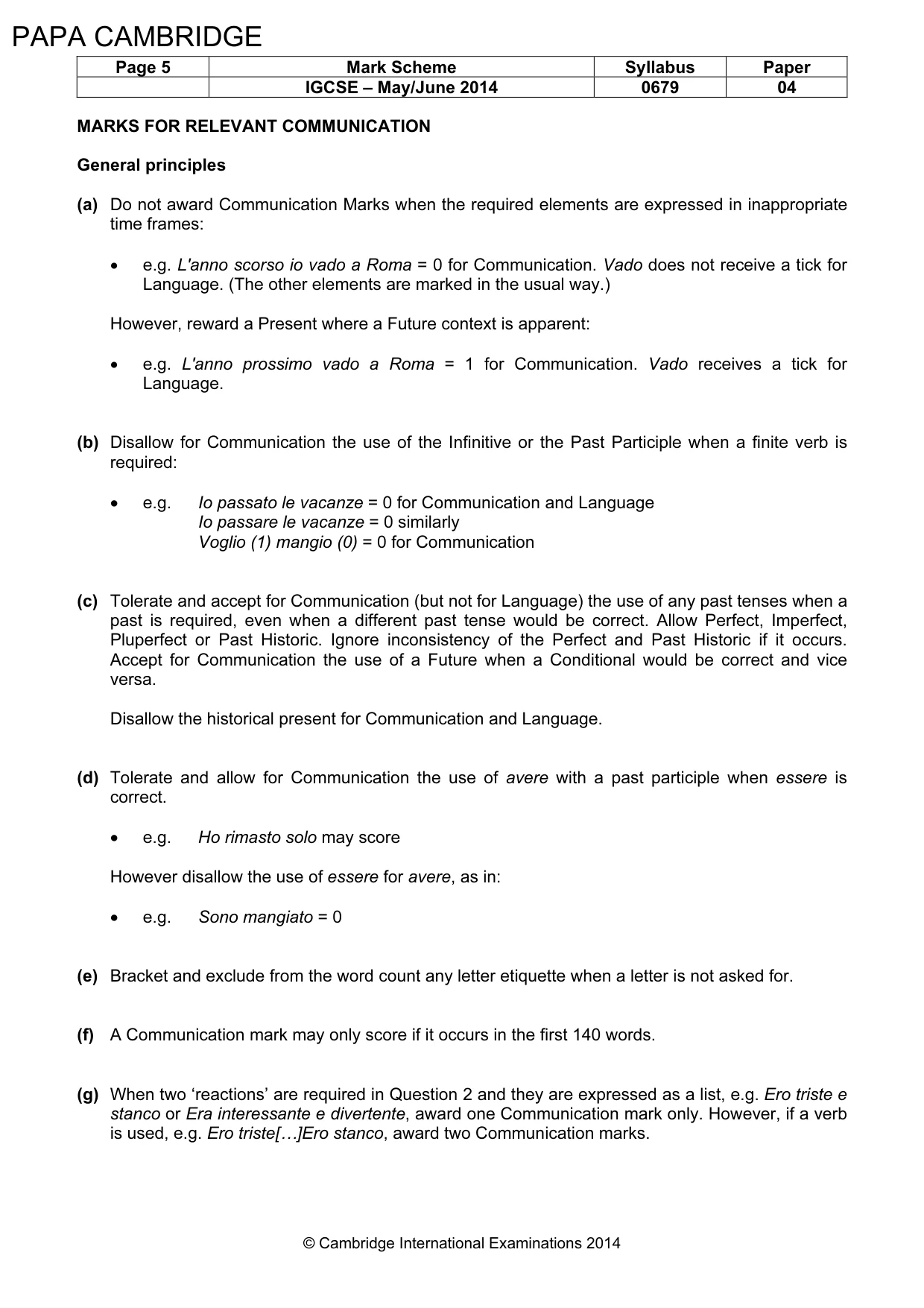
PAPA CAMBRIDGE Page 5 Mark Scheme Syllabus Paper IGCSE – May/June 2014 0679 04 © Cambridge International Examinations 2014 MARKS FOR RELEVANT COMMUNICATION General principles (a) Do not award Communication Marks when the required elements are expressed in inappropriate time frames: • e.g. L'anno scorso io vado a Roma = 0 for Communication. Vado does not receive a tick for Language. (The other elements are marked in the usual way.) However, reward a Present where a Future context is apparent: • e.g. L'anno prossimo vado a Roma = 1 for Communication. Vado receives a tick for Language. (b) Disallow for Communication the use of the Infinitive or the Past Participle when a finite verb is required: • e.g. Io passato le vacanze = 0 for Communication and Language Io passare le vacanze = 0 similarly Voglio (1) mangio (0) = 0 for Communication (c) Tolerate and accept for Communication (but not for Language) the use of any past tenses when a past is required, even when a different past tense would be correct. Allow Perfect, Imperfect, Pluperfect or Past Historic. Ignore inconsistency of the Perfect and Past Historic if it occurs. Accept for Communication the use of a Future when a Conditional would be correct and vice versa. Disallow the historical present for Communication and Language. (d) Tolerate and allow for Communication the use of avere with a past participle when essere is correct. • e.g. Ho rimasto solo may score However disallow the use of essere for avere, as in: • e.g. Sono mangiato = 0 (e) Bracket and exclude from the word count any letter etiquette when a letter is not asked for. (f) A Communication mark may only score if it occurs in the first 140 words. (g) When two ‘reactions’ are required in Question 2 and they are expressed as a list, e.g. Ero triste e stanco or Era interessante e divertente, award one Communication mark only. However, if a verb is used, e.g. Ero triste[…]Ero stanco, award two Communication marks.
Mark scheme, page 6
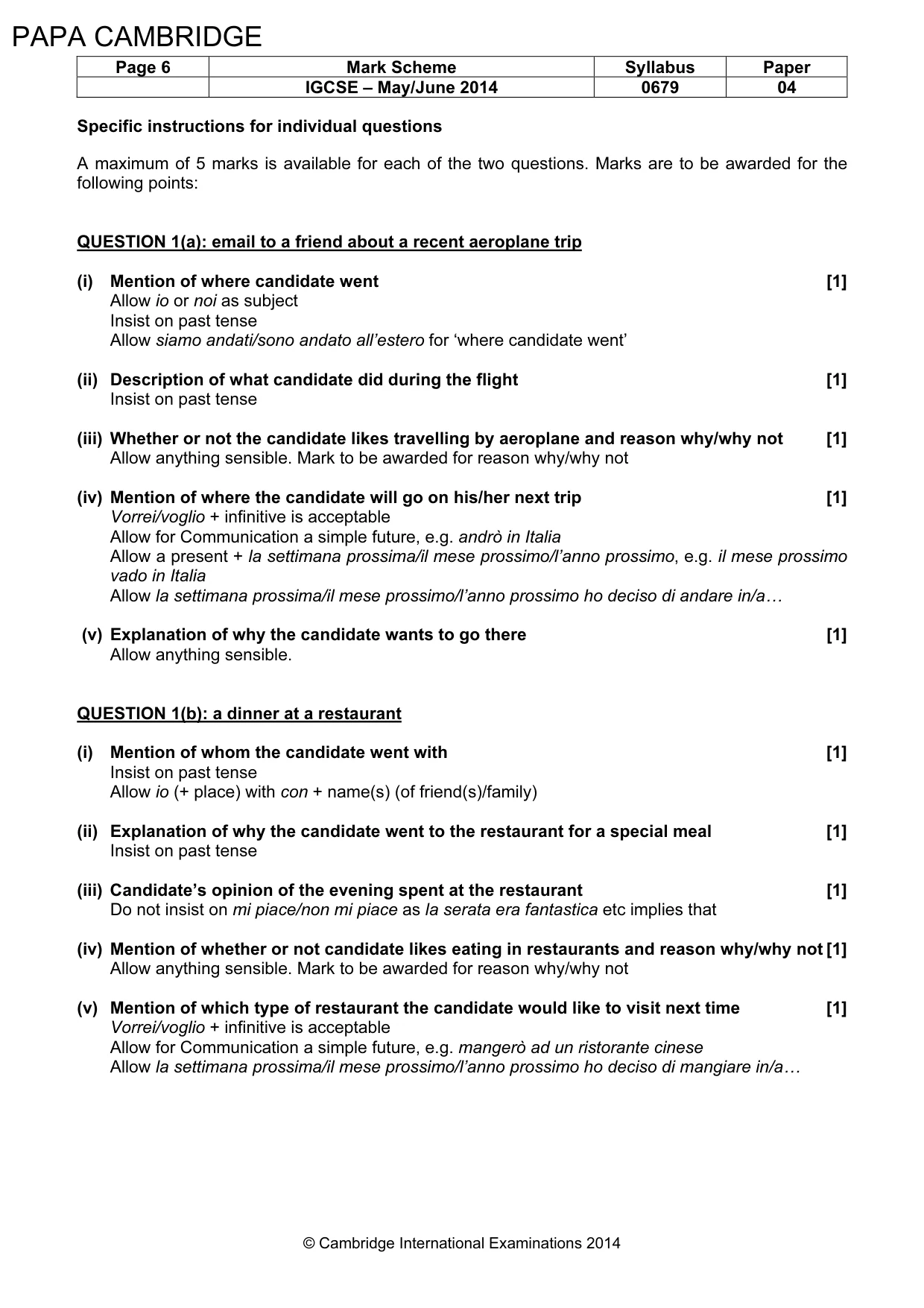
PAPA CAMBRIDGE Page 6 Mark Scheme Syllabus Paper IGCSE – May/June 2014 0679 04 © Cambridge International Examinations 2014 Specific instructions for individual questions A maximum of 5 marks is available for each of the two questions. Marks are to be awarded for the following points: QUESTION 1(a): email to a friend about a recent aeroplane trip (i) Mention of where candidate went [1] Allow io or noi as subject Insist on past tense Allow siamo andati/sono andato all’estero for ‘where candidate went’ (ii) Description of what candidate did during the flight [1] Insist on past tense (iii) Whether or not the candidate likes travelling by aeroplane and reason why/why not [1] Allow anything sensible. Mark to be awarded for reason why/why not (iv) Mention of where the candidate will go on his/her next trip [1] Vorrei/voglio + infinitive is acceptable Allow for Communication a simple future, e.g. andrò in Italia Allow a present + la settimana prossima/il mese prossimo/l’anno prossimo, e.g. il mese prossimo vado in Italia Allow la settimana prossima/il mese prossimo/l’anno prossimo ho deciso di andare in/a… (v) Explanation of why the candidate wants to go there [1] Allow anything sensible. QUESTION 1(b): a dinner at a restaurant (i) Mention of whom the candidate went with [1] Insist on past tense Allow io (+ place) with con + name(s) (of friend(s)/family) (ii) Explanation of why the candidate went to the restaurant for a special meal [1] Insist on past tense (iii) Candidate’s opinion of the evening spent at the restaurant [1] Do not insist on mi piace/non mi piace as la serata era fantastica etc implies that (iv) Mention of whether or not candidate likes eating in restaurants and reason why/why not [1] Allow anything sensible. Mark to be awarded for reason why/why not (v) Mention of which type of restaurant the candidate would like to visit next time [1] Vorrei/voglio + infinitive is acceptable Allow for Communication a simple future, e.g. mangerò ad un ristorante cinese Allow la settimana prossima/il mese prossimo/l’anno prossimo ho deciso di mangiare in/a…
Mark scheme, page 7
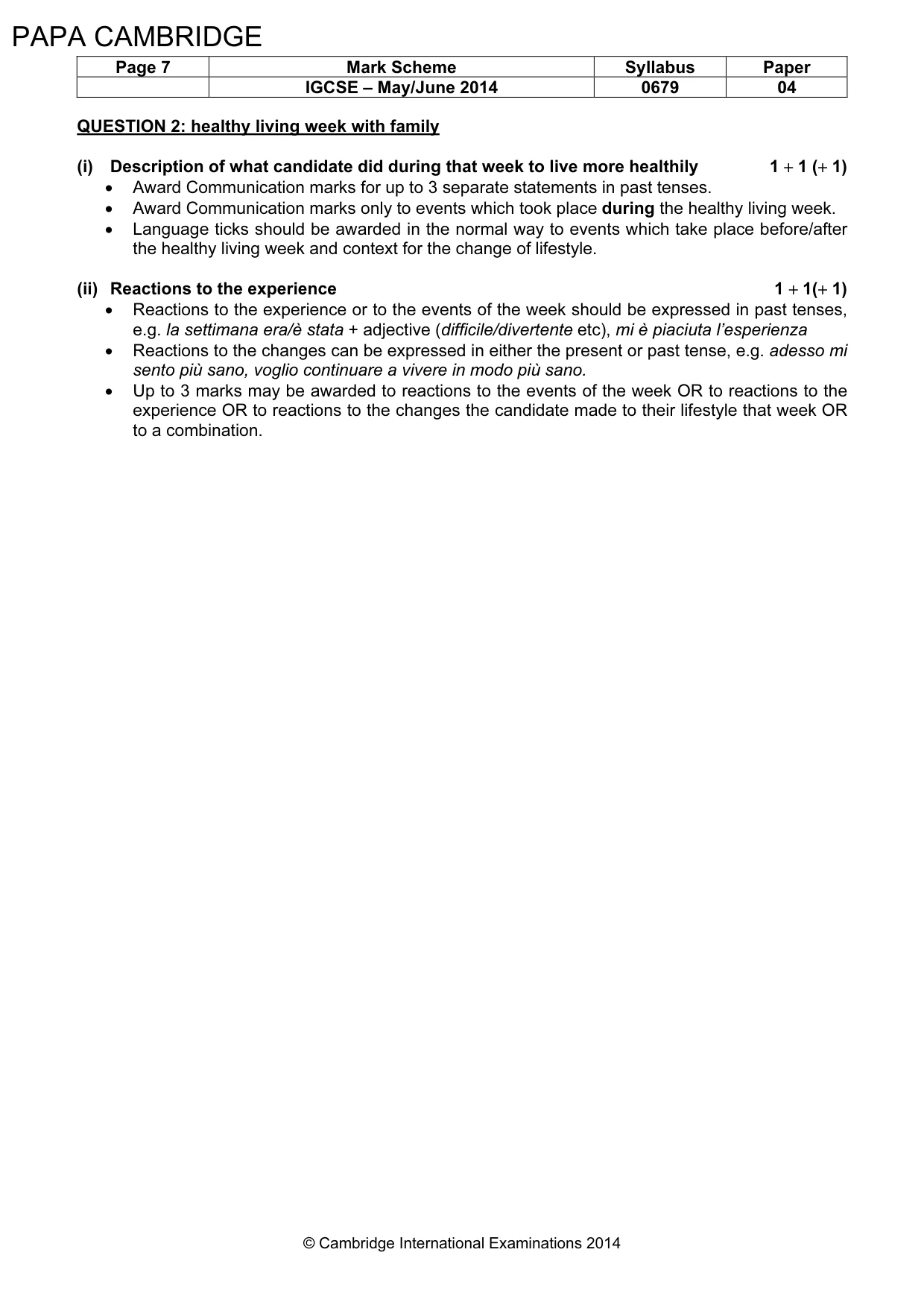
PAPA CAMBRIDGE Page 7 Mark Scheme Syllabus Paper IGCSE – May/June 2014 0679 04 © Cambridge International Examinations 2014 QUESTION 2: healthy living week with family (i) Description of what candidate did during that week to live more healthily 1 + 1 (+ 1) • Award Communication marks for up to 3 separate statements in past tenses. • Award Communication marks only to events which took place during the healthy living week. • Language ticks should be awarded in the normal way to events which take place before/after the healthy living week and context for the change of lifestyle. (ii) Reactions to the experience 1 + 1(+ 1) • Reactions to the experience or to the events of the week should be expressed in past tenses, e.g. la settimana era/è stata + adjective (difficile/divertente etc), mi è piaciuta l’esperienza • Reactions to the changes can be expressed in either the present or past tense, e.g. adesso mi sento più sano, voglio continuare a vivere in modo più sano. • Up to 3 marks may be awarded to reactions to the events of the week OR to reactions to the experience OR to reactions to the changes the candidate made to their lifestyle that week OR to a combination.
Mark scheme, page 8
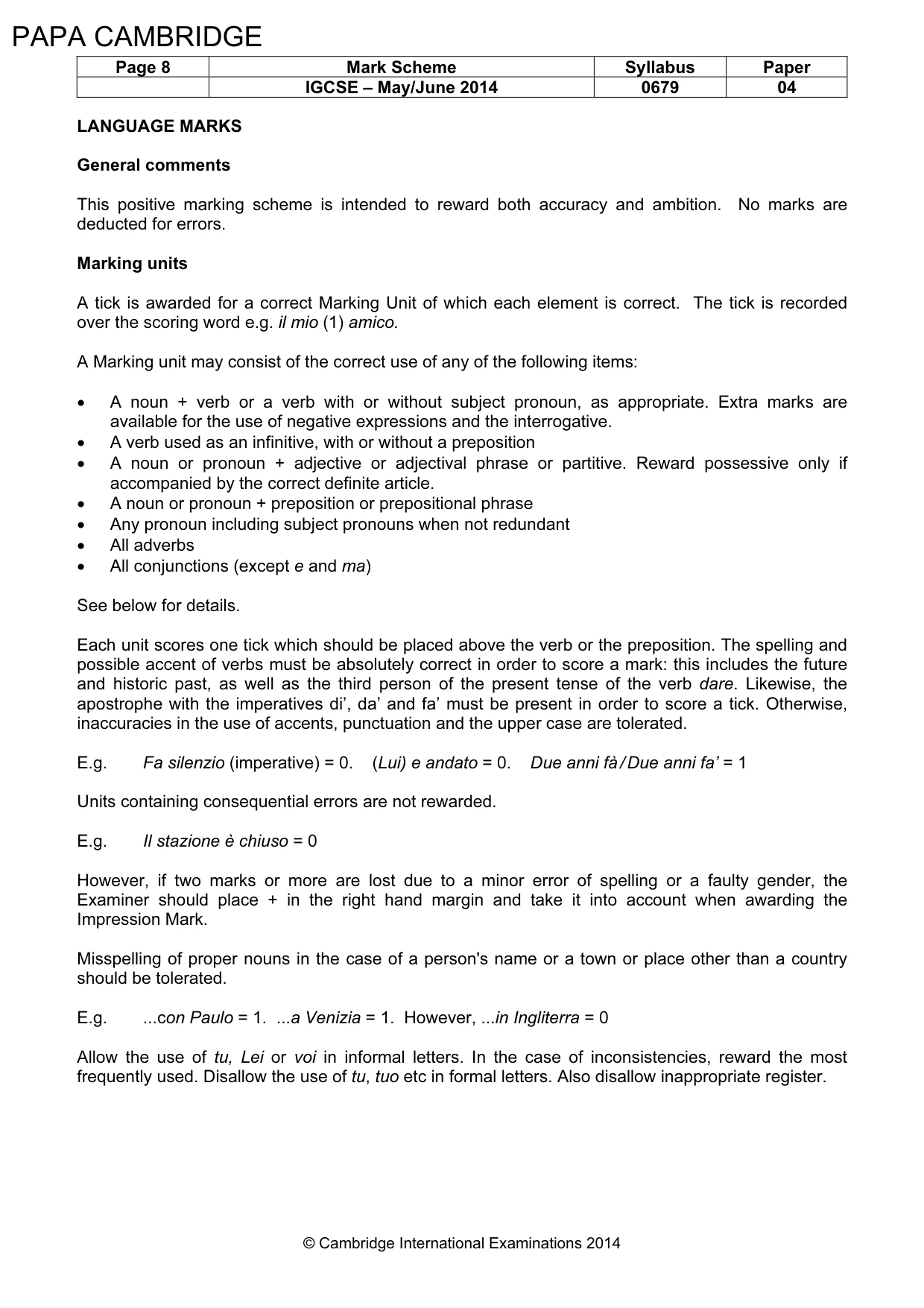
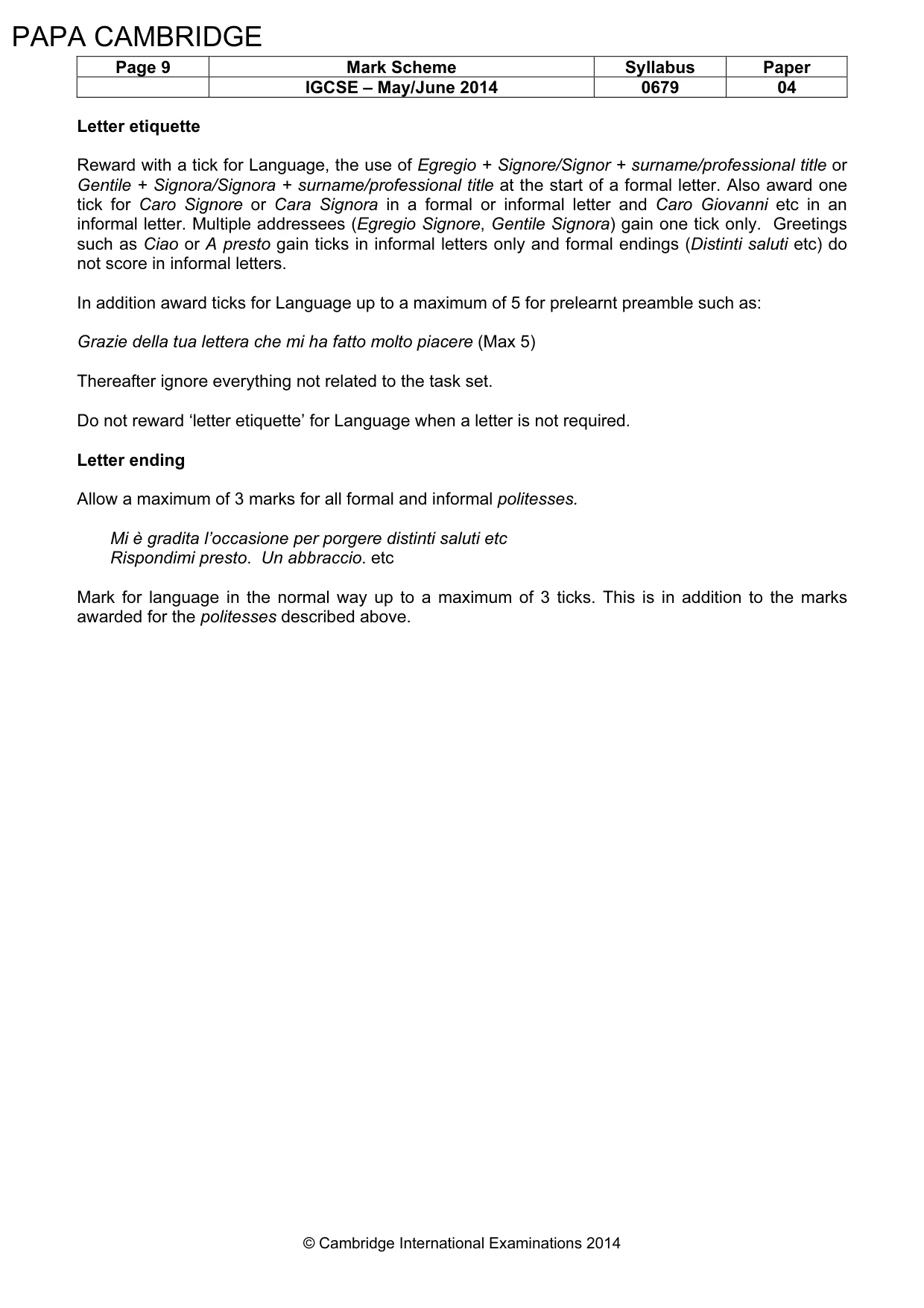
PAPA CAMBRIDGE Page 8 Mark Scheme Syllabus Paper IGCSE – May/June 2014 0679 04 © Cambridge International Examinations 2014 LANGUAGE MARKS General comments This positive marking scheme is intended to reward both accuracy and ambition. No marks are deducted for errors. Marking units A tick is awarded for a correct Marking Unit of which each element is correct. The tick is recorded over the scoring word e.g. il mio (1) amico. A Marking unit may consist of the correct use of any of the following items: • A noun + verb or a verb with or without subject pronoun, as appropriate. Extra marks are available for the use of negative expressions and the interrogative. • A verb used as an infinitive, with or without a preposition • A noun or pronoun + adjective or adjectival phrase or partitive. Reward possessive only if accompanied by the correct definite article. • A noun or pronoun + preposition or prepositional phrase • Any pronoun including subject pronouns when not redundant • All adverbs • All conjunctions (except e and ma) See below for details. Each unit scores one tick which should be placed above the verb or the preposition. The spelling and possible accent of verbs must be absolutely correct in order to score a mark: this includes the future and historic past, as well as the third person of the present tense of the verb dare. Likewise, the apostrophe with the imperatives di’, da’ and fa’ must be present in order to score a tick. Otherwise, inaccuracies in the use of accents, punctuation and the upper case are tolerated. E.g. Fa silenzio (imperative) = 0. (Lui) e andato = 0. Due anni fà / Due anni fa’ = 1 Units containing consequential errors are not rewarded. E.g. Il stazione è chiuso = 0 However, if two marks or more are lost due to a minor error of spelling or a faulty gender, the Examiner should place + in the right hand margin and take it into account when awarding the Impression Mark. Misspelling of proper nouns in the case of a person's name or a town or place other than a country should be tolerated. E.g. ...con Paulo = 1. ...a Venizia = 1. However, ...in Ingliterra = 0 Allow the use of tu, Lei or voi in informal letters. In the case of inconsistencies, reward the most frequently used. Disallow the use of tu, tuo etc in formal letters. Also disallow inappropriate register.
Mark scheme, page 9
PAPA CAMBRIDGE Page 9 Mark Scheme Syllabus Paper IGCSE – May/June 2014 0679 04 © Cambridge International Examinations 2014 Letter etiquette Reward with a tick for Language, the use of Egregio + Signore/Signor + surname/professional title or Gentile + Signora/Signora + surname/professional title at the start of a formal letter. Also award one tick for Caro Signore or Cara Signora in a formal or informal letter and Caro Giovanni etc in an informal letter. Multiple addressees (Egregio Signore, Gentile Signora) gain one tick only. Greetings such as Ciao or A presto gain ticks in informal letters only and formal endings (Distinti saluti etc) do not score in informal letters. In addition award ticks for Language up to a maximum of 5 for prelearnt preamble such as: Grazie della tua lettera che mi ha fatto molto piacere (Max 5) Thereafter ignore everything not related to the task set. Do not reward ‘letter etiquette’ for Language when a letter is not required. Letter ending Allow a maximum of 3 marks for all formal and informal politesses. Mi è gradita l’occasione per porgere distinti saluti etc Rispondimi presto. Un abbraccio. etc Mark for language in the normal way up to a maximum of 3 ticks. This is in addition to the marks awarded for the politesses described above.
Mark scheme, page 10
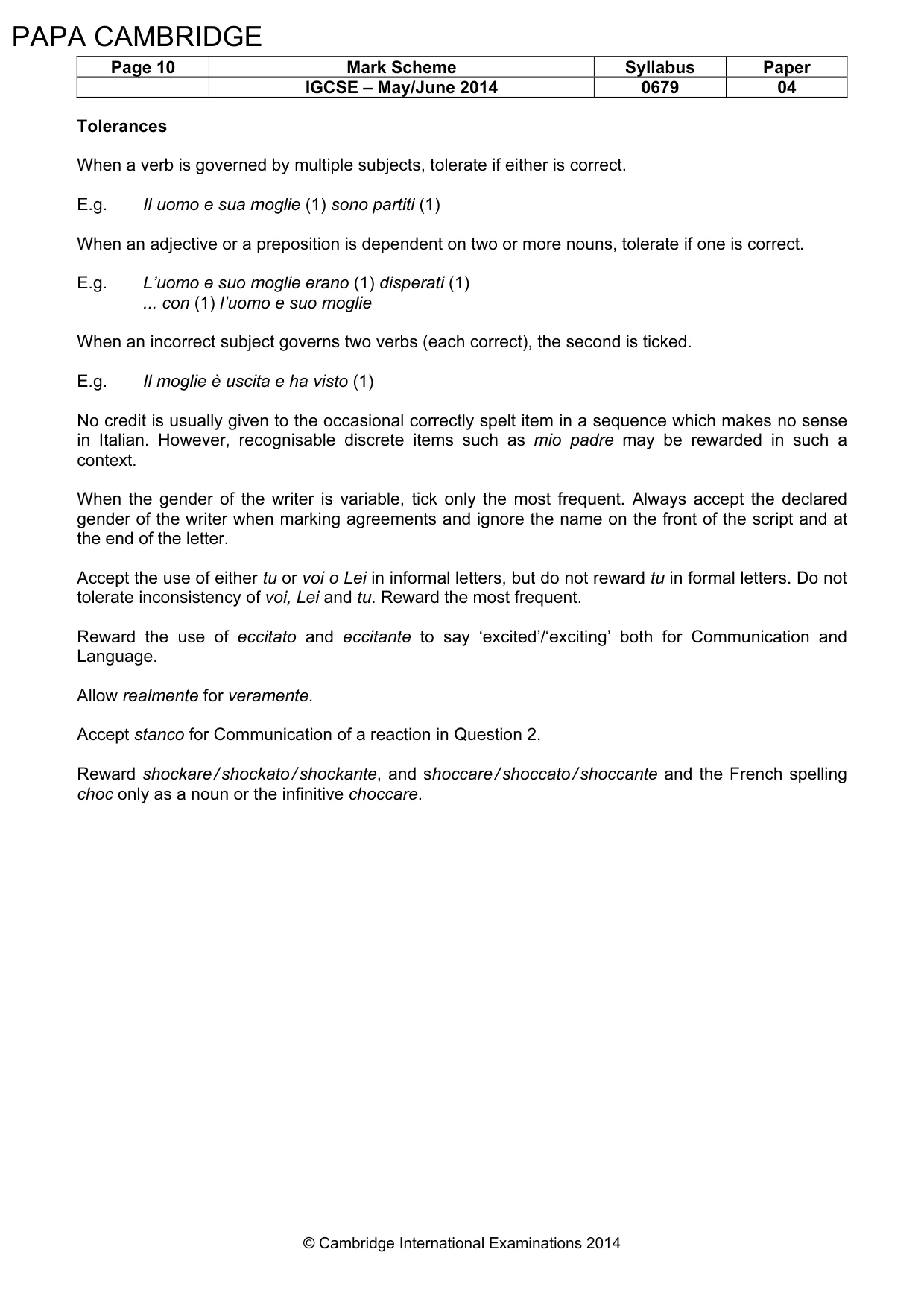
PAPA CAMBRIDGE Page 10 Mark Scheme Syllabus Paper IGCSE – May/June 2014 0679 04 © Cambridge International Examinations 2014 Tolerances When a verb is governed by multiple subjects, tolerate if either is correct. E.g. Il uomo e sua moglie (1) sono partiti (1) When an adjective or a preposition is dependent on two or more nouns, tolerate if one is correct. E.g. L’uomo e suo moglie erano (1) disperati (1) ... con (1) l’uomo e suo moglie When an incorrect subject governs two verbs (each correct), the second is ticked. E.g. Il moglie è uscita e ha visto (1) No credit is usually given to the occasional correctly spelt item in a sequence which makes no sense in Italian. However, recognisable discrete items such as mio padre may be rewarded in such a context. When the gender of the writer is variable, tick only the most frequent. Always accept the declared gender of the writer when marking agreements and ignore the name on the front of the script and at the end of the letter. Accept the use of either tu or voi o Lei in informal letters, but do not reward tu in formal letters. Do not tolerate inconsistency of voi, Lei and tu. Reward the most frequent. Reward the use of eccitato and eccitante to say ‘excited’/‘exciting’ both for Communication and Language. Allow realmente for veramente. Accept stanco for Communication of a reaction in Question 2. Reward shockare / shockato / shockante, and shoccare / shoccato / shoccante and the French spelling choc only as a noun or the infinitive choccare.
Mark scheme, page 11
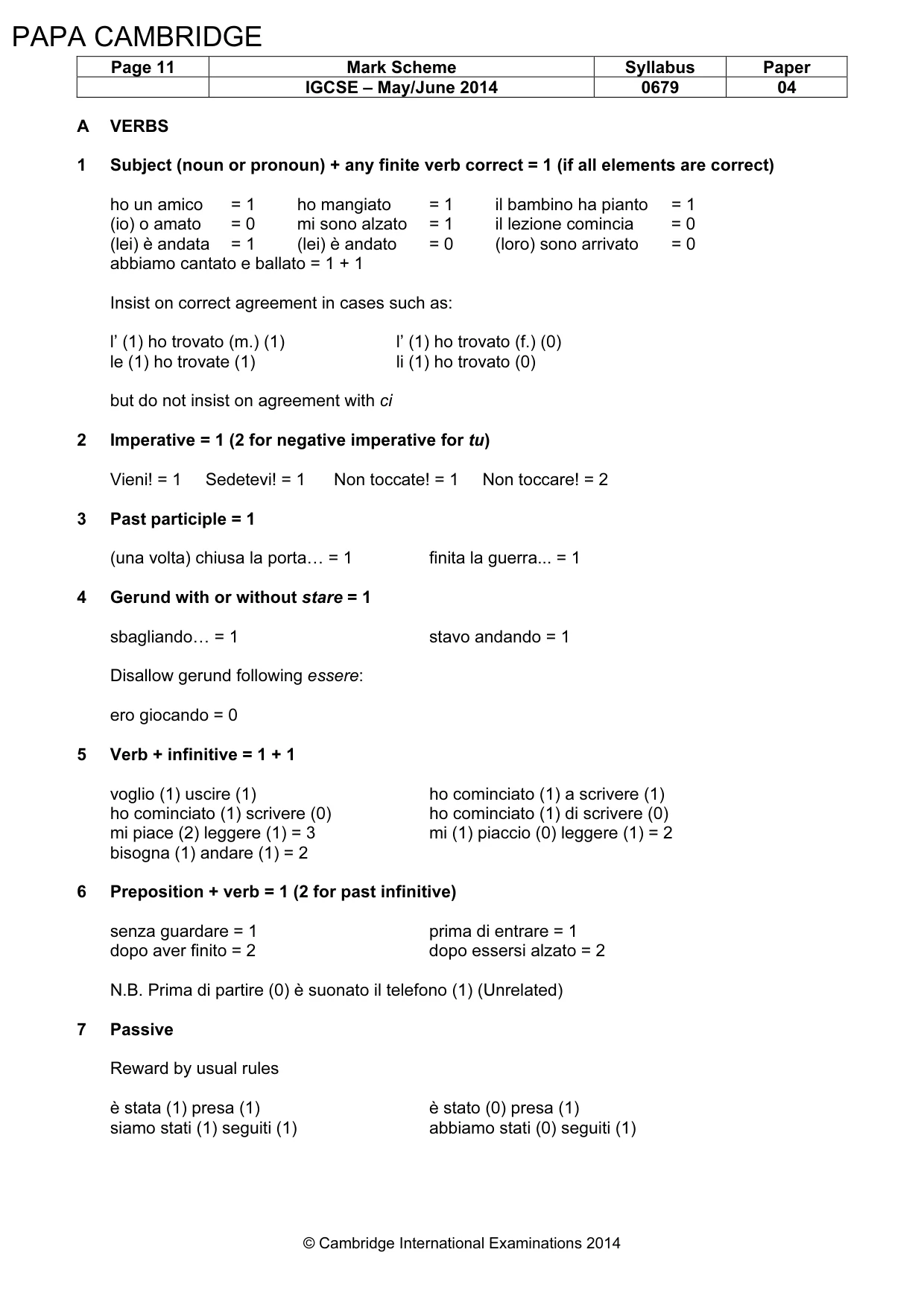
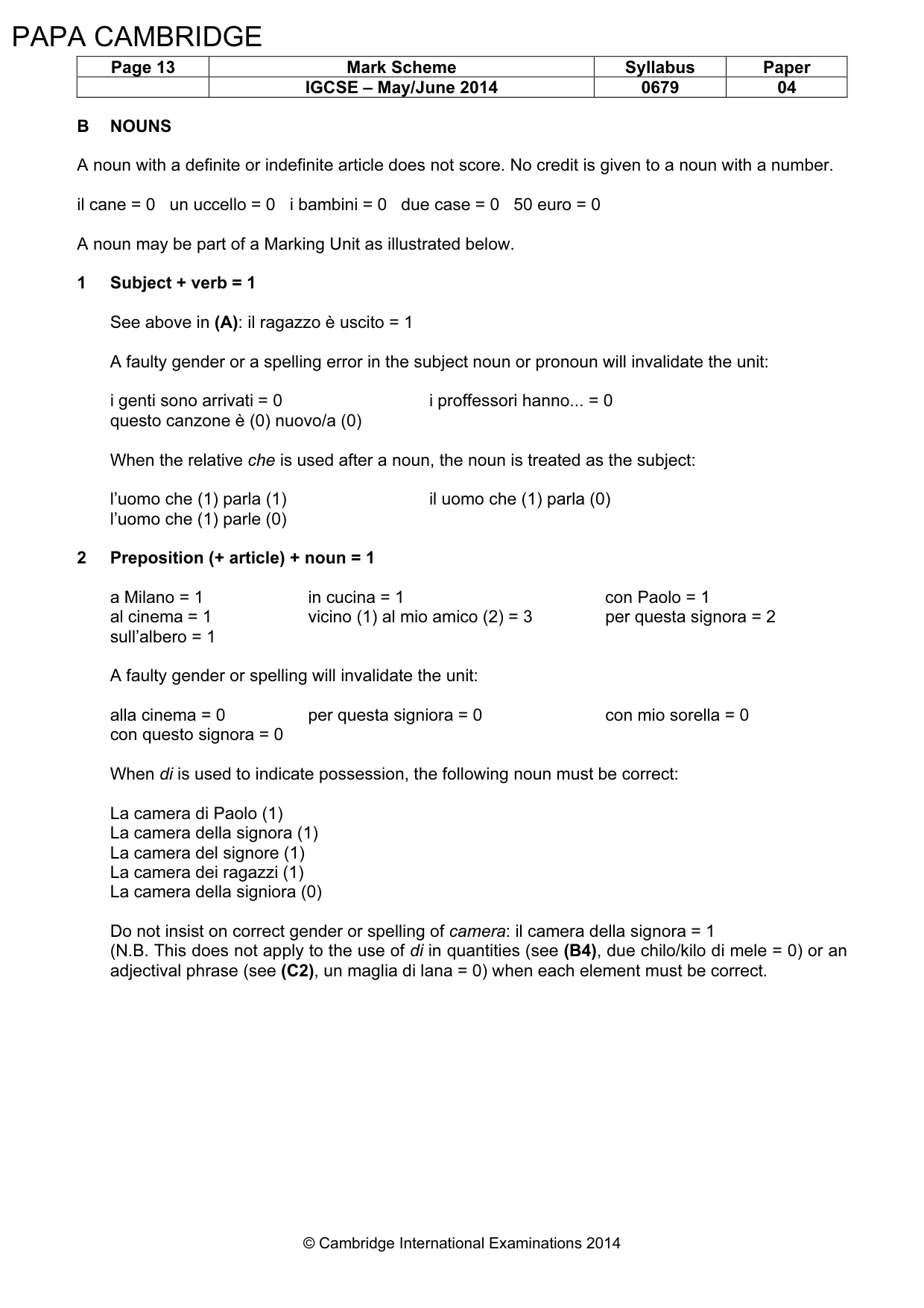
PAPA CAMBRIDGE Page 11 Mark Scheme Syllabus Paper IGCSE – May/June 2014 0679 04 © Cambridge International Examinations 2014 A VERBS 1 Subject (noun or pronoun) + any finite verb correct = 1 (if all elements are correct) ho un amico = 1 ho mangiato = 1 il bambino ha pianto = 1 (io) o amato = 0 mi sono alzato = 1 il lezione comincia = 0 (lei) è andata = 1 (lei) è andato = 0 (loro) sono arrivato = 0 abbiamo cantato e ballato = 1 + 1 Insist on correct agreement in cases such as: l’ (1) ho trovato (m.) (1) l’ (1) ho trovato (f.) (0) le (1) ho trovate (1) li (1) ho trovato (0) but do not insist on agreement with ci 2 Imperative = 1 (2 for negative imperative for tu) Vieni! = 1 Sedetevi! = 1 Non toccate! = 1 Non toccare! = 2 3 Past participle = 1 (una volta) chiusa la porta… = 1 finita la guerra... = 1 4 Gerund with or without stare = 1 sbagliando… = 1 stavo andando = 1 Disallow gerund following essere: ero giocando = 0 5 Verb + infinitive = 1 + 1 voglio (1) uscire (1) ho cominciato (1) a scrivere (1) ho cominciato (1) scrivere (0) ho cominciato (1) di scrivere (0) mi piace (2) leggere (1) = 3 mi (1) piaccio (0) leggere (1) = 2 bisogna (1) andare (1) = 2 6 Preposition + verb = 1 (2 for past infinitive) senza guardare = 1 prima di entrare = 1 dopo aver finito = 2 dopo essersi alzato = 2 N.B. Prima di partire (0) è suonato il telefono (1) (Unrelated) 7 Passive Reward by usual rules è stata (1) presa (1) è stato (0) presa (1) siamo stati (1) seguiti (1) abbiamo stati (0) seguiti (1)
Mark scheme, page 12
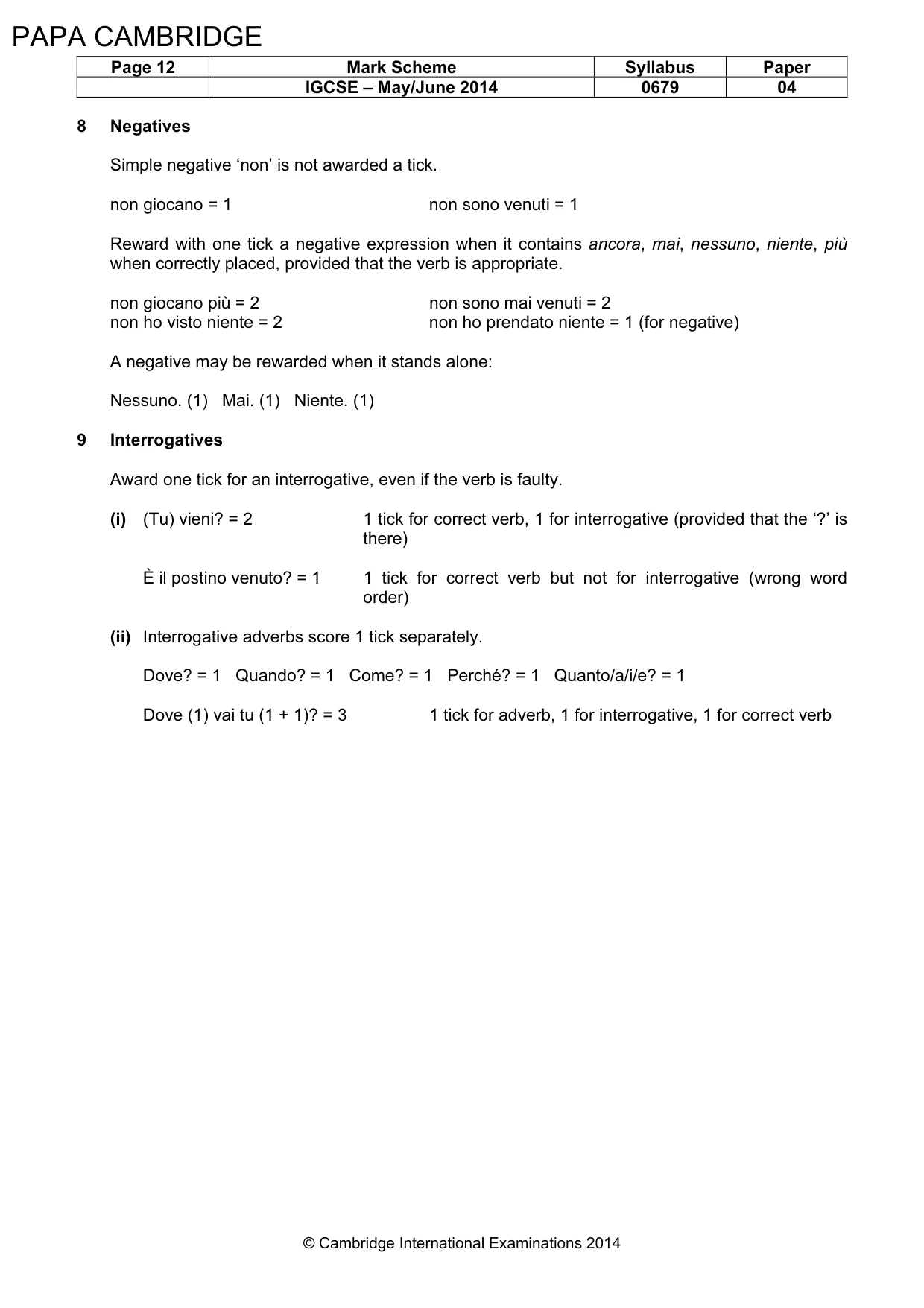
PAPA CAMBRIDGE Page 12 Mark Scheme Syllabus Paper IGCSE – May/June 2014 0679 04 © Cambridge International Examinations 2014 8 Negatives Simple negative ‘non’ is not awarded a tick. non giocano = 1 non sono venuti = 1 Reward with one tick a negative expression when it contains ancora, mai, nessuno, niente, più when correctly placed, provided that the verb is appropriate. non giocano più = 2 non sono mai venuti = 2 non ho visto niente = 2 non ho prendato niente = 1 (for negative) A negative may be rewarded when it stands alone: Nessuno. (1) Mai. (1) Niente. (1) 9 Interrogatives Award one tick for an interrogative, even if the verb is faulty. (i) (Tu) vieni? = 2 1 tick for correct verb, 1 for interrogative (provided that the ‘?’ is there) È il postino venuto? = 1 1 tick for correct verb but not for interrogative (wrong word order) (ii) Interrogative adverbs score 1 tick separately. Dove? = 1 Quando? = 1 Come? = 1 Perché? = 1 Quanto/a/i/e? = 1 Dove (1) vai tu (1 + 1)? = 3 1 tick for adverb, 1 for interrogative, 1 for correct verb
Mark scheme, page 13
PAPA CAMBRIDGE Page 13 Mark Scheme Syllabus Paper IGCSE – May/June 2014 0679 04 © Cambridge International Examinations 2014 B NOUNS A noun with a definite or indefinite article does not score. No credit is given to a noun with a number. il cane = 0 un uccello = 0 i bambini = 0 due case = 0 50 euro = 0 A noun may be part of a Marking Unit as illustrated below. 1 Subject + verb = 1 See above in (A): il ragazzo è uscito = 1 A faulty gender or a spelling error in the subject noun or pronoun will invalidate the unit: i genti sono arrivati = 0 i proffessori hanno... = 0 questo canzone è (0) nuovo/a (0) When the relative che is used after a noun, the noun is treated as the subject: l’uomo che (1) parla (1) il uomo che (1) parla (0) l’uomo che (1) parle (0) 2 Preposition (+ article) + noun = 1 a Milano = 1 in cucina = 1 con Paolo = 1 al cinema = 1 vicino (1) al mio amico (2) = 3 per questa signora = 2 sull’albero = 1 A faulty gender or spelling will invalidate the unit: alla cinema = 0 per questa signiora = 0 con mio sorella = 0 con questo signora = 0 When di is used to indicate possession, the following noun must be correct: La camera di Paolo (1) La camera della signora (1) La camera del signore (1) La camera dei ragazzi (1) La camera della signiora (0) Do not insist on correct gender or spelling of camera: il camera della signora = 1 (N.B. This does not apply to the use of di in quantities (see (B4), due chilo/kilo di mele = 0) or an adjectival phrase (see (C2), un maglia di lana = 0) when each element must be correct.
Mark scheme, page 14
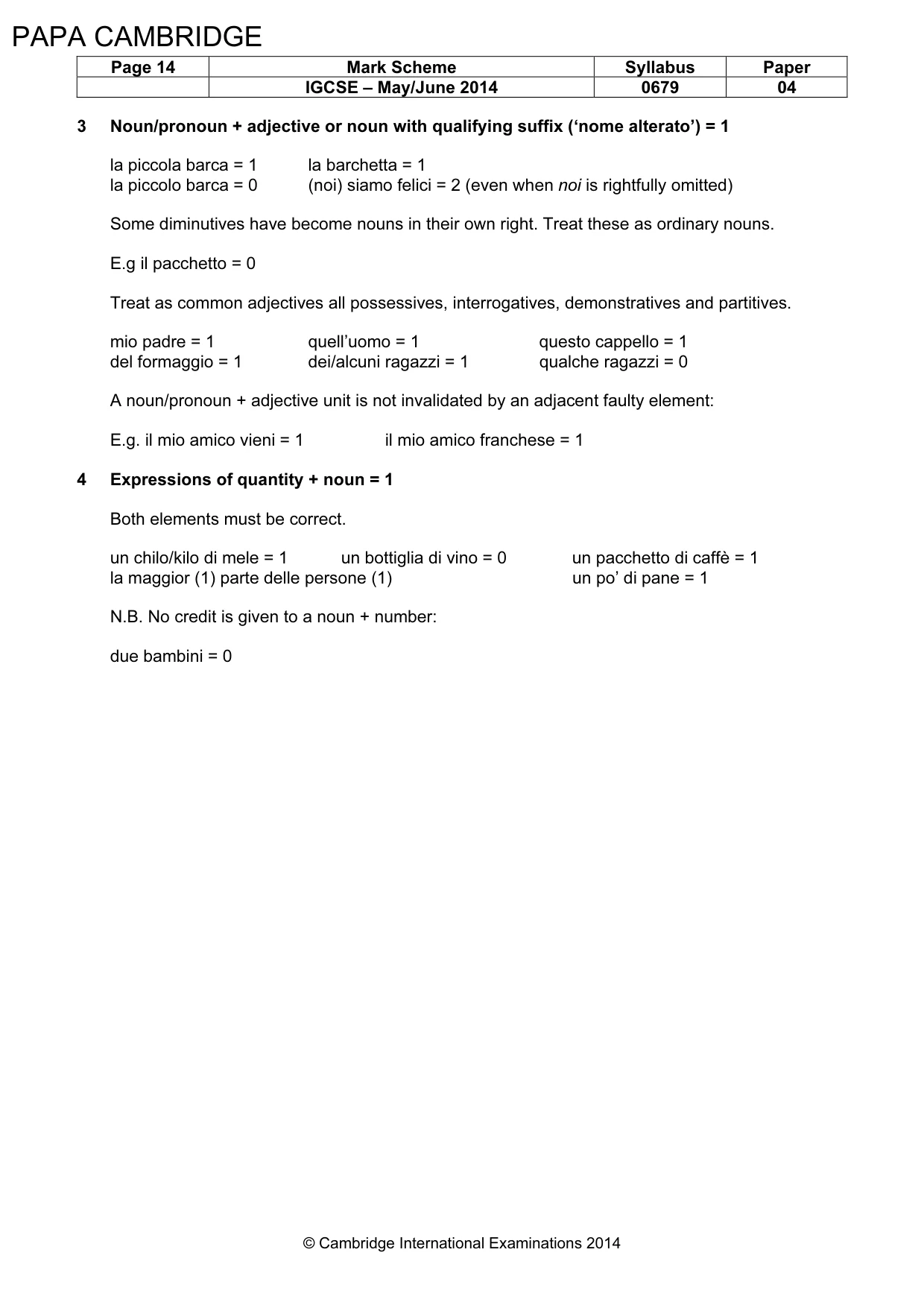
PAPA CAMBRIDGE Page 14 Mark Scheme Syllabus Paper IGCSE – May/June 2014 0679 04 © Cambridge International Examinations 2014 3 Noun/pronoun + adjective or noun with qualifying suffix (‘nome alterato’) = 1 la piccola barca = 1 la barchetta = 1 la piccolo barca = 0 (noi) siamo felici = 2 (even when noi is rightfully omitted) Some diminutives have become nouns in their own right. Treat these as ordinary nouns. E.g il pacchetto = 0 Treat as common adjectives all possessives, interrogatives, demonstratives and partitives. mio padre = 1 quell’uomo = 1 questo cappello = 1 del formaggio = 1 dei/alcuni ragazzi = 1 qualche ragazzi = 0 A noun/pronoun + adjective unit is not invalidated by an adjacent faulty element: E.g. il mio amico vieni = 1 il mio amico franchese = 1 4 Expressions of quantity + noun = 1 Both elements must be correct. un chilo/kilo di mele = 1 un bottiglia di vino = 0 un pacchetto di caffè = 1 la maggior (1) parte delle persone (1) un po’ di pane = 1 N.B. No credit is given to a noun + number: due bambini = 0
Mark scheme, page 15
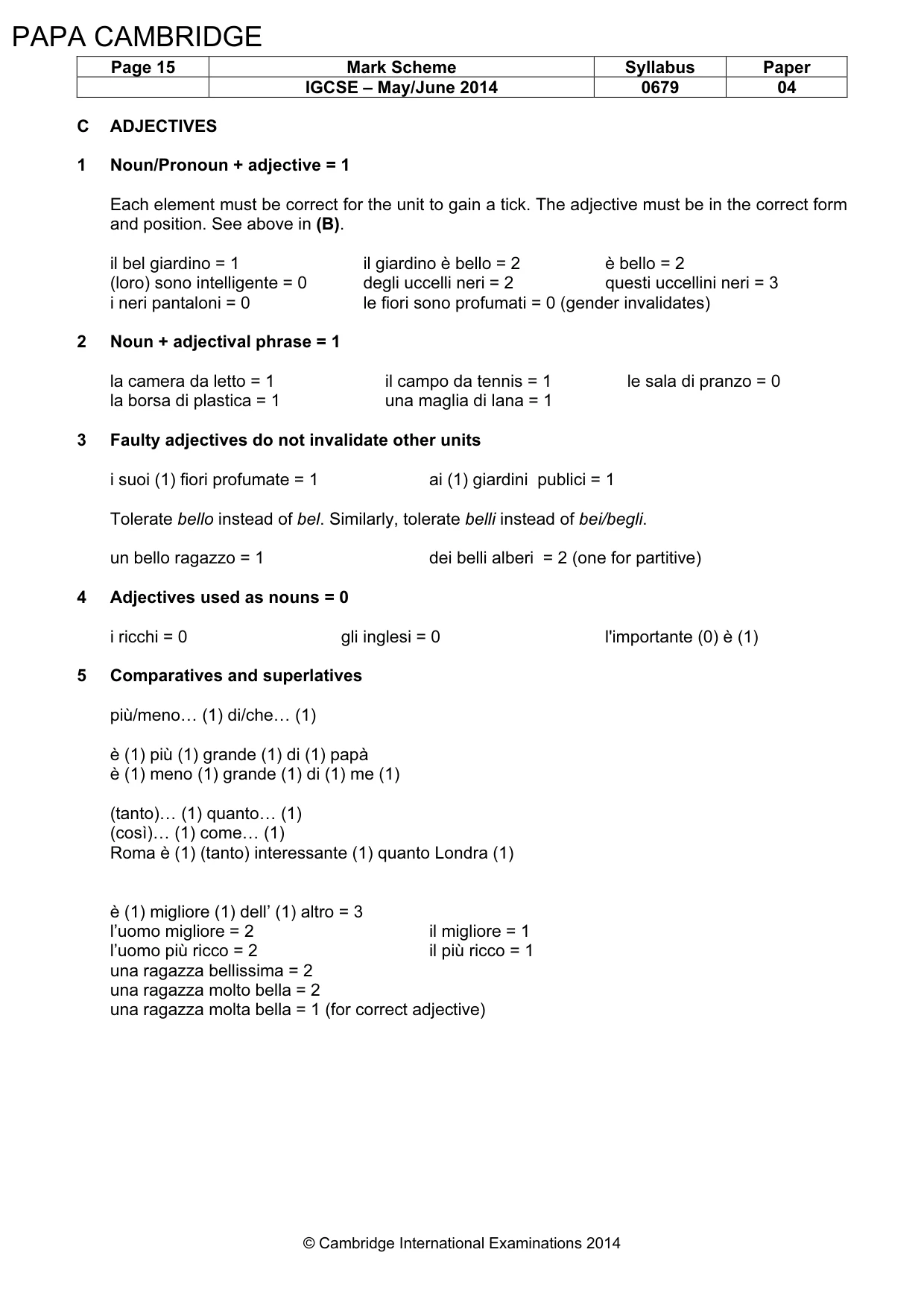
PAPA CAMBRIDGE Page 15 Mark Scheme Syllabus Paper IGCSE – May/June 2014 0679 04 © Cambridge International Examinations 2014 C ADJECTIVES 1 Noun/Pronoun + adjective = 1 Each element must be correct for the unit to gain a tick. The adjective must be in the correct form and position. See above in (B). il bel giardino = 1 il giardino è bello = 2 è bello = 2 (loro) sono intelligente = 0 degli uccelli neri = 2 questi uccellini neri = 3 i neri pantaloni = 0 le fiori sono profumati = 0 (gender invalidates) 2 Noun + adjectival phrase = 1 la camera da letto = 1 il campo da tennis = 1 le sala di pranzo = 0 la borsa di plastica = 1 una maglia di lana = 1 3 Faulty adjectives do not invalidate other units i suoi (1) fiori profumate = 1 ai (1) giardini publici = 1 Tolerate bello instead of bel. Similarly, tolerate belli instead of bei/begli. un bello ragazzo = 1 dei belli alberi = 2 (one for partitive) 4 Adjectives used as nouns = 0 i ricchi = 0 gli inglesi = 0 l'importante (0) è (1) 5 Comparatives and superlatives più/meno… (1) di/che… (1) è (1) più (1) grande (1) di (1) papà è (1) meno (1) grande (1) di (1) me (1) (tanto)… (1) quanto… (1) (così)… (1) come… (1) Roma è (1) (tanto) interessante (1) quanto Londra (1) è (1) migliore (1) dell’ (1) altro = 3 l’uomo migliore = 2 il migliore = 1 l’uomo più ricco = 2 il più ricco = 1 una ragazza bellissima = 2 una ragazza molto bella = 2 una ragazza molta bella = 1 (for correct adjective)
Mark scheme, page 16
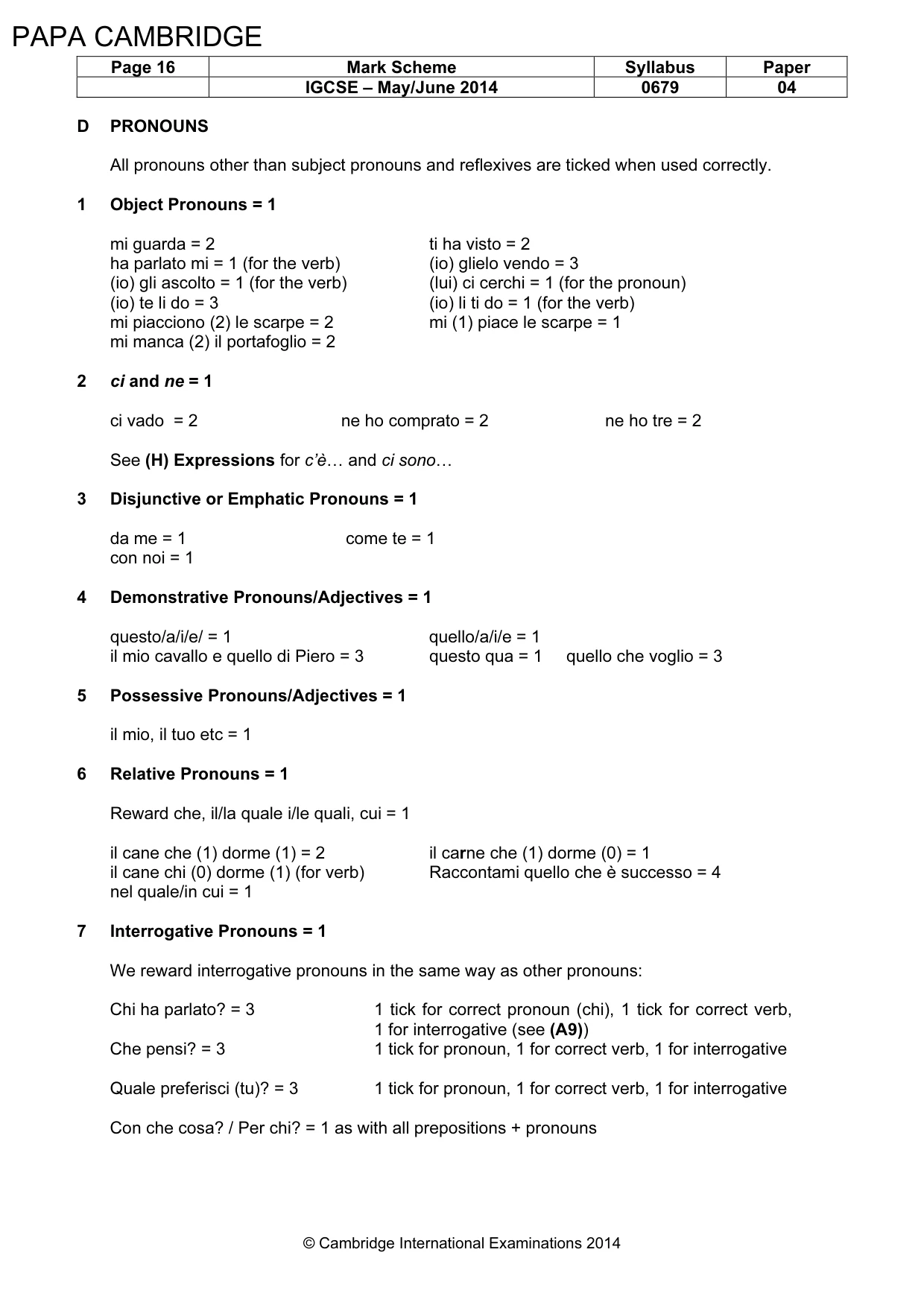
PAPA CAMBRIDGE Page 16 Mark Scheme Syllabus Paper IGCSE – May/June 2014 0679 04 © Cambridge International Examinations 2014 D PRONOUNS All pronouns other than subject pronouns and reflexives are ticked when used correctly. 1 Object Pronouns = 1 mi guarda = 2 ti ha visto = 2 ha parlato mi = 1 (for the verb) (io) glielo vendo = 3 (io) gli ascolto = 1 (for the verb) (lui) ci cerchi = 1 (for the pronoun) (io) te li do = 3 (io) li ti do = 1 (for the verb) mi piacciono (2) le scarpe = 2 mi (1) piace le scarpe = 1 mi manca (2) il portafoglio = 2 2 ci and ne = 1 ci vado = 2 ne ho comprato = 2 ne ho tre = 2 See (H) Expressions for c’è… and ci sono… 3 Disjunctive or Emphatic Pronouns = 1 da me = 1 come te = 1 con noi = 1 4 Demonstrative Pronouns/Adjectives = 1 questo/a/i/e/ = 1 quello/a/i/e = 1 il mio cavallo e quello di Piero = 3 questo qua = 1 quello che voglio = 3 5 Possessive Pronouns/Adjectives = 1 il mio, il tuo etc = 1 6 Relative Pronouns = 1 Reward che, il/la quale i/le quali, cui = 1 il cane che (1) dorme (1) = 2 il carne che (1) dorme (0) = 1 il cane chi (0) dorme (1) (for verb) Raccontami quello che è successo = 4 nel quale/in cui = 1 7 Interrogative Pronouns = 1 We reward interrogative pronouns in the same way as other pronouns: Chi ha parlato? = 3 1 tick for correct pronoun (chi), 1 tick for correct verb, 1 for interrogative (see (A9)) Che pensi? = 3 1 tick for pronoun, 1 for correct verb, 1 for interrogative Quale preferisci (tu)? = 3 1 tick for pronoun, 1 for correct verb, 1 for interrogative Con che cosa? / Per chi? = 1 as with all prepositions + pronouns
Mark scheme, page 17
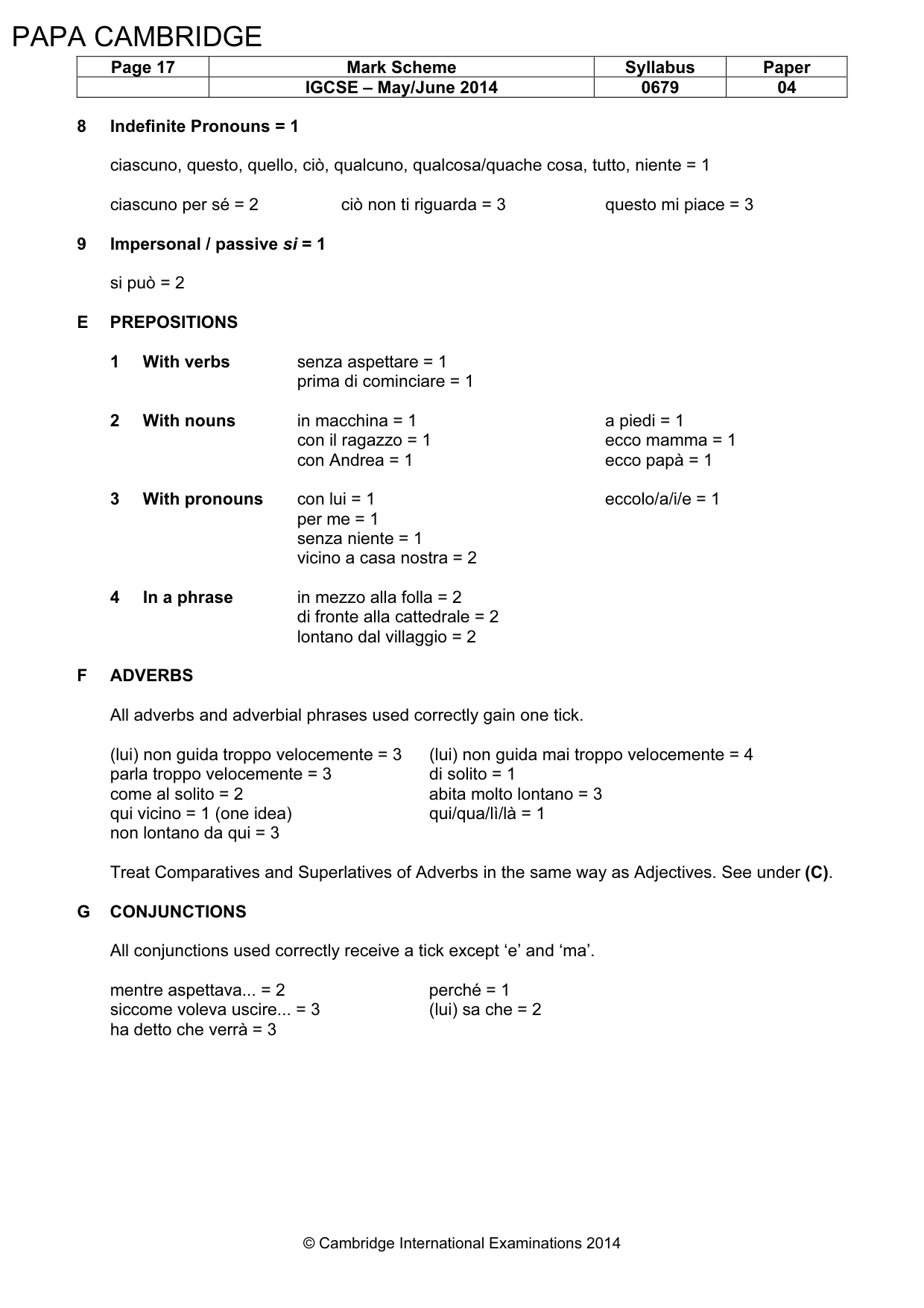
PAPA CAMBRIDGE Page 17 Mark Scheme Syllabus Paper IGCSE – May/June 2014 0679 04 © Cambridge International Examinations 2014 8 Indefinite Pronouns = 1 ciascuno, questo, quello, ciò, qualcuno, qualcosa/quache cosa, tutto, niente = 1 ciascuno per sé = 2 ciò non ti riguarda = 3 questo mi piace = 3 9 Impersonal / passive si = 1 si può = 2 E PREPOSITIONS 1 With verbs senza aspettare = 1 prima di cominciare = 1 2 With nouns in macchina = 1 a piedi = 1 con il ragazzo = 1 ecco mamma = 1 con Andrea = 1 ecco papà = 1 3 With pronouns con lui = 1 eccolo/a/i/e = 1 per me = 1 senza niente = 1 vicino a casa nostra = 2 4 In a phrase in mezzo alla folla = 2 di fronte alla cattedrale = 2 lontano dal villaggio = 2 F ADVERBS All adverbs and adverbial phrases used correctly gain one tick. (lui) non guida troppo velocemente = 3 (lui) non guida mai troppo velocemente = 4 parla troppo velocemente = 3 di solito = 1 come al solito = 2 abita molto lontano = 3 qui vicino = 1 (one idea) qui/qua/lì/là = 1 non lontano da qui = 3 Treat Comparatives and Superlatives of Adverbs in the same way as Adjectives. See under (C). G CONJUNCTIONS All conjunctions used correctly receive a tick except ‘e’ and ‘ma’. mentre aspettava... = 2 perché = 1 siccome voleva uscire... = 3 (lui) sa che = 2 ha detto che verrà = 3
Mark scheme, page 18
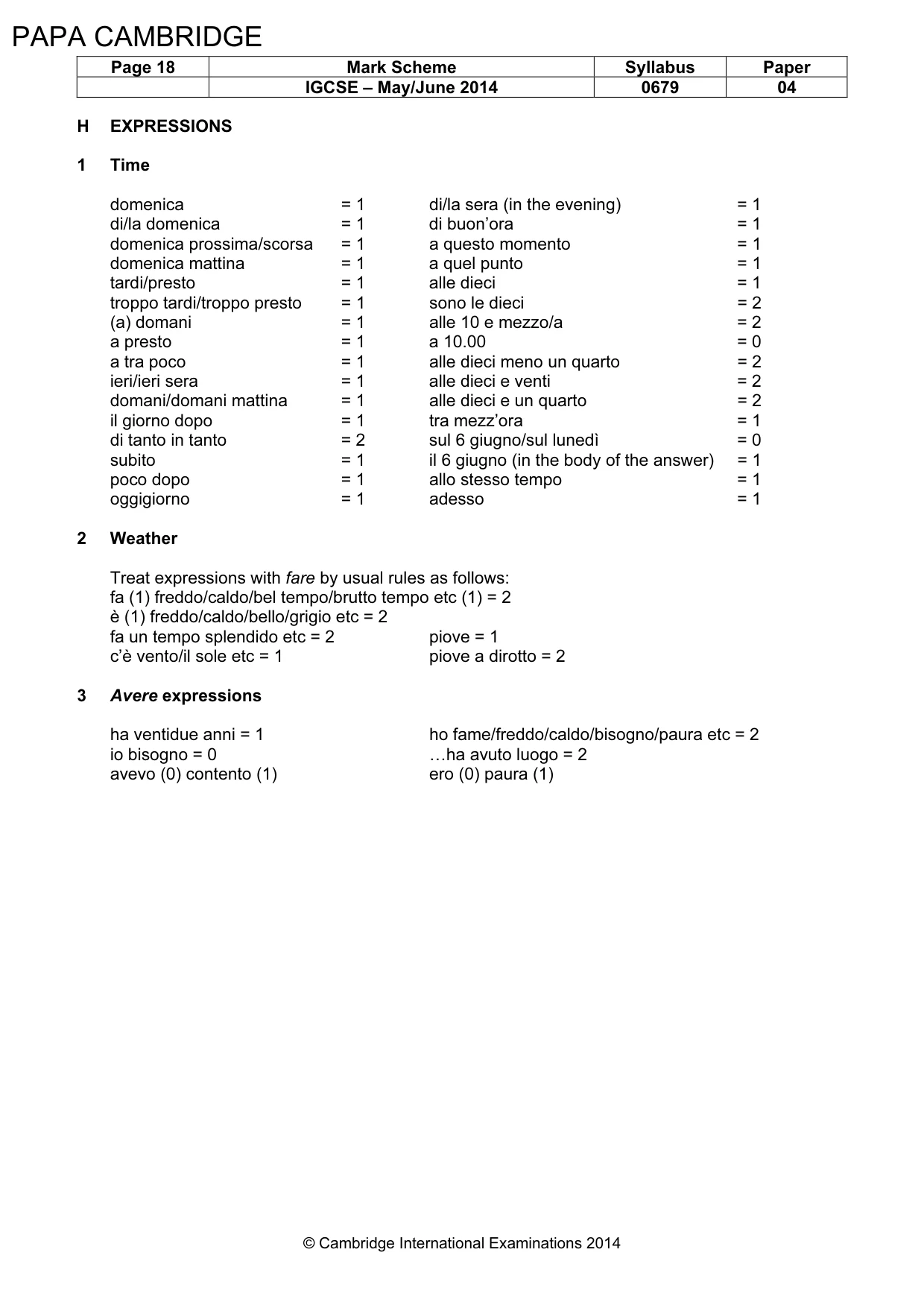
PAPA CAMBRIDGE Page 18 Mark Scheme Syllabus Paper IGCSE – May/June 2014 0679 04 © Cambridge International Examinations 2014 H EXPRESSIONS 1 Time domenica = 1 di/la sera (in the evening) = 1 di/la domenica = 1 di buon’ora = 1 domenica prossima/scorsa = 1 a questo momento = 1 domenica mattina = 1 a quel punto = 1 tardi/presto = 1 alle dieci = 1 troppo tardi/troppo presto = 1 sono le dieci = 2 (a) domani = 1 alle 10 e mezzo/a = 2 a presto = 1 a 10.00 = 0 a tra poco = 1 alle dieci meno un quarto = 2 ieri/ieri sera = 1 alle dieci e venti = 2 domani/domani mattina = 1 alle dieci e un quarto = 2 il giorno dopo = 1 tra mezz’ora = 1 di tanto in tanto = 2 sul 6 giugno/sul lunedì = 0 subito = 1 il 6 giugno (in the body of the answer) = 1 poco dopo = 1 allo stesso tempo = 1 oggigiorno = 1 adesso = 1 2 Weather Treat expressions with fare by usual rules as follows: fa (1) freddo/caldo/bel tempo/brutto tempo etc (1) = 2 è (1) freddo/caldo/bello/grigio etc = 2 fa un tempo splendido etc = 2 piove = 1 c’è vento/il sole etc = 1 piove a dirotto = 2 3 Avere expressions ha ventidue anni = 1 ho fame/freddo/caldo/bisogno/paura etc = 2 io bisogno = 0 …ha avuto luogo = 2 avevo (0) contento (1) ero (0) paura (1)
Mark scheme, page 19
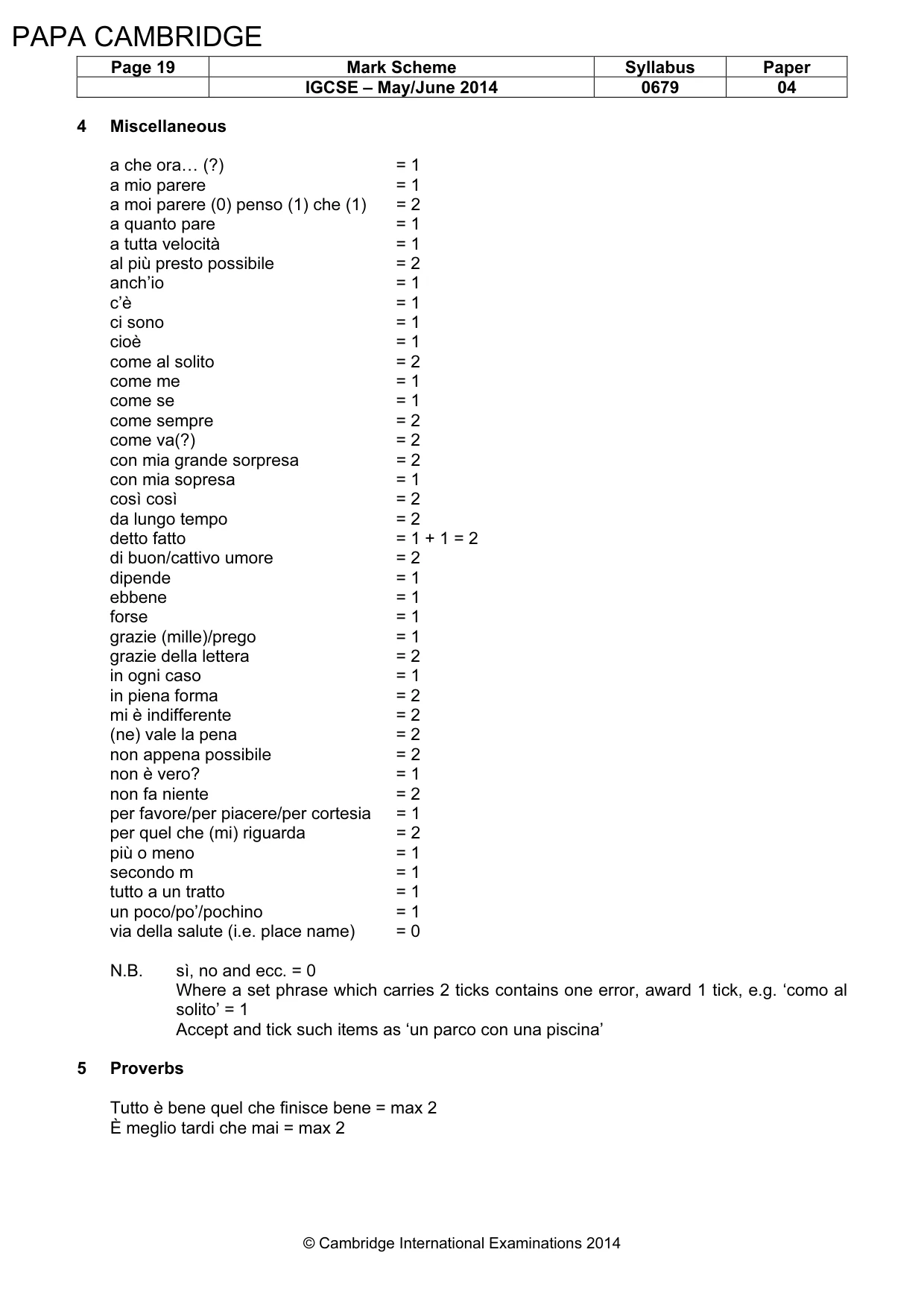
PAPA CAMBRIDGE Page 19 Mark Scheme Syllabus Paper IGCSE – May/June 2014 0679 04 © Cambridge International Examinations 2014 4 Miscellaneous a che ora… (?) = 1 a mio parere = 1 a moi parere (0) penso (1) che (1) = 2 a quanto pare = 1 a tutta velocità = 1 al più presto possibile = 2 anch’io = 1 c’è = 1 ci sono = 1 cioè = 1 come al solito = 2 come me = 1 come se = 1 come sempre = 2 come va(?) = 2 con mia grande sorpresa = 2 con mia sopresa = 1 così così = 2 da lungo tempo = 2 detto fatto = 1 + 1 = 2 di buon/cattivo umore = 2 dipende = 1 ebbene = 1 forse = 1 grazie (mille)/prego = 1 grazie della lettera = 2 in ogni caso = 1 in piena forma = 2 mi è indifferente = 2 (ne) vale la pena = 2 non appena possibile = 2 non è vero? = 1 non fa niente = 2 per favore/per piacere/per cortesia = 1 per quel che (mi) riguarda = 2 più o meno = 1 secondo m = 1 tutto a un tratto = 1 un poco/po’/pochino = 1 via della salute (i.e. place name) = 0 N.B. sì, no and ecc. = 0 Where a set phrase which carries 2 ticks contains one error, award 1 tick, e.g. ‘como al solito’ = 1 Accept and tick such items as ‘un parco con una piscina’ 5 Proverbs Tutto è bene quel che finisce bene = max 2 È meglio tardi che mai = max 2
Mark scheme, page 20
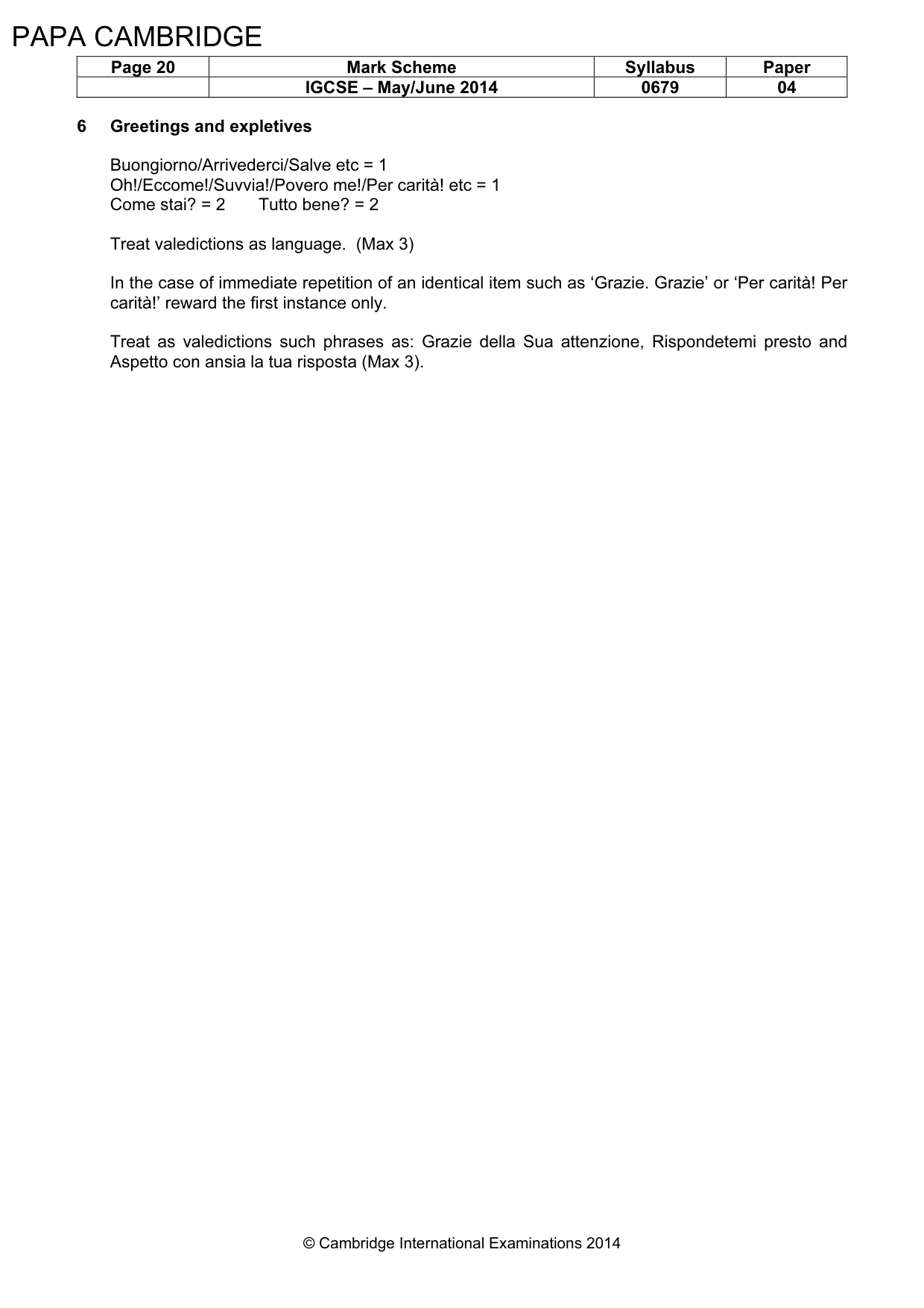
PAPA CAMBRIDGE Page 20 Mark Scheme Syllabus Paper IGCSE – May/June 2014 0679 04 © Cambridge International Examinations 2014 6 Greetings and expletives Buongiorno/Arrivederci/Salve etc = 1 Oh!/Eccome!/Suvvia!/Povero me!/Per carità! etc = 1 Come stai? = 2 Tutto bene? = 2 Treat valedictions as language. (Max 3) In the case of immediate repetition of an identical item such as ‘Grazie. Grazie’ or ‘Per carità! Per carità!’ reward the first instance only. Treat as valedictions such phrases as: Grazie della Sua attenzione, Rispondetemi presto and Aspetto con ansia la tua risposta (Max 3).
Mark scheme, page 21
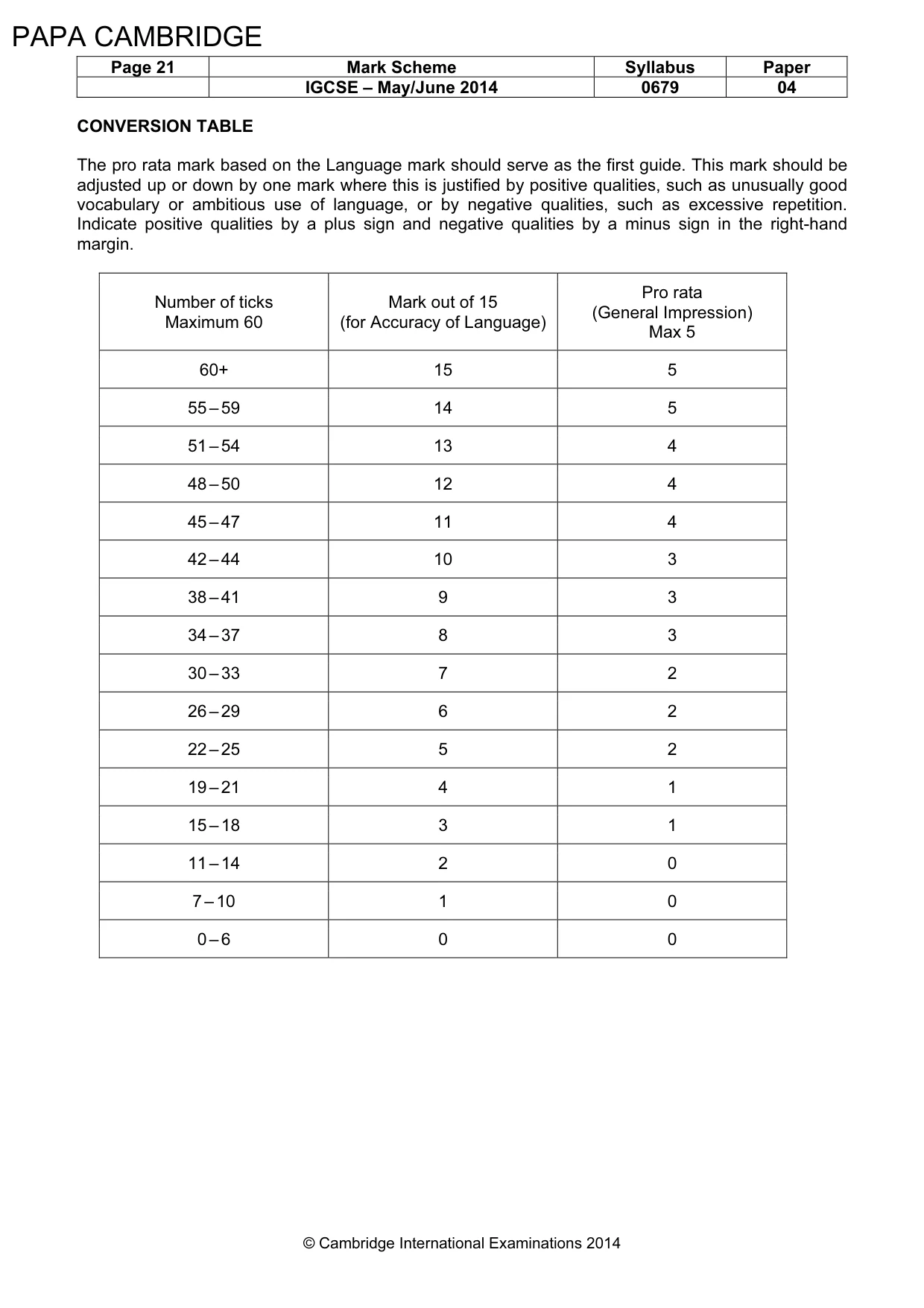
PAPA CAMBRIDGE Page 21 Mark Scheme Syllabus Paper IGCSE – May/June 2014 0679 04 © Cambridge International Examinations 2014 CONVERSION TABLE The pro rata mark based on the Language mark should serve as the first guide. This mark should be adjusted up or down by one mark where this is justified by positive qualities, such as unusually good vocabulary or ambitious use of language, or by negative qualities, such as excessive repetition. Indicate positive qualities by a plus sign and negative qualities by a minus sign in the right-hand margin. Number of ticks Maximum 60 Mark out of 15 (for Accuracy of Language) Pro rata (General Impression) Max 5 60+ 15 5 55 – 59 14 5 51 – 54 13 4 48 – 50 12 4 45 – 47 11 4 42 – 44 10 3 38 – 41 9 3 34 – 37 8 3 30 – 33 7 2 26 – 29 6 2 22 – 25 5 2 19 – 21 4 1 15 – 18 3 1 11 – 14 2 0 7 – 10 1 0 0 – 6 0 0
Mark scheme, page 22
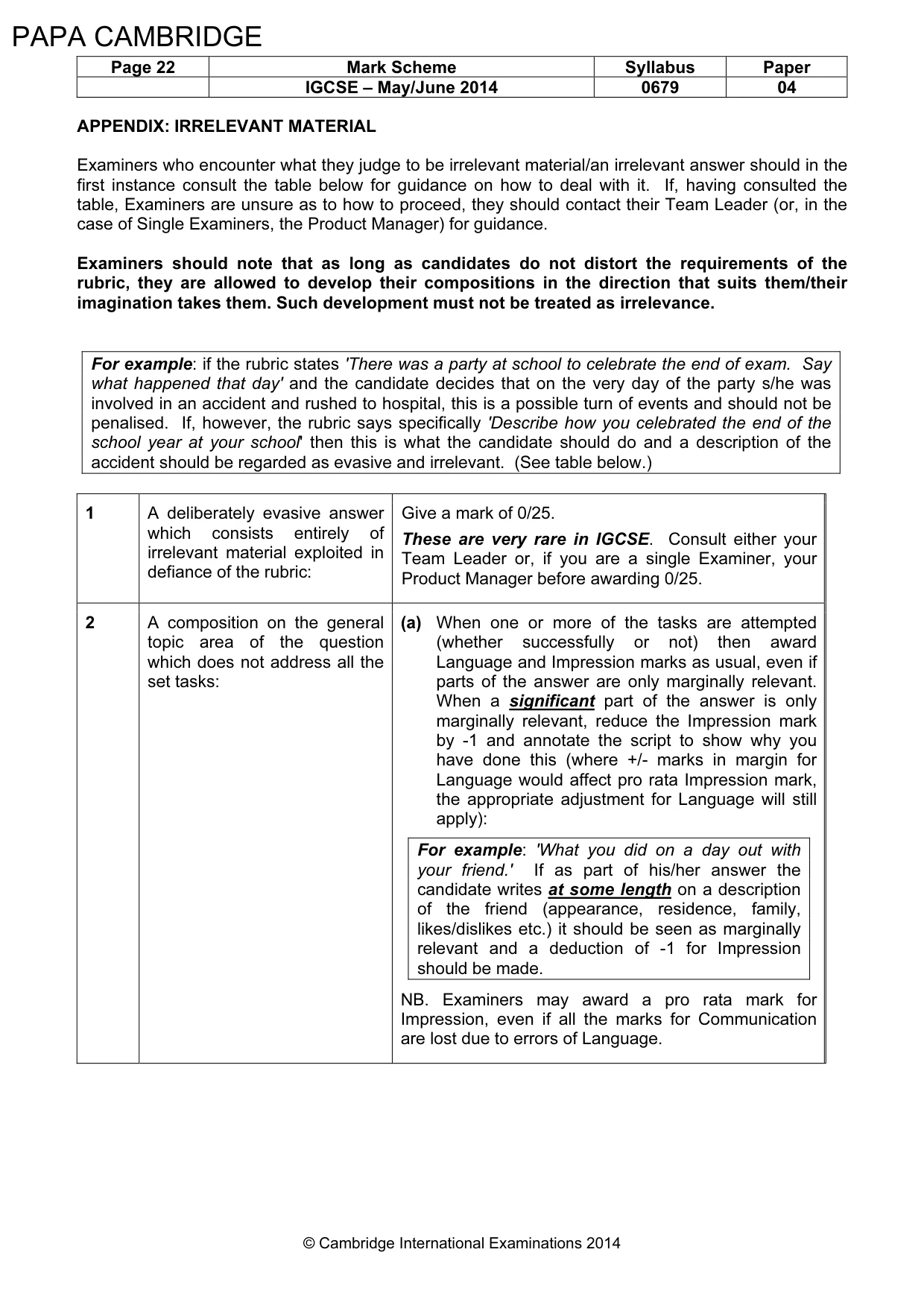
PAPA CAMBRIDGE Page 22 Mark Scheme Syllabus Paper IGCSE – May/June 2014 0679 04 © Cambridge International Examinations 2014 APPENDIX: IRRELEVANT MATERIAL Examiners who encounter what they judge to be irrelevant material/an irrelevant answer should in the first instance consult the table below for guidance on how to deal with it. If, having consulted the table, Examiners are unsure as to how to proceed, they should contact their Team Leader (or, in the case of Single Examiners, the Product Manager) for guidance. Examiners should note that as long as candidates do not distort the requirements of the rubric, they are allowed to develop their compositions in the direction that suits them/their imagination takes them. Such development must not be treated as irrelevance. For example: if the rubric states 'There was a party at school to celebrate the end of exam. Say what happened that day' and the candidate decides that on the very day of the party s/he was involved in an accident and rushed to hospital, this is a possible turn of events and should not be penalised. If, however, the rubric says specifically 'Describe how you celebrated the end of the school year at your school' then this is what the candidate should do and a description of the accident should be regarded as evasive and irrelevant. (See table below.) 1 A deliberately evasive answer which consists entirely of irrelevant material exploited in defiance of the rubric: Give a mark of 0/25. These are very rare in IGCSE. Consult either your Team Leader or, if you are a single Examiner, your Product Manager before awarding 0/25. 2 A composition on the general topic area of the question which does not address all the set tasks: (a) When one or more of the tasks are attempted (whether successfully or not) then award Language and Impression marks as usual, even if parts of the answer are only marginally relevant. When a significant part of the answer is only marginally relevant, reduce the Impression mark by -1 and annotate the script to show why you have done this (where +/- marks in margin for Language would affect pro rata Impression mark, the appropriate adjustment for Language will still apply): For example: 'What you did on a day out with your friend.' If as part of his/her answer the candidate writes at some length on a description of the friend (appearance, residence, family, likes/dislikes etc.) it should be seen as marginally relevant and a deduction of -1 for Impression should be made. NB. Examiners may award a pro rata mark for Impression, even if all the marks for Communication are lost due to errors of Language.
Mark scheme, page 23
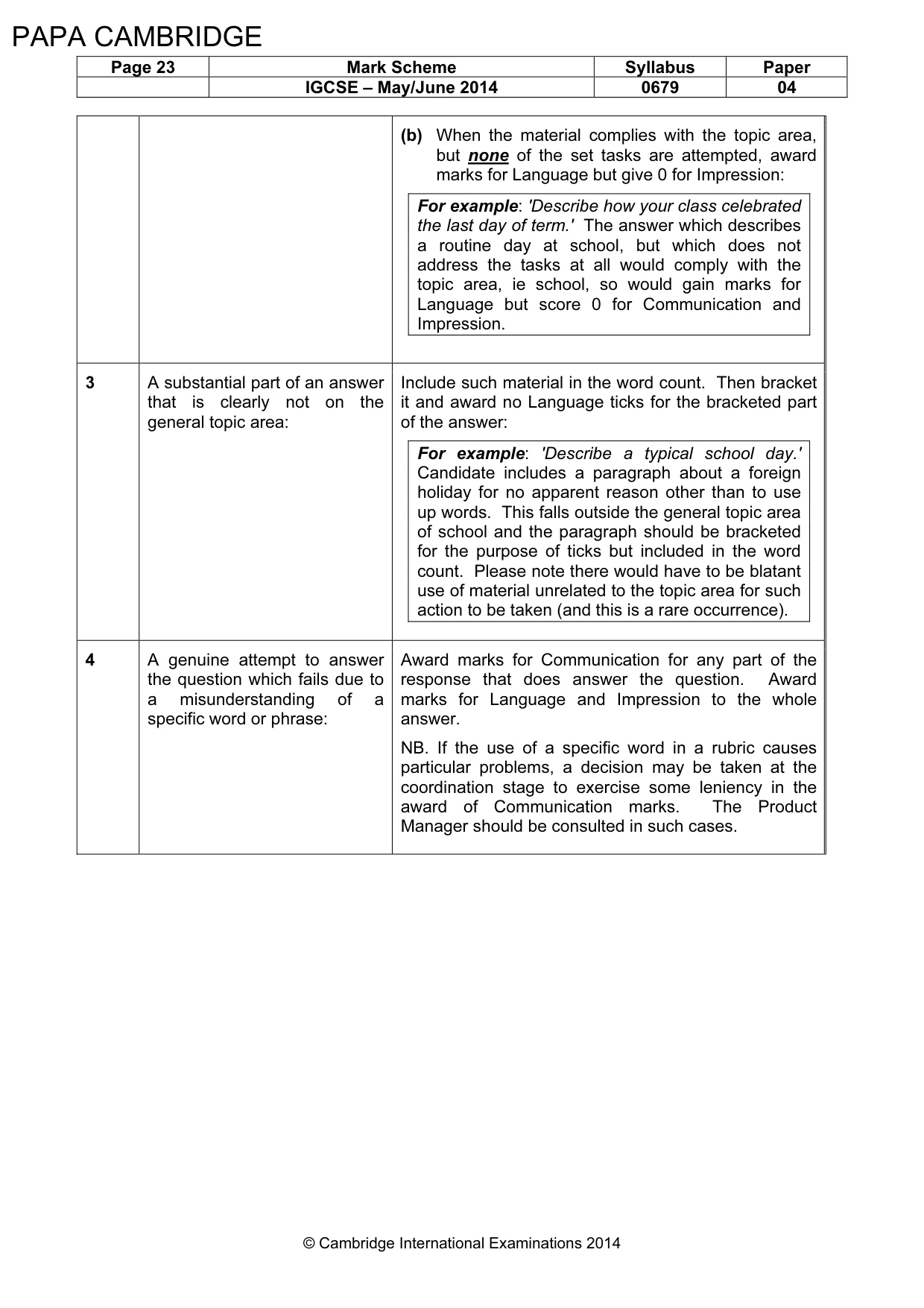
PAPA CAMBRIDGE Page 23 Mark Scheme Syllabus Paper IGCSE – May/June 2014 0679 04 © Cambridge International Examinations 2014 (b) When the material complies with the topic area, but none of the set tasks are attempted, award marks for Language but give 0 for Impression: For example: 'Describe how your class celebrated the last day of term.' The answer which describes a routine day at school, but which does not address the tasks at all would comply with the topic area, ie school, so would gain marks for Language but score 0 for Communication and Impression. 3 A substantial part of an answer that is clearly not on the general topic area: Include such material in the word count. Then bracket it and award no Language ticks for the bracketed part of the answer: For example: 'Describe a typical school day.' Candidate includes a paragraph about a foreign holiday for no apparent reason other than to use up words. This falls outside the general topic area of school and the paragraph should be bracketed for the purpose of ticks but included in the word count. Please note there would have to be blatant use of material unrelated to the topic area for such action to be taken (and this is a rare occurrence). 4 A genuine attempt to answer the question which fails due to a misunderstanding of a specific word or phrase: Award marks for Communication for any part of the response that does answer the question. Award marks for Language and Impression to the whole answer. NB. If the use of a specific word in a rubric causes particular problems, a decision may be taken at the coordination stage to exercise some leniency in the award of Communication marks. The Product Manager should be consulted in such cases.
What you needed in this session
Cambridge’s own grade thresholds for 2014 May/June, Paper 4 · Variant 1. A higher threshold means an easier paper — the bar moves with how the cohort did.