Cambridge IGCSE Italian - Foreign Language 0535 — 2019 May/June Paper 4 · Variant 1
0535/41/M/J/19 · 50 marks · ≈56 min
The question paper and its mark scheme, free to read here and free to download. This is Cambridge’s own paper, exactly as it was sat.
Question paper8 pages


Mark scheme23 pages
Answers below. Sit the paper first if you are practising.
Paper as text
Question paper, page 1
This document consists of 6 printed pages and 2 blank pages. DC (JP/TP) 166624/3 © UCLES 2019 [Turn over * 2 7 0 6 0 5 3 3 6 7 * ITALIAN 0535/04 Paper 4 Writing May/June 2019 1 hour Candidates answer on the Question Paper. No Additional Materials are required. READ THESE INSTRUCTIONS FIRST Write your centre number, candidate number and name in the spaces at the top of this page. Write in dark blue or black pen. Do not use staples, paper clips, glue or correction fluid. DO NOT WRITE IN ANY BARCODES. Answer three questions: Question 1, Question 2 and Question 3(a) or Question 3(b) or Question 3(c). The number of marks is given in brackets [ ] at the end of each question or part question. Cambridge Assessment International Education Cambridge International General Certificate of Secondary Education This syllabus is regulated for use in England, Wales and Northern Ireland as a Cambridge International Level 1/Level 2 Certificate.
Question paper, page 2
2 0535/04/M/J/19 © UCLES 2019 BLANK PAGE
Question paper, page 3
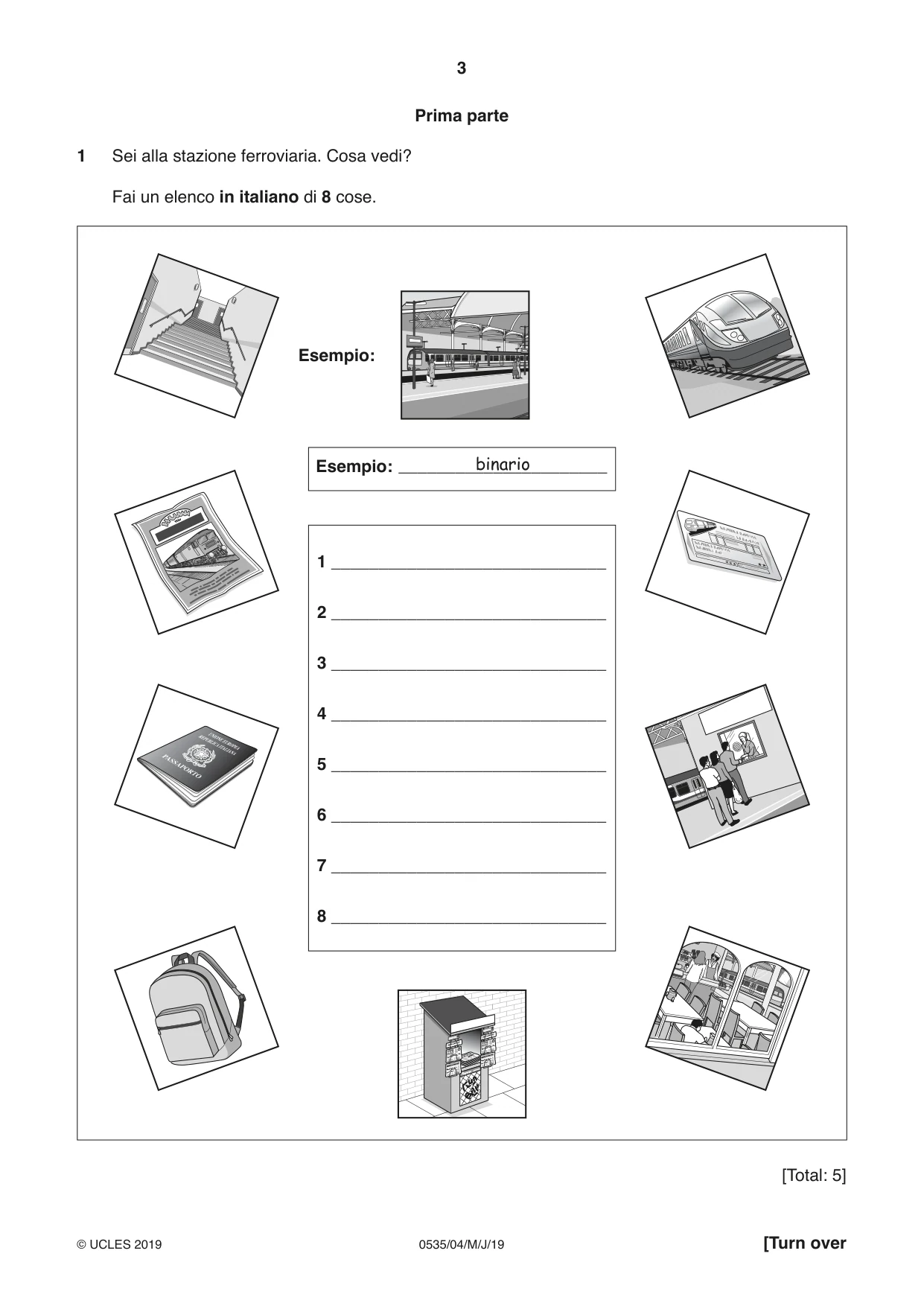
3 0535/04/M/J/19 © UCLES 2019 [Turn over Prima parte 1 Sei alla stazione ferroviaria. Cosa vedi? Fai un elenco in italiano di 8 cose. Esempio: Esempio: binario ______________________ 1 _____________________________ 2 _____________________________ 3 _____________________________ 4 _____________________________ 5 _____________________________ 6 _____________________________ 7 _____________________________ 8 _____________________________ [Total: 5]
Question paper, page 4
4 0535/04/M/J/19 © UCLES 2019 2 I lavori domestici • Quando aiuti in casa? • Quali lavori domestici non ti piace fare? • Preferisci aiutare i genitori in casa o in giardino? Perché? • Che lavori domestici farai il prossimo fine settimana? Scrivi 80–90 parole in italiano. … … … … … … … … … … … … … … [Total: 15]
Question paper, page 5
5 0535/04/M/J/19 © UCLES 2019 [Turn over Voltare la pagina per la Seconda parte.
Question paper, page 6
6 0535/04/M/J/19 © UCLES 2019 Seconda parte 3 Scegli uno degli argomenti seguenti. Devi scrivere 130–140 parole in italiano. (a) Al parco La settimana scorsa sei andato/a al parco. Scrivi un’e-mail al tuo amico/alla tua amica. • Descrivi che cosa hai fatto quando sei arrivato/a. • Ti sei divertito/a? Perché? • Che tempo faceva? • Perché ti piace andare al parco? • Che cosa farai la prossima volta al parco? O (b) Un concerto incredibile Scrivi un articolo per il giornale della scuola su un concerto che hai visto recentemente. • A quale concerto sei andato/a recentemente? • Perché è stato un concerto incredibile? • Ti piacerebbe diventare musicista in futuro? Perché? • Che cosa pensi della musica classica? Perché? • Hai altri passatempi preferiti? O (c) In ritardo a scuola! Ieri, mentre andavi a scuola, hai avuto un problema e sei arrivato/a tardi. • A che ora sei partito/a da casa? • Che problema hai avuto? • Che soluzione hai trovato? • Che cosa hai fatto quando sei arrivato/a a scuola? • Descrivi la reazione del tuo professore/della tua professoressa. Ecco l’inizio. Continua la storia. Ieri, mentre andavo a scuola, ho avuto un problema e sono arrivato/a tardi ...
Question paper, page 7
7 0535/04/M/J/19 © UCLES 2019 SCRIVI QUI LA TUA RISPOSTA ALLA DOMANDA 3 … … … … … … … … … … … … … … … … … … … … … … … … … … [Total: 30]
Question paper, page 8
8 0535/04/M/J/19 © UCLES 2019 Permission to reproduce items where third-party owned material protected by copyright is included has been sought and cleared where possible. Every reasonable effort has been made by the publisher (UCLES) to trace copyright holders, but if any items requiring clearance have unwittingly been included, the publisher will be pleased to make amends at the earliest possible opportunity. To avoid the issue of disclosure of answer-related information to candidates, all copyright acknowledgements are reproduced online in the Cambridge Assessment International Education Copyright Acknowledgements Booklet. This is produced for each series of examinations and is freely available to download at www.cambridgeinternational.org after the live examination series. Cambridge Assessment International Education is part of the Cambridge Assessment Group. Cambridge Assessment is the brand name of the University of Cambridge Local Examinations Syndicate (UCLES), which itself is a department of the University of Cambridge. BLANK PAGE
Mark scheme, page 1
This syllabus is regulated for use in England, Wales and Northern Ireland as a Cambridge International Level 1/Level 2 Certificate. This document consists of 23 printed pages. © UCLES 2019 [Turn over Cambridge Assessment International Education Cambridge International General Certificate of Secondary Education ITALIAN 0535/04 Paper 4 Writing May/June 2019 MARK SCHEME Maximum Mark: 50 Published This mark scheme is published as an aid to teachers and candidates, to indicate the requirements of the examination. It shows the basis on which Examiners were instructed to award marks. It does not indicate the details of the discussions that took place at an Examiners’ meeting before marking began, which would have considered the acceptability of alternative answers. Mark schemes should be read in conjunction with the question paper and the Principal Examiner Report for Teachers. Cambridge International will not enter into discussions about these mark schemes. Cambridge International is publishing the mark schemes for the May/June 2019 series for most Cambridge IGCSE™, Cambridge International A and AS Level and Cambridge Pre-U components, and some Cambridge O Level components.
Mark scheme, page 2
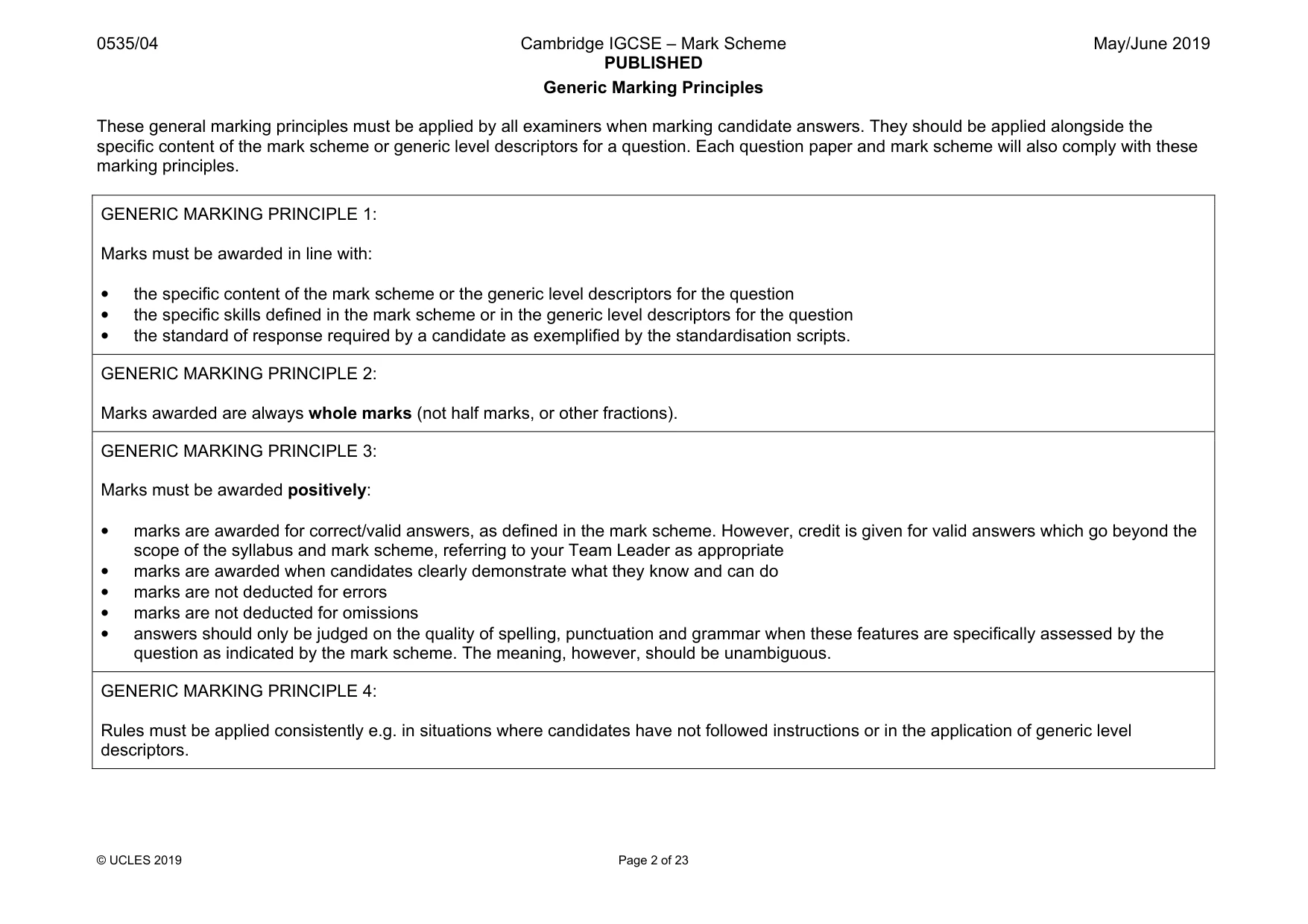
0535/04 Cambridge IGCSE – Mark Scheme PUBLISHED May/June 2019 © UCLES 2019 Page 2 of 23 Generic Marking Principles These general marking principles must be applied by all examiners when marking candidate answers. They should be applied alongside the specific content of the mark scheme or generic level descriptors for a question. Each question paper and mark scheme will also comply with these marking principles. GENERIC MARKING PRINCIPLE 1: Marks must be awarded in line with: • the specific content of the mark scheme or the generic level descriptors for the question • the specific skills defined in the mark scheme or in the generic level descriptors for the question • the standard of response required by a candidate as exemplified by the standardisation scripts. GENERIC MARKING PRINCIPLE 2: Marks awarded are always whole marks (not half marks, or other fractions). GENERIC MARKING PRINCIPLE 3: Marks must be awarded positively: • marks are awarded for correct/valid answers, as defined in the mark scheme. However, credit is given for valid answers which go beyond the scope of the syllabus and mark scheme, referring to your Team Leader as appropriate • marks are awarded when candidates clearly demonstrate what they know and can do • marks are not deducted for errors • marks are not deducted for omissions • answers should only be judged on the quality of spelling, punctuation and grammar when these features are specifically assessed by the question as indicated by the mark scheme. The meaning, however, should be unambiguous. GENERIC MARKING PRINCIPLE 4: Rules must be applied consistently e.g. in situations where candidates have not followed instructions or in the application of generic level descriptors.
Mark scheme, page 3
0535/04 Cambridge IGCSE – Mark Scheme PUBLISHED May/June 2019 © UCLES 2019 Page 3 of 23 GENERIC MARKING PRINCIPLE 5: Marks should be awarded using the full range of marks defined in the mark scheme for the question (however; the use of the full mark range may be limited according to the quality of the candidate responses seen). GENERIC MARKING PRINCIPLE 6: Marks awarded are based solely on the requirements as defined in the mark scheme. Marks should not be awarded with grade thresholds or grade descriptors in mind.
Mark scheme, page 4
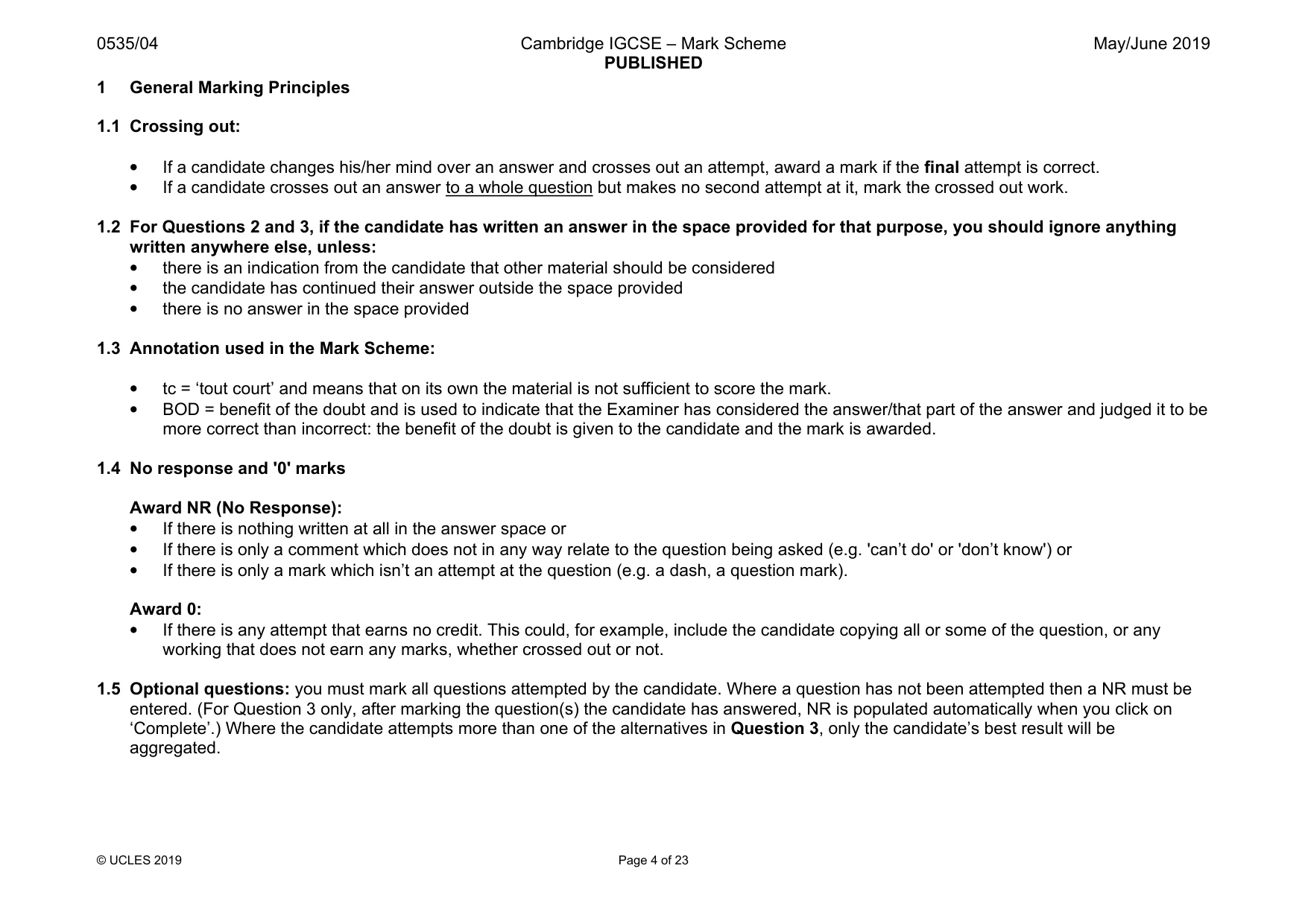
0535/04 Cambridge IGCSE – Mark Scheme PUBLISHED May/June 2019 © UCLES 2019 Page 4 of 23 1 General Marking Principles 1.1 Crossing out: • If a candidate changes his/her mind over an answer and crosses out an attempt, award a mark if the final attempt is correct. • If a candidate crosses out an answer to a whole question but makes no second attempt at it, mark the crossed out work. 1.2 For Questions 2 and 3, if the candidate has written an answer in the space provided for that purpose, you should ignore anything written anywhere else, unless: • there is an indication from the candidate that other material should be considered • the candidate has continued their answer outside the space provided • there is no answer in the space provided 1.3 Annotation used in the Mark Scheme: • tc = ‘tout court’ and means that on its own the material is not sufficient to score the mark. • BOD = benefit of the doubt and is used to indicate that the Examiner has considered the answer/that part of the answer and judged it to be more correct than incorrect: the benefit of the doubt is given to the candidate and the mark is awarded. 1.4 No response and '0' marks Award NR (No Response): • If there is nothing written at all in the answer space or • If there is only a comment which does not in any way relate to the question being asked (e.g. 'can’t do' or 'don’t know') or • If there is only a mark which isn’t an attempt at the question (e.g. a dash, a question mark). Award 0: • If there is any attempt that earns no credit. This could, for example, include the candidate copying all or some of the question, or any working that does not earn any marks, whether crossed out or not. 1.5 Optional questions: you must mark all questions attempted by the candidate. Where a question has not been attempted then a NR must be entered. (For Question 3 only, after marking the question(s) the candidate has answered, NR is populated automatically when you click on ‘Complete’.) Where the candidate attempts more than one of the alternatives in Question 3, only the candidate’s best result will be aggregated.
Mark scheme, page 5
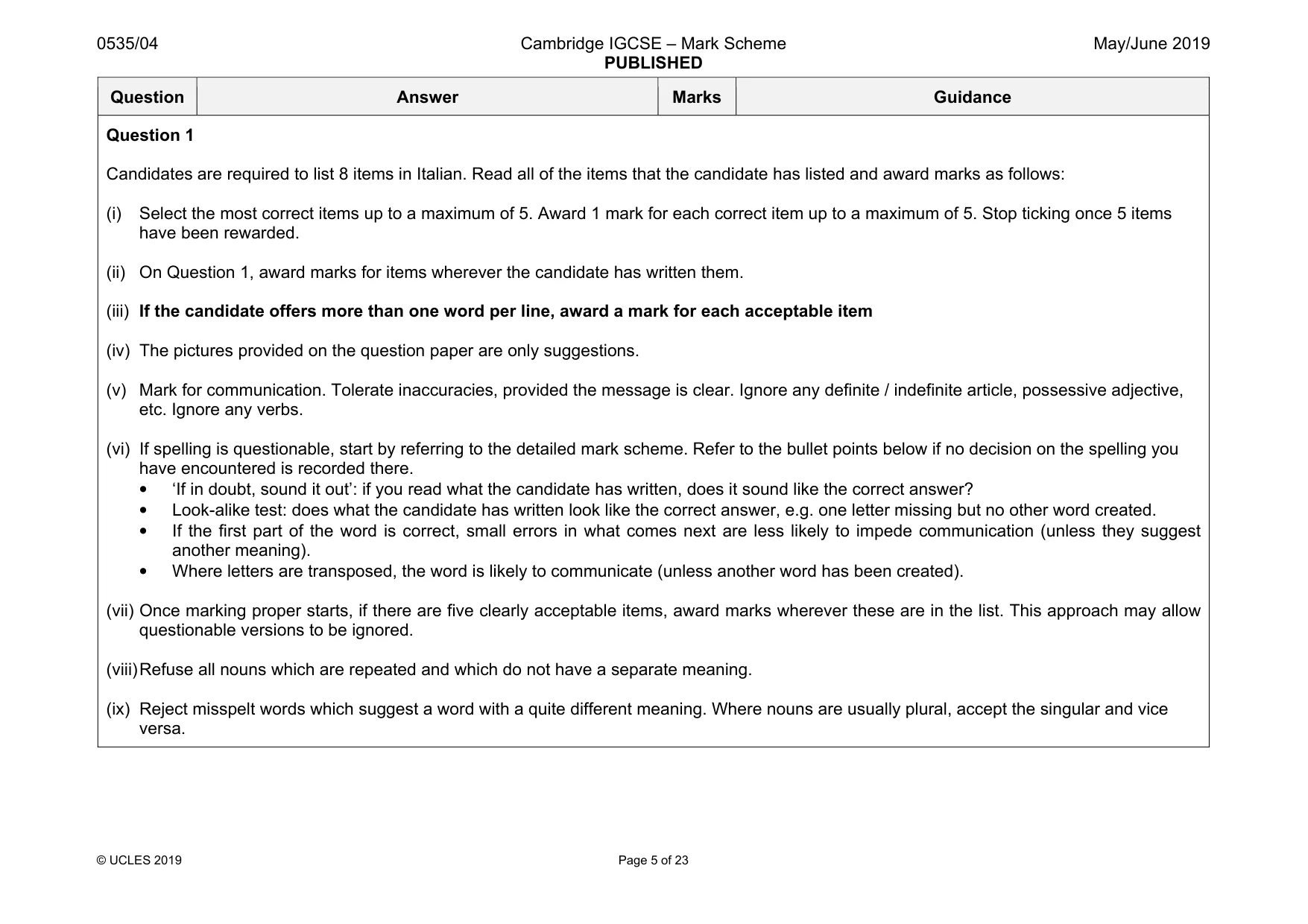
0535/04 Cambridge IGCSE – Mark Scheme PUBLISHED May/June 2019 © UCLES 2019 Page 5 of 23 Question Answer Marks Guidance Question 1 Candidates are required to list 8 items in Italian. Read all of the items that the candidate has listed and award marks as follows: (i) Select the most correct items up to a maximum of 5. Award 1 mark for each correct item up to a maximum of 5. Stop ticking once 5 items have been rewarded. (ii) On Question 1, award marks for items wherever the candidate has written them. (iii) If the candidate offers more than one word per line, award a mark for each acceptable item (iv) The pictures provided on the question paper are only suggestions. (v) Mark for communication. Tolerate inaccuracies, provided the message is clear. Ignore any definite / indefinite article, possessive adjective, etc. Ignore any verbs. (vi) If spelling is questionable, start by referring to the detailed mark scheme. Refer to the bullet points below if no decision on the spelling you have encountered is recorded there. • ‘If in doubt, sound it out’: if you read what the candidate has written, does it sound like the correct answer? • Look-alike test: does what the candidate has written look like the correct answer, e.g. one letter missing but no other word created. • If the first part of the word is correct, small errors in what comes next are less likely to impede communication (unless they suggest another meaning). • Where letters are transposed, the word is likely to communicate (unless another word has been created). (vii) Once marking proper starts, if there are five clearly acceptable items, award marks wherever these are in the list. This approach may allow questionable versions to be ignored. (viii) Refuse all nouns which are repeated and which do not have a separate meaning. (ix) Reject misspelt words which suggest a word with a quite different meaning. Where nouns are usually plural, accept the singular and vice versa.
Mark scheme, page 6
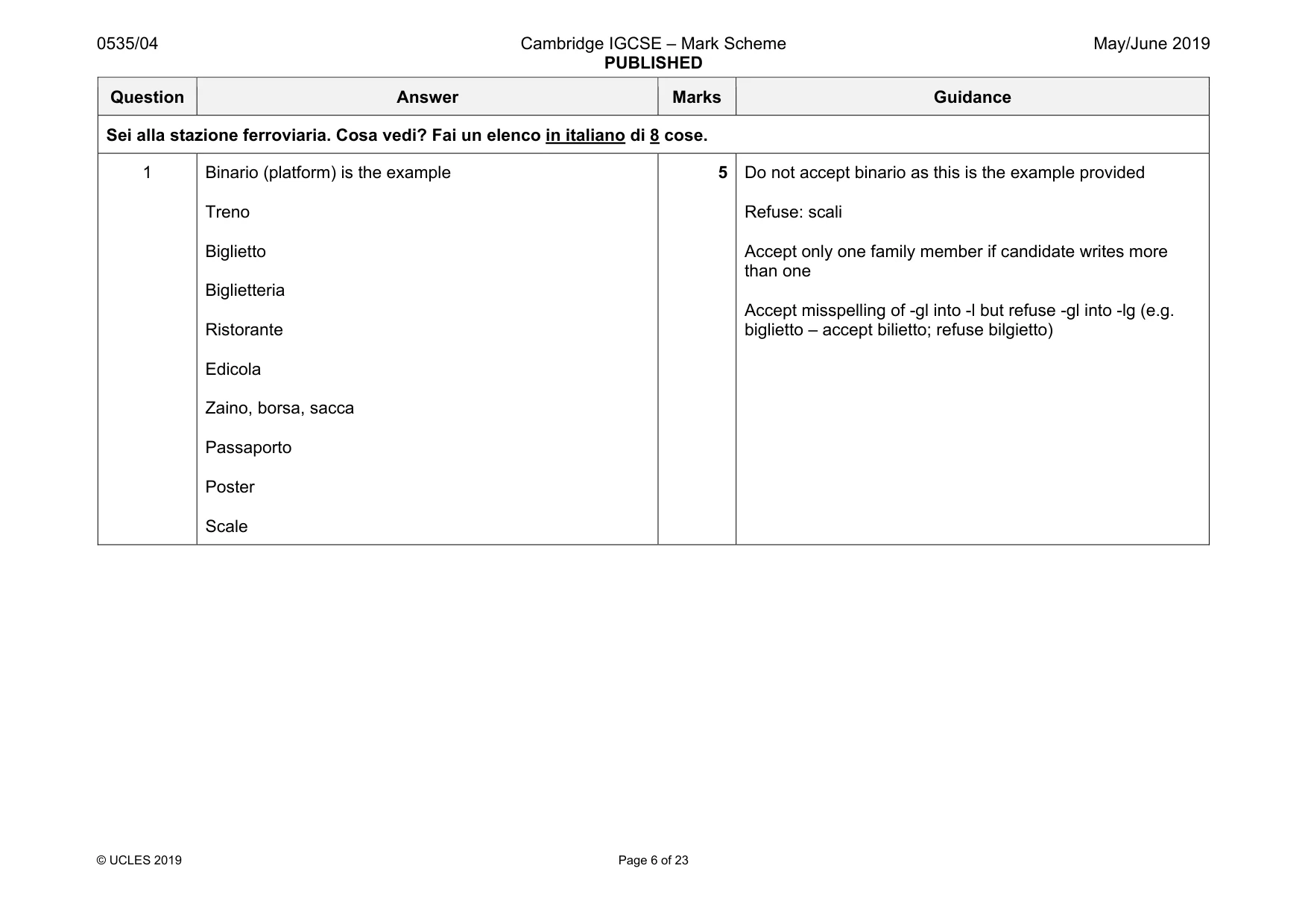
0535/04 Cambridge IGCSE – Mark Scheme PUBLISHED May/June 2019 © UCLES 2019 Page 6 of 23 Question Answer Marks Guidance Sei alla stazione ferroviaria. Cosa vedi? Fai un elenco in italiano di 8 cose. 1 Binario (platform) is the example Treno Biglietto Biglietteria Ristorante Edicola Zaino, borsa, sacca Passaporto Poster Scale 5 Do not accept binario as this is the example provided Refuse: scali Accept only one family member if candidate writes more than one Accept misspelling of -gl into -l but refuse -gl into -lg (e.g. biglietto – accept bilietto; refuse bilgietto)
Mark scheme, page 7
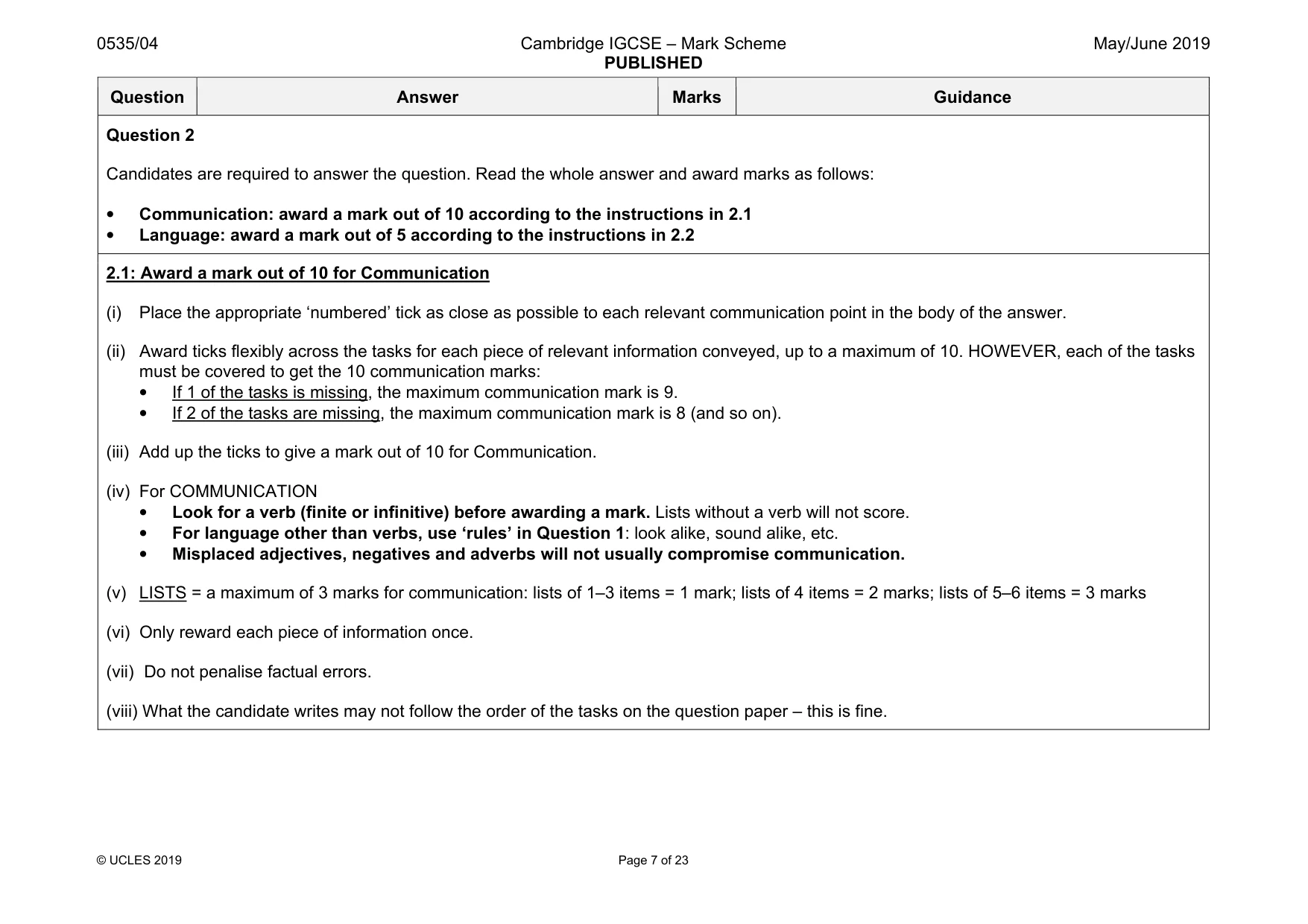
0535/04 Cambridge IGCSE – Mark Scheme PUBLISHED May/June 2019 © UCLES 2019 Page 7 of 23 Question Answer Marks Guidance Question 2 Candidates are required to answer the question. Read the whole answer and award marks as follows: • Communication: award a mark out of 10 according to the instructions in 2.1 • Language: award a mark out of 5 according to the instructions in 2.2 2.1: Award a mark out of 10 for Communication (i) Place the appropriate ‘numbered’ tick as close as possible to each relevant communication point in the body of the answer. (ii) Award ticks flexibly across the tasks for each piece of relevant information conveyed, up to a maximum of 10. HOWEVER, each of the tasks must be covered to get the 10 communication marks: • If 1 of the tasks is missing, the maximum communication mark is 9. • If 2 of the tasks are missing, the maximum communication mark is 8 (and so on). (iii) Add up the ticks to give a mark out of 10 for Communication. (iv) For COMMUNICATION • Look for a verb (finite or infinitive) before awarding a mark. Lists without a verb will not score. • For language other than verbs, use ‘rules’ in Question 1: look alike, sound alike, etc. • Misplaced adjectives, negatives and adverbs will not usually compromise communication. (v) LISTS = a maximum of 3 marks for communication: lists of 1–3 items = 1 mark; lists of 4 items = 2 marks; lists of 5–6 items = 3 marks (vi) Only reward each piece of information once. (vii) Do not penalise factual errors. (viii) What the candidate writes may not follow the order of the tasks on the question paper – this is fine.
Mark scheme, page 8
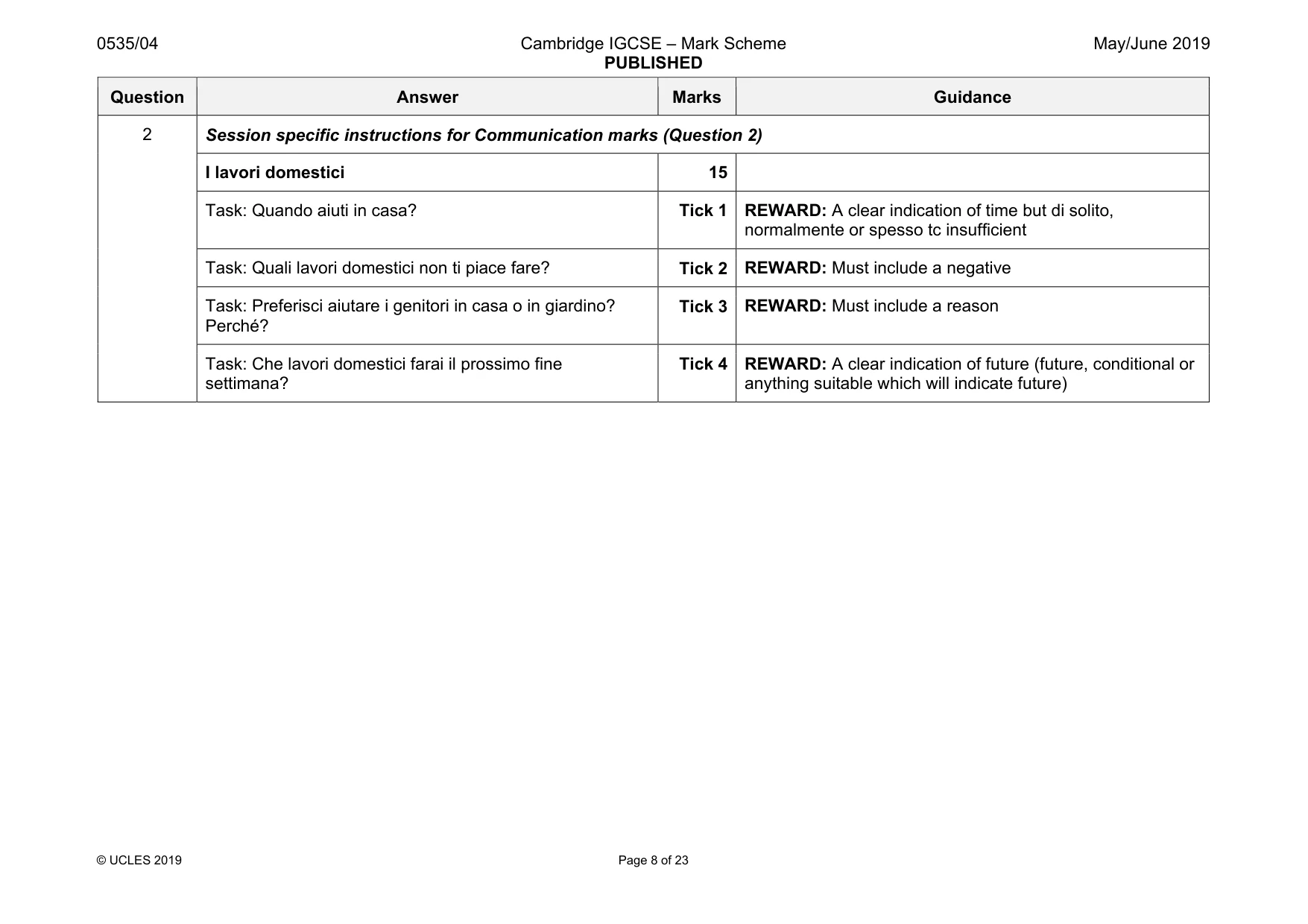
0535/04 Cambridge IGCSE – Mark Scheme PUBLISHED May/June 2019 © UCLES 2019 Page 8 of 23 Question Answer Marks Guidance 2 Session specific instructions for Communication marks (Question 2) I lavori domestici 15 Task: Quando aiuti in casa? Tick 1 REWARD: A clear indication of time but di solito, normalmente or spesso tc insufficient Task: Quali lavori domestici non ti piace fare? Tick 2 REWARD: Must include a negative Task: Preferisci aiutare i genitori in casa o in giardino? Perché? Tick 3 REWARD: Must include a reason Task: Che lavori domestici farai il prossimo fine settimana? Tick 4 REWARD: A clear indication of future (future, conditional or anything suitable which will indicate future)
Mark scheme, page 9
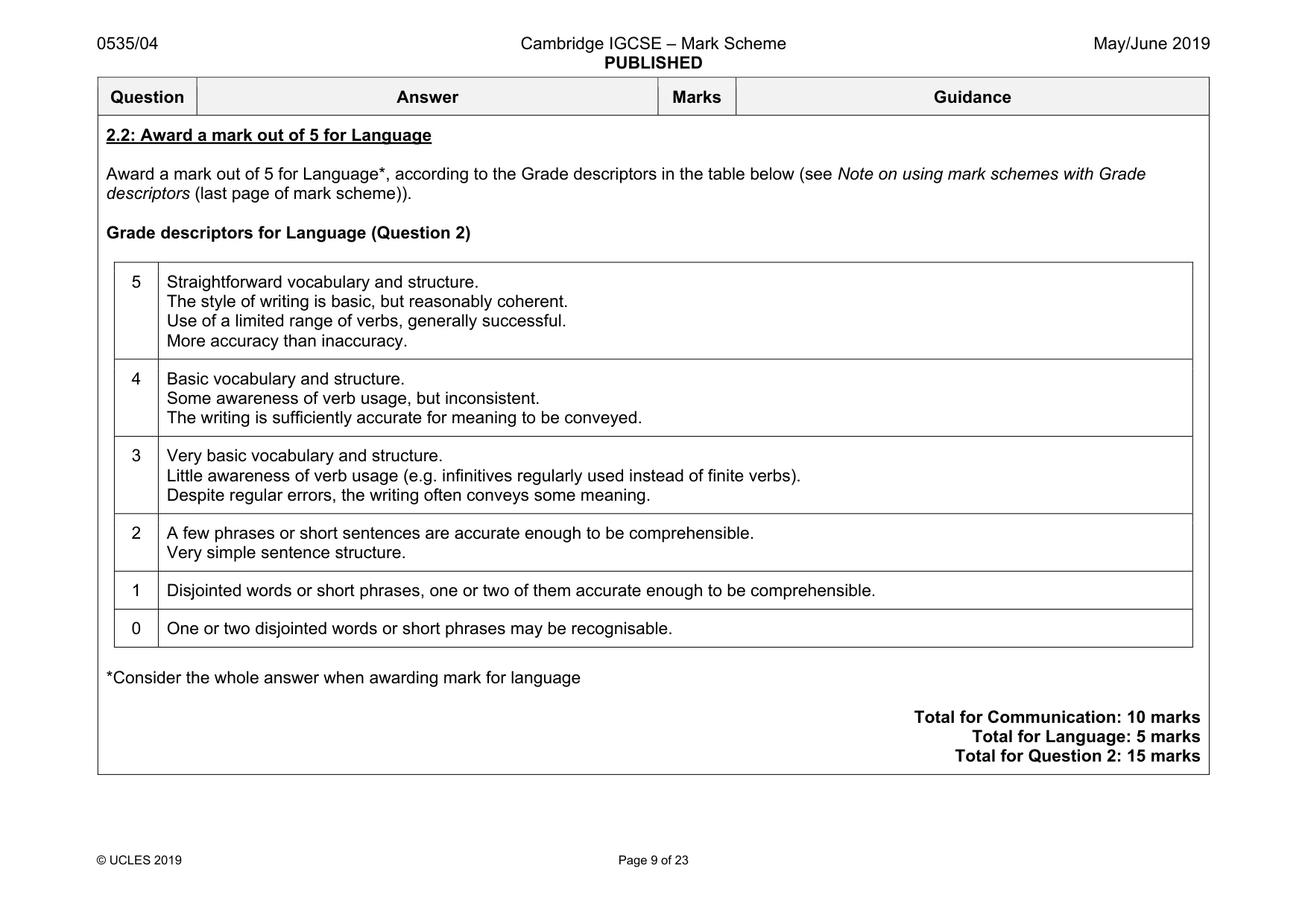
0535/04 Cambridge IGCSE – Mark Scheme PUBLISHED May/June 2019 © UCLES 2019 Page 9 of 23 Question Answer Marks Guidance 2.2: Award a mark out of 5 for Language Award a mark out of 5 for Language*, according to the Grade descriptors in the table below (see Note on using mark schemes with Grade descriptors (last page of mark scheme)). Grade descriptors for Language (Question 2) 5 Straightforward vocabulary and structure. The style of writing is basic, but reasonably coherent. Use of a limited range of verbs, generally successful. More accuracy than inaccuracy. 4 Basic vocabulary and structure. Some awareness of verb usage, but inconsistent. The writing is sufficiently accurate for meaning to be conveyed. 3 Very basic vocabulary and structure. Little awareness of verb usage (e.g. infinitives regularly used instead of finite verbs). Despite regular errors, the writing often conveys some meaning. 2 A few phrases or short sentences are accurate enough to be comprehensible. Very simple sentence structure. 1 Disjointed words or short phrases, one or two of them accurate enough to be comprehensible. 0 One or two disjointed words or short phrases may be recognisable. *Consider the whole answer when awarding mark for language Total for Communication: 10 marks Total for Language: 5 marks Total for Question 2: 15 marks
Mark scheme, page 10
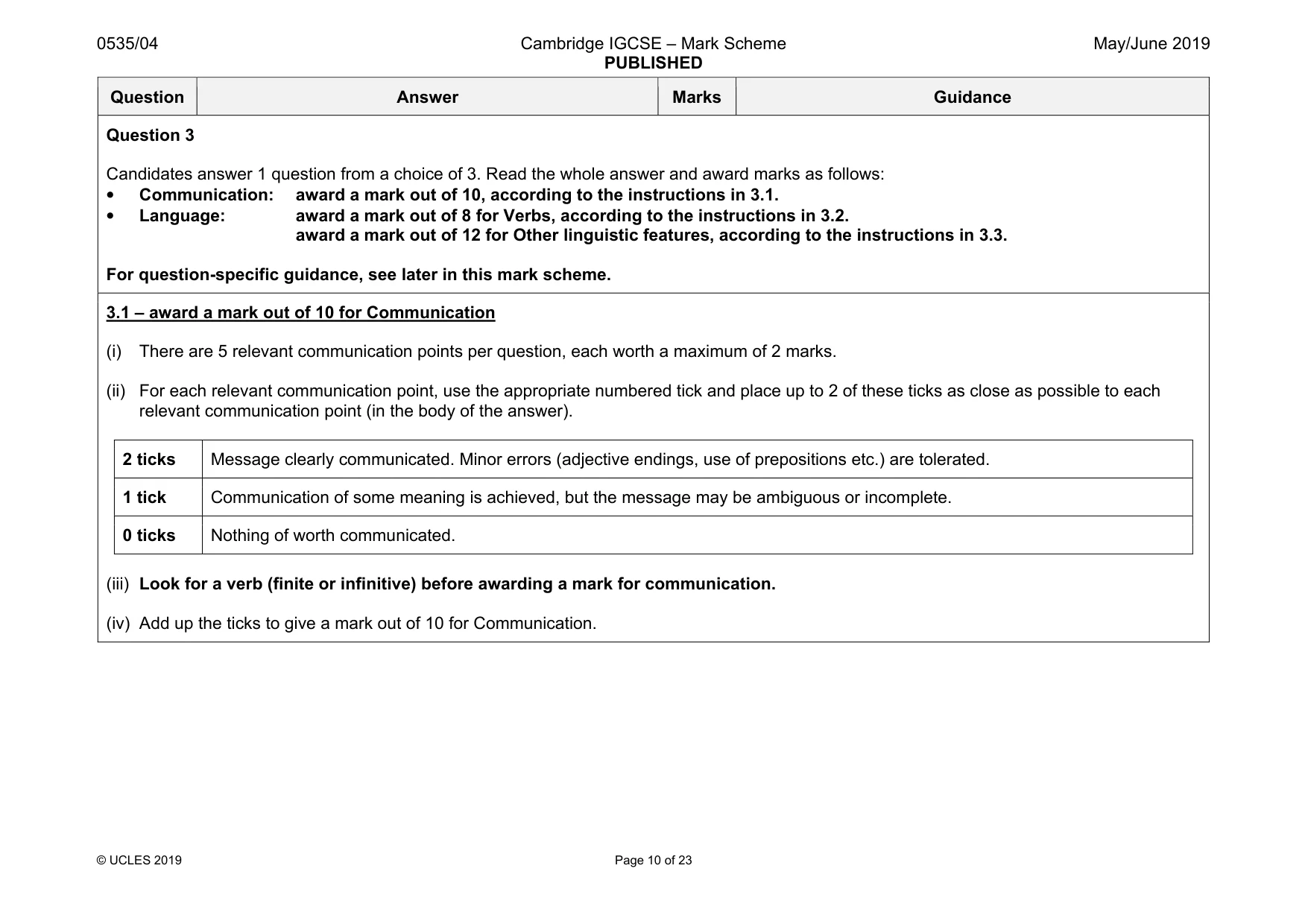
0535/04 Cambridge IGCSE – Mark Scheme PUBLISHED May/June 2019 © UCLES 2019 Page 10 of 23 Question Answer Marks Guidance Question 3 Candidates answer 1 question from a choice of 3. Read the whole answer and award marks as follows: • Communication: award a mark out of 10, according to the instructions in 3.1. • Language: award a mark out of 8 for Verbs, according to the instructions in 3.2. award a mark out of 12 for Other linguistic features, according to the instructions in 3.3. For question-specific guidance, see later in this mark scheme. 3.1 – award a mark out of 10 for Communication (i) There are 5 relevant communication points per question, each worth a maximum of 2 marks. (ii) For each relevant communication point, use the appropriate numbered tick and place up to 2 of these ticks as close as possible to each relevant communication point (in the body of the answer). 2 ticks Message clearly communicated. Minor errors (adjective endings, use of prepositions etc.) are tolerated. 1 tick Communication of some meaning is achieved, but the message may be ambiguous or incomplete. 0 ticks Nothing of worth communicated. (iii) Look for a verb (finite or infinitive) before awarding a mark for communication. (iv) Add up the ticks to give a mark out of 10 for Communication.
Mark scheme, page 11
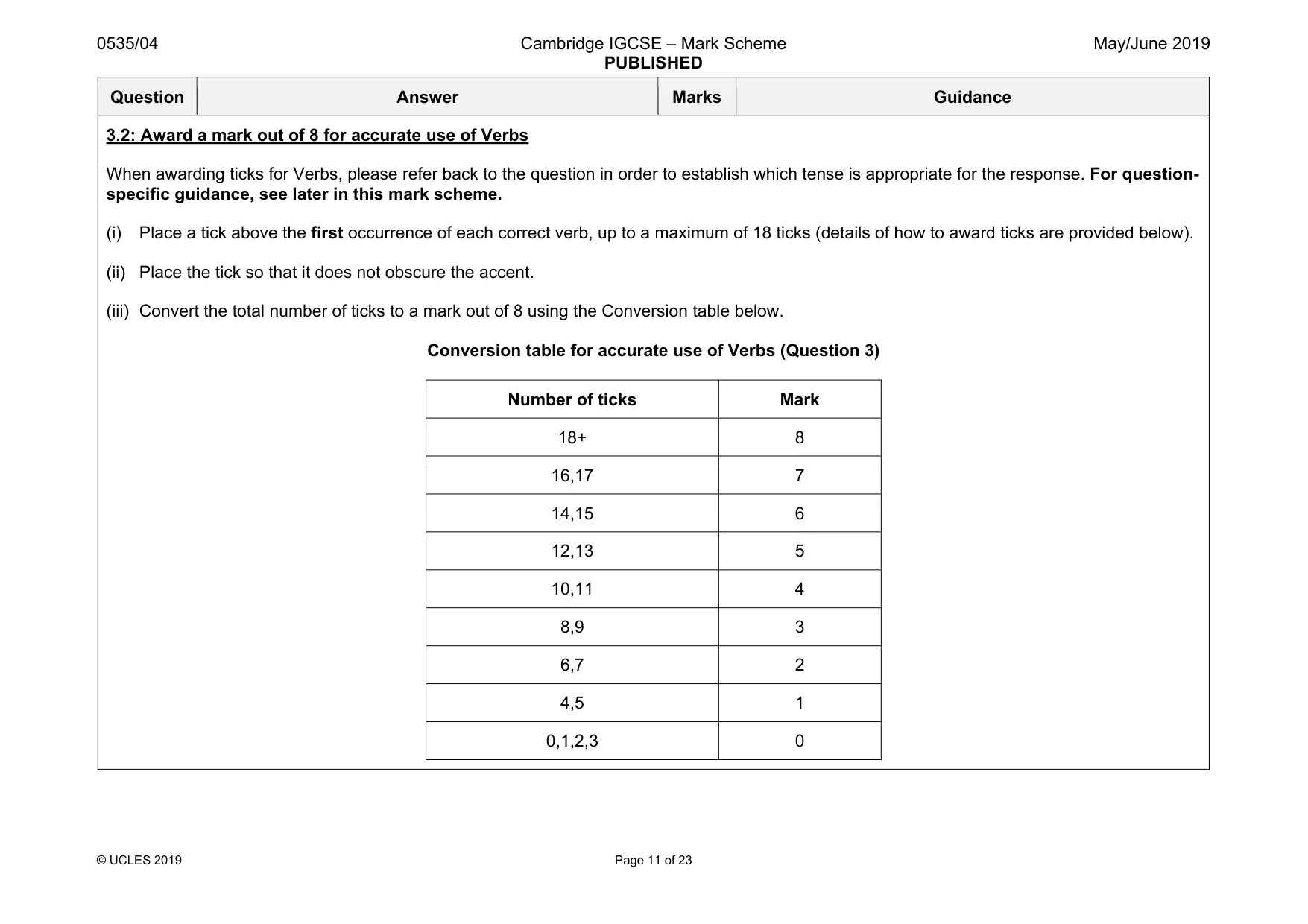
0535/04 Cambridge IGCSE – Mark Scheme PUBLISHED May/June 2019 © UCLES 2019 Page 11 of 23 Question Answer Marks Guidance 3.2: Award a mark out of 8 for accurate use of Verbs When awarding ticks for Verbs, please refer back to the question in order to establish which tense is appropriate for the response. For question- specific guidance, see later in this mark scheme. (i) Place a tick above the first occurrence of each correct verb, up to a maximum of 18 ticks (details of how to award ticks are provided below). (ii) Place the tick so that it does not obscure the accent. (iii) Convert the total number of ticks to a mark out of 8 using the Conversion table below. Conversion table for accurate use of Verbs (Question 3) Number of ticks Mark 18+ 8 16,17 7 14,15 6 12,13 5 10,11 4 8,9 3 6,7 2 4,5 1 0,1,2,3 0
Mark scheme, page 12
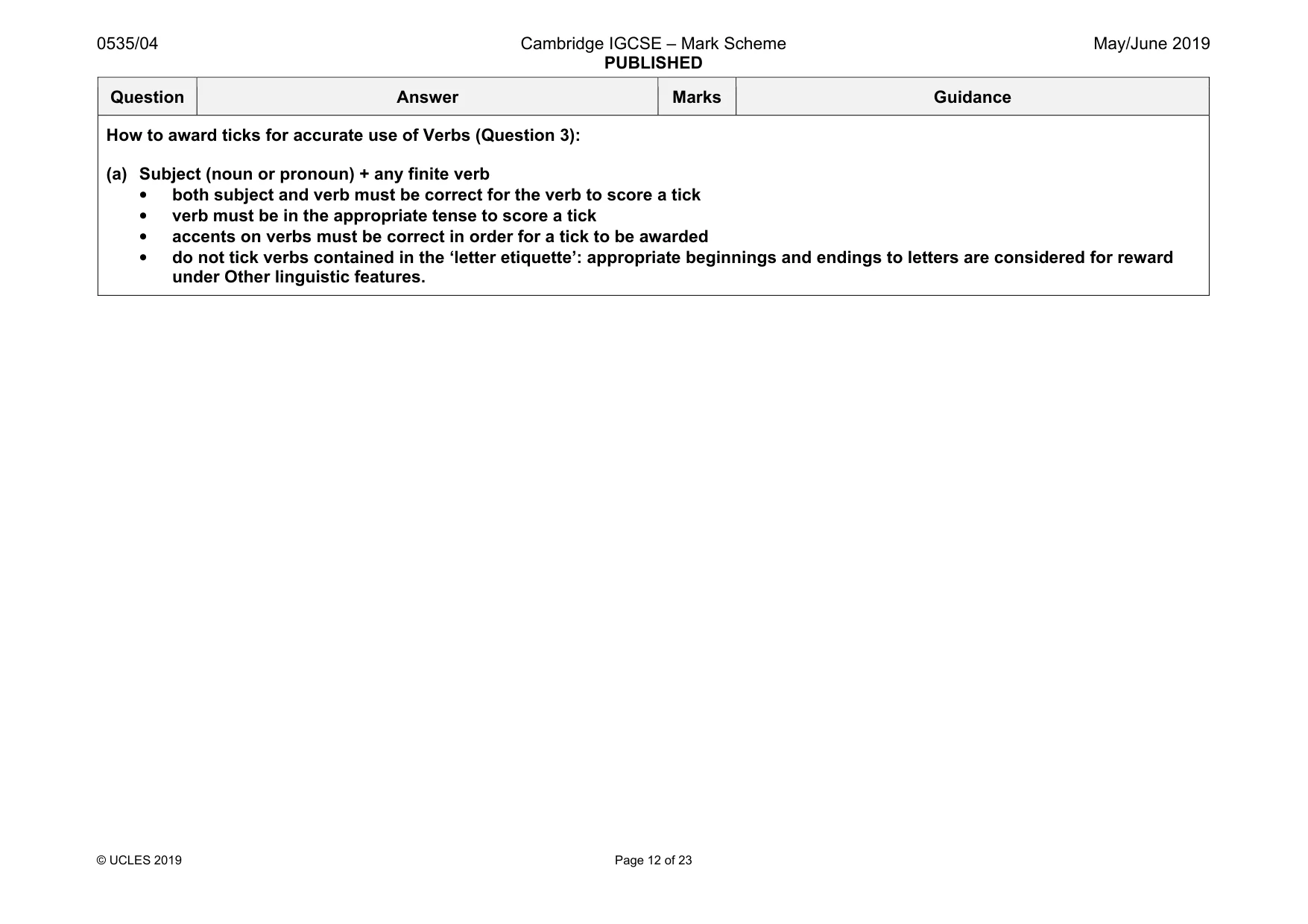
0535/04 Cambridge IGCSE – Mark Scheme PUBLISHED May/June 2019 © UCLES 2019 Page 12 of 23 Question Answer Marks Guidance How to award ticks for accurate use of Verbs (Question 3): (a) Subject (noun or pronoun) + any finite verb • both subject and verb must be correct for the verb to score a tick • verb must be in the appropriate tense to score a tick • accents on verbs must be correct in order for a tick to be awarded • do not tick verbs contained in the ‘letter etiquette’: appropriate beginnings and endings to letters are considered for reward under Other linguistic features.
Mark scheme, page 13
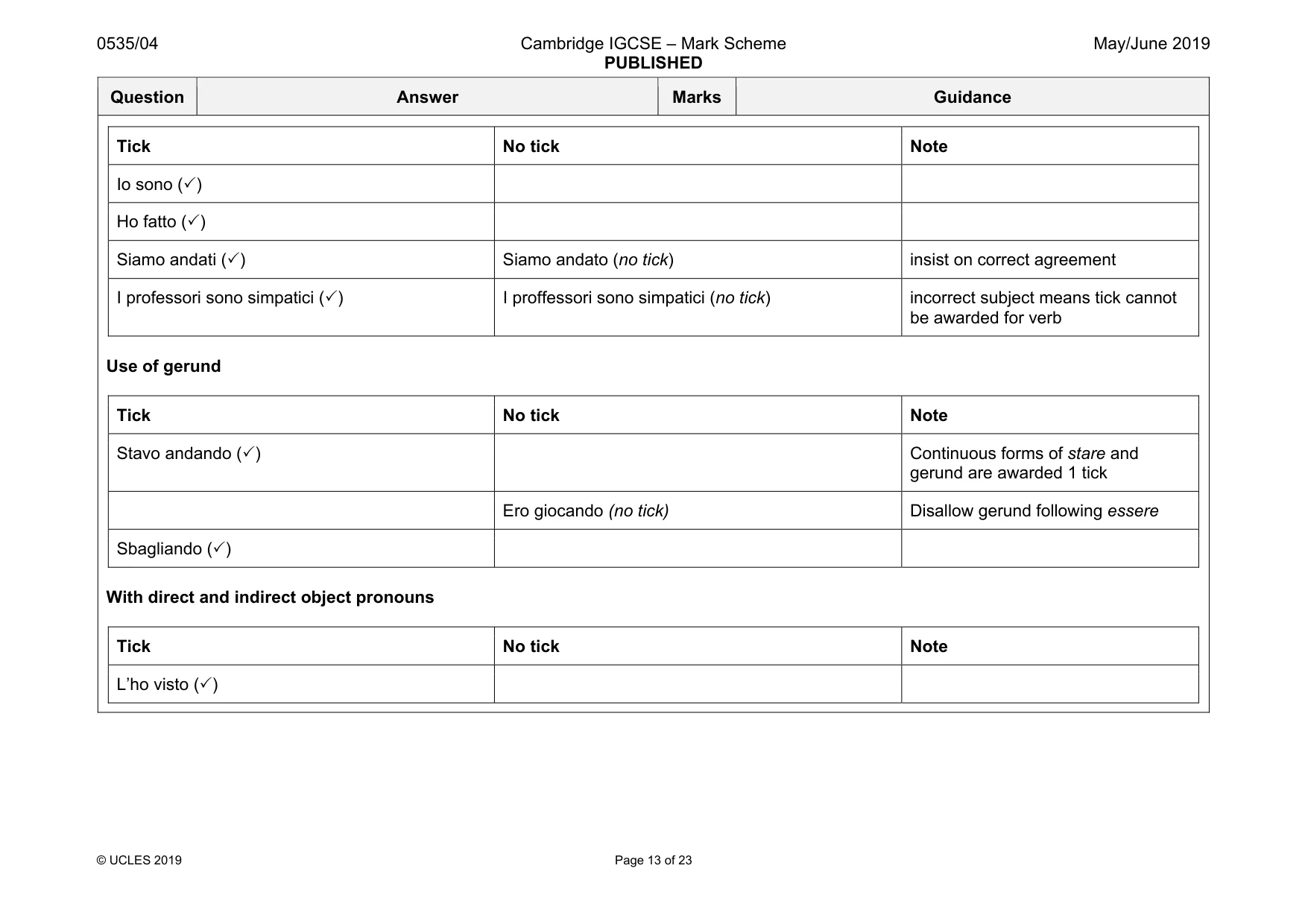
0535/04 Cambridge IGCSE – Mark Scheme PUBLISHED May/June 2019 © UCLES 2019 Page 13 of 23 Question Answer Marks Guidance Tick No tick Note Io sono (3) Ho fatto (3) Siamo andati (3) Siamo andato (no tick) insist on correct agreement I professori sono simpatici (3) I proffessori sono simpatici (no tick) incorrect subject means tick cannot be awarded for verb Use of gerund Tick No tick Note Stavo andando (3) Continuous forms of stare and gerund are awarded 1 tick Ero giocando (no tick) Disallow gerund following essere Sbagliando (3) With direct and indirect object pronouns Tick No tick Note L’ho visto (3)
Mark scheme, page 14
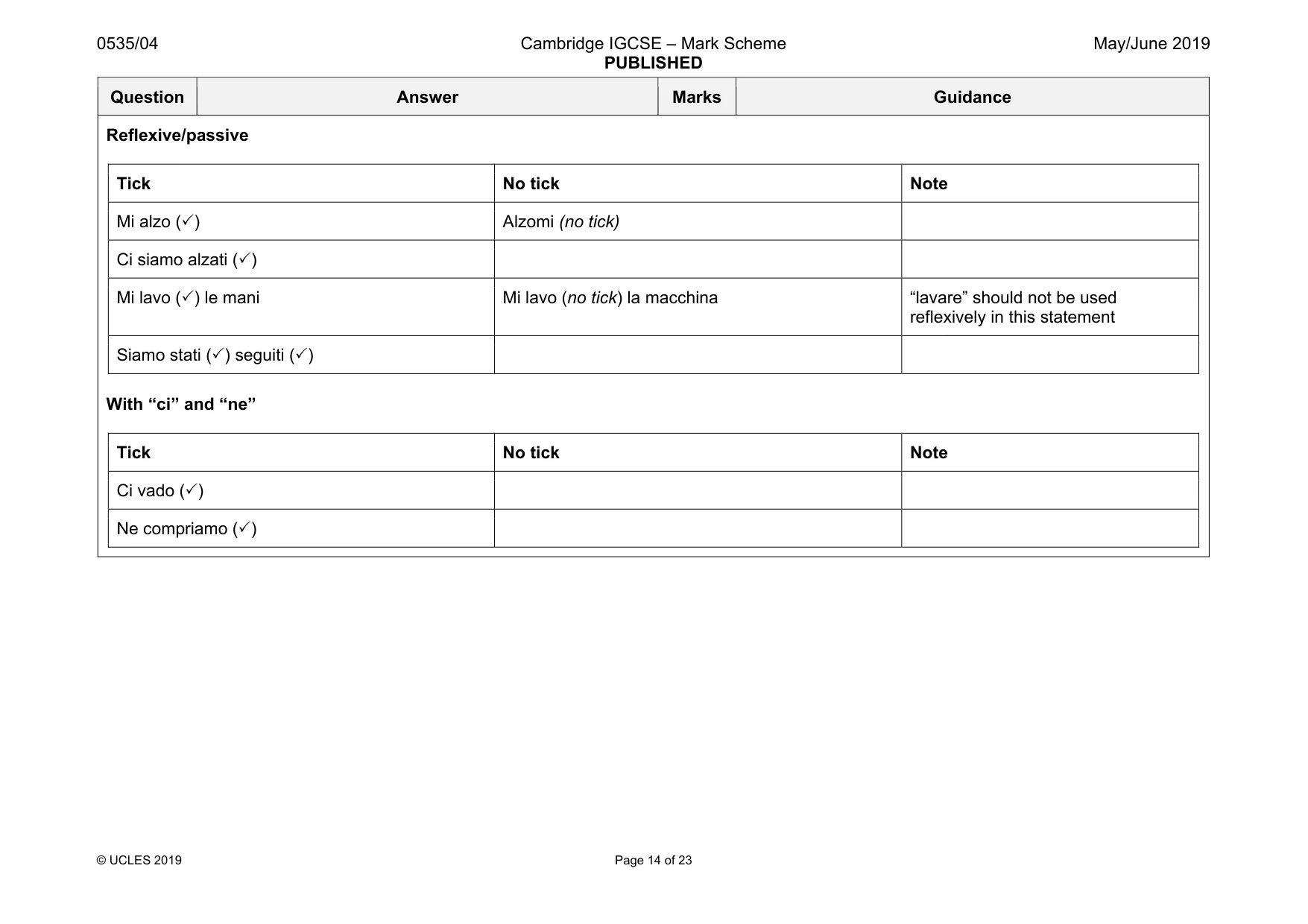
0535/04 Cambridge IGCSE – Mark Scheme PUBLISHED May/June 2019 © UCLES 2019 Page 14 of 23 Question Answer Marks Guidance Reflexive/passive Tick No tick Note Mi alzo (3) Alzomi (no tick) Ci siamo alzati (3) Mi lavo (3) le mani Mi lavo (no tick) la macchina “lavare” should not be used reflexively in this statement Siamo stati (3) seguiti (3) With “ci” and “ne” Tick No tick Note Ci vado (3) Ne compriamo (3)
Mark scheme, page 15
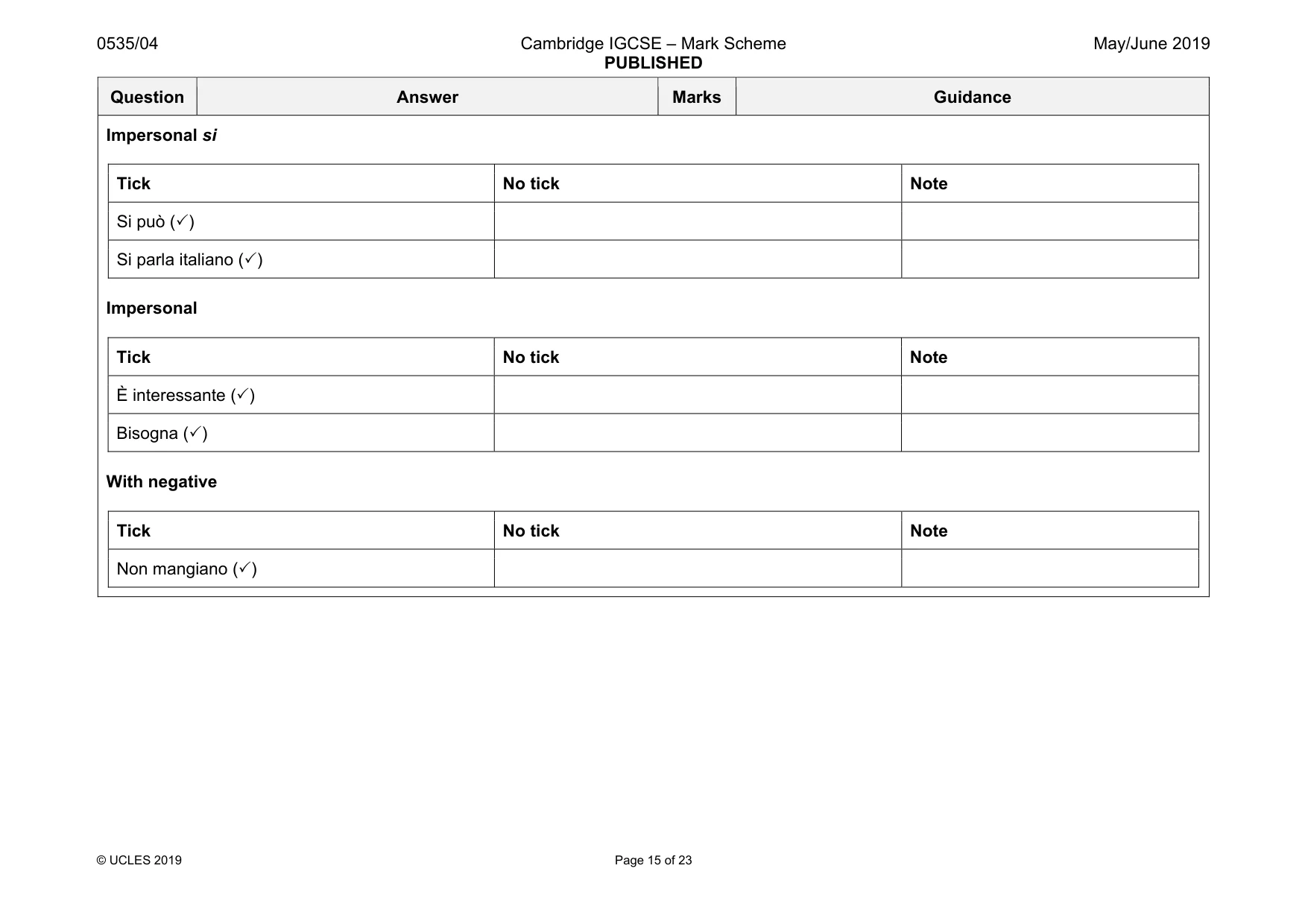
0535/04 Cambridge IGCSE – Mark Scheme PUBLISHED May/June 2019 © UCLES 2019 Page 15 of 23 Question Answer Marks Guidance Impersonal si Tick No tick Note Si può (3) Si parla italiano (3) Impersonal Tick No tick Note È interessante (3) Bisogna (3) With negative Tick No tick Note Non mangiano (3)
Mark scheme, page 16
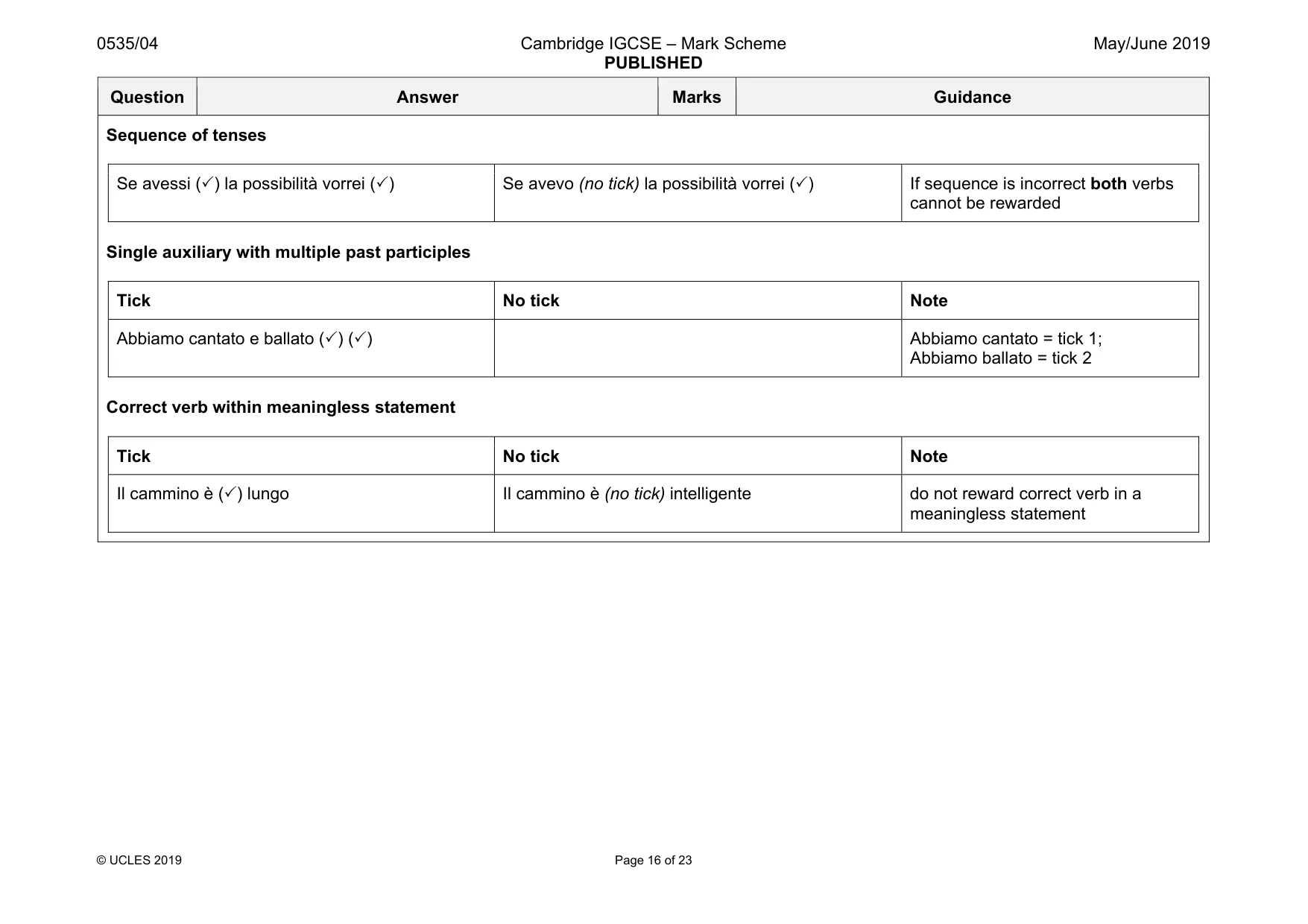
0535/04 Cambridge IGCSE – Mark Scheme PUBLISHED May/June 2019 © UCLES 2019 Page 16 of 23 Question Answer Marks Guidance Sequence of tenses Se avessi (3) la possibilità vorrei (3) Se avevo (no tick) la possibilità vorrei (3) If sequence is incorrect both verbs cannot be rewarded Single auxiliary with multiple past participles Tick No tick Note Abbiamo cantato e ballato (3) (3) Abbiamo cantato = tick 1; Abbiamo ballato = tick 2 Correct verb within meaningless statement Tick No tick Note Il cammino è (3) lungo Il cammino è (no tick) intelligente do not reward correct verb in a meaningless statement
Mark scheme, page 17
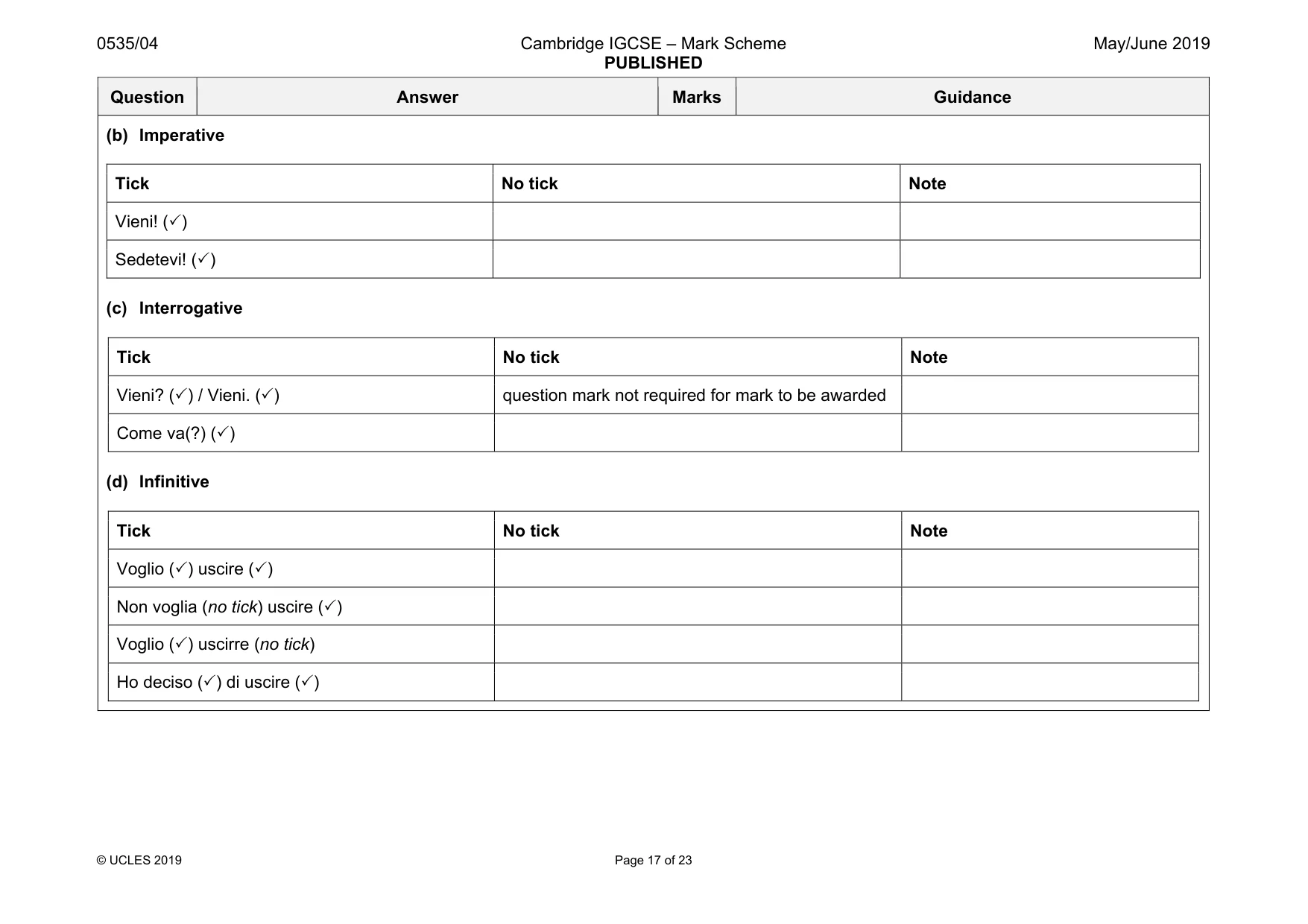
0535/04 Cambridge IGCSE – Mark Scheme PUBLISHED May/June 2019 © UCLES 2019 Page 17 of 23 Question Answer Marks Guidance (b) Imperative Tick No tick Note Vieni! (3) Sedetevi! (3) (c) Interrogative Tick No tick Note Vieni? (3) / Vieni. (3) question mark not required for mark to be awarded Come va(?) (3) (d) Infinitive Tick No tick Note Voglio (3) uscire (3) Non voglia (no tick) uscire (3) Voglio (3) uscirre (no tick) Ho deciso (3) di uscire (3)
Mark scheme, page 18
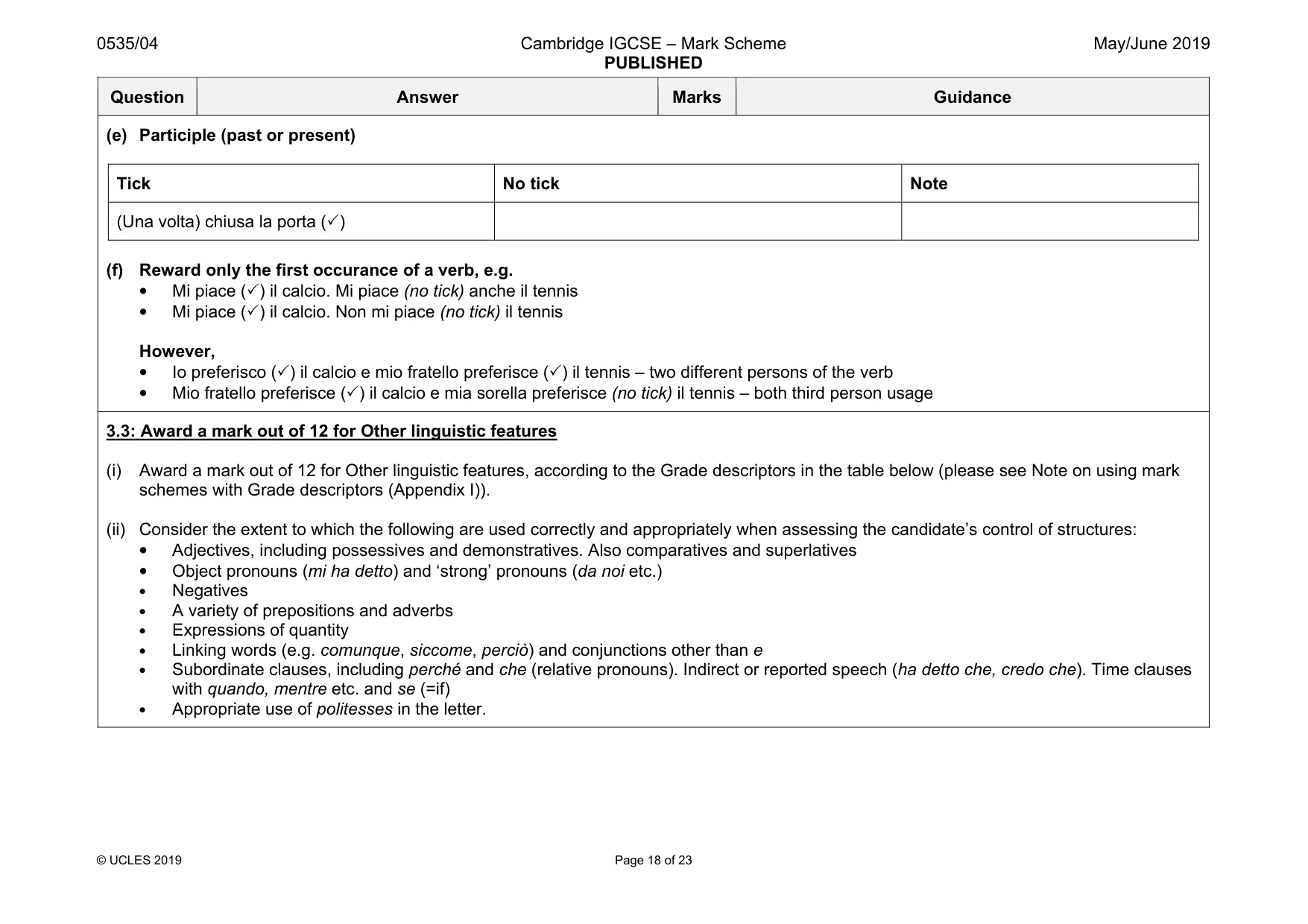
0535/04 Cambridge IGCSE – Mark Scheme PUBLISHED May/June 2019 © UCLES 2019 Page 18 of 23 Question Answer Marks Guidance (e) Participle (past or present) Tick No tick Note (Una volta) chiusa la porta (3) (f) Reward only the first occurance of a verb, e.g. • Mi piace (3) il calcio. Mi piace (no tick) anche il tennis • Mi piace (3) il calcio. Non mi piace (no tick) il tennis However, • Io preferisco (3) il calcio e mio fratello preferisce (3) il tennis – two different persons of the verb • Mio fratello preferisce (3) il calcio e mia sorella preferisce (no tick) il tennis – both third person usage 3.3: Award a mark out of 12 for Other linguistic features (i) Award a mark out of 12 for Other linguistic features, according to the Grade descriptors in the table below (please see Note on using mark schemes with Grade descriptors (Appendix I)). (ii) Consider the extent to which the following are used correctly and appropriately when assessing the candidate’s control of structures: • Adjectives, including possessives and demonstratives. Also comparatives and superlatives • Object pronouns (mi ha detto) and ‘strong’ pronouns (da noi etc.) • Negatives • A variety of prepositions and adverbs • Expressions of quantity • Linking words (e.g. comunque, siccome, perciò) and conjunctions other than e • Subordinate clauses, including perché and che (relative pronouns). Indirect or reported speech (ha detto che, credo che). Time clauses with quando, mentre etc. and se (=if) • Appropriate use of politesses in the letter.
Mark scheme, page 19
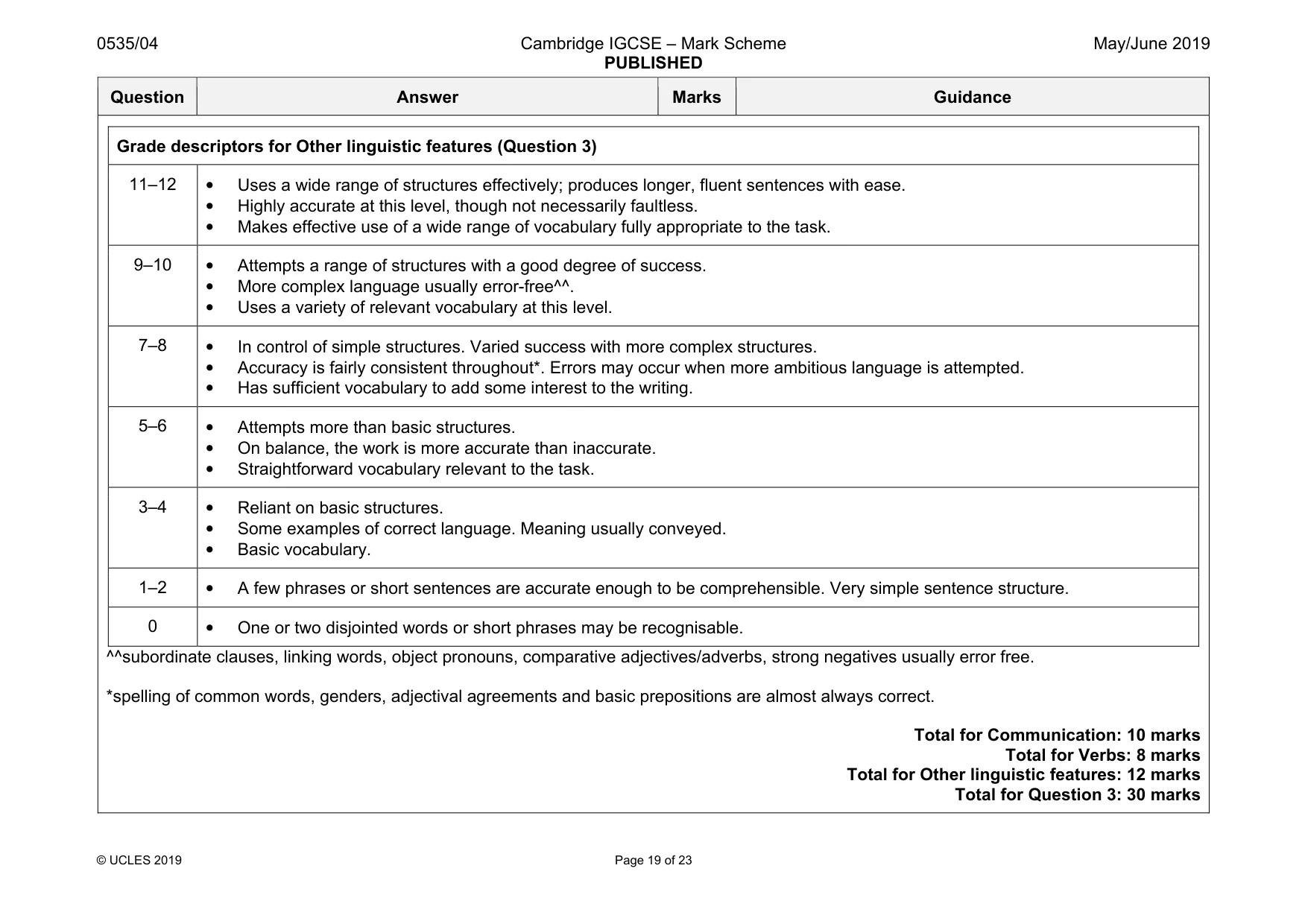
0535/04 Cambridge IGCSE – Mark Scheme PUBLISHED May/June 2019 © UCLES 2019 Page 19 of 23 Question Answer Marks Guidance Grade descriptors for Other linguistic features (Question 3) 11–12 • Uses a wide range of structures effectively; produces longer, fluent sentences with ease. • Highly accurate at this level, though not necessarily faultless. • Makes effective use of a wide range of vocabulary fully appropriate to the task. 9–10 • Attempts a range of structures with a good degree of success. • More complex language usually error-free^^. • Uses a variety of relevant vocabulary at this level. 7–8 • In control of simple structures. Varied success with more complex structures. • Accuracy is fairly consistent throughout*. Errors may occur when more ambitious language is attempted. • Has sufficient vocabulary to add some interest to the writing. 5–6 • Attempts more than basic structures. • On balance, the work is more accurate than inaccurate. • Straightforward vocabulary relevant to the task. 3–4 • Reliant on basic structures. • Some examples of correct language. Meaning usually conveyed. • Basic vocabulary. 1–2 • A few phrases or short sentences are accurate enough to be comprehensible. Very simple sentence structure. 0 • One or two disjointed words or short phrases may be recognisable. ^^subordinate clauses, linking words, object pronouns, comparative adjectives/adverbs, strong negatives usually error free. *spelling of common words, genders, adjectival agreements and basic prepositions are almost always correct. Total for Communication: 10 marks Total for Verbs: 8 marks Total for Other linguistic features: 12 marks Total for Question 3: 30 marks
Mark scheme, page 20
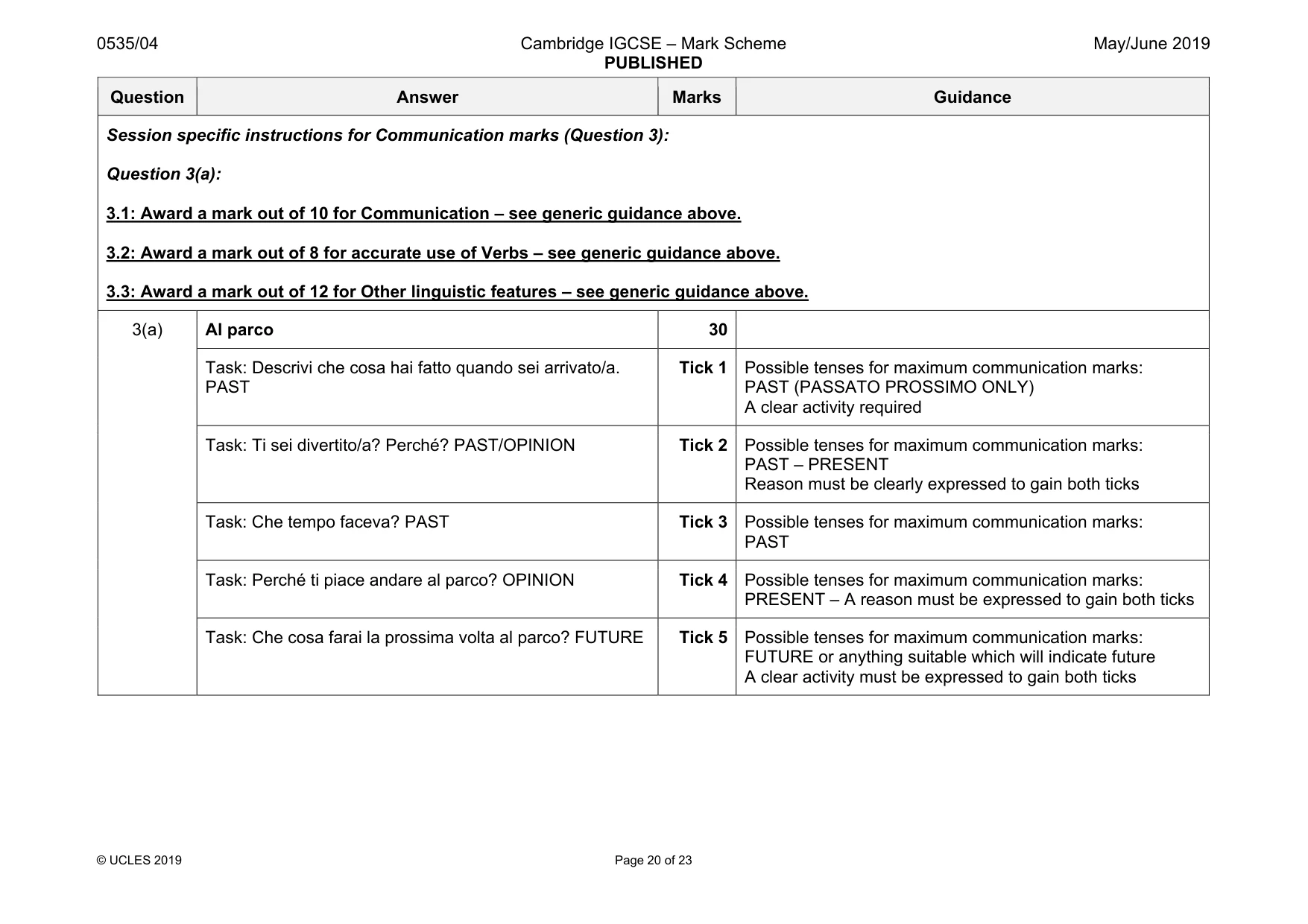
0535/04 Cambridge IGCSE – Mark Scheme PUBLISHED May/June 2019 © UCLES 2019 Page 20 of 23 Question Answer Marks Guidance Session specific instructions for Communication marks (Question 3): Question 3(a): 3.1: Award a mark out of 10 for Communication – see generic guidance above. 3.2: Award a mark out of 8 for accurate use of Verbs – see generic guidance above. 3.3: Award a mark out of 12 for Other linguistic features – see generic guidance above. 3(a) Al parco 30 Task: Descrivi che cosa hai fatto quando sei arrivato/a. PAST Tick 1 Possible tenses for maximum communication marks: PAST (PASSATO PROSSIMO ONLY) A clear activity required Task: Ti sei divertito/a? Perché? PAST/OPINION Tick 2 Possible tenses for maximum communication marks: PAST – PRESENT Reason must be clearly expressed to gain both ticks Task: Che tempo faceva? PAST Tick 3 Possible tenses for maximum communication marks: PAST Task: Perché ti piace andare al parco? OPINION Tick 4 Possible tenses for maximum communication marks: PRESENT – A reason must be expressed to gain both ticks Task: Che cosa farai la prossima volta al parco? FUTURE Tick 5 Possible tenses for maximum communication marks: FUTURE or anything suitable which will indicate future A clear activity must be expressed to gain both ticks
Mark scheme, page 21
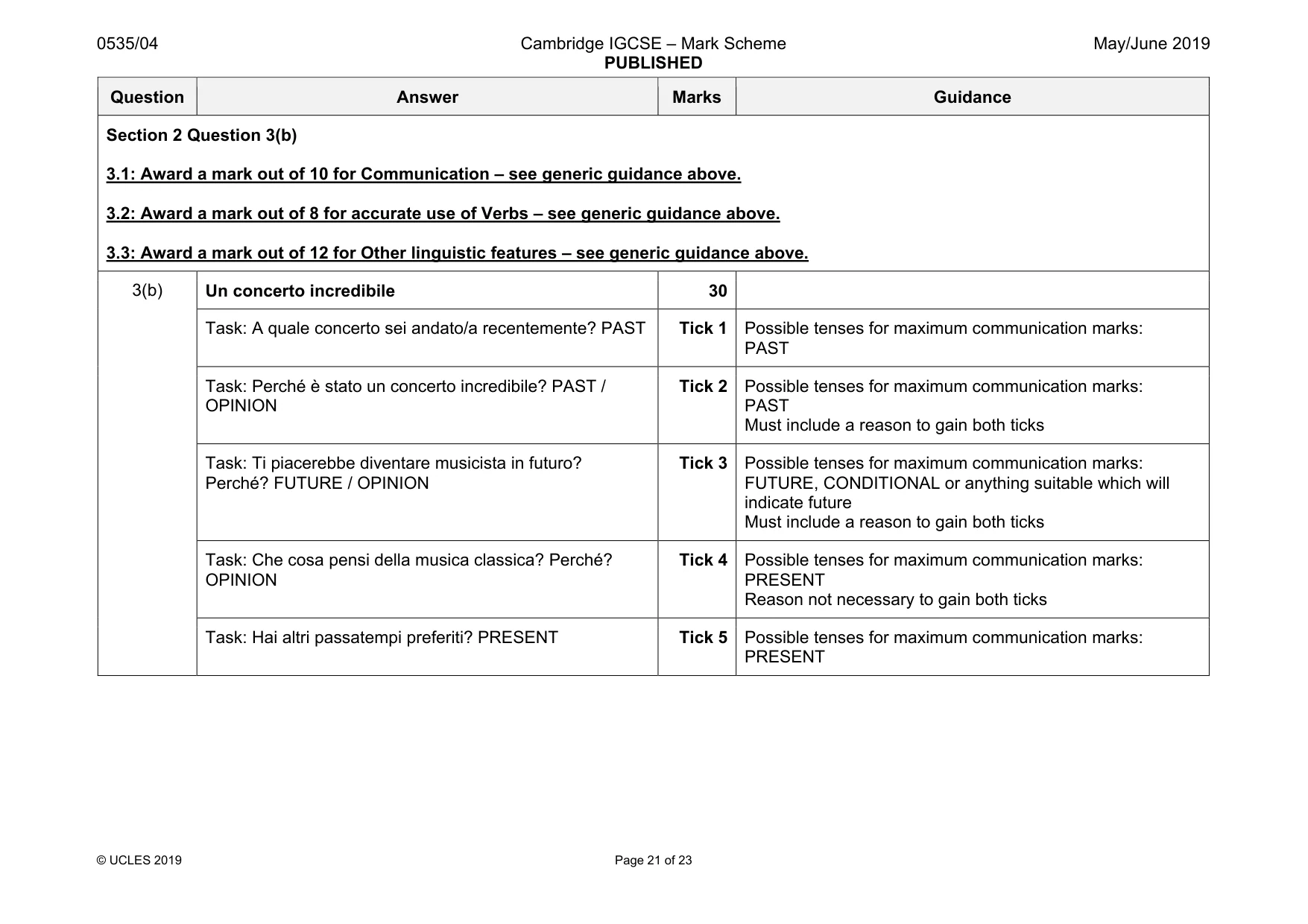
0535/04 Cambridge IGCSE – Mark Scheme PUBLISHED May/June 2019 © UCLES 2019 Page 21 of 23 Question Answer Marks Guidance Section 2 Question 3(b) 3.1: Award a mark out of 10 for Communication – see generic guidance above. 3.2: Award a mark out of 8 for accurate use of Verbs – see generic guidance above. 3.3: Award a mark out of 12 for Other linguistic features – see generic guidance above. 3(b) Un concerto incredibile 30 Task: A quale concerto sei andato/a recentemente? PAST Tick 1 Possible tenses for maximum communication marks: PAST Task: Perché è stato un concerto incredibile? PAST / OPINION Tick 2 Possible tenses for maximum communication marks: PAST Must include a reason to gain both ticks Task: Ti piacerebbe diventare musicista in futuro? Perché? FUTURE / OPINION Tick 3 Possible tenses for maximum communication marks: FUTURE, CONDITIONAL or anything suitable which will indicate future Must include a reason to gain both ticks Task: Che cosa pensi della musica classica? Perché? OPINION Tick 4 Possible tenses for maximum communication marks: PRESENT Reason not necessary to gain both ticks Task: Hai altri passatempi preferiti? PRESENT Tick 5 Possible tenses for maximum communication marks: PRESENT
Mark scheme, page 22
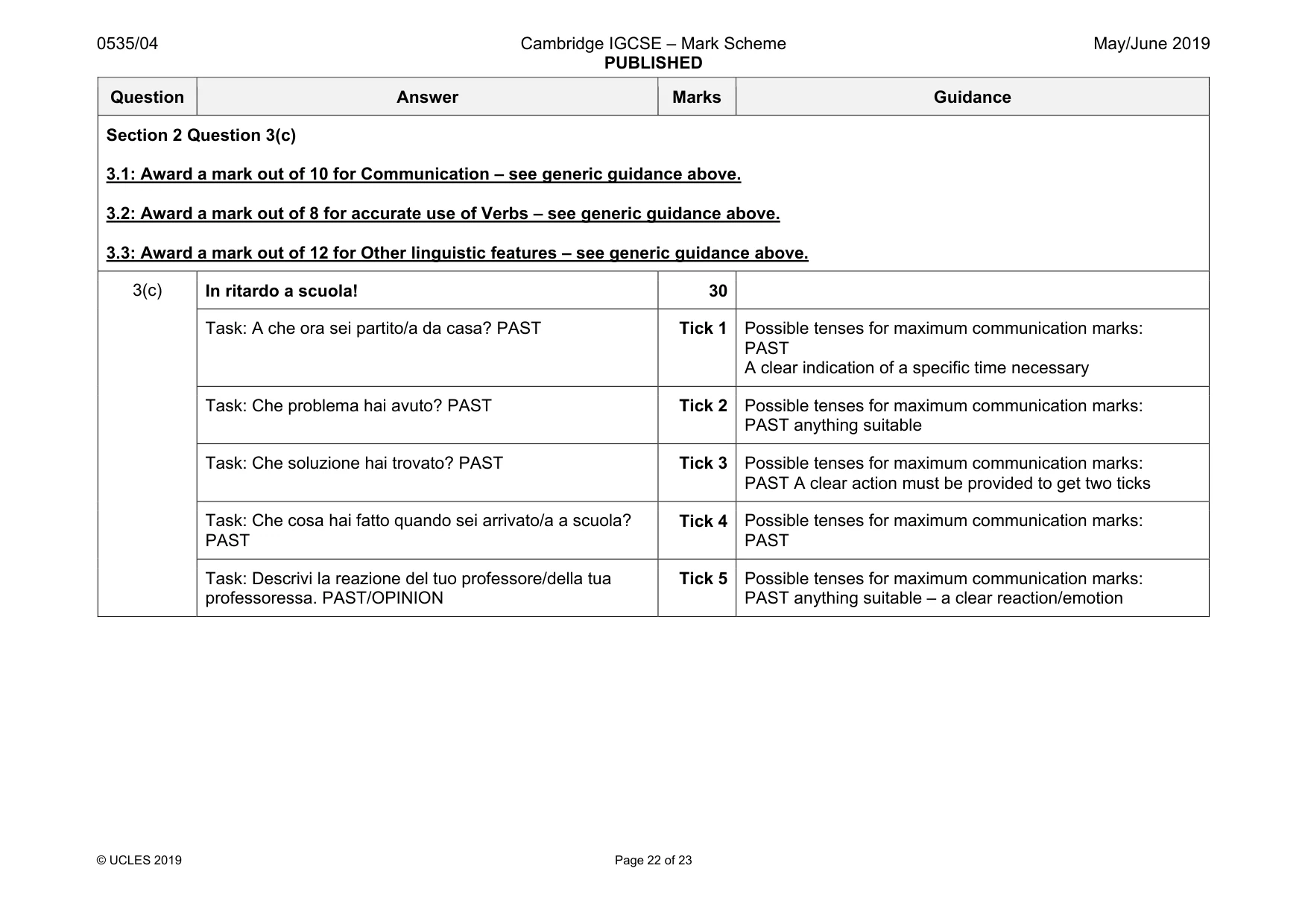
0535/04 Cambridge IGCSE – Mark Scheme PUBLISHED May/June 2019 © UCLES 2019 Page 22 of 23 Question Answer Marks Guidance Section 2 Question 3(c) 3.1: Award a mark out of 10 for Communication – see generic guidance above. 3.2: Award a mark out of 8 for accurate use of Verbs – see generic guidance above. 3.3: Award a mark out of 12 for Other linguistic features – see generic guidance above. 3(c) In ritardo a scuola! 30 Task: A che ora sei partito/a da casa? PAST Tick 1 Possible tenses for maximum communication marks: PAST A clear indication of a specific time necessary Task: Che problema hai avuto? PAST Tick 2 Possible tenses for maximum communication marks: PAST anything suitable Task: Che soluzione hai trovato? PAST Tick 3 Possible tenses for maximum communication marks: PAST A clear action must be provided to get two ticks Task: Che cosa hai fatto quando sei arrivato/a a scuola? PAST Tick 4 Possible tenses for maximum communication marks: PAST Task: Descrivi la reazione del tuo professore/della tua professoressa. PAST/OPINION Tick 5 Possible tenses for maximum communication marks: PAST anything suitable – a clear reaction/emotion
Mark scheme, page 23
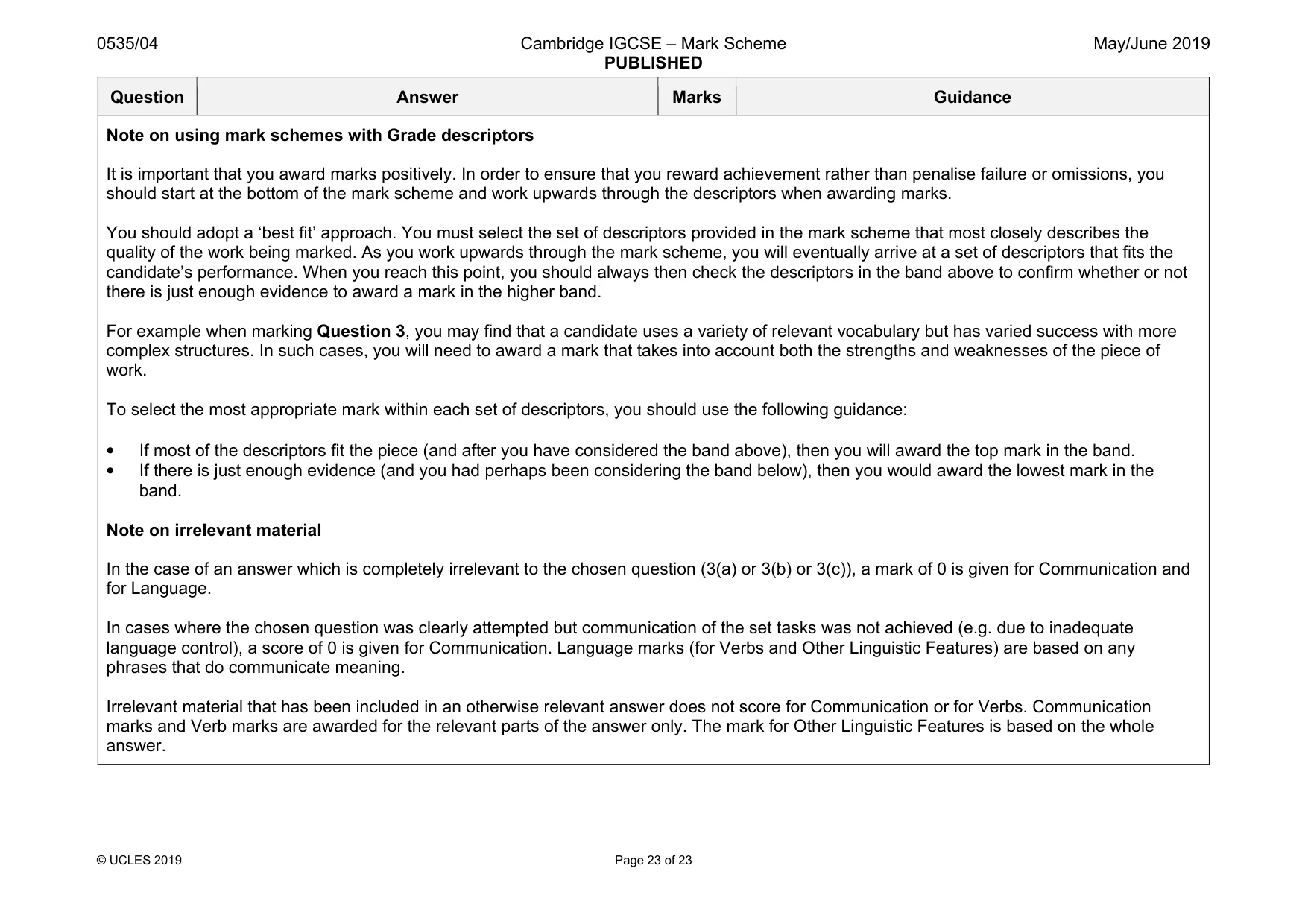
0535/04 Cambridge IGCSE – Mark Scheme PUBLISHED May/June 2019 © UCLES 2019 Page 23 of 23 Question Answer Marks Guidance Note on using mark schemes with Grade descriptors It is important that you award marks positively. In order to ensure that you reward achievement rather than penalise failure or omissions, you should start at the bottom of the mark scheme and work upwards through the descriptors when awarding marks. You should adopt a ‘best fit’ approach. You must select the set of descriptors provided in the mark scheme that most closely describes the quality of the work being marked. As you work upwards through the mark scheme, you will eventually arrive at a set of descriptors that fits the candidate’s performance. When you reach this point, you should always then check the descriptors in the band above to confirm whether or not there is just enough evidence to award a mark in the higher band. For example when marking Question 3, you may find that a candidate uses a variety of relevant vocabulary but has varied success with more complex structures. In such cases, you will need to award a mark that takes into account both the strengths and weaknesses of the piece of work. To select the most appropriate mark within each set of descriptors, you should use the following guidance: • If most of the descriptors fit the piece (and after you have considered the band above), then you will award the top mark in the band. • If there is just enough evidence (and you had perhaps been considering the band below), then you would award the lowest mark in the band. Note on irrelevant material In the case of an answer which is completely irrelevant to the chosen question (3(a) or 3(b) or 3(c)), a mark of 0 is given for Communication and for Language. In cases where the chosen question was clearly attempted but communication of the set tasks was not achieved (e.g. due to inadequate language control), a score of 0 is given for Communication. Language marks (for Verbs and Other Linguistic Features) are based on any phrases that do communicate meaning. Irrelevant material that has been included in an otherwise relevant answer does not score for Communication or for Verbs. Communication marks and Verb marks are awarded for the relevant parts of the answer only. The mark for Other Linguistic Features is based on the whole answer.
What you needed in this session
Cambridge’s own grade thresholds for 2019 May/June, Paper 4 · Variant 1. A higher threshold means an easier paper — the bar moves with how the cohort did.